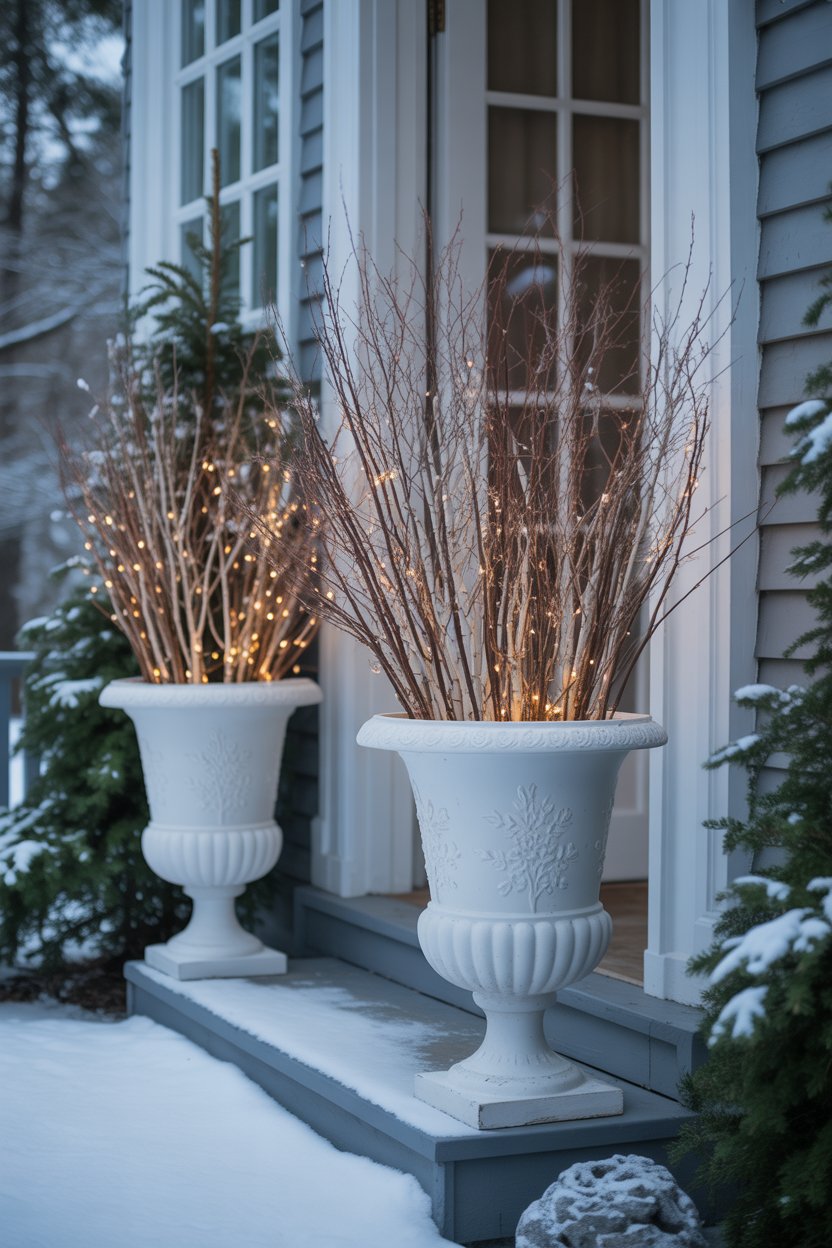
28 Stunning Pencil Christmas Tree Ideas You Need to Try This Holiday Season

If your pencil Christmas tree situation has been bothering you for longer than you’d like to admit, you’re in good company. Most of us have a corner a standard six-foot tree would swallow whole — and a Pinterest board full of slim trees we saved and never acted on.
We spent serious time browsing Target, Walmart, Wayfair, IKEA, and Facebook Marketplace to bring you only what’s worth your attention this year, across looks that land anywhere from $12 to $900.
Inside: 28 curated ideas spanning flocked and snowy, traditional red and gold, pastel and metallic, and pared-back minimalist — each with a budget take and a splurge take, so you can see where the money actually goes. And stay until the end, because we break down the three mistakes that quietly wreck these looks.
Slim trees are having a genuine moment in 2026. As apartments shrink and people stop decorating one big centerpiece in favor of two or three dressed corners, the pencil silhouette finally reads as a choice instead of a compromise.
Pin this guide for later — your future self will thank you when it’s time to actually do this.
This post contains affiliate links. If you buy through them, we may earn a small commission at no extra cost to you.
1. Warm White Lights and Metallics on a Slender Tree
Three things are doing the heavy lifting here. First, contrast: the tree’s narrow profile set against wide cream pleated curtains makes the silhouette read as deliberate rather than cramped. Second, repetition — gold, silver, and bronze spheres repeat at even intervals, so the eye travels upward instead of snagging on one spot. Third, restraint. Forest green, warm white light, and metal tones only, nothing else competing. That’s why a tree this slim still feels substantial.
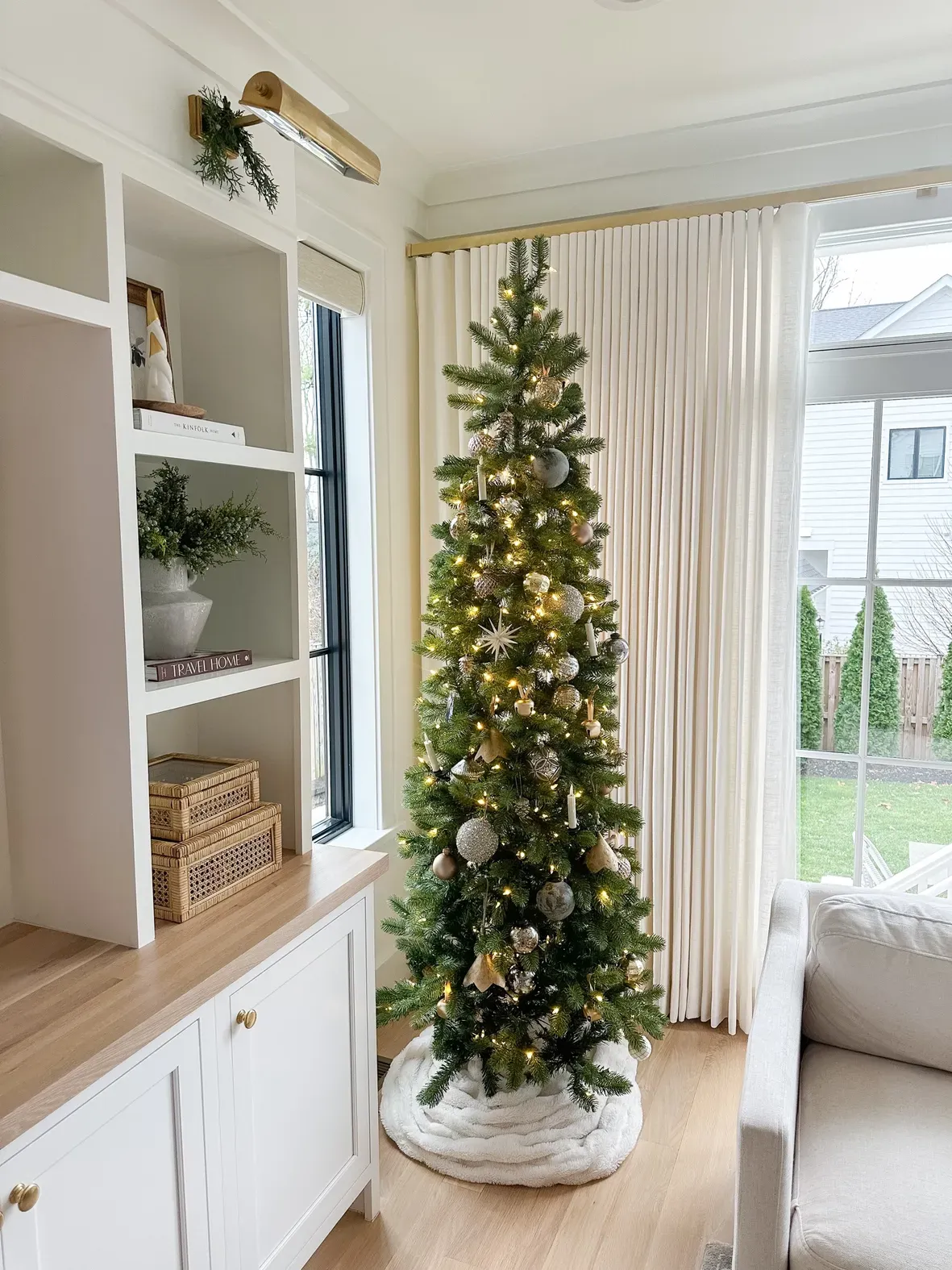
Hang your metallic ornaments in odd-numbered clusters of three and vary the sizes inside each cluster — a 4-inch, a 3-inch, and a 2.5-inch ball reads intentional; three identical ones read like a boxed kit. Push the deepest ornaments 2 to 3 inches inside the branches. On a pencil tree, depth is your only volume. The plush white skirt finishes it: wide, low, and generous enough to give that narrow base something to sit on.
2. Flocked Slim Tree Against White Paneling and Pinecones
the flocking. Take the snow effect away and this becomes a perfectly nice green tree in a classic room — but the white-on-white conversation between frosted branches, paneled walls, and the ornate mantel is what makes the whole corner feel like one continuous thought instead of three separate purchases. You’re buying a color story here, not just a tree.
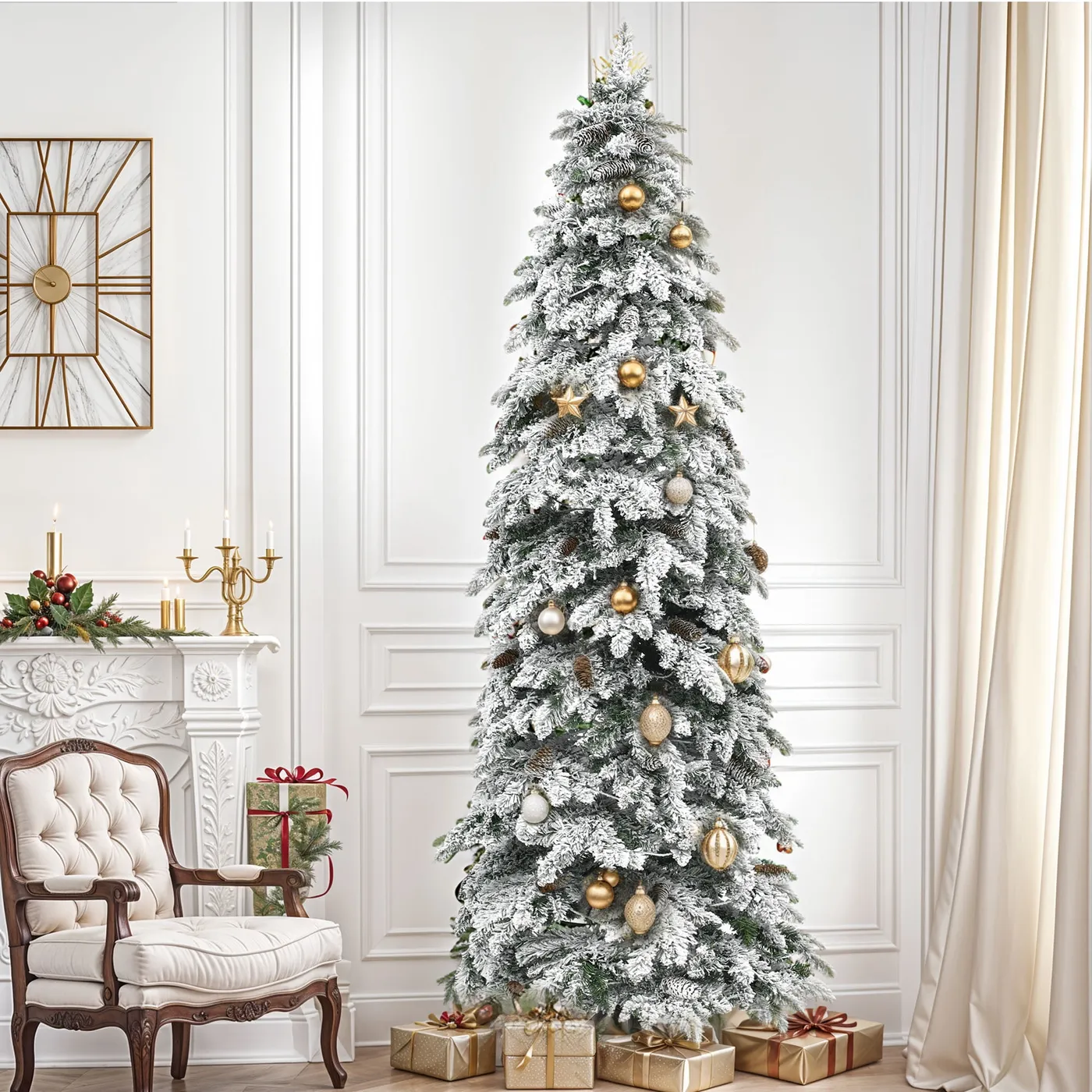
This look wants real height. A flocked pencil tree at 7 to 7.5 feet needs a ceiling of at least 8 feet so the topper has breathing room, and the base — usually 24 to 30 inches across — needs only about 3 feet of corner clearance. The catch is the company it keeps: this composition works when the tree sits beside a fireplace or a seating corner, not floating in an empty hallway.
3. Pre-Lit Flocked Tree Beside a Lit Fireplace
Two light sources, one warm temperature. When your tree is pre-lit with 2700K warm white and a real fire is burning, everything in the room shifts amber — so keep gift wrap in gold, cream, and white and skip icy silver, which turns grey and dirty beside firelight. Also run the tree cord along the baseboard behind the tree skirt before you build the present pile. Nobody wants an extension cord in the shot.
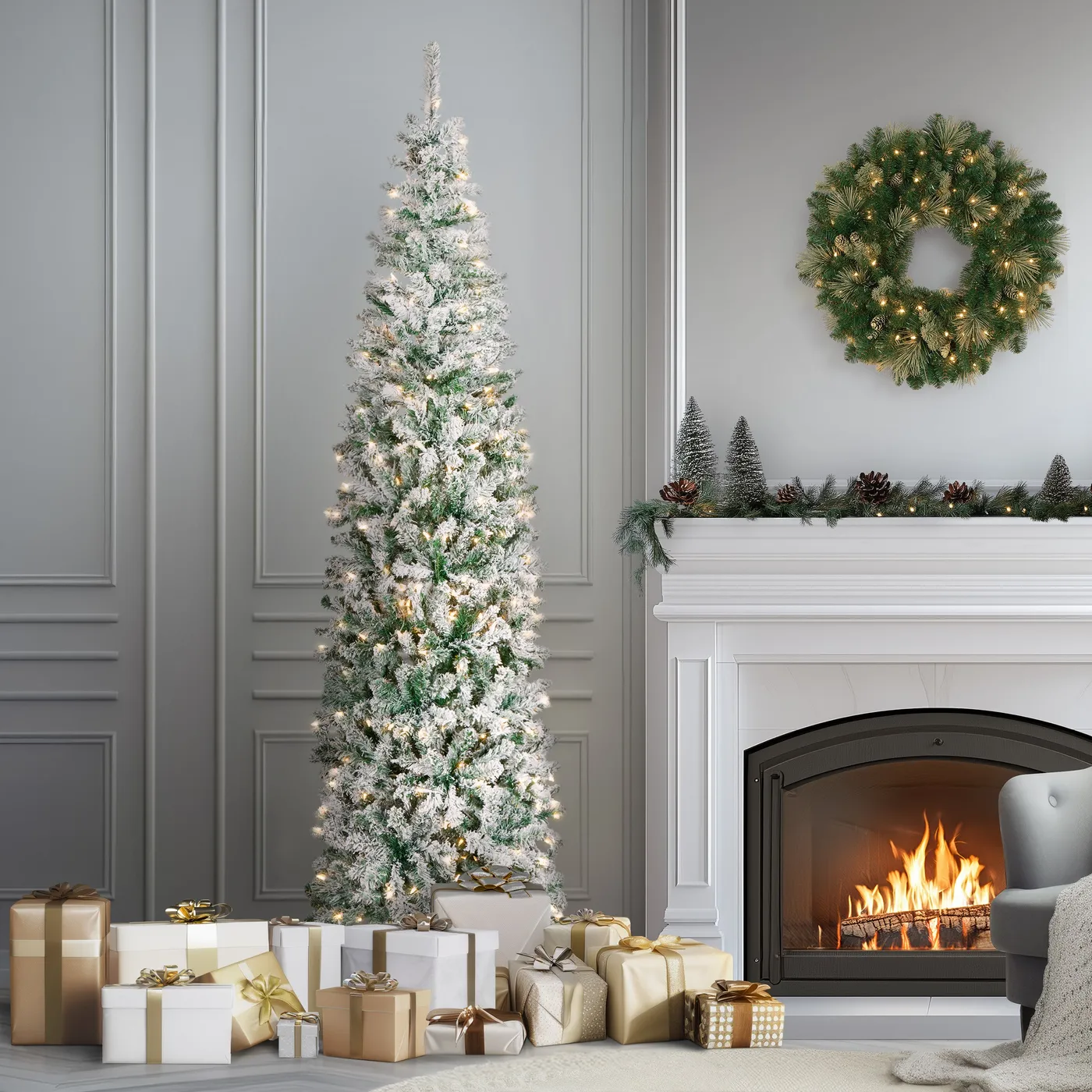
Flocked pencil trees have been climbing steadily since around 2020, and by 2026 they’re the default choice for anyone decorating a smaller footprint — apartments, entry corners, that awkward strip of wall beside a fireplace. The logic is practical: flocking adds visual weight without adding girth, so a 24-inch-wide tree reads as full. The light grey paneled wall behind this one is the newer half of the trend, a cool neutral backdrop that lets white flocking actually pop.
4. Silvery Slim Tree Built Around Fine Ornament Detail
Silver-toned pencil trees are unforgiving in one specific way: every ornament becomes the star, so mismatched baubles show up immediately. If you’re dressing this tree with family in a busy room, accept that it will read as charming and busy rather than styled — and that’s genuinely fine. Do check the foldability before you buy. A slim tree that folds flat for storage is worth more than one that doesn’t, especially if it’s going in a closet instead of a garage.
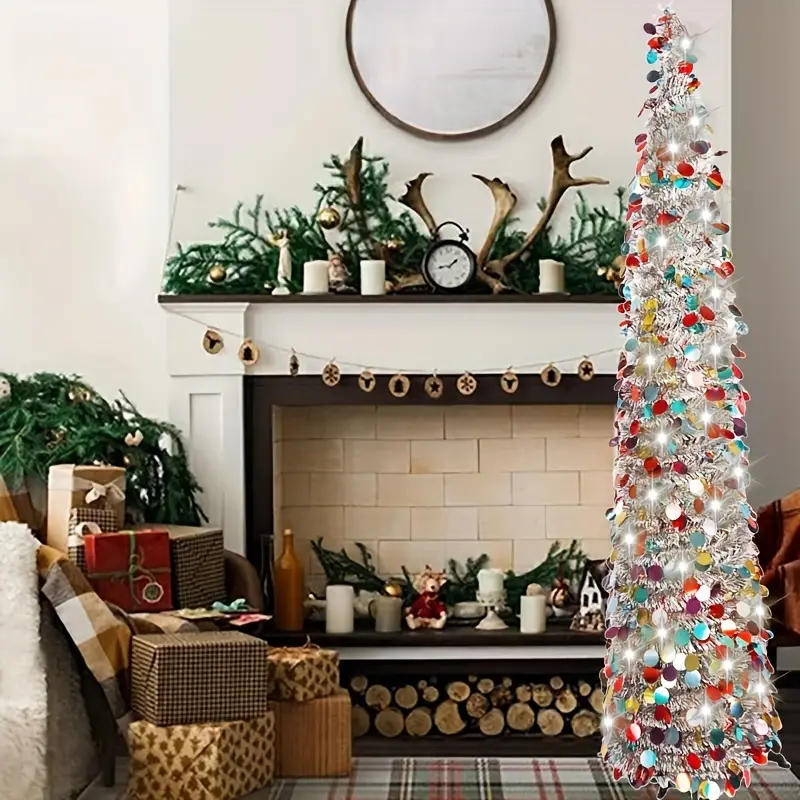
You don’t need to spend much here. A 6-foot silver or frost-tipped slim tree from Walmart or Target runs $60 to $110 in season, and 100 warm white LED string lights are about $15. Skip the ornament sets entirely and pull one statement piece — an oversized silver star or a cluster of three mercury glass baubles — for around $25. The rest of the tree should stay light and airy. Total: under $150.
5. Slim Tree Foreground With a Heavily Garlanded Mantel
The magic here is layering, not decorating. Look at the depth of the scene: a slim tree in the foreground, a mantel loaded with green garland, red and gold ornaments, candles and stockings behind it, then more trees and gift boxes beyond that. Every plane is dressed, but only one is the subject. That’s why a single slender tree can anchor an entire room — it’s the first thing your eye lands on, and everything else is built to support it.

60% forest green (tree, garland, mantel greenery) + 25% red and metallic gold (ornaments, stockings, wrapped gifts) + 15% cream white (fluffy rug, candles, ribbon). That’s the formula. To calm it down, swap the red for champagne and keep the gold — you’ll hold the warmth without the holiday-shop energy. Swap the green for flocked white and you get a snow scene instead. For the quieter, metallic-only version of this same palette, see Idea #1.
6. Dark Green Slim Tree on a White Shag Rug
- Main piece — 7 ft unlit slim artificial tree: $70–$160
- Lighting — 300 warm white LED string lights: $20–$45
- Textiles — white shag rug, 5×7: $60–$150
- Decor — red berry picks, gold baubles, gift wrap: $45–$90
- Mantel greenery — 9 ft garland with red berries: $30–$70
Total: $225–$515
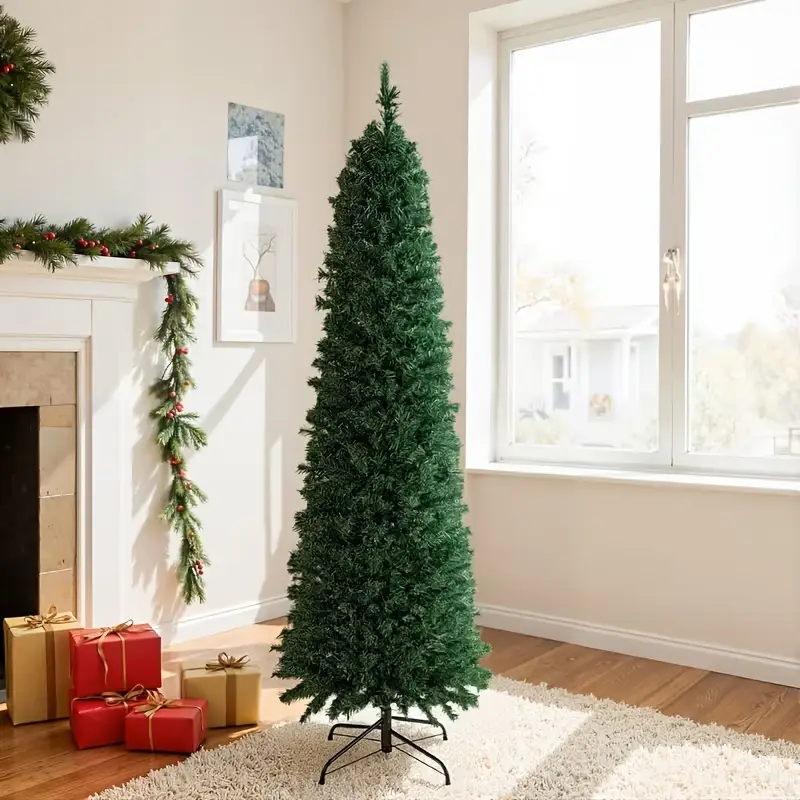
Put a white rug under a dark green tree on purpose. The shag pile acts as a light reflector and lifts the tree off a wood floor that would otherwise swallow it whole. Keep the rug at least 5×7 so the tree base and the gift pile both sit fully inside it. If you have pets or heavy foot traffic, choose a low-pile or machine-washable version — a 2-inch shag under a tree is a needle magnet and genuinely awful to vacuum in January.
7. Two Slender Trees Against Deep Green Paneled Shelves
It’s the wall. Two slim trees, warm white lights, white faux fur skirts — lovely, but ordinary against plain paint. Against deep green paneled shelving crammed with books, they become a composition: the trees echo the wall, while the white skirts and the white slipcovered sofa snap the whole scene into focus. Paint that wall a neutral and you lose the entire idea. Everything else here is replaceable.
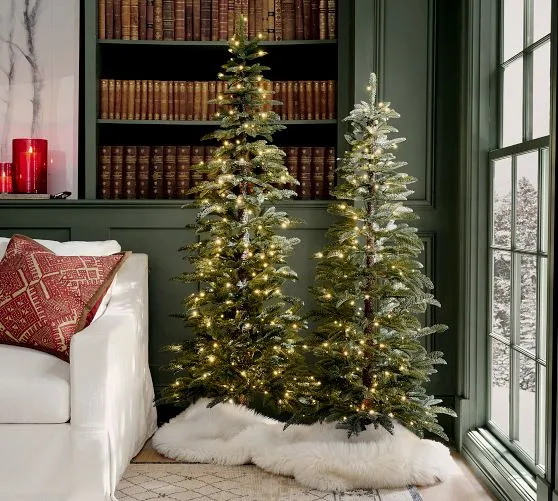
Faux fur tree skirts shed. Expect to vacuum around the base weekly through December, and plan on a cold-water hand wash in January rather than a machine cycle — most of these mats have glued backing that breaks down in a dryer. The deep green paneled wall is the other maintenance item: dark satin finishes show dust and fingerprints, so keep a microfiber cloth handy and wipe the frames and rails, not the panels themselves.
8. Twin Pre-Lit Slim Trees Flanking a Garlanded Doorway
Symmetry needs room. Two 6 to 7-foot pencil trees flanking a standard 32 to 36-inch door require about 5 to 6 feet of wall width total, with 12 to 18 inches between each tree and the door trim. In a narrower hallway, drop to 5-foot trees or use just one on the side with less foot traffic. Watch the floor too: on light beige carpet, brown kraft-paper gifts disappear, so switch to white ribbon and the bases still read.
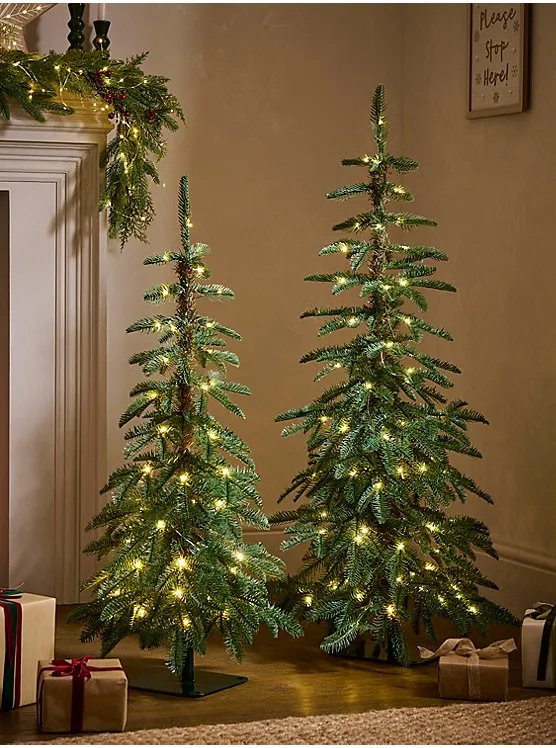
- Measure your door trim and mark the center point on the wall above it.
- Set both tree stands first, unplugged, and check the gap with an actual tape measure — don’t eyeball symmetry.
- Run the garland over the frame in one continuous pass, starting bottom-left so the end hides behind a tree.
- Plug the garland and both trees into a single switched power strip.
Time: about 45 minutes. Cost: $60 to $140 for garland and lights if you already own the trees.
9. Nine-Foot Slim Pine That Fills a Tall Wall
70% tree + 20% light + 10% ornament. On a 9-foot pre-lit slim pine, that ratio is what keeps it looking full instead of sparse — most of what you see should be green needles, then glow, then decorative detail. The mistake people make with tall slim trees is over-ornamenting to compensate for the narrow profile, which just builds a busy column. Fewer, larger ornaments at consistent spacing reads fuller every time.
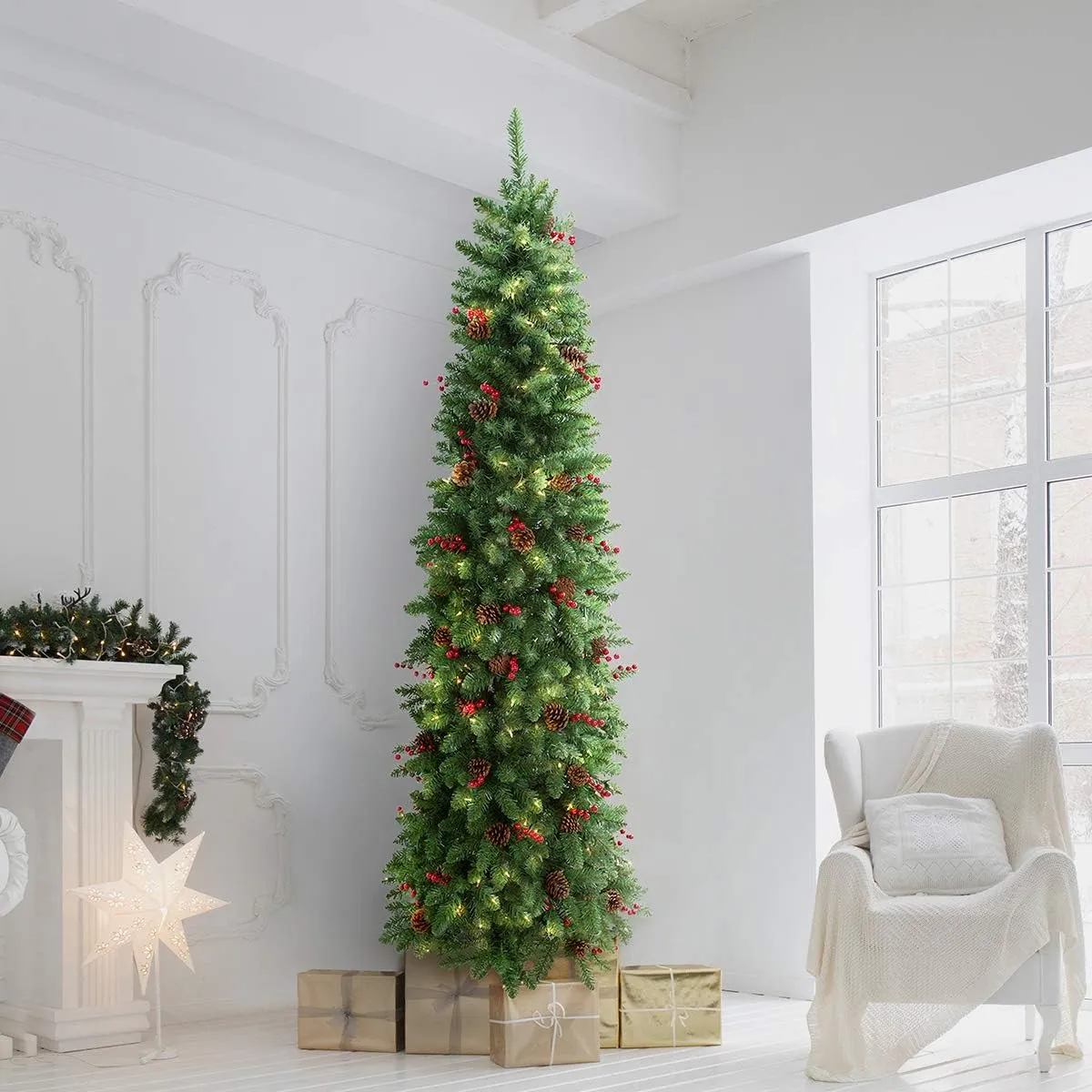
Nine feet of pre-lit tree is where prices climb, but you can stay reasonable. A 9-foot unlit pencil tree from Walmart or Wayfair runs $130 to $250; add 600 warm white LEDs for about $40 and you’re well under the $500-plus pre-lit models. Facebook Marketplace is the sleeper — tall slim trees are miserable to store, so they surface used every January for $40 to $80. If nine feet won’t fit your ceiling, the realistic alternative is the 7.5-foot pre-lit slim tree in Idea #12: same silhouette, roughly half the price.
10. Sparsely Ornamented Slim Tree With a White Star
Sparse is a decision, not an accident. On a slender tree, hang ornaments no closer than 6 inches apart and leave the top third nearly bare except for the star — negative space is what makes a light-handed tree look considered instead of unfinished. Pick one dominant size (3-inch) and one accent size (1.5-inch) and then stop. If you’re tempted to add more, add light instead.
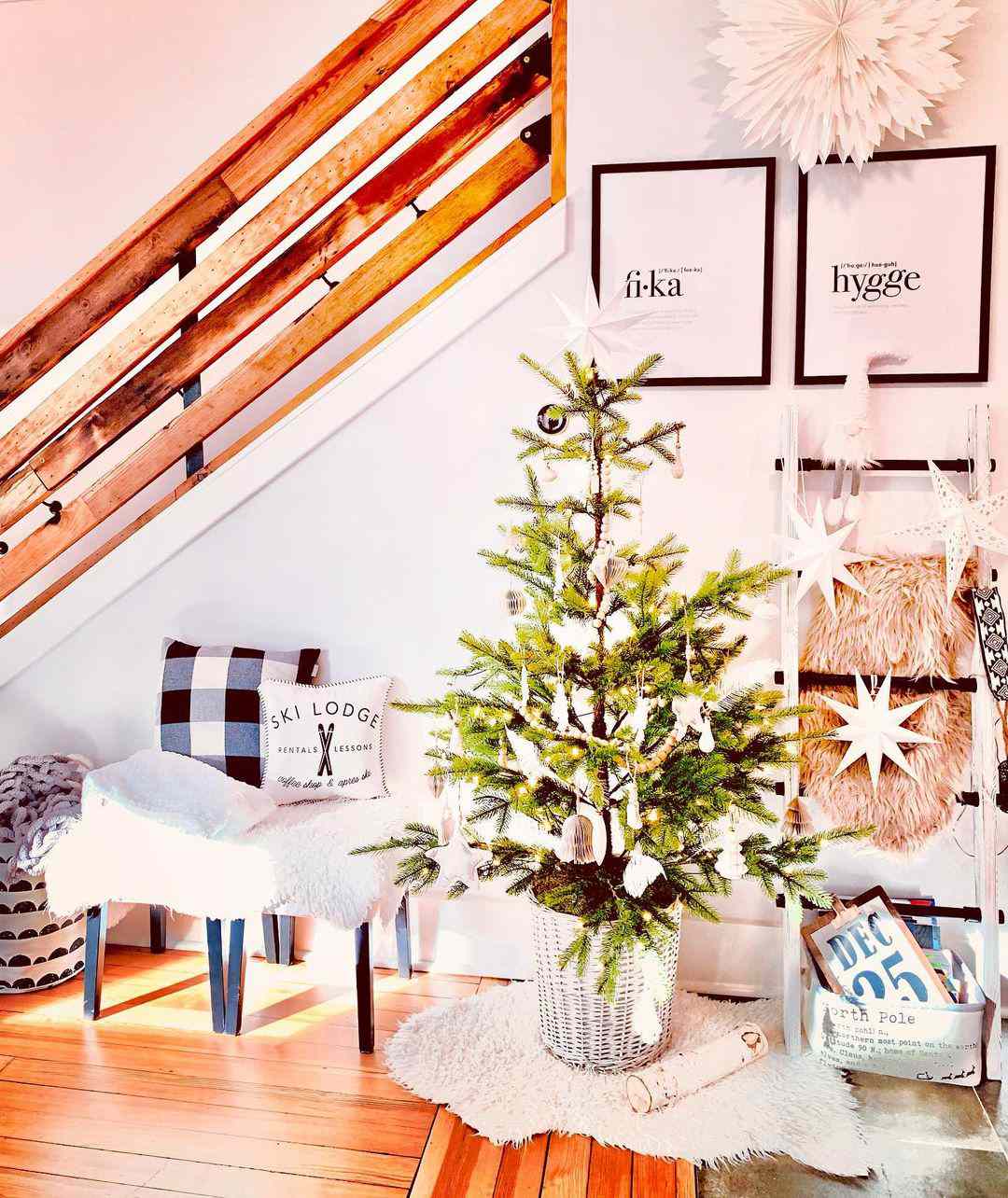
Here’s the honest part: a sparsely decorated tree photographs beautifully and can feel a little lonely in person, especially in a large room. Before you commit to this look, check your bulbs. Under cool white overheads, sparse ornamentation reads as empty. Under warm 2700K lamps with a lit green garland on the mantel, it reads as elegant. Same tree, completely different result. Fix your lighting before you fix your tree.
11. Red, Gold, and Ribbon Beside a Big Window
The window is the secret. Placing a slim tree beside glass gives you two light sources — the tree’s warm string lights and whatever daylight or streetlight comes through — and the white ribbon catches both. The red and gold globes then work as accent rather than volume. Note the birdcage resting under the tree, too: one unexpected object stops the gift pile from looking like a showroom display.
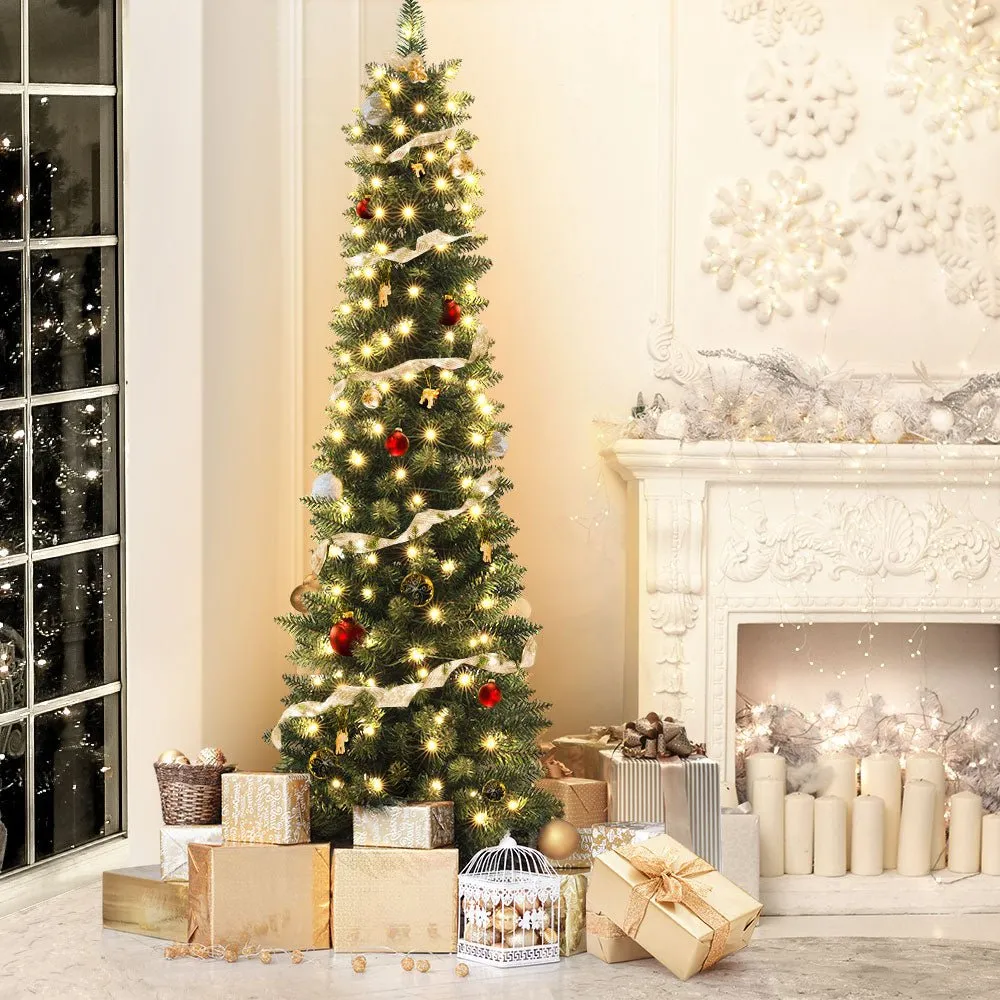
Strip the white ribbon garland and this is a standard red-and-gold holiday tree. With it, your eye has a path — the ribbon spirals upward and pulls your gaze to the star, which is exactly what a narrow tree needs. Garland, not ornaments, is what gives a slim silhouette vertical movement. Try it in cream first, then in red; the cream version supports this palette far better.
12. Bare Pre-Lit Slim Tree on a Four-Leg Stand
A tree like this typically measures 22 to 28 inches at its widest point, which means it fits corners where a standard 48-inch tree simply won’t go. Minimum ceiling height: 8 feet. Minimum floor clearance: about a 24-inch square. That’s what makes it work in apartment living rooms, narrow entry halls, and bedrooms with exactly one free corner. Measure the corner, not the wall — you’re fitting the widest part of the tree, not the base.
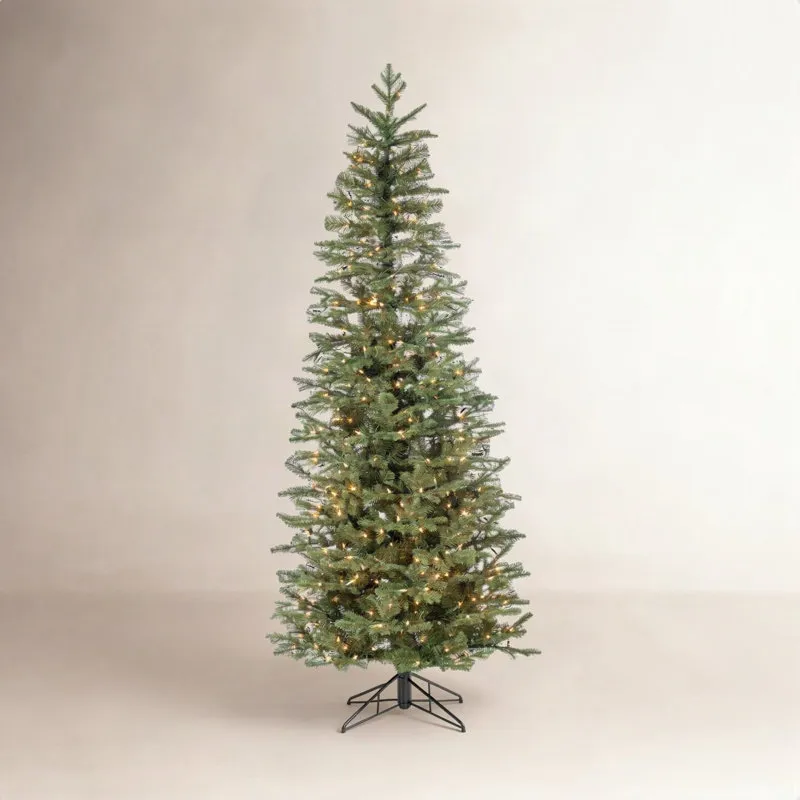
Slim pre-lit trees are winning on practicality, and 2026 is the year that flipped from compromise to preference. Decorating a 9-foot full tree takes three to four hours; a 7.5-foot pencil takes about 45 minutes once it’s pre-lit. Add smaller living spaces and the fact that people now dress two or three corners instead of one big centerpiece, and the narrow shape stops being a limitation. Fuller isn’t the goal anymore. Better placed is.
13. Tree in the Bedroom With Black, White, and Mustard
- Clear the corner nearest the window — daylight does more for a lit tree than any lamp.
- Layer the bed first: tree-patterned bedding, then a mustard knitted throw folded across the foot.
- Place the tree so its top hits just below the window’s crossbar; taller than that and it fights the architecture.
- Set one wooden tray with winter decor at the base instead of a full skirt.
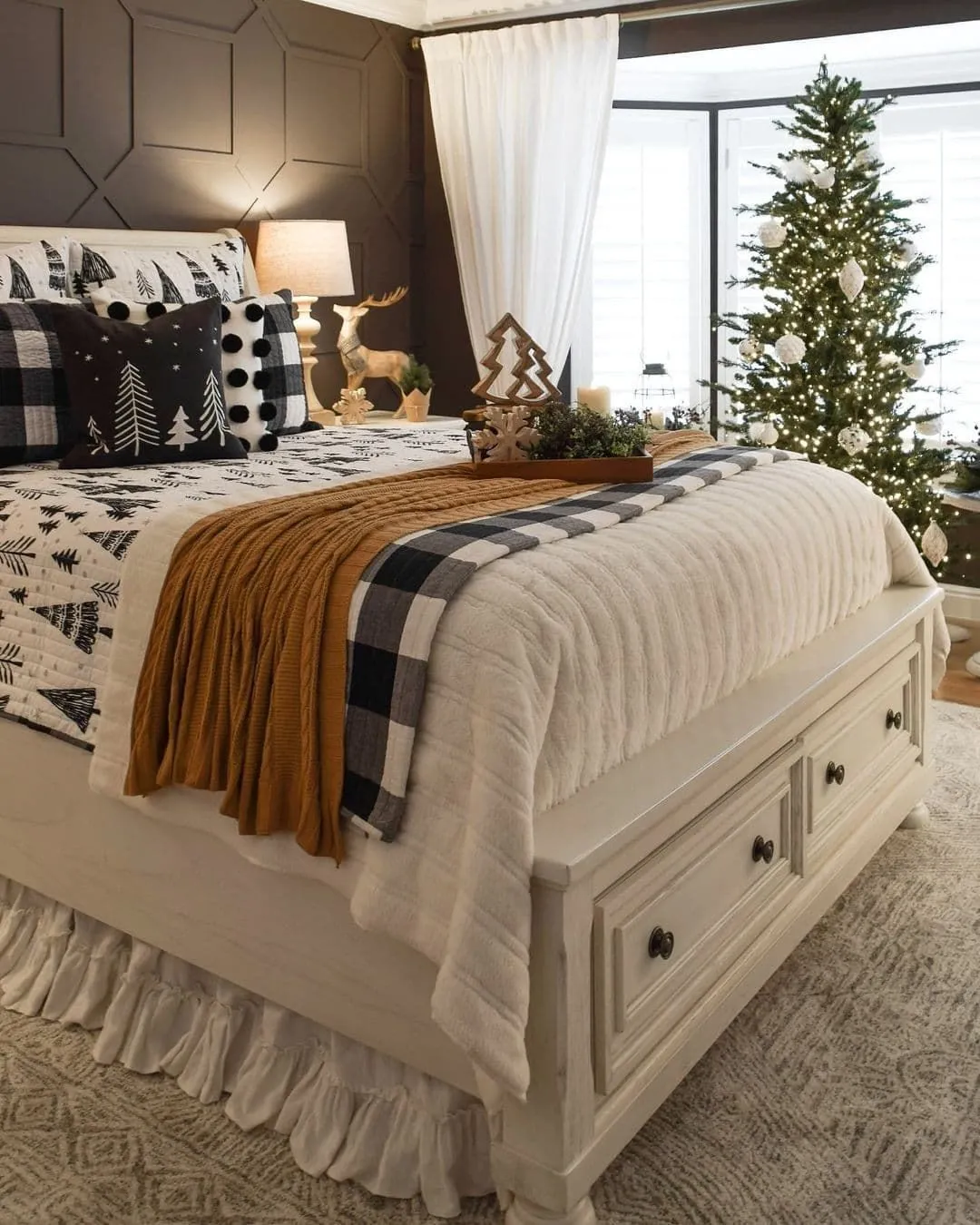
Time: about 30 minutes. Cost: $0 if the throw and bedding are already yours.
Keep the tree’s ornament palette narrower than your bedding. This room works because the bed carries the pattern — black and white trees across the duvet — while the Christmas tree stays in plain white ornaments against a dark geometric wall. If both surfaces compete with pattern, the room feels loud from the doorway. One patterned plane, one quiet plane. Compare that restraint with Idea #18, where the same principle is squeezed into an even smaller space.
14. Red Tinsel and Champagne Baubles by Orange Curtains
Traditional red and silver is the cheapest look in this entire collection, and that’s a compliment. Red bead garland runs about $8 at Walmart. A 100-piece red and champagne shatterproof bauble set is $25 at Target. Red tinsel is $5. Layer all three on a tree you already own. The warm orange-gold curtain behind it is doing half the work — if you have warm-toned drapes anywhere in the house, draw them before you photograph the tree. Free upgrade.

55% tree and warm light + 30% red (tinsel, bead garland, baubles) + 15% champagne and silver. That formula is why this reads traditional rather than chaotic: one dominant accent color with a metallic support act. If red feels like too much for your room, the same math works with burgundy and antique gold, or copper and cream. The trick is never letting your metals share the accent color’s temperature.
15. Slim Tree Centered in Front of a Snowy Window
- Measure the window width — a centered slim tree should be no more than one third of it.
- Confirm whether your fireplace is functional or decorative, and check the flue before the first fire.
- Test outlet placement; you need one within 6 feet of the tree for a clean cord run.
- Check rug size — tree, sofa edge, and hearth should all share the same rug or none of them will look settled.
- Budget at least $90 for wreaths and mantel greenery if you’re starting from scratch.
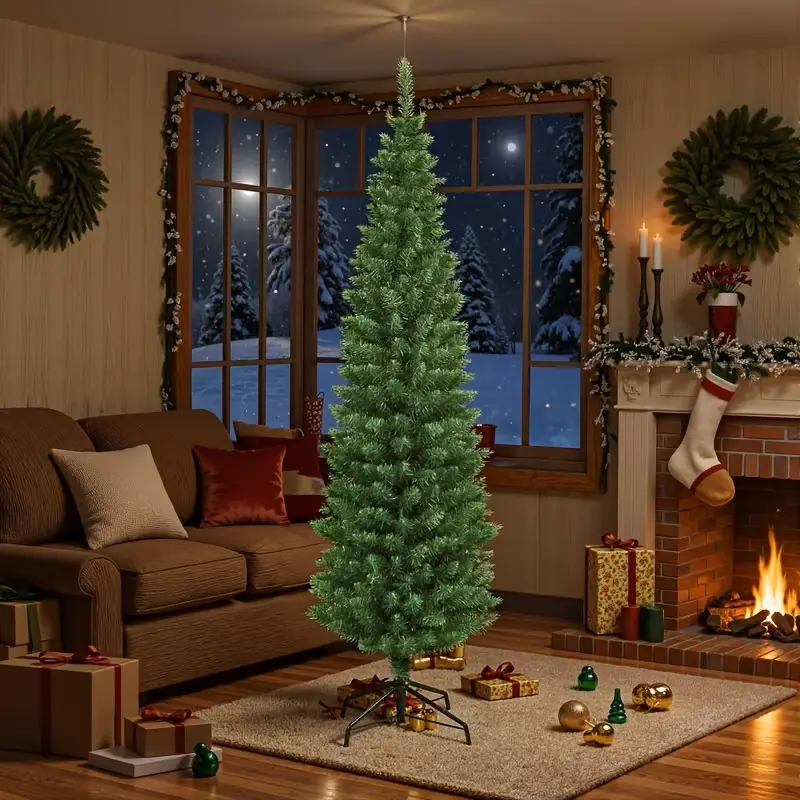
The window is doing structural work. A slim tree placed dead-center in front of a big window gets silhouetted against the night sky, which gives a two-foot-wide tree the presence of something much larger. Then the room stays warm on both sides — brown sofa with red cushions on the left, brick fireplace on the right — so you’re never staring at a tree floating in emptiness. That’s the trick with narrow trees: give them a frame.
16. Flocked Tree Next to a Pale Pink Desk
Flocked trees shed. That’s the entire trade. Expect to vacuum around the base every few days through December, and don’t run a robot vacuum under it — flocking clogs the brushes fast. In January, wrap the tree in a plastic bag before moving it, because flocking dust travels across the whole house. If shedding is a dealbreaker, a plain green pencil tree with white berry garlands and a white skirt lands 80% of this soft, pale look with none of the mess.
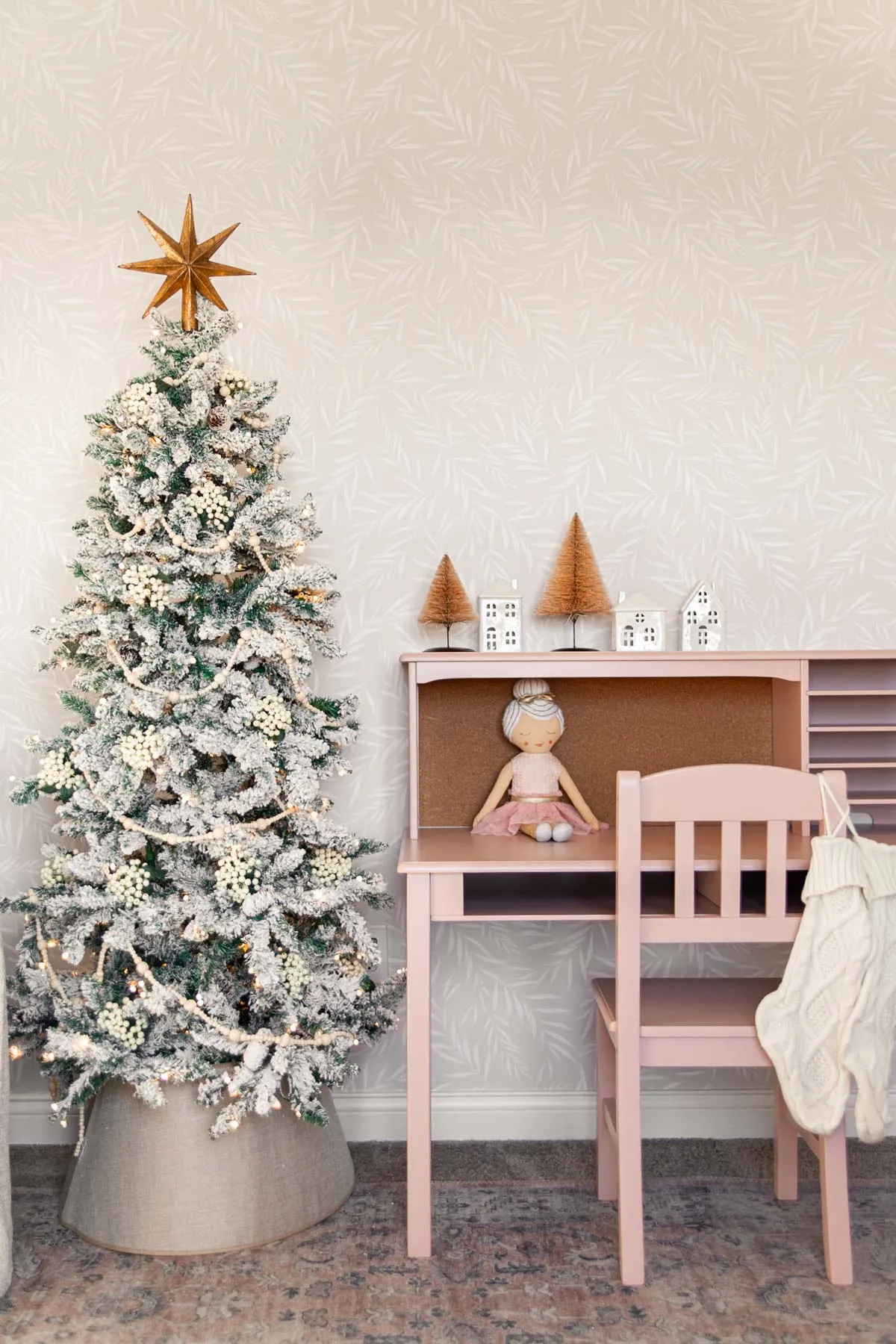
It’s the pink desk. A flocked tree with warm lights and white berry garlands is lovely but common; set beside a small pink painted desk and chair, with a muted pink and grey rug underfoot and tiny white houses clustered at the base, it becomes a scene rather than a decoration. That’s a $30 thrift-store desk doing more work than the tree. If you own one piece of furniture in a soft color, put it near your Christmas tree.
17. All-Pink Slim Tree With a Star-Shaped Base
Colored trees are cheaper than you’d expect, and the small ones are everywhere. A 6-foot pink slim tree runs $50 to $90 online in season; a 4-foot tabletop version is $25 to $40 and works beautifully on a dresser or in a kid’s room. Skip ornaments entirely, or use white only — the pink is the statement. Total for a full look: under $100. Thrift stores and Marketplace have them for $15 to $30 come January.
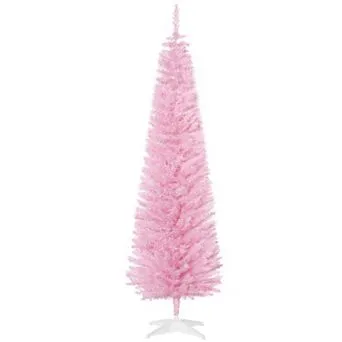
Think before you buy a colored tree. Pink, white, and black trees photograph wonderfully and date faster than green — they’re trend-forward by nature, so you may want to replace it sooner than you’d like. They also show dust and pet hair more, especially white flocking. If you love the idea but hate the commitment, buy small and park it in a child’s room or a home office where it’s a deliberate accent.
18. Mini Lit Tree on a Dorm Desk Under String Lights
A dorm room is the ultimate test for a pencil tree. A 3 to 4-foot pre-lit slim tree needs roughly 20 inches of clear floor or desk space and a 12-inch gap from the wall for the cord. If your desk faces a window, set the tree to the side of the laptop rather than behind it, or you’ll be reaching over branches all semester. Measure the distance to the nearest outlet before you buy anything.
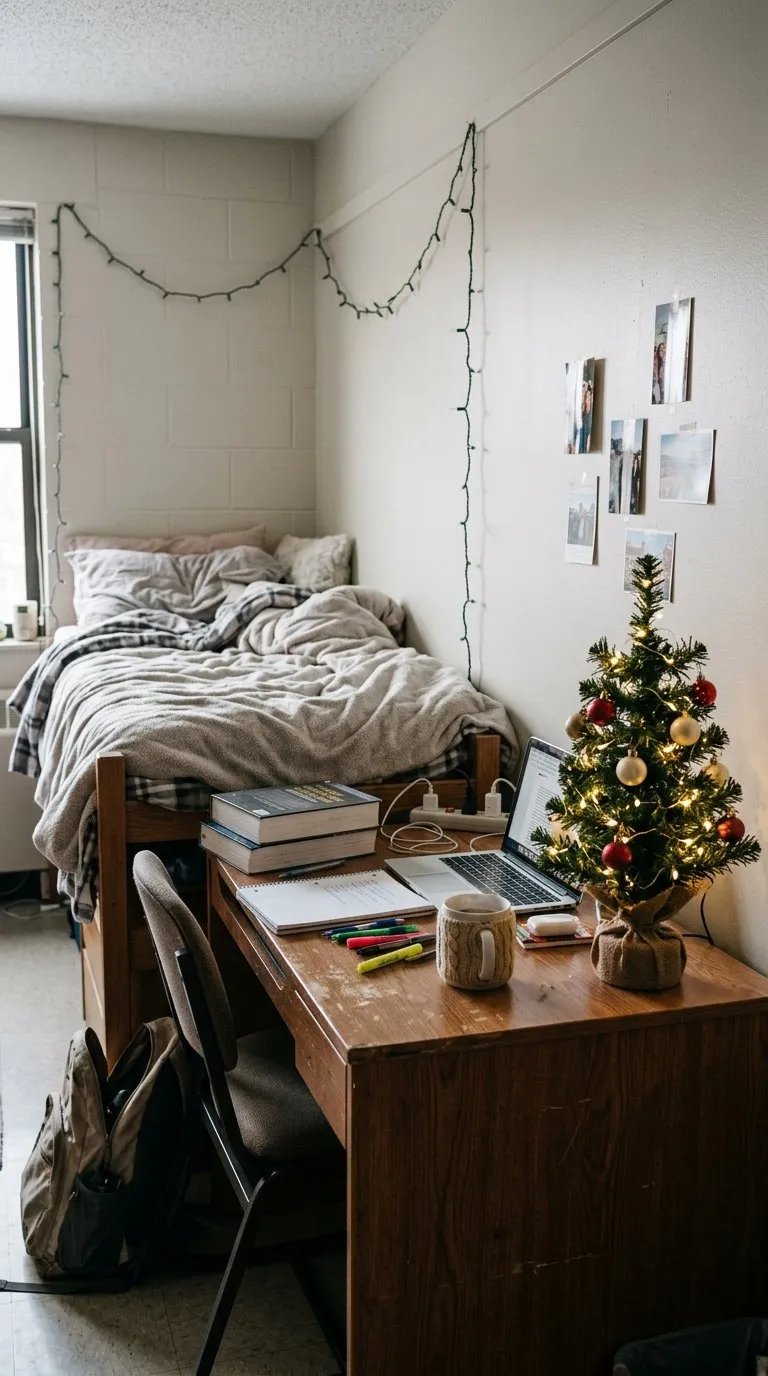
- Clear the desk surface and decide which half stays functional — the tree takes the other half.
- Run the tree’s cord behind the desk and secure it along the back edge with gaffer tape.
- Drape string lights along the wall above the bed first, then the desk, so the runs meet in one corner.
- Add three or four red and gold ornaments — no more. Let the little tree read as bright, not cluttered.
Time: about 25 minutes. Cost: $35 to $60 for the tree and lights if you’re starting fresh.
19. Heavily Flocked Slim Tree Against White Shiplap
Shiplap gives you horizontal lines; a vertical tree needs to cut across them cleanly. Hang the tree off-center by about one third of the wall’s width rather than dead center — the horizontal planks and the vertical trunk will fight instead of settle if they both hit the middle. And on grey plank flooring, use the dark metal stand or add a low, dark basket. A white base on a grey floor simply disappears.
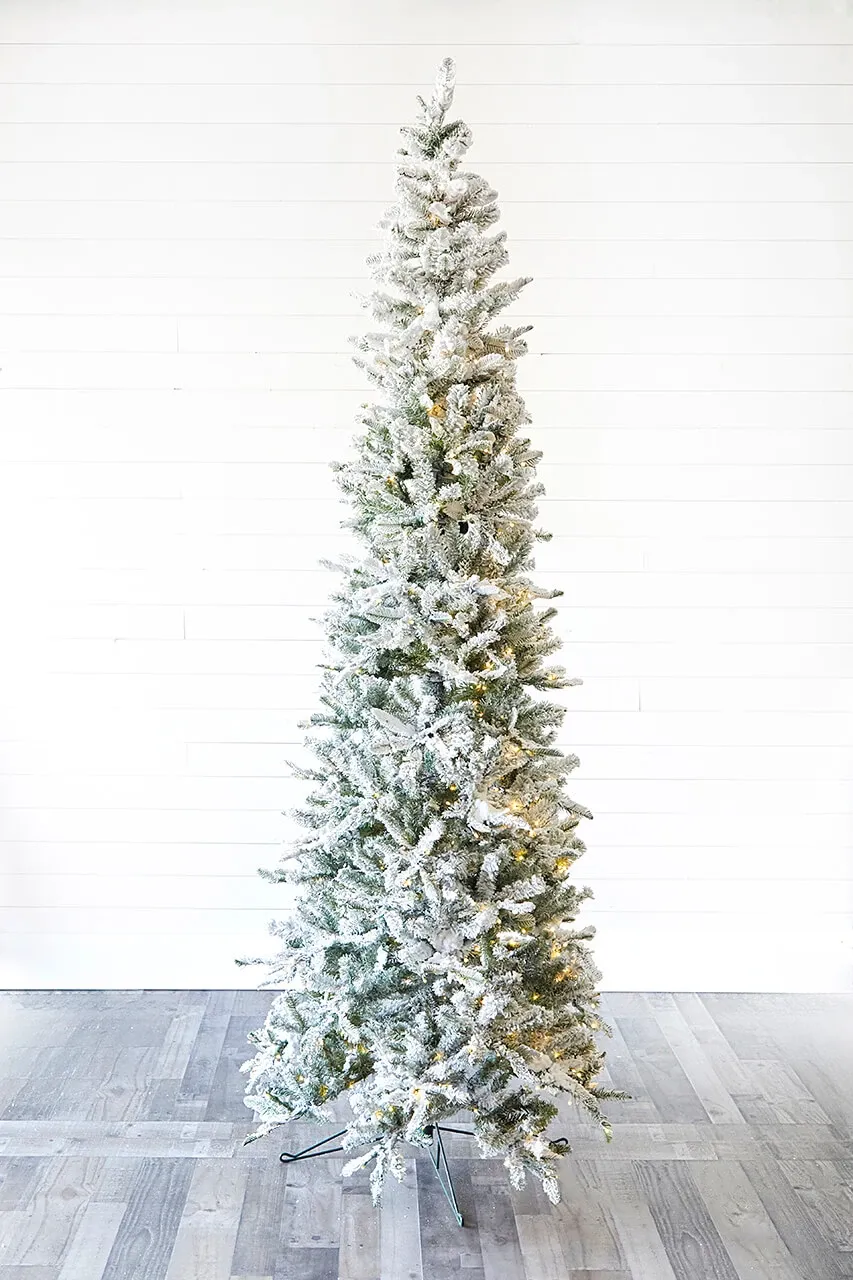
70% white (flocking, shiplap, window light) + 25% green (needles showing through) + 5% dark metal (stand, small accents). It’s an almost-monochrome formula, which is why this tree reads calm rather than festive. To warm it up, swap the dark stand for a woven basket and add two warm brass ornaments. To cool it down further, go silver-grey on the stand and skip ornaments entirely.
20. Flocked Pre-Lit Slim Tree on a Dark Green Base
Heavy flocking is the 2026 look because it solves a real problem: a slim tree has less surface area to hold ornaments, and flocking adds texture without adding width. It also photographs better than it used to — newer flocking processes use a finer powder that reads as frost rather than spray paint. The trade is weight and mess. Worth it if you want the snow effect without dragging a real garland through the house.
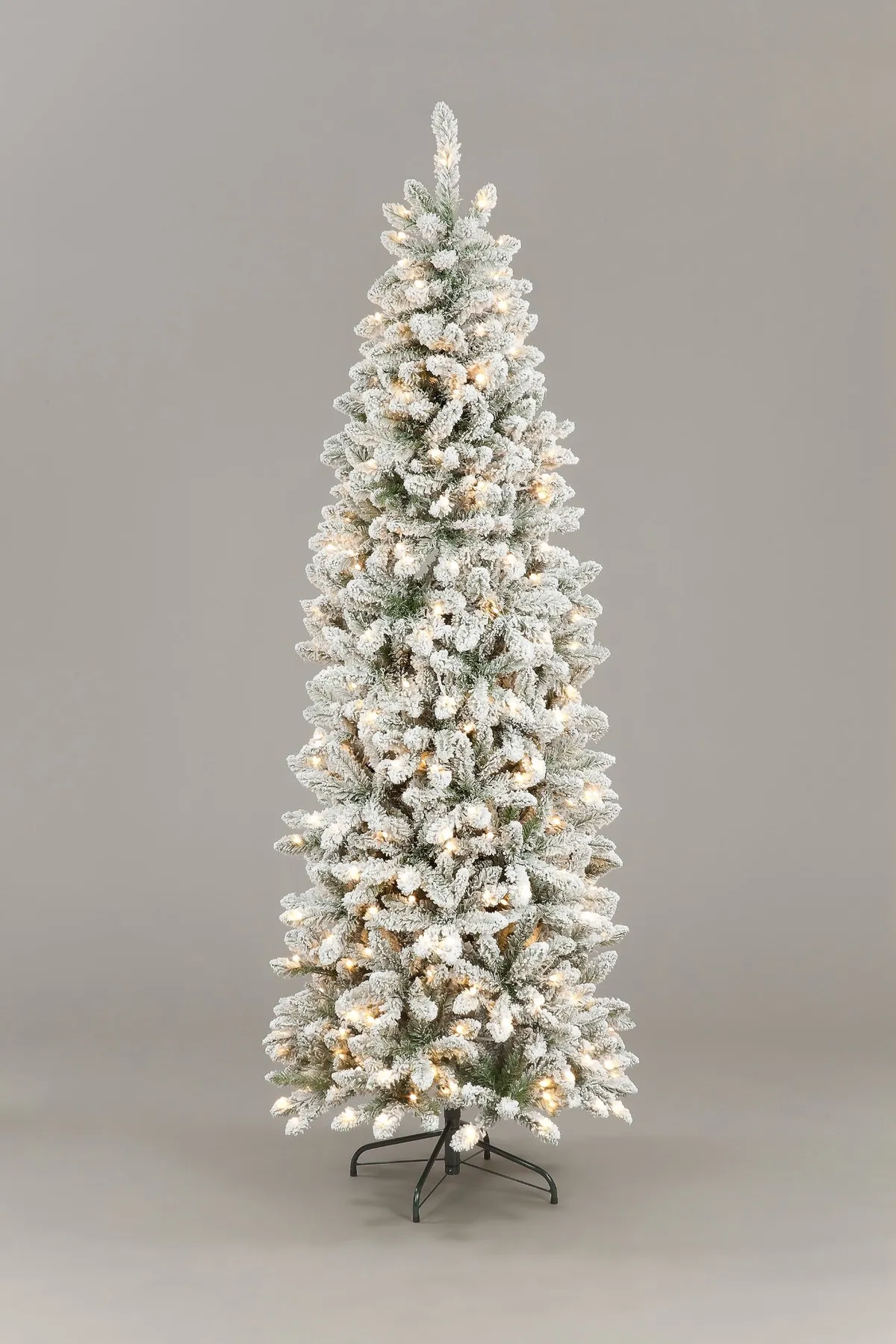
Look at how little is happening here: green needles, white flocking, warm light, a dark green stand. Four elements total, and it works because they’re all describing the same thing — winter. The dark green base matters more than it looks; it grounds the white canopy so the tree doesn’t float, and it repeats the needle color at the very bottom of the composition. Simple palettes fail when nothing anchors them.
21. Corner Slim Tree With Gold and Green Gift Boxes
The window view. A slim pre-lit tree in the corner with gold and green gifts underneath is a solid holiday setup, but the snowy street scene outside turns it into a story — and the pink armchair on the right keeps the corner from being just tree-and-wall. If your tree sits anywhere near a window with a view, resist the urge to block the glass with a bookshelf. Let the tree share the light.
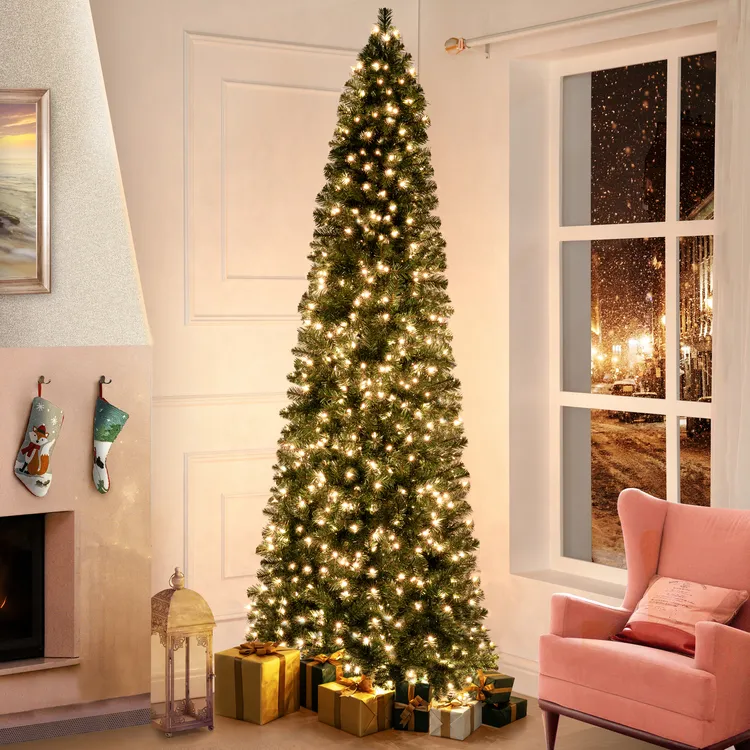
The gift pile is your budget lever. Gold and green wrapping paper runs $4 to $6 a roll at Target, and a spool of wide gold satin ribbon is about $6 — you can wrap 15 boxes for under $30 and the tree base reads as styled. For the tree itself, a 6-foot pre-lit slim model is $80 to $150. Compare the darker, moodier take on this same corner in Idea #7, where two trees share the work.
22. Pre-Lit Slim Tree Over a Burlap Base Wrap
Burlap wraps hide a lot of sins — a cheap stand, a mess of cords, a slightly uneven floor — and they cost about $12. What they don’t do is survive a wet floor or a crawling baby well. If you have pets that chew, skip the burlap and use a woven basket with a cutout instead. Burlap fibers come off in handfuls, and a determined puppy will absolutely eat them.
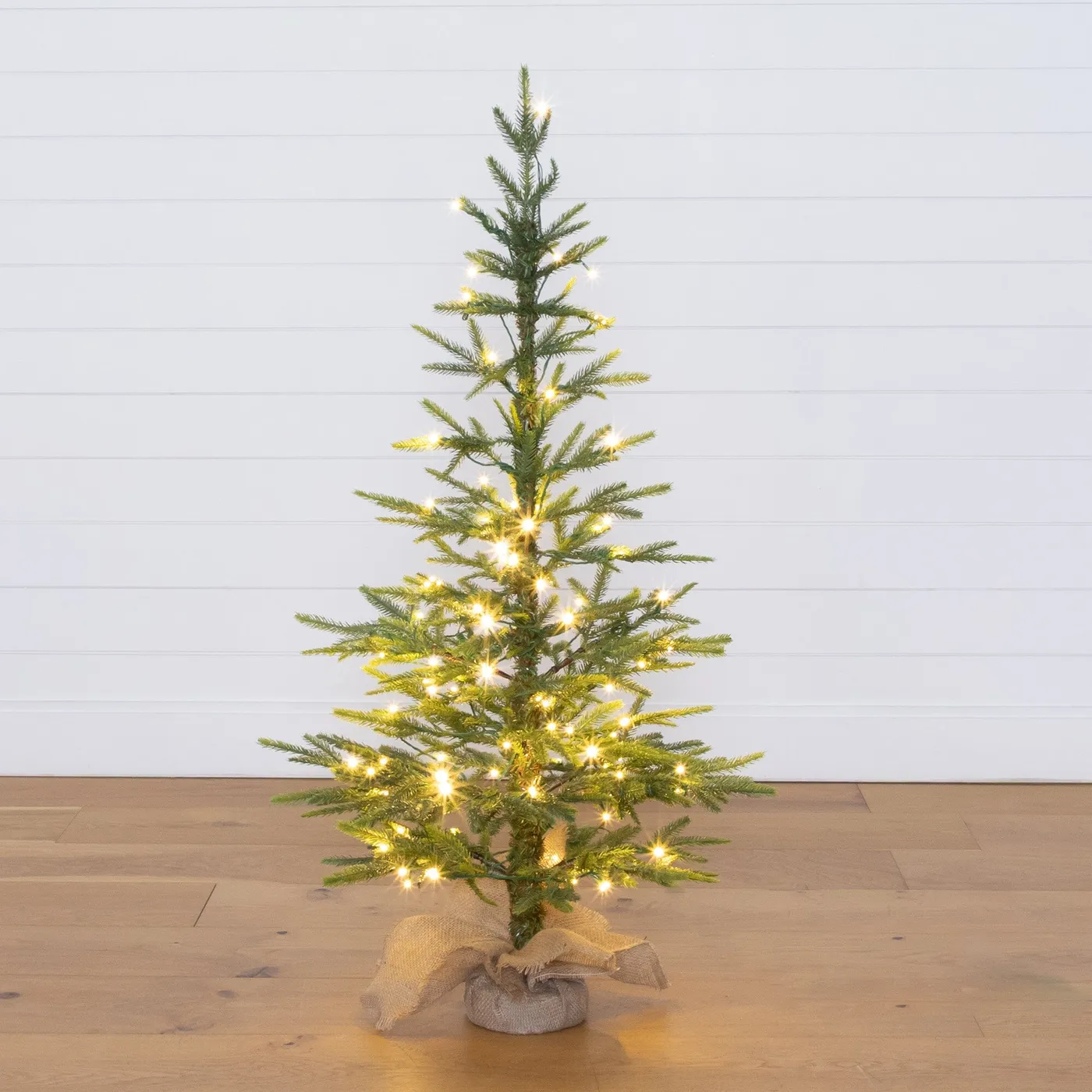
- Set the tree in its stand on the wood floor and check for wobble before anything else.
- Cut burlap to roughly 2.5 times the stand’s circumference.
- Gather the fabric around the trunk and pin it at the back where no one sees it.
- Hide the cord under the burlap, then run it behind the tree along the baseboard.
- Fray the top edge by hand for texture — it looks less like a sack that way.
Time: 15 minutes. Cost: $10 to $15.
23. Deck Tree With White Bells and a Rattan Basket
- Tree — 7 ft unlit slim: $70–$160
- Base — woven rattan basket: $35–$90
- Ornaments — white bells, large pinecones, natural ribbon: $40–$80
- Lighting — 300 warm white LEDs: $20–$45
- Seating accent — white wicker chair: $120–$400
Total: $285–$775
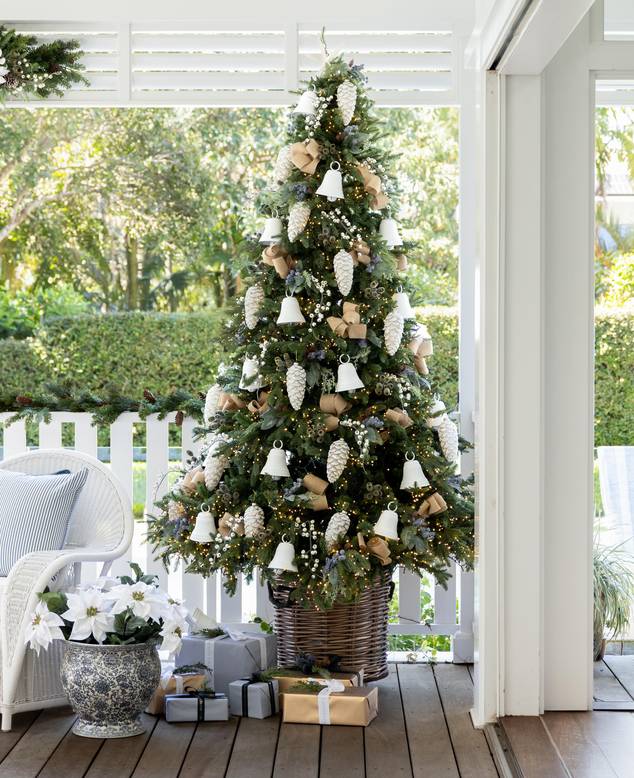
Anything on a covered wooden deck has to survive moisture and temperature swings. Rattan and wicker dry out and crack if they sit in direct sun; pinecones close up in humidity; ribbon fades within a season or two of exposure. If you’re decorating outdoors, plan on replacing ribbon and pinecones annually and bring the rattan basket inside when the season ends. Store the tree in a sealed bag — deck storage invites mice.
24. Trimmed-Down Slim Tree on a Black Tripod Stand
Notice the stand. A black tripod on a light wood floor is a deliberate visible element, not something to hide, and it’s the reason this tree reads as minimalist instead of unfinished. If you want that look, buy a tree with a decent stand and skip the skirt entirely. If you don’t, hide it — but don’t buy a nice stand and then cover it with a burlap sack. Decide which version you’re doing before you shop.
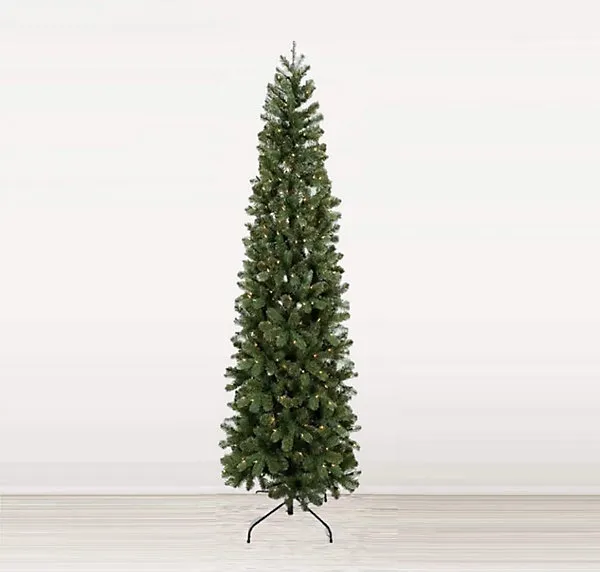
This is the tree for rooms under 120 square feet. At 6 to 7 feet tall and roughly 20 to 24 inches wide, it fits beside a bed, between a sofa and a lamp, or in a hallway nook without blocking circulation — you still want 30 inches of walkway past it. Ceiling height needed: 8 feet for a 7-foot tree. Working with less? Go down to a 5-foot version and raise it on a low stool.
25. Flocked Slim Tree With Polar Bears on the Mantel
The polar bears. A flocked tree with silver, gold, and white gifts is beautiful and very common — the small white figurines on the mantel and the frosted trees beside them are what make this corner feel curated rather than purchased. Little objects give a big scene a sense of scale, and scale is what makes flocking believable. Leave the mantel bare and the tree looks like it’s standing in a hotel lobby.
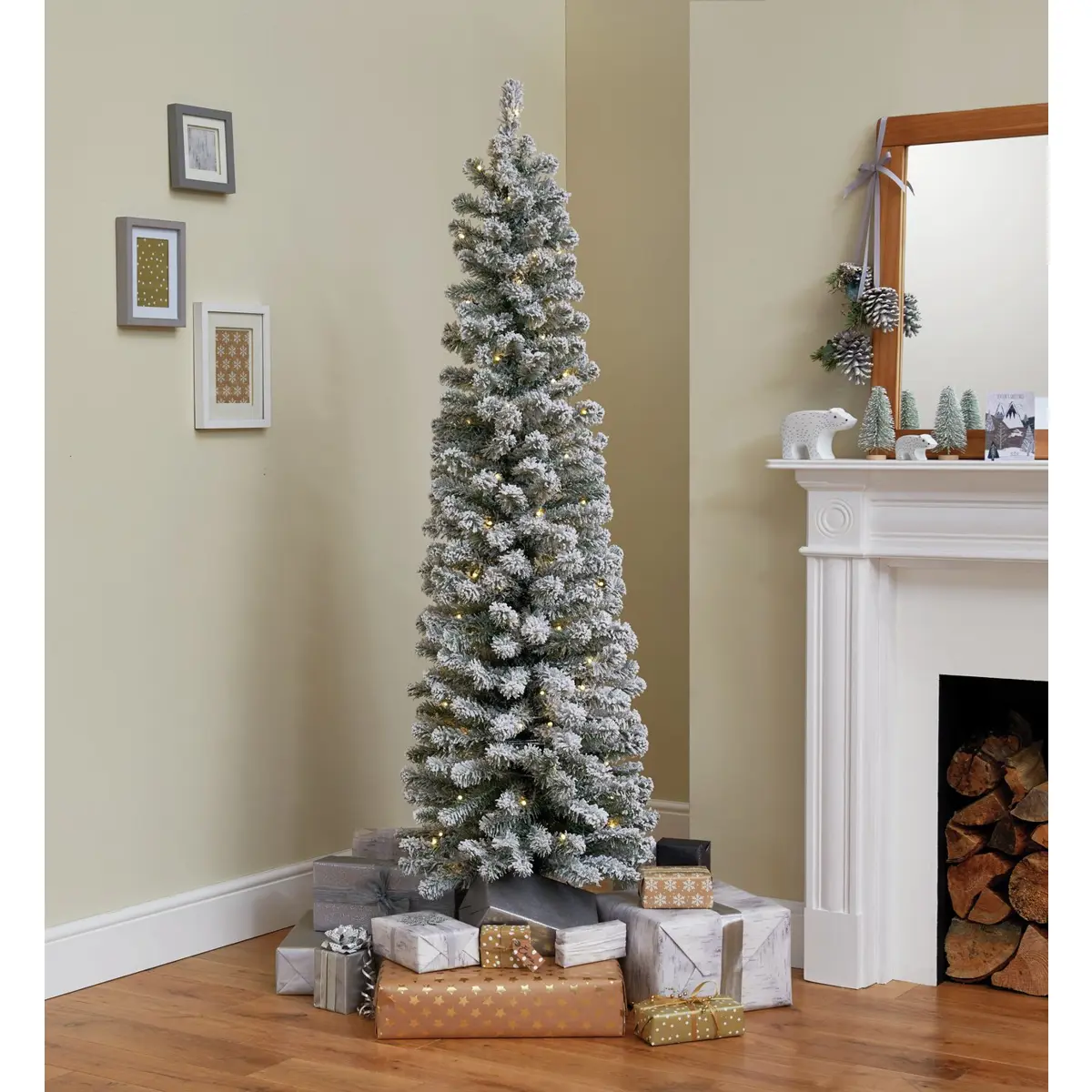
Two principles are at work. First, tonal layering: snowy flocking, warm gold light, silver paper, beige walls — everything lives inside a narrow warm-neutral range, so nothing shouts. Second, asymmetry. The gifts at the base are unevenly stacked and the mantel decor runs heavier on one side, which keeps a straight-on composition from looking like a catalog page. Symmetry is safe; slight imbalance is what makes it feel lived in.
26. Multicolored Lights and a Stone Fireplace Full of Family
Multicolored lights are the cheapest holiday upgrade there is — a 200-light strand runs $12 to $20, and if you already own a pre-lit white tree, you can add a colored strand on top for the hybrid look. The stone fireplace is the expensive part of this room, but you can fake the warmth with a wooden mantel, knitted stockings in cream and red ($15 each), and a stack of red and gold wrapped gifts. Nobody photographs the stone.
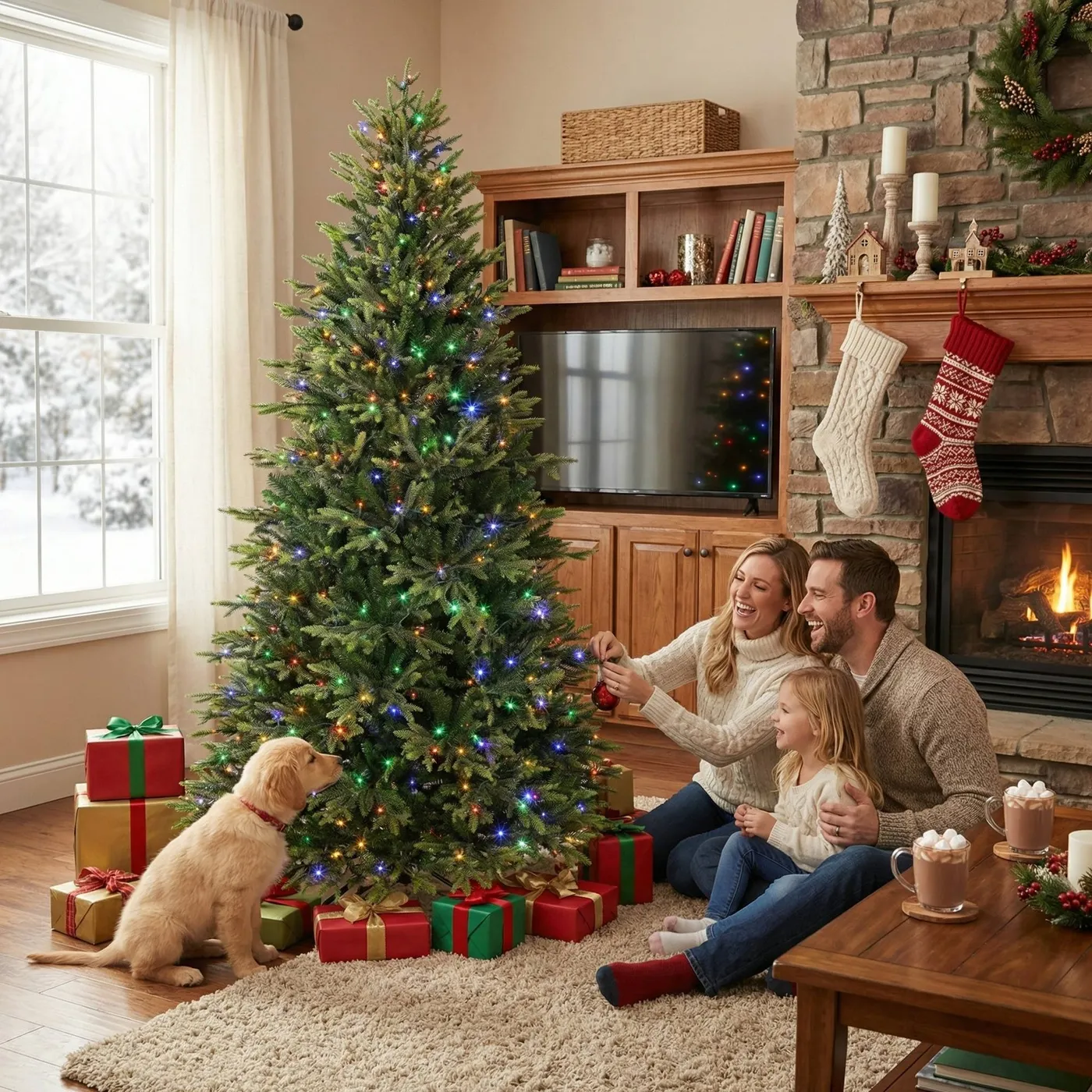
Family decorating sessions have a cost that isn’t financial: your tree will not look styled, and that’s the point. Kids hang ornaments at their eye level, which leaves the bottom third crowded and the top bare — lean into it. Give them the bottom quadrant, keep the top two-thirds for yourself, and hand out shatterproof ornaments only. Skip anything glass or heirloom if a puppy is in the room. For a tamer read on this same warm palette, see Idea #15.
27. Flocked Slim Tree Against a Soft Lavender-Blue Wall
- Paint or prep the wall first — light purplish-blue reads grey-blue in evening lamplight.
- Place the tree in the corner nearest the window so diffused light hits the flocking from the side.
- Skip the skirt; the black metal base is part of the composition here.
- Add one warm white strand if your tree isn’t pre-lit, and nothing else.
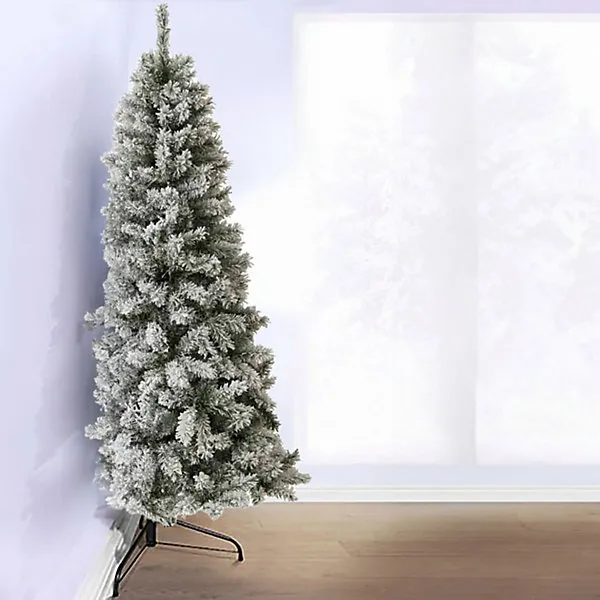
Time: an afternoon for paint, 10 minutes for the tree. Cost: $40 to $70 for a gallon of paint, $0 to $40 for lights.
Cool walls and warm tree lights need a bridge color, and here it’s the light wood floor. If your floor is dark or grey, a lavender-blue wall plus white flocking plus warm lights can feel disjointed — add a natural jute rug under the tree to warm the transition. A 5×7 jute rug runs $50 to $90 and it’s the difference between a scene that reads intentional and one that reads accidental.
28. Pearl Garland and Pastel Baubles on a Flocked Tree
65% white and cream (flocking, satin bows, pearl strands) + 25% pastel (pale blue, mint green) + 10% gold and silver (textured ornaments, wire star). It’s the softest formula in this collection, and it works because the metals stay small and scattered rather than clustered. Swap pale blue for blush and mint for sage and you get a spring-adjacent version. Keep the pearl garland in either case — it’s the thread tying the palette together.
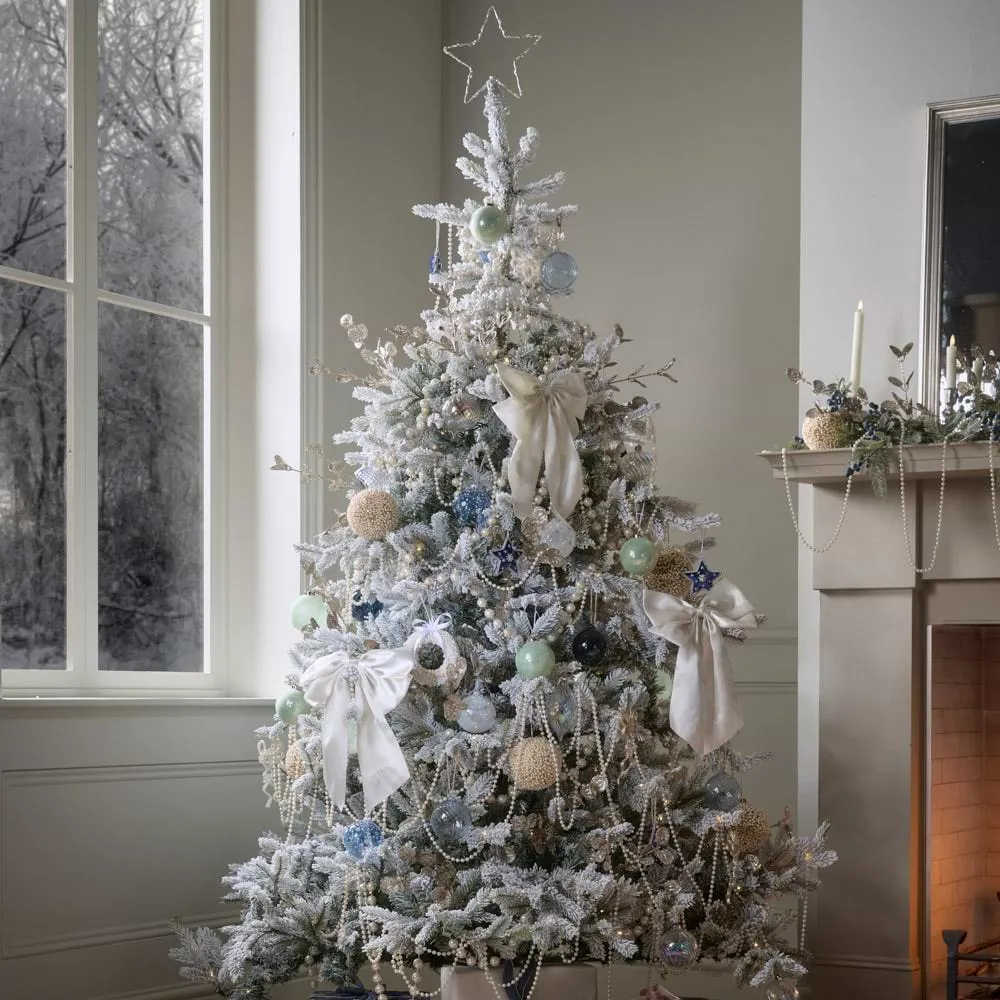
The satin bows. Pearl garland alone would be pretty; large cream satin bows tied at wide, even intervals are what push this from decorated tree to designed tree. They’re also the cheapest element here — a spool of cream satin ribbon is about $8 and you’ll use less than half. This is the pale, quieter cousin of the flocked setup in Idea #2: same snow effect, completely different mood.
One Narrow Corner, Endless Ways to Dress It
A pencil Christmas tree isn’t the compromise version of a real tree — it’s the version that actually fits the room you have, and 28 ideas in, that should feel pretty clear. Pick the palette that matches your walls, decide whether you’re team flocked or team forest green, and give that slim silhouette a frame worth looking at.
Save this to Pinterest now and come back to it when the boxes are out of the attic — you’ll want the budget breakdowns and the light counts handy once you’re actually shopping.