30 Jaw-Dropping Hallway Christmas Decor Ideas That Will Instantly Elevate Your Home for 2026

You know that feeling when a hallway photo stops your thumb mid-scroll — garland curling over a doorway, warm light pooling on a runner, and suddenly your own entry feels very, very beige? Same. So we went looking for the real thing: 30 hallway Christmas ideas pulled from actual homes, hotels, and historic halls, from a modern console styled with one white branch to a grand staircase drowning in red and gold.
We spent serious time browsing Target, HomeGoods, IKEA, Walmart, and Etsy to bring you only what’s worth your attention this year — everything from a $12 bag of ornaments to a $420 full tree setup. The dominant looks lean traditional red-and-gold, modern minimal greenery, rustic farmhouse, and full-on classic glam, and yes, budget and luxury versions sit side by side.
And stay until the end — we break down the most common mistakes that can ruin these looks.
📌 Save this to Pinterest for later — you’ll want to revisit these ideas.
1. A Festive Entry That Sets The Holiday Tone
The single thing that turns a hallway from merely decorated into genuinely festive is warm, low, layered light that starts right at the threshold. Take the glow away and every garland in the world reads as green plastic; keep the glow and even a bare doorway feels like an invitation. Most entries fail not because they’re under-decorated, but because the light is flat, cool, and coming from one sad overhead fixture.
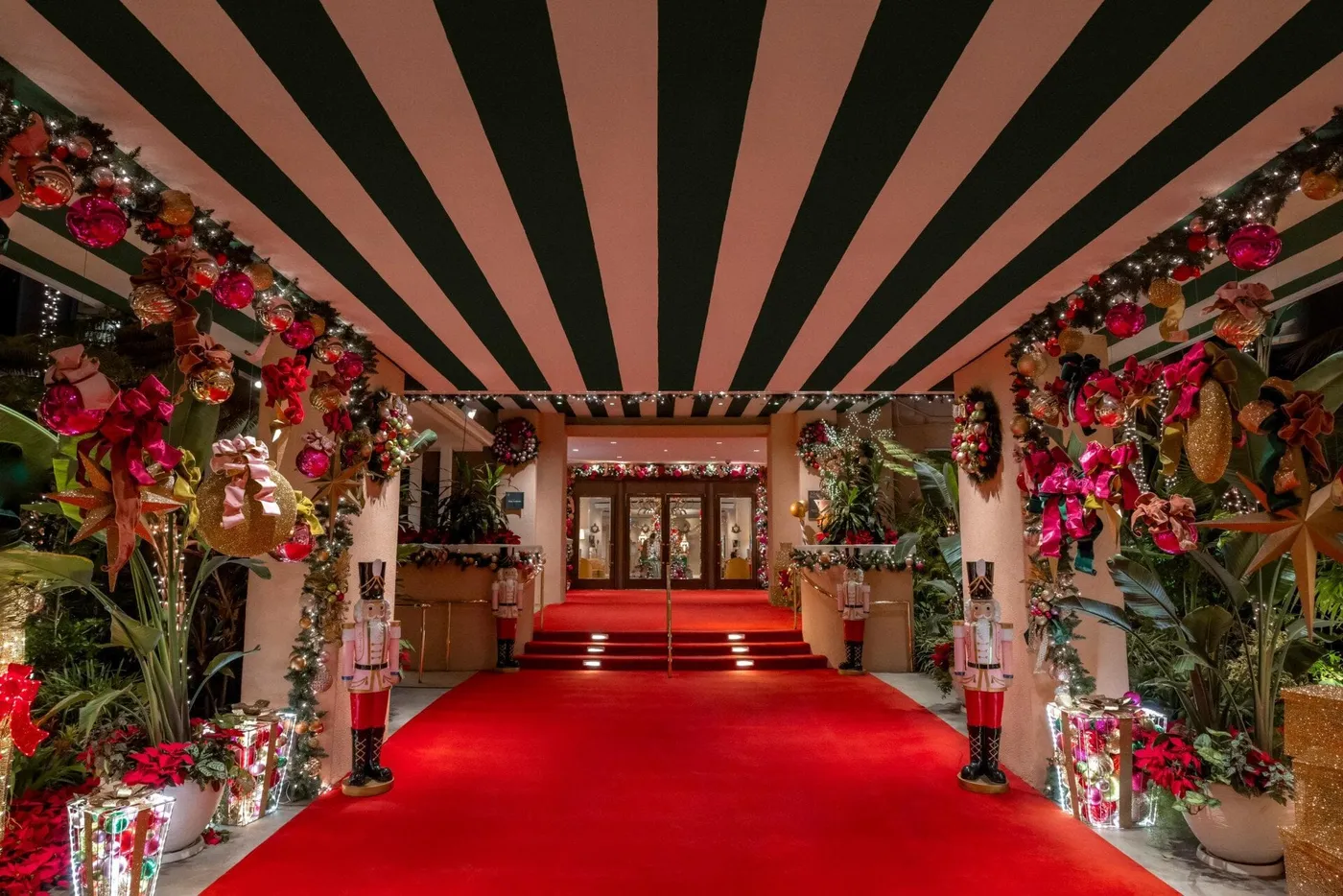
- Measure your doorway width, then buy a strand roughly 1.5x that length so you get a soft droop instead of a taut clothesline.
- Test the garland at night from the far end of the hall — daylight hides every gap and bald patch.
- Hang with removable adhesive hooks or zip ties, never tape, so your paint survives January.
- Add a shorter second strand at a different height so the eye has two points to travel between.
- Run everything into one smart plug set for 4:30pm to 11pm.
Time: about 45 minutes for one doorway. Materials: $25-$40 total for greenery plus lights.
2. Sleek Dark Console, One White Branch, A Lot Of Restraint
Three things are doing the heavy lifting here. First, contrast: a dark brown console against a light grey wall gives the vignette a silhouette you can read from ten feet away. Second, the oversized round mirror quietly doubles the garland and bounces light down a hallway that probably has no window. Third, that single tall white branch in the slender vase is negative space with a job — it stops the greenery from becoming a solid green lump.
Hang the round mirror so its center lands between 60 and 66 inches from the floor, not centered on the console. For a 40- to 48-inch console, a 30- to 36-inch mirror is the sweet spot; anything smaller and the garland swallows it. Attach greenery with green zip ties or florist wire around the frame’s back edge so nothing sticks to the wall, and keep ornaments in two metals only — gold and silver read as collected, three metals read as clutter.
3. Gold Mirror And Red Berries On A Narrow Console
The formula is almost embarrassingly simple: 60% light neutral base, 30% green and red, 10% metallic. The pale wall and the little white ceramic house carry the neutral load, the garland with red berries plus the potted evergreen and the miniature sleigh-side reindeer supply the green-and-red middle, and the round gold frame does the last 10% alone. Swap the red for burgundy and the gold for aged brass and it reads moodier; swap red for kelly green and you’re in preppy territory. Same math, different personality.
- Dark wood console table, 40-48 in: $120-$400
- Round gold-framed mirror, 30-36 in: $60-$250
- Green garland with red berries plus warm fairy lights: $25-$85
- Potted evergreen, silver reindeer, white ceramic house: $30-$90
- Mounting hardware and paint touch-ups: $0-$40
Total: $235-$865. Budget alternative: a Facebook Marketplace console at $60, a $15 thrifted mirror sprayed gold, and dollar-store garland bulked up with real pine clippings gets you there for $110-$320.
4. Red, Gold, And Marble: The Grand Staircase Entrance
After years of soft neutrals and beige-on-beige holiday styling, red and gold came roaring back — call it hotel-lobby maximalism, or grandmillennial with better lighting. The pull is nostalgia plus a little theater: people want their hallway to feel like the opening scene of something. The trend is holding because it photographs beautifully and because classic architecture genuinely supports it. Fads fade; a marble-floored hall with a checkered floor and fluted columns will look this good in 2040.
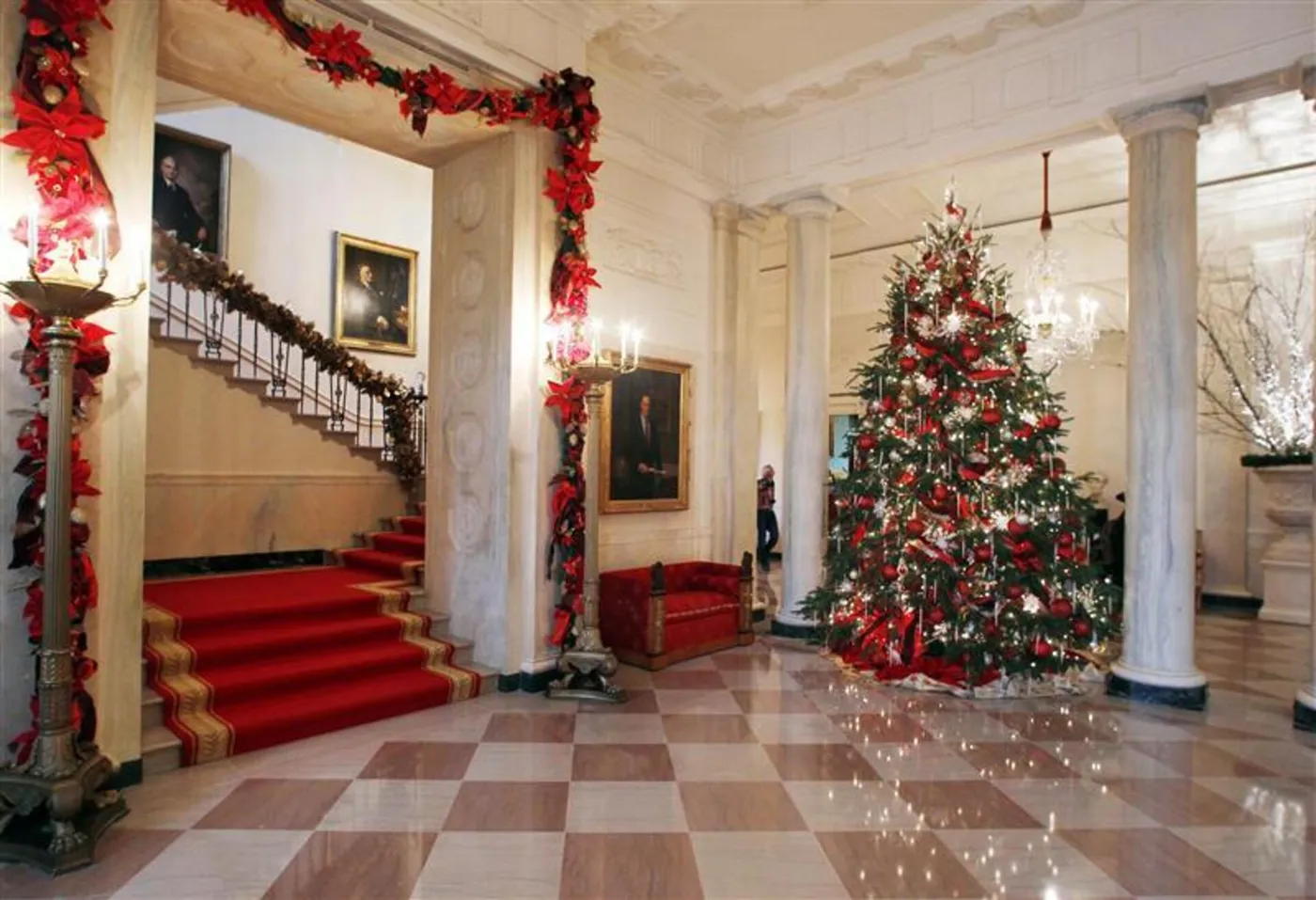
Red and gold only works when the architecture and the square footage can carry it. This look wants at least 150 square feet of circulation space, ceilings of 10 feet or higher, and a hallway 5 feet wide minimum so a tree with a skirt doesn’t become an obstacle course. Poinsettia garland across an archway needs 8 feet of clearance underneath, and a full tree wants 36 inches of breathing room from any stair rail. If your hall is 6 feet long and 3 feet wide, skip straight to Idea #25 — that one was built for small footprints.
5. Red Velvet Bows And Cardinals On A Wooden Staircase
- Measure the rake of your banister — the diagonal run from newel post to the top — and add 10% for swag.
- Attach the garland top and bottom first using zip ties under the handrail, not over it, so hands still fit.
- Weave warm-white string lights through after the greenery is anchored, working from the bottom up.
- Place red velvet bows at the newel post and then every 3 to 4 feet, sized 8 to 10 inches so they read from the doorway.
- Tuck in red berry picks and a cardinal or two at eye level, then step back and check it from the front door.
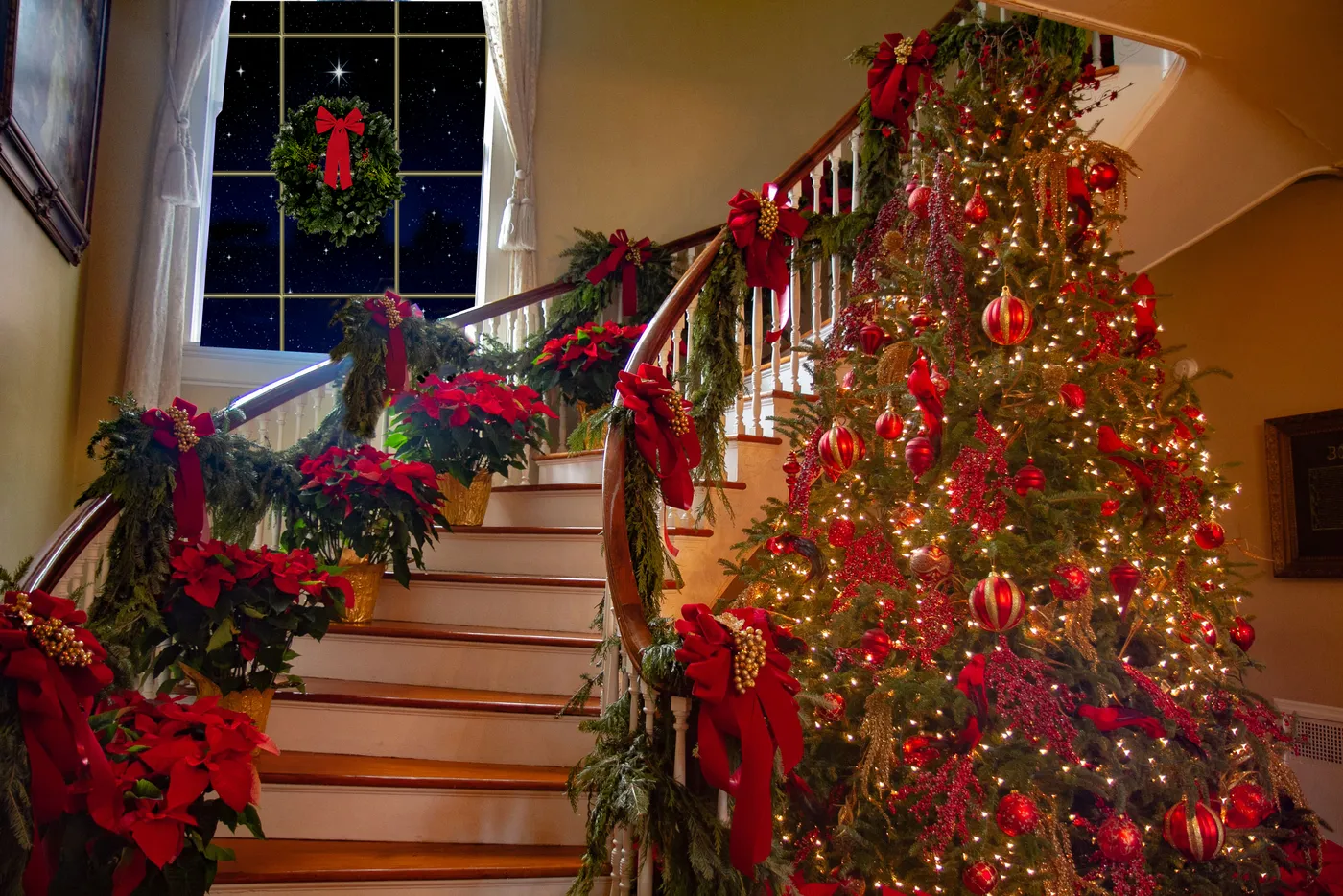
Time: roughly 1.5 hours. Cost: $60-$150 for garland, ribbon, picks, and lights. Real talk: if this railing gets used daily, keep swags tight to the rail and skip wired ribbon that catches sleeves. Real greenery drops needles for two straight weeks and stains pale carpet, and poinsettias sitting loose on stair treads are a genuine trip hazard with kids or grandparents in the house. Secure pots with museum putty if you must keep them there — same drama as Idea #4, less risk underfoot.
6. A Dried-Flower Wreath On A Dark Wood Grain Door
The dried flowers are the whole personality of this wreath. Without them it’s pine, pinecones, red berries, and ribbon — pretty, and completely anonymous. With them you get texture that doesn’t look like a big-box store endcap, plus a color story that plays off the dark wood-grain front door instead of fighting it. The mixed greenery, ornaments, and berries give volume; the dried stems give it a season that stretches from November through January without anyone calling it a Christmas wreath specifically.
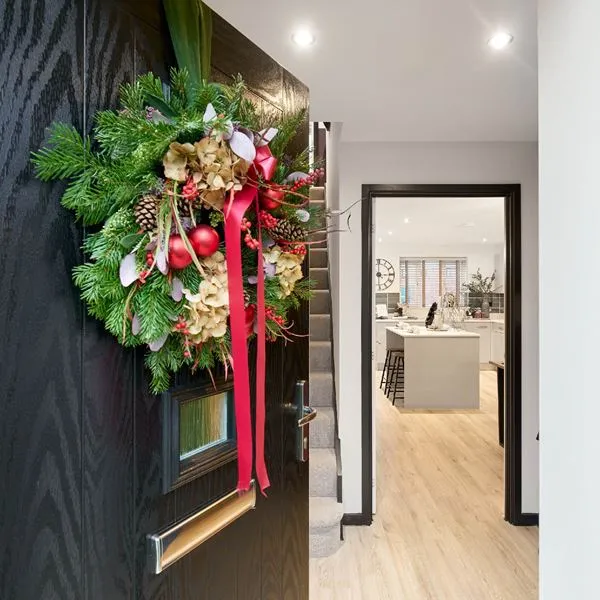
Dried botanicals are also the diva of this arrangement. They shed, they fade in direct sun, and they collect dust like a wool coat. Blow them off monthly with a hairdryer on cool and low, and expect the color to soften after one season. Real pine or cedar branches will drop needles onto light blonde flooring for about two weeks — a faux wreath with a few real pine sprigs added gives you 90% of the effect and none of the sweep-up. Store it flat in a box with tissue between layers, never squashed in a bin, or next year it looks like a tumbleweed.
7. The Holly Runner That Ties An Entire Hallway Together
Here’s the version that costs less than a nice pair of boots. A cream runner with a holly and snowflake print from Target or Walmart runs $25-$60 and instantly unifies a long dark wood floor that otherwise looks like an empty bowling lane. Dollar-store garland plus a pack of zip ties is $12. Two IKEA lanterns, $15 each. Wrap gifts in kraft paper you already have and stack them under the tree. Total for the staircase, the console, and the tree base: under $150.
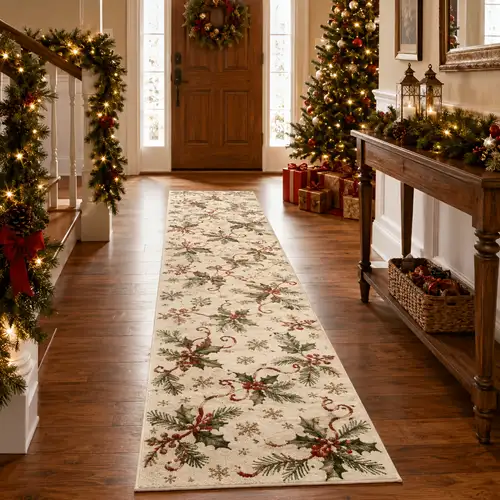
Why it works has nothing to do with budget. The runner breaks a dark floor into a warm path and gives the eye a destination, the lit garlands repeat the same warm white light in three places at three heights, and the deep red bows give you exactly one saturated color so nothing competes. That’s the whole trick — repetition of light, one accent color, and a runner that tells your feet where to go.
8. Oversized Nutcrackers Flanking A Hallway Tree
Two nutcrackers in the 4- to 6-foot range need real space or they turn comical. You want a hallway at least 8 to 10 feet wide, ceilings of 9 to 10 feet, and a run of 12 feet or more if a 7.5-foot tree is going between them. The tree itself needs 30 to 36 inches clearance from the columns behind it, and the figures want to sit slightly forward of the tree’s widest branch so they read as a trio, not a row. Below 8 feet of width, one nutcracker beats two every time.
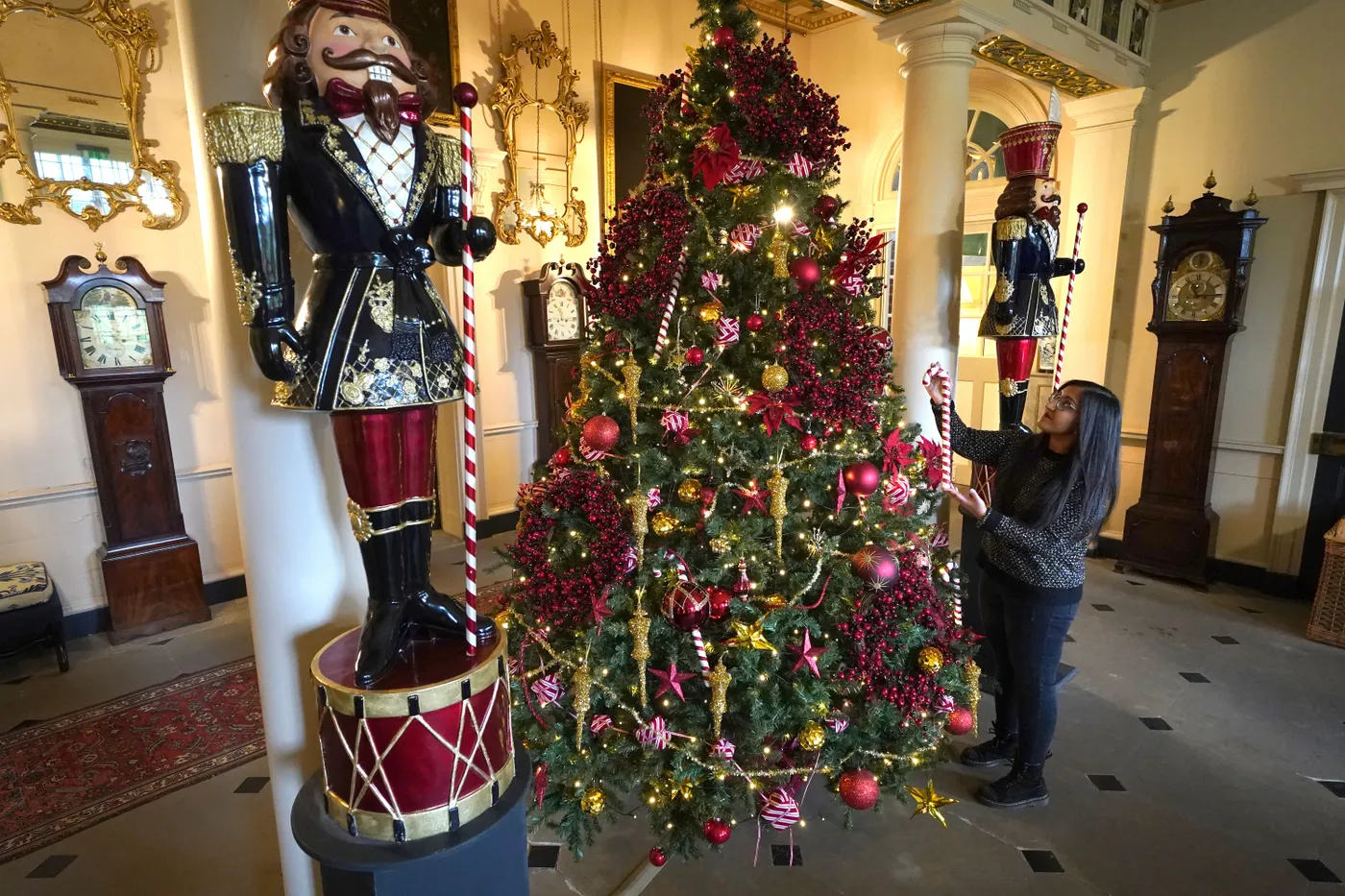
that makes this hallway is the nutcrackers, full stop. Remove them and you have a beautifully decorated tree in a lovely hallway — the kind of photo people scroll past. Keep them and the space has characters, a story, and a reason to stop walking. They do something else too: at 5 feet tall they bridge the gap between the tree’s height and human eye level, which is exactly the dead zone most hallway trees never solve.
9. Rustic Tile, Red Runners, And A Bronze Chandelier
The recipe: 70% dark, grounded base, 20% red, 10% warm light. Dark wood cabinetry, dark trim, and rustic brown tile form that heavy base, and it’s what lets this entry get away with so much red — the ornaments on the tree, the bows on the garland framing the glass-paneled door, the wrapped gifts, and the patterned runners all sit inside a dark envelope. Swap the red for copper and forest green and the whole thing relaxes into a moodier, more adult version. Same percentages, entirely different house.
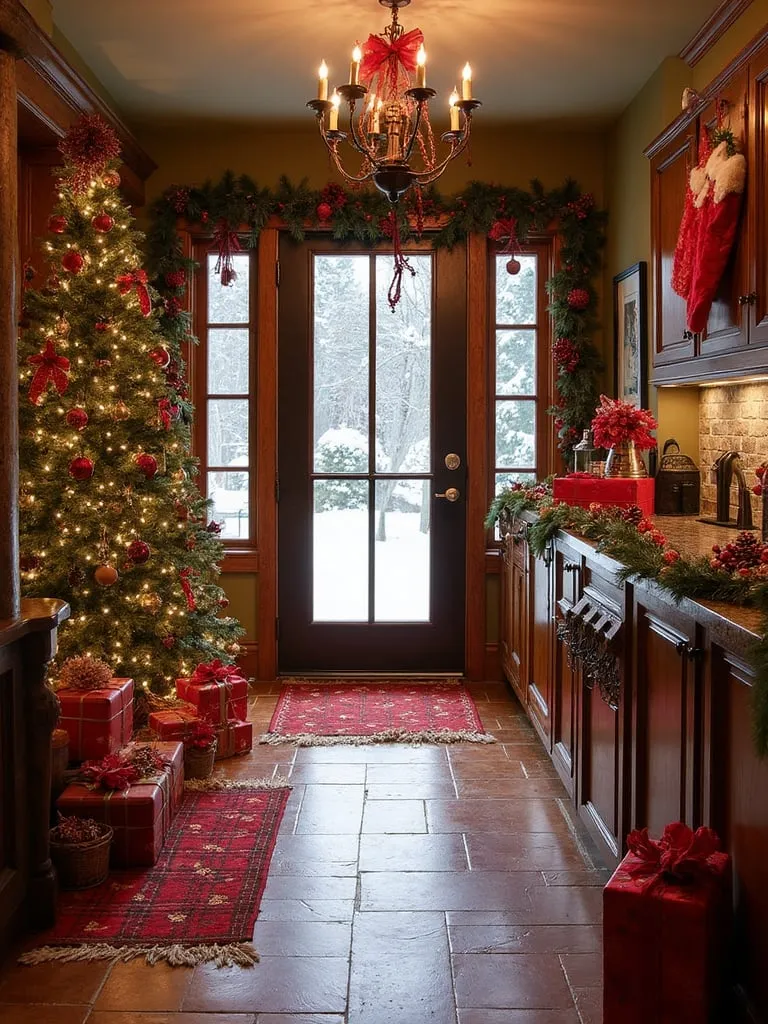
Now the unglamorous part. Patterned runners on rustic tile slide — put a rug pad under each one or someone’s going to learn that the hard way carrying a casserole. Garland attached to a glass entry door frame lives in a temperature swing zone, so use clips designed for glass, not adhesive. And if you’re hanging a bow on a bronze chandelier like this one, keep it at least 12 inches from any bulb; fabric and hot bulbs are a bad pairing, and this is the kind of fire hazard nobody notices until December 27th.
10. Candlelight, Sconces, And Garland-Draped Archways
Keep every light source in the same color temperature. This hallway works because the sconces, the candles in glass hurricanes, the tree, the brass floor lanterns, and the string lights all sit between 2400K and 2700K — warm, slightly golden, cozy. Mix in a single 5000K daylight strand and the entire scene goes blue and institutional. Buy bulbs labeled 2700K or lower, keep total wattage per circuit in mind (roughly 40 watts per 100 mini lights), and put the sconces on their own switch so you can run just those at 8am without lighting the whole production.
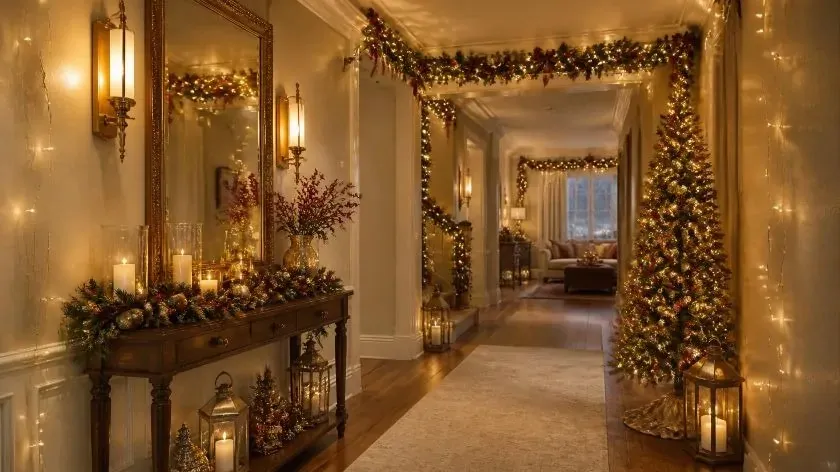
is vertical rhythm. Candles on the console, sconces on the wall, lanterns on the floor — three heights, one repeated warm note, so your eye travels the length of the hall instead of stopping at the first thing it sees. The ornate gold mirror bounces that light back down toward the door, and the garland swagged over the archway frames the view like a proscenium. Nothing here is expensive. It just all glows at the same temperature.
11. Evergreen, Pinecones, And A Table Lamp Glow
- Wooden console table, 40-48 in: $90-$350
- Red patterned runner rug, 2×6 ft: $40-$120
- Large evergreen arrangement with pinecones: $30-$85
- Table lamp with warm shade: $25-$90
- Framed botanical prints, set of two: $20-$70
- Wooden coat rack, wreath, and plaid scarf: $40-$120
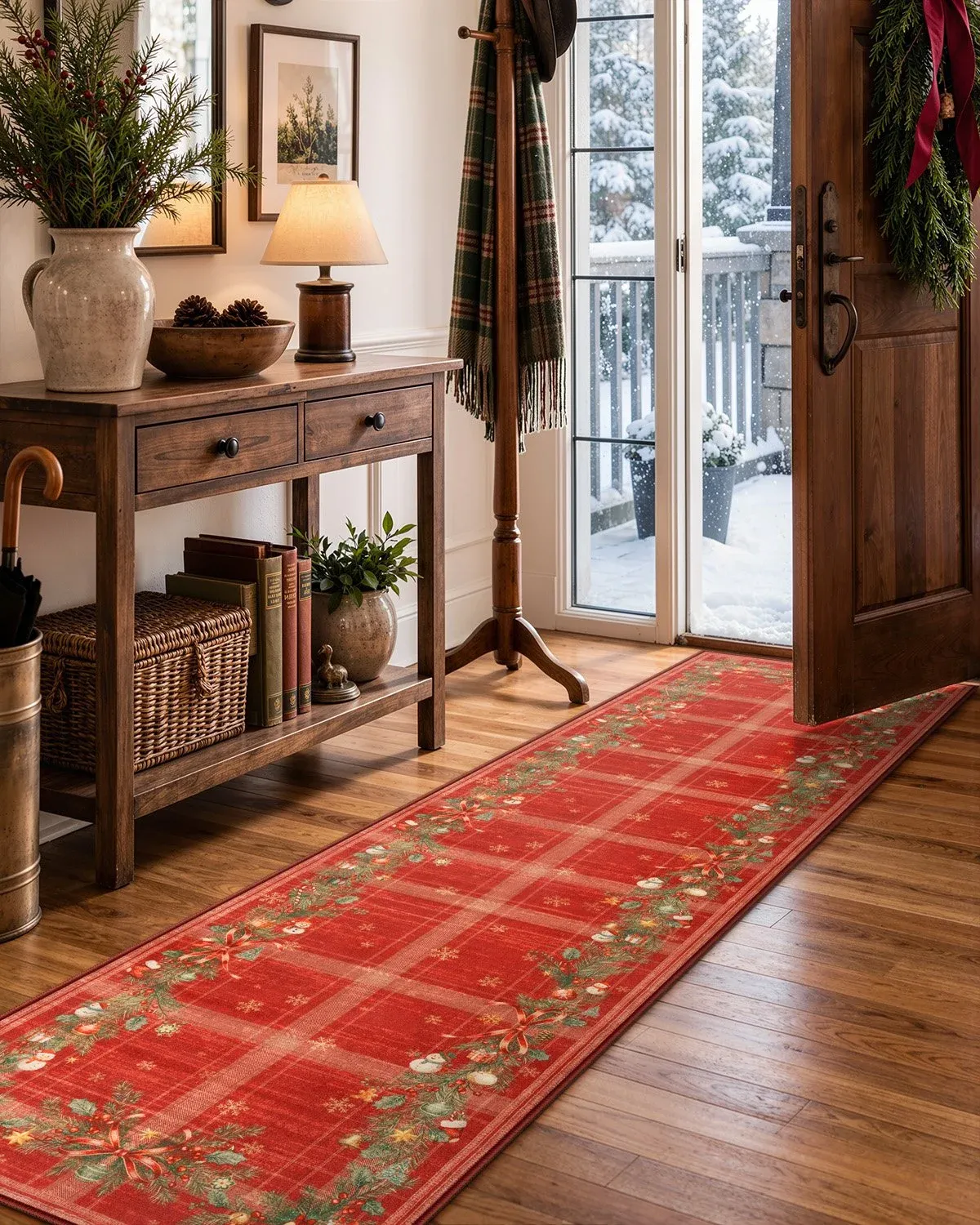
Total: $245-$835. Budget alternative: a thrifted console painted in the garage, a Walmart runner, and a faux evergreen arrangement with real pinecones collected from your own yard lands the same cozy read for $95-$280.
here is the table lamp, and it’s the detail most people miss. Garland and pinecones are decoration; a lamp is atmosphere. It puts a warm pool of light at seated eye level, which is exactly where a hallway console looks darkest, and it makes the framed prints above it feel like part of a room instead of something hung in a corridor. Pull the lamp and this becomes a perfectly nice, slightly lifeless holiday table.
12. Red Amaryllis And A Marble-Top Console
- Measure the console width and confirm a gold tray plus a vase will fit without crowding the edges.
- Find the nearest outlet — the lamps, tree, and string lights all want power, and extension cords across a hallway floor are a trip hazard.
- Check that the garland won’t sit against lamp shades or candle flames when the heat is on.
- Confirm the archway garland leaves at least 6 feet 8 inches of head clearance for tall guests.
- Decide fresh versus faux greenery before you buy, because fresh magnolia and cedar behave very differently.
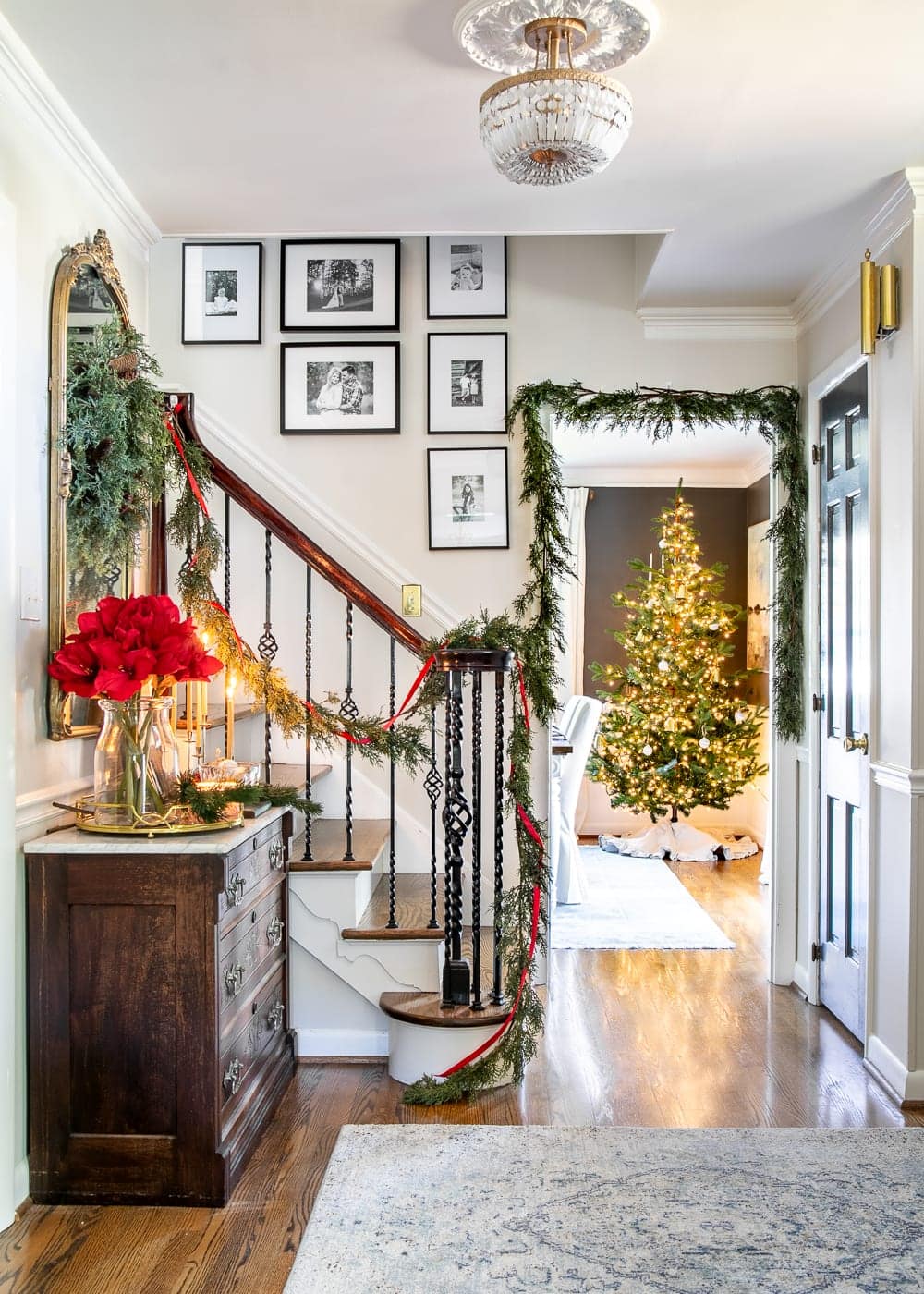
Garland on a staircase you actually use needs to be zip-tied tight, not draped loosely — loose swags catch hands, tote bags, and the occasional dog. Wax candles on a console look gorgeous and are genuinely risky around dried greenery; switch to battery pillars with a flicker setting and nobody will know. And if your gallery wall of framed photos sits above this console, remember it competes for attention with a lit tree visible through the archway. Sometimes the best move is fewer frames, not more.
13. Holiday Styling That Survives A Busy Household
The 2026 shift is away from showroom-perfect holiday styling and toward what people are calling lived-in holiday — decor that tolerates coats, boots, dogs, and a family of five moving through a hallway forty times a day. That means weighted elements, no trailing ribbon, no decor sitting on the floor in the walking path, and greenery attached with clips that survive a shoulder brushing past. Pinterest is full of it because the photos look real: warm light, slightly imperfect, and obviously inhabited.
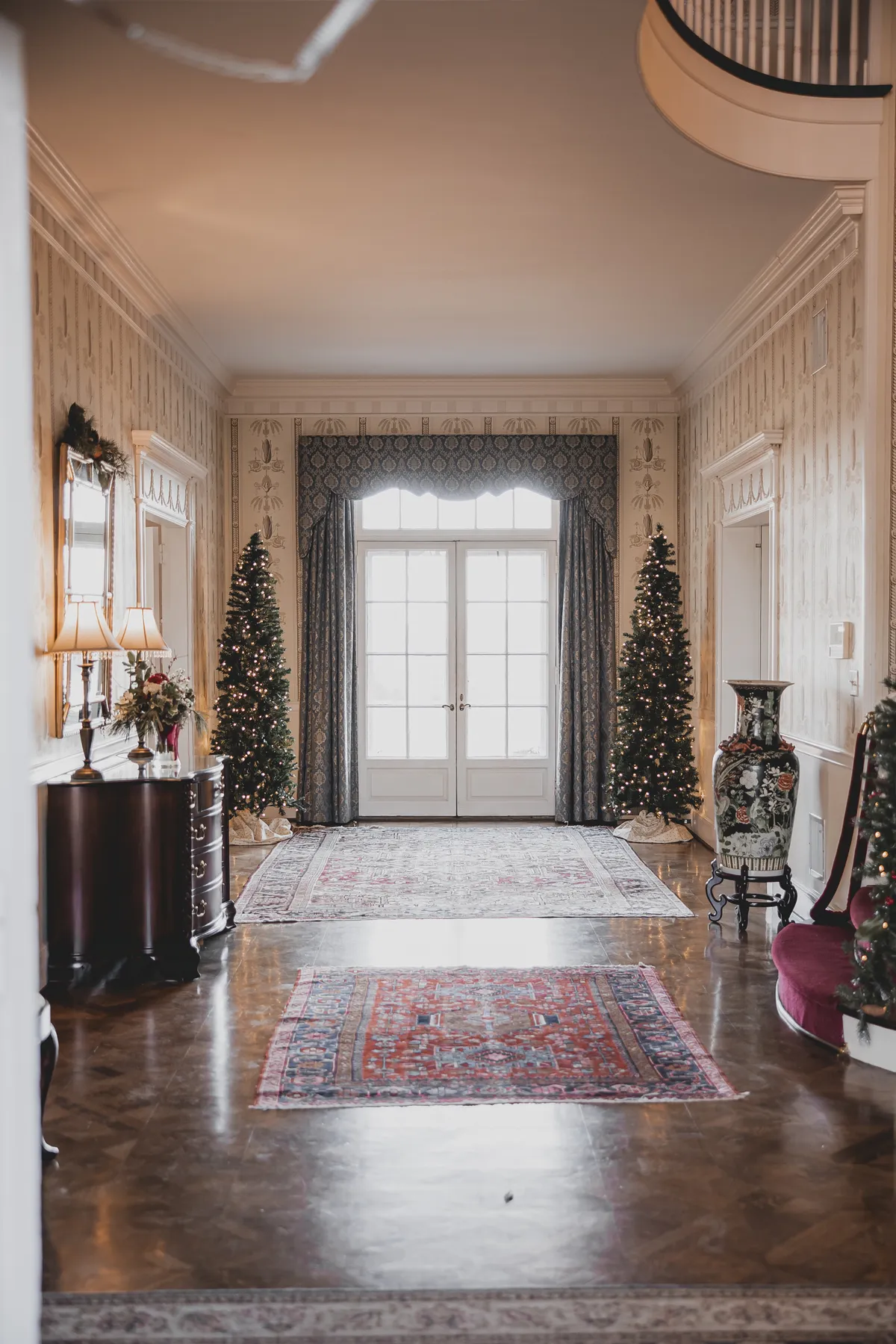
You can build it cheaply. Walmart and Target both sell pre-lit garlands under $25 that need zero styling skill, Facebook Marketplace is drowning in secondhand greenery in early December, and thrift stores are where you find the brass trays and glass hurricanes that make a console look intentional. A single $15 lamp on a $20 slipcovered side table will do more for your hallway than $200 of ornaments. Start with light and texture, then add the festive stuff on top.
14. Black Console, Flocked Tree, Buffalo Check Bench
The math: 55% white and cream, 25% black, 15% warm wood and green, 5% gold. The flocked tree and off-white runner with a black geometric pattern carry the white; the black console, wall sconces, and pillow accents carry the dark; warm wood, greenery, and pinecones hold the middle. For a springier version, swap black for deep charcoal blue and cream for oatmeal. For something softer, trade the geometric runner for a solid wool one and let the buffalo check do the pattern work.
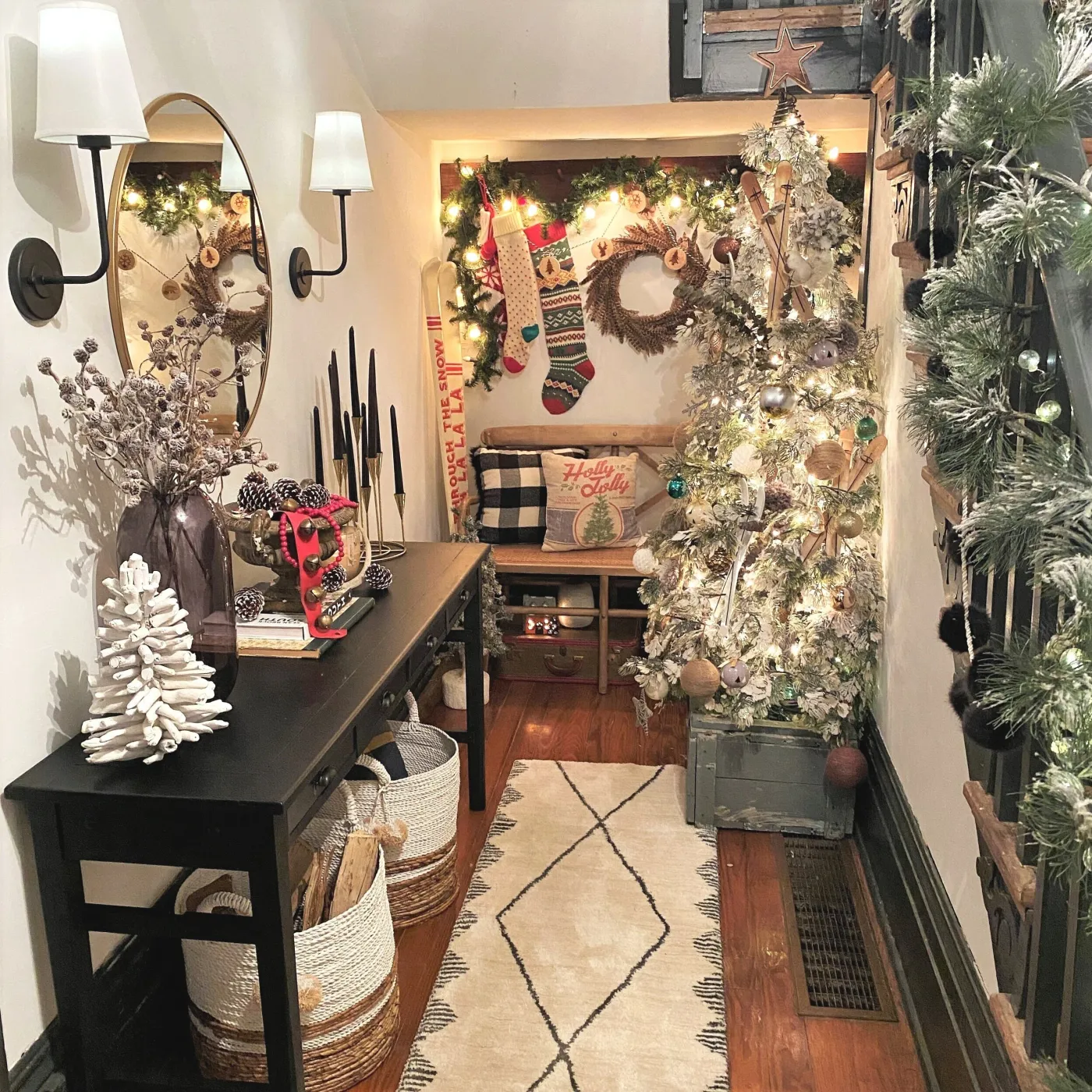
Flocked trees shed, and they shed more than the box admits. Expect a light dusting of fake snow on the floor for the first week — a vacuum with a brush attachment handles it, but don’t run a robot vac near it or you’ll be cleaning white dust out of the brushes in February. Store the tree upright in a bag if you can; squashed flocking cracks. Buffalo check pillow covers are thankfully machine washable, and knitted stockings pill after a season or two, so buy one spare set. For a version with zero shedding, compare with Idea #24.
15. The DIY Hallway That Looks Nothing Like DIY
- Buy a plain 6- to 9-foot faux pine garland — no lights, no ornaments — for $12.
- Fluff every branch by bending stems outward and alternating directions; this takes 10 minutes and doubles the volume.
- Zip-tie in pinecones, dried orange slices, or cinnamon sticks at irregular intervals, never evenly spaced.
- Weave a battery-operated fairy light strand through the back of the garland so the wires stay hidden.
- Hang it slightly below the door trim so it drapes past the frame by about 6 inches.
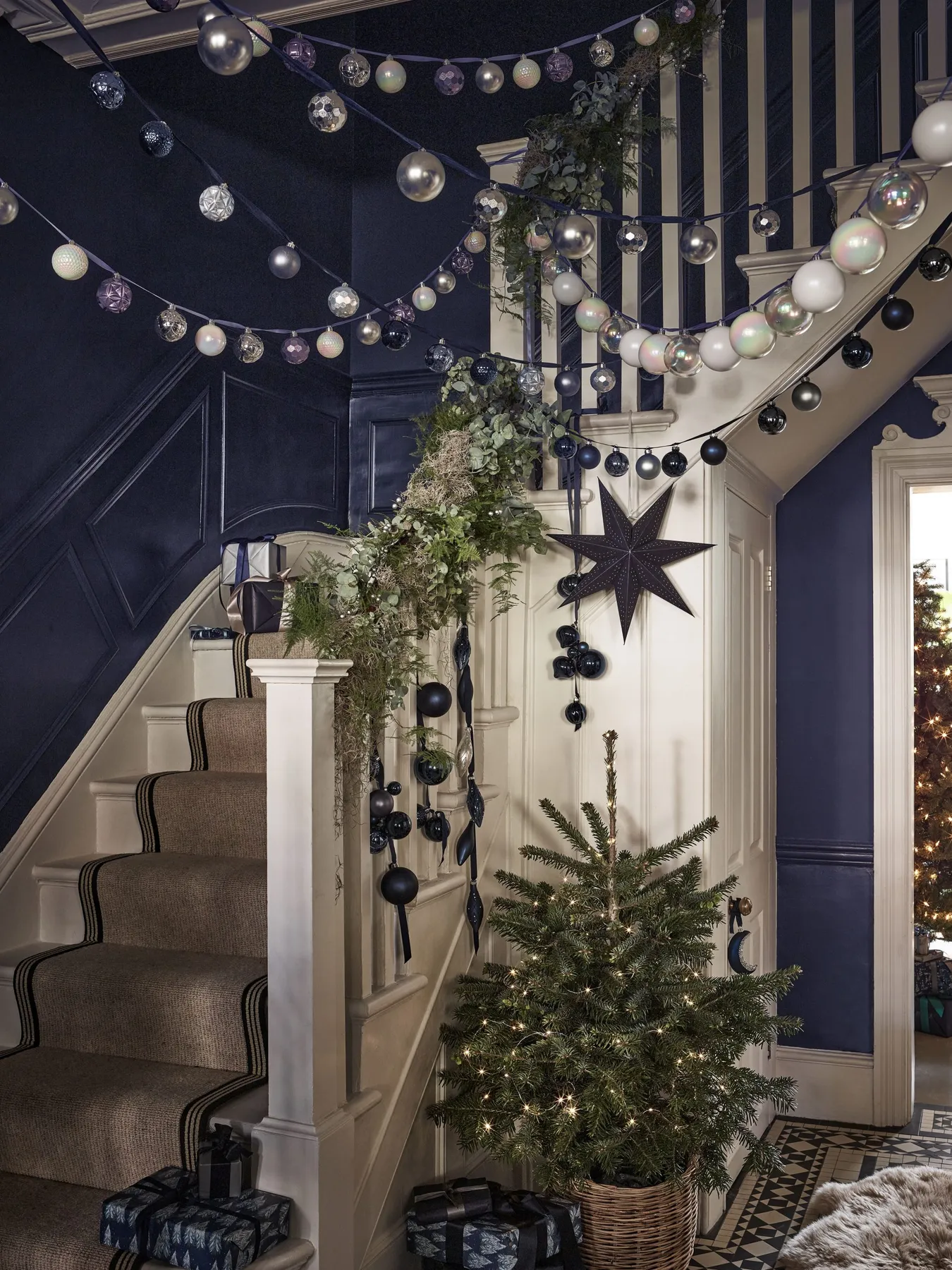
Time: 40 minutes. Cost: $18-$30. Budget alternative: if you want to skip the DIY entirely, Walmart’s pre-lit garlands at $18-$25 and dollar-store ornament packs do the job in fifteen minutes. The trick either way is buying twice as much greenery as you think you need — a stingy garland always looks like a stingy garland, no matter how well it’s styled.
16. White Lace Garland And Snowflakes In A Pale Hallway
- Hold the lace against your wall in daylight — white lace on a cool grey wall reads slightly yellow, and that’s not a flaw, just something to plan around.
- Measure the doorway you’re draping and add 12 inches of length so the lace falls past the trim.
- Check the bench height against the snowflake placement so the cutouts don’t sit behind someone’s head.
- Test your runner for slippage on the light wood floor with a quick shove.
- Decide now whether the coat hooks hold real pine branches or faux, because real ones drop needles onto light flooring.
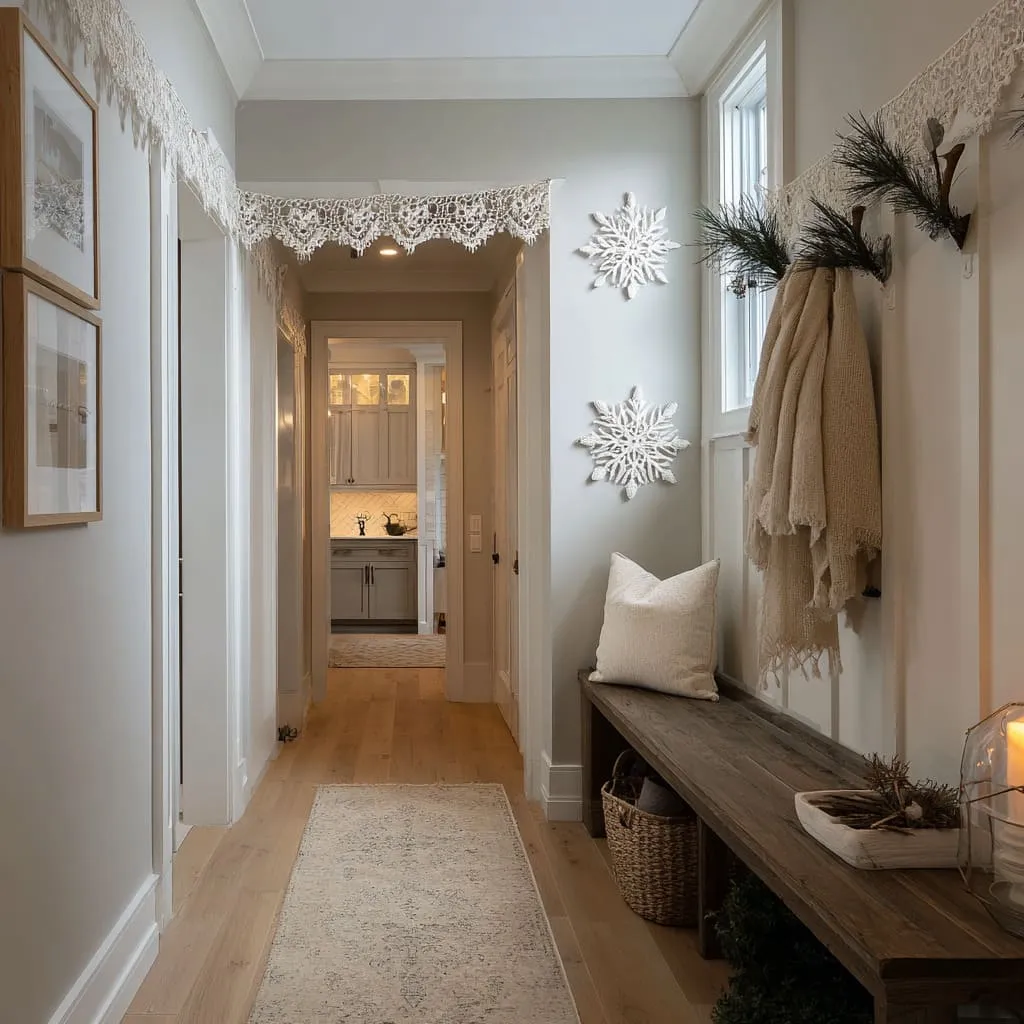
Treat wall decor like art, not stickers. Place two snowflake cutouts on a vertical axis about 10 to 12 inches apart, with the pair’s center around 60 inches from the floor, and use removable adhesive strips so pale paint survives removal. Drape the lace garland so it hangs 6 inches below the door trim on both sides — that asymmetry in length is what makes fabric garland look intentional instead of accidental. And one quiet trick: pin the lace slightly to itself at the top of the doorway so it keeps its shape instead of sliding sideways by New Year’s.
17. A Mantel Garland With Tiny Village Houses
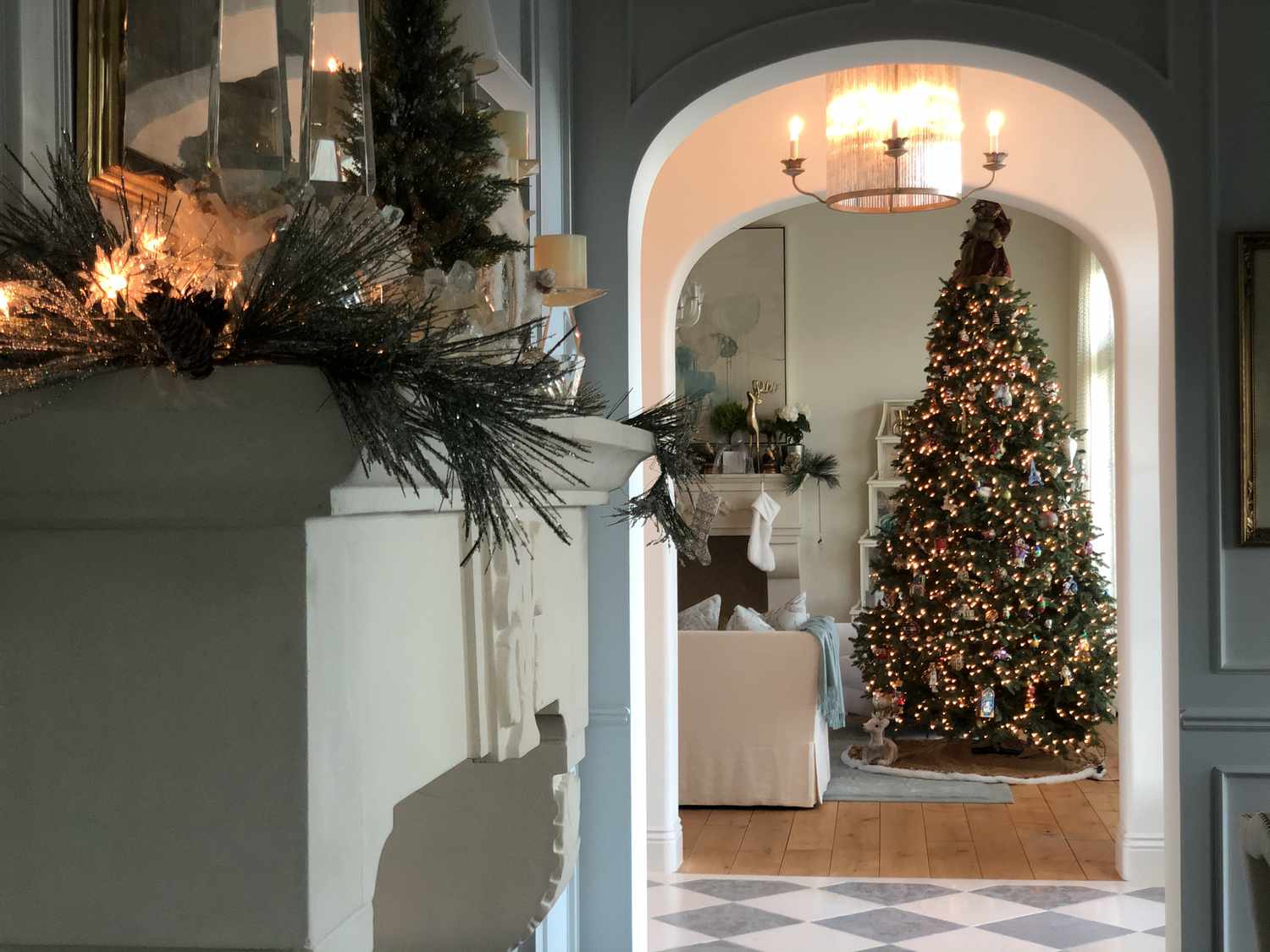
This is big-room decorating, so be honest about your dimensions. The look wants a fireplace wall at least 10 feet wide, a mantel 5 feet or longer, and a garland running 12 to 15 feet — plus ceilings high enough that a 10- to 12-foot tree doesn’t press against the ceiling. The stone fireplace and the oversized lit wreath need 6 feet of clear floor in front of them for seating. In a hallway under 8 feet wide, this volume of garland will feel like it’s inhaled the room; Idea #17 scales the same spirit way down.
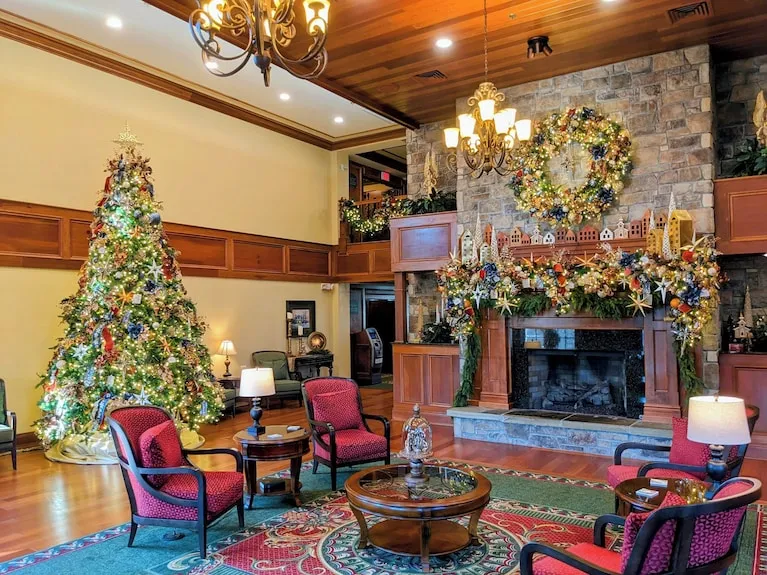
Storybook Christmas is having a moment, and the miniature village houses nestled into the mantel garland are the reason people stop and look. It’s nostalgia with a narrative — little lit windows, tiny roofs, stars tucked between branches — and it photographs like a memory rather than a display. The staying power is real, too. Village houses are collectible, they come out every year, and they never date the way novelty ornaments do. If you’re going to invest in one holiday piece this decade, this is the one.
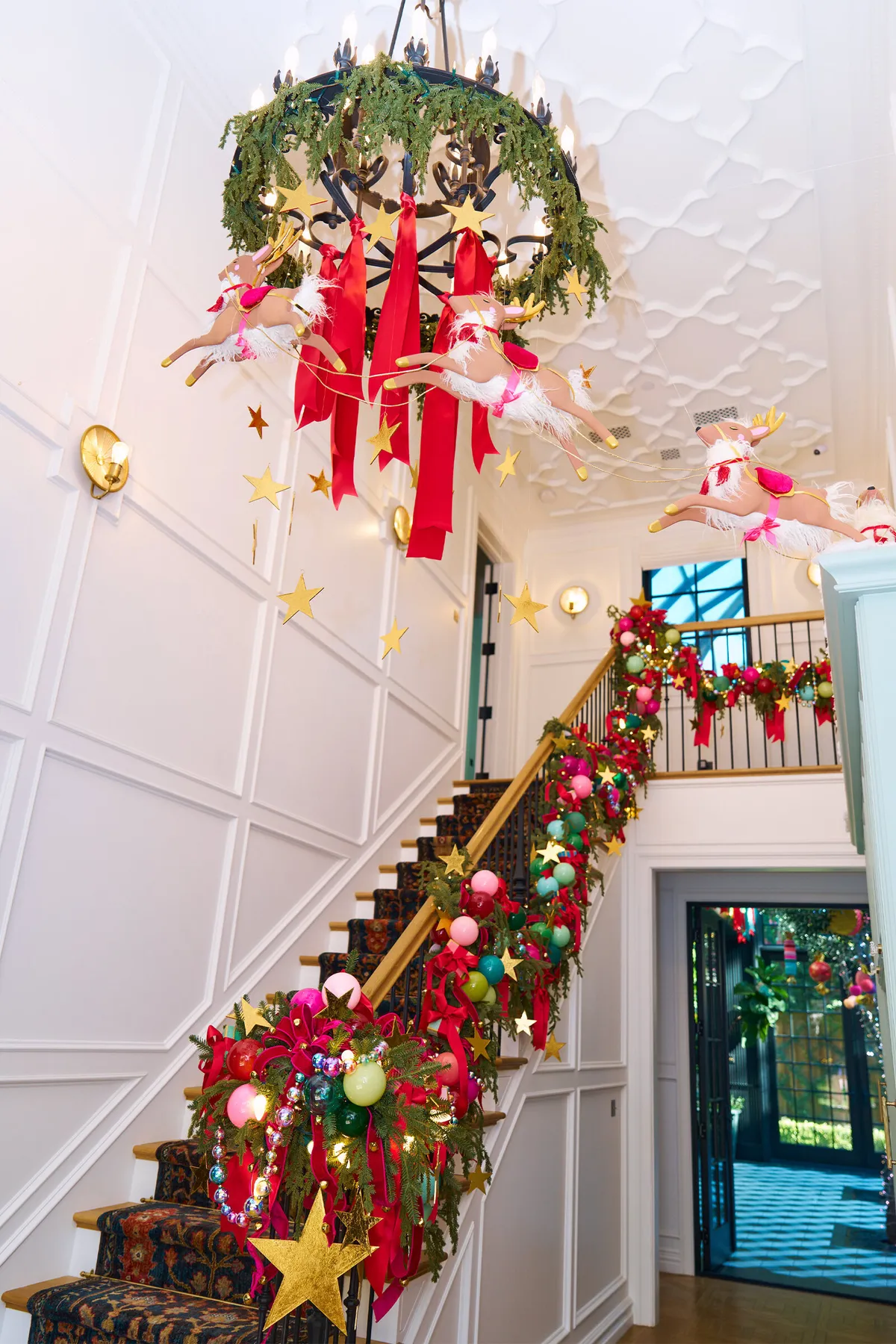
18. Peacock Feathers And Pink Glitter On The Banister
Teal garland sounds like a mistake until you understand why it works. Teal is still a green, so it reads as holiday rather than random; the warm white string lights keep it tethered to tradition; and the peacock feathers add iridescence and movement that flat pine can’t provide. Then hot pink and bright blue glitter balls repeat the feather colors in two places, which is the minimum for a bold palette to look deliberate rather than accidental. One pop of pink would read as a leftover ornament. Two or three read as a decision.
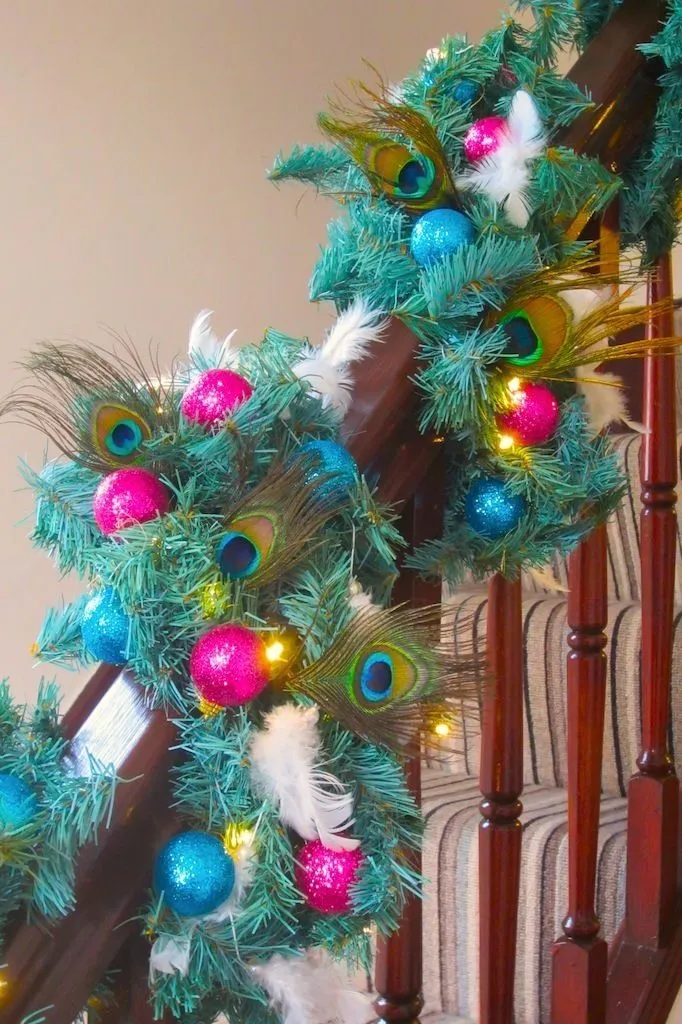
Reality check before you commit. Peacock feathers crush, shed, and collect dust — store them in a rigid box with tissue, not a plastic bag. Glitter ornaments drop glitter, which is charming on a dark wood banister and less charming ground into light carpet. Teal faux pine fades over a few seasons if it lives in a sunny hallway. And if the feather look has your pets’ attention, hang it higher than tail height. For a tamer take on the same banister, see Idea #5.
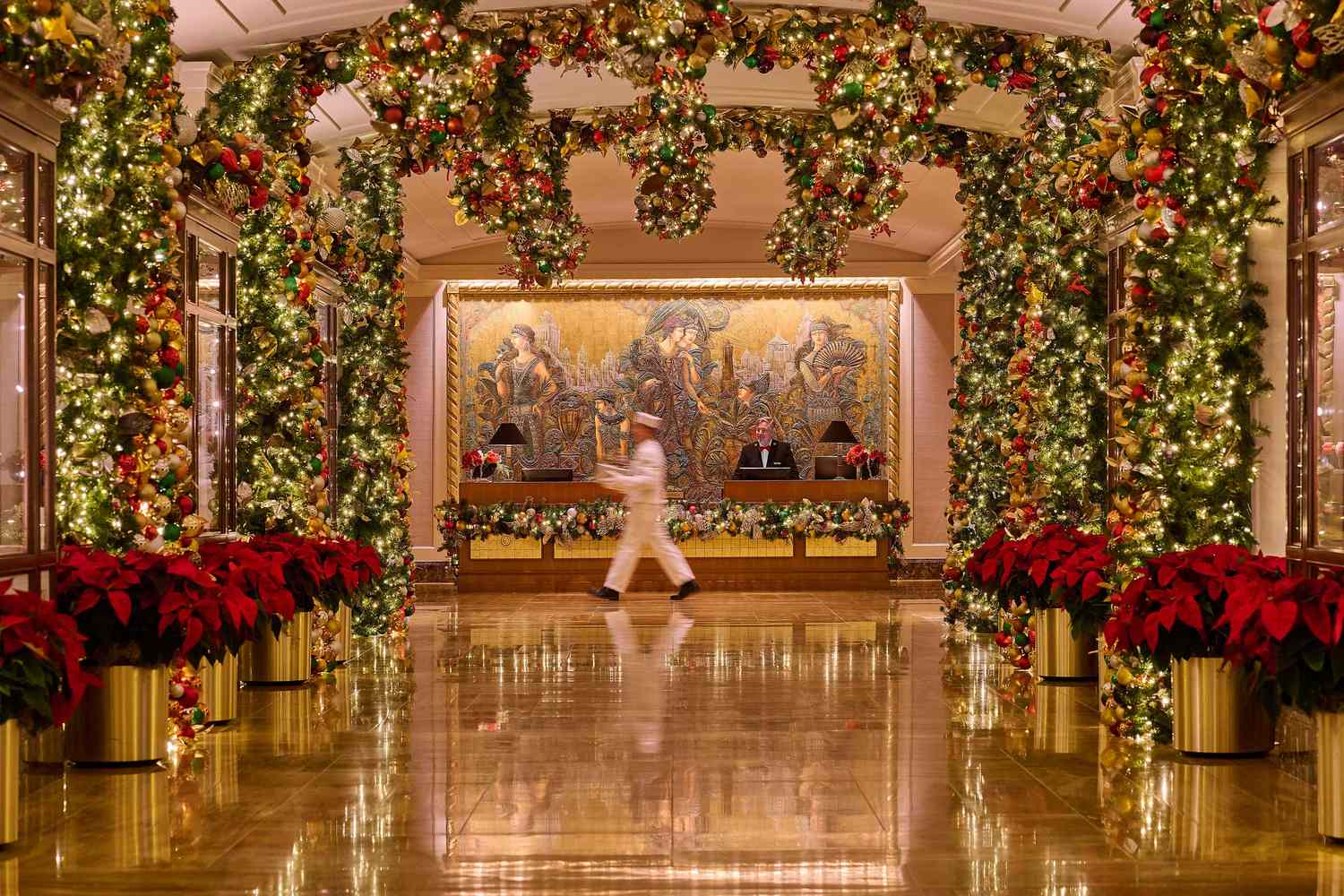
19. A Full-Size Tree Beside A Glass Revolving Door
- Pre-lit 7.5 ft artificial tree: $150-$450
- Gold and red ornament set, 100 count: $40-$120
- Candy canes and gold leaf or star picks: $15-$40
- Tree collar or skirt: $25-$70
- Extension cord, timer, and tree anchor strap: $15-$30

Total: $245-$710. Budget alternative: a Walmart 7-foot tree at $79 plus dollar-store ornaments in three finishes gets you 80% of this for under $140.
One professional note if your tree lives near glass like this one. In a narrow entry beside a revolving door, choose a slim profile — a 32- to 36-inch diameter tree instead of the standard 48 — so people can actually get through. Then buy ornaments in sets of twelve across exactly three finishes: matte red, shiny gold, and a single glitter finish. Collections look collected; mixed sets of five finishes look like a clearance aisle. Anchor the top of the tree to the wall with a strap if there’s foot traffic on two sides.
20. Magnolia Leaves And Golden Deer On Black Tile
This room is running 50% dark base, 30% deep green, 15% gold, 5% red. The black polished tile, dark wood console, and dark stair treads form that base; green garland, magnolia leaves, and the wooden staircase’s painted balusters hold the middle; gold deer, gold plaid accents, and brass hardware bring the shine. To shift it, swap gold for silver and red for ice blue and it becomes a frozen-forest entry. Swap green for burgundy and you get something closer to a library at Christmas.
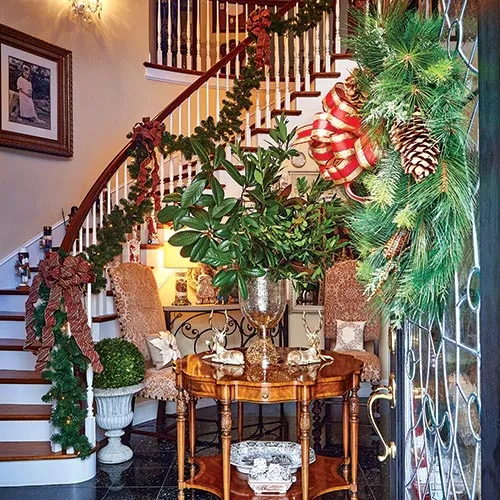
is the fresh magnolia leaves in the large glass vase. They’re glossy, oversized, slightly formal, and they don’t scream Christmas — which is exactly why they work against a garland that does. Take them out and the console looks like generic holiday filler. Keep them and the whole vignette reads like a designer stopped by. Magnolia holds up for two to three weeks indoors, longer if you mist it and keep it out of direct heat.
21. Silver Wrapped Gifts And A Trio Of Cone Trees
- Cluster in odd numbers — three or five pieces reads better than four, every time.
- Vary heights deliberately: something 8 inches, something 12, something 16.
- Put the tallest piece toward the wall and the lowest out front so nothing blocks anything.
- Keep ribbons matte — glossy ribbon fights glitter, and this vignette already has plenty of sparkle.
- Place it where feet won’t find it, ideally a corner beside furniture rather than mid-path.

Time: 20 minutes. Cost: $30-$60, most of which is the cone trees. Budget version: silver wrapping paper with white snowflake decals and black satin ribbon from the dollar store runs about $12. Target’s cone trees in white and gold are $8-$25 each, and dollar-store snowflake ornaments at $3 for a pack of three finish the trio. This is the smartest small-space holiday styling there is — it delivers a full festive moment in the floor space of a shoebox.
22. Navy Door, Jute Rug, Trees In Woven Baskets
Flanking elements should never match. In this entry the dark blue paneled door sits between a 40-inch tree in a woven basket, an 18-inch-spindle bench with cushions and a throw, and a crock holding branches — three different heights, three different materials, and a clear 36-inch walking path down the middle. That’s the formula: something tall, something seat-height, something low. Symmetry on both sides of a door makes an entry look like a catalog page, and uneven heights make it look like a home.
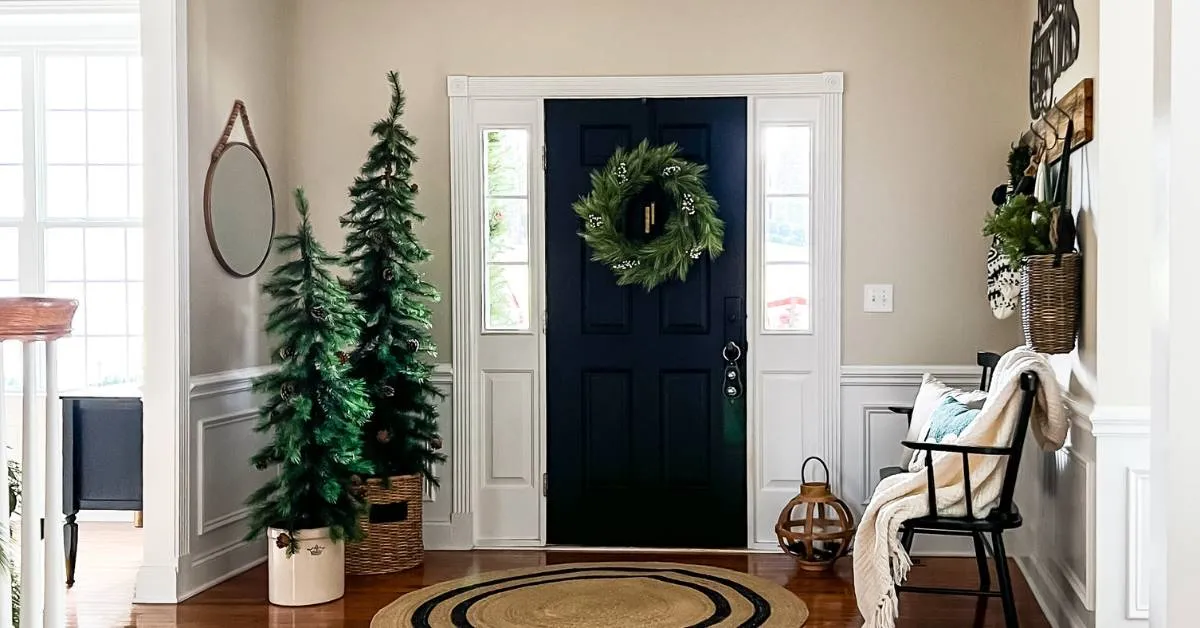
- Green wreath with white berries: $25-$70
- Two 4 ft artificial trees with pinecones: $60-$160
- Woven baskets plus a crock: $40-$120
- Black spindle-back bench: $80-$250
- Round jute rug with black stripes: $35-$90
- Woven basket lantern: $20-$45
Total: $260-$735. Budget alternative: a Target wreath at $15, two Walmart trees at $25 each, and a bench from Facebook Marketplace for $40 brings this to roughly $110-$180. Same palette, same warmth, one afternoon. Compare with Idea #14 if you want the same dark-anchor feel with a statement console instead.
23. Pinecone Garland Against A Fir-Patterned Wall
Pattern drenching is the design story of 2026 — walls with tonal motifs, colored tile floors, pattern on pattern, and holiday decor layered on top instead of stripped back. This stairway is the reason it works: the brown wall with its repeating fir tree pattern is quiet enough that a pinecone garland reads as a third layer, not a fight. Designers are pairing holiday decor with patterned walls precisely because a subtle motif under the garland makes the whole thing feel intentional rather than seasonal.
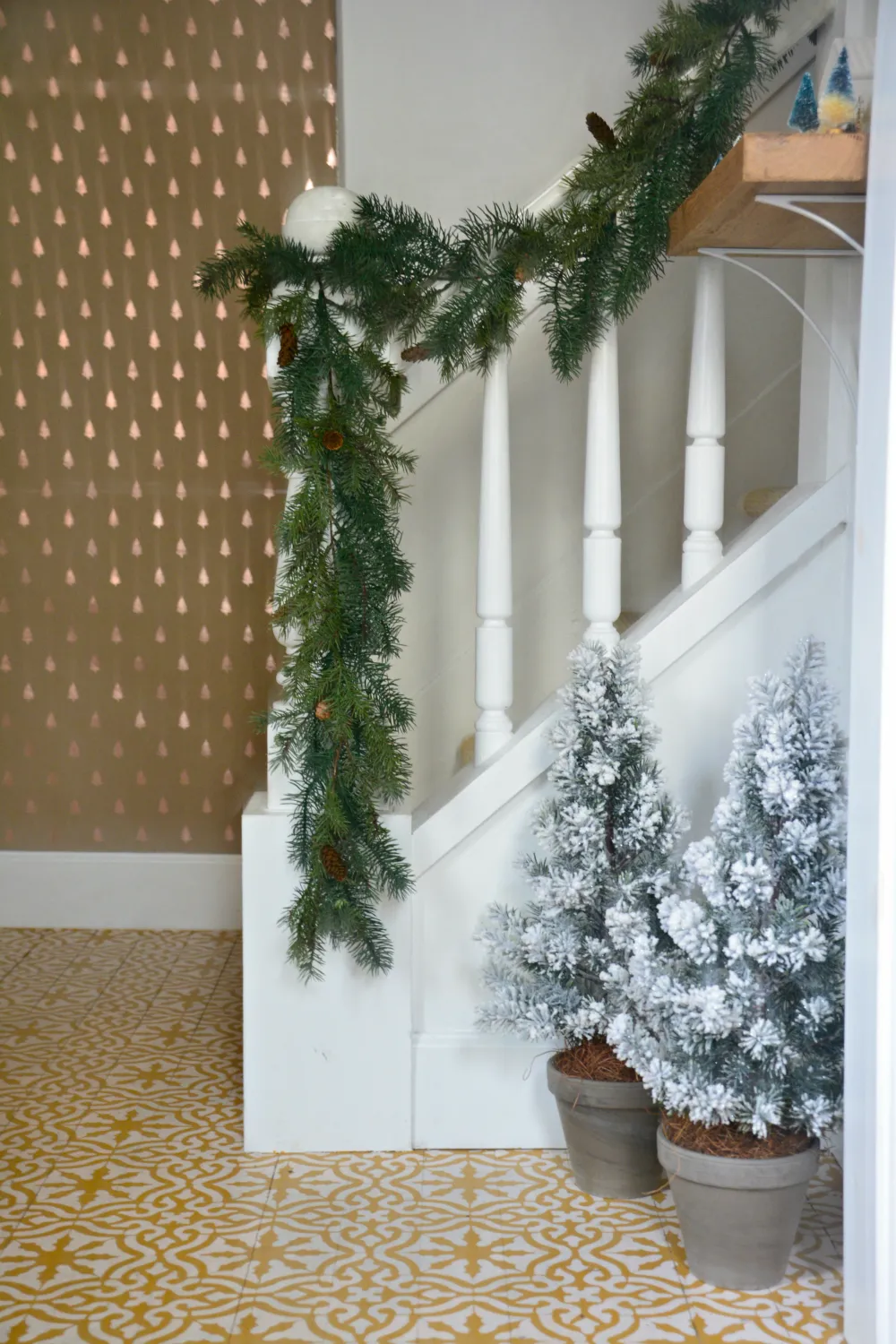
- Wipe the stair rail with a damp cloth so nothing slides or sticks unevenly.
- Attach garland with zip ties every 18 inches, under the rail where hands go.
- Wire pinecones onto short floral picks and tuck them in at alternating angles.
- Add a battery light strand through the back, then step down to the bottom of the stairs and check for dark spots.
- Fluff last — bend branches forward so the garland has depth from the side view.
Time: 45 minutes. Cost: $35-$60.
24. Symmetry: Two Lamps, Two Prints, One Gold Mirror
- Measure the console width and confirm two lamps plus two framed prints fit without crowding the mirror’s edges.
- Locate outlets and hide cords behind the console legs before you style anything.
- Check that the mirror’s bottom edge clears the tallest garland element by at least 2 inches.
- Confirm garland won’t touch lamp shades — warm fabric plus greenery is how things scorch.
- Set a budget ceiling for the mirror, because a 36-inch gold-framed round is where this look gets expensive.
Symmetry is doing the calming here. An elaborate garland with red berries and small flocked trees is busy — the matched lamps, matched prints, and single centered mirror give the eye a predictable structure to rest in. The two lamps also throw light at eye level, which is exactly the height a hallway console needs, and gold mercury glass vases pick up the mirror’s finish so the reflections multiply. If you want to break the symmetry without losing the calm, swap one print for a small clock and keep everything else aligned.
25. Small Foyer, Big Holiday Energy
For a foyer measuring roughly 4 by 6 feet with 8-foot ceilings, skip the tree entirely and work the vertical plane. Cap decor depth at 12 inches from the wall so you keep a 30-inch walking path, choose a 24- to 30-inch round mirror instead of a large art piece, and keep the garland to a single doorway swag rather than a wrap. Anything taller than 6 feet in a space this size starts to feel like a column. If you do have room for a tree, a 5-foot slim profile is the ceiling on scale here.
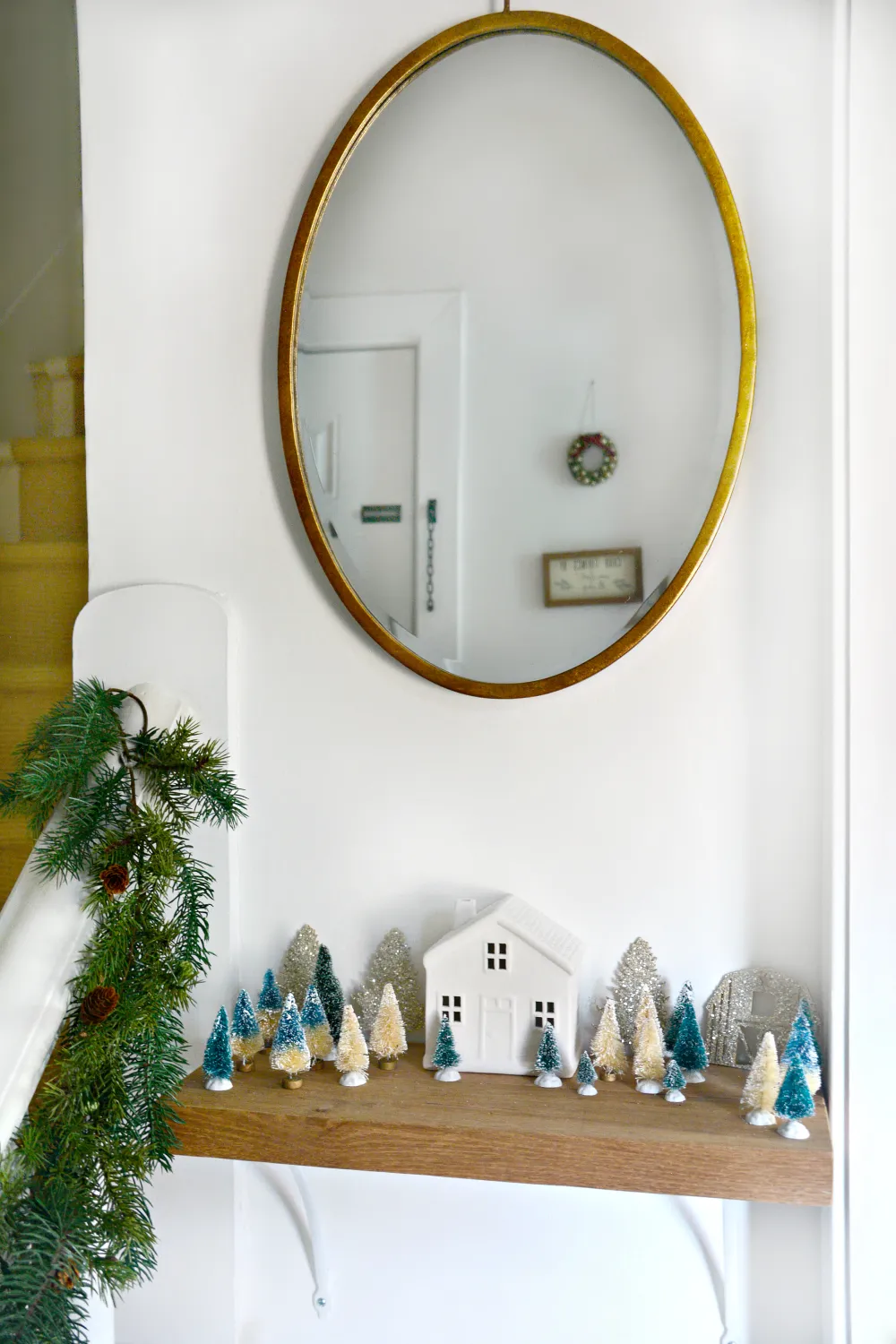
The cheap version of this is genuinely good. A $18 pre-lit Walmart garland, a $12 Target mini tree in a basket, a $15 thrifted mirror, and two packs of dollar-store ornaments gets you a fully styled foyer for about $60. Buy the mirror first at a thrift store and build the rest around its finish — brass, black, or natural wood — so nothing looks bought all at once. Small entries are forgiving; you only need three things to be right.
26. Warm Bulbs, Cool Walls, Zero Glare
Lighting a hallway for the holidays is mostly a color temperature decision. Stay between 2400K and 2700K for anything you’ll see at night, and keep it consistent — a single daylight-white strand in a warm-white hallway is instantly visible and instantly wrong. Budget wattage honestly: 100 mini lights draw roughly 40 watts, so keep it under three strands end-to-end on one run, and put the whole show on a smart plug or timer so you’re not crawling behind a console every night. Battery strands are worth the extra $8 near drapes and fabric.
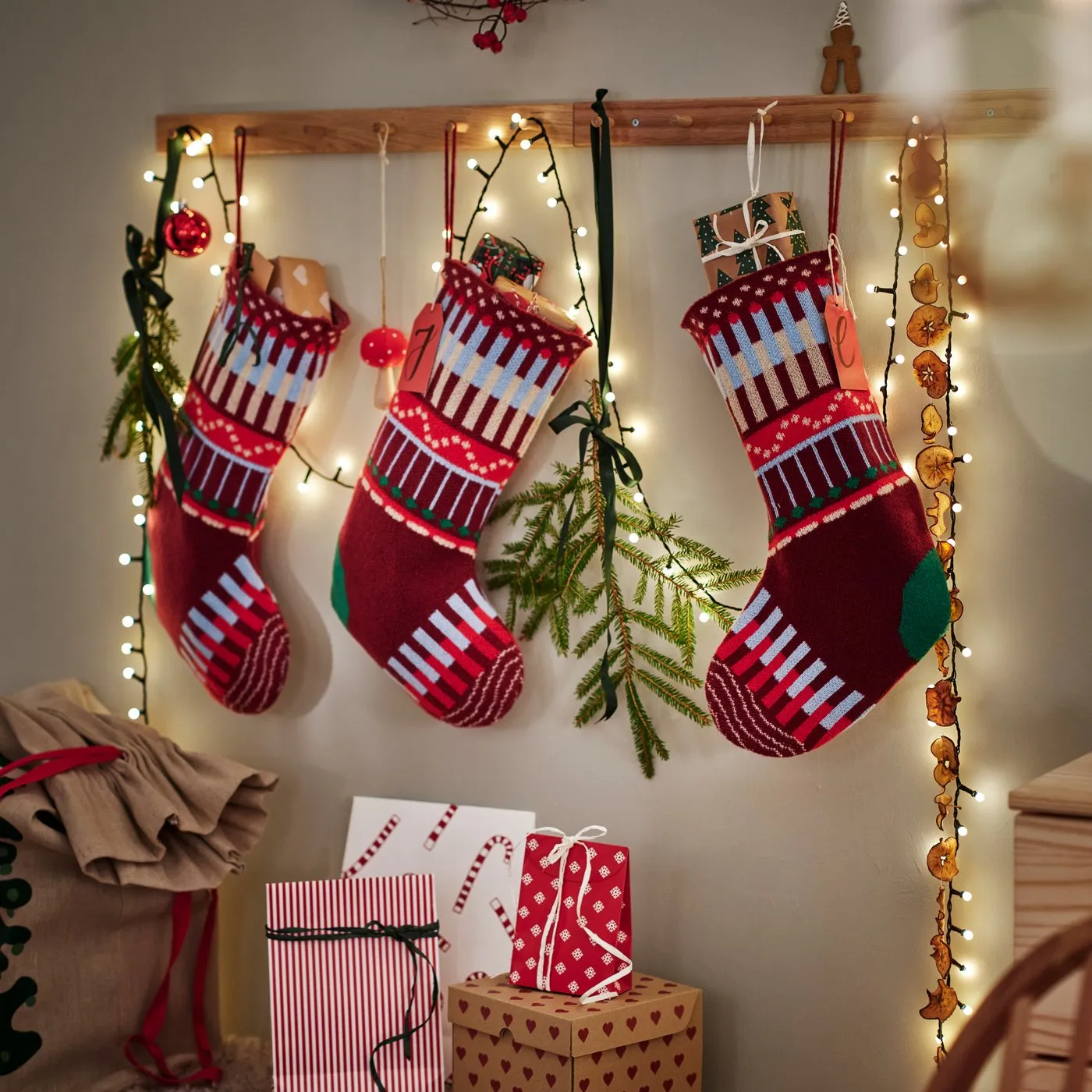
The honest warning: extension cords are the part of holiday decorating that actually causes fires. Never run a cord under a rug or across a doorway where feet travel, never daisy-chain more than the manufacturer allows, and check cords for warmth after the first hour. Battery-operated lights solve most of this, timed smart plugs solve the rest. If your hallway outlets are scarce, plan the layout around them before you buy anything — this is the step everyone skips and regrets.
27. Where To Put A Tree When The Hallway Is The Only Spot
- Slim 6-7 ft artificial tree, 32-36 in diameter: $90-$300
- Tree collar or woven basket base: $30-$70
- Heavy-duty extension cord plus timer: $15-$30
- Ornaments across three finishes: $30-$90
- Wall anchor strap for stability: $10-$20
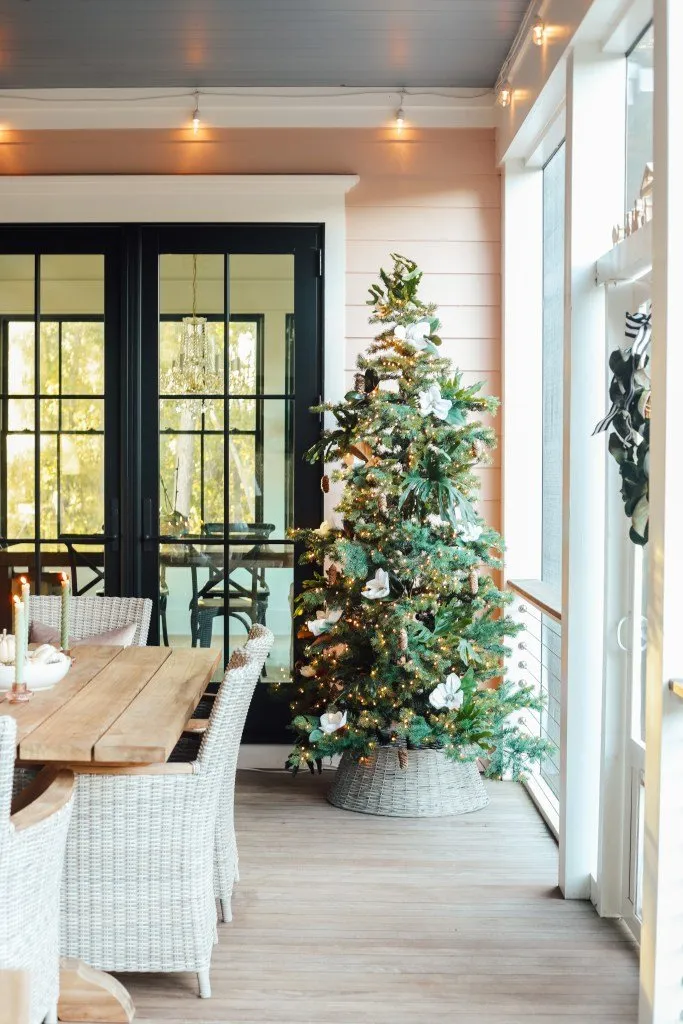
Total: $175-$510. Budget alternative: a Facebook Marketplace tree in early December runs $40, a basket from a thrift store is $8, and ornaments pulled from your existing box cost nothing.
that separates a hallway tree that works from one that feels like a barricade is a defined footprint. Ground it with a collar or basket so the base reads as furniture, and add a small rug or mat underneath so the tree has a visible edge rather than bleeding into the floor. Without that boundary, a tree in a corridor looks like it’s blocking the way, even when it isn’t. With it, the tree looks like it belongs exactly where it is.
28. The Classic Foyer Formula That Never Ages
- Clear the console completely — empty surfaces first, always.
- Hang or anchor your largest element, usually a mirror, and center it on the console, not the wall.
- Place the tallest object on one side, off-center, to break the symmetry.
- Build an odd-numbered cluster around it at three heights.
- Add one warm lamp, then one thing that smells good — a candle, cedar clippings, or a diffuser.
- Step back to the front door and remove one object. You’ll almost always remove the right one.
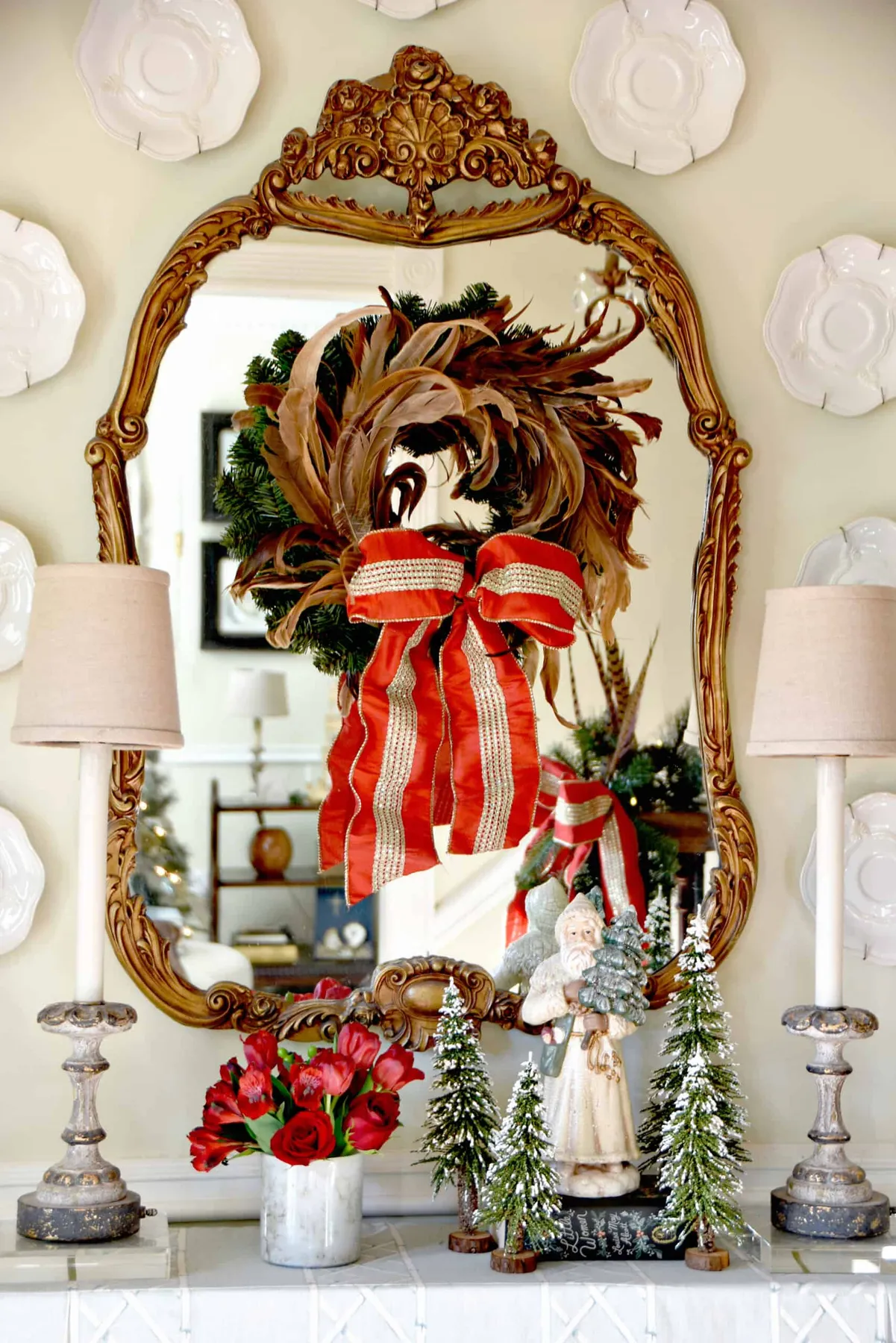
Time: 30 minutes. Cost: $0 if you shop your own house first. Real talk: this formula ages badly when every metal is the same shiny brass — mix in a matte finish or a black frame and it looks collected instead of dated. The other failure mode is a functioning entry that’s also styled; if your family drops keys, mail, and dog leashes on that console, add a small tray and a bowl so the clutter has a designated home. Styled and usable beats styled and off-limits.
29. Historic Hall Drama On A Modern Budget
Historic halls give you free drama in the form of height. With 12- to 14-foot ceilings and an 8-foot-wide corridor, full-scale garland swags, tall trees, and oversized wreaths all work because there’s air above them to absorb the volume. If your ceilings come in at 9 feet, scale the same design down about 30%: shorten swags, reduce garland diameter, and drop your tallest element below 8 feet. The proportions matter more than the quantities — a swag that would look generous in a castle looks like a noose in a ranch house hallway.
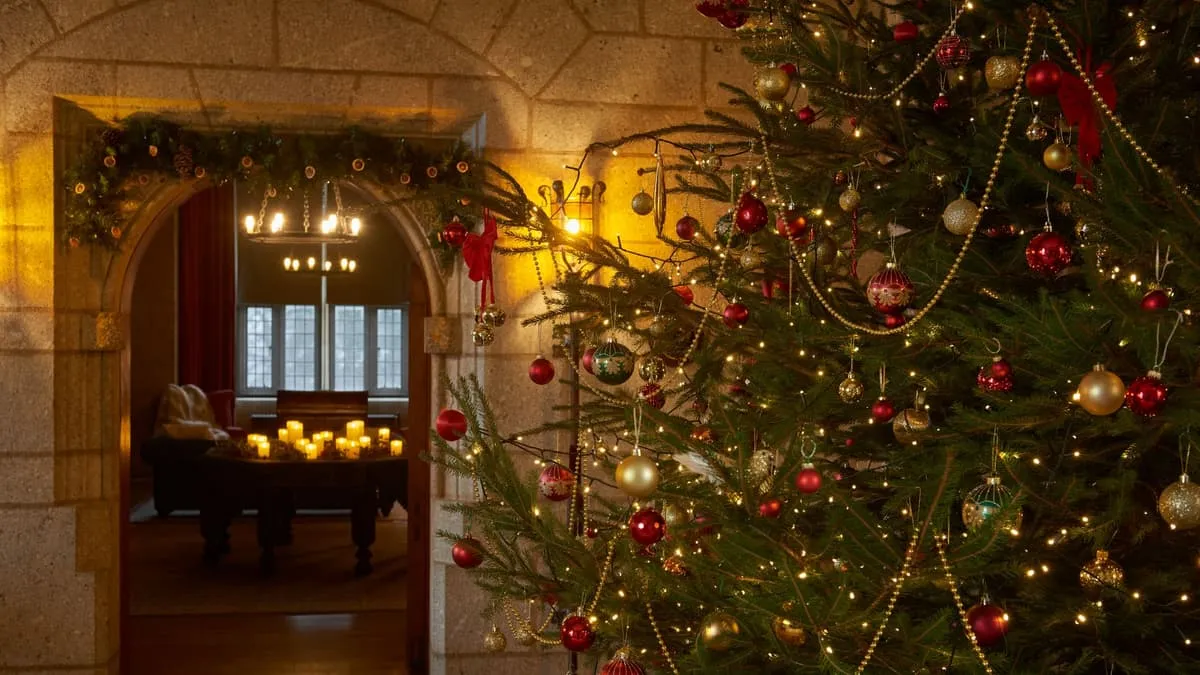
Three principles are doing all the work. Verticality: everything points up, so the eye travels the full height of the space. Repetition: the same garland treatment repeats at each arch, which turns a corridor into a rhythm. And restraint in the empty zones: the drama only lands because there are stretches of undecorated wall between the decorated moments. Warm light on cool stone finishes the effect. Emptiness is a design element here, not a gap to fill.
30. Bringing Old-House Character Into Holiday Decor
Old houses are beautiful and slightly hostile to holiday decor. Drafty hallways dry out fresh greenery fast — mist it every other day and expect two weeks, not four. Dust settles on garland and on old woodwork simultaneously, so a soft brush and a weekly pass keeps both looking cared for. Moisture from fresh garland can leave marks on old wood floors, so line baskets and add felt pads under anything heavy. And old wiring means old outlets: check that the circuit can handle your lights before you plug in four strands, and replace any bulb that flickers rather than living with it.
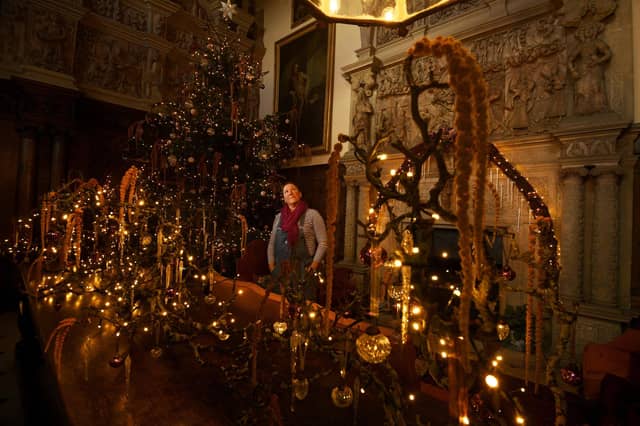
You can absolutely get the historic feeling without the historic price tag. IKEA’s faux greenery, Walmart’s pre-lit garlands, and Marketplace finds in early December will get you 90% of the atmosphere. Reuse everything for three years before buying anything new — the biggest hidden cost in holiday decor isn’t the first purchase, it’s the annual re-buy because nothing was stored properly. Labeled bins, tissue between layers, and a dry spot in the basement will save you more than any sale.
Your Hallway Is The Opening Scene
Your hallway is the first thing guests see and the last thing you see at night, which makes it the most underrated decorating space in the house. Start with one glowing moment — a lit garland, a warm lamp, a lamp on a console — and let everything else follow from there. You don’t need the biggest tree or the glossiest ornaments; you need light at the right temperature and one detail that feels like you.
Save this guide to Pinterest before you head out shopping — come December you’ll be glad you did.