Farmhouse Christmas decor in 2026 has quietly turned a corner on Pinterest — matched-set trees are out, and dough bowls, dried citrus, and garland you actually have to fluff are in. We spent serious time browsing Walmart, Target, and Facebook Marketplace to bring you only what’s worth your attention this year, and the range runs from about $8 for a spool of ribbon to $810 for a full front porch setup.
Inside you’ll find 32 curated ideas spanning rustic farmhouse, vintage nostalgic, neutral modern farmhouse, and traditional red-and-green. Budget versions and luxury versions are compared side by side, so you know exactly where to spend and where to fake it — every single idea comes from a real home, styled by real people.
The 2026 version of this look leans hard on collected-over-time decor: clip-on candle ornaments, old holiday cards strung across a window, estate sale glass. People are tired of buying the same twelve ornaments every November. And stay until the end — we break down the most common mistakes that can ruin these looks.
📌 Save this to Pinterest for later — you’ll want to revisit these ideas.
1. A Tabletop Tree, Brass Candlesticks, and a Dough Bowl of Gold
Strip away the lit tabletop tree and this is just a side table with candles on it. What makes the corner feel like Christmas in three square feet is the big wooden dough bowl — the kind your grandmother used for bread — loaded with gold ornaments and a few sprigs of greens. It does three jobs at once: it catches the flame light from the brass candlesticks, it repeats the mercury glass shimmer from across the room, and it gives the eye one generous, uncluttered mass instead of ten little knickknacks. Skip it and you’re decorating a table. Keep it and you’re decorating a mood.
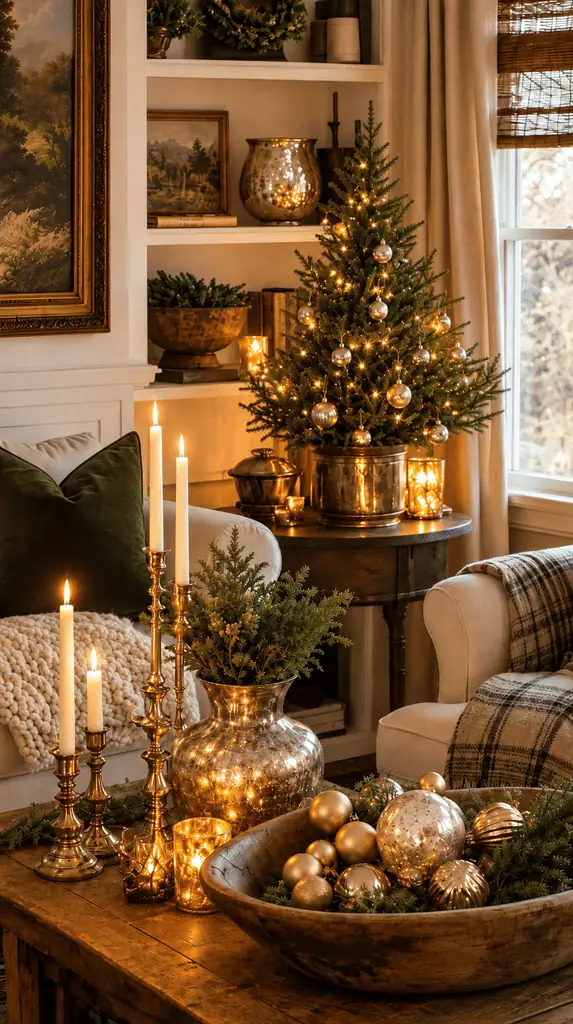
Here’s the math on that candle cluster most people get wrong: group three, five, or seven — never four or six. Then stagger the heights so the tapers in the brass candlesticks sit roughly two to four inches above the mercury glass holders. That gap is what creates the flicker-and-shadow pattern on the wall behind. Keep every flame at least twelve inches from the greenery; a live bough dries out fast in a heated room, and dried cedar lights up faster than you’d think.
2. Vintage Ornaments Towering Over an Antique Chest of Drawers
What’s working here is scale, and it’s working hard. The tree runs nearly to the crown molding, then the dark antique chest of drawers anchors it with something old and heavy — framed photographs, a pheasant figurine, a bowl of citrus fruit. That’s deliberate. A tall tree with nothing beside it reads as a showroom display. The chest gives it a companion. Even the plaid ribbon hanging off the window frame ties the two together without adding another ornament anywhere.
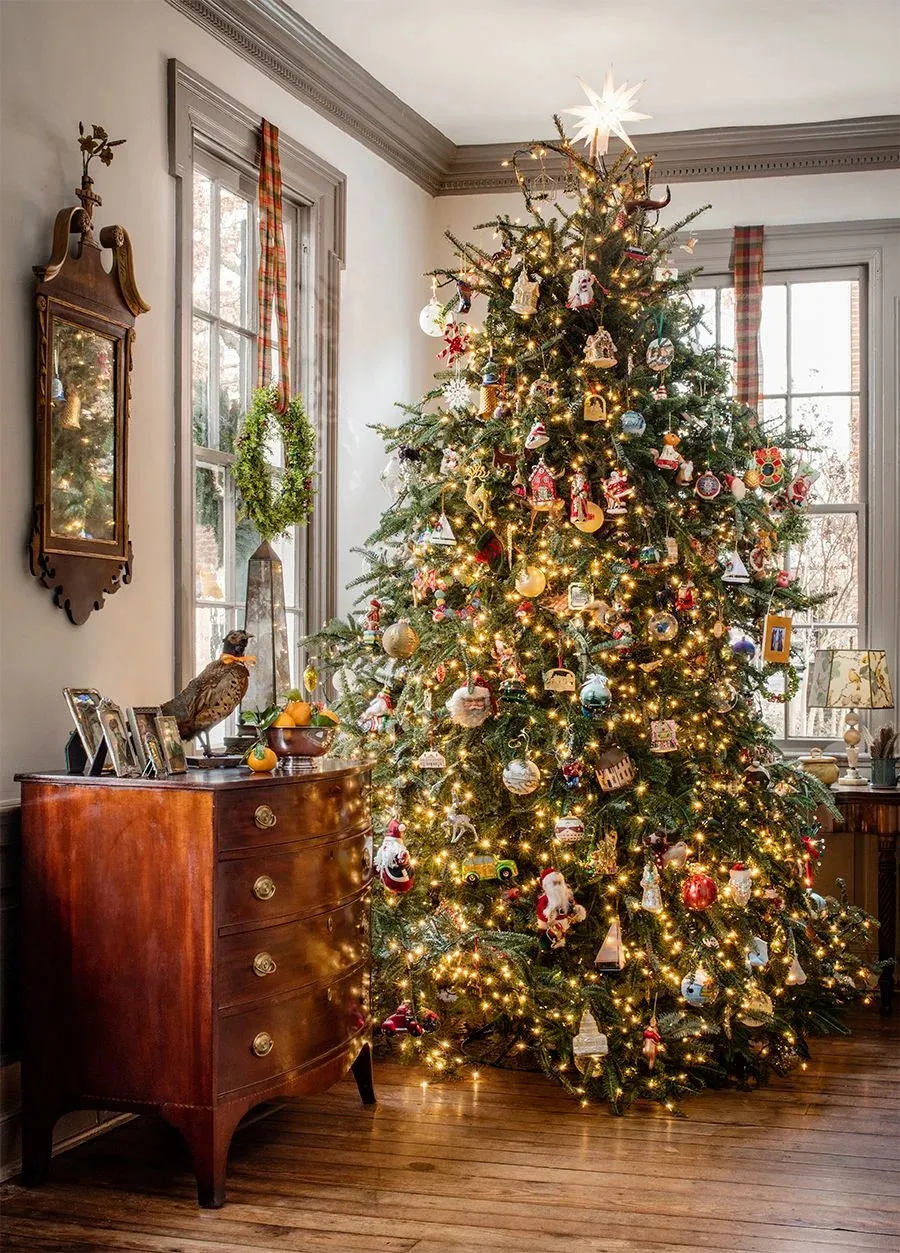
A tree this densely strung with vintage ornaments is beautiful and slightly fragile. Older glass shatters when a cat gets curious, and blown ornaments from the fifties and sixties can carry lead paint, so wash your hands after handling them. Real talk on the lights, too: warm white fairy lights at this density run hot, so check the cords for wear before you plug in, and put the whole tree on a timer. Nobody wants to crawl behind an antique chest at midnight.
3. Dried Orange Slices Against a Raw Stone Wall
- Slice navel oranges and a couple of lemons about 1/4 inch thick — thicker slices mold, thinner ones crumble.
- Blot them on paper towels, then bake at 200°F for three to four hours, flipping once, until they’re leathery, not brittle.
- Cool completely, then pierce each slice with a needle and thread them onto twine with three inches between slices.
- Drape on the tree in loose swags rather than a tight loop, so the light shines through the flesh.
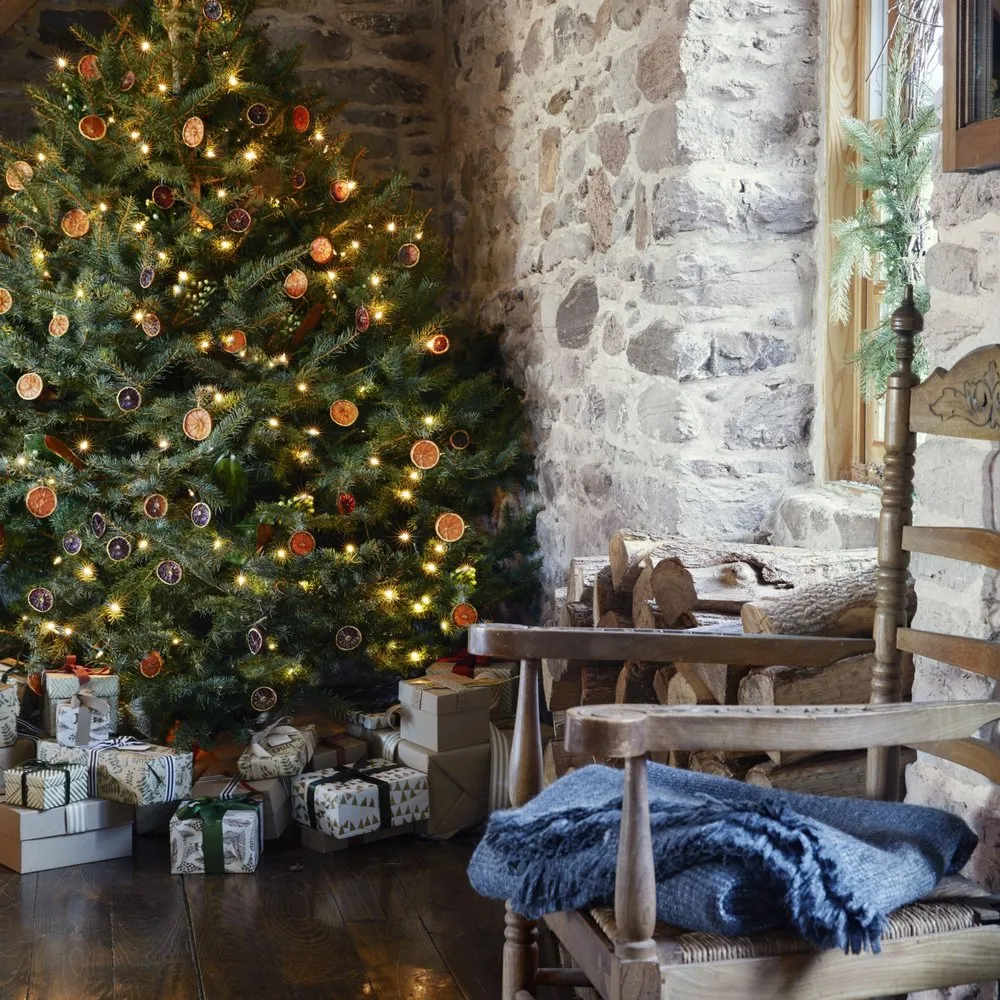
Roughly two hours of hands-on work plus oven time, and about $12 in fruit and twine.
Stone walls eat light, so aim your warm string lights downward rather than outward, and keep every strand on the same color temperature — 2700K, no cool white. Against gray stone, a 4000K bulb turns that cozy amber glow into something that looks like a parking garage. One more thing: hang the garland so the citrus sits in front of the stone, never behind it. The contrast between orange flesh and rough gray is the entire point.
4. Red Bows, Lit Evergreens, and Black Lanterns at the Front Steps
- Two pre-lit potted evergreens, 4 ft: $90–$220
- Pre-lit garland, two 9-ft strands: $40–$90
- Two wreaths with red ribbon: $40–$120
- Two planters plus evergreen and red stem filler: $60–$160
- Two black lanterns with LED candles: $50–$140
- Red velvet bows, bulk pack: $15–$35
- Outdoor extension cords and timer: $25–$45
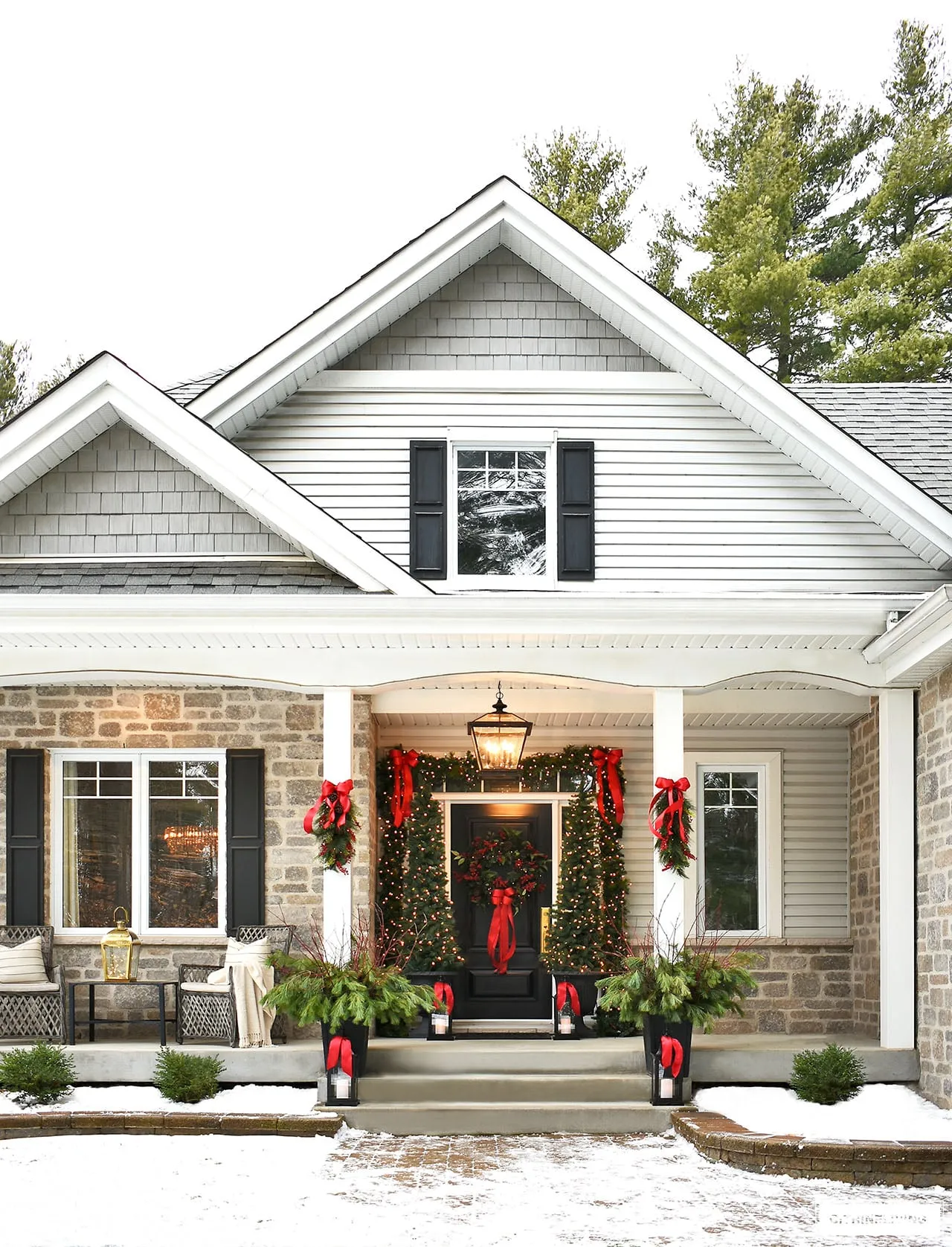
Total: $320–$810
Budget alternative: skip the pre-lit trees, use two $25 artificial evergreens and your own string lights, and tie the bows from ribbon on a spool. That lands you under $200 with the same silhouette.
This arrangement reads best on a covered entry at least 8 feet wide with a 9-foot ceiling — enough room for the flanking trees to breathe without crowding the door. A narrower stoop under 6 feet does better with a single garland and one planter per side, the kind of setup in Idea #7. High porch ceilings over 12 feet? Skip the small potted trees entirely, or the whole thing will look like it’s sitting on the floor.
5. Plaid Ribbon and Pinecones in a Woven Basket Tree Collar
The formula here is about 60% neutral — cream upholstery, natural wood, the woven basket collar — plus 30% forest green from the tree itself, then 10% red-and-black plaid doing all the loud talking. Swap the plaid for charcoal-and-white gingham and the room goes quiet and modern. Swap the basket collar for galvanized metal and it turns industrial. Keep the ratio, change the ingredients — that’s how you get a second look out of the same tree next year.
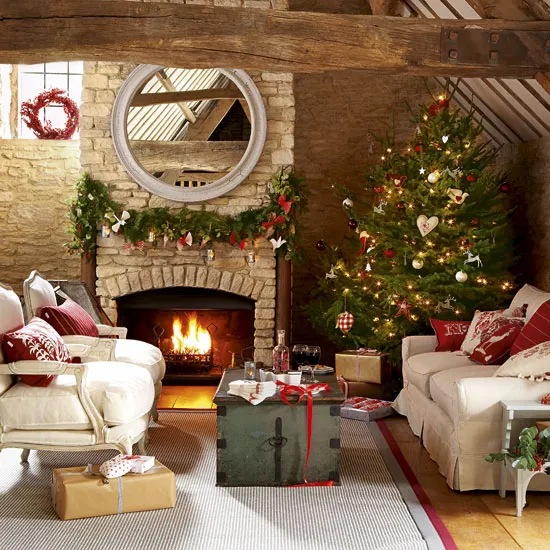
Woven basket collars hide a lot, including a stand that may not actually fit. Measure your tree base before you buy, because most baskets top out around 20 inches across. Live trees in baskets need water access, so either cut a hole in the bottom or line the basket with a tub. Over a wood floor, put a waterproof tray underneath no matter what. And skip the plaid ribbon if you have toddlers — loose ribbon gets pulled, and pinecones become projectiles.
6. A Vintage White Bench, Buffalo Check, and a Twig Reindeer
The version of this porch seating that costs almost nothing: a Facebook Marketplace metal bench in decent shape runs $30–$80, a can of white spray paint is $8, and buffalo check pillows come from Walmart for around $12 each. Thrift stores are gold for the twig reindeer — I’ve seen them for $6 in early November, right before anyone else starts looking. All in with a plaid throw from Target: under $150. The evergreens in woven baskets can be $20 artificials. Nobody stands close enough to tell.
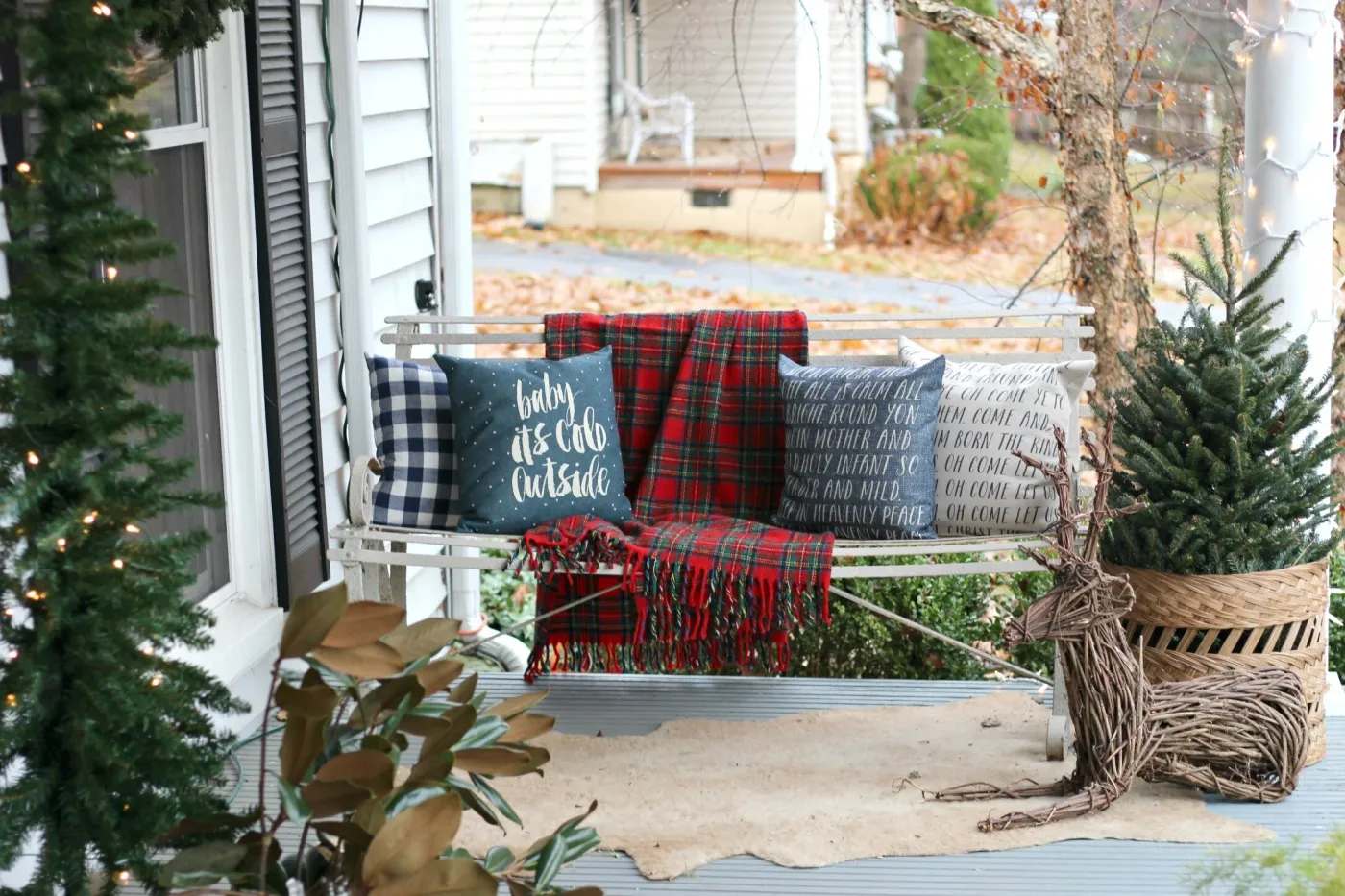
This arrangement wants a porch at least 6 feet deep so the bench can sit back from the railing — anything shallower and you’ll be stepping around it all season. Benches run 40 to 50 inches wide, so allow 18 inches of walking room on the open side. On a tight porch, go vertical instead with a wall-mounted bench, or borrow the smaller footprint of Idea #6.
7. Vintage Sled, Frosted Mini Tree, and a Snowman Welcome Sign
- Measure the wall from porch floor to the bottom of the window trim — most sleds run 36 to 42 inches tall.
- Check which way the porch faces; north-facing walls hold frost and darken early, so lean into warm bulbs.
- Confirm you have an outdoor-rated outlet within cord reach, or plan on battery fairy lights.
- Decide whether the display stays through January — if yes, choose a frosted tree over fresh greens.
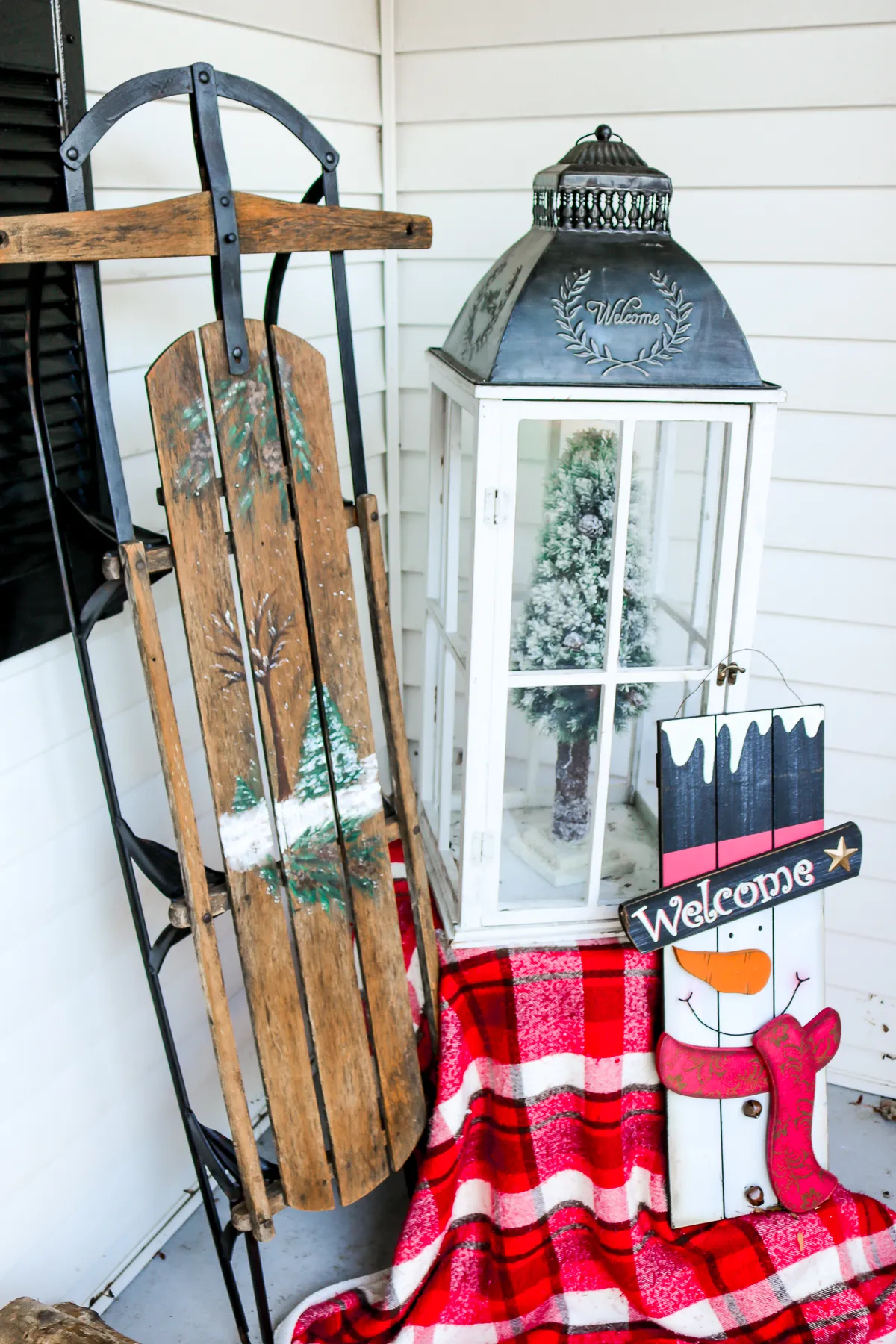
you cannot lose here is the plaid textile under the lantern. It isn’t decoration — it’s the layer that makes the corner feel like a room instead of a pile of props. It softens the hard porch floor, it picks up the red of the sled runners and the snowman sign, and it gives that white glass lantern something to sit on. Without it, the sled, lantern, and sign just stand in a row with nothing holding them together.
8. Double Wooden Doors Framed in Berry-Lit Evergreen Garlands
Evergreen garland with berries and miniature pines is having a real moment because it’s the one exterior look that photographs well at night without a ring light. Warm string lights tucked inside the greens read as candlelight on camera, which is exactly why this style floods Pinterest every November. It also has staying power: unlike tinsel-heavy trends, greenery-and-berry framing has looked right on American porches for a century. Nothing about it will feel dated in three winters.
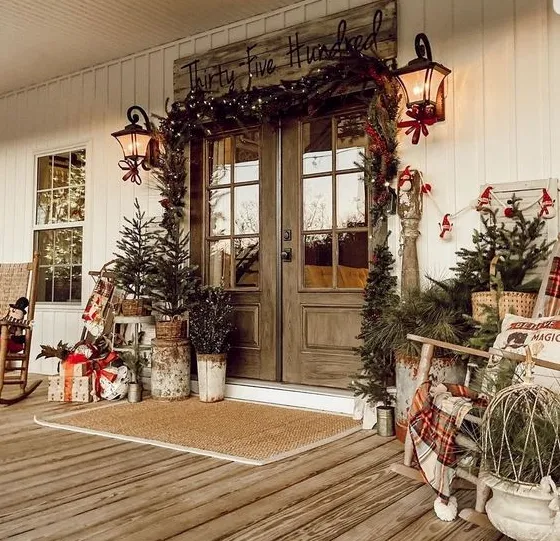
- Start with a hook at the top of each door frame — a small nail or adhesive hook rated for 5 pounds.
- Hang the garland in three separate swags rather than one long sag; the middle swag sits about 8 inches lower than the sides.
- Weave the string lights along the top of the greens so bulbs peek out instead of dangling.
- Cluster berries and pinecones at the low points of each swag, where the eye already goes.
- Zip-tie the ends to the hooks and trim any stray wire so nothing snags the door swing.
9. Heart-Shaped Snowshoes, Cedar Sprigs, and a Plaid Bow
Symmetry tricks people into thinking a display is expensive. With the snowshoes, don’t hang them as two separate items — cross the tails and fan the frames so together they form one heart silhouette, then build outward from the center point where they meet. That single join is where the plaid bow goes. Everything else — pine, cedar, red berries — hangs off that axis, heavier on the left, a touch lighter on the right so it doesn’t look stamped out by a machine.
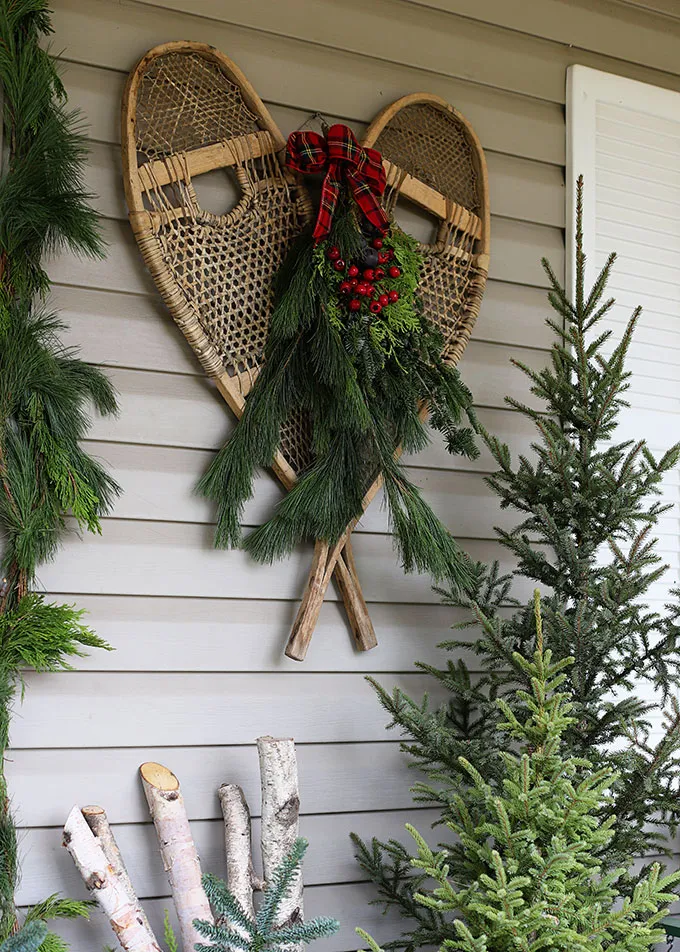
Fresh cedar and pine on a wall last about two to three weeks indoors before they dry and start dropping needles; outside, expect four to five weeks in cold weather. An antitranspirant spray on the undersides can buy you another week or two. Vintage wooden snowshoes need almost nothing — dust them with a dry cloth and keep them out of direct sun, because old rawhide lacing gets brittle and cracks. Birch logs are the divas here: they grow mold if they sit against damp siding.
10. Pine Branches and Dark Red Blooms on a Rustic Dining Table
Count this table as 60% dark wood and white dinnerware, 25% pine green, and 15% deep red from the flower arrangement. That red is doing more work than it looks — it’s the only saturated color in the frame, so your eye lands on the centerpiece long before it reaches the tree glowing in the background. Swap the red for burgundy and the table goes moodier. Swap it for blush and you get a table that still works in December.
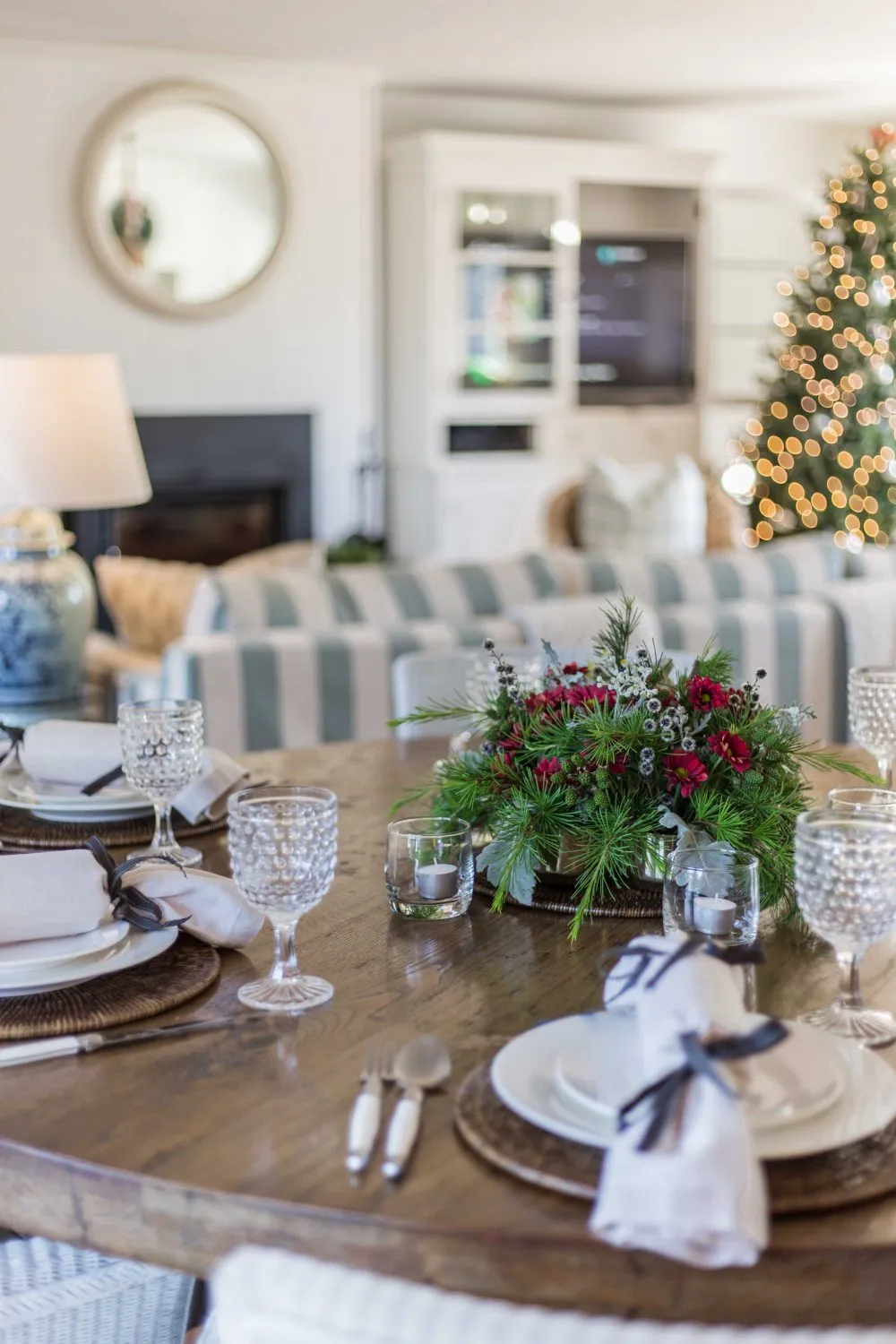
The centerpiece is dense — genuinely dense, like a hedge sitting on the table. That’s the point. A loose, airy arrangement would disappear in a room that already has a lit tree behind it. By building a tight mass of pine and dark red blooms just above the plate line, around 10 to 12 inches tall so nobody has to duck, the table holds its own against the glow. Thin it out and the whole dining setup goes soft.
11. Handmade Wooden Slat Trees Lit on a Winter Porch
- Two 4-ft wooden slat trees, or 1×4 lumber and paint: $60–$140
- Two outdoor string light strands, 100 count: $30–$60
- Two planter boxes: $40–$90
- Black metal reindeer figure: $40–$120
- Hanging lantern plus evergreen filler and plaid bow: $35–$80
- Outdoor timer and extension cord: $25–$45
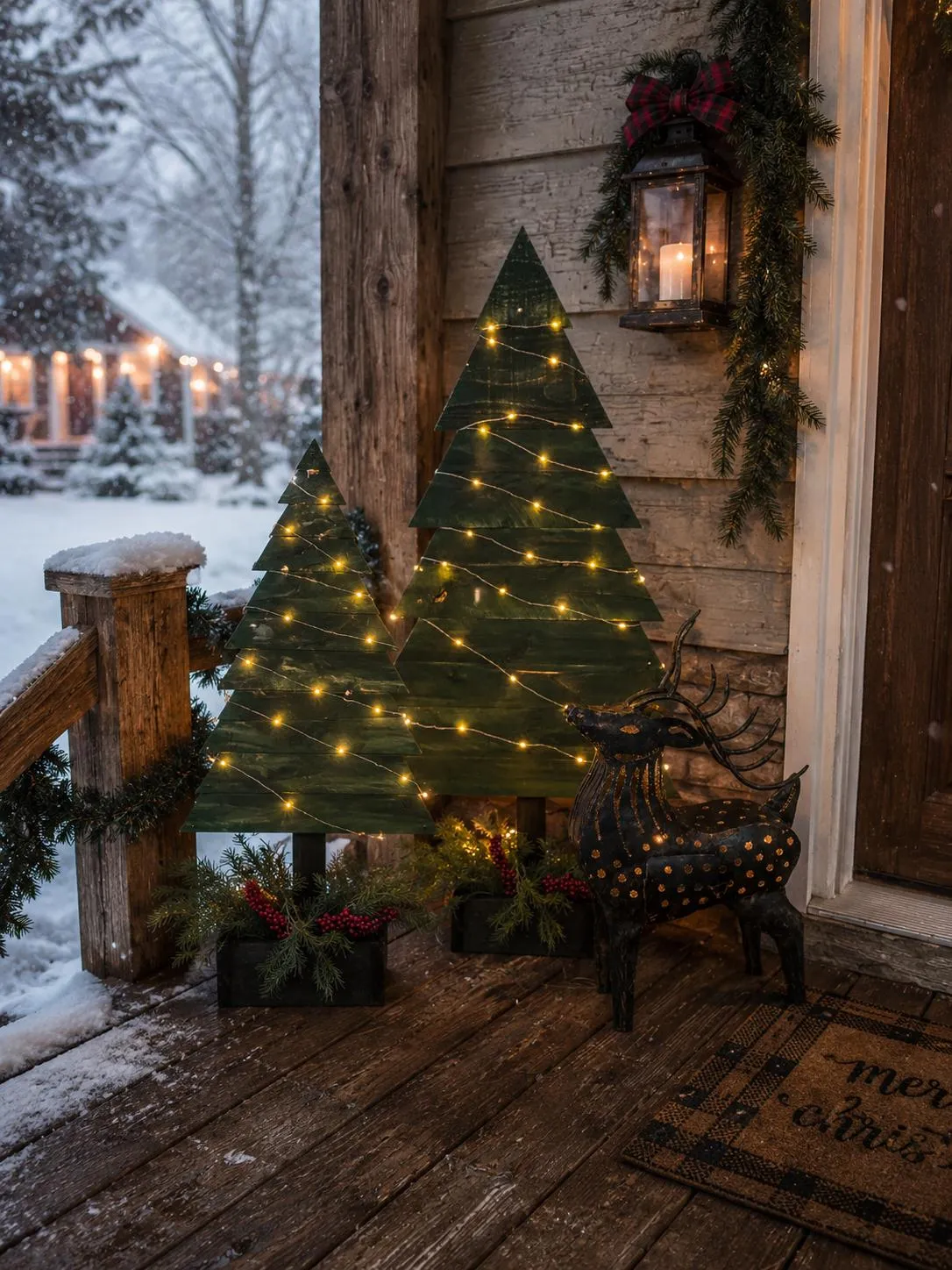
Total: $230–$535
Budget alternative: build the trees yourself from three 1×4 boards and a hinge — under $40 for both — then wrap them in a $15 strand from Walmart.
- Cut three slats to length: 48, 36, and 24 inches.
- Sand, then paint or stain; two coats of exterior paint outlasts spray every time.
- Attach the slats to a center post with screws, spacing them 8 inches apart at the bottom.
- Wrap a string light strand from the top down, securing with small clips every 6 inches.
- Set into a planter and weight the base with gravel so wind doesn’t tip it.
About 90 minutes per tree, or roughly $35 in materials if you’re using scrap lumber. If your slat trees end up feeling lonely on the porch, the layered wall display in Idea #19 fills the empty siding beside them beautifully.
12. Red Stockings, Herringbone Brick, and Leather Accent Chairs
Three things are pulling their weight. First, contrast: white sofa, white rug, and a herringbone brick firebox make the red stockings and the cardinal topper pop without a single extra accessory. Second, texture mixing — smooth leather accent chairs against a woven chair frame and a round white coffee table, so the room has something to feel even where the palette stays quiet. Third, the stacked firewood is doing real decor work; it echoes the mantel line and makes the whole thing look lived in.
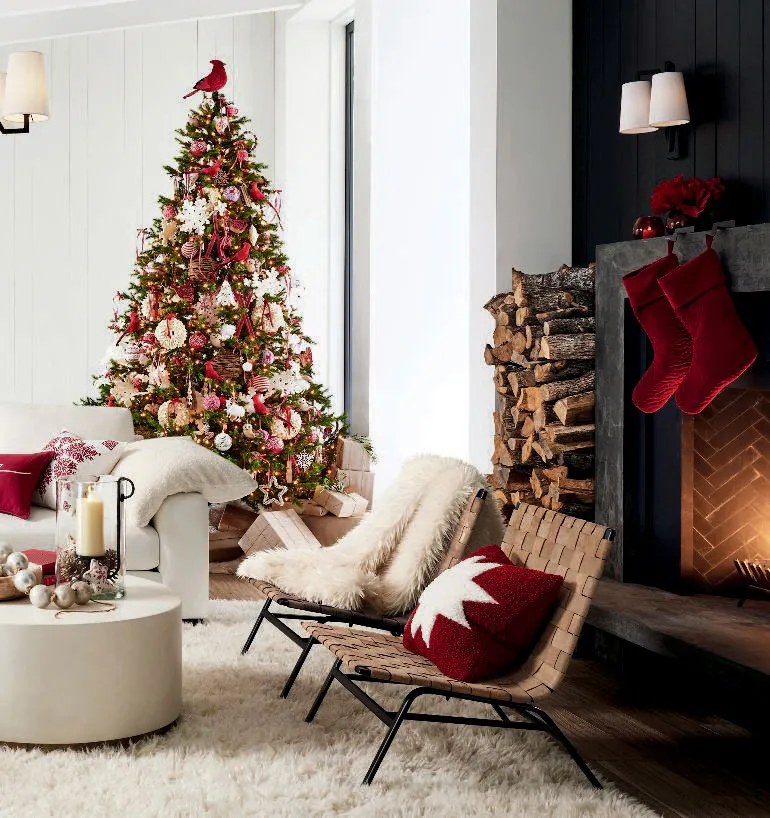
The rug-plus-round-table layout needs roughly 10 x 12 feet of open floor to keep a walkway between the sofa, the chairs, and the hearth. Under about 150 square feet, drop the coffee table for two small side tables and skip the accent chairs entirely. Hanging stockings only need 4 to 5 inches of mantel depth — a little more if you use weighted holders that stick out past the edge.
13. A Rolling Library Ladder, Vintage Ornaments, and Old Cards
The rolling ladder is the soul of this room. Not because it’s practical — though it is, and the vintage Santa face mask hung on it is the best styling move in the whole library — but because it signals that the shelves are deep, real, and used. Every vintage ornament on that tree reads as something pulled from a box in the attic precisely because the ladder implies a house that has kept things. Swap it for a step stool and the room loses twenty years of story.
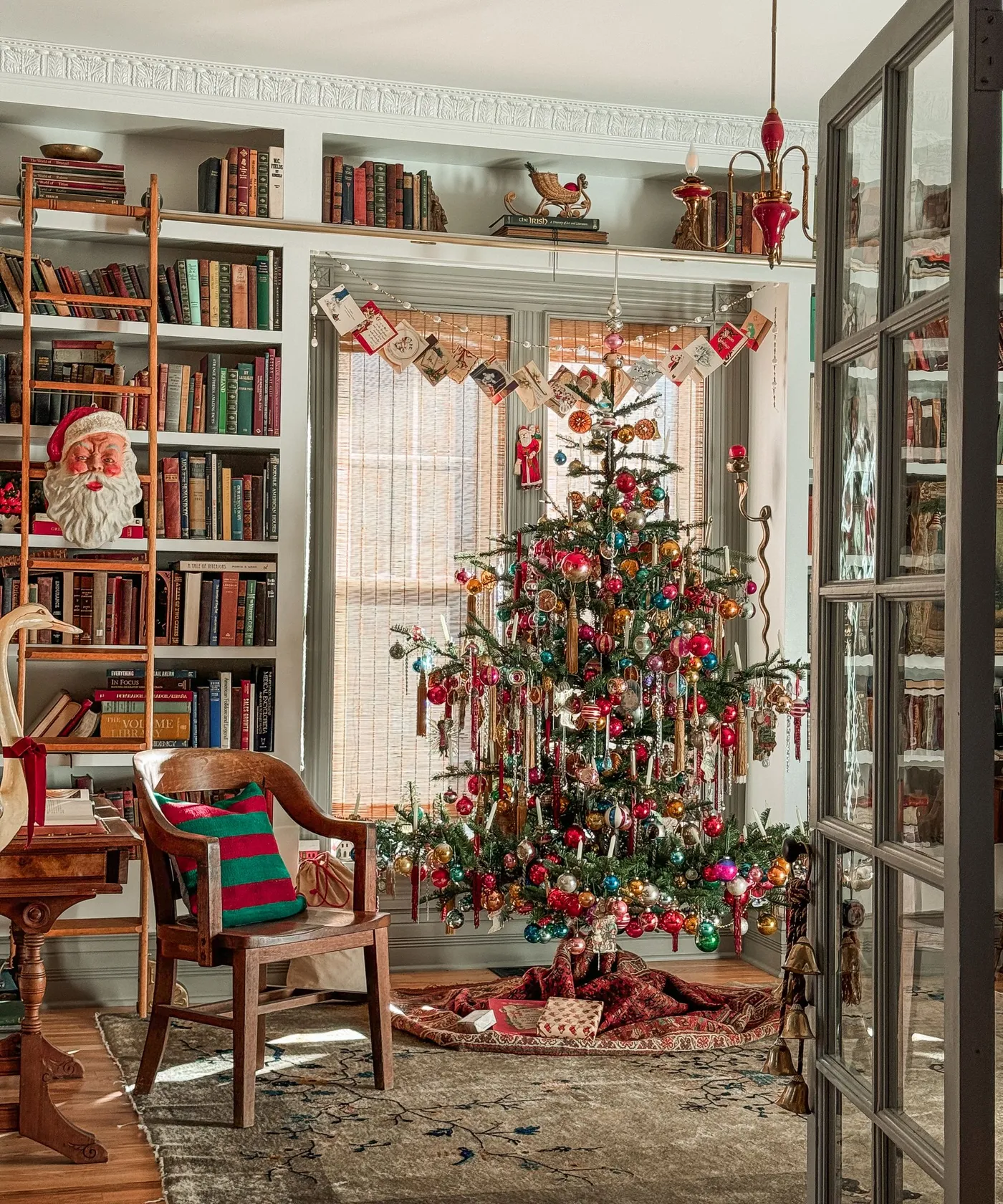
Vintage and collected holiday decor has been climbing for a few years, and 2026 is the year it fully replaces the matched-set tree. Glass club ornaments, clip-on candles, old greeting cards strung across a window — the appeal is part nostalgia, part a quiet rejection of disposable decorating. Grandmillennial styling pushed it forward and estate sales keep feeding it. Unlike trendier looks, this one gets better as your collection grows, which is exactly what makes it stick.
14. Wicker, Muted Pink, and a Basket-Held Tabletop Tree
The whole mood here is a thrift-store mood. The tabletop tree is a $20 Walmart artificial, the woven basket is $8 at Goodwill, and the wicker stand underneath is the kind of thing that gets left on the curb every August. Mix in books from library sales at a dollar each and a single vintage textile scrap for $5, and you’re under $75 while looking like you’ve been collecting for a decade. The one place to spend real money is lighting — a warm amber bulb does more for this corner than any ornament.
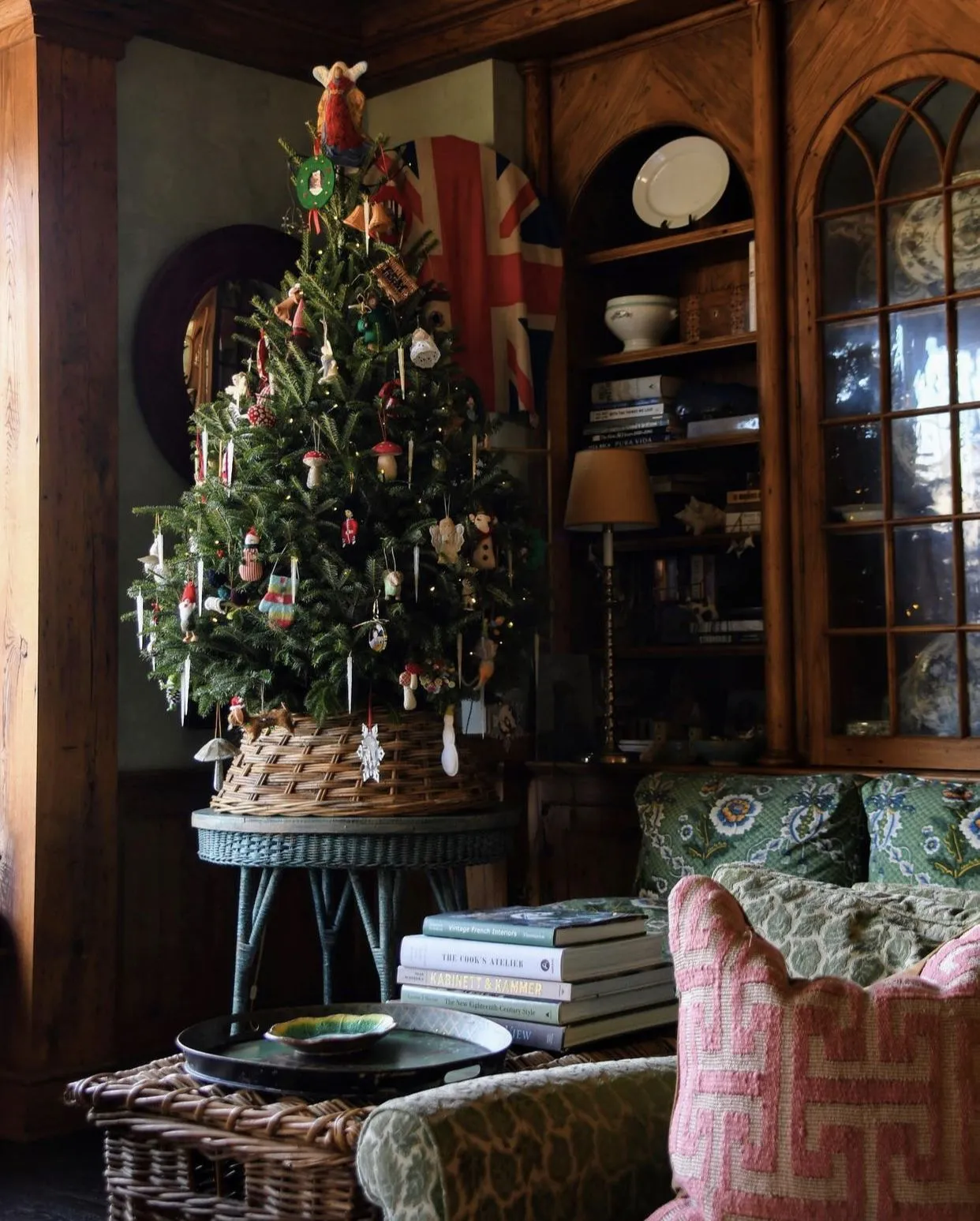
Roughly 55% warm natural wood, 25% forest green between the upholstery and the tree, 10% muted pink in the textiles, and 10% amber light. That pink is the wild card — against a green-and-cream base it reads cozy rather than frilly, because there’s so little of it. Swap pink for mustard and the room turns more primitive-farmhouse. Swap it for slate blue and the whole thing cools off by two degrees.
15. Beige Bows and Stockings Trailing Down the Stair Rail
- Measure the handrail, then buy about one and a half times that length in garland — you want slack for the swags.
- Attach at the newel post first with a zip tie, working upward and outward.
- Create swags every 24 to 30 inches, letting each one dip 6 to 8 inches below the rail.
- Add beige bows at every attachment point, then tuck stockings in so they hang clear of the treads.
- Secure every swag point — a loose garland on a staircase is a tripping hazard, not a styling choice.
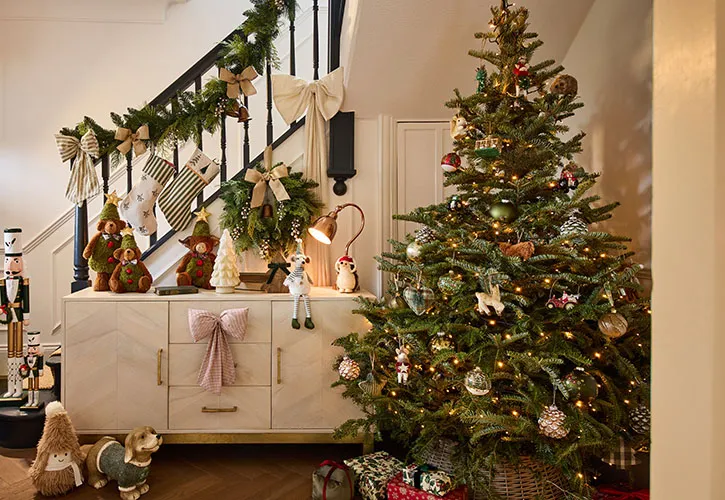
A staircase garland needs at least 10 feet of rail before it starts looking intentional; shorter runs are better served by a single wreath on the newel post. Keep stockings at least 24 inches above the tread so nobody’s shoulder catches them on the way downstairs. This reads best in two-story entries with 9-foot ceilings and up. If your entry is tighter than that, let the light wood credenza carry the whole look on its own.
16. Crimson Ornaments and Plaid Pillows in a Neutral Living Room
Red and white ornaments on a green tree is about as traditional as it gets, and the reason it still works is restraint plus repetition. The same two colors appear on the tree, in the plaid pillows, and in small doses on the coffee table — so the eye keeps finding the same note in different registers. The woven basket base softens the floor line, and the neutral upholstery gives all that red somewhere quiet to land.
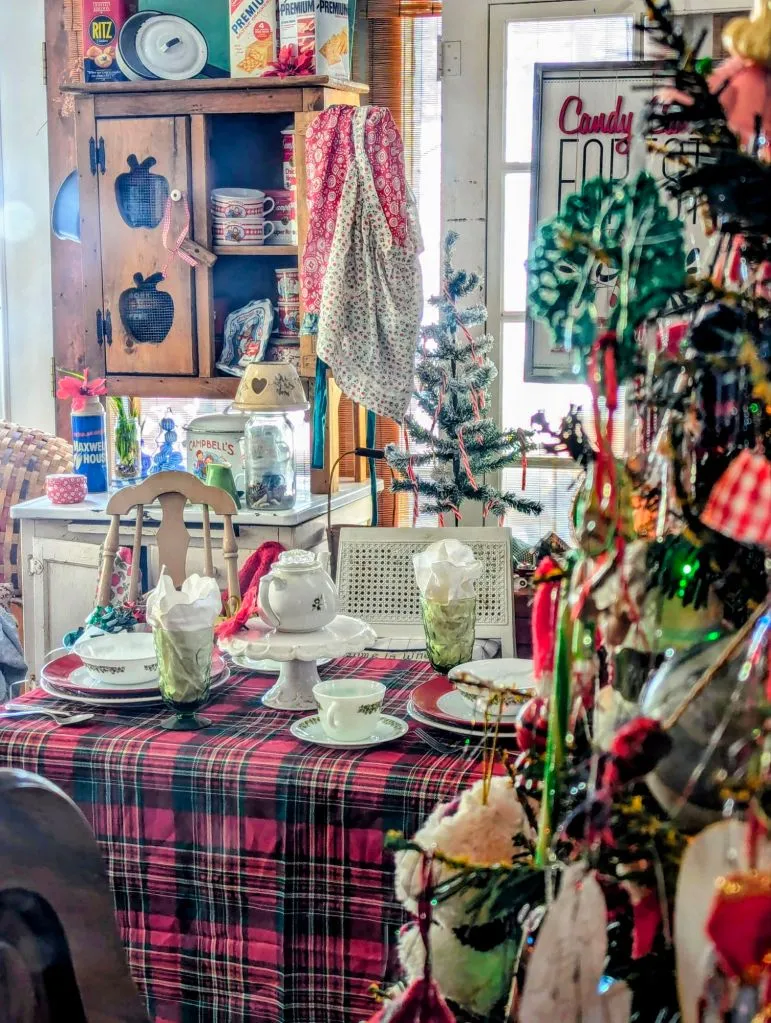
Red and white is unforgiving. One ornament in the wrong shade — orange-red next to blue-red — and the whole tree looks like a clearance bin. Buy your reds in a single shopping trip from one brand if you can, because dye lots vary more than people expect. And plaid pillows on a sofa you actually sit on get crushed fast. Rotate them, or choose tight seasonal pillow covers you can slip off and wash in January.
17. A Numbered Advent Garland Above a Cream Wood Stove
The advent garland is the one element you can’t substitute. A row of numbered muslin bags strung over a cream tile surround turns a functional wood stove into a countdown — and crucially, it gives the hearth a reason to be decorated at all. Most people dress a stove with a wreath and call it done. Here the numbers invite a daily ritual, which is why the single plaid stocking hanging among them feels intentional instead of leftover.
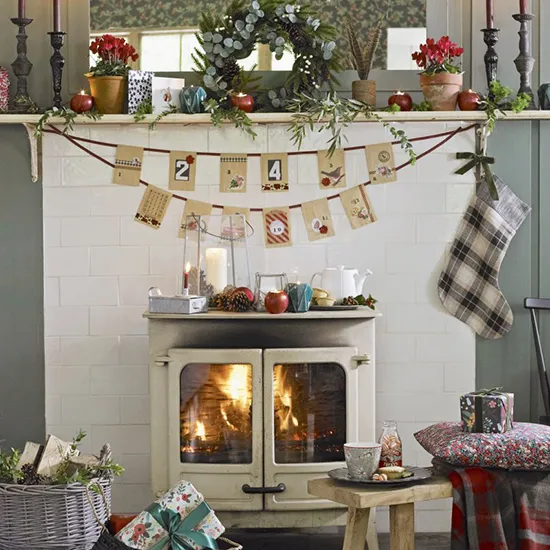
- Check clearance to any stove or heater — keep fabric at least 36 inches from a working heat source.
- Measure the surround width; advent garlands typically run 4 to 6 feet.
- Confirm your hanging method: tile needs adhesive hooks rated for the weight of filled bags.
- Decide whether the bags hold treats or just numbers — it changes how sturdy they need to be.
18. Chunky Textures and Pine Green Against Beige Upholstery
This room runs about 65% neutral — beige upholstery, natural wood, warm white light — 25% pine green from the tree, and 10% texture doing the heavy lifting. Notice the accent color isn’t a color at all here; it’s nubby pillows, a chunky throw, a woven basket. Swap the beige for gray and the room turns cooler and more contemporary. Swap the natural wood coffee table for black and it sharpens considerably while keeping every bit of the warmth.
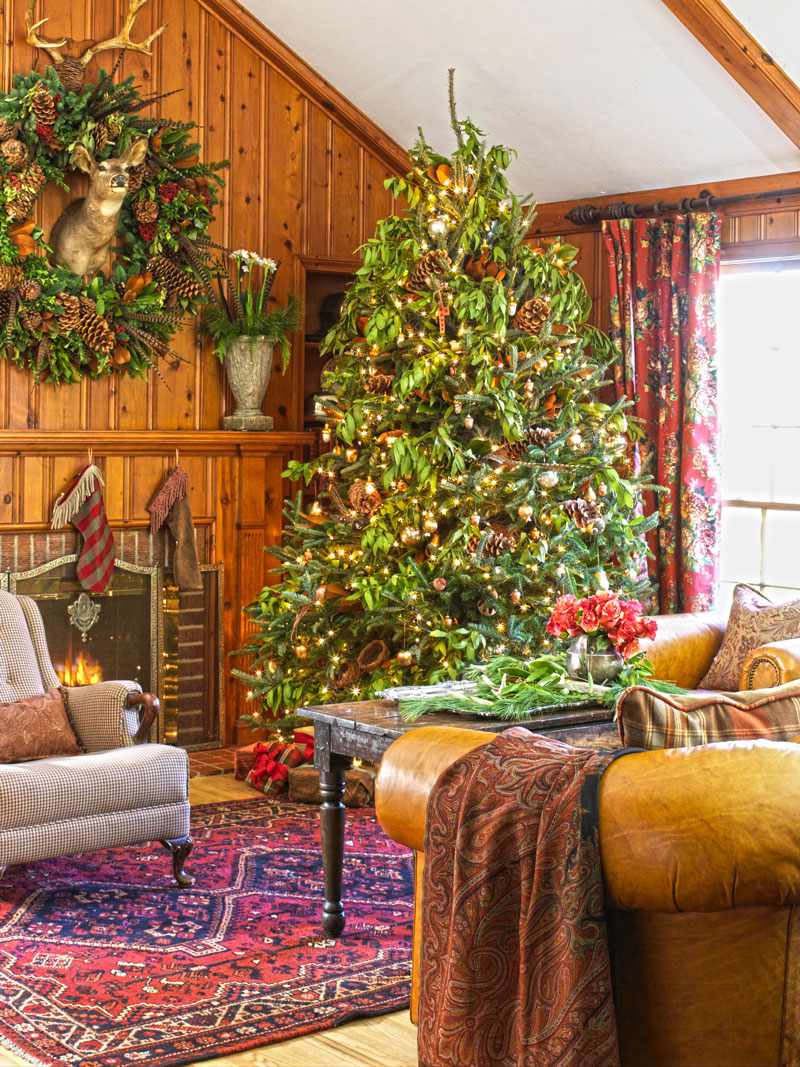
Textured throw pillows in boucle, sherpa, or chunky knit pill and fuzz. Plan on a lint roller weekly and a gentle hand wash or dry clean at season’s end — not machine wash, which mats the texture permanently. If you’re using a live tree, vacuum daily for the first week; needle drop is heaviest right after the tree adjusts to indoor heat. Flocked artificial trees shed white powder onto dark upholstery, so give yours a shake outside before setup and save yourself a month of vacuuming.
19. A Wreath on the Window and Birch Logs by the Door
- Green wreath with red bow, 24 in: $25–$70
- Vintage wooden sled, thrift or Marketplace: $30–$120
- White metal lantern: $20–$60
- Red and black plaid blanket: $15–$45
- Birch log bundle: $20–$50
- Painted snowman welcome sign: $15–$40
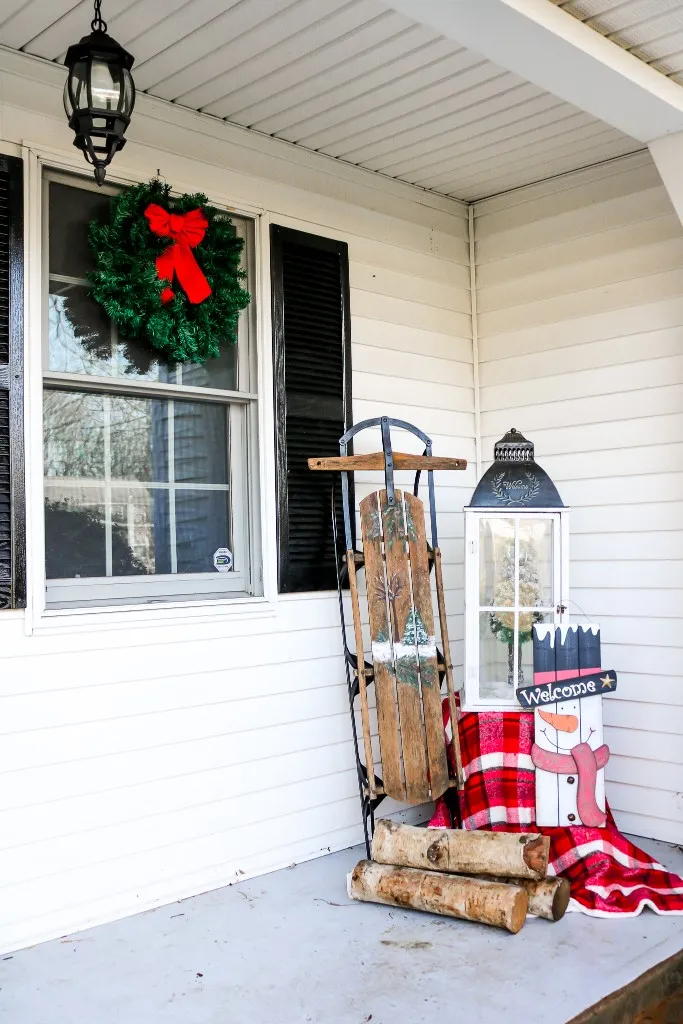
Total: $125–$385
Budget alternative: hang the wreath from a Command hook, skip the lantern and use a $10 battery pillar candle inside a Mason jar, and grab birch from a local tree-trimming service — many give it away free.
Keep the whole display on one visual shelf. Everything here — wreath, sled, lantern, logs, sign — sits between roughly 12 and 48 inches off the floor, which is why the corner looks styled instead of scattered. If you add anything, add it inside that band. Rule of thumb: the highest element should relate to the window trim above it and the lowest should touch the floor, so there’s no floating gap making the porch feel half-finished.
20. Buffalo Check Garland and a Black Star Topper
Buffalo check is the most affordable fabric trend on the market right now. Walmart and Dollar Tree stock check ribbon by the roll for $3 to $6, Target’s threshold line does check pillows for around $15, and a galvanized tub from Tractor Supply runs $20 to $35 and doubles as a planter in summer. The lit metal numbers are the splurge at $40-plus, but craft store marquee letters on clearance do the same job for less. Whole tree, under $120. Compare with Idea #28 — same check pattern, softer burlap energy.
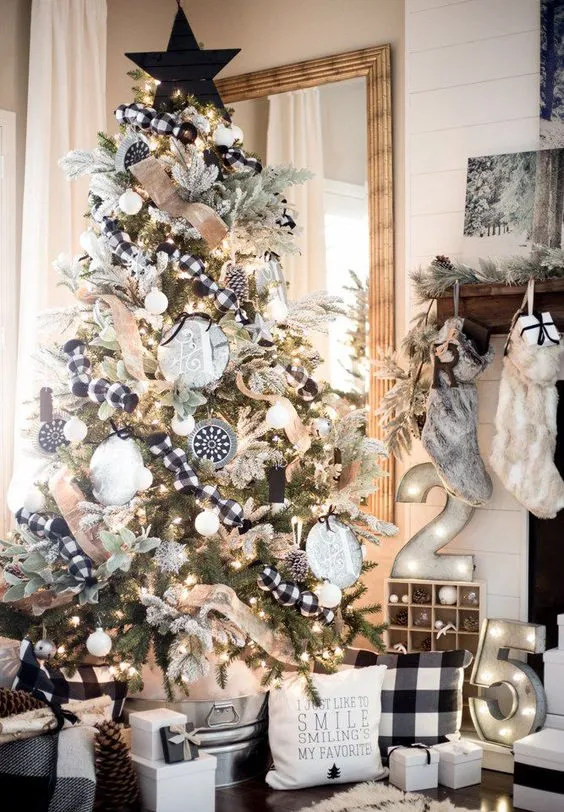
The black-and-white farmhouse palette has been cooling off in furniture, but it’s thriving in holiday decor because contrast reads beautifully in winter photography. There’s a practical driver too: frosted trees with white and black ornaments don’t compete with the warm wood tones most farmhouse homes already have, so people can decorate without restyling anything else. Expect this look to hold through 2027 at least — it’s neutral enough to survive the next palette shift.
21. A Burlap Bow Topper Over Plaid and Mercury Glass Ornaments
Count this ornament mix: 50% deep red and forest green, 25% slate blue and champagne gold, 25% naturals — pinecones, burlap, wood. The blue is the sleeper ingredient. Without it, red-and-green-plus-gold tips into department-store generic. One or two cool-toned ornaments for every three warm ones keeps the tree from going flat, and the champagne gold picks up the galvanized collar at the base so the whole thing feels anchored rather than floating over it.
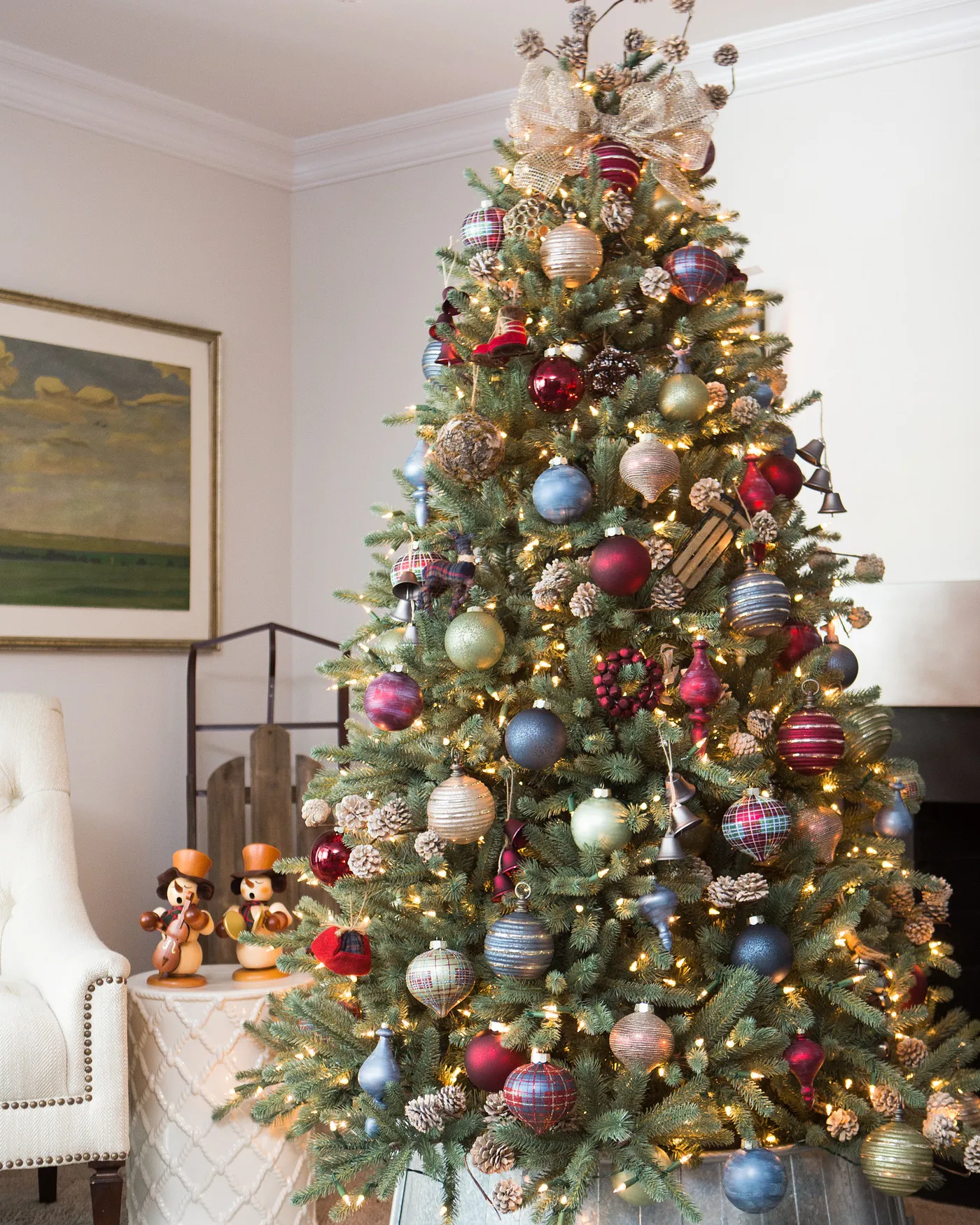
A burlap bow topper is charming and structurally fussy. Burlap is heavy, and a bow that size needs a real anchor — wire it to the top branch or it will slump sideways by week two. Natural burlap also sheds fibers, so keep it away from anything white. And a collar that size hides a stand, not a water reservoir; with a live tree, use a bucket inside it or you’ll be refilling from the side every morning.
22. Evergreen Gnomes in Fleece, Buffalo Check, and Sherpa Hats
The hats are what make these gnomes work — specifically the fact that no two are the same material. Blue fleece, red buffalo check, gray sherpa: that variety keeps a row of three identical silhouettes from looking like a repeat. Remove the hat variety and you have three green cones with noses. It’s the single change that turns a novelty item into something you’d actually leave on the mantel through January.
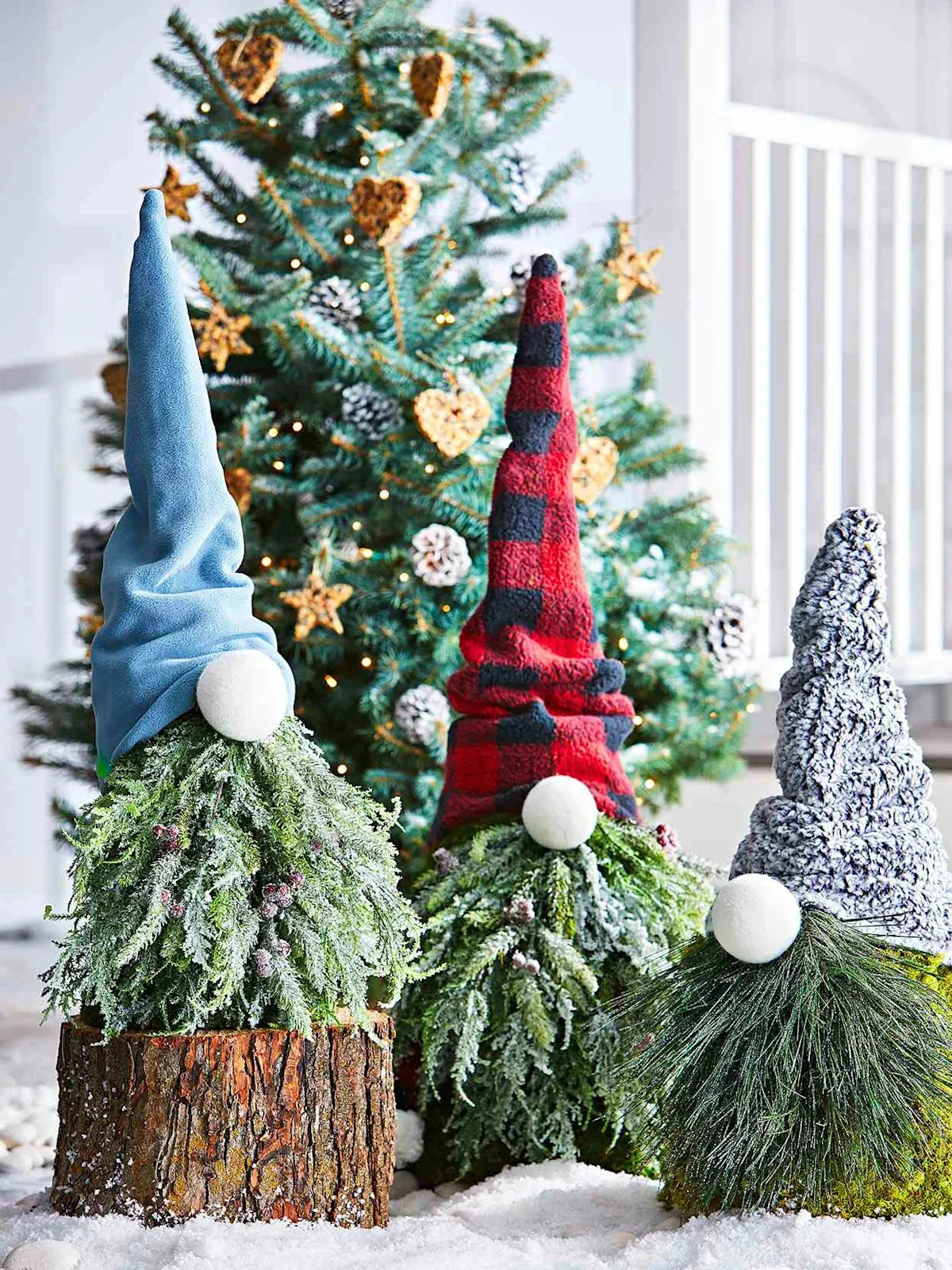
Odd numbers, always — three gnomes, five if you have the shelf depth. Vary the heights by at least two inches so the row has a rhythm instead of a flat top line. And backlight them. Placing them 12 to 18 inches in front of a lit tree puts a warm halo behind each hat, which is the only reason these read as charming rather than cheap. Without that backlight, they’re just figurines in a row.
23. A Hanging White Bench on a Red Brick Porch
A hanging bench needs a porch ceiling at least 8 feet tall and a joist you can drill into — most suspension kits want 400 pounds of rated hardware. Width matters more than length here: you need 30 inches of clearance on each side so the bench doesn’t read as wedged in. On a porch under 8 feet wide, a wall-mounted bench with legs works better. Short on floor space entirely? Borrow the smaller footprint of Idea #6 instead.
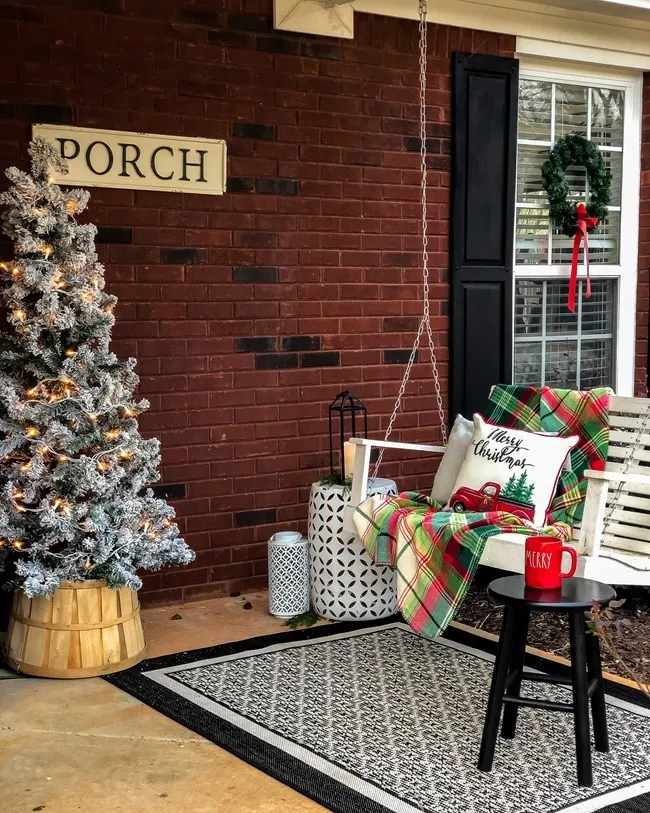
Frosted trees shed — that fake snow flakes off every time you move one, so expect to sweep weekly and never set it directly against painted railing. Red brick porches hold moisture; put a rubber pad under any basket or planter to prevent staining and efflorescence. Outdoor rugs in black-and-white geometric patterns show dirt from a mile away, but they also hose clean. If yours is polypropylene, a garden hose and a day to dry is the entire maintenance routine.
24. Red Bells and Painted Pinecones Between Double Doors
Rustic door framing with pinecones and berries keeps winning because it’s the rare holiday look that reads well in daylight, at dusk, and in a phone photo — which matters when the front door is the most photographed square footage of the season. The other reason is budget: one garland, some berries, and two mini trees cost less than a full porch setup and still deliver the whole greeting. It’s the highest impact per dollar on any exterior.
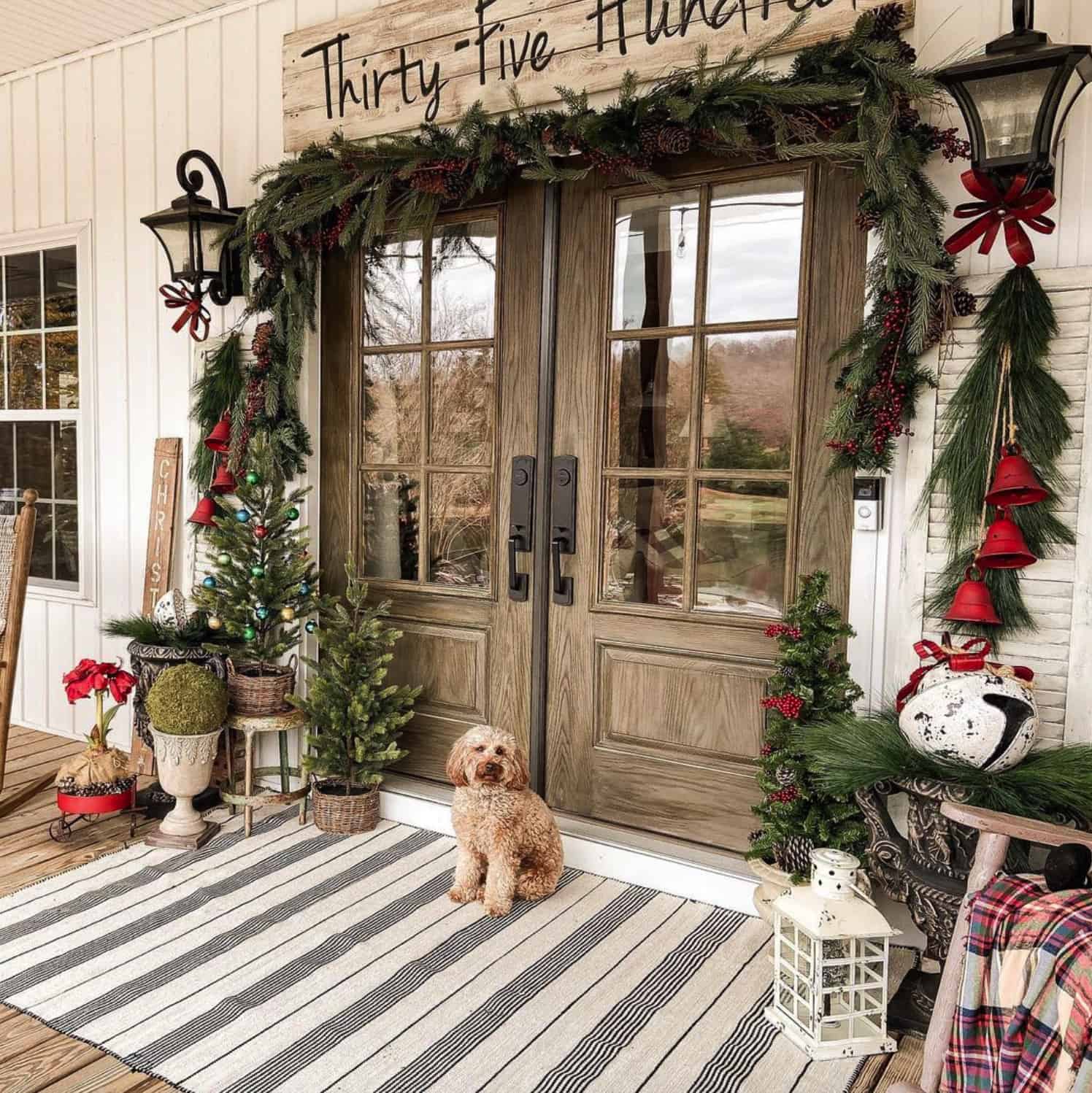
- Measure the door frame width and add 12 inches on each side — that’s your garland length.
- Hang a hook at each side and one at the center top, then drape in three swags.
- Wire the pinecones in clusters of three rather than evenly spaced; it looks collected, not manufactured.
- Place berries at the low points of each swag, where the porch light catches them.
- Finish with the bells at the center, and check the garland clears the door swing by two inches.
25. Wood-Paneled Walls and a Tree Glowing by the Window
Wood on wood on wood should feel heavy, and it doesn’t, because of one decision: the tree sits by the window. That placement gives the room a light source to work against, so the paneled walls read as warm rather than enclosing. The second move is the set table in the foreground — it pulls the eye down and forward, keeping the tree a backdrop instead of a bullseye. Layered plate settings on placemats do the same job as a centerpiece at half the visual weight.
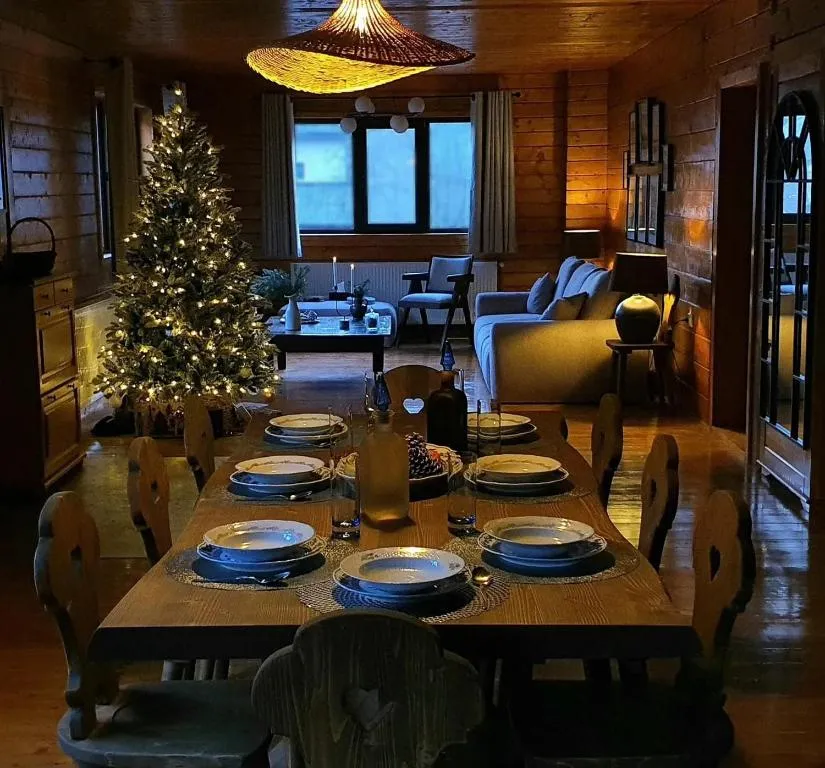
A fully paneled dining space wants at least 12 x 14 feet to keep a 7-foot tree from crowding the table. Under 10 feet wide, choose a slim profile tree or a tabletop version on a sideboard. Ceiling height matters more than people expect in a cabin room: below 8 feet, skip the tall tree and put the light near the window instead. Vaulted spaces play by totally different rules — see Idea #30.
26. A Blow Mold Santa on a Barrel and a Beverage Crate Tree
This is the cheapest charming setup in the whole article. Blow mold Santas run $10 to $40 at estate sales and flea markets — check Facebook Marketplace in early December, when people realize they don’t have room. Wooden beverage crates are $5 to $15 at antique shops, a 3-foot pre-lit tree from Walmart is around $25, and red bead garland is $4 at Dollar Tree. Whole corner, under $90. Anyone can buy a Santa. Finding one with a scuff on his boot is the fun part.
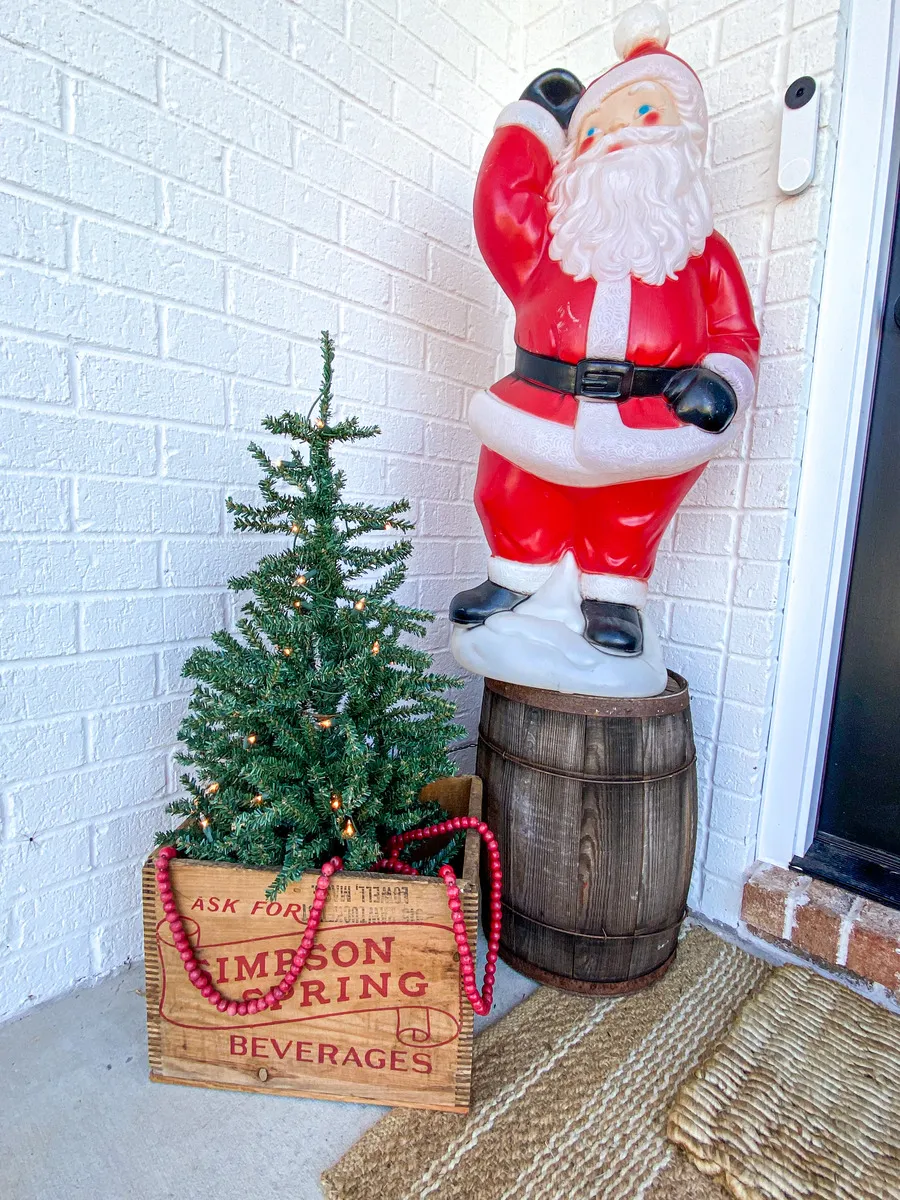
Blow molds are thin plastic and they hate temperature swings. Bring yours inside if a hard freeze is coming; the seams crack. Check the cord too — vintage ones often have brittle wiring and no polarized plug, so if yours is older than the nineties, run it on a timer and never leave it unattended. And while the crate is adorable, it isn’t weather-sealed. A coat of clear polyurethane keeps it from warping through a wet winter.
27. Garland-Draped Beams Across a Vaulted Wood Ceiling
When you’re draping beams, resist the urge to string one continuous garland from end to end. Use separate sections and let each sag at a different depth — 10 inches, 14 inches, 18 inches. That variation is what makes a vaulted ceiling look decorated rather than wrapped. Hang ornaments from the sag points only, spaced about 12 inches apart, and keep them in one metal family so the ceiling doesn’t turn into a craft store aisle.
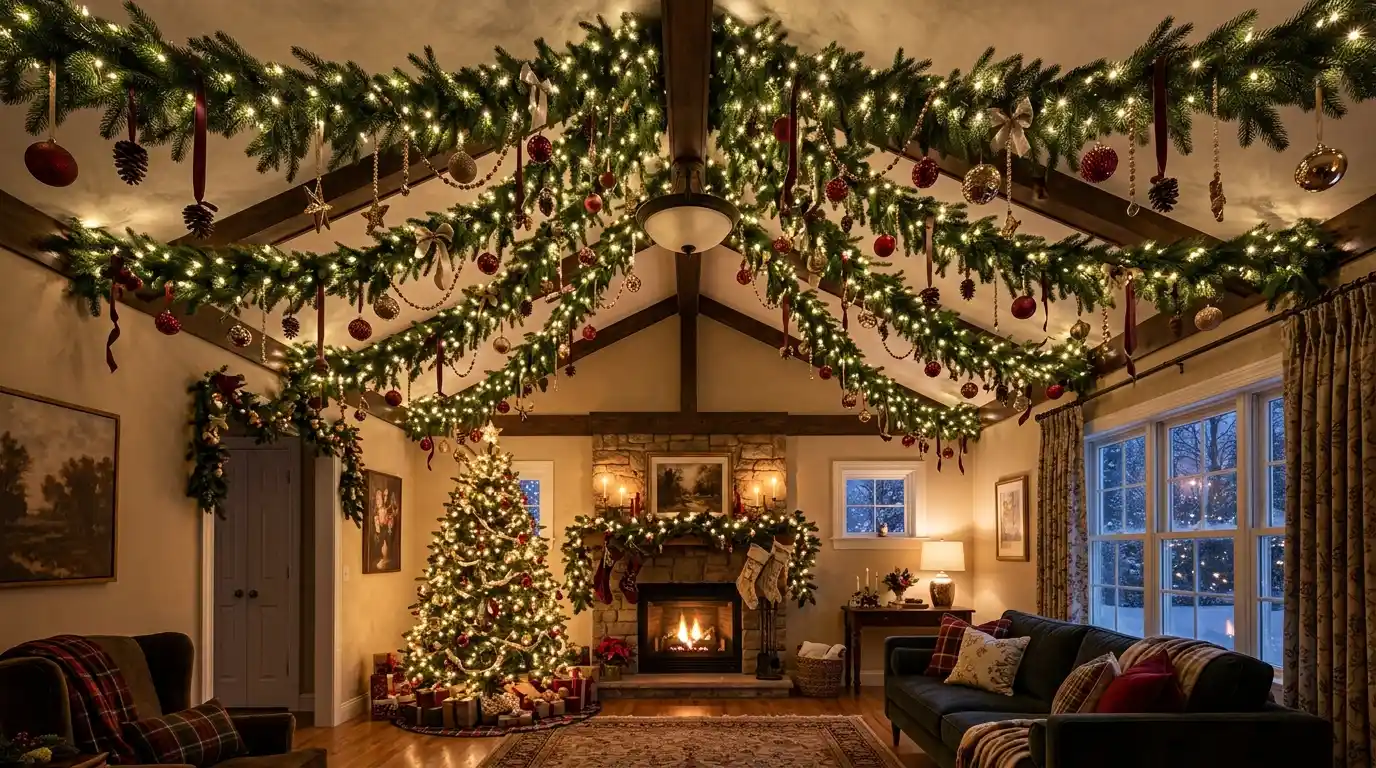
The garland on the beams is the element that makes this room unforgettable. Take it away and you have a very nice vaulted living room with a tree in the corner. Keep it and the ceiling itself becomes part of the holiday — the greenery leads your eye upward, spreads the tree’s light across the whole space, and makes the room feel decorated top to bottom instead of accessorized at eye level.
28. Burlap Script Ribbon and Buffalo Check Baubles
The palette is simple: 60% tan burlap and kraft paper, 25% black-and-white buffalo check, 10% natural wood slices and pinecones, 5% bright red accent. Burlap does the heavy lifting because it’s the only texture that reads rustic without looking costumey. Swap the check for solid black ribbon and the tree goes elegant. Swap the burlap for plaid fabric ribbon and it gets louder and younger. Same tree, three different holidays, one afternoon of ribbon shopping.
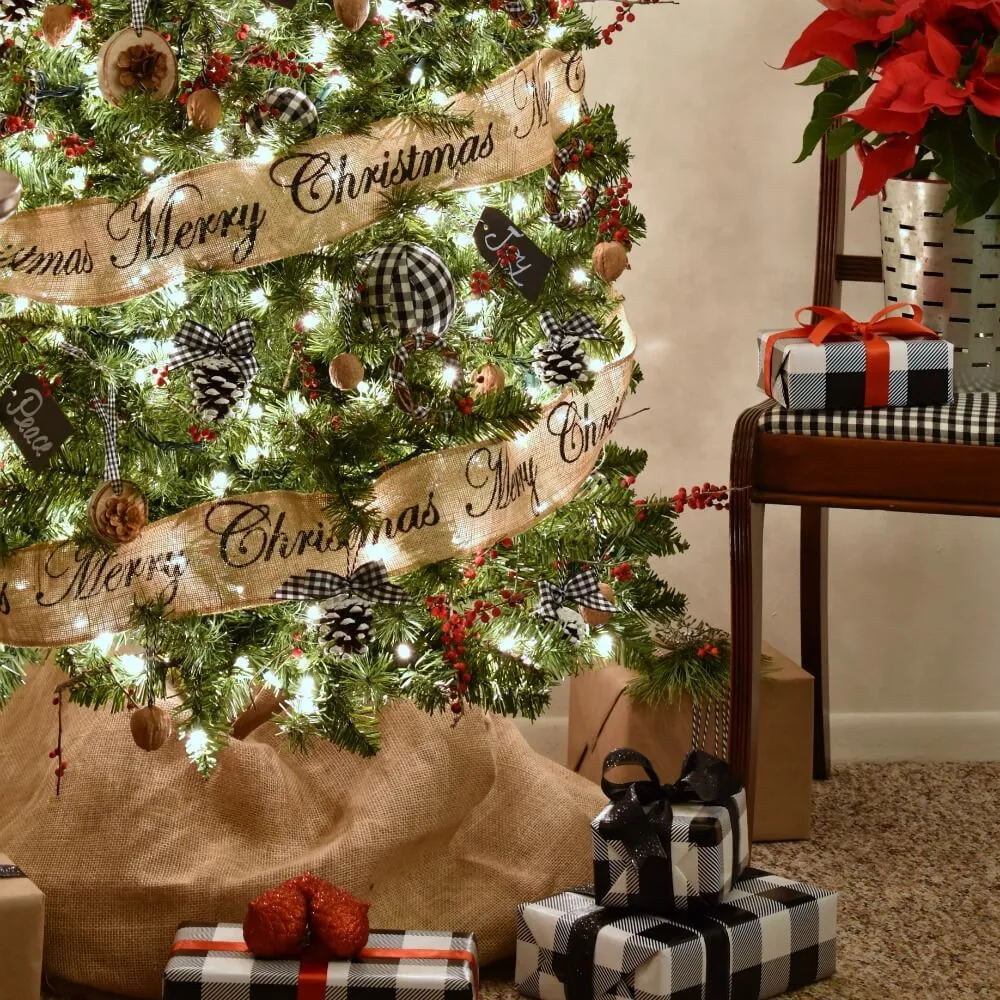
- Measure your tree’s widest branch spread — burlap ribbon needs 6 inches of slack per wrap.
- Count your wraps before you cut; one 10-yard roll covers a 7-foot tree twice around.
- Test the kraft paper against buffalo check under your living room lighting, not store light.
- Decide your ornament count first — wooden slices and check baubles compete for the same space.
29. White Bead Garlands on a Frosted Pine Branch
- Start at the top and wind the bead strand in a slow spiral, keeping about 10 inches between passes.
- Let one or two strands hang in loose loops rather than a tight coil — the draping is the charm.
- Clip ornaments on with wire hooks placed just below the bead line so they don’t hide it.
- Work top down and step back every three feet; frosted trees hide mistakes until you’re finished.
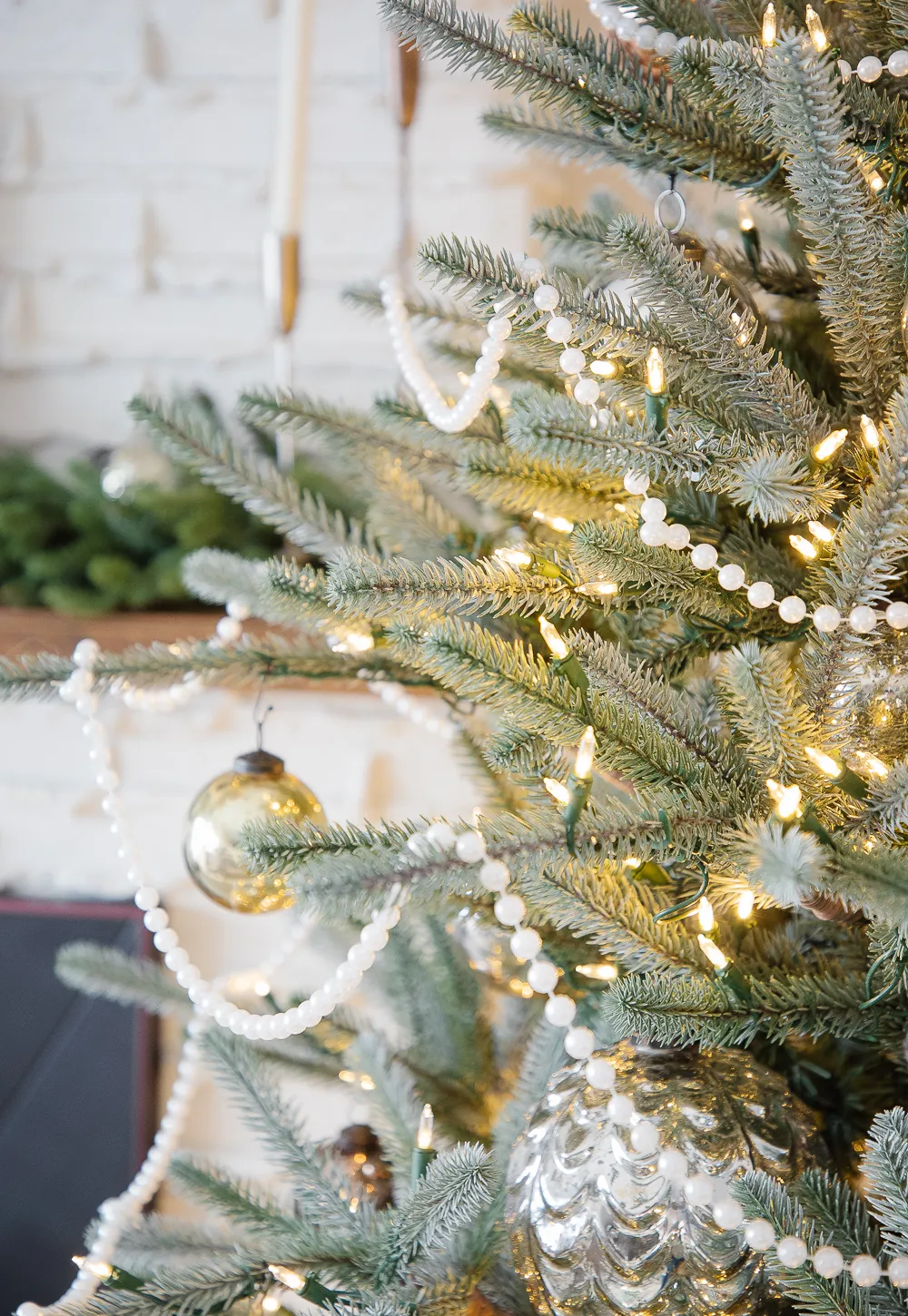
Twenty minutes for a 6-foot tree, about $8 for the garland.
On a frosted tree, keep ornament finishes to two — here it’s gold and mercury glass — or the white base starts looking busy. Hang the largest bauble about one-third of the way down from the top, not at eye level, so the tree keeps a focal point when you’re seated. And put your warmest bulbs behind the beads rather than in front. Backlighting makes the white garland glow instead of reading as plain string.
30. An Arched Mirror and a Gold Rocking Horse by the Brick Fireplace
A floor-to-ceiling brick fireplace eats vertical space and demands a focal point that can hold it. An arched mirror is that focal point, and it needs to be at least 30 inches wide to feel proportional against a 12-foot brick face. The room itself should hit 16 x 20 feet or the scale tips. A full-size tree beside the hearth needs 4 feet of clearance from the firebox. Smaller rooms should look at Idea #12 for a tighter version of the same idea.
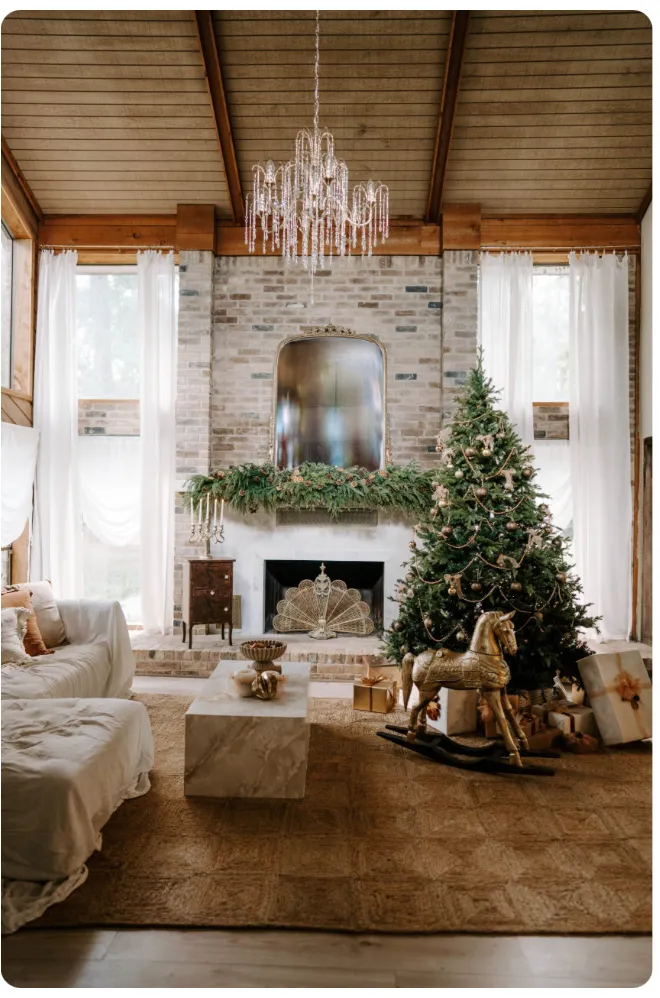
The vaulted fireplace wall is trending because so many people bought homes in the last few years with big open great rooms and no idea what to do with 18-foot walls. Brick plus an arched mirror plus garland is the answer that needs no construction — the arch softens the brick’s grid, the garland adds a horizontal band, and the mirror doubles whatever light the tree throws. It’s a fix for proportion, which is why it keeps showing up in designer portfolios.
31. Pink Ribbons Against a Charcoal Wall of Wood Slices
Pink ribbons on a Christmas tree is a strong choice and it commits you — there’s no neutral version of it. Paired with a charcoal wall like this, it looks deliberate. Drop the same ribbons into a red-and-green room and they look accidental. Wood slice wall art is also heavy, so use proper anchors rated for drywall, and if the slices are adhered together as one panel, plan on two people and a level. One small note: the pink reads best under warm light, so keep bulbs at 2700K.
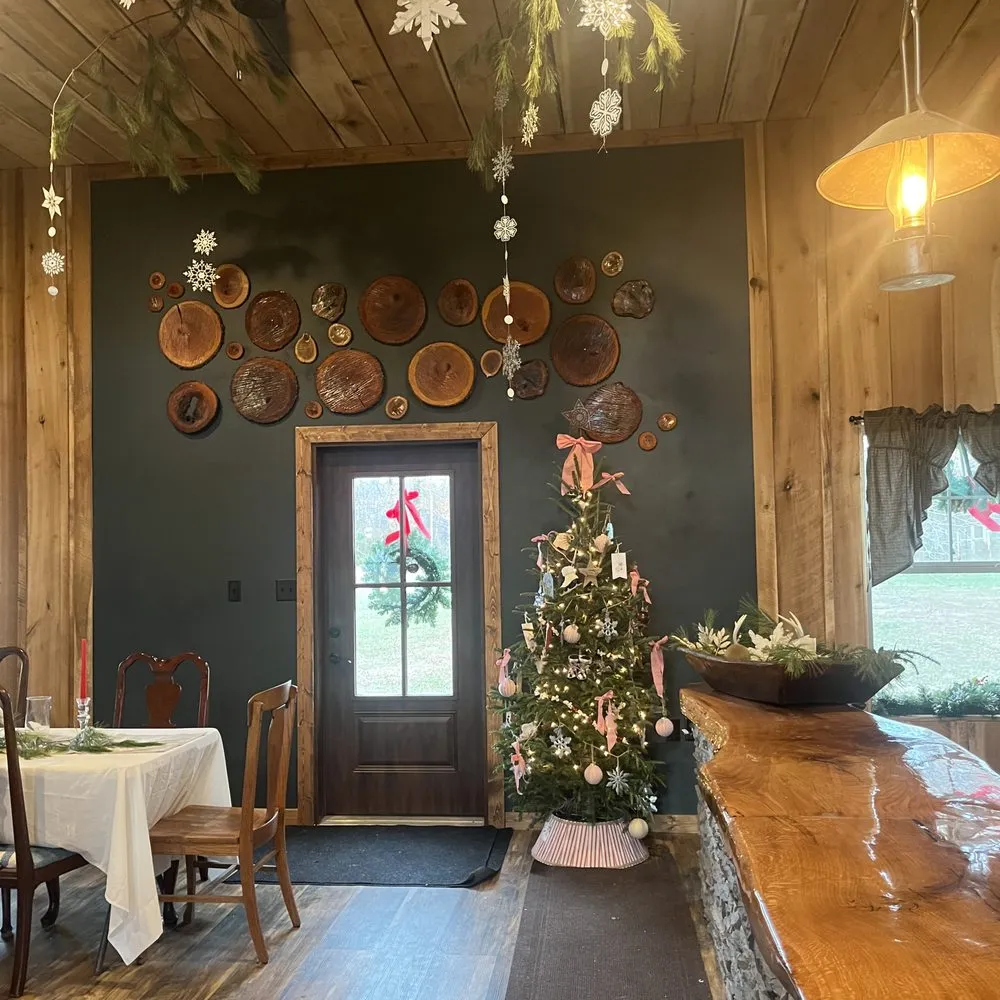
- Wood slice wall art panel, or 20 loose slices plus adhesive: $40–$150
- 3-ft lit tree: $35–$90
- Pink satin ribbon spools: $10–$25
- Wooden dining chairs, set of four, thrifted: $120–$400
- White tablecloth and simple dinnerware: $35–$90
- Warm 2700K bulbs plus timer: $20–$40
Total: $260–$795
Budget alternative: skip the panel and glue a dozen slices onto a plywood backer yourself for about $45. Marketplace chairs can run $25 each with a little sanding.
32. Shiplap Walls, Dark Green Drapes, and a Cast Iron Stove
Cast iron stoves need their flue swept annually, and the hearth pad should extend at least 16 inches past the stove on all sides — check local code before you decorate anywhere near it. White shiplap shows soot and smoke smudges, so keep a magic eraser handy and hang nothing fabric within three feet of the stove. Dark green drapes in a stove room trap dust and wood ash, which means vacuuming the pleats monthly. Vintage signage with chipped paint should be sealed or kept off high-traffic walls.
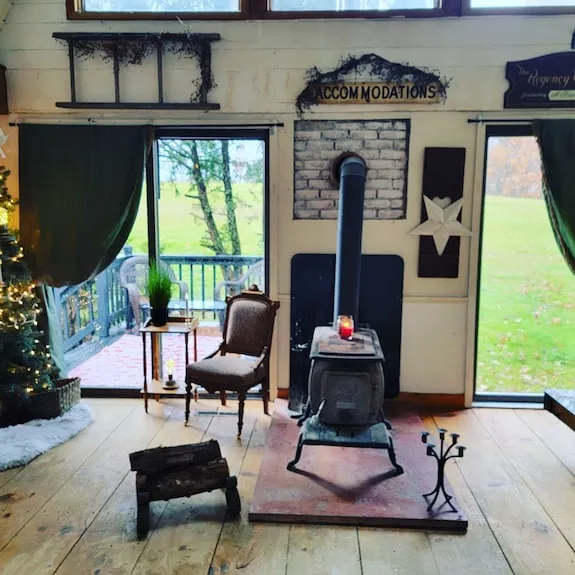
White shiplap plus dark green drapes is a high-contrast pairing, and it works because both finishes are matte. Swap either for something shiny and the room starts to feel like a theme restaurant. Keep metallics to one small object — the stove’s trim is already doing that job. Hang your drapes so the rod extends 6 to 8 inches past each side of the glass doors; it makes small windows feel wider and gives the tree room to glow.
Hang the Lights, Then Let the House Breathe
The best farmhouse Christmas rooms aren’t the ones with the most decorations — they’re the ones where a dough bowl, a dried orange garland, or a beat-up wooden sled looks like it’s been there for years. Start with one idea from this list, live with it for a week, and add slowly. That’s how a house starts to feel collected instead of decorated.
📌 Pin your favorite ideas to your Christmas board now — and tag us when you try one, because the imperfect versions always turn out best.