30 Jaw-Dropping Shiny Brite Christmas Tree Ideas That Will Make Your 2026 Holiday Unforgettable

You know that feeling when you finally find the exact vintage Christmas tree you’ve been picturing — dense with glass, glowing warm, the kind of tree that looks like it stepped out of a 1950s catalog — and then you realize you have no idea how to recreate it at home?
We spent serious time browsing Etsy, eBay, Terrain, Anthropologie, and Target to bring you only what’s worth your attention this year, with pieces running from about $12 to $480. After filtering through hundreds of vintage lots, flocked trees, and boxed bauble sets, we narrowed it down to 30 ideas that actually deliver — multicolor glass packed onto a classic green tree, snowy flocked branches, tabletop displays under glass cloches, and cottage corners where the ornaments do all the talking. Budget and luxury versions are compared side by side, and every idea is shoppable with direct product links.
What’s driving it in 2026: collectors have started treating Shiny Brite glass as year-round decor objects, and the “display the ornaments, don’t bury them” approach has quietly taken over Pinterest boards. And stay until the end — we break down the most common mistakes that can ruin these looks. 📌 Save this to Pinterest for later — you’ll want to revisit these ideas.
This post contains affiliate links. If you buy through them, we may earn a small commission at no extra cost to you.
1. Classic Green Tree Loaded With Striped Shiny Brite Glass
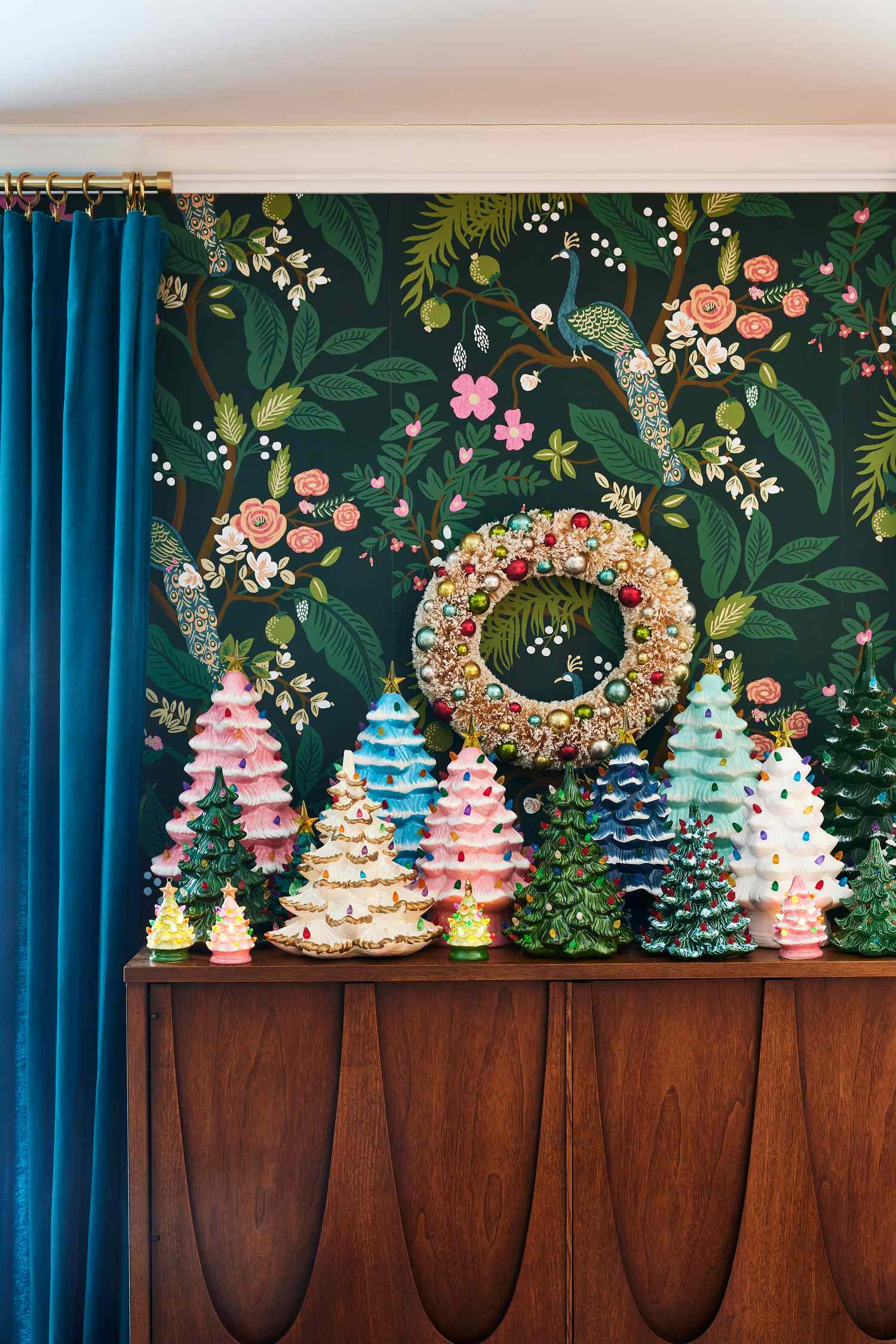
Three things are doing the work here. First, density — the tree is packed almost edge to edge, which is exactly how these ornaments were used in the 1950s, when a full-size tree could take a hundred pieces or more. Second, the finish contrast: glossy glass against matte green needles makes every ornament pop without a single accent color doing the heavy lifting. Third, warm white lights set deep inside the branches, so the reflection happens in the glass rather than on top of it.
- Unlit green tree, 7.5 ft: $180–$450
- Vintage Shiny Brite glass, 60–100 pieces: $200–$600
- Warm white string lights, 700–900 bulbs: $30–$70
- Tree skirt or collar: $25–$90
- Replacement caps, wire hangers, spare bulbs: $10–$25
- Total: $445–$1,235
Budget alternative: pick up 25–30 real vintage pieces at estate sales and fill the rest of the tree with $1–$3 modern glass-look balls — hang the old glass at eye level and in front, the fillers go behind.
2. Sorting a Vintage Shiny Brite Lot Before It Ever Hits the Tree
Sort a mixed lot by size before you hang anything, then build the tree in three bands. Pieces over 3 inches go on the bottom third, the 2- to 3-inch middle ground takes the center, and anything under 2 inches — plus small figures and bells — lives up top. A mixed box sorted this way takes about 20 minutes and saves you an hour of rearranging once the tree is up.
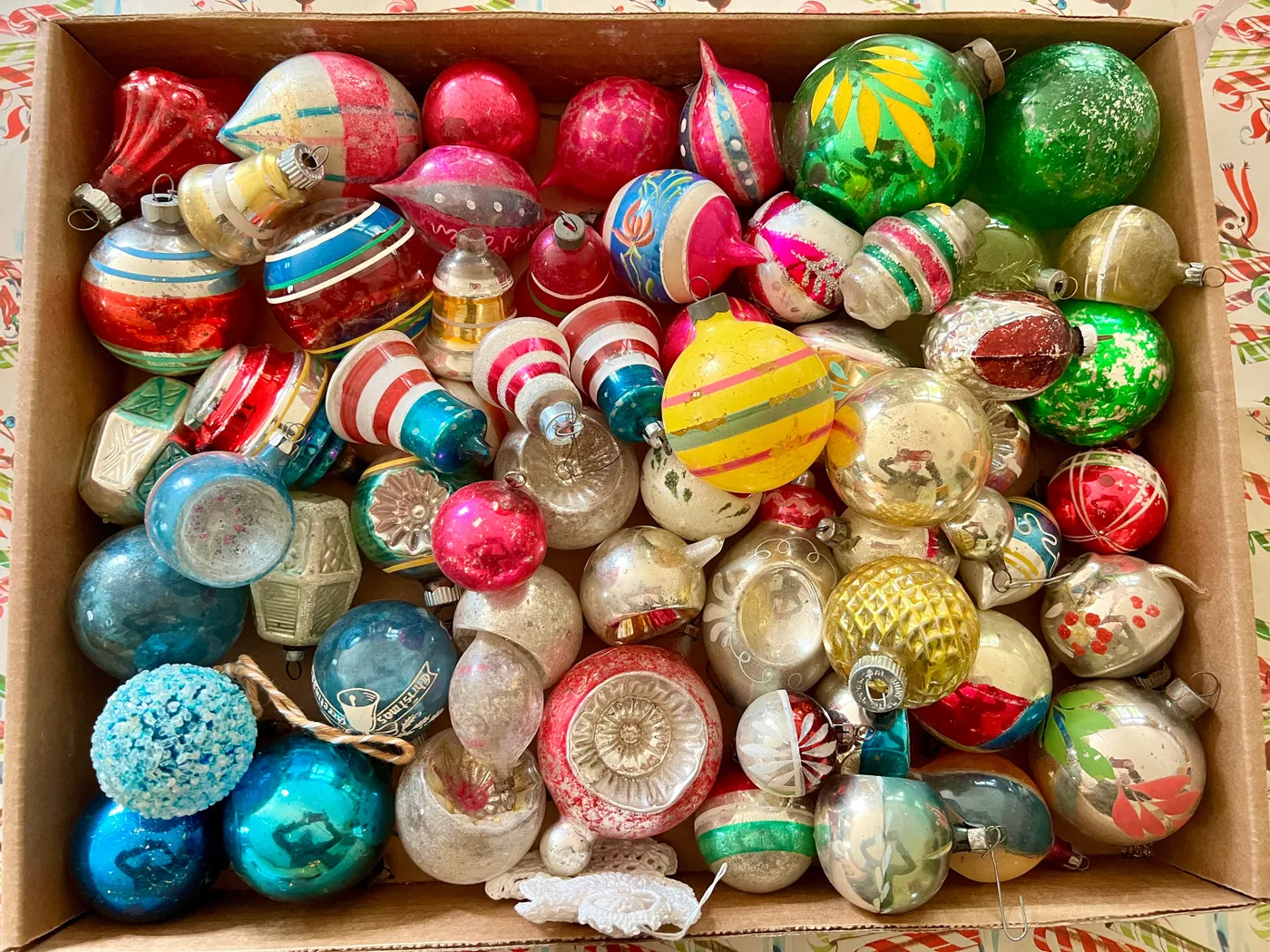
The formula that makes a random lot read as a collection: 60% solid-color glass (red, blue, green, silver), 30% striped or indented pieces, 10% figural or novelty. If your box is heavy on solids, add stripes by clipping narrow ribbon to the caps. If it’s mostly figural, cluster the novelties in one zone instead of spreading them thin — repetition is what makes them feel deliberate.
3. White Tree Dressed in Silver Tinsel and Figural Glass
The white tree. Everything else — the silver tinsel rope, the bells, the lanterns, the Santa, the angel riding a moon — only reads because the base is white. On a green tree those same figural pieces disappear into the needles; against white they sit forward like objects in a display case. Take the white tree away and you have a lovely ornament collection with nowhere to live.
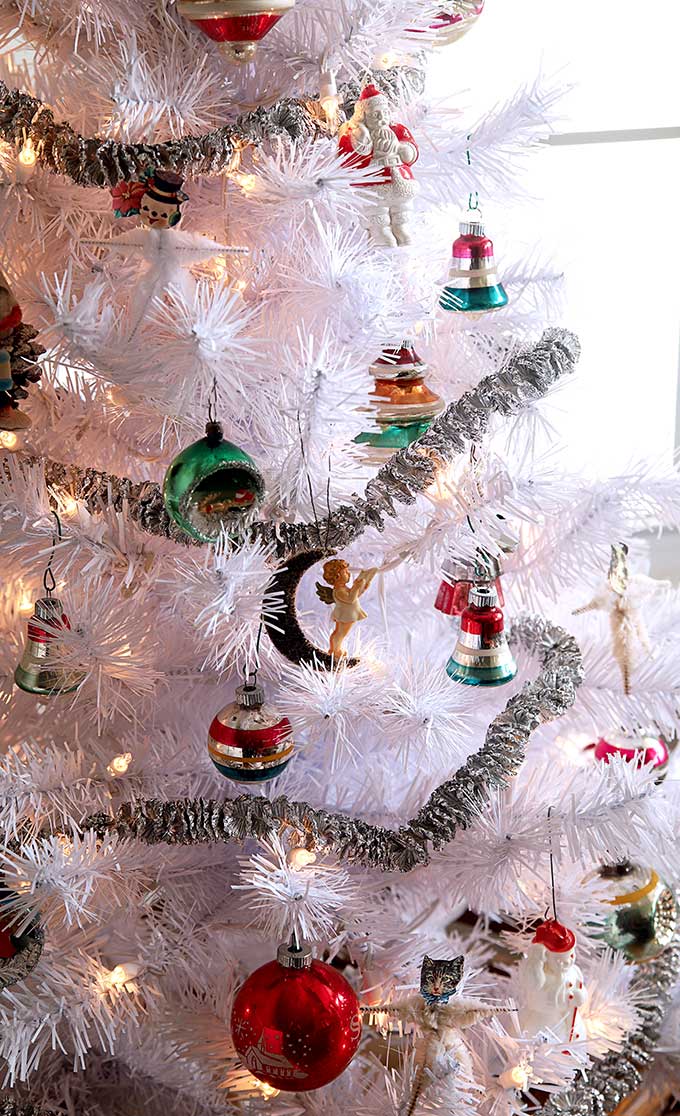
White trees are unforgiving about scale. A 6-footer needs ceilings around 8 feet and roughly 3 feet of clearance on each side, or the brightness starts eating your wall. Anything under 5 feet belongs on a table, like the small flocked version in Idea #9. Keep silver tinsel to one strand per branch layer — white plus heavy tinsel tips into icy fast.
4. Pink, Fuchsia, and Ombre Glass Baubles in a Divided Box
Here’s the honest part about hot pink and ombre glass: it photographs like a dream and it shows every fingerprint. These pieces carry metallic finishes that dull if you wash them, so dust with a dry microfiber cloth only — no water, no spray cleaner. Check the caps too. A loose or rusted cap on a heavy glass ball will drop it off the branch at the worst possible moment, usually onto tile.
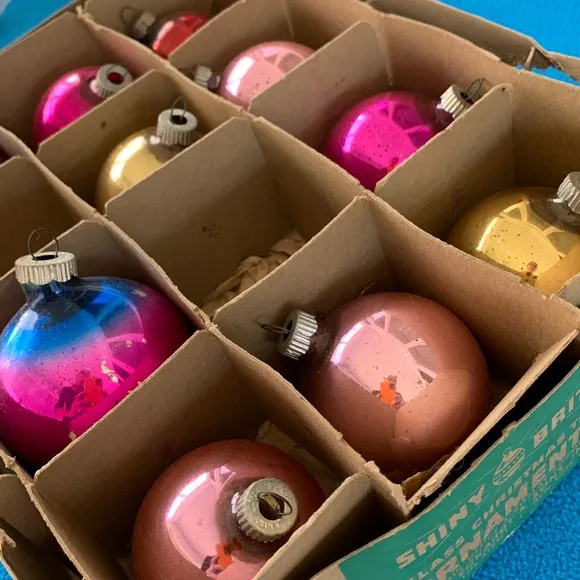
Pink and fuchsia glass is one of the fastest-moving colorways in vintage resale right now, and it isn’t a fluke. Designers spent the last few years pushing warmer, softer palettes back into holiday decor, and pink plays nicely with both gold and cream. The staying power is real because pink glass was genuinely manufactured in the era — you’re buying history, not a trend someone invented last season.
5. Tinsel-Loaded Tree With a Miniature Village Underneath
You don’t need vintage Putz houses to pull this off. Modern cardboard village sets run $12–$25 at Target and Walmart, or $20–$40 on Etsy for hand-cut versions you fold and glue yourself. Skip the light-up houses and drop one warm LED tea light inside each ($1 apiece). For the base, a plain teal blanket from a thrift store layered over a white cloth with a red print gets you the same two-tone look for under $20.
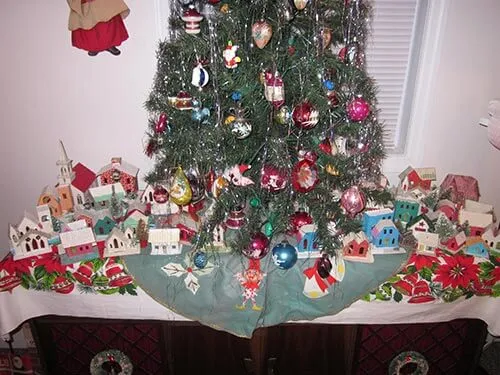
Keep the village lit at a lower color temperature than the tree, and leave a 4- to 6-inch gap between the lowest branches and the tallest house roof. That gap is what makes the village read as a separate scene rather than a pile of clutter under the tree. Run the village on its own switch so you can leave the tree glowing after the houses go dark.
6. Flocked Branches With Blue Spiral Tinsel and Embossed Glass
- Pre-flocked tree, 6.5–7 ft: $200–$500
- Blue spiral tinsel garland, 3–4 strands: $15–$40
- Vintage-style glass balls and teardrops, 50–70 pieces: $120–$350
- Embossed flower and star ornaments, 10–15 pieces: $60–$150
- Warm white string lights: $30–$60
- Total: $425–$1,100
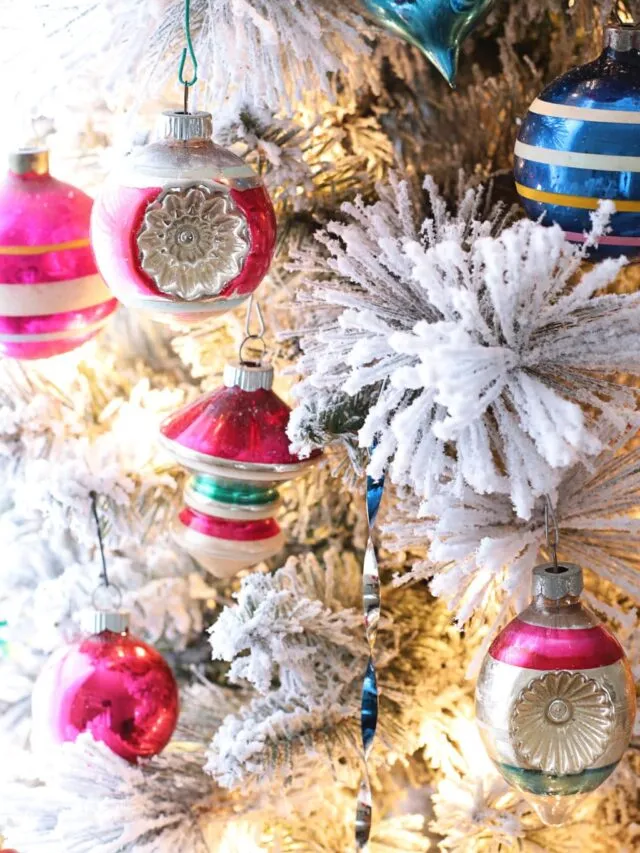
Budget alternative: buy a plain green tree, spend $12 on a can of flocking spray, and shop the six-packs of vintage-look glass at Walmart.
Flocked trees shed. Not a little — a fine white dust that settles on anything within three feet, so keep it away from a dark sofa. They also can’t sit in a hot attic without the flocking yellowing, and once they’re dusty there’s no vacuuming them back to life. If you have pets that chew or a toddler who treats branches as a snack, flocked is the wrong call.
7. Primary-Color Glass in a Compartmented Box, Ready to Hang
The box itself. Bright red, royal blue, and emerald green glass in a compartmented cardboard tray is one of the most satisfying objects in all of Christmas decor, and it works as a display, not just storage. Set it open on a shelf, a bar cart, or a side table with the lid leaning behind it. Without the box this is a pile of ornaments; with it, you’ve got a curated collection with a built-in frame.
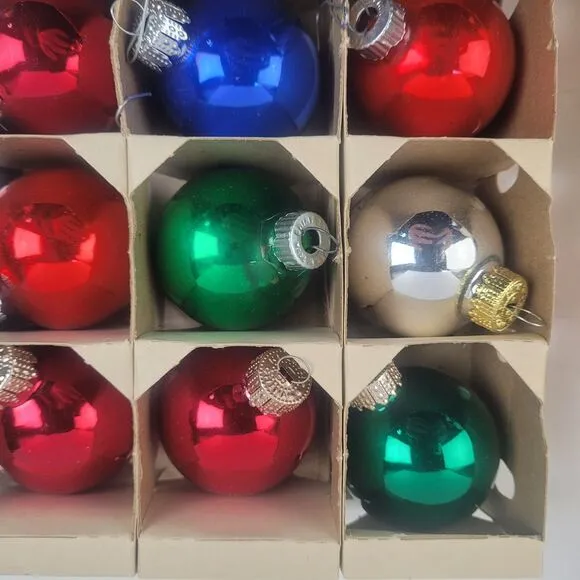
- Measure shelf or table depth — a full tray of 24 ornaments needs about 12 x 18 inches.
- Check ornament diameters against the dividers. Anything over 3 inches rides up and cracks its neighbor.
- Choose a spot out of direct sun, since old glass fades unevenly.
- Confirm the box has no musty smell before it comes indoors.
8. One Tiered Teal-and-Red Ornament Against Frosted Branches
- Choose the branch at eye level, just left or right of the tree’s centerline.
- Clear a 4-inch circle of needles behind it so the ornament sits against white, not green.
- Hang it 2 inches off the branch on fine wire rather than a metal hook, so it reads as floating.
- Add two small supporting ornaments within 6 inches — one teal, one gold — to anchor the moment.
- Step back to the doorway to check it. That’s the view that actually matters.
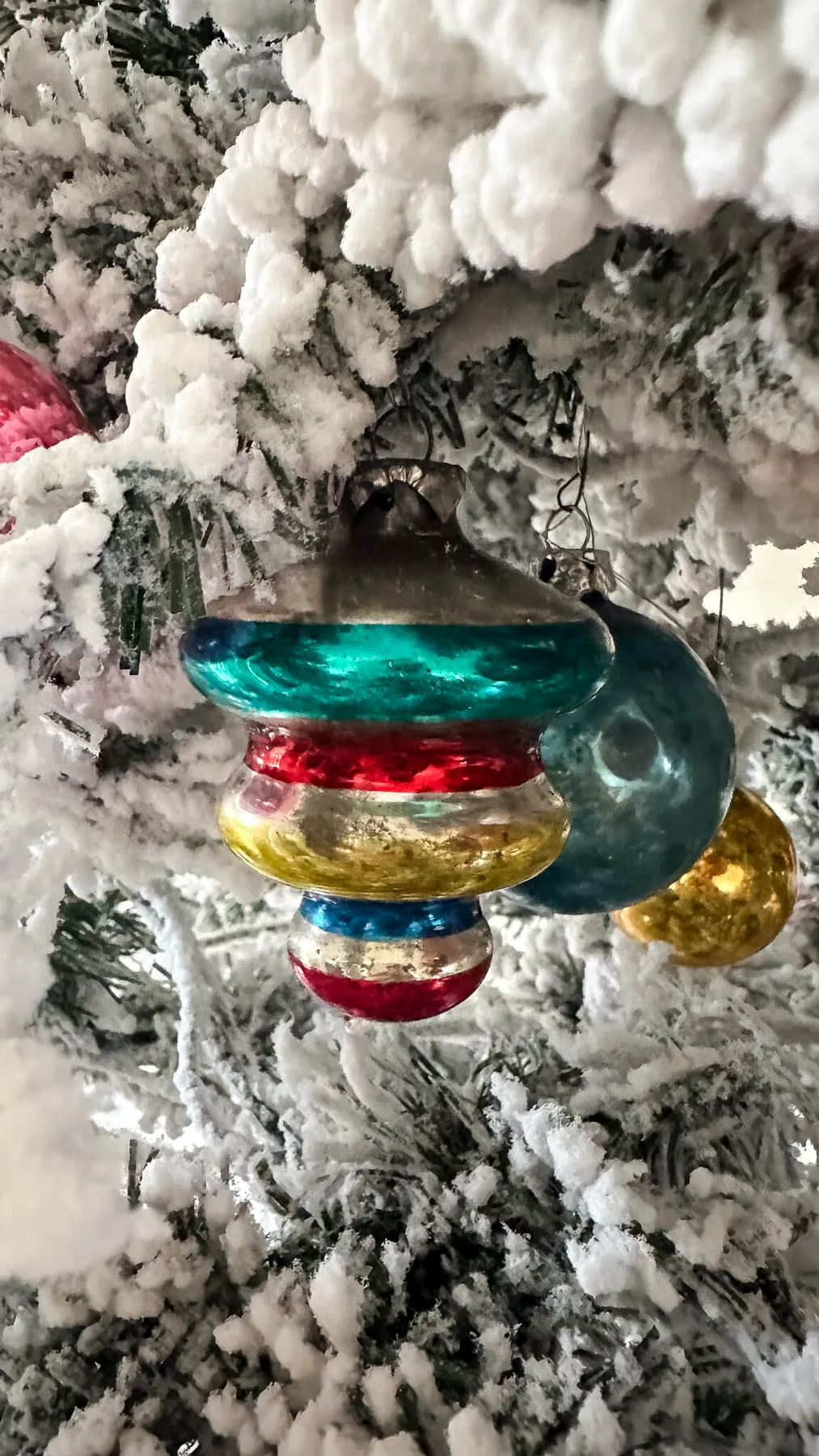
Time: 15 minutes. Cost: $0 if you already own the ornament.
Tiered, striped glass is the most fragile shape on any tree — the narrow neck cracks long before the body does. Store it in a compartment or padded bag, never loose in a bin. Flocked branches grab at ornament caps, so expect to check hangers weekly through December. Want the look with less heartbreak? Matte ceramic ornaments in the same teal and red give you 90% of the effect and survive hardwood.
9. Small Flocked Tabletop Tree With a Multi-Point Star
Small trees need a tighter formula than big ones: 70% multicolor glass, 20% metallic tinsel, 10% topper and garland shine. On a 3-foot tree that’s roughly 30 ornaments maximum — past that the branches vanish and you’re looking at an ornament pile shaped like a cone. Swap the mood by keeping the ratios and changing the glass family: all red and silver reads traditional, all pink and gold reads retro.
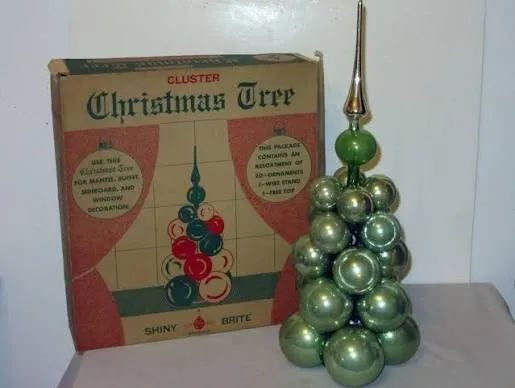
On any tree under 4 feet, use a 4-inch topper maximum. A standard 8-inch star on a tabletop tree is the single most common scale mistake I see, and it visually shortens the whole thing. Wind your tinsel in a spiral that overlaps itself by half on each pass so it reads as ribbon rather than a series of stripes. Compare with Idea #20, where the same star idea works at full size.
10. A Glass Tabletop Tree Hung With Heart Ornaments
- Set the base on a felt pad so it doesn’t scratch the surface.
- Load the bottom third with your heaviest hearts first — glass arms flex more than you expect.
- Work upward in a loose spiral instead of rows so no two hearts align.
- Thread ornaments with fine wire rather than hooks; thin arms bend easily.
- Finish by checking symmetry from three feet back, not from above.
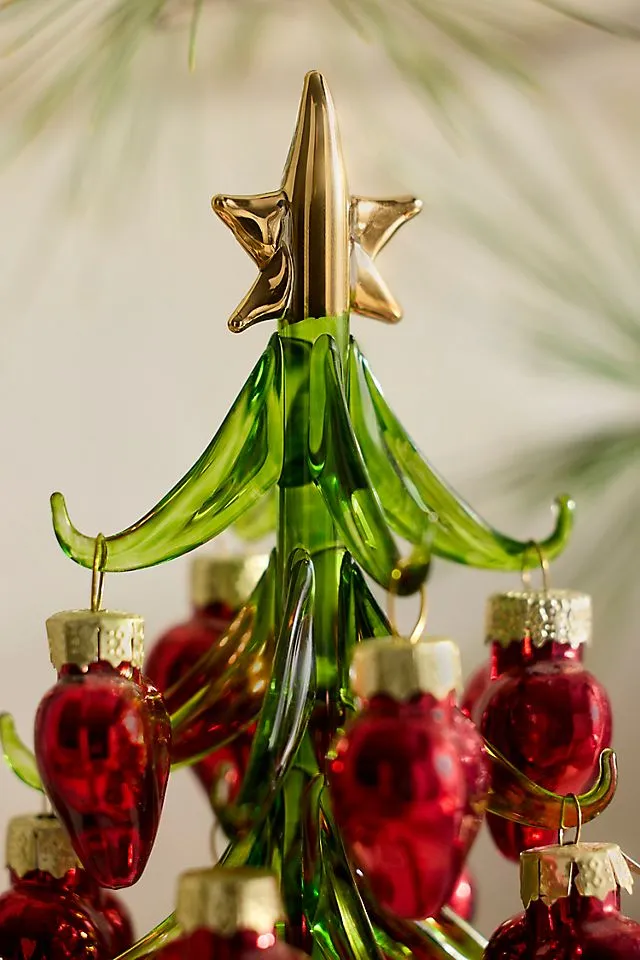
Time: 30–45 minutes. Cost: $0 if you’re using what you own, or $30–$80 for a full set of vintage-style hearts.
- Weigh your heaviest ornament — most wire tabletop trees max out around 2 ounces per arm.
- Measure the surface; these trees usually need a 12-inch circle minimum.
- Pick a spot away from a heating vent, since glass and heat don’t cooperate.
- Decide now whether kids or cats can reach it.
11. Vintage Santa Glass Ornament in a Cloud of Baubles
- Vintage-style Santa glass ornament: $8–$45
- Gold, silver, and teal ribbed balls, 10–14 pieces: $25–$70
- Clear glass ornaments with painted detail, 6–8 pieces: $20–$60
- Warm white string lights, one strand: $10–$20
- Shallow bowl or tray for display: $15–$45
- Total: $78–$240
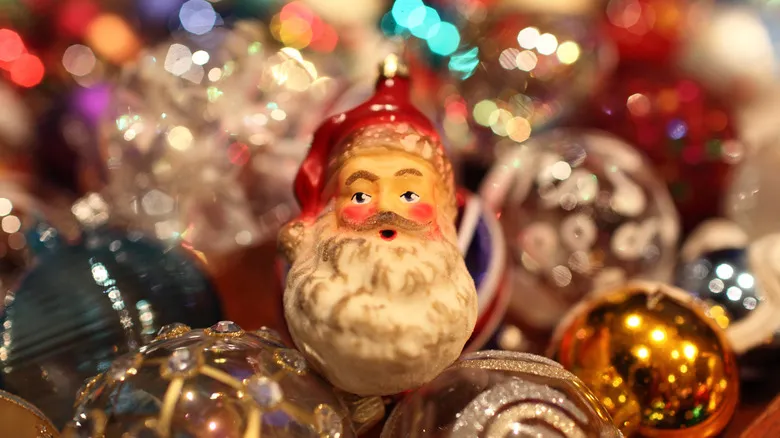
Budget alternative: Walmart and Target sell four-packs of vintage-look glass balls for $5–$8, which brings the whole arrangement in under $40.
The clear glass. Gold and silver alone would make this a shiny, meaningless pile — it’s the six or eight transparent pieces with painted detail that give your eye somewhere to land and make the cluster feel collected instead of matched. If you take one thing from this arrangement, take that: always mix a few transparent pieces into a group of solid metallics.
12. Holly and Red Drop Ornament on a Warm-Lit Branch
Long drop ornaments need a branch with real spring to it. Push the hanger three nodes back from the tip and let the piece hang in front of the branch rather than off the end of it — that’s the difference between elegant and droopy. For a 5-inch drop, a 14-gauge wire hook holds better than a standard metal clip, and it lets you angle the ornament slightly forward so the painted face catches light.
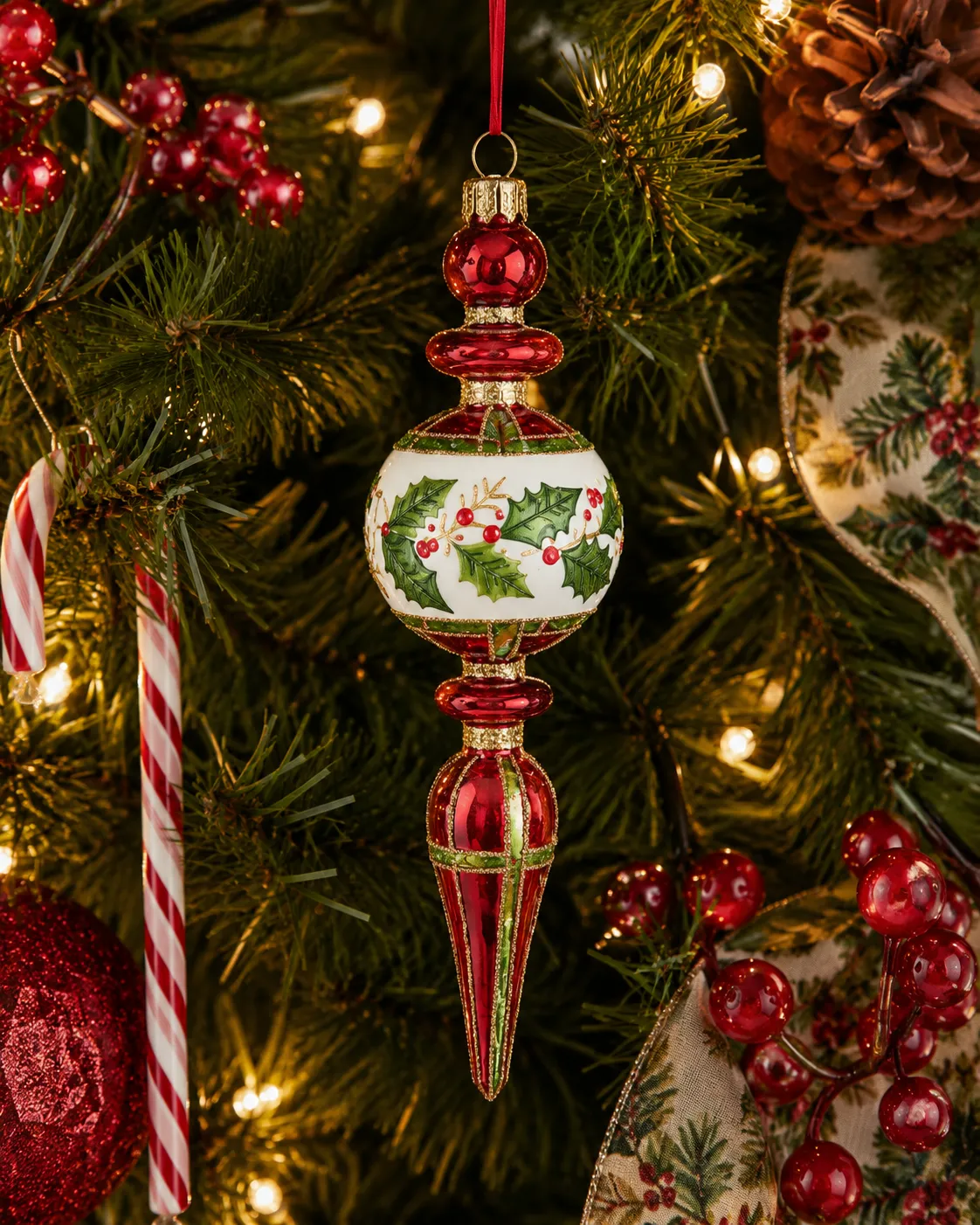
Elongated glass with painted holly and glitter is gorgeous and fragile in exactly the wrong spots — the glitter band at the neck is where hairline cracks begin. Don’t hang these where people brush past the tree in a hallway, and skip them entirely if you have a cat that swats. And resist putting them low: on a tree with a skirt, the bottom 12 inches is where feet, vacuums, and gifts land.
13. A Collector’s Tree With Ornaments Sized by Branch Height
Big glass at the bottom, medium in the middle, small up top. This is the oldest trick in vintage tree styling, and it’s the reason a closely packed tree still looks organized instead of chaotic. Your eye reads the taper before it reads individual ornaments, so the silhouette stays triangular even when the surface is complete visual noise. It solves a practical problem too, since the heavy pieces near the trunk stay put. Size your ornaments the way you’d size furniture: big pieces low, small pieces high.
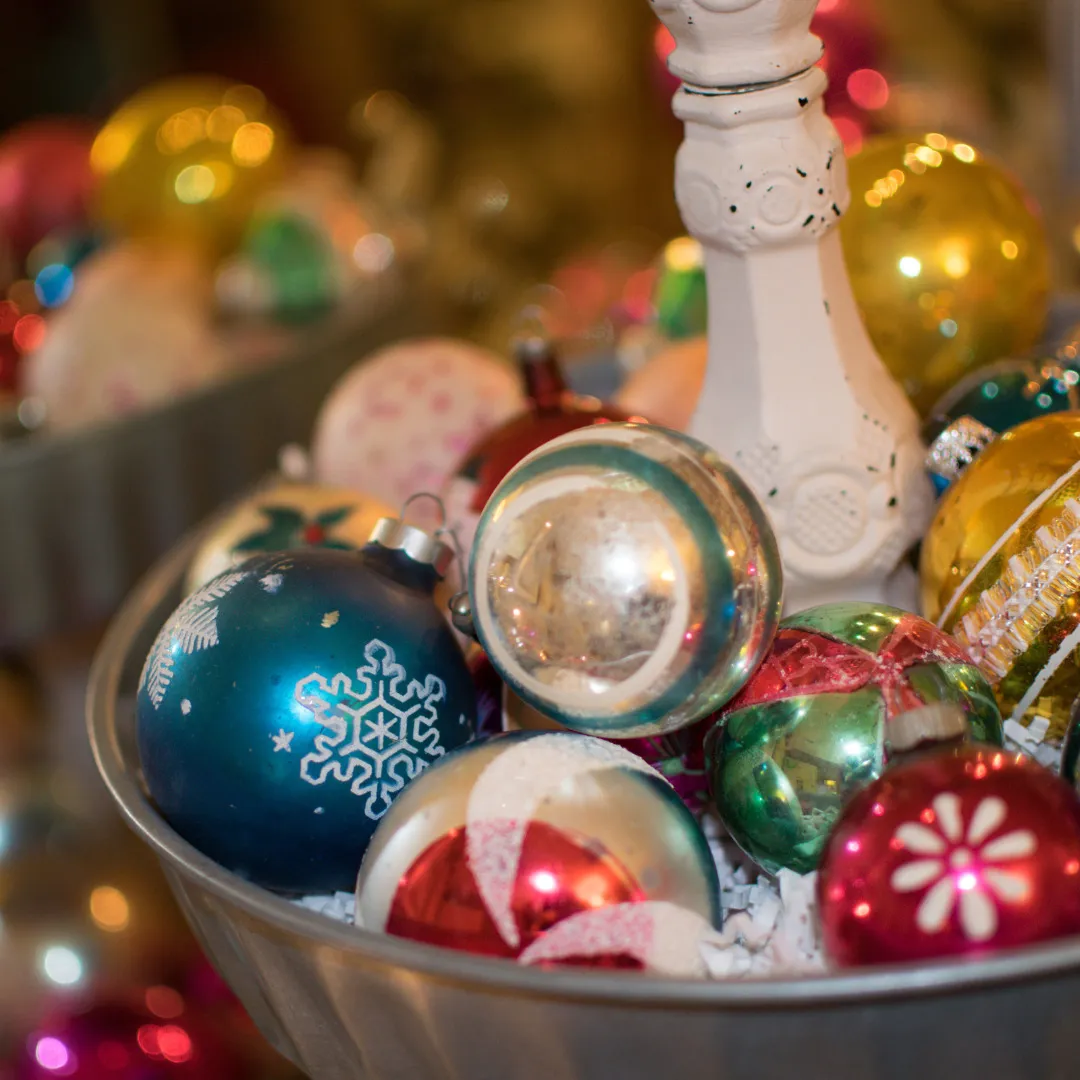
You don’t need a hundred matching vintage pieces. Facebook Marketplace and estate sales regularly move whole boxes of mixed Shiny Brite-era glass for $20–$50, and the mismatch is the whole point. Fill gaps with dollar-store balls in the same palette, hang the real glass in the front third of the tree, and tuck fillers behind the lights. Nobody has ever walked in and audited which ornaments came from which decade.
14. Ferris Wheel Ornament With Santa and Elves in the Cabins
Novelty ornaments like this glossy wheel with painted riders inside little blue-and-white cabins are the pieces that break first, because the parts that make them charming are also the thin, glued ones. Store it upright in its own box, never in a bin with heavier glass. A soft brush is all the cleaning it needs — water and glass paint are enemies. Expect to check the hanger every single year.
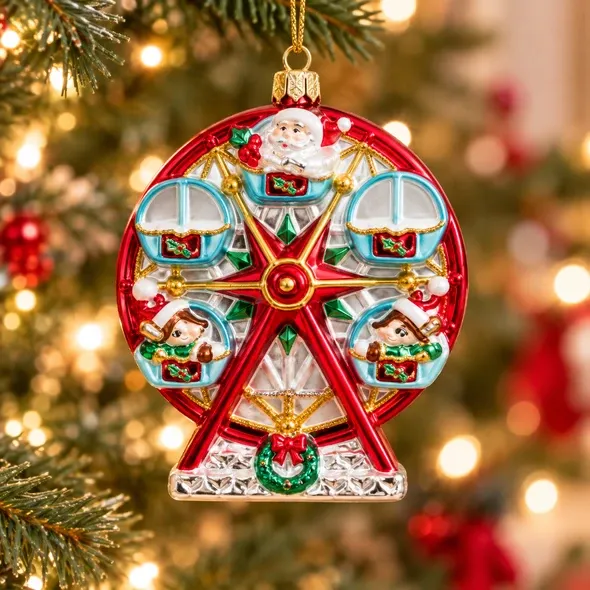
Placement. A Ferris wheel ornament needs negative space around it or it just reads as noise. Hang it where the nearest glass ball is at least 5 inches away, ideally on a branch slightly below eye level so you’re looking into the cabins instead of up at the underside. Take that breathing room away and it becomes invisible. Compare with Idea #11, where the single statement piece is a Santa instead.
15. Bottle Brush Trees and Glass Baubles Under a Cloche
Cloche displays work on a shelf, a mantel, or a side table — anywhere with 10 to 14 inches of vertical clearance. For a standard 9-inch cloche, keep the tallest bottle brush tree around 6 inches so there’s air above it. Crowding the glass makes the whole thing look like a terrarium instead of a vignette. Wider rooms can take a bigger version of the same idea, but the proportions stay the same: tallest element never touches the dome.
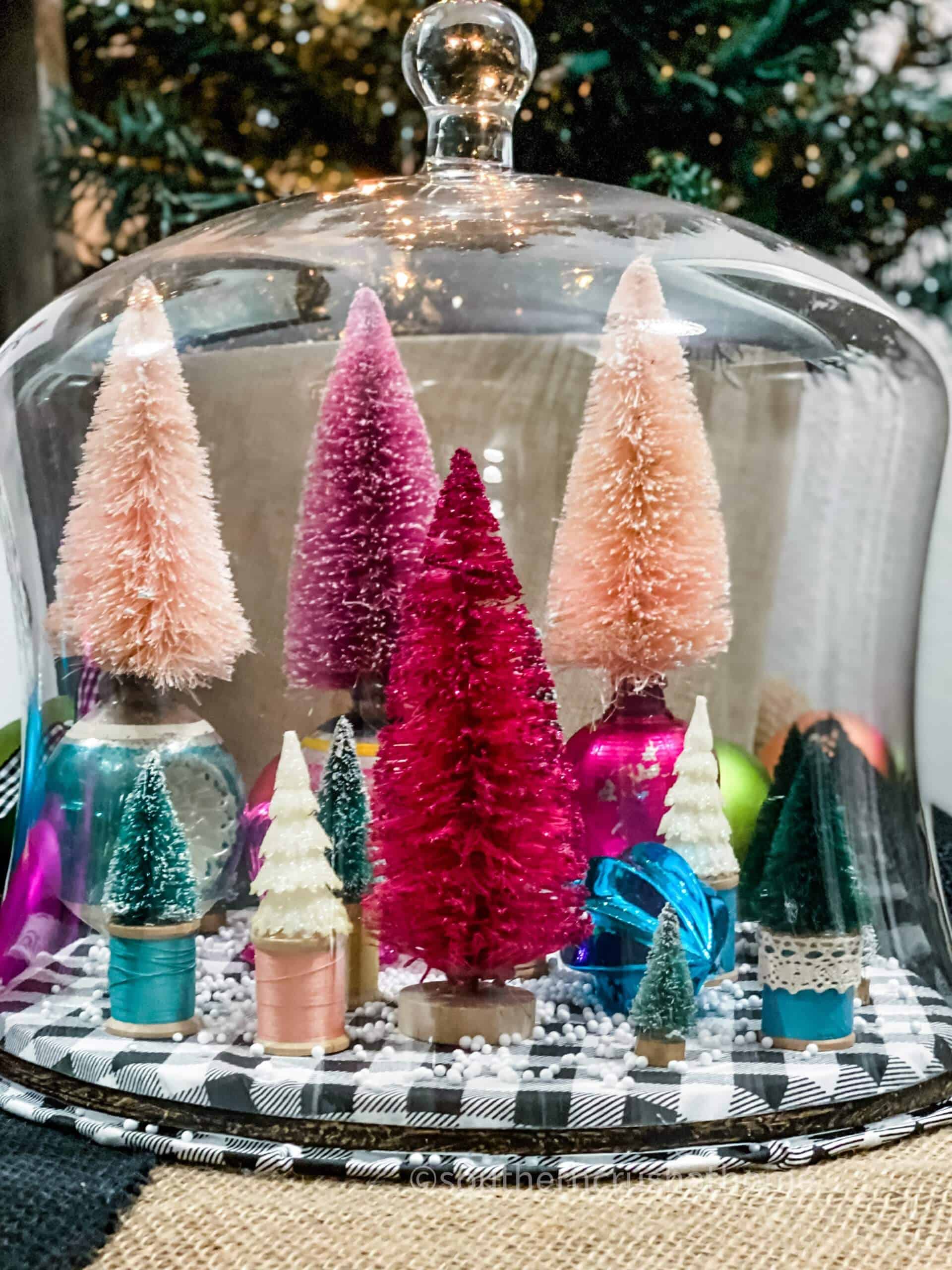
- Glass cloche with base, 9–11 in: $25–$60
- Bottle brush trees, 6–10 pieces: $15–$45
- Shiny teal and fuchsia ornaments, 8–12 pieces: $20–$55
- Buffalo check fabric square: $5–$15
- White bead scatter: $5–$10
- Total: $70–$185
Budget alternative: an upside-down clear glass hurricane vase over a thrifted plate does the same job for about $8.
16. Shiny Brite Next to Christopher Radko on One Tree
Mixing eras is the whole story of the 2026 collector tree. Shiny Brite glass from the 1940s through the 1960s and Christopher Radko’s hand-painted pieces from the 1990s onward sit in completely different price brackets, but they share a scale and a glossy finish, so they read as one family. Buyers are chasing both on the same shopping trip now, which has quietly pushed mid-century singles up in price.
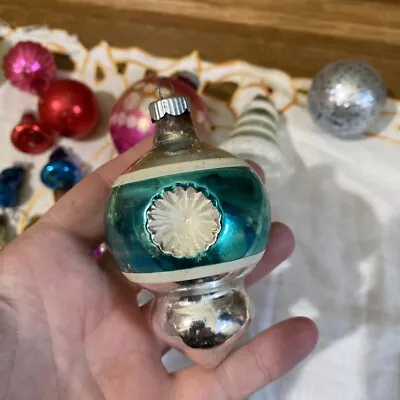
The catch is that they don’t age the same way, and you should know which is which before you spend:
- Shiny Brite-era glass: painted bands and indents, thinner walls, caps often stamped, usually under $15 per single.
- Radko-era glass: heavier, elaborate finials and figures, signed caps, often $40–$200 each.
- Both: check the cap and the neck for cracks before you buy. It’s the one flaw you can’t fix.
17. Hot Pink Tinsel With a Green, Gold, and Pink Ribbed Orb
This tree runs on a two-color formula with a neutral: 55% evergreen, 30% hot pink and gold, 15% clear light and silver accents. The ribbed ornament with the green jewel is the anchor — everything nearby echoes one of its three colors and nothing introduces a fourth. Want it calmer? Keep the ratio and swap pink tinsel for champagne ribbon. The tree reads traditional without changing a single ornament.
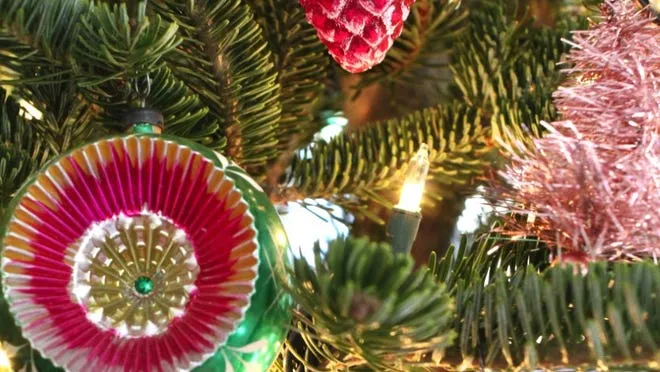
Run tinsel after the lights but before the ornaments, at a slight downward angle from the branch collar toward the tip, overlapping each pass by half. If you want the pink to feel intentional rather than accidental, pair it with a red glitter pinecone within 8 inches. That warm red stops pink from reading as bubblegum under cool light, which is the single most common complaint I hear about pink trees.
18. Eleven Vintage Glass Ornaments, Styled as a Small Collection
Eleven pieces is a completely reasonable collection, and it’s the number most people actually land on after a season of estate sales. Expect $30–$80 for a mixed set on Etsy or eBay, or $1–$5 per piece if you’re willing to dig through thrift bins and church rummage tables. Walmart and Target sell vintage-look glass singles for $2–$4 when you want to grow the set without hunting for it.
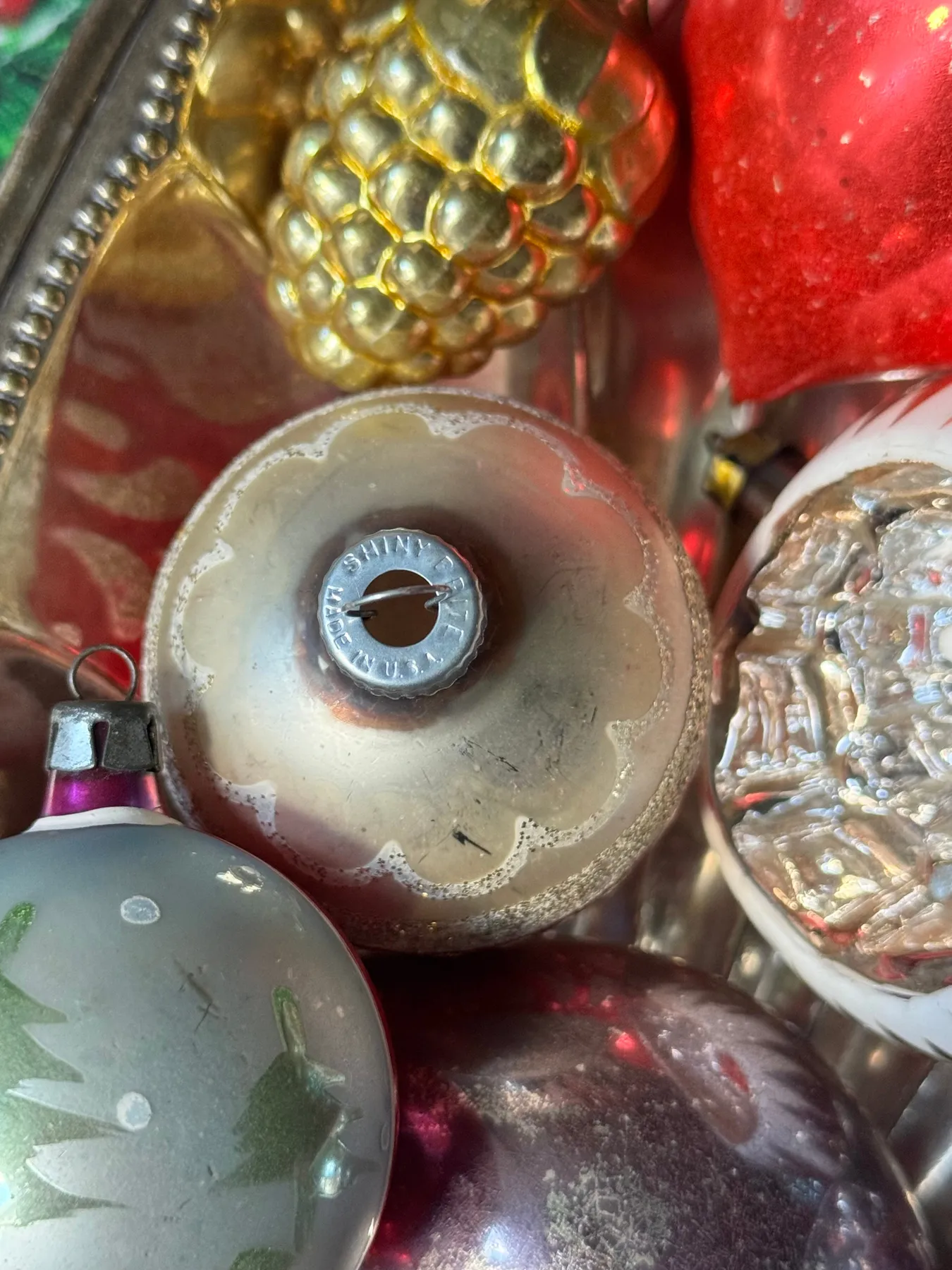
- Confirm how many pieces actually ship — “lot” listings often photograph 20 and ship 11.
- Ask the seller for photos of the backs. That’s where chips hide.
- Decide your display surface before buying; eleven ornaments fill a 14-inch tray.
19. Cottage Corner Where the Glass Does All the Talking
This works in a corner as small as 4 x 4 feet with an 8-foot ceiling: a slim tree, a low stool or crate, and one wall for a mirror or framed print. In a room under 100 square feet, keep the tree at 5 feet and skip the skirt-and-village setup — floor space is the first thing to go. In bigger rooms the same styling scales up, as in Idea #30, where the tree is sized to a seating group instead of a corner.
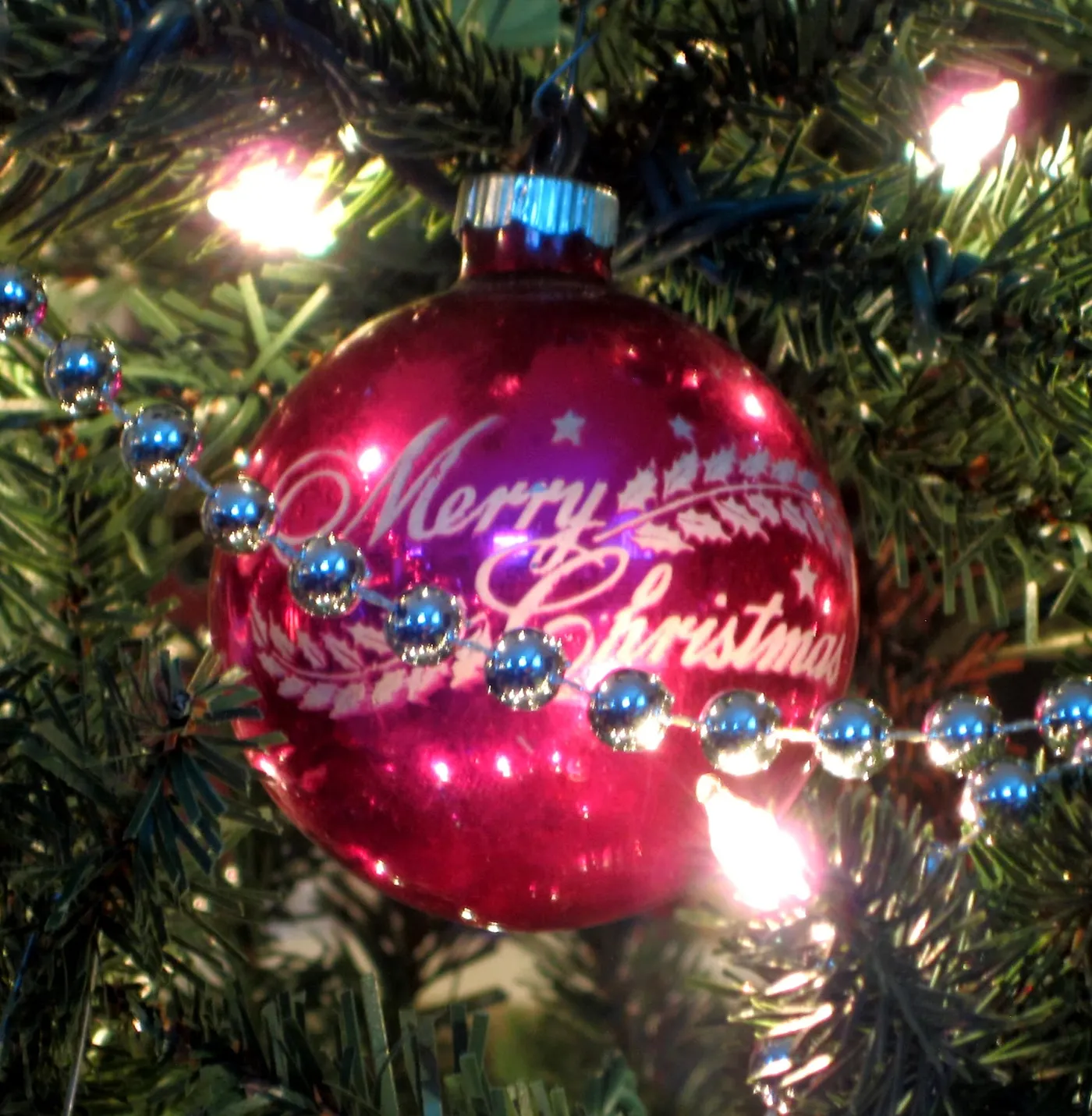
Restraint. A cottage corner lives or dies on how much you leave out — one tree, one textile, one small object on the floor, and glass doing all the color work. Add a second garland here and the corner closes in on itself. The ornament collection is the only thing allowed to be busy. That’s also why this look costs nothing to change from season to season.
20. Gold and Silver Glittered Star Topping the Tree
- Straighten the top branch so it’s vertical — a leaning leader makes any topper look drunk.
- Wrap a short piece of floral tape around the branch where the shaft will sit.
- Slide the topper down until its base rests on the tape, not on the tip.
- Rotate it so the most detailed point faces your main sightline.
- Fill the gap underneath with two small glass balls.
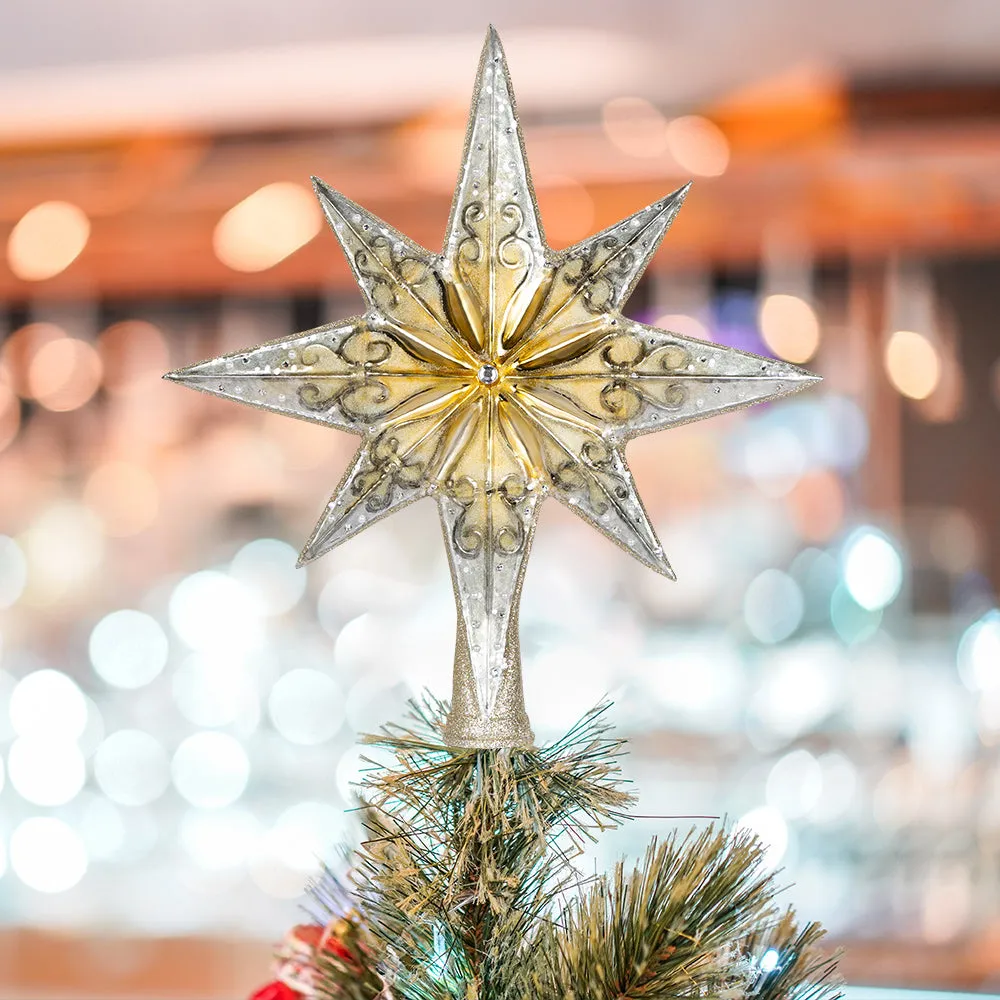
Time: 10 minutes. Cost: $0 if you own it; replacements run $15–$60.
Raised scrollwork plus glitter on both the points and the shaft is why this star reads as metalwork instead of craft foam — the texture catches light at different angles depending on where you stand. Silver-frosted points around a gold center also keep the topper from fighting a multicolor tree. If your tree is tabletop height, see the smaller proportions in Idea #9.
21. Worn Shiny Brite Glass Against Christmas-Print Fabric
Lay worn glass on a busy print and the formula flips: 50% patterned background, 40% solid and glitter-accented glass, 10% metallic caps. The fabric carries the red and green so the ornaments don’t have to work as hard, which is why aged pieces look intentional here rather than tired. To restyle it, swap the fabric — a plain linen drop turns the same ornaments into a modern, minimal arrangement in about two minutes.
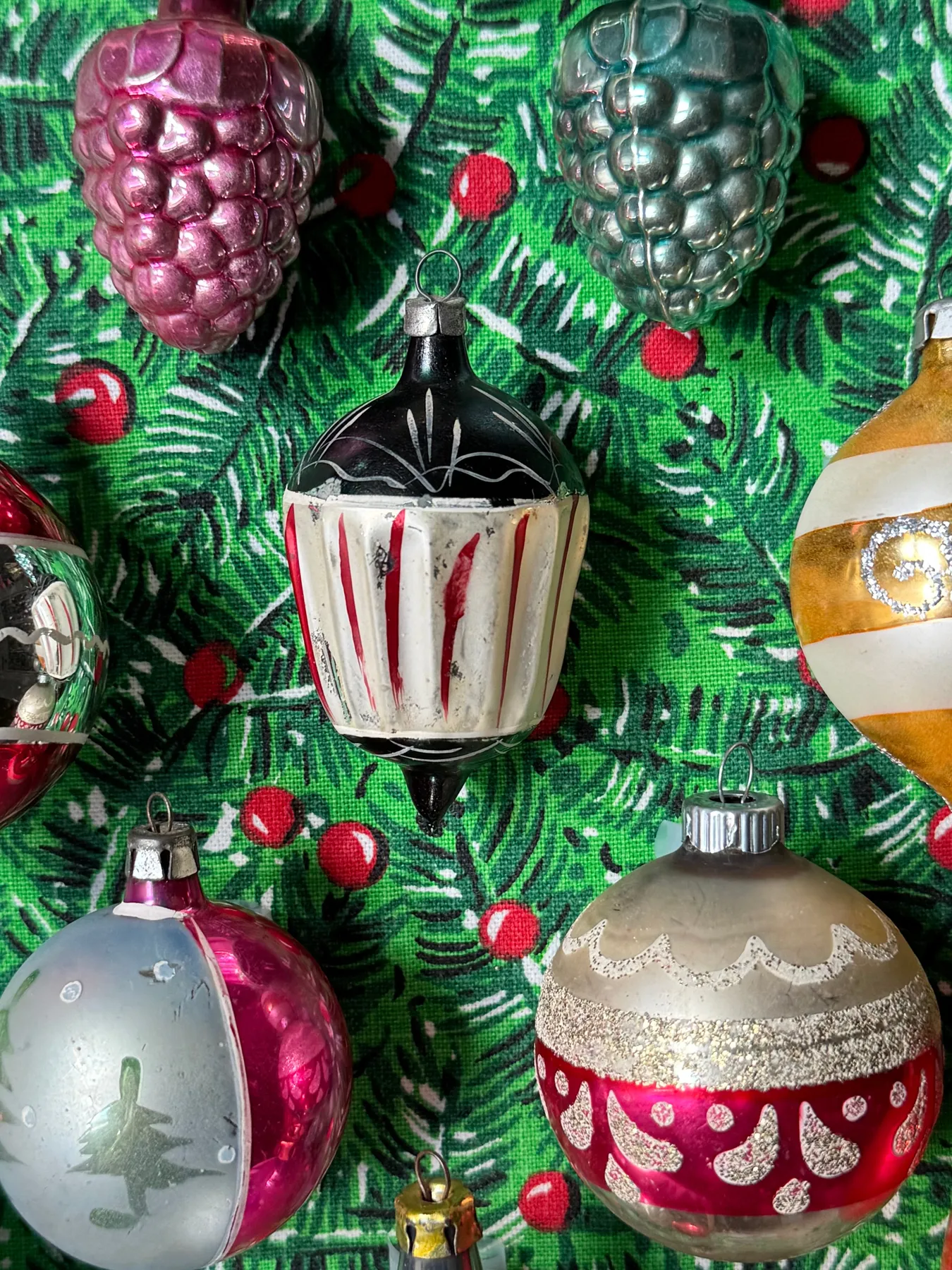
Older glass with worn paint should never be washed. Dust it with a dry, soft brush and leave chipped spots alone; repainting devalues a collector’s piece and rarely matches anyway. Store pieces in a compartmented box with tissue between layers, keep it out of a damp basement, and check for cap rust once a year. Flakes of old paint on your fingers after handling? Normal — wash your hands before you touch anything white.
22. The Incomplete Box of Red Shiny Brite Ornaments
Incomplete sets used to be the stuff nobody bid on. Now collectors buy them on purpose, because a partial box lets you build a whole tree in one color without paying single-piece prices. Red is the most common Shiny Brite colorway and the most forgiving — a box missing four of twelve is still a usable, desirable set, and it usually changes hands for about a third of what a complete box brings.
Where to hunt for partials and singles:
- Estate sales and church rummage tables: $1–$3 per piece, best odds in the first hour.
- eBay and Etsy “as is” listings: $10–$35 for a partial box.
- Facebook Marketplace lot purchases: $20–$60 for a mixed bin you split with a friend.
Fill an incomplete box with modern red glass balls from Dollar Tree at $1.25 each — nobody is going to count.
23. Living Room Tree Anchored by a Black Fireplace
- Fully lit 7.5 ft tree: $200–$500
- Ornaments, 80–120 pieces: $180–$500
- Pre-lit mantel garland, 9 ft: $40–$120
- Stockings, 4–5: $60–$150
- Tree collar or skirt: $30–$90
- Total: $510–$1,360
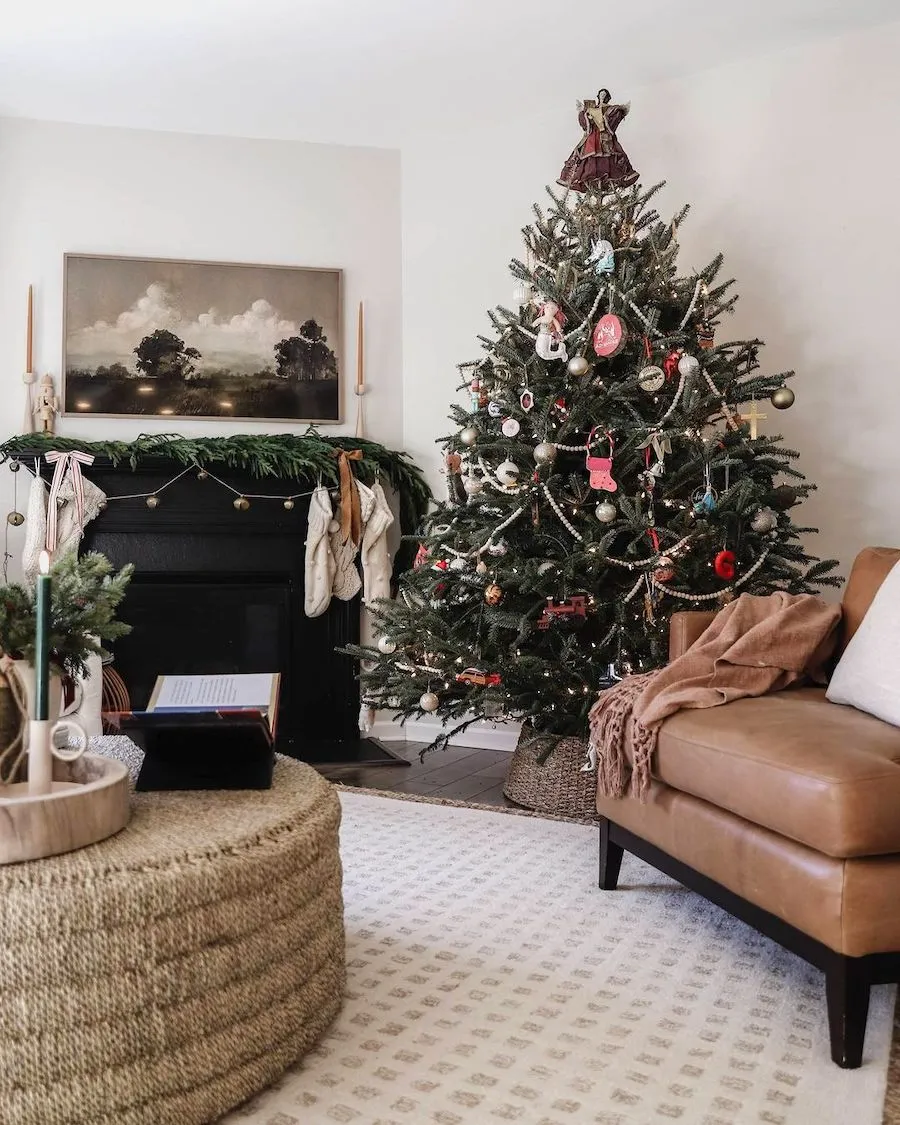
Budget alternative: skip the pre-lit garland and wind a $12 unlit strand through a $25 faux pine garland using the lights you already own.
Match garland thickness to the mantel, not the tree. On a standard 60-inch mantel, a 9-foot garland with about 6 inches of depth looks right; anything bulkier swallows the stockings. Keep the tree 24–36 inches from the fireplace so heat doesn’t dry it out, and put the mantel garland on its own switch — some nights you’ll want the fire glow alone.
24. Beaded Garland Strands With Glitter Pumpkin Baubles
- Count your strands before you commit to a garland plan — these come in packs of 6 to 9 feet.
- Check the bead finish under your actual room lighting; metallic and matte read very differently at night.
- Confirm the pumpkin stems are glued in, not pressed in. They pop off.
- Measure your run first: mantels, stair rails, and door frames all need different lengths.
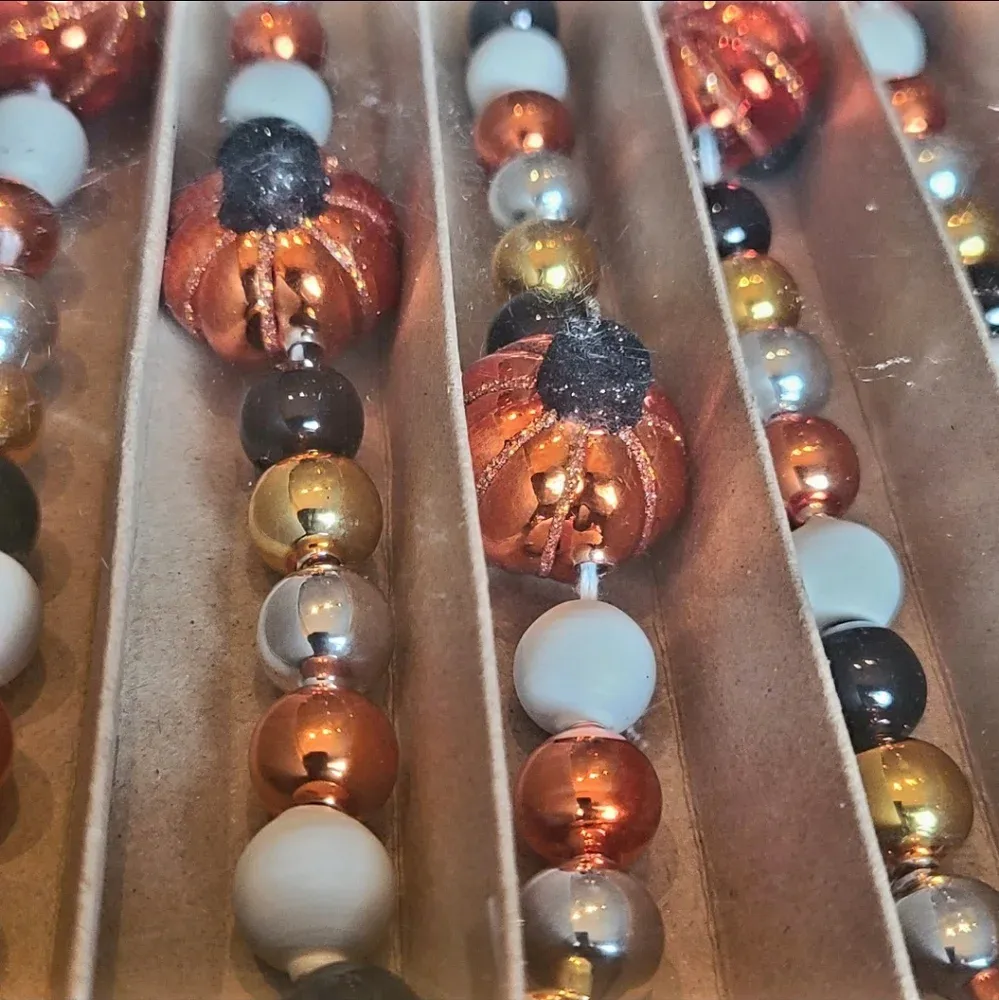
Glitter sheds, and these pumpkin-shaped baubles are heavy for their size. On a stair rail, keep strands doubled and anchored at both ends or the whole run slides downhill overnight. Be honest about the season too: metallic copper pumpkins are a tough sell in a room that’s purely evergreen and snow. They work best as an autumn-to-Christmas bridge on a shelf, not as your main tree garland.
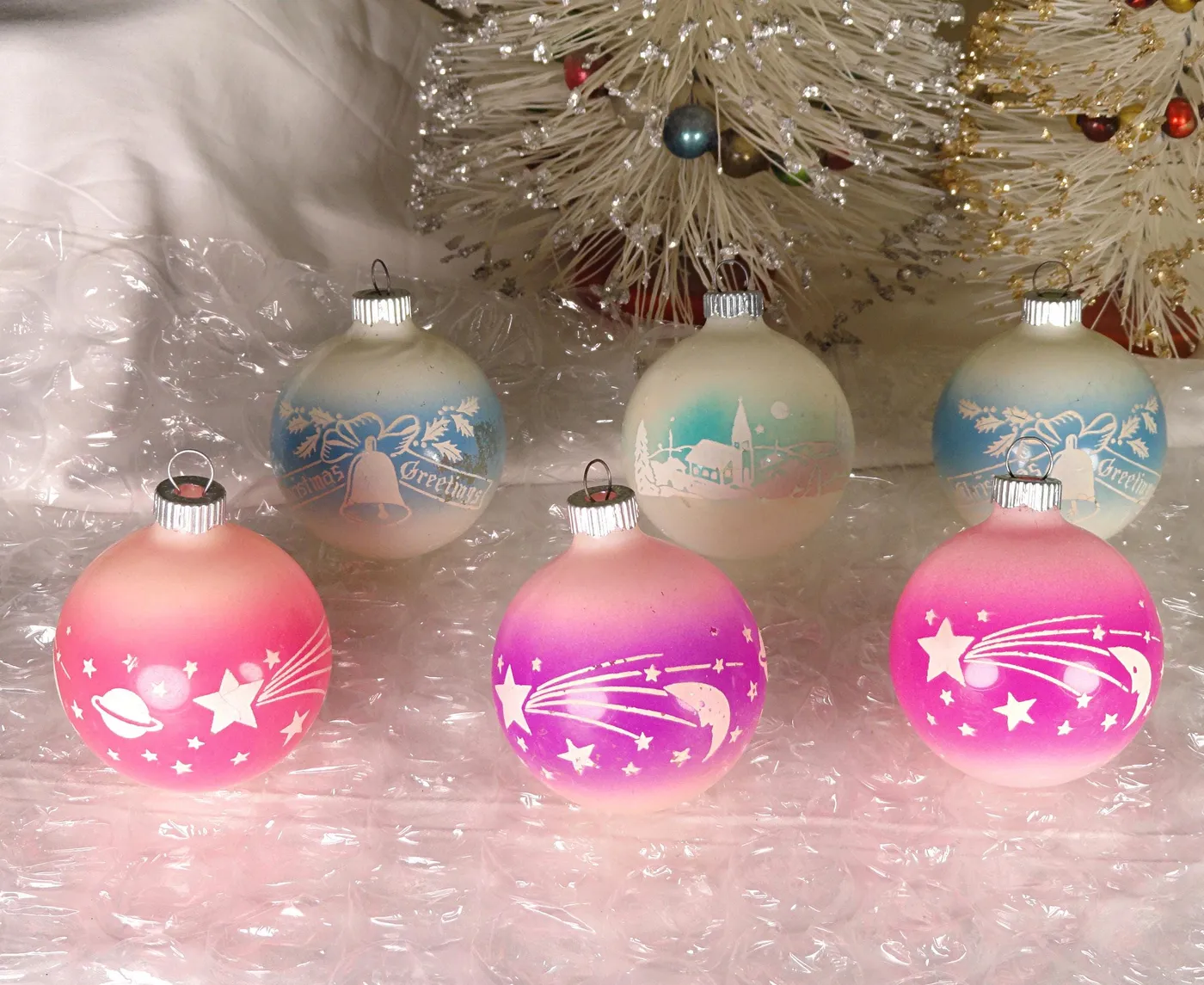
25. Star Brite Stripes in Yellow, White, and Blue
- Fill a bowl with lukewarm water and one drop of mild dish soap.
- Dip a microfiber cloth, wring it nearly dry, and wipe the glass only.
- Never submerge the cap — moisture gets in and rusts the wire.
- Dry immediately with a second cloth, turning gently by the cap.
- Let pieces sit an hour before they go back on the tree.
Time: 20 minutes for a dozen. Cost: about $1.
Yellow-and-blue stripes are a cool palette, so they need a warm base to keep from going icy. A green tree with 2700K bulbs handles it fine; a white tree pushes everything colder, which is why the white tree in Idea #3 leans on silver tinsel and figural pieces instead. Six to ten striped ornaments is plenty — spread them evenly and let solid red and gold do the filling.
26. Coby-Era Shiny Brite Kept in Its Original Box
The box. Coby-era packaging — the printed sleeve, the compartment dividers, the original price stamp — is worth as much as several of the ornaments inside, and it changes how the set gets displayed. Keep it open and upright on a shelf behind the tree. It gives the collection provenance and a graphic element no individual ornament can provide on its own.
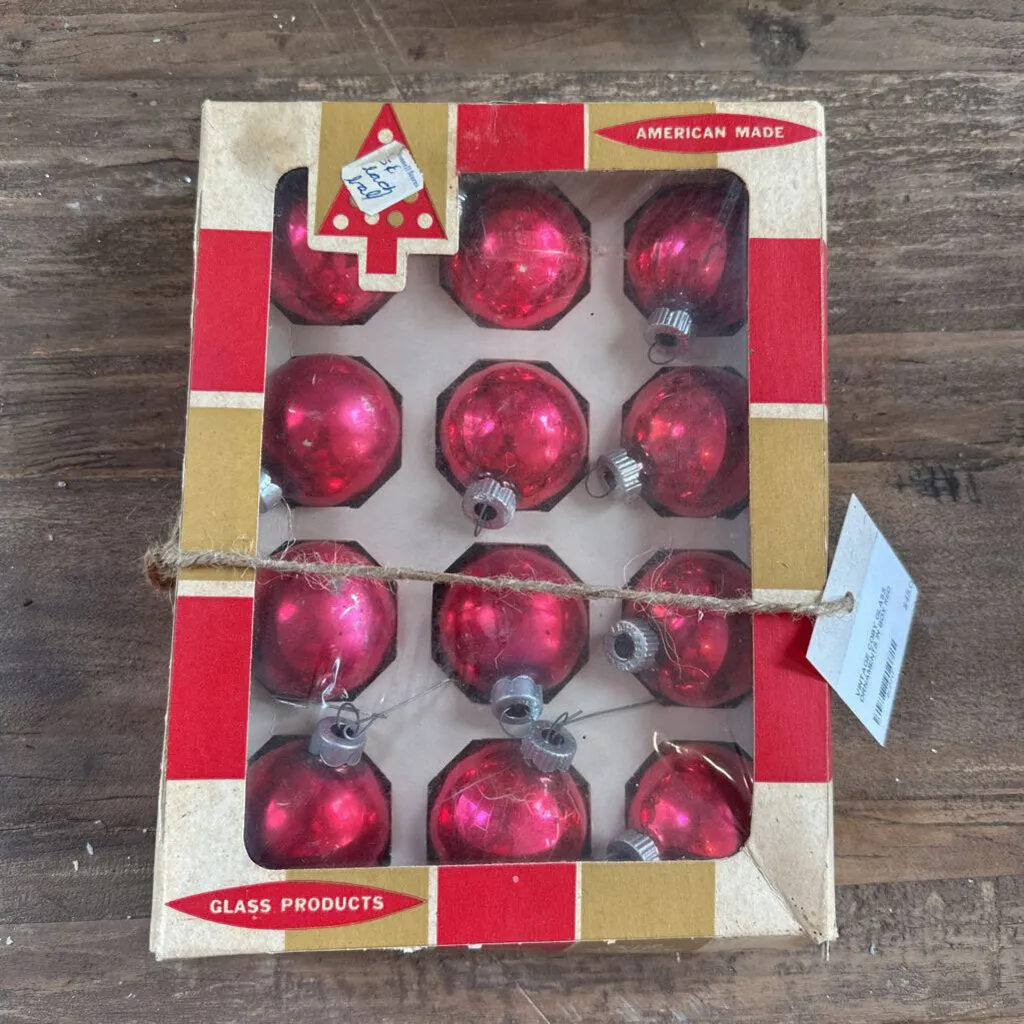
Cardboard is the enemy of long-term storage. Old boxes hold moisture and acid, so if your set lives in its original packaging, keep it in a climate-controlled closet rather than a garage or attic, and slide the whole box inside a sealed bin with a silica packet. Take the ornaments out once a year to check cap rust and paint flaking — 20 minutes of inspection protects a set that would cost $200+ to replace.
27. Bottle Brush Trees and a Candy Cane Pixie
Group bottle brush trees in odd numbers and vary heights by at least 2 inches between neighbors. A 2-, 4-, 6-, and 8-inch cluster instantly reads as a forest instead of a row of cones. Keep the pixie at the front edge facing slightly outward — figures staged mid-group look like they’re hiding. On a narrow surface, angle the tallest tree into the back corner and build forward and down from there.
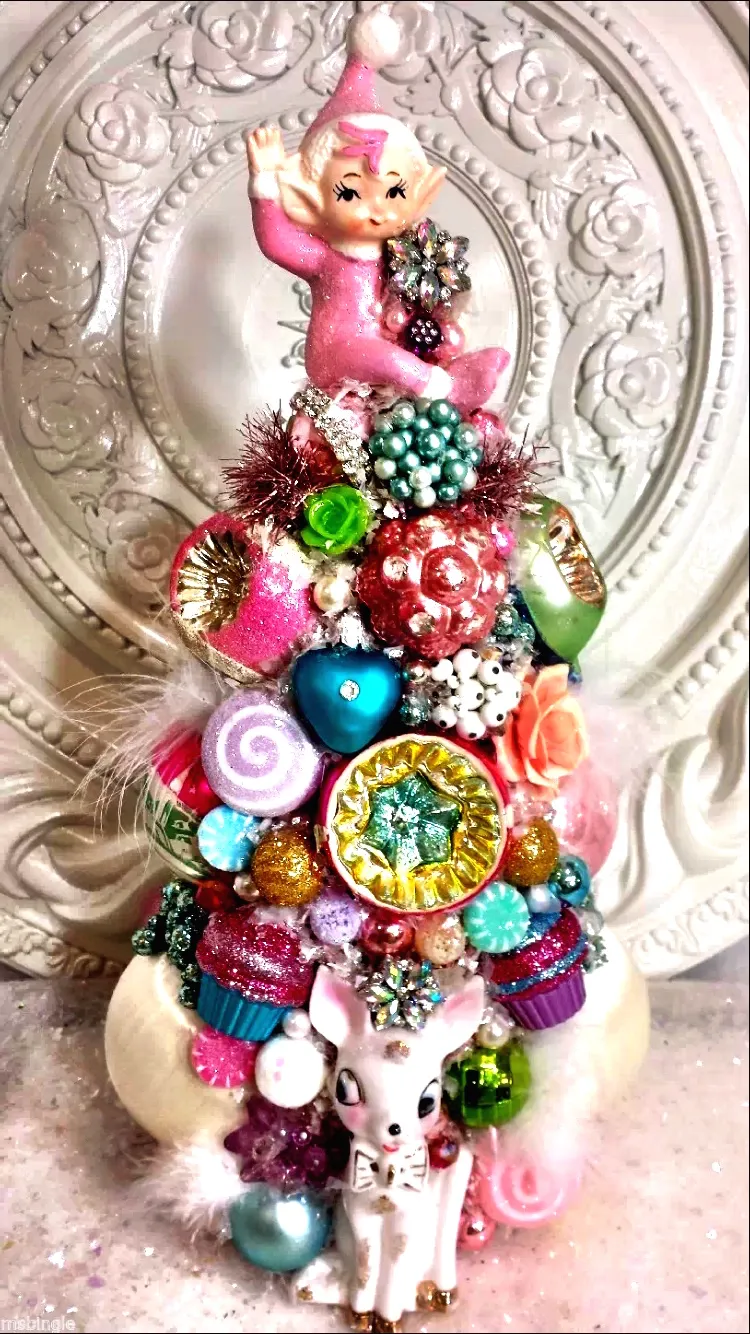
The 2026 vintage-Christmas revival isn’t only about glass. Small figural pieces — pixies, elves, bottle brush trees, anything candy-cane striped — are the fastest-growing category in holiday resale, mostly because they’re cheap, unbreakable, and easy to leave out year-round. That last part matters: people are buying Christmas decor they can keep on a shelf in January, and a 4-inch bottle brush tree fits that brief perfectly.
28. Stenciled Scenery Ornaments That Spell Merry Christmas
Stenciled scenery ornaments work as a set because they tell a story in sequence — a village, a sleigh, a tree, a greeting — and the repeated round format holds the story together. Repetition of shape plus variation of image is the same principle that makes a gallery wall work. Give them one dedicated surface so the narrative reads left to right, instead of scattering the pieces across a tree where the sequence disappears.
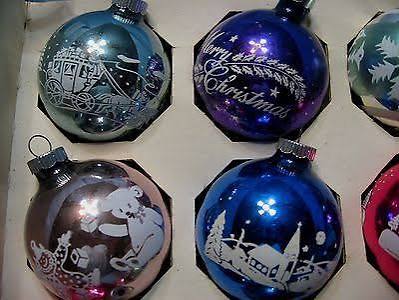
Stenciled paint on mid-century glass flakes if it’s handled wet, and these were often sold in sets of twelve meant to be displayed together, so buying them one at a time gets expensive fast. A full set generally runs $60–$150. Watch for repainted pieces too — a too-bright stencil on hazy glass usually means someone touched it up, and that cuts the value roughly in half.
29. Entryway Styling That Greets You With Glass Shine
Entryways are the easiest place to start a vintage glass collection because they ask for very little: a 30- to 42-inch console table, a 5- to 6-foot tree or a tabletop version, and 20–30 ornaments. If your entry is under 5 feet wide, skip the floor tree and put a slim 4-footer in the corner with a bowl of glass on the console. Ceiling height matters less here than clearance — leave 30 inches of walking space.
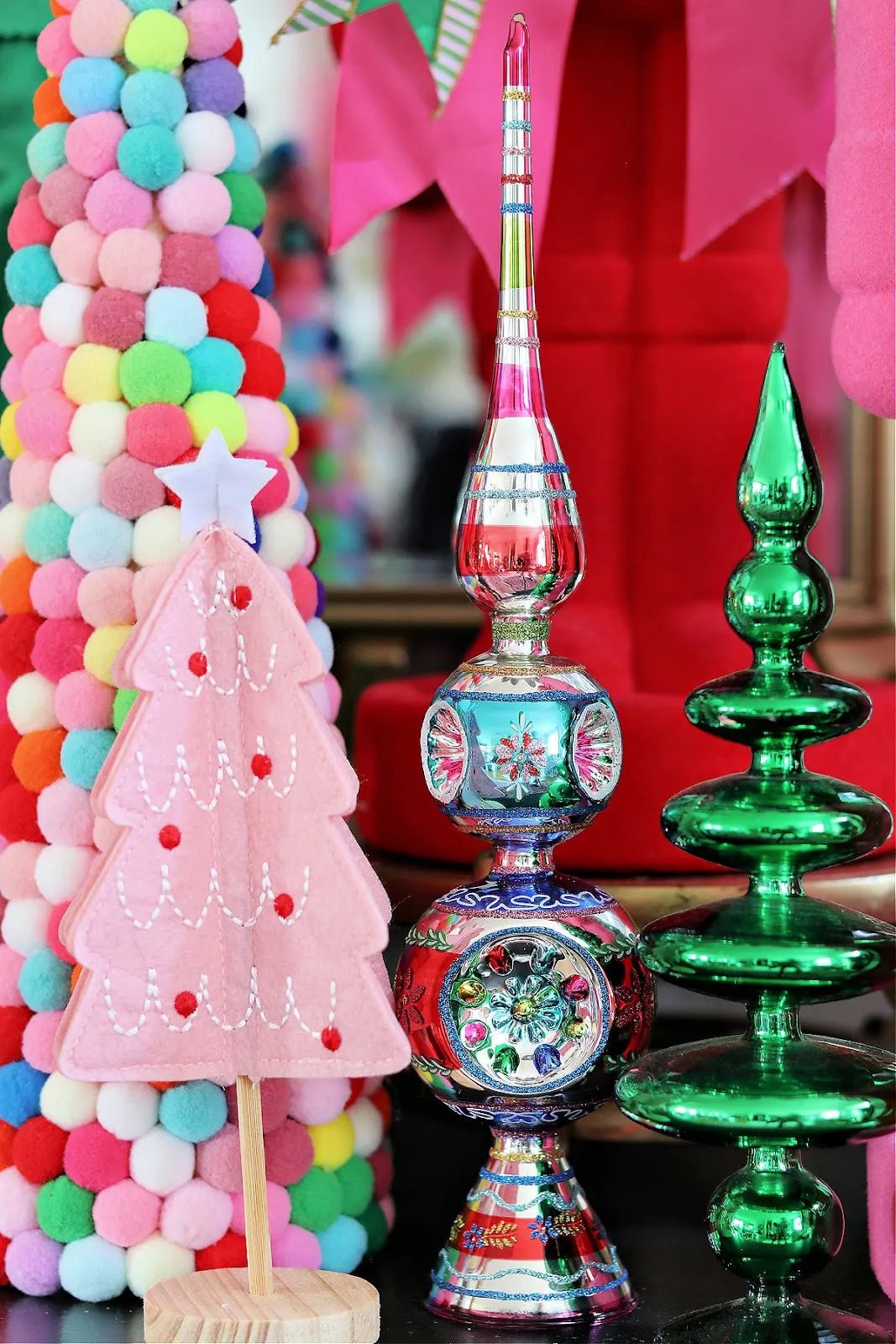
Getting the look for under $100:
- Thrift store glass bowl: $3–$8
- Modern vintage-look glass balls, 20 pieces: $20–$35 at Target or Walmart
- One real Shiny Brite piece as the focal ornament: $8–$15 on Etsy
- Ribbon and wire hangers: about $5
That’s an entire entry for the price of one collector-grade ornament.
30. The Living Room Tree That Anchors the Seating
- Measure the tree’s widest branch spread and add 12 inches of clearance on each side.
- Place it beside — not behind — the main sofa so guests can see it without turning around.
- Keep 36 inches clear on the side facing a fireplace.
- Run the cord along the wall and tape it down under the rug edge.
- Set one woven ottoman or basket within reach for gifts.
Time: 45 minutes with a helper. Cost: $0.
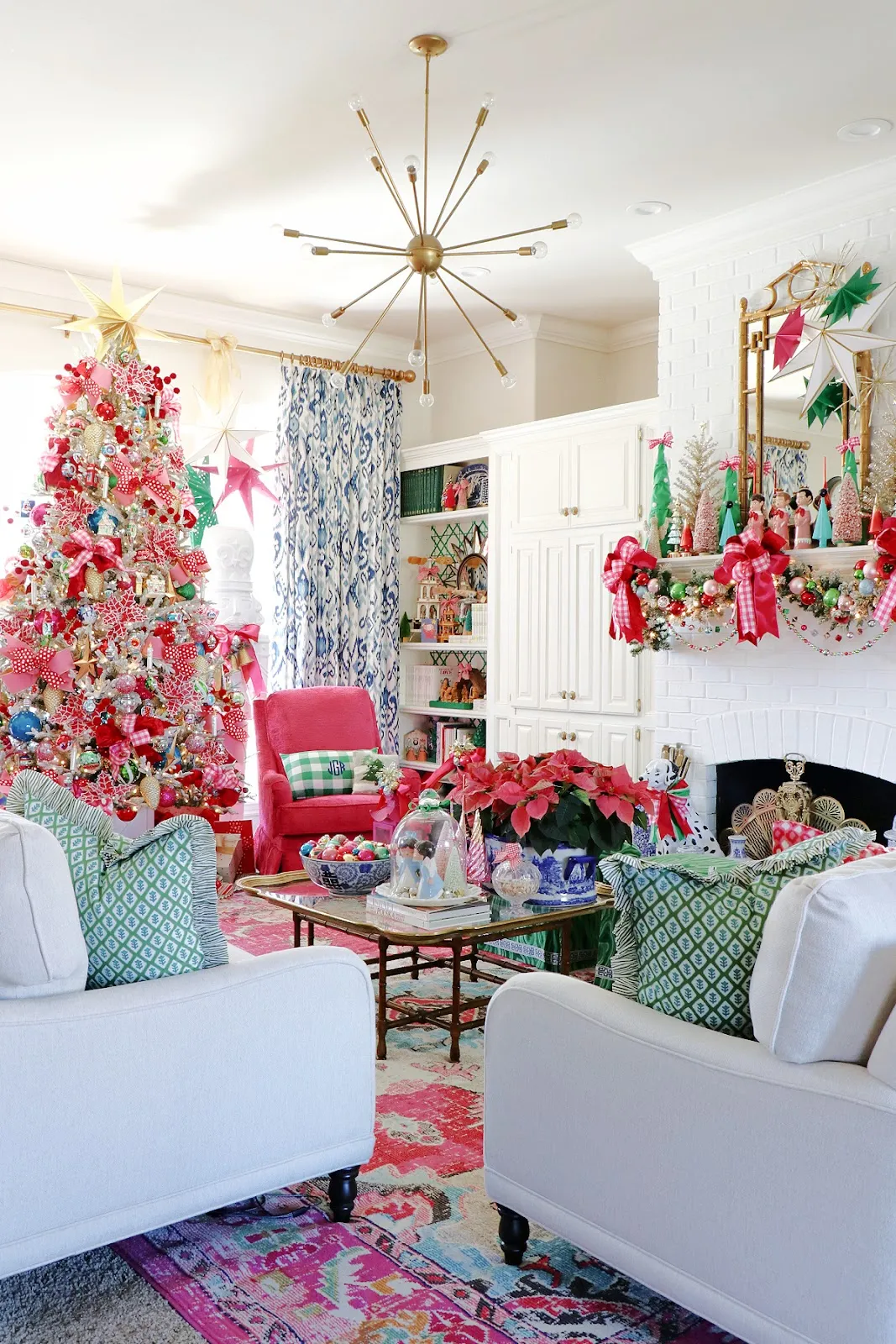
A tree reads as architecture when it sits at the end of a sightline rather than squeezed into a leftover gap. In this room the tree, the black mantel, and a light patterned rug give three different values — dark, mid, and bright — so your eye travels around the seating instead of stopping dead at one object. Leather and woven textures underneath keep the glass from being the only interesting thing in the room.
Your Shiny Brite Tree Starts With One Box
Start smaller than you think you need to — one good box of glass, one tree, one corner — and let the collection grow the way it did for every collector who came before you. The glass is patient. It waits in the box until you’re ready.
📌 Pin this guide now so next December you’re decorating instead of researching.