25 Jaw-Dropping 90s Christmas Tree Ideas You Need to See for 2026 That Will Evoke Pure Nostalgia

Tinsel is back, and this time nobody’s apologizing for it. If your Pinterest board suddenly looks like a 1994 department store window — dense multicolored lights, gold figurine toppers, ornaments that actually mean something — you’re not imagining the shift. We spent serious time browsing Target, Walmart, Michaels, IKEA, and Amazon to bring you only what’s actually worth your attention this year, from about $12 to $950. Inside you’ll find 25 curated ideas covering traditional layered trees, retro tinsel, nostalgic eclectic ornament collections, and natural rustic looks, with budget and luxury versions compared side by side. What’s driving it in 2026? A cultural swing back toward sentimental, collected-over-time decorating after a decade of perfect monochrome trees. And stay until the end — we break down the most common mistakes that can ruin these looks. 📌 Save this to Pinterest for later — you’ll want to revisit these ideas.
1. Firelit Living Room With a Real Evergreen Tree
Three things are doing the heavy lifting here. The tree and the hearth sit at matching visual weight — one tall, one low — so the corner reads as a single composition instead of two objects competing for attention. Every light source in the frame is warm: string lights, firelight, nothing cool or blue anywhere. And the white mantel is the only bright white in the whole scene, which gives your eye somewhere to land between all that ruby red and forest green.
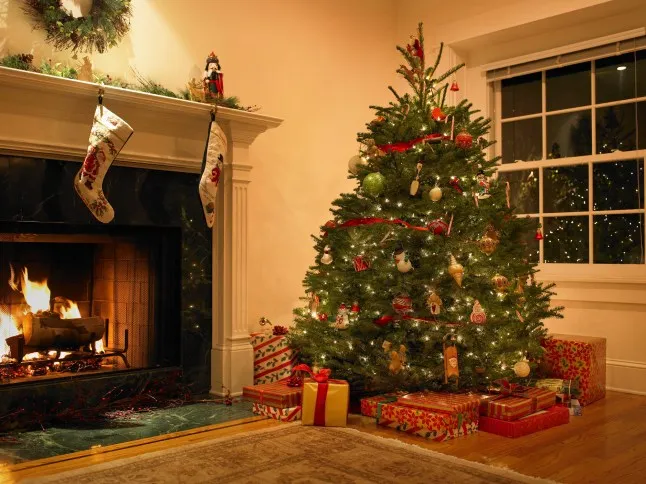
- Full evergreen tree, 7–7.5 ft: $120–$450
- Warm white string lights, 600–1,000 bulbs: $25–$70
- Ornaments, ribbon, and topper: $80–$250
- Mantel garland and patterned stockings: $40–$120
- Wrapping paper, ribbon, and gift tags: $25–$60
Total: roughly $290–$950, or about $170 if the tree is already yours. Budget alternative: hunt Facebook Marketplace in early November — decent 7-foot faux firs show up for $40–$80 because people upgrade right after Halloween.
2. Tinsel-Loaded Tree Framed by Deep Red Velvet Drapes
The formula here is almost aggressively simple: 70% dark green tree, 20% deep red velvet, 10% metallic silver and gold. That ratio is why the tinsel reads as glamour instead of chaos — there’s only one metallic family in play. Swap the drapes for emerald and the tinsel for champagne gold and the same math holds with a completely different mood. What you can’t do is add a third accent color. That’s the line where this tips into dollar-store territory. See Idea #19 for the version that spreads the same instinct across many colors instead of one.
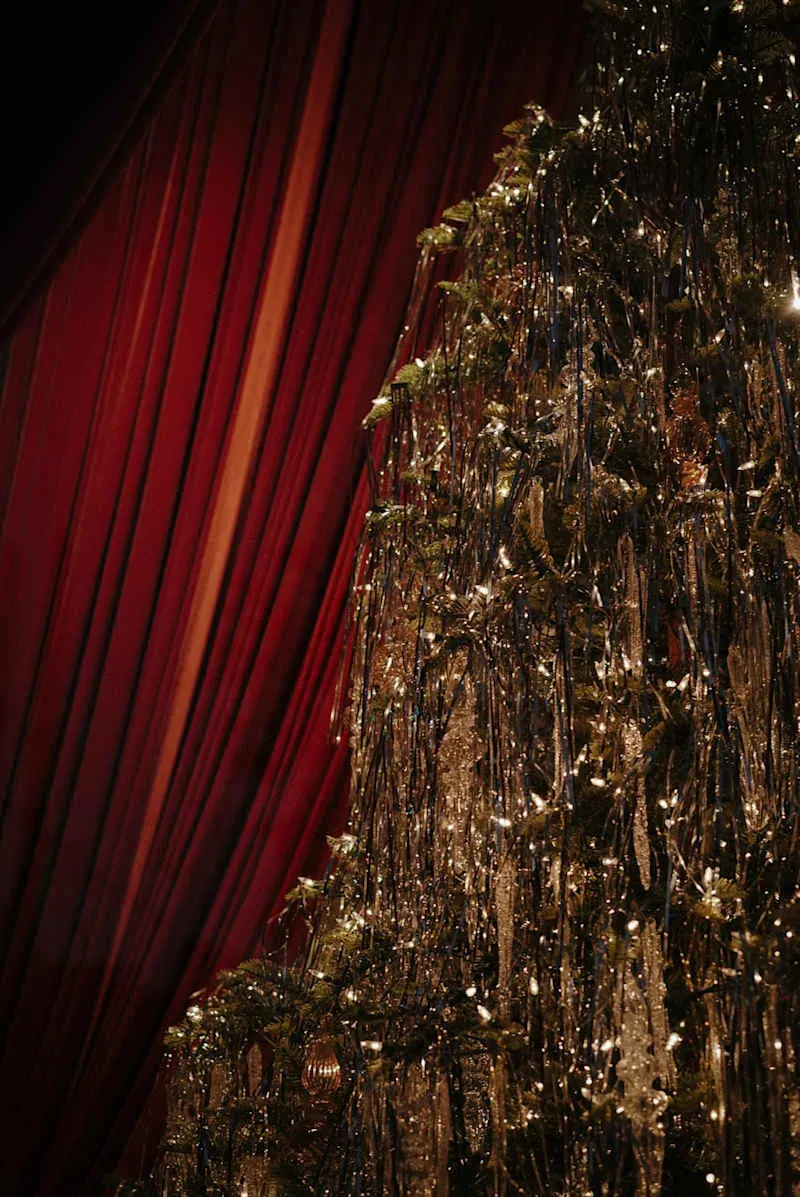
Here’s the trick with long strands: cut your tinsel into 10-inch lengths instead of draping whole packages. Lay each piece over a branch so it hangs in a soft V, then tuck the ends under the needles so nothing dangles loose. Roughly one strand per branch tip, working outside-in. Full skeins wound around the trunk are what make a tree look like a disco ball by December 20th.
3. A Monumental Tree in a Gold-and-Marble Grand Hall
This kind of tree needs altitude. Figure on 14-foot ceilings minimum for a 12-foot tree, plus three feet of open floor around the base so the marble and the geometric floor pattern can actually read. Anything under 400 square feet and the density starts to feel like a wall rather than a centerpiece. If your entry is more modest, Idea #7 covers the small-space version of this same instinct — one big gesture instead of five.

The ornament count is the whole story: hundreds of small pieces, no oversized baubles competing. From the balcony level, all those little shapes blur into something closer to tapestry than decoration. Remove that density and you’ve got a big tree with a few ornaments on it, which is a completely different and much sadder thing.
Call it heritage maximalism. After a decade of sparse Scandinavian trees, 2026 searches are swinging hard toward collected, layered, slightly over-the-top displays — the kind that look like they’ve been added to every year since 1993. The staying power is real, because the underlying idea isn’t a color trend. It’s accumulation, and accumulation never goes out of style.
4. Up Close: Multicolored Lights and a Snowflake Bauble
Getting multicolored lights to look intentional rather than random:

- Pick four bulb colors maximum — here it’s red, blue, yellow, and green.
- Run the strand in a loose zigzag inside the branches, not around the outside.
- Push bulbs about two inches deep so the needles soften the glow.
- Stand back ten feet and squint; any cluster of one color gets untangled.
- Plug in at dusk, not in daylight — you’re judging the night look.
About 45 minutes for a 7-foot tree, $25–$45 in lights.
Multicolored lights are the single biggest photos-versus-reality gap in Christmas decorating. In daylight they look like plastic beads; at night they’re magic. LED blue also tends to photograph violet and can read cold from across the room, so buy one brand in one batch — mixing manufacturers is how you end up with three different blues on the same tree.
5. Classic Artificial Tree With a Pleated Skirt
- 7.5-ft full artificial tree: $100–$400
- Warm white lights, pre-lit or add-on: $0–$60
- Assorted ball ornaments, 100+ pieces: $40–$150
- Draped metallic garland, three strands: $15–$45
- Pleated fabric tree skirt: $25–$70
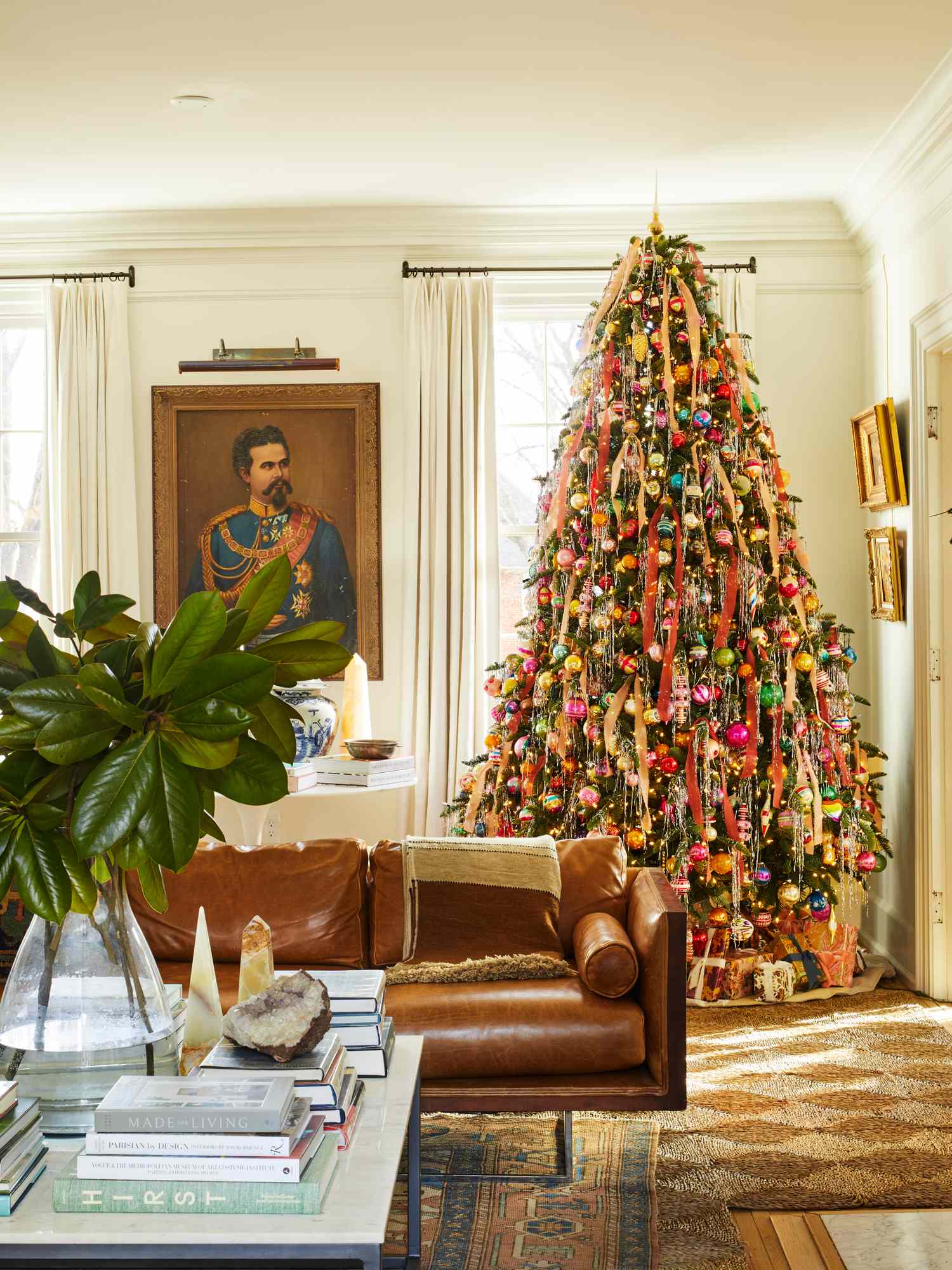
Total: $180–$725, or about $90 if you’re reusing last year’s tree and just adding a skirt. Budget alternative: an $8 plain cotton sheet gathered around the base and pinned at the back gives you nearly the same pleated silhouette.
Artificial trees shed — not needles, but a fine dust that coats everything by week three, especially when the tree lives in a garage all year. Vacuum the branches with a brush attachment before it goes up and it stops raining on your ornaments. Plan on eight to ten years of life per tree, and expect the built-in lights to die well before the branches do.
6. Gold Tinsel Tree With Vintage Red and Teal Baubles
Vintage is a shopping strategy, not a budget. Thrift stores and estate sales dump glass ornaments every November for a quarter to a dollar each — buy every teal and red one you see and you’ll have a collection for the price of one box at a big-box store. Gold tinsel garland still runs under $10 at Walmart and dollar stores. Total for this whole look: about $35.
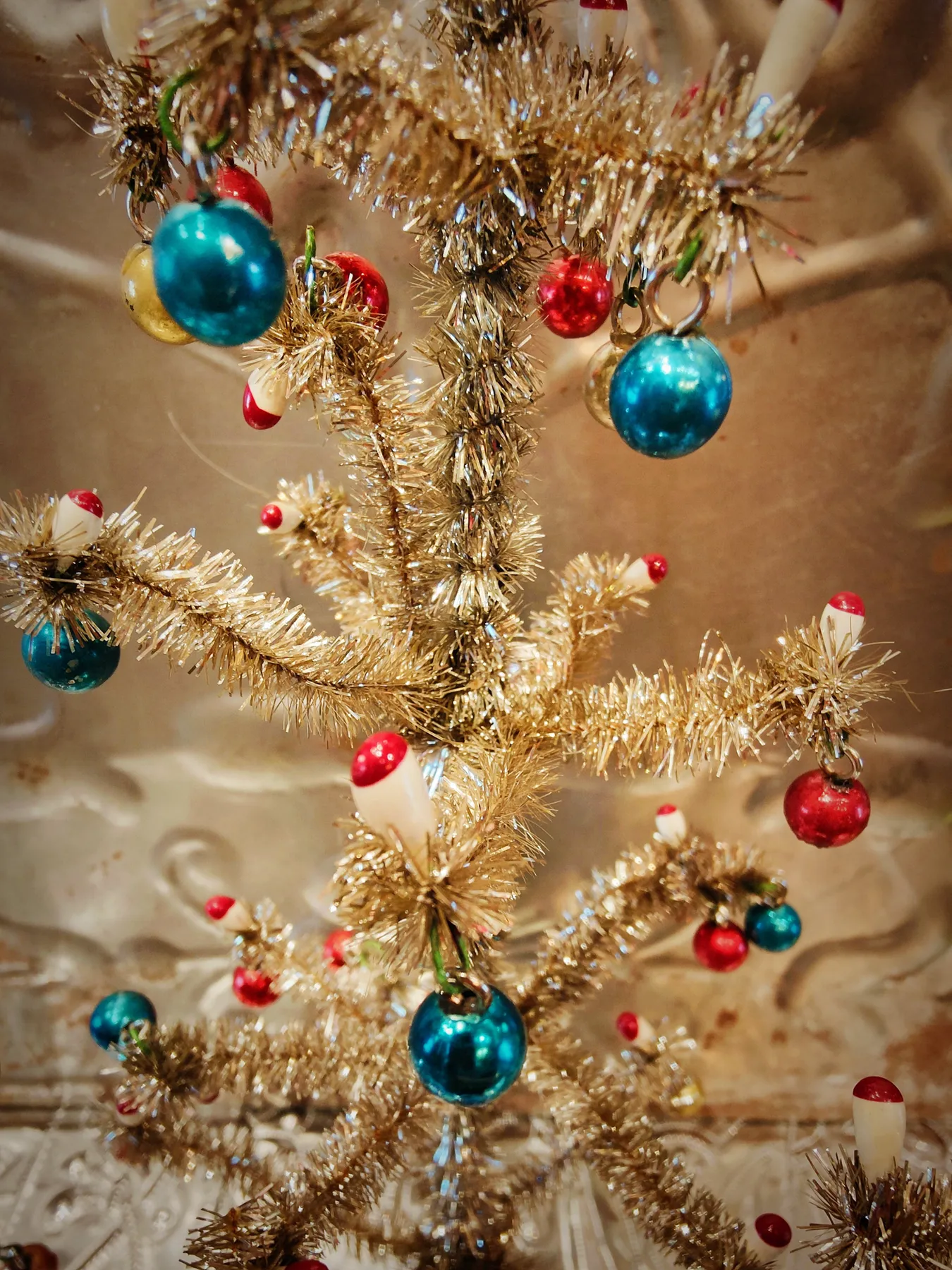
Read the palette in thirds with a twist: 50% gold tinsel, 30% bright red, 20% teal and cream. Teal is the wildcard that keeps this from becoming a generic red-and-gold tree, and it works because it sits at the same saturation level as the red — nothing here is muted or dusty. Swap teal for cobalt and you’re in the same family. Swap it for sage and the whole thing goes soft and modern instead of retro. That’s also the move behind Idea #19.
7. Minimalist Fir in a Wicker Basket With Kraft Gifts
The basket. Not the white ornaments, not the kraft paper — the woven wicker base. A tree skirt says Christmas, but a basket says the tree is a plant that happens to be decorated, which is exactly why the whole scheme reads calm instead of themed. It also lifts the lowest branches a few inches off the floor, so the tree looks taller than it actually is.
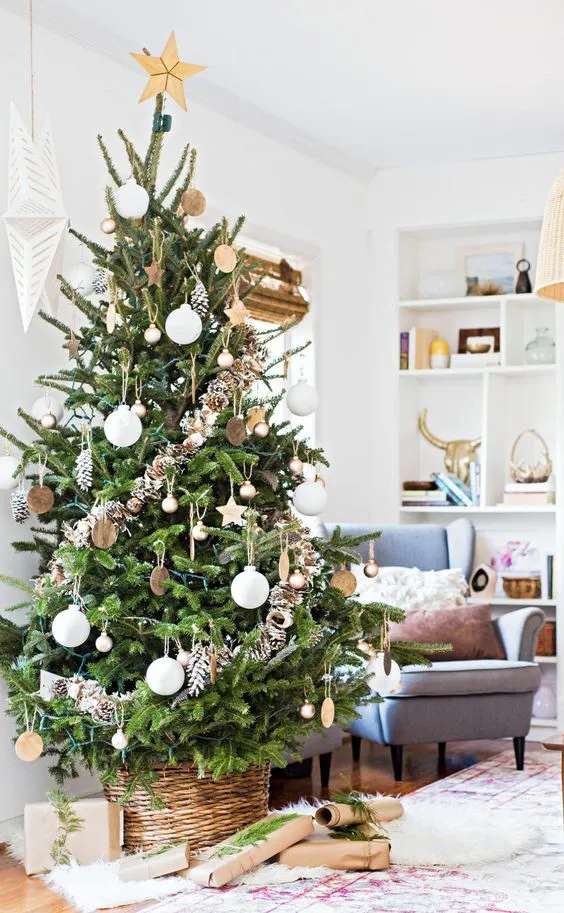
Make the white-tipped pinecones yourself and save the $20:
- Gather pinecones and bake them at 200°F for 30 minutes.
- Dip just the tips in white acrylic, then flick a dry brush for a snow-dusted edge.
- Let them cure two hours — they’ll look wet longer than they are.
- Hot glue a jute loop to the base for hanging, or leave them loose in a bowl.
- Tuck them into the thinnest parts of the tree.
About 90 minutes hands-on, $12 in materials.
Before you commit to the natural look:
- Measure the basket opening against your trunk — a 14-inch basket swallows most 7-foot trees.
- Confirm your tree stand fits inside the basket; you’re hiding the whole thing.
- Check the floor situation — kraft paper and pinecones both shed.
- Set your ornament cap now: 40–60 pieces reads minimal, 100+ tips toward traditional.
8. A Snow-Dusted Lamppost Glowing Against Blue Lights
Depth comes from temperature contrast. Keep your foreground light warm — 2700K, the color of that lamppost glow — and let the background run cool. Roughly a 60/40 split of warm to cool reads as atmospheric; flip it and the space feels clinical. In a real entryway that means one warm table lamp or sconce plus a cooler tree, never everything at the same temperature.
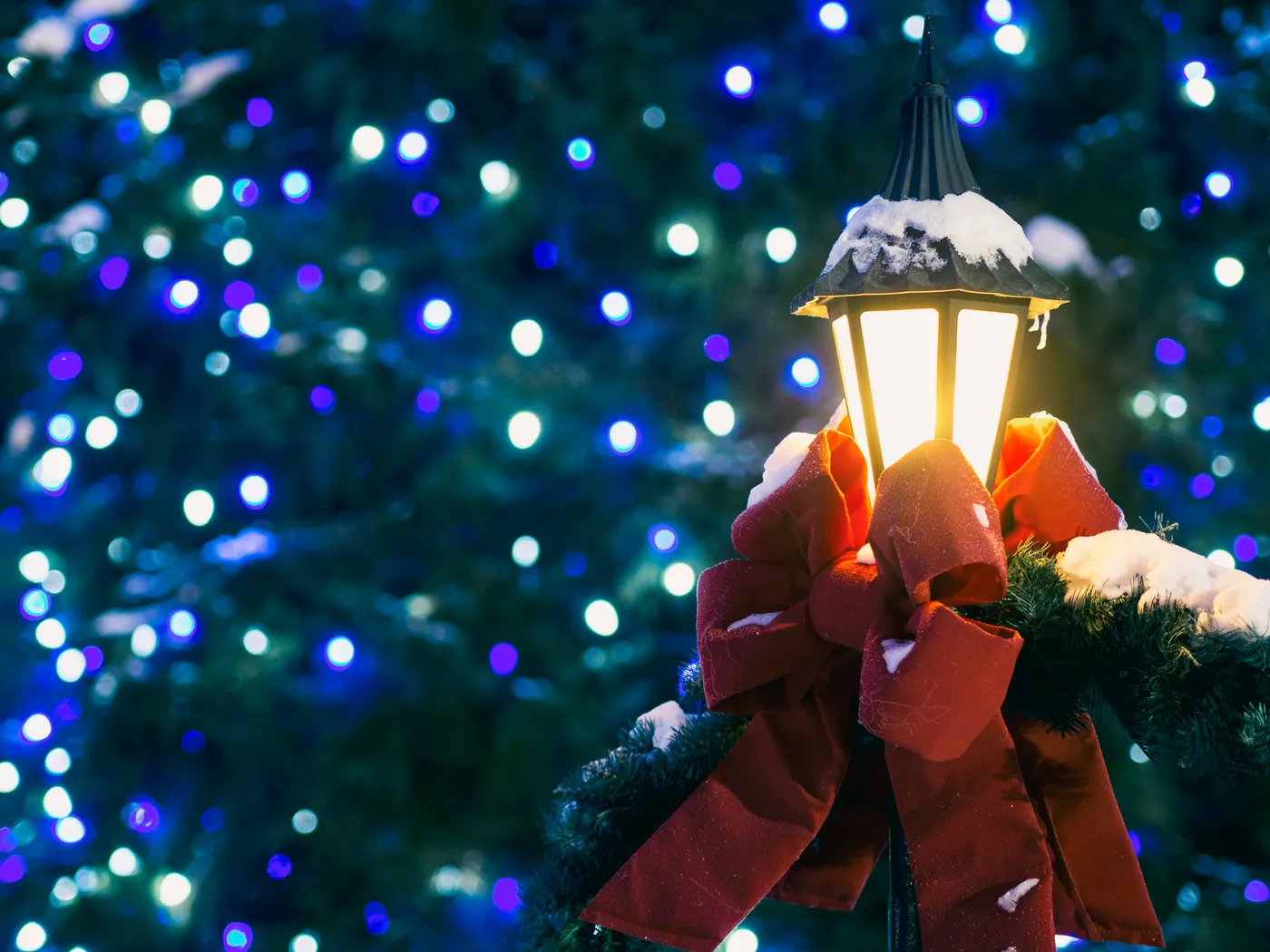
Three things happen at once here. The snow catches light and turns a plain post into a texture study. The red bow gives you one saturated focal point against an almost monochrome background. And the blurred blue lights behind create bokeh circles that read as depth without adding any actual detail — your eye fills in the rest. It’s a portrait, essentially, with the lamppost as the subject.
9. Grand Hall Tree With Blue Plaid and Red Ribbon
This tree is roughly 12 feet under a 14-foot ceiling, positioned so the archway frames the whole thing from the far end of the hall. For that vista shot you need at least 20 feet of sightline from the entry — under that and the tree reads as a mass instead of a destination. In tighter rooms the formula still works at 7.5 feet; you just drop the ribbon width from four inches to two and a half.
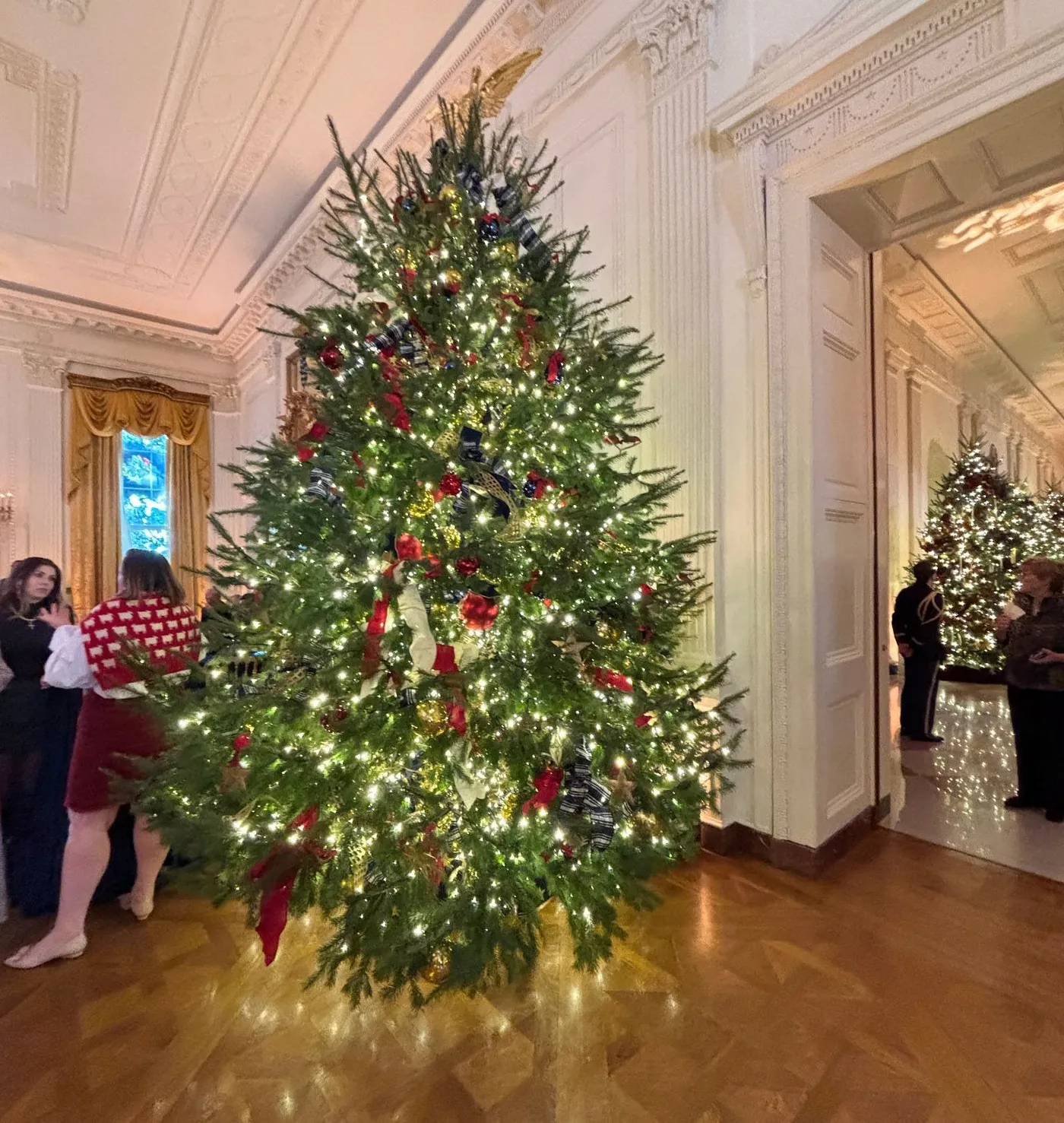
Plaid is quietly the story of 2026 holiday decorating. It’s the fastest-growing ribbon search on Pinterest for the second year running, showing up everywhere from preppy coastal homes to old farmhouses. The reason it sticks: plaid behaves like a neutral. It brings color without forcing you to commit to a theme.
- Blue plaid ribbon, 4-in, 30 yds: $18–$45
- Solid red ribbon, 2-in, 20 yds: $8–$22
- Red and gold shatterproof ornaments, 100 pc: $45–$120
- Warm white lights, 1,200 bulbs: $35–$90
- Topper, bird or star: $25–$85
Total: $130–$360 to dress a tree you already own. The wide ribbon is the one place I’d tell you not to cheap out — wire-edge holds a bow shape, and thin ribbon collapses into string.
10. Patterned Presents and Clipped Poinsettias Under the Branches
Gift wrap is where you save the most and nobody notices. Wrapping paper hits half price at Michaels and Walmart the first week of December, and dollar-store rolls handle the filler boxes underneath. Cloth poinsettia picks run $1–$3 each at any craft store — nine of them tucked into the front branches reads like a bespoke floral install. Total: about $30.
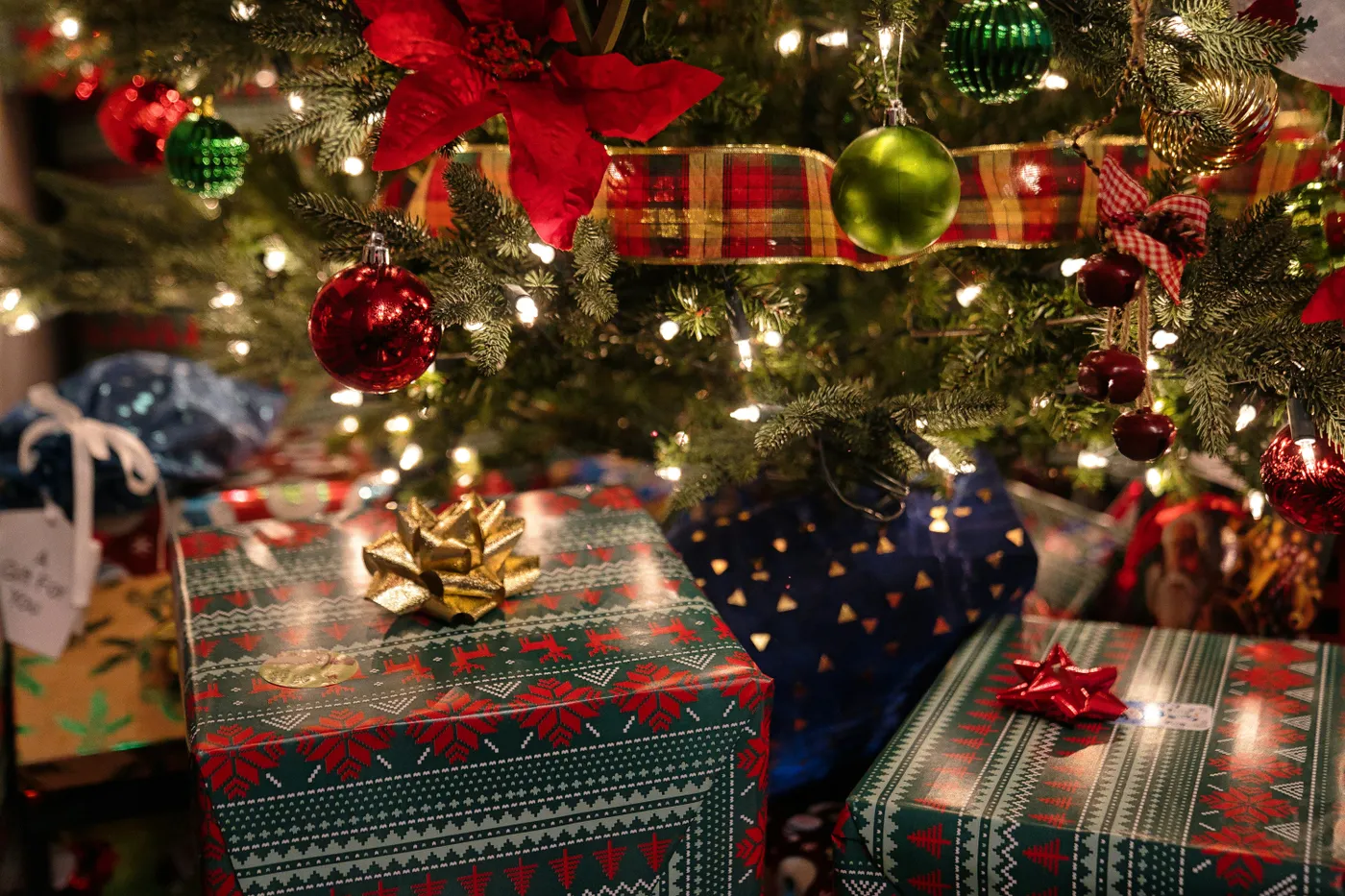
Cloth poinsettias hold up better than anyone expects, but they’re dust magnets, and stored flat they crease in ways that never quite relax. Also, real poinsettias nearby will drop leaves onto your gift wrap and stain it, so keep the live plants in another room. And check the bottom of your wrapped boxes before they go under the tree — patterned paper tears at the corners the minute a kid drags a present out.
11. A Colossal Plaza Tree Ringed by Light Angels
Civic trees are having a moment. Nostalgia for the downtown display you rode past in the back of a station wagon in 1996 is driving real traffic — vintage municipal Christmas photos are one of the fastest-growing holiday searches on Pinterest right now. It’s a very specific kind of 90s nostalgia: unapologetically colorful, no restraint, no curated palette.
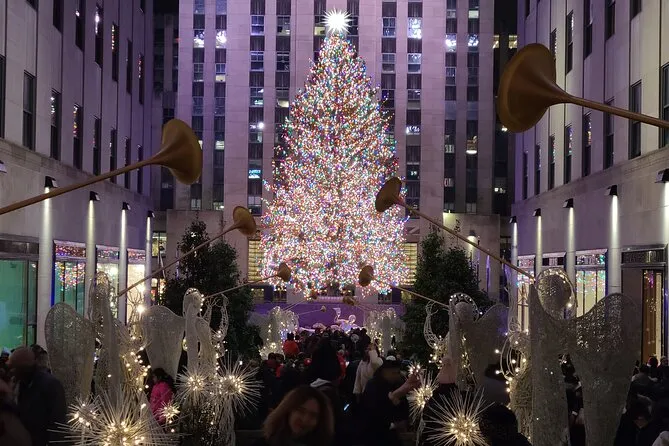
Scale changes the design rules entirely. At 30 feet tall, a tree needs roughly 100 feet of open sightline before it reads as a tree at all — any closer and you’re just seeing lights. The white wire angels work because they’re positioned 15 to 20 feet out from the base, which gives the tree a foreground layer instead of letting it float alone in the plaza.
12. The Felt Doll Tree: Ornaments With a Story
The oddballs. A green lightbulb, a pink smiley face, a felt doll with mismatched buttons — that’s the actual design decision here. A tree full of matching glass balls would photograph prettier and be completely forgettable in a living room. Remove three or four of the weird ones and the whole thing loses its voice. Keep at least one ornament per family member front-facing, no matter how ugly.
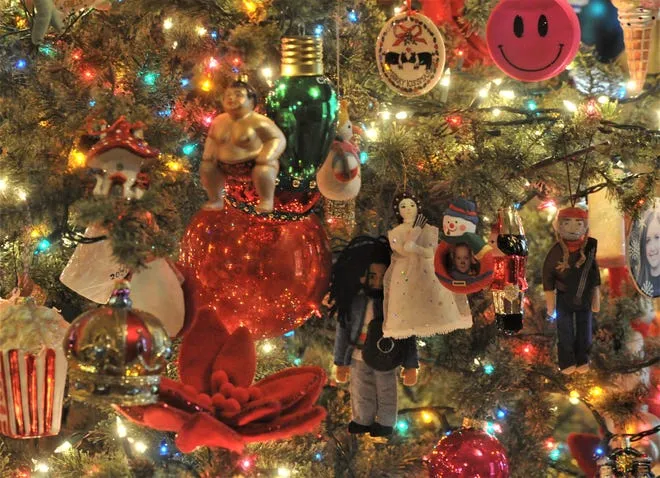
Build a story tree without it looking like a toy bin:
- Sort everything into two piles — sentimental and filler.
- Hang the sentimental pieces first in a loose spiral from the top down so they’re evenly spread.
- Fill the gaps with plain balls in one or two colors, pushed deeper into the branches.
- Reserve one focal ornament for dead center at eye level.
- Photograph the tree, then pull anything the camera flattened out.
About an hour, and the cost of this tree is whatever you’ve already collected.
13. Mushroom House Ornament on a Warmly Lit Branch
Figural ornaments need breathing room to register. Keep at least six inches between anything sculptural, and hang them on the outer third of the branch so light hits the front face instead of skimming past. If a piece looks blown out in photos, it’s usually the string light sitting directly behind it — nudge that bulb three inches to the side and the painted detail comes right back.
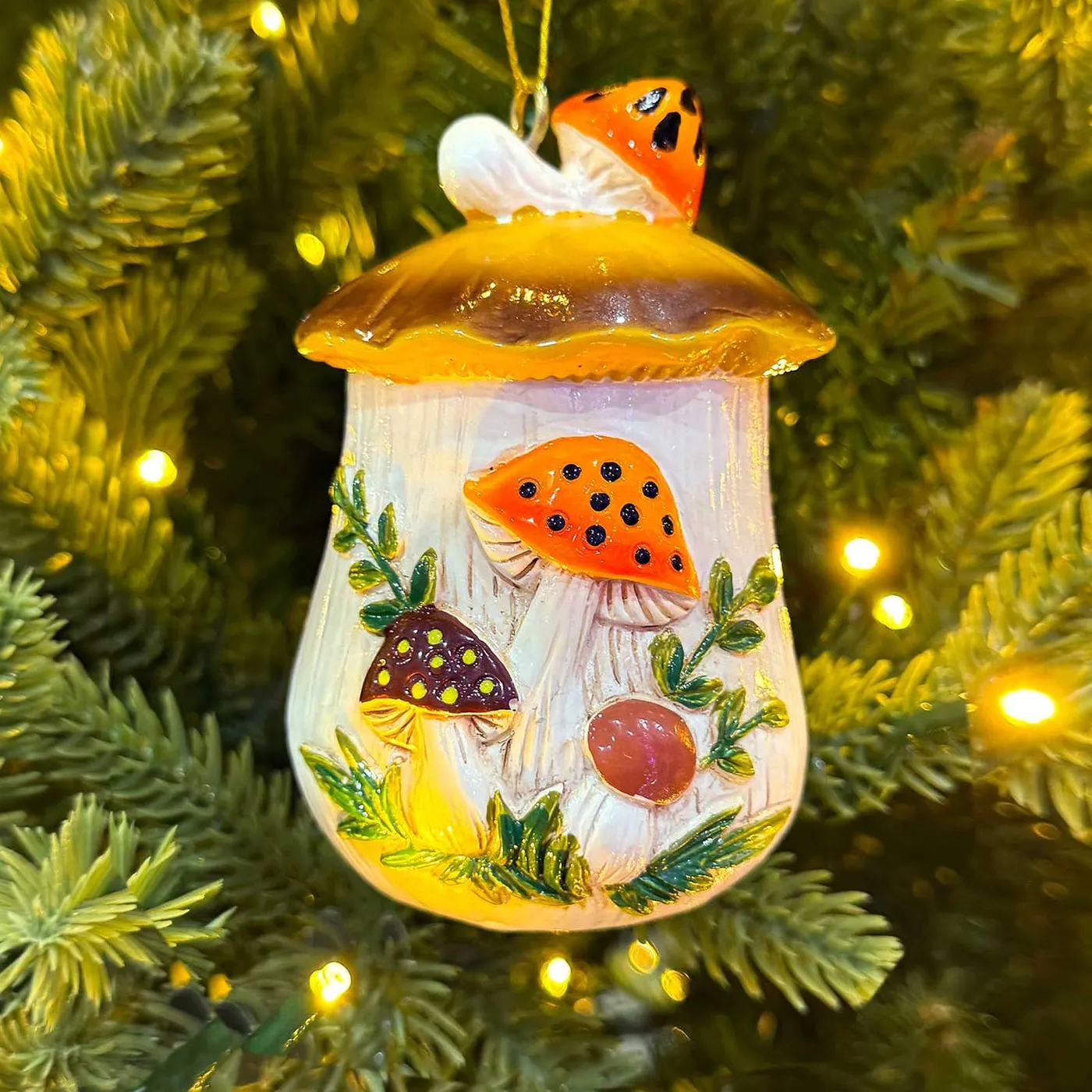
Painted resin and ceramic pieces chip at the edges, usually on the way into the storage box rather than on the tree. Wrap each one in acid-free tissue and keep them out of the attic — heat cycling crazes the glaze over a couple of seasons. Glitter finishes are the other problem; that chunky sparkle sheds a little every year, so expect the ornament to look slightly different by 2030.
14. Antique Bronze Lantern With a Santa Sleigh Scene
You don’t need the $60 boutique version. Target’s holiday aisle and Walmart both carry cutout metal lanterns in the $12–$20 range, and the silhouettes do all the work — nobody’s inspecting the finish from across the room. Stack two or three on a few cuts of scrap 4×4 for stepped height, then add a $6 sprig of faux pine and a handful of berries. Total: under $40.
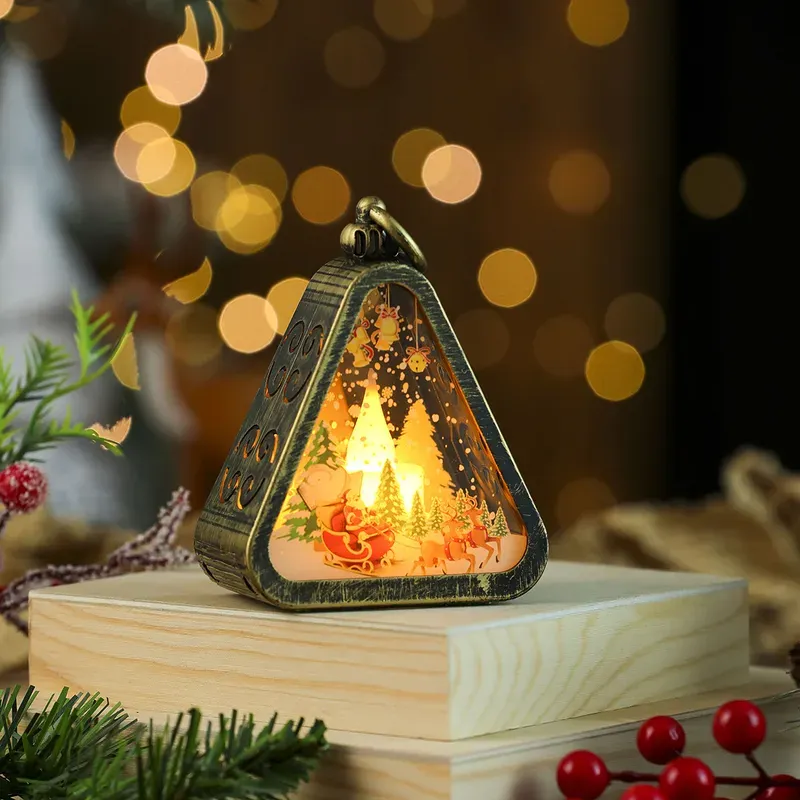
The triangular silhouette is the whole trick — it’s a shape your eye reads instantly as a little house, which makes the painted Santa scene feel like something you’re peeking into rather than looking at. The warm LED inside does the rest. And those light wood blocks underneath matter more than they appear to: without them the lantern sits flat on the shelf and loses all its presence.
15. Ice-Blue Plaza Tree Topped With a Starburst
This is a monochrome scheme with one intentional leak: 80% ice blue and white, 15% warm amber from the wreaths and overhead strands, 5% red on the bows. That amber is doing the heavy lifting — without it, blue goes cold and slightly gloomy instead of wintry. The same math works indoors: all-blue tree, warm-white room lighting, one small red accent. See Idea #23 for how this plays out against dark walls.
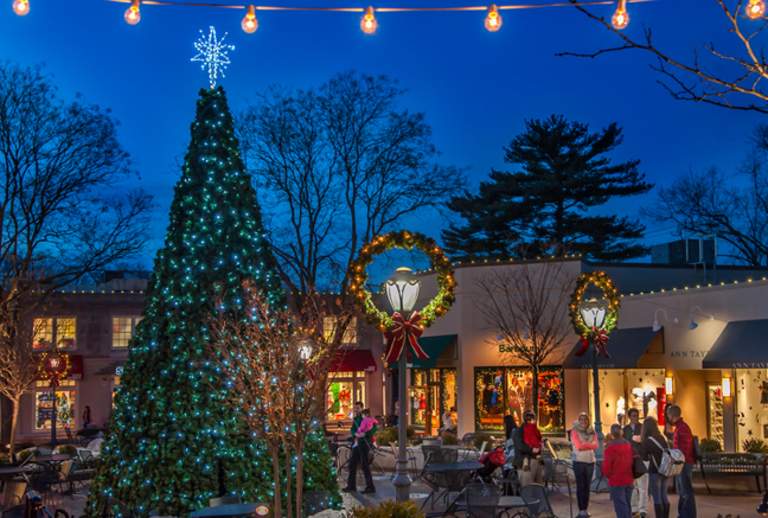
Blue lights vary wildly between manufacturers — one brand’s ice blue is another’s seafoam. Buy all your strands in a single order, same brand, same batch, or you’ll get stripes. They also read cooler in person than in photos, and against a light wall they can look a bit institutional. Test one strand on the tree at night before you commit to 2,000 bulbs.
16. Character Ornaments Under a Golden Figurine Topper
- 7-ft full tree with clear lights: $130–$400
- Character and novelty ornaments, 20–30 pieces: $40–$150
- Plain filler balls, 60 pieces: $20–$50
- Vintage golden figurine topper: $3–$40
- Moss green fabric tree skirt: $20–$55
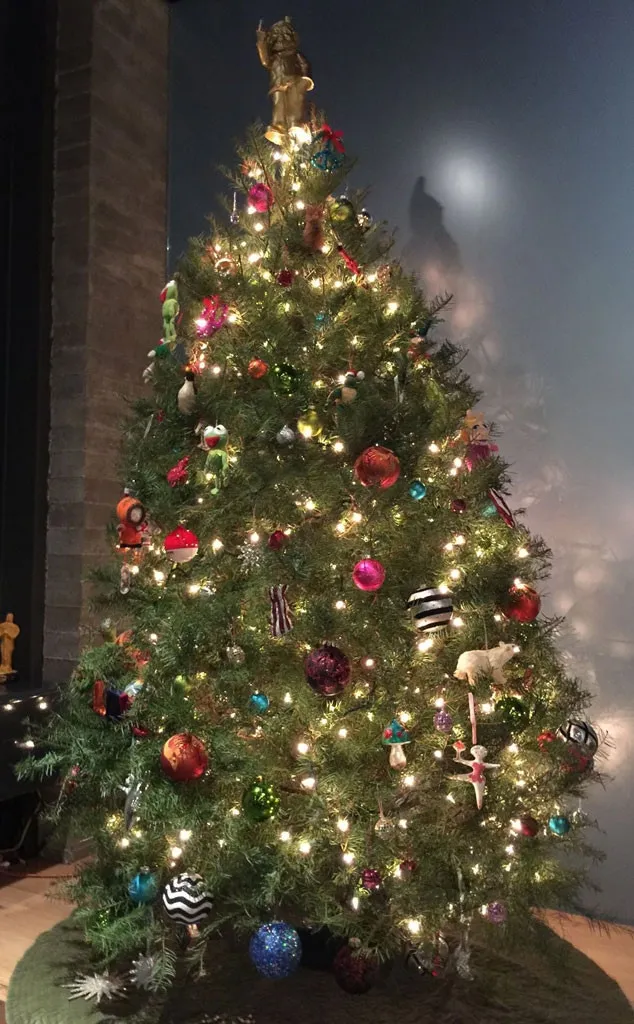
Total: $215–$695, or around $60 if the tree and lights are already yours. Budget alternative: buy filler balls in a single color from a dollar store, then spend your real money on eight to ten character ornaments that mean something.
The topper. A gold figurine instead of a star or angel quietly reclassifies the entire tree — it stops reading as family Christmas and starts reading as collection. Traditional toppers announce the holiday; a figurine just sits there being itself, which is a much more interesting thing to look at from across the room. It’s a flea-market move that costs almost nothing and outperforms a hundred dollars of new ornaments.
17. A Tiny Bookshelf Ornament Tucked in the Branches
Small figural ornaments belong between four and a half and five and a half feet up — roughly where your eyes rest when you walk past the tree. Anything under three feet is wasted in the floor-level dark zone, and above six feet people simply don’t look. If you have a collection of tiny pieces, cluster them all in that band and let the rest of the tree run on plain balls.
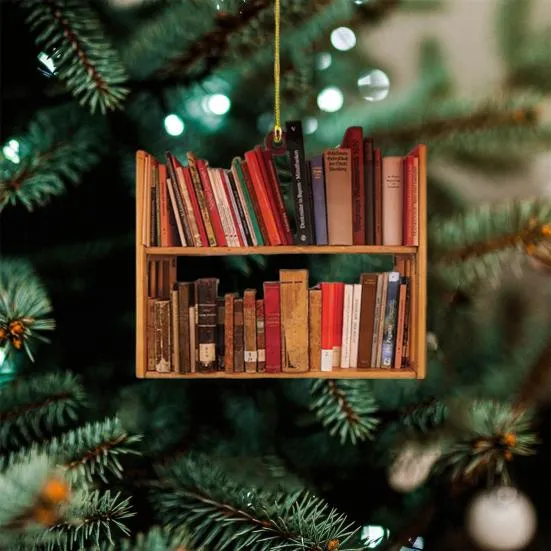
Make a miniature bookcase ornament in an afternoon:
- Cut two 2-inch by 1.5-inch pieces of balsa for the sides and two shorter shelves.
- Glue with wood glue, clamp with clothespins, dry 30 minutes.
- Cut ten tiny book spines from cardstock in mixed colors, folded into thin U shapes.
- Glue them in rows at alternating heights so it looks browsed, not stocked.
- Add a jute hanger and a coat of matte varnish.
Two hours, about $9 in supplies, and you’ll want to make six.
18. A Glitter-Crusted Tabletop Tree in Mercury Glass
A dollar-store cone and a jar of glitter will get you 90% of the way. Start with a $5 foam cone, brush on Mod Podge in small sections, and press chunky gold glitter in with your fingers — a wet brush just pushes it around. Then hot-glue six or eight thrifted ornaments in mixed metallic finishes, unevenly, down the sides. Entire project: $14 and one evening.
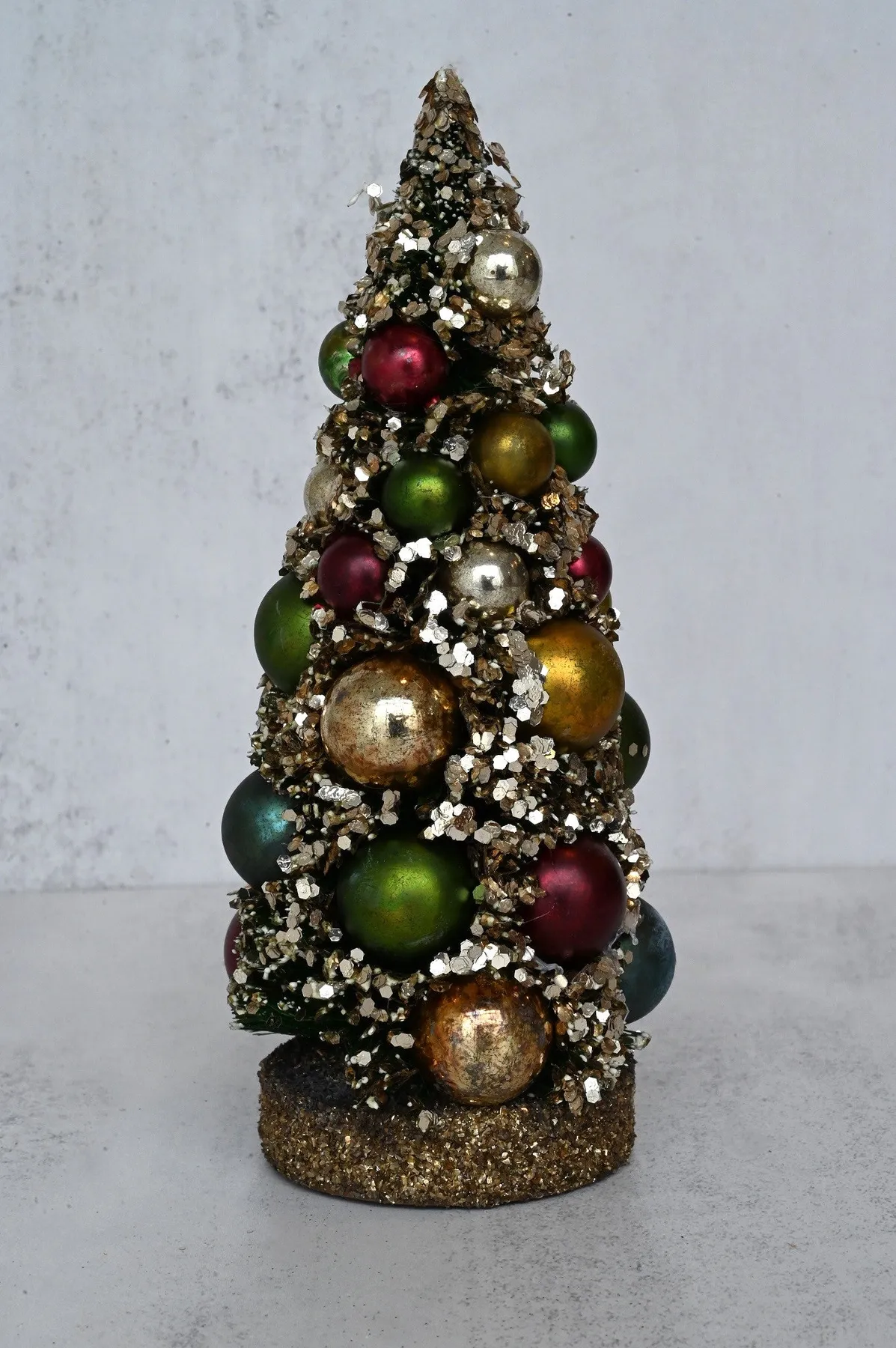
Tabletop trees have their own set of checks:
- Measure the table first — a 20-inch tree needs 8 inches of clearance all around or it crowds the edge.
- Put a felt pad or cutting board underneath; glitter transfer is permanent on finished wood.
- Weigh the base with stones or washers so a bumped table doesn’t tip it.
- Check outlet distance before you fall in love with a spot.
19. Retro Tinsel Strips and Multicolored Bulbs
Nostalgic trees run on a slightly different formula: 50% green foliage, 25% red, 15% gold, 10% white and purple combined. The old-fashioned tinsel strips hold it together — they catch every bulb and multiply the light without adding another color to the count. Compare with Idea #2, which uses the same instinct but concentrates everything into one metallic family.
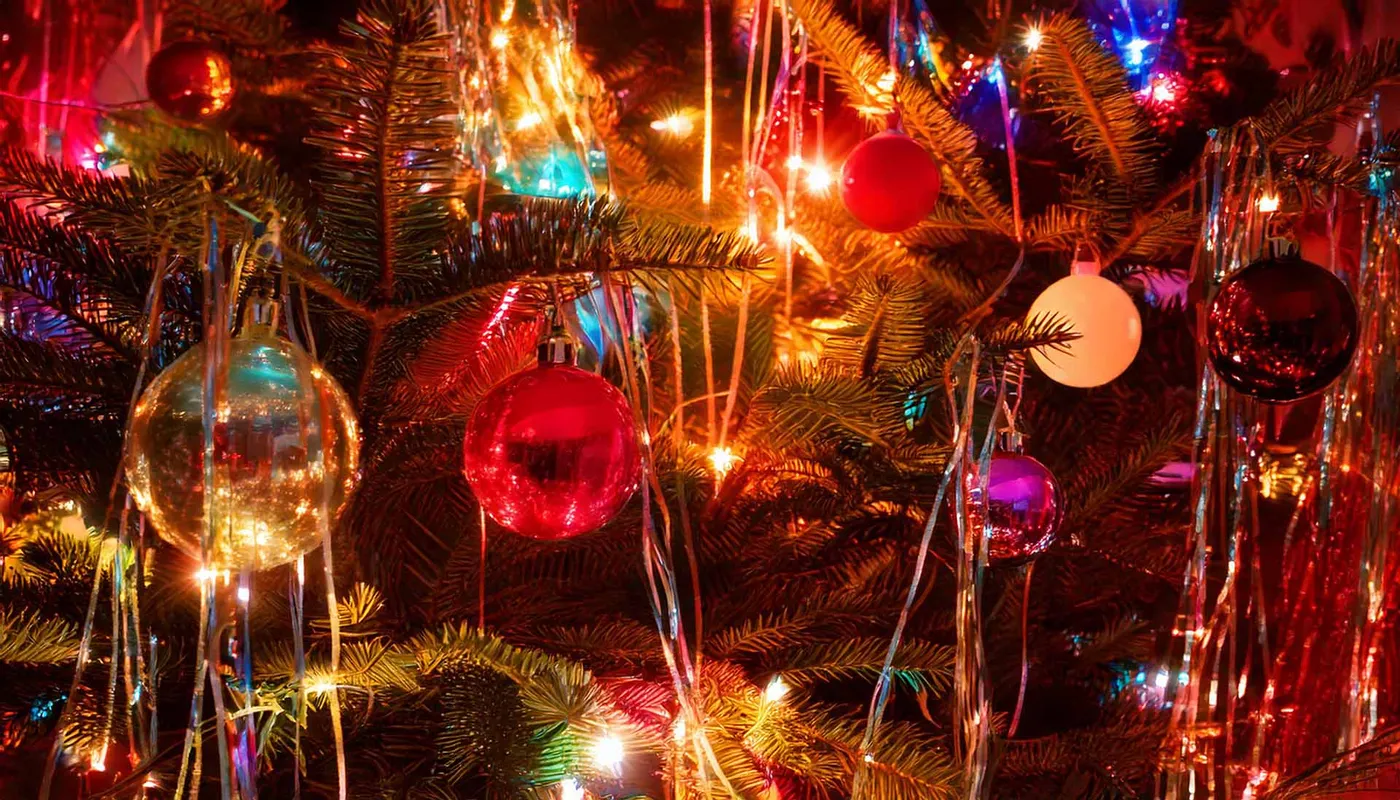
Repetition is the engine. Round ornament after round ornament, in slightly different finishes, gives the eye a rhythm to follow. The reflective strips create hundreds of tiny highlights, which is why a phone photo of this tree looks better than it has any right to — and why the whole thing reads as bright even though the bulbs themselves are small.
Two honest notes. Tinsel strands are a genuine hazard for cats and dogs — string-shaped tinsel is the classic December emergency vet visit, so skip it entirely in a pet household and use garland beads instead. And reflective strips plus a phone flash equals a screen full of white fireflies. Shoot these trees with the room lights off and no flash.
20. Traditional Living Room With a Black Marble Fireplace
This layout wants a corner, not a wall. A 7- to 7.5-foot tree in the 12-by-14 room shown here fills the space without blocking the grid-paned window, and the area rug defines the zone so the tree doesn’t look dropped in. If your room is under 10 feet wide, go down to a 6.5-foot tree and skip the second armchair rather than shrinking the tree.
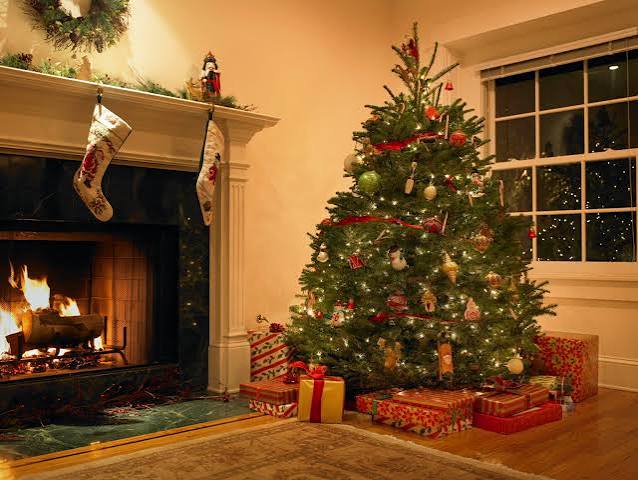
A live tree next to a working fireplace is a losing battle on a schedule. Dry heat pulls moisture out fast, so you’re refilling the stand daily and vacuuming needles by the handful. Keep the tree at least three feet from the hearth, close the screen when it’s lit, and know that any tree near a fire is good for about three weeks, not five.
21. Aged Brass Bells on Jute With Bottle Brush Trees
Cluster in odd numbers and vary the sizes — three bells, or five if you have the sizes for it. Six to eight inches of jute is the sweet spot for a hanging cluster; longer and the bells swing into whatever’s below them. And choose antique or matte brass over polished: the darker finish holds up against green foliage, while bright shiny brass disappears into it.
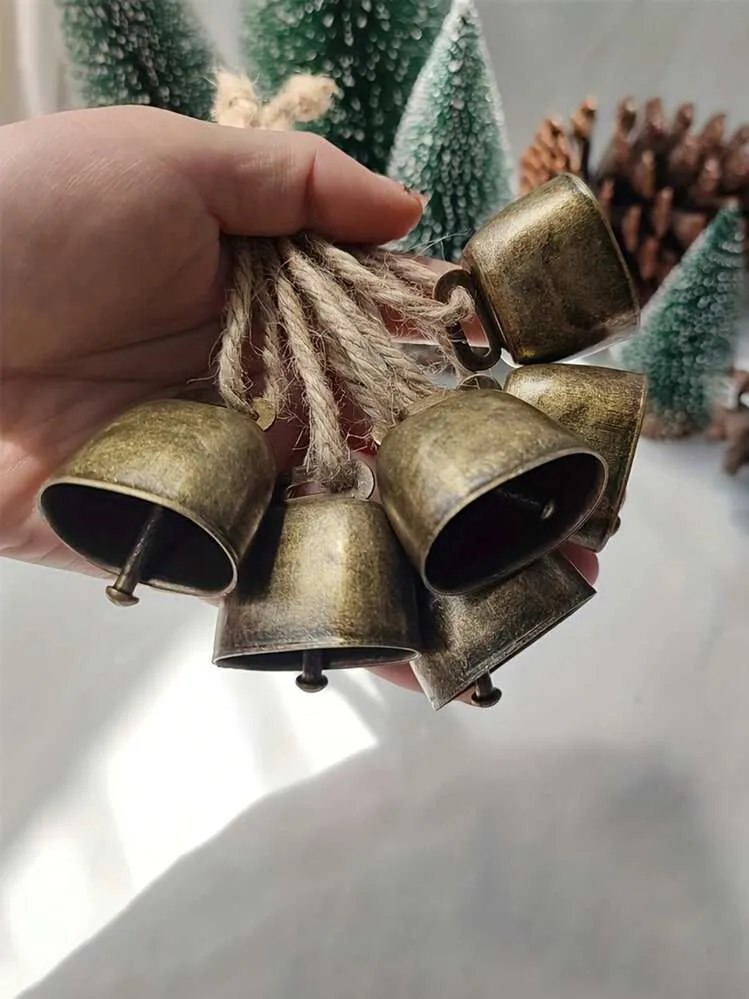
The contrast here is texture, not color. Matte brass, rough jute, soft green bristles, dry pinecones — four surfaces in a palette of about three colors, which is why it feels rich instead of busy. The dark bottle brush trees in the background do quiet work too: they repeat the tree shape at a smaller scale, so the eye connects the bells to the season without any literal signage.
22. Gold Beaded Garland and a Star Topper
Gold beaded garland is the reason this tree looks expensive, and it’s also the cheapest thing on it. It drapes in low swags rather than spiraling tight, which creates horizontal rhythm across a vertical object — that’s the contrast doing the work. The oversized multicolored bulbs add a second rhythm, and the star gives the eye one clear place to stop at the top.
- Gold beaded garland, three 9-ft strands: $15–$45
- Red and gold ball ornaments, 80 pieces: $35–$90
- Oversized multicolored bulb lights, 100 count: $12–$30
- Gold star topper: $10–$40
- Wrapping paper and bows: $20–$50
Total: $92–$255 to dress a tree you already own. Budget alternative: skip the ornament boxes and buy two colors in bulk from a dollar store — the beads and the lights are what people actually notice.
23. Silver Tinsel Tree Against Dark Grey Walls
Getting tinsel to look deliberate takes about twenty minutes:
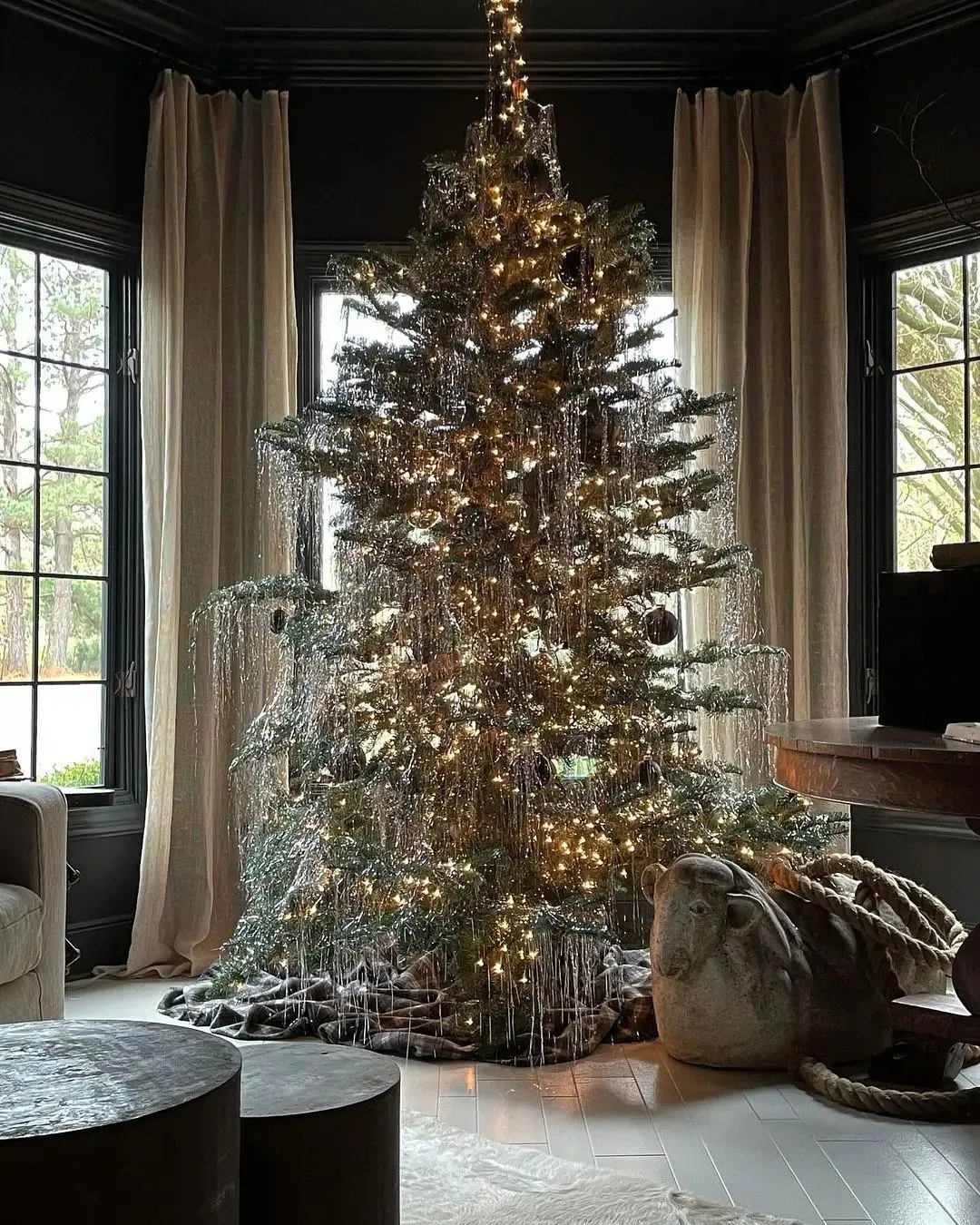
- Separate the skein into single strands — this is the step everybody skips.
- Cut each strand to about 12 inches; longer pieces droop and tangle.
- Lay one strand over a branch tip and press the middle in so both ends hang free.
- Work top to bottom, spacing strands roughly every four inches.
- Step back ten feet, find the bald spots, and fill only those.
Twenty minutes, and one $6 package covers a 7-foot tree.
Dark walls eat light. Against grey or charcoal paint, plan on roughly 1.5 times the light output you’d use against white — a 700-bulb tree on a cream wall becomes a 1,000-bulb tree on grey. Put everything on a dimmer too, because at full brightness against dark paint, silver tinsel blows out into pure white and you lose all the sparkle detail.
24. Gold Baubles, a Yellow Teardrop, and a Red Tassel
The pairing of the yellow teardrop with the deep red tassel. Nothing else on this tree is that brave — one warm, offbeat shape next to one heavy, traditional one, and somehow they make each other look intentional. Take either away and you’re back to a nice tree. Together they’re the reason you stop and look. It’s a reminder that a tree needs two or three pieces that argue with each other.
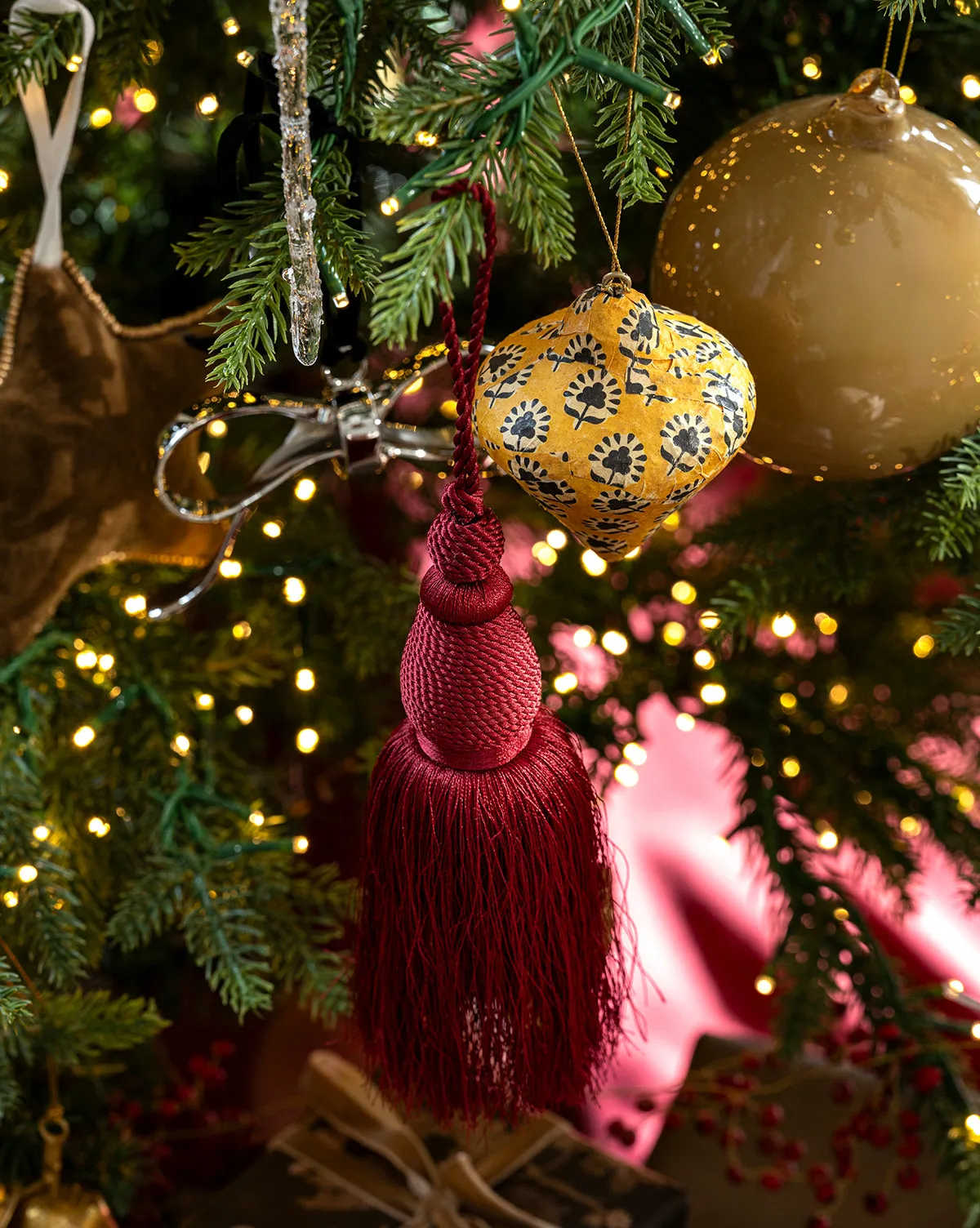
This is a spray-paint tree waiting to happen. Thrift-store ornaments cost about a quarter each, and a $7 can of metallic gold turns a box of tired 90s baubles into the glossy ones here — just wipe them with alcohol first so the paint grips. Tassels turn up in the sewing aisle or on old curtains. Entire refresh: under $25. Add one or two new pieces each year and you’ll have a collected tree without the collected-tree budget.
25. Red-and-Green Ornament Dressed in Gold Glitter
Even a single ornament has a formula: 55% emerald, 30% red, 15% gold glitter and sequins. The glitter is the smallest share and it’s the part you notice first, which is exactly how it should work — accents should be loud but small. Carry that ratio up to a whole tree and you get a classic that doesn’t look dated; push the gold to 40% and you’re in Liberace territory.
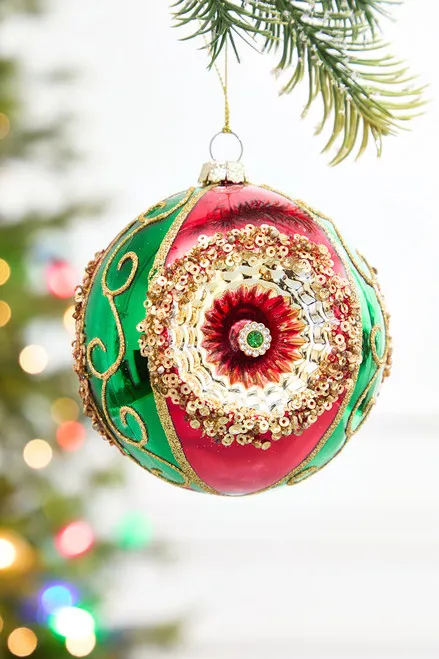
Before you hang anything this heavy:
- Weigh the ornament — anything over about four ounces needs a wire hook, not a bent-paper one.
- Check the branch: heavy pieces go on a sturdy inner limb, never a wispy tip.
- Verify the hanger loop and metal cap are secure; a loose cap is how glass ends up on the floor.
- Hang glass high if there are kids or dogs in the house.
A four-inch ornament is the ceiling for a 7-foot tree. Any larger and it starts to look like one ornament with a tree attached; go up to five or six inches only once you’re past nine feet. On a tabletop tree, stay under two and a half inches. Bigger isn’t more festive — it’s just out of proportion, and proportion is the only thing separating a beautiful tree from a crowded one.
Go Hang Something Weird on It
The best 90s-inspired trees aren’t the ones that copied a catalog — they’re the ones with a gold figurine from a flea market, a mushroom house someone gave you in 2011, and a strand of tinsel you cut into pieces instead of draping whole. Start with the palette, then let the personality in. Pin your favorite version now so it’s waiting for you next November.