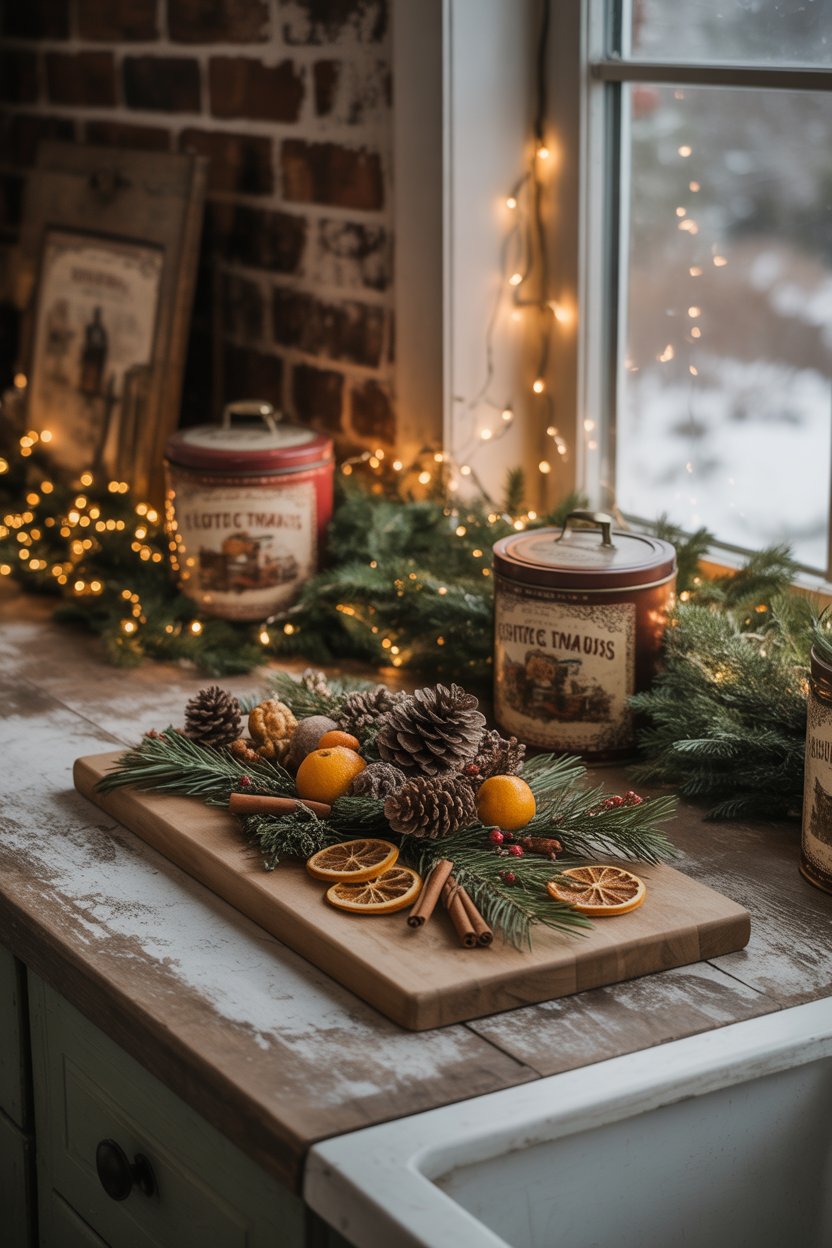
32 Jaw-Dropping Christmas Centerpiece Ideas You Need to Try This Holiday 2026 Season

Christmas table styling is having a major moment on Pinterest right now — and after scrolling the same forty photos as everyone else, we think we know exactly why. A centerpiece is the one holiday project you can actually finish in an afternoon, and it changes the mood of an entire meal. We spent real time digging through HomeGoods, IKEA, and Target (plus some late-night Facebook Marketplace browsing) to land on 32 centerpieces worth copying, with ideas running from about $28 to $450.
Inside you’ll find four big directions — old-school red and green, gold-and-evergreen glamour, natural woodland with citrus and pinecones, and a clean modern white look — with budget and luxury versions sitting side by side so you can see exactly where the money goes. In 2026 the shift is toward real greenery, mixed heights, and candlelight you actually light rather than just admire. And stay until the end — we break down the most common mistakes that can ruin these looks. 📌 Save this to Pinterest for later — you’ll want to revisit these ideas.
1. Gold-Tipped Garland with Red Baubles and White LED Tapers
What makes this table read as finished rather than just decorated is the height rhythm. The garland sits low and flat on the white cloth, the gold-holder LED tapers rise above it, and the oversized red and gold baubles sit between those two levels — three heights, one line of sight. The white tablecloth is doing quiet work too: it lets the dark green, deep red, and gold leaf read as separate colors instead of one muddy blur. Set small gold apples and clear glass bottles near the ends so the garland seems to continue past where it actually stops.
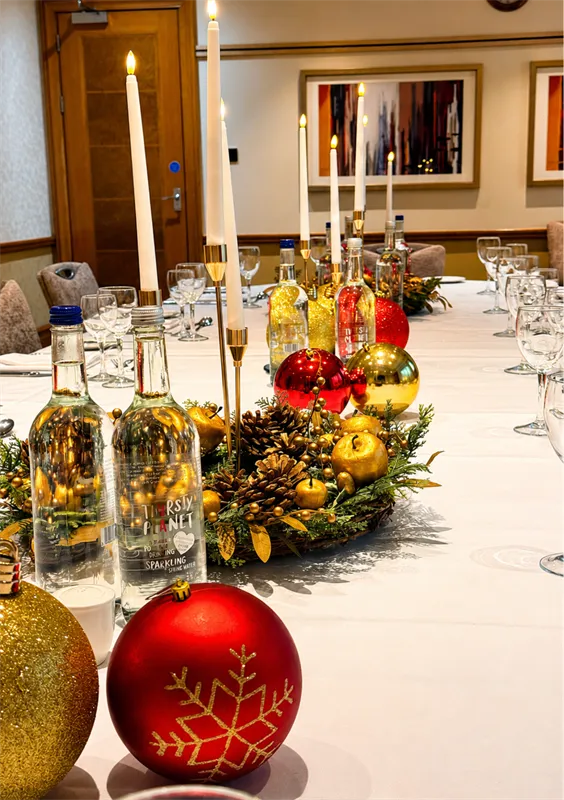
- Evergreen and pinecone garland with golden berries: $35–$90
- White LED taper candles plus gold holders, set of six: $30–$75
- Large red and gold baubles, mixed glitter, set of 12: $20–$55
- White tablecloth: $25–$70
- Gold apples and filler sprigs: $15–$40
- Total: roughly $125–$330
Budget alternative: swap the fresh garland for a $15 faux pine garland, spray-paint dollar-store ornaments gold, and use battery tapers from IKEA — you’ll land near $60.
2. White Roses and Evergreen Runner on Dark Wood
Build the runner in odd-numbered clusters, not one continuous strand. Group three rose clusters, then three pinecone-and-ornament clusters, then repeat down the table, leaving six to eight inches of bare wood between groups. On a dark table like this one, that breathing room is what keeps white roses looking crisp instead of crowded. Set your cream tapers slightly off-center in glass and brass holders — never perfectly aligned — and tie the napkins with brown velvet ribbon plus a single evergreen sprig so the place settings echo the middle without competing with it.
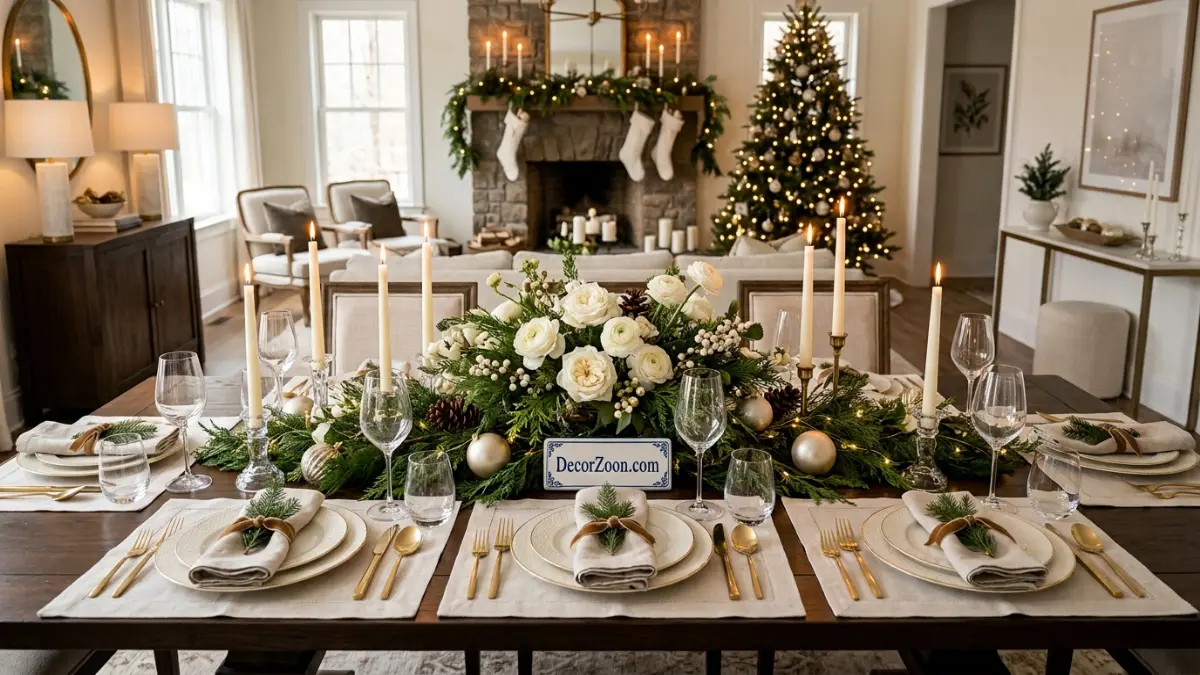
The formula is roughly 45% evergreen, 25% white floral and candles, 20% warm neutrals from beige linen, brass, and dark wood, and 10% metallic sparkle from the small gold and silver spheres. That’s a gentler ratio than a classic red-and-green table because white carries the brightness instead of red. To swap it, keep the percentages and change the cast: deep burgundy roses with copper lanterns for a moodier room, or blush garden roses with pewter for something softer. The dark table stays the anchor either way.
3. Orchids, Red Berries, and Frosted Pinecones in Gold Planters
The orchids are the whole reason this reads as expensive. Strip them out and you have a perfectly nice evergreen-and-berry runner — pretty, familiar, forgettable. Leave them in and the eye catches that arching white silhouette before it ever notices the red berries or the frosted pinecones at the base. Orchids also give you height without a flame, which matters if you’re serving family-style or working under a low fixture. If you only splurge on one element this season, make it the white phalaenopsis.
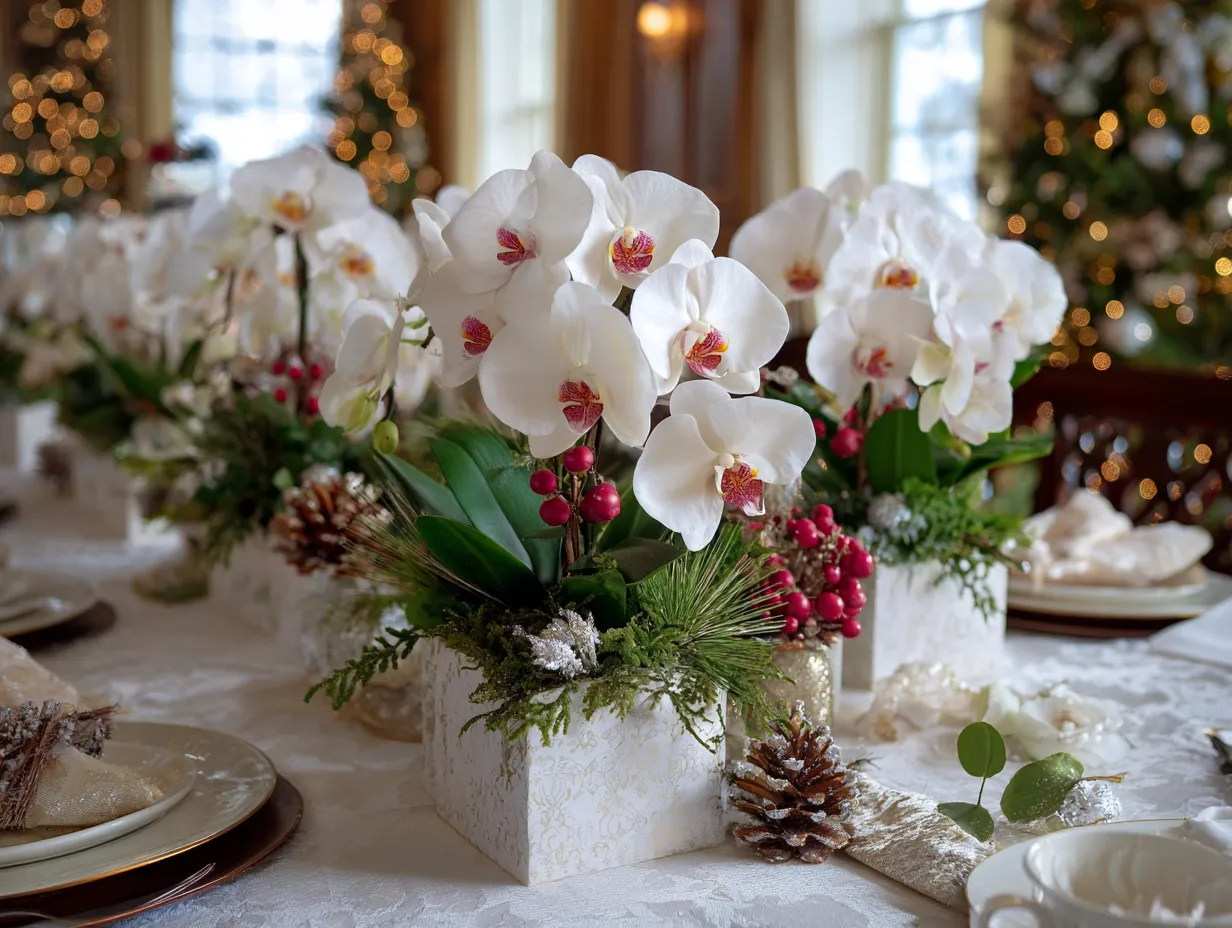
This look needs length more than width. It works best on tables 72 to 96 inches long and at least 36 inches wide, where you can set each white-and-gold planter roughly 18 to 24 inches apart on a white textured cloth and still leave room for plates at both ends. On a round table, use one planter as a true centerpiece and skip the multiples. A standard eight-foot ceiling is plenty here — the orchids top out around 20 inches. For a tighter footprint, see Idea #27.
4. Mirror-Gold Table with Evergreen Garland and Branch Chandeliers
- Reflective gold tabletop, or gold vinyl wrap over your own table: $40–$900
- Evergreen garland with micro string lights: $45–$120
- Gold-frame chairs with green velvet seats, set of four: $600–$2,400
- White taper candles and gold holders: $25–$60
- Ornate branch chandelier or a lookalike: $180–$1,200
- Total: roughly $890–$4,680
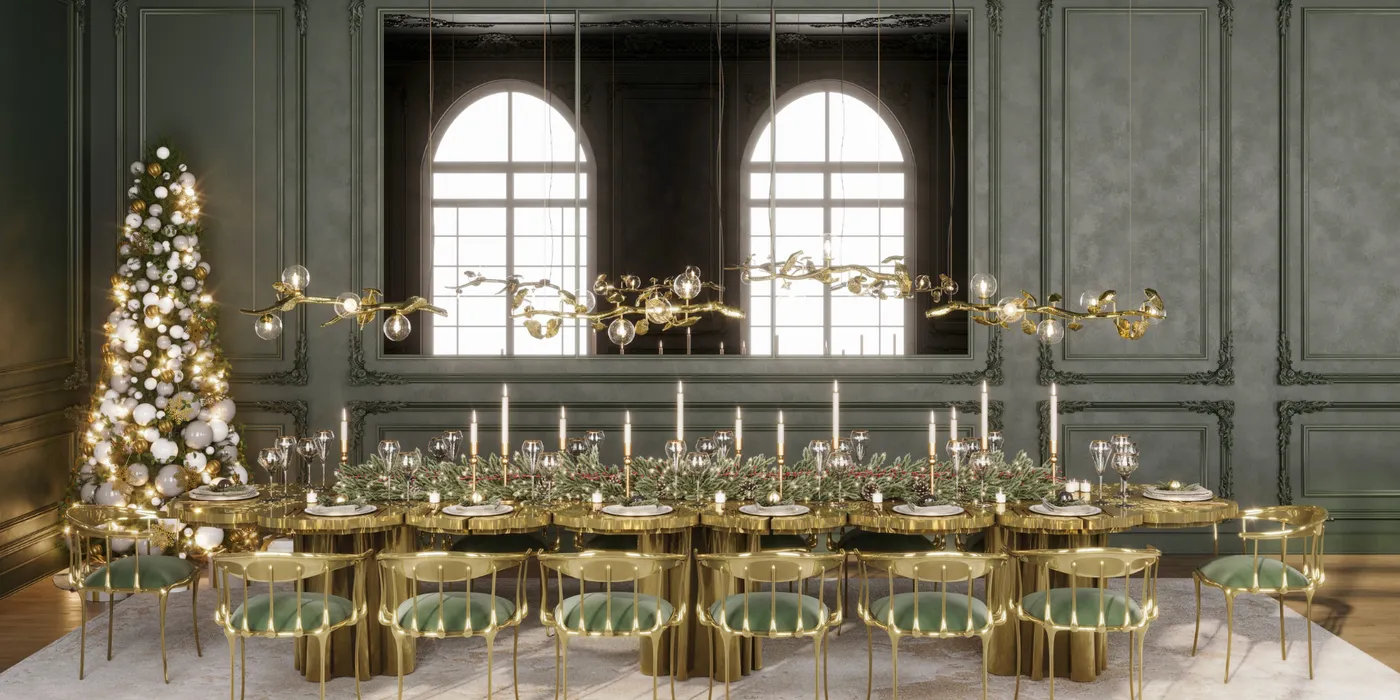
Budget alternative: keep your table and add a gold lame runner, rent the chairs for one evening, and skip the chandelier — a warm dimmer on what you already own gets you surprisingly close for under $200.
The dark-green paneled walls and gilded everything are a direct answer to years of pale Scandinavian minimalism; people want rooms that feel like an event again. Crimson is the color of the season and gold is its natural co-star. The branch chandeliers matter more than they look — they borrow the shape of a Christmas tree and hang it overhead, a trick set designers have used for decades. Will the wall color stick around past 2026? Yes.
5. Fir Wreath with a Dark Red Pillar and a Ribbon Bow
Buy the wreath form first, then shop your own tree. A 10-inch wire or grapevine ring takes about 15 minutes to cover with clippings, and using the bottom branches of your Christmas tree keeps the whole thing looking intentional. Wire the pinecones on by their base so they sit flat instead of jutting out like spikes, and set the pillar candle in a glass or metal cup at least a half-inch wider than the candle itself — melted wax needs somewhere to go. Fresh wreaths last three to four weeks indoors if you mist the back of the greens every few days.
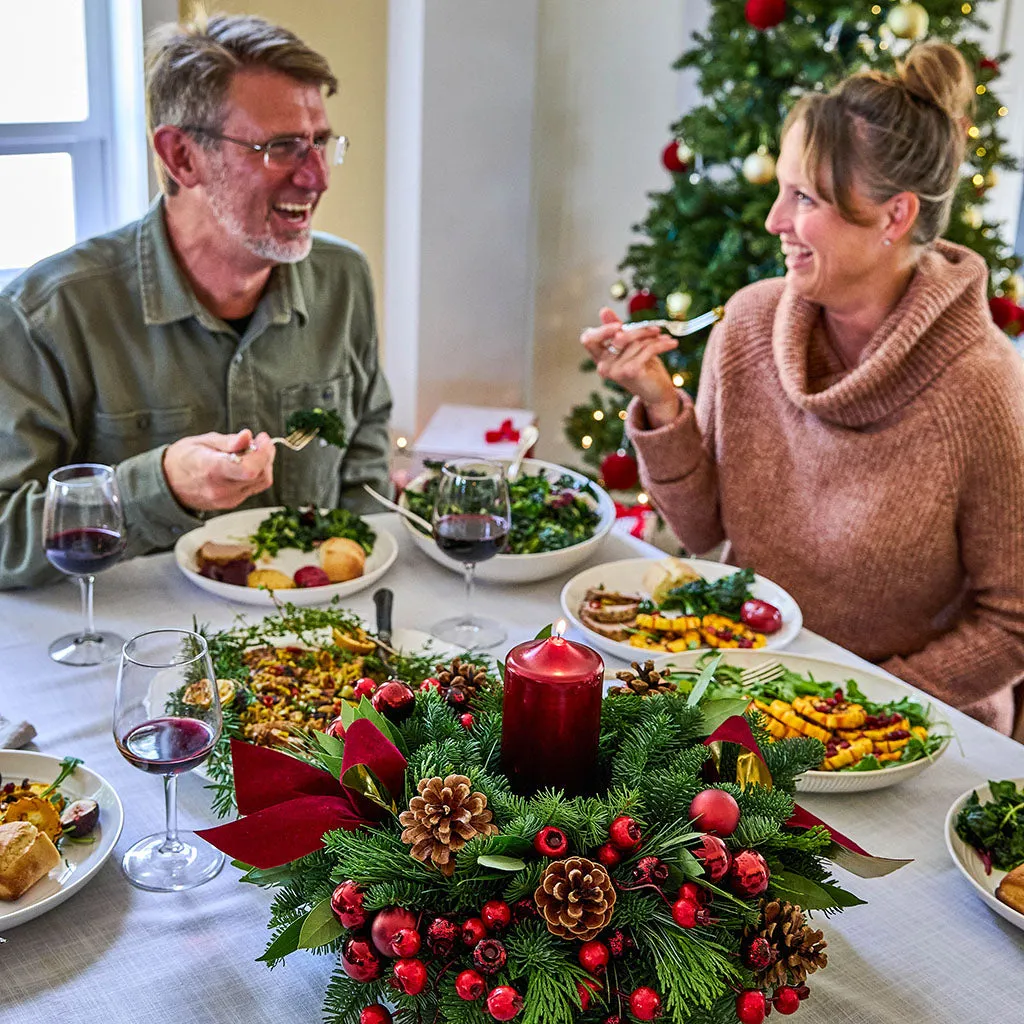
You don’t need a florist for this one. A wire wreath form runs $5 to $8 at Walmart, a bag of pinecones is about $6, and a dark red pillar candle is roughly $4 at IKEA. Add a red ribbon bow from the craft aisle and cuttings from your tree and you’re at about $20 all in. If you’d rather not build it, hardware stores start selling fresh evergreen rings for around $15 the first week of December — dress one up with berries and a bow and you’ve saved an afternoon.
6. Red Rose and Carnation Centerpiece in a Glass Hurricane
Real roses in a holiday arrangement are a three-to-five-day commitment, not a month-long one. Carnations are tougher than they look and will hold a week or more, but the roses will go first — usually right after the red pillar candle has melted down into the greenery. Keep the vase topped off, change the water every other day, and set this one away from heating vents and sunny windows. If your table sees heavy traffic from kids or pets, skip the glass hurricane entirely and use a metal or ceramic vessel instead.
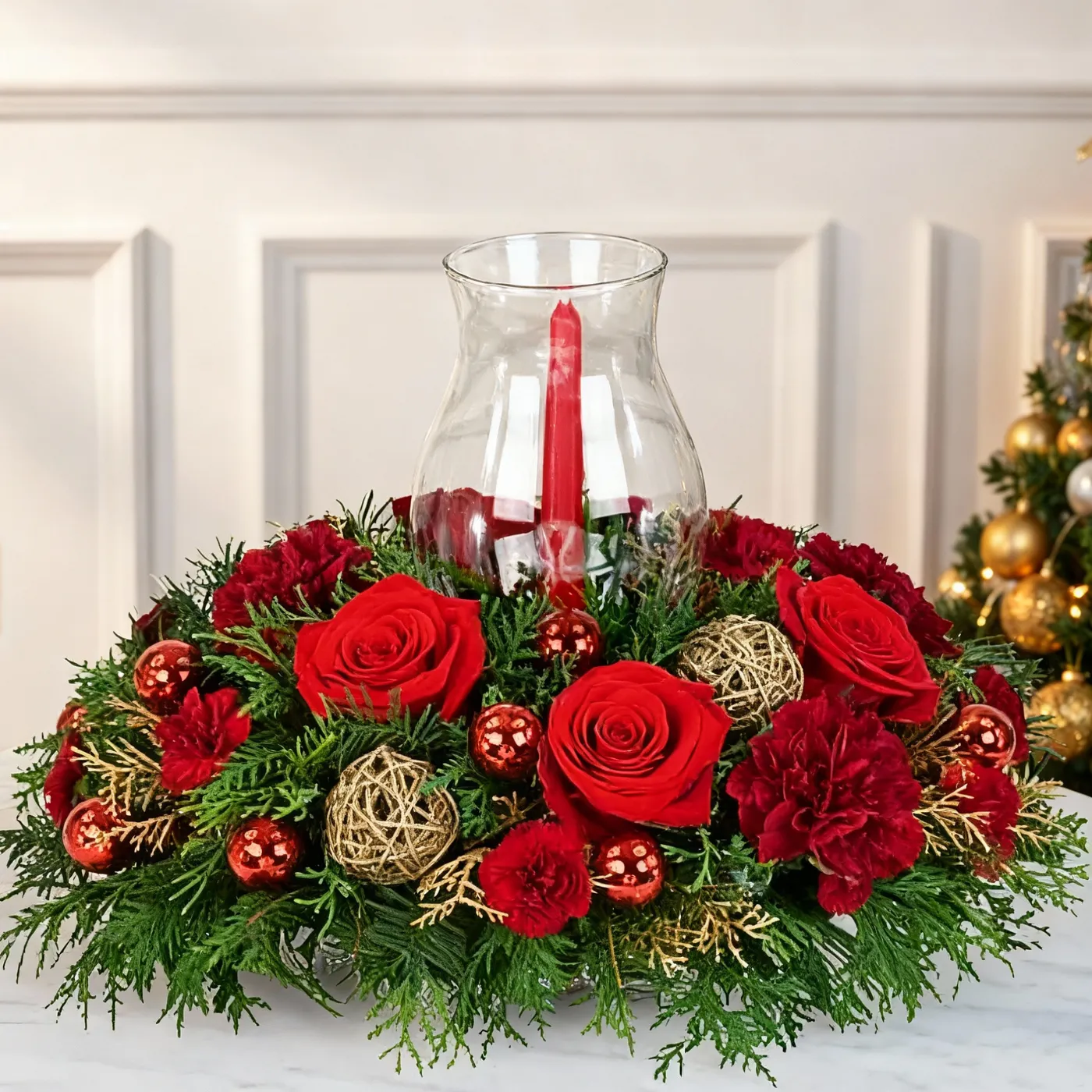
Two choices carry this arrangement. First, the glass hurricane does double duty — it protects the flame and gives the eye a clear vertical center so the roses read as a ring rather than a random bunch. Second, the colors repeat instead of match: red roses, red carnations, and a red candle at slightly different temperatures, plus gold spheres and glittery baubles that pick up the light. That small variation in red is what separates a florist’s work from a grocery-store bouquet. Compare with Idea #28 for the same red-and-green math in a silver urn.
7. Olive Green Bowls and Pine Sprigs on a Light Oak Oval Table
It’s the olive green bowls. Not the pine branches, not the red berries, not even the cake stand of cookies — those olive stoneware bowls sitting under white dinner plates are what turn this from a centerpiece photo into a real meal somebody is about to eat. They pick up the dark green in the taper candles and the deeper green in the pine, so the table reads as one graduated green story with red as punctuation. Remove them and you’d still have a nice holiday table. With them, you have a mood.
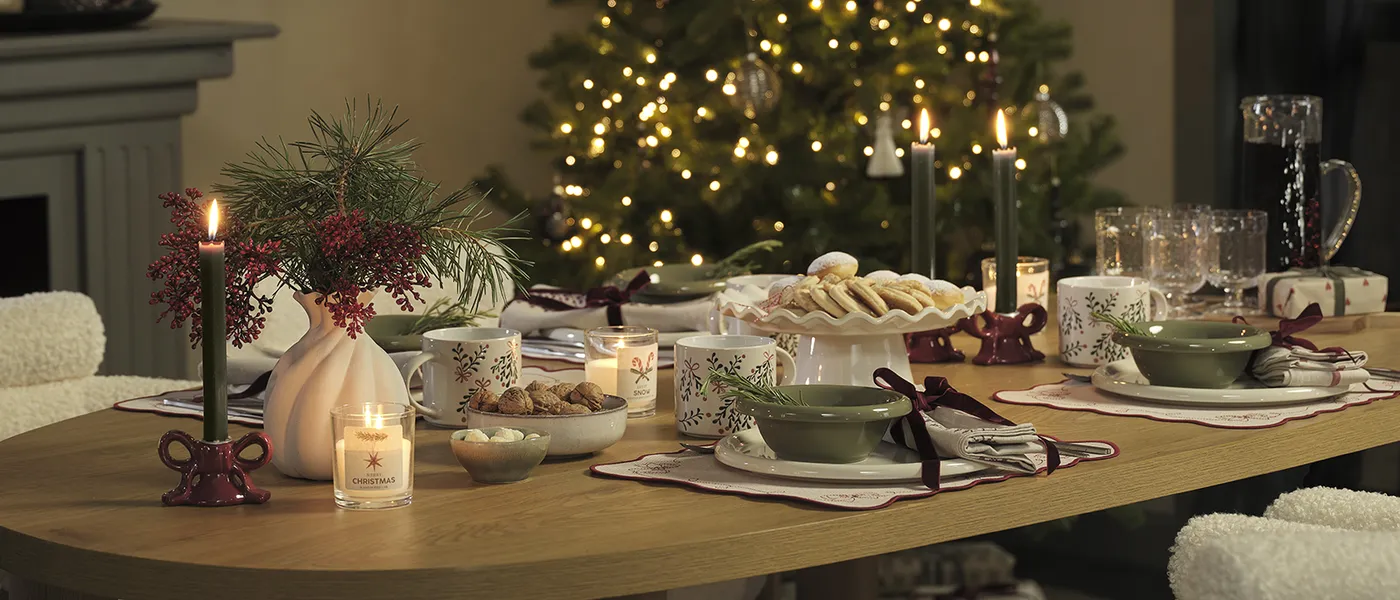
- Measure your table’s usable center width and leave 12 to 14 inches clear on each long side for plates
- Check that your dark green tapers are dripless — tall candles in bow-shaped holders look best short, and cheap ones drip onto wood
- Confirm your oval table’s leaf situation: adding or removing a leaf changes your centerpiece length by nearly 18 inches
- Decide where the food actually lands — a cake stand plus a centerpiece eats a lot of oval real estate
- Budget minimum: about $45 for candles, greenery, and berries if you already own white dishes
8. Lavender Pillar Candle in a Ring of Red Roses and Pine
Here’s a formula most people would never try: 50% deep green foliage, 30% deep red roses and berries, 15% natural brown pinecones, and 5% lavender-purple candle. That last 5% is doing all the tension work — it’s an unexpected third color that stops traditional red and green from looking like a catalog page. Try the same structure with a slate blue candle, a soft mustard pillar, or a dusty pink one. The rule holds as long as the accent stays under 10% and everything else stays in the red-brown-green family.
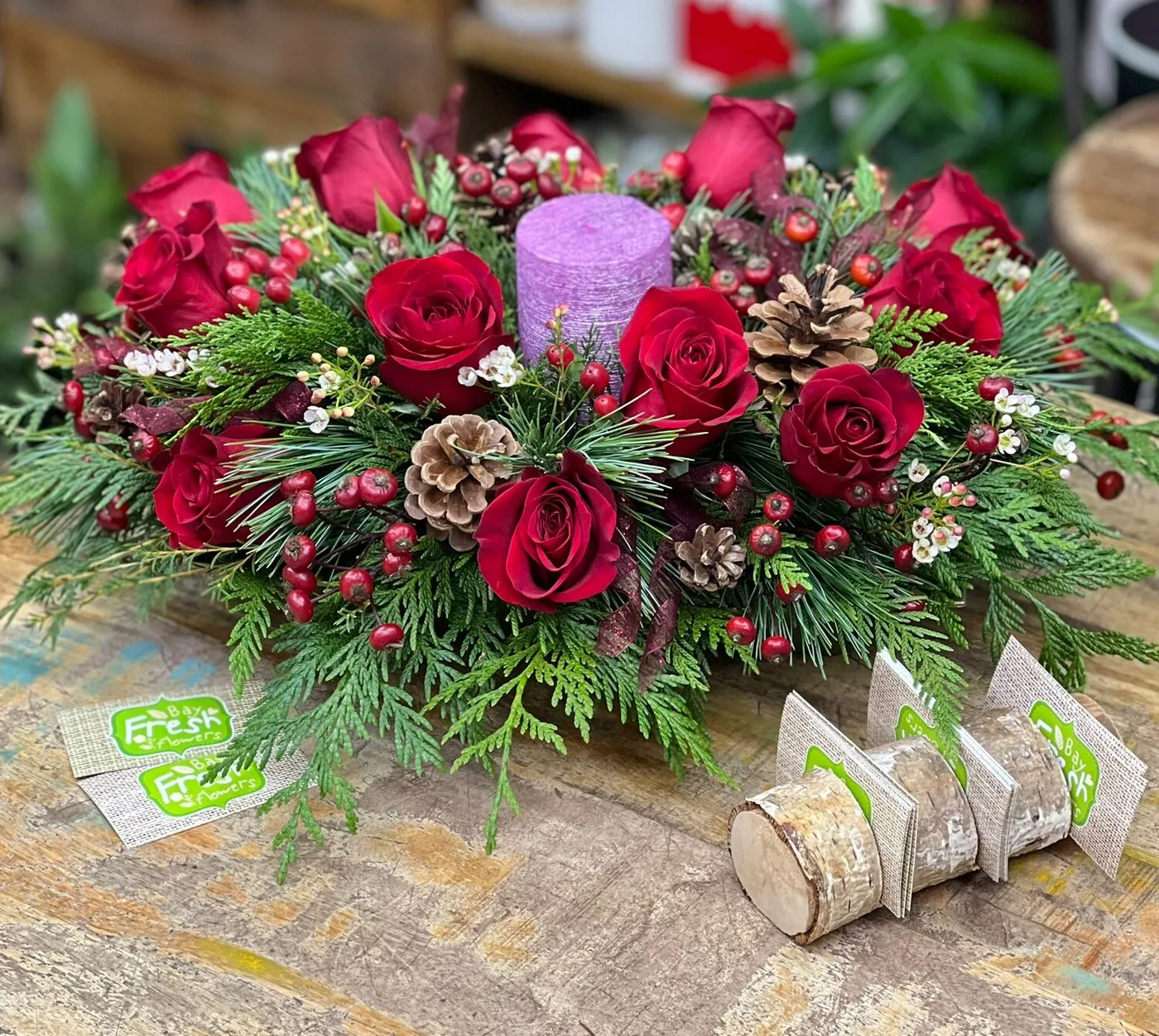
Build this one in a shallow oval bowl rather than a tall vase, so the roses sit at roughly plate height and you can still see across the table. Start with a soaked floral foam base, then place your greens out to a 14-to-16-inch spread before a single flower goes in. Wire or skewer the pillar candle into the foam center so it can’t lean, and keep rose blooms a full inch clear of the flame. Pinecones go last, pressed into the greens at the outer edge where candlelight will catch them.
9. Three White Pillars in Frosted Pine on a Gray-Walled Table
Three pillar candles at graduated heights — typically 3, 5, and 7 inches — span about 24 inches of table, which makes this one of the most flexible centerpieces in the whole list. It works on a 48-inch round for four and on a 96-inch rectangular table for eight. Low ceiling? No problem; the tallest candle tops out around nine inches including the holder. If your dining room is under 120 square feet, this is the shape to copy. For a longer table, see Idea #24 and repeat the arrangement rather than stretching it.
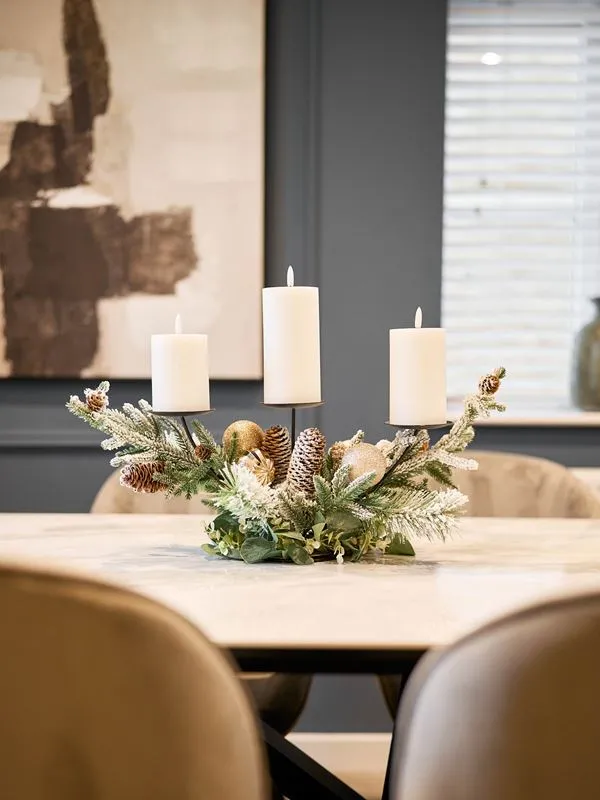
Faux frosted pine is much easier to live with than fresh branches, but it does two things you should know about. First, it sheds — a lot — for the first week, especially the inexpensive versions, so give it a shake outside before it goes on the table. Second, anything with flocking or glitter will eventually leave residue on your tablecloth, so put a runner or a tray underneath. On the plus side, this is a box you can pull out every December for a decade without a single needle hitting the floor.
10. Chevron Napkins, Candy Canes, and Red Raffia in Progress
- Stack a plain white plate on a charger and fold a green-and-white chevron napkin into a loose band around it.
- Tie the napkin with red raffia ribbon, leaving two six-inch tails hanging past the plate edge.
- Slide a sprig of evergreen under the raffia and lay a candy cane along the right side of the plate.
- Loop a brown kraft gift tag through the raffia and write the name in gold or white pen.
- Repeat down the table, then trim every raffia tail to the same length — this is the step where it starts looking styled.
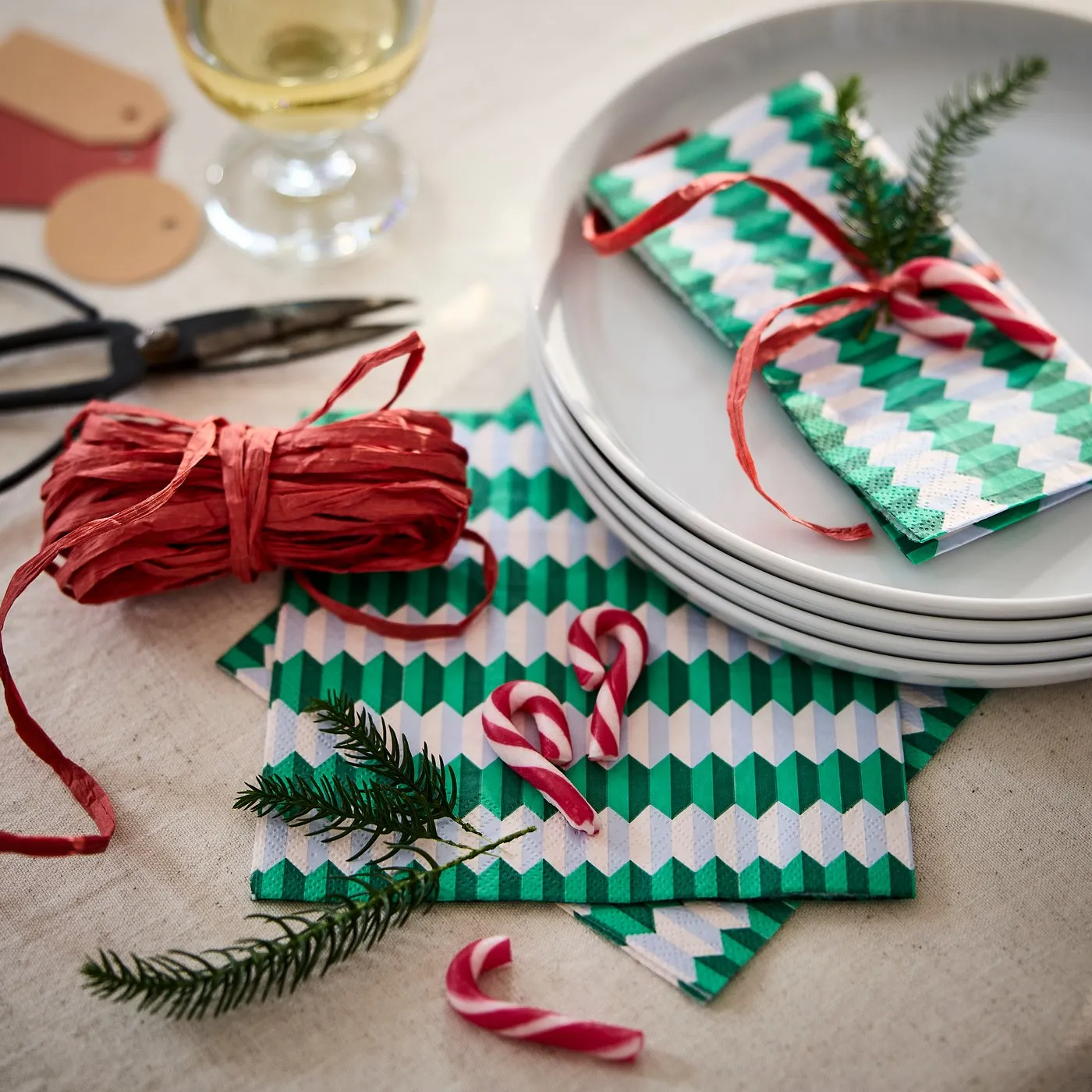
Time: about six minutes per setting. Materials: roughly $3 per place setting.
Everything in this setup is grocery-store and dollar-store territory. Candy canes are about $2 a box, red raffia is $4 a spool and covers eight settings, and kraft tags are $3 for 50. Chevron napkins run $12 to $18 for a set of four at Target, but a single yard of green-and-white fabric cut into squares costs about $6 and gives you six. White plates you already own. Under $40 for a table of six — and if you’d rather go full plaid, see Idea #25.
11. Miniature Gold and Green Trees with Ornate Silver Tapers
The little decorative tree has quietly become the centerpiece of holiday tablescaping. You can buy them flocked, glittered, bottle-brushed, or ceramic, and clustering five or six at different heights gives you the drama of a Christmas tree in the middle of the table without blocking anyone’s view. It’s partly a practical shift: more people are hosting smaller dinners and want something they can style in fifteen minutes and pack away in a single box. Expect this one to outlast most holiday trends.
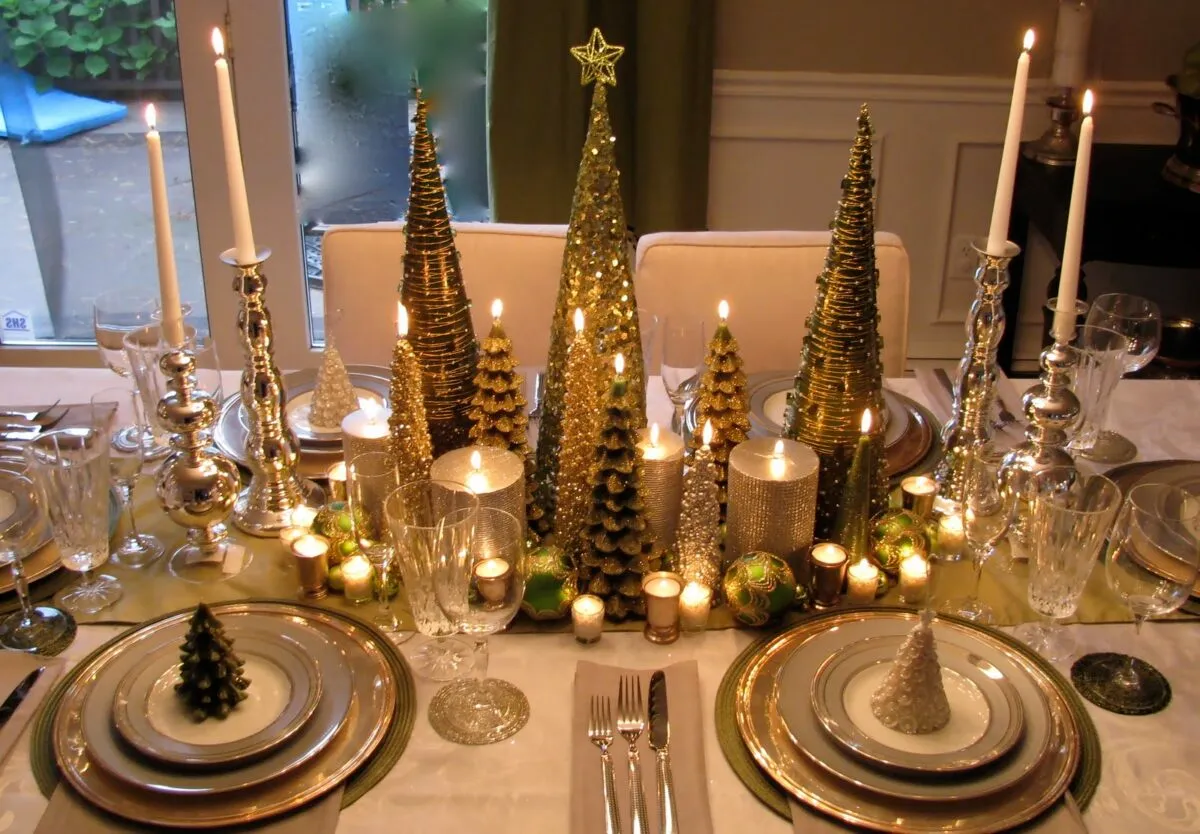
Cluster styling lives or dies by footprint. Keep the whole group inside a 30-inch span on a table at least 40 inches wide, with the tallest tree no more than 12 inches high under an eight-foot ceiling — anything taller starts fighting your chandelier. On a long table, run a green runner down the center and space three smaller clusters of trees and candles every 24 inches instead of building one big pile. Small nooks work fine with two trees and a single votive. Pair with Idea #16 for the same multiple-height idea in wreath form.
12. Rustic Evergreen Ring with Matte Red Ornaments and Pinecones
Mixing matte and glossy finishes in the same color is the fastest way to make a wreath look collected rather than bought. Use two-thirds matte red ornaments and one-third shiny, and cluster them in threes and fives instead of spacing them evenly — even spacing is what makes a wreath read as a craft project. Tuck the ribbon in as short folded loops rather than long tails so it doesn’t compete with the pillar candle’s height. Work on a flat surface first, then set or hang it, so nothing ends up lopsided.
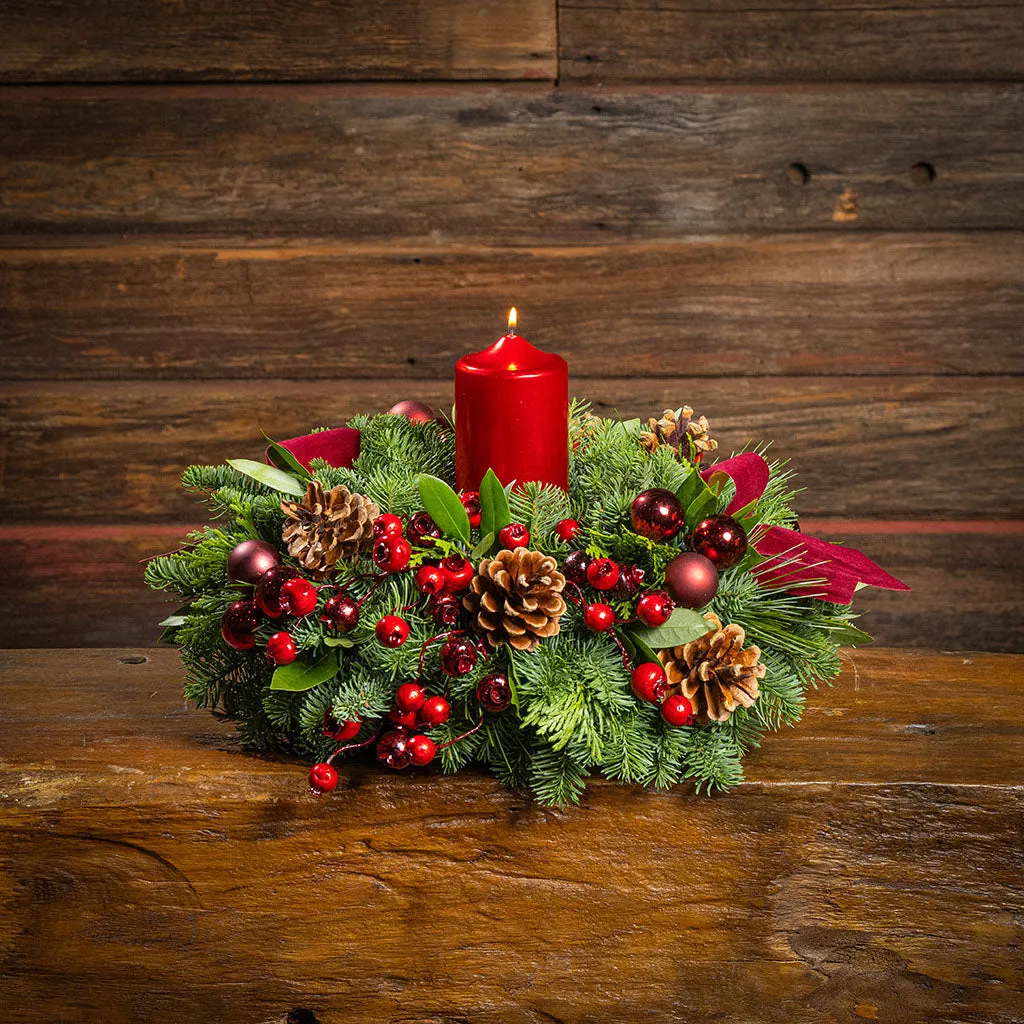
The lit red pillar at the center is the point. Everything else — the evergreen boughs, the shiny and matte berries, the pinecones, the dark red ribbon — is framing. The moment that flame is lit, the ring stops being a decoration and becomes a focal point with a job. It also gives the arrangement a natural top and bottom, which is why this shape works on a rustic wooden surface without a cloth: your eye reads the candle first and the greenery as its setting.
13. Tartan Ribbon Garland with Copper Chargers and Blue China
The unexpected move here is blue in a Christmas centerpiece, and it works because the ratio is disciplined: about 55% greens and white cloth, 20% deep blue from the tartan ribbon and linen napkins, 15% warm copper and gold from chargers and candelabras, and 10% light blue in the patterned dishes. Tartan carries the blue and green together, so the palette never splits into two camps. Swap in a red-and-green plaid and you get a completely different, more traditional table with the same structure. The copper is what keeps it from feeling cold.
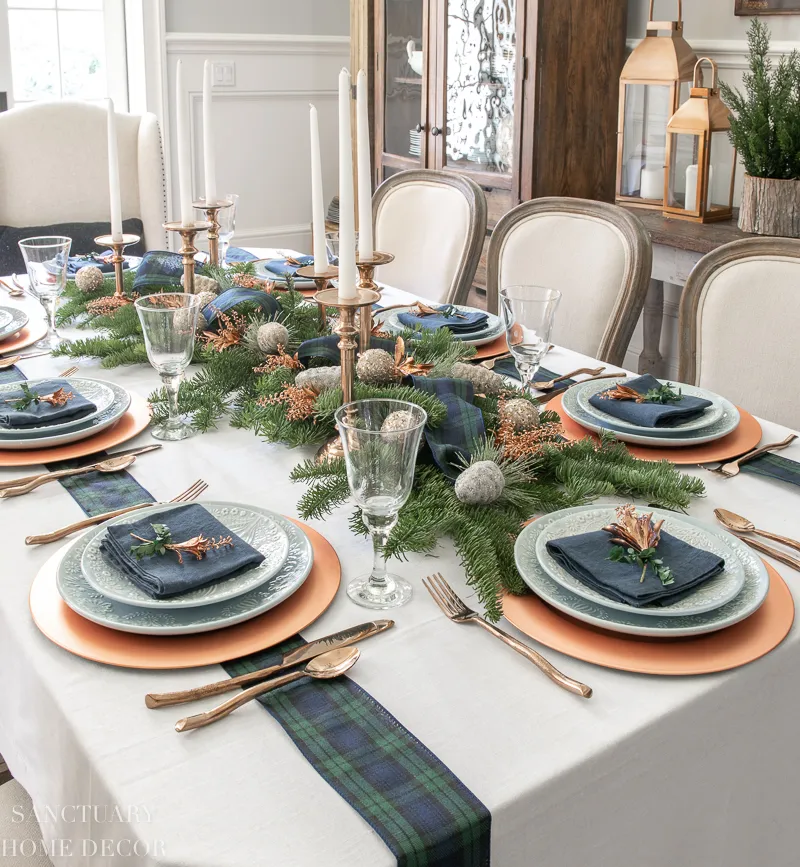
Blue-and-white holiday tables are having a real moment, mostly because people already own blue-and-white china and want permission to use it in December. Tartan ribbon pulls the two halves together — it’s a pattern, not a color, which is why it can bridge green and blue without looking mismatched. Worth noting: this is one of the few holiday looks that reads just as well in January, so you’re not packing it away the day after Christmas.
14. Wavy Wood Tray Garland with Cinnamon Sticks and Tapers
- Wavy wooden tray, or a long bread board you already own: $0–$65
- Mixed evergreen garland with holly berries: $40–$95
- Frosted pinecones and cinnamon sticks: $12–$30
- Mixed brass and silver candlestick holders, set of four to six: $35–$120
- Cream taper candles: $10–$25
- Clear glass runner: $15–$45
- Total: roughly $110–$380
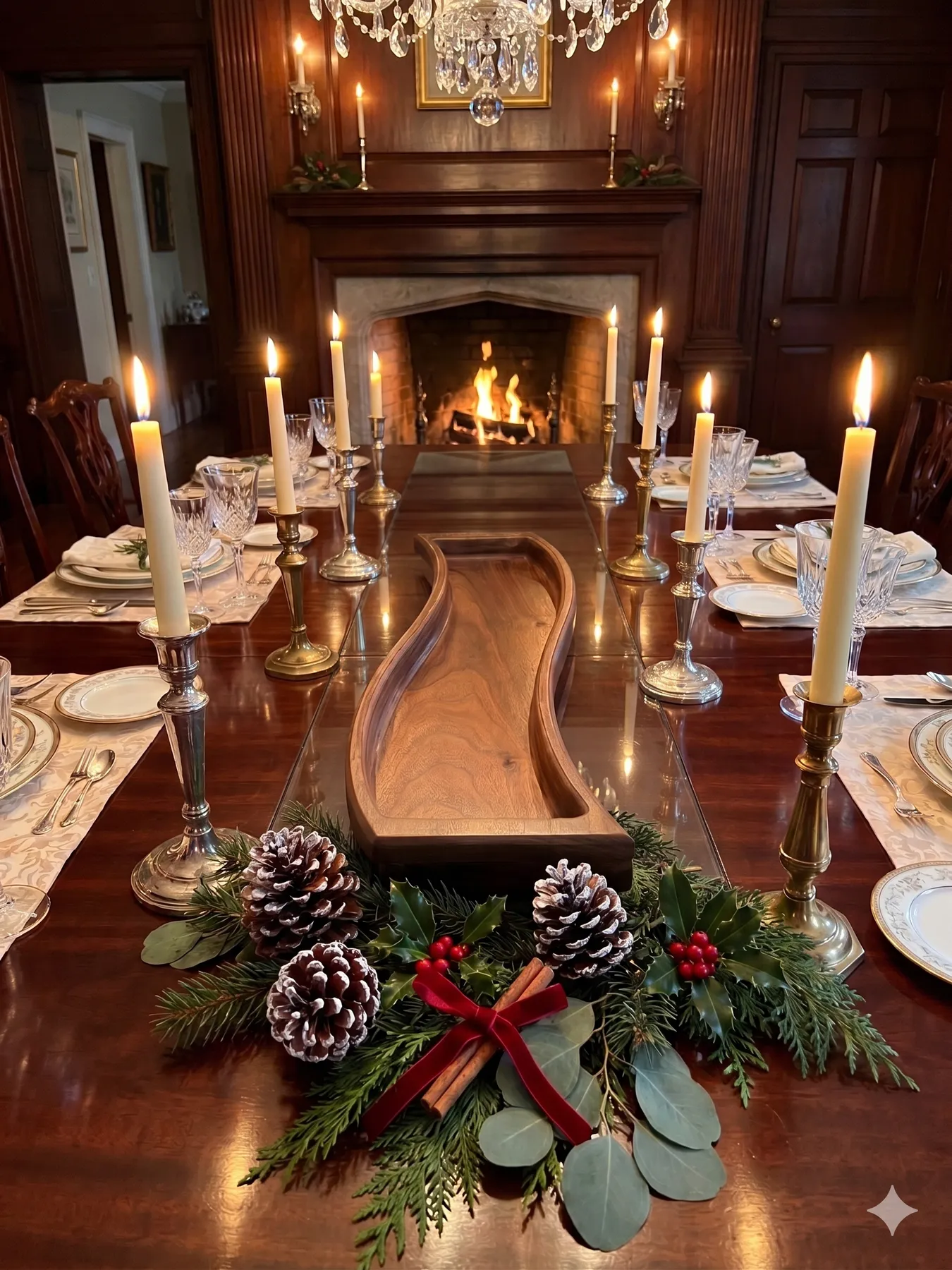
Budget alternative: skip the glass runner, gather mismatched brass candlesticks from thrift stores at $3 to $6 each, and use grocery-store greenery. You’ll be near $70 and nobody will know.
Cinnamon sticks and dried citrus are lovely and also a snack for anything with four legs — a determined cat will have those sticks on the floor by dessert. Fresh holly berries are toxic to pets and small children, so keep them above nose level or swap for faux berries in a curious household. And tapers in mismatched holders will drip at different rates, so buy one quality brand in a single size or you’ll be scraping wax off dark wood.
15. Pearl Bow Napkin Rings and a Green Glass Tree
This is the most copyable idea on the list because nothing here has to be expensive. Gold-rimmed white plates: Target, about $6 each. Pearl-and-gold bow napkin rings: Amazon or a craft store for $8 to $12 per set of four, or make them from a strip of gold ribbon and a single pearl bead for under $2 apiece. The small green glass tree runs $8 to $15 at discount stores — and remember the trick: it’s standing in for a centerpiece, not competing with one. Under $60 covers a table of four.
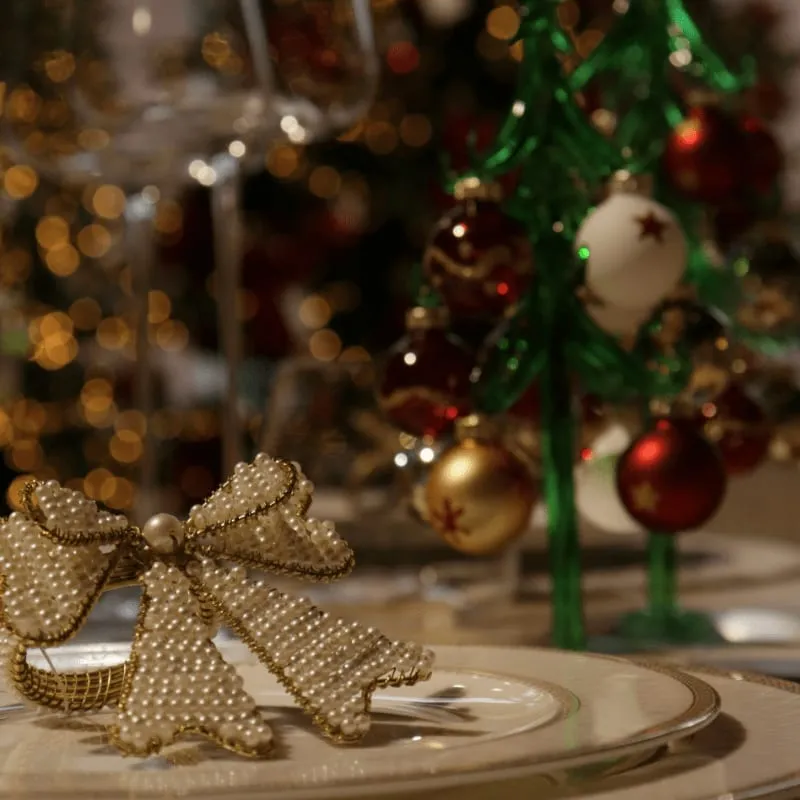
Photograph your table before you commit to it. Warm string lights out of focus behind a small green glass tree will make almost any arrangement look expensive, and that soft background glow is doing as much work as the pearl bow. If your dining room only has one harsh overhead light, add two or three battery votives behind the tree so the ornaments have something to reflect. Lighting is the difference between a centerpiece that photographs beautifully and one that falls flat in person.
16. Ivory Pillars on a Distressed Silver-Gold Footed Tray
The footed tray. It lifts the whole arrangement a couple of inches off the tablecloth, which gives the wreath a defined edge, keeps wax and pinecone debris off your linen, and makes the entire thing portable when the food comes out. A flat wreath sitting on a table can look like it wandered in from the front door. The same wreath on a tarnished silver-gold stand reads as a centerpiece. It’s the cheapest upgrade in this article and the one people always forget.
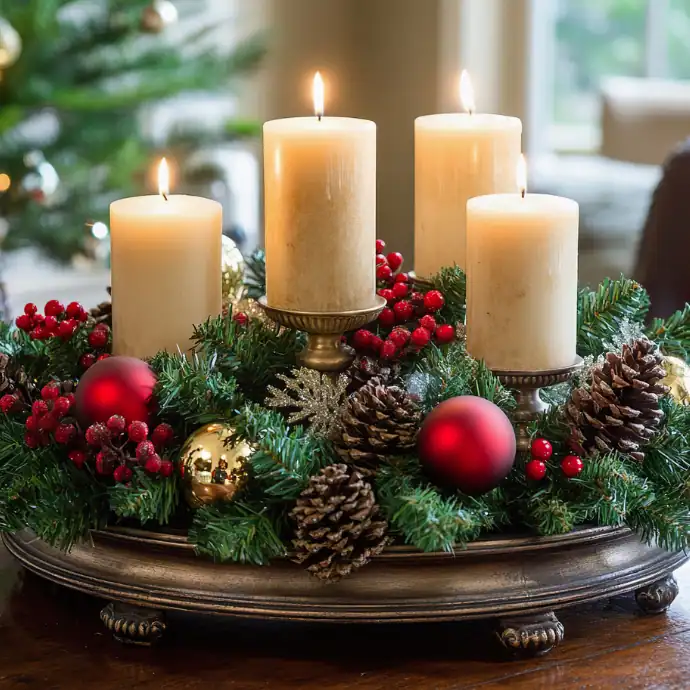
Scale and repetition are doing the heavy lifting. The four ivory pillars match the brightest highlights on the ornaments, so your eye travels around the ring instead of jumping. The red berries and gold accents appear in fives and threes — enough repetition to feel deliberate, not so much that it reads as uniform. And the distressed silver-gold finish is a smart choice: a shiny tray would bounce candlelight into a glare, while this finish scatters it into a soft glow.
17. A Muted Winter Feast Table Without a Single Santa
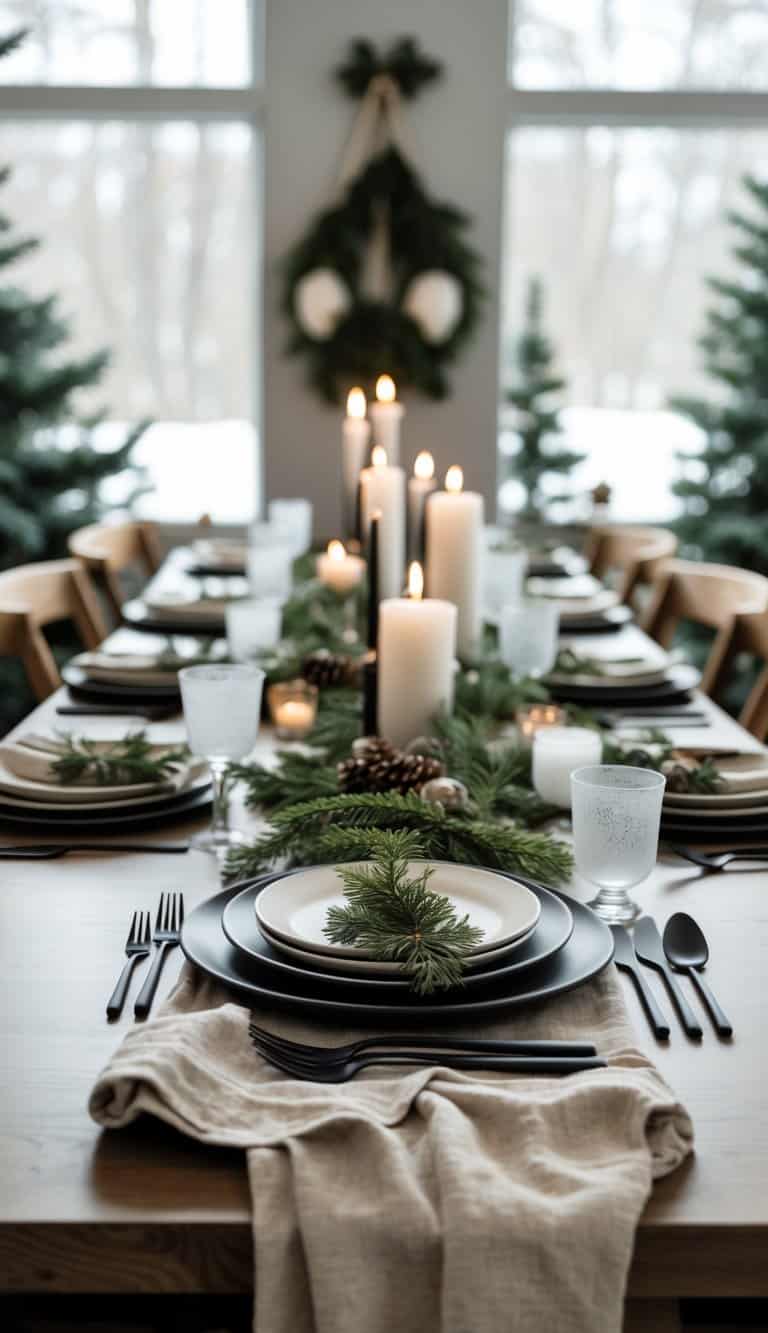
- Anchor an off-white cloth or a wide runner down the center of the table to give everything a shared base.
- Lay a low line of greenery in two or three sections rather than one continuous strand, leaving gaps at each seat.
- Add three candles at different heights — a couple of tapers plus one short, wide pillar.
- Bring in a single non-holiday element: pears, nuts in a bowl, or a stack of small plates.
- Finish with one matte ribbon color — cream, oatmeal, or charcoal — and stop there.
Time: about 30 minutes. Materials: $50–$120.
Fresh greenery on a dining table is high maintenance compared with anything else in this guide. Needles drop within a week, water rings appear under anything damp, and greens near a heat vent can brown in days. Safer: use fresh for the first week and faux for the rest of the month, and put a felt pad or a runner under every vessel. Wipe the table down nightly during the season — pitch from evergreens is sticky and it sets over time.
18. Dried Oranges and Cinnamon Sticks in an Evergreen Runner
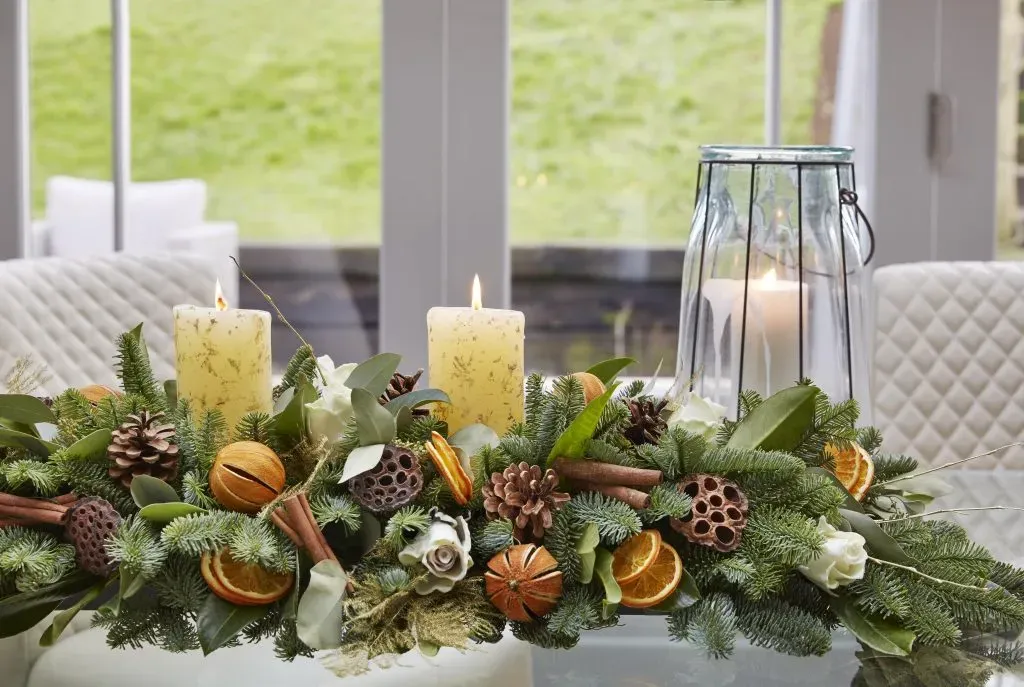
The dried orange slices. They cost about $3 to make, they’re the only warm orange in an otherwise green-and-cream arrangement, and they make the whole table smell like a kitchen in the best way. Without them, this is a nice evergreen runner with candles. With them, it reads as a specific point of view — natural, food-adjacent, quietly southern European. They also break up the green mass without adding a single store-bought ornament, which is exactly why the look still feels grown-up.
Think of it as 60% evergreen and cream, 20% natural browns from pinecones, cinnamon sticks, seed pods, and speckled pillar candles, 15% warm orange from the dried citrus, and 5% black metal from the lantern frame. That’s a woodland palette with a single warm note — no red anywhere, which is why it doesn’t read as Christmas in a cliché way. Swap the orange for dried apple rings for a deeper tone, or move the lantern from black to brass if your table is dark.
19. Sage Green Cloth with Garland Runner and Bottle Brush Trees
The sage green cloth changes how much you can put on the table — a pale base absorbs less visual weight, so you can afford a continuous garland runner. This is the look for a table 84 inches or longer. Under 60 inches, cut the garland to 30 inches and use two candle holders instead of four. Oval tables and this idea are a natural match. For a small round table, go to Idea #5 instead — one wreath with a single candle will read better than a squeezed garland.
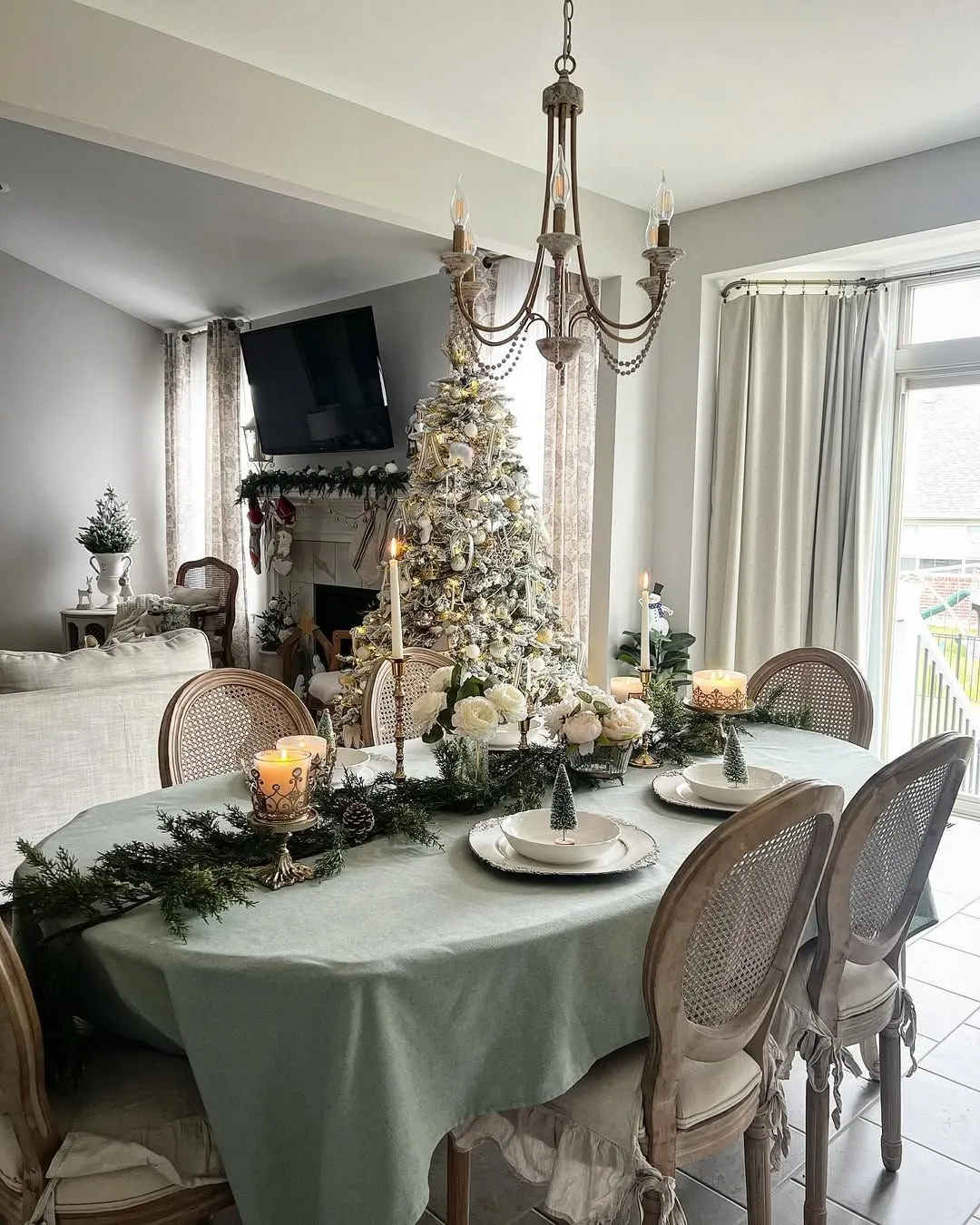
Two things to watch. First, candle drips on a pale cloth are the most visible kind, so buy dripless tapers or put a saucer under every holder. Second, a continuous garland plus a tablecloth plus bottle brush trees plus flowers adds up in dimensions fast; measure your chairs’ pull-out distance before you commit, or the first guest to sit down will be wearing your centerpiece. And if anyone at the table has allergies, fresh greenery in a warm room can be a sneeze fest.
20. A Grand Gold and Silver Tree Anchoring the Dining Room
- Seven-to-nine-foot tree with gold and silver ornaments, 150+ pieces: $350–$1,200
- Heavy floor-length drapes: $180–$700
- Pre-lit warm LED string lights: $40–$120
- Garland for the armchair and mantel: $35–$90
- Tree skirt or collar: $30–$120
- Total: roughly $635–$2,230

Budget alternative: reuse a tree you own, buy ornaments after Christmas at 70% off, and shop Marketplace in November for secondhand trees. Warm-white lights in bulk plus one metallic color gets you the same look for about $120.
The oversized tree has basically replaced the feature wall as the thing that makes a dining room feel decorated. What’s changed by 2026 is the palette — gold and silver together with no red at all, which lets a tree sit in a formal room without fighting the furniture. Warm white lights have won out over cool white. Both choices make the room feel calmer at night and are easy to repeat year after year without repainting anything.
21. Moss Deer, Nutcrackers, and Red Conical Trees
The moss deer. It’s the only texture in this tablescape that isn’t smooth, shiny, or leafy — and that fuzzy, green, slightly odd finish is exactly why the whole arrangement feels collected instead of bought. Everything else, from the red and dark green conical trees to the berries, holiday motif plates, and nutcrackers, is doing traditional work. The deer is the one object with a personality. If you own nothing else on this list, one moss-covered figure from a craft store at $12 will change the tone of a table.
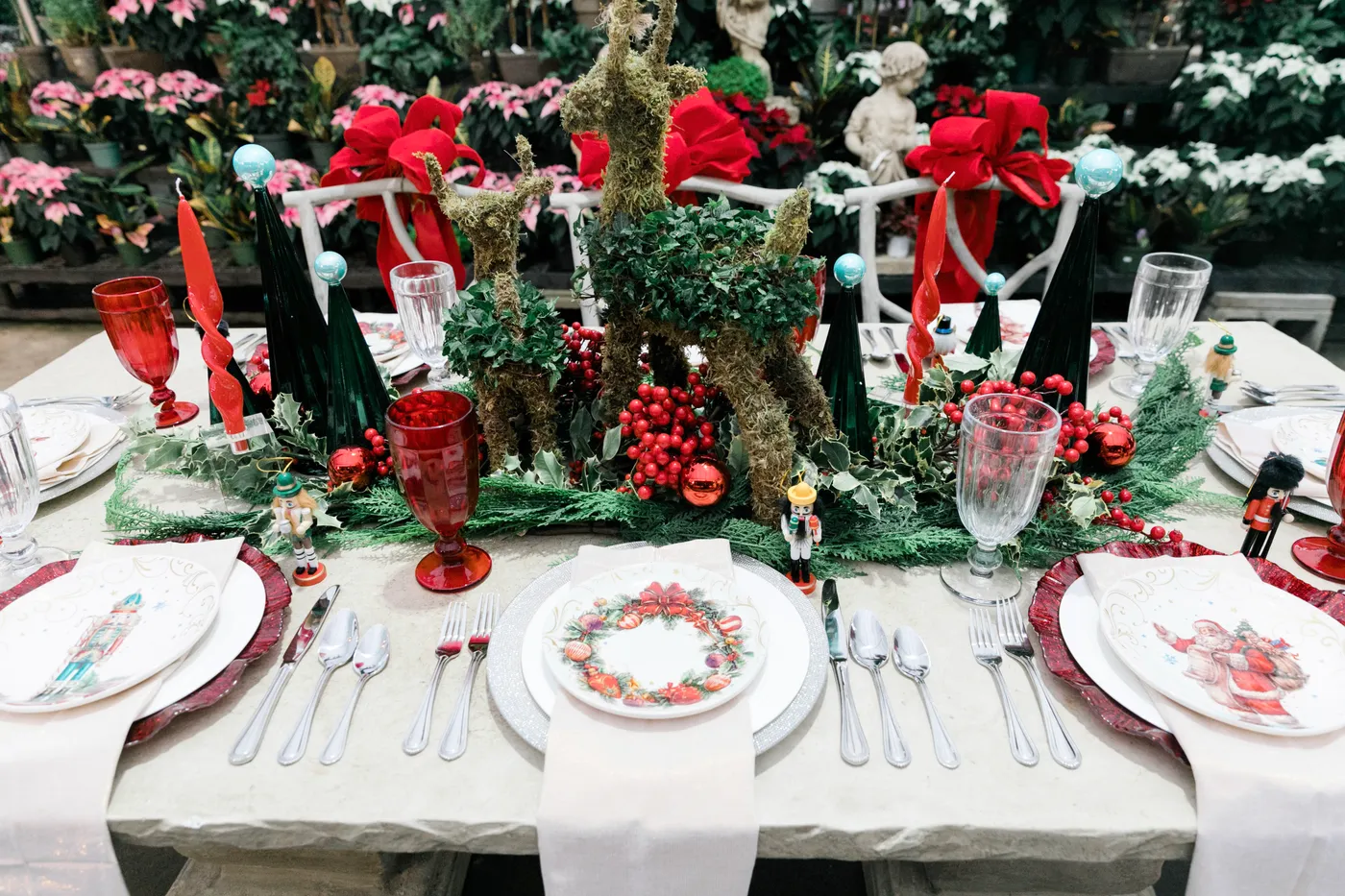
- Count your seats before you buy — one nutcracker per setting adds up fast, and mixed sizes look better than identical ones
- Check that your motif plates are food-safe if you actually plan to serve on them
- Measure the space between the conical trees: at 10 to 14 inches tall they’ll block conversation if they’re packed in
- Decide whether red or silver chargers work with your everyday dishes
- Budget minimum: about $80 for greenery, berries, trees, and a couple of figures; plates are extra
22. Rustic Wooden Tray Centerpiece on a Round Dark Table
A tray is the smartest container choice for a round dining table, and here’s why: it gives an irregular, organic arrangement a hard rectangular edge, which keeps it from smearing into a circle. The white pillar and votive candles in clear glass sit inside that edge, the greenery and berries spill slightly over, and the gold-rimmed plates repeat the gold flatware at each seat. Nothing here is expensive. It just looks intentional because the tray decides where the centerpiece begins and ends.
Wooden trays are one of the best thrift-store buys there is — $4 to $12 at Goodwill, and Marketplace always has a stack. Greenery from a supermarket bunch is $8 to $12, red berry sprays are $5, and clear glass votive holders are $1 to $2 each at dollar stores. White plates with gold rims run $5 to $8 each at Target. A table for six lands around $75 without the dishes. Want the same shape with less upkeep? Use two candles and one hurricane lamp in the middle.
23. Gold-Painted Pinecones and Three Golden Tapers
Spray-painting pinecones gold is the best return on $6 in holiday decorating. Work outdoors or in a garage on newspaper, hit the tips first at a low angle, and let them dry a full 24 hours before they touch anything. Use three taper candles — not two, not four. An odd number reads as designed, an even number reads as symmetrical, and symmetry is what makes a centerpiece look like it came out of a box. Set the tallest candle in the center and step down by an inch on each side.
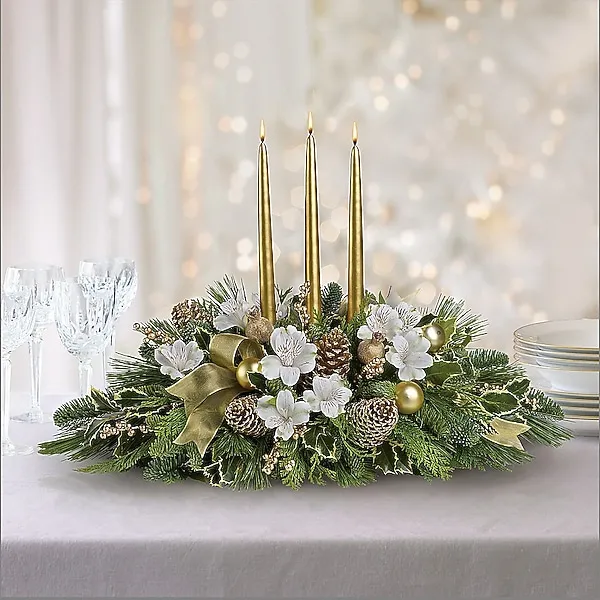
Spray-painted pinecones shed gold flakes onto white tablecloths for weeks and there’s no way around it — use a runner or a tray underneath. Gold-painted anything also collects dust visibly, so plan on dusting before each dinner. And if you’re mixing fresh evergreen with white flowers, know that roses and pine in the same water isn’t ideal; keep the flowers in their own small vessels tucked into the greenery. More work to set up, much easier to refresh.
24. Repeat Centerpieces in Dark Green Square Vases
Repetition only works on a long table — 96 inches or more, ideally 40 inches wide. Three identical arrangements spaced evenly at 30-inch intervals give you a rhythm one long runner can’t. On anything shorter, three vases start looking like a clogged aisle, so drop to two and place them at the one-third and two-thirds points. Tall-ceilinged rooms with a long table can handle a fourth. For a smaller footprint with the same floral idea, see Idea #27.
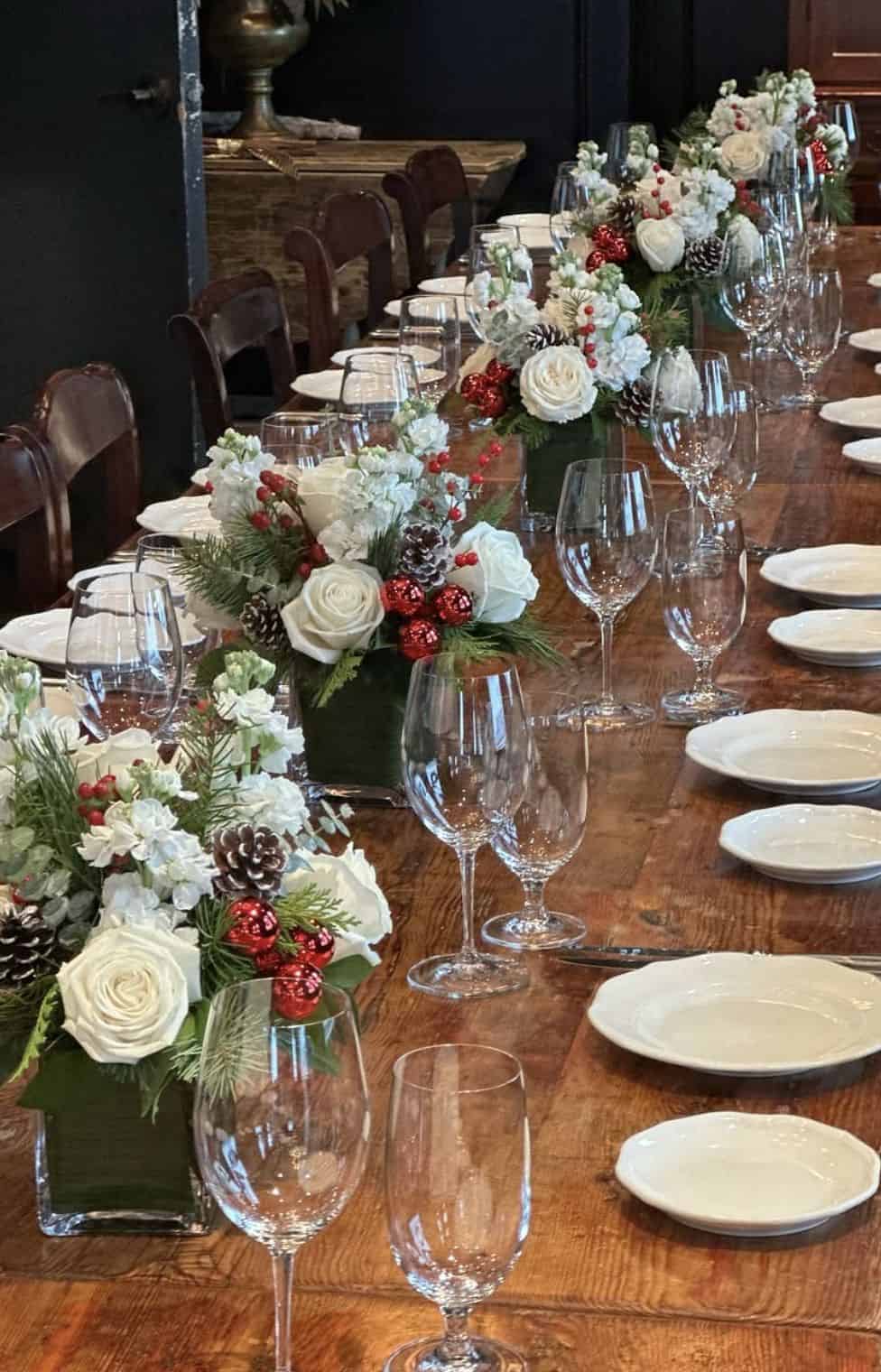
- Buy three matching dark green square vases, five to six inches tall — matching containers are the entire trick.
- Soak floral foam and cut it to sit just below each vase rim.
- Place evergreen sprigs first, angled outward, until the foam disappears.
- Add three white roses per vase at slightly different heights, then tuck in berries and pinecones.
- Set them 30 inches apart and rotate each one so no two look identical.
Time: about 20 minutes per vase. Materials: $25–$45 per arrangement.
25. Red and Green Plaid with a Scalloped Holly Placemat
This is maximalism with rules: roughly 40% red-and-green plaid, 30% white from the wreath plates and scalloped placemat, 20% gold from the crackers and glitter, and 10% forest green from the embroidery and greenery. The plaid does the loud work so everything else can stay simple. Swap the plaid cloth for a plain red one and you keep the layers but lose the personality; swap it for a green-and-white check and you get a quieter, more modern version of the exact same setting with no other changes.
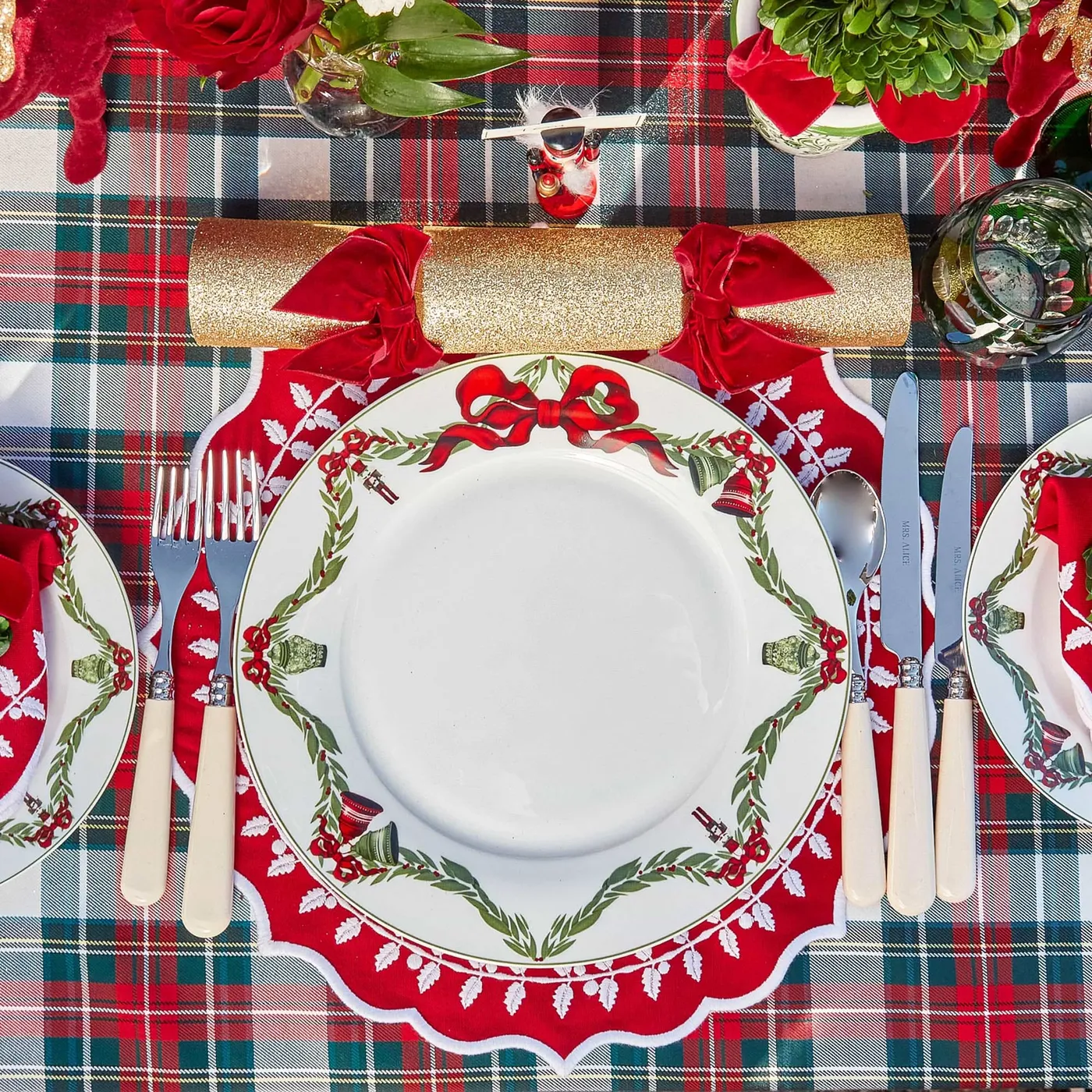
A plaid tablecloth is going to see gravy, wine, and candle wax, and the greens and reds hide stains better than you’d expect — but glitter is another story. Glitter from crackers and ornaments gets into everything, including your washing machine, and it doesn’t come out. Shake crackers over the table, not the floor, and keep them away from anything you plan to hand-wash. Scalloped placemats should be spot-cleaned, not machine washed, or the embroidery puckers permanently.
26. Yuletide Centerpiece for the Kitchen Counter
- Large footed bowl or compote: $18–$60
- Evergreen clippings and eucalyptus: $15–$40
- Fruit — clementines, pears, or apples: $8–$15
- Two or three pillar candles: $12–$30
- Ribbon and a single berried sprig: $6–$18
- Total: roughly $59–$163
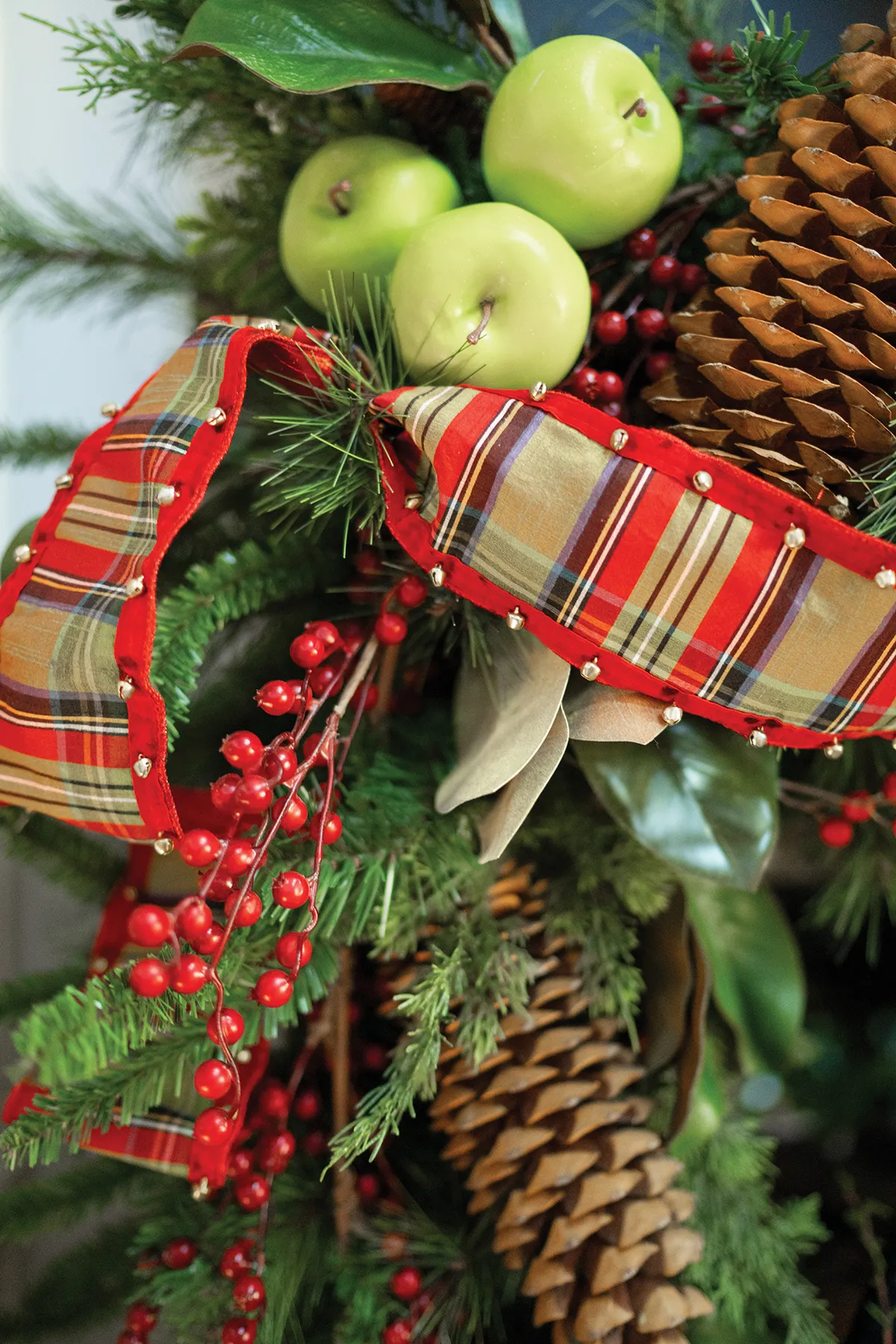
Budget alternative: use a mixing bowl you already own, skip the ribbon, and shop the produce aisle — this is one of the few centerpieces where the fruit is genuinely part of the design and costs less than flowers would.
Kitchen counters need a centerpiece that doesn’t fight for space, so keep it under 14 inches wide and 10 inches tall — anything bigger and you’ll move it every time you cook. Build it on a rimmed tray so you can lift the whole thing out of the way in one motion. Use fruit with some shelf life too: clementines and pears look generous for a week, while anything soft starts bruising by day three. Refresh the greenery mid-month and it carries you through New Year.
27. Red Roses, Hydrangea, and a Square Glass Votive
The square glass votive in the middle. Round arrangements with round candles look soft; that single square edge gives the composition a bit of structure and tells your eye where the center is. It also costs about $2. Everything around it — the red and white roses, light green hydrangea, red berries, pinecones, and mixed greens — could drift in any direction without it. Leave the votive out and you have a nice bouquet lying on a runner. Put it in and you have a centerpiece.
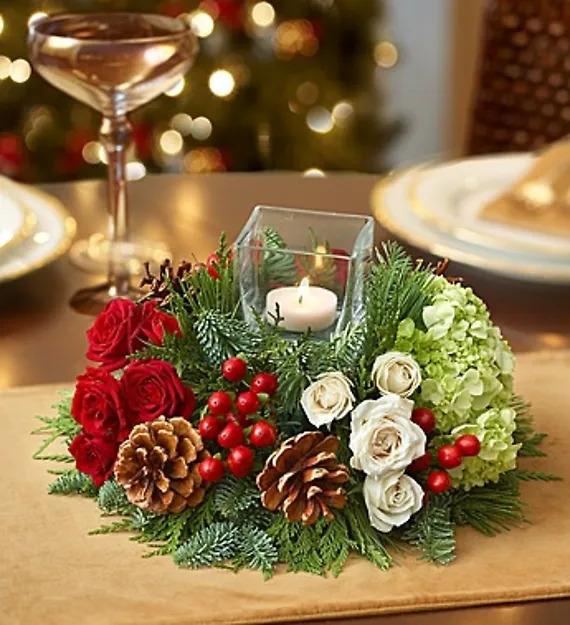
The percentages here are greener than they look at first glance: about 50% mixed forest greens, 20% red from roses and berries, 20% white and light green blooms, and 10% natural brown from pinecones and the golden-brown runner. The light green hydrangea is the sneaky part — it bridges white roses and dark foliage so there’s no hard jump between them. Swap hydrangea for seeded eucalyptus and the palette cools; swap red roses for peach and it turns into a spring table.
28. Silver Urn, Red Roses, and Frosted Pine on Deep Green
A polished silver urn needs polishing, and most people underestimate that job — expect 20 minutes with a cloth before every dinner if you want it bright. The upside: silver is the easiest metal to find secondhand, usually $15 to $40 at estate sales and thrift stores. Frosted pine branches drop white flecks onto a dark green cloth, and red taper candles drip onto whatever sits below. If you’re hosting a big group, set this look up the afternoon of, not a week ahead.
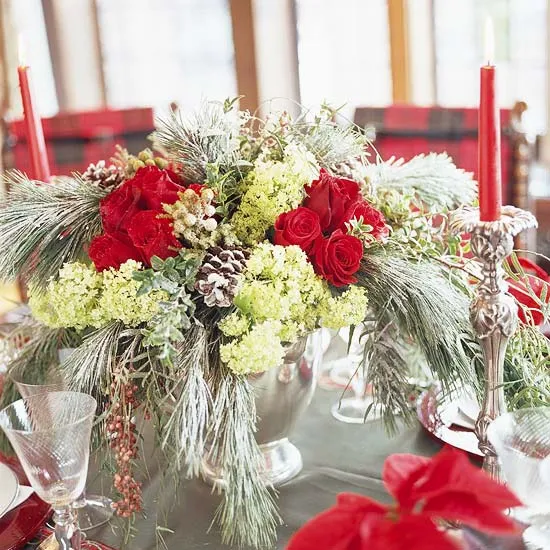
Contrast does almost all the work here: silver against deep green, deep red against lime green, frosted white against dark foliage. There’s no neutral on the table at all, and that’s why it reads as rich instead of busy — every element is either metallic or saturated, so nothing looks like filler. The ornate silver candlesticks echo the urn and hold the red tapers at twice the height of the flowers, giving the arrangement two clear tiers. Compare with Idea #6, where the same red-and-green logic goes into a clear glass hurricane.
29. Twine-Tied Napkins and a Snowy Window Backdrop
The best thing about this table is that the scenery is free. A snowy view through a window does more for a centerpiece than any ornament you could buy, so if you have one, use it — set the table with the window behind the candles and let the blue-gray light do the styling. Otherwise: evergreen clippings from a supermarket bunch ($10), a bag of pinecones ($6), mismatched glass candle holders from a thrift store ($2 to $4 each), and plain white plates and napkins you already own. Under $50 total.
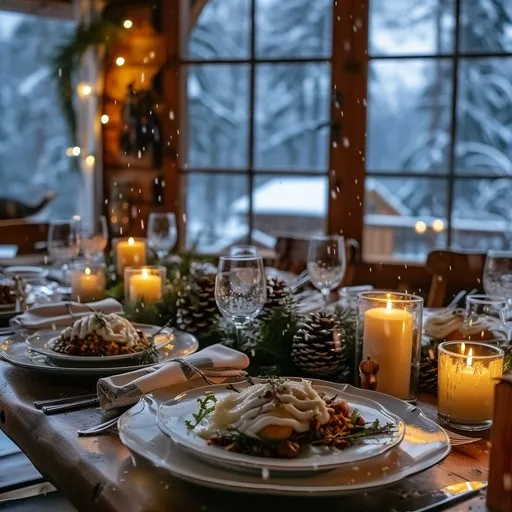
- Line the table with a rough evergreen branch base and let it look a little unkempt.
- Push pinecones into the greens at different depths, never in a row.
- Group candles in glass holders of three different heights, all within a 30-inch span.
- Roll white linen napkins, tie each with kitchen twine, and skip the name tags.
- Set glasses and plates the night before so morning light lands on the arrangement — this table is about daylight.
Time: about 25 minutes. Materials: $40–$70.
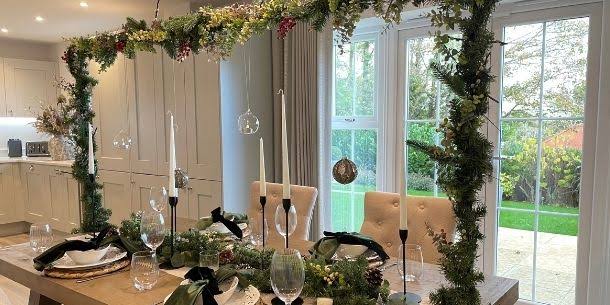
30. Hanging Wicker Ring Wreath Above a Candlelit Table
A hanging ring works when you have vertical room to spare. You want at least 30 inches of clear space between the tabletop and the bottom of the wreath, which means a nine-foot ceiling is comfortable and an eight-foot ceiling is tight but doable if you keep the ring under 20 inches across. It’s best over a table 72 inches or longer, and it should hang centered on the table, not the room. Under an eight-foot ceiling, skip the hanging and lay the ring flat as in Idea #12.
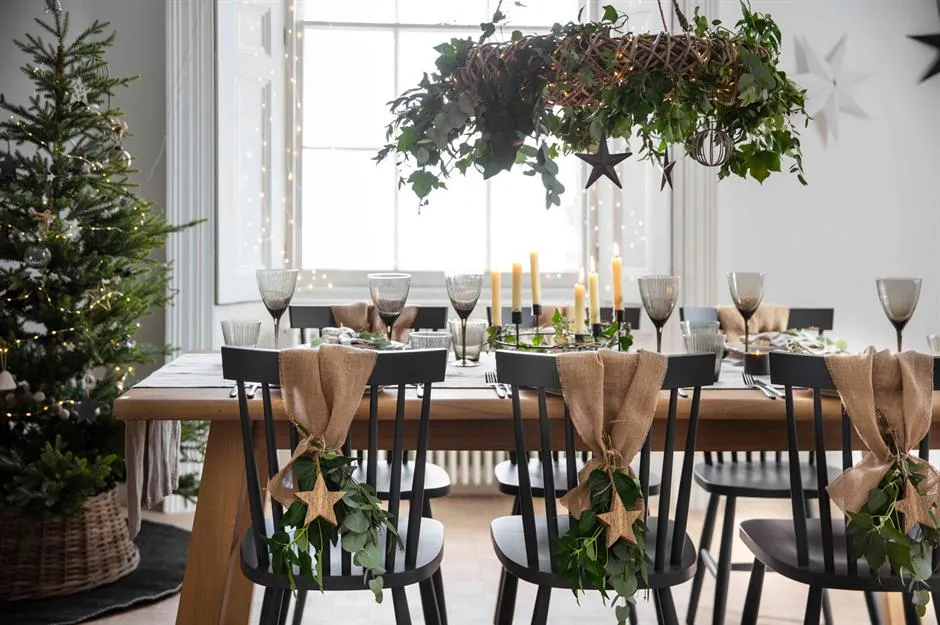
Hanging wreaths over dining tables started as a wedding-reception detail and moved into homes because people wanted a centerpiece that takes up zero table space — genuinely useful when you’re serving family-style. The burlap bows on the chair backs and wooden star ornaments push this one rustic, but the concept works in any style: a brass ring with eucalyptus reads modern, a grapevine ring with dried florals reads farmhouse. It’ll stick around because the practical argument is real.
31. IKEA Vinterfint Reds for a $30 Centerpiece
- Red bowl or platter from a budget holiday collection: $8–$15
- Red and white ornaments, set of 12: $8–$12
- Faux greenery stems: $6–$12
- Two red or white candles: $4–$8
- Ribbon or a small figure: $3–$6
- Total: roughly $29–$53
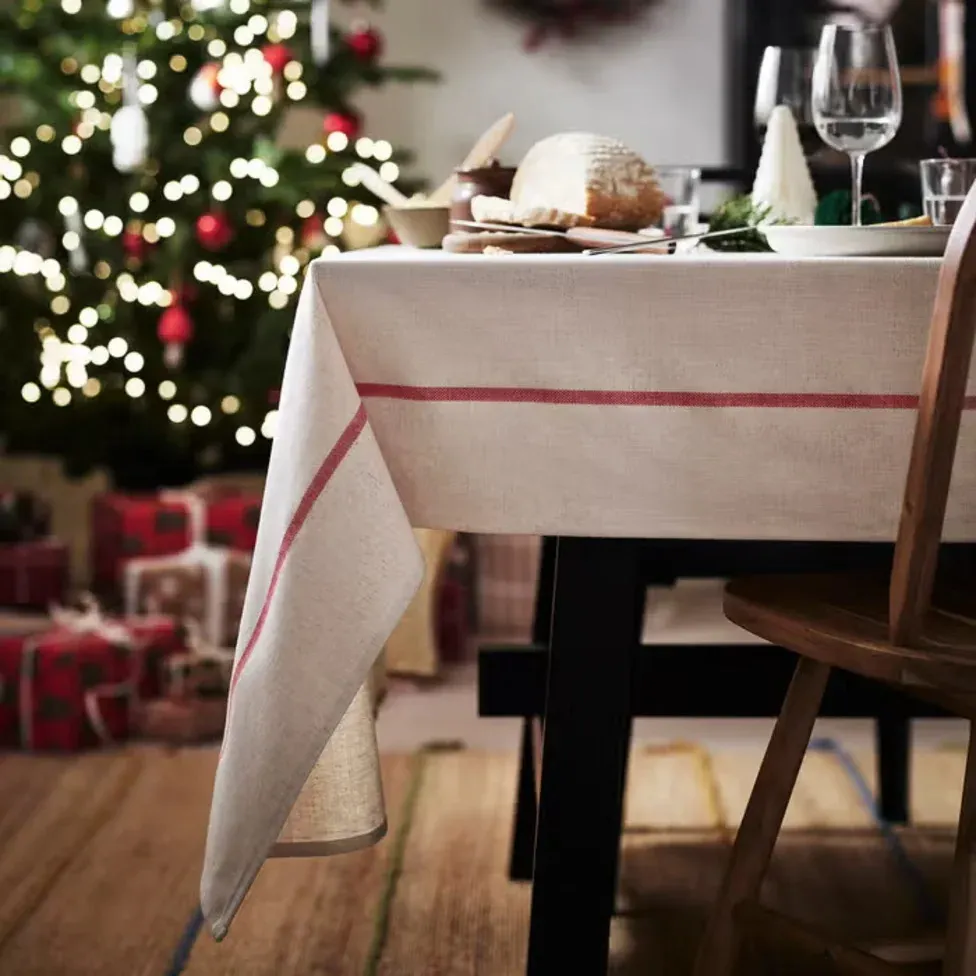
Budget alternative: this is already the budget version — the trick is buying the red pieces as a set so nothing looks mismatched, then adding one thing you already own, like a wooden board or a glass jar, to break up the newness.
Budget holiday collections sell out by the second week of December, so buy the red pieces early and buy them together — matched reds across a centerpiece look far more expensive than mixed reds do. Stack objects in threes: one tall, one medium, one small, all in the same shade. And if everything is flat matte red, add a single glossy element, a glass bowl or a shiny ornament, so the arrangement has at least one highlight to catch candlelight.
32. An All-White Modern Centerpiece in a Single Vessel
- Confirm your dining room isn’t already all-white — a white centerpiece on a white table disappears, so add a wood or charcoal runner first
- Choose one vessel, not three: modern white lives or dies on a single strong shape
- Test white flowers under your actual evening lighting, which pulls them toward cream or toward gray
- Decide on one non-white accent — greenery, brass, or a matte black base — and use only that
- Budget minimum: about $35 for a vessel plus flowers or white faux branches
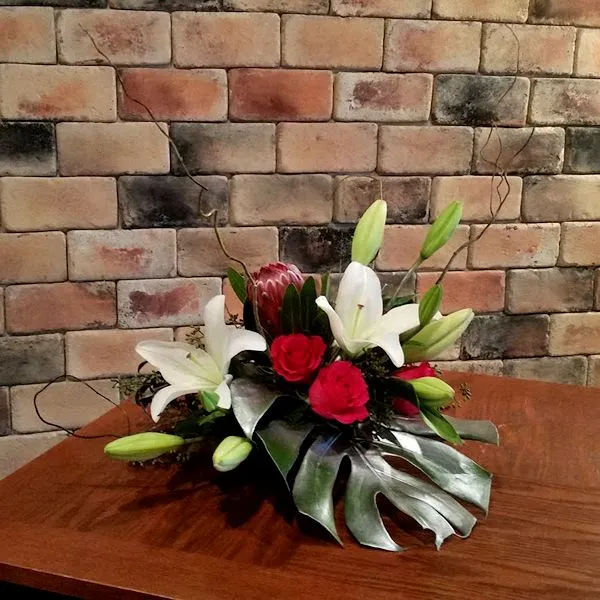
Minimalism at a dining table isn’t about having less; it’s about having one thing that’s unmistakably the point. A single white vessel with white blooms and branches forces the eye to read shape instead of color: the curve of the vessel, the height of the stems, the negative space around them. It also solves the problem every maximalist table creates — nobody has to see over a pile of greenery. Keep it under 12 inches tall so conversation stays open.
Set the Table, Then Go Sit Down
Here’s the thing nobody says out loud: the centerpiece doesn’t have to be perfect, it just has to be lit. Pick one idea from this list, use what you already own, and let the candles do the heavy lifting — a table that smells like pine and looks like somebody cared beats a showroom arrangement every single time. Start with the container, add greenery, then add light, and stop when it feels good.
If you try one of these, snap a photo before the food lands. And pin the ones you’re saving for next December — future you will be very grateful in the last week of November.