31 Stunning Christmas Garland DIY Ideas That Will Transform Your Home for 2026

You know that feeling when you finally find the garland photo that looks exactly right for your mantel — and then you realize it’s a $400 custom job? That’s the moment this guide was built for.
We spent serious time browsing Target, Walmart, and Etsy (plus more than a few thrift-store runs) to bring you only what’s worth your attention this year. Everything here lands between $12 and $260, whether you’re hot-gluing pinecones onto a vine base or buying a pre-lit nine-footer and calling it done.
Inside you’ll find 31 garland ideas covering rustic natural, traditional red-and-green, frosted minimal, and handmade felt — with budget and luxury versions compared side by side, and every idea broken down so it’s actually shoppable. And stay until the end — we break down the most common mistakes that can ruin these looks.
Garland has shifted in 2026: less tinsel, more texture. Frosted cedar, dried citrus, layered ribbons, and mixed-finish baubles are what people keep pinning, and most of it comes together in a single afternoon.
Save this post now — you’ll want it when you’re ready to shop. 📌 Save this to Pinterest for later — you’ll want to revisit these ideas.
1. Dried Oranges and Navy Velvet on a Whitewashed Brick Mantel
The trick here isn’t the greenery — it’s the temperature clash. Dried orange slices throw warm amber; the deep blue velvet ribbon answers with cold contrast, so the whole mantel reads rich instead of busy. Whitewashed brick stays quiet and lets those two colors argue in peace. Three textures carry it: matte citrus, glossy velvet, chunky knit stockings. Any two of those would look perfectly nice. All three look designed.
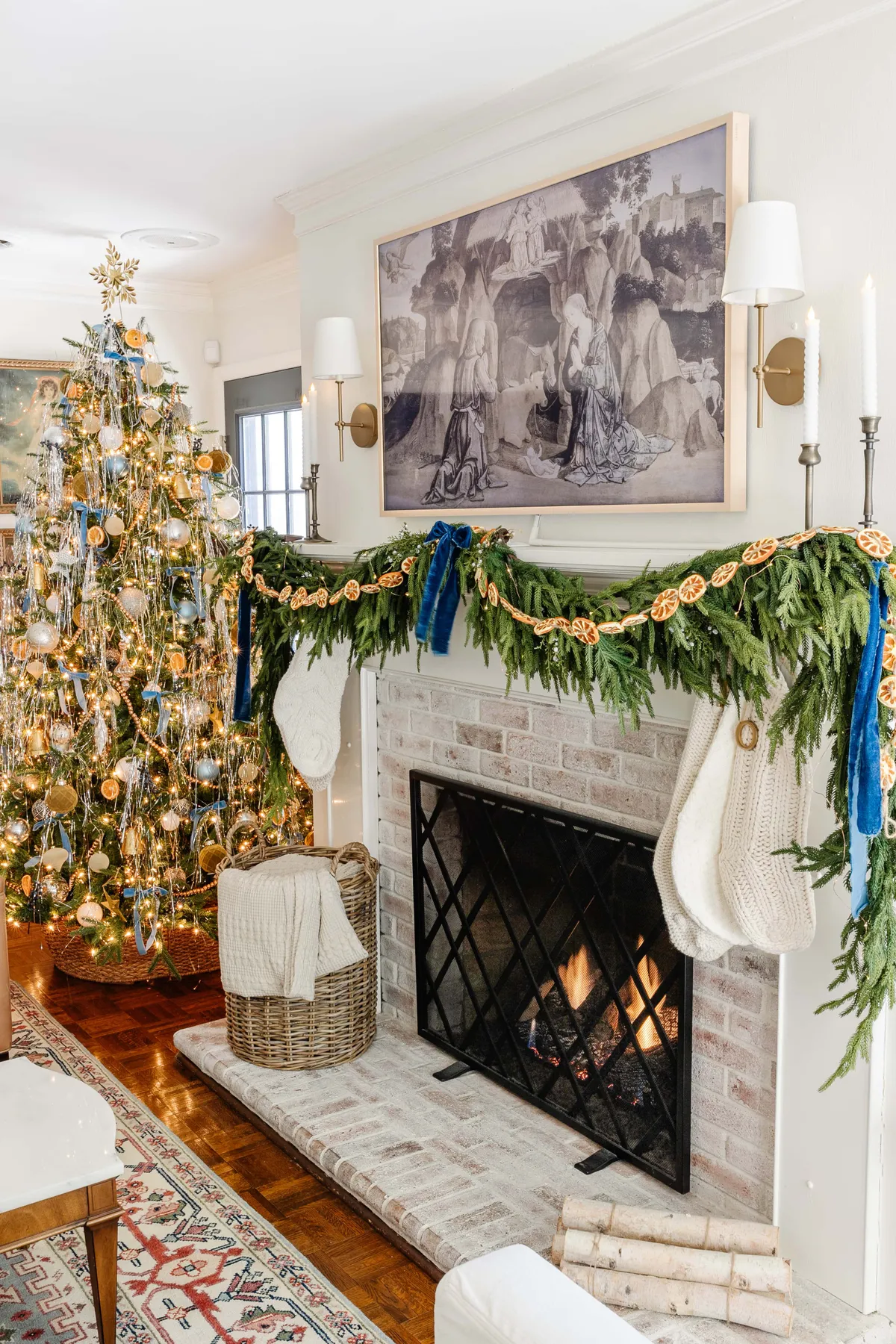
- Full faux pine garland (9 ft): $40–$90
- Warm white string lights (100 ct): $12–$25
- Dried orange slices (30-pack): $15–$28
- Deep blue velvet ribbon (2 rolls, 2 in): $18–$35
- Chunky knit white stockings (2): $30–$70
- White berry filler sprigs: $10–$20
Total: $125–$268
Budget alternative: swap velvet for 2-inch navy satin from a craft store and dry your own oranges in a 200°F oven overnight — that version lands around $70.
2. Red Gingham and Gingerbread Men Against White Paneling
The gingerbread men. Pull them off and you still have a perfectly pretty orange-and-gingham garland, the kind that shows up in every roundup. The cookies are the unserious element — flat brown cutouts with slightly crooked expressions — and they give the wall permission to be fun instead of formal. The white vertical paneling does the second job: it turns the garland into one crisp horizontal stroke instead of a green blur.
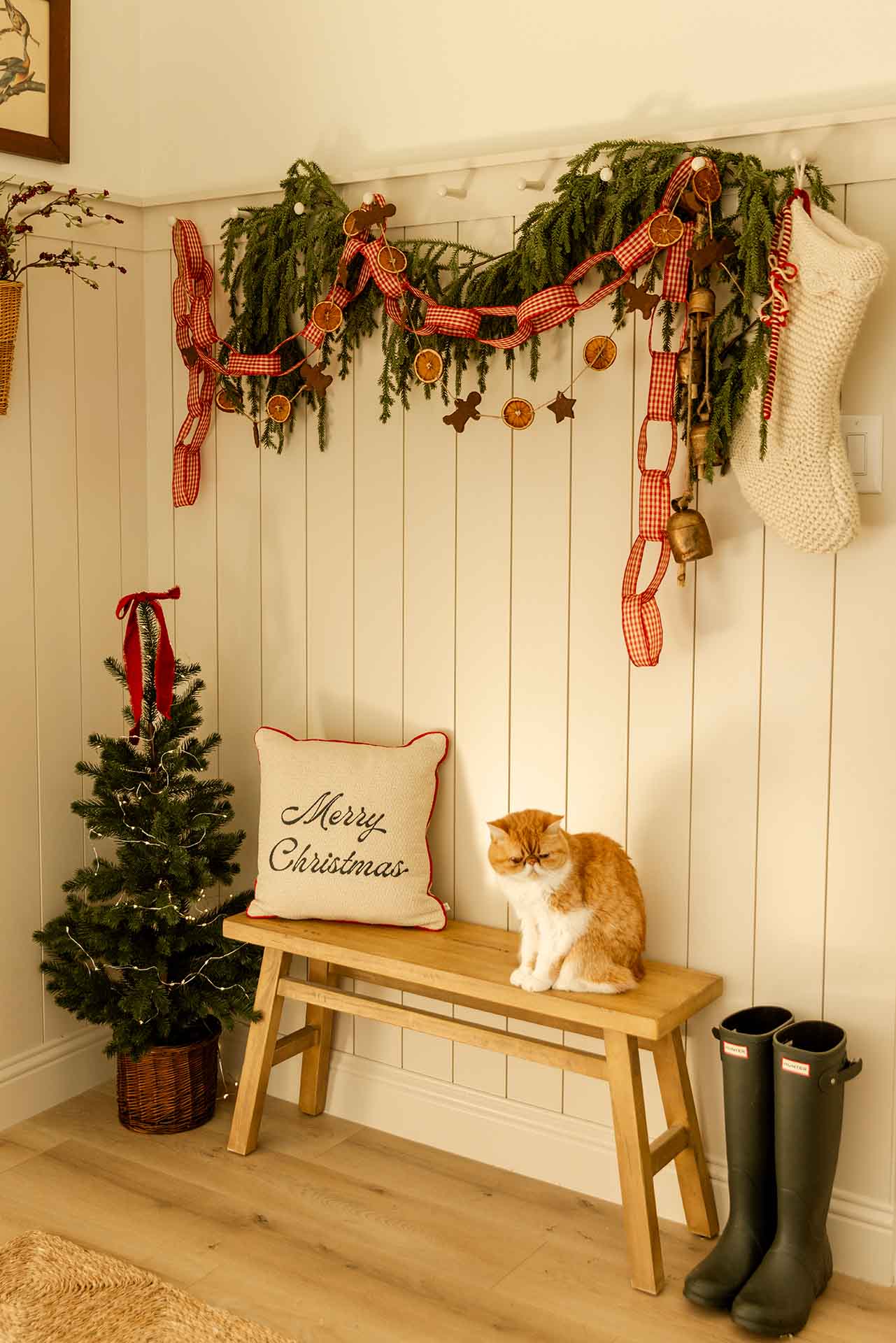
Felt gingerbread men come four to a pack at Dollar Tree for about $1.25, and a roll of red gingham ribbon at Walmart runs $3–$4. Dry your own orange slices — three navel oranges, sliced a quarter-inch thick, three hours at 200°F — and you’ve saved roughly $40 over a pre-made kit. The natural wood bench is the one piece worth buying new; Facebook Marketplace has them constantly for under $60.
3. Evergreen Swags Over Gray-Green Double Doors, Wreaths Above
When you swag a banister, don’t weave the garland through the balusters — zip-tie it to the outside face of the railing, on the side your hand doesn’t touch. You get a cleaner line, nothing rattles when someone uses the stairs, and it comes down in five minutes in January. Anchor every 18 inches and let each swag drop 10 to 12 inches between anchors; anything deeper turns into a curtain.
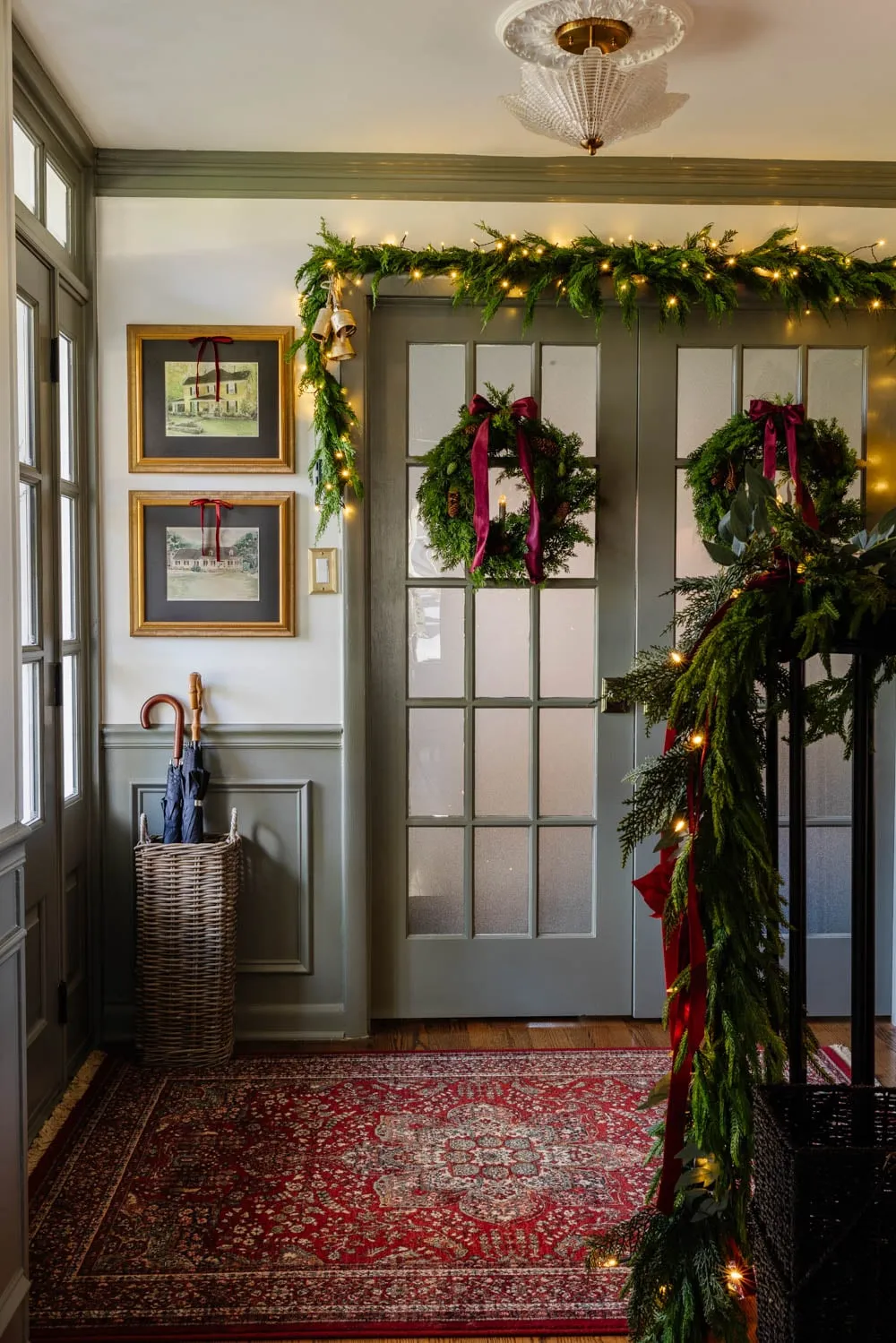
This one needs a doorway, not a wall. Double doors 60 to 72 inches wide want a 9-foot garland plus two wreaths at 22–24 inches across. Ceiling height matters too: clear 9 feet and you can hang wreaths at 66 inches on center with breathing room to spare. Working with a standard 8-foot wall? Skip ahead to Idea #30, which was built for exactly that.
4. Lit Garlands Wrapped Around White Columns and a Red Door
The formula on the porch is roughly 70% evergreen, 20% ornament, 10% white architecture. Red and silver mix at about a 2:1 ratio so the silver reads as sparkle rather than a second color, and the white columns stay bare so the garland has something to contrast against. Swap red for copper and silver for brass and the same math works on a dark house without changing anything else.
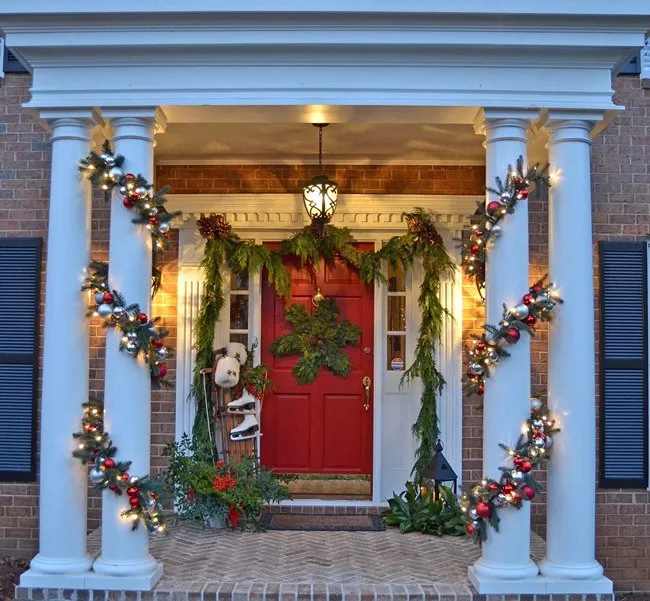
Outdoor garland takes a beating. Sun fades ribbons by February, rain rusts cheap wire, and a garland that looks full three feet away reads thin from the sidewalk. Look for UV-treated faux pine and already-coated wire. You’ll also want a GFCI outlet within reach — daisy-chaining extension cords across a porch is how you end up resetting a breaker on Christmas Eve.
5. A Bauble-Packed Garland in Magenta, Teal, and Gold
Density is doing the heavy lifting. The needles barely show through, which means every glance lands on a reflective ornament instead of a gap. The mix of smooth and faceted finishes matters just as much — the disco-ball pieces catch the fairy lights and throw tiny specular dots, which is what creates those soft bokeh circles in the background. One palette, three finishes: shiny, faceted, matte.
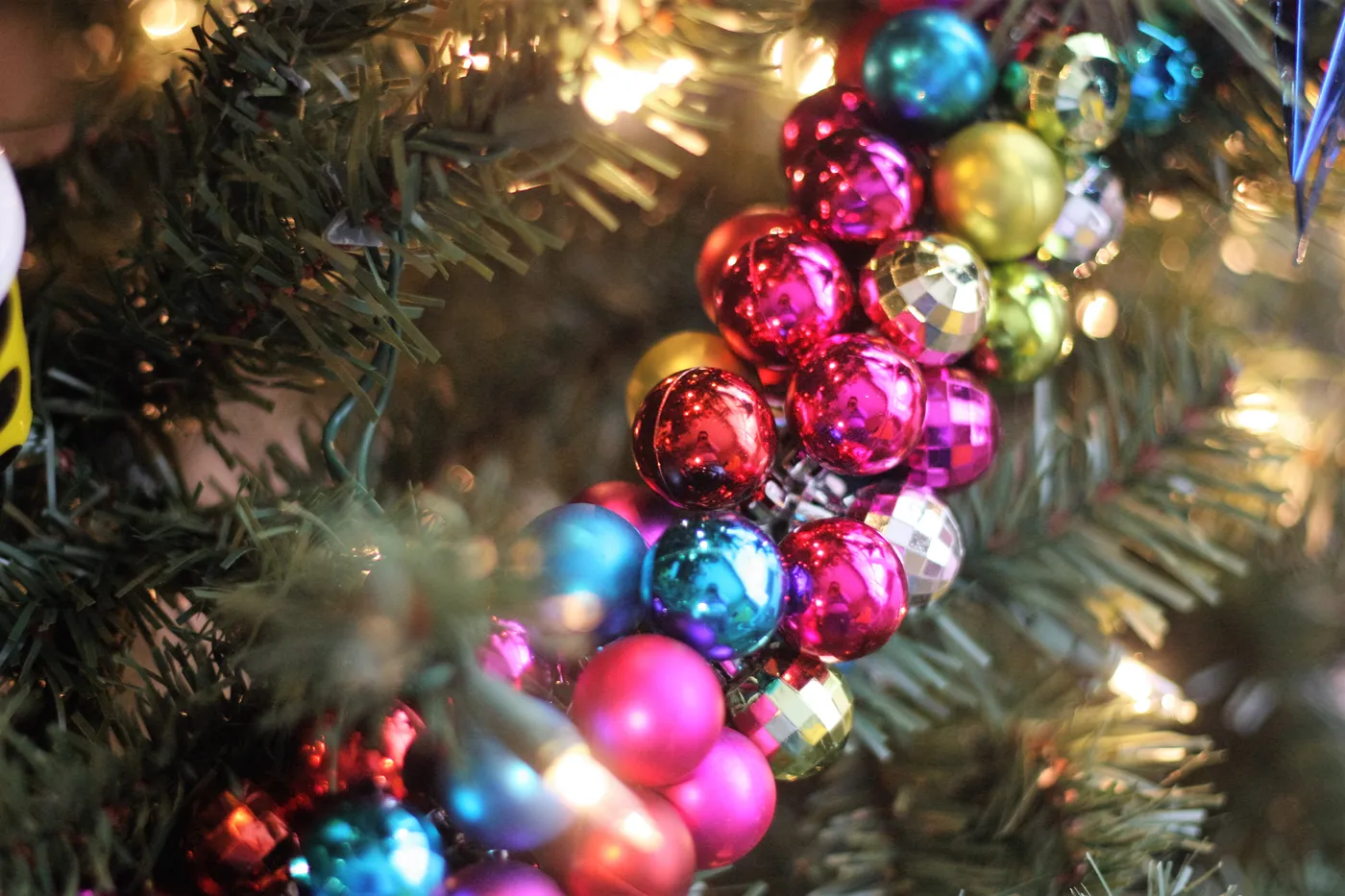
Ornament-dense garlands came back hard with the maximalist swing that’s been building for a few years, and by 2026 the pendulum is firmly on the more-is-more side. People got tired of sparse garlands that photograph like bare branches. The upside is forgiveness: you can keep adding baubles until it feels right, and nothing about it will look dated in three years.
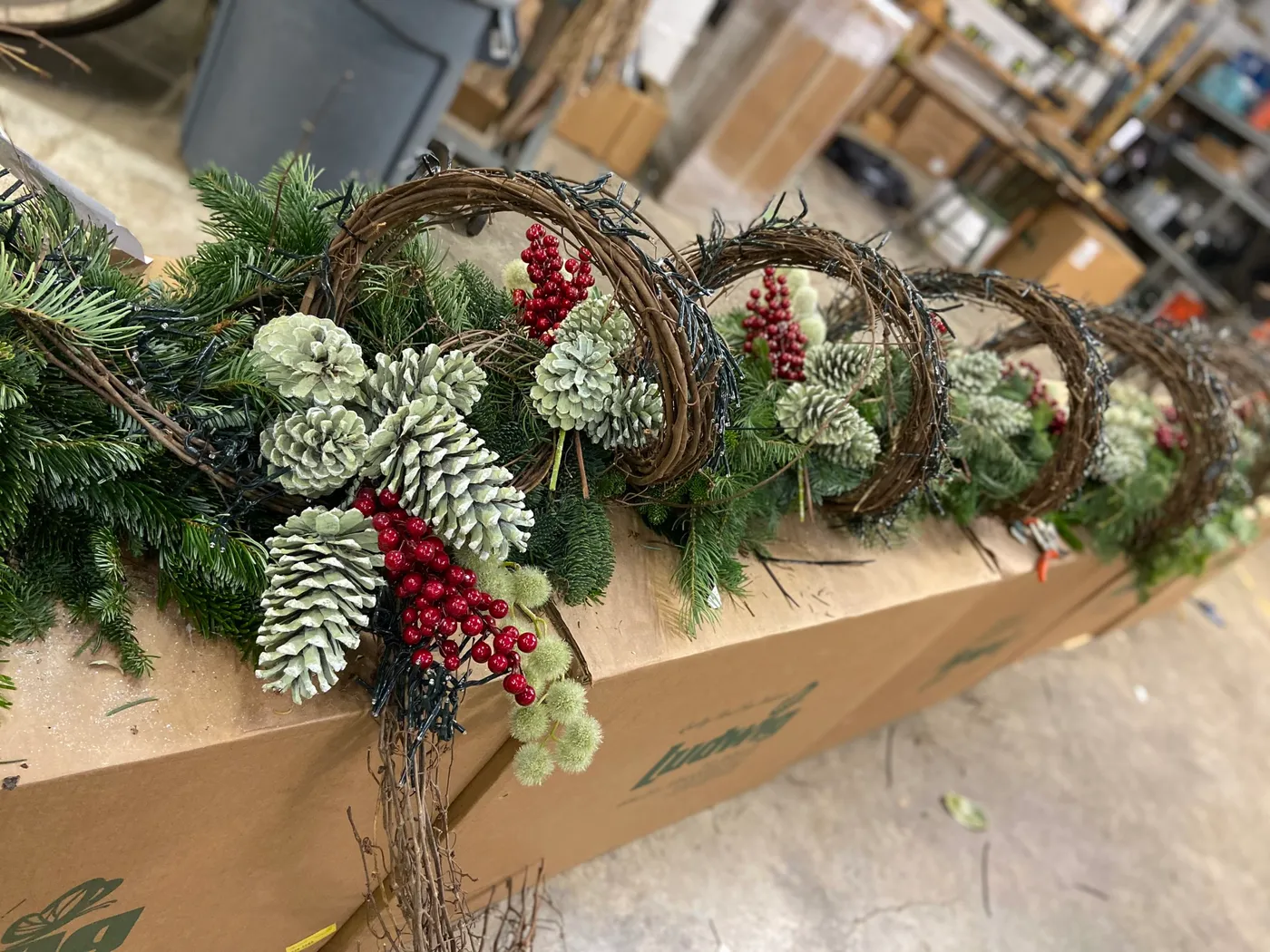
6. Vine-Base Garland with Frosted Sage Pinecones
- Lay the vine garland flat on the floor — decorating it upright is how things end up lopsided.
- Wrap the mini lights first, spacing them 4–5 inches apart and hiding the wire inside the vines.
- Hot-glue pinecones every 8–10 inches, alternating the direction they face.
- Wire berries in clusters of three, never as singles.
- Hang it, then fluff every branch outward — this takes longer than the decorating did.
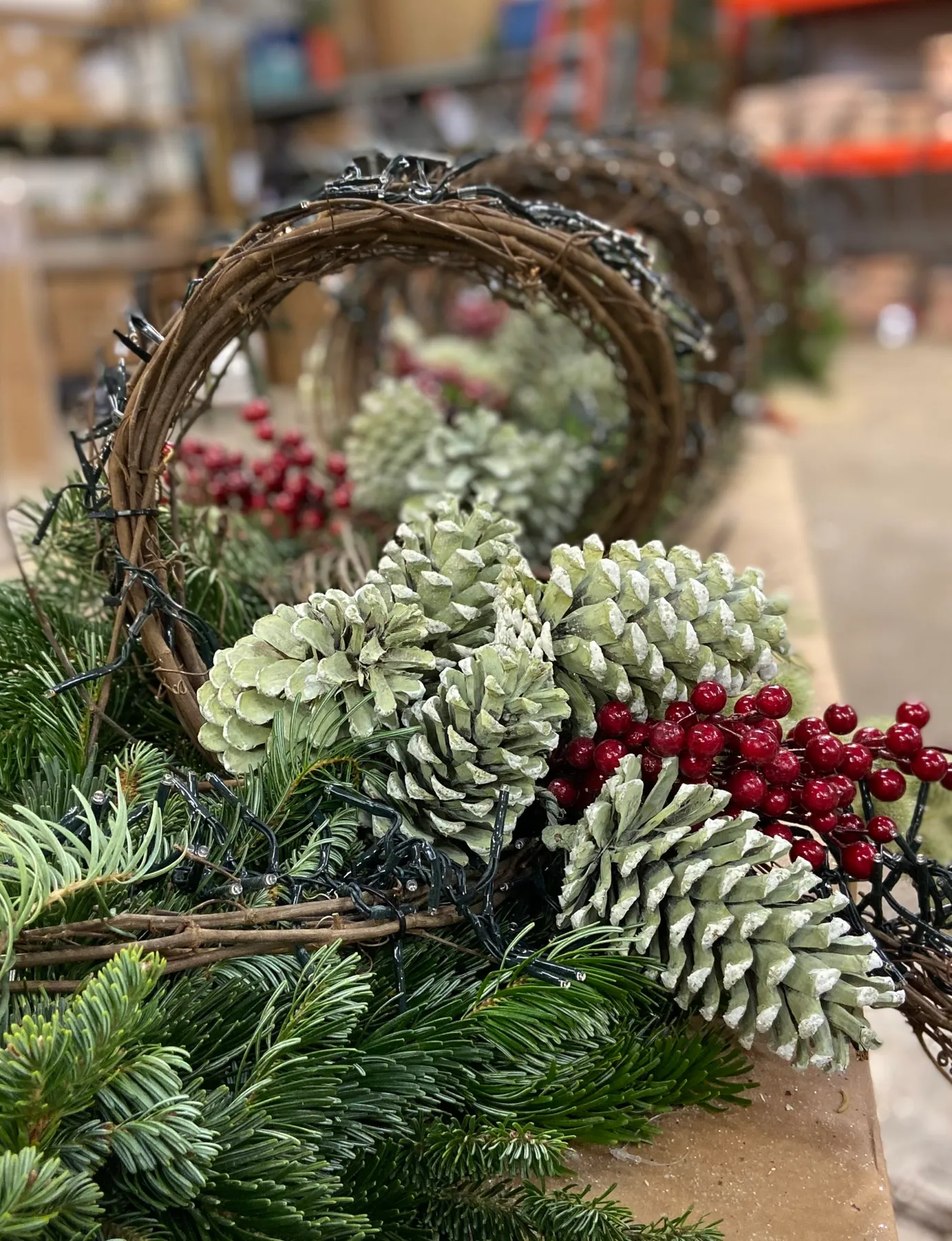
Time: 45 minutes. Materials: $25–$40.
Frosted pinecones shed. Every time you move this garland, expect a dusting of faux snow on the floor, so lay a sheet down before you hang it. Real berries rot and stain trim, so go faux unless it’s coming down in two weeks. Store it loose in a lidded bin rather than a garbage bag — crushed pinecones never fluff back. Budget about 20 minutes of reshaping each November.
7. The M-Drape: One Garland, Three Anchors, Beige Wall
The M-drape needs a wall 5 to 7 feet wide and a ceiling at least 8 feet high. Three anchors spaced evenly, with the middle one about 6 inches lower than the outer two — that’s what creates the swoop instead of a straight line. Narrower than 5 feet and the M collapses into a squiggle; wider than 7 and you’ll need a 12-foot garland to keep proportions honest. A hallway or a dining room side wall is the sweet spot. Same shape, different anchor: Idea #12 hangs its drape from the ceiling.
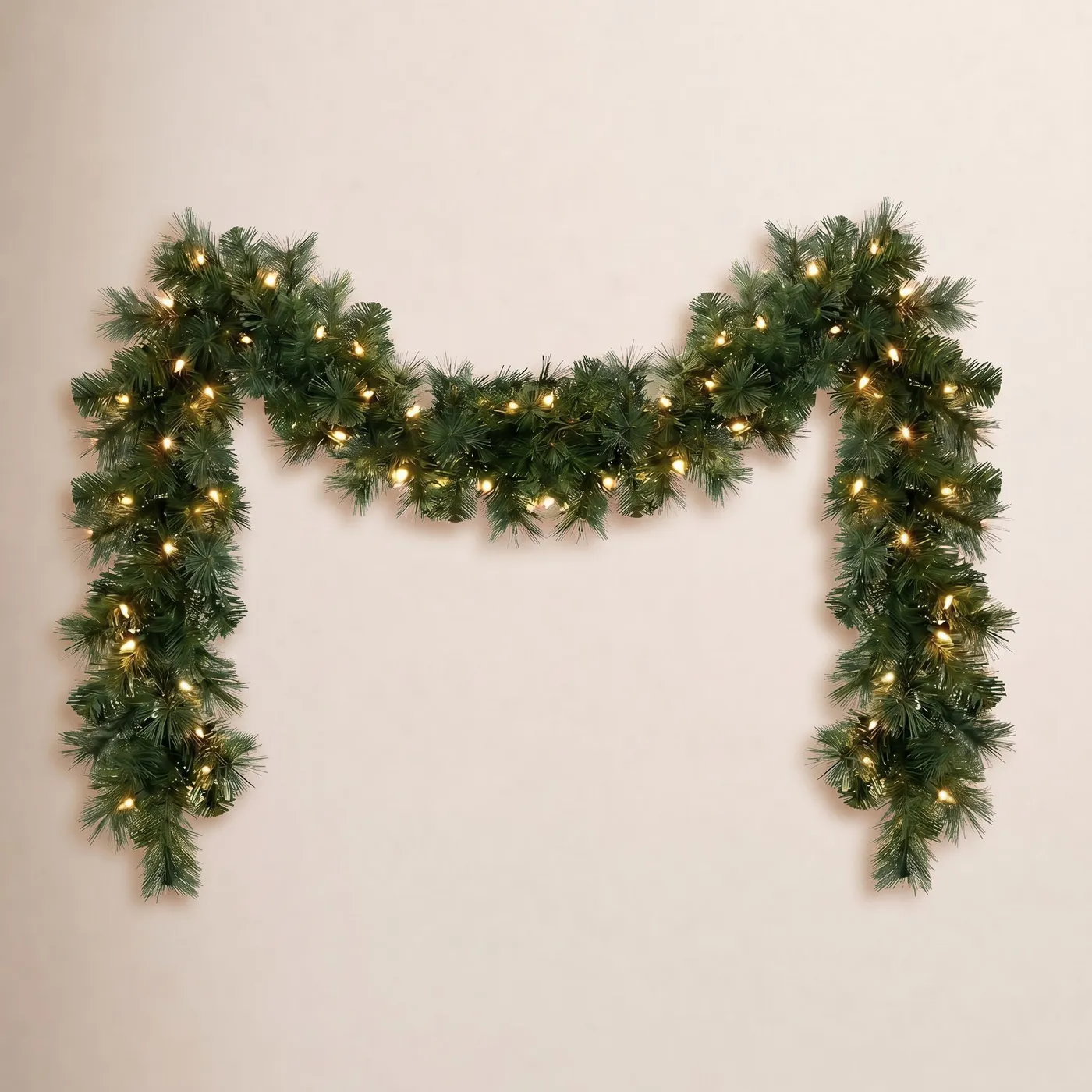
- 9 ft faux pine garland: $30–$60
- Warm white LED string lights (300 ct): $15–$28
- Adhesive hooks rated 3 lb+: $8–$14
- Plug-in light timer: $10–$18
Total: $63–$120
Budget alternative: an IKEA FEJKA garland plus a $6 set of battery LEDs from Target gets you the same M for under $40, and the battery pack hides behind the middle swag.
8. Lighted Village Houses Under a Lit Mantel Garland
The little lighted houses. They’re the only thing on this mantel that glows independently of the garland, and that matters — they repeat the warm white light at a second height, so your eye travels up and back instead of stopping at the greenery. Take them away and the mantel goes flat. Keep the garland to about a third of the mantel’s depth so the houses still have somewhere to sit.
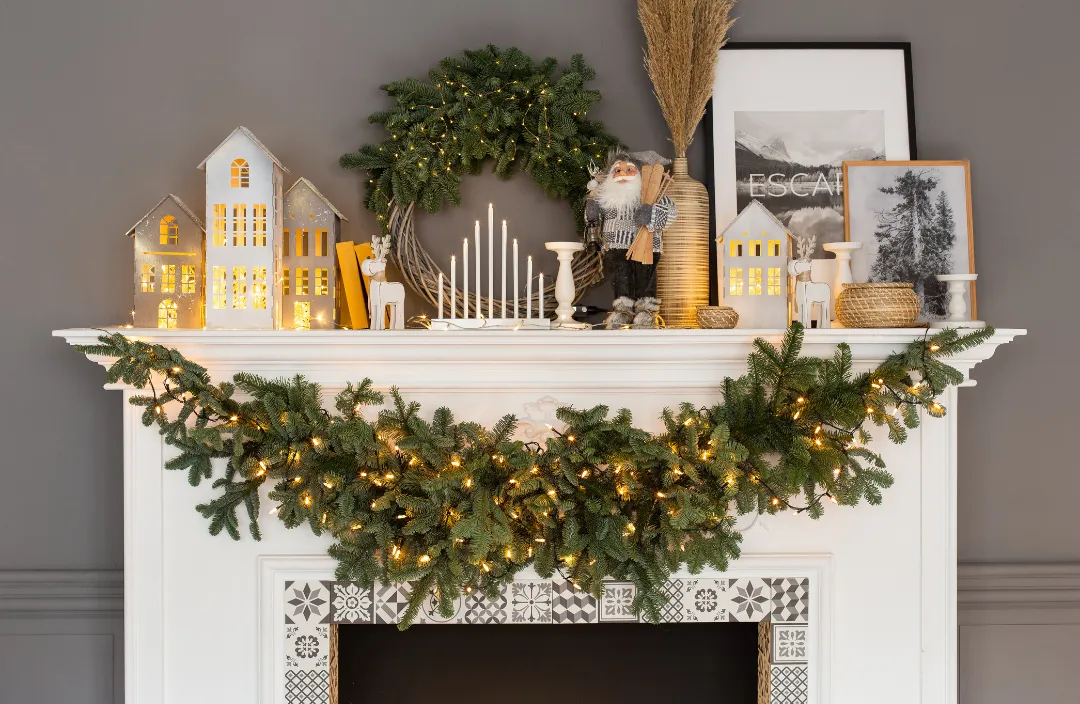
Style the mantel in odd-numbered clusters, not a row. Group the houses in threes at staggered heights — a stack of two books under one is enough — then leave an obvious gap before the next cluster. Gaps are what make a collected mantel read as curated rather than crowded. Three clusters on a 6-foot mantel, and keep the tallest item under 14 inches so it doesn’t fight the framed art.
9. Cream Knit Stockings and Red Tapers on White Brick
This is about 65% white and cream, 25% green, 10% red — and the red shows up in tiny doses, basically two taper candles. That restrained ratio is why a red-and-green Christmas reads calm here instead of loud. Swap the tapers for black and it turns modern instantly. Swap the cream stockings for charcoal knit and the whole fireplace goes moody without you touching the garland at all.
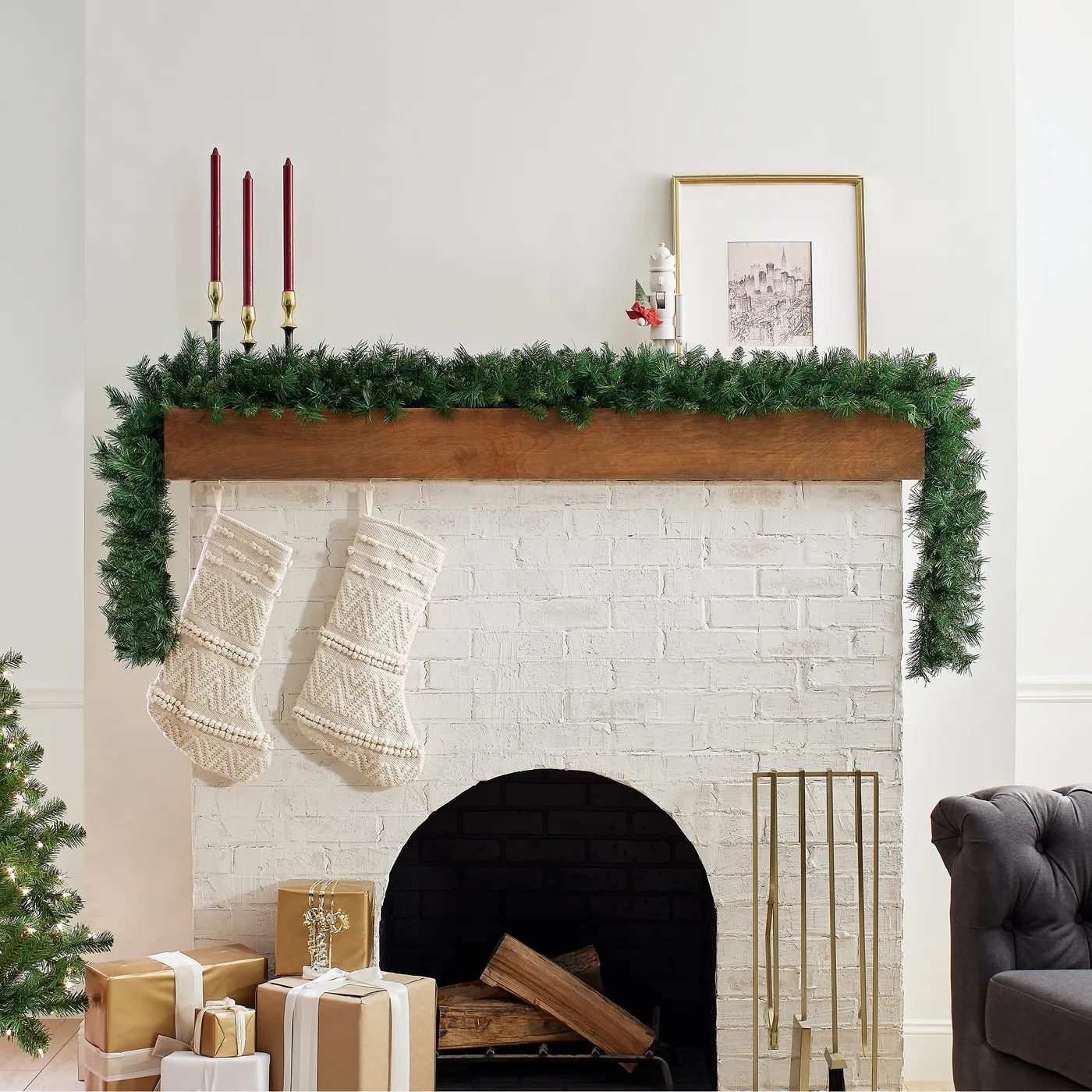
A 6-foot unlit garland at Walmart runs about $25 and a 100-count warm LED set is $8. IKEA’s knit stockings are $9–$12 a pair; brass candlesticks turn up at thrift stores for $3–$6 each. Wrap gifts in kraft paper with a single gold ribbon instead of printed paper — half the cost, twice the look. Realistic spend to recreate this corner: under $110.
10. Red Berries and Eucalyptus Over White Marble
The gold-framed mirror doubles the garland for free. Anything hung above a mantel reflects the greenery back, so a 9-foot garland reads like eighteen feet of green. The berries, eucalyptus, and white star flowers give the eye three distinct scales — tiny berries, medium blooms, large leaves — and the fire below pushes warm light up into the needles. Nothing here is symmetrical, and that’s exactly the point.
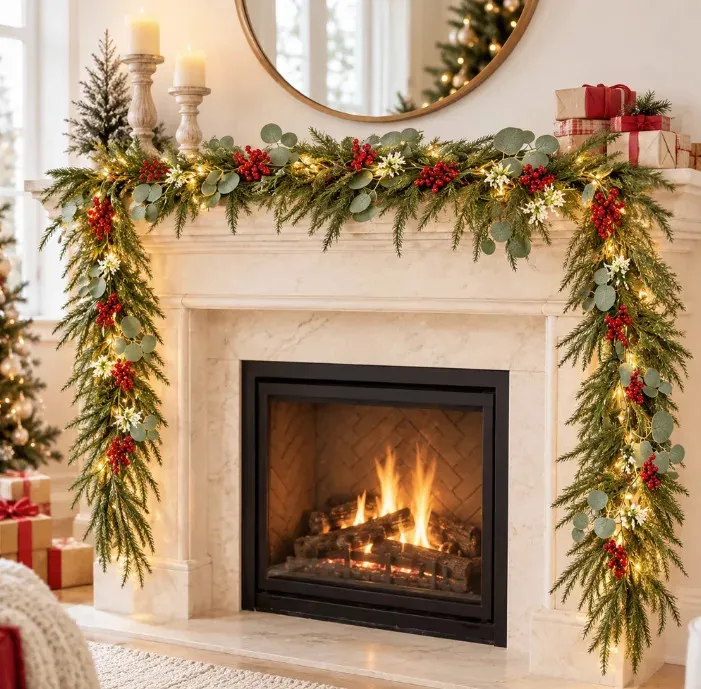
- Measure the mantel and subtract 6 inches; garland hanging past the ends looks unbalanced.
- Find the nearest outlet — a plug-in garland beats batteries you’ll forget to change.
- Keep greenery at least 12 inches from the firebox opening if you actually burn fires.
- Weigh your mirror: anything over 20 lb needs a stud or a proper anchor.
11. Distressed Gold Cowbells Layered Over Evergreen
Layer two garlands instead of one — a thick pine base at 9 feet, then a thinner magnolia strand at 6 feet laid on top and offset so the leaves peek through. Two lengths of greenery read as depth even when the total cost is less than one oversized luxury garland. It’s the cheapest way to fake a designer install on a front door, and it works on a plain wall too.
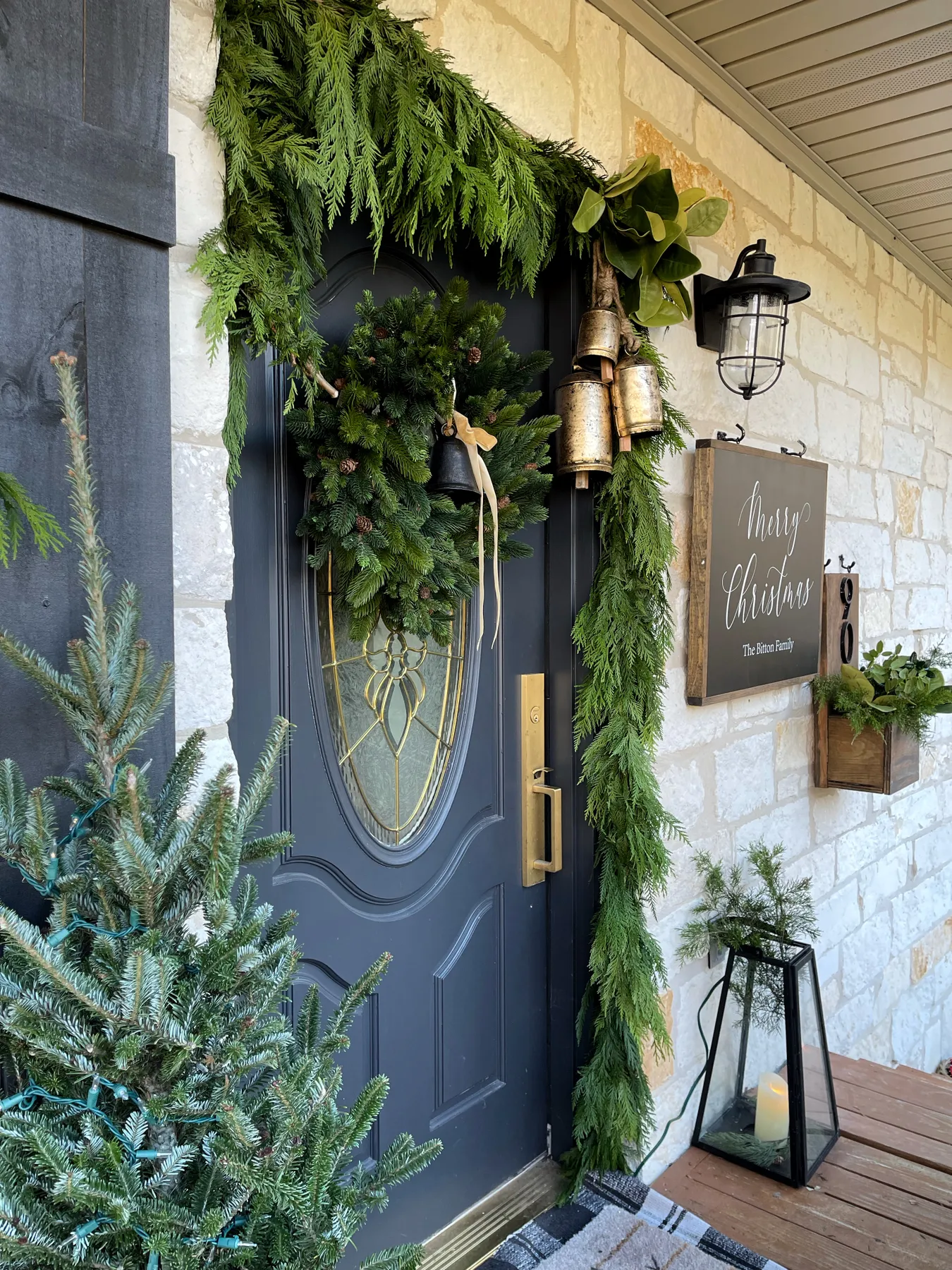
- Base faux pine garland (9 ft): $35–$70
- Magnolia or seeded eucalyptus strand (6 ft): $22–$45
- Distressed gold cowbells (set of 3): $18–$40
- Pinecone wreath for the door: $25–$55
- Over-door metal hanger: $8–$15
Total: $108–$225
Budget alternative: Dollar Tree sells faux magnolia stems for $1.25 each. Buy eight, wire them onto one base garland, and the layered look drops to about $50.
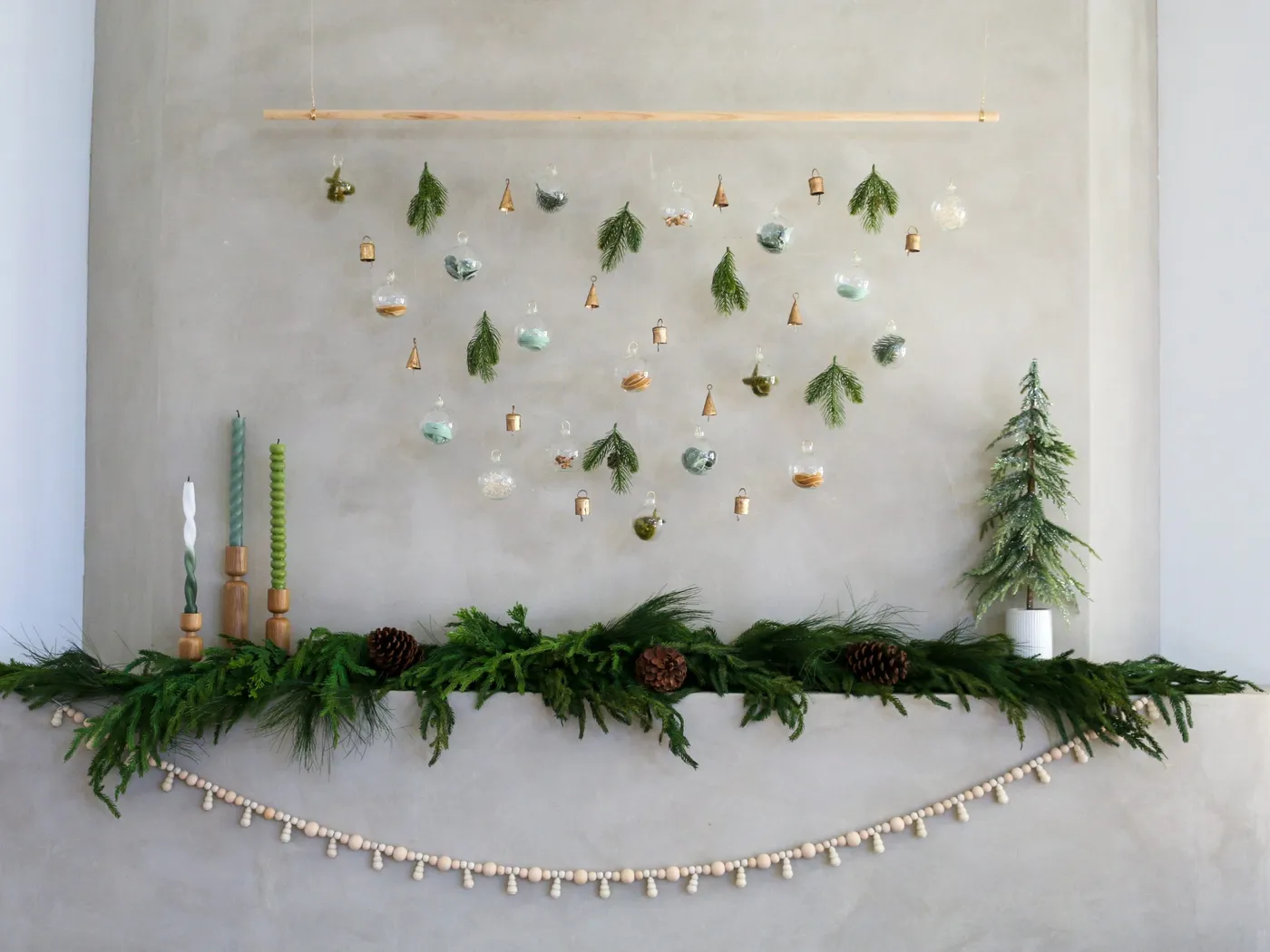
12. A Suspended Beam Garland with Ornaments on Strings
- Locate your ceiling joists with a stud finder — this beam carries real weight.
- Screw two eye hooks into the joists, 4–6 feet apart, and run braided cord or aircraft wire between them.
- Wrap the beam or dowel with garland and lights before you lift it; doing that work overhead is misery.
- Hang ornaments on fishing line at staggered drops — 6, 9, 12, and 15 inches works well.
- Raise the whole assembly last and level it with a phone level.
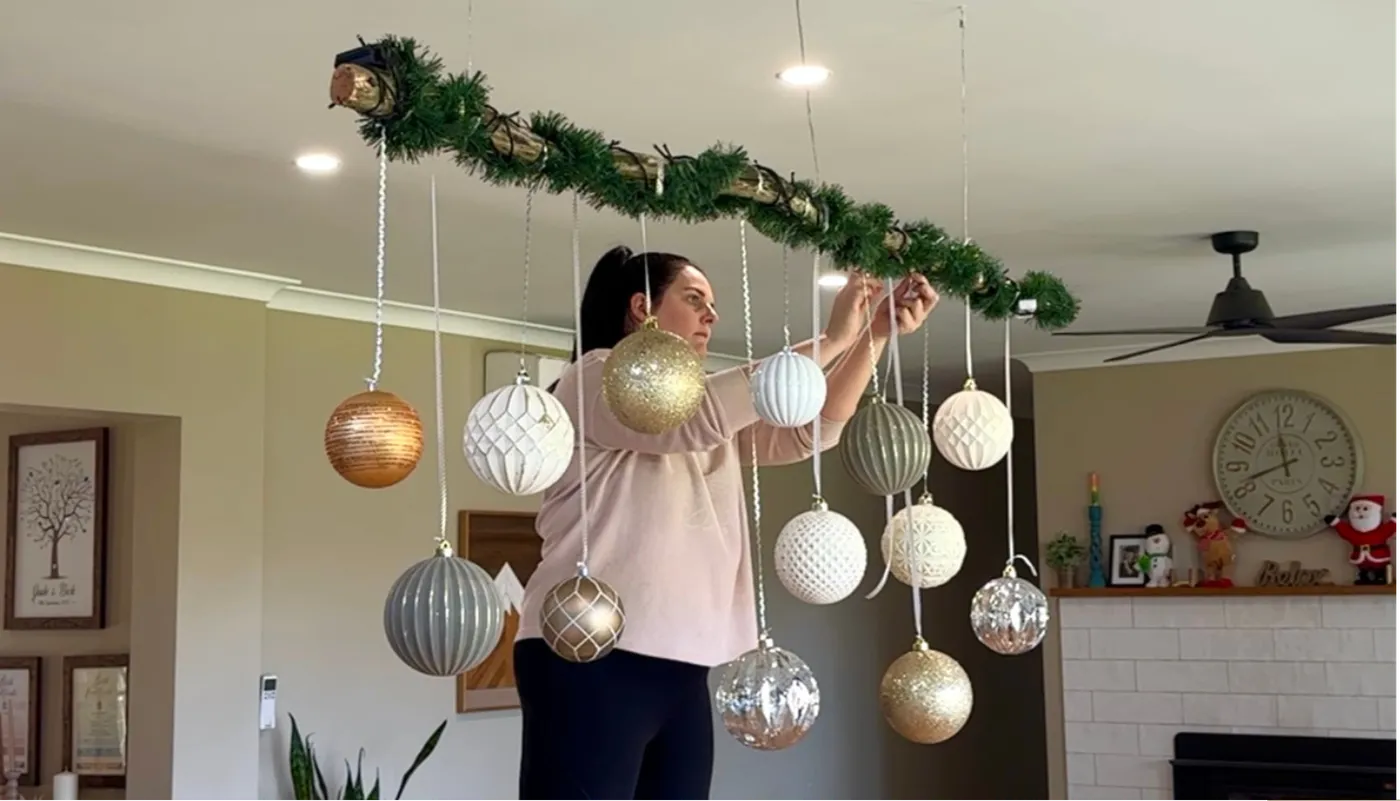
Time: 90 minutes. Cost: $60–$120.
Two things go wrong if you skip the prep. First, drywall anchors — a decorated beam with ornaments can easily hit 25 lb, and toggle bolts are the minimum you should trust. Second, drop length: if your lowest bauble hangs below 6 feet 8 inches, tall guests will walk into it. Hang the whole thing higher than feels natural and it’ll look right from the sofa.
13. Felt Gnomes, Snowflakes, and a Rainbow of Felt Balls
The gnomes. Everything else here is a shape you’ve seen before — balls, snowflakes, stripes — but the two little red-hatted figures give the garland a face, and faces are what make people stop scrolling. They also break the color rhythm: that single hit of solid red between all the dotted and striped felt is what keeps the pattern from turning into wallpaper.
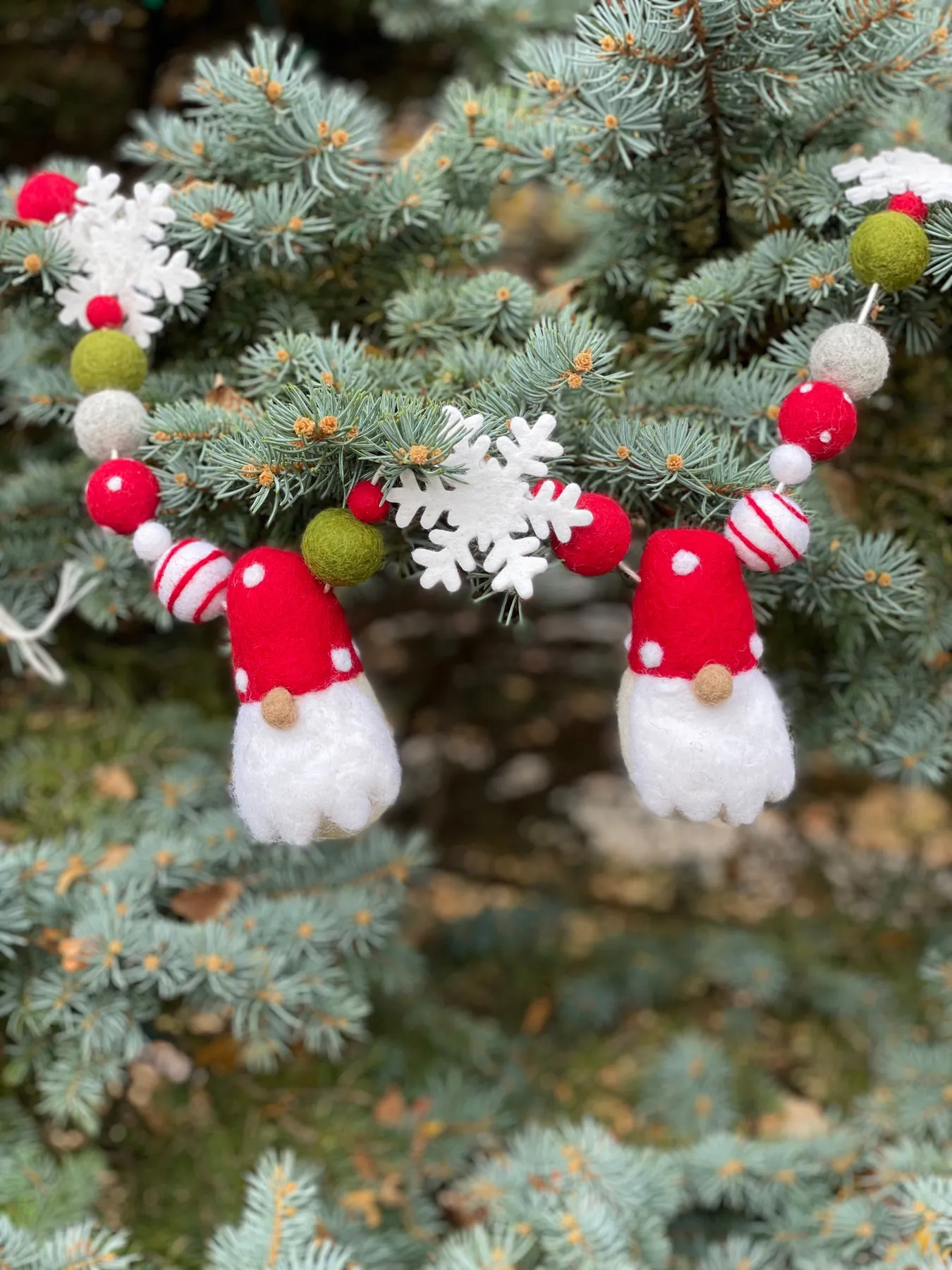
This might be the cheapest idea in the guide. Felt balls run about $6 for 100 on Amazon, a yard of red felt is $3 at Joann, and white felt snowflakes are $1.25 for a six-pack at Dollar Tree. Cut the gnome bodies freehand — imperfect is the point. Total: under $20, plus a glue gun you probably already own. Idea #21 is the wood-slice version at a similar price.
14. A Pinecone Swag Draped Over a Bamboo Mirror
The formula is 80% brown and green, 15% red, 5% white. That’s it — no metallics, no glitter, nothing shiny anywhere. Because the palette stays inside natural tones, texture has to do all the work: pinecone scales against smooth bamboo against long pine needles. One gold ornament would break the whole spell, so resist the urge to add sparkle.
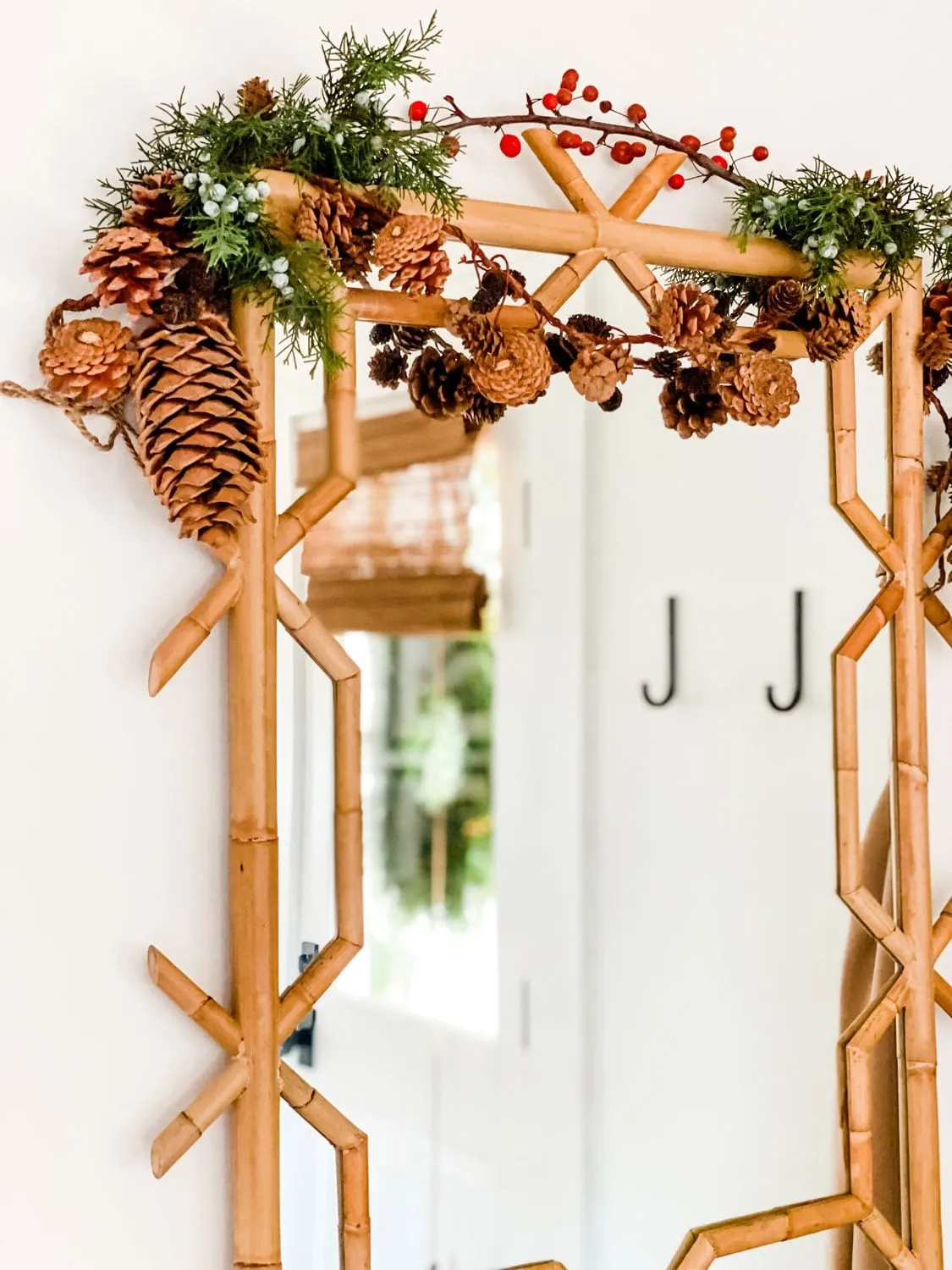
Draping the garland over a mirror frame instead of hanging it on the wall does two things: it softens the hard geometry of the bamboo, and it puts greenery in front of a reflective surface so the arrangement multiplies. The red berries stay sparse — three clusters, not thirty — because against a natural palette, red reads as a strong accent even in tiny amounts.
15. Deep Red Velvet Bows on a Dark Wood Mantel
- Faux evergreen garland (12 ft, full): $45–$95
- Dried orange slices (40 ct): $18–$30
- Deep red velvet ribbon (3 in wide, 2 rolls): $20–$38
- Red berry sprays (6): $12–$24
- Warm white string lights: $12–$25
Total: $107–$212
Budget alternative: skip the berry sprays and reuse orange slices in two sizes, and buy ribbon by the yard instead of a bow kit — that saves around $35.
The bows are the whole personality here, so don’t skimp on width. Anything under 3 inches disappears into a full garland. Make four, placed at roughly 25%, 40%, 60%, and 80% along the length — never dead center, never evenly spaced. Real velvet holds a shape; polyester satin goes limp in a warm room. Same dried citrus as Idea #1, completely different mood.
16. Mitten Pockets Stuffed With Frosted Evergreen
- Fill each mitten with a foam block cut to size before you add anything else.
- Push frosted evergreen sprigs into the foam, working from the outer edges inward.
- Add berries and pinecones at the base of each sprig to hide the foam.
- Wire the string lights through both mittens, hiding the battery pack inside a cuff.
- Attach the braided rope hanger with an over-the-top door hook — no screws required.
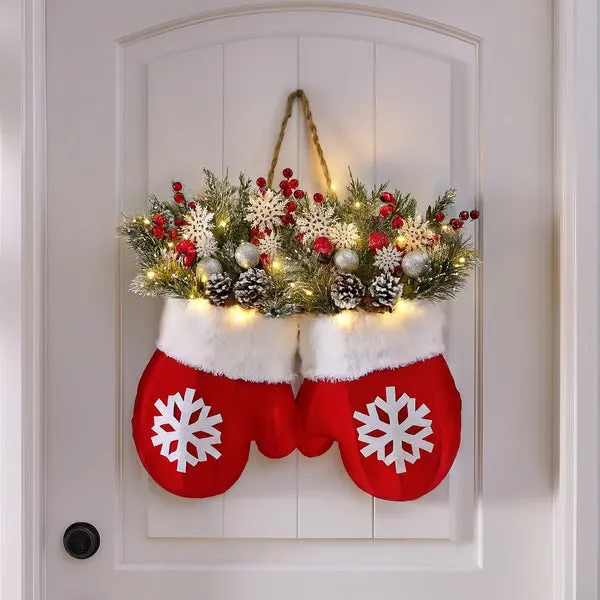
Time: about an hour. Materials: $30–$50.
Mitten hangers work best on a single door 32 to 36 inches wide. Two mittens about 10 inches tall each fill the space without swallowing it; go bigger and the door starts to look like it’s wearing gloves. Keep the frosty sprigs under 14 inches so they don’t cover a window or knock against the frame every time the door swings.
17. Ornament-Dense Garland on a Light Railing
Ornament-loaded garland is heavy and top-heavy. On a railing, zip-tie it at every third baluster or it will sag in the middle by week three. If the railing is outdoors, use shatterproof ornaments — glass baubles crack in the first hard freeze and you’ll be picking shards out of the flowerbed in March. Also worth knowing: metallic finishes tarnish outdoors within a season. Plastic with a good metallic coat is the practical call.
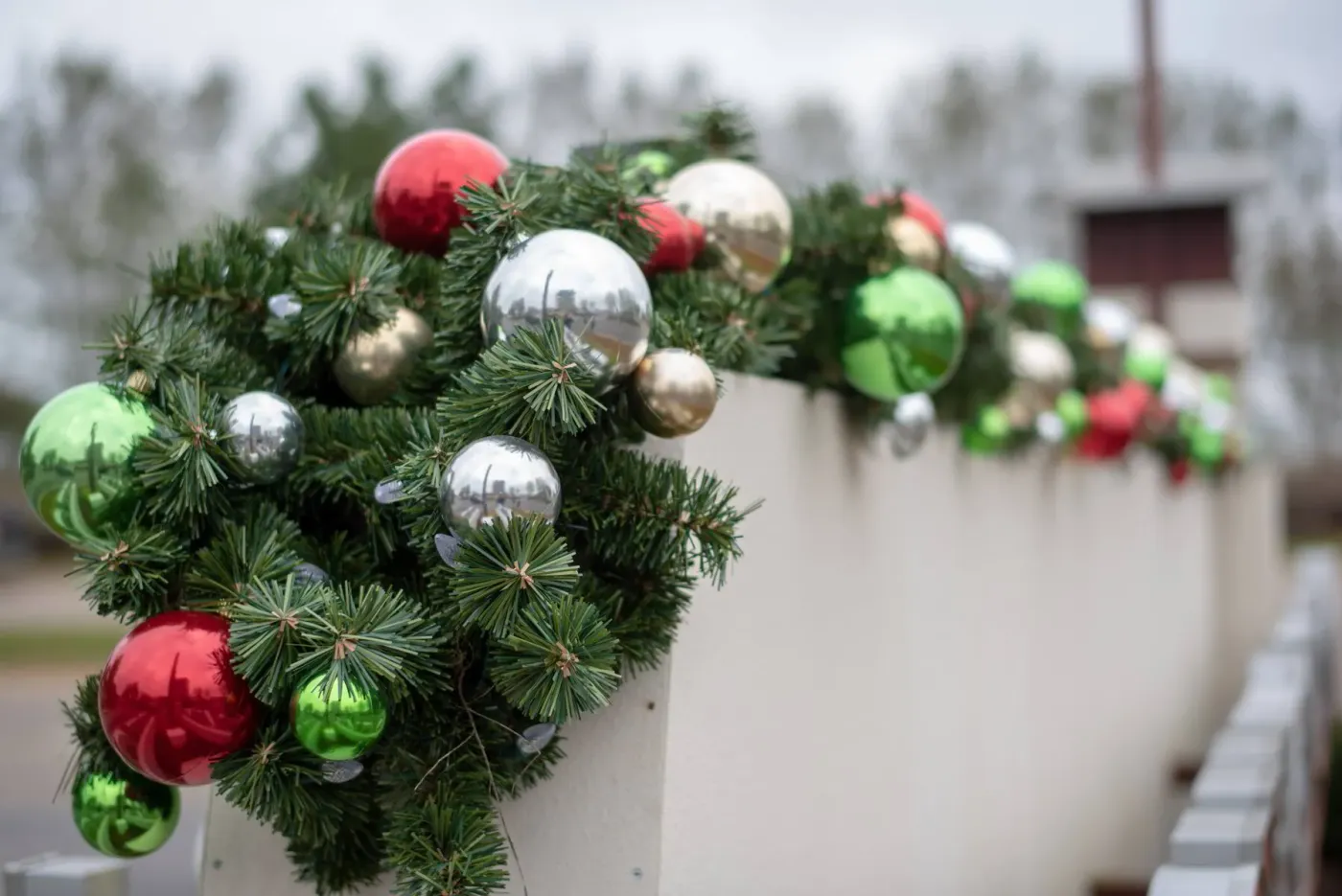
Buy a plain 12-foot garland for $40 and a 100-piece shatterproof ornament set for $25 at Walmart, then add a $10 light string. That’s $75 for a look that reads like a $300 pre-decorated garland. Buy ornaments in mixed sizes — 40mm, 60mm, and 80mm — because uniform baubles are exactly what make cheap garland look cheap. Fill the gaps with a $5 bag of minis.
18. Berry-and-Foliage Garland Across a White Archway
Hang garland over an archway with clear fishing line and small cup hooks screwed into the top of the trim — not nails into the drywall above it. You want the garland to sit slightly in front of the trim rather than flat against it, so it casts a soft shadow and reads as a real swag. Space your tie points every 15 inches and let the line go slack between them.
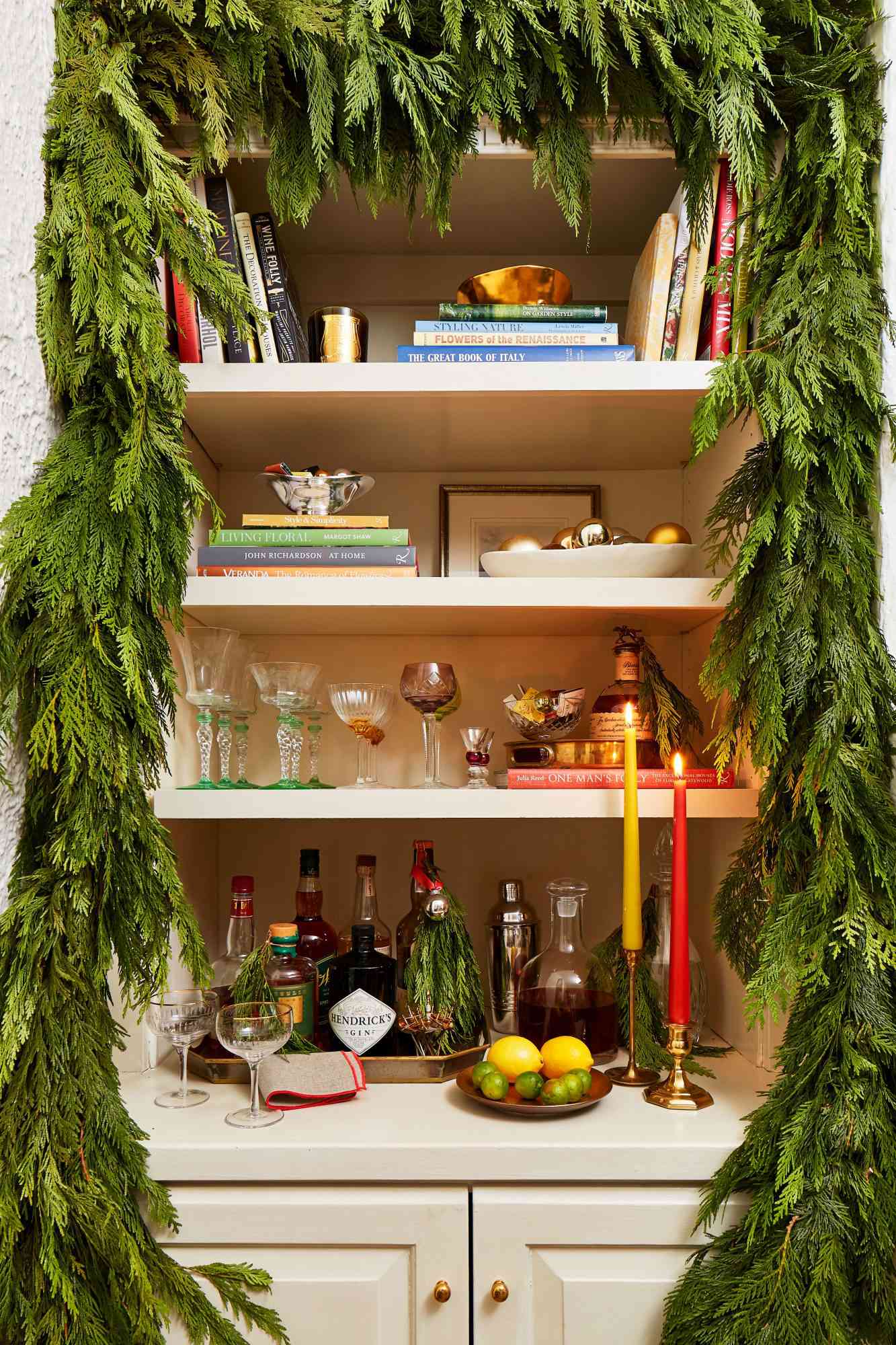
Anything with faux berries and white florals sheds. Shake it out over a sheet before you hang it, then again in January before it goes in the bin. Real berries stain trim, and white floral accents yellow after about two seasons of sun. If this archway gets direct afternoon light, rotate the garland 180 degrees each year so the fade stays even.
19. Plaid Bows and a Snowflake Over the Door Frame
The formula is 60% evergreen, 25% plaid, 15% natural brown from pinecones and twine. Plaid wants to be the loudest thing in the room, so it only works when greenery outnumbers it nearly three to one. Swap red-and-green plaid for buffalo check and the same garland goes farmhouse; swap for tartan and it goes traditional Scottish. The snowflake is the wildcard — one, not three.
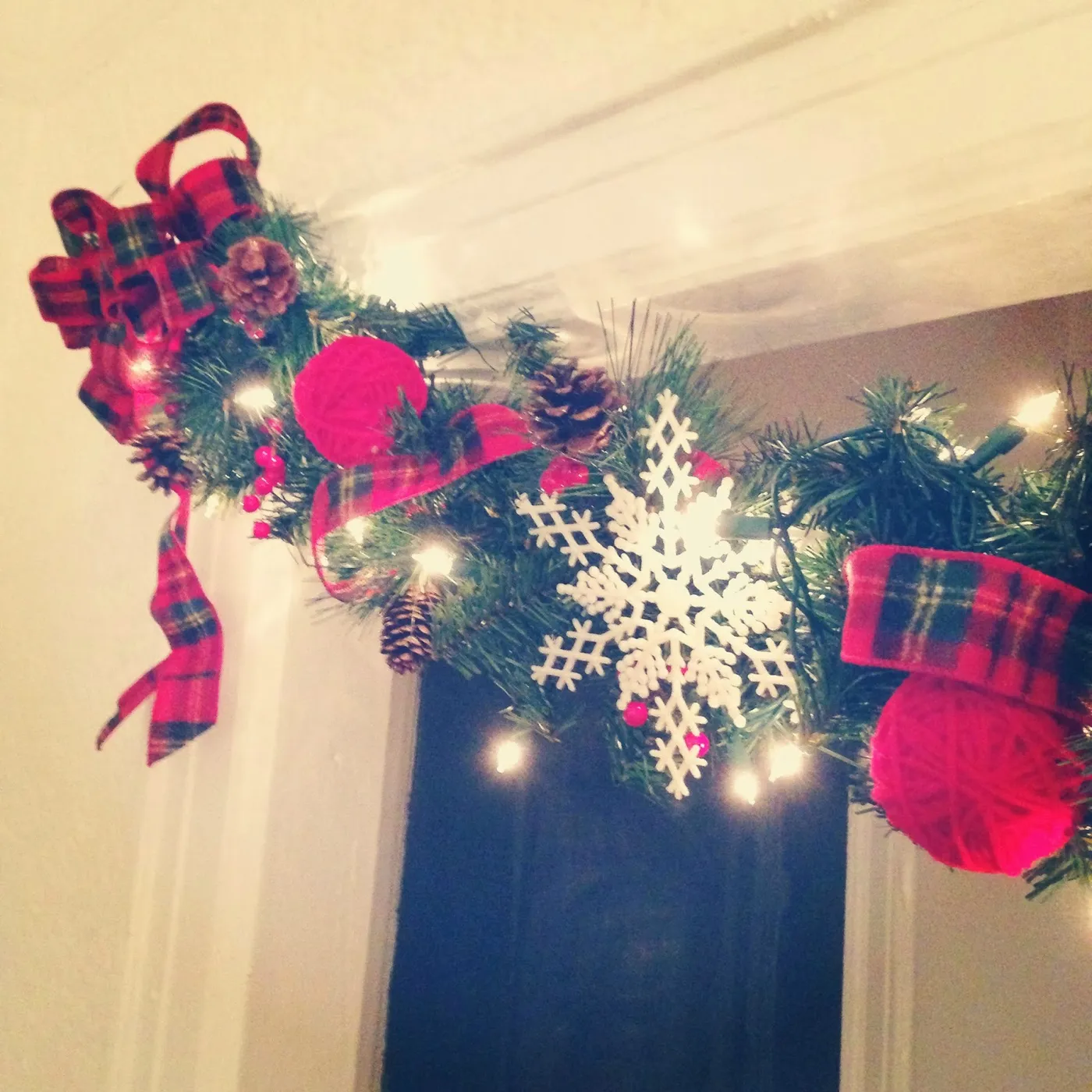
- Check your door swing — garland on the hinge side will catch and tear.
- Measure the opening plus trim; you want 6–10 inches of overhang on each side.
- Confirm an outlet or battery plan — doorways rarely have power nearby.
- Test-hang one bow with painter’s tape before committing to positions.
20. A Lit Glass Block Tucked Into the Garland
- Buy a clear glass block, 6×6 or 8×8 — craft stores carry them for about $8.
- Use a pre-drilled block, or drill a small hole in the bottom edge with a diamond bit.
- Feed a short strand of warm white fairy lights inside, leaving the battery pack outside.
- Tie a layered gold-and-brown ribbon bow around the block, offset to one side.
- Set it on the mantel beside the garland so the two light sources read as one.
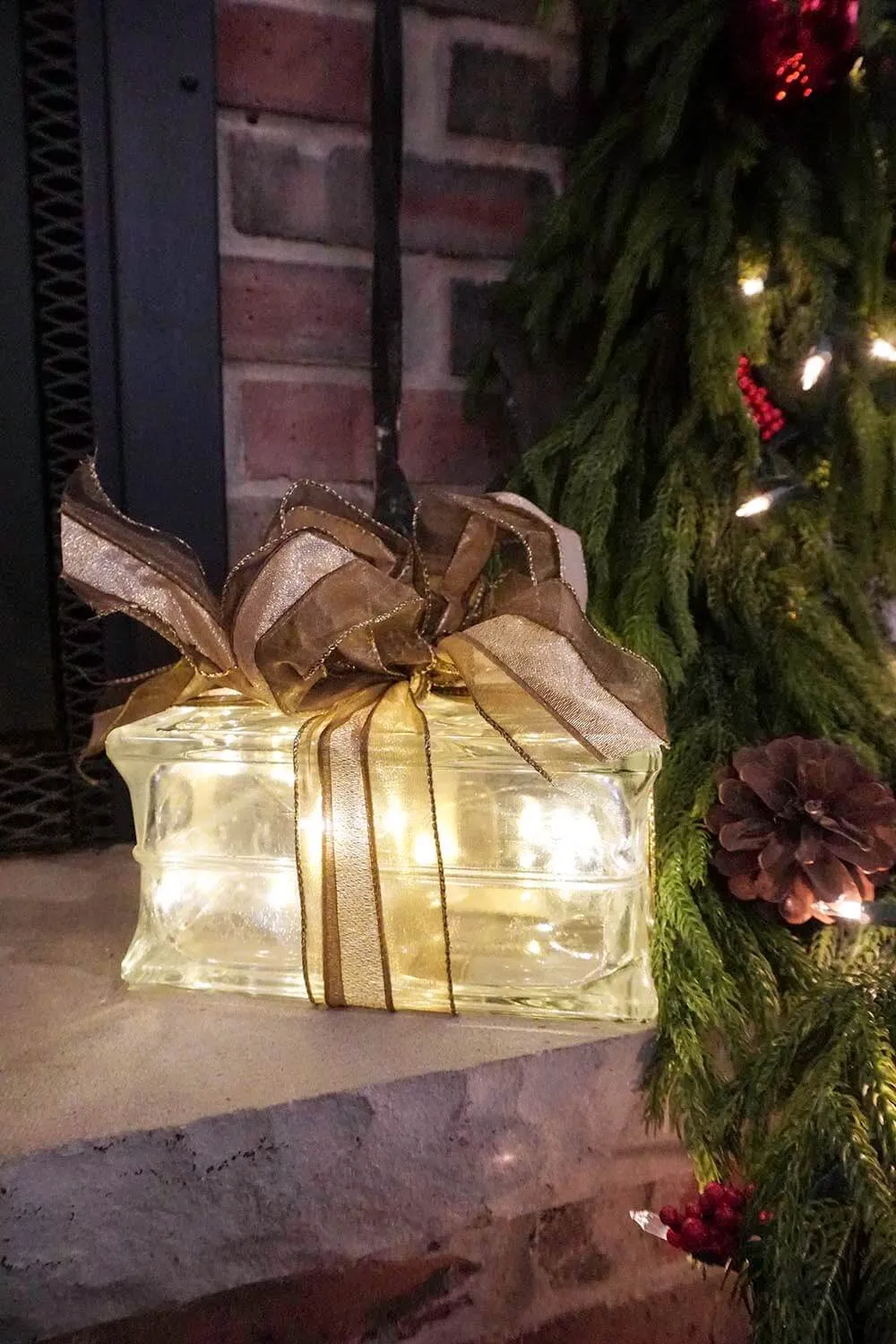
Time: 20 minutes. Cost: $12–$25.
You don’t actually need a drill. A $10 battery fairy light set can sit behind the block with the lights draped over the top, and from three feet away it looks nearly identical. Dollar Tree carries glass blocks and ribbon seasonally; a clear glass vase or a mason jar reads the same in a pinch. Under $15 either way.
21. Wood Slice Garland Strung on Jute
- Wood slices (50 ct, 2–3 in): $18–$30
- Jute twine or waxed cord: $6–$12
- Wood beads for spacing (100 ct, optional): $10–$18
- Hot glue sticks: $4–$8
Total: $38–$68
Budget alternative: cut your own slices from a fallen branch with a miter saw and let them dry two weeks — that drops the project to roughly $12 for twine and glue.
The raw edge is everything. Sanded, uniform slices look like a craft kit; slices with bark still attached and slightly uneven thicknesses look like something you’d find in a cabin. Drill the holes off-center so the slices hang at slight angles instead of lining up like buttons, and leave a few gaps — a garland made entirely of wood reads as a necklace.
22. A Chandelier Wearing Evergreen and Red Berries
Keep the garland above the light bulbs, never woven between them. Greenery touching a hot bulb is a fire risk, and it’s bad design too — you want the glow coming from underneath the foliage so the needles silhouette against it. Attach with florist wire wrapped around the chandelier arms rather than tape, and keep total added weight under about 3 lb so the fixture stays level.
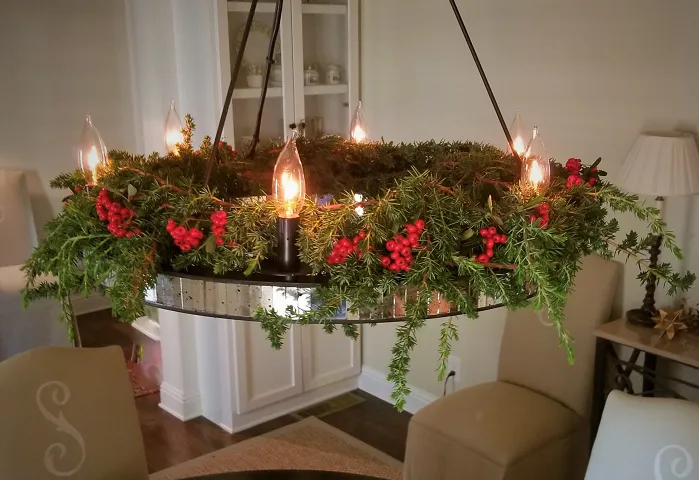
This works on chandeliers 20 to 30 inches across in rooms with at least 9-foot ceilings; you need roughly 30 inches of clearance between the fixture and the table so nobody’s eating under a shrub. In an 8-foot room, a smaller ring fixture gets a single 4-foot swag instead. Expect fallen pine needles in the soup — that’s the trade.
23. Black and Silver Tinsel Spiraling Down a Mint Staircase
Tinsel is back, and it came back through the maximalist, slightly ironic door — think black and silver rather than the 1970s green-and-gold. The mint staircase and lush plants are doing the heavy lifting here; tinsel on a plain white stairwell would read as a party-store afterthought. This style has less staying power than natural greenery, but it’s cheap, light, and comes down in one armful.
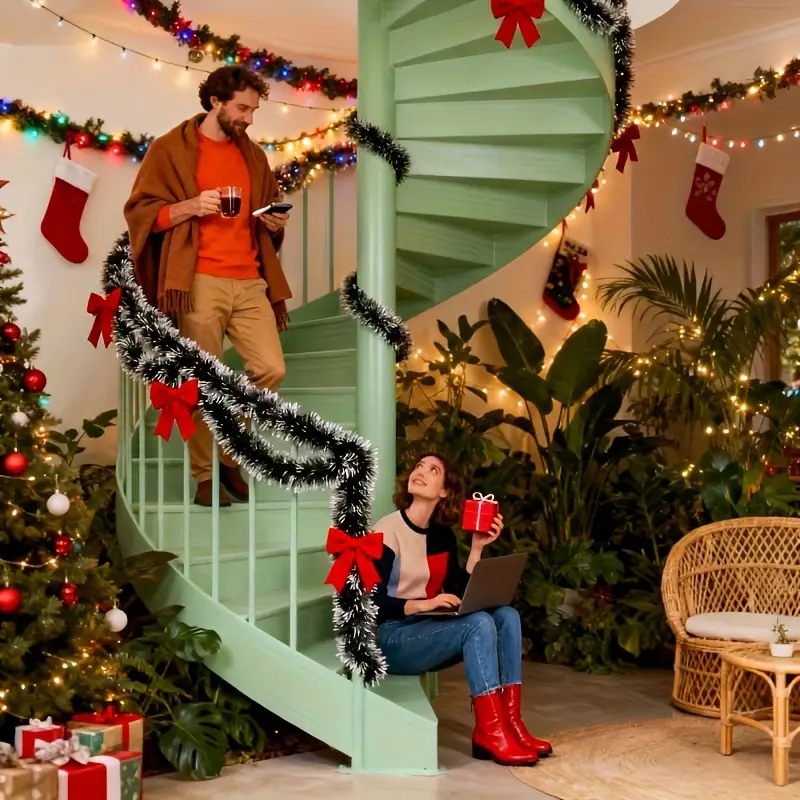
Tinsel sheds metallic strands everywhere, and pets eat them. Idea #22 can’t help you with that part. If you have a cat, skip tinsel or keep it above 5 feet. Black tinsel shows dust almost immediately and it’s fragile — one tug and you’re re-hanging a whole section. The upside: it’s light enough that adhesive hooks hold it fine.
24. Gingerbread Cutouts and a Hot Cocoa Bar Garland
This works because the garland isn’t the main event — it’s the frame. The cocoa bar, the sign, the candy cane pillow, and the gingerbread cutouts all sit inside the greenery, so your eye keeps moving instead of parking on one object. The scalloped fabric garland adds a soft, non-shiny layer that keeps the whole corner from turning into a glossy ornament display.
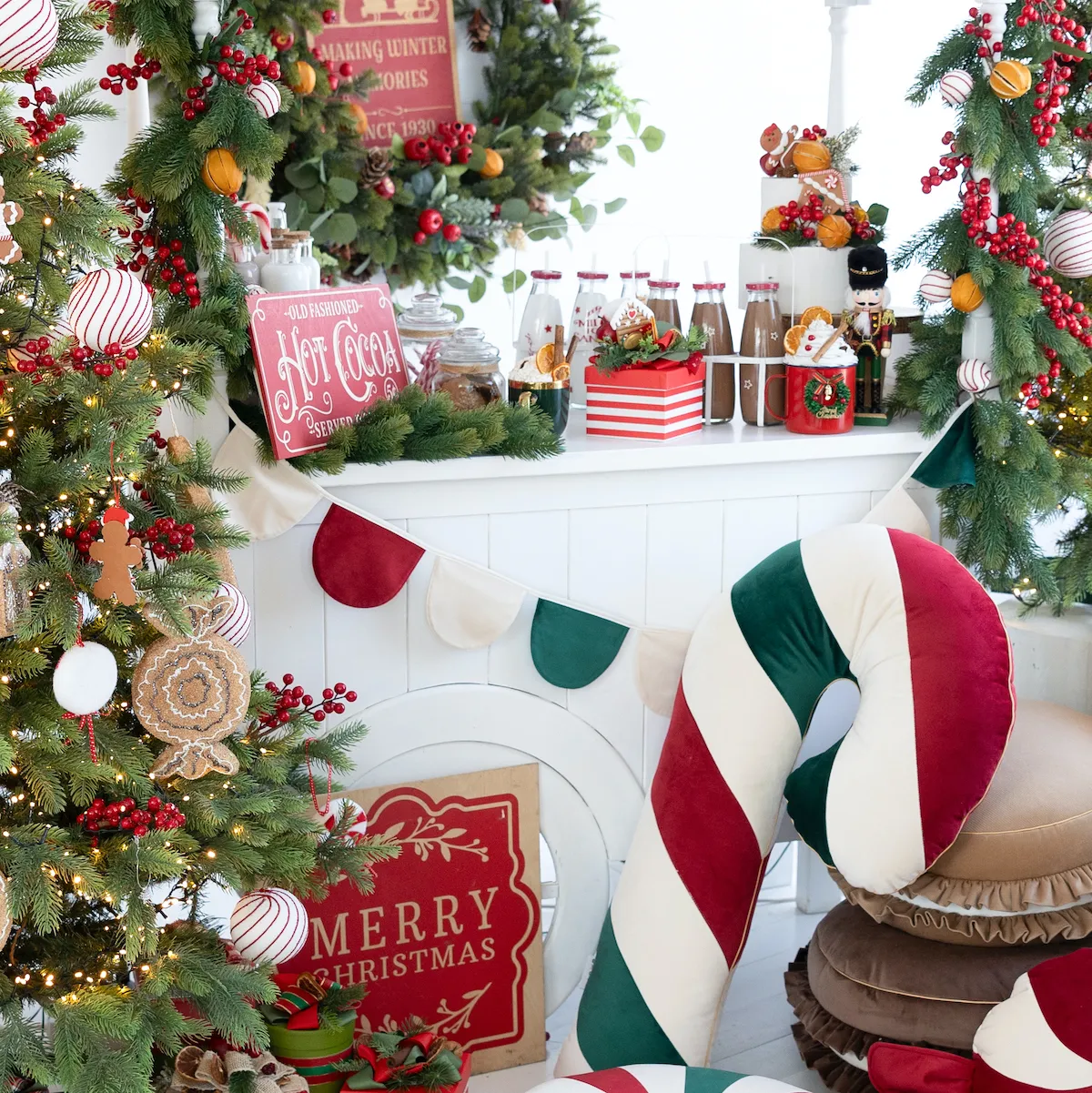
Faux evergreen garland at Walmart is about $20 for 9 feet. Gingerbread cutouts run $5 at Dollar Tree, or bake real ones and hang them — they’ll hold up about two weeks before going stale. The velvet candy cane pillow is the splurge piece; Target carries similar ones for $25–$35, but a plain red lumbar pillow at $12 does the same job from across the room.
25. Magnolia Leaves and Rustic Bells on a Dark Door
The bell string. It’s a thin vertical line of bronze bells dropping straight down the center of a round wreath, and it does something no bow can: it breaks the circle. Without it you have a beautiful but very familiar wreath. With it, you get a vertical axis that echoes the door’s paneling and pulls your eye top to bottom in one motion.
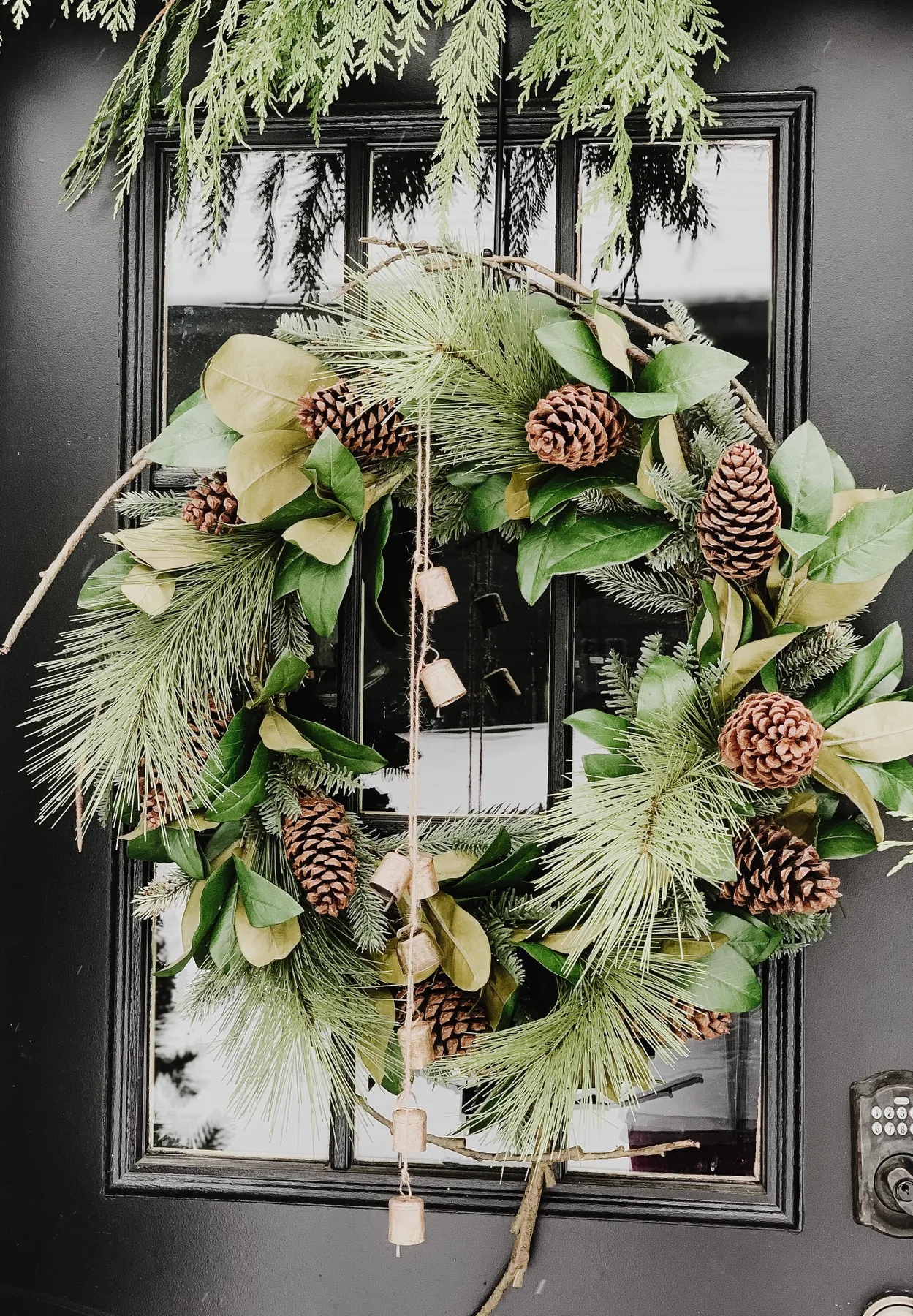
Wreaths on glass-paneled doors need a hanger that hooks over the top of the door, not a suction cup — suction cups fail in cold weather, and a wreath hitting the floor at 6 a.m. is a rough start to December. One more thing: tuck a magnolia leaf so its pale underside faces out. That flip of color is what makes real magnolia look expensive.
26. Felt Reindeer and Dried Orange Slices Side by Side
- Cut two reindeer shapes from beige felt; stitch or glue the edges with a quarter-inch seam.
- Add a red felt scarf and three mini pom-poms for the antlers.
- Slice oranges a quarter-inch thick and bake at 200°F for three hours, flipping halfway.
- Thread a gold wire loop through each orange slice while it’s still slightly warm.
- Hang both near the front of the tree at eye level, where guests will actually spot them.

Time: one afternoon. Materials: $15–$25.
Dried orange slices are sturdier than they look, but they do darken with age — expect bright amber to fade toward deep brown by year three. Store them in a paper bag, never plastic, so they don’t soften. Felt gets fuzzy with handling and picks up pet hair like a magnet; a lint roller fixes it. Both are light enough to hang on the thinnest branch.
27. Styling a Garland in Layers Instead of One Pass
The layer formula is 50% base greenery, 30% texture (pinecones, dried citrus, wood), 15% textile (ribbon, fabric garland), 5% light. Most people stop after the base and then wonder why it looks unfinished. Build in that order and step back after each layer — you’ll see exactly where the garland starts feeling done, and where it starts feeling overdone.
- Lay the garland flat on the floor first; decorating vertically is how things end up lopsided.
- Count your anchor points before you start — one every 18 inches.
- Decide your palette out loud: two main colors plus one neutral.
- Test the lights before you weave them in, not after.
28. A Serpentine Swag With Scattered Pinecone Pairs
A serpentine swag wants a long, uninterrupted wall — 8 feet minimum, 10 is better. Three swoops with a few inches of drop between them. It reads best on a plain surface with no artwork nearby, because competing frames break the rhythm. In a small apartment, run it along a single 5-foot wall in two swoops instead. The tighter, three-anchor version in Idea #7 is the better fit for narrow rooms.
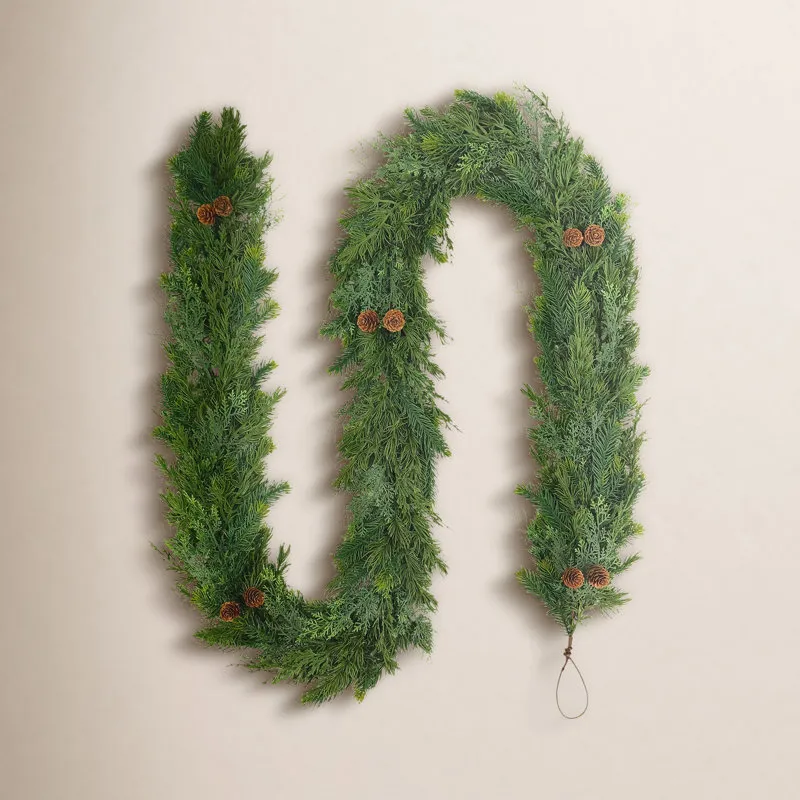
Real pinecones can carry sap and tiny insects, so bake them at 200°F for 30 minutes before bringing them indoors. Artificial garlands with mixed foliage textures trap dust in the crevices — a hair dryer on the cool setting, run along the length in spring, handles most of it. Never store one compressed in a vacuum bag; spiky needles crease and never fully recover.
29. Frosted Cedar, Silver Mercury Glass, and a Pink Wall
Mercury glass ornaments are lighter than they look, which is why they work so well on a wall-hung garland — five or six of them won’t pull your hooks out. Hang them from the garland’s wire at three different drop lengths, and cluster the gold berries in odd numbers. Against a light pink wall, keep ribbon white or silver; red would fight the paint and win.
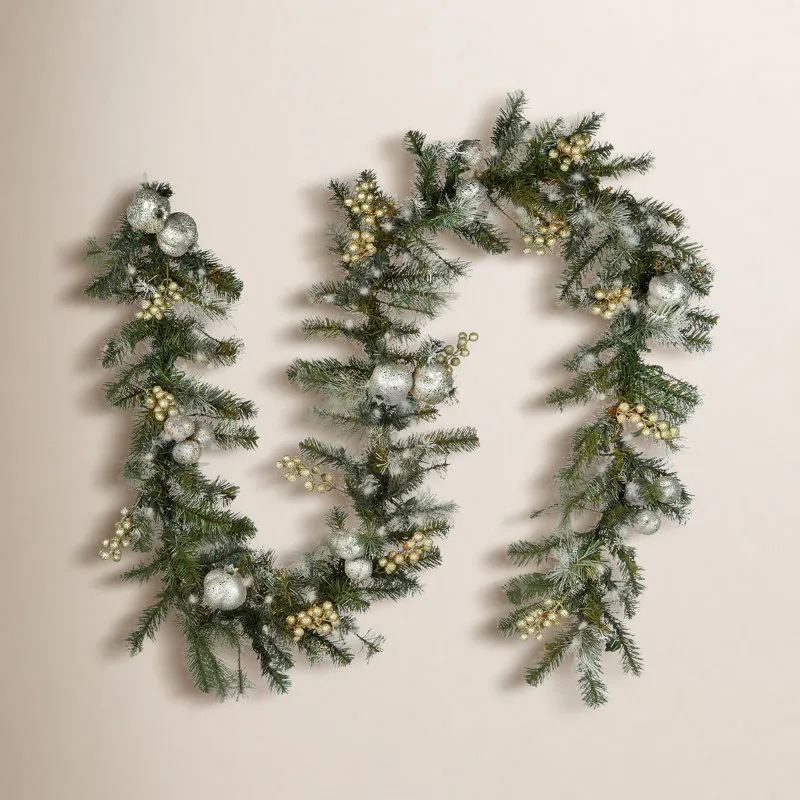
Frosted garlands took off because they photograph beautifully — the white tips catch light and read as snow even in a warm room. They pair with the quiet-Christmas trend that’s been growing alongside maximalism: less color, more texture. This one has staying power, mostly because a frosted garland looks intentional whether you add ornaments or leave it bare.
30. Frosted Cedar Swags on a Bare Beige Wall
- 9 ft artificial frosted cedar garland: $28–$60
- Command hooks or small finishing nails: $6–$12
- Warm white battery LED set: $8–$16
- Light timer or remote: $8–$15
Total: $50–$103
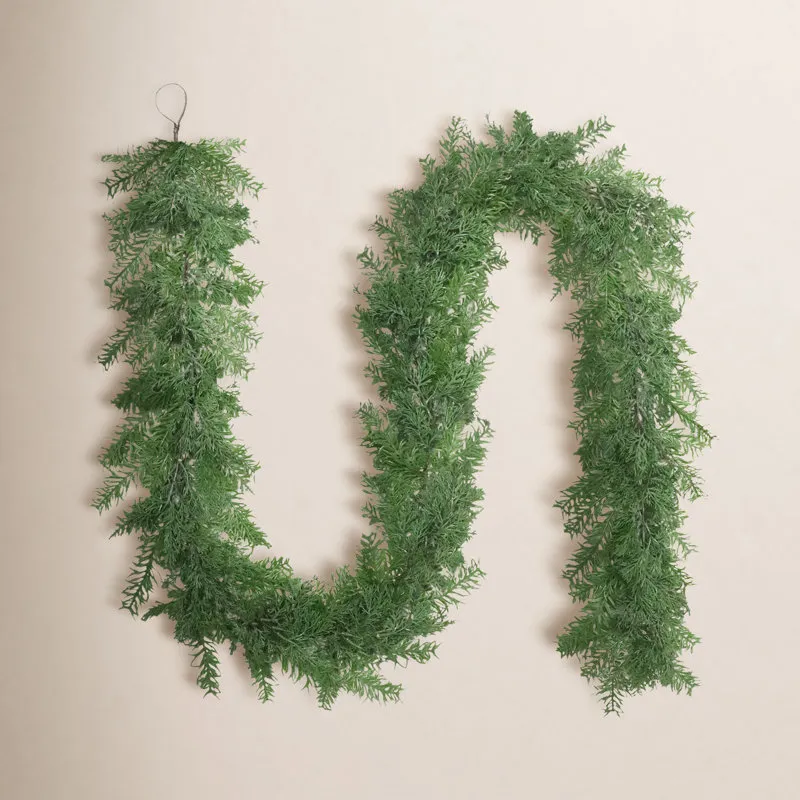
Budget alternative: one 9-foot garland cut into three pieces and re-wired into a single swag gives you the multi-swoop look for the price of one strand — about $35 all in.
A bare wall is unforgiving. Every thin patch is visible, so buy the fullest garland you can afford and fluff it for a solid ten minutes before hanging. Battery packs die at the worst possible time; a $10 timer solves that permanently. And if your wall is brick, stucco, or heavy orange peel, adhesive hooks won’t hold — use small finishing nails and fill the holes in January.
31. A Green Built-In Shelf Framed by Lit Garland
The basket of frosted pinecones on the bottom shelf. It’s the least designed element in the whole vignette and the thing that makes it feel lived-in. Shelves filled entirely with objects you bought look like a store display; one basket of natural fillers gives the eye somewhere to rest. Everything else — the wooden luminaries, the bottlebrush trees — is there to support it.
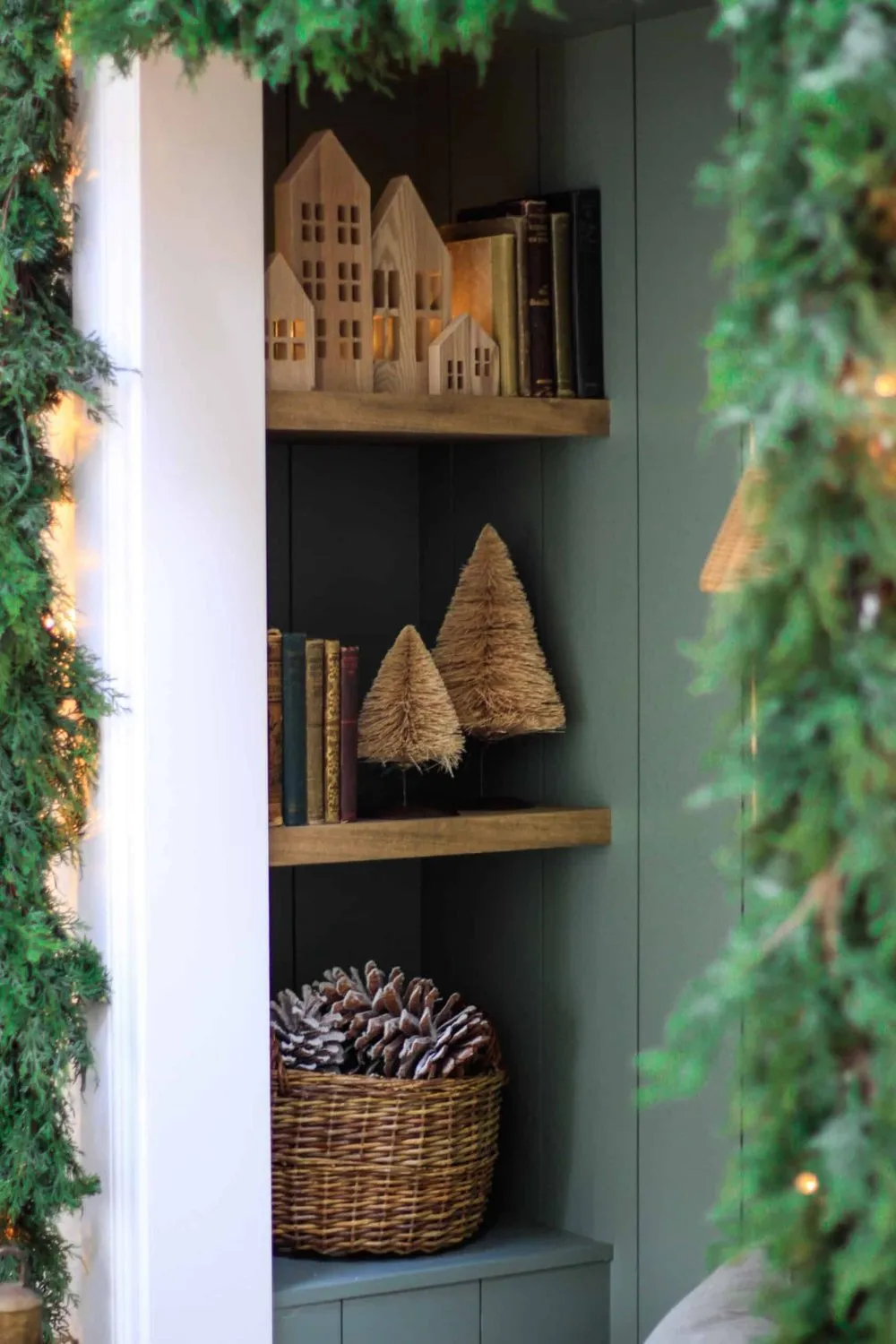
- Run the lit garland along the trim, not the shelves, so it frames the entire unit.
- Clear every shelf completely before you start restyling.
- Put the tallest item at the back, offset to one side.
- Group objects in threes, with at least one book stack per shelf.
- Leave roughly a third of each shelf empty.
Time: 45 minutes per section. Cost: $0 if you’re shopping your own house.
Go Hang Something Green
Start with one wall, one doorway, or one mantel — you don’t have to do the whole house this weekend. Buy the fullest garland your budget allows, fluff it properly, then layer in the parts that matter to you: the citrus, the velvet, the felt gnomes, whatever makes you smile when you walk past it.
If you try one of these, snap a photo and pin it — half the fun of garland season is stealing a good idea from somebody else’s entryway. 📌 Pin this guide now so it’s waiting for you next December.