33 Jaw-Dropping Outdoor Lights for House 2026 That Will Transform Your Home Tonight

You know that moment when a house down the street glows at dusk and you slow down without meaning to? That’s not luck — it’s layering, color temperature, and a little bit of aim, and it’s the highest-return exterior upgrade you can make in 2026.
We went through hundreds of options at Home Depot, Lowe’s, Wayfair, Amazon, and Target, from $18 path lights to $1,450 full facade systems, and pulled out the 33 ideas that genuinely deliver.
Inside you’ll find 33 curated exterior lighting ideas across modern minimal, warm traditional, layered landscape, and architectural uplighting styles, with budget and luxury versions compared side by side so you can see where the money actually matters.
2026’s real shift is warm, layered light — 2700K to 3000K fixtures, shielded beams, and dark-sky-friendly design instead of one cool-white flood over the garage door.
And stay until the end — we break down the most common mistakes that can ruin these looks. 📌 Save this to Pinterest for later — you’ll want to revisit these ideas. Some links in this post are affiliate links, which means we may earn a small commission at no cost to you.
1. Up-Down Sconces on Dark Vertical Paneling
Up-down sconces on vertical paneling live or die by alignment. Center each fixture on a panel seam rather than the gap between panels — shift it half a foot and the light throws a lopsided scallop that reads as a mistake all the way from the street. Space fixtures 8 to 10 feet apart, and pick a 3000K, 300-lumen model whose beam spread roughly matches the panel width. If the beam is wider than the panel, light bleeds onto the neighboring surface and the whole crisp rhythm goes soft.
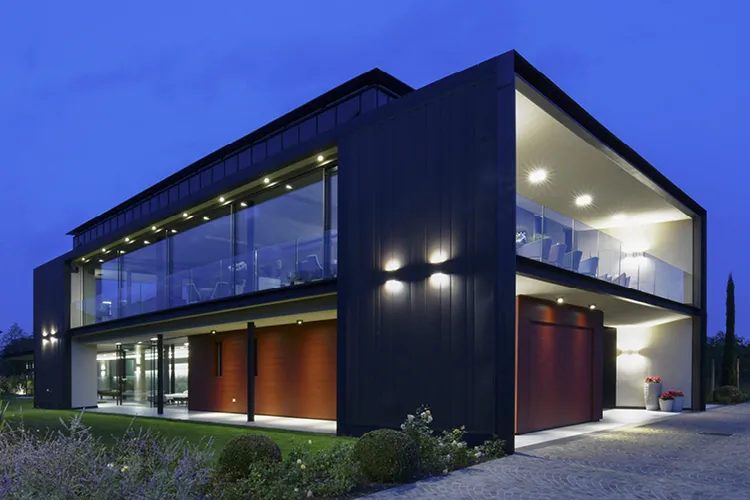
What makes this facade work is restraint. Dark grey paneling swallows light, so every fixture reads as a deliberate bright line instead of a wash. Three layers do the work — a linear strip along the upper glass facade, recessed soffit lights above, ground-level lights below — and that’s why the building looks composed rather than spotlit. The reddish-brown accent panels get no direct light at all, and that’s precisely what keeps the palette from flattening into one tone.
2. Stone Gables, Warm Uplights, and a Lantern-Lit Driveway
- Architectural uplights for gables and dormers (10–14): $450–$1,400
- Stone pillar lantern posts at the driveway (2): $180–$600
- Tree and garden bed uplights (8–10): $240–$700
- Transformer, low-voltage wiring, timers: $300–$900
- Professional installation, if hired: $1,200–$3,500
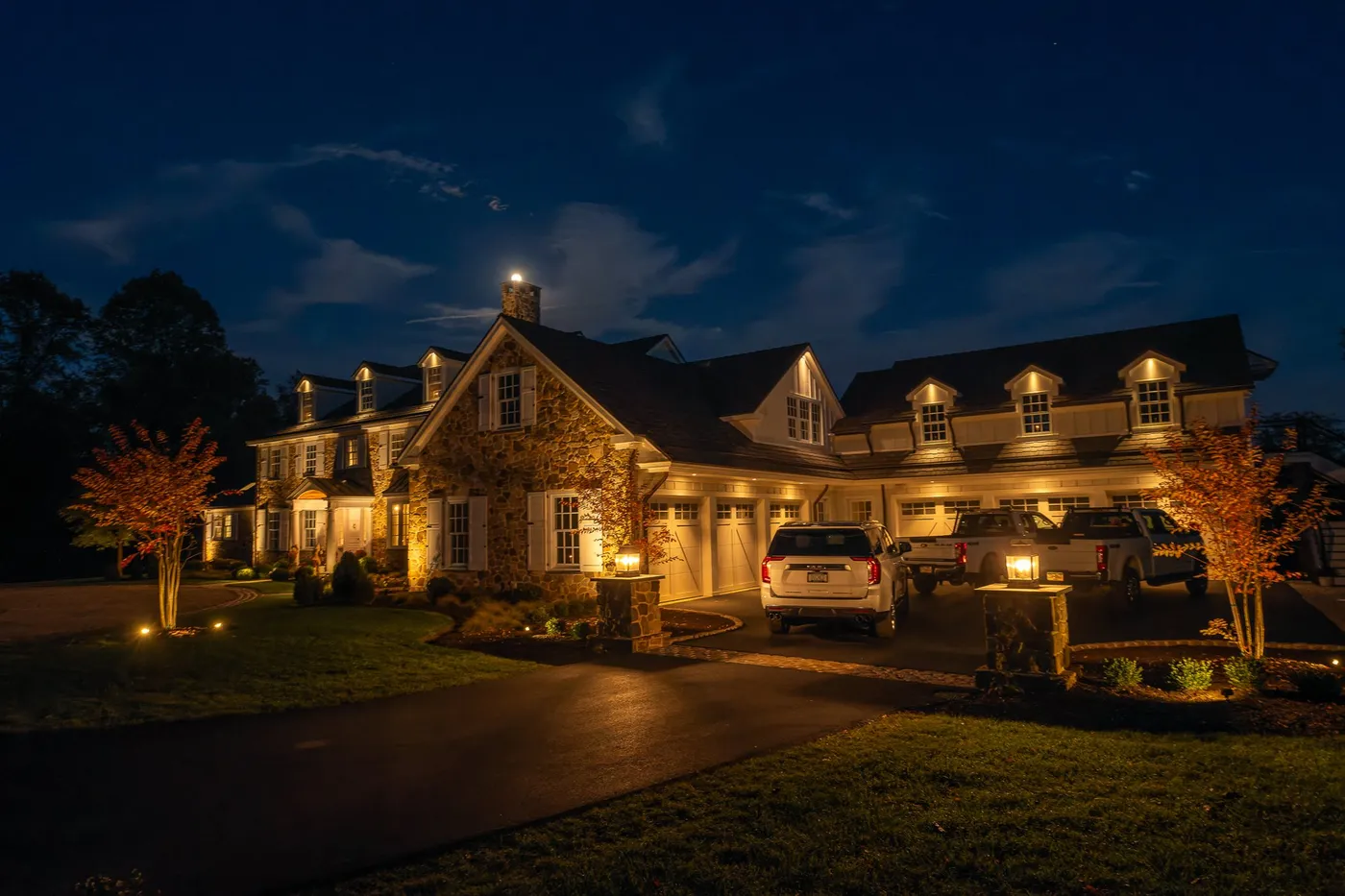
Total: roughly $2,400–$7,100
Budget alternative: keep the two driveway pillars and light just the four corners of the house. You’ll spend closer to $900 and the house still reads complete from the curb.
More light is not better light. On a house this size, 40 fixtures at full output turns the facade into a parking lot. Run the architectural lights at 60–70% and let the warm glow from inside do the rest. Also aim your fixtures after dark, never on a bright afternoon — a gable uplight pointed slightly wrong paints a hard triangle across the stone that you won’t spot until 9 p.m.
3. White Stucco with Light Strips Woven Into Wood Slats
The formula is roughly 70% warm white light, 20% natural wood tone, 10% night-sky contrast. Warm light does the heavy lifting, the vertical wood slats supply the texture, and the dark sky supplies the drama for free. Swap the wood for charcoal composite and the same percentages still work — just let the stucco carry more of the brightness. The proportions matter far more than the materials do.
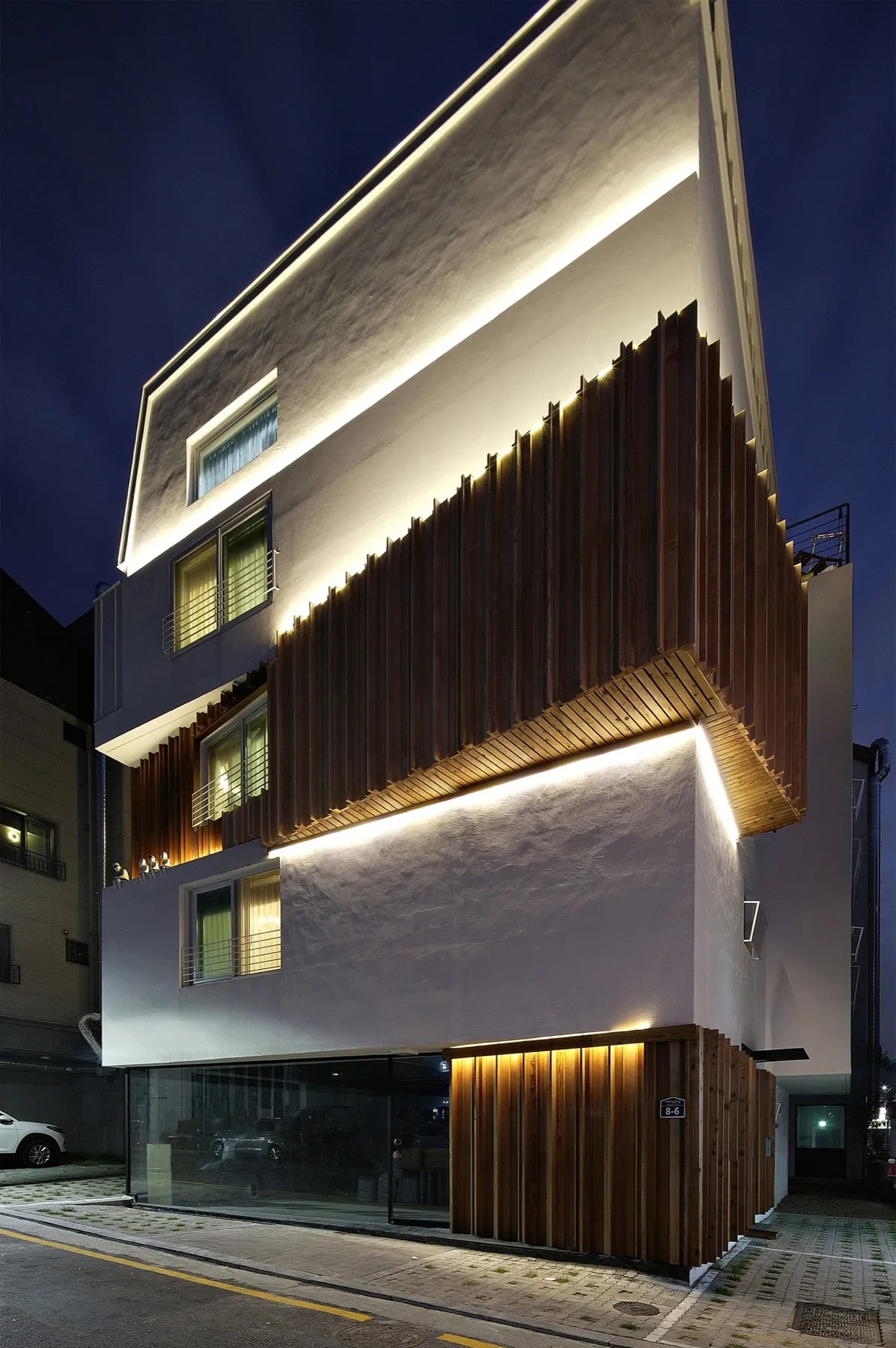
Integrated linear strips are unforgiving of sloppy framing. Ask for a minimum 1-inch recess depth so the light reads as one continuous line instead of a dotted row, and use 24V tape rather than 12V on any run longer than 16 feet — voltage drop is what causes that slow fade at the tail end of a strip. Put the driver somewhere you can reach without a ladder and a screwdriver.
4. Red Brick and Grey Stone Warmed by Grazing Uplights
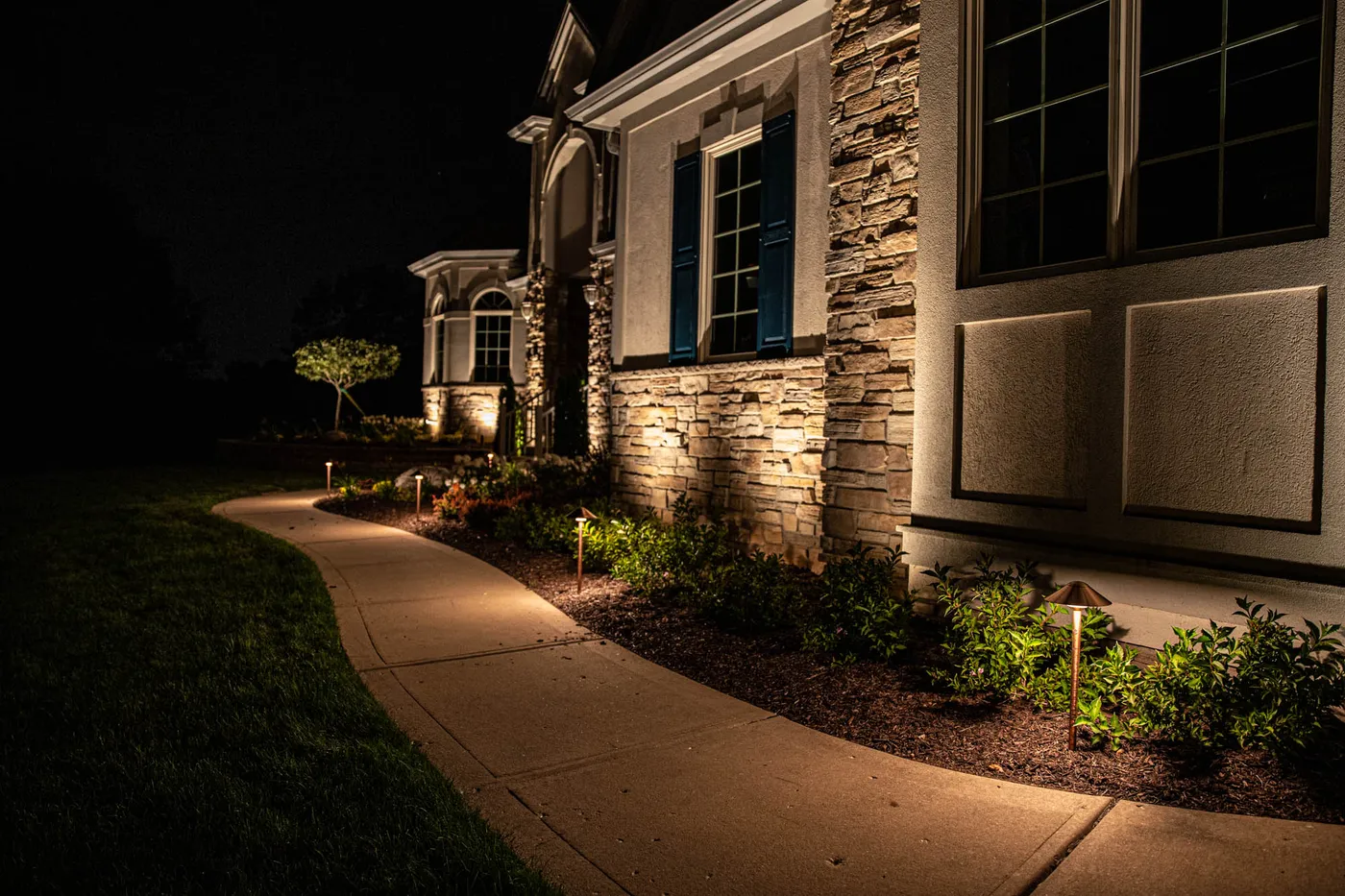
The single element doing the heavy lifting here is distance. Those uplights sit close to the brick — roughly 12 to 18 inches out — so the light travels up the wall at a grazing angle instead of washing it flat. Move the same fixtures three feet away and the brick goes muddy, the stone goes pale, and the arched wooden door stops being the focal point. Placement beats fixture price every single time.
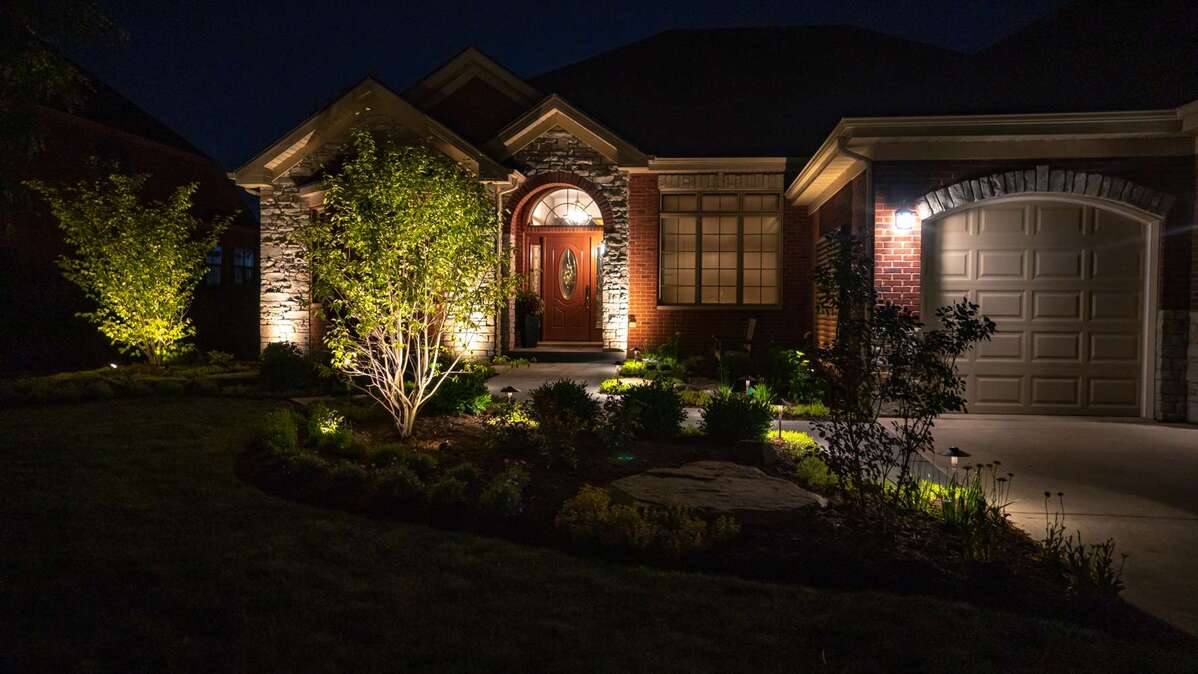
You can chase this look at a big-box store for about $180: eight 3000K well lights at $12–$18 each, a 120-watt transformer around $60, and 100 feet of low-voltage cable. The custom brass fixtures on the original house cost five times that, and at dusk most people can’t tell the difference. Spend the savings on a second circuit so the garage lights can run separately from the entry.
5. Stone Steps and Retaining Walls with Integrated Step Lighting
This layered approach needs room to breathe. Plan on at least 1,500 square feet of yard and a grade change of two feet or more — steps, a slope, a retaining wall, something for the light to climb. On a flat quarter-acre lot those same fixtures flatten into a runway. If your yard is smaller, the bollard approach in Idea #12 does the work of an entire layered scheme with half the footprint.
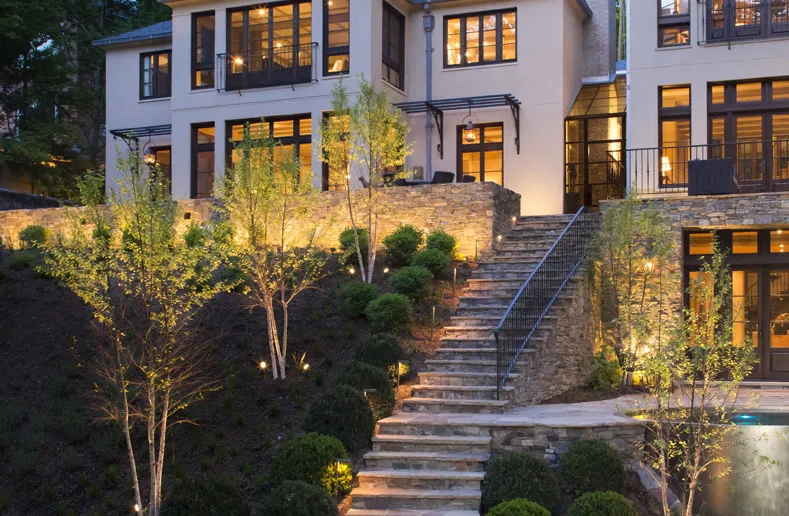
Three separate light layers keep this from looking like a floodlit parking structure:
- Step and wall lights at ankle height, which define the path without glare
- Uplights in the planting beds, which push the trees into silhouette
- Wall lanterns at eye level, which anchor the entry
Keep each layer under about 800 lumens. Stack them all at full brightness and the elegance disappears entirely.
6. Rustic Stone Facade with Ground Uplights and a Lit Path
Placing path lights that actually look good:
- Walk the path at night with a flashlight and mark where you naturally look down.
- Set fixtures 12–18 inches off the path edge, never directly on it.
- Space them 6–8 feet apart and stagger the two sides.
- Keep the top of each fixture below knee height so it never catches your eye.
- Cap the run at 12 fixtures per transformer to avoid dimming at the end.
Time: an afternoon. Materials: $150–$400 for a low-voltage kit.
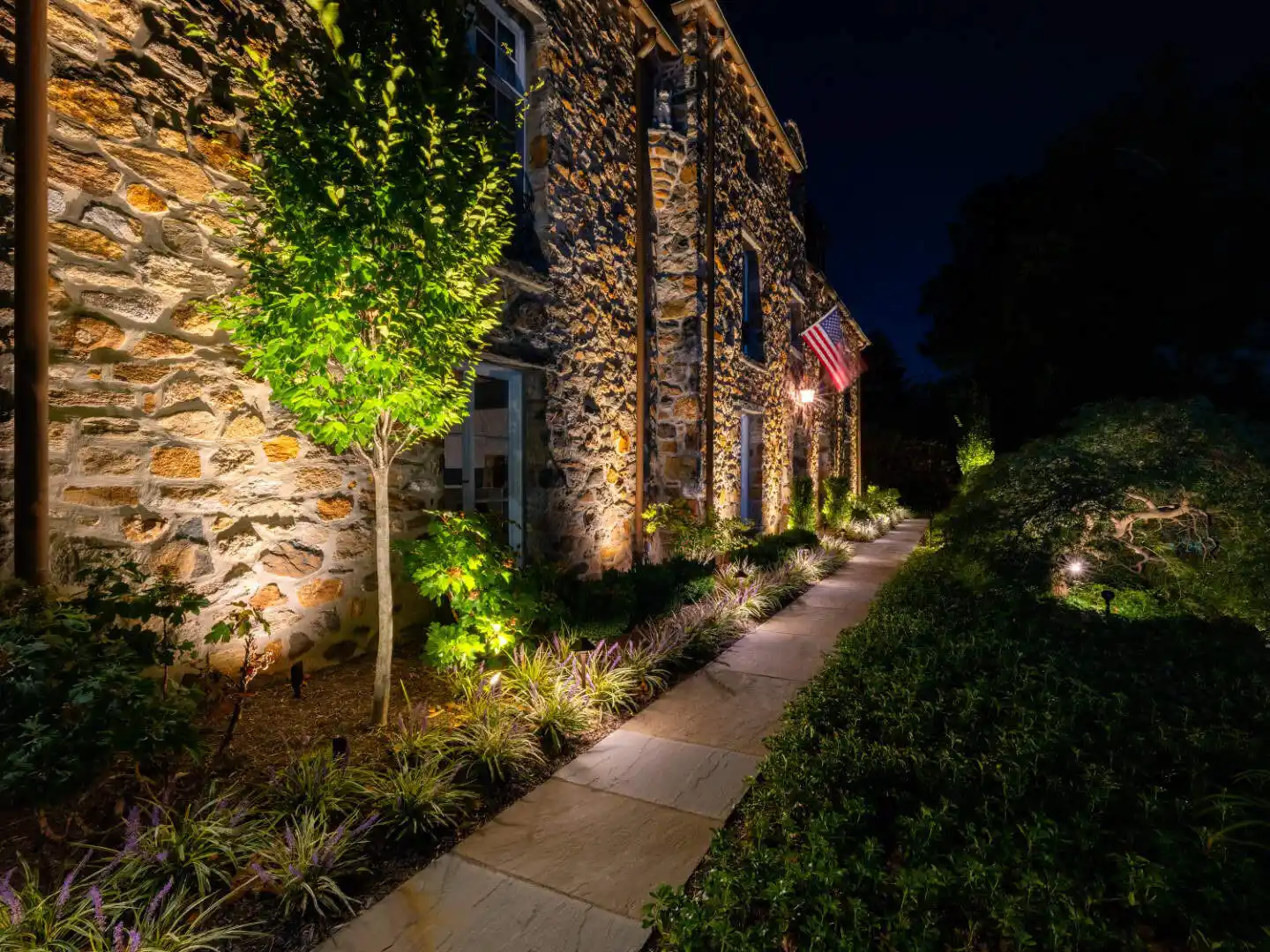
A dedicated light for the flag sounds charming until the bulb burns out in February and nobody notices until June. Put that fixture on the same circuit as the pathway so you flip one switch, and use an LED rated for 25,000 hours. One more thing — ground-level uplights get buried by mulch and clipped by mowers. Ring each one with a small stone collar and you’ll save yourself a season of frustration.
7. Arched Entry Stucco House with Fountain-Side Path Lighting
Warm, low-glare lighting has been the quiet 2026 trend — 2700K to 3000K fixtures instead of the cool 5000K floods that defined the last decade. Dark-sky-friendly shielding is showing up in ordinary neighborhood specs now, and copper-toned path lights are having a moment because they age into the landscape instead of standing out against it. This look has staying power because it’s basically good manners with a transformer.
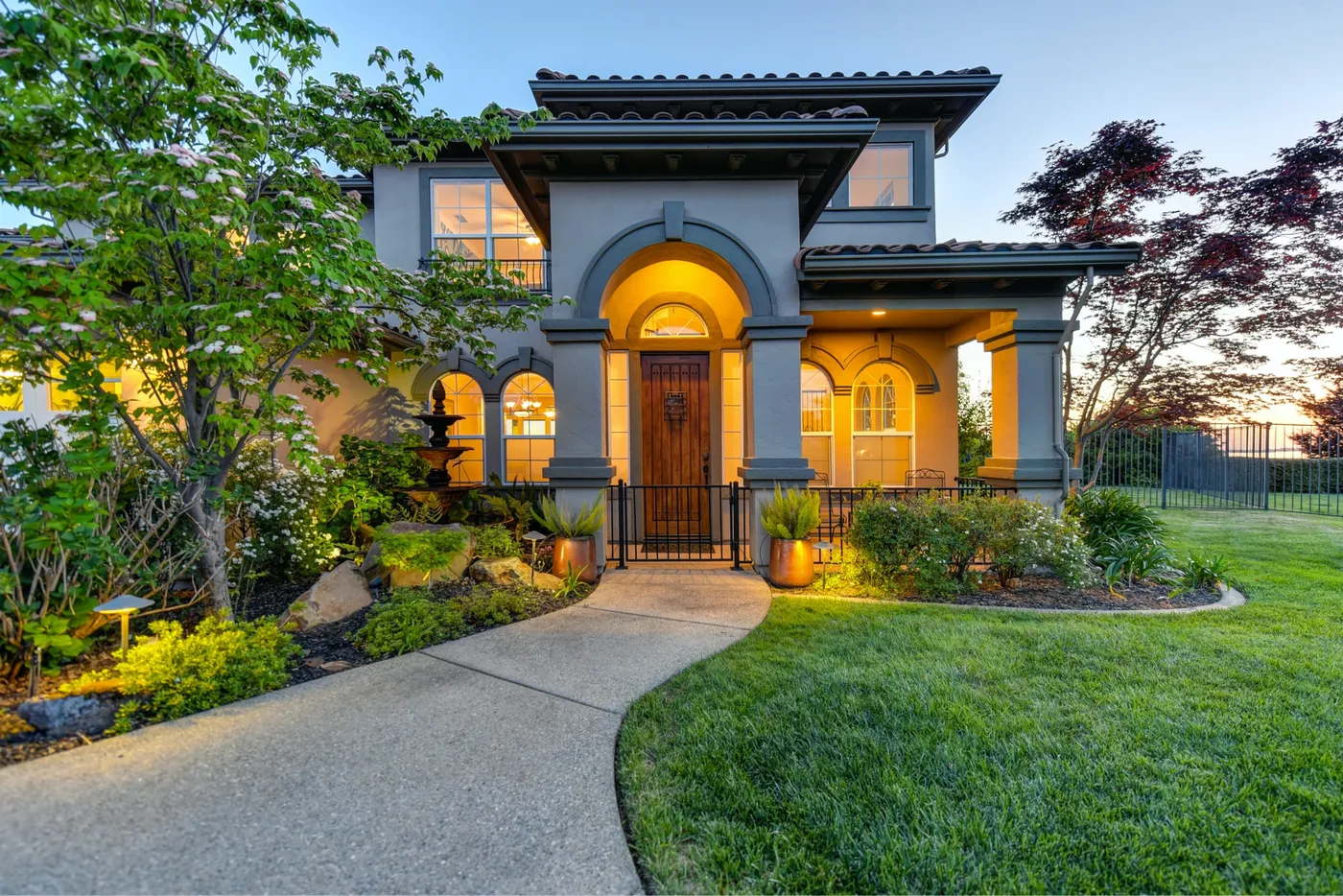
That tiered fountain needs to be lit, not floodlit. A single 3-watt submersible or a shielded uplight at the base gives you moving water and zero glare. For the curved walkway, choose path lights with a 90-degree shield so the light lands on concrete instead of in the eyes of anyone walking to your front door. Glare control is the whole difference between elegant and annoying.
8. White Brick with Uplights Tucked Beneath the Windows
The detail most people miss is that the uplights sit directly beneath the windows, not between them. That placement turns each window into a bright rectangle floating above a pool of light, and it makes white brick read as texture instead of a flat slab. Remove those four fixtures and the facade becomes a blank wall with a door in it. It’s the cheapest move in this entire article to copy.
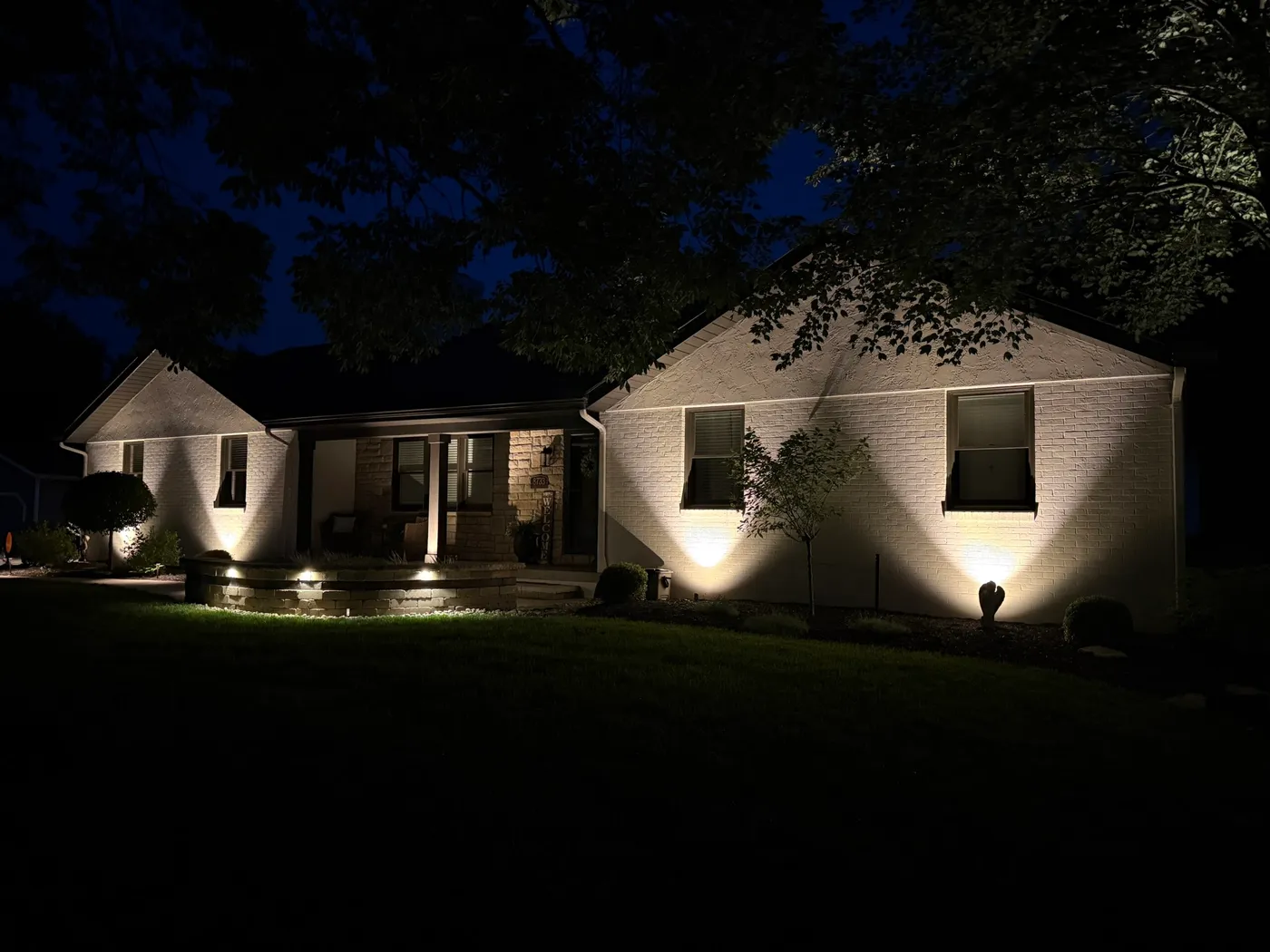
White brick shows every bit of grime that lighting reveals. Budget one gentle pressure wash per year, and expect to wipe the glass lenses on ground fixtures every three or four months — pollen and spider webs cut output more than you’d guess. Cheaper aluminum housings pit and chalk within three seasons; powder-coated or brass bodies cost more up front and still look decent in year ten.
9. Flush Wall Lights and Tree Uplights Around a Tiled Patio
Read this patio as 60% light-toned hardscape, 25% warm light, 15% dark furniture and planters. Grey tile and the pale house facade supply the base, the warm fixtures supply the glow, and the dark sofas and ribbed planters supply the contrast that keeps it from going beige-on-beige. Swap the tile for warm travertine and drop light to 20% — you’ll need less artificial glow because the surface bounces more back at you.
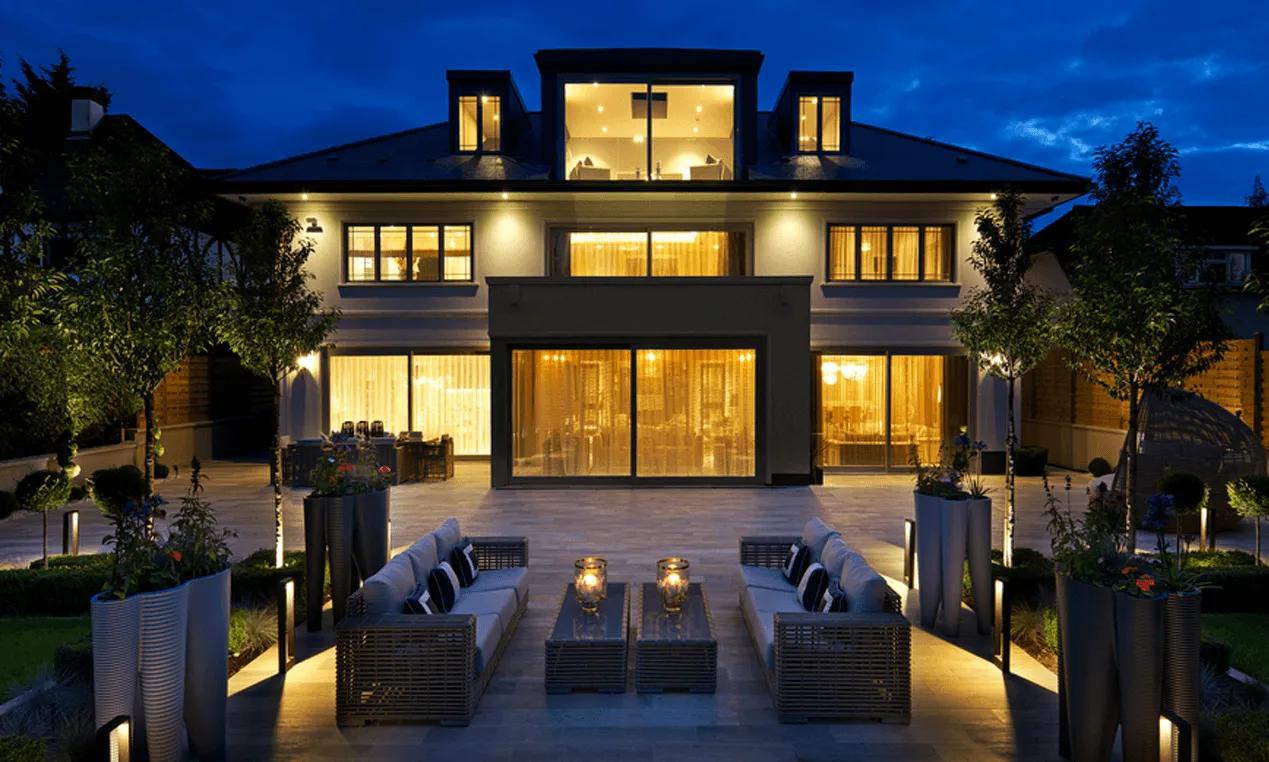
Before you buy a single patio fixture, confirm these:
- Measure the patio’s square footage — under 300 square feet, fewer fixtures read better.
- Note which direction the sun sets; west-facing patios need less artificial light at dusk.
- Check whether you have an exterior GFCI outlet within 50 feet of the run.
- Decide now whether you want one circuit or two, because retrofitting is the expensive part.
The soffit-only scheme in Idea #24 proves how far two fixture types can carry a whole exterior.
10. Grand Stone House with Curved Flower Beds in the Spotlight
- Facade uplights for two stories (12–16): $500–$1,600
- Bed and tree spotlights (10–14): $300–$900
- Transformer and low-voltage cable: $250–$700
- Timer or smart controller: $40–$180
- Installation: $1,000–$3,000
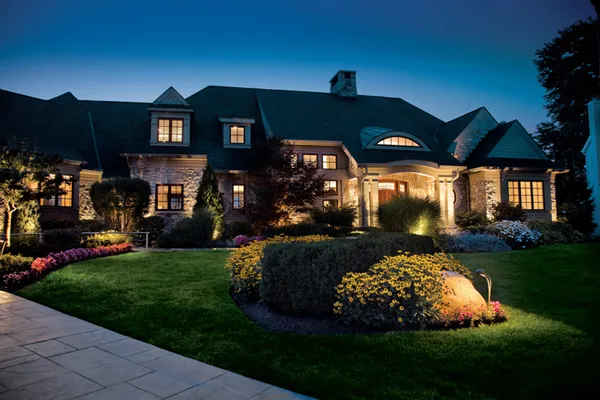
Total: $2,090–$6,380
Budget alternative: light the four architectural corners and the flower beds only — around $700 with off-the-shelf fixtures — and the house still reads grand from the street.
Uplighting a stone facade works because stone is a texture, not a color. Angle the beam up the wall and every ledge and mortar line casts a tiny shadow, which is what makes the wall look deep instead of painted. The curved beds matter too: soft, planted edges break up the hard line where lawn meets house, and the uplights make that curve visible after dark.
11. Linear Step Lighting and Tall Vertical Wall Lights
Linear step lighting needs two things: a groove and a drain. Recess the strip under the step nose, never on the face, or you’ll see individual diodes from across the yard. Slope the channel a degree or two toward the outside so rainwater runs off instead of pooling behind the lens. Order 10% extra tape — the first cut you make will be wrong, and matching a discontinued run two years later is a genuine nightmare.
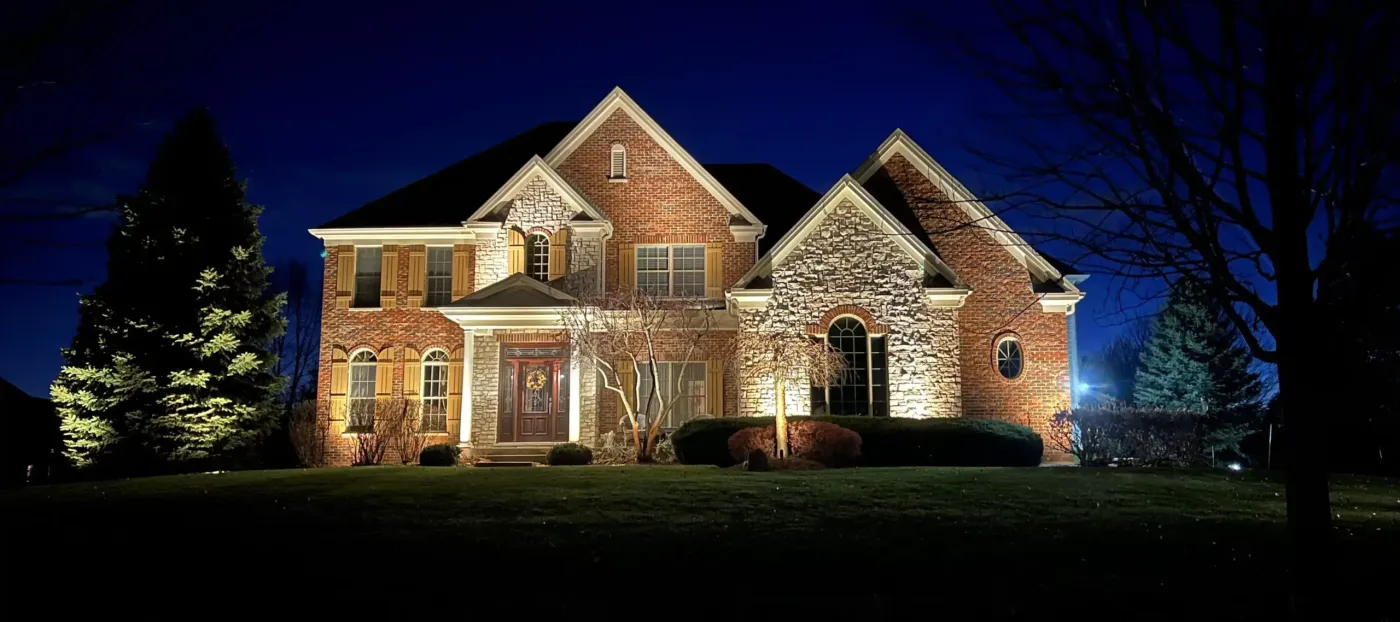
Those tall vertical flush wall lights are what separates this from every other minimal modern house on the block. They’re mounted almost like jewelry — slender, dark, evenly spaced — and they draw the eye upward, which makes the flat roof feel taller than it is. Swap them for small round sconces and the house reads generic. Vertical fixtures for vertical architecture, and keep the two perfectly aligned.
12. Dark Bollards, Frosted Diffusers, and a Matching Up-Down Sconce
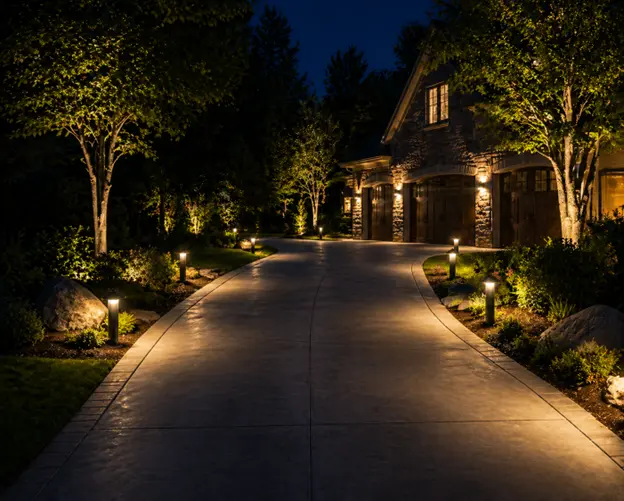
Bollards work best on narrow lots where wall-mounted lighting would spill onto a neighbor’s property. They suit paths 3 to 5 feet wide and lots under about 6,000 square feet, where a full uplighting package would feel aggressive. Space them 8 to 10 feet apart along a walkway, 12 to 15 feet along a driveway edge. On a bigger property, a layered uplighting package will always read better than a long row of posts.
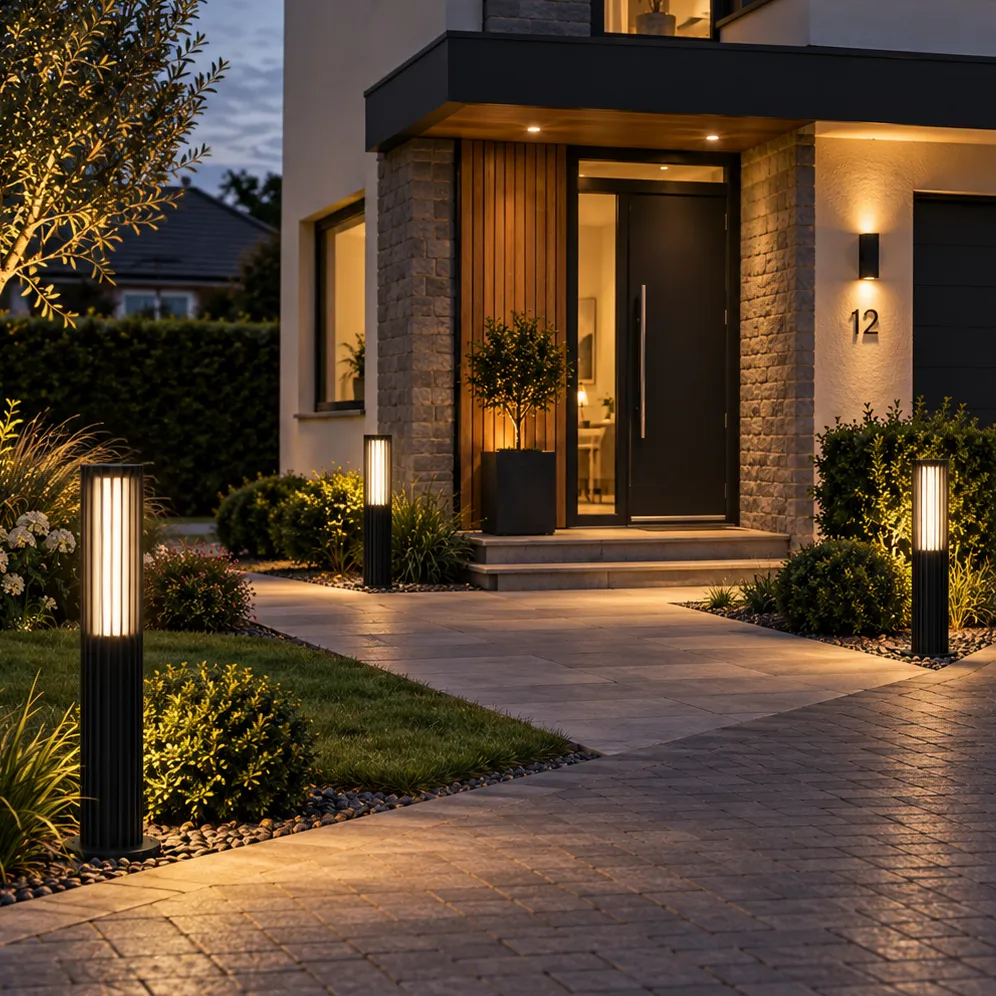
Frosted diffusers are magnets for spider webs and dust, and once they haze over, output drops fast. Wipe them with a damp microfiber cloth twice a year — spring and fall — and check that the ground hasn’t settled around the base, which is what causes most bollards to lean. Powder-coated aluminum handles freeze-thaw cycles well; cheap plastic bodies crack after two winters in a cold climate.
13. Carriage Lanterns and Grazing Light on Stone and Red Brick
Lighting a mixed facade without it looking messy:
- Count your wall materials — stone, brick, and trim each want their own fixture count.
- Place carriage lanterns flanking the entry, 60 to 66 inches to the center line.
- Set uplights at the base of stone sections only, 12 to 18 inches from the wall.
- Aim one fixture at the bay window so the copper roof reads after dark.
- Put the brick on its own dimmer zone — brick reads hotter than stone.
Time: a weekend. Materials: $400–$1,200.
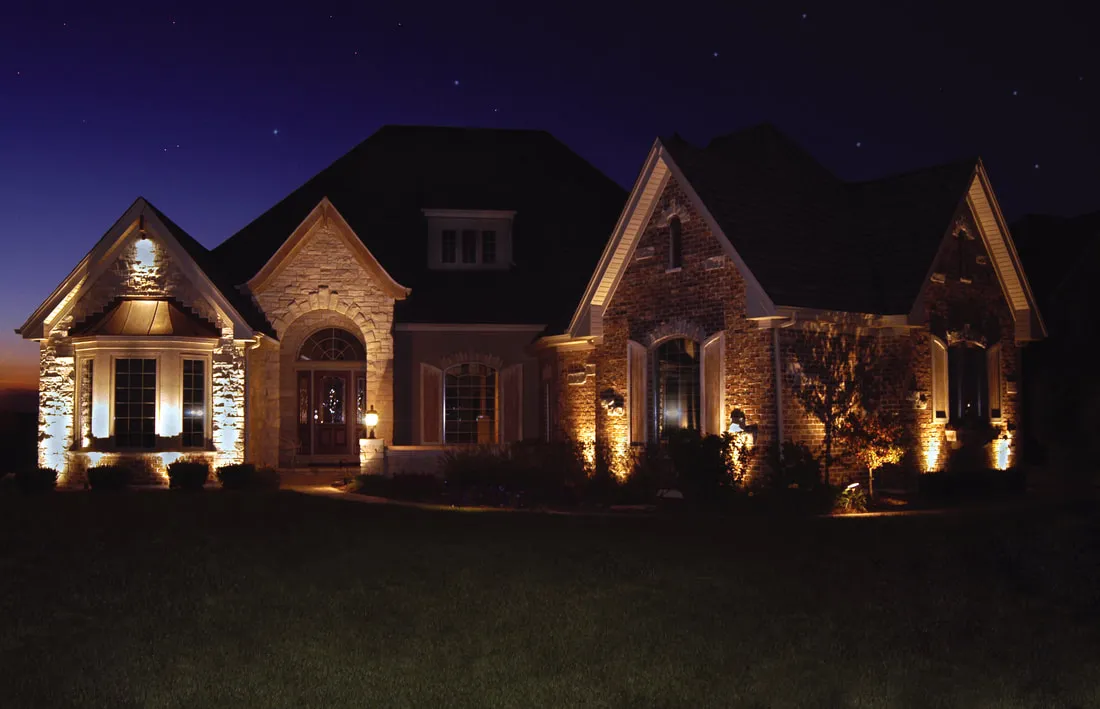
Carriage lanterns are the easiest exterior fixture to fake convincingly. Walmart and Home Depot both carry black aluminum versions for $30–$60 each that photograph identically from the curb; the $300 solid-brass ones only reveal themselves up close. Save your real money for the uplights, where build quality genuinely changes how the beam looks. Compare with Idea #4 for a warmer, single-material version of the same thinking.
14. Dormer Windows Framed by Warm Facade Uplights
Dormers are the hardest exterior detail to light well, because most people light the wall below them. Aim narrow-beam fixtures straight at the dormer faces instead, so each one glows like a small lantern against the roofline. The manicured lawn and flowering beds matter more than you’d think — they catch the overflow and keep the ground from going black, which is what makes the whole scene feel landscaped rather than floodlit.
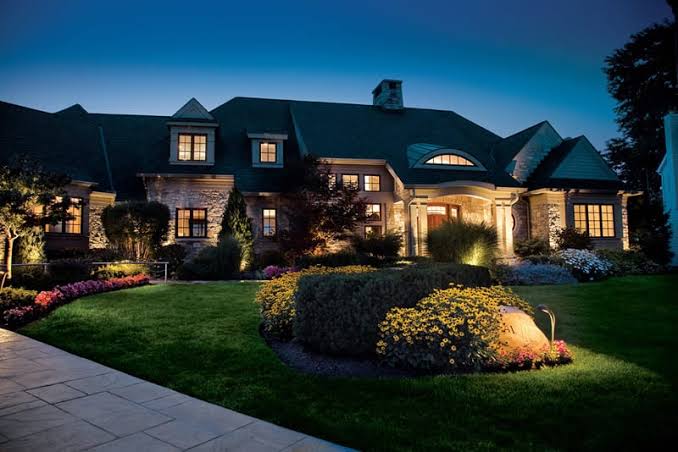
Warm uplights on light stone look wonderful and hide a lot. Watch out for these:
- Uplights aimed too steeply leave dark gaps between beams at the second story.
- Cheap fixtures shift color over time — one will go pinkish and you’ll notice it forever.
- Flower beds under spotlights dry out faster and need more watering.
Also check the lights from inside the house. If a beam crosses a bedroom window at 10 p.m., you’ll resent the whole system by Thanksgiving.
15. Square Up-Down Sconces on a Light Stucco Facade
Think of it as 65% pale stucco, 25% warm light, 10% black metal. The stucco is the canvas, the sconces are the accents, and the light is what merges them. This formula shifts easily: swap the beige stucco for soft grey while keeping everything else identical and the look turns crisper and more urban without a single fixture change. Change the black sconces to bronze and it goes Mediterranean. Same math, different mood.
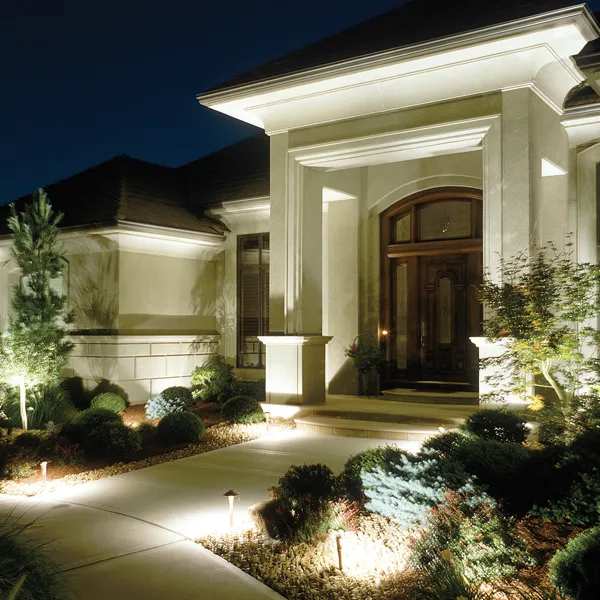
Mount up-down sconces so the lower beam lands on the ground and the upper beam dies before it reaches the soffit — around 5.5 to 6 feet to the center on a single-story wall. If the upward beam hits an overhang, you’ll get a hot spot and a hard shadow line. Square fixtures on flat stucco should be centered between the door and the nearest corner, and kept at least 4 feet from any opening.
16. Horizontal Siding and a Picket Fence Bathed in Warm Light
- Facade uplights (8–10): $300–$900
- Porch and column lights (2–4): $120–$450
- Tree and shrub uplights (4–6): $120–$350
- Transformer, cable, timer: $180–$500
- DIY installation: $0, or $800–$2,000 hired out
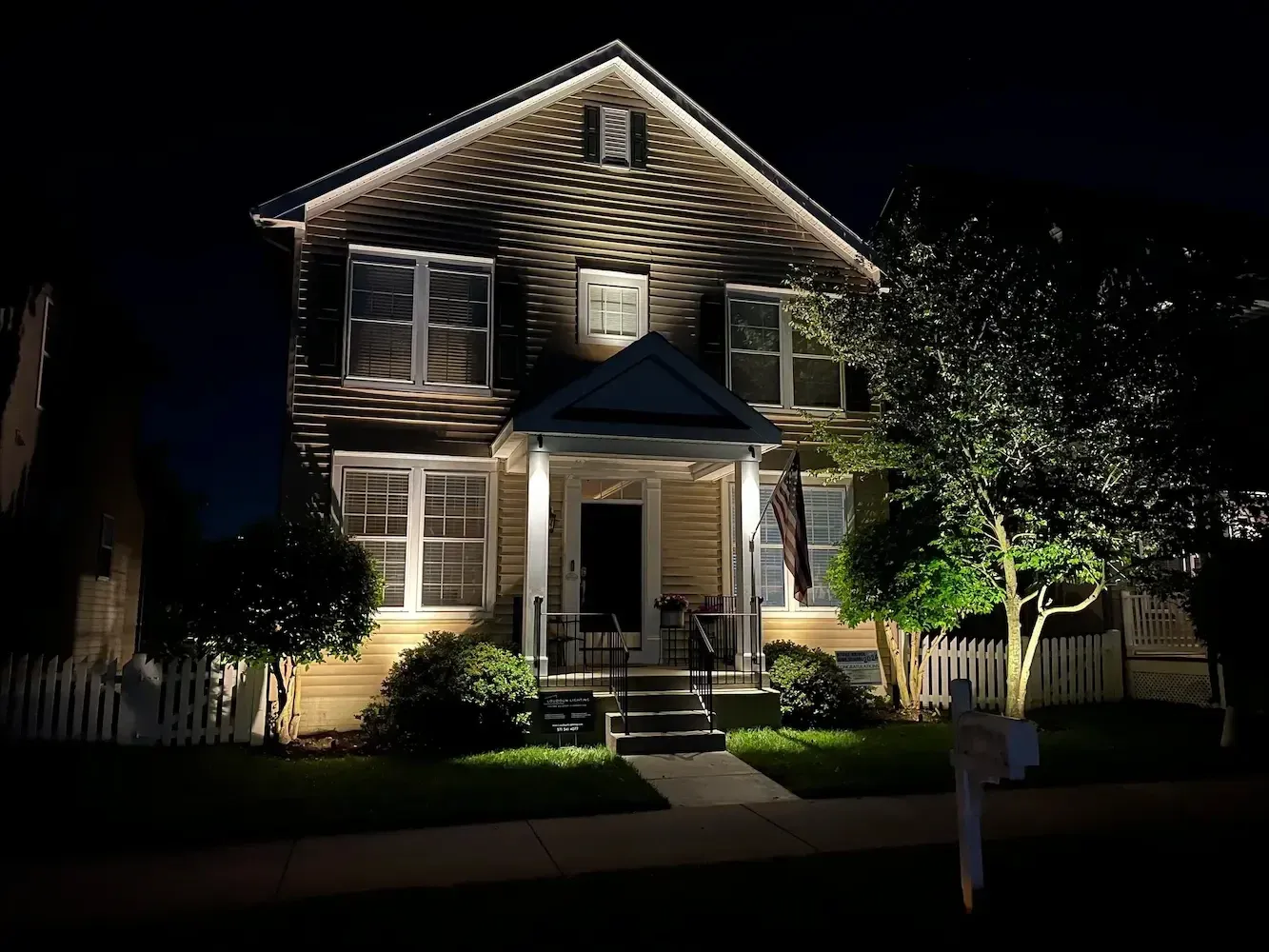
Total: $720–$2,200 if you install it yourself
Budget alternative: light the porch and two trees only, about $250 all-in, and let the picket fence catch the spill.
The white picket fence is doing more work than you’d guess. It catches the overflow from the yard fixtures and turns a hard property line into a soft, glowing edge — which is why this house reads friendly rather than fortress-like. Take the fence away and the same lighting feels slightly severe. A white-painted surface quietly doubles every fixture you own.
17. Spherical Post Lanterns Along a Curved Driveway
Spherical post lanterns are back, and not in an ironic way. The 2026 version is smaller-headed, darker-framed, and far better shielded than the 2005 model, which is why designers are pairing them with modern stone walls instead of colonial trim. It tracks with a broader shift toward fewer, larger gestures outdoors — three beautiful posts along a curve beats twelve tiny stake lights scattered everywhere. This one is likely to stick around.
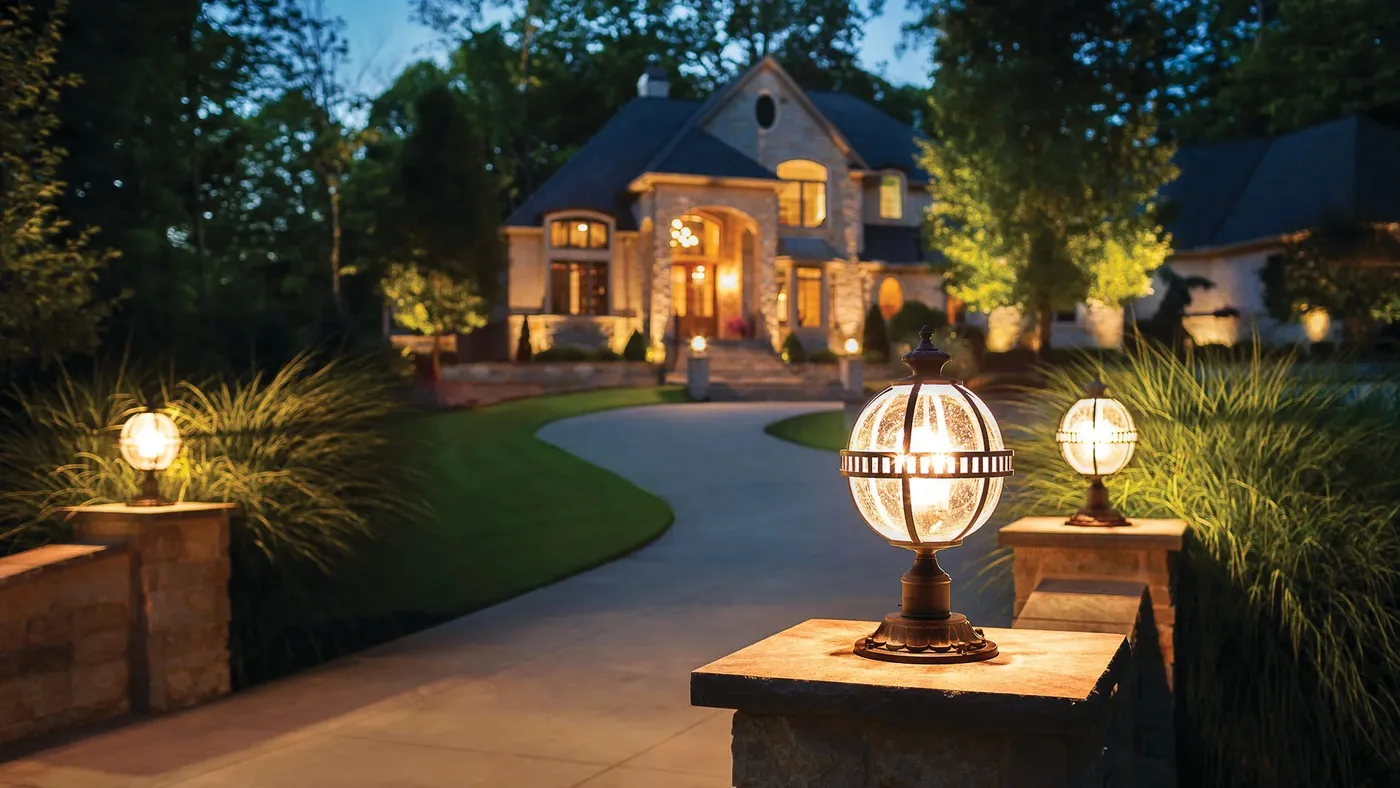
Curved driveways need at least 40 feet of run to justify three posts, and each post should sit 8 to 12 feet back from the pavement edge. On driveways under 30 feet, two posts read as a matched pair instead of a runway. Ornamental grasses between the posts soften the transition and hide the wiring trench. On tighter lots, a bollard run delivers the same wayfinding at half the footprint.
18. Stone Veneer Steps with Integrated Lighting and Fire Accents
Adding integrated step lights to a stone staircase:
- Measure every riser and record it — irregular steps demand custom channels.
- Choose recessed or surface-mount fixtures rated IP65 or better.
- Place one fixture per tread on stairs wider than 4 feet, otherwise every 3 feet.
- Wire them on a separate zone from the uplights so the stairs can stay on late.
- Seal everything with exterior silicone, then hose it down before closing the wall.
Time: 4–6 hours with a helper. Materials: $200–$600.
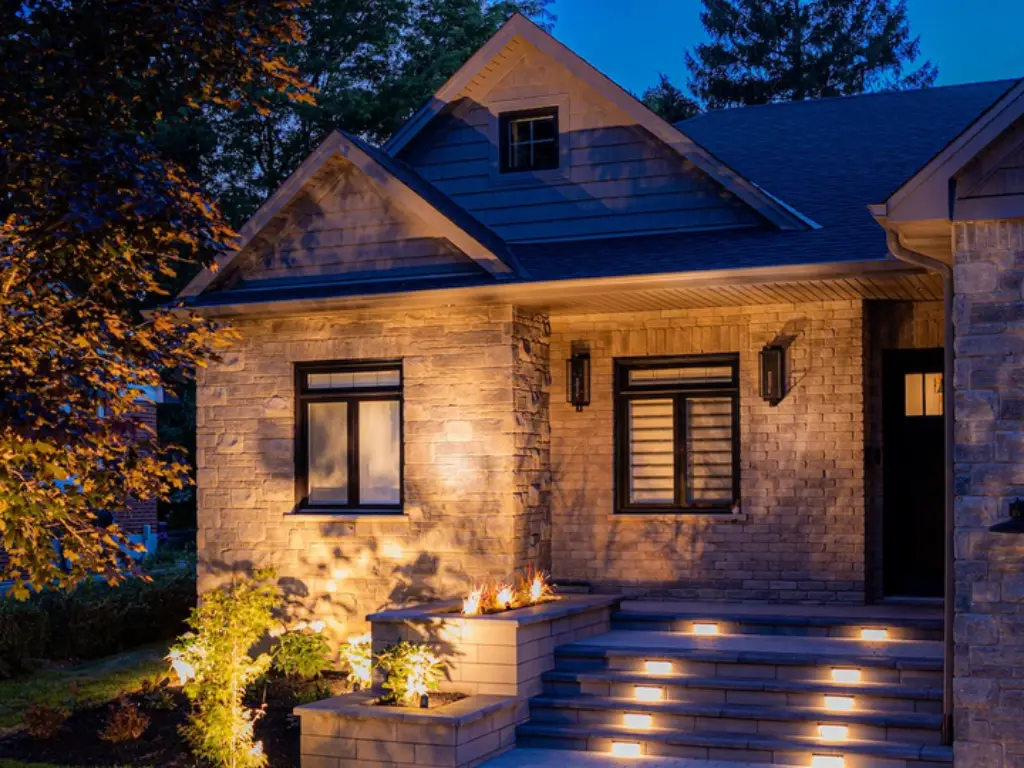
The small decorative fire features near the entrance are the wildcard — they don’t light anything, they just make the entry feel inhabited after dark. Two dark rectangular sconces flanking the central window do the actual anchoring, and the integrated step lights keep people from tripping. If you only had budget for one of the three, keep the sconces. They’re the reason the facade reads intentional.
19. Stacked Stone and Vertical Wood Cladding in Evening Light
Potted spiral topiaries are the sneaky expense here — the plants run $60–$150 each, and good planters another $50–$200. Buy the planters first at Home Depot or Walmart, then hunt for topiaries on Facebook Marketplace in spring, when everyone is dividing their yards. Two matching pots at $35 each and $40 plants gets you 80% of the effect for a quarter of the price. Nobody stands at the curb measuring your foliage.
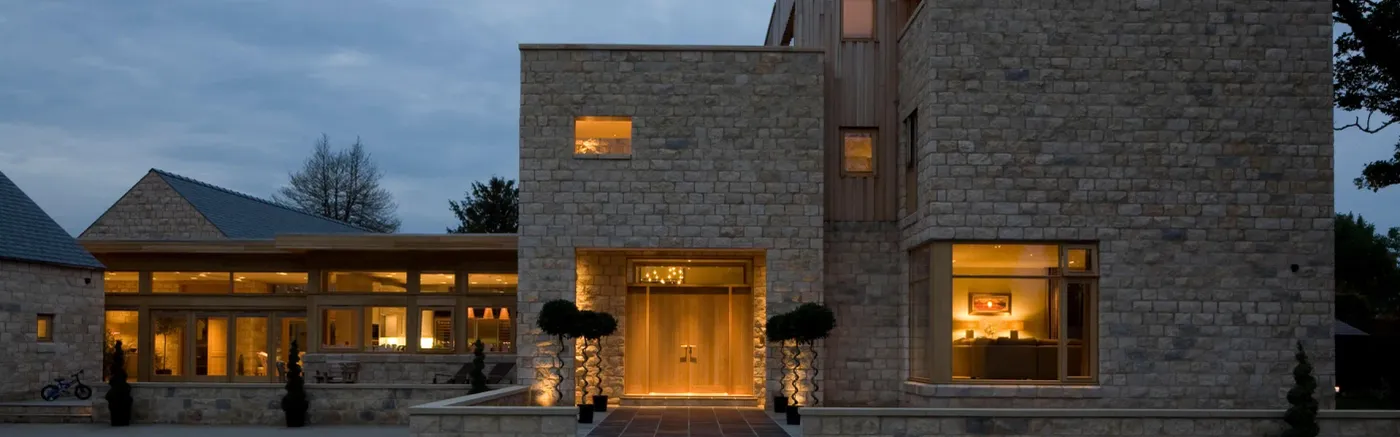
Two textures, one light source. The stacked stone throws shadows because it’s rough; the vertical wood cladding reflects because it’s smooth. Uplighting both with the same warm fixture creates contrast without adding a second color, and the wood-framed windows glow from inside to tie the two materials together. It’s a textbook case of texture doing the design work so the lighting doesn’t have to.
20. A Concrete Privacy Wall Grounded by Vertical Light Beams
That row of ground uplights along the concrete wall is the whole idea. Without them it’s a grey slab guarding a wooden gate. With them, you get vertical beams that read like a colonnade, and the geometric metal canopy above suddenly makes sense as the top of the composition. The star-shaped wall lights are the fun detail, but the beams are the structure. Light the verticals and everything above them looks intentional.
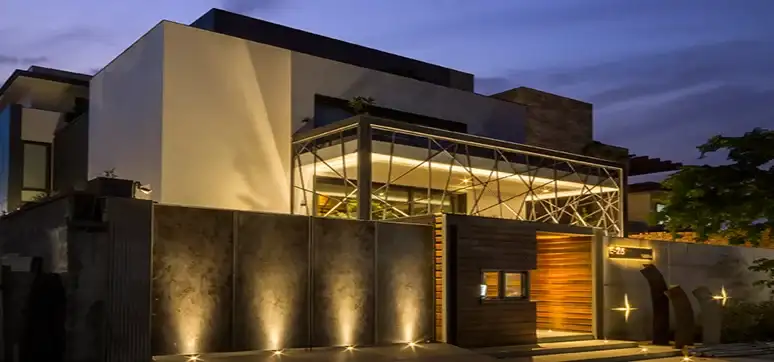
Run the math as 50% concrete grey, 30% warm vertical light, 15% natural wood, 5% black metal. That’s a heavier ratio than most residential schemes, which is exactly why this facade feels architectural rather than cozy. To warm it up, push warm light to 40% and grey down to 40%. To make it cooler and more gallery-like, flip those numbers back and swap the wood gate for steel.
21. Classic Columns and Dormers Lit in Warm White
Uplighting white columns is a favorite move and a risky one. Aim the beam slightly off-axis or you’ll get two bright stripes with a dark column between them, which looks like a mistake from every angle except directly in front. Older siding also shows shadows cast by nothing — a slightly bent piece of trim becomes a black scar once you light it from below. Fix the siding before you fix the lights.
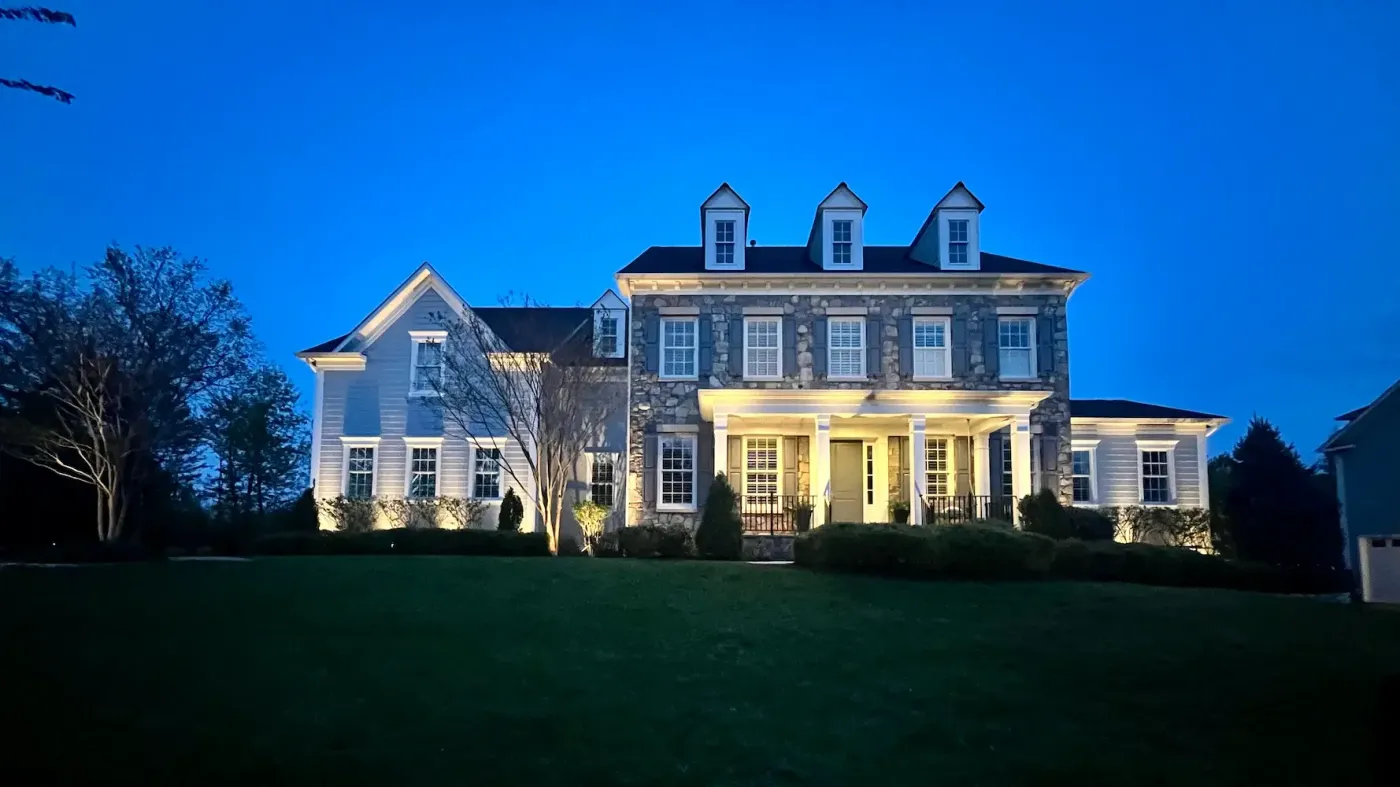
A warm traditional facade needs a yearly walkthrough: check for water in the lens, re-aim anything that shifted, and clear leaves out of ground fixtures in fall. Expect to replace one or two fixtures every four or five years — not because they fail electrically, but because the finish chalks. Keep a spare in the garage. It’s much easier than hunting a discontinued model three seasons from now.
22. Copper Path Lights on a Curved Walkway
Check these before you dig:
- Call 811 to mark utilities — a cut low-voltage cable is cheap, a gas line is not.
- Confirm which way the walkway drains so fixtures don’t sit in a puddle.
- Decide between copper and powder-coated aluminum, since copper patinas and aluminum doesn’t.
- Count your fixture total and size the transformer at least 20% above it.
Get these four right and the installation takes an afternoon instead of a weekend.
Real copper path lights run $60–$120 each, which adds up fast on a curved walk. Powder-coated aluminum in a copper finish costs $18–$35 and looks nearly identical for the first three years; after that, copper wins on charm and aluminum wins on price. Start with the six fixtures people actually walk past and add the rest next spring. Nobody has ever noticed a lighting plan that grew in stages.
23. A Reflecting Pool with Floating Lights and One Olive Tree
Water and light are a partnership, not a competition. Keep submersible and floating fixtures under 3 watts, and make sure the water surface stays still — ripples scatter light straight into glare. If the pool is under 8 feet across, three floating lights is plenty. Give the olive tree its own shielded spotlight so it reads as a sculpture; a flood will just make it look like a bush that happens to be lit.
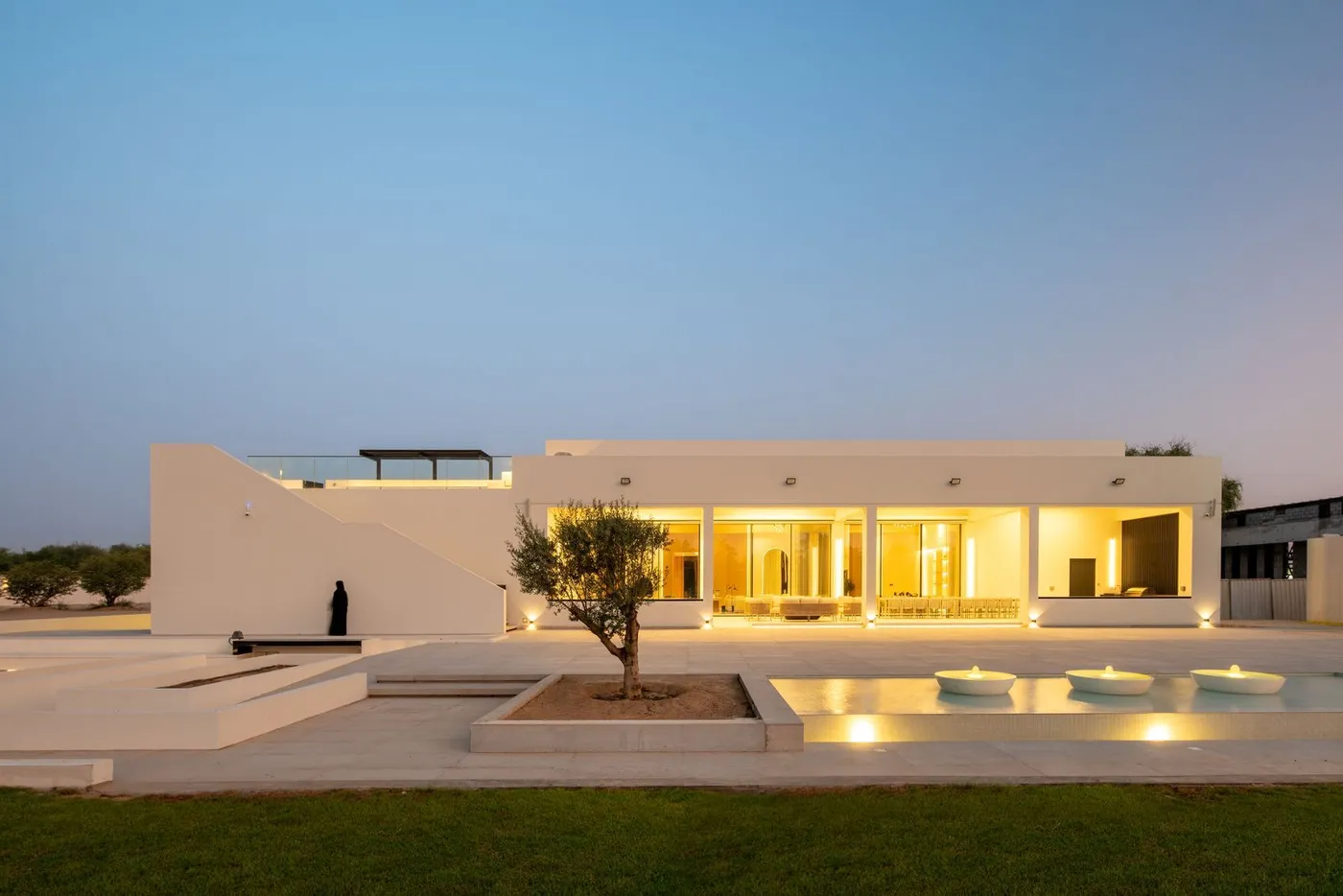
This one belongs on a lot with at least 2,000 square feet of usable yard, since the reflecting pool and lawn need breathing room to look deliberate rather than cramped. Overhang height matters too — glass walls read best when the soffit sits at 10 feet or more, so the interior glow has somewhere to go. Smaller lots get a similar serenity from two well-placed sconces on a light stucco wall.
24. Recessed Soffit Downlights Against Dark Cladding
Soffit downlights do something uplights can’t: they light the ground where people actually walk while keeping the source invisible. On a dark facade that’s worth more than raw brightness — the house stays moody, the patio stays usable, and there’s no glare at eye level. The light wood soffit helps too, bouncing warm light back down instead of absorbing it the way dark cladding would.
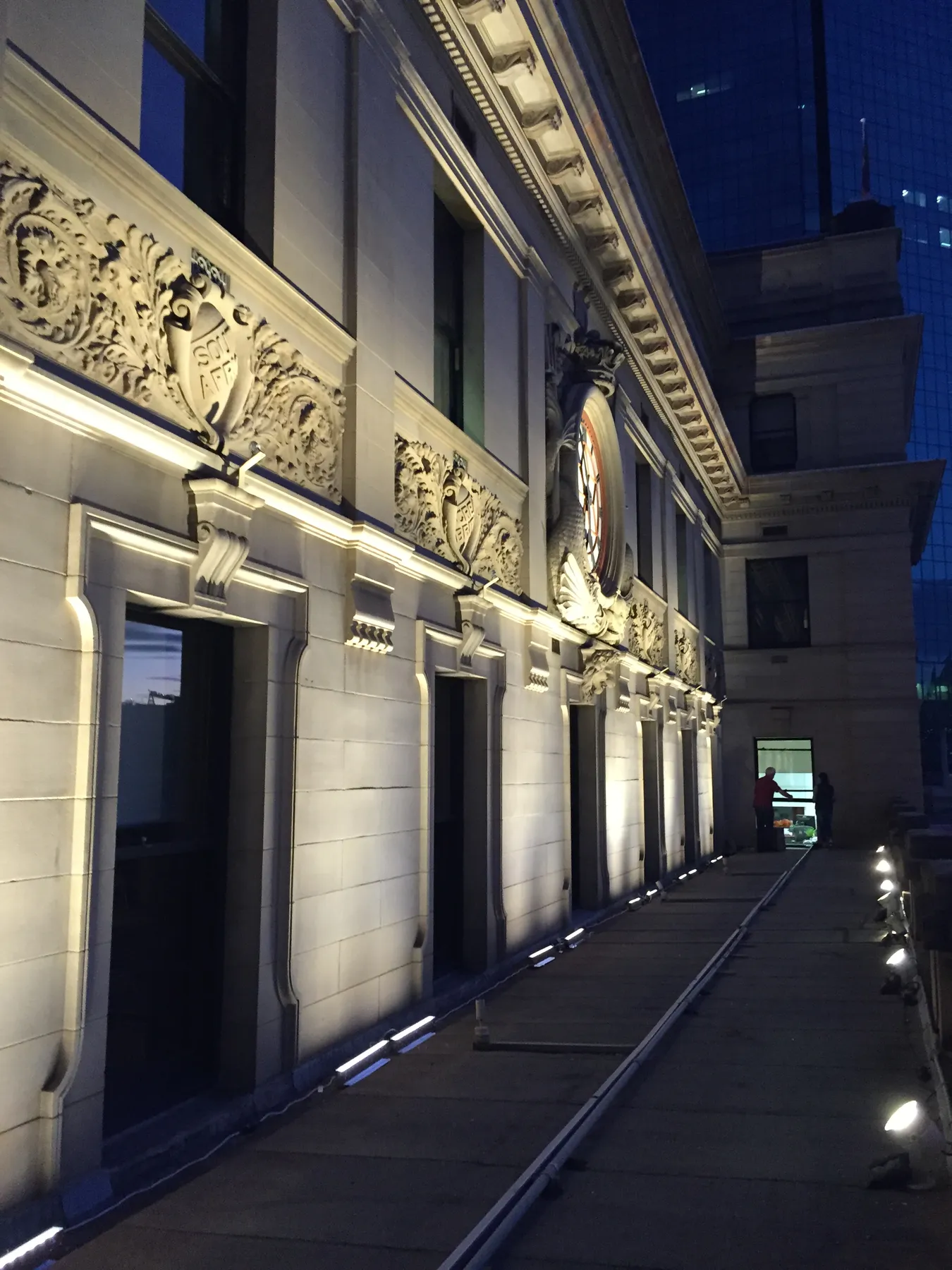
The light wood soffit ceiling is the quiet hero here. Against dark walls, that warm-toned plane catches every downlight and turns the underside of the roof into a glowing ceiling, which is why the patio feels like a room. Swap it for black soffit and the same fixtures become harsh dots. If you’re retrofitting, painting the soffit a warm mid-tone is a $200 change with a $2,000 effect.
25. Wall Sconces Between Dark Garage Doors
- Wall sconces between garage doors (2–4): $120–$500
- Entry column downlights (2–3): $90–$350
- Landscape spotlights and palm uplight (4–6): $100–$320
- Transformer, cable, photocell timer: $160–$450
- Installation: $400–$1,200
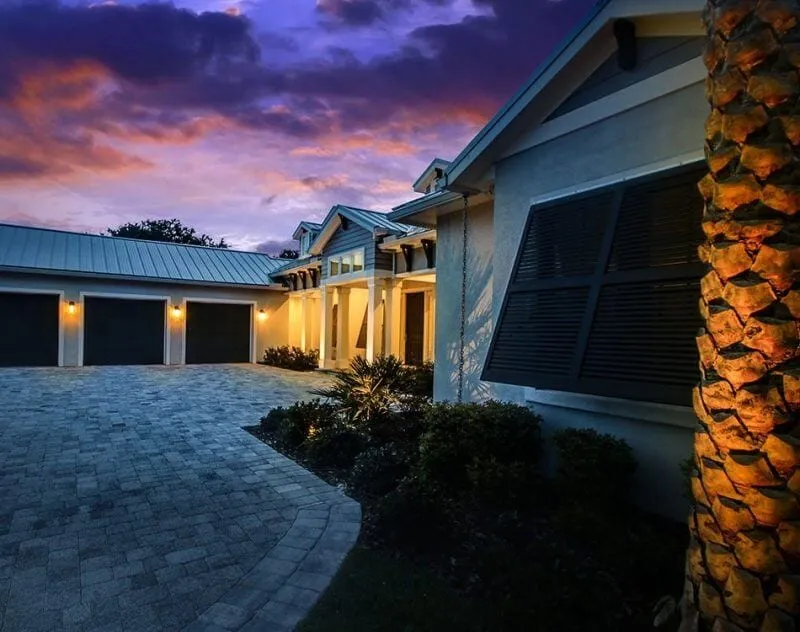
Total: $870–$2,820
Budget alternative: sconces and the palm tree only, roughly $280 with off-the-shelf fixtures — the entry still reads welcoming.
Put a sconce between the garage doors rather than on the outer corners. Centered fixtures light the driveway apron where cars actually pull in, and they make the doors read as two panels instead of one blank wall. Mount them 66 to 72 inches to the center line, and choose a down-only or up-down beam depending on whether you want light on the pavement or drama on the stucco.
26. Linear LED Outlining a Dark Facade Panel
Count it as 55% pale grey panel, 25% linear light, 15% dark accent, 5% green foliage. The vertical proportions matter as much as the percentages — one full-height light line and one horizontal outline, no more. Add a third line and the facade starts to look like a stage set. If you want to soften the whole scheme, trade the crisp white light for 2700K and it warms up without changing a single dimension.
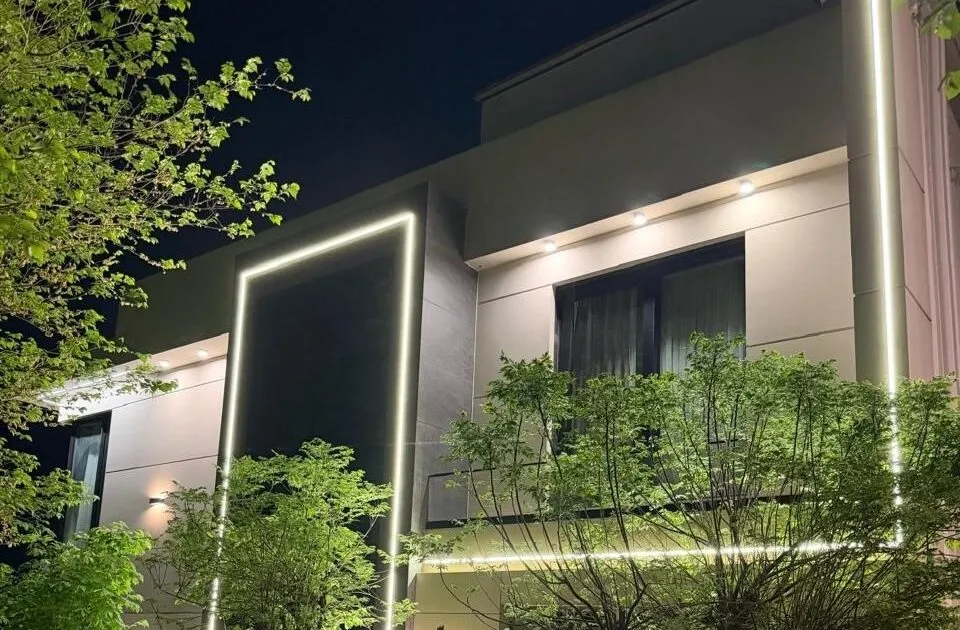
Linear exterior lighting is the most attention-hungry detail in this article. It shows every bit of dust, every insect, every drip mark, because it’s a continuous glowing line. It also demands a clean install — a wavy strip is instantly obvious at night. If your facade has texture, seams, or imperfect framing, go with the approach in Idea #1 instead, where individual sconces forgive a lot more.
27. Facade Uplights Tracing Columns, Porch, and Dormer
Dialing in a traditional facade:
- Light the porch columns first — two fixtures, offset slightly outward, not dead-center.
- Add the entry door light and put it on its own switch.
- Uplight the dormer with a narrow 15-degree beam so light doesn’t spill onto the roof.
- Add two uplights at the far corners of the facade to widen the composition.
- Dim everything to about 70% and live with it for a week before adjusting.
Time: two evenings. Materials: $350–$1,000.
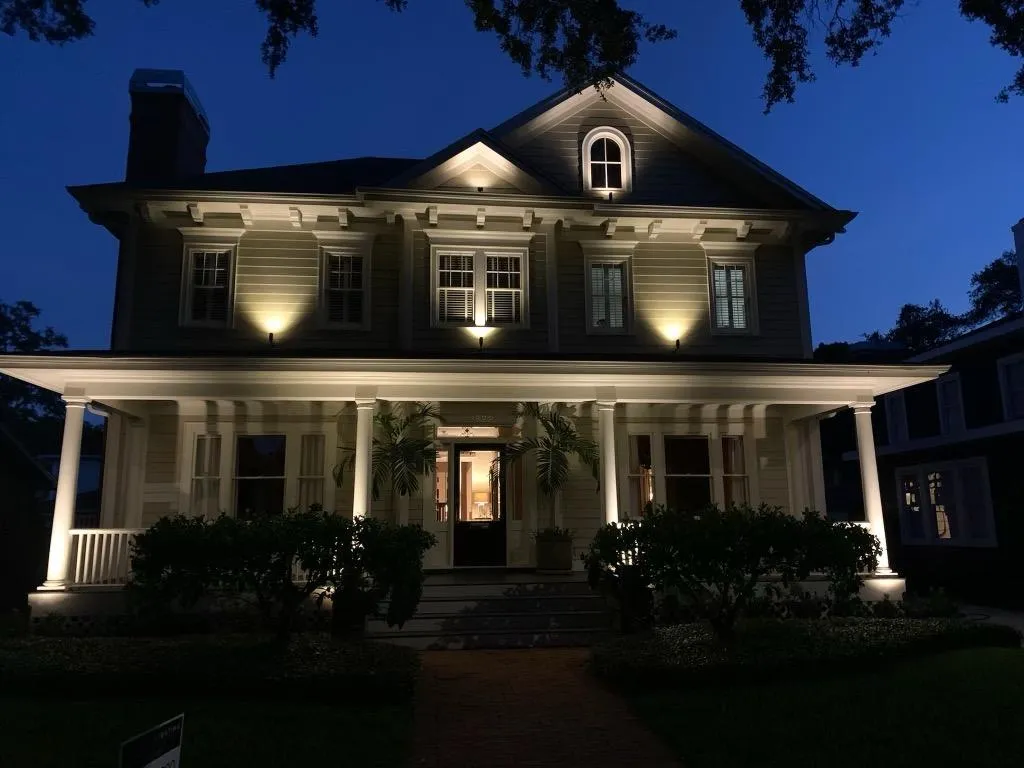
Traditional exteriors are getting a lighting refresh rather than a redesign, and it’s one of the more sensible trends of 2026. Homeowners are skipping full facade replacements and spending $600–$1,500 on warm, well-aimed uplighting instead, because it changes how a house looks for listings, for curb appeal, and for arriving home after dark. It’s the cheapest way to make a 1990s colonial look deliberate instead of dated.
28. LED-Traced Cornices on a Multi-Tone Facade
Cornice lighting is a measuring job before it’s a lighting job. Set the strip back 2 to 4 inches from the face of the cornice so the glow bounces rather than showing you the diodes, and use 24V tape with 2700K output. On anything taller than two stories, ask for a constant-current driver and an aluminum channel — heat is what kills roofline tape, not rain, and the channel is what dissipates it.
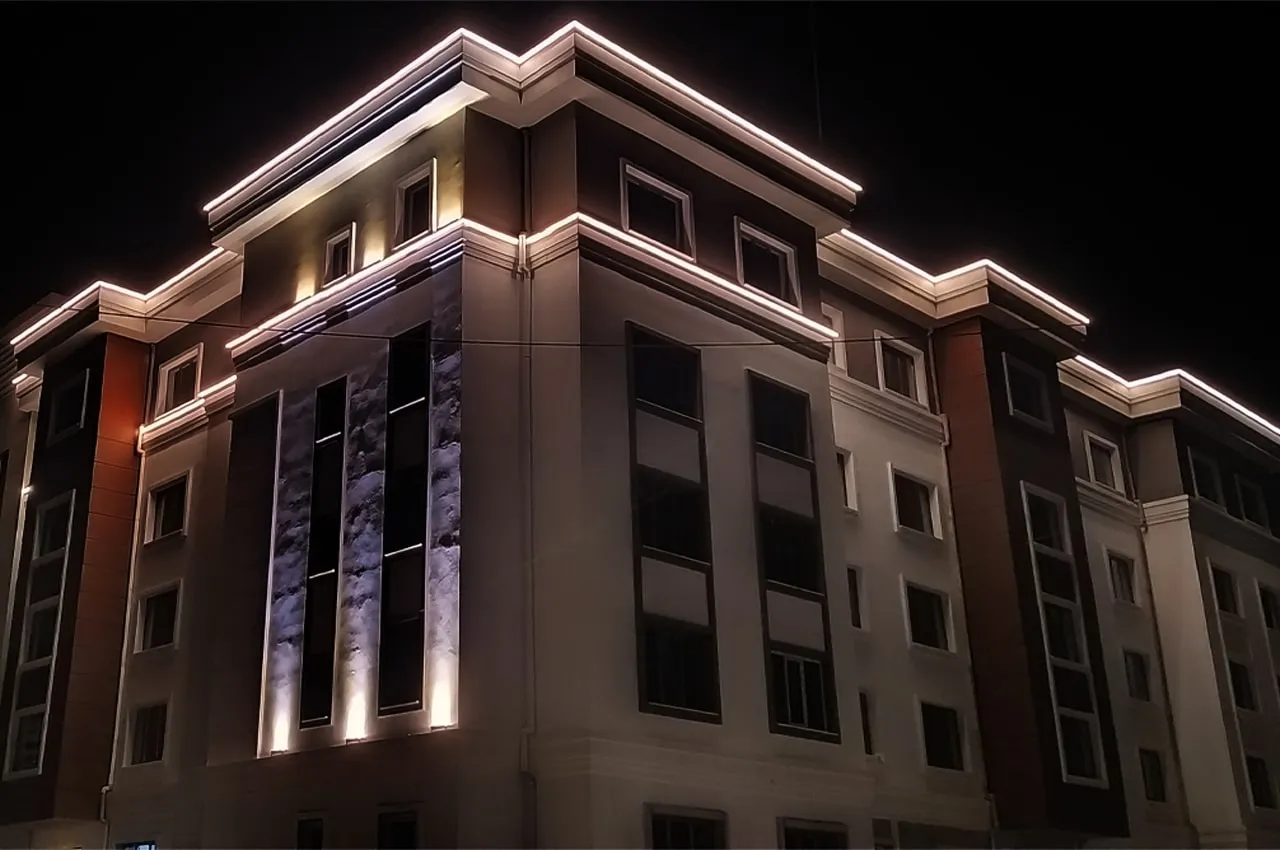
Roofline lighting is a maintenance commitment you can’t shortcut. Expect to clean the channel and diffuser once a year to remove pollen and cobwebs, and to replace a tape section every five to seven years — usually at the sunniest corner of the building, where UV does its work. Keep the driver indoors or in a ventilated box. If you’re not comfortable on a ladder, budget an electrician visit every other year.
29. Recessed Downlights Under a Modern Carport Ceiling
This scheme suits a house with deep overhangs or a carport ceiling at least 8 feet high and 200 square feet of covered area. Shallower structures get too much bounce from recessed cans and start to feel like a parking garage. On lots where you don’t have an overhang to work with, the facade-mounted approach in Idea #30 delivers a similar look without the structure.
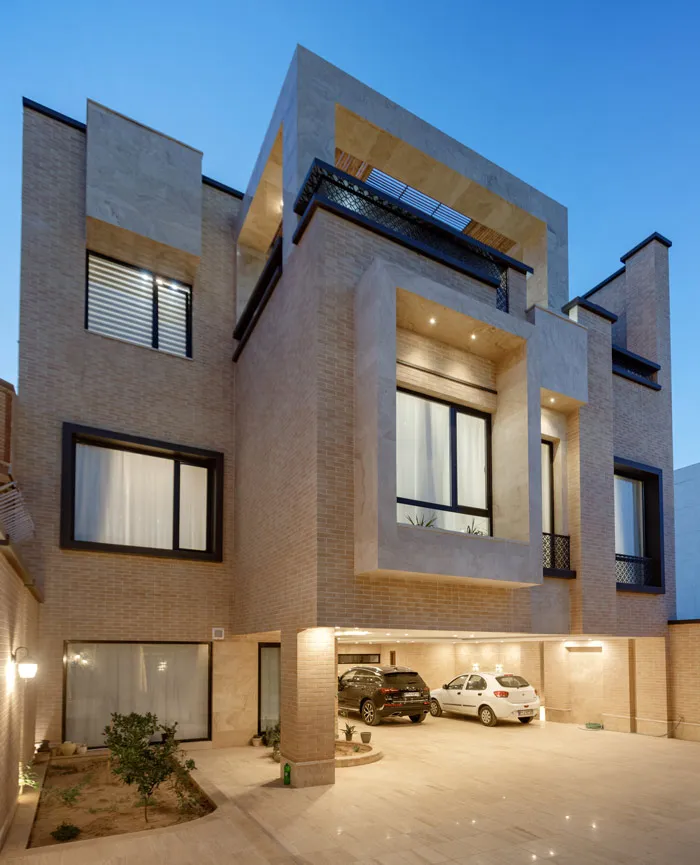
Recessed downlights do three jobs at once:
- They light the ground where feet actually go, which is what recessed fixtures are for.
- They keep the source hidden, so nothing glares from the street or a bedroom window.
- They let the brick and stone facade stay dark, which is what gives the house its shadow lines.
Add a few ground-level sconces at the entry and you have a complete exterior scheme with two fixture types and no visual noise.
30. Rectangular Up-Down Sconces and a Framed Entry Lantern
The rectangular up-down sconces were chosen for their beam shape, not their style. Those distinct upward and downward cones are what create the vertical rhythm along the facade — the light itself becomes the pattern. A round sconce with a softer diffuser would be pleasant and entirely forgettable. If you change one thing in this design, change the fixture shape and watch the architecture’s whole personality shift with it.
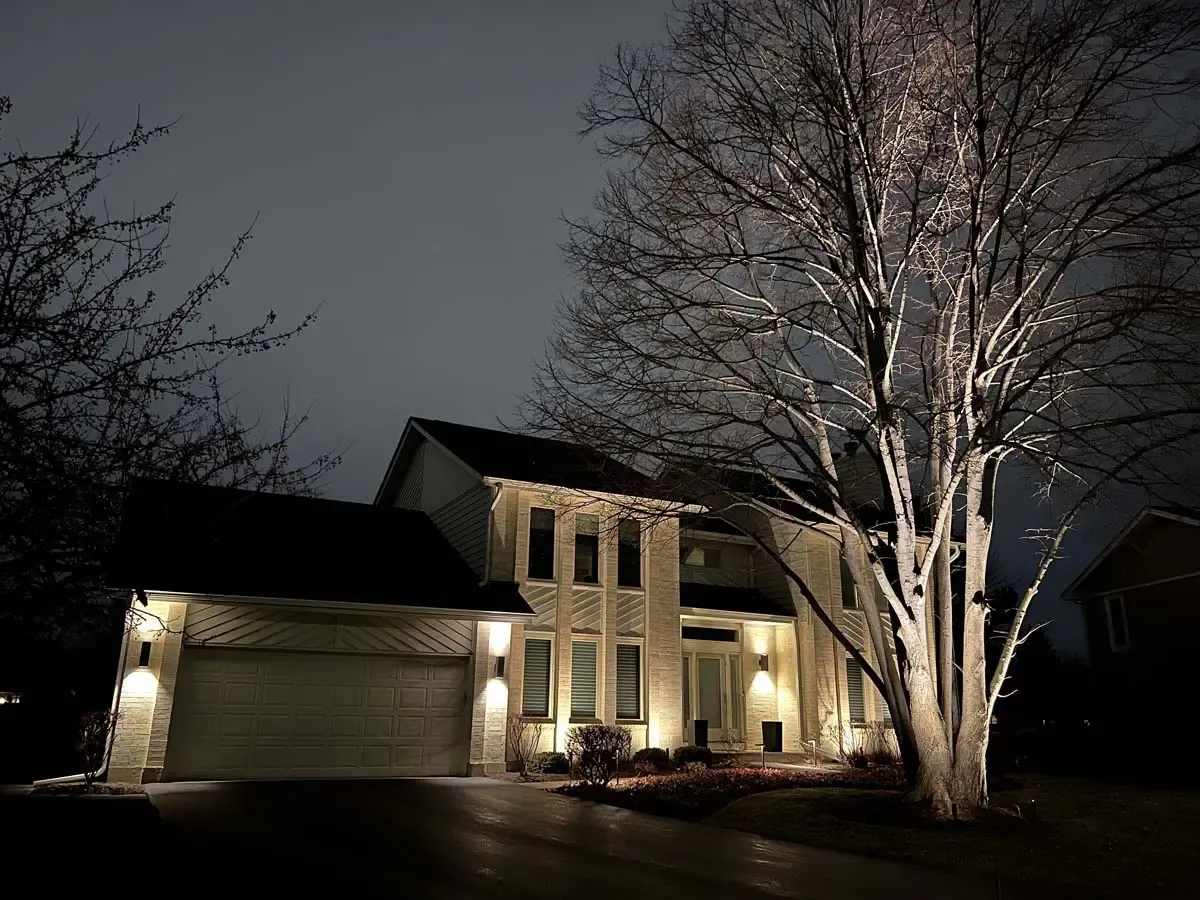
Rectangular up-down sconces are one of the few categories where the cheap versions hold up. Target and Home Depot sell wet-rated versions for $28–$45 each versus $200 for architectural-grade fixtures. What you lose is beam precision and finish durability, not the look. Buy four of the inexpensive ones, put them on a timer, and upgrade the two flanking the front door later if you’re still thinking about it.
31. String Lights Outlining Gables and Arches
- Commercial-grade string lights with warm LED bulbs (100–150 ft): $120–$400
- Mounting clips and stainless cable: $40–$180
- Landscape uplights for stone and beds (8–10): $240–$700
- Transformer, timer, and outdoor outlets: $180–$500
- Installation on a two-story gable: $500–$1,800
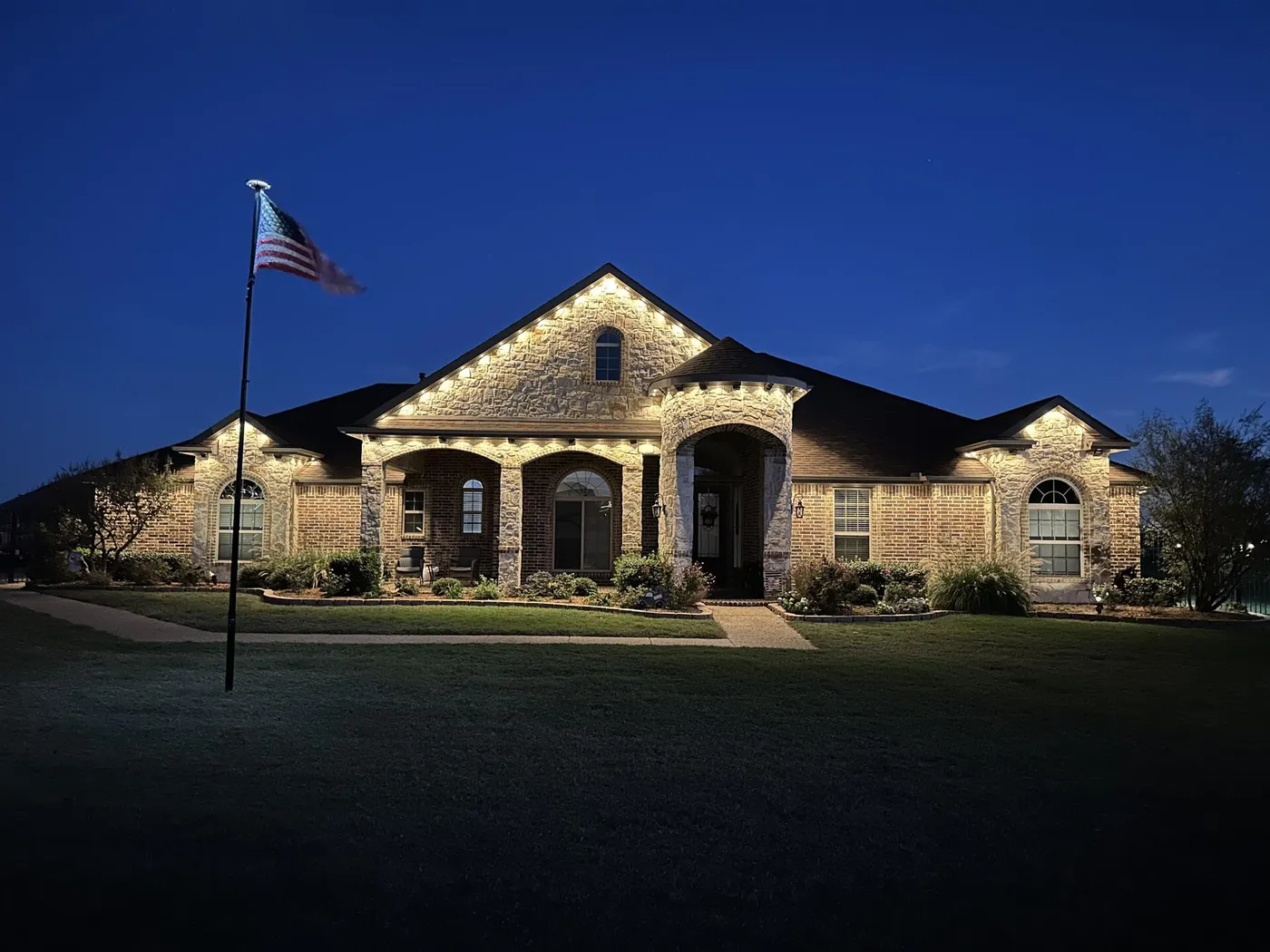
Total: $1,080–$3,580
Budget alternative: outline just the porch arches and skip the roofline. That’s a two-hour job with $150 of lights, and it photographs beautifully.
Tracing a gable with string lights:
- Measure the run and add 15% for sag and turns.
- Use stainless steel cable and clips, not nails — the wire carries the weight.
- Keep bulbs on 12-inch spacing for a continuous look; wider spacing goes spotty.
- Plug into a GFCI outlet with a photocell timer so the whole thing runs itself.
- Check it from across the street and adjust the sag until the lines match.
Time: 3–5 hours on a one-story house. Materials: $150–$450.
32. Vertical Light Stripes on a Brick Townhouse Facade
This one runs about 45% deep brick, 35% warm light, 15% black window frames, 5% white trim. That’s the darkest base in the entire article, which is exactly why the sconces can be so bright without looking garish — dark surfaces absorb light and let you push brighter. Swap in a pale brick and you’d need to drop the output by roughly a third to keep the same visual weight on the street.
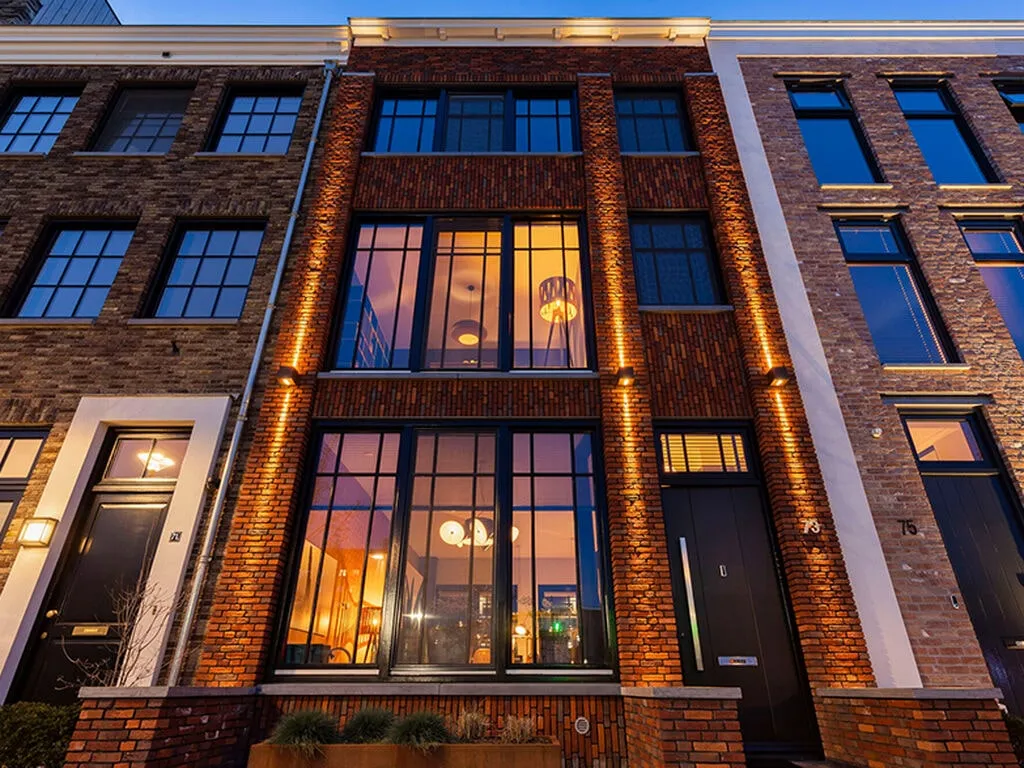
Up-down wall sconces on a narrow facade should be centered between window openings, not above them. You want the beams falling on solid brick so the wall itself becomes the striped element. On a 20-foot-wide townhouse, three sconces at 6 to 7 feet apart will look balanced; four will look crowded. The corten planter at the base is a nice finishing move — that rust tone quietly picks up the brick.
33. Linear Strip Lighting Along a Sandstone Retaining Wall
Water features and exterior lighting share one failure mode: nobody plans the maintenance. A linear strip in a retaining wall is lovely until leaves and grit collect in the channel, and a lit water feature grows algae faster with warm light on it. Plan on a spring cleaning every year, and put both on a timer that runs four hours in the evening — not all night. Your power bill and your filter will both thank you.
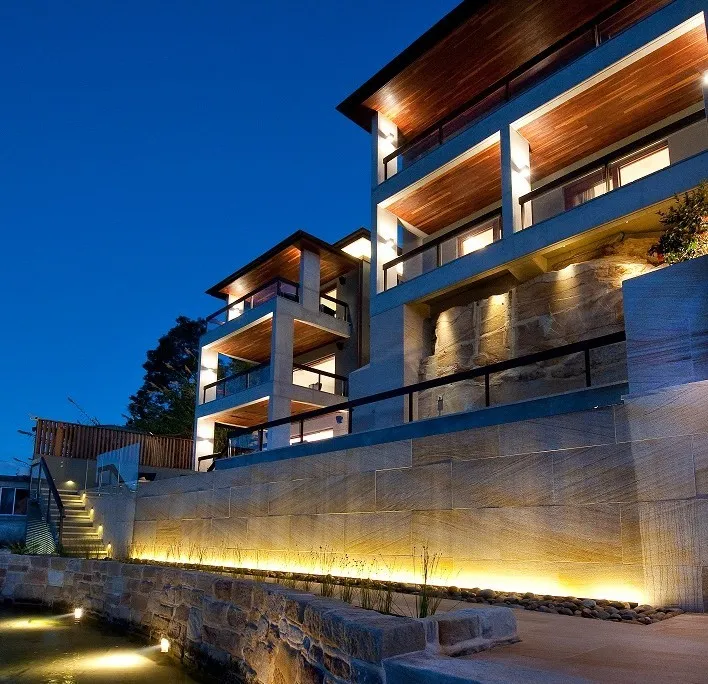
This multi-level approach belongs to houses with two or more stories and a grade change of at least three feet, typically on lots of 5,000 square feet or more with a retaining wall running 20 feet or longer. Below that, the linear strip turns into a bright line on a short wall and the drama evaporates. Compare with Idea #5, which reaches a similar layered mood through steps and planting instead of hardscape.
Your House, Glowing by Dusk
Start with three fixtures — the entry, one tree, and the path people actually walk. Get those right and the rest of the plan writes itself over the next few seasons, one zone at a time.
📌 Save this to Pinterest before you buy a single fixture, and pin the ideas you want to steal first — your future self will thank you on the first warm evening of the year.