Still scrolling through outdoor Christmas tree photos at 11 p.m., saving every single one? Same. The yard has quietly become the part of the holidays people plan first — and the photos saved in July are the ones that actually get built in November.
We spent real time browsing Walmart, Target, and Home Depot to filter out the listings that look nothing like their photos. What’s left is 30 ideas that actually deliver, from a $25 potted porch tree to a $1,200 full-yard display, covering classic traditional, modern light sculpture, whimsical character decor, and flocked winter wonderland looks — with budget and luxury versions compared side by side.
2026’s shift is easy to spot: fewer inflatables, more sculptural light forms. Cones, spirals, and wireframe trees read as design rather than decoration. And stay until the end — we break down the most common mistakes that can ruin these looks.
📌 Save this to Pinterest for later — you’ll want to revisit these ideas.
1. Blue and Amber Lights Over a Snow-Covered Yard
Mixing cool blue with warm amber on the same tree is the lighting move that keeps showing up in 2026 displays. It comes straight out of the color-drenched trend that took over interiors a few years back — people got comfortable with two light temperatures in one room, and now they’re doing it outside. On snow and ice, the two tones bounce and separate, so a display that could read as one flat glow suddenly has depth you can see from the end of the street.
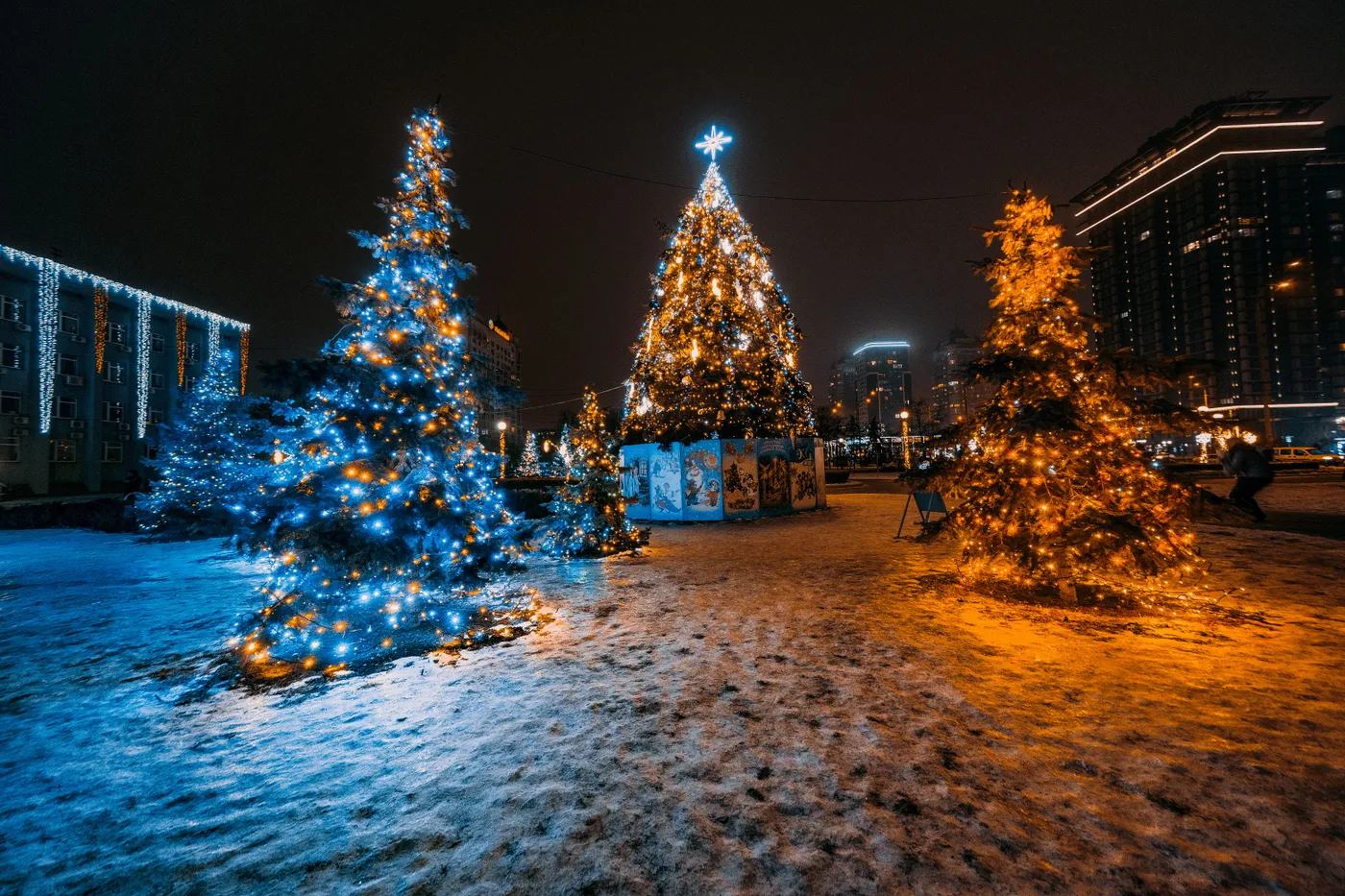
is temperature contrast plus restraint. Deep blue strands against amber ones, one bright star topper pulling the eye to the center, and no ornament clutter competing for attention. The snow and ice patches underneath double the light for free, reflecting both colors back up into the branches. Nothing here is expensive — the effect comes from color discipline and a little luck with the weather.
2. One Quiet Evergreen, Warmed by Delicate White Lights
Wrap the trunk before you touch the branches. For a tree this sparse, plan on about 100 mini lights per vertical foot of height, running the strand up the trunk and out along the main limbs instead of spiraling around the outside. That’s the difference between a tree that glows from inside and one wearing a light jacket. Clip every third bulb to a branch with a green zip tie so wind doesn’t whip the strand loose overnight.
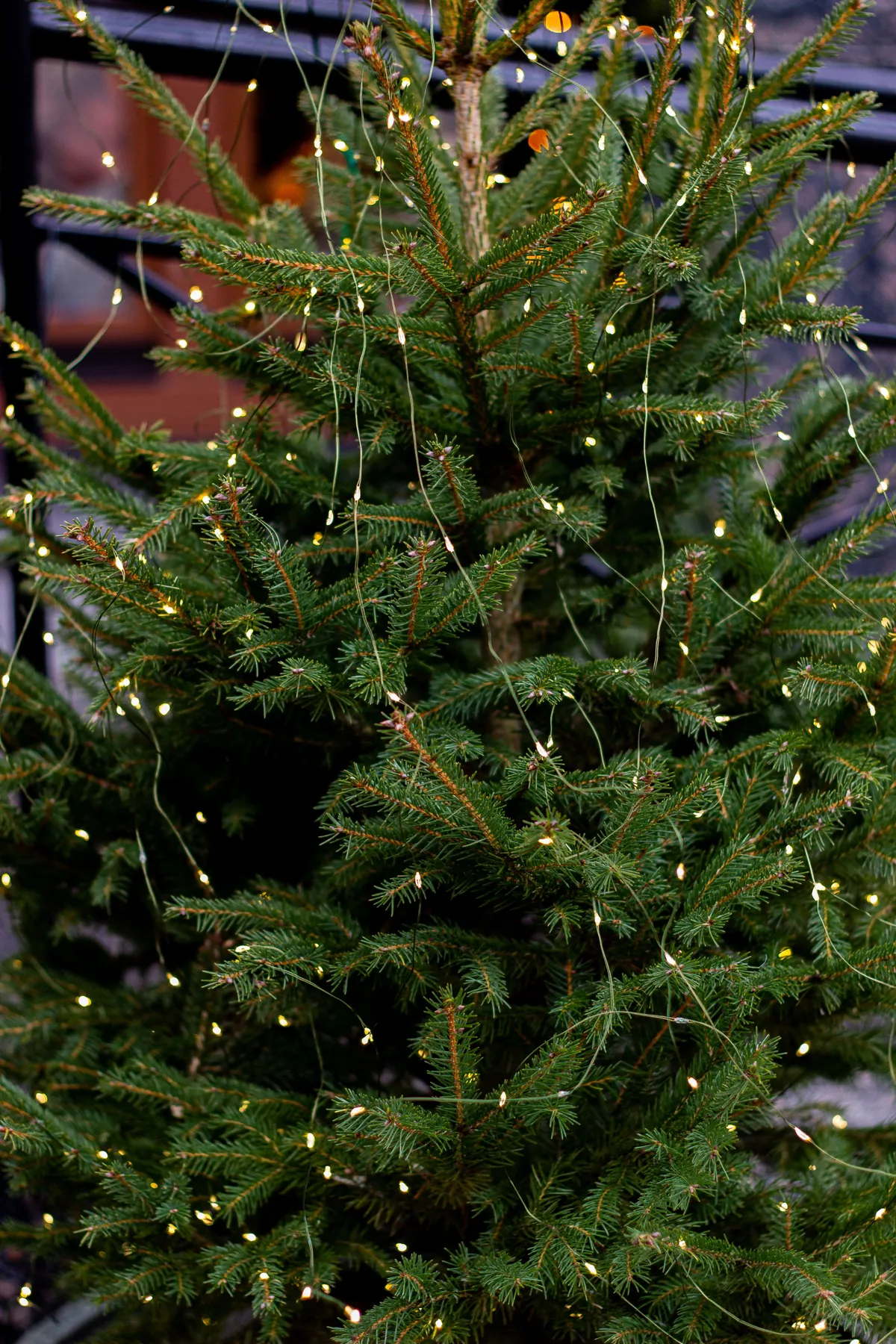
Warm white LED strands need a weekly walk-around. One dead bulb in a series run can darken a whole section, and you won’t notice until someone else does. Keep a spare fuse and two replacement bulbs in your coat pocket all season. In freeze-thaw climates, avoid wrapping tight against the bark — ice expansion pinches wires and cracks the jacket, which is how a strand dies in February instead of January.
3. Cone-Shaped Light Trees That Line the Whole Driveway
Lining a driveway with cone trees is a two-hour job if you plan the spacing first.
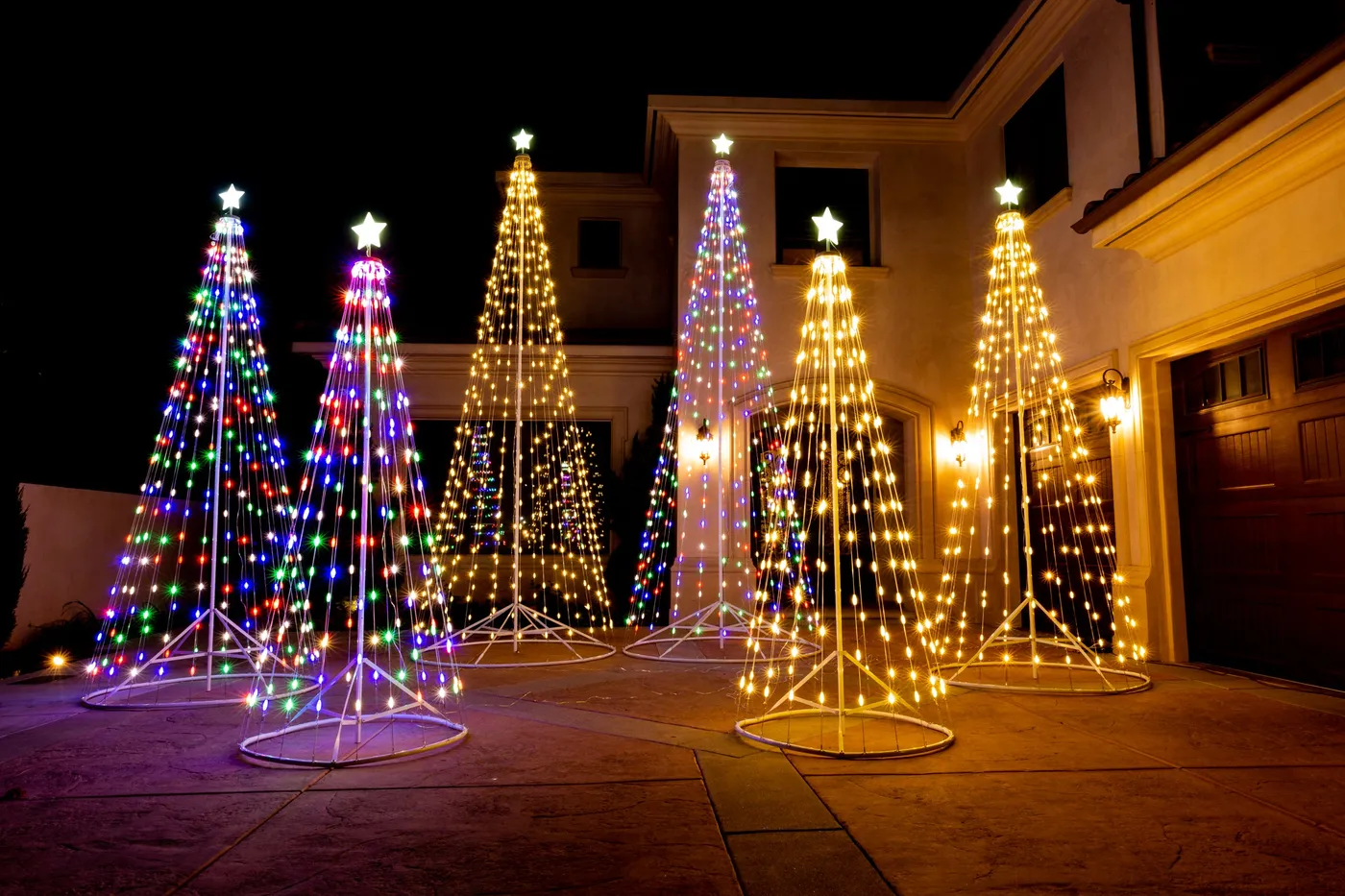
- Measure the driveway width and mark a center line every 6 feet with stakes.
- Alternate cone heights so the eye steps down toward the street instead of hitting a wall.
- Stake each cone or weight the base with a sandbag — wind tunnels hard down driveways.
- Run one heavy-gauge extension cord down the line and plug everything into a single outdoor timer.
- Cap each cone with a star topper, then check the whole run after dark.
Budget two to three hours, most of it spent walking back and forth.
- Cone light trees, 4-6 at $30-$60 each: $120-$360
- Star toppers: $30-$70
- Heavy-gauge cords and ground stakes: $40-$70
- Outdoor timer: $15-$30
Total: $205-$530
Budget alternative: buy unlit wireframe cones and wind your own warm white strands — roughly half the price, and you control the color. Compare with Idea #5 if you’d rather walk through the light than park beside it.
4. A Towering Tree in Red, Green, and Gold Ornaments
The formula is simple: 70% deep green foliage and white light, 20% red and green ornaments, 10% gold. Swap the gold for copper and the whole thing warms up and reads more modern. Pull the red out entirely and it turns into a silver-and-ice tree. The proportions do more work than the ornaments themselves — this reads as traditional because green and red hold most of the color weight while gold stays a guest.
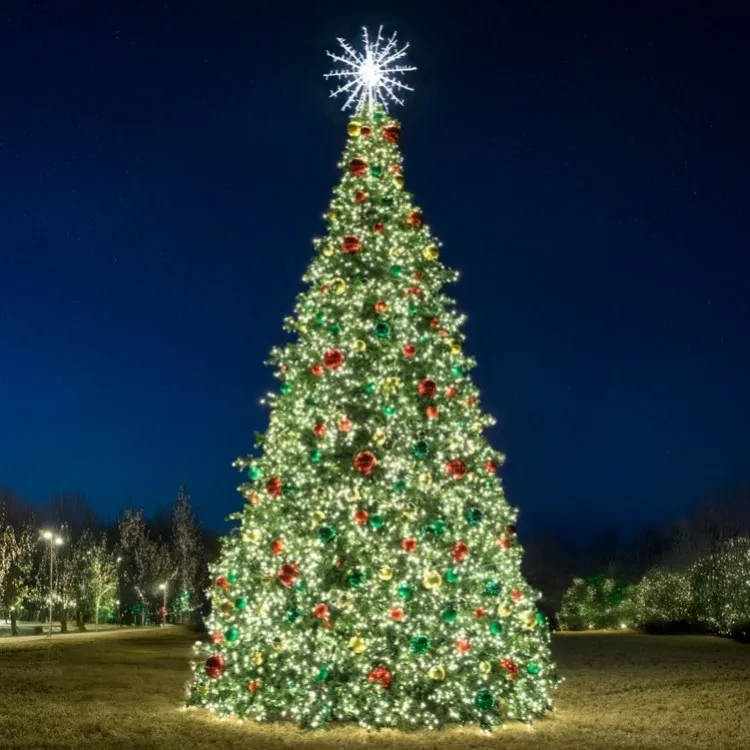
The white light starburst topper is the one thing you can’t remove. Without it you still have a very tall, very nicely lit tree, but the silhouette loses direction. With it, the eye travels up the trunk and gets a payoff at the top. If you have $80 left in the budget, it goes here, not into a third box of ornaments nobody will ever see from the sidewalk.
5. A Blue and Purple Cone Path You Can Walk Through
A walk-through light path is magic in photos and slightly treacherous in real life. Blue and purple strands put out far less perceived brightness than warm white, so trip hazards go invisible. Keep pathways at least 36 inches wide, stake every cord flush to the ground, and if your path is pavers or concrete, use sandbag weights instead of stakes. Buy one strand first and check the color in person — cool tones can look grey and dim at night.
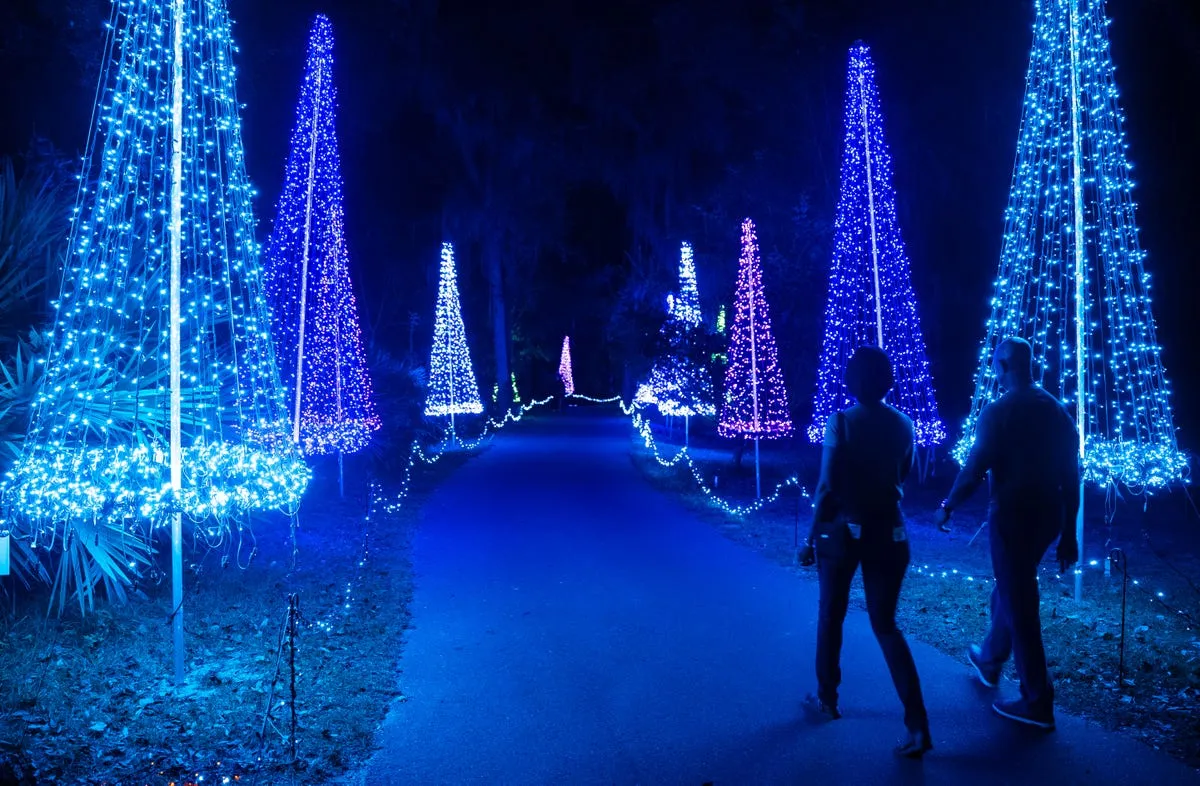
You don’t need $70 designer cones to get this look. Wire tomato cages from a garden center, flipped upside down, become perfect light cones for about $8 each. Wind two strands of blue around each, add a $4 star from a dollar store, and you’ve built the same path for roughly a third of the price. Facebook Marketplace in early December is also full of people selling last year’s display after a move.
6. Silver and Bronze Ornaments on a Dusk-Lit Conifer
Silver and matte bronze is the smartest metal pairing in outdoor decorating right now, and this tree shows why. Shiny silver throws the warm white lights back at the viewer; matte bronze absorbs them and adds weight. Together they keep a heavily ornamented tree from turning into a disco ball. The dusk sky does the rest — a real evergreen silhouette against blue-grey light looks intentional in a way that daytime photos never quite capture.
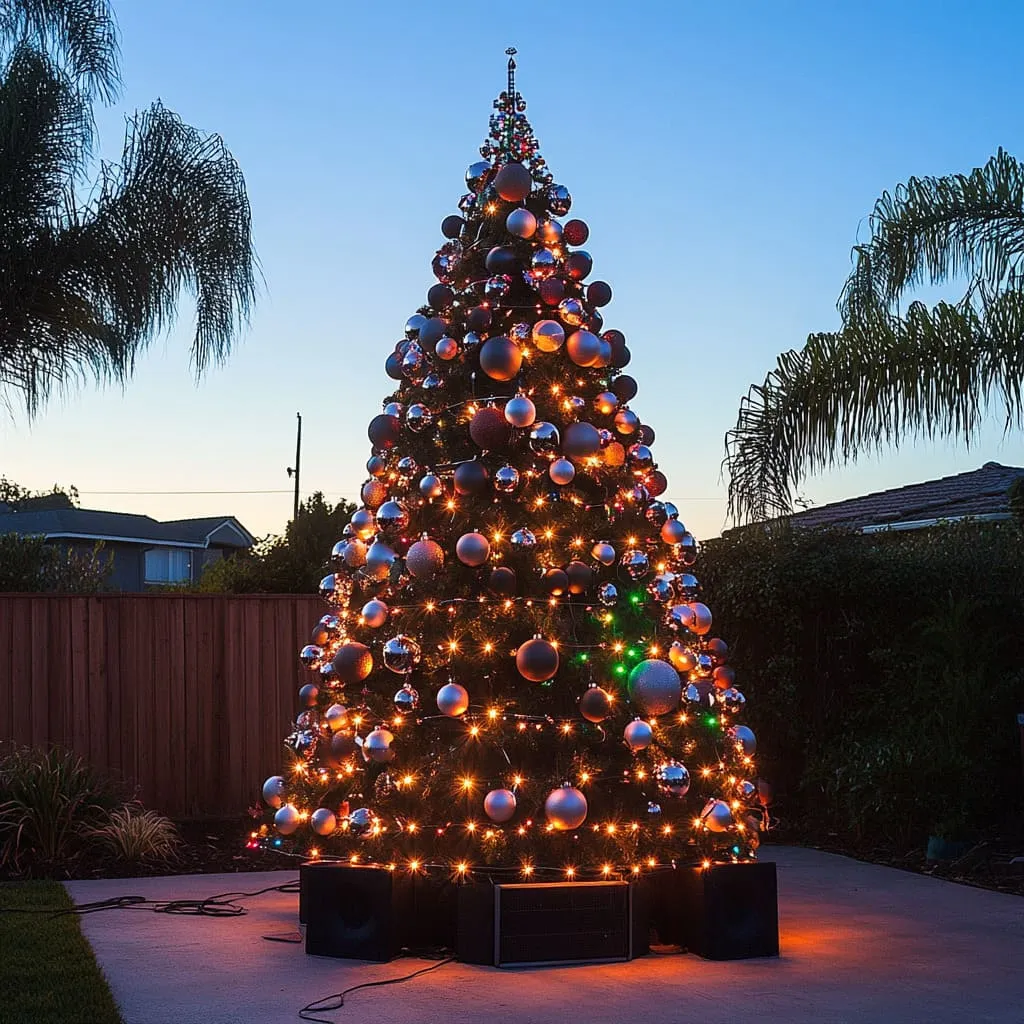
This look needs a paved or concrete base at least 4 feet wider than the tree on every side, so ball ornaments have room to catch light without disappearing into shrubbery. It reads best on trees 6 to 9 feet tall with a sightline of 15 feet or more — any closer and you see individual hangers instead of the overall effect. Small entry? The potted approach in Idea #22 scales the same palette down to a doorstep.
7. Two Lit Evergreens Framing an Ornate Stone Facade
Public square displays have quietly become the mood board for residential decorating. People walk past two lit evergreens in front of a grand stone facade, near an ornate multi-lantern streetlight, and think: I want that at home. The trend is less about ornaments and more about placement — matched trees used almost like architecture, lighting a facade instead of filling a yard. It’s why symmetrical pairs now outsell single mega-trees in a lot of neighborhoods.
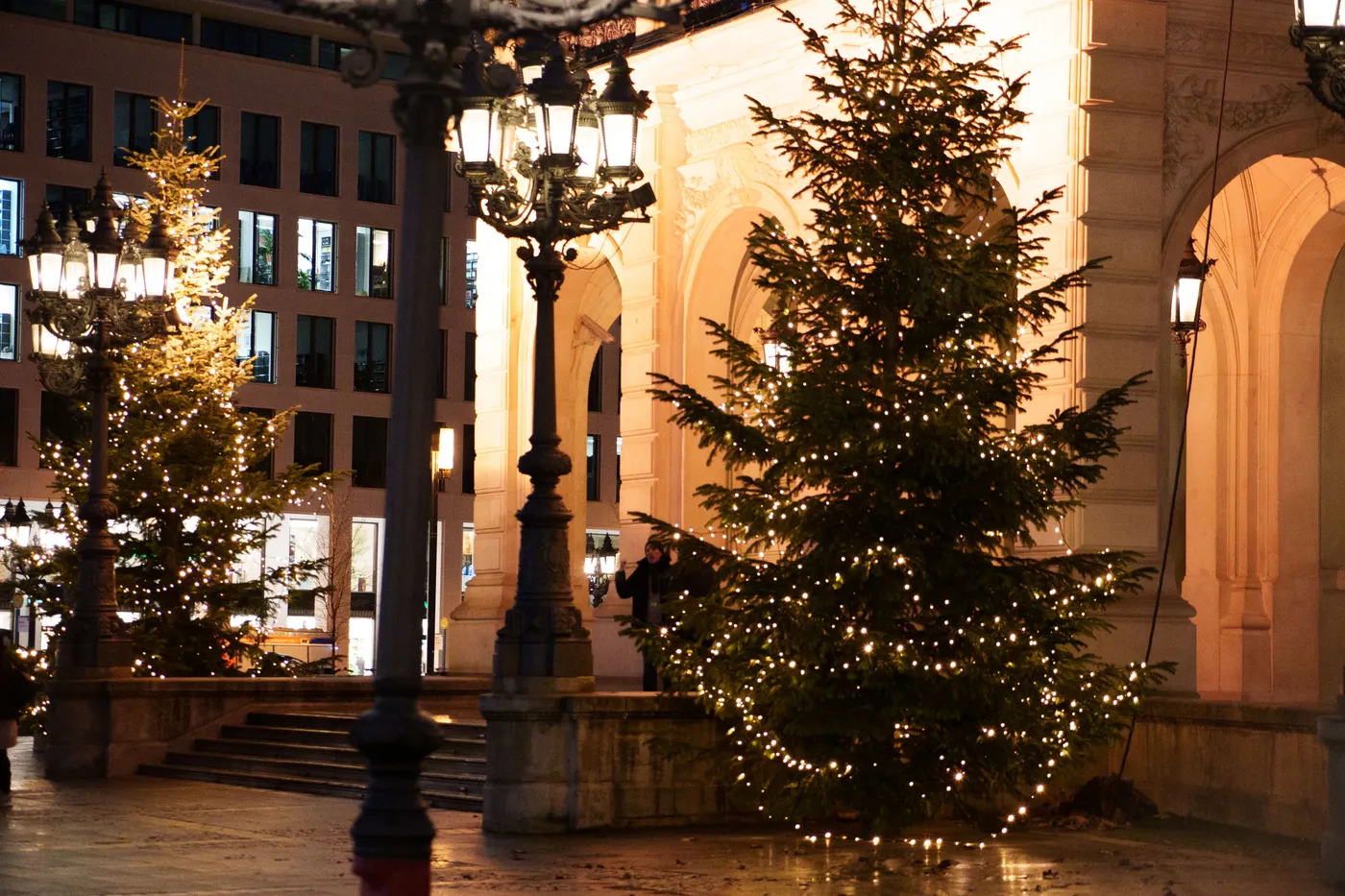
If you’re working with a narrow frontage, two matched trees beat one oversized one every time. Set them 12 to 15 feet apart so the front door sits visually between them, keep the light color identical on both — same warm white, same bulb count — and repeat the same ornament palette. Wet pavement is doing half the work in this scene, so on a dark walkway add one low path light to mimic that reflective glow.
8. Spiral Wireframe Trees Along a Stone Walkway
Spiral wireframe trees are the easiest “looks expensive, isn’t” project in this whole list.
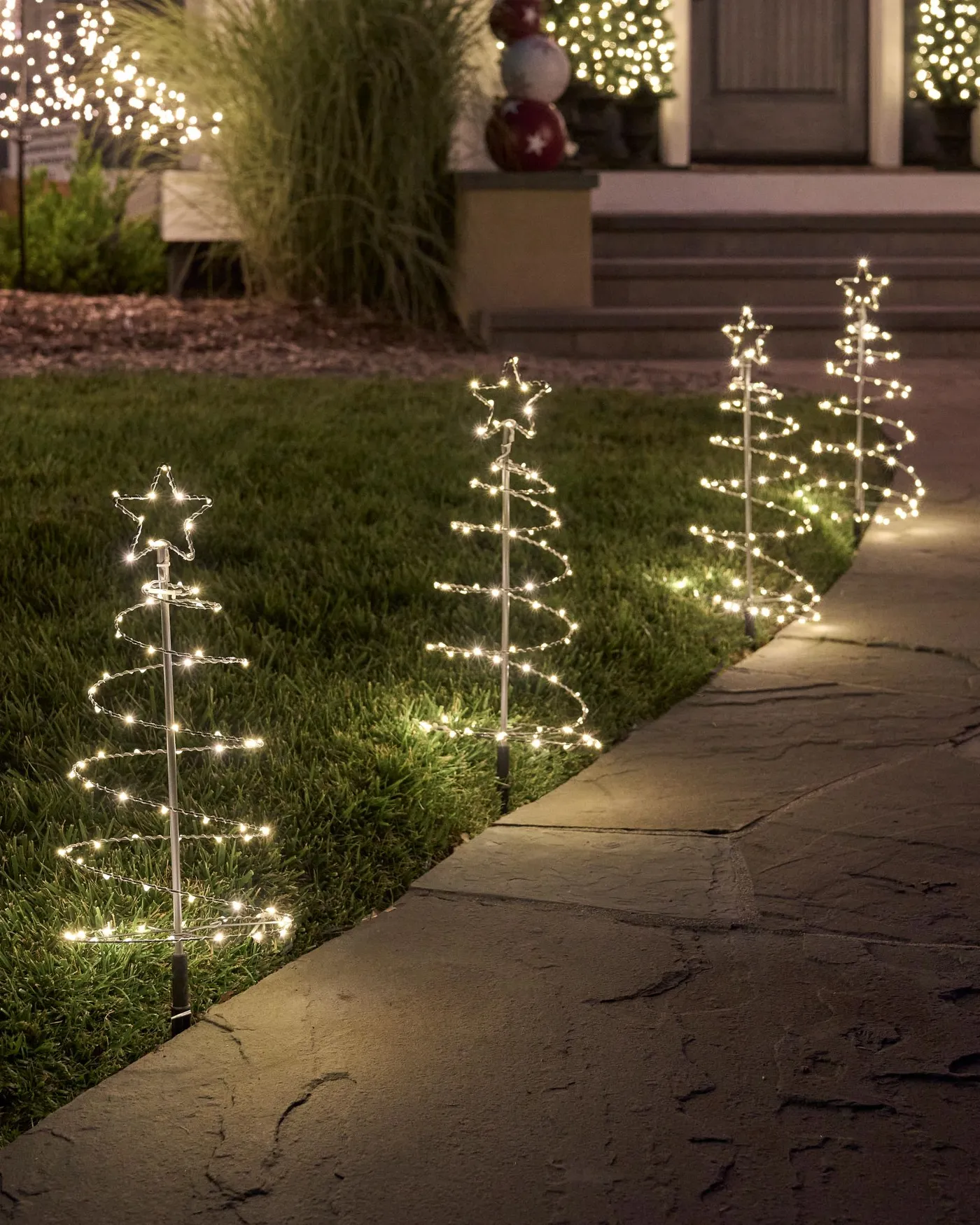
- Set the frame in soil or mulch, never on bare stone — push the stake until the base ring sits flush.
- Space a trio 24 to 30 inches apart along the walkway so they read as one gesture.
- Check that each star topper faces the street, not the house.
- Run cords along the back edge of the bed and pin them with landscaping staples.
- Test after dark and rotate any frame that looks tilted from the curb.
About 45 minutes per tree, and a surprising amount of satisfaction.
- Spiral wireframe trees, 3 at $45-$90 each: $135-$270
- Warm white strands if frames are unlit: $30-$60
- Stakes and landscaping staples: $15-$30
- Outdoor timer: $15-$30
Total: $195-$390
Budget alternative: wire your own using cheap tomato cages and dollar-store strands for around $25 a tree — you lose the polished silhouette but keep every bit of glow along the path.
9. A Branch Archway with a Glowing Urn at Its Center
The red ground wash under the stone urn is the element that sells this whole scene. Without it, you have a pretty lit archway over a nice planter. With it, the urn looks like it’s levitating on a pool of color and the entry becomes a moment rather than a decoration. It’s one uplight and one colored lens — the cheapest, highest-impact piece of the entire display. If you copy one thing from this photo, copy the floor glow.
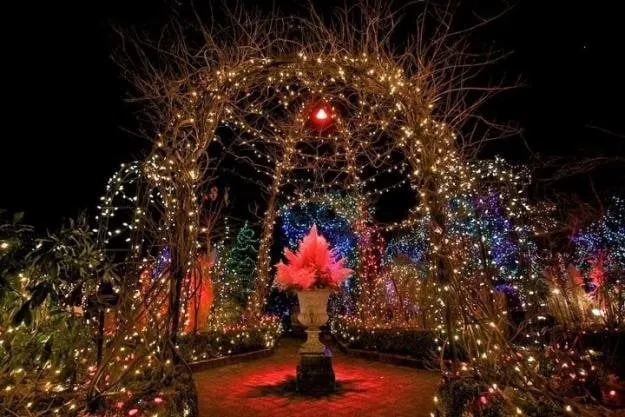
For ground-level color, use an IP65-rated uplight on a 12-inch stake, aimed about 60 degrees back toward the object so light grazes the surface instead of hitting the viewer in the eye. A red gel, or a color-changing LED locked to deep red, keeps the glow from reading pink. Bundle that cord with the archway’s power run so you aren’t dragging a second line across the planting bed.
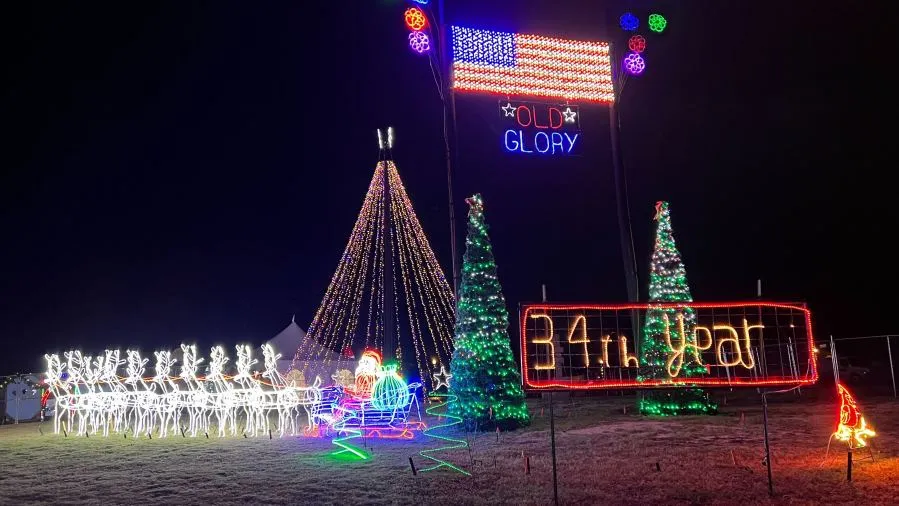
10. A Whole-Yard Display Anchored by a Lit American Flag
A yard-wide display like this is a power project, not a decorating project. LEDs draw far less than incandescent, but a lit flag, a large cone tree, reindeer, and a sleigh still land somewhere around 12 to 18 amps. Don’t daisy-chain that many strands, don’t run it all off one 15-amp garage circuit next to a freezer, and do pin or bury every cord. A “34th year” sign is a lovely flex; a tripped breaker every night is not.
- Large cone or signature tree: $250-$600
- Lit figures (reindeer, sleigh, Santa): $200-$700
- Colored light strands, 500+ feet: $150-$400
- Custom light flag: $300-$900
- Timers, stakes, heavy cords: $100-$250
Total: $1,000-$2,850
Budget alternative: build one hero piece per year and add an element each season instead of buying the whole scene at once. Same effect by year three, a third of the sticker shock.
11. A Lighted Teddy Bear, Gift Boxes, and One Big Tree
Whimsical figures are where the budget actually goes, and where you can save the most. A 4-foot lit teddy bear runs $60 to $120 new, but blow molds and light-up figures flood Facebook Marketplace the first week of January for $15 to $40. Stacked gift boxes are easier still — three lidded boxes from Target or Walmart, a $12 strand of lights in each, and you have the same glowing pile for under $40. Buy characters in January, buy lights in November.
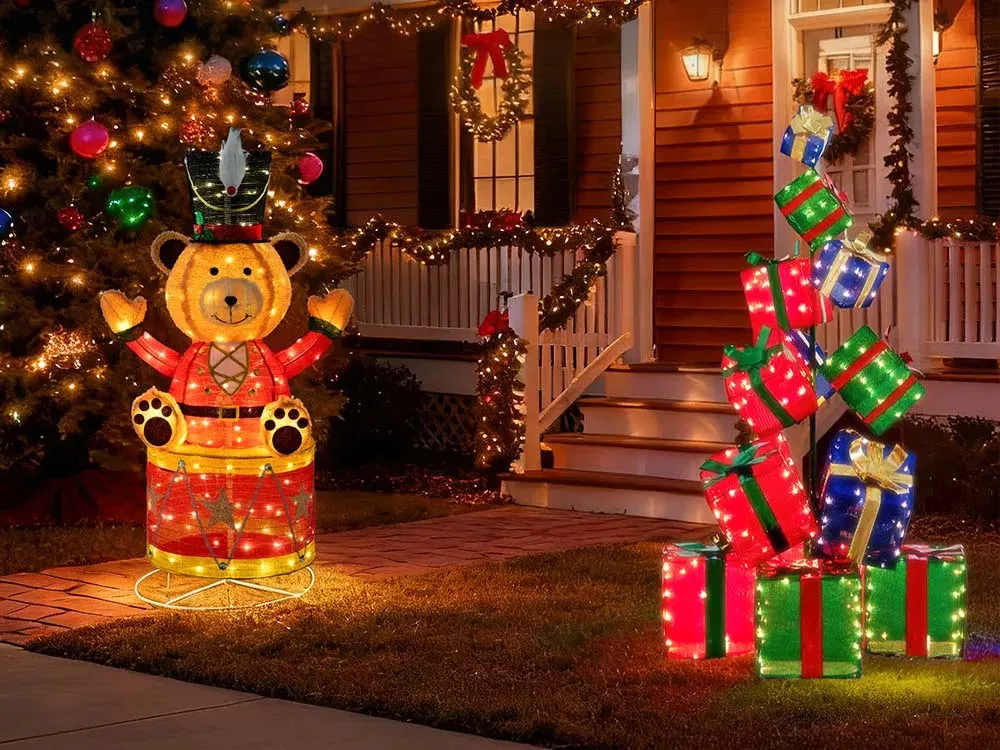
Foreground figures need breathing room or the yard looks cluttered. Plan on a 20 by 20 foot frontage minimum for a tree plus one character plus gifts, and keep the figure at least 8 feet in front of the tree so both read separately from the street. Under 15 feet of depth and the display compresses into one bright mass. Smaller yards do better with the single-tree approach in Idea #19.
12. A White Snowflake Tree in a Sunlit Garden Bed
Count it as 80% green foliage and neutrality, 15% white, 5% terracotta. The planters are the only warm note in the scene, and that’s exactly why the white tree reads modern instead of cold — the terracotta pulls the temperature back toward neutral. Swap terracotta for cobalt and the vignette turns graphic and cool. Swap it for natural wood and it goes Scandinavian. Same white tree, three completely different moods.
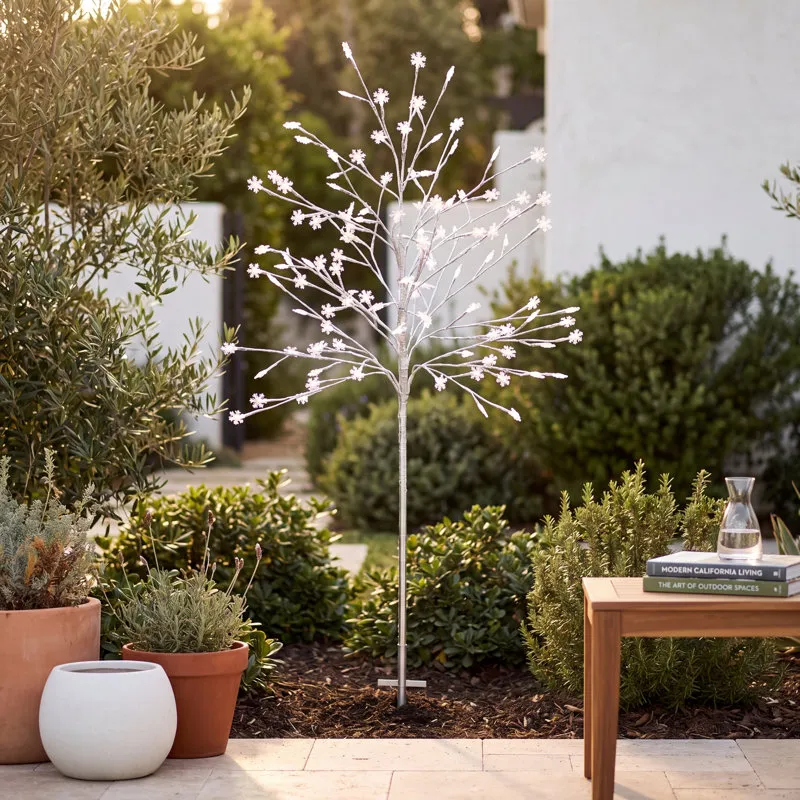
Daylight displays are underrated. A white lighted tree with snowflake shapes reads as texture at noon and as light at night — two looks for one purchase. Tuck it into a bed with plants 18 to 24 inches tall so the base disappears, and place it where afternoon sun rakes across the frames. That low-angle light is what makes the white look bright rather than washed out.
13. Evergreen Gnomes in Red Hats and Mittens
Evergreen gnomes are easier than they look — the whole trick is the cone.

- Start with a 3-foot wire cone frame, flipped so the point faces up.
- Wind faux evergreen garland from the base upward, zip-tying every 6 inches.
- Cut a 20-inch pointed hat from stiff red felt and slip it over the top third.
- Attach a 2-inch off-white sphere for the nose, then two tiny red mittens with wire.
- Weight the base with a paver so wind doesn’t turn them into bowling pins.
Roughly 40 minutes each, plus $25 to $45 in materials.
Same figures on a dollar-store budget: tomato cages run about $8 at a hardware store, garland is $10 for 9 feet at a discount chain, and red felt hats are $3 each at a craft store. That lands you near $25 per gnome instead of $95 for a retail version. If you’d rather skip the crafting entirely, IKEA and Walmart both carry plain cone frames in season — two zip ties and a hat and you’re done.
14. A Lighted Nativity Scene Framed by Two Small Trees
Scene displays need a few checks before anything gets plugged in.
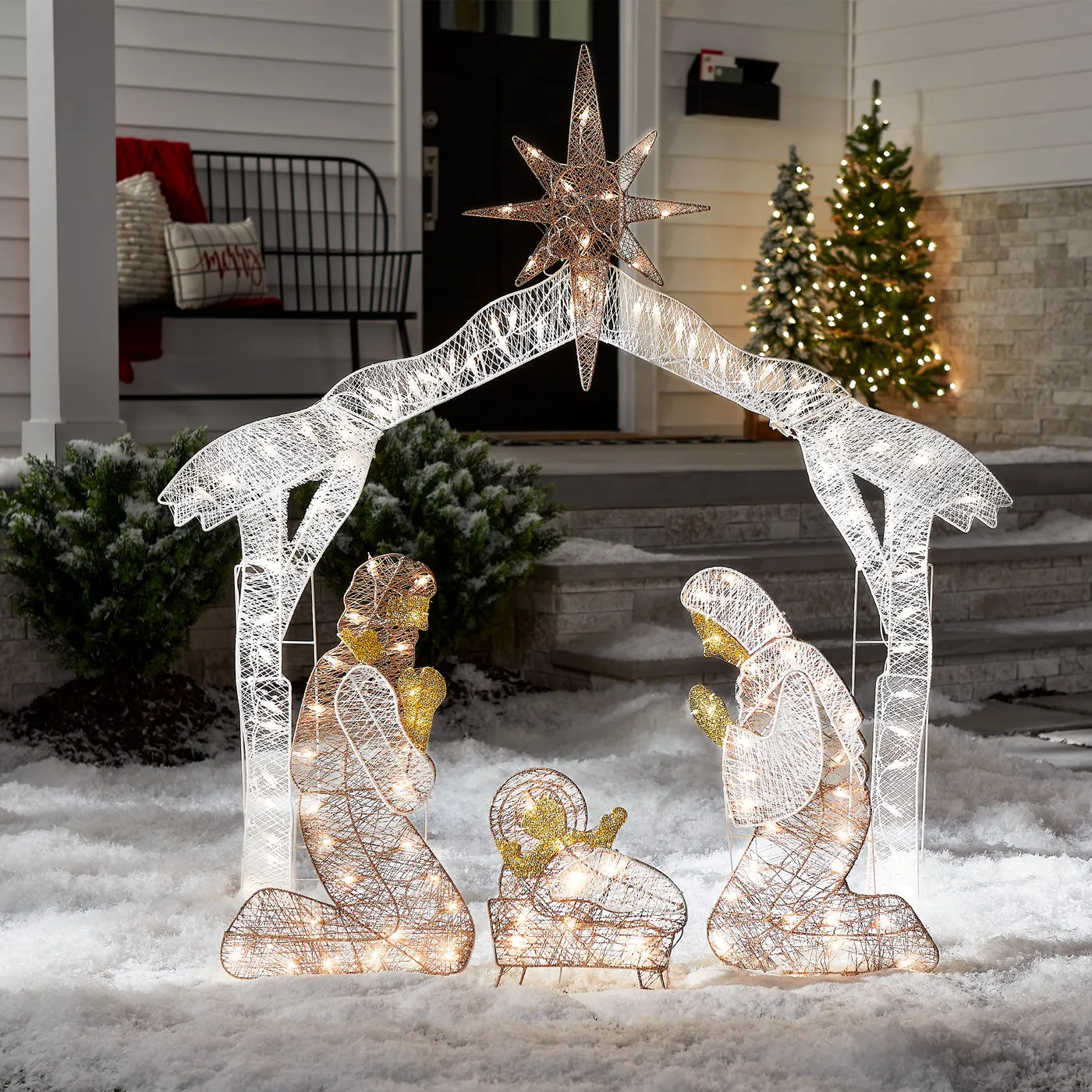
- Measure the footprint — a stable plus two flanking trees wants at least 8 feet of width.
- Confirm you have a GFCI-protected outdoor outlet within cord distance.
- Level the ground or set pavers; an uneven base makes wire-frame figures lean.
- Check HOA rules on religious displays and height limits before you build.
- Decide on faux snow now — it can smother grass for months underneath.
Three things make this scene read as calm instead of kitschy. The wire frames are outlined rather than filled, so you see shape and light instead of solid glow. Everything sits low, with no towering tree competing for attention, which makes the porch feel intimate. And the faux snow underneath bounces warm light back up into the figures so nothing looks like it’s floating. Compare with Idea #27 — same retail aisle, very different result.
15. One Potted Tree on a Firewood-Stocked Winter Porch
A potted pre-lit tree on a covered porch will last five seasons or more if you treat it like furniture. Wipe the planter and base after rain, and bring the tree inside during ice storms — the lights survive weather, the pot’s drainage doesn’t. Keep firewood at least 18 inches from the tree so you aren’t drying kindling next to a heat source, and store the tree upright in a breathable bag rather than a sealed bin, which traps moisture and corrodes sockets.
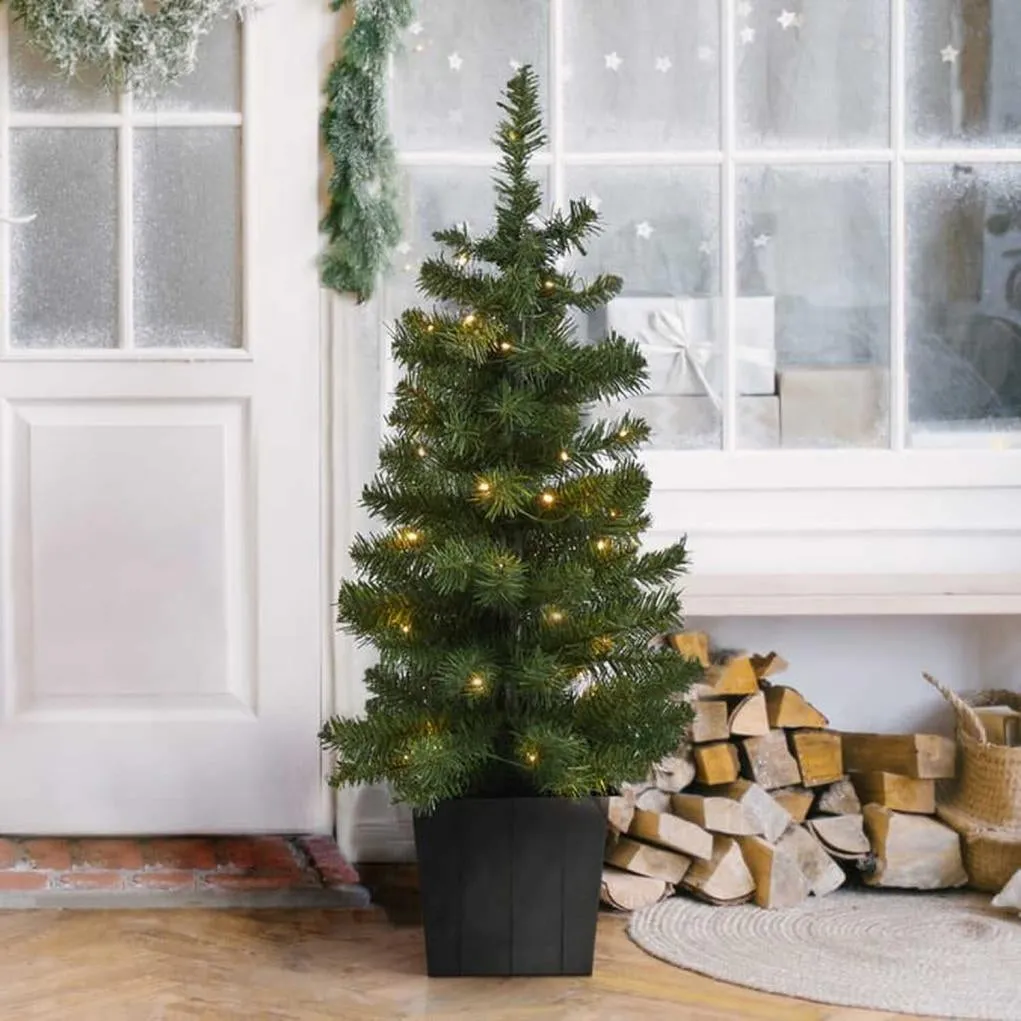
Porch scale is math, not instinct. A good rule: the tree should finish at roughly two-thirds the height of the door, and the planter should be about one-third the height of the tree. On a standard 80-inch door that means a 3 to 3.5 foot tree in a 12-inch planter. Go wider and the entry starts feeling crowded, especially once you add firewood, a rug, or a bench beside it.
16. Stone Steps Dressed with Potted Trees and a Red Bow
Stone steps are forgiving because they hand you natural levels. Plan on potted trees no wider than 18 inches for an 11 to 12 inch tread, and stagger the heights — a 3-footer at the bottom, a 2-footer mid-flight, a 4-footer at the door. Keep the lowest potted tree at least two steps up from the sidewalk so a delivery driver doesn’t clip it. Narrower than 10 inches per tread? Skip pots on the steps entirely and cluster them on the landing.
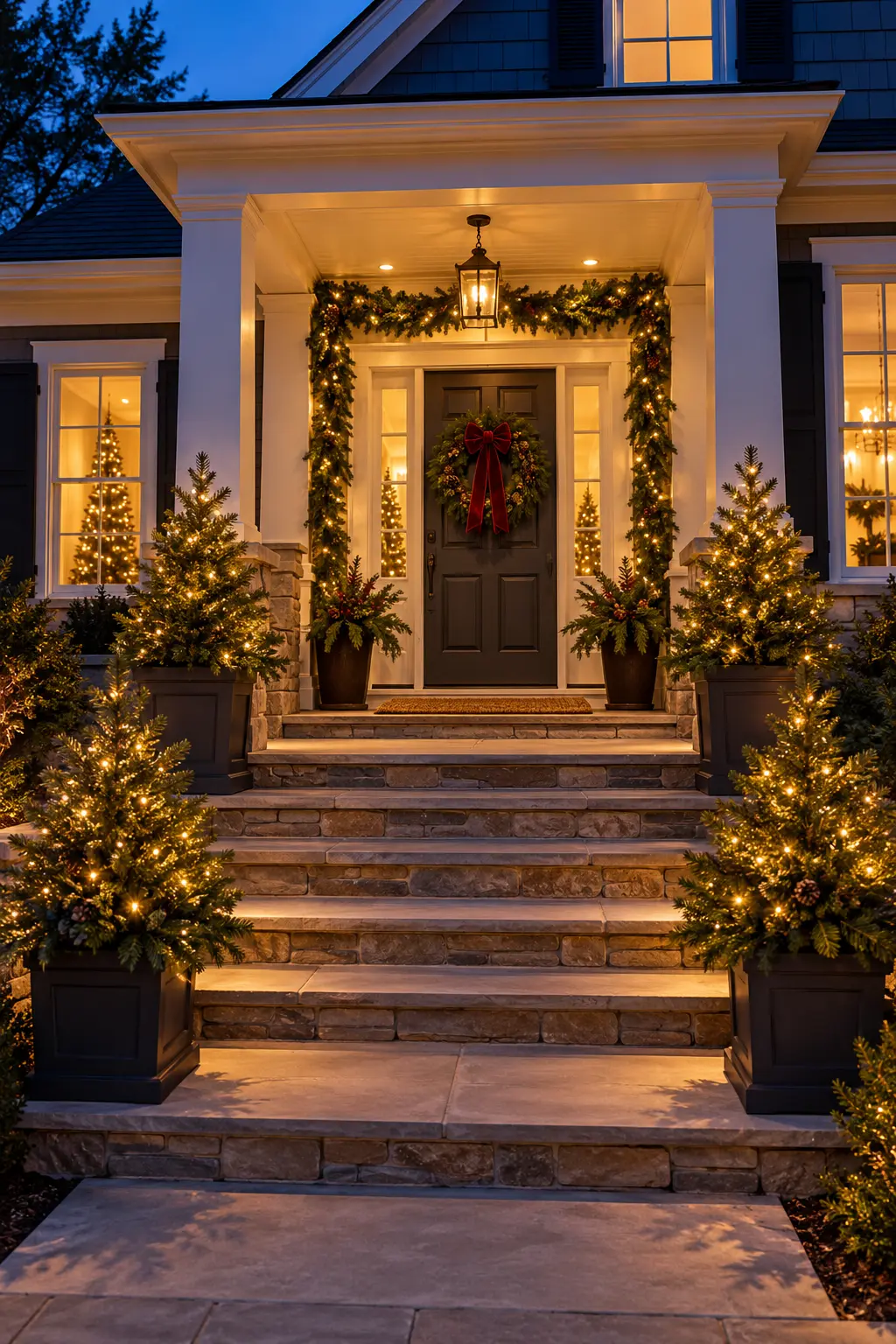
The red velvet bow on the door wreath is the whole thing. It’s the only saturated color in a display built from stone, dark grey, and green, and it’s what your eye lands on from the street. Take it away and everything still looks tasteful, just anonymous. One ribbon, maybe $12, does the work of a hundred extra lights. If you swap it, swap it for something equally saturated — deep burgundy, or a strong copper.
17. Metallic Bows and a Yellow Star Under a Grey Sky
This one is about finish balance: 50% red metallics, 30% gold, 20% silver, with a single yellow star as punctuation. Three metal tones sound chaotic and aren’t, because the bows carry texture more than color — matte, satin, and foil each catch light differently within the same hue family. Push it down to two tones and it sharpens into something more formal. Push it to four and the star loses its job as the focal point.
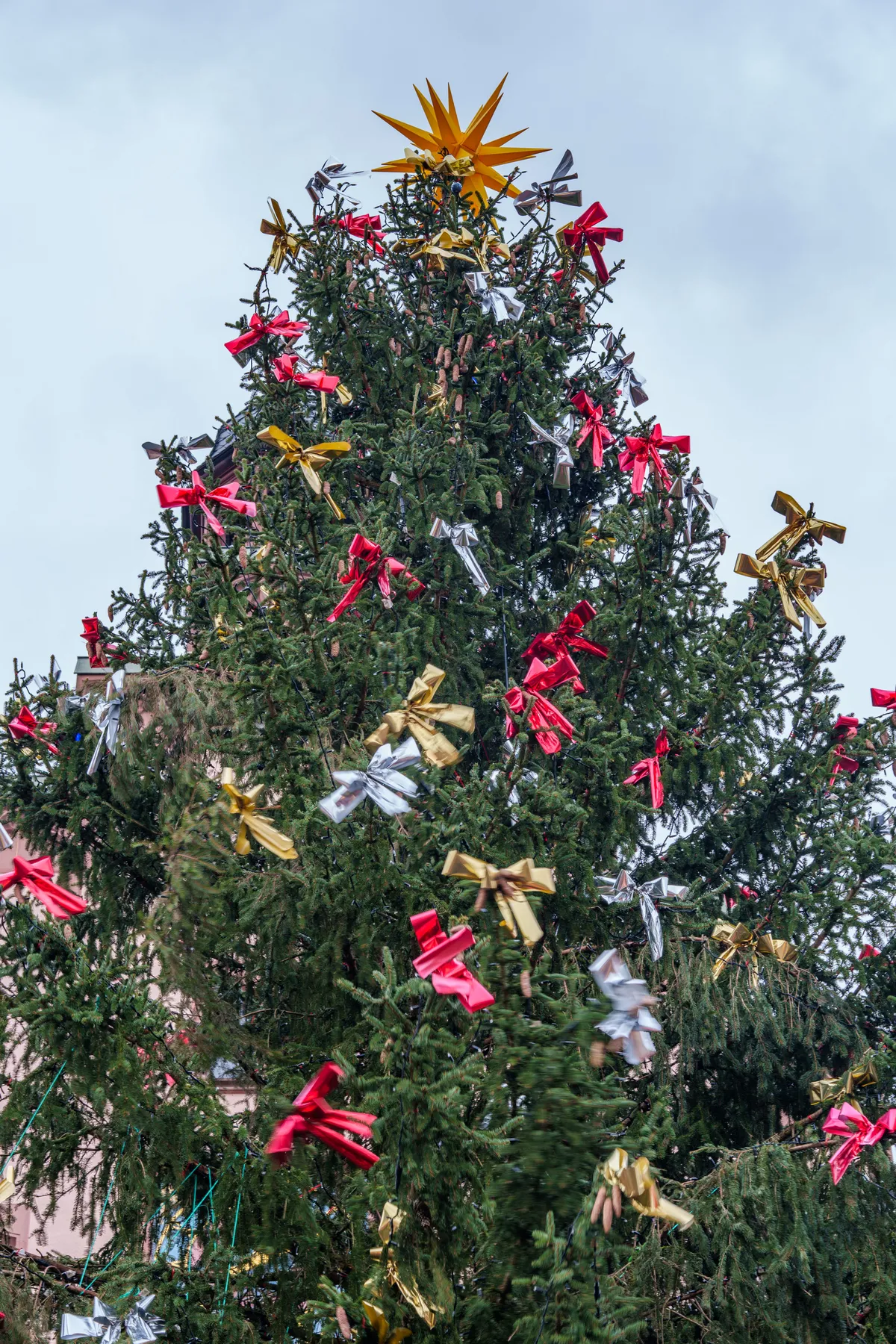
Metallic ribbon is the least weather-tolerant thing in this display. Rain spots foil finishes, sun fades satin, and by February a shiny bow looks like crumpled candy wrapper. Store bows flat in a box with tissue between layers, and plan on replacing the shiniest ones every two seasons. For longer wear, choose matte woven nylon ribbon with wire edges — it holds its shape through wind and never shows water marks the way foil does.
18. A Freestanding Weather-Resistant Tree for Any Surface
Freestanding trees are the easiest to install and the easiest to get wrong. Check these first.
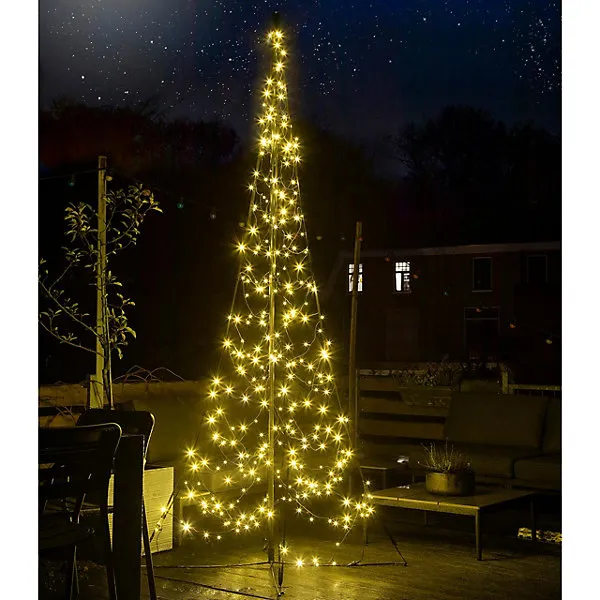
- Measure the base footprint and confirm it fits your deck, gravel bed, or patio slab.
- Look for a wind rating on the product page — anything under 25 mph needs extra weight.
- Confirm the nearest outdoor outlet, and whether you’ll need a 25-foot cord.
- Verify LED count and whether bulbs are replaceable or sealed.
- Check the return window; lit trees are often final sale after November.
Weather-resistant does not mean wind-resistant. A 3-meter freestanding tree has a lot of surface area, and a good gust will lay it across your walkway. Weight the base with sandbags or a paver hidden inside the stand, and never place one on a slope without staking it. The 320-LED rating on a tree that size gives you a soft, even glow rather than something you could read by — which is usually exactly what you want.
19. A Tall Conifer Glowing Over Frosted Ground
Three principles do the work here. First, hue discipline: one light color, top to bottom, no exceptions. Second, reflection — the frosted ground acts as a second light source, doubling the glow for free. Third, hierarchy: density near the base, thinning as it rises, so the tree looks lit from within rather than drenched. The subtle ball ornaments barely register, which is the point; they add depth without interrupting the silhouette.
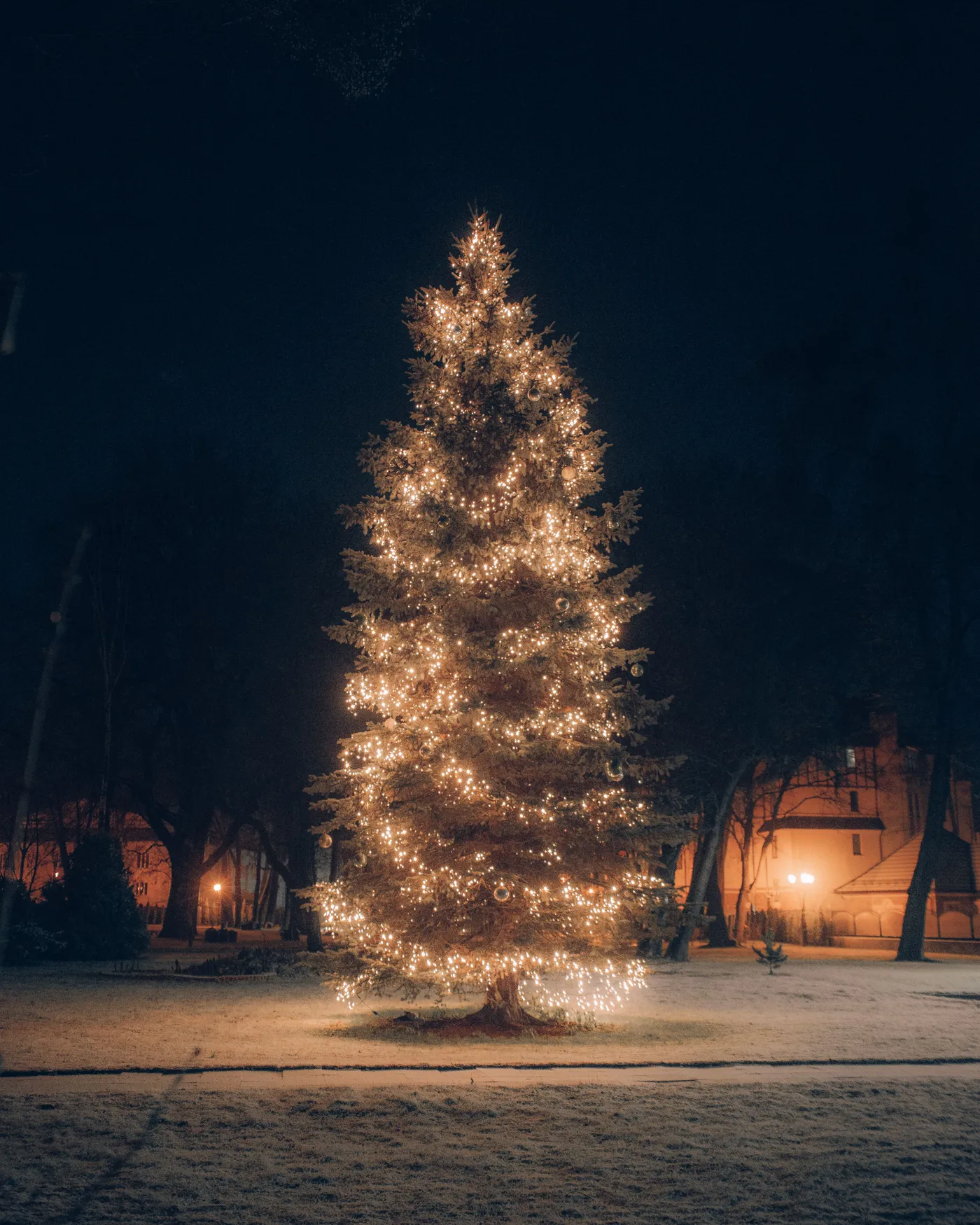
- Tall conical tree, 7-9 ft: $150-$400
- Warm white LED strands, 800-1,200 lights: $60-$120
- Subtle ball ornaments: $40-$80
- Timer, stakes, cord: $30-$60
Total: $280-$660
Budget alternative: buy an unlit tree plus one 1,000-light warm white strand on a spool. The hand wrap always looks denser than a factory pre-lit tree, and it costs about 40% less. It pairs beautifully with Idea #23 if you want a second tree further out in the yard.
20. A Compact Pre-Lit Fir for Small Backyards
A 4.5-foot pre-lit fir is the cheapest way into this entire article. Walmart and Target run them between $40 and $90 in November, and post-Christmas clearance drops them to about $25. Thrift stores and Facebook Marketplace are full of them in early January — people move, storage gets tight, and someone else’s tree becomes your $15 find. At that price you can buy two and flank a gate instead of settling for one.
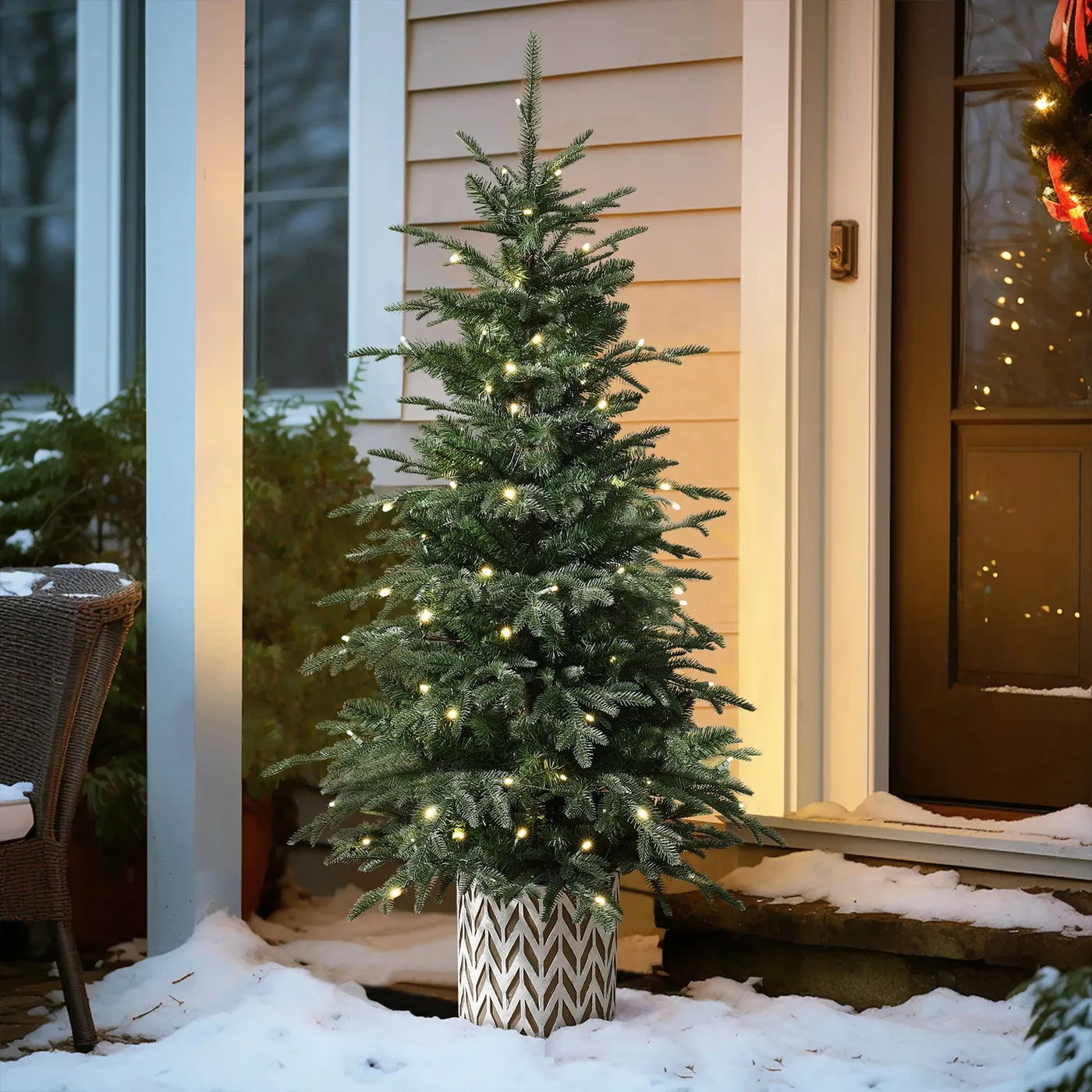
Small trees need height help. Set a 4.5-footer on a crate, a stump, or inside a raised planter so the light mass sits at eye level from the patio, and give it at least 10 feet of clearance from a fence or wall so the glow doesn’t flatten against a surface. A dark background — evergreens, a shed, a hedge — makes a small tree look twice its size, which is exactly what a modest backyard needs.
21. Gold and White Ornaments in an Elegant Town Square
Restraint is the element here, and it’s the one thing you can’t fake. Gold and white only — no red, no multicolor, no novelty ornaments. Take that discipline away and you have a pleasant town-square tree. Keep it and the tree reads as elegant from a block away. It’s the hardest thing to hold to when you’re standing in an aisle with a full cart, and it’s the entire reason this display looks expensive when it probably wasn’t.
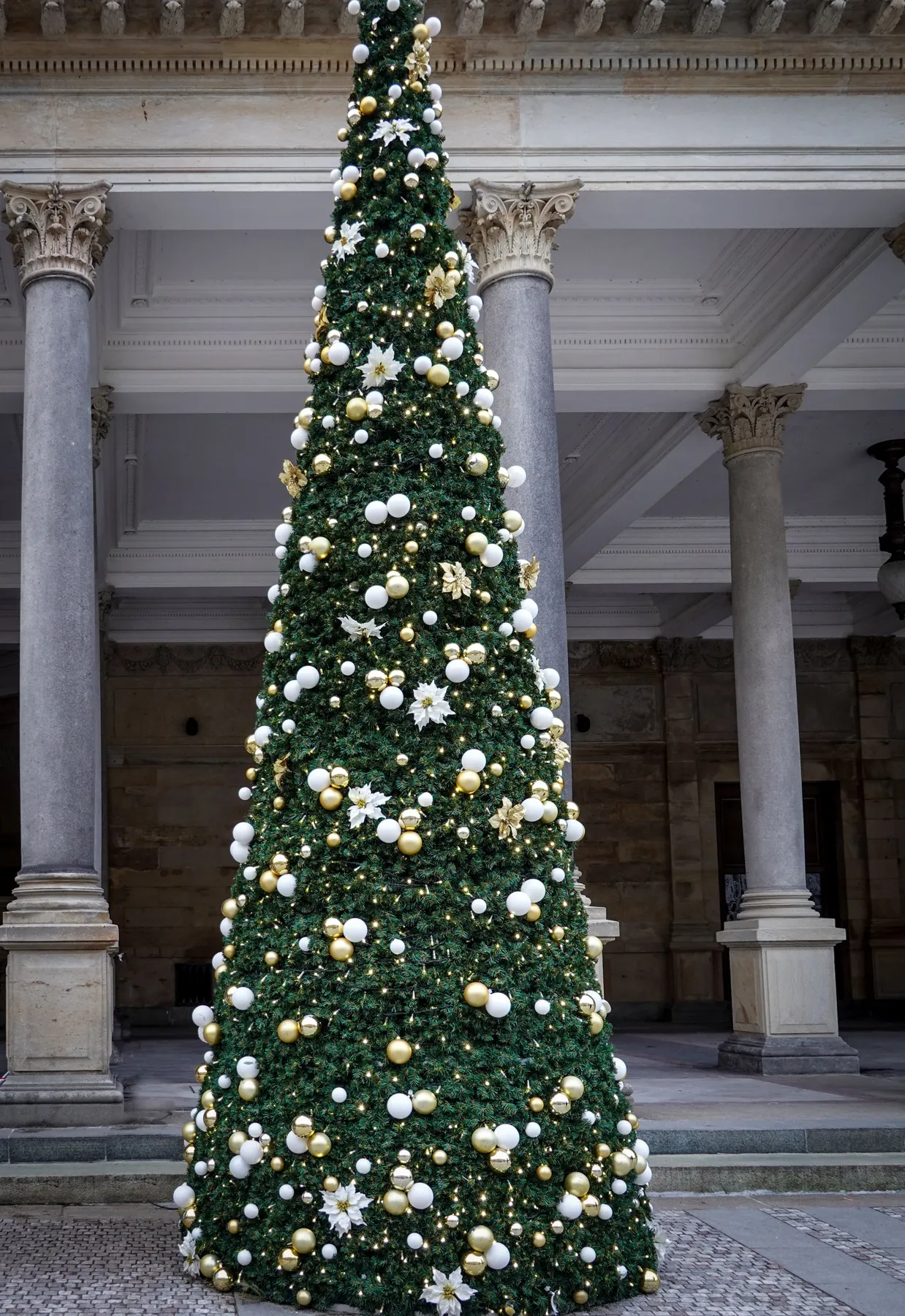
Roughly 65% green and light, 25% white ornaments, 10% gold. White does the heavy lifting because it reads as both ornament and reflected light, and gold stays rare enough to feel like an accent rather than a theme. Swap gold for champagne and it softens. Swap the white ornaments for pearl and it warms. Add a third color and the formula collapses into “decorated tree” instead of “designed tree.”
22. Red Baubles on a Potted Tree by a Sage Green Door
Doorway trees live or die on spacing. Keep the pot 6 to 8 inches off the door frame so the entry doesn’t look blocked, and match bauble size to the tree — 50mm for a 3-footer, 70mm for anything 4 feet and up. Champagne baubles sitting beside red velvet read warmer than plain white ones, and a red bow topper is plenty; skip a second ribbon, because two bows on one small tree starts looking like a gift shop window.
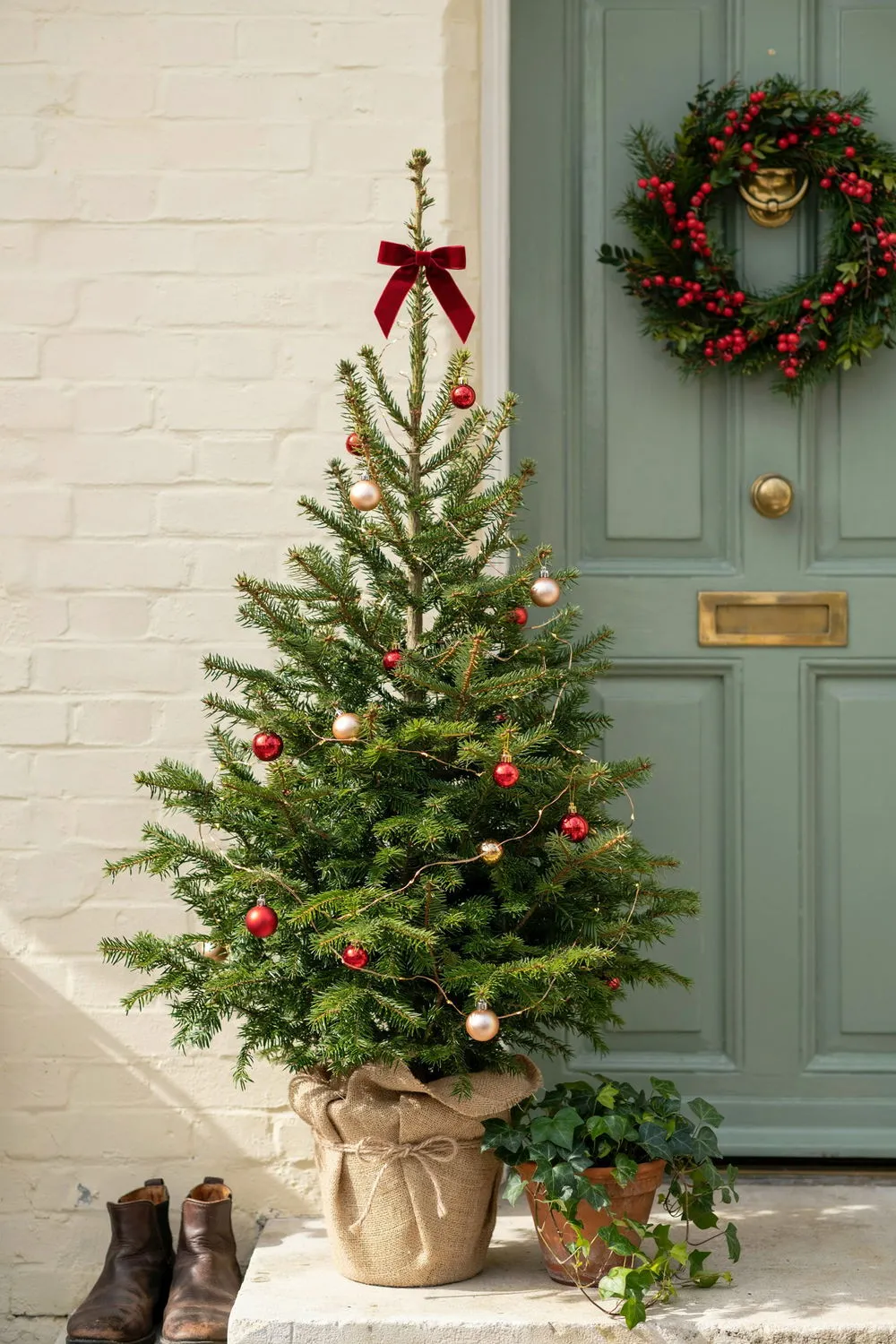
A 3 to 4 foot potted tree is right for a standard 36-inch front door. Go taller than 5 feet and it competes with the door instead of framing it. Leave at least 20 inches of clear step depth in front of the pot so the door swings freely and deliveries don’t knock it over. Small entry, big ambition? Pair this with the spiral frames in Idea #8 along the walkway rather than adding more at the door.
23. One Lit Tree Standing Alone in a Snowy Field
Negative space is the entire design. A single lit tree in an empty snowfield works because there’s nothing to compare it to — the eye has one place to rest, and the dark blue-grey sky gives it a backdrop with real depth. Scale matters too: a small tree under a huge sky feels deliberate, while the same tree crowded by shrubs feels accidental. The warm glow on the surrounding snow extends the tree’s footprint without adding a single strand.
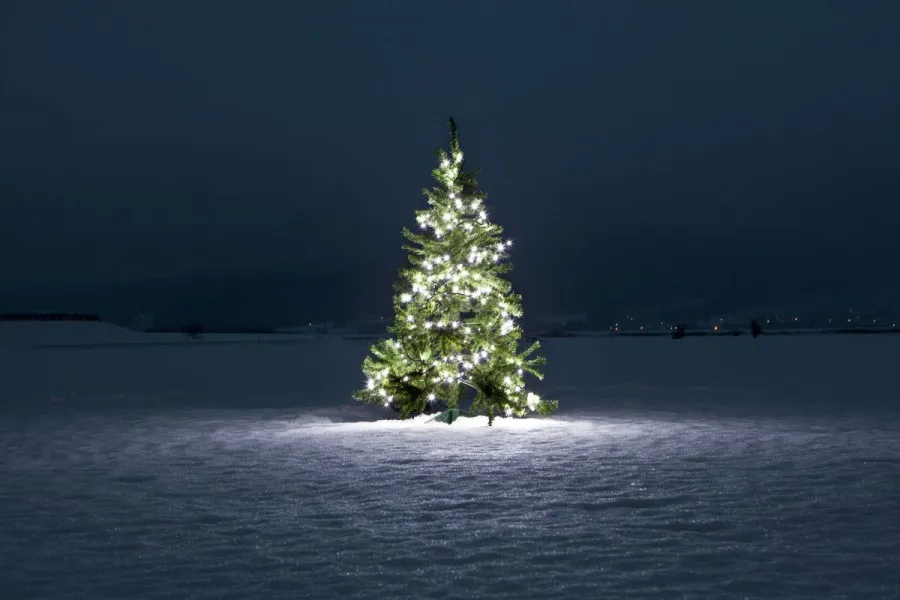
Practical question first: how are you powering it? A far corner or open field usually means no outlet, so plan on a battery pack or solar setup rated for cold — and expect lithium batteries to lose 30 to 40% of capacity in freezing temps. Think about visibility too, since a tree near a property line can read as a beacon to drivers. And don’t bury cheap cord; snowmelt and wildlife chew right through it.
24. Pre-Lit Spiral Trees That Set Up in Minutes
Pre-lit spiral trees assemble in about 20 minutes, if you do it in this order.
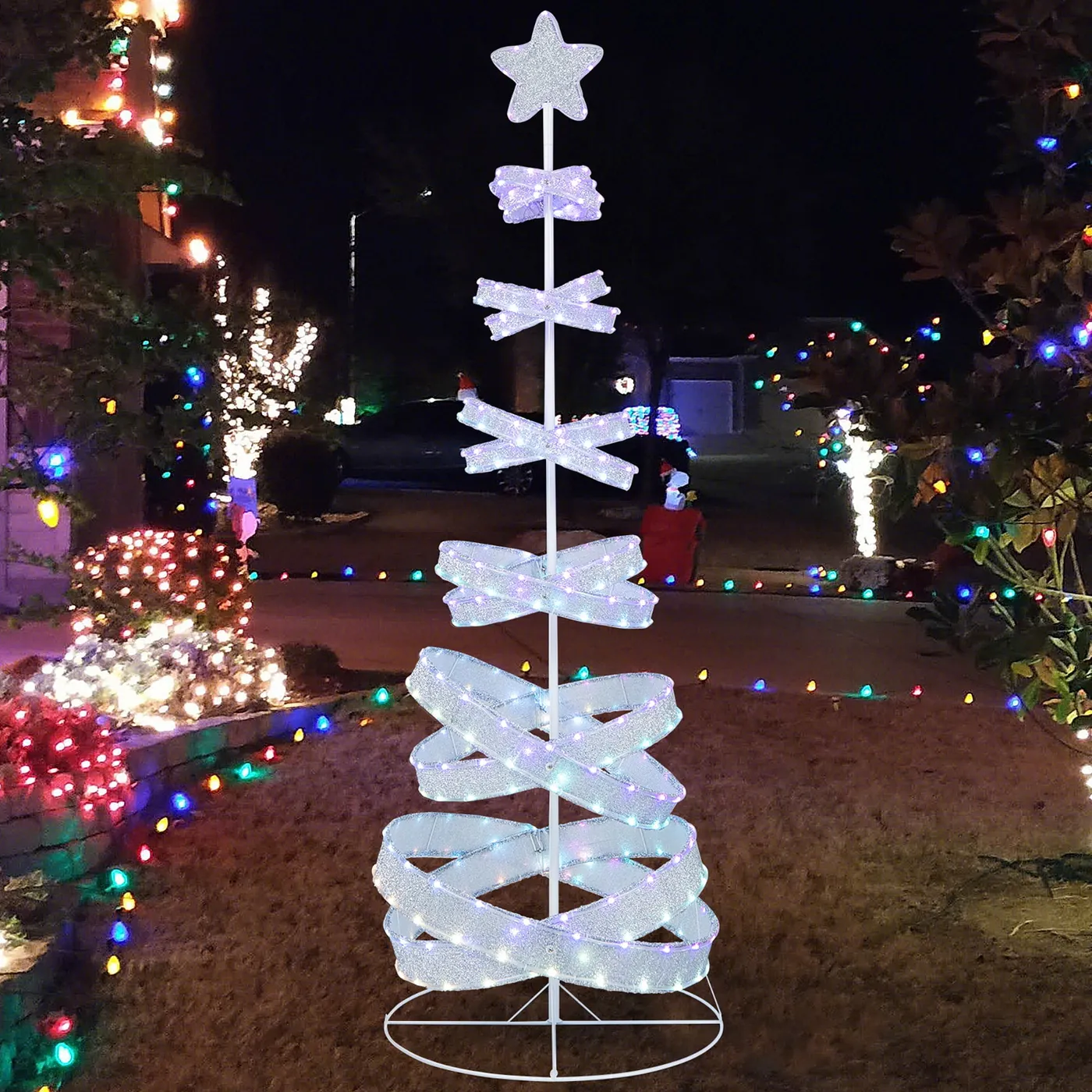
- Unbox outdoors and let the frames warm up — cold plastic is brittle and cracks easily.
- Snap the spiral section onto the base post until you feel it seat.
- Push the ground stake in first, then slide the tree down over it.
- Connect sections bottom-up and cover every connection with a weatherproof cap.
- Run one cord to a timer and check for dark sections before nightfall.
Spiral frames are simple, but they rust. Store them dry and indoors if you can, and wipe the joints with a dry cloth before they go into the garage — a little moisture in a folded frame turns into a rust ring by spring. Bulbs on these are usually sealed and non-replaceable, so if a section dies, it dies. Buy from a brand offering a two-year warranty and expect three to five good seasons.
25. A Backyard Fir You Can See From the Kitchen
The kitchen-window test is the one that matters most: if you can see the tree from where you make coffee, it’s doing its job. Place a backyard fir 15 to 25 feet from the window and give it at least 6 feet of clearance from a fence so the glow doesn’t flatten against wood. Yard under 400 square feet? A 4.5 to 6 foot tree is plenty — the potted approach in Idea #20 covers that scale nicely.
Pre-lit versus unlit is the real budget decision. An unlit 6-foot fir runs $60 to $110, and 600 warm white lights add about $35 — so you can often beat the pre-lit price and get denser coverage at the same time. End-of-season sales in early January drop backyard trees 50 to 70%, and Facebook Marketplace in a college town in May is an absolute goldmine. Buy in the off-season, plug in with everyone else.
26. A Heavily Flocked Tree with Green and Brown Baubles
The flocking is what makes this tree. Heavy artificial snow on every branch turns a lit evergreen into something that belongs in a storybook window. Strip it away and this exact tree — warm white lights, green and brown baubles, one tiny house ornament — is just a nicely lit tree. The flocking adds a third texture between the lights and the needles, and that’s what makes people slow down and look twice.
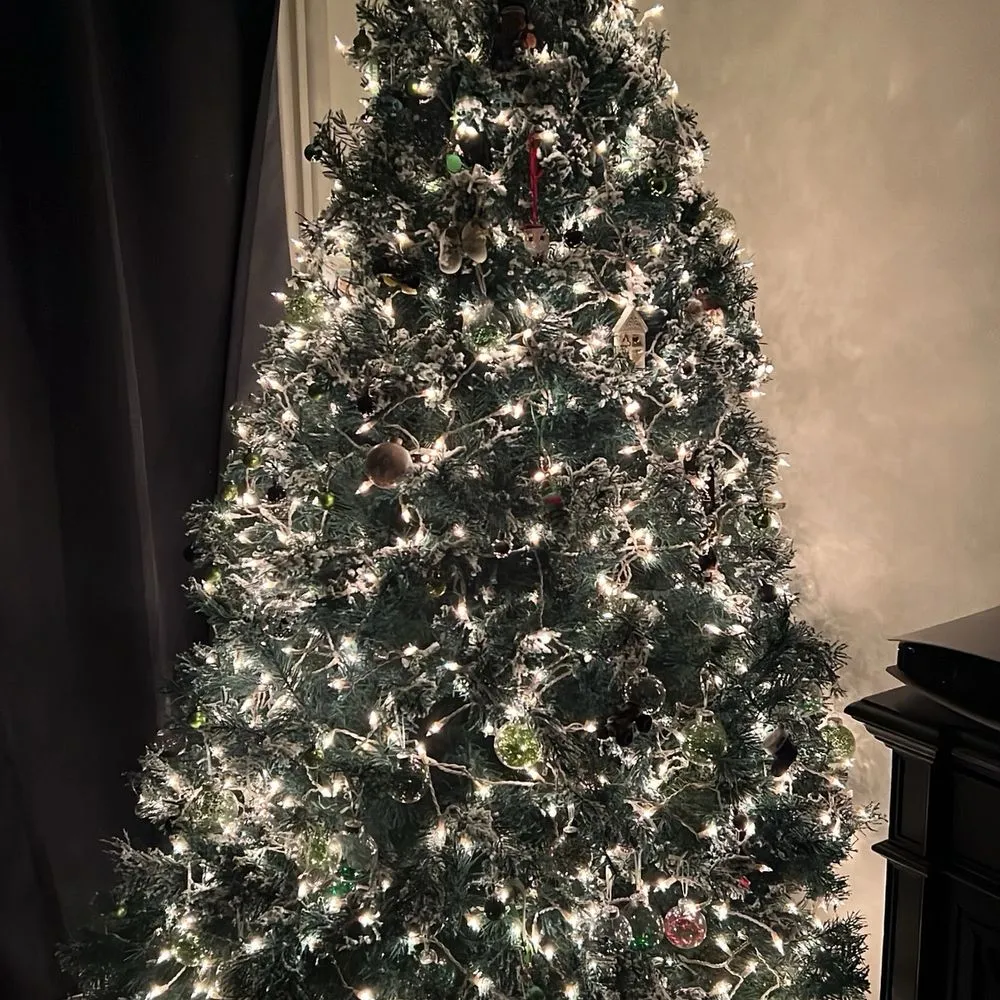
Flocked trees outdoors need to stay out of direct rain. Sealed flocking holds up well, but loose flocking sheds and leaves a white ring on your patio by January. Set it on a covered porch or under an eave, and check the product description for “sealed” and “flame-retardant” before buying. One more thing: on a flocked tree, avoid snow-white ornaments — they disappear completely. Go green, brown, or copper for contrast.
27. A Tree Collar and Multi-Colored Lights Straight From the Aisle
- Pre-lit 7.5 ft tree with multi-colored lights: $80-$250
- White woven tree collar: $25-$50
- Wide red ribbon for the collar bow: $8-$15
- Decorative nutcracker or figure: $30-$60
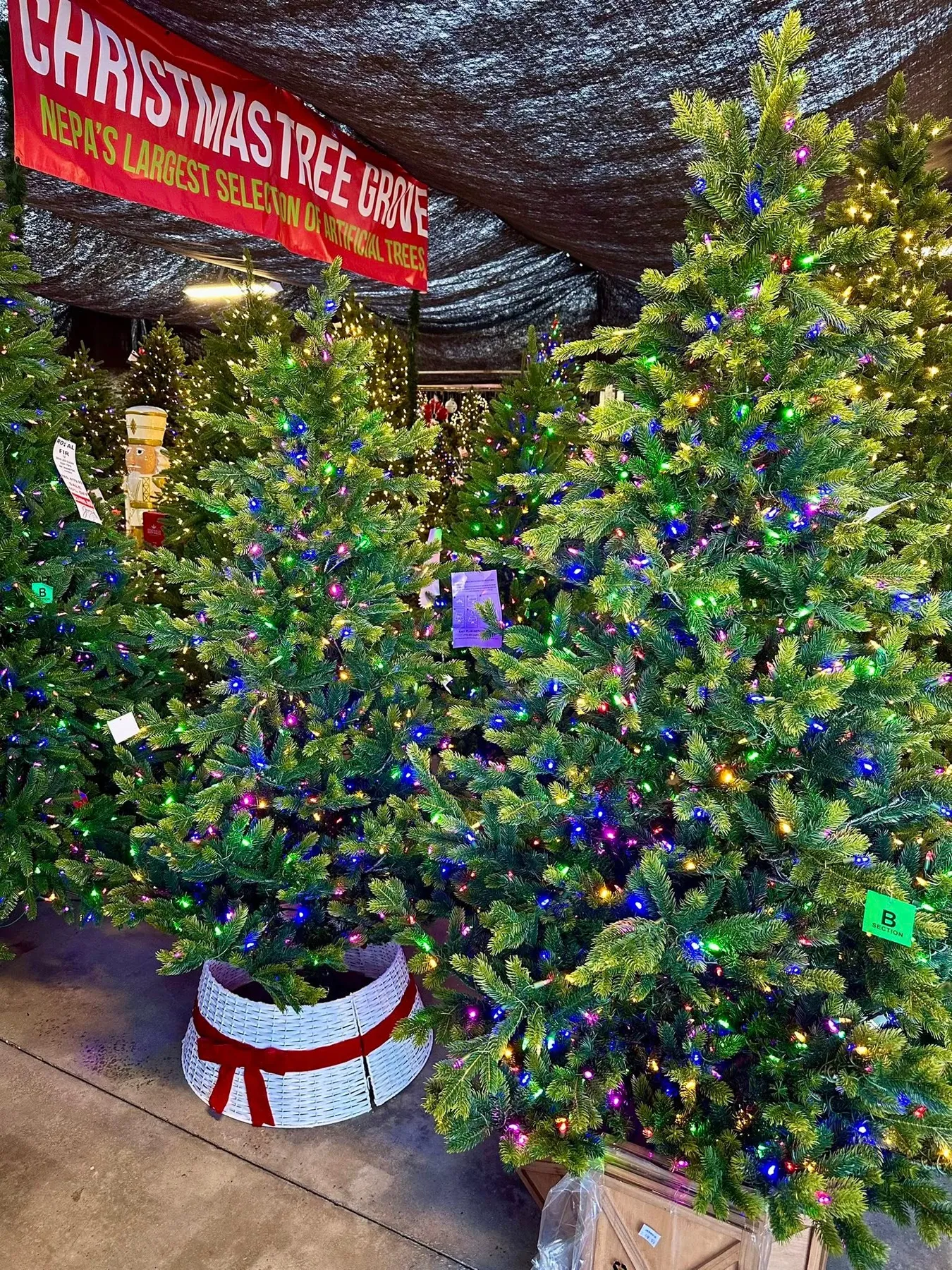
Total: $143-$375
Budget alternative: a plain unlit tree plus your own multi-colored strands often costs less than pre-lit, and you can replace individual strands when they fail instead of retiring the whole tree. Skip the collar and flip a woven basket upside down — about $12 at a thrift store. Before you wheel that cart down the aisle, know this:
- Check bulb count, not height — 400 lights on a 7.5-foot tree reads sparse.
- Measure your car. A boxed 7.5-foot tree does not fit in a sedan with passengers.
- Confirm the base diameter fits your planter or collar.
- Read the return policy; many lit trees go final sale after November.
- Make sure bulbs and fuses are replaceable, not sealed.
28. Galvanized Buckets, Flocked Trees, and Artificial Snow
The palette runs about 40% galvanized grey, 30% green, 20% white, 10% red. Galvanized metal is the quiet hero — cool, matte, and just industrial enough to keep flocked trees from reading like a department store window. Swap the buckets for terracotta and the whole entry turns rustic. Swap for black metal and it turns modern and a little serious. Same plants, same snow, completely different house.
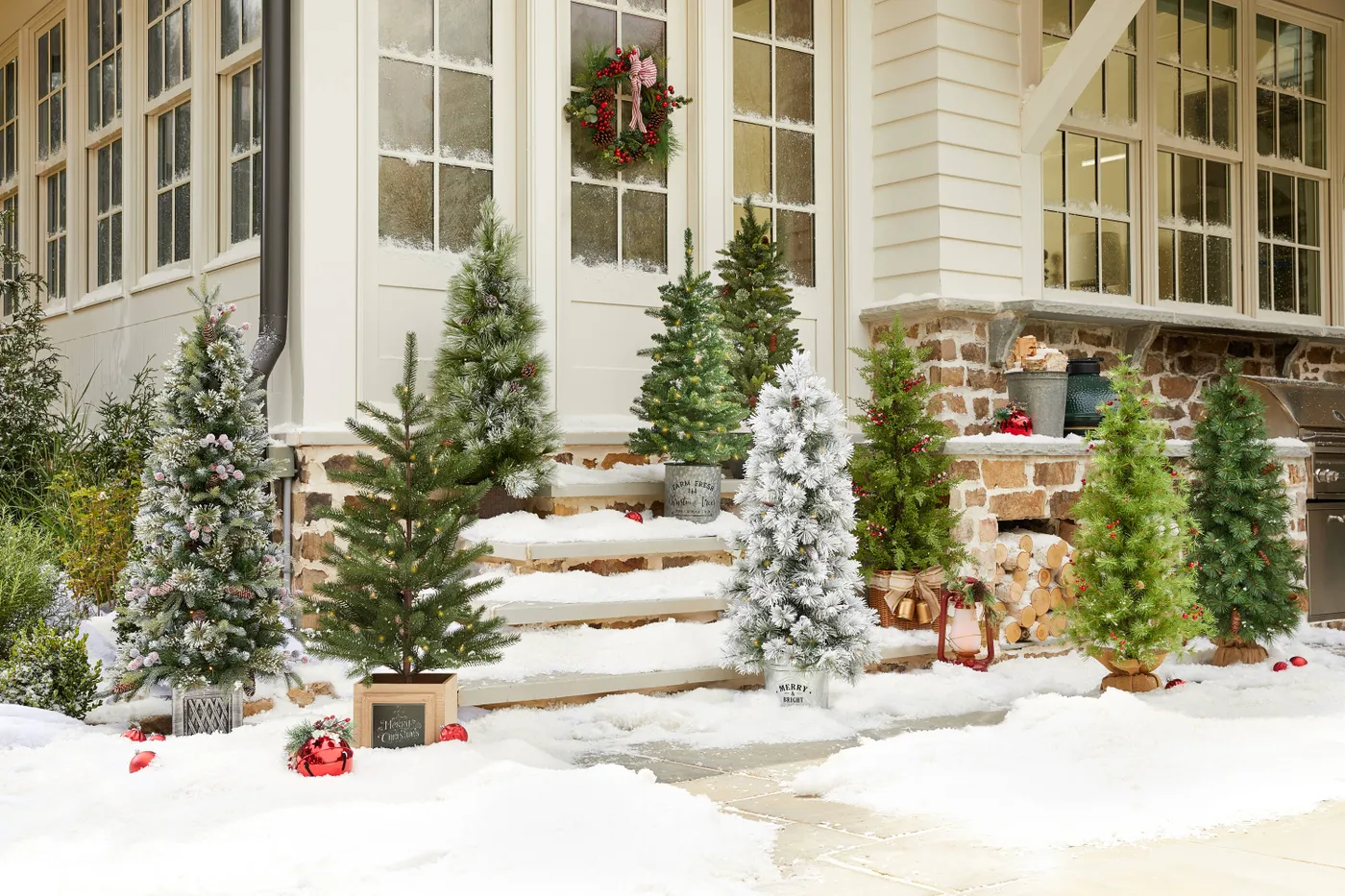
Fake snow on steps is a genuine slip risk. If you’re using it on treads or a walkway, mix it with a little sand, or skip those surfaces entirely and keep it in beds and planters only. Faux snow also smothers grass and leaves yellow patches well into spring, so keep it off the lawn. And watch your downspouts — artificial snow piled near a drain becomes a clog the first time it rains.
29. A Walk-Through Wonderland of Lit Trees
Walk-through light experiences have gone private. People who happily paid $40 a head to wander a lit garden are recreating a smaller version at home, and Pinterest saves for “backyard light tunnel” and “walkthrough Christmas lights” spike every September. The appeal is participation — you don’t just look at the display, you move through it. That shift is why paths, arches, and tunnels now outsell single hero trees in a lot of suburban yards.
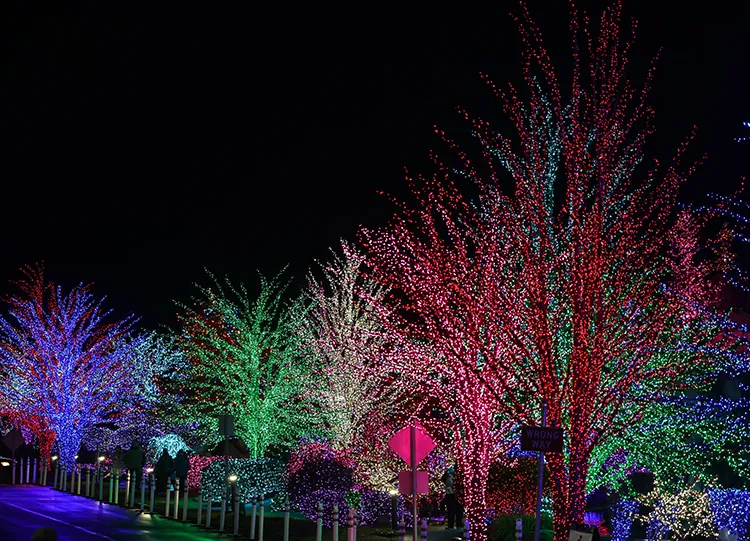
Repetition plus a path. When the same shape repeats at a consistent height and spacing, the eye reads rhythm instead of clutter, and a clear route gives people a reason to move through the space rather than stand in one spot. Varying the height along the line keeps it from feeling like a fence. Because the path is lit from both sides, the person walking it becomes part of the display — which is the whole point.
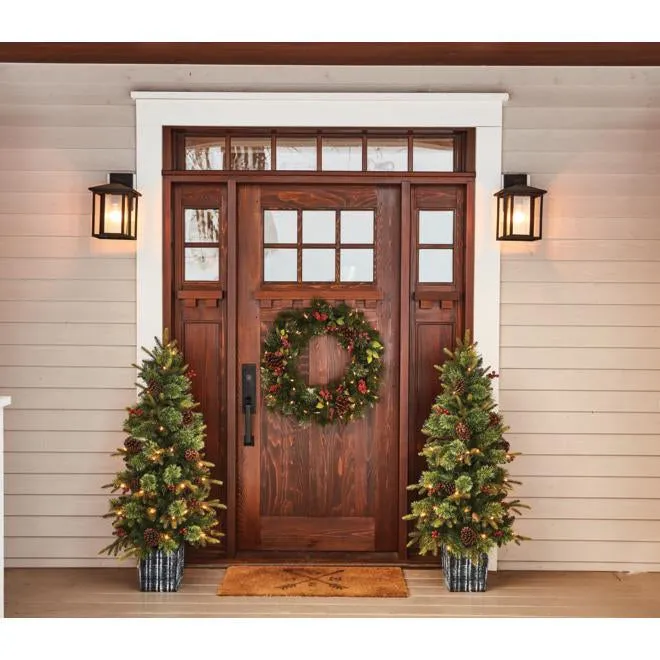
30. A Pre-Lit Tree and Garland in a Bronze Urn
Urn proportions are unforgiving. The container should be roughly one-third the height of the tree, so a 6-foot tree wants a 24-inch urn, and the tree should sit in a liner pot inside the urn with a brick on top for weight. For the door-frame garland, keep it 6 inches off the frame and fasten every 12 inches — a garland that sags in the middle reads as an afterthought, and this one is clearly meant to match the tree exactly.
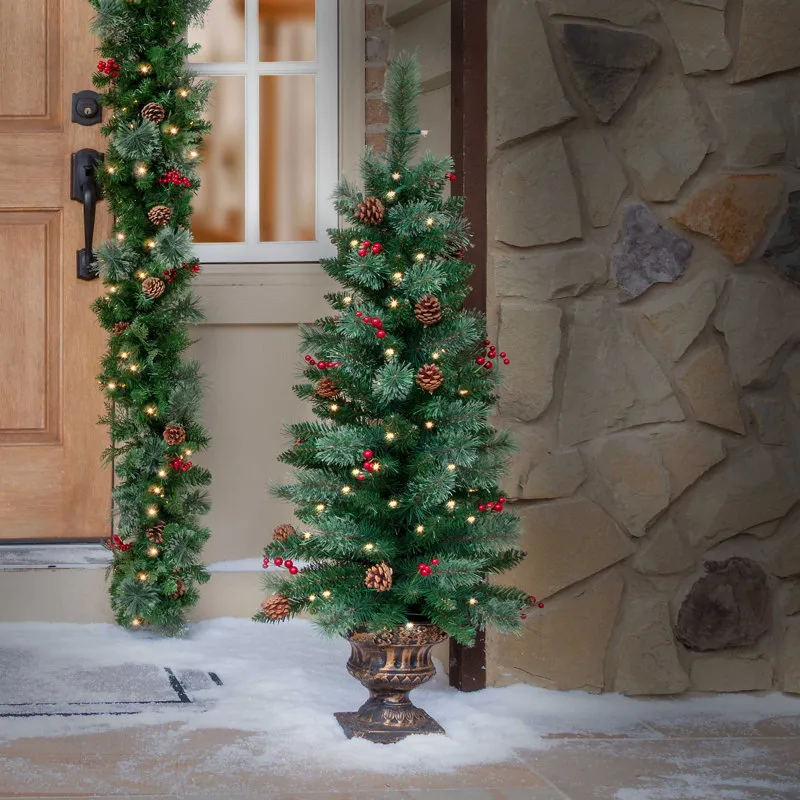
- Pre-lit tree with pinecones and berries: $120-$300
- Bronze-finish urn or planter: $60-$150
- Matching lit garland, 9 ft: $40-$90
- Extra pinecones and red berry picks: $25-$40
Total: $245-$580
Budget alternative: buy an unlit tree and a plain garland, then add a bag of pinecones and berry sprays for about $60 total. A holiday-branded urn costs triple what the same size costs at a garden center in October.
Your Yard, Lights On, Before the Neighbors Notice
Thirty ideas, one theme: the best outdoor Christmas trees are the ones that look deliberate — a color you chose on purpose, a size that actually fits your entry, and lights you’ll still be willing to maintain in January. Start with one, live with it for a week, and let the yard tell you what it wants next.
📌 Pin your favorite version to your holiday board now — when November rolls around, you’ll be very glad you did.