You know that feeling when you spot a garland of dried orange slices backlit in a kitchen window and immediately want to rebuild your entire December around it? That is exactly where this started — and it turned into 28 ideas worth actually making. We combed through Amazon, Walmart, Target, IKEA, and more than a few Dollar Tree aisles to pull the best dried orange Christmas decorations 2026 has to offer, from about $4 to $101, so nothing here is filler. Inside you’ll find foraged rustic wreaths, traditional trees dressed in cinnamon and citrus, Scandinavian-minimal jar arrangements, and farmhouse tables set with citrus-tied napkins — with budget and luxury versions compared side by side so you can see where the money actually matters. Dried citrus has become one of the most-saved natural details on Pinterest two winters running, partly because it is cheap to make, compostable, and honestly looks better the older it gets. And stay until the end — we break down the most common mistakes that can ruin these looks. 📌 Save this to Pinterest for later — you’ll want to revisit these ideas.
1. Vertical Dried Citrus Strands, Hung Like a Curtain
Three things are doing the heavy lifting here. First, repetition: a single strand of citrus reads as a craft project, but eight or ten strands read as architecture. Second, translucency — backlit against a wall or a window, dried orange slices glow like stained glass, which is why the shelves of mugs behind them stay soft and out of focus. Third, scale contrast: those small thin circles against long vertical lines keep the whole thing from feeling cluttered.
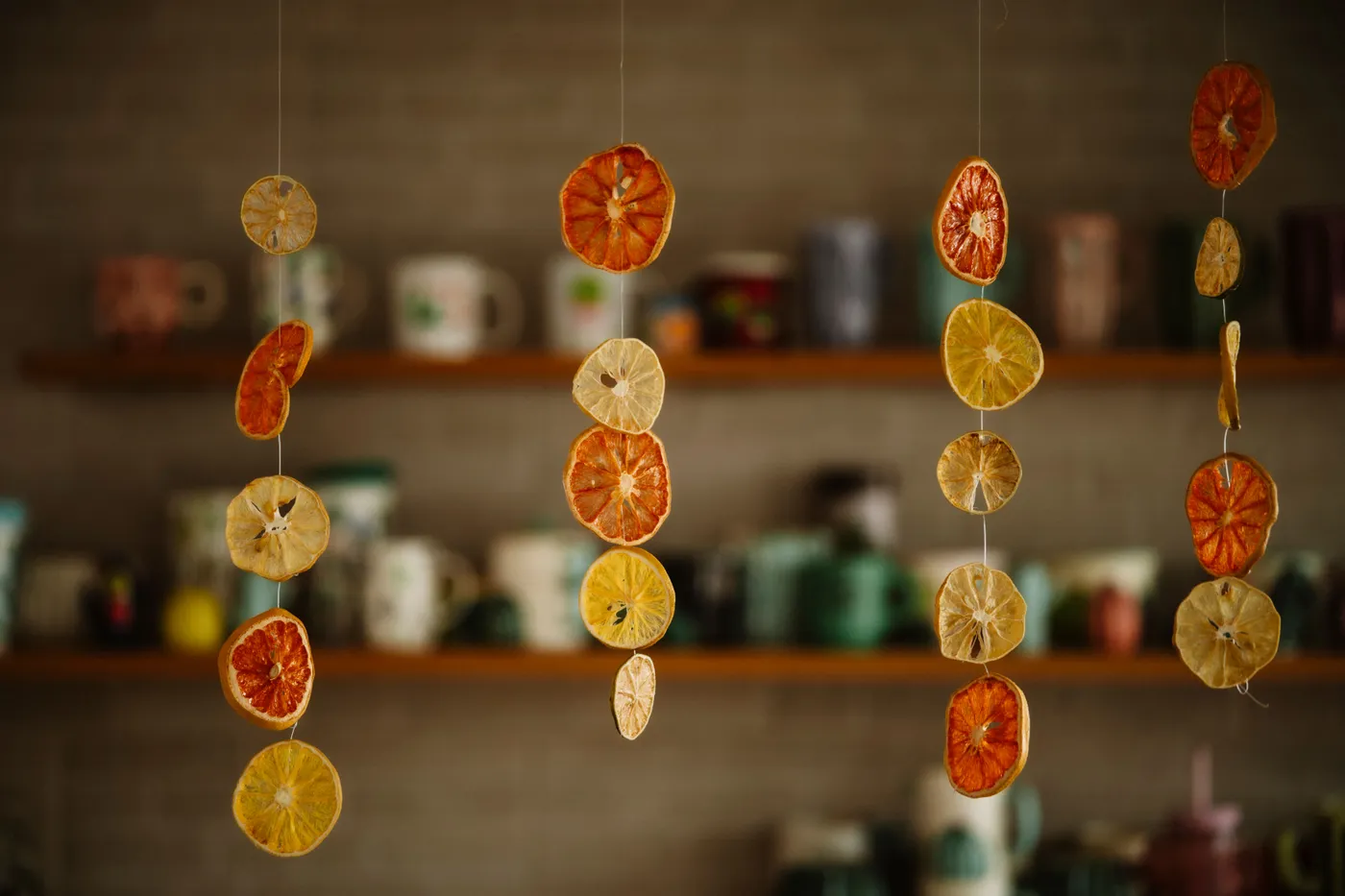
Slice your oranges a scant 3mm thick — anything thicker stays gummy in the middle and molds by January. Bake at 200°F for two and a half to three hours, flipping once at the halfway mark, then let them sit on a wire rack overnight before stringing. Hang strands on 26-gauge floral wire or clear fishing line spaced 4 to 6 inches apart, and finish the bottom of each strand with a tiny loop so the citrus doesn’t slide.
2. Ribbed Kraft Gifts with Velvet Ribbon and Orange Rounds
For the topper on each parcel:
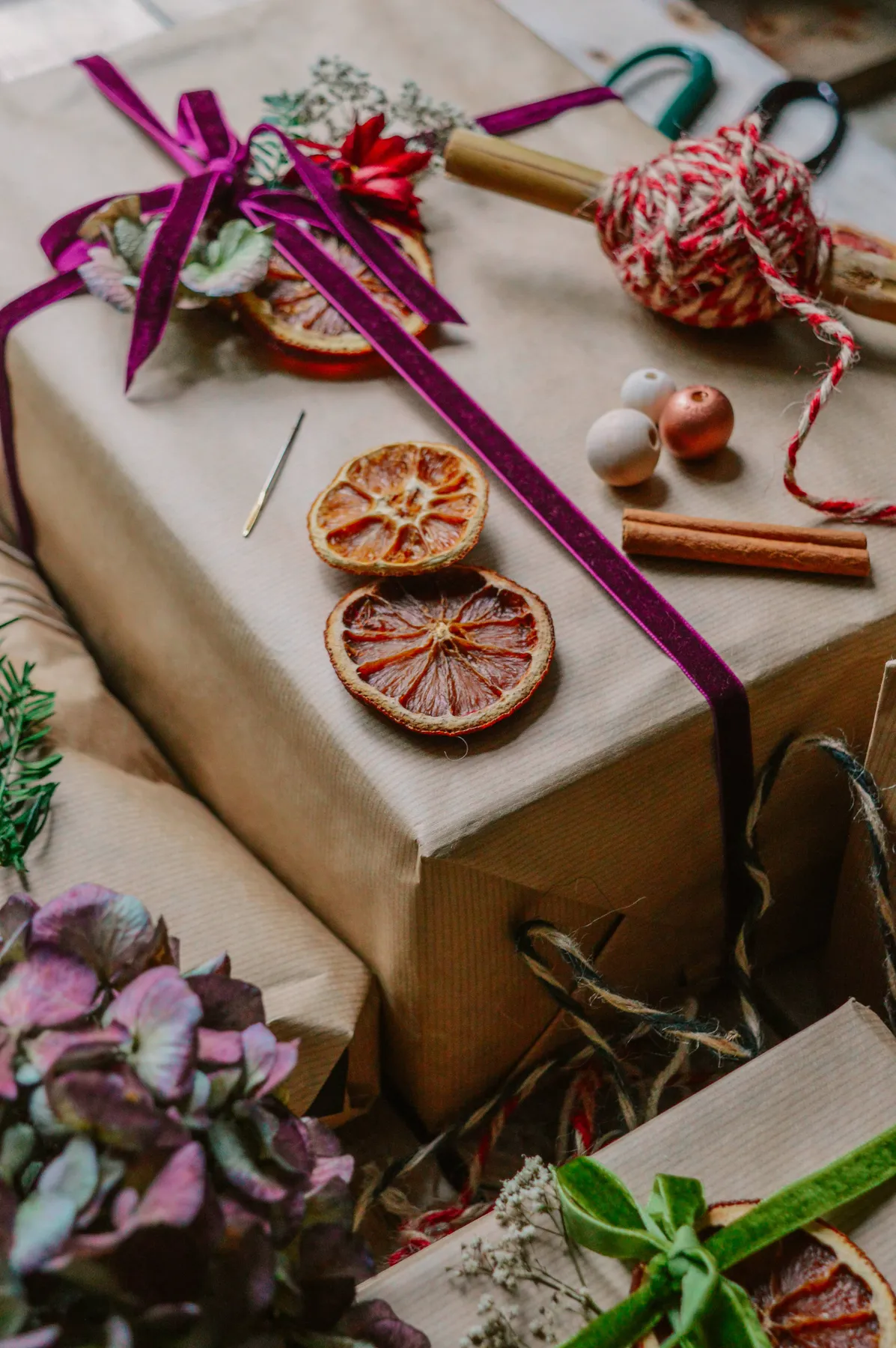
- Cut a 14-inch length of 1.5-inch velvet ribbon in deep magenta or forest green.
- Tie a square knot around the box, then a second knot directly over it to build height.
- Slide a dried orange slice and a cinnamon stick under the knot, angled in opposite directions.
- Add a short length of red-and-white baker’s twine, knotted loosely, and trim the tails at an angle.
- Ruffle the ribbon ends with your thumbnail so they don’t lie flat.
About 10 minutes per gift and roughly $1.50 in materials.
The formula on this wrapping table is roughly 55% ribbed kraft brown, 25% deep jewel tones from that magenta and forest green velvet, 15% dried citrus, and 5% accent through the twine and beads. Hold those proportions and you can swap freely — navy velvet with pear slices, or rust velvet with lemon rounds, still reads as the same design. Shift any single element by more than 10% and it starts to feel like a different project.
3. A Craft Table of Citrus, Wood Stars and Crystal Beads
What’s on this light wood worktable, priced out:
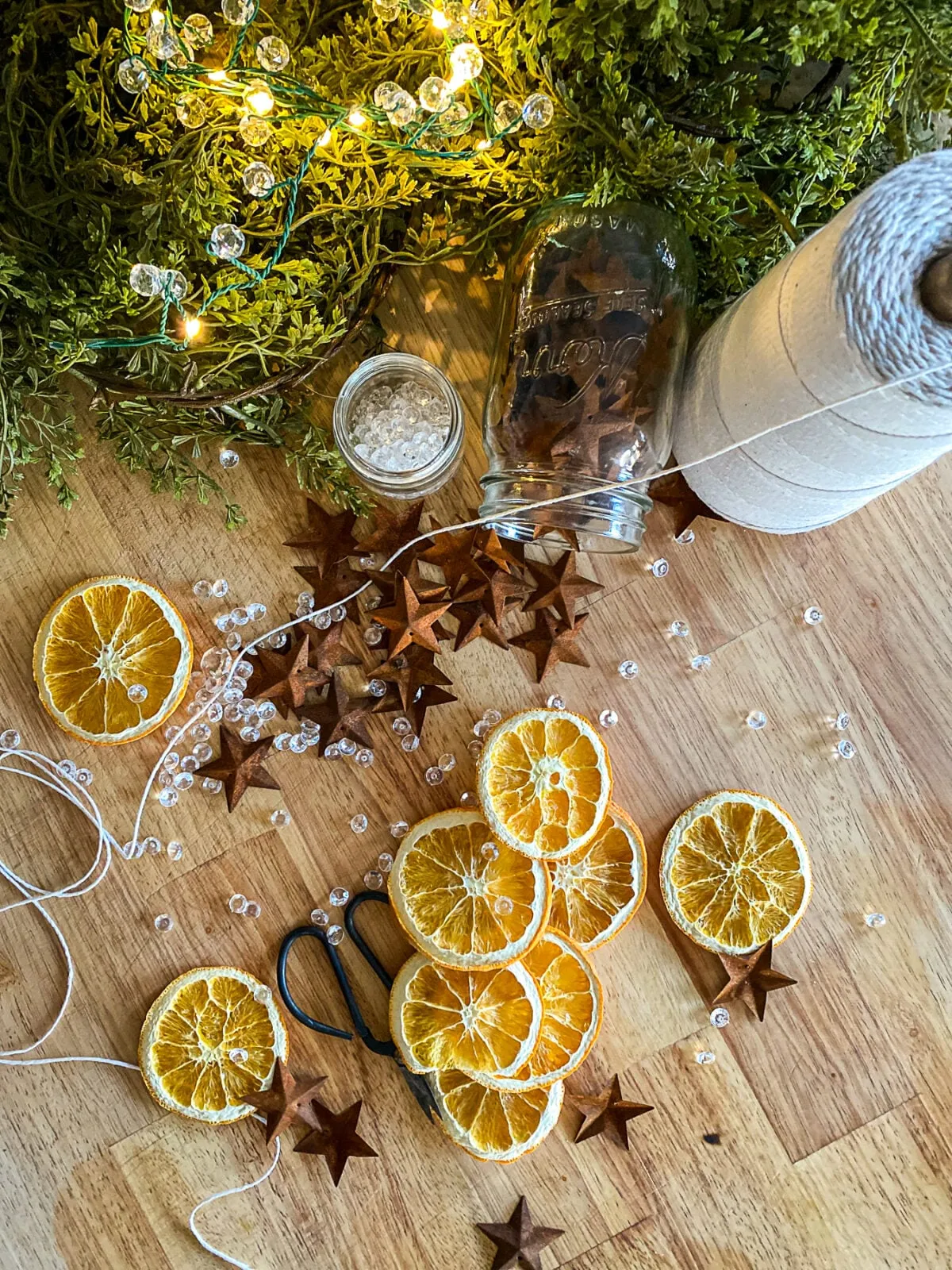
- Dried orange slices, about 40: $8–$14
- Small brown star ornaments, set of 12: $6–$12
- Clear crystal-style beads, 100-piece strand: $5–$10
- White craft string and twine spool: $4–$8
- Green faux foliage garland with warm string lights, 6 ft: $22–$45
- Total: $45–$89
- Budget alternative: $25–$35 with homemade citrus slices and a thrifted light strand.
This craft-table setup is riding the make-it-don’t-buy-it wave that has been building since 2024 and shows no sign of easing in 2026. Dried citrus became the default because it is cheap, compostable, and photographs beautifully — which matters when half the reason you’re making it is the reveal. The good news for longevity: wooden stars and clear beads looked right in your grandmother’s tree and they’ll still look right in 2036.
4. White Baubles and Dried Citrus on a Natural Tree
Take away the matte white spheres and this is just a tree with some citrus on it. Those baubles give the dried orange slices somewhere to sit — visually, they’re the punctuation. The citrus is translucent and matte, so it needs an opaque partner to keep the branches from looking dusty. If you buy one thing for your tree this year, make it a set of plain white ornaments in mixed sizes.
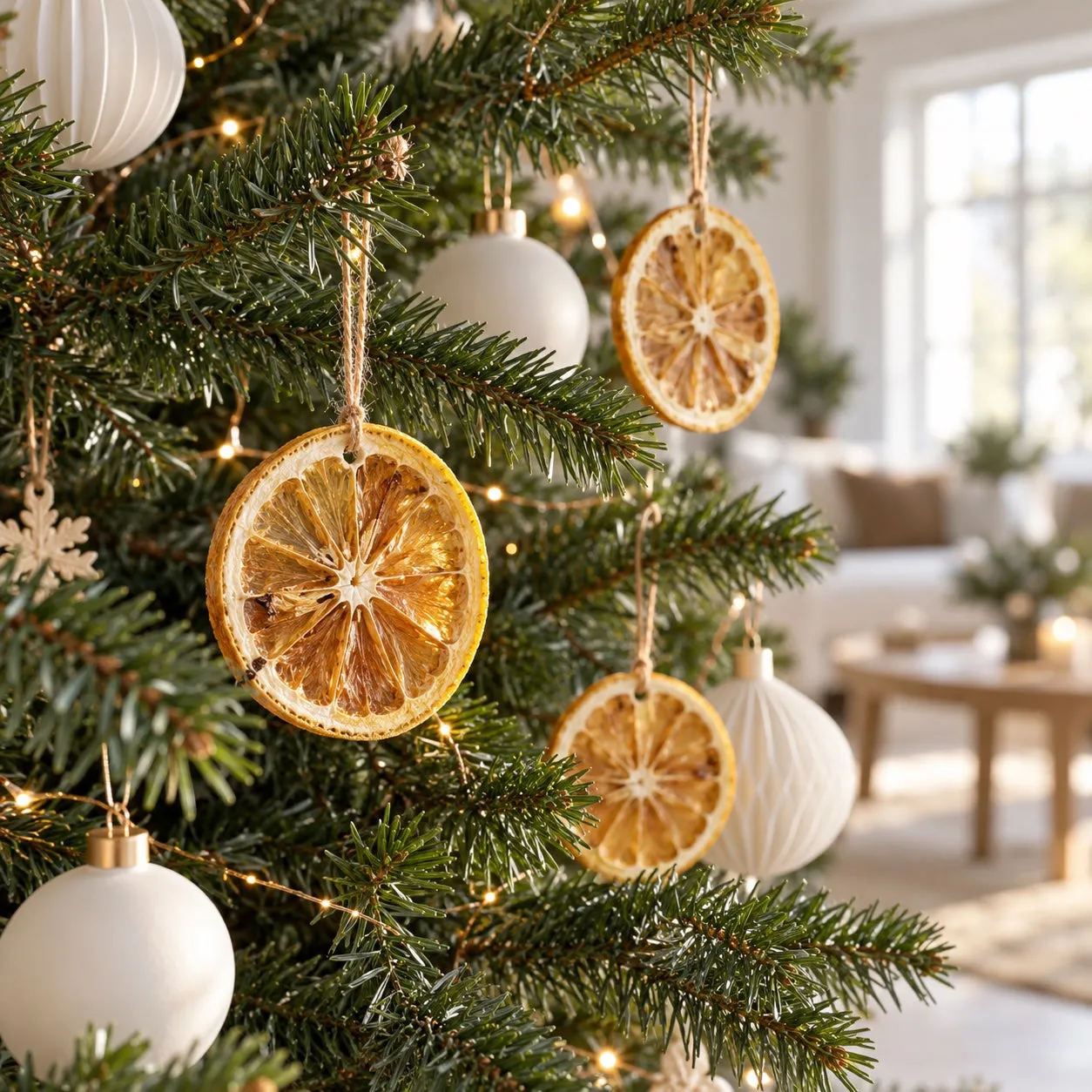
This leans toward a tree that’s at least 7 feet tall — anything shorter and the dried slices compete with the lights instead of layering over them. In a room under 10 by 12 feet, scale the whole look down: use lemon and lime slices instead of full oranges, and swap white glass spheres for 2-inch wooden ones. See Idea #26 for the same citrus language shrunk to wreath size, which works in a hallway where a full tree won’t fit.
Hang the citrus low and the white ornaments high, or at least keep the two from fighting. Dried slices weigh almost nothing, so a simple loop of jute twine holds them fine — but tie the loop so the slice hangs flat and facing the room, not perpendicular to the branch. A slice turned edge-on reads as a dark sliver and disappears. Space them 6 to 8 inches apart and let the string lights come through the gaps.
5. The Single-Orange Brown Paper Parcel with Cinnamon
The whole point of this parcel is that it costs almost nothing. Plain brown kraft paper runs about $6 for a 30-foot roll, jute twine is $3, and one dried orange slice plus two cinnamon sticks adds maybe 60 cents. That’s under $1.50 per gift. If you haven’t dried citrus yet, a bag of ready-dried orange slices from Walmart or Amazon runs $8 to $12 and covers 15 to 20 gifts. Skip ribbon entirely — the twine and the pine cone do the work.
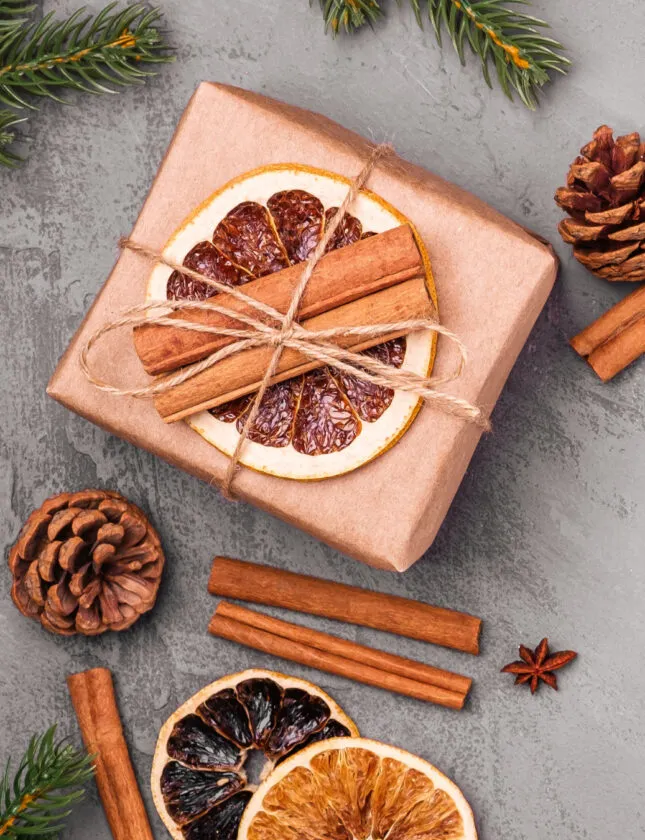
Getting the topper to look deliberate rather than random:
- Wrap the box in brown paper and crease every edge with your fingernail.
- Tie jute twine in a cross pattern, knotting at the center of the top.
- Thread one dried orange slice and two cinnamon sticks onto the loose ends before you knot again.
- Slide a small pine cone and a star anise pod in at an angle.
- Trim the twine tails to about 3 inches and fray the ends slightly.
Five minutes per gift, and no two end up identical.
6. Frosted Evergreen Garland with One Bold Citrus Pop
Frosted garlands shed. That glitter — and there is always glitter — will migrate onto your mantel, your floor, and eventually your socks. Lay a cloth under it while you’re fluffing, and keep it off surfaces you actually eat on. One more thing: frosted greens plus a dried orange slice is a high-contrast pairing, so it looks best against a pale wall. On a dark wall the garland turns into a blur. Test it in daylight before you commit to the whole staircase.
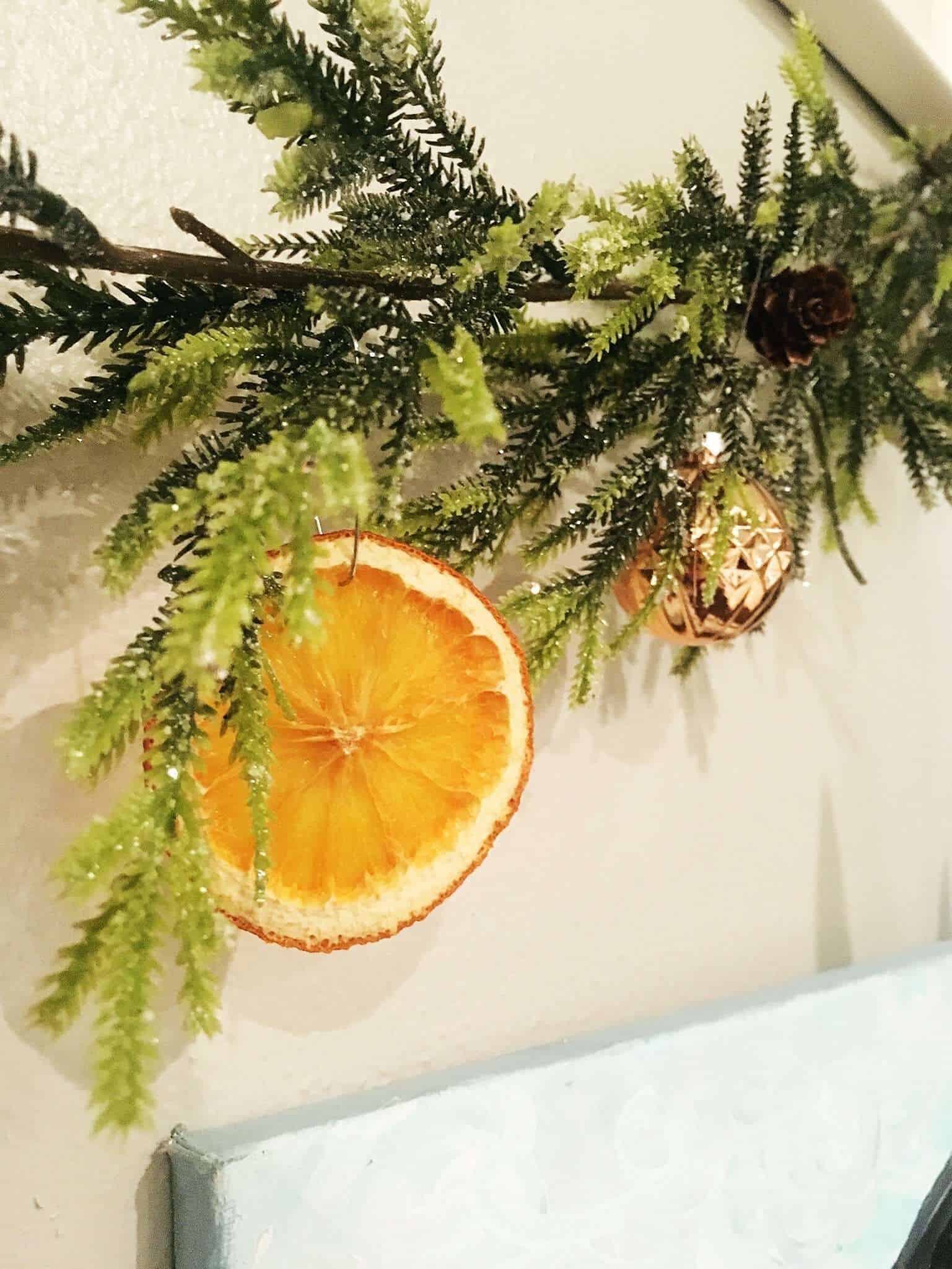
There’s exactly one dried orange slice on this section of garland, and that’s the smart part. A faceted gold ornament next to a single translucent citrus round creates a small, deliberate moment of contrast — matte against shine, warm orange against cool green. The frosted tips do the rest, breaking up the silhouette so the garland reads as light rather than weight. Compare with Idea #8, where the same pairing gets scaled up into full garlands across an entire tree.
7. Cinnamon Sticks and Dried Orange: A Reusable Pairing
Before you commit to a cinnamon-and-citrus scheme for the season:
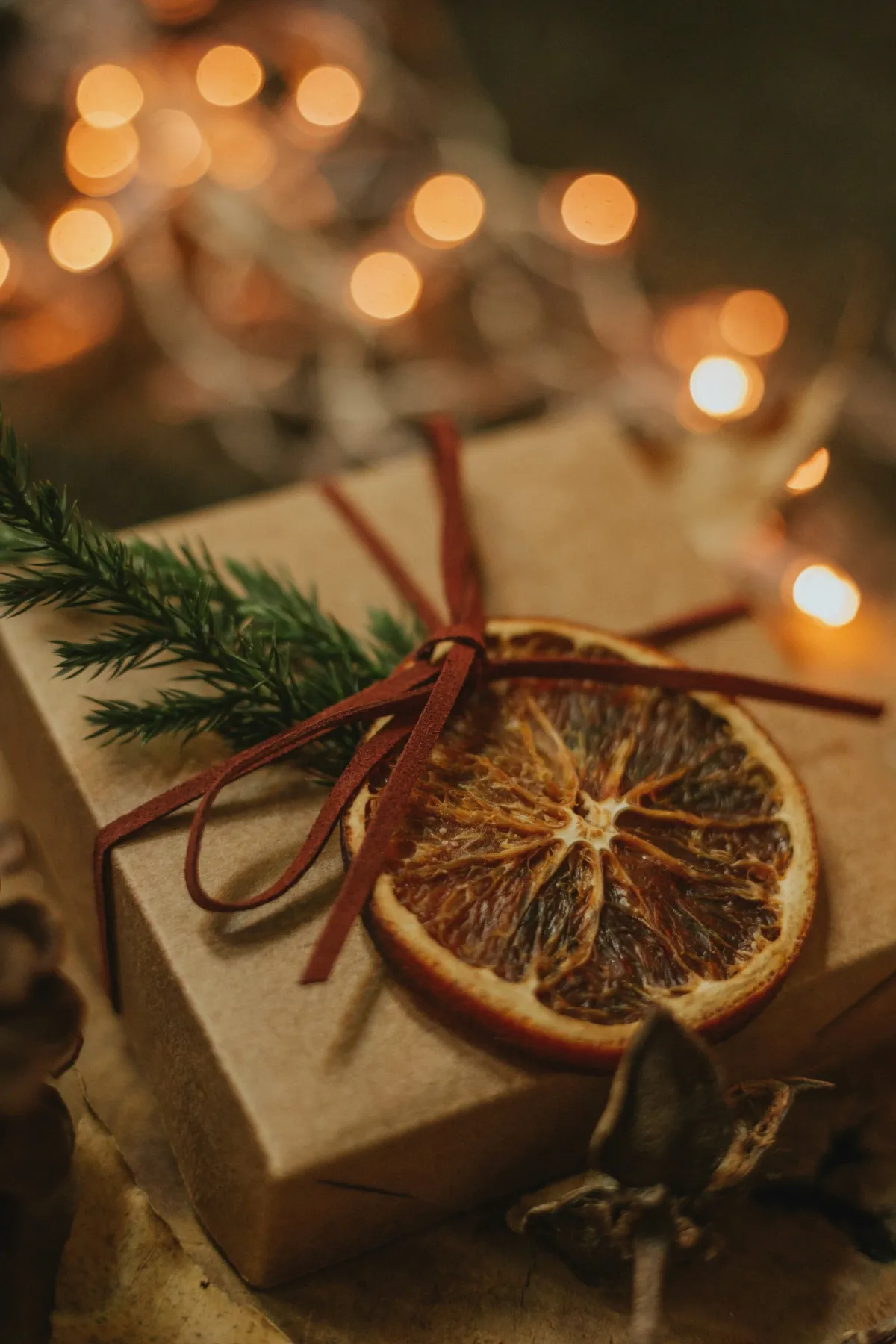
- Measure the surface or container you’re decorating — cinnamon sticks eat space fast and look skimpy when crowded.
- Check that your dried slices are fully dried, not leathery. A bendy slice molds within weeks.
- Decide where the scent actually matters. Cinnamon releases fragrance when it’s warm or humid, so near a radiator or candle it performs; on a cold shelf it stays silent.
- Confirm nothing on your list gets thrown out in January — the whole point is decor that stores flat and comes back next year.
Dried orange slices keep for one to two seasons if you store them in a sealed container with a silica packet, away from humidity. Cinnamon sticks last years. What kills both is a damp garage or basement shelf. If you use this decor anywhere near steam — a kitchen windowsill, a bathroom — expect curling edges by mid-December. Annually you’re looking at $10 to $15 in replacement citrus, still cheaper than one new box of mass-market ornaments.
8. Berry, Cinnamon and Citrus Garlands on a Densely Lit Tree
Count the ratios on this tree: roughly 55% greenery and warm white light, 25% rustic garland — the dried orange, cinnamon and berry strands — 15% antique gold, and 5% paper. The garlands are the movable piece. Swap berries for dried cranberries and it reads more Scandinavian; drop the gold entirely for a cabin look. The one ratio to keep constant is the light. Warm white should stay the quietest layer or the whole tree turns to soup.
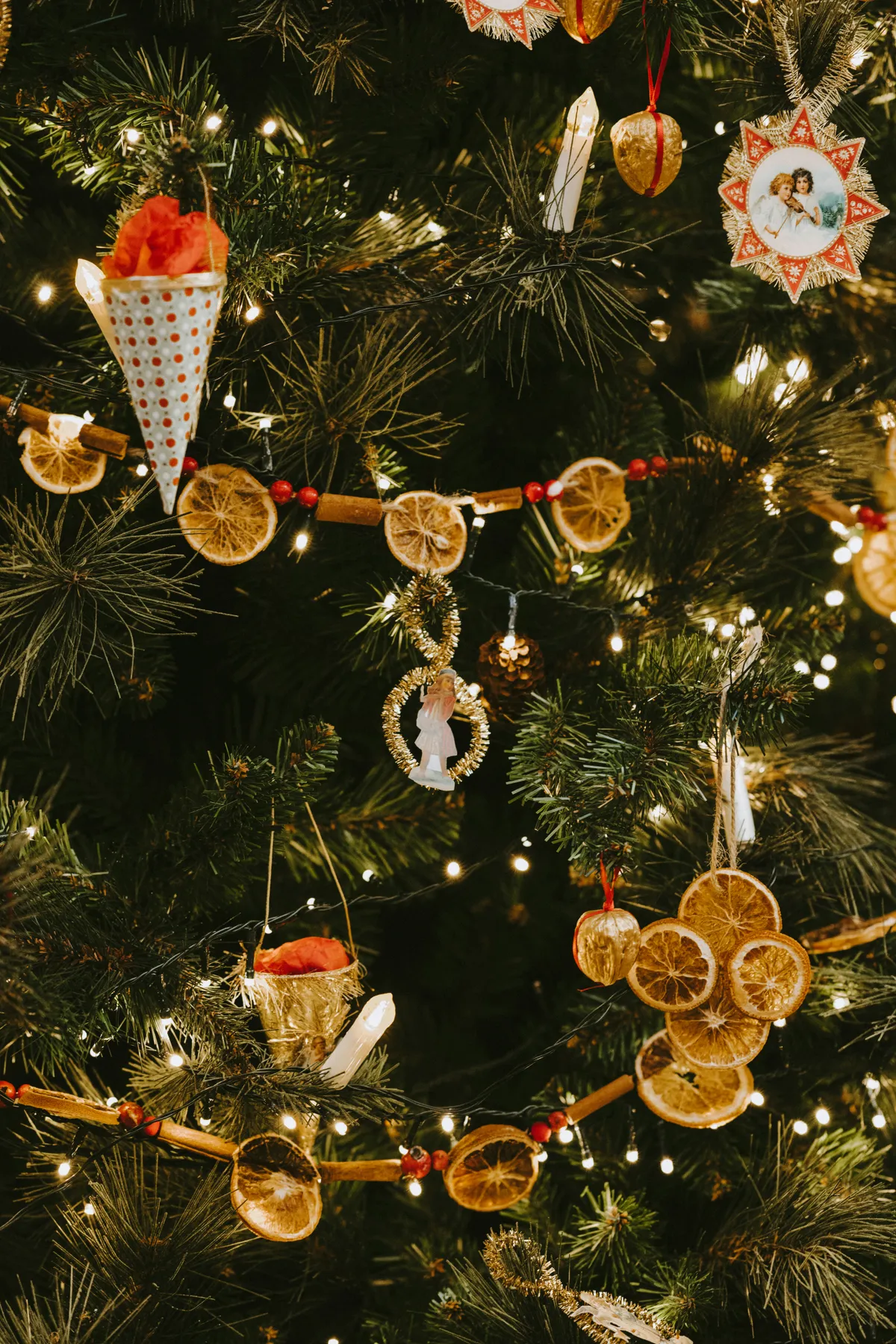
The garlands, strung roughly horizontally rather than draped in swoops. That’s the decision that makes this tree feel collected instead of styled — the citrus, cinnamon and berries sit in bands that echo the branch lines, so your eye travels around the tree instead of up and down it. Remove them and you’re left with a perfectly nice gold-and-light tree with no personality. Everything else here is supporting cast.
Traditional hasn’t meant your mother’s tree since about 2023. What’s happening now is a re-read of traditional — same garlands, same warm bulbs, but with handmade and foraged elements doing the ornament work. Dried citrus is the entry point because it’s the cheapest natural material that still looks finished. Will it last? The gold and the warm light will. The paper stars might not. Buy the citrus and the gold, borrow the rest.
9. A Foraged Wreath with Acorns and Dried Orange
Here’s what this one actually costs:
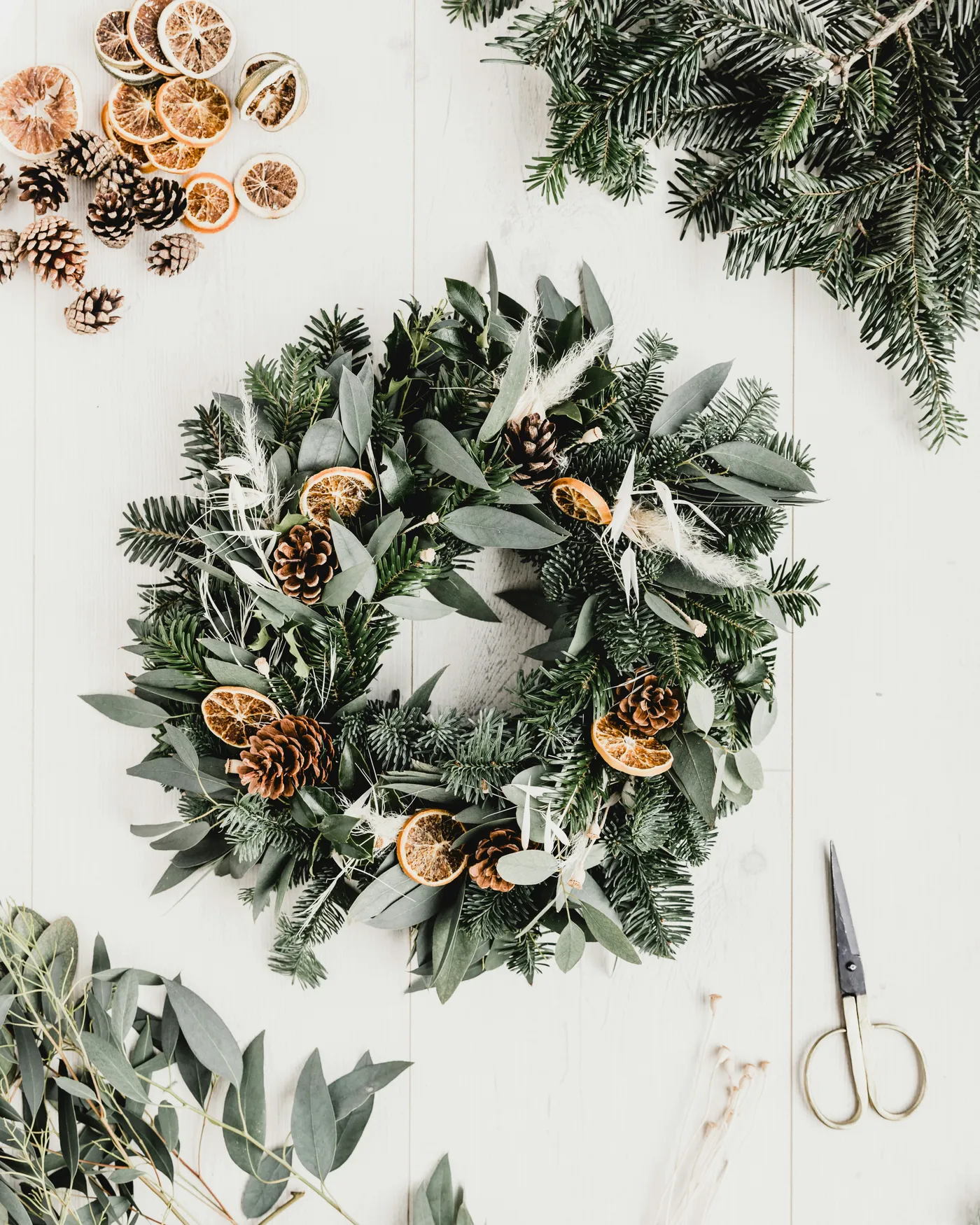
- Foraged evergreen and dried foliage gathered on a walk: free
- Acorns, collected and baked to evict anything living inside: free
- Dried orange slices, 20–25: $6–$12
- 18-inch grapevine or wire wreath base: $8–$18
- Floral wire and twine: $5–$9
- Total: $19–$39
- Budget alternative: $8–$12 if you build the base from a wire coat hanger and dry your own slices.
Wreaths have one hard sizing rule: the wreath should be roughly one-third the width of the door or wall space. A standard 36-inch door wants a 12-inch wreath; a wide 42-inch double door can carry 14 to 16 inches or two smaller wreaths side by side. This foraged style is forgiving because you build outward from the base, so you can keep adding until it hits the size you need. On an interior wall above a console, the same proportions apply — measure first, wire second.
10. Wreath-Making with Orange Berries on a Dark Table
Working the berries into a foliage base:
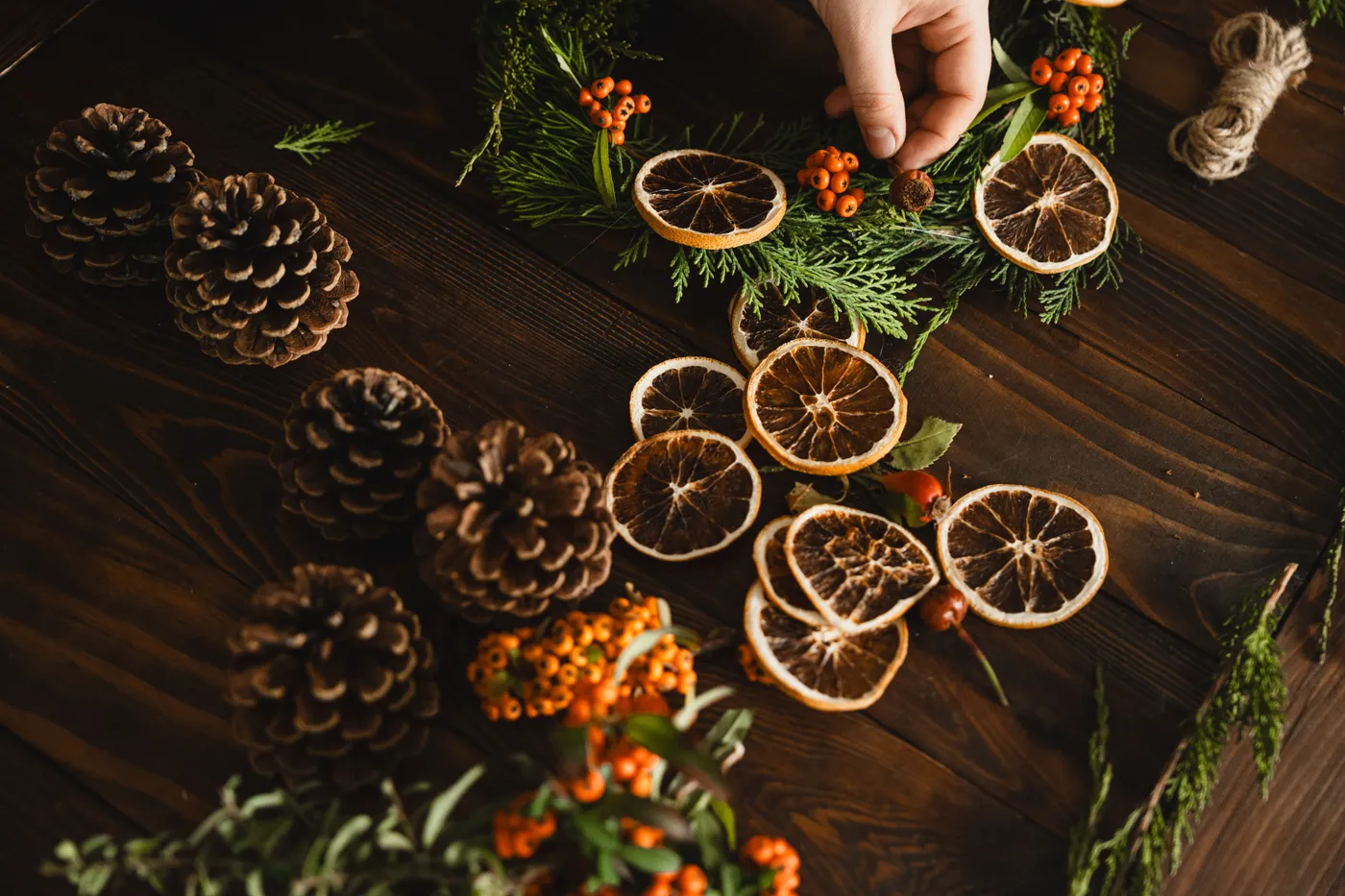
- Wire your greenery base first and let it sit an hour so it settles into its final shape.
- Cluster the orange berries in three to five spots rather than spreading them evenly — odd numbers read as natural.
- Tuck each cluster into the greenery so the stems disappear; you should see berries, not wire.
- Add dried orange slices between the clusters, spacing them so no two sit the same distance apart.
- Finish by wrapping twine loosely around the whole thing to lock the layers together.
About 45 minutes once your base is built.
Orange berries are the fragile part of this arrangement. Fresh ones crush if you handle them twice, and they drop. If you’re making this in November to hang in December, either build it the week you plan to display it or use faux berries and let the dried citrus carry the realness. A wreath this dense also holds moisture between the layers, so don’t hang it somewhere steamy. Airflow is what keeps it from going musty before the holiday is over.
11. A Flat-Lying Wreath Centerpiece with Gold Candle Pins
Laying the wreath flat changes everything about how it reads. Upright, a wreath is a symbol; flat on a table with candles nested inside, it’s a centerpiece you can actually dine around. The gold does double duty here — the small candle holders and the matte and glittery ball ornaments repeat the same metallic at three different scales, which is what keeps a warm palette from turning mushy. The dark wood underneath gives the orange somewhere to pop from.
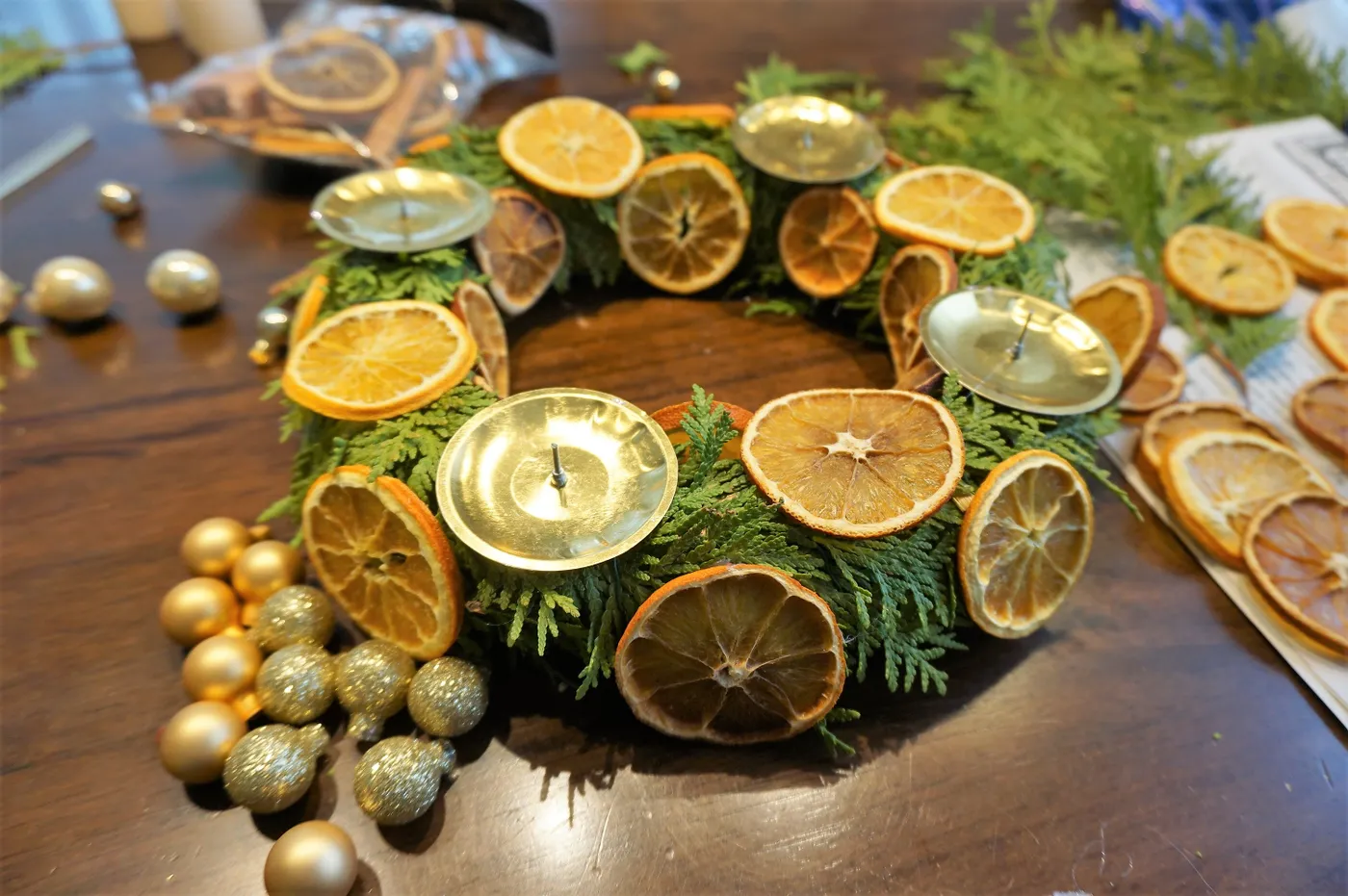
Candle holders with pointed pins press straight into the greenery, so place them at least 3 inches in from the wreath’s outer edge — closer than that and the ring sags. Use tapers no taller than 8 inches, or if this is going on a dining table, switch to short pillars and skip the pins entirely. And buy four more gold balls than you think you need. Centerpieces always look underfilled in a real room compared to how they looked while you were building them.
12. Conifer Wreath Layered with Orange Berries and Cinnamon
Three checks before you start wiring:
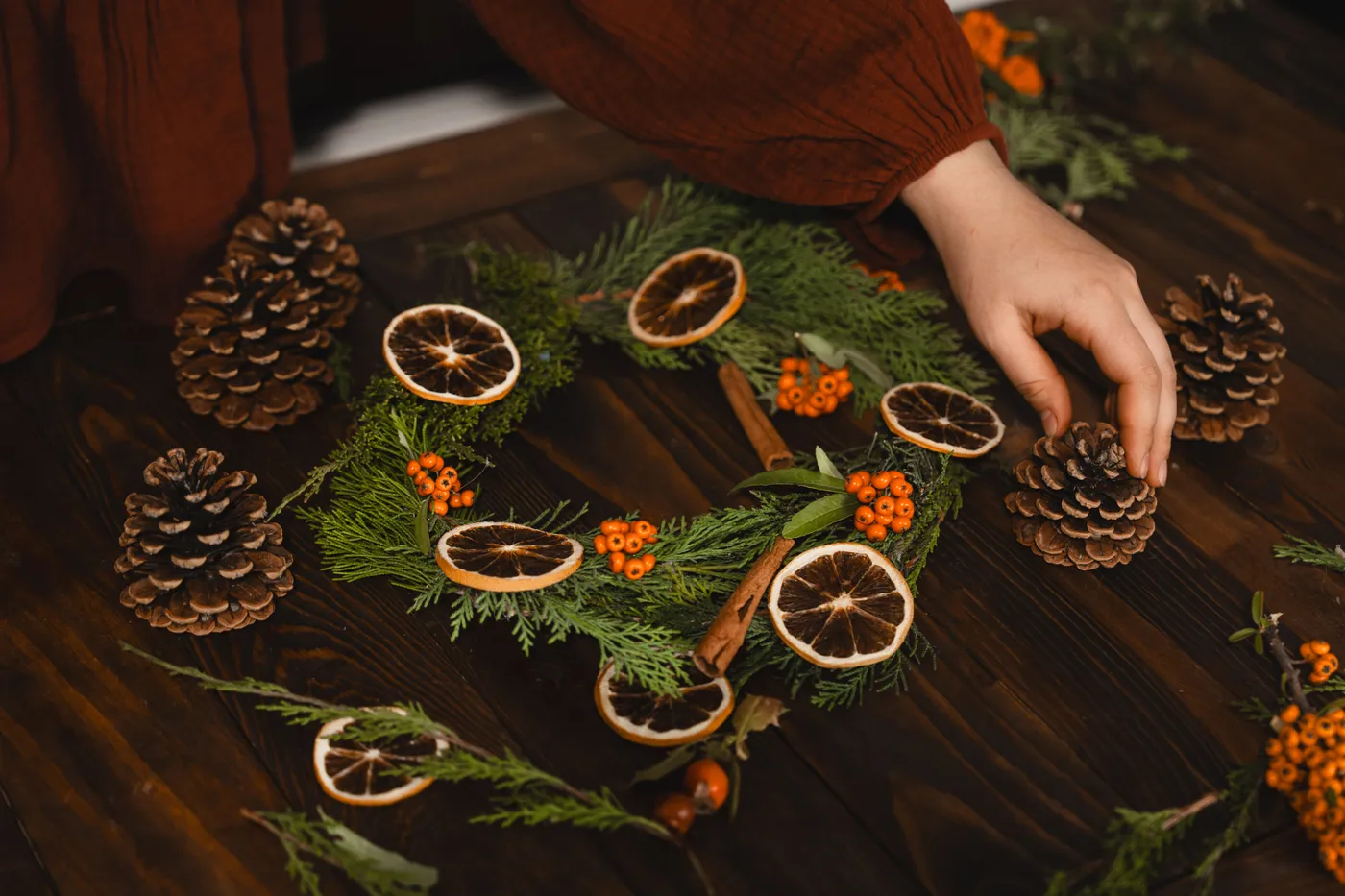
- Lay everything out dry — slices, berries, cinnamon sticks, pinecones — before a single wire goes in.
- Weigh the finished wreath. Anything over 4 pounds needs a nail or hook, not a suction cup.
- Check your door’s sun exposure. A west-facing door fades dried orange within a month; bring it inside if that’s your setup.
- Have more slices than you need. The last third of the wreath always eats more material than the first two.
Almost everything in this wreath can come from a walk or a grocery store instead of a craft aisle. A plain grapevine base is $8 at Walmart; the rest is $4 in oranges, $2 in cinnamon sticks, and pine cones gathered from a park. Berries can be faux — a $5 sprig from Dollar Tree reads identically tucked behind dried citrus. If foraging isn’t your thing, IKEA’s dried citrus pouches and Target’s wreath bases get you there for under $25.
13. A Redware Plate of Citrus, Star Anise and Dried Rose
The dried purple flowers and that single rose bud. Without them this is a nice, forgettable bowl of citrus and cinnamon. Those two purple tones push the arrangement from rustic-generic into something with an actual color story — orange and violet sit near-opposite each other, so the eye gets a small jolt exactly where the designer wanted it. Swap them out and replace with something equally unexpected: dried blue thistle or a few sprigs of dried lavender.
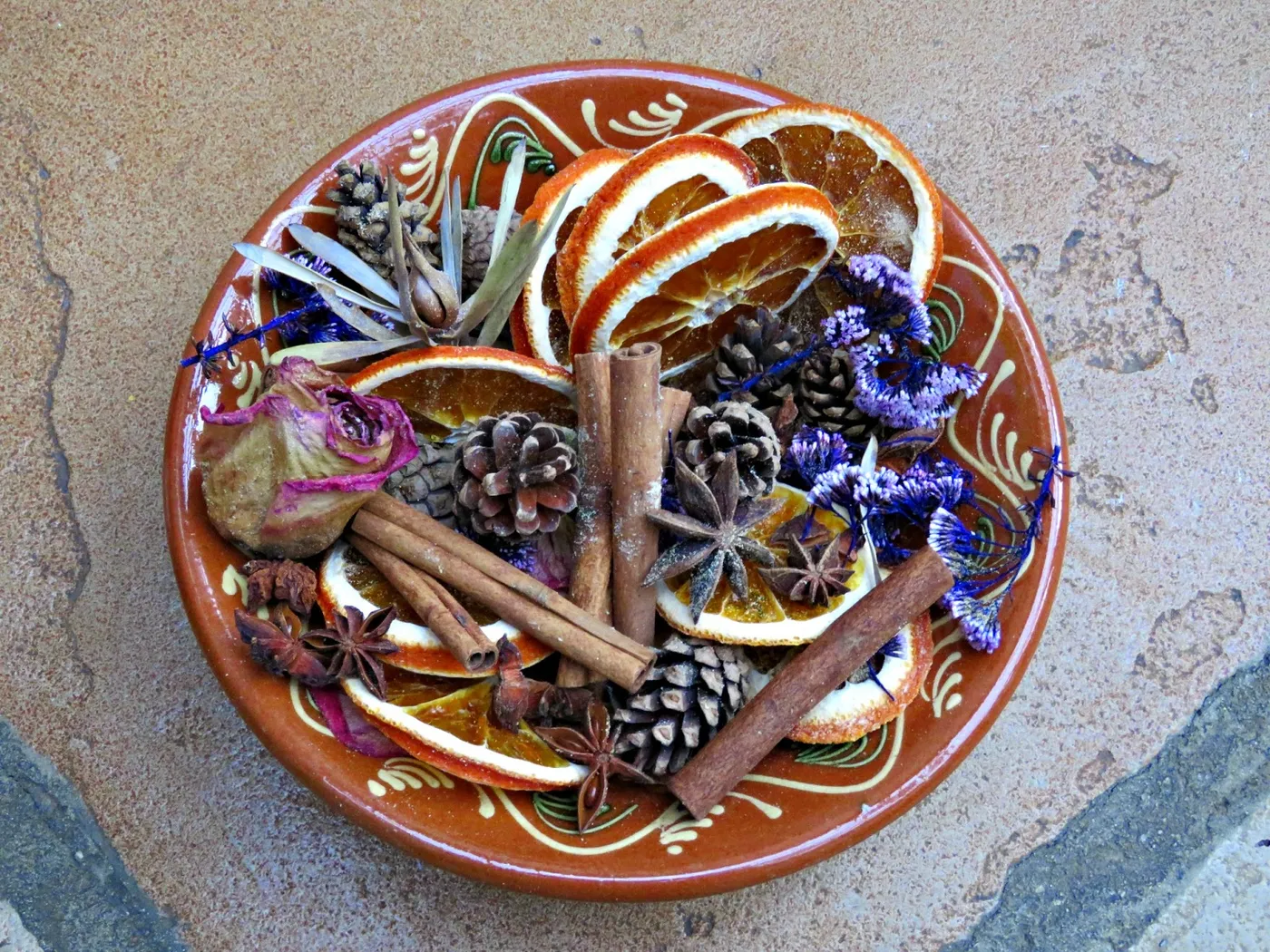
The recipe here is roughly 60% dried orange slices, 25% woody brown texture — pinecones, cinnamon, star anise — 10% the reddish-brown plate itself, and 5% accent, meaning the purple flowers and the rose bud. That last 5% is the entire personality of the arrangement. Keep the orange and brown base, then rotate the accent by season: dried rosehips for winter, dried lavender for a spring refresh, or nothing at all if you want it purely natural.
14. Coconut Shell Candles Crowned with Citrus and Fir
Four coconut shell candles want at least a 24-inch-wide surface with a few inches of breathing room on each side — a console, a long dining table, or a wide hearth ledge. On a small side table, use two instead of four and let the fir sprigs spill off the edge. If your ceiling is low or the room is under 100 square feet, skip the open flame version entirely; the white textured surface and citrus still give you the look without the smoke.
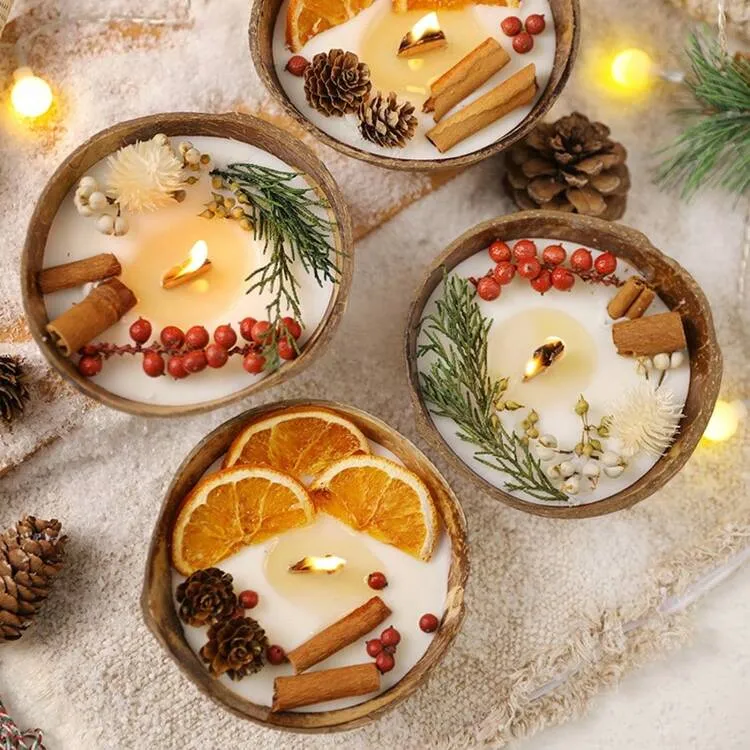
Real coconut shells run about $2 each at a grocery store — ask the produce department, they’ll often hand you halved ones for free. Soy candle flakes are $6 to $10 a pound and wicks cost pennies, so four candles land under $20. If you’d rather not pour wax, Target and Walmart sell coconut-shell candles seasonally for $8 to $14 each, and Dollar Tree sometimes carries small versions. Dried orange slices, fir sprigs and cinnamon sticks finish each one for about $1.
Coconut shell candles burn cooler than glass, but the shell will char if the wax runs low — never let one burn down past the halfway point and never leave the room. The white textured surface shows every speck of soot, so plan on a weekly wipe with a dry cloth. Dried citrus nestled next to a live flame browns and curls within days; it’s decorative, not permanent. Use faux slices if you plan to burn these nightly through December.
15. Burlap, Walnuts and Fir Branches with Dried Orange
Burlap is the hardest-working material in this whole setup, and most people use it wrong. Cut it with pinking shears — regular scissors leave a fringe of threads that unravels for weeks. Then line the back with iron-on hem tape before folding, so it holds a crisp edge. Keep burlap away from anything handled often; it sheds fibers onto fabric. On a tabletop, burlap works best as a base layer with wood, linen, or slate on top of it.
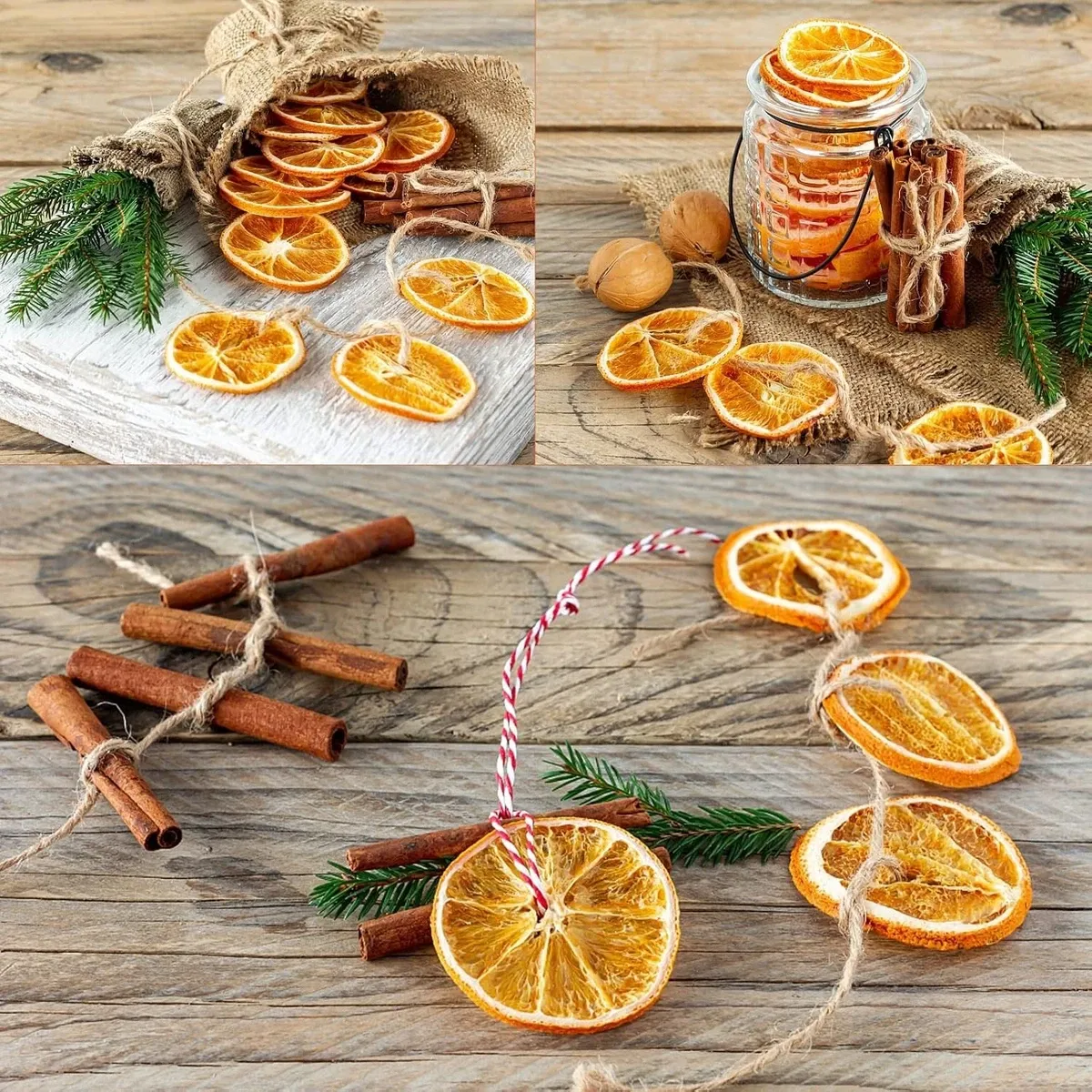
The full shopping list:
- Dried orange slices, 30–40: $7–$14
- Cinnamon sticks, bulk bag: $6–$12
- Fresh fir branches, 3–4 bunches: $15–$35
- Burlap fabric, 2 yards: $8–$16
- Jute twine and string: $4–$8
- Walnuts in shell, 1 lb: $5–$9
- Total: $45–$94
- Budget alternative: $22–$30 using grocery-store citrus dried at home, a thrifted burlap coffee sack, and foraged fir.
16. Patterned Napkins Tied with Twine and Citrus Rounds
Fabric napkins with a dried orange slice tied on look wonderful for about one dinner. Then someone washes one with the slice still attached, or the twine catches gravy, and the whole thing becomes a small sticky problem. Two fixes: tie the slice to a napkin ring instead of directly to fabric, or attach it with a loose knot you can slip off in three seconds. Also, pattern plus citrus is a lot of visual information — if your plates are patterned too, go plain on the napkin and let the orange be the moment.
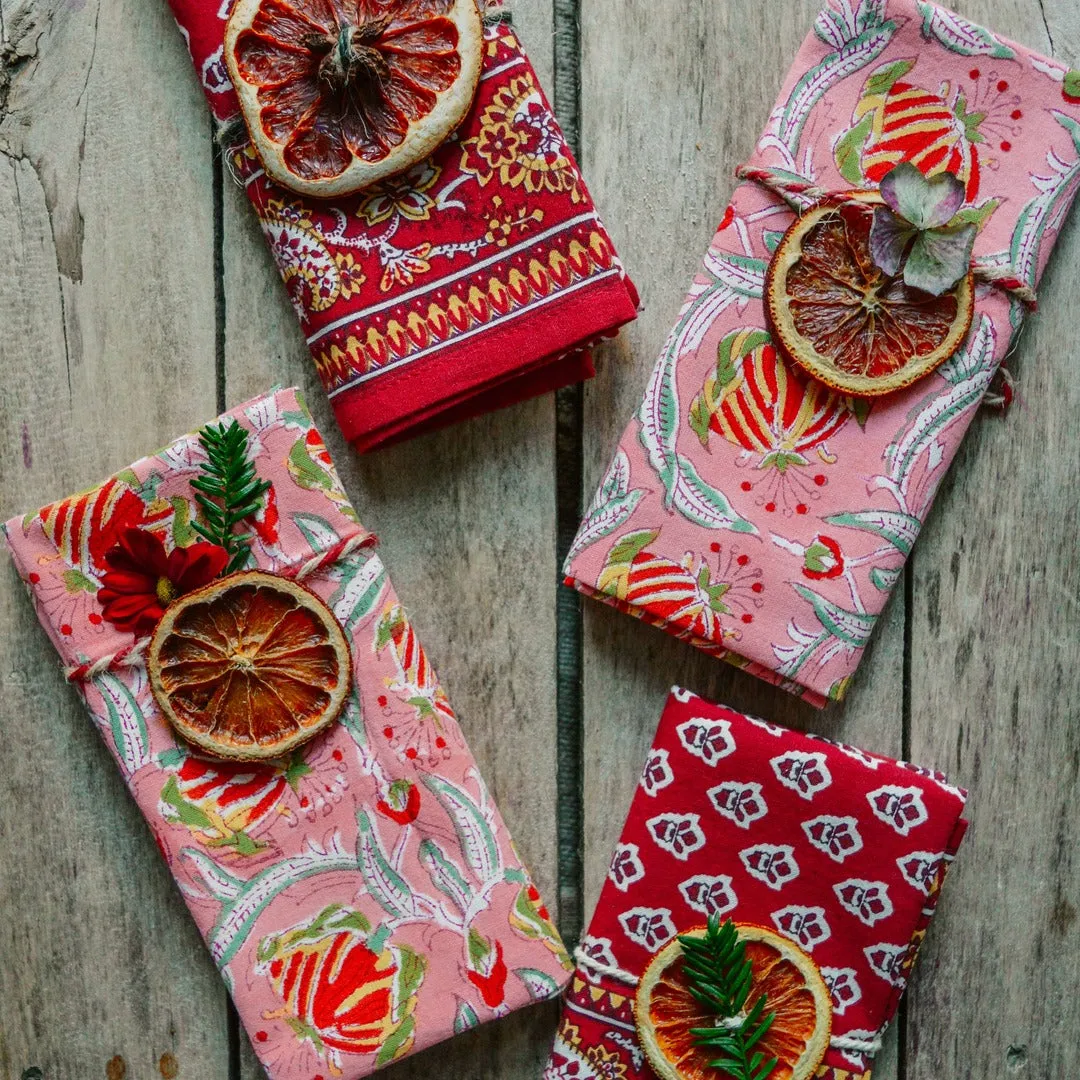
How to set it up:
- Fold each napkin into a simple rectangle, pressed flat — no fans, they fight the citrus.
- Wrap twine around the bundle twice and knot on the top face.
- Thread a dried orange slice onto one tail before tying the final bow.
- Tuck a single green sprig or a small dried floral stem under the twine.
- Trim the tails to 2 inches and leave them slightly uneven.
Under three minutes per setting, and it works with any napkins you already own.
17. Mason Jar Punch Garnished with Dried Orange and Lime
Dried citrus as a garnish rather than a decoration is the small shift that’s been moving through holiday entertaining since about 2024. Same instinct as the dried-flower cocktail moment, just cheaper: a dried orange wheel holds its shape in liquid, never dissolves, and gives a dark drink a bright rim of color. Compare with Idea #13 — same principle, where one tiny accent changes the whole read of an arrangement. For 2026, expect to see this on more holiday tables than paper straws.
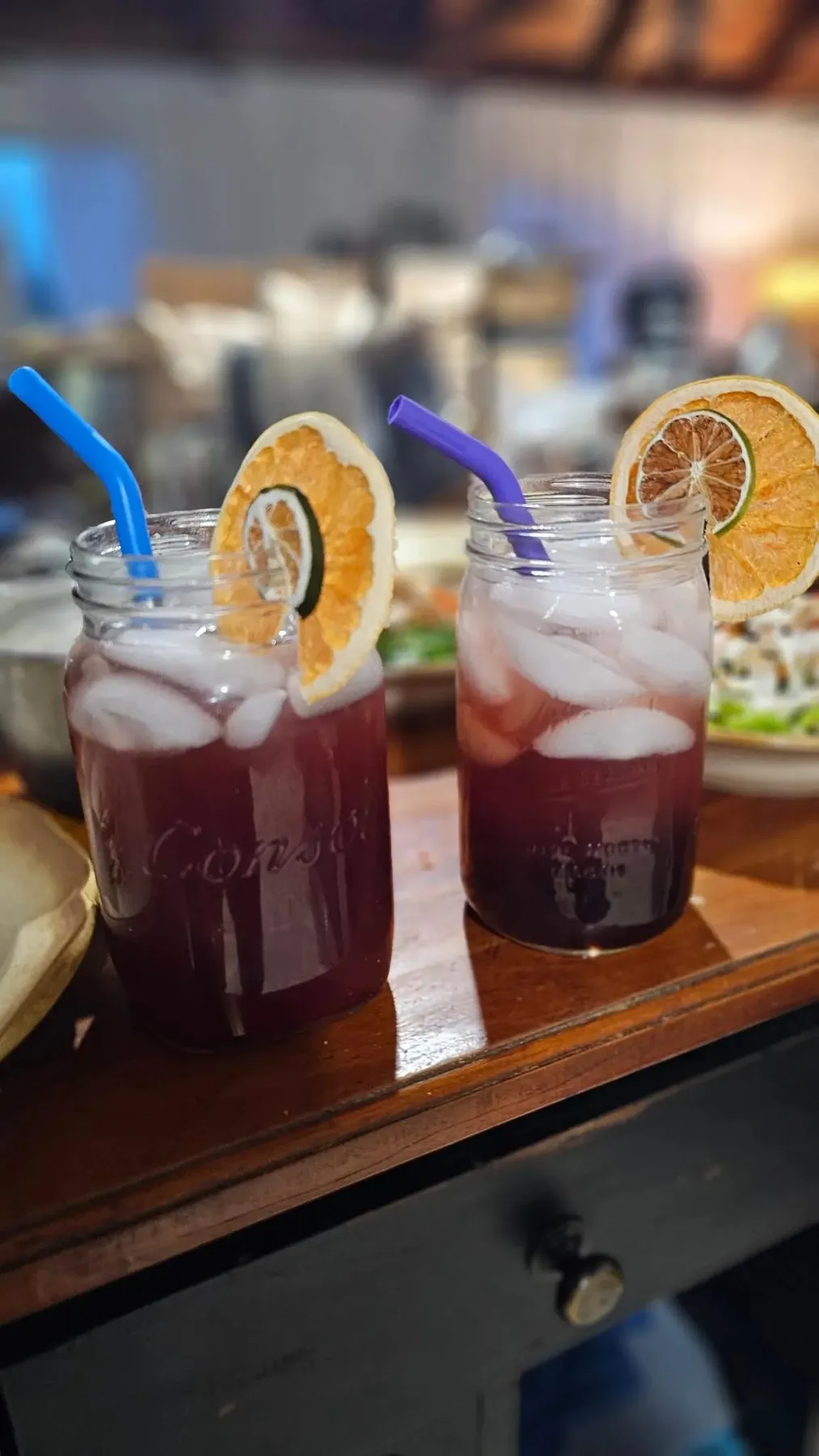
This drink works on temperature and value contrast. That deep reddish-purple liquid against pale ice and a matte orange wheel gives you three distinct values in one glass — dark, mid, light. The citrus is also doing a job: the bitterness of the dried peel cuts a sweet punch, which is why this looks and tastes better than a maraschino cherry ever will. The blue and purple silicone straws are the only place the palette gets loud, and that’s a deliberate single note.
18. Cinnamon and Citrus That Bridge November into December
The nice thing about a citrus-and-cinnamon scheme is that it doesn’t need a holiday-specific budget. Dried orange slices are $6 to $10 for a bag of 50 on Amazon; cinnamon sticks run about $8 a pound from a bulk spice aisle. Add a $3 spool of twine and you can dress a mantel, a table runner, and three jars for under $25. Thrift stores are also a reliable source for the empty glass jars to put it all in.
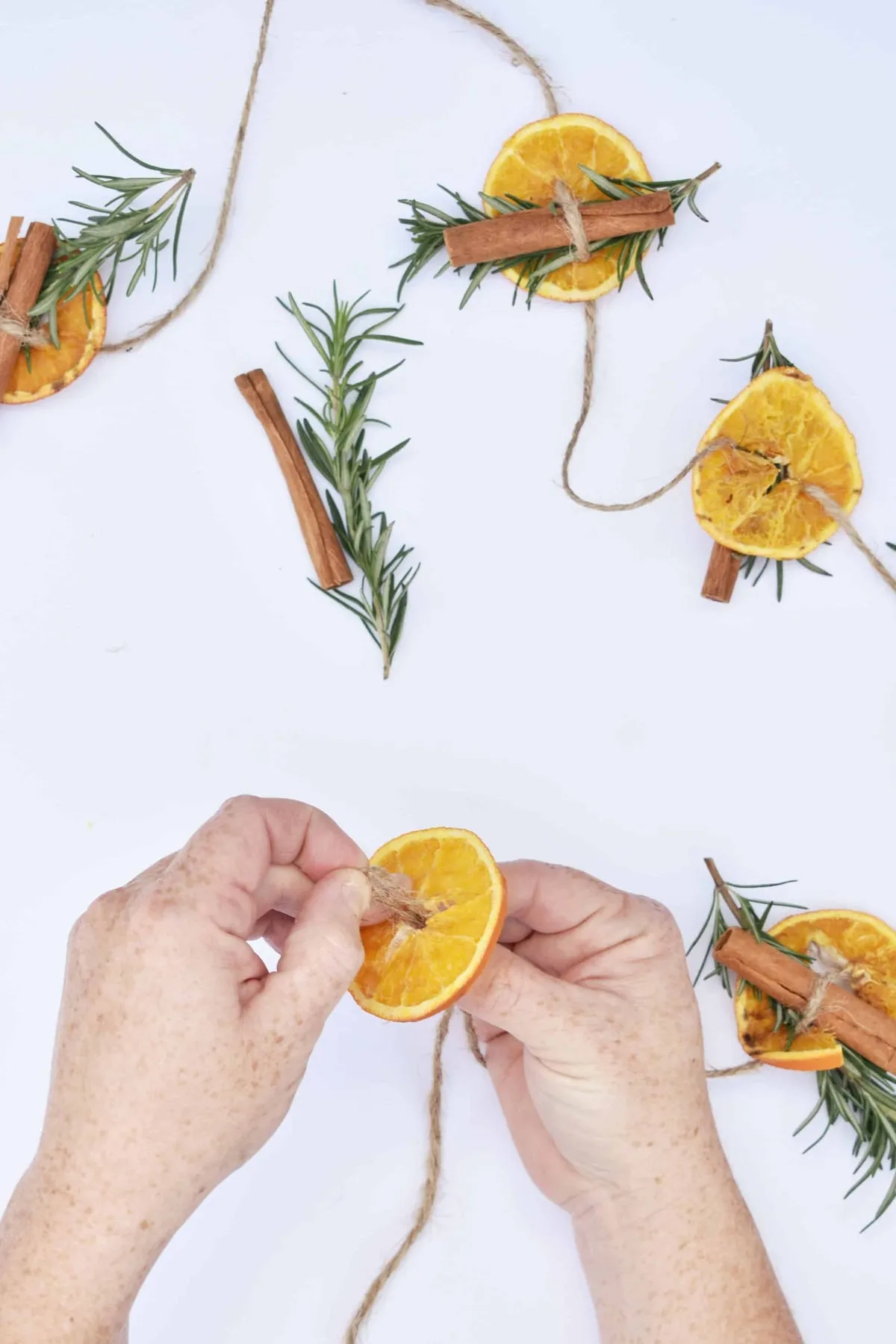
If you want the decor to carry from Thanksgiving through New Year, keep the base neutral and change only the accent. Build with dried orange, cinnamon, and natural twine in November, then add deep red berries and a sprig of evergreen in December — same arrangement, different season. Cinnamon sticks and dried citrus store in a sealed jar for two to three years, so buying in bulk in October genuinely pays off across multiple holidays.
19. Star Anise and Dried Chilies on a Speckled Counter
Count the palette on this countertop: about 70% warm terracotta and cinnamon browns, 20% dark accents from star anise and those dried chilies, and 10% bright, which is the red-and-white twine. The chili peppers are the wild card. They push a cozy scheme slightly sharp, which is exactly what it needs to avoid reading like a craft-store aisle. Swap the chilies for dried bay leaves or pink peppercorns if you want something less spicy-looking.
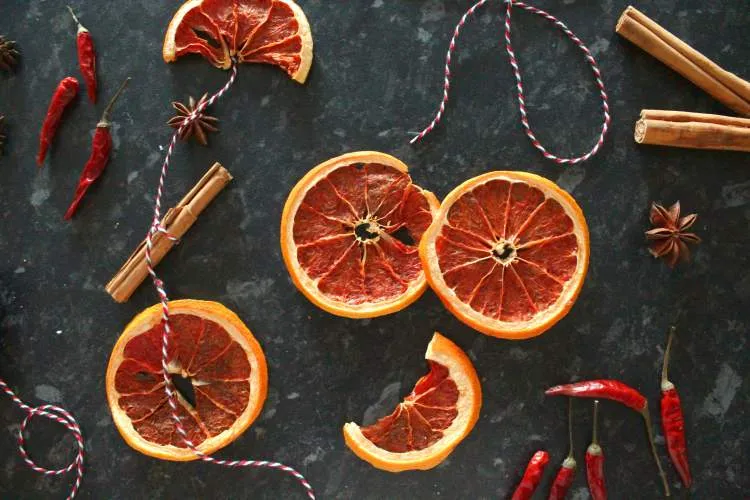
Those dried red chilies. Everything else on this surface is a classic — orange, cinnamon, anise — and would look lovely and completely expected. The chilies introduce heat, both visual and implied, and suddenly the arrangement has tension. It’s a one-ingredient upgrade: a $4 bag of dried chilies turns a standard holiday potpourri pile into something that looks like it came from a design studio. Keep them whole; broken chilies shed seeds everywhere.
20. Clear Bags of Citrus Potpourri Tied with Jute
Four things to check before you seal a single bag:
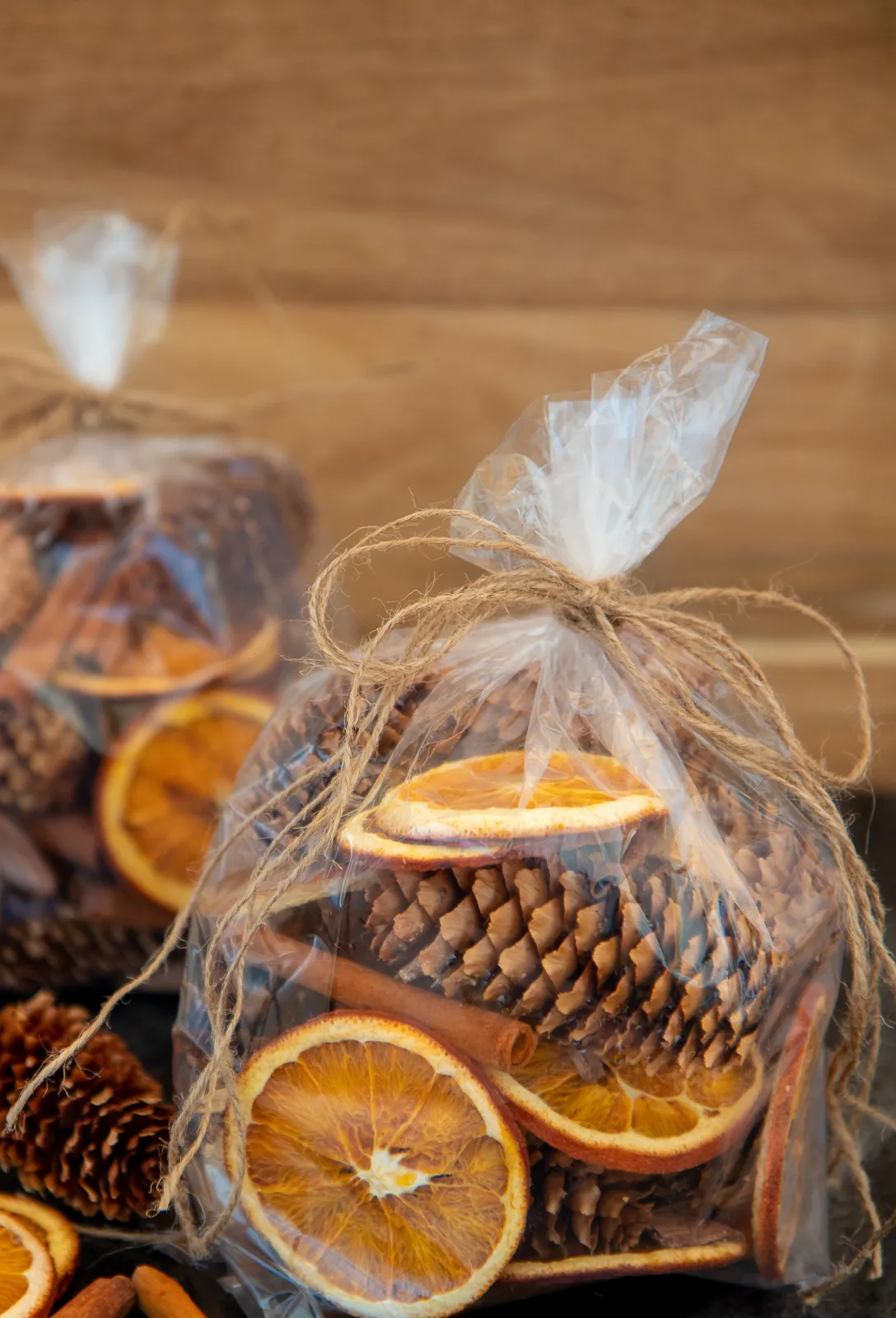
- Everything going in must be bone dry. Any residual moisture means mold in a sealed bag within two weeks.
- Choose a bag size with headroom — you want the potpourri loose, not compressed.
- Decide if these are gifts or storage. Gifts get a tag; storage gets a date label.
- Keep finished bags out of direct sun, and skip food-grade bags for anything you don’t plan to open within a month.
Here’s the cost breakdown:
- Clear cellophane or treat bags, 50 count: $6–$12
- Dried orange slices, bulk: $8–$16
- Pinecones, bag of 30: $7–$14
- Cinnamon sticks, 1 lb: $8–$14
- Jute twine, 300 ft: $4–$8
- Total: $33–$64 for roughly 25 gift bags
- Budget alternative: $15–$22 by foraging pinecones and drying your own oranges.
21. A Blue-Grey Mantel Dressed in Pine and Whole Oranges
A garland this layered needs a mantel at least 5 feet wide and 6 inches deep, plus a ceiling height of 8 feet or more so the whole thing doesn’t crowd the room. Below that, run the garland along the front edge only instead of swagging it, and skip the candles. If you’re working with a shallow 4-inch ledge, go with Idea #22 instead — a jar of the same materials delivers the identical palette in a fraction of the footprint.
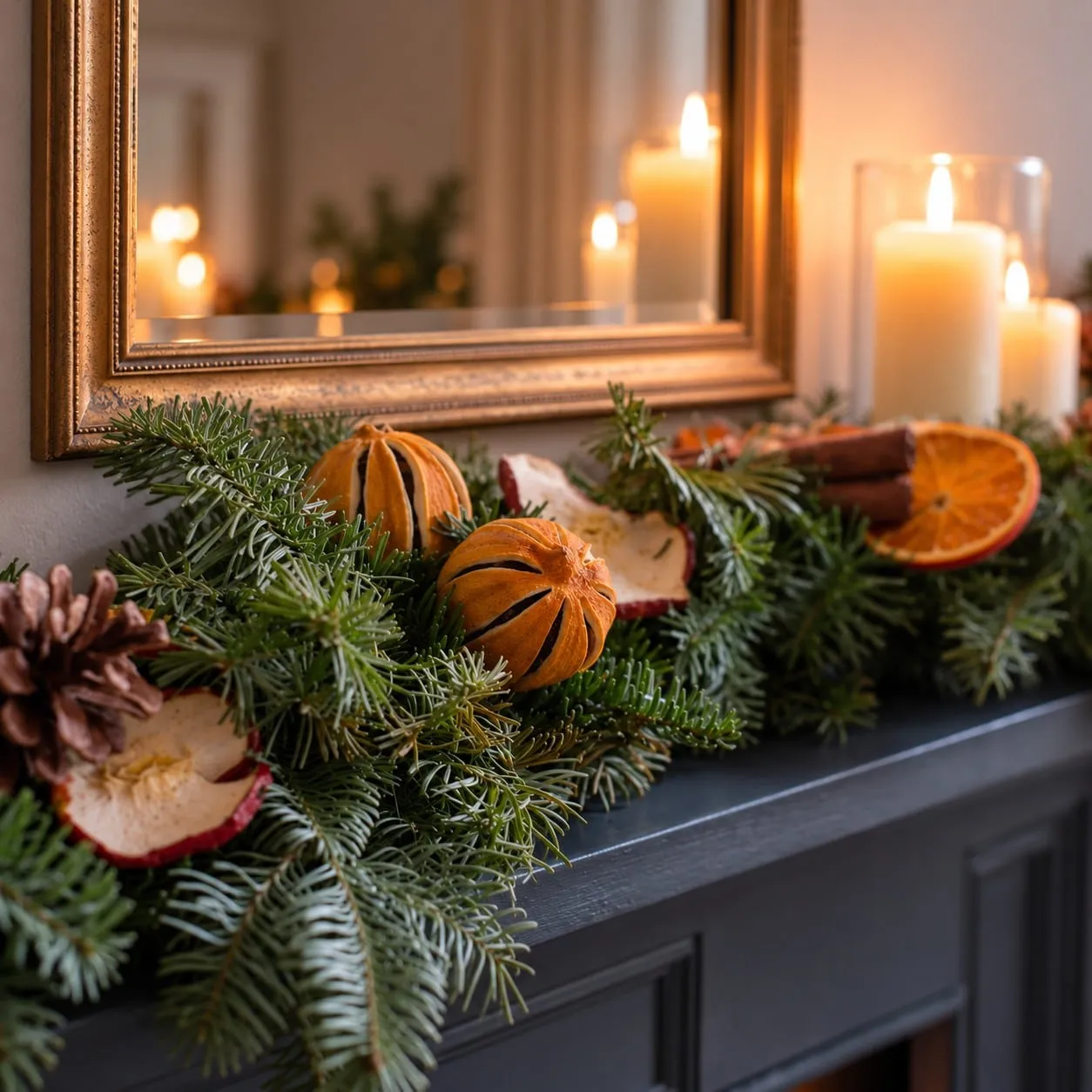
The whole oranges. Not slices — whole dried oranges tucked into the garland. They’re the reason this mantel reads as generous rather than twee, because they scale the citrus up to match the size of the garland itself. Slices alone would look like confetti. Whole fruit gives you a repeating sphere at a size the eye registers from across the room, and it echoes the round gold mirror frame above.
Drying whole oranges takes three to four hours in a 200°F oven plus a day of air drying, and the savings are real: a 4-pound bag of oranges is $5 and covers the entire garland. Pine garland is $18 to $35 at a garden center, but a plain faux garland from Walmart runs $12 and accepts real dried fruit without complaint. Dried apple slices are the cheapest filler here — one $3 bag of apples fills every gap between the citrus.
22. Layered Citrus and Pinecones in a Ribbed-Lid Jar
Layer the jar from the back, not the front. Start with pine needles pressed against the glass, then pinecones, then cinnamon sticks stood upright, and finish with citrus slices flat against the curve of the jar where they catch light. Tilting the jar slightly as you fill keeps the layers from mixing. A wide-mouth jar with a 4-inch opening is the sweet spot — any narrower and you can’t get your hand in to arrange anything halfway down.
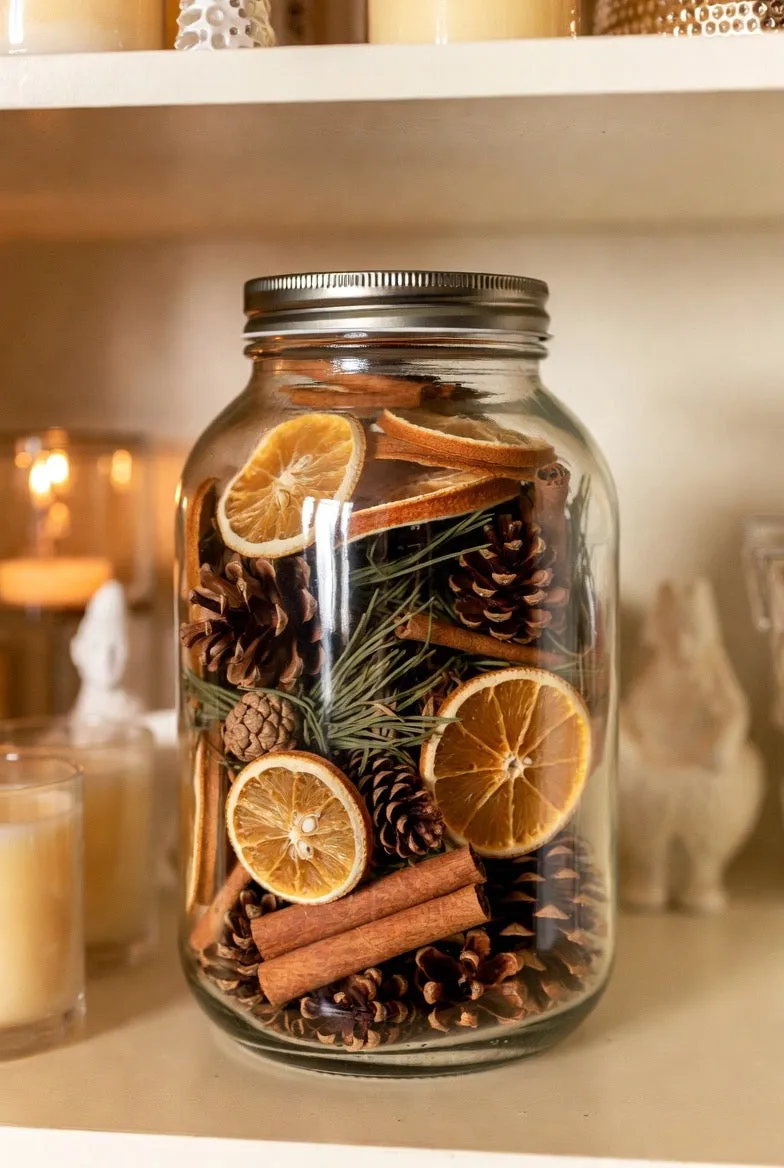
The strata follow a simple formula: roughly 40% dried orange, 30% pinecone and cinnamon brown, 25% pine green, and 5% the ribbed silver lid framing the whole thing. Change the lid and you change the accent — a warm gold lid softens it, a black lid makes it sharper and more modern. The base layers stay the same either way. That’s the advantage of working with a formula: you can restyle without rebuilding.
23. Kraft-Wrapped Jar with Cedar, Citrus and a Handwritten Tag
Building one from scratch:
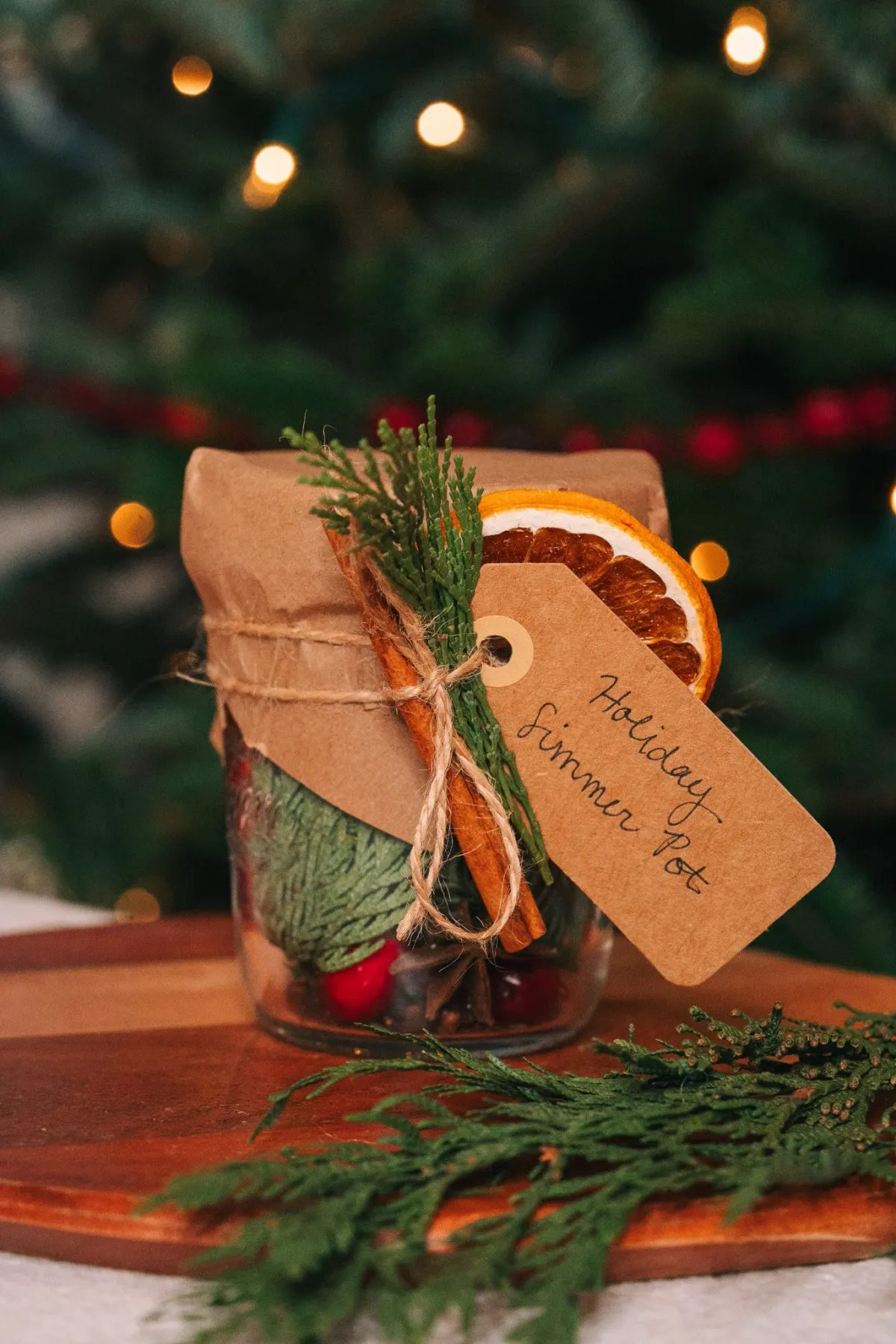
- Cut a band of kraft paper about 1 inch wider than the jar and wrap it around the middle.
- Secure with three or four wraps of twine, knotting at the front.
- Tuck a dried orange slice, two cinnamon sticks, and a cedar sprig under the twine.
- Punch a hole in a kraft tag, thread it on, and write the contents in pencil.
- Fill the jar with greenery and berries before closing — looking through the glass should be part of the gift.
Fifteen minutes per jar, and the paper removes cleanly for reuse.
Real berries inside a closed jar will mold. Use faux berries, or fill the jar with dried material only and keep the fresh red on the outside. If you’re gifting these, wrap them the day you hand them over — kraft paper crinkles and twine loosens with handling. Also check that whatever fills the jar isn’t pressing against the glass at the top, because a heavy jar tipping off a shelf is a genuinely bad way to end December.
24. Embroidery Hoop Ornaments with Lace and Tiny Pinecones
The white lace ribbon at the top. Without it, this is a pretty, slightly craft-fair hoop of citrus and pinecones. With it, the ornament goes soft and vintage — the lace echoes the translucency of the dried orange and gives the piece a lightness that keeps the pinecones from weighing it down. A wide satin ribbon would have done the exact opposite. If you swap the lace, go with something equally airy: a torn strip of white linen or narrow cotton eyelet.
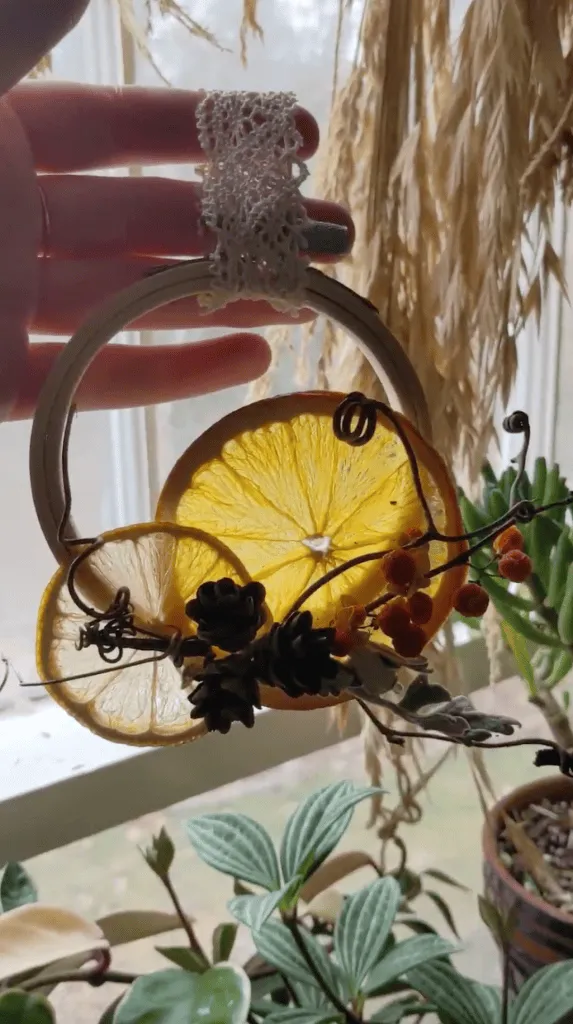
Wooden hoop ornaments are about as low-maintenance as holiday decor gets — no water, no shedding, no wiring to redo. The vulnerability is the berries, which shrink and darken over a season, and the citrus, which fades in direct sun. Store them in a box with tissue between layers and they’ll come back for three or four years. Expect to replace the berries annually; a $4 sprig covers six hoops.
25. A Flat Lay Kit: Fir, Pinecones and Wooden Snowflakes
Assembling a kit like this yourself is genuinely cheap. Fir branches are $5 to $8 a bunch at a grocery store, or free if you have a tree to trim. Pinecones cost nothing if you’re willing to walk a park in November — bake them at 200°F for 30 minutes to evict anything living inside. A cloth bag is $3 at IKEA, twine is $3, and wooden snowflake cutouts run about $6 for 20 at Dollar Tree. Under $25 for the whole flat lay.
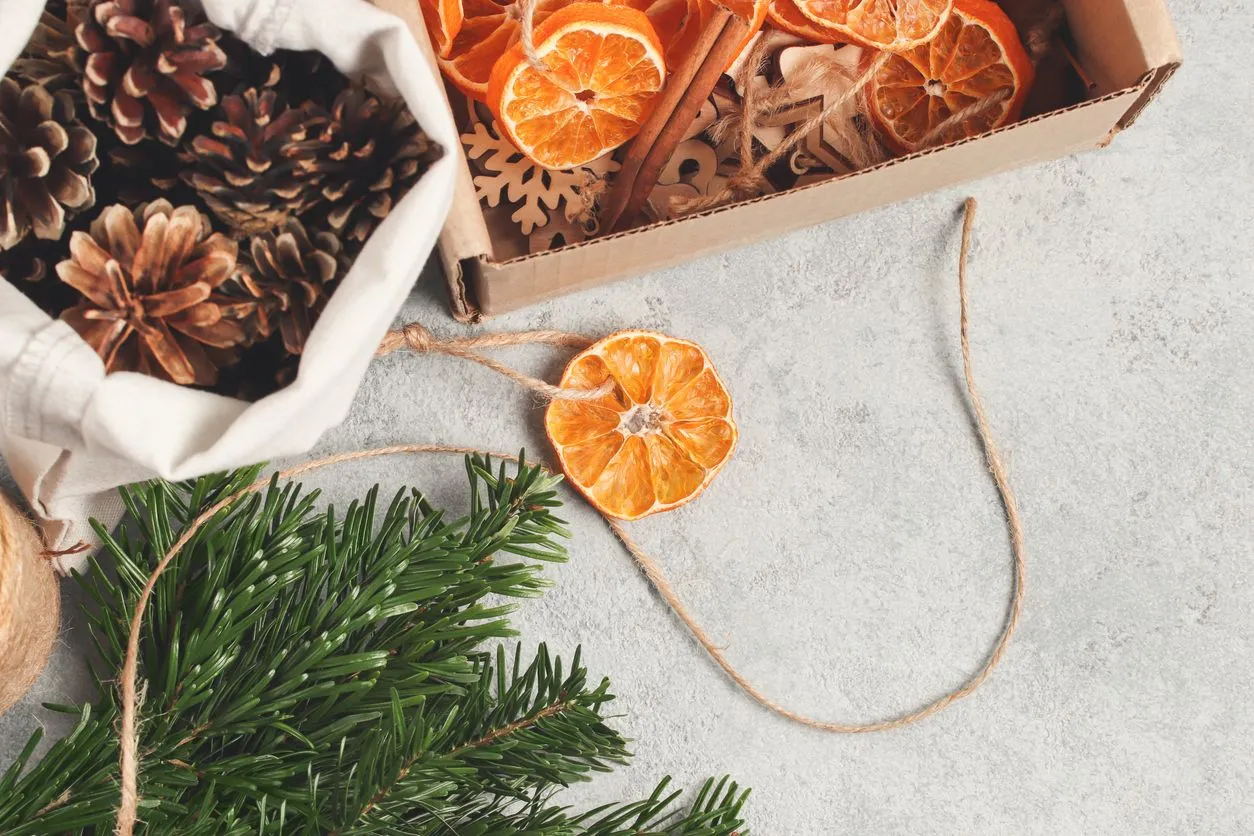
Bake your foraged pinecones. Twenty to thirty minutes at 200°F on a foil-lined sheet, then let them cool completely before they touch anything. It kills insects and larvae and makes the cones open and harden so they don’t crumble into your decorations three weeks later. Do it the same day you gather them, and don’t use a toaster oven you plan to cook in afterward — the resin smell lingers.
26. A Citrus-Dense Wreath with a Dark Green Bow
Dried orange slices take up far more of this wreath than most people would dare — nearly a full ring of them — and that density is exactly why it works. The eye reads the citrus as one continuous band of warm color instead of individual ornaments, and the dark pinecones and berries punch holes in that band so it doesn’t go flat. Remove a third of the slices and the effect is gone. Here’s Idea #10 for the looser, more scattered approach.
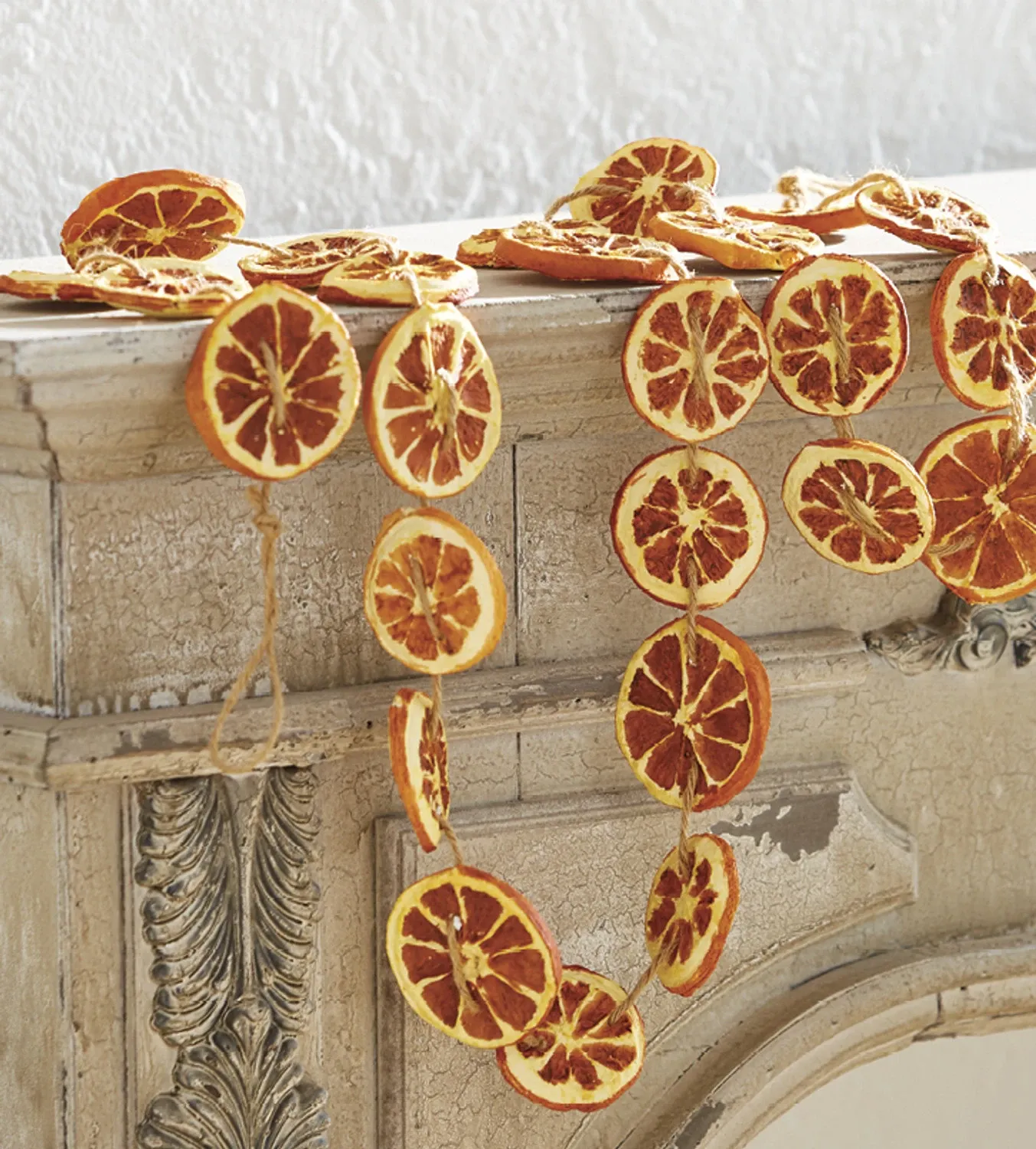
This is an interior wreath — a dark green bow and dense citrus read wonderfully over a console, a mirror, or a bookcase. At 18 to 20 inches it works on a wall or above a fireplace; at 12 inches it’s better on a door or a kitchen cabinet. It needs a wall at least 3 feet wide so the wreath doesn’t crowd whatever frame it hangs near. In a small apartment, one of these above a sofa does more than three smaller decorations scattered around the room.
27. A Backlit Lace-Wrapped Hoop of Orange and Lemon
This window piece runs about 50% citrus — orange and lemon together — 25% pinecone and berry, 15% white lace, and 10% the pale wood hoop. Keeping both orange and lemon is what gives it that sunlit, almost faded quality; all-orange would be warmer and heavier. Swap the lace for twine and the character shifts from ethereal to rustic. Same formula, different accent, entirely different mood.
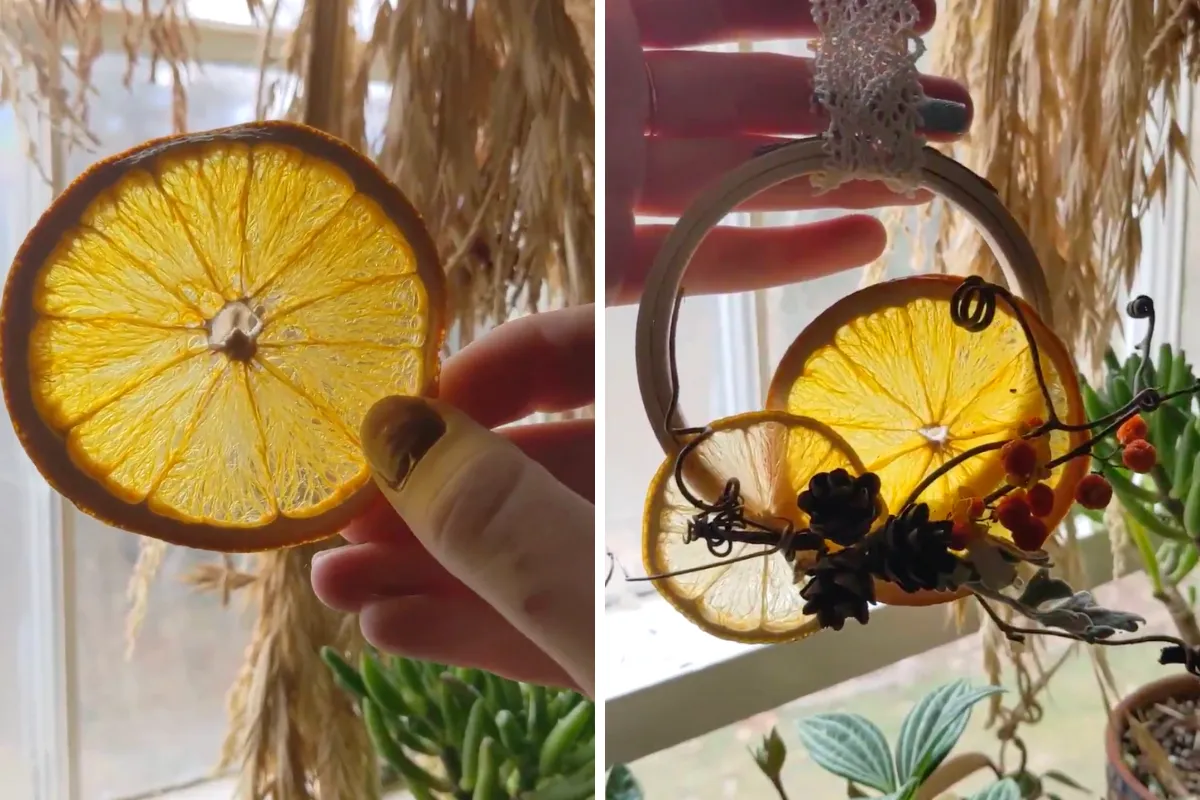
Backlit natural decor is one of the quieter things gaining ground on Pinterest right now, and a lot of it comes down to how it photographs — translucent citrus in window light is nearly impossible to shoot badly. It also fits a broader shift toward decor that lives between seasons: this isn’t Santa-and-snowflakes, it’s winter light and dried fruit, which means you can leave it up from November through February without anyone raising an eyebrow.
28. A Fruit Basket Garland Tied with Orange Ribbon
Fresh fruit under a dried garland is a gorgeous combination that lasts about eight days. Once the pomegranates start to give, the whole presentation goes. If you’re styling this for a party, build it the morning of. If you want it on a counter for the season, use faux fruit or keep the fresh stuff in a bowl nearby and treat the basket as a backdrop. Keep it out of direct sun too — citrus rinds sweat and the crinkled paper filler will show every drop.
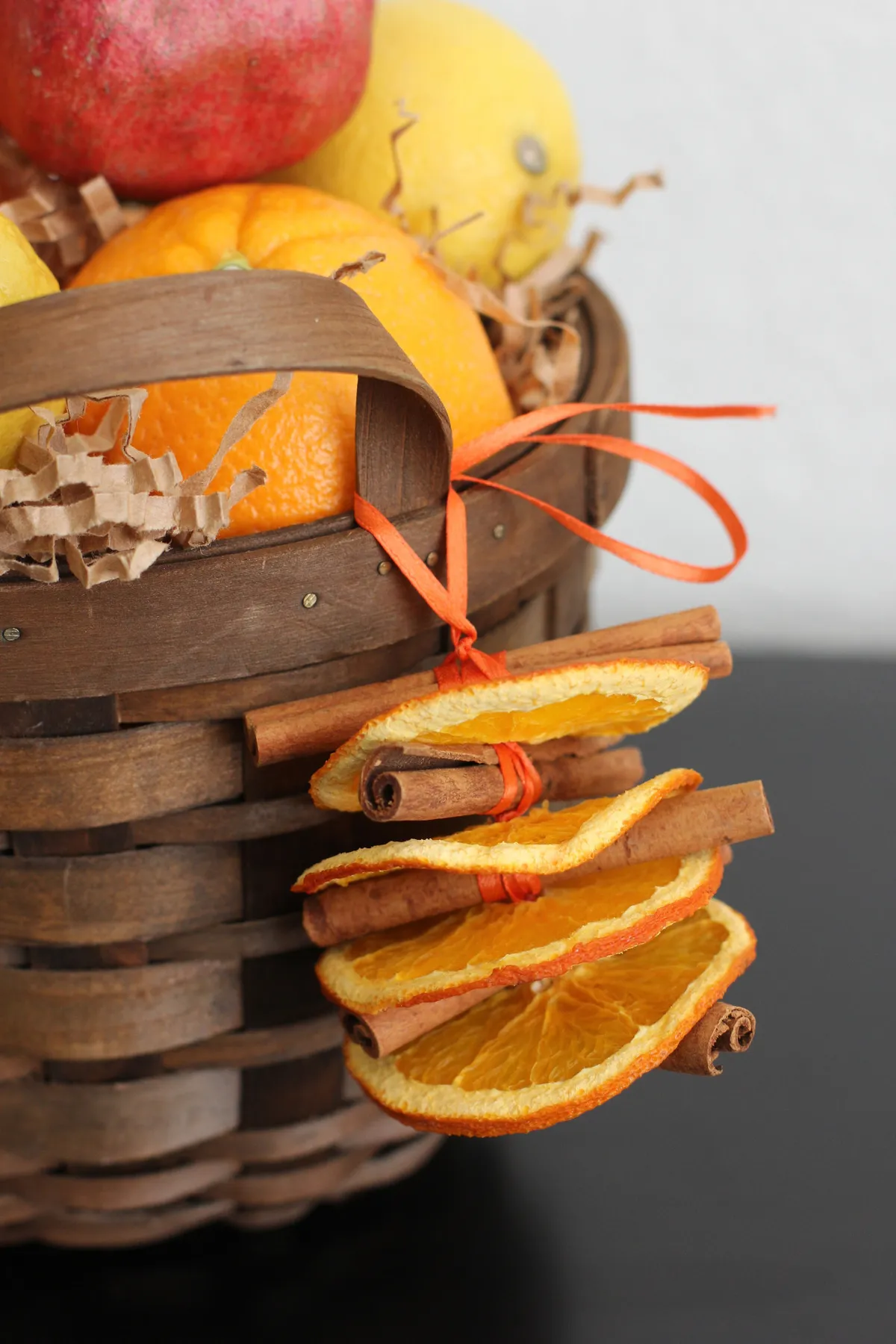
What it costs to put this together:
- Woven basket, 12–14 inch: $18–$40
- Orange ribbon, 2 rolls: $6–$12
- Dried orange slices, 20: $6–$12
- Cinnamon sticks, small bundle: $5–$9
- Crinkled paper filler: $4–$8
- Fresh fruit to fill it: $12–$20
- Total: $51–$101
- Budget alternative: $20–$30 with a thrifted basket, grocery-store citrus you dry yourself, and a reusable fabric bow.
Dry It Once, Enjoy It Three Decembers
Start small — one strand over a window, one jar on a shelf, one wrapped gift with a citrus slice tucked under the twine. Dried orange is forgiving, costs almost nothing, and genuinely looks better as it ages, which is more than you can say for most holiday decor you’ll box up in January.
📌 Pin your favorite version now so it’s waiting for you when the oranges go on sale in November.