23 Jaw-Dropping Christmas Pathway Lights Ideas That Will Make Your Yard Sparkle This Holiday Season

You know that feeling when you’ve pinned about forty photos of glowing winter walkways and none of them quite tell you where to actually start? Same. Christmas path lighting is one of those things that looks effortless in photos and feels completely overwhelming in the driveway with a tangled box of extension cords.
So we did the digging. We spent serious time browsing Home Depot, Lowe’s, Amazon, Target, and Walmart to bring you only what’s worth your attention this year, covering everything from a $12 strand of candy cane stakes to a $900 immersive garden installation. After filtering through hundreds of options across those retailers, we narrowed it down to 23 ideas that actually deliver.
Inside you’ll find 23 curated outdoor lighting looks — forest-wrapped displays, snowy bistro corridors, candy cane classics, spiral tree forms, even desert luminarias — and where it matters, we compare budget and luxury versions side by side so you can build the same mood at either end of the scale.
What’s driving all of this in 2026? Landscape lighting has officially merged with holiday decorating. People aren’t stringing one lonely strand along the hedge anymore — they’re designing whole winter scenes with layered color temperatures, and Pinterest is flooded with it.
Pin this guide for later — your future self will thank you when it’s time to actually do this.
1. Trees Wrapped in Warm White, Blue, and Red
This is the look that stops people mid-scroll: a long concrete path running beneath mature deciduous trees, each trunk densely wrapped in string lights. The color story is what makes it sing — warm white for the base glow, with blue and red woven through in the shrub layer. Add wooden benches and scattered fallen leaves still on the ground and you get a scene that reads enchanted rather than decorated.
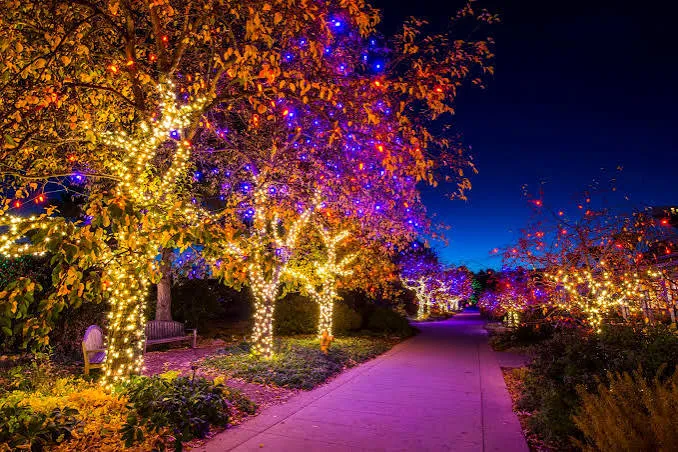
Two things are doing the heavy lifting here. First, repetition — wrapping every single tree at the same density turns a path into a tunnel, and the eye reads it as one continuous gesture rather than twenty separate projects. Second, color temperature contrast. The cool blues sit against warm whites and the whole thing feels dimensional instead of flat.
- String lights (roughly 300–600 ft for a path this length): $60–$180
- Extension cords and outdoor splitters: $30–$70
- Stakes and zip ties to secure wraps: $15–$35
- Timer with dusk-to-dawn sensor: $15–$30
- Total: $120–$315
Budget alternative: skip the multicolor stand and wrap in warm white only for a calmer, less busy night scene.
2. Roofline, Windows, and Evergreens All in Warm White
The element everything else orbits is the discipline of a single color temperature. Every light on this two-story brick and stone facade — the rooflines, the window frames, the porch columns, the frosted grass below — runs warm white. Nothing competes. Lighted wreaths sit in the windows and lit evergreens carry the glow down to the driveway, all of it reading as one continuous, serene gesture against a deep blue sky.
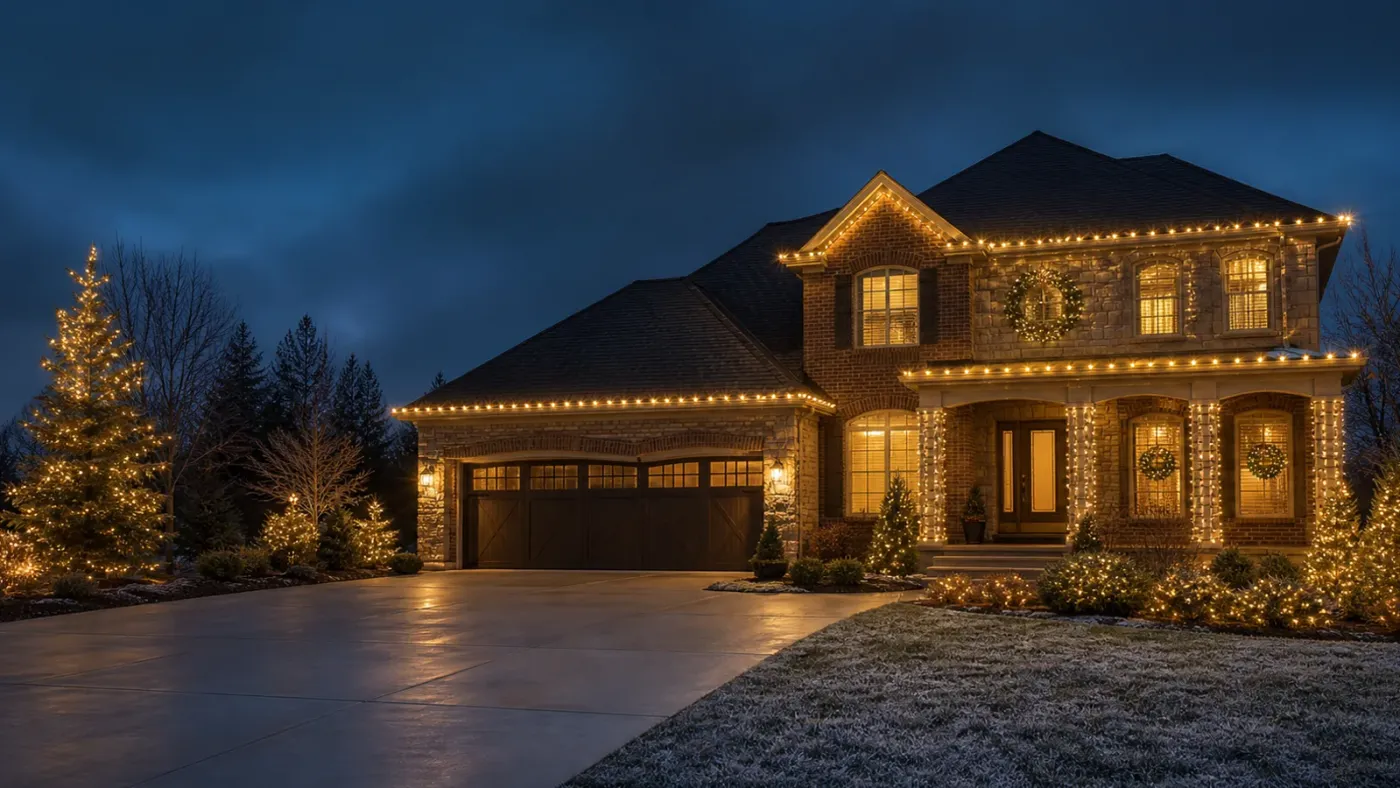
The reality check: outlining a full two-story facade is a ladder project, not an afternoon. Steep roof pitches, gutters, and second-story windows are where most DIY attempts go wrong — and where people get hurt. Budget for an outlet on each side of the house, because a single long run will lose voltage and dim toward the end.
Run your roofline clips every 12 to 18 inches and point the bulbs downward, not straight out. Warm white LED C9 strands at 2700–3000K read as classic candlelight; anything above 4000K goes cold and blue on camera.
3. A Wrapped Garden Corridor of Glowing Foliage
Garden-scale displays like this one live or die on density, not wattage. The whole effect comes from wrapping trunks, branches, and bed lines so thoroughly that daylight disappears behind the glow. You don’t need a park budget to get there — you need patience and a lot of clips.
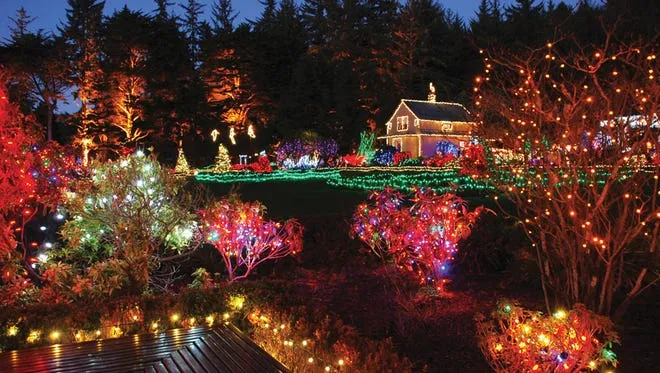
Here’s the honest version: buying 2,000-count light reels from Walmart or Amazon instead of boutique holiday brands cuts your strand cost by 50–70%. Opt for warm white all one temperature and skip the color mixing, which is where amateur displays start looking chaotic. If you’re willing to spend a weekend in the yard, you can build this corridor look for roughly $200–$350 rather than a professional install quote of $2,000+.
One warning worth taking seriously: wrapping trees too tightly can girdle thin-barked species like birch and young maple. Keep the strands loose enough that your fingers fit underneath, and pull everything off by late February.
4. Historic Facade Bathed in Warm String Lights
What you’re looking at is a full architectural wash — a multi-towered historic building outlined with warm string lights, with manicured bushes, garden beds, and even a passing trolley all glowing in the same honeyed tone. It’s the kind of lighting that makes stone look liquid.
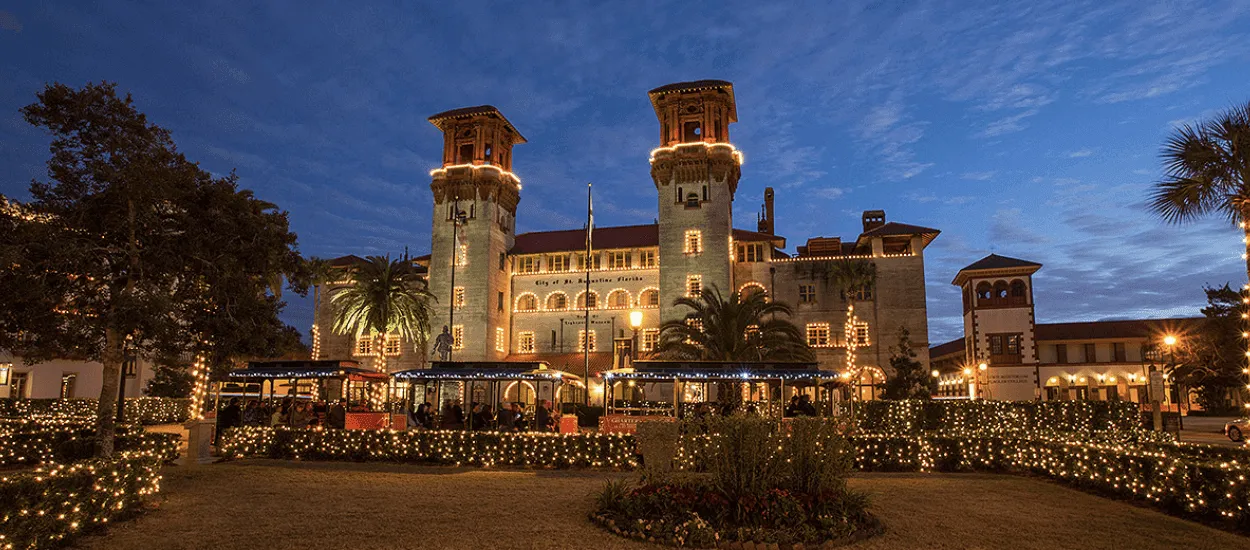
The reason this style has exploded on Pinterest this year comes down to color temperature. After a few seasons of loud multicolor extravagance, people are gravitating toward monochrome warmth — it photographs beautifully, it’s timeless instead of trendy, and it flatters old architecture rather than fighting it.
The formula is simple to steal: 70% warm white on hard architecture (facade lines, columns, window trim) + 20% warm white on soft landscaping (bushes, trees, bed edges) + 10% single-accent color for punctuation (here, that’s the trolley itself). Swap the accent to deep red or emerald green and the whole scene shifts personality without touching the base.
5. Butterflies, Blooms, and Rope Lights Along the Beds
A white house with blue and red floodlights washing the facade, brick paths bordered by green and white rope lights, and light-up butterflies and flowers perched in the trees and garden beds. It’s maximalist, joyful, and completely unafraid of color.
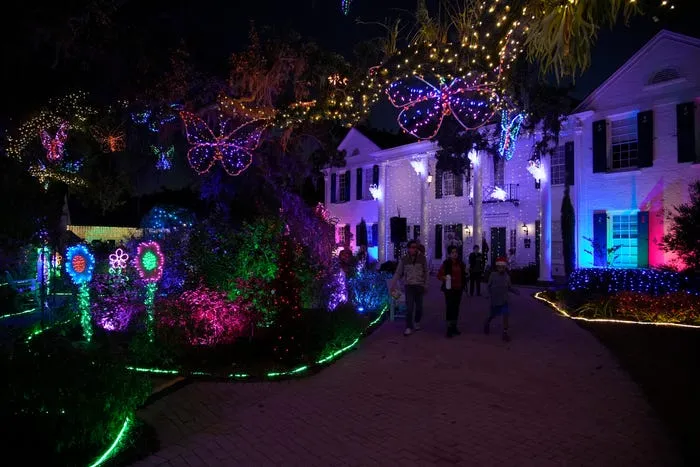
The trick to making a display this busy still read as designed: keep the rope lights one consistent color from start to finish. Switching rope colors mid-path fractures the visual line and your eye loses the route. Also, stake your 3D figures at eye level or higher — butterflies and blooms that sit below knee height vanish in snow or tall grass.
- Rope light (green + white, 100 ft): $40–$90
- Light-up butterfly and flower figures (3–5 pieces): $80–$220
- Colored LED floodlights (blue, red): $60–$160
- Stakes, splitters, waterproof connectors: $25–$50
- Smart timer or app-based controller: $25–$60
- Total: $230–$580
Budget alternative: skip the floodlights entirely and let the rope lights and figures carry the scene.
6. A Reflecting Pond Framed in Linear Warm White
This is what happens when an estate gets lit with restraint. A red-brick building with arched windows runs warm white above, dotted with wreaths, while the foreground steals the show: a reflecting pond bordered by a crisp linear run of warm white lights, with glowing spherical orbs floating in the water itself. Every tree and tall shrub around it is densely wrapped, so the reflection doubles everything.
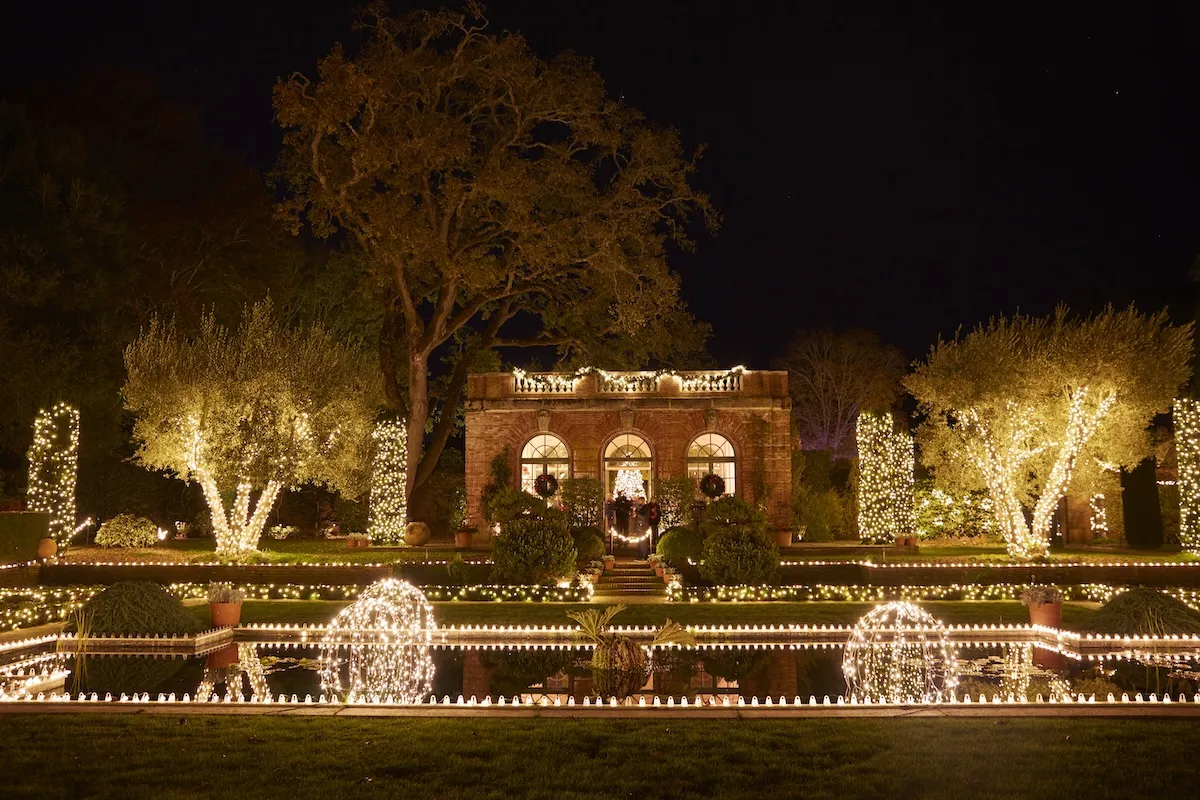
The genius move is negative space. That black water reflects light instead of competing with it — the pond is effectively a second lighting layer you didn’t have to install. The linear border also creates a hard visual edge that keeps the whole composition from floating away.
Now the less glamorous part: water features demand maintenance if you’re lighting them through winter. Plan on checking the underwater orbs weekly for water intrusion, draining and covering the pump if you get hard freezes, and expect the orbs themselves to last roughly two to three seasons before seals degrade. If you don’t want that upkeep, a mirrored border of warm white string lights along a stone edge gets you 80% of the effect with zero water exposure.
7. Roofline Sparkle Over Uplit Trees and a Stone Walk
What makes this one work is restraint at the top and drama at the bottom. A modest run of warm string lights traces the roofline and stops. Everything else happens at ground level — mushroom-shaped path lights guiding a wide light concrete walk, uplights washing the tree canopies and shrub masses, and stone veneer catching the spill.
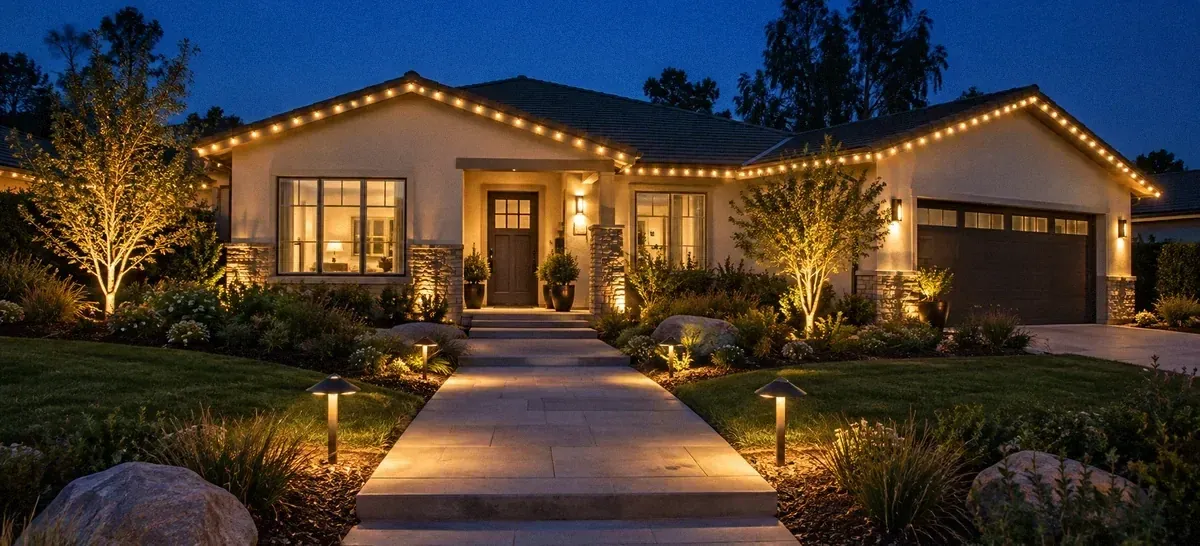
If you removed the uplights, this would be a nice but forgettable front yard. Those beams turning the foliage into glowing sculpture are the entire difference between decorated and designed. Notice that the pathway fixtures are dark and low-profile — they disappear into the beds, so you read the glow, not the hardware.
uplighting trees against a dark exterior means the fixtures themselves need aiming after every storm and every mow. Budget a hands-on check each fall, and if you’ve got deer in the neighborhood, they will absolutely investigate your cord runs. Keep connections off the ground where you can.
8. Butterfly Displays and a Star-Topped Tree on the Walk
A brick path bordered by glowing rope lights runs past a tall Christmas tree with red and blue lights and a star on top, while a nearby tree holds warm yellow string lights and a flock of butterfly-shaped light displays. Bushes pick up the color story, and a white garden bench sits quietly in the middle of it all.
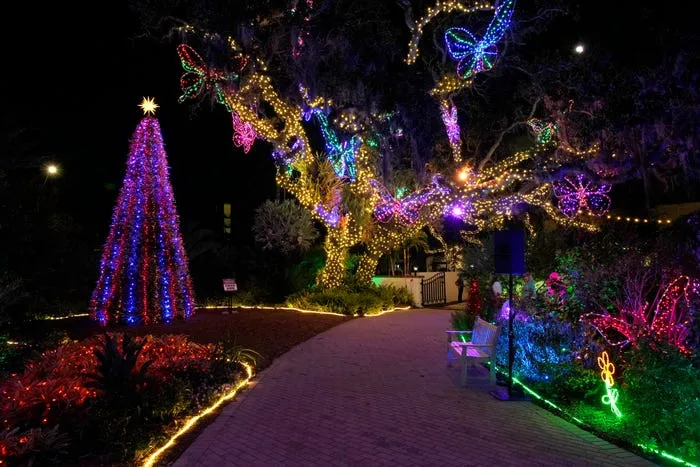
Building the rope-lit border is genuinely a one-afternoon job:
- Measure the path length and add 10% extra for curves and corners.
- Stake the rope along the inner edge, pressing it just into the soil line so it looks embedded.
- Connect runs in parallel — not end to end — so one failure doesn’t kill the whole border.
- Wrap the start and end connections in waterproof tape and tuck them behind the first bush.
About 2 hours and roughly $45–$90 in materials for a 30-foot path. Group your butterfly figures in odd numbers and vary heights — three at the same level looks like a store display.
9. The Lighted Archway That Turns a Lawn Into a Corridor
Warm white rope lights trace the roofline and gutter line of a beige-sided house, but the star of the show is the archway. A garden arch wrapped entirely in warm white light stands at the head of the yard, turning an ordinary walk from the street into an entry procession. A tree trunk in the foreground is wrapped in multicolored string lights, tying the scene together.
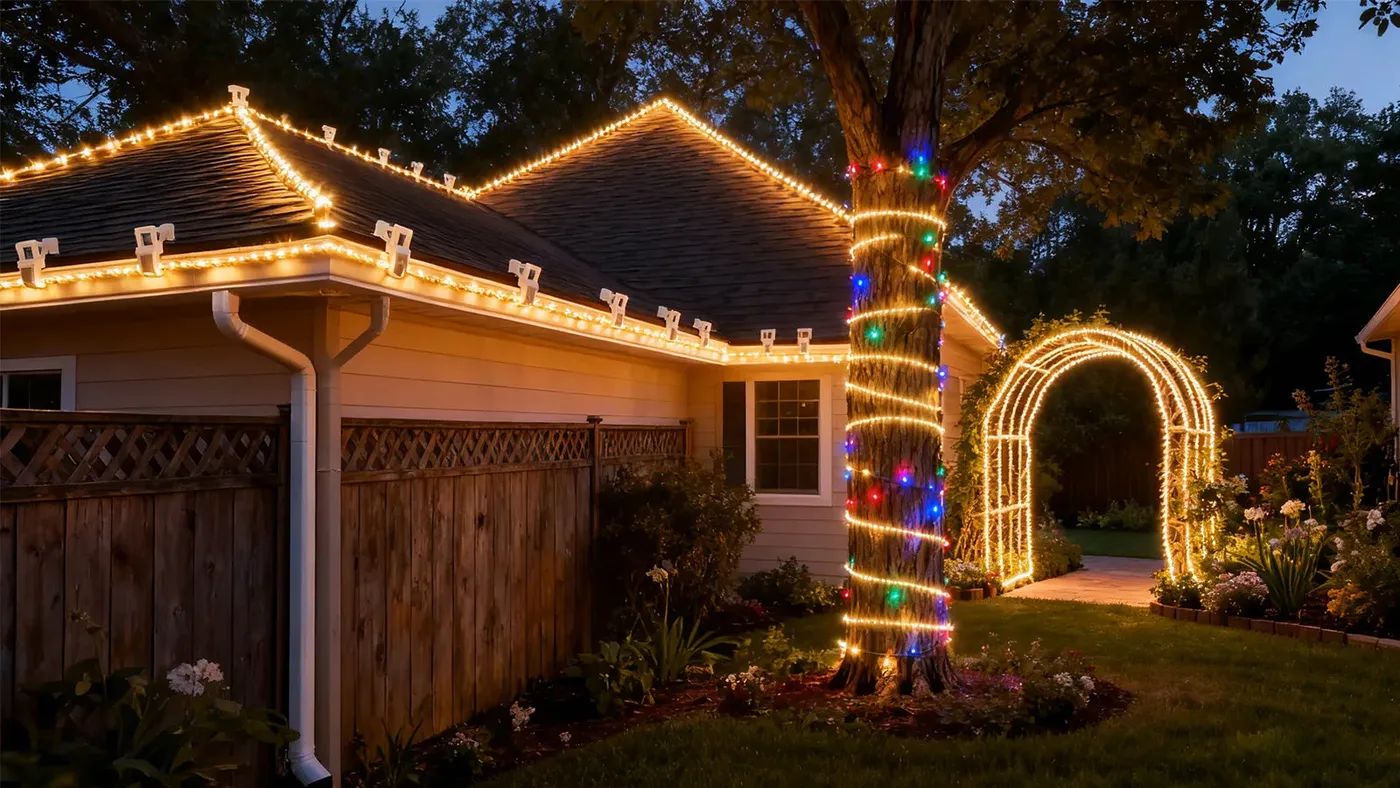
The tip that matters: light your archway from the base upward in one continuous strand and spiral the wrap at about 6-inch intervals. Wider spacing looks sparse from the street, tighter looks like a cocoon. Also give yourself a dedicated outlet near the arch — daisy-chaining it into your roofline run will dim both.
Garden arches run $60–$200 depending on material. But Facebook Marketplace and end-of-season clearance at Lowe’s and Walmart regularly drop them to $25–$50 in late November, and a plain black metal arch wrapped in your own $15 strand looks identical to a $180 pre-lit version. Same light, a tenth of the price.
10. Red and Green Wrapped Trunks With Conical Planters
This is a layered corridor: large mature trees densely wrapped in red and green, with smaller conical Christmas tree forms glowing in solid green and warm white, set in wooden planters along a walking path. Deep blue night sky, dark trunks, and the planters themselves add warm brown grounding.
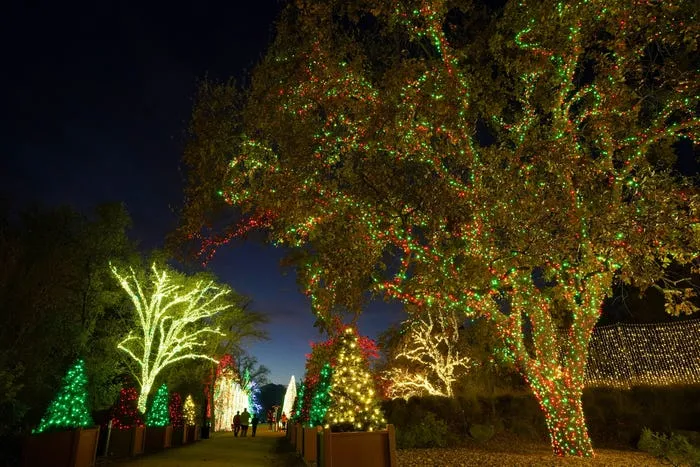
The formula is clean: 50% red-and-green on the big trees + 35% warm white on the conical forms + 15% natural wood and soil tones for contrast. If red-and-green feels too traditional for your street, swap to copper-and-cream — same percentages, completely different mood.
On scale: this look needs a path of at least 20 feet to read properly, and it works best where the big trees are 15 feet or taller so the wrapped trunks create height. If your front walk is short, drop the conical planters and use a single large wrapped tree as a focal point instead. For tighter spaces, see Idea #14 — same corridor idea at a fraction of the footprint.
11. Desert Pathway With Luminarias and Overhead String Lights
Here’s a regional twist worth stealing: a dark paved path under bare tree branches, with warm white string lights strung overhead and square paper luminarias glowing soft orange along the ground. Columnar and globular cacti sit in the shadows, lit just enough to read as silhouettes.
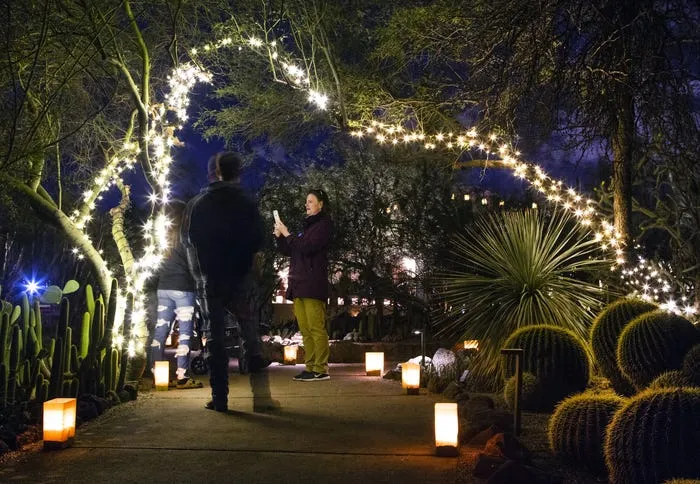
Two principles make this work. First, the overhead strings create a ceiling, which is what transforms a path into a room. Second, the luminarias are small and repetitive — dozens of tiny orange squares do more than three big lanterns ever could, because the rhythm carries your eye forward.
Maintenance matters more here than in colder climates. Paper luminarias don’t survive rain, so plan on a plastic or metal alternative if you get winter moisture, and expect the bags themselves to last one season regardless. Bring the strands down before monsoon season, and if you’re in a wildfire zone, use LED-only options — open flame in a dry landscape is not worth the risk.
12. Blue and Purple Glow on a Snowy Winding Path
Against snow, color behaves completely differently than it does on grass. This winding path uses that to full effect — cool blue and violet lights buried in snow-covered bushes and small trees, with a single lamppost casting a purple wash across the ground. Bare trees disappear into a dark sky behind it.
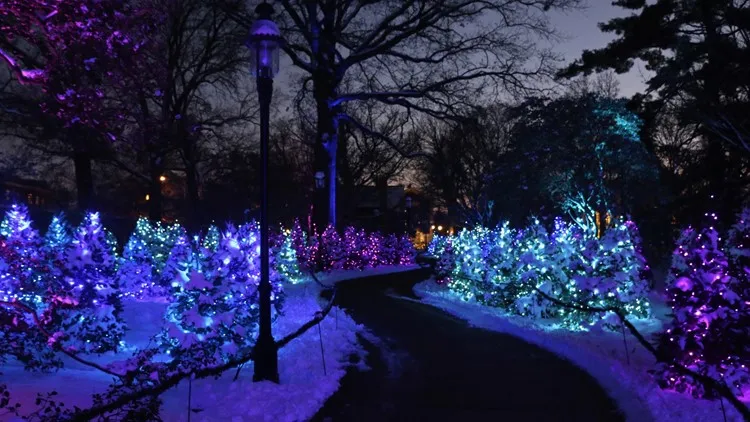
that makes it unforgettable is the lamppost. Remove it and you’d have a pretty but generic holiday path. With it, the scene gets a focal point, a vertical anchor, and a color story concentrated in one spot instead of smeared across the yard.
Before you commit to a cool-color scheme, check a few things:
- Stand outside after dark and see whether your snow reflects blue cleanly or goes gray.
- Confirm your fixtures and strands are rated for sub-freezing temperatures.
- Map where your outdoor outlets are — cold-weather runs drop amperage fast.
- Decide where the lamppost or vertical element will live before buying anything.
13. Illuminated Corn Stalks Bordered in Green and Gold
This is one of the most unexpected path ideas out there: tall corn-like structures lining both sides of a dark walkway, each stalk wrapped in bright green LED string lights with warm yellow-white sections forming ears, and branched light forms on top. Small warm white strands run along the ground edge, and a large pale planter sits at the end.
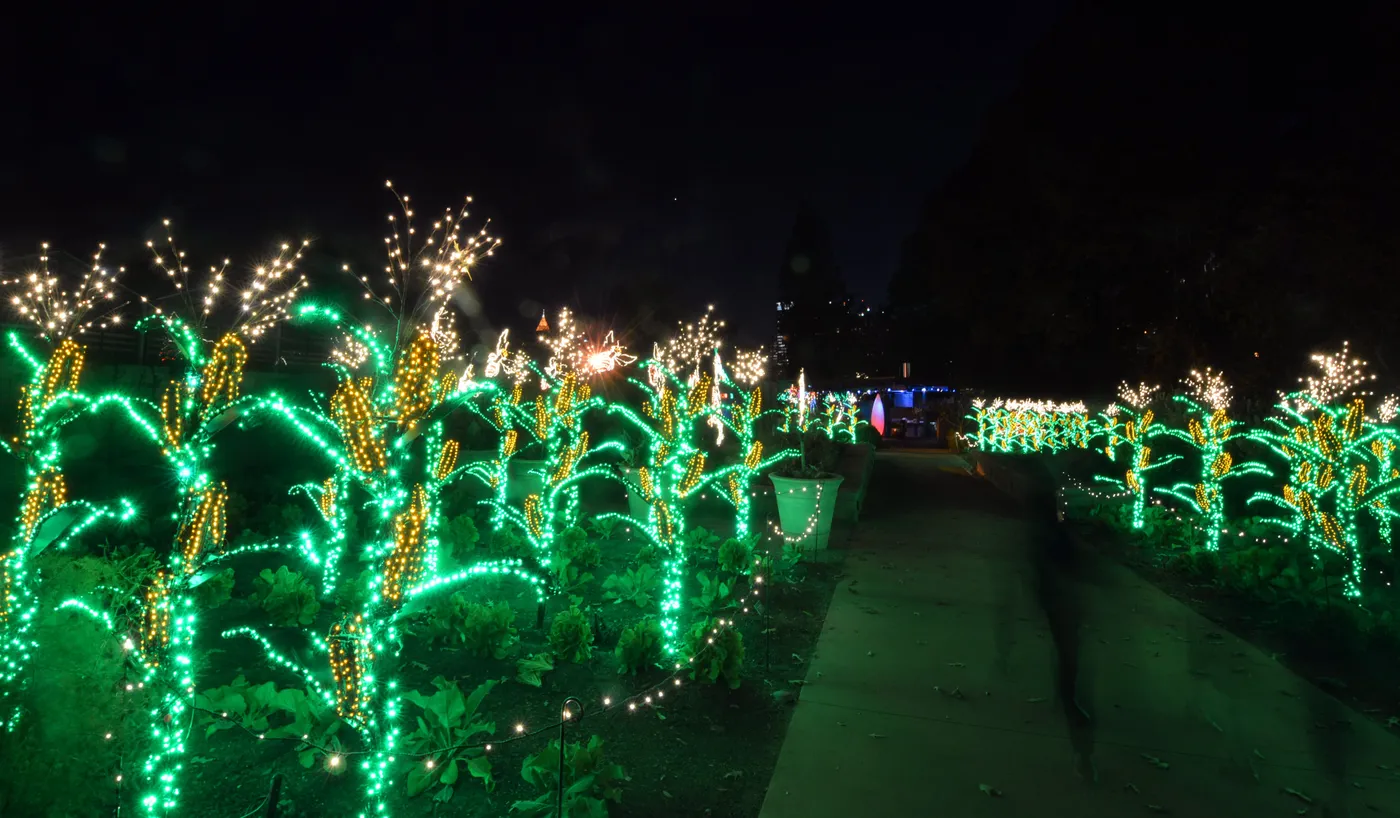
You can build a simplified version yourself:
- Source 6–8 tall tomato cages or metal garden obelisks as your stalk frames.
- Wrap each in green LED strands, spacing about 5 inches apart, bottom to top.
- Zip-tie a short warm white strand in a cluster near the top of each frame to read as the ear.
- Stake each frame 18 inches deep so wind doesn’t tip them.
- Run a low-wattage warm white strand along the path edge to tie it all together.
Roughly 4–6 hours and $150–$280 for a full corridor. Real talk: this look is bold and it’s specific — it reads as agricultural or harvest-inspired. In a suburban front yard it’s charming; on a formal traditional street, it may feel out of place. Trust your neighborhood.
14. Spiral LED Trees Staked Along Flagstone and Grass
This is the pathway idea that does the most work with the least effort: freestanding spiral Christmas tree lights staked into the grass beside a flagstone path. Each one is a silver-toned metal frame wound with small warm white LEDs and topped with a five-pointed star. No hanging, no ladders, no wrapping.
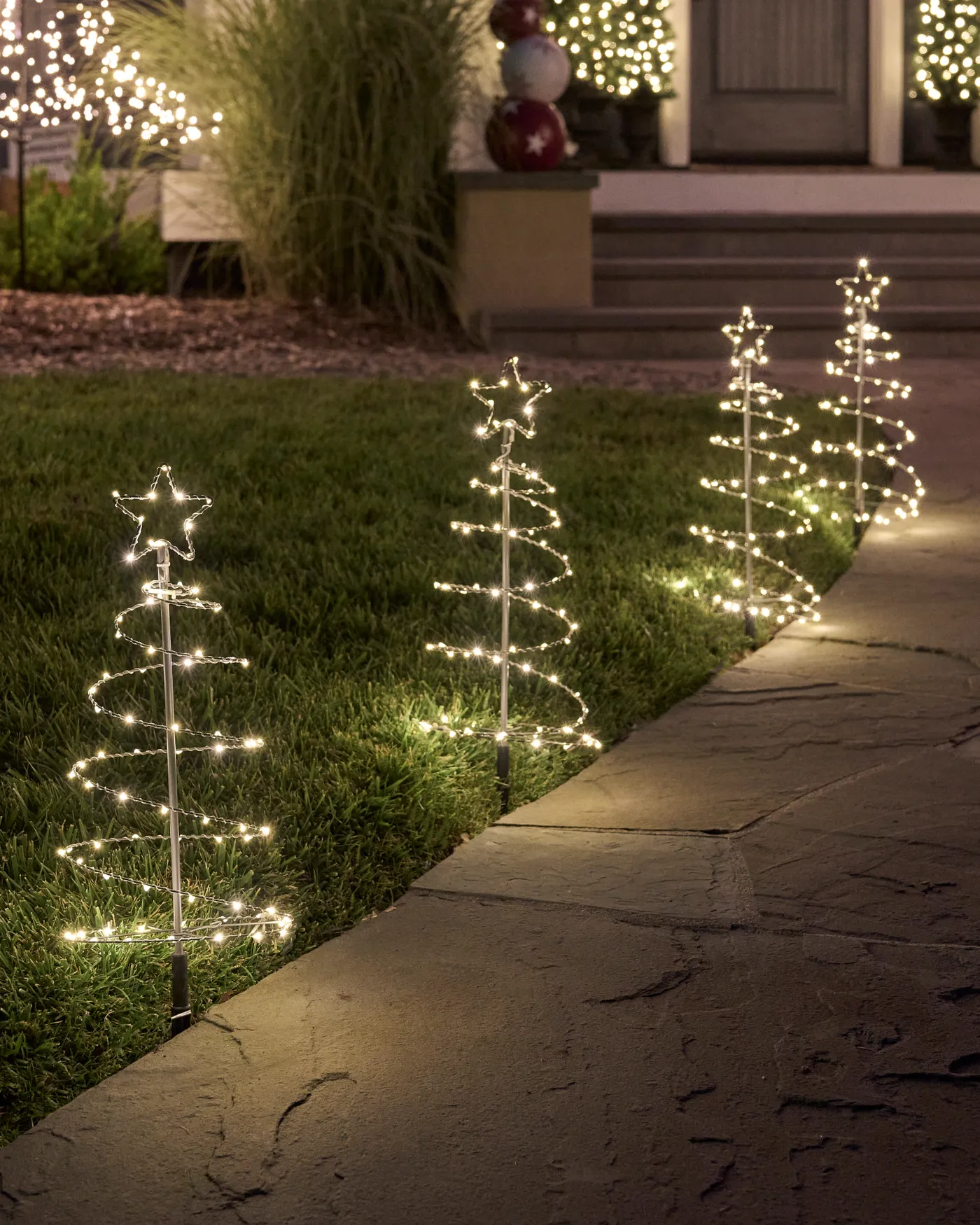
You can spend $40 each at a garden center or $12 each at Walmart, Target, and Amazon for near-identical versions. Buy 6–8 and line them at even intervals along a 20-foot path — the visual impact scales with quantity, not price. Two minutes per unit to install, and they store flat.
The honest downside: staked light forms tip in wind. If your yard catches gusts off a corner or open field, add a hidden landscape staple over each base foot. And in wet climates, bring them inside after the season — the frames rust at the stake joint, which is the first thing to fail.
15. Reindeer and Santa Sleigh Stakes in Candy Cane Stripes
Five pathway lights march across green grass: four translucent reindeer and one Santa in a sleigh, each sitting on a red-and-white candy cane striped stake with warm white glow embedded inside. Behind them, a house with lit windows and warm exterior fixtures holds the backdrop together.
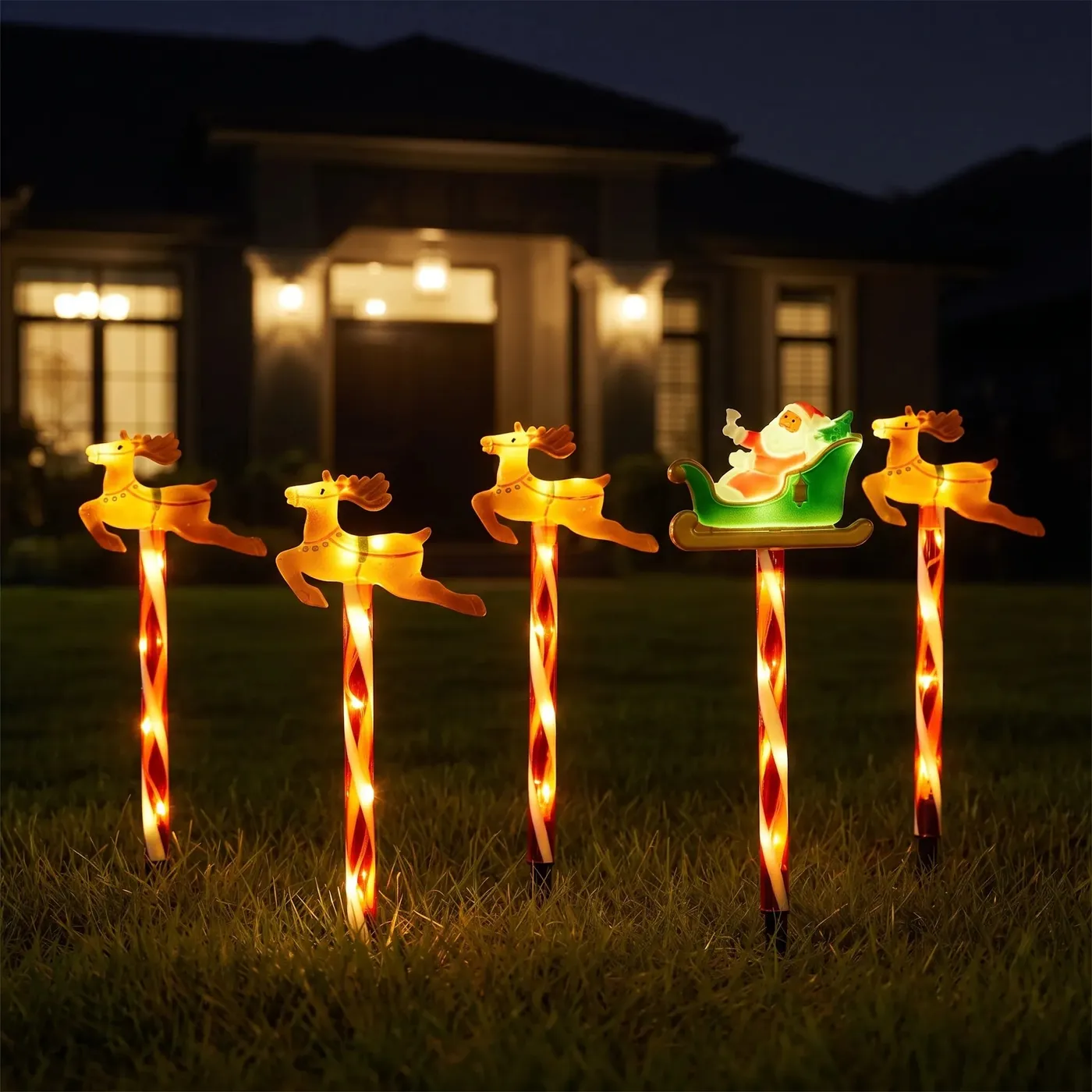
The charming part is the scale in front of the house — these are knee-to-waist height, which lets them read as a procession rather than a lawn ornament collection. That’s a deliberate choice. Oversized figures in a small yard look apologetic; correctly scaled ones look intentional.
These need a stretch of grass about 15–20 feet wide to space correctly, with 3 feet between figures. If your front bed is narrower, use three instead of five and repeat them on both sides of a walk for symmetry — see Idea #18 for how a similar repetition strategy works along a snowy corridor. Skip them for a steep slope; the stakes aren’t designed for anything past a gentle grade.
16. A Large Lacy White Deer With Golden Collar
The centerpiece is impossible to miss: a large freestanding white deer figure with an intricate lacy cutwork design and a golden collar, standing in a dark yard. Behind it, warm white icicle lights run the roofline of the house, multi-colored lit trees fill the yard, and red-and-white candy cane lights mark the path to the door.
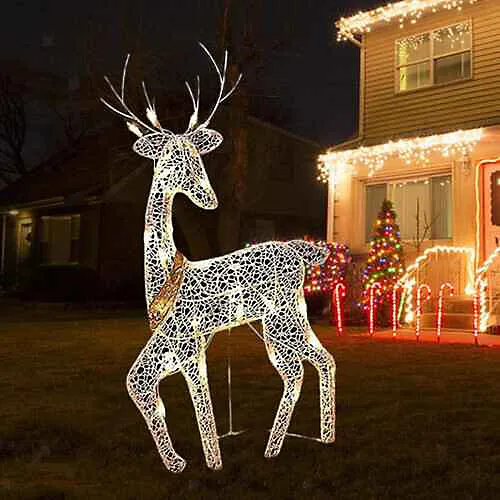
What matters most here is size. A 4-foot deer is a decoration. A 6-to-7-foot deer with cutwork details is a moment — the scale commands the composition and everything else becomes supporting cast. If you owned this deer and nothing else, you’d still have a lit front yard.
- Large illuminated deer (48–72 in): $120–$400
- Warm white icicle lights (25–40 ft): $30–$70
- Candy cane pathway lights (4–6 stakes): $25–$55
- Small lit trees (2–3): $60–$150
- Stakes, cord, smart timer: $25–$50
- Total: $260–$725
Budget alternative: skip the lit trees and let the deer, icicles, and candy canes do the talking.
17. Green Light Sculptures Topped With Golden Stars
Snow-covered ground at night, a winding path between green light-sculpted Christmas trees, each one topped with a prominent golden star. Multicolored strands drape across the snow and thread through bare branches overhead. Silhouetted figures walk the corridor, dwarfed by the trees.
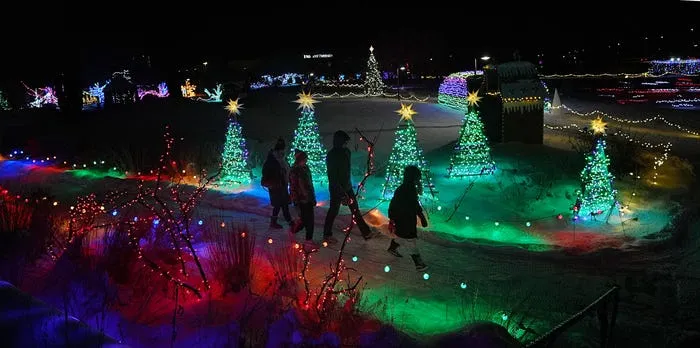
The formula: 45% green sculpted forms + 30% warm gold (stars and ground strands) + 25% multicolor accents scattered in branches. That middle 30% is what keeps the whole thing looking holiday instead of sci-fi — the gold softens the intense green and grounds it against the white snow. Swap green for warm white and the same percentages give you a completely different, calmer evening mood.
on snow, your color temperature is doubled by reflection, so everything reads roughly one step brighter than on grass. If your strand colors look muddy or harsh on the ground, light them in place before finalizing — and consider dropping power by one setting on any smart controller you use.
18. Green-Wrapped Trees Over White-Lit Trimmed Hedges
The structure is what sells this one: large trees wrapped in vibrant green, smaller bushes and trimmed hedges glowing warm white, all defining garden beds and a gravel-and-dirt path. The green-on-top, white-on-bottom layering makes the hedges read as an illuminated base beneath a canopy of color.
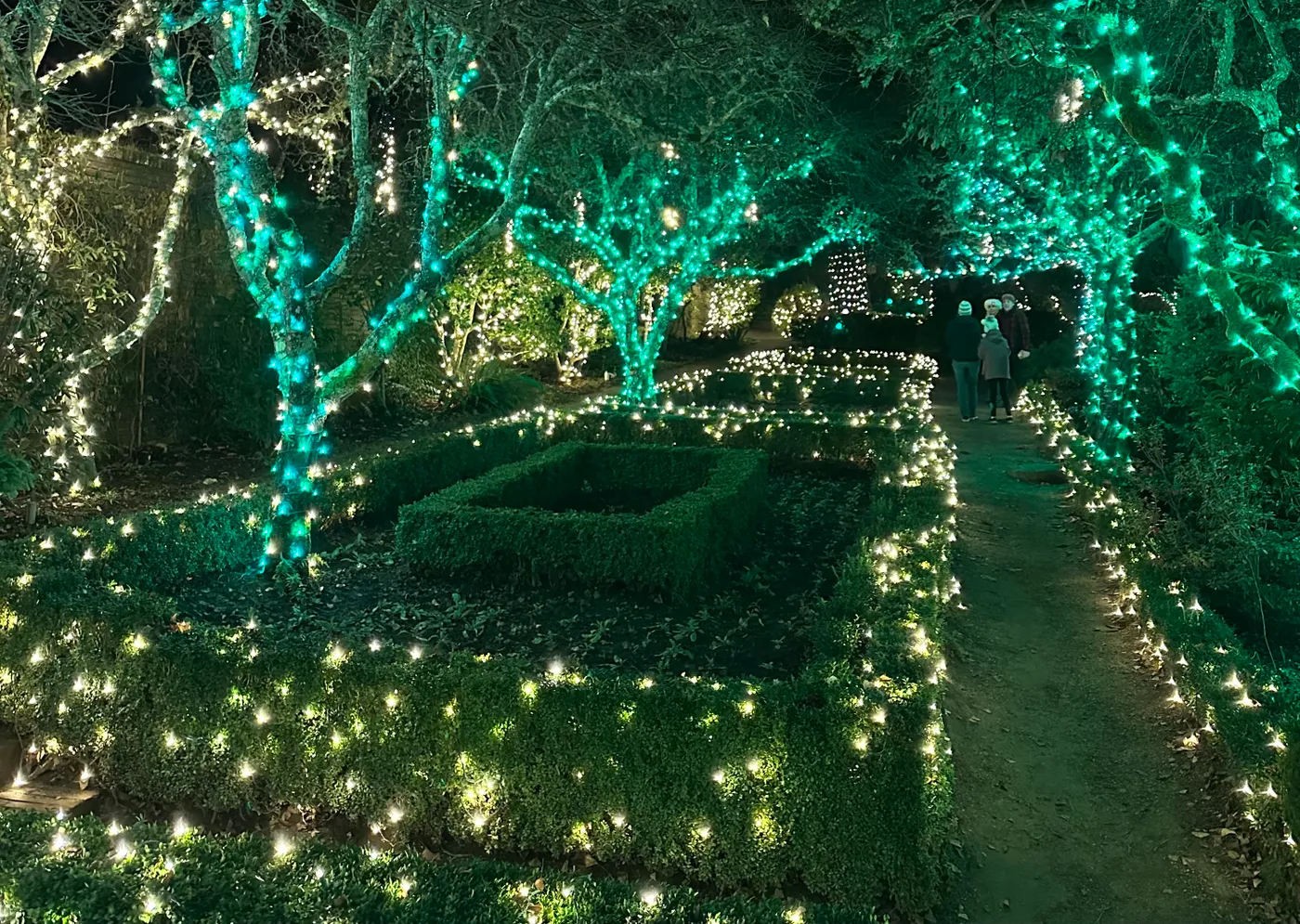
You don’t need matching strands. Discount-store green LEDs at around $10–$15 per 100-count reel look nearly identical up in a tree canopy — the distance hides any quality difference. Spend your money instead on the warm white hedge lighting, where the finer filaments and softer color are visible from close range. A full yard like this can be done for $250–$450 with Target, Walmart, and post-holiday clearance finds.
On upkeep: green lights can fade to a sickly yellow after two seasons, and the plastic housing yellows faster than any other color. Budget replacements every 2–3 years, and don’t store green strands in sunlight between seasons — a dark bin in the garage extends their life significantly.
19. Candy Cane Stakes Leading Through Falling Snow
A snow-covered path lined with candy cane striped stakes, each topped with an illuminated reindeer figure and one Santa in his sleigh. A Santa-clad visitor walks toward a brightly lit house under falling snow, and the whole scene reads like a holiday card come to life.
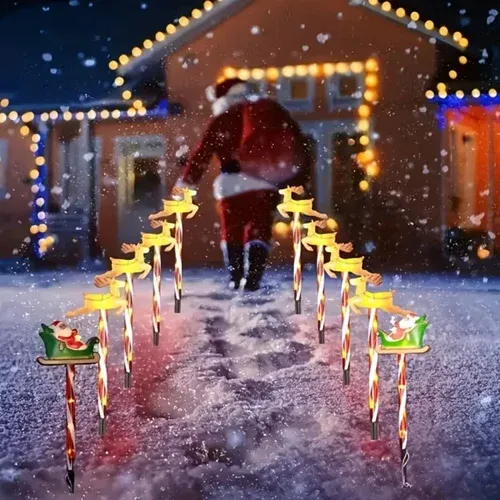
The reason this kind of whimsical, character-driven path lighting has surged on Pinterest this year isn’t nostalgia for its own sake — it’s the rise of “walkable wonderland” fronts, where families design the yard to be experienced at a pace, not just photographed from the street. Candy cane stakes are the cheapest way in — they’re about $10–$20 apiece and instantly legible from a distance.
Before you buy a set, walk your path and confirm these:
- How many stakes fit comfortably at 3–4 feet apart.
- Whether your walk is shoveled regularly — deep snow buries stakes entirely.
- Where your outlet is relative to the farthest stake.
- Whether passing cars can see the stakes at night; reflectors help.
- Whether the figures need to be anchored against wind and drifting snow.
20. Permanent Roofline Channels Feeding a Festive Walk
Permanent roofline lighting is the quiet upgrade that makes seasonal walkway displays look effortless — a channel mounted once, then programmed or plugged in as needed instead of re-installed every November. Pair it with a festive walkway below and you get year-round capability with instant holiday impact.
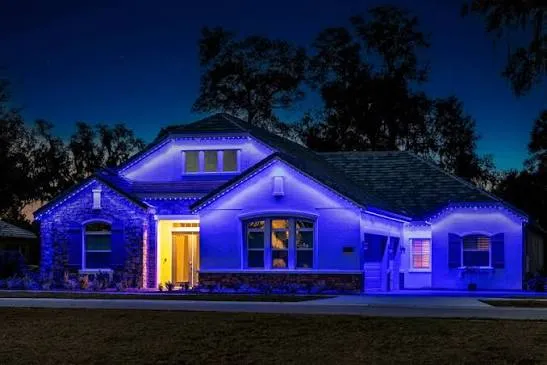
The trade-off is upfront cost, and it’s real:
- Permanent LED channel system (25–50 ft): $400–$1,200
- Professional installation (optional): $600–$1,800
- Smart controller and app setup: $80–$250
- Pathway lights and cords: $150–$400
- Timer and outlet work: $50–$150
- Total: $680–$3,800
this is a long-term investment, not a single-season purchase. If you’re renting, or if you plan to move within three years, keep to plug-in strands — you’ll never claw back the install cost.
21. Layered Garden Beds With Water-Reflected Color
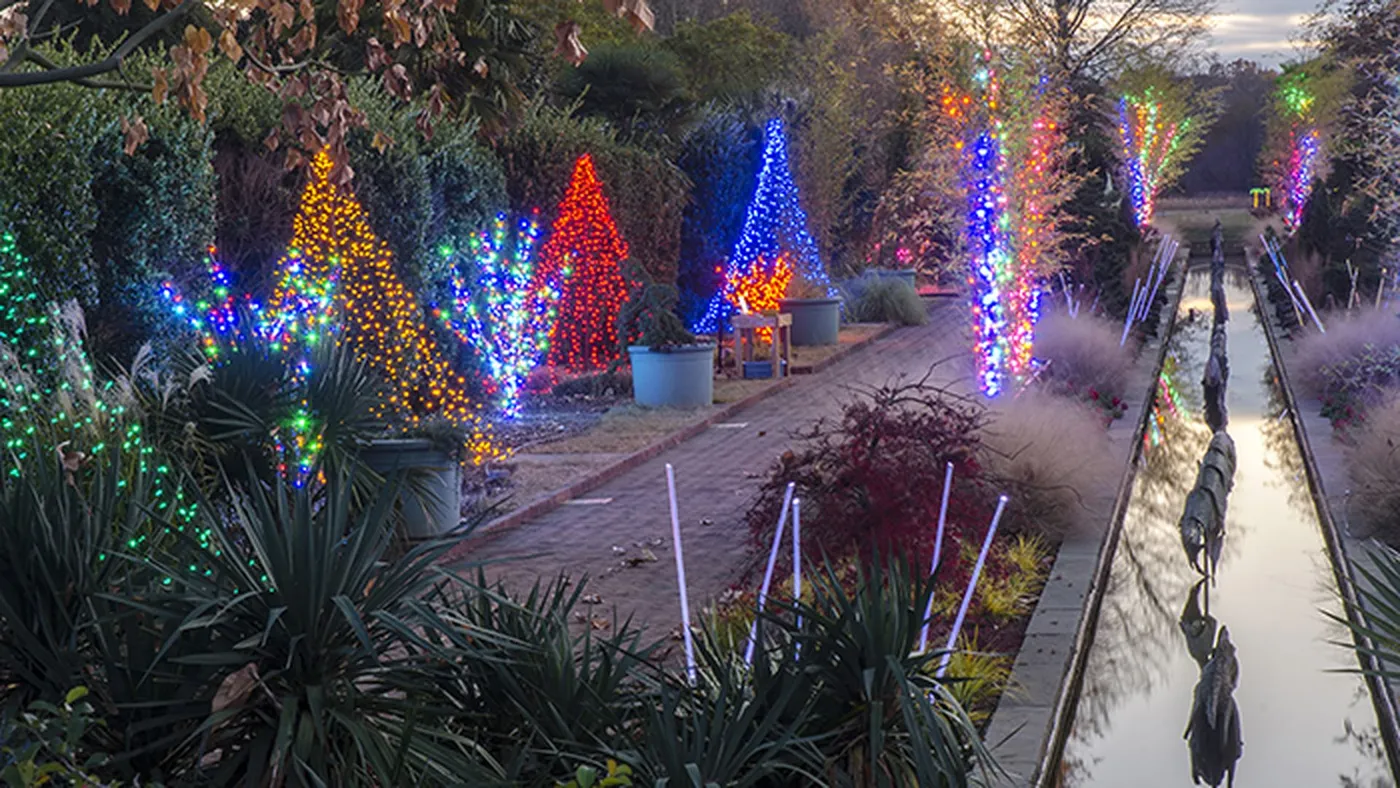
This garden takes full advantage of a long, narrow water feature running parallel to a brick-edged path. Dense bushes and trees are covered in colorful string lights, the water mirrors them all back, tall vertical light tubes in white and purple punctuate the composition, and a series of dark sculptures sits mid-water like stepping stones of shadow.
Three design principles are at play. Reflection doubles your total light output for free. Contrast matters — those dark sculptures in the water are what keep the reflection from turning into visual mush. And verticality: the light tubes give the eye something to climb between the horizontal ground plane and the vertical shrub mass.
when lighting a path with a water feature beside it, aim your strands slightly downward toward the surface, not straight out or up. Downward light hits the water at a shallow angle, which produces the long smeared reflections you see here. Overhead-high fixtures aimed up will just disappear into the sky.
22. Designer Landscape Lighting Adapted for the Holidays
The most sophisticated seasonal path displays borrow directly from professional landscape lighting — moonlit tree canopies, grazing uplights on architecture, path fixtures buried in beds, and a tight color temperature that stays consistent from the curb to the door. Applied to holiday lighting, that means fewer novelty shapes and more attention to what’s being lit.
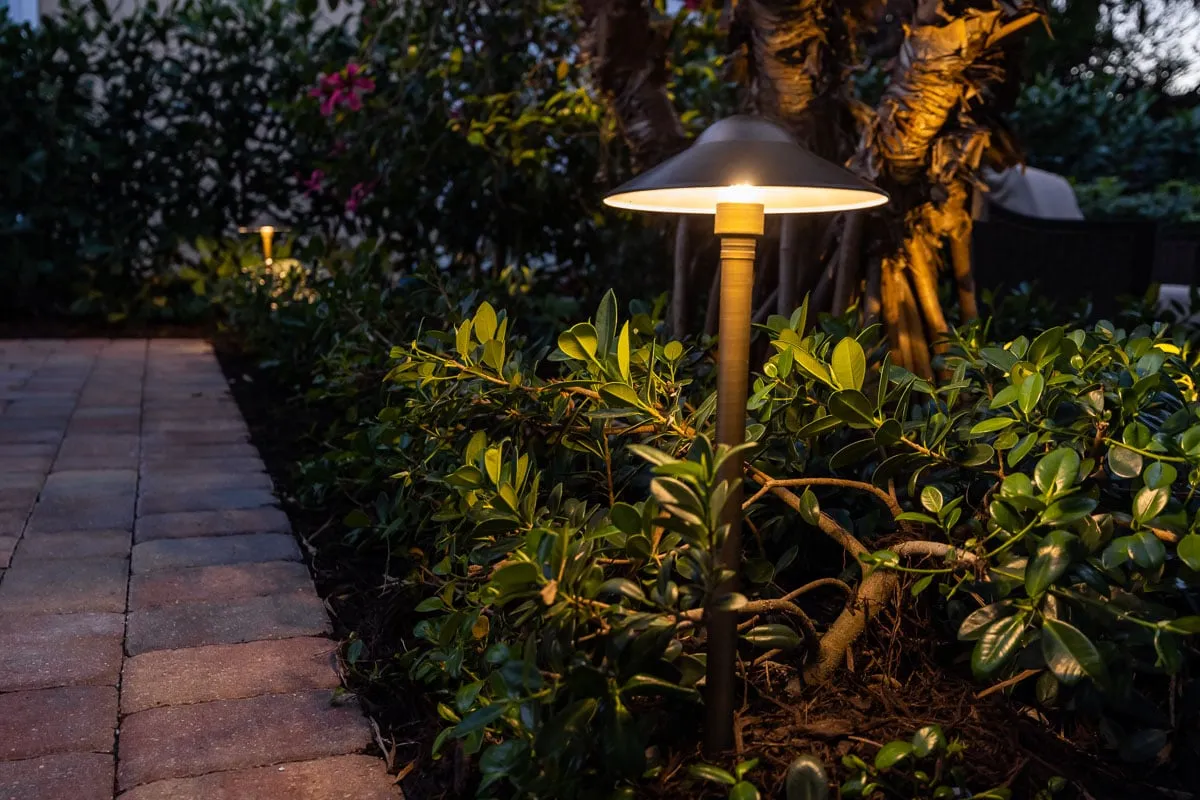
The honest reality: if you hire a landscape lighting crew for the season, expect $1,500–$4,000 for a medium front yard, and be very clear about whether the price includes take-down and storage. Many do not, and you’ll pay again in January to have everything removed.
if you’re doing it yourself with pro-grade fixtures, connect every circuit to a single astronomical timer. Nothing kills a design scheme faster than fixtures turning on at eleven different times because they’re on separate plugs. One timer, one schedule, done.
23. Wrapped Beds, Lit Trunks, and a Winding Path Frame
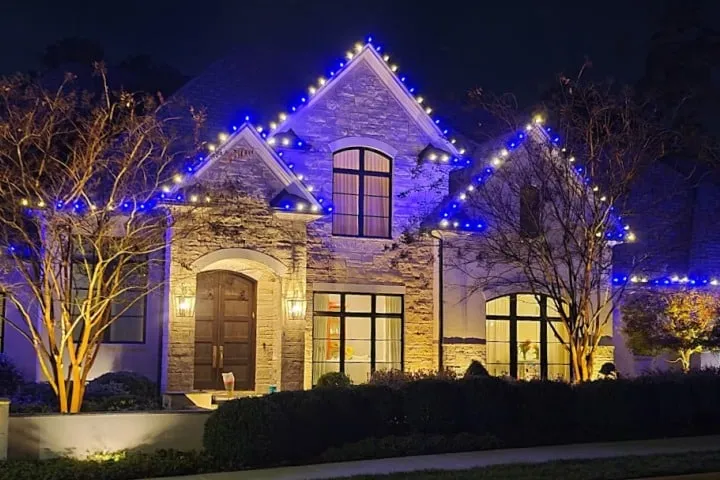
Seasonal exterior path lighting, done well, always follows the same structure: generous wrapping in the planting beds, lit trunks for vertical interest, and a clear, unbroken path of glow that carries the eye from the street to the front door. It’s less about how many lights you own and more about where you place the ones you have.
The budget version of this look comes from three moves. First, reuse what you already own — sort last year’s strands, test them, and retire the dead ones. Second, buy at post-season clearance (December 27th through mid-January), where $20 strands drop to $6–$8. Third, focus your spending on the front 15 feet of the path, which is what everyone sees from the street.
On maintenance, plan for a February take-down day. Strands stored tangled and exposed to sun lose 30–40% of their usable life. Coil them over cardboard reels in a climate-controlled bin, and you’ll get four or five seasons instead of one.
Your Path Is The First Sentence
Every one of these 23 ideas comes down to the same truth: your path is the first sentence of your holiday story, and it’s also the last thing people see when they walk home. Start with the basics — one color temperature, twice the strands you think you need — and layer in the butterfly displays, candy cane stakes, or corn stalk corridors when you’re ready for the fun part.
Pin this guide to your Holiday Lighting board so it’s right there when you’re standing in the driveway with a tangled bag of lights and a decision to make.