26+ Stunning Round Christmas Door Hanger Ideas to Elevate Your Holiday Decor in 2026

Round Christmas door hangers are having a major moment on Pinterest right now, and honestly, the reason is simple: they photograph beautifully, they fit almost any door, and they don’t need a single nail. We spent serious time browsing Etsy, Hobby Lobby, and Michaels (plus a few Target aisles we’re not proud of) to bring you only what’s worth your attention this year, from $18 wood blanks to $189 layered showpieces. Inside you’ll find 26 curated ideas spanning rustic farmhouse wood slices, vintage Santa plaques, buffalo check and tartan plaid, and soft pastel flocked wreaths — with budget and luxury versions compared side by side so you can pick your price point before you pick your palette. This post contains affiliate links, which means we may earn a small commission at no extra cost to you. Round signs went from craft-fair staple to full-on design statement in 2026, partly because over-the-door hooks finally caught up to the trend. Save this post now — you’ll want it when you’re ready to shop.
📌 Save this to Pinterest for later — you’ll want to revisit these ideas.
1. White Wood Round With a Red Truck and a Big Red Bow
- Round wood blank, 18 in., plus white paint: $12–$25
- Layered red pickup truck cutout: $15–$40
- Wired red fabric bow, 10 in. wide: $8–$18
- Vinyl or laser-cut script lettering: $10–$22
- Snowflake accents and snowy base layer: $6–$15
- Over-the-door hook: $5–$12

Total: about $56–$132.
Budget alternative: paint the truck directly onto the round instead of buying a dimensional cutout, and shape a plain $4 ribbon into a bow yourself. That lands you around $30, roughly 45% less.
Two things are doing the heavy lifting here. The pickup truck sits on its own white snow cutout layer, so it throws a real shadow — that depth is what makes the sign readable from the sidewalk. And the horizontal faux-plank lines painted into the white round give it a board-and-batten texture that keeps bright red and forest green from turning loud. Remove the snow layer and the whole thing flattens out.
2. Wood Slice Lettering That Reads ‘Deck the Halls with Lots of Jolly’
Hand-lettering on a round wood slice lives or dies by your margins. Tape off a circle 1 inch inside the bark edge before you touch a brush, then draw two faint guide lines — one for the top of the script, one for the baseline. Cap yourself at four words per line and leave the bottom third of the slice empty so the topper has room to breathe. Rub graphite on the back of a printed template to transfer, and seal the raw wood with matte polycrylic first. Black paint on unsealed wood wicks along the grain and goes fuzzy at the edges.
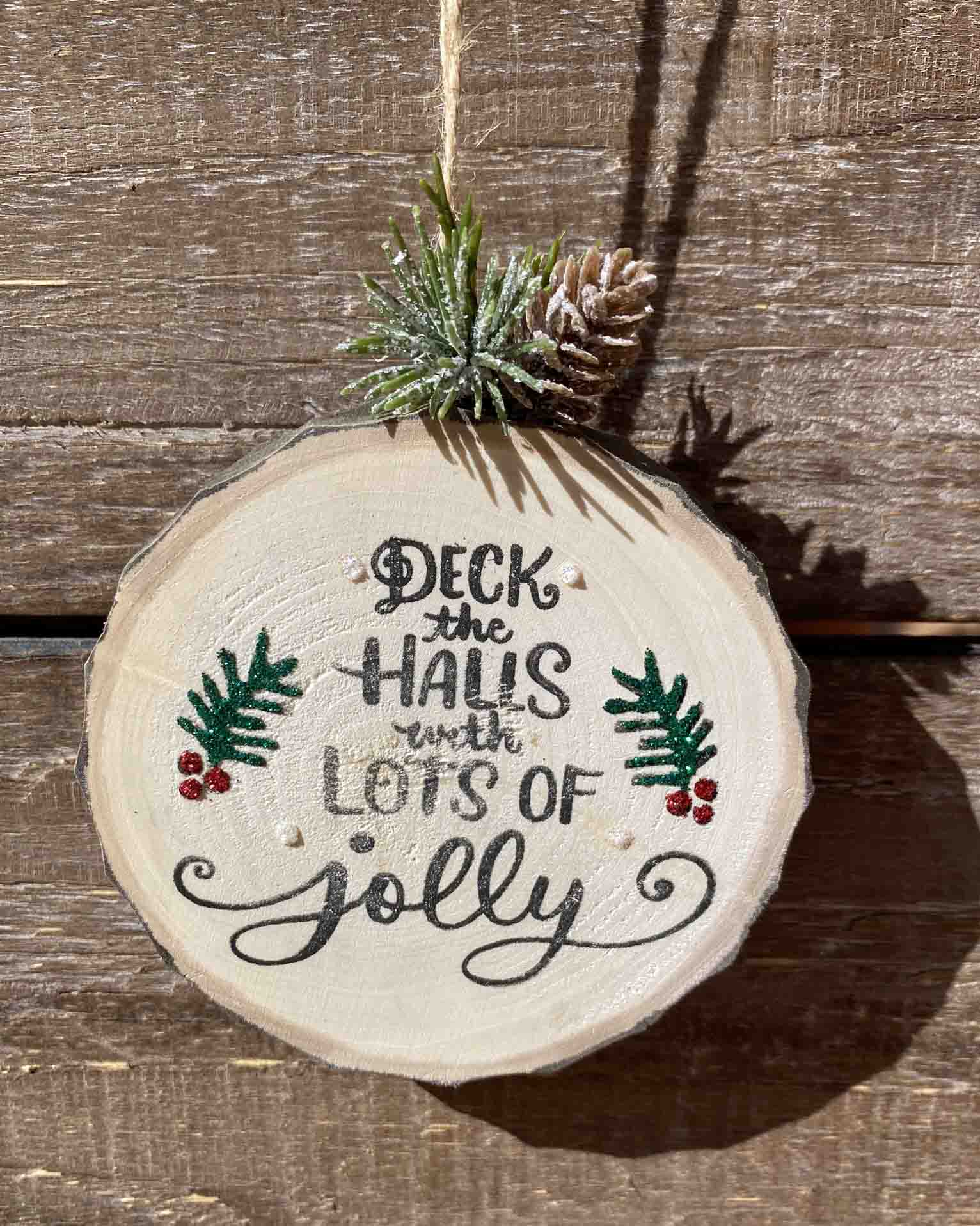
The cluster at the top — pine sprigs, a small pinecone, and frosted evergreen tips gathered where the twine loop meets the wood — is the piece you can’t remove. Without it, a painted slice is a coaster with nice handwriting. With it, you get a silhouette that reads as an ornament from across the yard. Keep the bundle tight and nudged slightly left of center. A perfectly symmetrical cluster looks manufactured.
3. Gingerbread ‘Welcome’ Round With a Candy-Print Bow
The charm here is the split finish, so start there — a $6 wood round from Michaels plus a sample pot of red paint gets you a base that looks custom. The gingerbread man is a $3 cutout you paint and glue on, and Target’s holiday aisle usually has patterned ribbon for $5 a spool. Boxwood picks from Walmart run about $4 for a bundle of three. You’ll spend around $25 instead of $95, and nobody standing on your porch will ever know the difference.
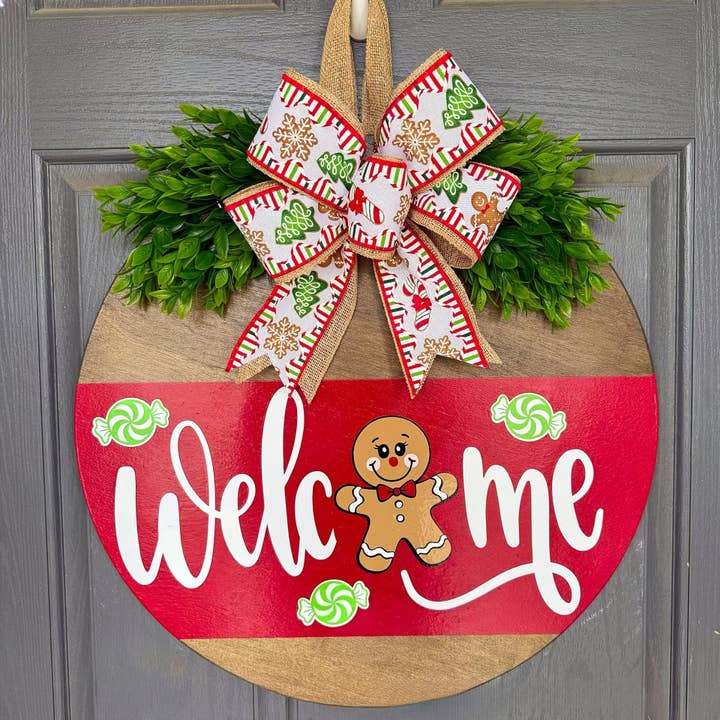
Fair warning on the big patterned bow: on a covered porch it’s fine for years, but a door that catches direct weather will fade that fabric to a sad mauve by January. Same story for anything painted and hung flat against the door — moisture gets trapped behind the round, and you’ll find a ghost ring of red on the door come spring. Stick a self-adhesive felt pad on the back, and if your porch is exposed, use a hook that holds the sign half an inch off the surface.
4. A Set of Four Bark-Edge Wood Slices on a Plank Wall
- Cut three 3-inch sprigs of faux pine and pick one small pinecone.
- Bundle the sprigs and wrap florist wire around the stems twice, twisting tight.
- Hot-glue the pinecone to the front of the bundle so it hides the wire.
- Poke two small holes in the slice’s top edge with an awl.
- Thread jute twine through the holes and knot it behind.
- Tie the sprig bundle over the twine knot with a 12-inch piece of twine.
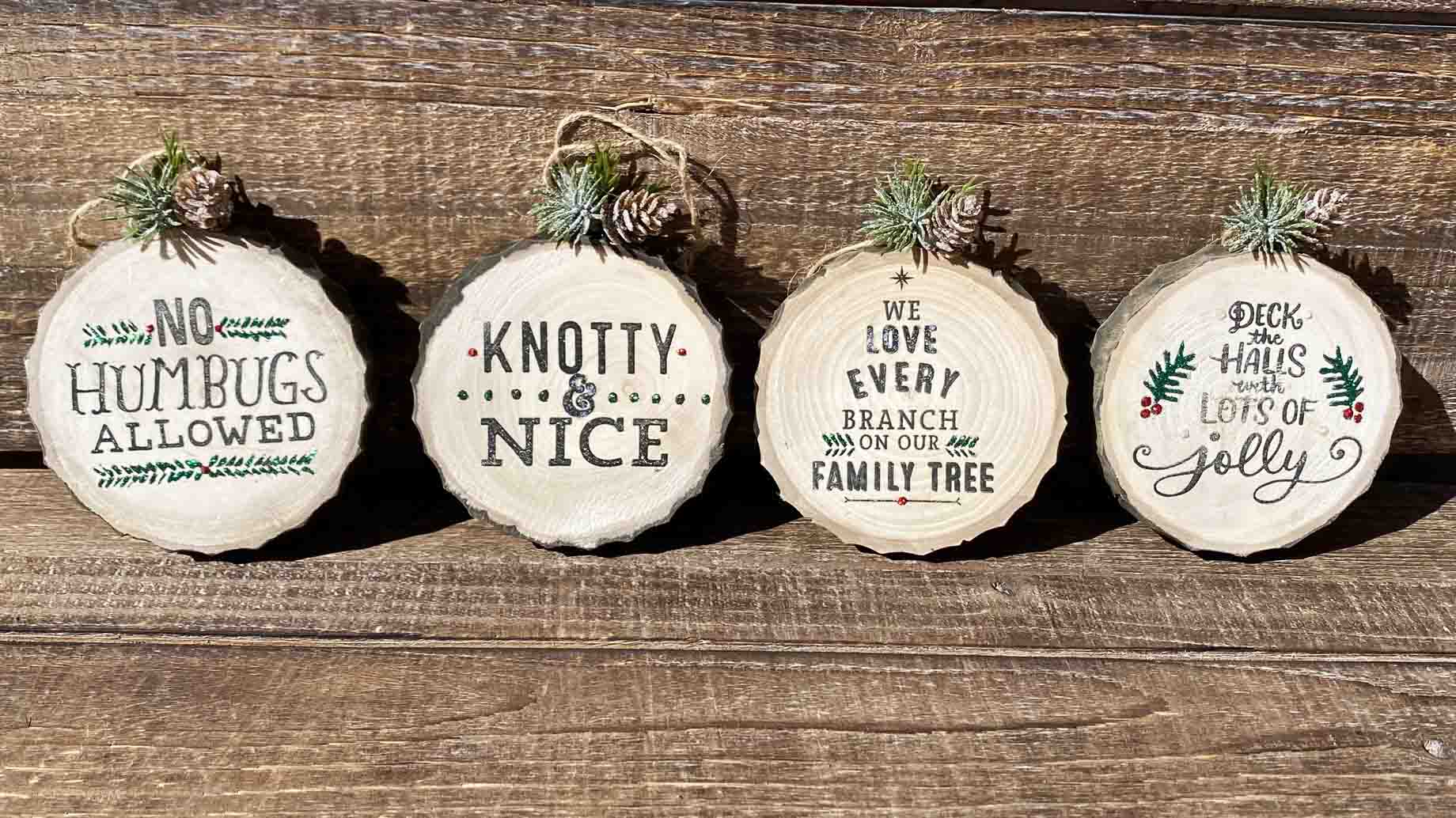
Roughly 15 minutes per slice and $2–$4 in supplies if you buy pine picks on sale after Thanksgiving.
The formula across all four slices is about 75% raw wood, 20% black and cream lettering, and 5% color — one crimson accent, one forest green, nothing more. That tiny color share is why four different sayings still hang together as a set instead of looking like four separate crafts. Swap crimson and forest green for mustard and slate blue and the same math carries into fall. Compare with Idea #2 — same wood slice language at single-sign scale.
5. Pink and Turquoise Layered Script on Stained Wood
The pink-and-turquoise holiday palette started in coastal and grandmillennial corners of Pinterest, then exploded once people realized how well it photographs against warm wood grain. In 2026 it’s less a niche and more a full lane — Target and Etsy both stock pastel Christmas signage now, which would have been unthinkable five years ago. The stained backing is what gives it staying power. Pastels on a chalky white base look like a nursery project. Pastels on visible grain look intentional.
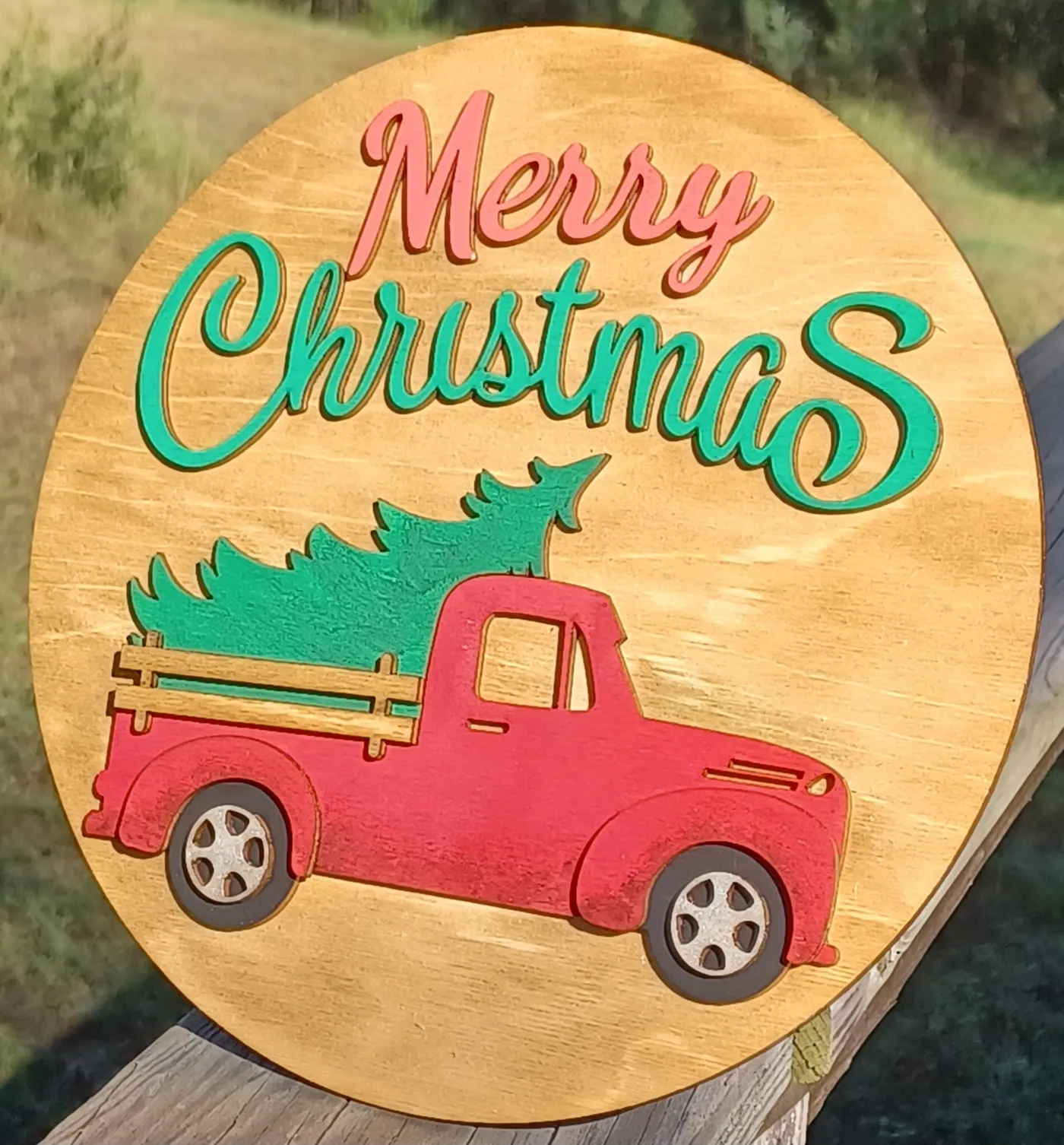
This sign wants a standard 36-inch front door. An 18- to 20-inch round sits in the sweet spot — roughly half the door’s width, centered about a third of the way down from the top. Push to 24 inches and it starts crowding a sidelight or a storm door frame. On a narrow 30-inch door, drop to 14–16 inches and skip the layered cutouts; the script reads better without them. Wide double doors can take one round per leaf and nothing in between.
6. Split-Finish Round With Scripture and a Polka-Dot Bow
- Wood round, 20 in., stained top and red-painted bottom: $15–$30
- Vinyl or hand-painted white script: $10–$25
- White polka-dot ribbon, 2.5 in. wide, plus wire: $6–$14
- Faux eucalyptus sprigs, two stems: $8–$16
- Jute rope hanger and hardware: $4–$10
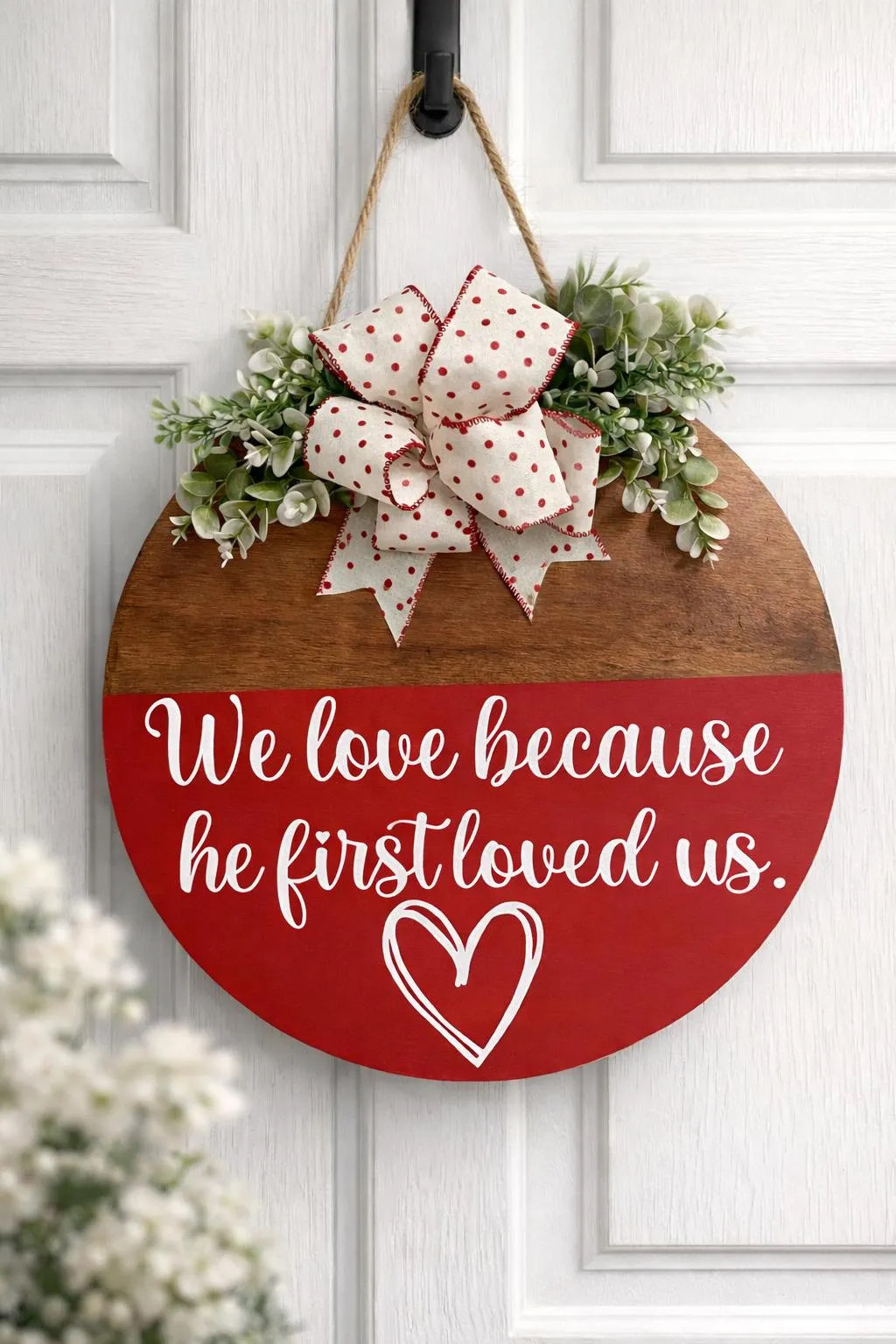
Total: about $43–$95. Budget route: letter the phrase with a $3 white paint pen and split one eucalyptus stem into two pieces. Closer to $25.
What makes the split finish work is proportion, not color. The stained section takes roughly the top third and the red takes the bottom two-thirds, which puts the script right at the eye line where a visitor’s gaze lands. Flip that ratio — mostly stain with a thin red band at the bottom — and the sign reads top-heavy. The white polka-dot bow matters too. It pulls the lettering color up into the top of the piece so your eye travels the whole circle instead of stopping at the words.
Paint the curve, not the whole board. Mask off the section below the line with painter’s tape, press the edge down hard with a credit card, and pull the tape while the paint is still slightly tacky. A clean edge on a circle is worth the extra 20 seconds. Draw the heart outline with a pencil and a round object first — freehand hearts on a curved surface almost always drift right, because most of us are right-handed.
7. Game-Day Round in Tennessee Orange and Buffalo Plaid
The layered bow is the entire personality of this sign. Orange ribbon stacked with black-and-white buffalo plaid, tied in three loops with two tails — it’s the only element that says game day rather than generic Christmas. Without it you’d have a white round with a logo and some pine tree silhouettes. Notice how the plaid repeats the black of the lettering and the orange repeats the ribbon underneath it. That echo is why the whole thing looks designed instead of decorated.

Team spirit doesn’t require a $120 custom sign. Grab a plain white 18-inch round from Hobby Lobby during their wood sale — usually 40% off, so about $8 — then print your lettering and transfer it with graphite paper. Orange and black craft paint runs $1.50 a bottle. The buffalo plaid ribbon is the one place to spend: Joann’s carries team-adjacent plaids for $7 a roll, and cheap ribbon sags by week two. You’re in for under $35.
8. Black Wood Round With ‘falala’ and Buffalo Check
Black signs are gorgeous and completely unforgiving. Every fingerprint shows on matte black, and if this hangs where afternoon sun hits it, the paint can soften and get tacky in a warm climate — enough to leave a mark on your door. Clean it with a dry microfiber cloth, never a wet wipe. Check your door color first, too. Black on walnut or charcoal disappears in the low winter light, and December is nothing but low winter light.
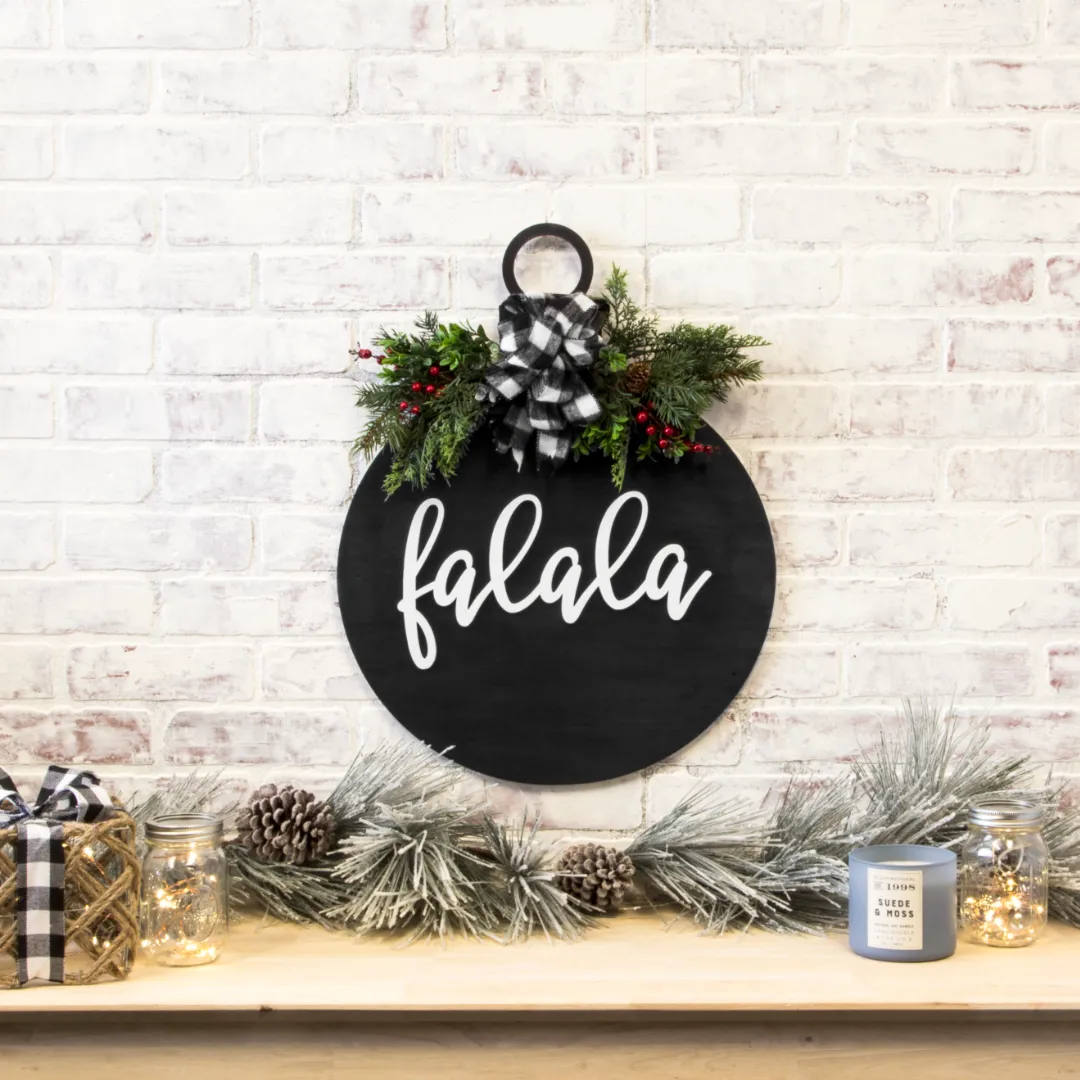
- Cut four 6-inch faux evergreen sprigs and gather two small pinecones.
- Wire the sprigs into a fan shape with all stems pointing down.
- Tie a 2.5-inch buffalo check ribbon into a four-loop bow with 10-inch tails.
- Hot-glue the bow over the stems, then tuck pinecones and berries around it.
- Attach the whole cluster to the sign’s top edge with one screw-in eye hook.
Twenty minutes, about $12 in materials, and the cluster can move to a different sign next year.
9. Peppermint and Gingerbread Wreath in Santa Hats
The recipe is roughly 60% snowy green pine, 25% peppermint red-and-white, and 15% brown — pinecones, gingerbread figures, and those tiny Santa hats. It reads as candy-shop Christmas because the red is concentrated rather than scattered: the peppermint balls are clustered in threes, not sprinkled evenly around the circle. Trade the peppermint red for blush pink and you’d have a softer wreath with identical structure. Keep the brown share where it is either way; it’s what stops the whole thing from looking like a dessert cart.
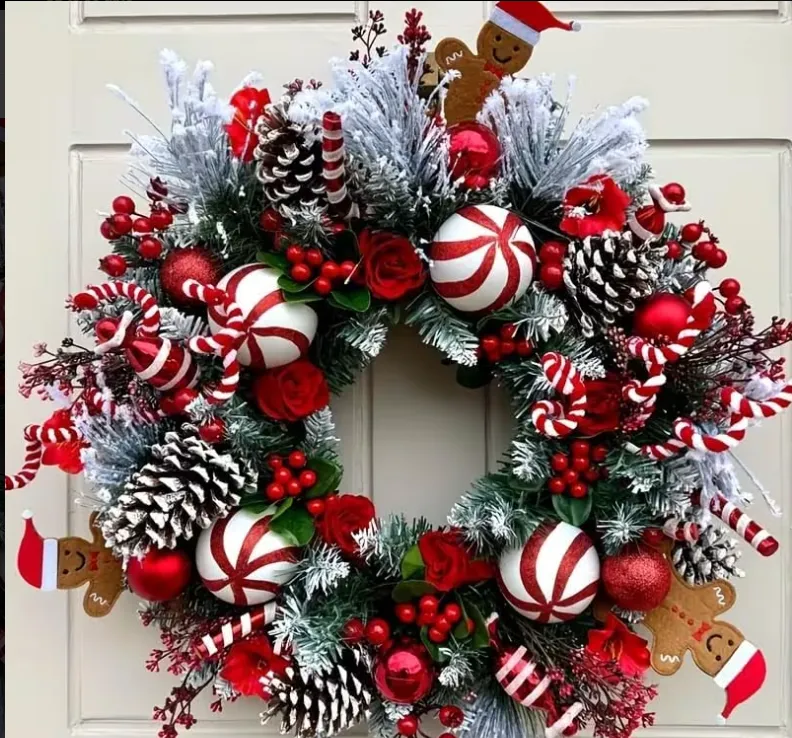
Flocked wreaths shed. Expect a light dusting of white flakes on your porch every time the door swings, and more in the first season than the second. A quick spray of matte floral sealant before hanging cuts that dramatically. The peppermint ornaments are usually plastic and will survive anything; the gingerbread cutouts are typically wood or foam and will fade in direct sun. Plan on refreshing the small accents every other year, and store the wreath in a breathable bag — never a sealed bin.
10. Grooved White Round With ‘God bless America’ and a Layered Bow
Raised lettering on a grooved surface needs a bead of adhesive, not a dollop. Run a thin line of clear silicone along the back of each script letter, press for 30 seconds, and let it cure a full 24 hours before the sign goes outside. Temperature swings will pop a half-cured letter right off. When you’re laying out a phrase on a round, keep the widest line at about 70% of the total width. Any wider and the outer letters start climbing the curve.
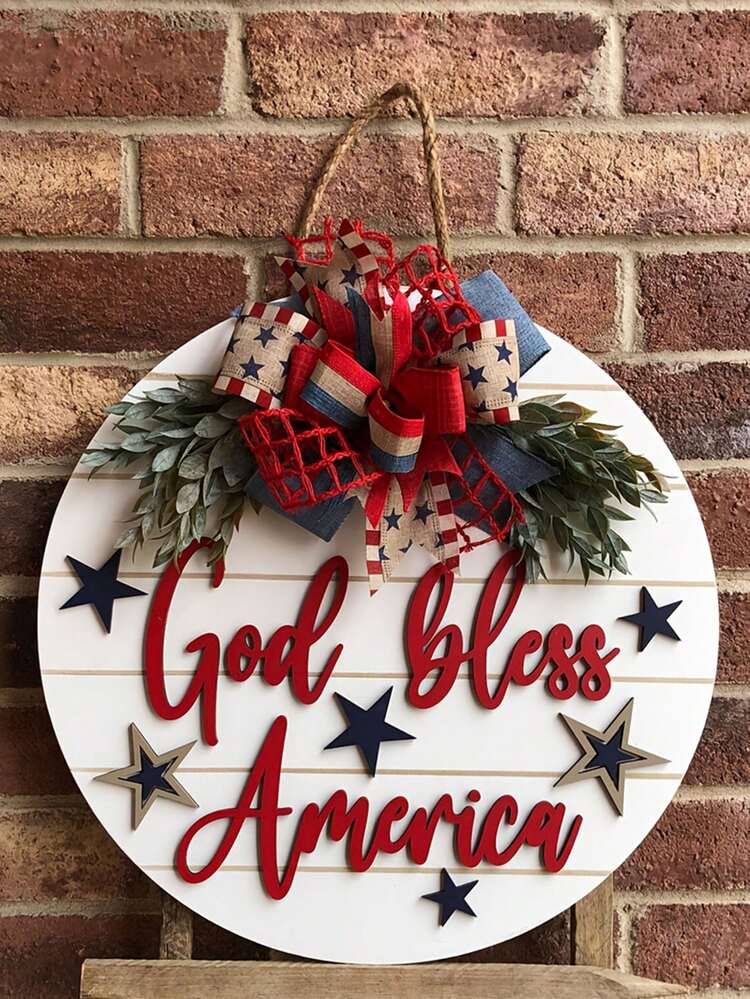
The horizontal grooves are doing quiet work. They give a flat white round a hand-planed texture that reads as craftsmanship from ten feet away, and they visually widen the sign so it feels substantial without being heavy. Then the multi-patterned bow pulls red, white, and blue together in one object, which is what keeps a patriotic round from looking like three separate signs stapled to one board. The green foliage is the surprise — it cools the palette so the red doesn’t shout.
11. Fern and Boxwood Wreath With a Striped Burlap Bow
Fern fronds need room. This one looks best at 24 to 28 inches across on a standard door — smaller and the cascading fronds get crushed into a donut shape. It also wants clearance: natural-look fronds extend 5 to 6 inches past the base, so a storm door that swings within 4 inches of your front door will flatten one side within a week. On a 30-inch door, scale down to 20 inches and cut the frond count in half.
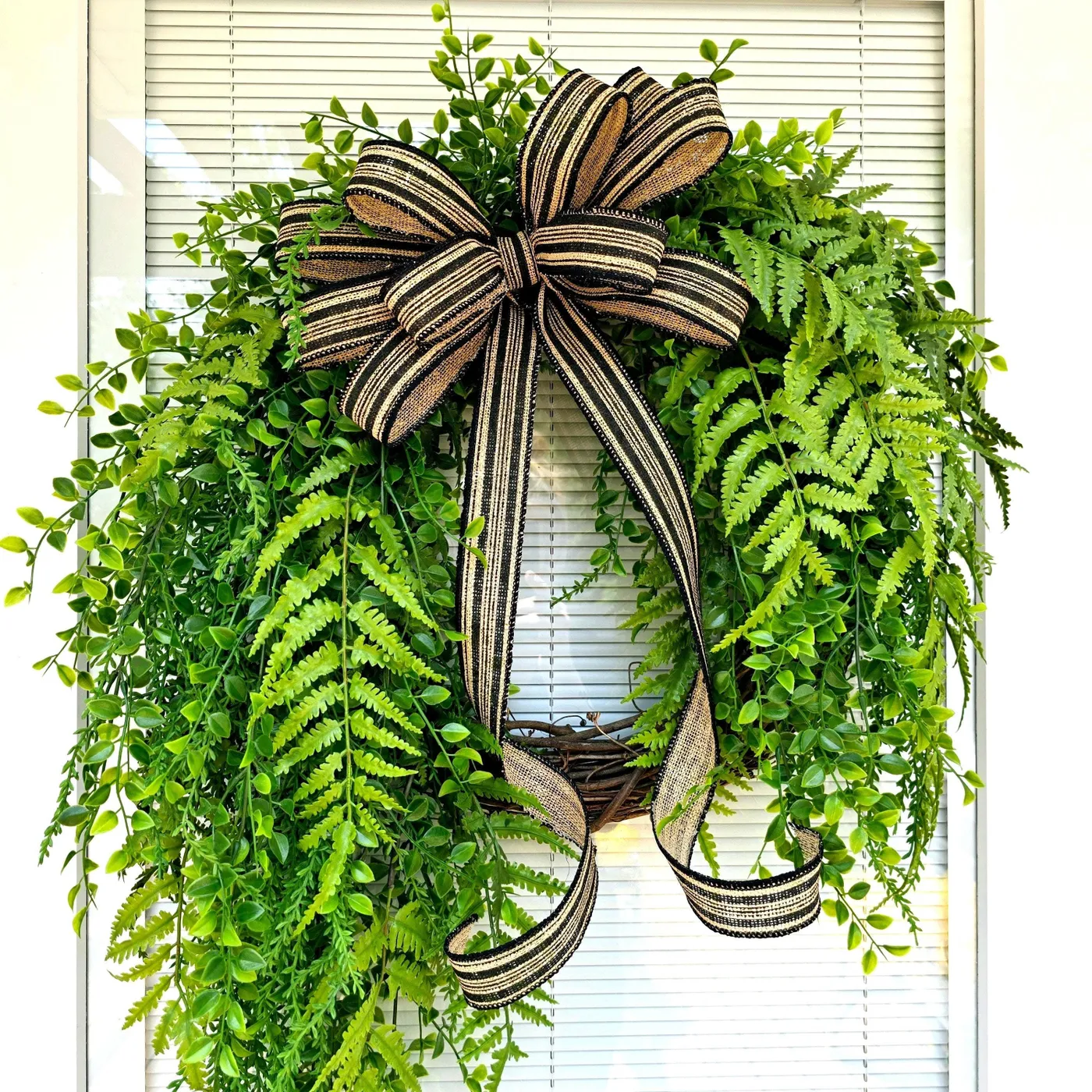
- Twig wreath base, 24 in.: $10–$20
- Faux fern fronds, 6–8 stems: $24–$48
- Boxwood sprays, 4–6: $16–$30
- Striped burlap ribbon, 4 in. wide, 3 yards: $12–$22
- Floral wire and hot glue: $5
Total: about $67–$125. Budget route: one bunch of faux greenery per section from Dollar Tree, roughly $12 total, plus a $6 ribbon — under $30 for the whole wreath.
Botanical, non-glittery wreaths have been climbing for three seasons running, and the logic holds up: they work from Thanksgiving through January without ever looking off-key, and they photograph better in natural light than tinsel ever did. The striped burlap bow is the 2026 detail — the same trick designers use on table linens, adding a crisp graphic line to temper all that organic texture.
12. Frosted Pinecone Wreath on a Navy Paneled Door
The frosted pinecone wreath is the anchor, but look at the whole entry before you buy anything. That garland overhead, the two black lanterns, the potted evergreens on either side — the design succeeds because the wreath’s frost finish repeats in the garland. One pinecone wreath on a bare navy door is nice. The same wreath with a matching garland is a photograph. Repeat one material across two or three elements and the whole entry suddenly looks intentional.
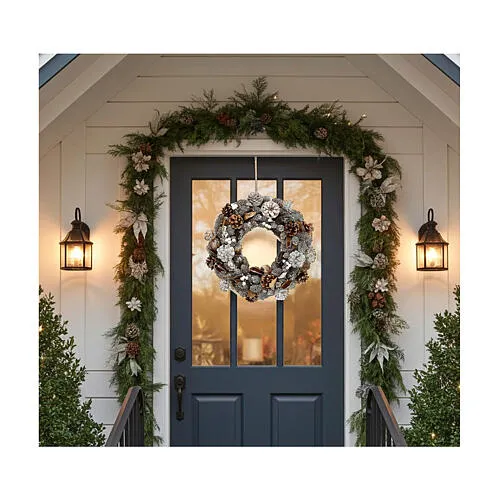
Two practical notes on a dark navy door. Frost and flocking disappear against navy in overcast light, so add a silver or champagne ribbon and give yourself something bright at eye level. And garland over a door frame means you’ll be unhooking it every time you carry in groceries — use a command hook rated for 5 pounds and skip the wire that scratches paint. If your door faces west, check the finish quarterly. Navy fades to a chalky slate faster than any other color.
13. Navy and White ‘Happy Holidays’ Round With Star Motifs
The clean geometry here is easy to fake on a budget. A 16-inch wood round from Walmart is about $9, and a can of navy spray paint plus a white paint pen is another $12. The star and swirl motifs are simple enough to stencil with a sponge. Skip the custom vinyl and hand-paint the lettering — imperfect script on a graphic sign reads as handmade rather than sloppy. You land around $28 versus $110 for a boutique version with the same visual weight.
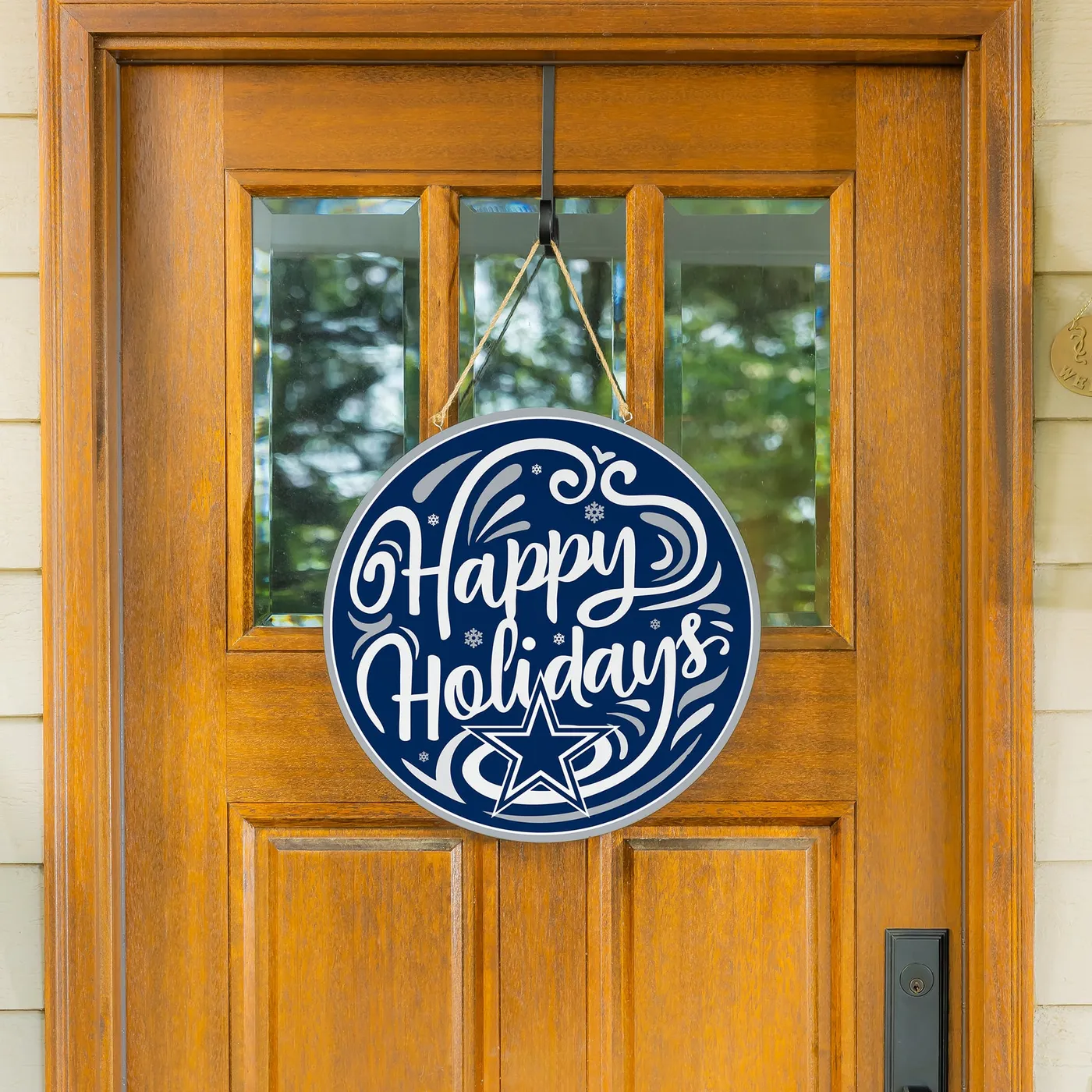
The math is roughly 65% deep blue, 30% white lettering and motifs, and 5% grey for softness. That grey is the secret: pure white graphics on navy read like a sports logo, but knocking the white back a shade makes the sign feel like good stationery. Swap navy for forest green and it becomes a more traditional sign with the exact same composition. Compare with Idea #5 — same stained-wood construction, completely different energy.
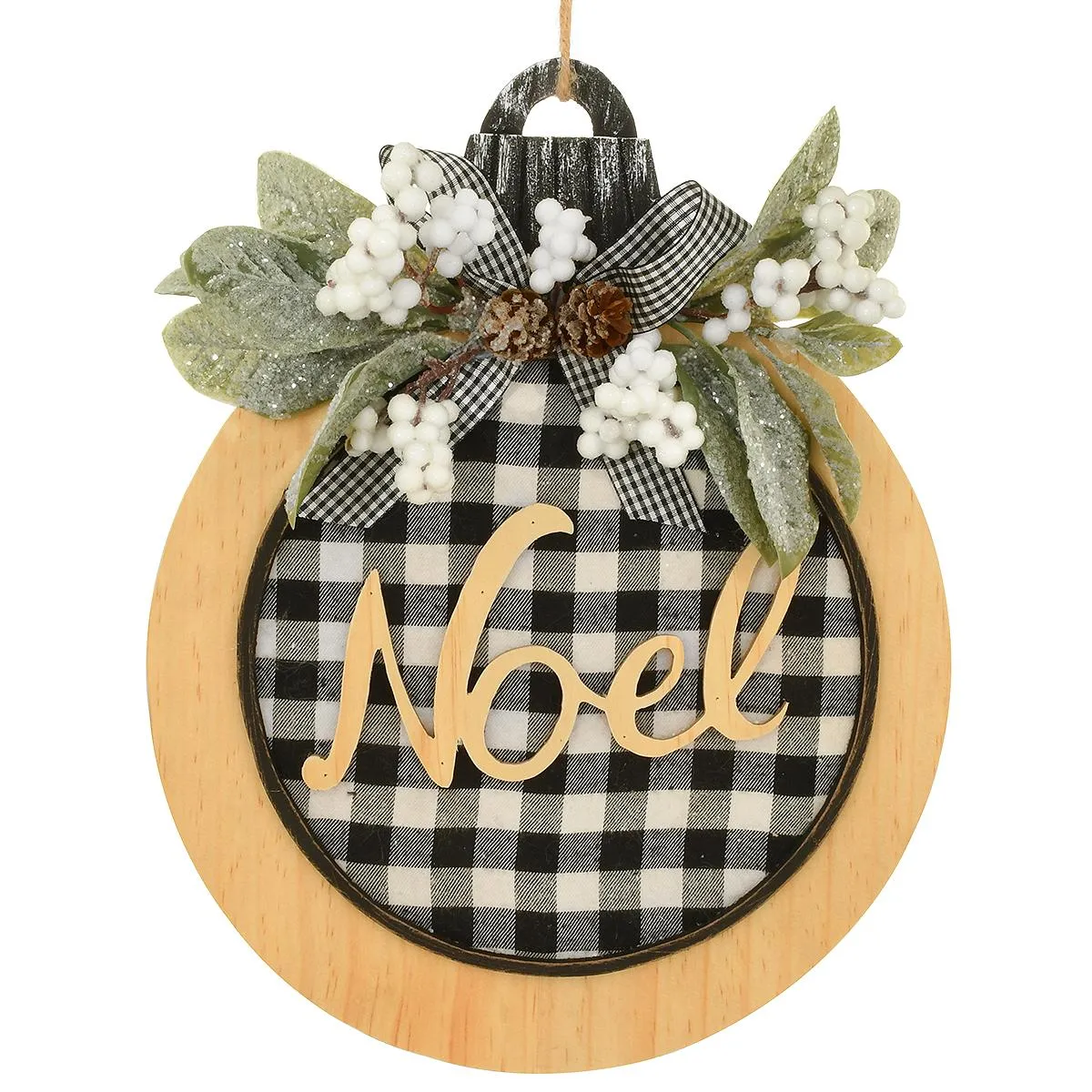
14. Buffalo Check Ornament With a Red Script Monogram
Order the monogram first, not last. A single letter in bold script wants to occupy about 40% of the ornament’s width and sit dead center — under 30% looks like a speck, over 50% looks like it’s swallowing the sign. Choose gloss vinyl or painted wood for the letter and layer it over the check pattern with foam tape. That 2mm lift is what makes it pop off the grid, because buffalo check and script fight for attention at the same depth level.
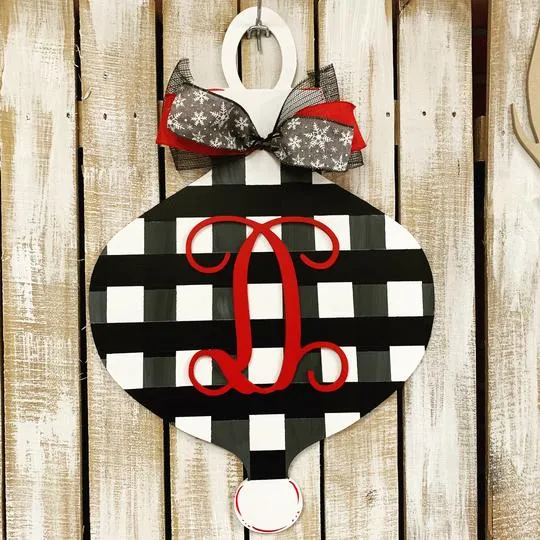
Ornament shapes run smaller than rounds, usually 15 to 18 inches tall, which makes them a good fit where an 18-inch round feels crowded — narrow entries, doors with glass inserts, or a sidelight you’d rather not cover. Hang the top of the loop about 60 inches off the ground; that keeps the bulk of the sign in the middle third of the door, which is where the eye naturally rests. On a wide 36-inch door, pair it with a simple boxwood wreath rather than a second sign.
15. Over-the-Door Hook Setup on a Paneled Wood Door
- Slide the metal over-the-door hanger onto the door’s top edge, flat side facing the interior.
- Bend the hook arm slightly so it clears the door’s raised panels.
- Cut a 24-inch length of twine and tie a double knot through your sign’s hole.
- Loop the twine over the hook and adjust until the sign hangs level.
- Add a small felt pad behind the sign where it touches the wood.
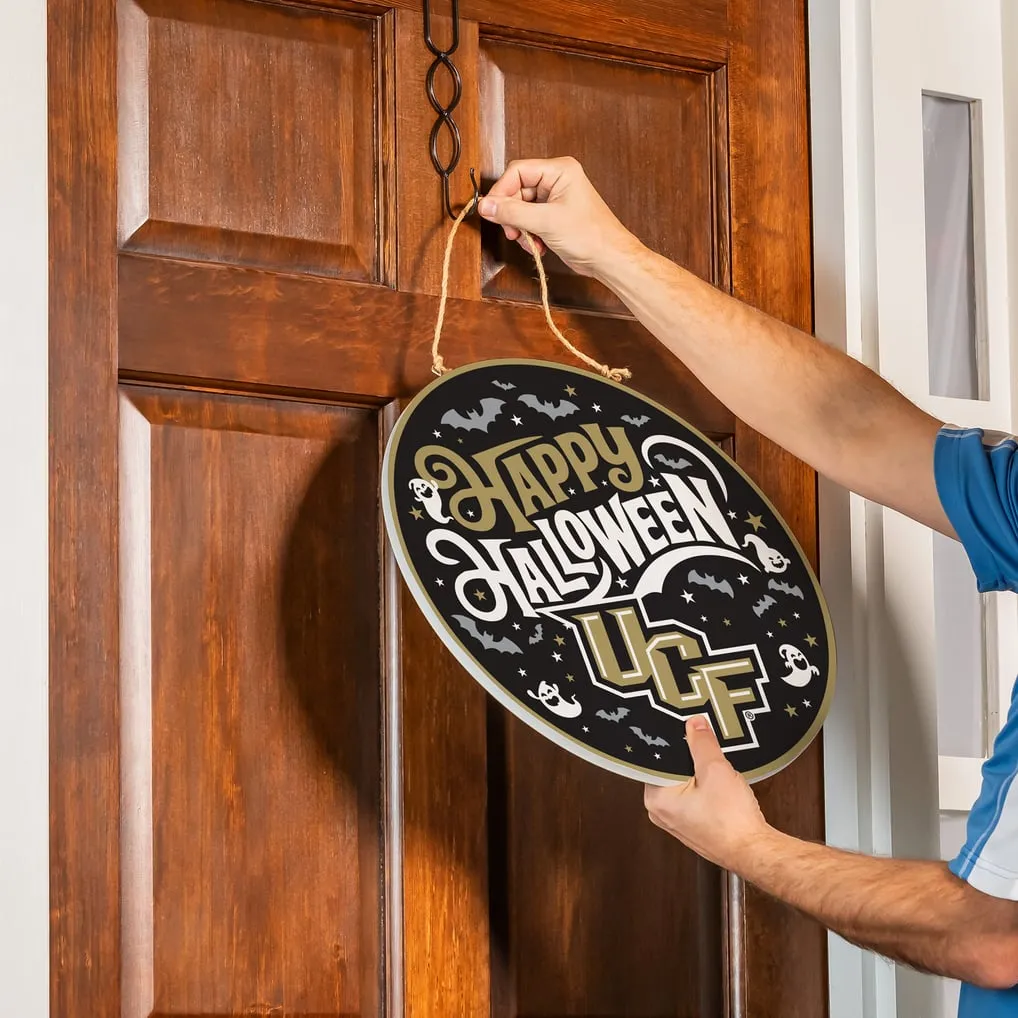
Five minutes, no tools, no holes — and it’s the reason you can change signs with the season. Hanger and twine together run about $8.
That over-the-door hook is doing more damage than you think. The metal edge rubs the top of the door frame every time you open it, and after two seasons you’ll see a dark line worked into the stain. Line the contact points with a strip of felt tape — $3 and 30 seconds. Check monthly that the hook hasn’t bent under a heavy sign, too. Once it warps it starts catching the frame, and that’s when paint chips.
16. White Wreath Form Wrapped in Red and Black Crochet
This is a work-in-progress moment, and a genuinely useful one. The white foam form sits on weathered planks with a folded red-and-black crocheted panel laid over the lower right edge — that’s the second before a rag wreath becomes a wreath. What makes the finished version work is the tension between soft, irregular crochet texture and the perfectly smooth circle underneath. Contrast between textures is almost always more interesting than matching ones.
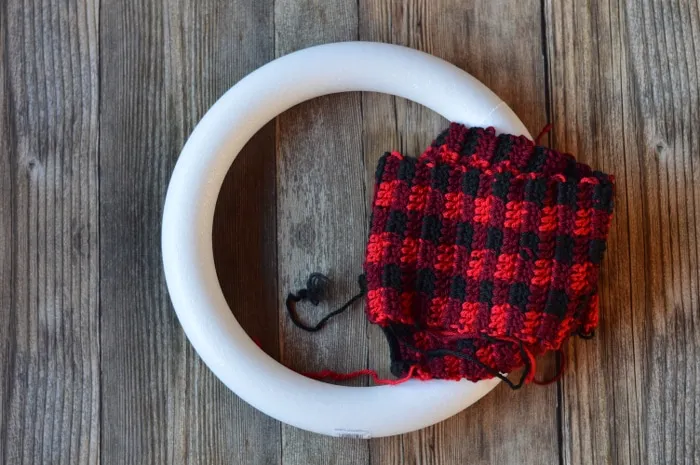
- White wreath form, 14–16 in.: $6–$14
- Red and black crocheted or knit fabric, 1–1.5 yards: $8–$20
- Rotary cutter and mat, if you don’t own them: $25
- Hot glue and pins: $5
Total: about $19–$39, or $44–$64 with the cutting tools. Thrift stores are the move — a $4 men’s plaid shirt yields more fabric than a $12 craft-store bundle.
Cut strips 2 inches wide by 8 inches long, tie each in a single knot around the form, then push every knot tight against the last one. Two rows is the bare minimum at this size; three is what makes it look expensive. Keep the crochet panel folded and pinned rather than glued — you’ll want to reposition it three or four times before the layout feels right.
17. Green, Yellow, and White Round on a Dark Wood Door
The dark door is the element most people forget to count. A medium-to-dark wood door acts like a picture frame — it makes a green, yellow, and white sign read brighter than it ever would on a white door, and the twisted twine looks warmer against walnut than against painted trim. If your door were the same value as your sign, the whole thing would wash out. Before you buy, hold the sign against the door at night with the porch light on. That’s the lighting you’ll actually live with.
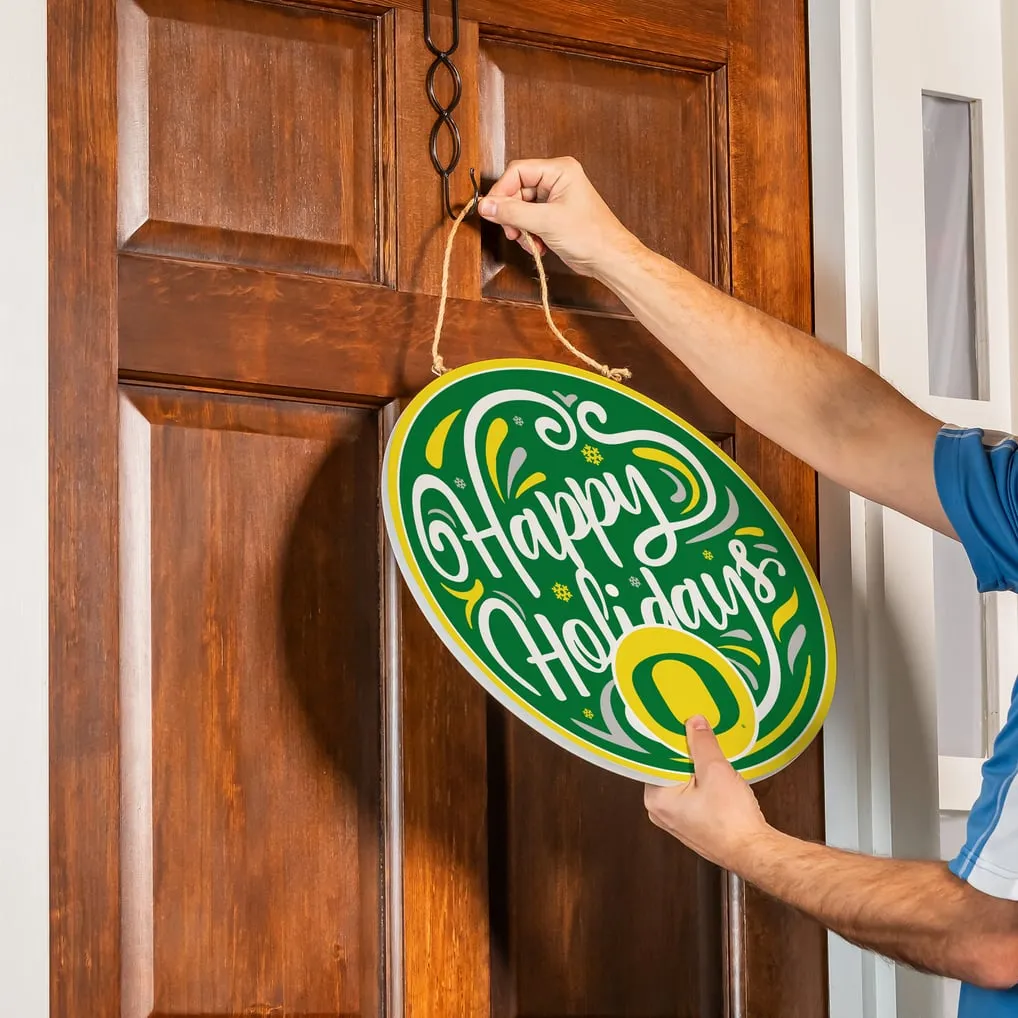
Three-color signage like this is the easiest thing in the world to DIY. Wood round, $8 at Walmart. Paint the green background, let it cure, then letter in white with a paint pen. The yellow accents are two brushstrokes. Twine is $2 and honestly looks better than a chain. Under $20 total, and you can shift the accent color every year — which is more than the store-bought version can say.
18. Buffalo Plaid Crochet Wreath With Bronze Jingle Bells
Crochet wreaths with metal accents are heavier than they look. A 16-inch version with a bell cluster can hit 3 pounds, which is more than most suction cups or small adhesive hooks will hold. Use an over-the-door hanger or a 5-pound-rated command hook on a clean, dry surface, and let the adhesive cure a full 24 hours before you hang anything. Also: jingle bells on a front door jingle. Every single time. If you work from home, consider yourself warned.
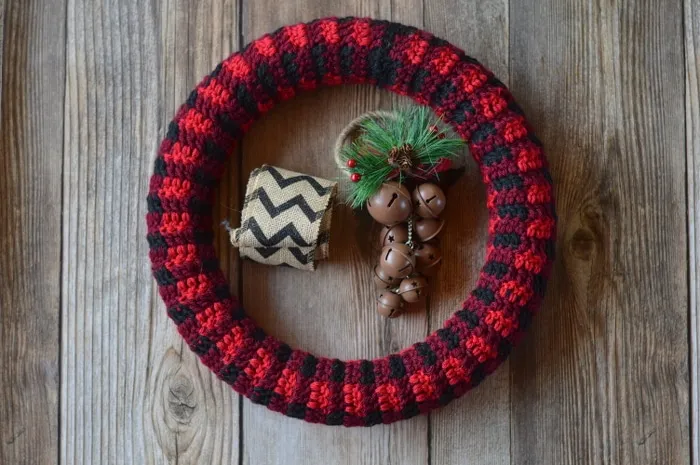
This one wants a solid wood or painted door, 32 to 36 inches wide. The plaid is visually dense, so it needs at least 4 inches of visible door on each side or the wreath looks like it’s squeezing the frame. On a narrow 28- or 30-inch door, drop to a 14-inch wreath and lose the burlap tails. On a wide double door, hang one per side with identical accents — mismatched bells on a pair look accidental rather than collected.
19. Royal Blue Round With a Blue Horse Mascot
Roughly 60% royal blue, 25% white script, 10% bright orange, and 5% natural wood and twine. That orange share is the entire point — it’s an outlier color that makes the blue feel alive instead of corporate, and it’s placed low, right where the mascot sits. To shift this into another school’s colors, keep the ratio identical and swap only the blue and orange values. The proportion is doing the work, not the palette. Compare with Idea #7 — same principle, opposite temperature.
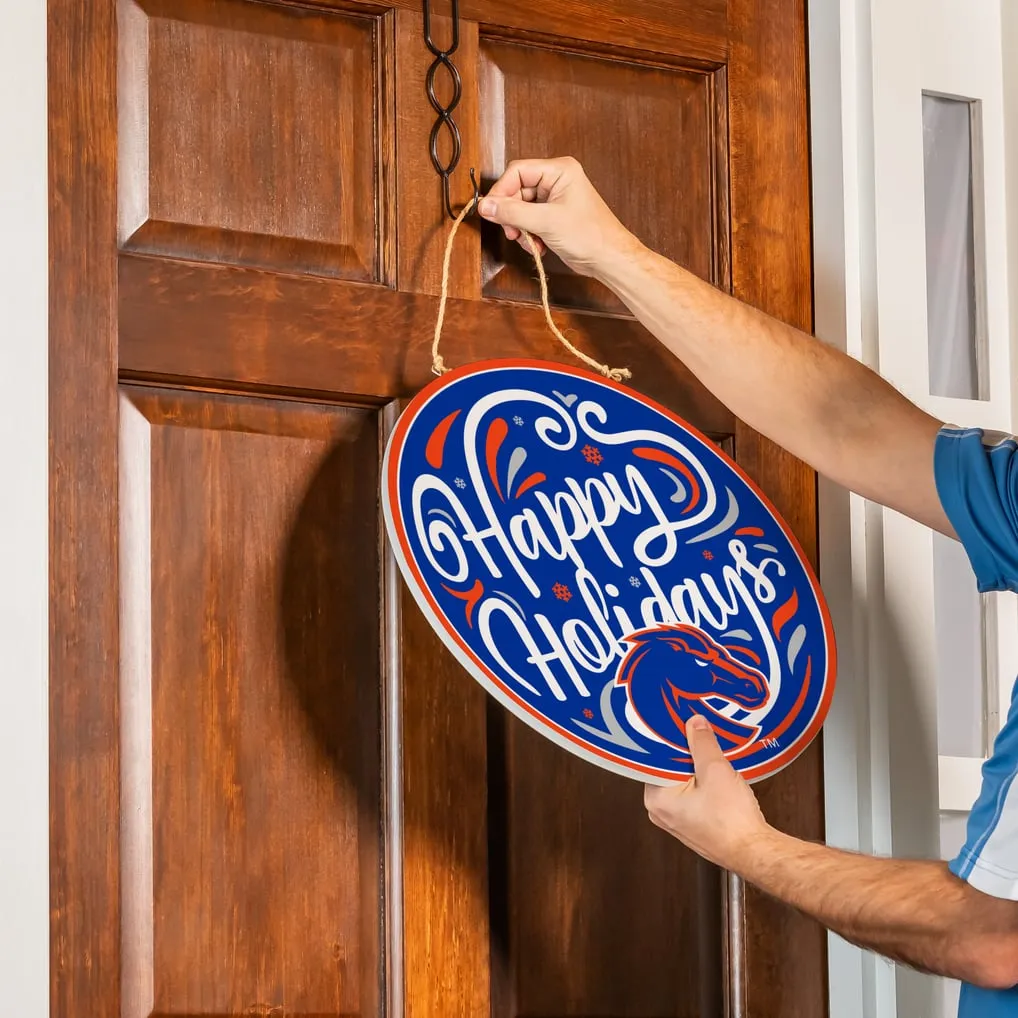
Paint the background in two thin coats, never one thick one. A heavy coat on a wood round dries unevenly and you’ll see brush ridges the moment light hits it, especially on a saturated blue that shows every flaw. Sand lightly with 400-grit between coats and wipe the dust off with a tack cloth. Then let the sign sit for 48 hours before you add lettering. Blue paint stays soft longer than you’d expect, and vinyl pressed into soft paint will slide.
20. Framed Vintage Santa Plaque With a Glitter Plaid Bow
Vintage Santa imagery has been the quiet winner of the last few holiday seasons, riding the same nostalgia wave as retro glass ornaments and mid-century tree toppers. What’s new in 2026 is the framing — literally. Mounting a printed Santa illustration inside a round black frame turns a $6 print into a wall piece, and Pinterest has been full of it since summer. This one has real staying power because it’s built on imagery people already love, not a color that dates itself in two years.
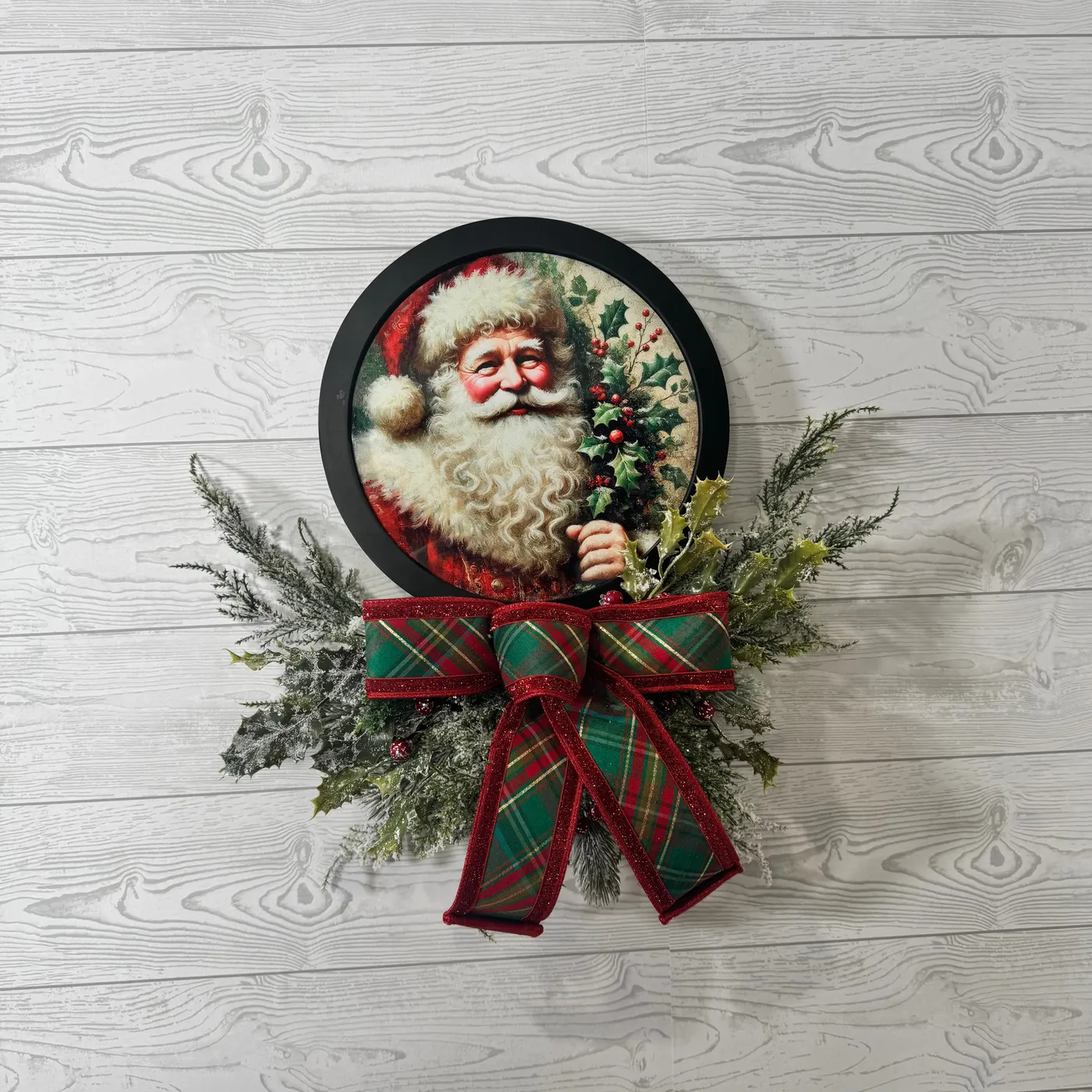
The frame is what separates this from a paper cutout, and the whitewashed wood behind it does the rest. A plain white wall would make that black ring look harsh, but the softened plank texture gives it somewhere to land. Below, the frosted evergreens, holly, and berries are all roughly the same visual weight, and then the plaid bow with glitter trim deliberately breaks that pattern. Flat, flat, flat, then one thing that sparkles. Repeat that rhythm anywhere and it works.
21. Blue and Green Plaid Rag Wreath on an Off-White Door
- Cut 2-inch by 9-inch strips from 1.5 yards of plaid fabric — about 60 strips.
- Fold each strip in half and tie a simple knot around a 14-inch wire form.
- Push every knot tight against the previous one, alternating plaid direction.
- Fill two full rows, packing the second row between the first row’s knots.
- Finish with a third row on the outer edge so no wire shows from the side.
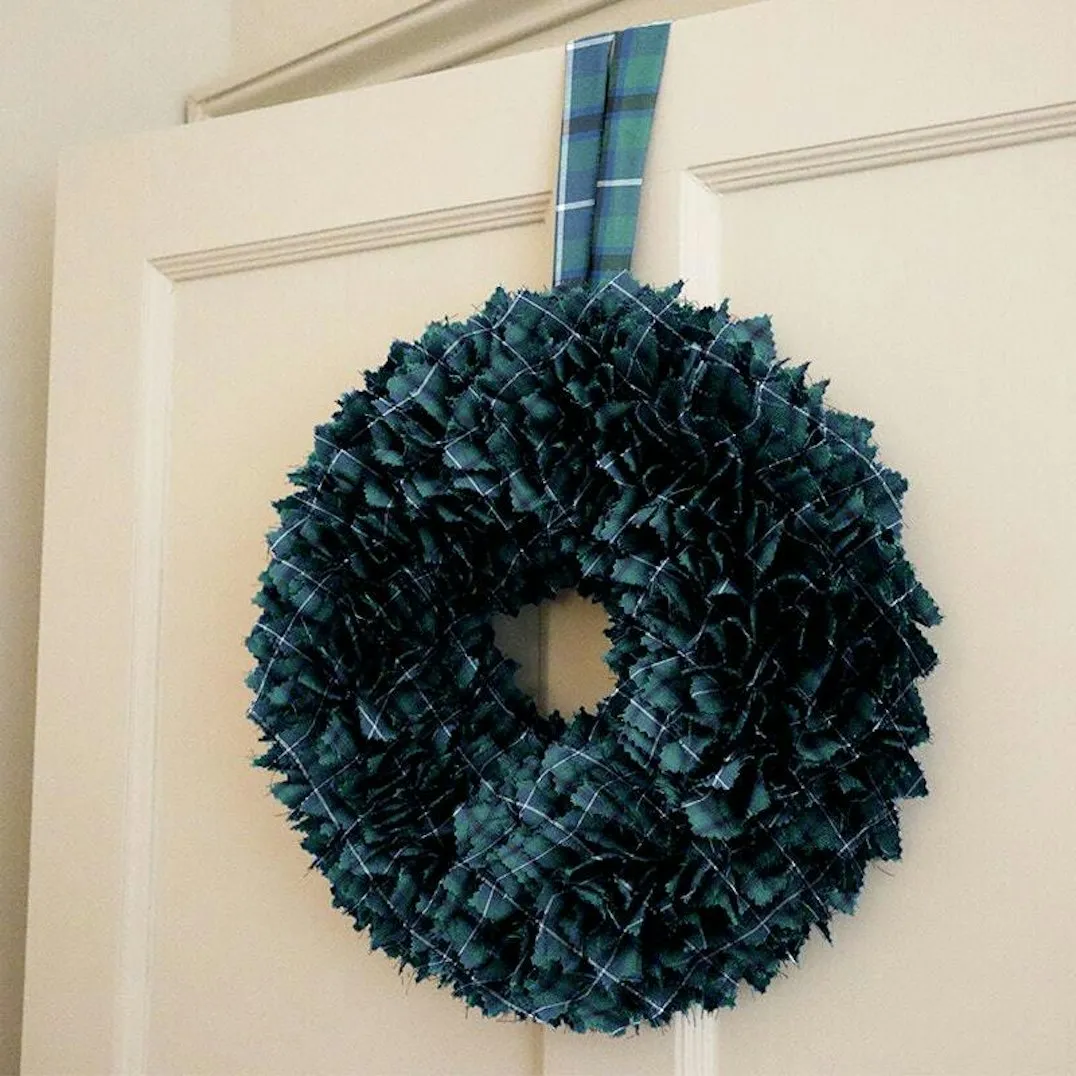
About 90 minutes, and roughly $14 in fabric if you catch a holiday sale. Rag wreaths are almost impossible to get wrong because there’s no pattern to follow.
- Wire wreath form, 14–16 in.: $5–$10
- 1.5–2 yards plaid fabric: $12–$28
- Matching ribbon for the hanging loop: $5–$9
- Fabric scissors or rotary cutter: $0–$20
Total: about $22–$47, and you’ll likely have enough fabric left for a small tabletop version. Buy the fabric in person — plaid colors online are almost always more saturated than they look.
- Measure your door width and subtract 8 inches — that’s your max wreath diameter.
- Check that your door’s top edge is under 1.5 inches thick so an over-the-door hanger fits.
- Confirm fabric weight: quilting cotton frays nicely, flannel frays into fuzz.
- Decide your hook type before you buy the form — heavy rag wreaths need real support.
22. Merry Christmas Round Styled With Gifts and Pillar Candles
That styled arrangement with the textured grey placemat, wrapped boxes, and two pillar candles is a mantel vignette waiting to happen — but open flames near a wood sign are a real risk. Keep pillar candles at least 12 inches from the sign’s edge and never let a wick get within 2 inches of the top. A painted wood round is basically a fuel source. If you want the look without the flame, battery-operated pillars on a flicker setting read almost identically in photos and you’ll never wipe soot off white script.
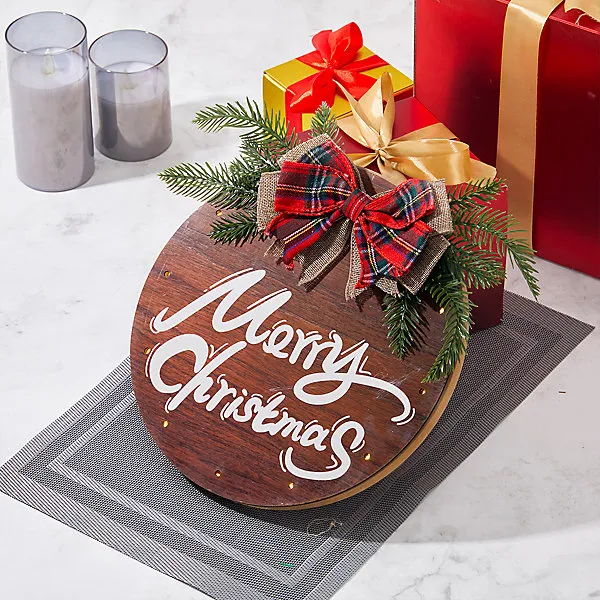
The sign itself is the cheap part. A 12-inch round is $7 at Michaels on sale, white script is a $4 paint pen, and pine sprigs come from cutting apart any $6 garland. The plaid-and-burlap bow is where the look actually lives — buy 2 yards of wired red plaid ribbon for $8 and build a four-loop bow yourself, then layer a scrap of burlap underneath it. About $25 versus $85 for a boutique version. And run through the common mistakes section before you commit to placement.
23. Dense Tartan Rag Wreath With Layered Frayed Texture
Density is the whole trick, and there’s a number for it. For a full 16-inch rag wreath you want 55 to 70 knots per row and three rows minimum — roughly 180 to 200 strips total. Most first-timers stop at 120 and end up with a wreath that looks sparse and homemade instead of lush and handmade. Push each knot tight to its neighbor as you go; you should barely see the wire form from any angle. If you can see the form, you’re not finished.
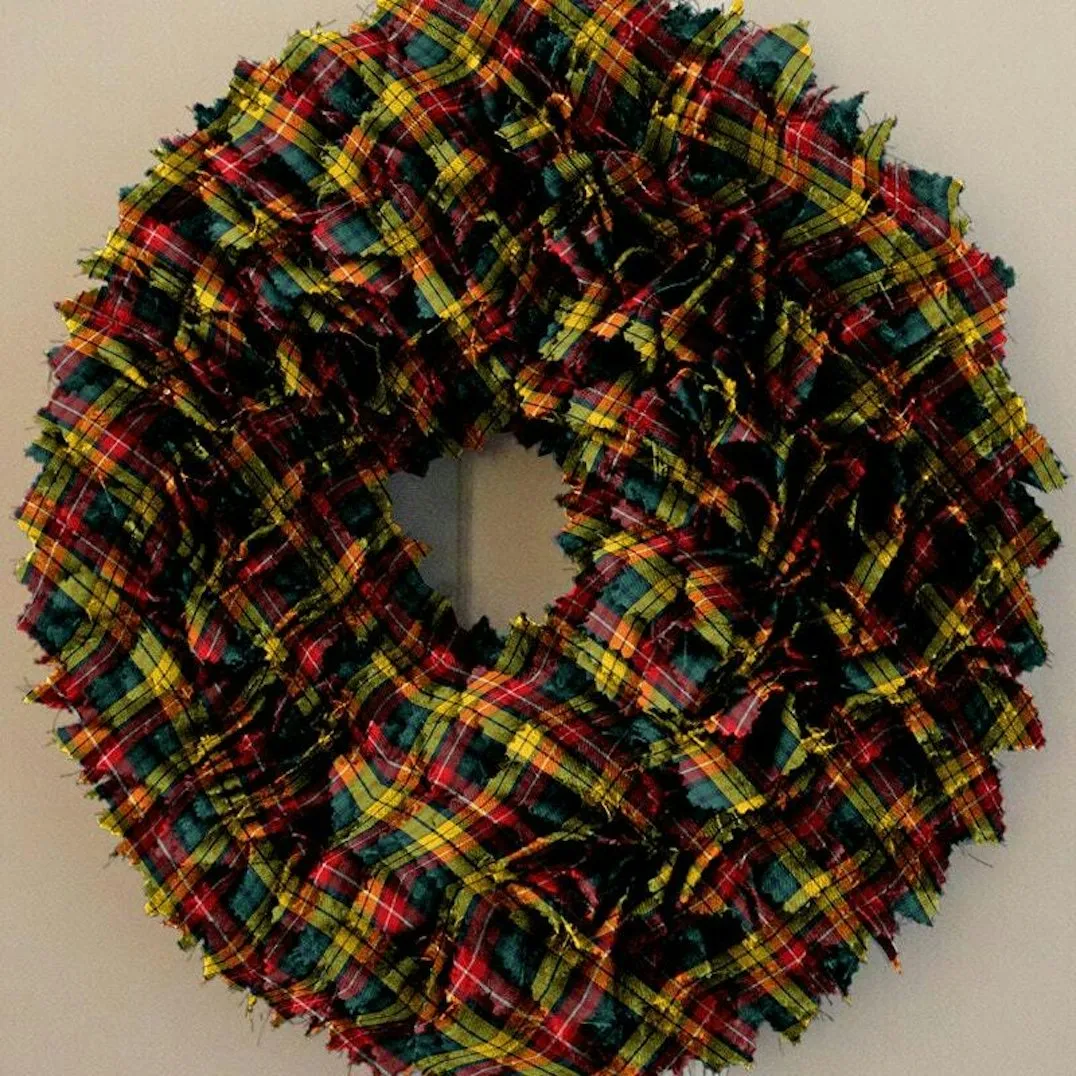
The frayed edges are doing more than you’d guess. Every cut strip of tartan releases a soft halo of loose threads that blurs the silhouette and gives the wreath an almost antique quality you simply can’t get with smooth ribbon. Cut with pinking shears or a rotary cutter and resist trimming the loose threads afterward. Compare with Idea #21, where a matching ribbon and a lighter plaid keep the same construction feeling crisp instead of cozy.
24. Layered Reindeer Round With a Houndstooth Bow
Layered wood signs are thicker than flat ones — usually 1 to 1.5 inches of stacked depth — which means the sign’s drop shadow becomes part of the design. That’s lovely on a door with room, less lovely if your storm door clears by less than 2 inches. Measure that gap before you order. A 20-inch layered round is the practical maximum for a standard 36-inch door; go bigger and the antlers start competing with the door frame instead of sitting inside it.
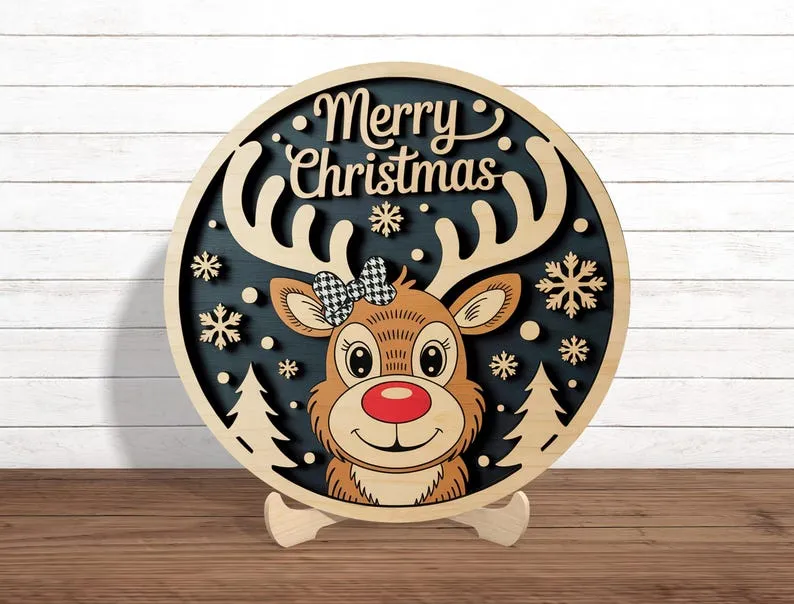
Two honest notes. First, layered cutouts collect dust in the gaps between layers, and a dark navy background shows every speck — plan on a soft brush every couple of weeks, not a wet wipe. Second, the red reindeer nose is usually painted or vinyl, and it’s the first thing to chip when the sign knocks against a frame. Brush a clear matte topcoat over just the nose and you’ll get years instead of months out of it.
25. Choosing Your Round Base: Wood, Foam, or Twig Ring
Whatever you hang, the math is the same: sign width should land at about 45–55% of your door width, and the center of the sign should sit 60 to 66 inches off the ground. From there, the formula is 70% base + 20% text + 10% accent — leaves, bow, or berries. A 16-inch round on a 36-inch door is 45%, which is why it feels restrained. The same 16-inch round on a 30-inch door is 53% and reads instantly bolder. Adjust the base, not the decoration.
- Weigh your finished sign on a kitchen scale before you hang it.
- Under 2 pounds: a suction cup rated for 3 pounds works on clean glass or metal.
- 2–5 pounds: use an over-the-door hook with a felt-lined contact edge.
- Over 5 pounds: drill a 1/8-inch pilot hole and use a screw-in hook, or a wreath hanger with adhesive strips rated 5 pounds or higher.
- Always let adhesive cure 24 hours above 50°F.
Ten minutes of prep, and nothing ends up on the porch.
- Wood round: heaviest and most durable, best for paint and vinyl — 1.5 to 4 lbs.
- Foam form: lightest, built for wrapping and rag work — 8 to 14 oz.
- Twig ring: mid-weight, best for faux greenery and natural looks — 1 to 2 lbs.
- Check hole or loop placement before you start decorating, not after.
26. Flocked Pine Wreath With Pink Hearts and Tiny Gift Boxes
Mostly white, with pink, champagne, silver, and a whisper of frosted green — and no red anywhere. That absence is deliberate. Red would instantly reset this wreath as traditional Christmas; leaving it out lets the pink hearts and miniature wrapped gift ornaments carry the entire mood. The warm string lights woven through the branches are the other critical move. Without them, a flocked wreath in pastels reads cold and bridal. With them, it reads like a snow globe.

Pastel and pink holiday decor has moved well past trend status — it now has its own dedicated shopping season, with retailers stocking full pink collections instead of a token endcap. The driver is simple: people with blush and cream interiors got tired of hiding their living rooms for six weeks a year. If you’re building a pastel scheme, start with the wreath and work outward. Compare with Idea #12 — same flocked-and-frosted idea, traditional palette, and it hangs just as well.
Go Hang Something on That Door
Your front door is the one decorating decision every single visitor actually sees, which is exactly why a round hanger earns its keep — swap it once and the whole entry changes personality. Start with the idea that matches the door you already have, then work outward: the wreath, the hook, the felt pad, the garland. And if you build one of these, photograph it in daylight before you tuck the supplies away — you’ll want the proof.
📌 Pin your favorite version to your Christmas board now, so future you can find it in November instead of scrolling for an hour.