Still scrolling the same fifty Christmas porch photos and saving none of them, because your front door is navy and your porch is four feet deep? Same. We spent real time digging through Home Depot, Target, At Home, Walmart, and Etsy to pull only the ideas that survive actual weather, and the range runs from a $28 planter refresh to a $2,500 roofline install. Inside you’ll find 32 curated ideas spanning classic traditional, rustic farmhouse, snowy white minimalist, and full-tilt multicolor light displays — with budget and luxury versions compared side by side, plus a shoppable shortcut for every single one. Here’s why this matters in 2026: the front porch has officially become a room, the same shift driving all those outdoor fireplace and porch coffee-bar pins you’ve been saving since September. And stay until the end — we break down the most common mistakes that can ruin these looks. 📌 Save this to Pinterest for later — you’ll want to revisit these ideas.
1. Full-Tilt Multicolor: The Two-Story House That Goes All In
What makes a display this over-the-top read as designed instead of chaotic comes down to three things. First, repetition: the icicle lights hang at an even depth along every eave, so the roofline becomes one continuous ribbon rather than a patchwork. Second, a floor: those blue bulb ground lights sit low and cool, giving the eye somewhere to rest before it climbs the facade. Third, characters placed at human scale — Santa, the light-up train, the reindeer — clustered in the yard where kids actually walk past them, not stranded up on the roof. Remove any one of those layers and the whole thing turns into noise.
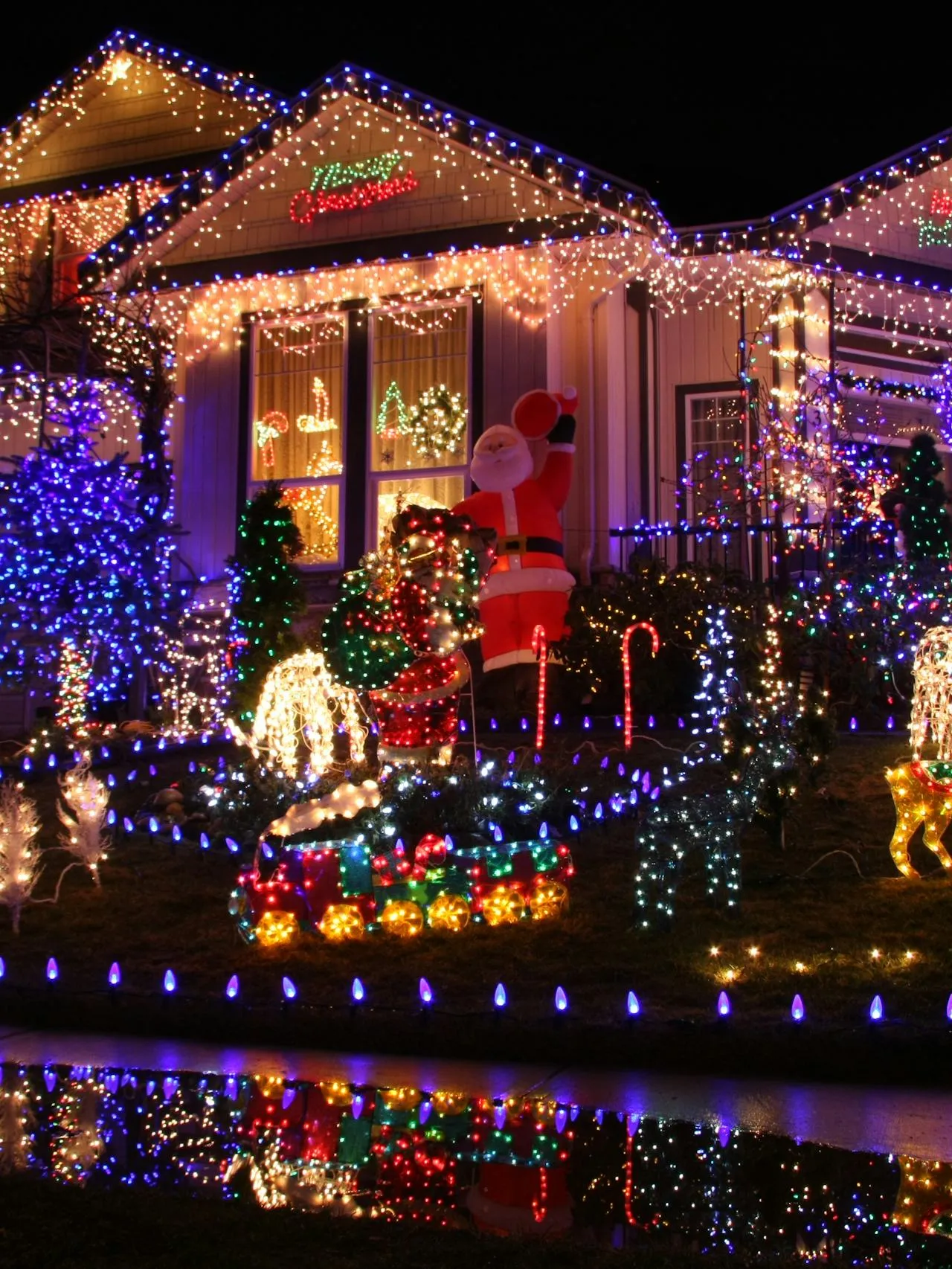
Before you commit to this level of coverage, do the unglamorous math. A display this dense can draw 1,200 to 1,800 watts, which is more than a space heater, so it wants its own dedicated circuit rather than the same outlet as your garage freezer. Everything outdoors should run through a GFCI outlet in a covered in-use box, and timers save you from the 11 p.m. walk in slippers. Plan storage now too — decor this heavy eats an entire garage shelf, and you’ll be untangling it in the cold next November if you don’t wrap each strand on a reel.
2. A Snowy Yard Full of LED Characters (Teddy Bear Totem Included)
The formula here runs roughly 35% illuminated figures, 25% string lights on the house and bushes, 20% snow-covered ground acting as a neutral backdrop, 15% warm white glow, and 5% pure whimsy — that’s the teddy bear totem pole, and it is doing more work than you’d think. White siding keeps the multicolor figures from fighting each other. If your house is brick or tan, swap the white base for warm cream lights and lose the cool blue tones in the figures; you’ll get the same playful energy without the muddiness.
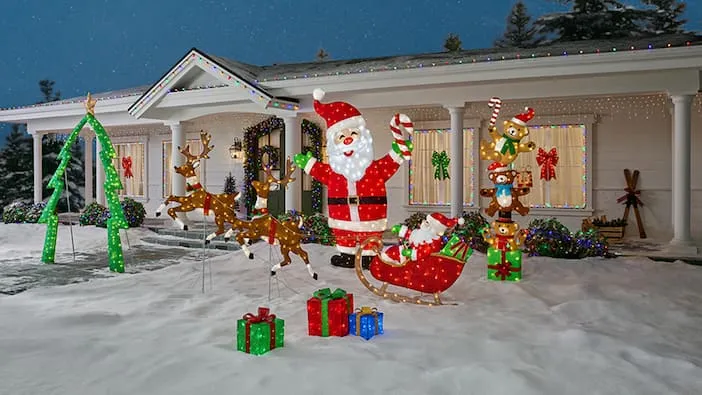
You don’t need a showroom budget to build a yard like this. Big-box stores drop their light-up figures to $35–$70 right after Black Friday, and Marketplace in January is a graveyard of $20 Santas from people who are tired of storing them. Start with three figures and one string-light run, then add a piece each year. If your house can’t carry this much color, the warm-white restraint in Idea #3 is the calmer sibling of this exact look — same snowy yard, completely different mood.
3. Warm White Restraint: Icicle Lights, Red Bows, One Star-Topped Tree
The element that turns this house from nicely decorated into stop-the-car is the single outdoor tree in the yard, fully wrapped in warm white and topped with a star. Everything else — icicle lights along the eaves, wrapped railings, lighted mini trees on the steps — is supporting cast. That tree gives the yard its own light source, so the house glows from two directions instead of one. Take it away and you’d have a pretty porch. Keep it and you have a scene.
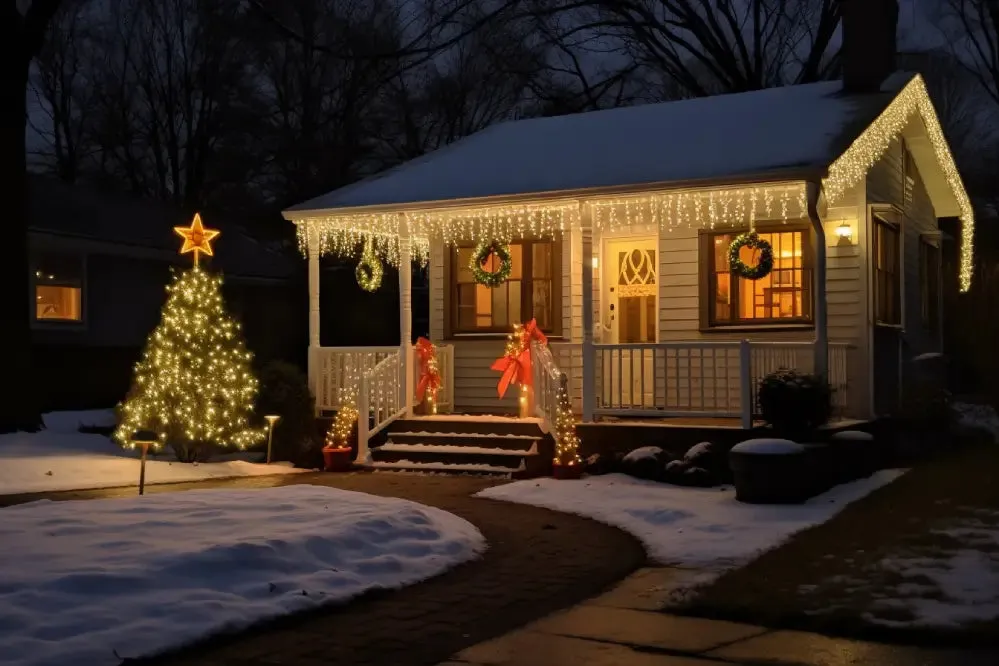
Here’s a number most people get wrong: red bows on a railing look best spaced 24 to 30 inches apart, not clustered in pairs. Tie them with floral wire wrapped around the back of the rail so the bow faces the street, and let the tails hang 8 to 10 inches — any longer and the wind will flop them sideways by New Year’s. Run the light strand along the inside face of the railing and the garland on the outside. You’ll hide the cord entirely and still get the glow bleeding through the greens.
4. Flocked Trees and Red Poinsettias Against White Brick
Recreating this pairing costs less than most people assume:
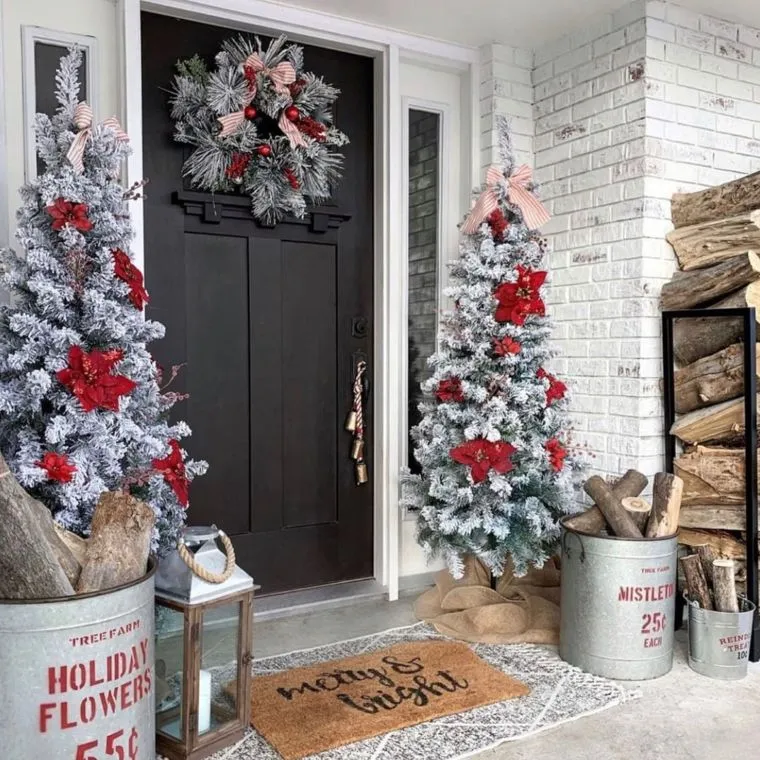
- Two flocked artificial trees (4–5 ft): $90–$220
- Red poinsettia picks and striped bows: $25–$55
- Galvanized buckets or planters: $30–$70
- Warm white tree lights and a frosted wreath: $25–$60
- Patterned outdoor rug and doormat: $45–$120
- Firewood, lantern, small decor: $20–$50
Total: roughly $235 to $575.
Budget alternative: two $40 flocked trees from Walmart, Dollar Tree poinsettia stems, and a pair of galvanized buckets from a farm store land near $140 — about 60% less.
Flocked trees shed. Not dramatically, but you’ll be sweeping white dust off the porch every few days, and wet flocking can gum into clumps, so this setup wants a covered porch or at least wide eaves. Galvanized buckets develop rust rings on concrete by season two; set them on a rubber mat or a scrap of slate. Silk poinsettias fade to a dull tomato after about three seasons of UV, so store them indoors when December ends.
5. A Lit Wreath on a Navy Door, Garland Wrapping the Arch
Scale is the whole ballgame with an archway. For a standard 36-inch door, garland 10 to 12 inches in diameter looks right; on a wide brick arch like this one, go 14 to 16 inches or it reads as a string of spaghetti. Wrap the garland in lights before you hang it, then fluff the branches outward so the wire disappears. And hang the wreath so its center sits at eye level, about 60 inches from the threshold, rather than centered on the door panel — the most common wreath mistake there is.
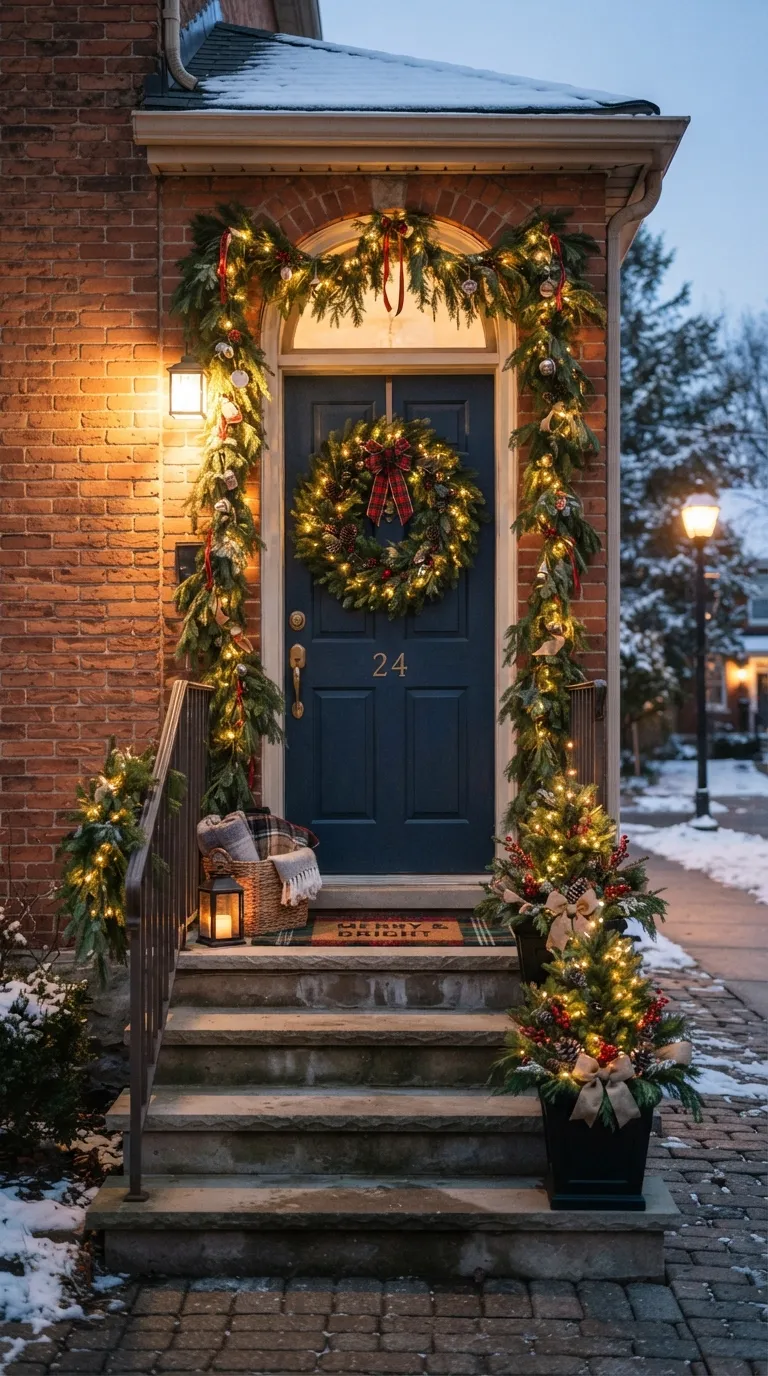
There’s a reason warm light looks so good on red brick. Brick reflects orange-red tones, and 2700K bulbs reinforce that instead of fighting it, which is why this porch feels like a fireplace even from the sidewalk. The wicker basket of plaid blankets does something subtler: it adds a soft, non-decorative texture that keeps the scene from looking like a catalog page. Deep green garland, navy door, warm bulb, wool plaid — four materials, one temperature. That’s the trick.
6. One Planter, Five Textures: Mixed Evergreens with Red Orbs
Build a planter like this in about 25 minutes for $35 to $55:
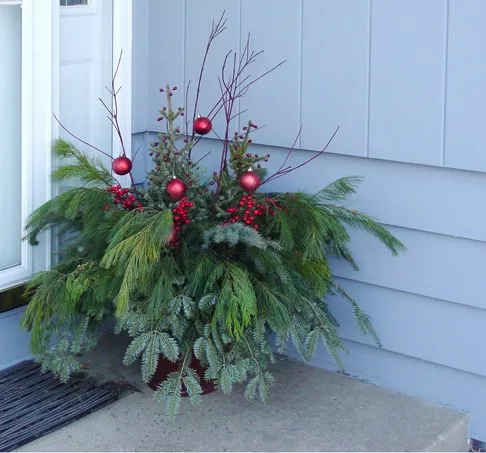
- Fill the pot two-thirds with soil, then press in a dome of chicken wire to hold stems upright.
- Start tall: push the thin dark twigs and any birch in first, angled slightly outward.
- Layer evergreens in three passes — long branches low, medium in the middle, short sprigs at the rim so nothing looks clipped.
- Tuck red berry clusters deep enough that the stems disappear.
- Cluster red ornaments in odd numbers, pushing them into the greens rather than resting them on top.
- Water lightly so the pot has weight; skip it if you’re using a foam base.
The visual recipe is roughly 55% evergreen green, 25% red, 15% brown twig and berry structure, and 5% whatever sits behind it — here, light blue siding, quietly doing a lot of work by helping the red pop without adding another color to the mix. Swap the siding for grey brick and the same planter turns moody; swap it for cedar shakes and it goes cabin-rustic. The proportions stay put. Only the backdrop changes.
7. Vintage Deer Head Wreath and a Red Blow Mold Candle
Vintage Christmas has been climbing on Pinterest for several seasons, and 2026 is the year the porch caught up. Blow molds, wooden figurines, and thrifted Santas are the tell. Part of the draw is nostalgia and part is fatigue with the glossy, matching big-box look — people want decor that looks like it came out of a grandmother’s attic, because it kind of did. Good news: this trend has real staying power. Blow molds were built to be reused, and a carved wooden deer head doesn’t go out of style the way a trendy color does.
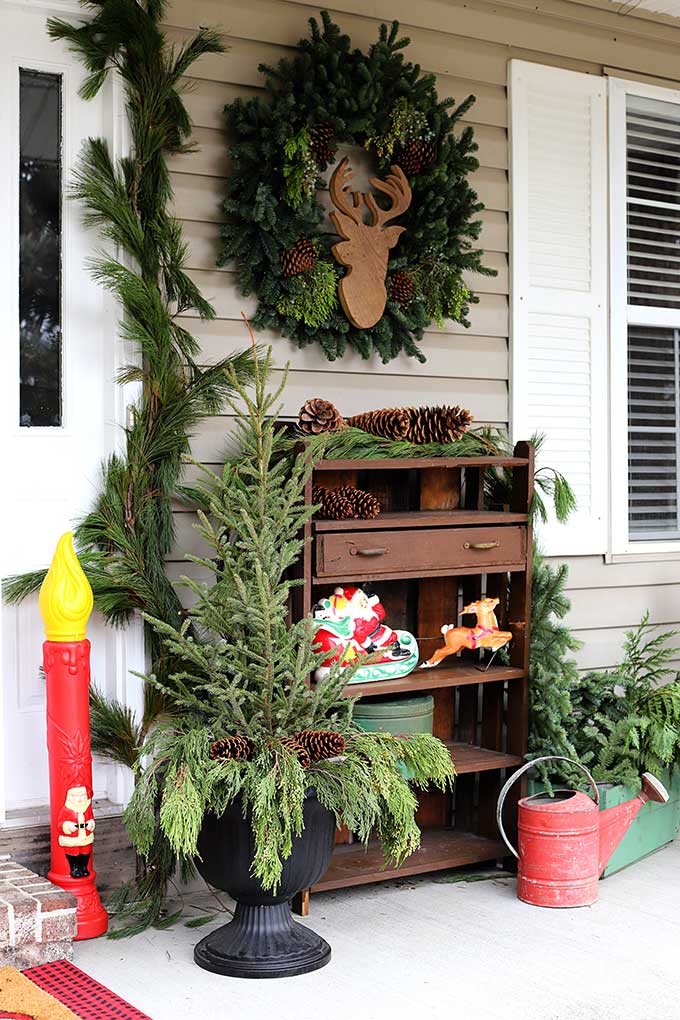
This is the cheapest look in the whole article to pull off, because it rewards hunting rather than buying. Blow mold candles and Santas run $8 to $25 at estate sales and thrift stores, and Marketplace in early December is full of them. A plain black urn is $15 at a garden center, and evergreen clippings are free if you know anyone with a pine tree and a pair of pruners. Budget $60 to $120 for a display like this one, and expect it to take three or four Saturday mornings of hunting.
8. Red Branches in Terracotta: Dressing a Brick Archway
This is a wide-entry look. You want at least 8 feet between the planters, which means an entry 7 to 9 feet across, and enough overhead clearance that 4-foot red branches don’t crowd the transom — figure 9 feet minimum. The planters themselves should be 18 to 22 inches in diameter; anything smaller gets swallowed and anything bigger blocks the walk. Porches narrower than 6 feet should skip this and try the bench-scale arrangement in Idea #15 instead.
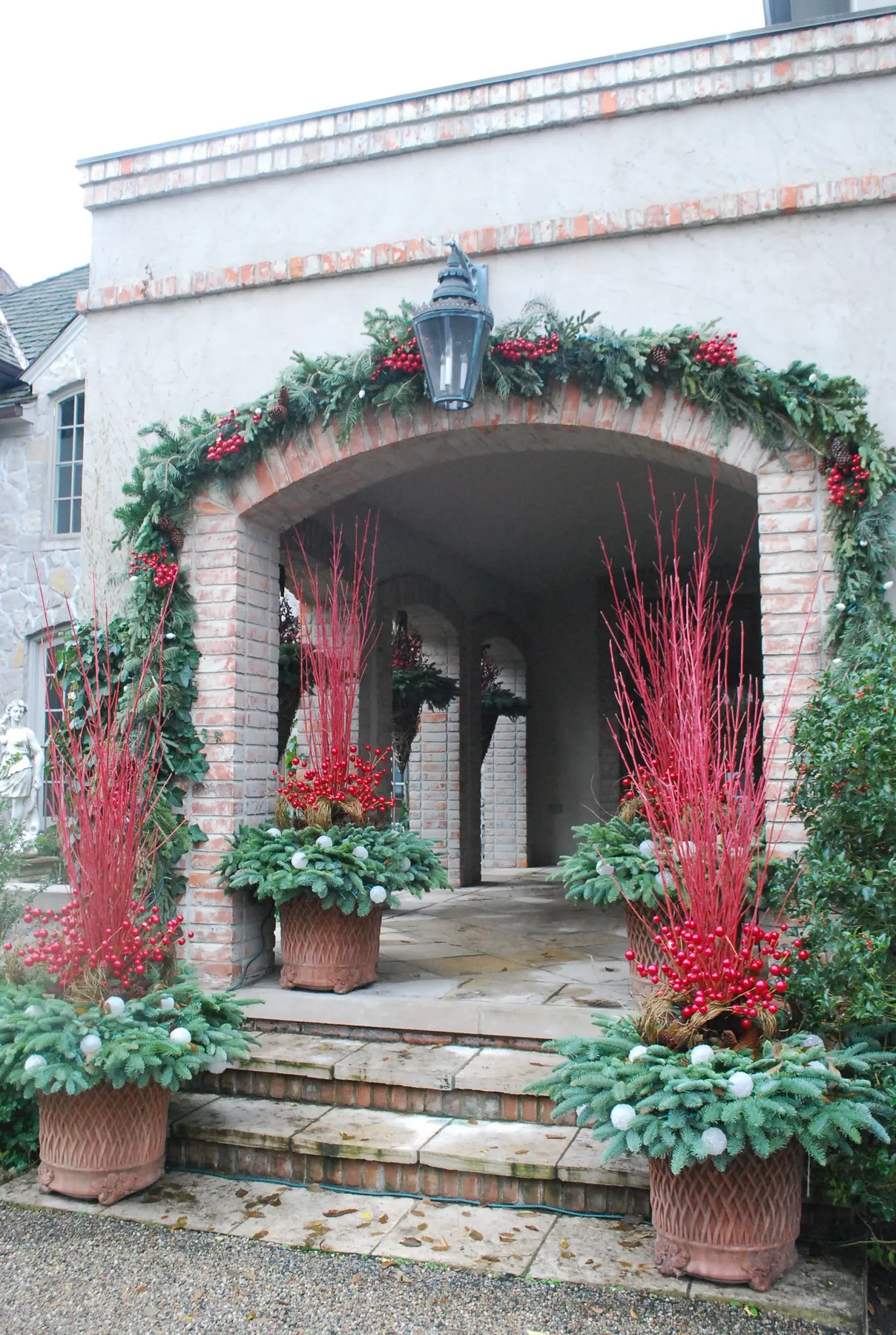
Strip everything else away and the element that makes this entry work is the tall red branches. Greenery alone would have been handsome but flat; the branches add a vertical line that carries your eye up to the arch and connects the planters to the garland above. Everything here is horizontal — the steps, the brick courses, the boughs — and the branches break that up. Without them, this porch would have been pretty. With them, it has a spine.
9. Trees Wrapped to the Trunk: The Snowy Lawn Light Show
Wrapping trunks looks incredible, but there’s a cost nobody mentions. Tight wraps trap moisture against bark and can encourage rot on thin-barked trees, and every spring you’ll be outside with cold fingers unwinding 400 feet of wire. Keep the wrap loose — a gentle spiral, not a mummy — and never wrap a tree under three years old. Coordinate with neighbors before you go this big, since a lawn this bright throws light into bedrooms across the street. Compare with Idea #23, where the glow is concentrated into a few showpiece figures instead of spread across the whole yard.
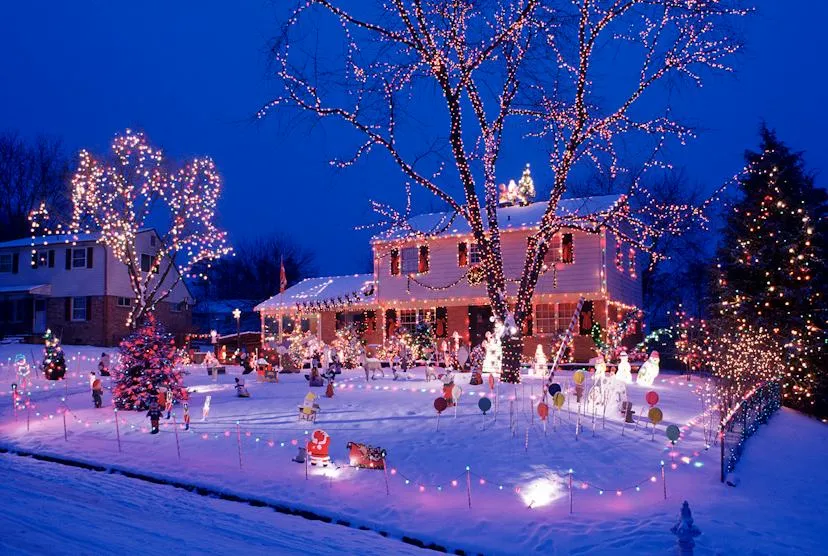
Here’s the wrapping math that saves you a return trip: for a 6-inch trunk about 12 feet tall, you’ll need roughly four 100-foot spools of LED strand wrapped at 6-inch spacing to reach the first branches. Start at the base, spiral upward, and keep the plug end at the bottom where your extension run lives. Commercial-grade spools cost more up front but survive four or five seasons, which works out cheaper than replacing $12 big-box strands every single year.
10. Birch Logs, Buffalo Check, and a Slatted Wood Crate
This one takes about 20 minutes and $45:
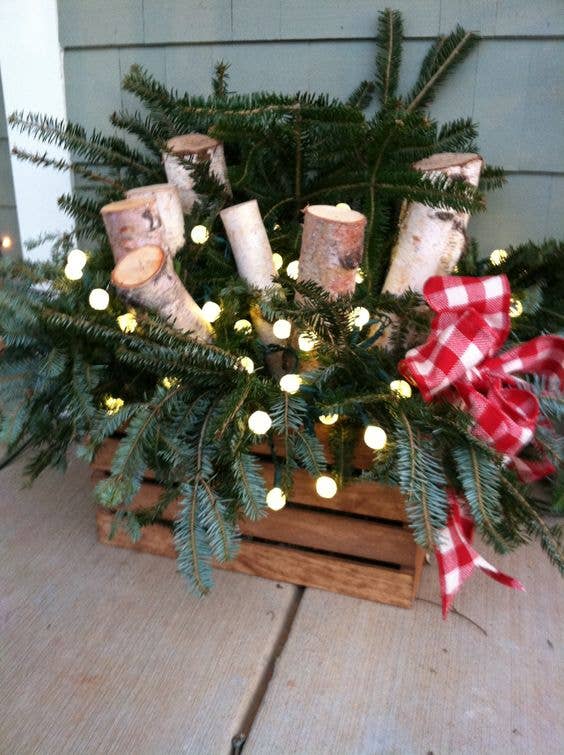
- Set the crate in place first — it gets heavy fast once it’s full.
- Line the bottom with a plastic liner so wet greens don’t stain the wood.
- Stand three birch logs upright at the back, varying the heights by a few inches.
- Tuck evergreen branches in front and to both sides, letting them spill over the rim.
- Weave a battery strand through the greens, hiding the pack behind the logs.
- Tie the buffalo check bow to one side of the crate, slightly off-center.
- Slatted wood crate: $18–$45
- Birch logs (3): $15–$35, or free from a friend’s woodpile
- Evergreen branches: $10–$25
- Battery string lights: $8–$20
- Buffalo check ribbon: $6–$14
- Floral wire and clips: $4–$8
Total: about $60 to $150, and most of it packs away for next year.
11. A Porch Table Set for Cocoa: Copper Pots and Fairy Lights
The genius of this setup isn’t the styling — it’s the implication. A table with mugs on it tells anyone walking past that people sit here, which is a completely different message than a porch with decor on it. The copper and terracotta pots repeat warm metal and warm clay, so the light bouncing off them seems to come from three places at once. And the light level stays low — tiny fairy lights, one distant tree, a single lantern — which is what makes an outdoor space feel like a room instead of a stage.
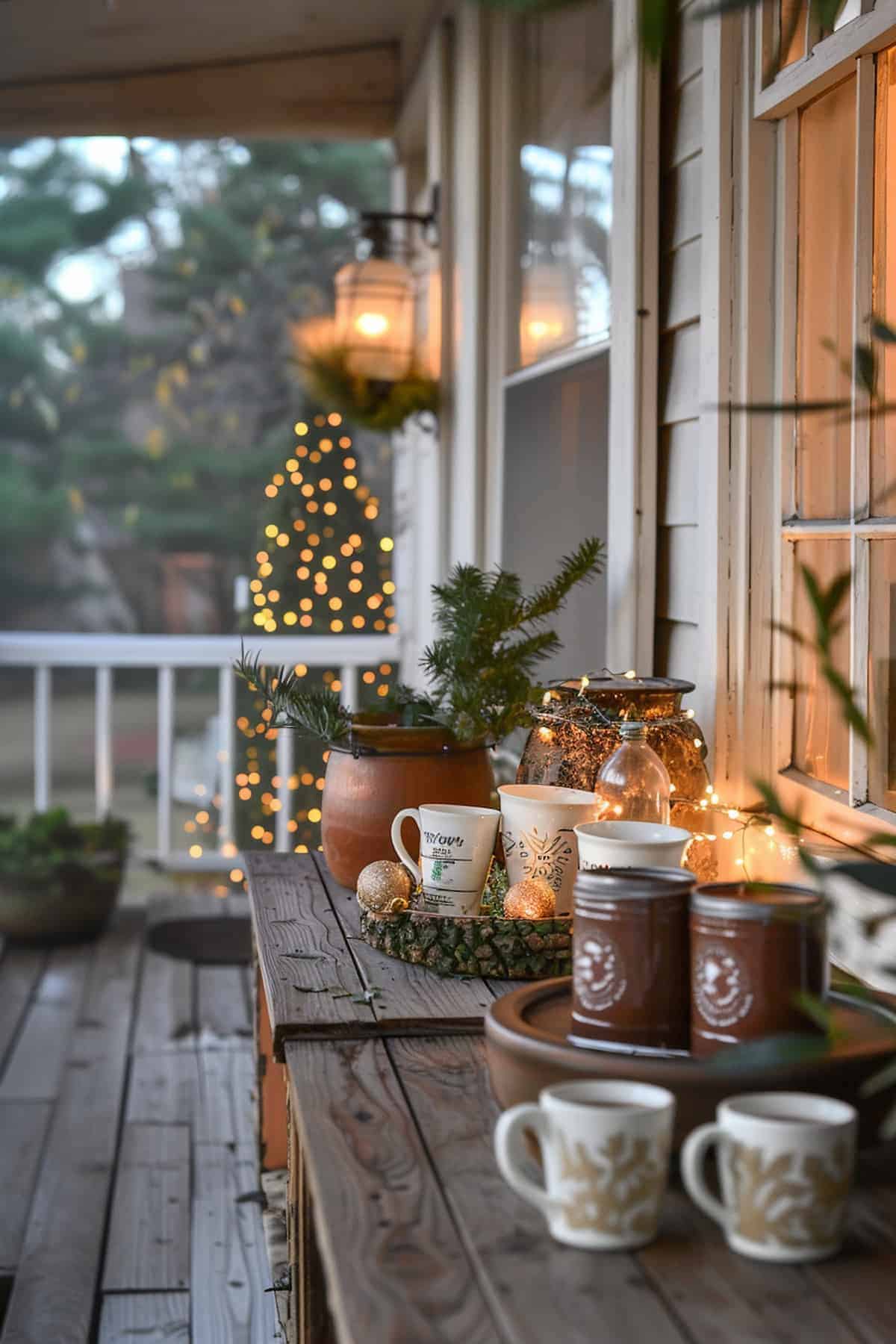
Porches have been quietly becoming real rooms for a few years now, and 2026 is when the trend hit the holidays. People who spent 2020 and 2021 fixing up backyards started looking at the front of the house, and the results are showing up in saved pins: coffee bars on porches, sectional seating tucked under the eaves, mugs staged like a magazine shoot. The draw is obvious. Holiday decor is up for six weeks; a porch set up for actual sitting gets used for twelve months.
12. Cardinals, Curly Willow, and a Champagne Ruffled Bow
Read this arrangement as a recipe: 50% evergreen boughs, 20% neutral structure from the birch logs and curly willow, 15% red between the berries and the cardinals, 10% champagne ribbon, and 5% texture pieces like the woven twig spheres. That last 5% is what separates a nice planter from one people photograph. The birch does double duty as both a color and a shape, giving the arrangement its height. Swap the red for white berries and the champagne for matte black and you’d have a completely different, moodier planter using the exact same proportions.
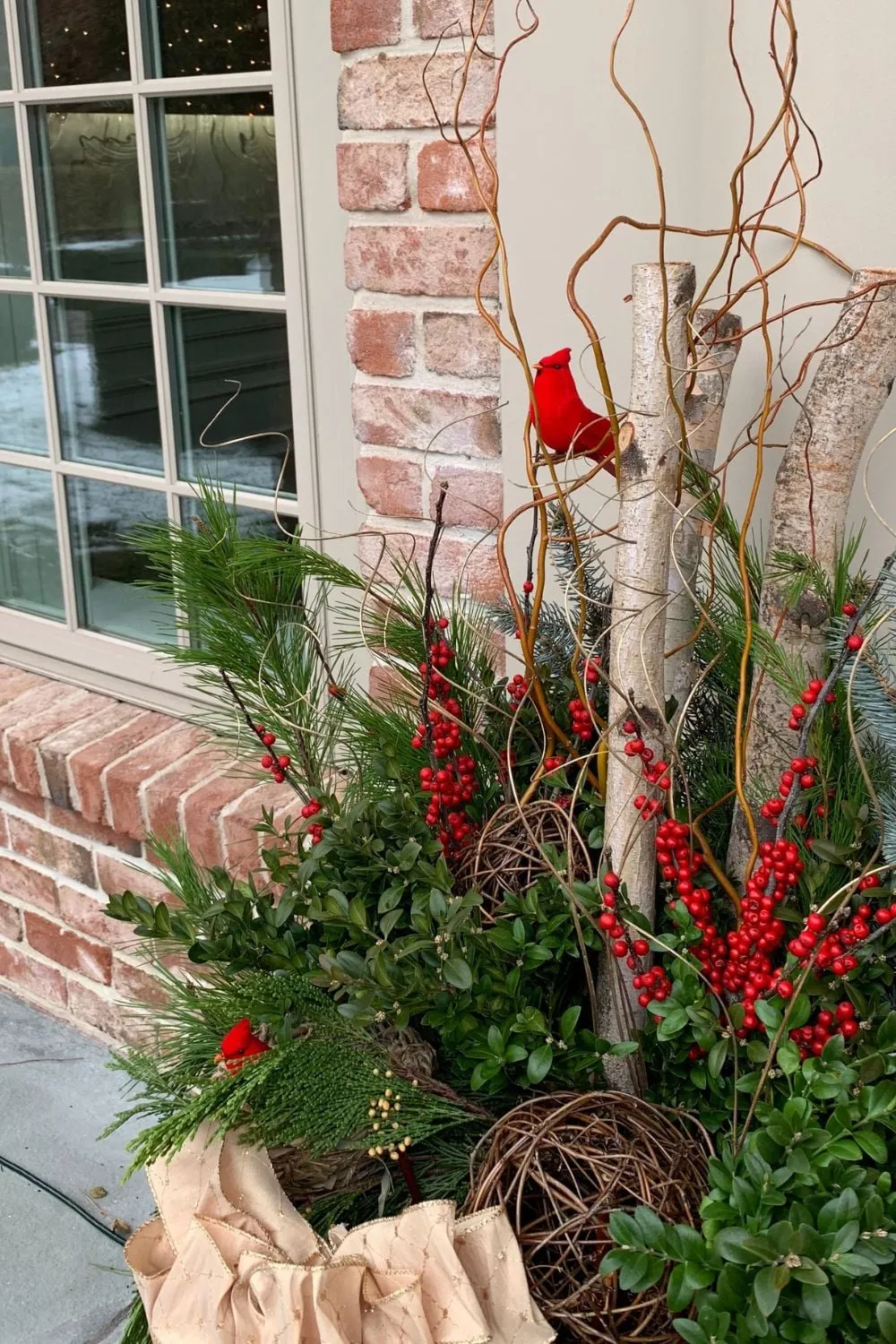
Two rules govern this kind of planter. First, odd numbers: three birch logs, three twig spheres, three berry clusters. Even numbers look arranged; odd numbers look gathered. Second, height ratios — the container should be about one-third of the finished height, so a 12-inch pot with greenery topping out near 36 inches. If your planter looks squat, it’s almost always because the greenery isn’t tall enough, not because the pot is too big. Add height before you add width.
13. Red Door, Red Sled, Buffalo Plaid on the Banister
Plenty of porches get the wreath and the urns right. What makes this one feel lived-in is the sled leaning against the banister — a real wooden one, propped at an angle with a buffalo plaid blanket draped over it. It’s the element that says a person lives here rather than a display company. The wreath announces the season and the urns frame the door, but the sled is where the story is. Move it off to the side and the porch loses its warmth immediately.
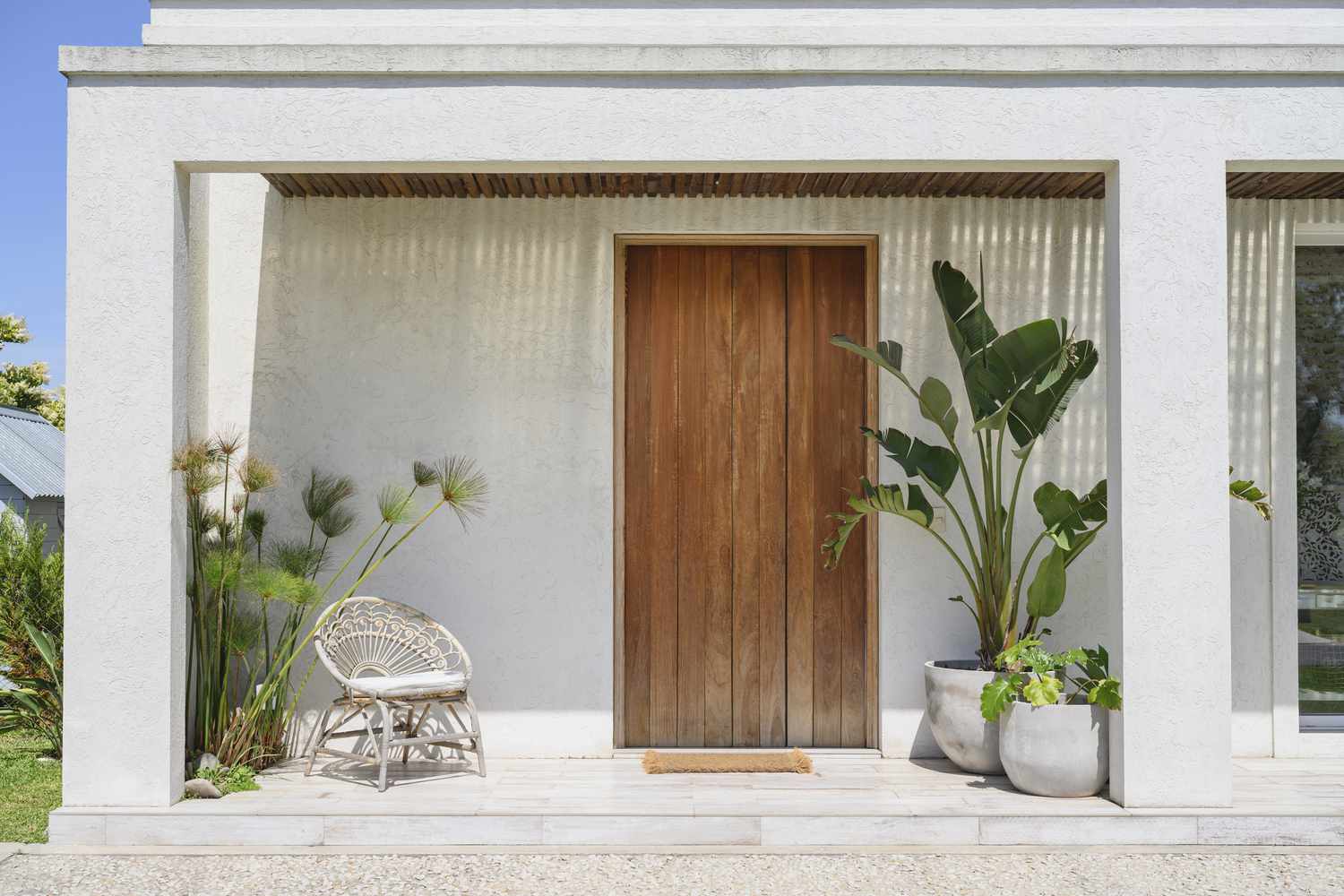
Anything with real wood needs to come inside when the weather turns wet. Sleds with wood runners will warp and split after a season or two outdoors, and old paint flakes off in sheets. Buffalo plaid comes in everything from wool to acrylic — outdoors, choose acrylic, because wool holds water, gets heavy, and smells like a wet dog by February. One word on flocked urns: flocking sheds when it’s dry and clumps when it’s wet, so give them a spot under an overhang and keep a can of spray snow handy for touch-ups in early December.
14. Frosted Wreath and a Merry and Bright Doormat
This is the budget read on Idea #4 — same white-and-red palette against a pale wall, about half the spend. Target flocked tabletop trees run $25 to $50 and look nearly identical to the specialty ones. Dollar Tree poinsettia picks are $1.25 each and read fine from four feet away, which is where people actually stand. IKEA lanterns land around $15 to $25, galvanized buckets turn up at farm stores for under $10, and a plain buffalo-check ribbon goes further than a pre-tied bow. Budget $150 to $200 for the whole front step.
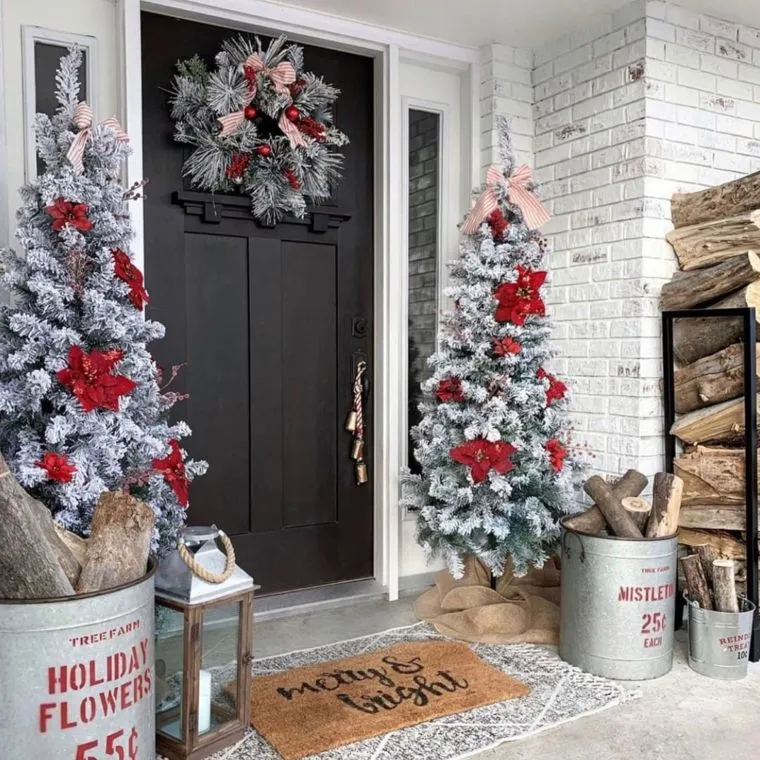
Layering rugs at the door is a five-minute job with one rule: size. Put a 20-by-32-inch doormat on top of a 2-by-4-foot outdoor rug and leave at least six inches of rug showing on all three visible sides. Any tighter and it looks like a mistake; any wider and the doormat looks stranded. Center the mat on the door’s opening, not on the step, and pick a rug pattern with some contrast so the doormat reads as a deliberate layer instead of an accident.
15. A Handled Basket of Pinecones and Cream Fringe
Small-space secret: a handled basket does everything a planter does at a third of the weight and half the footprint. Pick one 16 to 20 inches wide and skip anything taller than 12 inches, or it blocks the sightline to your door. Deal with the battery pack before you style anything — tuck it under the greens at the back, or drop it into a shallow bowl hidden inside the basket. Space those tiny fairy lights about four inches apart as you weave. Bunch them up and they look like a tangle; spread them out and they look like they were always there.

This arrangement is made for a stoop, a narrow porch, or a bench — anywhere from four to six feet wide, which covers most city entryways. On a 48-inch bench, one 18-inch basket sits perfectly centered; a 60-inch bench wants two, set about 12 inches in from each end. If you’re working with a wide brick archway instead, this basket will read as an afterthought. Go bigger there and try the terracotta planters in Idea #8.
16. Natural Elements with a Gold Wreath as the One Shiny Thing
Before you hang anything, run through this list:

- Measure your door width — a wreath reads best at about half to two-thirds of that measurement.
- Check where the outdoor outlet is and how far a cord has to travel.
- Confirm what your door material can hold; a nail in hollow-core steel isn’t going to work.
- Decide where everything lives in January before you buy it in November.
Five minutes with a tape measure saves a returned wreath and a second trip.
Natural materials have been the quiet story in holiday decor for a couple of years — undyed wood, twine, raw linen, and foraged greens instead of plastic. Gold is the exception people keep making, and it works because it’s the one metallic that reads warm rather than cold. Put a gold wreath against bare wood or stone and it looks collected. Put it against glitter and tinsel and it disappears. In 2026 the mix is holding steady: skip the shiny, keep the gold, let everything else stay matte and natural.
17. A Snowy Deck, a Red Plaid Rug, and Gifts Under the Tree
This setup needs real square footage. Count on a 10-by-12-foot deck minimum if you want a full-size decorated tree plus seating — a 6-foot tree occupies roughly a 3-foot circle and the armchair needs another 3 feet of clearance behind it. The rug is where people get it wrong: it should extend at least 24 inches past the front edge of your seating so chairs sit fully on it, not half off. Anything smaller and the rug looks like a bath mat that wandered outside. On a tighter deck, see how Idea #24 handles the same red plaid idea in less space.
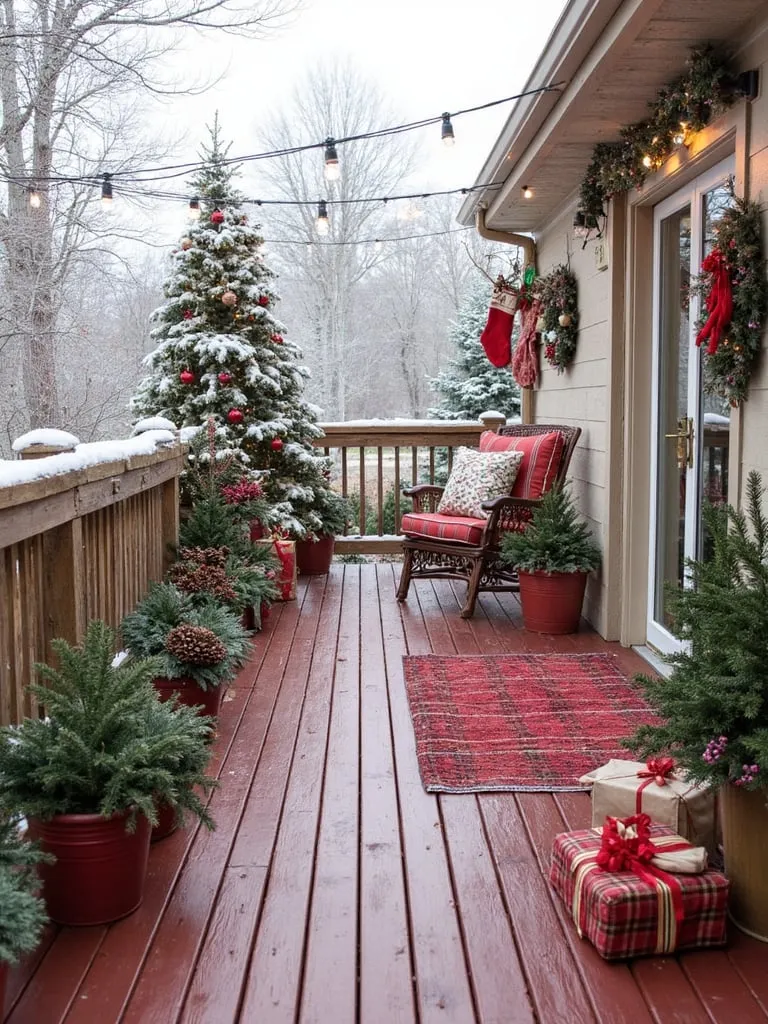
- Decorated artificial tree (6–7 ft): $120–$350
- Red plaid outdoor rug (5×8): $60–$150
- Potted evergreens in red planters (4): $80–$200
- Outdoor string lights: $25–$60
- Wrapped gift boxes and ribbon: $30–$70
- Festive cushions: $25–$60
Total: roughly $340 to $890.
Budget alternative: a $60 Walmart tree, a $35 discount-store plaid rug, and greens cut from your own shrubs get you close for about $180.
18. Dried Oranges and a Gold Nutcracker on Sage Green
Sage green is a forgiving door color, and this entry leans on that. A green wreath on a green door sounds like a mistake until you see it working — the tonal match lets the dried orange slices and white ornaments do all the talking, so your eye goes straight to the small details. The gold nutcracker supplies the one thing the palette was missing: a hit of shine at ground level. Everything else, from the trailing ivy to the potted fig to the white gift box, sits back and lets three colors do the job.
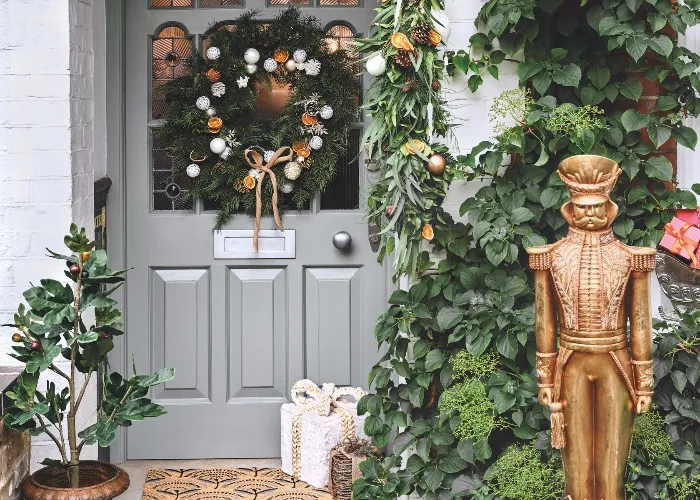
Dried orange slices look beautiful and behave badly outdoors. In wet climates they go soft and dark within two weeks; even in dry air, direct sun bleaches them to beige by January. Give them a coat of matte polyurethane if you want them to last the season. A painted nutcracker is fine under an overhang but will peel in the rain, and a heavy one can tip in a stiff wind — sand the base or anchor it against the wall. The potted fig is the sleeper issue: most need to come indoors below 40 degrees, so plan its winter spot before you buy it.
19. Candlelight and Pre-Lit Trees Around a Light Blue Door
Everything on this porch is doing a job, but the cluster of real candles in lanterns is the element that makes it feel like a home instead of a display. LED string lights are consistent and safe; a real flame flickers, shifts color slightly, and throws moving shadows across the siding. That unpredictability is the entire point. If open flame makes you nervous — and with kids or pets it should — battery pillar candles with a flicker setting get you most of the way there.
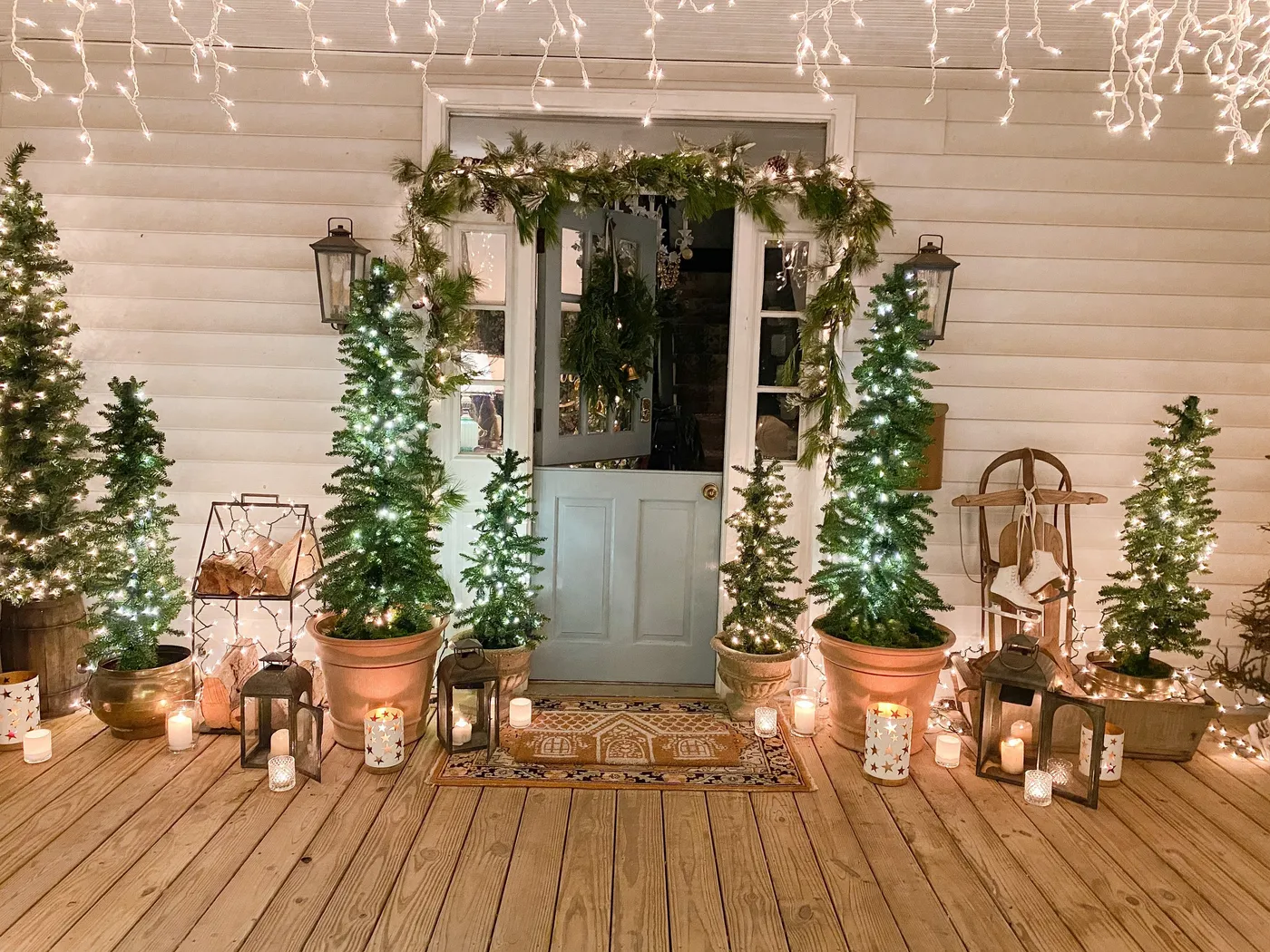
Staggering pre-lit trees takes about 15 minutes and costs nothing:
- Pick three heights, roughly 18 inches, 3 feet, and 5 feet.
- Place the tallest at the corner furthest from the door, where it won’t compete with the entry.
- Set the shortest one directly beside the door frame at an angle, not squared to the wall.
- Put the middle tree on the step below, slightly forward of the other two.
- Drape one continuous strand of icicle lights above all three so they read as a single group.
20. Symmetry in White: Flocked Minis on a Striped Rug
The math is 65% white and pale grey, 20% warm white light, 10% dark accents — the lantern, the rug border, the tree trunks — and 5% silver. That dark 10% is what keeps an all-white porch from washing out into a blur, so don’t skip the lantern even though it’s tempting to keep everything light. The formula swaps beautifully: change the rug to a navy-and-white stripe and the porch turns coastal, or trade the flocked trees for dark green ones and it becomes a more traditional entry altogether. The proportions hold either way.
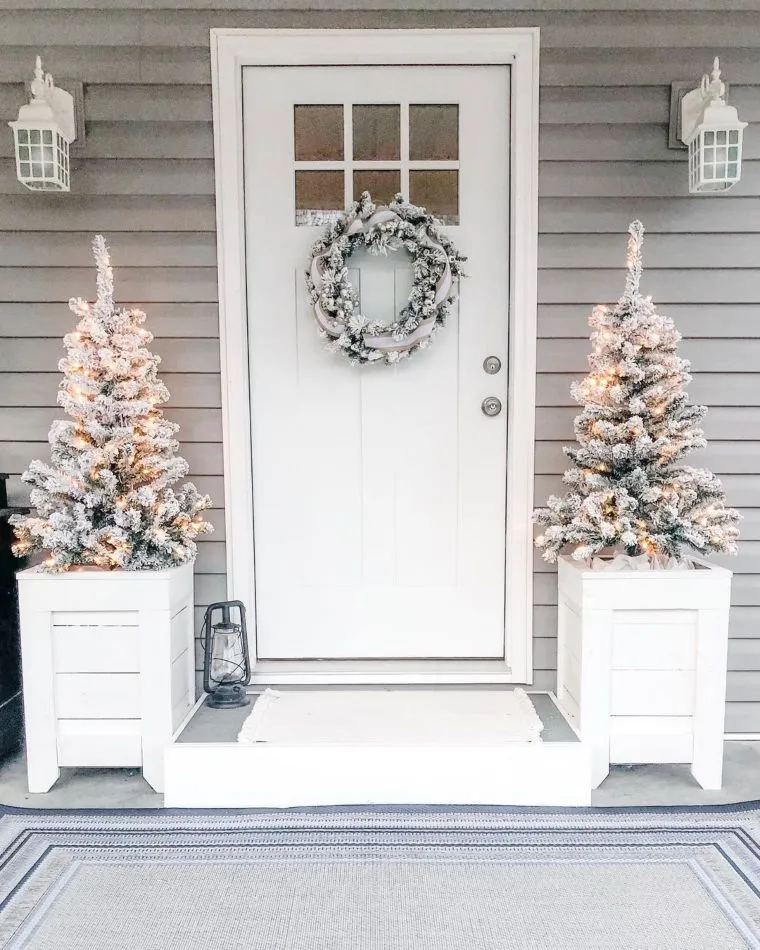
Run through this before committing to a symmetrical setup:
- Measure both sides of your door — plenty of porches aren’t as even as they look, and a 4-inch difference will be obvious with matching planters.
- Check step depth. Anything under 11 inches won’t hold a planter and a lantern without crowding.
- Confirm the outlet location and whether a cord will show.
- Lift one planter filled with soil before you buy two — wet containers get heavy fast.
21. A Stone Fireplace, Pom-Pom Tree, and Skates by the Fire
A covered porch with a fireplace is a beautiful thing, and also a damp one. Faux fur throws and cable-knit pillows are not outdoor textiles — bring them in after every gathering or they’ll hold moisture and smell sour by January. Hang stockings from a garland rather than a metal hook screwed into stone, and keep everything at least 36 inches from an active firebox. Check whether your vintage sled and ice skates are actually worth something before leaving them outside for six weeks; a fair number of them are.
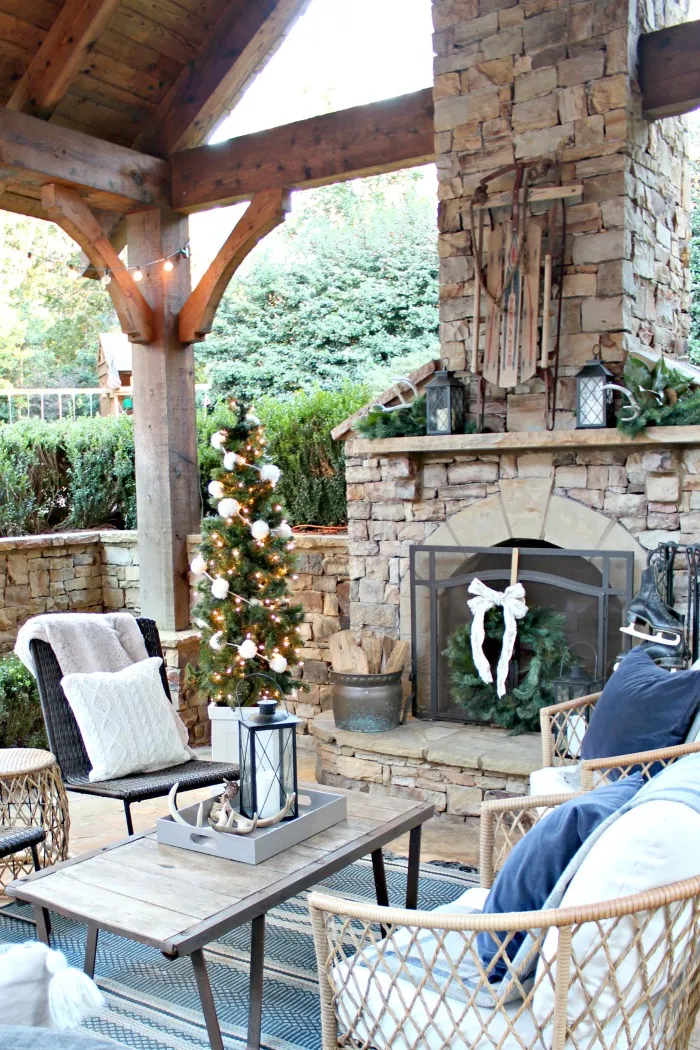
You don’t need a stone fireplace to borrow this feeling. A fire pit table with a low flame does 80% of the work, and a chimney-style outdoor heater plus a wool blanket gets you sitting outside in December for about $150. Woven chairs like these run $120 to $300 each new, but Marketplace in late fall is full of outdoor furniture people are clearing out. Thrift stores are the best source for vintage sleds and skates — $10 to $30, and nobody will know the difference.
22. Stockings on an Outdoor Mantel with a Roaring Fire
The mantel here follows the same layering rule as a good indoor shelf: something vertical at the back — in this case two small mirrors leaning against the stone — something horizontal in front, and three heights of candle holders to keep the eye moving. The garland runs the full width and then some, which visually widens the whole fireplace. And a real fire in the box means every decorative element gets backlit, which is why the stockings read even from across the yard.
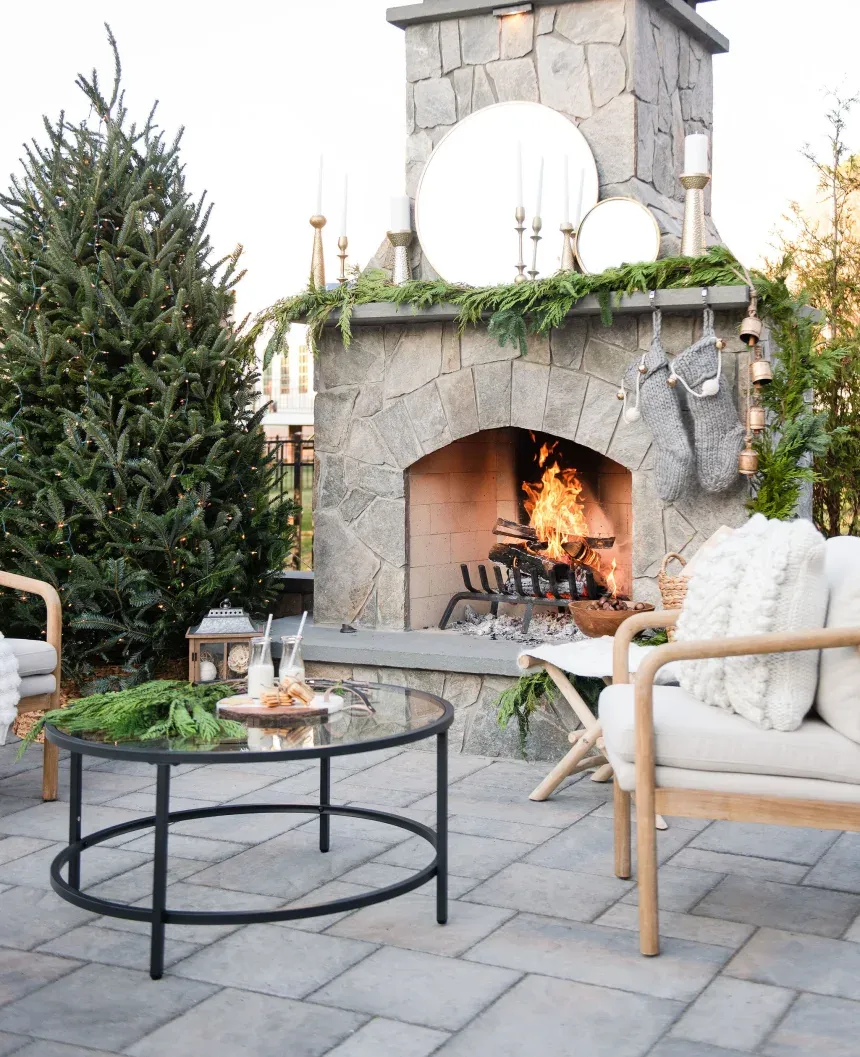
An outdoor fireplace as a focal point needs room to be a focal point. Plan on a patio at least 12 feet deep and 14 feet wide, with 36 inches of clear hearth space in front of the firebox and seating pulled back another 4 feet. Ceiling height matters too — if the porch roof sits below 9 feet, the fireplace will feel like it’s wearing a hat. Smaller patios do better with the bench-and-basket scale in Idea #21, which delivers a similar feeling in half the footprint.
23. Golden Reindeer with Red Beads Under a Lit Gazebo
Oversized light-up figures have been the story of the last three holiday seasons, and 2026 is when they went gold. The shift is partly technological — modern LEDs are bright enough to make a metallic finish glow instead of just sparkle — and partly taste. After years of inflatables, shoppers want rigid pieces that stand up to wind and can be repaired instead of replaced. Gold reindeer sit in a sweet spot because they work with warm white and multicolor lights both, and they should stick around: durable, repairable, and readable from the street.
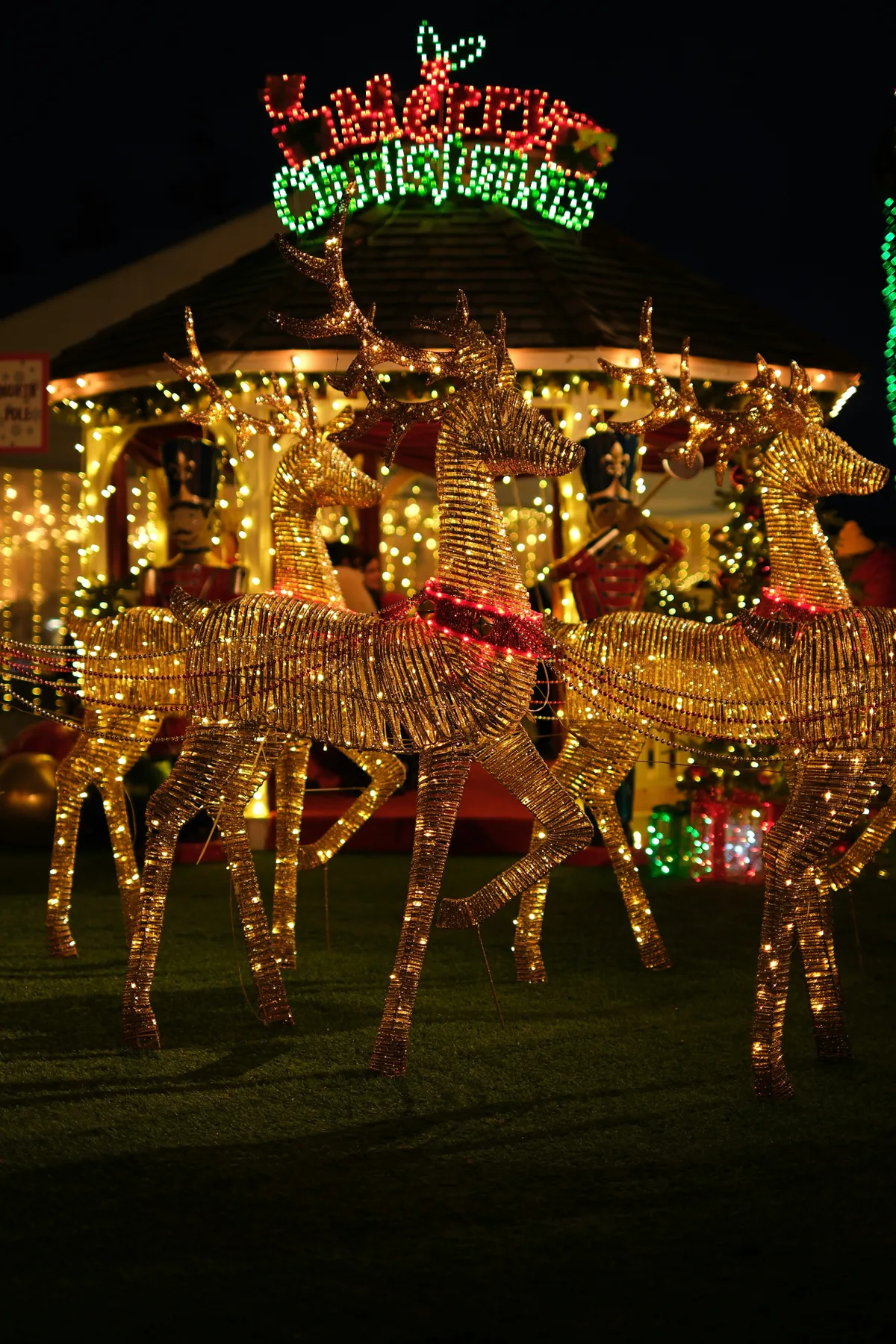
- Light-up reindeer figures (2–3): $120–$400
- Warm white string lights for the gazebo: $40–$90
- LED Merry Christmas sign: $45–$120
- Nutcracker figure and gift box decor: $50–$150
- Artificial turf or ground cover: $40–$120
- Extension cords, stakes, timers: $25–$50
Total: about $320 to $930 for a yard that lights up a whole block.
24. Plaid Underfoot: Wicker Seating on a Red Plaid Rug
The balance here is about 45% red plaid, 30% evergreen, 20% beige wicker and cushions, and 5% black metal. Red is a loud color, so it only works when something quiet holds it down — that’s what the neutral wicker and the stone pillars are doing. If you wanted to soften this porch for a smaller space, drop the plaid to a runner instead of a full rug and let the green take the bigger share. Same pieces, gentler voice.
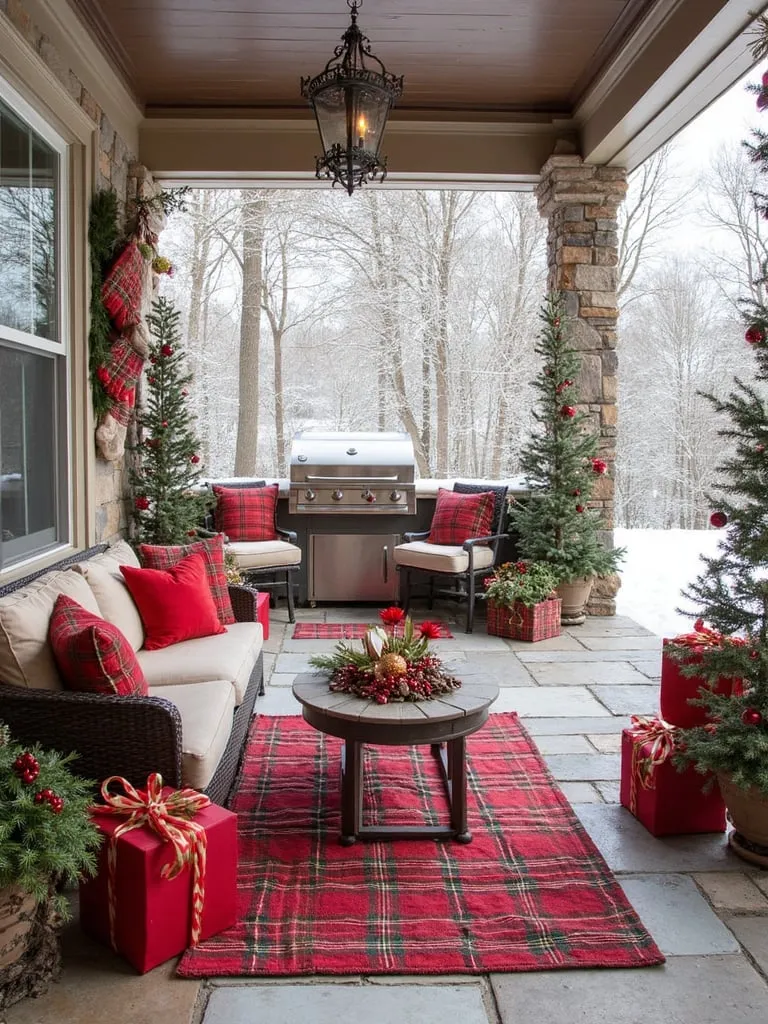
The plaid rug is the reason this porch feels like a room. Without it, you’d have wicker furniture with some trees around it — pleasant, forgettable. The rug defines the seating zone, gives the eye a boundary, and tells everyone where the conversation happens. It also does something practical: it hides a concrete or composite floor that would otherwise look bare in photos and cold underfoot in December. If you buy one thing from this list, buy the rug.
25. Black Rocking Chairs and a JOY Sign Made from Fence Panels
Two numbers worth remembering. On rocking chairs, an 18-inch pillow insert inside a 20-inch cover is the sweet spot — bigger and it swallows the seat back. And wreaths on windows or doors look right when the top of the wreath sits about one-third of the way down from the top of the frame, so on a standard 80-inch door the hanger goes around 54 to 58 inches. Any lower and the wreath looks like it slid. The painted fence-panel JOY sign works for the same reason the chairs do: everything sits on one consistent height line.
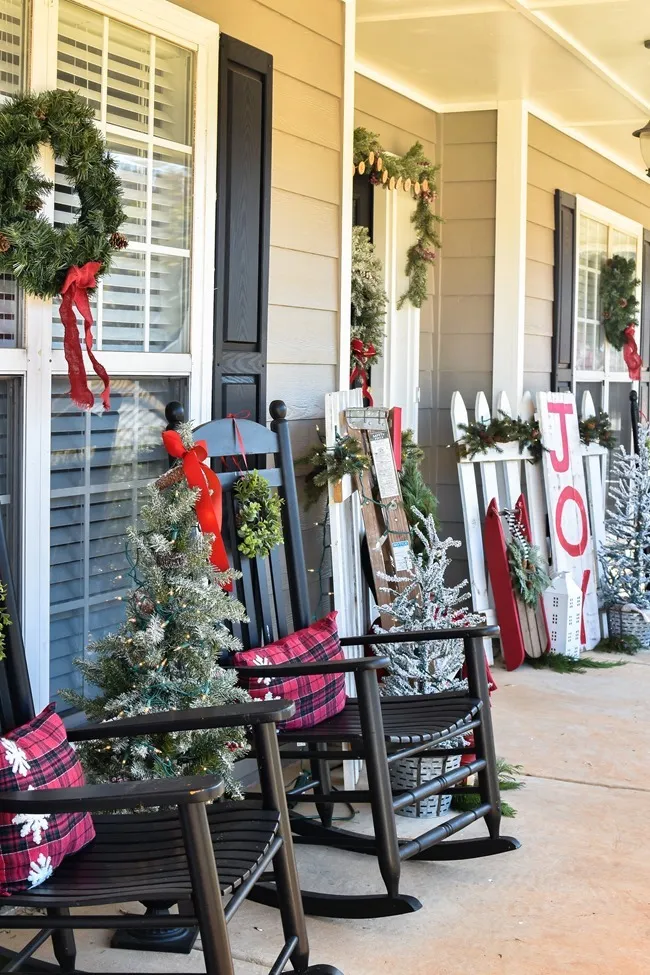
Rocking chairs on an exposed porch will move in the wind, and in a gust they will move into each other. Add felt pads to the runners and turn them slightly toward the door when they’re not in use. Plaid pillows in acrylic survive a season of sun; cotton ones fade to a dull pink by mid-December. Flocked mini trees are light enough to blow right off a porch, so put a brick or a sandbag in the bottom of each container, especially if your porch faces west.
26. Mesh Ribbon Garland on the Railing (and a Wire Angel)
Securing garland so it survives wind takes about 15 minutes per 8 feet and runs $25 to $45:
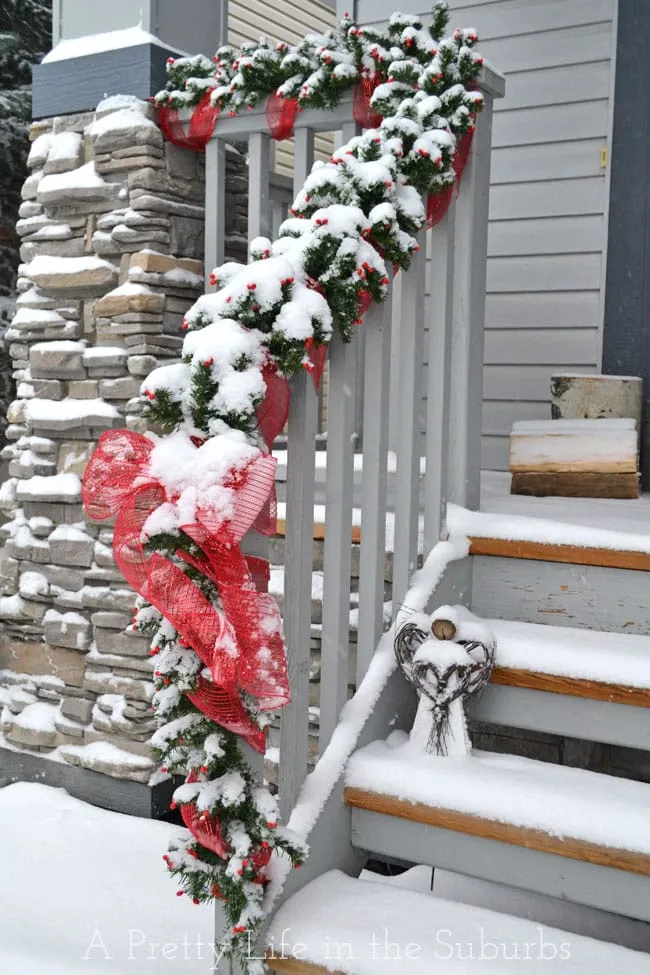
- Zip-tie the garland to the railing every 12 inches — clear ties on light railings, black on dark ones.
- Weave the lights through the greens before you attach anything, working bottom up.
- Thread the mesh ribbon through in loose S-curves rather than wrapping it tightly.
- Build the bow separately, then wire it to the railing post at the corner, not to the garland.
- Trim the tails at an angle so they hang evenly.
Mesh ribbon is inexpensive and it looks it after about six weeks. UV turns it brittle, the edges fray into a fuzzy halo, and by season two it’s usually done — so buy it assuming it’s a one-year item. Snow load is the bigger concern: wet snow can add 10 pounds to every 8 feet of garland, which is why it needs to be tied to the structure and not just draped. A wire angel on a snowy step will rust, so seal it before it goes outside.
27. Distressed White Metal Trees Beside a Charcoal Door
Distressed metal trees are one of the most overpriced items in holiday decor — $60 to $90 each at full retail. Buy them from the January clearance bin for $15 to $30, or check resale sites in November when people realize they have too many. Galvanized buckets are $8 to $15 at a farm supply store and look exactly like the designer ones. Add a wooden chair you already own, a $12 pillow, and a thrift-store sled, and the whole entry lands under $200 instead of $500.
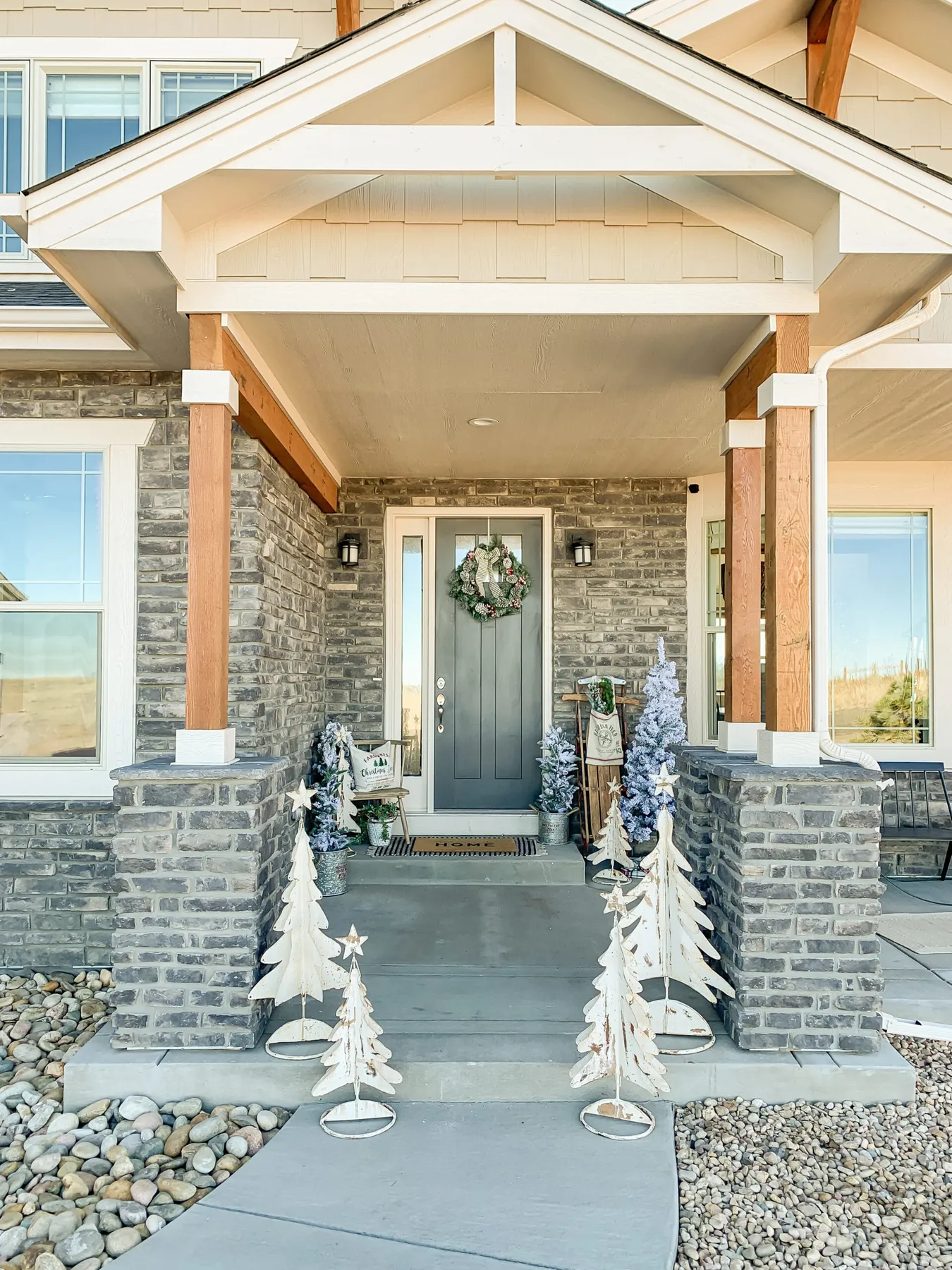
The palette breaks down as roughly 40% charcoal and stone, 25% white, 25% evergreen, and 10% red. That heavy neutral base is what makes the small red details land so hard — a plaid ribbon, a berry cluster, a few ornaments. Move those proportions around and the porch changes personality: bump red to 25% and the whole thing becomes traditional Christmas; cut red to zero and it becomes a winter porch that works through February. The charcoal door holds either version.
28. Fresh Oranges and a Pineapple Wreath on a Colonial Porch
Colonial porches with columns need garland measured in segments, not one long strand. Count your columns first: a typical covered porch has four to six, spaced 8 to 10 feet apart. You’ll want about 9 feet of garland per column for a proper drape that hangs 18 to 24 inches below the top. Window boxes underneath need roughly 6 inches of clearance from the siding for airflow, or fresh greens will rot against the house. This is a big-house look — if your entry is under 6 feet wide, the planter styling in Idea #8 will read better.
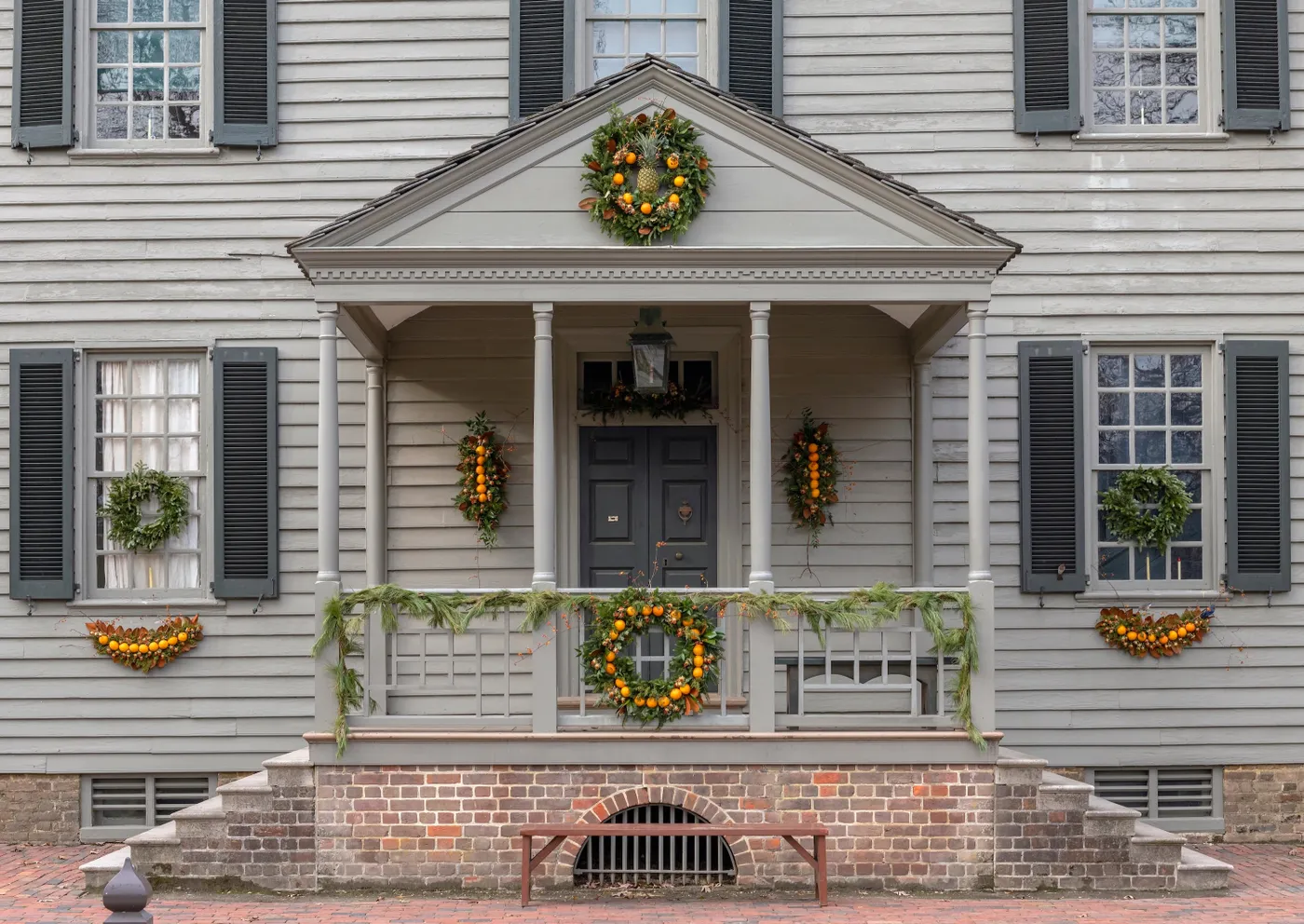
- Fresh pine garland, 40–60 ft: $120–$300
- Pineapples, oranges, and citrus for swags: $35–$80
- Window box greens: $40–$90
- Wreath form and floral wire: $20–$45
- Outdoor light strands: $30–$70
Total: roughly $245 to $585.
Budget alternative: buy garland by the case from a local tree lot in early December — they sell greens cheaply at the end of the day — and a few boxes of clementines do the same visual job as fancy citrus.
29. Lit Topiaries with Red Velvet Bows, Flanking a Dark Door
Two lit topiaries are what make this entry read formal. The wreath and garland are lovely, but a wreath on a door is a basic move — the topiaries are what turn a porch into a threshold, creating a frame around the entry that your eye passes through. Take them away and the door is decorated. Keep them and the door is announced. If you only buy two things for a formal entry this year, these are the two.
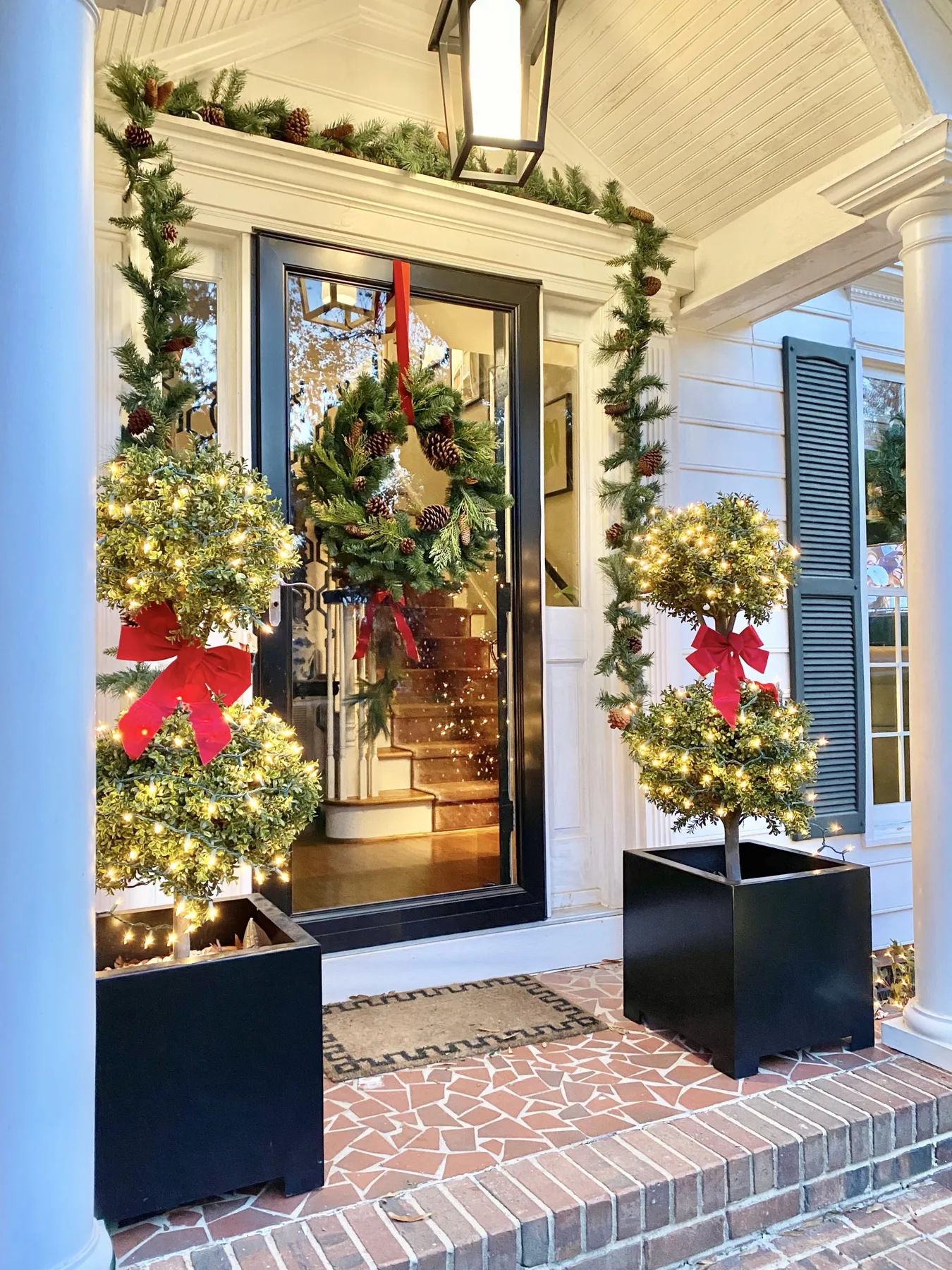
Verify these four things before you order a pair:
- Measure from the door frame to the porch edge — you need at least 20 inches on each side for a planter and a walking gap.
- Find your outdoor outlet and check whether a cord will cross the walkway.
- Confirm the planters have drainage holes if you’re using real soil.
- Test the weight of one filled planter; two heavy containers on a wood porch can leave dents.
30. Wreaths on Every Window: The White Clapboard Classic
Repetition is the entire design here. Identical wreaths on every window, evenly spaced, turn a plain facade into a grid — and grids read as order, which is why white clapboard houses with dark shutters respond so well to this treatment. The centered entry, with its columns, lit lantern, and topiary pair, creates a deliberate break in the rhythm so your eye lands exactly where it should. Warm string lights on the bushes add a soft base layer, keeping all that symmetry from feeling cold.
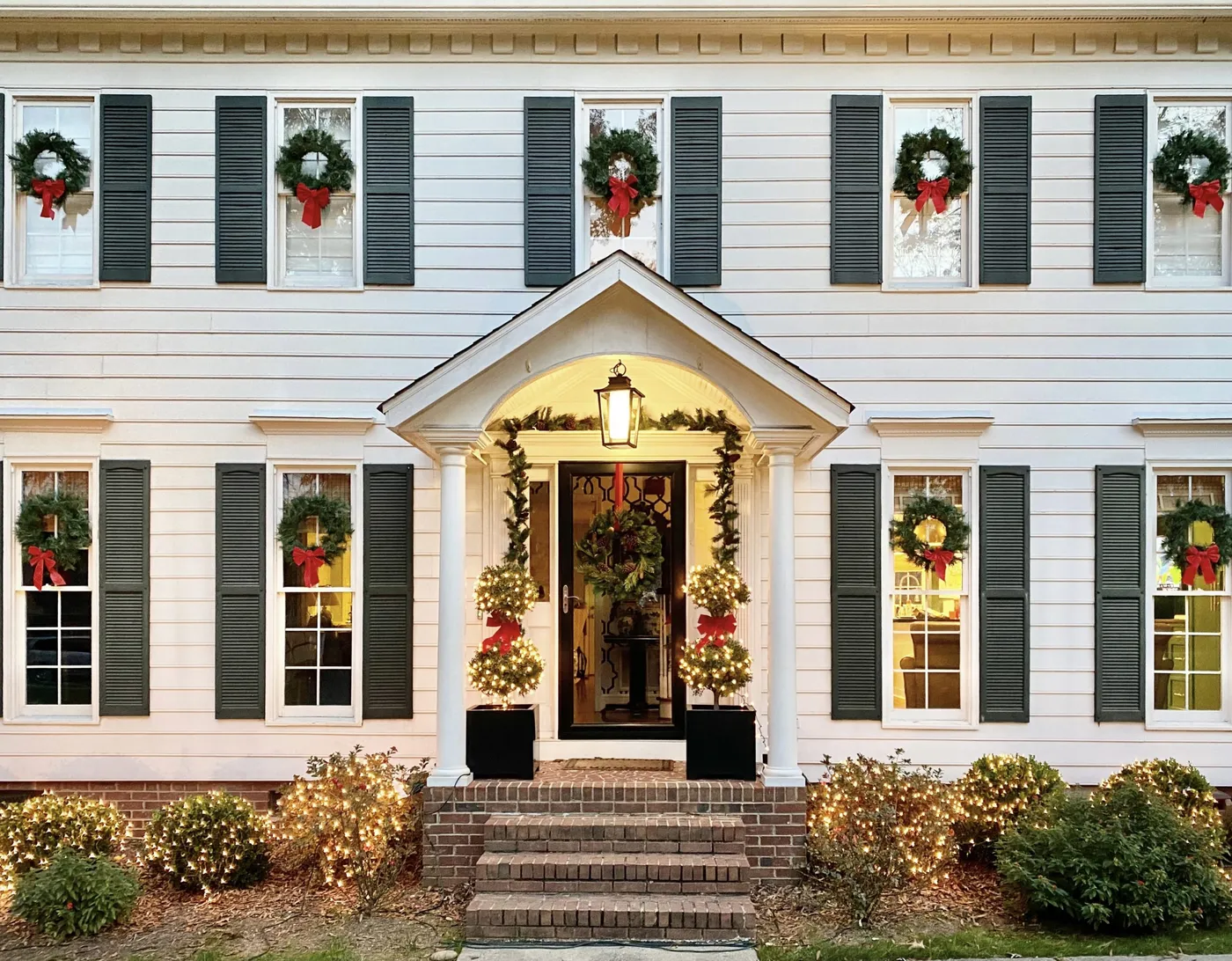
- Green wreaths with red bows (6–10): $180–$550
- Lit topiary trees in black planters (2): $140–$380
- Warm white string lights for bushes: $60–$150
- Garland for the entry: $35–$90
- Extension cords, timers, clips: $30–$70
Total: about $445 to $1,240 — the biggest line item is always the wreaths, so buy them off-season.
Budget alternative: DIY wreaths from $8 grapevine forms plus clearance greenery cost about $25 each, so six for $150.
31. Magnolia, Lotus Pods, and Red Pears on a Dark Green Door
Wreath sizing has a simple formula: diameter should be about half to two-thirds the width of your door. On a 36-inch door, that’s an 18-to-24-inch wreath, which is bigger than most people buy and exactly why so many store-bought wreaths look small. When you build a layered wreath like this one, work in three passes — greens first, then medium elements like berries and lotus pods, then the large focal pieces, placing the pears at roughly 10, 2, and 6 o’clock so they’re never symmetrical.
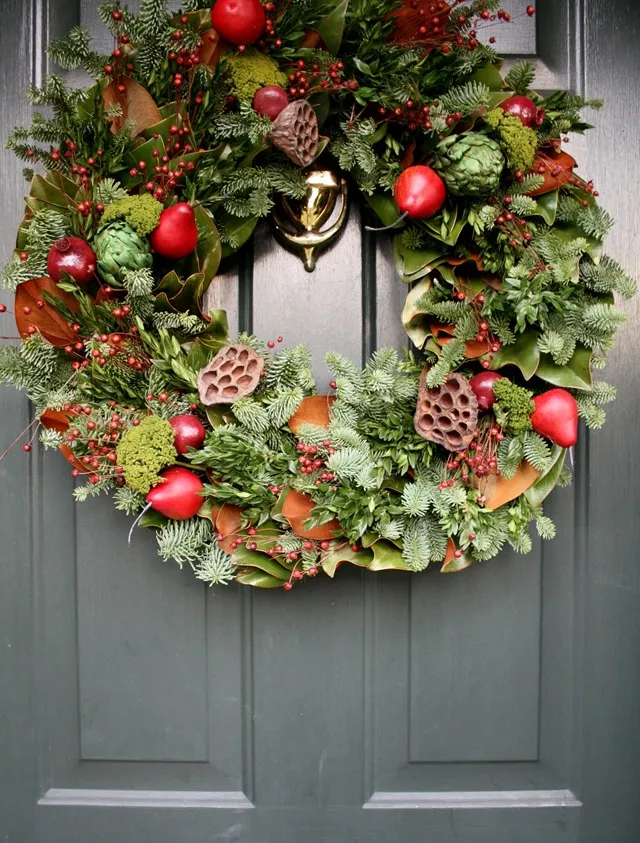
Wreaths built from real dried botanicals are beautiful and slightly high-maintenance. Magnolia leaves curl and brown in dry indoor heat; real fruit will attract wasps and eventually soften, so keep those outdoors under cover only. Lotus pods hold up well but go brittle after a season and can shed their seeds. If you want this exact look with none of the fuss, use silk magnolia leaves and faux pears, then stash the whole thing in a wreath box instead of hanging it in the garage.
32. A Skiing Santa Takes Over the Black Slatted Bench
The mix is roughly 50% black — bench, shutters, window frames — 25% white between the brick and the plaid throw, 15% red from the pillows and the Santa, and 10% grey. Black grounds everything and makes a big red-and-white figure feel intentional instead of goofy. If your porch is already dark, swap the black bench for natural wood and the proportions still work; you’ll just get a softer, more rustic read on the same idea.
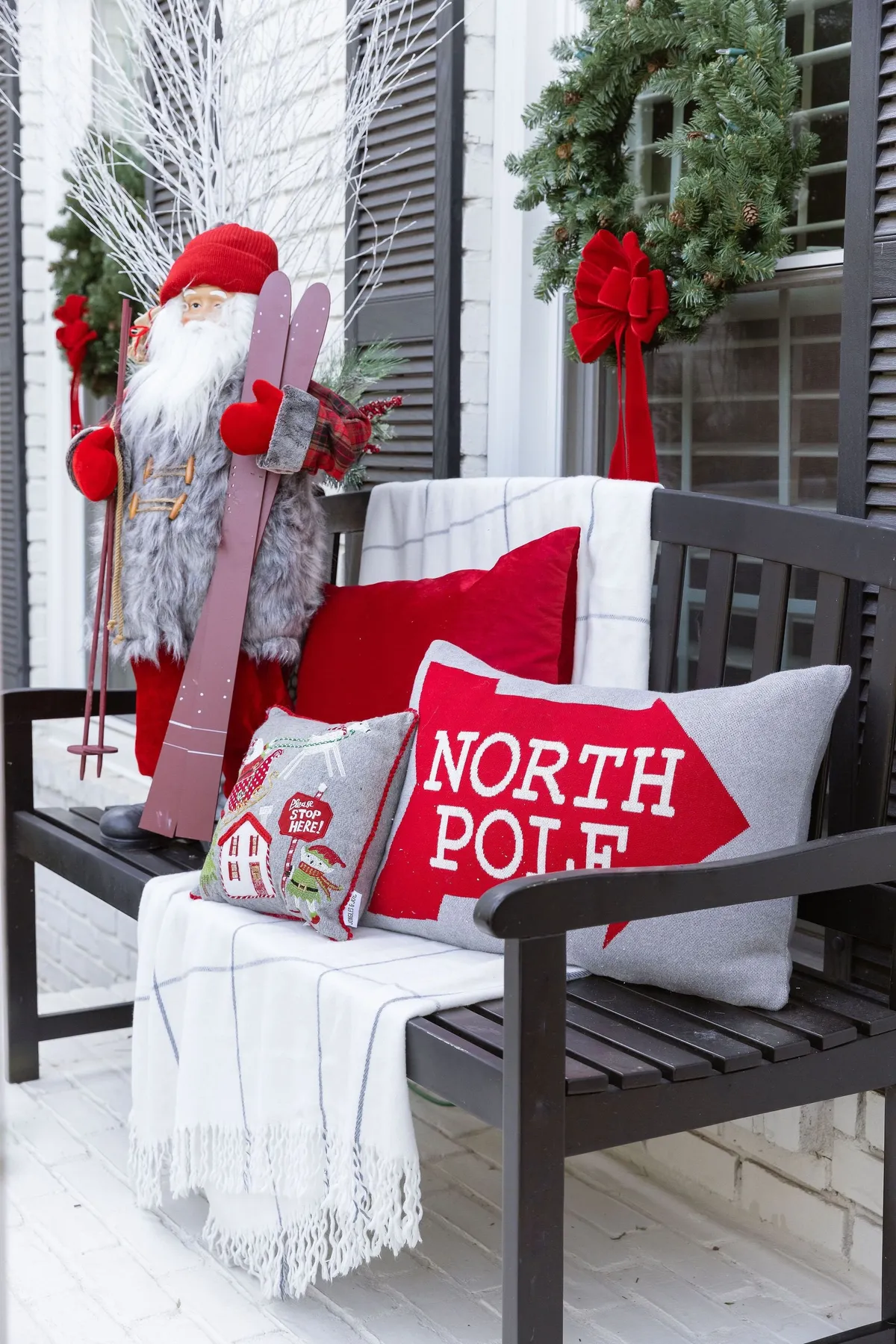
A display bench invites a practical question: do you actually want to sit here? A Santa with skis takes up most of the seat, so treat this as a styling bench and keep a second chair free for real use. Account for wind, too — a large lightweight figure on a slatted bench will tip unless you anchor it or weigh the base. And on white brick, every bit of road dust and exhaust shows, so a quick rinse in November keeps the whole setup looking crisp through the holidays.
Your Porch Gets Its Moment This December
Pick the one idea that fits the width of your entry, start with the lights, and let everything else follow — porches are forgiving that way, and nobody has ever walked up to a house and wished it had been more tasteful. Try one thing you haven’t tried before: a real flame, a plaid rug, a star-topped tree in the yard.
📌 Save your favorite before you head to the store — you’ll want it when December gets here.