26+ Jaw-Dropping Christmas Window Box Ideas You Absolutely Need to Try in 2026

You know that feeling when you spot a window box across the street — evergreen spilling over the rim, a red bow catching the porch light — and you quietly think, mine could look like that.
After filtering through hundreds of options across Terrain, Etsy, Lowe’s, and Amazon, we narrowed it down to 26 ideas that actually deliver, from $25 berry picks to $450 full custom installs.
Inside you’ll find 26 curated picks spanning traditional evergreen and red velvet, rustic woodland with birch and corrugated tin, gold-and-frost shimmer, and a few gloriously unserious snowman setups — with budget and luxury versions compared side by side.
2026’s holiday curb appeal is all about layering real texture — mixed conifers, birch, dried hydrangea — instead of one flat garland, which is exactly why these saves are climbing on Pinterest right now.
Pin this guide for later — your future self will thank you when it’s time to actually do this. And stay until the end, because we break down the most common mistakes that can quietly ruin these looks.
1. Birch Branches and a Picket Fence in One Planter
There’s a reason this planter reads as collected rather than decorated. The vertical birch branches and slivers of white picket fence break the round, mounded shape of the pine and spruce, so your eye keeps traveling upward instead of stopping dead at the rim. Then the palette does the heavy lifting: deep green and red handle tradition, while blue-and-white striped ornaments and white-tipped pinecones keep it from tipping into candy-cane territory. Repetition of globe shapes — ornaments, berries, pinecones — ties four different materials into one coherent idea.
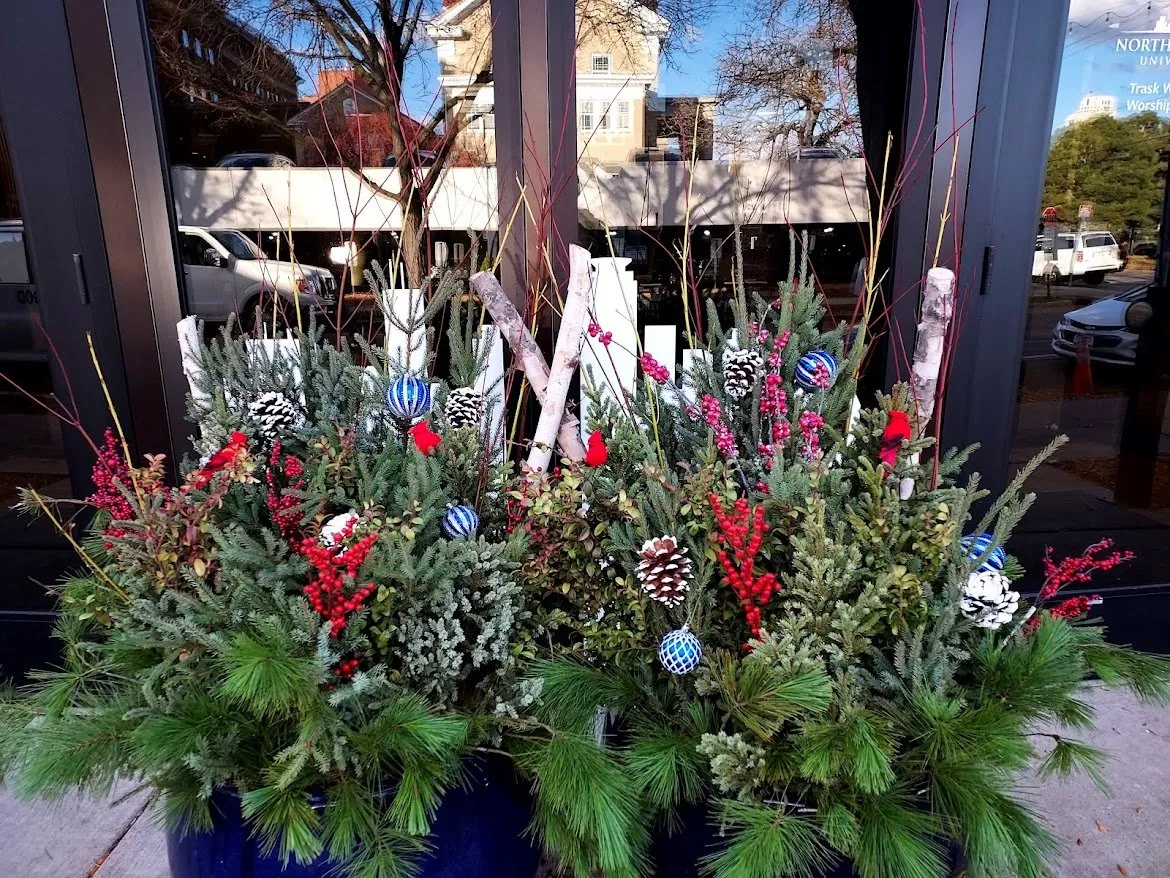
- Large outdoor planter: $40–$120
- Mixed evergreen bundles (pine, spruce, cedar): $35–$90
- Birch branches: $15–$40
- Ornaments, berries, white-tipped pinecones: $25–$70
- Salvaged picket fence pieces: $10–$35
- Total: $125–$355 for one statement planter
Budget alternative: skip the salvage fence and use a thrifted wood crate set on its side. Facebook Marketplace greenery bundles run $10–$20 the week after Thanksgiving, and one bundle split between two planters looks fuller than you’d expect.
2. The Nighttime Window Box That Glows From the Street
Count your lights before you count your bows. A box this size wants roughly 100 warm-white mini bulbs per 9 feet of garland, and they should sit inside the greenery so you see glow, not wires. Wrap the strand around the garland’s spine first, then push individual bulbs up through the needles toward the street. Choose 2700K–3000K bulbs — anything cooler turns the red bows pink in photos and makes the whole box look clinical instead of candlelit.
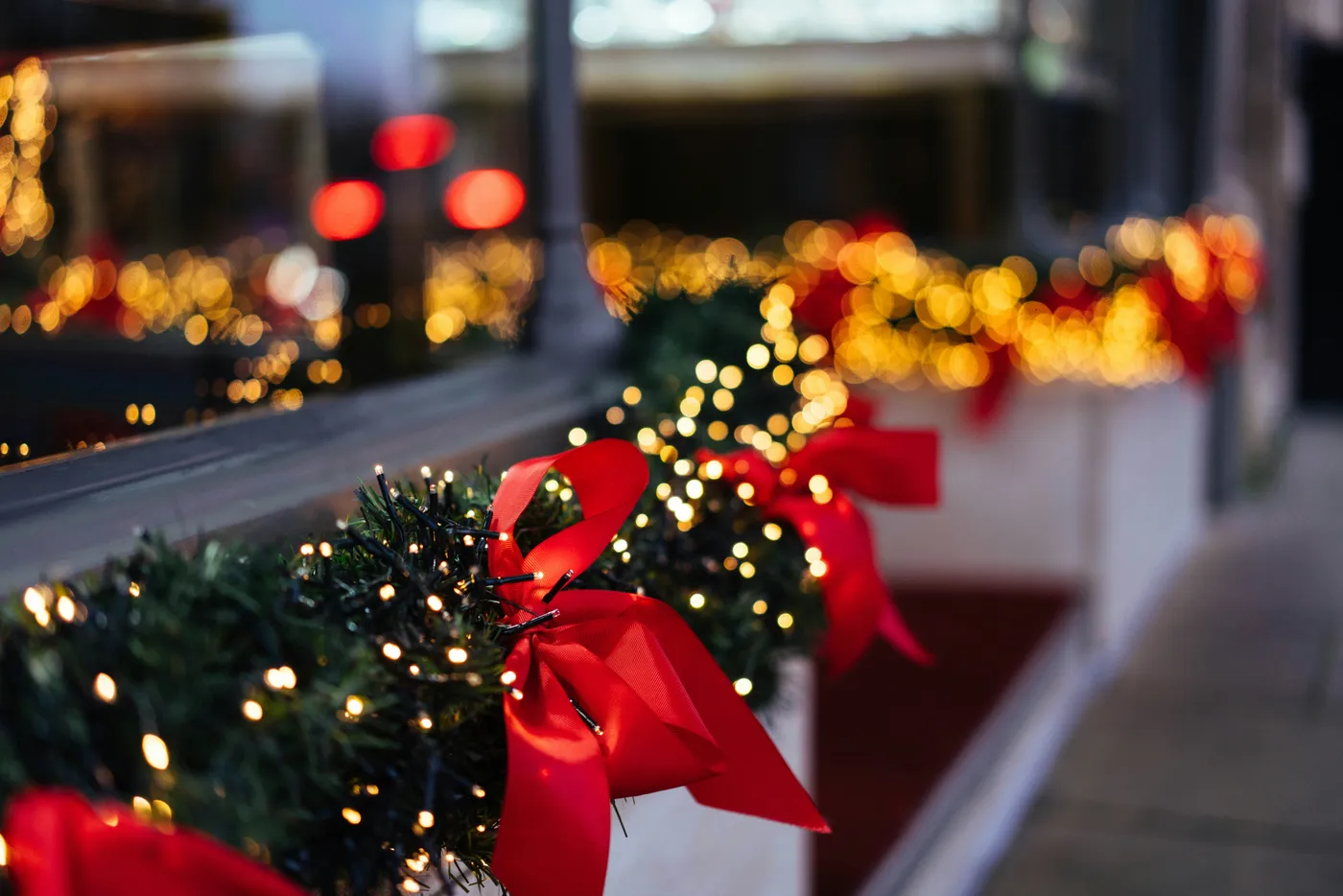
The bows are the entire idea. Without them you have a pleasant green rectangle glowing at dusk: pretty, but anonymous. What makes it a front-door moment is scale — each bow is wide enough to read from the sidewalk, not the porch step, and tied with tails long enough to fall into the needles rather than sit on top like stickers. Three to five per box at uneven intervals, and you get depth instead of a row of polka dots.
3. Gold, Copper, and Chartreuse Globes in a White Box
The formula here is 60% forest green base, 25% mixed metallics, 10% natural brown, 5% red. What stops the metallic mix from looking like a craft-store bin is that the globes are close in size and matte-to-satin in finish — gold, copper, and that odd, wonderful chartreuse. Swap the metallics to all silver and pewter for an icy Scandinavian read, or keep the metals and trade the red velvet bow for a plaid wool scarf. The proportions stay, the mood changes completely.
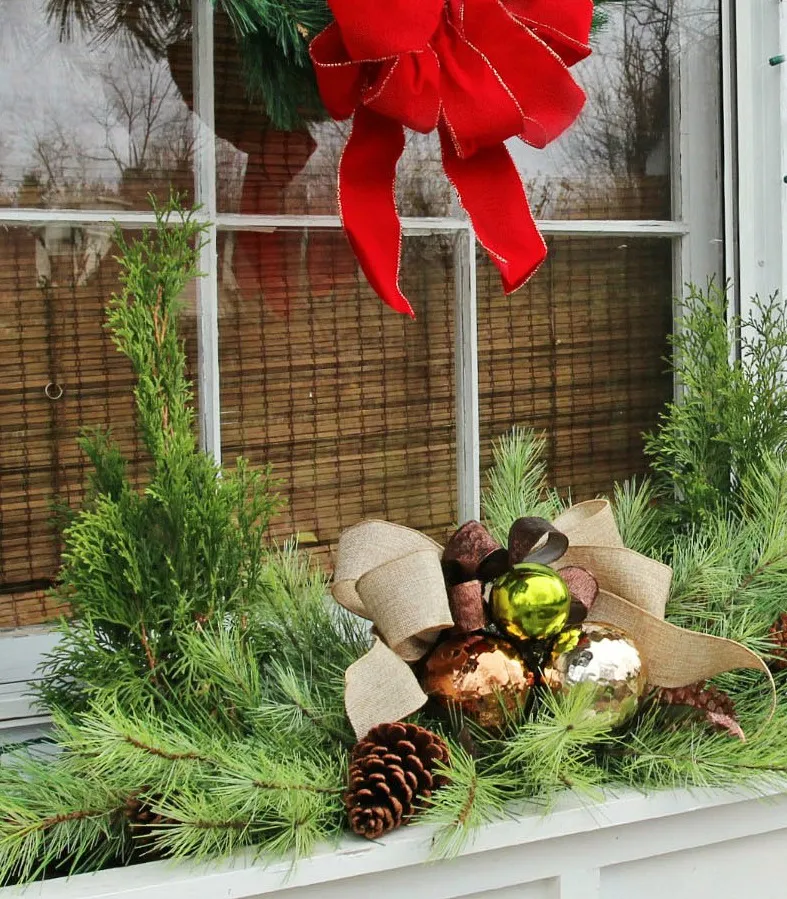
Velvet and weather don’t negotiate. A ribbon this wide in a wet climate mats down, spots, and eventually droops into a sad tongue within a season, so if you’re in the Pacific Northwest or anywhere with freezing rain, buy two and rotate them, or choose a stiff outdoor-rated velvet-look ribbon with a wired edge. Also worth knowing: a box this full hides its own hardware, and saturated greenery gets shockingly heavy after a rain.
4. A Weathered Box That Leans Rustic, Not Shiny
Cedar and pine look spectacular for about five weeks and then start shedding onto your sill. Real branches want water — a liner with damp floral foam or a plastic tray at the bottom buys you a week or two — and expect to pull spent needles out of the box in January. Fairy lights tucked into fresh greenery also trap moisture against the wire, so choose battery packs rated for outdoor use and pull them before the deep freeze. Faux cedar avoids every bit of it.
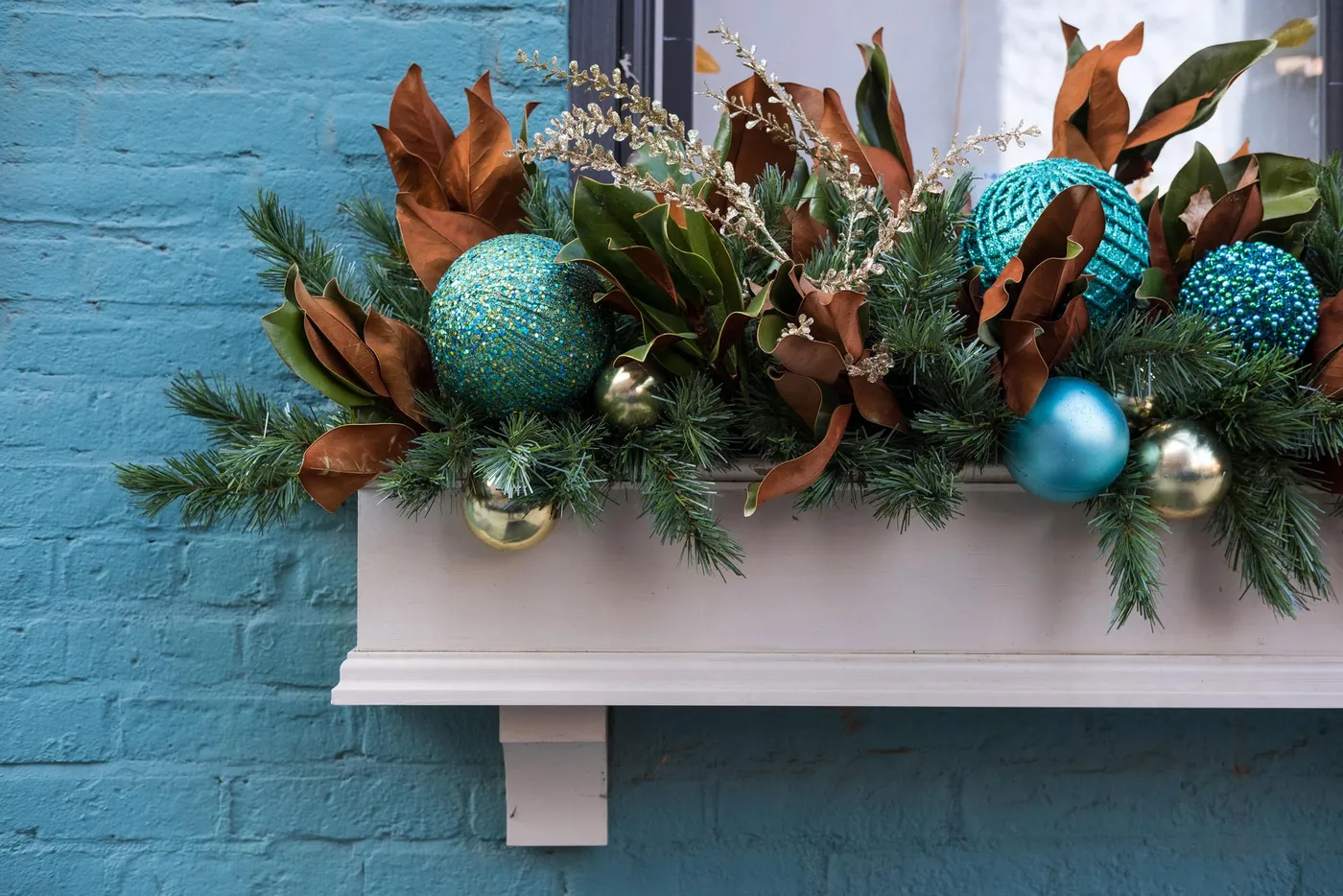
Rule of thumb for red accents: cluster them in threes and place each cluster where the greenery naturally parts, roughly at 4, 7, and 10 o’clock around the box. Scattered single berries read as polka dots; odd-numbered clusters read as fruit growing in the bush. Keep every red accent within 4 inches of the front edge so weather doesn’t bleach the back side and leave you with a two-tone mess by New Year’s.
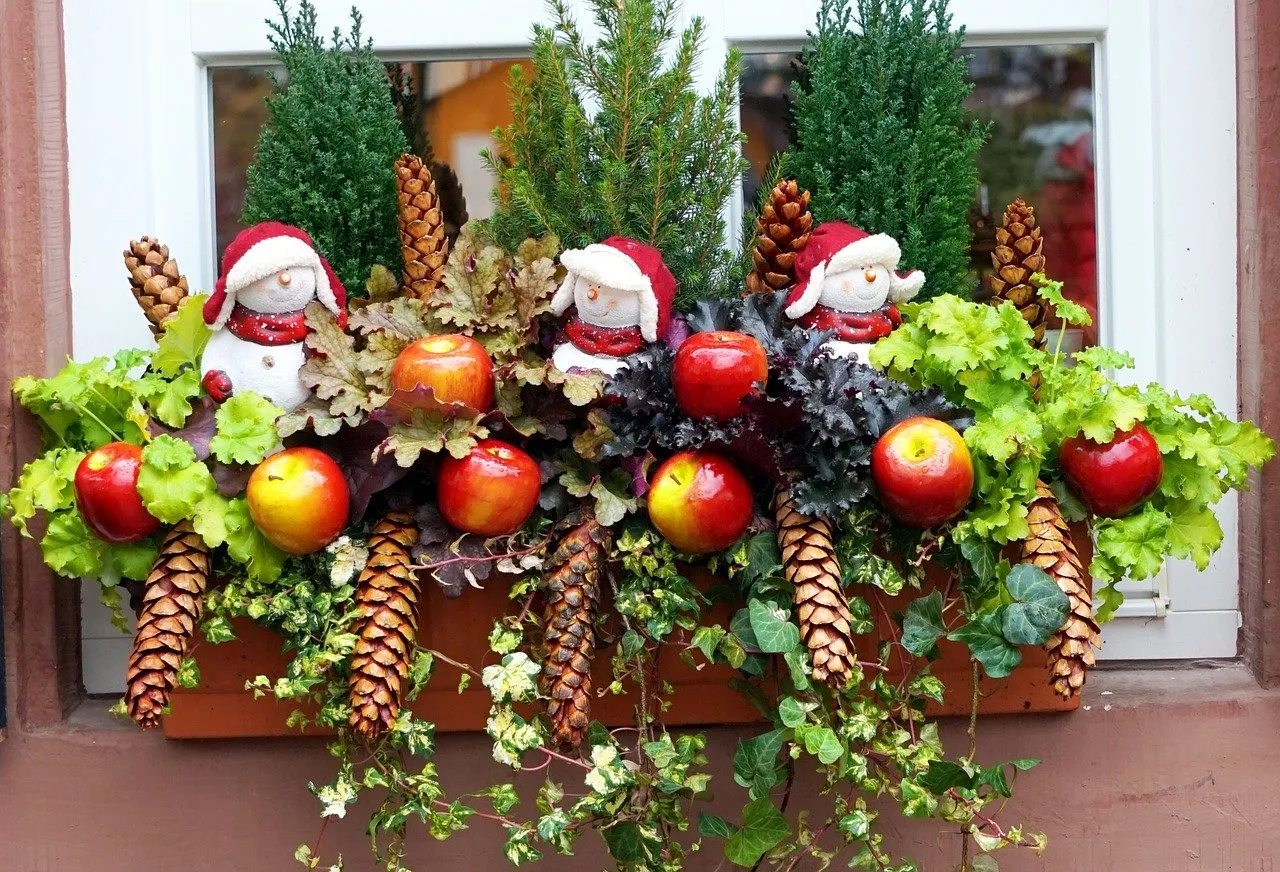
5. Snowmen, Apples, and Trailing Ivy — Delightfully Unserious
- Fill the box with greenery first, leaving a 4-inch gap at the front-center lip.
- Set the ivy’s root ball into that gap, angled so the vine exits forward rather than straight down.
- Drape the longest runner over the lip and pin it with a bent paperclip pushed into the foam.
- Thread the snowman figurines into gaps last, at three different heights, so they look like they’re peeking out.
- Give the ivy a splash of water every five days.
Time: about 45 minutes. Cost: $18–$40 for the ivy and picks.
Cute comes with caveats. Painted resin snowmen fade to pastel by February if they face south, and artificial apples can crack at the stem after a hard freeze, so keep sentimental pieces on a sheltered porch and let the durable stuff take the weather. If a dog patrols your yard, note that trailing ivy is mildly toxic when chewed — and small loose figurines have a way of migrating into the lawn.
6. Snow, Dried Grass, and Matte-Meets-Glossy Red
You can rebuild this in an afternoon for under $60. Grab a basic white plastic planter from Walmart for $12–$18, a bundle of dried pampas or wheat from Trader Joe’s for about $6, a bag of artificial snow for $5, and a set of shatterproof red ornaments from Target for $10. Thrift stores are gold for ribbon — a roll of red velvet-look ribbon usually runs $2–$4, and nobody can tell once it’s frosted. This is the budget cousin of the mixed planter in Idea #1: same red-and-white bones, half the spend.
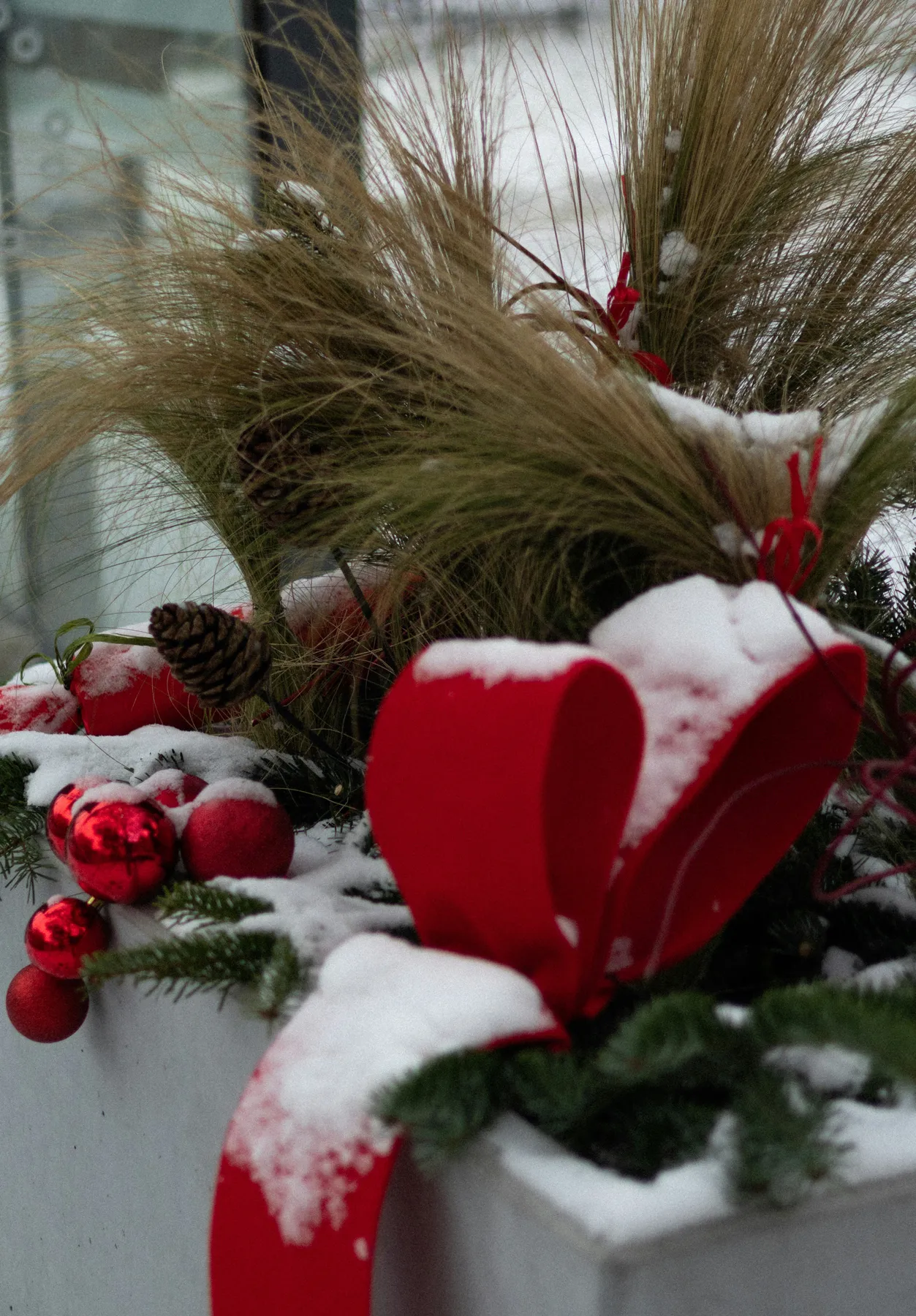
The thing you’d miss most if it vanished is the mix of matte and glossy red. Half of these ornaments have a soft, chalky finish that reads almost like felt against the snow; half are high-shine and catch whatever light is left at 4:30 in the afternoon. All glossy turns cheap and shiny, all matte goes flat and dusty. That two-finish rule works at any budget — just split whatever ornaments you already own.
7. Coir, Green Apples, and Seed Pods on Red Brick
Two principles are doing quiet work here. First, the lime-green apples share a hue family with the lighter evergreen tips, so they feel planted rather than placed — and the terra cotta brick behind adds warm contrast that makes the whole arrangement feel edible. Second, the texture ladder: soft coir, waxy berries, dry seed pods, brittle pinecones. Each material catches light differently, and that’s what keeps a natural arrangement from flattening into one green mass in a photograph.
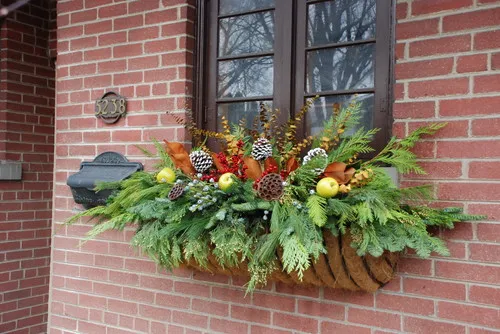
Coir liners this full are happiest in boxes at least 30 inches long and 8–10 inches deep. Shallower than that and there’s no room for the branch ends, so everything sits proud and tips out in wind. They suit single-story facades and porch-level windows best, where you’re viewing from 6–15 feet away. If your windows sit higher, jump to Idea #13 for a lighter box that still reads from the sidewalk.
Coir is basically a sponge, which is both its charm and its chore. It dries faster than foam or soil, so expect to water every two to three days in a dry cold snap — and if it freezes solid, don’t water at all, since ice will split the liner. Real apples are a three-week prop outdoors at best.
8. Champagne Gold Berries Against a Black Box
This is a 70/20/10 build: 70% dark evergreen in two or three needle lengths, 20% natural brown from the pinecones, 10% champagne gold. The dark container matters — a black or graphite box gives the frosted berries something to pop against, while a white one would swallow them whole. Want it warmer? Trade champagne gold for antique brass and the pinecones for cinnamon sticks. Want it cooler? Go silver and add eucalyptus. Same ratios, entirely different holiday.
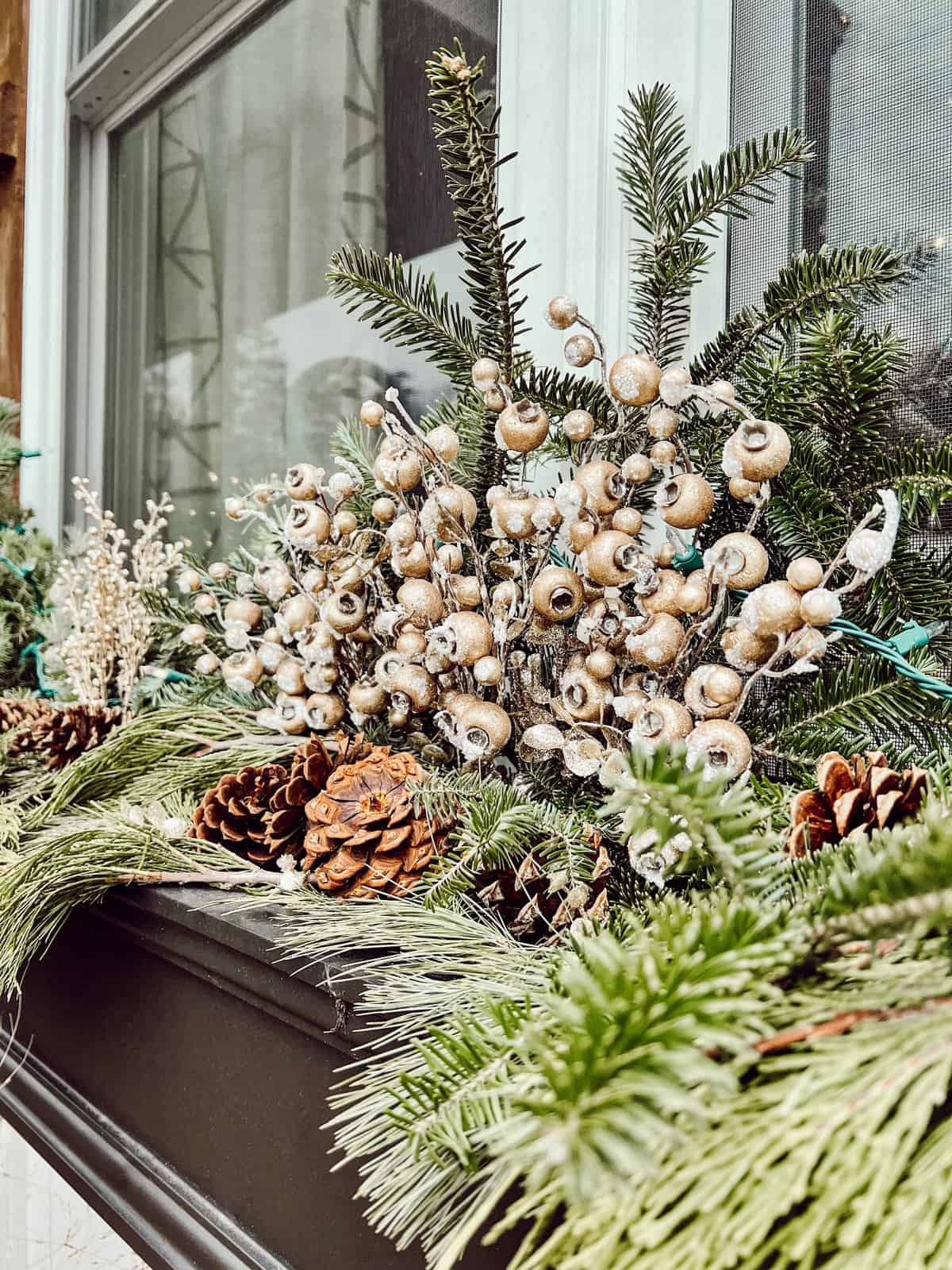
Choose green-wire lights, always, when the greenery is dark. Black or white wire flashes through needles at night and turns an elegant box into a tangle, while a 100-bulb green-wire strand disappears completely and lets the gold read as the only sparkle in the frame. And frosted gold berries photograph best about a third of the way up the arrangement, not at the very top, so the needles frame them instead of silhouetting them against the sky.
9. Weathered Wood, Corrugated Tin, and a Birdcage Lantern
This is the look that replaced all-white-and-twinkly for a lot of people around 2023, and it shows no sign of leaving. Call it collected farmhouse: mismatched weathered surfaces, salvage tin, a lantern that looks like it came out of a barn. The reason it stuck is that it ages well — every scratch and rust spot is on-theme, so there’s nothing to protect. Expect it to hold through 2026 while the ultra-glossy glam look keeps cycling in and out.
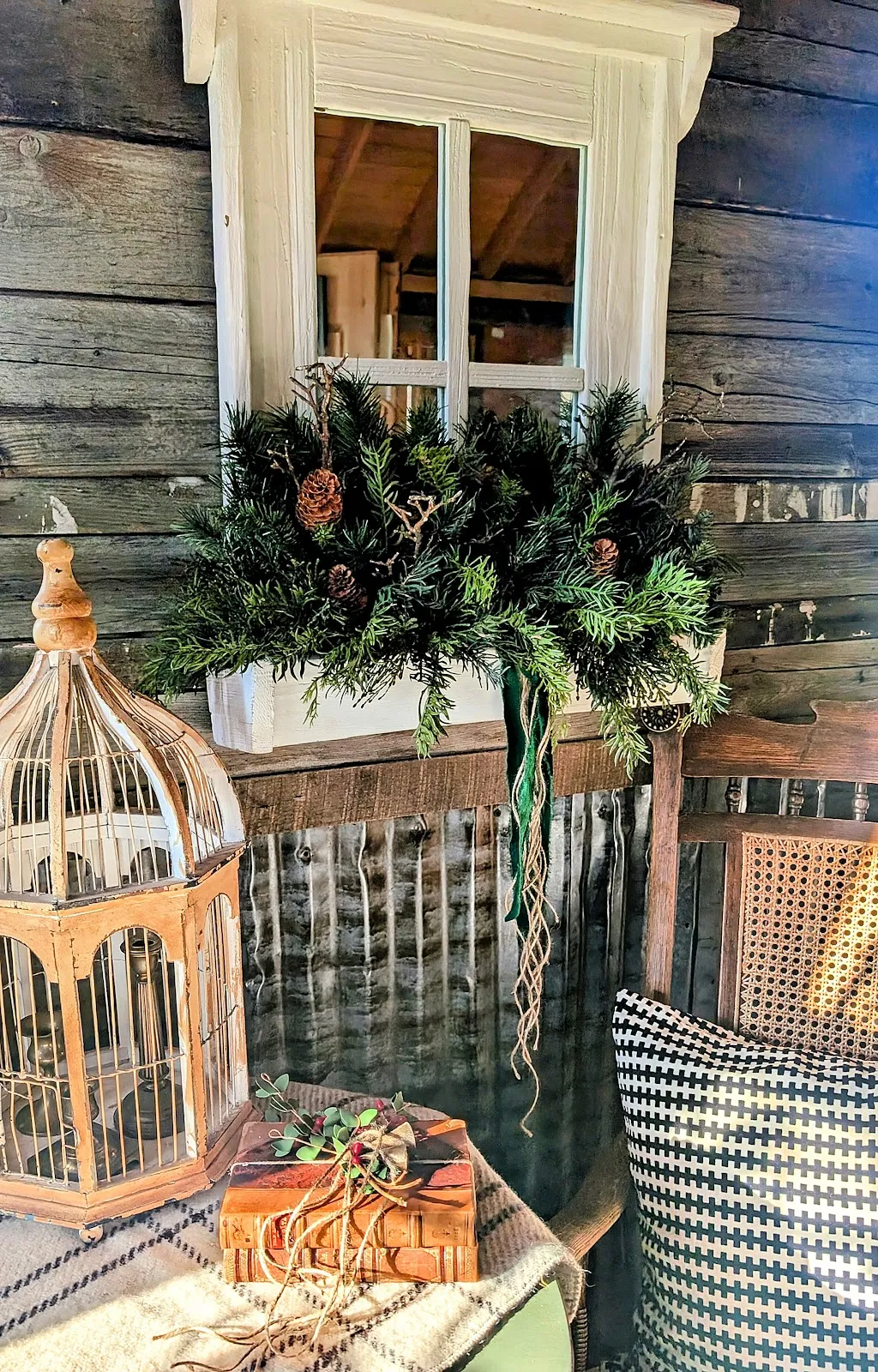
How to layer the wall behind the box:
- Measure the window width and mark 6 inches past each side.
- Attach a salvaged corrugated metal sheet to the siding with exterior screws driven into studs, positioned 12–18 inches below the sill.
- Hang the window box on a cleat rated for 60 pounds wet.
- Set the lantern to the left at hip height so it lights the greenery from below.
- Add one soft textile — a plaid pillow on a chair — to break up the hard surfaces.
Time: 2–3 hours. Materials: $30–$90 for salvage tin and hardware.
10. Variegated Holly and Magnolia for a Green-on-Green Box
is leaf variety — specifically the glossy magnolia leaves. Take them out and this becomes a nice but expected evergreen box. Magnolia’s broad, waxy, dark-green-to-bronze undersides reflect light in a way needles simply can’t, and they give the arrangement a Southern-garden weight. The variegated holly supplies the cream edging, and the blue-grey berry sprays keep it from going monochrome. Gloss, matte, and variegation: three leaf finishes, one box.
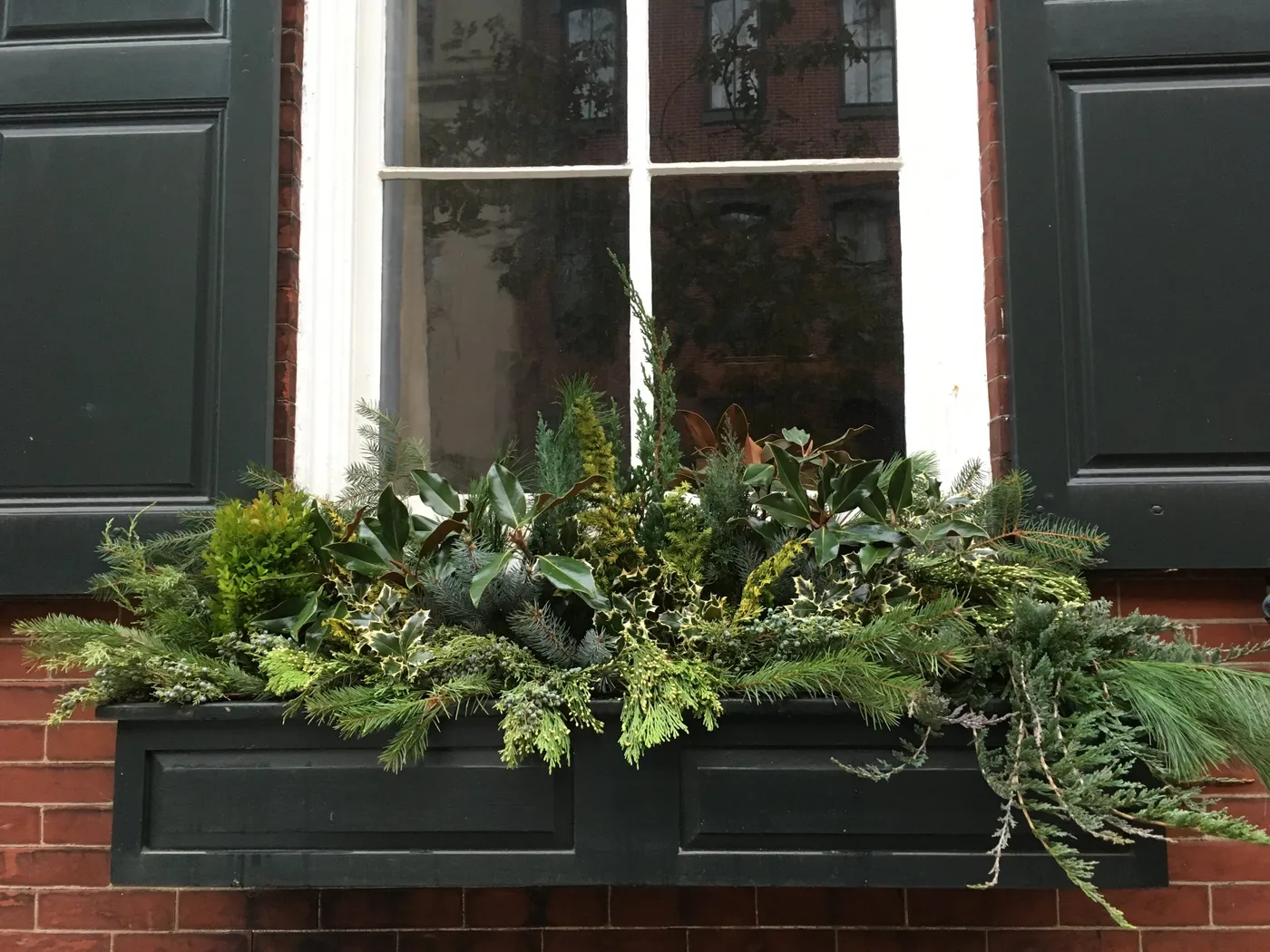
Magnolia looks incredible for about three weeks, then the leaves curl and go leather-brown — and unlike needles, they don’t hide, they just hang there looking tired. Plan on swapping them mid-December if your box is in full sun. Holly is tougher but genuinely sharp, so wear gloves when arranging, and skip it if the box sits beside a walkway where kids brush past. A faux magnolia stem set gets you the same sheen without the browning.
11. The Layered Window Garden That Works All Winter
Before you buy a single branch, run through the boring checks that decide whether this works:
- Measure the box’s interior depth — you need 8 inches or more for a real layered planting.
- Note which direction the window faces; south-facing boxes dry out twice as fast.
- Confirm your mounting hardware is rated for at least 60 pounds when saturated.
- Decide fresh versus faux before you shop, because you can’t mix plans halfway through.
- Set a budget floor of about $75 for a box worth photographing.
The thriftiest version of a window garden is a nursery run in early November, not a decor store in December. Buy one 6-inch juniper, one small arborvitae, and a flat of pansies or ornamental kale for $35–$50 total, then fill the gaps with pinecones from your own yard and a $6 bag of cranberries. Dollar Tree wreath picks run $1.25 each and look perfectly respectable tucked between real branches.
12. Marigolds and Succulents Make a Case for Off-Season Color
Marigolds and succulents in the same box is a watering mismatch — and that’s the trick. Plant the succulents in their own small pots sunk into the soil so you can lift them out and water separately; marigolds want consistent moisture, and echeveria rots within a week on the same schedule. Keep the trailing vines pinned at the front lip, not the middle. Front-lip trailing reads as deliberate overflow; middle trailing just looks like the plant fell over.
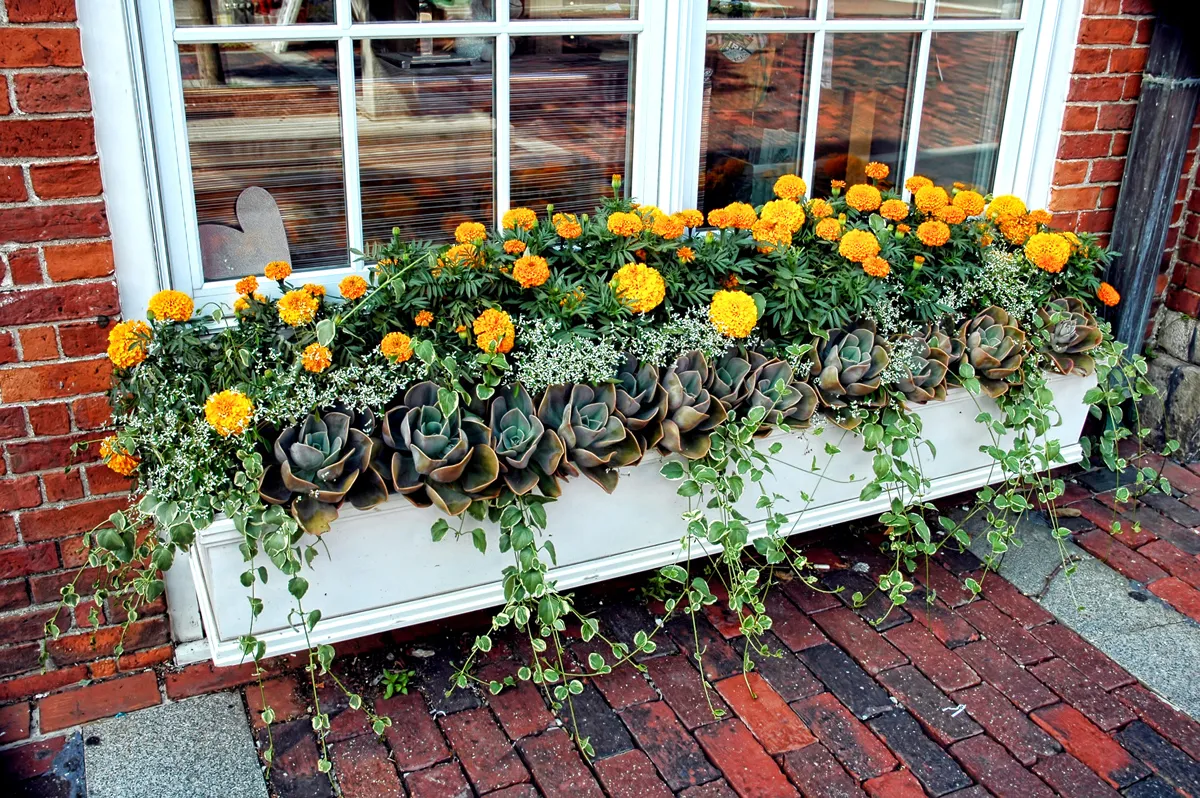
The formula is 55% green foliage, 30% warm orange bloom, 10% gray-green succulent, 5% small white filler. It’s the same structure as a classic evergreen-and-red box, just rotated on the color wheel — orange and gray-green are neighbors, so nothing fights. Swap marigolds for burgundy pansies and succulents for dusty miller and you have a winter version. Proof that Idea #26‘s red-and-gold palette isn’t the only way to fill a box beautifully.
13. A Miniature Tree, Two Big Ornaments, Gray Shutters
This one earns its keep on single and two-story facades where the window is wide but not tall — think 30 to 36 inches across. The miniature tree gives you instant height in a box that’s only about 9 inches deep, which is why this works where a sprawling arrangement would look squashed. If your windows run 6 feet or wider, hang two boxes side by side instead of one long one for the same rhythm and better proportions. Compare with Idea #18, which suits narrow cottage windows.
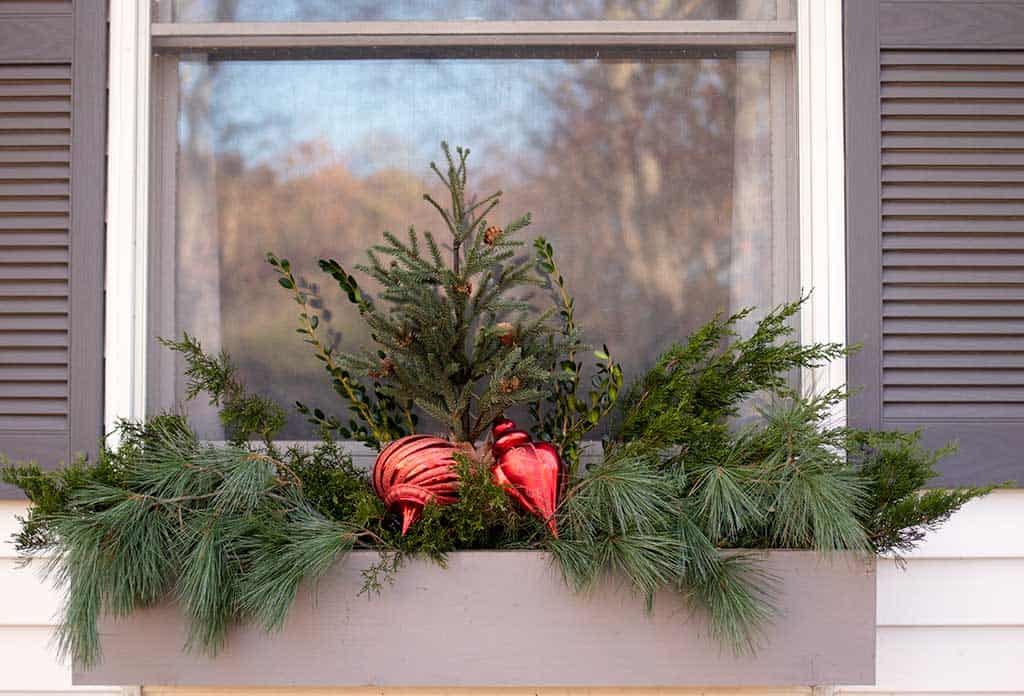
Two things carry this: deliberate scale contrast and a cool neutral frame. The tiny tree next to two oversized ribbed ornaments creates a jump in size that keeps your eye moving, and the cool light gray box against dark gray shutters makes red read as the only warm note in the whole elevation. Useful principle for any color scheme — keep the container neutral, keep the house trim neutral, and let exactly one color do the talking.
14. Red Berries, White Berries, Frosted Pinecones Lit Within
Warm white string lights inside a fresh box are gorgeous and slightly risky. Heat from incandescent mini bulbs dries needles out faster, so if you’re set on real branches, go LED — they run cool and use almost nothing. Check that your strand is rated for wet locations and that the plug end isn’t sitting in the bottom of the box where water collects. And be honest about the white berries: on fresh arrangements, frost finishes shed onto the sill within a few weeks.
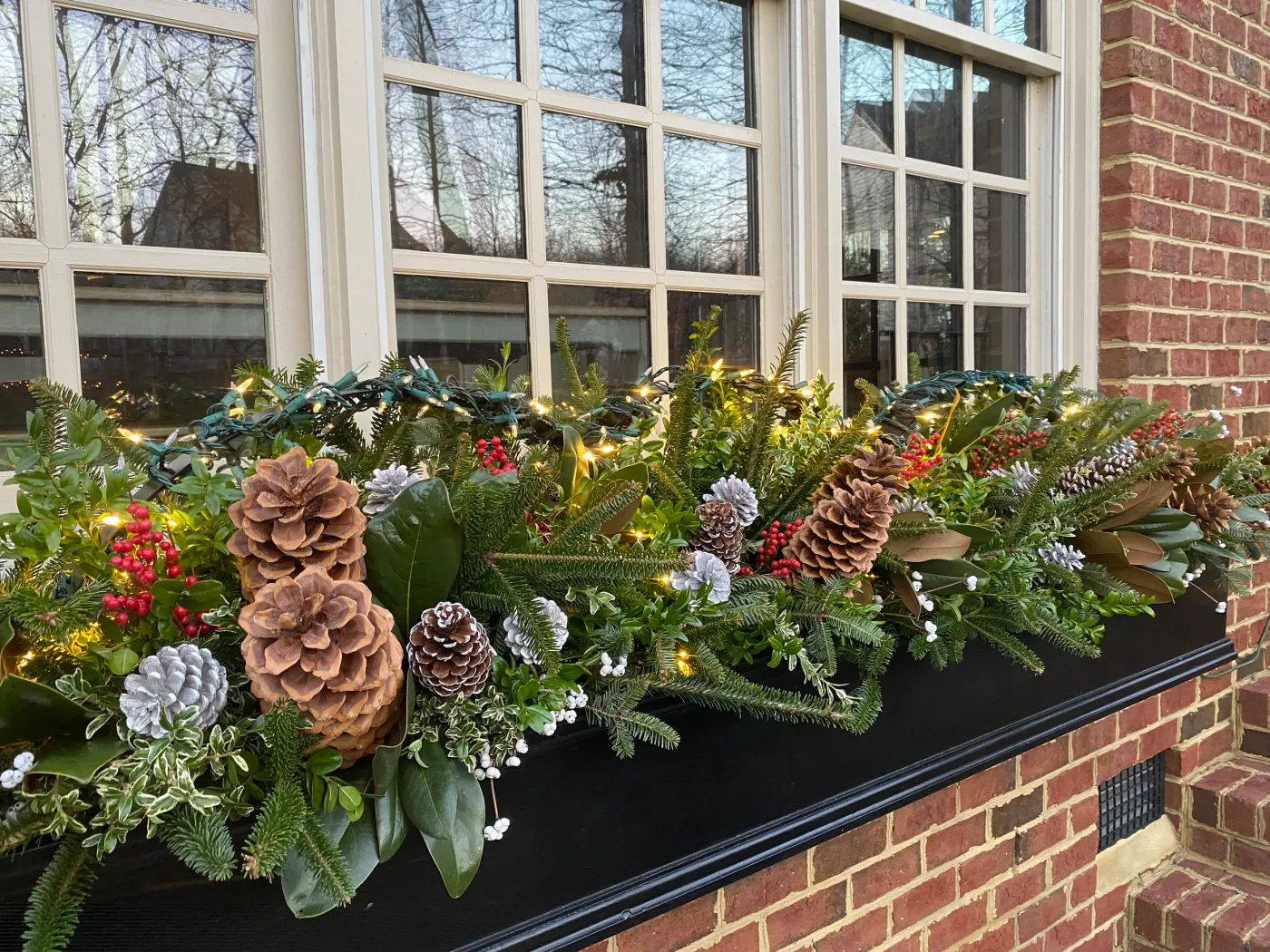
Put your largest pinecones at the base and let them get smaller as you move up and outward. It mimics how cones actually fall and grow, and it keeps the top of the box visually light so it doesn’t block the window. Aim for three size tiers — roughly 5-inch, 3-inch, and 2-inch — and place the frosted ones near the lights so the sparkle does double duty. Fifteen to twenty cones total is plenty for a 36-inch box.
15. Faux Poinsettias Under a Dusting of Snow
The single hero is the faux poinsettia — and yes, faux is the entire point. Nothing in nature holds a bract shape under wet snow, and real poinsettias hate cold, so this arrangement is only possible because the blooms are silk. What sells it is the dusting: snow collects in the flat spaces between bracts, exactly where it would land on a real flower. Remove the poinsettias and you have a pleasant snowy green arrangement. Add them and it becomes unmistakably Christmas.
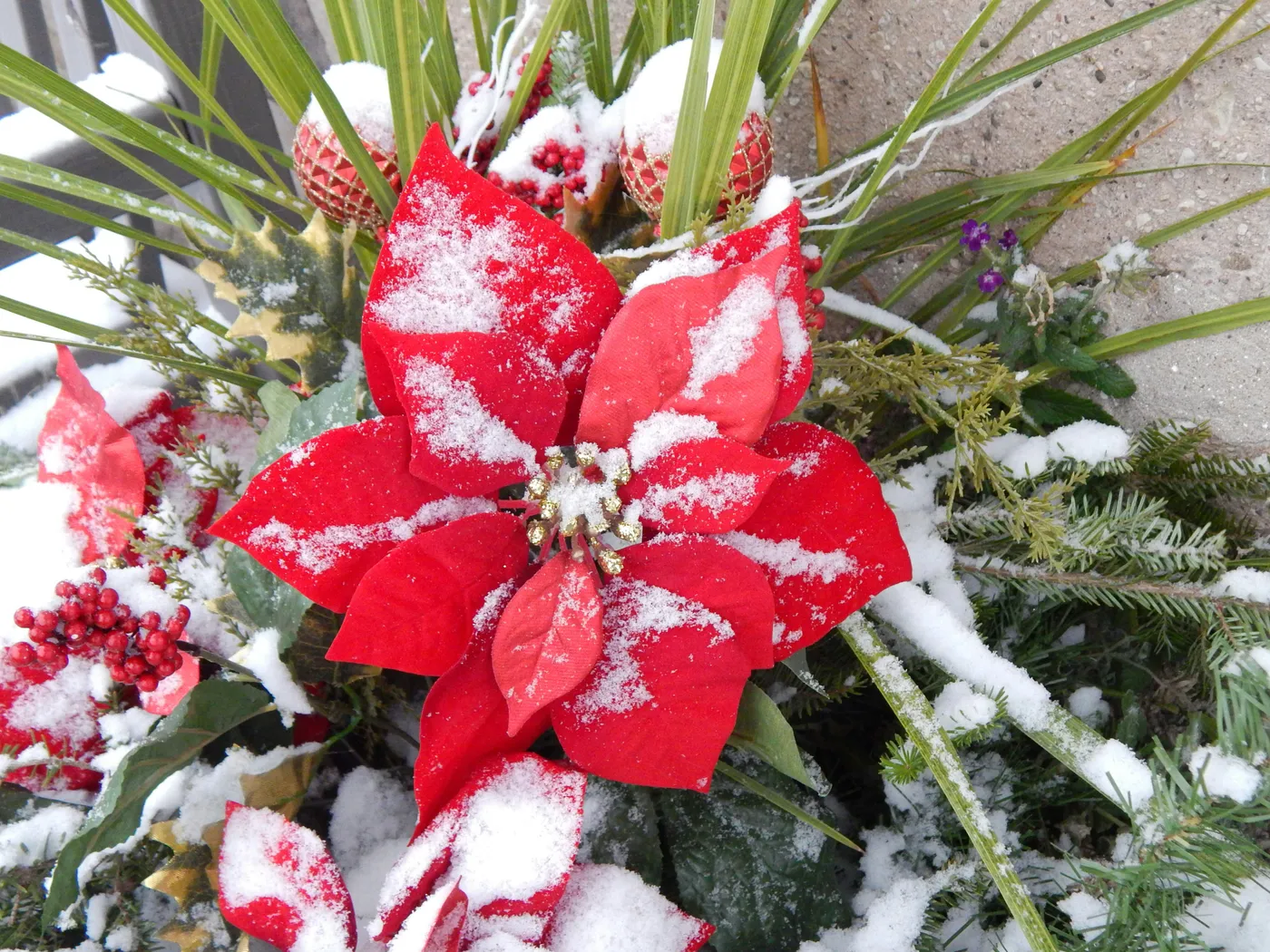
Poinsettia stems are where people overspend. A single realistic faux stem can run $12–$18 at a craft store, but a bundle of six from Walmart or Dollar Tree runs $10–$15 for the set, and once snow-dusted and mixed with greenery the difference disappears. Batch it: two bundles of red poinsettias, a bag of artificial snow, a bag of mixed berries and ornaments. January thrift stores are quietly excellent for this too.
16. The Classic: Evergreen, Velvet Bows, and Snow on the Ground
- Measure each window box separately — matching windows are rarely actually identical.
- Count your bows and divide by the number of boxes; symmetric facades look best with equal counts.
- Test every strand of lights before hanging and replace the dead ones first.
- Confirm an outdoor outlet or stock up on batteries — you’ll want a timer either way.
- Check that the greenery won’t block the light coming from inside the room.
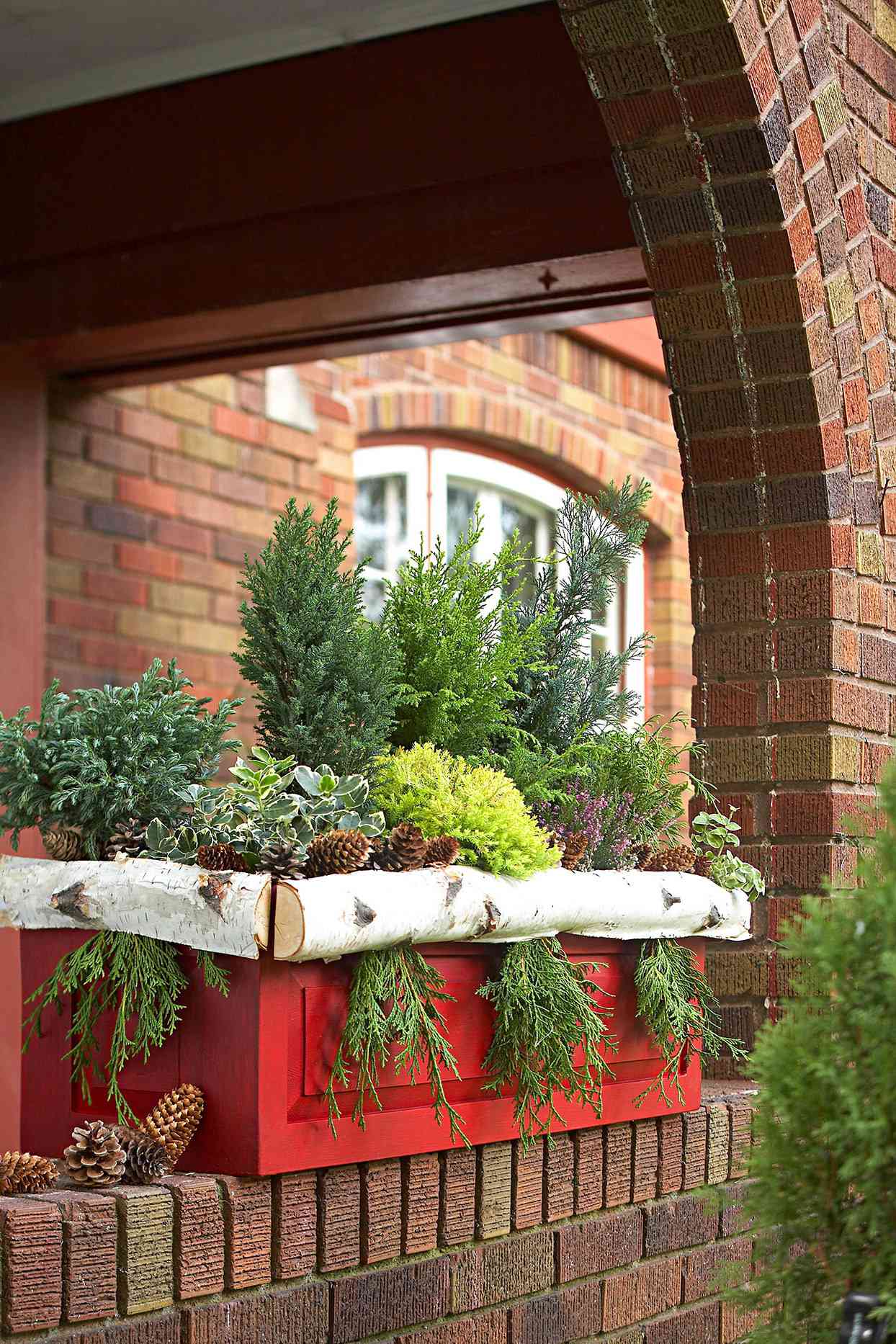
- Two 36-inch window boxes: $40–$110
- Fresh evergreen bundles for two boxes: $60–$140
- Warm white LED string lights, two strands: $20–$45
- Red velvet bows, six-pack: $18–$40
- Red berry sprays: $15–$35
- Total: $153–$370 for a matched pair
Budget alternative: buy one 8-foot garland and cut it in half rather than two separate bundles — you’ll save $30–$60 and get a fuller, more uniform look.
Traditional red and green never really left, but it’s been the fastest-moving palette on Pinterest for two seasons running, climbing right alongside the maximalist holiday trend. Part of it is nostalgia; part of it is that classic is the only look that photographs well in snow. You could hang the same bows in 2036 and nobody would call it dated.
17. Glittered Stems and the Case for Green Wire
The ratio here is 65% deep green, 25% gold shimmer, 10% dark neutral. That dark box is doing real work as the 10%, because a light container would give the gold nothing to reflect against. If you’d rather go silver, drop the glittered stems for frosted eucalyptus and swap gold berries for mercury glass — but keep the dark box either way. And notice the green wire. It’s the only reason this much glitter doesn’t look like a craft aisle exploded.
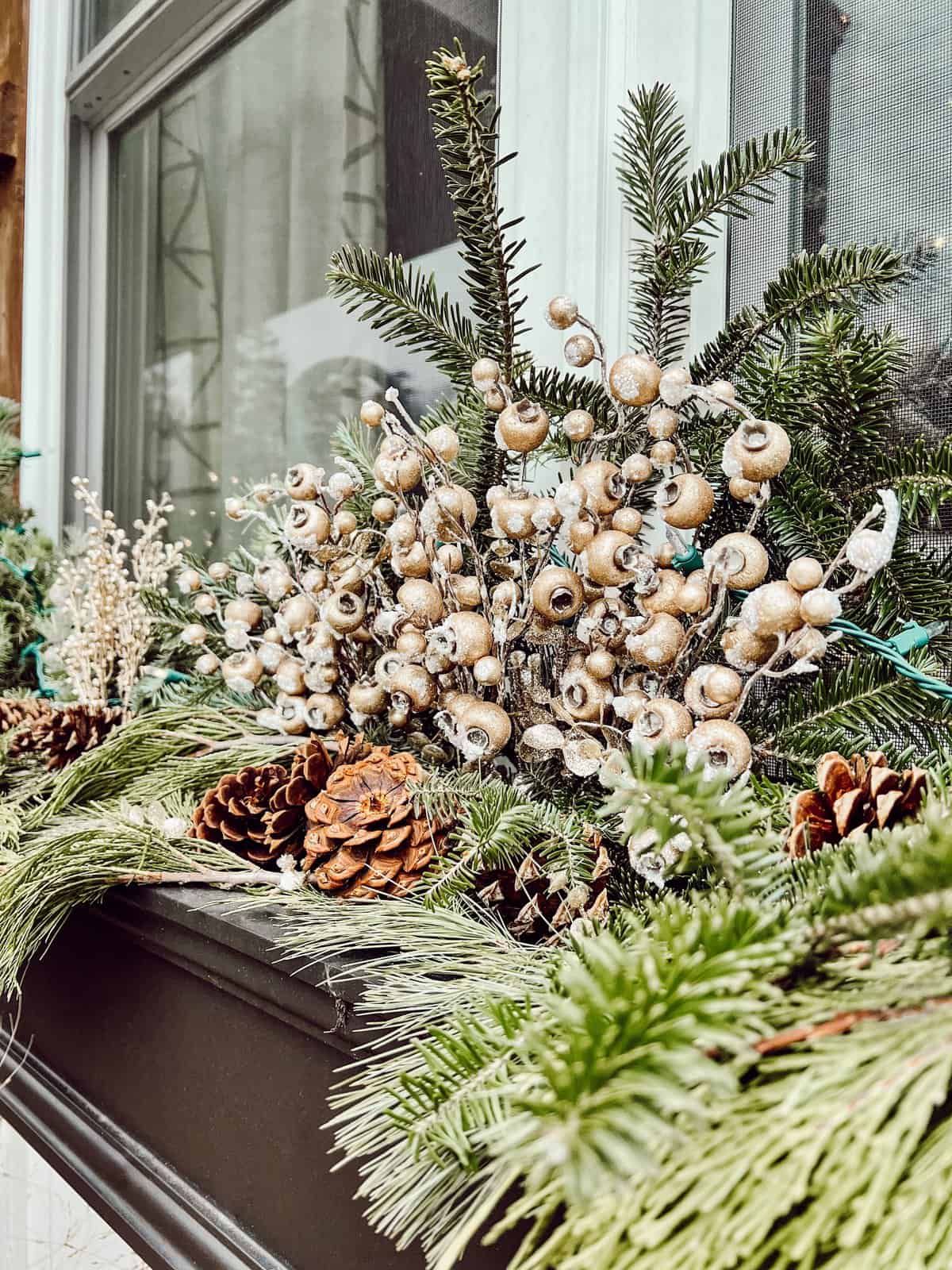
Glitter is a commitment. Gold-frosted berries shed onto your sill, your walkway, and eventually your floor, and once it’s in the grout there’s no getting it out. Glittered stems also don’t love wind; on an exposed facade, expect to re-glue one or two by January. If shedding will drive you up a wall, choose sequin-free gold berries with a matte metallic wash — you keep the shimmer with about a tenth of the mess.
18. The Matching Box-and-Wreath Pair, Plus One Warm Lantern
Repetition is the whole story: same greenery, same berries, same pinecones, once horizontal and once vertical. That sameness lets the eye read the window as a single composition instead of two decorations that happen to be near each other. Then the black lantern does the counterweight — it’s the only hard-edged, non-green object in the frame, and it gives the eye somewhere to rest. Warm light inside it bounces off the white box, which is why distressed white reads so much softer than clean white.
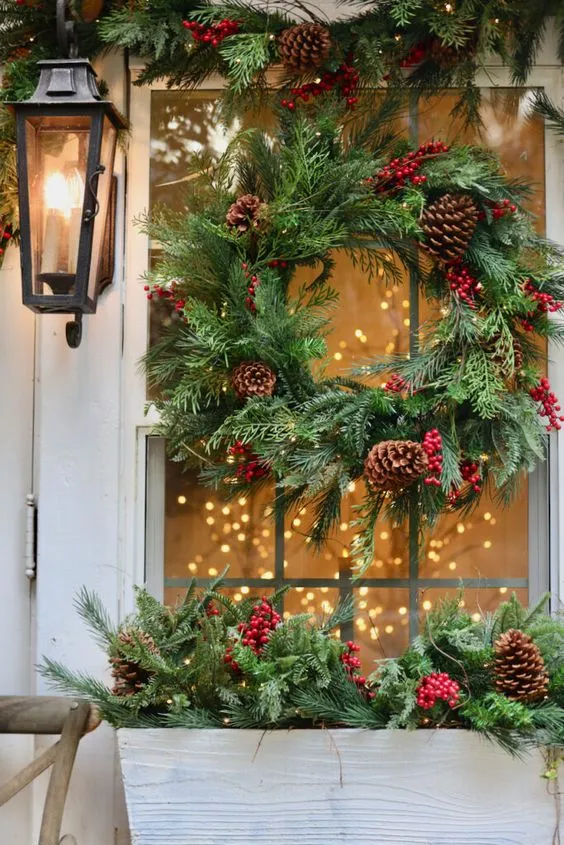
This pairing needs a window roughly 28 to 36 inches wide for the box, plus a pane tall enough to hang a 20–24 inch wreath without crowding the glass. It’s ideal for cottage, farmhouse, and Craftsman frontages where windows are vertical. Wide picture windows lose the effect entirely — the wreath floats and the box looks undersized. On broad facades, use Idea #16, where multiple boxes carry the rhythm instead.
19. Jingle Bells, Dried Hydrangea, and Burgundy Leaves
Dried hydrangea is the secret weapon here — it’s the only element that’s creamy and matte, which makes the bright red berries look wetter and the evergreens look deeper. Buy one dried bunch and split it into four or five clusters, then place each cluster so it faces slightly outward from the box’s front. Keep the jingle bells clustered on one side rather than spread evenly. Asymmetry makes an arrangement feel put together by a person, not a warehouse.
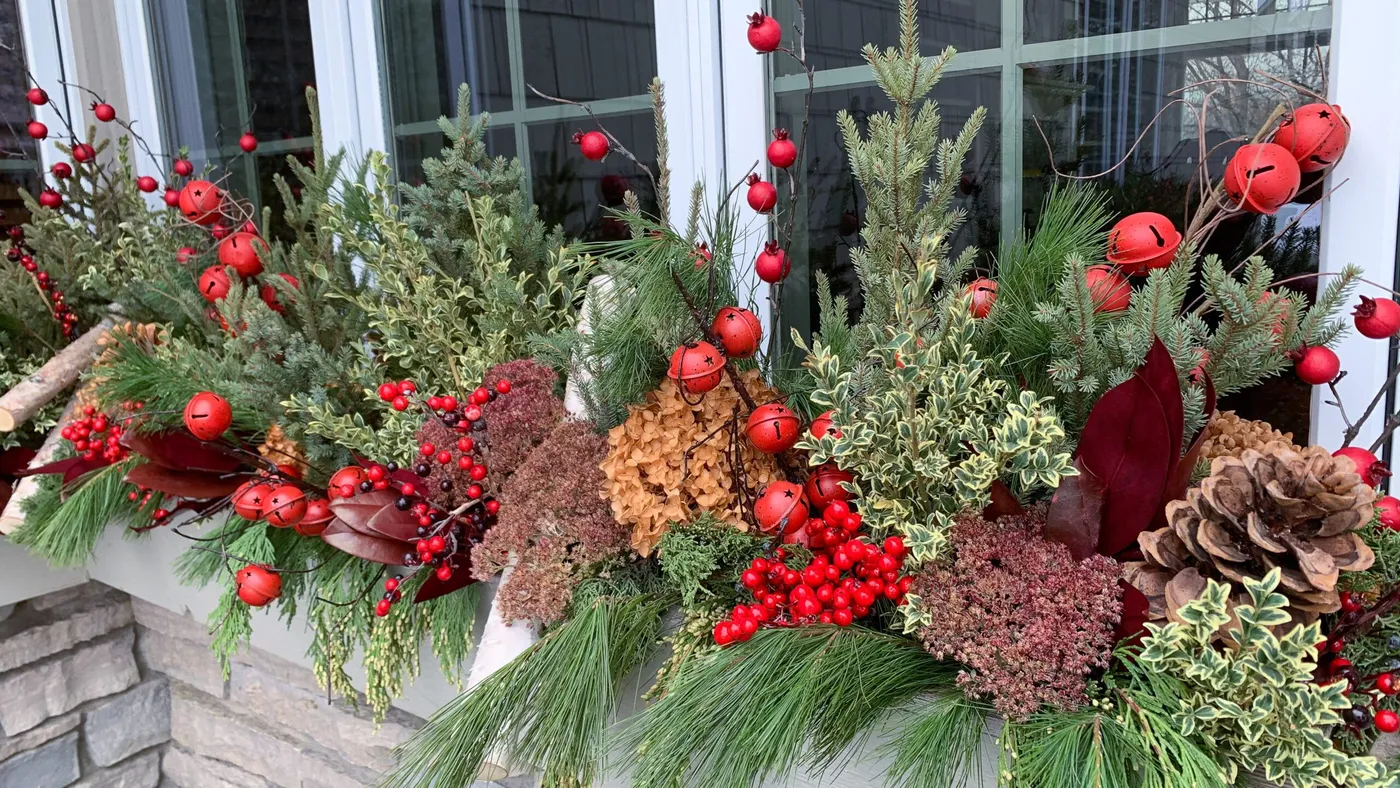
How to build a base that holds heavy elements:
- Line the box with damp floral foam cut 1 inch taller than the rim.
- Push in structural branches first — pine and fir — at a 45-degree angle, front to back.
- Add burgundy leaves and dried hydrangea in the gaps, tallest material at the back corners.
- Wire the jingle bells to short picks before pushing them in so they don’t drop.
- Finish with berries and pinecones along the front edge.
Time: about 1 hour. Cost: $45–$110 depending on how much is fresh versus faux.
20. Two Golden Deer Standing in a Box of Red and Green
Take away the golden deer and you have a beautiful, completely forgettable classic box. The deer are what make your neighbor slow down on their evening walk — they’re the one element that reads as a small scene rather than a decoration, and they give the arrangement a story. Two is the right number: one looks lost, three looks like a lawn ornament migration. Keep them at different heights and facing slightly inward, and let the evergreen cover their bases so they appear to be standing in it.
Figurines are back, and not ironically. After years of minimal, all-neutral holiday decor, people are re-buying the small whimsical objects their families had in the nineties — deer, snowmen, tiny carolers. Pinterest is full of nostalgic Christmas porch saves, and designers riding the wave are mixing one or two figurines into otherwise grown-up arrangements. It’s the sweet spot: playful without going full yard-inflatable.
21. When a Garland Beats a Window Box
Before you commit to hanging greenery straight on the house, tick these off:
- Check whether your sill is deep enough to rest greenery on, or whether everything hangs.
- Identify your attachment points — brick, stucco, and vinyl siding all need different hardware.
- Decide on a power source: outlet, battery, or solar.
- Measure the total run you want covered and buy 20% more garland than you think you need.
- Confirm you can reach the top of the window without a ladder on stairs.
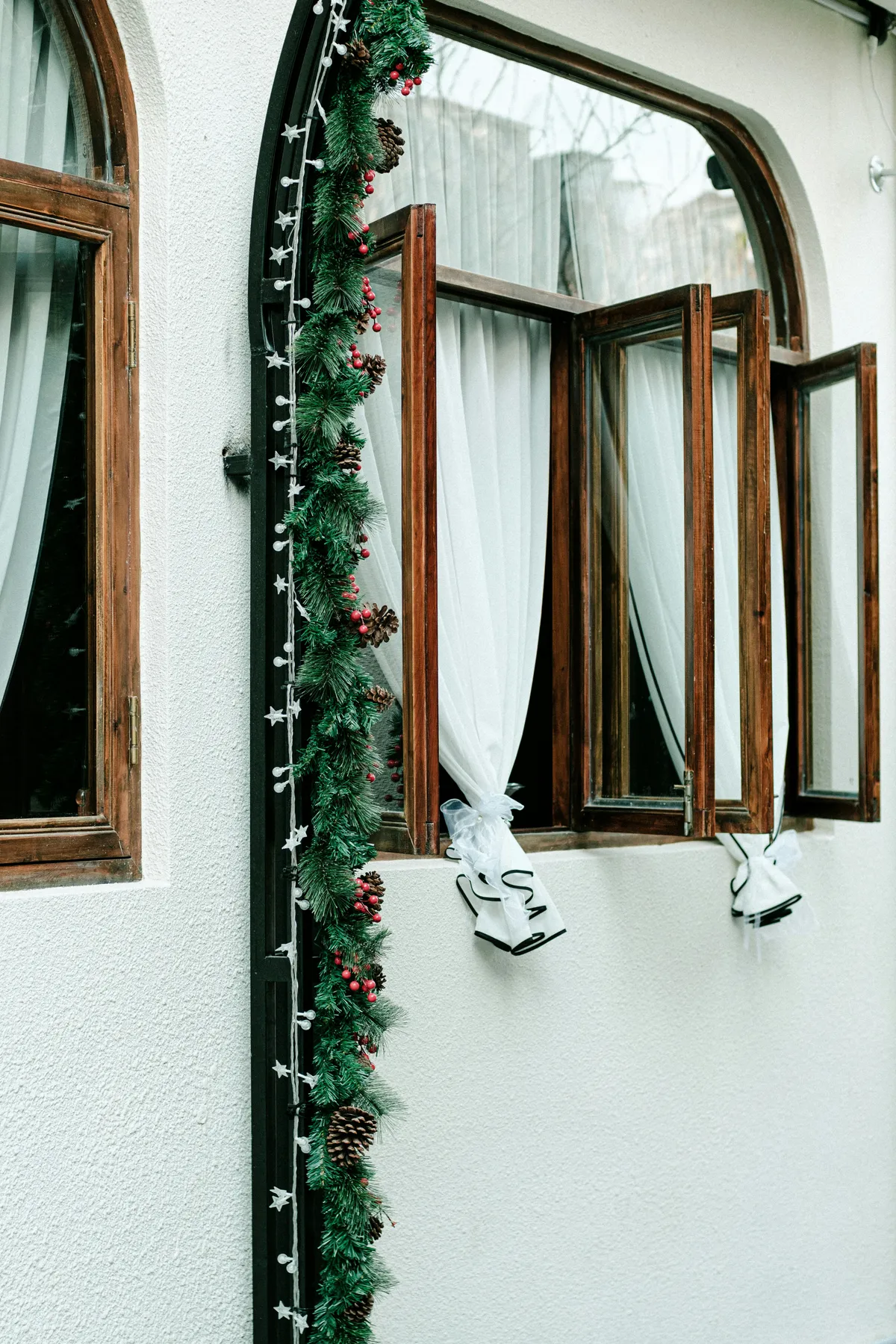
Garland is usually cheaper than a box, and you skip the container entirely. A 9-foot unlit evergreen garland runs $15–$25 at Lowe’s or Walmart; lights add $12–$20. Command outdoor hooks cost about $8 for a pack and save your siding. Want fuller coverage? Zip-tie two cheap garlands together and fluff them by hand — 15 minutes, and it looks identical to one $80 garland.
22. Terracotta, Snowmen, and Apples That Fool Everyone
The charming version and the soggy version of this box look identical in November. Real apples go soft and attract wasps within three weeks outdoors, and ivy in a terracotta container dries out faster than in plastic or foam-lined boxes, so this needs water every couple of days during a dry snap. If the box faces full sun, the deep purple foliage fades toward brown by mid-December. Faux apples and a coco liner solve both problems quietly, and nobody has ever noticed the difference from the sidewalk.
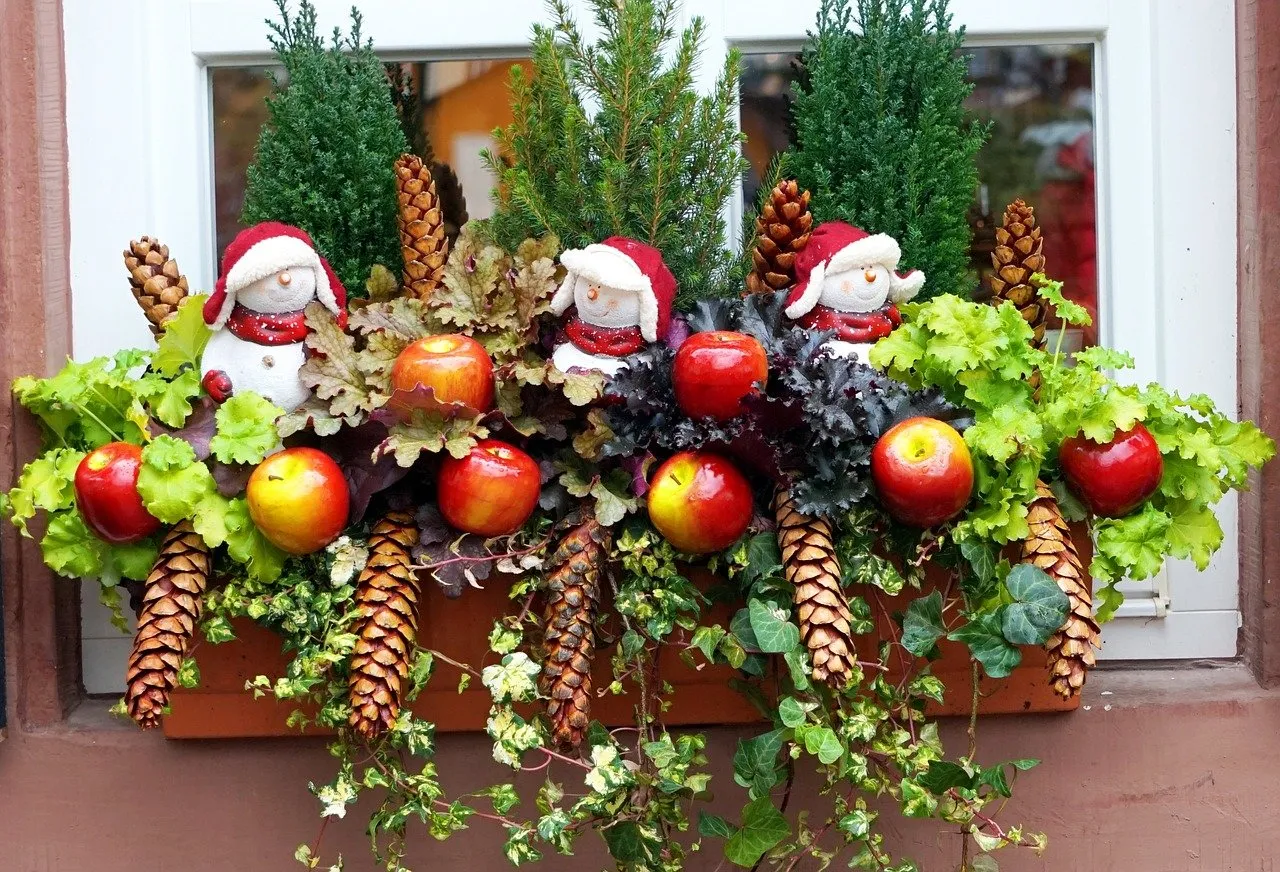
- Terracotta-look window box, 30-inch: $25–$60
- Evergreen shrubs and small conifers: $30–$70
- Snowman figurines, set of three: $12–$30
- Faux apples and large pinecones: $15–$35
- Trailing variegated ivy: $8–$20
- Soil or coco liner: $8–$18
- Total: $98–$233
Budget alternative: skip the ivy and trail an artificial vine instead — $4 at Dollar Tree, and it survives a freeze.
23. Red Hearts and Mustard Trim on a Stucco Wall
How to hang garland on stucco without wrecking it:
- Mark two anchor points 4 inches in from each side of the window frame.
- Drill 1/4-inch holes and tap in plastic sleeve anchors — stucco crumbles without them.
- Screw in vinyl-coated cup hooks and seal the edges with clear exterior caulk.
- Loop florist wire through the garland’s spine every 18 inches, then over the hooks.
- Add hearts and lights after hanging, so weight doesn’t pull it down.
Time: 45 minutes. Cost: $12–$25 in hardware.
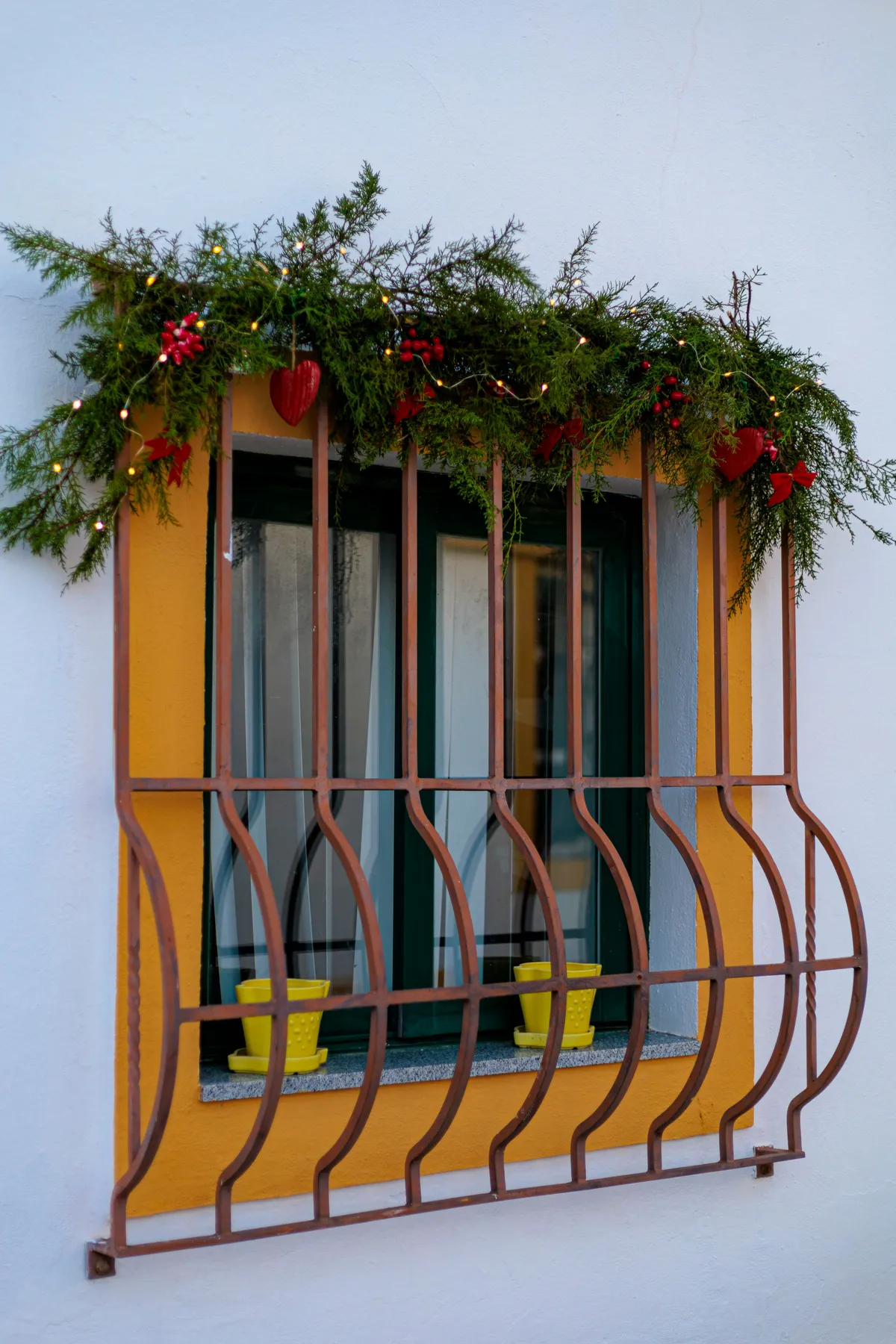
The palette ratio is unusual and it works: 55% deep green, 20% mustard yellow, 15% red, 10% wrought-iron black. Mustard at 20% is a lot — but because it lives in the architecture rather than the decor, it reads as backdrop instead of a competing color. Prefer not to commit to yellow trim? Swap it for cream and the red hearts gain 5% of the visual weight.
24. Birch Logs, Warm Lights, and a Snowflake Next Door
- Dark window box, 36-inch: $35–$85
- Mixed evergreen branches (fir and cedar): $30–$65
- Cut birch logs, three to four pieces: $18–$45
- Warm white LED string lights: $15–$35
- Metal snowflake ornament: $8–$20
- Matching garland: $20–$45
- Total: $126–$295
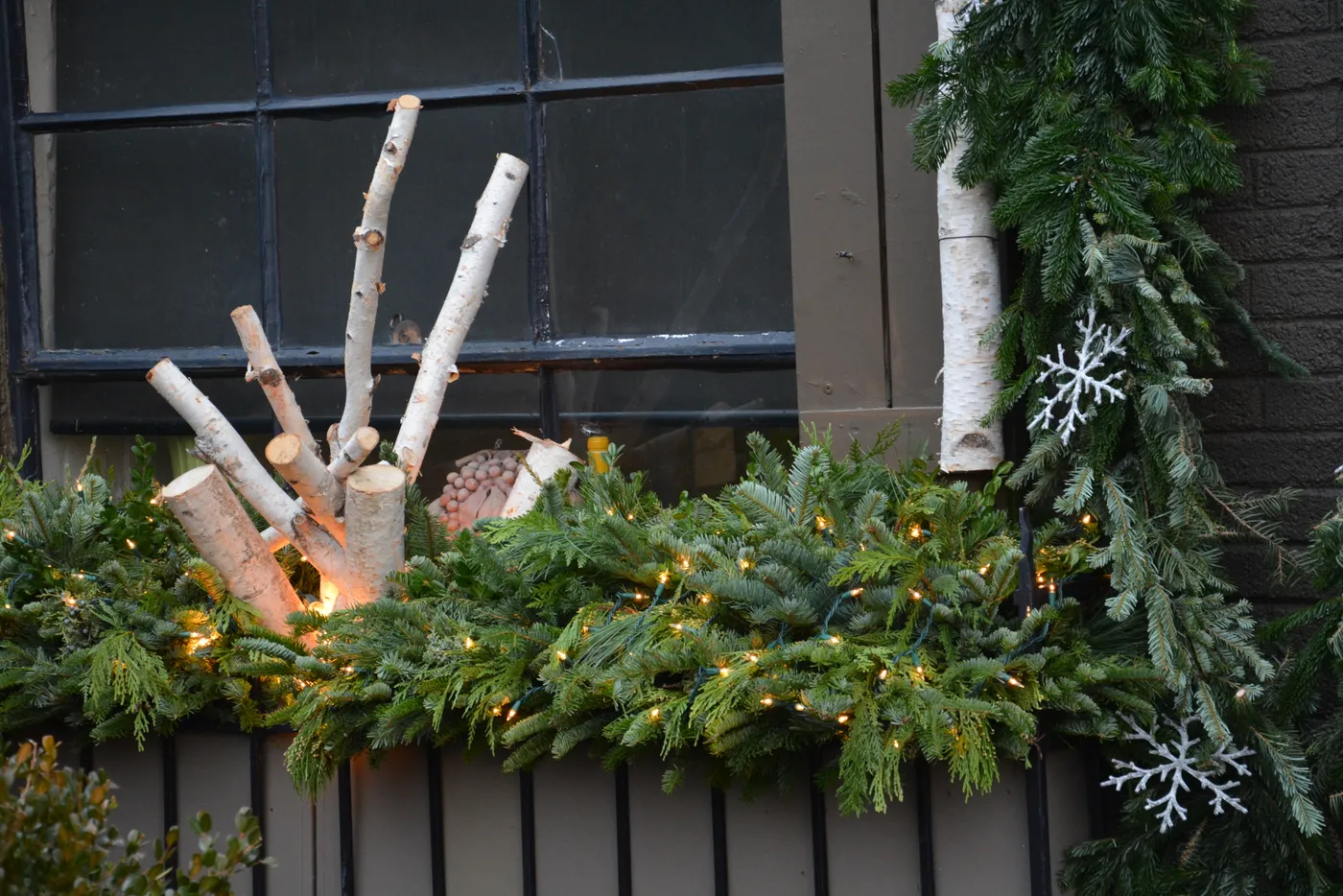
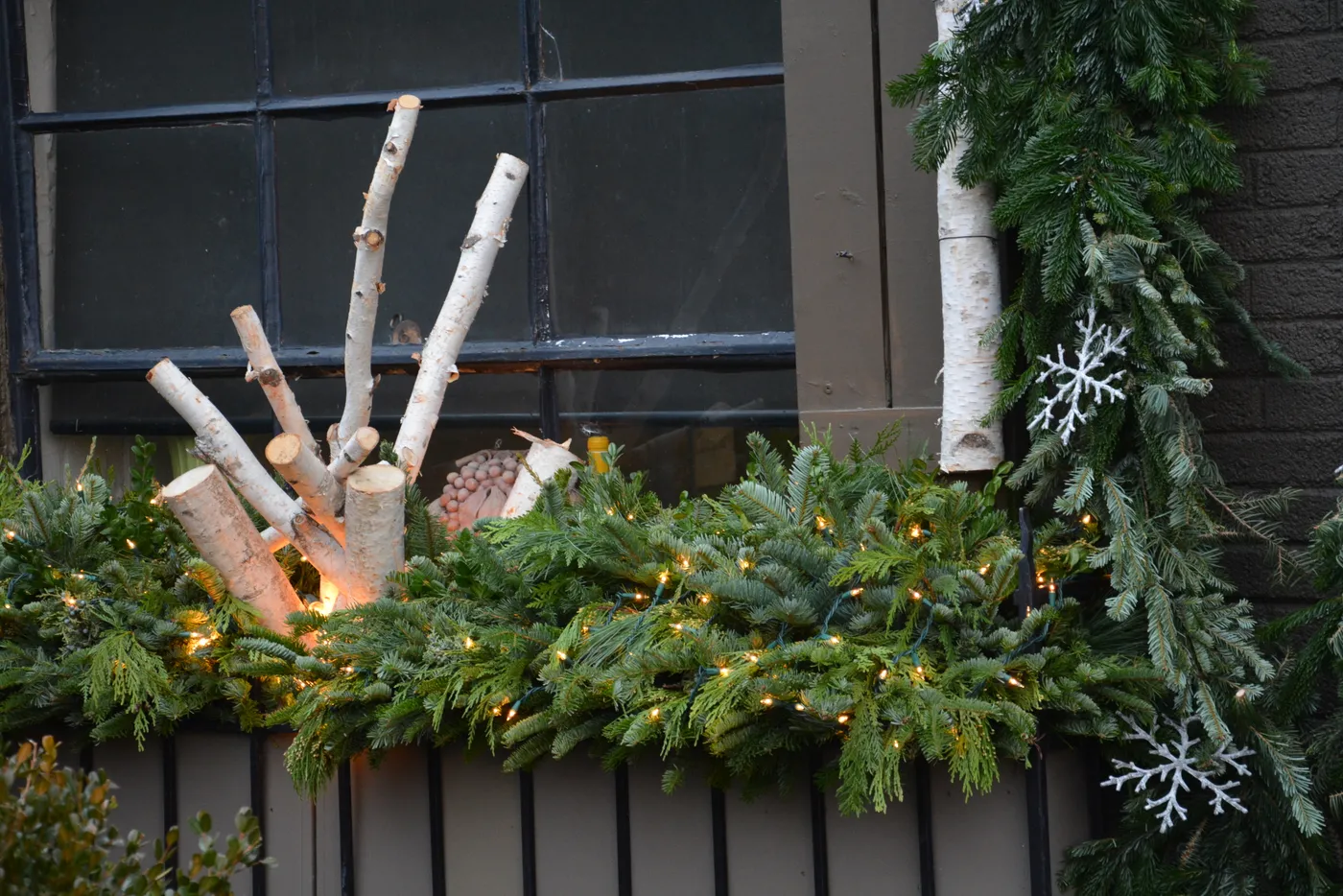
Budget alternative: birch logs are the pricey bit. Ask a local tree service for cut rounds in late fall — many will hand them over free — or wrap dowels in peel-and-stick birch veneer for about $10.
Birch logs need room to read as logs, so this arrangement wants a box at least 36 inches wide and 10 inches deep. Anything smaller and the logs look like sticks. It’s built for darker facades — brick, charcoal siding, stained wood — where the pale bark becomes a light source before you even plug anything in. On a bright white house, look at Idea #13 instead.
25. White-Tipped Pinecones and One Brave Blue Shutter
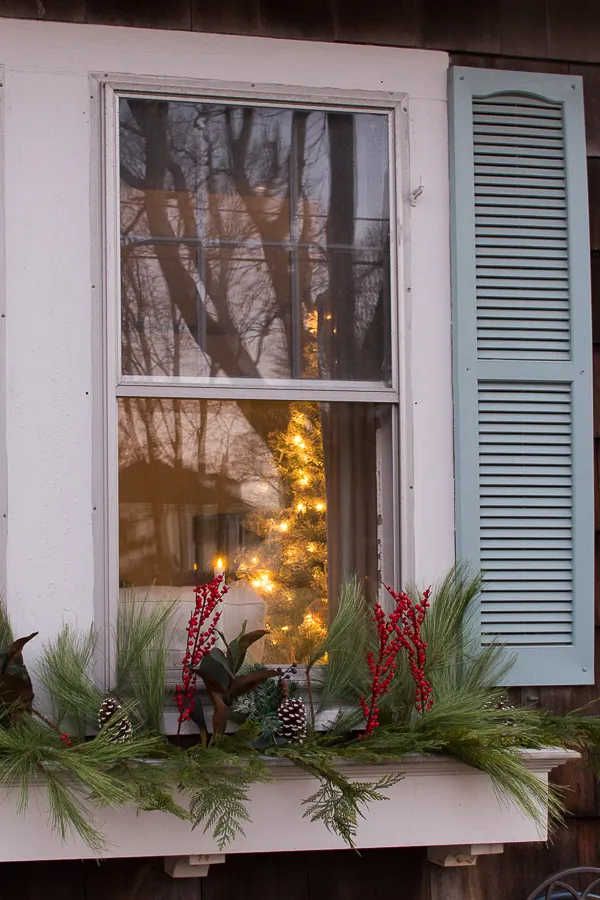
The light blue shutter is the odd one out, and that’s precisely why it works. Traditional red-and-green boxes can start to feel airless; one cool, unrelated color in the architecture gives the whole elevation somewhere to breathe, and it echoes the white-tipped pinecones without matching them exactly. The second principle is layering across the glass — the lit tree inside the window becomes a background glow behind the silhouette of the box, so the display reads as both inside and outside at once.
If you strip everything back, the element carrying this box is the white-tipped pinecones. They’re the reason the arrangement works against a white container without disappearing — the tips create a broken outline instead of a solid dark mass. Red berries alone would read heavy and Christmas-card predictable; frosted cones add air. Buy a bag of plain pinecones and dry-brush the tips with white craft paint. Ten minutes, four dollars, and nobody will guess.
26. High-Shine Red and Gold Soaked in Warm Light
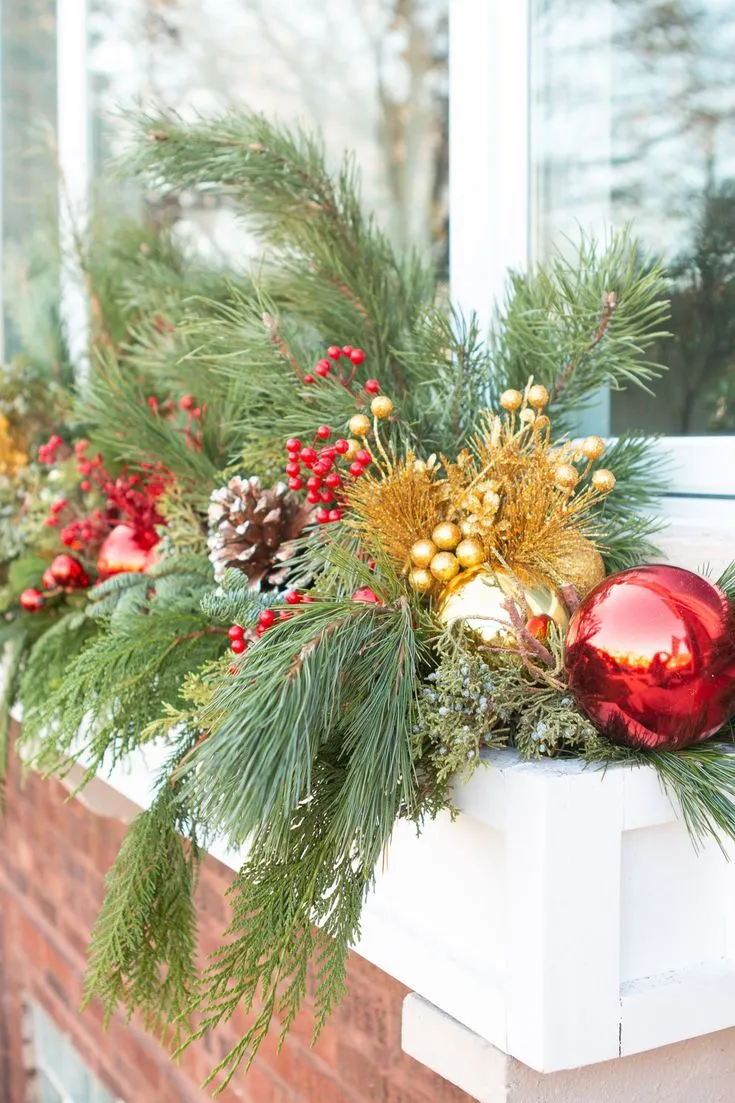
Shiny ornaments outdoors need two things: a wire loop rather than a cap, and a spot where they won’t swing into the glass. Thread craft wire through each ornament’s cap, twist it into a 4-inch pick, and push it deep into the greenery so the ball sits against needles instead of hanging free like a pendulum. Also, cluster the gold — three to five gold ornaments in one area with the red spread around them reads far more expensive than alternating colors at even intervals.
Fill and depth rule: for a box 30 to 36 inches long, aim for 12–18 ornaments total, with the largest at the bottom outer corners and the smallest near the top. Bigger boxes can take more, but anything past 24 starts to look like a store display instead of a home. This scale suits standard double-hung windows on one-story homes. For taller facades, pair two of these with the ribbon treatment in Idea #16.
Let Your Windows Do the Greeting This Year
Whether you go full classic with velvet bows or slightly unhinged with snowmen and apple props, the point is the same: your windows are doing the talking before anyone reaches the door. Start with one box, one palette, and one rule about keeping the light visible — then build from there.
📌 Save this to Pinterest for later — you’ll want to revisit these ideas when the greenery goes on sale the week after Thanksgiving.