You know that feeling when the tree is finally up, the stockings are hung, and the coffee table is still sitting there completely bare?
We spent serious time browsing Target, IKEA, HomeGoods, and Etsy — plus a long scroll through real, unstaged homes — to find what’s actually worth copying in 2026, and the range is wider than you’d expect: from about $5 for a grocery-store bundle of greenery to $875 for the full dark-wood-and-silver-candlelight setup.
Inside you’ll find 33 curated ideas across rustic, traditional, modern minimalist, coastal, and elegant metallic styling, with budget versions and splurge versions compared side by side so you can pick your lane before you spend a dime.
The 2026 shift is toward warm, layered, lived-in Christmas decor — thrifted ornaments, mixed metals, and arrangements that look like somebody actually uses the table. And stay until the end — we break down the most common mistakes that can ruin these looks.
📌 Save this to Pinterest for later — you’ll want to revisit these ideas.
1. Warm Candle and Pinecone Tray on a Distressed Grey Table
Here’s the rule that keeps a tray like this from looking like a fire hazard: keep every candle under 8 inches tall and vary the heights in 2-inch increments — 4, 6, 8. From a seated position, that reads as a staircase instead of a cluster. Leave a 2-inch margin of bare tray around the arrangement, too. Candles that touch the rim look cramped; the same candles with breathing room look styled.
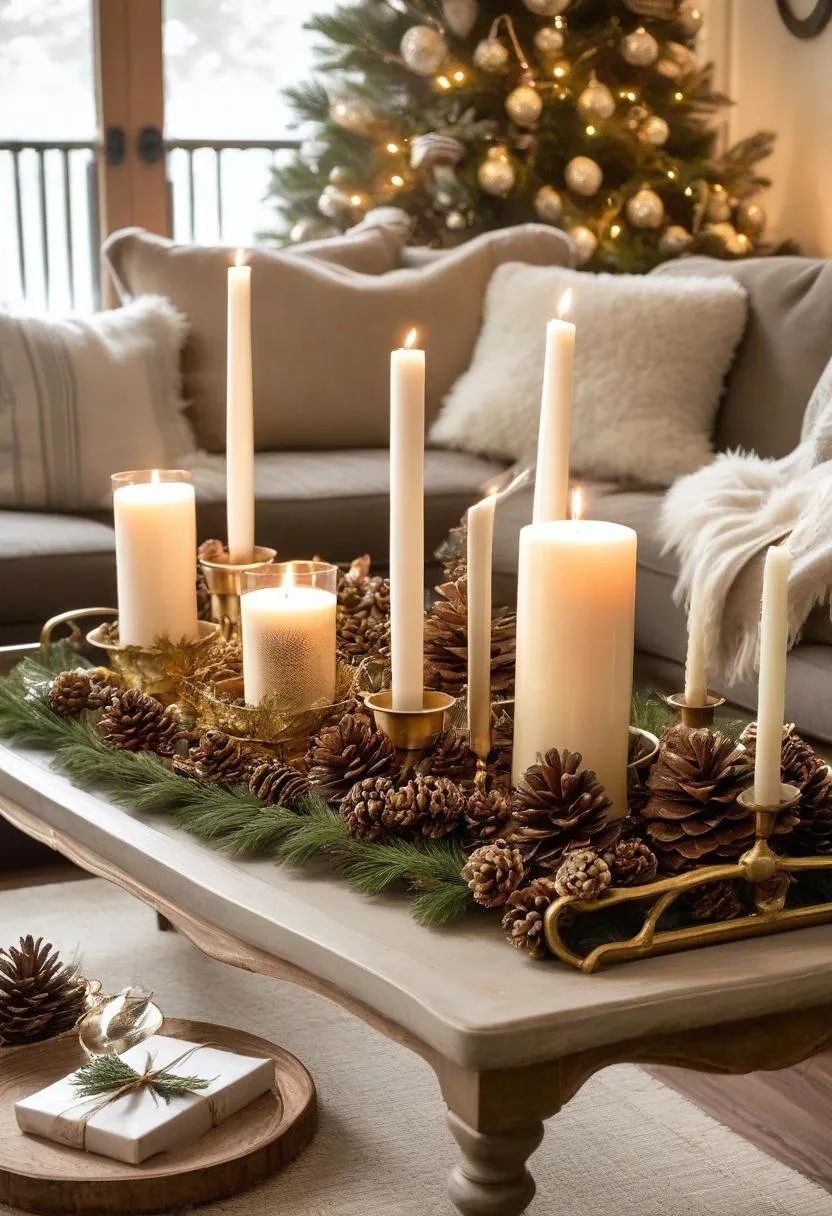
Take away the gold tray and you’d still have candles and pinecones — just a scatter of them. The tray is what turns loose objects into one centerpiece, and it quietly does three jobs: it catches wax drips, it gives you a single thing to lift when you need the table for pizza, and its warm gold picks up every flame in the room. Look for one at least 18 inches long so the arrangement doesn’t spill over the edges.
2. Silver Ornaments and Red Berries on Dark Wood
Silver ornaments on dark wood shouldn’t work this well — the contrast is the whole point. Cool, reflective silver against warm, matte brown makes each ornament look more expensive than it is, and the red berries do the heavy lifting: a few bright dots through an otherwise neutral arrangement keep your eye moving instead of settling. The pewter candlesticks matter more than they look, too. They’re brushed rather than polished, so they read as antique instead of brand new.
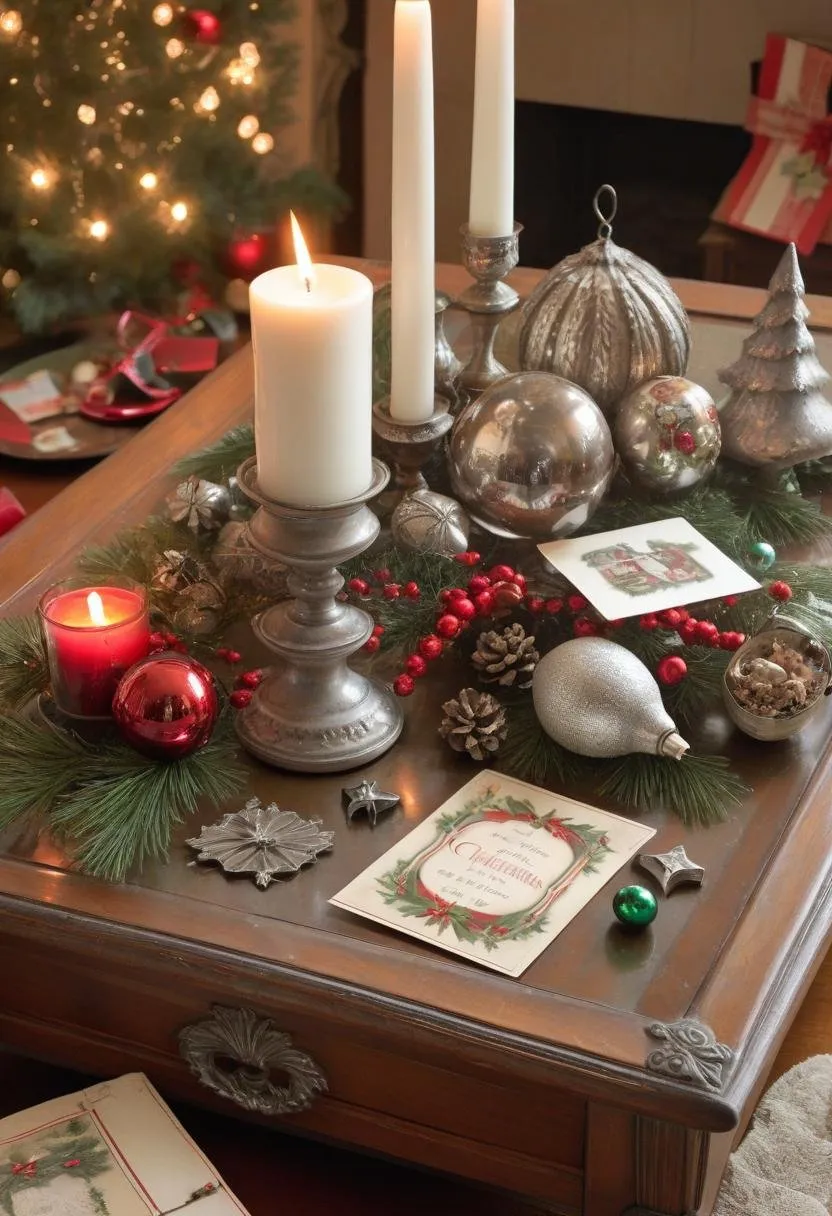
- Dark wood coffee table: $180–$600
- Pewter or pewter-look candlesticks, set of three: $40–$120
- Silver ornaments plus a textured gourd or tree shape: $35–$90
- Pine branches, red berry sprays, pinecones: $15–$40
- Vintage Christmas cards: $5–$25
Total: roughly $275–$875, and you probably own half of it already. Budget alternative: thrift the pewter (often $6–$12 a stick) and swap fresh pine for a $12 faux garland — the look holds at about 55% less.
3. Gingerbread and Golden Mugs on a Textured Oval Table
- Bake or buy the cookies a day ahead — they firm up and stop smearing.
- Line a shallow bowl with parchment, then nestle stars, trees, and figures in overlapping layers.
- Prop one star upright against the bowl’s edge so it stands above the pile.
- Add greenery behind the bowl, not on top — cookies and pine needles don’t share a plate well.
- Refresh only what you’ll actually eat; anything sitting out past three days gets tossed.
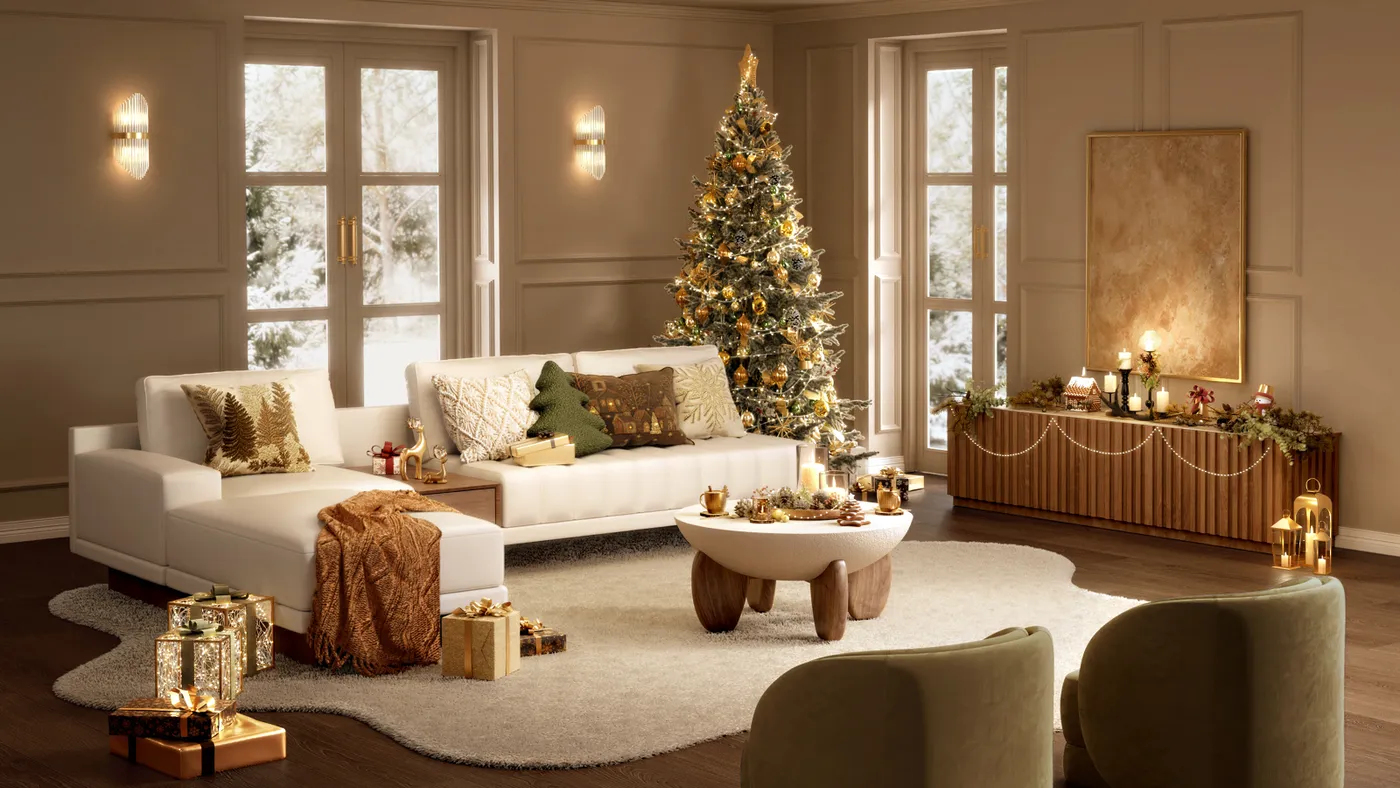
About 25 minutes and $8–$20 in cookies. The textured off-white top and chunky dark wood legs are doing the rest of the work.
Gingerbread on a coffee table is charming and also a snack. With a dog, a toddler, or a husband in the house, expect the stars to vanish first and the figures to get nibbled. Keep the cookies on the upper surface and the candles on a separate tray so nobody reaches across a flame for a treat. If your table doubles as a homework station, swap in wooden or felt gingerbread shapes — they survive December by the handful.
4. A Sculptural Wavy Base Under Three Lit Pillars
Most of the styling on this table takes thirty seconds — three plain white pillars, a green wreath, a few pinecones on a slice of wood. The carved, wavy base underneath is the part you can’t fake. It turns a functional surface into something you notice from across the room before a single candle is lit, and it gives the whole arrangement a visual anchor a plain pedestal never would. If you’re buying one coffee table this year, buy the base. You can always restyle the top; you’re stuck with the silhouette.
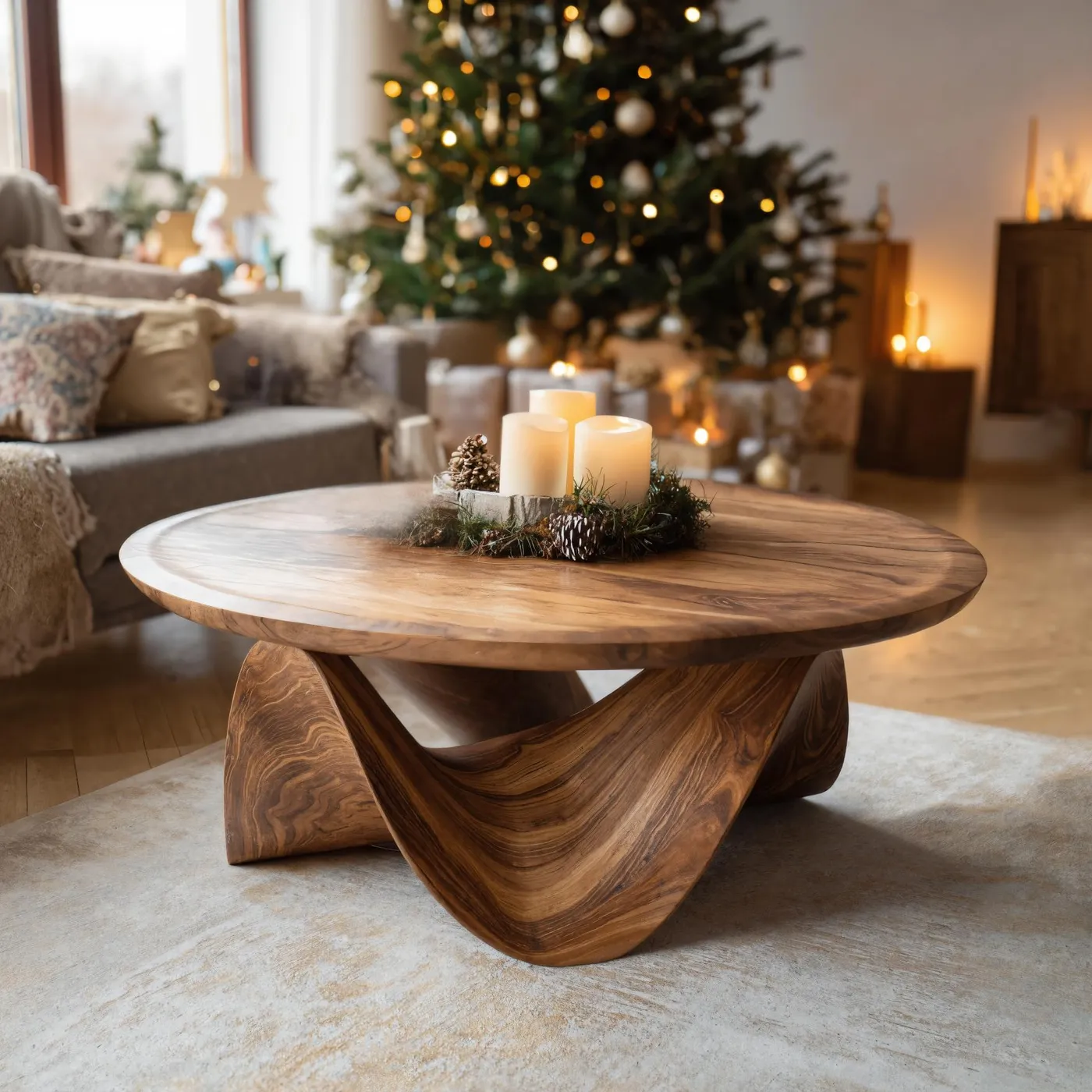
The formula is simple enough to steal for any room: 55% warm dark wood, 25% cream, 15% evergreen, 5% brown pinecone. To shift it seasonally, keep the proportions and swap the middle. Cream becomes blush in spring, deep teal in fall. For a version that runs through January, trade the pinecones for birch logs and leave everything else exactly where it is. The proportions are doing the work, not the objects.
5. The Coffee Table Wreath, Done Simply
Wreaths on a coffee table need a flat bottom and an interior wide enough for a hurricane. Check three things before you buy:
- Inner diameter of at least 6 inches
- A base that sits flat, with no wire loops underneath
- Realistic branch structure, not tightly wound tinsel
Then set the glass on a felt pad so it doesn’t scratch the wood when you slide it. A 4-inch pillar inside a 6-inch hurricane leaves clearance to actually light the thing.
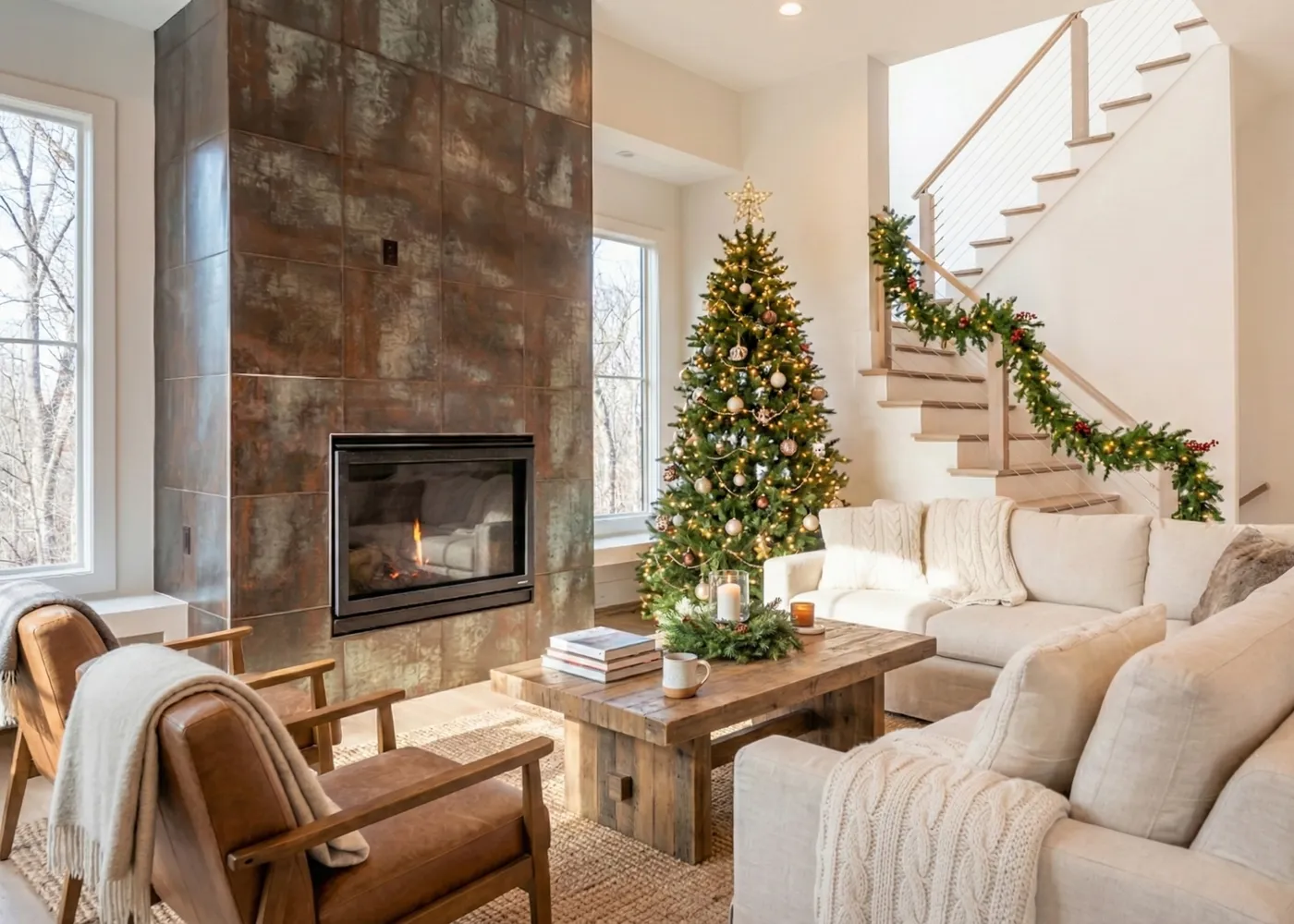
Nothing here is precious, and that’s the strategy. A wreath, one candle, a stack of books you’re genuinely reading, a mug that’s probably still warm — this is a table that invites people to sit down rather than look. The cream sofas and worn leather armchairs frame it without competing. What makes it work is restraint: one green element, one flame, one stack. Add a second wreath and the whole thing tips from living room into display.
6. A Wooden Tray, a Bottle Brush Tree, and a Vintage Christmas Carol
The bottle brush tree is doing a lot of cultural work right now. There’s been a real swing away from color-coordinated, brand-new holiday decor toward the kind of Christmas people actually remember — mismatched ornaments, worn paperbacks, trees that look like they came out of a 1970s attic. Thrifted and vintage Christmas decor has been one of the fastest-growing Pinterest searches heading into 2026. This table is that whole trend in miniature: nothing on it cost much, and nothing on it looks like it came from a set.
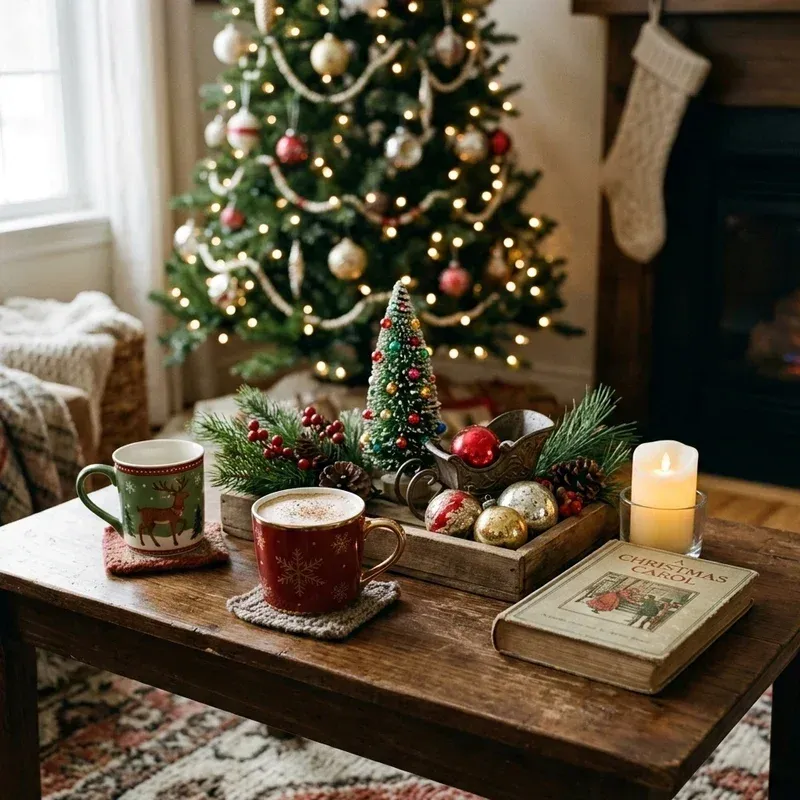
- Rustic wood coffee table: $150–$500
- Wooden tray: $25–$70
- Bottle brush trees, set of three: $12–$35
- Pine, berries, small ornaments: $20–$50
- Two festive mugs and knitted coasters: $20–$45
- Glass hurricane and pillar candle: $15–$40
Total: about $240–$740. Budget alternative: the tray, trees, and mugs are the whole story — skip the rest and you’re still there for under $60.
7. Plaid, Laptop, and a Lift-Top That Actually Works
Lift-top tables are wonderful and also a commitment. The mechanism adds real weight, so measure your rug and your walking path before you buy — a 48-inch lift-top in a 9-foot-wide room becomes furniture you have to negotiate with. The draped red-and-black plaid throw is charming until somebody trips on the fringe, so tuck it so no more than 8 inches hangs down. And wipe the raised desktop weekly. Coffee rings on a lift-top surface are basically permanent.
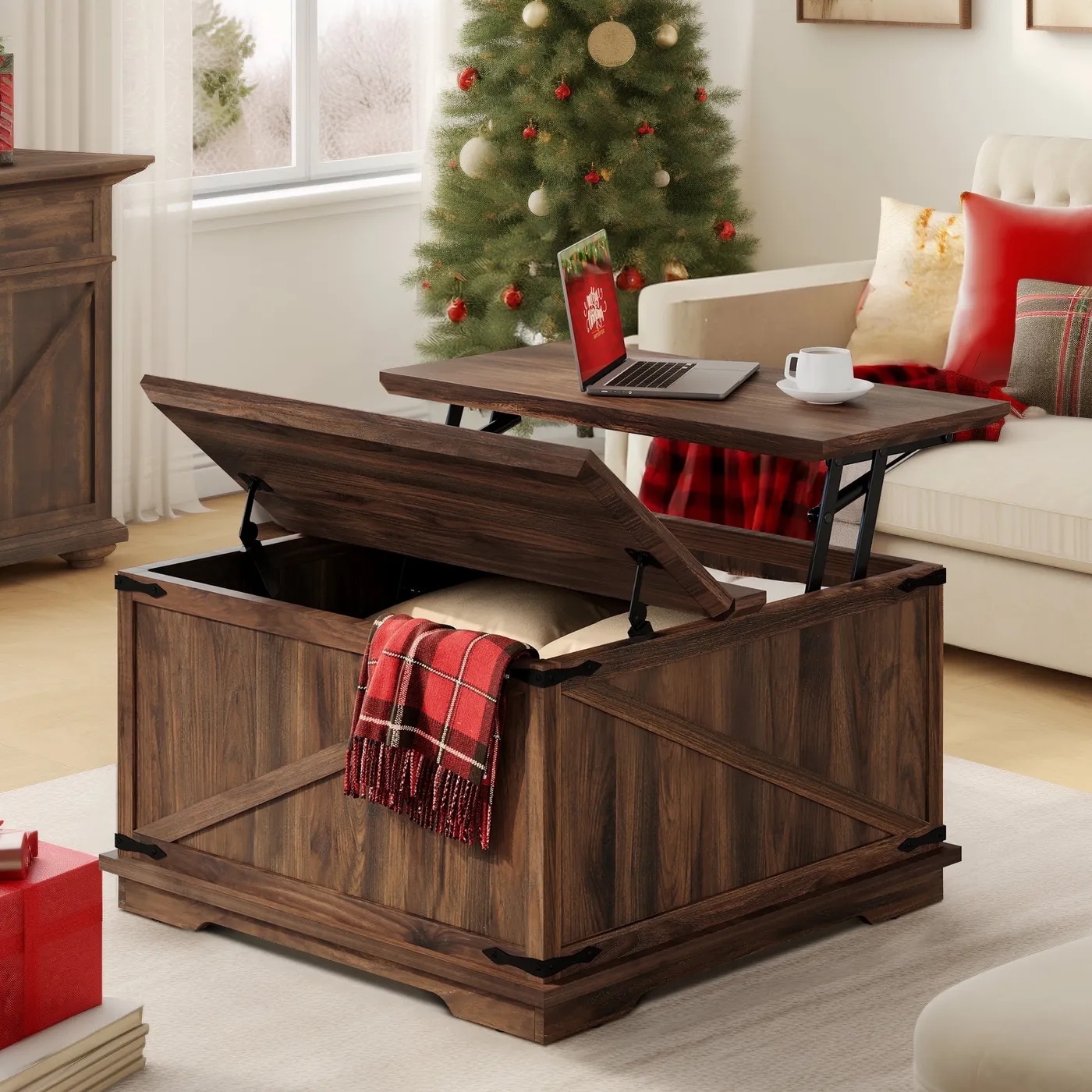
A lift-top with storage usually runs $250–$700. You can get the same function for less: a $60–$120 standard wood table from IKEA or Walmart, plus a $35–$60 woven basket or thrifted vintage trunk slid underneath for blankets and remotes. Target and Walmart sell red plaid throws for $15–$30 in November, and Facebook Marketplace is full of them by January. All in, around $150.
8. Twig Wreath and Four Hurricanes on Natural Wood
This layout wants a table at least 48 inches long and 24 inches deep. Four hurricanes in a row need roughly 36 inches of usable length; go narrower and you’re forced into a cluster, which reads completely differently. Low ceilings under 8 feet actually help here, since the arrangement stays under 10 inches tall and never competes with the room. If your table is smaller, see Idea #19 for a scaled-down version that works on a 30-inch surface.
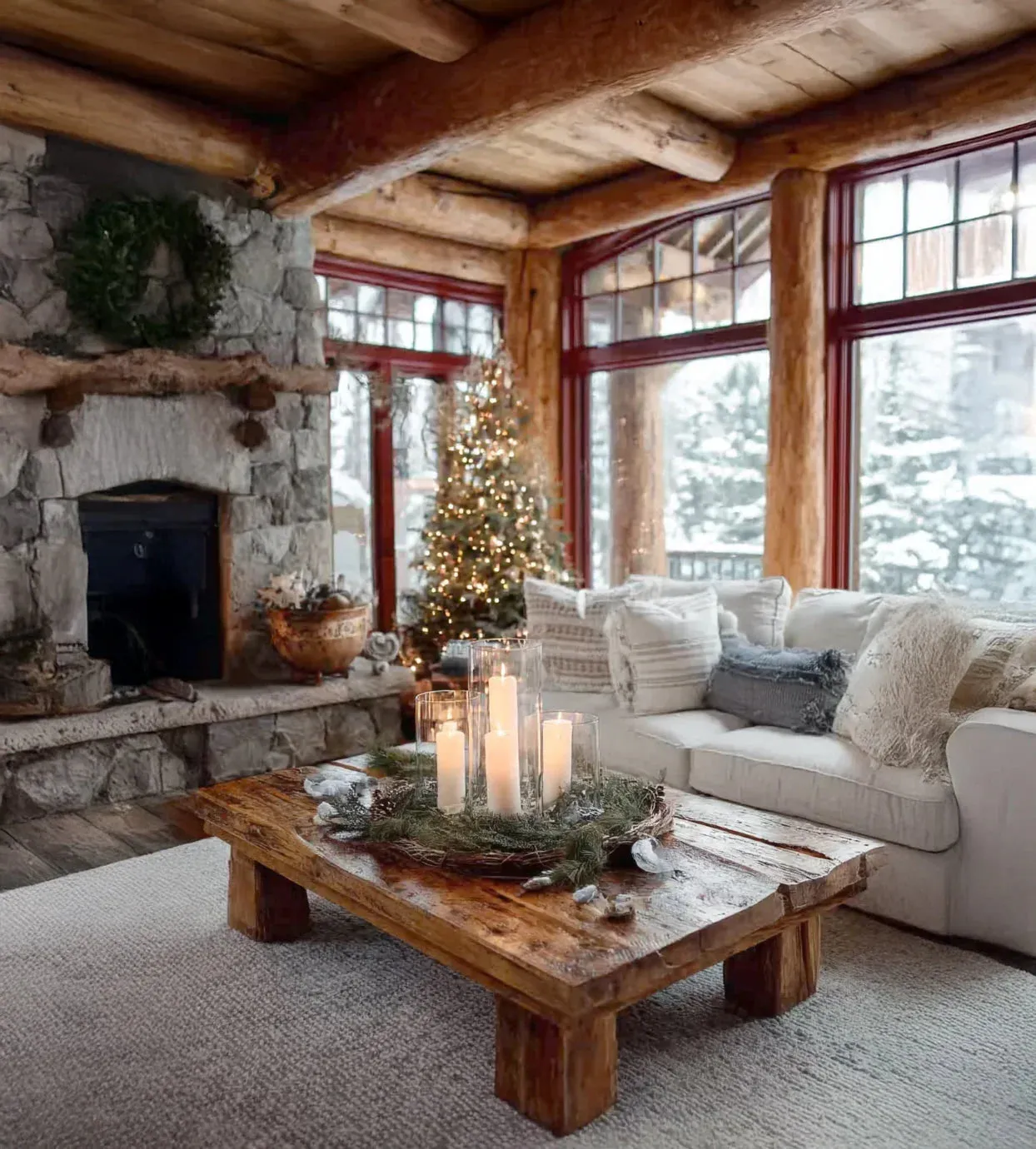
- Start with a 12-inch grapevine or twig wreath base — $8–$15 and it lasts for years.
- Tuck small evergreen sprigs into the gaps, working in one direction so it looks grown rather than placed.
- Set the wreath flat and place four hurricanes inside it, spaced evenly.
- Trim any sprig that touches glass — greenery against hot glass scorches.
- Mist the greens every few days if they’re real.
Twenty minutes, about $30 if you already own the hurricanes.
9. Metallic Ornaments in a Bowl of Faux Fur
Scoop the ornaments out of the bowl and it’s still a fine arrangement. Take away the white faux fur underneath them and it’s just a bowl of baubles. The fur is the difference between a display and a moment — it softens hard metallic surfaces, it makes gold look warmer, and it hides the fact that ornaments never sit neatly in a round bowl. A $12–$25 scrap from a craft store does the exact same job as a designer version.
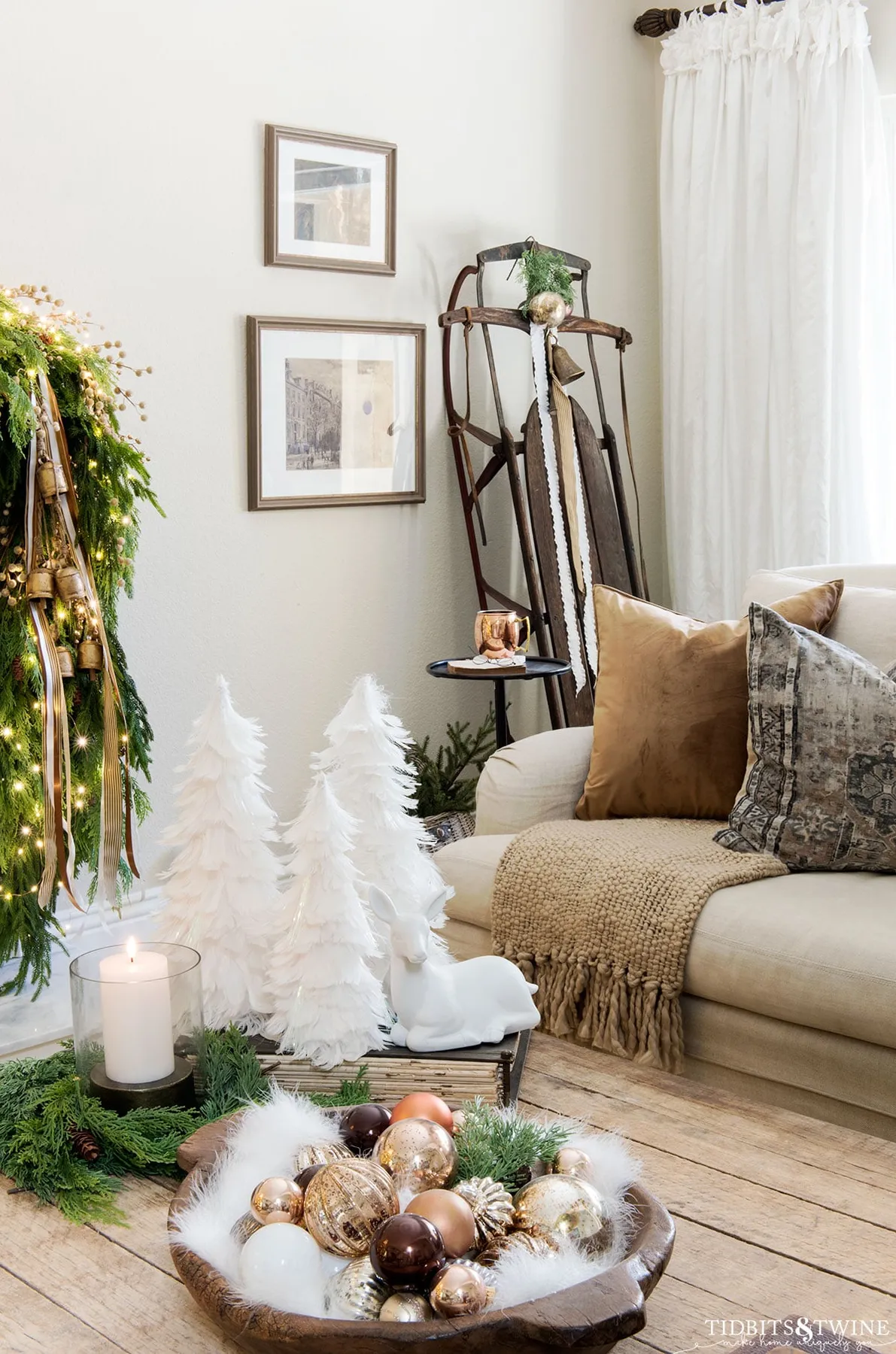
Faux fur is a magnet. It collects dust, pet hair, and static-cling glitter, and it does not appreciate a vacuum with a beater bar. Shake it out weekly, spot-clean with a damp cloth, and plan on replacing a $15 scrap every season or two rather than laundering it. The metallics have their own issue: gold and bronze finishes dull with fingerprints and skin oils. Handle ornaments by the cap, and wipe them with a dry microfiber cloth before you pack them away.
10. Gilded Branches and Metallic Deer Take the Table
Metallic-on-metallic works when you split the temperature. This table runs roughly 50% warm gold, 35% cool silver, 15% white. Gold leads — it’s in the branches, the deer figurines, and the candle wax — while silver supports in the candlesticks and pinecones. Flip that ratio and the table turns cold and formal instead of festive. To try the same formula with copper instead of gold, hold silver at 35% and push everything else toward white.
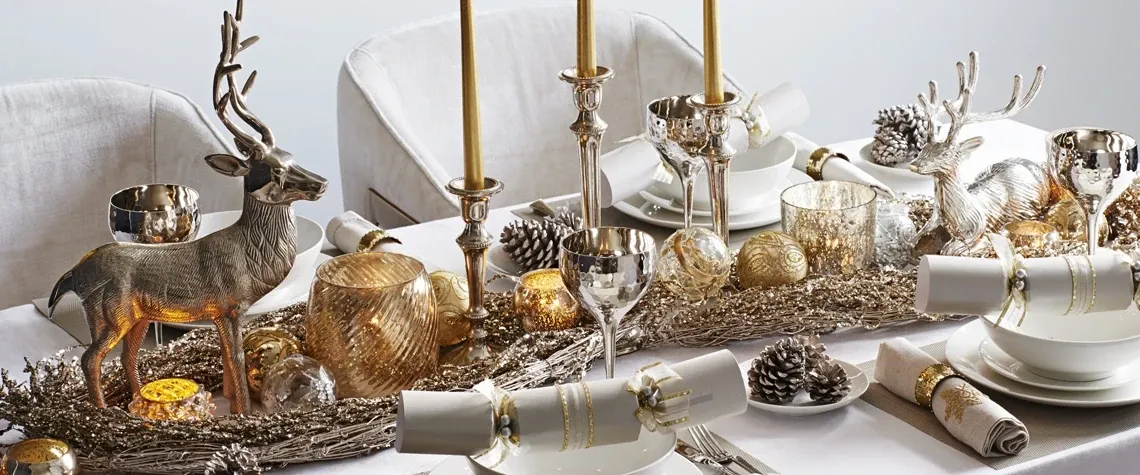
Mercury glass votives are the cheapest way to make a table look expensive. Buy six or eight — odd numbers read better than even — and cluster them in threes at staggered heights. Flame height matters more than people think: votives burn 2–3 hours, so light them right before guests sit down, not an hour early. And use unscented candles at a dining table. Two competing scents fighting the food is the fastest way to ruin a beautiful setting.
11. A Dark Green Runner Rewrites the Whole Table
The runner is the entire design. A dark green band down a light wood table does the same thing a painted stripe does on a wall — it narrows a wide surface and gives every place setting somewhere to live. The gold foliage woven into the fabric is what lets gold cutlery read as intentional instead of random. And notice the candle is white, not green: on a table this saturated, the flame needs a neutral base, or the green starts to look like it’s vibrating against itself.
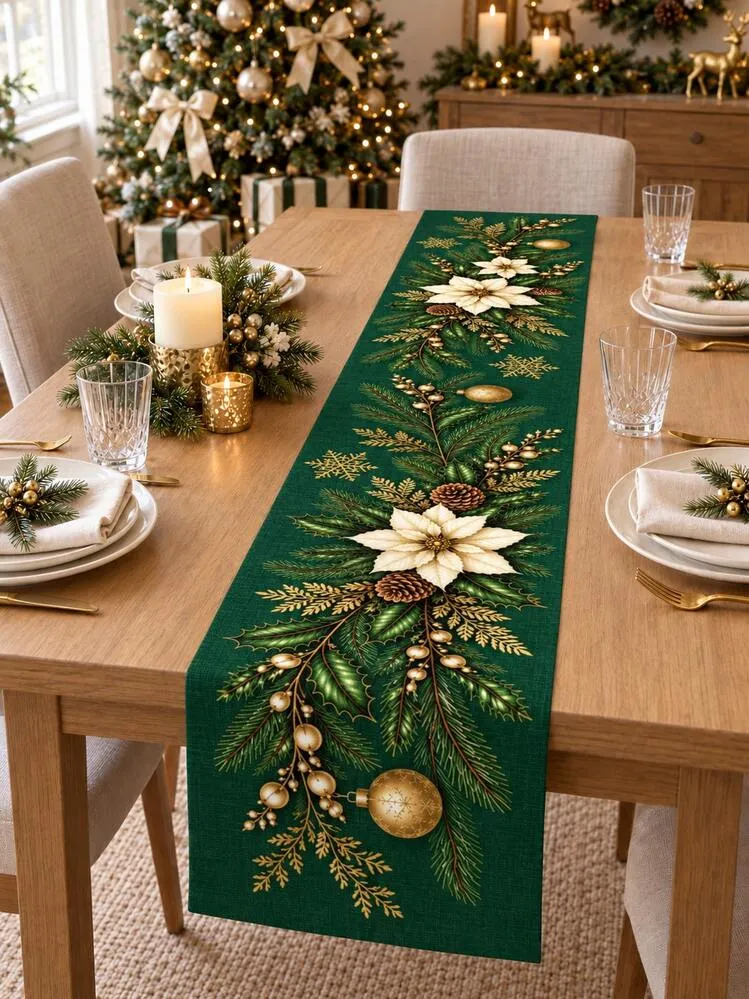
A patterned runner like this runs $40–$120 at a home store. Walmart and Target sell solid dark green runners for $12–$25, and that’s most of the way there. Layer a $20 faux garland down the center for the gold-and-green feel, and use plain white plates you already own instead of buying a holiday set. Gold flatware is the one place worth spending — IKEA’s is about $30 for four settings and it upgrades everything it touches. Whole table for under $90.
12. Traditional Christmas, Painted in Your Own Colors
Before you commit to a traditional scheme on the coffee table, verify a few things:
- Measure usable width and leave 10 inches of bare surface on at least one side for drinks.
- Check what the tree, mantel, and sofa pillows already do color-wise, then pick your dominant from there.
- Choose one metal and stay with it — two metals read as a mistake in traditional styling.
- Confirm where the nearest outlet or battery source is if you want lights.
- Set a hard object ceiling, because traditional arrangements grow fast.
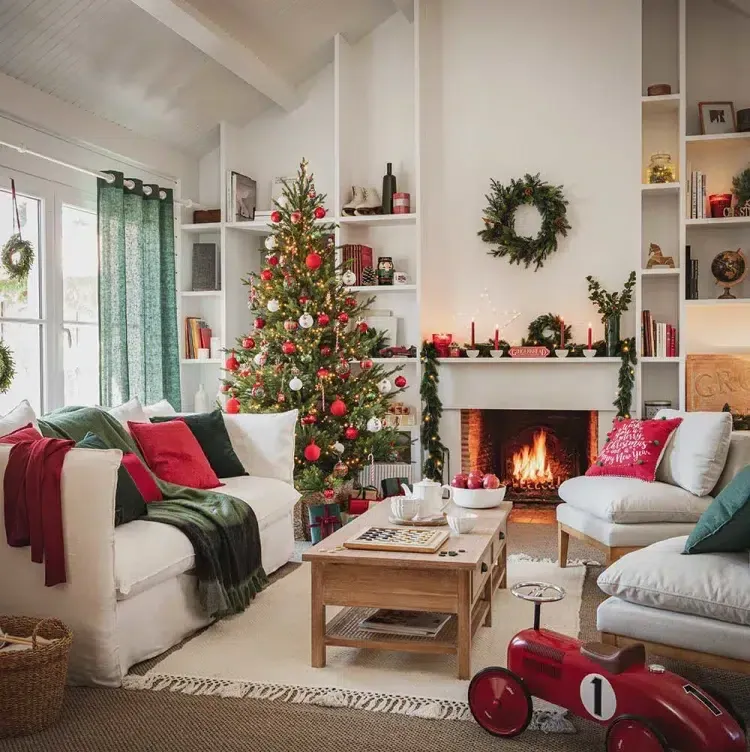
Traditional Christmas styling isn’t a nostalgia play anymore — it’s mainstream. Search interest in classic pinecone-and-berry decor has climbed for three straight seasons heading into 2026, and the biggest driver is color customization: people want the familiar shapes in their own palette. That’s why you’re seeing the same vocabulary in navy, in blush, in black and white. The forms stay traditional; the color is yours. That combination has staying power because it isn’t a trend — it’s a formula.
13. The Modern Arrangement That Skips the Sparkle
Modern Christmas styling on a coffee table comes down to negative space. Aim for 60–70% empty surface. One sculptural object — a single tall candle, a ceramic form, a simple bowl — plus one low element, and stop. Keep total object count under five, use matte finishes over glitter, and choose a palette of two colors plus one material: stone, wood, or ceramic. If you can’t see the table’s surface between objects, you’ve already left modern behind.
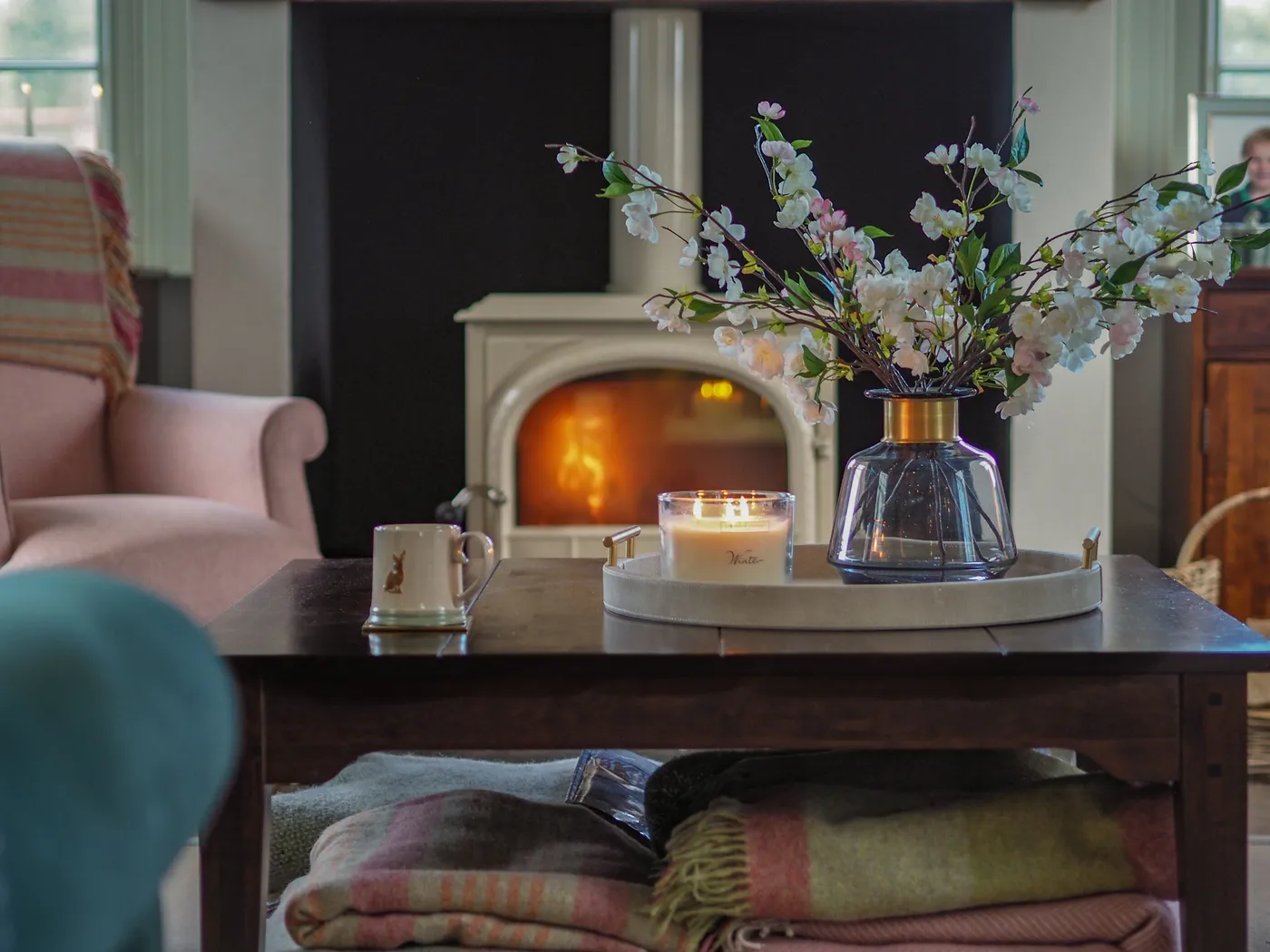
This approach is forgiving on size, which is exactly why it works in small rooms. It holds up on a 24-inch square, a 36-inch rectangle, and a 48-inch round. What matters more is ceiling height and sightline: in a room under 9 feet, keep the tallest element under 14 inches so it doesn’t cut the view to the tree. For a bigger room where the table needs to hold its own, see Idea #14 — that one scales up with a heavier table underneath it.
14. Black Table, Beamed Ceiling, One Gold Tray
Black coffee tables are beautiful and brutally honest. Every fingerprint, every drop of candle wax, every speck of dust shows up in raking light. If yours sits under a window or across from a lamp, plan on a wipe-down every few days, and put a felt pad under the tray — gold edges scratch black finish permanently. The reward is worth it: a black surface makes a single lit candle look like stage lighting.
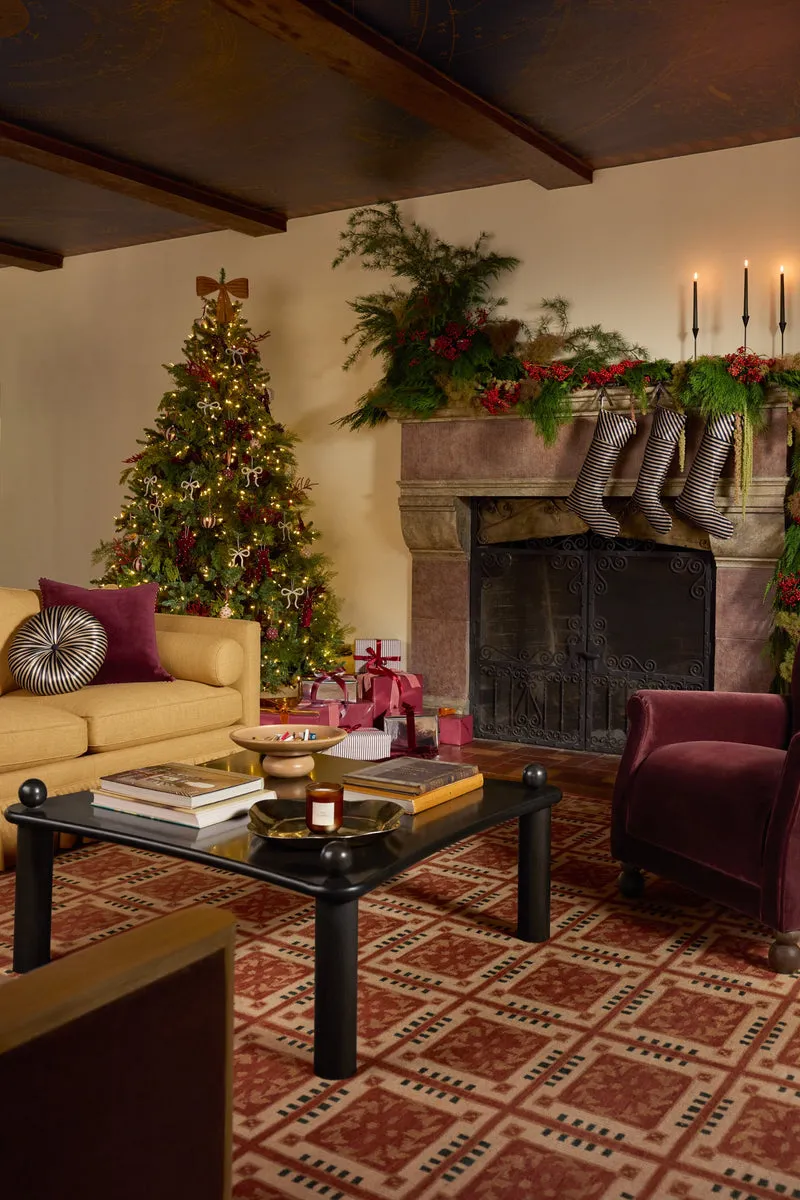
Black tables change the math. On light wood, decor can be subtle and still register. On black, you need contrast or the arrangement disappears entirely. This one runs roughly 40% black, 30% warm red and mustard, 20% cream, 10% gold, with the cream rug and light walls keeping the black from swallowing the room. If your table is white or oak instead, keep the red-and-mustard accents and drop black to 10% — the arrangement still reads, just softer.
15. Two Tiers of Glass and Gold, Styled Bottom to Top
- Start with the largest item on the lower shelf — a woven basket, a tray, or a stack of magazines — placed off-center.
- Fill the basket with folded throws, rolled rather than folded so the color edges show.
- Add one vertical element, like a small book stack laid flat with a candle on top.
- Leave at least a third of the shelf visibly empty so the glass still reads as glass.
- Check the view from the sofa — the bottom shelf should look styled from a seated angle, not from above.
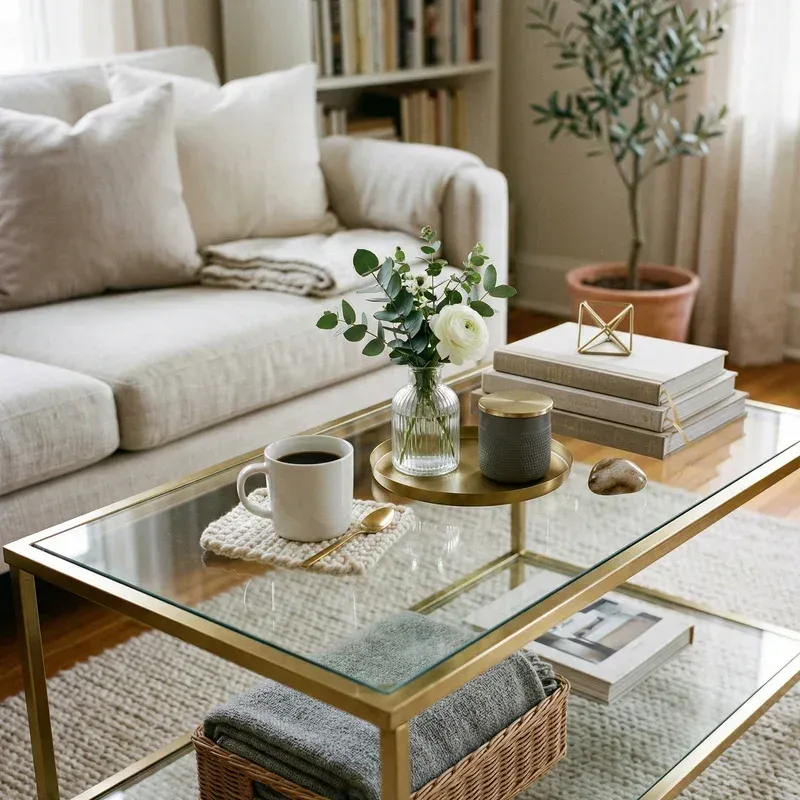
Fifteen minutes, and $0 if you already own a basket.
A gold-framed glass table runs $200–$500. A plain glass table with a wooden or black frame runs $70–$150 and looks nearly identical once it’s styled, since the gold reads mostly from the frame’s thin edge anyway. Spray-paint a thrifted tray for the top for about $8. For the basket, IKEA and Target both sell woven versions for $15–$30 — the market-basket shape matters more than the brand name.
16. Coffee and Gingerbread, Styled Like a Still Life
- Coffee table you already own: $0
- Two stoneware mugs: $16–$40
- Wooden serving board or small tray: $15–$45
- Gingerbread or holiday cookies: $6–$18
- Linen napkins in a warm neutral: $12–$30
- One pillar candle and holder: $10–$35
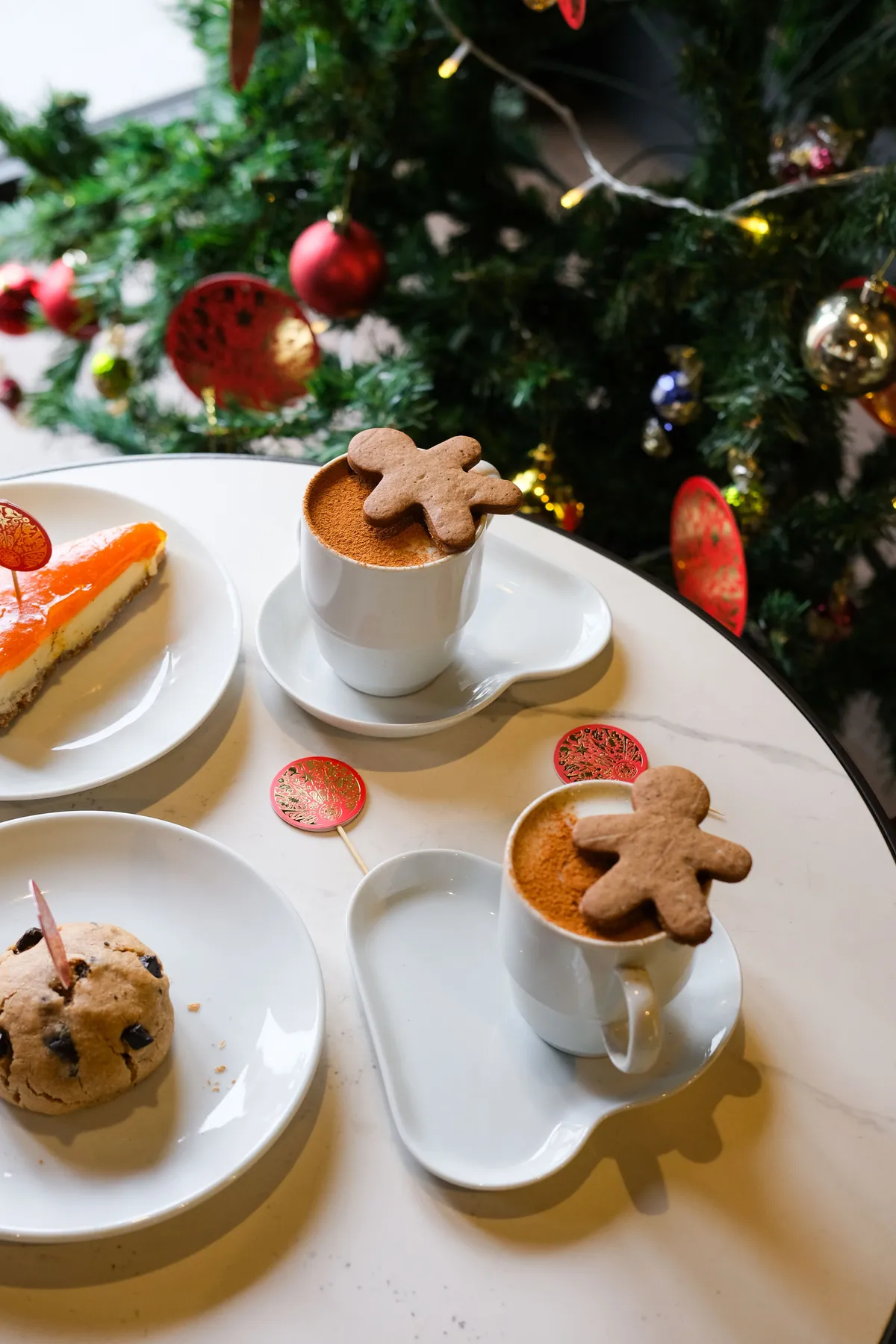
Total: about $60–$170. Budget alternative: thrift the mugs and the board for around $10 combined, bake the cookies yourself for $5, and borrow a candle from another room. That’s a real Christmas moment for under $25.
For a coffee-and-treats setup, the trick is warmth and timing. Heat the mugs first with hot water so the coffee stays hot while people linger, and never fill past two-thirds or you’ll have rings on the table by the second cup. Set the treats on a board with a lip, and put a small plate under anything frosted. Sugar and wood finishes are not friends.
17. Live Edge Walnut Meets Rustic Christmas
Live edge tables do the decorating for you. The irregular edge, the visible grain, the uneven tone — that’s already texture, so the surface doesn’t need much added to it. Rustic Christmas decor works here because both share the same vocabulary: unfinished, uneven, a little rough. Add too much polish and you get a clash. The rule with live edge is to match its rawness — unbleached linen, raw wood, wool, dried citrus, nothing shiny.
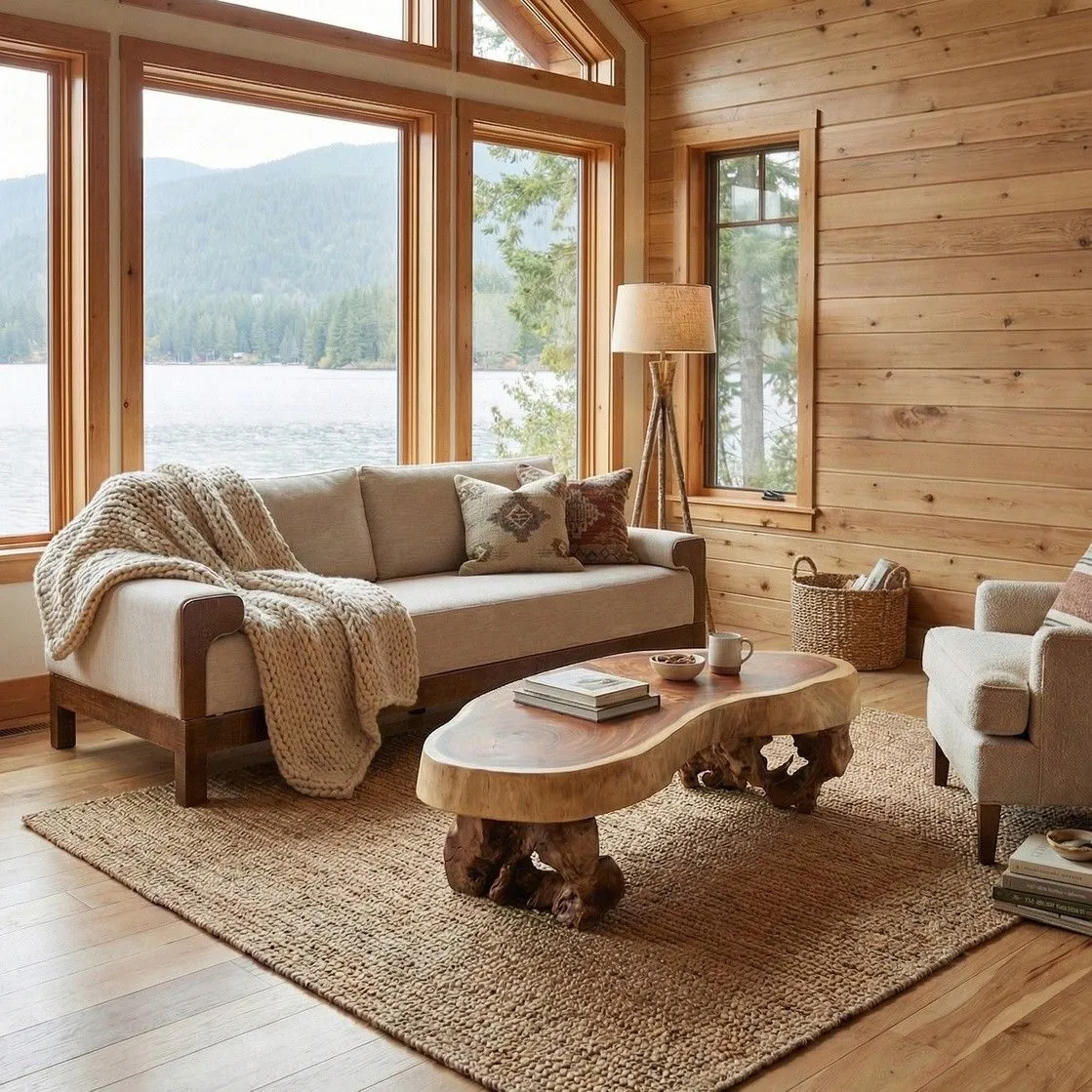
Live edge is a real wood surface, which means it behaves like one. It moves slightly with humidity, so keep it away from heating vents and direct sun, and never set a hot mug directly on it. Expect to oil it once or twice a year with a food-safe finish. Measure the depth carefully, too: slabs often run 26–30 inches deep, which eats walking space in a narrow room. If your space is tight, look at Idea #28 instead.
18. A Geometric Candle Holder on a Reflective Top
One object can carry a whole table, and this is that object. A geometric holder brings angles into a room that’s otherwise soft — round cushions, draping throws, organic greenery. And because the table is reflective, the candle gets doubled: one flame above, one glow below. Choose a holder in a matte finish so the reflection reads as shimmer rather than glare, and let it be the tallest thing on the surface.

Reflective tables are the most size-sensitive surface in the room. Check these before you commit:
- Table depth under 20 inches — one candle holder, nothing else.
- Room under 120 square feet — keep reflections minimal or the space reads as a funhouse.
- Ceiling above 9 feet — go taller, 12 to 16 inches.
- Windows directly opposite — place the holder off-center so light doesn’t bounce straight back at you.
19. Moon Art and Two Candles on a Little White Table
Small tables don’t need small budgets, but they rarely need big ones either. A white marble-pattern table runs $90–$250 new, and Walmart and Wayfair both carry versions around $60. The round distressed white tray is $15–$35, or paint a thrifted one. Two pillar candles: about $10. The little potted plant: $8 at any grocery store. For the framed moon print, download a free one and use a $10 IKEA frame. Total for the vignette: around $45, not counting the table.
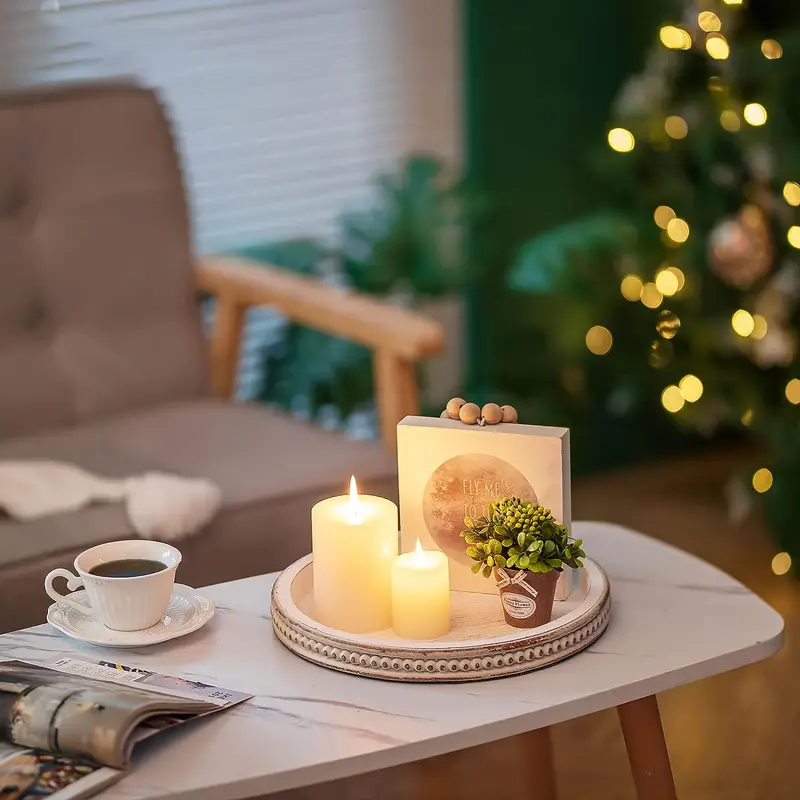
- Set the tray on the table first, off-center by about two inches.
- Place the two candles on one side at different heights, roughly 2 inches apart.
- Put the plant in the opposite corner so the tray feels balanced rather than symmetrical.
- Lean the framed art against the wall behind, or prop it on the tray edge.
- Leave the teacup and open magazine where you actually set them down — the imperfection is the point.
Ten minutes, no cost if you shop your own shelves first.
20. Mercury Glass Trees Under a Garland of String Lights
String lights belong under the garland, not wrapped over it — you want glow, not visible wire. Run the strand along the table first, then lay the garland on top and fluff the branches so they cover the cord. Put the battery pack at the end nearest a wall you’re not styling. A 20-foot strand of warm white fairy lights runs about 8 hours on two AAs. And keep tapers under 10 inches so nobody’s leaning around a flame to pass the potatoes.
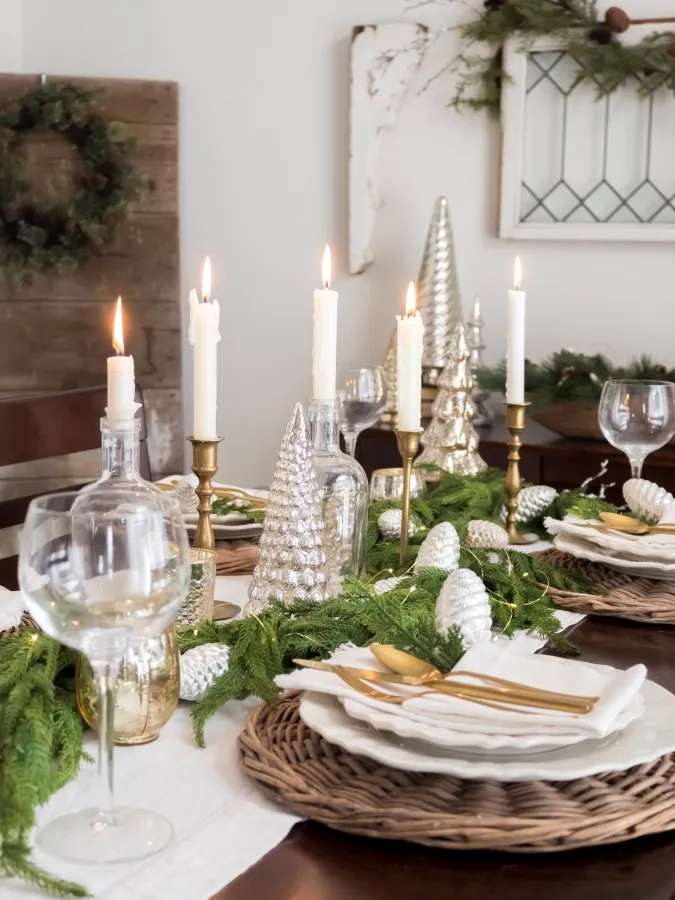
The classic white-and-green formula, properly weighted: 45% white (runner, scalloped plates, painted pinecones), 30% deep green, 15% silver mercury glass, 10% gold. The mercury glass is what keeps white from turning cold — it reflects candlelight and the room right back at itself. To rework the whole thing in a warmer register, swap silver mercury for amber glass and gold for copper, hold white at 45%, and the table still reads elegant rather than rustic.
21. An Unapologetically Red Tablecloth
Full-color Christmas is back, and it’s not being ironic about it. After several seasons of neutral, Scandinavian-adjacent holiday styling, the pendulum has swung hard: saturated red tablecloths, ornament-scattered place settings, a real tree in the corner. Part of that is the broader return of maximalism; part of it is that people want their holiday decor to look like the holidays. Red and green at this saturation isn’t going anywhere in 2026.
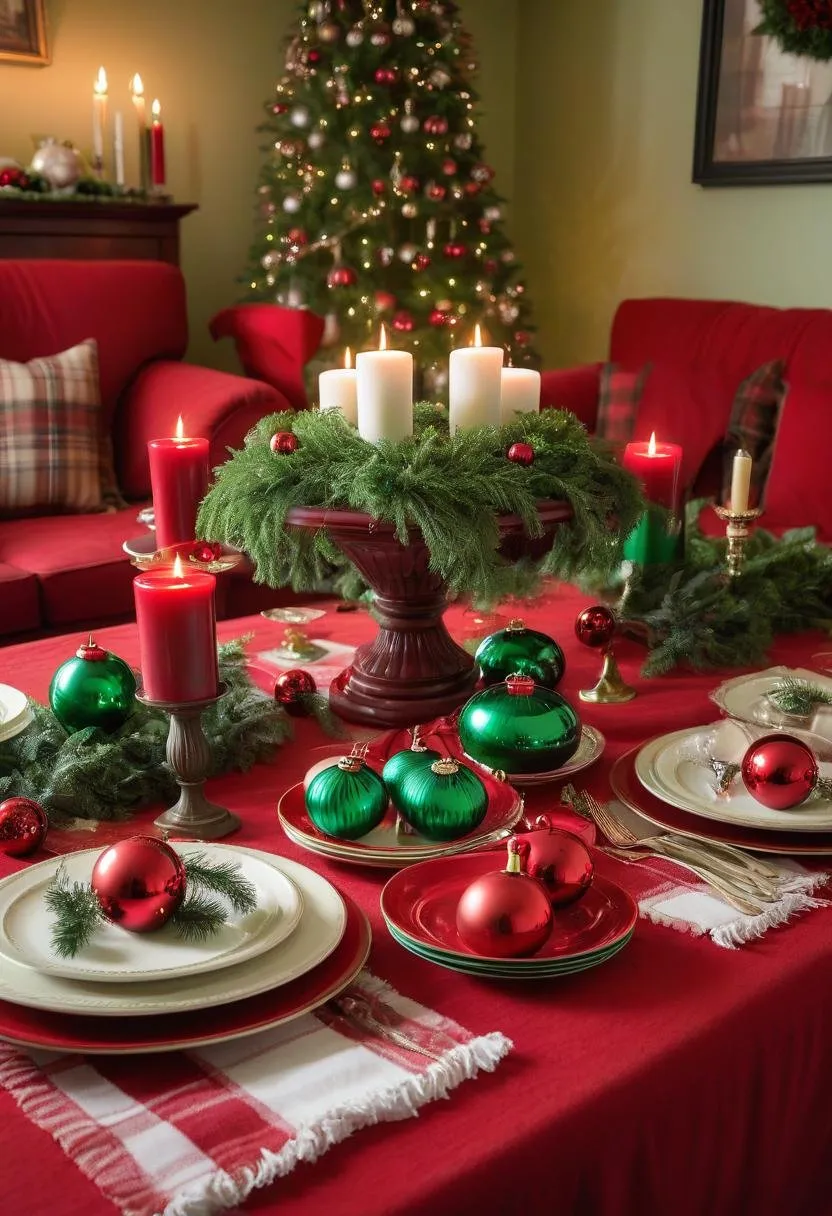
A red tablecloth is a commitment in ways a runner isn’t. It shows every crumb, and red dye transfers — don’t set a damp napkin down and leave it. Choose cotton or a cotton blend, not polyester satin, and wash it cold the night after dinner rather than the following weekend. If your dining room is small or north-facing, a full red cloth can close the room in. In that case, see Idea #11 — a green runner gets the same festive punch with an escape hatch.
22. A Wooden Christmas Pyramid as the Centerpiece
The wooden pyramid is a piece of German Christmas folklore — a carousel powered by rising candle heat — and using it as a coffee table centerpiece does two things at once. It gives the room a story, and it pulls the eye down off the garland-swagged bookshelves so the whole wall can breathe. Pairing it with neutral armchairs is deliberate: a folk object needs a quiet frame. Add patterned pillows and lit garland and the room turns busy fast.
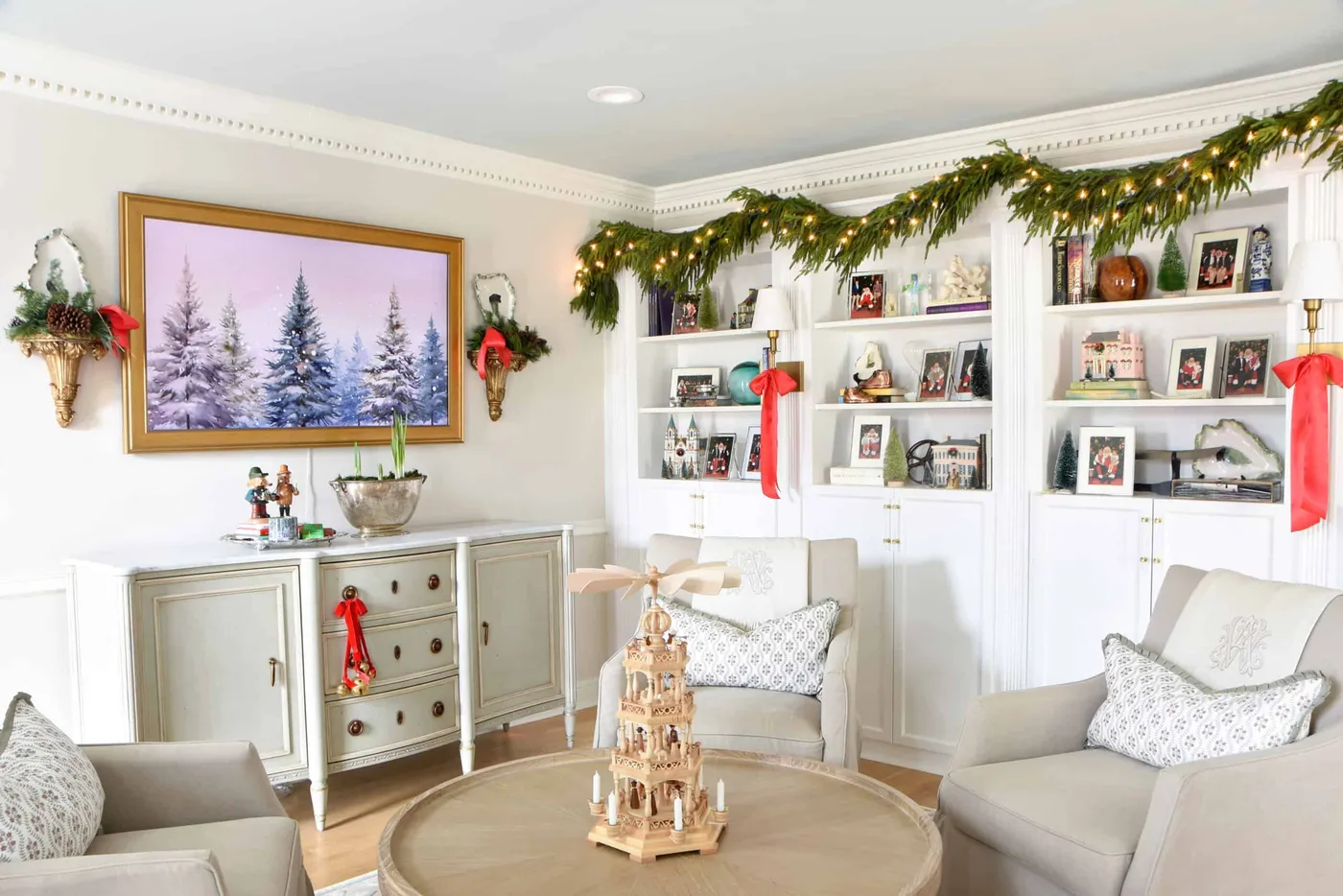
Before you set a candle-powered piece anywhere, check the basics:
- Table surface is heat-safe, or there’s a slate or marble trivet underneath.
- At least 12 inches of clearance above the blades so heat can rise and spin them.
- No books, papers, or gift wrap within 18 inches.
- The table is stable — carved bases wobble, and spinning tops need level ground.
23. The S-Base Table With Sprigs, a Wooden Radio, and Fruit
Drawers in a coffee table change how you style the top, because the surface no longer has to store anything. Keep it to three objects and let the drawers hide the rest. Also: a sculptural S-base visually shifts the table’s footprint, so measure the base, not the top — an S-curve can eat 4 inches of clearance on each side where your feet want to go. Aim for 16–18 inches between the table edge and the sofa skirt.
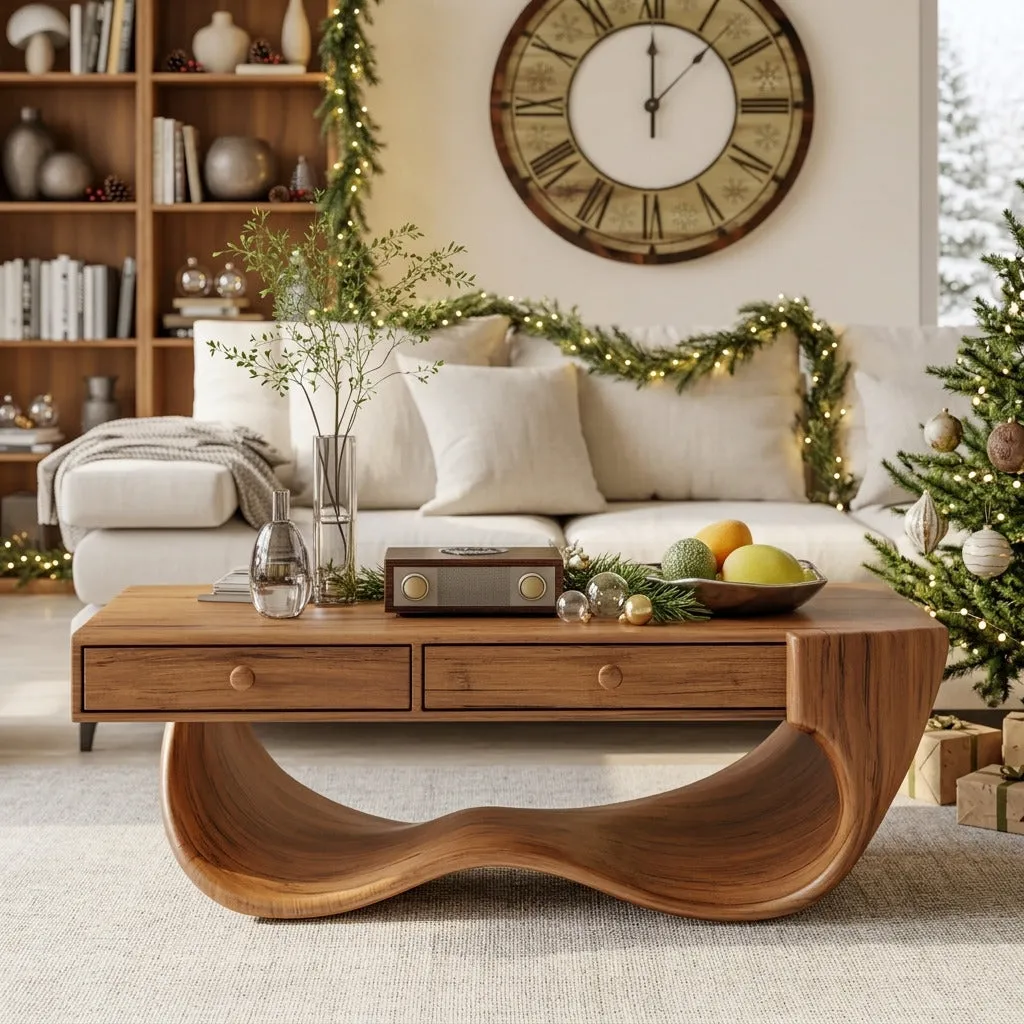
This shape suits wide, shallow rooms. A 47-inch top works in living rooms from roughly 130 to 260 square feet; any smaller and the base starts crowding the sofa. Ceiling height isn’t a factor because the arrangement stays low — 10 to 12 inches total, which is why the bowl of fruit and the vase of sprigs read as decor rather than clutter. Pair it with a sofa no deeper than 36 inches. If your room is narrow, Idea #4 offers a round alternative with movement built into the base.
24. One Long Dark Tray, Evergreens, and Lit Pillars
- Long rectangular tray, 24–36 inches: $25–$80
- Fresh evergreen branches: $15–$40
- Five white pillar candles in mixed heights: $20–$55
- Small gold or bronze ornaments: $12–$30
- Candle holders or gravel filler: $8–$20
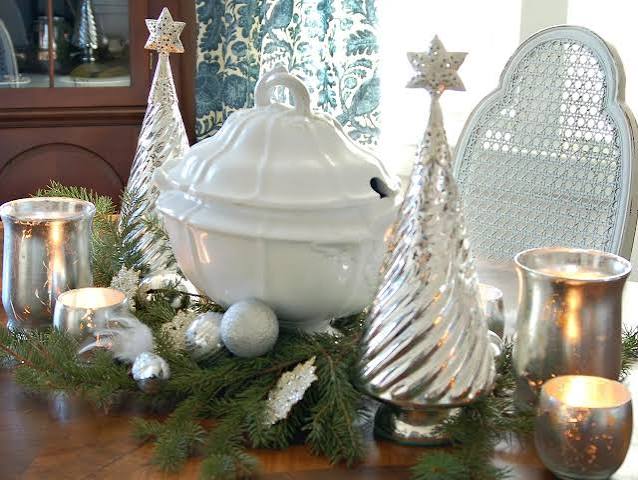
Total: about $80–$225 for a centerpiece that can run from Thanksgiving straight through January. Budget alternative: use a dark cookie sheet or a thrifted tray, buy a $12 grocery-store bundle of greens, and grab pillar candles at a dollar store — you’re under $35.
The tray is doing more work than the greenery. A 30-inch dark tray gives the arrangement a defined edge, which means the branches can look loose and wild without making the table feel messy — and loose is the entire appeal. It also lets you lift the whole centerpiece off in one move, which matters more than you’d think once the cookies come out. Choose one with a 1-inch lip so ornaments don’t roll off.
25. The Living Room Centerpiece Formula That Survives Any Table
A centerpiece formula that works on almost any table: 50% one large element, 30% greenery or texture, 20% light. The large element is whatever the room already wants — a bowl, a tray, a lantern, a stack of books — and it anchors everything else. Greenery softens it, and the 20% of light can be a candle, a small lamp, or fairy lights. Change the palette every year without touching the proportions, and it never looks like the same arrangement twice.
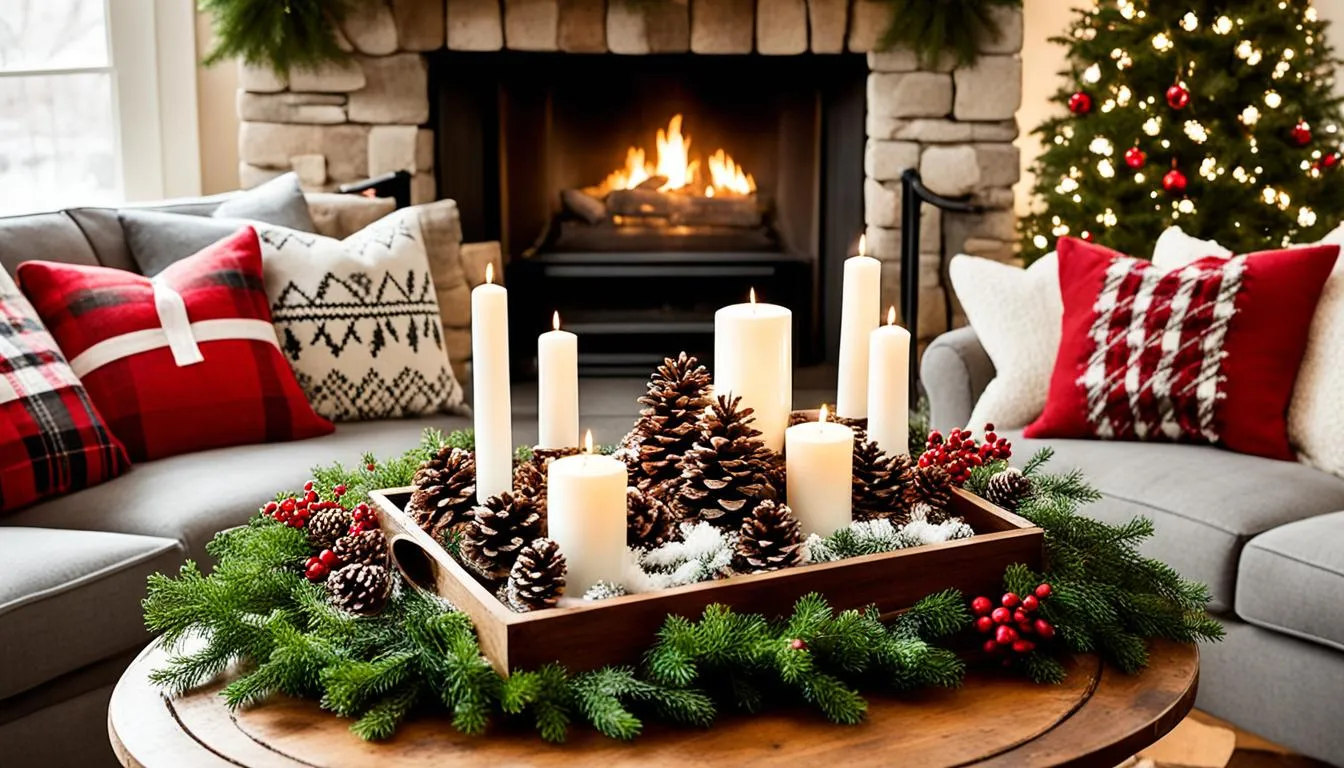
Fresh greens are the fastest thing to go. Fir and pine hold about three weeks in a cool room; cedar and cypress start dropping needles in ten days. Keep them away from heat vents and fireplaces, mist every other day, and pull anything browning immediately, because one sad branch makes the whole arrangement look tired. Faux greens last forever but collect dust — give them a rinse in the shower and let them air-dry before you pack them.
26. Building a Festive Centerpiece in Twenty Minutes
- Clear the table completely, then place the largest object slightly off-center — never dead center.
- Build outward in layers: hard base first, then soft greenery, then small accents.
- Add height on one side only; symmetrical heights look staged.
- Tuck in one light source and check it from the doorway, not from directly above.
- Step back five feet and remove one thing. Always remove one thing.
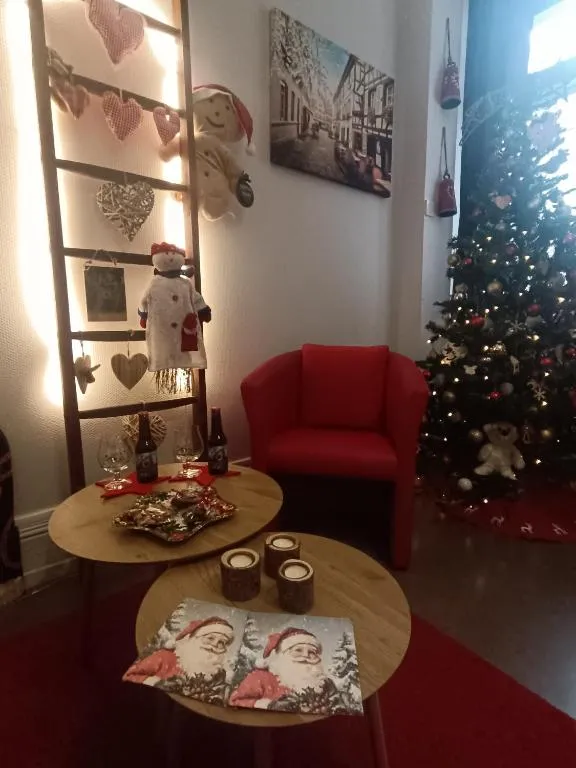
Twenty minutes, and most of it is deciding what to take off.
You can build a genuinely good centerpiece for under $40 without trying hard. Thrift stores are full of trays, wooden bowls, and candlesticks in December — $3 to $8 each. Dollar stores carry pillar candles at $1.25 and ornaments by the tube. Grocery store greenery runs $8–$14 a bundle and stretches further than you expect. Spend your real money on one nice candle; everything else can be cheap and nobody will know the difference.
27. Classic Silver and White, Kept Warm
Silver and white is the most forgiving holiday palette there is, and it’s because of light. Both colors bounce candlelight instead of absorbing it, so even a single flame makes a silver-and-white table look lit from within. It also works with any wall color and reads as elegant without requiring you to buy anything precious. The one rule: keep the whites warm. Cream, pearl, champagne, and ivory beat pure bright white every single time.
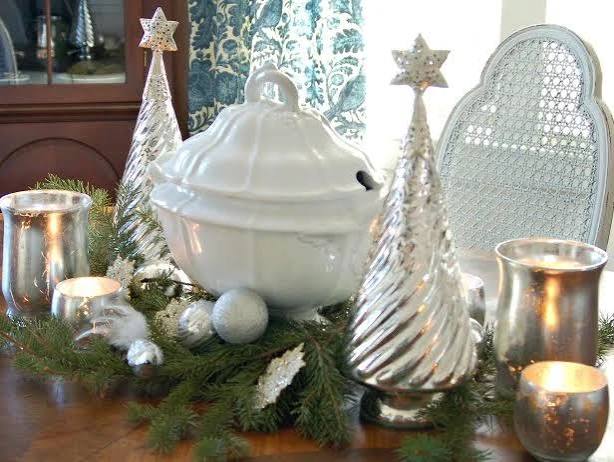
If you go silver and white, give yourself one warm accent or the table turns icy. A single gold candle, an amber glass votive, or a wood tray underneath is enough. Mix your silvers, too — matte, brushed, and mirrored finishes at different scales look collected, while eight identical mercury glass balls look like a catalog page. And cap yourself at three distinct shades of white, or it just looks like you ran out.
28. One Cup of Coffee, and the Simplest Cozy Table There Is
- Coffee table: already yours, $0
- Two stoneware mugs in cream or clay: $18–$45
- Small wooden board or saucer: $10–$30
- One pillar candle and a simple holder: $12–$35
- Knit throw draped nearby: $20–$60
- Greenery sprig in a small vase: $5–$15
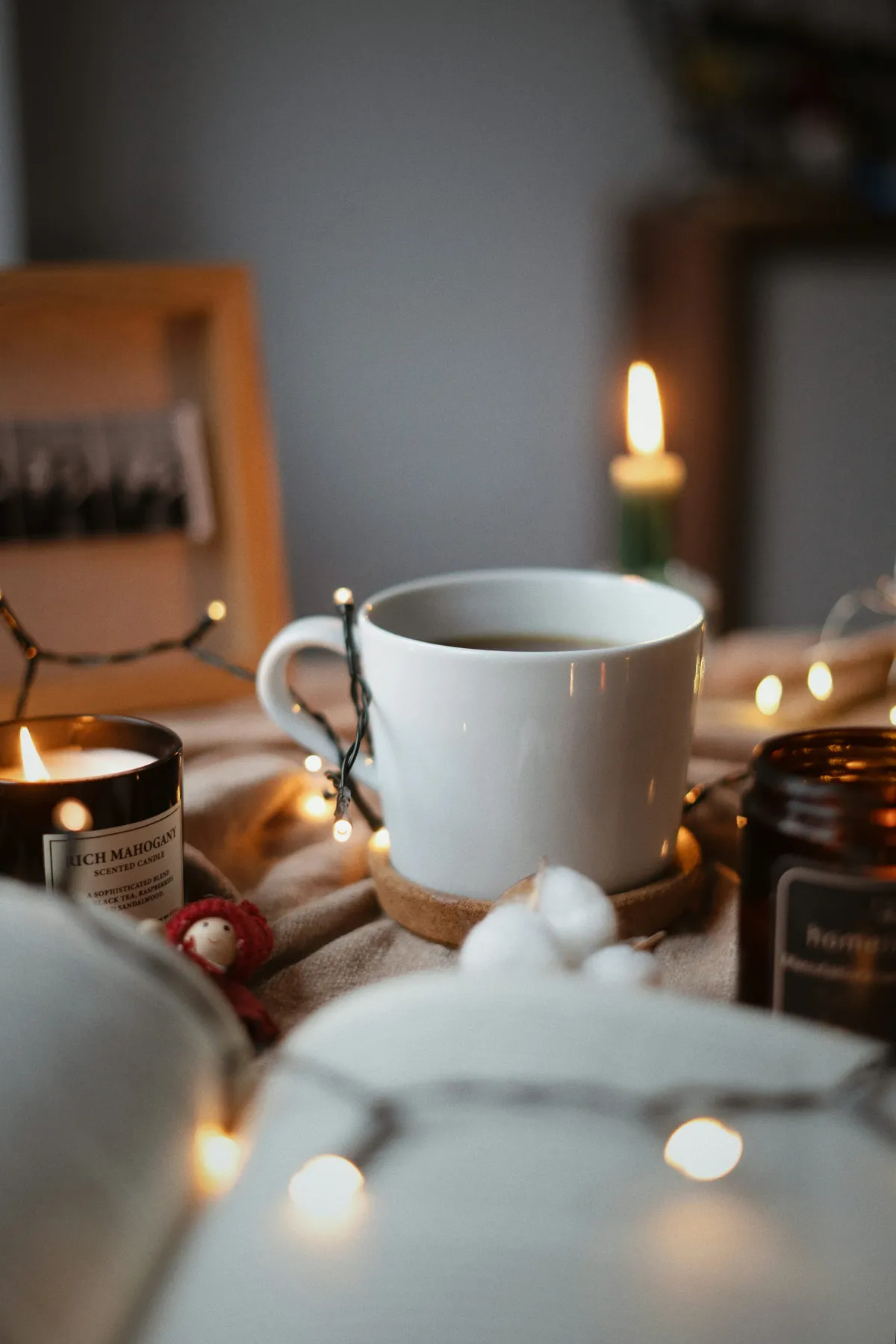
Total: about $65–$185. Budget alternative: skip the throw and the board, keep the mug and one candle — under $20, and it still reads cozy from the couch.
Small-space coffee tables are their own genre. On a table 30 inches or shorter, one mug, one candle, and one small vase is the entire arrangement; anything more and you can’t set a book down. In rooms under 100 square feet, keep the tallest element under 8 inches so it doesn’t block the sightline from sofa to tree. Above 150 square feet, you can move up to a tray-based setup like Idea #24.
29. Kiln-Dried Live Edge, Deliberately Undecorated
Kiln-dried live edge is more stable than air-dried, but it’s still wood, and wood moves. Keep it out of direct sun and away from forced-air vents, use coasters without exception, and re-oil once a year with a food-safe finish — a 30-minute job that prevents a cracked top down the line. Watch the thickness, too. Slabs over 2 inches look incredible in photos and read as heavy in person. In a room under 200 square feet, a 1.5-inch slab is plenty.
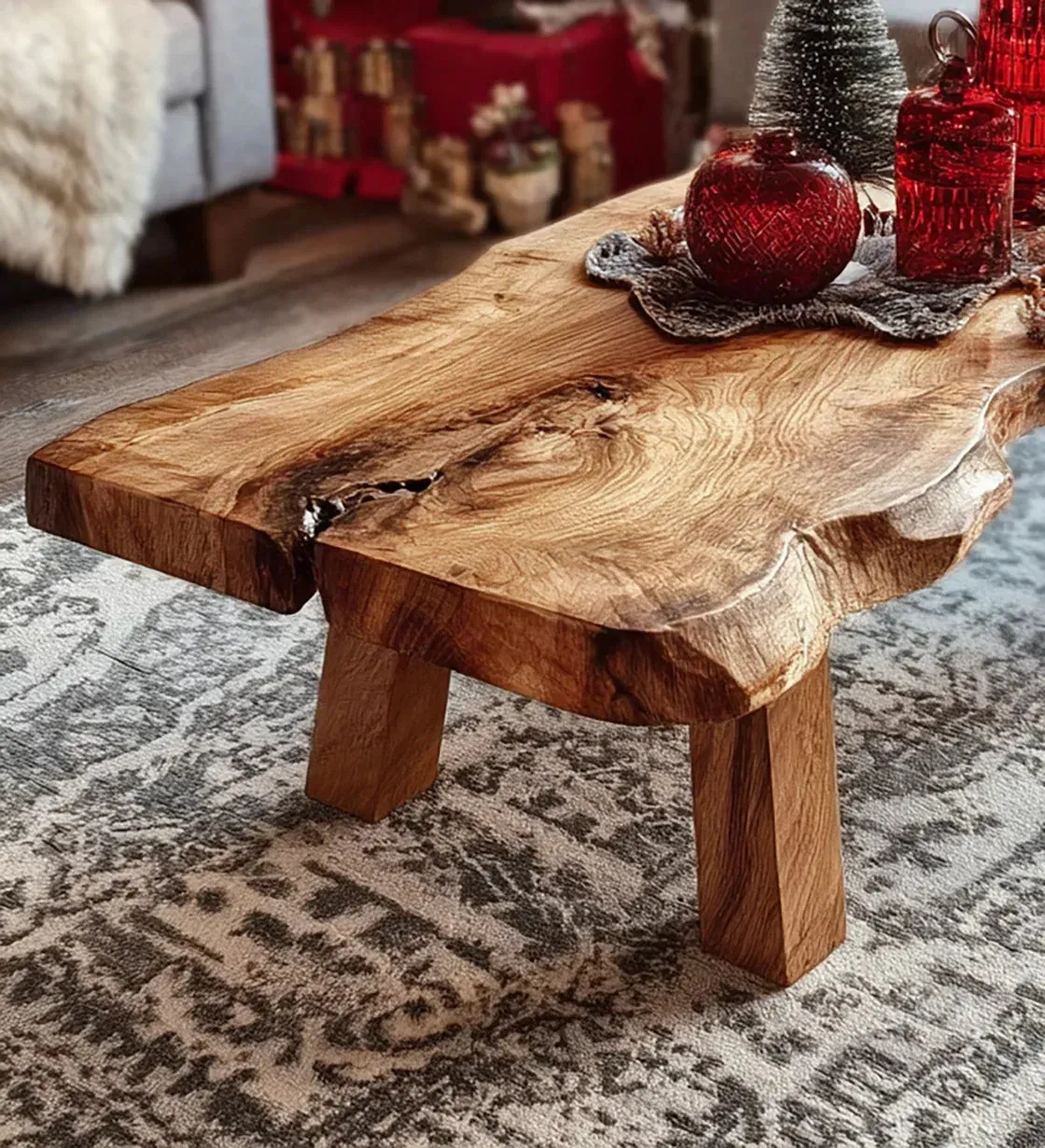
What makes a live edge table work at Christmas isn’t the decor — it’s what you leave off. The grain and the irregular edge already provide the visual interest, so the arrangement only needs texture and light to feel finished. Add a runner, a tray, and six ornaments and you’ve buried the thing you paid for. Two or three raw, matte objects and one flame. That’s the entire brief.
30. Coastal Christmas, Minus the Snow
Coastal Christmas is one of the cheapest themes to pull off, because so much of it comes from outside. Sand and shells from a trip: free. Driftwood: free, if you know where to look. A bag of sea glass or a jar of sand: $10–$20. White pillar candles: about $10. A rope-tied lantern: $20–$40 at Target. Add one sprig of evergreen so it still reads as Christmas and not July, and you’re in for under $60 total.
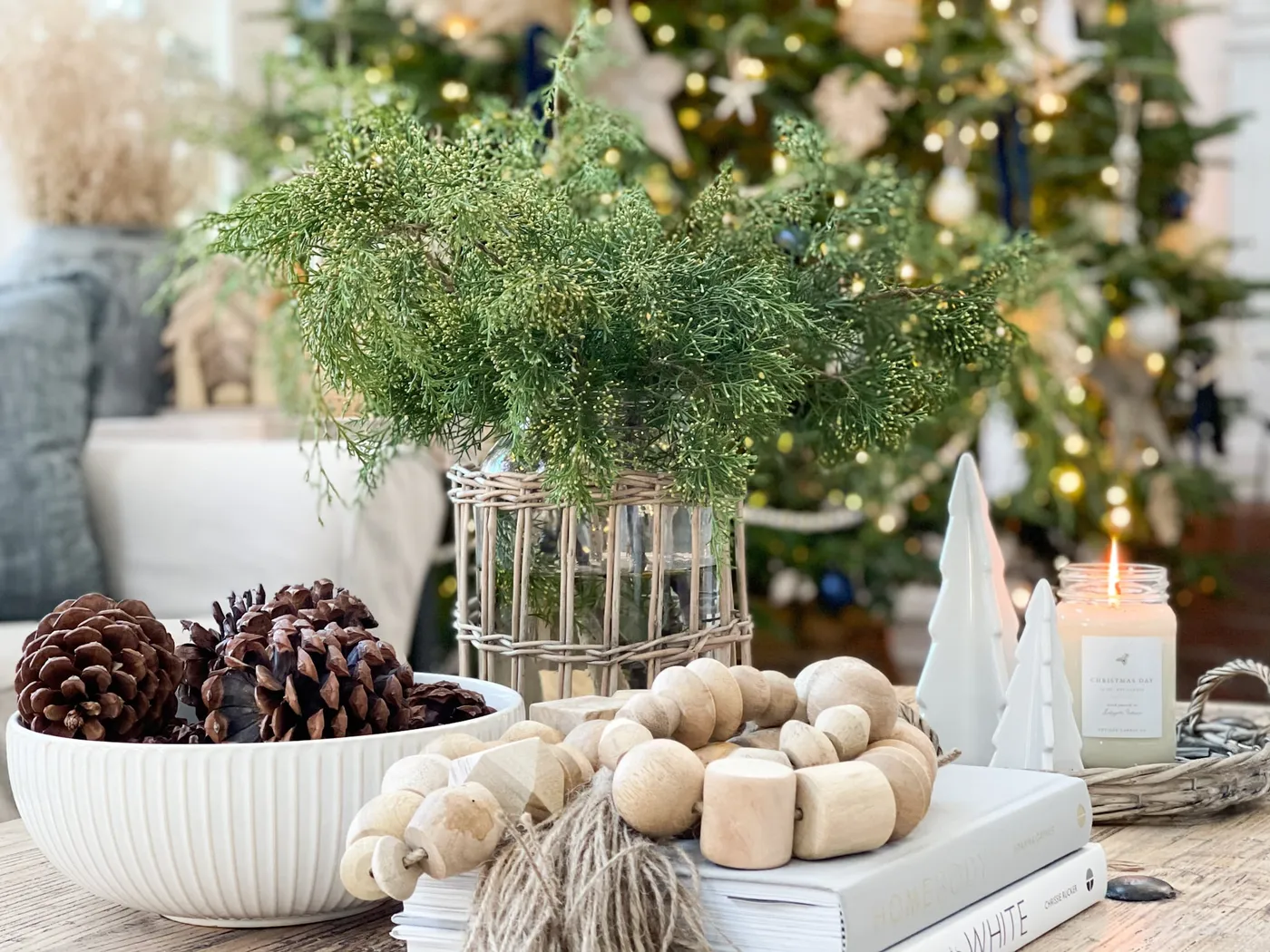
Sand is the trade-off. Even a small bowl of it ends up on the rug, the couch, and eventually your bed. Use a lidded jar or a bowl with a high lip, and set it on a tray so the whole thing can be lifted and emptied outside. Shells hold dust in their ridges — a soft toothbrush and warm water once a season handles it. Driftwood needs no care at all, which is exactly why it’s the best piece in the arrangement.
31. Layered Cozy: How to Do More Without Doing Too Much
Layering a coffee table without it looking cluttered follows a stack order. Build back to front:
- Tallest element — branches, a lantern, a vase — in the back third
- Mid-height objects — candles, a small tree — in the middle third
- Low and personal items — books, a mug, coasters — at the front third
Keep 10 inches of the front edge clear. If you can’t put a drink down without moving something, you’ve layered one step too far.
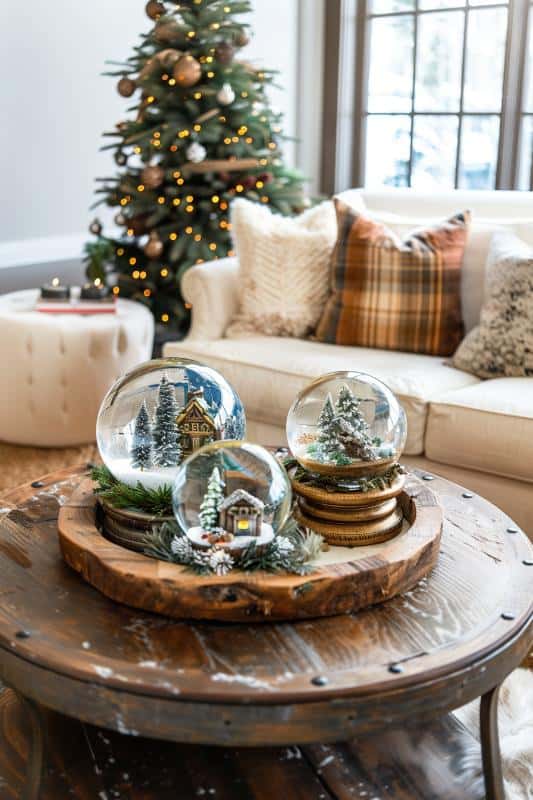
More really is more right now, but only when there’s structure underneath. Layered tables work because they create depth — your eye moves back, then forward, then lands somewhere. They also look the way people actually live: a candle, a book, a mug, a bowl of something. The trick is that every layer shares a palette. Warm cream, wood, and one deep green repeating four or five times reads as collected. The same objects in six unrelated colors reads as a mess.
32. The Close-Up Details That Sell the Whole Look
Close-up styling is really about scale ratios. On a table 40–48 inches wide, keep any single object under 14 inches tall and under 12 inches wide, or it dominates the surface. Space your three main objects roughly 8, 12, and 16 inches apart — even spacing looks like a shelf, uneven spacing looks styled. And check the table from the height of a seated person, not from standing. Most arrangements that look wrong in person look wrong because they were styled from above.
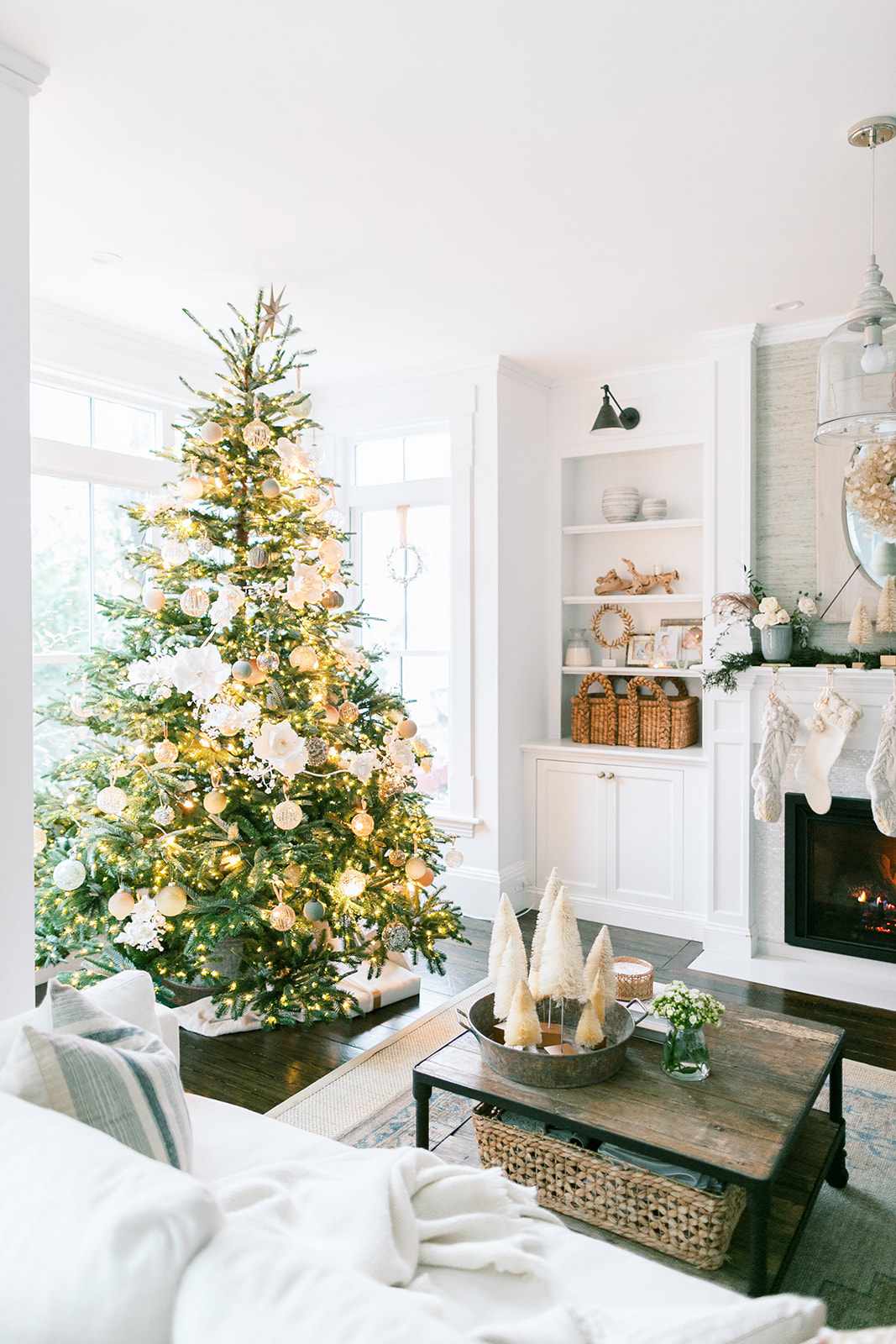
- Pick one hero object and put everything else in service of it.
- Add a textile — a napkin, a small runner, a folded throw — to break up hard surfaces.
- Layer two books flat and set something small on top.
- Tuck fresh greenery into one gap so it spills slightly over the edge.
- Add a single light source, turn off the overheads, and check it again.
Fifteen minutes, and it’s the step most people skip.
33. Rustic Wood, Softened With One Textile
On a plain wood table, the single element that matters is a textile. Wood is hard, warm, and visually busy; a linen runner, a wool cloth, or a folded throw softens it and gives everything else somewhere to sit. Without it, candles and ornaments look like they’ve been set directly on the grain. With it, they look arranged. One $20 runner does more for a rustic coffee table than another $100 of decorations would.
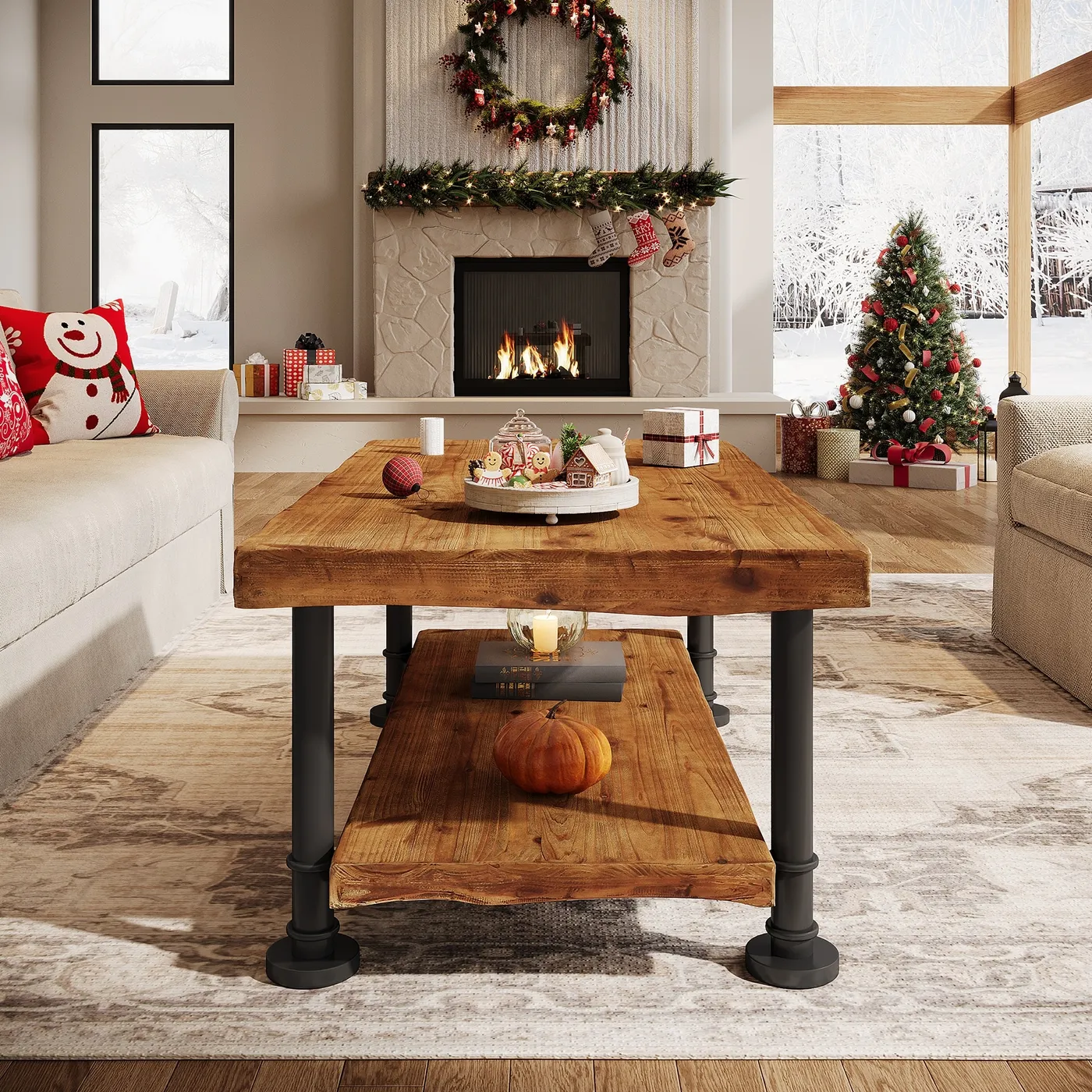
- Wood coffee table: $150–$600
- Linen or wool runner: $18–$60
- Two or three pillar candles and holders: $20–$55
- Greenery bundle or faux garland: $12–$40
- Thrifted ornaments or pinecones: $8–$25
- Small tray or wooden bowl: $15–$45
Total: about $220–$825. Budget alternative: if the table is already yours, the runner, candles, and greens run about $50 all-in — and that’s the entire look on a rustic surface.
Your Coffee Table Is December’s Quiet Overachiever
You don’t need a designer, a bigger table, or a single thing that matches anything else. You need one surface, one light source, and the nerve to leave part of it empty. Start with the idea that looked most like your actual living room, and build from there.
📌 Save this to Pinterest so next December you’re restyling instead of starting from scratch — and tag us when your table finally gets its moment.