28+ Stunning Holiday Table Setting Ideas You Need to Try in 2026 That Will Wow Your Guests

Holiday table settings are having a major moment on Pinterest right now — and honestly, we get it. One scroll through this year’s saves turns up farm tables buried in evergreen, candy cane stripes that somehow look grown-up, and gold-rimmed paper plates nobody expected to love.
We spent serious time browsing Target, Walmart, and IKEA (plus a few thrift hauls) to bring you 28 table looks that actually work in real homes, from $8 napkin rings to a full $2,000 setup. Inside you’ll find traditional red-and-green, winter-white, blue-and-white, and rustic-evergreen tablescapes — and we compare budget and luxury versions of the same idea side by side, so you pick the number instead of someone else’s.
Why now? The 2026 shift is layering: garlands under candles, paper placemats under charger plates, heirlooms next to dollar-store glass. And stay until the end — we break down the most common mistakes that can ruin these looks.
📌 Save this to Pinterest for later — you’ll want to revisit these ideas.
1. Red Berries, White Chairs, Wreaths on Every Back
What makes this table read as designed rather than just decorated is repetition. The same small evergreen wreath shows up on the back of every white chair, tied with the same glittery red ribbon, so your eye circles the table and keeps landing on the same note. The red-and-white striped runner echoes that ribbon, and the red glass vases pick it up a third time.
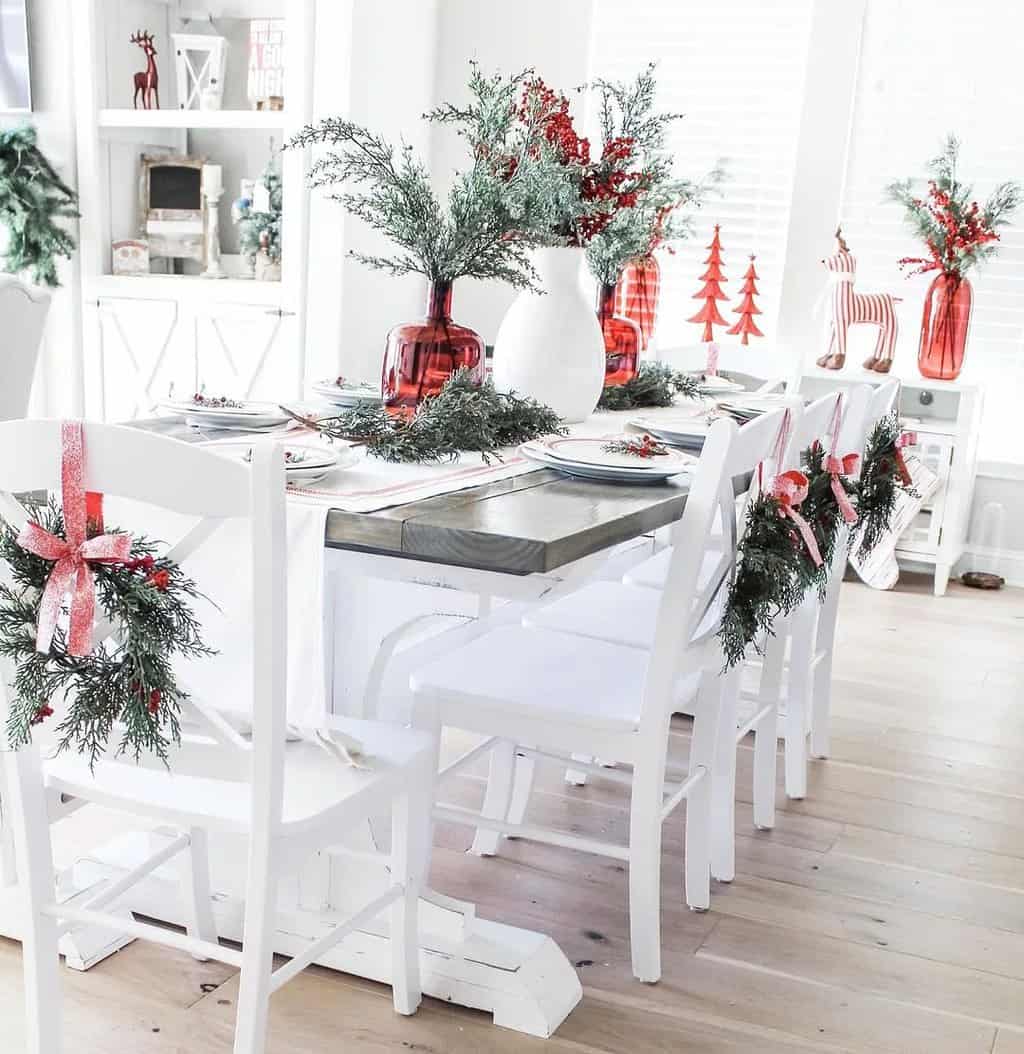
The white wood-topped table and the white ceramic vase act as the pause button. Without them, all that red would shout. With them, the whole thing feels bright and traditional instead of themed.
Rule of thumb for a centerpiece people can actually talk over: nothing taller than 12 inches above the tabletop. Guests should see the person across from them without leaning. If you want drama, buy it in width instead — run the greenery down the middle and keep the tall branches at the two ends where nobody has to reach past them.
Cluster your vases in odd numbers, three or five, at staggered heights of roughly 4, 8, and 12 inches. That uneven rhythm does more for a table than any single expensive piece.
2. The Napkin Ring Does All the Work
Take away the winter greenery rings and this becomes a very nice, very ordinary white dinner party — stacked light grey plates, clear stems, gold flatware, a silver candlestick and a copper tray doing their quiet metallic thing. Which is exactly the point. Every place setting gets its own small sprig of pine, two red berries, and a tiny pinecone.
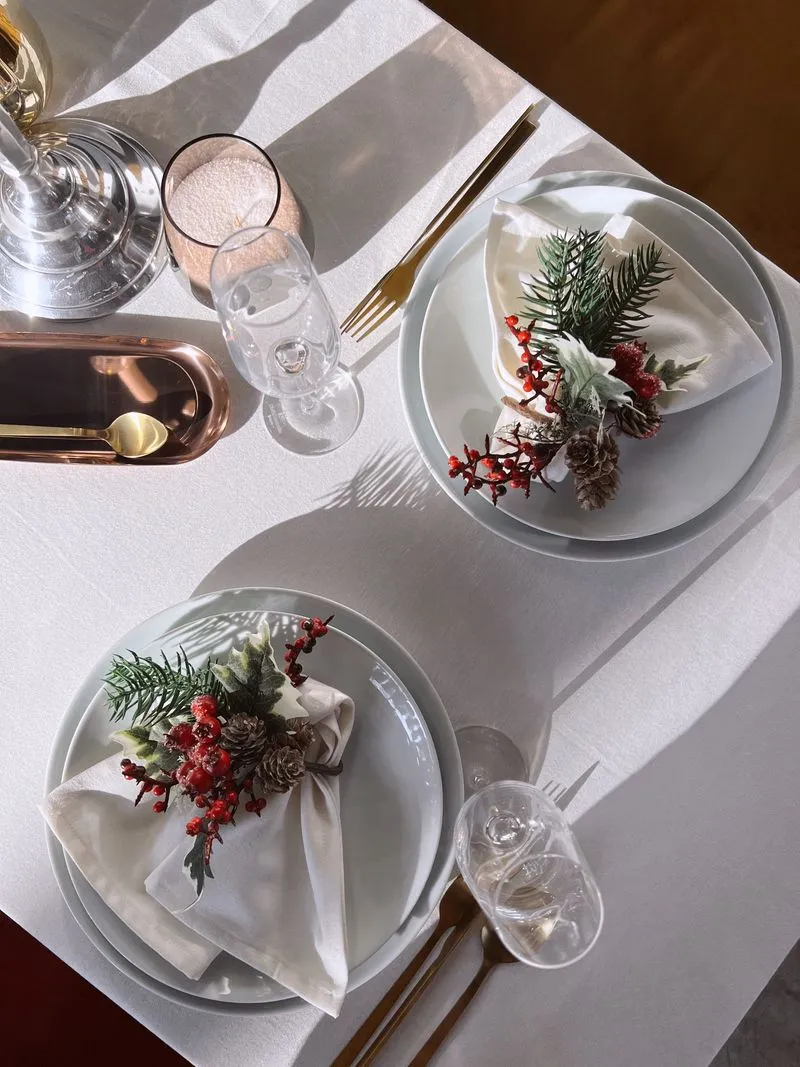
That is the element: one small organic moment, repeated eight or ten times down the table. It costs almost nothing, and it is the only reason anyone says oh, this is a holiday table.
You can build them in an afternoon.
- Buy plain wood or brass napkin rings — about 4 for $6 at a craft store.
- Snip 3-inch sprigs of pine, cedar, or rosemary and soak them in cool water for 10 minutes so they don’t dry out overnight.
- Wire a sprig to each ring with 24-gauge floral wire, hiding the twist underneath.
- Add two faux red berries and one small pinecone.
- Roll a cream napkin into a soft cylinder and slide it through.
Roughly 45 minutes for eight settings and about $25 in materials. Make them the night before and refrigerate.
3. Silver Deer, Gold Cloth, and a Pile of Tiny Gifts
The formula here is about 50% gold-and-white base, 40% green-and-red holiday, 10% silver shine. The gold tablecloth and white sheer runner set the base. Fresh greenery, white roses, and those small white gift boxes with red ribbons carry the holiday weight. The silver deer candelabras are the last 10% — the metallic that keeps everything from looking flat.
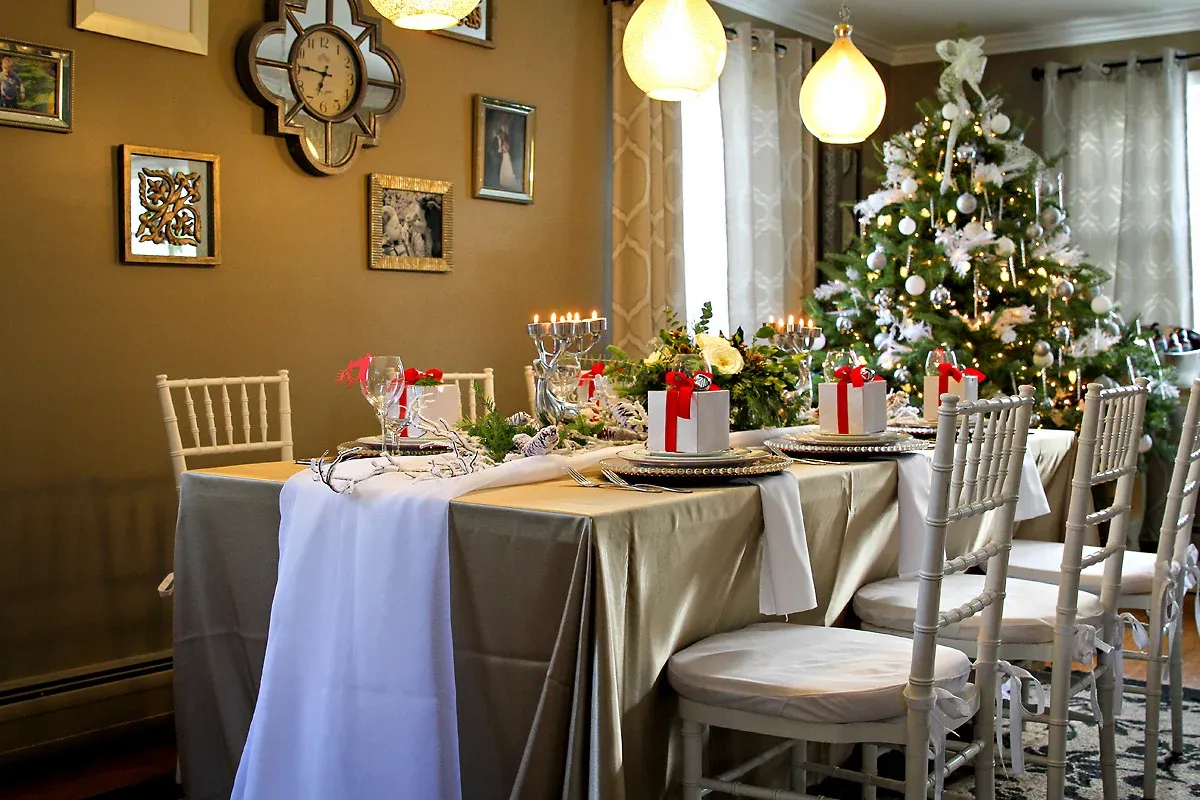
Swap test: change the gold cloth to ivory and the deer to brass, keep the greenery and the gifts, and you have the same table at half the formality. Just don’t introduce a third metal. Silver and gold already counts as two.
This look wants room. A gold cloth plus white Chivari chairs needs at least a 72-inch table and ideally 36 inches of pull-out clearance on one side. It also wants a backdrop — here, a lit tree — which is why it sings in a dining room and feels thin on an open kitchen island.
Tight on space? Go to Idea #10, which packs a similarly icy palette into a much smaller footprint without the floor-length cloth.
4. Burgundy Tapers on a Farm Table, Wreath on the Sideboard
- Rustic wood dining table: $450–$1,400
- Textured white dinnerware, 8-piece: $80–$220
- Green glass goblets, set of 4: $40–$90
- Brass candlesticks, assorted heights: $60–$150
- Fresh evergreen garland, 10 ft: $35–$70
- White and burgundy taper candles: $20–$40
- Decorative trees, wreath, and velvet bow: $50–$120
- Total: roughly $735–$2,090
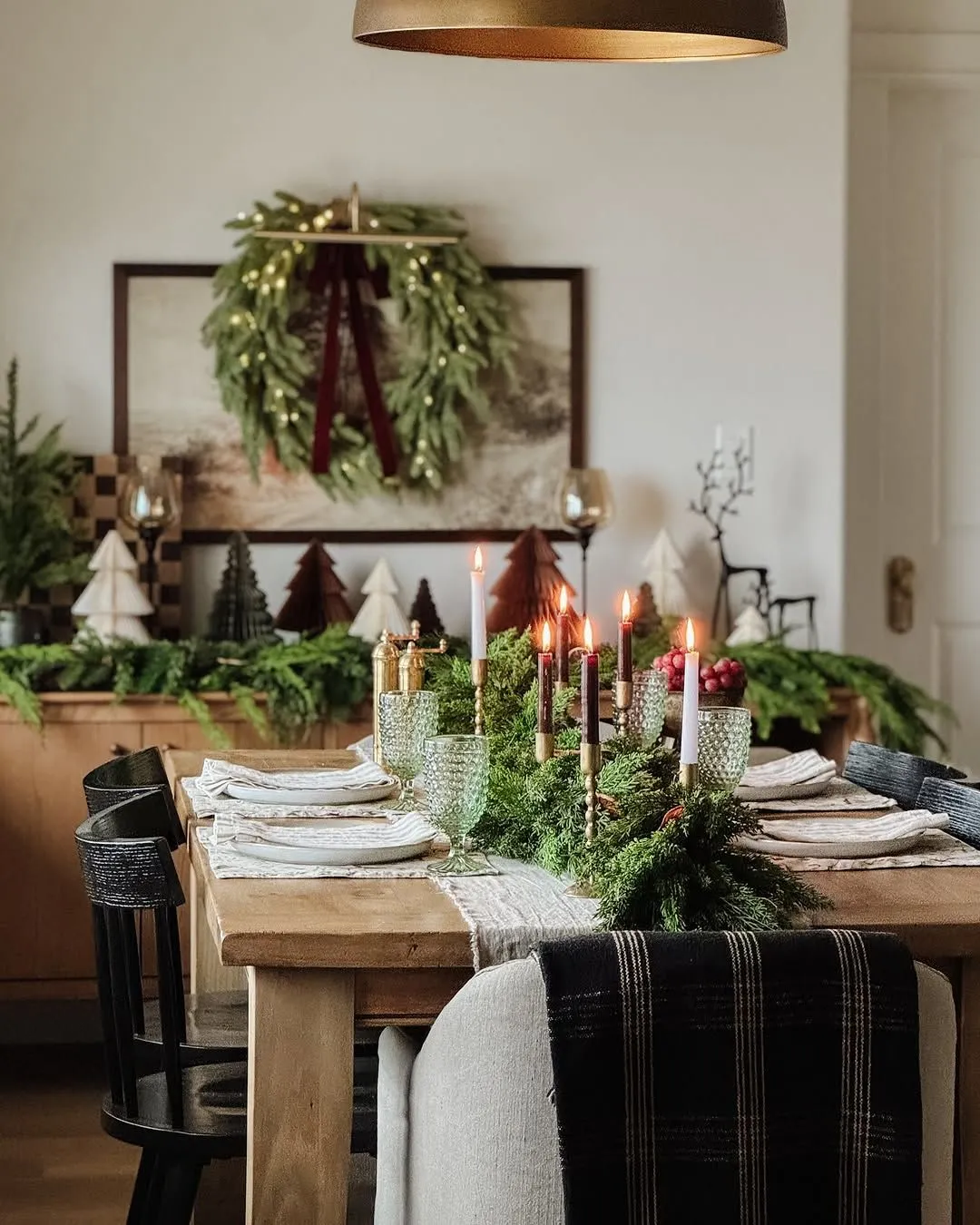
Budget route: skip the glass goblets, buy garland at a tree lot the week before, and hunt brass candlesticks at thrift stores for $3–$8 each. That lands the table closer to $400.
Two honest warnings. Real evergreen garland sheds — expect needles in the tablecloth and the rug for weeks, and keep it away from heat vents or it drops everything by the 20th. And burgundy tapers on a wood table near a lit tree are gorgeous and also a fire you haven’t had yet.
If you have toddlers, a dog, or a cat with a tail, switch to battery tapers and run the garland high. It looks the same from three feet away.
5. One Neutral Base, Three Seasons of Foliage
If you want one tablescape that survives Halloween, Thanksgiving, and New Year’s, build the base from matte ceramic, wood, linen, and glass. Nothing in that layer should be red, orange, or green — no printed cloth, no themed plates, no glitter.
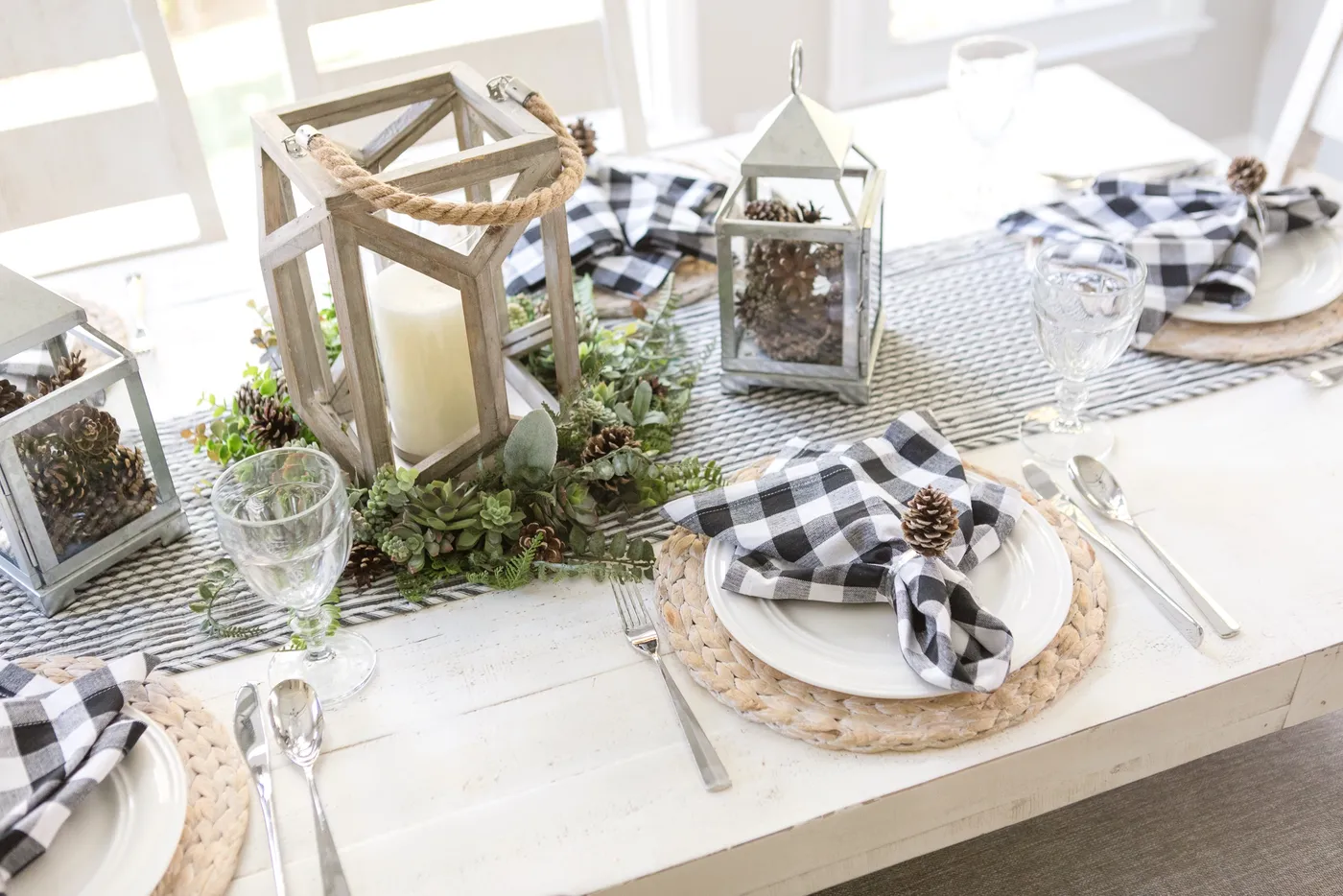
Then swap only the foliage. Olive and eucalyptus branches in fall, cedar and pine in December. Add one seasonal fruit or berry at the base of the arrangement and you’re done in ten minutes, for the cost of a $12 bunch of branches.
This is the tablescape style quietly winning 2026: fewer objects, better materials, and a willingness to reuse the same base for months. It’s a reaction to the last few years of maximal, photographed-to-death holiday tables — and to the fact that most of us host twice, not twelve times.
Staying power? High. Material-driven tables don’t date the way a specific motif does. If you own one good set of matte plates, you already have the hardest part.
6. Greek Key Linens, Kumquats, and White Hydrangeas
Three things are pulling weight. The light blue Greek key border on that cloth gives the table an instant formal edge without a single flower. Then the blue-and-white patterned vases hold white hydrangeas and dark magnolia leaves — same palette, opposite textures, so the arrangement never looks like a matched set.
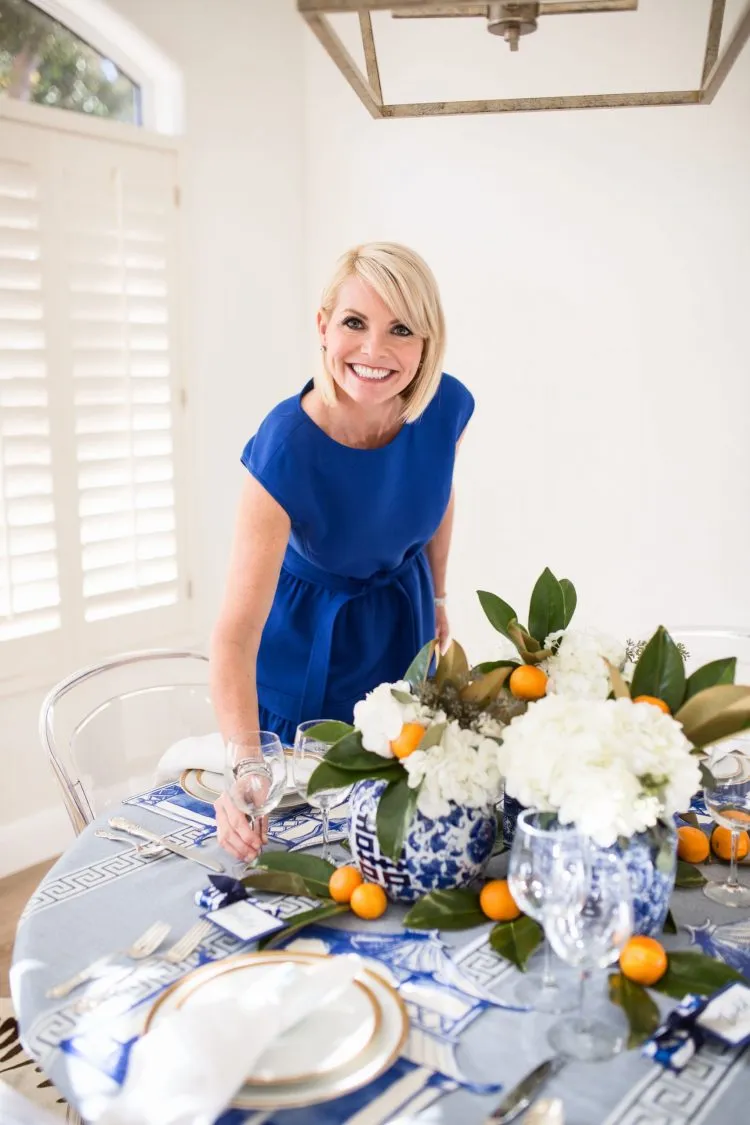
And the kumquats. Small orange fruits scattered around the base of the vases are the only warm note in a completely cool scene, and they catch the light. Gold-rimmed plates and clear acrylic chairs stay out of the way.
The pattern is the expensive part, not the flowers. A plain light blue cloth runs $25–$40, and you can add Greek key ribbon trim yourself for about $12. Or skip the cloth entirely and let the blue-and-white vases and gold-rimmed plates carry the scheme on white.
Real hydrangeas wilt within hours, so use water picks or good faux stems. Kumquats are $4 a bag at the grocery store and last a week in a bowl. Realistic rebuild: $150–$300.
7. Polar Bears, Frosted Greens, and a Table Full of Candles
Building a frosted winter centerpiece, step by step:
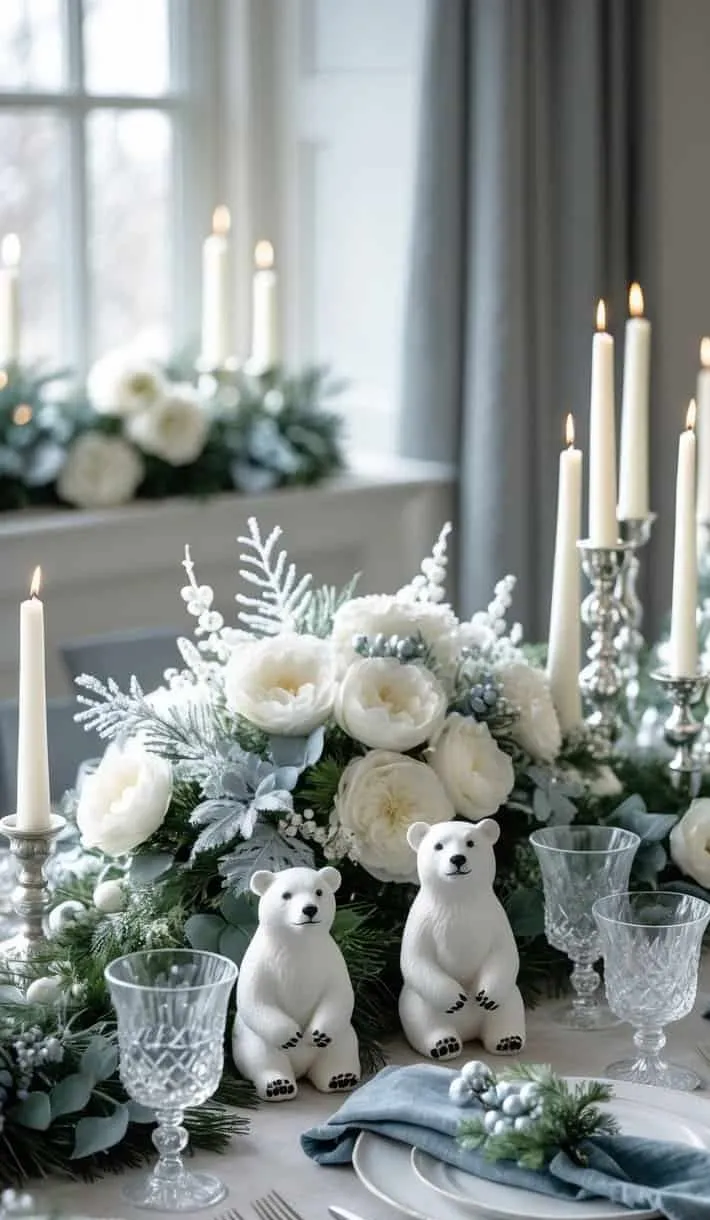
- Start with a low, wide vessel — a footed bowl or a tray — and fit soaked floral foam inside.
- Ring the outer edge with evergreen, then fill the center with white roses.
- Mist the greens with water and dust them lightly with faux snow spray while still wet. Go light; too much looks like dust.
- Tuck silver-blue sprigs at the edges so the silhouette breaks up instead of forming a tidy dome.
- Set the polar bear figurines in last, one at each end, so they read as deliberate.
About 90 minutes and $60–$90 in stems and supplies. Keep it out of warm rooms or the frost will spot the table.
Ivory tapers burn roughly an hour per inch, so the tall ones are a two-hour commitment — and they drip. Trim wicks to a quarter inch every time. The white roses are the first thing to go, usually by day two; frosted greens hold about a week if you mist them. Battery tapers are the honest shortcut here.
8. Deep Green Runner, Burgundy Pillars, Rose Gold Flatware
The textured deep green runner is the element to protect. It’s what turns a wood table plus flowers into something moody and intentional — the matte fabric swallows light, which makes the red and white blooms and the burgundy pillar candles glow harder by contrast.
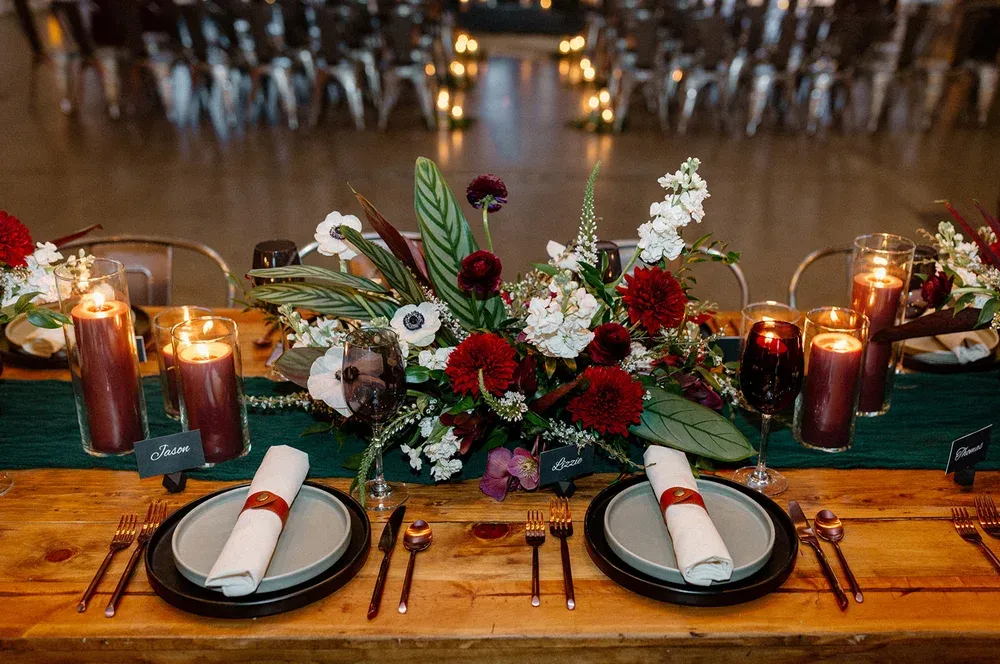
Remove it and you’d still have a lovely rustic table, but you’d lose the depth. If you can’t find a textured runner, use a length of matte velvet or heavy linen in deep forest green, unhemmed and slightly rumpled. The wrinkles are part of the look, not a problem to solve.
- Deep green textured runner, 14 x 108 in: $30–$85
- Red and white floral centerpiece: $70–$180
- Burgundy pillar candles, set of 4: $25–$50
- Glass hurricane vases, set of 4: $40–$110
- Dark grey and light grey plates, 8-piece: $90–$240
- Rose gold flatware, service for 4: $60–$140
- Total: roughly $315–$805
Cheaper route: thrift the hurricanes and the runner, and build the centerpiece from supermarket blooms plus one bunch of variegated foliage. Under $150 is very doable.
9. String Lights Buried in the Evergreen
Battery fairy lights woven inside the garland — not draped over the top — are what make this table look lit from within. Use two or three strands of warm white micro lights on a thin green wire and bury them so the wire disappears into the foliage. Zigzag, don’t spiral; spiraling creates an obvious ring.
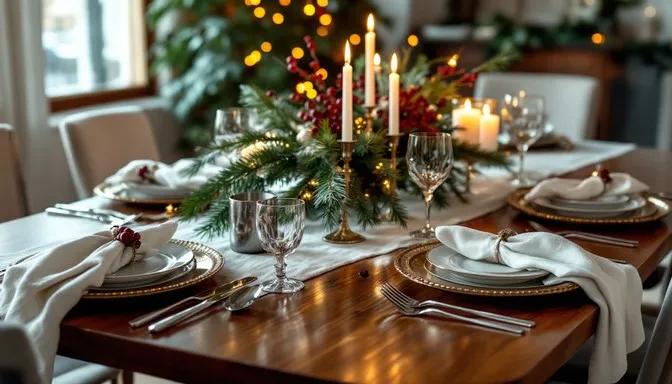
Then dim the chandelier. A tablescape with hidden light and low room light reads as candlelit even if you never strike a match. Total cost: about $12 for three strands.
Here’s the palette split: roughly 45% dark wood and evergreen as the base, 25% white plates, napkins, and taper candles, 20% brass and gold chargers, 10% red berries for the pop.
Swap brass for matte black and the table goes modern. Swap the dark table for a light one and it turns breezy. The proportion of dark to light is what you’re actually responding to — not the specific pieces.
10. Mint Plates, Fluted Chargers, and Ceramic Trees
The blue and green patterned cloth is doing a lot of visual work, so this look needs a table that isn’t fighting it. It works best on a round or oval table 48–60 inches wide, where the print stays contained. Stretch it across a 96-inch rectangle and it starts to feel like wallpaper.
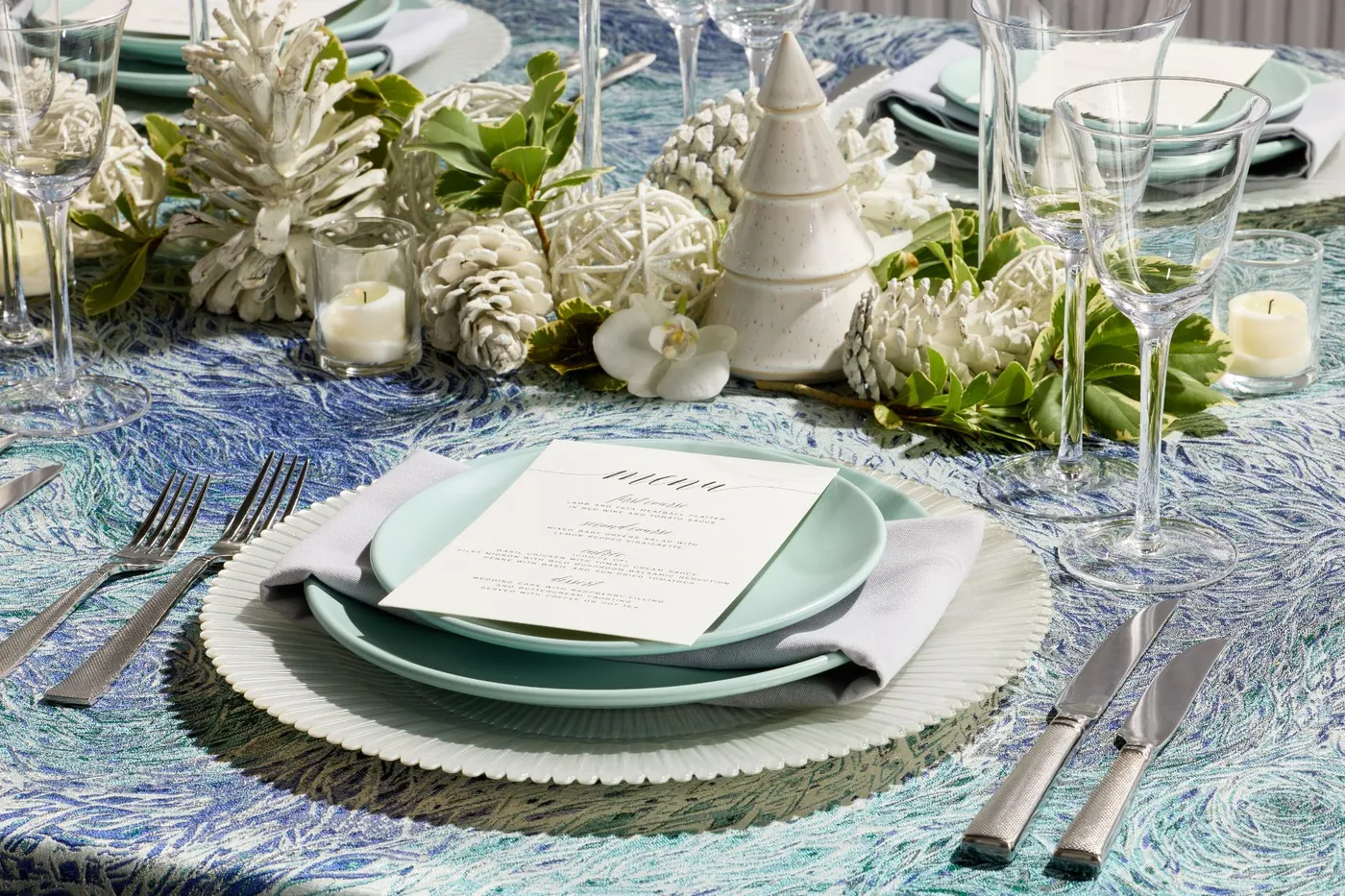
Ceiling height isn’t a factor here — the tallest object is a small ceramic tree. If your dining area is under 100 square feet, drop the patterned cloth and keep the mint plates, frosted pinecones, and ceramic trees on a plain white or pale blue base. Same palette, half the noise.
Mint green plates are the risky purchase. They anchor the table in December, then sit in a cabinet for eleven months. Before you buy a full set, buy four.
Also: a patterned cloth plus patterned chargers plus pinecones is three textures on one surface, and frosted pinecones leave a white dust trail on fabric. Seal them with matte spray outside and let them cure a full day.
11. A Centerpiece That Outlives the Season
The tablescape people are saving most in 2026 isn’t holiday-specific at all — it’s a low bowl or tray that gets refilled instead of redesigned. Designers have been pushing it since the quiet hosting idea took hold.
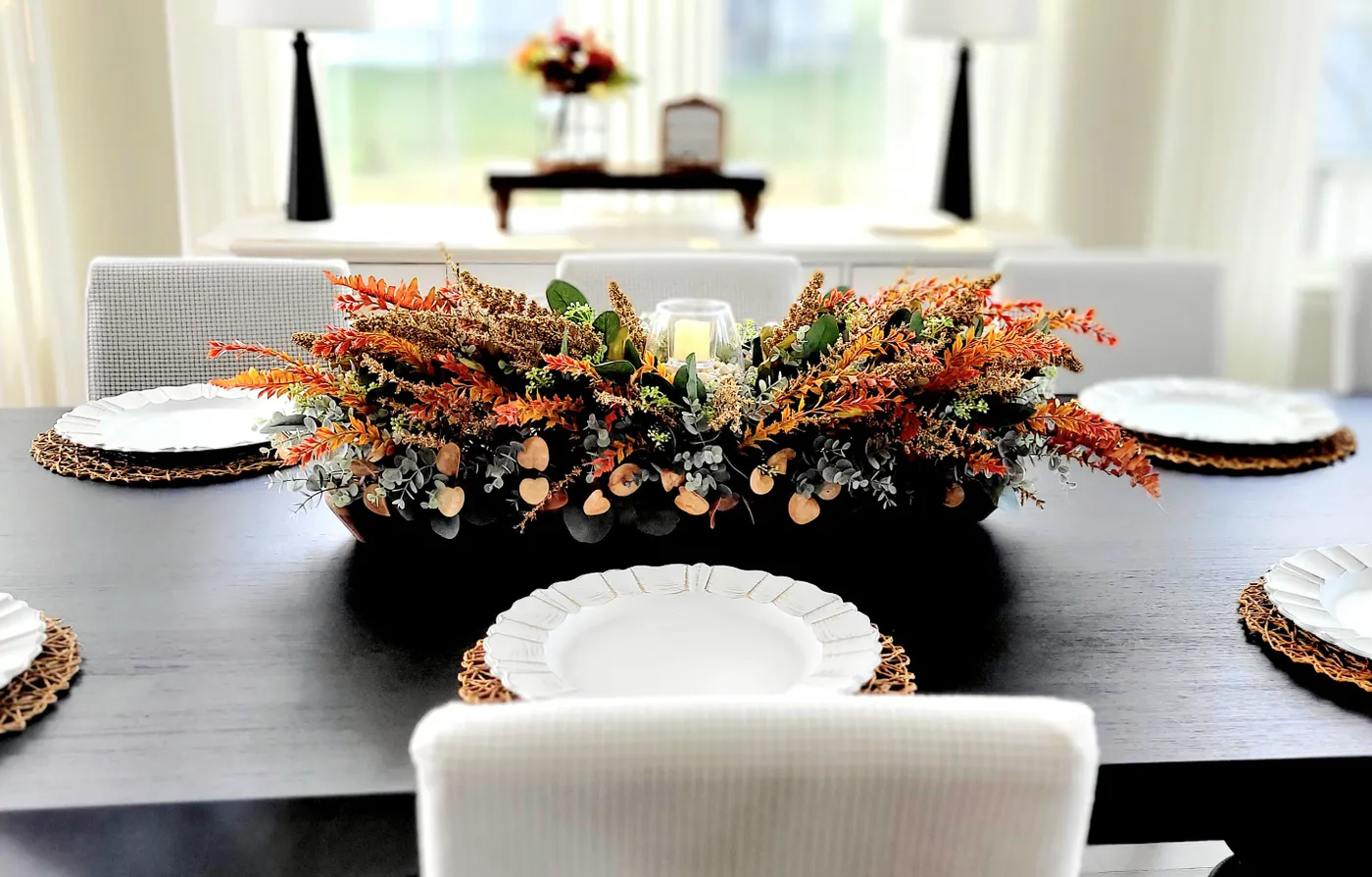
It lines up with how people actually host now: smaller groups, more often. A table that takes ten minutes to reset for a random Tuesday dinner gets used. One that takes two hours and a craft store run gets saved for the 25th only.
- Measure your table’s clear center strip — you want at least 12 inches of width that plates won’t touch.
- Check your light: warm bulbs make orange and brown sing, cool light flatters greens and blues.
- Confirm storage. A year-round base needs a home for the seasonal extras.
- Choose your neutral base first (wood, ceramic, linen) before buying anything seasonal.
- Set a ceiling of $120 for base pieces. The swaps should stay cheap.
12. The Table Where Nobody Sits Still
What’s happening here is a low centerpiece and a wide radius of empty cloth. The greenery, red berries, and pale flowers sit close to the surface, so nobody has to dodge anything — glasses are toasting across the top of it. That’s why this looks joyful rather than staged.
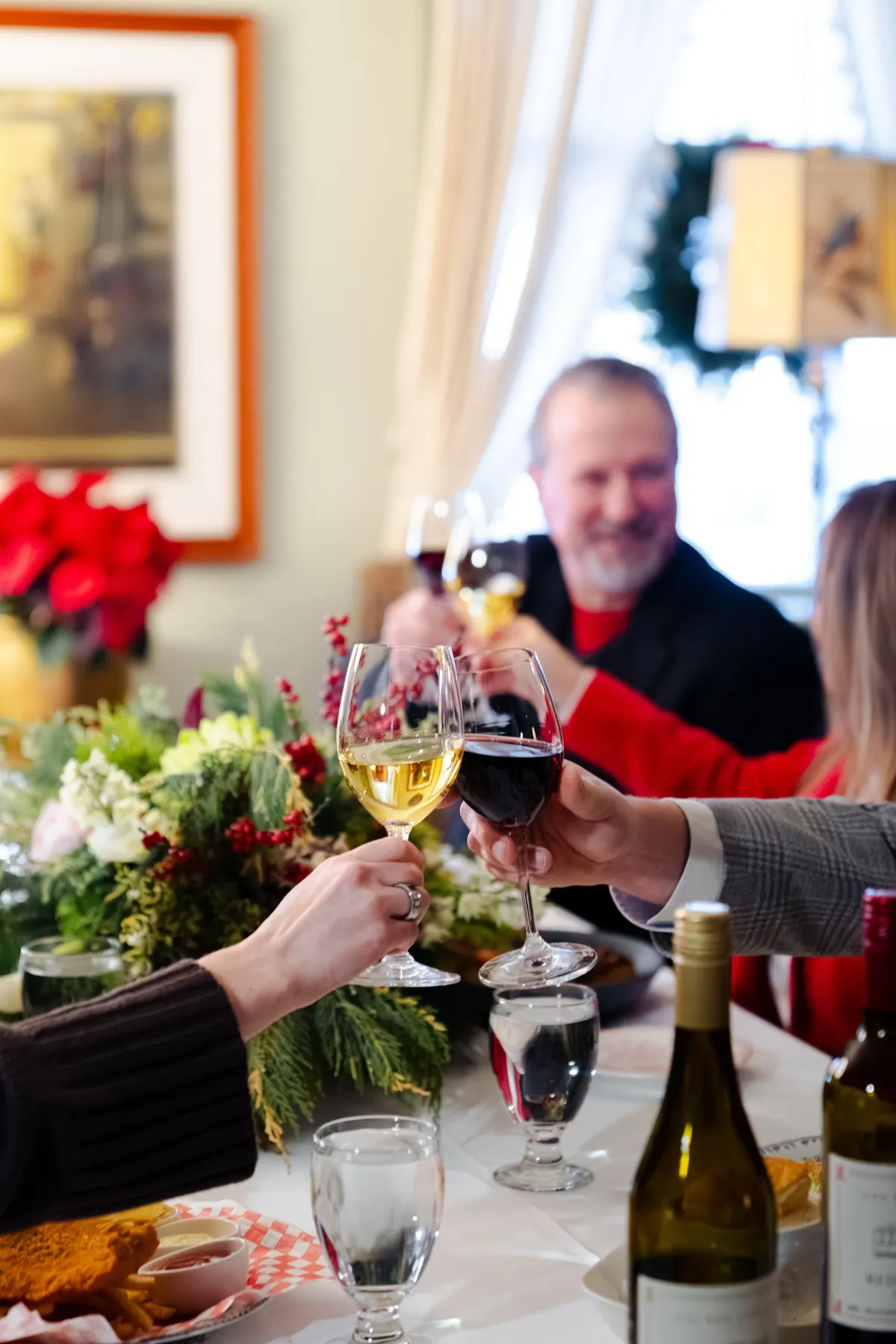
It’s also a high-low mix: a proper white tablecloth with a sheet of red-and-white checkered paper under the food. The linen says occasion; the paper says sit down and eat. Both are true.
The single best decision on this table is that the centerpiece never tries to be a sculpture. It’s a dense, low band of greenery with berries and a few pale blooms — long instead of tall, continuous instead of clustered.
Take it away and you have a plain white cloth with dishes. Put it back and the table looks generous. If you copy one thing from this entire article, copy the shape: long, low, unbroken.
13. Twisted Tapers in Blue Glass
You don’t need custom linens for this. A blue patterned tablecloth from a discount home store runs $20–$35, and blue glass candleholders are everywhere right now — Target and Walmart both carry them for $6–$14 each. Buy three in different heights instead of six matching ones.
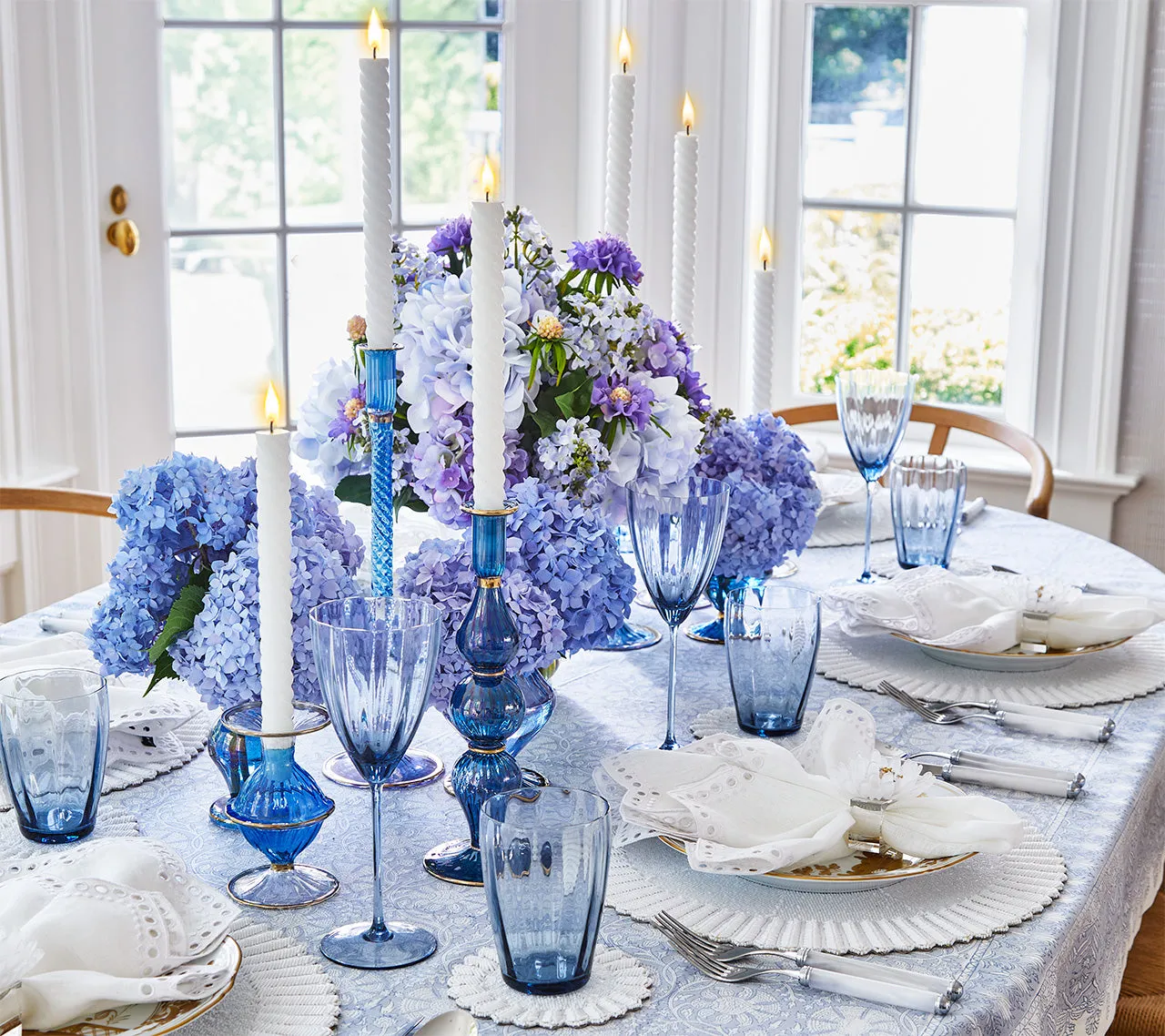
Blue glass goblets are the pricey bit at $12–$20 a stem. Drink from clear glass and let two or three blue pieces be purely decorative. Blue and purple hydrangeas are out of season in winter, so substitute faux stems at about $8 a bunch.
Getting the twisted taper look right:
- Buy genuine twisted tapers, about $10 a pair. Straight ones snap when you try to shape them.
- Trim each wick to a quarter inch and pre-burn for 30 seconds to set the edge.
- Seat them in the holders with a dab of sticky wax putty so they don’t lean.
- Group holders in odd numbers, tallest in the center, at least 3 inches apart.
- Light them 10 minutes before guests arrive — intentional, not drippy.
Under 20 minutes and about $40 in candles and holders.
14. Candy Cane Stripes, Finally Grown-Up
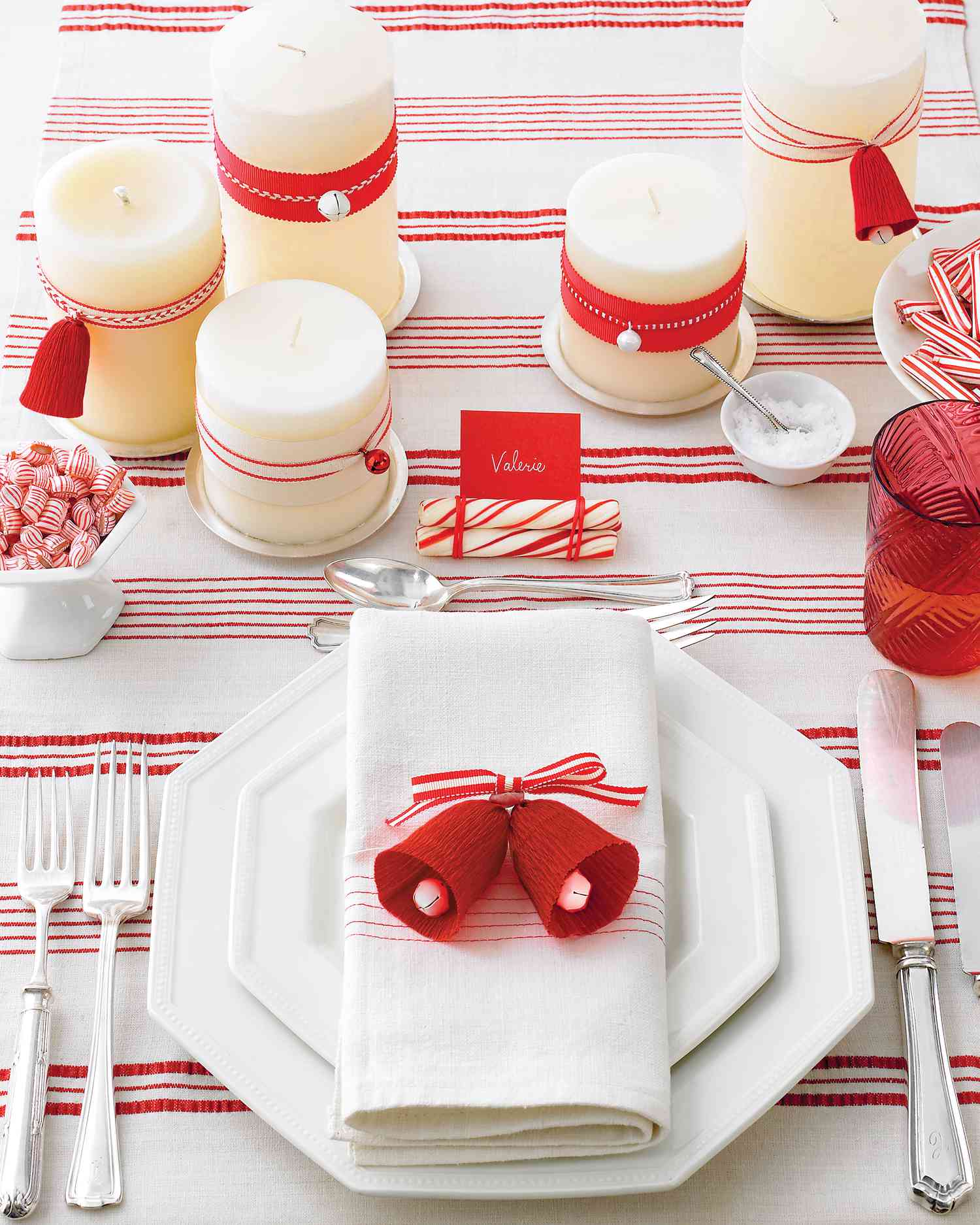
The trick with this much red is proportion: about 60% solid red cloth, 30% white plates and striped pieces, 10% gold. The stripes work because they’re small and they repeat — on the plate edges, on the candle holders. Nothing new enters the palette.
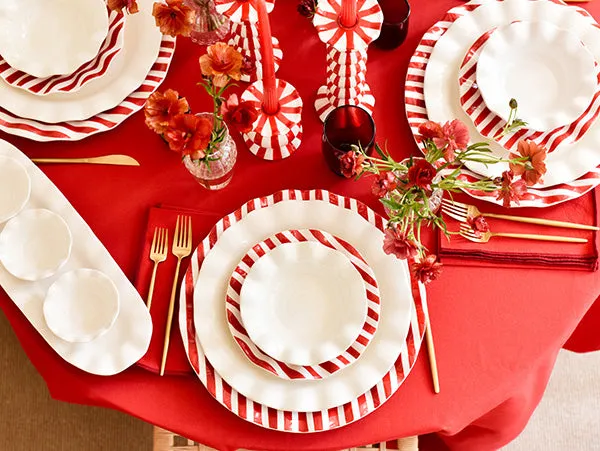
Swap the red cloth for a red-and-white stripe or a red toile and the formula still holds. Swap gold flatware for silver and it goes colder and more modern. Never let stripes exceed about 15% of the table or it tips into candy shop.
When you layer a strong pattern like candy cane stripes, vary the scale. A bold stripe on a candle holder next to a fine stripe on a plate edge reads as designed; two bold stripes at the same scale read as a party store. The eye needs one place to rest between patterns.
And don’t overlook the red glassware. Tinted glass picks up the tablecloth’s color and makes the whole table feel deeper than it is — worth about $8 a piece at a discount store.
15. Pink Tapers and Teal Quilted Chairs
Pink, forest green, and teal is a genuinely beautiful combination in a room with exposed brick and dark walls, where the paint absorbs some of that color. In a bright white dining room, the same palette can tip into birthday party territory fast.
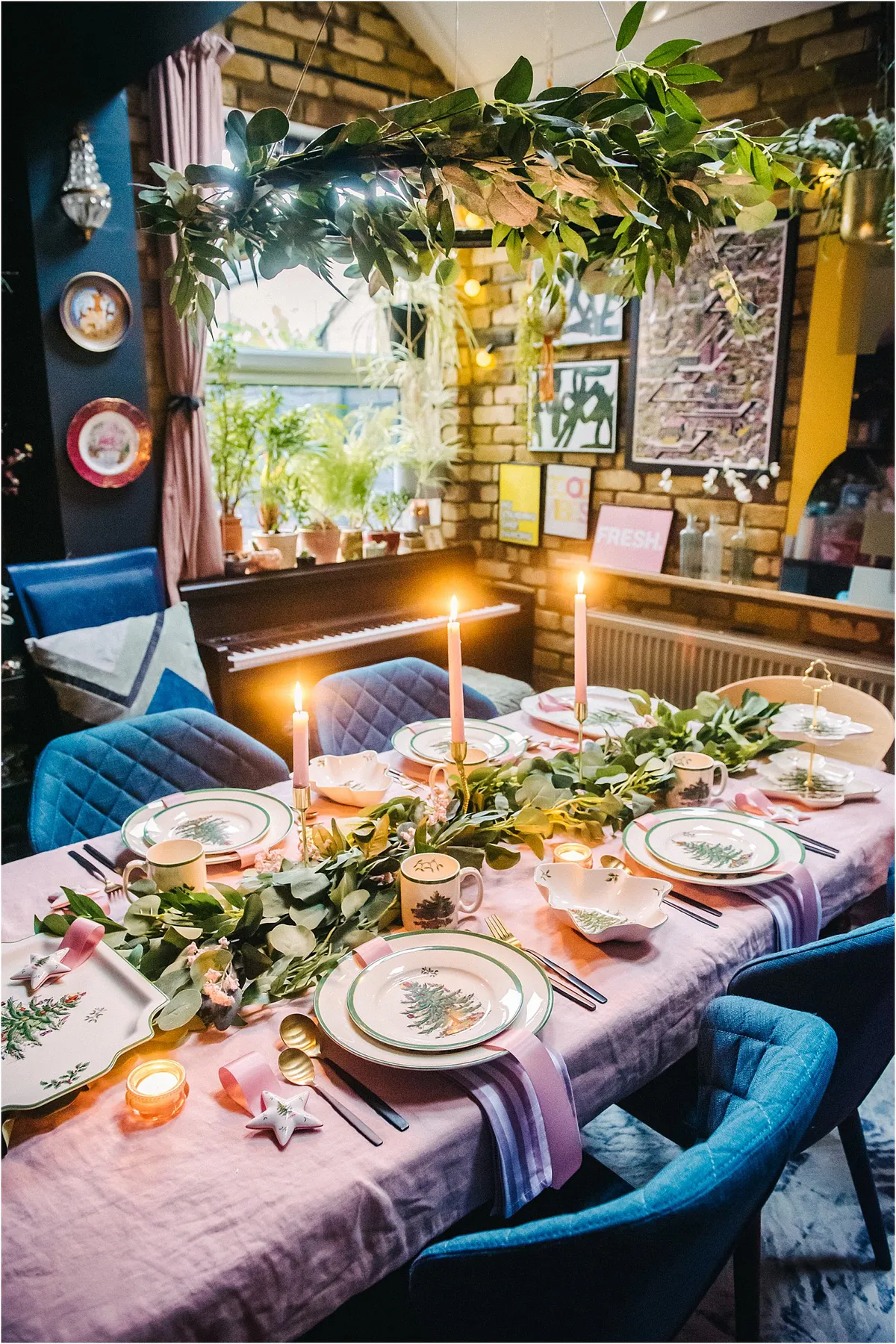
Test it before you commit: hold the pink candles against the wall, stand back six feet, and look. If the pink is the loudest thing in the room, pull it back to one accent — candles only, or napkins only.
This one is made for a real dining room, not a nook. The garland needs at least 6 feet of table length to run properly, and the teal quilted chairs need roughly 30 inches of clearance behind them, which means about 10 x 12 feet of floor space.
Smaller space but the same appetite for color? Try Idea #28, which gets festive pink onto a standard table with paper placemats instead of a full garland.
16. Blue Pumpkins, Still Going in December
Look closely at the centerpiece: pine needles, pinecones, and small white and blue decorative pumpkins. That’s the whole idea. Someone refused to abandon autumn on December 1st and simply moved the pumpkins next to the pinecones — and it works because the pumpkins are white and blue instead of orange.
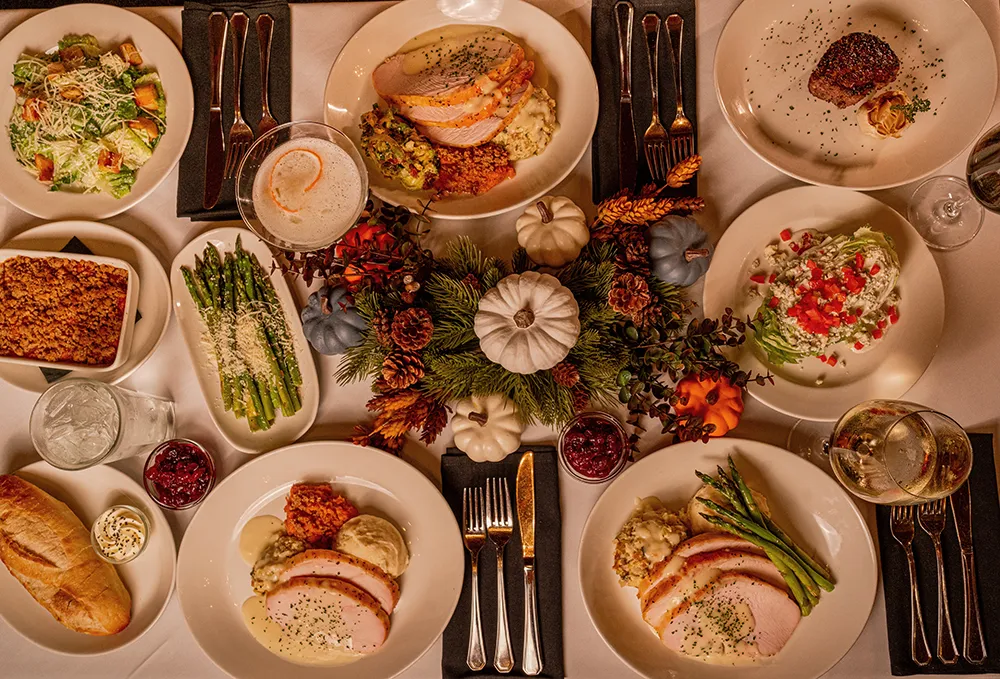
White and blue pumpkins read as winter the second they sit beside evergreen. Remove them and you’d still have a perfectly nice pinecone centerpiece, and nothing whatsoever to ask about.
Palette split: 50% white cloth and plates, 25% deep green pine and pinecones, 15% dark blue, 10% warm brown and orange. The black cloth napkins and gold-toned knife blades are the sharp notes that keep all that white from going flat.
To shift this toward full winter, trade the pumpkins for blue baubles and leave everything else — same percentages, same table. To push it back toward fall, swap the pine for dried leaves and keep the pumpkins.
17. Look Up — The Ceiling Is Wallpapered
A wallpapered ceiling is the most beautiful thing in this room and the most annoying thing to own. It collects cooking oils if the dining room opens to a kitchen, and it doesn’t take scrubbing well — use a dry microfiber on a pole, twice a year, and nothing wetter.
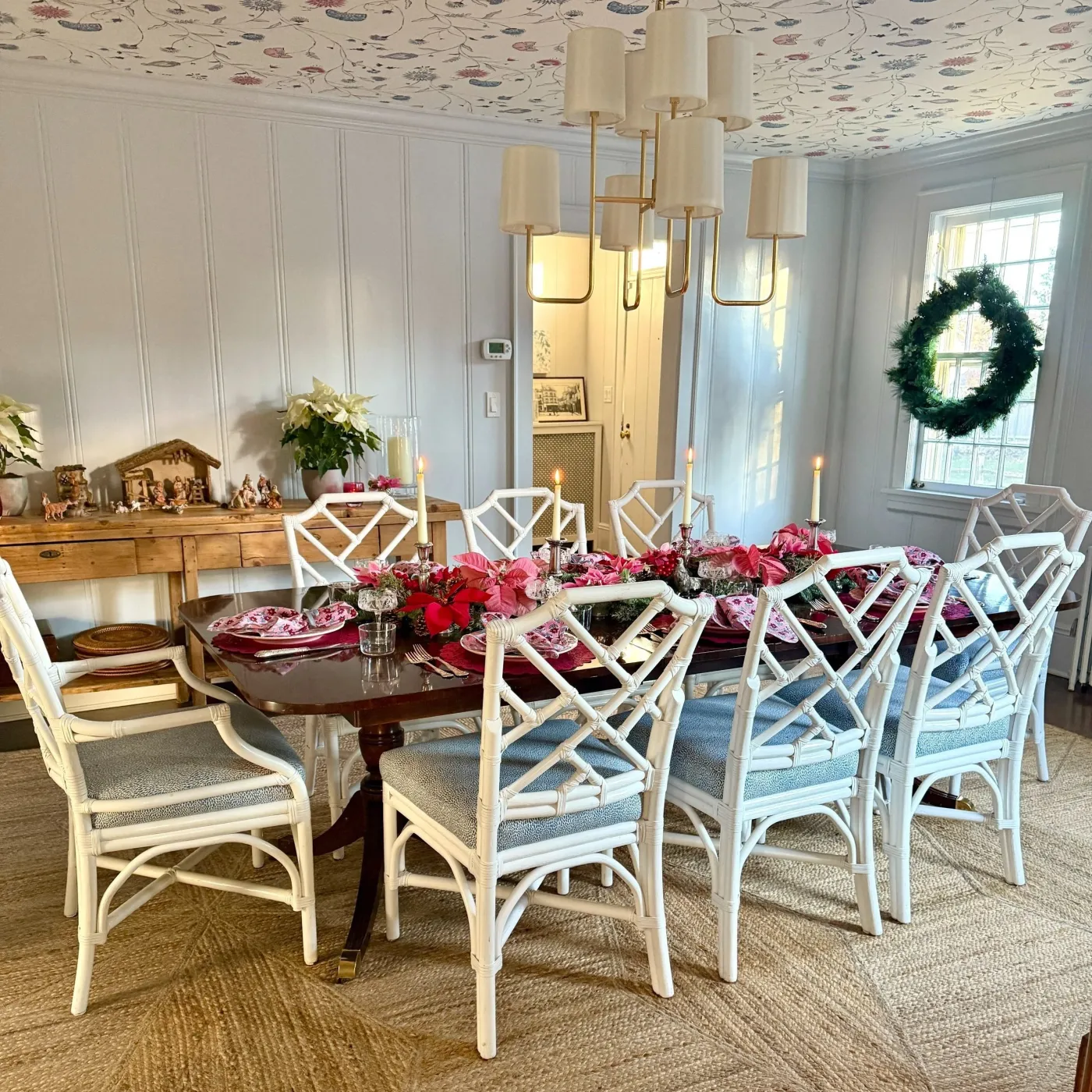
The real poinsettias drop leaves, and those leaves stain a natural fiber rug. Set the plants on a tray or a plastic liner and accept that in January you’ll be vacuuming red bits out of the weave.
Three things are working in this room. The floral ceiling gives it a soft, high focal point, so the table doesn’t have to carry all the drama — that’s why red poinsettias can be the only strong color and still feel like enough.
The white bamboo-style chairs with blue patterned cushions repeat the light blue in the rug and the table, tying three zones together. And the natural fiber rug grounds a very light, very patterned space with something matte and plain.
18. A Rosemary Wreath Instead of a Place Card
Mini rosemary wreath place cards, start to finish:
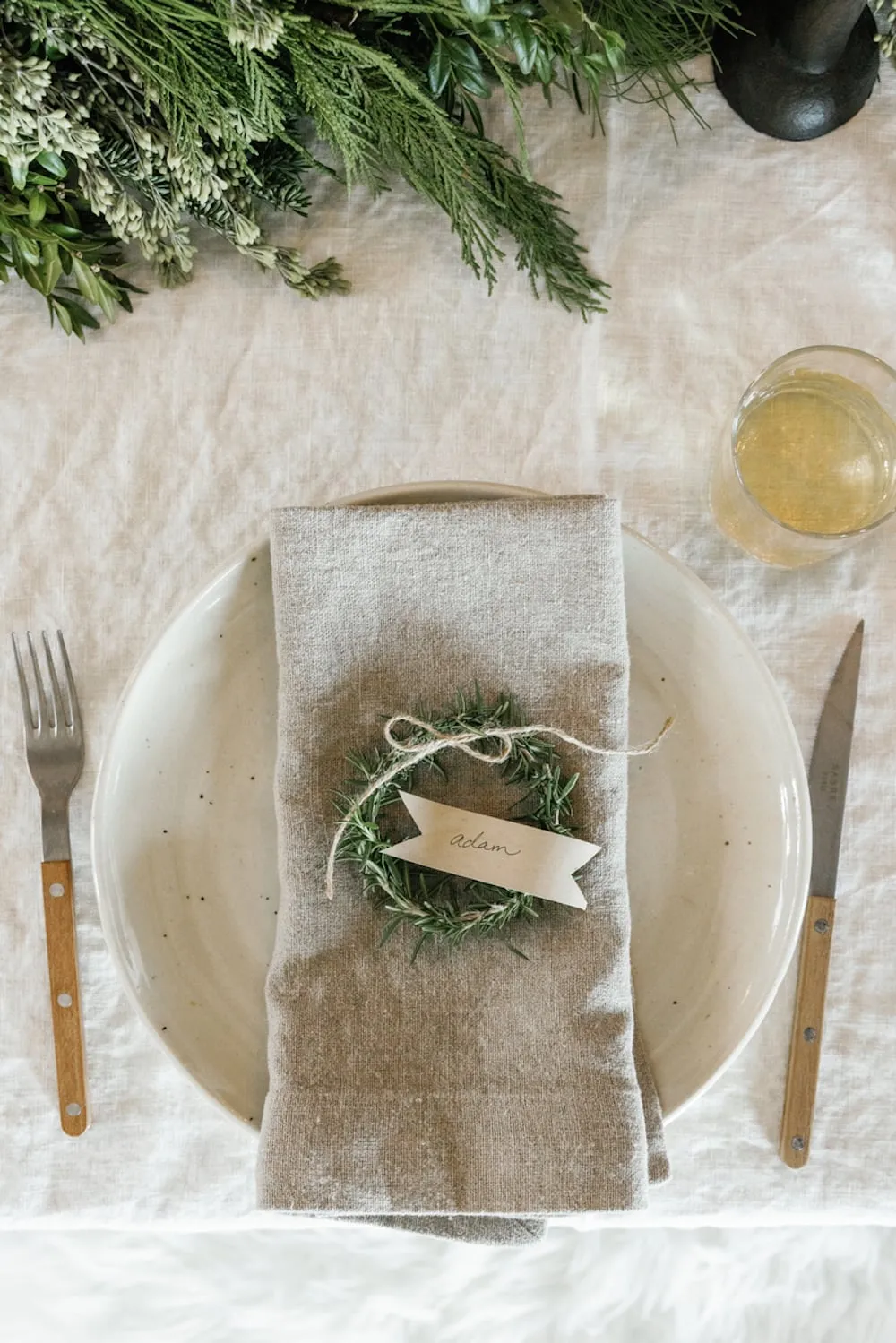
- Cut 10–12 rosemary stems about 4 inches long.
- Bend each stem into a circle and overlap the ends by an inch.
- Wrap the overlap tightly with 24-gauge floral wire and hide the bend with a small sprig.
- Write names on kraft paper tags and punch a hole in the corner.
- Thread the tag on with twine and lay the wreath flat on a folded linen napkin.
About 30 minutes for eight and roughly $15 in wire, tags, and twine. Refrigerated, they last three or four days.
One natural element used everywhere beats four different decorations used once each. Here it’s rosemary — on the napkins, in the garland, tucked anywhere that needs a green note. Restricting yourself to a single plant keeps a table coherent with no coordination required.
It also smells, which matters more than people admit. A table that smells like rosemary and beeswax reads as festive before anyone has looked at it properly.
19. Oranges and Evergreen, Straight From the Grocery Store
This is one of the cheapest high-impact tables in the whole article. The centerpiece is a greenery runner with red berries and orange slices — items that cost about $5 a bag in December.
Real greenery: $15–$25 from a tree lot. Two bags of oranges or clementines: $10. White tapers: $8 a box. If you already own white plates and any gold flatware, you can rebuild this table for under $50. Whole oranges tucked among the greens are the giveaway that it’s real fruit, and nobody notices the difference from ten feet away.
The formula is 60% white and neutrals, 25% green, 15% warm orange and red. That last 15% is what makes the table feel generous instead of austere — the citrus warms up what would otherwise be a very cold white-and-green scene.
Swap citrus for pears and pomegranates for a deeper, older-European feel. Swap to cranberries alone and it goes crisp and Scandinavian. Same proportions, different mood, zero new purchases.
20. Red Pillar Candles, Held in Clear Glass
Pillar candles in glass are the easiest way to add height without a tall arrangement. This layout wants a table at least 60 inches long — with five or six candles down the middle plus florals, anything shorter stops looking like a centerpiece and starts looking like a traffic jam.
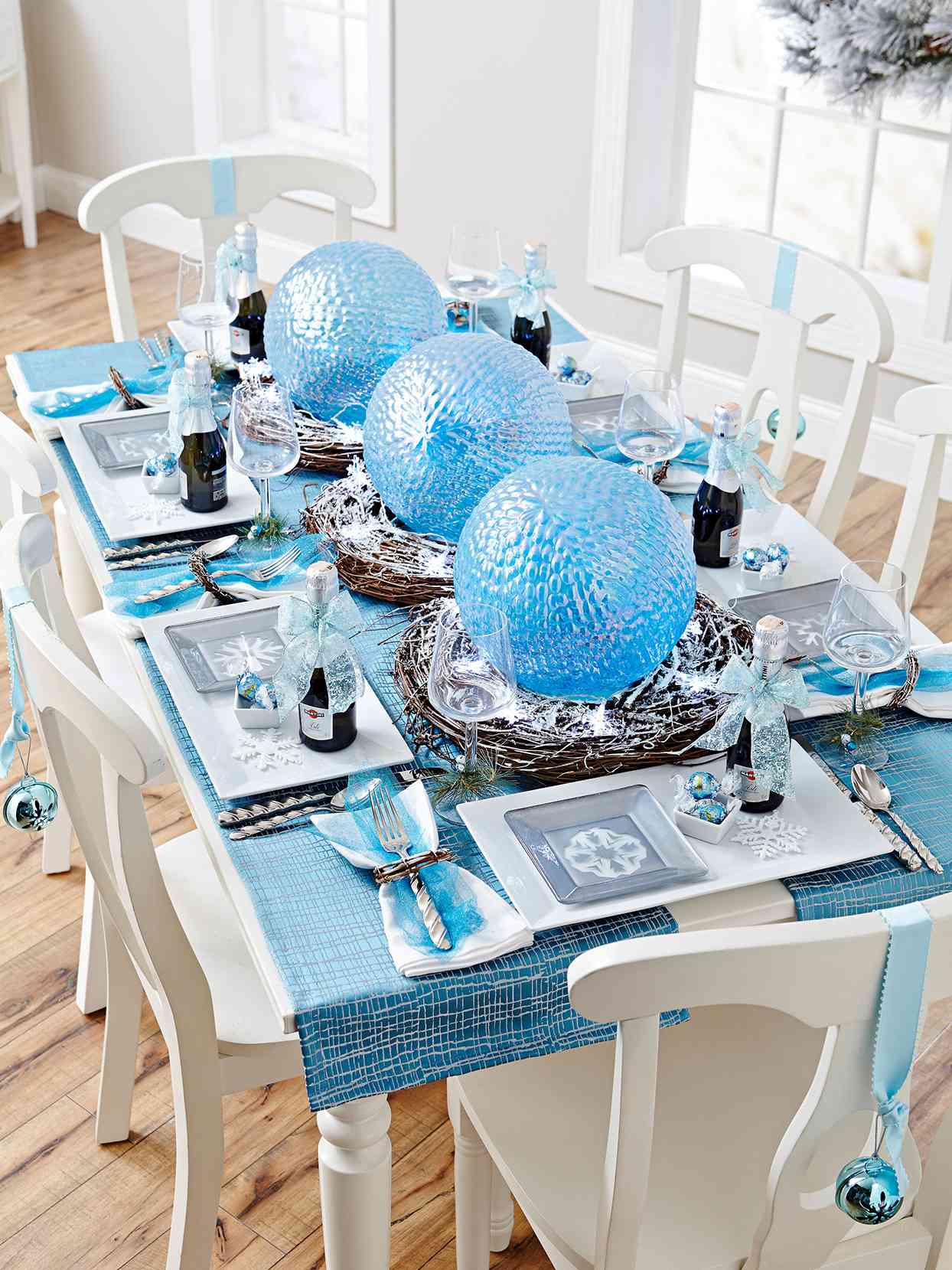
It also works in low-ceilinged rooms, 8 feet or under, precisely because the flames sit below eye level when you’re seated. Compare with Idea #3, which needs vertical room for candelabras and a focal tree.
The clear glass holders are what make this table. Red pillar candles sitting directly on a red-and-white cloth would read flat — same color, no separation between object and surface.
The glass creates a small shadow and a reflection under each flame, lifting the red off the pattern. It also catches drip, which means the tablecloth survives the evening. About $3 apiece at a craft store, and they do more work than the flowers.
21. Paper Plates With Gold Rims (Yes, Really)
If you set this one up on a covered porch, three things will ruin it: wind, condensation, and heat. Paper plates with gold rims blow off in a gust — weigh each with a real charger underneath. Cold drinks sweat and turn paper placemats to pulp, so use coasters and keep paper goods away from the table edges.
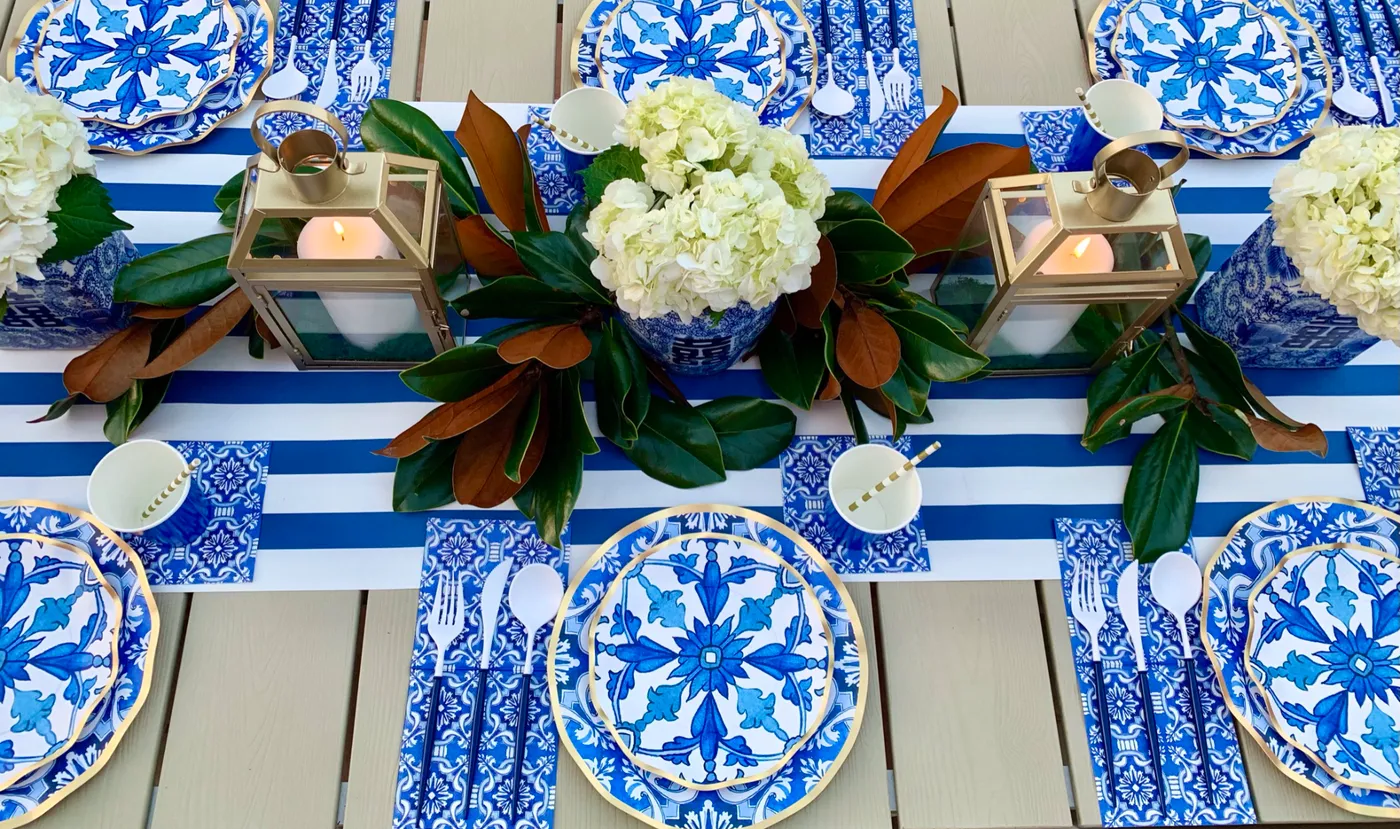
Lit candles in lanterns at dusk look spectacular right up until a breeze tips them. Use enclosed hurricanes or battery candles if there’s any air movement at all.
Now the good news: this is proof that a beautiful table doesn’t need real china. Blue-and-white patterned paper plates with gold rims run about $12 for eight. Matching cutlery sleeves, a striped runner, and napkins bring the whole thing to roughly $40 for eight people.
Put the money in the two gold lanterns at $20–$35 each, plus the hydrangeas. Those are what people photograph, and they come back out every single year.
22. Gingham, Eucalyptus, and Pale Blue Tapers
Gingham is a country pattern and pale blue tapers are a formal one — that tension is the reason this table looks fresh instead of folksy. Same with the woven round placemats: natural fiber usually reads casual, but here it’s holding layered white and blue-grey plates like it’s setting a fine table.
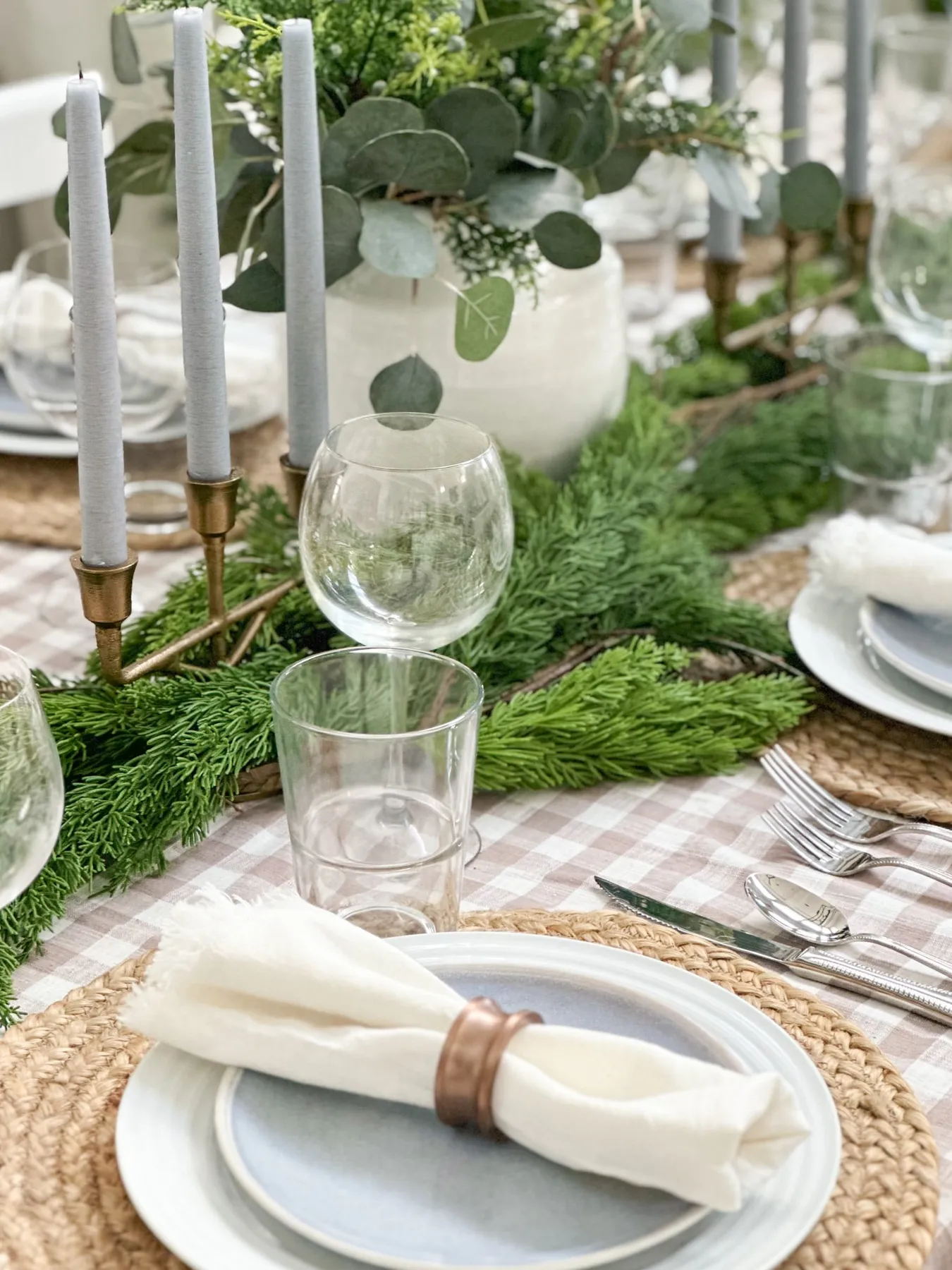
The evergreen and eucalyptus garland picks up brass from the candle holders and copper from the napkin rings. Three warm metals, one green, one pale blue. That’s the entire palette. It’s a close cousin to Idea #4 — same rustic greens, lighter mood.
Building the garland-with-candles centerpiece:
- Lay a 6-foot mixed garland down the middle and fluff it wider at both ends.
- Push three brass holders down into the garland so the bases are hidden and the candles stand clear.
- Add a low white vase of eucalyptus at the center for a second leaf shape.
- Snip any stems pointing straight up — you want a low silhouette.
- Light the tapers just before guests sit down.
Twenty minutes, $45–$75 depending on whether the greens are real or faux.
23. The Garland That Lights Itself
Fairy lights inside a garland look magical and behave badly. Cheap strands flicker, die in a season, or overheat when they’re buried in foliage with no airflow. Buy LED strands rated for indoor use, and don’t bury the battery pack — you’ll be reaching for it every other night.
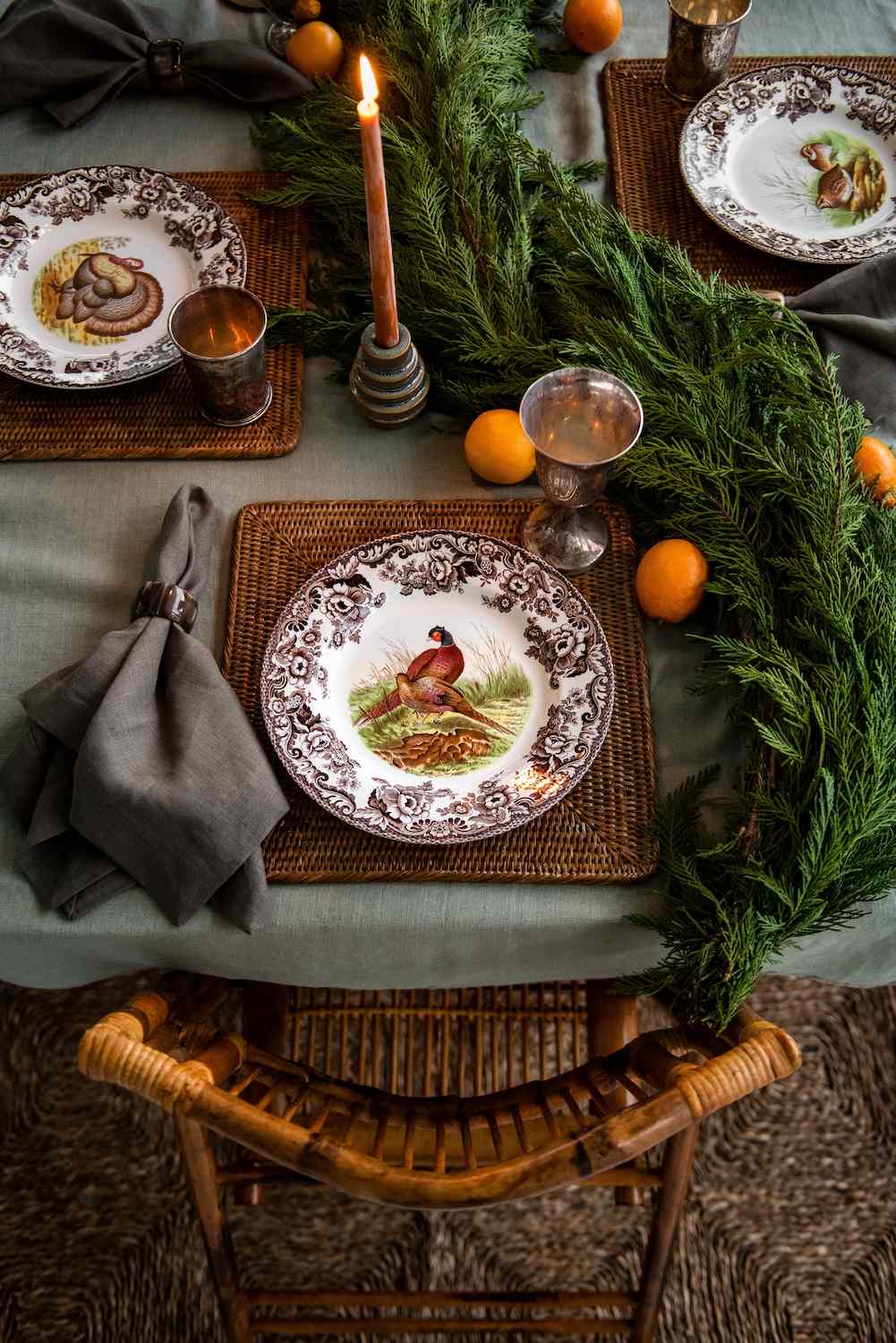
Also be realistic about slatted wood chairs with cushions: they’re gorgeous, but they’re heavy, they don’t stack, and without the cushions two hours in becomes uncomfortable. Nobody tells you that part.
- Measure the table first — you need about 1.5 feet of garland per foot of table length for a full look.
- Count your outlets. Buy battery strands if the nearest plug is more than 6 feet away.
- Check your plates are truly white. Beside garland, off-white ceramic suddenly looks dirty.
- Test the fairy lights for 30 minutes before installing them near anything dry.
24. A Needlepoint Stocking at Every Place
Stacked red and white plates with gold rims and a plaid napkin are standard holiday issue. The needlepoint stocking draped at the setting is not — and it’s the only reason this close-up is worth saving.
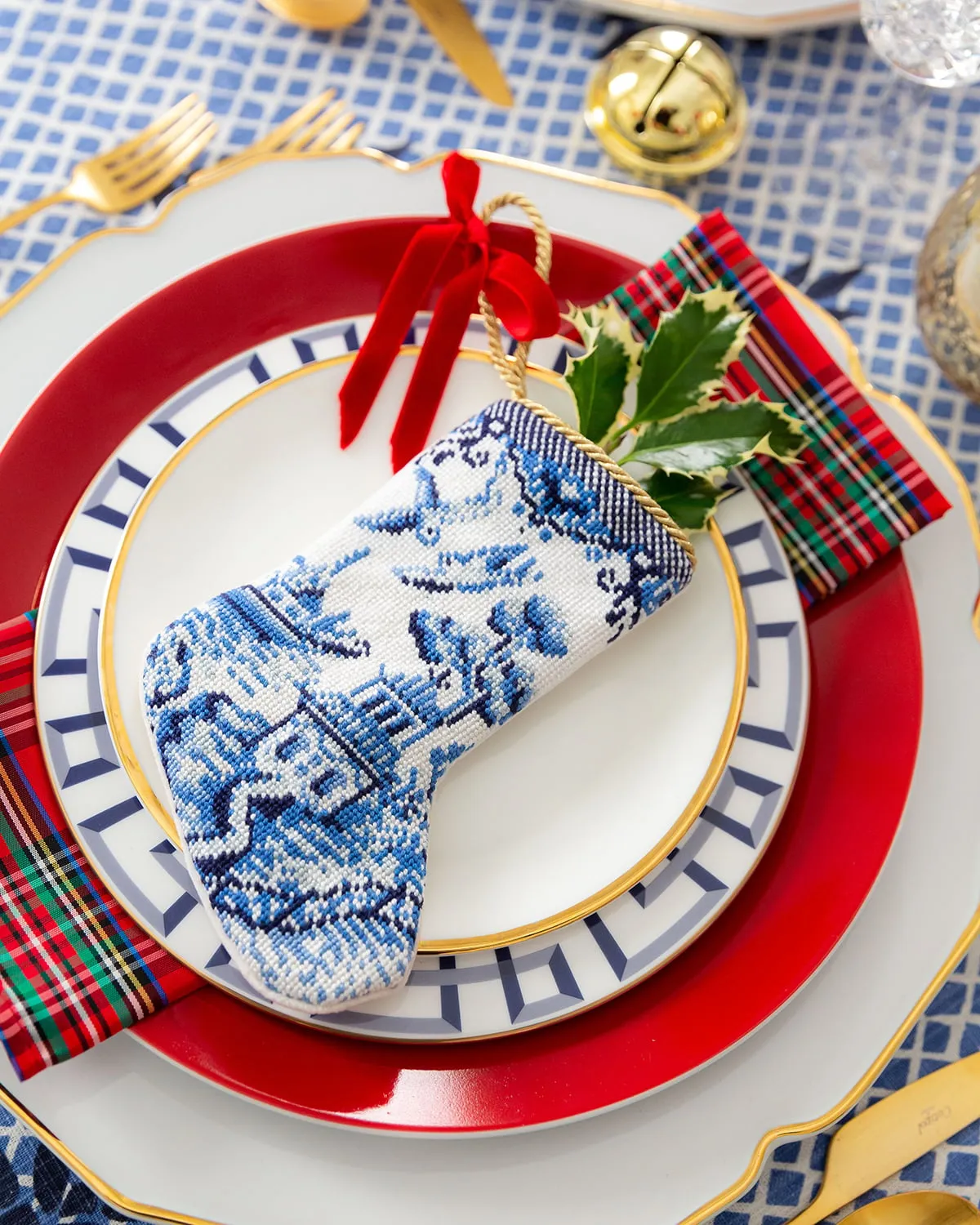
It’s an heirloom, a conversation, and a name tag all at once. That’s the principle: one object per table with actual history, rather than a dozen that are merely pretty. Take it off and you have a catalog photo.
Heirloom-heavy tables are having a real moment, partly as a counterweight to years of perfectly matched, all-new tablescapes. People are mixing grandparent china with dollar-store glass on purpose, and it looks better than either alone.
It matches how people are shopping in 2026 too: fewer new purchases, more estate sales and Facebook Marketplace. Vintage needlepoint and plaid is genuinely easy to find under $10. This one has staying power because it isn’t a trend — it’s just the good stuff.
25. Red Florals in a Blue Vase — Trust the Contrast
- Plaid napkins, set of 4: $20–$45
- Green ribbon for napkin ties: $6–$12
- Gold flatware, service for 4: $50–$130
- Red floral arrangement in a blue vase: $55–$140
- Garland with red berries, 9 ft: $30–$65
- Candles, gold holders, and a hurricane vase: $45–$110
- White plates with gold and blue rims, 8-piece: $90–$260
- Total: roughly $296–$762
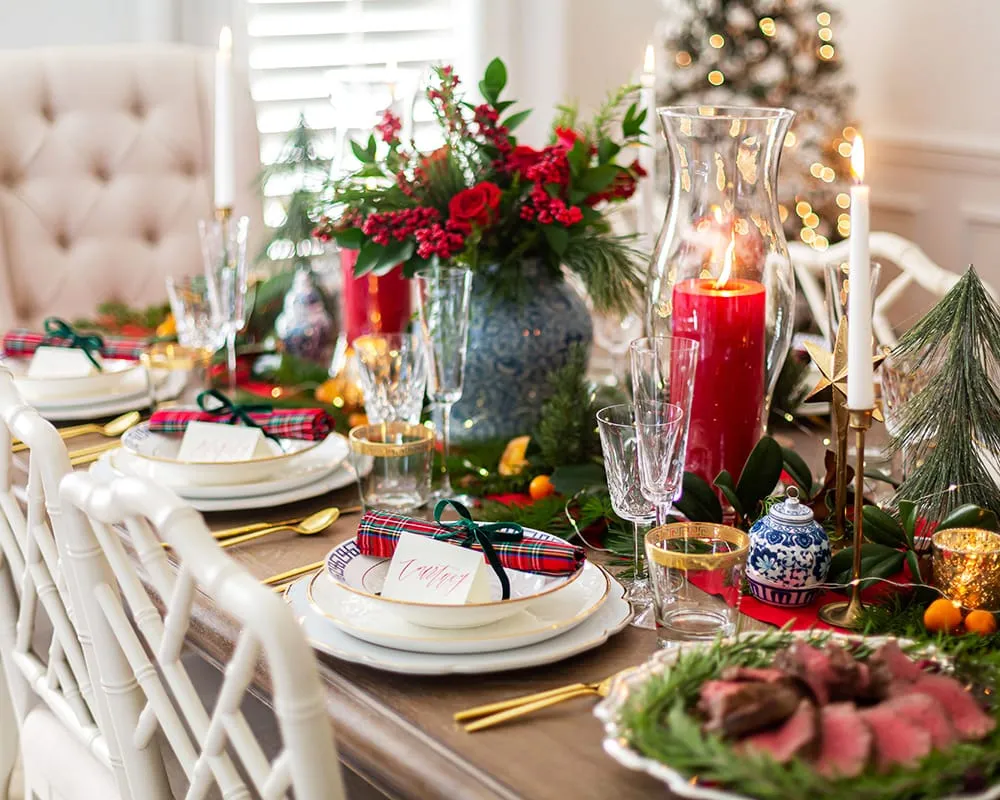
To cut it down, use plain white plates you already own and let the red arrangement star. That alone drops you under $250.
The one long table is the format this works in — 8 to 10 feet, garland running its length, candles clustered at the midpoint. On a round table the garland becomes a wreath and the arrangement moves to the center. The palette survives; the procession down the table is what you’d lose. For a smaller footprint with similar impact, see Idea #20.
26. A Hydrangea Garland Running the Whole Table
The recipe: 45% light wood and woven natural fiber, 30% white and blue patterned china, 20% green foliage, 5% soft blue blossom. That last 5% is small on purpose — blue hydrangeas are a supporting color here, not a theme.
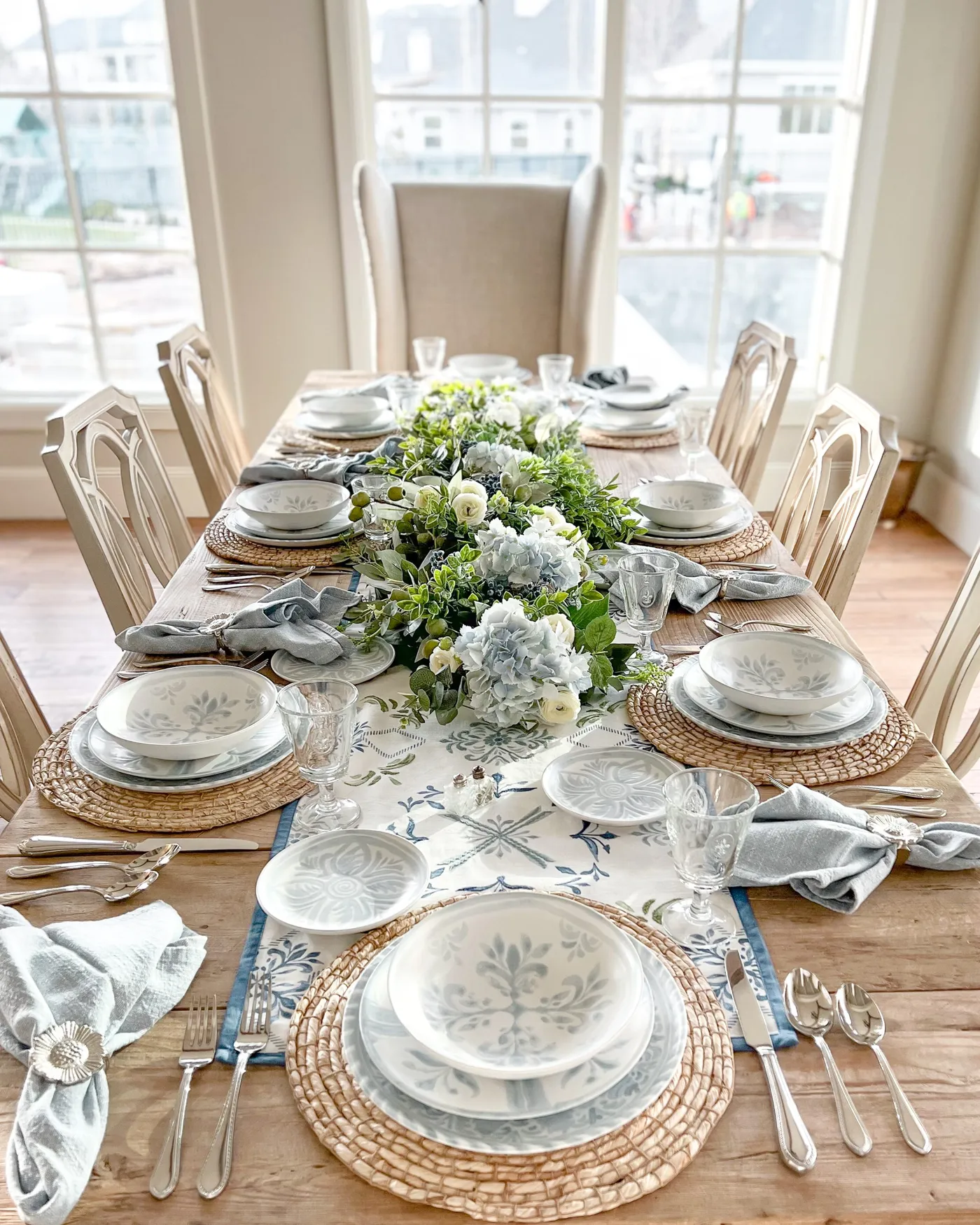
Swap the blue hydrangeas for white and you get a completely calm table. Swap the patterned china for solid white and the flowers can go much bolder. Keep the woven placemats either way; they’re what stops blue-and-white from feeling precious.
Hydrangeas in a garland are the fussiest thing in this article. Out of water, blue hydrangeas wilt in about two hours and never come back. You need floral foam, water picks, or a concealed channel of soaked foam running the length of the arrangement — and even then, expect to replace a few stems mid-party.
The practical fix: cut hydrangeas in water picks, tucked into a faux green garland. Real blooms, fake structure, ten minutes of maintenance instead of an hour.
27. Navy Runner, Black Velvet Ribbon, Mercury Glass
Pine branches, pinecones, and white pillar candles are low-maintenance compared with fresh floral — but pine drops sap on wood. If your table is unsealed oak or pine, put a felt pad under anything resinous and wipe drips with a little rubbing alcohol before they cure.
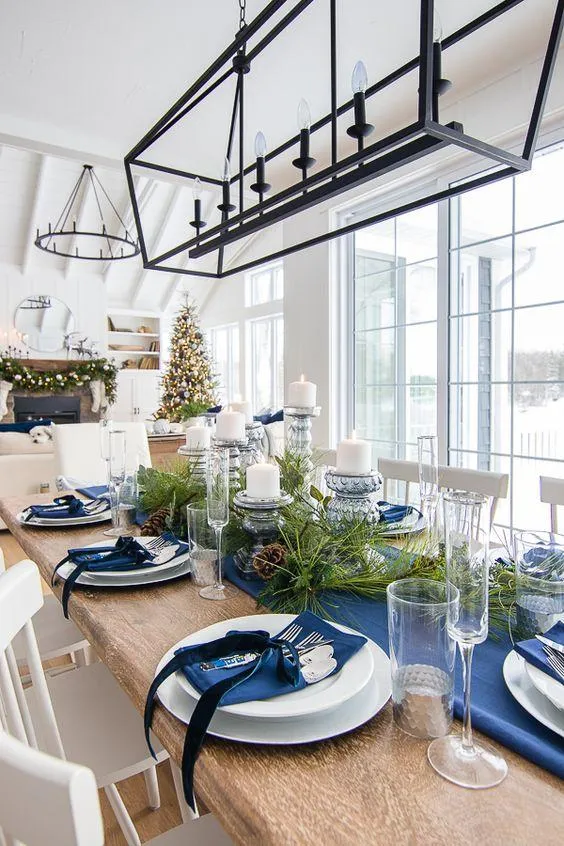
Mercury glass is the opposite: nearly indestructible, and the silvered finish hides wax splatter. Rinse the holders in warm water once a year and they’ll look new for a decade.
Navy blue and black velvet ribbon is a stronger combination than most people expect. It reads formal and faintly wintry, and it lets you skip red entirely without the table feeling un-festive. The rule when you go this dark: keep the plates white and the candles white. Everything else can be navy.
Tie the ribbon in a single simple knot with the tails left long and slightly uneven. Symmetry is what makes velvet look stiff.
28. Fuchsia Lace Under Pink Chargers
Fuchsia lace paper placemats sound like a splurge and cost about $10 for twenty. Light pink chargers run $2–$4 each at discount stores, and the floral napkins with the light blue ribbon can be the one real linen you buy.
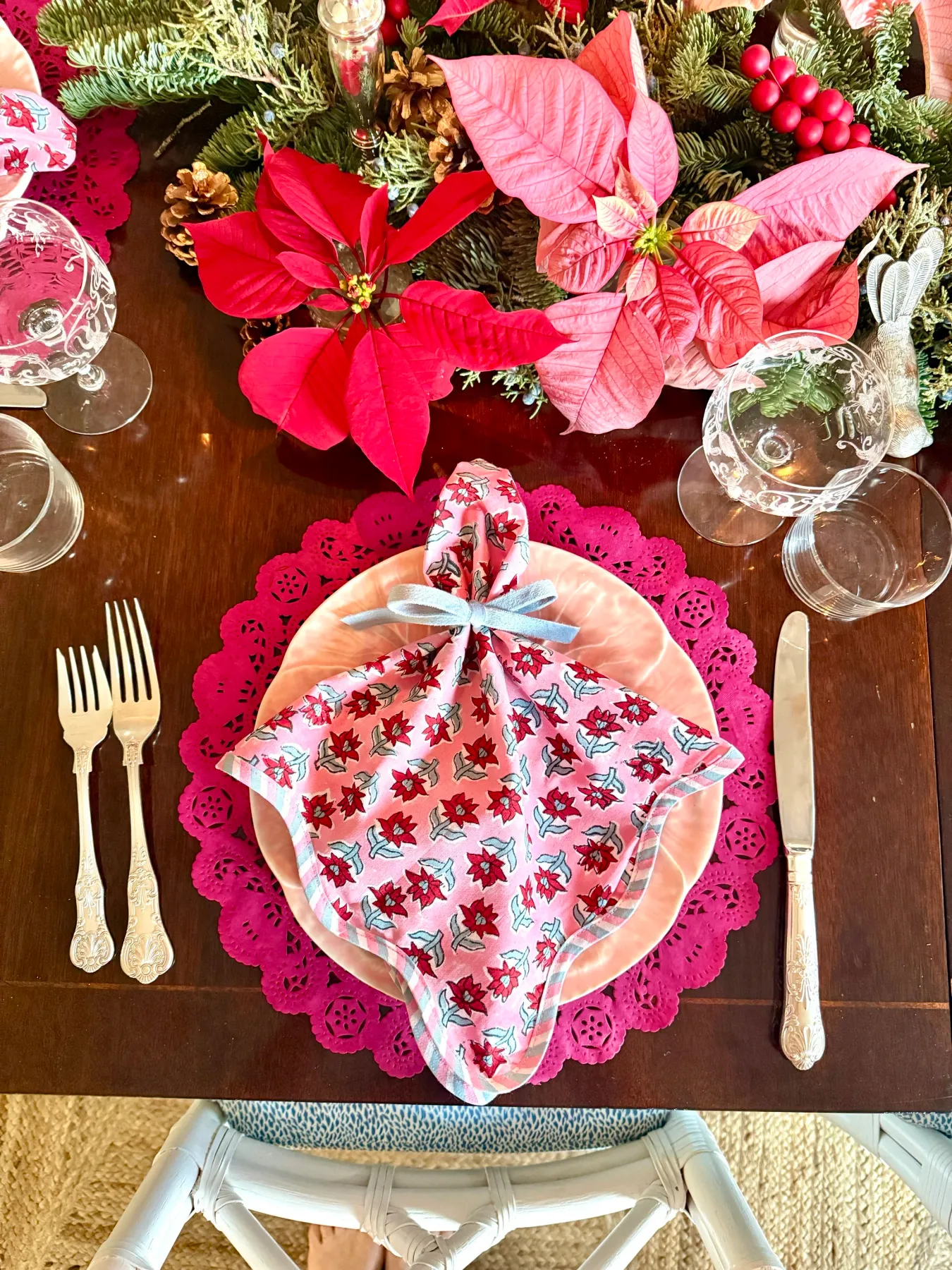
Spend on the poinsettias instead. Red and pink poinsettias from a grocery store florist in December are $12–$20 a plant, and three of them, popped out of their foil and nestled into an evergreen garland, look like a professional arrangement. Estimate: under $90 for the whole table.
Three principles are doing the work. Pink next to red is a bolder, more modern pairing than red next to green, and the evergreen keeps it grounded. The fuchsia lace is see-through, so the dark table shows through and the placemat reads as texture rather than a colored rectangle.
Then there’s ornate silver cutlery against paper placemats. High and low, ten inches apart. That contrast is the entire personality of the table. If you’re tempted to add one more pattern, skip ahead to the mistakes section first.
Your Best Holiday Table Is the One People Actually Sit At
Pick one idea, steal one detail, and forgive yourself for not doing all twenty-eight. The tables people remember are the ones where the food fit, the candles were lit, and nobody had to lean around a centerpiece to say hello.
Start with the version of Idea #24 that uses what you already own — the heirlooms are the whole point.
📌 Pin your favorite tablescape now so it’s waiting for you when December gets busy.