33 Jaw-Dropping Christmas Tree Lights You Need to See for 2026 That Will Dazzle Your Home

You know the moment: the tree is up, the ornaments are on, and something still looks off — usually because the lights went on last, in a panic, in one dense ring around the middle. Lighting is the difference between a tree that glows and a tree that glares, and it’s the one part of December decorating most of us rush.
We spent real time filtering through Target, Home Depot, Anthropologie, and Walmart to pull the 33 ideas below — everything from a $12 plug-in glitter tree to a full facade illuminated for a crowd, roughly $12 to $900.
Inside you’ll find traditional red-and-green, flocked winter-white, modern light sculpture, and full-gloss retro multicolor, with budget and luxury versions compared side by side for the big-ticket pieces.
In 2026 the shift is toward dimensional light — infinity-mirror trees, wireframe cones, and clip-on candle bulbs instead of one more strand of fairy lights. Some links below are affiliate links.
📌 Save this to Pinterest for later — you’ll want to revisit these ideas.
1. A Multicolor Tree Against Deep Red Walls
For a tree carrying this much ornament, resist the urge to wrap lights in tidy horizontal rings. Run them in vertical zigzags down the trunk first, then spiral outward through the branch tips — roughly 100 bulbs per vertical foot. That’s what makes the glow read from inside the needles instead of sitting on top like a garland of beads.
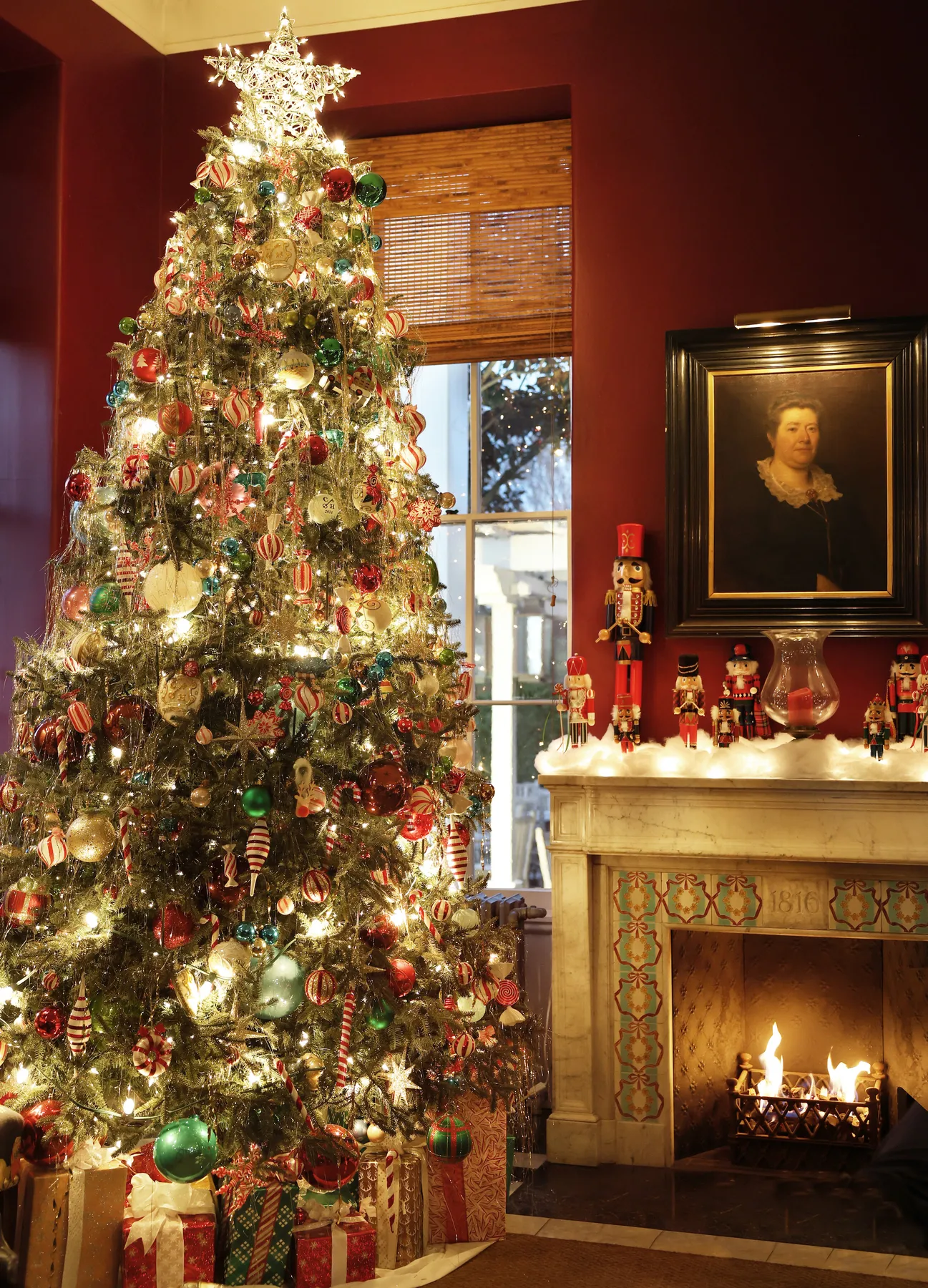
Multicolor bulbs also want a tighter ornament palette, not a looser one: pick three colors and repeat them. Here the red, green, and gold stay disciplined, so the tree feels opulent rather than chaotic.
The deep red walls are doing quiet heavy lifting. Red and green sit opposite each other on the color wheel, so the foliage pops without a single extra decoration, and the warm bulbs turn the corner into a glow rather than a glare.
Then the marble fireplace adds a cool, hard surface right beside all that softness — tinsel, needles, snow. Nutcrackers standing in artificial snow on the mantel tie the fire and the tree together without introducing a fourth color.
2. Flocked Branches Lit Only in Warm White
Strip the color out and the flocking becomes the decoration. This tree wears a dense layer of faux snow and nothing but warm white bulbs, so the pale branches catch light and hold it — the tree glows from the needles outward rather than from a pile of ornaments.
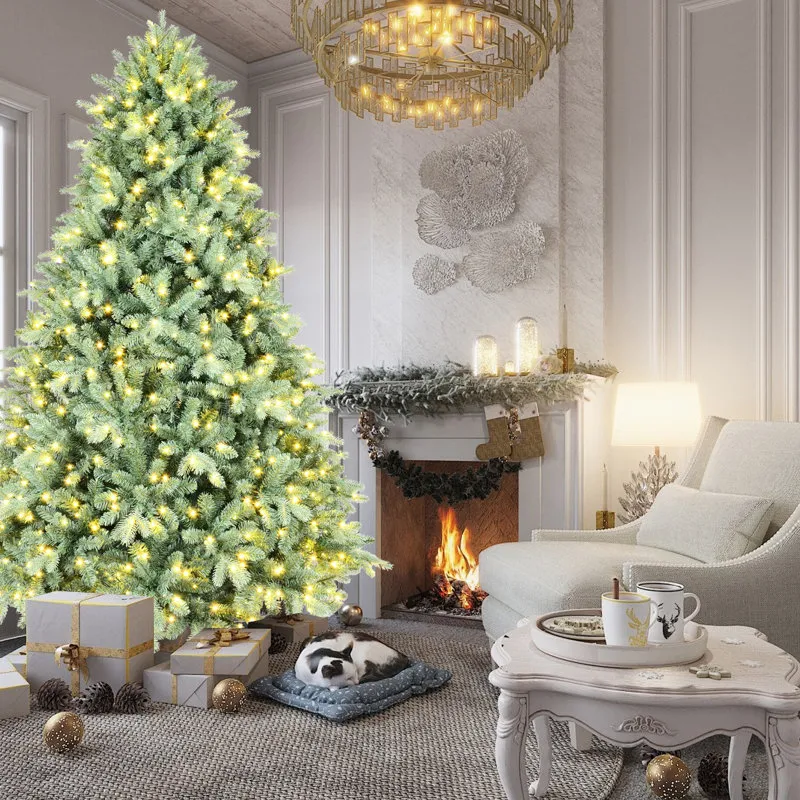
Take the flocking away and you have a very ordinary green tree with white lights. Take the warm bulbs away and the white turns grey and flat. The two elements only work as a pair.
Roughly 90 percent of this look is white and cream — flocked branches, paneled walls, the upholstered chair, the ornate side table. Warm bulbs supply about 8 percent of the visual weight, and a whisper of muted green foliage is the last 2 percent.
Swap the flocking for champagne-toned branches and the same formula reads softer and more modern. Swap the bulbs for cool white and the formula collapses; that’s the one variable you can’t trade.
3. A Spiral Light Tree Suspended in the Window
Rigging a spiral light tree takes about two hours and $60 to $120 in materials.
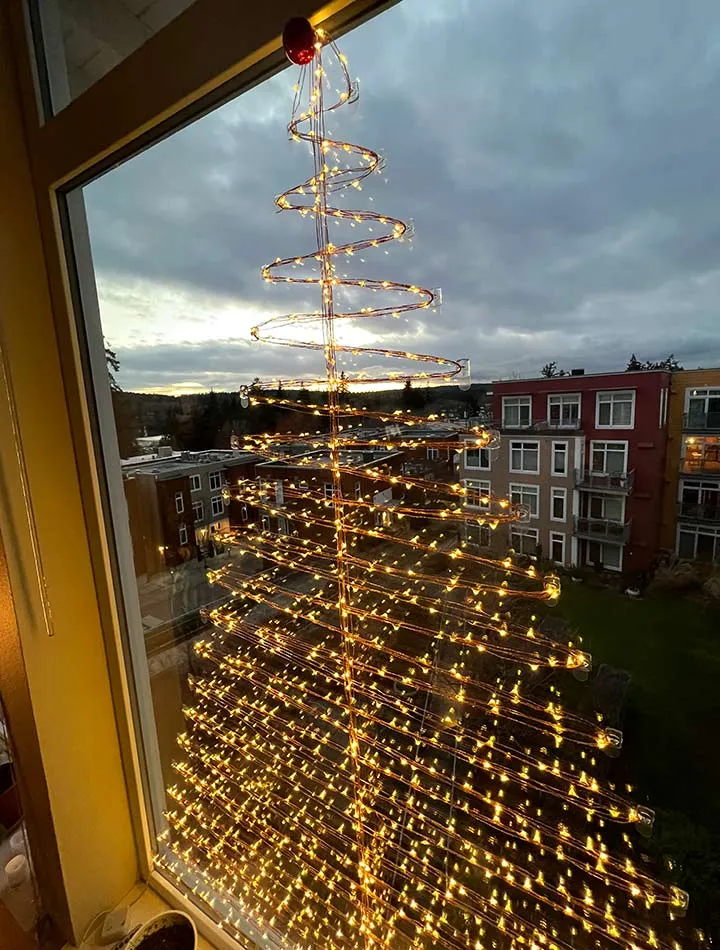
- Bend 9-gauge galvanized wire into a 24-inch base ring and a 3-inch top ring, then join them with four vertical ribs.
- Wrap the frame with warm white LED strands, spacing coils 3 inches apart.
- Hang the frame from two anchored cup hooks rated for 25 pounds.
- Add a single red finial at the apex.
- Plug into a timer set for dusk.
Two things bite people here. First, glass: a lit tree pressed against a single pane throws a hard reflection back into the room at night and turns your living room into a fishbowl for the street. Hang it 6 to 10 inches off the glass.
Second, power. There’s rarely an outlet centered under a window, so plan a slim cord run along the sill with a cover, or you’ll be staring at a black cable all season. Renters, use cup hooks and patch them in January.
4. Candle Bulbs and Gold Spheres Against Red Velvet
Candle-shaped tree lights have quietly climbed back into favor because they solve a problem fairy lights can’t: they give a tree dimension. Each bulb reads as a small, separate source instead of an even wash, which is why the look photographs like a room in a period film.
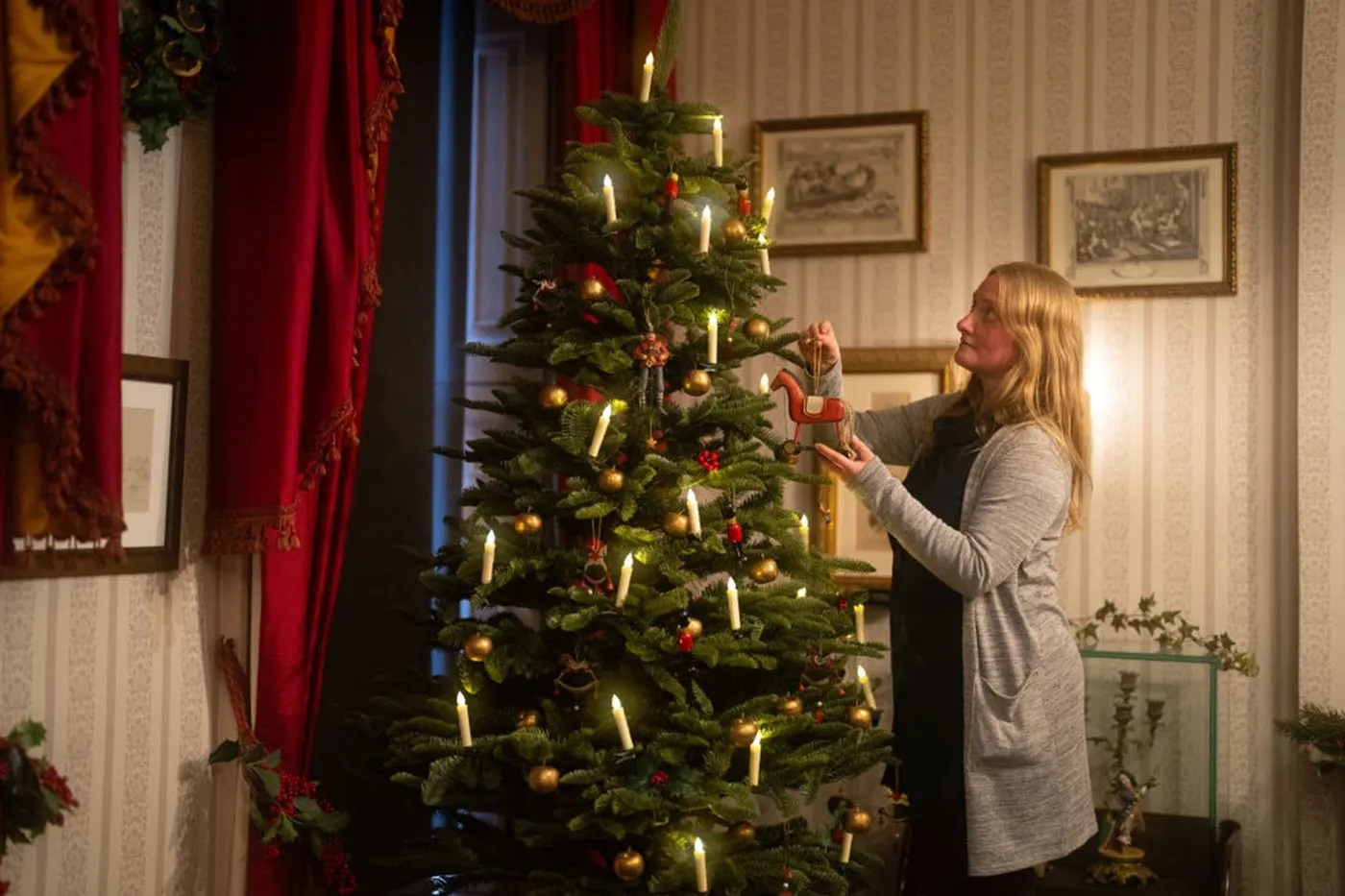
It’s also where two 2026 trends overlap — old-world nostalgia and low-lumen, warm-color lighting at home. The bulbs are LED now, so you get the flicker without the fire risk.
Clip candle lights to the outer tips, never the interior branches, and aim them slightly upward at a 45-degree angle so the flame reads above the needles. Space them 10 to 12 inches apart.
Buy 2,200K to 2,700K bulbs only. Anything cooler and the cream striped wallpaper behind the tree goes grey, and the gold spheres start looking like brass.
5. LED Cone Tree Framed by Poinsettias and Gold Planters
- Pre-lit cone tree, 6–7 ft: $90–$350
- Gold cylindrical planters, 4–6: $25–$60 each
- Red poinsettias, 4–6: $12–$30 each
- LED star topper: $20–$50
- Outdoor timer and cord covers: $20–$40
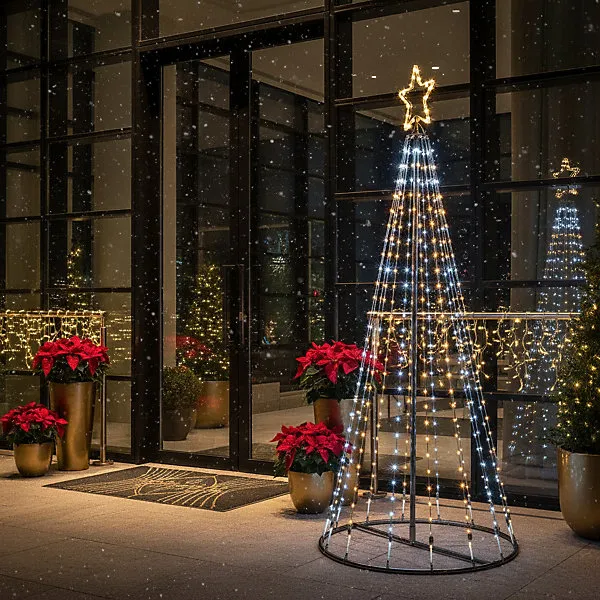
Total: roughly $280 to $900 depending on whether you’re buying planters or raiding the garage. Budget version: a tomato cage, zip-tied string lights, and nursery poinsettias in spray-painted buckets gets you 80 percent of this for about $70.
This composition needs a landing wide enough for the cone plus a planter on each side — 6 feet minimum, 8 feet to breathe. Door height matters more than people expect: a 6-foot cone under a 7-foot entry looks cramped, so measure the opening first. Smaller porches carry a 4-foot cone with two planters instead of four.
- Confirm every strand is UL-listed for outdoor use and plugs into a GFCI outlet.
- Measure door height and landing width before choosing cone size.
- Check that planters have drainage if the poinsettias are real.
- Set a ceiling for planters — they’re the sneaky line item.
6. Warm White Density Against a Dark Modern Facade
Dark facades are a gift to Christmas lights. The near-black building behind this evergreen swallows shadows, so every bulb reads at full strength — the tree looks brighter than it would against pale brick.
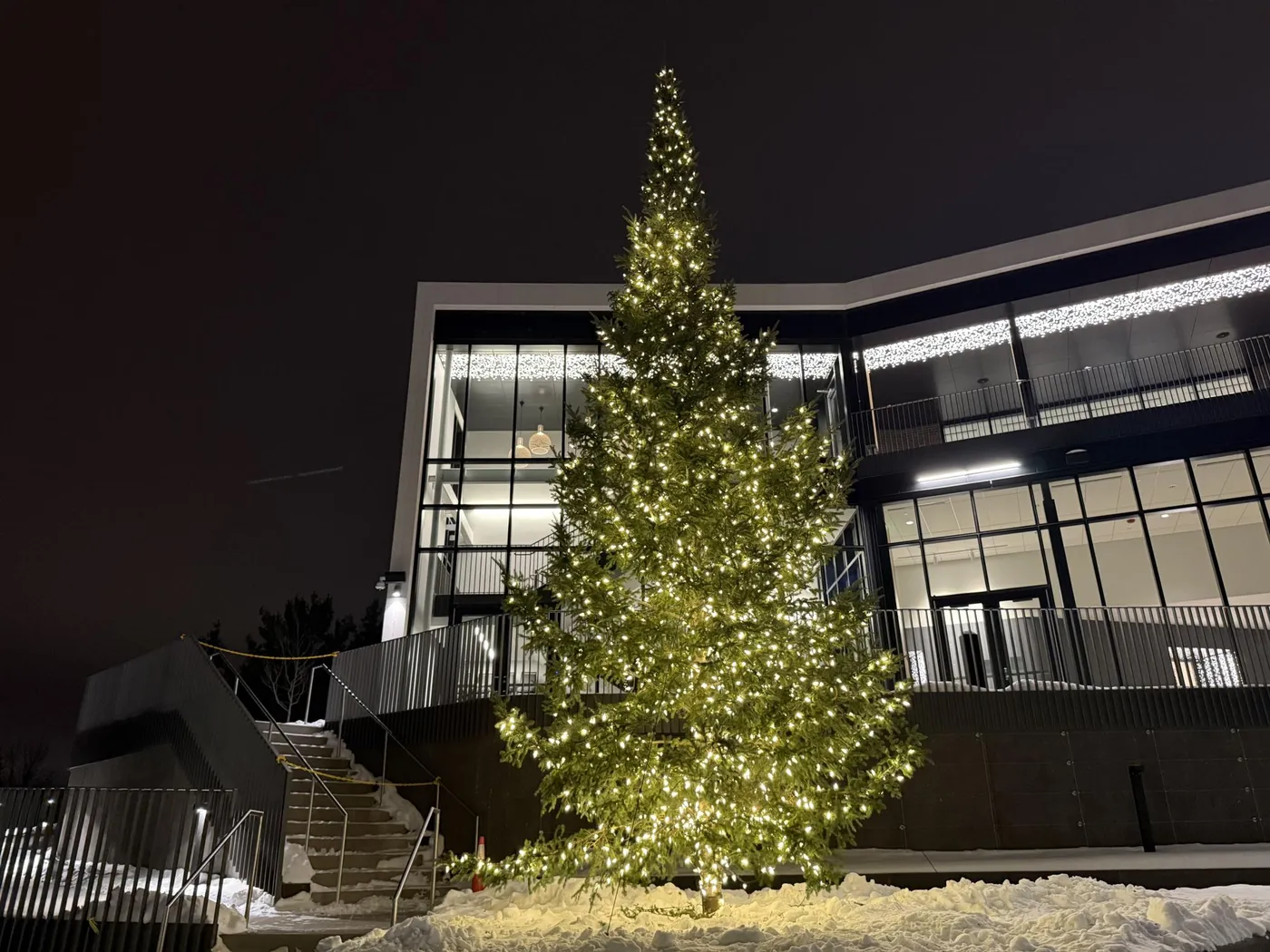
The white string lights along the upper windows do a second job: they repeat the tree’s color temperature, so the whole entrance reads as one composition instead of a lit tree standing beside an unlit building.
Outdoor strands are the ones that fail. LED bulbs last years, but connections corrode, and one loose socket takes out a whole run. Walk the tree once a week with the lights on and reseat anything flickering.
Snow load is the other risk: heavy wet snow snaps the thin branch tips that hold your lights. Shake the tree off after storms, and budget on replacing a $20 strand every two or three seasons.
- Photograph the entrance from the street before you hang anything.
- Count how many strands one circuit can carry.
- Buy two spare strands in the same color temperature.
- Note where snow slides off the roof.
7. A Slender Flocked Tree Framed by Patterned Curtains
Slim trees need fewer lights than you think — about 50 to 70 bulbs per vertical foot, not the 100 a full tree wants. Overlight a narrow silhouette and it stops reading as a tree and starts reading as a glowing column.
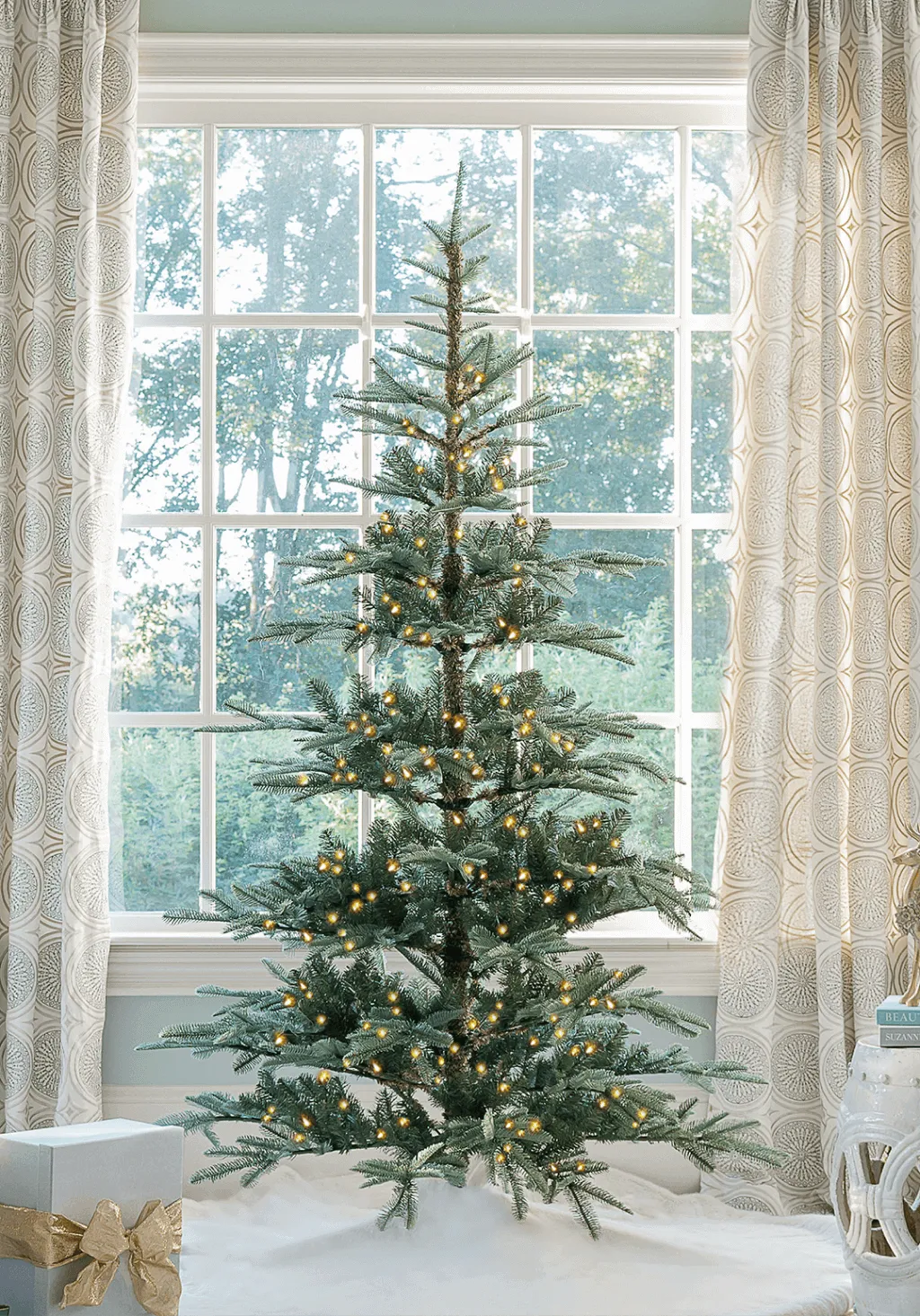
Position it 8 to 12 inches back from the glass. Close enough that the window frames it, far enough that the reflection doesn’t double the tree into a blur.
The formula here is temperature contrast: a cool blue-grey frosted tree against warm yellow bulbs, with white faux snow at the base and cream patterned curtains softening the edges. About 70 percent cool neutral, 25 percent warm light, 5 percent accent — that single pale blue gift box.
Swap the accent to a soft blush ribbon and the scene turns romantic. Swap the bulbs to cool white and it turns icy instead of cozy. Same math, different mood.
8. The Oversized Red Velvet Bow Topper
A star would disappear into this tree. The oversized red velvet bow does something a topper usually can’t — it echoes the red ornaments below and the plaid ribbon on the gifts, so the eye travels from the top of the tree to the floor in one line.
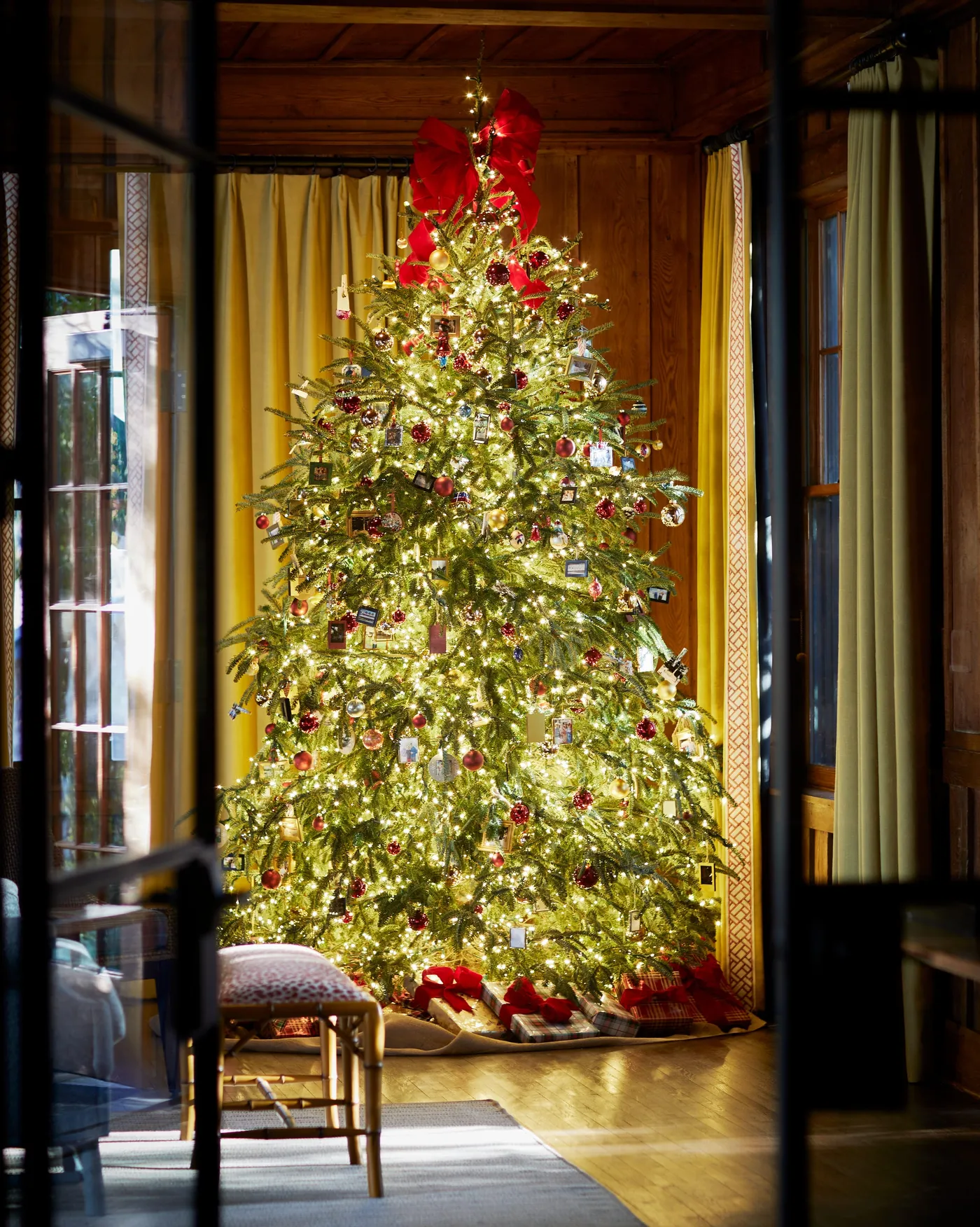
Remove it and you still have a beautifully lit, generously decorated tree. You just lose the thing that makes it feel like somebody’s grandmother did it on purpose.
Twenty minutes and about $15 in materials.
- Buy 4-inch wire-edge velvet ribbon — the wire is what holds the shape.
- Make two loops roughly 8 inches across, pinching the center as you go.
- Add a third, slightly smaller loop behind for depth.
- Bind the center with floral wire and wrap it with a short offcut.
- Zip-tie the bow to the top branch, angled slightly toward the room.
9. White and Silver on a Grey Sectional
Count the palette: light grey sectional, grey rug, pale wood coffee table, white sheers — that’s the 80 percent neutral base. White and silver ornaments plus warm whites make up the 20 percent that actually reads as Christmas from across the room.
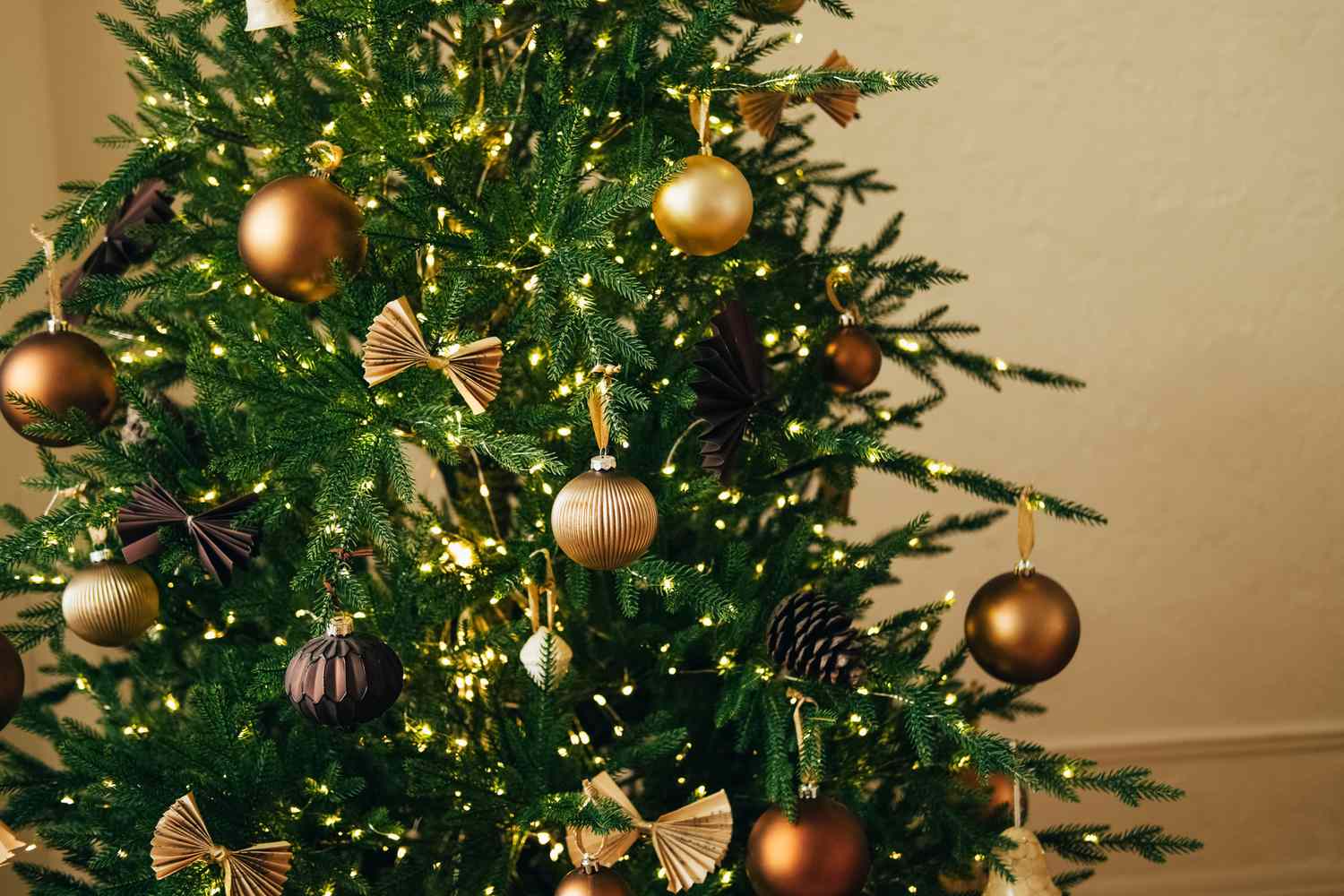
To warm it up without changing the formula, swap silver for antique brass. To cool it down, move the bulbs to 3,000K. Both keep the same 80/20 split.
The look is mostly restraint, which is cheap. A $40 slim tree from Target, two strands of warm LED lights, and a tub of white and silver baubles from Walmart lands under $100.
Save on ornaments by buying one mixed tub instead of individual pieces, and check Facebook Marketplace in early December — people unload whole collections when they change palettes. Compare with Idea #16, which spends its money on tinsel instead.
10. A Ceramic Village Glowing Under the Branches
Build the village on a white board or a sheet of foam core, not directly on the floor — it gives you one flat, movable platform and hides every cord underneath. Then stack heights: tallest church at the back, smallest cottage front-left.
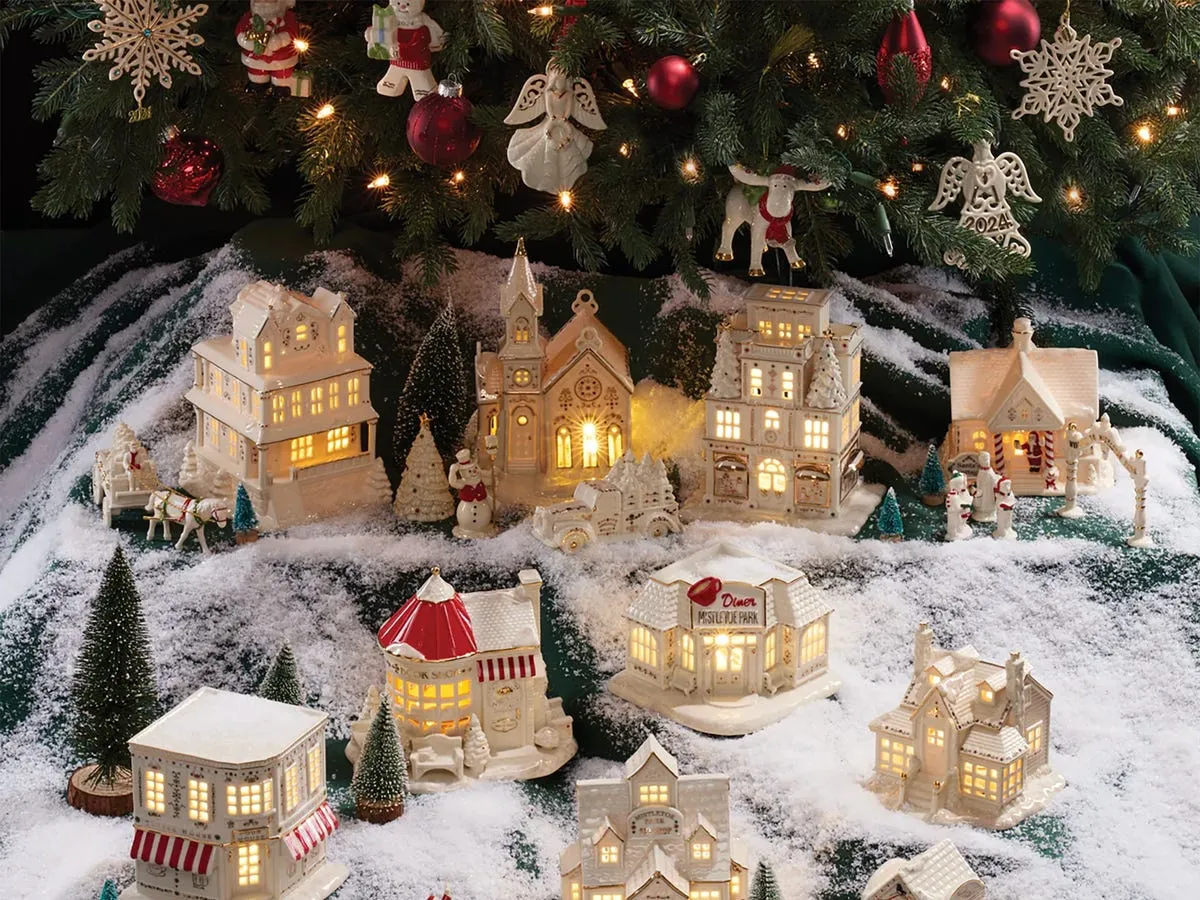
Run everything into a single power strip with a timer. Twenty small illuminated buildings on twenty outlets is how a charming display becomes a fire hazard.
The village is the soul of this setup. The tree above it is lovely — red balls, snowflakes, warm strands — but it’s the frame, not the picture.
What sells the illusion is the faux snow drifting over the rooflines and the bottle brush trees at the edges, so the buildings look settled into a landscape rather than lined up on a shelf. Without that, it’s a collection. With it, it’s a place.
11. Beaded Garland and Gold Icicles in a Wood-Paneled Hall
This composition wants height. The ceiling reads at 12 feet or more, and the tree is doing 10 to 14 feet of work — anything shorter gets swallowed by the paneling and the parquet.
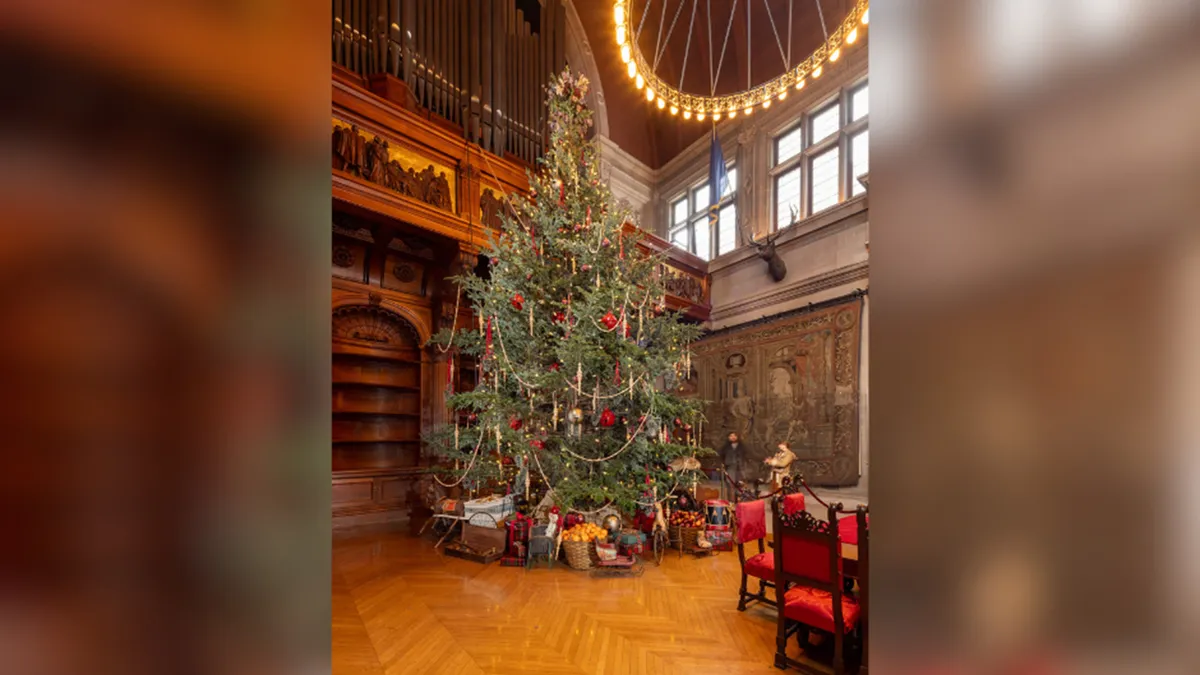
Floor space matters too: you need 3 feet of clearance on all sides for the gifts and baskets at the base to read as intentional. In a standard 8-foot living room, that same density belongs on an 8-foot tree with lighter garland.
- 10–12 ft tree: $400–$1,200
- Warm white LED strands, roughly 1,200 bulbs: $80–$180
- Red baubles, 100-count mixed: $60–$140
- Gold icicles and beaded garland: $50–$120
- Tree skirt or collar: $40–$90
Total: roughly $630 to $1,730. Garland is where you save — buy beads by the roll and drape in loose swags rather than tight loops and you’ll use half as much. A $150 nine-foot tree, thrifted beads, and discount icicles reads 85 percent as grand.
12. Velvet Skirt, Pre-Lit, Beside a Bright Window
Pre-lit trees are a bargain until a section dies. Expect to lose a 50-bulb run every three to five years; the fix is usually a $10 fuse or a reseated plug, but sometimes it’s a new strand woven in by hand.
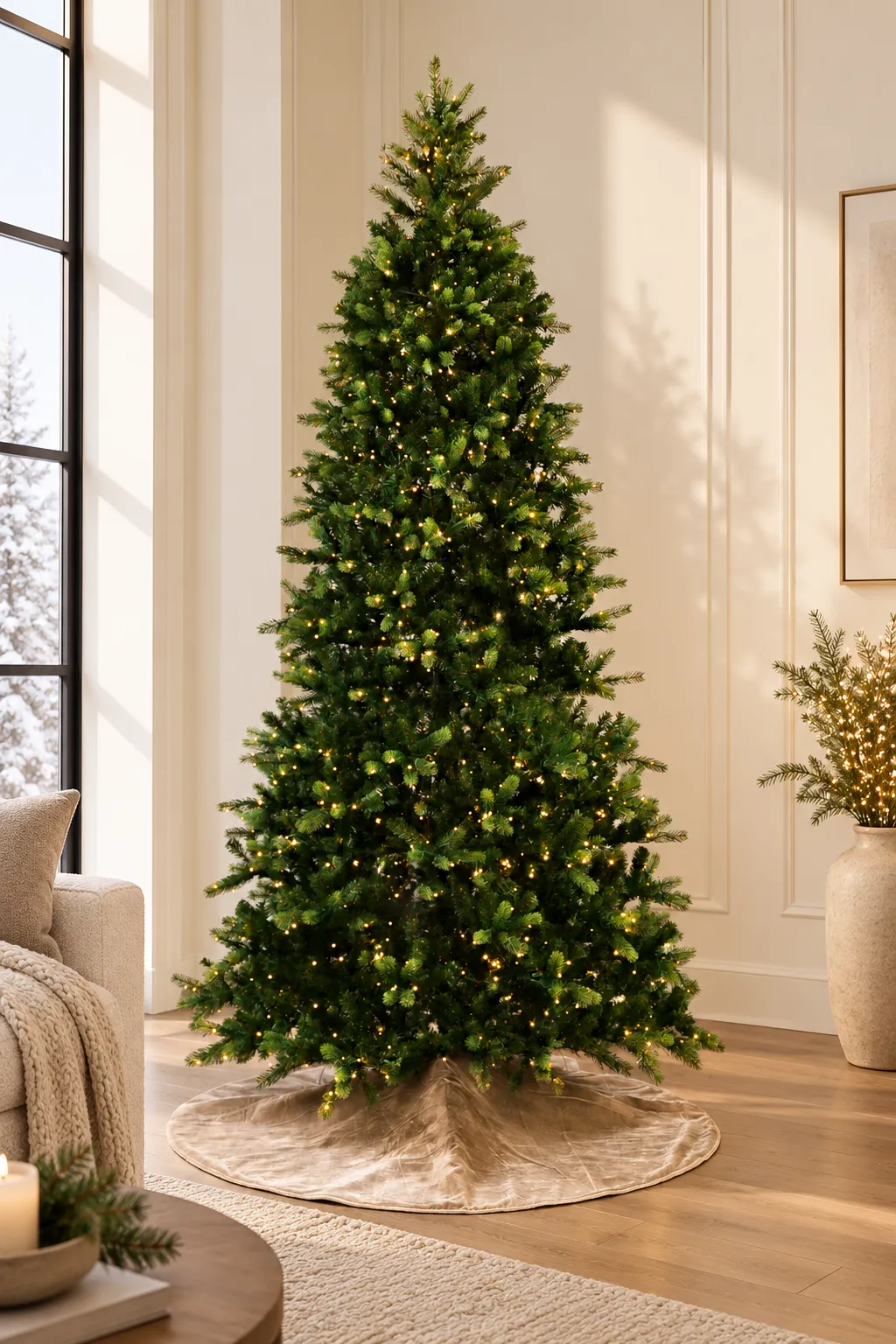
Velvet skirts need a lint roller more than a wash — spot clean only, and keep them away from heat vents.
Daylight is the enemy of pre-lit trees. In a bright room, run a second strand on the window side of the tree only — about 100 extra bulbs — or that side looks sparse all afternoon and gorgeous only at night. Set the timer for 4pm so the tree is already glowing when the light goes flat.
If you’d rather skip the flocking, compare with Idea #22 — same slim silhouette, warmer skirt, white wainscoting.
13. Blue and White Bulbs on a Snow-Dusted Outdoor Tree
Colored LEDs photograph brighter than they look in person, and blue is the worst offender — almost white on camera, then hard enough at night to wash out the branches. If you want blue, buy fewer strands than you think and place them low.
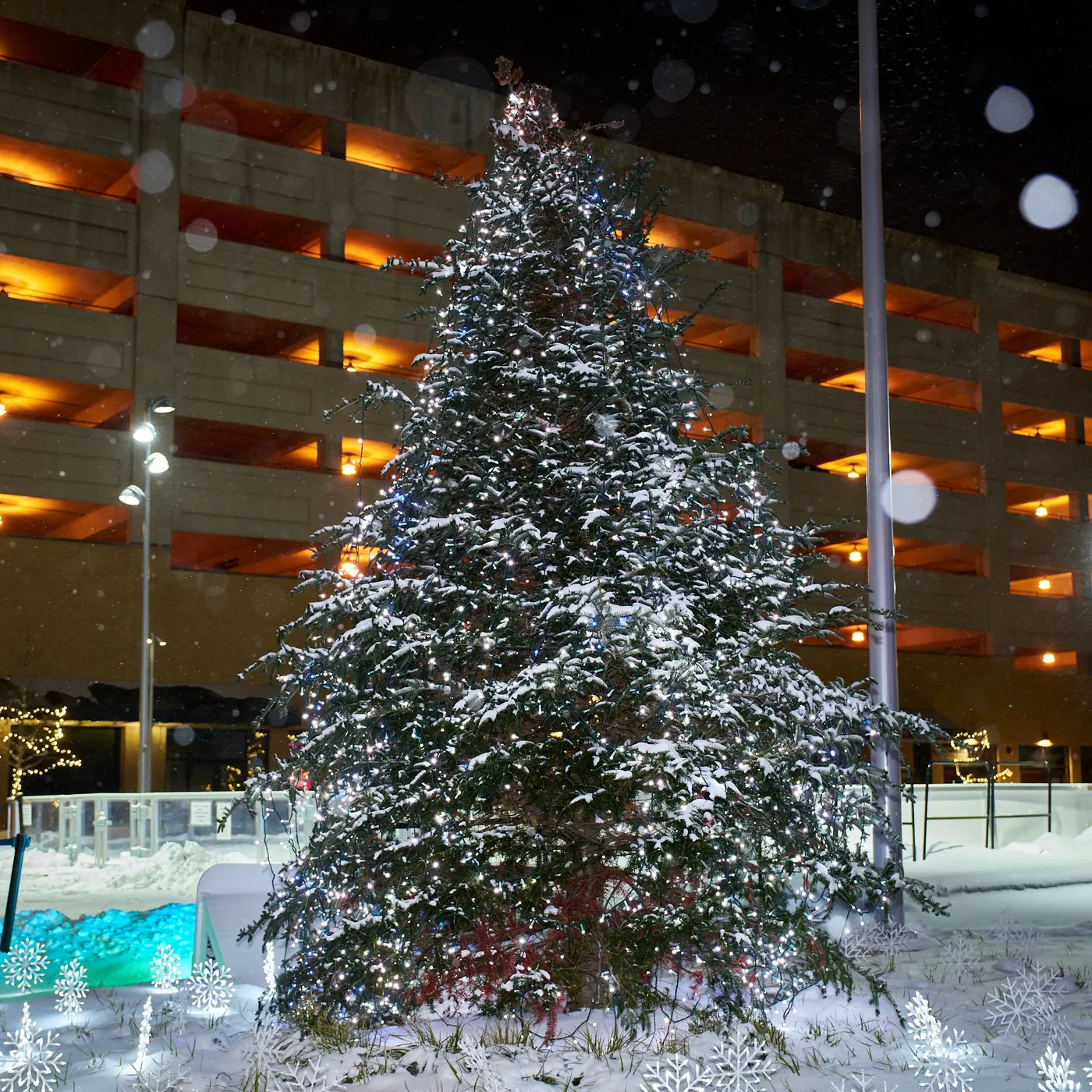
Also check that your lights are rated for wet locations, not just outdoor. The difference matters when snow sits on a socket for three weeks.
The mix here is roughly 60 percent white bulbs, 30 percent blue, and 10 percent everything else — the stray warm tones keeping the tree from going full ice palace. Cool light on dark green needles is high contrast, which is why it reads from a block away.
Shift to 80/20 white-to-blue for something calmer, or push blue to half for a colder, more dramatic look.
14. RGB Ring Ornaments on a Metal Frame Tree
Frame trees made of individual light rings are having a moment because they photograph like sculpture and store flat. They’re also the most 2026 thing about holiday lighting: app-controlled, color-addressable, and changeable to match a party.
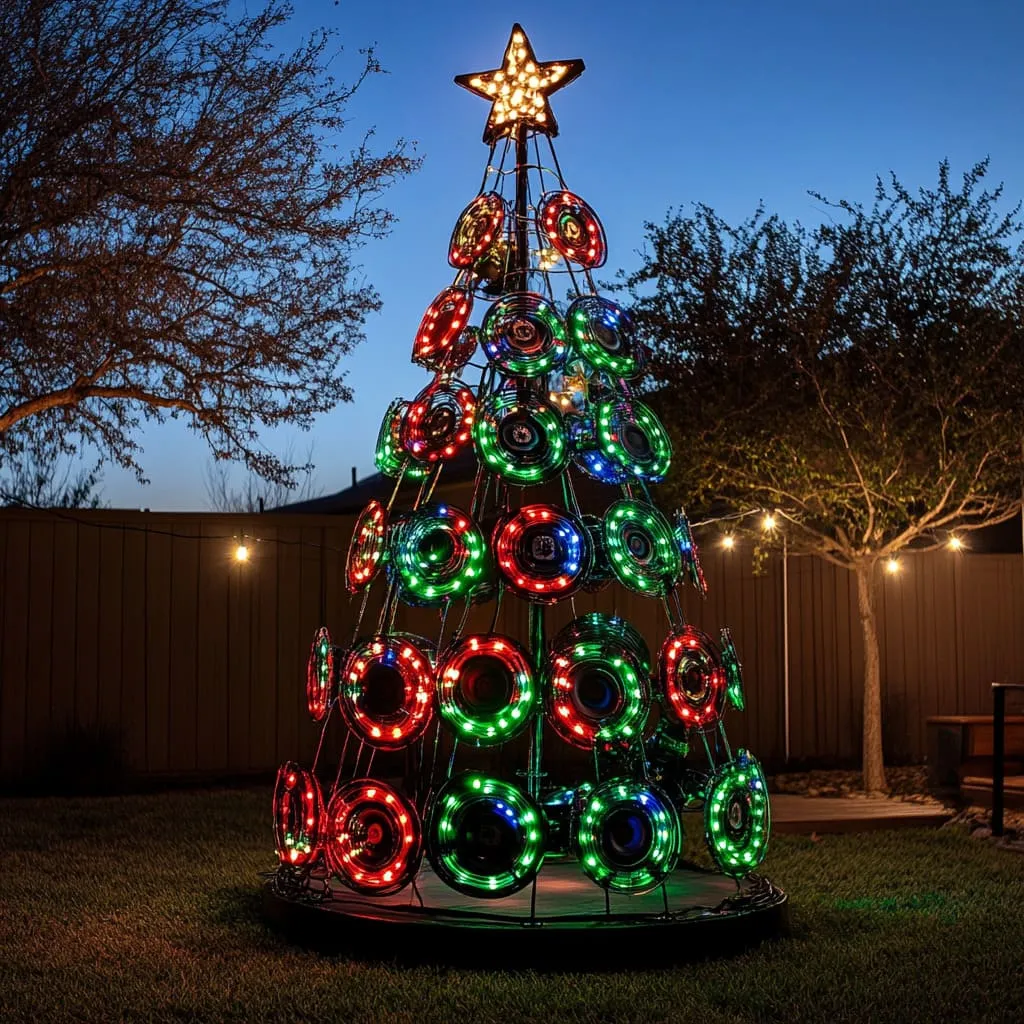
Staying power is decent — the silhouette is classic, only the color is trendy. If RGB feels loud in five years, you’ll still have a beautiful dark metal tree on the lawn.
About 90 minutes if you’re building the rings yourself.
- Cut 12-inch hoops from 1/4-inch aluminum tube — eight to twelve of them.
- Wrap each hoop with RGB LED strip, adhesive side in.
- Bolt the hoops to a central pole, graduated from 20 inches at the base to 6 at the top.
- Mount a warm white star with a short bracket.
- Plug every hoop into one controller and set the scene.
15. Mercury Glass Trees on a Golden Console
Mercury glass is one of the rare decor categories where the knockoff is nearly indistinguishable. The speckled, lit-from-within effect comes from silvered paint and a bulb, not craftsmanship.
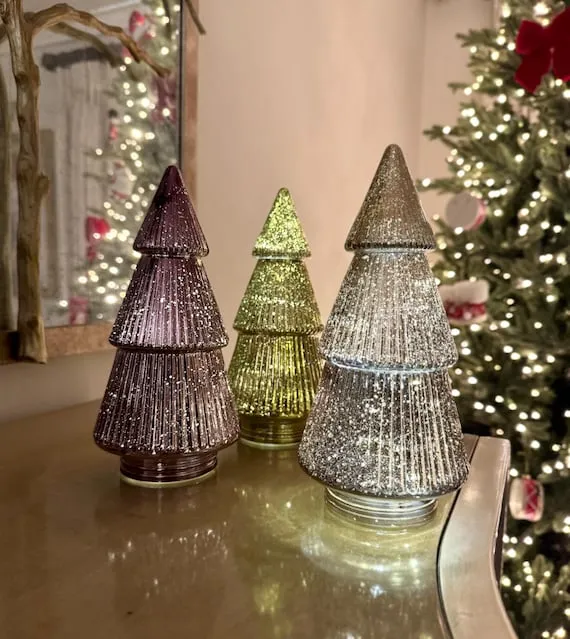
Buy one $25 tiered tree from Target and pair it with two $8 plain glass trees from Walmart — from three feet away, nobody can tell which is which. The reflective gold console underneath does more for the vignette than any single piece.
Mercury glass only reads at night. Put these where a lamp or a tree behind them can bounce light off the finish — a reflective surface underneath doubles the glow, which is exactly why this console works.
Group in odd numbers and vary the heights by at least 4 inches, or the tiered silhouettes cancel each other out.
16. Silver Tinsel Streamers Beside Grey Velvet
Tinsel is the whole personality here. Long silver streamers hang the full height of the tree, catching every warm bulb and throwing light back into the room — which is why the grey velvet sofa beside it looks softly lit rather than shadowed.
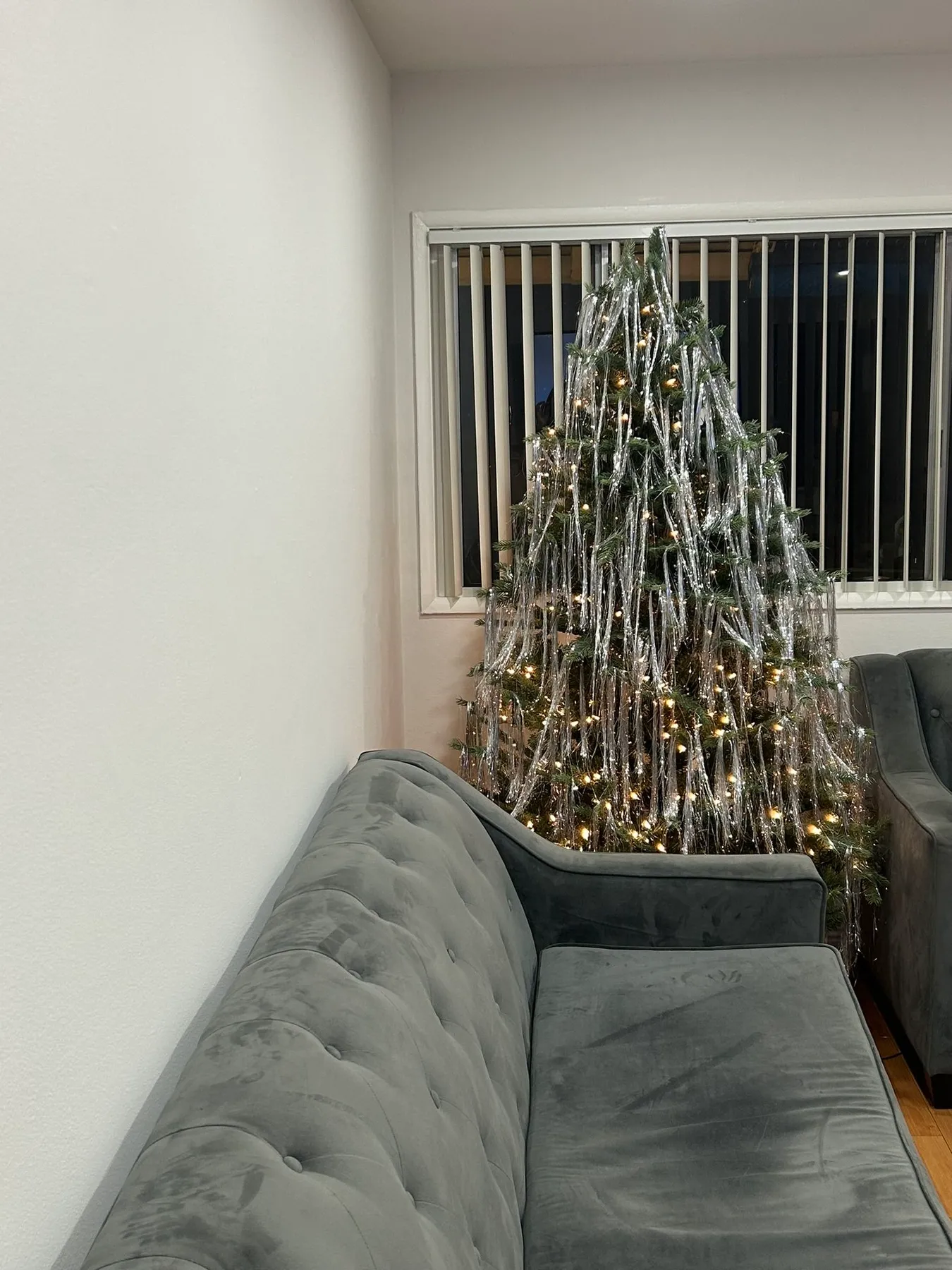
Everything else is quiet: white walls, vertical blinds, plain warm bulbs. Take the tinsel away and you have a perfectly nice tree that nobody photographs.
Tinsel sheds. It will be in the rug, on the tufted sofa, in the dog. Plan a vacuum pass every few days in December, and don’t hang it near a heat vent or fireplace — warm air makes strands cling to everything. Buy foil, not plastic film; cheap tinsel looks silver head-on and grey from an angle.
- Check branch clearance before committing to full-height streamers.
- Test one strand under your bulbs — some tinsel reads gold.
- Ask whether anyone in the house has a Mylar sensitivity.
- Pick a vacuum schedule you’ll actually keep.
17. Flocked Garland Echoing a Flocked Tree Across a White Mantel
Repetition is the whole trick. The flocked tree on one side and the flocked garland and wreath on the mantel aren’t matching by accident — repeating the same material across a room is what makes a scheme feel designed instead of assembled.
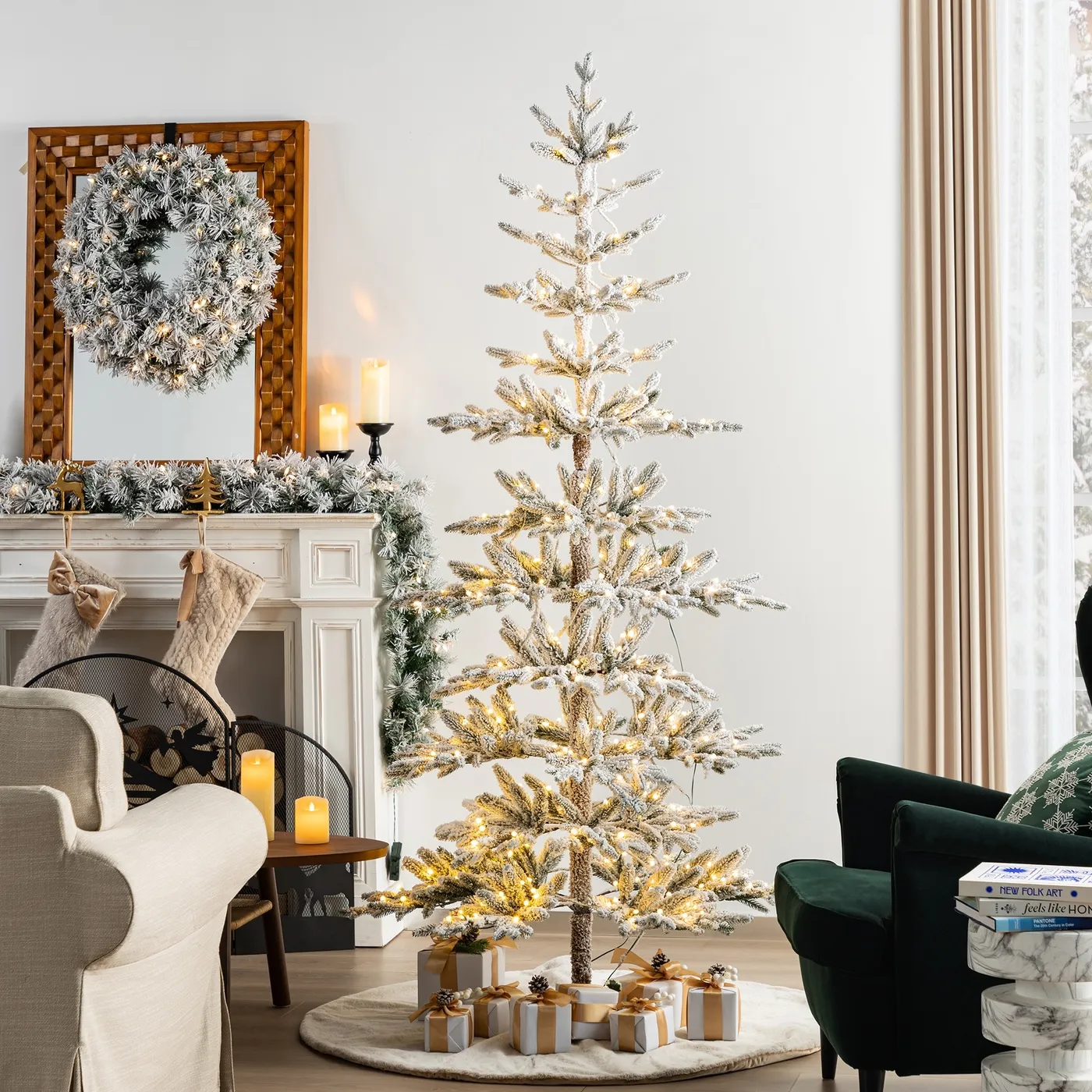
The dark green velvet chair is the counterweight. Without one deep, saturated note, all that snow would go flat and slightly clinical.
Works best in a room 12 by 14 feet or larger, with a mantel at least 60 inches wide — the garland needs 6 to 8 inches of overhang on each end to look generous rather than crammed.
Below 8-foot ceilings, scale the garland to a single swag and skip the wreath, and put the tree in a slimmer silhouette so the corner keeps breathing.
18. An Infinity Mirror Tree Among Pine Garlands
Infinity mirrors stopped being a gallery trick and became a gift-shop staple somewhere around 2024 — the LED-lined tunnel effect is now pressed into trees, stars, and snowflakes for under $60. It’s the rare trend that’s both genuinely magical and genuinely cheap.
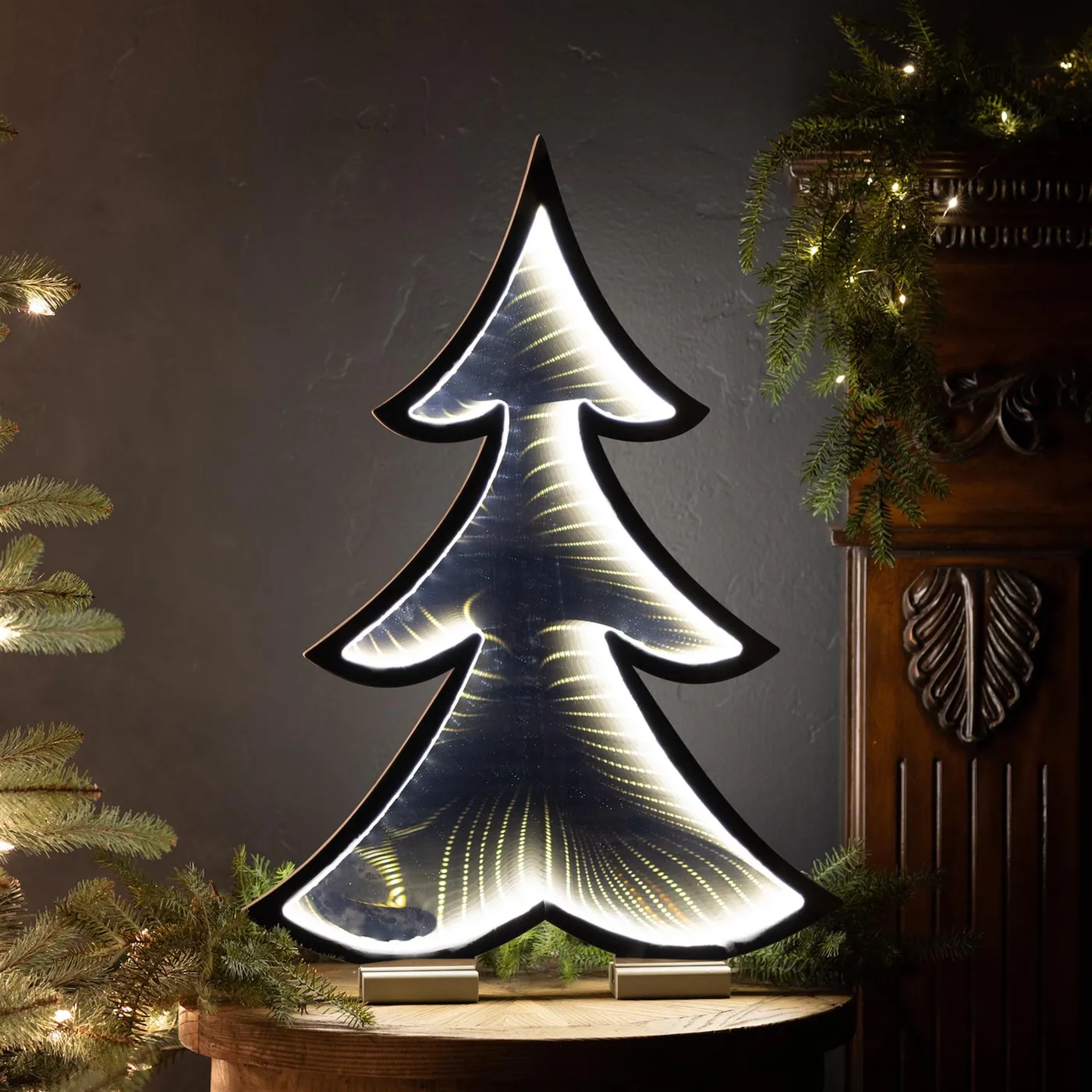
It also suits 2026’s appetite for small, low-commitment statement pieces over full-room installations. Less work, more glow.
- Infinity mirror tree light: $35–$70
- Faux pine garland, two sections: $25–$60
- Warm white battery string lights: $12–$25
- Light wood riser or board: $15–$40
- Timer or rechargeable batteries: $10–$20
Total: roughly $97 to $215. The riser is optional but earns its keep — it lifts the tree light off the dark furniture and lets the mirror work against the textured wall.
19. A Faceted Silver Star Above Multicolor Baubles
This is a big-sky composition — a tree that size wants open air, a wide plaza, and at least 15 feet of clearance to the nearest building so the star reads against blue rather than brick.
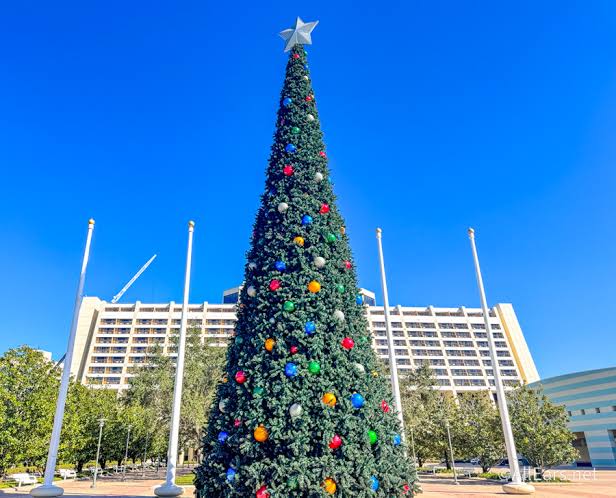
In a smaller yard, drop to 10 feet and keep the oversized star anyway. The contrast between a giant topper and a modest tree is part of the charm.
The silver star is the element that makes it. Everything else is texture — hundreds of red, orange, and gold baubles packed shoulder to shoulder, so no single ornament can hold your eye. The faceted star is the only thing with a hard edge and a reflective finish, and it gives all that color somewhere to point.
Swap it for a bow and the tree becomes cheerful. The star makes it ceremonial.
20. Icicle Ornaments Over a Snow-Runner Table
The table runner takes about 20 minutes and costs under $30.
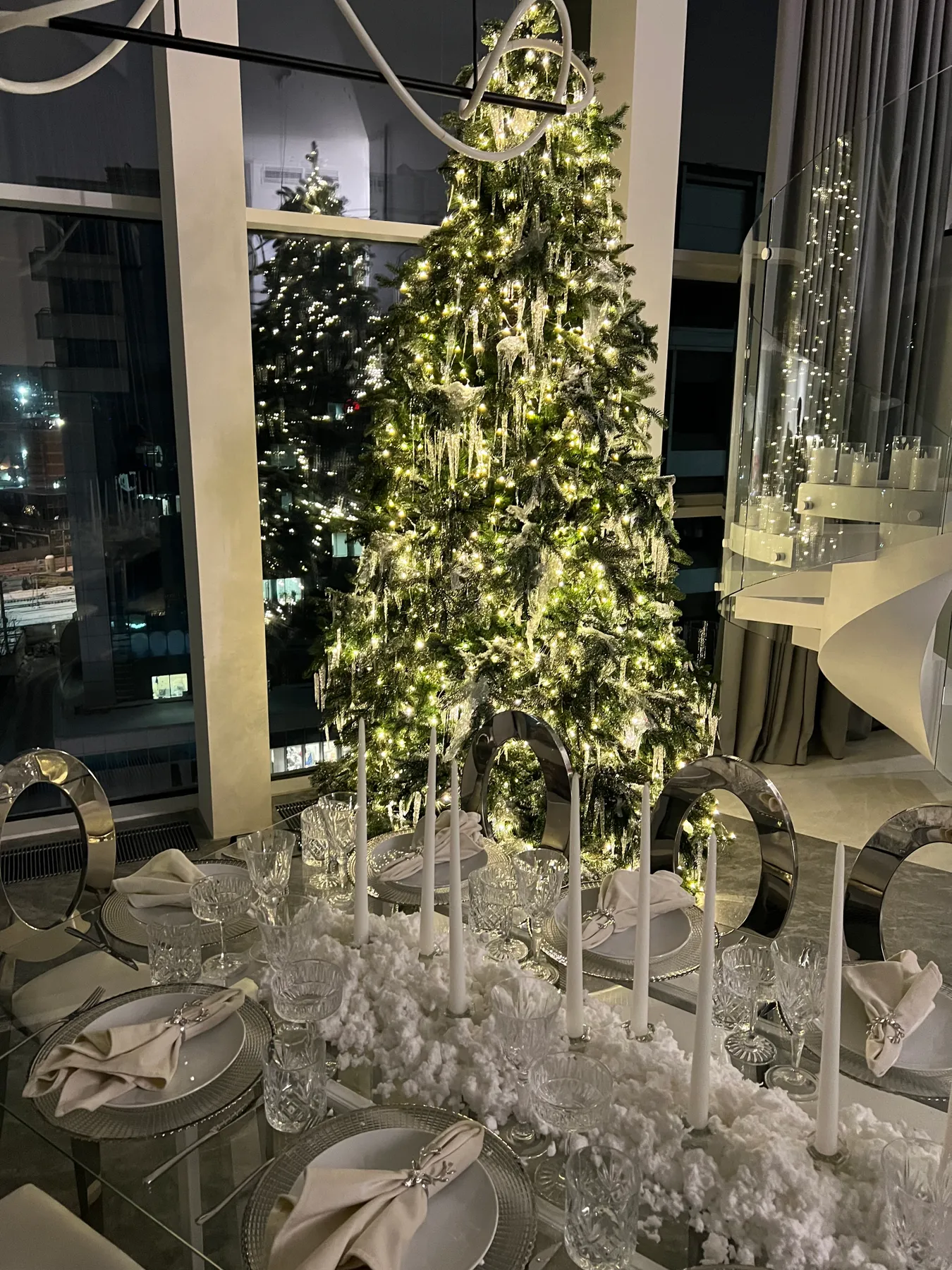
- Lay a white faux fur or snow-texture runner down the center of the table.
- Set five to seven taper candles in low glass holders, 6 inches apart.
- Nestle clear icicle ornaments between the candles, tips up.
- Add frosted sprigs at each end to soften the transition.
- Light everything 10 minutes before guests sit.
Nearly everything here is cool — chrome chairs, silver chargers, glass table, crystal stems, a tree of clear ornaments and warm bulbs. That’s roughly 85 percent cool neutral against 15 percent warm light.
The tapers are the pivot. Swap them for ivory pillars and the room warms up instantly. Compare with Idea #21, which runs the same formula using red as the warm note instead.
21. Deep Red Baubles and Berry Garland Next to a Black Fireplace
Berry garland is the cheapest way to add depth to a red-and-green tree — real or faux, it gives the branches something to drape over instead of hang from. Wind it in a loose spiral after the lights but before the baubles, so ornaments sit on top.
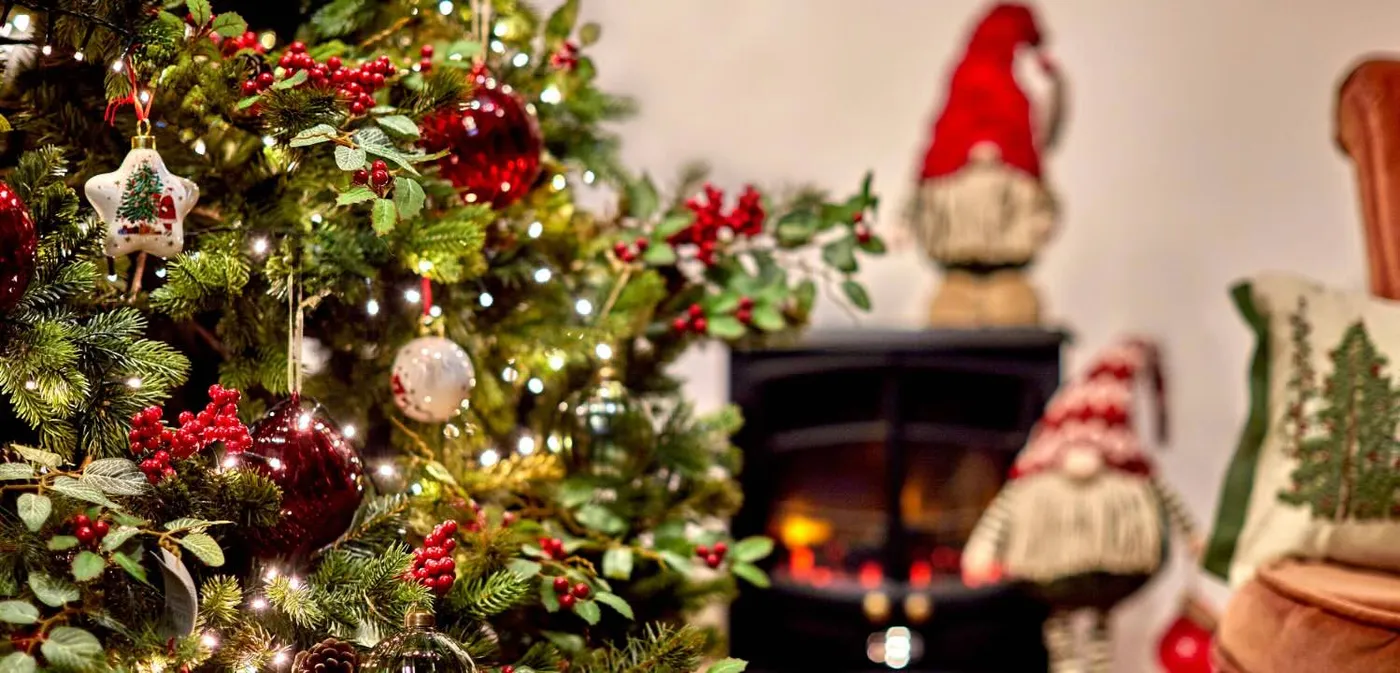
Use small fairy lights on the garland itself, around 40 bulbs per foot, rather than borrowing from the tree. It keeps both elements glowing independently.
This whole corner is a $120 project. Deep red shatterproof baubles come in 50-count tubs at Walmart for about $15, berry garland is $8 a strand on sale at Michaels, and the fairy lights are the same copper-wire strands you’d use on a wreath.
The black electric fireplace is doing the expensive-looking work — a $200 insert against the right wall beats a $2,000 mantel with no flame.
22. Champagne Velvet Skirt Under a Slim Pre-Lit Tree
Champagne velvet shows every mark — pine needles, pet hair, a stray shoe. Brush it weekly with a soft clothes brush rather than vacuuming, which crushes the pile.
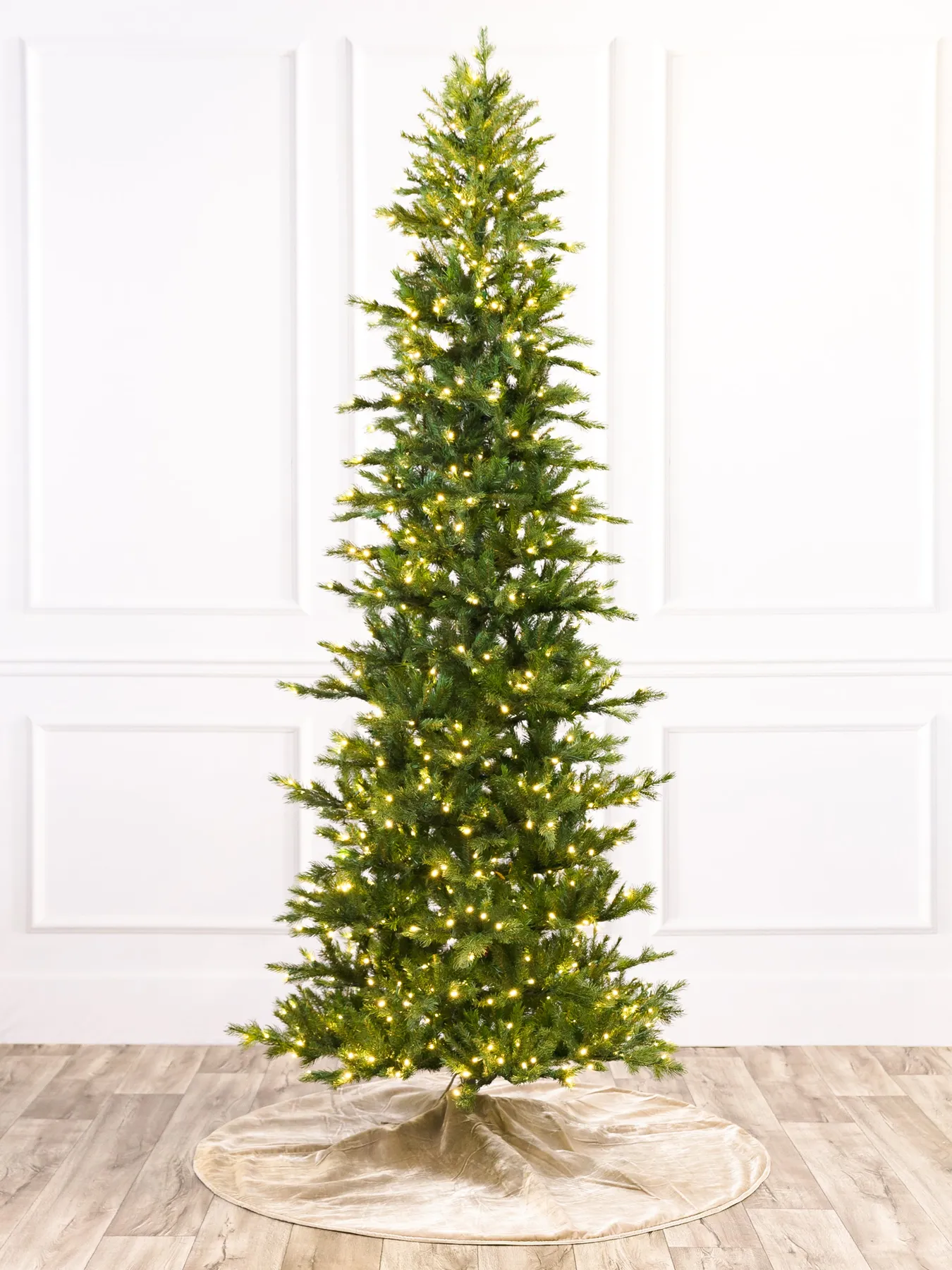
Pre-lit trees in bright rooms also collect dust on warm bulbs, and dust on an LED is a genuinely noticeable dulling. Wipe the outer bulbs once a season with a microfiber cloth, tree unplugged.
The skirt is doing a quiet job: it visually anchors a very slim tree. A six-foot pencil tree with nothing at the base looks like it’s floating on light wood planks — the champagne velvet gives it weight and picks up the warm bulbs without adding a new color.
The white wainscoting handles the rest. Vertical paneling and a vertical tree repeat each other, which is why the corner feels calm rather than tall.
23. Multicolor Bulbs Woven With Striped Ribbon
Multicolor bulbs are divisive and they’re also unforgiving about bulb count — with only a hundred lights, a tree this decorated looks speckled and dim. You want 400-plus bulbs on a seven-footer before you add a single ornament.
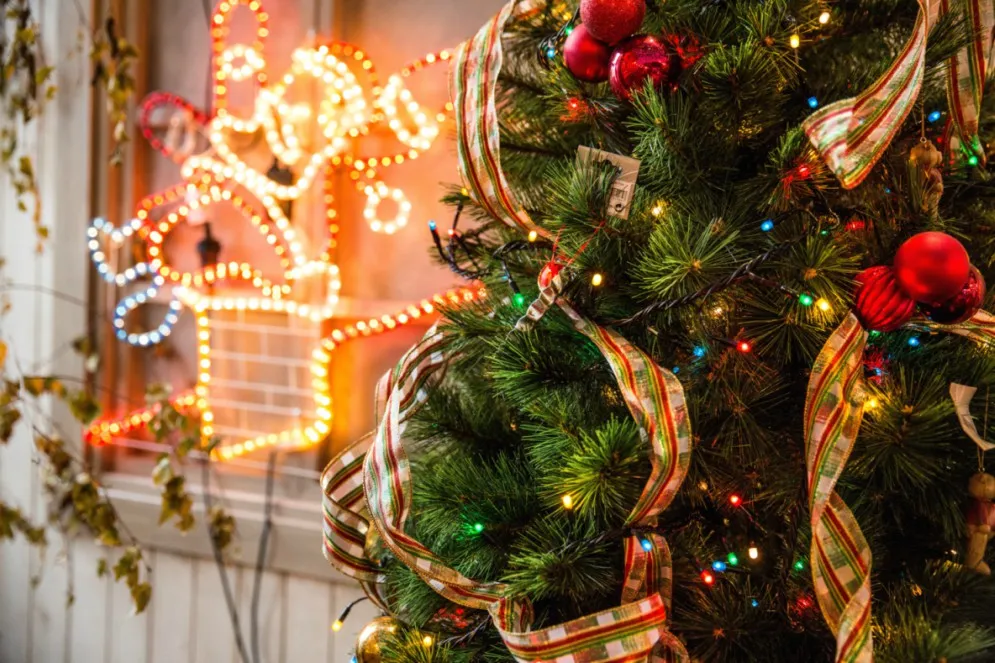
And know your audience: multicolor reads nostalgic to some people and chaotic to others. It photographs better at night than in a bright room, where the colors flatten out.
Weave ribbon after the lights and before the ornaments, and keep it to a single vertical run rather than spiraling — a straight drop makes a narrow tree look taller and won’t fight the bulb pattern. Use wire-edge ribbon so it holds a soft S-curve instead of hanging like a streamer; two 3-inch rolls cover a seven-footer.
24. A Wireframe Cone That Glows at the Edges
All that light is an illusion: the frame barely exists, so the cone’s edge glows while the center stays dim. It reads as a Christmas tree shape rather than a Christmas tree, which is why it works in a room where a real tree would feel like too much.
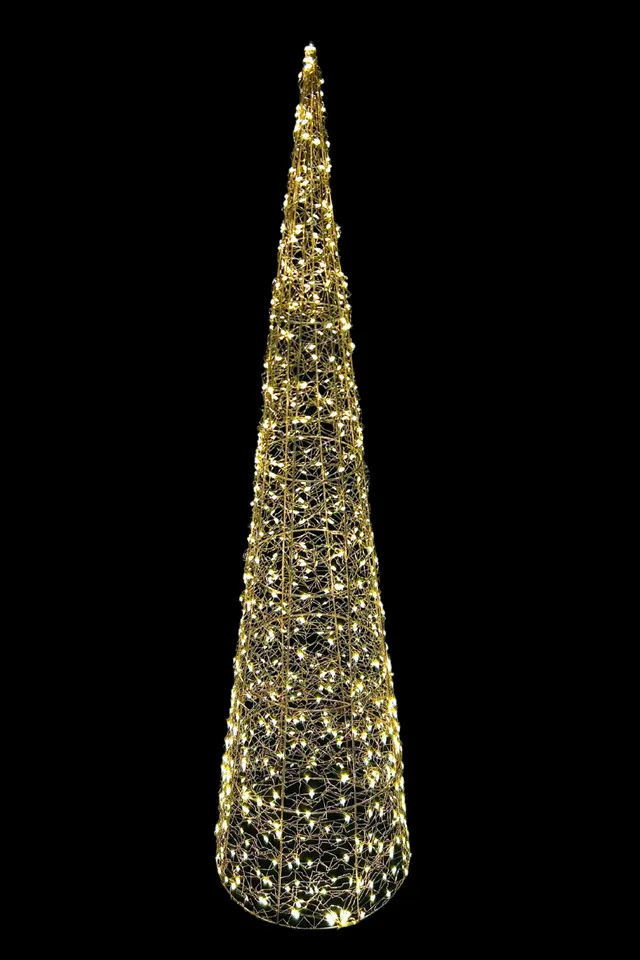
Uniform bulb density is what keeps it from looking like a mesh cage. Every ring is lit at the same interval — no clustering, no gaps.
Because it’s a light object rather than foliage, it can go where a tree can’t: a two-foot-wide corner, a hallway, an entry landing. Ceiling height is the only real constraint — leave 12 inches of air above the top ring.
At five to seven feet tall it holds a small living room. Past eight feet it starts needing a double-height space or a commercial foyer.
25. Spiral Lights With Blue-Wrapped Trees
Blue and warm yellow in the same view is a hard pair to balance — blue pulls cool and makes the yellow look dirty next to it. This scene works because the two stay physically separated: yellow on the big spiral tree, blue only on the distant wrapped trunks.
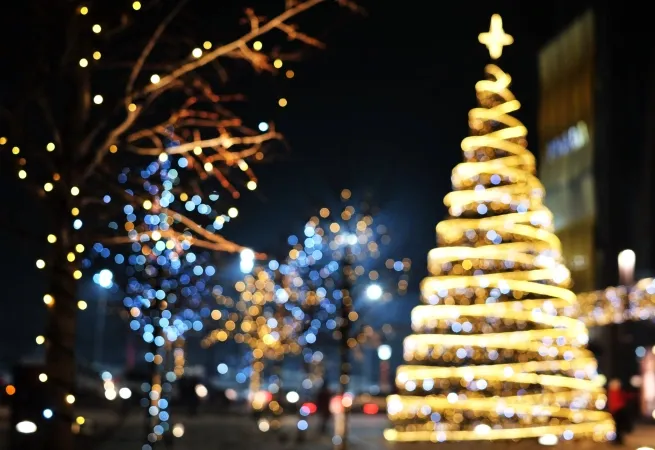
Mix them on one tree and you’ll get a muddy purple glow. Also, cordless wrapped trunks want fresh batteries every three to four weeks in cold weather.
Wrapping bare trunks is the best cheap trick in outdoor lighting — you’re using trees you already own. A 100-foot strand of warm white LED runs about $20 at Home Depot and covers three or four medium trunks. For the cone shape, a tomato cage and two strands does the job of a $150 pre-lit tree. Compare with Idea #3 for the indoor window version.
26. Lime-to-Blue Light Strips With Purple Uplit Trees
This is a color-block formula: 50 percent purple uplighting, 30 percent lime-to-blue gradient on the cone, 20 percent black negative space. The darkness isn’t a flaw — it’s the third color, and it’s what makes the greens look electric.
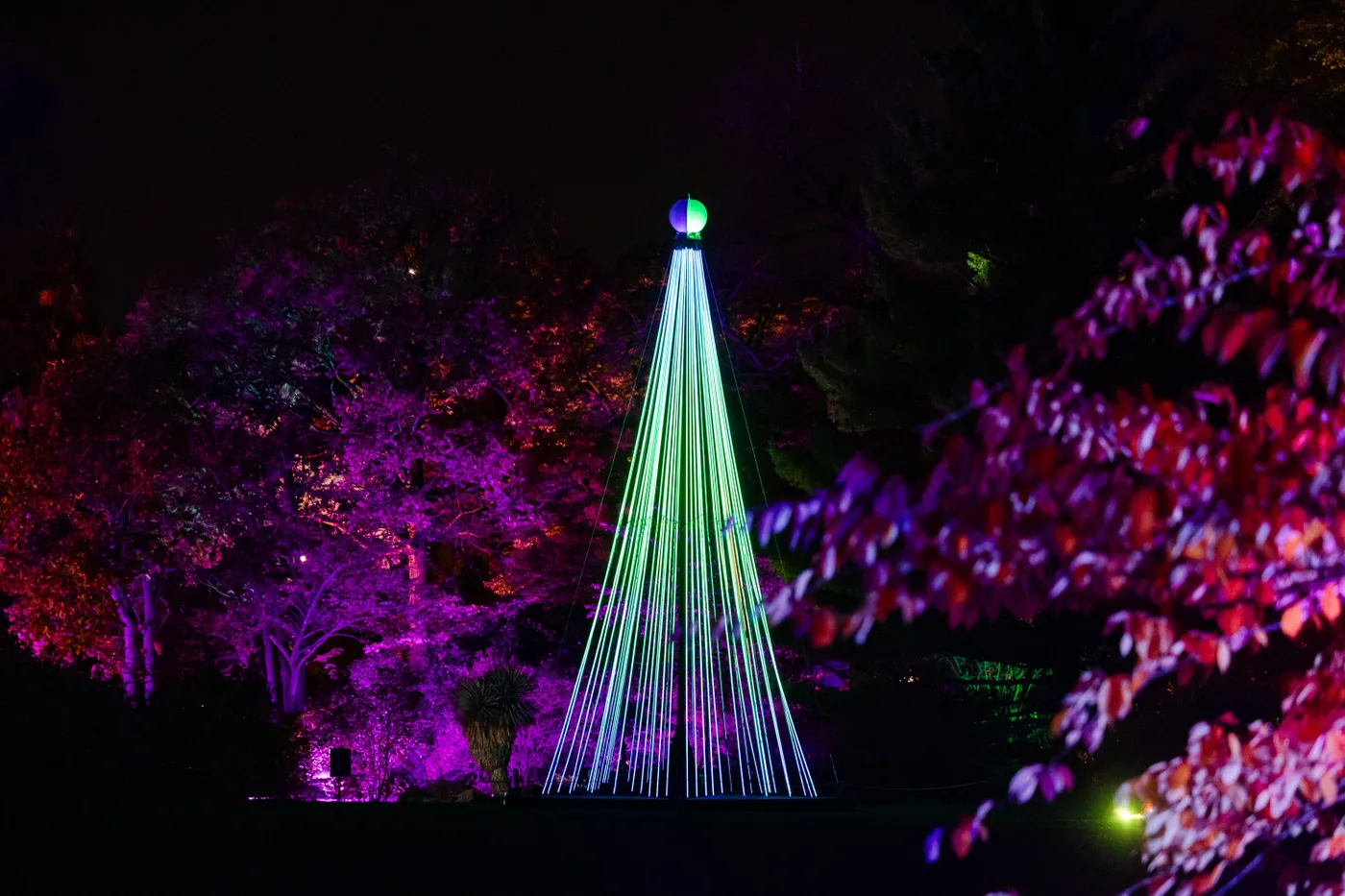
Keep the gradient running one direction across every surface. Flip it on a single tree and the scene starts to look accidental.
Uplighting trees in saturated purples and oranges is borrowed straight from event design, where it’s made venues feel expensive for the cost of a few fixtures. It’s now the default for anyone who wants a yard that reads as an installation rather than a decoration.
It’s also the most temporary-looking option on this list, which is much of its appeal.
27. A Lit Glitter Tree on a Frosted Sill
- Illuminated glass glitter tree, 10–14 in: $20–$45
- White bottle brush trees, set of six: $12–$28
- Gold and red wrapped gift boxes: $8–$20
- Frosted window film or spray: $10–$25
- Battery tea lights for the sill: $8–$15
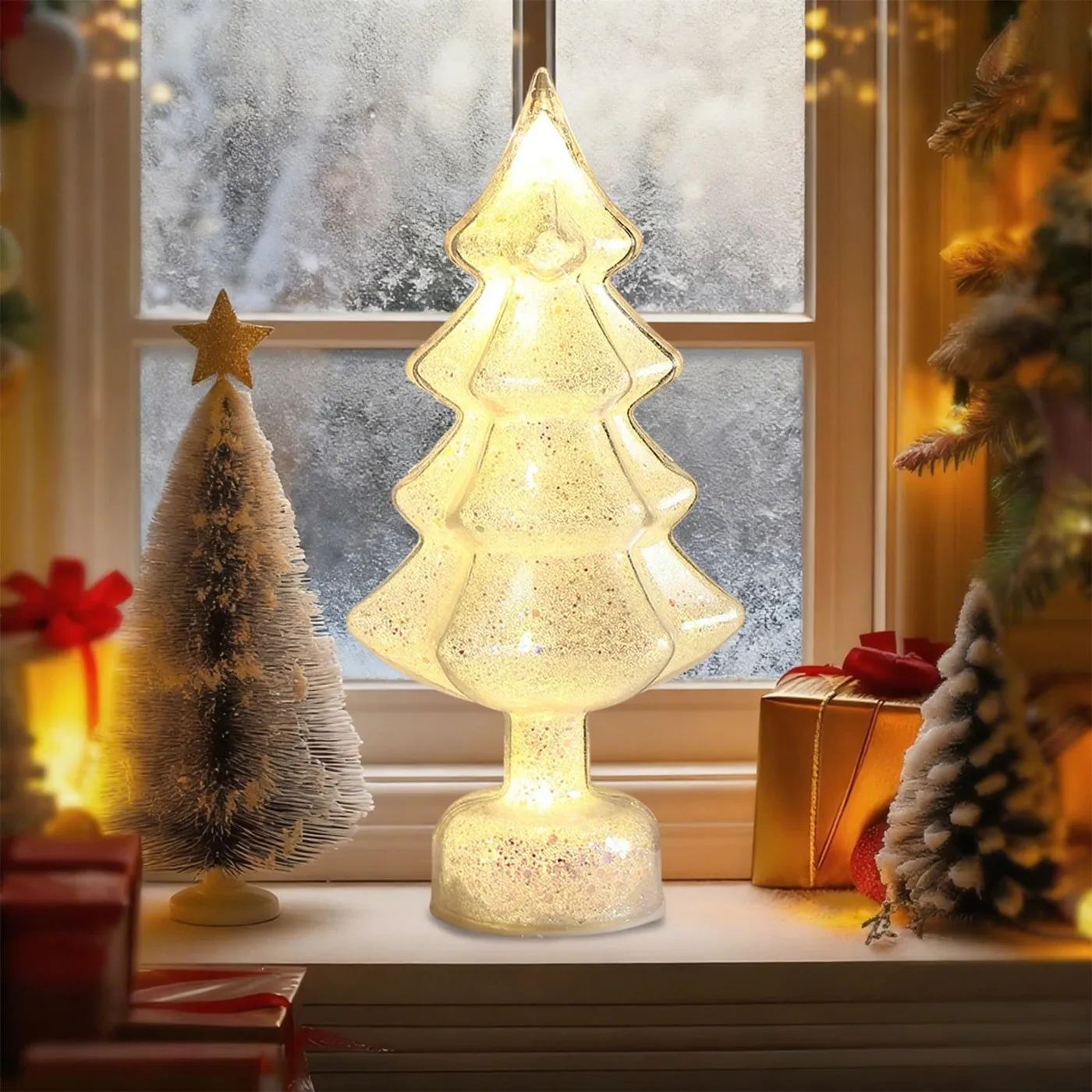
Total: roughly $58 to $133. The window treatment is what sells it — without the frosted pane, the sparkle has nothing to bounce against.
Put the tallest lit tree slightly off-center and build down and out from it, not in a straight row. Odd numbers, three heights, one clear hero. Then check it at night with the room lights off — glass glitter pieces look dull in daylight and extraordinary after dark, so judge anything you buy on the evening version.
28. Dark Brown Branches With Globe Bulbs
There’s no green anywhere, and that’s the entire point. Bare brown branches plus small spherical bulbs give you the silhouette of a tree without the foliage — the shape does all the festive work.
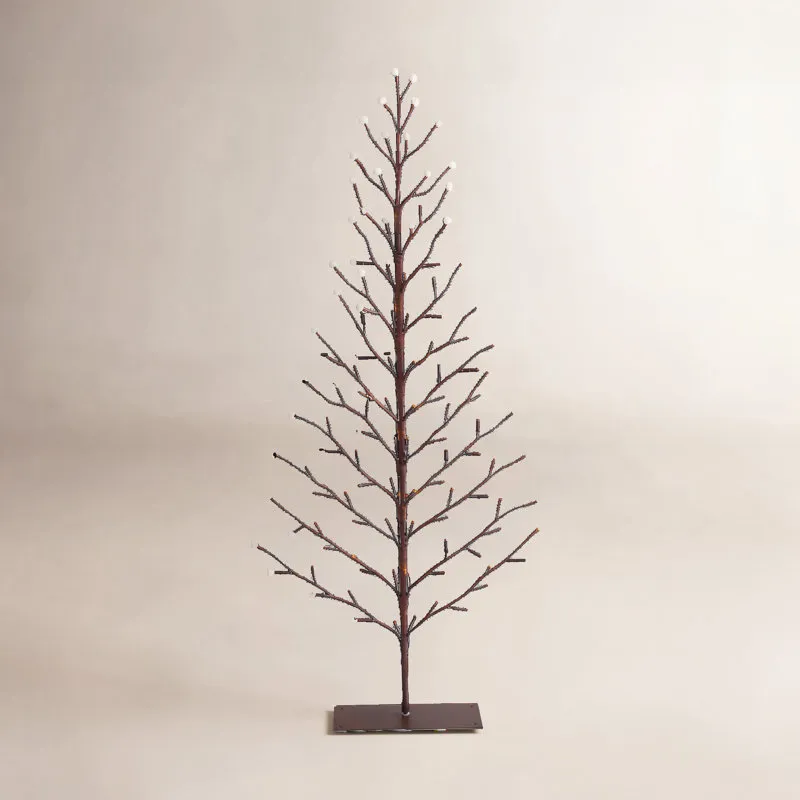
Cover it in ornaments and it collapses. Leave it alone and it looks like something from a design shop.
Bare branch trees don’t hide cords. Every wire is visible against the thin stems, so plan the run down the trunk and secure it with clips every 8 inches or it will look like a science project.
They’re also less stable than a full tree — a light bump or a cat will send it over. Weigh the base or anchor the top to the wall.
29. A Glitter-Filled LED Tree on a Wooden Board
These little glitter trees run $15 to $60 depending on the store and they’re functionally identical. Buy the $18 version at Target and spend the difference on the surface underneath — a light wood board or a marble offcut does more for the vignette than a nicer tree would.
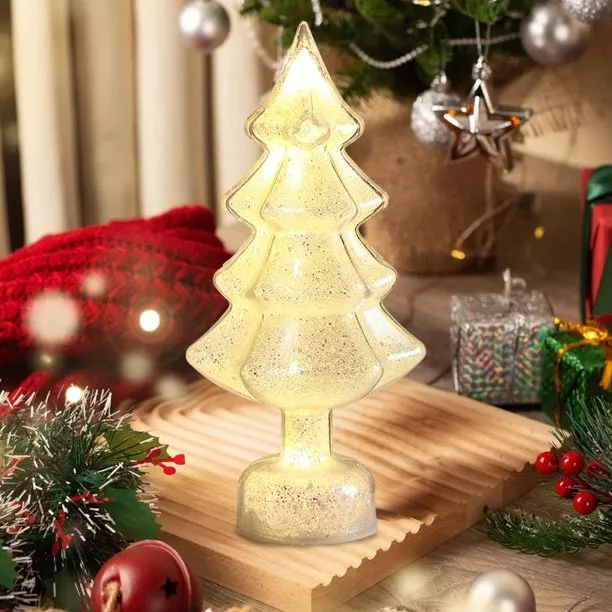
Surround it with things you own: silver ornaments, a red knit throw, boxes wrapped with ribbon you saved. Compare with Idea #27, where the same trick meets a frosted window.
Sealed glitter globes are maintenance-free until they aren’t — the liquid inside can cloud after a few seasons and there’s no fixing it. Keep them out of direct sun; UV is what turns the glass yellow.
Dust the outside with a dry microfiber only. Water spots on the glass are permanent once they dry.
30. Warm White Light Along a Stocking-Hung Mantel
The lights are doing two jobs at once. On the tree they’re the main event; on the mantel garland they’re connective tissue, pulling the fireplace into the same warm pool as the tree so the room doesn’t have a bright half and a dark half.
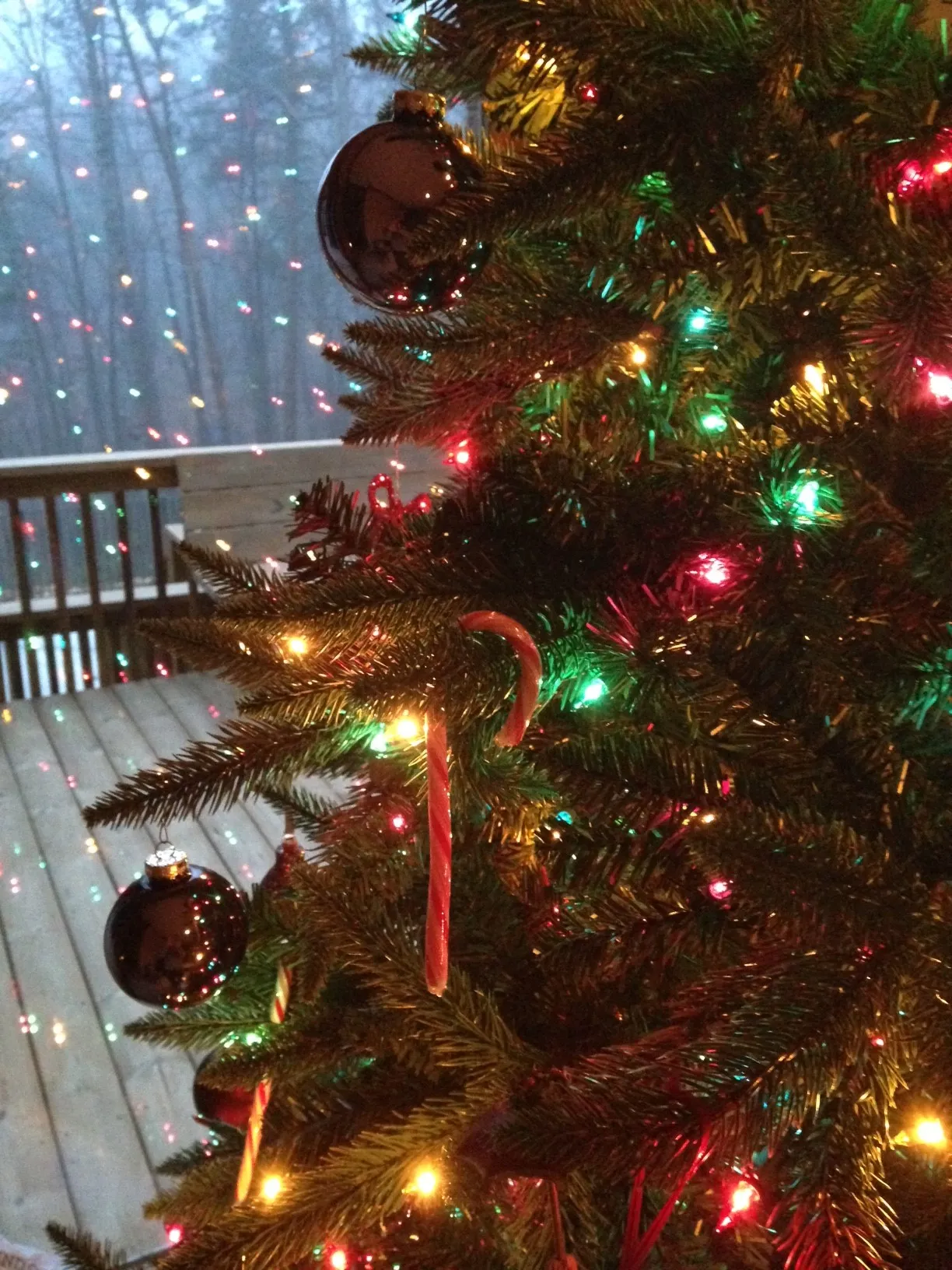
The white sofa and dark coffee table split the foreground into light and heavy, which keeps your eye moving between the fireplace and the tree instead of settling on one.
This is the layout for a standard living room — 12 by 16 feet, 8-foot ceiling, a seven to eight-foot tree with 18 inches of breathing room on the window side. Tuck the tree into the corner and let the mantel carry the horizontal line.
In a tighter room, keep the tree but drop to a single garland swag, like the slim silhouette in Idea #12.
31. A Town-Square Tree Lit All the Way to the Star
Scale changes everything: a 40-foot tree needs a bulb roughly every 4 to 6 inches of branch, which is why municipal trees use thousands of strands rather than hundreds. At home the same rule applies in miniature — the bigger the tree, the denser the light has to be, or the silhouette goes patchy.
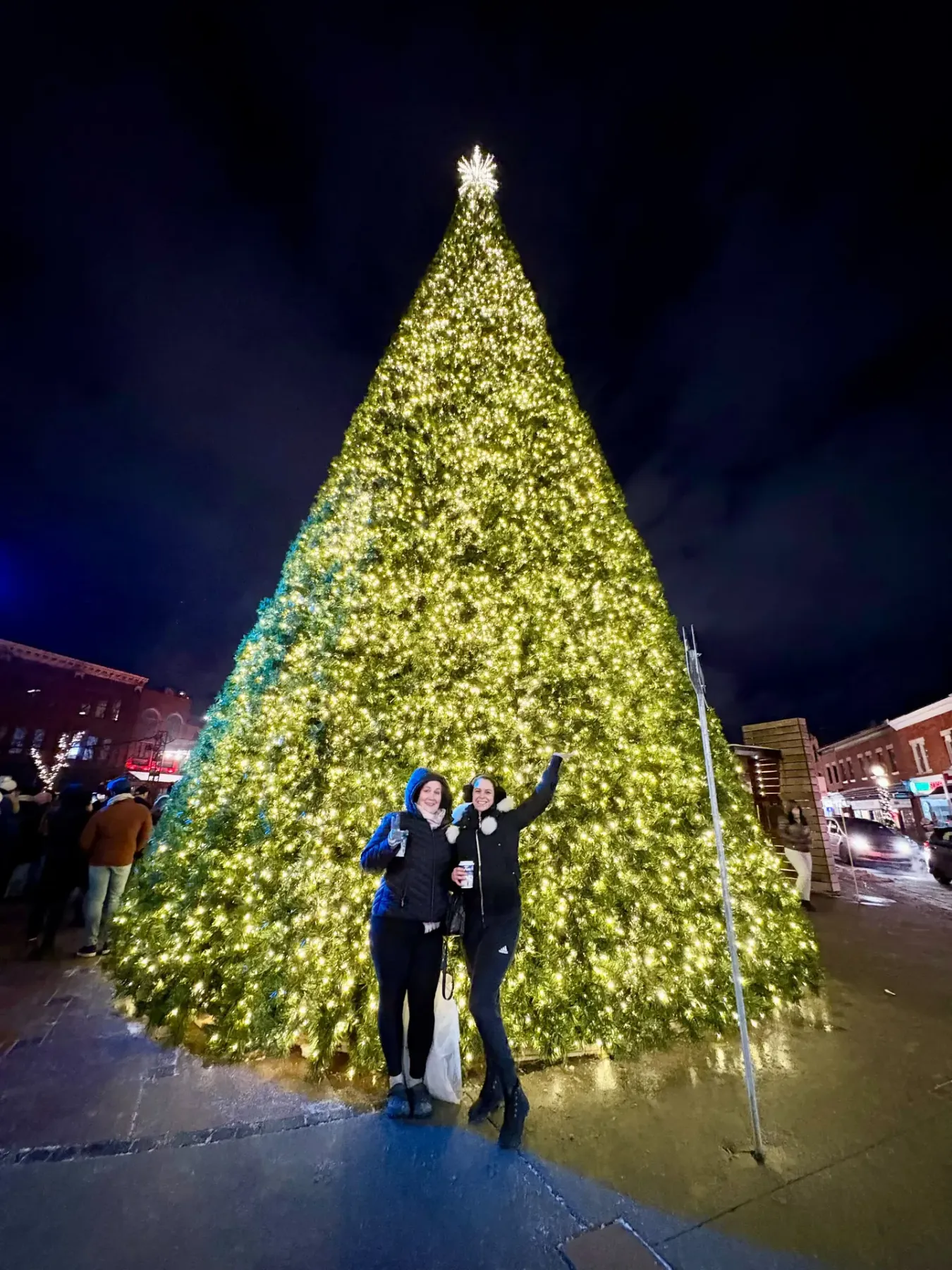
Clearance matters too. A tree this size wants 30 feet of open paved space in front of it, or the star gets lost behind rooftops.
- Commercial 20–30 ft tree: $1,500–$6,000
- Commercial-grade warm white strands, 2,000+ bulbs: $300–$900
- Illuminated star topper: $150–$500
- Lift rental for install: $400–$1,200
- Timer and controller: $100–$250
Total: roughly $2,450 to $8,850 before labor. A residential 12-footer with 1,200 bulbs gets you 70 percent of the effect for around $500.
32. Big Glossy Baubles on a Heavily Lit Outdoor Tree
- Confirm every strand is rated for wet locations, not just indoor/outdoor.
- Count outlets and add a GFCI before you hang anything.
- Measure the tree’s widest point so ornaments scale correctly.
- Check ladder access and whether you can reach the top safely.
- Set a replacement budget — outdoor ornaments break.
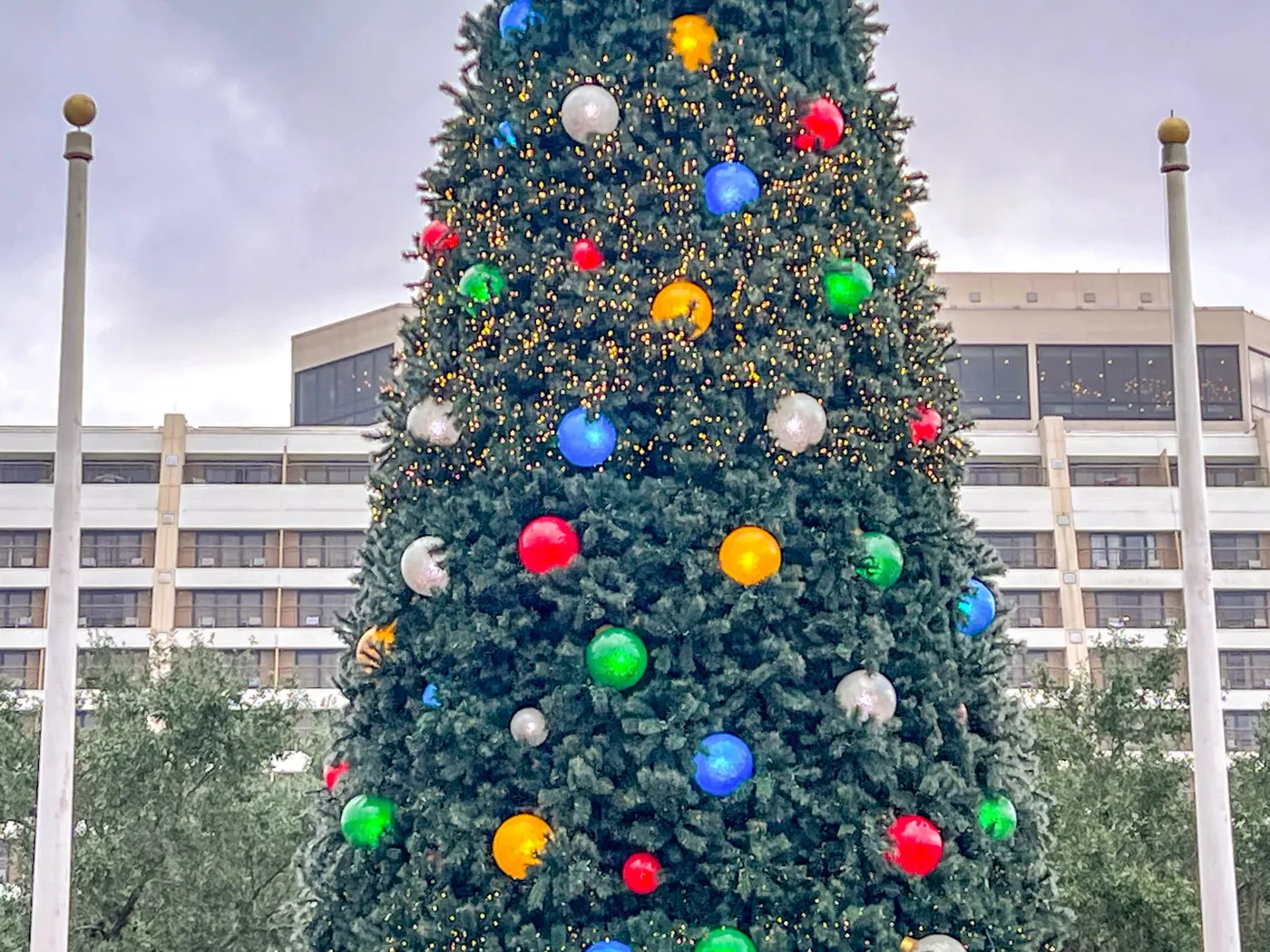
Oversized ornaments outside need to be genuinely oversized. Anything under 4 inches disappears at 15 feet, which is why this tree uses baubles that look absurd in your hand and correct on the branch.
The trade-off is weight: heavy ornaments swing in wind and snap thin branch tips. Wire them to the main stem rather than the twig, and bring them in before the first ice storm.
33. Matte and Glossy Red and Green in a Wood Collar
Fifteen minutes, no tools.
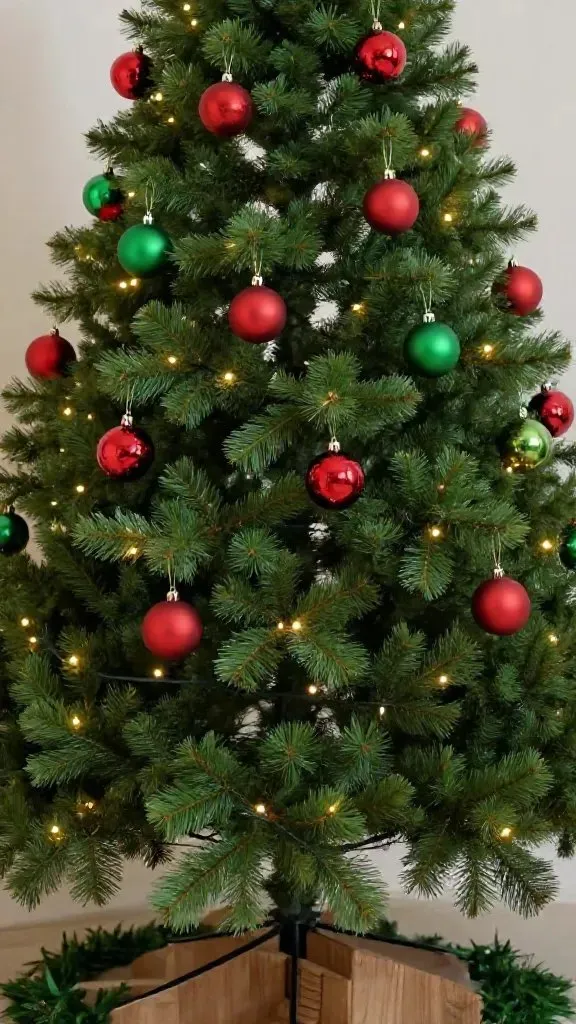
- Divide ornaments into matte and glossy piles before you hang a single one.
- Place glossy balls on the outer branches where light hits them.
- Tuck matte balls deeper in, roughly 4 inches back from the tips.
- Repeat in loose clusters of three rather than spacing evenly.
- Set the tree into the wood collar and hide the stand.
The wood collar is the quiet hero. It costs about $30 and does what a fabric skirt can’t — it turns the base of the tree into a piece of furniture instead of a pile of cloth, and the light brown tone keeps red and green from going full candy cane.
On a tree this traditional, the base is the one place you can introduce something modern without disturbing anything above it.
Hang the Lights Before the Ornaments This Year
Lighting is the part of the tree nobody plans and everybody notices — so start there. Count your bulbs, check the Kelvin number, and get the strands where they belong before a single bauble comes out of the box.
📌 Pin your favorite look now so it’s waiting for you next December.