28 Jaw-Dropping Christmas Table Centerpiece Ideas for 2026 That Will Dazzle Your Guests

You know the feeling — you’ve pinned forty Christmas tables and none of them look like your actual dining room. Here’s the thing: the centerpieces that photograph best are usually the ones built from grocery-store rosemary, a bag of clementines, and candles you already own. So instead of another round of renders, we gathered 28 real centerpieces from real tables and broke down exactly how each one is built — material by material, cost by cost.
After filtering through hundreds of options across Terrain, Etsy, Target, West Elm, and Facebook Marketplace, we narrowed it down to the arrangements actually worth copying, from $30 grocery-store builds to $650 full-length installations. Four moods run through the list: foraged and natural, classic red-and-green, quiet gold glamour, and one whimsical woodland set that’s very 2026. Budget and luxury versions sit side by side so you can see precisely where the money goes.
The 2026 shift is toward tables that look gathered rather than purchased — fruit, herbs, clove-studded oranges, tarnished brass, and one odd object that makes people lean in. And stay until the end — we break down the most common mistakes that can ruin these looks.
📌 Save this to Pinterest for later — you’ll want to revisit these ideas.
Some links in this post are affiliate links. If you buy through them, we may earn a small commission at no extra cost to you — and we only recommend pieces we’d put on our own tables.
1. Rosemary in Terra Cotta Pots on a Linen Runner
The height here comes from living plants, not candleholders — and that’s the whole trick. Five rosemary pots at slightly different heights give the runner dimension without a single tall, view-blocking object, and the terra cotta repeats the warmth of the light wood so the arrangement reads as one material story instead of a pile of decorations. The napkins get a matching sprig tied with twine, which is the detail most people skip.
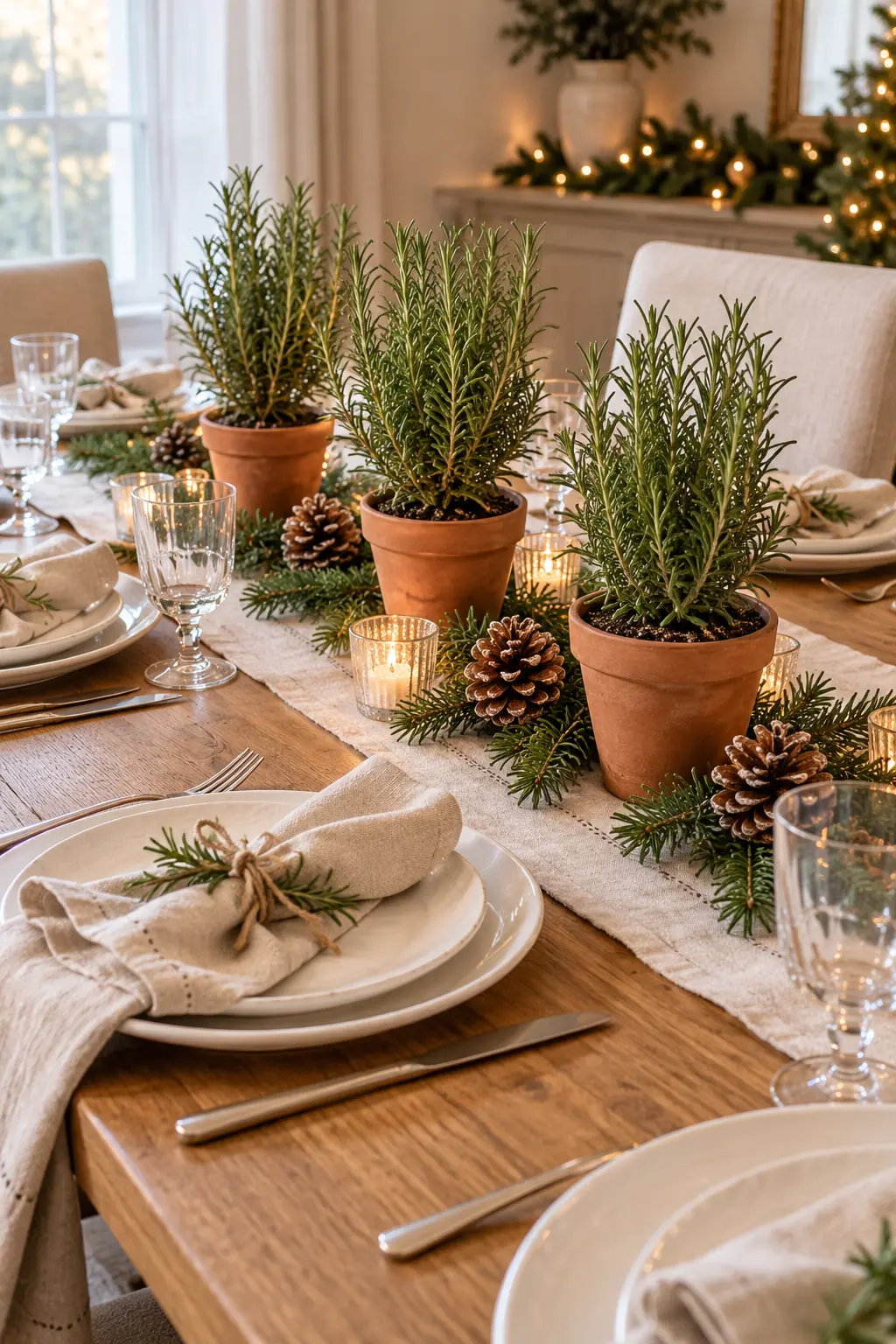
- Centerpiece core: 5 potted rosemary plants, $6–$12 each; 5 terra cotta pots, $3–$8 each
- Greenery and filler: evergreen branches, $15–$30; frosted pinecones, $12–$20 a bag
- Textiles: linen runner, $30–$70; four linen napkins, $20–$45
- Candles: clear glass votives, $8–$16 each; votive candles, $10–$18
- Tabletop: white dinner plates, $40–$120 for four
Total: $300–$650 — and considerably less if the plates and glassware are already yours. Budget alternative: skip the pots entirely and tuck bare rosemary bundles straight into the evergreen run. Saves about $60 and looks even more foraged.
2. Brass Tapers, Velvet Ribbon, and a Berry-Strewn Runner
Here’s the measurement that actually matters: on a 30-inch table, a 10-to-12-inch taper in a 4-inch holder puts the flame at roughly 36 inches off the floor — just below the eyeline of a seated guest. Go taller and you spend dinner talking around a candle instead of through it. Keep the tapers unscented, too. Scented wax competing with the food is the quiet reason a beautiful table can still feel off.
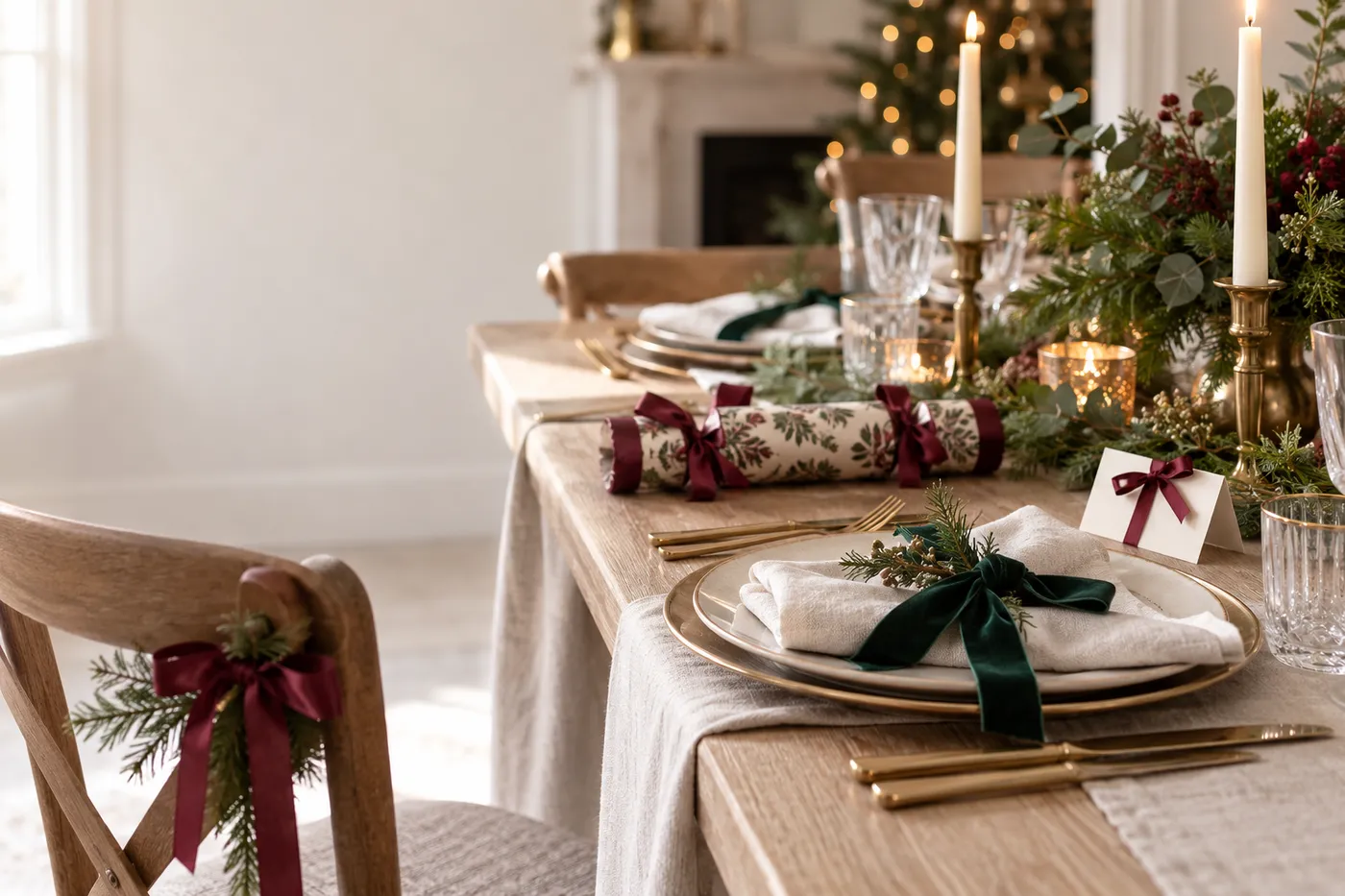
The dark green velvet ribbon on the napkins is doing more work than it looks like. Without it, the garland and the place settings read as two separate systems that happen to share a color. With it, the deep green travels from the centerpiece out to every seat, and the brass candleholders suddenly have something to echo. If you change one thing on this table, change that.
3. Faux Fur, Golden Deer, and Amber Votives
Three textures are stacked on purpose: faux fur, wax, and gold. The fur runner softens the hard wood beneath it, so the evergreen garland looks like it’s resting on snow rather than sitting on a table. The golden deer push the arrangement from “greenery with stuff in it” into a small scene — and because they’re low and horizontal, they never interrupt the view across the table.
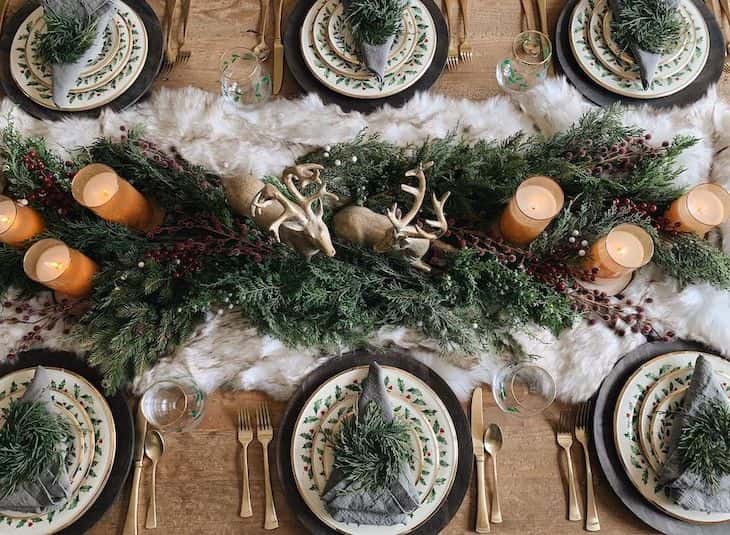
You can build the same three-texture formula for far less. A $15 white faux fur throw folded into a runner replaces the $60 version, thrifted brass deer turn up for $4–$10 almost every December, and a plain garland plus a $6 bag of red and white berries does what the $80 pre-decorated one does. Same cream-and-red palette as Idea #11, different energy — this one is softer and more relaxed.
4. A Full-Length Foliage Run with White Candles
Building a six-foot run takes about 90 minutes and roughly $70 in materials if you start from two plain garlands.
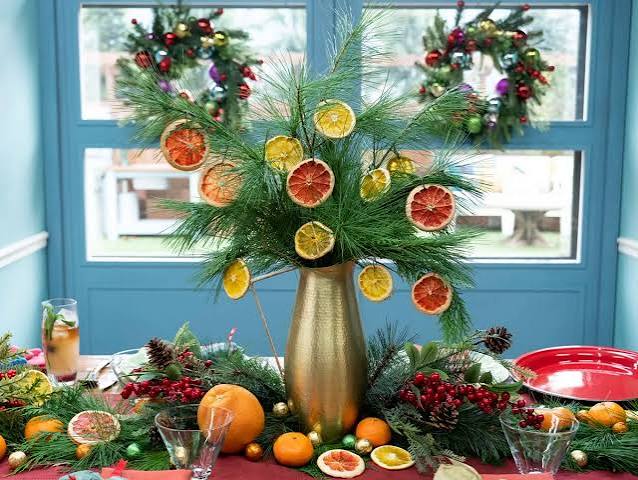
- Lay the garlands end to end and twist the join with floral wire so there’s no visible gap.
- Set the candles first — three to five, spaced about 18 inches apart — then build greenery around them.
- Tuck white accent stems at the base of each candle to hide the holders completely.
- Fill the gaps with individual sprigs until you can’t see the table through the run.
- Light everything and check it from a standing position before guests arrive.
This full-length run needs a table at least 72 inches long — on anything shorter, the greens swallow the place settings entirely. It’s also the arrangement that suffers most in a narrow room: you want 36 inches of clearance on both sides so people can slide chairs out.
5. A Wooden Box of Evergreens, Lemons, and Clove Oranges
- Base: rustic rectangular wooden box, $25–$60
- Greenery: mixed evergreen branches, $20–$40
- Fruit: 4 lemons, 3 oranges, whole cloves, $10–$18
- Accents: blue-grey berry clusters, $12–$22
- Mechanics: plastic liner, floral foam, moss, $8–$15
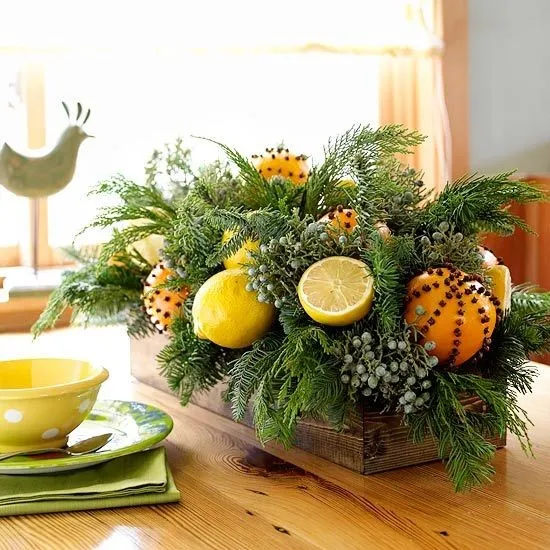
Total: $75–$155. A budget version uses a shoe box wrapped in brown kraft paper — about $6 — with grocery-store rosemary standing in for the mixed greens.
Two things extend this arrangement’s life by a week. Stud the oranges the day you build: cloves pushed in along the equator release oil for days and the fruit dries rather than rots. Then swap standing water for damp floral foam under the moss and re-wet it every third morning with a turkey baster. Nobody sees it; everybody notices the scent.
6. The Hurricane Candle Wreath with Fresh Fruit
The hurricane lamp is the one element you can’t swap out. It does three jobs at once: it shields the flame from the drafts every dining room has, it gives the fruit ring a visual center to circle, and it lets a thick off-white pillar sit low enough that nobody’s view gets blocked. Pull it out and you’re left with a wreath with a hole in the middle.
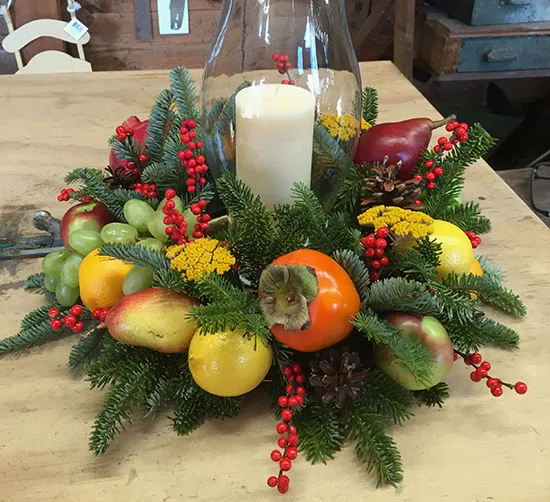
The ring itself is a 20-minute build and costs about $35 if you’re buying everything new.
- Set the hurricane in the center, then lay a 16-inch evergreen wreath base around it.
- Tuck sprigs pointing outward in the same direction, all the way around.
- Add fruit in clusters of three — never evenly spaced; one side should be heavier.
- Thread red berries through last so they sit on top of the greens, not under them.
- Set the pillar inside the glass and light it five minutes before guests sit down.
7. The Slat Basket Filled With Citrus and Pine
Wooden slat baskets run $30–$70 at garden centers, but a $12 bushel basket from a farm stand or a $5 thrifted picnic basket gives you identical slatted texture. The fruit is where people overspend: a $9 bag of clementines, one orange, and one lemon covers a 20-inch basket completely. Gold glitter ornaments go six for $4 after December 15th. Full build: $30–$40.

Fresh citrus in an unlined basket is a five-to-seven day arrangement, and it announces itself when it goes — fruit pressed against damp greenery softens fast. Line the basket with a plastic bag hidden under moss, keep it out of direct sun, and pull any piece that starts to dimple. If this table has to survive December 20th through New Year’s, use faux fruit or whole nuts instead.
8. Pomanders, Pinecones, and a Shallow White Platter
Read it as roughly 70% green pine, 20% brown pinecone, 10% orange pomander — with the dark red berries acting as punctuation rather than a full color. That ratio is why this feels natural instead of autumnal. Swap the orange for small green pears, keep the same 70/20/10, and you have a completely different arrangement using identical mechanics.
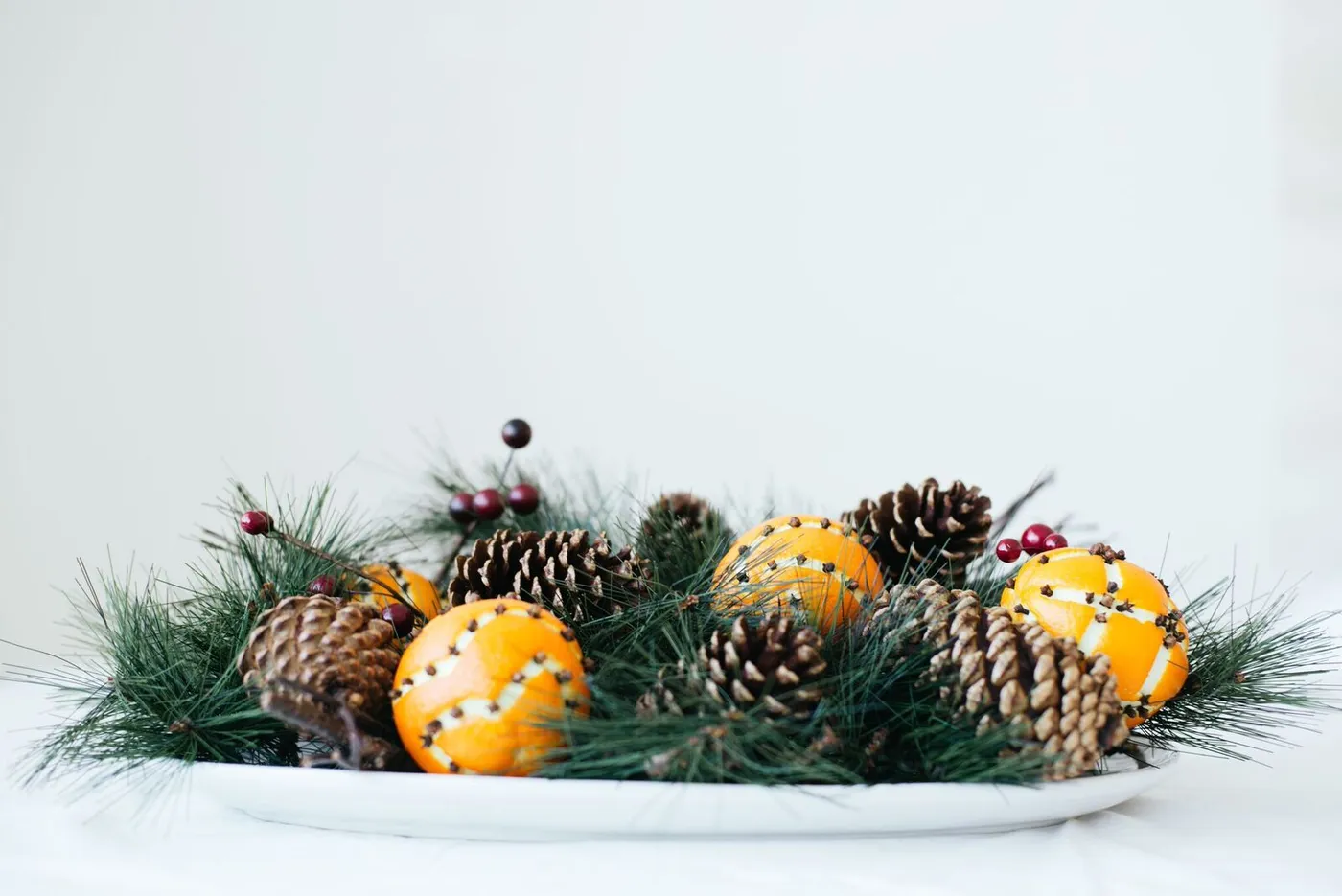
The shallow white platter is quietly doing the heavy lifting. Because the dish has almost no rim, the materials appear to spill directly onto the table instead of sitting in a container — the whole thing feels collected rather than built. The white also bounces light upward into the greens and the orange, which is why this reads bright even in a dim dining room.
9. Plaid Ribbon in a Lush Pinecone Centerpiece
Most of this arrangement is faux and will outlive the season — the trade-off is dust. Evergreen picks collect it visibly, so plan on a two-minute pass with a hairdryer on cool before you pack it away, and again before it goes out next year. The plaid ribbon is the fragile part: cheap wire-edged ribbon creases permanently, so roll it around a cardboard tube rather than folding it flat.
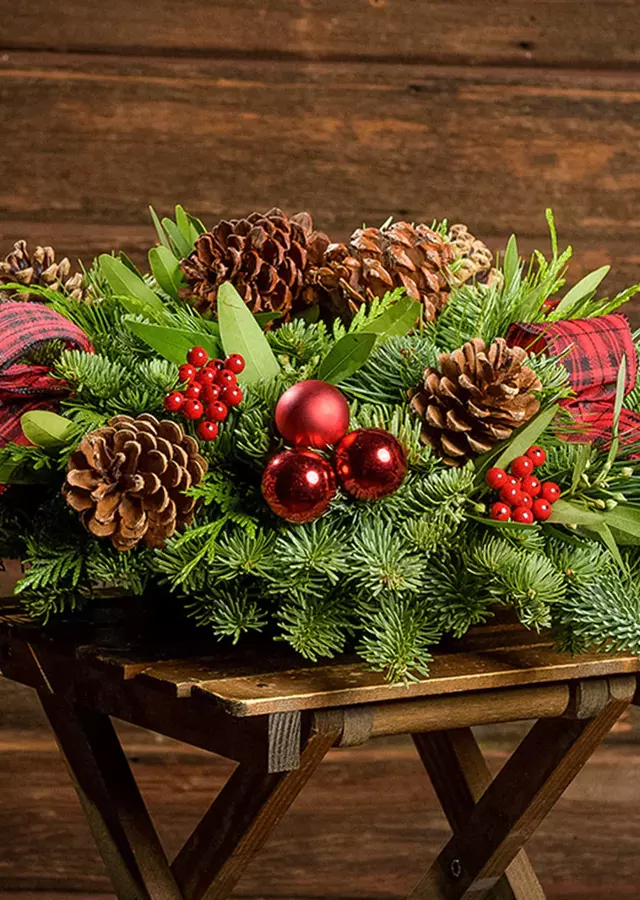
Big pinecones are the one thing worth buying real. They hold their shape for decades, they smell faintly of resin for the first week, and they cost nothing if you gather them yourself — 20 minutes in a 250°F oven on a foil-lined sheet kills anything living inside. Soak them in a bleach solution for a few minutes first if you want the pale, frosted look instead of dark brown.
10. Tartan Ribbon Tucked Into a Green Pot Arrangement
- Container: textured green pot, $18–$40
- Greenery: 3 mixed evergreen bunches, $24–$45
- Ribbon: red tartan, 2 yards, $8–$16
- Accents: berries, small red ornaments, pinecones, $15–$28
- Mechanics: floral foam, moss, wire, $10–$18
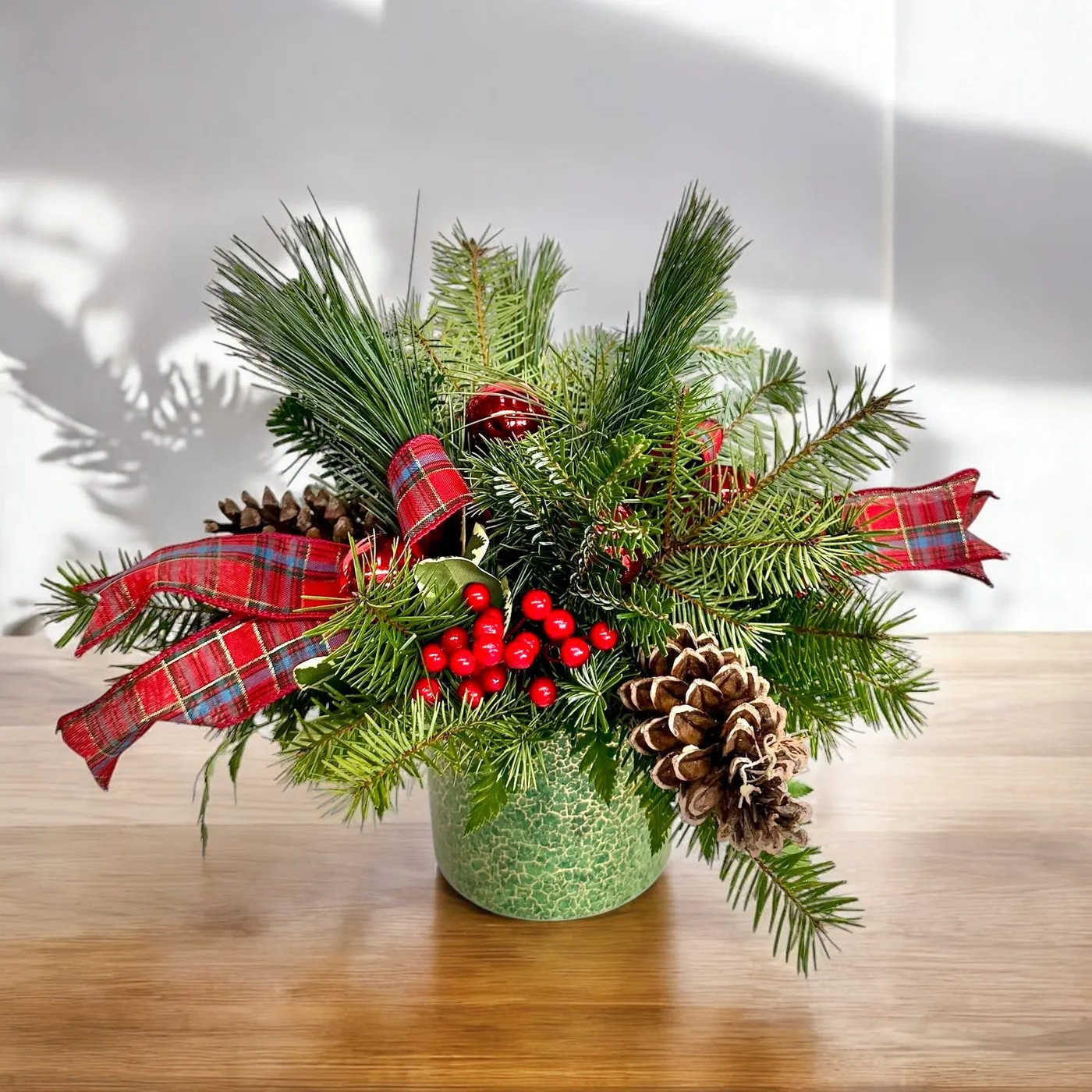
Total: $75–$147. Skipping the pot and building straight into a $6 willow basket drops this under $60 without changing the look one bit.
- Measure the table’s clear center — you need at least 14 inches of width or the pot crowds the plates.
- Check for a drainage hole or line the pot; foam plus water in a sealed container grows mildew.
- Confirm the ribbon against your existing plates in daylight, not under warm bulbs.
- Decide where it lives before you build — this one is round and doesn’t travel well once arranged.
11. Red Poinsettias With Cream Pillars on Gold Holders
This one costs about $55 and takes half an hour, most of it spent separating poinsettia stems.
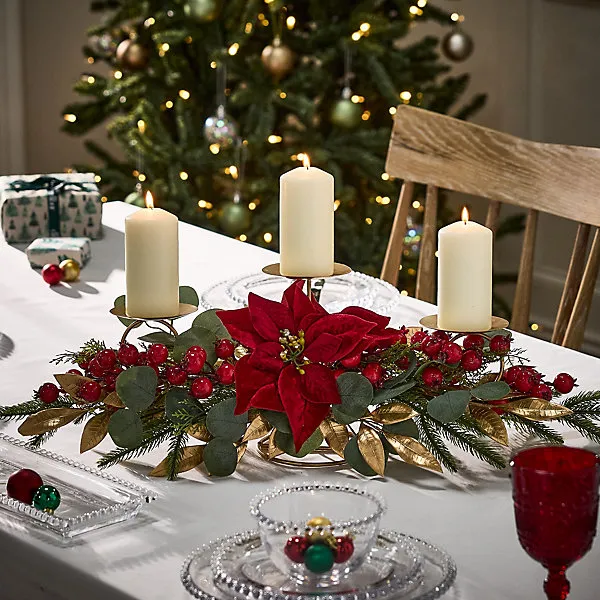
- Run a low garland of mixed green and gold foliage down the center first.
- Cluster three poinsettia blooms at one end, two at the other — odd numbers, off-center.
- Set three cream pillars in gold holders, spacing them wider apart than feels comfortable.
- Thread red berries between the blooms, never on top of them.
- Finish with a few loose baubles at the edges so the arrangement doesn’t look bordered.
The gold holders are what make this read as Christmas rather than fall. Cream pillars alone look neutral; lift them four inches off the table in brass and suddenly the gold-painted foliage has a family, the plate rims match, and the whole thing carries a warmth that red and green can’t produce on their own.
12. The Black Candelabra on a Ribbed Green Runner
A three-arm candelabra like this wants a table between 36 and 42 inches wide and at least 60 inches long. Anything taller than 20 inches total and you’ve built a wall. Two things to verify before you commit:
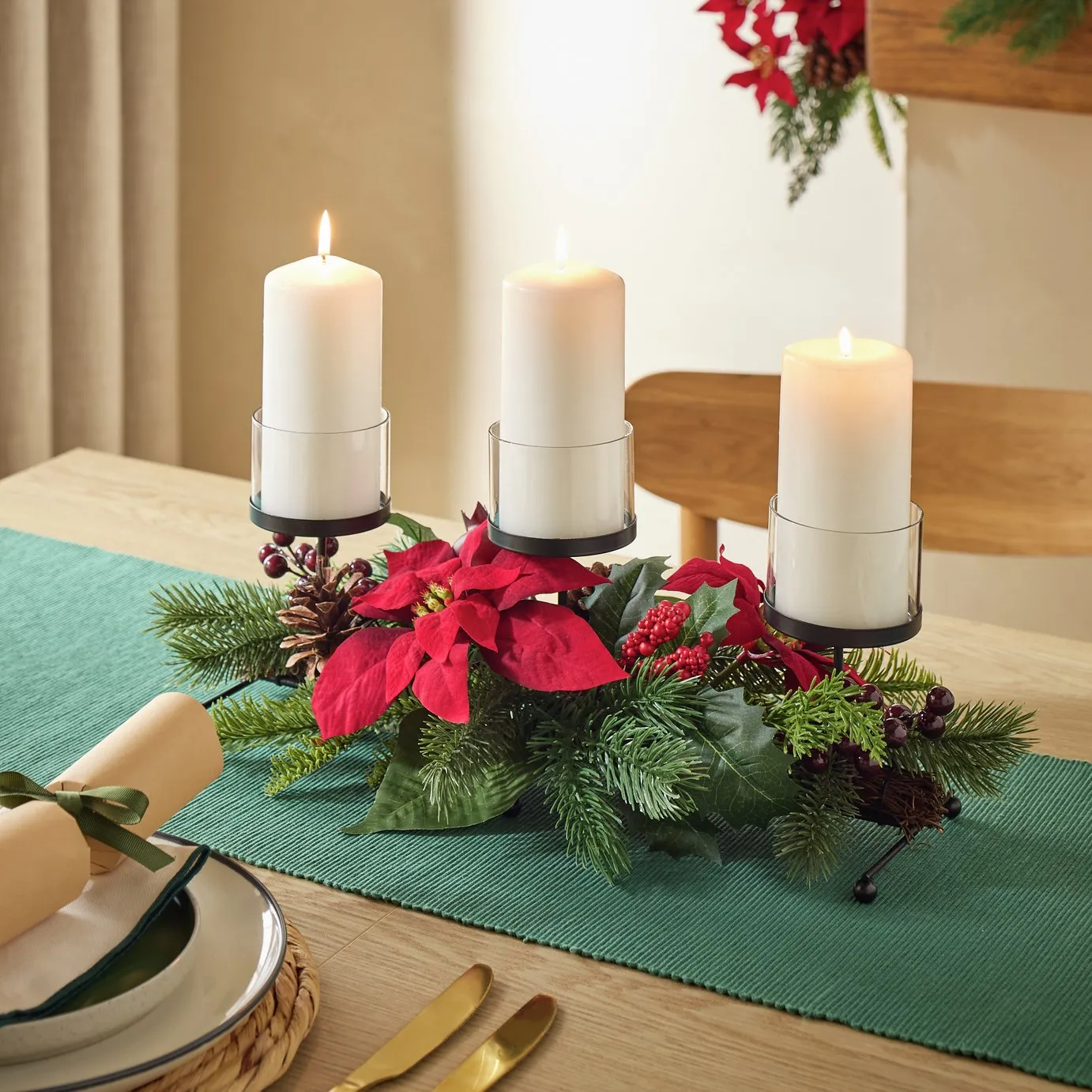
- Ceiling height of at least 8 feet if you’re using 4-inch pillars in the cups
- Chairs that tuck fully under the table, so nobody’s shoulder catches an arm
On a narrow apartment table, drop to a single-arm holder and let the greenery do the width instead.
Read the palette as 60% black-and-white structure, 30% green and red, 10% gold. The candelabra and the ribbed runner carry that structural 60, which is why the arrangement feels calm even with poinsettias in it. Swap the runner for charcoal linen and the same formula holds — you’d just lose a little warmth and gain a modern edge.
13. An Evergreen Wreath With LED Pillars Inside
LED pillars inside a wreath look wonderful and behave badly if you buy cheap ones. The low-cost versions flicker at the end of their battery cycle and cast a blue-white light that fights the red poinsettias. Spend the extra $8 per candle for warm white, and check that the timer actually resets — nothing kills the mood like a dead candle at 7pm on Christmas Eve.
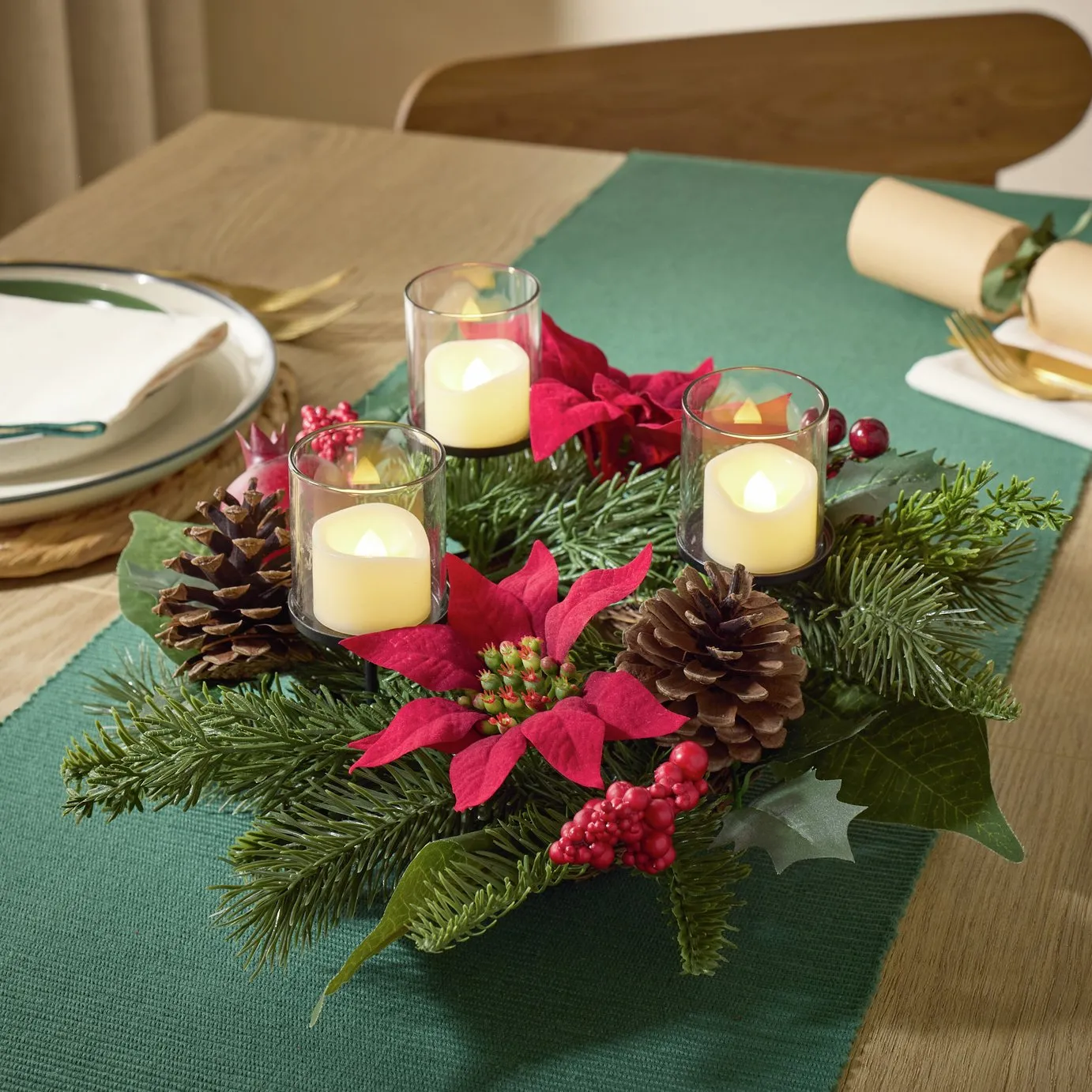
The wreath is where you save. A plain 18-inch evergreen wreath is $12–$20 at any craft store; the pre-decorated version with poinsettias is $70. Buy a $6 stem of faux poinsettias, break it into four clusters, and wire them in yourself — twenty minutes, and it looks deliberately irregular instead of factory-perfect. The green runner underneath is a $10 length of fabric.
14. Floating Candles Over Submerged Poinsettias
Use distilled water, not tap. Submerged stems cloud a vase within two days in most municipal water, and once the glass fogs you lose the entire point of the arrangement. Re-cut each stem at an angle right before it goes in, and drop a few clear glass marbles in the base to hide the stem ends. Floating candles get a 15-minute wick soak before lighting so they don’t list sideways.
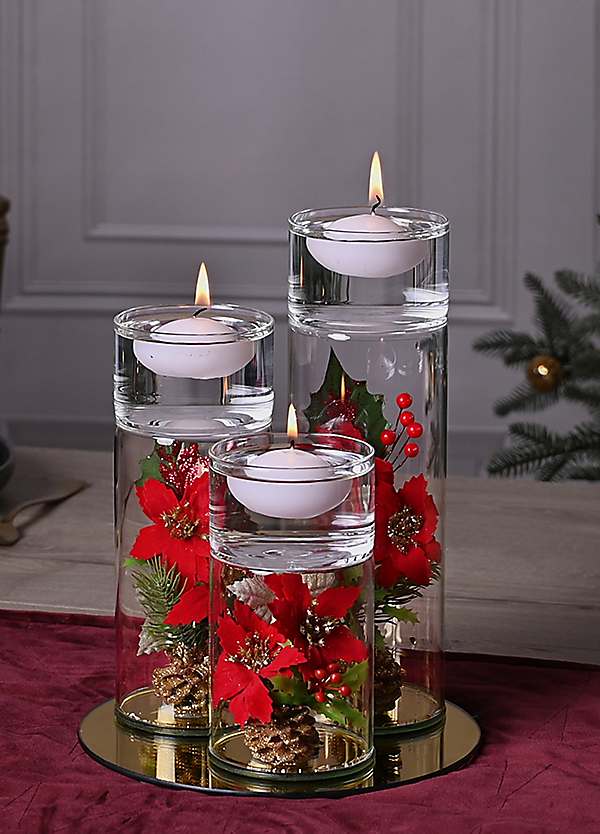
Expect to rebuild the water every three days — lifting the candles out, dumping, refilling, resetting. Poinsettia sap turns water cloudy fast and glittered pinecones shed into the vase. The gold mirror tray is the easy part; a microfiber cloth handles the rings. Want zero upkeep? Swap in silk poinsettias and refresh the water weekly instead.
15. Velvet Poinsettias Rising From Brass Candle Holders
The candles don’t sit beside the arrangement — they grow out of it. Brass holders buried in the foliage mean the flames appear to rise from the red blooms, which is far more dramatic than candles placed next to a centerpiece. The gold-painted leaves scattered at the edges bounce flame light back into the flowers, so the whole thing seems to glow from the inside rather than from above.
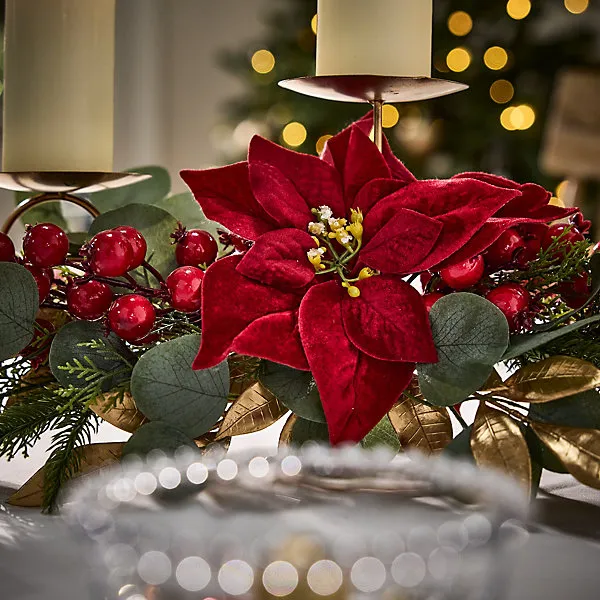
- Focal flower: 5–7 red velvet poinsettia stems, $25–$50
- Greenery: mixed green foliage bunches, $18–$35
- Accents: glossy red berry sprays, gold-painted leaves, $14–$28
- Candles: 2 brass holders, $16–$40; cream pillars, $8–$16
- Base: low bowl or tray, $12–$30
Total: $93–$199. Velvet poinsettias are the splurge; faux stems at $3 each cut the total in half and photograph almost identically.
16. Tree-Shaped Candles on a Patterned Runner
Figurative candles have gone from novelty to staple in about two holiday seasons, and the 2026 versions are softer and less literal than the early ones. The teal-and-red pairing here is a deliberate break from strict red-and-green — the kind of small oddity that makes a table feel collected rather than catalog-ordered. These will still be around in 2027; the shapes just keep getting better.
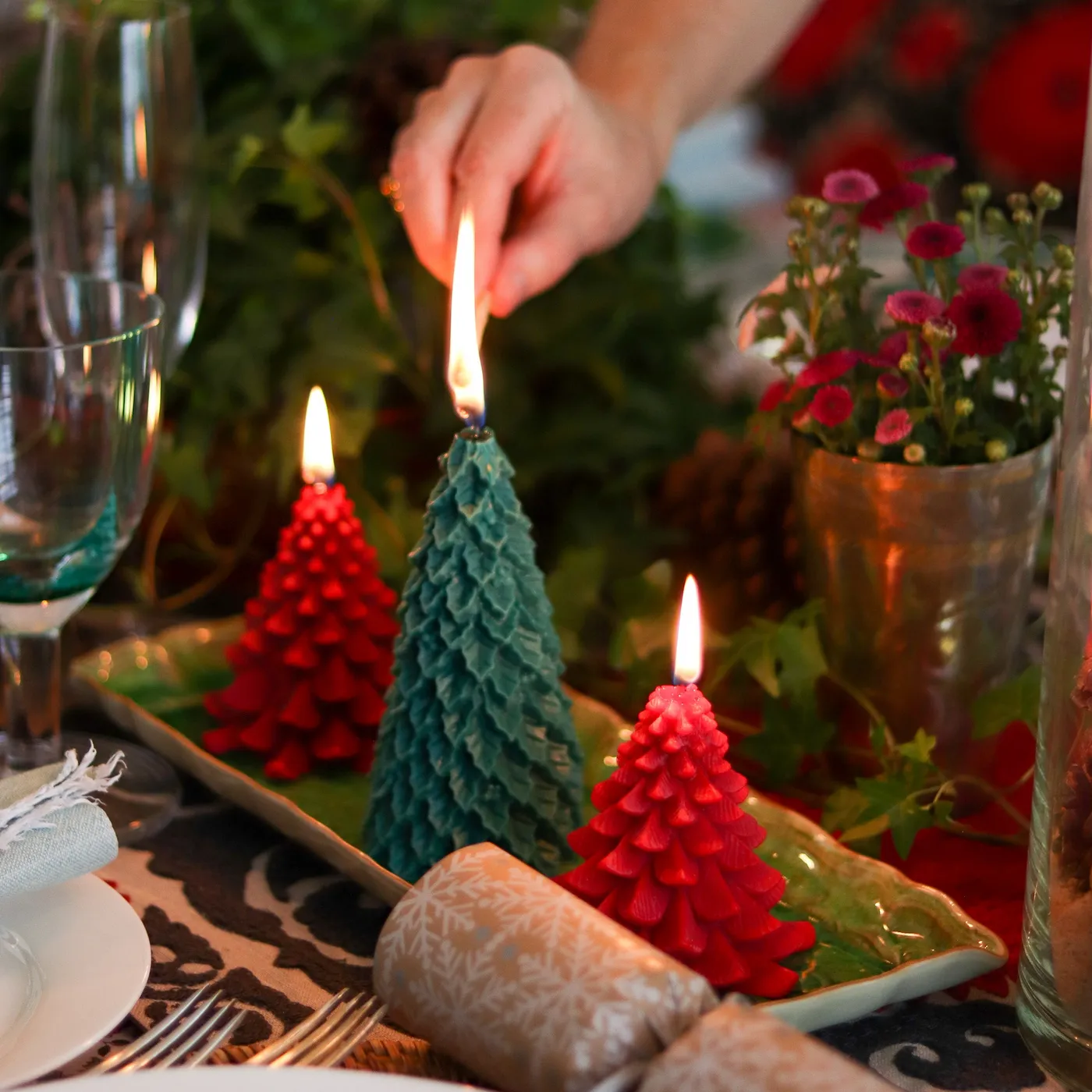
Shaped candles come with two problems. They burn unevenly — narrow necks melt faster than the bases, so they slump by dessert. And the pigment can bleed onto a fabric runner. Put a small ceramic dish under each one, light them no more than 90 minutes before guests arrive, and never leave them burning in a room with a draft.
17. Dark Ceramics, Dried Garland, and Mixed Candle Heights
The formula is roughly 65% warm brown wood and dried neutrals, 25% dark blue-grey ceramics, 10% metallic. It’s a cool-toned table built on warm furniture, which is exactly why it feels intimate instead of cold. Swap the blue-grey dishes for charcoal and it goes more modern; swap them for cream and it softens into something slightly traditional.
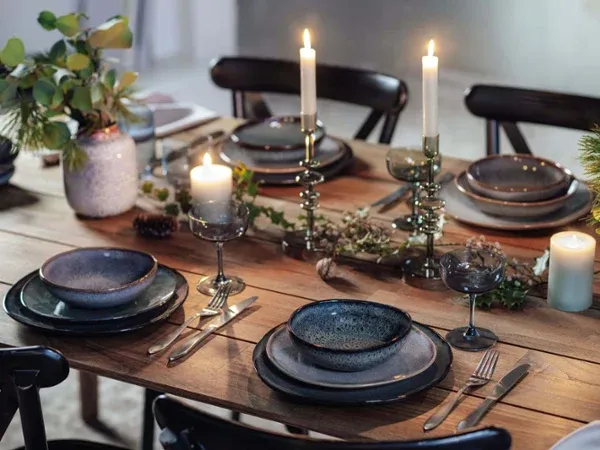
It’s the height difference between the candles. Three white pillars at three clearly different heights, plus two thin tapers, give the eye a staircase to climb — and that’s the only reason an arrangement this loose reads as composed. The same objects at the same height would look like a shelf. Vary by two inches minimum per candle, and don’t line them up.
18. Frosted Foliage With Gold Glitter Leaves
Linear arrangements like this one want a table 60 inches or longer and a room with dimmable light — frost and glitter only read as glamorous under low, warm bulbs. In a bright south-facing dining room they can look dusty by 2pm. If your table is under five feet, split the arrangement into two smaller clusters at either end and leave the middle open for serving dishes.
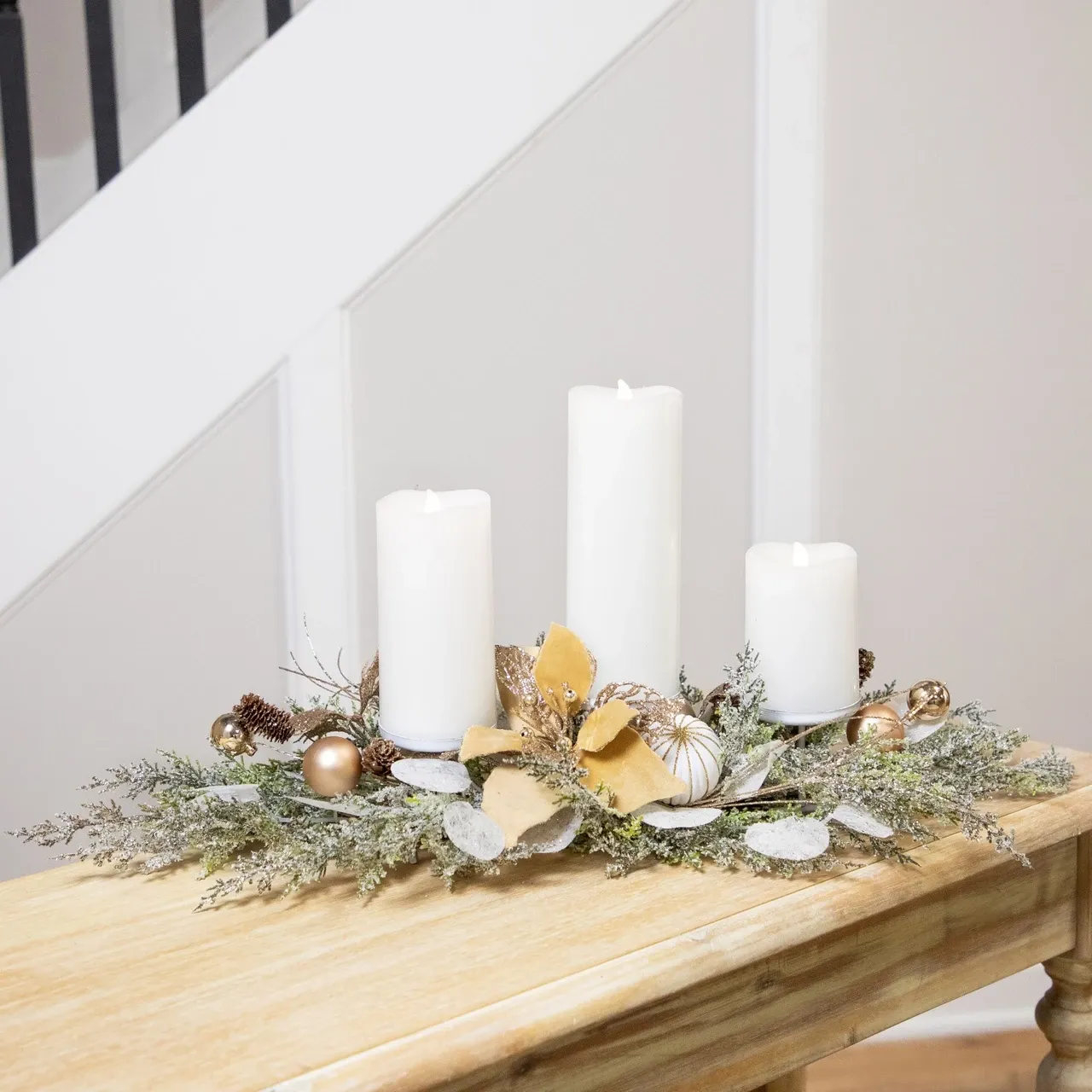
Gold glitter is a commitment; frosted is forgiving. One glitter-dusted leaf sheds onto everything within a foot, so seal them with a light pass of matte spray before they hit the table — two minutes, and the flaking stops. The matte gold ornaments do more here than the shiny ones, because they hold their color in candlelight instead of throwing a hard reflection across the plates.
19. The Ceramic Cardinal Basket on Green Velvet
The cardinal basket is the expensive part at $35–$60, but a plain white ceramic bowl from a thrift store for $3 plus a $6 clip-on cardinal ornament gets you 90% of the way there. Dark green velvet runner: a $12 fabric remnant, edges raw and hidden under the platters. Snow-dusted pine is just pine plus a $5 can of spray snow.
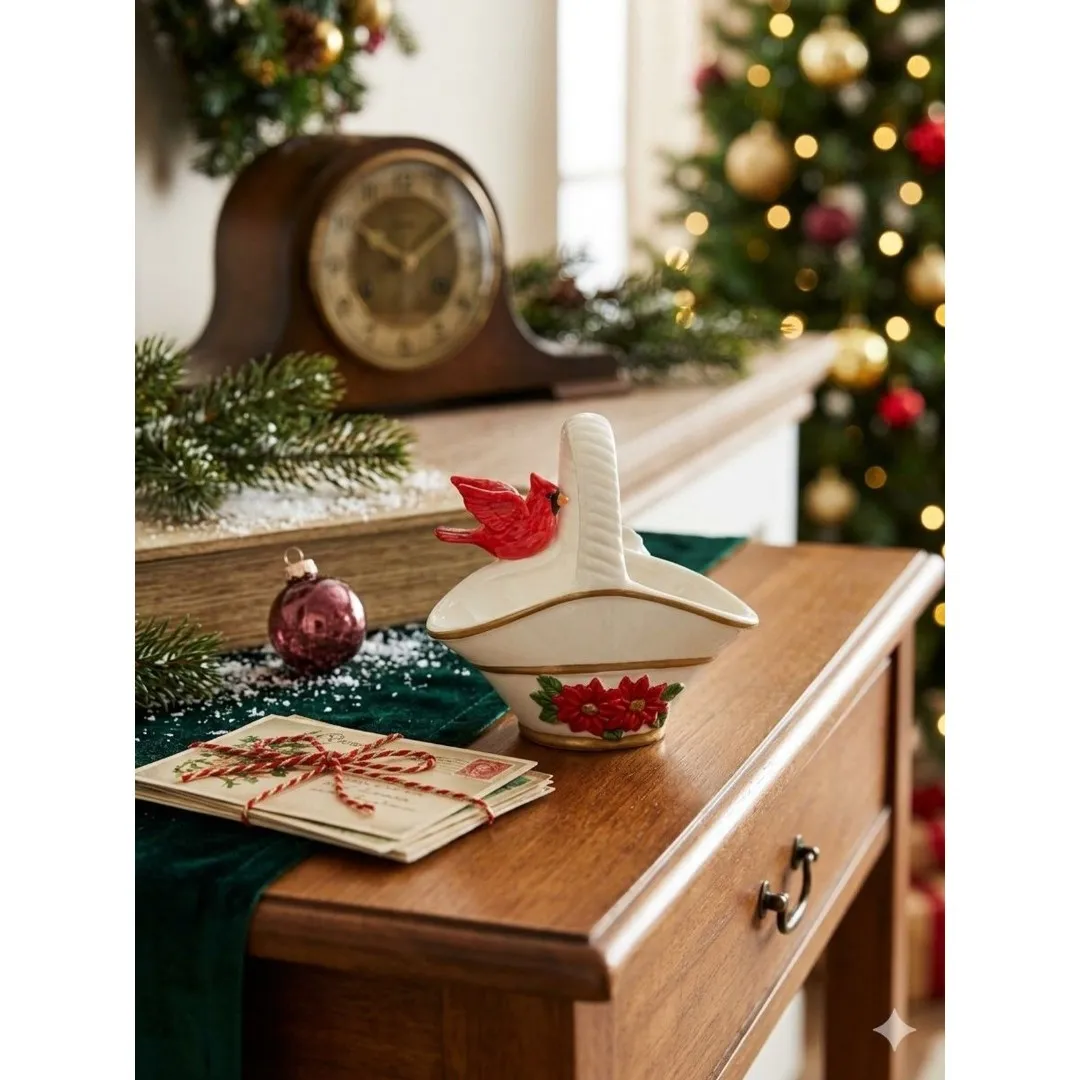
This whole vignette takes 25 minutes and about $40 if you start from a thrifted bowl.
- Lay the velvet runner first and let it hang over the console edge by a few inches.
- Set the basket slightly off-center — dead center looks like a hotel lobby.
- Build pine branches up and out on one side only, following the bowl’s natural direction.
- Spray snow from 12 inches away in short bursts, holding the can at an angle.
- Finish with the tied letters and one maroon ornament resting on the runner, not in the basket.
20. Red Amaryllis on a Wooden Tray With Wood-Slice Candles
Amaryllis are hollow-stemmed and top-heavy, and they lean toward the light within a day. Stake them with a thin bamboo stick while nobody’s looking, and turn the vase a quarter turn every morning. Sap from cut stems irritates skin, so wear gloves when trimming. The wood slice is charming but genuinely risky if a pillar burns below its edge — set the candles on a small metal plate first.
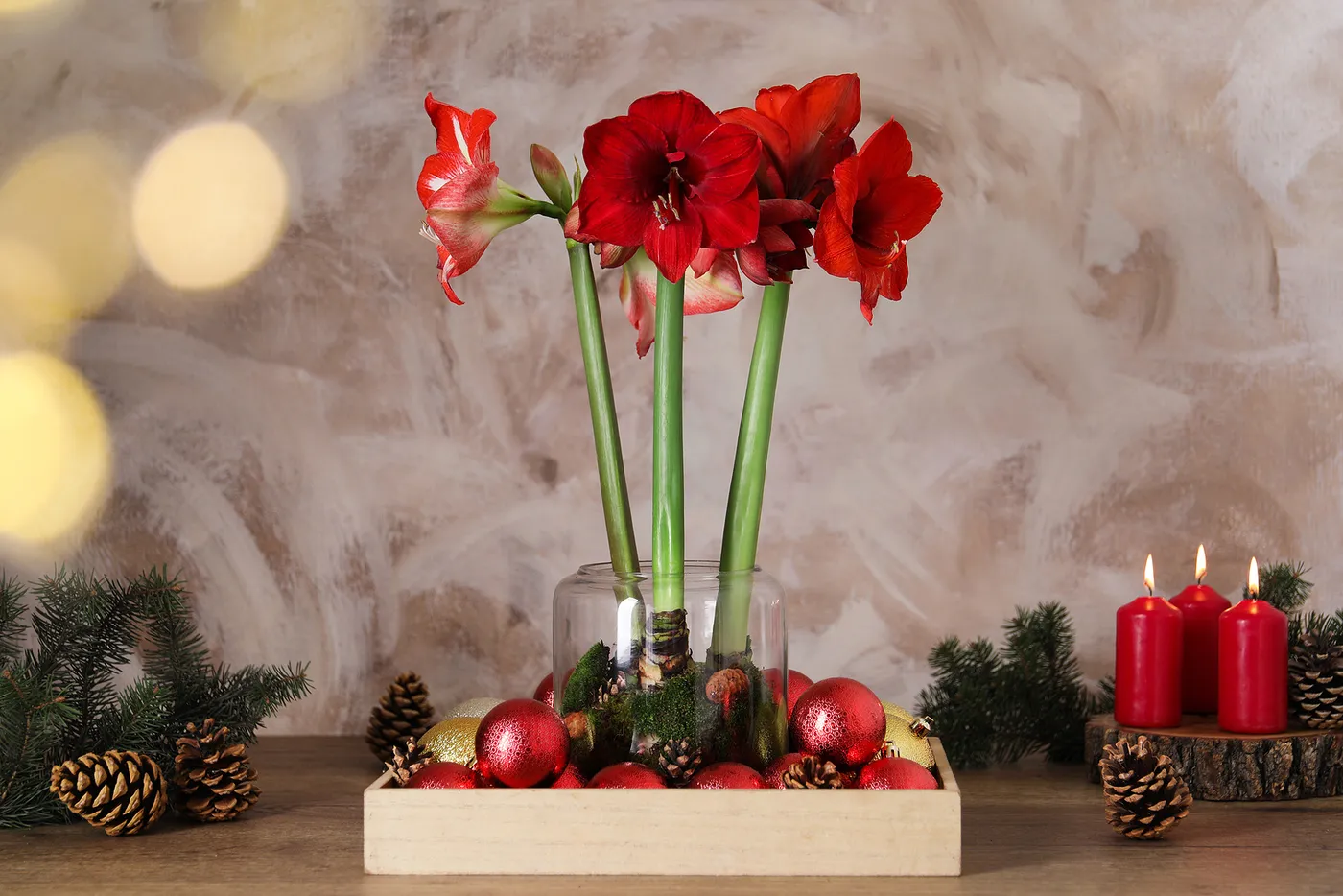
- Base: vintage wooden tray, $20–$45
- Flowers: 3 amaryllis stems, $24–$45; glass vase, $10–$25
- Filler: moss and pinecones, $12–$20
- Candles: 3 red pillars, $15–$30; wood slice, $8–$18
- Ornaments: red and gold baubles, $10–$20
Total: $99–$203. Paperwhite bulbs in a $4 forcing glass deliver the same height and drama for a quarter of the flower cost.
21. Peach Blooms on a Red and Green Plaid Runner
Peach flowers shouldn’t work on red-and-green plaid. They work because the peach picks up the warm gold in the ornaments and the cream in the candle, softening the plaid’s formality. It’s a temperature trick: one warm, low-contrast element dropped into a high-contrast scheme stops the whole table from feeling like a department store display.
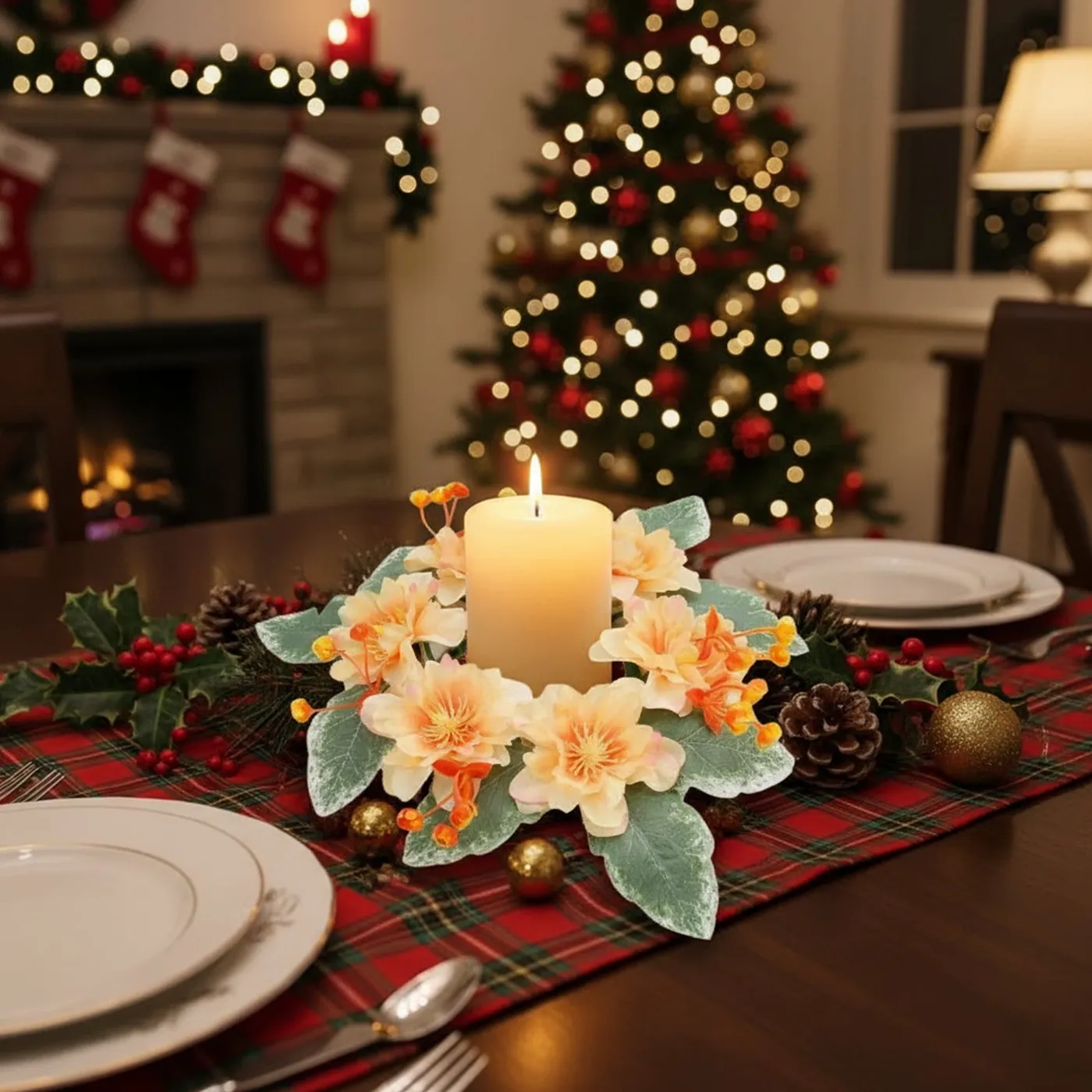
The ratio is about 55% plaid, 30% greenery, 15% warm bloom and gold.
- Keep the plaid, swap peach for blush pink to go softer
- Keep the peach, swap plaid for solid charcoal to go modern
- Swap both: cream linen with burgundy blooms for a richer, more traditional read
Every version holds together because the greens stay constant at roughly a third of the composition.
22. The Twig Orb Hidden in Dense Conifer Garland
The twig orb is the giveaway that this wasn’t bought as a set. Hand-woven natural forms and visible asymmetry are the direction holiday decor has been moving — fewer matched pieces, more collected objects, and a willingness to let texture do the decorating. It also photographs unlike anything else on a table, which is precisely why it keeps circulating.
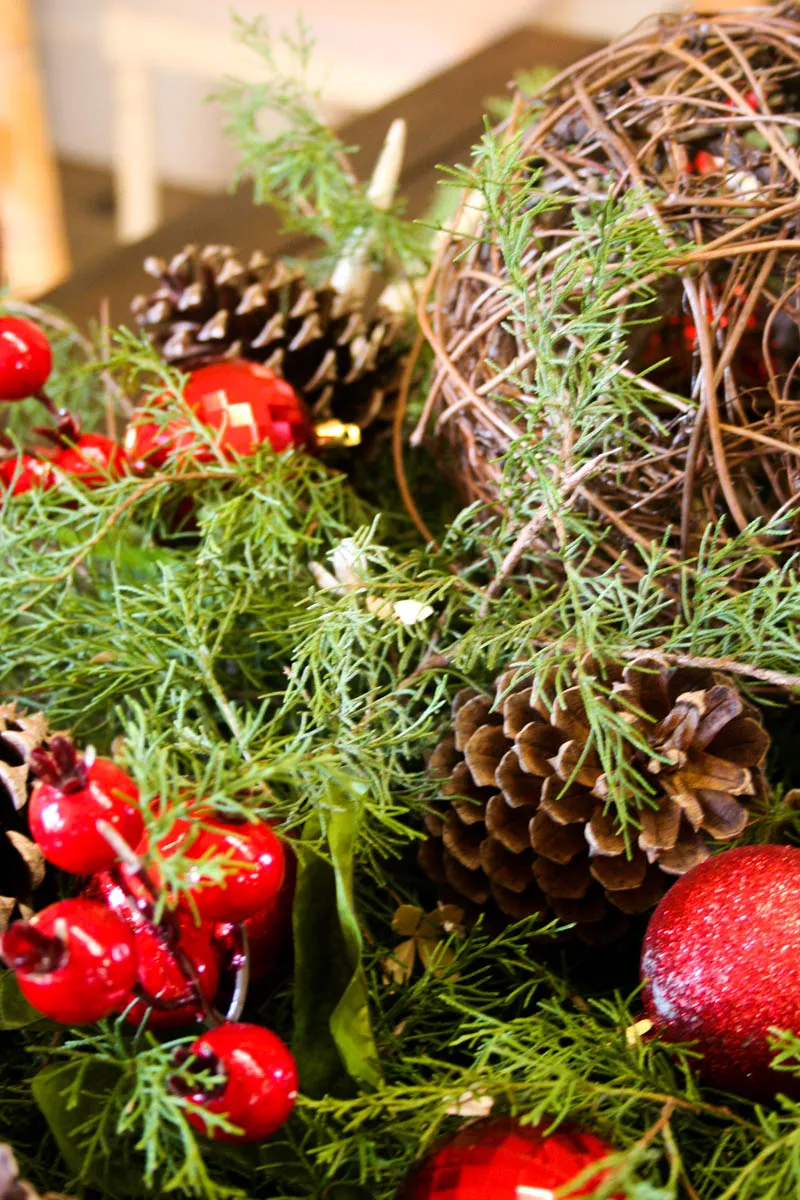
This works on a round table as easily as a rectangular one, because the orb has no front. Aim for an arrangement about one-third the length of the table and no taller than 10 inches, so guests can see across it. In a room under 120 square feet, drop to a single orb and let the pinecones carry the detail instead.
23. Red Roses Nestled Among Evergreen and Ivory Pillars
Roses in a holiday arrangement need to be tight-budded, not open, or they shatter by the 24th. Buy them two days ahead, cut stems at 45 degrees, and condition in cool water for four hours before they go anywhere near the table. Keep the blooms well away from the flames, too — heat opens petals fast and turns a two-week arrangement into a three-day one.
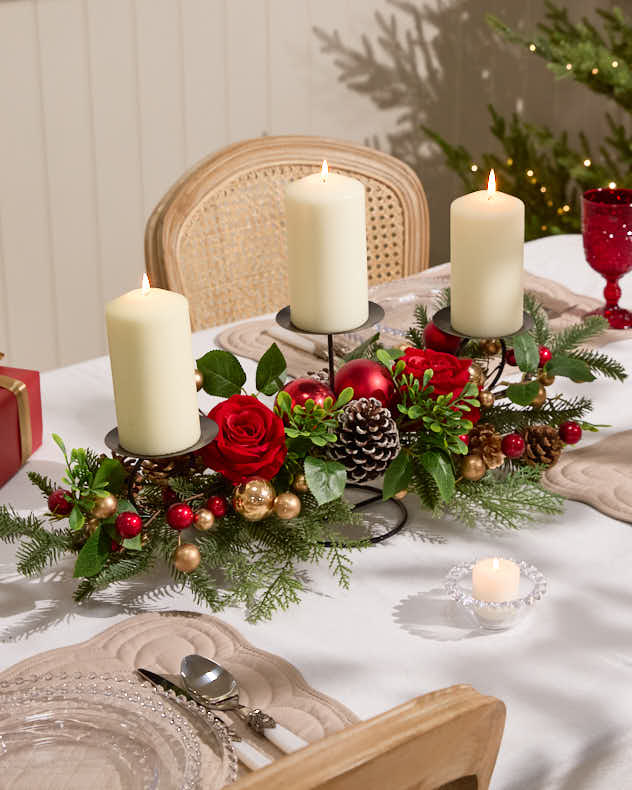
Red roses at $2–$3 a stem add up quickly. Carnations, which nobody respects and everybody should, cost about $1 each and last twice as long in the same red; cluster three together and they read as a single bloom. The black metal holder is a $15 thrift find most weeks, and ivory pillars are the cheapest candles on the shelf.
24. A Long Wooden Tray With Fairy Lights and Pillars
- Measure the tray against the table — it should cover no more than two-thirds of the length.
- Check the fairy lights’ color temperature; warm white only, with a plug-free battery pack.
- Confirm candle height clears your tallest serving dish so nothing blocks the pass.
- Make sure the tray has handles or a lip — a full tray of greenery is heavier than it looks.
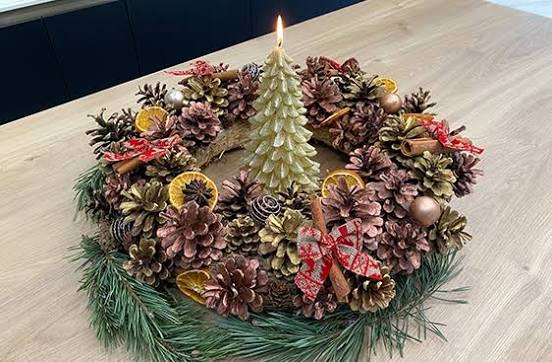
The tray does something a loose garland can’t: it defines an edge. Everything stays inside a clear boundary, so the arrangement looks intentional even though it’s dense and irregular. The fairy lights tucked underneath are the second trick — they light the greens from the inside, which reads as warmth rather than as a light source you can actually see.
25. Pomegranates, Artichokes, and Limes in a Wooden Trough
Whole fruit holds up far better than cut — pomegranates and artichokes look good for two weeks, limes about ten days, dried orange slices the entire season. The real risk is moisture: greenery pressed against fruit in a sealed trough starts to sweat. Leave the arrangement open, keep it away from radiators, and pull anything that softens within a day.
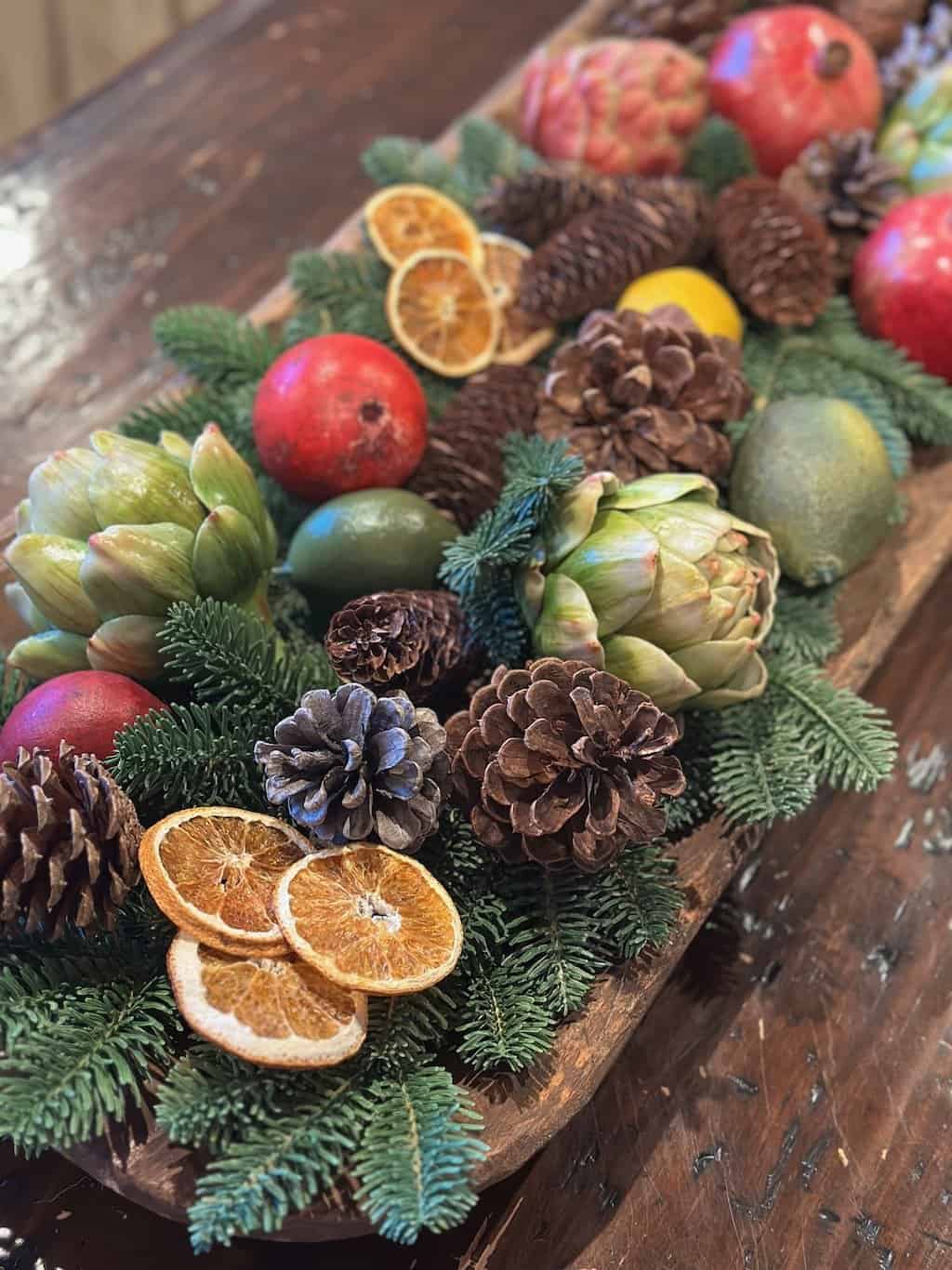
Grey-dusted pinecones are the cheapest way to make a natural arrangement look expensive. A light pass of white spray paint from 18 inches, hitting only the tips, gives you that frostbitten finish — and it hides the ones that are chipped or faded. Do it outside, in one coat, and don’t touch them for an hour.
26. Moss, Ceramic Mushrooms, and a Wooden Moose
It’s the moose. Everything else — the moss, the mushrooms, the dark green plates — sets a woodland mood, but the little wooden figure with felt antlers is what turns a theme into a story. Take him away and you have a nice natural table. Leave him there and guests start talking about it before the soup arrives. That’s worth more than any of the expensive pieces on this list.
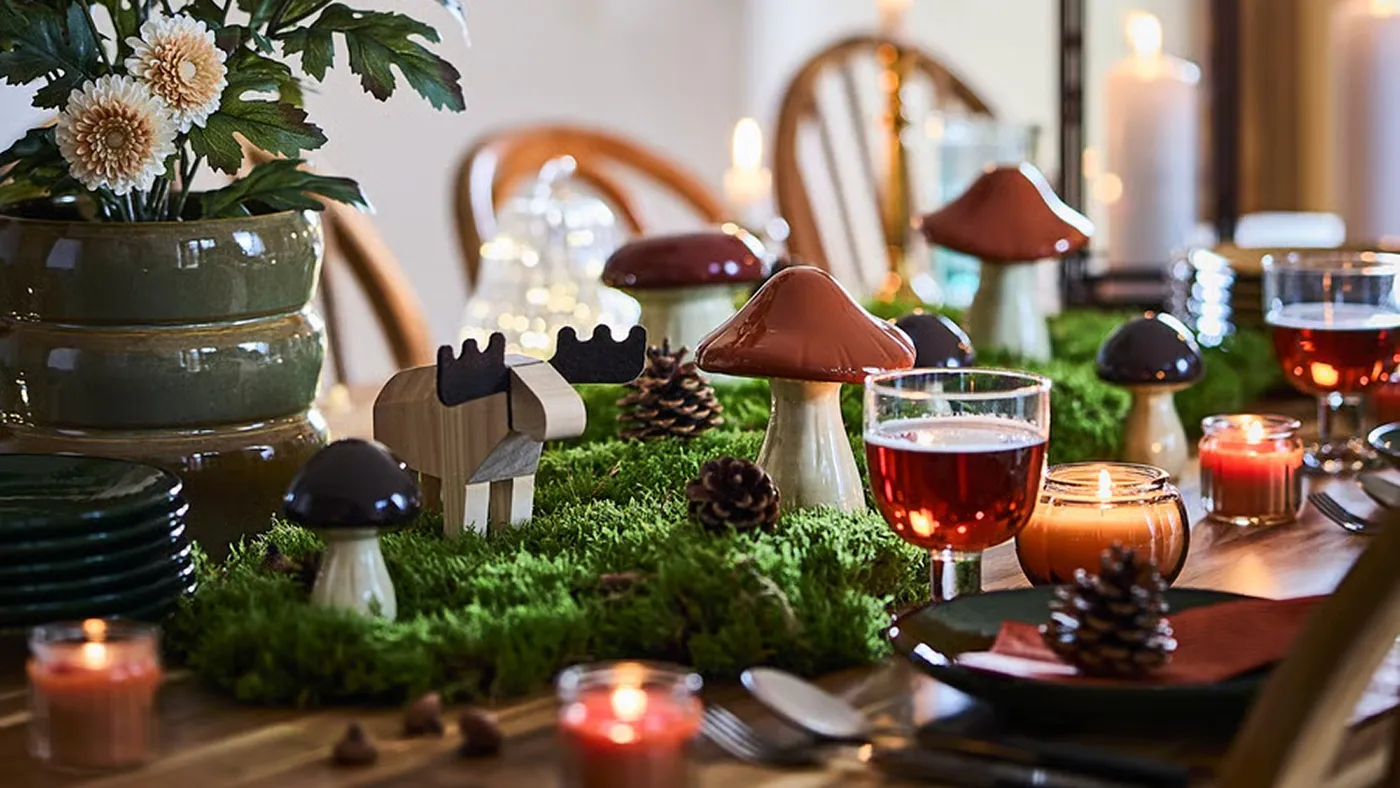
Story-driven tables are where holiday decorating has been heading: fewer matched sets, more small characters and handmade objects that invite a second look. The moss runner is a big part of why it lands — it’s cheap, it’s reusable, and it makes ceramic mushrooms look like they grew there.
27. The Hanging Evergreen Beam Suspended Over the Table
A hanging centerpiece takes about two hours including hardware, and roughly $60 in materials.
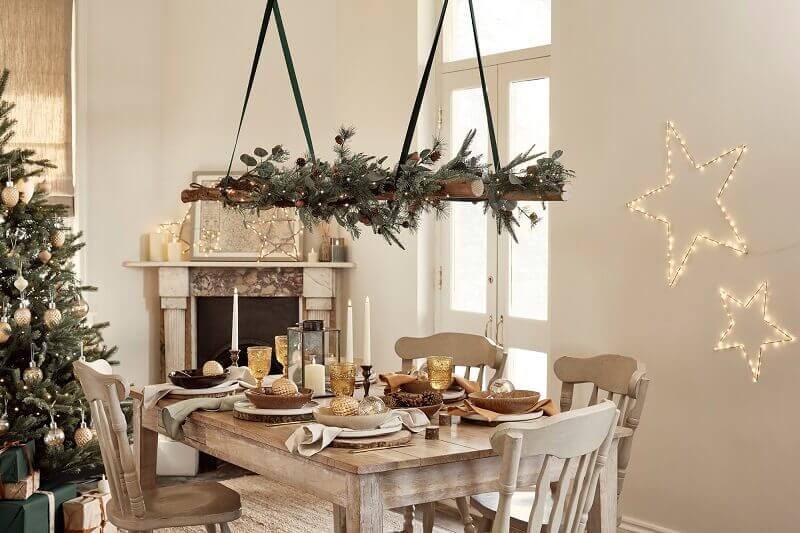
- Measure ceiling height and table length, then cut the beam to two-thirds of the table.
- Attach two eye hooks to ceiling joists — use a stud finder, not guesswork.
- Wire the greenery, berries, and string lights to the beam while it’s still on the floor.
- Hang with ribbon at a height that leaves 30 inches of clearance above the tabletop.
- Set the table underneath only after the beam is secure, then check sightlines from a seated position.
This only works in rooms with 9-foot ceilings or higher. At 8 feet, a hanging beam plus a centerpiece on the table creates a squeeze that makes the room feel lower than it is. You also need a table at least 72 inches long, or the beam appears to float off the ends.
28. A Poinsettia Ring Around a Cream LED Pillar
- Candle: cream LED pillar, $12–$28
- Flowers: 8–10 faux poinsettia stems, $20–$45
- Base: grapevine wreath ring, $8–$16
- Accents: yellow-orange berry clusters, $8–$15
- Table protection: felt pads or a mat, $5–$10
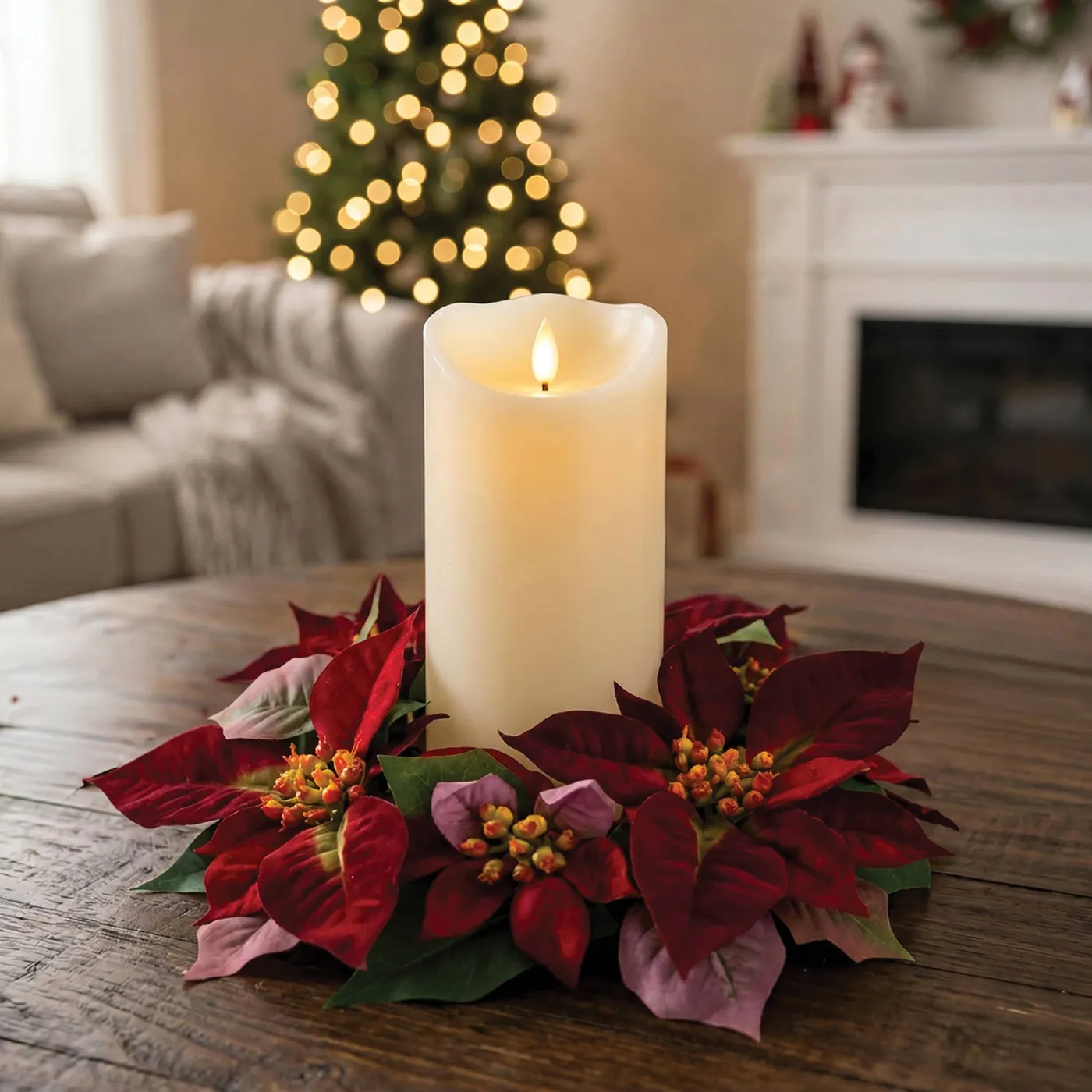
Total: $53–$114. Real poinsettias in small pots, ringed around a glass hurricane instead, cost about the same and last through January if you keep them watered.
Check the candle’s glow color before you fall in love with it. Cool-white LEDs turn deep red poinsettias muddy and faintly purple. Warm white at 2700K or lower keeps the reds rich. If you’re using a real flame instead, don’t let the petals come within three inches of it — they go up faster than you’d think.
Your Table’s Been Waiting Since October
None of these tables required a designer, a delivery truck, or a budget you’d have to hide from anyone — just a runner, a base, three heights of candle, and one element that’s slightly more interesting than it needs to be. Start with the arrangement that matches the table you actually own, then borrow one idea from a completely different photo. That’s usually where the good ones come from.
📌 Pin your favorite now — when December gets loud, you’ll be glad you saved it.
