20 Stunning Rustic Christmas Tree Ideas to Elevate Your Holiday Decor This Year

You know the feeling — forty holiday tree photos saved to Pinterest and still no decision between “snowy woodland cabin” and “quiet farmhouse.” Here’s the thing about a rustic Christmas tree in 2026: it isn’t one look. It’s texture you can actually touch — burlap, dried citrus, hand-stamped wood, pinecones that fool people into thinking you foraged.
We spent serious time browsing Etsy, Target, and Walmart to bring you only what’s worth your attention this year, from $12 ornaments up to a $489 statement tree collar. Inside you’ll find 20 curated ideas covering snow-flocked woodland, vintage farmhouse, neutral organic, and handmade craft styles — with budget and high-end versions compared side by side. And stay until the end — we break down the most common mistakes that can ruin these looks.
📌 Save this to Pinterest for later — you’ll want to revisit these ideas.
This post contains affiliate links. If you buy through them, we may earn a small commission at no extra cost to you.
1. A Sunroom Christmas Tree That Lets the Winter Light In
Three things are quietly doing the work here. First, contrast: a pale frosted tree against dark teal velvet armchairs, so the furniture reads as silhouette and the tree glows instead of competing with it. Second, the cream patterned fabric on the chair backs echoes the frost on the branches, tying both sides of the room together without a single matching ornament. Third, the seating stays low — one round tufted leather ottoman instead of a coffee table keeps the sightline to those gridded windows wide open.
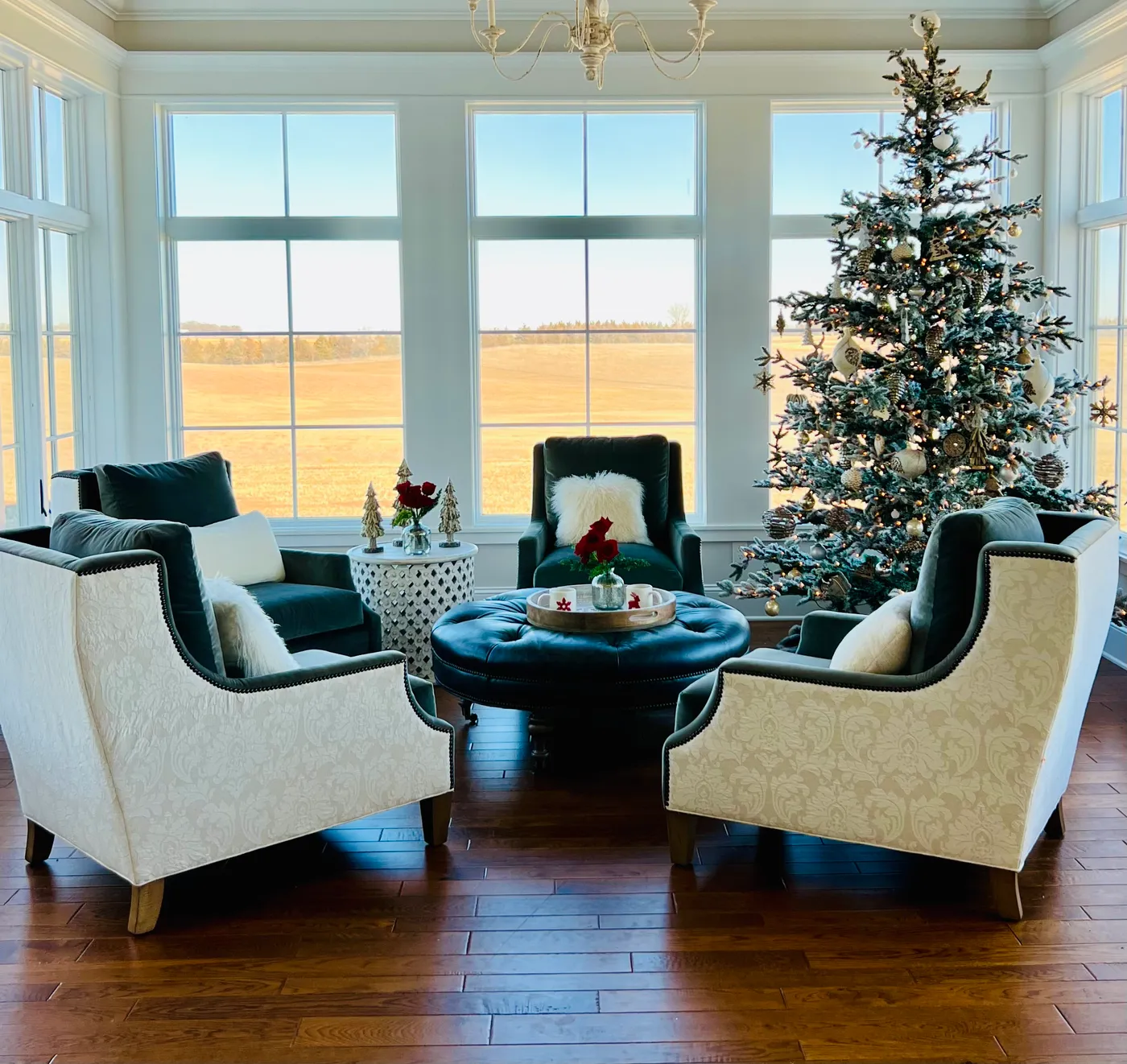
This layout needs width more than depth — figure on at least 12 by 14 feet so the tree can claim a corner without crowding the seating circle. Ceiling height matters less than window placement, because the tree wants to stand beside the glass rather than in front of it. With nine-foot ceilings, a seven-foot tree is the sweet spot. In a tighter room, borrow the corner-framing trick from Idea #10, where the tree sits between two pieces of seating instead of beside them.
2. Pinecone-and-Magnolia Wreath That Looks Gathered, Not Bought
A wreath stops looking store-bought the second you quit spacing things evenly. Cluster your materials in odd numbers — three pinecones, five berry sprigs, two magnolia leaves — and let the clusters overlap. Keep every addition within two inches of the outer edge, because anything pushed toward the center fills the hole and the ring disappears. And leave one quadrant almost bare; that deliberate gap is what makes a wreath read as gathered from the yard.
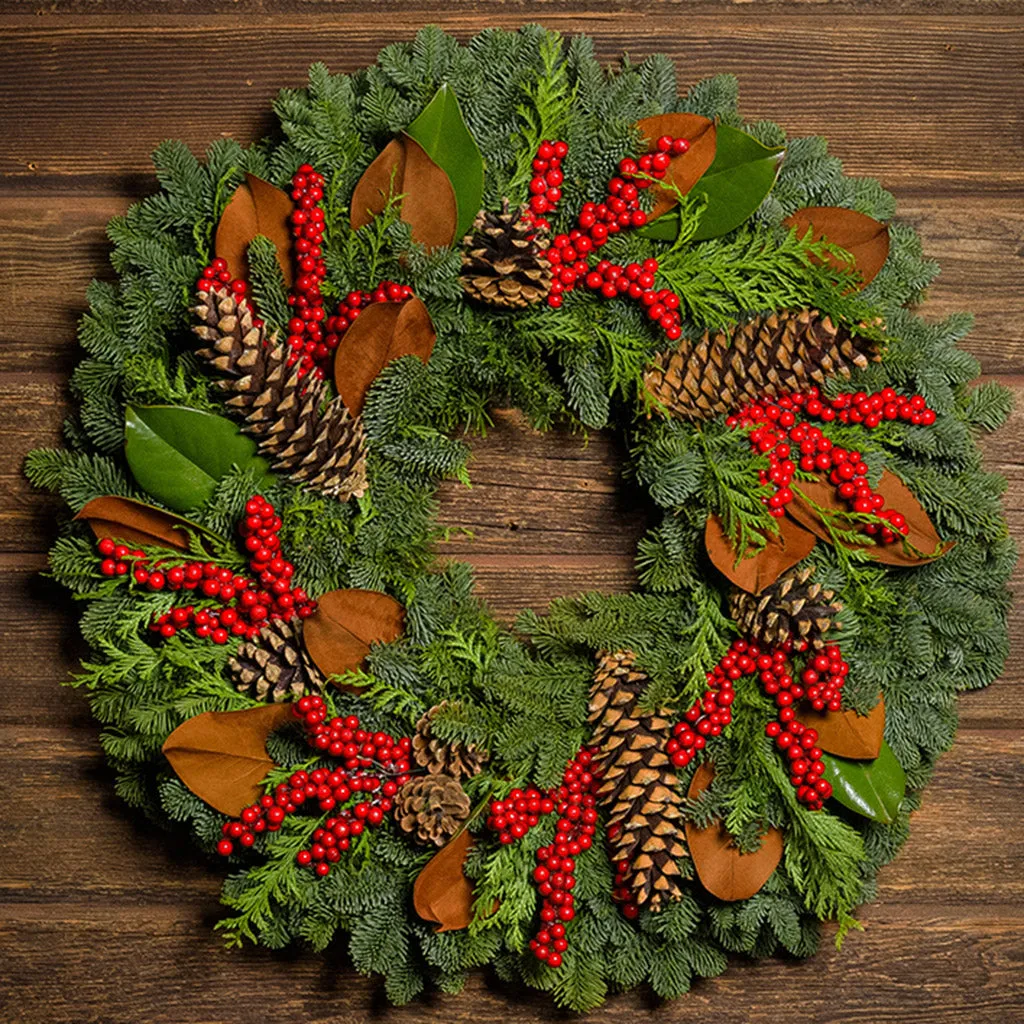
Budget about 90 minutes and $35 in supplies if you already own a 24-inch grapevine or evergreen base.
- Lay the wreath flat and pick your three biggest pinecones as anchors.
- Wire each anchor with 22-gauge floral wire, twisting from the back so nothing shows.
- Tuck cedar and magnolia sprigs behind the anchors, angling them outward past the base.
- Thread berry clusters in last, pushing stems into the inner ring so the berries sit forward.
- Hang it, walk ten feet back, then take one element off. It will look better.
3. Frosted Woodland Tree Beside a Stone Fireplace
Pull the white dimensional stars off that wood-paneled wall and this corner loses half its charm. The tree already carries pinecones and hearts, and the fireplace carries fire and garland — the stars are the only element that pushes the holiday up the wall and into the room’s architecture. They repeat the frost on the branches in a flat, graphic way, which keeps a very cozy scene from turning into a fuzzy one.
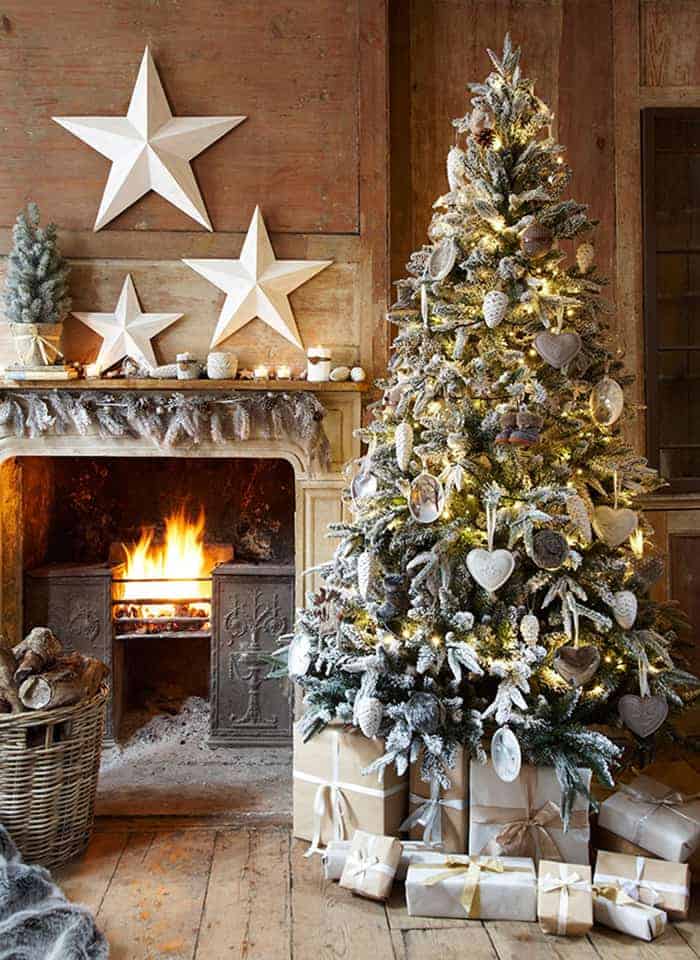
- Flocked 7.5 ft tree: $180–$450
- Pinecone and heart ornaments plus fairy lights: $60–$150
- White dimensional stars, set of five to seven: $25–$90
- Mantel garland, candles, and holders: $45–$120
- Wrapping paper, ribbon, and gift boxes: $30–$80
- Total: $340–$890
Budget alternative: a Marketplace flocked tree at $80, dollar-store star cutouts painted white, and thrifted brass candle holders bring the whole thing to roughly $160.
4. A Stained Wood Tree Box With the Family Name On It
Custom stained tree boxes run $150 to $300 on Etsy, which is a lot for something that holds one tree. Build your own for about $45: three 1×10 pine boards, a can of dark walnut stain, and a pack of white vinyl cutouts ordered pre-cut for $12. No saw, no patience? Target and Walmart sell unfinished wood collars from $25 that take stain beautifully.
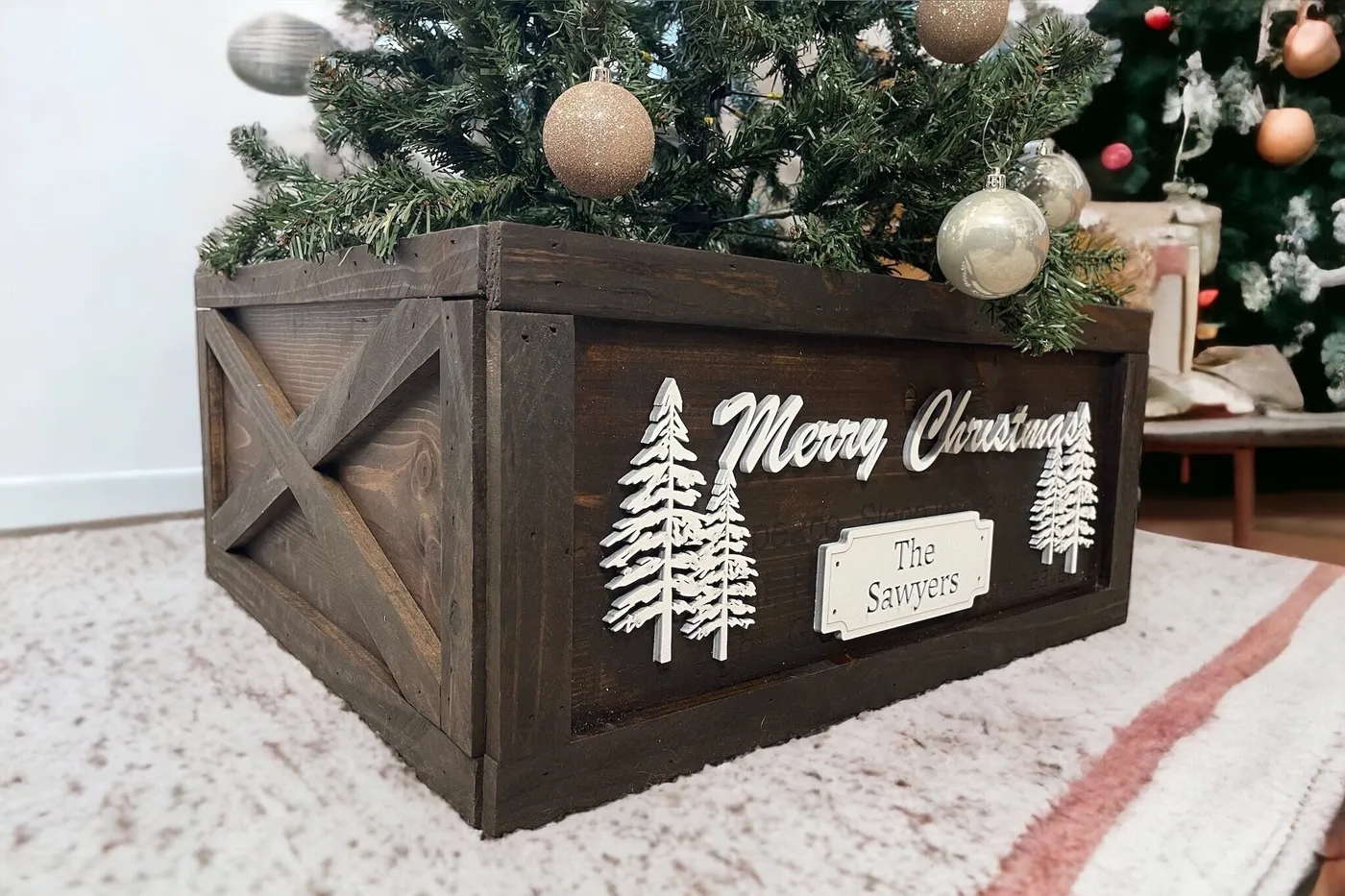
A tree collar should be roughly one-fifth the height of your tree, so a 7-footer wants a box about 16 to 18 inches tall and 22 to 24 inches wide. Set the tree down inside it so the lowest branches spill over the rim by a few inches. If that bottom row disappears completely, you’ve gone too deep — raise the tree with a stack of pavers or a scrap of 2×4.
Plan for a 30-inch clearance radius around the box, not just the box itself, because you need room to water, adjust lights, and reach the back of the tree. Small-space readers should look at the flat, wall-mounted wood tree in Idea #11, which takes up zero floor space.
5. Burlap, Buffalo Check, and a Big Wooden Star
Flocked trees shed. Expect a fine white dusting on the floor for the first week or two, especially if you’re hauling the tree in and out of a box. A washable flat-weave rug under the tree saves you from vacuuming flocking out of plush carpet all January. Also, skip the burlap-near-flame combination: burlap ribbon is one of the fastest-burning trims you can hang on a tree, so keep those wooden signs and candles on separate surfaces.
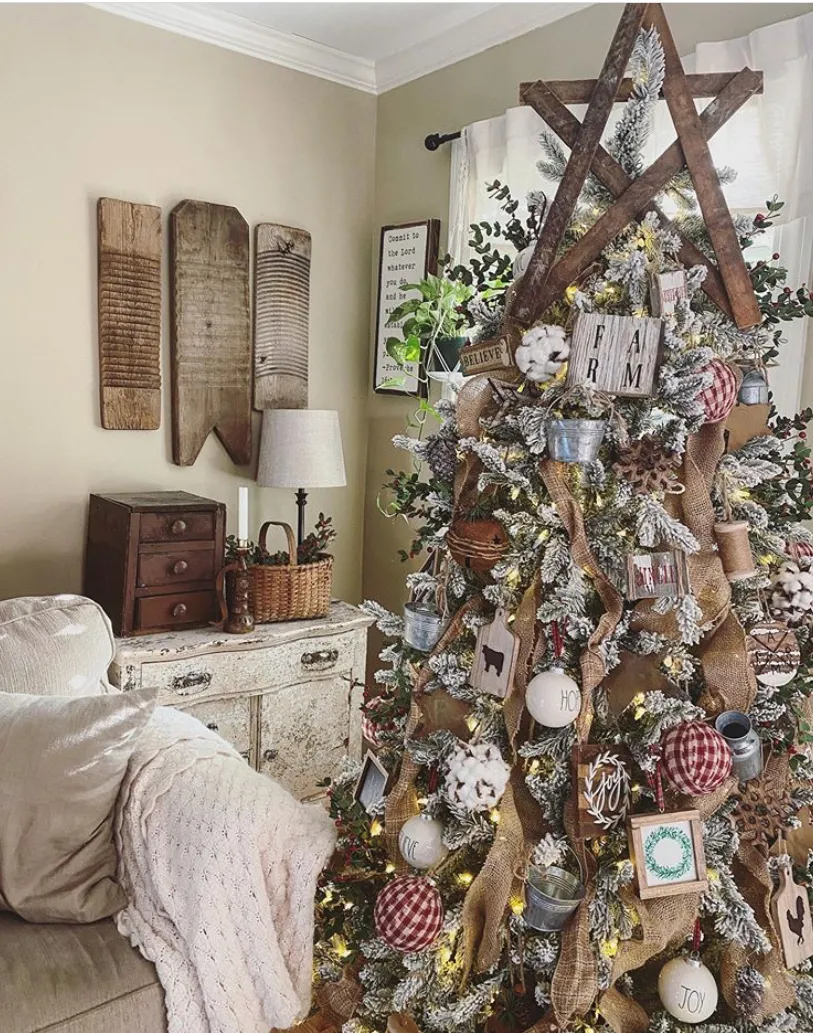
The formula here is about 60% white and cream — flocked branches, distressed cabinet, neutral armchair — then 25% warm brown from burlap, wooden signs, and the star topper, and 15% red-and-white check for the pop. Swap the check for black-and-white plaid and you get a sharper farmhouse look; swap it for solid deep red and the room turns traditional instead of country.
6. A Ceiling-High Frosted Tree With Bells and Floral Picks
This one is a ceiling-first decision. To pull off a nine- or ten-foot tree with 24- to 30-inch floral picks, you want at least a 10-foot ceiling — 12 feet if you plan to keep a topper upright. In a room with 8-foot ceilings, drop to a 7.5-foot tree and cut the picks down to 12 inches. Tall trees also need a 26- to 30-inch base opening, so measure your stand before you fall in love at the lot.
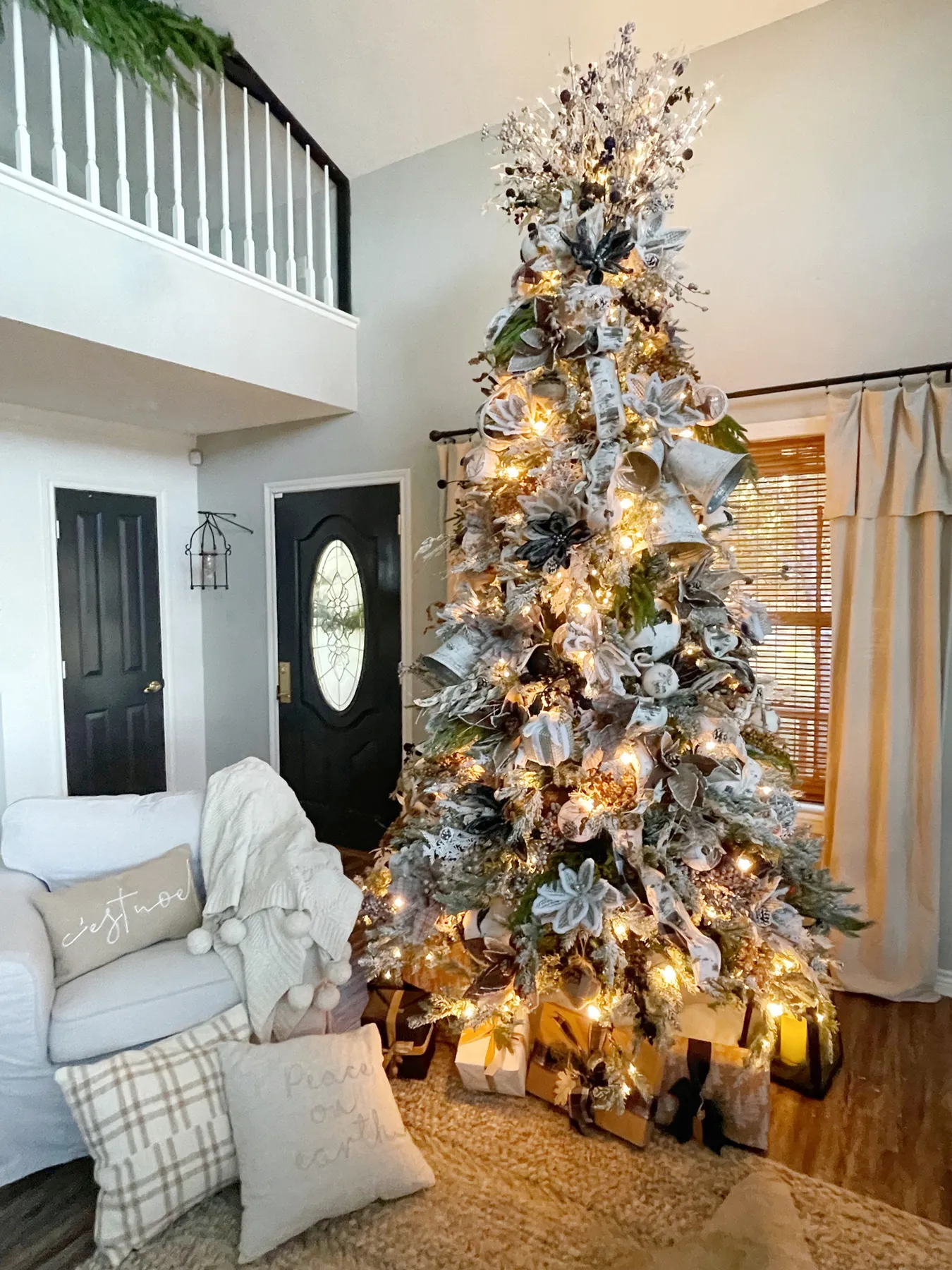
Frosted branches collect dust like a lint roller, so plan on a soft brush and a weekly pass in January. Metal bells dull and spot within a season or two — a dry cloth wipe keeps the finish even, and storing them in a zippered bag beats a cardboard box every time. Budget roughly $15 a year for replacement light strands, because one always quits on you.
7. Weathered Metal Pinecones for Years of Reuse
- Measure your vase or container opening — these stems usually need a 4- to 6-inch mouth to sit upright.
- Check the patina finish in person if you can; distressed metal varies widely from piece to piece.
- Confirm the stem is rated for indoor use, since unsealed metal can rust in a humid room.
- Decide your count before you buy — odd numbers of three or five read best in a tall vessel.
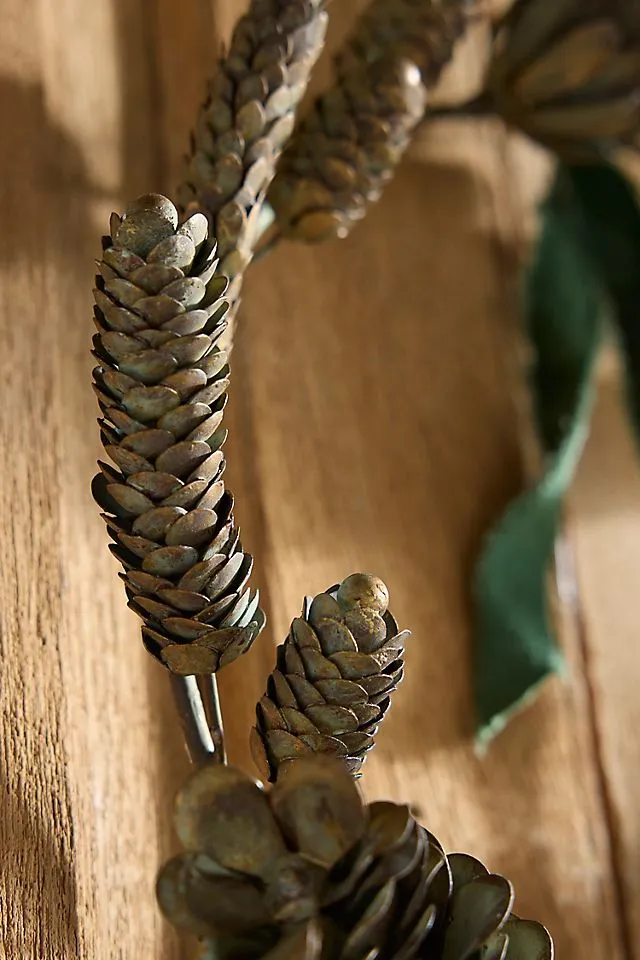
The move toward aged metallics has been building for a few seasons alongside the broader shift from “hauled out of the attic” to “collected on purpose.” In 2026 the interest sits squarely on patina — bronze, pewter, oxidized brass — instead of high-shine gold. It’s a look with real staying power, because it functions as a neutral: a patina stem reads as brown from across the room, which means it still works when you’re completely over candy canes.
8. Leaning Antique Doors as a Rustic Tree Backdrop
Leaning antique double doors safely takes about 30 minutes and a $15 furniture strap.
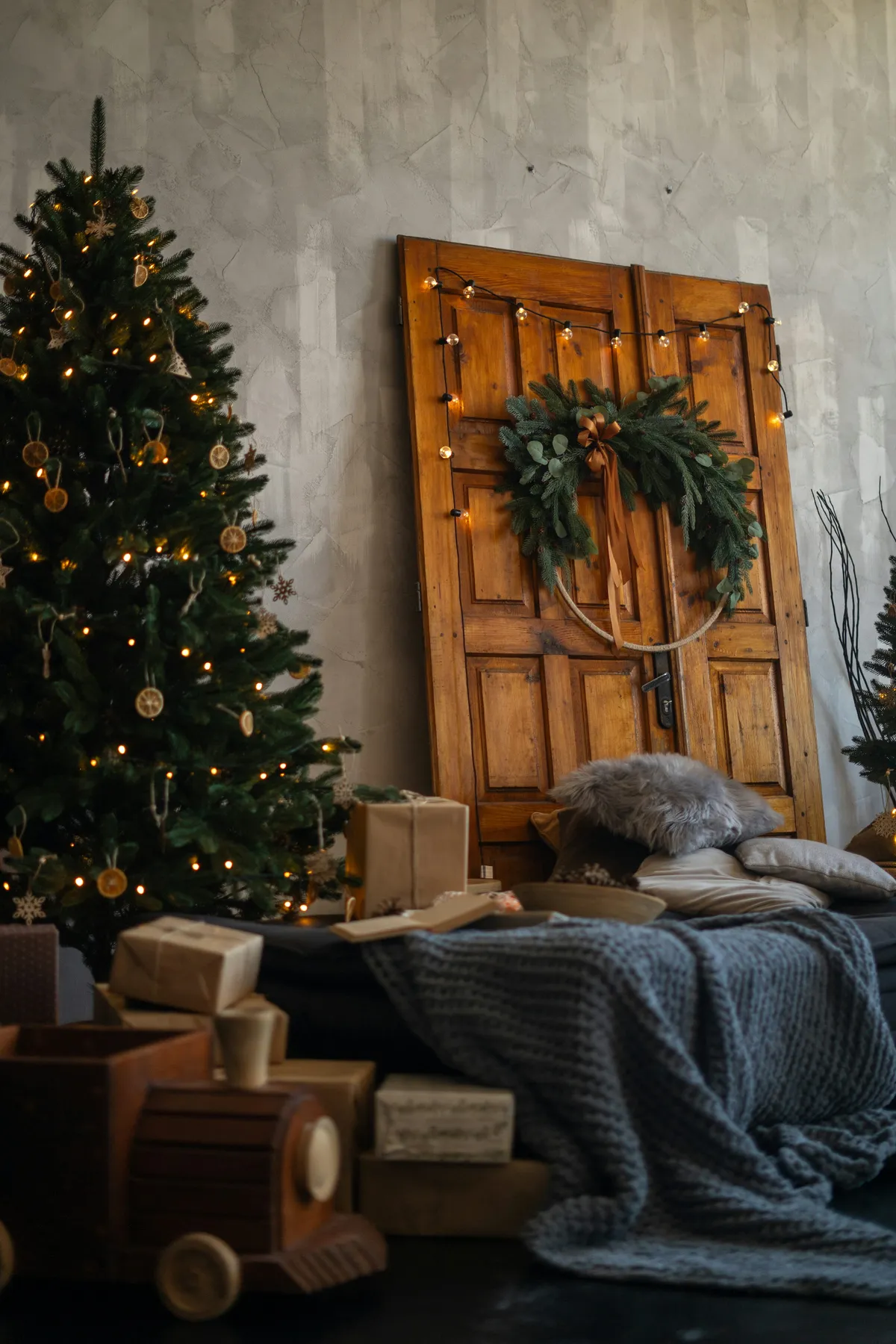
- Stand the doors against the wall with the bottom edge 20 to 24 inches out.
- Slide a nonslip rubber pad under the base so the wood can’t skate on hardwood.
- Run an anti-tip strap from the top rail to a wall stud, or use a heavy planter as a stopper.
- Zip-tie the light strand to the door’s back frame so the cord exits near the floor.
- Hang the wreath on a padded hook so it doesn’t scuff the old finish.
Two warnings about leaning doors: they’re a serious tip-over risk, and they’re usually older than your house’s wiring. Anchor them if kids, dogs, or cats share the space. And if the doors came from a flea market, check for lead paint before you sand or restyle them — a swab kit costs about $12 and takes five minutes.
9. Pinecone Garland Swooped Across White Brick
Most garlands look thin because they’re used straight out of the box. Fluff every branch tip outward and slightly upward, then zip-tie two garlands together end to end for double depth. On a wall or door frame, hang in 10- to 12-inch swoops secured with clear adhesive hooks rated for two pounds. Add a hook at each swag’s low point, not just the ends, or the garland will slowly stretch over the season.
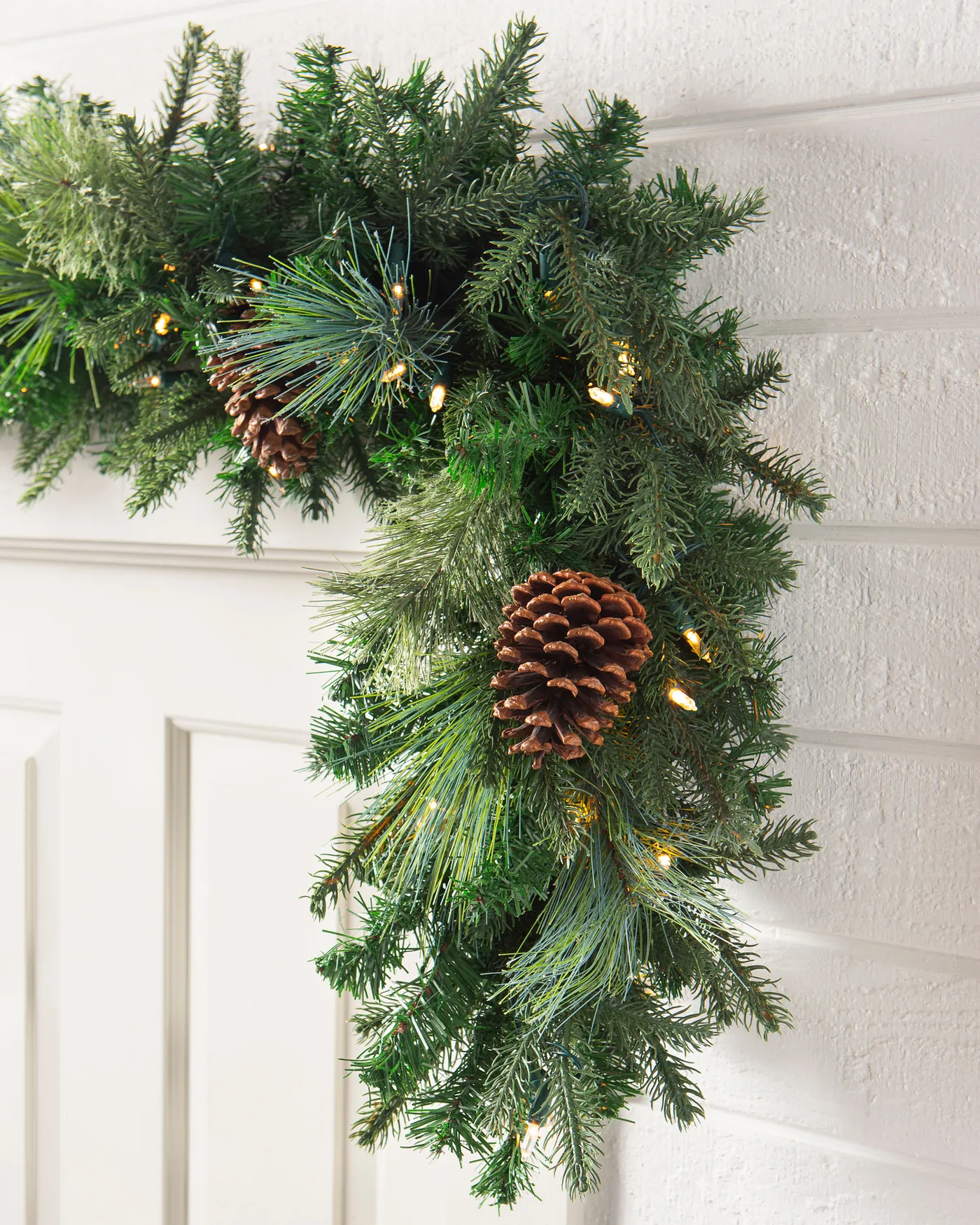
Three design principles are at play. Contrast: deep green against white brick is the highest-contrast pairing in the entire holiday palette, which is exactly why it photographs so well. Repetition: the same swoop repeated across the frame gives the eye a rhythm. Restraint: because the brick and trim are already busy, the garland carries only two elements — pinecones and warm white lights — and stops there.
10. A Leather-and-Plaid Corner Tree in a Wooden Box
Strip everything else away and the buffalo check is what holds this corner together. The tree sits between dark brown leather pieces, so it needs one pattern that bridges warm leather and cool white lights — check does exactly that. It also softens the hard edges of a wooden box collar by repeating a grid of squares in fabric, which is a much friendlier version of the same geometry.
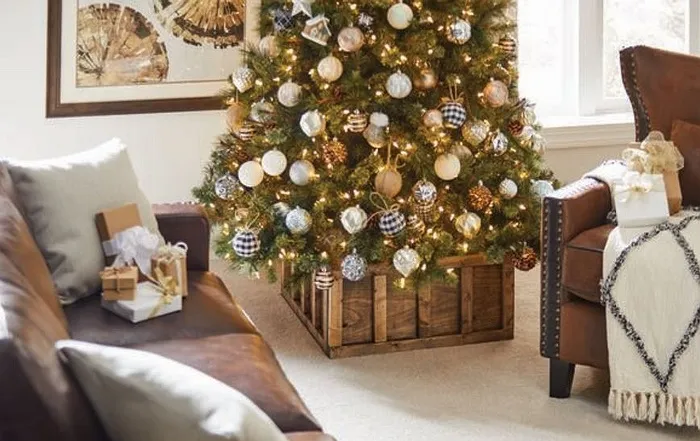
You don’t need new leather to get this. Facebook Marketplace is full of $250–$400 sofas that need a wipe-down, not a reupholstery job. Buffalo check ribbon runs about $6 a roll at Target, and wood tree collars sell for $30–$60 at Walmart and Amazon versus $200 for boutique versions. Compare with Idea #15 — same warm earthy palette, but built on dried citrus instead of plaid.
11. A Sculptural Walnut Tree Hung on the Dining Wall
Roughly 70% off-white and warm neutral — textured plaster wall, gray dining chairs, linen napkins — then 20% dark walnut from the sculptural tree and the table, and 10% olive green in that velvet armchair. Brass candle holders sit outside the percentages as the metallic accent. Want it warmer? Trade the olive chair for camel leather and change nothing else. Want it cooler? Swap the walnut sculpture for pale ash.
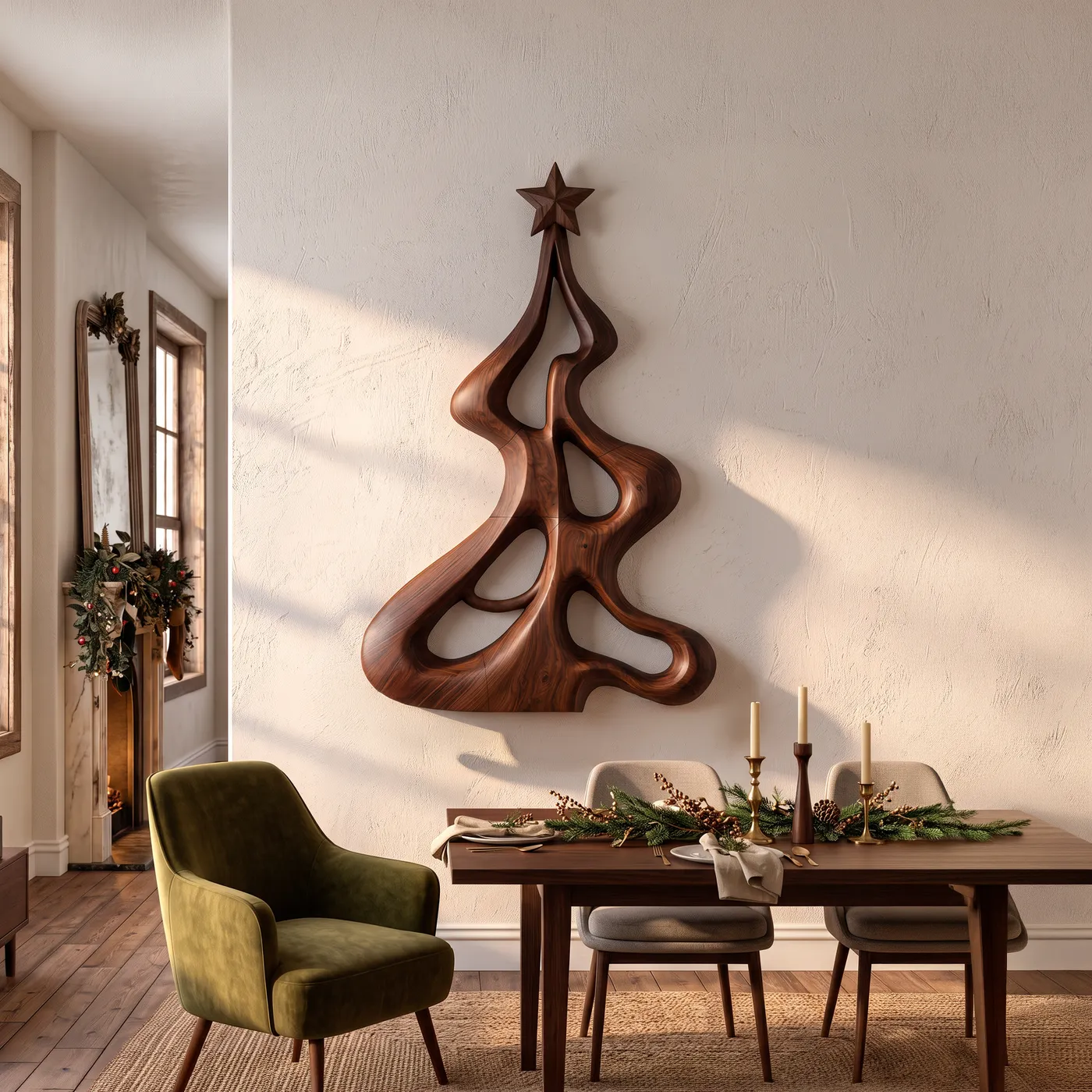
Rule of thumb for wall-mounted tree art: about two-thirds the width of the table beneath it. A 60-inch table wants artwork 36 to 42 inches wide, hung so the lowest branch tip lands 30 to 36 inches above the tabletop. The room itself needs at least 10 by 12 feet to fit a table, four chairs, and an accent chair without shrinking the walkway below 24 inches.
12. Red Berry Sprays and a Stained Panel Collar
- 7.5 ft artificial tree: $120–$350
- Warm white string lights, 600–800 count: $25–$60
- Mixed colorful ornaments, 100-piece sets: $45–$120
- Red berry sprays, six to eight stems: $20–$45
- Stained wood panel collar: $40–$180
- Star tree topper: $15–$40
- Total: $265–$795
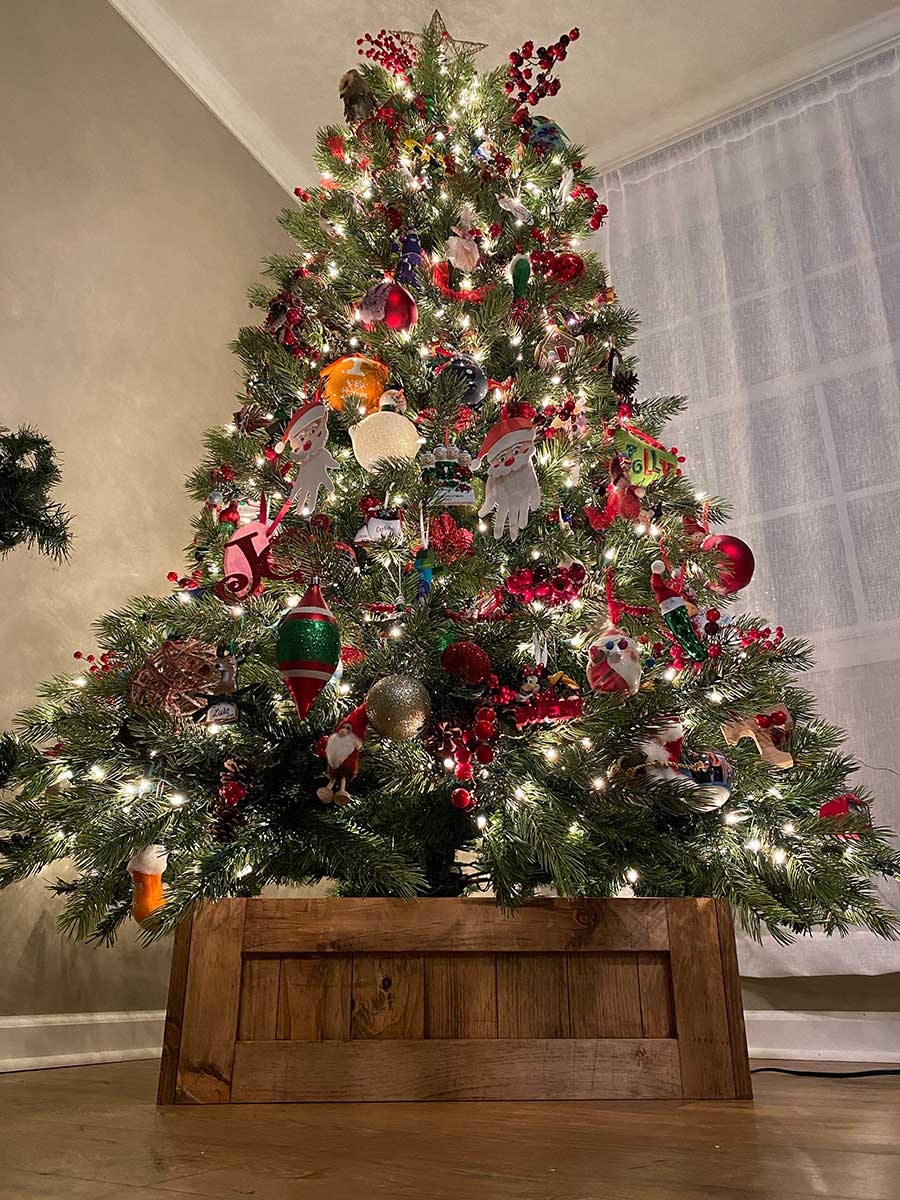
For less: a thrifted tree at $60, two Walmart light strands at $8 each, and a collar built from a $12 stained crate panel lands near $120.
Spread ornaments by proportion, not by eye. Aim for roughly 60% solid color balls, 30% textured or natural pieces like berries and pinecones, and 10% high-shine glass or glitter. Hang the largest ornaments on the lowest third, where branches are strongest and the widest spread fills the silhouette, and save small pieces for the top. Then step back and look for dark holes — those get an ornament, not the front of the tree.
13. A Gray Fabric Collar With Leaping Reindeer
Make this collar in about two hours for roughly $25.
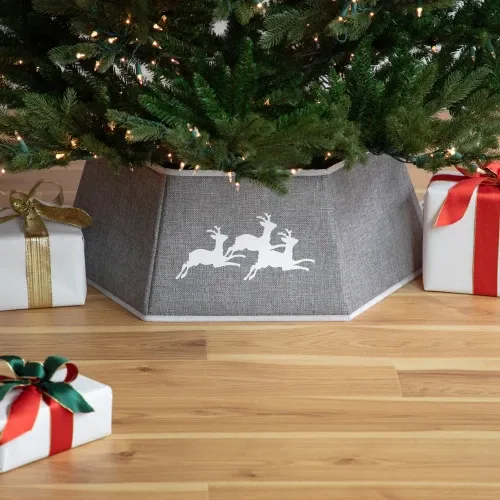
- Cut six 14×20-inch panels from heavy chipboard or foam core.
- Wrap each panel in gray textured fabric, keeping the weave straight before hot-gluing the back.
- Tape the panels into a hexagon along the inside seams so the joins stay invisible.
- Cut a reindeer silhouette from adhesive white vinyl and press it onto the front panel.
- Slide it around the base — it should sit flush on the floor with no gaps at the bottom edge.
The white reindeer silhouette is the entire personality of this piece. Without it you have a perfectly nice gray hexagon; with it you have reindeer vaulting across a felted snowfield. The detail works because it’s flat, single-color, and slightly oversized — three leaping shapes instead of one big motif, which keeps the scale friendly next to a full tree.
14. A Whitewashed Wood Tree Behind a Crate of Gifts
This is one of the cheapest looks in the whole article to fake. Trace a simple tree silhouette onto scrap plywood, cut it out, and paint with two coats of thinned white — about $18 in materials and an afternoon. Thrift stores sell slatted wood crates for $5 to $10, and kraft paper plus a roll of burlap ribbon is $12 at Walmart. Skip the boutique “handmade” listings at $120 and up.
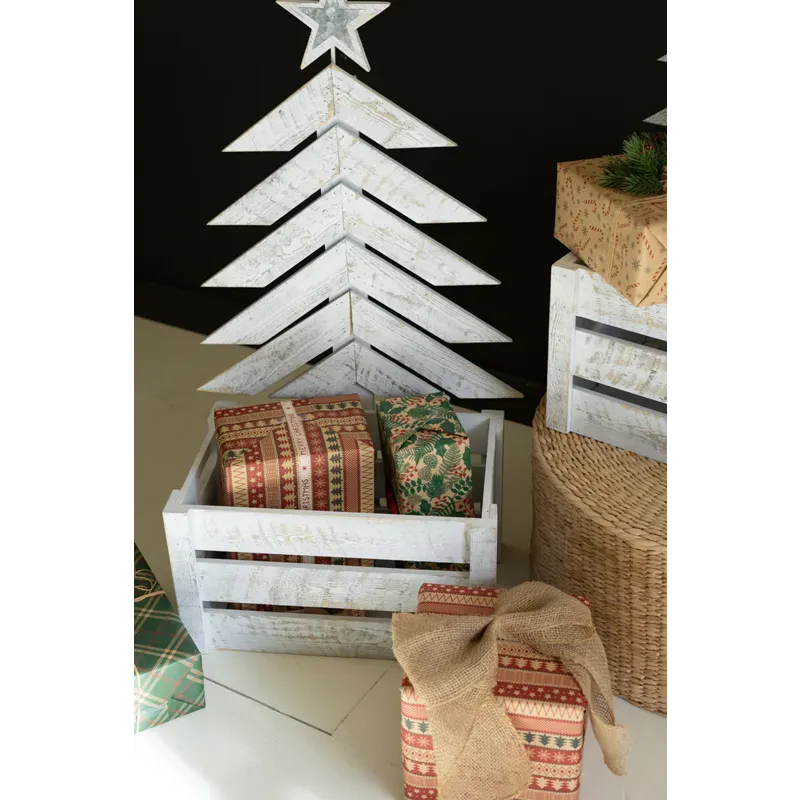
Distressed and whitewashed finishes chip, and they chip exactly where you grab them. Keep the sculpture out of high-traffic paths, touch it up with a craft brush once a year, and don’t set it flush against a painted wall — the wood can transfer marks. Kraft paper wrinkles after a season, so store the ribbon flat and re-wrap next year instead of trying to iron creases out.
15. Dried Orange Slices and Burlap, No Red Anywhere
About 50% deep green foliage, 30% tan and aged white from burlap and weathered star ornaments, and 20% golden orange from the dried citrus. Zero red, which is the whole point — the orange does the color work instead. Swap dried citrus for dried pomegranate halves and the palette warms toward burgundy; swap in dried limes and it cools toward olive.
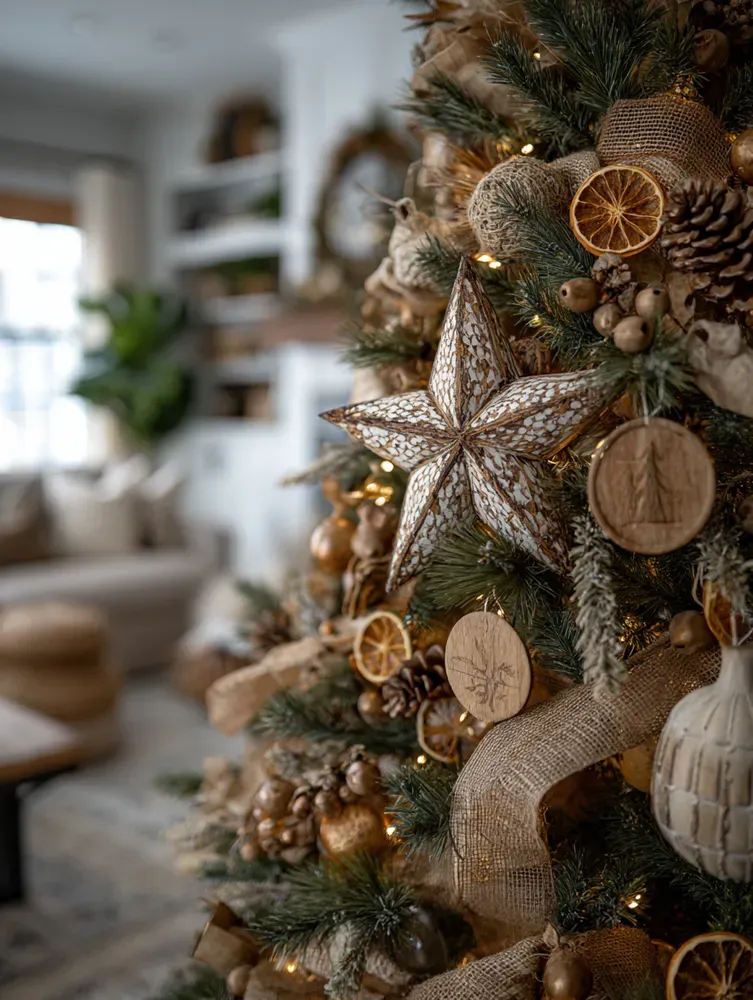
Slice oranges an eighth of an inch thick and dry them at 200°F for about three hours, flipping once, until they’re leathery rather than brittle. Thread them with clear fishing line rather than ribbon so they hang flat and don’t spin. One more thing: dried slices darken over the season, so hang the brightest ones at the front of the tree where room light hits them.
16. Felted Animals and a Real Pinecone Garland
What makes this tree feel collected instead of themed is the texture mix: matte pinecones and felted animals against shiny glass baubles, with translucent snowflakes adding a third finish that catches the lights. The animal ornaments also sit at eye level, where kids and guests actually look, while the top and bottom thirds stay quieter. For the same collected feeling with zero shedding, the weathered metal pinecones in Idea #7 do the job beautifully.
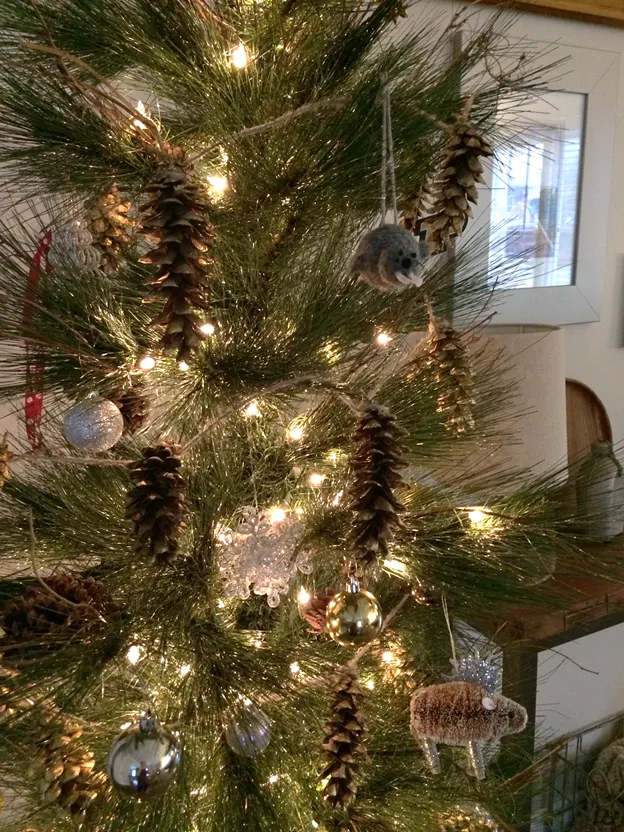
Natural pinecones carry sap, seeds, and occasionally small hitchhikers. Bake them on a foil-lined sheet at 200°F for about an hour, let them cool, then brush off loose debris before they touch a tree or garland. Skip that step and you’ll get sticky spots on branches plus a faint rain of pinecone scales every time someone walks past.
17. Cardinals, Frosted Berries, and a Red Bow
The red truck has been a holiday staple long enough to count as tradition, but 2026’s version is quieter: fewer props, more greenery, and the cardinal doing most of the talking. That restraint is exactly why it keeps working while louder holiday trends cycle out. It travels well, too — the same wreath works on a porch, a barn door, or the side of an actual vintage truck.
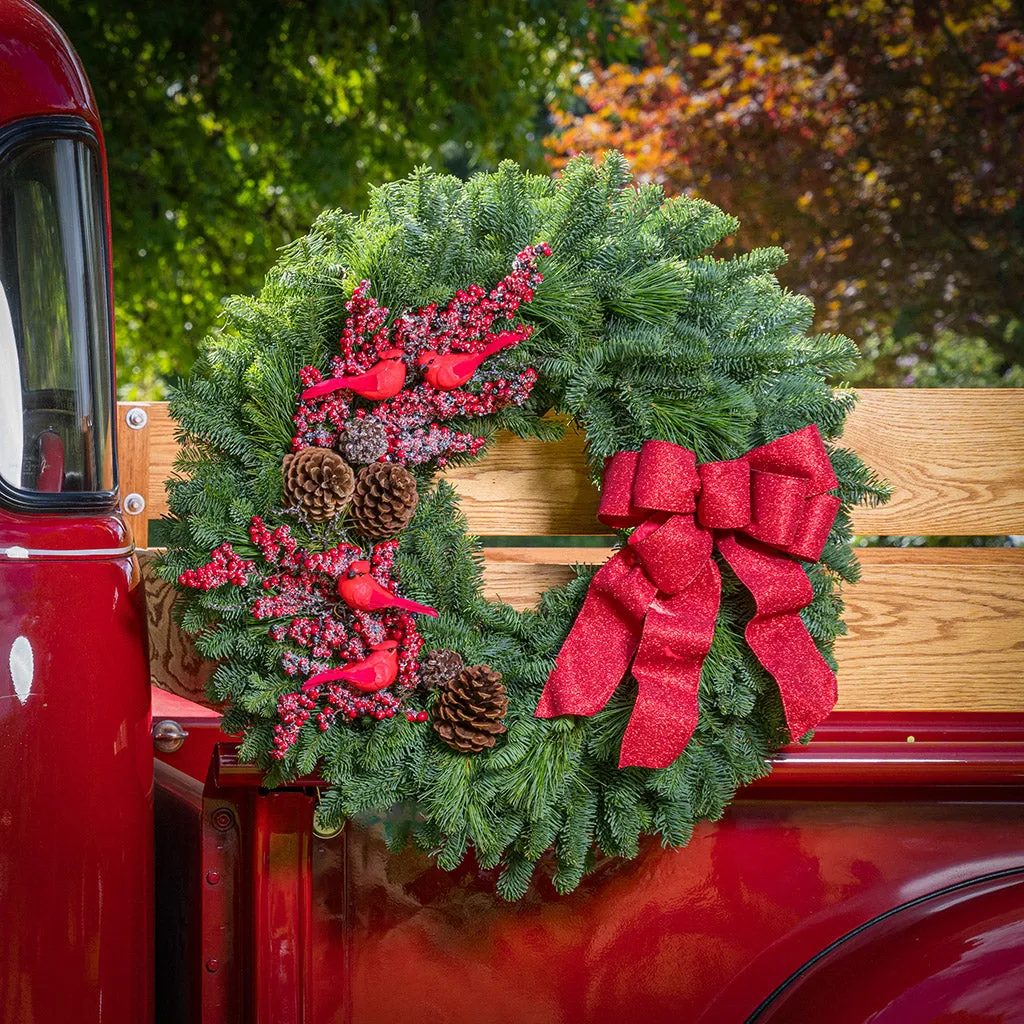
- Measure the mounting surface first — most wreaths of this style run 24 to 30 inches across and need solid wood to anchor into.
- Match your reds. A crimson bow beside orange-red berries will look muddy in daylight.
- Check that the cardinals and berries are wired on, not just glued, if the wreath lives anywhere with wind.
- If it’s going indoors, confirm the ribbon has no loose glitter that will drift onto furniture.
18. Frosted Pinecones and Berries in a Twig Frame
Arrangements this dense read best in three sizes: a 6- to 8-inch twig ring for a shelf or mantel top, a 12-inch version as a dining table centerpiece, and a 20-inch-plus cluster in a floor urn for an entry. For a console 30 inches high and 48 inches wide, keep the arrangement under 22 inches tall so it doesn’t block the mirror behind it. Narrow entries should borrow the flat-hanging trick from Idea #2 instead of using a dimensional piece.
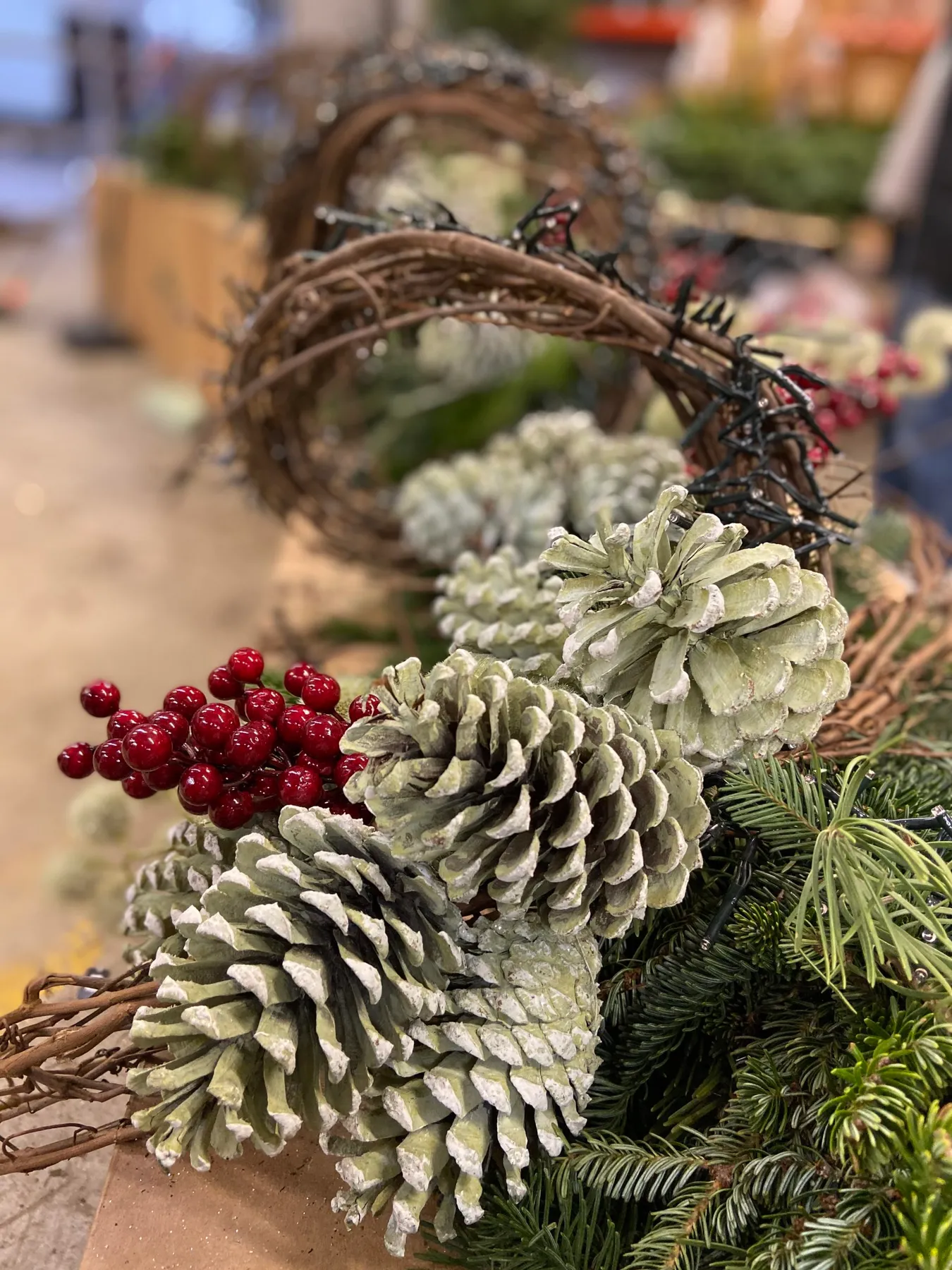
Frosted pinecones shed their finish. Handle them once, place them once, and leave them alone; every touch flakes a little more white onto the table. Artificial berries fade toward pink in direct sun within a season, so keep this away from a south-facing window. Expect to replace the twig frame every few years — it dries out and starts snapping after a couple of winters in a heated room.
19. Pinecones in Three Sizes on a Shiplap Wall
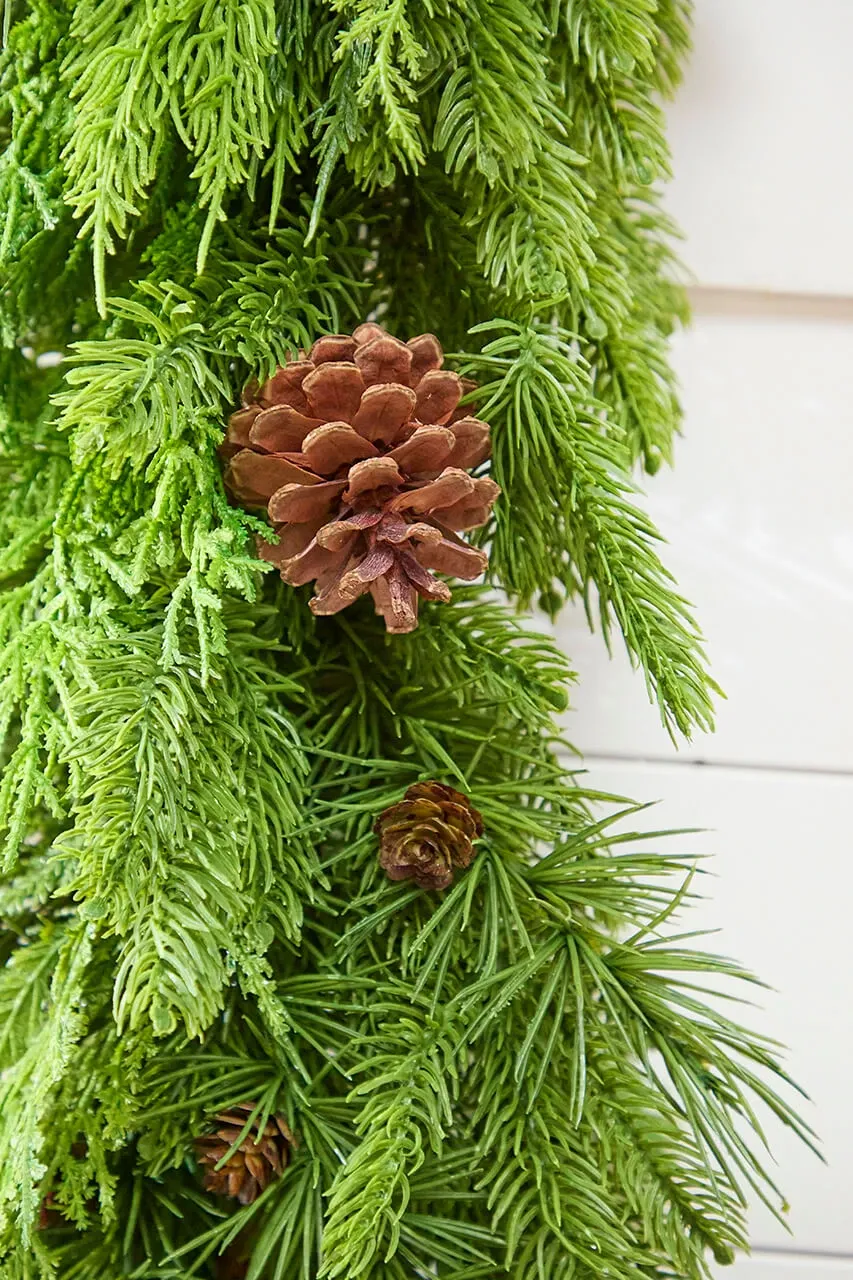
The single detail that sells this garland is the mix of pinecone sizes — small, medium, and large clustered together instead of one uniform size spaced evenly. A single-size garland always looks manufactured, no matter how full the greenery is. Three sizes create a natural hierarchy, and the eye reads the whole thing as something that fell off a tree in your yard rather than something that shipped in a box.
- 9 ft artificial pine garland: $25–$70
- Second garland to double up for depth: $25–$70
- Bag of assorted pinecones: $8–$20
- 22-gauge floral wire and adhesive hooks: $7–$15
- Total: $65–$175
Fluff the garland before it goes up: separate every branch tip by hand, working from the middle outward, which can nearly double its apparent volume. Wire pinecones in clusters of three to five, wrapping the wire around the cone’s base rather than its scales so the cones stay intact. Attach them near the back and let the clusters tilt forward — that’s what creates the depth you see in styled photos.
20. Hand-Crocheted Teal Pinecones for the Tree
About 25 minutes per ornament and $3 in yarn once you find the rhythm.
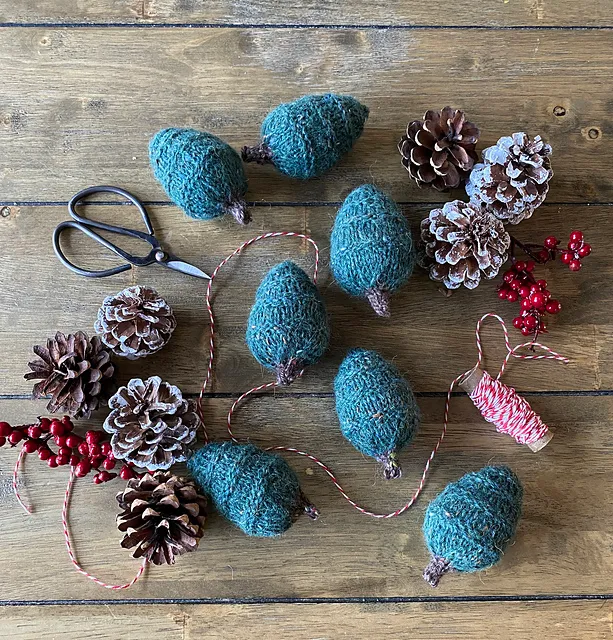
- Work a magic ring of six single crochet with a 3.5mm hook and worsted cotton.
- Increase in a spiral until you have 18 stitches — that’s your pinecone’s widest point.
- Alternate one single crochet with a chain-three picot to build the scale texture.
- Stuff lightly with poly-fill, then decrease back down to six and pull the ring closed.
- Add a baker’s twine loop at the top, tied tight so it hangs straight.
Etsy sellers charge $28 to $45 for a set of six, which is fair for handmade work but adds up fast on a big tree. Yarn is about $3.50 a skein at Walmart or Michaels and makes roughly four ornaments, so a dozen costs you $12 plus an evening. If crochet isn’t your thing, the felted and bottle-brush animals in Idea #16 get you the same handmade feeling with a glue gun.
When teal enters a rustic palette, it needs a job. Here it’s roughly 55% forest green foliage, 25% warm wood from the plank surface and natural pinecones, 12% teal in the ornaments, and 8% red from berry stems and twine. Keep teal at a tenth or less and it reads as an accent; push past a quarter and the whole tree turns coastal instead of rustic.
Bring the Woods Indoors (Without the Shedding)
Rustic doesn’t mean fussy — it means texture you can identify, colors that came from somewhere real, and a tree that looks like it belongs to your house instead of a catalog page. Start with one idea here, get that corner right, and the rest usually follows on its own.
📌 Save this to Pinterest before you head to the store — next December you’ll be glad you did.