30+ Dreamy Blue and White Christmas Tree Ideas That Will Elevate Your 2026 Holiday Decor

Most blue and white Christmas trees fail for the same boring reason: people buy one shade of blue and expect it to carry an entire room. It never does. We went deep into Target, World Market, Etsy, and HomeGoods — plus a few estate sales and dollar-store aisles — and narrowed hundreds of options down to 30 ideas that actually deliver, from about $8 for a bag of shatterproof baubles to $975 for a fully styled tree with a gold convex mirror.
Inside you’ll find frosted and flocked trees, chinoiserie porcelain in full Delft glory, jewel-toned velvet ribbon, coastal turquoise glass, and a handful of one-ornament vignettes that cost less than lunch. Budget and luxury versions sit side by side, and every idea is shoppable with the exact pieces shown.
Blue-and-white holiday styling is surging on Pinterest right now, driven by the same porcelain-and-velvet maximalism that took over interiors this year. And stay until the end — we break down the most common mistakes that can ruin these looks. 📌 Save this to Pinterest for later — you’ll want to revisit these ideas.
1. Blue String Lights and Gold Stars at Night
Blue light doesn’t just decorate a tree — it flattens it into a single glowing silhouette, which is exactly why this one reads from half a block away. The dense wrap of string lights means there are no dark gaps breaking up the cone, and the scattered gold and white stars sit on top of that blue wash like confetti. Notice the star motif repeating from the ground-level lights all the way up to the starburst topper. Repetition is doing the heavy lifting; nothing else is competing for attention.
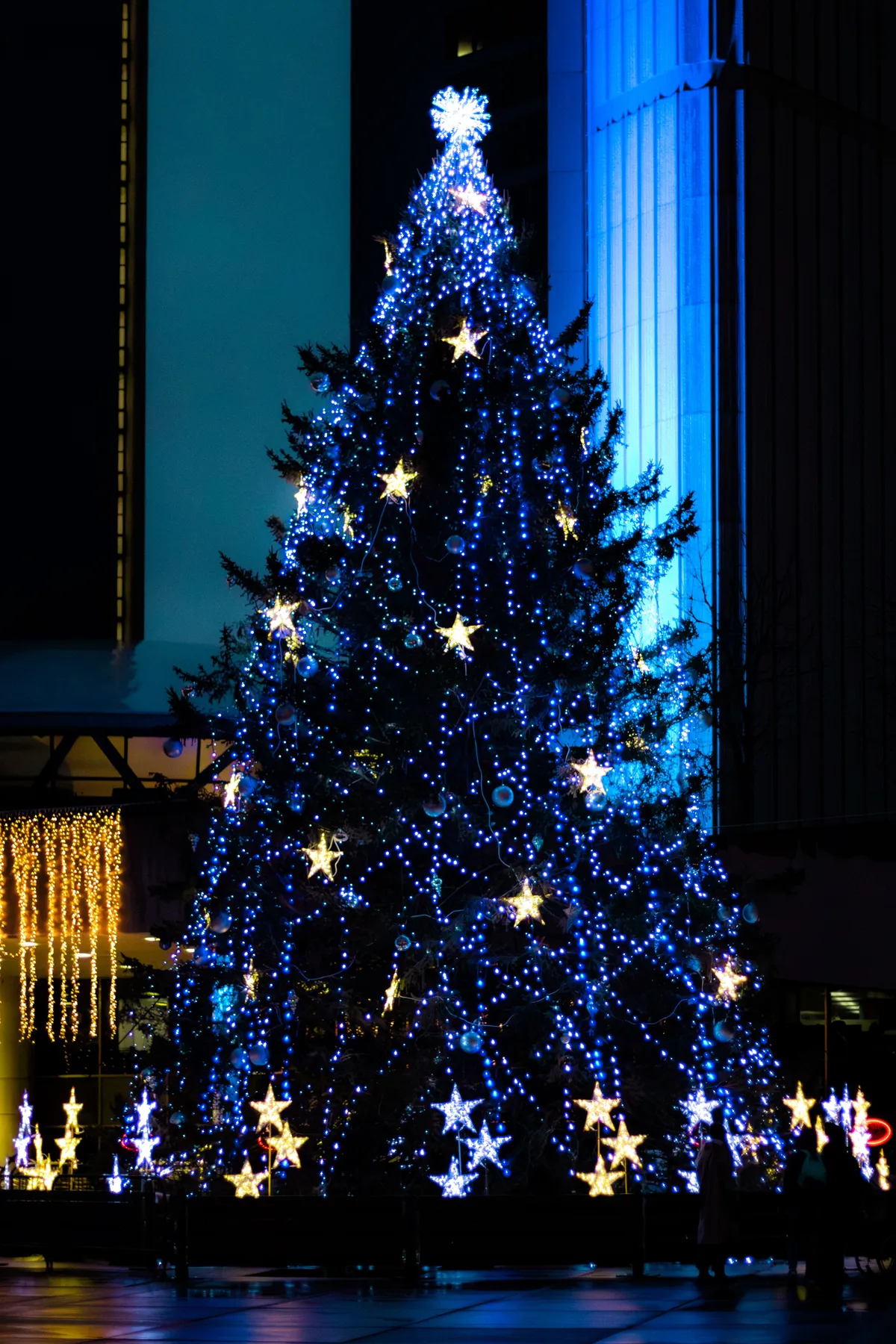
Cool-toned holiday lighting has been creeping up on Pinterest for a few seasons, and 2026 is the year it fully takes over the winter night. Part of it is photography — blue lights photograph beautifully against dark skies without blowing out. Part of it is the “blue hour” aesthetic that’s dominated mood boards since 2024. Expect this to hold for a while. Icicle white had its decade; blue is the moodier, more modern choice.
2. Handpainted Ginger Jar Ornament in Blue and White
The painted green wreath is the detail that makes this ornament feel collected rather than bought. Anyone can find a blue-and-white bauble; the little hand-painted wreath sitting inside the botanical pattern is what tells you a person made a decision. Strip it away and you’re left with something pretty but anonymous. Keep it, and the ceramic body suddenly reads like a tiny piece of transferware you’d spot in a Charleston antique shop.
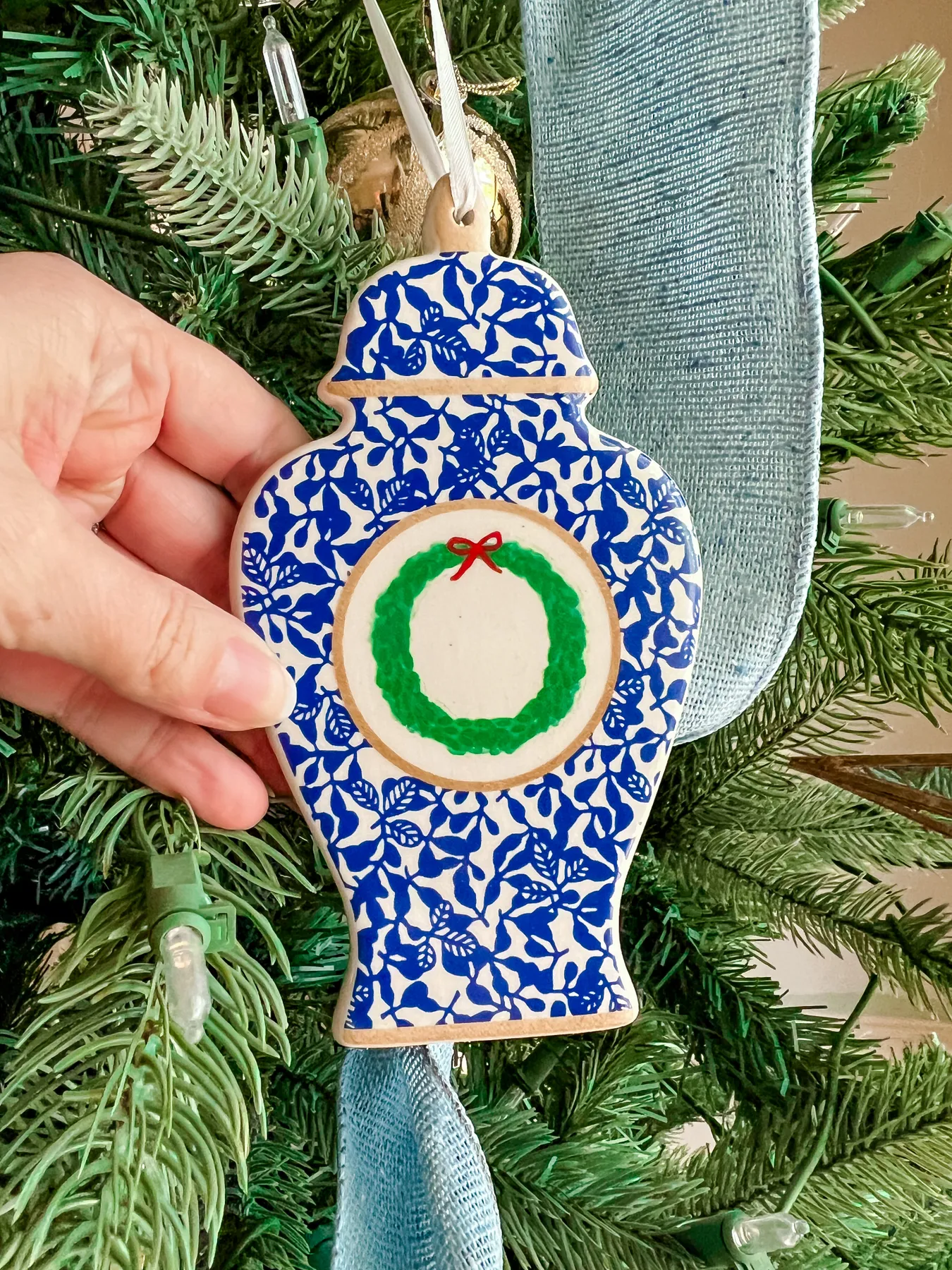
A ginger jar ornament needs breathing room, so resist the urge to cluster five together.
- Pick a branch section roughly at eye level — around 5 to 5.5 feet up on a 7-foot tree.
- Hang the ginger jar first, on a 4-inch white ribbon so the shape isn’t buried in needles.
- Add a wide, textured light blue ribbon behind it, running vertically for about 18 inches.
- Place one plain white or glass ornament 6 inches to the side — never directly beside it.
- Step back 8 feet and check that the pattern still reads.
Time: about 15 minutes. Materials: roughly $12–$20 per ornament, plus $6 for ribbon.
3. Royal Blue and Gold Baubles Over a White Mantel
- Green tree, 7.5 ft: $150–$420
- Royal blue and gold ornaments, 80–100 pieces: $120–$350
- Warm white string lights: $40–$90
- Lit star topper: $30–$70
- Ribbon, skirt or patterned rug: $40–$130
- Blue wrapping paper and gold ribbon: $25–$55
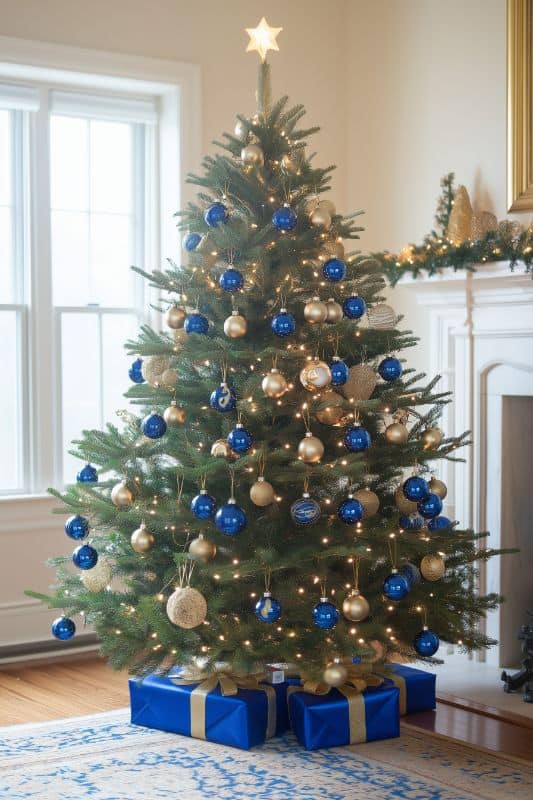
Hang ornaments on the outer third of each branch, never pressed against the trunk. On a 7-foot tree that means the last 4 inches of every tip — that’s where light actually reaches them, and it makes the tree look a full size bigger. For the blue-to-gold ratio, aim for roughly 70 percent blue and 30 percent gold. Gold is louder per piece, so a little goes a long way.
4. Navy Ginger Jar Ornament With White Holly and Gold
The formula here is 55 percent evergreen green, 35 percent blue and white, 10 percent gold. That last 10 percent is the gold striping on the ornament and the thin metallic detailing — remove it and the whole thing goes flat and cold. You can swap the holly pattern for any blue-and-white motif and the math still works. Just keep the gold at a whisper. Two ornaments with visible gold trim per ten blue-and-white pieces is the sweet spot.
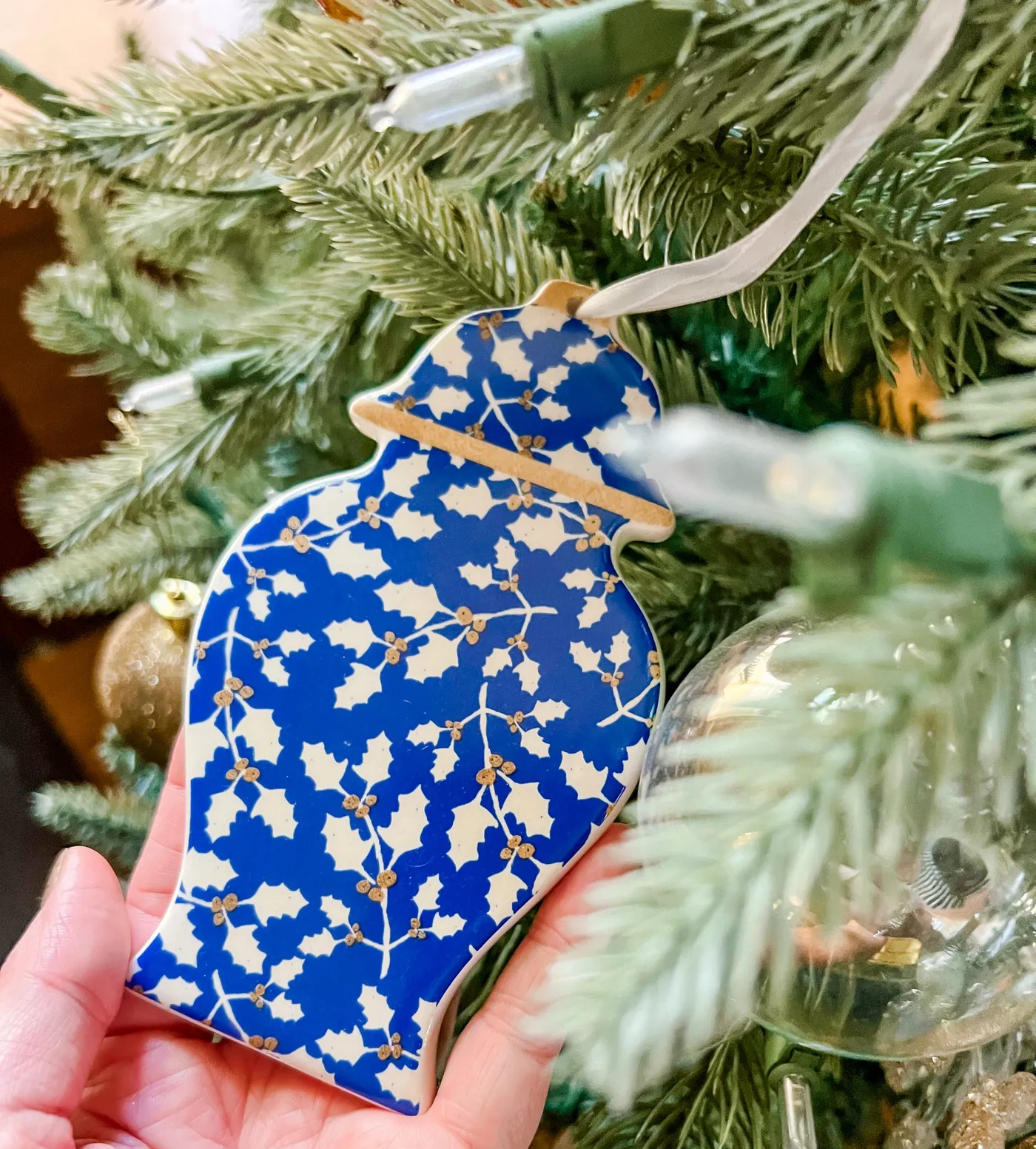
Flat ceramic ornaments look gorgeous head-on and nearly invisible from the side. If your tree gets walked past rather than looked at, pair them with round baubles so the branches never read as empty. Also worth knowing: a ginger jar ornament weighs two to three times a standard glass ball. Skip the wire hooks and use ribbon loops wide enough to sit on a sturdy branch, or you’ll find them on the floor by New Year’s.
5. A Multi-Story Tree With Oversized Metallic Baubles
This look needs altitude. A tree this size — call it 18 to 25 feet — wants a room with at least a 24-foot ceiling, which is why it lives in atriums and hotel lobbies. Scale the idea down honestly: for every 3 feet of tree, you want 1 inch of ornament, so a 9-foot tree gets 3-inch balls and a 6-foot tree gets 2-inch ones. Squeezing 4-inch ornaments onto a 7-foot tree is the fastest way to make a room look small. Compare with Idea #13, where a flocked tree pulls off the same palette at human scale.
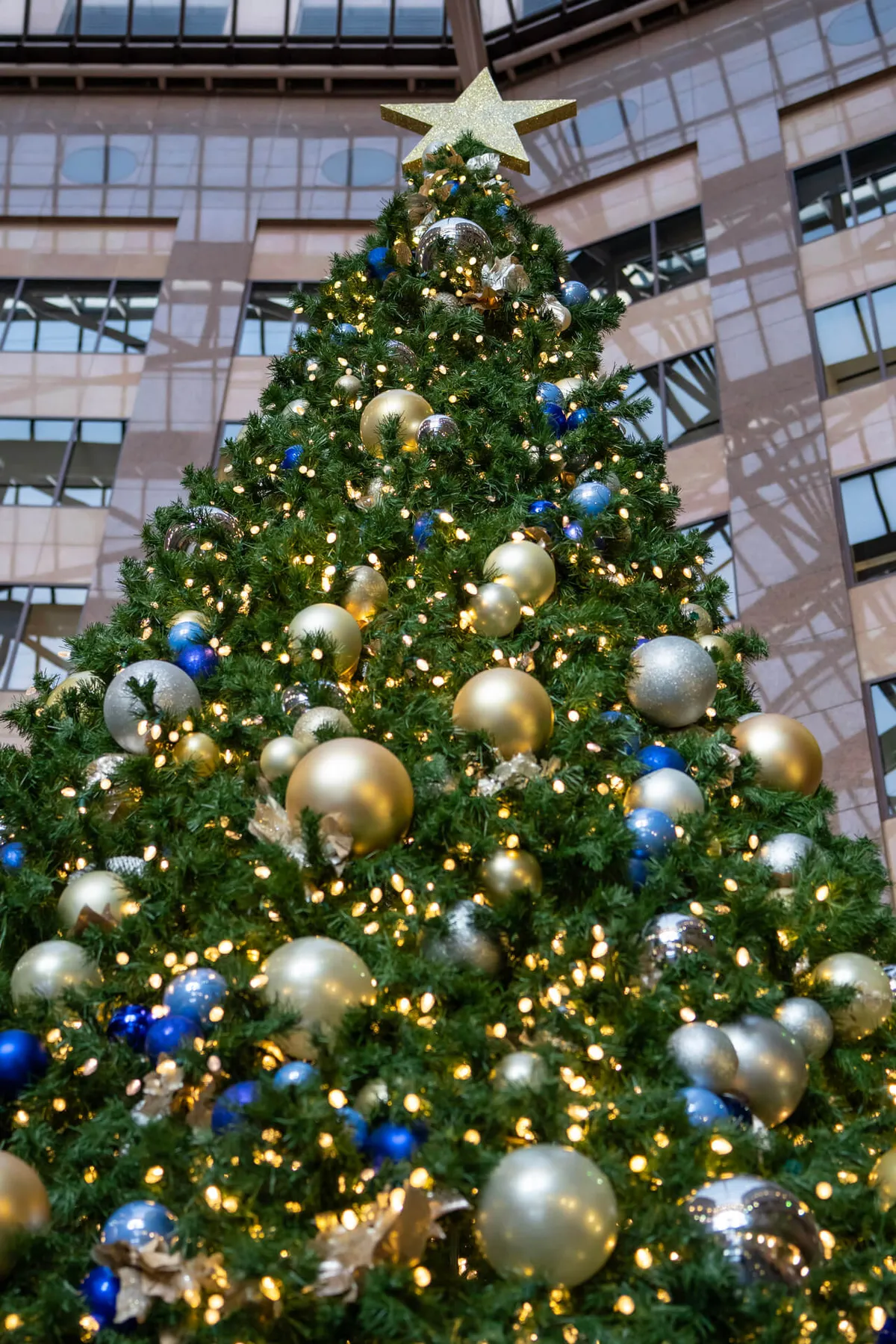
Oversized ornaments are deceptively high-maintenance. Metallic finishes scratch, and once the coating is scuffed you can’t buff it out — store them in individual tissue wraps, not one big bin. Expect to replace 10 to 15 percent of a large set every three years if you’re packing them yourself. Glass is beautiful but brittle; on a tree this tall, shatterproof plastic reads identically from below and saves a fortune.
6. Delft Porcelain Bells With Gold Feather Garland
Gold mesh ribbon needs to be tucked, not spiraled. Run it in vertical cascades of about 2 feet, pressed into the branches so only the front half shows, then anchor each end with a cluster of three ornaments. A feather-and-leaf garland works the same way — let it look like it grew there. If a strand hangs loose and perfectly even, the whole tree starts reading like a craft store display instead of something collected over years.
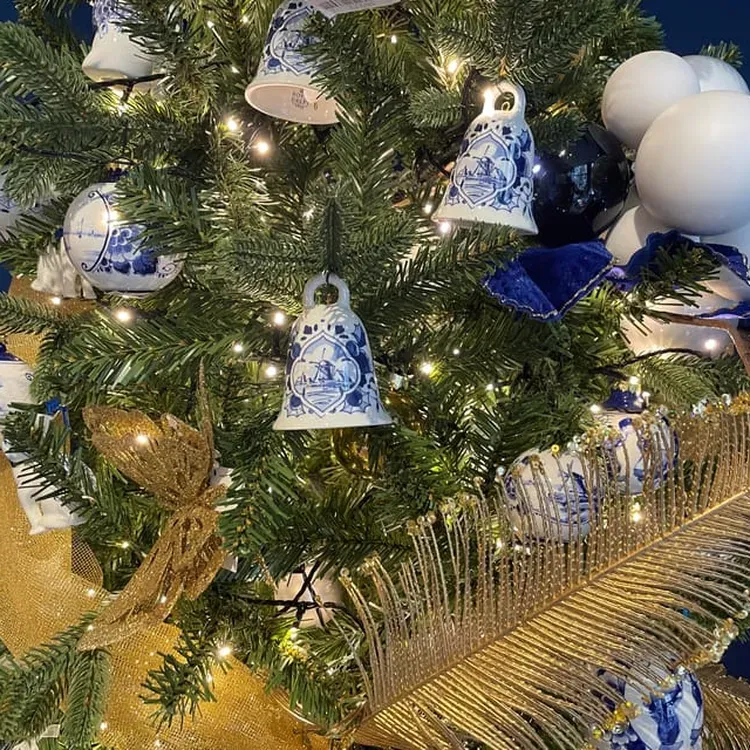
Real Delft ornaments run $25 to $60 each. You can build the same story for a fraction of that: hunt estate sales and Facebook Marketplace for chipped blue-and-white teacups, then hang the saucers with ribbon loops. Thrift stores regularly have blue-and-white transferware plates for $3 to $6. Target and World Market both carry porcelain-look blue-and-white ball ornaments in sets of four for around $15. Nobody inspecting your tree from a normal distance will know.
7. The All-Blue Tree Lit Only With Warm White
Two things are happening here. First, the tree is the ornament — a deep blue tree with almost nothing on it stays elegant because there’s no second color fighting the blue. Second, the lights are warm white, not cool. That’s the counterintuitive part: a cool-toned tree actually needs warm light to look intentional rather than accidental. Swap in blue LEDs and the whole thing goes icy and cheap. Warm white against deep blue is the entire trick.
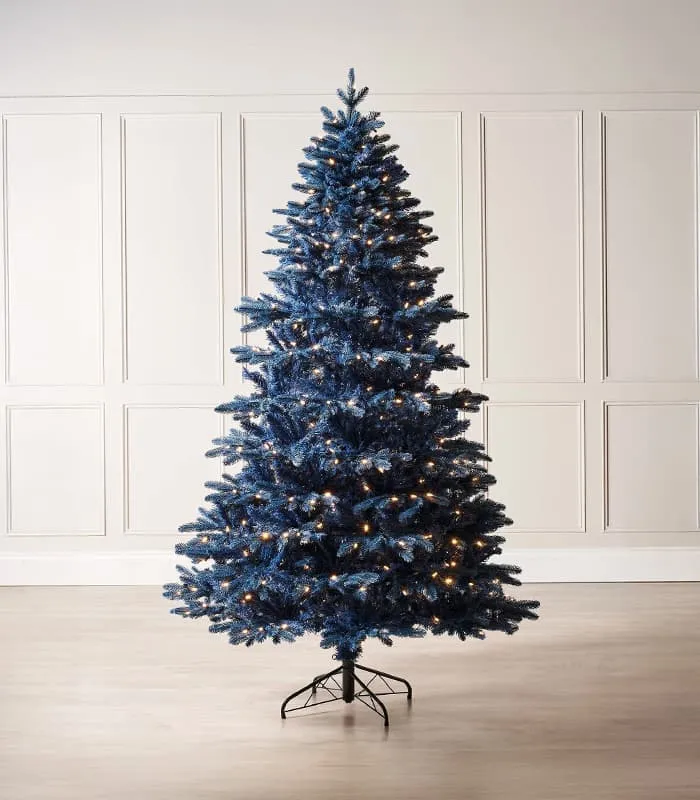
- Measure your ceiling height and buy a tree at least 6 inches shorter — blue needles show every gap near the ceiling.
- Check the wall behind it. Deep blue needs a light or cream backdrop; against a dark navy wall it disappears.
- Confirm outlet placement before you commit to a spot, then hide the cord with a cord cover or a gift box.
- Set the stand on a felt pad. Tinted artificial trees can shed color onto light wood flooring.
8. Turquoise, Aqua and Iridescent Glass on Evergreen
Think of this as a gradient, not a color scheme: 50 percent evergreen, 30 percent mid-tone turquoise, 15 percent pale aqua, 5 percent silver. Hang the deepest blues in the interior of the tree and let the palest aqua sit at the tips — the tree ends up looking lit from within. To swap it, keep the same gradient logic with blush, champagne, and rose gold and the structure still holds. The percentages barely change.
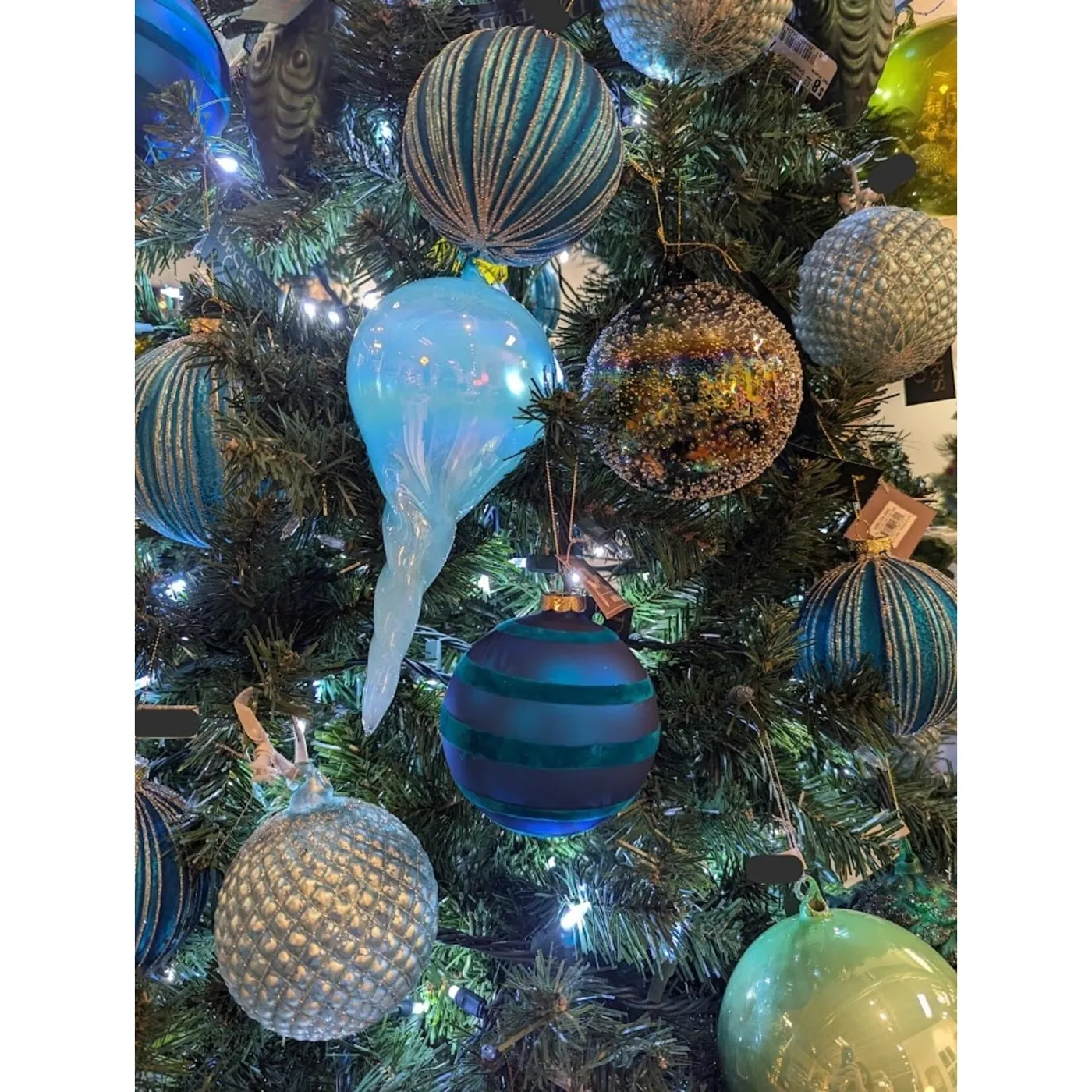
If you removed everything but the iridescent icicle drop, the tree would still work. That single elongated piece breaks the rhythm of round baubles, which is what keeps a monochrome tree from looking like a bin of sports balls. One or two long drops per tree, hung slightly lower than everything else, is the difference between “nice” and “collected.” Look for handmade glass icicles — they catch light at angles round ornaments simply can’t.
9. Blue Lights, Silver Balls and a Steel Atrium
Commercial trees like this run 30 to 45 feet, and everything scales with them: 8-inch ornaments, 4-inch-wide ribbon, lights spaced no more than 4 inches apart. The translate-down rule is roughly one-third — take your tree’s height in feet, multiply by 0.33, and that’s your ornament diameter in inches. A 9-footer gets 3-inch balls; a 12-footer gets 4-inch. Compare with Idea #24, where the same blue gets contained inside a single bauble instead.
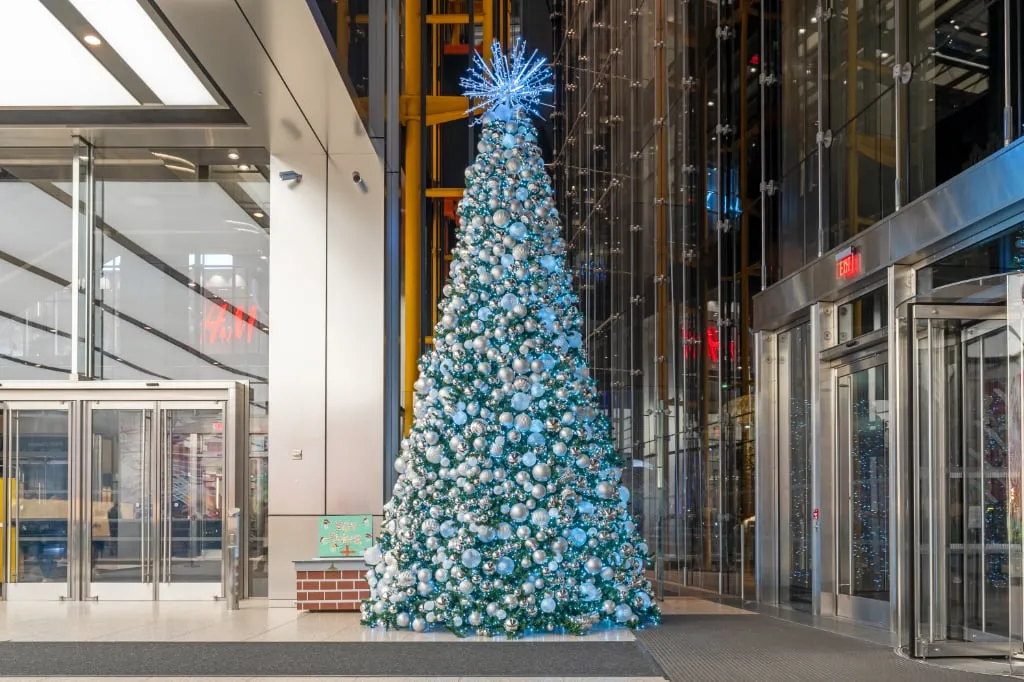
Corporate atriums have quietly become the trend lab for home trees. What gets installed in a hotel lobby in November shows up on Pinterest by December and in living rooms the following year — oversized baubles and blue light washes both followed that exact path. Silver and blue together also read as “winter” rather than “holiday,” which is why the combination lingers past December 25 and still works in a neutral January room.
10. Matte Blue Bauble Styled With Eucalyptus and Gold
- Start with a round tray or cake stand — anything that creates a boundary, about 12 inches across.
- Set the matte blue ornament slightly off-center, resting on a small ring or a folded cloth.
- Lay two eucalyptus sprigs at opposing angles so they cross behind the bauble, not in front.
- Add three small white star figurines at different depths — one close, two further back.
- Scatter gold beads in a loose arc, then stop. Tidy clusters look staged; a loose arc looks collected.
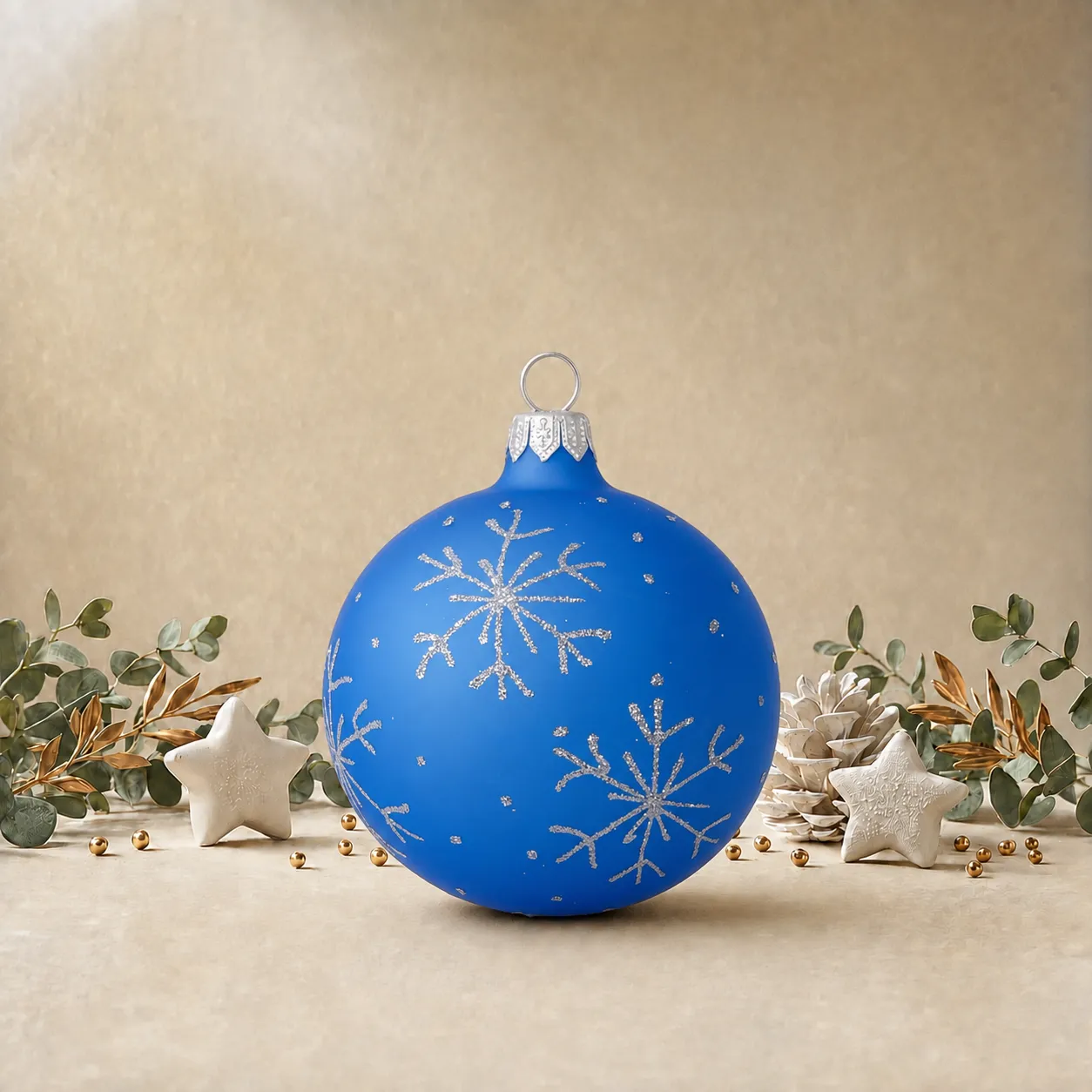
Budget: $30–$60 in materials, about 20 minutes of arranging.
Keep matte finishes to about a third of your ornaments. Matte absorbs light, gloss throws it, and a tree with all-matte ornaments reads flat and dusty from across the room. On a 60-ornament tree, that’s roughly 20 matte pieces — enough to add texture without dulling the glow. Always pair a matte bauble with something reflective nearby, the way this vignette sets matte blue against glitter-covered leaves.
11. Blue and White Toile Ornaments With Oversized Poinsettias
- Blue and white toile-pattern ornaments, 12–18: $60–$180
- Oversized faux poinsettias in white and champagne, 10–14: $50–$140
- Gold and white striped ribbon, 3 rolls: $24–$45
- Warm string lights, 300-count: $25–$50
- Gold convex wall mirror: $90–$400
- Blue and white ceramic vase: $40–$160
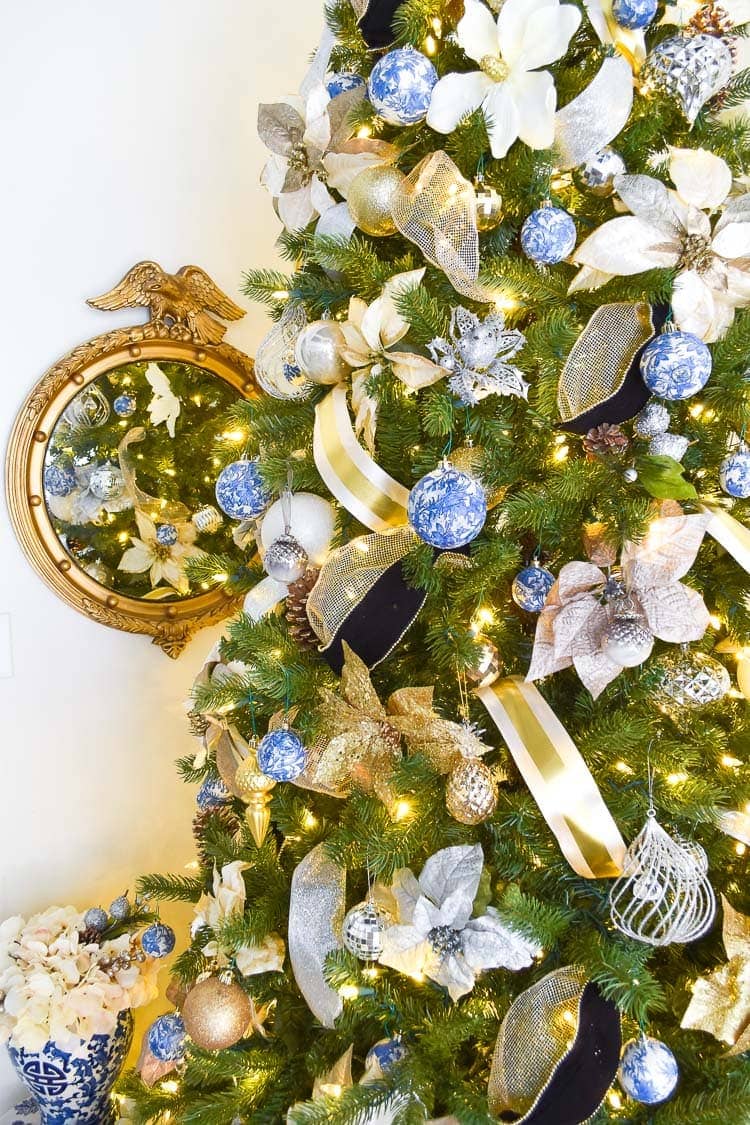
The oversized poinsettias are what make a densely decorated tree feel airy instead of cluttered — they’re big enough to register as shapes rather than details. The toile ornaments handle the storytelling, and the gold-striped ribbon repeats the gold of the mirror, which visually doubles the light in the room. Three elements, three jobs. Most cluttered trees are just doing the same job three times.
12. Blue Floral Ornaments Finished With White Satin Bows
The satin bow is the whole personality. Blue floral ornaments on their own are pretty but a little cold — the bow adds a soft, matte counterpoint that takes maybe four seconds to tie and changes everything. What you’d lose without it is warmth. What you’d also lose is scale: a 4-inch ornament with a 3-inch bow suddenly reads as a much larger piece, which means you need fewer of them to fill a branch.
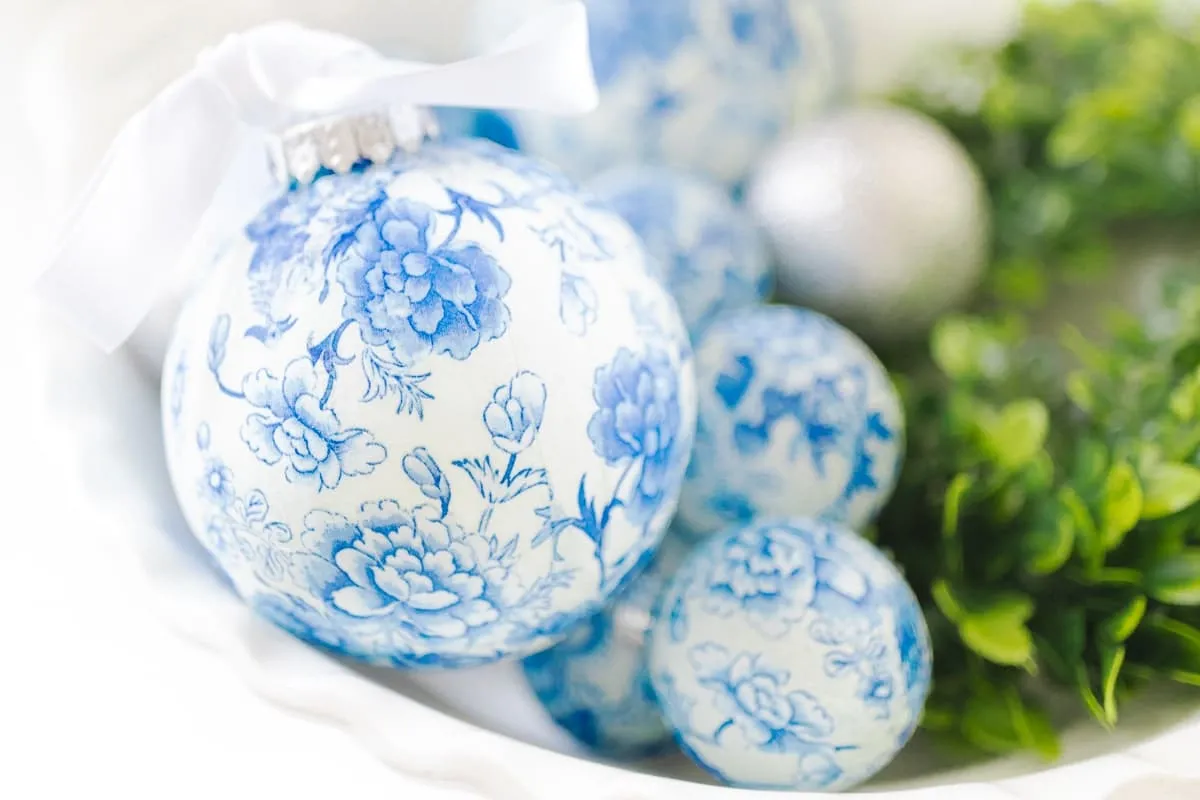
Satin creases. If you store bows crushed in a bin, they’ll come out looking tired by the second season — wrap each one around a cardboard tube, or hang the whole ornament with the bow attached inside an ornament box. White satin also yellows with age and heat. If your tree sits near a vent or radiator, switch to matte white velvet ribbon instead. It holds its shape and won’t discolor over the years.
13. A Flocked Tree With Pale Blue and Gold Wrapping
Flocking sheds. Every time you move the tree, assemble it, or brush past a branch, tiny white particles end up on the floor — expect to vacuum twice during setup week. Flocked trees also can’t live in a hot attic; the coating softens and clumps. A cool, dry basement or closet is non-negotiable. If you love the look but not the cleanup, a plain white artificial tree with a light snow spray gives you 80 percent of the effect with far less shedding.
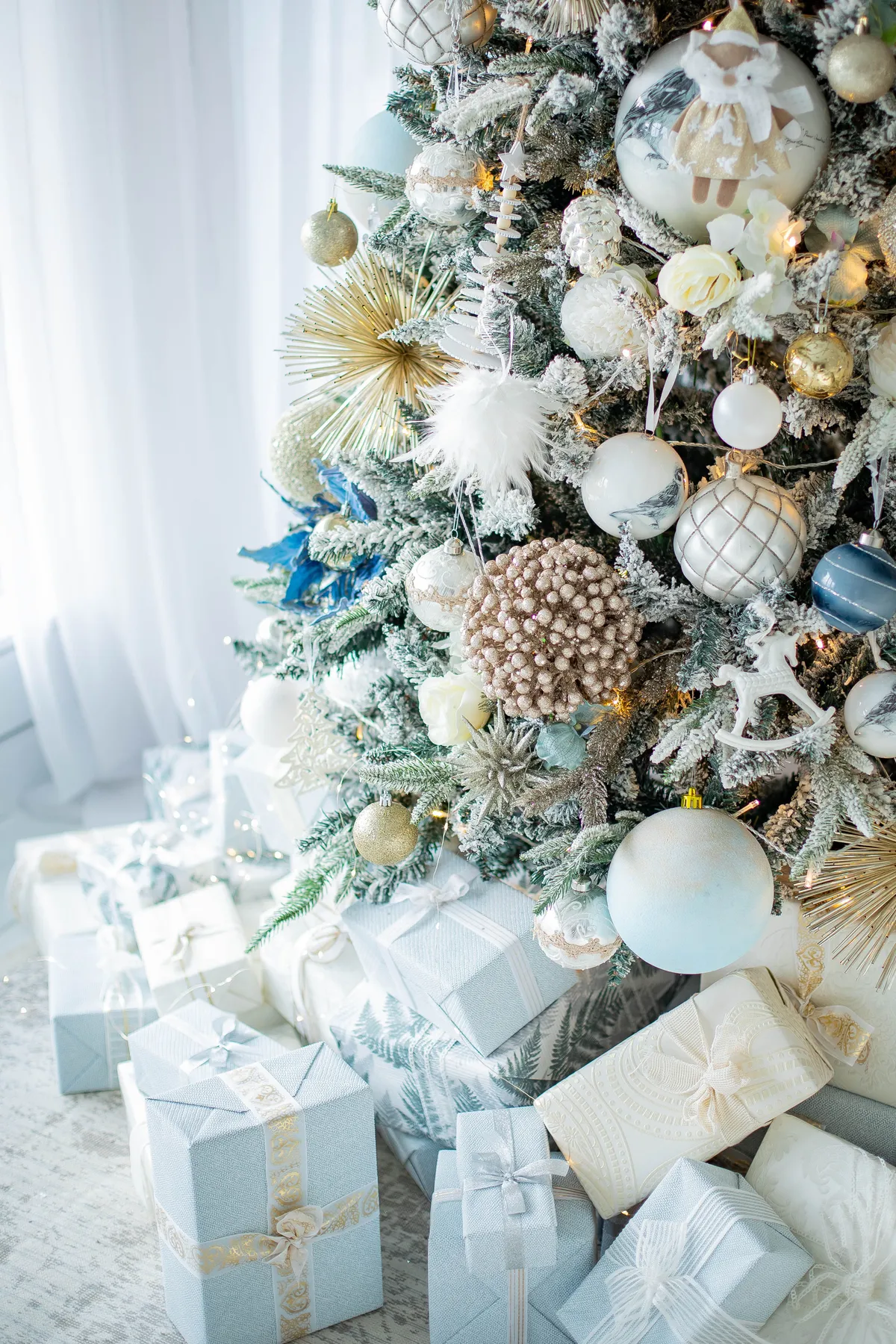
Flocked trees cost 30 to 50 percent more than plain ones, and pre-lit versions can run past $600. The workaround: buy an inexpensive unlit green tree and a $25 flocking kit, then spray only the outer 4 inches of each branch. You get the snow-dusted look for under $200 total. For wrapping, skip patterned paper and use plain white kraft with a light blue velvet ribbon — same effect, half the price, and honestly it looks more collected.
14. Deep Blue Baubles on a Heavily Frosted Tree
Frosted branches eat contrast, so go one shade darker than you think you need. A royal blue that looks rich against green needles will read as pale gray-blue on a heavily flocked tree. Bring a branch sample with you when you shop, or order one test ornament first. Then hang floral picks 8 to 10 inches apart, angled outward and slightly up — picks pointing straight down look like they fell there and never got fixed.
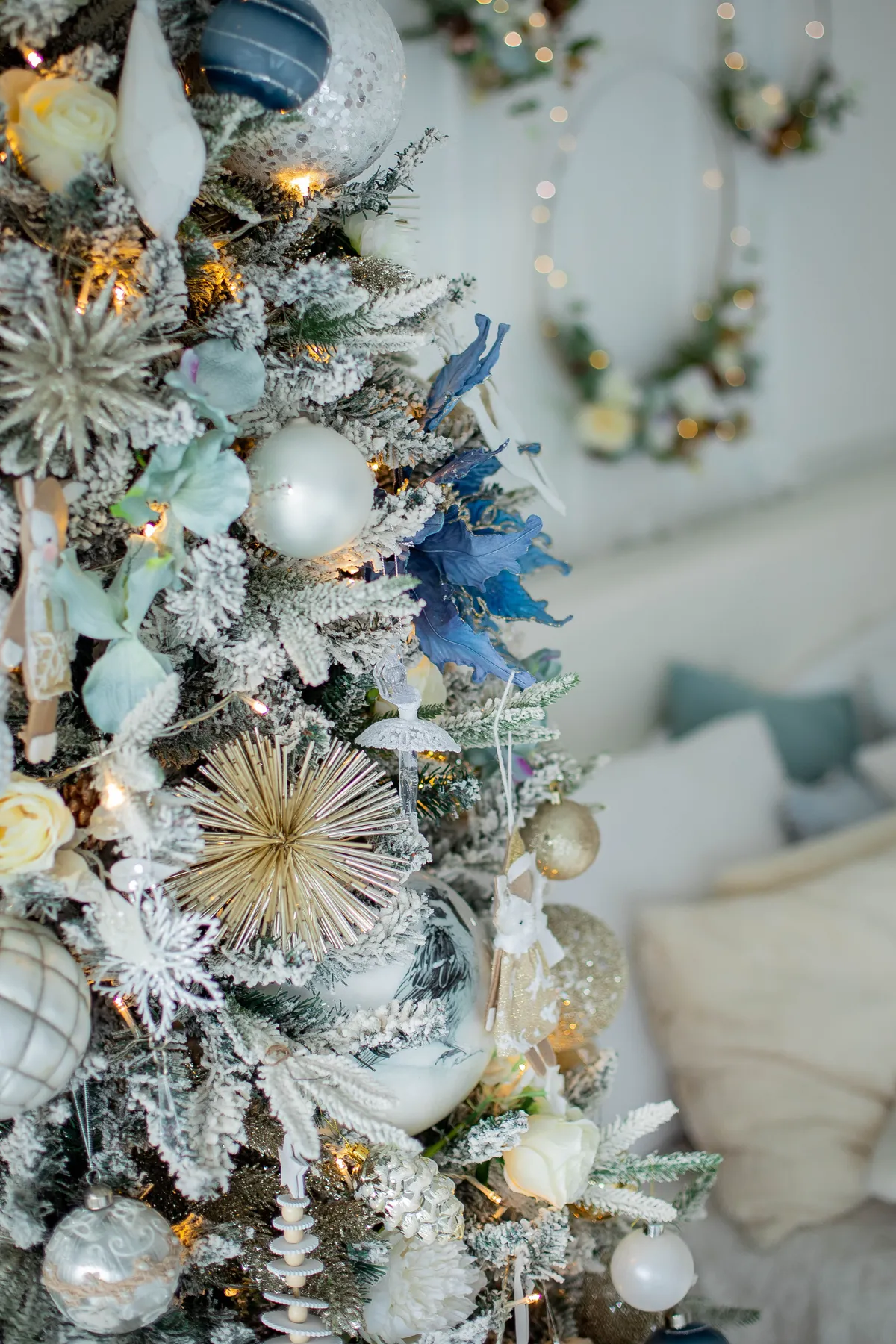
The formula shifts on a frosted tree: 45 percent white, 35 percent deep blue, 15 percent warm gold, 5 percent silver. White takes the biggest share because the branches are already white — you’re building on top of it, not fighting it. Swap deep blue for deep green and you have a completely different woodland look using the same math. The white percentage stays put either way.
15. A Blue and Red Flatlay With Pine and Berry
This is the cheapest palette on the list to pull off. A bag of shatterproof blue balls at a dollar store runs $5 to $8 for a dozen, red berry sprigs are $3 at any craft store, and pine clippings come free from a tree lot in December — they’ll hand you armfuls from the trimmings pile. Total cost for the whole arrangement lands under $30. The white surface is just a tablecloth or a sheet of foam board from the hardware store.

- Lay a white cloth or matte board on a flat table near a window, not under a ceiling light.
- Place three blue ornaments in a loose triangle — never evenly spaced.
- Tuck pine branches in from the edges at three different depths, letting some run off the frame.
- Curl two red ribbons with the back of a scissor blade and set them crossing each other.
- Fill remaining gaps with berry sprigs, then remove one ornament. Negative space is what makes a flatlay breathe.
Time: about 25 minutes.
16. Teal Baubles, Silver Leaf Sprays and Velvet Dots
High-density ornament styling needs room. This look wants a tree at least 7.5 feet tall and a wall behind it at least 4 feet wider than the branches; anything tighter and it reads like a wall of glass. In a room under 120 square feet, cut the ornament count by 40 percent and let the branches show. A narrow tree under 6 feet with this much glass just becomes a glitter wall — see Idea #7, where a blue tree goes the opposite direction and wears almost nothing at all.
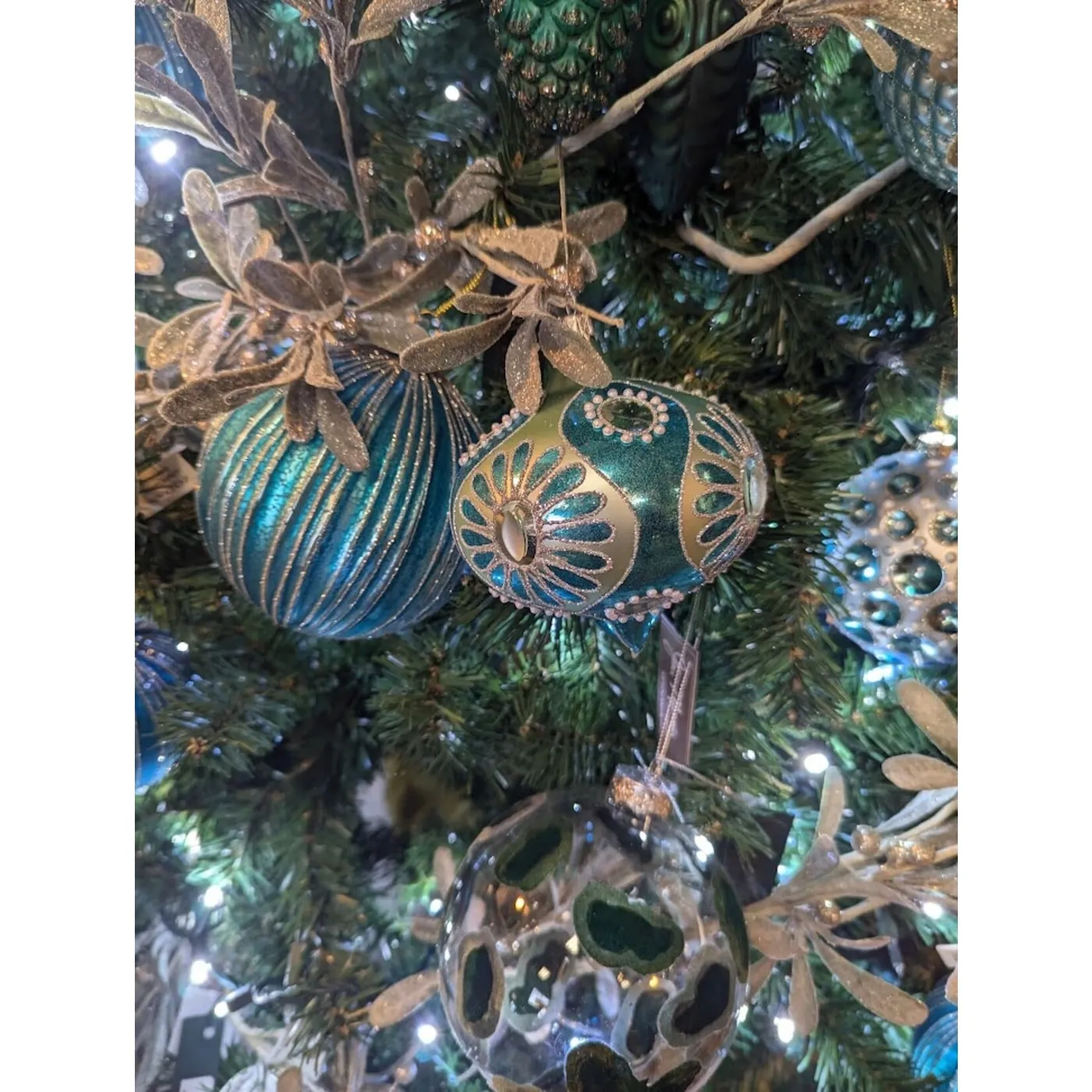
The clear glass ornament with dark green velvet spots is doing more than it looks like. Every other piece on this tree is opaque, reflective, or both — this one is transparent, so it lets the branches show through and gives your eye somewhere to rest. Transparent glass is the secret to a jewel-toned tree that doesn’t turn into a pile of shiny. Two or three clear pieces per dozen is the ratio to aim for.
17. Royal Blue Velvet Ribbon With a Jeweled Mosaic Edge
Trimmed ribbon is the sleeper trend of the season. Instead of buying more ornaments, stylists are buying one extraordinary ribbon — jeweled, beaded, fringed — and letting it carry the whole tree. It photographs beautifully, it’s reusable, and it lets you change palettes by swapping a single spool. Dark blue damask as a backdrop comes from the same shift: people are treating the wall behind the tree as part of the decoration, not just a place to stand it.
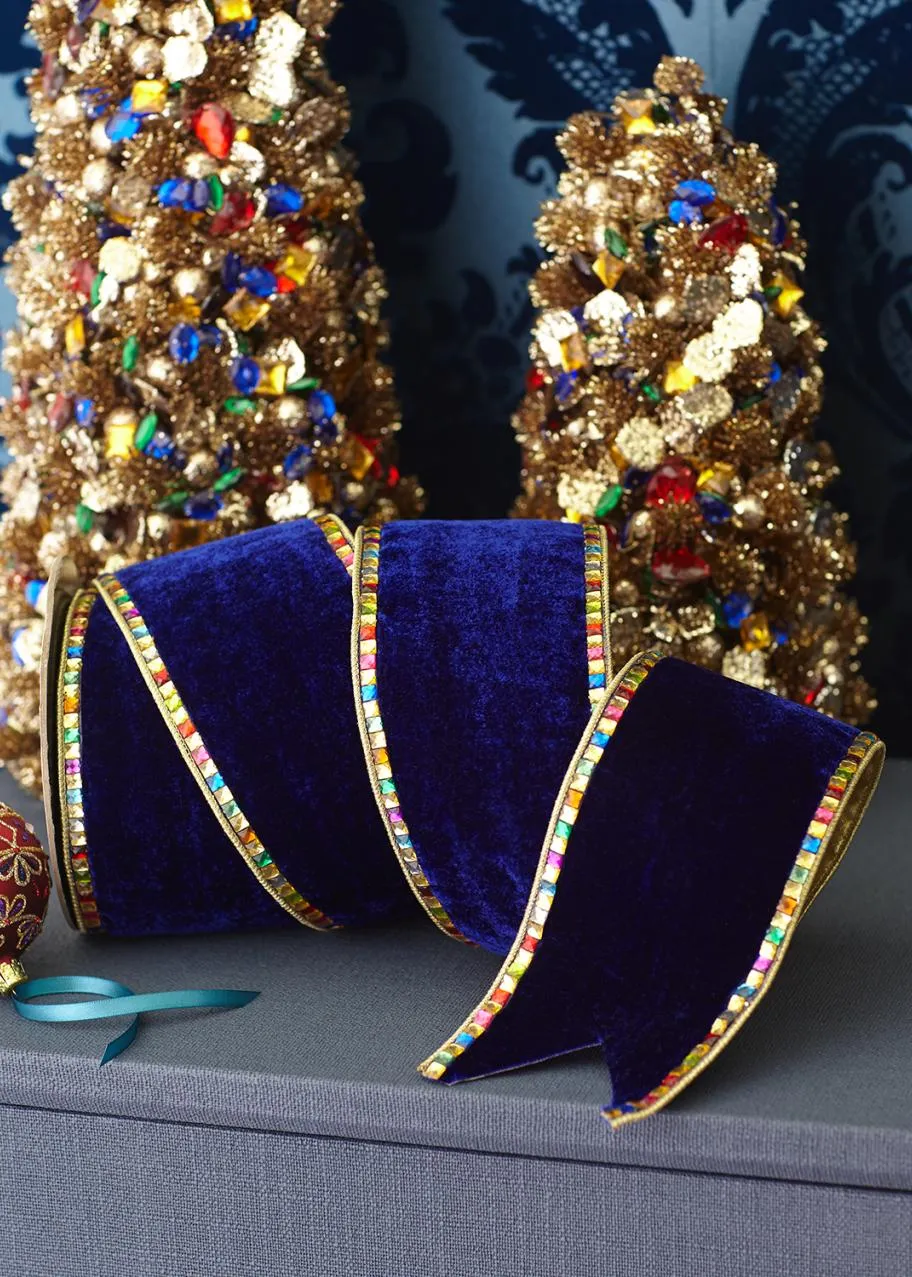
- Jeweled velvet ribbon spool, 5 yards: $30–$75
- Two miniature gold cone trees with gems: $25–$70
- Plain velvet ribbon for filler, 10 yards: $15–$30
- Damask-look wallpaper or fabric panel: $40–$120
- Small glass ornaments to anchor the arrangement: $20–$45
18. A White Tree Lit Blue, With Boughs of Pinecones
A white tree is the least forgiving thing you can buy. Every smudge, every film of dust, every brown needle from a real wreath nearby shows up against it. Plan on wiping the branches with a damp microfiber cloth before you pack it away each January. And be honest about the blue lights: on a white tree, cool blue LEDs can tip the whole room toward clinical. The brown pinecones here are doing real work warming it back up — don’t skip them.
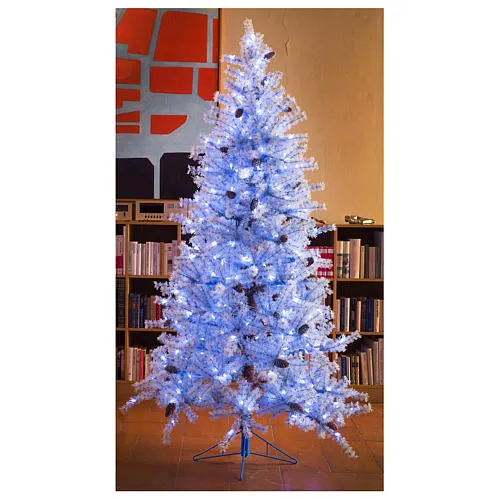
Natural brown is the antidote to a cold palette. When you’re working with white and blue, add at least one untreated material — pinecones, raw wood beads, kraft paper, jute ribbon. It gives the eye a place to land that isn’t shiny. Roughly one unglossed, unbleached element per four blue-and-white pieces is the ratio that keeps a cool tree feeling like a home rather than a showroom.
19. One Blue Glass Bauble on a Curved Silver Stand
Displaying a single ornament takes confidence, and it works for a very specific reason: at that scale, the hand-painted scene becomes a picture rather than a pattern. Nothing competes, so your eye actually reads the little winter figures. The curved silver stand lifts it off the wood and casts a soft reflection underneath, which adds a second, quieter shape. A cluster of ten would bury all of that. Compare with Idea #10, which proves the same point with a matte finish.
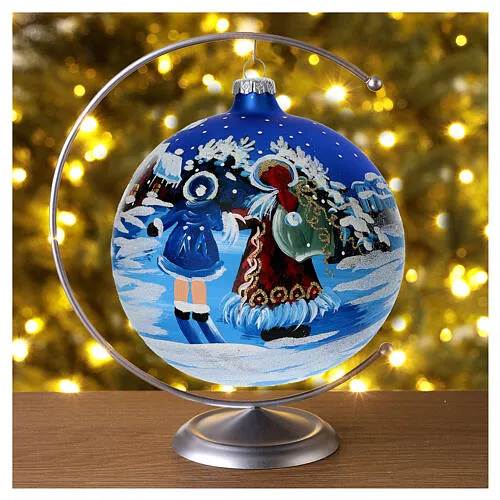
Hand-painted glass ornaments like this run $40 to $120. Three cheaper routes: buy a plain cobalt glass bauble for $8 to $15 and paint a simple snowy scene with a white paint pen (about 20 minutes, surprisingly forgiving); hunt vintage hand-painted ornaments at estate sales for $3 to $10; or watch after-Christmas clearance, where these drop 60 to 75 percent. The display stand itself is $10 to $20 at most craft stores.
20. A Woodland Frosted Branch With Owls and Deer
- Pick one branch section about 18 inches wide and clear it of filler ornaments.
- Anchor the cluster with the matte blue deer bauble at the center.
- Hang the silver icicle 6 inches to the left, lower than the others, so it reads as a drip.
- Place the light blue owl and the dark mushroom slightly behind, one on each side.
- Stop at four pieces. Woodland scenes lose their charm the moment they turn into a crowd.
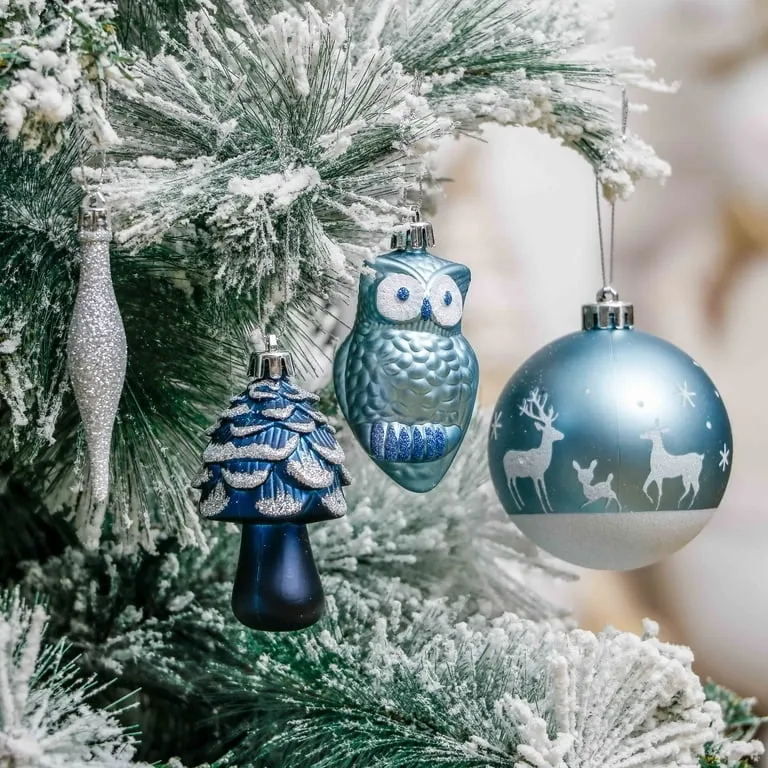
Time: about 15 minutes per cluster. Cost: $8–$20 per figurine ornament.
Character ornaments need to stay under about 20 percent of the total. On a 60-piece tree, that’s 12 figurines — enough to be discovered one at a time, not so many that the tree turns into a toy shelf. Keep the other 80 percent as plain glass and matte solids in the same blue range. The solids give the characters somewhere to hide, and hiding is what makes people walk over for a closer look.
21. Iridescent Teal Ornaments on a Pale Wood Tray
The textured droplet surface is the whole point. Smooth teal glass is everywhere; glass with a bumpy, dew-covered finish catches light in dozens of tiny separate glints instead of one big reflection. That’s what makes these read as handmade. Frosted greenery underneath is the right call too — green needles behind frosted teal keep the composition soft, whereas glossy branches behind glossy glass would turn into a hall of mirrors. For the same reason, it sits well next to Idea #8.
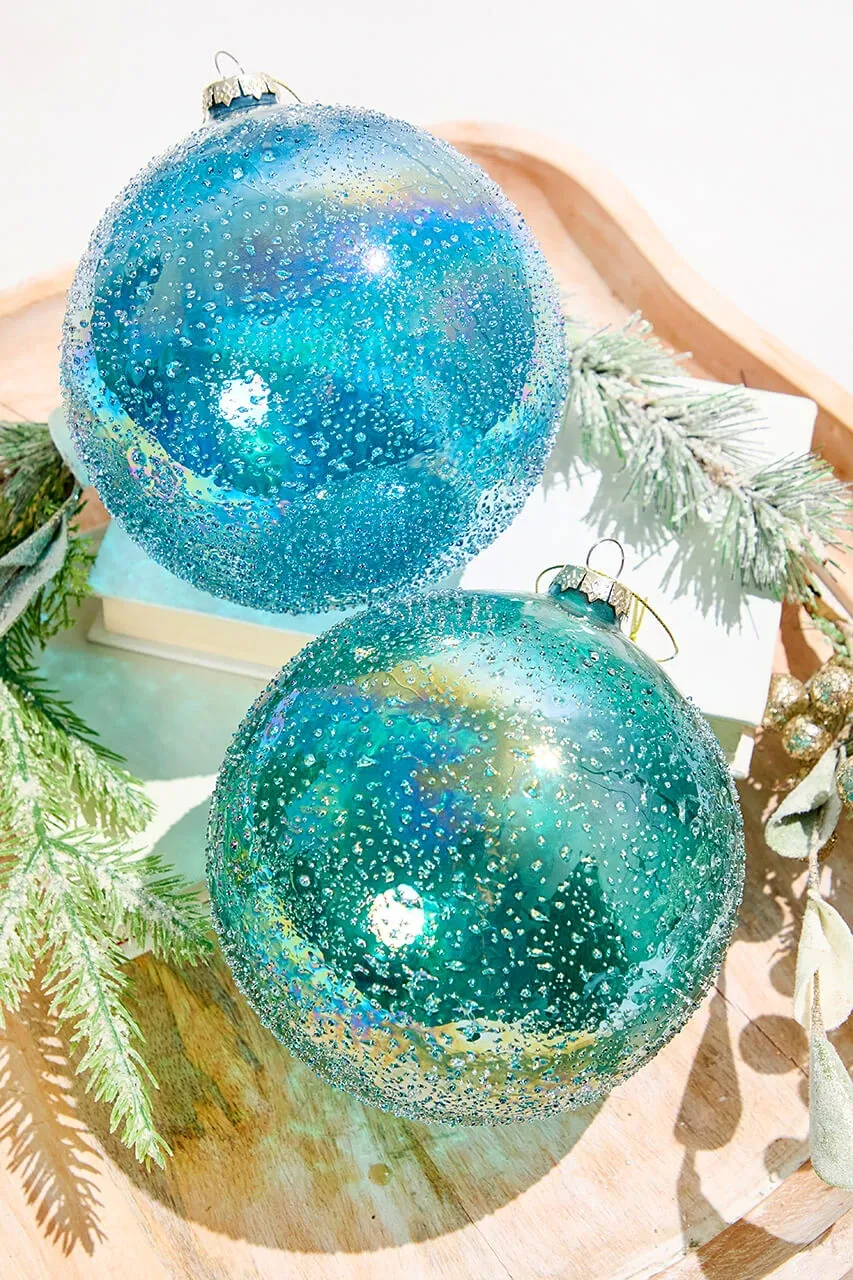
Textured glass is a dust magnet. All those little droplets trap particles, and a dry cloth just pushes them around — use a soft, slightly damp microfiber cloth and let it air dry. Iridescent coatings are delicate too: no glass cleaner, no vinegar, no paper towels, which can micro-scratch the finish. Warm water and a drop of dish soap is plenty. Store in tissue, not newspaper — newsprint ink transfers to iridescent surfaces and never comes off.
22. A Single Iridescent Bauble With a Rainbow Band
Iridescent glass only performs when light passes through it, so hang these where they’ll get side or backlight — near a window, or in front of warm string lights rather than under a ceiling fixture. On a tree, that means positioning them on the outer edges, never tucked inside. A rainbow-sheen ornament buried 3 inches in the branches just looks like a gray ball. With this finish, placement matters far more than quantity.
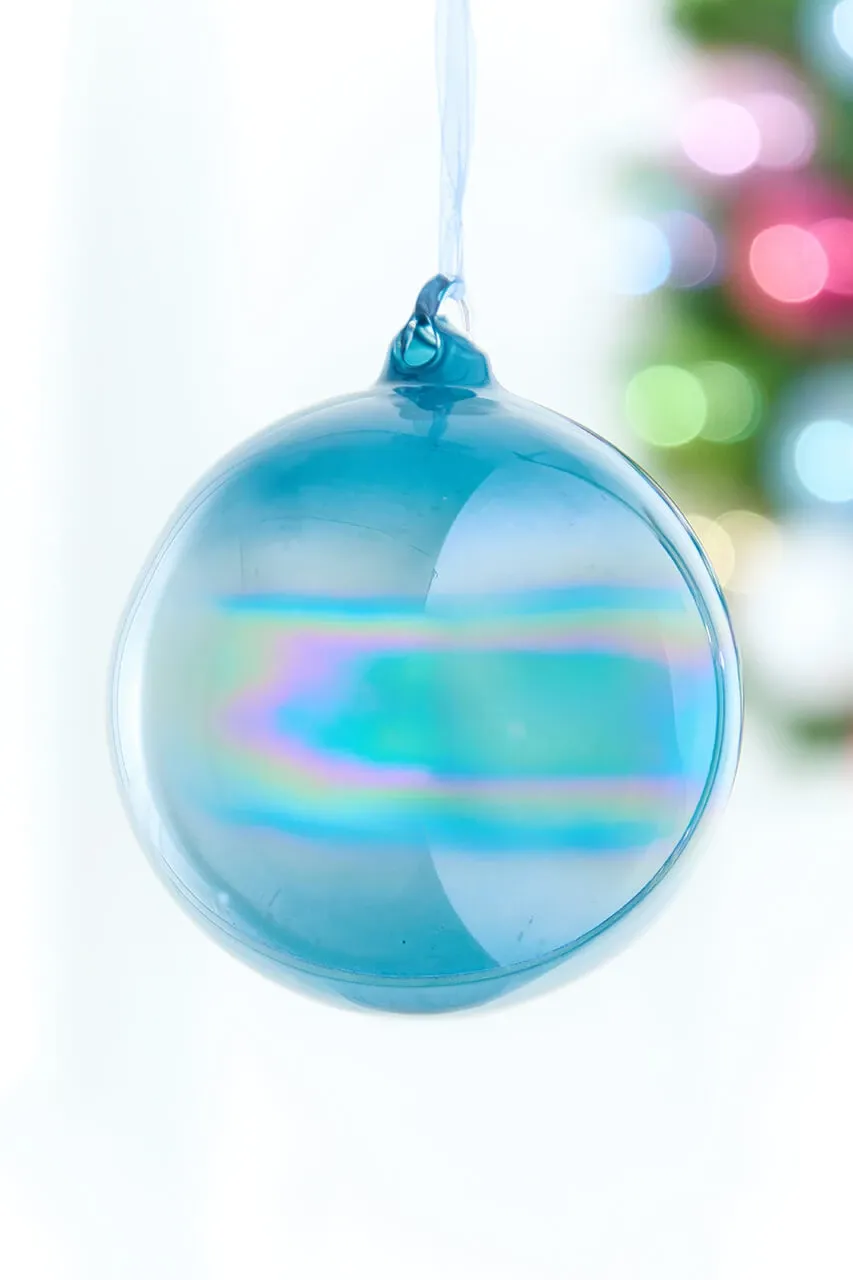
- Note which direction your main window faces and which side of the tree gets daylight.
- Test one iridescent ornament in two spots before committing to a placement plan.
- Check your ribbon — thin satin holds iridescent glass better than wire hooks, which scratch the caps.
- Confirm your tree lights are warm white. Cool white flattens iridescent finishes.
23. Blown Glass Ornament With a Blue Tree Inside
Transparency is a design choice here, not a limitation. Because the glass is clear, the tree inside floats — and because the background is a bright window, the ornament’s edges get outlined by light. That only works if you don’t crowd it. One ornament, one window, nothing else in frame. Move it to a dark wall and the same piece would go nearly invisible. Context is basically the fourth material in this design.
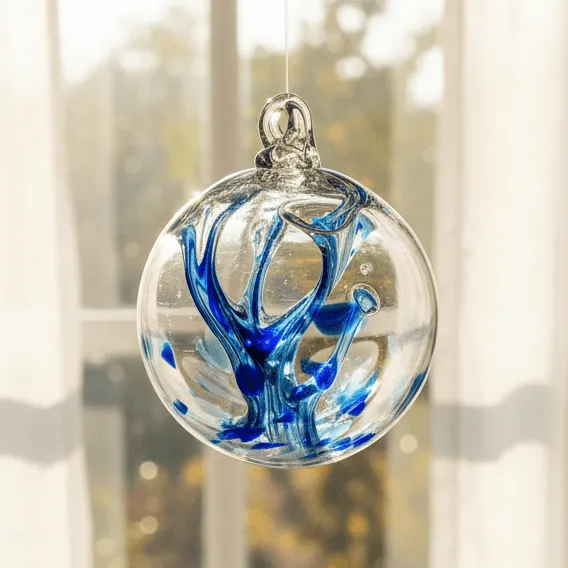
Thin blown glass is beautiful and it breaks. If you have kids, dogs, or a cat with tree ambitions, hang these above the 4-foot mark and wire them to the branch rather than looping over it. Keep direct sun in mind too — sustained UV exposure can cloud clear glass over time, and near a radiator or heat vent, thin glass can crack from temperature swing. Pull the shades during the brightest afternoon hours.
24. Faceted Cobalt Glass With Antique Brass Caps
Deep, saturated glass actually works best on smaller trees. On a 6- to 7-foot tree, two or three ornate cobalt baubles in a cluster read as jewelry. On a 12-foot tree, they vanish. If you’re working with high ceilings, scale up to 6-inch spheres and hang them in groups of three. In a standard 8-foot room, keep them in one contained cluster rather than spreading them across the whole tree — see Idea #5 for how the same blue scales up dramatically.
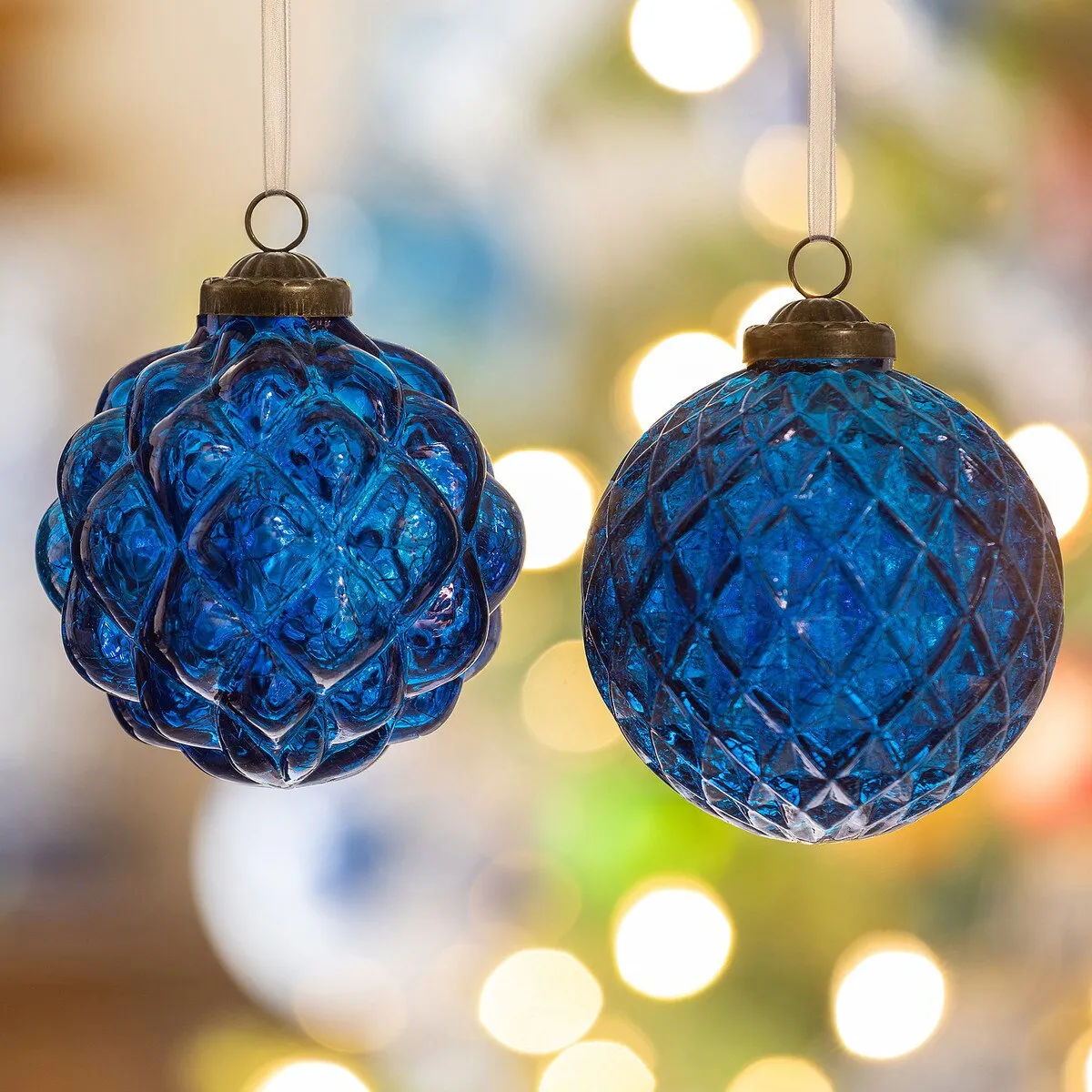
- Two faceted or diamond-cut deep blue glass ornaments, 4-inch: $18–$60
- Antique brass ornament caps, replacement set: $6–$18
- White satin or velvet ribbon, 3 yards: $5–$14
- Ribbon-loop hooks or wire hangers: $4–$10
25. A Velvet Poinsettia Ornament in Deep Blue
One big floral ornament placed at eye level on the front-facing side of the tree does more than a dozen small pieces, because it’s the only thing holding a recognizable silhouette. Anchor it around 5 feet up, dead center. Then count: one oversized bloom per 3 feet of tree height. More than that and the effect flips from statement to theme party. Also keep glitter-shedding pieces off the top half if your tree sits near a dining table.
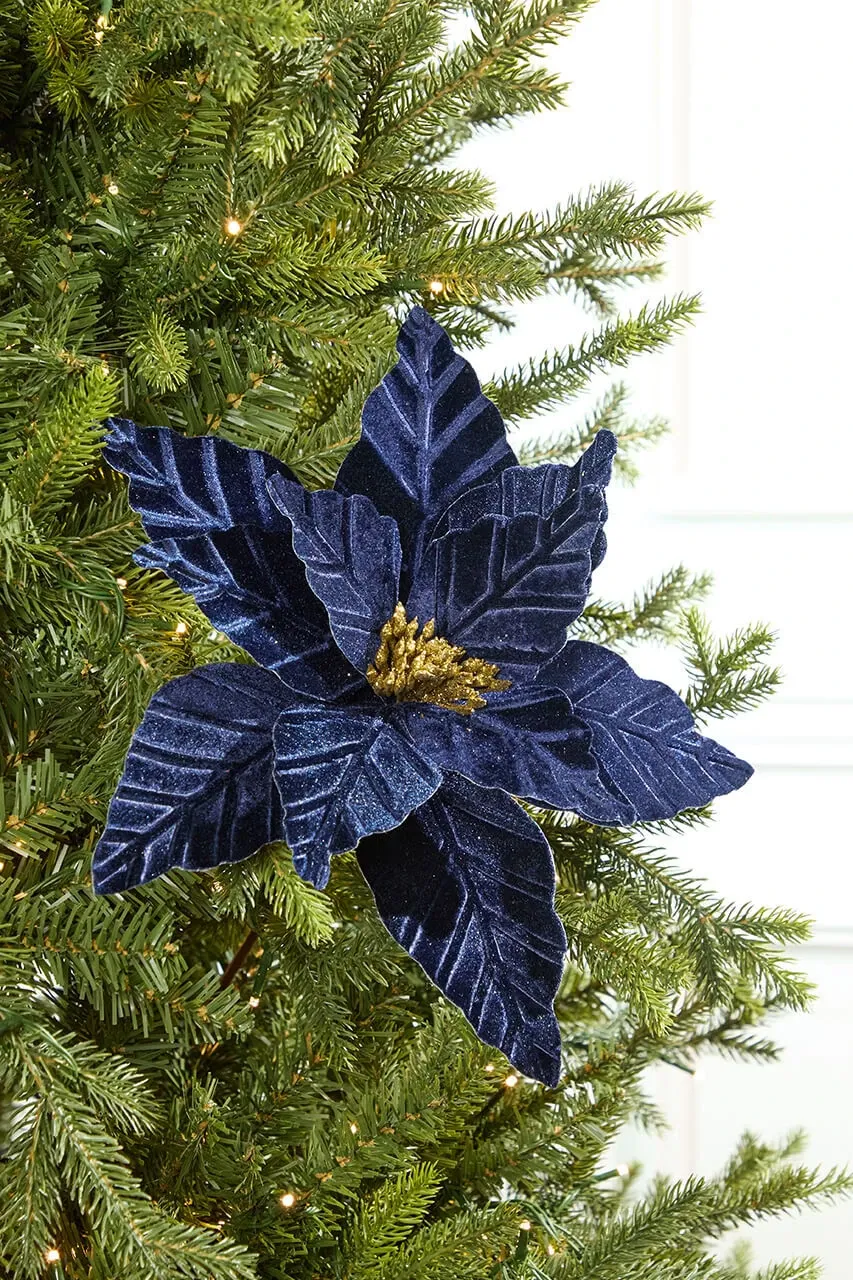
Glitter sheds, and blue glitter on a cream rug is a commitment. Give any heavily glittered ornament a firm shake outdoors before it goes on the tree, then set a small mat under that section. Velvet petals should never be stored flat — the nap crushes and the pile never fully recovers. Hang the piece, or rest it in a box with tissue between petals. Expect a two- to three-season lifespan for a $10 to $25 piece.
26. Blue Glass Filigree With Gold Glitter Scrollwork
Ornate pieces are seasoning, not the meal. The formula: 60 percent plain solids, 25 percent single-detail ornaments like a beaded band or one snowflake, 15 percent full-ornate pieces like this one. Go above 20 percent ornate and your tree reads as noise from across the room — no single piece wins. The reverse is also true: a tree with nothing ornate feels like a display model. Fifteen percent is the number that makes people lean in.
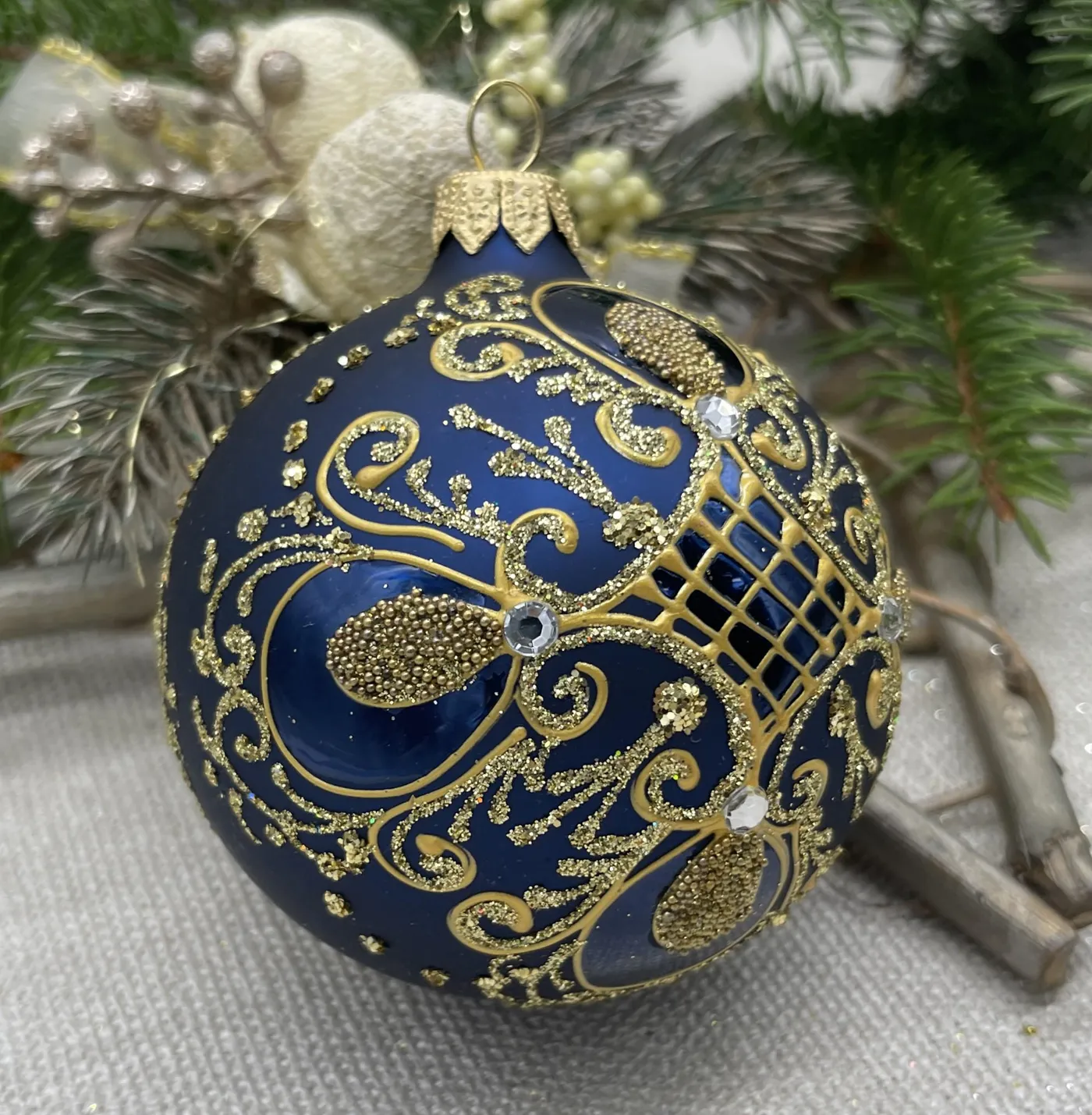
Glued-on crystals fall off. Expect to lose a few each season — check the ornament over a tray before packing it, so you don’t find rhinestones in the carpet in July. Reattaching is a five-minute job with clear craft glue and tweezers. Glitter filigree also thins out over a few years. Store ornate glass in individual tissue wraps inside a rigid box, never loose in a bin, and never anywhere damp — the adhesive behind glitter hates humidity.
27. A Mini Potted Tree With Hand-Painted Ceramic Pieces
A tabletop tree is the smartest way to try this palette without committing. A 3-foot potted evergreen runs $30 to $60, and ceramic ornaments from Target, World Market, or a thrift store run $3 to $8 each — you only need six to eight. Swap the plastic planter for a ceramic one you already own, or a $12 cachepot. Total: under $100, and if you decide blue and white isn’t your thing, you’re not staring at a $900 tree.
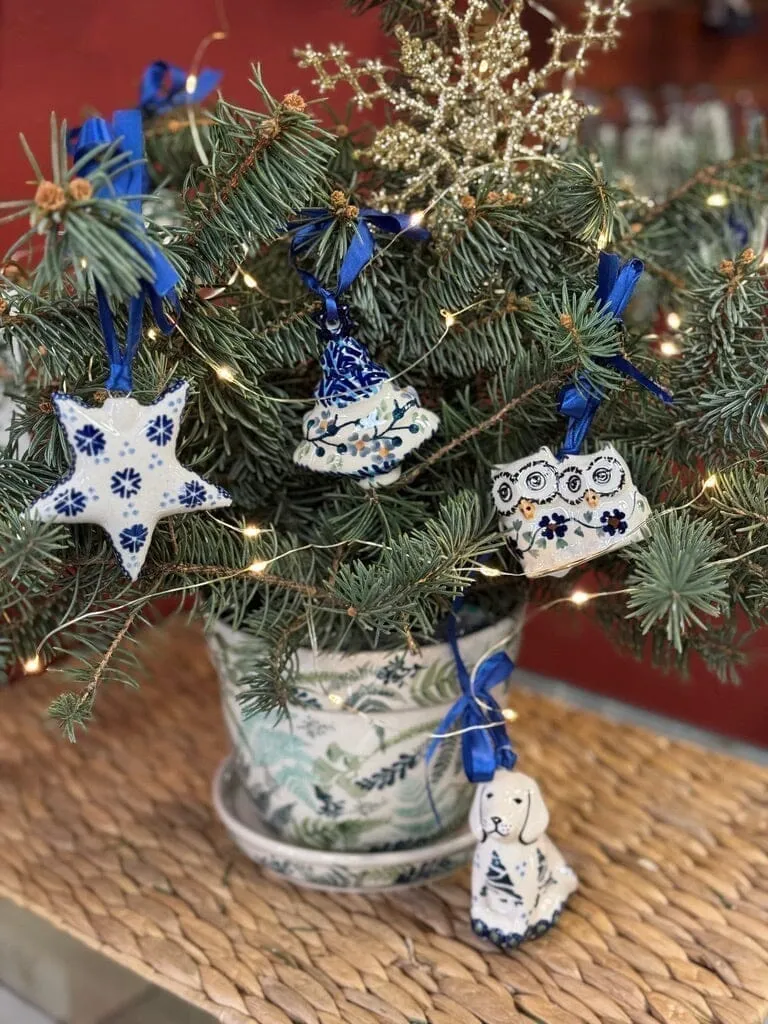
- Set the tree in the planter and stabilize it with a few inches of sand or florist foam before decorating.
- Wrap a 100-count strand of warm fairy lights from the bottom up, spacing loops about 4 inches apart.
- Choose six ceramic ornaments in the same blue-and-white family — no more.
- Hang each on a 6-inch royal blue satin ribbon, tied in a simple single knot.
- Top with one gold snowflake and stop. Small trees look best slightly under-decorated.
Time: 40 minutes. Cost: $80–$140.
28. White Gifts Tied With Navy and Green Plaid
Ribbon width should be about one-sixth of the box width. On a 10-inch box, that’s a 1.75-inch ribbon — most people reach for something half that size and then wonder why the wrapping looks thin and sad. Use a wired ribbon so the bow holds its shape, and mix two widths in the same plaid: a wide band around the box and a narrow one for the bow. Two ribbons, one pattern, and it looks professionally done every time.
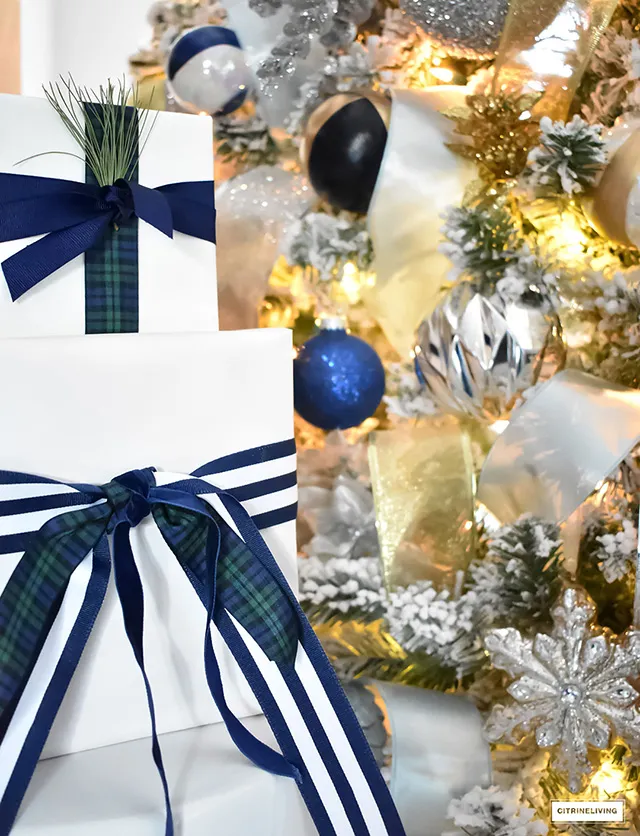
Gifts under the tree should occupy roughly the bottom 15 percent of the tree’s height — no higher, or the tree starts to look shorter than it is. For a 7-foot tree, keep the pile under about 12 inches tall and cluster it slightly off-center rather than symmetrical. Fewer, larger boxes read better than many small ones; three big boxes beat nine small ones from across the room. Pair this with Idea #13 and the whole corner ties together.
29. A Ceramic Landscape Ornament Ringed in Gold Scrollwork
The gold scrollwork border is what turns a small painted scene into a framed picture. Without it, you’d have a nice blue-and-white disc. With it, the ornament reads as a piece of delftware in miniature — something you’d buy on a trip and keep for thirty years. The border also does a practical job: it visually separates the ornament from whatever sits behind it, which matters a lot when it’s hanging against dark evergreen needles.
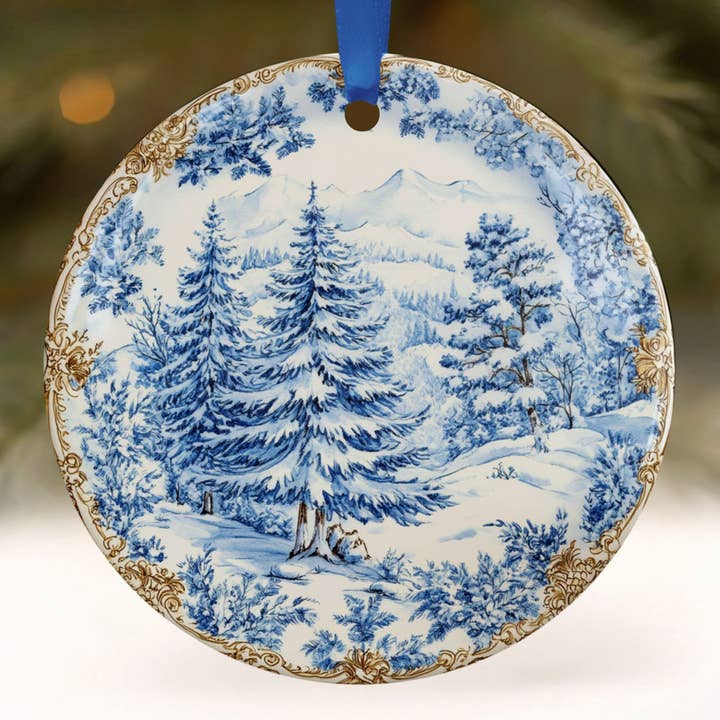
There’s a quiet shift happening away from matching ornament sets and toward single collectible pieces — one good hand-painted ornament a year instead of a $200 boxed set. It’s cheaper, it feels less disposable, and it gives you a tree that tells a story by the time you hit your forties. Ceramic and porcelain pieces are leading that shift because they age beautifully and don’t shed glitter all over the house.
30. Light Blue Velvet Bows With Textured Gold Accents
This tree is 70 percent ribbon, which is a bolder move than it sounds. Bows give you volume for very little money — a $20 spool of velvet ribbon can cover a 7-foot tree where $200 of ornaments couldn’t. The formula: 60 percent evergreen, 25 percent light blue velvet, 15 percent textured gold. Keep the gold matte or textured rather than shiny. Polished metallic competes with velvet’s soft finish, and the whole thing turns loud in a hurry.
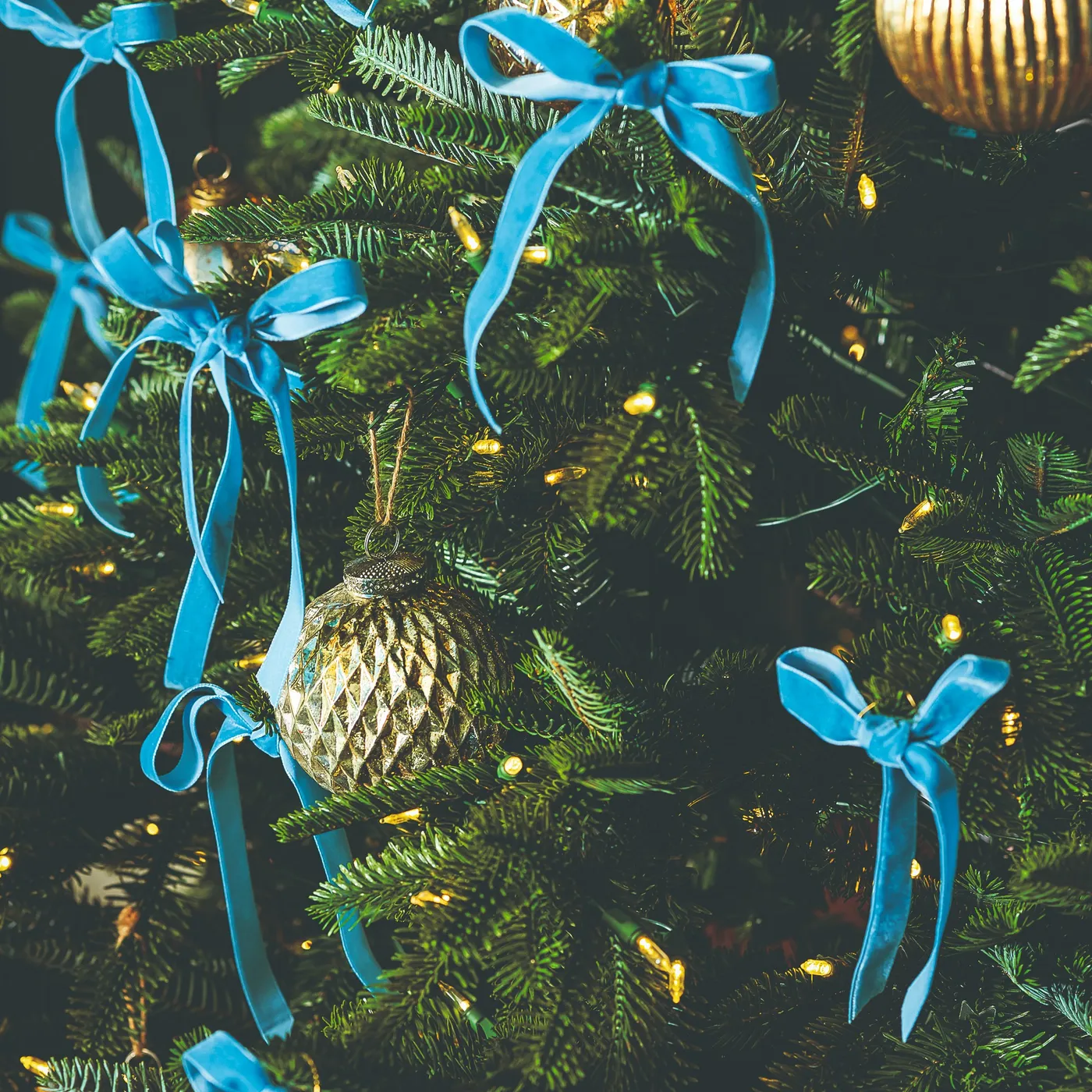
- Light blue velvet ribbon, 3 spools of 10 yards: $45–$90
- Textured gold ornaments, 24 pieces: $40–$110
- Warm white string lights, 300-count: $25–$50
- Floral wire to shape bows: $5–$10
- Ribbon-tail scissors: $12–$25 (one-time buy)
Blue Christmas, Built One Bauble at a Time
You don’t need a $900 tree or a designer’s phone number — you need one honest blue, a warm light source, and the discipline to stop adding things. Start with the idea that matched your photo, buy two pieces this week, and let the rest of the look grow over a season or two.
📌 Save this to Pinterest for later — you’ll want to revisit these ideas when the ornaments go on sale in January.