30+ Jaw-Dropping Gold and Red Christmas Tree Ideas That Will Elevate Your 2026 Holiday Decor

Red and gold is the one Christmas palette that never really leaves — but the 2026 version looks different from the shiny tinsel trees of a decade ago. We spent weeks digging through Target, At Home, HomeGoods, Etsy, and Wayfair to find the trees, ornaments, and finishing touches that hold up in a real living room, and we narrowed hundreds of options down to 30 ideas that actually deliver, from a $9 single bauble to an $850 statement tree, with budget and luxury versions compared side by side.
You’ll find traditional, maximalist, vintage, grand-luxe, and rustic cabin looks, each photographed in a real home or a real designer space. The shift this year is deeper, warmer gold instead of brassy yellow, paired with saturated reds and a lot of texture — flocked branches, velvet, hand-painted glass. And stay until the end — we break down the most common mistakes that can ruin these looks.
📌 Save this to Pinterest for later — you’ll want to revisit these ideas.
1. The Grand Lobby Tree With a Red Bow Crown
The star isn’t what makes this tree. It’s the red bow at the very top — wide, structured, and readable as a silhouette against two stories of dark walnut paneling. Swap it for a standard gold finial and the tree instantly turns anonymous. One strong shape at the top does more for a tall tree than fifty extra ornaments below it. Everything else here stays deliberately quiet: red and gold spheres, a few star accents, warm white lights that never compete with the columns or the wrought iron railing above.
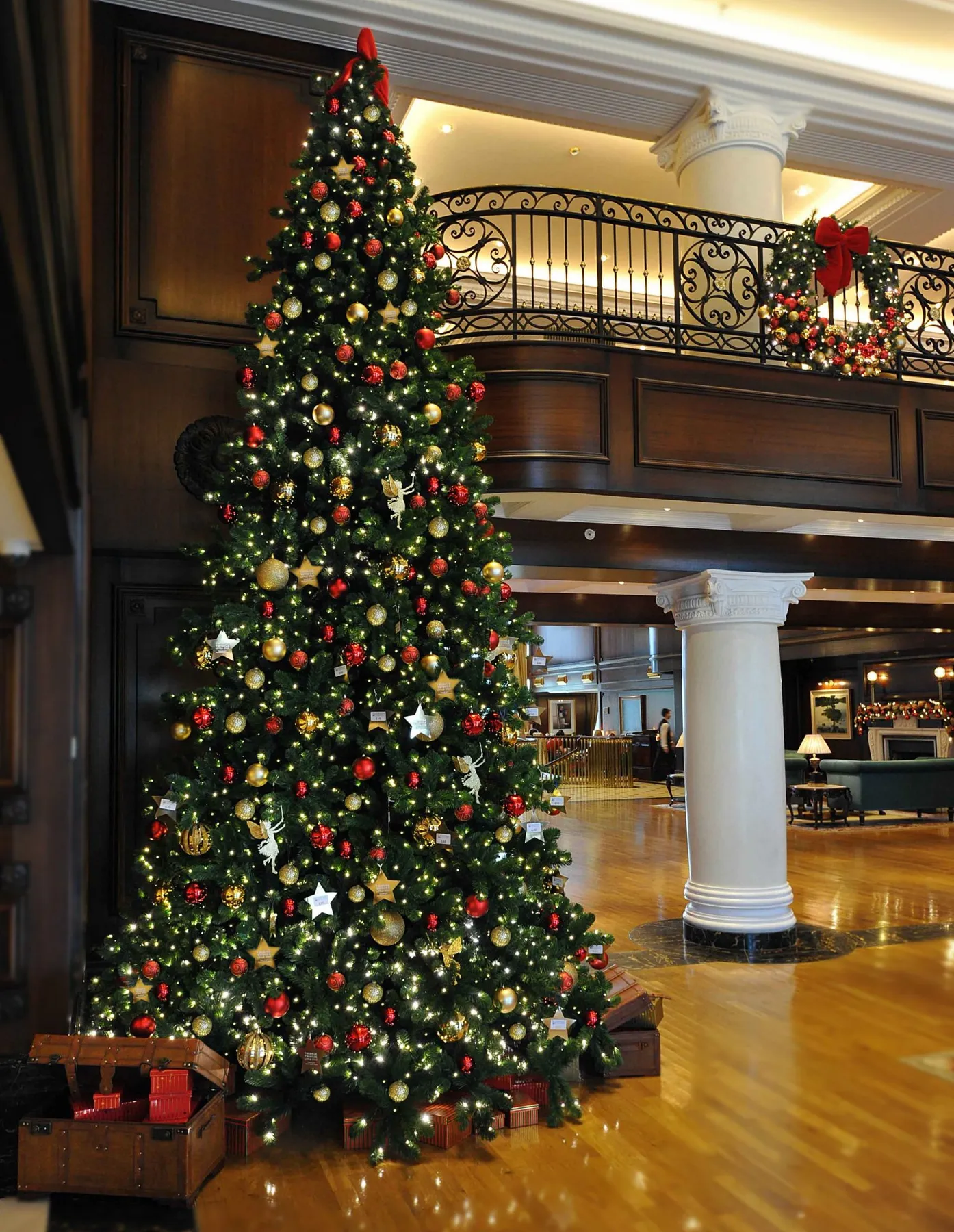
This look lives or dies on proportion. You’re seeing a tree roughly 12 to 14 feet tall under a ceiling that clears 20 feet, with the balcony railing landing near the tree’s midpoint. In an ordinary room, copy the formula at 7.5 feet and skip the columns entirely. Tall spaces want volume; low spaces want width. If your ceiling is under 9 feet, see Idea #15 for a denser, shorter tree that still feels full.
2. Pearl Garlands in a White Foyer
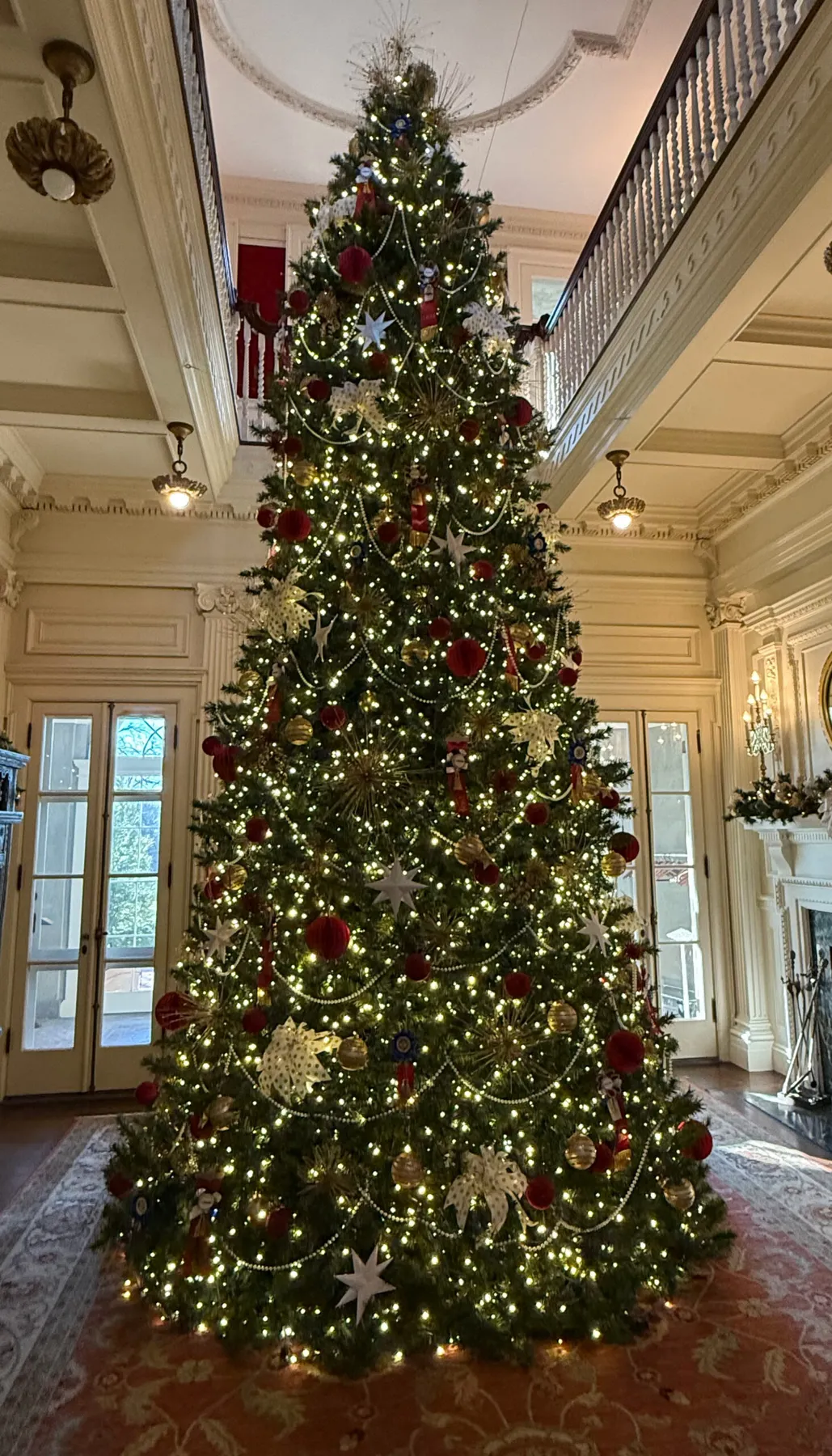
Pearl garlands look expensive and cost very little — the trick is how you drape them. Work in vertical swags roughly 10 to 12 inches apart, letting each one hang in a shallow U about a third of the way down its section. Skip the tight spiral; it reads like a craft project. Have these ready before you start:
- 26-gauge gold floral wire, cut into 4-inch lengths
- Pearl strands 6 to 8 feet long — two per tree section
- Small gold hooks to anchor each swag end invisibly
Anchor both ends of every swag at the same branch depth, or the strands will slowly slide and droop by New Year’s.
The red and gold reads as luxury here because everything around it is white. Ornate moldings, classical columns, a cream-and-red patterned rug underfoot — the architecture does the quiet work, so the ornaments can go saturated without looking cheap. If your entry is flat and beige, add one strong cream element first: a runner, a large mirror frame, or trim you paint yourself.
3. Bay Window Tree With a Ruffled Gold Skirt
The formula here is roughly 50% deep green foliage, 35% gold, and 15% red. Gold carries more visual weight than red, which is why a single wide gold ribbon garland and a ruffled gold skirt do so much while the red stays in the accents — florals, baubles, a few berries. Swap the gold for copper and the tree goes moody and modern; swap red for burgundy and it reads vintage. The ratio stays the same either way.
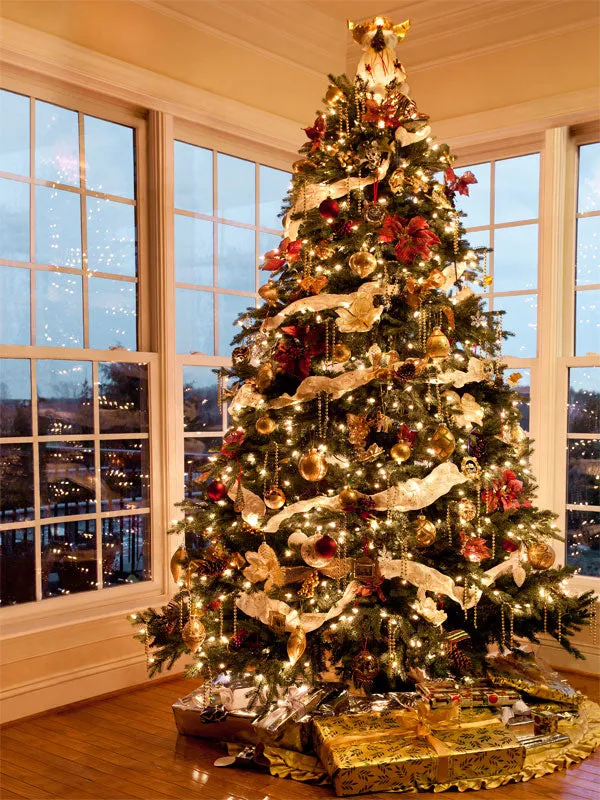
None of this requires designer money. A $12 spool of double-faced gold satin from a craft store does what a $60 designer roll does, and the ruffled skirt is easy to fake — a yard and a half of gold fabric gathered onto an elastic band, about $25, versus $120 ready-made. Buy the gold spheres in January at 70% off and store them flat; you’ll have next year’s tree for the price of one nice dinner.
4. Striped Baubles and Red Beaded Garlands
Red bead garlands are the fastest way to make a plain tree look collected rather than bought. Here’s the method that keeps them from sliding:
- Start at the top back and hook the first end over a sturdy branch, not a tip
- Drape in 8 to 10 inch loops, letting each one dip and lift naturally
- Twist the strand once at every third branch to lock the loop in place
- Work down and around, keeping loops slightly larger toward the bottom
- Finish at the back so the tail end is never visible from the room
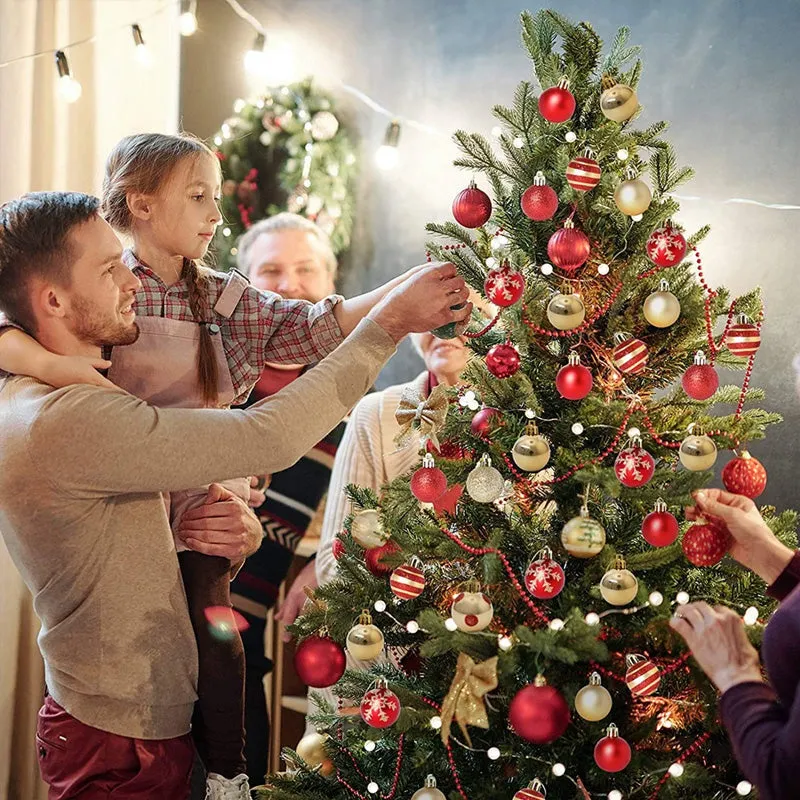
Expect about 45 minutes for a 7-foot tree and roughly $18 for two 9-foot strands. Then hang the striped and snowflake baubles in the gaps the beads create — the garland builds the structure, the ornaments fill it.
One honest note: bead strands and real trees don’t always get along. Sap grabs the wire, and a warm room makes natural branches droop, which pulls the loops out of shape by mid-December. If you’re using a live tree, drape the beads last and plan to re-drape once. Pets treat dangling beads as a toy, so run the strand tight against the branches above knee height if you have a cat.
5. Plaid Ribbon, Pinecones, and a Whole Lot of Santa
- Tree, 6.5 to 7.5 feet: $120 – $400
- 60 to 80 ornaments, mixed: $80 – $200
- Plaid ribbon, floral picks, berry sprays: $55 – $130
- Pinecones and natural filler: $0 – $25 (gather them)
- Warm white lights, 600 count: $20 – $40
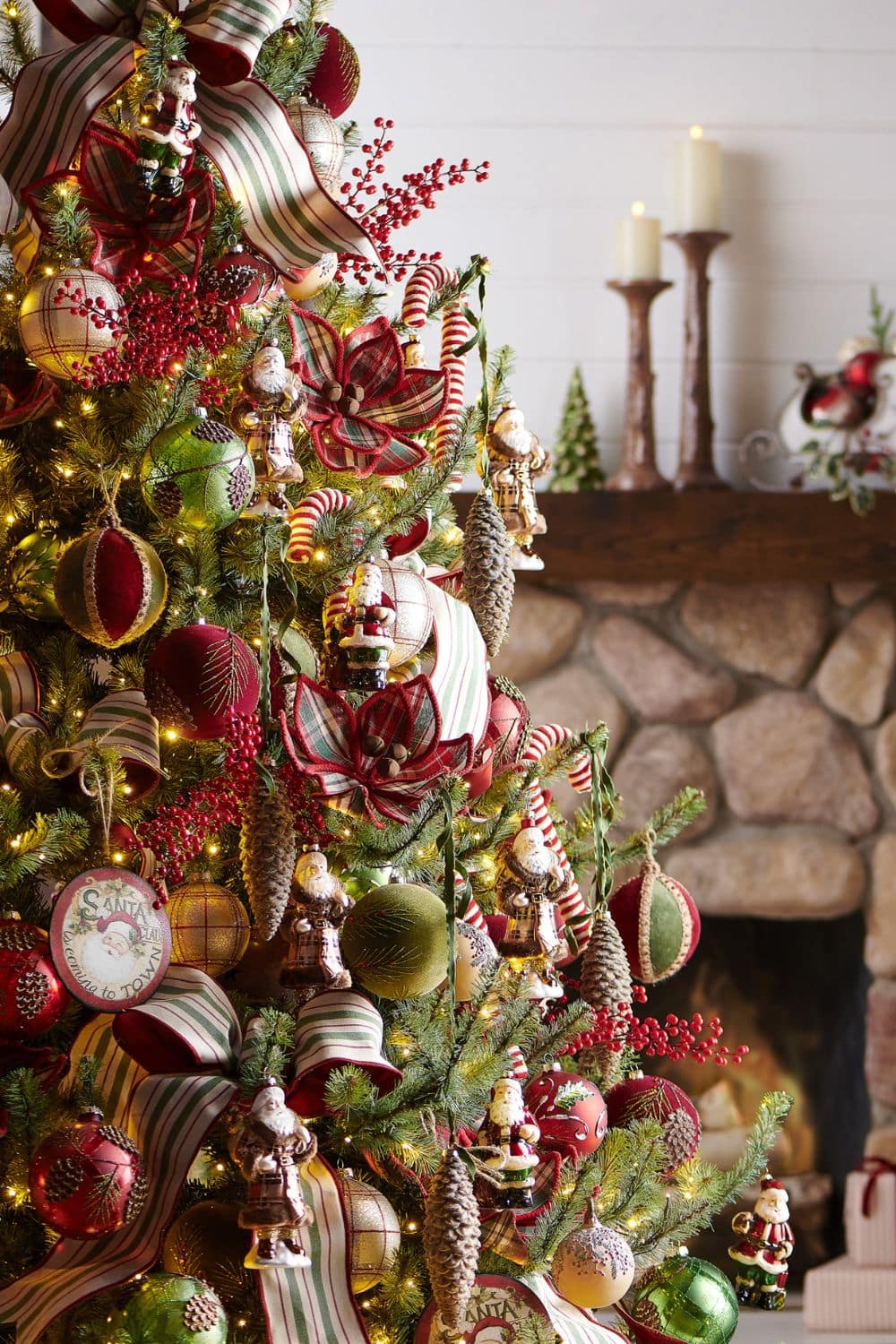
Total: $275 – $795. Budget alternative: buy the ornaments secondhand by the box at estate sales and church thrift shops — $15 to $30 for a mixed box that would cost $90 new, and the mismatched finish is exactly what this look wants anyway.
This is a wall tree, not a corner tree. It wants a stone fireplace or paneled wall beside it so the plaid and berry sprays have something rustic to lean against. Give it a footprint of at least 4 feet wide and 8 feet of wall, and keep the mantel above it relatively bare — the tree is already telling the story. In a small apartment, borrow the ribbon-and-pinecone idea and leave the figurines in the box.
6. The Black Top Hat Topper Nobody Expects
Notice how the mantel works here: the arched mirror stays mostly empty, one large wreath hangs centered on the glass from a wide ribbon, and the garland sits on the mantel surface rather than swagged across it. That layering — glass, ribbon, wreath, garland, stockings below — is what keeps a busy fireplace from looking cluttered. Hang the wreath so its bottom edge clears the garland by about 4 inches; any lower and the two merge into one heavy mass.
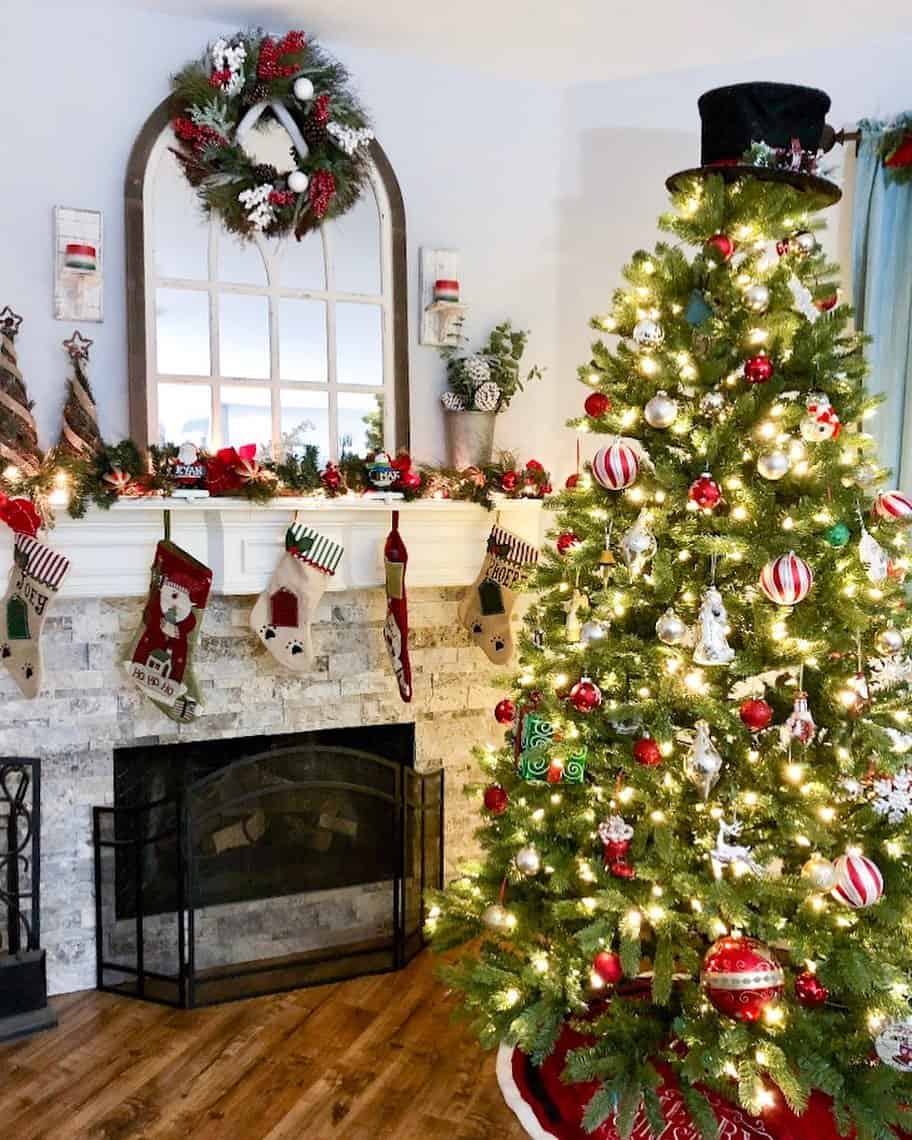
The top hat is the whole personality of this tree. Without it, you have a very pretty red-and-silver tree beside a stone fireplace — lovely, forgettable. With it, the tree has a wink in it, and the red and silver suddenly feel like a costume rather than a color scheme. If you want a gold-and-red version of this energy, a single oversized velvet bow or a vintage Santa hat does the same job for under $20.
7. An All-Gold Tree Against a Charcoal Wall
Read the ratio as 70% green foliage, 25% gold, 5% warm glow. The gold isn’t one note — it’s matte spheres, textured spheres, beaded garlands, a star topper, and wrapped gifts, all in different finishes so the eye keeps moving. Against a dark grey textured wall the whole thing turns sculptural. Swap gold for warm silver and you get a frostier version of the same formula; swap the charcoal wall for cream and it goes bright and formal.
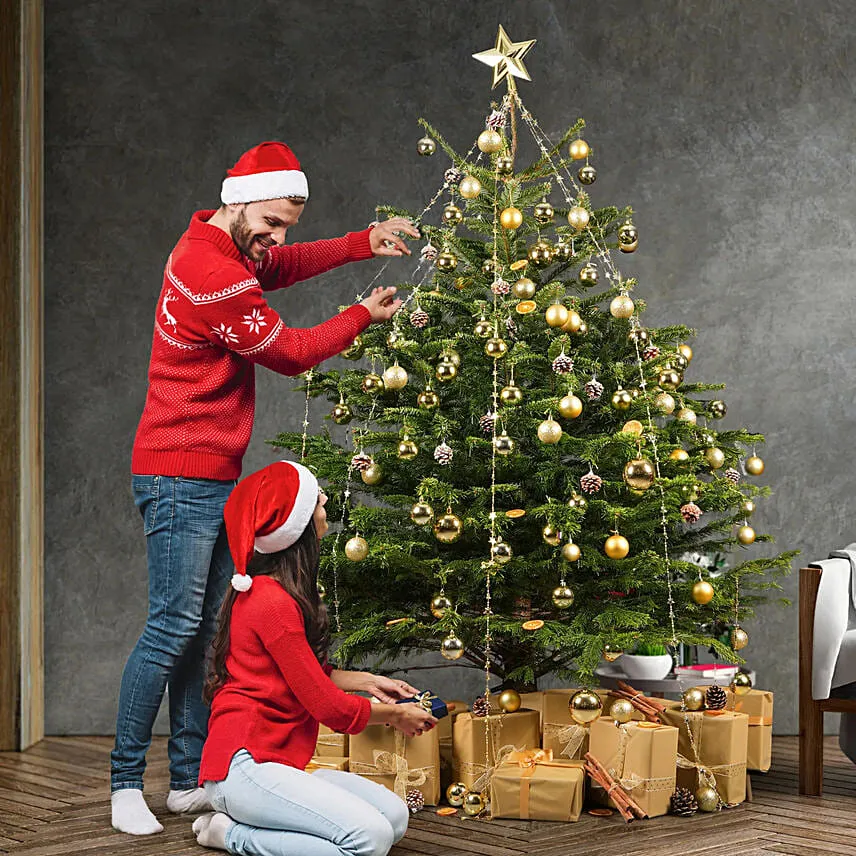
Gold ornaments are the single most thriftable item in Christmas decor, which almost nobody takes advantage of. Estate sales and Facebook Marketplace routinely list boxed gold baubles at $3 to $8 each against $12 to $25 new, and older ones often have a nicer matte finish than current stock. This is the budget cousin of Idea #3 — same gold-forward thinking, different mood entirely.
8. Tinsel, Glitter, and Pinecones at Arm’s Length
Up close, this is a study in contrast: matte red against glitter gold, shiny tinsel against dry pinecone scales, all pressed into dark green needles. Three textures in a tight space create more visual interest than three colors ever could. The shiny tinsel garland is the risky element — it works here because it’s balanced by matte red and natural brown, so the tree shimmers instead of glaring.
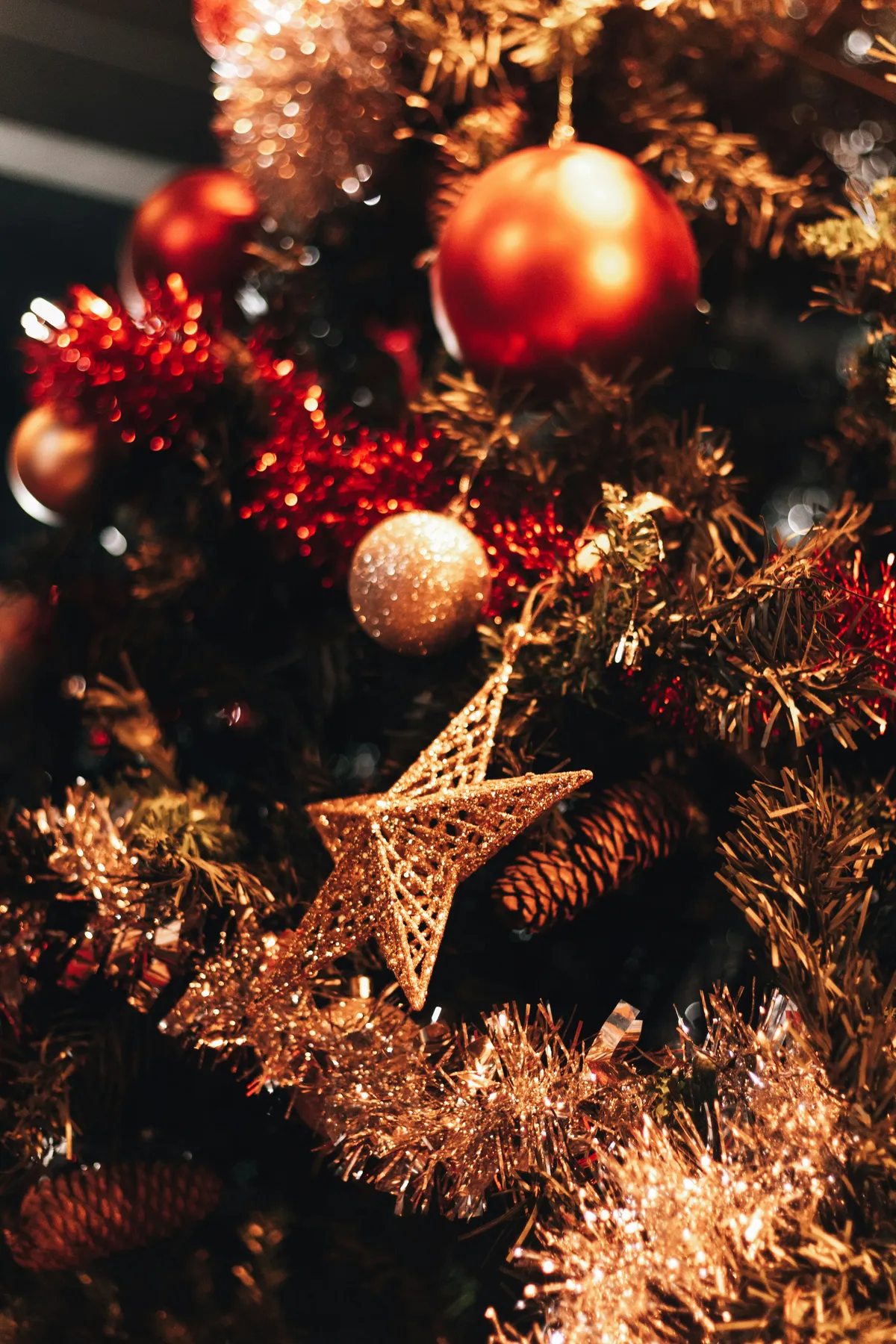
Glitter is a commitment, and I say that with love. Expect a fine gold dusting on your floor, gifts, and anything you carry near the tree through December. Tinsel garlands shed worst in the first season and settle down after that. If shedding bothers you, look for glass or matte-finish ornaments with flocked rather than loose glitter, and shake every new ornament outside before it comes in the house.
9. Three Finishes, One Palette
Here’s the rule that fixes most homemade-looking trees: hang in a 1:1:1 finish ratio. For every matte red bauble, add a shiny gold and a glitter gold, then place the matte and darkest pieces deepest into the branches and the shiniest ones on the outer tips. Matte recedes, gloss advances. Three finishes in the same two colors create depth that a hundred shiny ornaments of the same type never will. Buy in sets of six and you’ll naturally hit the ratio.
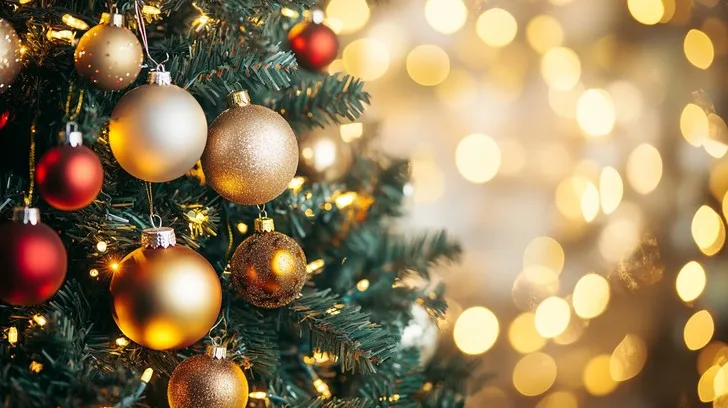
Crunch the numbers as roughly 60% dark green foliage, 20% gold split across three finishes, and 20% matte red — with warm yellow light as the glue holding it together. The trick is that red never exceeds gold by much; at 20/20 the two colors read as equals. Push red to 35% and the tree gets loud fast. Swap the yellow lights for cool white and this exact tree stops glowing and starts glinting.
10. Vintage Santas, a Sleigh, and Multi-Colored Lights
Figural ornaments are wonderful and they photograph badly if you crowd them. Santas, sleighs, and stars need negative space around them or they merge into a lump. Give each figural piece a hand’s width of clear branch on every side, and hang them at eye level where they can actually be seen. Multi-colored lights are a bold choice in a red-and-gold tree — they warm up the gold but they will fight the red, so keep the strands sparse and let the ornaments lead.
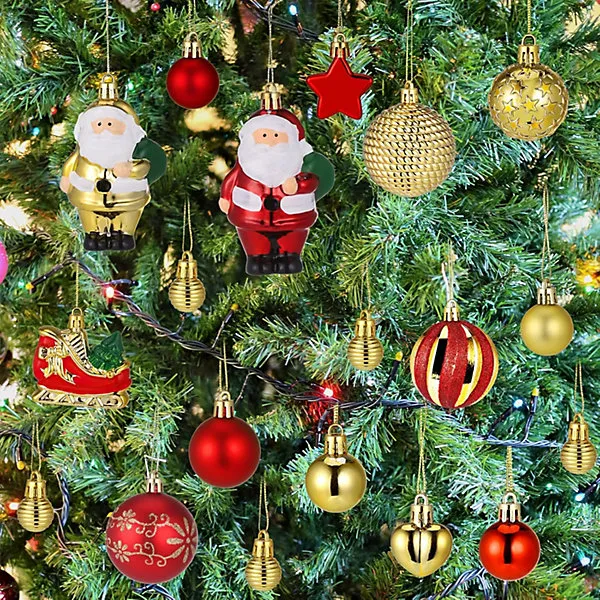
Figural vintage ornaments are the best bargain in holiday decorating. Thrift stores price a boxed Santa at $2 to $5 because they don’t know what they have; the same piece at a vintage market runs $18 to $45. Spend one Saturday hitting three shops and you’ll have a collection. Compare with Idea #15, which takes the opposite approach — no figurines at all, just spheres and restraint.
11. Gift Boxes Tucked Right Inside the Branches
The thing you remember about this tree isn’t the ornaments — it’s the wrapped gift boxes suspended inside the branches, gold ribbons catching the lights. That single move turns a decorated tree into a decorated room. Pull the boxes out and you have a perfectly nice red-and-gold tree that looks like every other one on the block. If you do only one unexpected thing this year, make it this.

They’re easier than they look:
- Choose light boxes — a few ounces, not a shoebox full of anything
- Wrap the lid separately from the base so the seam stays crisp
- Wire the base to a thick inner branch, never a tip
- Tilt each box 10 to 15 degrees so it doesn’t read as a flat square
- Space them 14 to 18 inches apart and keep them below the top third
Roughly 30 minutes and about $15 in paper and ribbon for six boxes.
12. Velvet Ornaments That Look Like Heirlooms
Velvet is a magnet for dust and pet hair, and unlike glass you can’t just wipe it down. Plan on a soft brush or a lint roller pass every couple of weeks during the season, and store velvet pieces in tissue inside a hard box rather than a soft bag — crushed pile doesn’t recover fully. Keep them out of direct sun; deep red velvet fades to a dull brick faster than any other ornament finish I’ve worked with.
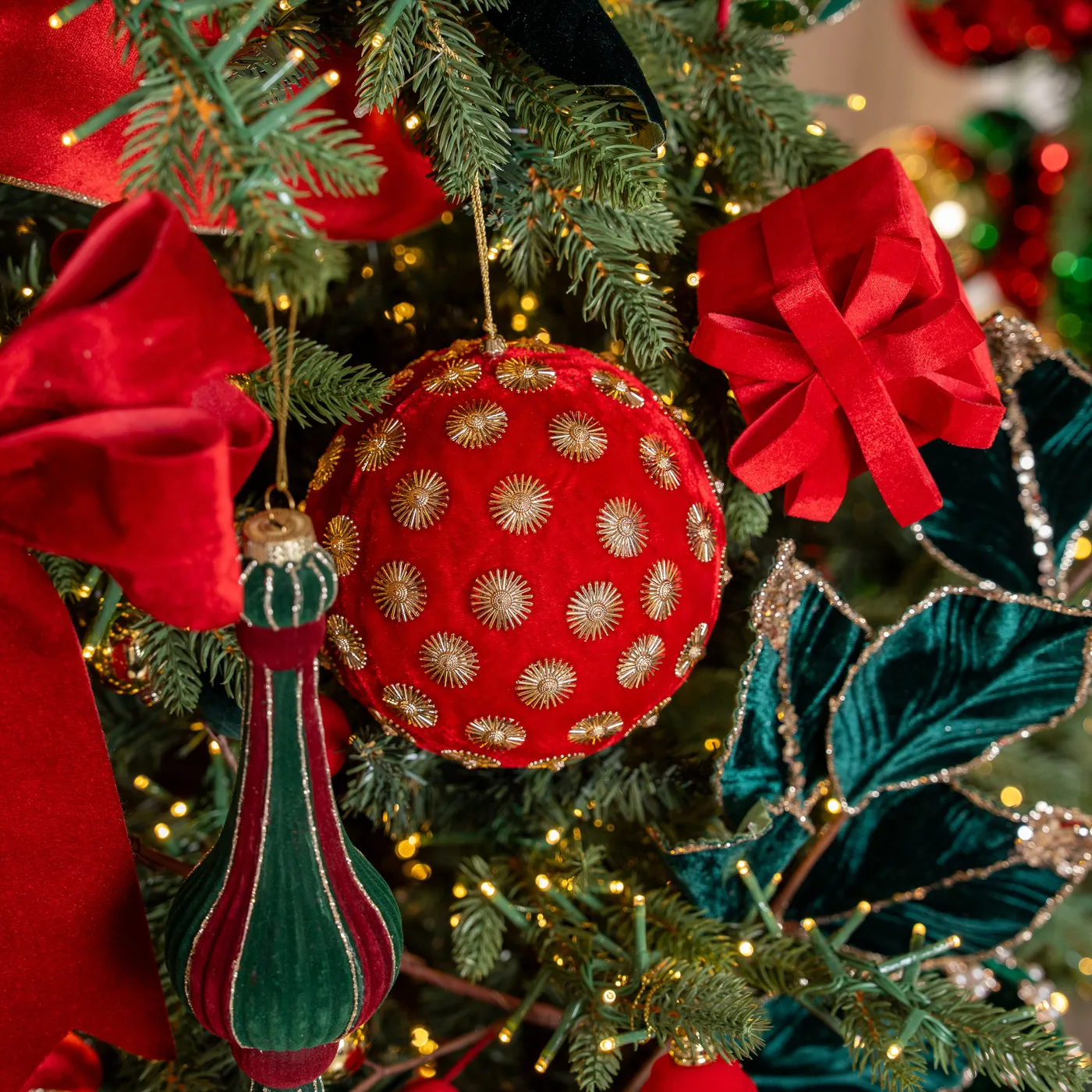
Velvet is also the fastest way to make an inexpensive tree look expensive, which is why it’s worth the fuss. Buy the wide ribbon first and wire it into loose 12-inch loops rather than tight bows — looser loops catch light on the pile and read rich, while tight ones look like a gift-wrap demo. Intermix one embroidered or beaded piece for every four plain velvet spheres; that’s the difference between a collection and a set.
13. Wide Velvet Ribbon and Gold Jingle Bells
The balance here is about 55% green, 25% red, 15% gold, and 5% off-white. Red velvet ribbon and green satin bows handle the two dominant colors; gold shows up only as jingle bells and ribbed accents; a single matte cream ornament breaks the saturation every few feet. Keep the ratio and you can swap green satin for black watch plaid and get a completely different tree from the same ingredients.
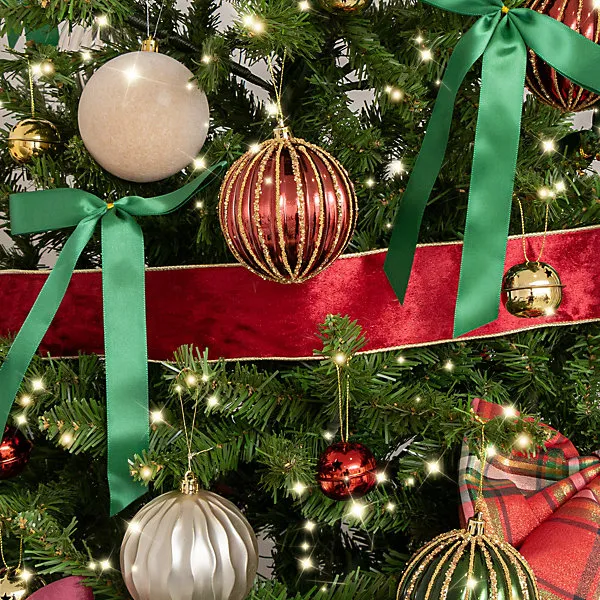
This is the look driving most of the 2026 mood boards: traditional silhouettes, richer materials, and a deliberate step away from the all-white farmhouse Christmas that dominated for years. Warm gold over cool silver, saturated red over blush, texture over matched sets. It has staying power because it isn’t a color trend — it’s a return to materials.
Before you commit:
- Measure your tree’s widest point — you need 9 to 12 feet of 2.5-inch ribbon
- Check your light temperature; velvet goes muddy under cool white
- Count your ornament hooks — jingle bells need ribbon loops, not wire
14. Glitter Bows and Thread-Wrapped Baubles
This is a $60 tree pretending to be a $400 tree. Red glitter bows run about $8 for a set of twelve, thread-wrapped spheres are $10 to $15 a dozen, and a single silver swirl ornament at $6 anchors the whole thing. Everything else is warm white lights and green branches. You don’t need a designer tree to get this energy — you need one shiny piece and a lot of cheap texture around it.
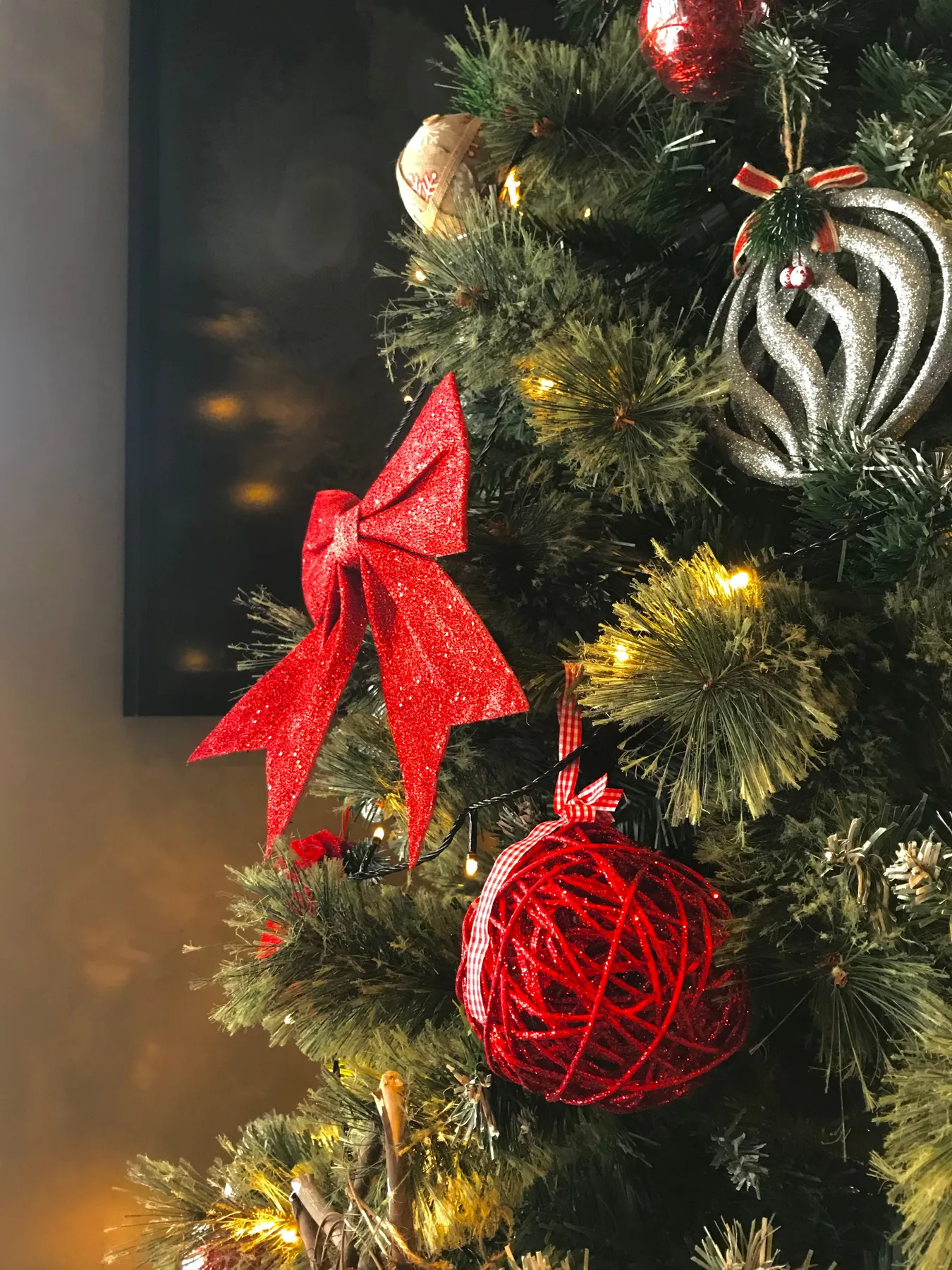
Two warnings. Glitter bows shed onto everything below them, so hang them above ornaments you don’t mind dusting. And thread-wrapped balls are surprisingly fragile — they snag on pine needles going in and out of storage. Compare with Idea #8, which leans on glitter too but balances it with matte red so the shedding is far less obvious. Here the glitter is the star, so keep a lint roller in the room.
15. When Twenty Ornaments Are Actually Enough
Almost nobody believes me on this: a tree this dense only needs about twenty ornaments. Not twenty per foot — twenty total, in two sizes. The foliage is dark and full enough to do the work, so shiny spheres catch the light and disappear into the branches between them. Remove the restraint and you lose the thing that makes it elegant, which is the space between the ornaments.
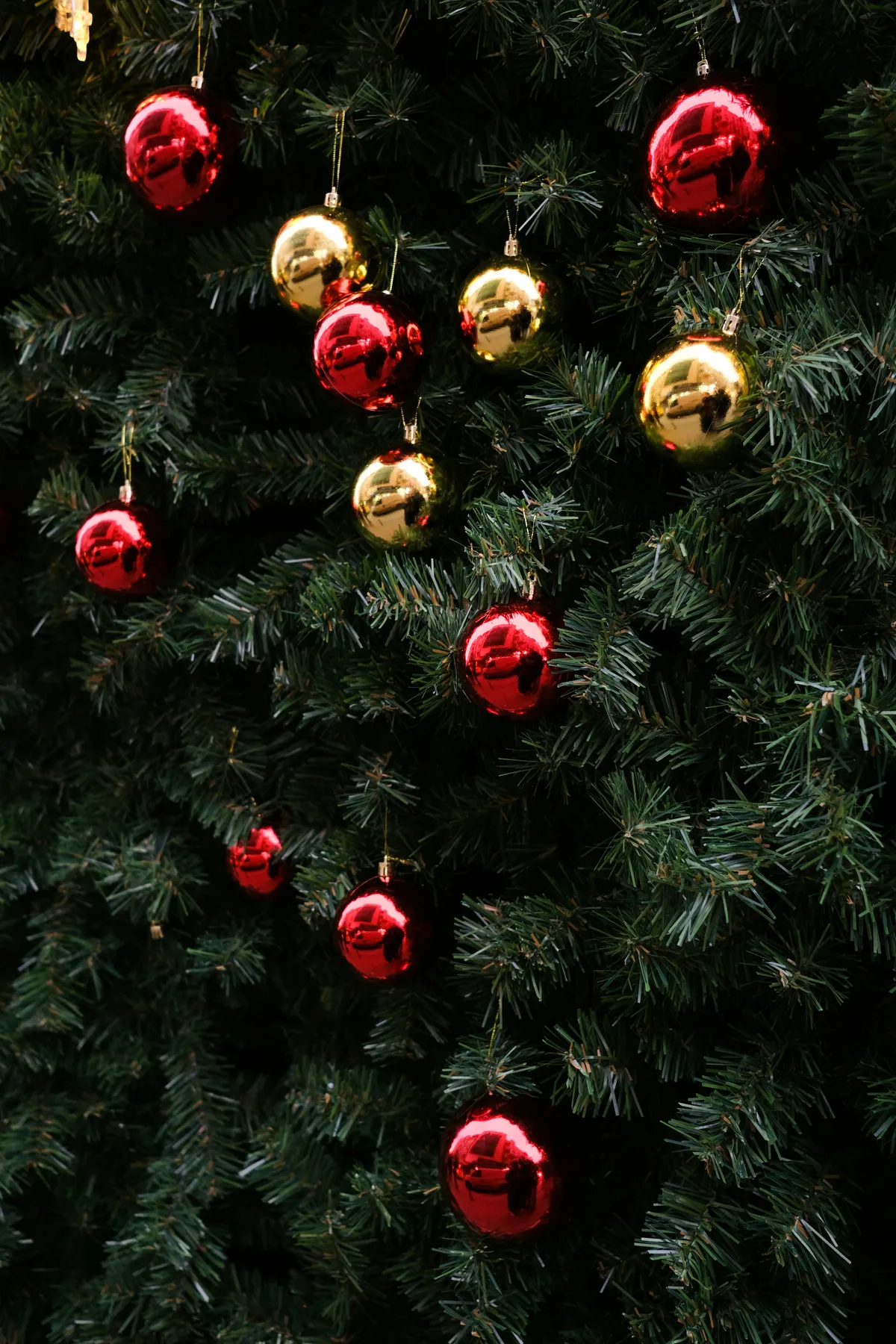
- Large shiny red and gold spheres, 4-inch, set of 12: $25 – $60
- Smaller mixed spheres, 2.5-inch, set of 12: $15 – $35
- Gold ornament hangers, 50 count: $5 – $9
- 600 warm white lights: $20 – $40
Total: $65 – $144. Skip the specialty baubles entirely and put the savings toward a better tree — a full, dark artificial tree is what makes the twenty-ornament approach work.
This idea suits a 7 to 8 foot tree in a room with 9 foot ceilings and at least 3 feet of clearance on two sides. It’s also the best option for renters, small apartments, and anyone who wants the tree up in twenty minutes. If you’re working with a double-height space, go back to Idea #1 instead — this one will look lost.
16. One Faceted Red Ornament on a Frosted Branch
The unglamorous secret to this shot: the ornament hangs on twine, not a wire hook, and the twine loop is left long — about 2 inches above the cap. That extra length lets the ball sit away from the branch so light wraps around it instead of behind it. It also lets it turn slowly. Swap in a metal hook and the ornament reads flat against the needles, and half the sparkle is gone.
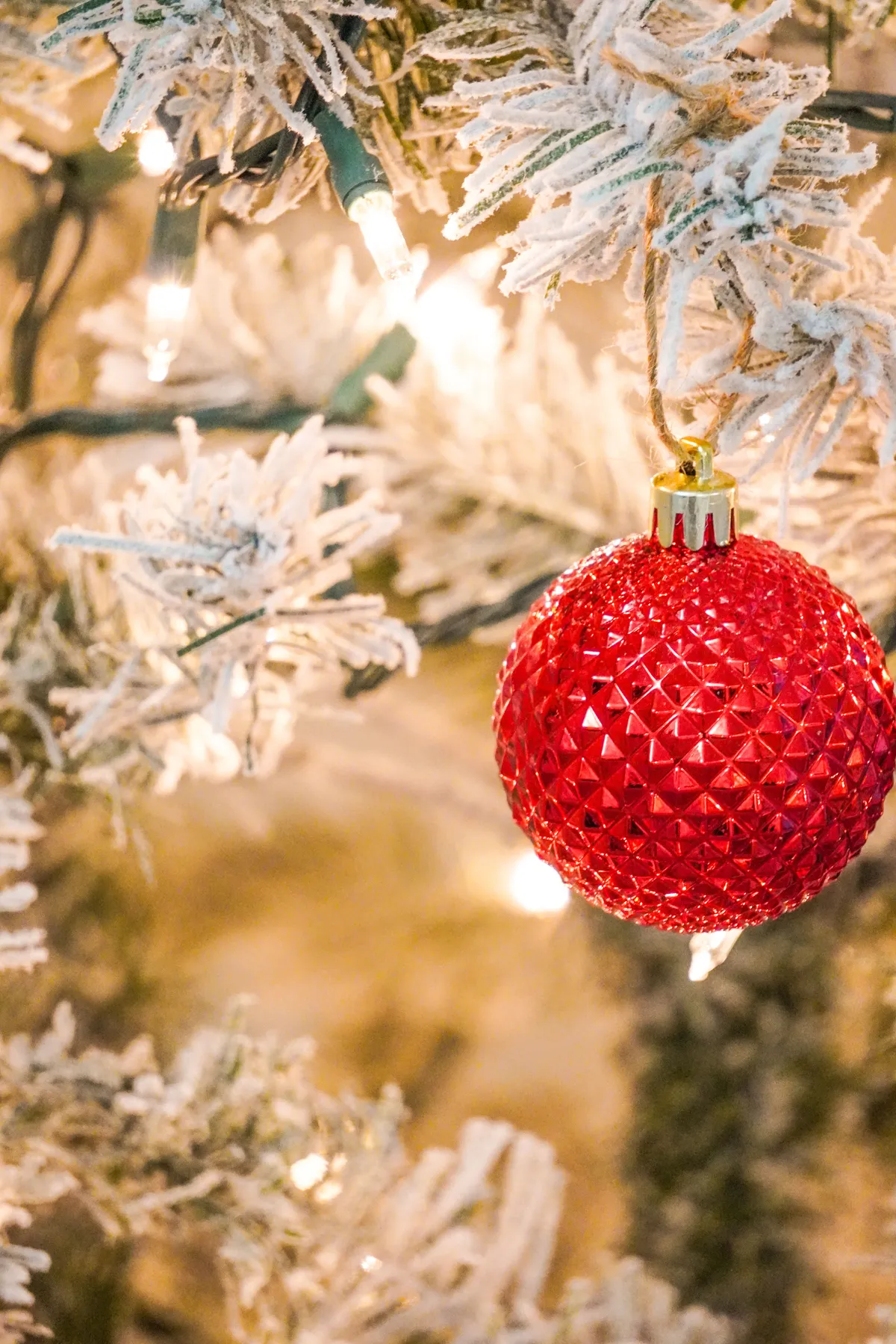
Frosting a branch yourself is a 20-minute job:
- Mix 1 part craft snow medium with 3 parts water in a spray bottle
- Spray lightly from 10 inches away, working in short bursts
- Let it dry 15 minutes, then spray a second pass on the tips only
- Add lights before the frost so the bulbs stay clean
- Finish with a single large ornament and step back
Under $15 for the spray, and it reads like a much more expensive tree.
17. Sheer Ribbon and a Tree Full of Inside Jokes
Sheer yellow-gold ribbon woven through the branches is doing quiet structural work here — it catches the string lights and bounces warmth across the whole tree, which is why the purple, red, and gold ornaments all sit comfortably together instead of fighting. Without the ribbon this is a random collection. With it, there’s a unifying texture holding the chaos in place.
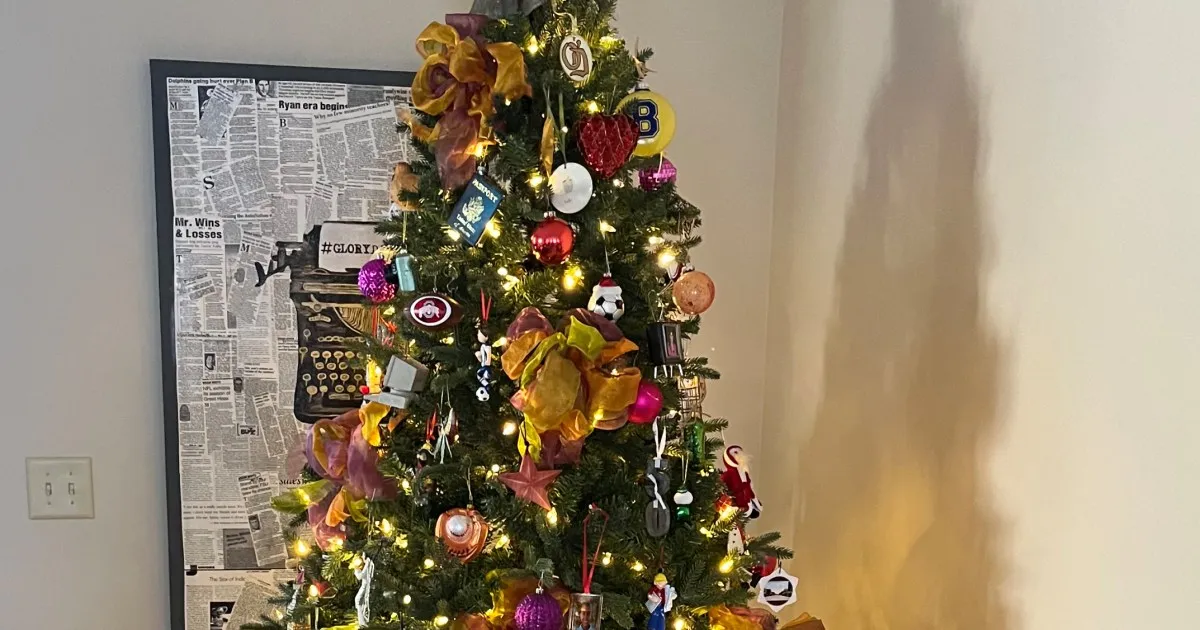
The personal ornaments are the point, but they need a framework or the tree just looks like a memory box. Three things make it hold together:
- One sheer ribbon color woven throughout at a consistent height
- Warm white lights only — colored bulbs would tip it into clutter
- All personal pieces under 4 inches, with a few plain gold spheres as breathing room
Keep the mantel and walls quiet if you go this route. A framed newspaper collage behind the tree is plenty of personality for one room.
18. Evergreen A-Frames Dressed in Plaid and Berries
Building a swag that stays where you put it:
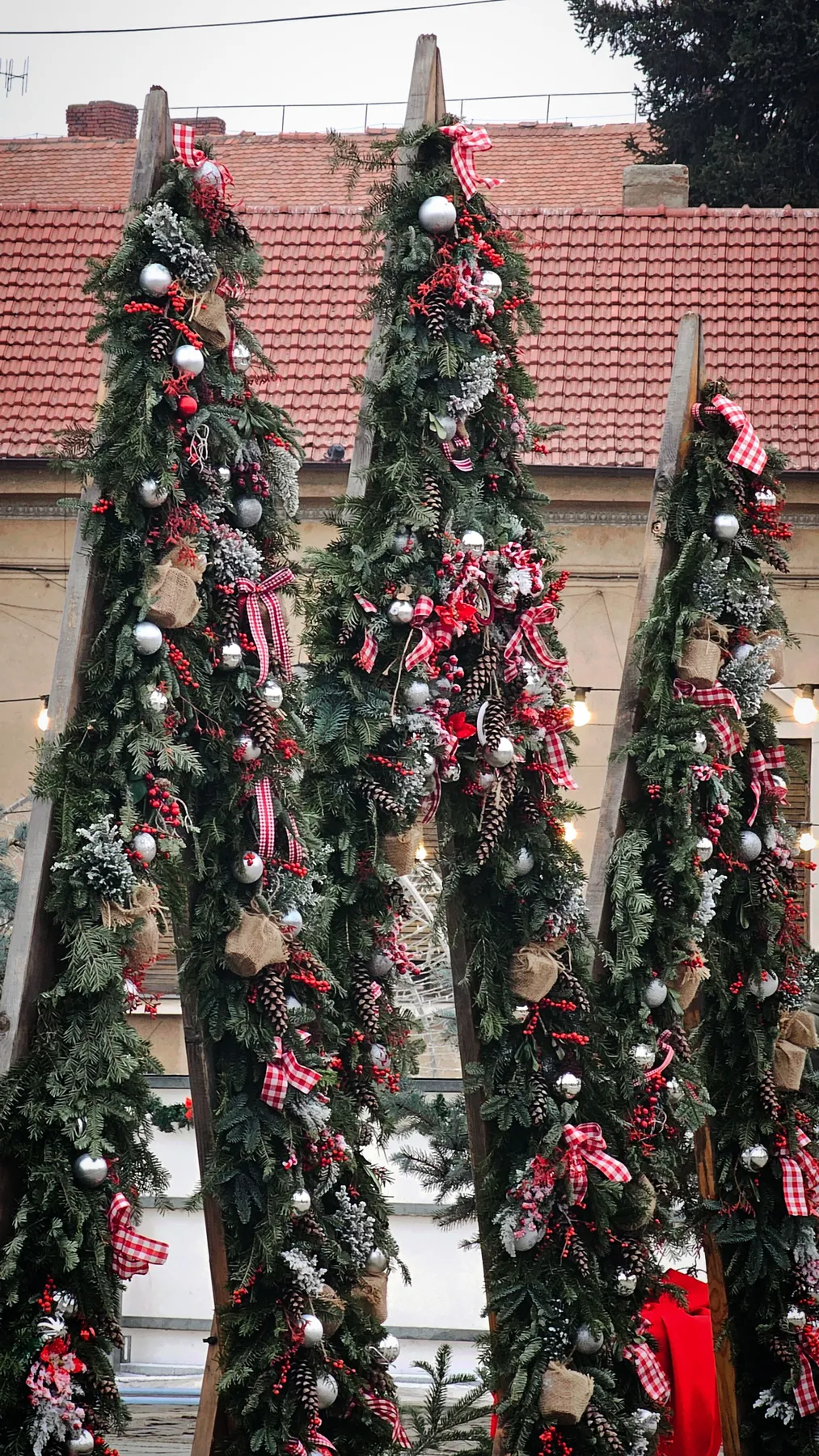
- Start with a 6-foot evergreen garland base, fluff every tip outward
- Wire in red berry clusters every 10 to 12 inches, always angling down and out
- Add silver spheres in pairs — single balls look like accidents
- Tuck pinecones and burlap pouches into the hollows, not the surface
- Tie plaid bows at the third and two-thirds points, never evenly spaced
- Finish by threading white flocked picks through for a dusted look
About two hours per frame and $45 to $90 in materials, depending on how much you gather yourself.
These A-frame forms need vertical space to work — think 8 feet tall and 3 feet wide at the base, with at least 18 inches of clearance on either side. In a low room they dominate fast. Scale the idea down to a single garland swag on a staircase rail and you keep the plaid-and-berry story without the footprint.
19. Red Apple Ornaments in a Half-Timbered Room
The red apple-shaped ornaments are the surprise here, and they work because the room behind them is already full of dark wood beams, white plaster, and red curtains — the tree is echoing the architecture rather than competing with it. Ribbed gold spheres fill in and keep the palette from going too literal.
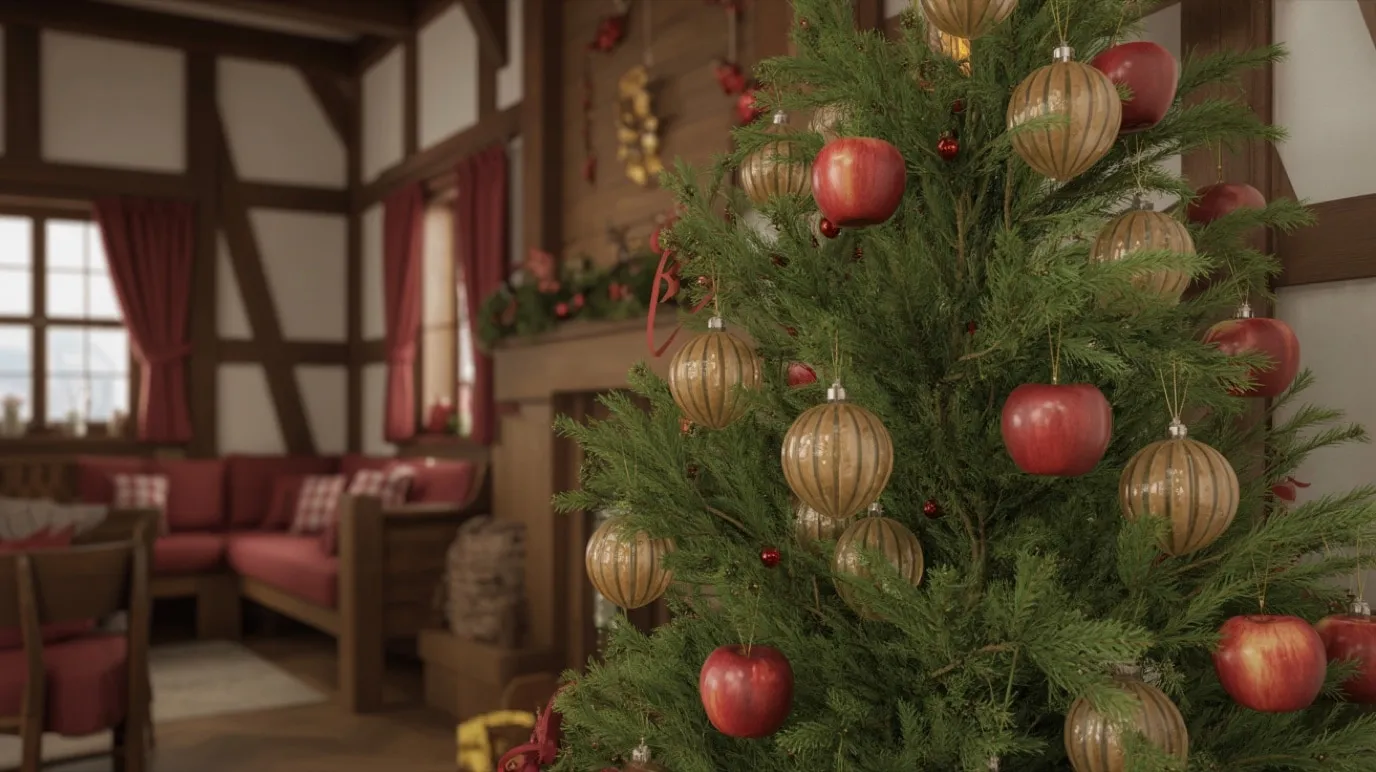
- Apple-shaped ornaments, set of 12: $18 – $40
- Ribbed gold spheres, set of 12: $20 – $45
- Warm white lights, 400 count: $15 – $30
- Red velvet ribbon, 9 feet: $12 – $28
Total: $65 – $143. Vintage apple ornaments turn up constantly at estate sales for $2 to $4 each and often have a nicer hand-painted finish than anything new.
Shaped ornaments collect dust in every crevice that a sphere doesn’t have, and painted apples chip at the stem. Wipe them with a dry microfiber cloth at the end of the season, store them in individual tissue wraps, and never stack them. Skip the dishwasher — I’ve seen it end badly.
20. A Forest of Small Trees Instead of One Big One
Grouping three to five smaller trees instead of one giant one is the fix for awkward rooms — narrow living rooms, entryways, apartments with no good tree wall. Keep the tallest tree at roughly two-thirds the height of the shortest ceiling element nearby, then step the others down by 12 to 18 inches each. Decorate all of them with the same palette at different densities: dense on the tall one, sparse on the smallest.
This is also the most 2026 version of a red-and-gold Christmas. One statement tree is a commitment; a cluster of small ones is furniture. It reads collected, it moves when you move, and it lets you buy a $40 tree five times instead of a $600 tree once. If you do have the grand space, though, Idea #1 is still the one that stops people in the doorway.
21. The Hand-Painted Floral Bauble
Hand-painted glass needs more care than anything else on your tree. Store it in its original box if you have one, or wrap it in acid-free tissue — newspaper ink transfers onto the matte red surface and never comes off. Hang painted pieces on interior branches where they won’t knock against neighbors, and never stack them in a bin. Expect a few chips over a decade; that’s normal and honestly part of the charm.
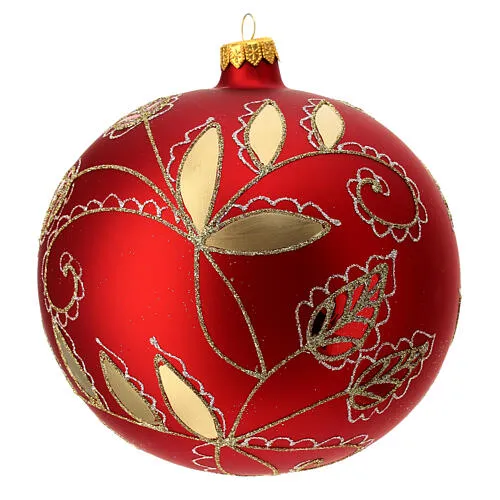
The reason this single ornament works so hard is scale contrast. The floral motif and the glitter outlines are tiny — maybe a quarter inch — against a four-inch sphere, and that fine detail against coarse pine needles is exactly the ratio your eye finds satisfying. Matte red keeps it from turning gaudy. Put the same pattern on a glossy ball and it reads cheap immediately.
22. Diamond Glitter and a Perfect Bokeh Backdrop
Patterned ornaments need a ratio or the tree becomes a jumble. Try one patterned piece for every four solids, and make sure the pattern repeats a color already in the palette — here it’s gold on red, so the surrounding gold spheres and warm lights do the blending. If you hang six diamond-pattern balls in a cluster, the pattern stops reading as a pattern and starts reading as noise.
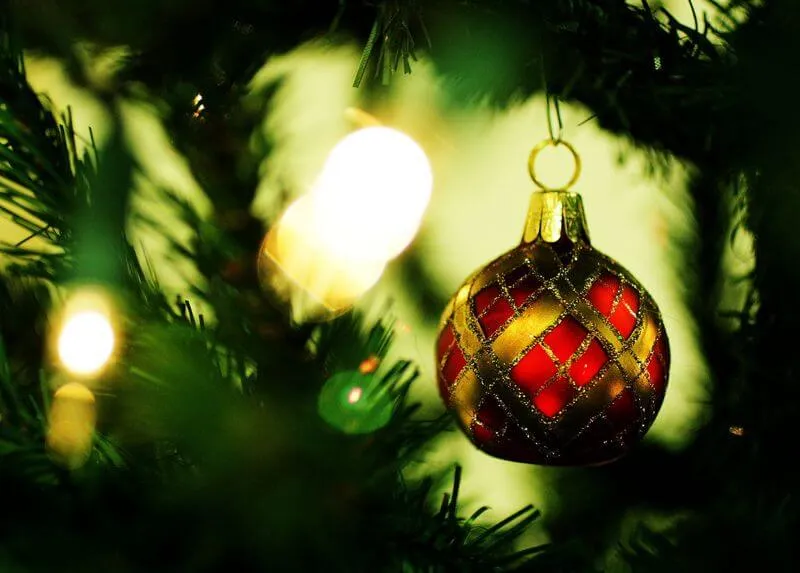
What sells this photo is the light behind it, not the ornament itself. Warm bulbs pushed deep into the branches and left slightly out of focus are the entire mood. Put the tree in front of a dark wall, keep the room lights low, and let the bokeh do the work. It costs nothing and it’s the difference between a snapshot and a photo you’d frame.
23. Matte Gold in Front, Red in the Shadows
Before you hang anything this season, check these:

- Hold a bare bulb against the wall — is the light warm or cool?
- Count your branch layers; you need at least six for depth like this
- Group ornaments by finish, not color, before you start hanging
- Test one ornament at arm’s length and one at three feet away
Depth is the whole trick in this close-up. The textured matte gold bauble sits forward on an outer branch while the smooth red one stays tucked behind the needles, catching only edge light. That layering — one matte, one glossy, one near, one far — is what makes a two-color tree feel rich instead of repetitive. Everything at the same depth goes flat no matter how nice the ornaments are.
24. Scrollwork, Gemstones, and a Red Glass Globe
The silver cap is the detail almost nobody notices and the one that makes this ornament look expensive. Gold glitter scrollwork on red glass is common; a decorative capped top with a proper hanging loop is not. If you’re buying one statement ornament this year, look at the hardware first — a well-made cap and a real ribbon hanger cost a manufacturer money, and that’s usually a reliable sign the rest was made with care too.
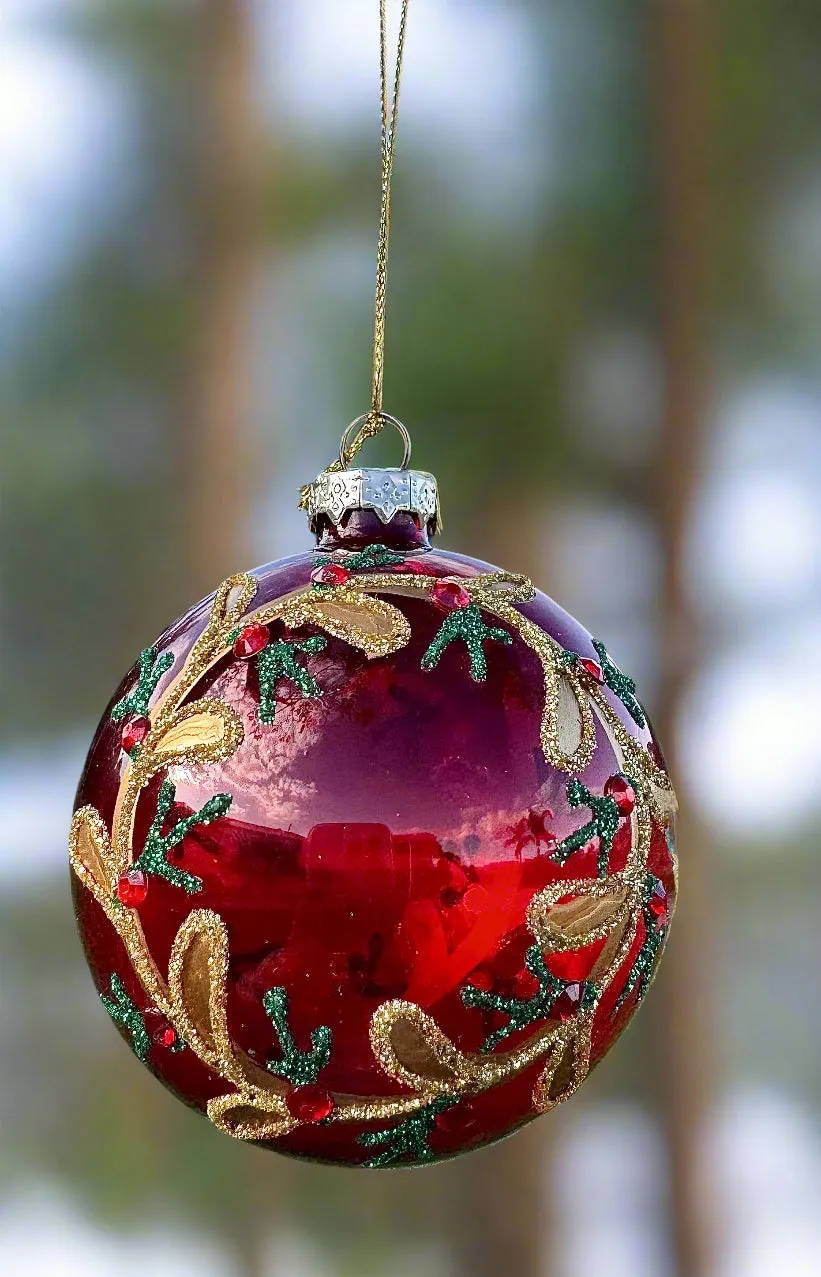
These run $25 to $45 new, which is a lot for one ball. Vintage and estate versions in the same style are routinely $8 to $15, and the glitter work is often finer because it was done by hand. Thrift stores misprice ornate glass constantly. Buy two, hang them where they catch the light, and let the rest of the tree stay simple.
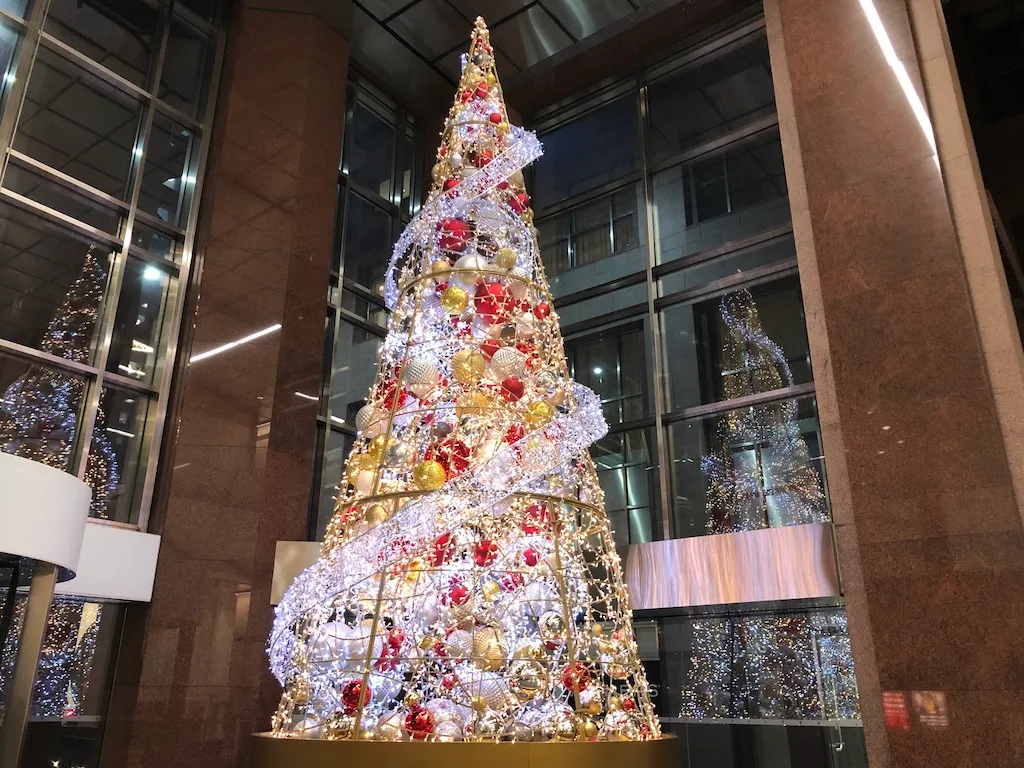
25. Bronze and Muted Brick in a Gilded Lobby
This is a public-space tree and the sizing follows the architecture: 14 feet tall, placed where gilded columns frame it on both sides, with smaller lit trees lining the hall behind to build depth. In a home, that logic translates to a 9 to 10 foot tree in a two-story entry — anything shorter gets swallowed. Ceiling height is the real constraint here, not floor space.
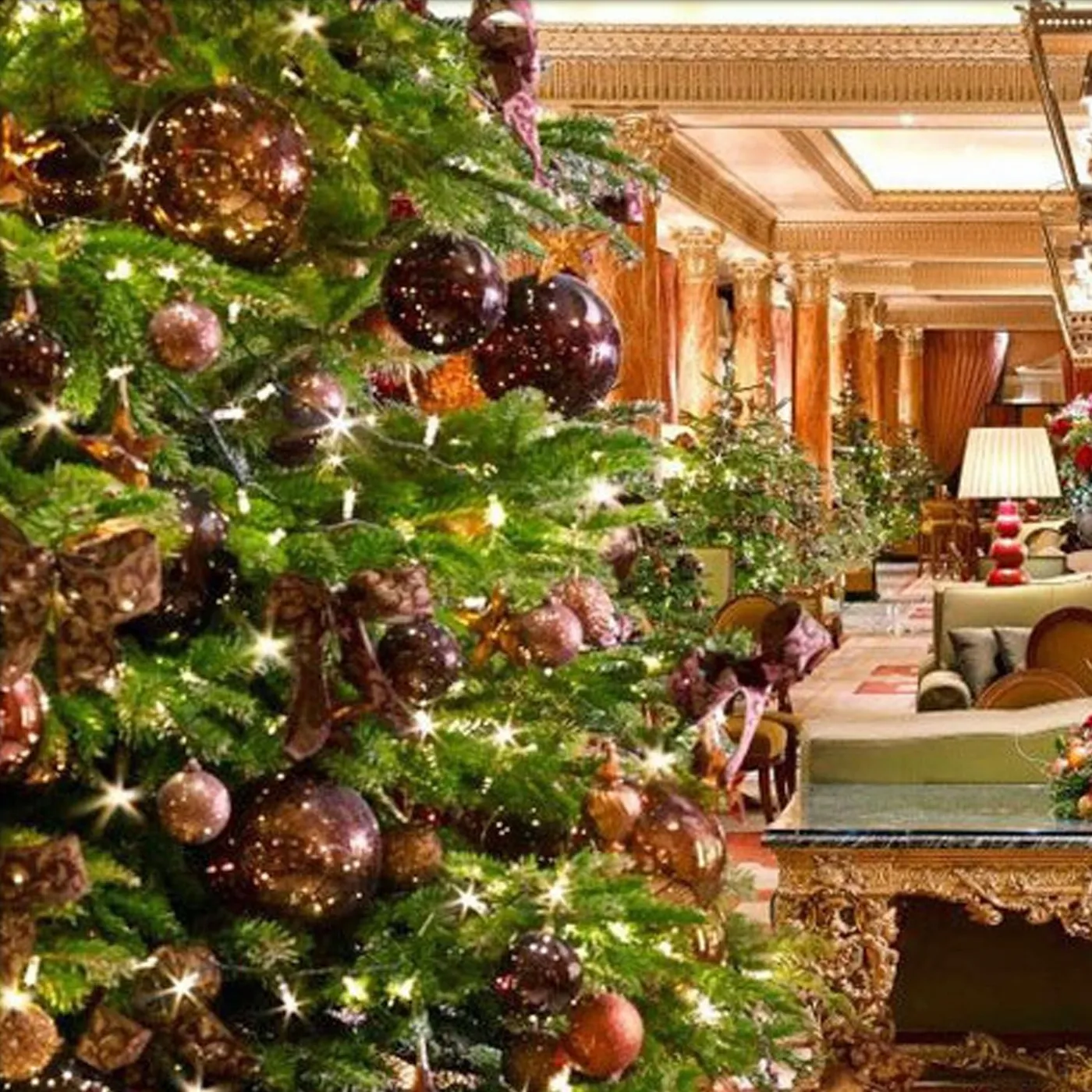
- Oversized tree, 9 to 14 feet: $400 – $1,800
- Bronze and muted red-brown spheres, 80 count: $160 – $380
- Patterned brown bows and gold stars: $60 – $140
- Warm white lights, 1,200 count: $60 – $120
- Pre-lit labor or installation: $0 – $500
Total: $680 – $2,940. The budget version of this look is Idea #2 at a fraction of the scale — same restrained palette, ordinary foyer.
26. Plaid, Teddy Bears, and a Wood Stove Corner
Red and blue plaid alongside teddy bears and berries is a very specific flavor, and it doesn’t blend with a sleek red-and-gold tree three feet away. Commit to one story per room. The stone wall and black wood stove here set the rules — rustic, cozy, slightly nostalgic — and everything else follows. Drop this palette next to polished brass and marble and both lose.
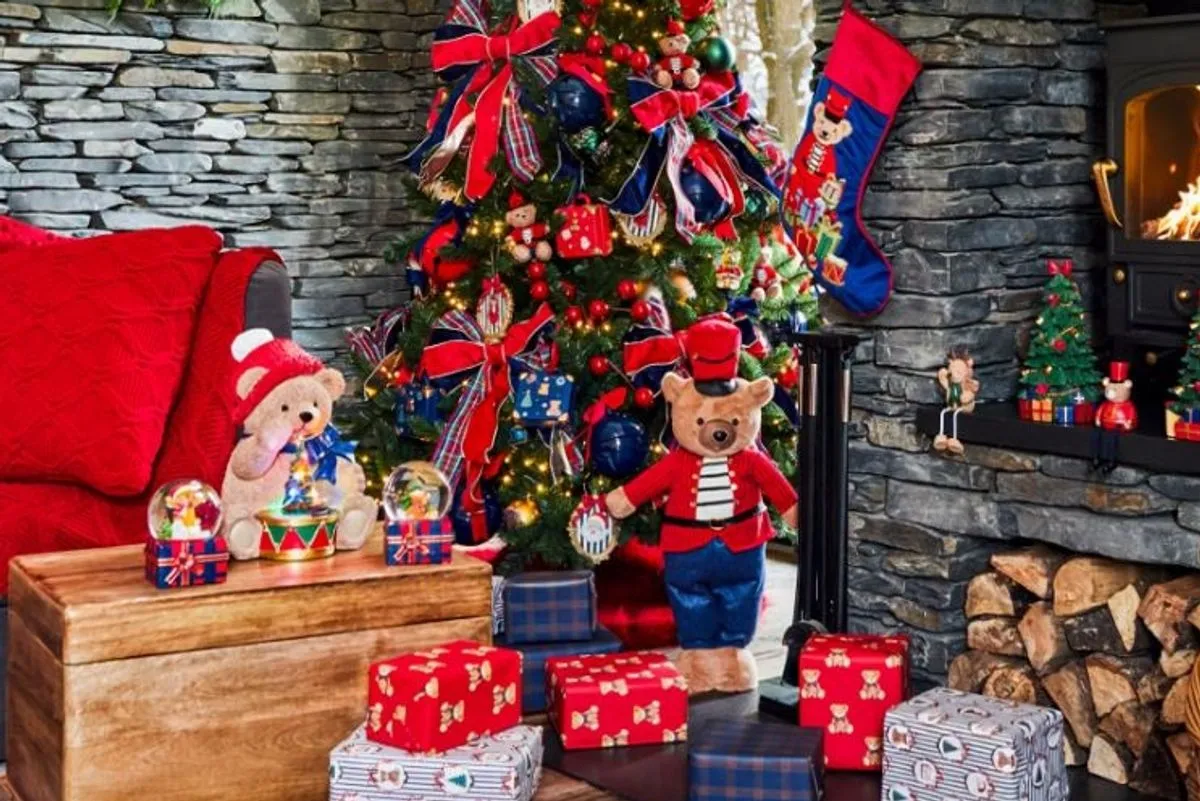
It’s also the trend with the most staying power on this list. The cabin-and-plaid look has been quietly gaining for two seasons as people push back against minimal holiday decor, and it has deep roots — this isn’t a color that will feel dated in 2027. Buy plaid ribbon by the roll rather than pre-tied bows; you’ll get four times the yardage for the same money and can tie them to your own scale.
27. Red, Gold, and a Sliver of Navy
Roughly 65% green, 20% red, 10% gold, and 5% navy. That last 5% is what makes this tree look curated rather than off-the-rack — the dark blue spheres read almost black in low light and give the red something to push against. Red velvet ribbon ties the whole thing together and red berries add a matte texture that glass can’t. Swap navy for deep plum and the tree goes warmer and more romantic.
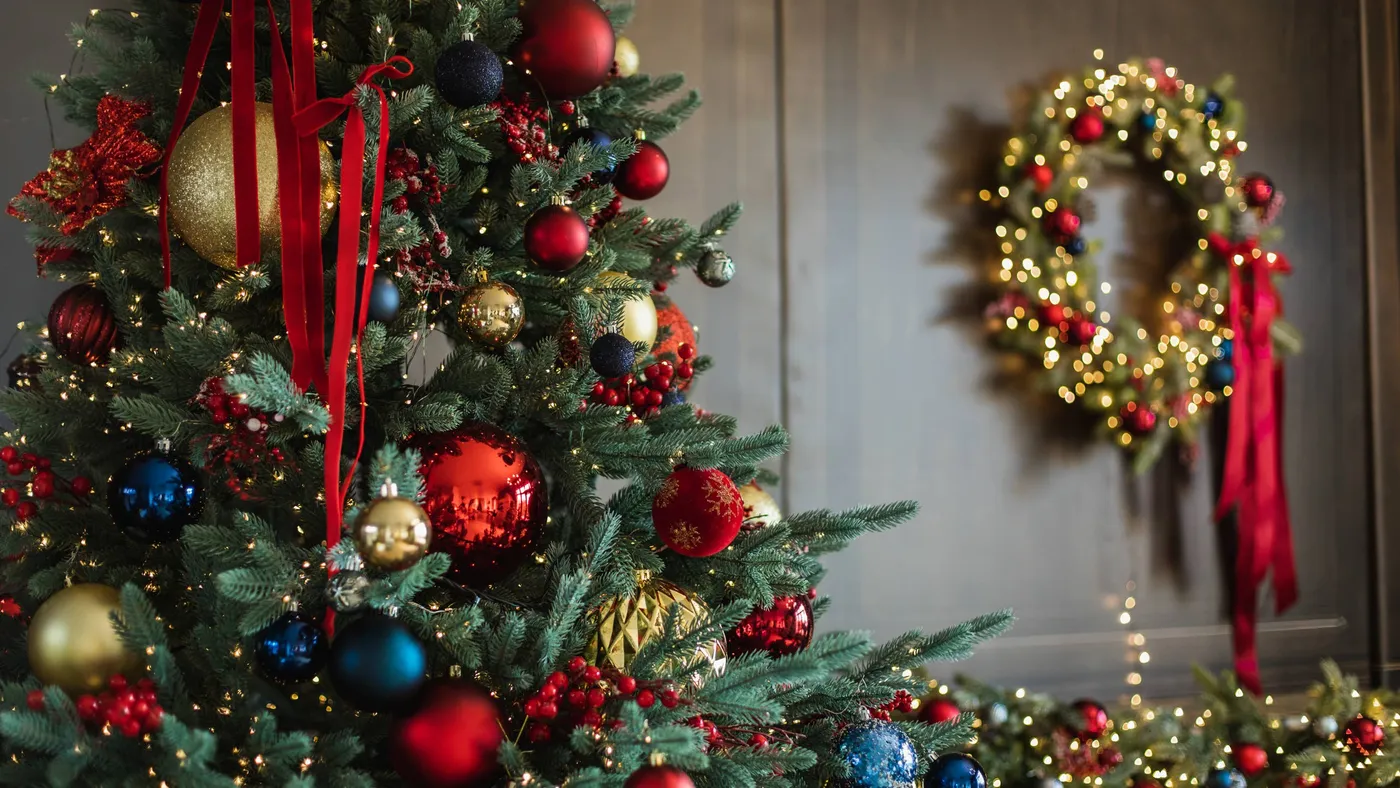
A practical note on velvet ribbon: wire-edged holds a shape but kinks badly in storage. Roll it around a cardboard tube instead of folding it, and store it flat in a box. When you re-hang it next year, steam the length over a kettle for thirty seconds and every crease drops out. That single habit will get you five seasons out of one roll.
28. Before You Buy a Single Ornament This Year
Do this before you spend anything, because it’s the step almost everyone skips:
- Measure your tree’s height and its widest branch spread
- Note your existing ornament count and finishes — most people own twice what they think
- Photograph your room in the evening with the tree lit, not in daylight
- Set a total budget and split it 50% tree, 30% ornaments, 20% lights and ribbon
Then run the numbers: an 8-foot pre-lit tree runs $150 to $450, 80 assorted ornaments $100 to $250, ribbon and garland $30 to $70, and lights if your tree isn’t pre-lit $25 to $50. Realistically you’re in for $305 to $820 for a tree that looks finished. Buying in January cuts that by 60 to 70%, and nobody will ever know.
29. One Ornament on a Stand, Styled Like Jewelry
Displaying a single large ornament on a metal stand is the most underrated holiday styling move there is, and it costs about $8 for the stand. The reason it works is that it borrows the language of a jewelry display — dark wood surface, one hero object, fresh pine and berries beside it, warm light behind. A plate of cookies next to it doesn’t hurt. Scale matters: a 5 to 6 inch teardrop on a 10 inch stand, placed on a surface that’s at least 16 inches deep.
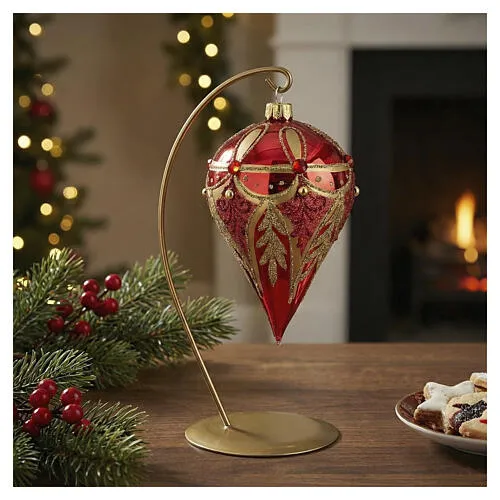
Glass this ornate scratches, and glitter scrollwork lifts if you scrub it. Dust with a dry soft brush only, never a damp cloth, and keep it off surfaces that get direct sun — the red fades toward orange within two seasons otherwise. If it does start to fade, move it to a lower-light spot and it’ll still hold up.
30. Flocked Branches, Velvet Spheres, Gold Bows
The order you hang things in matters more than what you buy:
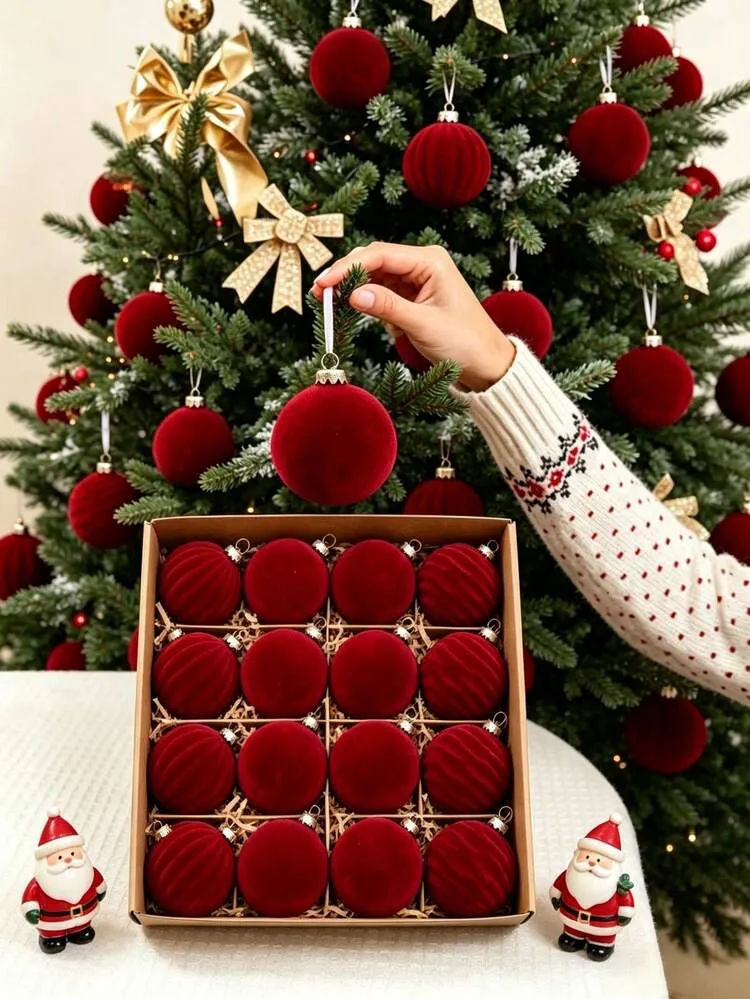
- Warm white lights first, pressed deep against the trunk
- Gold ribbon bows second, on the outer third of the branches
- Velvet spheres last, in clusters of two or three
- Fill gaps with one solid gold sphere for every three velvet
Planning roughly 12 velvet spheres and 10 gold bows for a 7-foot lightly flocked tree — any more and the flocking disappears underneath. Flocked branches hold ornaments beautifully but they also show every fingerprint, so handle them at the stem, not the tip.
Light flocking is the smarter choice in a real home: heavy flocking sheds onto floors and dark velvet picks up every fleck. This tree is the dressed-up cousin of Idea #12 — same velvet-and-gold instinct, softer finish.
Your Red and Gold Moment Starts With One Good Ornament
You don’t need a fourteen-foot lobby tree or a designer budget — you need one strong idea, a palette ratio you actually stick to, and a topper with some personality. Pick the one idea here that fits the room you have, not the room you wish you had, and build from there.
📌 Pin your favorite to your Christmas board now — future you, standing in a store in November with no plan, will be extremely grateful.