27+ Stunning Dried Orange Garland Ideas You Need to Try for a Chic 2026 Home

Most dried orange garland guides hand you a dehydrating chart and call it done — which is exactly why so many of them are sagging off the mantel by December 20th. We spent serious time combing through World Market, Etsy, Target, HomeGoods, and Amazon to pull together 27 garlands, wreaths, ornaments, and table setups that actually hold up, with prices running from about $6 for a spool of jute twine to $185 for a fully loaded faux evergreen.
You’ll see rustic farmhouse mantels, old-fashioned beeswax candles, modern organic eucalyptus runs, and cozy eclectic table runners — and yes, budget and luxury versions are compared side by side, with direct product links for each. In 2026 the pull toward handmade, seasonal, unplastic decor has gone fully mainstream, and dried citrus is the rare project that costs almost nothing and looks like you hired someone.
And stay until the end — we break down the most common mistakes that can ruin these looks. Some links here are affiliate links, which means we may earn a small commission at no cost to you.
📌 Save this to Pinterest for later — you’ll want to revisit these ideas.
1. Dried Citrus and Spice Garland Behind a White Linen Table
Hang a vertical garland so its lowest slice lands 18 to 24 inches above the tabletop. Any lower and it fights your candles; any higher and it floats. Use two 3-lb. cup hooks set into wall anchors, spaced to match the garland’s width, and thread the slices about 2 inches apart so the gaps read as intentional rhythm rather than a shortage of oranges.
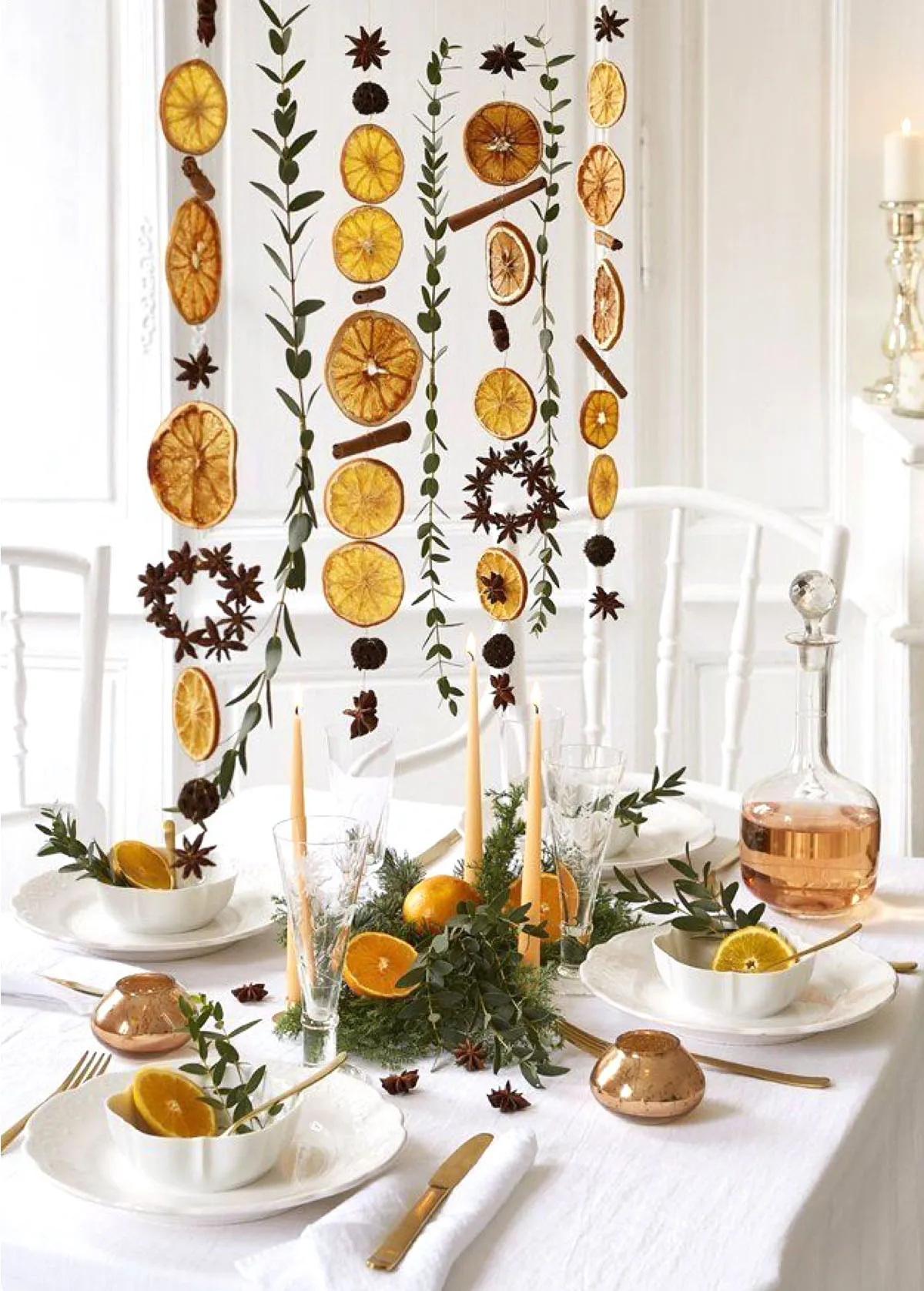
Three things are doing the work here. First, color temperature — the warm amber of dried citrus against cool white linen keeps the palette from going saccharine. Second, shape repetition: round slices, round scalloped plates, round star anise. Third, that vertical garland echoes the table’s long horizontal, so the eye travels up and across instead of stalling out at the centerpiece.
2. Rustic Wooden Table with Evergreen, Pinecones, and Candlelight
- Evergreen garland, 9 ft (real or good faux): $25–$60
- Dried orange slices, 2 bags or 6 oranges: $8–$25
- Pinecones and berries: $0–$15
- White tapers plus dark metal holders, set of 4: $20–$45
- Plates, green glasses, linens: $30–$120
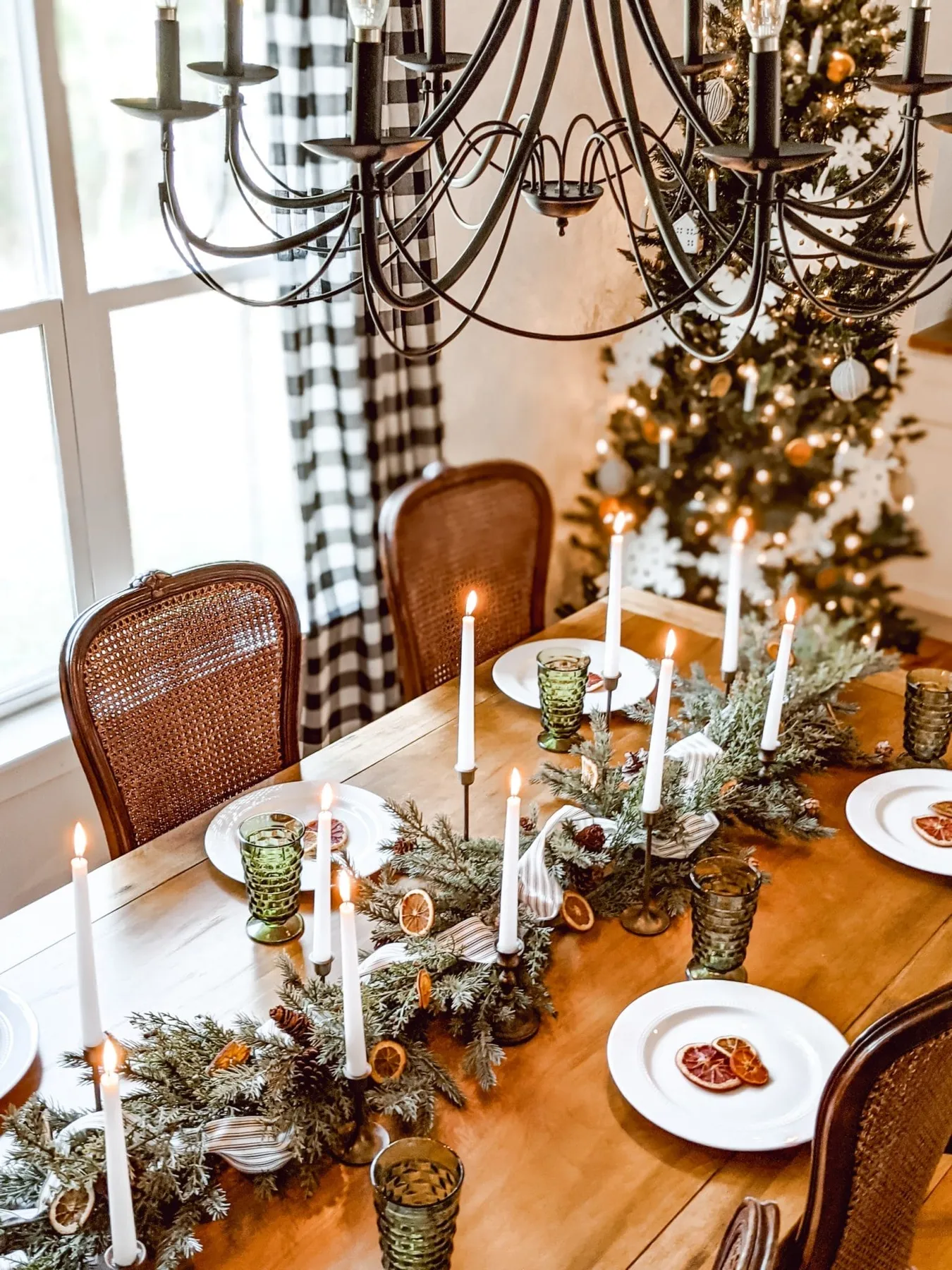
Total: $83–$265 — and the garland does 80% of the work. Budget alternative: a $15 faux pine garland from Target, thrifted black candle holders at $2–$4 each, and oranges you dry yourself for about $5.
Take away the candles and this table still reads as a nice holiday spread. Take away the garland laid down the length of the table — not looped up in a vase — and you lose the whole thing. That low, slightly uneven ribbon of evergreen is what makes the table feel gathered rather than decorated, and it gives everyone somewhere to tuck a wine glass down.
Real evergreen sheds. By day three you’ll be picking needles out of the butter, and sap will leave faint rings on an unwaxed wood table. Put a strip of parchment or a runner underneath, or go faux for the tabletop and save the real branches for the mantel. Also: dried orange slices are brittle, so don’t let anyone lean a hot taper within an inch of one.
3. Twine, White Beads, and Orange Slices Over Weathered Wood
- Slice oranges 1/8 inch thick and dry at 200°F for 3–4 hours, flipping once; they should be leathery, not crisp.
- Cool completely — warm slices crack when threaded.
- Use a blunt tapestry needle and 6-strand jute, tying a knot every 12 inches so the weight isn’t all hanging from one end.
- Alternate orange, bead, bead, orange for the rhythm you see here.
- Finish with a loop at each end.
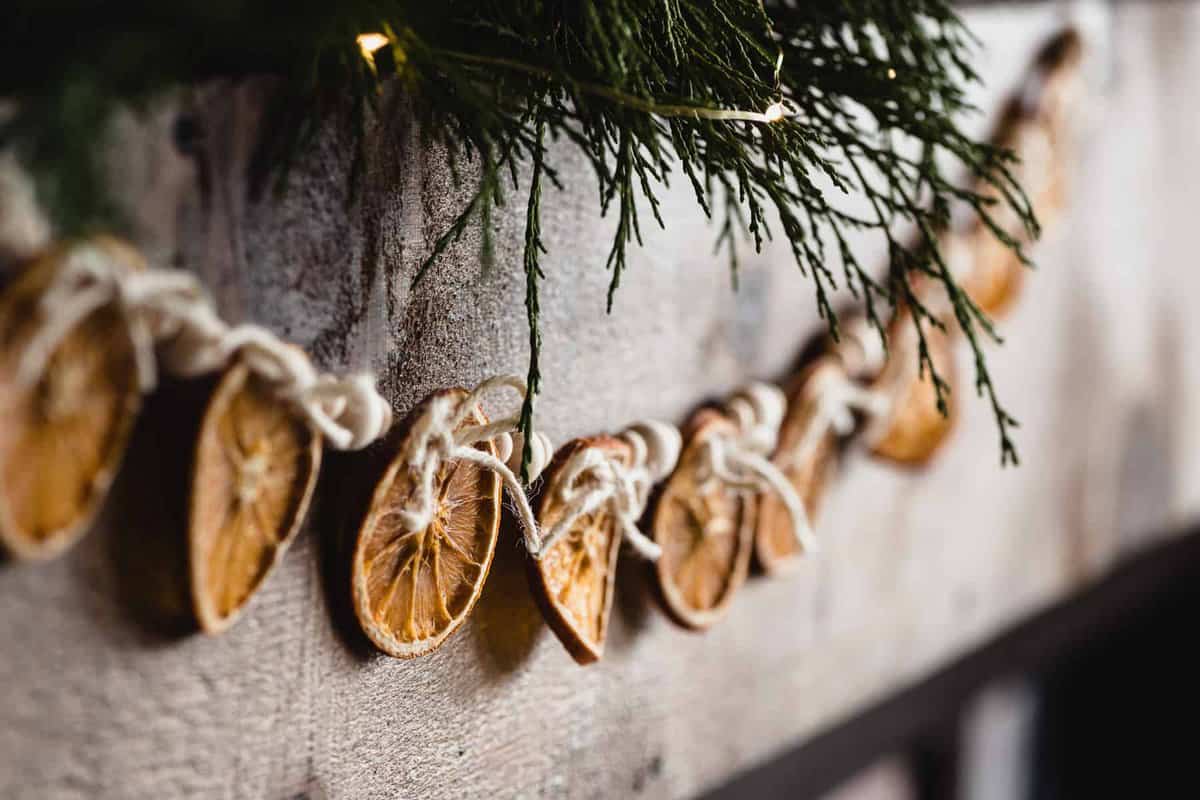
About 90 minutes of hands-on time once the fruit is dry, plus $10–$15 in materials.
Dried citrus is a sponge for humidity. In a steamy kitchen or a bathroom, slices soften and eventually grow fuzzy at the pith, so keep garlands in living and dining rooms instead. Dust them with a hair dryer on cool, never a damp cloth. Expect the color to deepen from bright orange to warm amber over two or three seasons — which honestly looks better — and store them flat in a paper box, never plastic.
4. Single-Thread Citrus Garland Against Dark Distressed Wood
The formula here is roughly 70% dark brown and neutral, 20% burnt orange, 10% deep green — a palette that reads sophisticated because the accent never gets a chance to shout. Swap the backdrop to white oak and the fruit to blood orange, and those same percentages give you something much brighter and more modern. Hold the proportions, change everything else.
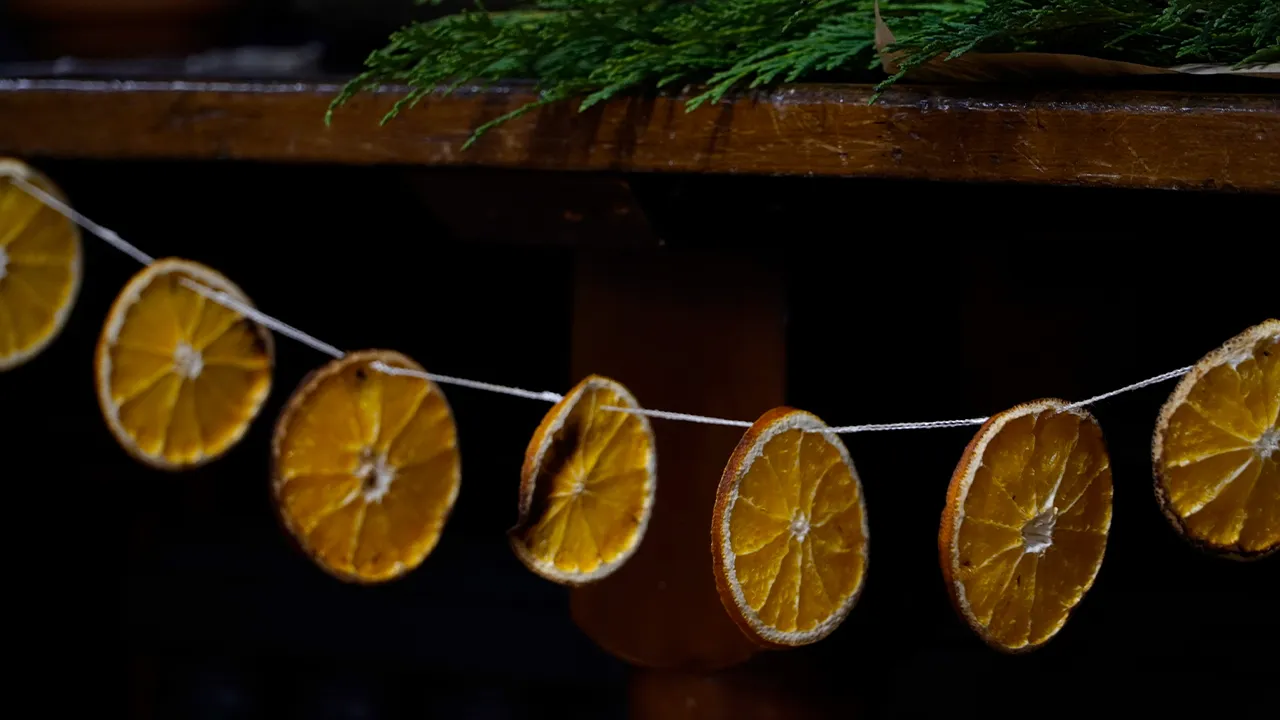
The reason these slices look like perfect coins instead of potato chips is the cut. Use a mandoline at 1/8 inch, dry them flat on parchment in a single layer with no overlap, and flip at the halfway mark. Anything thicker than 3/16 inch stays spongy in the middle and browns unevenly. String on thin white cotton so the fiber nearly disappears against a pale wall — the same trick that makes Idea #1 look so clean.
5. A Dark-Rimmed Bowl of Dried Citrus and Apple
This is the least fussy thing in the entire article and it might be the most effective. A shallow bowl, a dark rim, three textures of dried fruit — orange, pale apple, reddish-brown apple — and a dark green cloth underneath doing quiet heavy lifting. That dark rim acts like a picture frame, stopping the pale apple slices from dissolving into the table, and the matte fabric kills any glare.
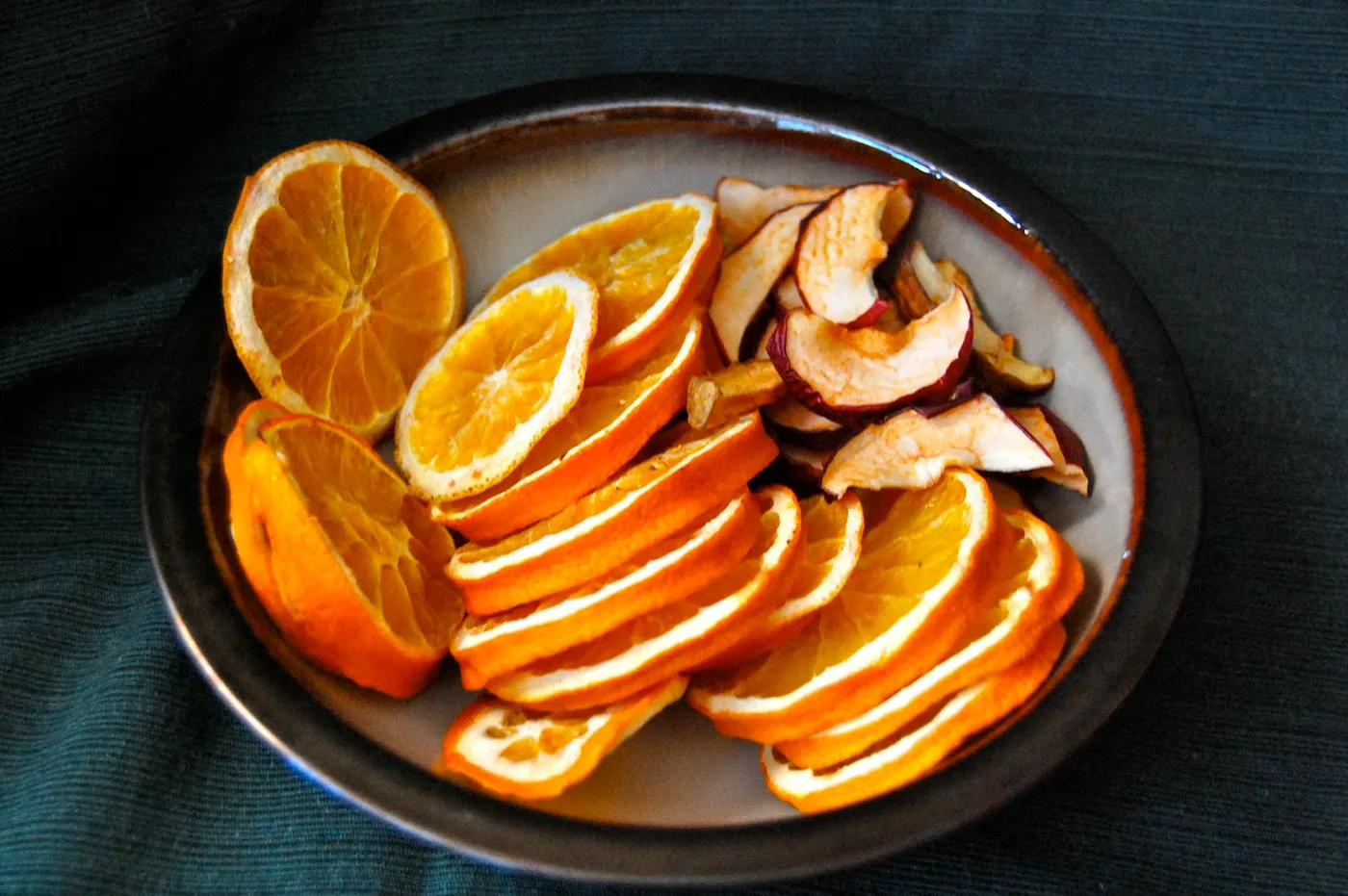
Total cost if you already own a bowl: about $6. Two navel oranges, two apples, and four hours of oven time. Thrift stores are full of shallow ceramic bowls with dark rims for $3–$8, and a dark green linen napkin or a scrap of velvet works as the base. Compare with Idea #10 — same idea, more spice, zero extra effort.
6. Backlit Orange Garland with Whole Fruit and Fairy Lights
Dried citrus keeps outselling plastic ornaments because it photographs like a candle flame — translucent, warm, slightly irregular. In 2026 the unplastic holiday has moved from niche to mainstream, and searches for dehydrated orange garlands spike every November for a reason. It’s a trend with legs, largely because the supply chain is your grocery store.
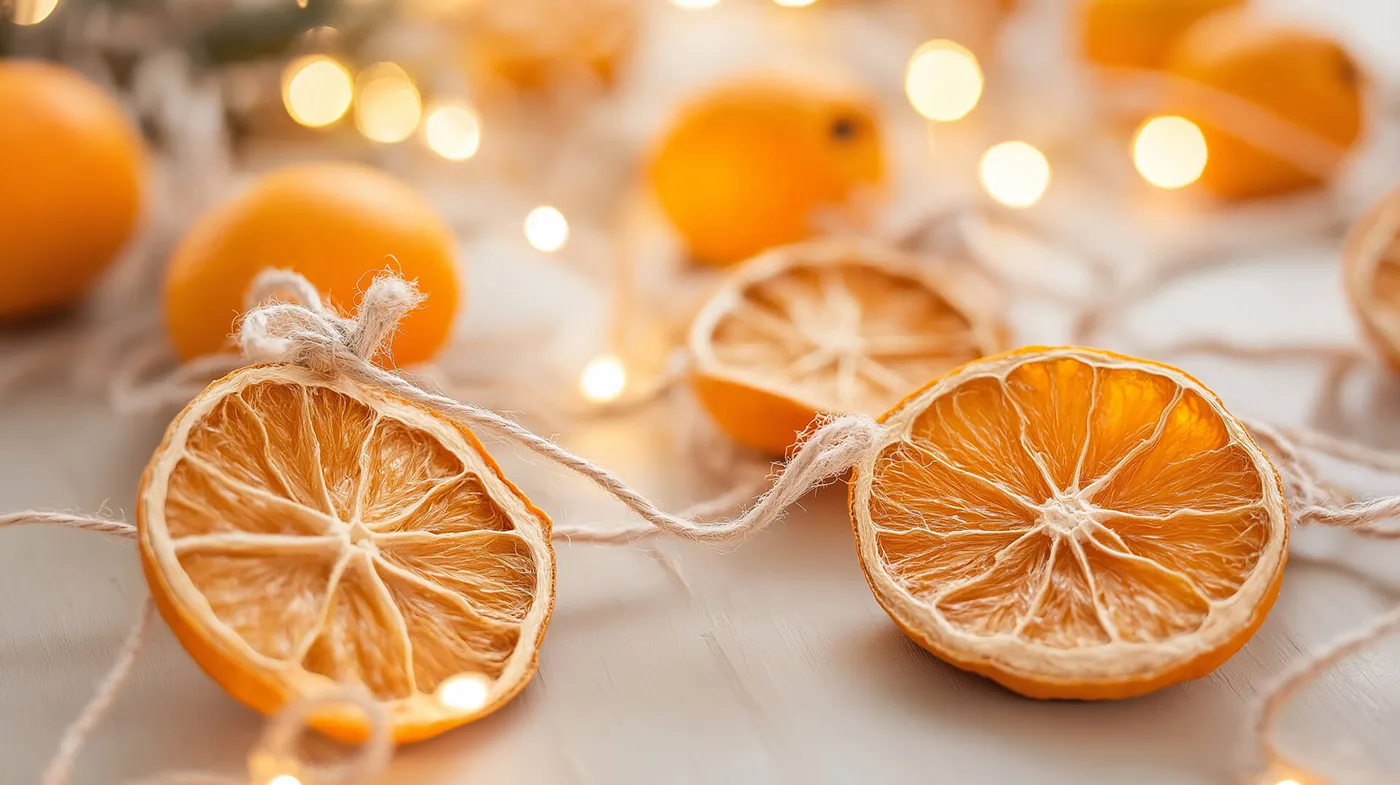
This close-up styling works anywhere from a two-foot shelf to a nine-foot built-in, but the rules change with size. Under 4 feet of surface, use one strand and two clusters of whole fruit. Above 6 feet, run two strands at different heights — roughly 8 and 14 inches apart — and let the lights sit behind both so the fruit glows instead of reading flat.
7. Evergreen Wreath with Cinnamon Bundles and a Cream Bow
Wire fruit into a wreath in three clusters, never evenly spaced — think 10 o’clock, 2 o’clock, and 6 o’clock. Push 22-gauge floral wire straight through the pith rather than the rind, which tears, then twist it around the wreath’s base ring and hide the twist under a pinecone. Cinnamon sticks look best bundled in threes, tied with twine, and tucked so they sit slightly proud of the greens.
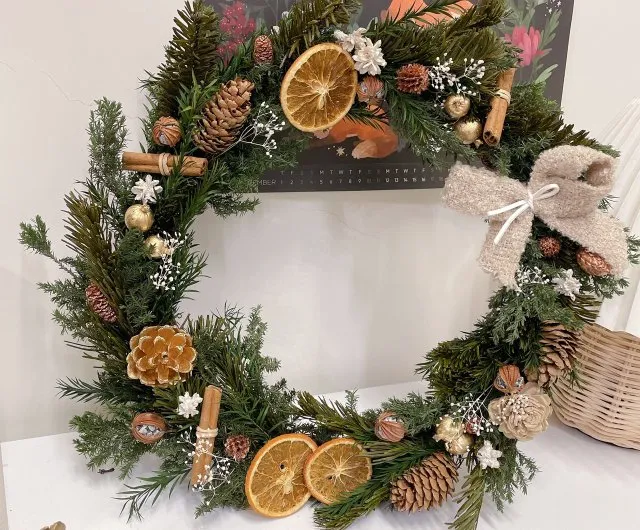
That big textured cream bow is the release valve. Everything else on this wreath is brown, green, and orange — beautiful, but heavy. The bow gives your eye somewhere soft to land, and it’s also the one element you could swap season to season without touching a single orange slice. Change it to oxblood in January and the whole wreath reads winter instead of Christmas.
8. Artificial Pine Garland Decked with Berries and Spice
- Faux pine garland, 9 ft: $15–$30
- Dried orange slices, 40–50: $10–$20
- Cinnamon sticks, bulk bag: $6–$12
- Red berries and pinecones: $8–$20
- Floral wire and twine: $5–$8
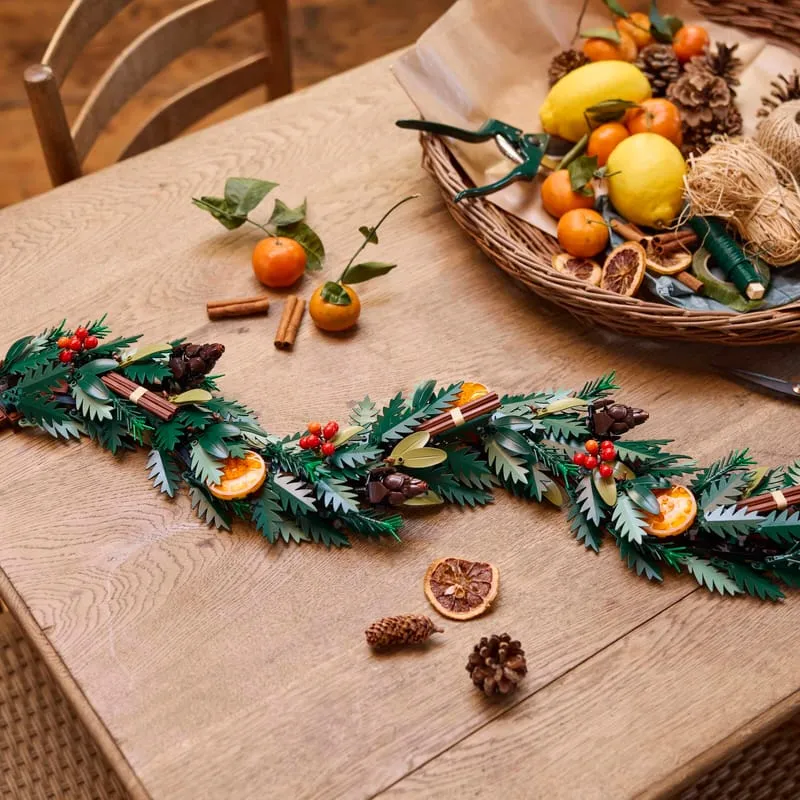
Total: $44–$90 for nine feet you’ll reuse for years. Budget alternative: buy dried oranges and cinnamon in bulk at a restaurant supply store and forage the pinecones from a park — free, and nobody will know.
- Lay the garland flat and fluff every branch outward, not downward.
- Wire orange slices in clusters of three, about 10 inches apart.
- Add berries so they peek from behind the orange, never in front.
- Tuck cinnamon sticks in pairs near each cluster.
- Weave twine loops at the back every 18 inches for hanging.
About 45 minutes for nine feet, and no glue gun required.
The red berries are what make it. Without them this is a brown-and-green garland — pleasant, a little sleepy. Those small red clusters give the whole thing a pulse and, more practically, they’re the cheapest item on the list. One $8 bunch of faux berries can wake up a garland you already own.
9. Flat Lay of Grapefruit, Orange, and Rosemary for Garland Making
- Test one slice: if it bends without cracking, it needs more oven time.
- Clear a surface you can leave messy for two hours.
- Cut twine to the finished length plus 12 inches for loops and knots.
- Check your needle — a dull one tears the pith.
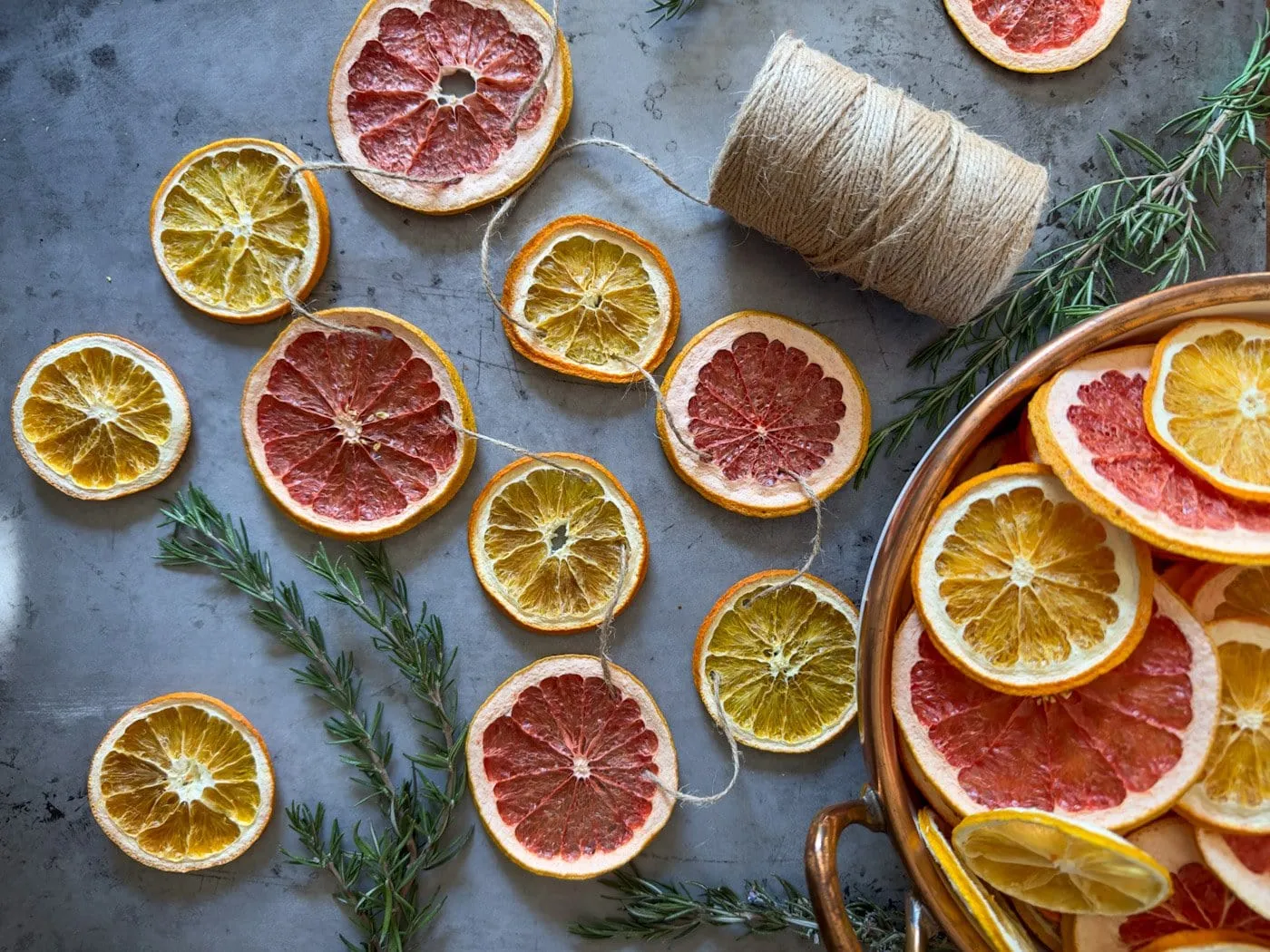
Skip any of these and you’ll be re-threading the entire strand an hour later, which nobody enjoys.
Grapefruit is not orange. The slices are thicker, wetter, and take nearly twice as long to dry — plan on six hours, not three, and expect a few casualties. Rosemary is the other trap: it looks incredible for about a week, then drops needles everywhere and fades to a dull grey-green. Use it on the table where it’ll be handled, not in a garland you plan to keep until January.
10. White Openwork Bowl of Citrus and Spice Potpourri
Count the components: dried orange, dried apple, pinecones, cinnamon, star anise. That’s five materials, three of them brown and two orange, and it still feels calm because the bowl is white and open-work. The rule is one bright, one pale, three earth tones. Trade the star anise for whole nutmeg and nothing changes visually; lose the white bowl and the whole arrangement goes muddy.
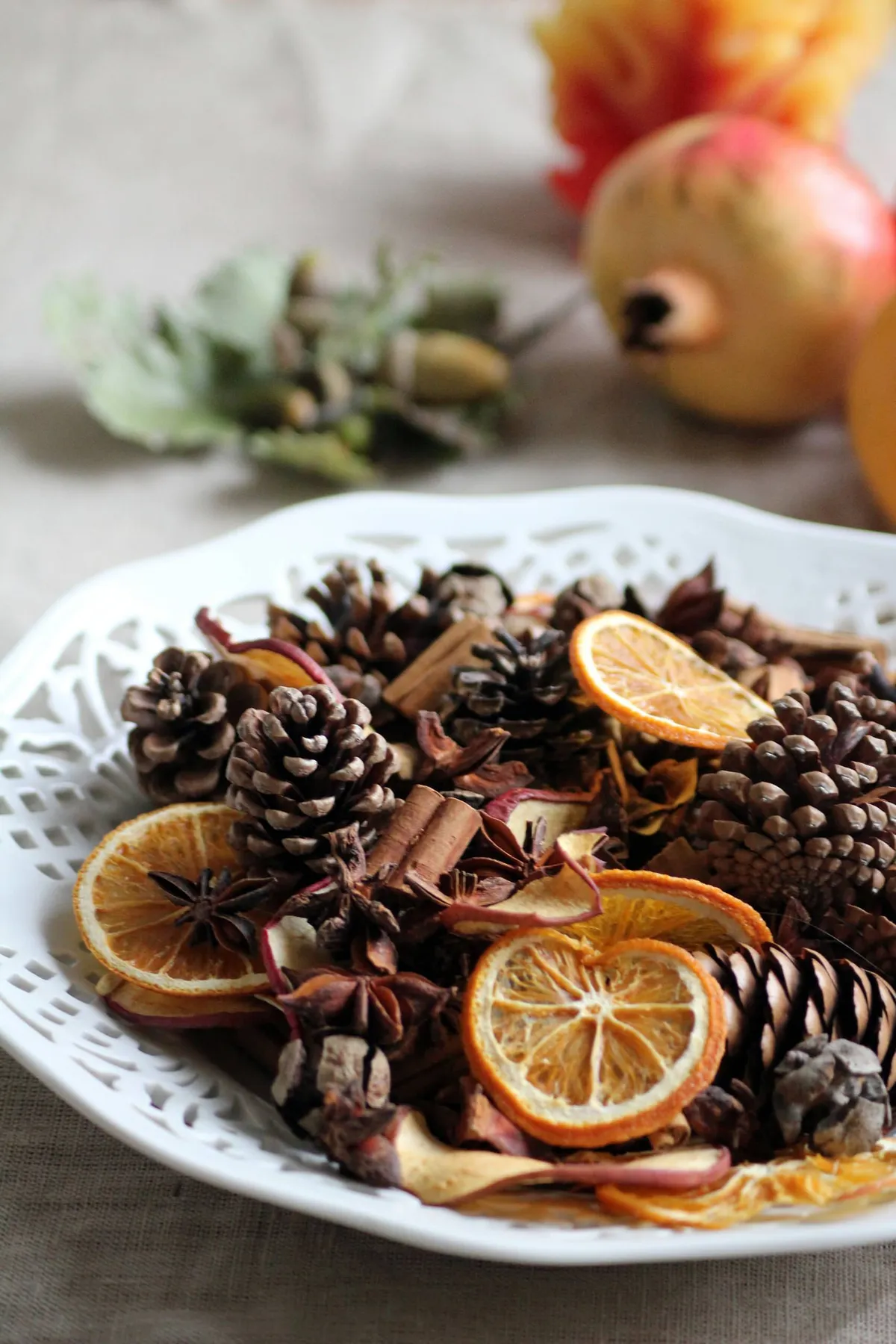
Potpourri is a dust trap, plain and simple. Empty the bowl every three or four weeks, wipe it out, and shake the contents over a bin outdoors. Skip the fragrance oils — they darken the fruit and attract grit. If the orange slices start looking grey, a couple of hours at 200°F resets them. Expect to replace the fruit every other year or so.
11. Star Anise Citrus Ornament on a Lit Tree
Two details make these ornaments read as handmade rather than craft-fair. Use slices no wider than 2 inches — bigger ones look like coasters hanging on a tree — and set the star anise with a single dot of hot glue in the pith, not the flesh, so it sits flush. Tie the loop with jute and hang it so the star faces outward. It’s a one-sided ornament, and that’s completely fine.
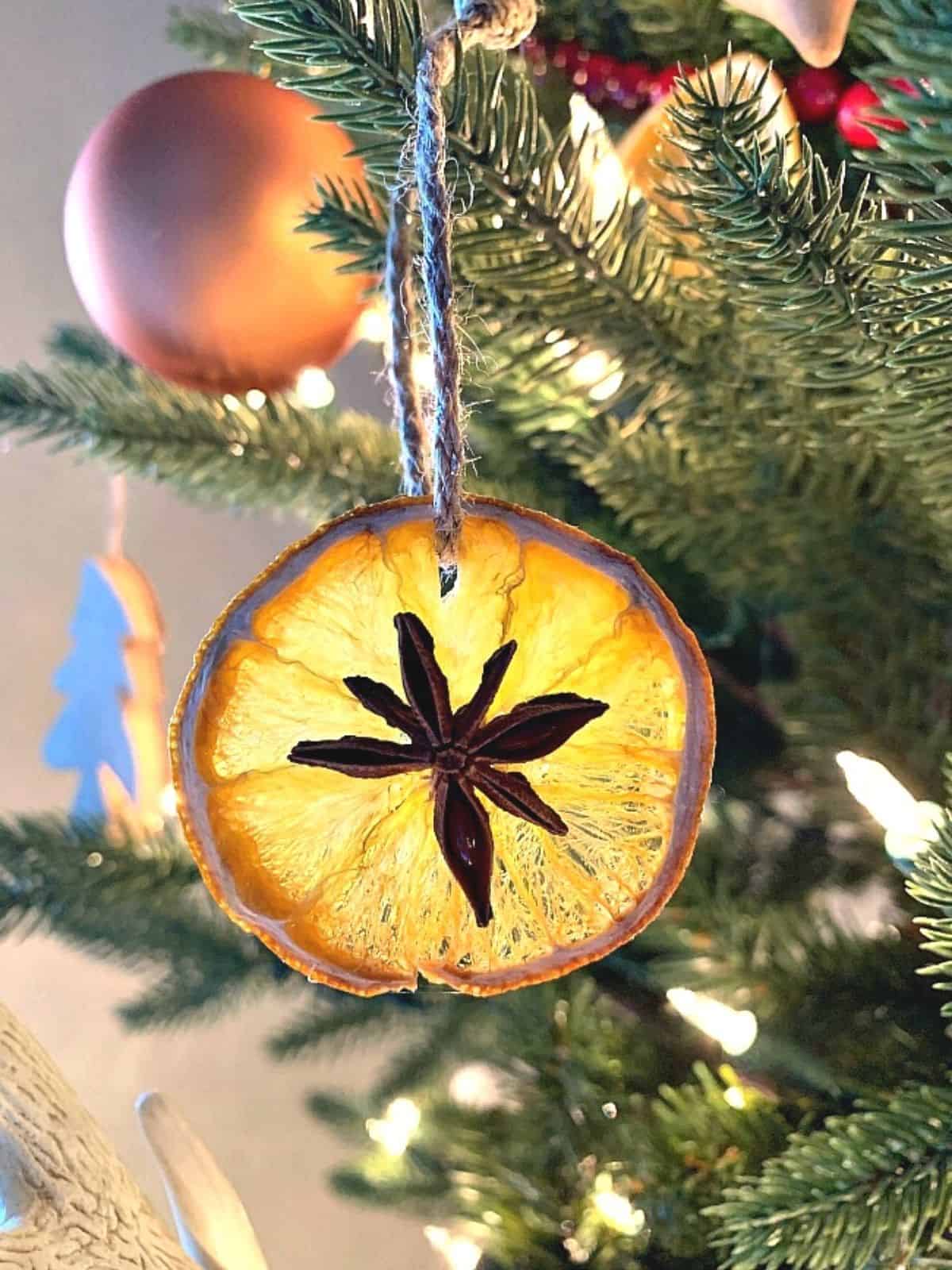
Contrast of scale is the quiet hero. The star anise is maybe three-quarters of an inch across, sitting inside a two-inch orange slice, hanging on a tree full of four-inch baubles. That tiny dark center inside a translucent ring gives your eye a focal point it can hold from across the room — which is exactly why the plain peach sphere in the background fades away.
12. Building an Evergreen Garland with Orange Berries by Hand
- Start with a base garland and work in 12-inch sections, not the whole length.
- Wire the fresh evergreen sprigs in first — they set the silhouette.
- Add cinnamon sticks in bundles of three, tucked deep.
- Attach orange slices last so they sit on top and catch light.
- Finish each section with two or three berry clusters for a repeating beat.
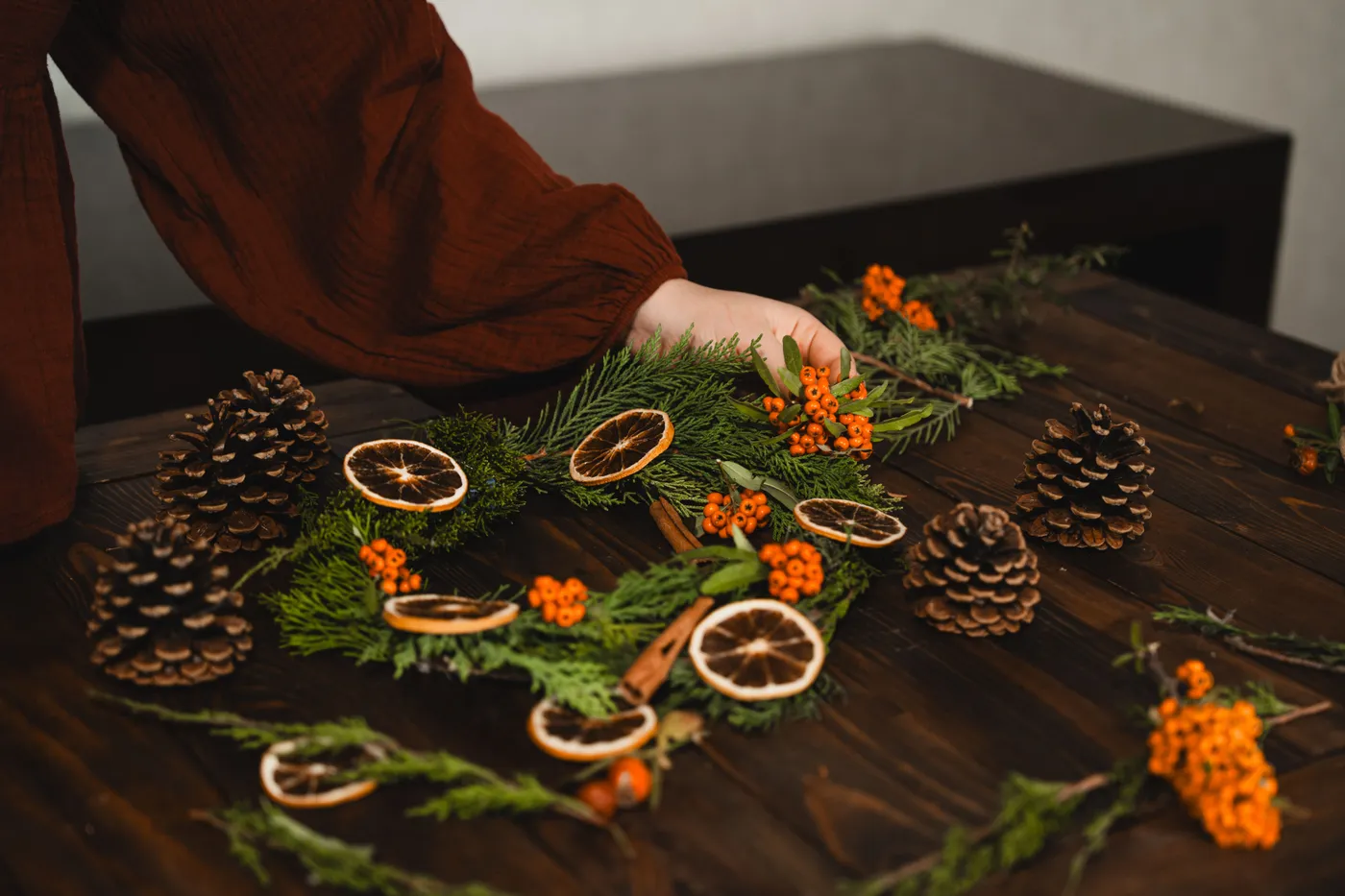
Roughly 15 minutes per foot, $30–$50 in materials for six feet, and best done the day before you need it.
Fresh evergreen is the expensive part, and it’s also the part that dies. A $12 bundle of mixed greens from a grocery floral department plus a $15 faux base garland gets you the same silhouette for half the cost of a designer version. Skip the specialty berry sprays and grab a $5 bunch of faux orange berries — three stems go a surprisingly long way.
13. Mantel Garland Over a Rough-Hewn Beam and Wood Stove
Measure your mantel and add 12 inches to each end — that overhang is what makes a garland look installed rather than perched. A 6-foot mantel wants 8 to 9 feet of garland. If your ceiling is under 8 feet, keep it tight to the beam and skip the swag entirely; long loops will crowd the room. For a smaller treatment, Idea #7 does the same job in a fraction of the space.
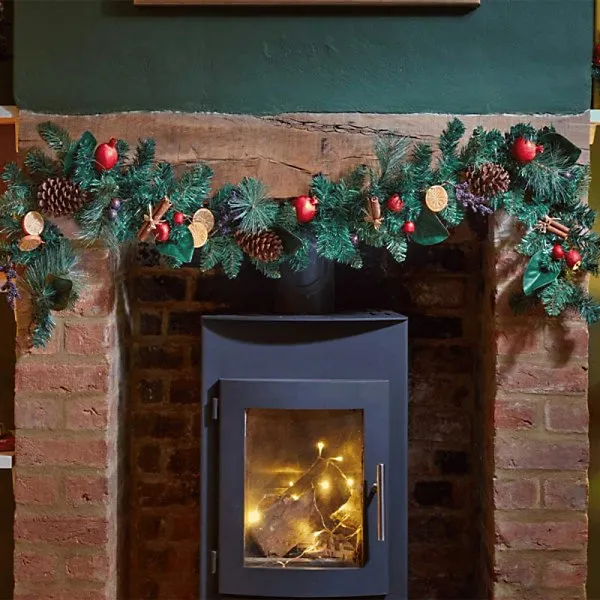
If that stove gets lit, everything above it is a fire hazard by definition. Real dried oranges will scorch and smell like burnt sugar long before they actually catch, and that smell is your only warning. Keep the garland at least 18 inches above the stovetop and never let it hang over the door. Faux greens near heat, real greens far from it.
14. Blood Orange and Star Anise Ornament in Deep Garnet
It’s the blood orange. Swap it for a navel and this exact ornament becomes ordinary — pleasant, but ordinary. Blood oranges dehydrate to a deep garnet at the edges with a burnt-orange center, and that color shift is what makes the star anise look deliberate instead of decorative. If you find them in season from December through February, buy a bag and dry the whole thing.
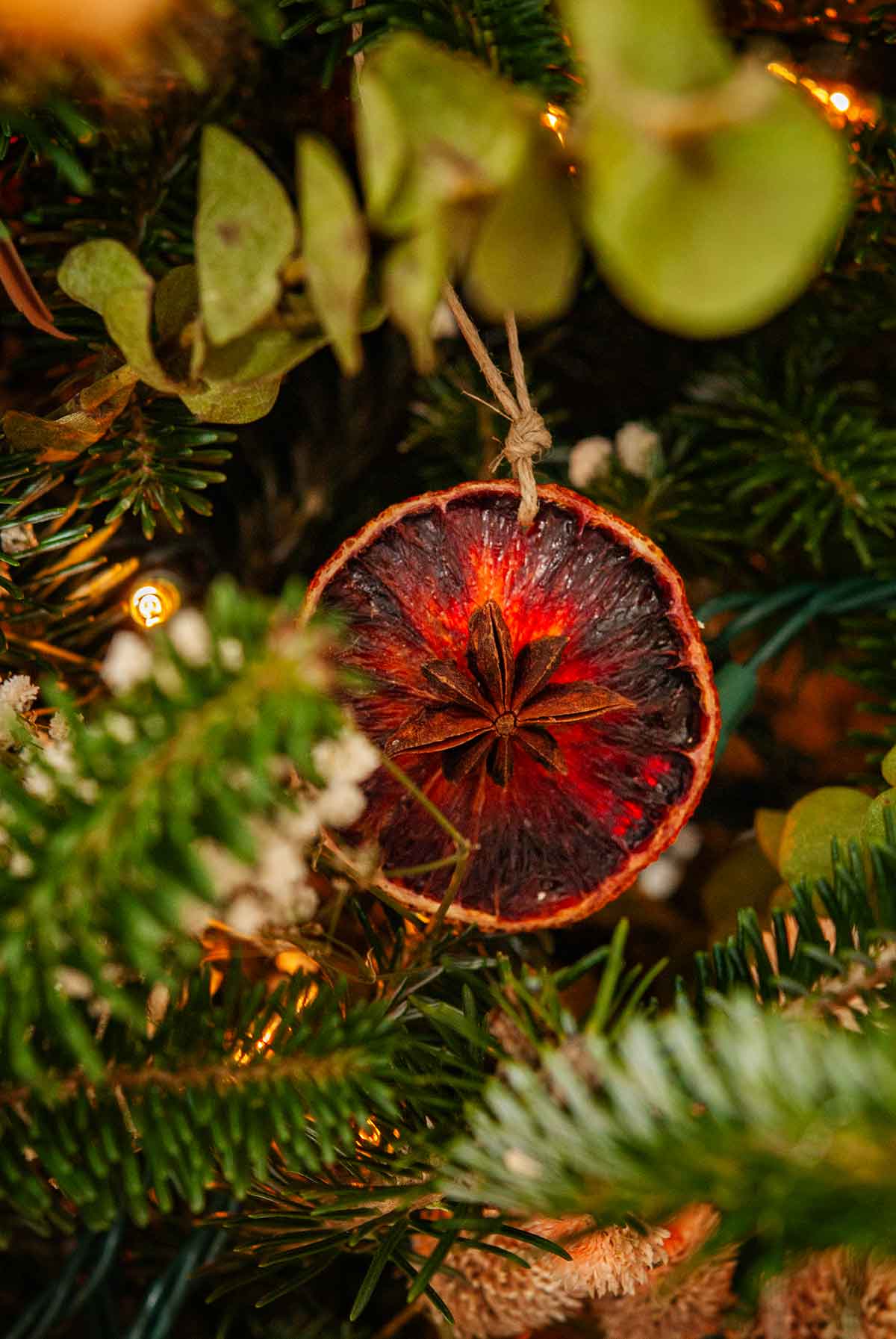
To keep that deep red instead of letting it brown, dry blood oranges low and slow: 135°F for six to eight hours with the oven door cracked an inch. Higher heat flattens the color to orange-brown within the first hour and you can’t get it back. Slice them at 1/8 inch and lay them cut-side up so the juice doesn’t pool in the center.
15. Beaded Citrus Garland on an Off-White Linen Runner
- Wood bead garland, 6 ft: $12–$25
- Dried orange slices, 30: $8–$15
- Battery fairy lights: $8–$15
- Linen runner: $20–$45
- Glass jar, tray, gold flatware: $25–$70
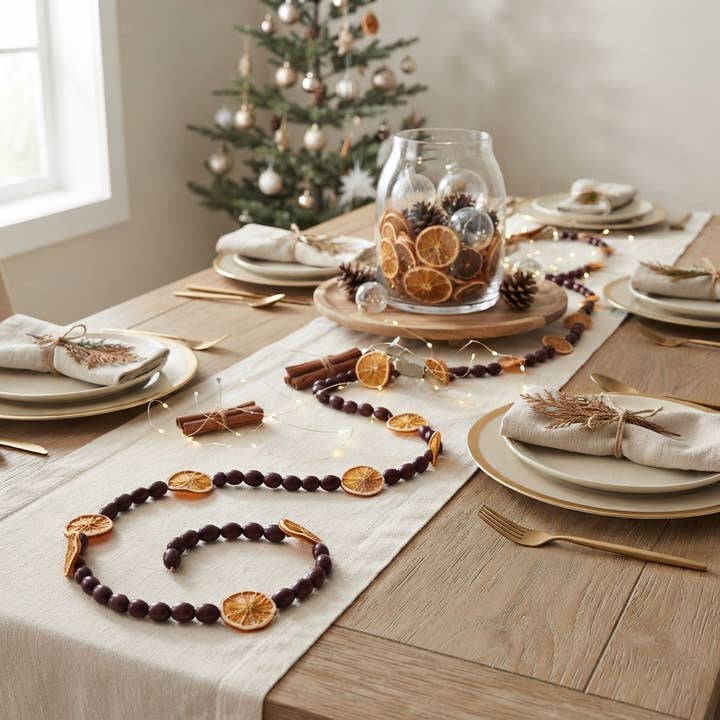
Total: $73–$170. Budget alternative: a $6 bag of wood beads from a craft store and a $4 string of lights get you 90% of the look, and a folded linen sheet stands in for the runner until you find the right one.
The bead garland is doing something specific: it stretches the citrus. Orange slices alone read sparse on a long table, but interleave them with dark brown beads and suddenly five dollars of fruit covers eight feet of surface. The ratio here is about three beads to one slice. Switch to ivory beads for a lighter, springier table. Compare with Idea #19 — same math, different finish.
16. Lush Eucalyptus Garland with Dried Whole Fruit
Eucalyptus solves a problem pine can’t: it drapes. Those long, flexible stems let a garland fall in soft curves instead of sticking straight out, and the silvery leaves give you a mid-tone between dark evergreen and bright orange. The dried whole fruits tucked in at irregular intervals keep it from looking like a color-coded craft project.
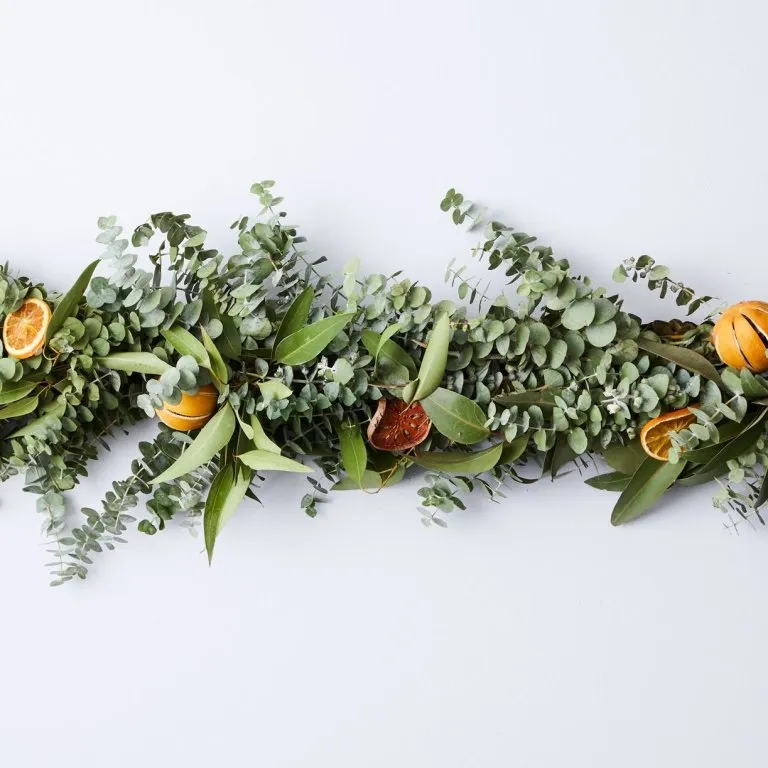
This one wants width. It works beautifully on a sideboard five feet or longer, a stair rail, or a headboard, and it will look thin and slightly sad on a two-foot shelf. You need at least 14 inches of clearance below whatever you’re hanging it from, because the eucalyptus will droop. Small rooms should look elsewhere — this is a garland for generous horizontal runs.
17. Tiered Raffia Wall Hanging with Whole Dried Citrus
- Dry whole thin-skinned oranges at 170°F for 8–10 hours, turning every two hours.
- Tie a raffia loop around each fruit and each cinnamon bundle.
- Knot them onto a single vertical raffia spine, starting with the heaviest fruit at the bottom.
- Space elements 3 to 4 inches apart so each one reads.
- Hang from a small nail — the whole piece weighs under two pounds.
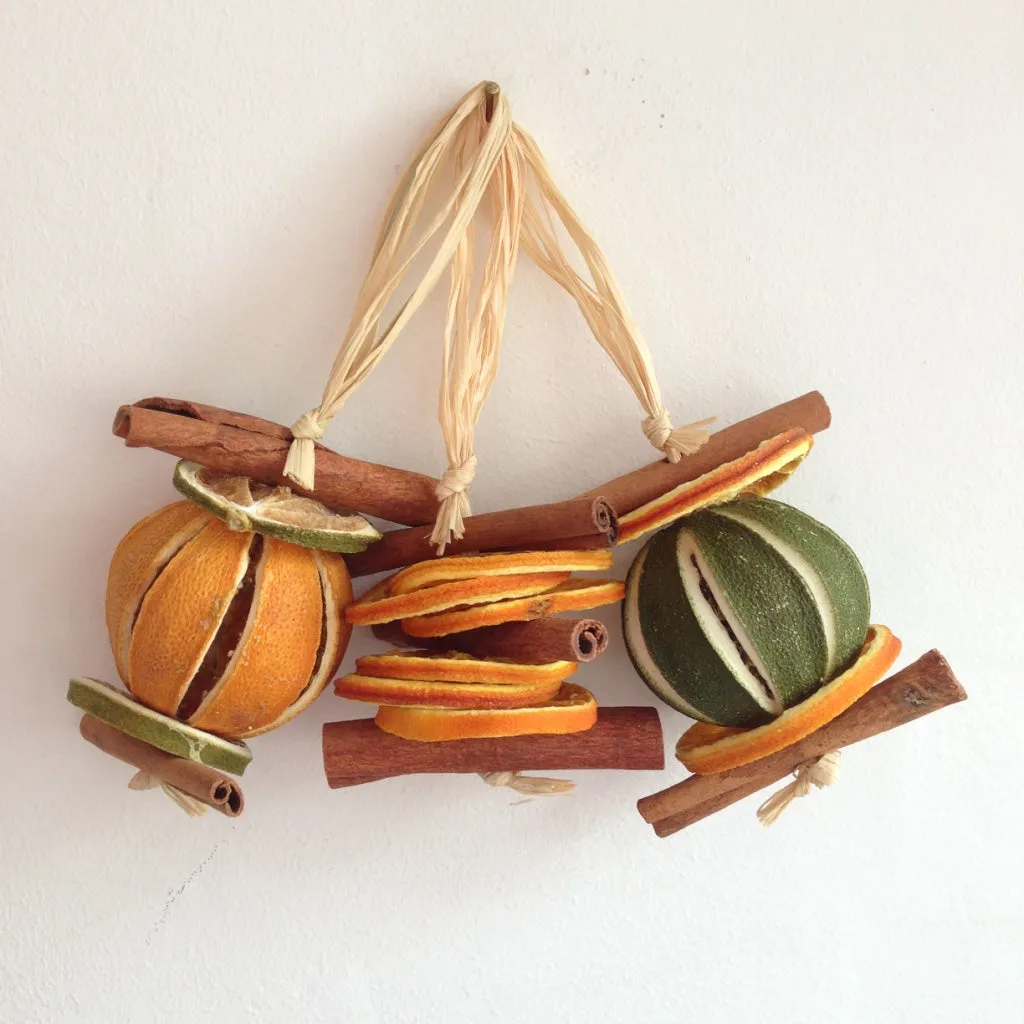
One weekend of drying, twenty minutes of assembly, about $12 in materials.
Wall-hung dried arrangements are the 2026 answer to the gallery wall — same vertical real estate, none of the framing costs, and it smells like a spice market. It’s part of a broader shift toward seasonal decor that gets composted instead of stored, and it photographs beautifully against a plain white wall, which is exactly why it keeps showing up on Pinterest.
18. Christmas Tree with Dried Oranges and Real Beeswax Candles
Yes, this is how it was done for a hundred years, and yes, it’s still a fire. Lit candles on a real tree demand that you never leave the room, keep a bucket of water within arm’s reach, and trim any branch that comes within a foot of a flame. If you have kids, pets, or a habit of stepping into the kitchen, use LED tapers in beeswax-colored sleeves — same glow, no adrenaline.
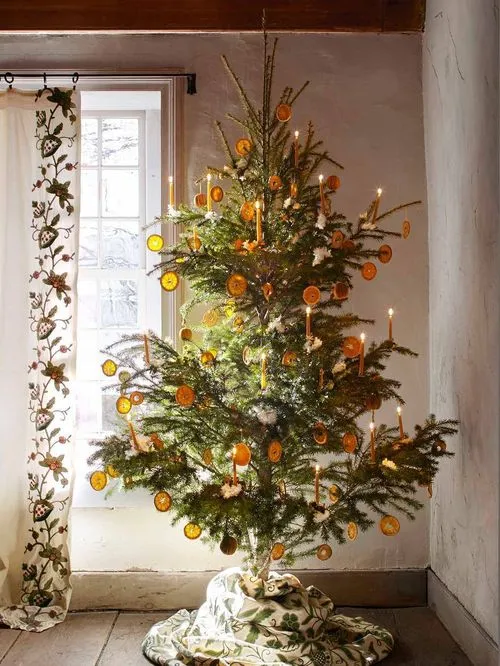
A cut tree with candles dries out twice as fast, because the heat pulls moisture from the needles. Check the reservoir daily, re-cut the trunk when you bring it home, and expect to take the tree down a week earlier than usual. The dried oranges, meanwhile, will slowly darken in the tree’s warm microclimate — that’s normal, and it looks lovely.
19. Long Winding Bead and Citrus Garland with a Glass Jar Centerpiece
Run the garland in a lazy S, not a straight line — three curves down an eight-foot table. Secure it with two clear adhesive hooks under the runner at the curve points so it doesn’t migrate every time someone reaches for the salt. And keep the jar centerpiece under 10 inches tall: anything taller blocks the sightline across the table and people quietly stop talking to each other.
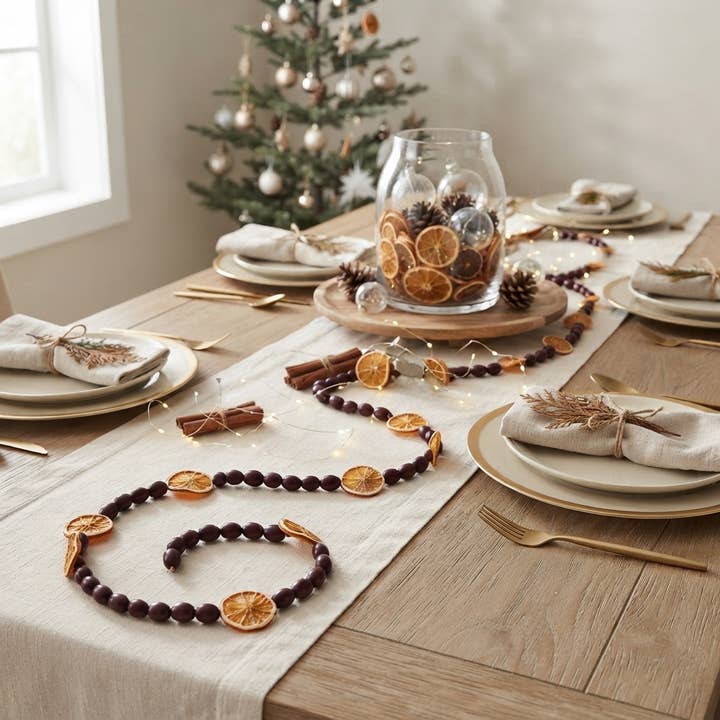
The glass jar centerpiece is the easiest thing to fake. A $3 mason jar, a handful of pinecones, three dried orange slices, and two clear ornaments from a dollar store — under $10 total. The gold-rimmed plates are lovely, but plain white thrifted plates with the same gold flatware read nearly identically once the lights are on.
20. Translucent Citrus Slices Threaded with Green Sprigs
This is a two-material garland and it still works, which tells you something: 80% burnt orange, 20% deep green, 0% anything else. The restraint is the style. If you want to warm it up, add a thin ribbon of cream cotton at 5% and nothing more. Once you add beads, berries, and cinnamon sticks, you’re making a different garland entirely.
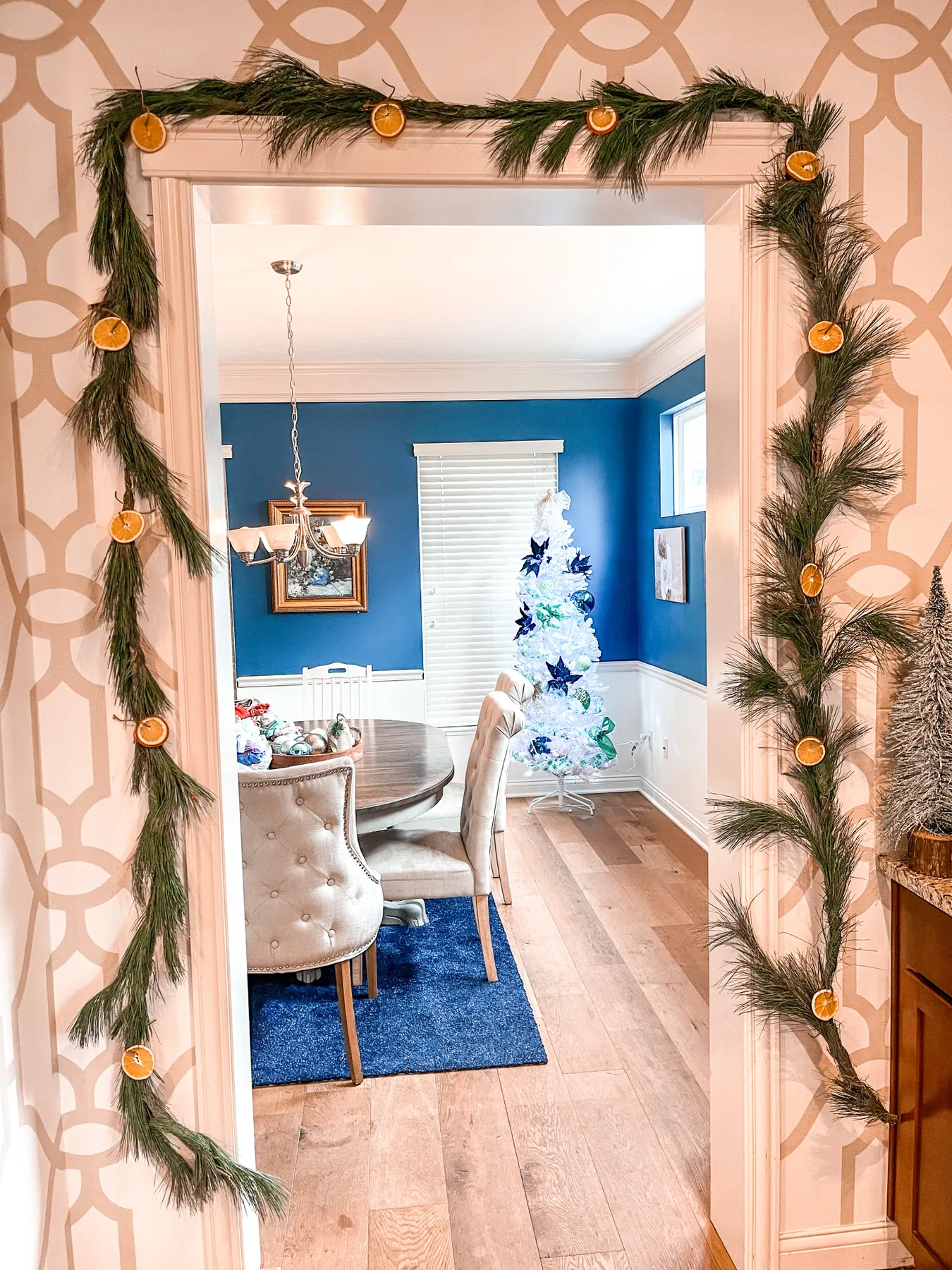
- Hold a slice up to a window — you should see light through the flesh.
- Check that every slice is fully dry at the center, not just the edges.
- Measure your space and add 15% for slack.
- Decide how you’ll hang it before you thread anything.
A five-minute check that saves an hour of re-stringing.
21. Crafting a Simple Jute and Citrus Garland on a White Table
- Cut jute 12 inches longer than your final length.
- Heat a needle or skewer and pierce each slice near the top edge, not the center.
- Thread with a knot every 8 to 10 slices to distribute the weight.
- Add a conifer sprig every fifth slice.
- Tie loops at both ends and hang it right away — jute stretches under load.
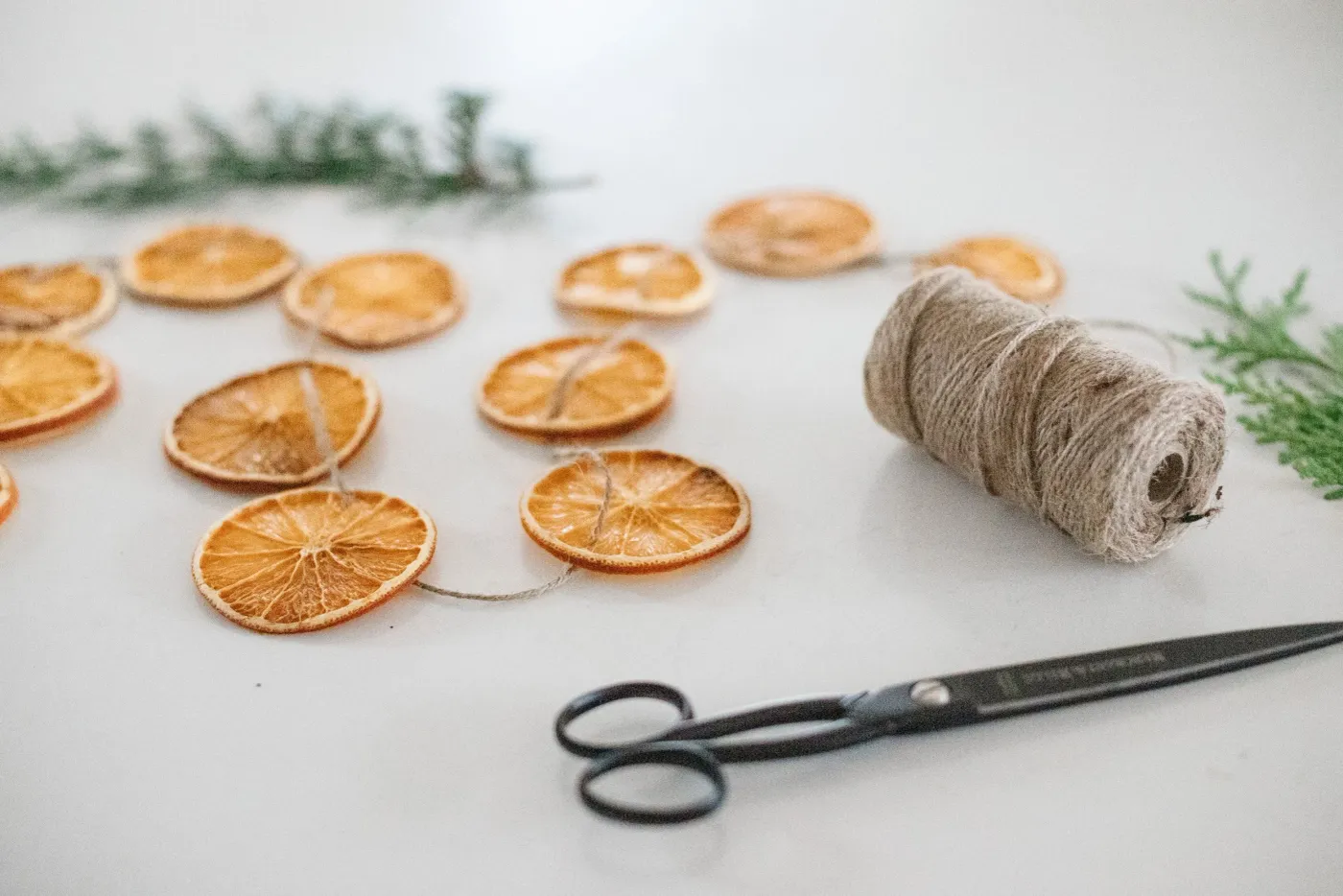
Twenty minutes for six feet and about $8 in materials, no glue or sewing involved.
- Pre-dried orange slices, 50: $10–$18
- Jute twine, 100 ft: $5–$8
- Fresh conifer sprigs: $0, or $6 from a florist
- Scissors and a tapestry needle: $0–$5
Total: $15–$31 — the cheapest garland here, and the one people ask about. The technique is identical to Idea #4, just on a heavier string.
22. Faux Pine Garland Curved into an S with Two Berry Colors
Faux greens have quietly gotten good. In 2026 the best ones are molded from real branch cuttings rather than stamped plastic, and the blueberry-toned accents here are the tell — that’s a detail the cheap versions skip entirely. It’s also why so many people are going faux for high-traffic spots and saving real branches for the table.
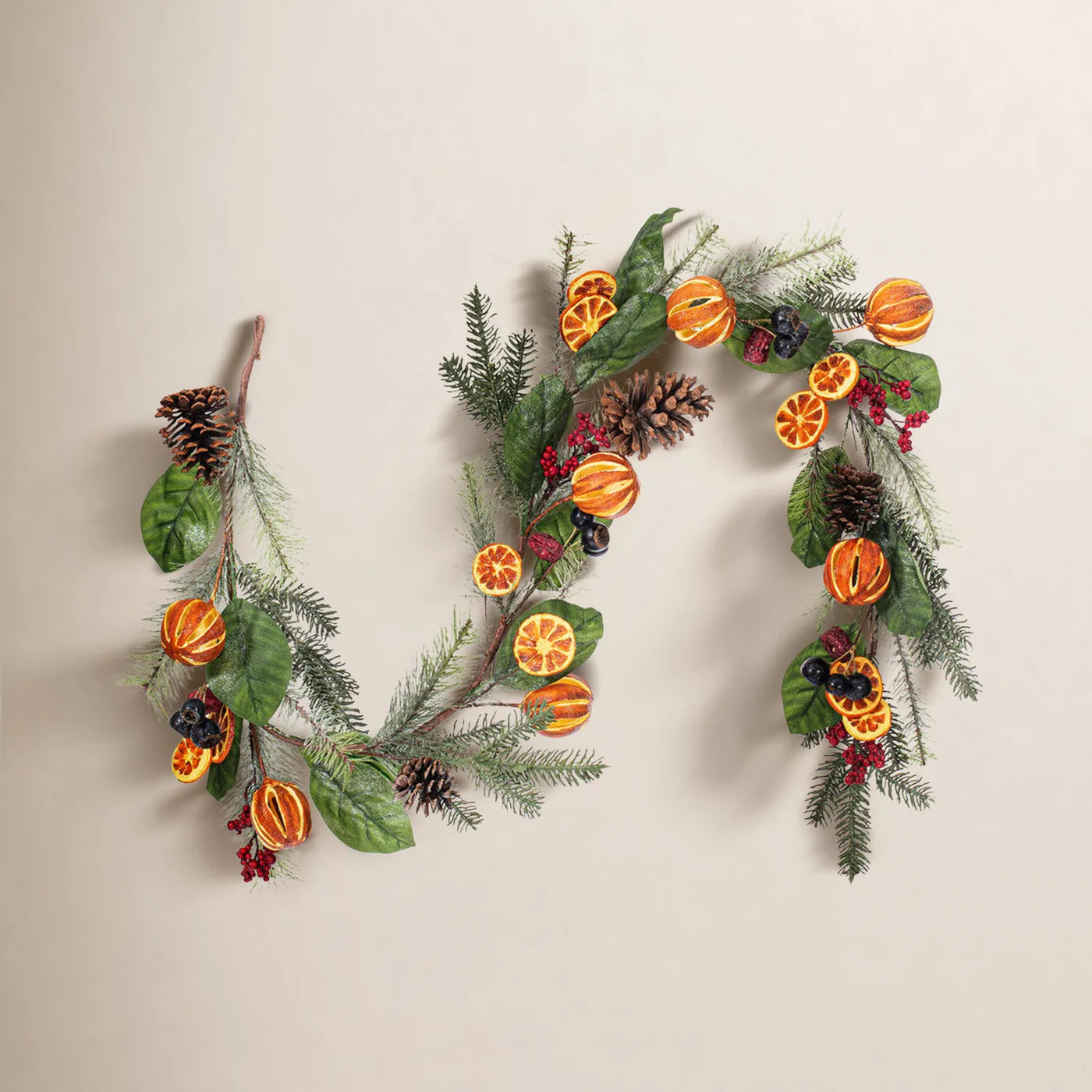
Two berry colors instead of one. Red berries alone would push this garland toward traditional Christmas; the dark blue ones pull it back toward something more organic and less candy-cane. Add oversized leaves — bigger than anything a real pine produces — and you get that slightly exaggerated, illustration-like quality that photographs so well against a plain wall.
23. Blood Orange Ornament with a Coarse Twine Loop
The twine. Not the orange, not the star anise — the coarse, visible, slightly frayed twine loop. A satin ribbon here would push the whole tree toward formal; the twine admits it’s handmade and lets everything else relax. It’s also the cheapest detail in the project, which is a nice thing to be able to say about the one element that makes it work.
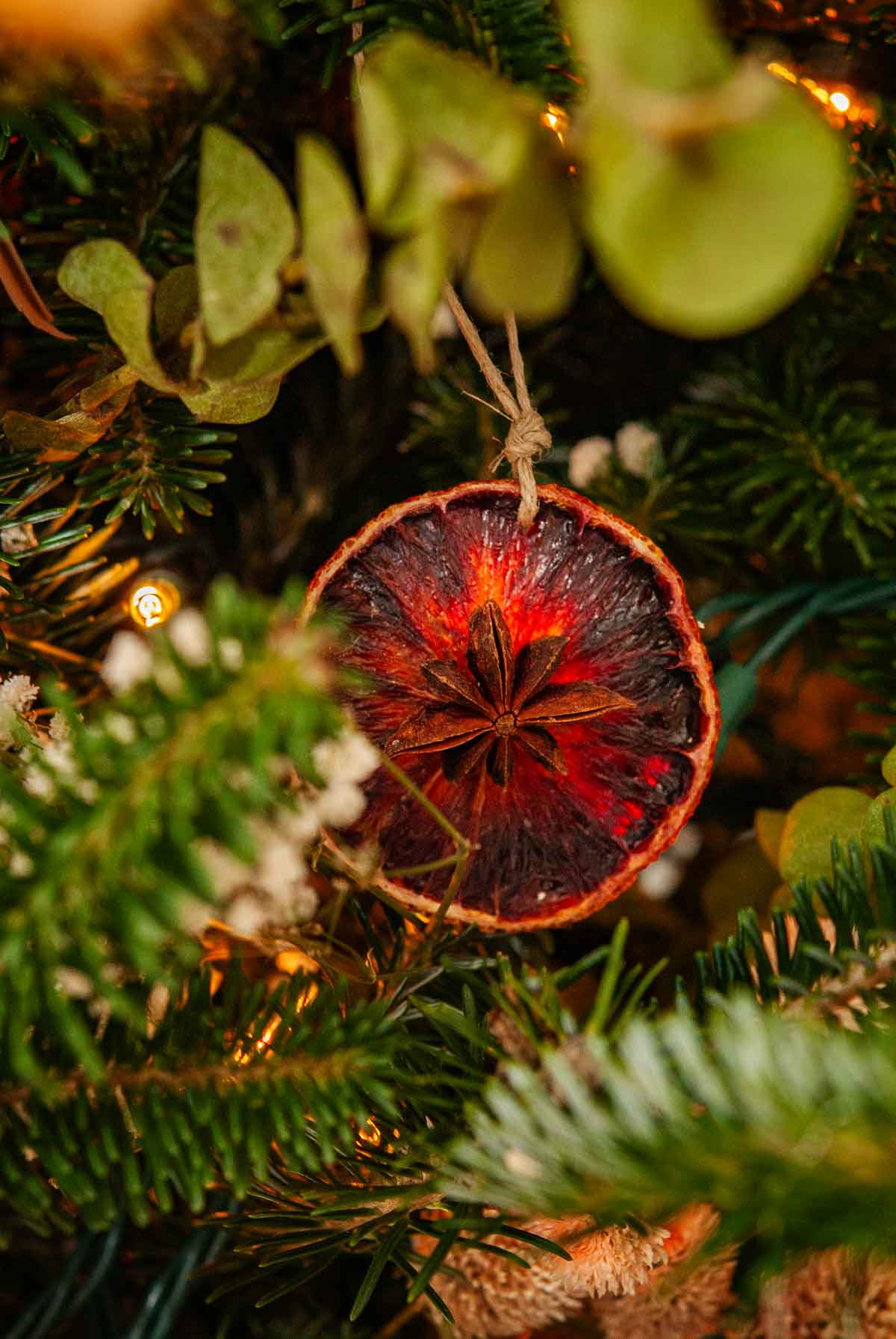
Hang dried citrus ornaments in odd-numbered clusters — three, five, seven — and vary the size within each group. A tree with forty identical two-inch ornaments looks manufactured; a tree with 2-, 2.5-, and 3-inch slices grouped together reads collected. Resist the urge to fill every gap. Empty branches are what make the fruit look intentional.
24. Dark Metal Bowl of Citrus, Frosted Pinecones, and Baubles
This is the shop-your-own-ornament-bin arrangement. That dark metal container could be a $4 thrifted bucket, a paint-can planter, or the bottom of a basket you already own. Frosted pinecones run about $6 a bag at a craft store, and the dog and bird ornaments look like they came out of a box in the attic. Realistic budget: under $20 if you’re only buying fruit and pinecones.
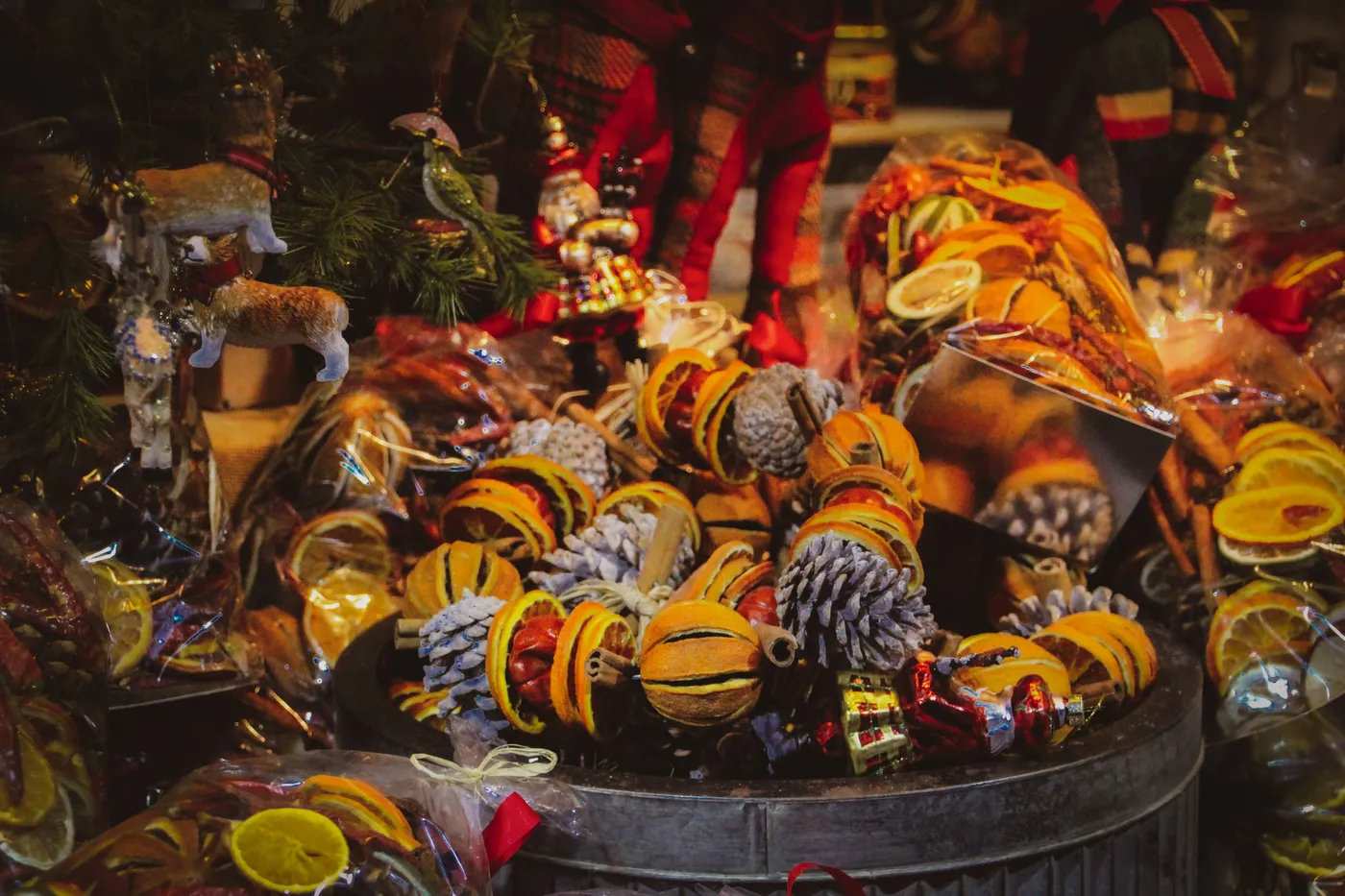
A centerpiece bowl should be roughly one-third the width of the table it sits on — a 20-inch bowl for a six-foot table, 14 inches for a four-foot console. Any wider and there’s no room for a plate. Keep the pile height under 8 inches so people can see over it, and remember that a shallow bowl always looks more generous than a deep one holding the same amount.
25. Threading Oranges and Fresh Cranberries with a Silver Needle
- Use a long upholstery or craft needle — 3 inches is ideal for piercing fruit cleanly.
- Knot the start, then alternate orange, three cranberries, orange.
- Push through the pith, not the rind, to avoid splitting.
- Keep tension loose; cranberries bruise and bleed if you cinch tight.
- Hang it the same day — fresh cranberries last about a week.
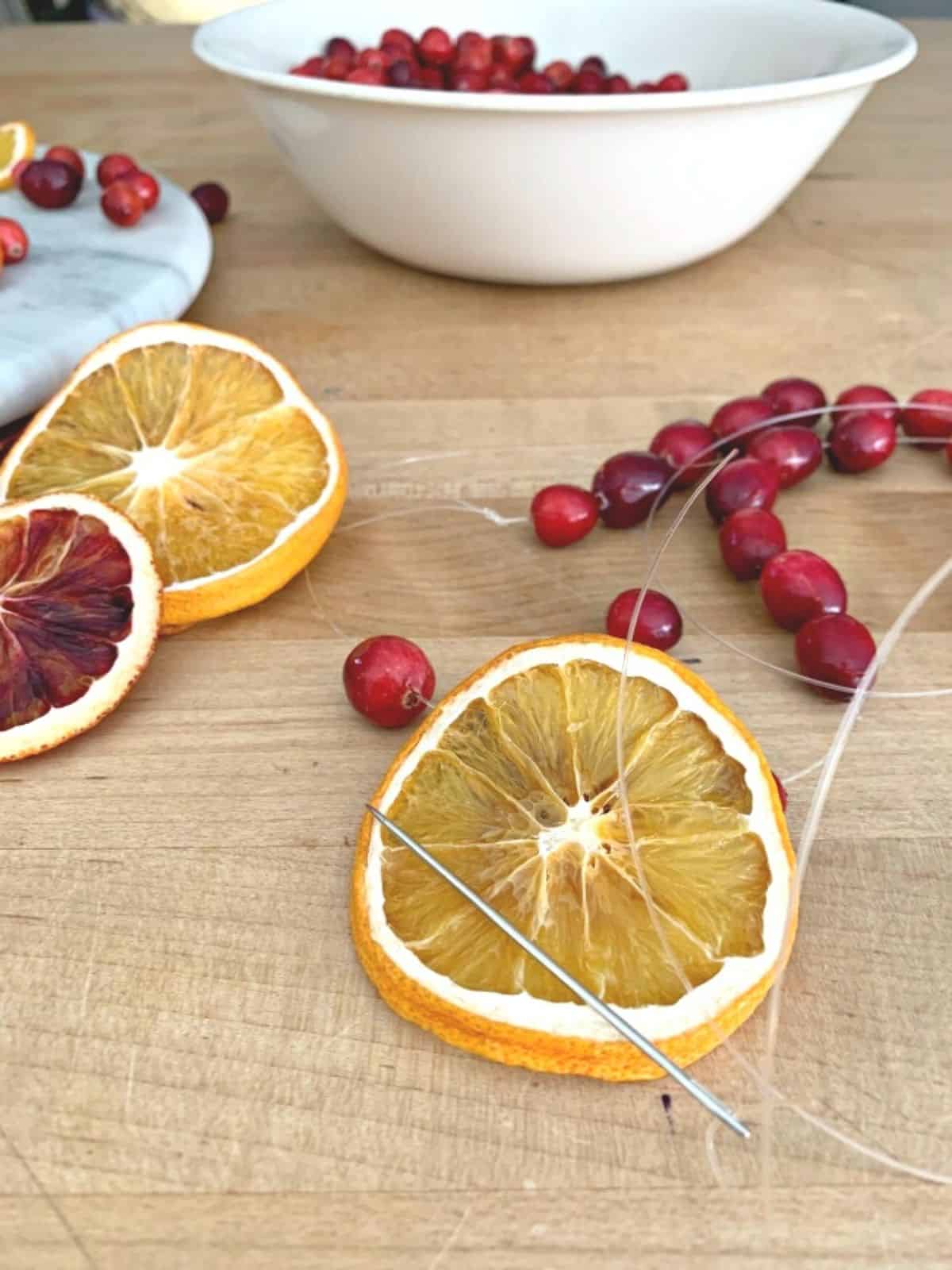
Ten minutes per foot, and the cranberries cost $3 a bag.
Fresh cranberries are the one ingredient here that won’t keep. They go soft in five to seven days and start weeping onto the orange slices, which stains them. Make this garland for a party, not a season — or substitute faux cranberries and accept that they’ll look slightly too perfect. Compare with Idea #3, which uses beads for the same visual rhythm and lasts for years.
26. Citrus and Pine Garland Draped Above Framed Calligraphy
- Delicate pine garland, 6 ft: $12–$28
- Dried orange slices, 25: $8–$15
- Small battery lights, optional: $8–$14
- Wall hooks and twine: $4–$8
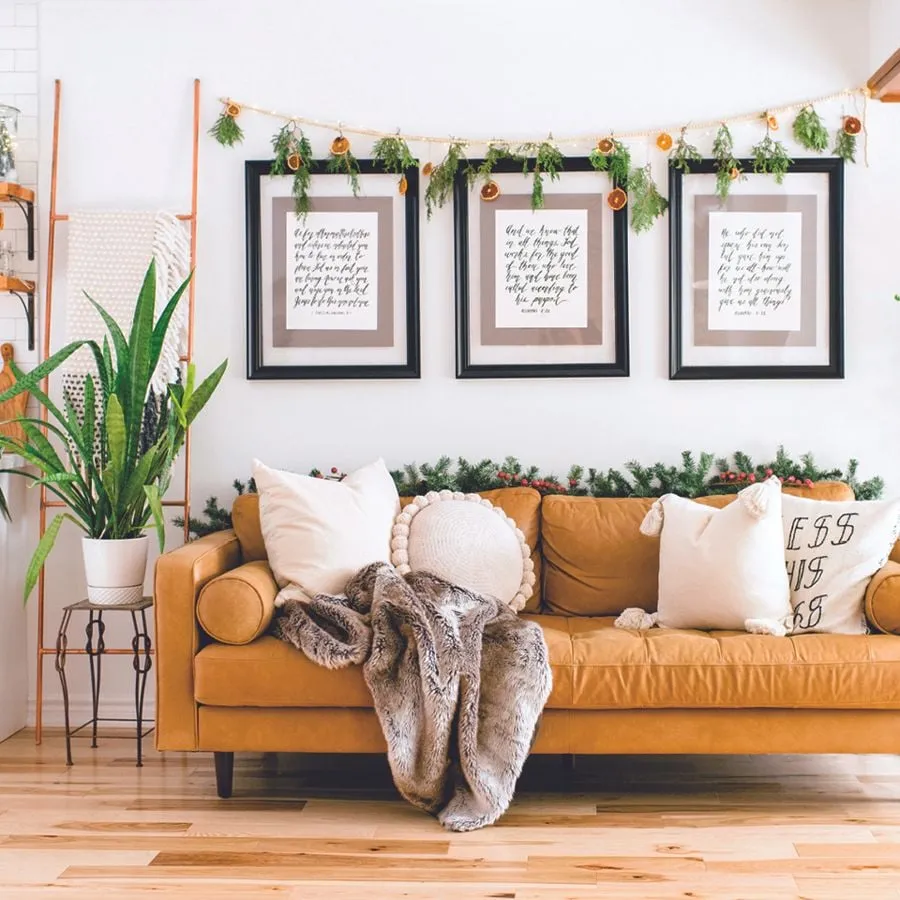
Total: $32–$65 for the garland treatment alone — the sofa, ladder, and art are the expensive part and probably already exist. Budget alternative: two $6 faux pine picks wired together cover three feet convincingly.
The restraint above the frames is the whole story. There’s a big, busy, red-berried garland lower on the wall, and then this thin, quiet citrus strand up top. If both were lush, the wall would be noise. That contrast — heavy below, delicate above — is what keeps the calligraphy readable and stops the vignette from turning into a department store display.
27. Loose Citrus Slices and Twine in Harsh Window Light
The palette here is essentially one color: 60% off-white surface, 40% orange in three values — pale yellow-orange, mid amber, deep brown-orange. Nothing else. It’s the reason the shadows read as a design element rather than a photography problem. Add a fourth value and the whole composition falls apart; that’s how narrow the margin is.
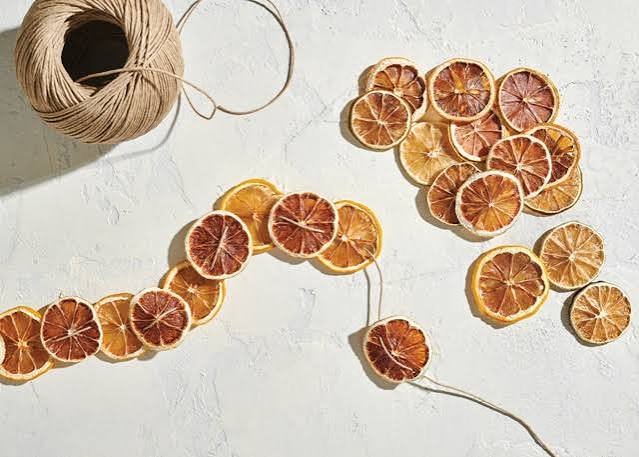
Direct sun is the enemy of anything you plan to keep. A garland hung in a south-facing window will bleach from orange to beige in a single season, and the twine goes brittle at the same rate. Rotate it every few months, or just accept that the fade is part of the look — the faded version is genuinely pretty, it’s simply not orange anymore.
Your Oranges Are Already Sitting in the Fruit Bowl
You don’t need a dehydrator, a designer, or a single new ornament to pull any of this off — three oranges, a spool of twine, and an afternoon will get you most of the way there. Start with the smallest idea that fits your space, and let next year’s version be the ambitious one.
📌 Pin your favorite idea now so it’s waiting when citrus season hits.
