29+ Stunning Silver Christmas Tree Ideas That Will Make Your 2026 Holiday Sparkle

Silver trees have a reputation problem, and honestly, they have earned part of it. The tangled tinsel. The cold blue glare. The tree that looks like it belongs in a hotel lobby circa 1998. But scroll Pinterest for ten minutes this month and a different story shows up: flocked white cones loaded with crystal, slender tinsel trees glowing warm against wood floors, sculptural metal trees sitting on a shelf like actual art. We pulled 29 real rooms from real homes to show you exactly what separates the two.
We spent serious time combing through Target, HomeGoods, Etsy, and Walmart to find what is actually worth your attention, and these ideas run from about $18 for a tabletop piece up to $815 for a full flocked tree and mantel setup. Four moods are covered — flocked and frosty, retro tinsel, modern metallic minimalism, and pink-and-silver glam — with budget swaps and luxury upgrades sitting side by side.
2026’s silver leans warm and textured rather than chrome-bright, which is why so many of these trees pair brushed metal with cream, blush, and raw wood. And stay until the end — we break down the most common mistakes that can ruin these looks.
📌 Save this to Pinterest for later — you’ll want to revisit these ideas.
1. Two Flocked Silver Trees Flanking a White Mantel
Two trees instead of one is the whole trick, and it works because the eye reads them as a matched pair rather than a double dose. The flocking does the heavy lifting: a thick white coat turns an ordinary green cone into something that looks cast in silver. The silver poinsettia picks repeat at the same height on both trees, so the symmetry never feels accidental, and the big star on each topper gives the pair a shared peak. Remove one tree and the mantel behind it suddenly looks lonely.

Scale your topper to the tree, not to your nerve. A star’s width should land between one-sixth and one-eighth of the tree’s total height, which is roughly a 9- to 12-inch star on a 6-foot tree. Go wider and the top branches start bowing under the weight by week two. Buy one extra spool of silver ribbon while you’re at it, because matching metallic finishes two weeks into December is a losing game.
2. Winter White Tree with a Blush Knit Throw Nearby
The blush throw is the one thing holding this corner together. Everything else — the flocked tree, the white fur garland, the silver ornaments, the plush rug — sits in the same cool white range, and a room made entirely of white and silver starts to feel like a display window. That single chunky pink knit drops a warm note into the mix, and the silver glitter deer pillow quietly echoes it so the pink never looks random. Remove the blanket and you still have a pretty tree. You just lose the reason to sit down next to it.
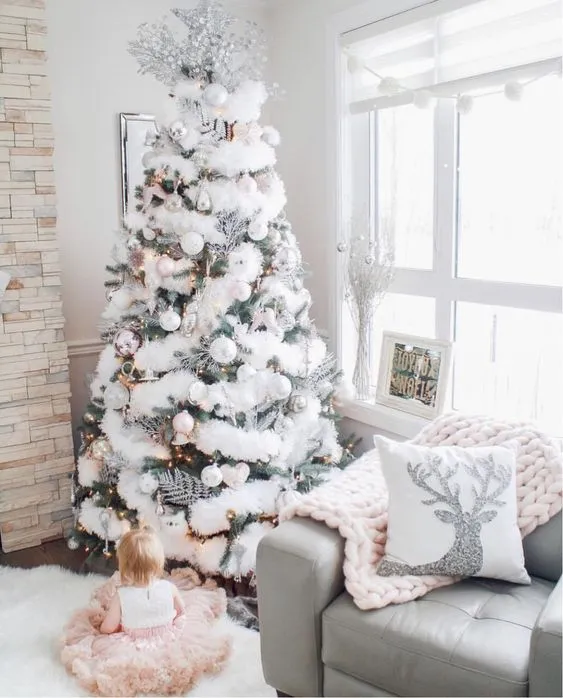
- Flocked 7.5 ft tree: $120–$350
- Silver and white ornament set: $45–$120
- White faux fur garland: $20–$45
- Chunky blush knit throw: $30–$85
- 5×7 white faux fur rug: $60–$180
- Silver glitter deer pillow: $15–$35
- Total: $290–$815
Budget alternative: a plain green 7 ft tree, two cans of snow spray ($22), a $25 blush throw from Walmart, and a $12 faux fur rug gets you 60% of this look for under $200.
3. Flocked White Tree Loaded with Red and Blush Spheres
Run the numbers and this tree is 60% flocked white, 25% red, 10% blush pink, and 5% cool metal. That ratio is why it reads classic instead of candy-cane. The blush sits between the red and the white and softens the jump between them; take it out and red on white goes sharp and peppermint. Swap the red for forest green and you get a woodland version with the same bones. Swap the blush for soft gold and the tree warms up without losing its crispness. Keep the percentages, change the players.
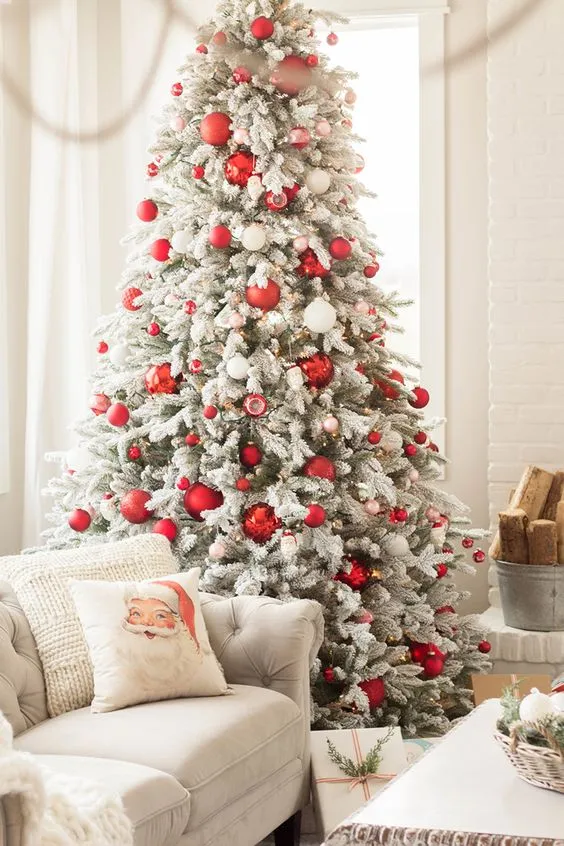
Two honest notes before you commit. Heavily flocked trees shed, so expect a fine white dust on that tufted sofa for the first week — keep a lint roller in the drawer and don’t park anything upholstered directly under the branches. And that galvanized bucket of firewood looks fantastic, but firewood belongs at least three feet from any tree with lights on it. It’s the one styling choice here worth breaking. If you love the metal-bucket look, Idea #5 does it with a tinsel tree.
4. Flocked Tree and Mantel Dressed in Silver Orbs
Dressing a mantel garland so it doesn’t look like a rope:
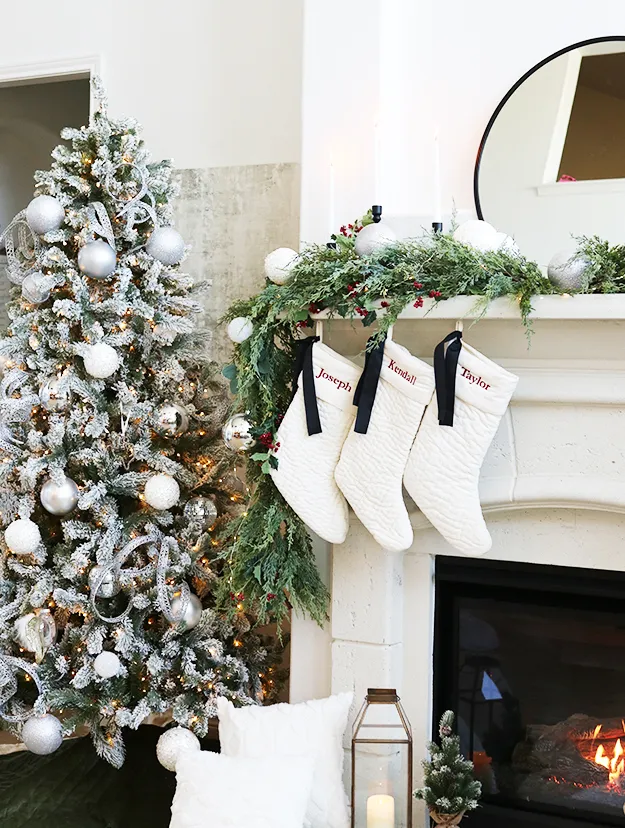
- Start with a real-touch green garland and fluff every branch outward — ten minutes, and it’s the difference between lush and sad.
- Wire in silver and white orbs in three sizes, clustering them in odd numbers along the run.
- Tuck red berry sprays between the orbs at roughly 8-inch intervals so the color repeats rhythmically.
- Hang the white knit stockings on evenly spaced hooks.
- Step back and shift the whole garland one inch off-center so it doesn’t read as machine-placed.
Twenty minutes and about $60 in supplies if you already own the stockings.
This arrangement wants a mantel at least 60 inches wide — anything shorter and the garland, orbs, and three stockings start fighting for real estate. The flocked tree beside it reads best at 7 to 7.5 feet under a standard 8-foot ceiling; push to 9 feet and you’ll have to give up the topper. Short mantel? Steal the garland formula and skip the tree, or borrow the tabletop approach from Idea #14.
5. Green Tree Paired with a Tinsel Tree in a Bucket
Here’s the thing about this corner: the small silver tinsel tree in the galvanized bucket probably cost less than the ornaments on the big tree. Tinsel trees run $25–$45 at Walmart and Target, buckets are about $12 at any hardware store, and the botanical poinsettia print is a $15 download you can frame yourself. The tall green tree carries the gold and silver investment; the silver one is pure attitude on a budget. That’s the smartest split in the whole arrangement.
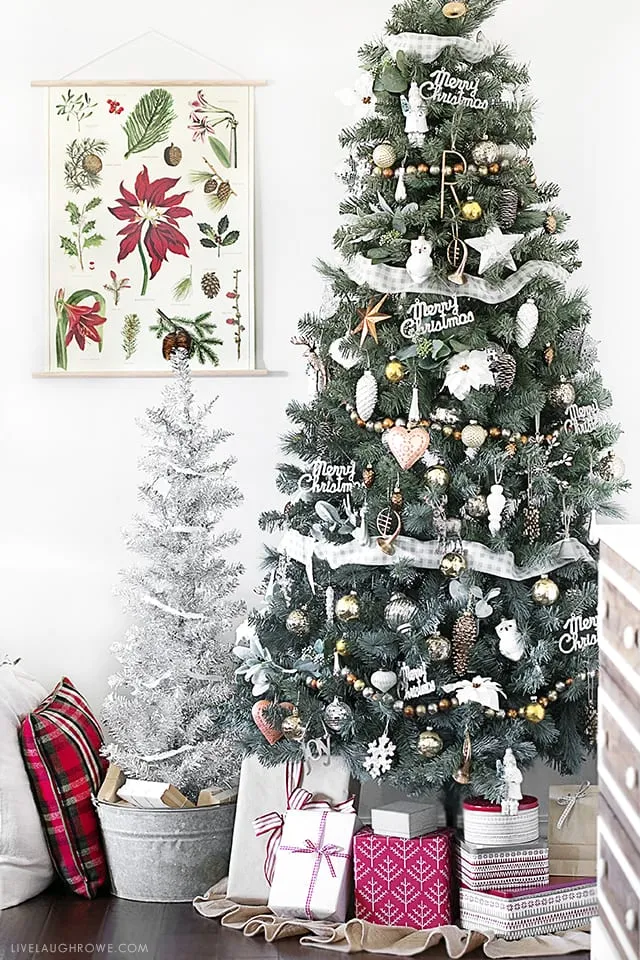
The small silver tinsel tree is what makes this room interesting. A tall green tree with gold and silver ornaments is a lovely, completely expected choice — you’ve seen it a hundred times. Set a skinny silver tree in a beat-up metal bucket next to it and suddenly there’s a conversation happening between formal and found. The ruffled burlap skirt plays the same game: dressed up on top, farm-rough at the bottom. That contrast is the idea. Everything else is supporting cast.
6. Flocked Branches Close-Up with Textured Silver Spheres
Silver ornaments come in three finishes and you want all three: mirror-polished, brushed matte, and textured or hammered. A tree of nothing but mirror balls reflects the room back at you and reads gray from across the space — flat, no sparkle, no depth. The rule I use is one of each finish per cluster of three ornaments, then repeat that cluster around the tree. The textured ones catch light at an angle and make the whole thing look like it’s moving.
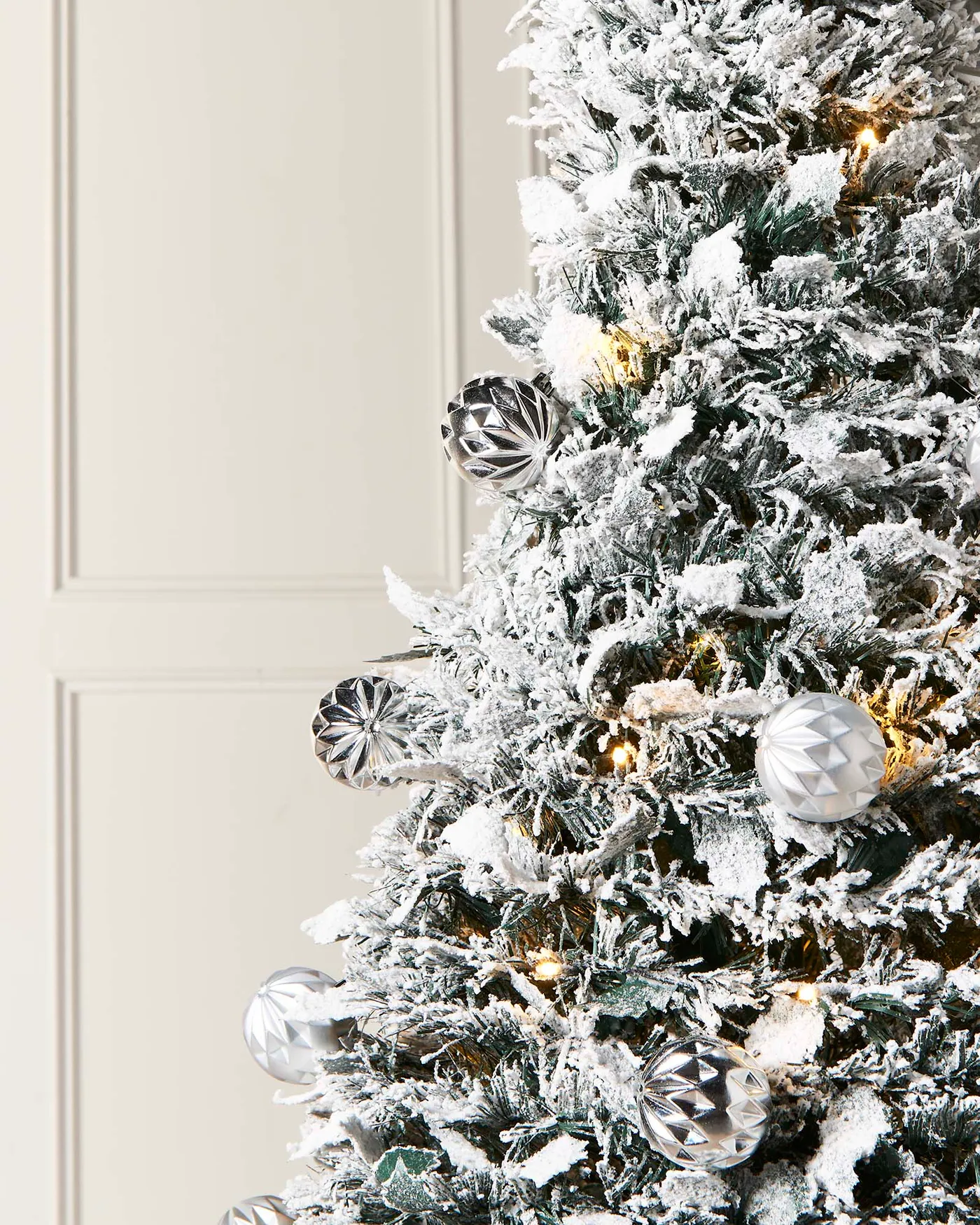
Warm string lights plus cool flocking is the engine of this look. The snow coating drops the tree’s color temperature toward blue-white, and the warm bulbs push back the other way — that tension is why the branches glow instead of glare. Notice the paneled wall behind: a light, matte, low-contrast backdrop lets the lights do the drama. Put this same tree in front of dark patterned wallpaper and half the glow disappears into the pattern.
7. Glowing Silver Star Topper on a Green Tree
Lit toppers stopped being a novelty a couple of seasons ago and now they’re basically standard. The reason is practical: a star with LEDs built into the wire frame throws light up and sideways, filling the dark gap at the top of a tree that string lights never quite reach. In 2026 the shapes have gotten sculptural — multi-pointed wire stars, spiral cones, starbursts — and prices have settled into the $25–$60 range. This one is bright enough to act as a lamp in the corner.
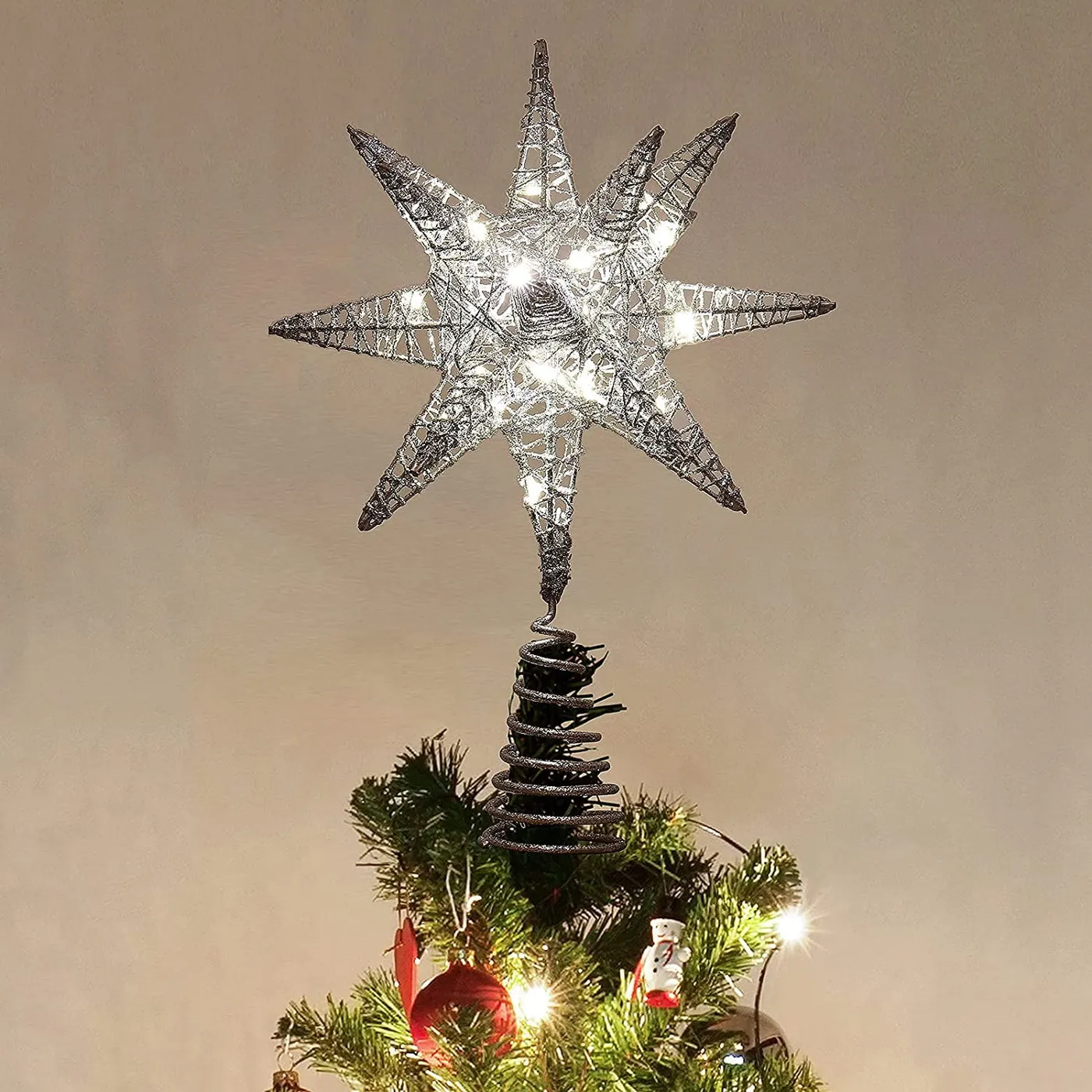
Think of this tree as 70% forest green branches, 20% white light, and 10% metal and red accents. Green volume has to dominate or the silver looks like it’s floating in a void. That single red sphere near the top is doing more work than it appears to — it’s the one warm saturated note in a cool palette, and it keeps the eye traveling up toward the star. Want a calmer version? Swap the red for pale pink and the formula still holds.
8. Silver Tinsel Tree Standing on Warm Wood Floors
Full honesty: tinsel sheds. Not dramatically, but you will find silver strands on that wood floor for weeks, and by January they’ll be wrapped around the vacuum brush. The bare metal stand is also a decision you have to make — either lean into it or cover it, because exposed stand legs under a tinsel tree read unfinished rather than industrial. A shallow basket or a small rug underneath solves both problems at once. And tinsel trees don’t fluff; whatever shape they arrive in is the shape you’re keeping.
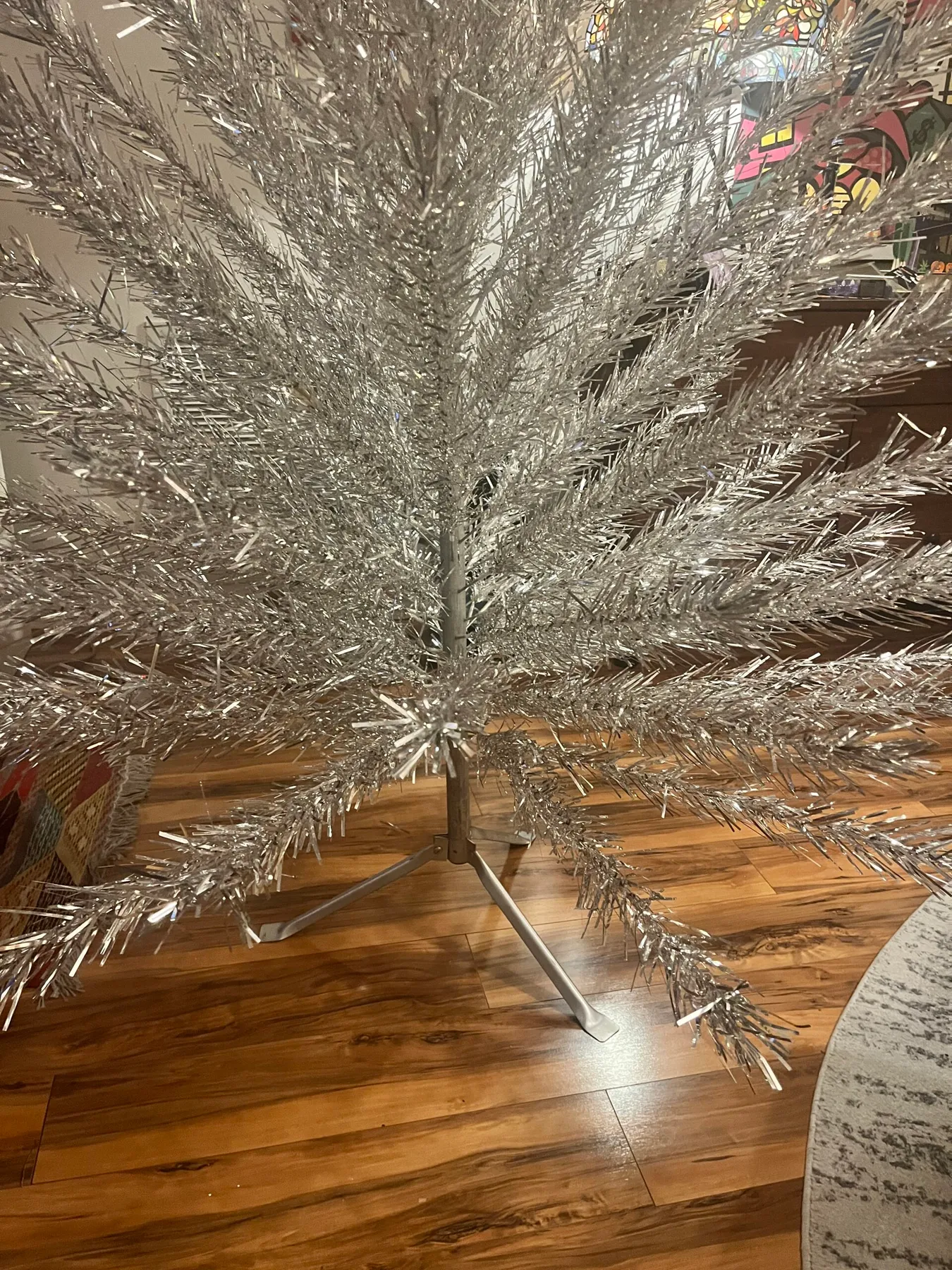
You can do this for under $75. Target and Walmart both carry 6-foot tinsel trees in the $30–$55 range, and Facebook Marketplace in mid-November is full of them for $15 because someone upgraded. Skip the designer stand and use a sturdy bucket or a heavy ceramic pot with a bag of sand. That warm wood floor is doing more for this look than any accessory would — put a tinsel tree on gray carpet and it goes flat instantly.
9. Tall Pop-Up Silver Tinsel Tree with Leaf Accents
Pop-up tinsel trees live and die by ceiling height. A 6-footer needs at least 8 feet of clearance to feel intentional; in a room with 9 or 10-foot ceilings, go straight to the 7.5-foot version or the proportions look shrunken. They’re narrow — usually 24 to 30 inches at the base — which makes them the fix for tight entryways and apartment corners where a full tree simply won’t fit. Same tight-footprint logic behind Idea #24.

A pop-up cone has a flatness problem: from any angle, the silhouette is a smooth triangle with no depth. The fix is interruptions. Twist sections of tinsel against their natural direction so light bounces at different angles, then push those reflective leaf accents in at irregular heights — never in a spiral, never in tidy rows. Anything that breaks the outline reads as texture instead of geometry. Ten minutes with your hands, no money spent.
10. Three Distressed Metal Trees Topped with Red Stars
Those solid red stars are the reason this trio works. Distressed white and silver metal trees are everywhere, and without toppers they’d read pale and a little washed out against a light wood surface. A saturated red cap on each cone gives the eye somewhere to land and ties the arrangement to the berry branches and the ribbon without matching them literally. Swap the stars for silver and the whole vignette goes quiet.
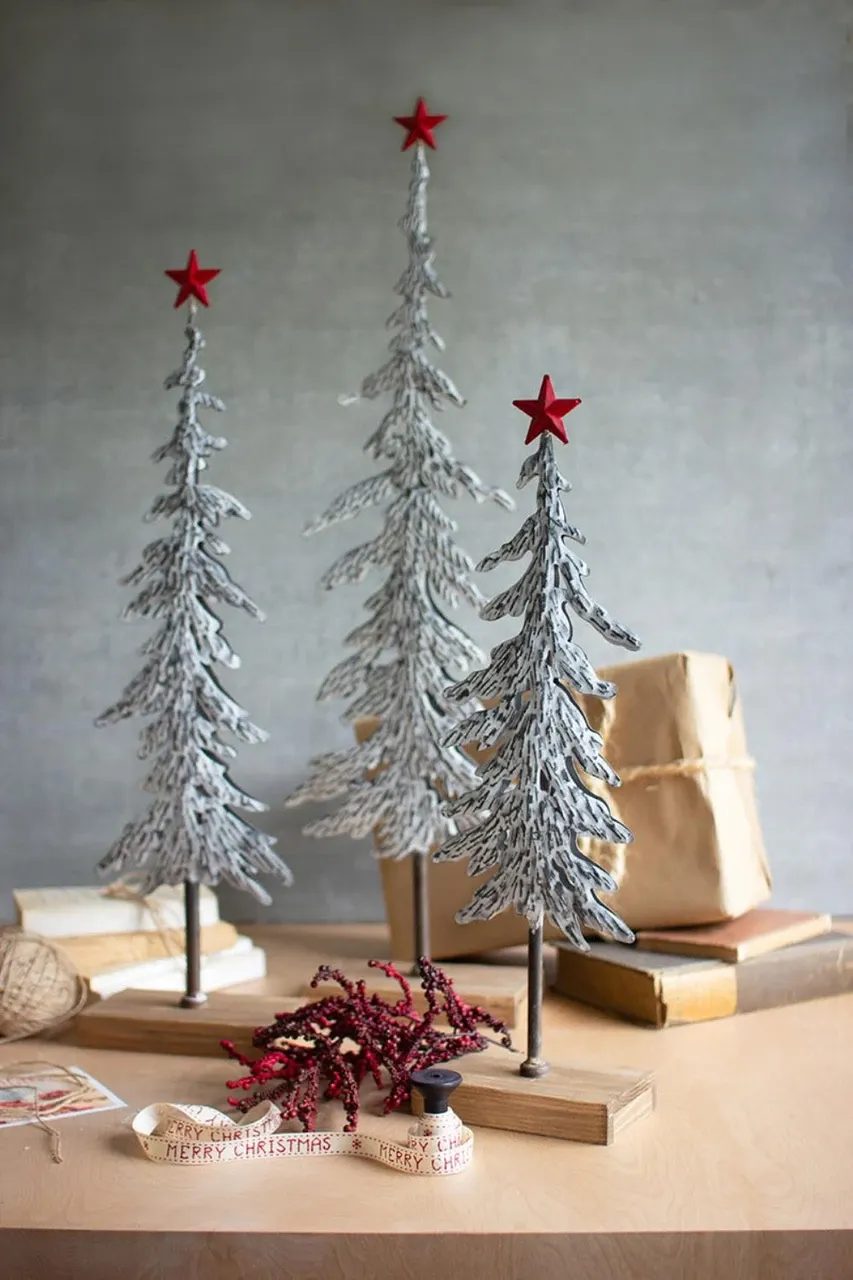
Distressed metal is a finish, not damage — but it still chips. Store these wrapped in tissue rather than loose in a bin, because the edges knock together and paint flakes at the corners. Dust settles into the pierced detail, and a dry microfiber cloth handles it in thirty seconds. The faux berries will fade after two or three seasons in direct sun, so keep them off a south-facing windowsill. Kraft paper gifts wrinkle when stored wrapped, so rewrap each year.
11. Tiered Crystal Tree Against Deep Navy Paneling
Dark navy is the hero here, not the crystal. A tiered silver and glass tree has almost no mass — it’s wire and facets — so on a white wall it would dissolve into the brightness. Put it in front of deep navy paneling and the contrast does the work: every facet picks up a hard edge, and the tree starts to look lit from inside. Add the navy velvet sofa and the beige knit throw and you have three values stacked, dark, mid, and light, which is why the corner feels composed rather than busy.

Styling the side table so the tree stays the star:
- Set the tree slightly off-center, about two-thirds to the left of the table’s width.
- Stack two or three books flat on the opposite side, tallest on the bottom, spines facing the room.
- Place a small potted plant behind the books for height without extra shine.
- Drape the knit throw over the sofa arm nearest the table, never on the table itself.
- Check it from the doorway — if the tree and the plant read the same height, raise the plant on a book.
12. Small Tiered Silver Tree on a Marble-Look Table
Tiered silver tabletop trees are one of the few holiday pieces where the cheap version genuinely looks expensive. Target, HomeGoods, and Amazon all sell them between $18 and $45, and the difference between a $20 tree and a $200 one is mostly the weight of the base, which nobody sees. Buy the $20 version, set it on a marble-look tray from a thrift store, and spend your money on the surface underneath instead. A good tabletop does more for this than a heavier tree ever will.

Small vignettes follow the same math as rooms: 60% quiet surface, 25% metallic, 15% soft. Here the marble-look top is the quiet 60%, the tiered silver tree and its star carry the 25%, and the blurred beige throw in the background supplies the soft 15%. Skip the soft element and tabletops go hard and showroom-y. You can swap silver for gold without touching the percentages, or trade marble for dark walnut and the same tree suddenly reads vintage.
13. Glass Bauble with a Glowing Ceramic House Inside
Ornaments with lights inside need to hang where they can be seen straight-on, not tucked into branches. Put these on the outer third of the tree at eye level or slightly below, and never directly under another light source — a warm bulb overhead washes out the little glow inside. Group them in odd numbers: three in a loose triangle, five spread wider. And buy the good batteries. A cheap coin cell dims noticeably by the second week and the effect collapses entirely.
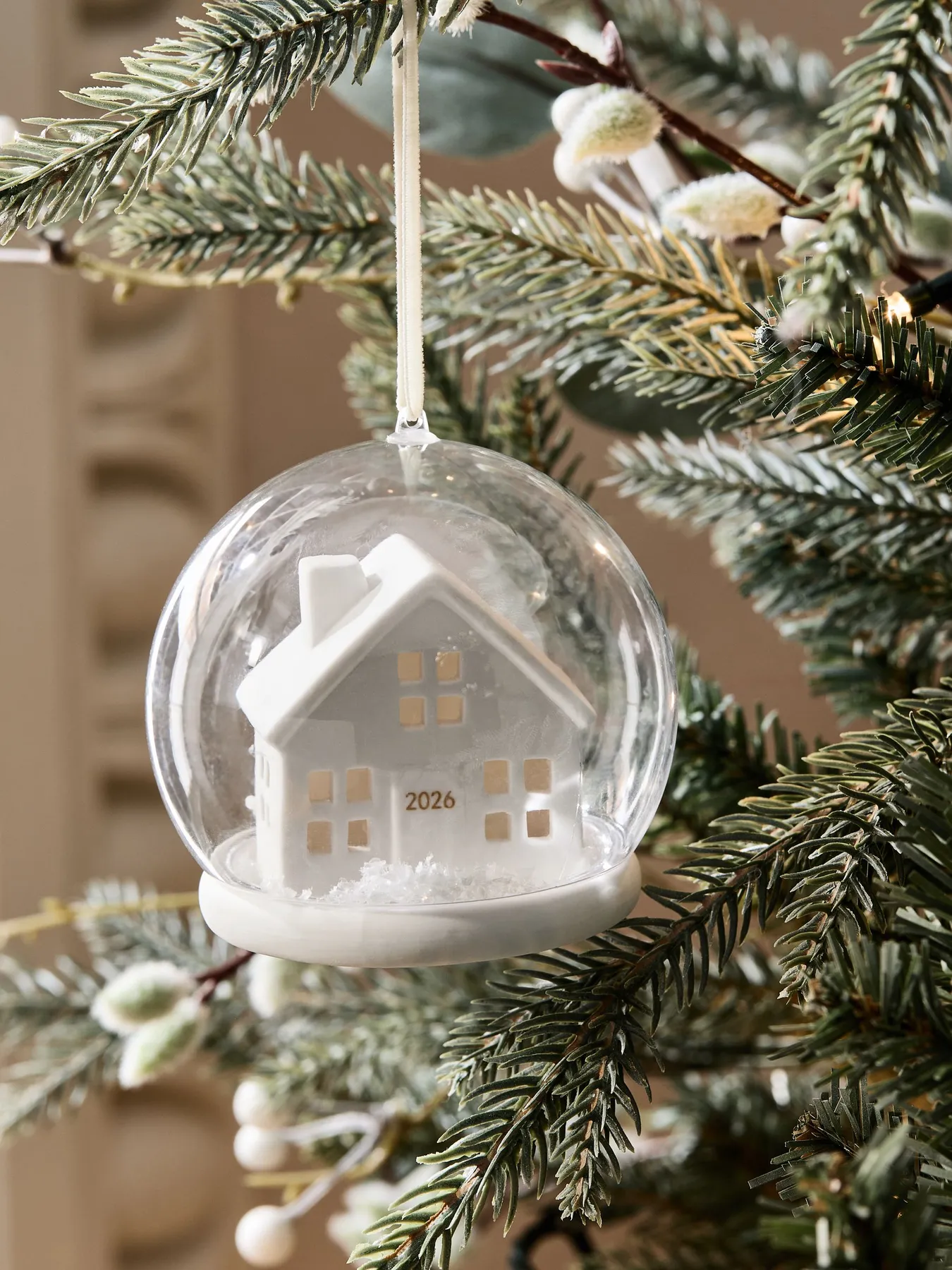
Glass plus a lit interior insert is a fragile combination, so if you’ve got toddlers, a dog with a happy tail, or a cat who thinks the tree is furniture, hang these higher than feels necessary. Batteries are the other reality — most take three LR44s and run two to three weeks on continuous use, so switch them off at night. Store them in their original box with the battery out. Loose in a bin, the ceramic house inside will crack against the next ornament.
14. Hammered Metal Layered Trees on a Dark Wood Shelf
A trio on a shelf needs about 30 inches of run and 10 inches of depth to breathe. Vary the heights by at least a third — if the tallest is 12 inches, the shortest should sit around 8 — otherwise the eye can’t tell they’re a set. This group rests on a rough-hewn slab that’s wider than the arrangement, which is the trick: the surface should overhang the objects by a few inches on each side. Working with a narrow ledge? The single-tree approach in Idea #19 fits in half the space.
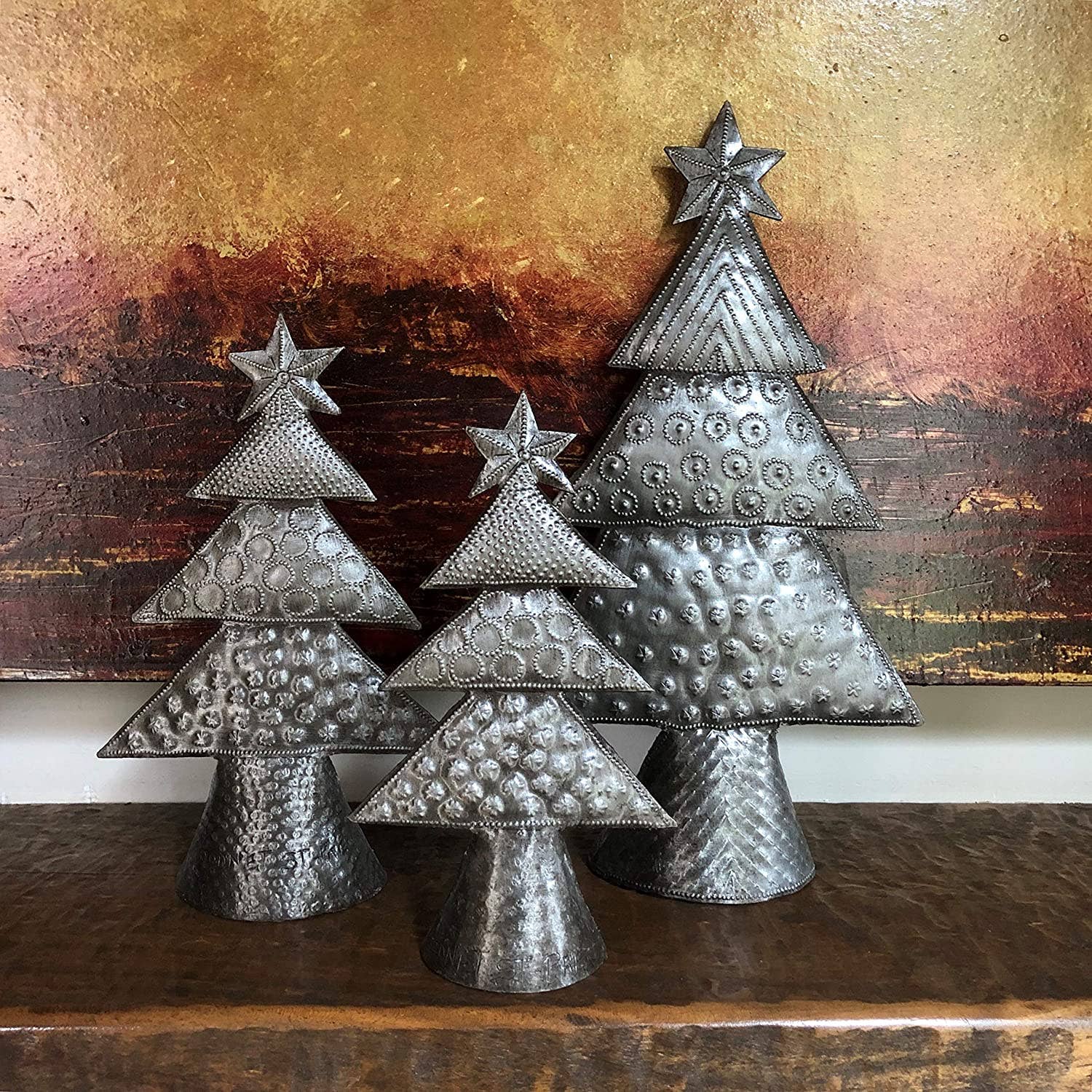
Each tree carries a different embossed pattern, and that’s what keeps a trio from looking like three of the same thing in three sizes. Stacked triangles alone would be a shape; the hammered, dotted, and geometric textures turn them into three separate objects that happen to belong together. The gold and red abstract painting behind repeats that idea — same palette, different rhythm. If you’re buying a set like this, verify the patterns actually differ before you pay.
15. Slot-Together Silver Metal Tree on a Raw Wood Slab
This works because nothing in the frame is trying to be precious. The tree is sheet metal cut and slotted together, the surface is a raw wood slab with saw marks still visible, and the wall behind is corrugated steel. Three industrial materials, one palette of silver and warm brown, with the green garland and warm lights as the only softening note. Flat-pack geometry needs rough texture next to it or it reads like a render. That’s the rule — precision plus grain, always.

Skip the boutique markup. Flat metal tree sculptures turn up at craft fairs and on Etsy for $35–$70, but the same slot-together construction shows up at IKEA and T.J. Maxx for under $25 during the holidays. For the base, ask a lumber yard for an offcut — they’ll often hand you a scrap slab for free or $10 — then sand the edges yourself. Lean it against a dark wall and nobody will ask where it came from.
16. Slender Silver Tree Styled in Pink and White
A white faux fur rug under a silver tree is gorgeous for about nine days. Then the tree sheds, the fur traps every strand, and vacuuming becomes a wrestling match. Two fixes: shake the tree outside before you bring it in, and use a smaller fur piece as a skirt rather than a full rug so you can carry it out and beat it against a wall. Faux fur also flattens under gift boxes — fluff it back with your fingers and a dryer on the cool setting.
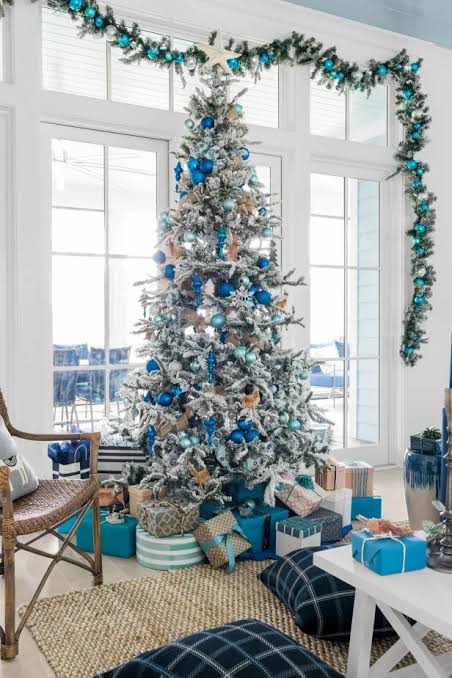
Pink and silver go saccharine fast. The proportion that keeps it grown-up is roughly one pink ornament for every three silver ones, and the pinks should be pale and slightly dusty — blush, shell, mushroom — rather than bubblegum. Put the pink low and the silver high and the tree reads taller. And place a mirror nearby: a starburst or a simple round one doubles the light and gives that narrow silhouette some width in the reflection.
17. Pre-Lit Silver Tinsel Tree in a Sea of Wrapped Gifts
Building the gift-and-candle cluster around a small tree:

- Start with the fluffiest white base you own — faux fur, a blanket, even a folded duvet — and let it spill past the tree’s footprint.
- Stack three or four wrapped boxes at different heights, tallest behind and to one side.
- Fill gaps with a Santa figurine and a small bottle-brush tree so the pile looks collected, not staged.
- Add two pillar candles at different heights on the outer edge, clear of anything flammable.
- Wrap the smallest gifts in newspaper or kraft so the palette doesn’t turn into a rainbow.
The small-tree, big-pile setup has quietly become one of the most saved holiday configurations on Pinterest, and the logic is sound: a 4-foot tree is cheap, easy to store, and fits on a console or sideboard where a full tree never would. What makes it feel abundant is the overflow — gifts and candles spilling past the base so the tree looks like it landed mid-celebration. Apartment dwellers drove this one, and it isn’t going anywhere.
18. Dense Silver Tinsel Layered with Gold and Bronze
This is 55% silver tinsel, 30% mixed gold and bronze, and 15% white. Silver dominates because tinsel is the ground, not the accent — flip the ratio and make gold the majority, and you get a completely different, warmer, much more traditional tree. The bronze is what keeps it from looking like a jewelry counter; it’s the shadow note between the gold and the silver. Swap bronze for copper and the whole thing goes rosier. Swap it for black and you get a modern, graphic tree.
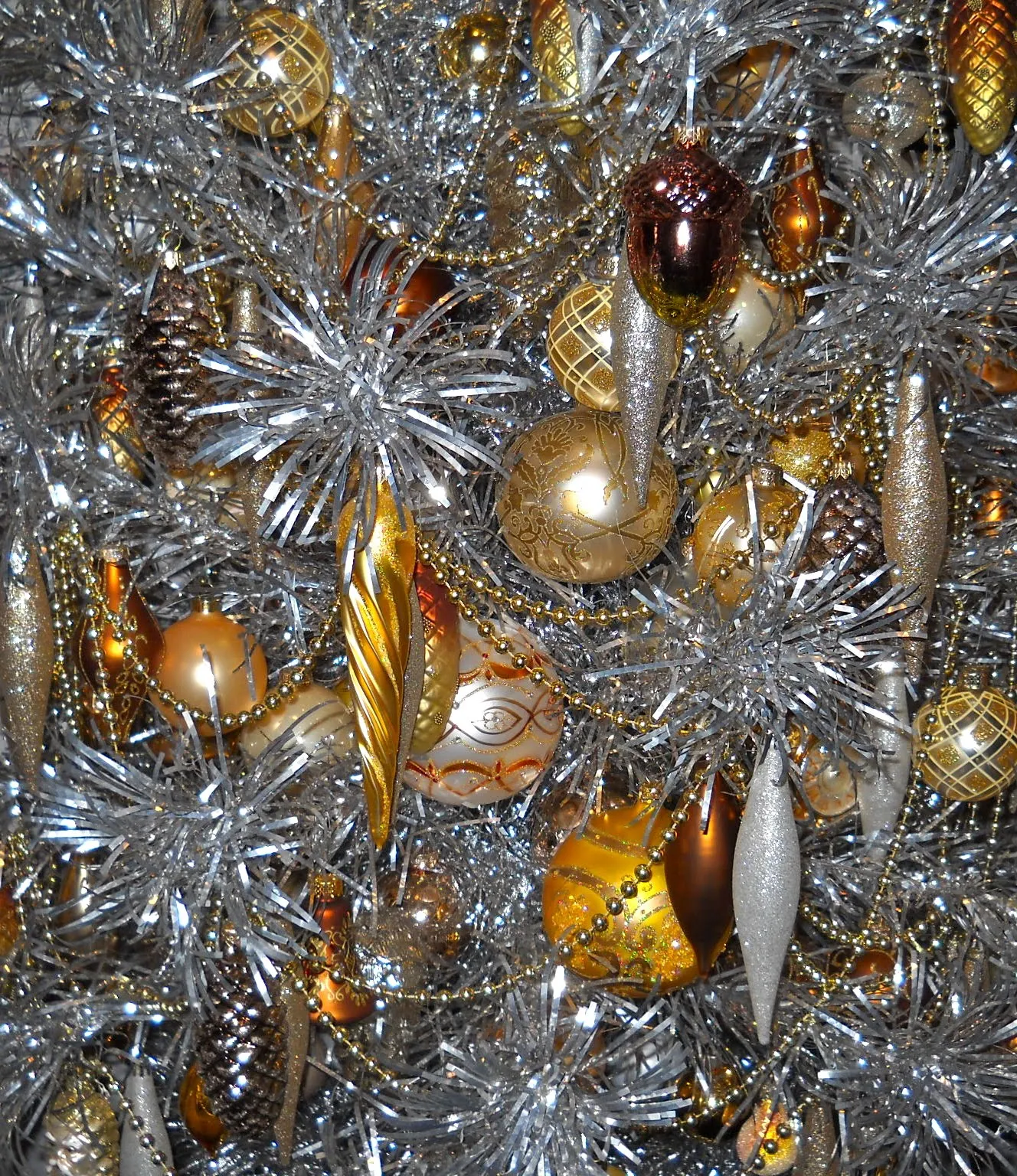
The gold bead garland is what turns a pile of ornaments into an arrangement. Without it you’d have dozens of objects floating at random depths and nowhere for the eye to travel. The bead strand draws a line — down and across, in and out, catching light along its length — and every ornament it passes suddenly looks placed. This is the cheapest upgrade in the entire article: a $6 string of gold beads will fix a tree that feels scattered.
19. Bark-Textured Silver Tree on a Dark Sparkling Surface
Be honest about what you’re buying: a 10-inch decor tree, not a Christmas tree. Set it on a table with a busy background and it vanishes, which is why every good photo of one has a soft, blurred backdrop behind it. Put it somewhere with a wall or a dim corner behind it, and give it a dark, slightly reflective surface underneath — glass, lacquer, a dark tray — so it doubles itself. In a bright, cluttered room it just looks like a knickknack.
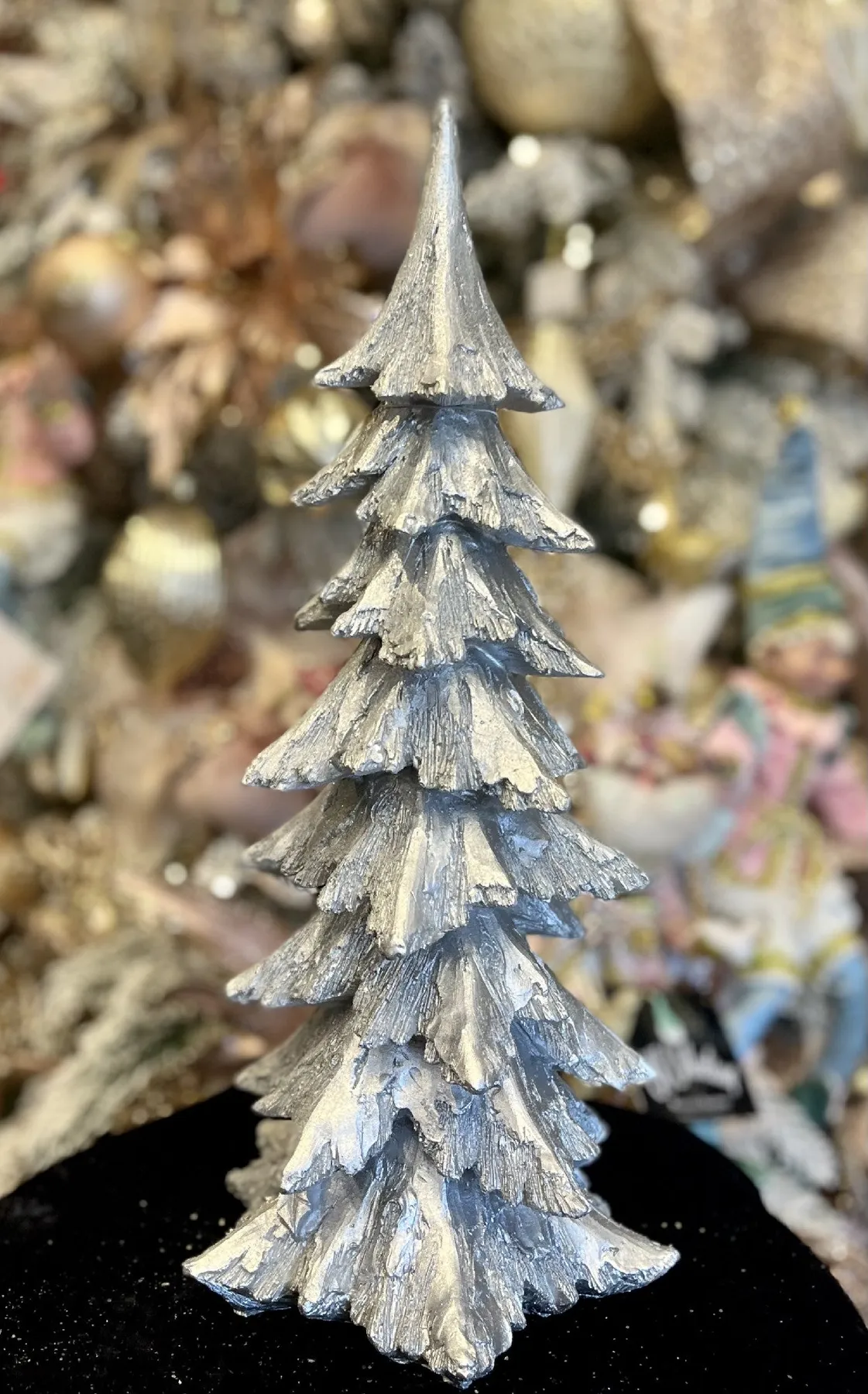
Tabletop pieces want to occupy about a third of the visual height in their frame. On a console with 30 inches of clearance above it, a 10- to 12-inch tree is right; on a coffee table, drop to 8. The dark sparkling surface here is roughly 12 inches across, which gives the tree a small stage and keeps surrounding clutter from crowding in. If your table runs longer than 40 inches, this will look lost, and the trio in Idea #14 is the better answer.
20. White Tiered Metal Tree with Tiny Black Polka Dots
Polka dots on a metal tree create pattern, and pattern needs a plain neighbor or it gets loud. That’s why the pinecones work here — natural, matte, irregular — and why a printed table runner would ruin it. My rule for any patterned decorative piece: give it three plain things within arm’s reach. A wood surface, a matte pinecone, a single unadorned candle. Then the dots read as charming instead of busy. Keep the topper simple too; a shaped topper fights the pattern.
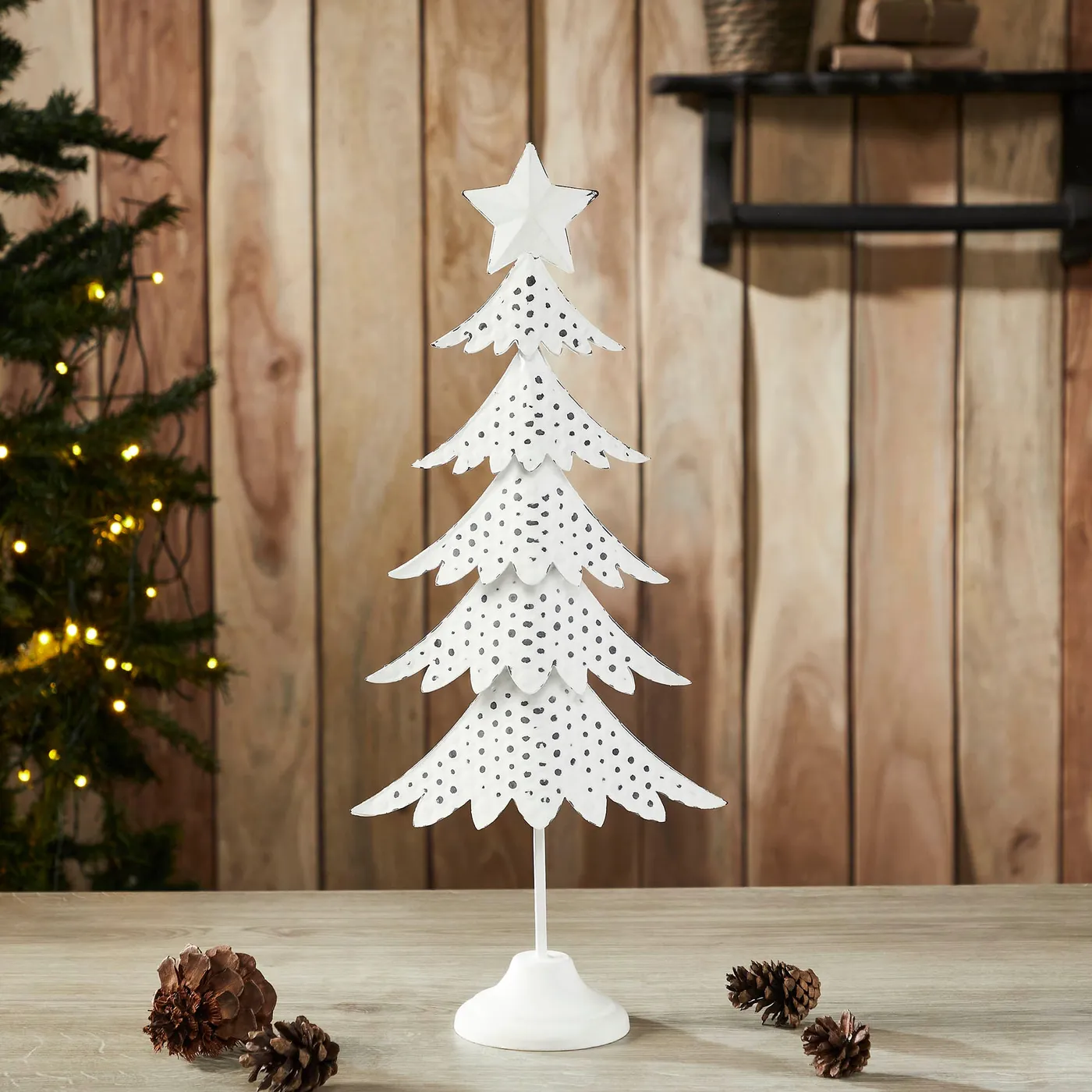
This is a $25 idea, not a $150 one. Tiered metal trees with a plain finish run $15–$30 at Target and HomeGoods, and a can of matte white spray paint plus a small black paint pen gets you the dots in an afternoon. Dot them with the pen’s round tip, dry flat, and don’t aim for perfect — hand-done irregularity is the charm. Pinecones are free if there’s a park nearby; bake them at 200°F for 30 minutes first.
21. Cream Glass Ornaments with Gold Beading and Pearls
These ornaments work because they’re embellished at three levels — cream glass as the base, gold beading and glitter as the mid-layer, and tiny crystal leaves as the sparkle — and each layer sits physically on top of the last. That’s different from an ornament painted in three colors. Real dimensional layering catches light at different depths every time the tree moves in a draft. The pearl garland then repeats the cream note in a different material, which is what keeps the whole tree from reading monochrome.
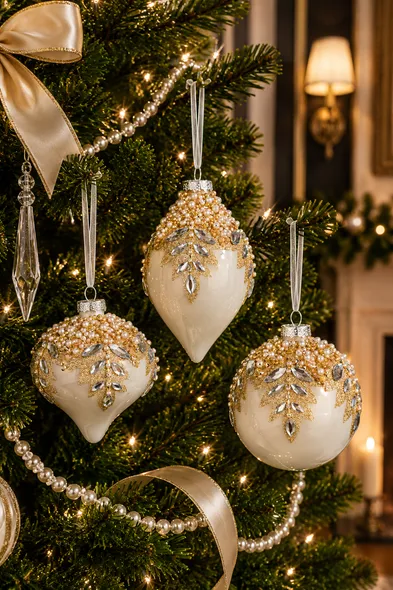
- Cream glass ornament set (12–18 pieces): $40–$95
- Pearl bead garland, two strands: $15–$35
- Cream satin ribbon, one spool: $8–$18
- Warm white fairy lights, 300 count: $20–$45
- Gold beaded filler ornaments: $18–$40
- Total: $101–$233
Budget alternative: buy plain cream glass balls at a dollar store and add gold bead trim with a hot glue gun — about $30 for a full set, and the handmade quality actually suits the look.
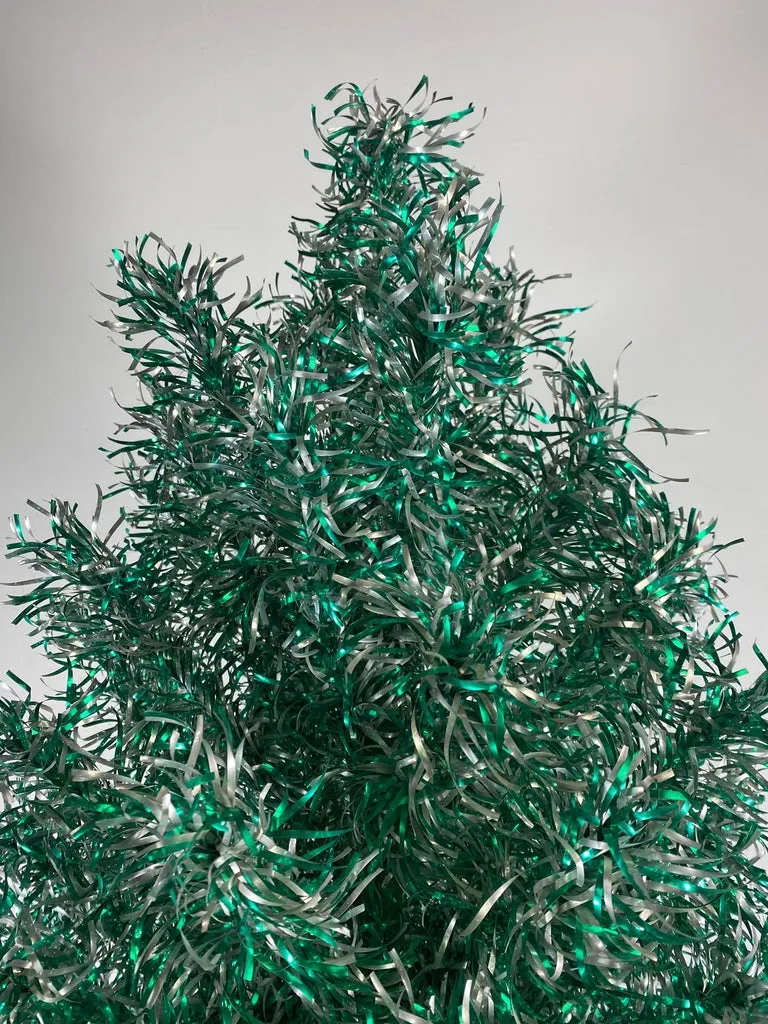
22. Metallic Green and Silver Tinsel, Seen Up Close
Tinsel is essentially very thin foil wrapped around thread, and it does not enjoy being stored in a hot garage. Heat makes the coating brittle, and brittle tinsel sheds in sheets. Keep it in a cool closet in a breathable bag rather than sealed plastic, and don’t compress it — crushed tinsel never springs back. Expect static too: it grabs dust and pet hair like a magnet, and a dryer sheet run lightly over the branches in November resets it for the season.
Reviving a packed-away tinsel tree:
- Set it up in a warm room and let it sit for an hour — strands relax as they warm.
- Work section by section, bottom to top, lifting each branch outward with two fingers.
- Twist any flattened sections against their natural direction to restore bounce.
- Shake loose debris into a trash bag as you go instead of brushing it onto the floor.
- Add lights before ornaments so the wire disappears into the tinsel.
About 40 minutes, no materials needed.
23. Distressed Metal Tree with a Star on Faux Snow
At roughly 12 inches tall, this is a shelf or sideboard piece, and it wants to stand alone. Give it at least 6 inches of clear space on every side or the metal leaves blur into whatever’s next to it. The scattering of faux snow is doing scale work — it widens the footprint visually so a small object doesn’t look marooned. A round base also means it can’t be jammed into a corner; it needs to be seen from three sides. Idea #15 takes the same metal idea to a much larger scale.

Faux snow is a commitment. The flakes drift, they stick to anything slightly damp, and they will migrate across that wood surface within a week. Use less than you think — a light scatter, not a drift — and set it on a tray with a small lip so it stays put. Distressed white metal also shows fingerprints and dust in a way polished silver doesn’t, so plan on a monthly dry-cloth dusting. Worth it, but know what you’re signing up for.
24. Slender Silver Tinsel Tree Densely Lit with Warm Whites
Light density is the number that matters with tinsel. A regular green tree wants about 100 lights per foot of height; a silver tinsel tree wants closer to 150, because metallic strands reflect light back instead of absorbing it and the tree reads dimmer at the same count. On a 7-foot slender tinsel tree, that’s roughly 1,000 warm white mini lights. Wrap the trunk first, then work outward — the interior wrap is what creates the glow.
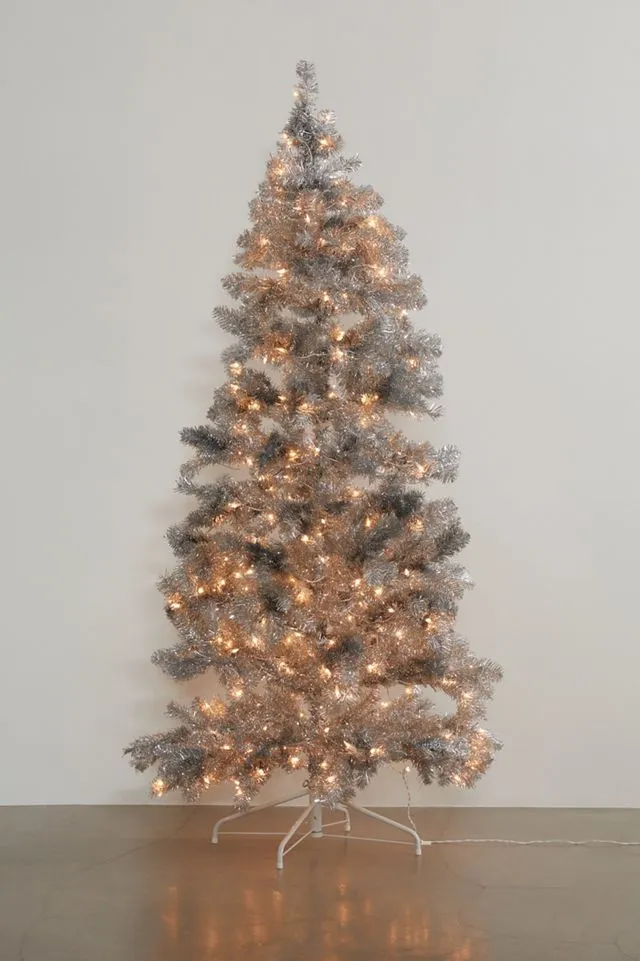
Warm white only, and all one temperature. The formula is 90% warm white light and 10% silver reflection, with no cool white strings anywhere near it. Mixing color temperatures on a silver tree is the fastest way to make it look cheap: cool bulbs turn the tinsel blue-gray and suddenly you’re standing in a hotel lobby. If you want a second light color, make it a warm amber, and check the Kelvin rating on the box before buying two strings from different brands.
25. White Ring Tree with Silver Orbs and Clear Teardrops
The open ring structure is the entire idea, and it works because of what isn’t there. A solid tree fills a corner with green volume; this one leaves gaps you can see the wall through, which is why it doesn’t crowd the seating area beside it. The silver orbs and clear teardrops hang in that negative space rather than sitting on branches, so they read as floating. Take away the rings and hang the same ornaments on a green tree and you’ve got a completely ordinary, much heavier-looking Christmas.

Negative space is the principle, and it’s why this works in a room that isn’t huge. A traditional tree blocks sightlines and eats floor; an open frame lets the eye pass through and keeps the corner feeling light. The clear teardrops matter too — they’re the ornaments that disappear and reappear as you move through the room, adding motion without adding color. Everything in this vignette is quiet: light wood, beige, taupe. The tree is the only thing with a hard edge.
26. Bare Flocked Tree in a Wood-and-Stone Cabin Room
- Measure ceiling height minus topper clearance — a flocked 9-footer needs a 10-foot ceiling.
- Check your light direction: flocking glows with warm light in front of it and turns gray when backlit by a window.
- Confirm the floor can take the weight — flocked trees run 20–30% heavier than plain ones.
- Decide you’re going unadorned before you buy ornaments. This look only works bare.
- Count your outlets. A tree this size wants two light strands on separate plugs.
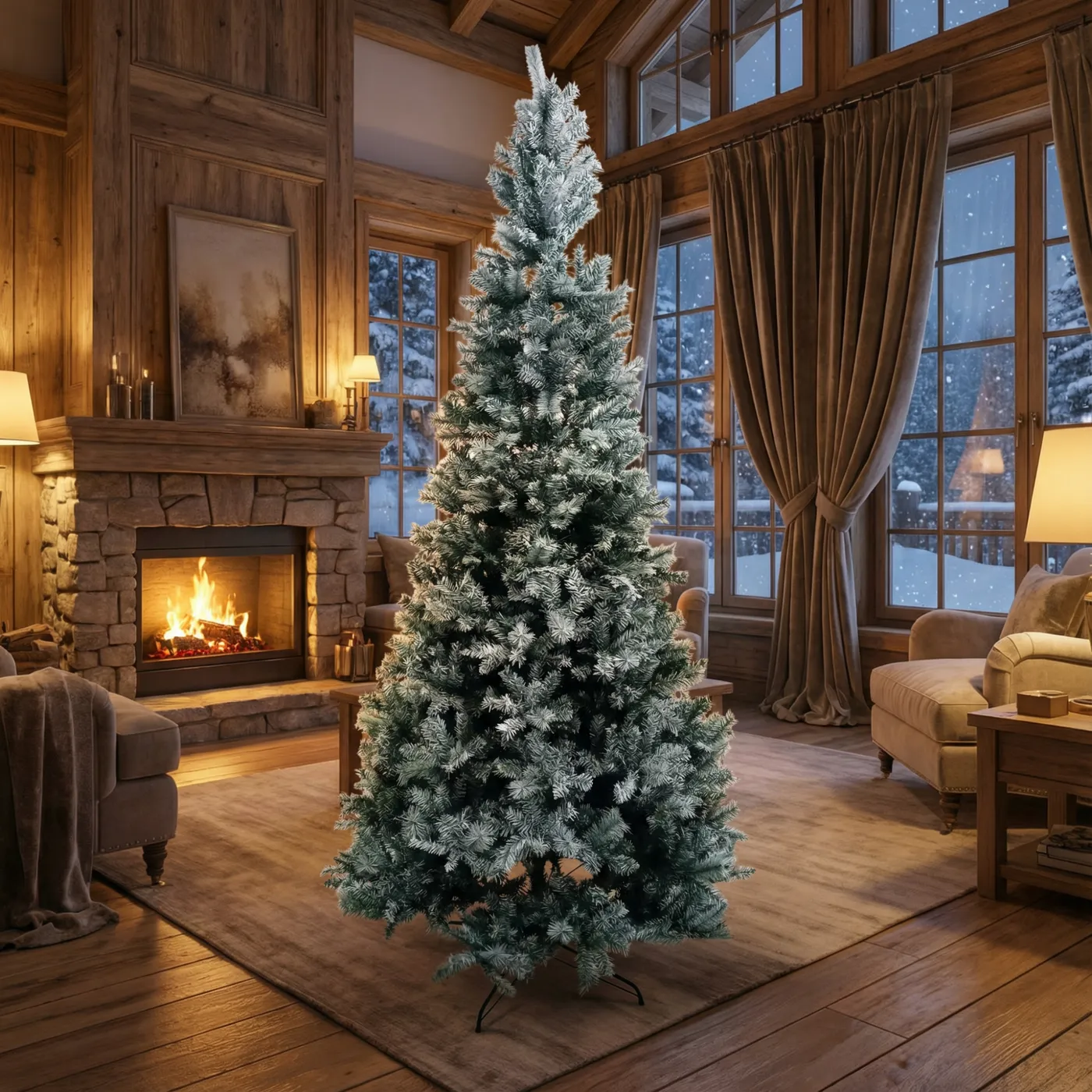
An unadorned flocked tree only works if the room supplies the texture. Here it’s the wood paneling, exposed beams, stone fireplace, and pleated curtains — four surfaces within ten feet, so the bare tree reads as restraint instead of laziness. In a plain white room, the same tree looks like you ran out of ornaments. If your walls are flat, add a chunky knit throw and a rough basket at the base before you give up on decorating entirely.
27. Black Tree with Musical Note Ribbon and Striped Drapes
Black Christmas trees spent a few years as a novelty and have settled into a real, if niche, position — the people who buy them buy them deliberately, and they build the whole room around them. What’s changed by 2026 is the styling: less neon contrast, more silver, cream, and pale pink, with wide patterned ribbon doing the decorative work instead of hundreds of ornaments. The black-and-white striped drapery behind is the tell. This is a room designed as a set, not decorated after the fact.
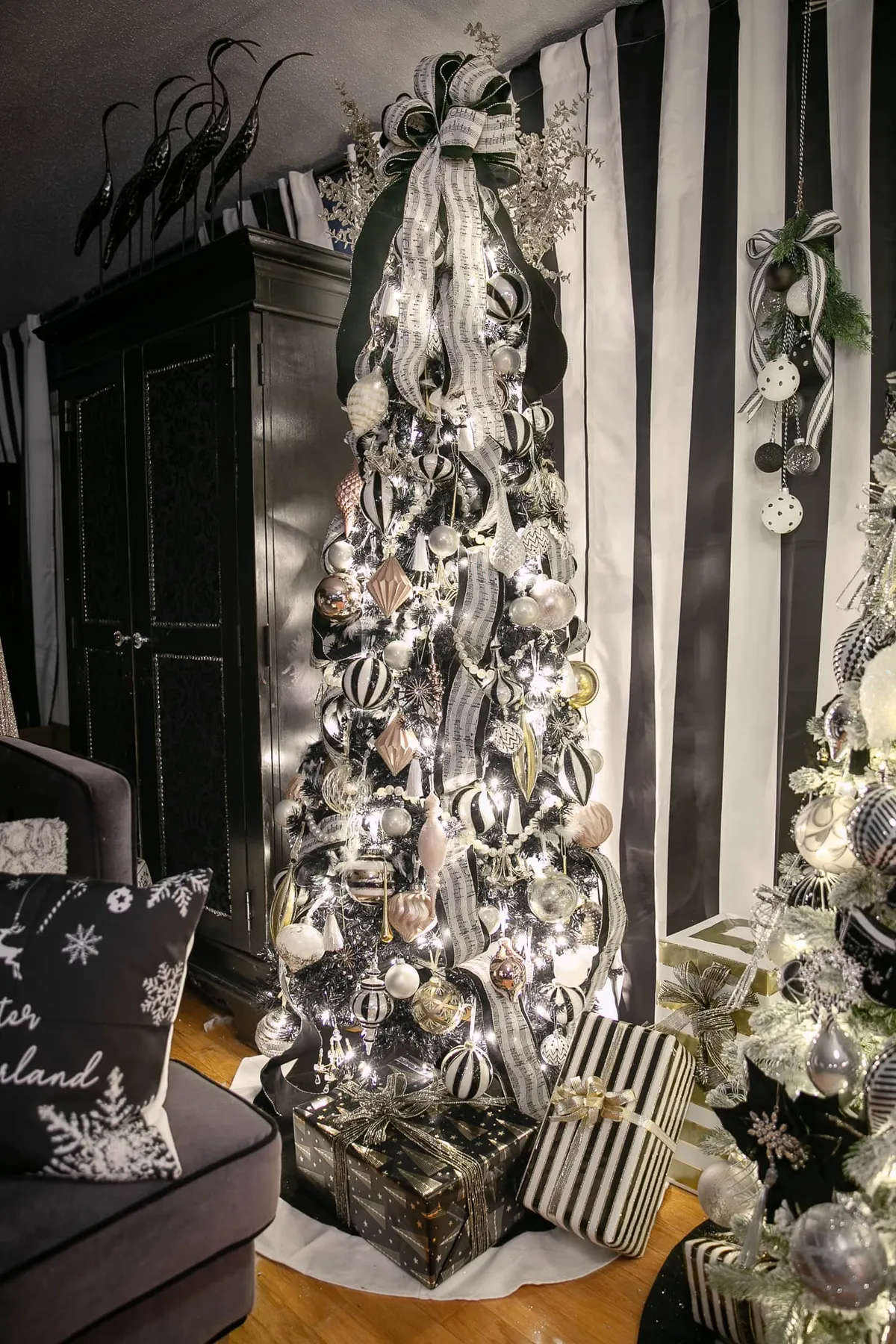
Making the oversized ribbon bow topper:
- Buy wired ribbon at least 2.5 inches wide in the same pattern as your tree ribbon — about 3 yards.
- Make four loops, each roughly 6 inches long, pinching and twisting the wire at the center as you go.
- Wrap a short length of the same ribbon around the center pinch to hide the wire, leaving two tails about 14 inches long.
- Sit it on the top branch and anchor with a zip tie hidden under the loops.
- Trim the tails on a sharp diagonal so the pattern stays readable.
Fifteen minutes, under $20.
28. Three Gold Sculptural Trees with Mercury Glass Candlelight
Gold sculptural trees are having a moment, and boutique versions run $60–$120 for a trio. Here’s the workaround: buy plain papier-mâché or ceramic cone forms at a craft store for $4–$8 each, or set three different-height candlesticks with a cone glued on top, then hit them all with metallic gold spray paint. Total cost under $35. The mercury glass votive is the one piece worth buying new — thrifted ones are often scratched inside, and the silvering is what creates that glow.
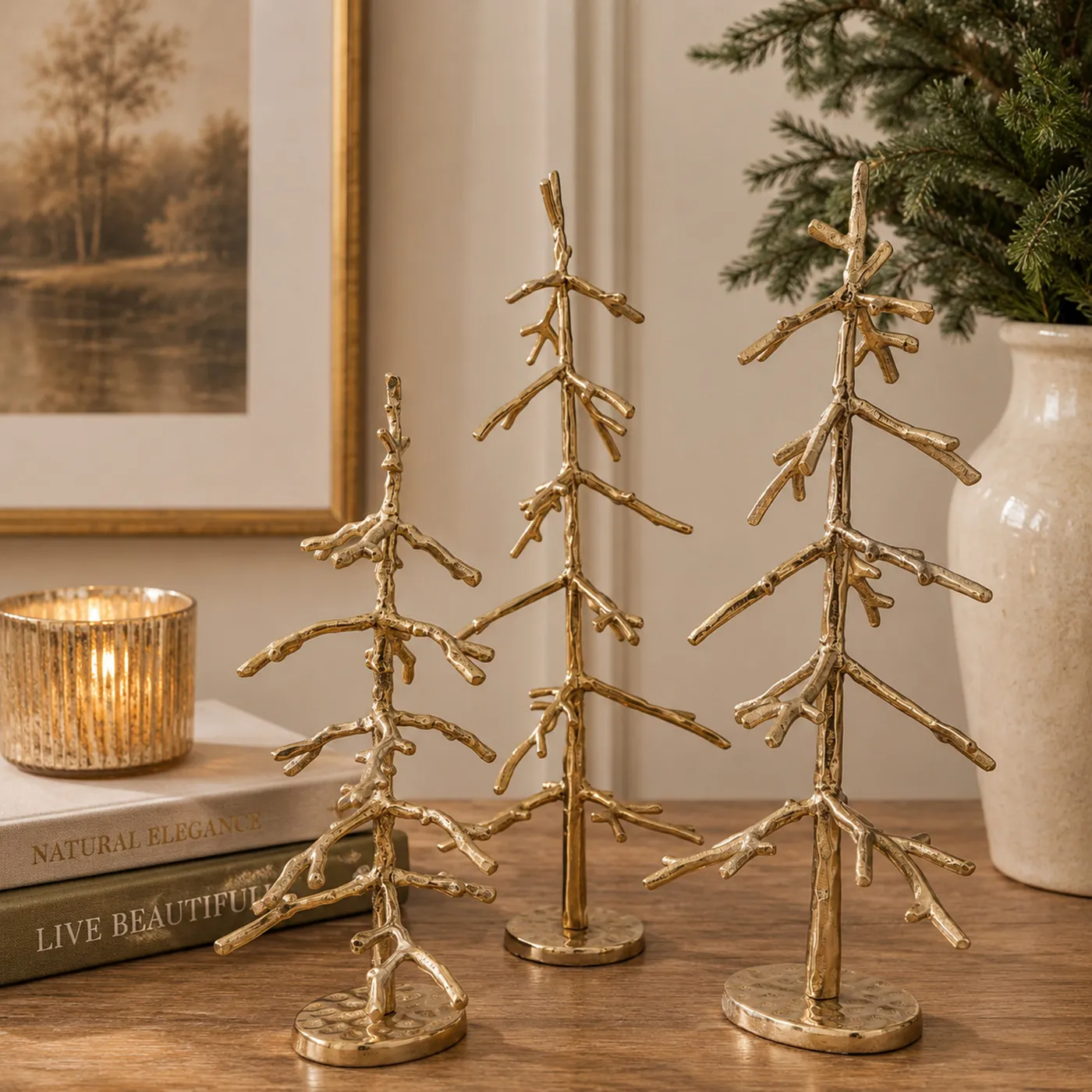
Keep a tabletop trio to three heights and three materials. Here that’s gold metal, glass, and paper — the books and pine branches add a fourth and fifth without competing, because they’re matte and textural while the gold is the only shine. The lit votive sits toward the front and slightly off-center on purpose: candlelight should never be blocked by the tallest object. Move it two inches left and the whole vignette warms up.
29. Mercury Glass Ornaments Piled in a Blue Dough Bowl
Mercury glass is glass with a silvered coating on the inside, and that coating does not like water. Never soak these, never put them in a dishwasher, and never scrub the interior — a soft dry cloth, or a quick swish of lukewarm water followed by immediate drying, is all they need. The finish also dulls slowly over the years, which most people end up preferring. Want the look without the fragility? Silver-painted glass ornaments give you 80% of the glow for a third of the price.
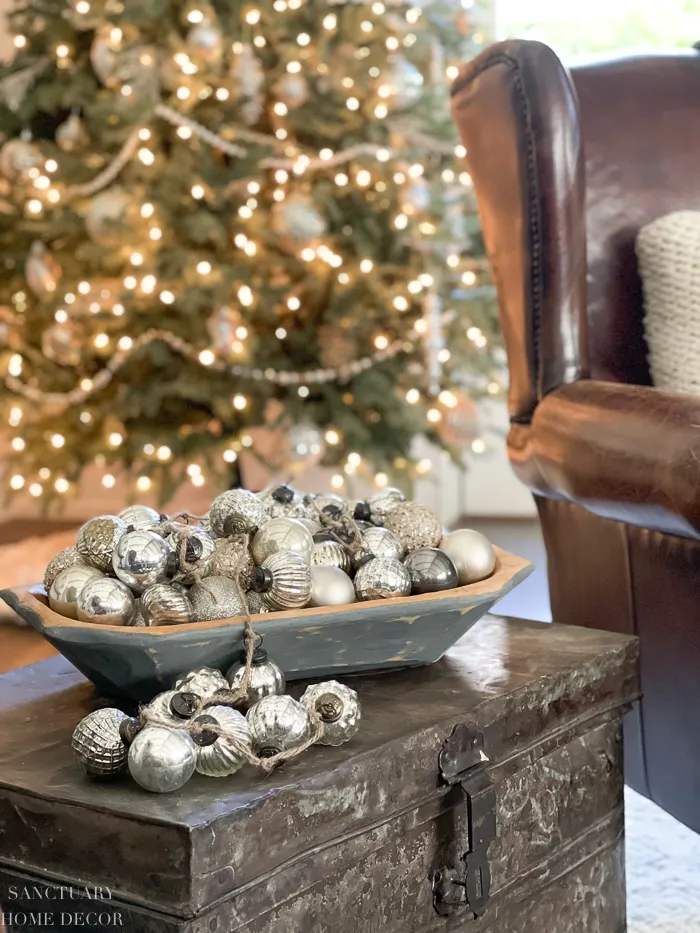
Piling ornaments in a bowl instead of hanging them is the smartest trick in holiday styling, and here’s why: at eye level, a tree full of ornaments is a blur, but a bowl brings a dozen within arm’s reach where you can actually see the mercury finish, the fluting, the age. The distressed blue bowl adds the one cool note against all that warm light and brown leather, echoing the tree behind it without matching it. Nothing here is expensive. It just looks collected.
Silver Trees Aren’t Cold — They’re Just Under-Lit
Every good silver tree in this list has the same two things going for it: warm light in front of the metal, and at least one texture that isn’t shiny. Get those right and the cold-hotel-lobby problem disappears. Start with the version that fits your actual room — a $20 tabletop piece counts — and build from there.
📌 Pin your favorite from these 29 ideas now, so you can find it again when the boxes come down from the attic.