Christmas window ideas 2026 is having a major moment on Pinterest right now — and we know exactly why. After filtering through hundreds of options across Target, Etsy, HomeGoods, Anthropologie, and Walmart, we narrowed it down to 31 ideas that actually deliver, from $8 chalk markers to $450 statement garlands. You’ll find rustic evergreen swags, vintage caroler decals, twinkling ceramic villages, hand-painted window art, and the kind of warm-light layering that makes a room feel like a snow globe from the inside out. Budget and luxury versions sit side by side, so you can pick your lane without guessing. The 2026 shift is toward real, tactile materials — dried oranges, wool felt, hand-painted glass over plastic — and windows are where that shows up first. And stay until the end — we break down the most common mistakes that can ruin these looks. 📌 Save this to Pinterest for later — you’ll want to revisit these ideas.
1. Four-Pane Window Outlined in Warm String Lights
Here’s the trick with framing a window in lights: run one unbroken strand along the outer edge of the trim, then commit. A 100-bulb warm white strand at 2700K — not 3000K, there’s a difference you’ll notice at dusk — covers roughly eight feet of trim at four-inch bulb spacing. Don’t double back over your own line to fill a gap. That’s what creates the hot spots in photos that look off but you can’t name why.
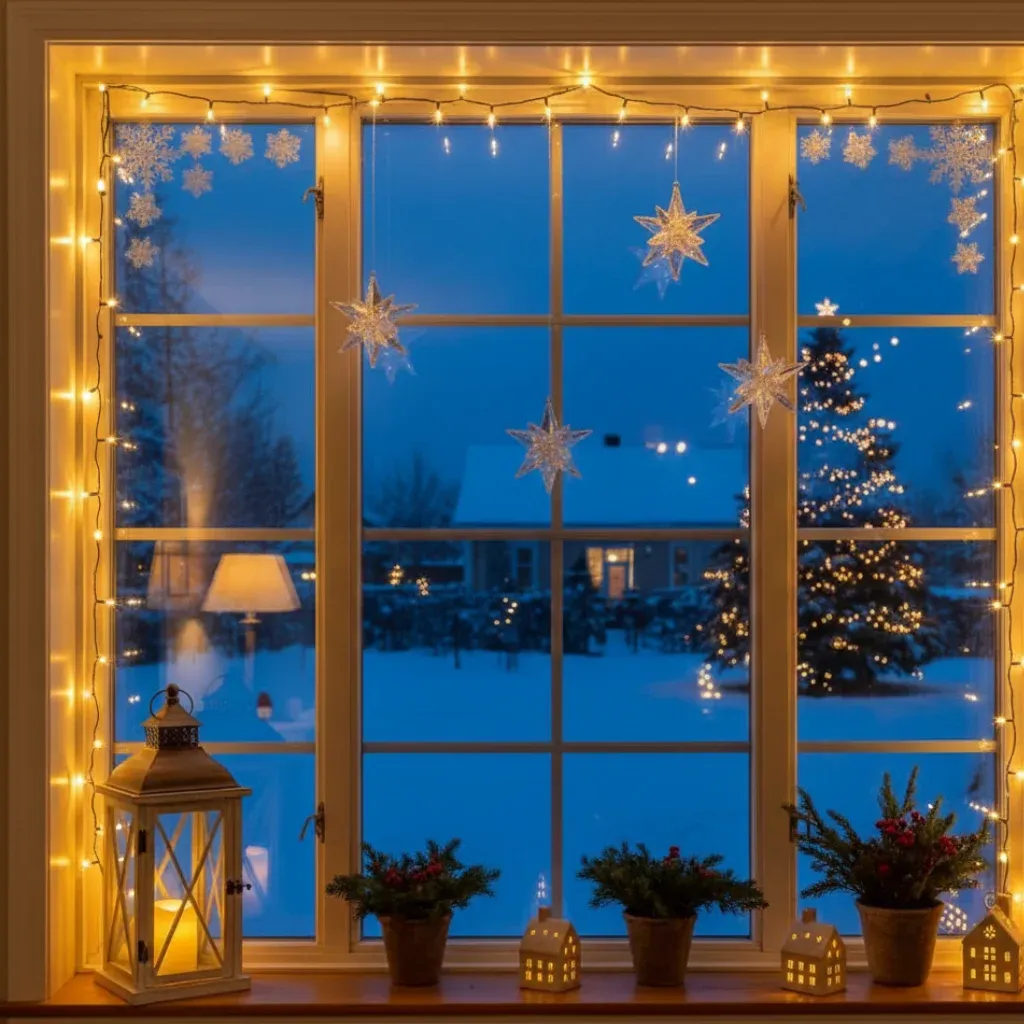
If you strip this window down to one element, it’s the three little lit ceramic houses on the sill. They’re what turn a decorated window into a scene — the lights outline it, the snowflakes dress it, but the houses give your eye somewhere to land at human scale. Remove them and you’re left with a lit rectangle. Keep them and it reads like a story someone lives inside.
2. Bay Window Draped in Warm White Lights
- Warm white string lights, two 8-ft strands: $18–$34
- Assorted small ornaments (balls, pinecones, snowflakes): $12–$30
- Brass candle holders plus pillar candles: $24–$65
- Potted green ivy: $14–$28
- Tray and one gold ornament: $10–$22
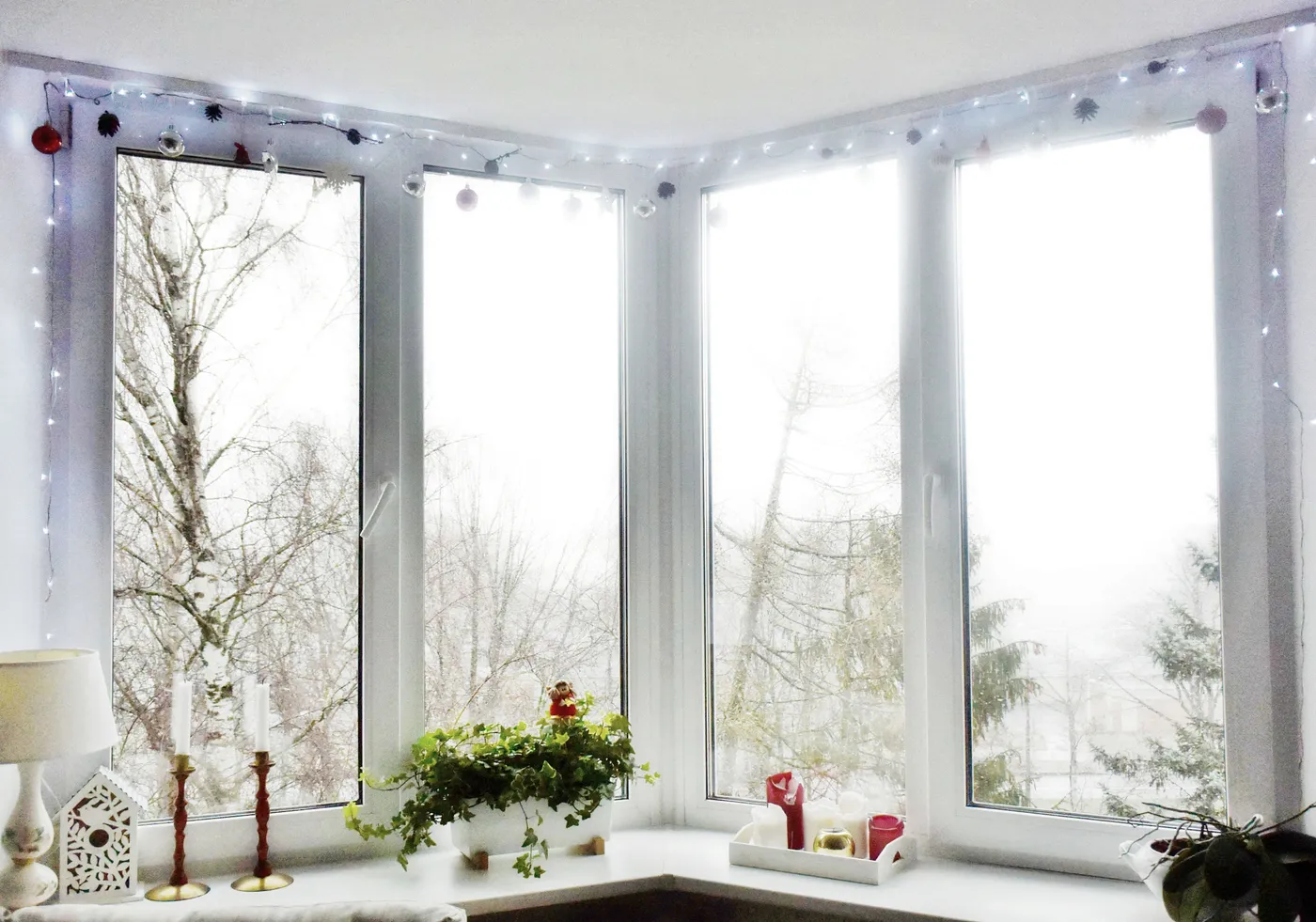
Total: $78–$179. Budget alternative: skip the brass, use cream tapers in thrifted juice glasses, and you land around $45.
A bay window is basically three windows arguing for attention, so the rule here is one continuous line, one cluster, one plant. The lights travel the top frame without stopping at the mullions, which visually knits the panels into a single unit. Everything else lives low on the sill in a loose cluster. Contrast does the rest — brass against white trim, cool winter light outside against 2700K inside.
3. Jewel-Toned Gowns Behind Curtains of Light
Store windows get away with density because they’re lit from four directions. At home, version this by treating the light strands as a curtain, not a garland — hang them vertically from the top frame at four-inch intervals, letting them fall to the sill. You need roughly 12 to 16 drops for a standard 36-inch window, and a single 300-bulb curtain strand covers it. Anything fewer and you get stripes instead of glow.
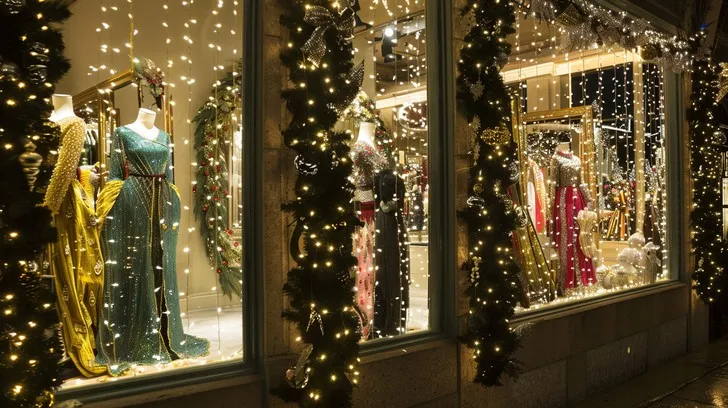
The maximalist store window is back in 2026 because everyone got tired of beige Christmas. Jewel tones photograph beautifully under warm light, which is exactly what Pinterest rewards.
- Fuchsia reads festive rather than Easter when it sits next to forest green
- Dark green garland makes gold ornaments look expensive
- Light curtains turn any background into a backdrop
The light-curtain technique itself is timeless, even if the saturation dials back in a year or two.
4. A Painted Winter Cabin Lit From Behind
Clean the glass with rubbing alcohol and let it dry fully — paint won’t hold on cold, oily panes. Sketch the cabin and two flanking pines in white chalk pencil, keeping the cabin to the lower third. Block in the dark background first, then the cabin, then the snow. Tape a warm white strand to the exterior side of the glass before dark. About 2.5 hours and $22 in acrylic craft paint.
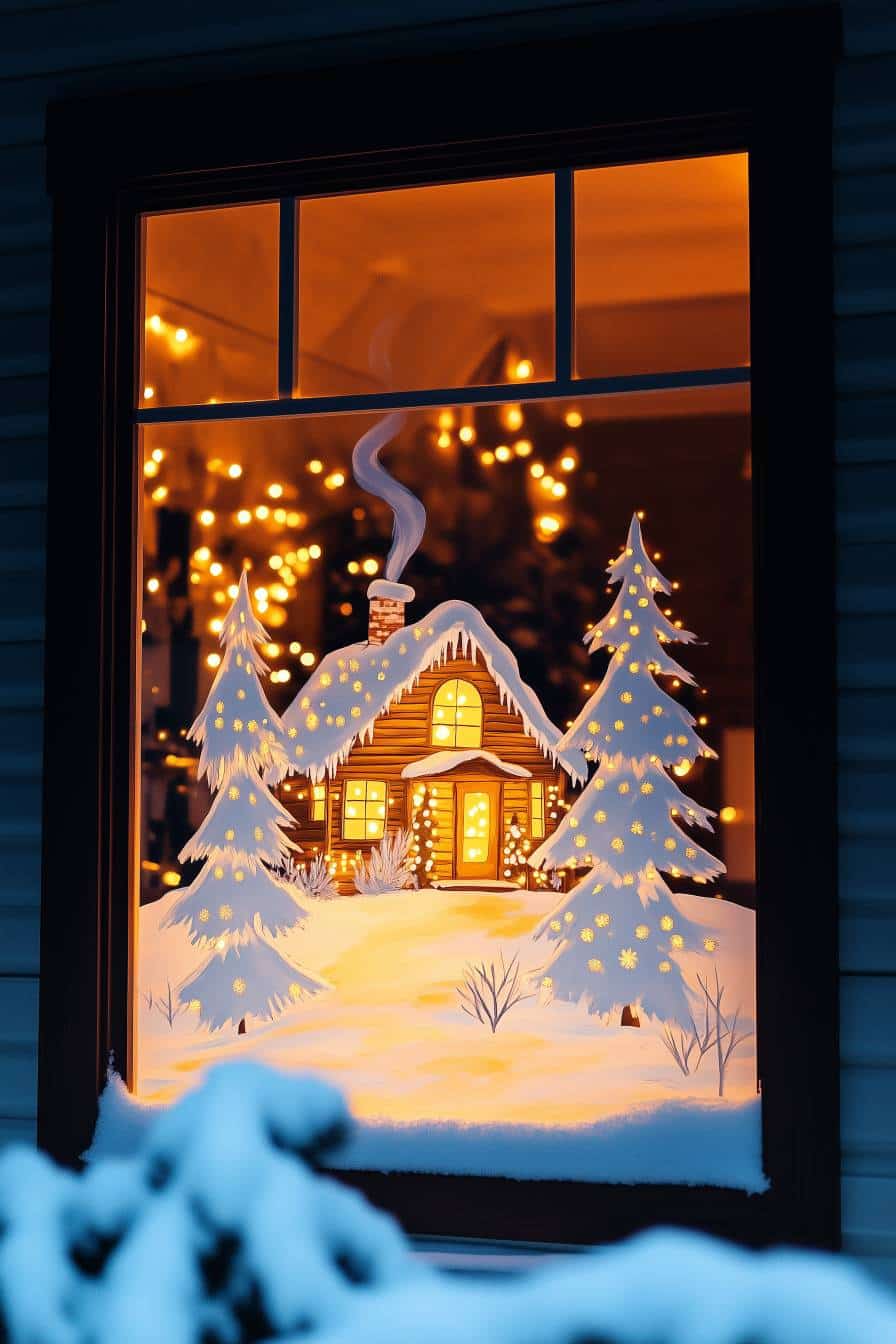
You don’t need a $600 scenic mural. Acrylic craft paint from Walmart runs $1.50 a bottle and covers a full pane in two coats. The lit-from-behind effect — the thing that actually makes this magical — comes from a $12 strand taped to the outside of the glass, not from any paint. If you’re renting, use window cling film instead and you’re out $15.
5. Pleated Paper Trees in Classic Red and Green
Here’s the formula that keeps red-and-green from looking like a 1994 grocery store: 70% dark green, 20% red, 10% warm white light. The green does the heavy lifting — garland, wreath, paper trees — while red appears in only three or four places. Swap the red for burgundy and it gets more sophisticated. Swap the green for sage and it goes cottage. The ratio stays identical either way.
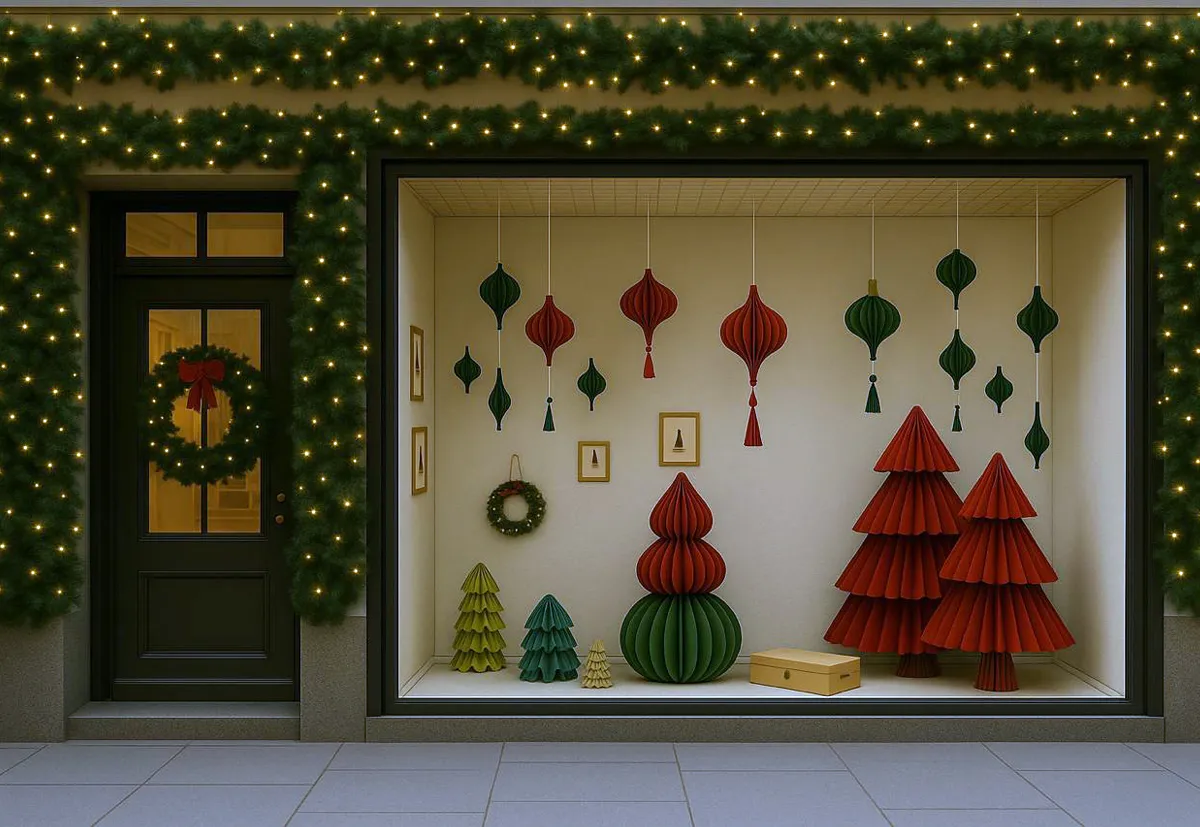
Pleated paper ornaments are gorgeous and they are not kid-proof. Before you commit, check:
- Are these windows within reach of anyone under four feet?
- Is the window in direct afternoon sun? Paper fades in about six weeks.
- Do you have a dry place to store them flat?
If the first answer is yes, hang the paper pieces high and keep the unbreakable garland down low.
6. Frosted Snowflake Decals and a Brass Lantern
Apply decals to glass that’s above 60°F — cold panes are the number one reason they peel by New Year’s. Wipe with a microfiber cloth and a 50/50 vinegar-water mix, dry completely, then press from the center out with a squeegee. And here’s the part nobody says out loud: put the snowflakes in the upper corners only. Clustering them at the top mimics how frost actually forms and keeps your sightline clear.
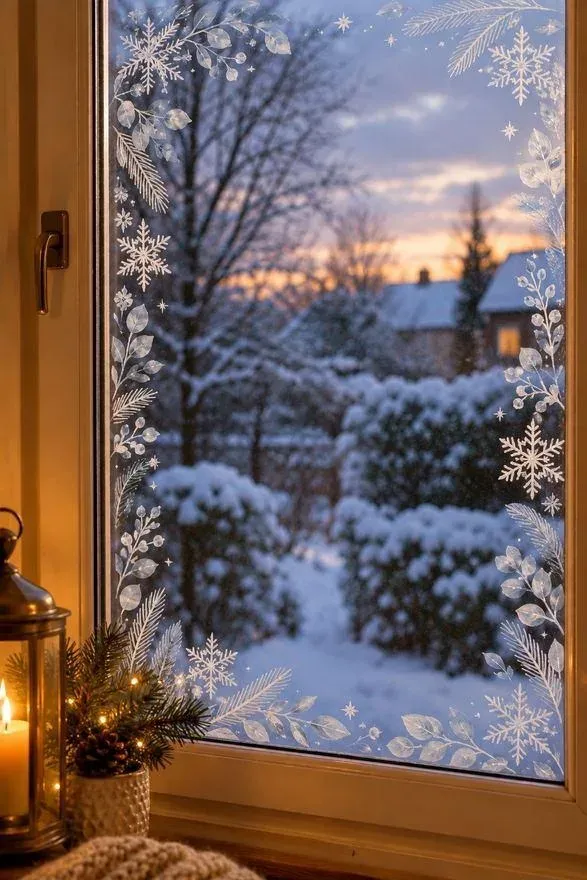
Two things are happening here. First, contrast of temperature — cool white decals against warm candlelight create a visual shiver that reads as winter without a single real snowflake. Second, scale variation: the decals come in three sizes, which is why the arrangement feels organic rather than stickers-on-a-window. The knitted textile on the sill adds a third texture so your eye has somewhere to rest.
7. Dried Orange Slices Over the Kitchen Sink
Slice navel oranges 1/4 inch thick and bake at 200°F for 3 hours, flipping once. Wire them onto the wreath form with 22-gauge floral wire, spacing every 4 inches. Hot-glue pinecones into the gaps, keeping the bottom third lightest. Hang the wreath so its top edge sits 4 inches below the window’s top trim — not centered. Roughly $18 and an afternoon.
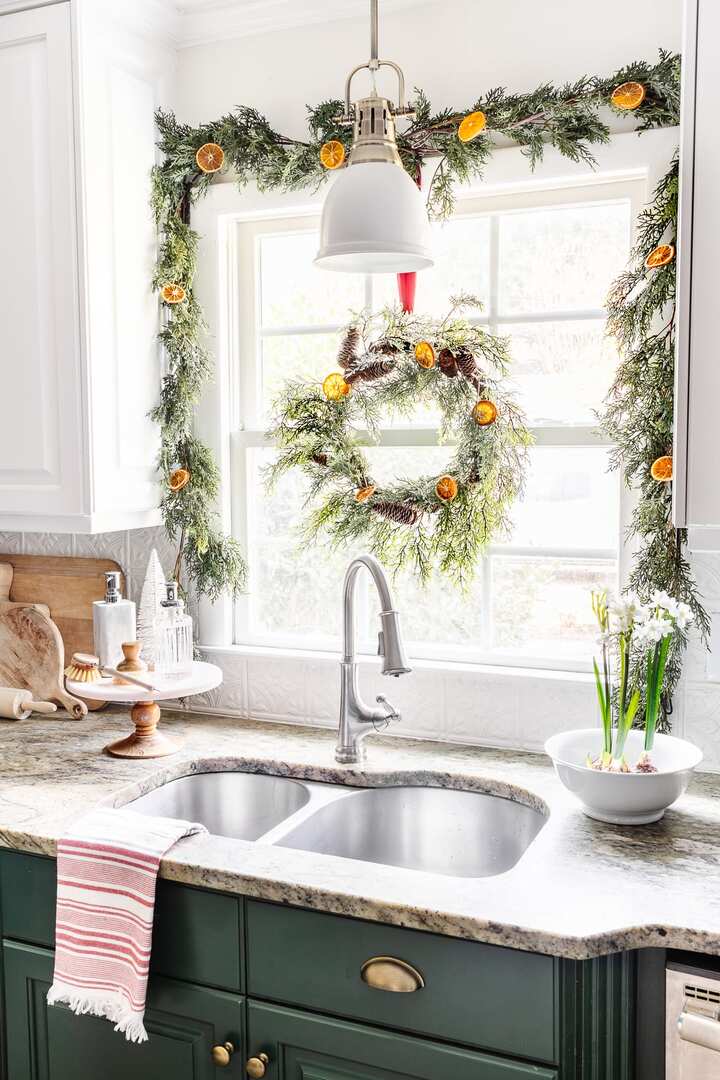
This look needs a window at least 30 inches wide, ideally 36 or more, because the wreath plus flanking garland eats 12 inches of visual space on each side. It works best over a sink where the garland can rest on the sill rather than hang — a 24-inch-deep counter gives you room. In a galley kitchen under 60 square feet, skip the garland and keep only the wreath, as in Idea #20.
8. Craftsman Window Bench With Tapered Black Candles
The black tapered candles. Everything else here — the garland, the stone vases, the gold branches — is warm-toned and soft, and the whole composition would go slightly mushy without those dark vertical lines. Black tapers in a Christmas window is a bold move that pays off because they echo the dark window frames. Remove them and the bench becomes a generic garland display.
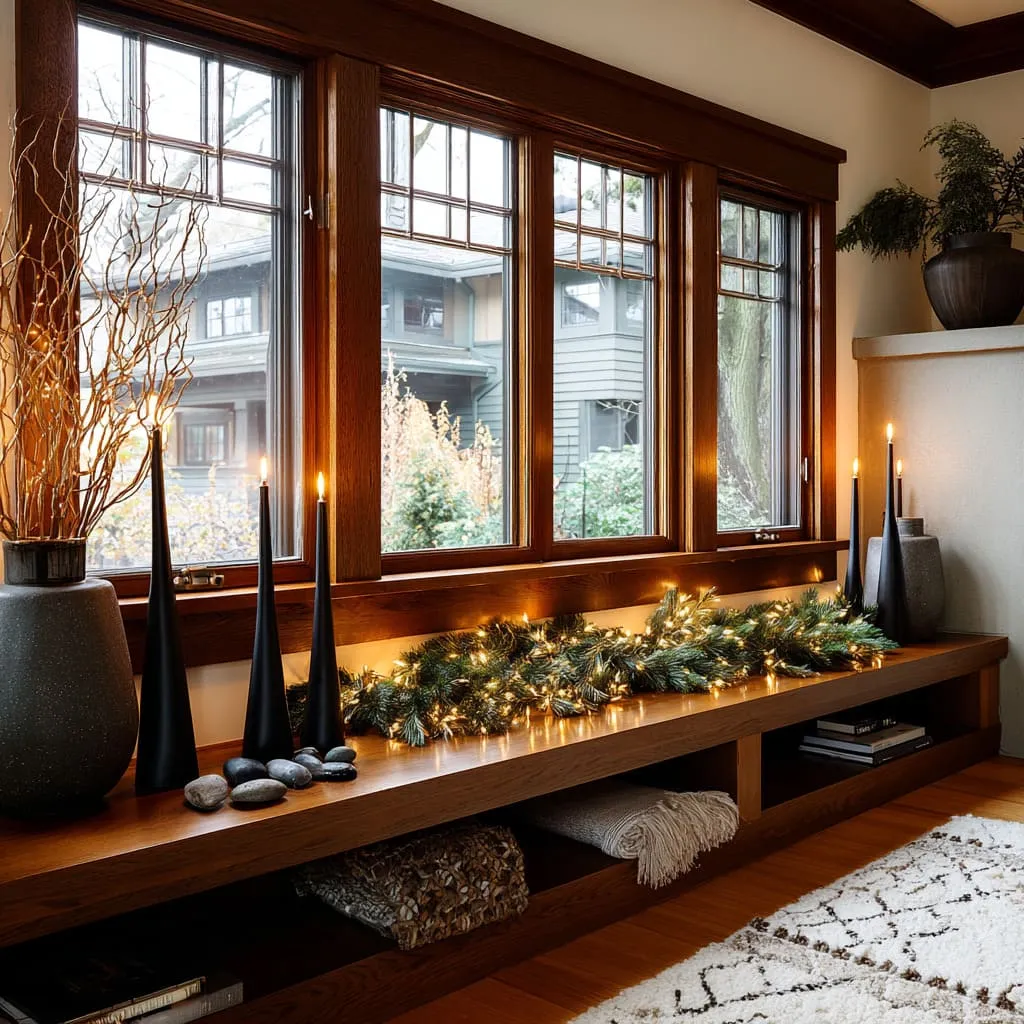
Tapered candles in a window need to be at least 10 inches tall to read from across a room — the 6-inch ones disappear. Use a holder with a wide, heavy base, because a bench gets bumped. If you want real flame near fabric, keep 12 inches of clearance above and never leave them burning unattended. Battery tapers with a remote run $14 and honestly look identical from three feet.
9. Plaid-Ribbon Wreath Above a Wooden Trunk
- Evergreen garland, 9 ft: $30–$75
- Wreath, 24 inch: $28–$60
- Plaid ribbon, 2.5 inch × 10 yd: $8–$16
- Pinecones, gathered or bagged: $0–$12
- Amaryllis and red berry stems: $22–$48
- Oversized green glass bottles, thrifted: $12–$30
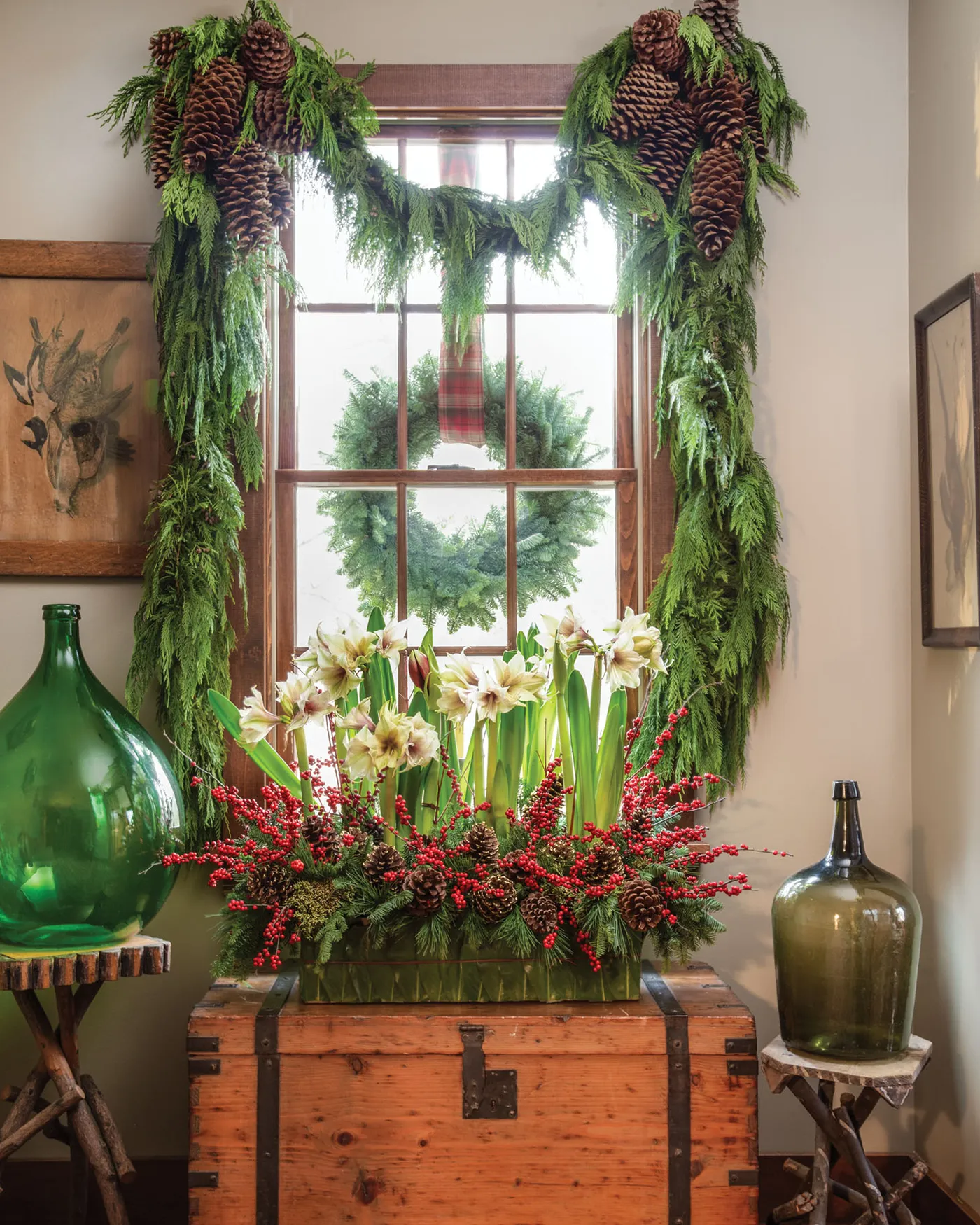
Total: $100–$241. Budget version: skip the florals and use grocery-store amaryllis in a plain vase — about $50 all in.
The formula is 60% evergreen, 25% natural wood, 10% deep red, 5% surprise. That last 5% is the oversized green glass bottles — they’re the wrong scale on purpose, and that’s why the arrangement doesn’t feel staged. Swap the plaid ribbon for velvet and you lose the rustic read entirely. Compare with Idea #25, which uses the same natural-wood base with completely different energy.
10. A Sill Full of Glass Lanterns and Candlelight
Glass lanterns at home stores run $30 to $80 each, which is absurd for a candle holder. Thrift stores and Facebook Marketplace are flooded with them in December for $4 to $12. Mix smoked grey, clear, and amber — the variety is what makes the cluster read as collected rather than purchased. Walmart’s $6 glass hurricane does the exact same job. Realistic spend for six lanterns: $45.
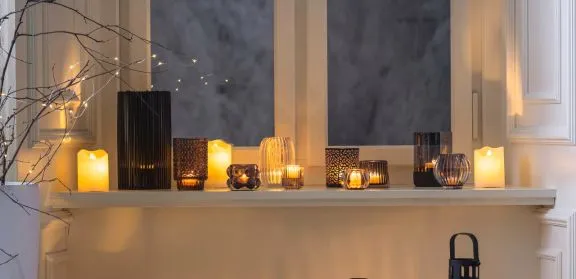
Real candles in a window leave soot on glass within about two weeks — you’ll see a grey film at the top of the pane. LED pillars look 90% as good and cost $12 for a set of three with a remote. If you insist on real flame, trim wicks to 1/4 inch and wipe the glass weekly with vinegar solution. Also: any candle within 12 inches of a curtain is a fire hazard, full stop.
11. Wooden Village Cutouts Nestled in Evergreen
Cut house and tree shapes from 1/4-inch craft plywood — a jigsaw handles the curves in about 20 minutes per piece. Sand the edges, then leave them raw or seal with matte polyurethane. Drill a 1/8-inch hole near the top of each for fishing line. Wire warm white fairy lights through the evergreen first, then tuck the cutouts in at three different heights. About $35 in materials for eight pieces.
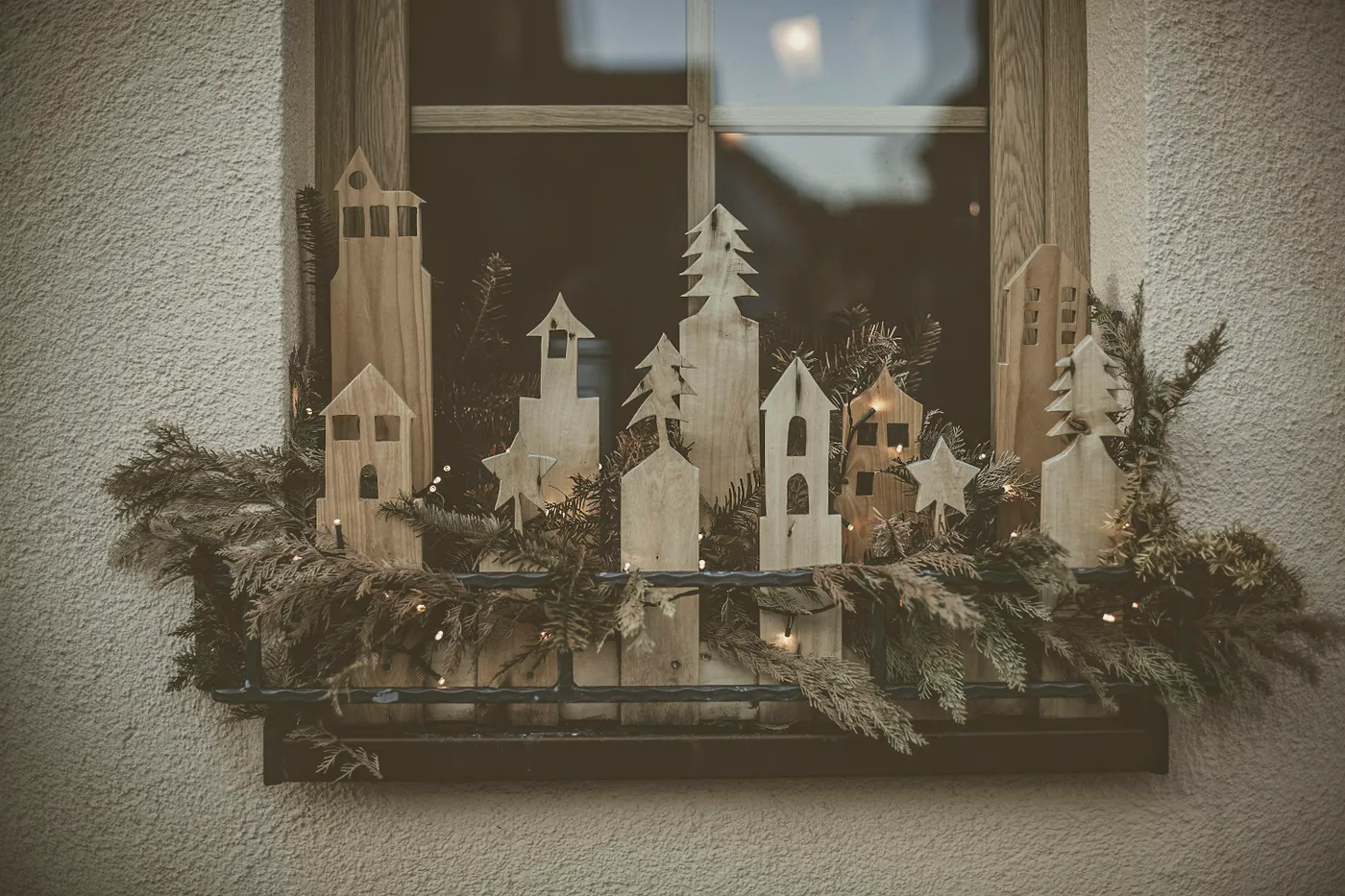
It’s the raw, unfinished wood. Paint these cutouts white and the whole display becomes a craft-store project. Left natural, they pick up the warm string light and glow from within, and the visible grain gives the little village a handmade honesty a printed backdrop can’t fake. If you do nothing else, resist the urge to paint. One coat of matte poly keeps them looking new for years without killing the texture.
12. Snow-Dusted Garland With Red Baubles
Flocked garland is bulky — figure one foot of garland for every four inches of window width, so a 48-inch window takes about 12 feet if you want the full drape. This look needs windows 30 inches and up. Below that, the garland overwhelms the frame and you’re better off with a lighter treatment. Ceiling height doesn’t matter here; sill width does. Give yourself at least 6 inches of depth so the garland has somewhere to sit.

Here’s what nobody tells you about flocked garland: that fake snow sheds. Constantly. It dusts your sill, your floor, and whatever sits below the window, and a vacuum with a brush attachment becomes your new best friend. It also yellows in direct sun after two or three seasons. If your window faces south, buy unflocked garland and add a can of spray snow yourself — $8 and you control the coverage.
13. Pink Twisted Tapers Among Ceramic Houses
- Ceramic village houses, set of 5–8: $24–$60
- Frosted mini trees, 6-pack: $12–$22
- Pink twisted taper candles, pair: $10–$18
- Artificial snow, 1 lb bag: $6–$12
- Battery votives for inside the houses: $12–$20
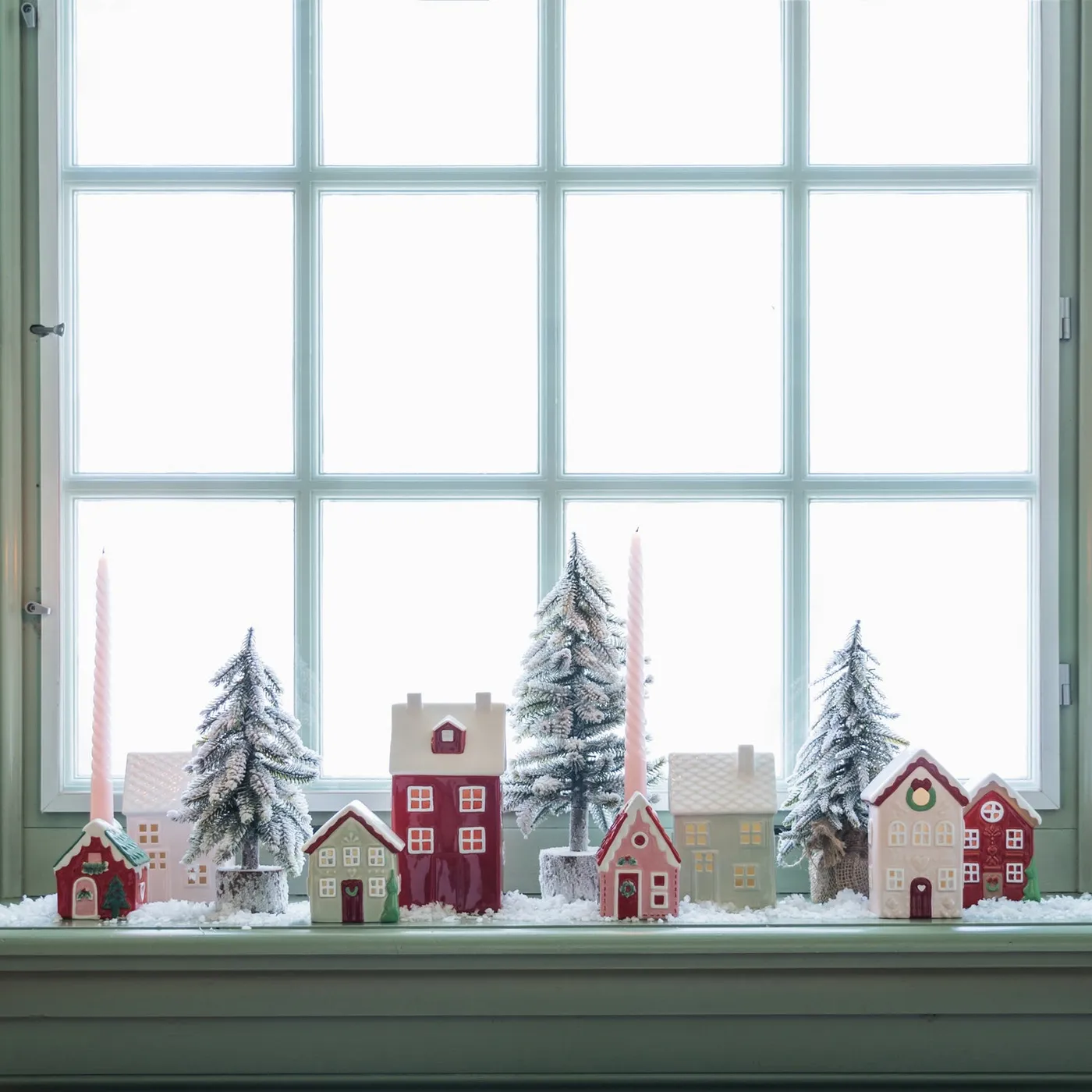
Total: $64–$132. Budget alternative: buy the houses at a thrift store in January for $2 each and tuck them away — same look, 70% less.
The pink candles are doing something specific: they’re the only non-neutral in a scene of white, cream, and pale green, and pink sits just close enough to red to read as festive without tipping into candy-cane territory. That’s a deliberate 90/10 split. The other principle at work is scale stacking — houses at three heights, trees at two — which keeps a small display from looking like a flat row.
14. A Painted Red Mailbox Sending Heart Letters
Print a simple mailbox silhouette and tape it to the outside of the glass as a guide. Trace with a white chalk pencil, then remove the paper. Fill the mailbox in red acrylic, two coats, letting each dry 30 minutes. Add the envelopes in beige with a fine brush, then dot the hearts in red. Finish with the white swirls and dots last — they go over everything. Around 3 hours and $15.
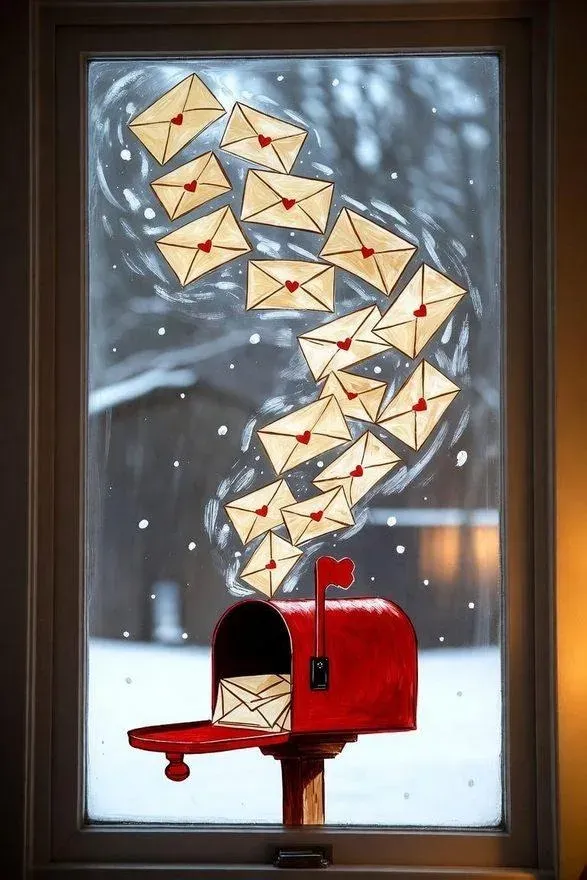
Hand-painted windows exploded on Pinterest in 2025 and the trend is maturing in 2026 — people are moving away from generic snowflakes toward small narrative scenes with a bit of humor. The mailbox with flying letters works because it’s legible from the street, tells a story in one glance, and costs almost nothing. Whimsy with a plot is the 2026 mood, and this one has staying power because it’s a skill rather than a product.
15. Looking In at a Grand Christmas Tree
The magic here isn’t the tree — it’s the framing. Sheer white curtain panels from IKEA run $15 a pair, and tying one back with a wide ribbon costs nothing. A multi-pane window does the rest. If yours is a single pane, add a $20 grid-style window film from Amazon and you’ve got the same mullioned look. Compare with Idea #28, a close-up version of the same through-the-glass idea.
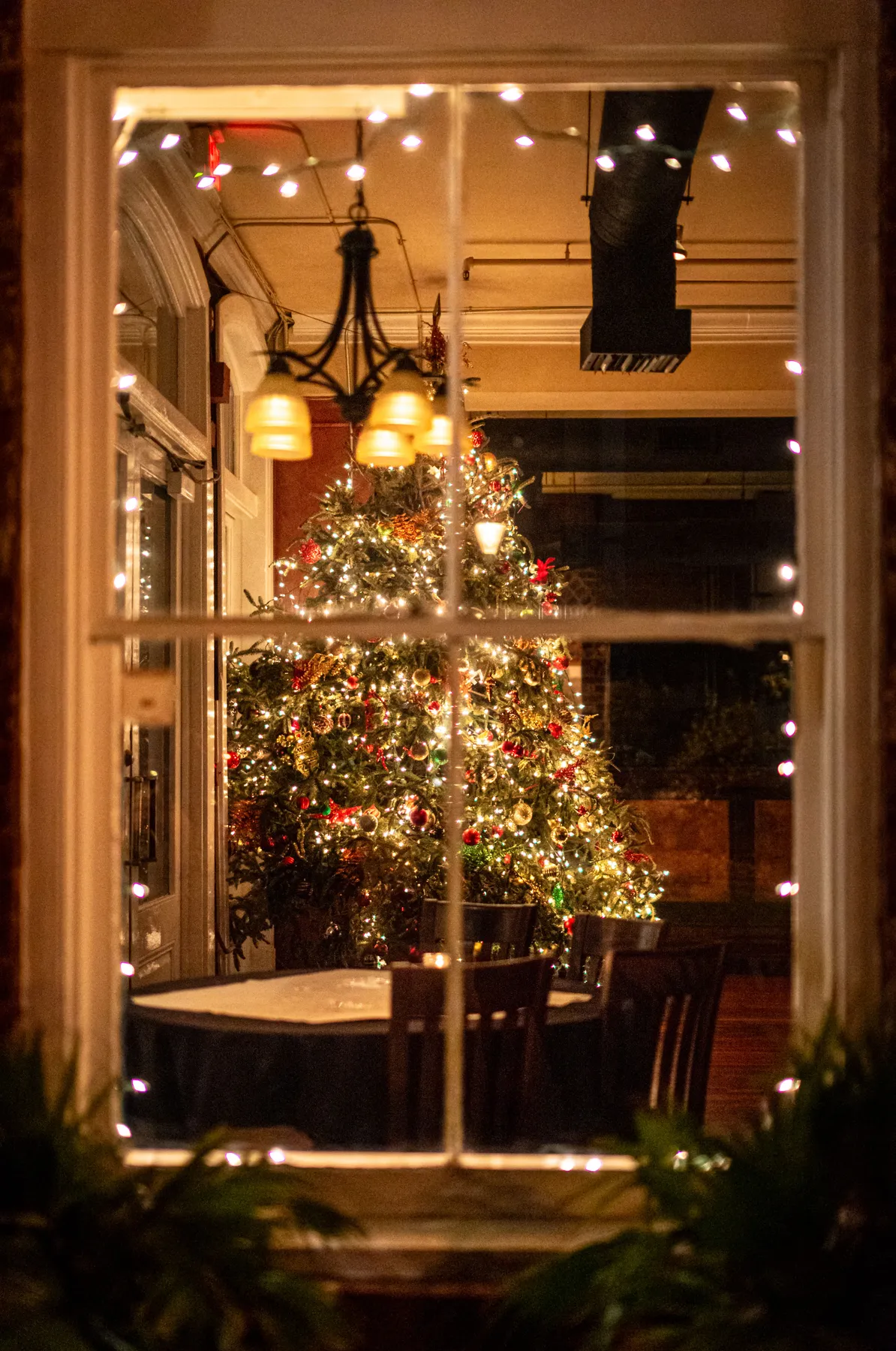
Photographing a tree through glass is harder than it looks, and living with it has its own quirks:
- Any light source behind the camera will bounce off the pane and kill the view
- A curtain tied back on one side needs a bracket, not a full rod swap
- The tree has to sit at least 3 feet back or it crowds the glass
Plan the tree position before you decorate it, not after.
16. Golden Tinsel Ornaments That Glow From Within
The formula is 80/20: 80% gold, 20% bright white light, and everything else is texture. Gold tinsel, backlit gold snowflakes, gold shimmer backdrop — they all read as one warm mass, and the white glowing snowflake patterns keep it from turning into a solid yellow blur. Swap the gold for silver and it goes cold and modern. Swap for copper and it turns warm and vintage. The ratio has to hold.
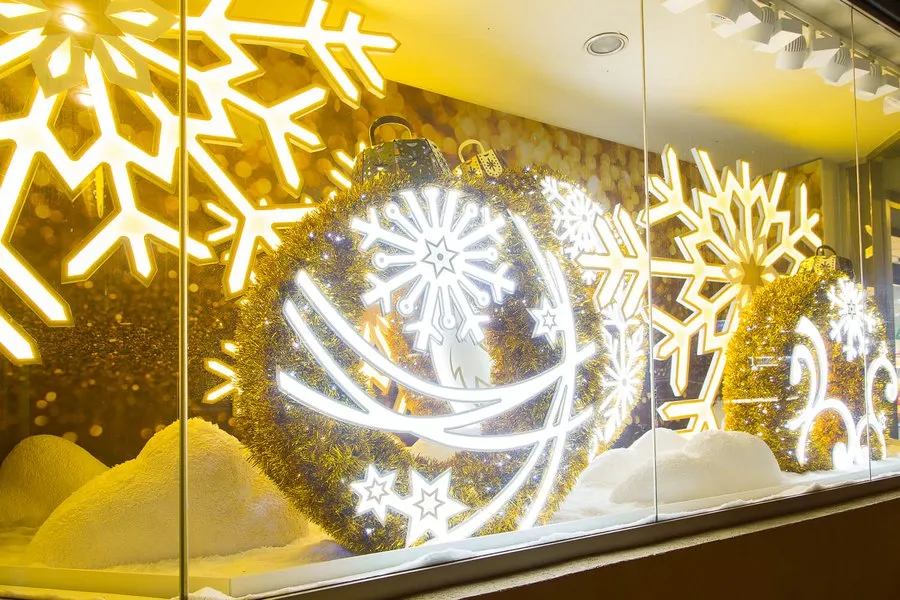
Large ornaments with internal glow run on button cells that die after about three weeks of nightly use, so buy rechargeable or plan to swap on January 1.
- Hang at three heights — 8, 14, and 20 inches from the top
- Keep 6 inches between ornaments so the glow doesn’t merge
- Use clear monofilament, never ribbon, for the hanging line
That spacing is the difference between a display and a blob.
17. Snowflakes Suspended on Invisible Thread
The suspension. Snowflake cutouts taped to glass look like a school project; the same cutouts hanging an inch off the surface on clear line look like an installation. That half-inch of air creates a shadow on the glass behind each one, which doubles the visual depth for essentially zero cost. It’s the single detail separating this from every window on the block.
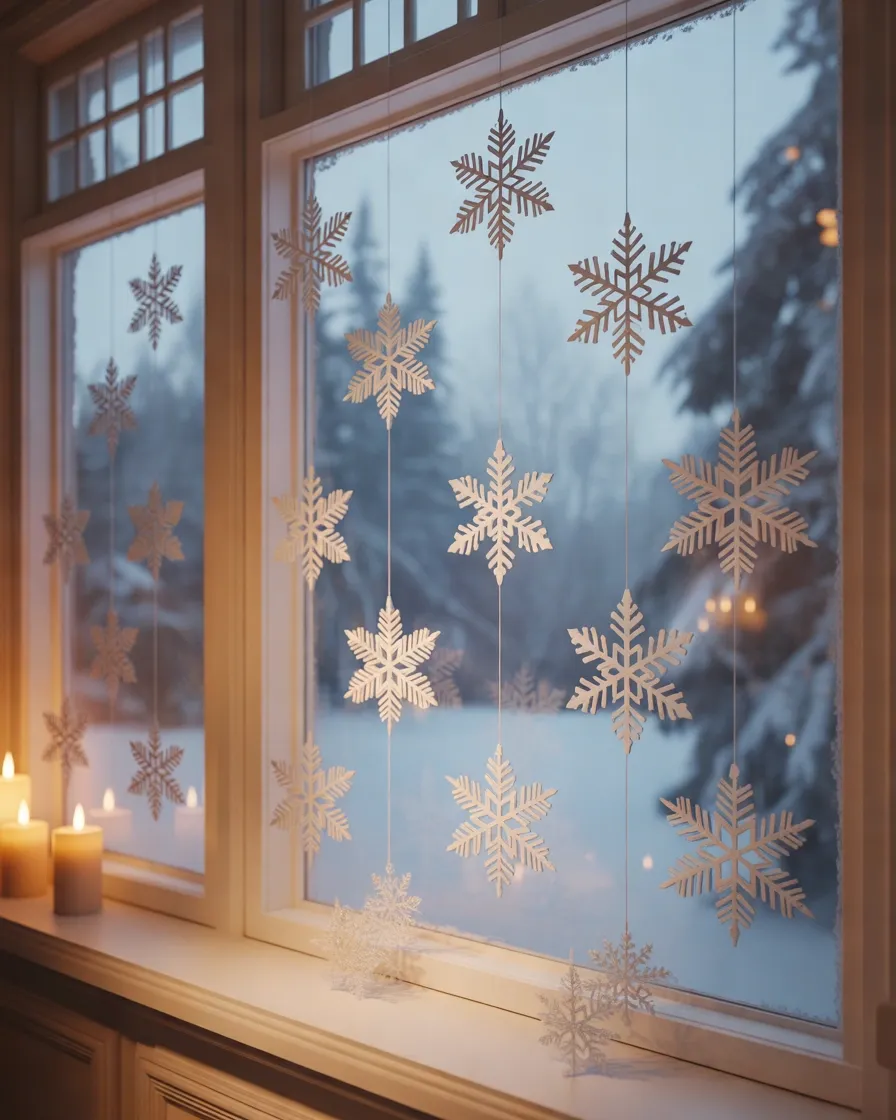
This works best in a window 36 inches wide or larger, with at least 20 inches of glass height — you need room for the cutouts to hang at different lengths without tangling. Vary sizes from 3 to 10 inches, and hang the largest ones no lower than 8 inches from the sill. In a small powder-room window, use the sill-only candle approach in Idea #10; hanging cutouts in a tight space just feels crowded.
18. A Snowman Tie-Back Holding Back the Curtain
Cut two 6-inch circles of fleece for the head and body, plus a 2-inch circle for the hat brim. Stitch or hot-glue a 12-inch length of 1-inch elastic between the two circles. Add a knit hat and scarf from the dollar store — scale matters, so keep the scarf narrow. Wrap around the curtain and pin the elastic ends to the back of the fabric with safety pins. About 45 minutes and $8.

Fleece collects dust and the garland sheds, so both need a pass with a lint roller every couple of weeks. The bigger issue is the curtain itself — a tie-back pulls the fabric at one point, and after about six weeks you’ll see a crease that doesn’t steam out easily. Rotate the tie-back position a few inches each season. Machine-washable fleece is worth the extra $3; craft-store felt pills badly.
19. Hand-Drawn Cocoa Mugs and a Striped Scarf
Chalk markers run $8 for a four-pack at Target and wipe off with a damp cloth, which makes this the most renter-friendly idea on the list. Walmart carries a $5 liquid chalk set that’s honestly fine. Skip the expensive window-paint pens — they set permanently and you’ll be scraping them off in February. If you’re nervous about drawing freehand, print a template, tape it outside, and trace.
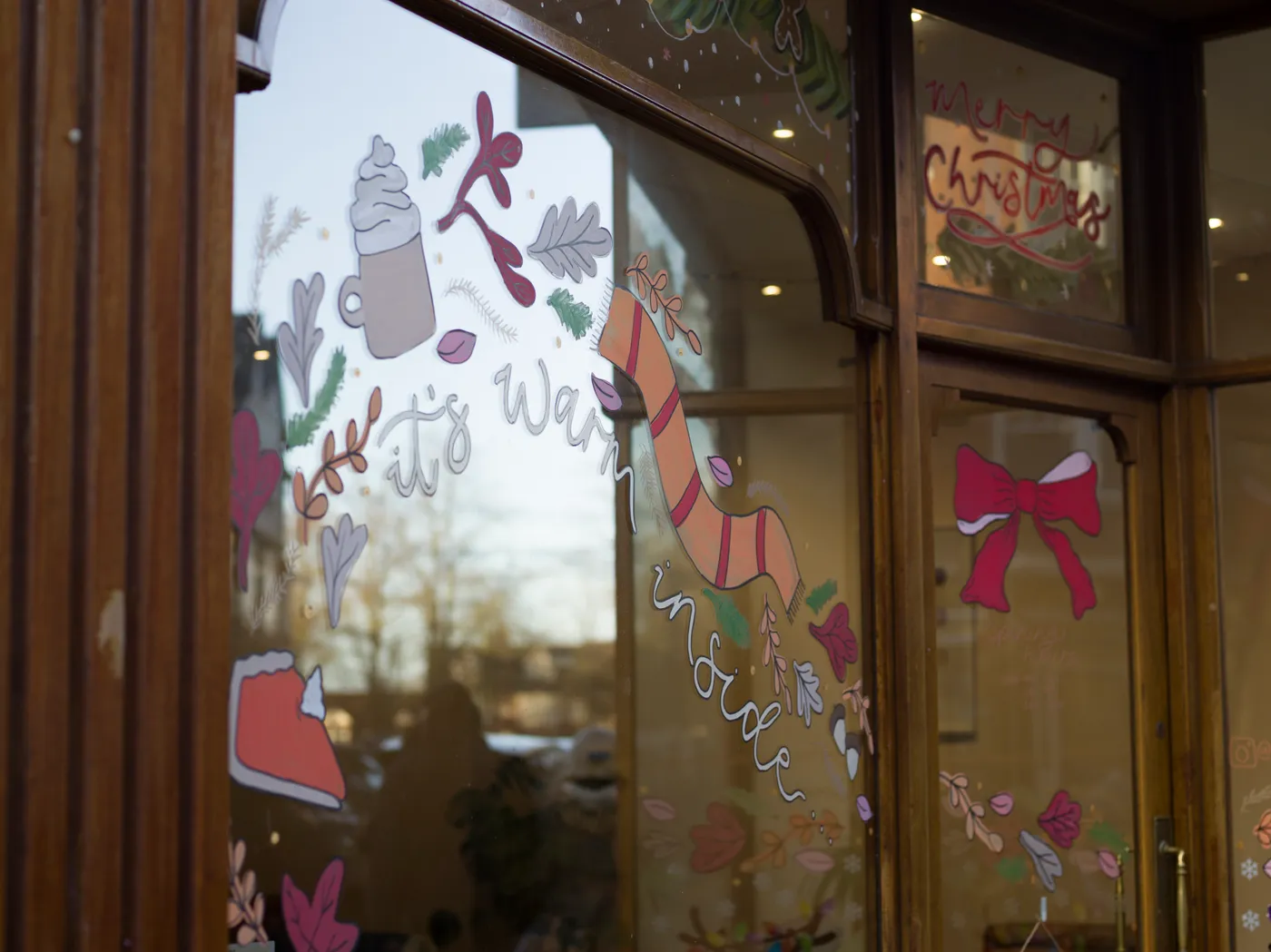
Three reasons this reads as charming rather than messy. It’s clustered around the center and corners, leaving breathing room. The palette is limited to four colors — red, orange, green, white — which keeps a busy composition cohesive. And the scale varies: a big red bow, a medium mug, tiny dots. That’s the same principle behind any good gallery wall, applied to glass.
20. Three Wreaths, Three Red Ribbons, One Window
Wreath spacing is math, not instinct. Divide your window width into thirds and center the wreaths on each third — for a 48-inch window that puts them at 8, 24, and 40 inches. Hang the middle one 4 inches higher than the outer two, and drop the outer wreaths to 60% of the center wreath’s size. That asymmetrical triangle is what makes it look styled instead of symmetrical-and-boring.

Run through this before you buy anything:
- Measure the window and note where the mullions fall — wreaths straddling a divider look wrong
- Check what’s behind the glass at night; a dark room kills the effect
- Confirm your rod or hooks can hold three wreaths at about 4 lb each
- Buy ribbon last, after the wreaths are hung, so you know how much you need
21. A Window Nook Built for Watching Snow Fall
Window nooks are lovely and they are cold. Glass is the weakest thermal point in any room, so if you’re planning to actually sit here with cocoa for an hour, you need a thick rug, a lined curtain, and a stool that isn’t metal. Also check that your window is double-paned — single-pane glass in an older home will fog with condensation from body heat and you’ll be wiping it constantly.
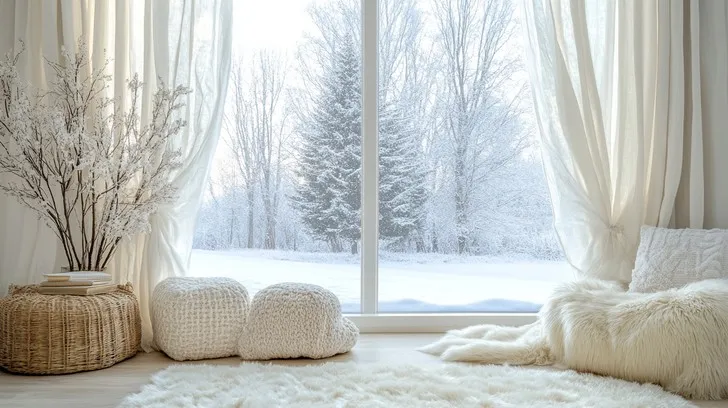
This setup needs a window at least 60 inches wide to fit a stool plus two poufs without feeling like a waiting room. Sill height matters too — under 20 inches and the nook becomes floor seating, which is actually better for kids. Above 30 inches, you’re standing at it. For a smaller version of the same cozy-view idea, see Idea #30.
22. Painted Sleighs and Cabins on Black Glass
- White acrylic window paint, 8 oz: $7–$14
- Assorted brush set: $9–$18
- Chalk pencil for sketching: $3–$6
- Paper towels and spray bottle for corrections: $4
- Optional stencil set if freehand makes you nervous: $12–$22
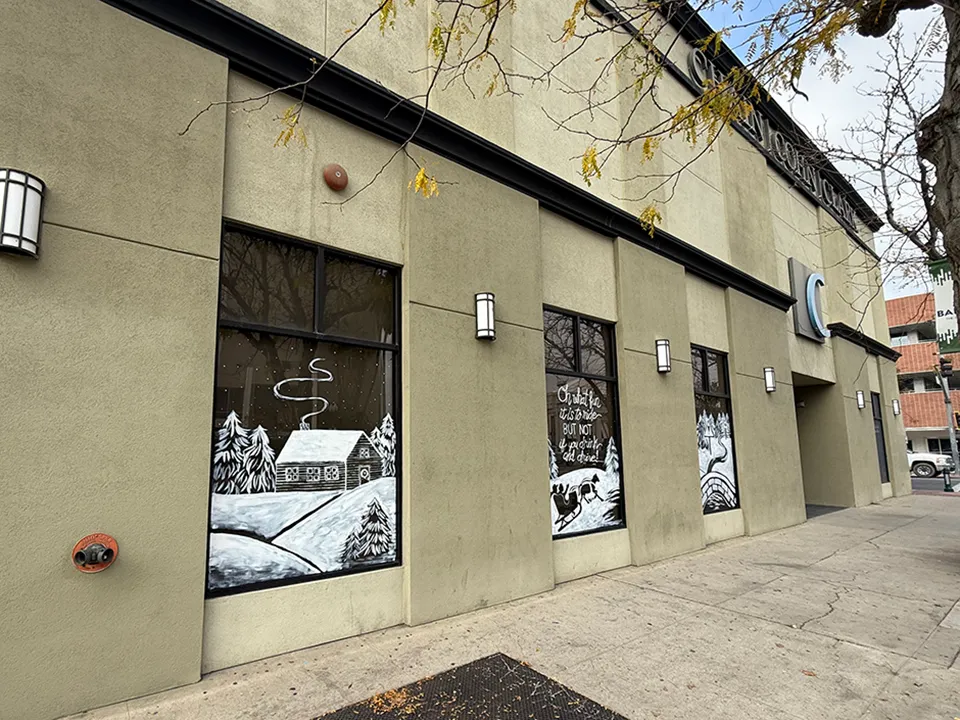
Total: $35–$64. Budget alternative: white tempera from the school supply aisle runs $4 and washes off with warm water in spring.
Black glass. The paintings only work because the windows are dark and unlit behind them — white paint on black reads as silhouette, and that’s what gives it the old-storybook quality. Put these same designs on a lit window and it turns into refrigerator art. If your glass won’t go dark, use black kraft paper as a backing and paint on the paper instead.
23. Vintage Carolers in Red and Green Felt
Size the decal to no more than 60% of the window height so there’s breathing room. Clean the glass with vinegar and water, then dry completely. Position the highest point first, using painter’s tape as a level line. Smooth from the center outward with a squeegee to push out air bubbles. Add the printed candle garland below, leaving a 2-inch gap. About 30 minutes and $25 for the decal.
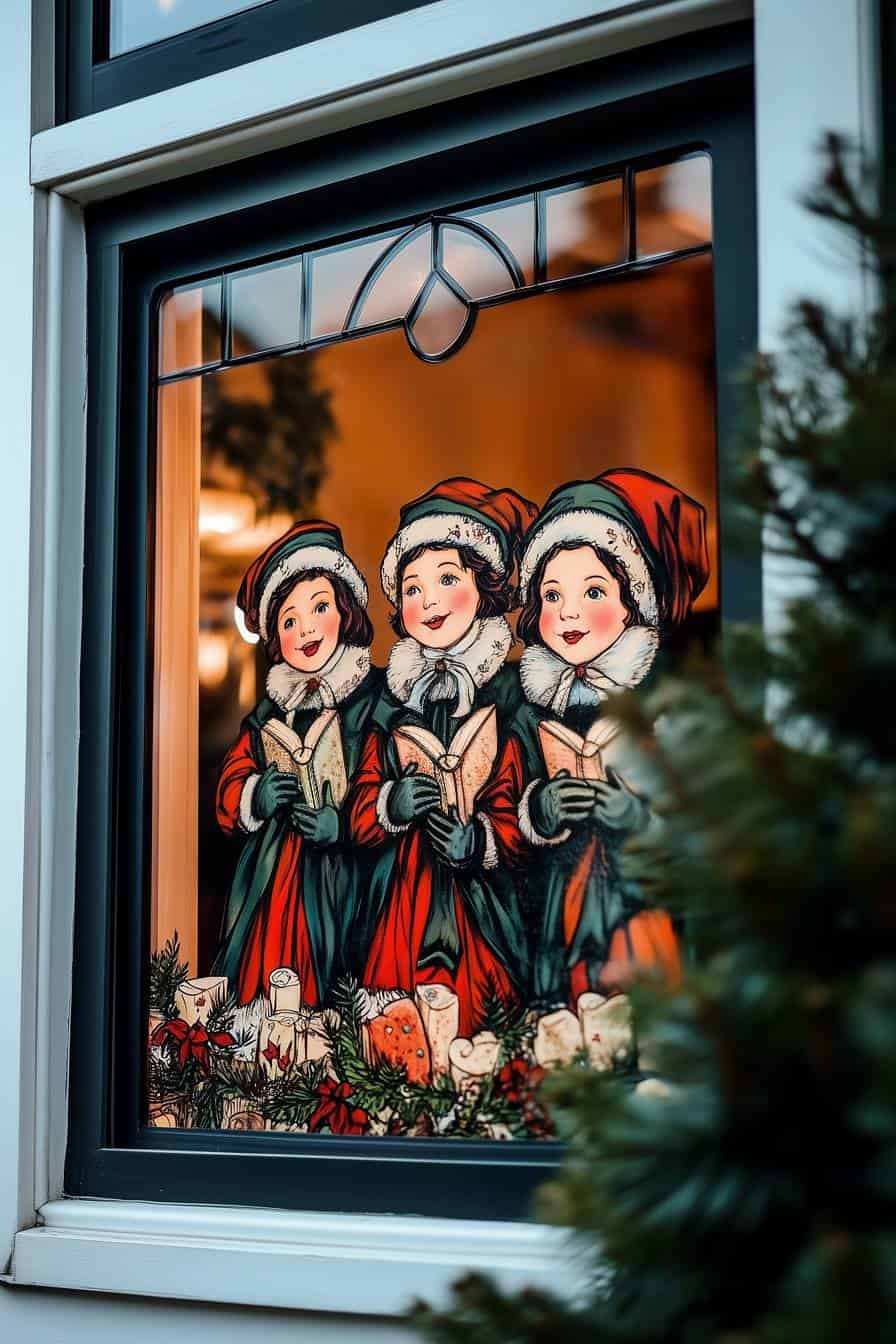
Vintage Christmas imagery is having a real moment in 2026 — not the ironic kind, the sincere kind. Retailers are leaning into 1950s and 60s illustration styles because shoppers are exhausted by minimalist holiday decor and want something that feels like a memory. Carolers, choirboys, and mid-century Santas are all surging on Pinterest. Expect this one to age well; nostalgia doesn’t really go out of style.
24. Red and Gold Ornaments Through a Tied-Back Curtain
The framing is the whole point. A tied-back sheer curtain creates a soft vertical edge a bare window doesn’t have, and it pushes the tree back into the room so you’re seeing it at a slight distance rather than pressed against glass. That gap between curtain and glass is what gives the composition depth. Notice also that the ornaments are only red and gold — two colors, repeated at scale, which is exactly why it looks curated.
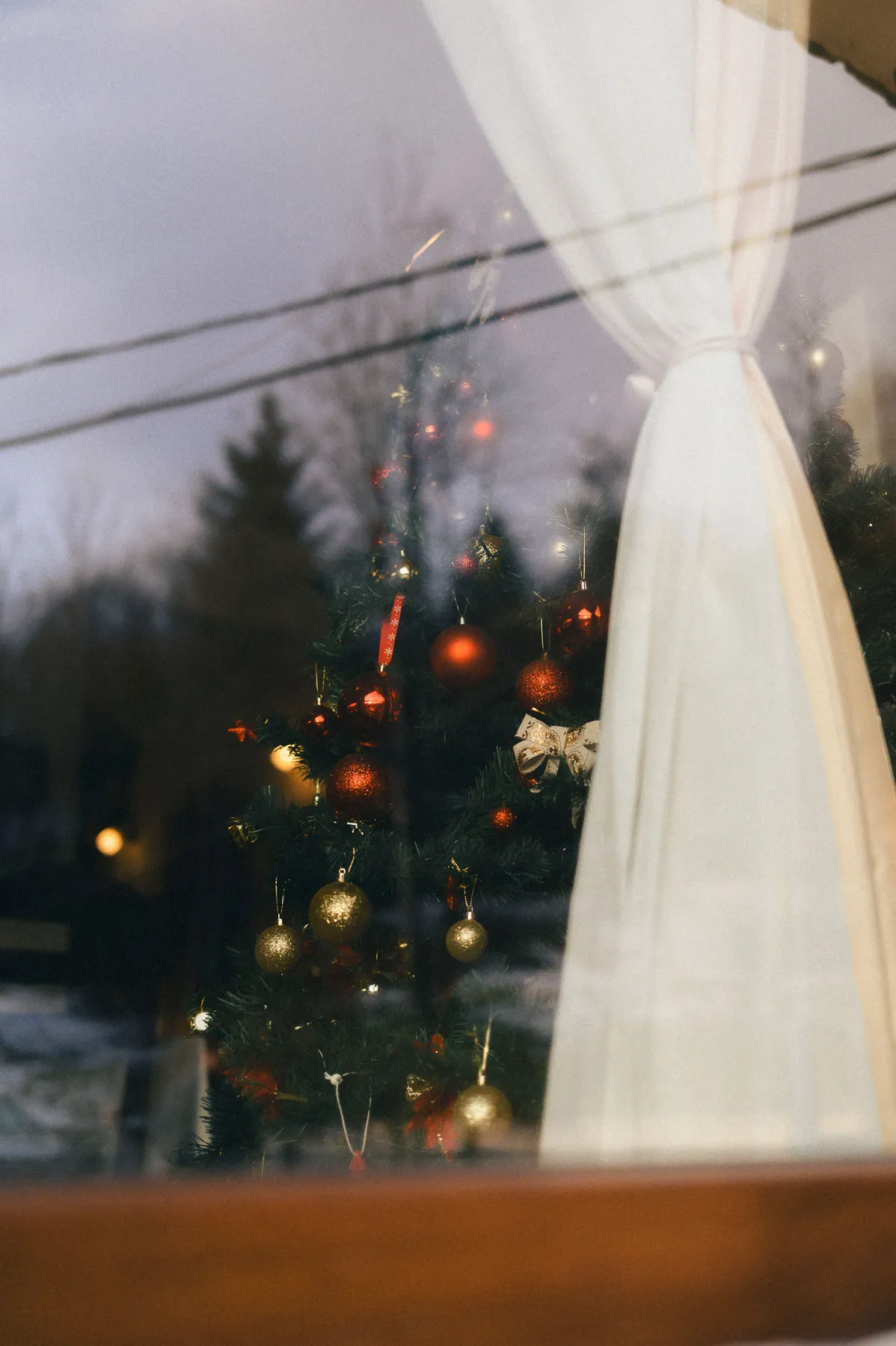
Tie-back height matters more than tie-back style. Measured from the floor, the tie point should land at roughly two-thirds the window height, not the middle. Too low and the curtain pools; too high and you lose the drape. A wide satin ribbon does the job for $6 and is far more forgiving than a metal holdback. Compare with Idea #18 for a novelty take.
25. Firewood, a Snowman, and a Painted Village
The painted backdrop is just a sheet of foam core and acrylic paint — about $20. The snowman can be three thrifted sweaters stuffed with newspaper. The sled came from a garage sale for $15. What makes a display like this read as expensive isn’t the props, it’s the snow dusting: one can of spray snow, $8 at Walmart, applied unevenly so the tops of things get more than the sides. That’s the entire trick.
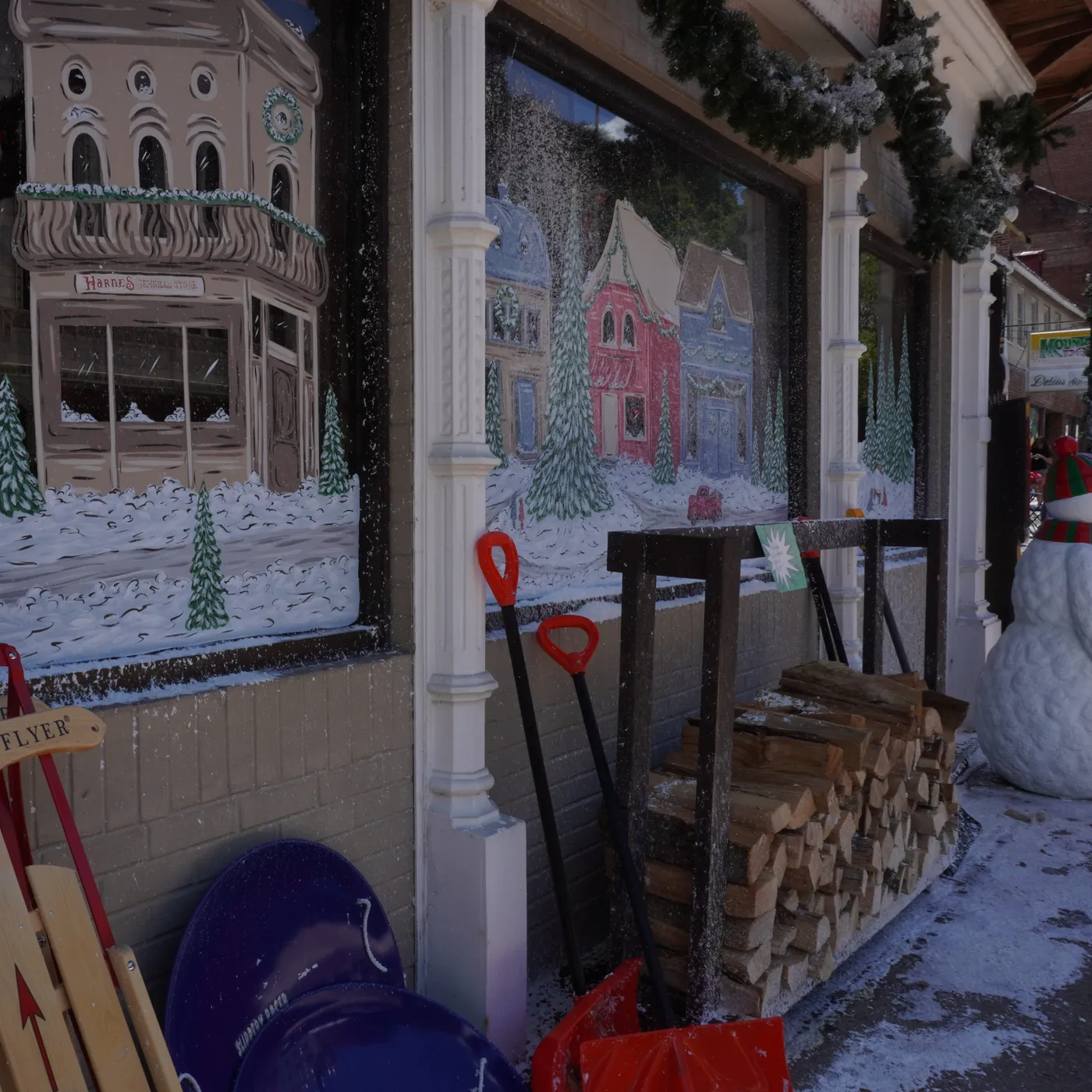
Real firewood indoors brings bugs. If you’re using it as decor, bake it at 200°F for an hour or buy kiln-dried logs — or just use a decorative log set. Painted props and colored plastic fade fast in direct sun. And check your lease before you drill into a rental facade, because the backdrop usually needs anchoring.
26. A Miniature Village on a Frosted Sill
Miniature villages are dust magnets, and bottle brush trees flatten if you store them in a bag.
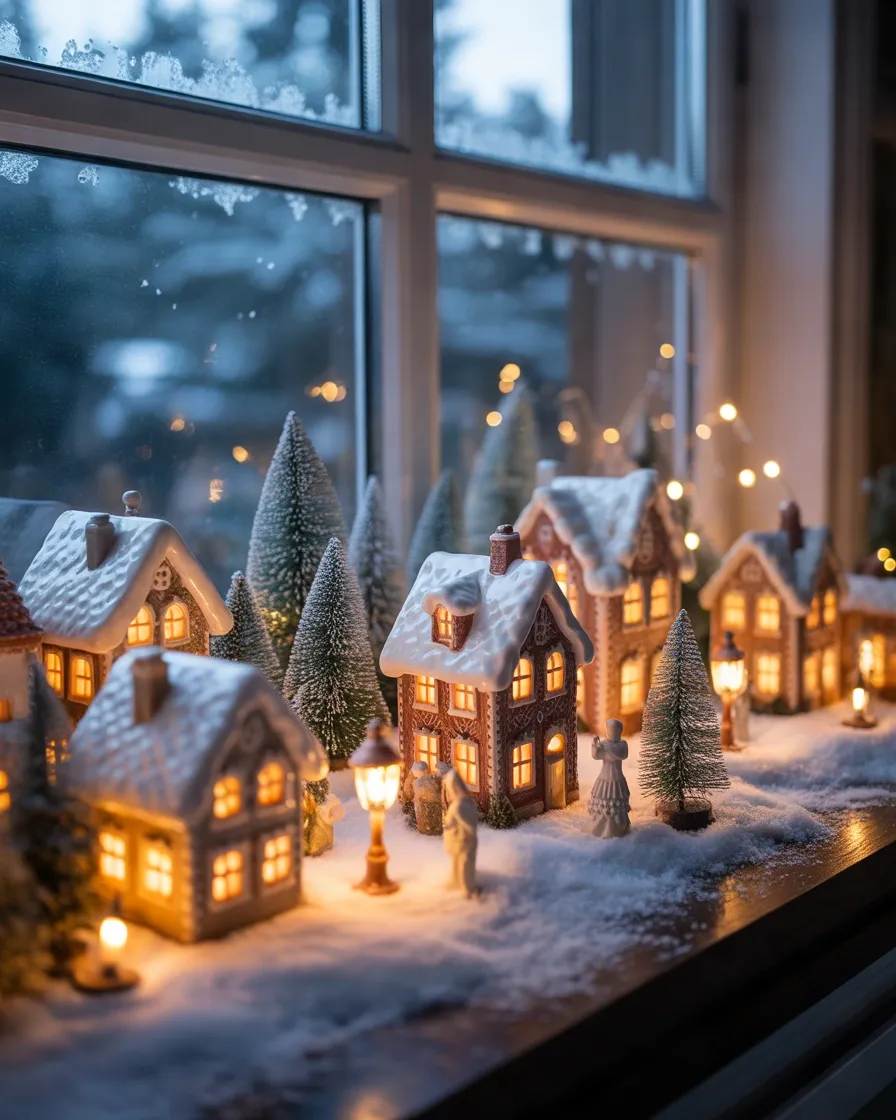
- Dust the houses monthly with a soft pastry brush — never a cloth
- Store bottle brush trees upright in a shallow box with tissue between layers
- Replace artificial snow every two seasons; it yellows
- Keep battery packs accessible so you don’t disassemble the village in January
Five minutes a month keeps it looking new.
This is a sill-only treatment, so it needs at least 8 inches of depth and 30 inches of width to hold six or more pieces without crowding. It’s the single best option for narrow windows — a 24-inch bathroom sill handles a three-house version beautifully. Everything stays below eye level, which is why it doesn’t block the view the way hanging decor does.
27. A Vintage Bicycle and Hanging Lit Stars
This one’s a commitment, so measure twice:
- Measure your window opening — a bicycle needs 48 inches of width and 30 inches of height to read properly
- Weigh the bike; most vintage frames run 30+ lb and need a proper anchor, not a hook
- Check that the star lights have a reachable switch or remote
- Confirm basket depth so your snow and berries don’t spill
The empty space between the stars. This display works because the stars hang at wildly different heights — the negative space is as designed as the objects themselves. Cluster them at eye level and you’ve got a clump. Spread them across the full window height and each one gets its own little spotlight. Same logic as pendant lights over a kitchen island: the gaps are the design.
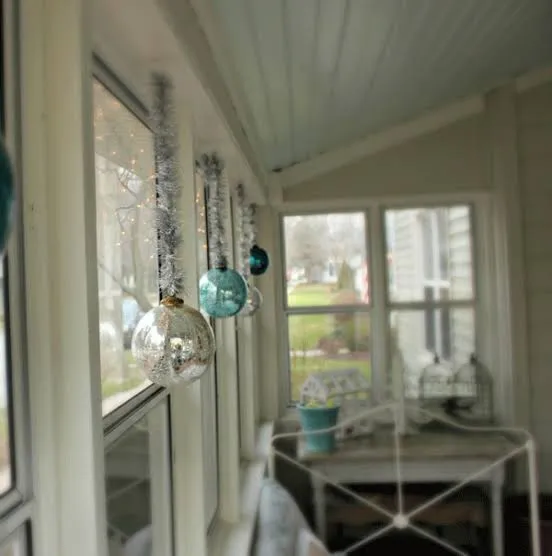
28. Blue Glass Stars on Almost-Invisible Strings
Fishing line, not ribbon — 20 lb test is invisible against glass and won’t stretch. Tie a small loop through the ornament cap, then a second loop over a tension rod or a cup hook screwed into the window frame’s top reveal. Keep hanging lengths at 6, 11, and 15 inches so the eye travels. Leave 4 inches clear at the bottom; ornaments that touch the sill look like they fell.
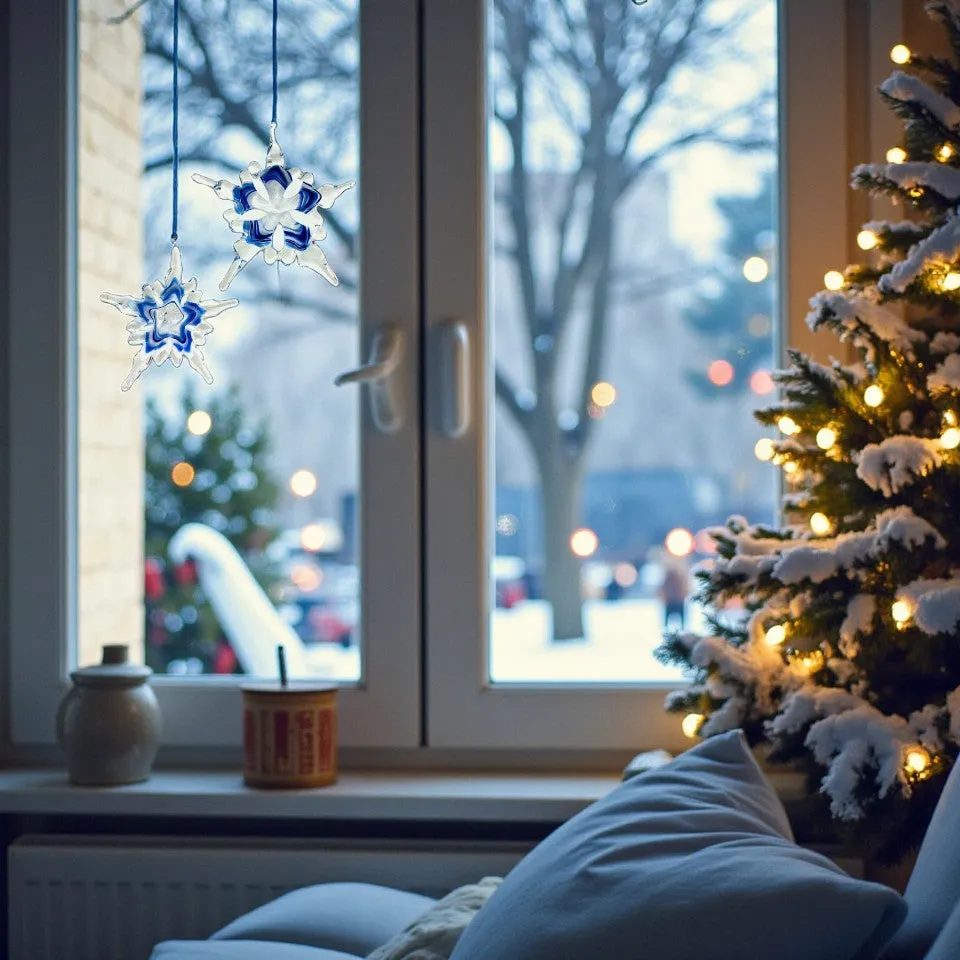
There’s a color trick happening here: blue ornaments on a white frame, with a snow-dusted tree glowing warm behind. Blue and warm yellow are near-complementary, so the tree seems to glow harder than it actually does. The two objects on the sill — a lidded jar and a patterned mug — are almost an afterthought, but they’re what tell you a real person lives here.
29. Gingerbread Houses That Actually Light Up
- Illuminated ceramic houses, set of 4: $35–$80
- Flocked mini tree, 18 inch: $14–$28
- Burlap for the tree base: $4–$8
- Artificial snow, 1 lb: $6–$12
- Battery tea lights: $10–$16
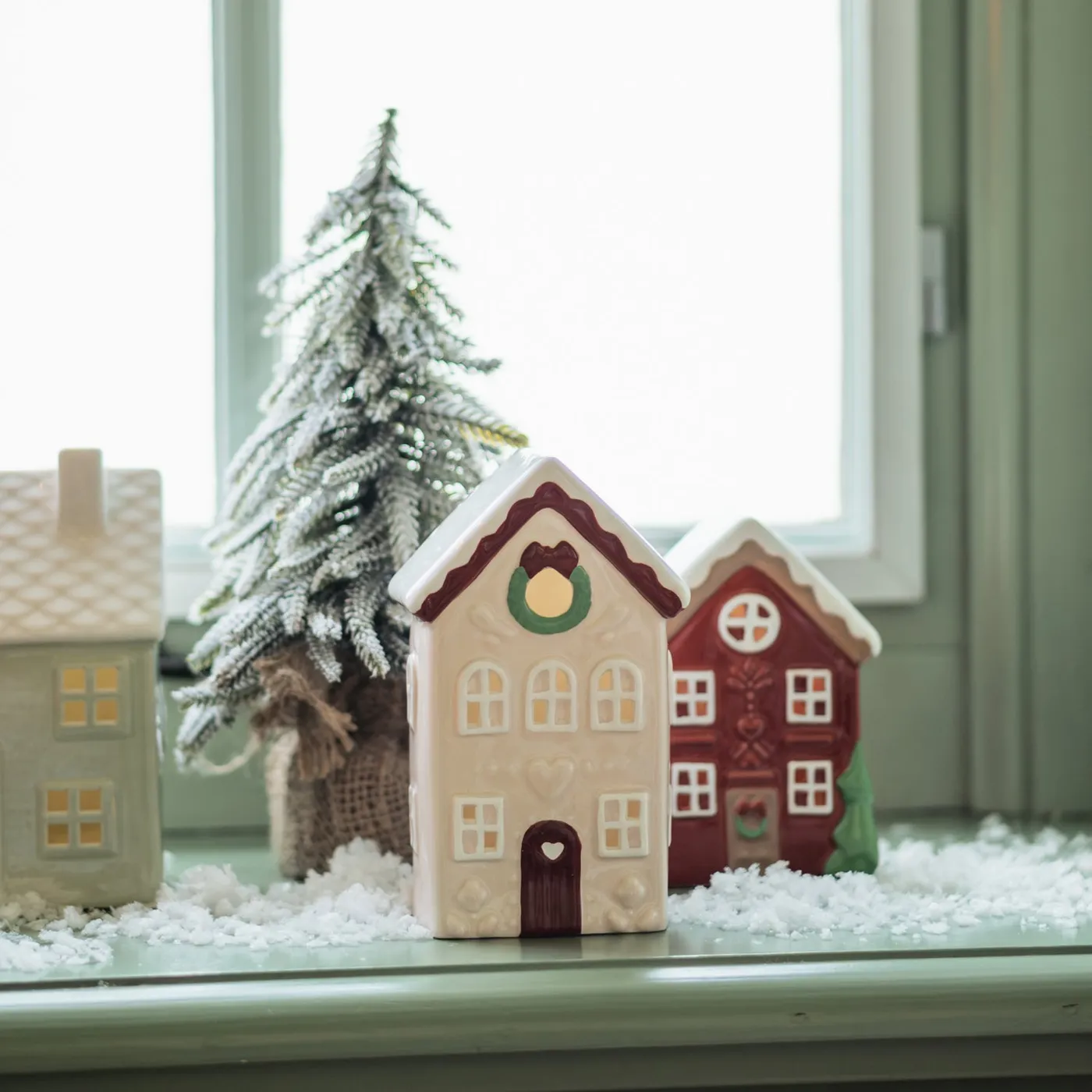
Total: $69–$144. Budget alternative: plain white ceramic houses from the dollar store plus a $3 bottle of puffy fabric paint for the icing — you’ll spend about $25.
An 18-inch flocked tree runs $40 at a garden center in November. A 20-inch bottle brush tree runs $9 at Target and reads nearly identically once it’s got a burlap wrap and a dusting of fake snow. If you already own a small green tree, skip the flocking entirely — a plain tree among white houses looks intentional, not unfinished. Save that money for the houses.
30. A Slate Tray of Candles and Eucalyptus
The formula is 70% neutral — light wood, white pebbles, white candles — 20% deep green, and 10% earthy terracotta from the vase. That’s the whole recipe. Swap the terracotta for black ceramic and it gets moodier. Swap the eucalyptus for pine and it goes traditional. Keep the slate tray either way: that dark rectangle is what stops the arrangement from floating.
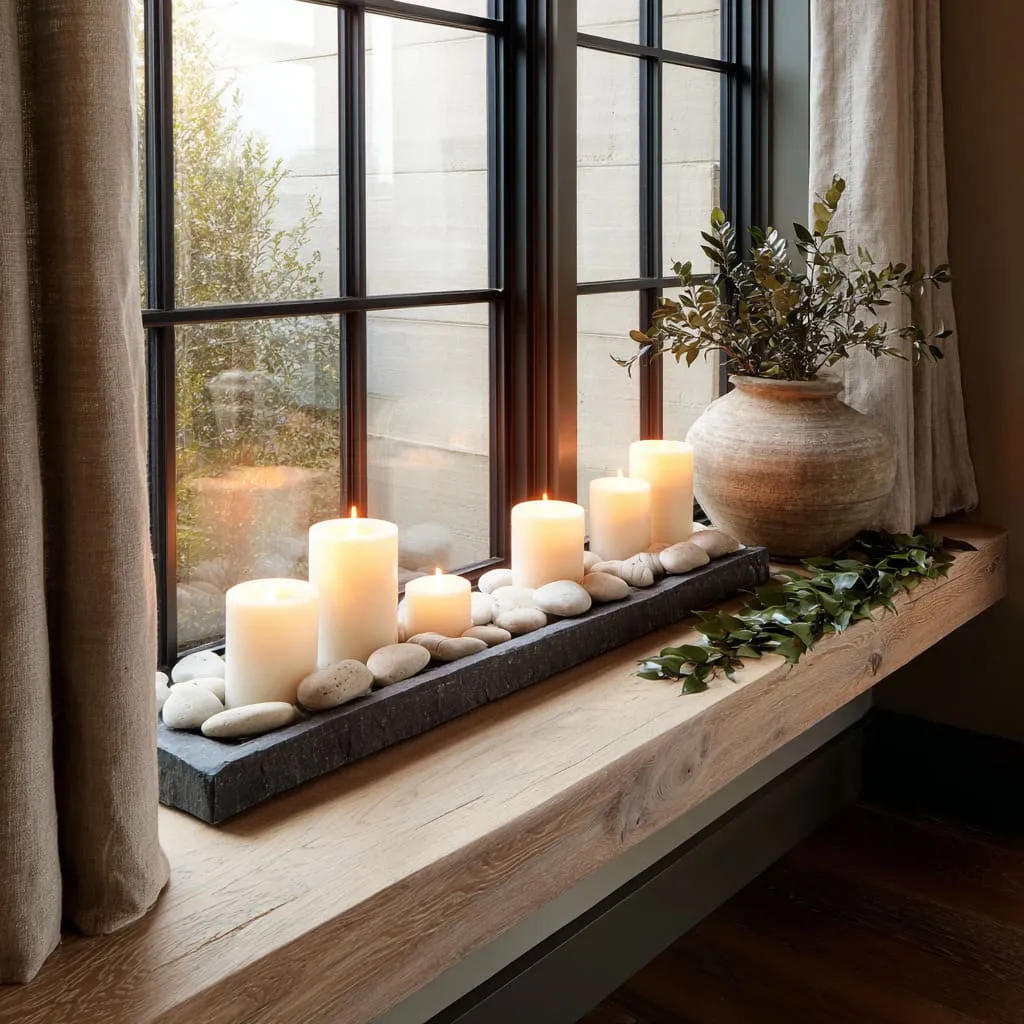
Candles on a wooden sill near a window are a genuine fire risk in winter, when drafts push the flame sideways. Keep the tray at least 6 inches from the glass and never leave them burning when you leave the room. Eucalyptus dries out in about two weeks and gets brittle — swap for faux if you want it to last through January. Real candles drip, and the slate tray will save your sill, which is exactly why it’s there.
31. A Gingerbread Village Under Artificial Snow
- Gingerbread house kit, or baked from scratch: $12–$25
- Royal icing and piping bag: $5–$10
- Assorted candies: $10–$18
- Frosted mini pine tree: $8–$16
- Artificial snow or plain flour: $3–$6
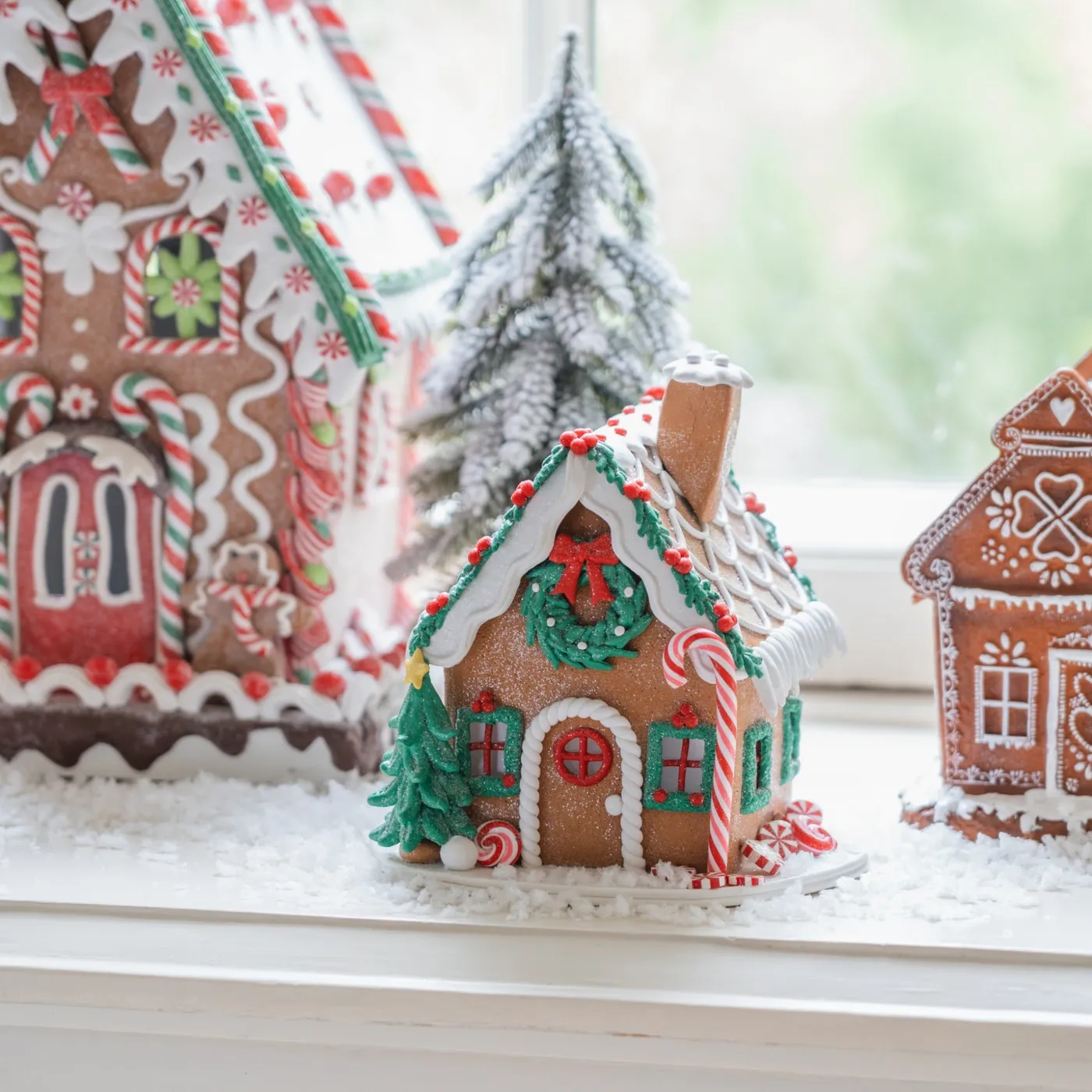
Total: $38–$75. Budget alternative: build the houses from graham crackers and a simple sugar glue — about $15, and the kids can help.
- Check the sill is out of direct sun — icing slumps above 75°F
- Confirm no pets can reach; sugar and chocolate are both toxic to dogs
- Build the houses on a foil-covered board so you can move the whole village
- Plan to photograph within 48 hours — it does not last
Your Window Is the First Thing the Street Sees
Start with one window — the one you actually look at while you’re making coffee. A single strand, three objects, and a color temperature you checked on the box will do more than a whole afternoon of shopping. 📌 Pin your favorite from this list now, so it’s waiting for you next November.