34 Elegant Red Christmas Table Settings to Elevate Your Holiday Gatherings in 2026

You know that feeling when you’ve saved forty red-and-gold table photos and still can’t picture any of them in your own dining room? Same. So instead of adding to the pile of vague inspiration, we went looking for the real thing — tables that actual people set in actual homes, with the creases in the tablecloth and the half-lit candles to prove it.
We spent serious time browsing Pottery Barn, Anthropologie, and Etsy to bring you only what’s worth your attention this year, and the range runs from about $18 for a set of beaded napkin rings to $640 for a full formal place-setting wardrobe. After filtering through hundreds of options, we narrowed it down to 34 ideas that actually deliver — traditional toile and velvet deer, modern grey linen with gold flatware, rustic garlands with fairy lights, and a few playful checkered-tablecloth moments that don’t take themselves too seriously.
Budget and luxury versions are compared side by side throughout, so you can see exactly where the money goes and where it absolutely doesn’t need to. Red is having a very specific moment in 2026 — deeper, moodier, more burgundy than candy-cane — and Pinterest searches for “moody red tablescape” have been climbing all season. Save this post now — you’ll want it when you’re ready to shop.
1. Red Napkins, Gold Flatware, and a Bowl Full of Ornaments
The single element that holds this whole table together is the white pedestal bowl piled with metallic and white ornaments. Pull it and you’d still have a pretty table — red folded tree napkins, gold-rimmed plates, amber glasses, polka dot chargers — but you’d lose the height, the shimmer, and the one thing guests’ eyes land on first. Everything else is a supporting cast.
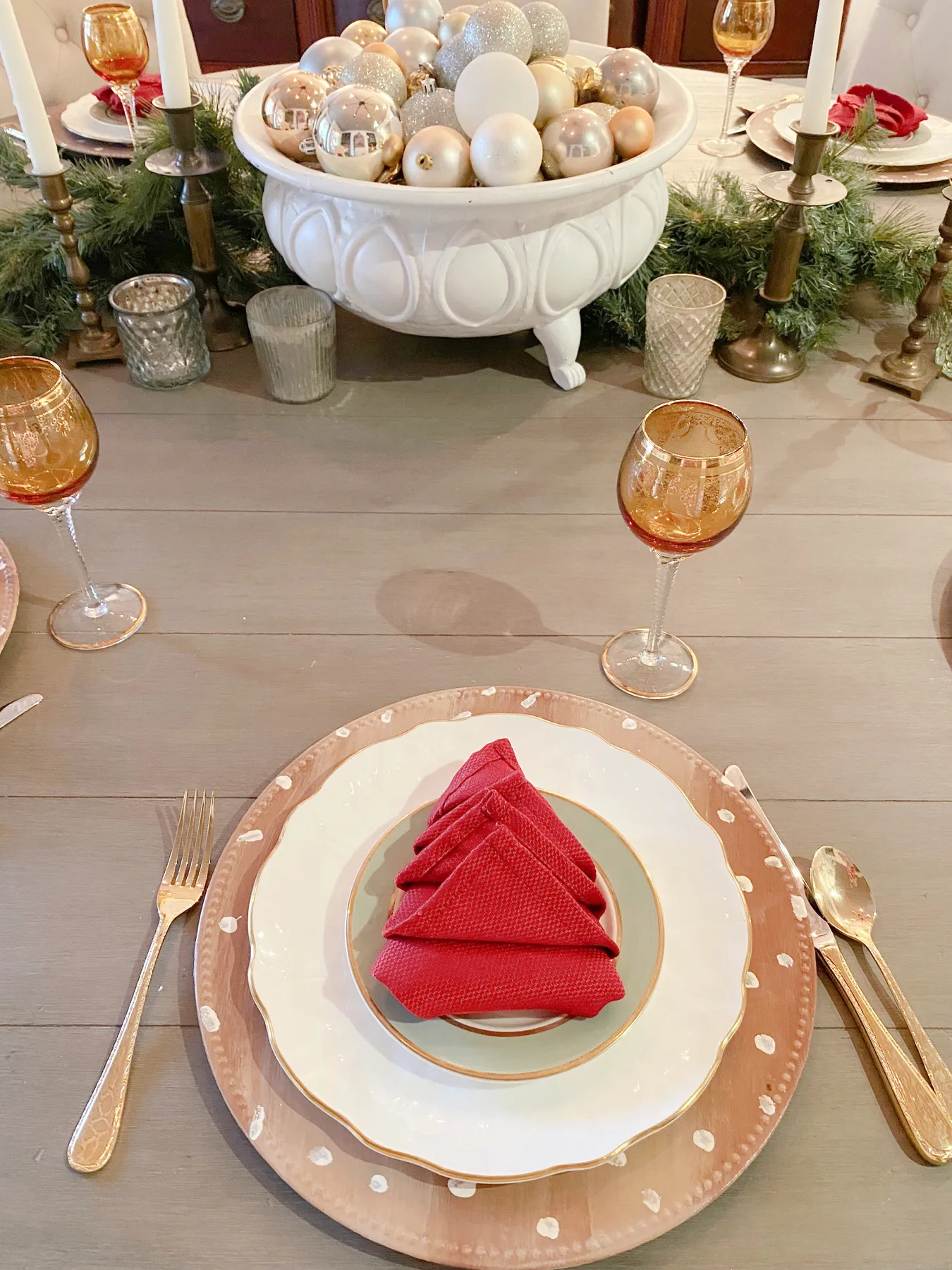
Here’s the professional move: build your centerpiece at three heights and never let two objects share one. The pedestal bowl sits high, brass candlesticks mid, evergreen garland low and spilling toward the edges. That gap between levels is what makes a table read as designed rather than decorated.
The formula is roughly 60% light neutral (grey-washed wood, white plates, cream cloth) + 25% red + 15% gold and evergreen. Swap the red for burgundy velvet ribbon in January and the same math still works. Understanding this formula makes Idea #5 feel like the maximalist cousin of this exact table.
2. White Roses and a Red Runner on Crisp White Linen
Three things are doing the heavy lifting here. First, contrast: the red runner is vivid and saturated, and it’s floating on a crisp white tablecloth, which makes the red read as an event rather than a theme. Second, scale — the rose and foliage arrangement is low and long, so nobody has to lean around it to find their sister-in-law. Third, restraint: white plates with a thin dark rim, plain silver forks, wooden chairs. Nothing competes.
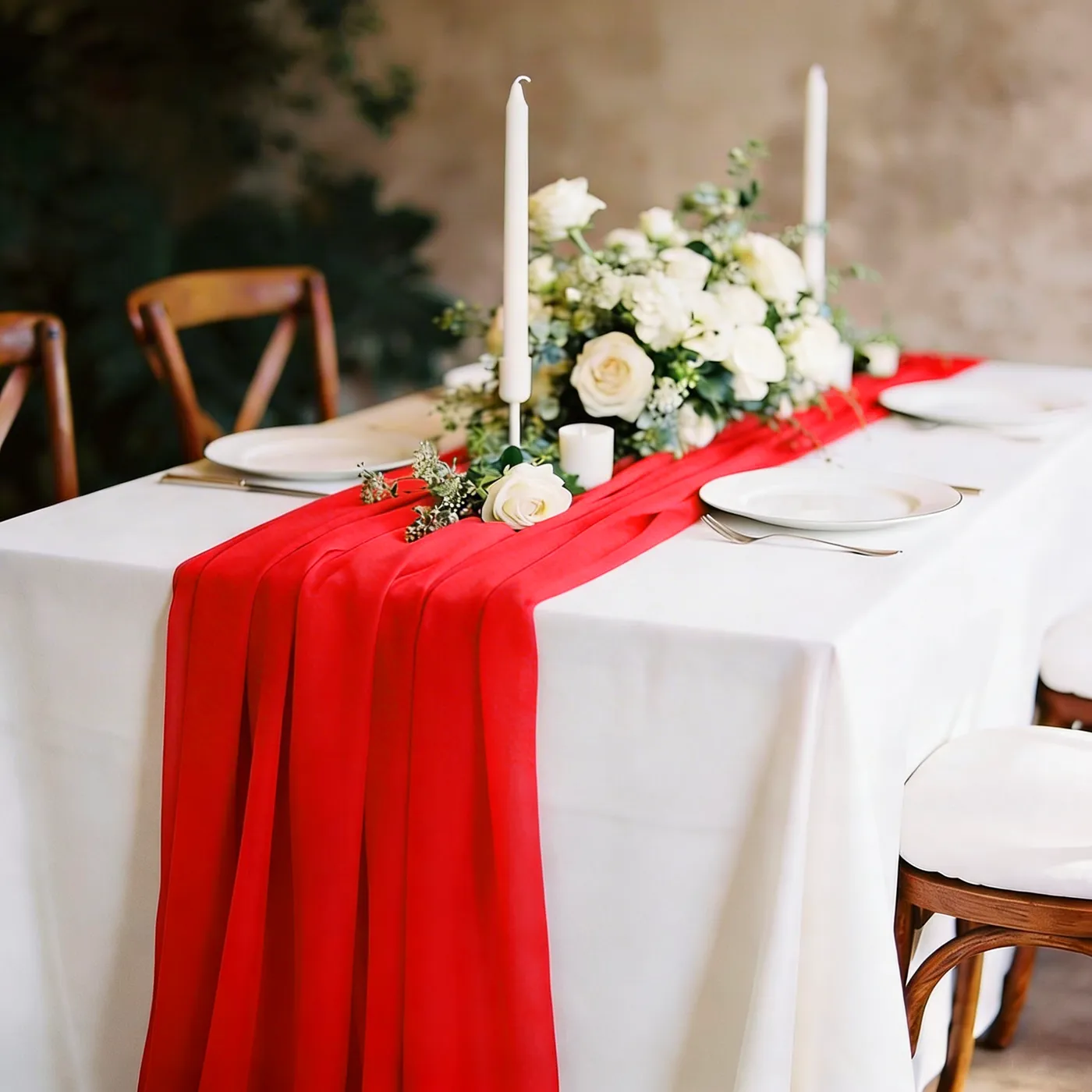
If you want to recreate it, here’s roughly what you’re looking at:
- White tablecloth, floor-length: $40–$120
- Red fabric runner: $15–$45
- White roses + greenery (florist or grocery): $60–$150
- Taper and pillar candles: $20–$60
- White rimmed dinnerware, service for 8: $80–$300
- Total: $215–$675
Budget alternative: shop the tablecloth and runner at Target, buy roses at Trader Joe’s the morning of, and borrow candlesticks from a friend. You’ll land near $110 and nobody will know.
3. Toile Cloth, Nutcrackers, and Grandmother’s Clock
This is the table that made toile cool again. The cream-and-red patterned cloth, gold-rimmed plates, red goblets, and that wildly layered centerpiece of dark red flowers, golden branches, nutcrackers, deer figurines, miniature lamps and candles — it’s maximalism with a family-history spine. The grandfather clock and large painting in the background aren’t staging; they’re the reason it works. The table belongs to the room.
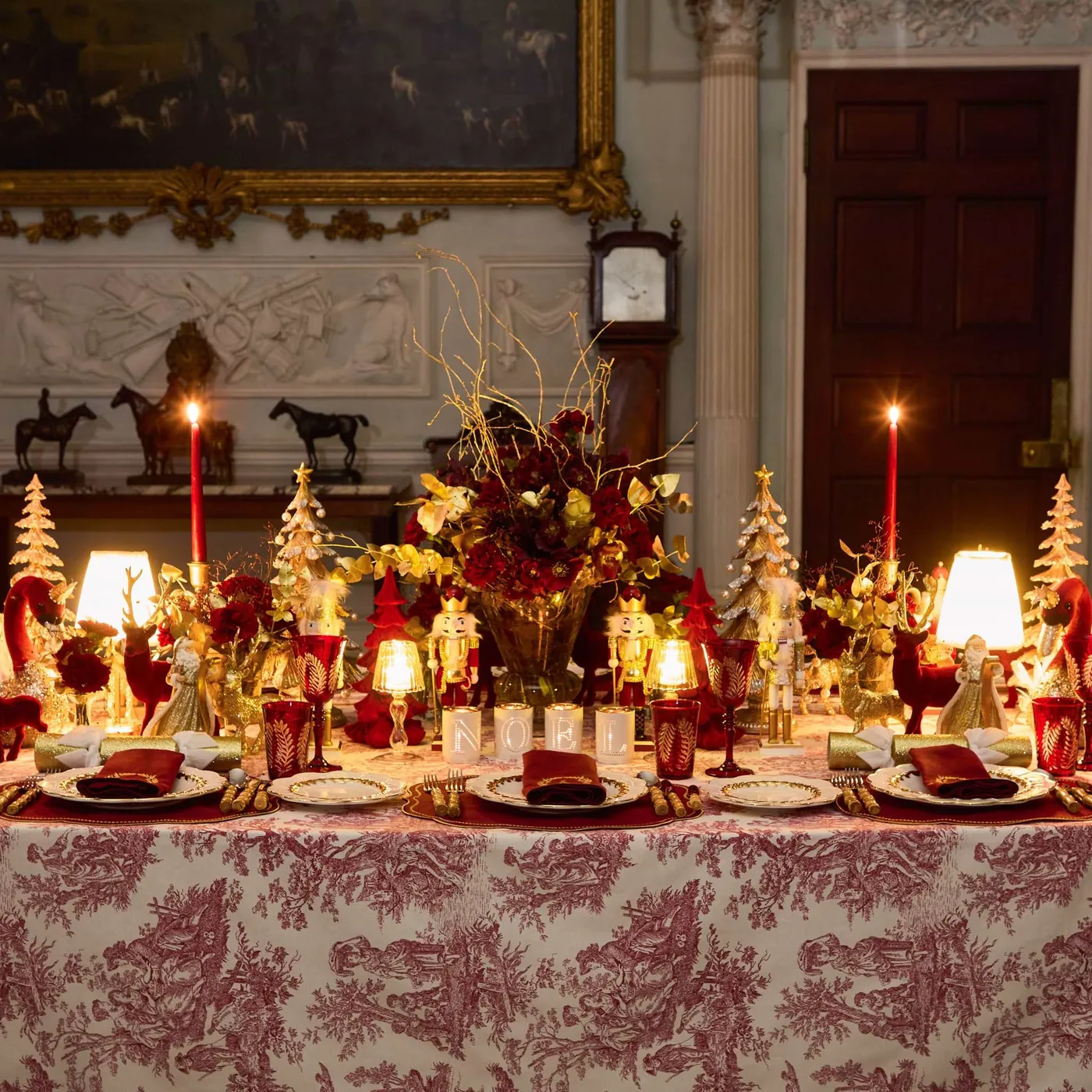
Toile has been quietly climbing for three seasons, largely because it photographs beautifully and reads as heirloom rather than new-money. That’s staying power, not a fad.
on upkeep: patterned tablecloths hide a spilled glass of wine better than plain linen, but they still need washing after anything greasy, and gold-rimmed plates should never go in the dishwasher — the rim dulls within a dozen cycles. Expect to hand-wash the good plates and spot-treat the cloth. Budget about $25 a year for a gentle detergent and a re-press at the dry cleaner once a season.
4. One Place Setting, One Candle, One Very Good Wood Table
Notice what’s missing: a centerpiece. This single setting on a natural wood table relies on white plates with metallic rims, a red patterned napkin in a wooden ring, a dark woven round placemat, a dark red pillar candle on a wooden base, and a wine bottle with an empty glass. The bare wood is doing as much work as any decoration. Sometimes the table is the tablescape.
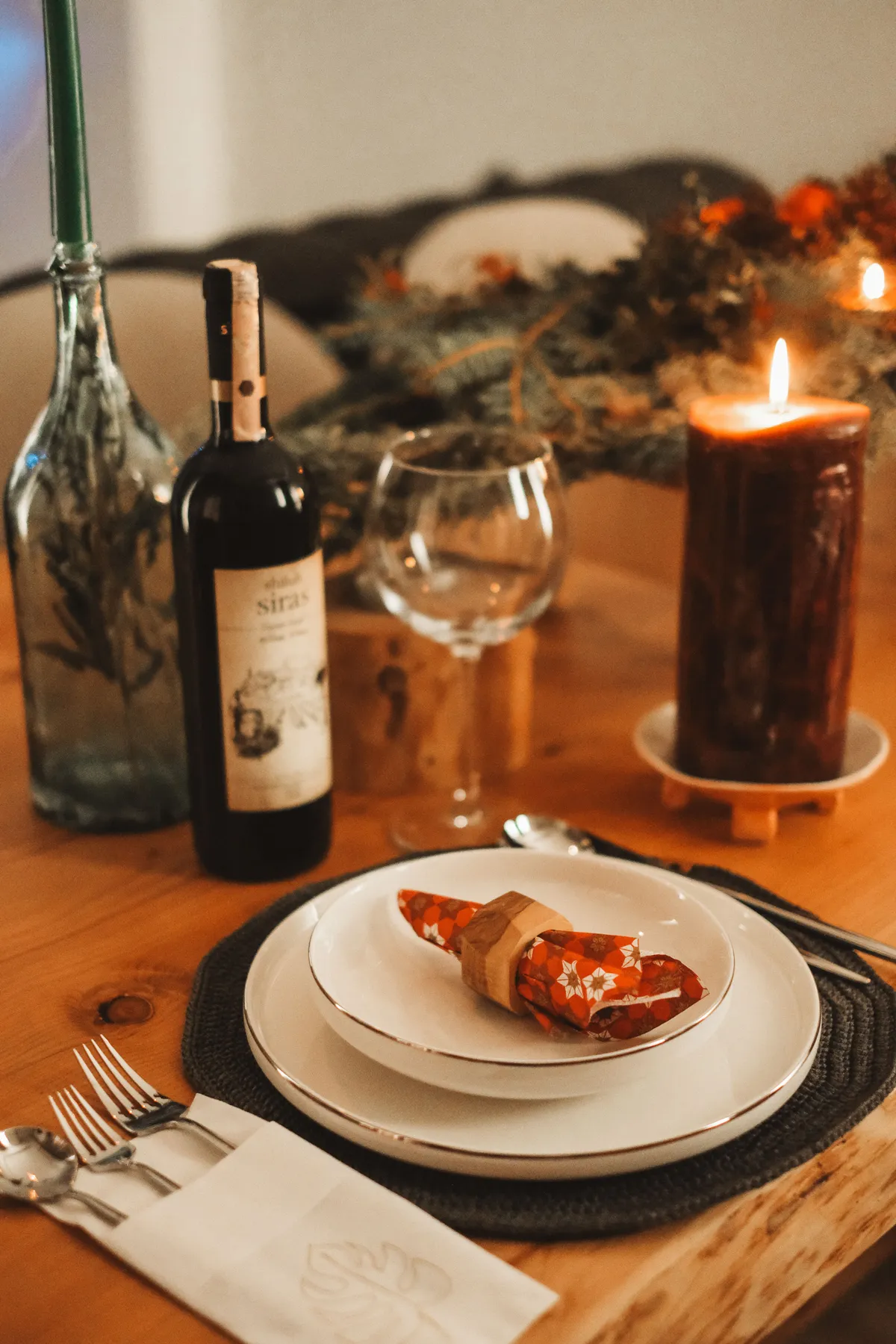
keep your pillar candle diameter at 3 inches or under for a dinner table. Wider candles look gorgeous in photos but cast a heavy, unflattering light across faces, and they tunnel down the middle if they burn longer than two hours. A 2.5-inch pillar burns evenly and gives that soft upward glow guests actually want.
One caution — natural wood is unforgiving about heat and moisture. Use a candle base with a felt bottom, and never place a sweating wine bottle directly on bare wood. A small round of cork or a coaster solves it. If your table is a family heirloom, this is the moment to be a little precious about it.
5. Red Cut-Glass Goblets on Polished Dark Wood
The faceted deep red goblets are the whole story here. On a polished dark wood table already loaded with red and gold patterned dinnerware, ornate silver cutlery, velvet napkins, and plaid ribbons with holly, those faceted glasses are what keep the table from turning into a single red blur — they catch light and throw it back in hard, sparkly little pieces. Remove them and the whole thing goes matte.
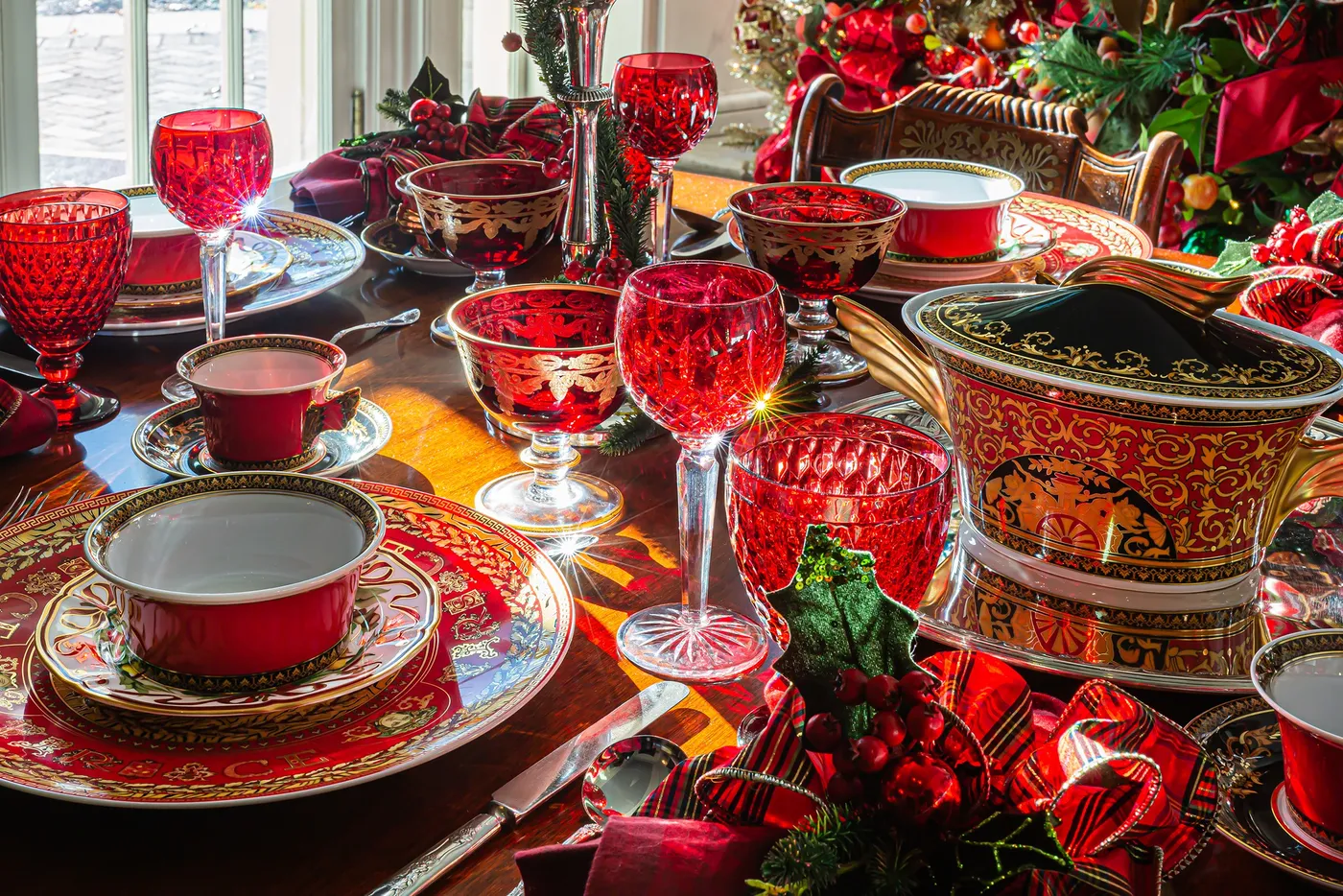
You don’t need to spend $45 a glass. Vintage ruby cut-glass goblets turn up constantly at estate sales and on Facebook Marketplace for $6–$12 each, and matching isn’t the point — a set of four mismatched cut patterns looks more collected than a boxed set anyway. Thrift stores in older neighborhoods are goldmines here; look on the back shelf behind the vases.
Compare with Idea #16 — same deep red glassware energy, much softer and more romantic lighting.
6. Grey Linen, Gold Flatware, and a Pine Sprig Per Plate
This is the most modern table in the whole set, and it costs almost nothing to pull off. Dark grey tablecloth, white speckled dinnerware, gold flatware, a pine sprig on every plate, amber votives, one small white gift box with a gold ribbon. That’s it. The formula: 70% cool neutral grey and white + 20% warm gold + 10% green. Swap forest green sprigs for olive and it rolls straight into January.
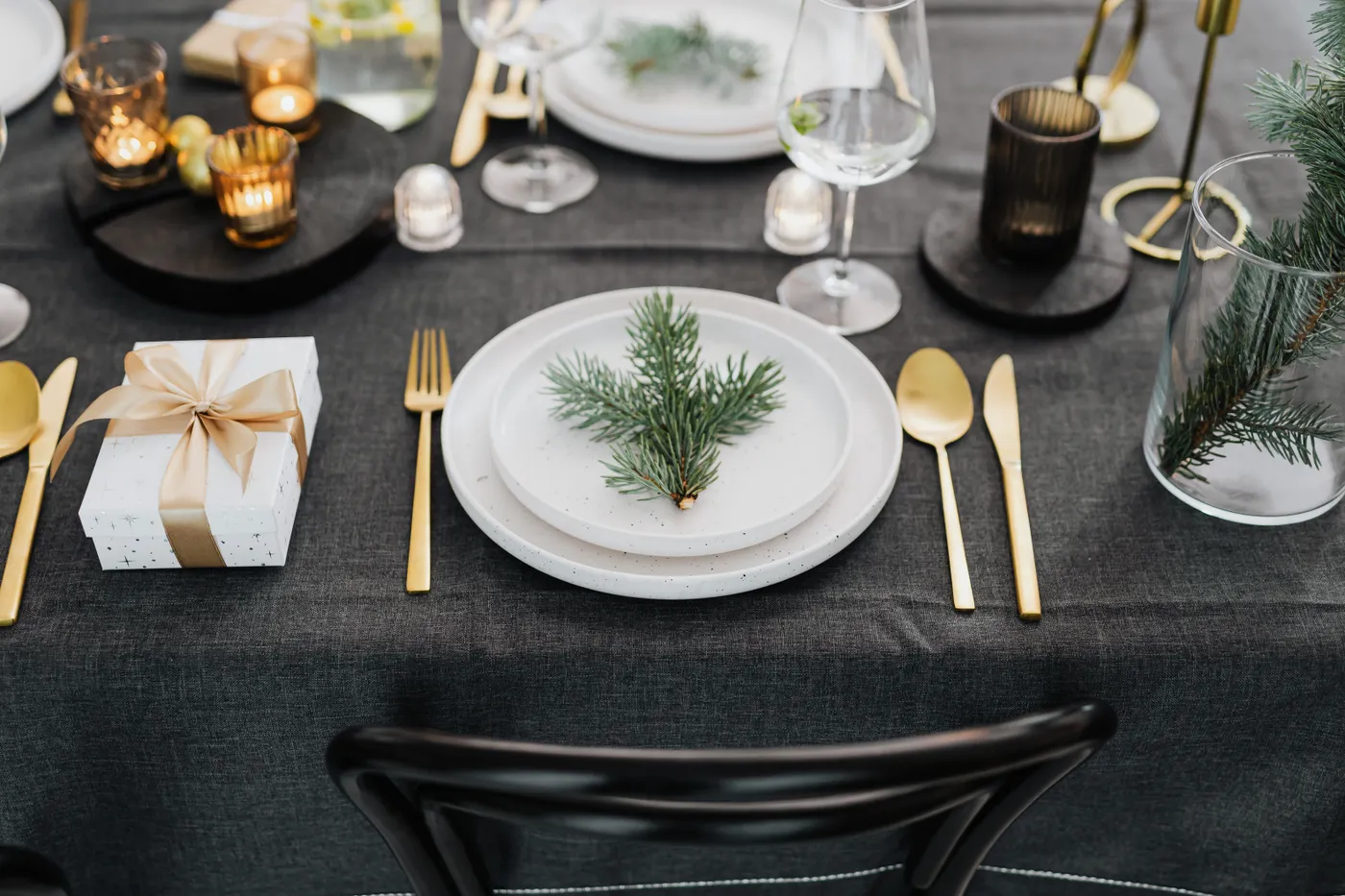
It works beautifully in a room as small as 10’x10′ with an eight-foot ceiling, because grey recedes and there’s no heavy centerpiece to eat visual space. If you’re working with a long, narrow dining room, see Idea #29 for the runner-based approach that suits a stretched footprint better.
For the pine sprigs, here’s the quick version:
- Clip six-inch sprigs from a grocery-store bunch the morning of the dinner
- Rinse and pat completely dry so they don’t weep onto the plate
- Lay one sprig diagonally across each plate, tips pointing toward the fork
- Add a small gold ribbon loop at the stem end, tied once
- Refresh with new sprigs on day three
Ten minutes, about $8 for greenery.
7. Scalloped Red Placemats Under Velvet Deer and Toile
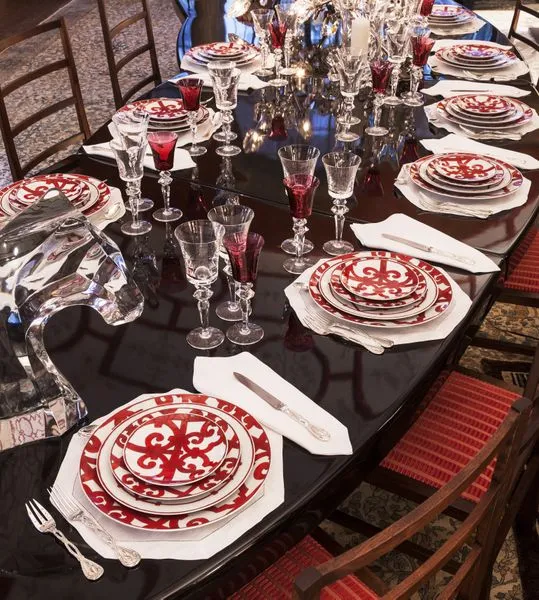
There’s a lot happening on this long table — toile tablecloth, red scalloped placemats, red velvet deer, gold glitter foliage, nutcrackers, red pleated lampshades, gold taper candles, white and gold plates, red napkins with bows, bamboo-handle cutlery. In less careful hands it would be chaos. What saves it is repetition: every single place setting is identical, so the eye reads a rhythm instead of a mess. When your centerpiece is this elaborate, your place settings must be soldiers, not snowflakes.
Ballpark to build this:
- Toile tablecloth: $60–$180
- Red scalloped placemats, set of 8: $40–$90
- White and gold rimmed plates: $100–$280
- Velvet deer, nutcrackers, gold foliage: $80–$250
- Taper candles and red lampshades: $40–$110
- Total: $320–$910
Budget alternative: keep the placemats and plates, and buy one statement figure instead of six. One good velvet deer at the center beats a whole herd from the discount aisle.
8. Ruby Stemware Against a Glossy Black Tabletop
The unexpected move here is the black table. A glossy black surface underneath red-and-white patterned dinnerware, clear and ruby stemware, silver cutlery on white octagonal placemats, and dark wood chairs with red striped seats — the black acts like a mirror and a shadow at once, making every red element sit forward. If this table were wood or white, the same plates would look sweet. On black they look expensive.
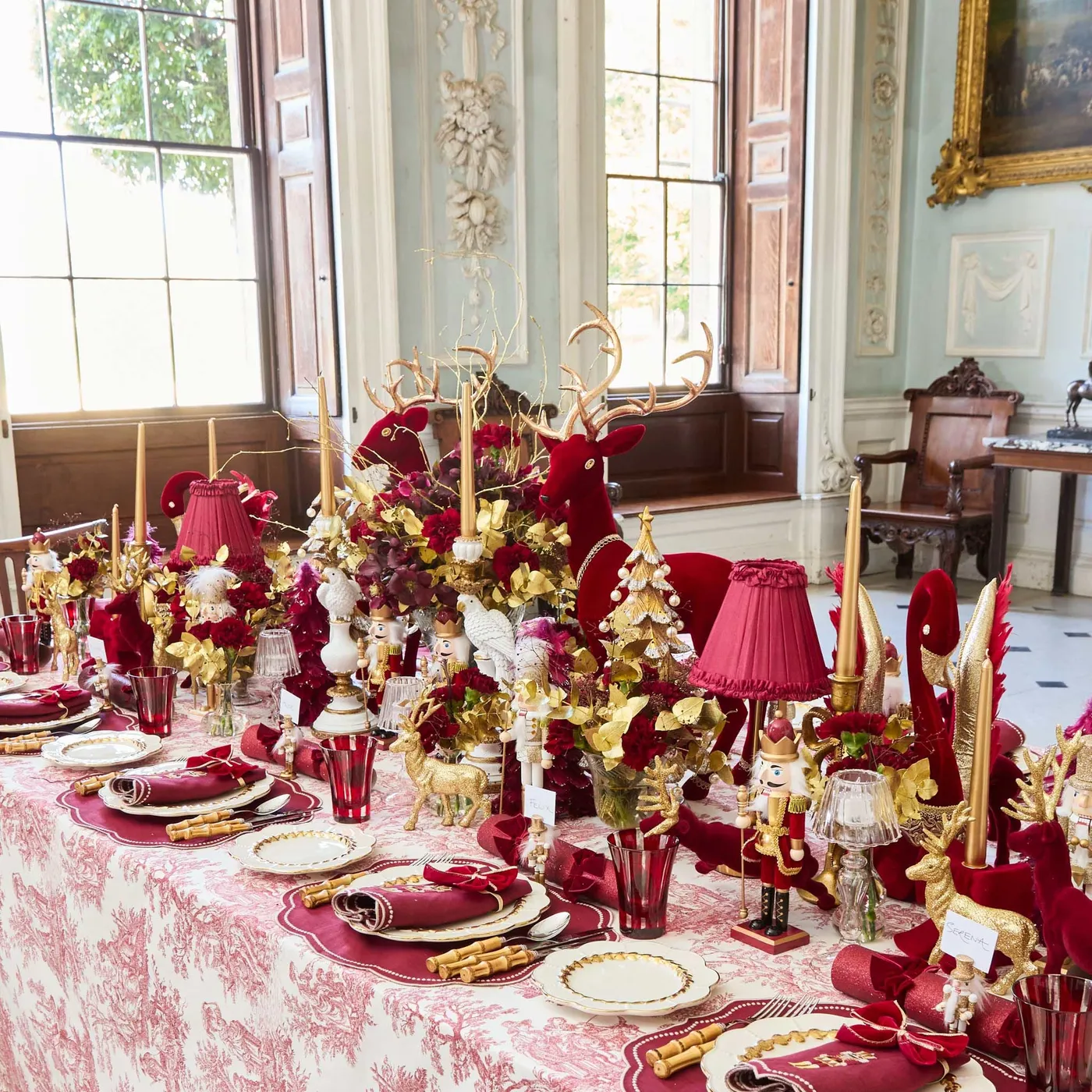
Two principles at work: high contrast placement (white placemats keep plates from disappearing into the dark) and temperature mixing (silver reads cool, red reads warm, and the friction between them is the point).
Now the honest part. Glossy black shows every fingerprint, water ring, and crumb of salt. Plan on a microfiber cloth and a spritz of glass cleaner before guests arrive and again after dessert. If that sounds exhausting with kids at the table, a matte dark finish or a charcoal linen tablecloth gives you 80% of the drama for none of the wiping.
9. Silver Chargers, Plaid Napkins, and a Village in the Background
The white and green floral arrangements in silver vases, flanked by white tapers in silver holders, are what make this red tablecloth feel elegant instead of merely festive. Red cloth alone can tip toward birthday party. The cool silver and the green-and-white flowers pull it back toward formal dinner, and the plaid napkins keep it from getting stiff.
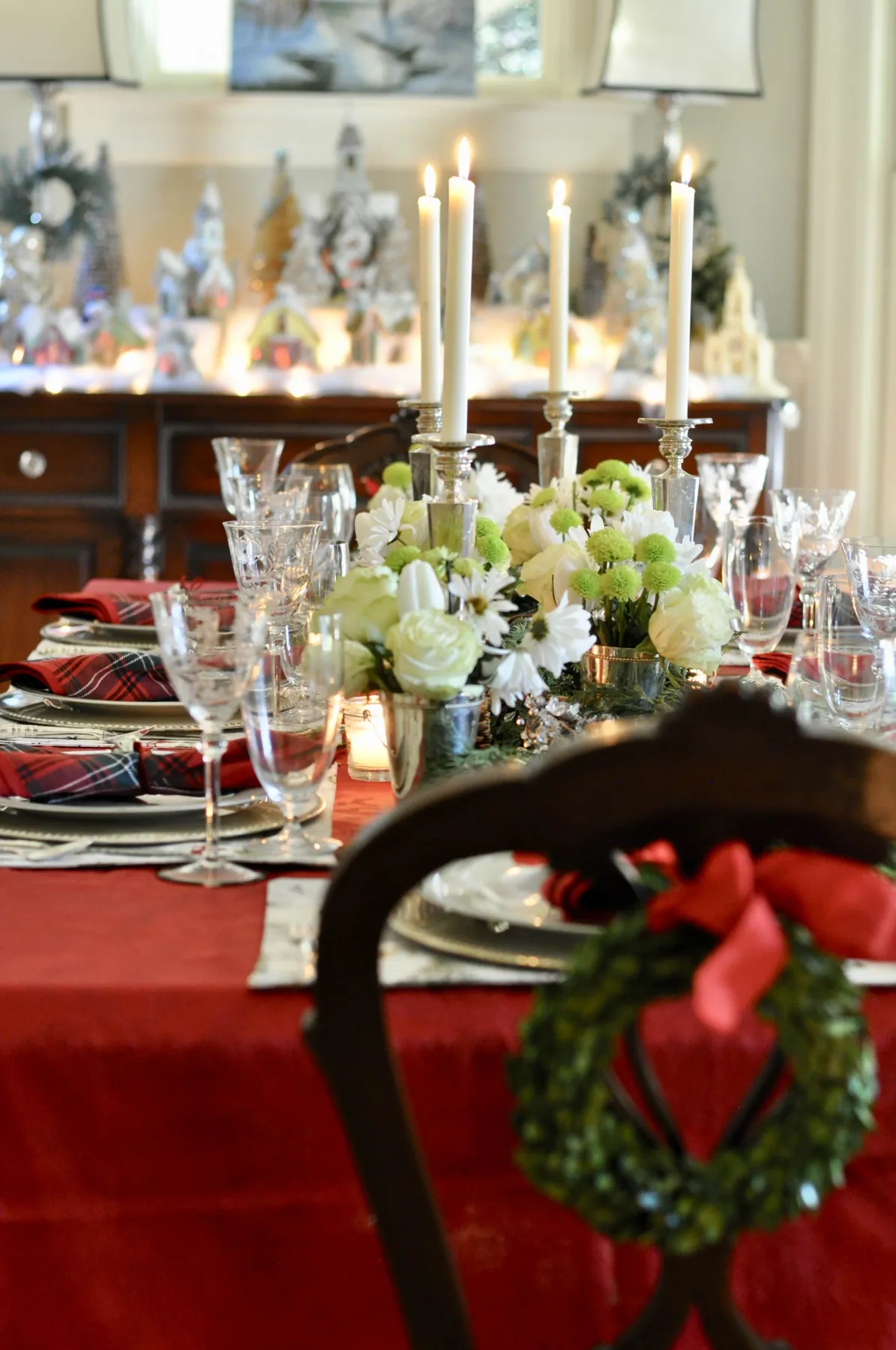
Before you commit to this look, run through a quick check:
- Measure the table — silver chargers are 13 inches and need a table at least 36 inches wide
- Confirm your taper candles fit the holders snugly (loose tapers lean and drip)
- Check whether your red cloth reads burgundy or cherry in your actual dining room light
- Count seats vs. chargers — buying chargers for 8 when you regularly seat 10 is a false economy
That illuminated village on the buffet behind is the kind of detail that makes a room feel lived in. If you have a collection, put it where people can see it while they eat.
10. Plaid Rims, Poinsettia Embroidery, and a Pinecone Ring
Look at the napkin. A beige linen embroidered with red poinsettias and green leaves, cinched with a pinecone-and-red-berry ring, resting on a beige linen placemat. That napkin is the most traditional object on the table and the reason the whole setting feels like it came out of a cedar chest. The plaid-rimmed plates, the tartan deer bowl with the gold rim, the crystal glass — all lovely, but the embroidery is the soul.
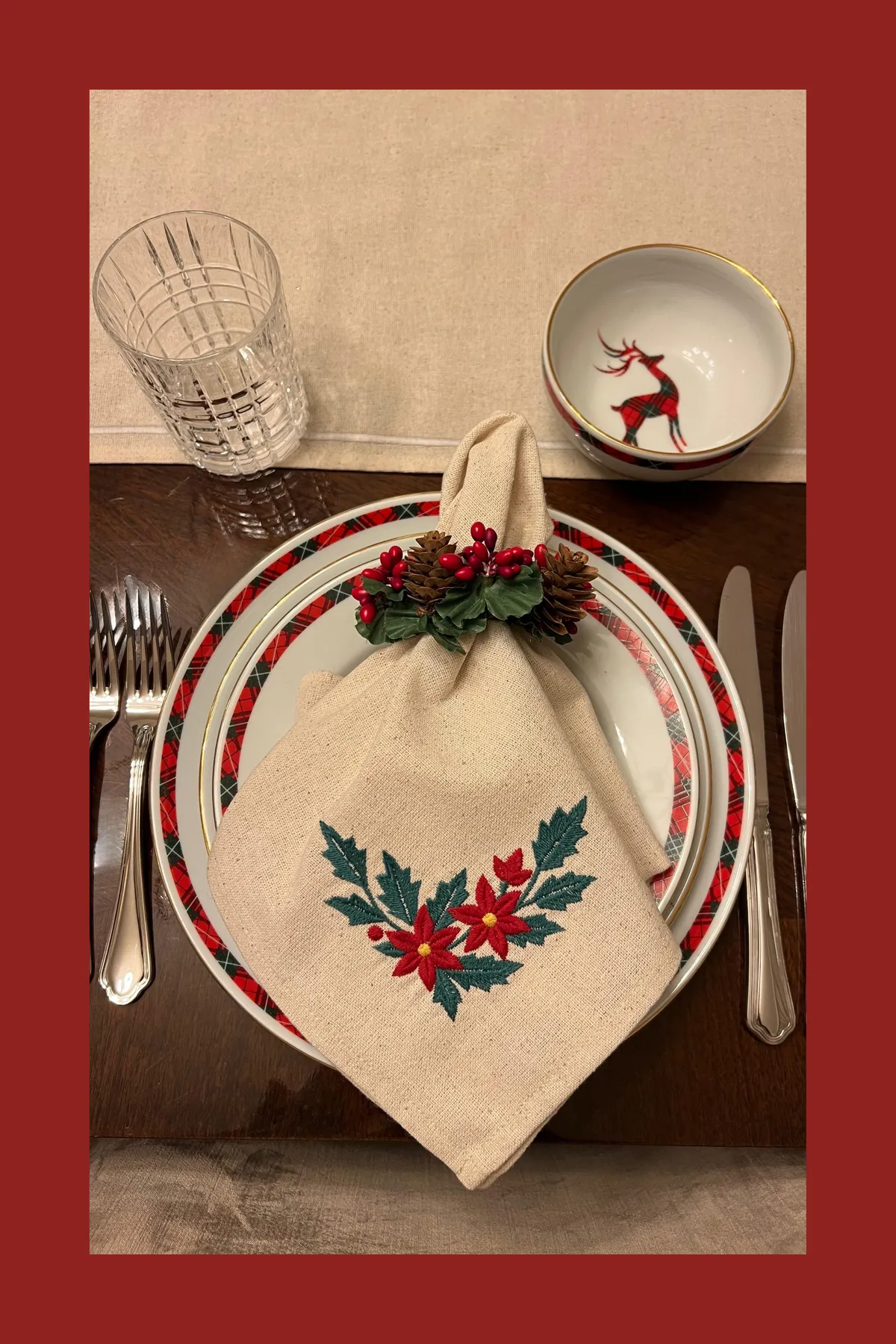
on napkin rings: keep the ring under 2.5 inches in diameter and lighter than the napkin itself. Heavy rings pull the fabric down into a sad cone. A pinecone-and-berry ring like this one sits at roughly 2 inches and holds a folded napkin upright all evening.
The color math: 50% beige and cream + 30% red and forest green + 15% white + 5% gold. That’s a warmer, softer ratio than most Christmas tables, and it’s exactly why this one looks like a December afternoon instead of a store window. For a bolder read on the same tradition, see Idea #12.
11. Red Beaded Placemats and a Sprig of Pine Per Napkin
The round, bright red beaded placemats are the standout against that white embroidered cloth with green and red holiday motifs. Round placemats on a rectangular cloth is a small, deliberate rule-break that keeps the table from feeling like a grid. Add gold-rimmed white plates, white napkins with red scalloped edges, and a miniature pine sprig with red berries and a tiny striped ornament on each, and you’ve got cheerful without a single piece of tinsel.
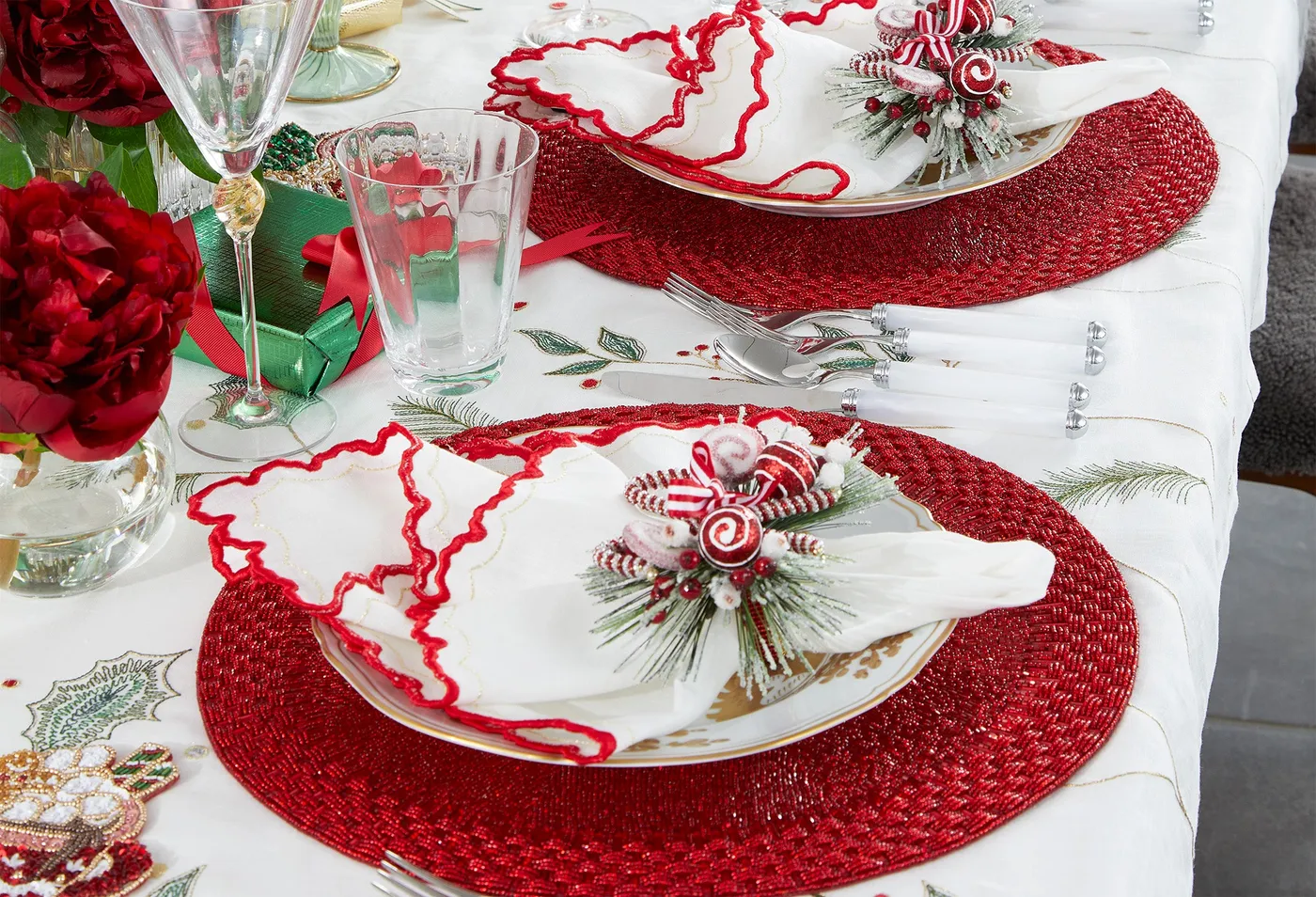
You can absolutely do this for less. Beaded placemats run $30–$50 each new, but craft-store bead strands plus a round cork base make a very convincing version for about $8 a piece if you’re handy. The gold-rimmed plates? IKEA and Home Goods both carry near-identical versions for $5–$8 a plate. Red peonies in a clear vase can be grocery-store stems on day two, when they’re cheapest.
One honest note: beaded placemats are crumb catchers. Shake them out over the sink after dinner and store them flat, not stacked, or the beads press into each other and leave dents by New Year’s.
12. Ribbed White Plates and Evergreen Garland Down the Center
A white tablecloth, round woven placemats, ribbed white plates, folded red fabric napkins, gold flatware, textured red glasses, and a centerpiece of evergreen branches with bright red berries running the length of the table between two white serving dishes with red trim. It’s the most welcoming table in this collection — nothing precious, everything touchable.
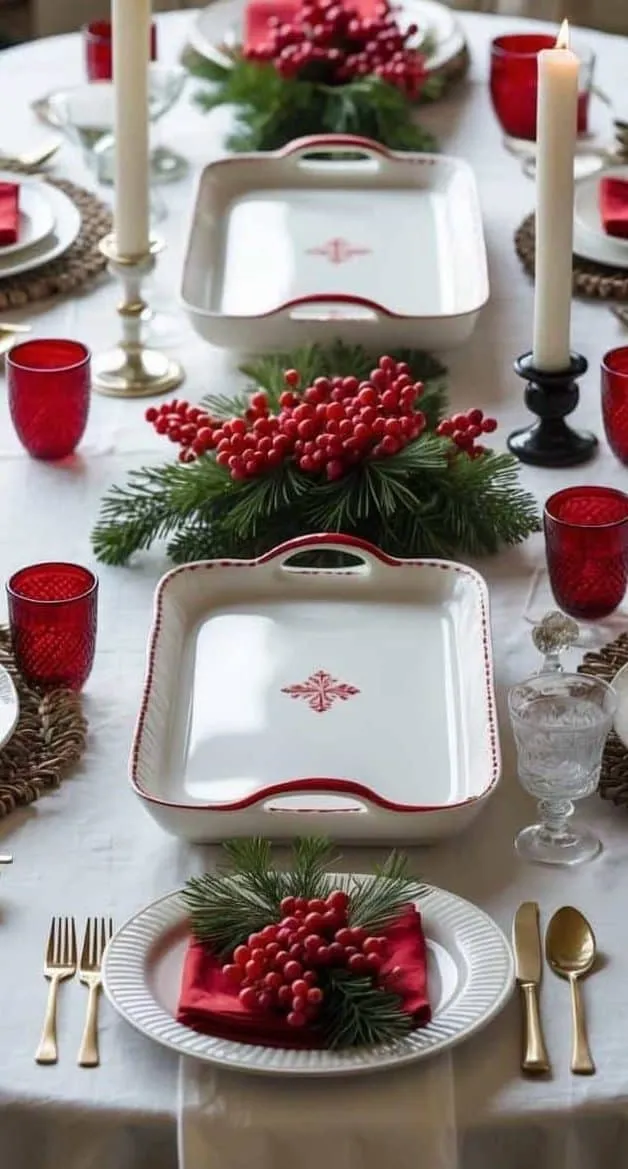
Why it works: the woven placemats add a matte, nubby texture that makes the glossy ribbed plates pop, and the garland runs long and low, which is the correct move for a table you actually serve food on. Ribbing is also quietly functional — it hides knife scratches better than a smooth glaze.
This layout shines on tables 72 to 96 inches long. Shorter than 72 and the garland crowds the outer settings; longer than 96 and you’ll want two garlands meeting in the middle with a taller element at the seam. If your table is round, Idea #25 handles that geometry better.
13. Napkins Folded Like Crackers with Red Velvet Bows
The white napkins folded into cracker shapes and tied with red velvet bows are the detail that lifts this table out of the ordinary. On a red-berry-patterned white cloth with layered plates, crystal glassware, and deer figurines, a bottle brush tree and a nutcracker nearby, the folded napkins give the whole setting a handmade, almost Victorian generosity.
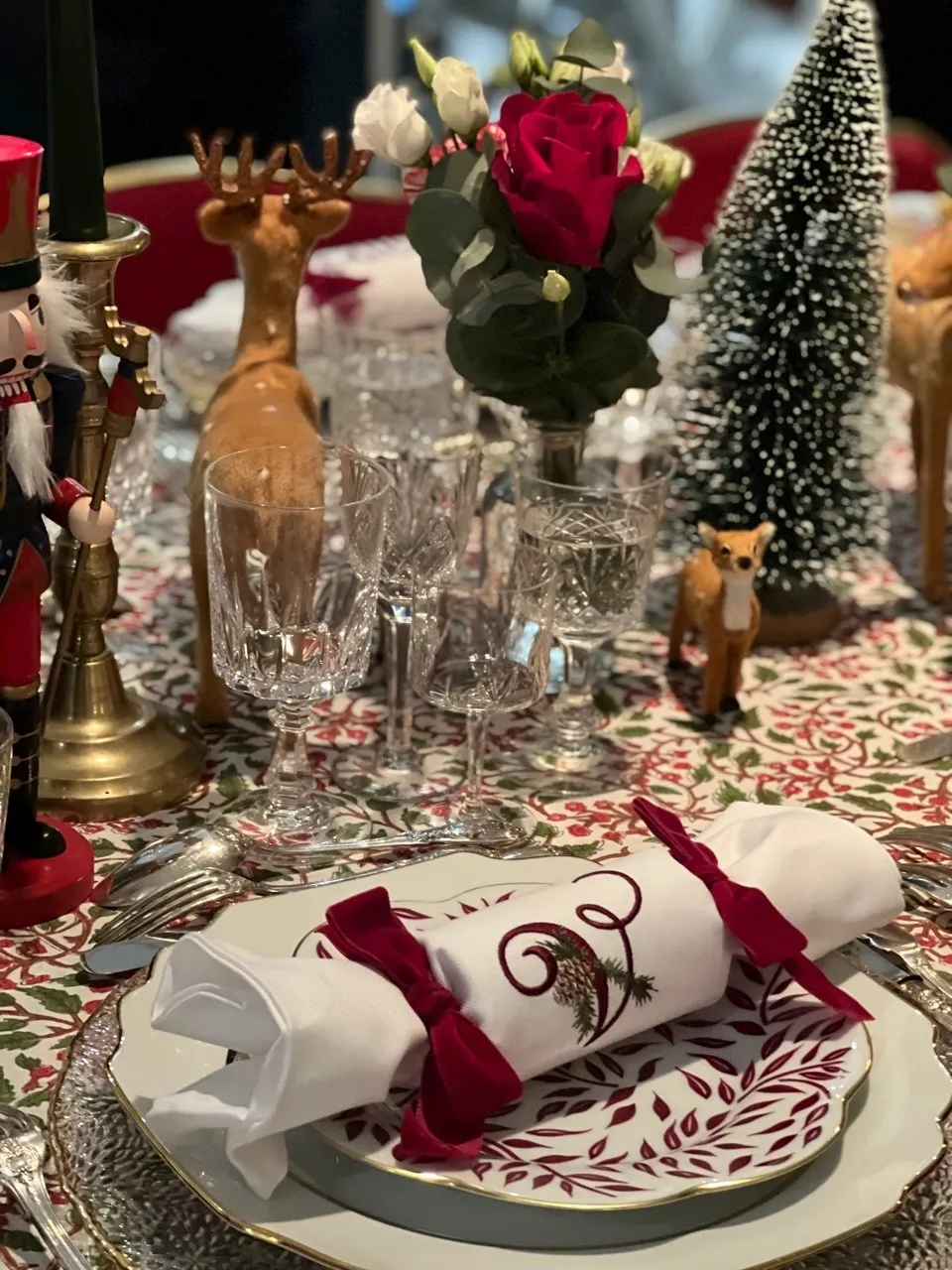
Here’s how to fold them:
- Press the napkin flat, then fold in half lengthwise into a long rectangle
- Roll tightly from both short ends toward the center until they meet
- Tie a narrow velvet ribbon around the middle, snug but not crushing
- Fan the two ends slightly so it reads as a cracker, not a scroll
- Slip a small sprig of greenery under the bow
About 4 minutes per napkin and roughly $6 of ribbon for eight. Do it the night before and store them on a tray under a cloth — velvet ribbon creases if it’s piled.
14. Beige Chargers, Red Berries, and a Tiny Bell Ornament
What makes this setting feel expensive is the layering order: textured red placemat, beige charger, white dinner plate, smaller white salad plate with a thin grey rim. Four layers, each one slightly different in tone, so the eye keeps moving. Red berry branches and a glittery green garland across the top, silver cutlery, a white napkin, two glasses, and a small white bell ornament with burlap and a red ribbon sitting on a gold sparkly runner.
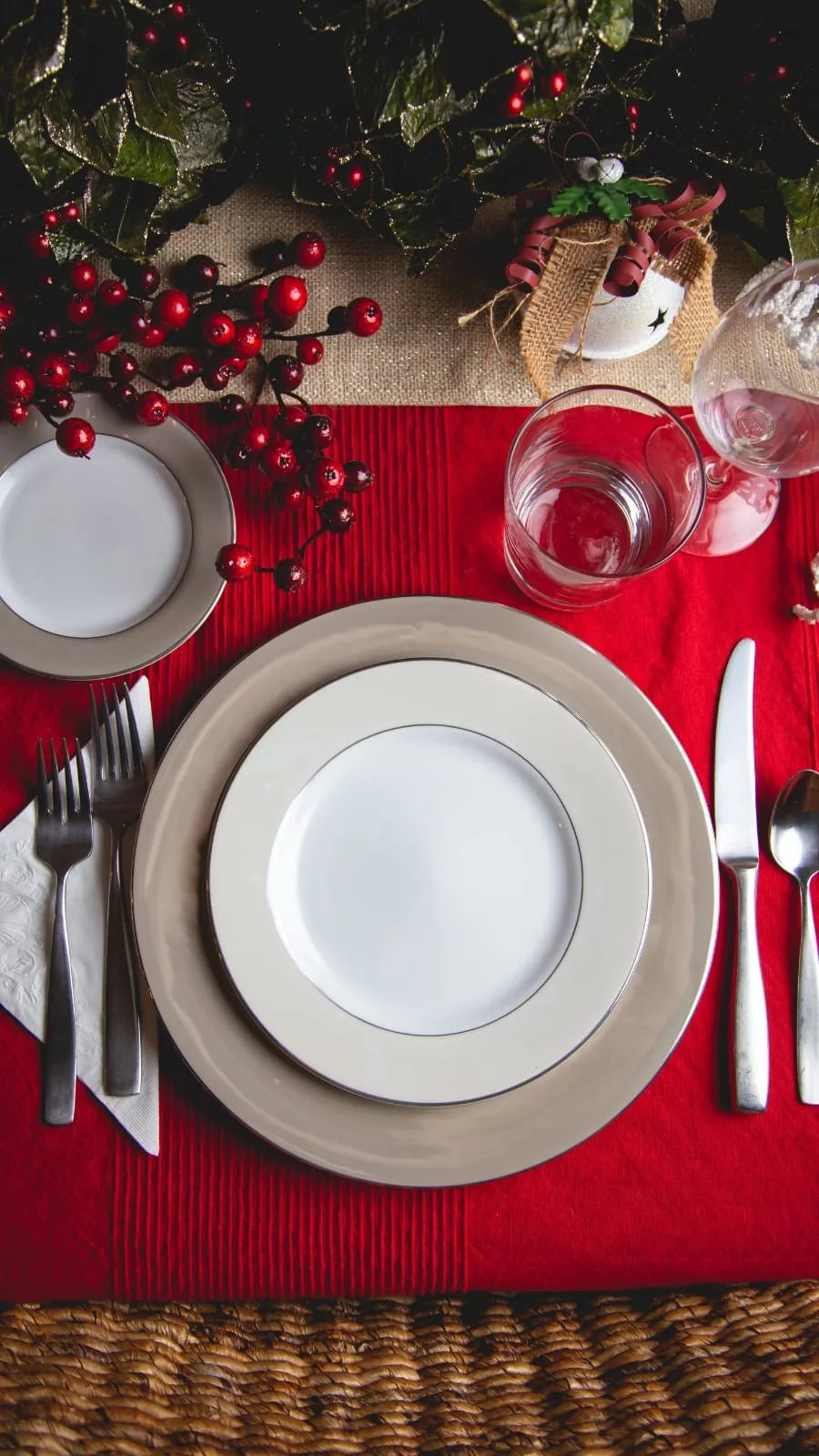
- Textured red placemats, set of 8: $35–$80
- Beige chargers, set of 8: $45–$100
- White dinnerware with grey rim: $90–$220
- Red berry branches and glitter garland: $30–$75
- Bell ornaments and ribbon: $15–$40
- Total: $215–$515
Budget alternative: skip the beige charger and use a plain white dinner plate as your base layer — the four-layer effect survives on three. That single change saves $60 and nobody at the table will notice.
15. Checkerboard Cloth and Santa Boot Candle Holders
Red and white checkered tablecloth, plain white plates, striped fabric napkins, clear stemware, red taper candles in ceramic Santa boot holders, and paper crackers scattered around. This is the table for the people who think the elegant ones are a little much. It’s bright, it’s a bit silly, and it works because it commits completely — no half-hearted rustic touches trying to class it up.
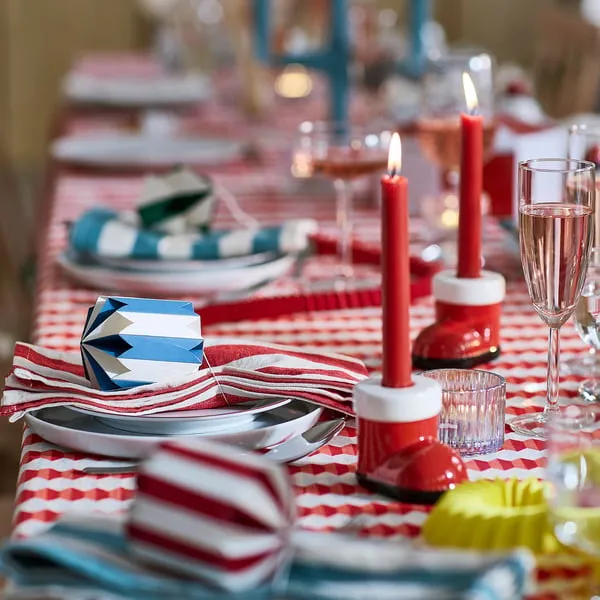
ceramic boot candle holders tip easily. If there are kids or a dog in the house, either weight the base with museum putty or move them to the sideboard. Also, checkered cloth plus striped napkins is two competing patterns — it works here because the scale is wildly different (small checks, wide stripes). Match your scale and you can mix patterns all day; match your pattern and it goes muddy.
For the budget version: paper crackers can be made from cardboard tubes and tissue for pennies, and dollar-store Santa boots look identical once the lights are low. This is the one table in the collection where thrift is the whole point.
16. Holly Plates and a Sparkling Silver Napkin Ring
A red patterned cloth, a dark red charger, a white plate with holly and berry design, a plain white bowl, and a rolled red napkin held by a sparkling silver ring. The silver ring is the one thing — it’s the only cool, hard, reflective object in a sea of warm red and white, and it makes the place setting feel finished rather than merely stacked.
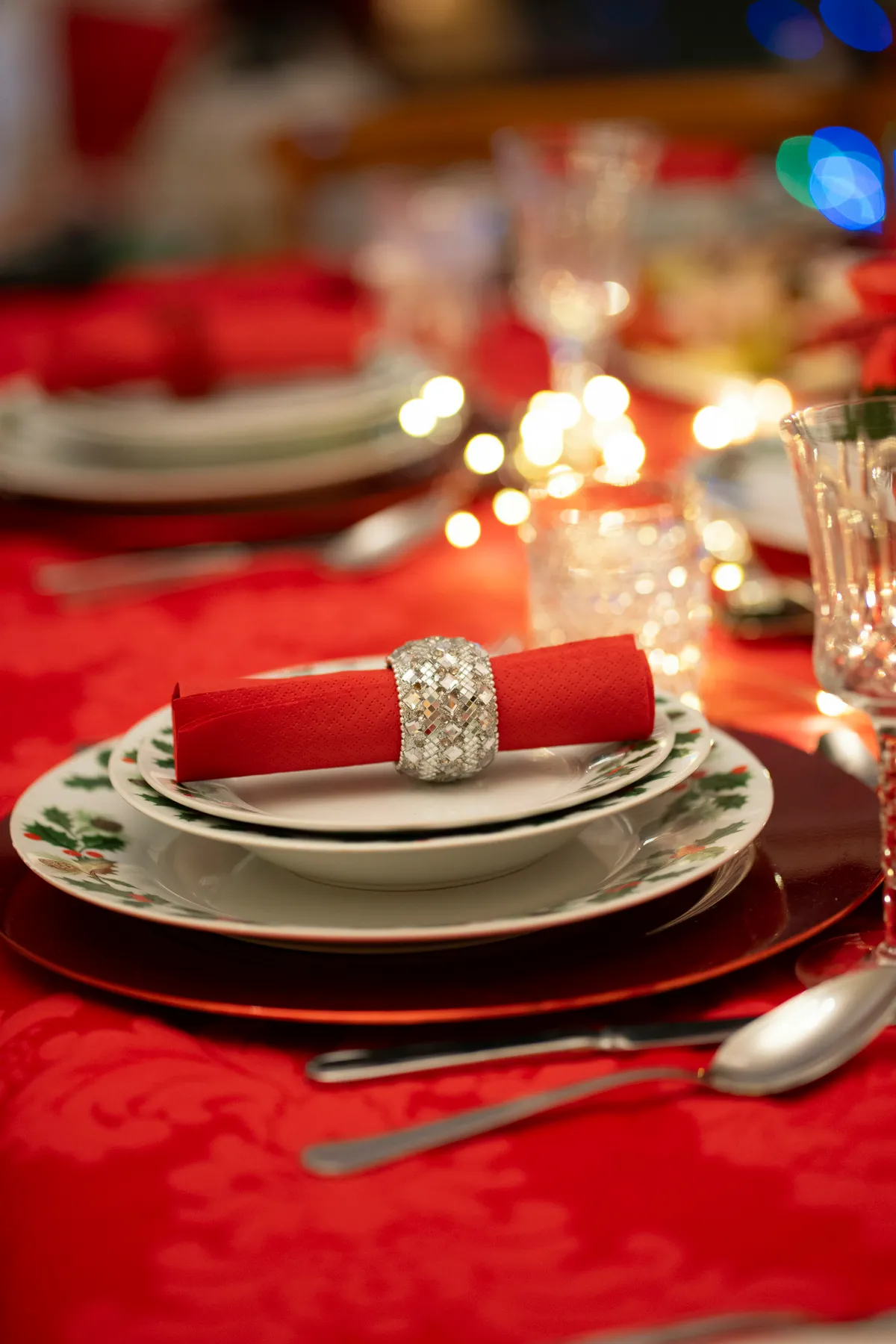
check on rhinestone-style napkin rings: they shed. Expect to lose two or three stones a season, and don’t let them sit in water or soak in the sink. Wipe with a dry cloth only. Cheap ones will tarnish within a year; the slightly better ones hold up for a decade. If you want the sparkle without the fuss, a polished silver or gold band gives you 90% of the effect and zero loose stones.
Compare with Idea #20 — same silver-ringed rolled napkin, much more dramatic lighting and rose-heavy centerpiece.
17. A Lighted Pine Garland on a Turned-Leg Wood Table
Faux pine garland with star fairy lights, red berries, and gold ornaments runs down a red patterned runner on a wooden table with turned legs. White dinner plates with dotted rims flank it, and a flocked tree glows in the background. Nothing here is expensive individually — it’s the layering that sells it.
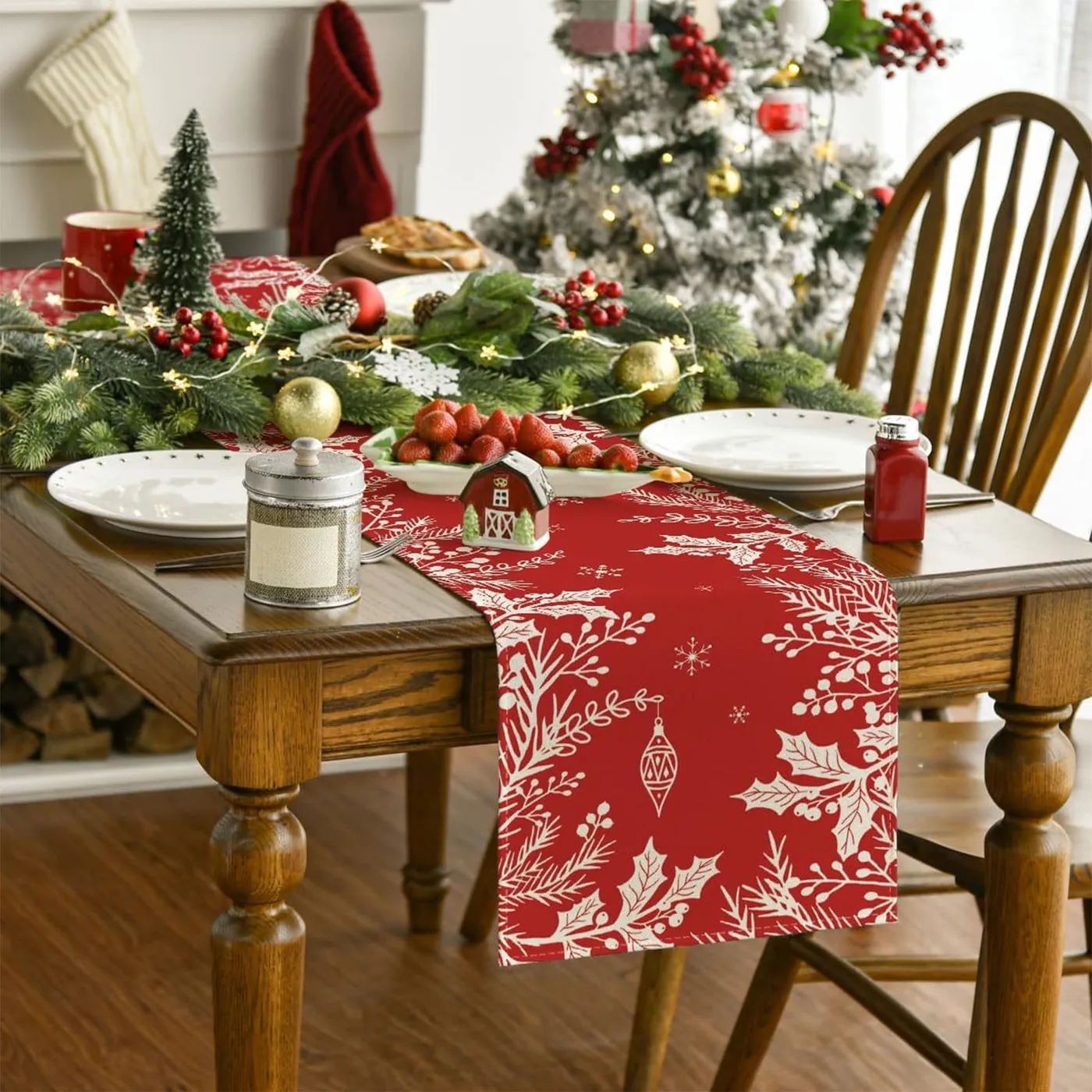
the lights are warm-white and small, so they read as candlelight rather than carnival. And the garland sits directly on the runner rather than in a container, which lets it spill and drape instead of sitting in a stiff line. Wrapping the wire loosely — some sections high, some touching the cloth — is what makes faux greenery look real.
, verify these:
- Battery or plug? Confirm an outlet reach before you fall in love with a lit garland
- Measure your table’s clear center span — leave 15 inches per setting
- Test the lights before the day of; nothing kills a table faster than a dead strand
- Check that the runner is cotton or linen, not polyester, near hot bulbs
18. Red Roses, Green Hydrangea, and a Gold-Painted Pinecone
Red roses, a single red gerbera daisy, light green hydrangeas, evergreen foliage, a burgundy ribbon, red berries, and one gold-painted pinecone in a reflective metallic vase on a white cloth with gold embroidery. The hydrangea is the quiet hero — it softens the roses, which can otherwise read funereal in a dense arrangement, and its light green keeps the whole thing from turning into a Valentine.
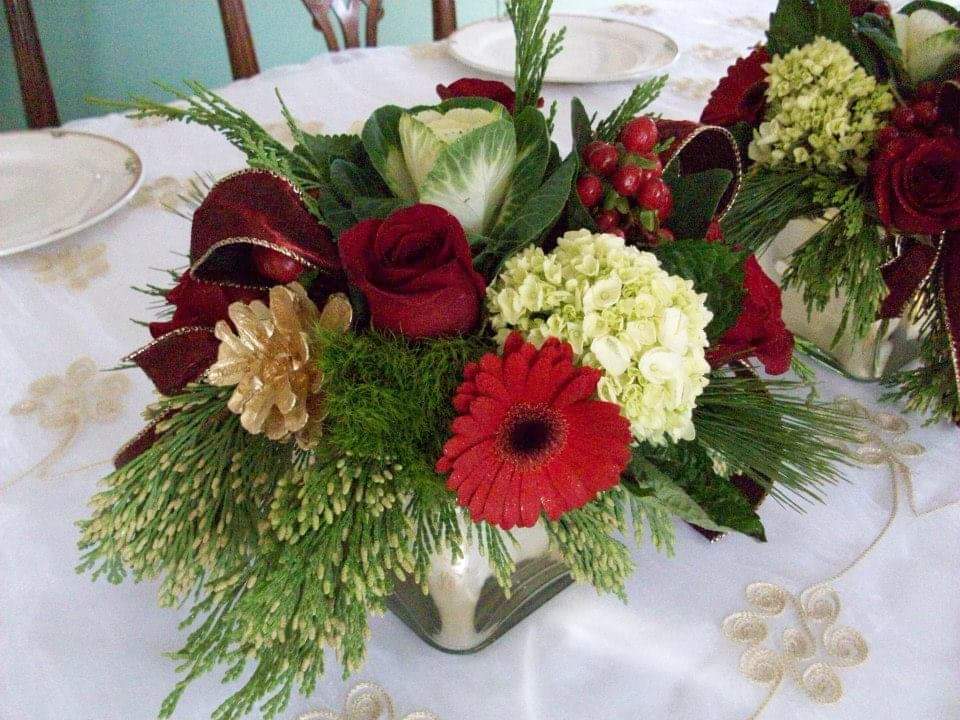
worth paying for: cut hydrangeas should be conditioned in cool water for four hours before arranging, and mist the blooms every couple of hours on the day of. They drink through their petals as well as their stems, which is why they droop first and apologize later.
This centerpiece needs a table at least 60 inches long and ideally a room where it can be seen from a slight distance — it’s the table’s sculpture, not its backdrop. Tuck it against a wall on a narrow table and you lose the reflective vase entirely. Related: Idea #21 takes the same green-and-red palette in a much warmer direction.
19. A Prep Table: Red Tapers, Brass Candlesticks, and Green Ribbon
Sometimes the prettiest moment is the table before it’s finished. A dark wooden tabletop with a stack of white plates holding bright red cloth napkins, two red tapers in brass candlesticks, personalized place cards, ornate silver cutlery, and a spool of dark green ribbon on a red-and-white checkered textile.
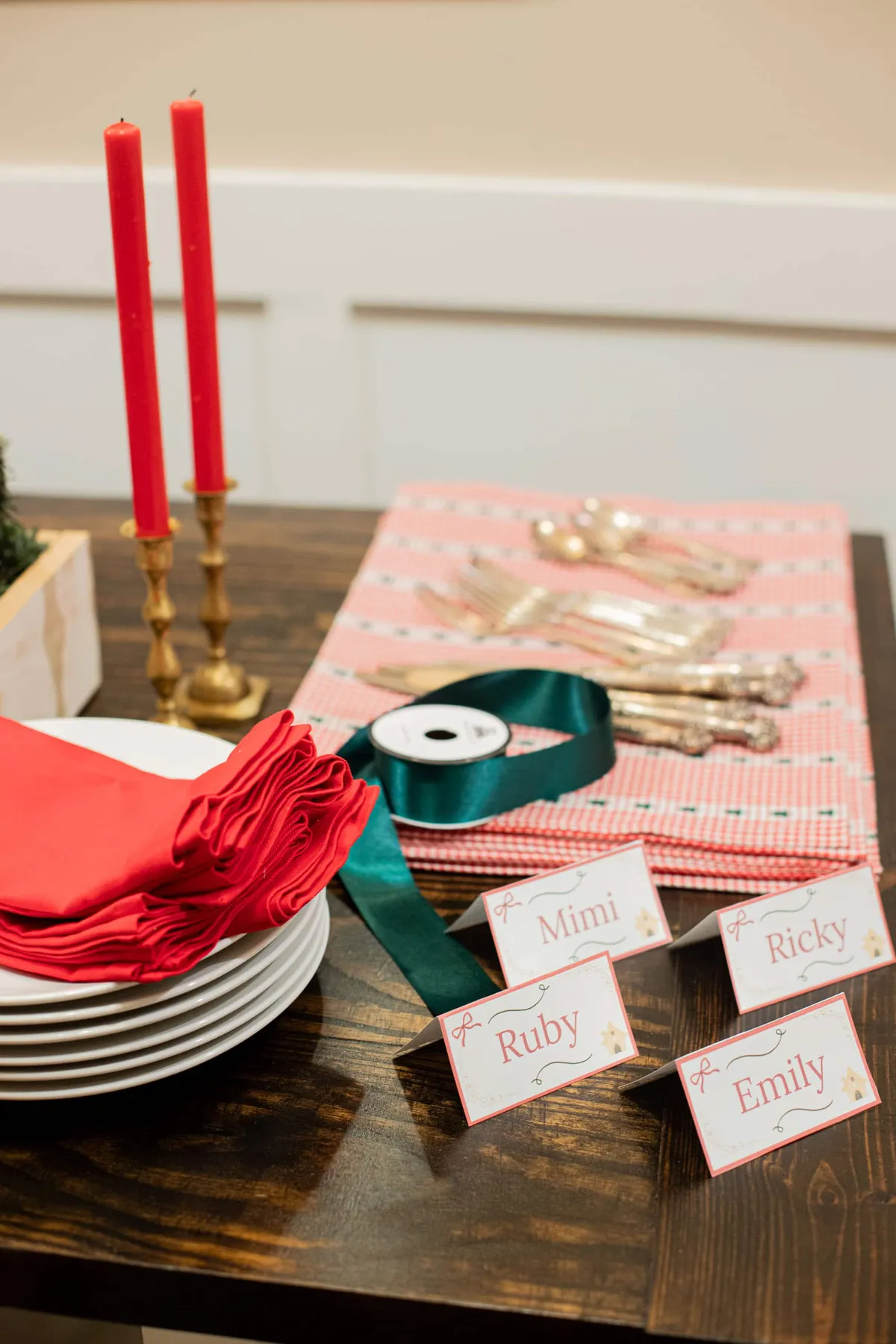
The brass candlesticks are why this reads warm rather than sharp — brass has a soft, aged reflection that flatters red candle wax in a way chrome never does. If you’re buying one thing this year, buy brass candlesticks. They work in December and every other month.
Set the table in stages:
- Lay the textile and iron it flat (10 minutes)
- Place plates and cutlery, checking spacing with a ruler (15 minutes)
- Fold and stack napkins, then add place cards (10 minutes)
- Add candles last, unlit, and light them five minutes before guests sit
Under an hour total, free if you already own the pieces.
20. Red Rose Petals Scattered Across a Gold Vase Centerpiece
A dense dome of red roses in an ornate gold vase, red petals scattered across the table, glowing votives everywhere, silver-rimmed white plates, deep red napkins in sparkling silver rings, and patterned clear goblets. The petals are the move. They cost nothing, they take thirty seconds, and they make the table feel like an occasion rather than a setting.
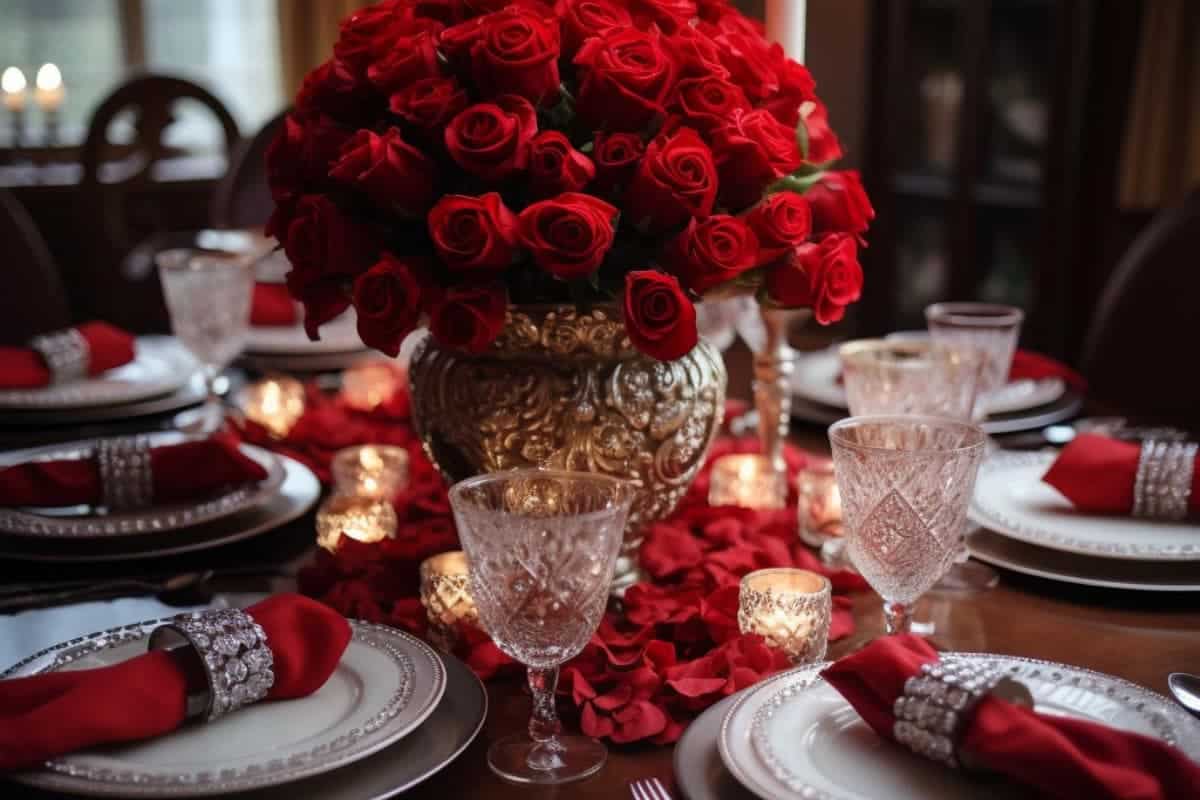
But be honest about the practicalities before you commit. Loose petals on a tablecloth will be sat on, will end up on the floor, and will stain white linen if they’re left overnight. Use them on a runner rather than directly on the cloth, and sweep them up before bed. Votives at this density are also a genuine fire risk near paper napkins — keep flames at least six inches from any fabric edge and never leave the room with them lit.
Done carefully, this is the most romantic table in the collection. Done carelessly, it’s a candle-safety demonstration.
21. Peach Roses, Pinecones, and Deep Red Wine in a Decanter
This one is unusual: white linen, white dinnerware with black and gold bands, gold flatware, deer-shaped napkin rings, pine boughs and pinecones with peach-colored roses, and a glass decanter of deep red wine. Peach roses at Christmas is a genuine choice, and it works because the pinecones and forest greens keep the arrangement rooted in December while the peach softens it into something you’d happily look at in February.
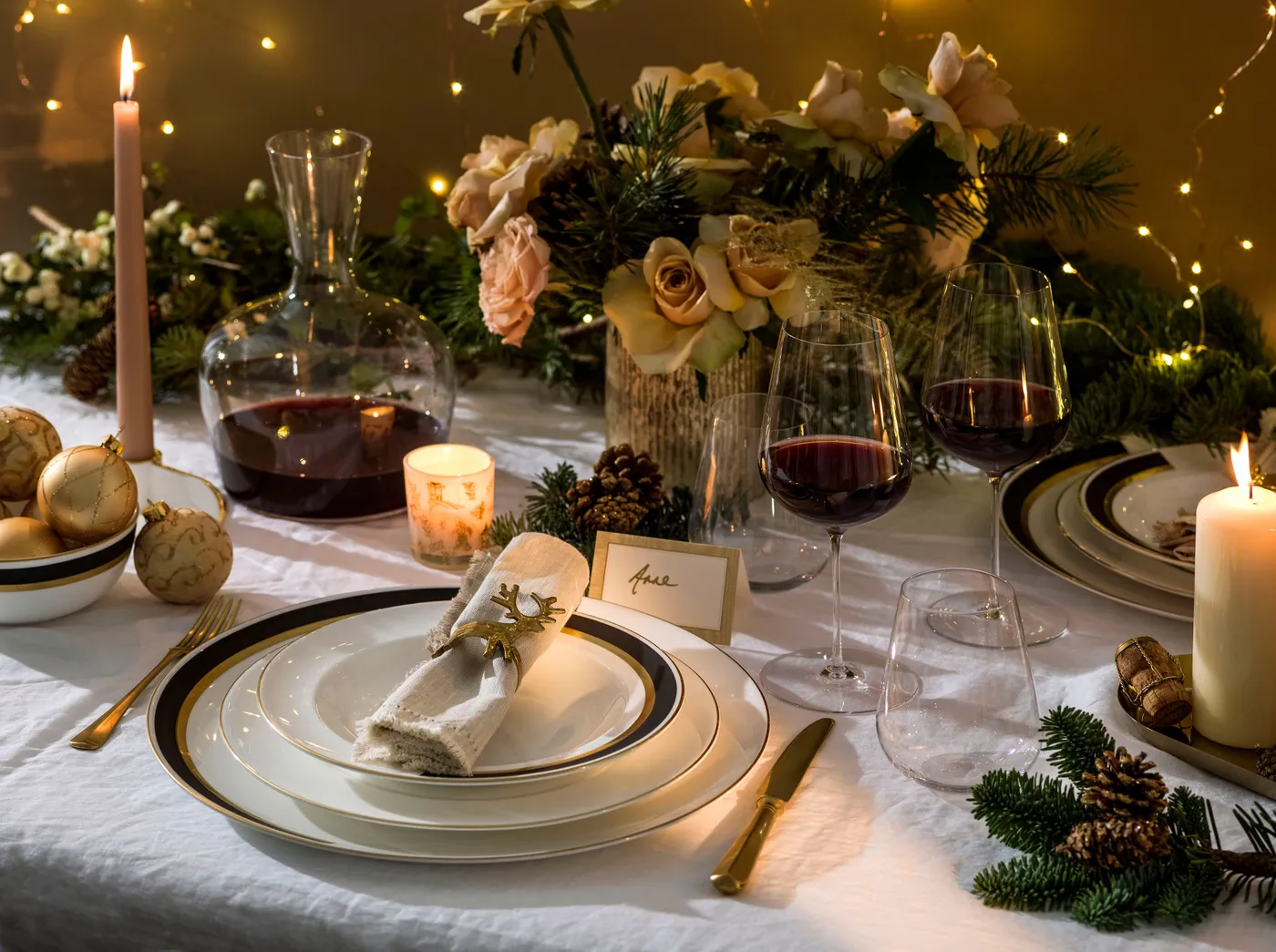
The formula: 55% white + 20% forest green + 15% peach and cream + 10% deep red (mostly from the wine itself) + a thin gold line throughout. It’s the most sophisticated ratio in this whole collection, and it’s why the table feels calm even with candles and fairy lights going.
Key principle: when your centerpiece has one unexpected color, every other element must be classic. Peach roses plus novelty plates would be a disaster. Peach roses plus white and gold is a dinner party.
22. White Hydrangeas, Red Tapers, and Stockings on the Mantel
A polished dark wood table, cream upholstered chairs, layered formal place settings with silver flatware and crystal, a large centerpiece of white hydrangeas, green foliage and red berries, red taper candles, and embroidered stockings hanging from a white fireplace mantel behind. This is the table for a room with architecture — the mantel is effectively part of the design.
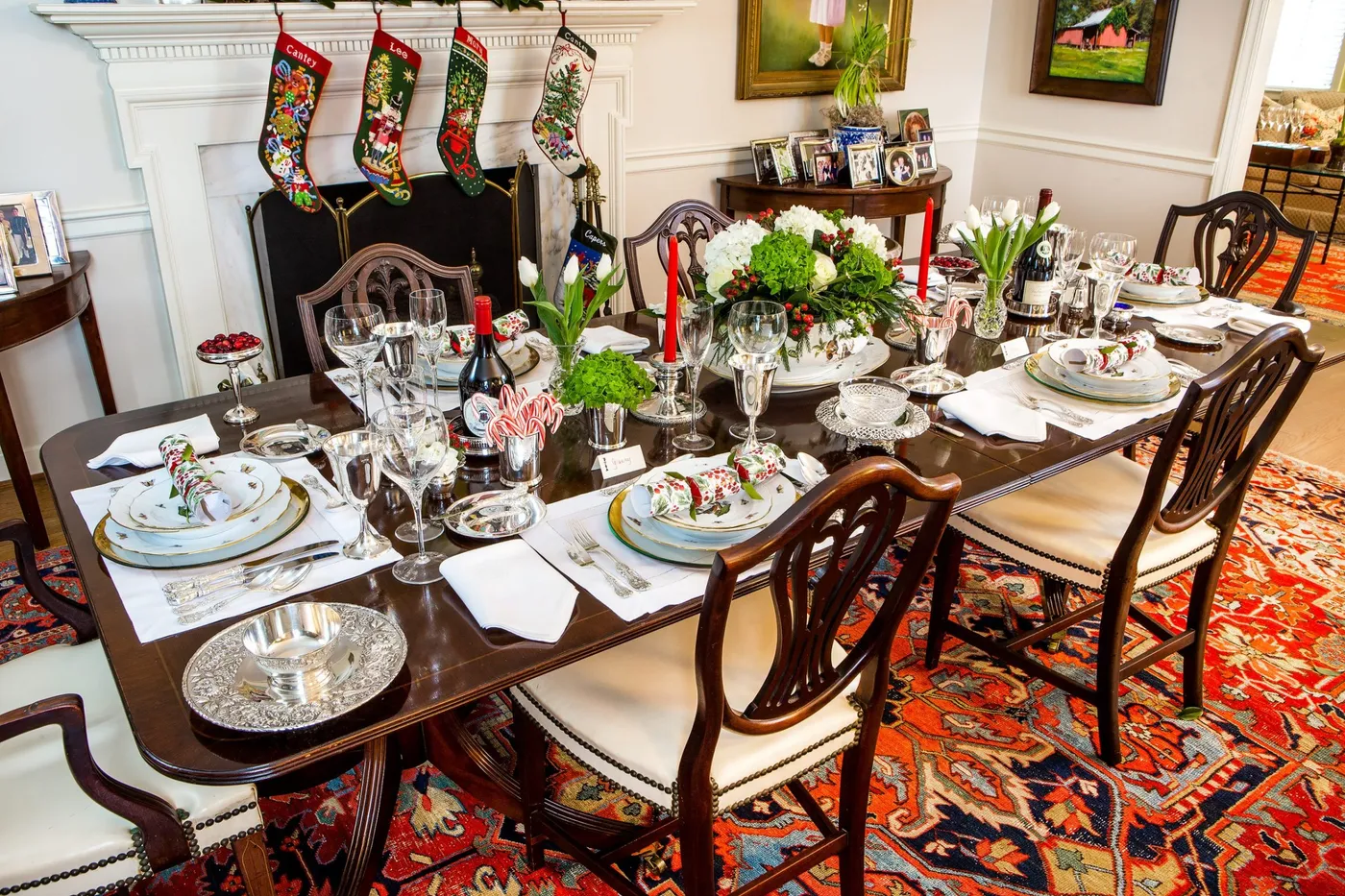
It needs space to breathe: think a dining room of at least 180 square feet with a ceiling over eight feet, and a table that seats eight without anyone’s chair hitting the wall. In a tighter room, the same elements will crowd. If your space is smaller, Idea #6 delivers a similar level of formality on a smaller footprint.
Good news on cost: cream upholstered chairs and dark wood are the expensive parts, and you probably already have them. The hydrangeas can be grocery-store stems, the red tapers are a few dollars each, and the crystal can be borrowed. Most of this table’s impact comes from the flowers and the candles — roughly $90 total.
23. A Toile Village Placemat with Three Tiny Ornaments
A cream placemat printed with a red toile winter village scene, a white ruffled plate with a light green rim, three small ornaments in red, rose gold, and light green resting inside it, gold-toned cutlery alongside. It’s a place setting designed for a house where the table is small and the decorating happens at each seat rather than down the middle.
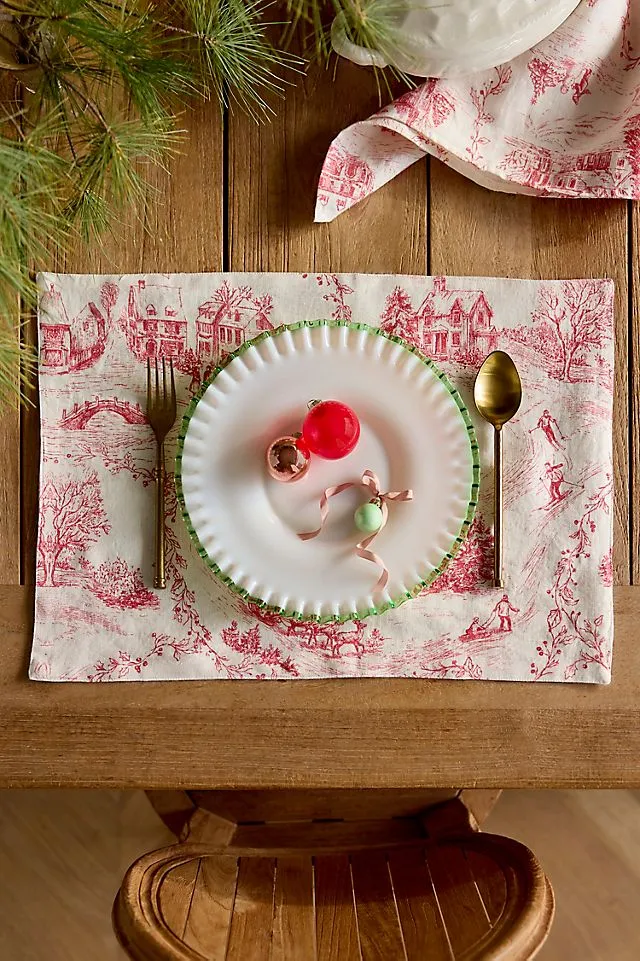
when you decorate individual plates instead of the table, keep each object under three inches and use exactly three. Odd numbers read as intentional; two look like you ran out; four look like clutter. And put the heaviest object at the back so nothing rolls into a lap mid-meal.
Quick check before you buy ornaments for plates: confirm they’re unbreakable (wood, felt, or metal), and confirm they don’t have glitter that will shed onto food. Also verify the plate’s rim is flat enough to hold them without wobbling. Small details, but this is the kind of setting that lives or dies on them.
24. Four Red Tapers in a Black Iron Candelabra
Four tall red taper candles in a black metal candelabra, being lit on a wooden table set with black-and-white patterned plates, crystal glassware, and eucalyptus-like greenery, with a warm Christmas tree blurred behind. The candelabra is the one thing. It gives the table a center, a silhouette, and a reason for everyone to look up from their phones.
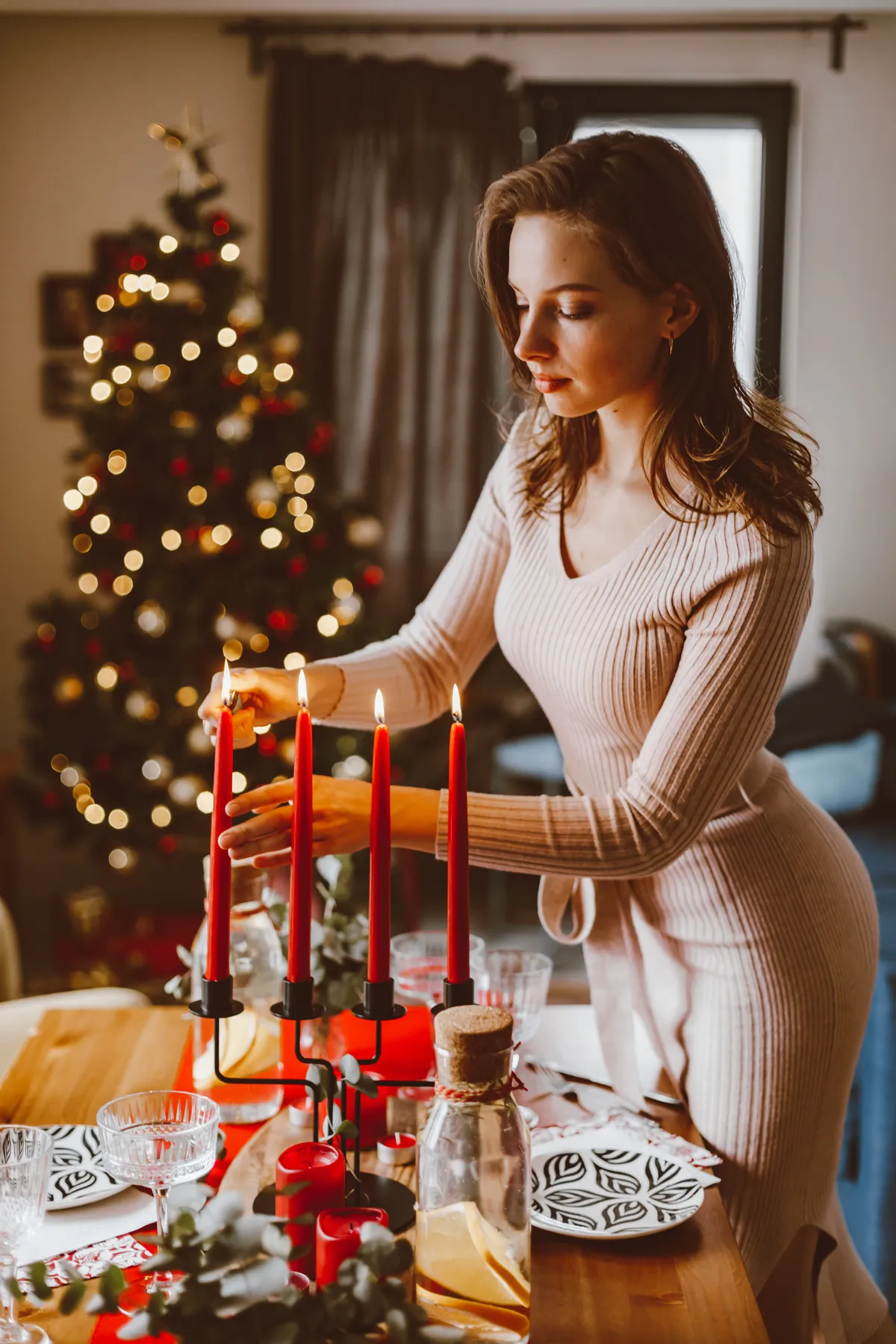
Black iron is having a real moment in 2026 — it’s the antidote to a decade of brass-and-blush. It reads graphic and slightly old-world, and it photographs beautifully against warm candlelight. Unlike most trends on this list, it’s genuinely cheap: a good iron candelabra runs $35–$70 and will outlive every other object on your table.
Practical note: four tapers in a row means four times the drip. Look for dripless beeswax tapers if you want to skip the scraping, and trim wicks to a quarter inch before lighting.
25. Gingham Napkins and Pink Poinsettias in Terracotta
Red and white gingham napkins, green and white floral plates, gold flatware, and a centerpiece of pink and red poinsettias in terracotta pots on a wooden table, with a gold chandelier overhead, a red-ribboned tree behind, and a green wreath with red ribbons on a gold-framed mirror. Pink poinsettias are the surprise, and terracotta pots are why they work — the clay brings them down to earth instead of letting them read as gift-shop plants.
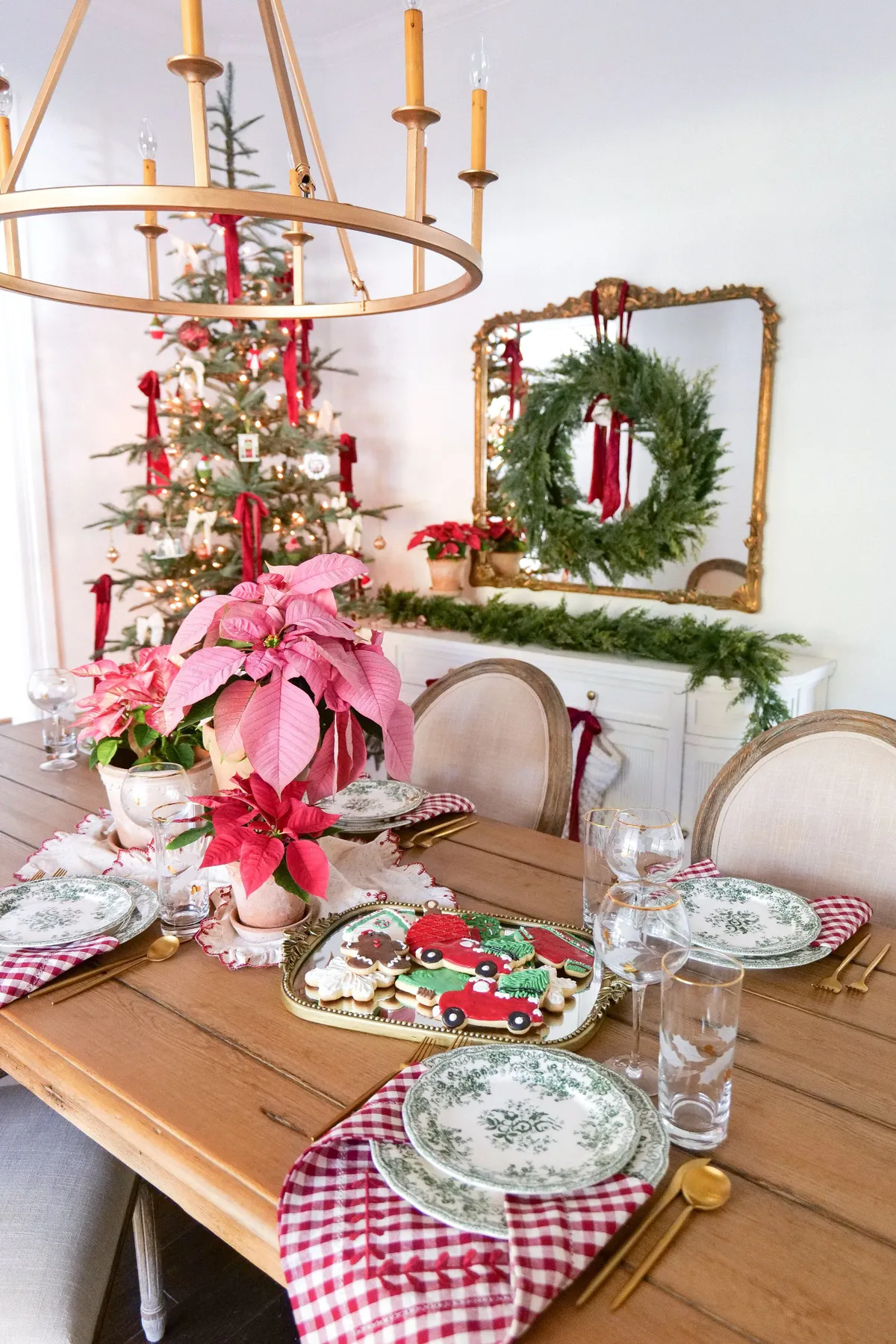
- Gingham linen napkins, set of 8: $40–$90
- Green and white patterned plates: $80–$200
- Gold flatware, service for 8: $50–$140
- Pink and red poinsettias, 6 plants: $60–$120
- Terracotta pots: $15–$35
- Total: $245–$585
drop a plastic nursery pot inside the terracotta rather than planting directly. It hides the plastic, protects the clay from water stains, and lets you swap a wilting plant the morning of without repotting anything.
26. An Evergreen Wreath Around a Lit Red Pillar Candle
An evergreen wreath laid flat on a black-and-white patterned tablecloth, with a lit red pillar candle at its center, holly leaves, pinecones, small red baubles, and a rich red velvet bow at the base. Dark ribbed glasses and plates of food sit around it. It’s the oldest trick in the Christmas table book, and it still beats almost everything else for impact per dollar.
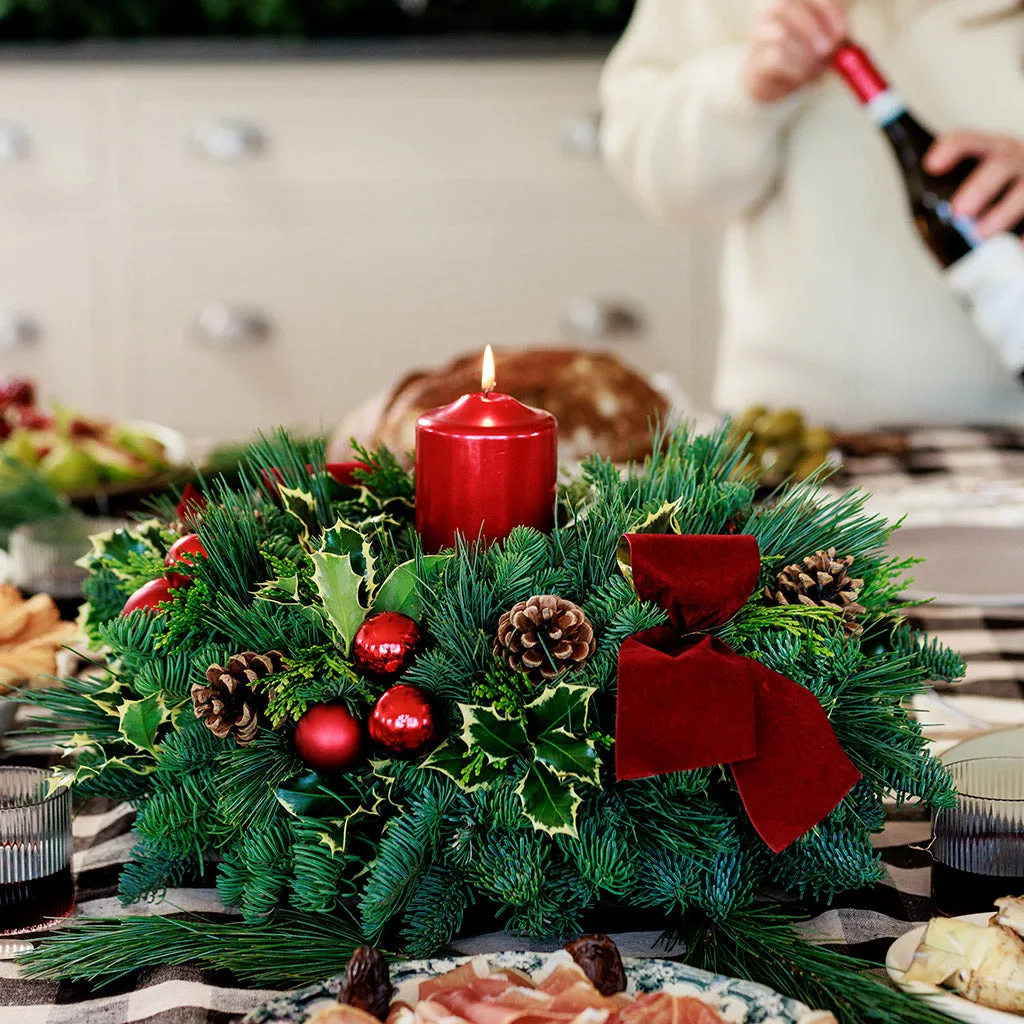
To make it last the whole season:
- Start with a faux evergreen wreath base, 12–14 inches across
- Wire in holly leaves and pinecones at four evenly spaced points
- Add small red baubles on short wire picks, tucked inward, not on top
- Set a glass candle plate in the center so wax never touches greenery
- Attach the velvet bow with florist wire so it stays put when moved
Roughly 30 minutes and about $30 if you’re starting from scratch.
never let the candle burn down to the greenery. Trim the wick, light it for two hours max, and blow it out before it gets within an inch of the wreath.
27. Rattan Placemats Under Red-Rimmed White Plates
A greenish-grey patterned cloth, layered rattan and scalloped white placemats, white plates with red rims, cream napkins with braided green rings, bamboo-handle cutlery, dark red taper candles, and small vases of deep-toned foliage. The rattan layer is the quiet genius here — it adds weave and shadow between the cloth and the plate, which is what makes the setting look collected instead of bought in one trip.
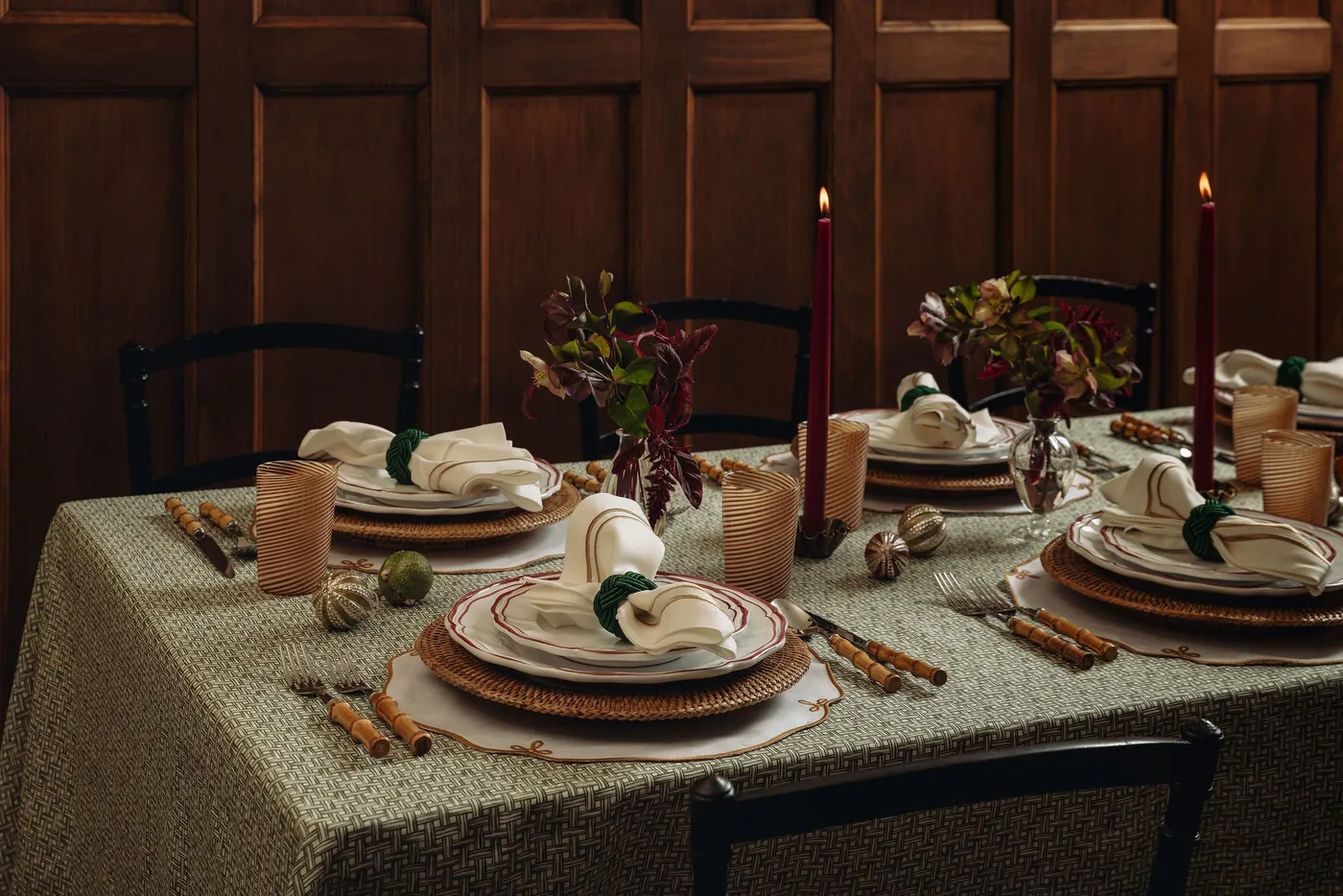
The formula: 45% greenish-grey + 25% white + 15% dark red + 10% warm brown (rattan and bamboo) + 5% metallic. The grey-green base means the red reads as an accent rather than a theme, which is why this table feels refined rather than seasonal-only. Swap dark red tapers for ivory and it works from October through February.
rattan placemats collect dust in the weave and don’t love a wet wipe. Shake them out after each use, and once a season wipe with a barely damp cloth and let them dry fully flat — never standing, or they warp.
28. Honeycomb Paper Trees Against Dark Green Wainscoting
Green placemats, white plates with a green pinecone design, gold flatware, striped napkins with gold bell rings, and honeycomb paper Christmas trees in green and brown on a beige cloth — all set in a room with textured beige wallpaper, dark green wainscoting, and a colorful abstract gallery wall. The paper trees are the delight: they’re a dime-store material treated with real design confidence.
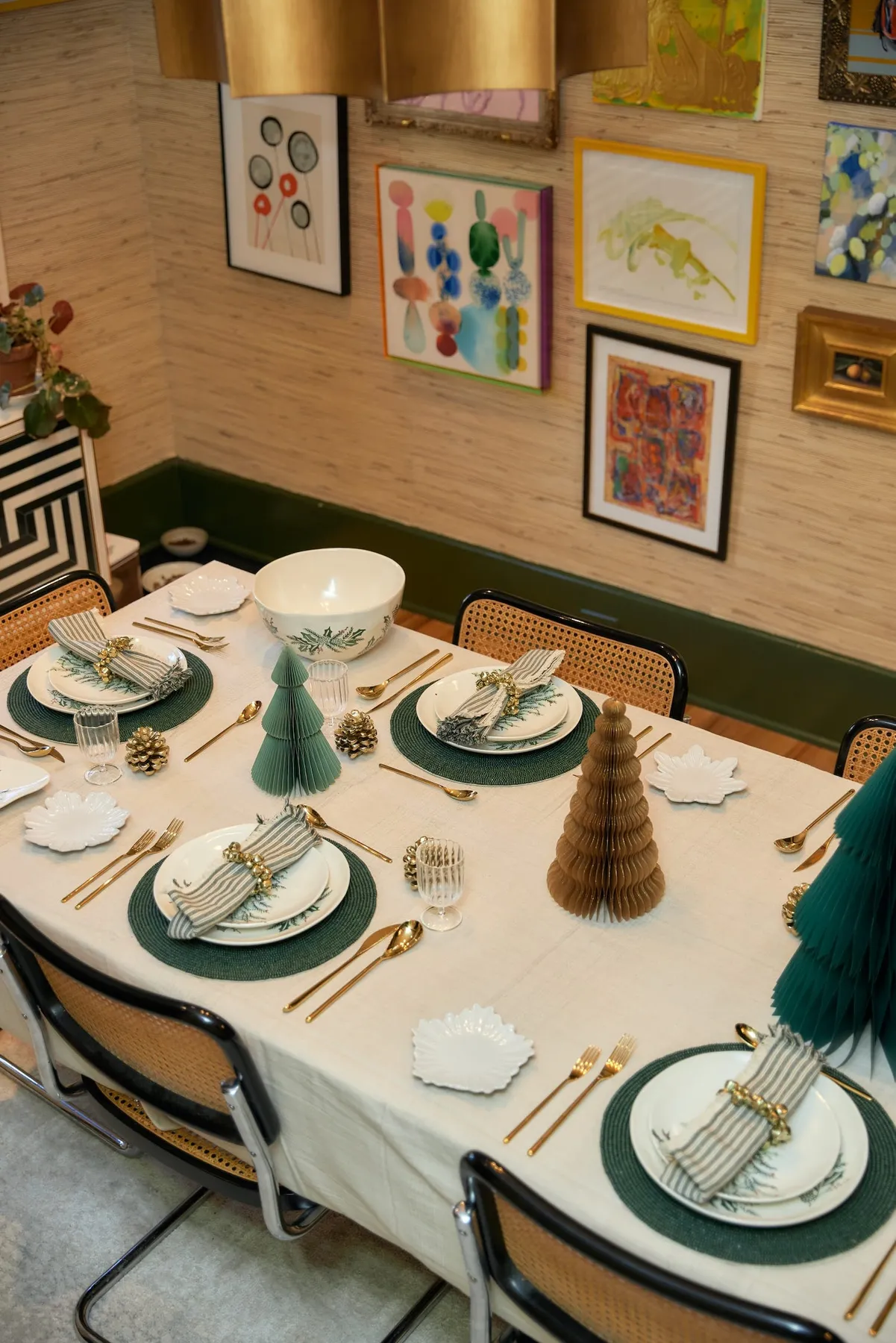
is the tension between old and new. Wainscoting, wallpaper, and pinecone china say traditional. Honeycomb paper trees and abstract art say now. Neither wins, and that’s the point — a fully traditional room can feel like a museum, and a fully modern one can feel cold.
Budget version: honeycomb trees are $6–$14 each at craft stores and card shops, and they fold flat for storage. Buy three in mixed heights rather than six in one size, and cluster them off-center. Roughly $30 total for the centerpiece, and it collapses into a drawer on January 2.
29. A Crinkled Red Runner with Peach Roses Down the Floor
A full-length white tablecloth, a crinkled red fabric runner down the center, a garland of peach roses and green eucalyptus that spills off the table and onto the light wood floor, white plates, red folded napkins, and clear champagne flutes. The spill is the whole idea — the garland deliberately breaks the edge of the table, which is what makes the arrangement feel abundant rather than contained.
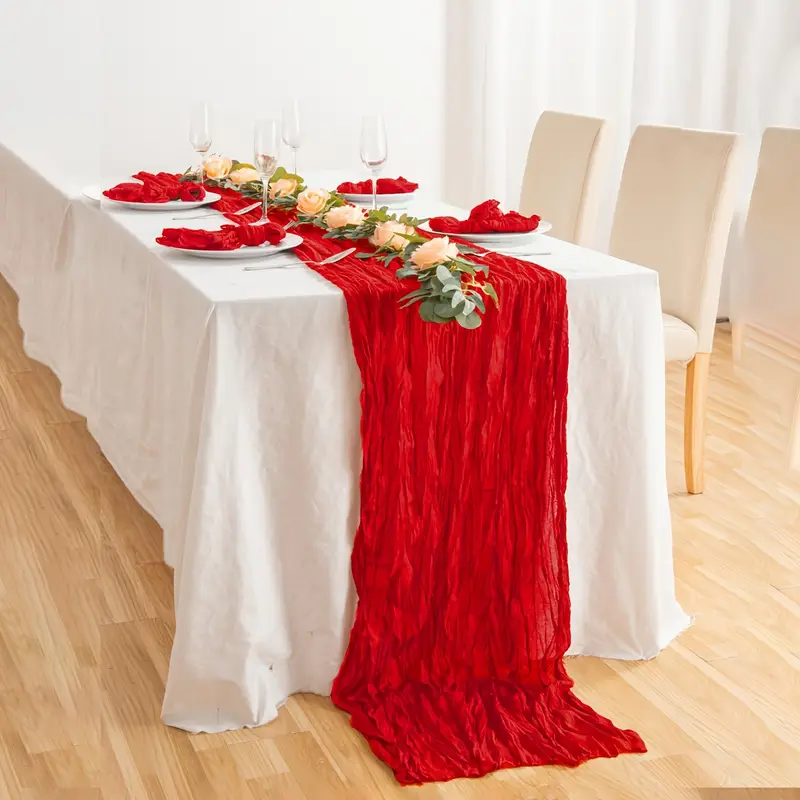
when you let a garland run onto the floor, secure it at the table edge with a small piece of floral tape underneath the cloth so nobody kicks it loose. Keep the floor portion behind the table’s leg line so it never sits in a walkway, and choose eucalyptus over anything that sheds — you don’t want leaves in the carpet by dessert.
This layout works best on a table of 8 feet or longer with at least three feet of clearance around it. On a shorter table, keep everything on top or the spill will read as a tripping hazard rather than a gesture.
30. Thirty Pieces of Red-and-White Striped Ceramics
A full collection of red and white striped ceramic dinnerware — plates, mugs, ruffled baking dishes, candlestick holders — plus striped fabric napkins and red-and-white beaded garlands, all against a rich red background. This is less a table setting than a commitment. The bold horizontal stripe and fluted edges give it a candy-shop energy that’s been steadily gaining traction as people get tired of tasteful beige Christmas.
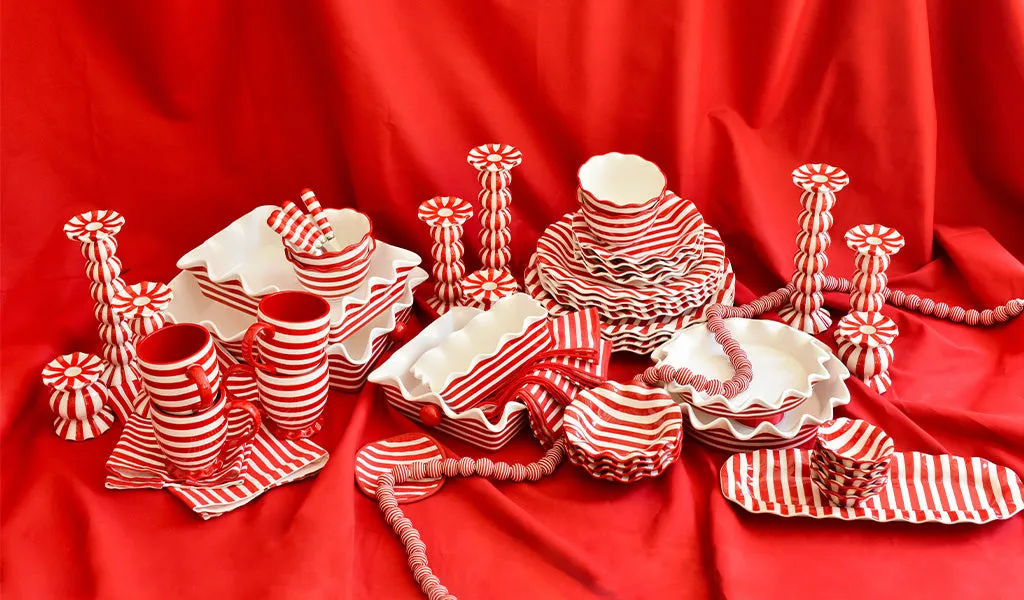
Why now: the maximalist holiday has been building for three years, fueled by people wanting their homes to feel visibly, unapologetically festive after a long stretch of quiet luxury. Stripes photograph well, mix easily with solid red or white, and don’t require a single fresh flower.
Get the look for less: buy two or three striped pieces and mix them with plain white you already own. A striped serving bowl and a set of striped mugs will read as a collection if the rest of the table is quiet. Skip the matching everything — it’s the fastest route to looking like a catalog page rather than a home.
31. Red Chargers, Grey Patterned China, and a Gift at Every Seat
Red chargers, ornate white and grey patterned china, multiple red glass stemware pieces, gold ornate flatware, a small white gift box with a red ribbon at each setting, an evergreen garland with red ornaments, and a large white pillar candle in a red holder down the center of a white-clothed table. The gifts are the one thing — they give every guest something to touch the moment they sit down, which is worth more than any centerpiece.
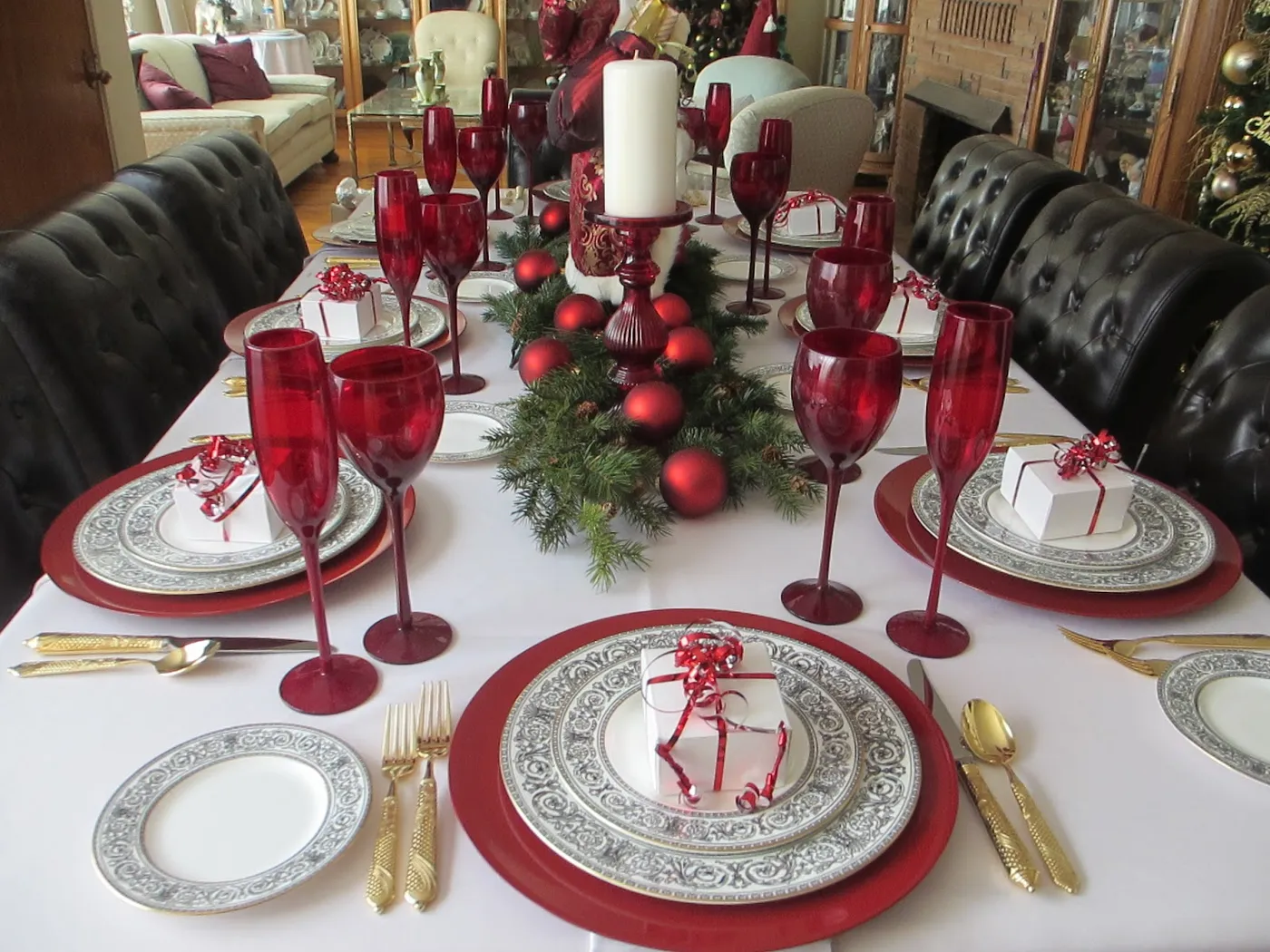
- Red chargers, set of 8: $50–$110
- Ornate patterned dinnerware: $140–$360
- Red stemware, set of 8: $60–$160
- Gold flatware: $50–$140
- Garland, ornaments, pillar candle: $45–$110
- Gift boxes and ribbon: $20–$50
- Total: $365–$930
Budget alternative: skip the patterned china and use plain white plates with a red charger. The gifts and the red glass do the festive work; the china is a luxury, not a requirement.
32. A Geometric Plate Border and a Gold Leaf Napkin Ring
A rectangular deep red placemat with a subtle leaf pattern, a white dinner plate with a black and gold geometric border, a red napkin held by a gold leaf-shaped ring, gold forks, knife and spoon, a clear wine glass, and a small ornate white and gold dish above the forks. All on dark wood with a white lace-edged runner.
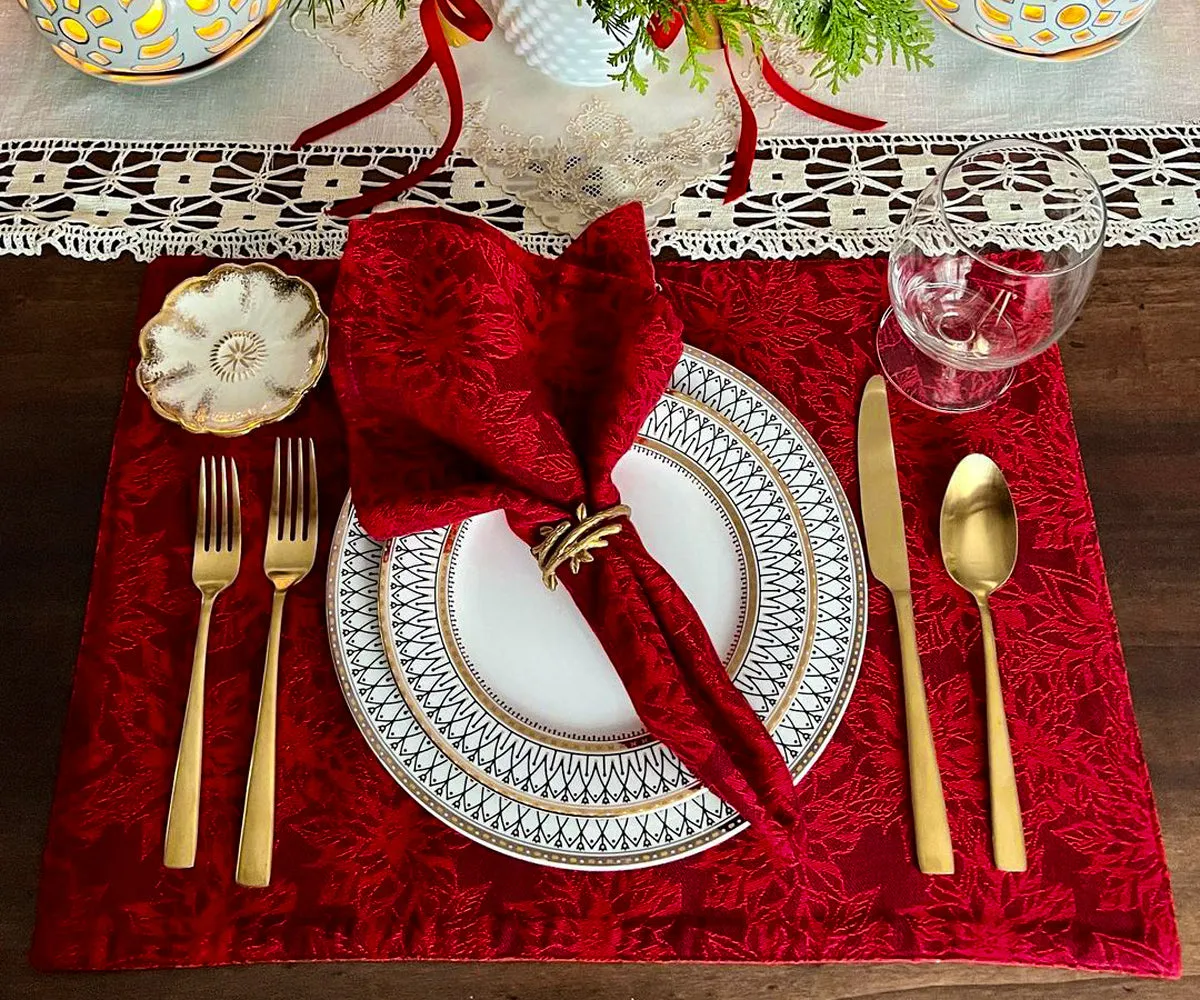
when your plate has a graphic border, keep the napkin ring simple and the placemat textured but not patterned in the same scale. The geometric border is already loud; a floral napkin ring on top of it would fight. This is why the gold leaf ring works — it’s organic, but it’s a single clean shape.
Before you commit to gold flatware, check two things: whether it’s hand-wash only (most good gold-plate is, and dishwasher cycles strip the finish within a year), and whether the color temperature matches your plates. Warm gold against cool silver-toned china looks accidental. Put one fork next to one plate in the store before you buy eight.
33. Red Crystal Candelabras with Dangling Prisms
Tall deep red glass candelabras with dangling crystal prisms, flanked by cut crystal stemware, surrounded by ornate porcelain plates and cups with gold and floral detailing, on a white lace tablecloth with a carved wooden mantel behind. The candelabras are the one thing, and they are not subtle. They throw colored light and hard sparkle across the whole table, which is exactly what a formal Christmas dinner wants.
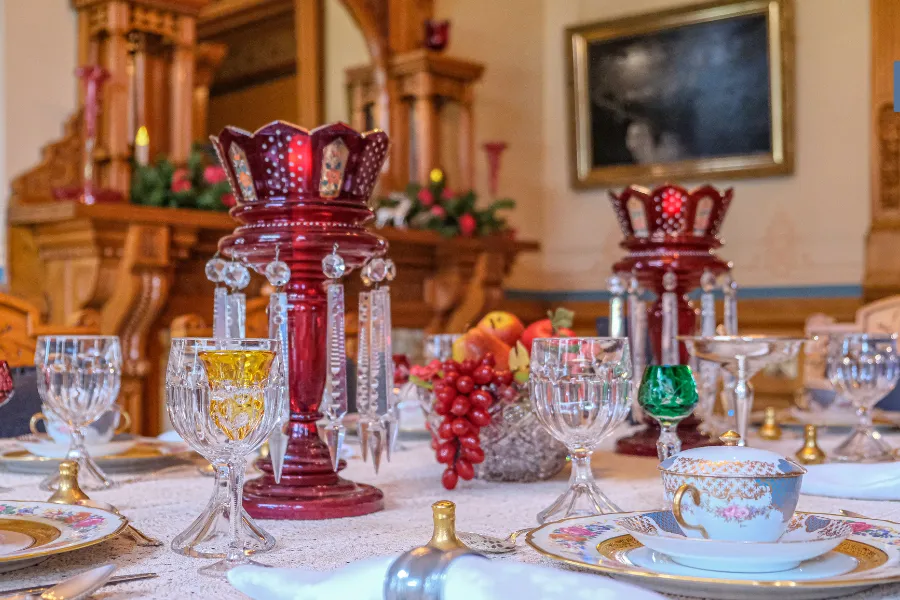
red glass with prisms is delicate in two ways. The prisms loosen and go missing, and hard water etches red glass permanently if it’s left to soak. Hand-wash in lukewarm water with a drop of dish soap, dry immediately with a microfiber cloth, and store prisms in a padded bag with the candelabra. Expect to spend 15 minutes on care per candelabra per season.
Scale note: this is a large-table look — 8 feet or longer, high ceilings, formal chairs. On a smaller table the candelabras will dominate the conversation. Idea #8 gives you formal sparkle at a much more forgiving scale.
34. Red Tapers in Silver Holders Beside the Cheese Board
A red and beige botanical print tablecloth, off-white ribbed plates, deep red napkins with silver rings, tall red tapers in silver holders, a deep red floral centerpiece with green foliage, and — crucially — actual food. A cheese board, a salad, a wine decanter. This is the table in the collection that looks like people are about to eat at it, which is the highest compliment a tablescape can get.
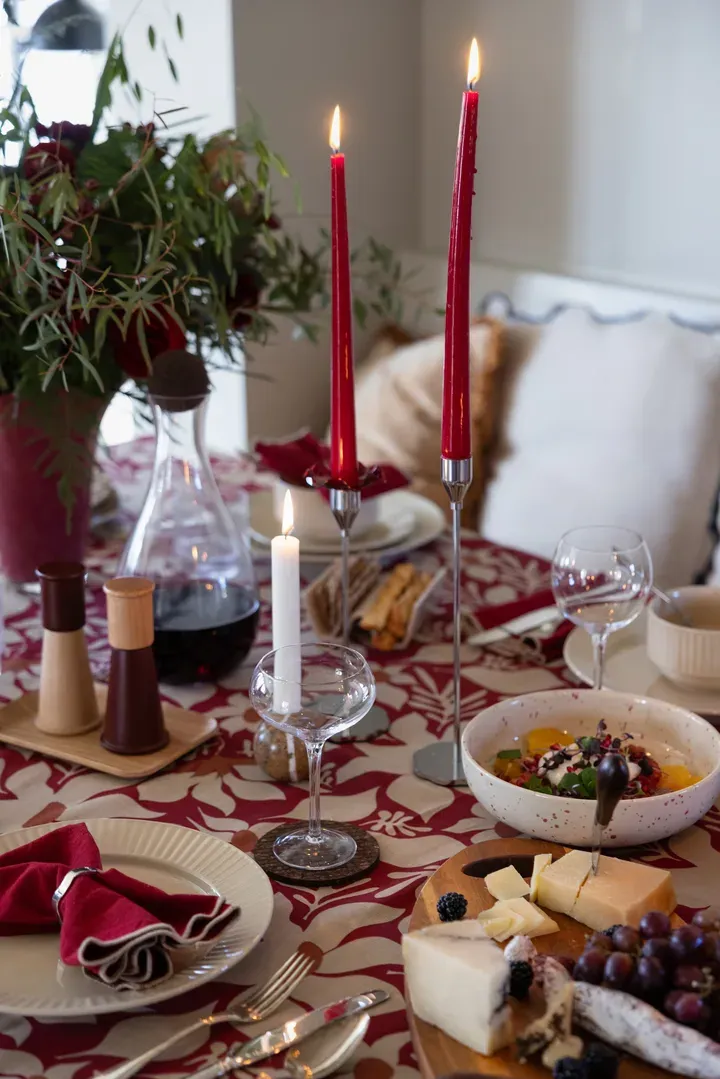
Why it works: the botanical print is busy, so everything on top is quiet — off-white, silver, one red. And the candles are tall and thin rather than wide and low, so they don’t block sightlines across a table where people are passing plates and reaching for cheese.
put the cheese out an hour before guests arrive so it comes to room temperature, and keep the decanter away from the candles — a warm decanter makes red wine taste flat within twenty minutes. Move the tapers to the far end and let the food have the center.
Light the Candles and Let the Red Do the Work
You don’t need thirty matching plates or a floral budget to set a table people remember — you need one thing that carries the room and a whole lot of restraint around it. Pick your anchor, keep the rest quiet, and light the candles five minutes before anyone sits down.
📌 Pin your favorite setting now so it’s waiting for you when December gets busy.