You know that feeling when you finally find the exact right planter arrangement — and it turns out the whole thing was three grocery-store bundles and an urn you already owned? That’s the energy behind outdoor holiday planters in 2026: less plastic, more texture, bigger bows, and containers that actually do the work. We went through Target, IKEA, Etsy, and Facebook Marketplace to pull 32 ideas that deliver, from $5 thrift-store ornaments to $600 full-scale entry displays.
Inside you’ll find traditional evergreen-and-berry builds, rustic natural arrangements with birch and pinecones, cool-toned metallic looks in silver and teal, and a few playful ones for people who want a teddy bear on the porch. Several ideas pair a splurge version with a budget version side by side. And stay until the end — we break down the most common mistakes that can ruin these looks, from soggy mechanics to planters that are simply too small for the door.
📌 Save this to Pinterest for later — you’ll want to revisit these ideas.
1. Ornate Cast Iron Urn with Birch Logs and Mixed Berries
The ornate cast iron urn is doing the heavy lifting here. Take it away and you still have pretty greens — what you lose is the sense that this arrangement is permanent, inherited, and slightly too good for a Tuesday. A dark, footed urn gives mixed evergreens, red berries, blue-green berry clusters, large pinecones, and birch logs a formal base to stand in.
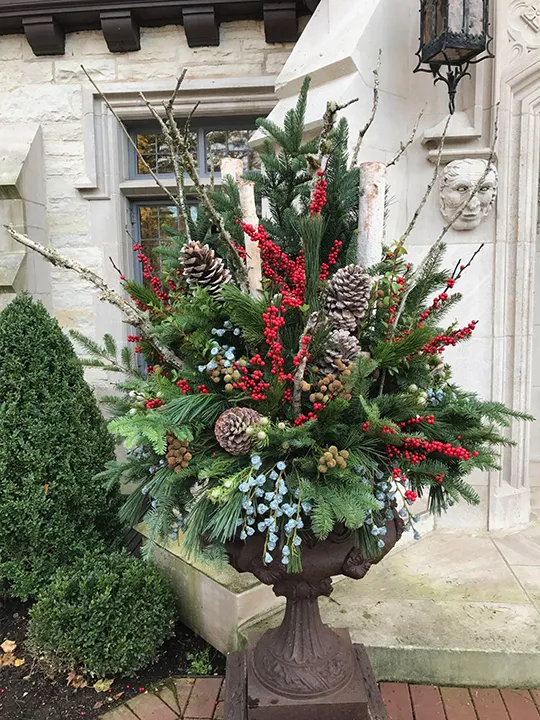
Three things are working at once. Tall birch logs push the eye upward while small berry clusters pull it back down, creating rhythm instead of a green blob. Then there’s texture — needle, berry, cone, and lichen-covered branch each read differently against the light stone facade behind them. Finally, temperature: warm red berries against cool deep greens and pale stone is a contrast that photographs exceptionally well at any hour.
2. Snow-Dusted Stone Planter with Gold and Silver Accents
- Large light-colored stone-look planter: $80–$260
- Evergreen bundles (fir, cedar, pine): $30–$70
- Red berries, pinecones, metallic branch sprays: $25–$60
- Frost spray and foam or cage mechanics: $12–$25
- Battery or solar mini lights: $15–$40
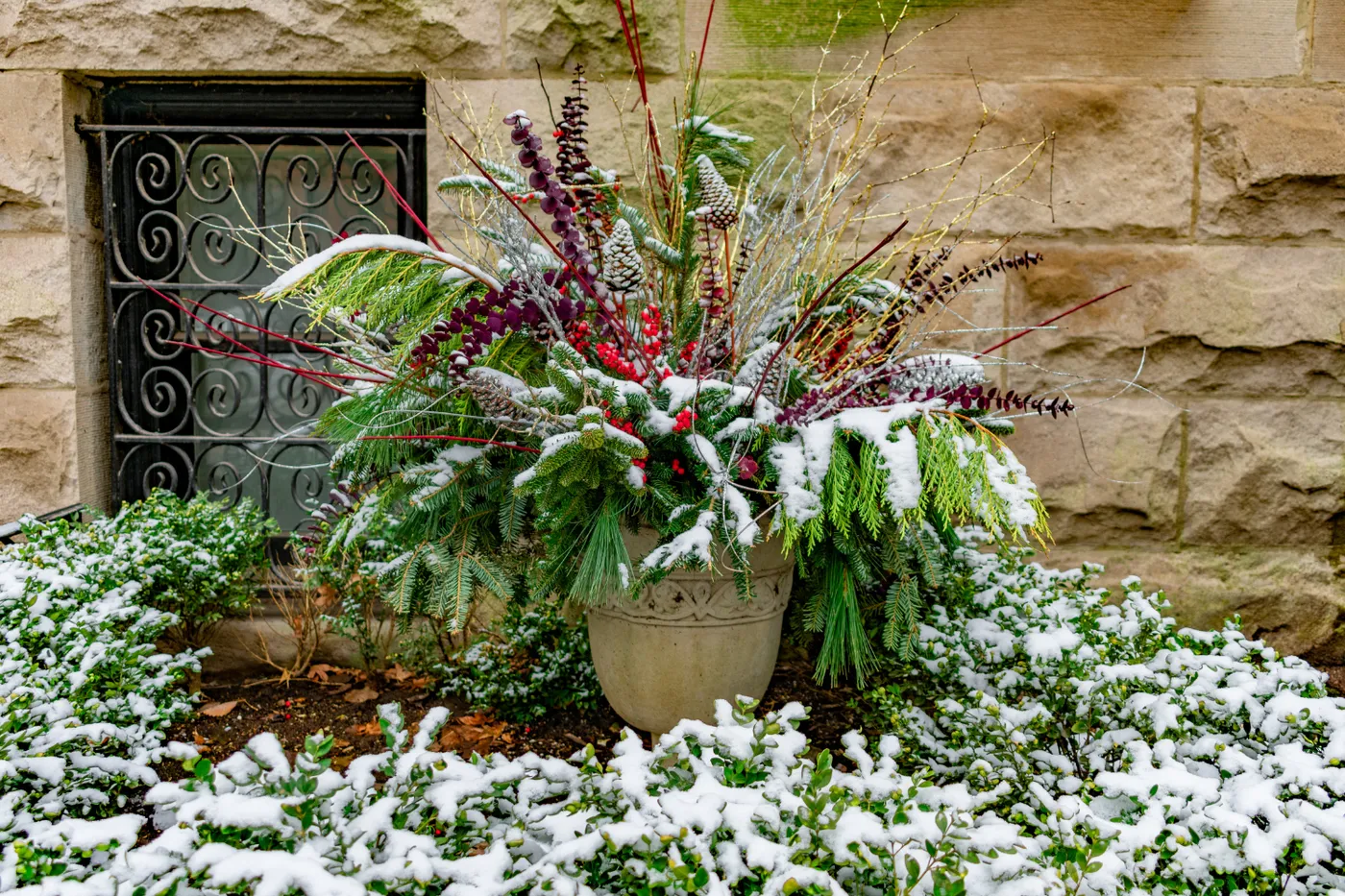
Total: roughly $160–$455 for two planters. Budget alternative: reuse last year’s container, buy one mixed grocery-store bundle for $15, add dollar-store berry sprays, and finish with a can of faux snow. Under $35 total.
Freeze your mechanics, not your design. In a planter that sits below freezing, soak floral foam and let it freeze solid before you push stems in — the ice holds branches upright all season without a single wire. Stop the foam an inch below the rim so you can hide it under pine tips and snow-dusted cones. One caution: metallic sprays turn brittle in cold, so set the gold and silver branches deep in the center where the greens protect them.
3. Twin Grey Urns Flanking an X-Pattern Front Door
Read this entry as a formula: 50% evergreen volume, 20% red berry, 15% pinecone, 10% doormat and styling, 5% container. That math is why two urns read as one composition instead of two separate purchases. Swap the red berries for white or orange and the whole entry shifts mood without buying a single new branch. Swap the grey urns for matte black and the door becomes the star instead of the planters.
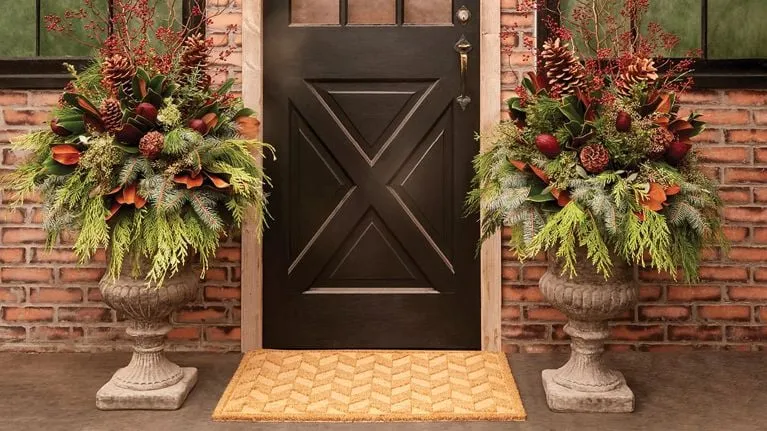
- Two matching planters, same height and species
- One doormat, no wider than the door
- Berries at eye level, never buried
Steps to make the mirrored look actually mirror: measure the distance between planter centers and keep it under 6 feet so the doorway stays framed. Fill both with the same base greenery first, working outward from a tall center branch. Add pinecones to both, checking height from the sidewalk. Place berry branches last, angled slightly toward the door. Then step back 15 feet and photograph both — fix whatever difference you see. About 45 minutes for the pair, $45–$90 in greenery.
Two urns need a stoop at least 5 feet wide with a door of 36 inches or more. On a narrower step, use one planter and let a wreath carry the other side — see Idea #7 for a single-side-friendly build.
4. Dark Fluted Planter Woven with Warm String Lights
A dark fluted planter with warm string lights does not require a designer price tag. Look for a fluted resin urn at a home improvement store for $40–$70, or scan Facebook Marketplace in early November when people upgrade. Battery-operated warm white lights run $8–$15 at Target or Walmart. One grocery-store evergreen bundle plus a bag of dollar-store pinecones lands under $25. Realistic total: $75–$110 for one planter, versus $300 and up for a florist-built version of the same thing.
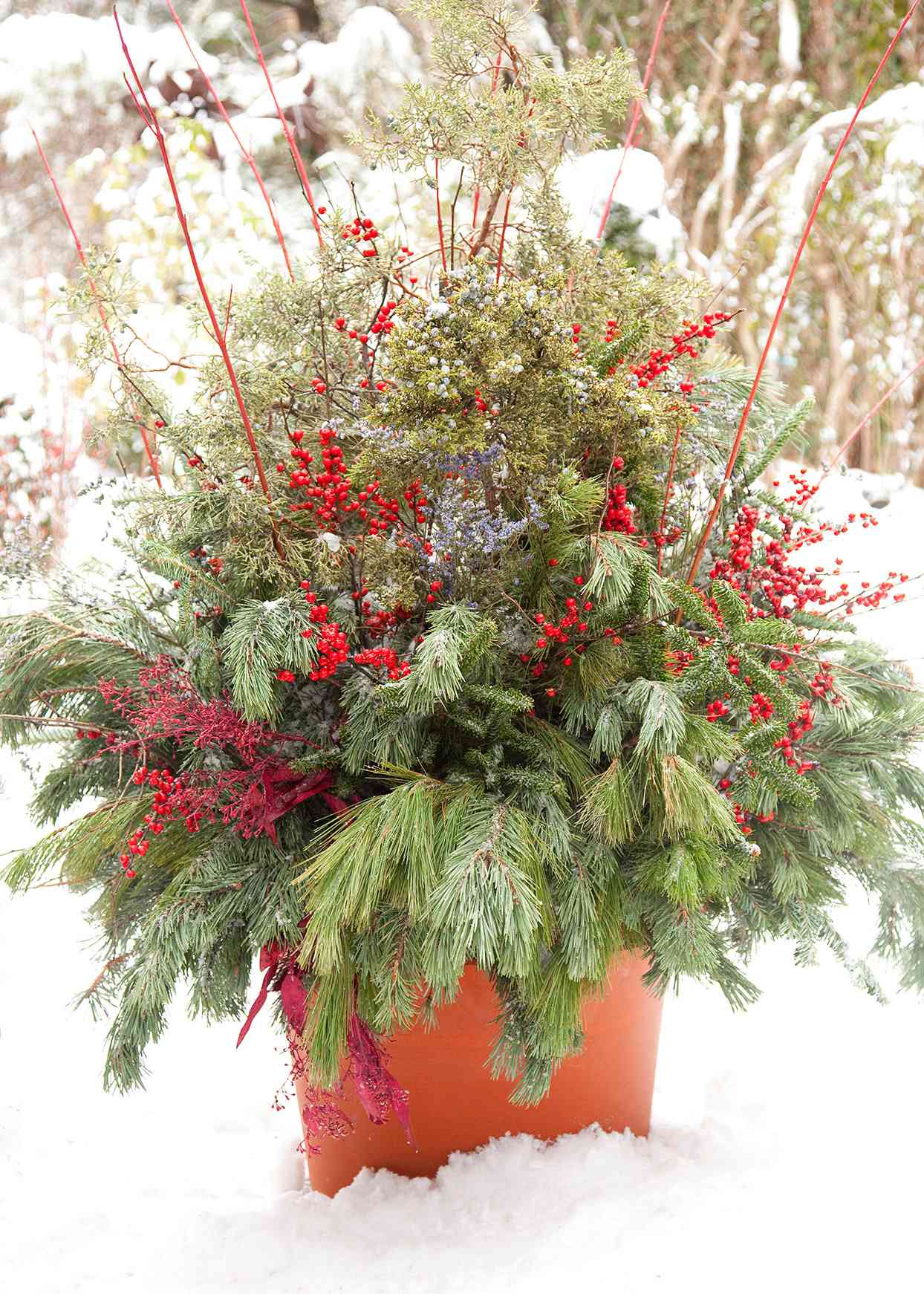
Real evergreens dry out. That isn’t failure, it’s physics — expect needle drop on the interior stems within three to four weeks. Mist the arrangement when temperatures climb above freezing, keep it out of direct sun, and never let it sit in standing water, because frozen roots and soggy foam kill a display faster than cold ever will. Battery lights need fresh cells every three weeks or so. A $12 set of rechargeable AAAs pays for itself before January.
5. Tall Grey Planter Topped with a Big Red Satin Bow
A bow that reads well from the sidewalk is bigger than you think — 10 to 12 inches across, not 6. Use wired satin ribbon at least 2.5 inches wide, because thin craft ribbon collapses in wind and looks like string from 20 feet away. Anchor it with a zip tie around the top center stem, then fluff the loops outward rather than flattening them against the greens. One oversized bow beats three small ones every single time, and it gives the thin brown twigs something to frame.
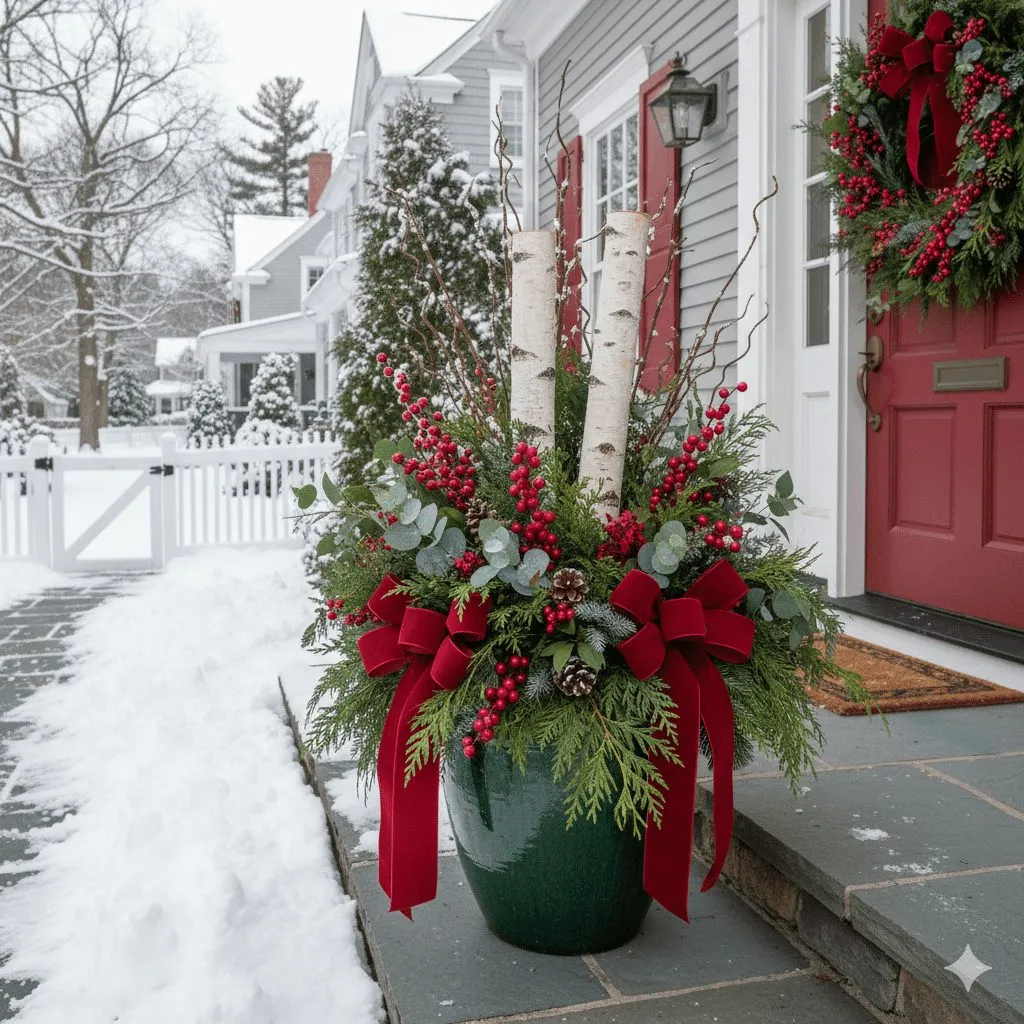
- Confirm the rim diameter — a 12-inch rim holds about one bundle plus accents
- Check the spot for wind; tall twigs snap in exposed entryways
- Pick a color story: deep green, bright red, natural brown, one metal
- Measure door height so the arrangement tops out below the handle
6. A Porch Swing, Lit Evergreen Urn, and Vintage Sled
A porch this layered takes work, and lights are the honest sticking point. Outdoor-rated string lights on a timer are non-negotiable. Untreated lights on a porch pillar fail by mid-December, and an extension cord stretched across a walkway is a genuine trip hazard. The textiles deserve a mention too: faux fur cushions and a chunky white knit throw look wonderful and get damp. Bring them in during rain, or choose solution-dyed outdoor fabric and store the throw in a lidded bench between uses.
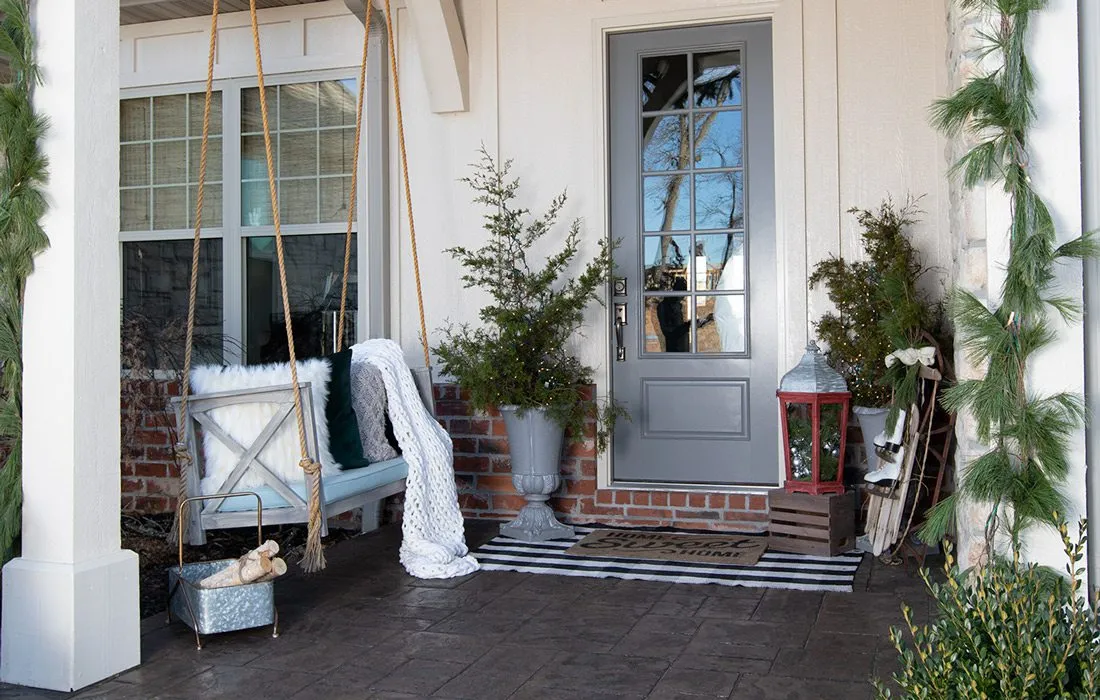
Wrapping a pillar with pine garland: start at the bottom and work up so each overlap points downward like real growth. Secure with green zip ties every 12 inches — clear ties flash in photos. Weave the lights through after the garland is hung, not before. Tuck a few pinecones into the spiral to hide the hardware. Roughly 30 minutes per pillar, with garland and lights running $35–$70.
7. Black Square Planters with Burlap Bows and Berry Sprigs
Burlap-bowed black planters want a porch at least 6 feet wide with a clean wall behind them. On a narrow step, drop to 18-inch planters instead of 24-inch — oversized containers on a small stoop make a door look like it’s sinking. If your entry is genuinely tight, one planter plus a simple wreath on the white paneled door reads more composed than two squeezed urns fighting for space.
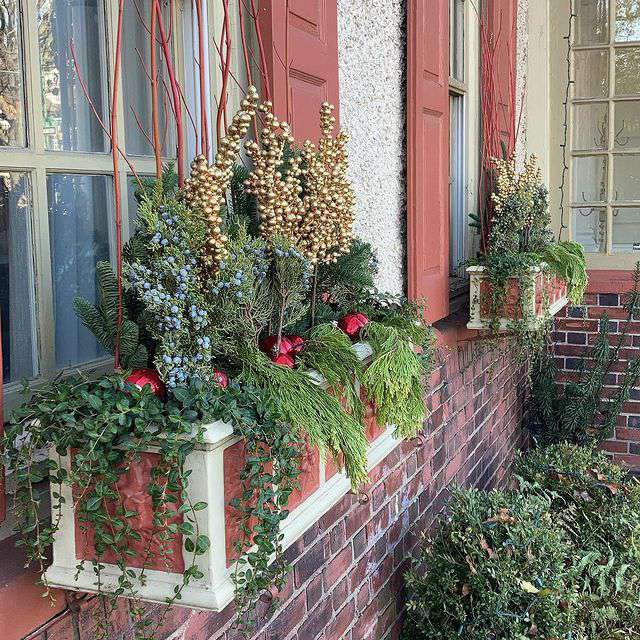
- Two tall black square planters: $60–$200
- Evergreen boughs, two bundles: $30–$60
- Red berry sprigs: $10–$25
- Pinecones, one bag: $6–$15
- Burlap ribbon, two rolls: $10–$20
Total: $116–$320. Budget alternative: two 16-inch buckets sprayed matte black, thrifted burlap from a fabric remnant bin, and clippings from a neighbor’s cedar. Often under $40 for the pair.
8. Terracotta Urns and Garland at an Arched Brick Entry
The garland is the anchor and the planters echo it, which is exactly why this entry feels finished rather than decorated. Look at the repetition: pinecones appear in both the arch and the urns, red runs from ornaments to berries to the tall bare branches, and white spheres show up twice. That two-part echo is what makes an entrance look designed. The ivy on the adjacent wall adds a soft, living texture that keeps the terracotta and stucco from feeling flat.
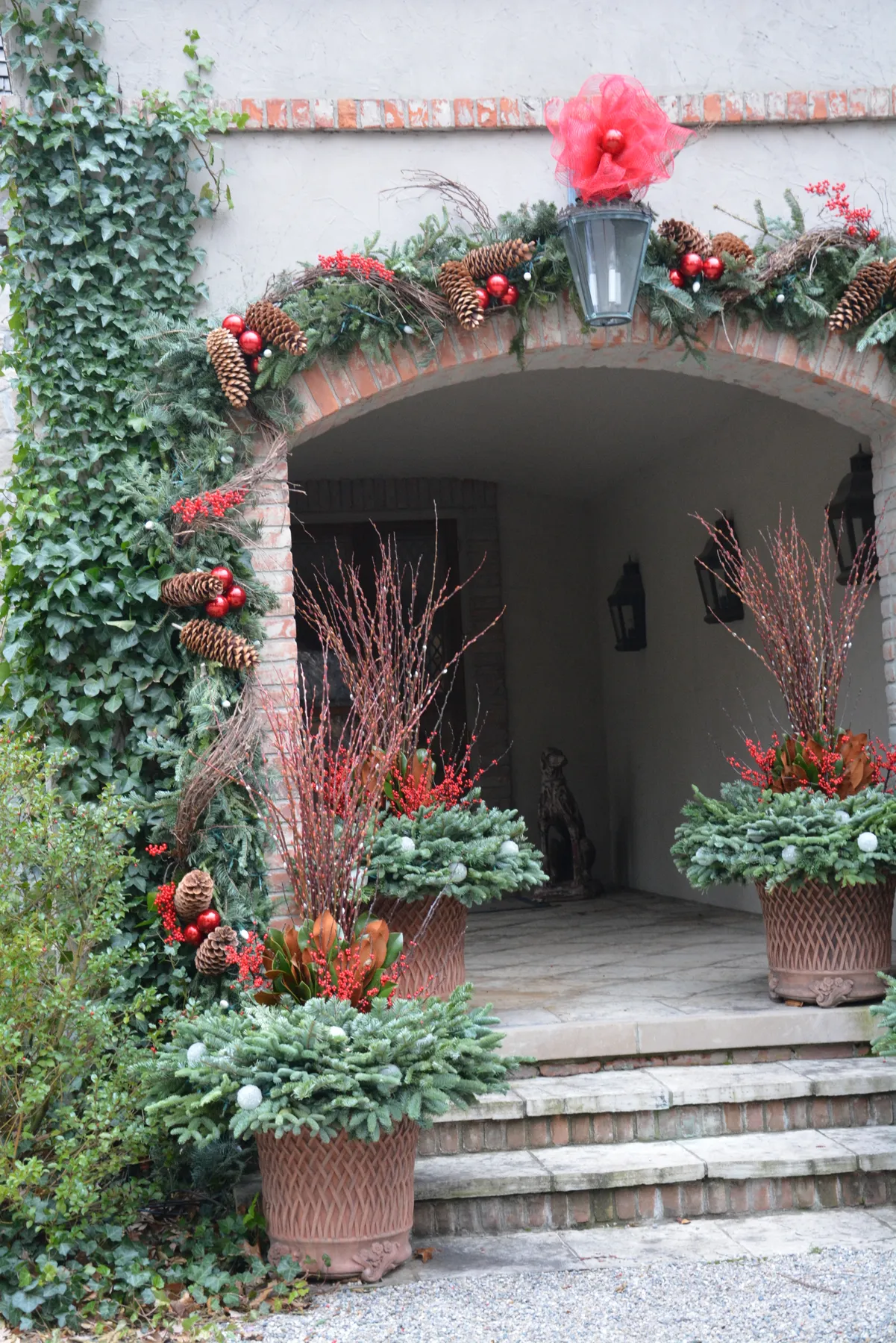
The arched-entry-with-garland look has surged because people are treating front doors like a photo backdrop again — it photographs beautifully at dusk with warm porch light. It’s also a reaction to years of minimal holiday decor; abundance is back. This one has staying power. Garlands and urns are reusable, and the look ages better than anything inflatable you’ll deflate in January.
9. Black Cylinder Planter with Birch Logs on a Blue Stool
The three birch logs in the center are the one thing that matters. Without them this is a nice evergreen bundle; with them it becomes a composition with a spine. Birch reads as bright vertical contrast against deep green, and it gives the arrangement height without a tall branch that would snap in wind. The plaid bow around the planter and the blue-grey eucalyptus-like foliage are what keep it from being just another red-and-green setup.
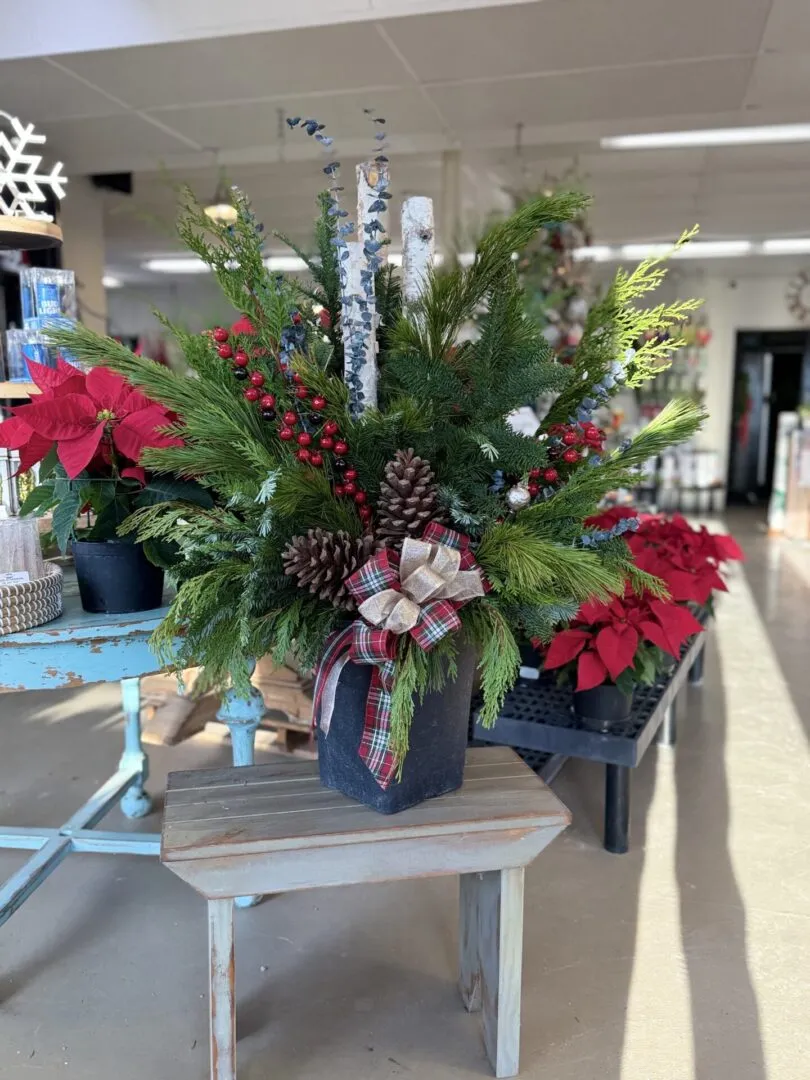
Think 55% evergreen, 20% birch and woody texture, 15% red berries, 5% blue-grey foliage, 5% plaid ribbon. That blue-grey is the quiet hero — it’s the cool note that stops red from looking cheap. Swap the plaid for solid velvet ribbon and it reads more formal; swap the birch for dark curly willow and the whole thing turns moodier and heavier.
Standing birch logs upright without a cage: cut three logs to slightly different heights, 24 to 34 inches. Bundle them with two zip ties so they form a tripod. Set the bundle in the planter first, off-center by about an inch. Pack foam or soil around the base and water lightly to settle it. Fill the greens around the logs, never over them. Twenty minutes, and birch logs run $12–$30 at a garden center.
10. Two-Tone Glazed Planter with Curly Red Branches
Curly red branches look best in odd numbers — three or five, never four. Cut them at different heights so the curls sit at staggered levels; matched heights read like a fence line. Insert them at a slight outward tilt, around 10 degrees, so they arc into the arrangement instead of spearing straight up past the birch. If your branches arrive dead straight, warm them with a hairdryer for a few seconds and bend gently.
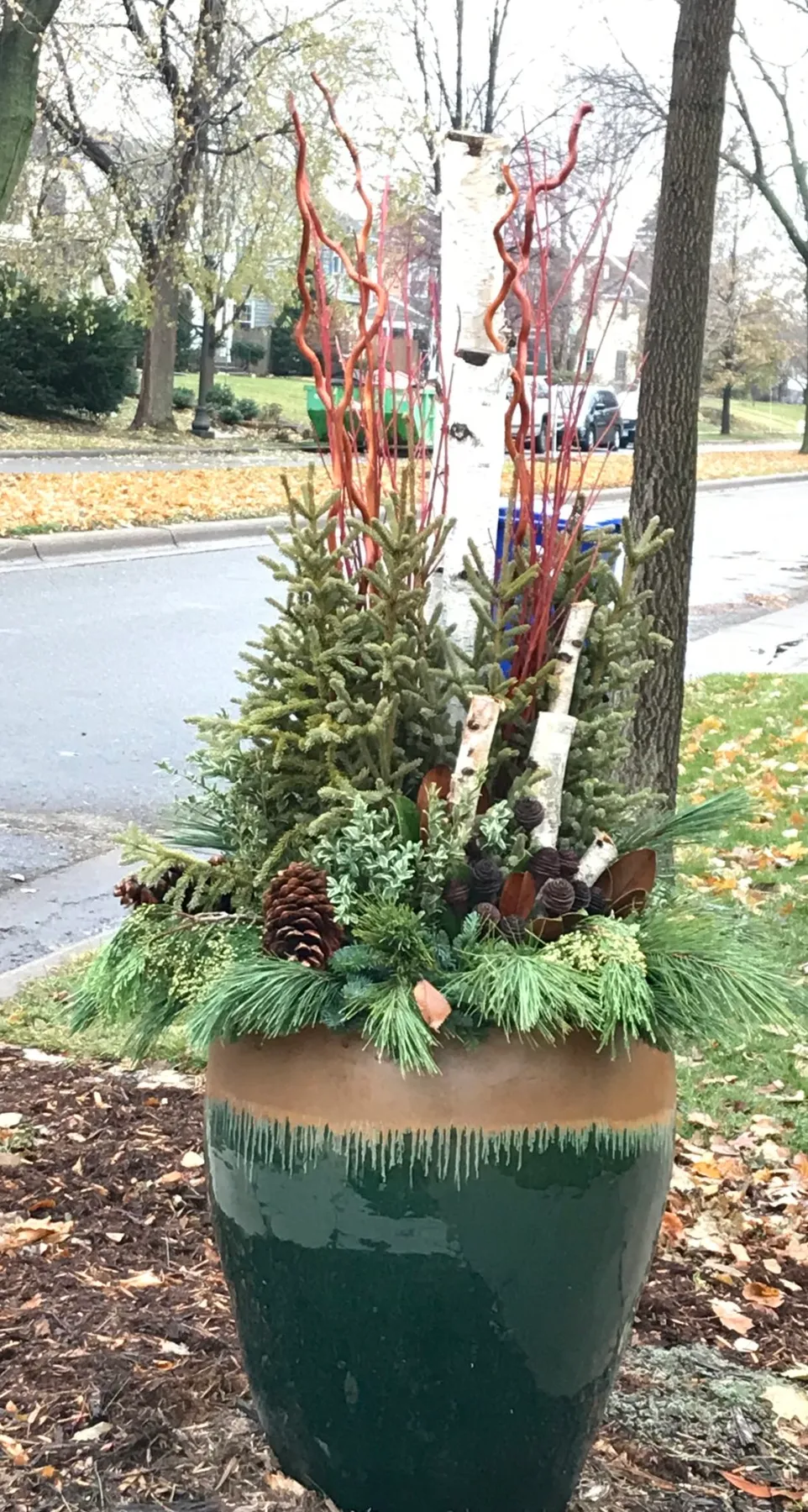
Glazed ceramic outdoors is a year-round commitment, and the real risk is a freeze-thaw crack. Empty this planter in late January so water can’t pool and expand, and lift it off the ground on a brick or two so it doesn’t freeze to the surface. Dried leaves and seed pods keep indefinitely. Birch bark yellows after a full season of sun, so plan to refresh the whites every year or two rather than expecting permanent brightness.
11. The Evergreen Skeleton: Your Planter’s Starting Formula
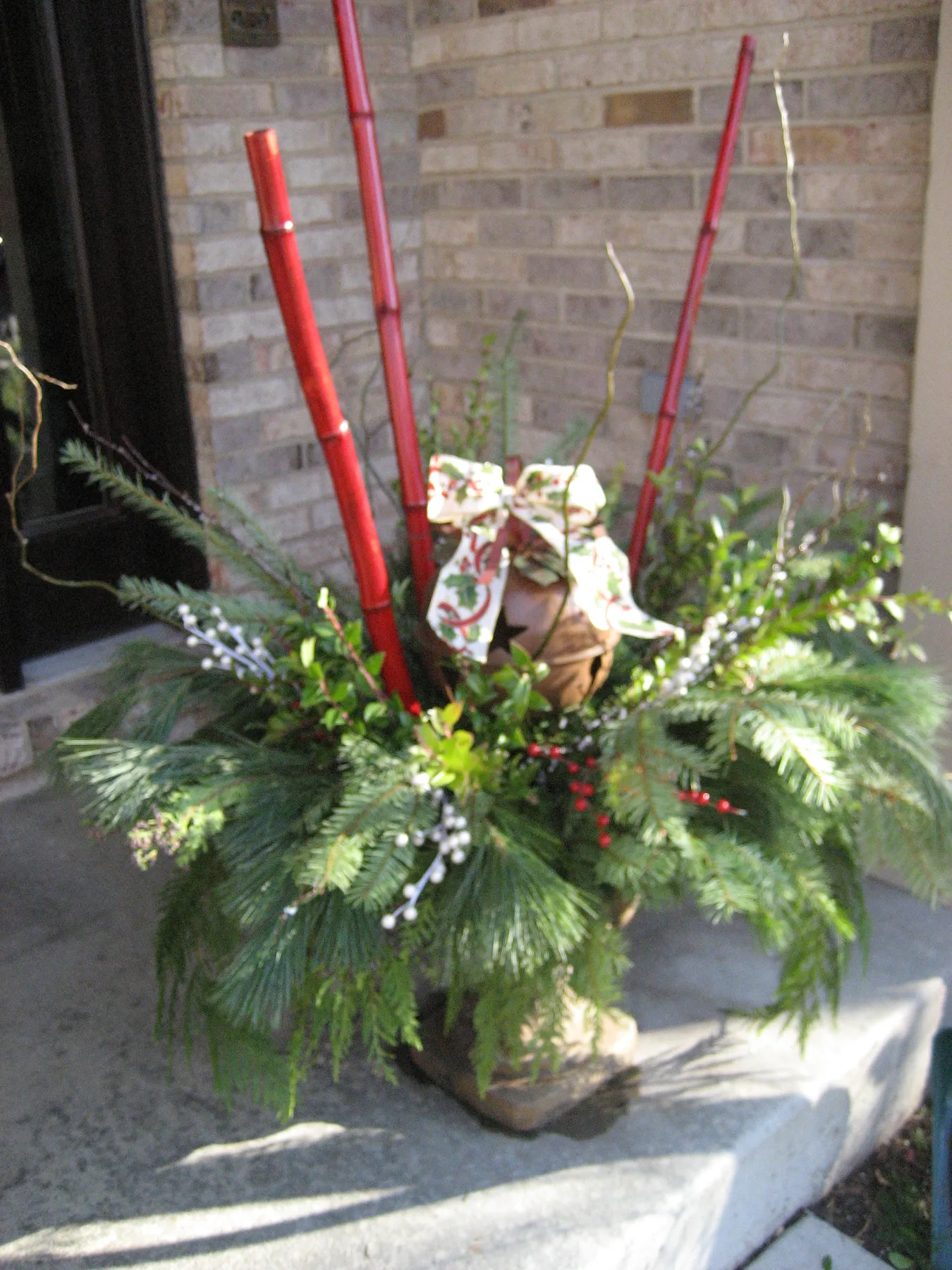
Before you buy a single branch, work out your framework: container diameter (14 inches minimum for a mixed display), where the planter will sit, and whether you want it to look good from one angle or four. Check sun exposure too — a south-facing spot bleaches color while a north-facing one holds moisture and can rot stems. Set a budget ceiling, because greenery adds up faster than you’d guess, and figure out how you’ll water it. A planter you can’t reach with a hose will be a planter you forget.
- Container diameter and depth
- Sun direction and wind exposure
- One-angle or four-angle viewing
- A real budget ceiling
- A watering method you’ll actually use
The evergreen skeleton is 60% greens, 20% structure (birch, twigs, branches), 15% color accent (berries, ornaments), and 5% ribbon or bow. That ratio holds whether you’re building a $25 grocery-store arrangement or a $400 florist piece. Change the accent color and you change the season feel; change the structure and you change the silhouette entirely.
12. White Poinsettias and Birch Logs Between Black Doors
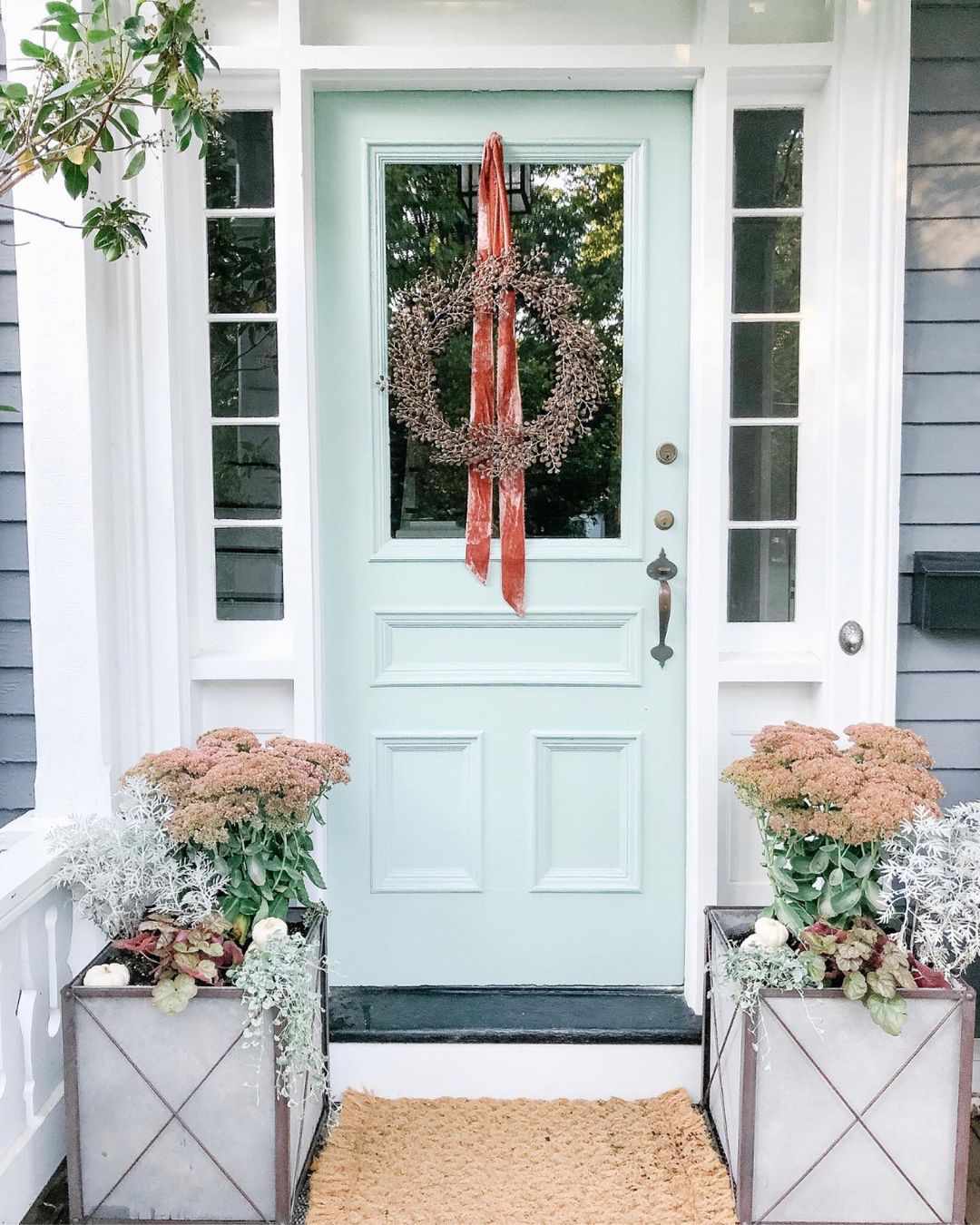
White poinsettias between black double doors work because of restraint. There is no red anywhere — the palette is white, deep green, brown birch, and dark grey — so the arrangement reads elegant instead of cheerful. The upright birch logs also echo the vertical lines of the door panels, which is why the composition feels deliberate rather than plopped. Scale matters too: these planters are nearly half the door height, which is what keeps them from looking like an afterthought.
- Two large dark fluted planters: $90–$280
- White poinsettias, six to eight: $30–$60
- Evergreen bundles: $30–$70
- Birch logs, six: $20–$45
- Floral foam and stakes: $10–$20
Total: $180–$475. Budget alternative: one white poinsettia per planter ringed with free cedar clippings and paper-birch logs cut from a fallen branch. Around $45 for the pair.
13. Textured Dark Planter with Mixed Greens and Glow Behind
Texture-first arrangements photograph beautifully and drop needles noticeably. A dark textured planter also collects snow and water in the grooves, so confirm the base drains before you build. Watch your warm string lights as well — if they sit too deep in the greens, the heat and dryness speed up needle drop right where people see it up close. Keep the bulbs on the outer third of the arrangement, where they glow against the needles instead of cooking them.
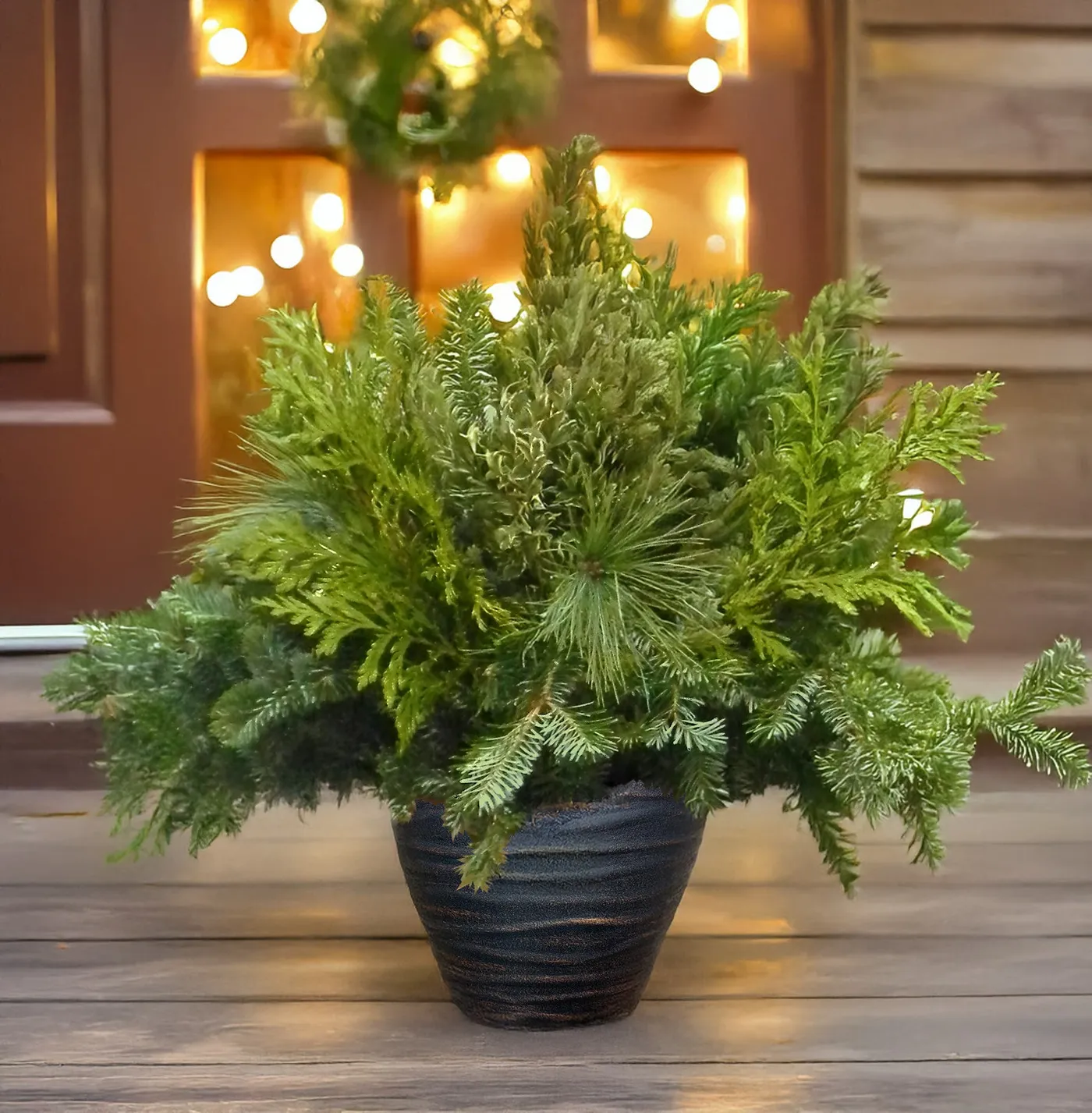
This works at nearly any size because it’s really a container-and-greens study: a 12-inch planter on a step, or a 20-inch on a covered porch. The wooden plank flooring suggests a sheltered entry, which means less wind damage and much better light retention on the greens. If your entry is wide open to the street, see Idea #5 for a wind-friendlier build with more structural branches inside it.
14. Magnolia Leaves and White-Tipped Pinecones in a Fiber Basket
Lining a basket or planter with natural fiber: cut a piece of burlap or coir 4 inches wider than the rim. Press it into the base, pleating the excess rather than cutting it. Set a foam block or a soil-filled inner pot on top of the liner. Fold the fiber over the rim last, so the edge hides the mechanics instead of the other way around. About 15 minutes and a few dollars of burlap gets you a display that looks collected rather than purchased.
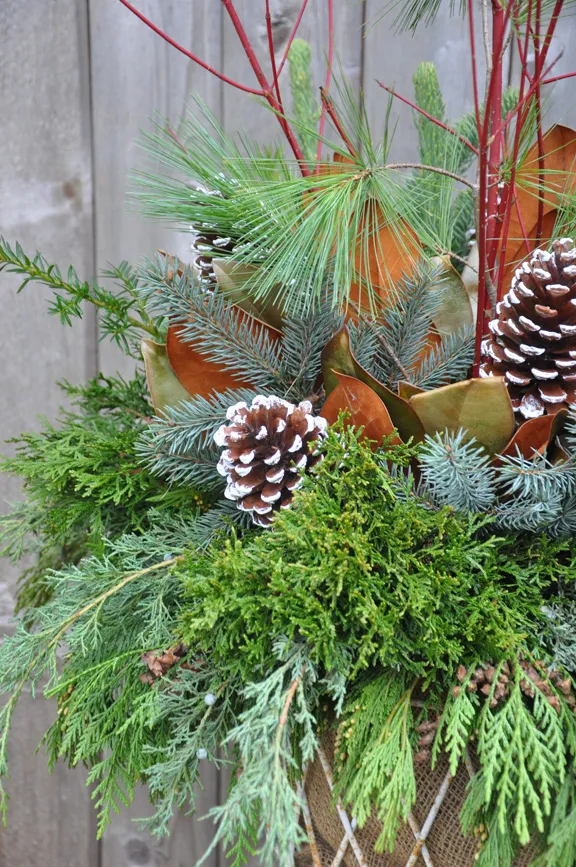
Magnolia leaves are the budget trick — one bag at a garden center runs $8–$15 and reads expensive. Pair them with a single grocery-store evergreen bundle ($12–$18), white-tipped pinecones from a dollar store, and a handful of red-toned branches you’ve sprayed yourself ($6 for a can). Total: about $40. Compare with Idea #1, where the same palette runs into the hundreds mostly because of the container.
Magnolia leaves should go in last and face outward, like shingles on a roof. Lay each leaf so it overlaps the one below by roughly a third. The underside is a dull rust-brown that makes a gorgeous accent color — but only when it’s intentional, so flip two or three deliberately to get the two-tone effect.
15. Coir Window Box with Green Apples and Lotus Pods
The green apples. They’re the detail nobody expects in a winter window box, and they’re the reason people slow down and look. Apples add a matte, slightly irregular roundness that berries can’t duplicate, and their yellow-green warms the entire dark green mix. They won’t last forever, but a week or two of novelty is exactly what a window box needs to feel alive instead of staged.
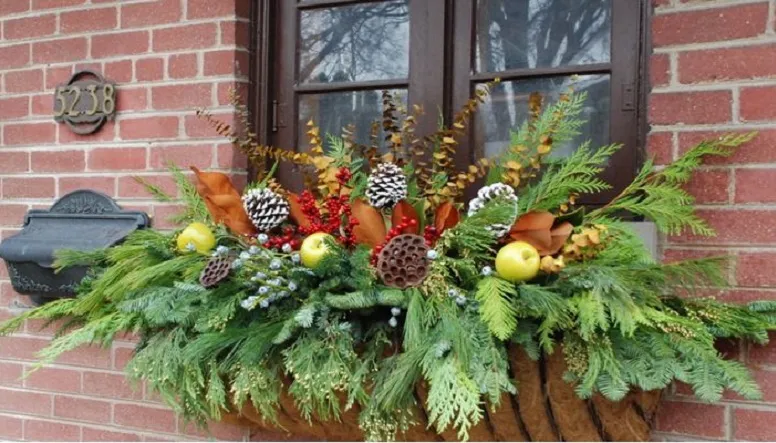
Edible elements in winter planters are quietly trending — apples, artichokes, even citrus — because they photograph with a richness plastic ornaments can’t touch. It’s part of a broader move toward foraging-inspired holiday decor. In a hard freeze, though, apples split. Keep them in a sheltered window box, or swap to faux fruit after the first deep cold and nobody will notice from the street.
16. Silvery-Green Rectangular Planter with a Dusting of Snow
- Dark rectangular planter: $50–$160
- Silvery-green evergreen bundles: $25–$55
- Red berry clusters: $15–$35
- Natural pinecones: $8–$18
- Faux snow spray: $8–$15
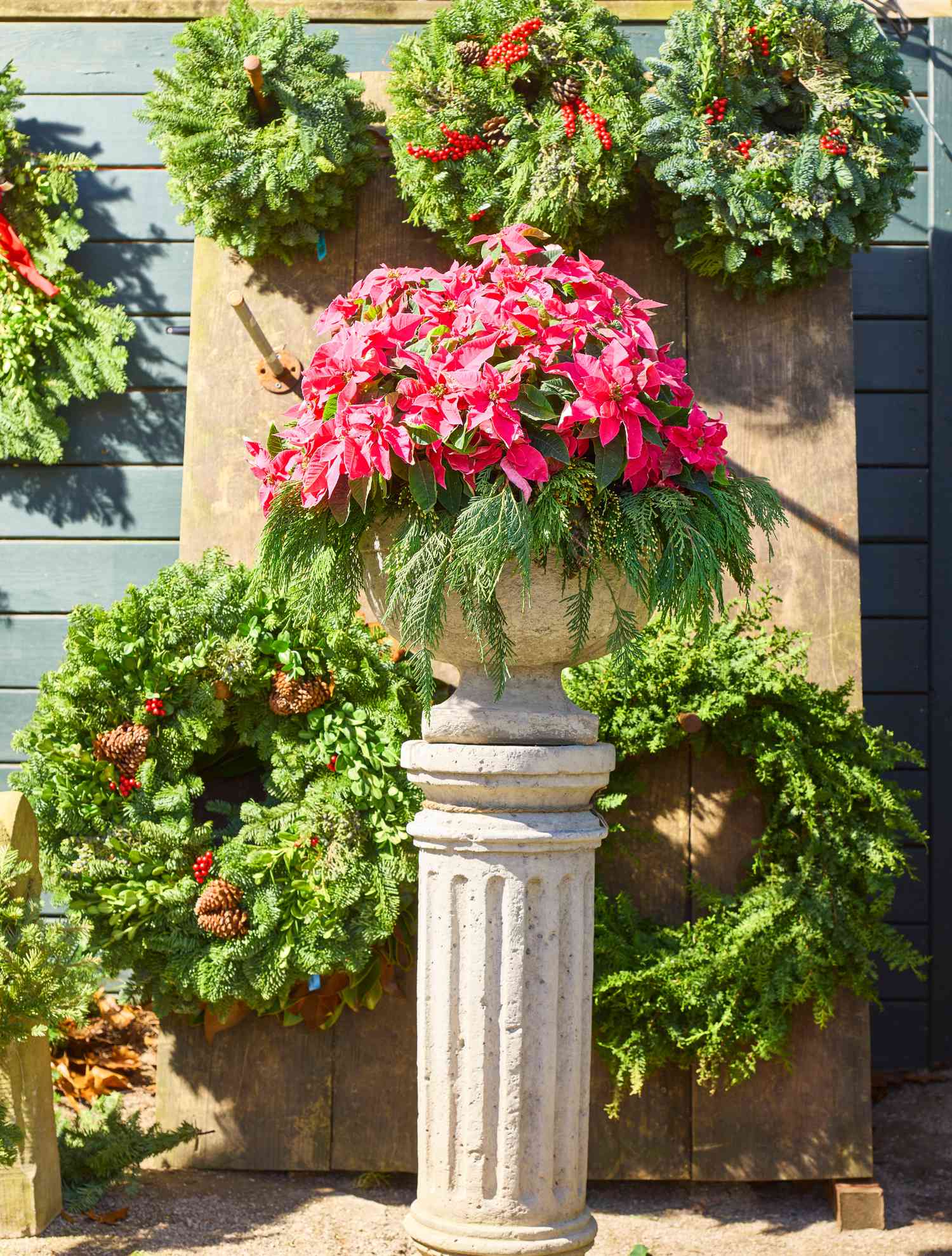
Total: $106–$283. Budget alternative: a 22-inch planter from IKEA, one bundle of silver fir, and pinecones collected on a winter walk. About $45, and no one will know the difference from the sidewalk.
Snow dusting looks serene in photos and slightly sad after a thaw. Real snow melts into the arrangement and matte needles fade to grey-brown; faux snow spray can yellow under UV. Refresh the faux snow after a heavy rain, and choose a planter with a clear drain hole so meltwater doesn’t sit against the roots. Silvery greens genuinely stay fresh longer than most firs, which is a real advantage if you want this looking good into January.
17. Tall Conifer Centerpiece with Red Twig Accents
A tall conifer centerpiece plus mixed greens is a generous arrangement — plan on a planter at least 16 inches across and a spot with headroom. It works best beside a door rather than flanking both sides, because two planters this full can visually squeeze a doorway. On a small porch, one is plenty. On a wide step, two with about 5 feet between them. For the mirrored twin-urn version of this idea, see Idea #3.
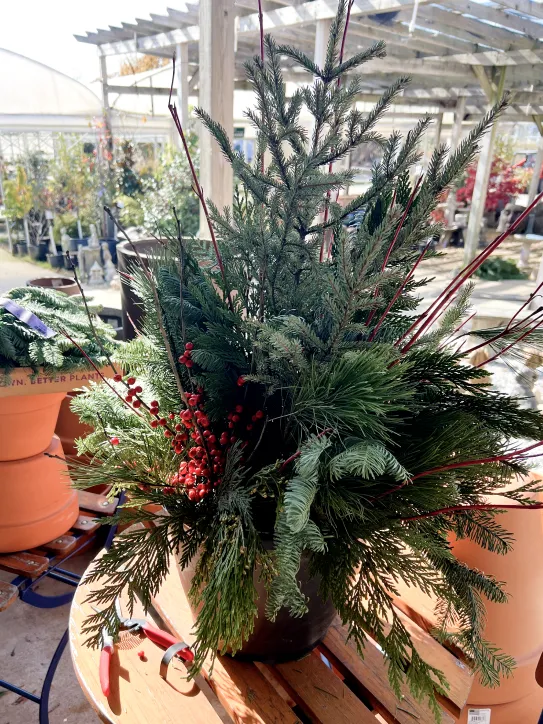
The small conifer at the center is the single element that matters. It turns a bundle of cut greens into something that reads like a living planting, and it’s the only piece with a predictable shape. Everything else is texture; the conifer is form. Choose one that tops out at about two-thirds the height of your finished arrangement so branches can taper down around it naturally.
Building height that doesn’t collapse: set the conifer first, slightly off-center. Add the longest branches horizontally at the base to widen the footprint. Fill the middle with medium stems at a 45-degree angle. Push short, fine tips into the top and around the rim. Finish with red berries at three heights — low, middle, top. Forty minutes and $50–$100 in materials.
18. Weathered Stone Urn with Birch Poles and Speckled Fruit
Real stone urns are heavy, so never move a filled one. Set the empty urn in its final position, then build in place. Line the inside with a plastic nursery pot so you can lift the whole arrangement out after the holidays and dump the greens without tipping an 80-pound container. It also protects the stone from tannin staining, which is permanent on porous surfaces and shows up as dark ghosting around the base.
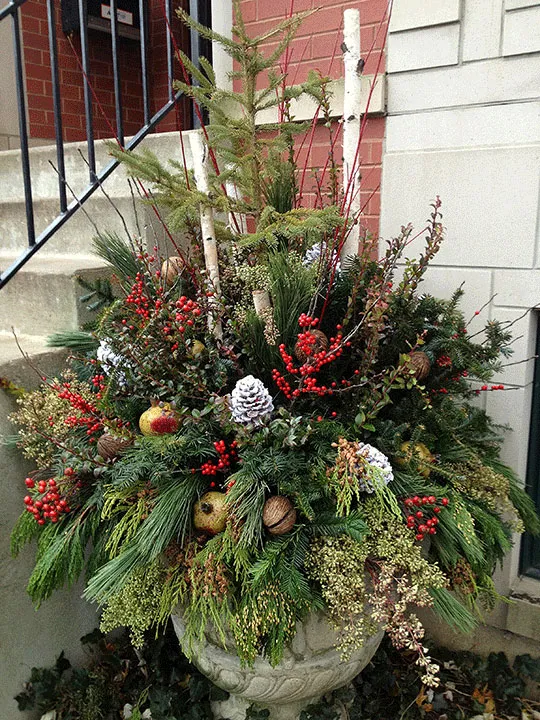
Weathered stone without stone prices: a resin urn in a grey-buff finish runs $45–$90 and weighs a fraction as much. Add birch poles from a craft store at $3–$6 each and a bundle of red twig dogwood for about $12. Speckled fruit — crabapples or faux pomegranates — comes from a grocery store for under $10. The whole display lands near $85 and looks like it cost four times that.
Nuts and fruit in a winter arrangement attract squirrels, and once they find it, they’re relentless. If you’ve tucked in walnuts or crabapples, expect visitors by week two. Faux versions solve it instantly. Real stone also absorbs water, so keep the urn’s drain clear and never let it sit in a puddle through a freeze.
19. Evergreen Planter with Red LED Branches and Silver Bow
Red LED lights on dark branches are the reason this arrangement works after dark, and it’s a genuinely different design than the daytime version. The lights glow from inside the arrangement rather than outlining it. The red and silver ribbon bow adds a metallic note up top, and the white-painted branches keep the dark greens from going muddy in low light. Daytime it reads lush and natural; nighttime it reads warm and deliberate.
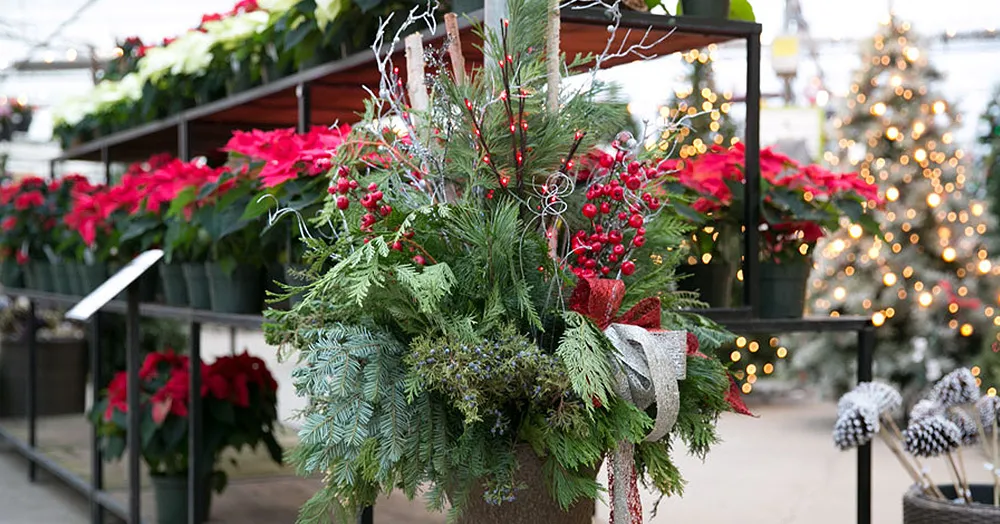
- Confirm the lights are outdoor-rated and on a timer
- Test the ribbon outside — some satins fray in wind
- Check that berries are wired, not glued; glued ones drop in cold
- Place the bow so it doesn’t block a house number or handle
20. Gray Slatted Square Planter with Cedar and Pine
The math here is 50% mixed evergreens, 15% red berries, 15% natural wood branches, 10% pinecones, 5% lights, 5% container. Cedar is the soft, flat note; pine is the crisp one. Keeping both in the same planter is why this looks expensive with zero ornaments. Swap the red berries for orange and it becomes a fall arrangement that lingers into December without anyone questioning it.
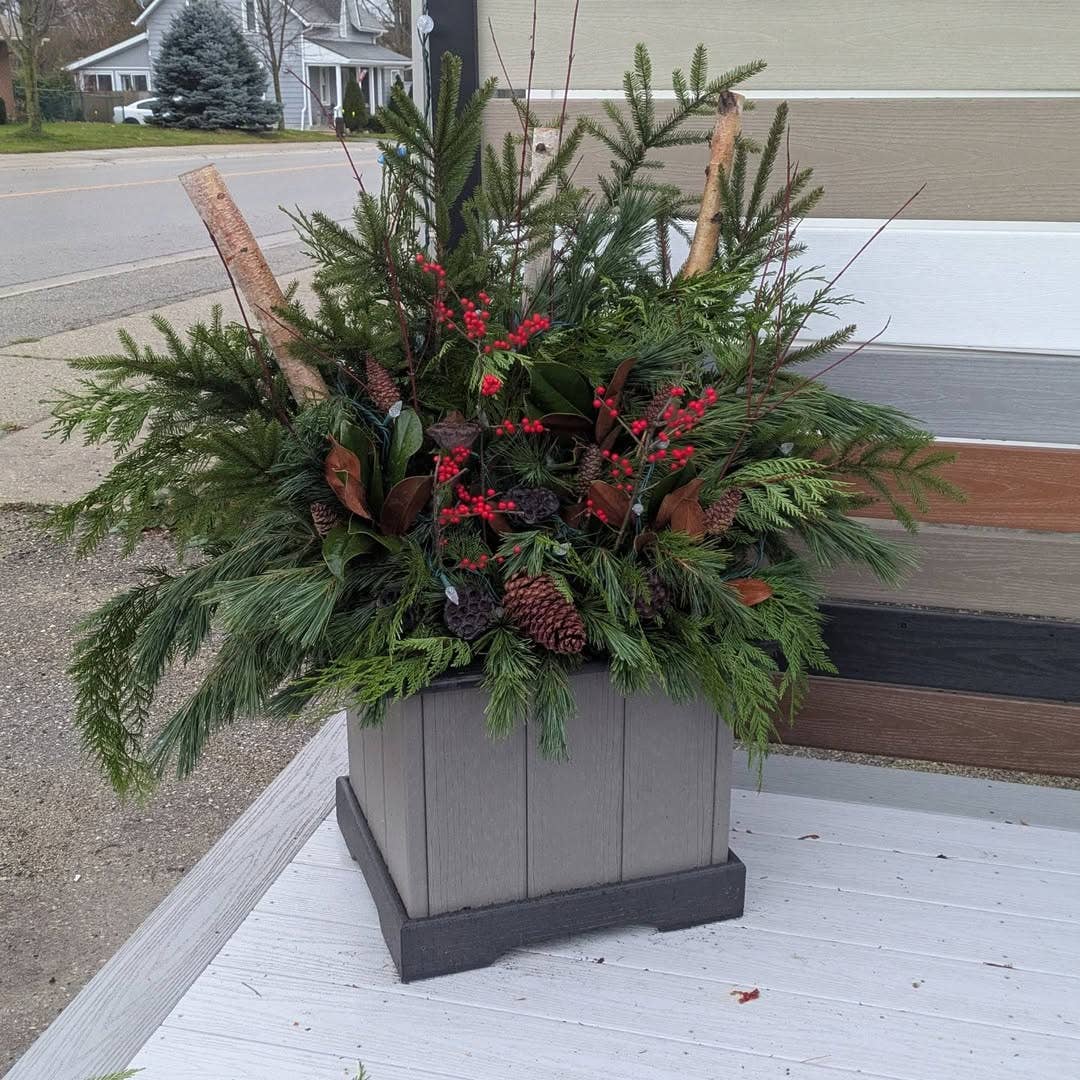
Slatted planters are gorgeous and thirsty. The gaps let air move through the root zone, which dries greens faster than a solid container — you’ll be watering every four or five days instead of weekly in a mild climate. Line the inside with a plastic pot or a burlap layer to slow moisture loss. Also, skip white mini lights on a white wall; they’ll disappear entirely.
- Line slatted planters with plastic or burlap
- Water every 4–5 days in mild weather
- Confirm the base won’t stain a light surface
21. Distressed Terracotta Planter Against a Snowy Cabin
Terracotta is one of the cheapest good-looking containers there is. A large unglazed clay pot runs $30–$60, and a distressed finish is nearly free — leave it outside through one winter, or rub it with sandpaper and diluted craft paint in an afternoon. Evergreen bundles at a hardware store are $10–$15. Warm string lights, about $9. Berries from a dollar store, $6. You’re looking at $60–$95 versus several hundred for a florist-built display with the same silhouette.
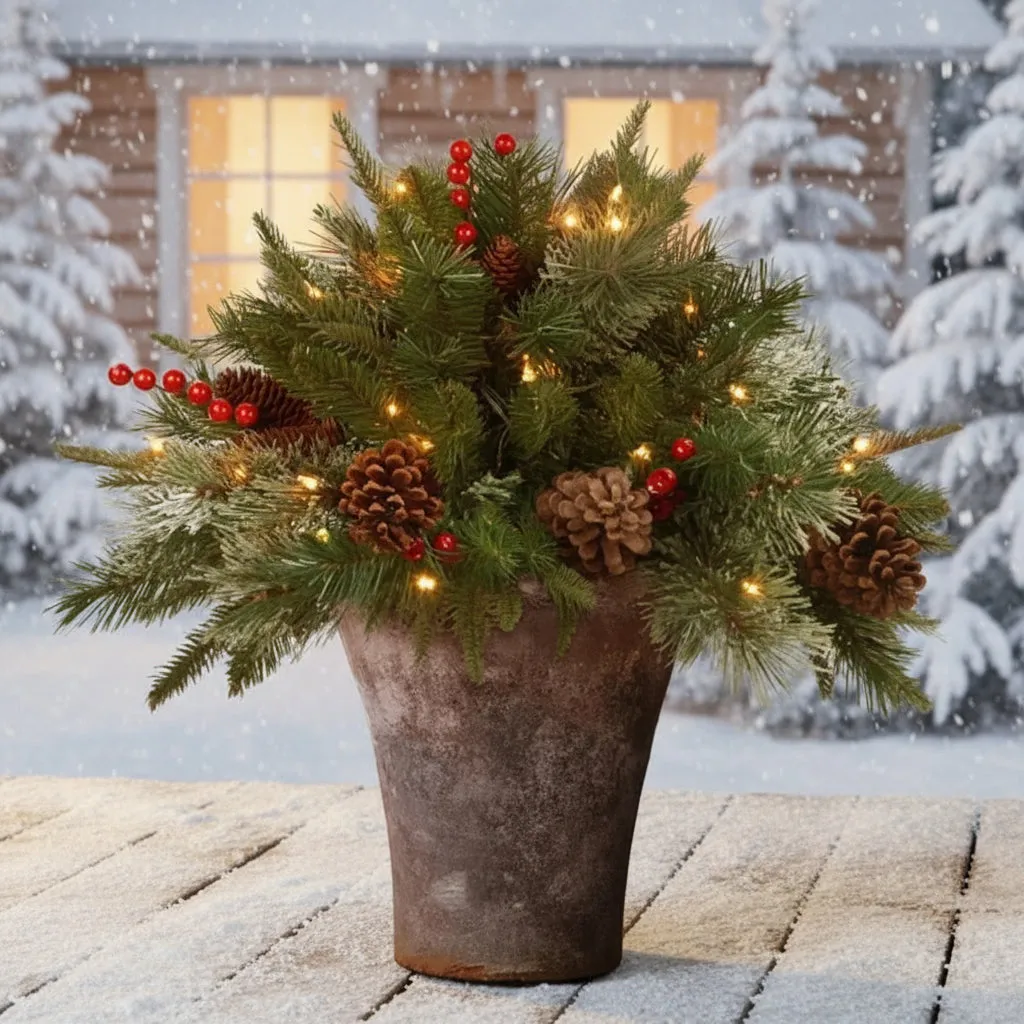
Making a new terracotta pot look weathered: wipe it clean and let it dry completely. Sand the edges and rim with medium grit where wear would naturally happen. Mix a tablespoon of white latex paint into a cup of water. Brush the wash over the surface and wipe most of it back off. Seal with a matte outdoor sealer if it’ll see rain. About 30 minutes and $10–$15 in supplies.
22. Teddy Bear in a Black Planter with Oversized Ornaments
Whimsy is back. After several years of restrained, monochrome holiday styling, playful elements — plush figures, oversized ornaments, toy accents — are turning up in outdoor planters again. It’s a reaction to decor that photographed well but felt cold in person. This trend has staying power if you have kids or a porch the neighborhood walks past; if you don’t, one plush figure is plenty to get the effect.
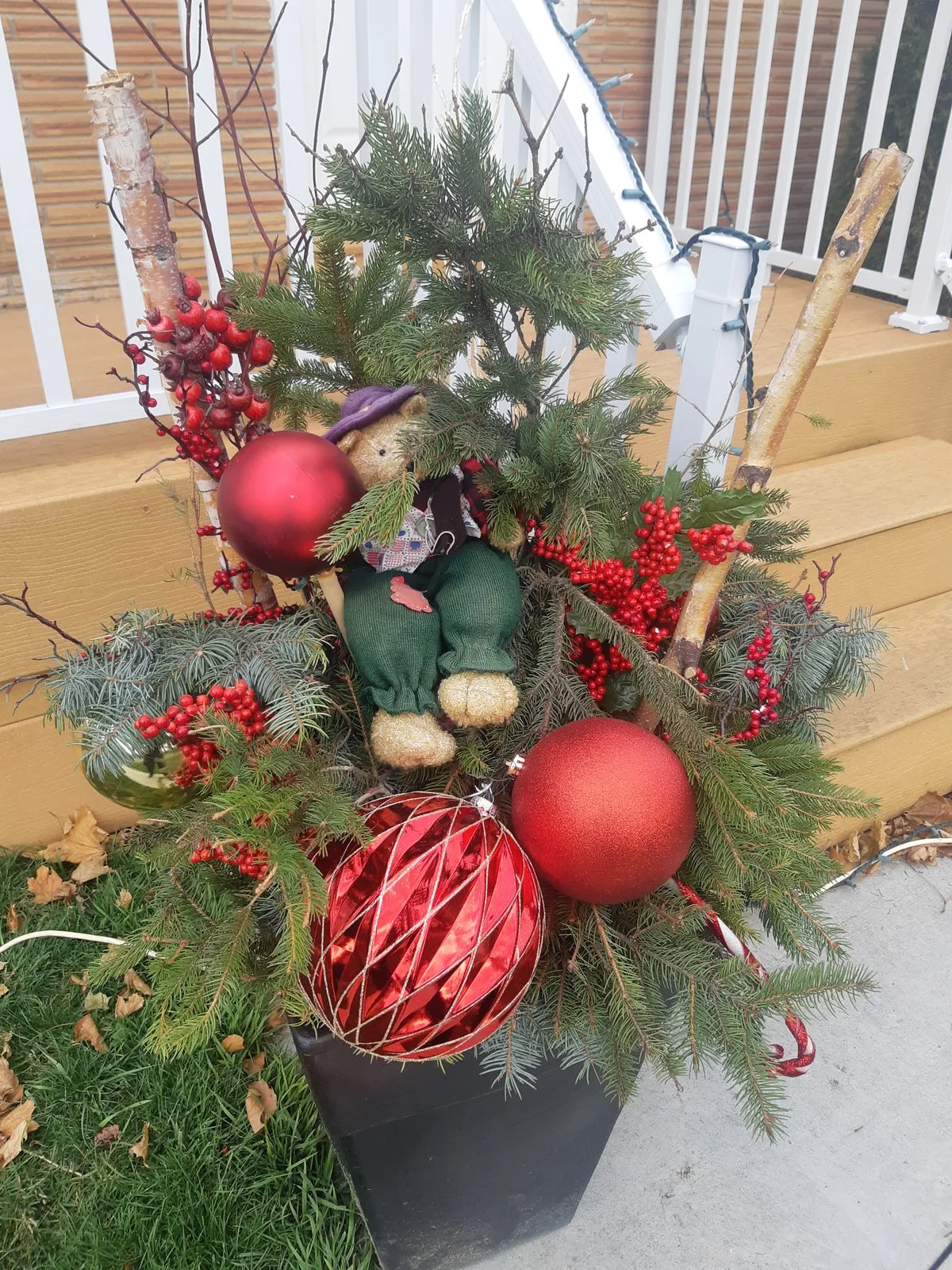
- Large black planter: $45–$150
- Evergreen bundles: $25–$55
- Red berry clusters: $12–$30
- Four oversized shatterproof ornaments: $16–$40
- Birch logs and plush figure: $20–$50
Total: $118–$325. Budget alternative: two logs from the woodpile, ornaments recycled from last year’s tree, and a thrifted teddy bear. Often under $30 on top of a planter you already own.
The bear is the whole point. Everything else — evergreens, berries, ornaments, birch — is a standard winter planter. The bear is what makes strangers smile from the sidewalk. If you’re uneasy about it, tuck it low and at an angle so it peeks out of the greens rather than sitting on top like a display piece.
23. Plaid Bow, Birch Slice, and Blue-Green Evergreens
The birch wood slice is doing quiet structural work. It’s a perfect circle, and the only circle in a composition full of triangles and spikes — that contrast is why your eye lands in the middle of the arrangement instead of wandering out to the edges. The red and white plaid bow picks up the cream and brown from the slice and the pinecones. Nothing here matches exactly; everything echoes.
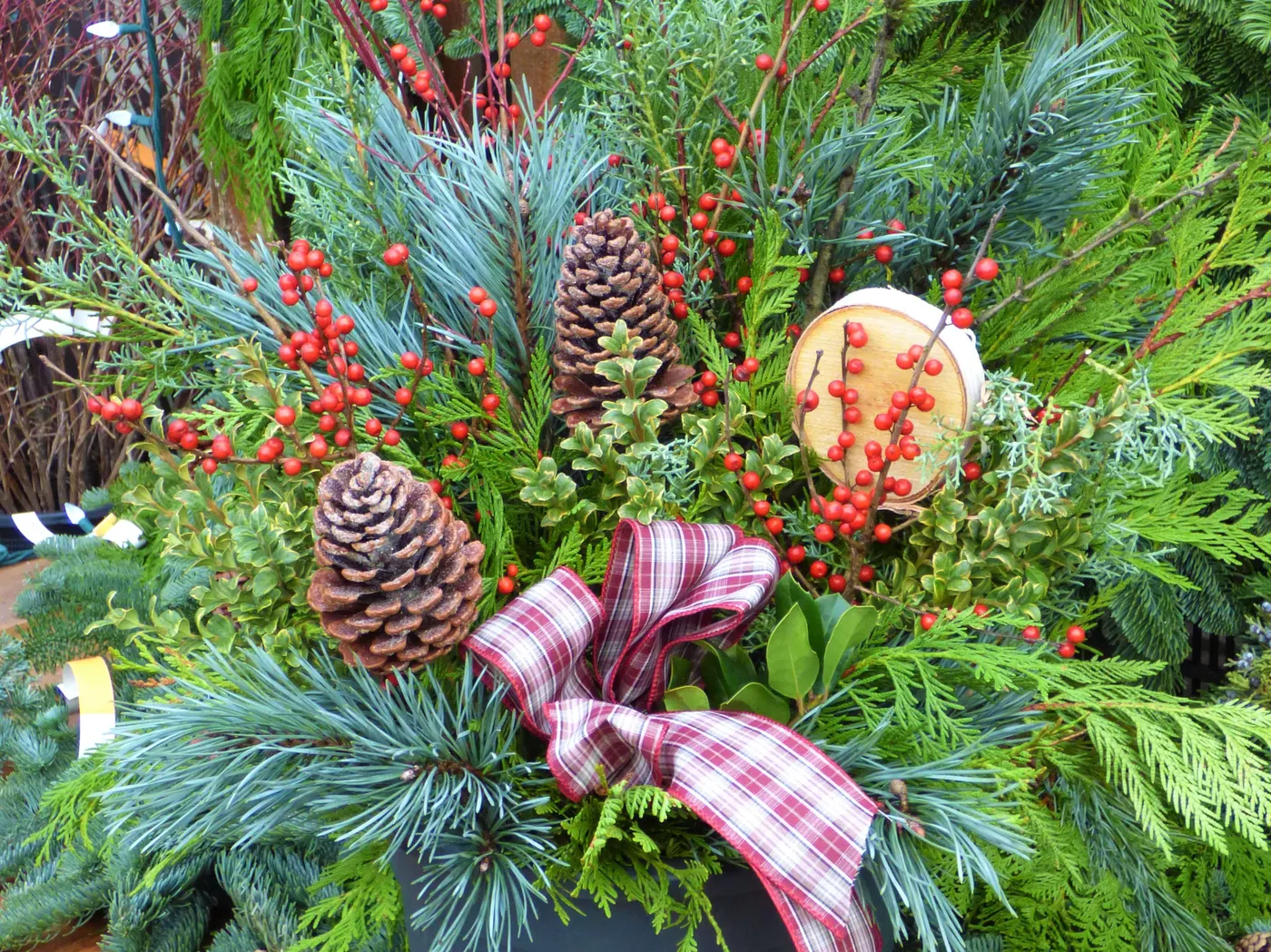
The formula: 50% green and blue-green evergreens, 20% red berries, 15% pinecones, 10% plaid ribbon, 5% natural wood accent. Blue-green juniper and spruce are the ingredients that separate a garden-center look from a custom one. Swap the plaid for solid red ribbon and the arrangement reads five years older; swap in buffalo check and it swings farmhouse instead of traditional.
24. Red Velvet Bows and Silver Ornaments in a Textured Planter
Silver ornaments disappear in daylight and shine after dark, so place them where they’ll catch porch light — about a third of the way up the arrangement, facing outward. Use shatterproof plastic outdoors; glass baubles crack in freeze-thaw cycles. Attach them with dark green wire rather than ribbon loops so they hold position in wind. And let the large red velvet bows sit above the ornaments, which keeps the eye traveling upward instead of settling in the middle.
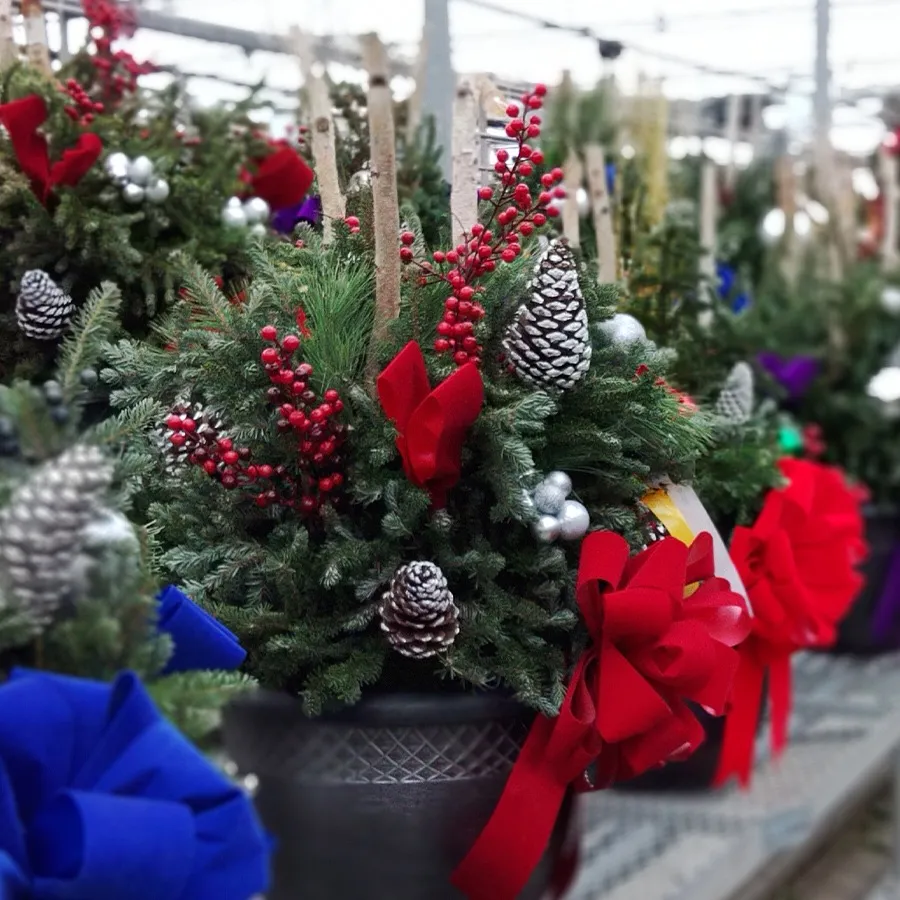
Red velvet bows are the easiest holiday element to DIY. Two yards of velvet ribbon yields three bows for $12–$20. Silver ornaments can come from a thrift store by the bag — $5 for a dozen, and light scratches vanish under porch light. White-tipped pinecones are free if you collect pinecones on a walk and dip the tips in leftover white craft paint.
25. A ‘SNOW’ Sign and White Berries in a Round Planter
White accents are the highest-maintenance choice in an outdoor planter. Artificial berries and faux snow hold up fine for a season, but they yellow after a few years of UV exposure, and dirty snow spray looks grey by February. Store white elements indoors in a sealed bin after the holidays; replacing them every other year is realistic. Reddish-brown clusters are the opposite — they deepen and darken rather than fading, so they’re worth investing in.
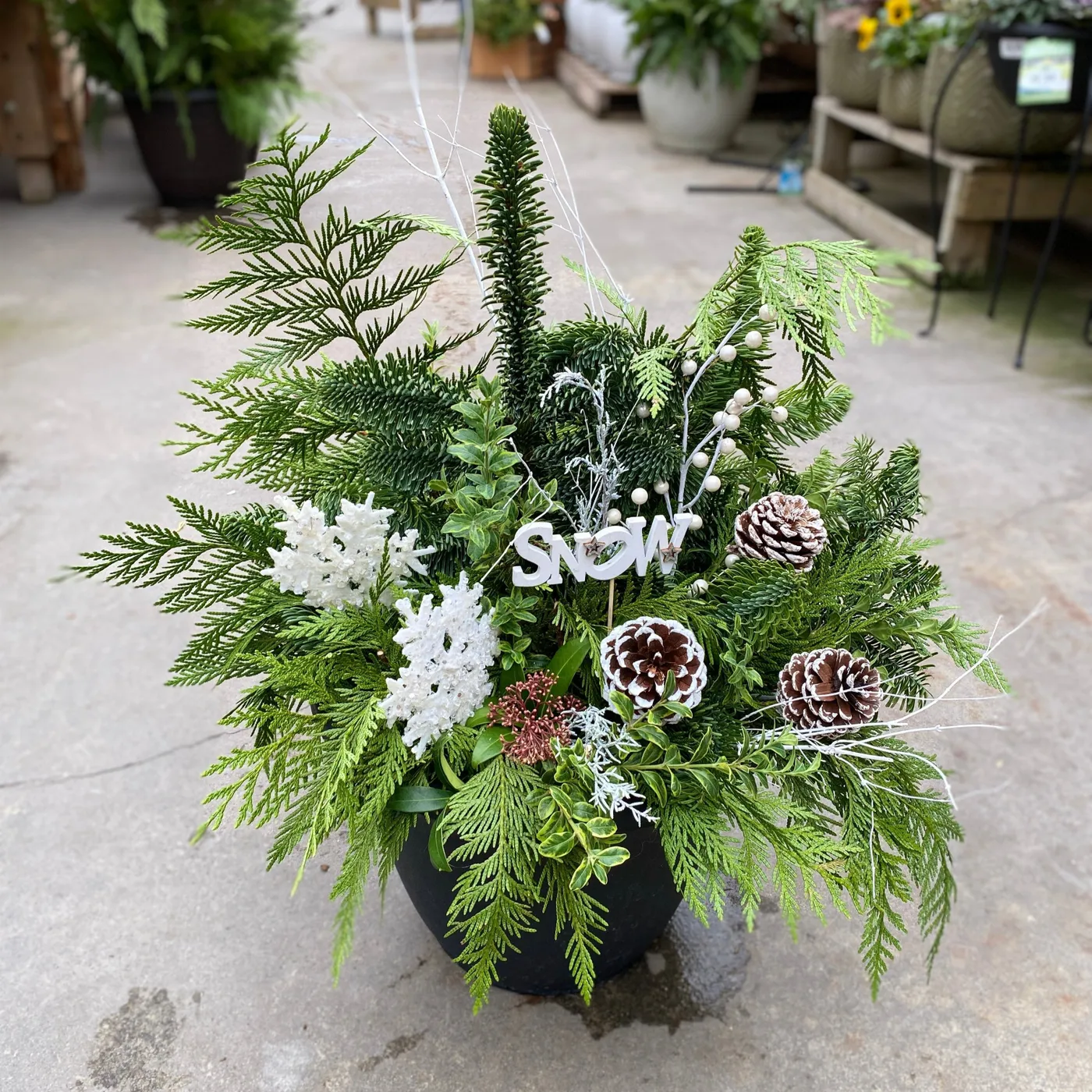
Round planters this full want a footprint of 15 to 18 inches and a stoop that can hold them without crowding the door. Two at this scale need at least 6 feet between centers. Use these dimensions as your benchmark: a 12-inch round planter holds a single branch bundle with no centerpiece, 15 inches supports a full bundle plus accents, and anything 18 inches and up can take a mixed arrangement with real structure. Working with a narrow step instead? See the entry-friendly build in Idea #32.
26. Silver-Glittered Pinecones with Magnolia Leaves
Glitter sheds. Set glittered pinecones and gold branches in the center of the arrangement rather than the outer edge so the sparkle stays on the planter and not on your walkway or doorstep. If you love the look, choose glass-glitter finishes over loose craft glitter — they hold up far better in rain and don’t contaminate soil if the greens end up composted in spring.
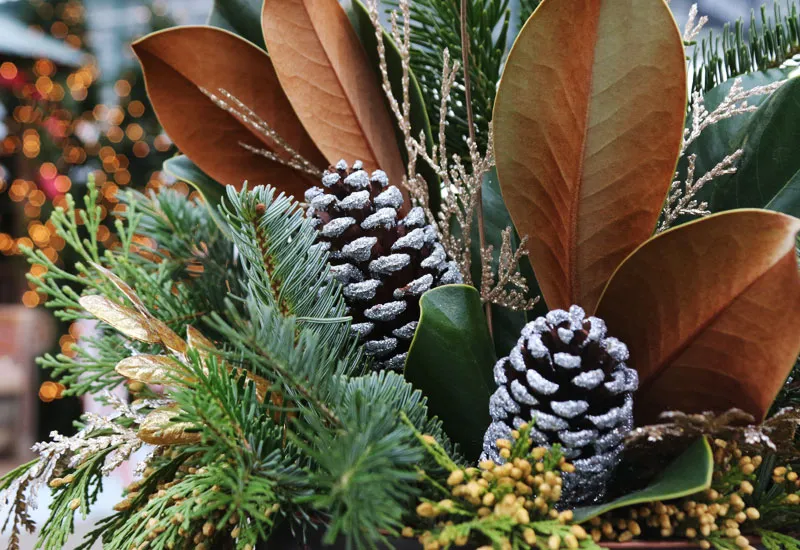
Sparkle and silver are stronger this season than they’ve been in years, largely because glitter finishes now look refined instead of craft-store. The metallic pinecone is the gateway element: it adds shine to a natural arrangement without introducing a single piece of plastic. Expect metallics to stay through next winter — they photograph well in low light, and December is mostly low light.
Magnolia leaves are the structural genius here. Their glossy brown tops and darker undersides create a subtle two-tone that makes a planter look layered even with only a few stems. Silver-dusted pinecones add cool sparkle against the warm brown, and small yellow-green bud clusters act as the bridge color between them. Three temperature zones in one arrangement is a lot of visual payoff for very little money.
27. Rustic Weathered Planter with Fresh Boughs on Stone
- Large weathered-look planter: $50–$180
- Fresh evergreen boughs: $25–$60
- Natural pinecones: $8–$18
- Red berry clusters: $12–$28
- Foam or soil mechanics: $8–$18
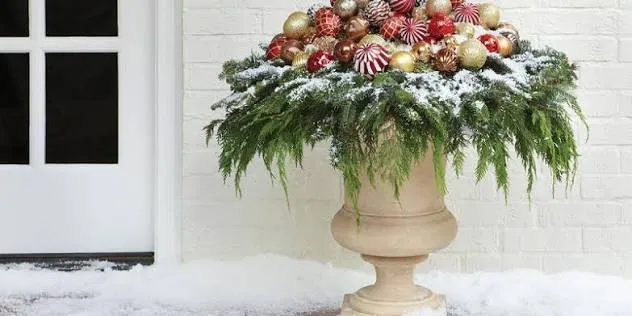
Total: $103–$304. Budget alternative: a resin planter finished in weathered grey, clippings from friends with cedar or holly, and berries cut from a shrub in your own yard. That combination often comes in near $55.
Fresh boughs on a light-colored surface will stain it. Cedar and fir release tannins and sap as they warm, and the mark can be stubborn on porous pavers or limestone. Set the planter on a saucer, a scrap of roofing felt, or a couple of bricks. Also worth knowing: painted or distressed finishes chip. Expect a small touch-up each spring if the container stays outside year-round.
28. Teal Ornaments and Cool-Toned Urns at a Brick Entry
The palette math is 50% evergreen boughs, 15% bare dark branches, 20% teal ornaments, 10% teal satin bows, 5% white poinsettia-like flowers. The cool palette is the entire point: teal, forest green, light grey, and white read elegant and slightly unexpected against a brown brick facade. Swap teal for burgundy and the same formula turns traditional; swap for copper and it goes modern without changing anything structural. For a warmer take on the same arched-entry layout, see Idea #8.
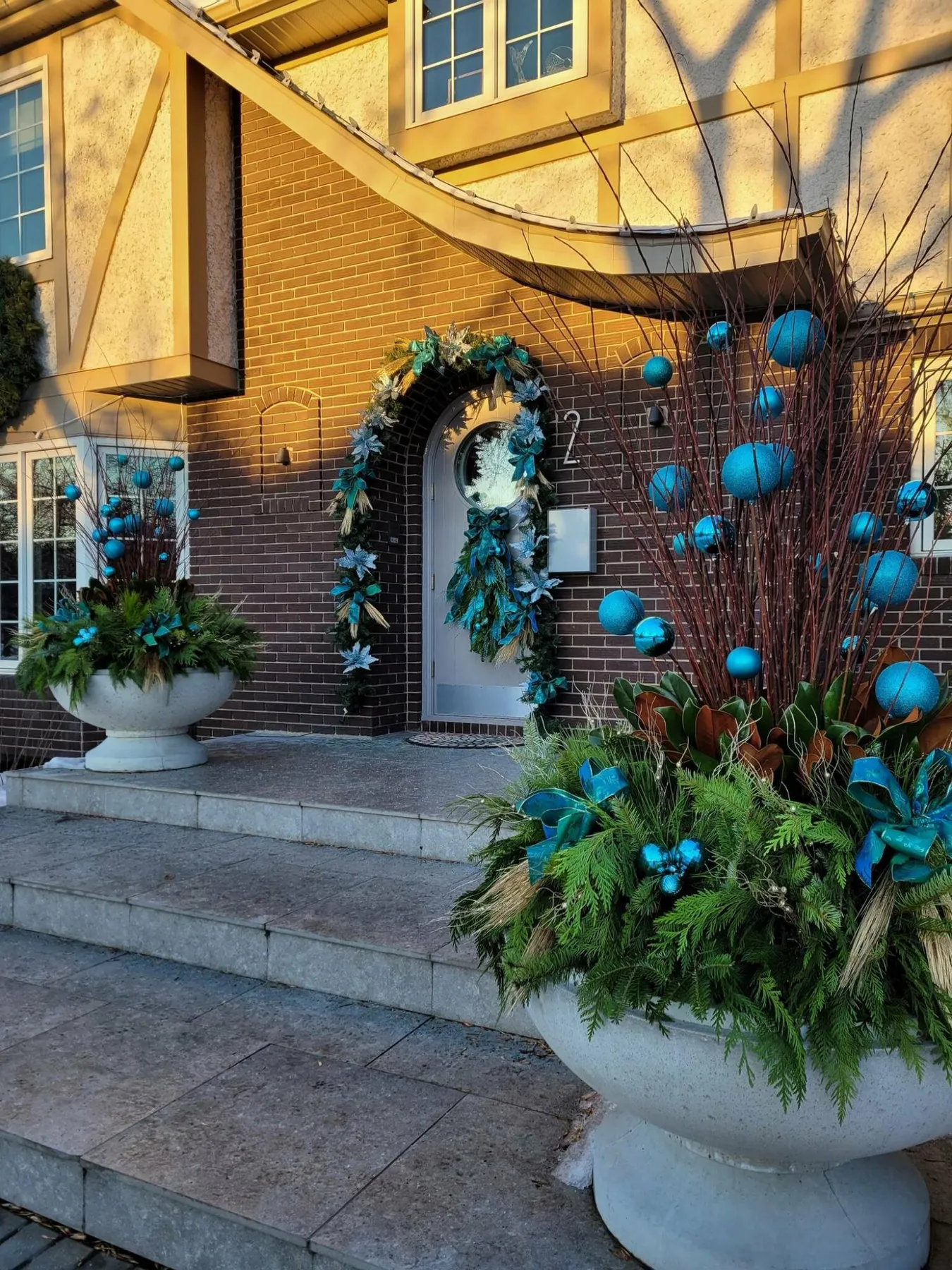
The matching garland is the one thing holding this together. Two teal-and-evergreen urns alone would read as a nice pair; the arch garland ties them into a single composition and turns a doorway into a moment. It’s also what makes the color story legible from the street — the eye catches teal at the top, then again at the bottom, and understands the design instantly.
29. White Window Box with Conifers and Coral Blooms
Building a mixed seasonal window box: measure the box’s interior and note its depth. Set three small cone evergreens evenly, pushed slightly toward the back. Plant the upright bloomers between them, keeping the tallest at the ends. Fill the front edge with trailing foliage so it spills over the lip. Water deeply twice a week until the roots establish. Planting takes about an hour, and plants run $60–$120 depending on size.
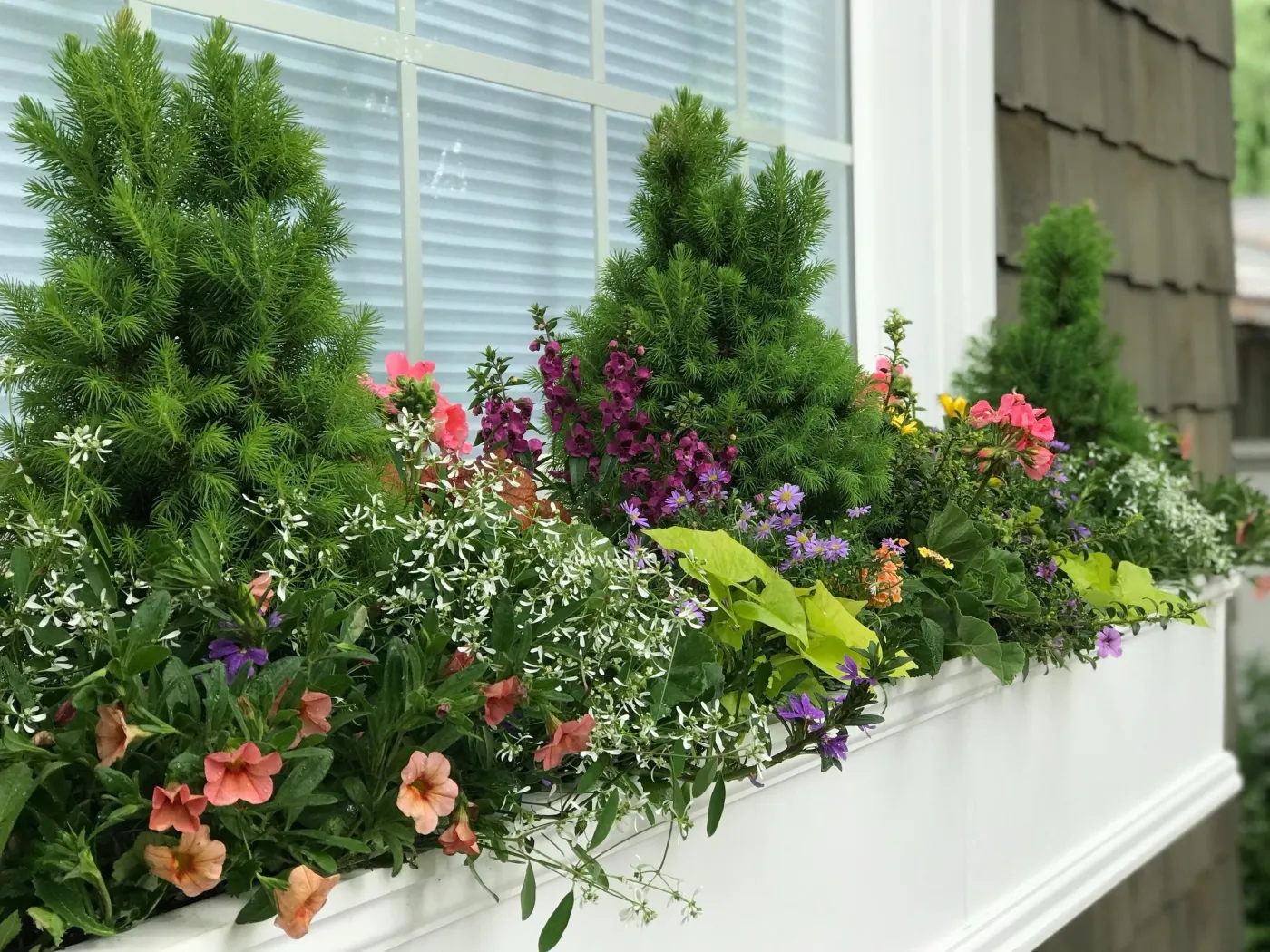
A window box this full needs to be at least 10 inches deep and 8 inches wide, and the plants will roughly double in size within a season. If your box is shallower, use trailing plants only and skip the conifers — roots need room to anchor. For winter-only planters, depth matters far less. For year-round boxes, it’s the difference between thriving and limping along.
This works because it’s a garden first and a container second. The cone evergreens give the box a repeating vertical rhythm, and the coral and magenta blooms pull their complementary color from the lime green trailers. Cool and warm colors alternate along the length so the eye keeps moving. It’s the same principle as a well-planted border, just compressed into four feet of window.
30. Tapered Black Planter with Dried Hydrangeas and Birch Bark
Dried hydrangeas are the sleeper ingredient here. Choose heads that are fully dry with stiff stems, and set them so they sit just above the evergreen line — they should look like they’re floating, not buried in the greens. Pale green heads work with almost any palette; pink or blue heads commit you to a specific mood. If yours droop, a light misting of hairspray stiffens the florets for a full season.
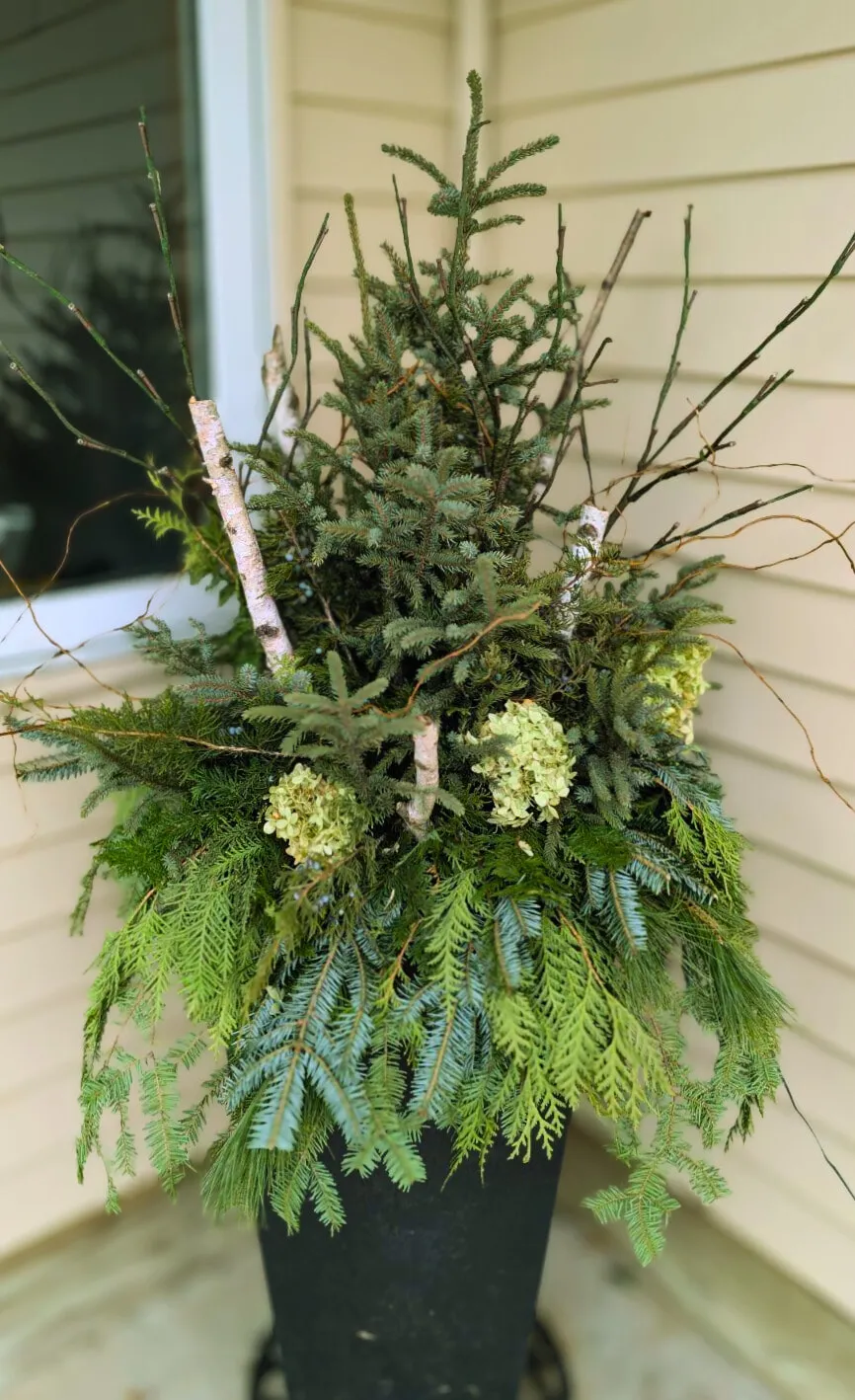
- Confirm the planter has a drain hole and sits level
- Check that the wall behind it is light — dark planters need light backdrops
- Decide whether you want one texture family or three
- Measure how high you can build before covering a house number
The birch bark pieces are the one thing that matters. Not full logs — cut segments tucked at angles so only the white outer bark shows. They break up the deep green mass and give a tall black tapered planter something bright to hold. Without them this is dense and heavy; with them it has light, angle, and movement.
31. Twin Planters with Magnolia Leaves and Gnarled Wood
- Two 24-inch dark square planters: $120–$360
- Mixed evergreen bundles, four: $50–$110
- Red and white berries: $20–$45
- Large pinecones and magnolia leaves: $18–$40
- Birch logs or gnarled wood pieces: $20–$50
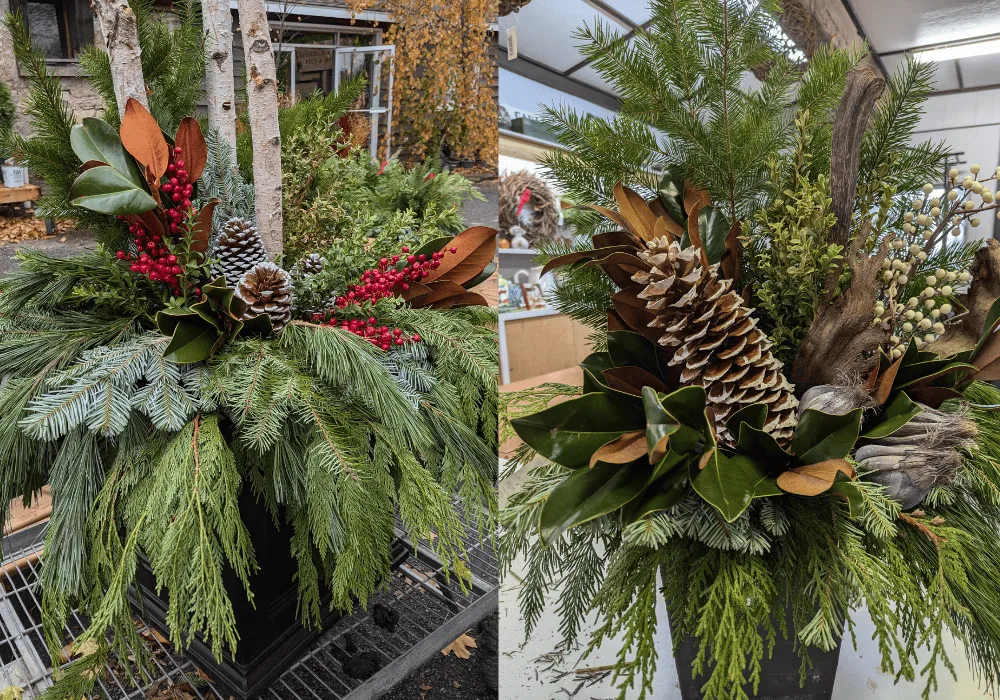
Total: $228–$605. Budget alternative: two 18-inch planters instead of 24-inch, one bundle each, and gathered pinecones and magnolia leaves from a park or a friend’s tree. Roughly $95 for the pair, and the layered look survives the downsize.
Two planters this full need two bundles each for honest coverage. One bundle looks sparse from three feet away even when it photographs perfectly, so don’t judge by your phone screen. Weight is the other issue: a 24-inch planter packed with damp greens and soil can hit 60 pounds. Build it where it will live, or use an empty inner pot and lift the whole arrangement into place afterward. For a smaller-scale version of this dense style, see Idea #1.
32. Tapered Planter with a Red Plaid Bow on Concrete
A tapered square planter is one of the easiest containers to find secondhand — check Facebook Marketplace and neighborhood buy-nothing groups in early November. Used planters run $15–$35. A plaid bow takes a yard of ribbon ($8), berries are $6 at a dollar store, and one $14 evergreen bundle fills an 18-inch planter with room to spare. Total: about $45 for a front step that looks considered.
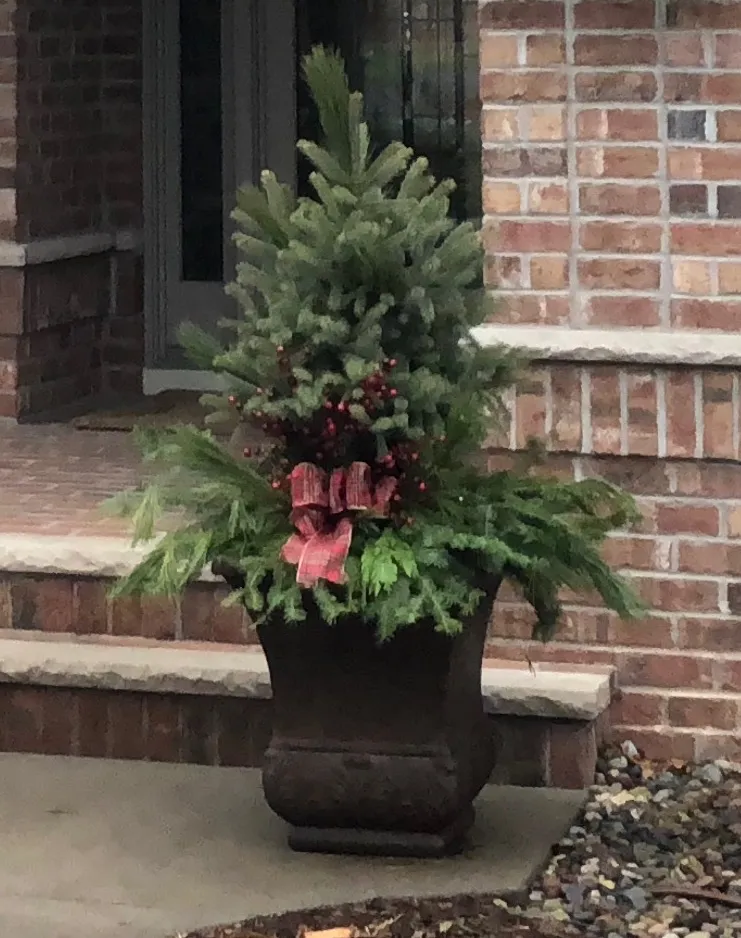
Tying a plaid bow that survives the wind: use wired ribbon at least 2 inches wide. Make two loops, then a third slightly smaller one in front. Pinch the center and wrap a 6-inch piece of ribbon around it. Secure the bow to the arrangement with a zip tie, not the ribbon itself. Trim the tails at an angle so they don’t fray. Five minutes and $8–$15 of ribbon.
Traditional plaid has quietly replaced minimalist holiday decor for a lot of people, partly because it’s nostalgic and partly because it’s the cheapest possible update. One ribbon can refresh a planter you’ve owned for a decade. Low commitment, very long shelf life, and it works on brick just as well as it does on siding.
Make the Whole Street Slow Down at Your Door
Thirty-two ideas, one honest takeaway: the planters that stop traffic are almost never the most expensive ones — they’re the ones with real texture, a container that earns its spot, and a color story you can actually explain in a sentence. Start with the formula in Idea #11, pick one idea from this list that fits your porch, and build it this weekend while the bundles are still fresh.
📌 Pin your favorite to your Holiday Curb Appeal board now — and tag us when your front step is done, because we genuinely want to see it.