31 Stunning Blue and Champagne Christmas Tree Ideas for the 2026 Holiday Season

You know that feeling when you save a Christmas tree photo at 11 p.m. and then can’t find a single thing in a store aisle that comes close? That’s usually a palette problem, not a budget problem — and blue with champagne gold is one of the few pairings that fixes it fast.
We spent serious time digging through Hobby Lobby, Etsy, Target, and Amazon, and pulled the best options from about $9 up to $349, so there’s something here whether you’re dressing a tabletop tree or a double-height corner.
Inside you’ll find 31 curated ideas covering flocked winter-wonderland elegance, turquoise coastal sparkle, celestial navy-and-gold, and a few gloriously retro detours. Budget and luxury versions sit side by side, and every idea is shoppable with direct product links.
2026 is the year flocking went fully mainstream and champagne officially replaced silver as the metallic of choice — which is exactly why this pairing looks so current on Pinterest right now.
Save this post now — you’ll want it when you’re ready to shop.
1. A Winter Wonderland Dining Room in Blue, Silver, and White
What holds this dining room together isn’t the tree — it’s the repetition of three colors at three different scales. Royal blue appears large on the sheer patterned window curtains, medium on the tree ornaments and place settings, and small on the wrapped boxes stacked on the table. White and silver do the same trick, moving from flocked branches to stockings to flatware. Nothing here introduces a fourth color, so the glow becomes the focal point instead of the clutter.
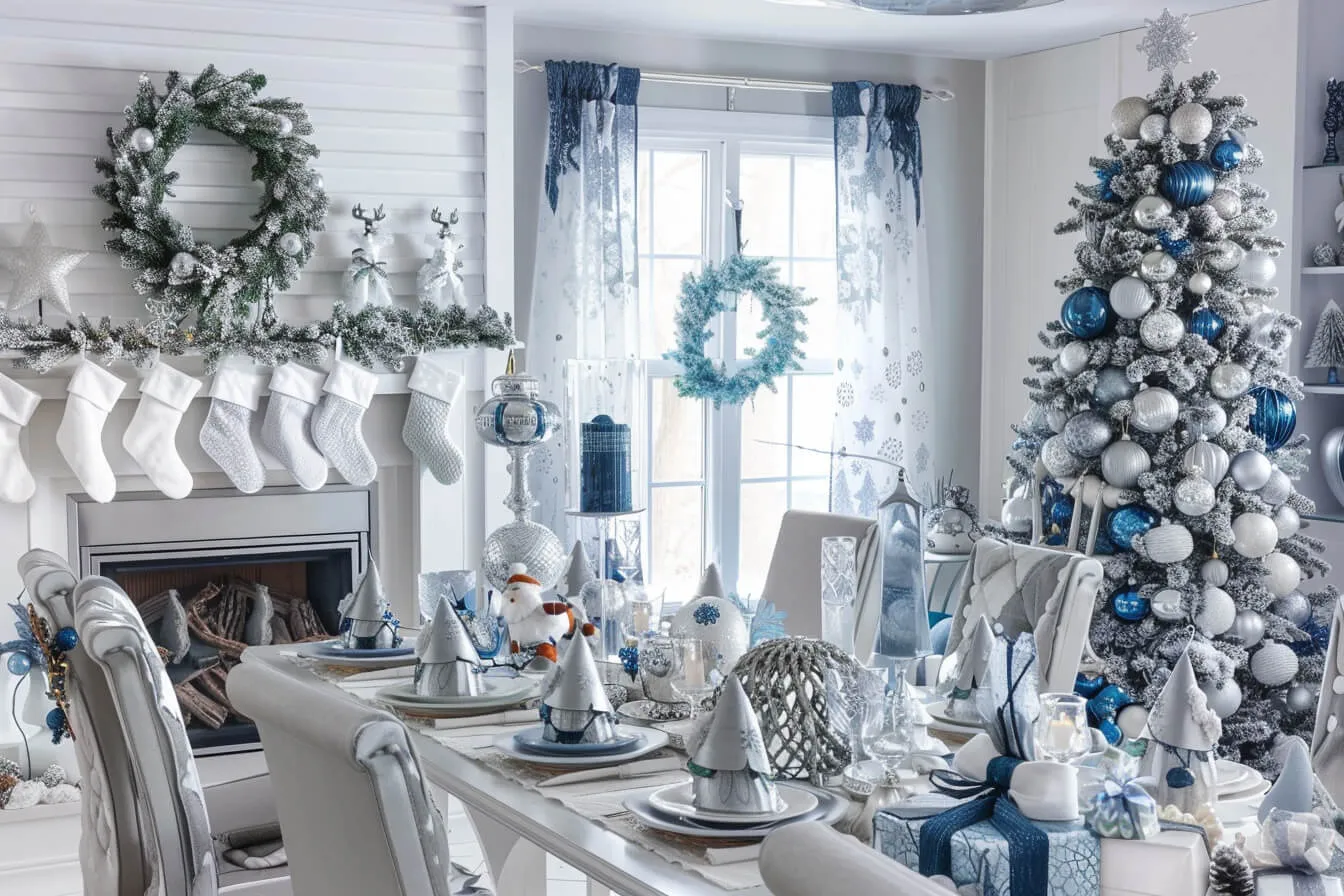
Scale your ornaments to their surface. A 4-inch bauble reads as clutter on a tablescape, and a 2-inch bauble disappears in a 7-foot tree. Keep tree ornaments between 3 and 5 inches, tabletop ornaments between 1.5 and 2.5 inches, and choose ribbon at least 2.5 inches wide so the branches don’t swallow it. If your tree and your table share a palette, they should still differ in scale — that’s what keeps a matched scheme from looking like a catalog page.
2. Blue and Silver Flocked Tree Framed by Brass Candlesticks
here is the arched gold-framed mirror standing on the white mantel, flanked by brass candlesticks holding white tapers. Strip away the garland and the stockings and the room still reads finished, because the mirror bounces tree light back into the space and the brass adds a warm reflective note against all that frost. Without it, the mantel is just a shelf with decorations on it. With it, the tree has a counterpart.
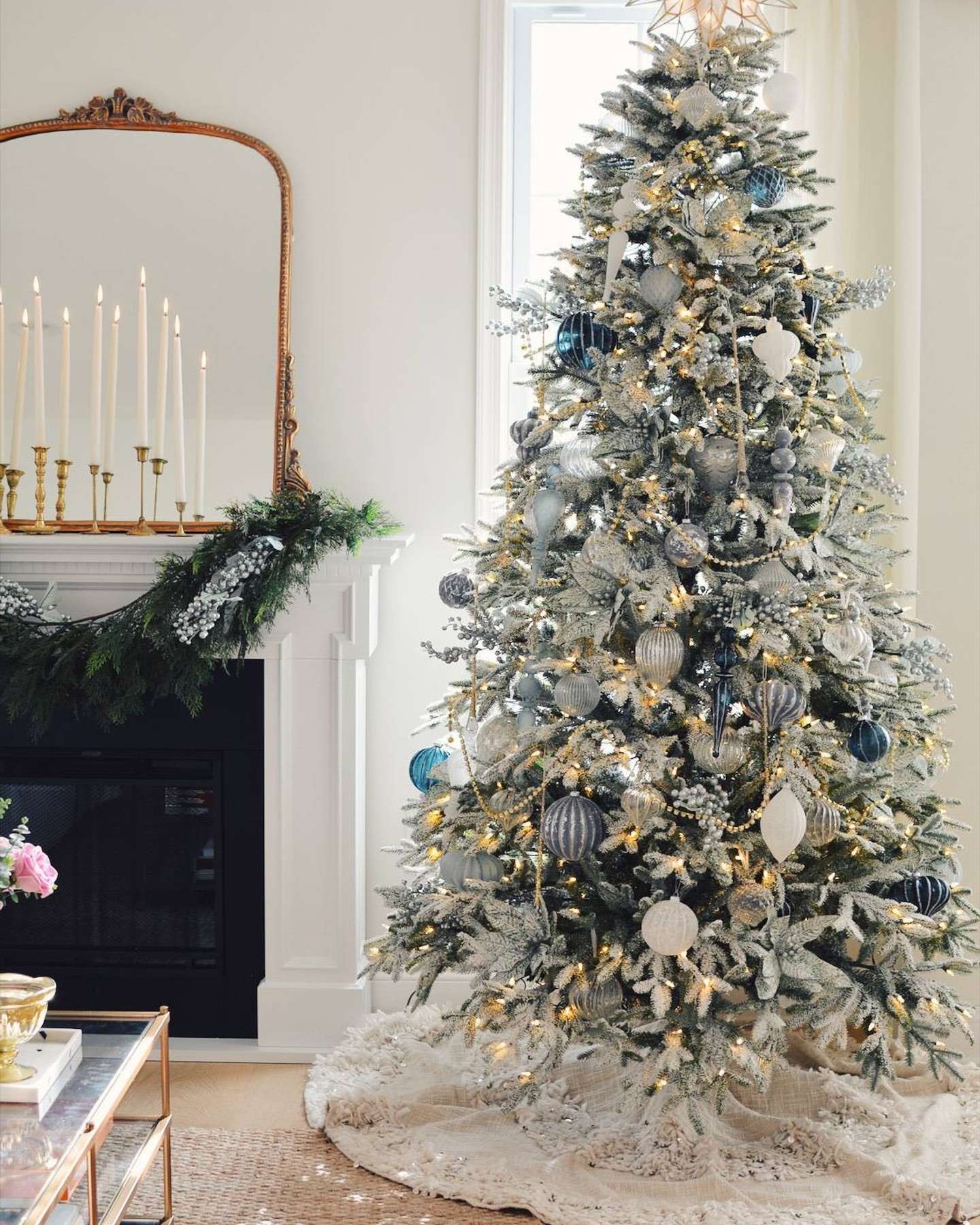
- Flocked 7.5-ft tree: $180–$450
- Warm-white LED string lights (400 ct): $20–$45
- Blue, silver, and white ornaments (about 90): $90–$260
- Beaded garland, two strands: $30–$70
- Arched gold-framed mirror: $120–$400
- Brass candlesticks and taper candles: $35–$120
- Dark evergreen mantel garland: $25–$60
- Total: roughly $500–$1,400
Budget alternative: a Facebook Marketplace flocked tree at $60–$120, Dollar Tree glass baubles at $1.25 each, and a thrifted brass candlestick pair for $12 get you about 80% of this look.
3. Blue and Champagne Ribbon Woven With White Poinsettias
Read this tree as a formula: about 40% flocked white branches, 25% blue ribbon and solid blue spheres, 20% champagne and gold, and 15% oversized white florals. Swap the light blue for deep green and you get a traditional tree. Swap the white poinsettias for pink peonies and it turns romantic. The proportions are what make it work, so change the colors, not the ratios.
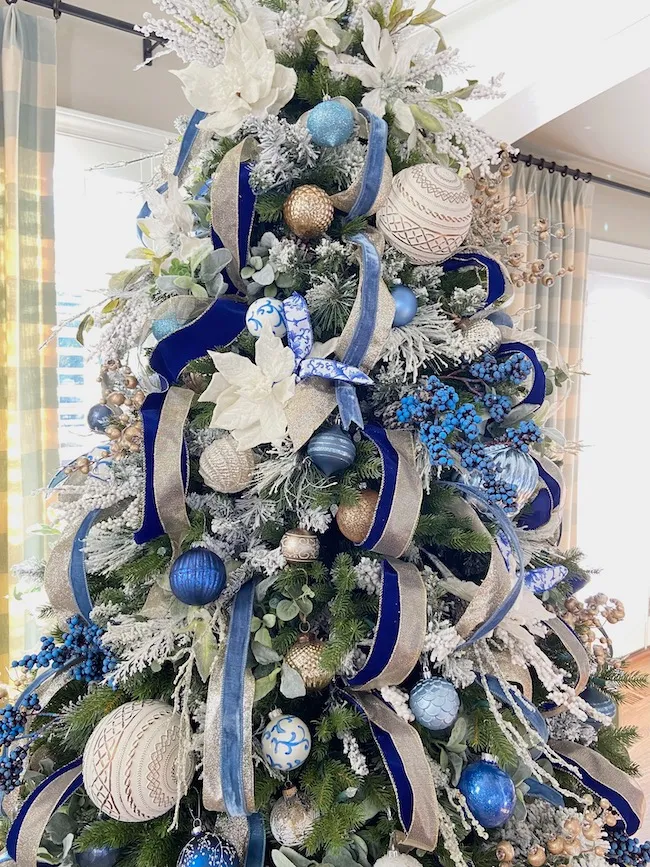
Wire-edged ribbon in two widths — 4-inch blue, 2.5-inch champagne — is the difference between designer ribbon and a garland that hangs like a wet noodle. Loop the champagne over the blue every 18 inches so the two read as one braided element, and push the loops into the branches rather than draping them across the front. This is the softer cousin of Idea #9 — same blue-and-gold logic, gentler execution.
4. Turquoise, Seafoam, and Starfish on a Flocked Tree
Coastal Christmas has quietly grown from a Florida novelty into a full Pinterest category, and 2026 is its biggest year yet. The shift tracks with something broader: people decorating second homes and rentals they actually use in December, plus a general fatigue with red-and-green. Turquoise and silver keep the icy sparkle of a flocked tree but trade solemnity for brightness. It has staying power precisely because it’s a regional taste that doesn’t ask anyone else to adopt it.
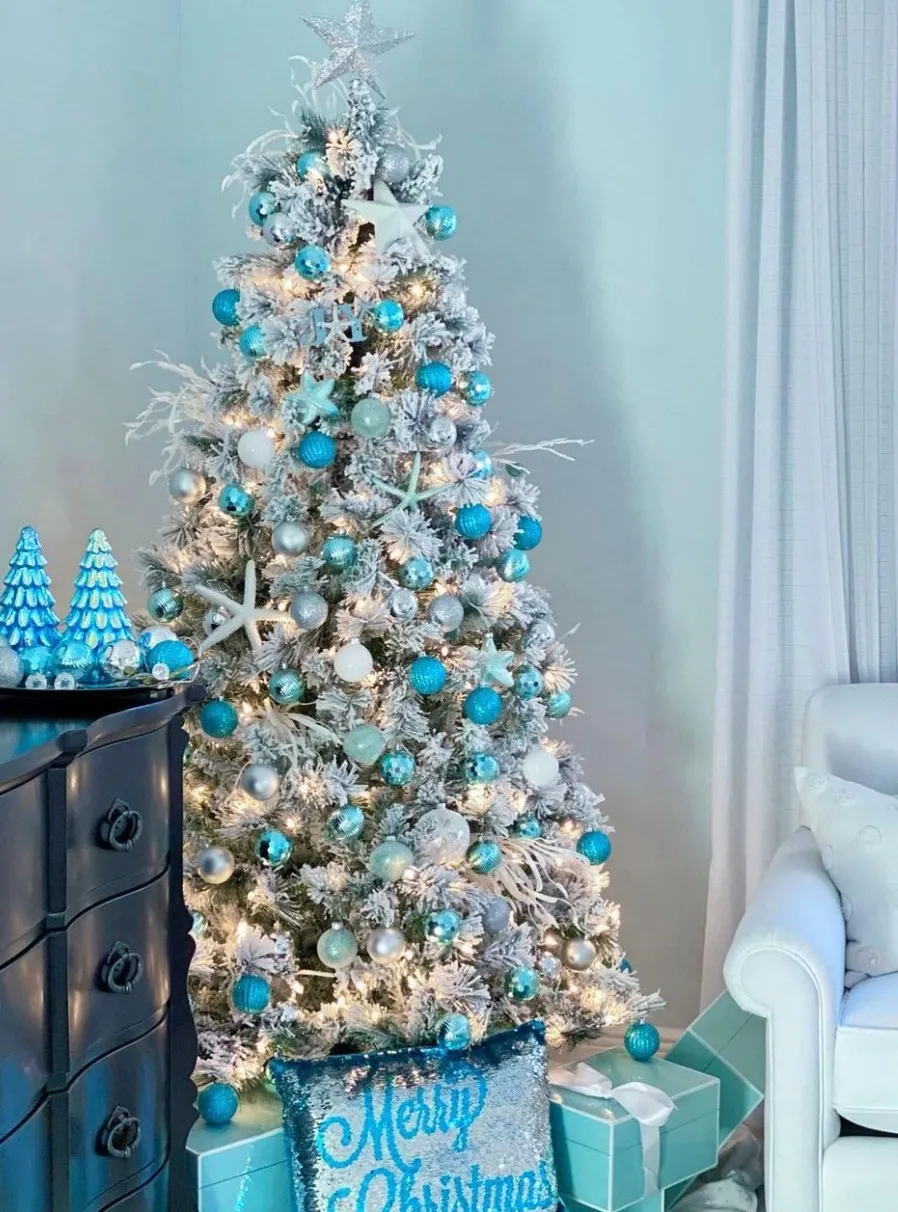
Two honest warnings. Real starfish are brittle, so anything hanging near the floor or a wagging tail will not survive the season — buy extras. And turquoise, seafoam, and pale blue all sit on the cool end of the spectrum, which means under warm-white bulbs they can drift toward washed-out gray by 9 p.m. Test your palette at night before committing to ninety ornaments, or switch to 3000K bulbs for a truer read.
5. Champagne, Copper, and Honeycomb Paper Baubles
Making the honeycomb spheres takes an afternoon and almost nothing.
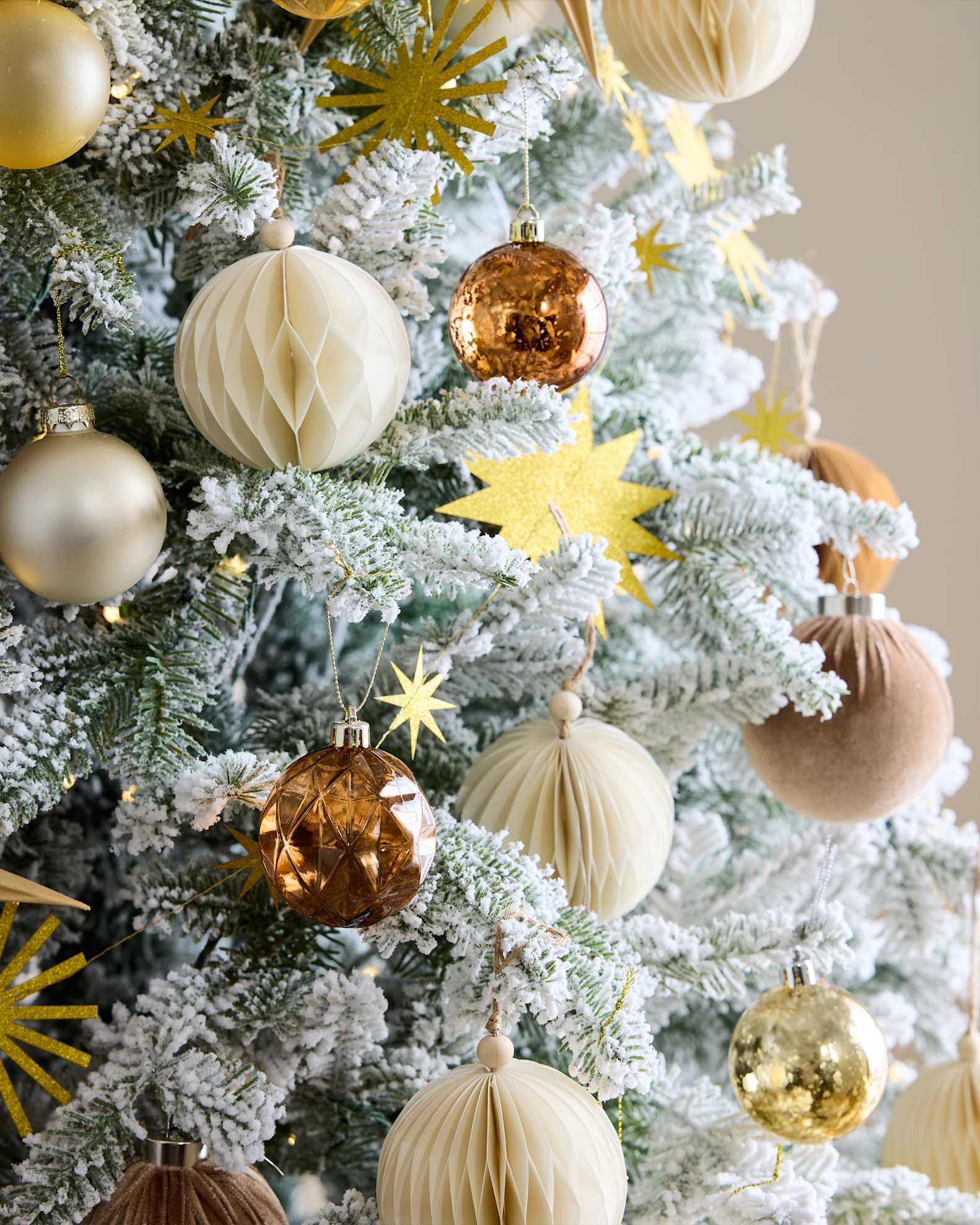
- Cut 8–10 circles of tissue paper, 4 to 6 inches across.
- Stack them and sew or staple a single line down the center.
- Fan the circles open into a sphere and glue the outer edges together.
- Mist one side with copper or champagne metallic spray, dry flat for 20 minutes.
- Thread a loop of fine twine through the center seam.
Time: about 2 hours for a dozen. Cost: roughly $8 for the batch, plus $9 for spray paint.
If paper crafts aren’t your December hobby, the same look lives at retail for very little. Target’s Threshold line runs honeycomb ornaments around $3–$5 each, Dollar Tree has champagne and copper spheres for $1.25, and IKEA’s VINTERFINT set covers matte gold stars for about $6. Mix store-bought glass with two or three handmade paper pieces and nobody will tell which is which — texture variety is doing the work, not the price tag.
6. A Grand Blue and Gold Tree in a Double-Height Room
This layout needs volume, and it needs it honestly. Figure on ceilings of 10 feet or higher, at least 250 square feet of floor, and a tree in the 8-to-10-foot range — anything shorter gets visually flattened by floor-to-ceiling windows. If your room is closer to 12 by 14 feet, look at Idea #8 instead; the slender tinsel tree was made for tighter footprints and reads just as dressed-up.
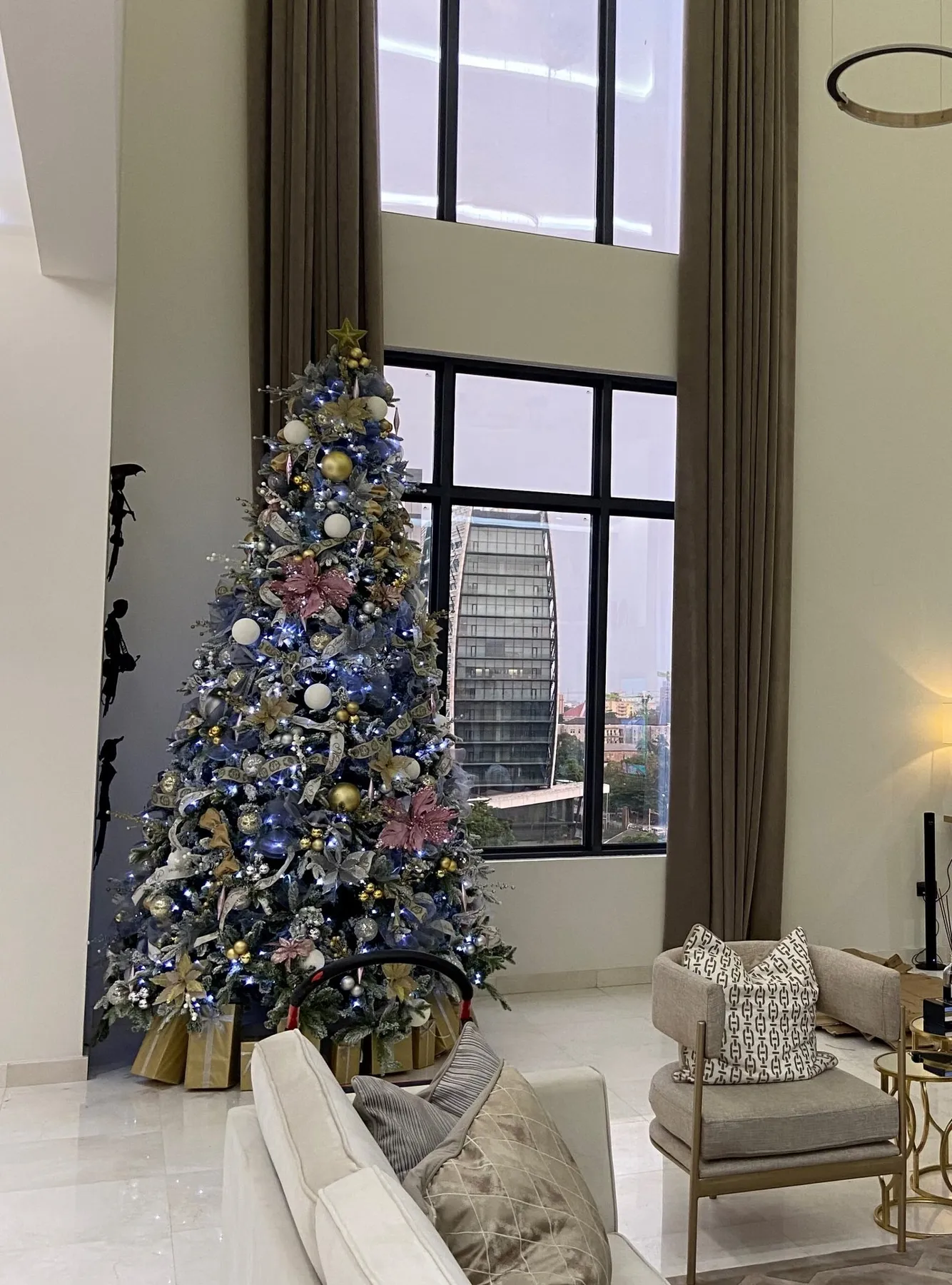
The trick with a big tree in a tall room is that the tree isn’t the tall thing — the windows are. The blue ribbon and gold baubles echo the window frames’ vertical rhythm, while pink floral accents keep the arrangement from turning into a hotel lobby. Neutral upholstered seating in the foreground grounds it. Without those low, soft elements to land on first, your eye would travel straight up and stop.
- 9-ft tree: $400–$1,200
- Blue ribbon, 3 rolls: $45–$90
- Gold and white baubles (120): $150–$420
- Faux floral stems: $60–$180
- Tree lighting (1000 ct): $45–$90
- Total: about $700–$1,980
Budget alternative: a pre-lit 9-footer from Walmart runs $199 in early November, and 120 shatterproof baubles land near $60. You’ll lose glass shine, keep the silhouette.
7. Feather Picks and Champagne Ribbon on a Neutral Tree
The patterned feather picks are the whole personality of this tree. Champagne ribbon and white poinsettia blossoms are lovely, but they’re also everywhere — the feathers are what make the arrangement feel collected rather than purchased. Remove them and you have a perfectly nice neutral tree that looks like every other neutral tree. Keep them, and the branches get movement and a little weirdness, which is what your eye actually remembers.
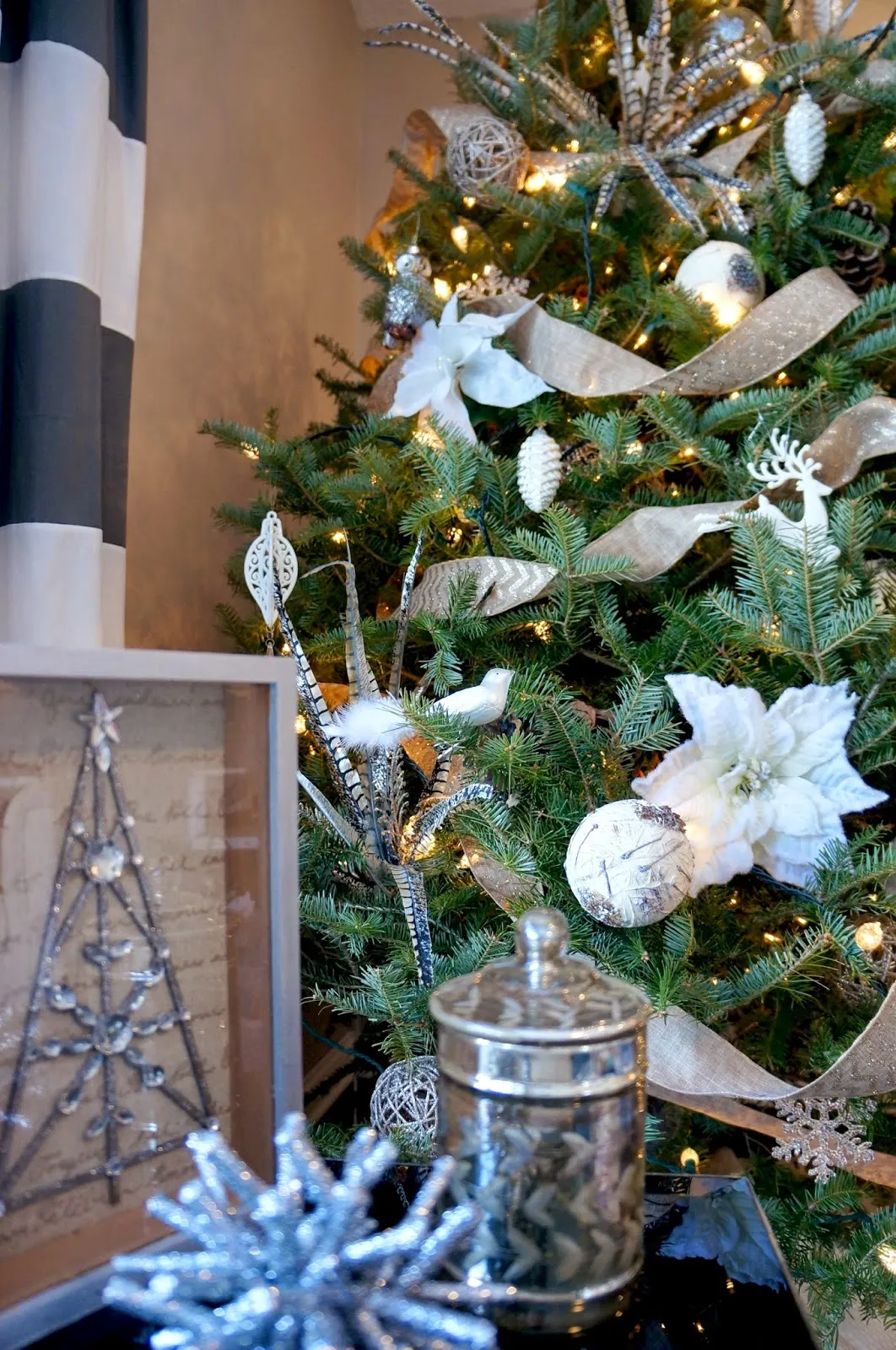
Flocked trees shed. Expect a fine white dusting on the floor every time you water, rotate, or bump the tree, and plan on vacuuming weekly through December. Feather picks are worse — they drop barbs and crush in storage, so keep them in a rigid box rather than a zip bag. A handheld vacuum with a brush attachment is the unglamorous hero of a flocked Christmas, and it will also save your champagne ribbon from a season of dust.
8. A Slender Champagne Tinsel Tree for Tight Corners
Tinsel trees are the great equalizer. A 6-foot slim champagne tree from Walmart runs about $45, and teal and deep-green baubles can come from Dollar Tree at $1.25 a piece — call it $40 for thirty. Add a $12 strand of warm LEDs and a silver JOY topper you already own, and the total lands under $100. Compare with Idea #6: same elegant mood, roughly a tenth of the spend.
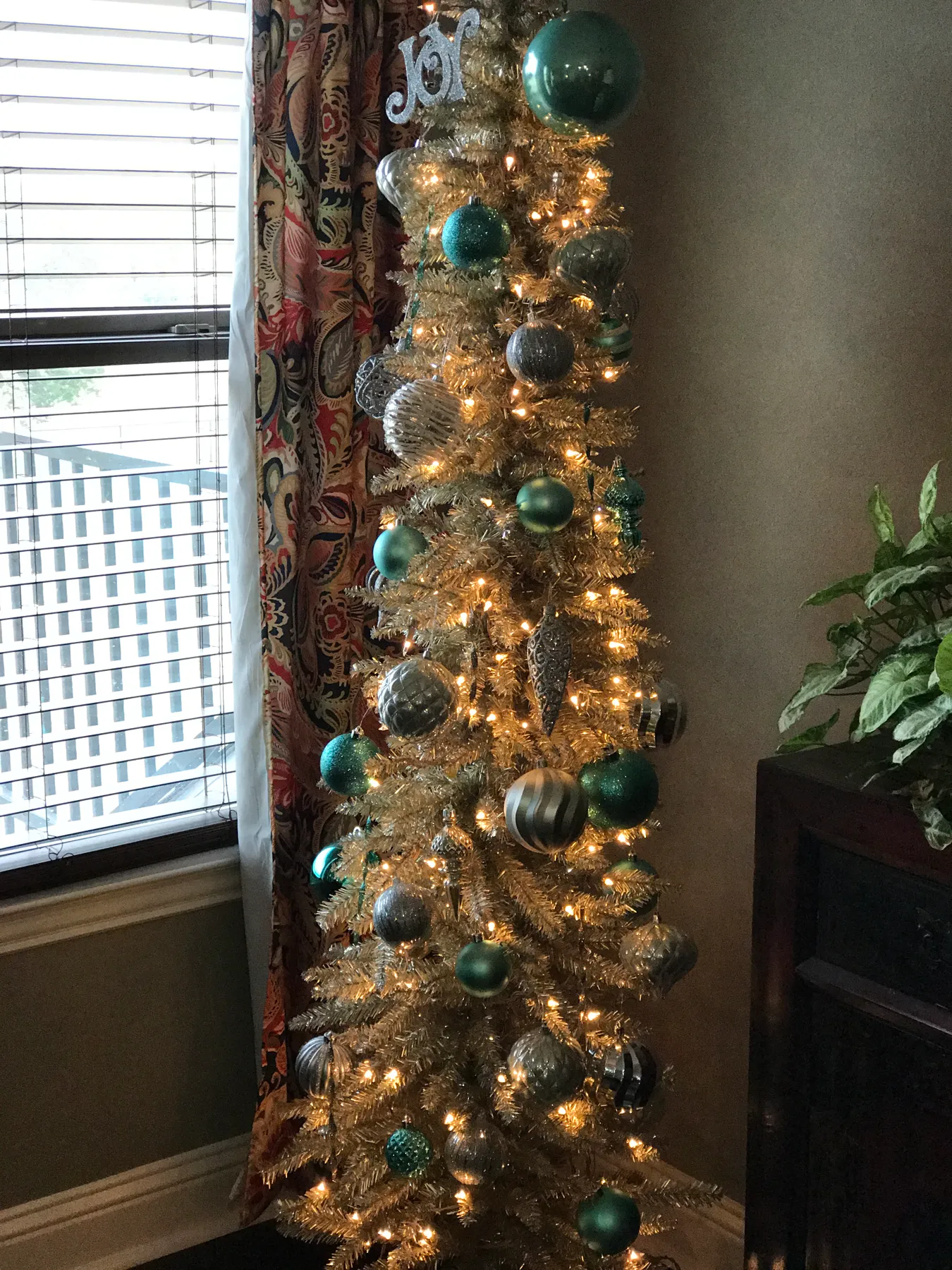
This is the tree for the corner you forgot you had. It works in rooms as small as 8 by 10 feet, in apartments with 8-foot ceilings, and against a wall where a full tree would block a doorway or a dark wood cabinet. The narrow profile — typically 24 to 30 inches wide at the base — means you can still walk past it. Just leave 18 inches of clearance on the window side so the tinsel catches glow instead of reading flat.
9. Cascading Blue Velvet Ribbon and a Gold Geometric Star
The formula is deceptively simple: about 55% tree — green needles and warm light — plus 30% blue, split between matte and glossy spheres and one wide velvet ribbon, plus 15% gold in the topper and a handful of metallic baubles. Keep the blues in the same family, navy through cobalt, and let matte and gloss do the contrasting. Swap blue for burgundy and gold for pewter and the same ratios hand you a completely different tree.
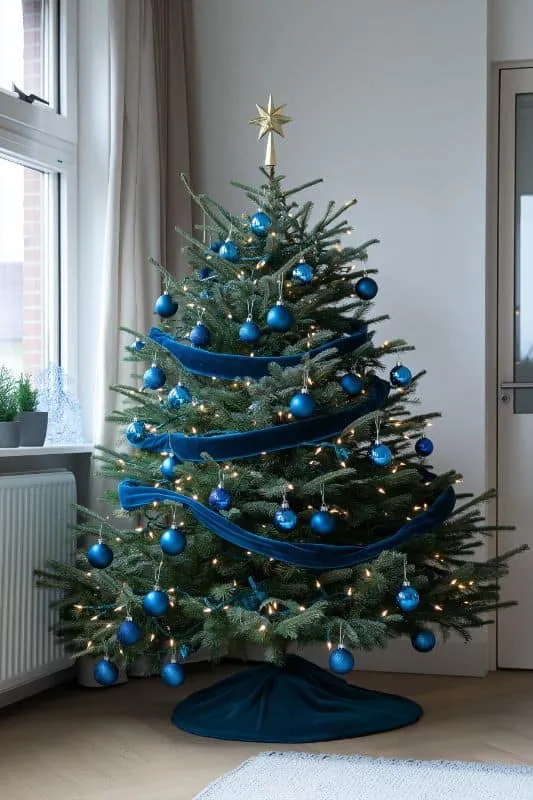
Velvet ribbon needs to cascade, not wrap. Start at the top, anchor with floral wire, and let it fall in loose diagonal sweeps, tucking a loop into a branch every 12 to 15 inches. Flat-wrapping velvet around the tree kills the texture that makes it worth the money. Velvet ribbon is the single fastest way to make an inexpensive tree look expensive. A matching blue velvet tree skirt finishes the thought.
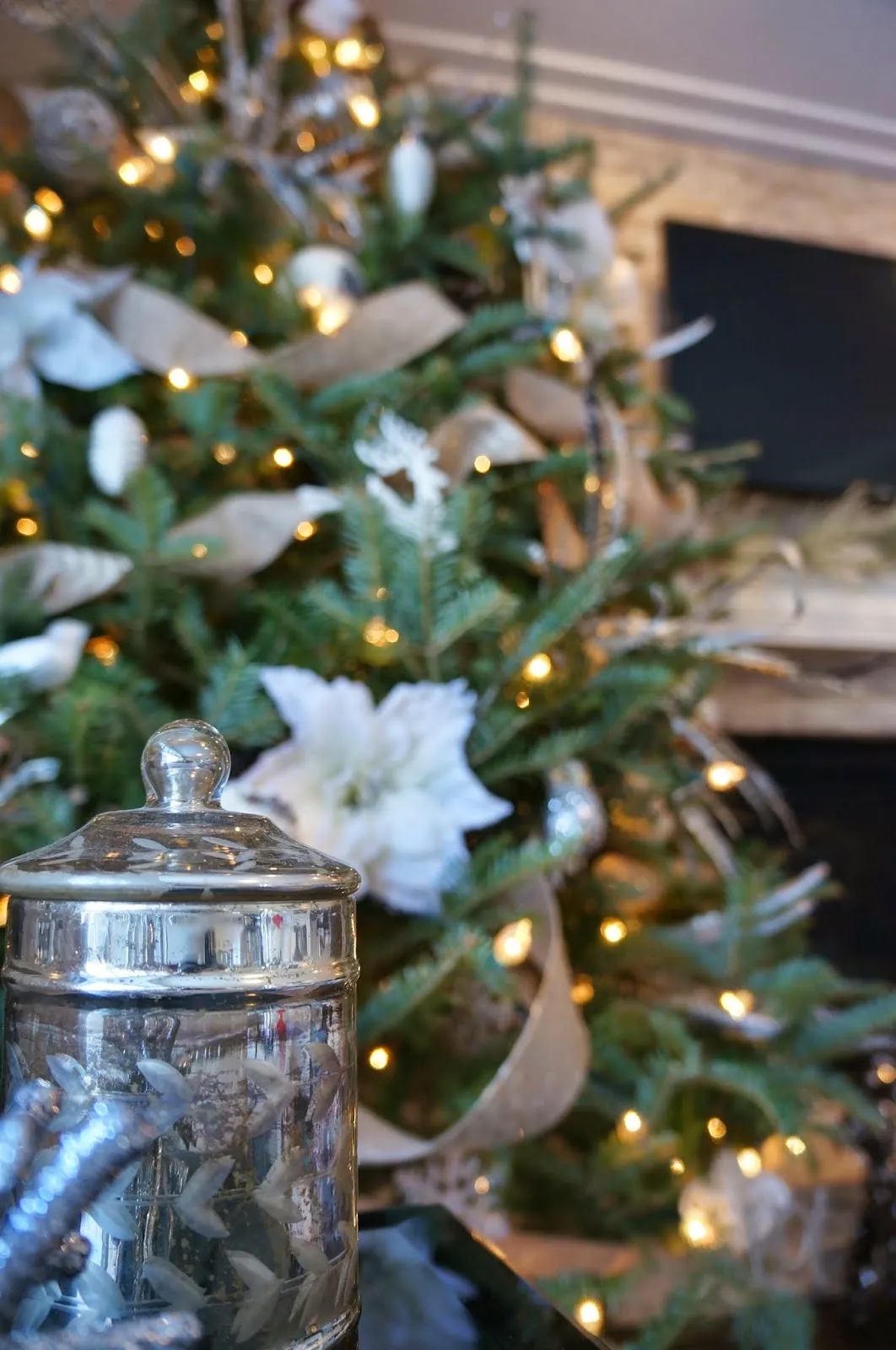
10. Mercury Glass, Champagne Ribbon, and White Florals Up Close
The layered close-up look is a staging trick, and you can build it in an hour.
- Clear a side table or console near the tree.
- Place your largest reflective object — a mercury glass jar or lidded canister — slightly off-center.
- Add two smaller objects at different heights behind it.
- Weave a short strand of warm fairy lights around the base of the objects, not over them.
- Dim the room’s overhead light and let the tree do the illuminating.
Time: 45 minutes. Cost: $0 if you shop your own shelves.
The mercury glass jar is what turns a corner of the room into a scene. It looks antique, it’s silvered, and it catches tree lights and throws them back as soft gold. Without it, the tree is just a tree and the table is just a table. With it, there’s a middle distance between you and the branches, which is exactly what makes a photograph feel like a room. Mercury glass is a coating, not a material, so hand-wash only and skip anything abrasive.
11. A Celestial Sun-and-Moon Ornament on a Frosted Tree
One oversized ornament, hung front and center, gives a decorated tree a face. The blue-and-gold sun-and-moon disc does that job here, and the embroidered velvet ribbon with gold starbursts repeats its motif up and down the branches so the ornament reads as intentional rather than random. Repeat a motif three times and the eye accepts it as a theme. Repeat it once and it looks like an accident.
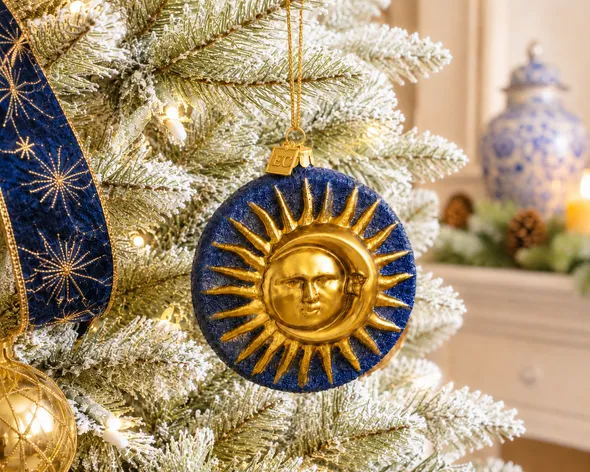
Celestial motifs are having a long moment, but that specific ornament may not be around next December. Before you build an entire tree around one piece, check that you can source three or four items in the same visual family — stars, moons, sunbursts, gold-threaded navy. If the ribbon and the baubles can stand without the focal ornament, you have a theme. If they can’t, you have a trend with an expiration date.
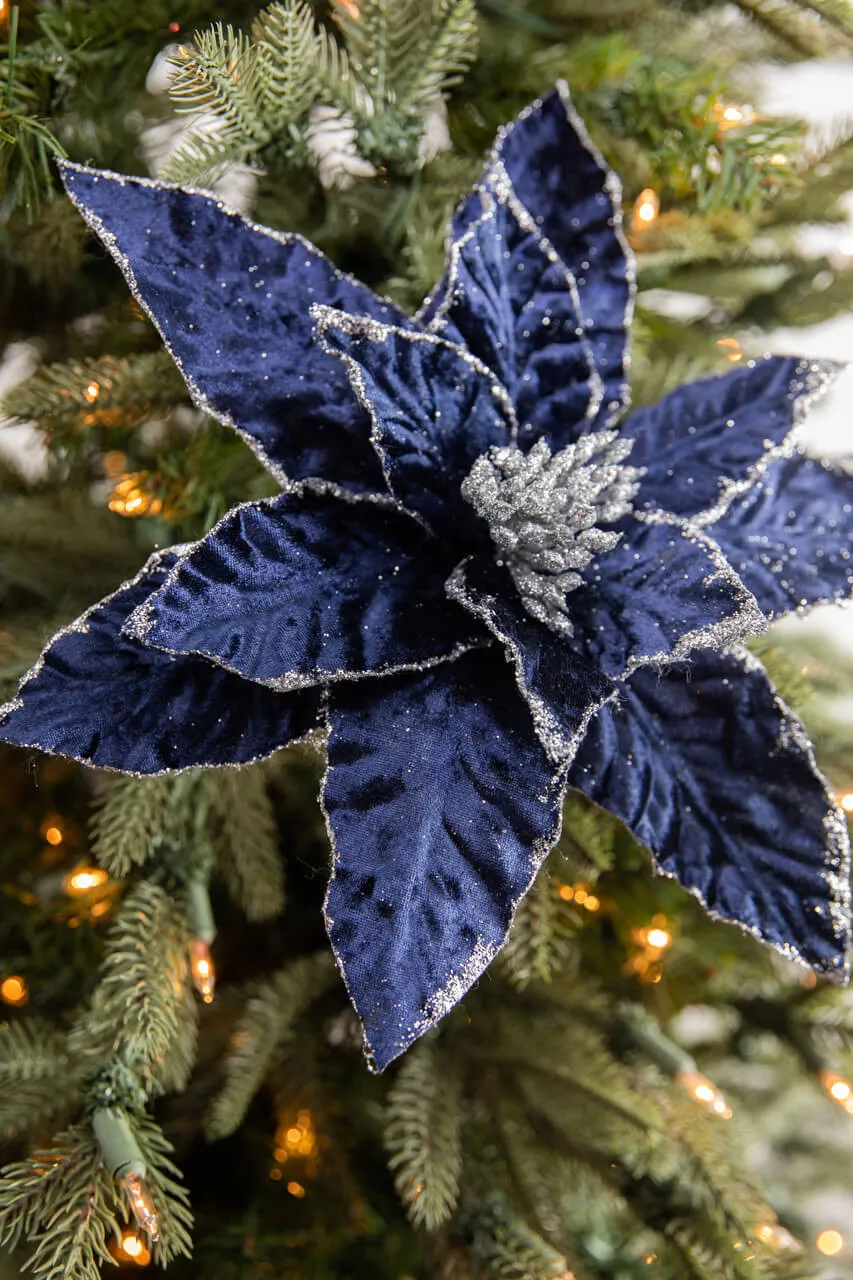
12. A Dark Blue Velvet Poinsettia With Glitter-Trimmed Petals
Big statement florals need space to be seen. Place a 6-to-8-inch velvet poinsettia every 10 to 12 inches of branch, and resist the urge to cluster them — three in one spot turns a flower into a bouquet. Also relevant: hang them slightly deeper in the branches than your baubles so the petals sit against greenery rather than floating in front of it. That depth is what makes an ornament look like it grew there.
Run through this before you commit to a blue-on-blue tree:
- Photograph your tree at night with the lights on — that’s the only lighting that matters.
- Confirm at least two ornament finishes: matte, gloss, glitter, or velvet.
- Check that your focal ornament is at least 4 inches wide to hold its own.
- Buy velvet in person if you can — online blues vary wildly between screens.
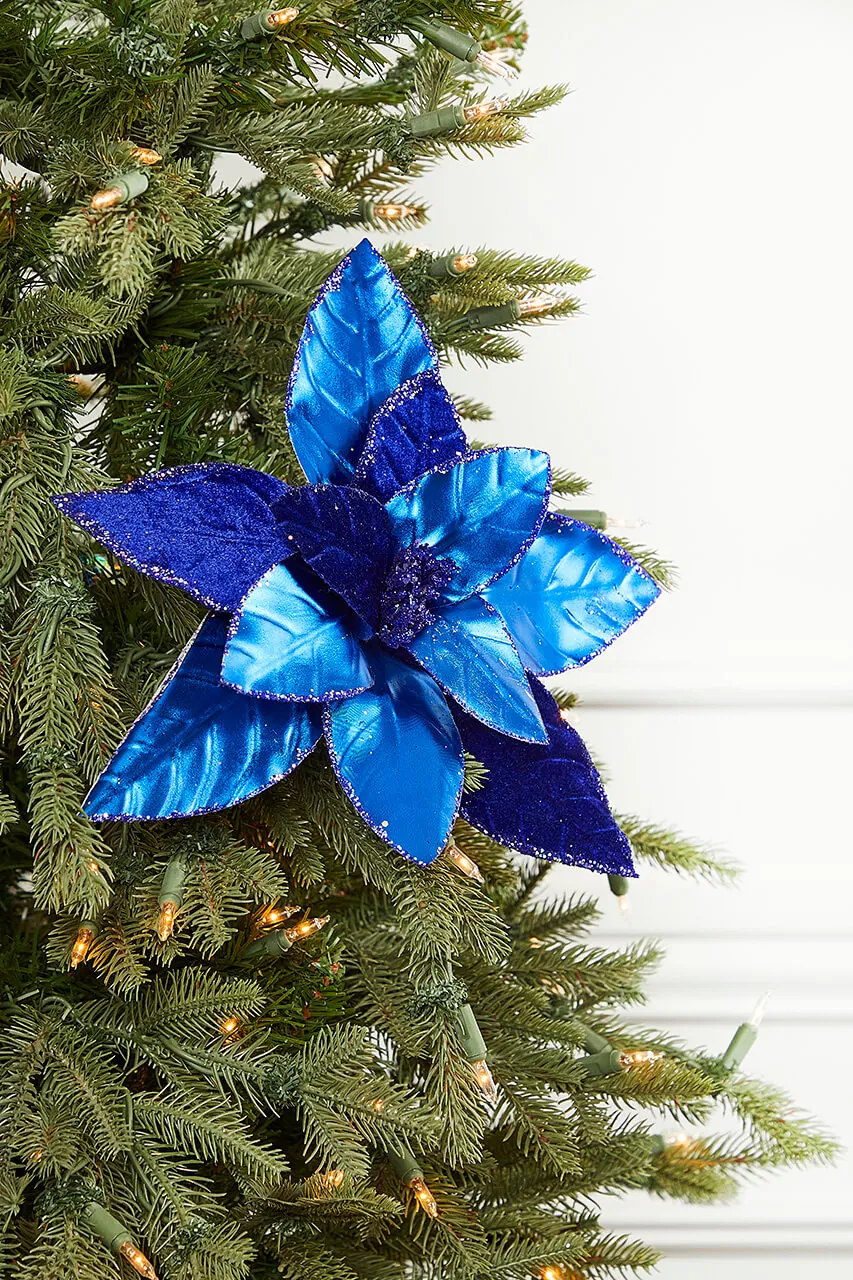
13. A Vibrant Blue Faux Poinsettia in Metallic and Glitter
The mixed finish is the point. This poinsettia isn’t one material pretending to be a flower — it’s half smooth metallic petals and half heavily glittered ones with silver edging, and that combination is why it looks expensive from across the room and interesting from two feet away. A single-finish version of the same bloom would read like a craft-store pick. Compare with Idea #12 — same flower, darker mood.
- Large blue poinsettia stems (6): $48–$120
- Assorted blue and silver baubles (60): $60–$180
- Warm-white string lights (300 ct): $18–$35
- Unlit 6.5-ft tree: $120–$350
- Silver glitter picks for filler: $20–$45
- Total: roughly $265–$730
Budget alternative: clip the stems off dollar-store poinsettia bushes and wire them into picks yourself — six statement blooms for under $20. The balance on the tree is about 60% green branches and warm light, 25% blue, 15% silver and glitter. Because the florals are so saturated, the green never reads as dominant even though it takes up the most space.
14. A Saturated Blue Tree in a Pink-and-Gold Retro Room
This is the grandma-Christmas resurgence in its loudest form, and it’s been building since around 2023 — vintage figurines, retro Santa gift bags, pastel everything on gold shelving. Pink and blue together are a mid-century pairing pop culture keeps re-validating, and it plays especially well on camera. It’s also the most polarizing look in this roundup, which is fine. Rooms that commit to a point of view are more memorable than rooms that hedge.
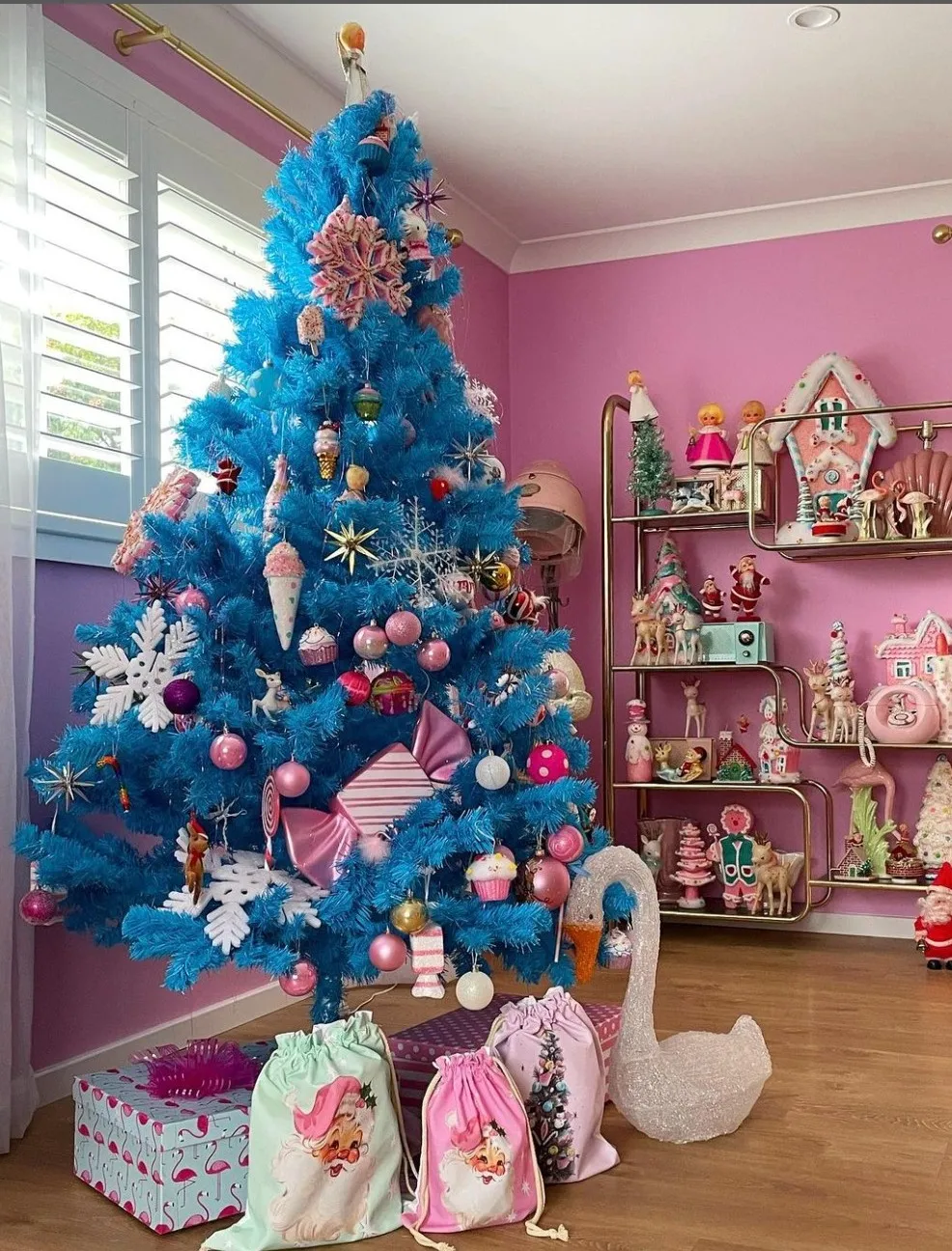
Two things are doing the heavy lifting. First, the pink walls make the blue tree read cooler and brighter than it would against white — simultaneous contrast, the oldest trick in color. Second, and more importantly, nearly every ornament is pink or white, so the tree is the only blue object in the frame. One saturated element surrounded by soft companions is a composition. Five saturated elements is a fight.
Retro maximalism needs walls. Plan on at least 120 square feet with the tree against a solid-color wall, and give yourself 3 feet of clear floor so the display shelving and the tree don’t crowd each other. Ceilings under 9 feet are fine here — this style is horizontal and shelf-driven, not vertical.
15. Chinoiserie Ginger Jar Ornaments With Plaid Ribbon
Think of it as 50% traditional green tree, 30% ceramic narrative — the ginger jars — and 20% plaid ribbon holding it together. The trick is that red-and-blue plaid is the bridge: it lets a white-and-red jar share branches with a dark blue one without either looking misplaced. Keep the plaid to one or two patterns and let the jars vary. Swap in green-and-white toile and you’re in a different holiday entirely.
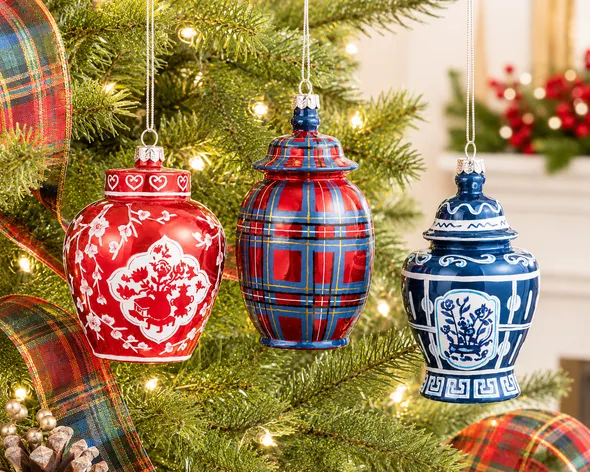
Real ceramic ginger jar ornaments run $12 to $30 each, which adds up fast for a full tree. Better move: buy two or three real ones and fill the rest with a $6 set of printable jar-shaped ornaments from Etsy, mounted on card stock and hung with gold cord. Thrift stores turn up single vintage jars year-round for a dollar or two. Nobody counts your ornaments from a foot away.
16. A White Tray of Blue and Champagne Baubles Under String Lights
The tray arrangement takes 20 minutes and photographs like a magazine spread.
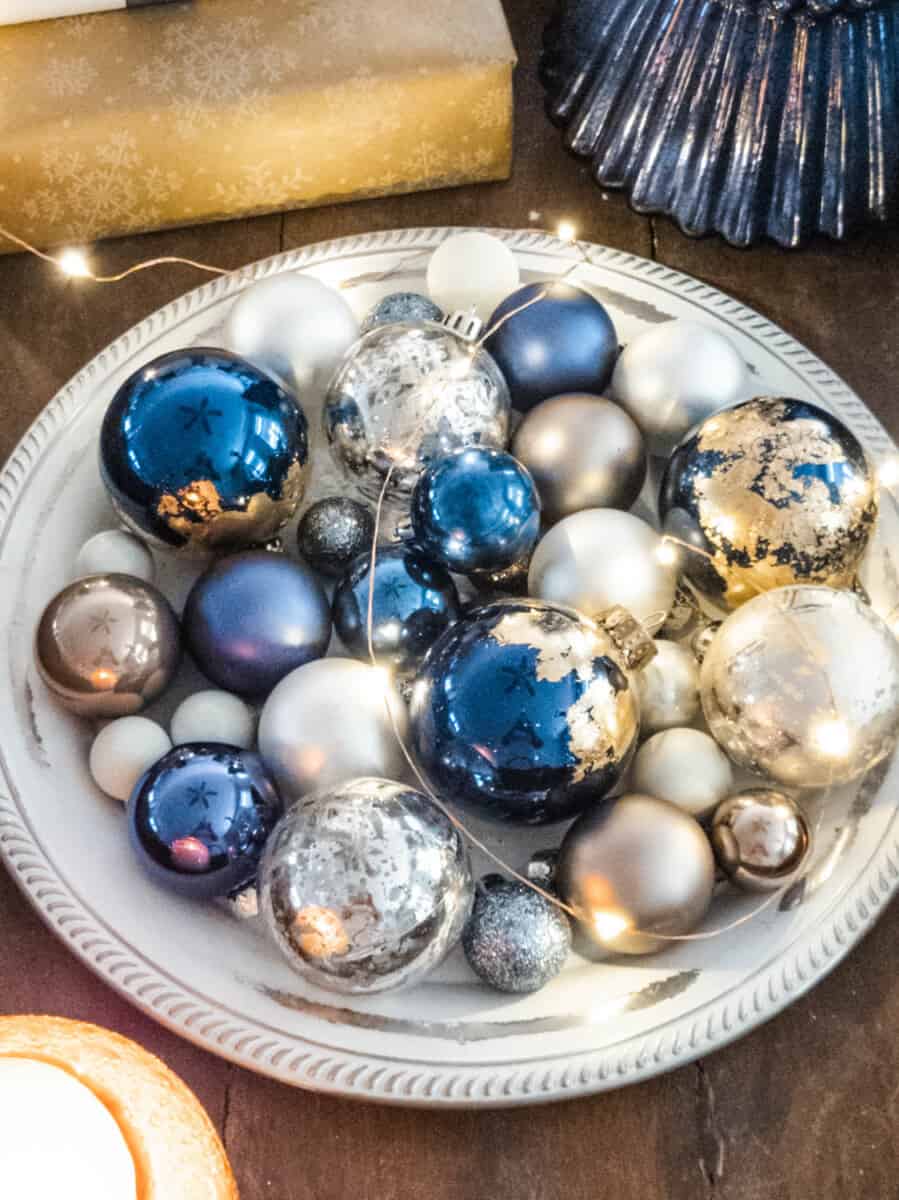
- Choose a tray with a fluted or raised rim — it holds the spheres in place.
- Layer the largest matte-white and royal blue baubles first, loosely.
- Fill gaps with champagne and mercury glass spheres in smaller sizes.
- Weave a strand of warm fairy lights through the middle, not around the edge.
- Leave one or two ornaments lying on the table just outside the tray.
Time: 20 minutes. Cost: $25–$60 if you’re buying new, $0 if you’re raiding the tree.
This is the lowest-maintenance display in the whole roundup — no watering, no shedding — but glossy ornaments show fingerprints, and mercury glass shows dust within a week. A dry microfiber cloth every few days keeps it clean. If the tray sits under a window, rotate it monthly; UV fades gold foil faster than blue glass.
17. Navy Velvet Ribbon With Gold Edges and a Rhinestone Teardrop
Wired velvet ribbon with a gold edge is worth the extra cost because the wire lets you shape it and the edge gives you a light line against dark branches. Use it at 2.5 to 4 inches wide, and always buy a full 10-yard roll per 7-foot tree — running short mid-tree is how projects end up unfinished. The same principle applies to the teardrop ornament: gold rhinestone detailing needs two darker, plainer neighbors or it stops being a highlight.
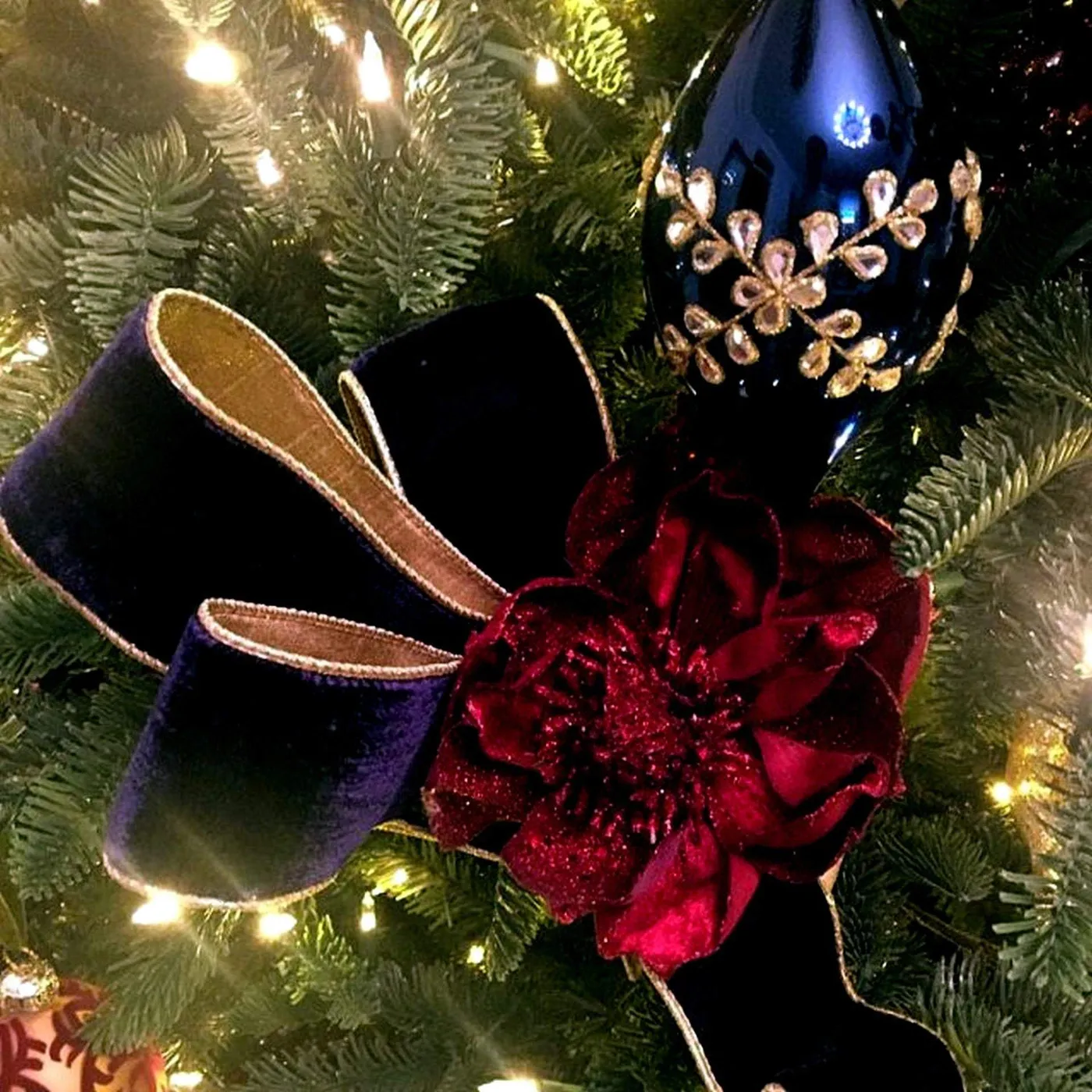
Two things nobody warns you about. Rhinestones snag velvet — if a beaded ornament brushes your ribbon, it pulls threads, so hang the fancy pieces at least 6 inches from ribbon paths. And deep red velvet blooms plus navy can tip into theatrical if you layer more than three of them. Keep the red to a single accent and let the blue do the talking.
18. Frosted Blue-Green Tree With Pink and Champagne Baubles
This one is happiest in a room between 10 by 12 and 14 by 16 feet, with the tree against a textured grey or greige wall where the soft palette can breathe. Frosted blue-green needles plus pink is a low-contrast pairing, so the tree needs a plain background or it disappears into pattern. Ceiling height matters less than wall width here — give it 4 feet of clear wall on each side.
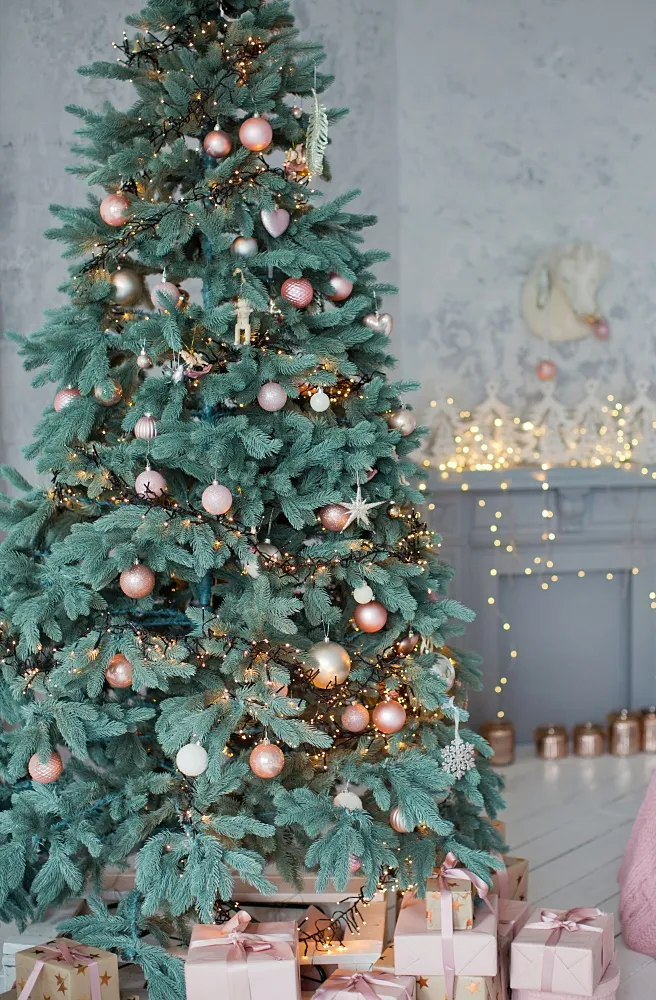
The ratio is about 45% frosted blue-green branches, 30% pink, 20% champagne gold, and 5% delicate star accents holding it together. Pink and champagne sit close in value, which is why the tiny star accents matter more than their size suggests — they’re the only sharp contrast in the mix. Swap pink for pale sage and the formula holds; change gold to silver and it goes icy instead of soft.
- 7-ft frosted blue-green tree: $150–$400
- Pink shatterproof baubles (60): $50–$130
- Champagne and gold ornaments (40): $45–$140
- Warm-white fairy lights, 2 strands: $20–$40
- Star accents and picks: $18–$50
- Gift wrap and ribbon: $25–$60
- Total: about $300–$820
Budget alternative: HomeGoods and Walmart both carry pink shatterproof sets at $12 for 30 in early season, cutting the ornament spend by more than half.
19. A Blue Glass Bauble With a Winter Forest Inside
The diorama is everything. A translucent blue glass ornament with painted pine trees and glittered snowflakes inside gives you a tiny scene, and tiny scenes are what people stop and stare at. A plain blue sphere in the same spot would be pretty and forgettable. This one makes guests lean in. It’s the clearest example in this whole collection of why one carefully chosen ornament outperforms fifteen average ones. Buy one ornament you’d never get tired of looking at, then build the tree around it.
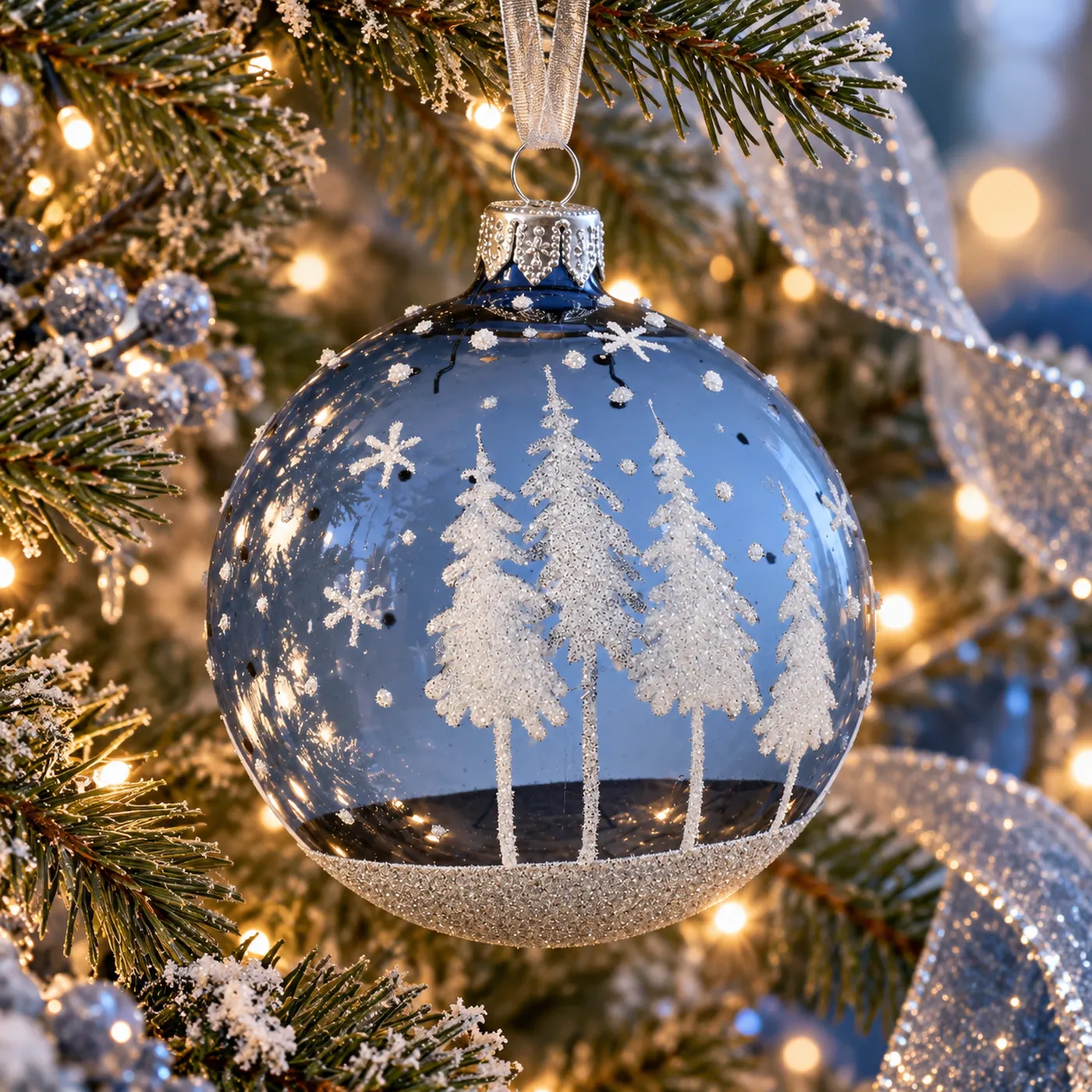
Diorama ornaments are a handcrafted-market specialty — Etsy sellers price them from $22 to $60, and independent glass studios go higher. The budget route: clear glass fillable ornaments run $8 for six at craft stores, and a $10 set of miniature bottle-brush trees fits inside two of them. Add a spoonful of faux snow and a dab of glue. It isn’t hand-painted, but from six feet away nobody knows. See Idea #16 for a whole tray built on this same principle.
20. Adjusting Velvet Ribbon Around Dark Faceted Baubles
Hanging faceted glass so it actually catches light takes a minute of fussing.
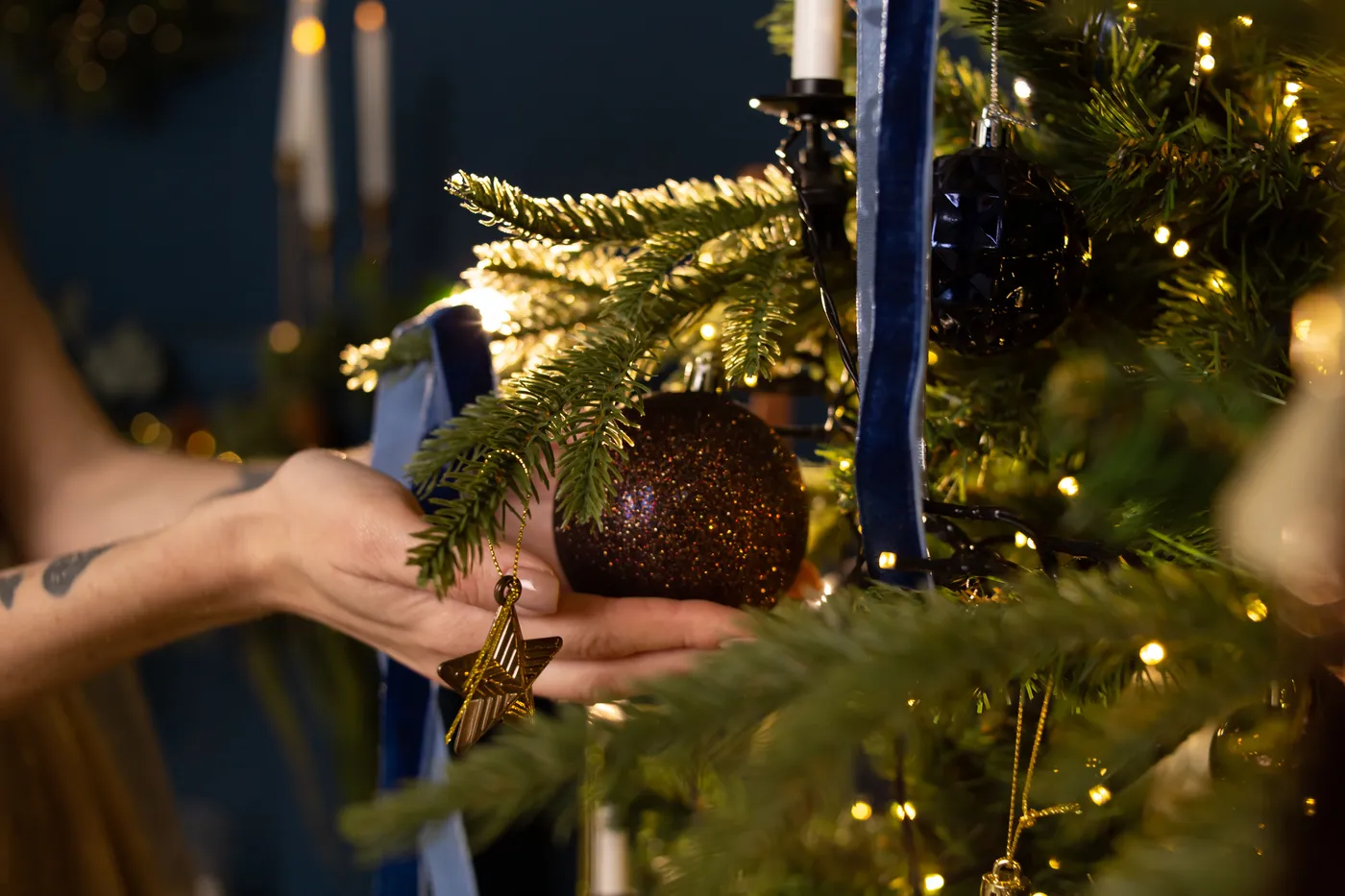
- Hang the ornament on a branch facing your main seating area, not the center of the room.
- Push the hook back so the piece rests against needles, not in open air.
- Rotate it until a flat facet faces the nearest light source.
- Repeat for anything you plan to photograph — light-facing facets photograph twice as bright.
Time: 10 minutes for a cluster. Cost: $0.
Deep blue and brown glass reads nearly black under warm bulbs, so treat it as texture rather than color. That means you need about three times as many as you’d think, spread evenly, plus small gold stars to break up the mass. If you want visible blue after dark, buy glossy cobalt instead of faceted navy. Same velvet ribbon, completely different result.
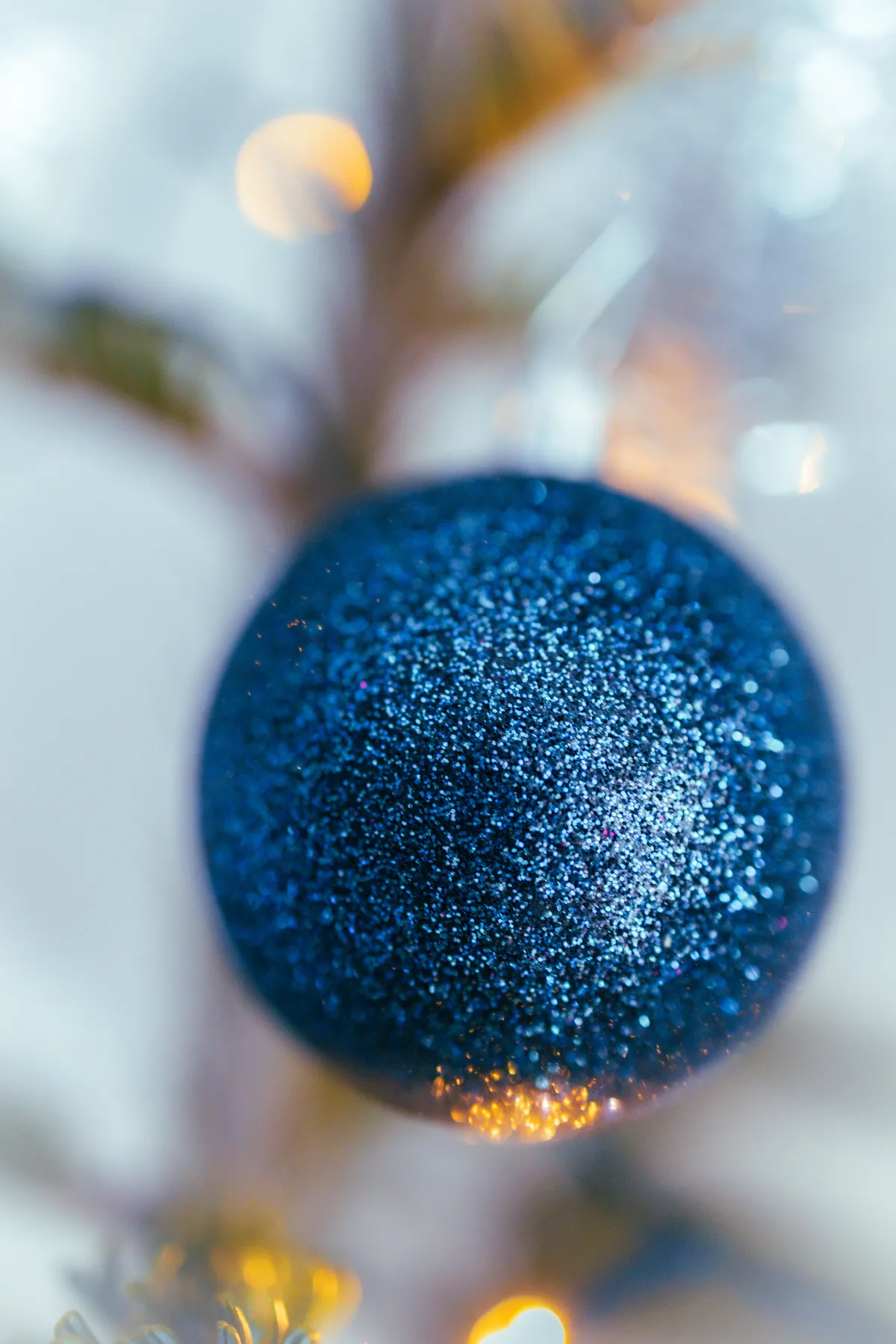
21. A Dark Blue Glitter Ornament Against Warm Bokeh
This is a lesson in how little you need. One round ornament, heavy dark blue glitter, hung with warm lights blurred behind it and nothing else competing. The soft background is doing as much work as the ornament — it turns a plain sphere into a glowing object. If you want this effect on your own tree, keep your busiest decorations toward the back and the interior branches, and leave a little clear air in front of your favorite three or four pieces.
Check these before you commit to a dark-and-glittery tree:
- Count your light strands — dark ornaments need roughly double the usual bulb count.
- Lay your ornaments on a table and photograph them together in daylight.
- Confirm your storage box fits the tallest ornament plus the topper.
- Decide whether you want to see the color at night, or just the sparkle.
22. Snow-Flocked Tree on a Wicker Collar Against a Navy Wall
Deep navy walls want a bright tree, and this is the pairing that proves it. The room needs enough width for the wicker tree collar and the flanking baskets to sit clear of foot traffic — call it 3 feet of floor around the base, or about 12 by 12 feet minimum. White and silver baubles and natural pinecones keep the whole thing from going moody, and a plain pine tree skirt would have lost the texture the wicker brings.
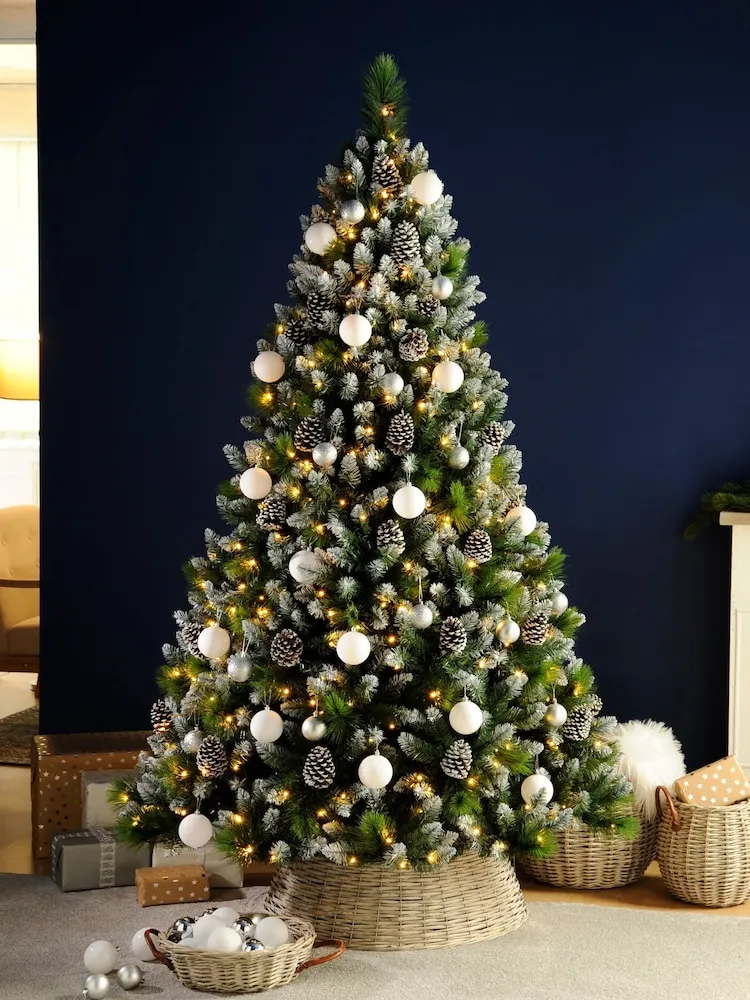
Wicker is the practical hero here and the maintenance headache. It collects dust in every weave, so plan on a vacuum brush attachment monthly, and keep it off damp floors — wicker that sits in a puddle warps and never recovers. Flocking plus pinecones means more shedding than a standard tree, so a woven collar that catches fallen snow is genuinely functional. Expect to shake it out twice a season.
Natural pinecones bring natural bugs, and that is not a myth. Bake foraged pinecones at 200°F for about an hour on a foil-lined sheet to kill anything living inside, then let them cool completely before they touch the tree. Store-bought is usually treated, but if you gathered yours in October, that step is not optional.
23. Blue Glass Figural Ornaments Beside a Bottle-Brush Tree
Vintage-style figural ornaments are the kind of thing that costs $28 each at a boutique and $3 at a church rummage sale. Hunt estate sales and eBay lots in September, when sellers are clearing last year’s stock, and you can build a collection of eight or nine for under $60. The bottle-brush tree is even easier — a small white one on a wood slice runs about $8 at Target, and pinecones are free if you bake them first.
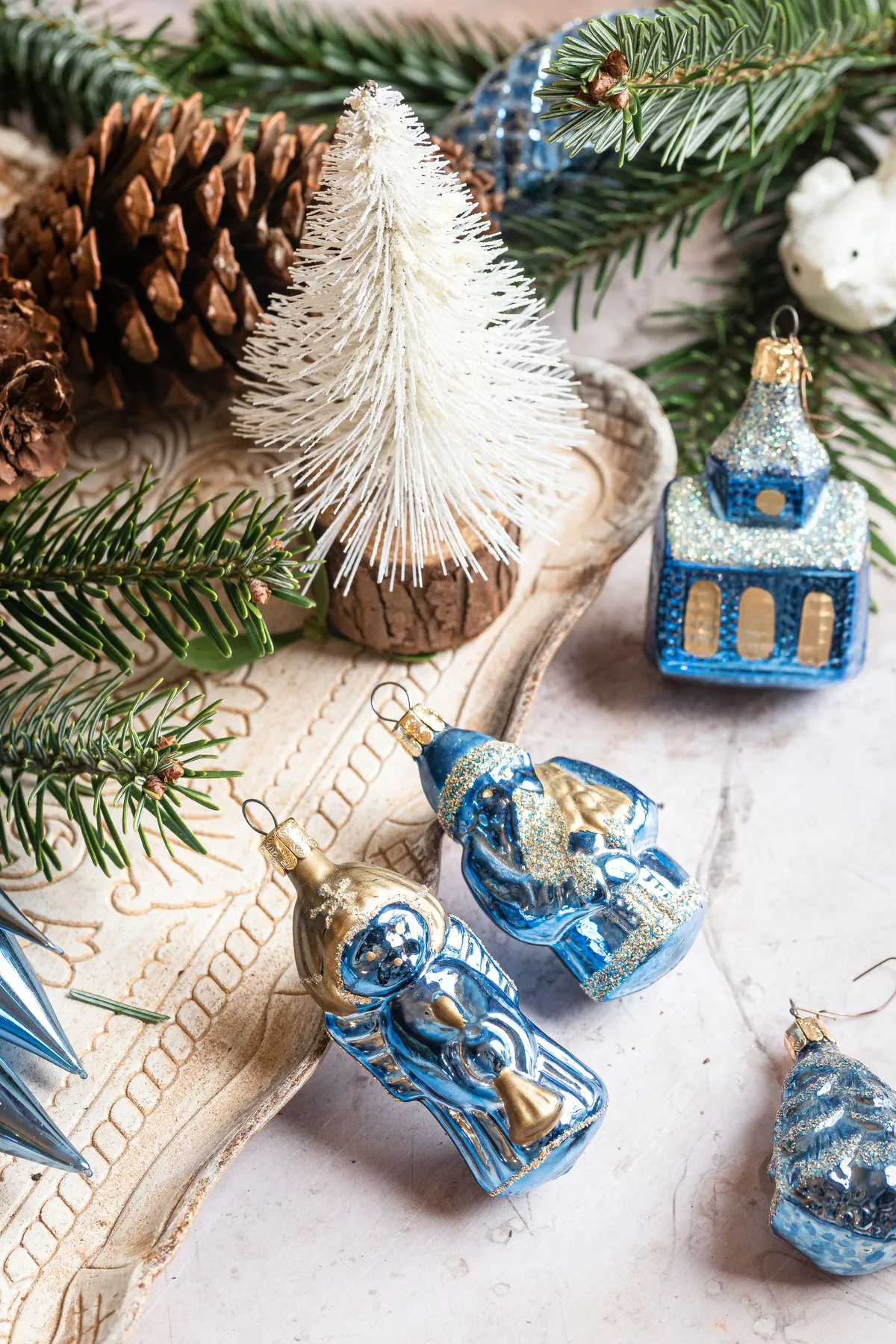
Vintage figural ornaments have been climbing on resale sites for a few years now, partly because new production can’t match the painted detail and partly because buying secondhand fits how younger decorators like to shop. The display style — a textured tray, fresh evergreen boughs, a couple of small lit twig trees — is the same logic as a curated shelf, applied to a holiday. It’s a trend with a natural ceiling; once everyone’s grandmother’s attic is emptied, it settles into a classic.
24. Flocked Tree With White Lights, Pinecones, and Red Berries
White lights are unforgiving. They read colder than warm LEDs, they can make flocking look blue rather than snowy, and any gap in branch coverage becomes a visible dark hole. If you’re set on white, buy roughly 100 lights per foot of tree height — a 7-footer needs about 700 — and check the effect from your sofa at night before you add ornaments. Most people under-light by half and then blame the tree. Compare with Idea #22, where white and silver do the same job against navy walls.
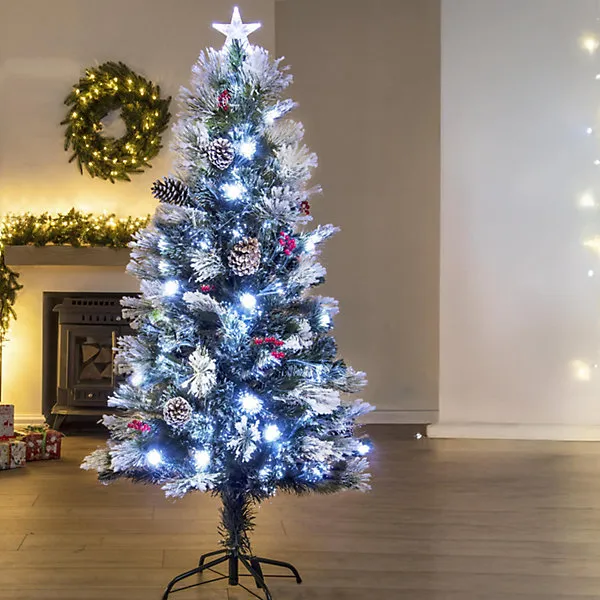
Berries are cheap and easy to place correctly.
- Choose small clusters of 3 to 5 berries rather than single stems.
- Space them roughly every 12 inches around the visible front of the tree.
- Tuck each cluster against green needles, never at the tip of a branch.
- Keep berry clusters above the 18-inch mark if you have a toddler or a chewer.
- Save three clusters for the mantel garland so the tree and fireplace connect.
Time: 25 minutes. Cost: $12–$30 for a full tree.
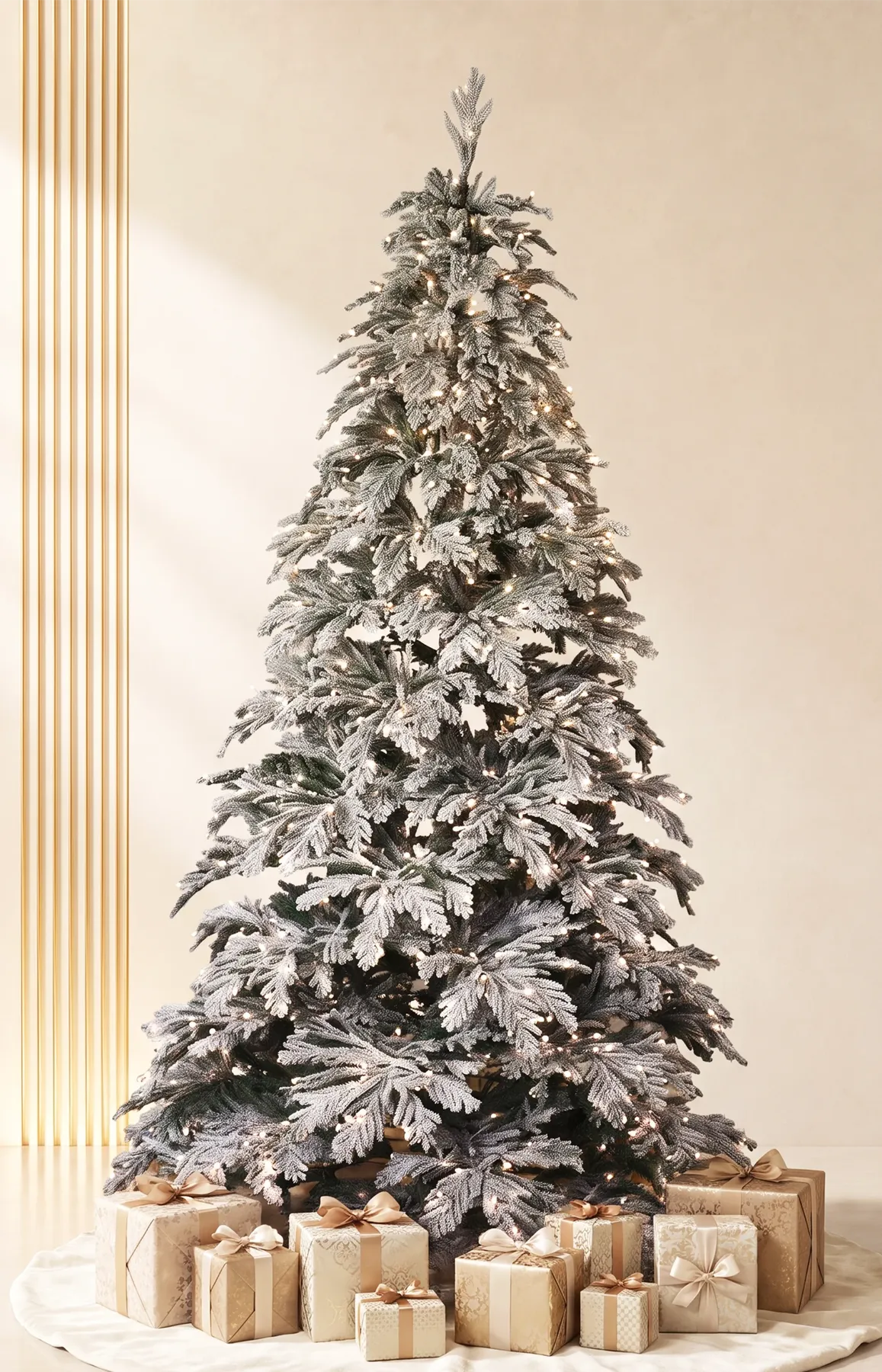
25. Flocked Tree With Champagne Gifts Against Gold Wall Slats
Wrapped gifts are decor, so treat them like it. Use three paper patterns maximum — one solid, one stripe or plaid, one tiny motif — and unify them with a single ribbon color. Match your gift wrap to the wall behind the tree and let the tree itself carry the contrast; champagne packages in front of vertical gold slats turn a corner into one glowing block, which looks deliberate in photographs and muddy in person. Vary sizes: tall box, square box, flat box.
- 7.5-ft pre-lit flocked tree: $220–$550
- Warm-white lights if unlit: $25–$50
- Gift wrap, ribbon, and bows: $40–$90
- Champagne gift boxes, 10 empty: $25–$60
- Tree skirt or collar: $35–$110
- Total: about $345–$860
Budget alternative: skip empty display boxes and wrap real gifts early in brown kraft paper with a champagne satin ribbon — about $14 total for a genuinely stunning pile on a white tree skirt.
26. A Blue Flocked Tree That Doesn’t Need a Single Ornament
Going ornament-free is a real design decision, not a shortcut. Confirm these first:
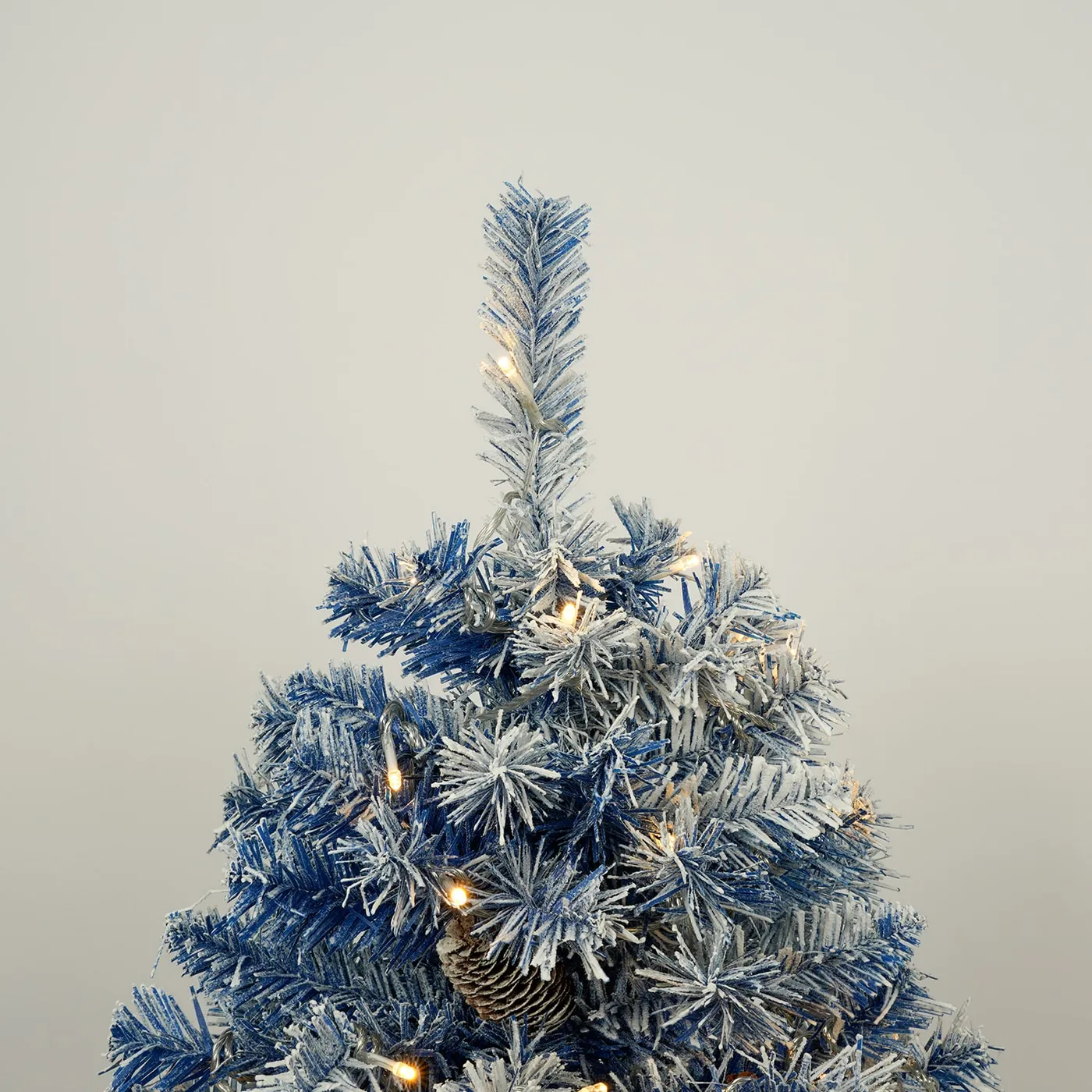
- Is your tree in a spot with enough light to show off the needle color?
- Does your flooring have enough contrast to define the base?
- Can you commit to one strong tree collar instead of a skirt?
- Will you actually resist adding just a few ornaments in January?
Read it as 80% blue-needled flocked branches and 20% warm light, with a single brown pinecone for texture — that’s the entire formula. The color contrast lives in the object, not the arrangement, which is why it works at any scale. A dark red wooden tree collar under a frosted green tree does the same thing with less risk. Change the needle color and the collar color and you have a whole new tree without buying anything else.
27. A Glittered Champagne Bottle Ornament on a Lit Pine Branch
Novelty ornaments are usually terrible in groups and wonderful alone. This gold-glittered champagne bottle with a cursive label works because it hangs by itself against lit needles — no neighbors, no competition, just a small joke in a tree. Put six of them on and the tree becomes a bar cart. Novelty ornaments work best when there’s exactly one of them. Pair with Idea #23 if you’re building a whole collected vignette instead.
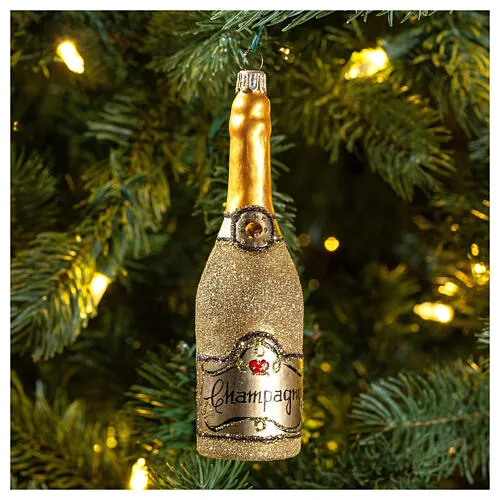
Three things make it land: the finish contrast between the rough glitter body and the smooth metallic neck, the vertical shape breaking up a tree full of spheres, and the fact that it’s legible from three feet away. Tiny lettering rewards a close look; big glitter reads across the room. An ornament that does both is rare, and it’s why this one earns a spot in the front third of the tree.
Food-and-drink novelty ornaments have quietly become a collector category — champagne, martinis, espresso cups — and 2026’s version is more refined than the cartoon Santas of a decade ago, with real glass, real glitter, and typography that looks designed. If you’re buying, check the hang loop; cheap versions often use a flimsy plastic cap that snaps by year two.
28. A Tall Undecorated Flocked Tree in a Plain Corner
An undecorated tree only works at scale and against restraint. This one needs a 9-foot ceiling, a full corner with 30 inches of clearance on both sides, and plain white walls — the frosted branches and the dark red collar are the only two things in the frame. In a smaller room, an undecorated tree reads as unfinished rather than minimal. On light wood flooring, the red collar does the grounding work a tree skirt would otherwise handle.
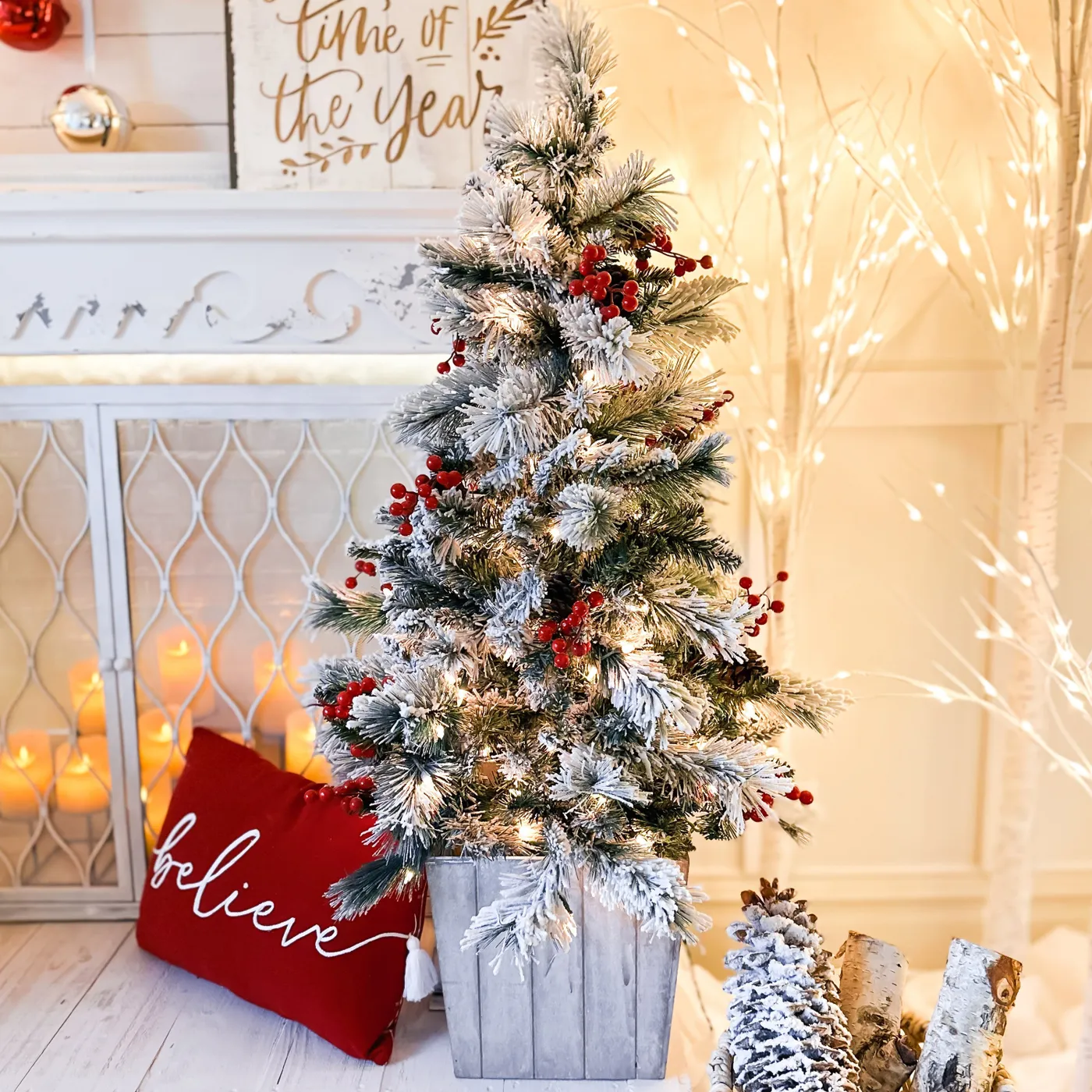
Before you decide to leave a tree bare, verify:
- Your tree’s flocking density — sparse flocking looks cheap with nothing on it.
- That the base or collar is a deliberate design object, not a plastic stand.
- Whether you have enough lamp light to show the needle color after dark.
- That the corner is genuinely empty, not a storage nook you’re hiding.
29. A Tabletop Flocked Tree With Red Berry Clusters
Tabletop trees are staged, not natural — so they need more light than you’d guess. A 2-to-3-foot tree needs a full 100-bulb strand to look alive, and if it’s sitting on a mantel, the lit fireplace screen behind it will fight the tree for attention. Choose one focal point. Small trees also tip easily with ornaments loaded on one side, so keep the heavier pieces low and centered, and weight the planter box if it’s anywhere near a doorway.
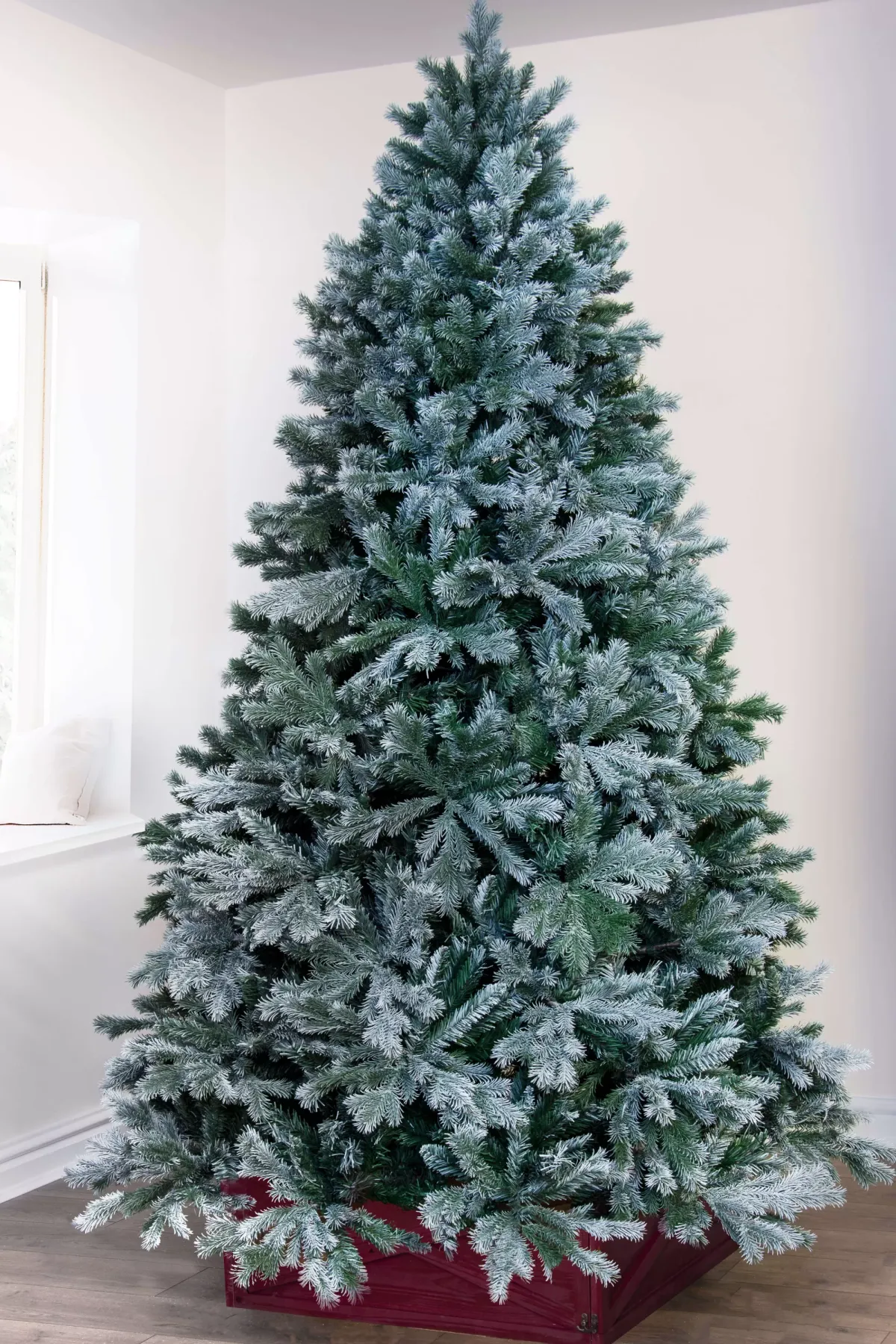
The planter box is what sells it as intentional.
- Choose a box tall enough to hide the tree’s base by at least 3 inches.
- Set the tree in, then fill around the trunk with florist foam or crumpled paper.
- Add a layer of faux snow or white batting over the top.
- Wire two or three red berry clusters into the front-facing branches only.
- Place the box slightly off-center on the mantel, never dead middle.
Time: 30 minutes. Cost: $30–$70, most of it the box.
30. Champagne, Cocoa, and Red-Gold Ornaments on Dark Wood
A hot-drinks station is charming for about two weeks and sticky for the rest of December. Felt pads under mugs, a tray with a raised lip, and a wipe-down cloth kept within reach will save the wood finish. Powdered cocoa and coffee pods attract moisture and clump in humid rooms, so store them inside the mugs rather than leaving them loose. Budget $20 for a decent tray if you don’t own one — it’s the difference between a display and a mess.
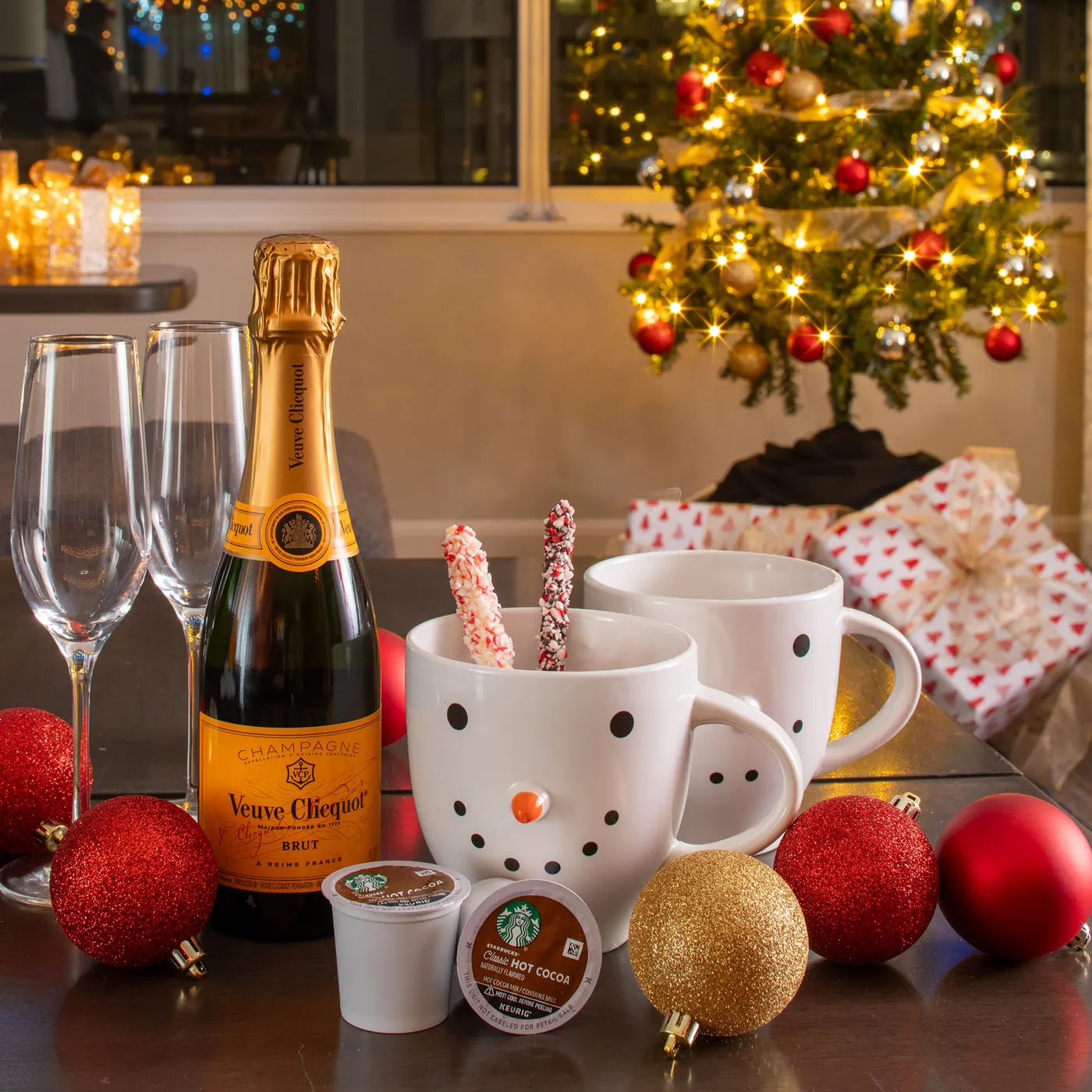
- Champagne bottle and two flutes: $30–$70
- Seasonal mugs, set of 2: $12–$30
- Wooden tray: $20–$55
- Red and gold ornaments (12): $15–$40
- Cocoa, pods, and striped stirrers: $15–$25
- Total: about $92–$220
Budget alternative: dollar-store flutes at $1.25 each, a thrifted tray for $6, and ornaments you already own bring this in under $30 — and the glowing tree in the background is carrying most of the atmosphere anyway.
31. Peacock Feathers With Champagne, Silver, and Blue Baubles
Feather stems are the cheapest way to add vertical drama to a tree, but they need a plan. Use odd numbers — five or seven — and always place them in the lower two-thirds, angled outward so the iridescent eyes catch light. Trim the stem to 8 inches and wire it to a branch so it holds that angle. Above eye level, feathers read as clutter; at or below eye level, they read as an arrangement.
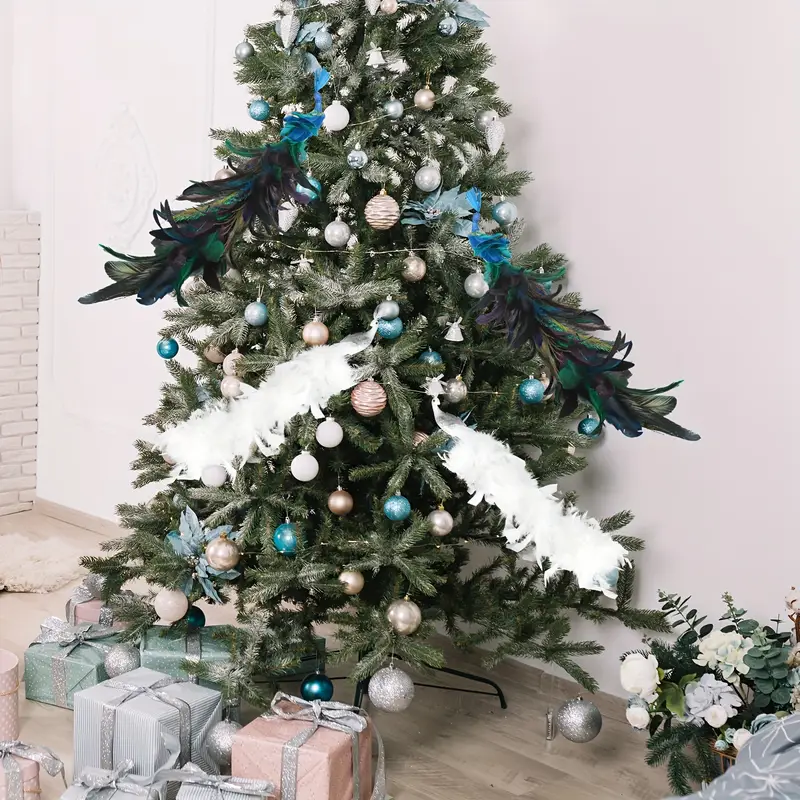
Remove the peacock feathers and you’d have a perfectly lovely silver-and-champagne tree that looks like a hundred others. The feathers are the risk, and the risk is the point — their green-gold iridescence mimics both the flocking and the champagne ornaments while adding a color nobody expects. White feathery garlands soften them so they don’t look like a costume shop. That balance between unexpected and matched is the whole lesson, and it’s why the wrapped gifts underneath stay in quiet pastels.
Now Go Make December Look Like Your Saved Folder
Every tree in this roundup shares one habit: it commits to a palette, then repeats it at three different scales. Blue and champagne isn’t a difficult combination — it’s a disciplined one, and you already have the reference photos.
📌 Pin this guide before December gets loud — the budget swaps, the ribbon widths, and the mistakes section will all come in handy when you’re standing in an aisle at 8 p.m. wondering if you bought enough.