Still scrolling through maroon Christmas tree photos at eleven at night without committing to a single one? That’s not indecision — that’s a very specific look searching for the right room.
We spent serious time browsing Home Depot, Anthropologie, and Etsy to bring you only what’s worth your attention this year, plus a handful of Target and Lowe’s finds, spanning roughly $18 for an ornament set up to $1,200 for a full lit tree.
After filtering through hundreds of options, we narrowed it down to 29 ideas that actually deliver — from monochromatic maximalism and vintage traditional to jewel-toned eclectic and flocked romantic. Budget and luxury versions sit side by side, and every idea is shoppable with direct product links.
In 2026 the maroon tree has quietly replaced the all-white tree as the Pinterest flex — searches for oxblood and burgundy holiday palettes climbed all season, and deep red is now the shade stylists reach for first. And stay until the end — we break down the most common mistakes that can ruin these looks.
📌 Save this to Pinterest for later — you’ll want to revisit these ideas.
1. A Fully Red Tree That Wears Nothing Else
The tree is the decoration. Take away the red needles and you’re left with an ordinary lighted tree on a plain metal stand — which is exactly the point. Because the foliage already carries every bit of color, this design skips tinsel, ribbon, and ornament sets entirely and lets dense branching plus evenly scattered warm white bulbs do the work. It’s a genuinely modern move, and it only falls apart when you panic and start adding things. If you own one colored tree, let it be the loudest object in the room and nothing else.
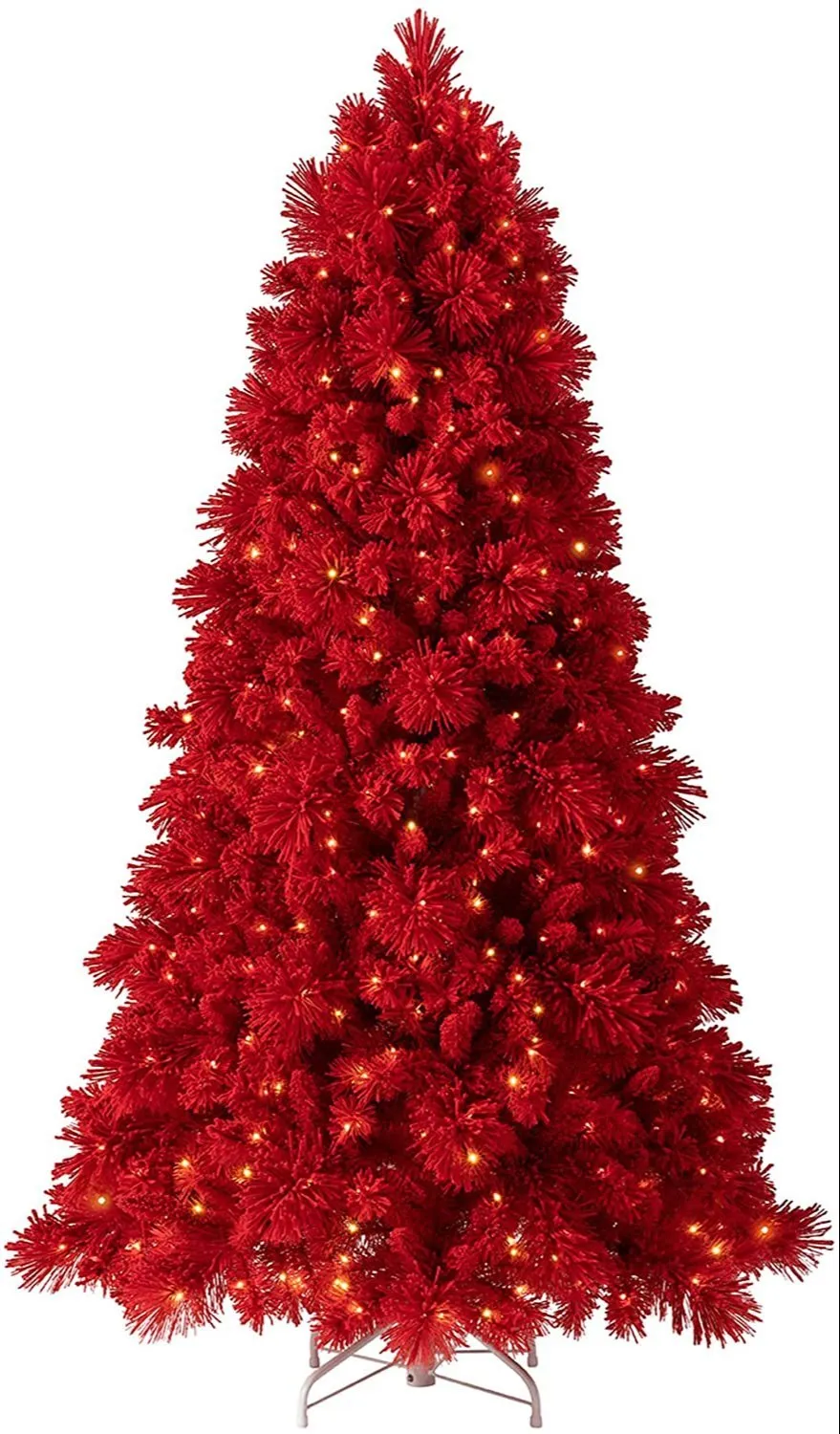
With a colored tree, ornament count matters far less than ornament size. Keep individual baubles under three inches so they read as texture rather than clutter, and cap the whole tree at eight to ten pieces spaced at least 18 inches apart. For lighting, aim for roughly 100 warm white bulbs per vertical foot — that’s what creates this even internal glow instead of the spotlight effect you get from a single 200-bulb strand tossed onto a 7-foot tree.
2. When the Ceiling Becomes a Maroon Balloon Cloud
Immersive single-color rooms are the holiday trend that refuses to quit, and this is the maximalist edge of it: floor-to-ceiling maroon and red balloons, a deep red carpet, and a lit red tree working as one continuous color field. It borrows the design language of theatrical window displays and immersive art shows and drops it into a living room. Statement installations like this have staying power because they photograph brilliantly and strike in a weekend — but they’re a one-season idea, not a decade-long one.
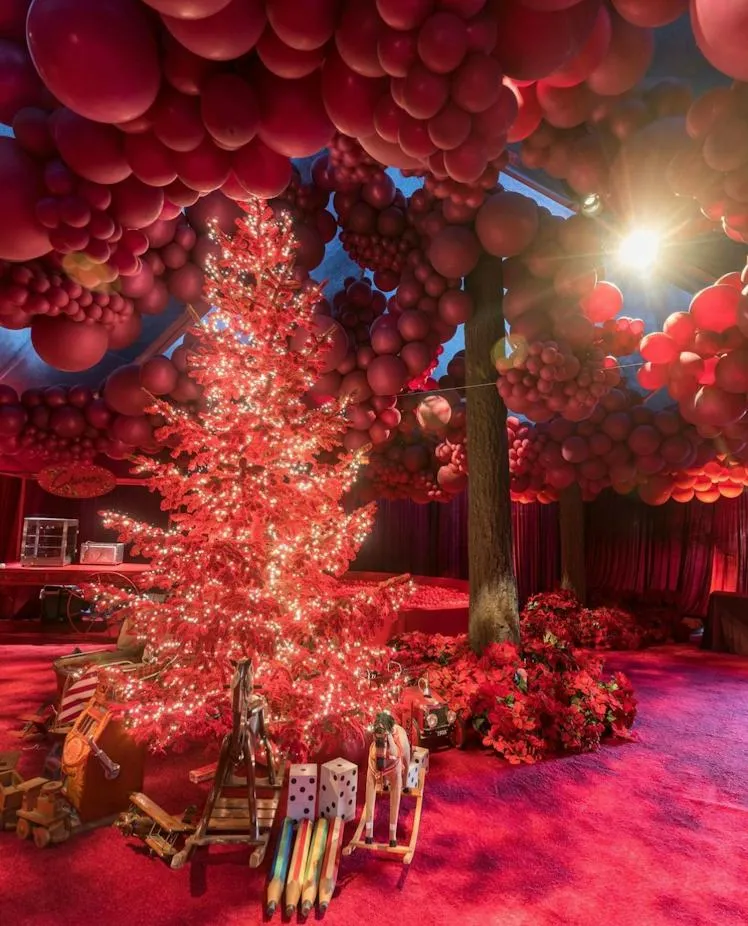
Three things hold this together. First, value contrast: deep maroon balloons sit against crimson carpet so the red never flattens into a single tone. Second, texture stacking — matte latex, glossy ornaments, the dry wood of vintage rocking horses, and fresh red florals clustered at the base. Third, a deliberate gallery of small objects, because a room this saturated needs somewhere quiet for the eye to land. The toys and floral arrangements are doing exactly that job.
3. A Deep Maroon Tree Against White Wainscoting
70% white architecture + 25% deep red foliage + 5% warm light. The wainscoting and pale walls aren’t the background here — they’re a full two-thirds of the composition, which is precisely why the dark red reads elegant instead of heavy. Same monochrome instinct as Idea #1, softened by architecture. Want it warmer? Swap white for cream and the deep red for a softer brick. Want more drama? Push the red toward oxblood and keep the trim pure white. The ratio never changes.
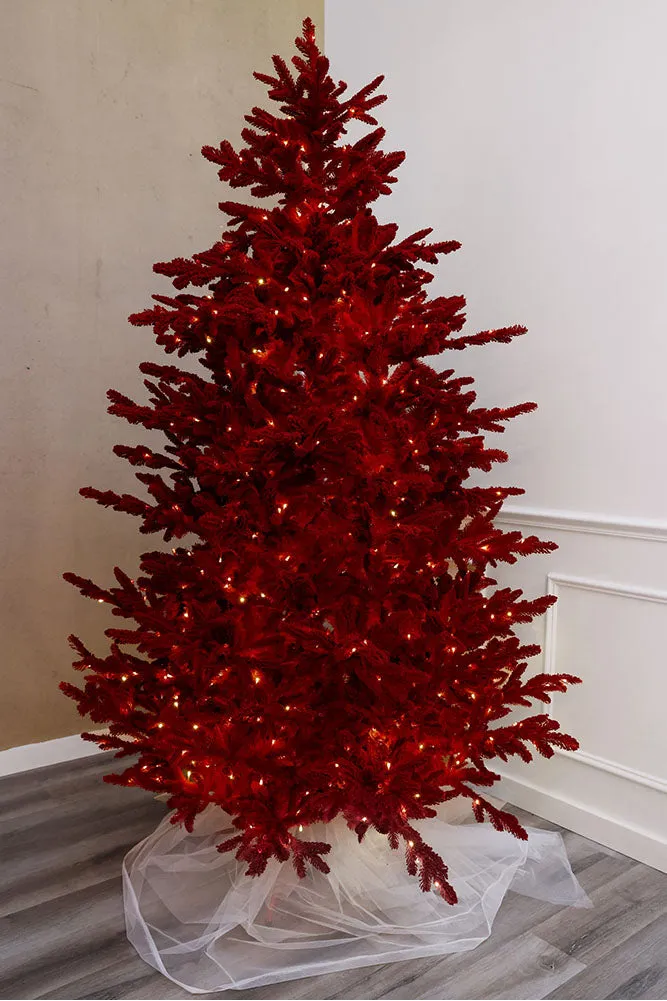
Deep red trees show dust, pet hair, and needle gaps more than green ones — the dark surface has nowhere to hide. If your tree sits near a fireplace or a busy hallway, plan on a quick lint roller pass every week or so. One more thing worth knowing: a saturated tree against white wainscoting is a high-contrast pairing, so a crooked skirt or a tilted stand becomes instantly visible. Straighten the base before you add a single branch.
4. Cranberry Beads, Popcorn, and a Dried Apple Slice
Two garlands, two materials, one color family. The glossy dark red cranberry strand reflects the lights while the matte popcorn absorbs them, so the tree gains depth from a single hue. Then the dried apple slice with its little green leaves interrupts the rhythm — a warm brown and green note that keeps the whole thing from reading like a craft-store display. That one organic detail is the difference between a tree that looks collected and a tree that looks purchased.
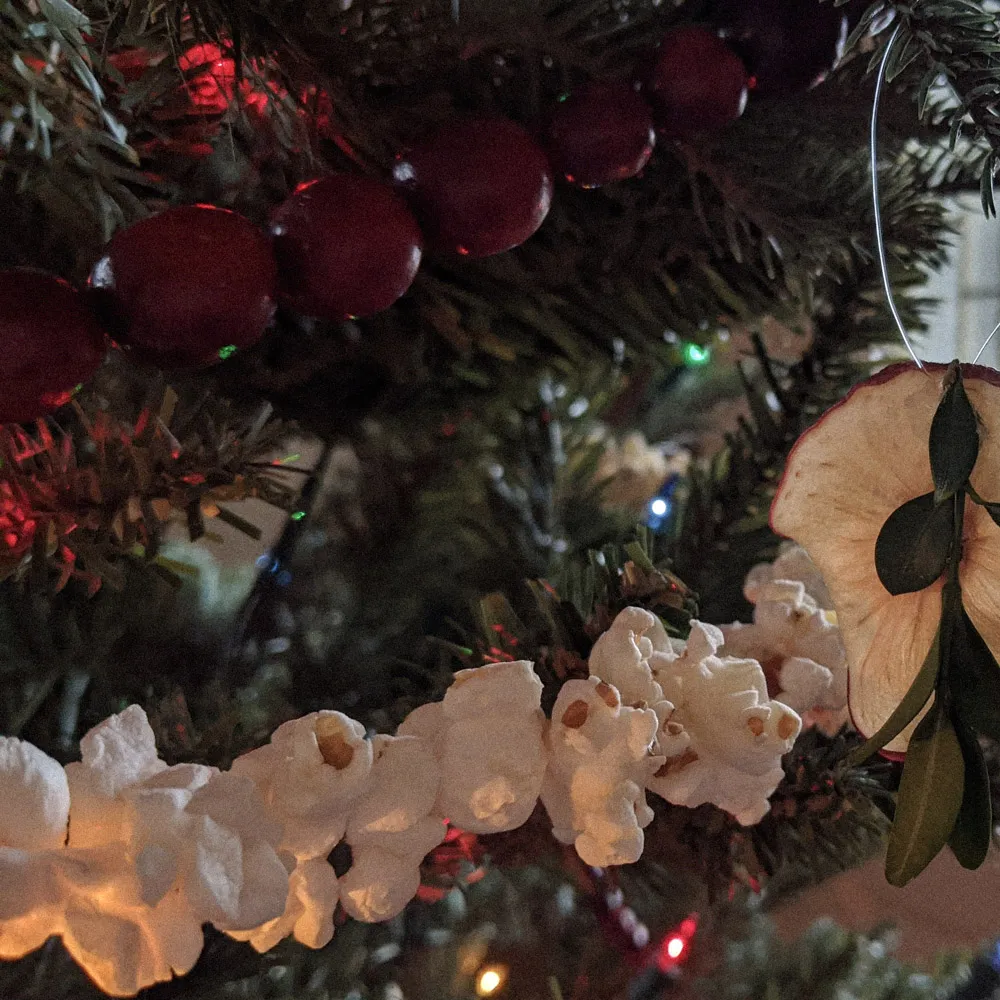
Popcorn garland has a real failure mode: it snaps. Use day-old popcorn, since fresh kernels are too soft and crumble, plus a long upholstery needle and doubled quilting thread. Drape in loose 12- to 14-inch swags instead of pulling it taut, and string it at least 24 hours before guests arrive so it has time to settle. If you have a dog, skip it entirely — the butter scent is an open invitation. Keep cranberry strands about a half-inch off the branch tips.
5. The One Diagonal Strand of Maroon Beads
That single strand of glossy maroon beads, run on a long diagonal instead of tidy horizontal rings. Remove it and you still have a perfectly pleasant evergreen with pinecones, a textured dark red bauble, and a small brass bell — nice, and completely forgettable. The diagonal is what makes the eye travel up the tree and gives an otherwise traditional scheme a little modern tension. It costs about twelve dollars and it changes the entire silhouette.

- Set one end near the top, about four inches in from the tip.
- Pull the strand down and across, wrapping once every 12 to 14 inches of tree height.
- Let the beads rest on top of the branches, never tucked underneath.
- Step back six feet every two wraps and check that the line stays diagonal.
- Fill the open pockets with pinecones and one brass bell per side.
Time: 25 minutes. Materials: $12-$25.
6. A Jewel-Toned Tree in a Teal-Lacquered Room
Colored rooms are having another moment, and the boldest version pairs a fully saturated paint job with a tree in an entirely different color family. Here, deep teal walls and ceiling meet purple, turquoise, and gold ornaments — no green or red anywhere in sight. It’s the anti-traditional holiday palette that’s been building on Pinterest for several seasons, and it works because jewel tones share the same depth and saturation. This one’s a commitment, but it isn’t a fad.
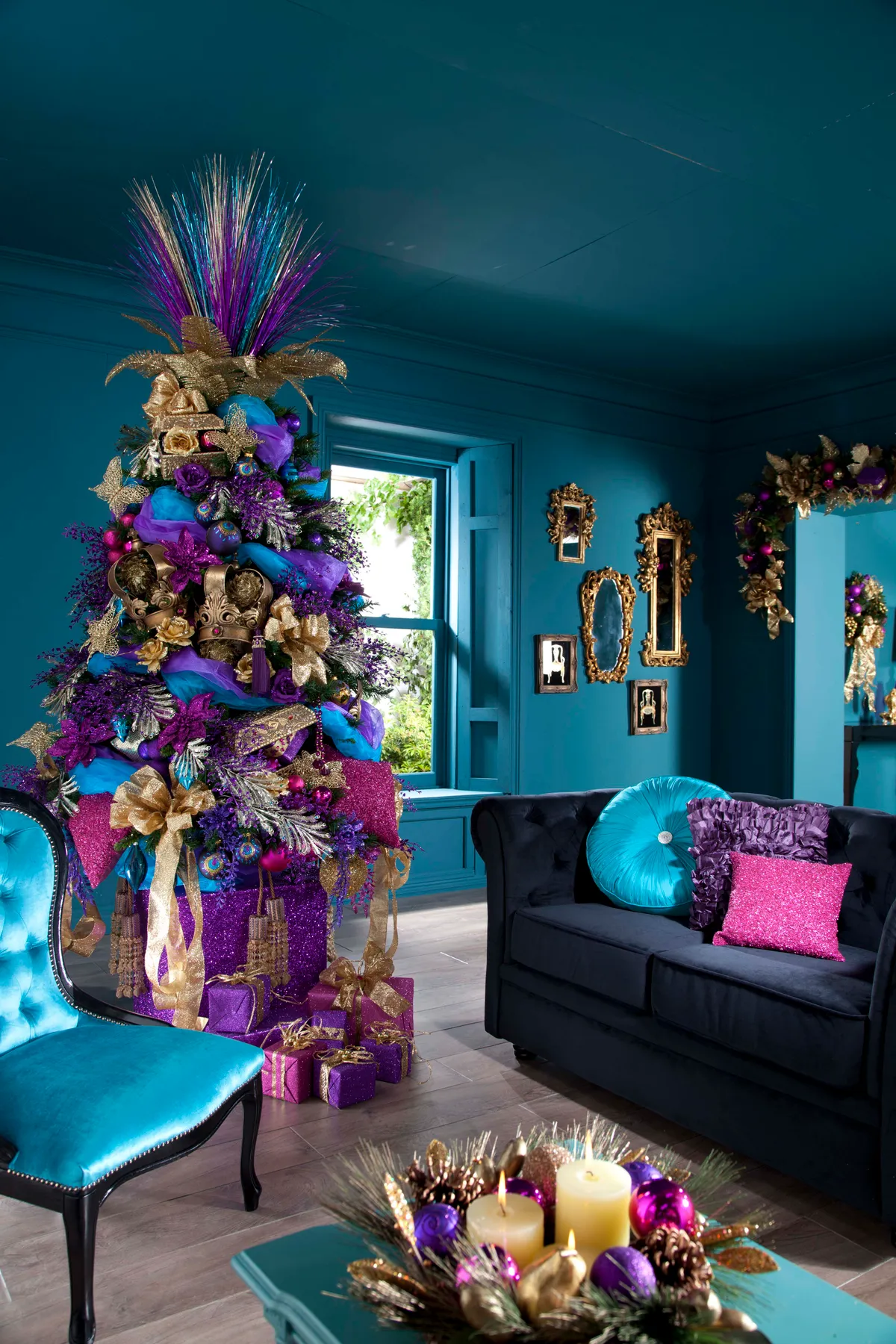
60% teal (walls, ceiling, upholstery base) + 30% purple and magenta (tree, cushions, gifts) + 10% gold (mirrors, frames, ornaments). Notice the ceiling is painted too — that’s what makes the room read as an object rather than a wall with a tree parked in front of it. To test the formula at home: keep any two of these three colors and swap the third. Teal plus gold with a cream tree works. Purple plus gold against white walls works just as well.
7. Frosted Silver Branches With Glossy Red Teardrops
- Flocked silver 7-ft tree: $120-$400
- Warm white string lights: $15-$35
- Glossy red teardrop and round ornaments, 24-30 pieces: $40-$120
- Plush red tree skirt: $25-$70
- White and red patterned rug: $60-$250
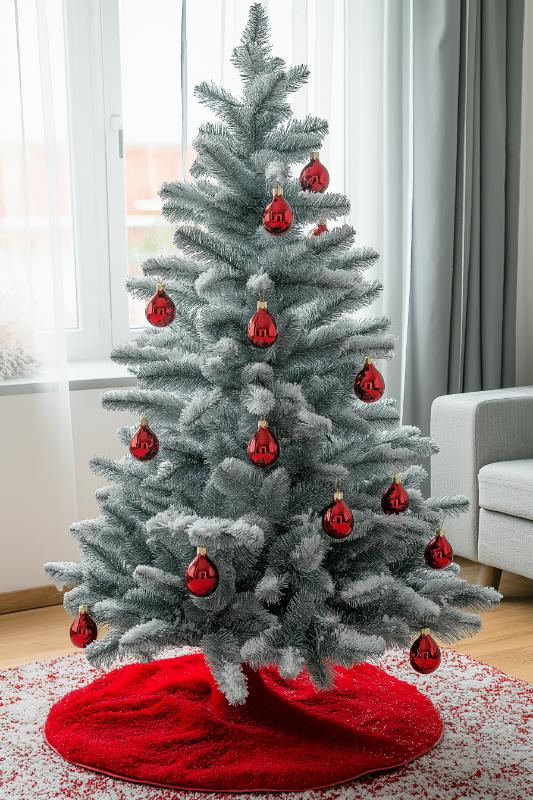
Total: $260-$875
Budget alternative: a plain silver tree from Target around $60, one can of spray flocking at $18, and thrifted ornaments at roughly 50 cents each land the same look near $130.
Flocked trees shed. Constantly. Expect a fine white dust on your rug and anything within three feet of the tree for the first two weeks, and again every time you move it. Skip flocking entirely in nurseries or anywhere a crawling baby roams. Glossy red ornaments also show fingerprints and smudges instantly — matte or ribbed finishes in the same red read just as festive and need a fraction of the wiping.
8. The Ringmistress Tree With a Mannequin Torso
Theatrical builds only work when the theme is applied at three scales: large (the mannequin torso), medium (big bows and striped ribbon), and small (miniature drums, tiny checkered ornaments). Skip the small layer and it looks unfinished. Skip the large layer and it looks like a school craft project. Keep every element inside three colors — red, black, white — because a themed tree loses its punch the second a fourth hue sneaks in.
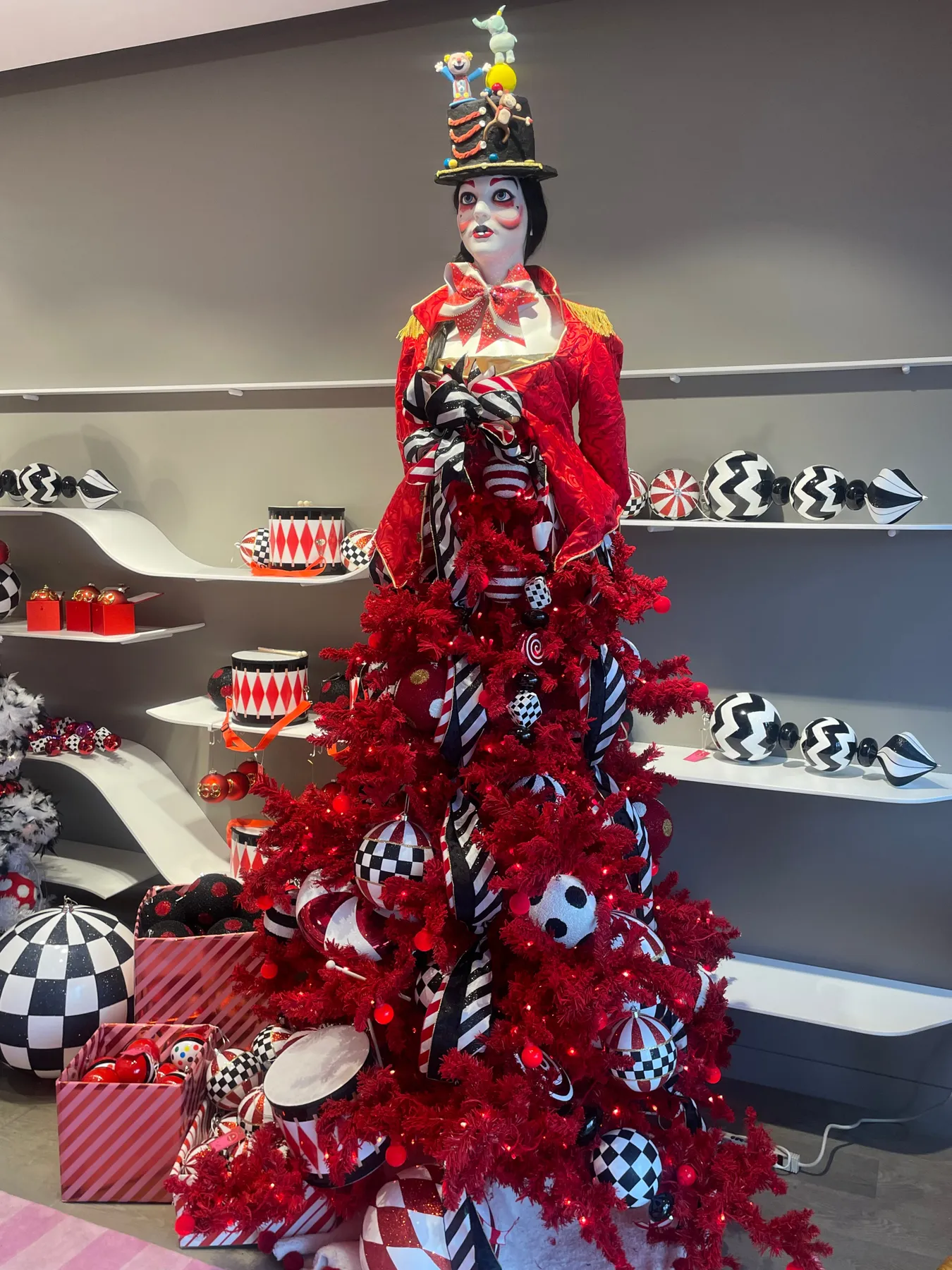
The torso at the top, in its top hat and red jacket, is the whole thing. Without it you have a red tree with checkered ornaments: fun, and forgettable. With it, the display becomes a character, and those black-and-white checkered baubles suddenly read as costume rather than pattern. If you build one piece with real personality this season, build this one, and let the floating white shelves behind it stay perfectly ordinary.
9. Oversized White Rounds on a Heavily Flocked Tree
Scale contrast is doing the heavy lifting. Oversized white rounds, three to four inches across, sit against heavily flocked branches so they read as snowballs rather than decorations. Bright red baubles and bows sit lower and smaller, giving the tree a soft gradient from white at the top to red toward the base, and warm string lights run between the two, keeping the white from tipping icy. If you’d rather go metallic than snowy, Idea #7 gets there with silver instead.
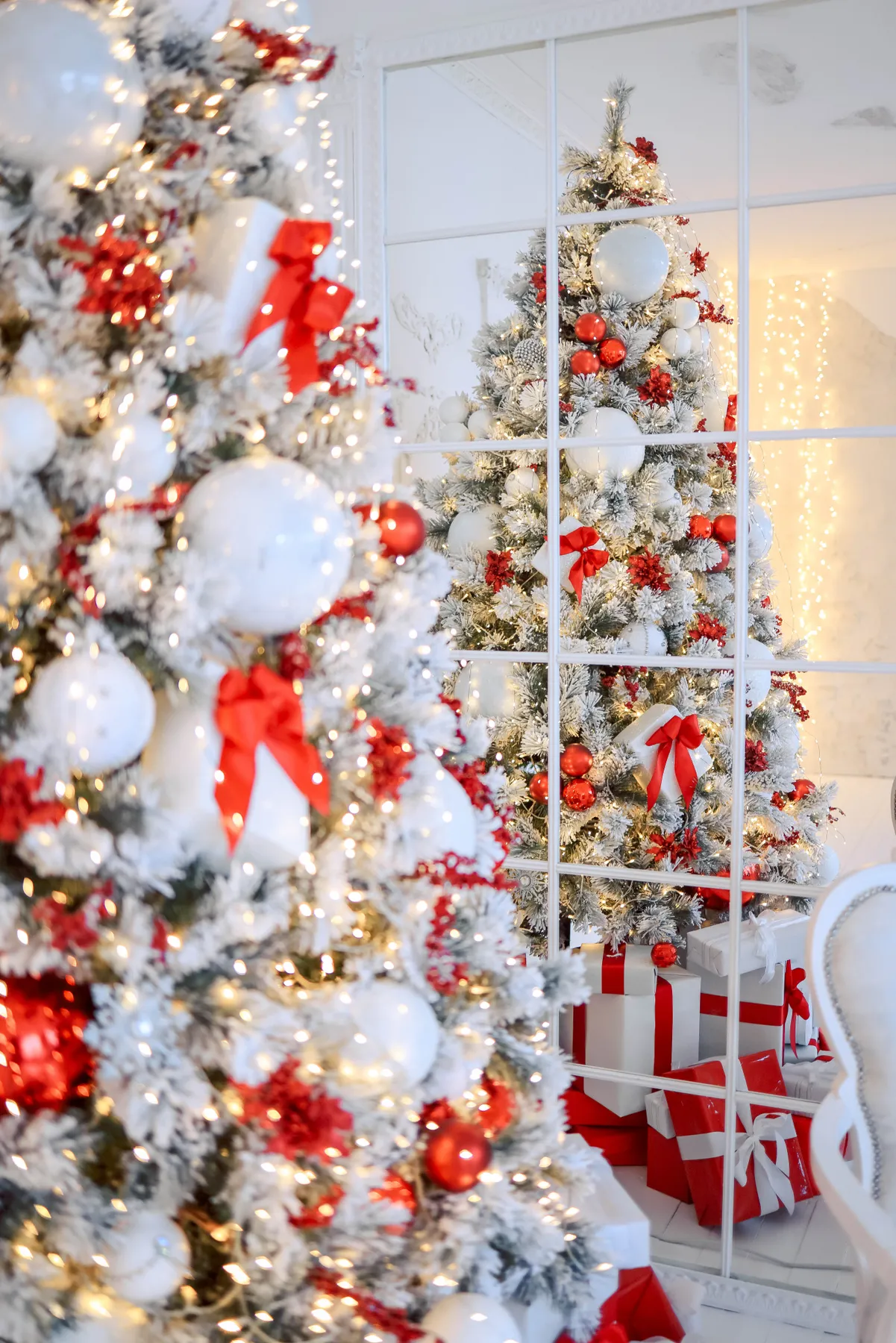
You don’t need a designer flocked tree. A $70-$120 green tree from Walmart or Lowe’s plus one $15 can of spray flocking applied in two light passes gets you most of the way. Oversized white ornaments drop to $1-$3 each at Target the week after Thanksgiving. And a red velvet skirt can be a $12 remnant cut in a circle with pinked edges — no sewing, no hemming, no fuss.
10. Maroon Velvet Tufted Chairs Facing the Tree
Split the room into rough thirds: 35% dark wood (paneling, floor, trim), 35% maroon (tufted chairs plus the lit tree), 30% everything else — the muted red and blue vintage rug, the small floral ottoman, the warm tree lights. The maroon appears twice in wildly different materials, flat needle foliage and deep tufted velvet with nailhead trim, which is what makes the color feel deliberate rather than accidental. Swap the rug for something quieter and the formula still holds.
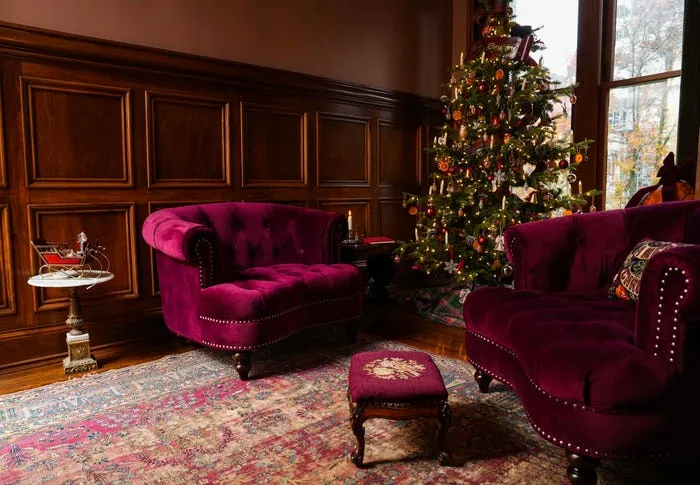
Tufted velvet is a statement chair — buy one, not a pair, unless the room runs over 300 square feet. Check the pile direction before you order, too: deep pile looks gorgeous on a showroom floor and shows every handprint within a month. A short-pile or performance velvet in the same maroon holds up far better with kids and pets. Measure the footprint plus a 30-inch walkway before you commit.
11. Red Plaid Sofa, Plaid Curtains, One Warm Tree
This layout wants a room around 14 by 18 feet with 9-foot ceilings. Below that, matching plaid on both a sofa and floor-length curtains starts to feel sealed in — pick one surface to pattern and leave the other solid. Here, wide plank wood flooring and a big coffee table give the eye somewhere to rest. If your living room comes in under 200 square feet, take the plaid to the sofa only and hang plain natural linen at the windows.
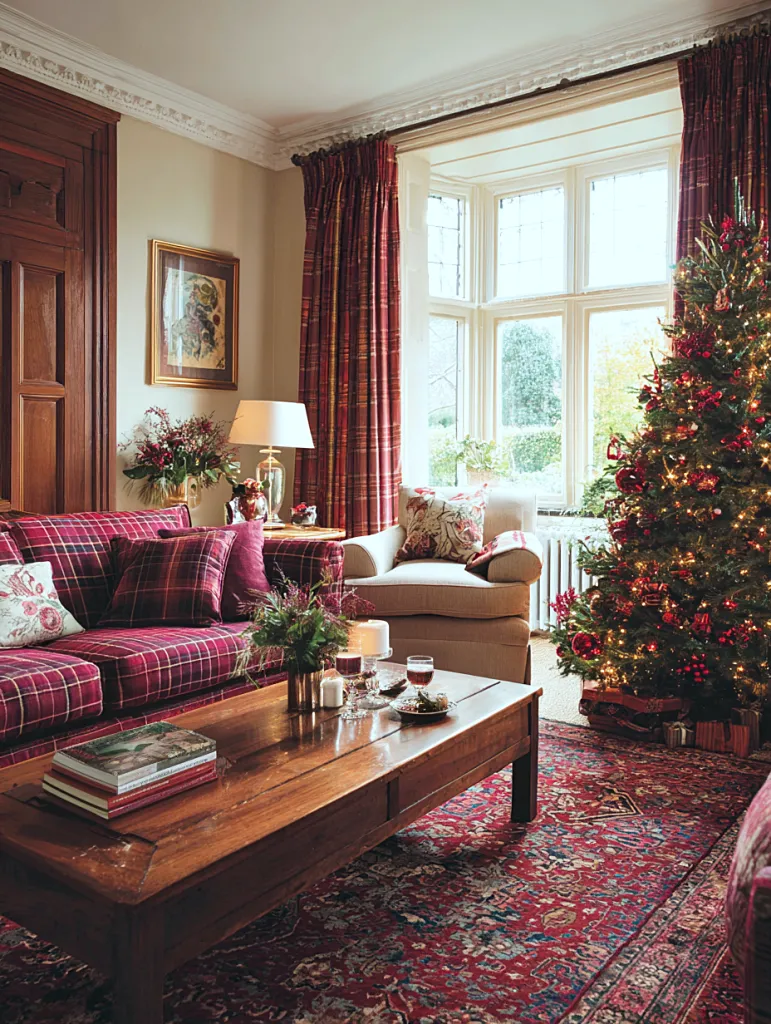
Plaid upholstery in a saturated red shows crumbs, dark pet hair, and uneven fading along sun-facing edges. Rotate cushions monthly and keep curtains out of harsh southern light if you can. Wool and wool-blend plaids should be spot-cleaned with cool water only — hot water sets red dye into the fibers permanently. The oriental rug underneath wants a professional clean roughly every 18 months, about $150-$250 for a room-size piece.
12. Red Poinsettias Tucked Into Green Branches
The oversized poinsettia blossoms. Everything else on this tree — glossy red balls, matte red baubles, little beaded berry garlands, warm white lights — is standard holiday issue. The poinsettias are what turn the tree into a garden. Tuck them in so no stems show and the petals sit slightly inside the branch line rather than on the tips; a flower floating outside the silhouette looks stuck on rather than grown there. Six to nine across a 7-foot tree is plenty.
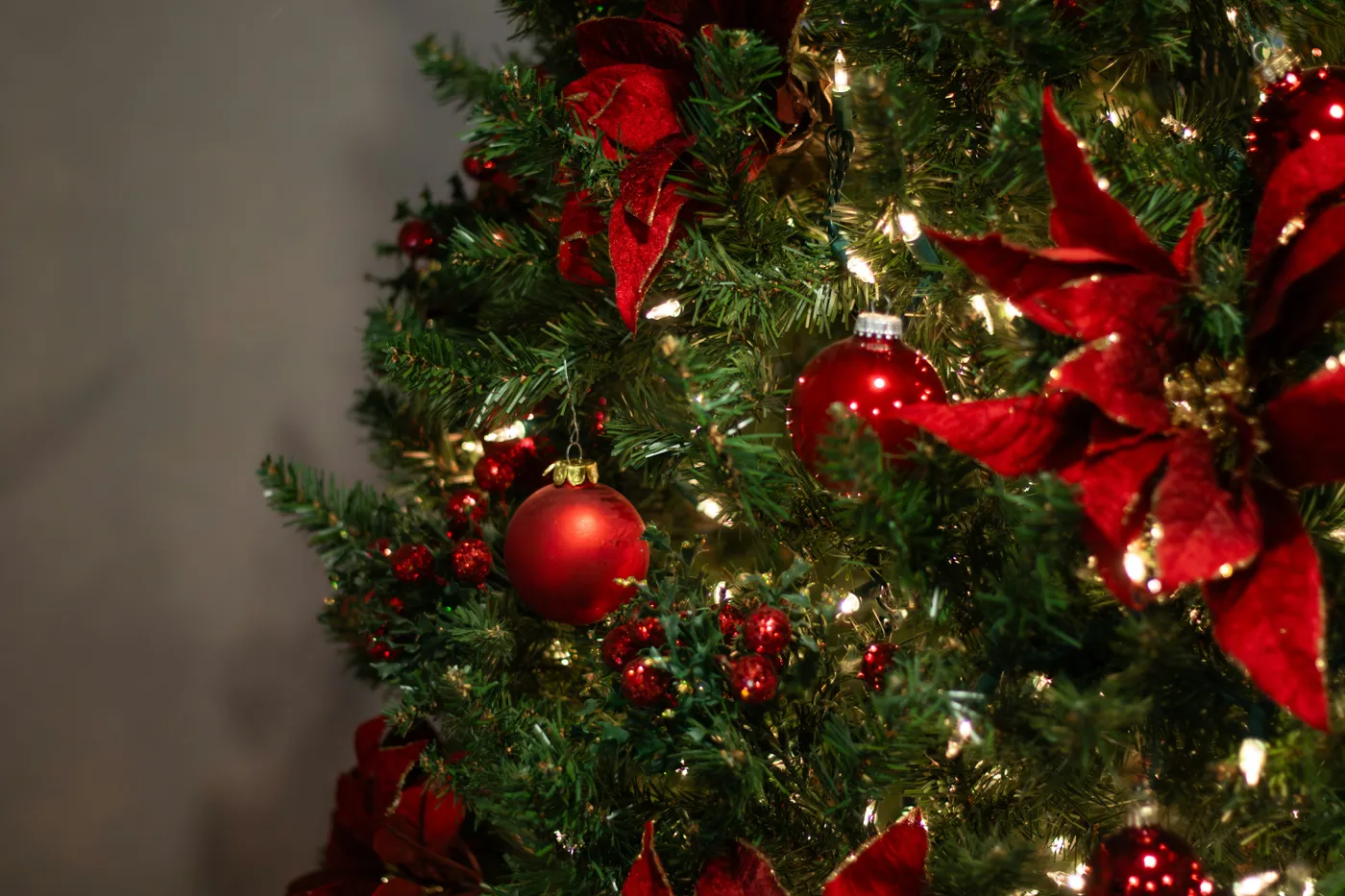
Mix matte and glossy red baubles in a 2:1 ratio. Matte finishes absorb light and read darker, which buys you free depth without introducing a second color. Hanging order matters as much as the ornaments: place the largest pieces first, three per horizontal band, then fill between them with small beaded strands last. On a 7-foot tree that’s roughly 60-70 ornaments total — more than you think, fewer than the display tree at the store.
13. Dense Maroon and Gold With Ribbon Woven In
Volume, not variety. This tree uses maybe two colors and one ribbon, packed so densely the green branches nearly disappear. The maroon ornaments come in both matte and high-gloss finishes, and every gold piece is warm and slightly bronze rather than bright yellow — which is exactly what keeps the scheme opulent instead of gaudy. Ribbon woven through the branches rather than looped on top adds a third texture without adding a third color, and the fairy lights close the whole thing up.
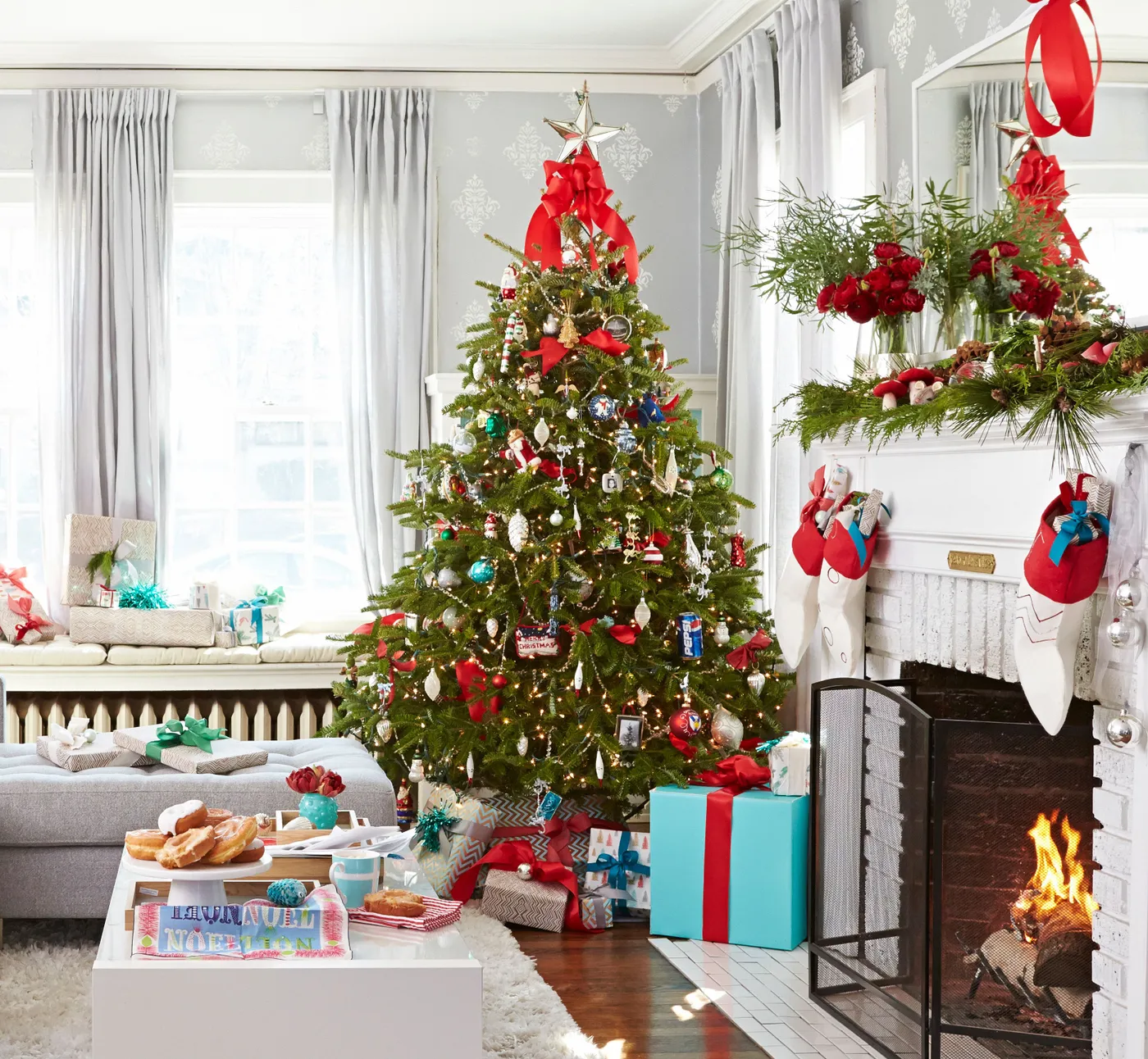
Dense trees are dust traps. If yours lives in a storage bag eleven months a year, budget an hour in late November for a lint roller and a soft brush, or you’ll be sneezing through December. Ribbon woven into branches creases badly, so store it rolled around a paper tube and never folded. Gloss ornaments scratch when they’re packed snugly — keep them in a divided tray instead of one big bin.
14. Purple-Paneled Walls and a Frosted White Tree
Monochromatic color rooms have moved from maximalist interiors into holiday styling, and purple is the sleeper choice for 2026. Paired with a frosted white tree, paper star lanterns, and metallic beaded strands, it reads cozy rather than cold — because everything sits inside the same warm-to-cool range. This is a two-season look for most people, so treat the painted paneling as the real commitment and the tree as the part you can swap out without guilt.
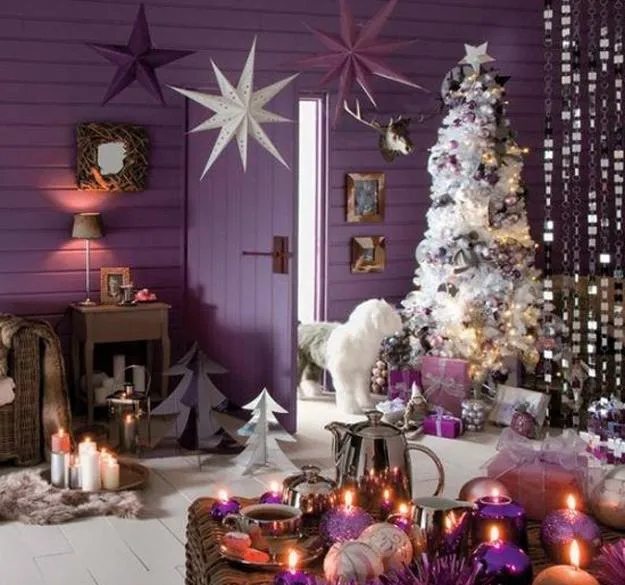
Horizontal paneling plus a full-size tree wants at least 9-foot ceilings and a room around 12 by 14 feet, otherwise those horizontal lines close in fast. The beaded curtain divider and hanging paper stars also need vertical room to swing free. In an 8-foot apartment, skip the paneling and hang paper stars from a corner instead, keeping the white frosted tree and purple ornaments. Idea #6 is the teal-based version of the same instinct.
15. Flocked Crimson Branches, Lit From Within
Flocked colored trees are the least forgiving thing you can buy. The flocking sits on top of dye, so any scuff shows as white against red, and you can’t spot-clean it — you can only rearrange branches to hide the damage. In direct sun, expect the crimson to fade toward orange over two to three seasons. Best placement is a corner away from windows and heat vents, and never in a room where kids are throwing things across the floor.

Choose the wall before the tree. Against a warm gray like this one, crimson reads rich and saturated. Against beige or cream it goes flat and dull. If you’re locked into warm walls, add one dark charcoal or deep navy element behind the tree — a curtain panel, a leaning canvas — to create the same contrast. It’s a $40 fix for a problem most people blame on the tree itself.
16. A Maroon Velvet Tray of Tiny Baubles
Small, low, and layered: 50% maroon velvet surface + 30% small metallic ornaments + 20% fresh green. That’s the entire formula for a coffee table or mantel display that feels festive without a tree in the room. The velvet anchors, the ornaments sparkle, and one pine branch is the only thing that says December. Swap the velvet for deep green linen and the same ornaments still work — the mood just gets cooler and more modern.
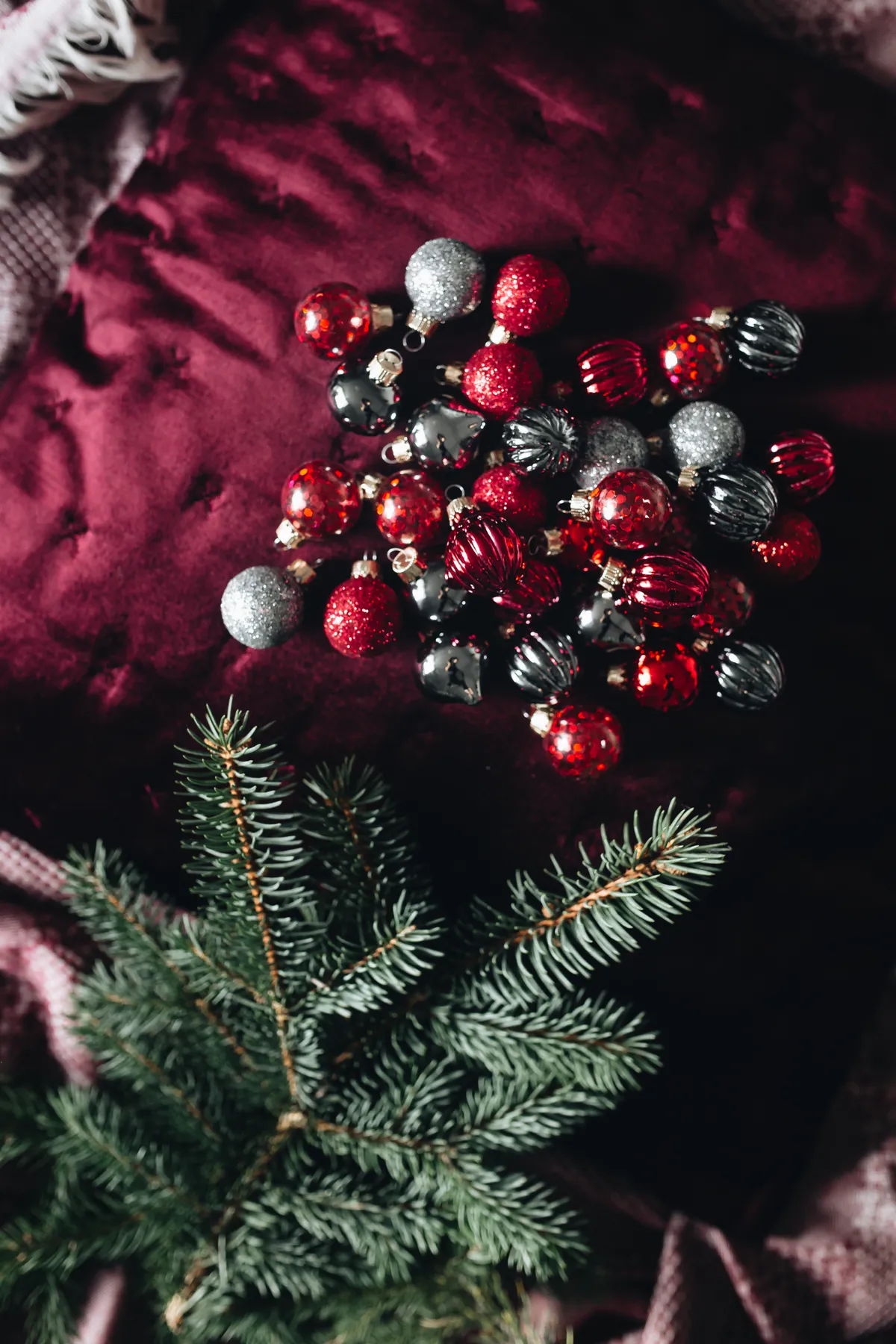
- Cut a velvet remnant to roughly 18 by 12 inches; no hemming needed.
- Arrange ornaments loosely, mixing three sizes and leaving visible gaps.
- Push a cluster of five or six toward one corner instead of spreading evenly.
- Lay one fresh pine sprig across the lower third, tips just off the fabric.
- Add a tiny light strand if the surface sits in a dark corner.
Time: 10 minutes. Cost: $15-$40 if you thrift the ornaments.
17. Red Glitter and Gold Finials on Dark Paneling
Flocked trees run $200 to $600. A two-pass DIY version: a $90 green tree, a $16 can of spray flocking, and about 40 minutes outside on a dry day. Red glitter balls are the cheapest part of the equation — Walmart sells 20-packs under $15 in early November. For the gold finials and acorn shapes, check Facebook Marketplace the first week of January, when people unload entire designer ornament collections for $30 a box.
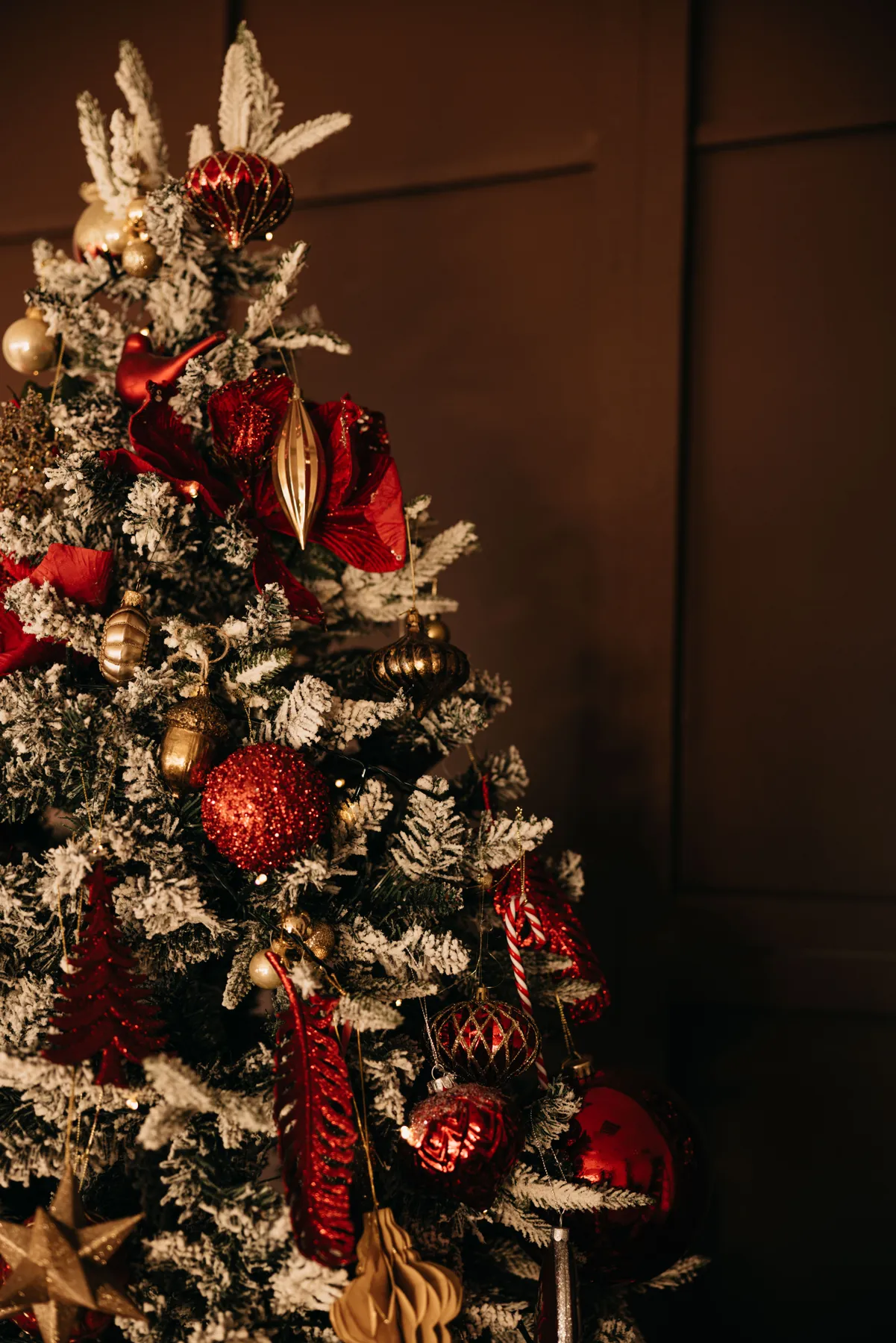
Glitter sheds, and on a flocked tree there’s no vacuum-friendly way to catch it. Keep a lint roller at the base and roll the tree skirt weekly, or you’ll find sparkle in the carpet through February. Metallic gold ornaments with a painted finish, rather than true gilt, dull wherever fingers touch them most. Store finials upright in a box with dividers — bent caps mean crooked hanging angles next year.
18. That One Big Maroon Velvet Bow
- Buy 1.5 yards of maroon velvet or velvet-look ribbon, 4 inches wide.
- Fold it into a figure-eight, pinching the center between your fingers.
- Wrap a short 6-inch length around the pinch and knot it at the back.
- Trim both tails on a diagonal, keeping them 14-18 inches long.
- Wire or hook it to a front branch at eye level, tails falling free.
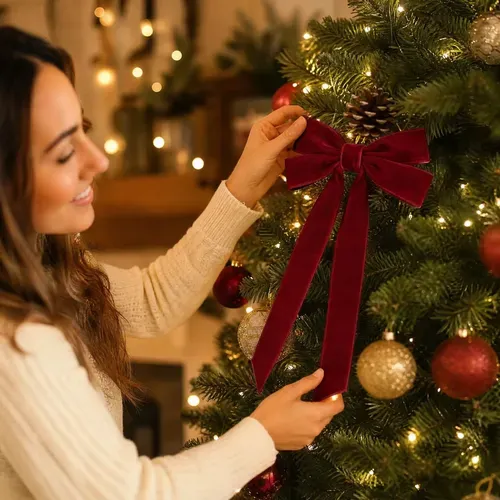
Time: 8 minutes per bow. Cost: about $9 each, or $5 if you’re cutting from a bolt.
The tails are the whole point. A velvet bow without long tails is just a knot; those two 16-inch drops are what make your eye follow down through the fairy lights. Keep them untwisted and hanging vertically — if they curl or cross, the gesture reads messy. Everything else here, the pinecones, gold balls, and small red rounds, stays deliberately undersized so nothing competes with the velvet.
19. Real Candle Clips and Gingerbread Cutouts
- Measure the gap between branch tips — clips need at least 3 inches of clearance.
- Confirm your tree has stiff branches; sparse or floppy trees can’t hold clip weight.
- Order clip-on holders rated for real tapers, plus a box of dripless candles.
- Check ceiling height — a taper adds 8 inches above the branch.
- Decide who lights them, and never leave the room while they burn.
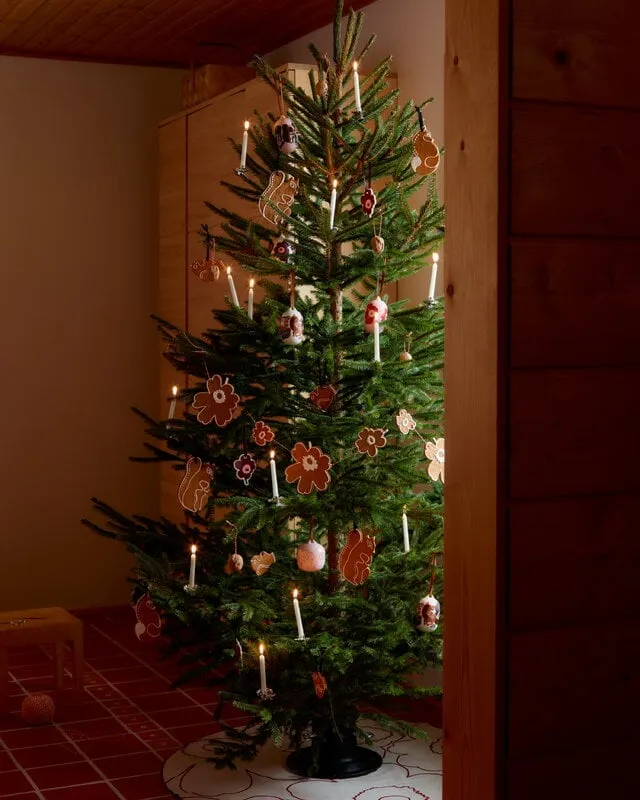
Real candles on a tree are genuinely beautiful and genuinely dangerous, and this is the one idea in this article where I’ll happily play the boring friend. If you go for it: dripless tapers only, light a few at a time, keep an extinguisher within arm’s reach, never leave the room. Most people get 90% of this look from LED clip-on candles at $3-$5 each — and honestly, that’s the version I’d put in my own house.
20. Glass Globes and Maroon Hearts, Hung From a Chair
- Push a sturdy dining chair beside the tree, seat facing the branches.
- Hang every breakable piece from the chair side, working top to bottom.
- Group clear glass globes in threes, then space the maroon hearts between them.
- Repeat on the far side from a step stool so the tree stays balanced.
- Pull the chair away and check the silhouette from the doorway.
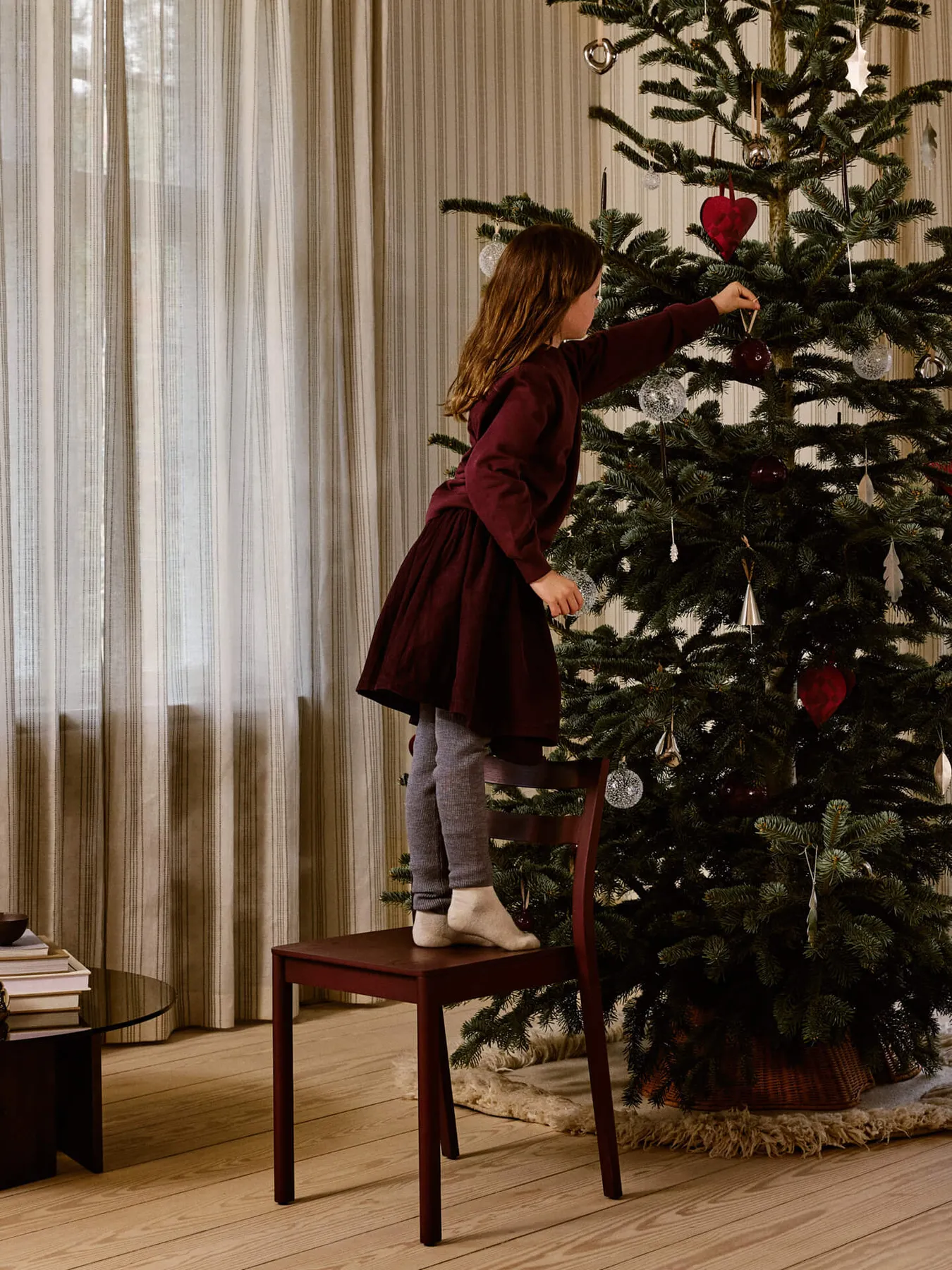
Time: about 45 minutes for a 7-foot tree. Cost: $0 — it’s a method, not a purchase.
A tree this full wants a corner at least 5 feet wide, and a burgundy chair beside it needs 30 inches of walkway behind. In a room under 150 square feet, go narrower: a 6-foot slim tree reads just as full at this ornament density, and pale striped sheers behind it add height without extra width. Idea #11 is the version for rooms big enough to pattern the whole space.
21. Forty Red Bows and a Blue Apron
- Large green 8-ft tree: $150-$450
- Red fabric bows, 30-40 pieces: $40-$90
- Gold and green ball ornaments: $35-$80
- Gold poinsettia picks, 6-10: $30-$75
- Warm white light strands: $20-$45
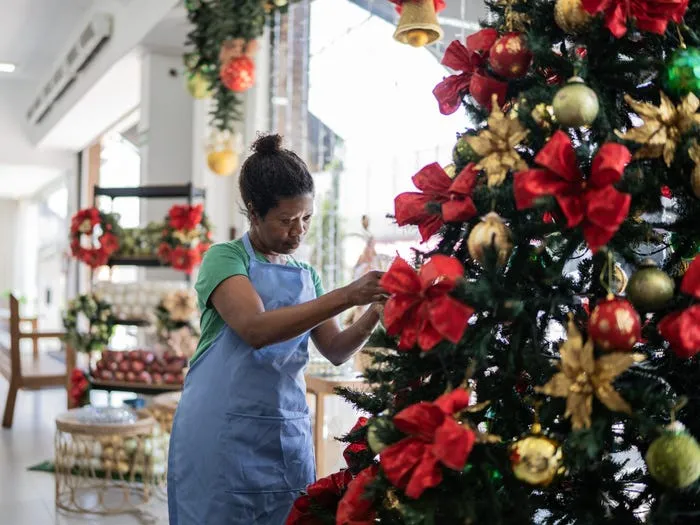
Total: $275-$740
Budget version: a $70 tree, dollar-store bows at $1 each, and thrifted ornaments put this look around $140.
The bows are the entire personality here, which is great news, because bows are the cheapest thing on any tree. Buy ribbon by the spool instead of pre-made bows — a $12 spool of 2-inch red satin makes roughly 25 bows with a simple two-loop fold. Gold poinsettia picks are the one place not to cheap out; dollar-store versions look flat and plasticky beside real satin. Mix in thrifted gold balls and nobody will ever know.
22. A Live-Edge Table Covered in Paper Trees
The tree is the star, but the coffee table is what makes the room feel lived in. Honeycomb paper trees in red, teal, and gold echo the ornaments without repeating them, and the live-edge wood top brings a raw texture that keeps the arrangement from going too sweet. The pinkish-brown sofa layers a deep red round pillow, a yellow-and-white striped bolster, and a plaid throw — three patterns that all share warm undertones, so they read as collected rather than chaotic.
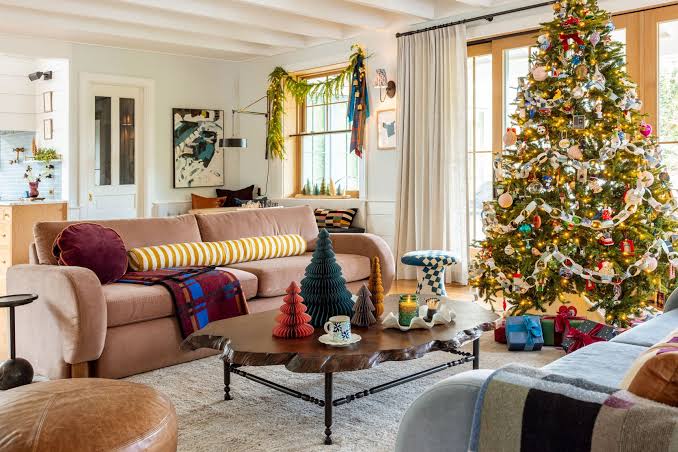
40% warm neutral (sofa, white beamed ceiling, pale walls) + 30% red (tree, round pillow, paper trees) + 20% natural wood and teal accents + 10% yellow and gold. The exposed beams add a fourth texture without adding a fourth color. To adapt it: keep the warm neutral base and the wood, then rotate the accent family. Blue and white instead of teal and red works beautifully in a small apartment.
23. Maroon Bows Meet Dusty Pink and Silver
- Start with warm white lights and no ornaments at all.
- Add the four or five largest velvet bows first, spread across the front.
- Fill with dusty pink and silver baubles, two per branch gap.
- Tuck ribbed paper ornaments between the baubles for texture contrast.
- Finish with silver stars, angled slightly upward.
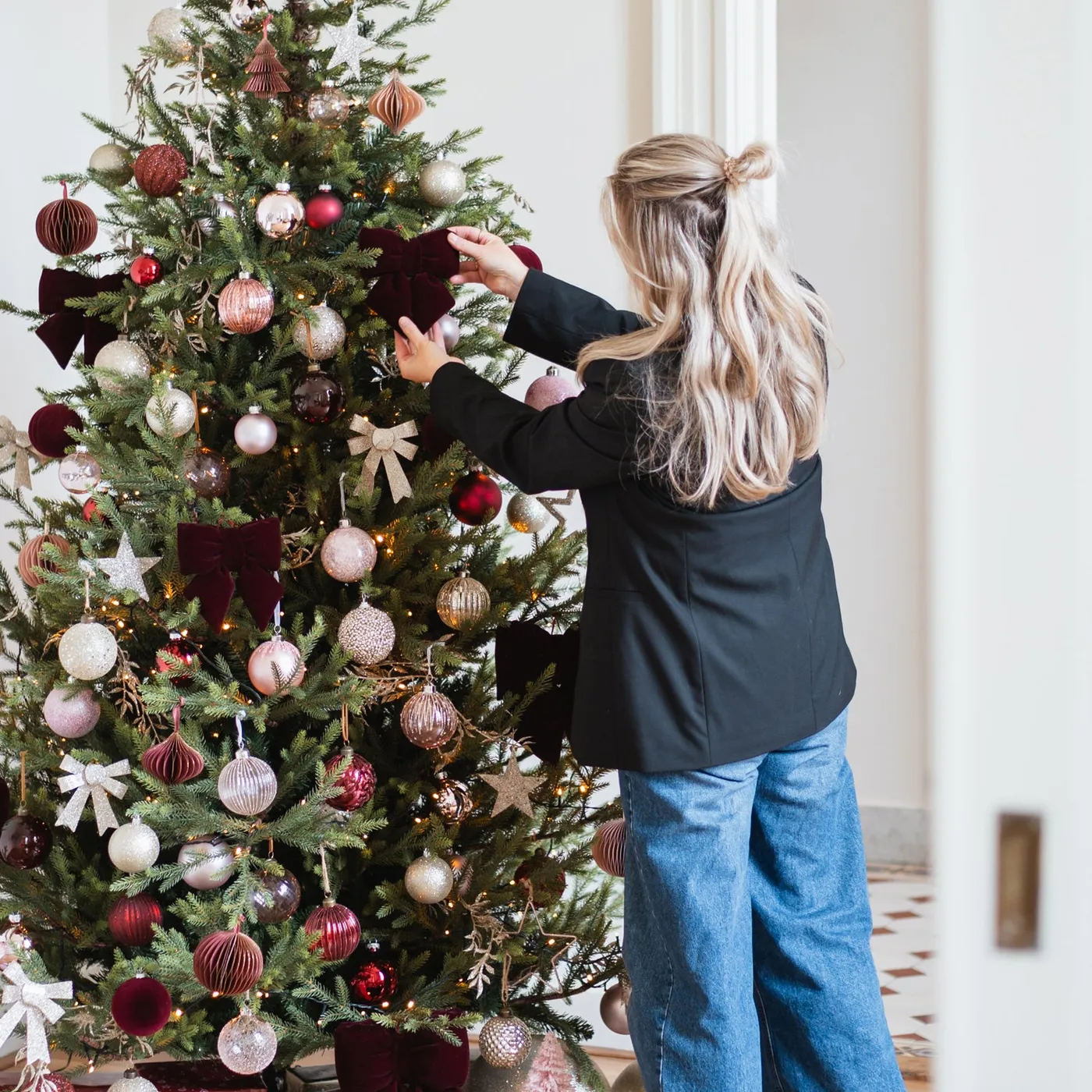
Time: 40 minutes. Cost: $60-$120 if you already own lights and a tree.
Deep maroon is a heavy color and it needs something light to float against. That’s the job the dusty pink and silver are doing — they aren’t filler, they’re a counterweight. Swap the pink for more maroon and the tree turns muddy fast. A reliable rule: for every large maroon element, hang two small pale ones near it. Sounds fussy, takes four seconds, and it’s the difference between elegant and heavy.
24. Maroon Ornament Clusters That Read Like Berries
The clusters themselves. Instead of hanging single baubles, these picks group three to five matte and metallic maroon spheres so they sit on the branch like a bunch of berries. Remove that and you’re back to standard hanging ornaments on a green tree. The clustering is what gives a plain artificial spruce a natural, almost foraged quality — and it’s the reason the whole thing photographs so well up close in good light.
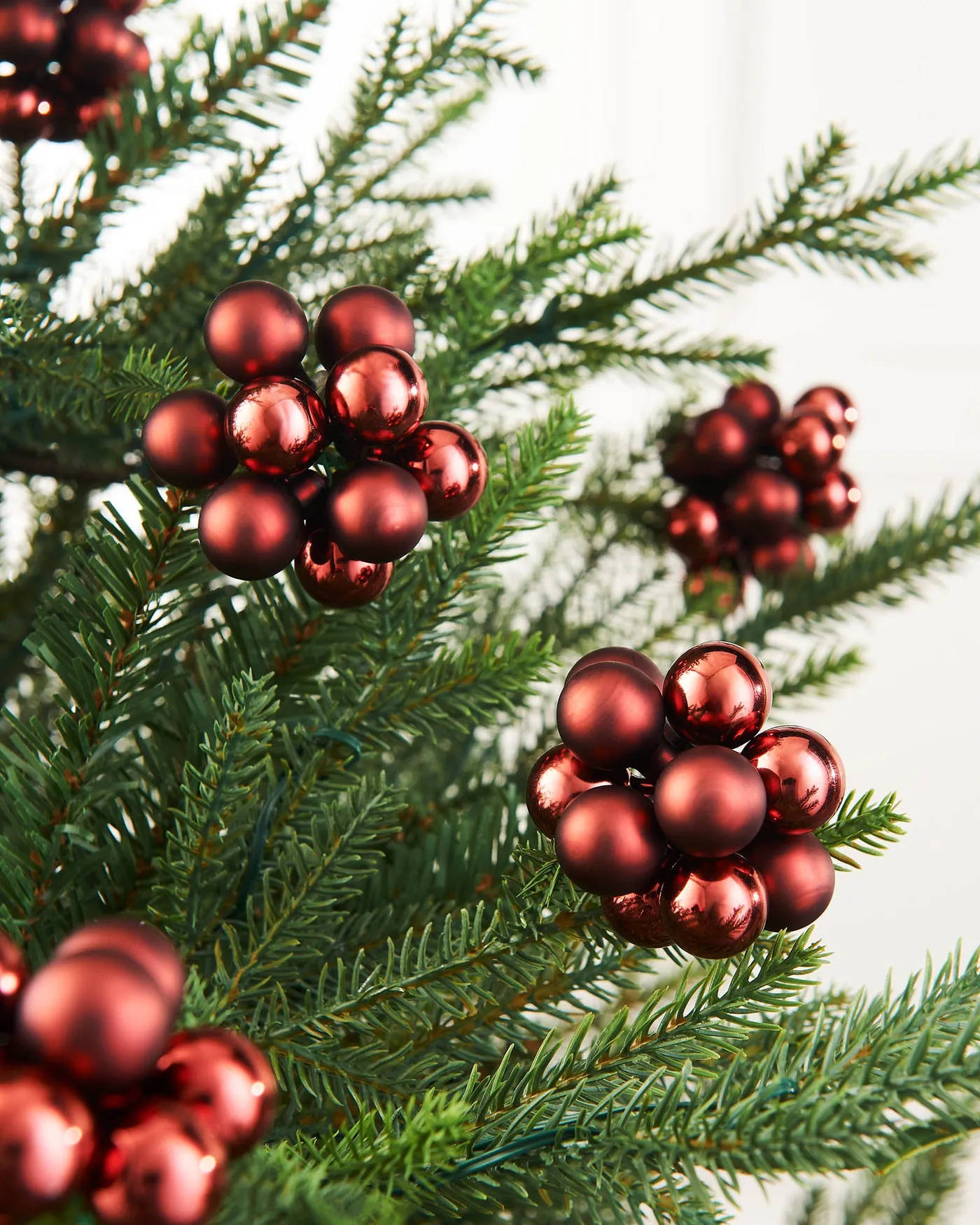
Cluster picks work best on trees 6 to 9 feet tall with reasonably dense branches; on a sparse or oversized tree they get lost. Space them 8 to 10 inches apart, no more than 20 per tree, and keep the upper third lighter so the silhouette stays readable. Plain white backgrounds make maroon pop hardest, which is why this reads beautifully in bright rooms and gets swallowed whole in dark ones. Idea #13 is the maximalist version.
25. Santa Figurines and a Vintage Wall Clock
Grandmillennial styling keeps gaining ground, and this is it dressed for December: Santa figurines, oversized plaid and diamond ribbons, large velvet poinsettias, and a vintage wall clock that has nothing to do with Christmas at all. The move is mixing a formal red-and-gold palette with objects that feel inherited rather than purchased. It’s nostalgic without turning kitschy, and it’s the style most likely to still look good in 2035.
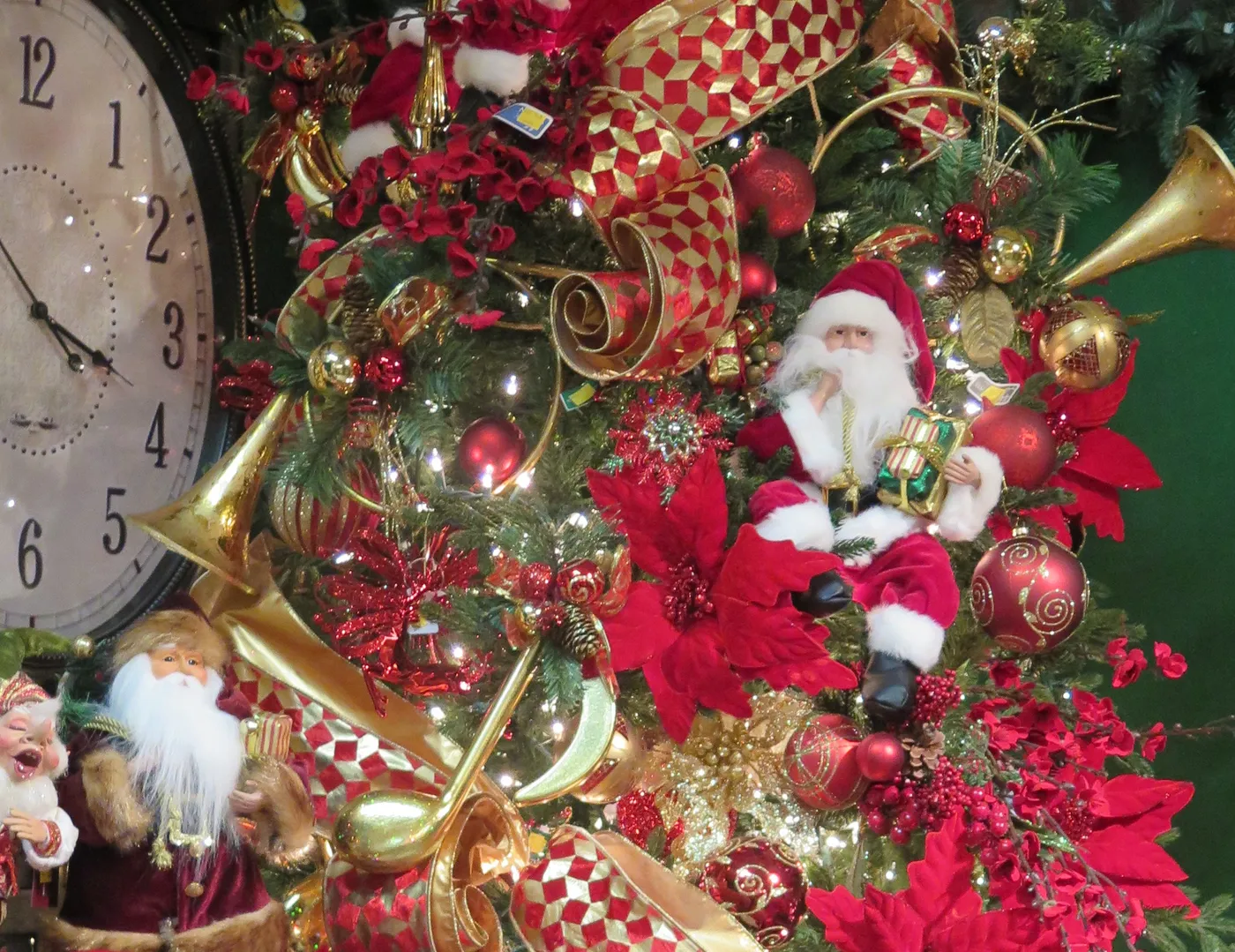
Two rules keep this much maximalism feeling collected. First, everything sits in the same red-to-gold range, so the eye never gets lost. Second, the ribbon comes in two scale sizes — a wide plaid and a narrower diamond pattern — which creates rhythm across the branches. Gold musical horns and Santa figures add small shiny interruptions. On a tree this busy, warm white lights matter more than ever: they blend the whole thing instead of spotlighting it.
26. Accordion Paper Trees on the Console Table
Honeycomb and accordion paper trees cost $8 to $20 at Target and Etsy, and they fold flat for storage — which is the real win if closet space is tight. A glass-topped console from a thrift store runs $40 to $90. Fill a white vase with faux frosted branches and a few red berry sprays for about $25, and use framed photos you already own. The whole vignette lands under $150, and half of it collapses into a drawer.
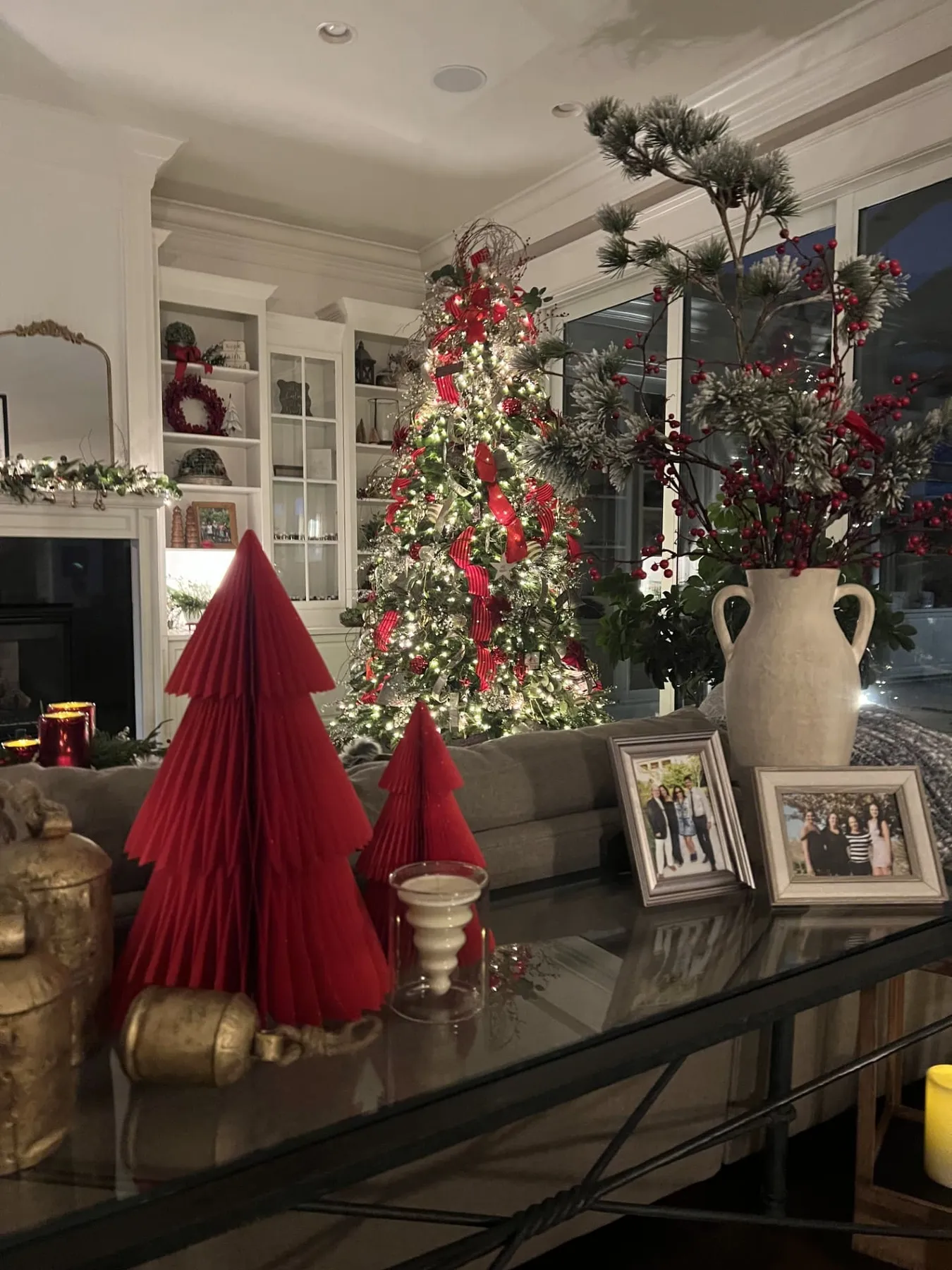
Console and mantel styling follows a simple height rule: something tall at one end, something low and wide in the middle, something small at the other end. Here the vase of frosted branches is the tall note, the red paper trees are the middle mass, and the framed photos are the small counterweight. Keep everything within a 5-inch depth so the arrangement never crowds the tree behind it.
27. A Gold Bowl Piled With Maroon Baubles
Read it as 60% metallic (the textured gold bowl) + 30% deep maroon (glossy ornaments) + 10% fresh green and white (pine, eucalyptus, marble). The trick is that the gold is textured rather than polished, so it never competes with the shiny ornaments. Swap the bowl for matte ceramic and the whole display softens instantly — same ornaments, completely different mood. Swap the maroon for deep green and you get a quieter winter version of the same vignette.
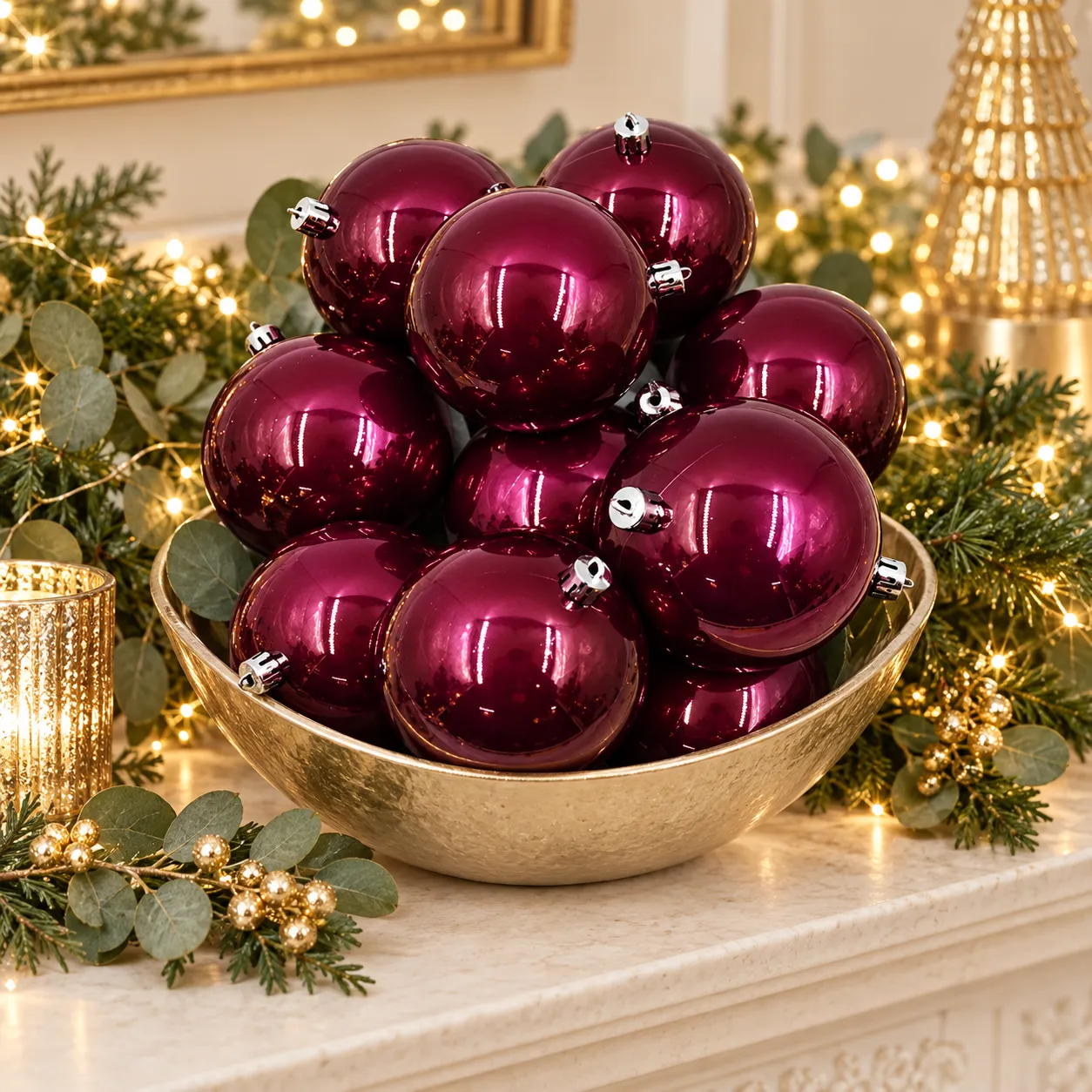
Skip the designer bowl. A thrifted brass or hammered-gold bowl runs $8 to $20 at Goodwill or on Facebook Marketplace. Deep maroon ornament sets go for about $12 per dozen at Walmart, and a pile this size only needs 15 to 20 pieces. Clip-on fairy lights are $6. The biggest savings, though, is real eucalyptus — a $5 bunch from Trader Joe’s dries beautifully and holds up for weeks on a mantel.
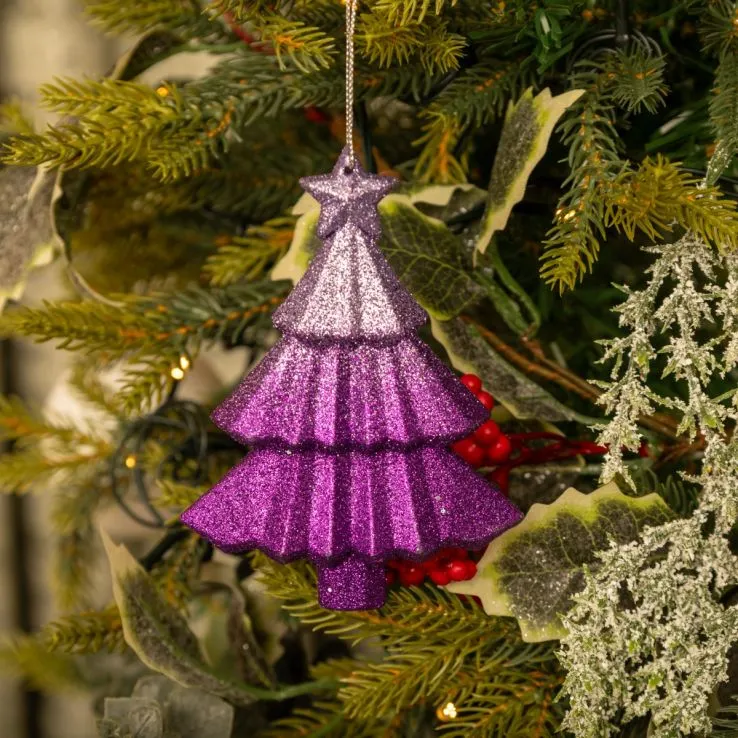
28. One Purple Glitter Tree, Hidden in the Needles
Glitter ornaments shed, and purple glitter is especially stubborn on light floors and upholstery. If this is heading anywhere near a white sofa, give it a coat of matte clear sealer first. The wire hook also needs to hide completely behind the star topper or the illusion collapses. One more thing: a single purple piece in a green, red, and silver tree reads as a deliberate wink. Three of them read as a mistake.
The contrast works because purple sits nearly opposite green on the color wheel, so the ornament pops without being bigger than anything around it. Heavy glitter texture then catches the fairy lights and holds them, which makes the frosted leaves and red berries nearby look richer too. It’s a five-dollar decoration doing the visual work of a whole themed corner. Look for fluted or tiered shapes over flat ones.
29. Two Trees, One Mantel, and White Bows
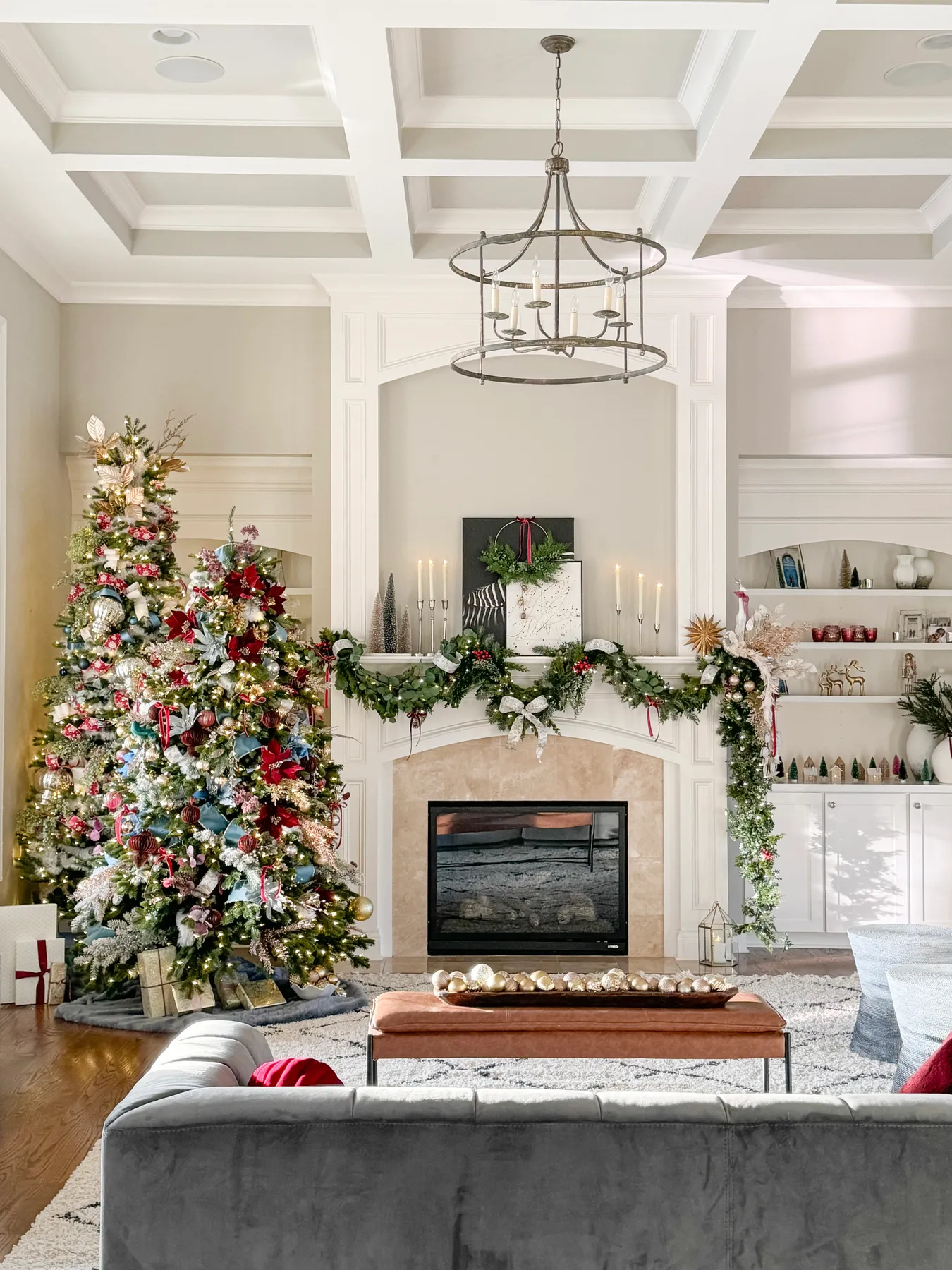
Double trees need real estate. This layout wants 12-foot ceilings and a room at least 16 feet across so the pair reads as a composition rather than clutter. If that isn’t your space, one tree plus the mantel garland delivers the same symmetry at half the footprint — and in a room under 250 square feet, garland alone is genuinely enough. Idea #3 is the smaller-scale version of this same balance.
When you hang garland on a mantel, let it break the edge. Garland that sits neatly on top of the shelf looks like a liner; garland that spills 6 to 10 inches down the sides makes the fireplace part of the tree. Keep the swag on the front face only, secure it with clear adhesive hooks rated for 2 pounds, and hang the white bows last so they sit on top of the greenery instead of getting buried.
Go Hang the First Maroon Bow
Start with one thing — a velvet bow, a gold bowl of ornaments, a single diagonal strand of beads — and let the room tell you what it wants next. Maroon is a forgiving color to build around because it plays nicely with white trim, dark paneling, gold, silver, and dusty pink alike.
📌 Pin your favorite ideas from this list now, so when November rolls around you’re not starting from zero.