34 Stunning Velvet Ornaments Christmas Tree Ideas to Elevate Your Holiday Decor

You have been saving velvet Christmas tree photos for weeks — the burgundy baubles, the giant ribbon toppers, the matte black bows — and now you need to know which ones actually hold up in a real living room. Same here. After filtering through hundreds of options across Etsy, Target, Walmart, Anthropologie, and Pottery Barn, we narrowed it down to 34 ideas that actually deliver, from $3 thrift finds to a $450 heirloom ornament set.
Inside you will find velvet baubles, flocked spheres, ribbon toppers, and boxed ornament collections across four main styles: traditional burgundy-and-gold, rustic organic neutrals, minimalist modern, and full-on vintage maximalist. Budget and luxury versions are compared side by side, and every idea is shoppable with direct product links.
Velvet is trending in 2026 for a very specific reason: matte textures absorb LED light instead of bouncing glare back at your camera, which is exactly why your Pinterest feed looks softer than your tree. And stay until the end — we break down the most common mistakes that can ruin these looks.
Bookmark this before you scroll away — it is the kind of guide you will come back to when it is time to actually decorate.
1. Velvet Ribbon Bows in a Stained-Glass Bay Window
Velvet ribbon behaves nothing like satin, so give it room to be itself. On a tree this scale, use a 3-inch wire-edged velvet and cut every tail at a 45-degree angle so the pile stops fraying. To kill the fold creases from the spool, lay the ribbon on a towel and press with a cool iron — never direct heat, never steam, or the pile crushes flat. Loop the bows at roughly chest height and let one tail trail about 18 inches below the other. That lopsided tail is what reads as expensive from across the room.
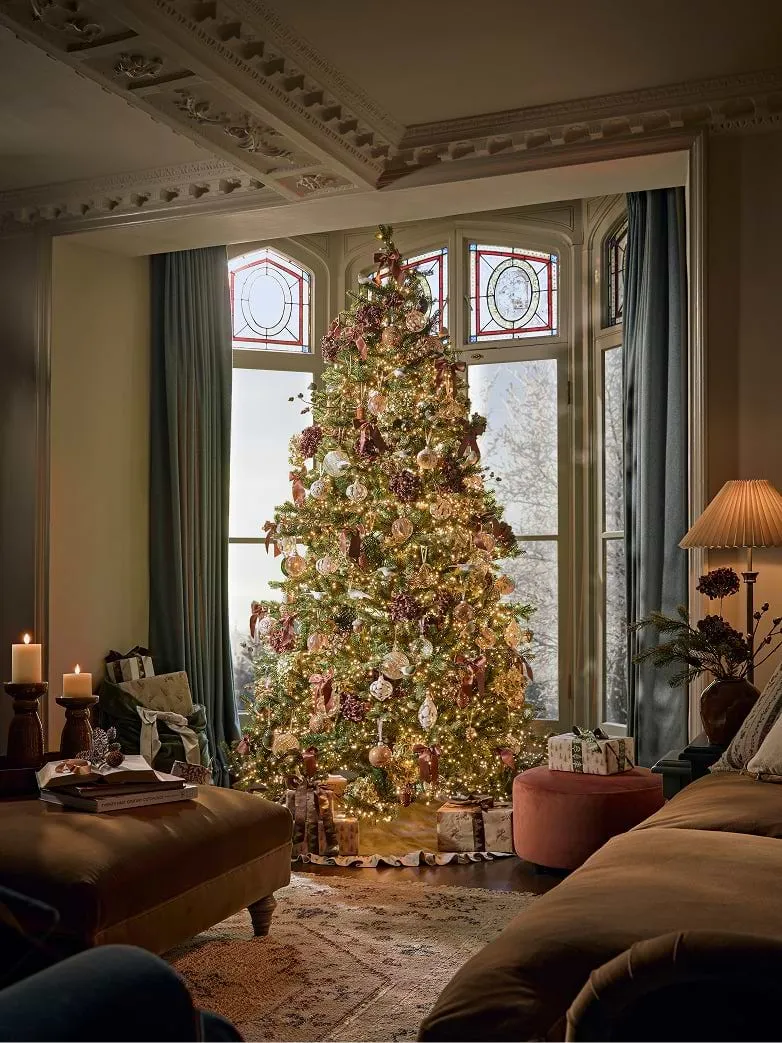
Velvet does quiet work here. It absorbs the tree lights instead of reflecting them, which keeps the stained glass in the bay window the brightest thing in the frame. That is contrast built on temperature, not just color — cool blue drapes on one side, warm gold light in the middle, muted rose velvet softening the handoff between them. Nothing competes for attention. The ornate crown molding gets to read as architecture because no shiny surface is pulling your eye away from it.
2. Teddy Bears in Tailored Miniature Outfits
Plush ornaments are everywhere in December. What makes these two memorable is the tailoring — real herringbone trousers, a buttoned plaid jacket, lapels and seams sewn at a scale nobody will ever inspect up close. Take the clothes off and you are left with two generic bears. The wardrobe is the entire idea. If you hunt vintage bears at estate sales, favor the ones with stitched-on clothing over printed fabric bodies; construction is what photographs as intentional rather than merely cute.
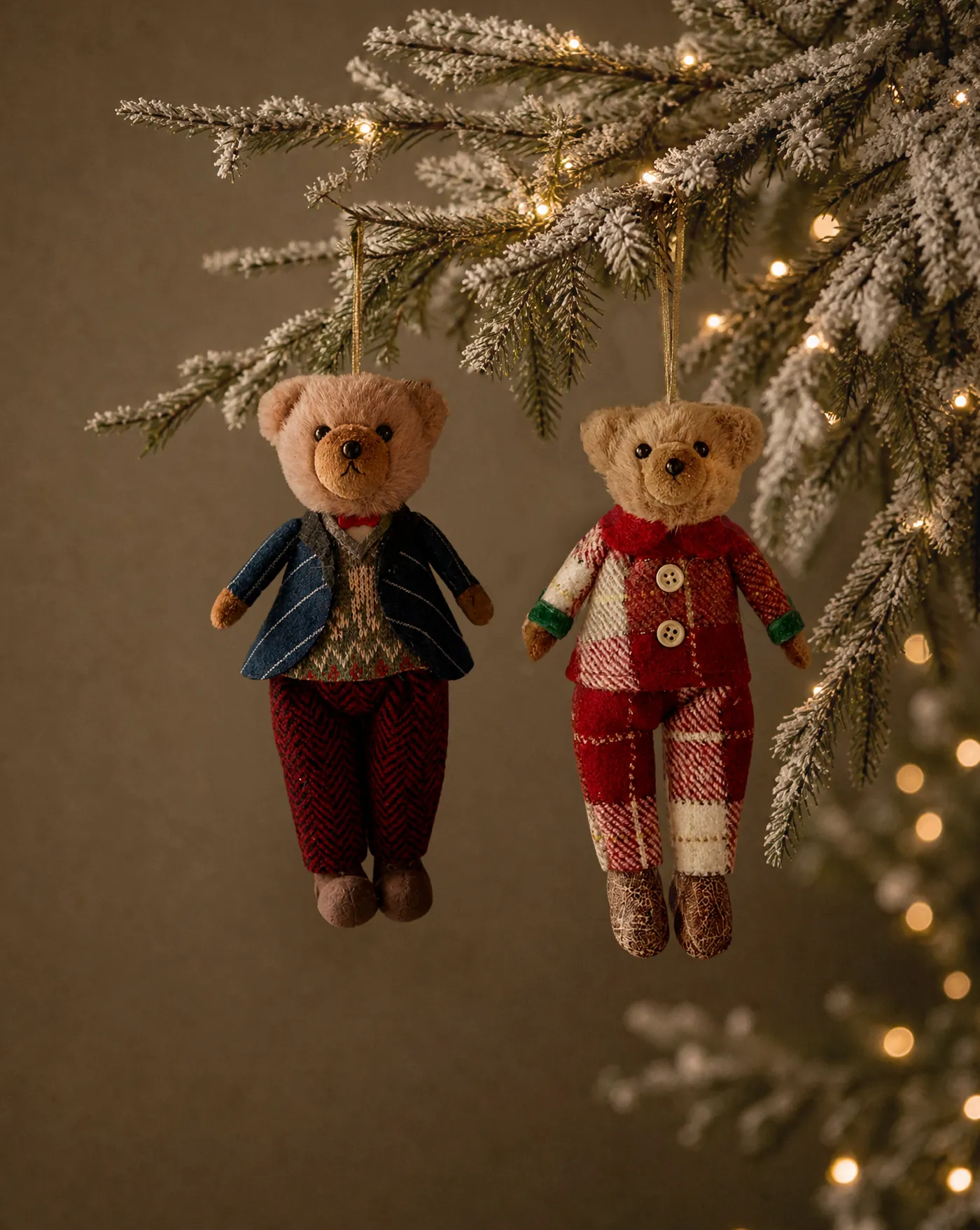
Vintage dressed bears turn up constantly at estate sales and church rummage tables for $3 to $8, and the tailoring is often better than anything new. If you want them factory-fresh, Etsy sellers hand-sew herringbone and plaid bear outfits for $18 to $35 apiece, and Target’s Wondershop line does a knit-sweater bear for around $10. Hang these at eye level instead of burying them mid-branch. Characters deserve a stage, and nobody crouches to admire a bear.
3. Sage Flocked Spheres Styled With Lichen Branches
The formula runs about 70% dark neutral ground, 20% muted green and warm tan, 10% aged brass. Swap the sage flocking for dusty blue and the same arrangement turns coastal. Swap the brass caps for matte black and it goes Scandinavian-stark. The constant is that dark grey surface underneath — flocked ornaments need a moody backdrop or they read pastel and vanish. Keep the natural elements in the same tonal family as the ornaments and the whole arrangement looks gathered rather than purchased.
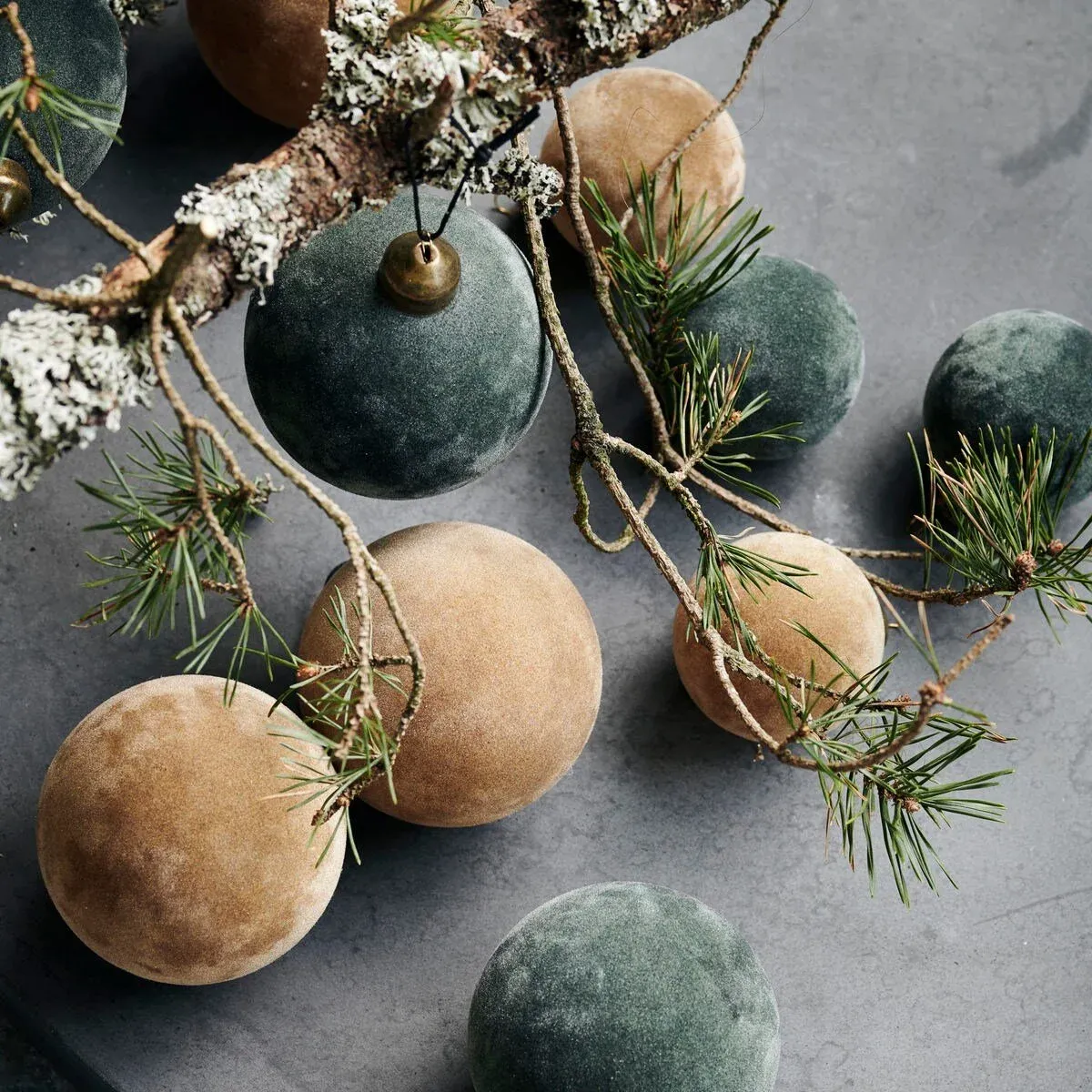
Flocked ornaments shed. Not dramatically, but you will find a fine dusting under them by January, so avoid hanging them directly above a white linen tablecloth or a laptop. Fresh lichen branches are brittle too — they crumble after a few handlings and drop debris onto whatever is below. If you want the look with none of the mess, preserved moss branches plus a matte-finished flocked ornament set deliver about 90% of it, and you can box the whole thing up for next December.
4. A 16-Piece Burgundy Velvet Ornament Grid on Burlap
Here is what this arrangement actually costs to recreate:
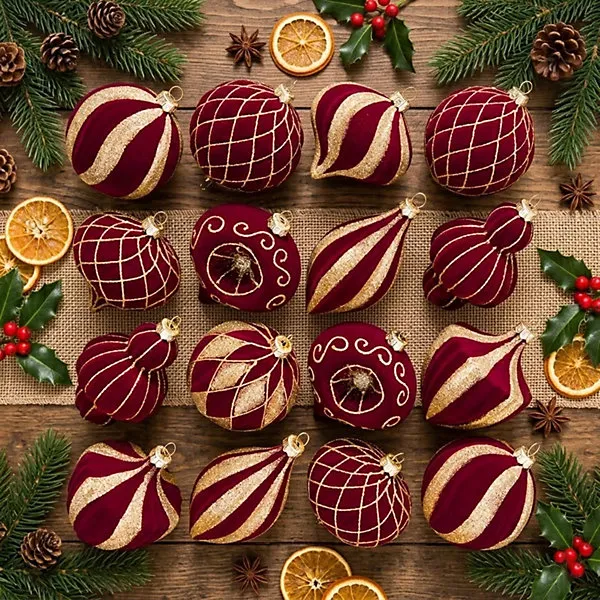
- Velvet ornaments with gold glitter accents (set of 16): $35–$90
- Burlap table runner: $12–$25
- Pinecones, dried orange slices, star anise, holly: $15–$30
- Fresh pine branches or faux picks: $10–$28
- Wooden tray or styling surface: $0–$40
Total: $72–$213
Budget alternative: plain burgundy velvet balls from Walmart or Dollar Tree run about $1.25 each — sponge gold glitter through a stencil and you have 16 for roughly $25, plus a $10 burlap runner.
Flat-lay ornament photography exploded because it sells the idea of a collection rather than a tree. The deeper shift is texture. After a decade of glitter-everything holidays, buyers in 2026 are chasing matte surfaces — flocked, velvet, brushed brass — that photograph softly under warm light and never glare. Burgundy velvet with restrained gold glitter sits exactly in that middle ground: festive enough for tradition, muted enough for a neutral living room. It has staying power because it is a palette, not a novelty.
5. A Purple Velvet Clock Face in Baroque Silver
The clock face is the whole trick. A silver baroque frame with crystal numerals is a known quantity — ornate, predictable, the kind of piece that shows up in every luxe ornament bin. Covering the dial in purple velvet is what makes you look twice, because the eye expects glass and gets fabric instead. If you own an ornate metal ornament that feels generic, recovering a flat surface in velvet is a 20-minute fix. The unexpected material is worth more than the elaborate frame.
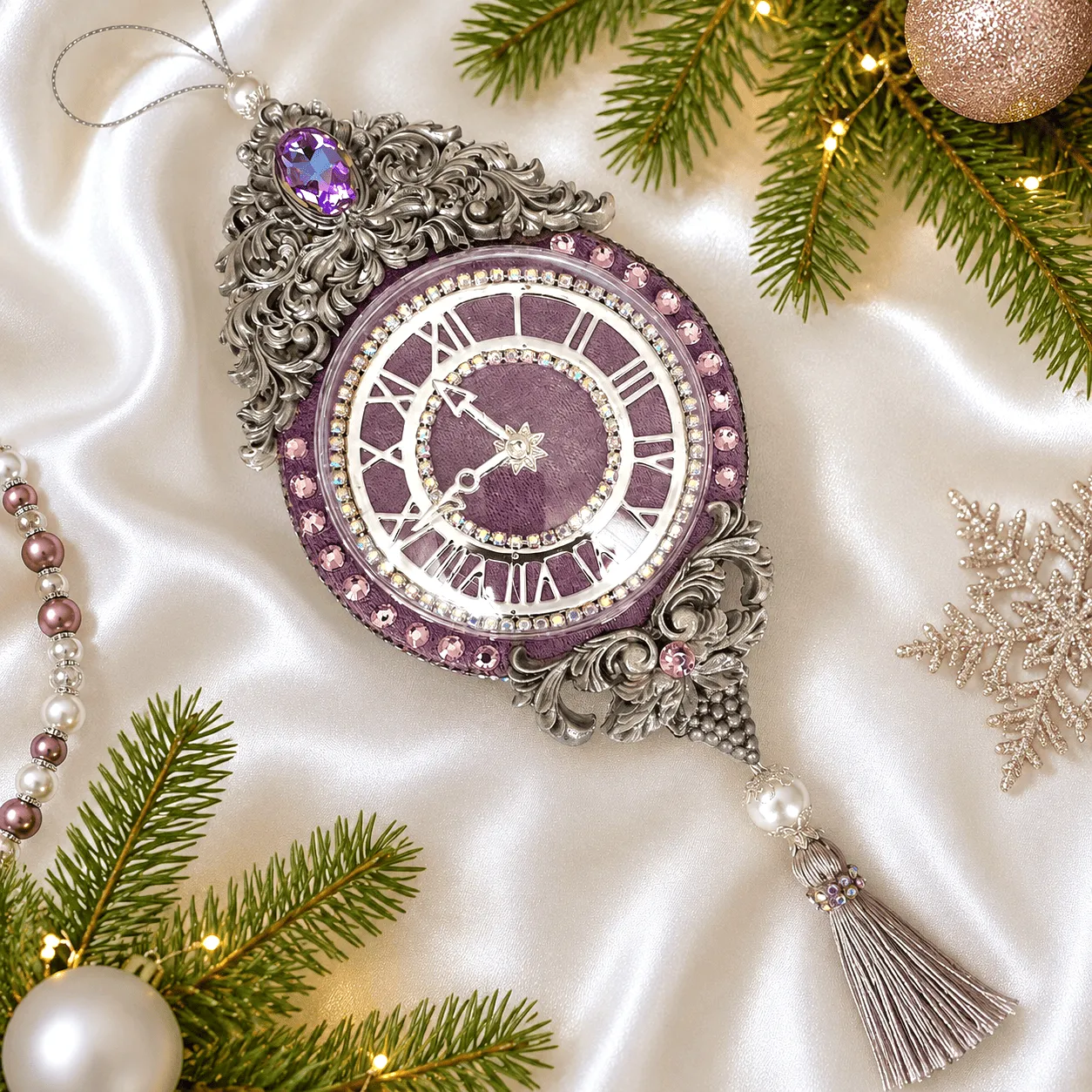
Statement ornaments need negative space or they turn into clutter. When you hang a one-off piece like this clock, follow three rules:
- Hang it between 60 and 70 inches from the floor, where the eye lands naturally
- Keep at least 8 inches of clear branch on every side
- Repeat its metal tone at least three more times elsewhere on the tree
That last rule is the one people skip. A single silver piece on a gold tree reads like a mistake. Three or more and it reads like a decision.
6. Mauve Velvet Bauble With an Antique Brass Cap
This one is close to 80% soft neutral, 15% mauve, 5% antique brass. That tiny brass percentage is doing real work — it keeps the pink from drifting sweet and the white from going clinical. Swap mauve for terracotta and you get a warmer, more southwestern feel. Swap it for dusty blue and the whole mood cools by ten degrees. Keep the hanging ribbon brown rather than white; white satin would break the warmth instantly and turn a cozy ornament into a bridal one.
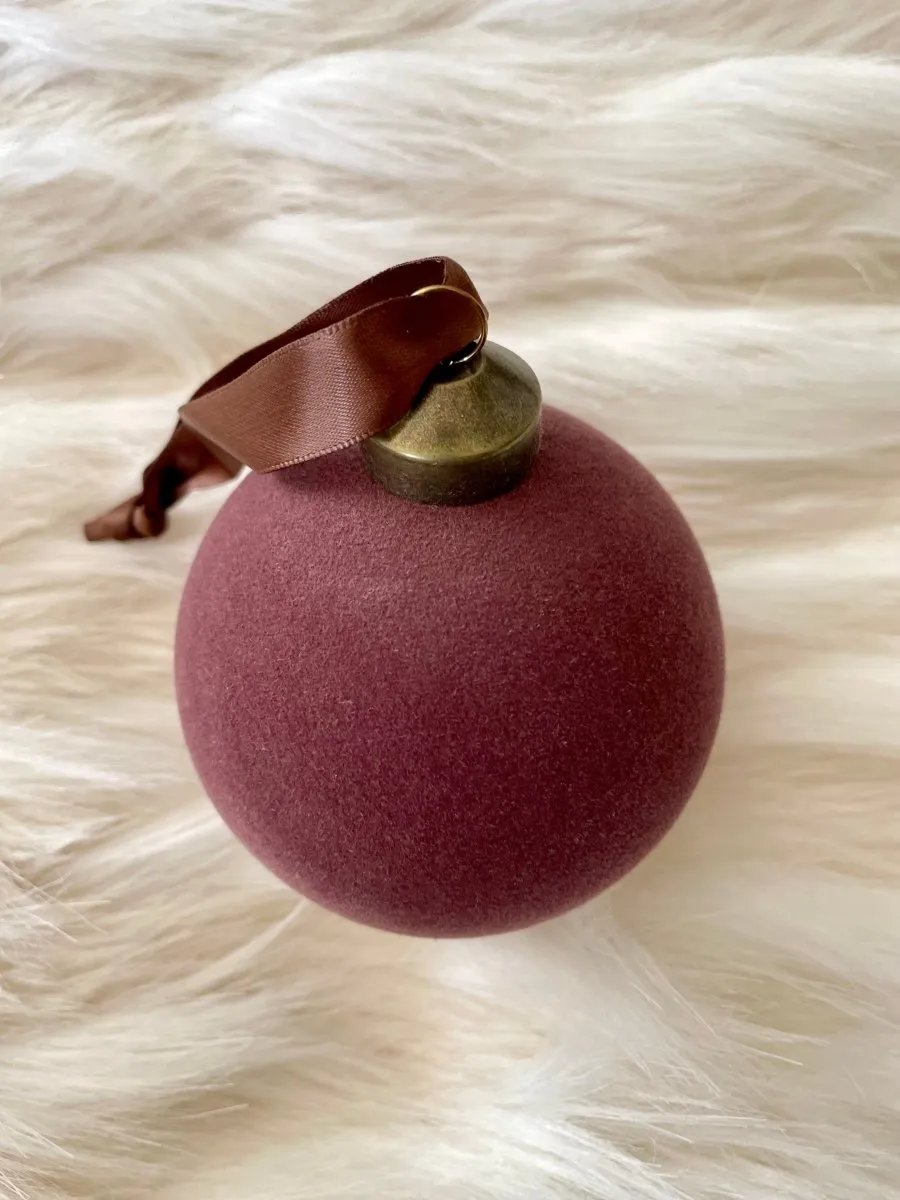
Two textures, one color story. The velvet pile is matte and slightly irregular, which is why it catches light in soft gradients rather than a single hot highlight. Set against plush white faux fur — another soft, light-hungry material — you get depth without a single hard edge anywhere in the frame. The antique brass cap adds the only sharp note, and because it is small it reads as jewelry rather than hardware. Scale matters too: this works best as a single hero ornament, not one of forty.
7. A Dark Blue Flocked Ball Against Amber Bokeh
Dark blue flocked ornaments are one of the cheaper ways to look expensive. The breakdown:
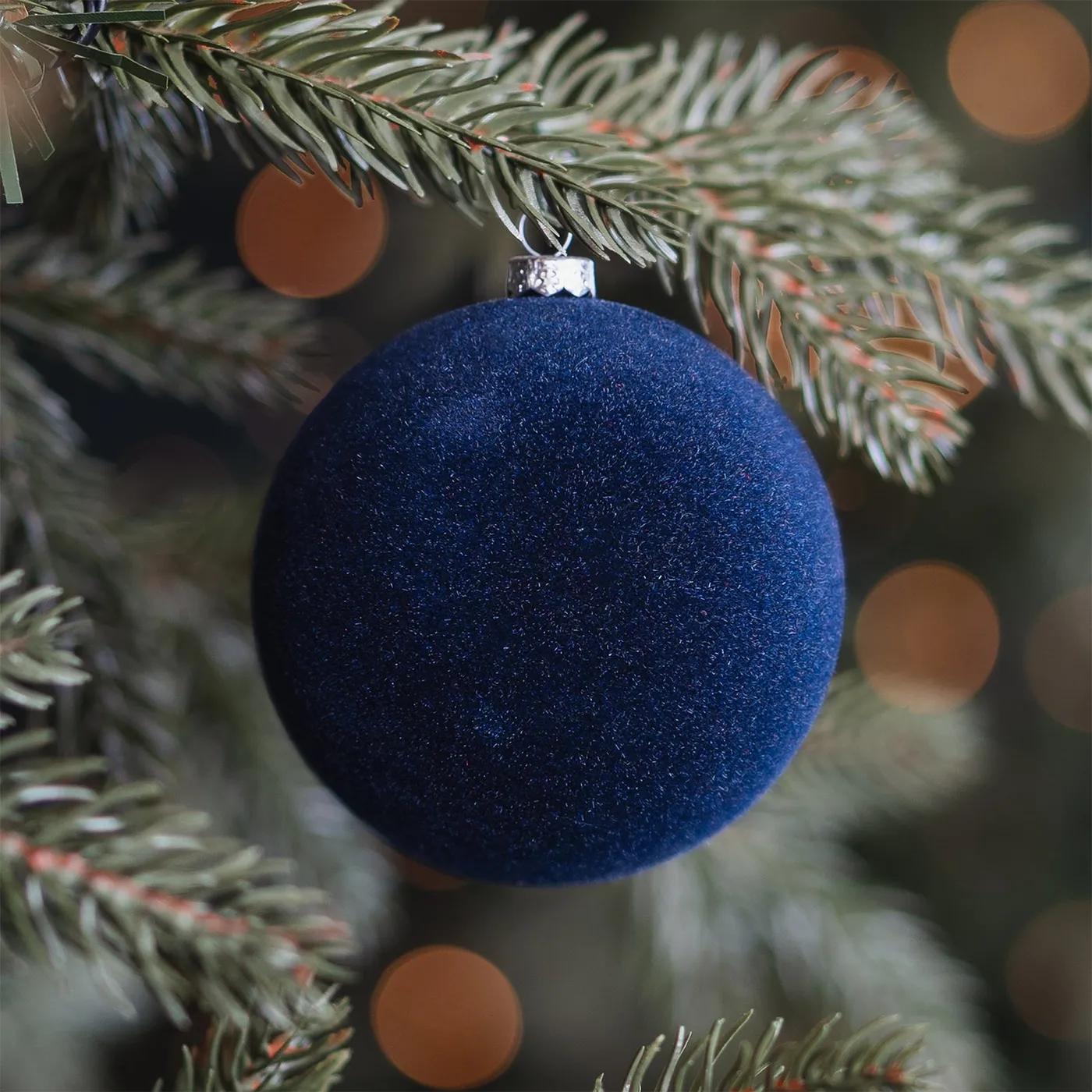
- Dark blue flocked ball ornaments (set of 12): $18–$45
- Warm white LED string lights, 100 count: $12–$30
- Flocked or heavily lit artificial tree, 6.5 ft: $120–$450
- Hooks, ribbon, spare bulbs: $6–$15
Total: $156–$540
Budget alternative: Walmart’s $39 six-foot tree, a $19 navy flocked set from Target, and $9 LED lights get you the same mood for under $70. Nobody standing in your living room is measuring branch density.
Navy flocking has a quirk: it goes nearly black in a dimly lit room, then turns rich and dimensional the moment warm light hits it. If your tree sits in a corner without a nearby lamp, the ornaments will read as dark holes rather than navy. Flocking also transfers — a faint blue-grey dust on your hands, the floor, the storage bin. Vacuum the bin before packing them away, and plan on a light lint-roll each season.
8. Red Velvet Baubles With Rhinestone Chains
Rhinestones only sparkle when light hits them off-axis. Hang anything crystal-covered slightly in front of a bulb rather than directly beside it, and angle the ornament so the beadwork faces outward — not the ceiling. One more thing people never think about: velvet absorbs light, so a heavily beaded velvet ornament needs more lumens around it than a glass one. If your tree reads flat, add two extra strings of warm lights before you buy another ornament. Lighting solves more than shopping does.
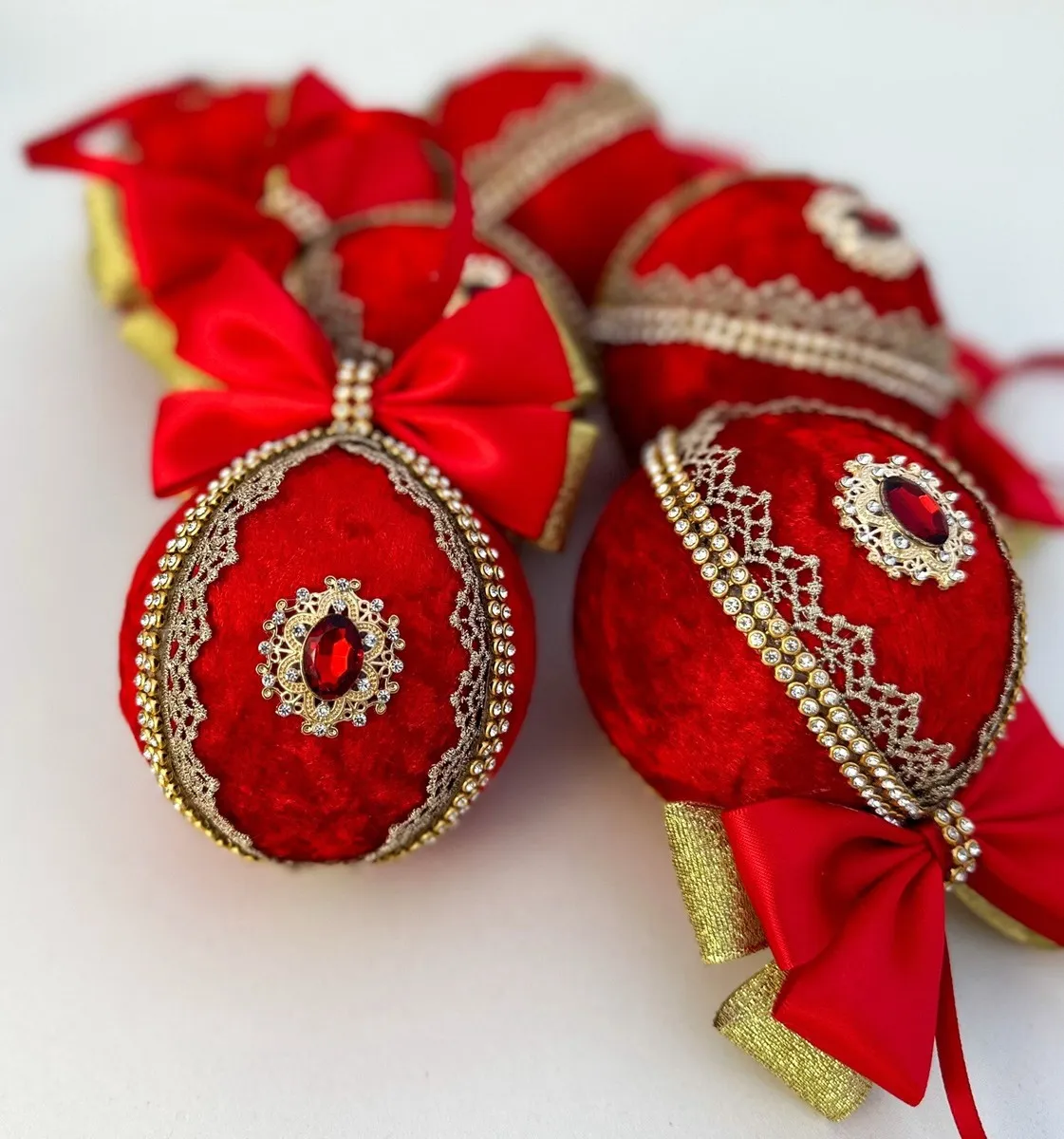
Turning a plain velvet ball into one of these bow-topped pieces takes about 25 minutes and roughly $6 in materials.
- Cut a 14-inch length of 1-inch satin ribbon and seal the ends with a lighter
- Fold it into a loop bow, pinching the center with your fingers
- Wrap a 4-inch piece of 18-gauge floral wire around the pinch twice
- Trim the tails at a sharp angle, then twist the wire ends into a hook
- Cover the wire with a small rhinestone, using fabric glue rather than hot glue
Skip hot glue directly on velvet — it leaves a shiny ghost mark that never comes off.
9. Gold Filigree Clock Ornament on Satin and Pearls
It is the tassel. Pull it off and you still have a handsome gold filigree clock ornament — pretty, a little costume-jewelry, and entirely forgettable. The tassel is what turns it from an ornament into an object: it hangs below the clock face like a pocket watch chain and gives the piece weight and movement. Anything hanging in a tree should move slightly when someone walks past. If you already own tassel-free ornaments you love, a $2 silk tassel glued to the bottom changes how they read completely.
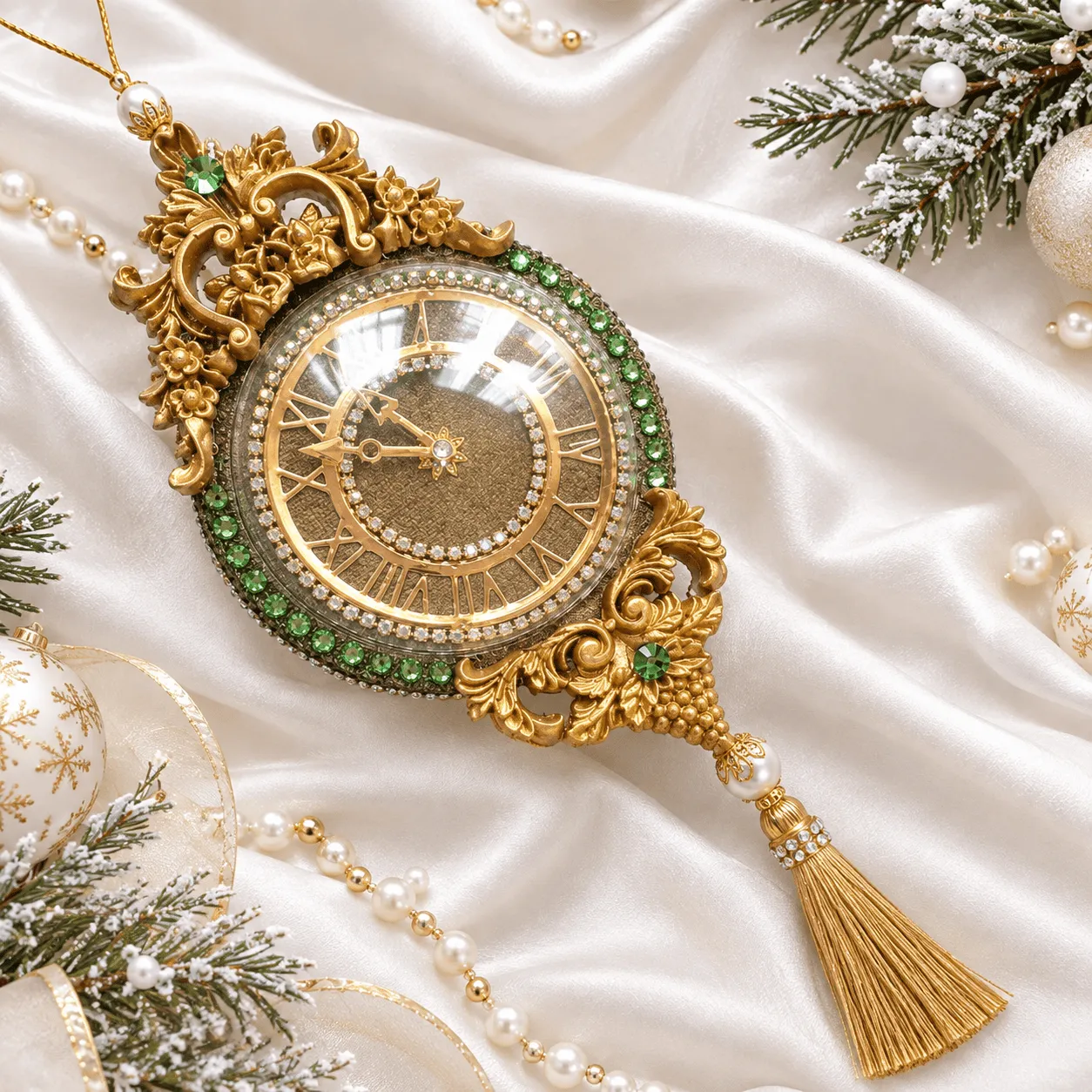
Pieces this ornate want a small stage, not a big one. A clock ornament with a 3.5-inch face reads perfectly on a tabletop tree, a mantel garland, or a narrow console vignette — anywhere you are within three feet of it. On a nine-foot tree it vanishes unless you buy three or four and cluster them, which gets expensive fast. If you have the generous bay window setup from Idea #1, save the scale for velvet ribbon and keep the jewelry small. Small room, small tree — go ornate every time.
10. Faceted Burgundy Glass Drops on a Lit Evergreen
Faceted glass drops are the expensive part of this look — good ones run $8 to $18 each, and this tree uses seven. Here is the workaround: buy three glass and four acrylic, and hang the acrylic ones in the back where only the silhouette registers. Nobody counts. Thrift stores regularly have bagged vintage glass drops for $4 to $9, and Walmart sells a 12-pack of faceted burgundy drops for around $14. From two feet away, warm light and a sheer ribbon loop do most of the convincing.
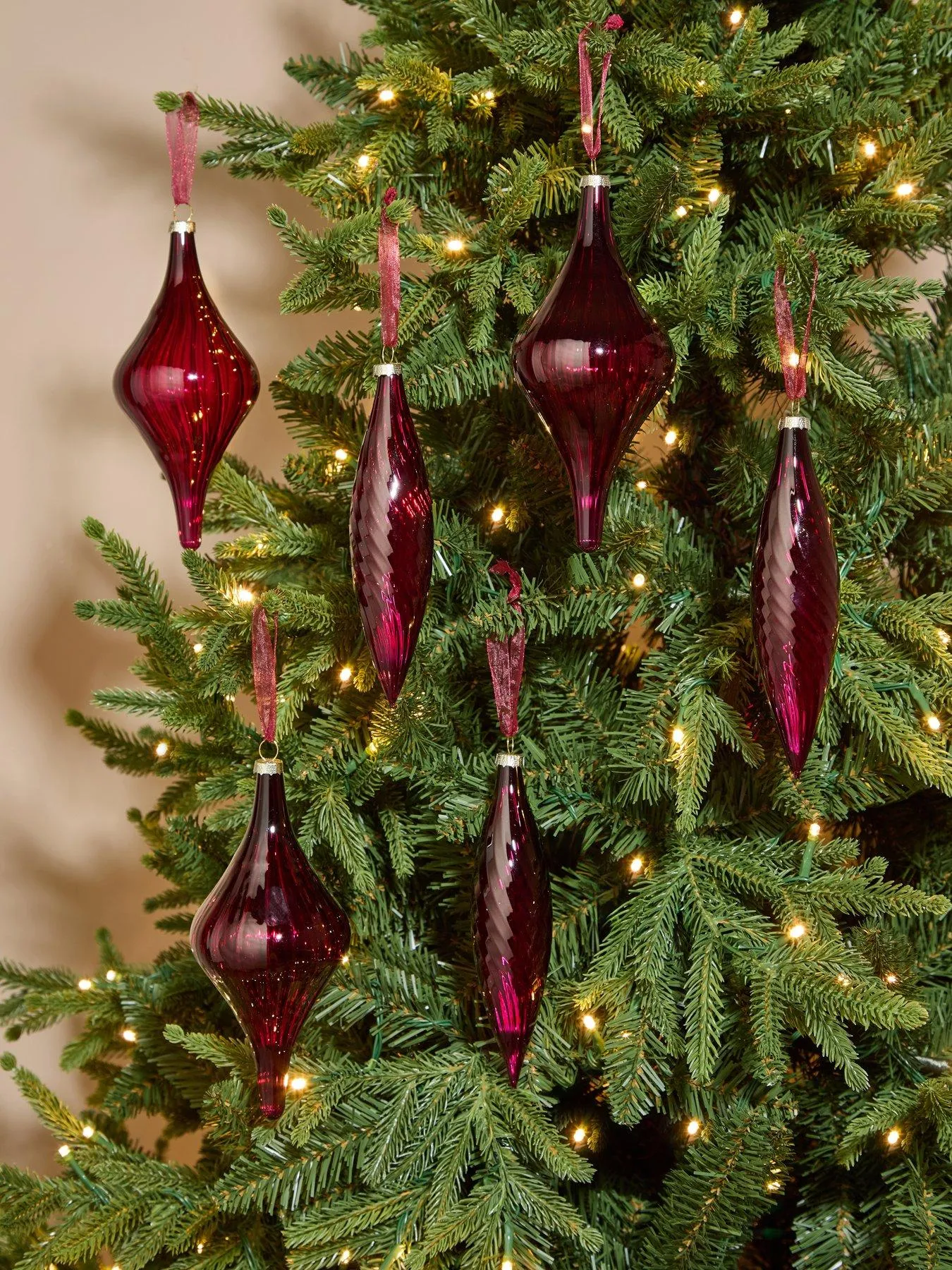
Seven identical drops, evenly spaced, is repetition doing the heavy lifting. Your eye reads the pattern before it reads any single ornament, which is why this feels calm instead of busy. Two details sharpen it: the sheer burgundy ribbon loops that make the ornaments appear to float rather than hang, and the gold caps, which give the eye a small bright anchor at every repetition. Change one variable — mix in three different ornament shapes — and the rhythm collapses into clutter.
11. Brown Velvet Baubles With Crystal Borders and Lace
Brown velvet is the most underrated neutral in holiday decorating, and it works because of contrast, not color. Pair matte brown with glitter gold and clear crystal and you get shine without saccharine. The rule that keeps it from going muddy: limit any tree to three finishes total. Matte, glitter, and glass. Add sequin, pearl, and mirrored as a fourth and fifth and the whole tree starts looking like it was assembled by committee. Rich brown plus two shining finishes plus green pine is a complete menu.
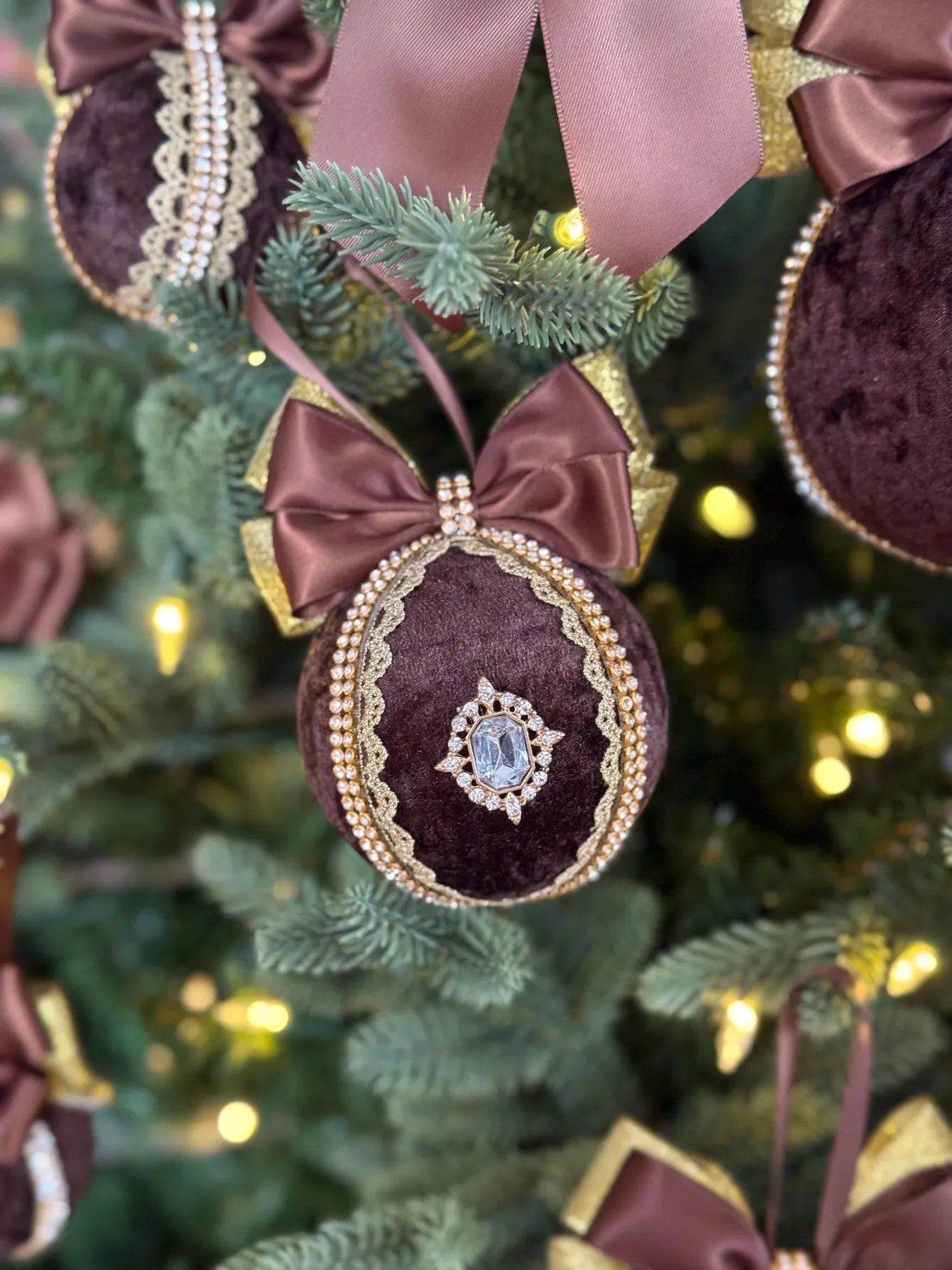
Before you commit to an ornament collection at this level of detail, check four things:
- Measure your tree’s widest branch spread — heavily embellished ornaments need 8 inches of clearance to read
- Note where your light sources sit; crystal beadwork needs warm 2700K nearby
- Count your current ornaments. More than 80 and you already have enough
- Confirm storage space — these need individual wrapping, not a bin dump
That is the checklist that stops a $200 purchase from disappearing into a tree that is already full.
12. One Dark Brown Velvet Ball, Soft-Focus Pine Behind
Roughly 90% natural green, 10% dark brown. That is the whole formula. When you hang a single ornament color on lush-looking evergreen, restraint does all the work. Swap dark brown for charcoal and the tree turns modern-industrial. Swap it for oxblood and you get classic Christmas. The one hard rule: whatever you choose has to be darker than the tree or it disappears. Brown velvet on green pine works because the ornament reads as a shadow with texture.
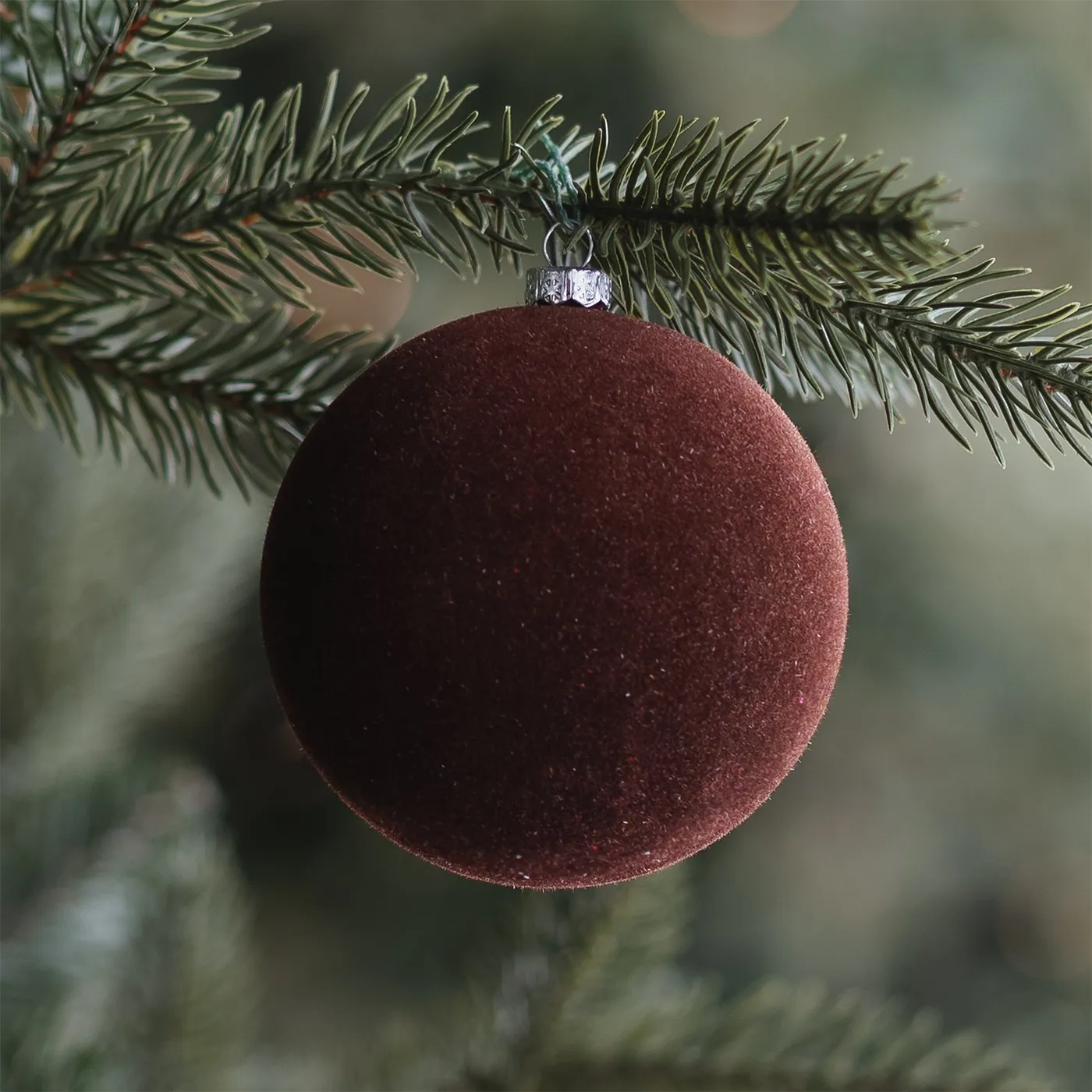
Dark brown velvet is gorgeous in daylight and invisible at night. In a dim room it becomes a black hole against dark pine — you lose the softness that made you buy it in the first place. If your tree lives in a corner with no lamp, either add a floor lamp or pick a lighter taupe. And be honest about the single-ornament photo above: it is a portrait, not a tree. Thirty dark brown balls photographed straight on look very different from one hero shot. Buy accordingly.
13. Quilted Red-and-Cream Bauble With a Hidden Brass Santa
You can build a peekaboo ornament like this from a plain sphere in about 45 minutes and $8 in materials.
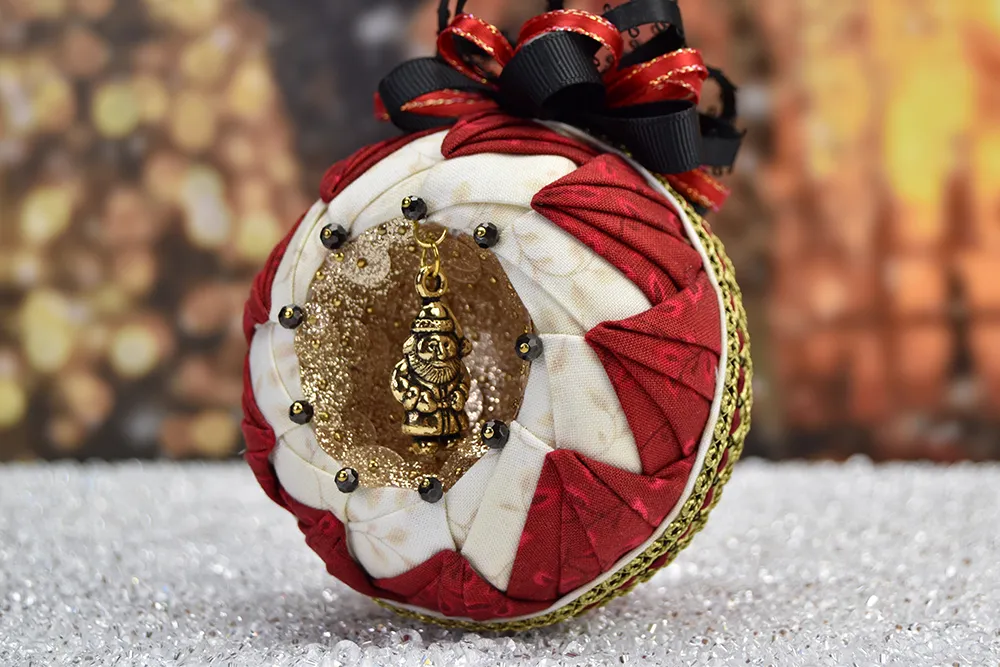
- Start with a hollow two-piece ball ornament you can open
- Cut a 2-inch circle from cardstock and coat the inside face with gold glitter
- Hot glue a miniature brass figurine so it hangs from the top interior
- Fit the cardstock disc behind the opening so it becomes a recessed backdrop
- Frame the opening with thin gold trim, then add a black-and-red striped bow
Quilted fabric ornaments are harder to fake — if you want the real thing, look for handmade sellers on Etsy around $22 to $40.
The recessed window is everything. Without it, this is a sweet quilted fabric ornament with a bow — pleasant, and completely forgettable on a crowded tree. That 1.5-inch deep opening creates an actual shadow, and shadows are what give an ornament dimension at a distance. It also gives you a place to hide a tiny brass Santa, a small secret only the person standing at the tree ever finds. Worth more than any amount of glitter.
14. A Single Oversized Cream Bow on a Bare Evergreen
Minimalist trees save you money on ornaments and spend it on statement scale:
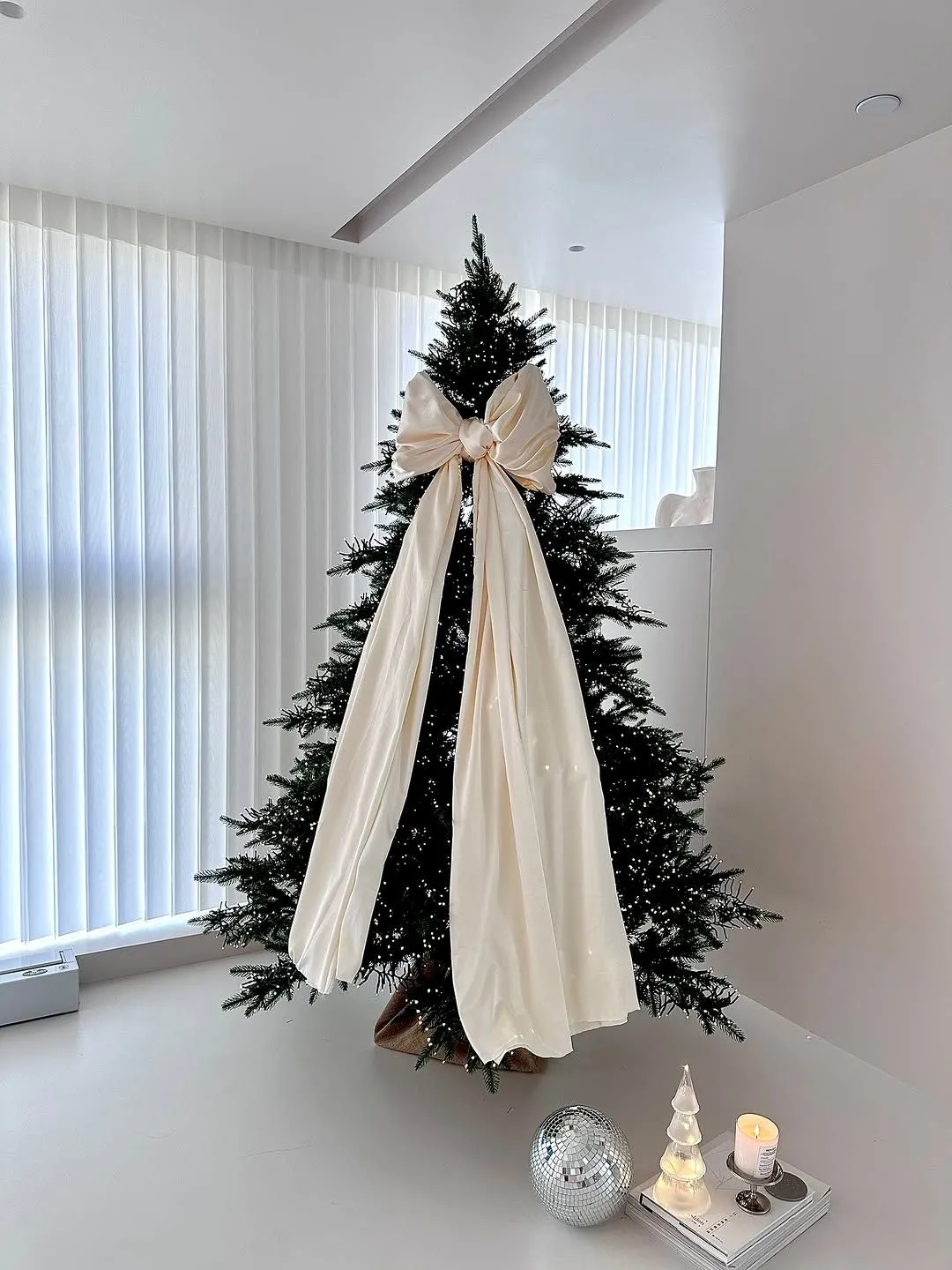
- Wide cream fabric or velvet ribbon, 3 yards: $12–$30
- Unlit artificial tree, 7 ft: $80–$500
- Warm LED fairy lights, two strands: $14–$28
- Disco ball ornament on the floor: $10–$35
- Glass tree figurine and pillar candle: $15–$60
Total: $131–$653
Budget alternative: skip the figurines entirely. A $12 spool of cream velvet ribbon, a $39 Walmart tree, and $9 of fairy lights get you the same calm for about $60.
One enormous bow only works if it holds its shape, and most ribbon collapses. Use fabric with a wired edge or back the ribbon with fusible interfacing before you tie it. Then anchor the bow with a black zip tie around the treetop trunk rather than a wire hook — wire bends under the weight and tips forward by New Year’s. A useful proportion: the bow’s total width should run about one third of the treetop width, so on a narrow treetop keep it under 20 inches.
15. Cascading Red Velvet Ribbon From a Bow Topper
Ribbon-only trees took over Pinterest because they photograph beautifully and cost a fraction of an ornament collection. The 2026 version has moved past thin satin into wide velvet with a visible pile — the kind that reads as fabric even in a thumbnail. The trend tracks with a broader shift toward fewer, larger holiday statements: one dramatic bow instead of sixty small baubles. Velvet ribbon has real staying power. It is reusable, it survives trend cycles, and it dresses a tree in ten minutes.
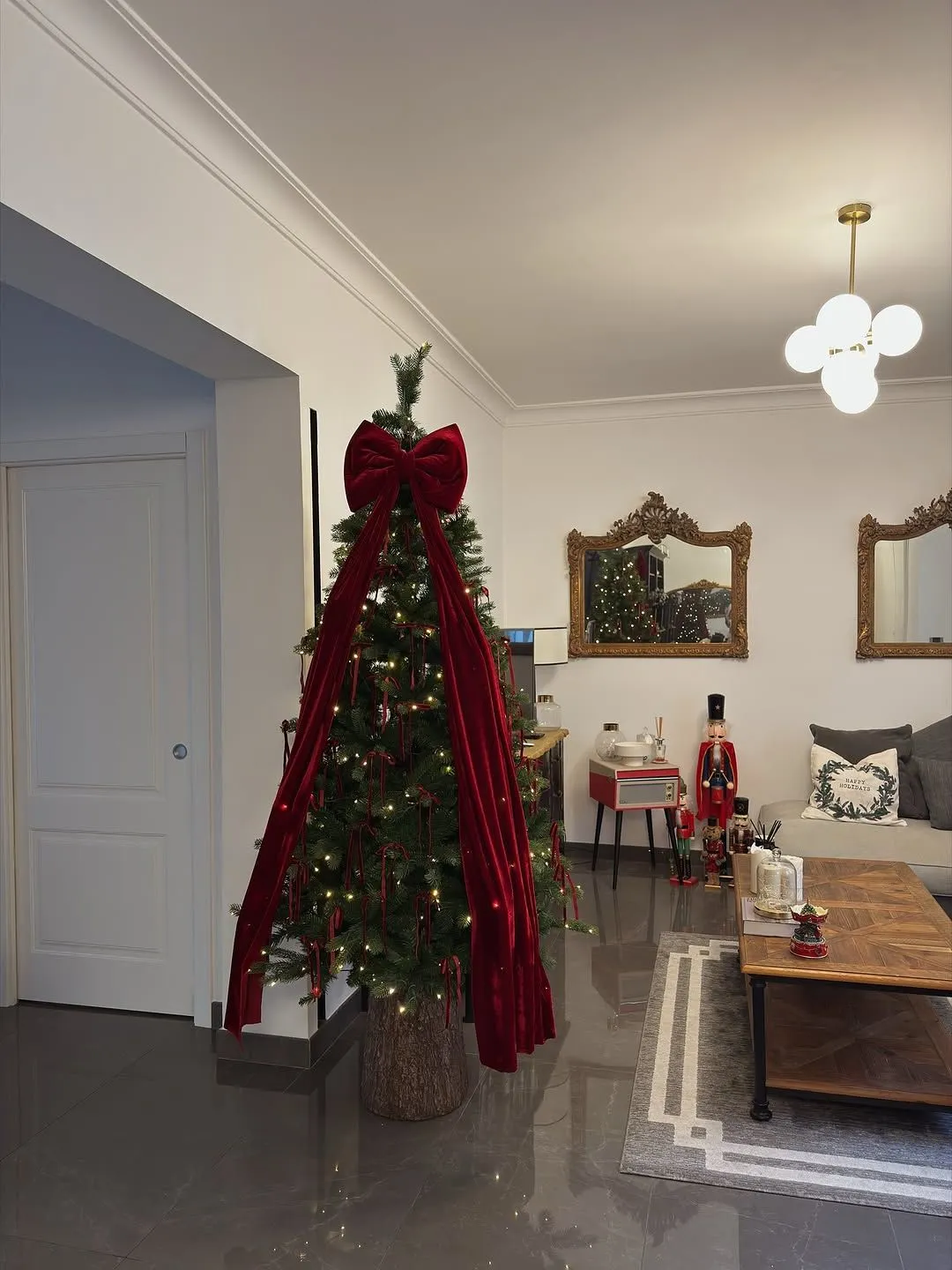
This look needs room to cascade. Plan on an 8-foot tree, a 9-foot ceiling, and a floor area of at least 12 by 14 feet so the trailing ribbons have visual space to fall into. In a smaller living room the ribbons will read as clutter rather than drama. If your space is tighter, the boxed velvet sets in Idea #24 and the tabletop styling in Idea #34 deliver the same velvet story without needing height.
16. Sage, Pink, and Gold Fabric Ornaments With Tassels
Mixed-finish fabric ornaments are the easiest category to buy cheap, because the charm is in the variety. Target’s Threshold line sells fabric and sequin mixed sets for $14 to $24, and HomeGoods regularly has gold-sequined and tasseled spheres for $5 to $9 each. Best move: buy six new, then add three thrifted tassel ornaments for $2 apiece. Hang the tassels low, where their movement is at eye level. The combination of new and found is exactly what makes an arrangement look collected.
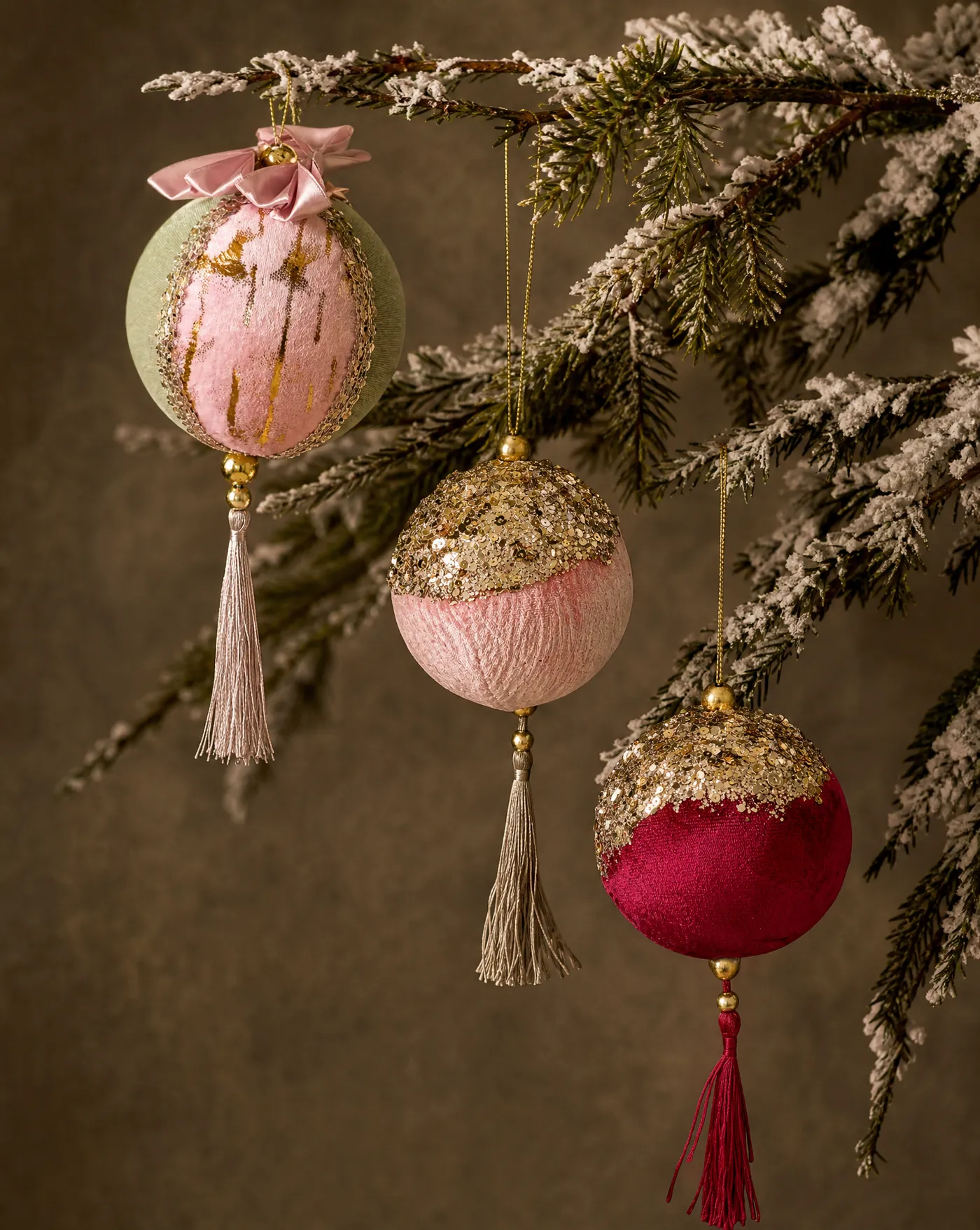
About 50% deep forest green from the branch itself, 30% soft accents in sage and pink, 20% gold sequin. That gold percentage sounds small until you remember glitter amplifies — a little goes a long way under fairy lights. Swap the pink for soft blue and the arrangement turns frosty and traditional. Swap the sage for cream and it gets modern. Keep deep red to one or two pieces, since red plus gold sequins plus pink in equal measure tips into candy-shop territory.
17. Plush Tree-Shaped Ornaments With Beaded Candy Canes
Small plush ornaments disappear on a big tree unless you cluster them. Twenty minutes, no cost.
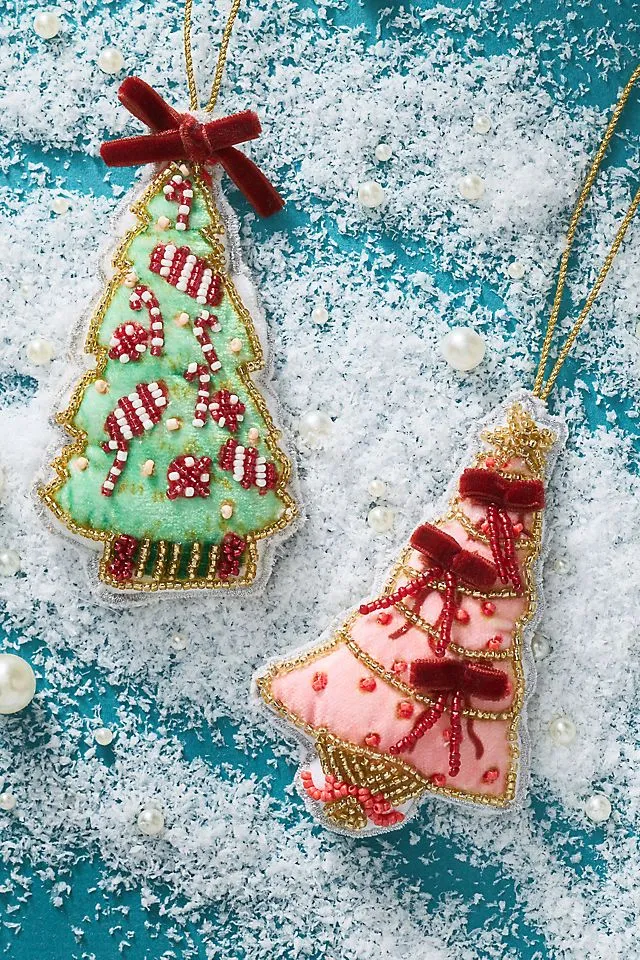
- Pick three to five plush ornaments that share a palette
- Choose one branch section about 14 inches wide near the front of the tree
- Hang the largest in the center, then the others in a loose ring around it
- Leave the ring uneven — symmetry kills the collected look
- Finish by tucking one burgundy velvet bow at the top of the cluster
That single bow ties the group to the rest of the tree and keeps it from looking like a separate decoration.
Two textures arguing pleasantly. The bodies are soft mint and blush plush, which photograph flat and gentle. The beadwork and embroidered candy-cane motifs are hard, shiny, and precise. That soft-versus-hard contrast is what keeps these from reading as stuffed animals — the gold bead borders and gold cord loops give your eye something crisp to land on. The tiny burgundy bows are the third element: a dark, saturated note that makes the pastels look intentional rather than accidental.
18. A Carved Gold Bauble Among Red and Warm White
Depth is what separates a professionally decorated tree from a full one. Hang ornaments at three distances from the branch tips: roughly one third sitting right at the tips, one third set back 3 inches, and one third tucked 6 inches deep toward the trunk. That gives you layers instead of a flat wall of baubles, and it means you need about 30% fewer ornaments than you think. Do the front-facing half first at eye level and let the sides stay lighter. Nobody inspects the back.
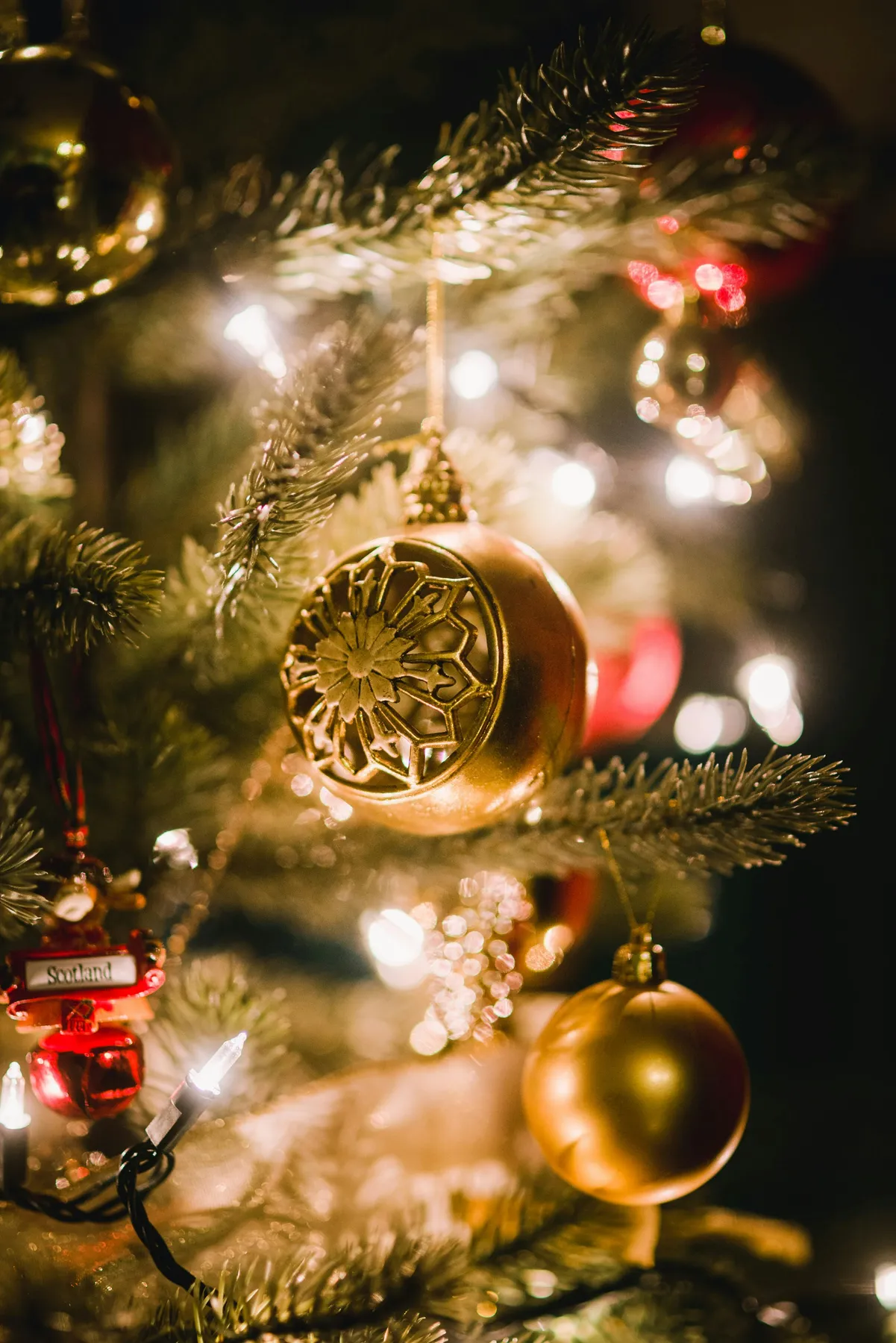
Gold is the finish most likely to disappoint. Antique golds and mercury-glass golds keep their depth under warm white LEDs. Yellow-brass golds turn greenish and cheap-looking under cool white or daylight bulbs. Before you buy a set, check your tree lights: if they are 4000K or higher, gold ornaments will look wrong no matter how much you spent. Move to a warm 2700K strand and the same ornaments suddenly look like heirlooms. It is the cheapest upgrade in this entire article.
19. Dusty Pink Velvet Balls With Embroidered Floral Appliqué
The embroidered floral appliqué. A dusty pink velvet ball is a nice object; a dusty pink velvet ball with hand-stitched florals and tiny gem centers is a story. The appliqué creates texture on top of texture — soft pile underneath, raised thread and faceted stones above — which is the exact thing that makes an ornament hold up when you pick it up and look closely. If you can only afford one embellished set this year, buy the one with dimensional surface detail.
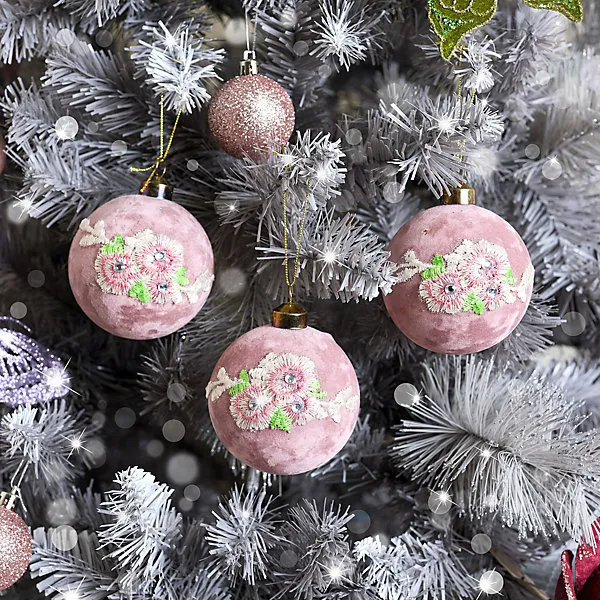
The good news: this is a DIY-friendly look. Plain pink velvet ball ornaments run about $1.50 each at Walmart or in Dollar Tree multipacks, and Etsy sells iron-on embroidered floral patches with gem centers for $5 to $8 a set of four. Press or glue one patch per ball, add a gold cap, and you have a designer-looking set for roughly $14. Do them in front of a movie. It is an hour of work, and nobody will guess.
20. Deep Red Velvet and Sheer Gold Mesh Ribbon
Red and gold is the classic, and the classic has a price range:
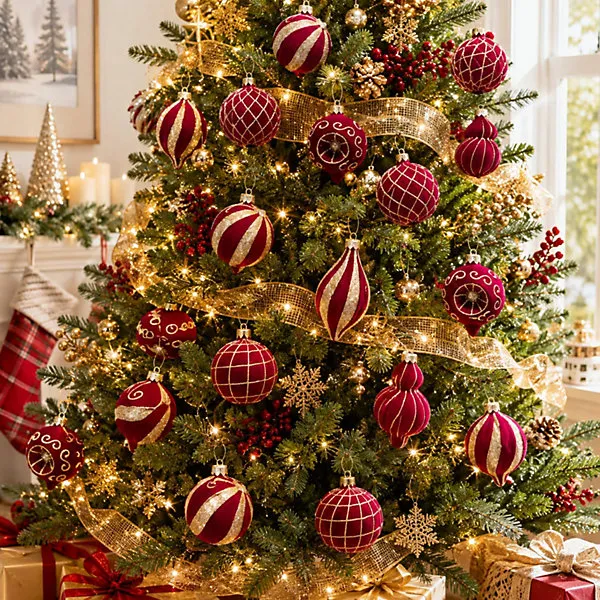
- Deep red velvet ornament set, 24 pieces: $30–$90
- Sheer gold mesh ribbon, 10 yards: $10–$25
- Gold snowflake cutouts and berry picks: $12–$30
- Warm white string lights, 200 count: $15–$35
- Artificial tree, 7.5 ft: $120–$450
Total: $187–$630
Budget alternative: Dollar Tree’s velvet-look ornaments at $1.25 each and a $5 roll of gold mesh ribbon from Walmart will dress a 7-foot tree for under $60. Use more lights than you think you need and nobody notices the price tag.
A 7.5-foot tree with a full red-and-gold treatment wants roughly 120 to 150 ornaments and 800 to 1,200 lights, spread across a room at least 12 by 12 feet. In a smaller apartment, drop to a 6-foot tree and cut the ornament count to about 80, or borrow the restrained single-color approach in Idea #12, which reads full with a third of the volume. Leave 6 inches between treetop and ceiling too — a tree that touches the ceiling feels cramped.
21. Smooth and Ridged Burgundy Velvet on Gold Strings
Ornaments on gold string hang differently than ornaments on wire hooks — they swing. Here is how to use that.
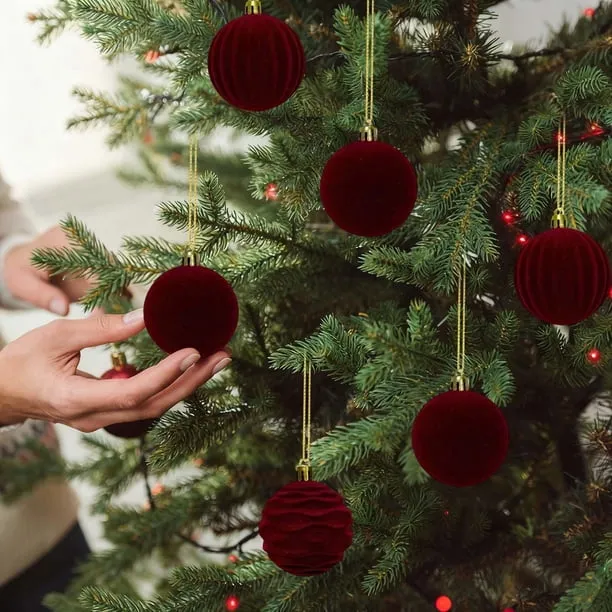
- Cut the string to 6 inches, longer than a standard hook
- Loop it over a branch, not around a single needle cluster
- Let the ornament rest 2 inches below the branch line
- Space ridged ornaments next to smooth ones so light catches both
- Recheck after an hour — string settles and needs a second adjustment
Fifteen minutes of fussing gets you the soft, drifting movement that makes a velvet tree feel unhurried.
Velvet ornaments are more durable than they look. The pile hides fingerprints, dust, and the small scuffs of a household with kids or cats. What damages them is storage: crush them in a bin and the pile flattens permanently along the fold lines. Wrap each one in tissue and stand them upright in a divided box. Skip the vacuum attachment entirely — a lint roller is all velvet ever needs, twice a season at most. Assume a 10 to 15 year lifespan with reasonable care.
22. A Tray of Velvet Ribbon Spools Beside the Tree
About 60% of this comes from the tree itself — green needles and glass balls in red, silver, and gold. Another 30% is the ribbon story: red and brown velvet spools plus white and red lace trim. The last 10% is the wooden stool and white oval tray holding it all. Swap the brown velvet for charcoal and the arrangement goes modern. Swap the lace for plain linen trim and it goes rustic. Keep the tray white regardless; a dark tray would swallow the ribbon colors completely.
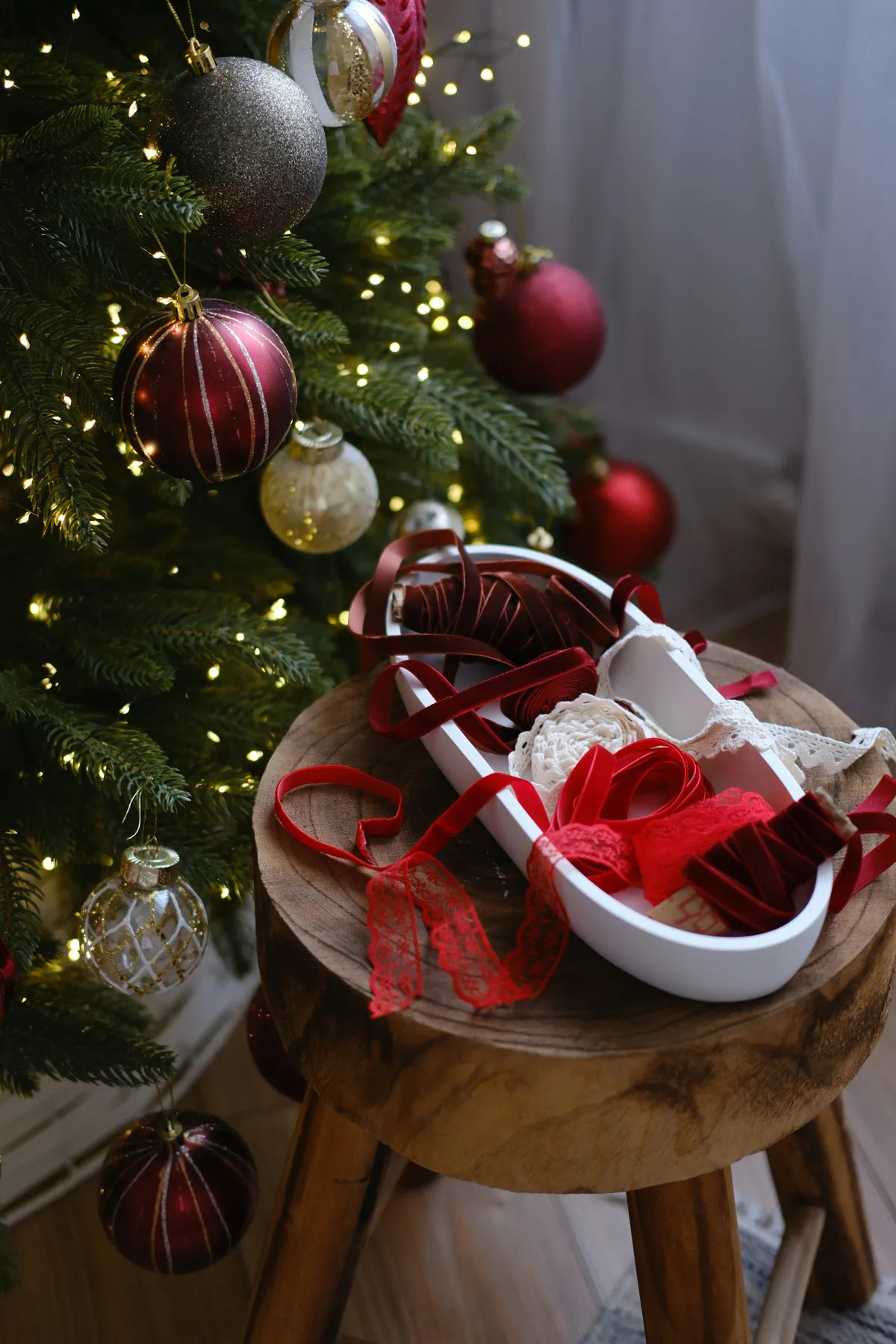
Before you set up a ribbon tray as decor rather than storage, verify these:
- A tray at least 12 inches across, or the spools will cascade off the edge
- A surface you actually pass daily — a stool behind the sofa goes unseen
- Spools that fit upright; lay them flat and the pile creases
- Enough ribbon to finish the tree. Ten yards of 2-inch ribbon dresses a 6-foot tree
If the tray is only there for the photo, that is fine too. Just be honest about it.
23. A Corner Tree Anchored by a Woven Rug
A tree next to a sofa is cozy for about three weeks and annoying by New Year’s. Check three things before you commit to this arrangement: keep at least 18 inches between the tree and any seating so people can actually sit down, keep the tree away from vents and radiators or the branches will dry and drop faster, and put a waterproof mat under the stand because wood floors show water rings forever. Run the light cord along the wall behind the sofa, never across the walking path.
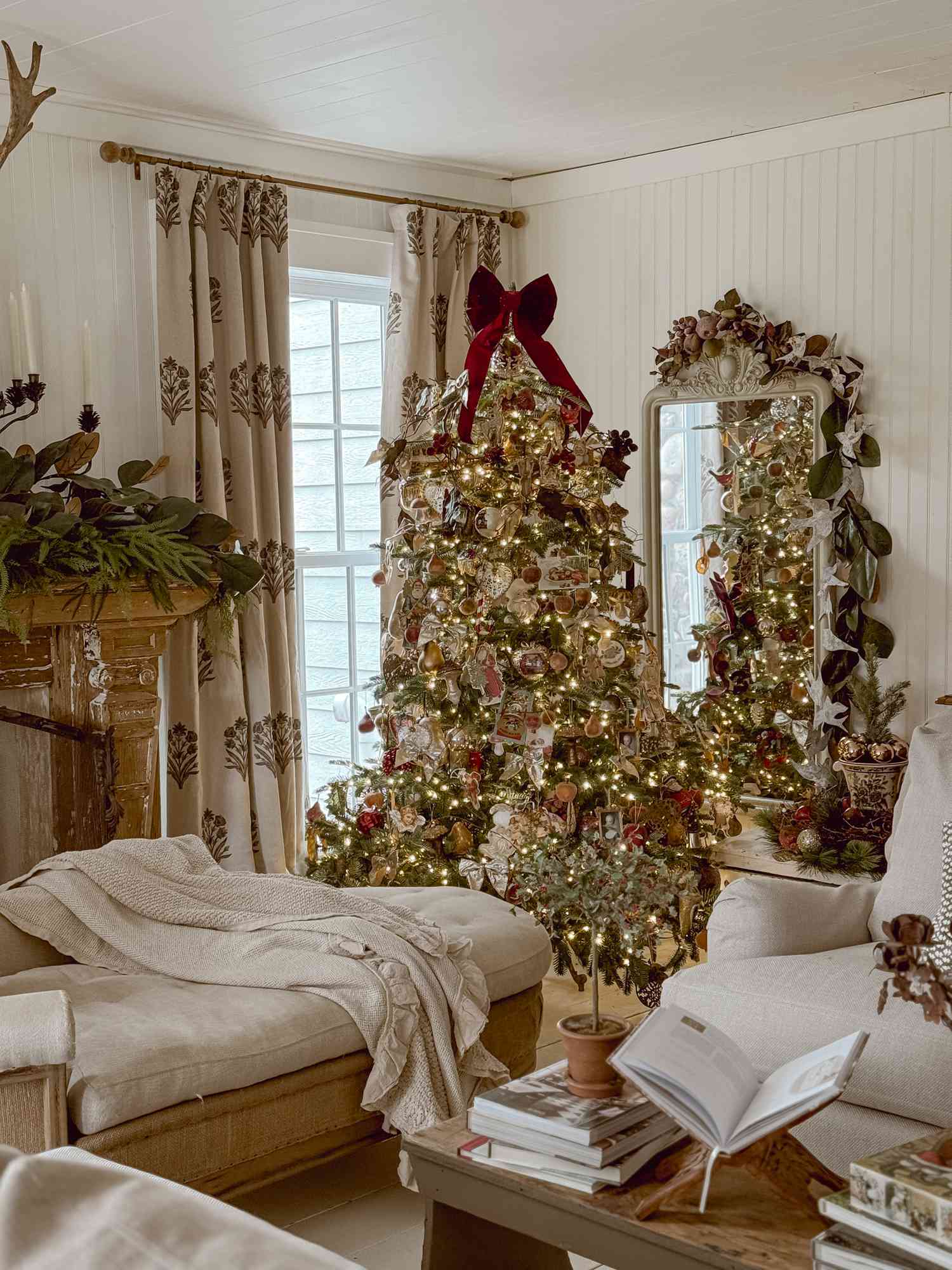
A woven rug is doing something sneaky here. It visually anchors the tree to the floor, so a tall green object stops feeling like it is floating in a beige room. The framed art above provides a second vertical element, which balances the tree’s height instead of letting it dominate one corner. And the neutral wall lets the green read as the only strong color in the room, which is exactly why this corner feels festive without being loud. Three elements, one job each.
24. Beige, Taupe, and Olive Velvet Balls in a Box
Neutral velvet is the hardest palette to get right, because beige, taupe, and off-white start blending into mush under the wrong light. Keep your neutrals within two values of each other — if you go light, stay light — and let a single dark olive green ball do the anchoring. Olive also needs warm light to look rich; under cool white bulbs it turns grey-brown and dusty. And resist adding a fourth neutral. Three tones plus one dark accent is the whole formula.
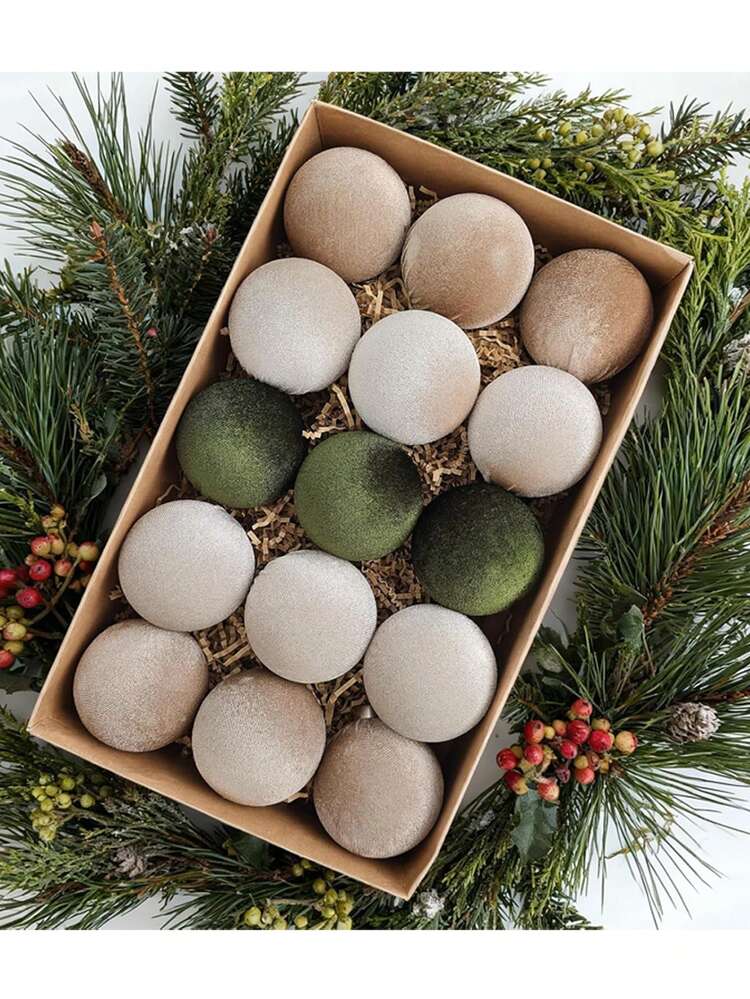
This is a category where budget sets genuinely compete with luxury ones, since the appeal is a matte finish rather than fine detailing. Costco and Sam’s Club carry 30-piece velvet-look ball sets in neutrals for $19 to $29 during the holidays, and Walmart’s $12 beige and olive sets are perfectly convincing on a tree. If you want to save on the box itself, ask at thrift stores in January — unopened velvet ornament sets appear constantly and run $4 to $8. A shallow wooden box and a few pine branches finish the look for about $6.
25. Matte Velvet and Glossy Red on a Dense Garland
Dense, fully-dressed garlands are back after years of minimal greenery, and the reason is photography. A packed garland reads as abundance in a single phone shot, while sparse garland looks unfinished at thumbnail size. Mixing matte velvet with glossy metal in the same red is the 2026 twist — it adds depth without introducing another color. This style has real staying power because it is built on finish contrast rather than a novelty shape. Traditional red is not going anywhere.
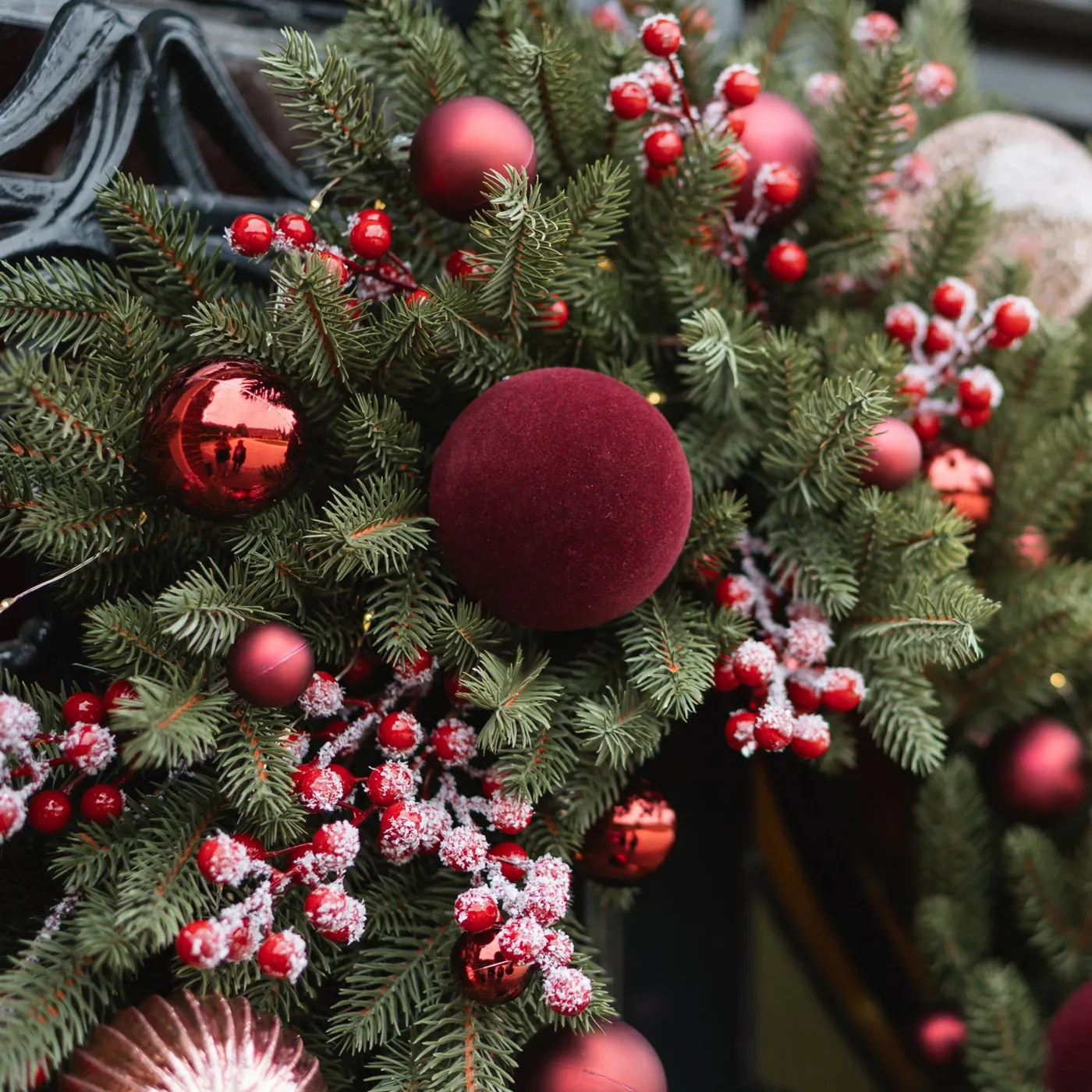
Dressing a garland so it looks full takes about 40 minutes and no special skill.
- Start with a garland at least 9 feet long for a standard mantel
- Weave lights first, doubling the strand back on itself for density
- Place the largest velvet ornaments in groups of three, never evenly spaced
- Add frosted berry clusters to fill gaps between groups
- Finish with glossy baubles tucked slightly deeper than the velvet ones
Velvet in front, shine behind — that layering is what makes it look expensive.
26. Brown Flocked Balls on Beaded Gold Chains
Brown flocked balls are quietly one of the best-value velvet looks:
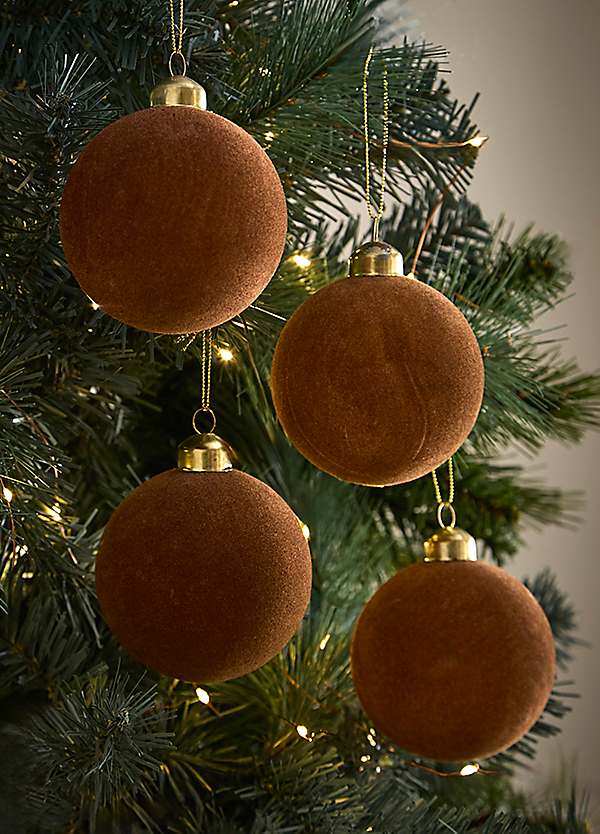
- Brown flocked ball ornaments, set of 12: $20–$48
- Beaded gold chain hangers, 12 count: $8–$18
- Warm white string lights, 100 count: $12–$30
- Artificial tree, 6.5 ft: $80–$300
Total: $120–$396
Budget alternative: hit the after-Christmas clearance at Target or Hobby Lobby for flocked sets at 60% to 75% off, then buy beaded chain by the yard at a craft store for about $3. Same look, roughly $35 total, if you can wait until January.
The beaded hanging chains. Swap them for standard wire hooks and this becomes just another brown ornament — pleasant, unremarkable. Beaded chain catches light along its whole length, so each ornament gets a small halo above it, and the drape hangs straighter than wire ever will. It reads like jewelry, and that is the whole difference. If you own plain velvet balls already, the cheapest upgrade in this article is a $10 spool of beaded chain.
27. Red Velvet Bauble With Teardrop Gems and Rhinestone Lattice
Detail work on ornaments has a viewing distance. Rhinestone lattice and gem appliqués like these read clearly from up to about four feet; past that they blur into a general sparkle and could be anything. That is not a flaw, it is a decision. Hang the heavily embellished pieces where people actually stand — near the front, at chest and eye level, above a gift table. Save the simpler velvet balls for the top and sides. Rotating your best pieces to the front each year is a two-minute job with a big payoff.
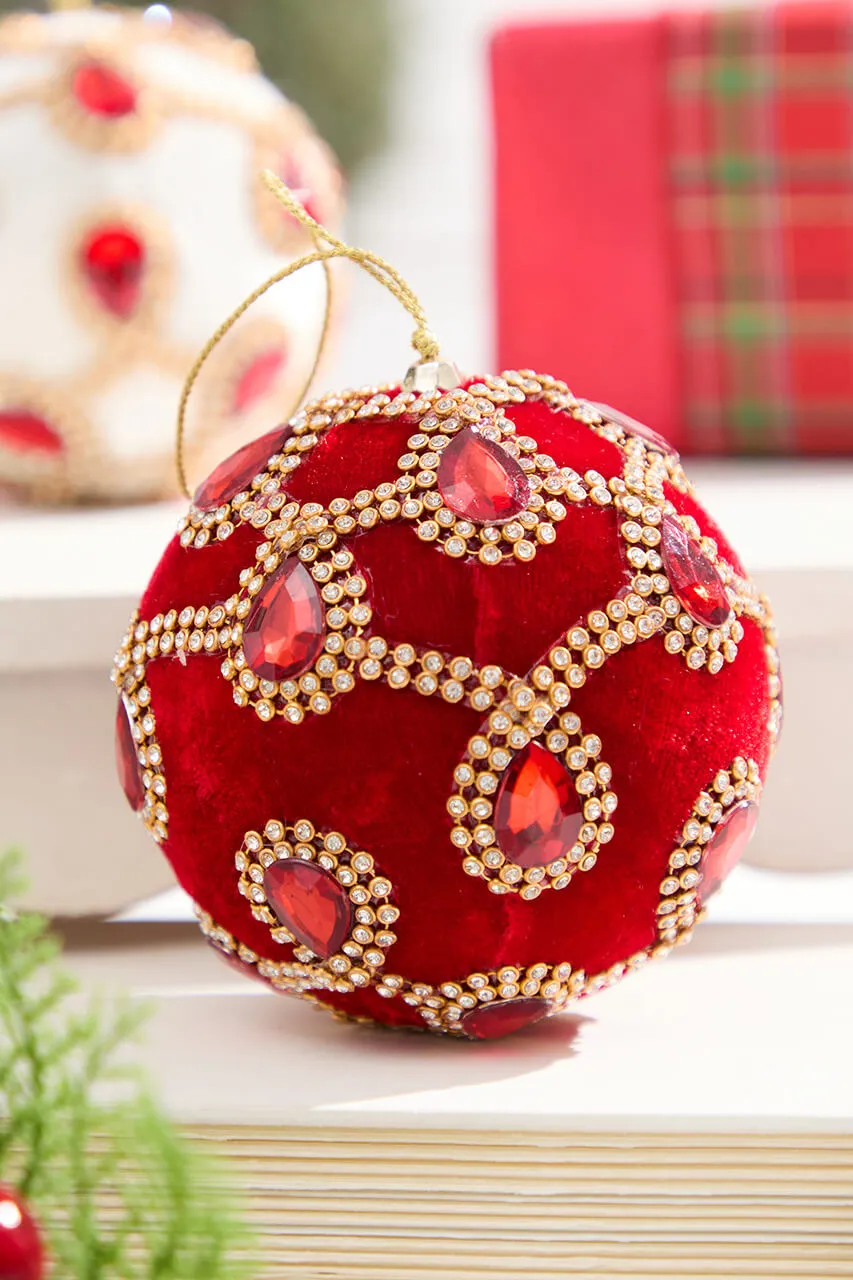
Roughly 85% red velvet, 10% clear rhinestone, 5% gold. The rhinestone percentage stays low because sparkle compounds — a full lattice of stones on every ornament would read as costume jewelry. Keep the gems monochrome red so the shape is what you notice, not a color scramble. Swap the clear stones for smoke grey and the ornament goes moody and modern. Swap the gold string for silver and it cools down significantly. Change one variable at a time and you never lose the effect.
28. Pink and Maroon Striped Balls on Sheer Silver Ribbon
Four large striped balls is the right count for a small stage. This works on a 4 to 6 foot tree, a slim hallway tree, or a tabletop display where the ornaments sit within arm’s reach. On anything taller than 7 feet, four ornaments vanish — you would need at least a dozen, and the stripe pattern starts to feel busy fast. Pair with the fuller, denser approach in Idea #20 if you have the ceiling height and want a bigger statement.
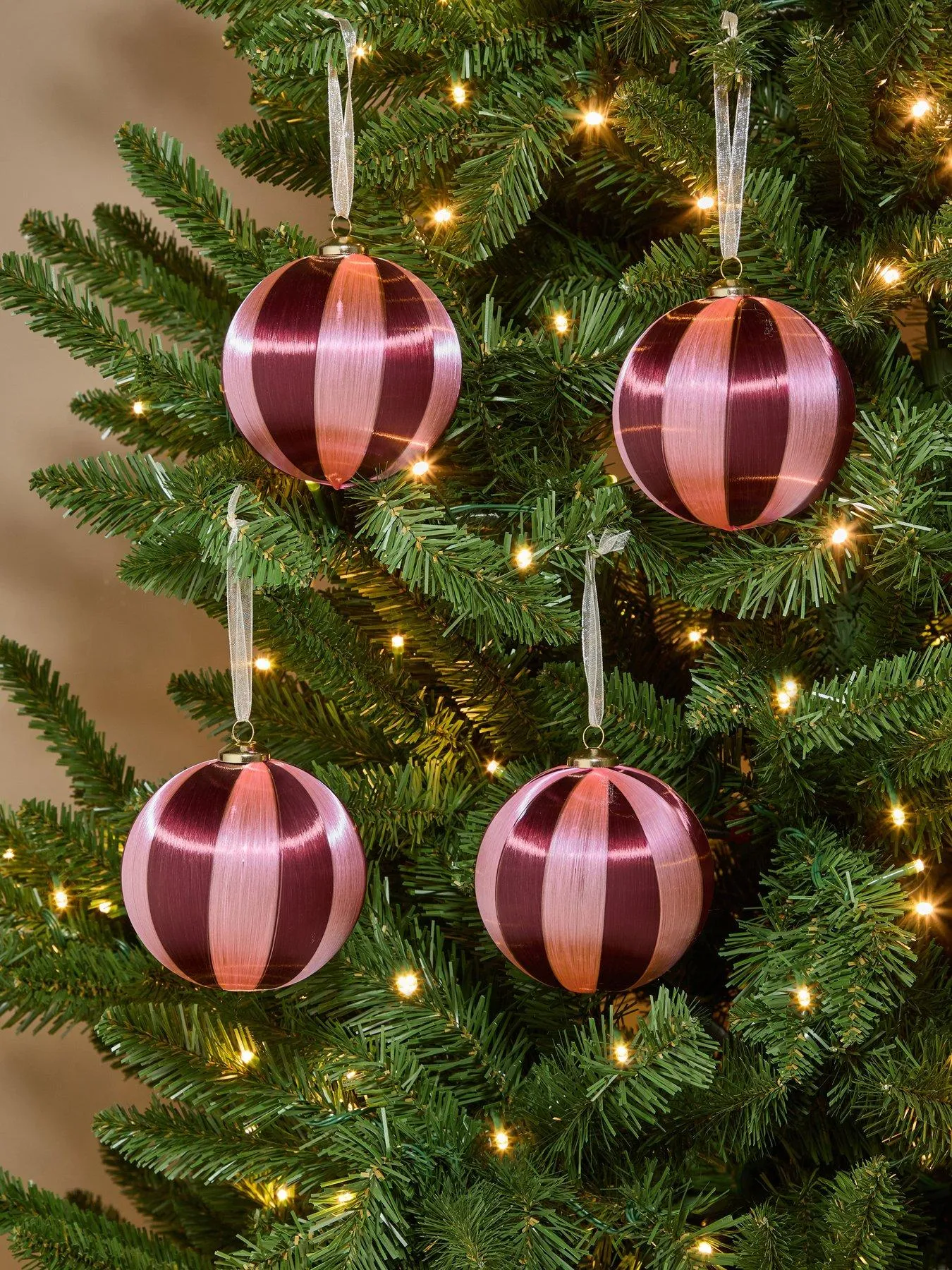
Pink and maroon is a beautiful pairing that goes wrong under warm yellow light. Those bulbs push both colors toward orange, and the crisp stripes turn muddy brown from across the room. Before you commit, hold one ornament under your actual tree lights at night — not in the store, not in daylight. If it muddies, add one cool-toned white LED strand nearby to balance it, or shift the pink toward blush. Two minutes of testing saves a whole set of returns.
29. A Blue Velvet Ornament Set in a Satin-Lined Box
The box. A set this ornate could be dumped in a bin and it would look like a pile of blue velvet. Presented in a white satin-lined box, it reads as a collection — something you would give as a gift or set on a console as decor in its own right. That presentation is half the value. When you buy ornaments online, pay attention to whether the set comes boxed. It is the difference between 18 ornaments and a piece of holiday styling you can display for six weeks.
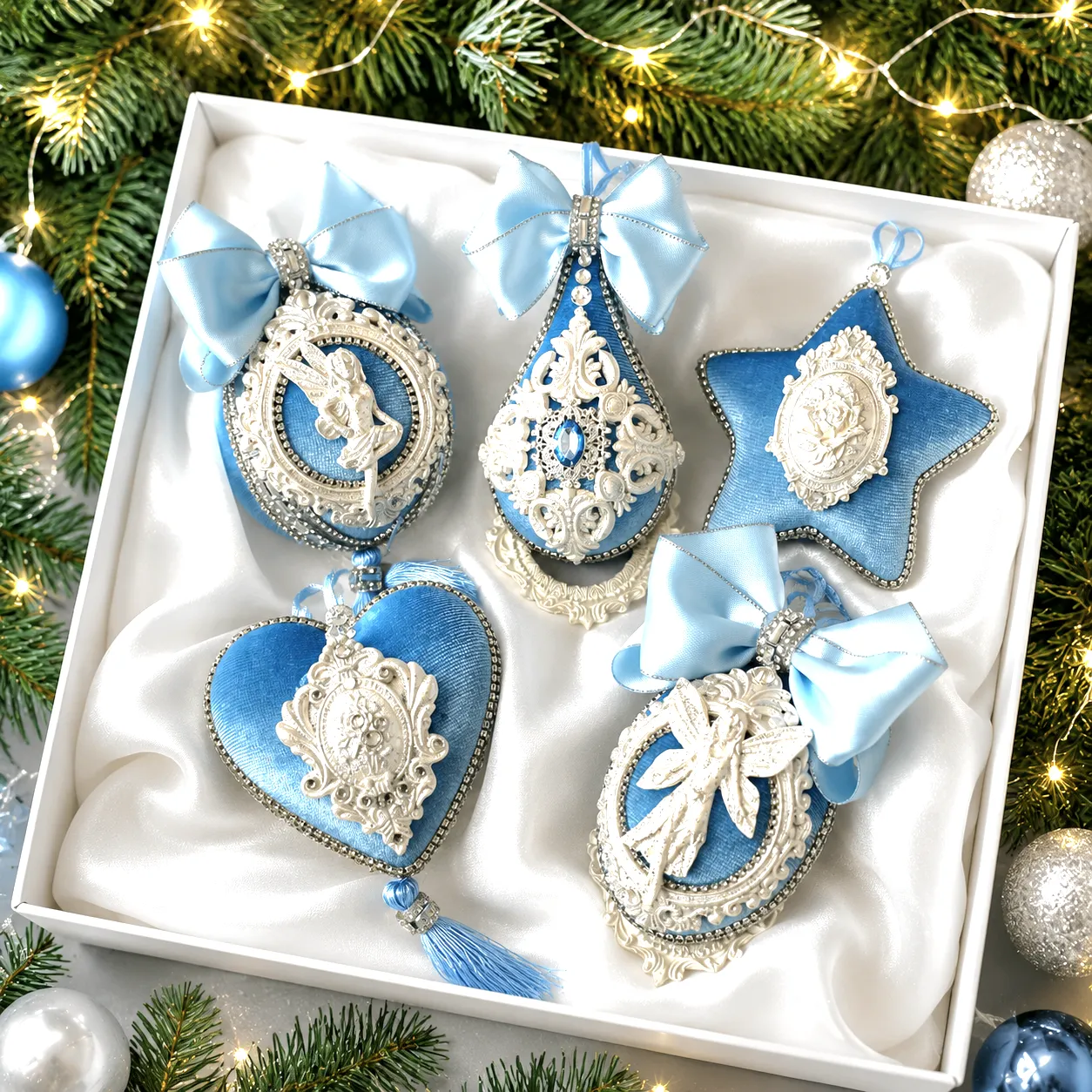
You can build the same silhouettes for less. Start with a $16 blue velvet ball set from Walmart, then buy one baroque-style pendant ornament, one star, and one teardrop with a tassel from a craft store for $6 to $12 apiece. Add light blue satin ribbon bows from a dollar store spool. Total lands around $55 versus $120 or more for a matched set. Mixed silhouettes in a consistent palette and finish read as curated, not mismatched. That is the whole trick.
30. A Matte Black Velvet Bow on Lit Pine Garland
Black on dark green should not work, and that is exactly why it does. The bow registers because of value contrast — matte black is deeper than any pine needle — plus the warm fairy lights glowing directly behind it, which outlines its silhouette. Without those lights the bow would disappear entirely. Two things make it feel deliberate rather than goth: the ribbon is velvet, so it has visible softness, and the tails are cut long and uneven. Symmetry here would kill the whole mood.
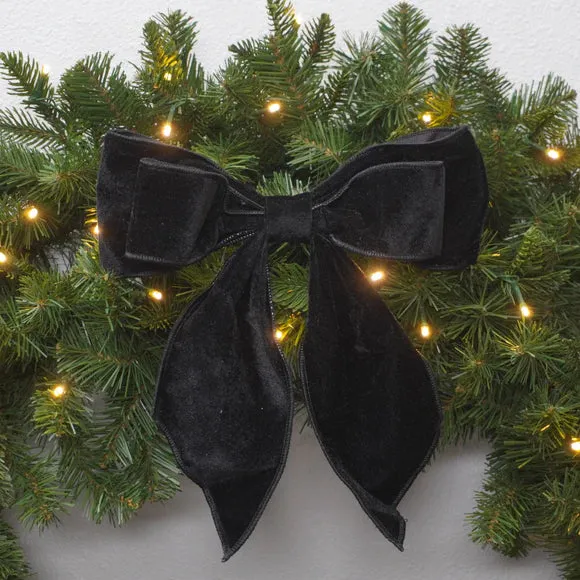
Black velvet is the single most lint-visible material in holiday decor. Every stray fiber, pet hair, and soot particle from a fireplace will find it. Keep the garland away from the hearth or plan on a weekly lint roller session. Store the bow flat in tissue rather than folded — velvet permanent creases never fully relax. On the plus side, black velvet does not fade, does not show dust the way pale ribbon does, and will outlast almost any other trim you own. Five years, easily.
31. Ridged Red Velvet Bells With Silver Glitter Zigzags
Bell ornaments need companions or they read as a single jingle. Fifteen minutes, under $12.
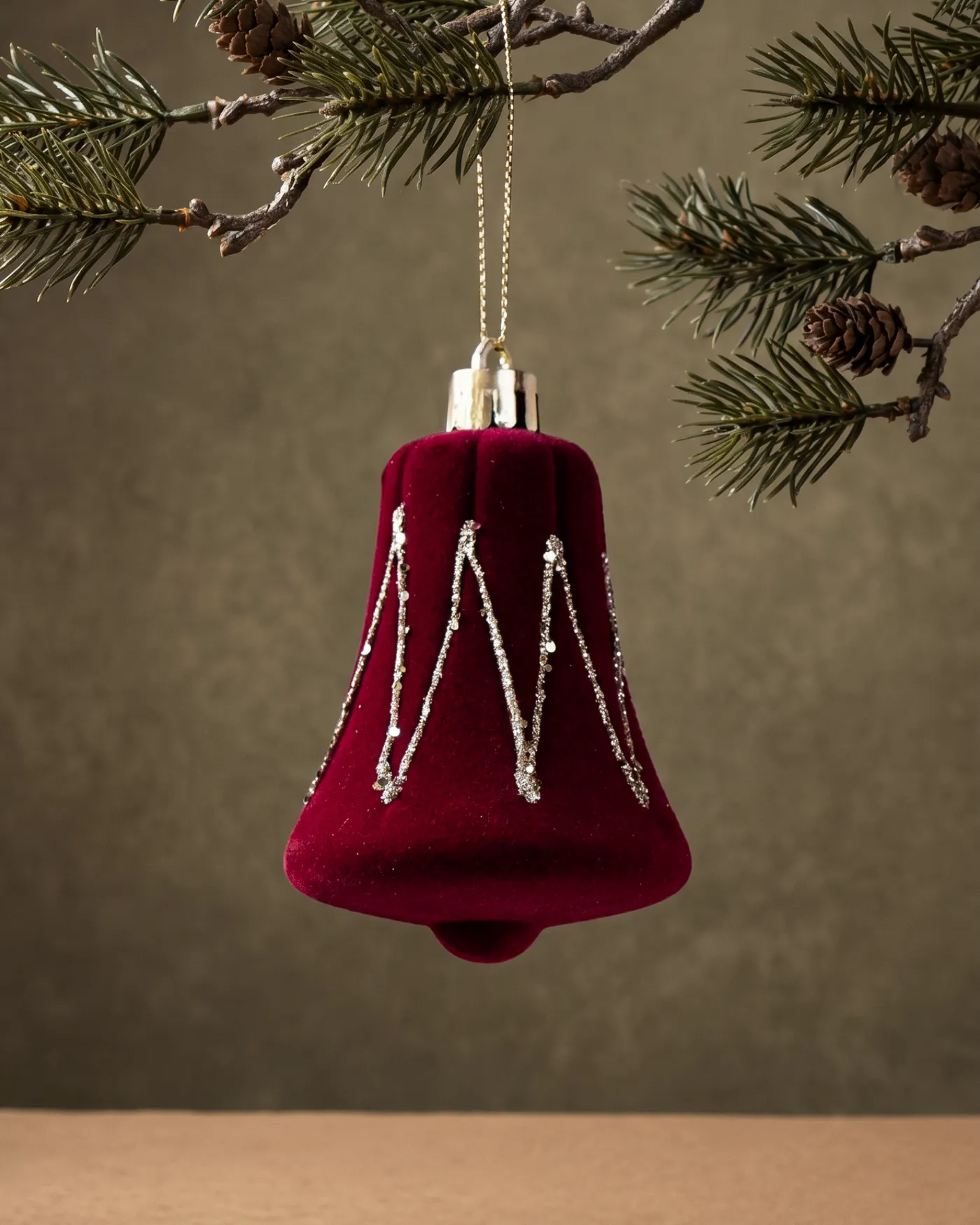
- Hang the bell at the top of a short branch section
- Place two pinecones just below and slightly to one side
- Tuck a green pine sprig behind the bell to fill the gap
- Repeat the same trio every 10 to 12 inches along the branch
- Leave the plain pine between clusters completely bare
The bare gaps are what make the clusters look intentional. Filling every inch flattens the effect.
Shaped ornaments — bells, finials, teardrops, stars — are having a moment after a long run of plain spheres. Pinterest searches for vintage-shaped ornaments have climbed steadily, and that tracks with the broader grandmillennial pull toward older, more formal holiday styling. The zigzag glitter detail here nods to mid-century Christmas without going full retro. Shapes date more slowly than colors, which makes them a safe place to spend.
32. A Black Velvet Poinsettia With Silver-Glitter Edges
Large flat ornaments like this poinsettia have one job: face the room. They read as a flat disc from any other angle, so wire them through two points on the back rather than one — a single hook lets them spin and tilt. Use floral wire or a small zip tie through the petal gaps. A useful count: one oversized floral ornament per 18 inches of tree height, hung where a branch naturally juts forward. More than that and the tree starts looking like a wreath.
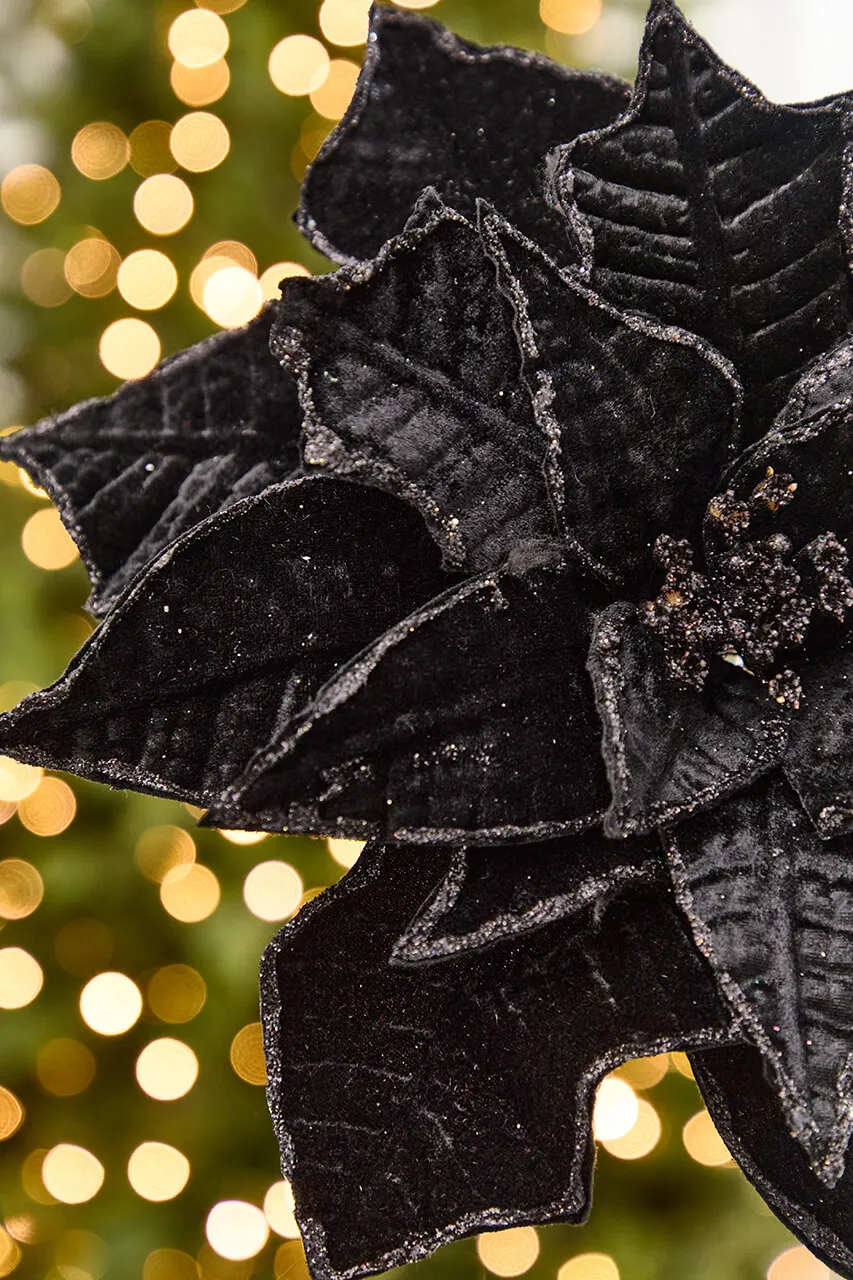
The silver glitter along the petal edges. Matte black velvet petals on their own are dramatic but flat — the eye slides right off them. That thin glitter border catches light and draws the outline of every petal, so the flower reads as a shape even from across a dark room. Same principle as a metallic frame around a matte painting. If you make your own, run a fine line of silver glitter glue along each petal edge and let it dry flat for an hour.
33. Red Velvet Baubles Ribbed With Lines of Gold Glitter
Ribbed glitter velvet is one of the easier effects to source cheaply:
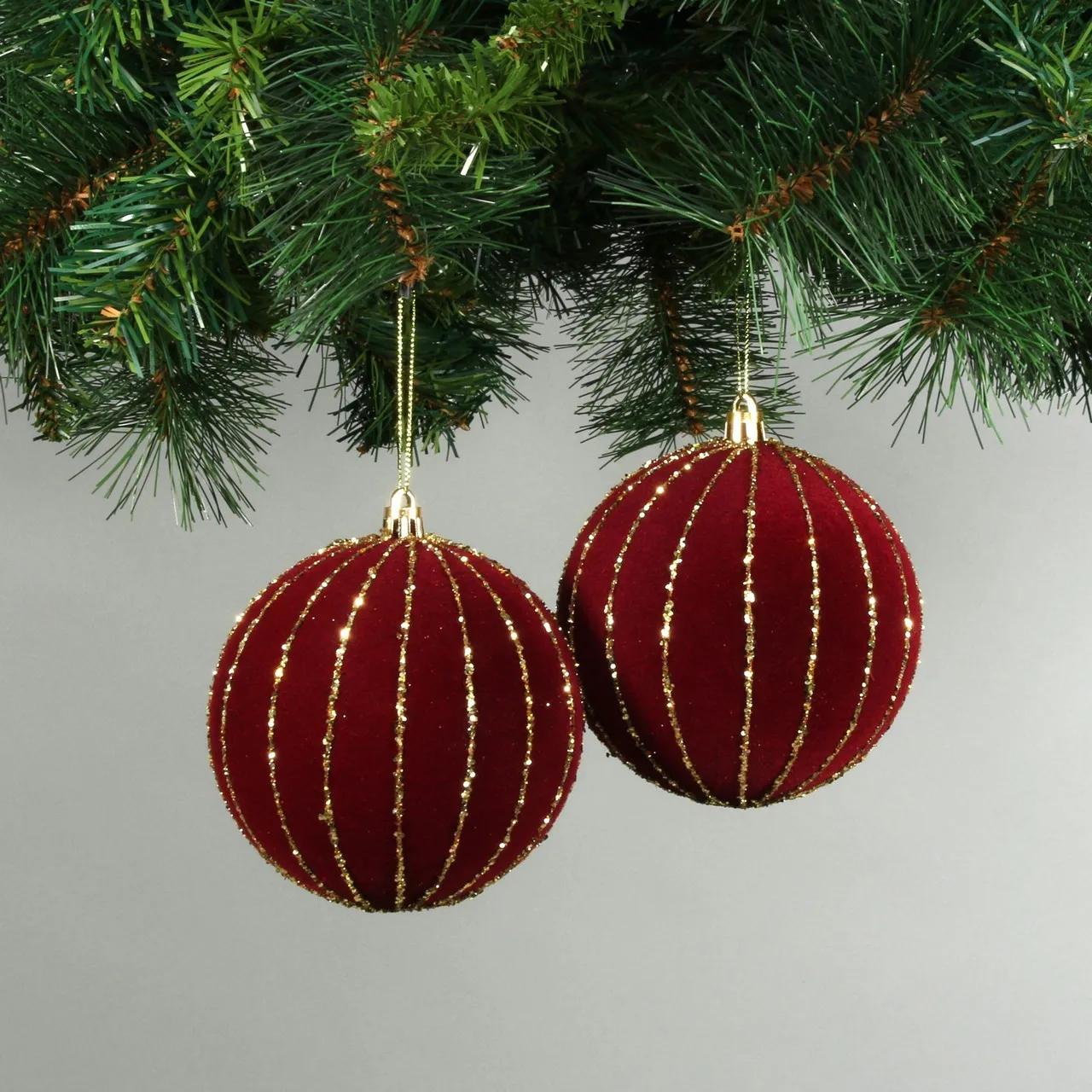
- Red velvet ornaments with gold glitter ridges, set of 6: $14–$36
- Green pine sprigs or picks: $8–$20
- Gold caps and hanging string, 12 count: $4–$10
- Neutral backdrop or shelf styling: $0–$25
Total: $26–$91
Budget alternative: buy plain red velvet balls at Dollar Tree for $1.25 each and add gold glitter ridges with a fine-tip glue pen and loose glitter. Six ornaments, about $12 total, one evening of work.
Two large baubles on a styled shelf is a vignette, not a tree. If you are working with a 6.5-foot tree and want this ribbed look throughout, budget on 60 to 80 ornaments plus 400 to 600 warm lights. A 4-foot tabletop tree needs about 30. The two-ornament photo above works because of the plain grey background — in a real room you need volume to make the same impression. Check Idea #22 for how a smaller count can still read as finished.
34. Mint Green Flocked Ball on a White Beaded Stand
About 60% mint green, 25% white, 15% gold glitter and gold-tone hardware. Mint is the risky part — it goes chalky against pure white and slightly acid against cream. Keep the white elements matte and beaded rather than glossy and the two play nicely. Swap mint for seafoam blue and the whole thing turns wintry. Swap it for sage and it goes rustic. The beaded stand is doing more work than you think; it gives a single ornament a reason to sit on a table.
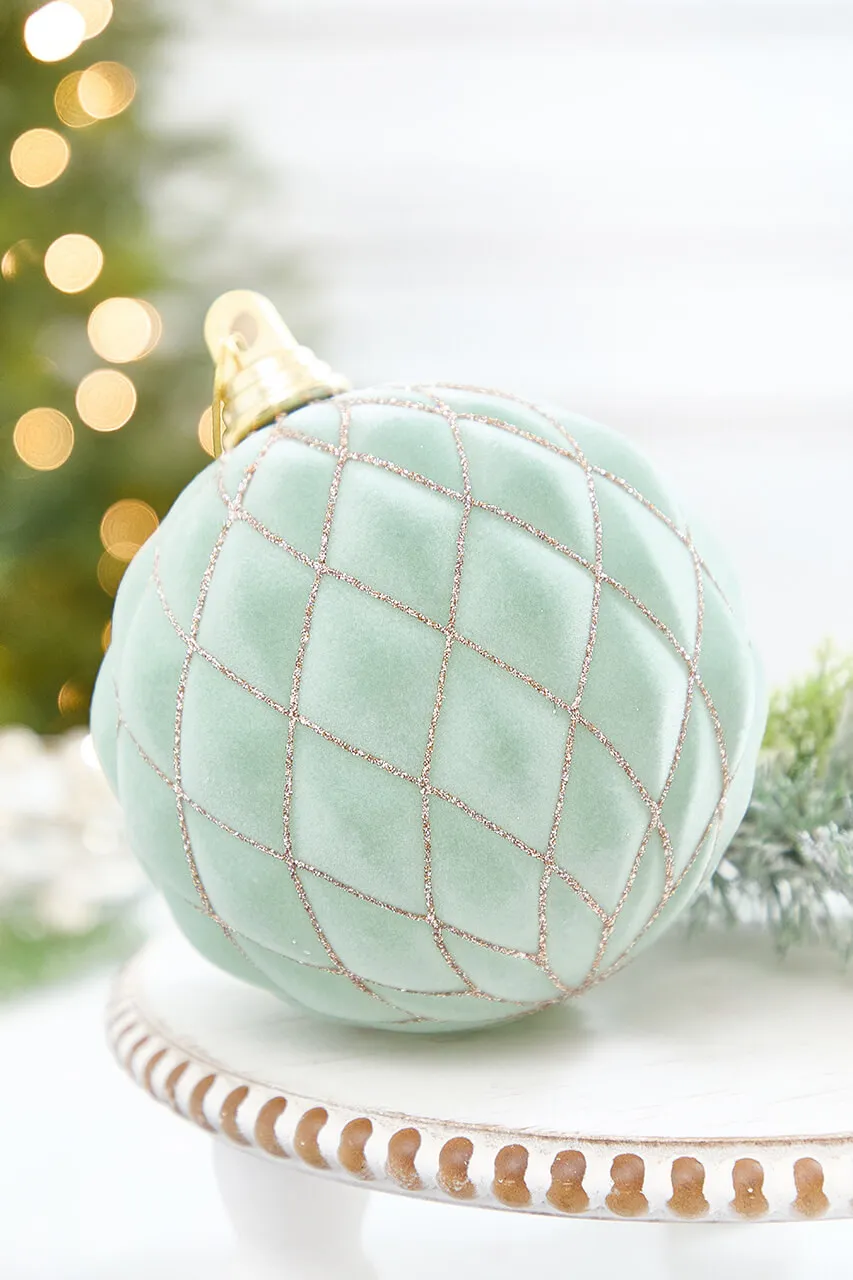
For a tabletop ornament display like this, check four things first:
- A stand with a 2-inch cup or beaded rim so the ball cannot roll
- Background light — you want bokeh, not a blank wall
- Pine needles or greenery within 6 inches to tie it to the season
- At least three ornaments. One alone reads as forgotten
If you have the space and want to scale up, the full tree version in Idea #19 uses the same dusty pastel logic on a much bigger canvas.
Hang the Velvet, Then Step Back
Velvet ornaments are forgiving in the ways that matter: they hide fingerprints, they survive kids and cats, and they look better under warm light than almost anything else you can hang on a tree. Start with one idea from this list — a single color, a single ribbon, a single oversized bow — and build from there. The trees that photograph best are never the fullest ones; they are the ones where one decision was made clearly. 📌 Save this to Pinterest so you can find it again when the boxes come out of the attic.