31 Dreamy Winter Bedroom Decor Ideas You Need to Try for 2026-2027 That Will Elevate Your Space

Most winter bedroom decor guides get it wrong — they pile on the fuzzy everything and forget that a winter bedroom still has to be a room you can actually breathe in.
We spent serious time browsing Anthropologie, Target, West Elm, IKEA, and Wayfair to bring you only what’s worth your attention this year, and the ideas here run from a $28 knit throw up to a $2,400 upholstered bed. After filtering through hundreds of options, we narrowed it down to 31 that genuinely deliver — spanning layered neutrals, rustic alpine wood, quiet minimalism, and deep-toned moody rooms, with budget and luxury versions compared side by side.
The 2026 shift is toward texture over color: chunky knits, fluted wood, and warm metals doing the cozy work instead of a red-and-green theme. And stay until the end — we break down the most common mistakes that can ruin these looks.
📌 Save this to Pinterest for later — you’ll want to revisit these ideas. This post contains affiliate links, and we may earn a small commission at no cost to you.
1. Layered Neutrals Grounded by Classic Wall Moldings
An all-cream room can flatten into hotel-suite territory fast. What keeps this one breathing is structure: the applied panel molding gives those white walls a shadow line for light to catch, so the palette reads layered instead of blank. The distressed patterned rug adds a little grit underfoot, and the two round upholstered ottomans echo the curve of the lamp bases. Here, contrast comes from shadow and texture — not color.
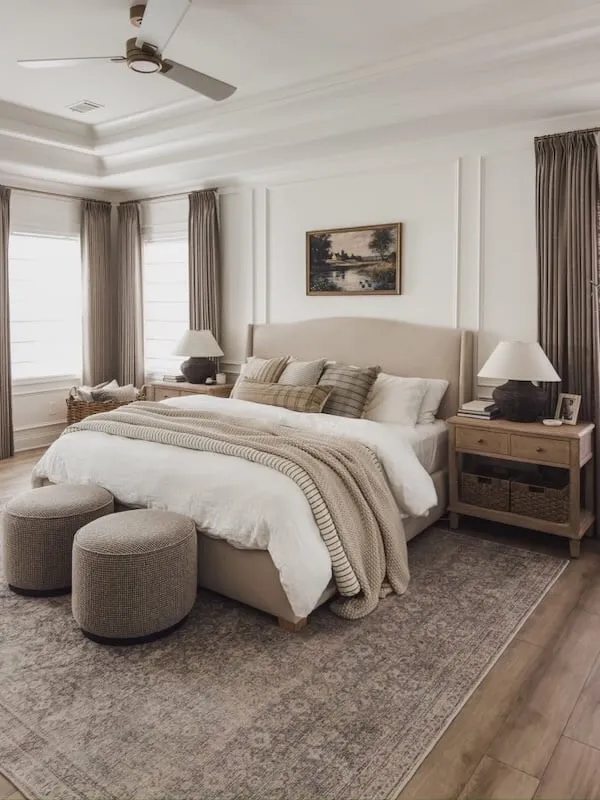
Run the drapery rod 10 to 12 inches past the window frame on each side, and mount it within two inches of the ceiling. That extra width is what makes a standard window feel architectural. Inside the frame, a flat Roman shade in warm taupe adds a horizontal line without stealing daylight, and it lets you drop the bottom half on drafty nights while the taupe drapes stay purely decorative.
2. Recessed Oak Shelf With Integrated Lighting Above the Bed
The formula here is roughly 75 percent white and light oak, 15 percent soft grey textiles, and 10 percent glass plus a single plant. Keep those proportions and you can swap the grey throw for warm sand, the oak shelf for walnut, or the sheer curtains for a linen blend — the room will still read the same. Change the percentages instead of the materials, and it starts to feel like a completely different room.
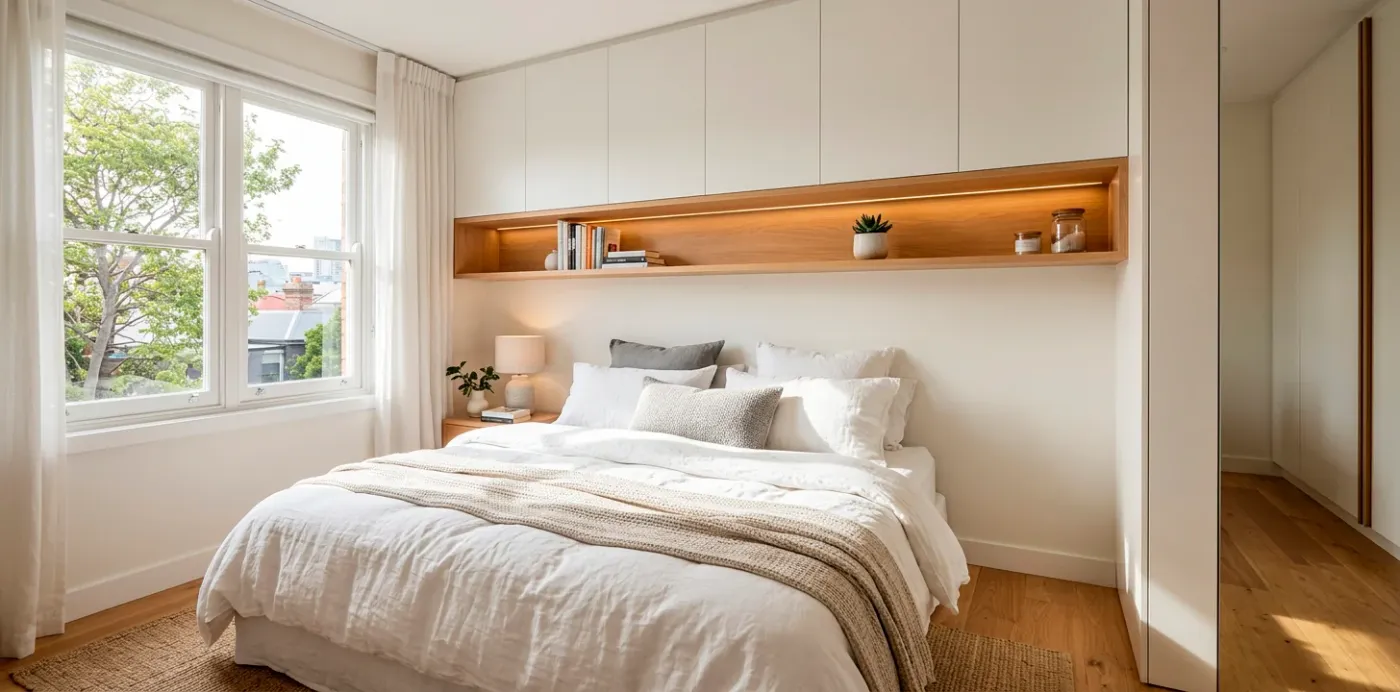
Take away the recessed light-wood shelf and you’d still have a pretty white bedroom — just a flatter one. That niche does three jobs at once: it pulls the eye up past the headboard, it puts a warm glow exactly where you want it at 10 p.m., and it turns otherwise blank wall space into a place for books. The integrated lighting is the part worth copying even if you build it from a floating shelf and a strip light.
3. Brass Globe Sconces Against a Grey Upholstered Headboard
Wall sconces should sit roughly 60 to 66 inches from the floor and about 8 to 10 inches out from the edge of the headboard — close enough to read by, far enough that you’re not staring into a bulb. Here the brass arms and white glass globes land right at the top third of the grey headboard, which is why the whole composition feels deliberate rather than decorated.
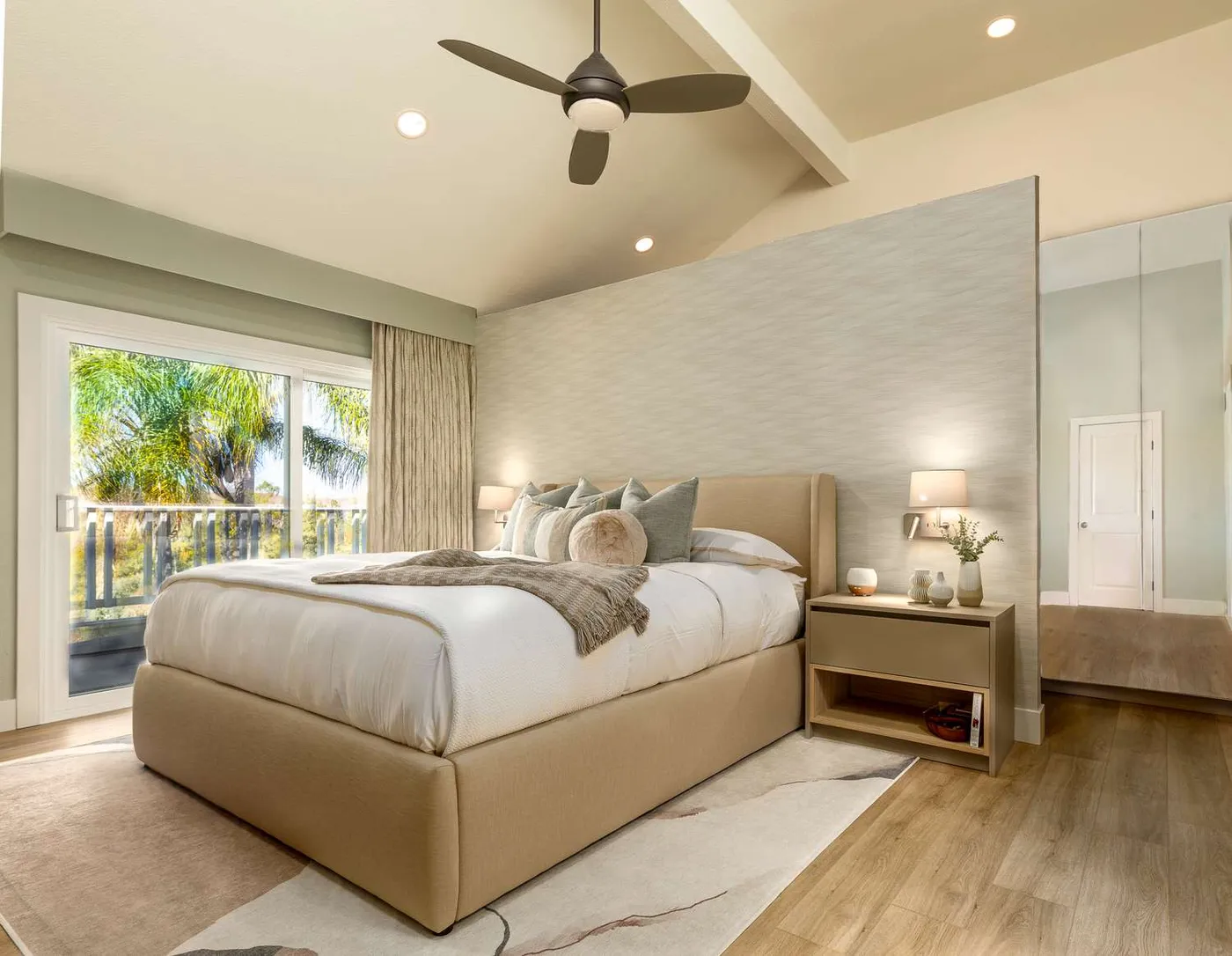
This layout is forgiving: it works in anything from a 10×11-foot guest room up to a primary suite, and it needs about 36 inches of clearance at the foot of the bed to walk comfortably. If your room is tighter than that, look at the wall-mounted approach in Idea #16, where lighting and storage share the same wall instead of eating floor space.
4. Faux Fur and Chunky Knit Piled on a King Bed
Faux fur is the fastest way to make a bed look expensive and the fastest way to make it look tired. Shake it out weekly, spot clean with a damp cloth and a drop of mild soap, and keep it away from radiators — synthetic fibers glaze and mat under direct heat. Expect to replace a cheap version every two winters. Chunky knits need a pill shaver once a month and should be folded, never hung.
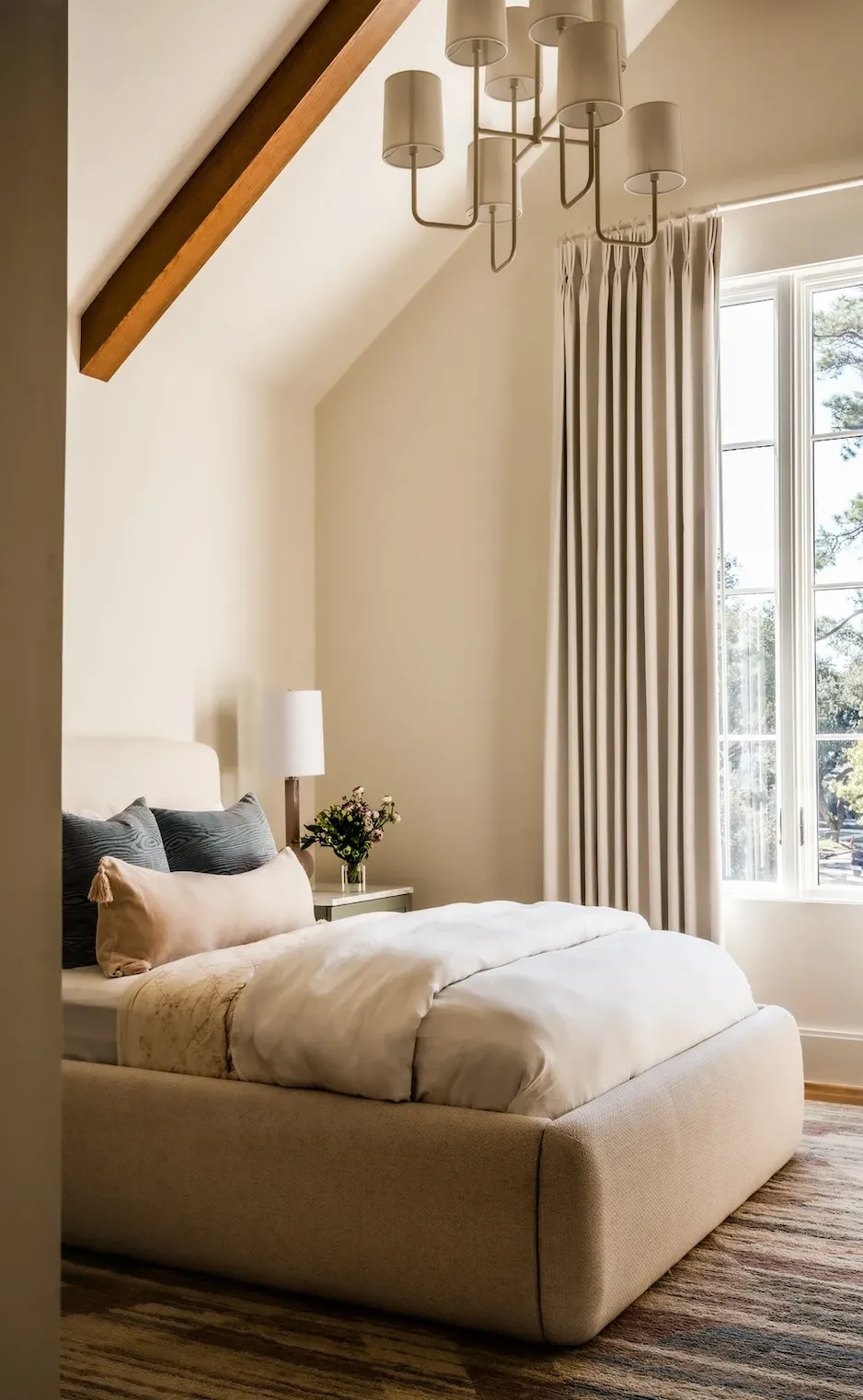
You don’t need designer bedding to get this. Target’s Threshold faux fur throws run about $30, IKEA’s chunky knit lands near $40, and a washed cotton duvet from Walmart comes in around $60. Thrift stores are gold mines for the real wool blankets people offload in January. Total for the full layered look: under $150, versus $600-plus for the boutique versions.
5. Horizontal Wood Paneling Below a Black-and-White Mountain Print
Call it quiet alpine: the chalet look has been creeping back for a couple of years, but the 2026 version has been stripped of cuckoo clocks and red plaid. What’s driving it is a broader shift toward rooms that feel like a physical exhale — warm wood, black-and-white landscape photography, nothing that asks for attention. The paneling does the heavy lifting, so the styling stays almost monastic. That’s a trend with real legs, because it’s really just good architecture.
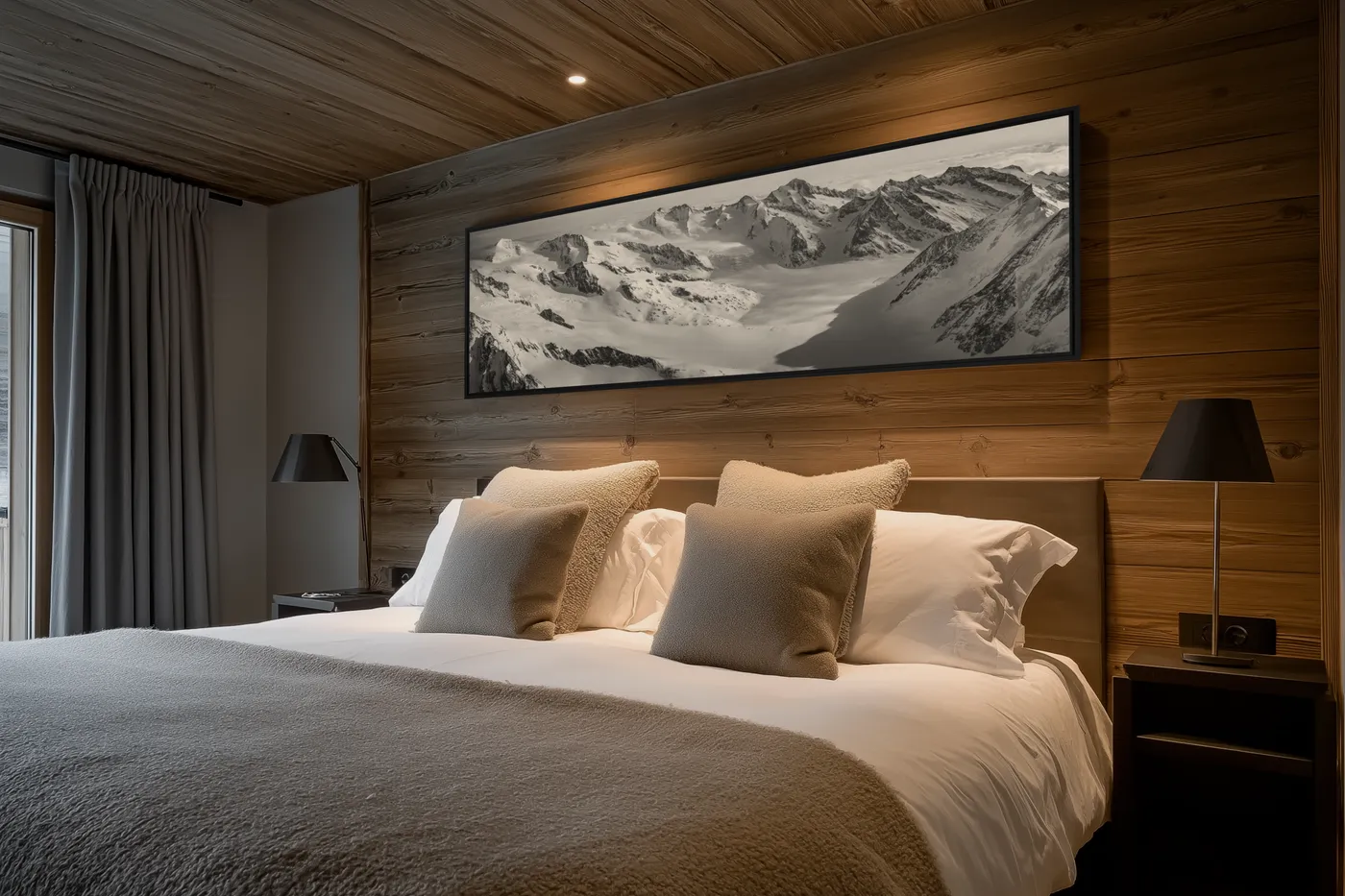
If you’re faking the paneling, run the boards horizontally and stop them at about two-thirds wall height — not the ceiling. That ratio keeps a low room from feeling squat and gives you a paintable band above. Standard shiplap is 5 to 7 inches wide; anything narrower starts to read as beadboard, and anything wider fights the mountain print.
6. Burnt Orange and Deep Blue Layered Against Warm Beige
Burnt orange and deep navy are gorgeous together and absolutely capable of swamping a small room. The trick this bedroom pulls off is keeping both colors in the textiles, never on the walls — warm beige stays in charge of every vertical surface. If your room gets less than a few hours of direct light a day, drop the navy and keep the orange. Otherwise you’ll spend the whole winter in a cave.
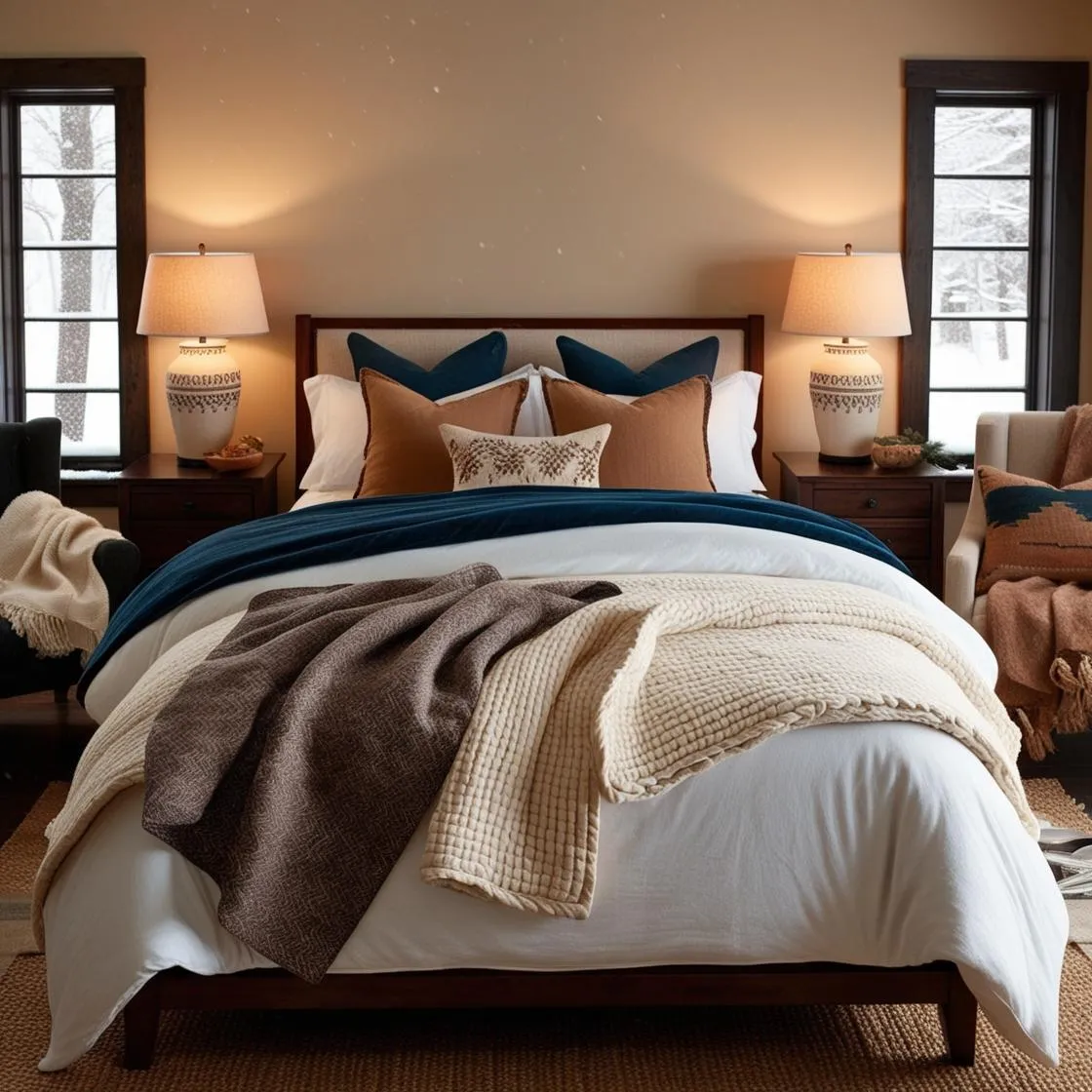
Count it out: roughly 60 percent warm beige walls and white bedding, 30 percent dark wood across the frame, nightstands, and window trim, 10 percent color split between deep blue and burnt orange. Want a cooler version? Swap the orange for rust and the navy for slate. Same weights, same warmth, different mood. The dark wood is non-negotiable — it’s what stops all those pale textiles from floating.
7. A Modern Winter Bed Styled in Clean, Considered Layers
- Bed frame and upholstered headboard: $250–$900
- Bedding layers (duvet, sheets, quilt): $120–$400
- Throws and accent pillows: $60–$250
- Bedside lighting: $40–$200
- Rug, if the floor is cold: $80–$400
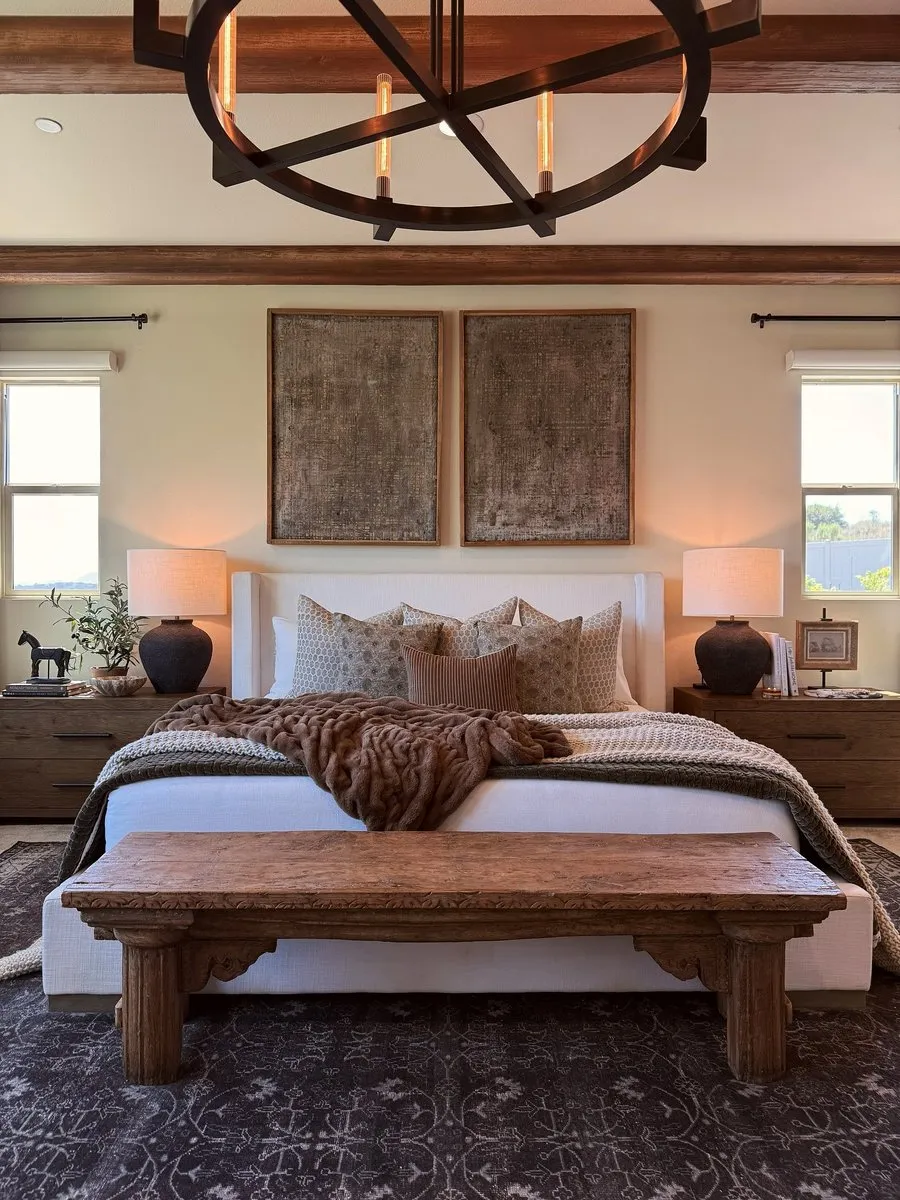
Total: roughly $550–$2,150. Budget alternative: buy the duvet and two throw pillows new, then layer in a quilt and a knit blanket you already own — that alone saves 40 percent.
Of everything on this bed, the one move that makes it look styled rather than simply made is the folded layer across the foot. It adds weight where your eye expects the bed to end, hides the messy bit where a duvet never quite meets the frame, and gives you something to pull up at 3 a.m. Skip it and the bed still reads nice — it just reads like a showroom, not a place you sleep.
8. Log Walls Warmed by Hidden Amber Strip Lighting
Log walls are visually loud — all that grain and shadow can overwhelm a room in minutes. The amber strip lighting running along the top of the logs fixes that by washing the texture with warm light instead of raking across it, which softens the whole envelope. Then the dark upholstered headboard and black sconces give the eye one calm, solid plane to land on. It’s contrast management, not decoration.
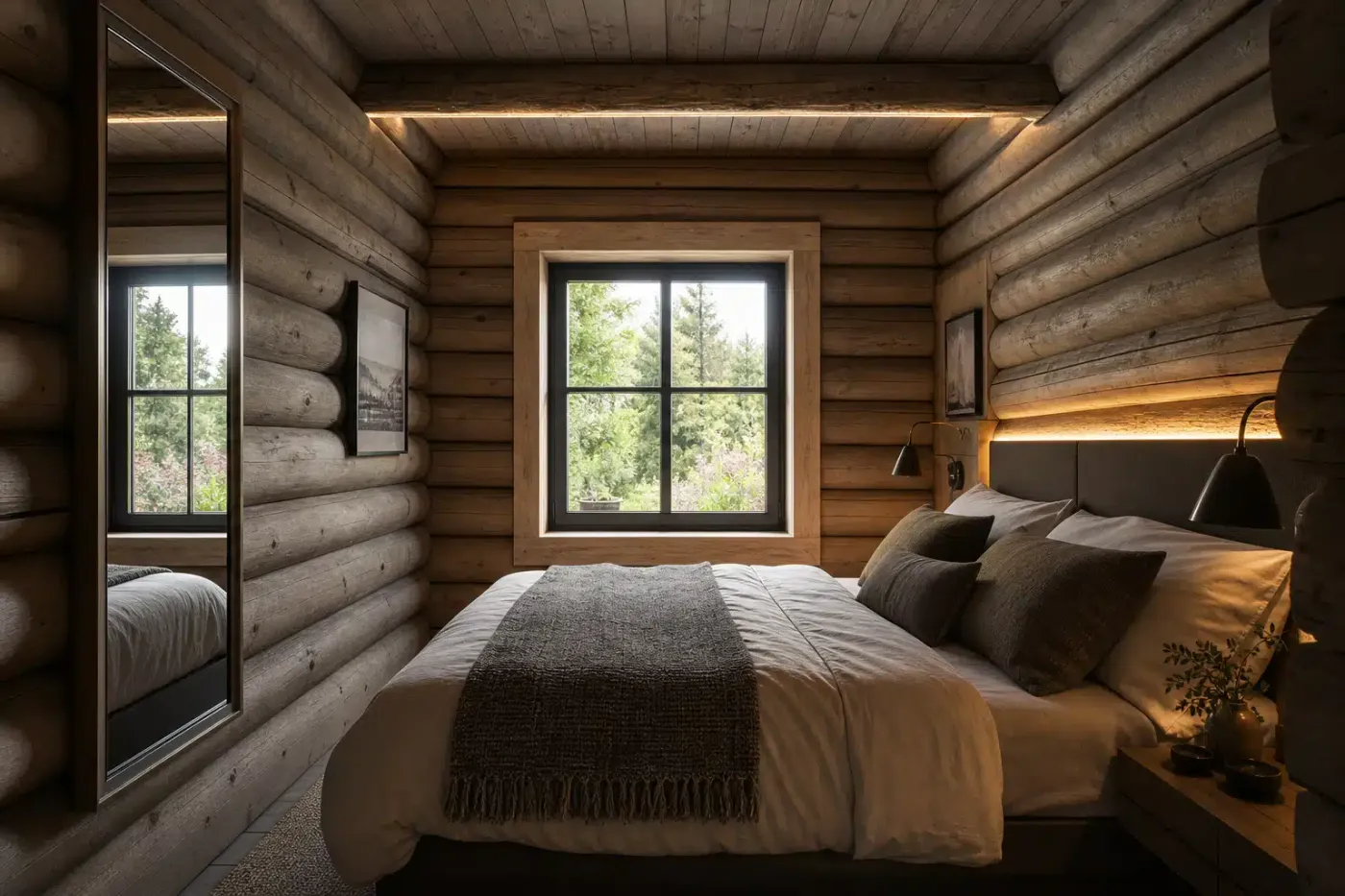
- Measure the wall and buy warm-white 2700K LED tape plus an aluminum channel.
- Mount the channel 4 to 6 inches below the ceiling line, tucked behind the top log.
- Test the full run before adhering — you want a glow on wood, not a visible hot spot.
- Put it on a smart dimmer so it can drop to 10 percent at bedtime.
Time: about 2 hours. Materials: $60–$120.
9. Dark Paneled Wall Behind a Cream Nailhead Headboard
Against a near-black paneled wall, the cream headboard with nailhead trim and wooden finials is the entire reason the room works. It’s the light anchor — without it, the bed would dissolve into the paneling and the space would feel like a cave with a mattress in it. Keep the headboard tall: it should rise at least 32 inches above the mattress so it holds its own against all that dark joinery.
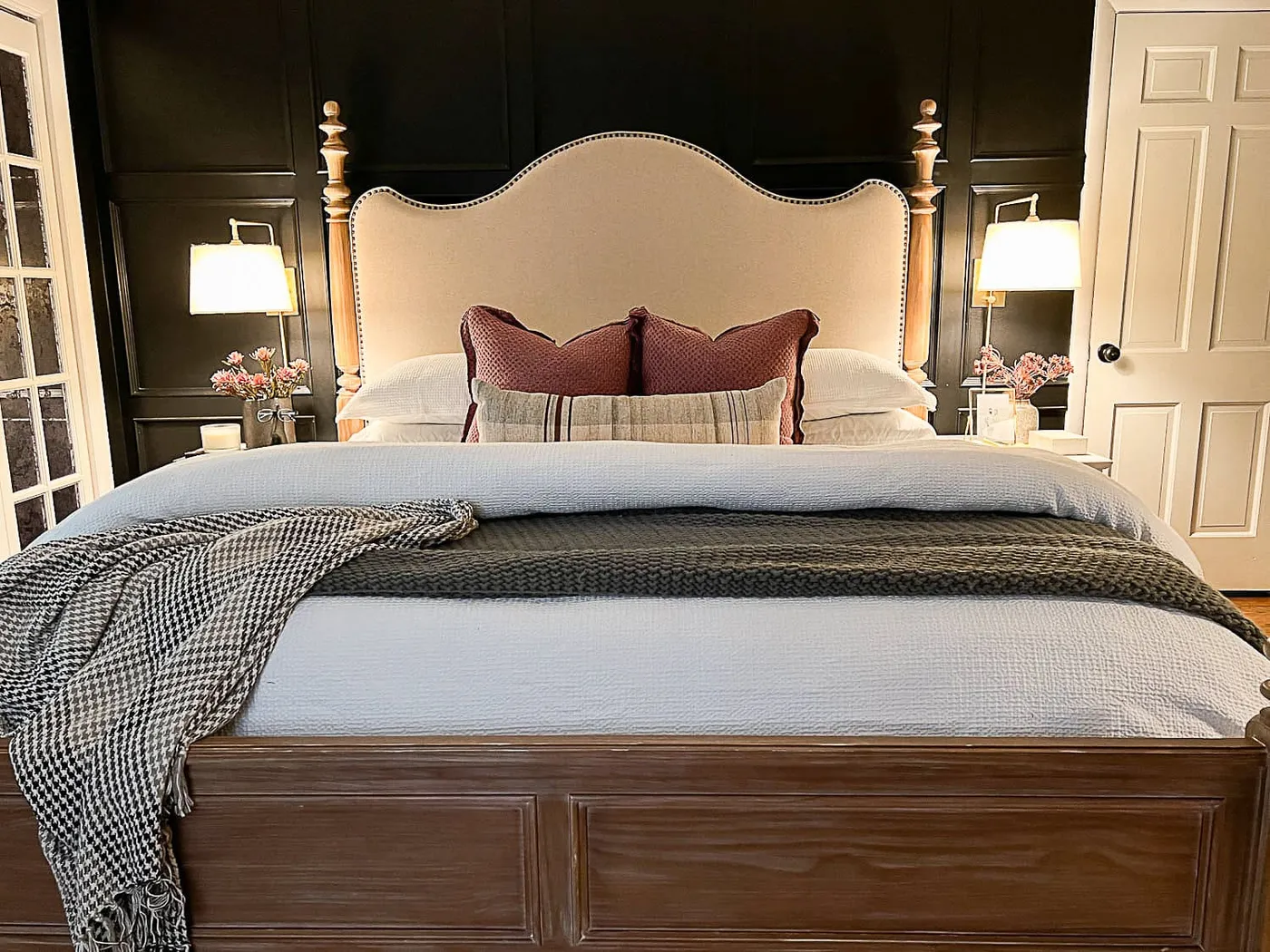
Deep-walled bedrooms like this one want company — a king bed needs at least 12×12 feet to leave 30 inches of walking room on both sides. Anything under 11 feet wide and the dark paneling starts to close in. In a smaller room, take the paneling only to chair-rail height, or steal the lighter approach in Idea #10, where white trim does the opposite of what dark green does.
10. Blue Textured Wallpaper Framed by Crisp White Paneling
When you pair wallpaper with paneling, decide the order before you buy a roll. Installing the molding first and papering only the recessed panels gives you a controlled, tailored look and hides seams. Papering the whole wall and applying molding over it is faster but eats your pattern. Also: keep the white paneling matte. Semi-gloss reflects light in hard streaks and makes the texture behind it look cheap.
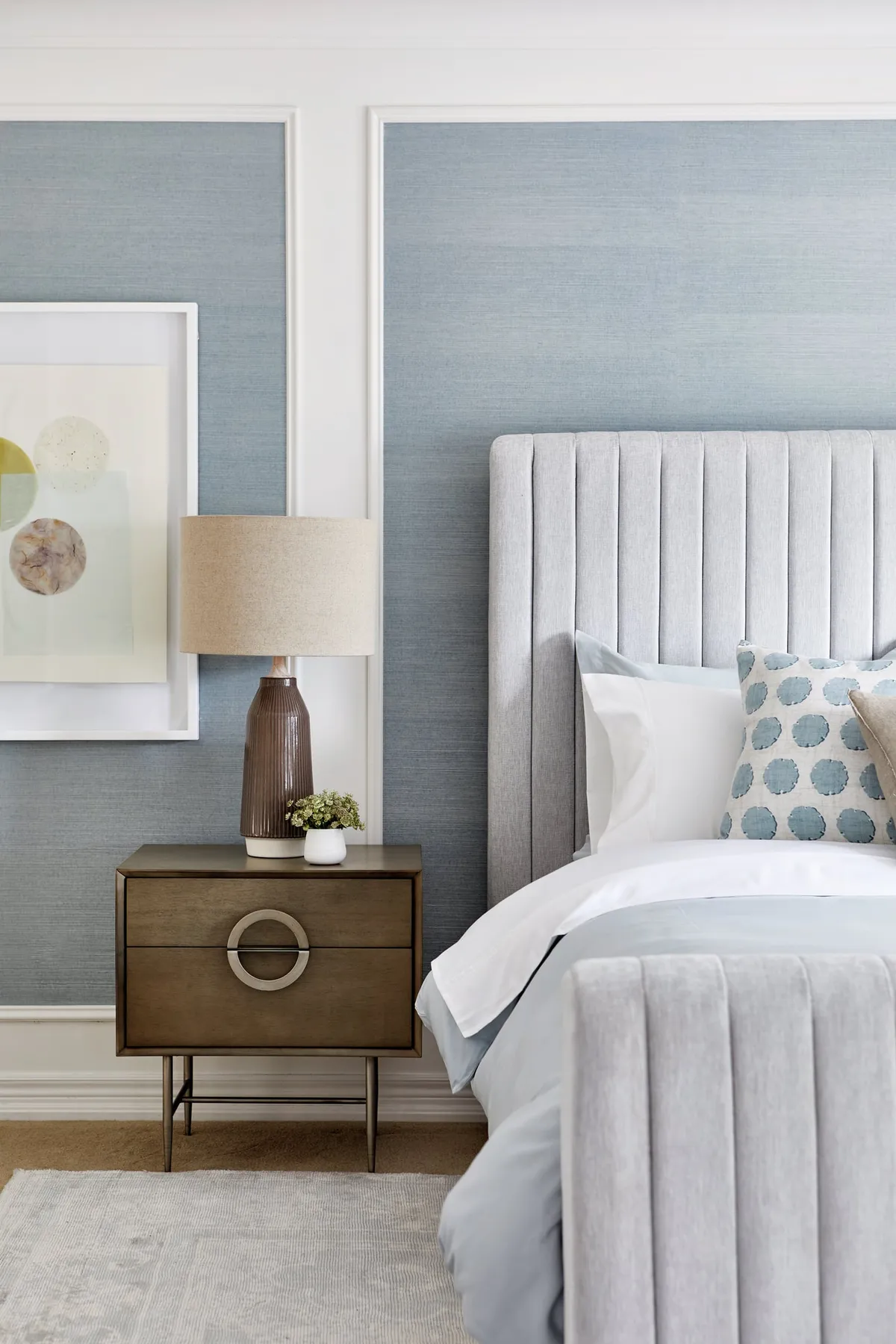
Two honest cautions. Light blue plus channel tufting can drift toward nursery if you add white rickrack and pastel art — keep the metals and wood dark and it stays adult. And textured wallpaper shows seams and lifting corners more than flat paper, especially in a bedroom with an ensuite shower. Prime properly, use heavy-duty adhesive, and don’t hang it during a humid week.
11. Low Oak Bed, Linen Bedding, and a Jungle of Plants
Houseplant styling stopped being a trend and became a default, which is exactly why it works here. What’s newer is the restraint: a low bed, plain walls, and greenery doing the decorating instead of art or pattern. It’s the same instinct behind all those quiet interiors dominating saves right now — fewer objects, more living things. Hard to get tired of, and easy to maintain if you can keep a fiddle leaf alive.
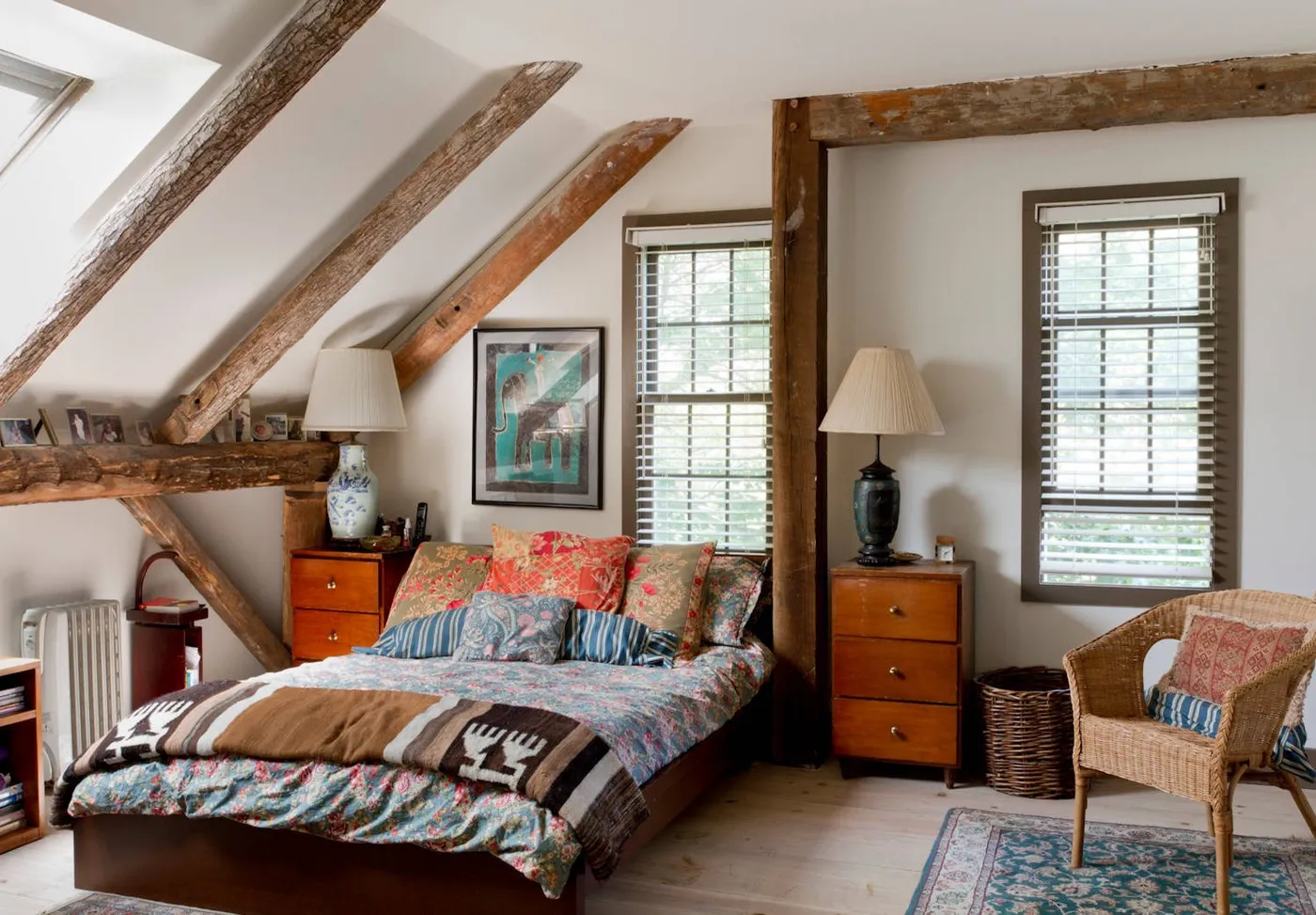
The whole look hangs on the bed frame and the plants, and neither has to be expensive. IKEA’s Tarva or Target’s wood-frame beds sit around $150 to $250; a washed linen duvet from Walmart or H&M Home runs $70 to $120; six-inch nursery pots cost $12 to $25 each and grow in. Facebook Marketplace is full of ninety-dollar dressers. The budget version of Idea #29 is basically this same list.
12. Rough-Hewn Beams and Mixed-Pattern Florals Under the Eaves
Count it out: about 50 percent white wall and ceiling, 30 percent natural wood between beams, floor, and nightstands, and 20 percent pattern across bedding, rug, and artwork. That last share is what makes attic rooms sing — but it’s also the ceiling. Add one more patterned element and the space tips into chaos. Swap the florals for stripes or a block print and the formula holds, as long as pattern lives in three places, not five.
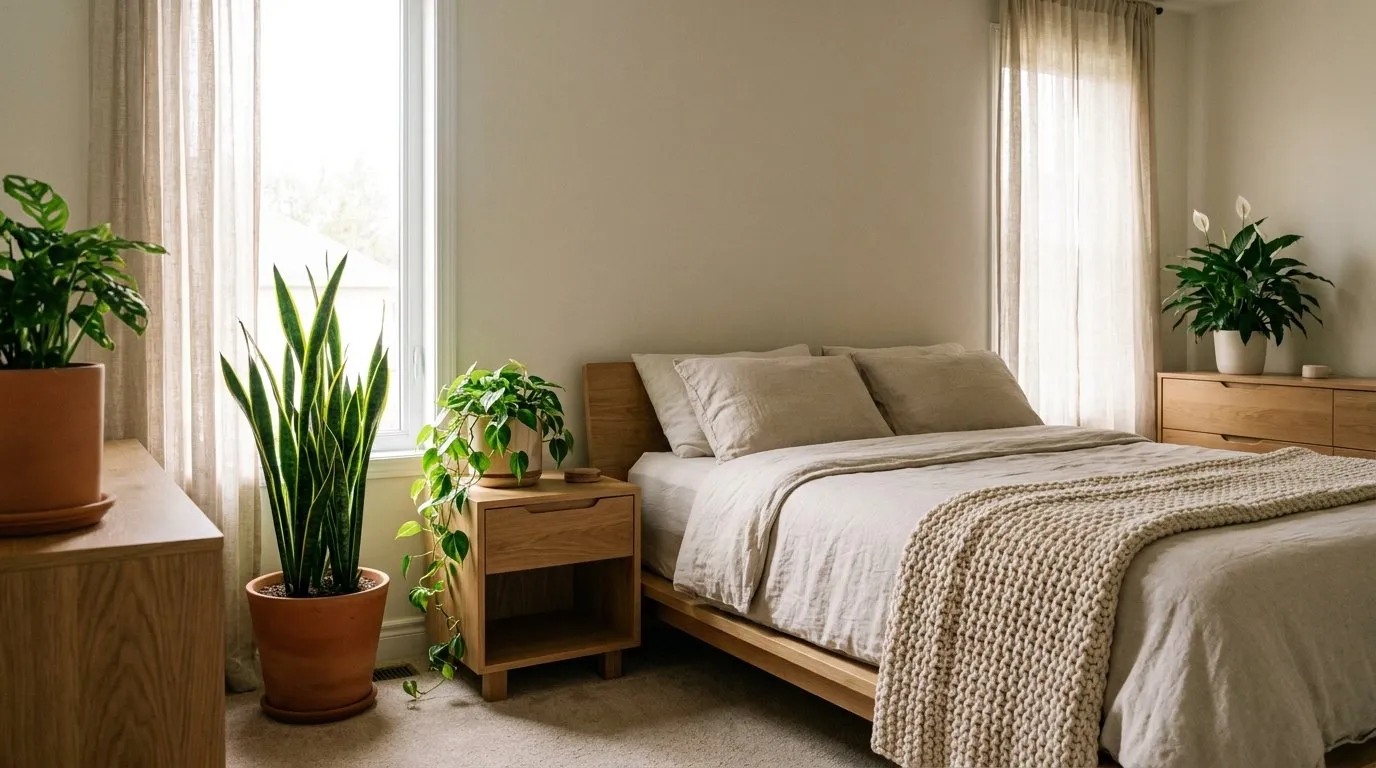
Exposed beams are charming until you’re swinging a vacuum attachment at them in March. Rough wood holds dust and cobwebs, and in an attic it holds heat too — expect the room to run a few degrees warmer than the rest of the house. Check headroom before committing to a tall headboard, and never place the bed where you have to duck to get in. Charm has a physical cost.
Rough-sawn beams need dusting every three to four weeks with a microfiber wand, plus a yearly wipe with a damp cloth and mild soap to keep them from going grey. Never oil or wax raw beams — it just attracts more dust. Budget about 20 minutes a month and one $15 extendable duster.
13. A Curved Black Canopy Frame That Draws the Whole Room
A canopy frame needs air around it or it reads like a cage. Give it at least 36 inches of clearance on both sides and 40 at the foot — for a queen, that means a room of roughly 11×13 feet minimum, with ceilings at least 8 feet so the curve doesn’t crowd you. Lower ceilings? Skip the canopy and borrow the sculptural furniture move in Idea #15 instead.
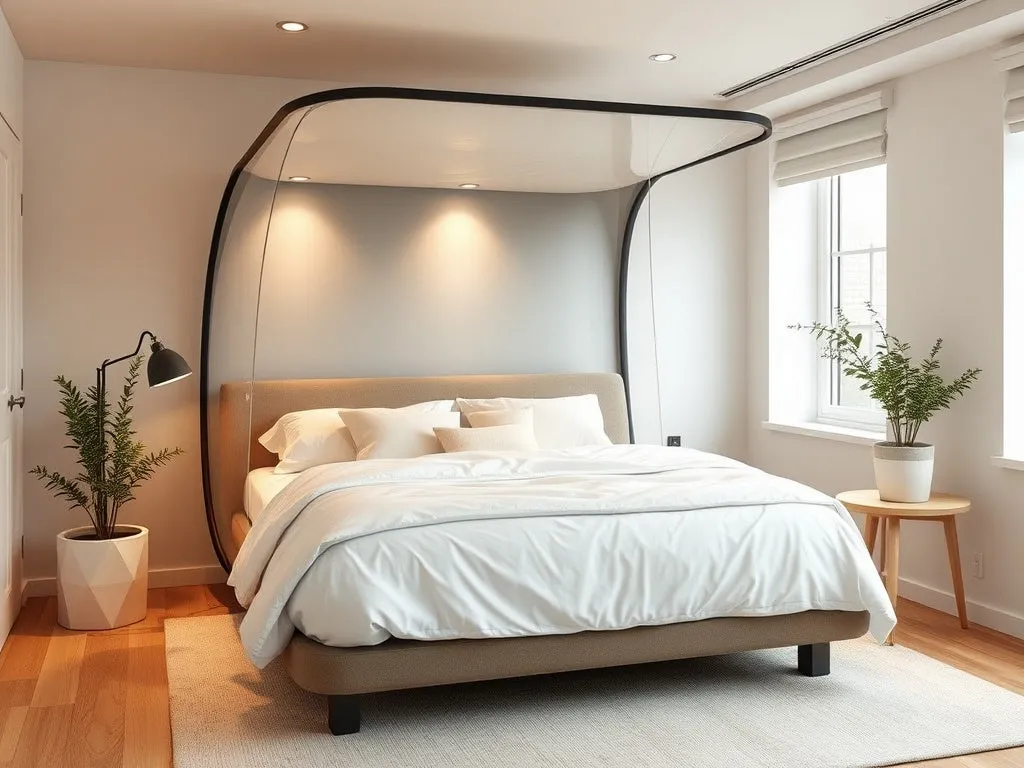
The curved black frame is doing all the work — remove it and you have a beige bed in a white room. What makes it smart is the thinness: a heavier tube would read like a four-poster, but at this gauge it feels almost like a drawing in the air, which is why the minimalist styling doesn’t compete. If you buy one thing for a plain bedroom, buy the thing that draws a line.
14. Dark Leaf Wallpaper Behind a Wide Plank Headboard
Patterned wallpaper is low-effort until it isn’t. Keep it out of direct sun or the background fades unevenly, and wipe marks with a barely damp cloth rather than a sponge. The woven pendant is the real chore — natural fibers collect dust, so plan on a monthly vacuum with a brush attachment. And a white shag rug needs weekly vacuuming to stay white; let it go two weeks and it turns the color of oatmeal.
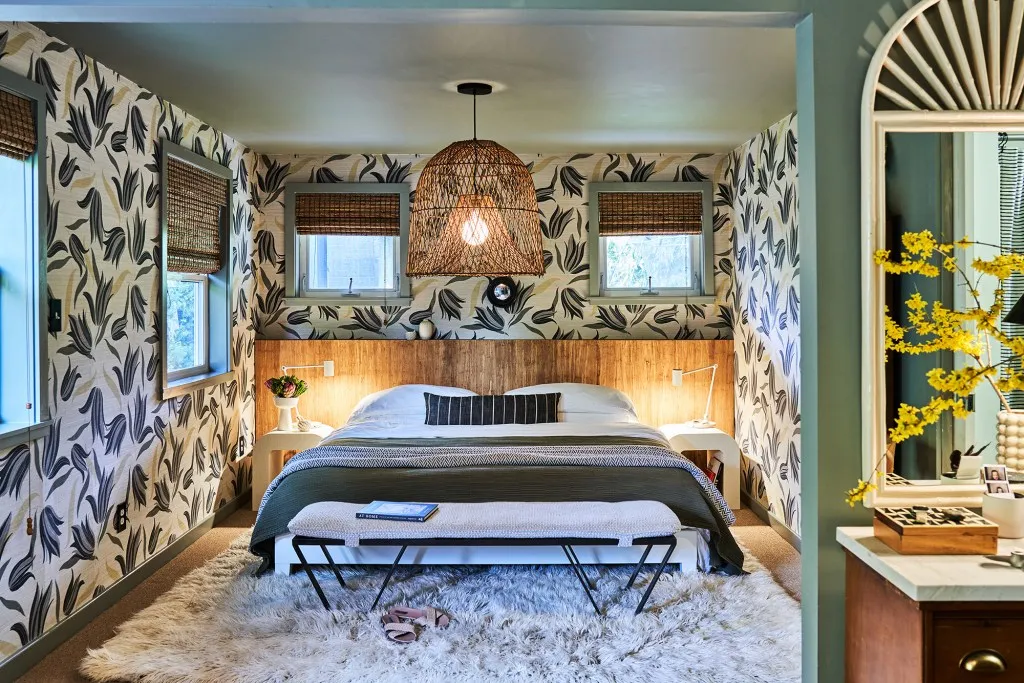
Hang a pendant like this 24 to 30 inches above the nightstand surface, or 30 to 36 inches above the mattress if it’s centered over the bed — low enough to feel intentional, high enough that you won’t hit it sitting up. Match the shade diameter to roughly one-third the width of the bed. A 24-inch shade over a queen is the sweet spot; anything bigger starts to look like a dining room.
15. Fluted Cylinder Side Tables Flanking a Channel-Tufted Bed
This room runs on 85 percent cream and off-white with 15 percent warm light wood — that’s it, no accent color at all. What replaces color is shape: the fluting on the side tables, the channel tufting on the headboard, the drum shades. If you want to warm it further, push the wood a shade or two darker rather than introducing a hue. Keep the ratio and the room stays soft no matter what you swap.
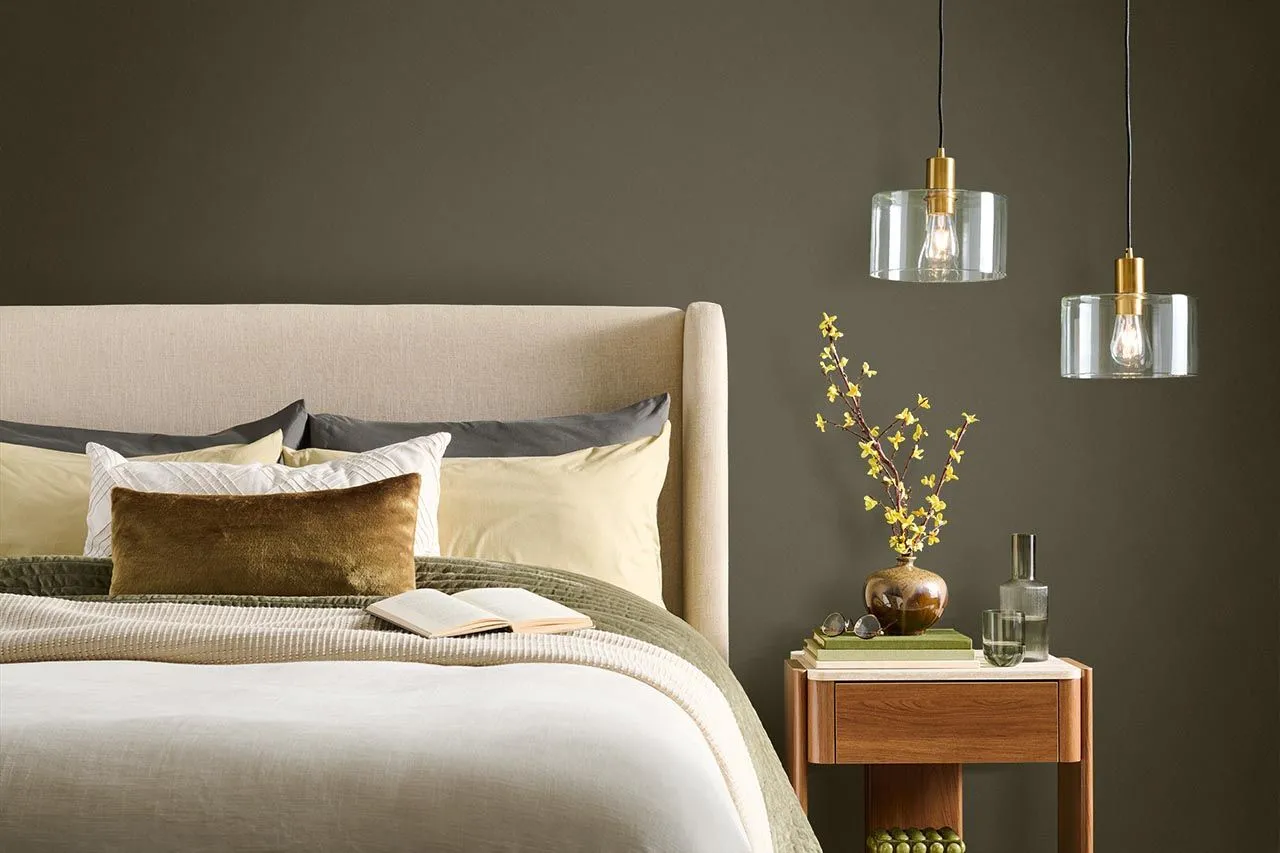
Repetition is the quiet engine here. Vertical channels, vertical fluting, cylindrical lamps, a rectangular mirror leaning at an angle — the room repeats one shape family and then breaks it exactly once. That break is the mirror, and it’s why the symmetry doesn’t feel stiff. Symmetry with a single interruption reads as composed; symmetry with none reads as a hotel corridor.
Best in a primary bedroom of 12×14 feet or larger, where those tall drum-shade lamps sit at full height without crowding the headboard. Under 11 feet wide, swap the lamps for wall-mounted reading lights and drop the side tables to 20 inches. Lean the mirror so its top lands 6 to 10 inches above the headboard, never below.
16. Built-In Shelving That Turns the Headboard Wall Into Storage
Built-in shelving beside a bed sounds dreamy until it becomes the place you dump receipts. Open niches next to a pillow also collect dust at exactly the height you’re breathing, and sconces mounted too close to shelving throw glare onto a book’s pages instead of onto the page. Commit to styling those niches with six objects maximum, or spec doors on the lower half.
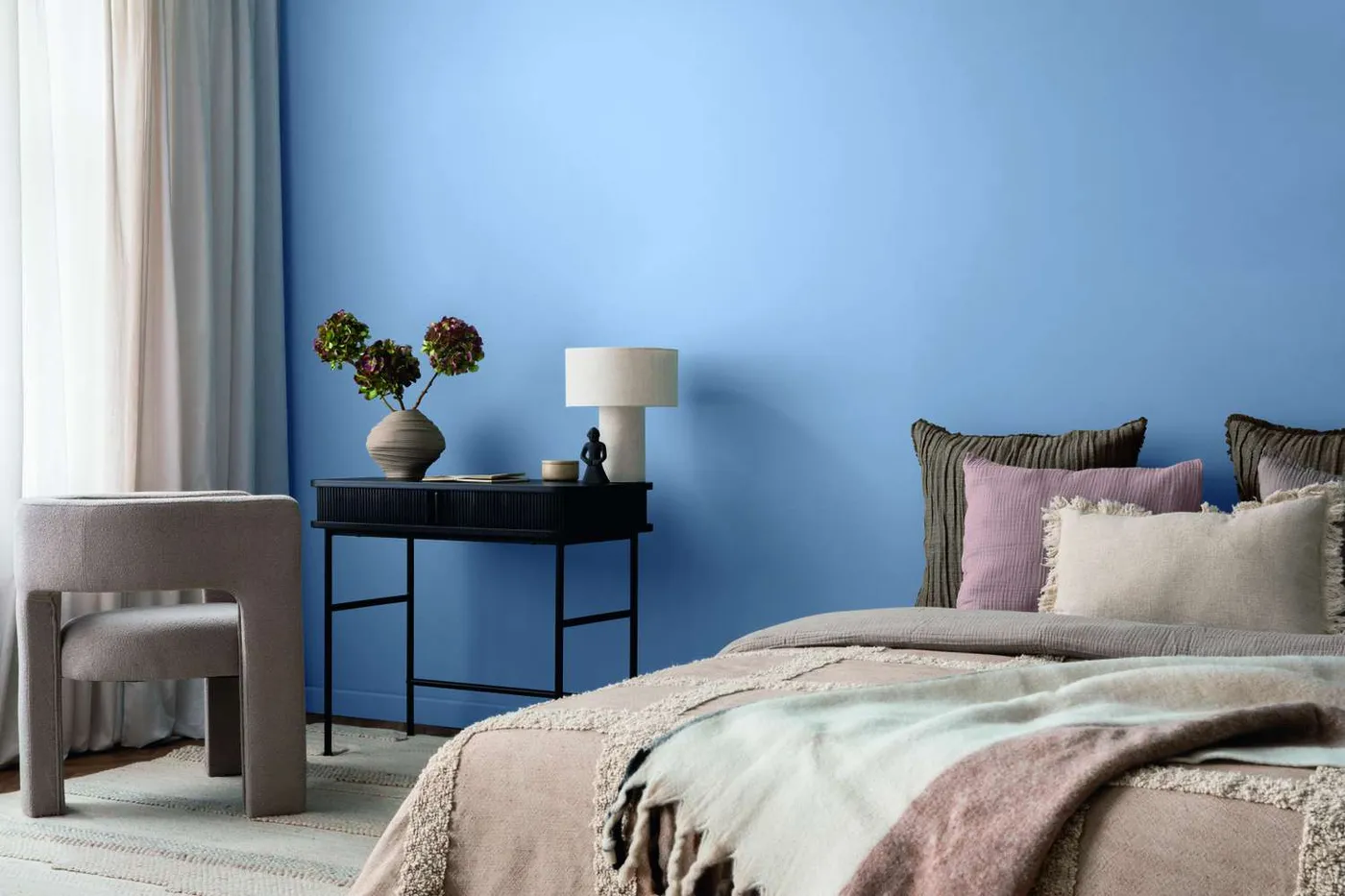
A full built-in wall runs $3,000 to $8,000 custom. You can fake 80 percent of it with two IKEA Billy bookcases at $60 to $90 each, trimmed out with a $30 length of pine and painted the same grey as the wall. Add plug-in wall sconces, no electrician required, for $40 to $70 a pair. This is the renter-friendly cousin of Idea #2, where the shelf is recessed into the architecture instead.
17. Vertical Wood Paneling With Brass Swing-Arm Reading Lights
Vertical paneling adds visual height, so it’s the move for rooms with 8-foot ceilings and generous footprints — 12×13 feet and up. In a narrow room, vertical lines can feel like a tube; go horizontal instead. If you’re using swing-arm sconces, mount them 58 to 62 inches off the floor so the arms reach your reading position, and keep the bed centered on the paneled wall rather than pushed to one side.
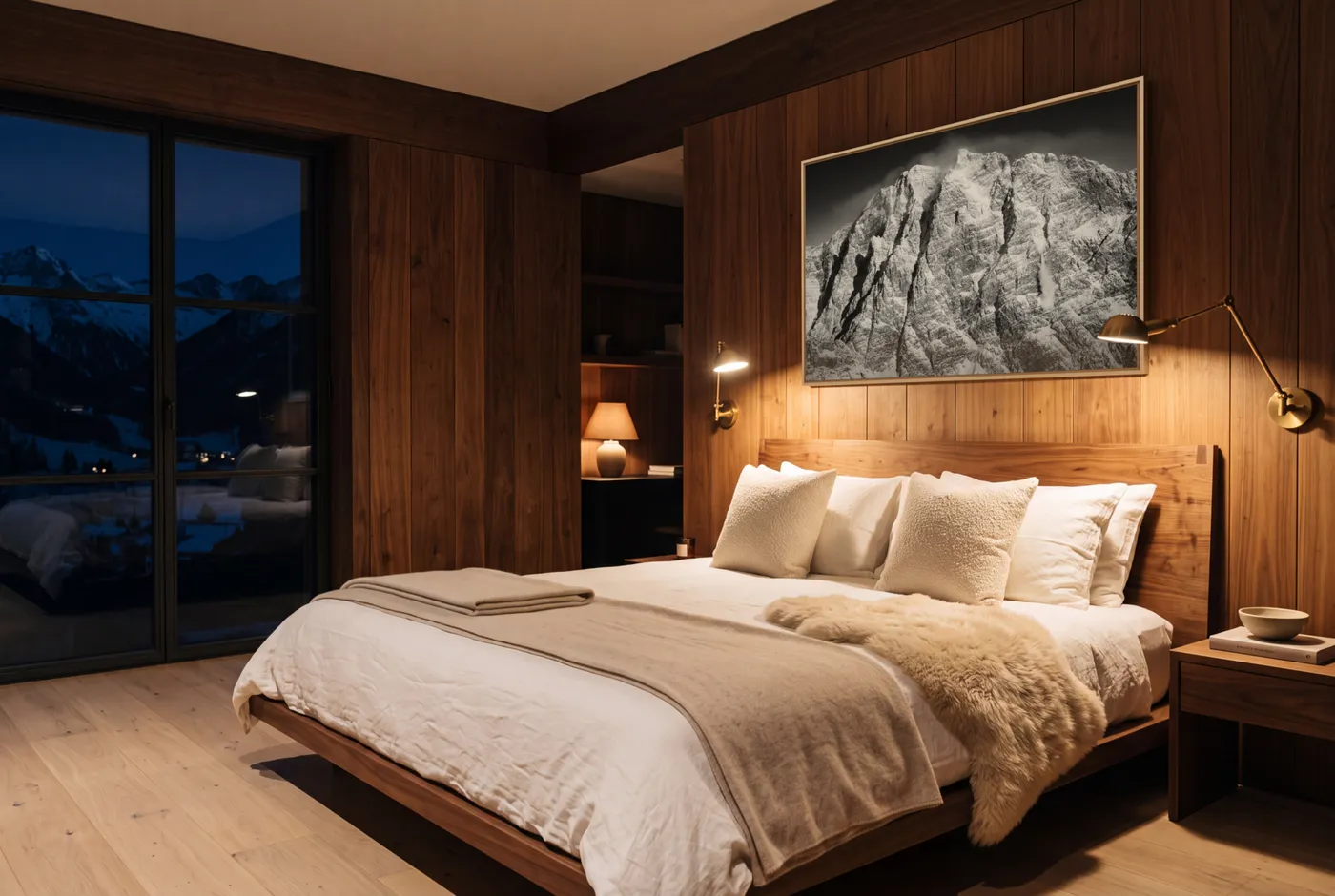
Alpine-inspired bedrooms keep outperforming on saves because they photograph beautifully in low winter light — warm wood reads golden at 4 p.m. in December. The 2026 version has dropped the antlers and gone architectural: paneling, one big landscape print, brass. It’s a look that ages well because it borrows from ski lodges built in the 1930s rather than from a catalog cycle.
18. Blue-and-Cream Stripes With a Pleated Shade Nightstand
Stripe scale is everything: keep bands under two inches on a duvet or they’ll look like mattress ticking, and repeat the same stripe on the shams but rotate it 90 degrees for a subtle break. Pleated shades work best in a matte fabric — pleated silk or poly in cream diffuses light into a soft wash rather than a glare. Set the lamp so the bottom of the shade sits at eye level when you’re sitting up in bed.
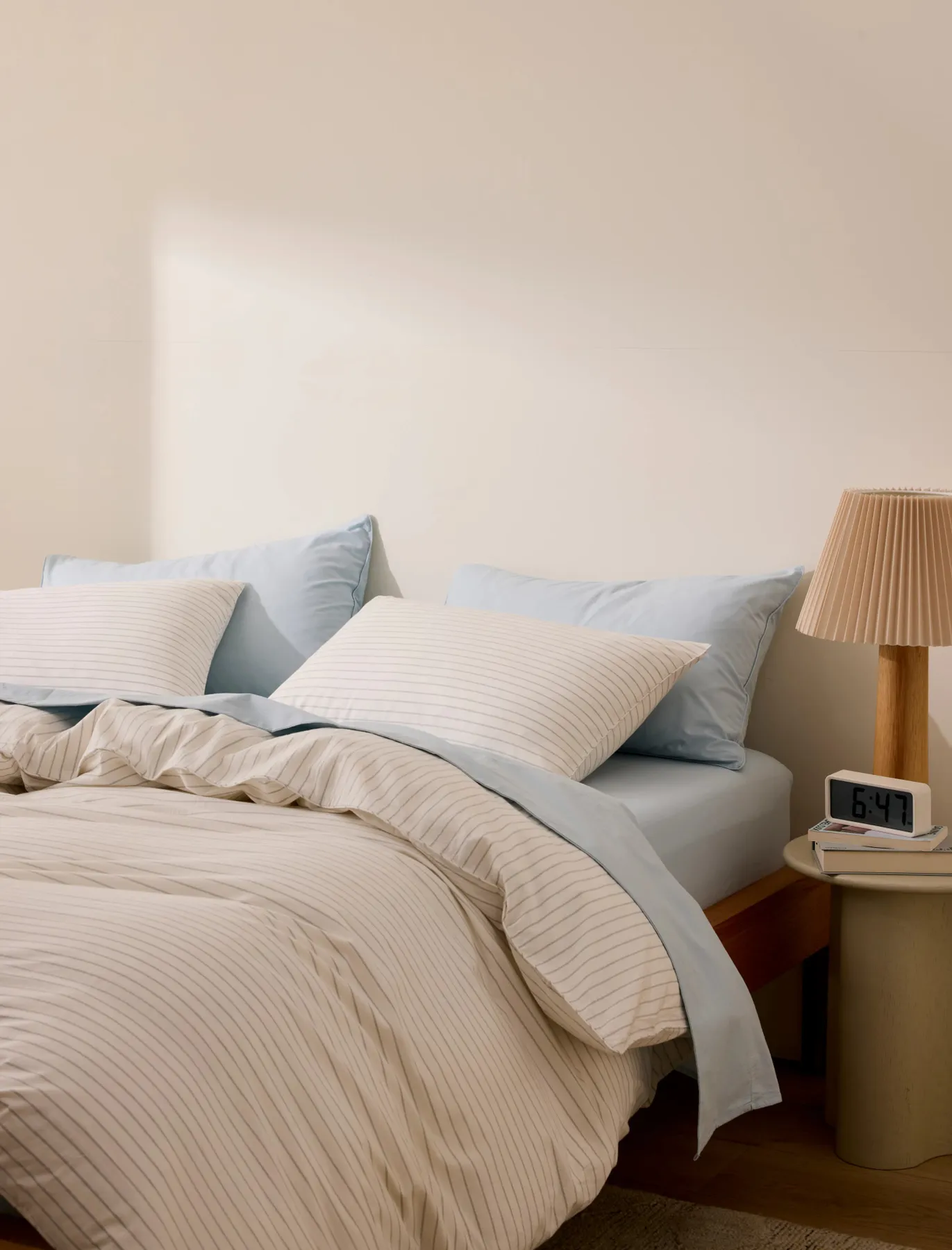
The pleated lamp is the smallest thing in this room and the one doing the most. Pleats scatter light sideways instead of down, so the wall behind the bed gets that soft scalloped glow you can’t fake with a smooth drum shade. Swap it for a plain ceramic lamp and the room instantly reads more generic — proof that the last 10 percent of a design is usually one object.
19. A Wood Accent Wall That Frames a Snow-Capped View
Wood paneling behind a bed does something no paint color can: it gives the head of the room weight without darkness. Here it’s pitched against light plaster walls and a very large window, so the wood reads warm rather than heavy. The black-and-white mountain print above the bed quietly echoes the view outside, which is why the composition feels inevitable instead of decorated.
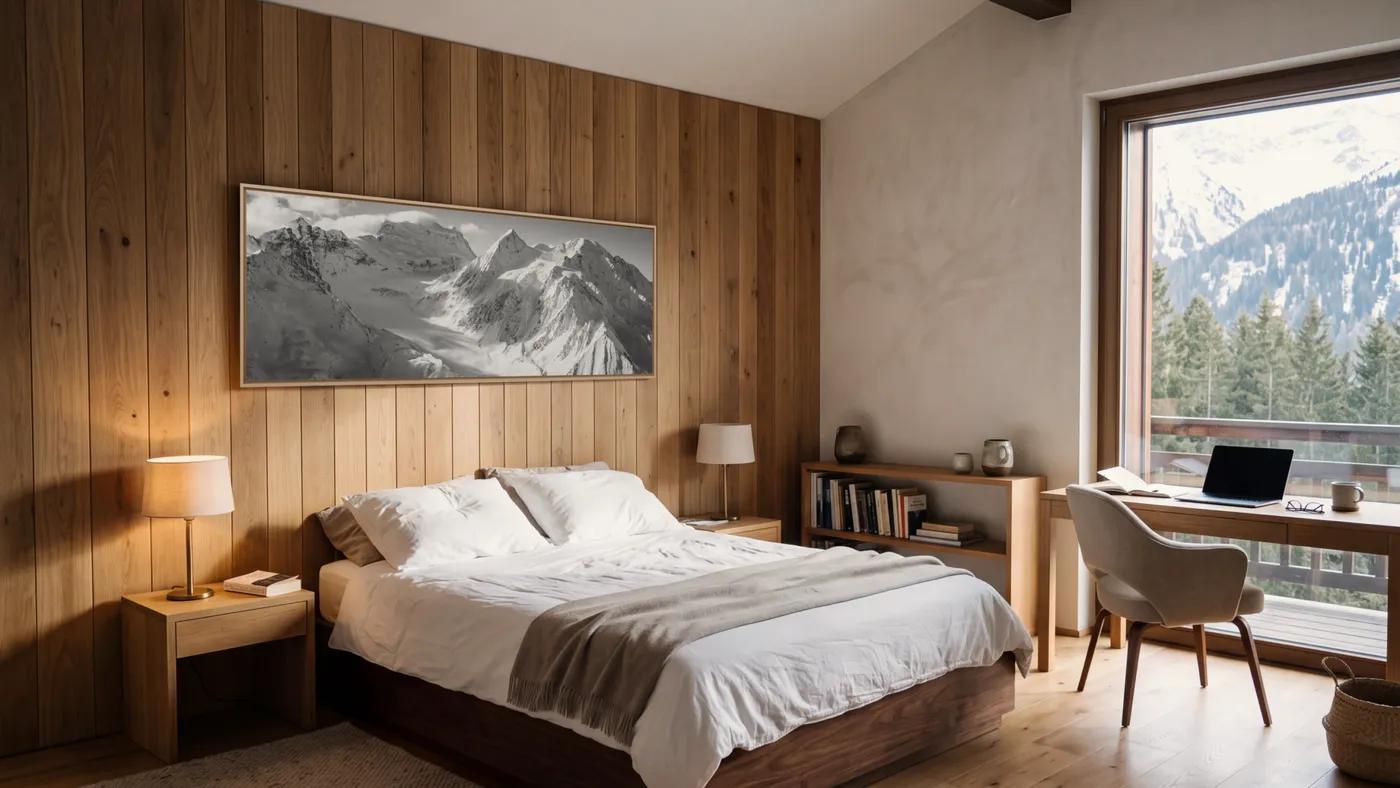
Wood paneling needs dusting every few weeks — horizontal ledges trap it — plus an annual wipe with a slightly damp cloth. Oiled or unfinished wood wants re-oiling every 12 to 18 months at roughly $30 in product. Big windows mean UV: if the paneling faces direct sun, expect the tone to shift lighter within three or four years unless you add a UV film or lined treatments.
20. Dark Grey Walls Balanced by Rounded White Nightstands
- Upholstered headboard or bed: $300–$1,200
- Bedspread and throw layers: $80–$300
- Two rounded nightstands: $150–$700
- Large textured wall art: $80–$500
- Shag rug: $100–$450
- Paint, two coats: $60–$120
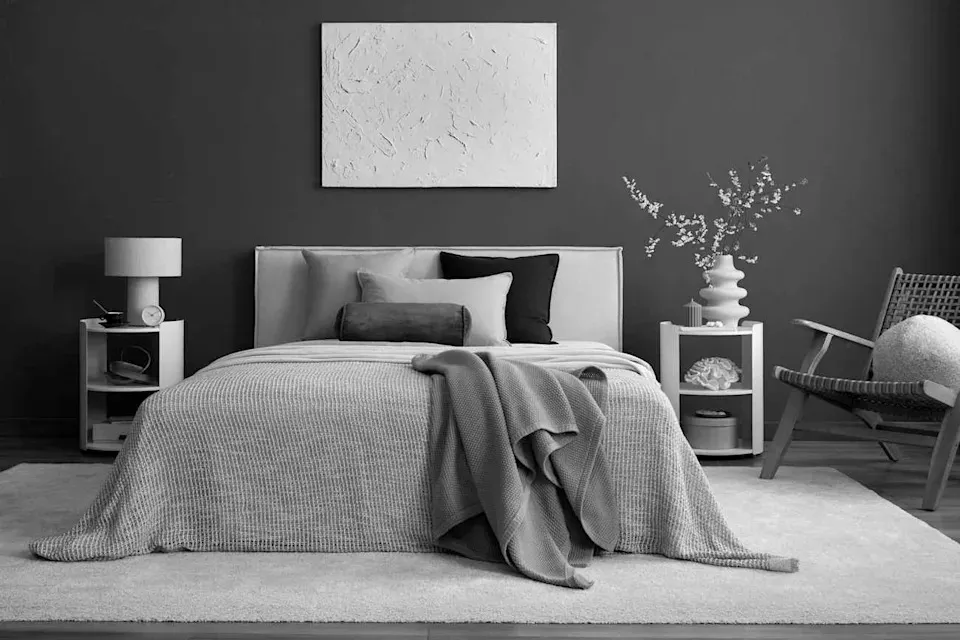
Total: roughly $770–$3,270. Budget alternative: paint one wall instead of four and buy the art print unframed — that cuts the total nearly in half without losing the effect.
The balance is 55 percent dark grey wall, 35 percent white and grey textiles, 10 percent black and light wood. That dark wall is a big commitment, so it only works when the whites are genuinely white — cream against charcoal goes muddy. Swap the grey for deep navy and the formula still holds; swap the white nightstands for wood and it collapses.
21. Ochre Walls and a Checkerboard Headboard Under a Slope
It’s the checkerboard headboard. Ochre walls alone would be a bold paint choice; the brown-and-cream check is what makes the room feel collected rather than decorated. It bridges the warm wall and the cool white quilt, and it gives the eye somewhere to rest in a space with no art hung yet. Remove it and the whole room becomes an argument between paint and bedding.
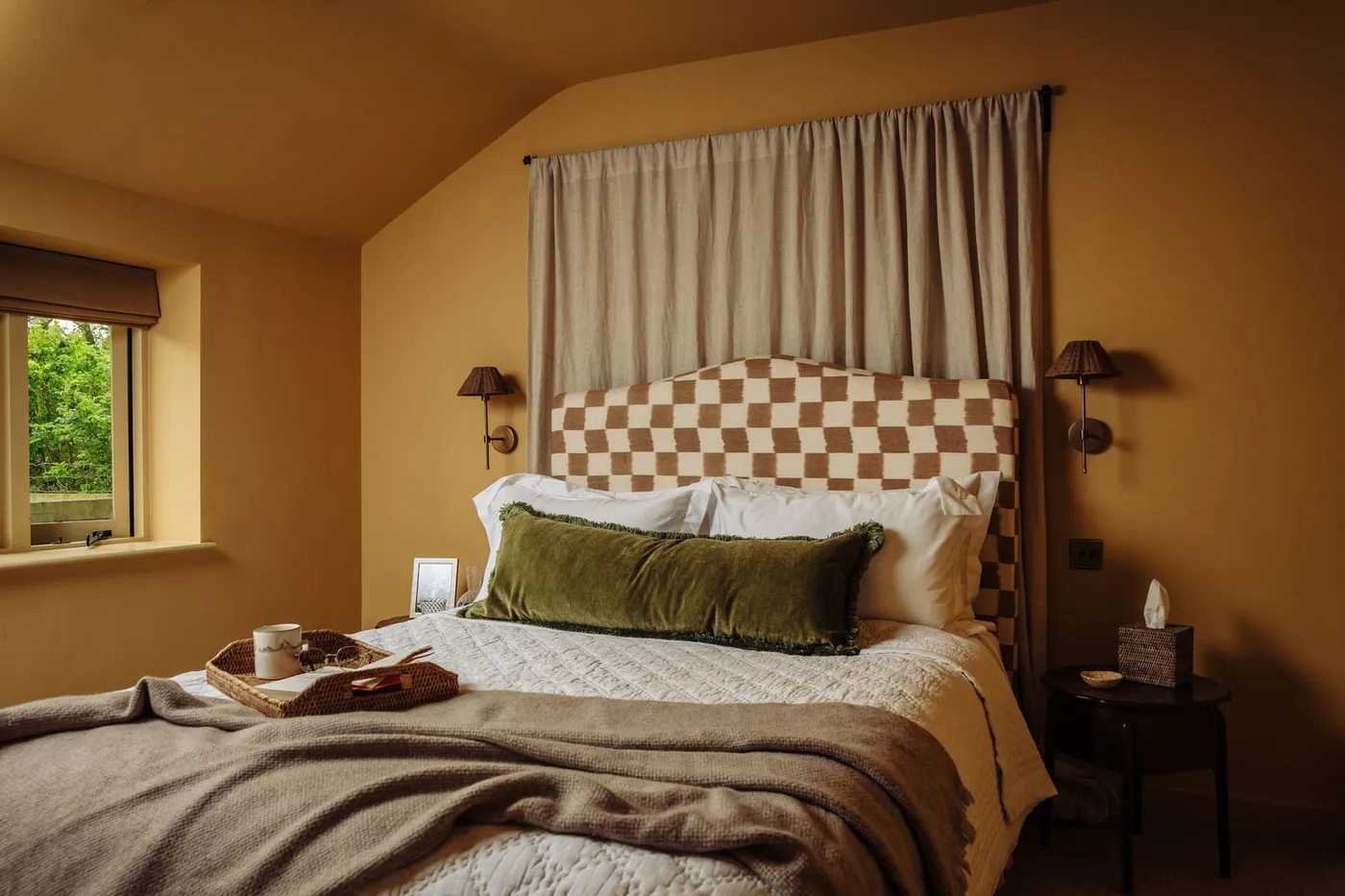
Ochre on all four walls plus a sloped ceiling is a lot of pigment, and it will make the room feel smaller than it is — great for a snug guest room, less great for a primary bedroom you share. It also exaggerates uneven plaster, so skim-coat first. If you’re not ready, paint just the sloped plane and keep the vertical walls warm white.
22. Sage Green Slopes, Green Velvet, and a Skylight Over Vinyl
Attic bedrooms are having a moment because people are finally treating them as rooms rather than storage — and green is the color that makes a low, sloped space feel like a garden instead of a crawlspace. The record player and gallery wall signal something bigger: bedrooms are being designed for waking hours again, not just sleep. That shift is exactly why sage and olive keep showing up in 2026 saves.
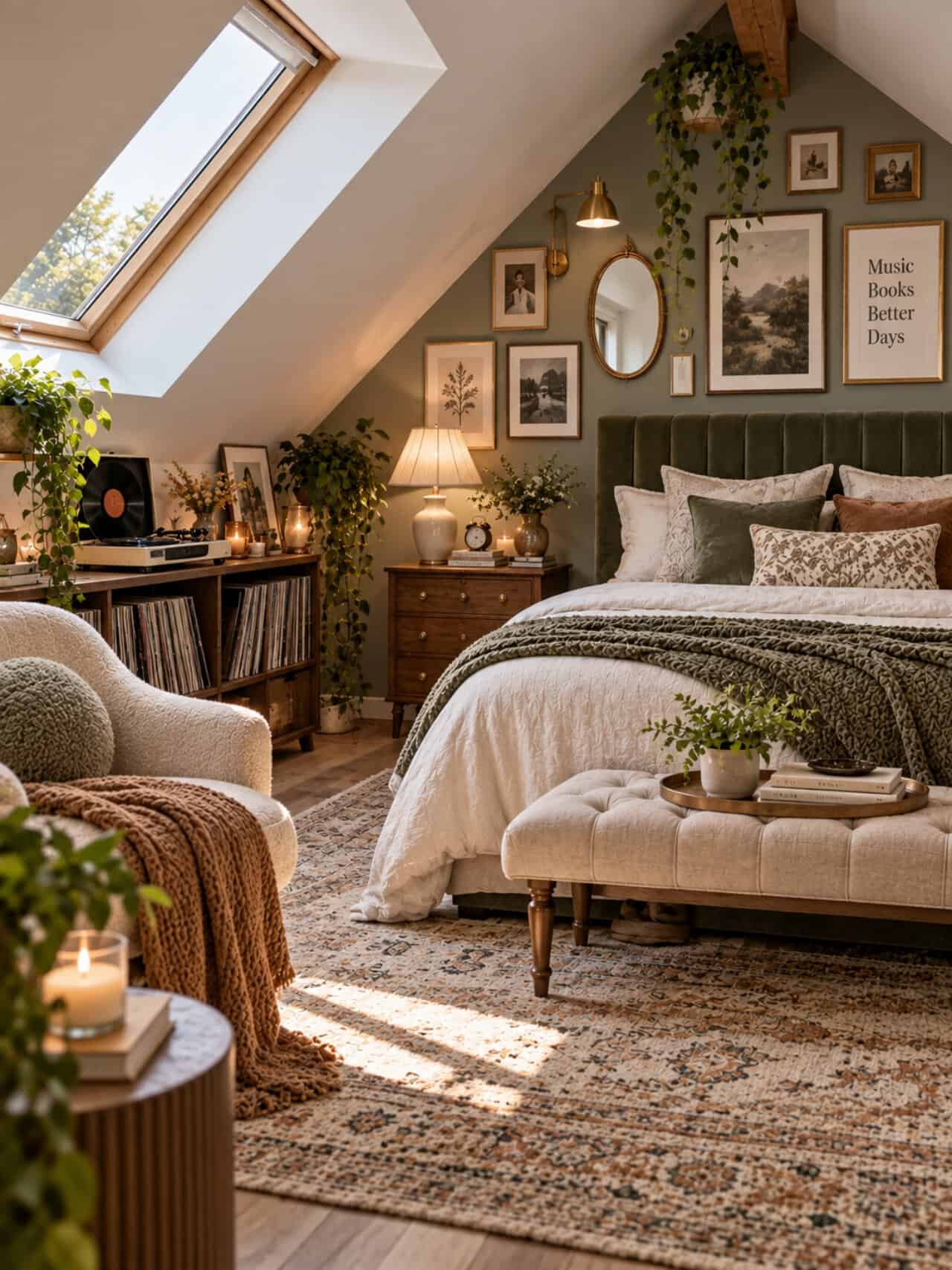
Attics need a headroom check before anything else. You want 6 feet 8 inches of clearance where you’ll stand, and at least 3 feet above the pillow so you’re not ducking into a slope. For a full bed under a skylight, plan on roughly 120 square feet of usable floor. Tighter than that? Borrow the low-profile approach in Idea #26.
23. Cherry Blossom Wallpaper With Red Gingham and a Writing Desk
Mixing two patterns is a scale game: keep the floral small and scattered and the gingham large and graphic, or the two compete at the same visual frequency. Here the wallpaper motif is delicate and the check is broad, so each reads clearly from across the room. One more rule — pull your accent color from the wallpaper, not from a catalog. That red is doing exactly that.
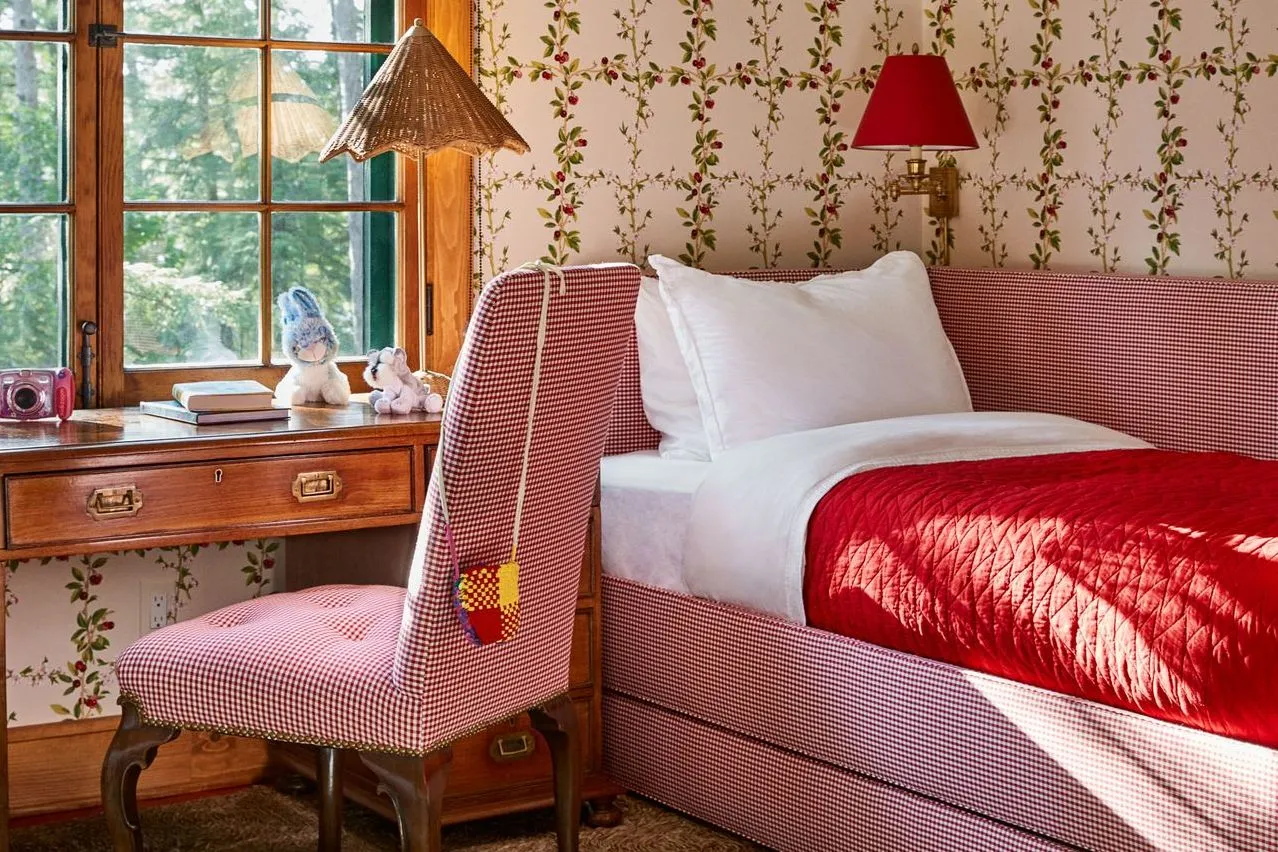
What saves this from being too sweet is the furniture. The desk and daybed are simple, the wood is warm and unpolished, and the brass pulls are plain — so the wallpaper and the gingham get to be the loud ones. Traditional pattern needs plain shapes around it. Add ruffles and scallops and the whole thing tips into a dollhouse.
24. Earthy Abstract Art Anchoring a Cream-and-Oak Layering
Roughly 65 percent cream and white textiles, 20 percent natural light wood, 15 percent earthy abstract art in grey and rust strokes. The art is the only place color appears, which is why it can be as bold as it likes without overwhelming anything. Swap it for a muted landscape and the room goes quieter; swap it for something with saturated blue and the balance changes. That single panel is the color dial.
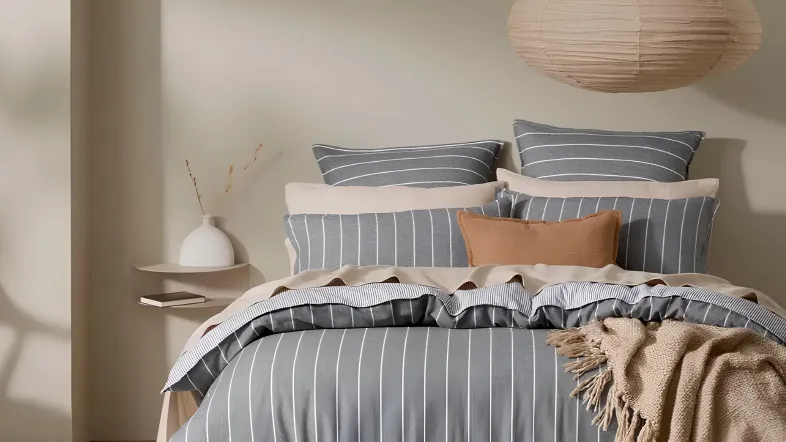
Layered neutrals are the easiest look to fake. Target’s Threshold sheets plus a $60 washed duvet do most of it; two matching ceramic lamps from Walmart run about $80 for the pair; a framed abstract print costs $30 to $60 at a craft store, or nothing if you print it yourself. Thrifted wood nightstands, sanded and oiled, beat new particleboard every time. Same warmth as Idea #1, minus the custom upholstery.
25. Powder Blue Headboard, Dusty Rose Drapes, One Tortoiseshell Lamp
Powder blue trim, dusty rose drapes, and a scalloped duvet is a combination that lives or dies on nerve. Get the tones slightly wrong and it reads as a child’s room; get them right — all three at the same saturation, nothing neon — and it’s the most charming room on the block. Test paint chips against the fabric in the actual room light before committing to either.
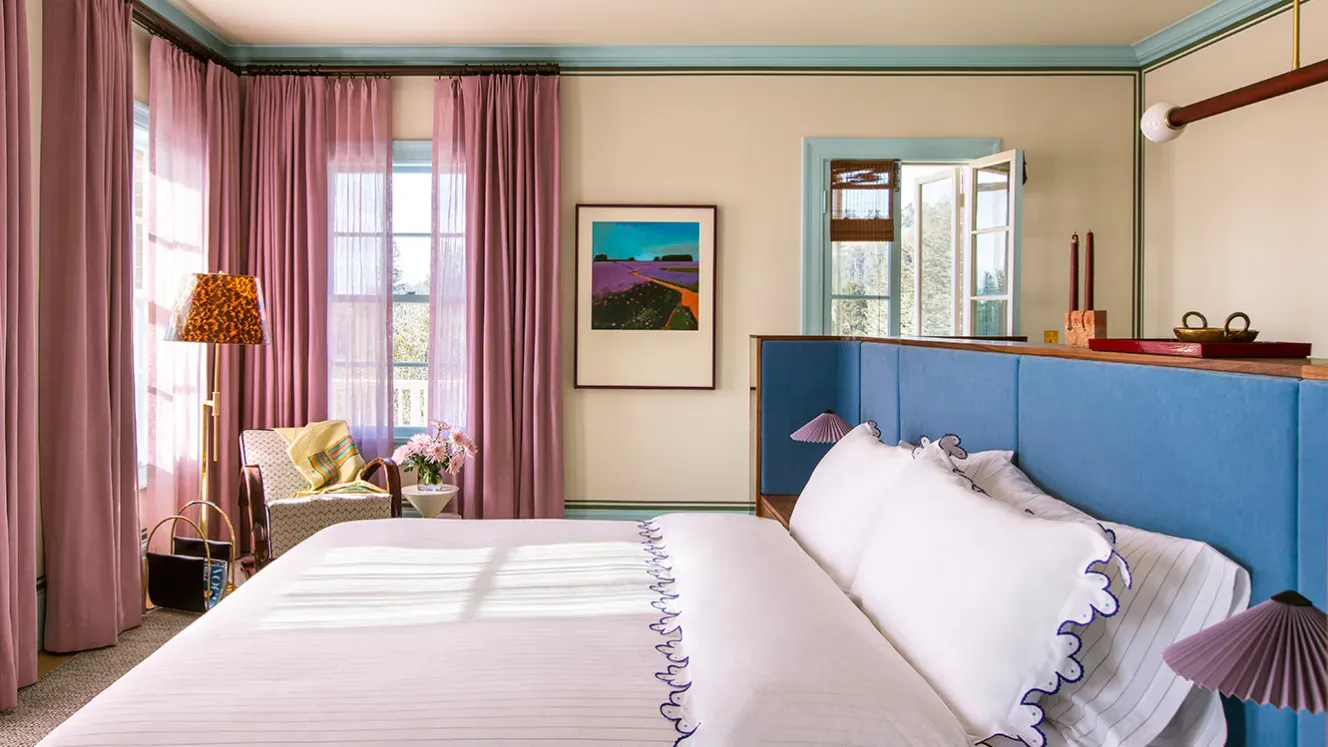
- Measure from the rod to the floor, then subtract half an inch for a just-kissing hem.
- Choose a rod 1.5 times the window width so panels stack clear of the glass.
- Order panels at 2 to 2.5 times the window width for real fullness.
- Blind-stitch the hem so the lining doesn’t flash when light hits it.
Time: 2 to 3 hours. Cost: $120–$400 depending on fabric.
The tortoiseshell-shaded floor lamp is the wildcard. Everything else here is soft and sweet; that one shade is dark, glossy, and slightly off — and it keeps the room from becoming a dessert. That’s the value of a single note that doesn’t match: it wakes up an otherwise very pretty scheme.
26. Charcoal Bedding Against a Textured Limewash Wall
Charcoal bedding hides a lot, but it shows lint and light pet hair immediately — keep a lint roller in the nightstand. Textured wall finishes like limewash can’t be scrubbed, so spot-clean with a soft eraser or a barely damp cloth only. Dried branches shed, so give them a gentle shake outside once a month, and expect to replace them each season if the room runs dry.
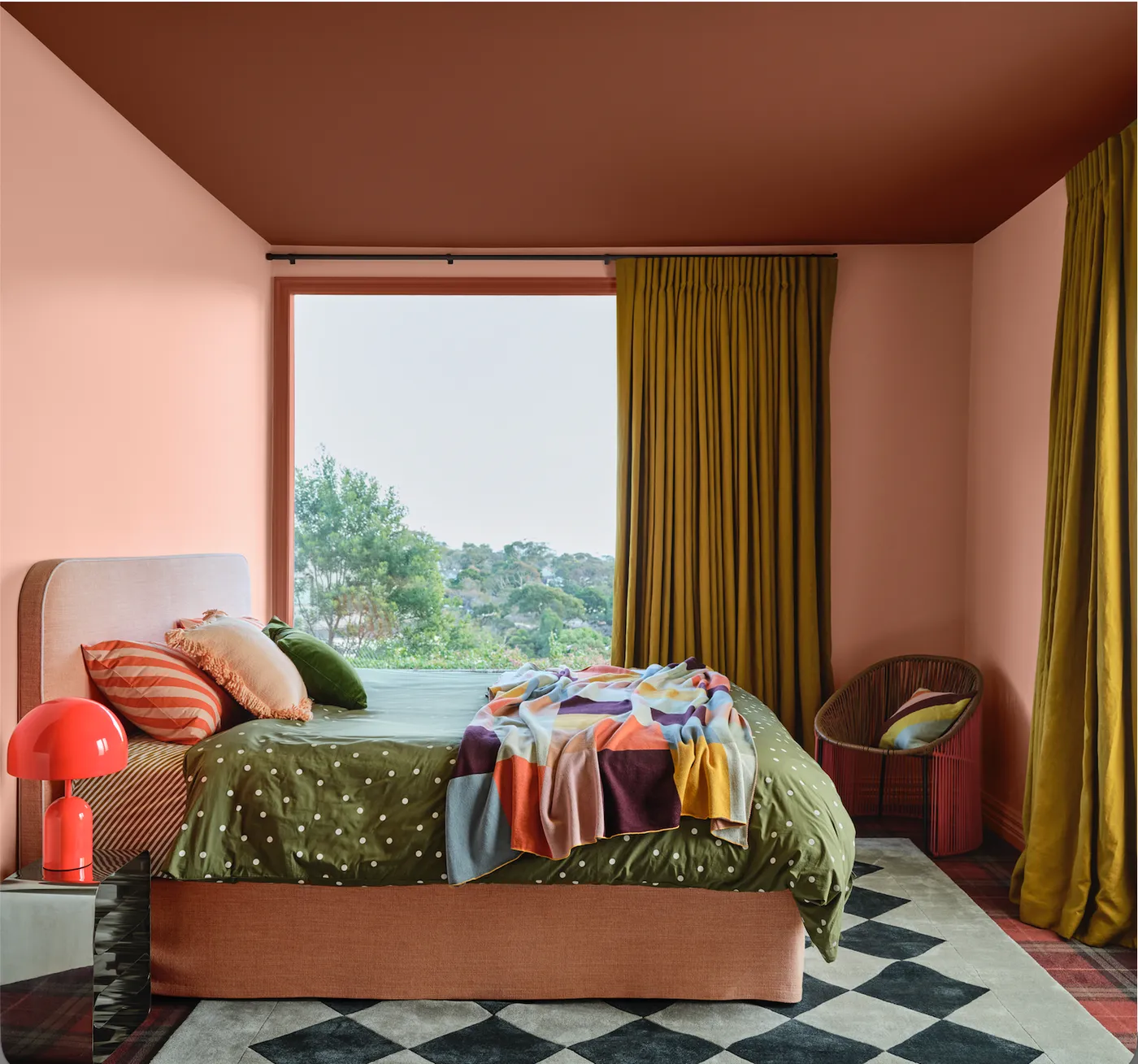
Three light sources, all at 2700K, all on dimmers: that’s the rule for a bedroom that feels like this one. The ceramic lamp gives you the pool of light, a ceiling fixture handles tasks, and one low source does the mood work after 9 p.m. Never rely on a single overhead — it flattens every texture you paid for.
27. Geometric Wood Headboard on a Deep Green Paneled Wall
Wood and green is one of those pairings that always works because it’s borrowed from outside. What’s smart here is the value contrast: the paneled wall is deep enough to read almost black at night, and the warm wooden headboard glows against it. The smoked glass pendant sits in between, catching a little green without competing. Three materials, one temperature.
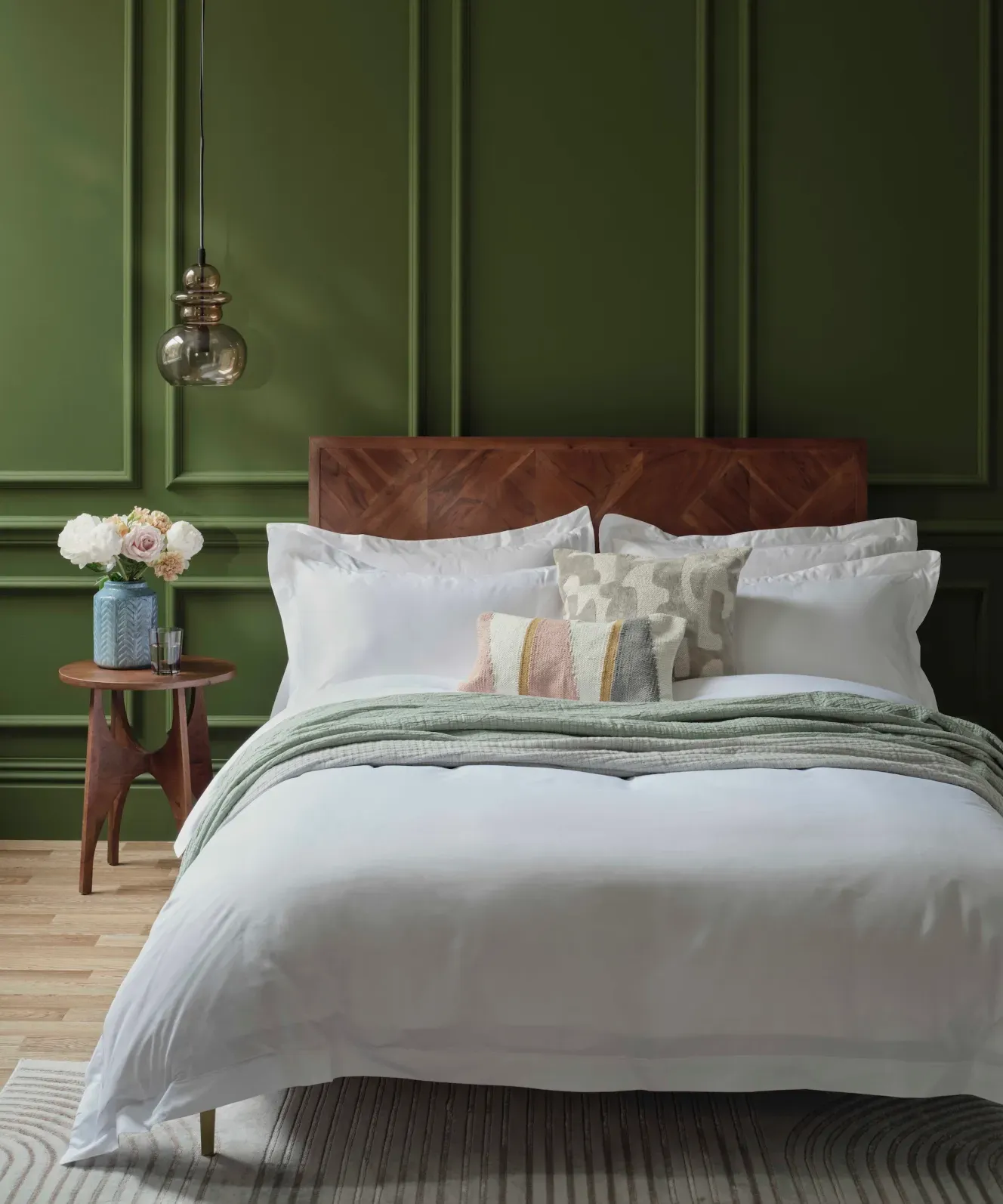
Dark green paneling reads best in a room at least 11 feet wide, where the color has wall space to breathe. Panel to two-thirds height under 9-foot ceilings to keep it from pressing down. Hang the pendant 24 to 28 inches above the side table, and leave at least 18 inches between its shade and the headboard’s edge so nobody’s elbow finds it at night.
28. Leather-Strap Headboard With Striped Curtains and a Shell Chandelier
The shell-disc chandelier is the element you couldn’t swap for something cheaper without noticing. In a room built almost entirely from matte, soft materials, a fixture made of dozens of small translucent discs adds movement and a little shimmer — the ceiling stops being a dead zone. It’s also the light that makes the beige headboard and cream bedding read warm rather than washed out.
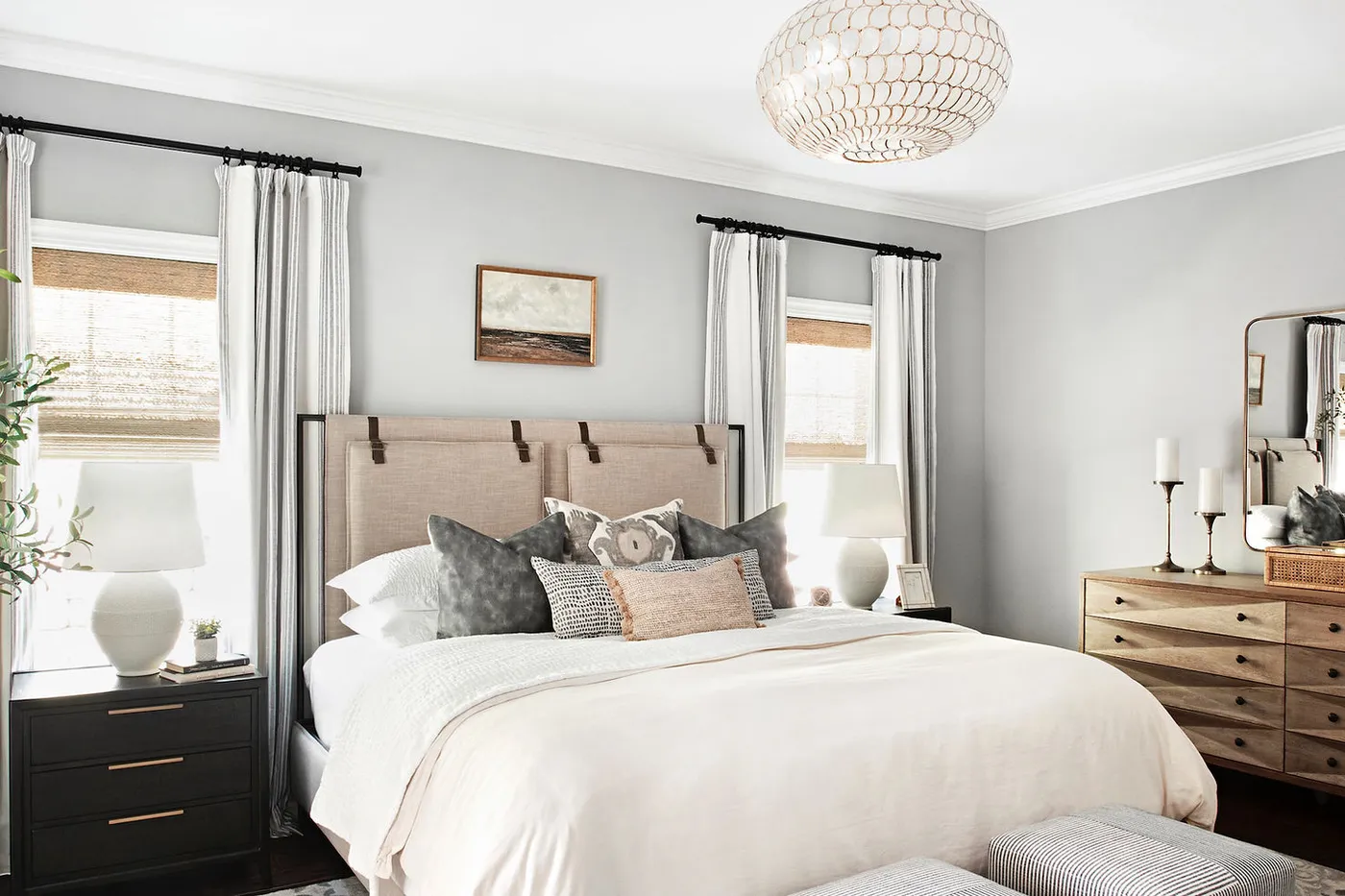
Capiz and shell chandeliers look expensive and usually aren’t — similar styles turn up at World Market or on Etsy for $120 to $250, versus $600 and up for designer originals. For the striped curtains, IKEA pairs plus $15 of ribbon trim get you 90 percent there. The leather-strap headboard is a weekend DIY with webbing and brass tacks. Compare with Idea #15 — same soft neutral base, far more texture.
29. Sheer Curtains, Vertical Slats, and a Mountain Window
- Measure your window wall — sheer panels need about 2.5 times the width for real fullness.
- Note which direction the winter light comes in; sheers diffuse it but won’t stop a draft.
- Check bed frame height before buying a duvet, since a low frame needs a shorter drop.
- Match the plant’s light needs to that window — fiddle leaf figs want bright, indirect sun.
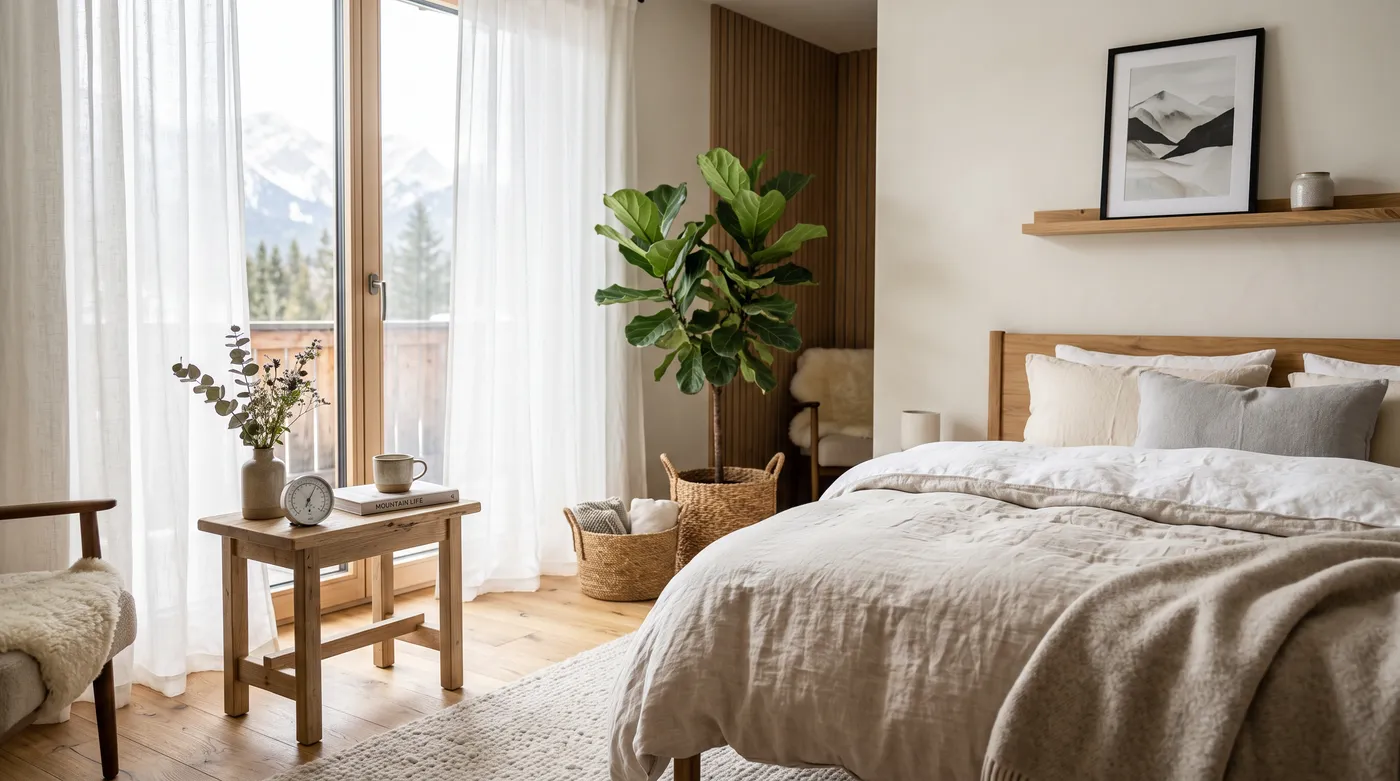
If you’re adding vertical wood slats, space them 2 to 3 inches apart and run them floor to ceiling. Wider spacing reads as a fence; tighter reads as a radiator cover. Paint or stain the wall behind them the same color as the slats so the shadows do the work, and stop the run right at the ceiling instead of trimming it with a rail — that’s what makes the room feel taller.
30. Sage Green Built-Ins Behind a Burnt Orange Duvet
Roughly 40 percent sage green millwork, 30 percent cream and white, 20 percent burnt orange, 10 percent light wood and dark green accents. It’s an unusual formula because the built-ins are structural, not paint — you can’t adjust them later. If you’re painting cabinets instead, keep the orange to a duvet and two pillows so the contrast stays a deliberate choice rather than a theme.
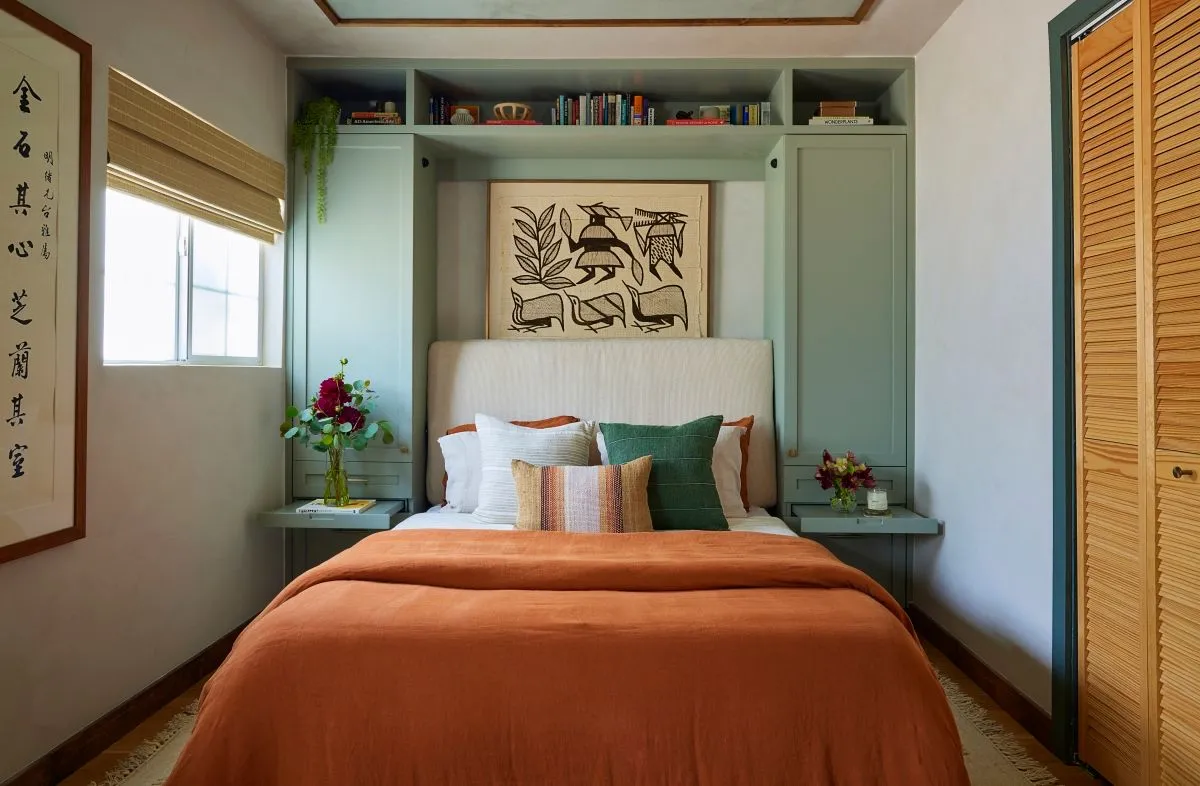
Colored cabinetry in bedrooms is the 2026 story. People are treating built-ins as architecture worth painting rather than something to hide, and sage green has become the safe-but-interesting default. Pair it with one warm, saturated textile — burnt orange, rust, terracotta — and you get depth without a feature wall. This one has staying power because it’s millwork, not a motif.
31. Dark Slat Headboard With Chunky Knits and a Plaid Throw
- Start with a white duvet, then fold a textured quilt across the foot of the bed.
- Drape the chunky knit over one corner only — never across the entire width.
- Lay the plaid throw on the opposite side to balance the visual weight.
- Finish with three pillows in descending sizes, one in a contrasting texture.
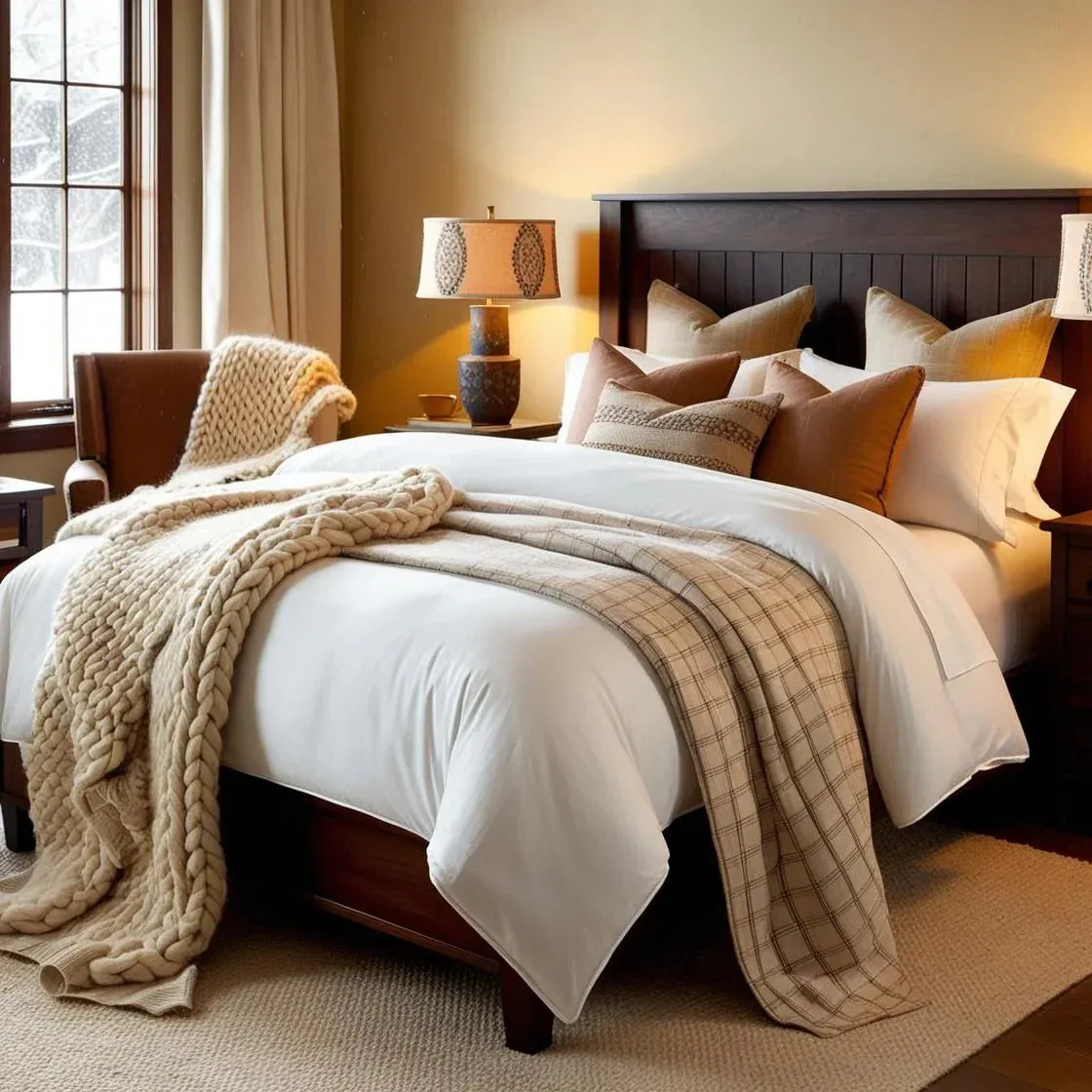
Time: 15 minutes. Cost: $0 if you shop your own linen closet first.
Dark wood frames plus light textiles is the oldest trick in the book, and it still works because it mimics daylight: pale surfaces catch light, dark surfaces hold it. Here the slatted headboard supplies repetition, the throws add three textures at three scales, and the snowy window does the rest. Nothing in this room matches, and that’s precisely why it feels collected.
Your Warmest Winter Starts at the Bedroom Door
You don’t need a whole new bedroom — you need one good layer, one light source that isn’t the ceiling, and the nerve to hang your curtains higher than feels normal. Pick a single idea from this list, do it properly this weekend, and the rest of the room will start telling you what it wants next.
📌 Pin your favorite of these 31 winter bedroom ideas now, so when the cold really sets in, you’re not scrolling from scratch.