29+ Stunning Ralph Lauren Inspired Christmas Tree Ideas You Need to See for 2026

Ralph Lauren-inspired Christmas trees are having a major moment on Pinterest right now — and one look at the deep forest green, red plaid ribbon, and brass-and-leather equestrian detailing explains why. We spent real time combing through Pottery Barn, Etsy, Anthropologie, Target, and Amazon to bring you only what’s worth your December, from a $14 felt ornament set to a $1,150 statement flocked tree.
Inside you’ll find 29 curated ideas spanning traditional red-and-green, white-and-gold glam, plaid-heavy heritage, rustic woodland, and full equestrian fox hunt — with budget and luxury versions compared side by side so you can see exactly what your money buys. In 2026, the look that’s winning is layered and collected rather than matchy-matchy: plaid next to velvet, berries next to brass, heirlooms next to drugstore baubles. And stay until the end — we break down the most common mistakes that can ruin these looks. 📌 Save this to Pinterest for later — you’ll want to revisit these ideas.
1. Red Floral Dining Room with Taper Candles and a Jewel-Toned Tree
Recreating this dining room is mostly about the table, not the tree. Here’s roughly what it takes:
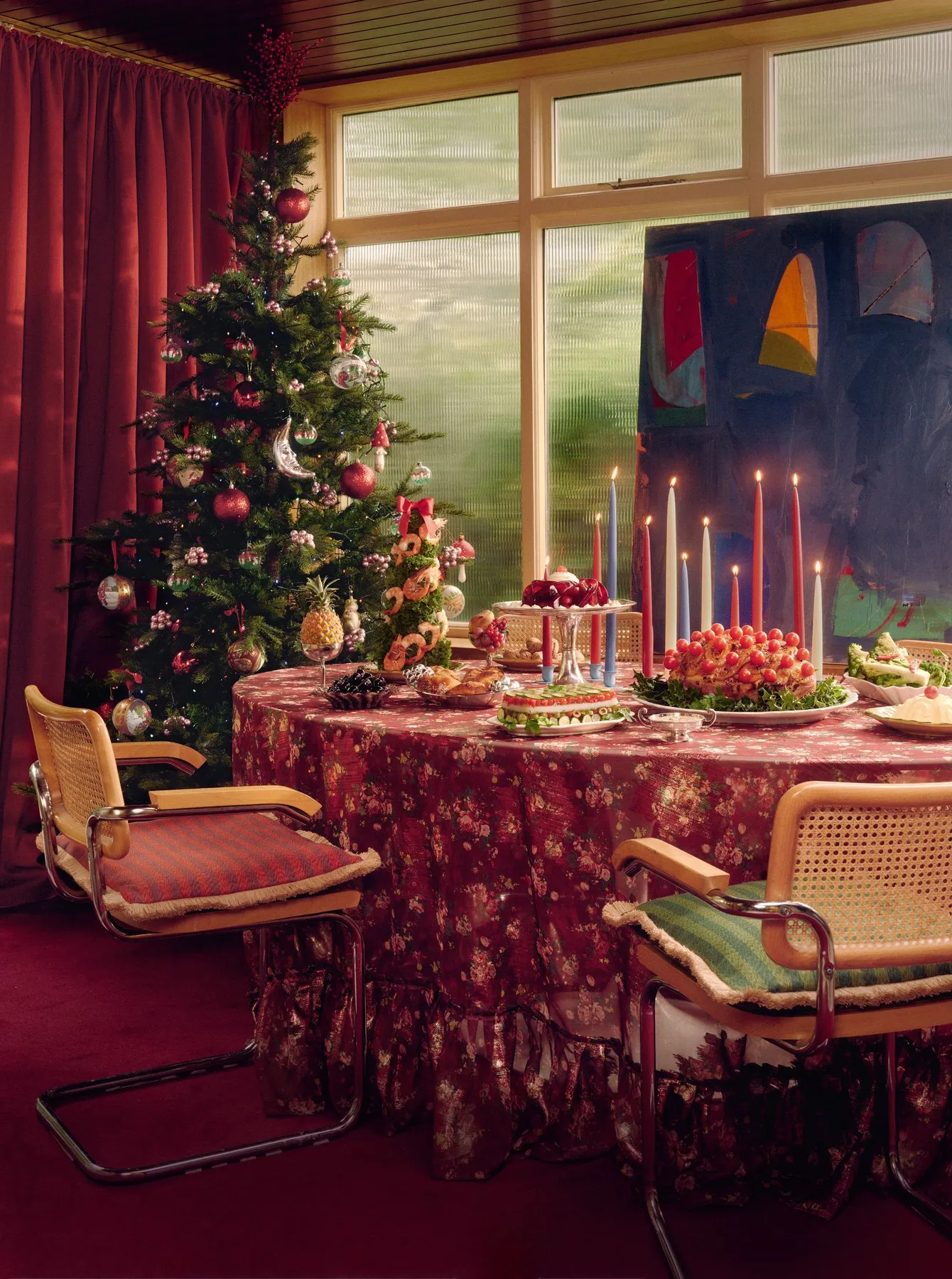
- Round pedestal table with four cane-back chrome chairs: $900–$2,400
- Ruffled red floral tablecloth: $60–$180
- Mixed taper candles in red, blue, and cream, 12 count: $30–$90
- Slim tree plus red and silver ornaments: $300–$450
- Deep red curtains and a matching 8×10 rug: $370–$1,300
Total: $1,660–$4,420
Budget alternative: a $35 Target floral tablecloth, dollar-store tapers in thrifted brass holders, and a secondhand rug land the same mood for around $400. The candlesticks matter more than the cloth.
The hard part of a red-on-red room isn’t the red — it’s the value. The curtains, carpet, and tablecloth here all sit in the same deep, slightly blue-based red, but no two are the same material: matte wool, crisp cotton ruffles, soft pile. Swap in a brick-red rug or an orange-leaning curtain and the whole thing starts to look accidental instead of collected. Tape three fabric swatches to the wall for a week before you commit, and check them at night under lamp light, not just at noon.
2. Flocked White-and-Gold Tree Against Dark Wood Paneling
Value contrast is doing most of the heavy lifting — a nearly white flocked tree against near-black wood paneling reads as sculpture rather than decoration. The white-and-brass chandelier repeats that bright note up high, while champagne ornament tones echo it down low, so your eye keeps traveling vertically instead of stalling at the floor. The oversized white 3D wall piece then bridges the room’s two halves, keeping the art side from feeling like an afterthought. Contrast is doing all the work here, and it’s contrast in value, not color.
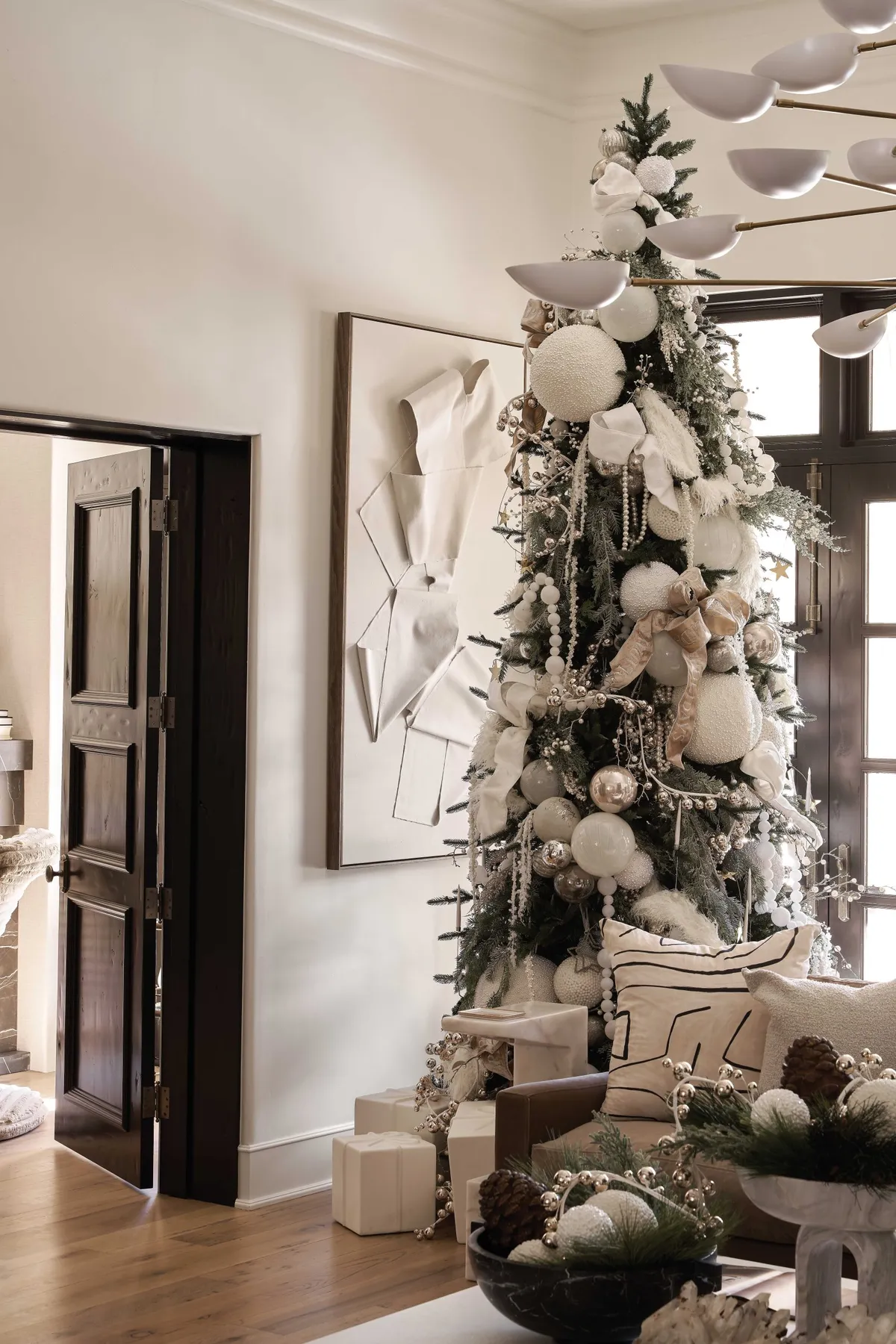
Take away the white 3D wall art and the room still works — it just stops being interesting. That piece is the only matte, hand-made-looking surface in a scene full of shine, and its pale tone mirrors the flocked tree across the doorway, quietly binding two zones into one composition. If you’re recreating this, don’t spend the budget on more ornaments. Spend it on one big, low-gloss piece of art behind the tree and let the tree finish the sentence.
3. A Barely-Dressed Pre-Lit Tree in a Snowy-Window Living Room
Making an unadorned pre-lit tree look intentional instead of unfinished:
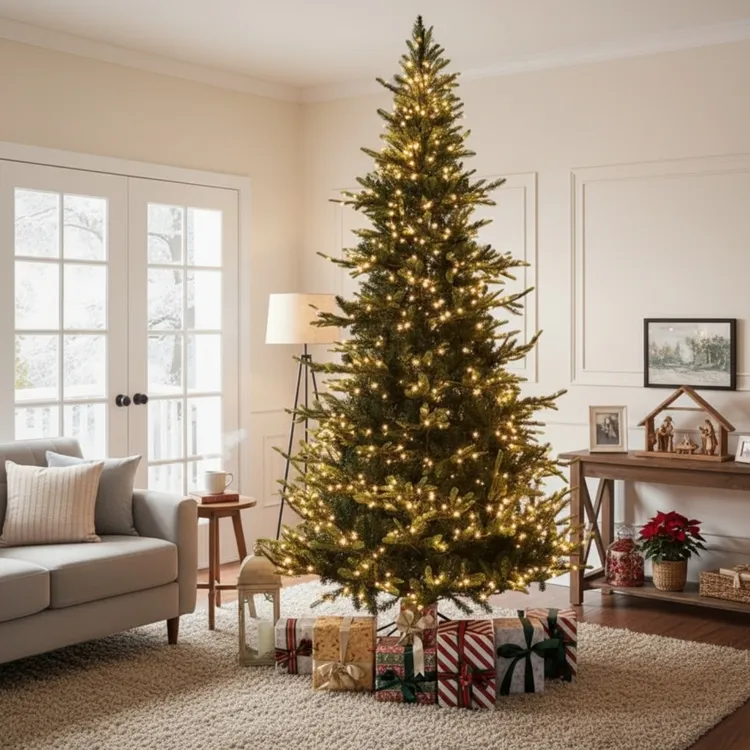
- Fluff every branch outward from the trunk — 30 to 45 minutes on a 7.5-footer, and worth every one of them.
- Add one extra strand of warm white lights, weaving in 6-inch horizontal loops rather than spiraling.
- Wrap the visible trunk and a few inner branches so the glow comes from inside the tree, not just the tips.
- Run the cord down the back and plug into a floor timer set for 5 p.m.
- Skip the topper entirely, and leave the base bare except for the gifts.
Time: about an hour. Cost: one extra light strand.
A lights-only tree is gorgeous at dusk and surprisingly plain at 2 p.m. — fine if that’s the point, but know what you’re signing up for. Pre-lit trees also announce their on/off status to the whole room, so an unplugged tree looks like a green cone by mid-January. A plug timer costs about $12 and solves that. One more thing: white lights read cooler and dimmer than you expect against cream walls and gray sofas, so buy a strand labeled warm white, 2700K.
4. Cream Tufted Sofa, Frosted Tree, and a Tall Brass Candelabra
The formula is roughly 60% cream — sofa, walls, moldings, patterned rug — 30% frosted green with champagne ornament, and 10% brass shine. It works because the largest color is also the quietest one; nothing loud is holding down the biggest surface area. To change the mood, change only the middle number: blush and copper for something softer, charcoal and pewter for something moodier. Keep the 60/30/10 split and you can repaint, restyle, and re-ornament this room every year without it ever looking like a different room.
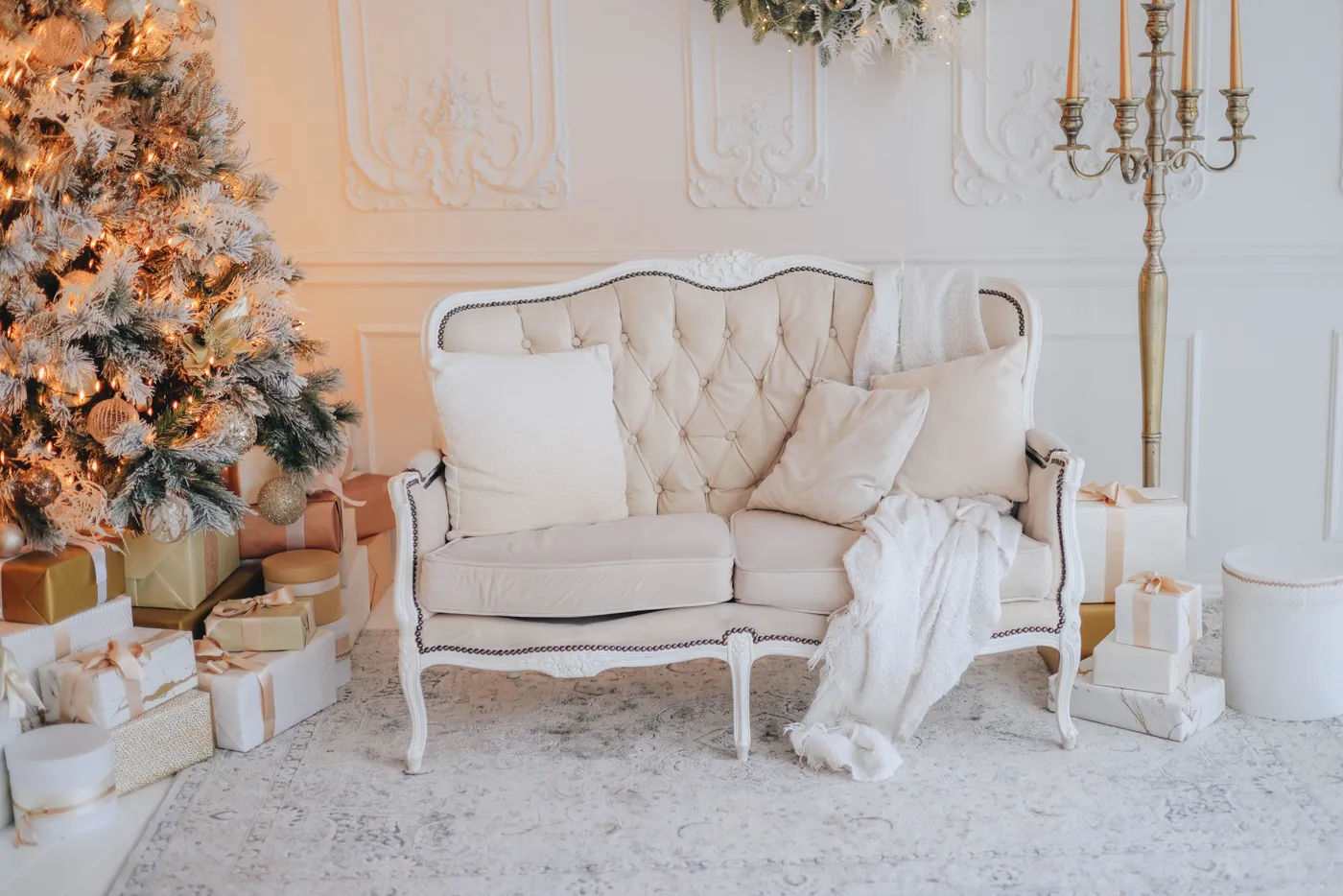
Gift wrap is decor, and most people overdo it. Pick exactly two papers and one ribbon width for the entire tree — here it’s gold and white with a satin band — then stack gifts in groups of three, tallest at the back, so each cluster reads as one object. Tuck the smallest boxes at the front where they catch light. Keep ribbon tails under 8 inches, too; long tails on thirty packages start looking like a craft aisle instead of a styled room.
5. A Golden-Yellow Tree with Kraft Paper Gifts and Cable Knit
A non-green tree is one of the easiest things to fake. A 6-foot golden-yellow artificial tree runs $70–$140 at Target or Walmart in late October, and the rest is paper. Kraft wrapping paper is about $6 a roll, deep green paper about $8, and a plain jute 5×7 rug is $60–$90 at IKEA. Thrift or Facebook Marketplace for the cable knit throw — real wool ones show up for $15–$25 all winter. You can rebuild this entire corner for under $300. If you love the rustic gift styling, Idea #26 takes it all the way to woodland.
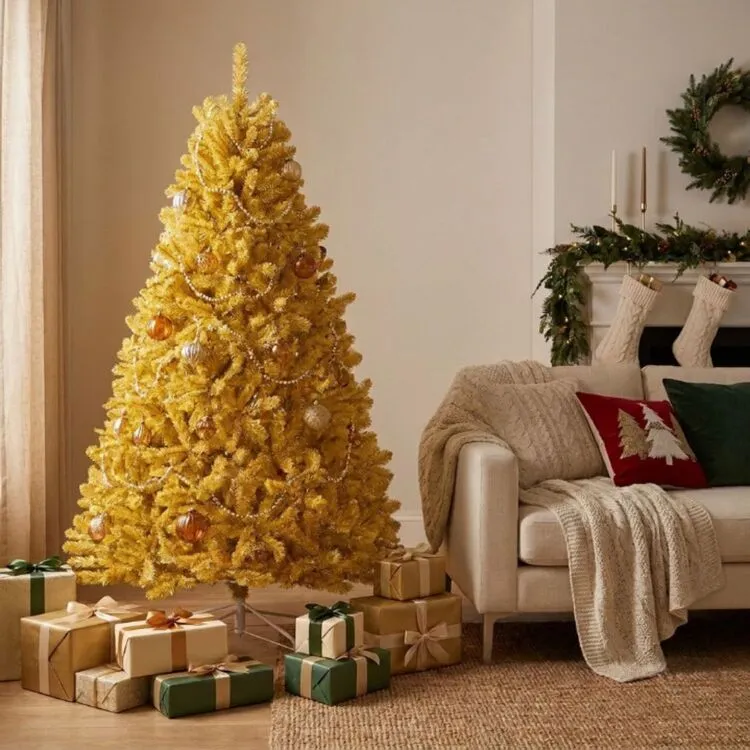
The colored tree isn’t a fad anymore, it’s a strategy. Pinterest searches for gold, blush, and champagne trees have climbed every season since 2023, and 2026 looks like the year people stop apologizing for skipping green. What changed is the styling around it: instead of hiding an unconventional tree in a corner, people pair it with natural, unfussy textures — kraft paper, jute, chunky knits — so the color reads as intentional rather than novelty. A yellow tree with cheap shiny tinsel will date instantly. A yellow tree with linen and twine won’t.
6. Red-and-Green Plaid Table with Gold Deer Candlesticks
A busy plaid cloth will swallow your plates unless you break the pattern, and the fix is a solid runner. Proportion matters more than color: keep the runner 14 to 16 inches wide on a 40-inch table, letting roughly 12 inches of plaid show on either side. Narrower than 12 inches and it disappears; wider than 18 and you’ve just covered the tablecloth you paid for. Green embroidered vines on red feel festive without competing, and they give the leaf-shaped plates something calm to sit on.
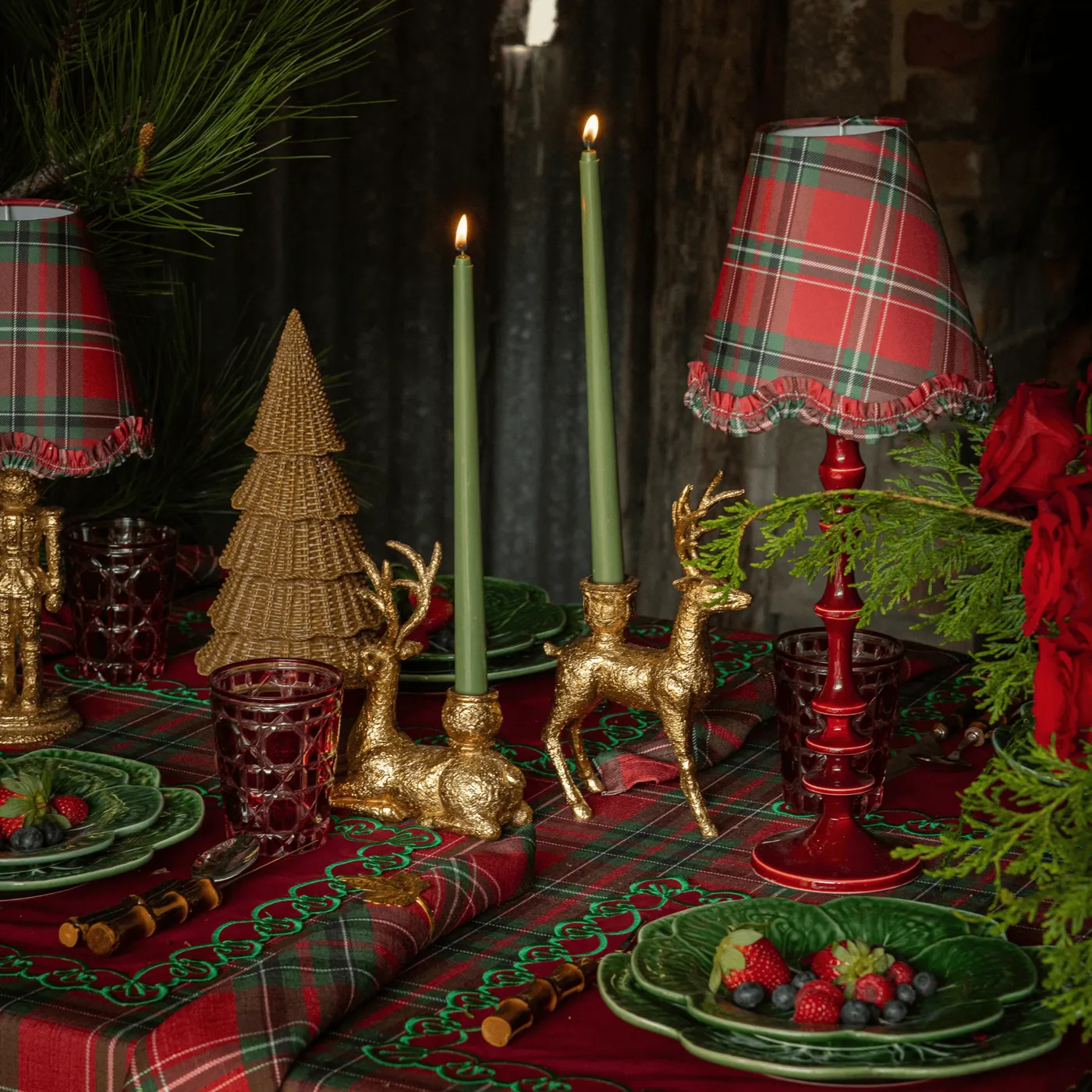
This tablescape wants a room with real breathing space. Figure on a 54- to 60-inch round table or a 72-inch rectangular one, seated for six, inside a dining room of at least 11 by 13 feet — you need 36 inches of clearance behind each chair to pull out comfortably. Ceiling height barely matters here since there’s no hanging fixture competing with the candlesticks. In a smaller dining nook, drop the tablecloth for a plaid runner and skip the layered plates entirely.
7. Plaid Ribbon and Berry Clusters with a Blue Stripe
Strip out the blue and this becomes a tree you’ve seen a hundred times. That thin blue stripe in the plaid ribbon — plus the frosted blue berry stems tucked into the branches — is the entire personality of the design. Blue doesn’t compete with red and green the way another warm color would; it cools the tree down at exactly the points where it would otherwise get syrupy. If you’re building this look, buy the ribbon with blue in it and let that one decision set your ornament budget. Think of it as Idea #8‘s busier cousin — same plaid backbone, a lot more going on.
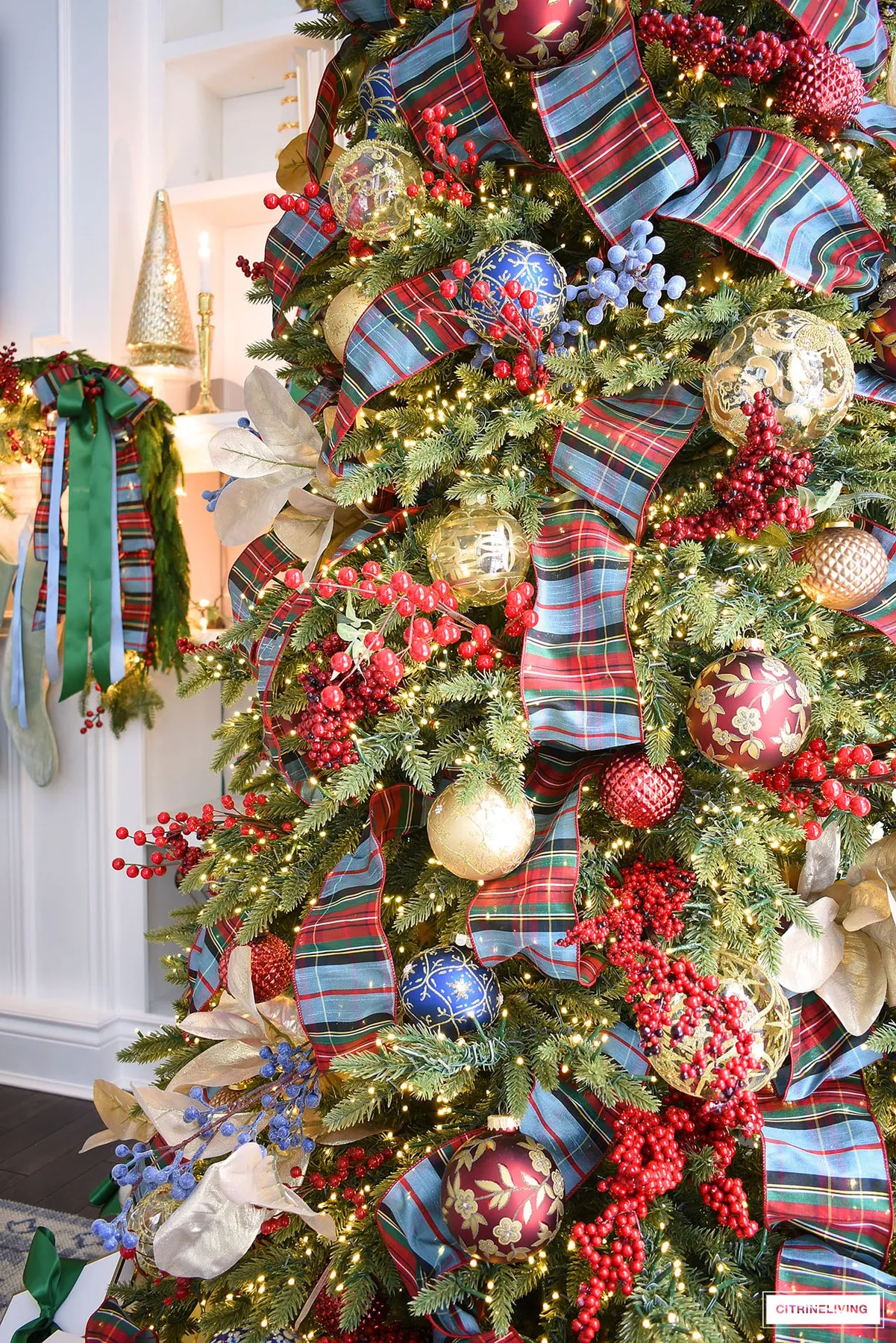
Glitter is the maintenance story here, and it isn’t negotiable. Gold glitter poinsettias and frosted berry stems shed a little every time you touch them, so plan on vacuuming the skirt area weekly through December, and consider a smooth skirt instead of a shaggy one. Store all glittered picks in a single lidded bin — unpacking them one at a time next year just spreads the mess. Faux berries hold up for years out of direct sun, but the finish fades to a chalky pink after about three seasons near a south-facing window.
8. Red Plaid Ribbon, Gold Baubles, and a Matching Plaid Skirt
A ribbon-forward tree is cheaper than it looks, because ribbon covers a lot of bare branch.
- 7.5-foot unlit tree: $200–$600
- Red plaid ribbon, three spools: $40–$90
- Gold ball ornaments, 60 count: $60–$180
- Red berry garland, 9 feet: $25–$60
- Warm white string lights, 300 count: $20–$50
- Matching plaid tree skirt: $40–$120
Total: $385–$1,100
Budget alternative: buy the ribbon and skirt in the same plaid, reuse last year’s ball ornaments, and shop after-Christmas sales for the tree — you’ll land this exact look for around $180.
The plaid tree skirt is the reason this reads as a designed tree rather than just a decorated one. Repeating the ribbon’s exact plaid at the base creates a frame — your eye enters at the skirt, travels up the ribbon, and lands on the red berry garland. It’s an old decorator’s trick: repeat a pattern in two places and the space between them instantly feels considered. The gold spheres then do the opposite job, catching light and breaking up all that linear plaid so nothing feels like wallpaper.
9. Gray Velvet Chesterfields Facing a Silver Flocked Tree
Be honest about your square footage before you fall in love with this room. Two large Chesterfield sofas facing each other need roughly 16 by 18 feet with walkways, plus a 10-foot ceiling so a crystal chandelier doesn’t feel low. The flocked tree wants 7.5 to 9 feet of height with 40 inches of base clearance. In a 12 by 14 living room, keep the sofa shape but buy one instead of two, go down to a 6-foot tree, and swap the chandelier for a pair of tall lamps.
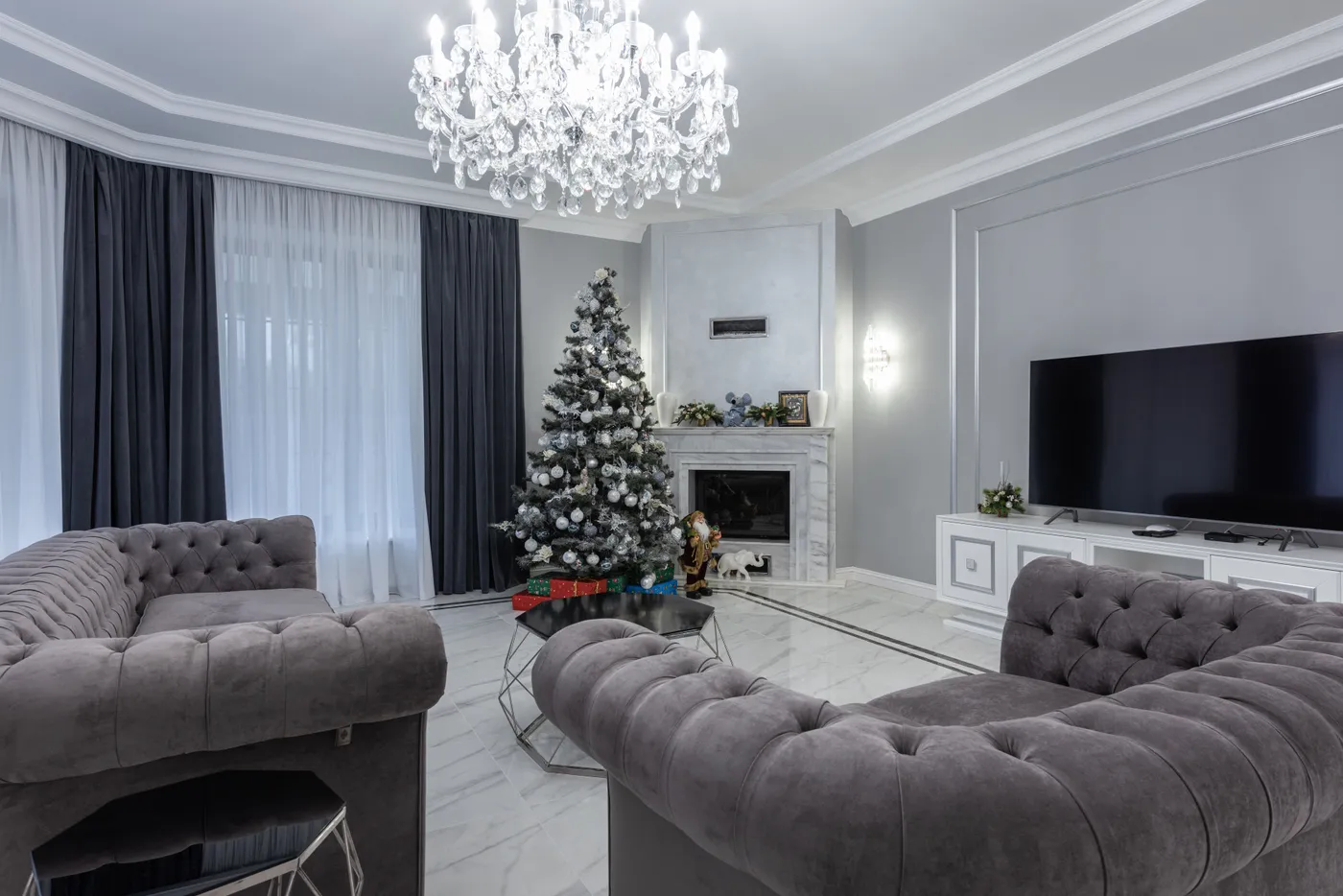
Two things will quietly drive you crazy. Flocked trees shed — a lot — and on white marble-look flooring every stray fleck is visible, so budget for a weekly vacuum with a brush attachment and keep a lint roller in the closet. Then there’s dark gray velvet, which shows every bit of white fluff and every fingerprint of glitter. With shedding pets or kids under five, a mid-gray performance fabric or a textured weave gives you the same moody look for a fraction of the upkeep.
10. Vertical Plaid Ribbon Drapes Topped with a Gold Wire Star
This is a strict three-color tree: roughly 55% deep green foliage, 35% red plaid ribbon, 10% gold. That’s it — the discipline is the design. Vertical drapes run from the top third of the tree downward, spaced every 12 to 15 inches, so the green still shows between them. To restyle the same formula, trade red plaid for navy plaid with the same gold accents, or keep the red and switch the gold to antique brass. The percentage split is what keeps an all-plaid tree from turning into a plaid bush.
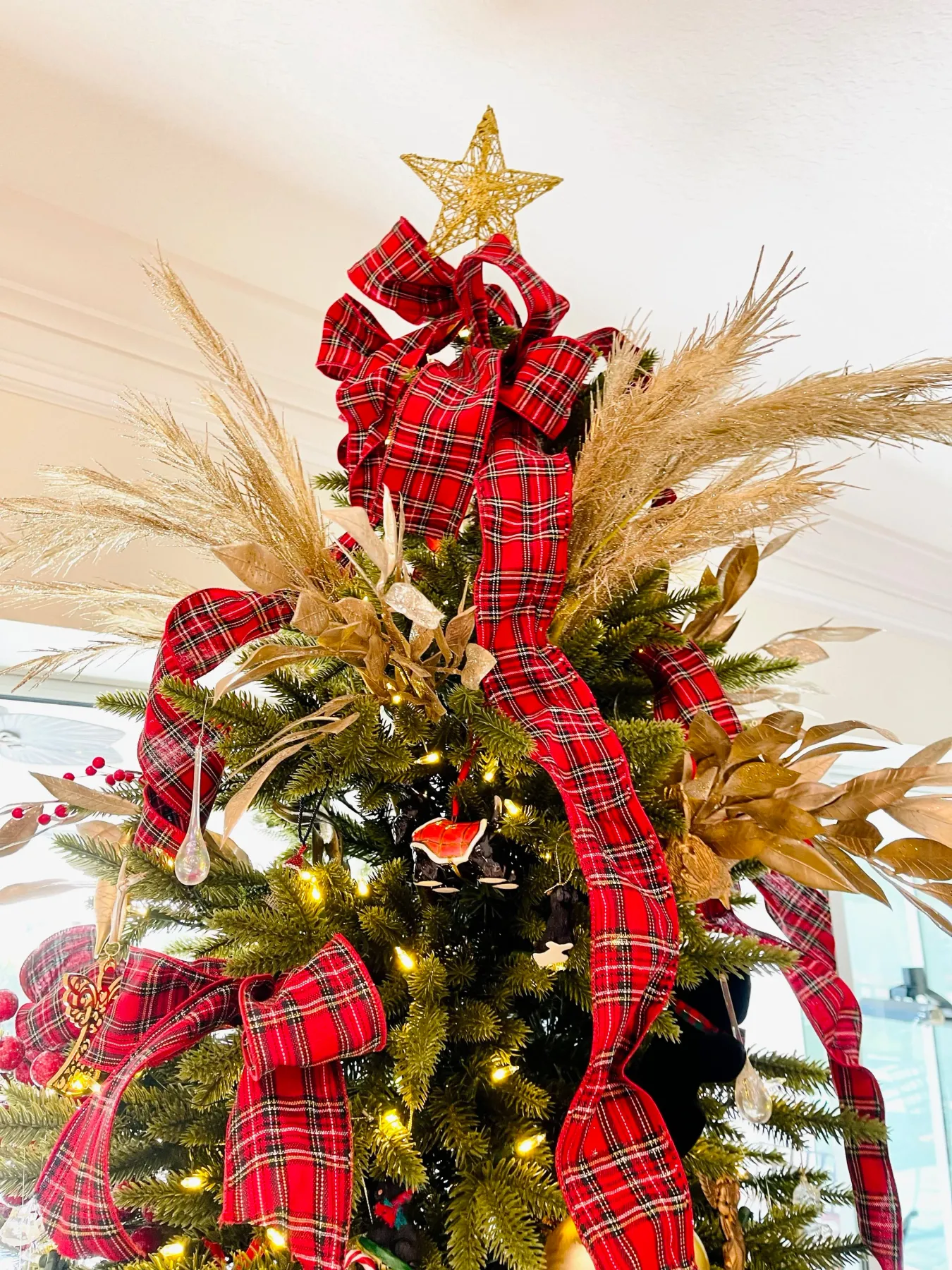
Draping ribbon vertically so it looks deliberate:
- Buy wired ribbon at least 3 inches wide — unwired falls flat by day two.
- Cut lengths of 6 to 8 feet and fold each into a soft loop at the top.
- Start in the top third, tuck the loop into a branch, and let the ribbon fall between branch layers.
- Secure the bottom with a floral wire bent into a hook — never tape.
- Space drapes every 12 to 15 inches and alternate lengths for rhythm.
Time: 30 to 40 minutes. Materials: three spools of wired ribbon, about $45.
11. Stone Fireplace with Velvet Stockings and a Gold-Ribbon Tree
Check these before you buy a single stocking:
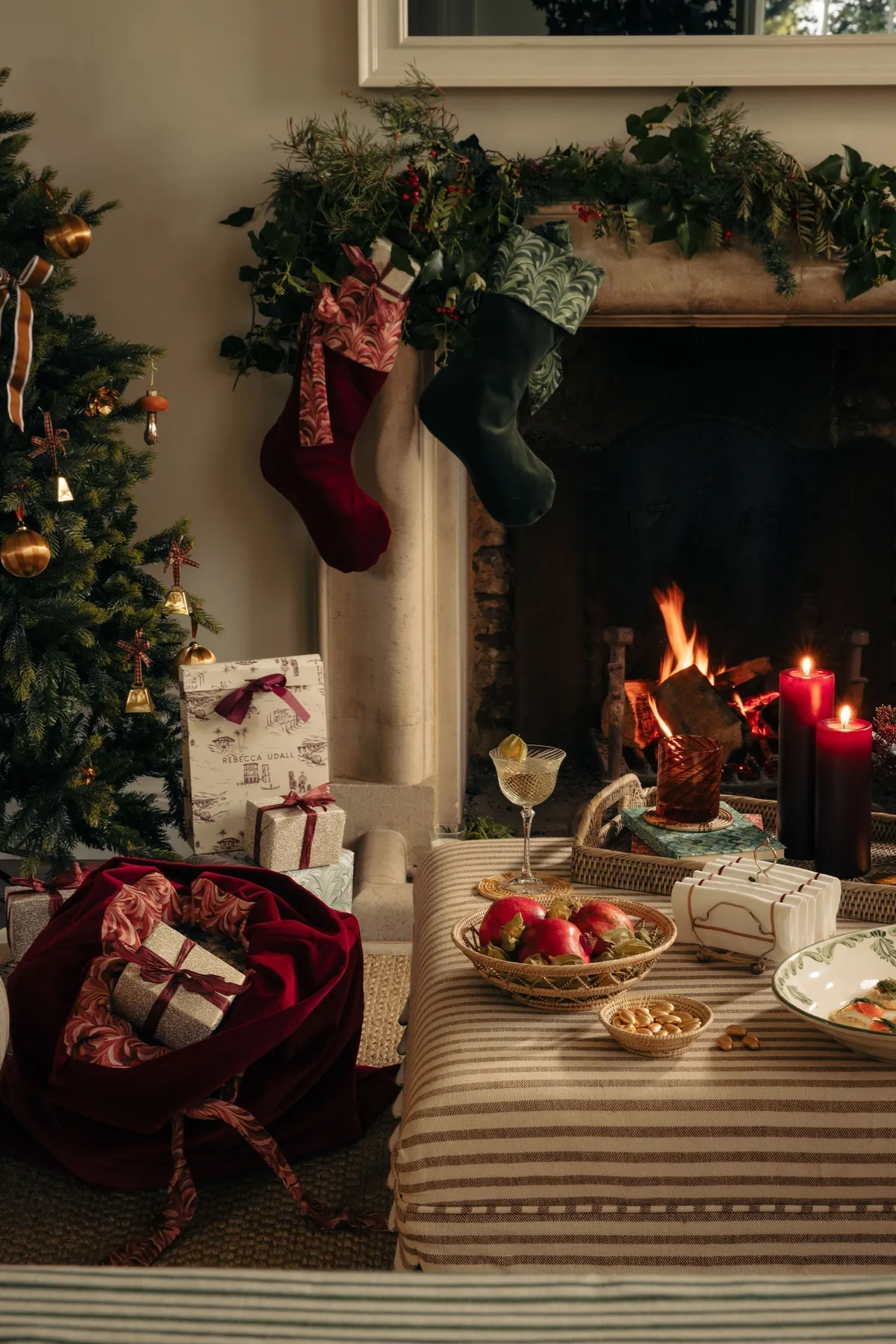
- Measure your mantel length and divide by the number of stockings, allowing 6 inches between each.
- Confirm the gap between the mantel shelf and the top of the firebox — 18 inches minimum if you actually burn fires.
- Find the nearest outlet and decide where the tree cord and garland lights will run.
- Check whether the mantel holds weight without a bracket; stone usually needs adhesive clips, not nails.
- Hold your garland against the wall in daylight — evergreen can look muddy against warm cream paint.
Stockings hung at random heights are the fastest way to make a beautiful mantel look sloppy. Hang every stocking so the top of the cuff sits at the same height, 2 to 3 inches below the mantel shelf, and let the toes fall naturally. Keep them 18 inches from the firebox opening if you light fires, and never let a cuff dangle over the edge. On a shallow mantel, use weighted stocking holders instead of hooks — they also let you adjust heights to the half inch.
12. Tinsel-Lit Tree Beside a Distressed Console and Gilded Mirror
The ornament collection is the point — not the tree, not the console. Silver tinsel, personalized baubles, novelty shapes, framed photos: this is a tree that accumulated, and that’s exactly why it feels warm instead of styled. Strip out the mismatched ornaments and you’d have a perfectly nice display with no memory in it. Starting from scratch? Buy one personalized ornament per family member each year and let the tree become a record. It’ll look like this by year eight.
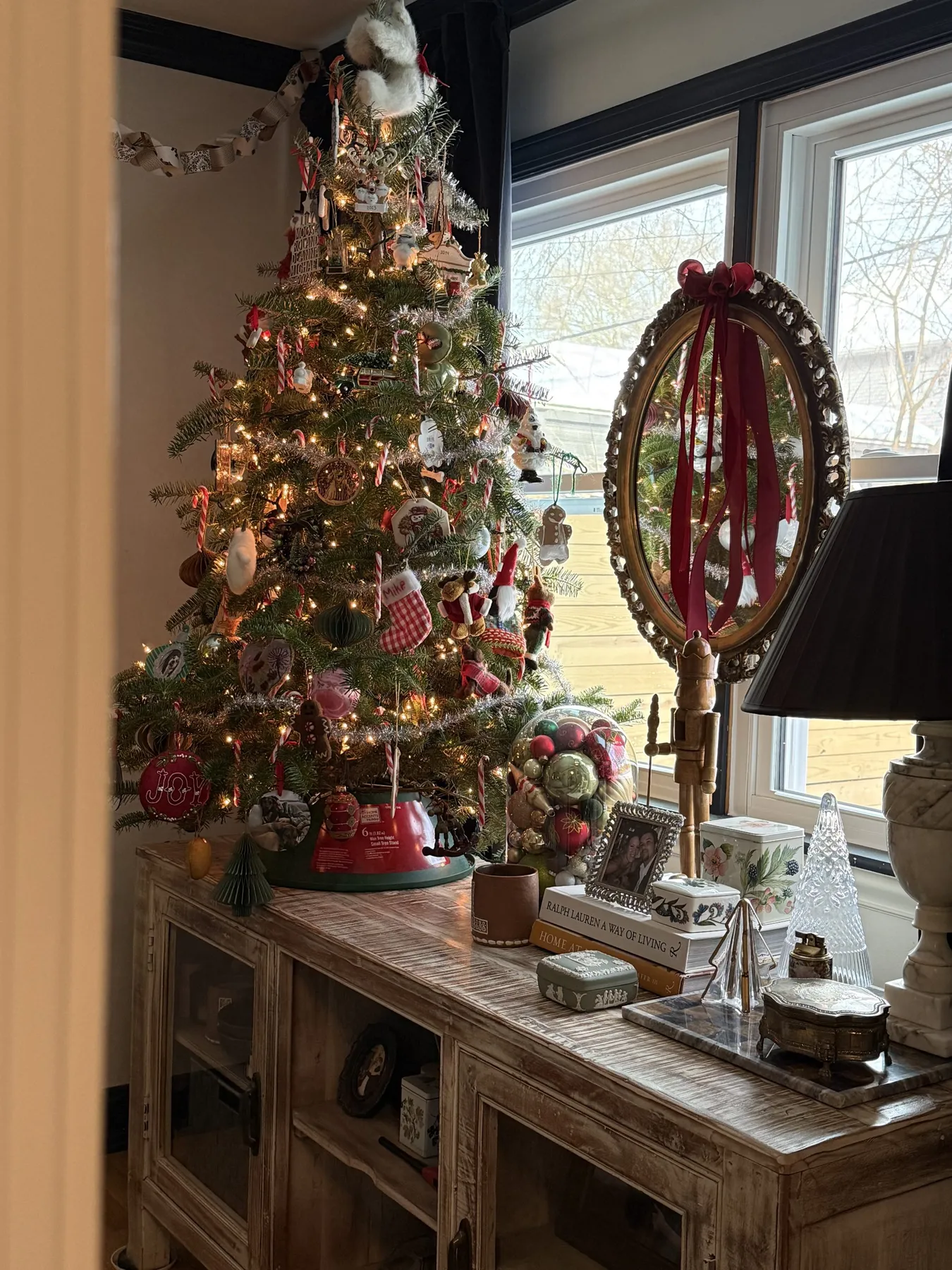
Everything flanking this tree came from somewhere affordable. A distressed wood console shows up on Facebook Marketplace for $60–$120 most weeks. A gilded oval mirror runs $15–$40 at a thrift store, and you can add the red ribbon yourself for $3. Glass cloches are $8–$15 at Goodwill and about $12 at IKEA — fill one with dollar-store baubles and nobody will know. The stacked books and decorative boxes should come straight off your own shelves. Whole vignette: under $200.
13. Bronze Star Topper and Rust Velvet Ribbon on White Gifts
Velvet ribbon is beautiful and high-strung. It arrives creased, and if you fold it back into a storage box the same way every year, those creases set permanently — store it rolled around a cardboard tube instead. White gift boxes are the other issue: bare white paper picks up fingerprints and glitter dust, so wrap gifts last, after the tree is finished, with a clean towel down while you work. Rust ribbon fades noticeably after about two seasons of sun exposure, so rotate which side faces the window.

Look closely and that ribbon isn’t holiday red — it’s rust, a burnt orange leaning brown. That single shift is what makes this styling feel grown-up. Rust sits in the same warm family as red, so it still reads festive against dark green pine, but it doesn’t trigger the “same as every other tree” reflex. The metallic star repeats the warmth up top, and the frosted branches keep everything from getting heavy. Want the same trick with a different accent? Try oxblood, copper, or deep terracotta.
14. Tall Gold-Ornament Tree Doubled in an Ornate Gilt Mirror
Gold-heavy trees have quietly overtaken the all-white glitter look that dominated the 2010s. Part of that is the broader move toward warm, aged metals — brass over chrome, antique gold over bright silver — and part of it is practical: warm gold ornament tones photograph beautifully under the 2700K bulbs most people already have in their lamps. The ornate gilt mirror here is the tell. Mirrors placed to double the glow of a tree or fire is one of the fastest-growing styling moves heading into 2026, and it costs nothing if you already own one.
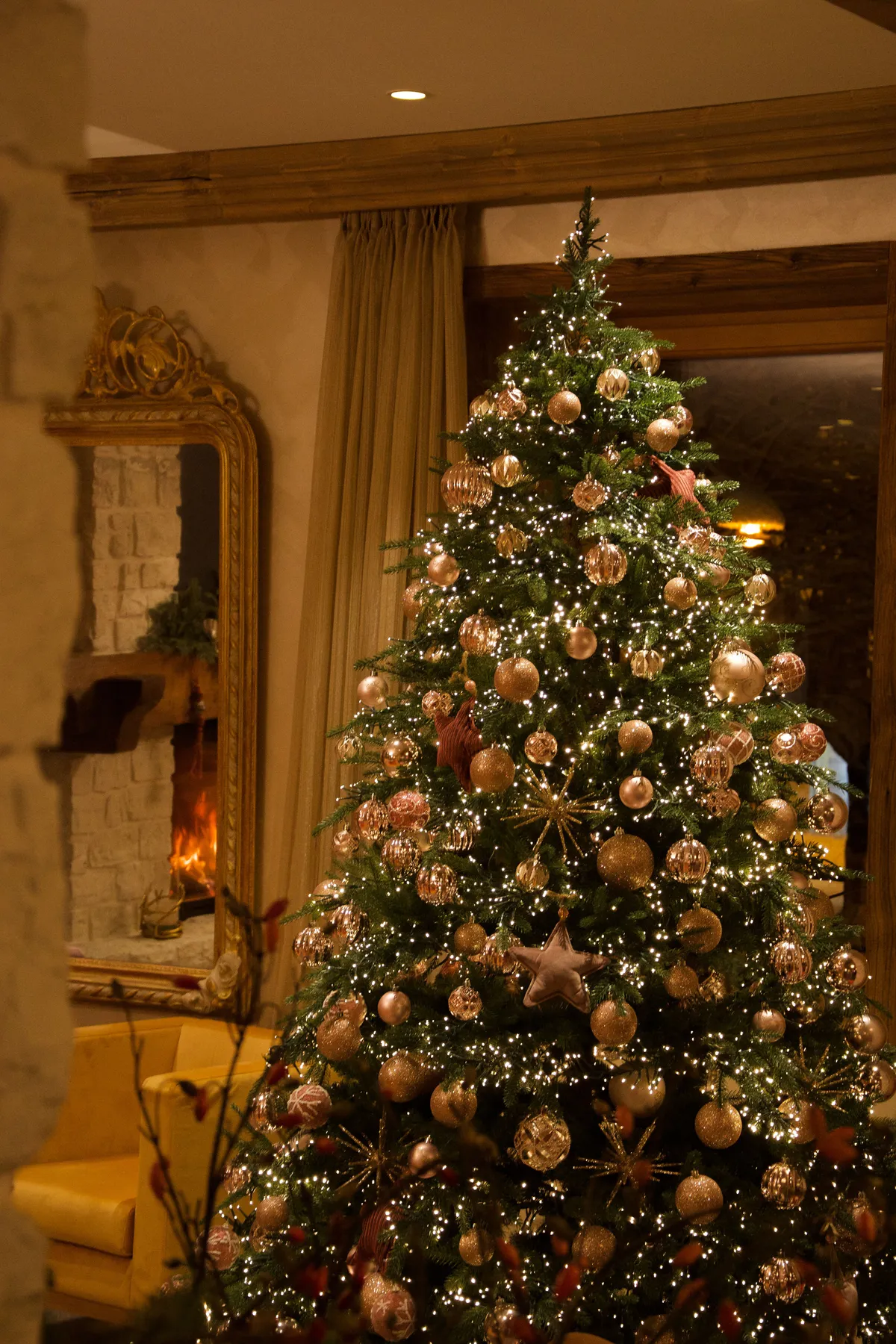
An all-gold tree fails when every ornament has the same finish — it turns into one flat sheet of shine. Aim for roughly 40% matte gold, 40% satin or brushed gold, and 20% high-shine or glitter, a split you can hit with three discount-store packs instead of one expensive set. Mix the shapes too: keep spheres to about two-thirds of the count, and use the rest on stars, finials, and teardrops. They break up the geometry and let light through instead of bouncing off a wall of balls.
15. Silver Santa Figures and Pink Felt Balls in the Branches
Placing figural ornaments so they actually get noticed:
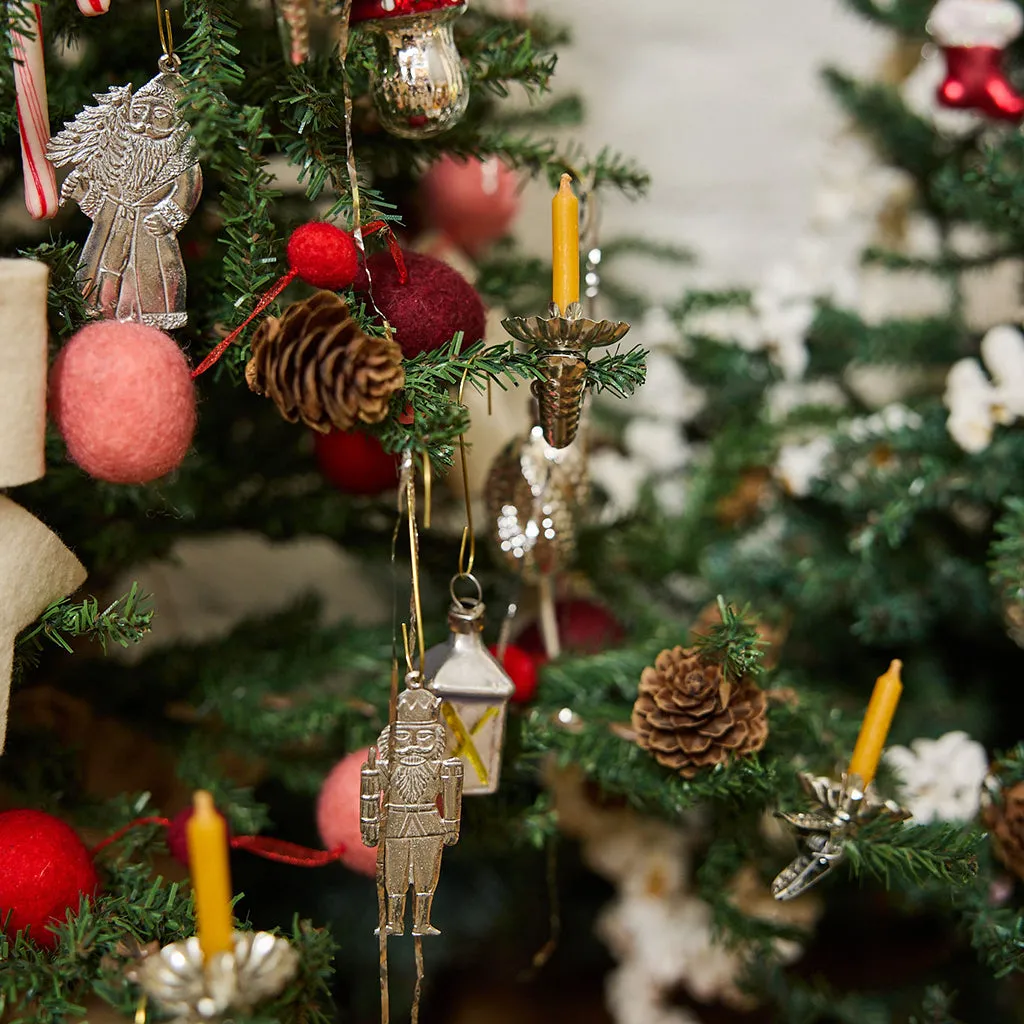
- Hang metallic Santas and nutcrackers in the outer third of the branches, between 4.5 and 6 feet off the floor.
- Face each figure slightly downward and toward the room, never straight out.
- Give every figure at least 10 inches of clear branch around it — figurines vanish in clutter.
- Fill the gaps with soft felt balls in red and pink, which add color without competing.
- Tuck pinecones and small taper holders deep in the inner branches for depth.
Time: about 25 minutes once the lights are on.
Read this tree as a ratio: about 45% silver metallic, 30% warm red and blush felt, 15% natural pinecone and wood, 10% golden candlelight. The silver keeps it crisp, the felt keeps it soft, and the naturals keep it from looking like a store display. Swap silver for pewter and pink felt for cream and you’ve got a quieter, more traditional tree from the same recipe. Push the felt up to 50% and it turns cozy and almost Scandinavian. The formula scales; the ornaments don’t have to.
16. Gold Ornaments Floating Over a Cream Boucle Sofa
The floating ornaments are the splurge, and they’re cheaper than they look.
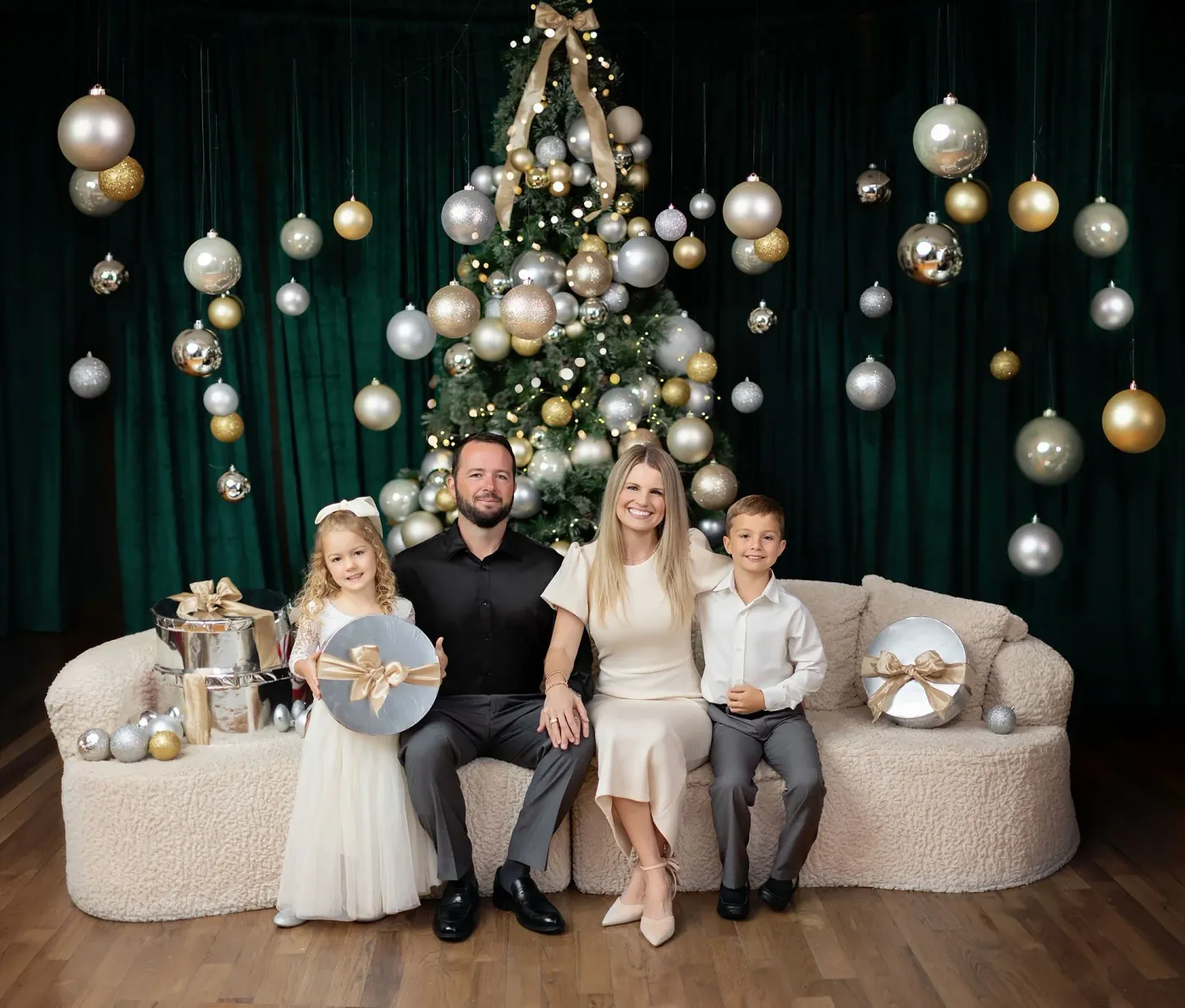
- Dark green velvet curtains, 96-inch pair: $150–$500
- Oversized gold and silver shatterproof ornaments, 12 count: $40–$120
- Ceiling hooks and clear fishing line: $15–$25
- 7.5-foot tree with lights and standard ornaments: $350–$800
- Silver gift boxes with gold ribbon: $20–$50
Total: $575–$1,495
Budget alternative: skip the velvet panels for a dark green IKEA curtain at about $40 a pair, then hang nine ornaments instead of twenty. The floating effect reads just as well at nine.
Floating ornaments need vertical real estate. You want a 9-foot ceiling minimum, with the lowest hanging ornament no less than 6 feet 2 inches off the floor so nobody walks into it. Hang them in a band between the tree’s midpoint and the curtain rod, staggered 6 to 10 inches apart, keeping the whole cluster within 3 feet of the tree so it reads as one composition. With an 8-foot ceiling, cut the count in half and hang them tighter.
17. Plaid Ribbon and Cowboy Boot Ornaments on a Fur-Trimmed Skirt
Themed trees tip into costume fast. The fix is proportion: let the theme occupy about 20% of the branches and let the rest be classic filler. On a 7.5-foot tree that’s roughly 20 themed pieces against 80 red baubles, plaid ribbon, and berries. Spread the Western pieces out — boots on opposite sides, hats above and below the midline — so the eye discovers them rather than getting hit by a wall of cowboys. If kids are helping, let them place their own. A slightly lopsided themed tree beats a perfectly merchandised one. Compare with Idea #22 — same red-and-navy palette, much calmer execution.
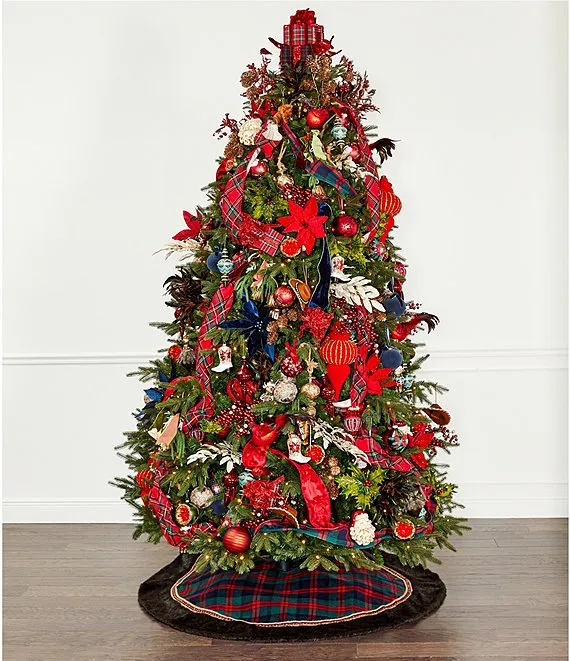
The stacked plaid gift boxes on top, standing in for a star, are the whole idea. A traditional topper would have made this a plaid tree; the gift stack makes it a story. It also solves a real problem — on a tree this busy, a star gets visually eaten by ribbon and berries, while a topper with volume and pattern holds its own. Use three lightweight boxes, wire them together through the backs, and anchor the bottom box to the top branch with a zip tie so it doesn’t lean.
18. Deep Red Walls, Brown Leather Chairs, and a Lit Stone Fireplace
Deep red walls sound like a dare until you see them with a lit tree. What makes it work is that the walls and the tree agree — green reads as a natural counterweight to red instead of fighting it, and firelight warms both. Brown leather armchairs do something a neutral sofa couldn’t: they add a third earthy tone that keeps the room from becoming a two-color poster. If you’re painting, go one shade deeper than you think. Red reads lighter on a wall than on a swatch, every single time.
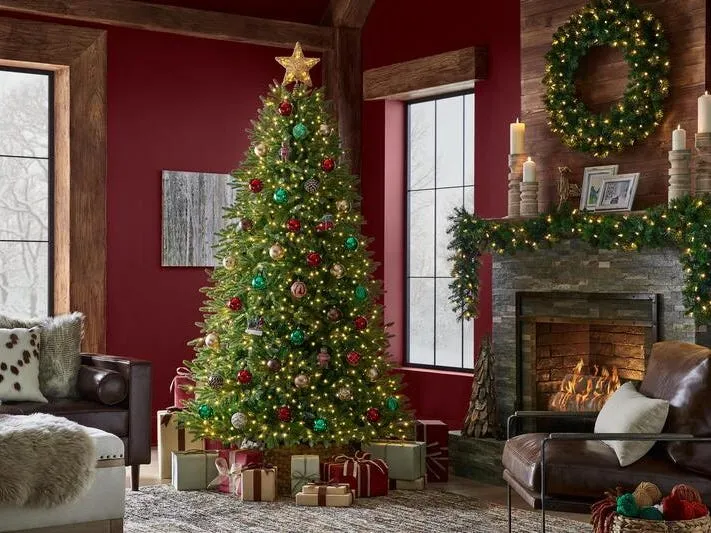
Deep red paint is the cheapest move in this entire article — a gallon of quality interior paint runs $35–$70 and covers one wall of a 12×14 room. Leather-look club chairs turn up on Facebook Marketplace for $80–$200 each, and vintage brown leather holds up better than new bonded stuff. A pre-lit tree from Walmart in the 7-foot range is $120–$200, and last year’s red and gold ornaments go for a dollar apiece at after-Christmas sales. This whole holiday look, minus the painting, lands under $500.
19. White Ceramic Cones and Marble Nutcrackers on a Holiday Table
On a dining table, decoration height is a social rule, not an aesthetic one. Keep anything between seated guests’ eyelines under 12 inches tall — the cones here stay in the 6- to 10-inch range for exactly that reason. Vary the heights in a strict rhythm, roughly 6, 8, and 10 inches, and group them in threes rather than spacing them evenly, since even spacing reads as a store shelf. White flowers go behind or between the cones at the same low height.
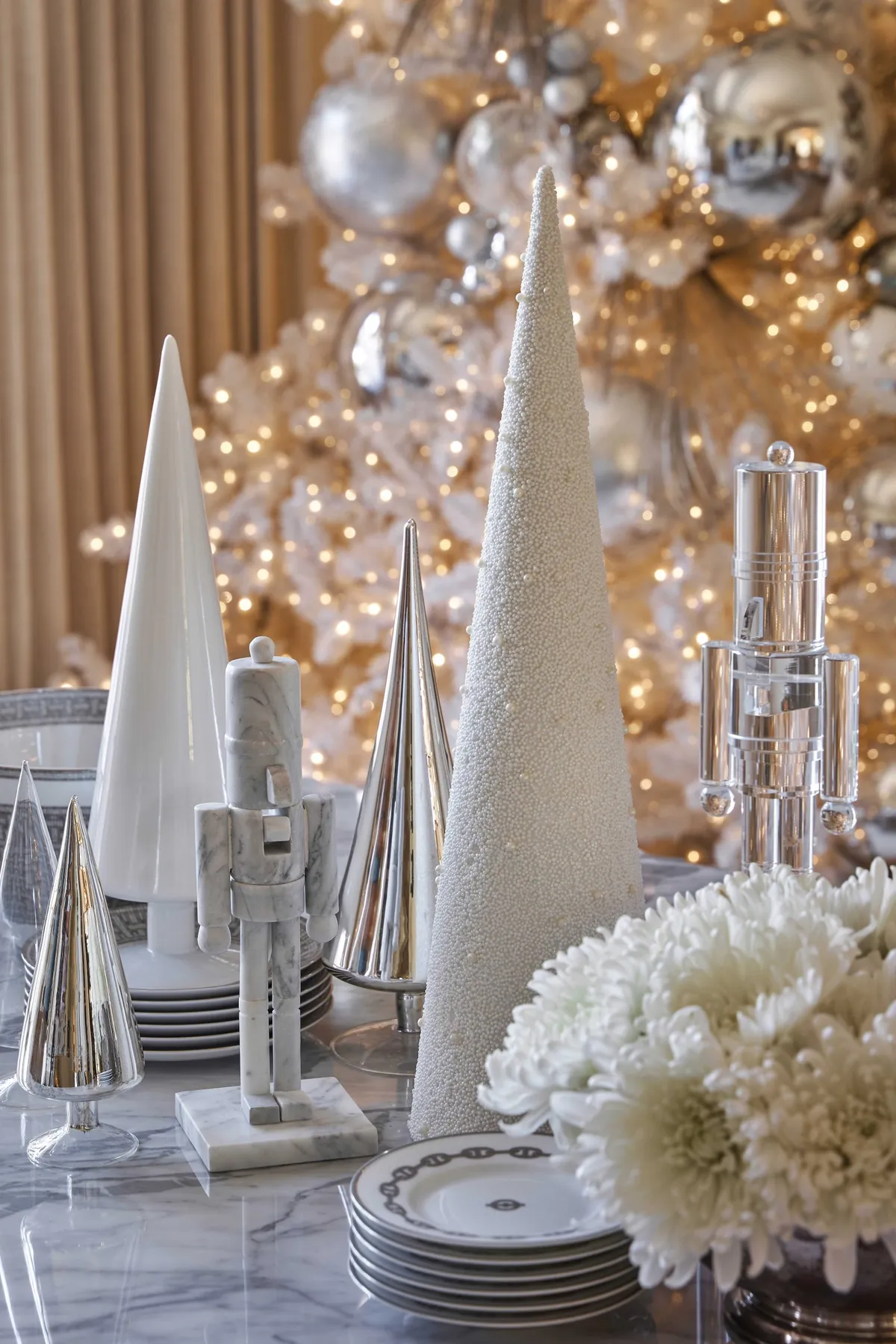
This tablescape needs a table at least 40 inches wide, because the cone groupings, plates, and flowers each want their own zone. A 72-inch rectangular table or a 60-inch round seats six comfortably; anything narrower and the cones crowd the water glasses. The room itself is flexible — marble and a pale palette actually make a small dining room feel bigger. Under 10 by 10, use three cones instead of seven and swap the tall chrysanthemums for low white roses.
20. Grand Foyer Tree Above a Blue-Runner Staircase
Remove the dark blue stair runner and this foyer becomes a very pretty, very forgettable red-and-gold Christmas scene. That blue — cool, slightly formal, running up the center of the staircase — is the only element that isn’t in the holiday palette, and it’s what makes the space feel like a real house instead of a display. The lesson generalizes: in heavily themed spaces, one confident non-holiday color keeps things from going costume. If blue isn’t your thing, a deep green or charcoal runner does the same job.
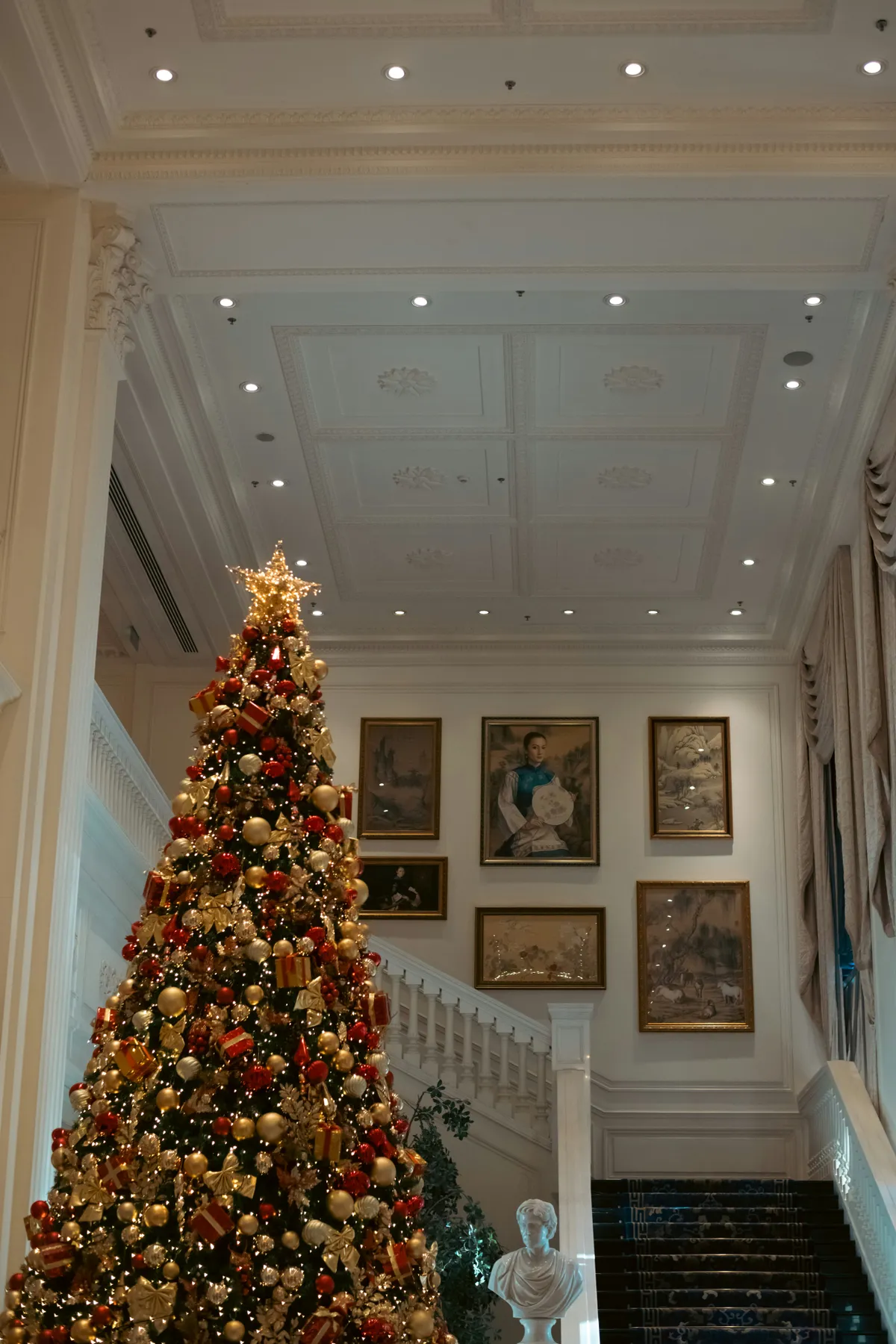
Foyers are unforgiving, so measure twice:
- Ceiling height minus 12 inches gives you your maximum tree height; leave room for the topper.
- Walk the path from the front door to the stairs — you need 36 inches of clear width around the tree base.
- Find the outlet before you buy the tree, or plan on a flat extension cord along the baseboard.
- If the tree sits near stairs, weight the base with a 20-pound sandbag or it will wobble.
21. Red, Gold, and Silver Baubles with Frosted Pinecones
The most budget-friendly tree in this whole article, because it’s about density, not designer pieces.

- 7-foot pre-lit tree: $180–$500
- Red, gold, and silver ball ornament set, 100 count: $60–$180
- Frosted pinecone picks, 12 count: $15–$40
- Red berry clusters, 10 stems: $20–$50
- Extra warm white light strand: $15–$30
Total: $290–$800
Budget alternative: hit Walmart or Target the week after Thanksgiving and buy two mixed ornament sets in the same color family — 200 ornaments for under $80. Density is what sells this tree anyway.
Three metals on one tree only works if the ratio stays uneven. Split red, gold, and silver evenly and you get a tree with no point of view — think of this as the low-stakes version of Idea #8. Aim for something like 3 red to 2 gold to 1 silver, and keep the silver in the interior branches so it reads as sparkle rather than competition. Also check ornaments under your actual room lighting before hanging: silver looks flat gray under warm bulbs, and gold turns brassy under cool white LEDs.
22. Red Velvet Bows, Navy Jingle Bells, and Teddy Bear Ornaments
Break this tree down and it’s about 50% deep red, 30% navy, 15% green, 5% gold. The navy is what separates it from a standard red-and-green tree — close enough in value to red that it reads as shadow from across the room, which adds depth without adding noise. To soften the same formula, trade navy for forest green. To push it further, switch to black watch plaid ribbon and let the gold do all the warming. Either way, keep ribbon widths consistent: one wide, one narrow, never two of the same.
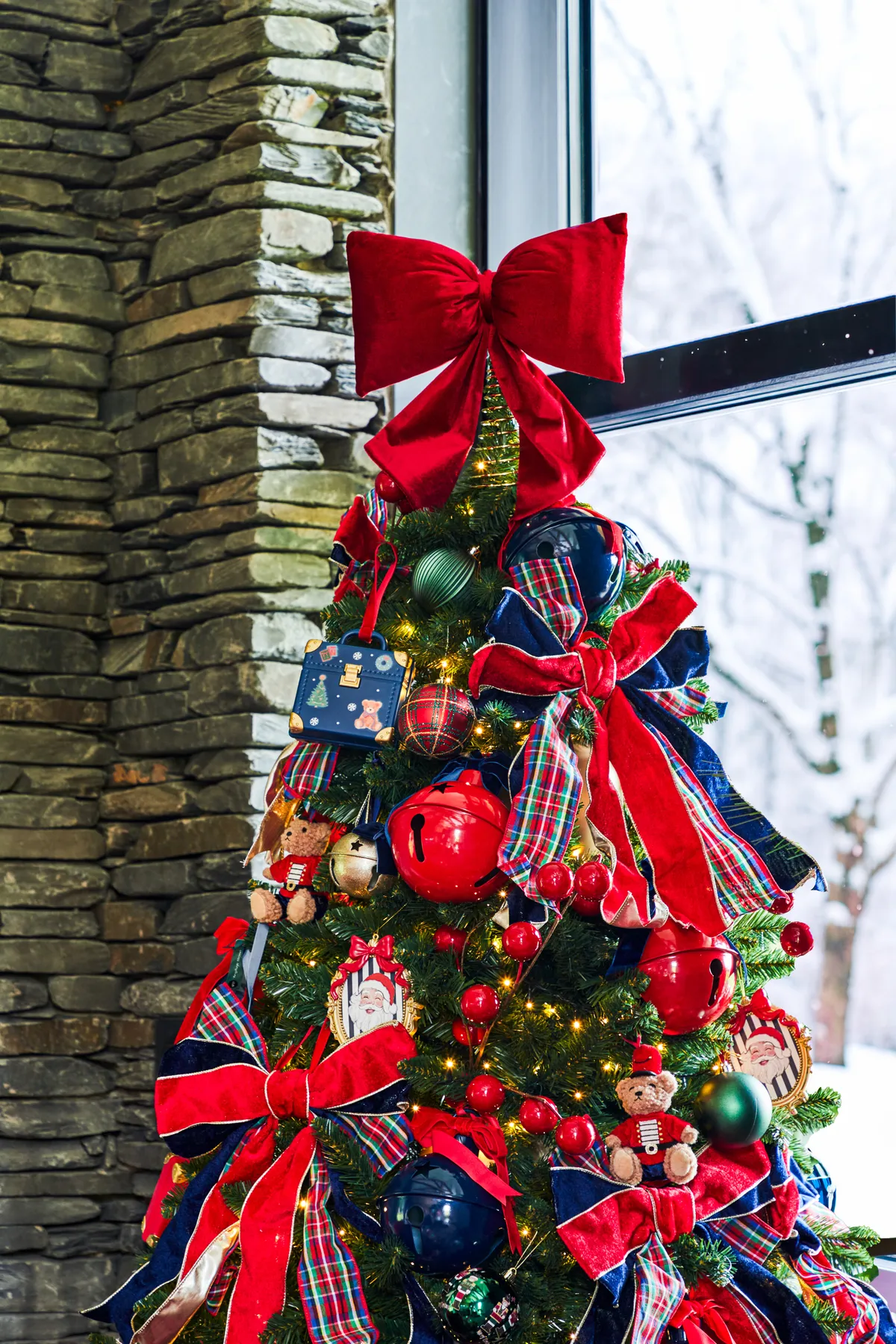
Fabric ornaments — teddy bears, velvet bows, plaid ribbon — are dust magnets, and dust is what makes a well-loved tree look tired by mid-December. Run a vacuum brush attachment gently over the bears and bows once a week, or hit them with a hair dryer on cool from 12 inches away. Store fabric ornaments in breathable cotton bags rather than plastic bins; trapped moisture from a damp basement will spot velvet permanently. Ribbon should be unspooled and rolled, never folded.
23. Gold Tree by Floor-to-Ceiling Windows in a High-Rise
A high-rise living room with floor-to-ceiling glass is a specific puzzle. A 7- to 8-foot tree works in a 450- to 600-square-foot open living space, placed beside the window rather than in front of it so the city view stays intact. Keep the tree 24 inches back from the glass — condensation and sun fade both hit harder up high. With 10-foot ceilings, anything under 7 feet looks undersized against a wall of windows, so in a smaller space go with a 6-foot tree on a 12-inch riser instead of a tall one squeezed into a corner.
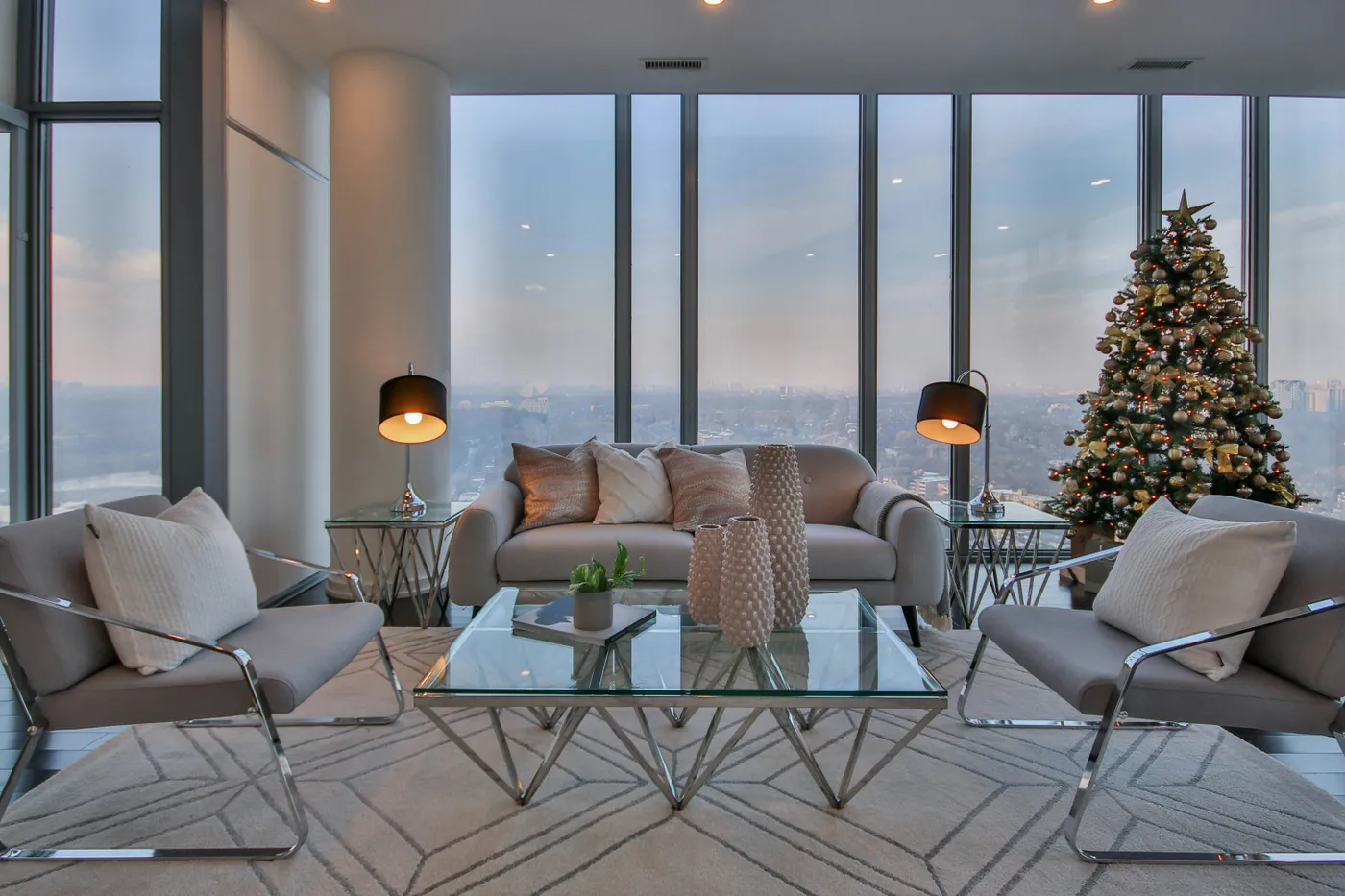
Chrome-and-glass city style is very reproducible on a budget. IKEA’s glass-topped coffee tables run $90–$180, and a light gray two-seat sofa in performance fabric is $400–$700 at IKEA or Wayfair. Gold ornaments in bulk are cheapest at Michaels with a 40% coupon — about $30 for 60 pieces — and a geometric flatweave rug in 5×8 is around $80 at Target. In a small apartment, a 4-foot tabletop tree on a console by the window gives you 80% of this look for about $90.
24. Jewel-Tone Baubles Mixed with Faux Eucalyptus and Pinecones
Jewel tones on Christmas trees are the direct result of two years of maximalist color coming back into interiors — deep blues, magenta, and purple have been moving onto walls and sofas since 2024, and ornaments had to catch up. What makes this tree different from the saturated color of a decade ago is the greenery: eucalyptus sprigs and pinecones act as a neutralizer, so the color reads rich rather than candy-bright. It has real staying power because it isn’t a theme. It’s just color, and color doesn’t date the way novelty ornaments do.
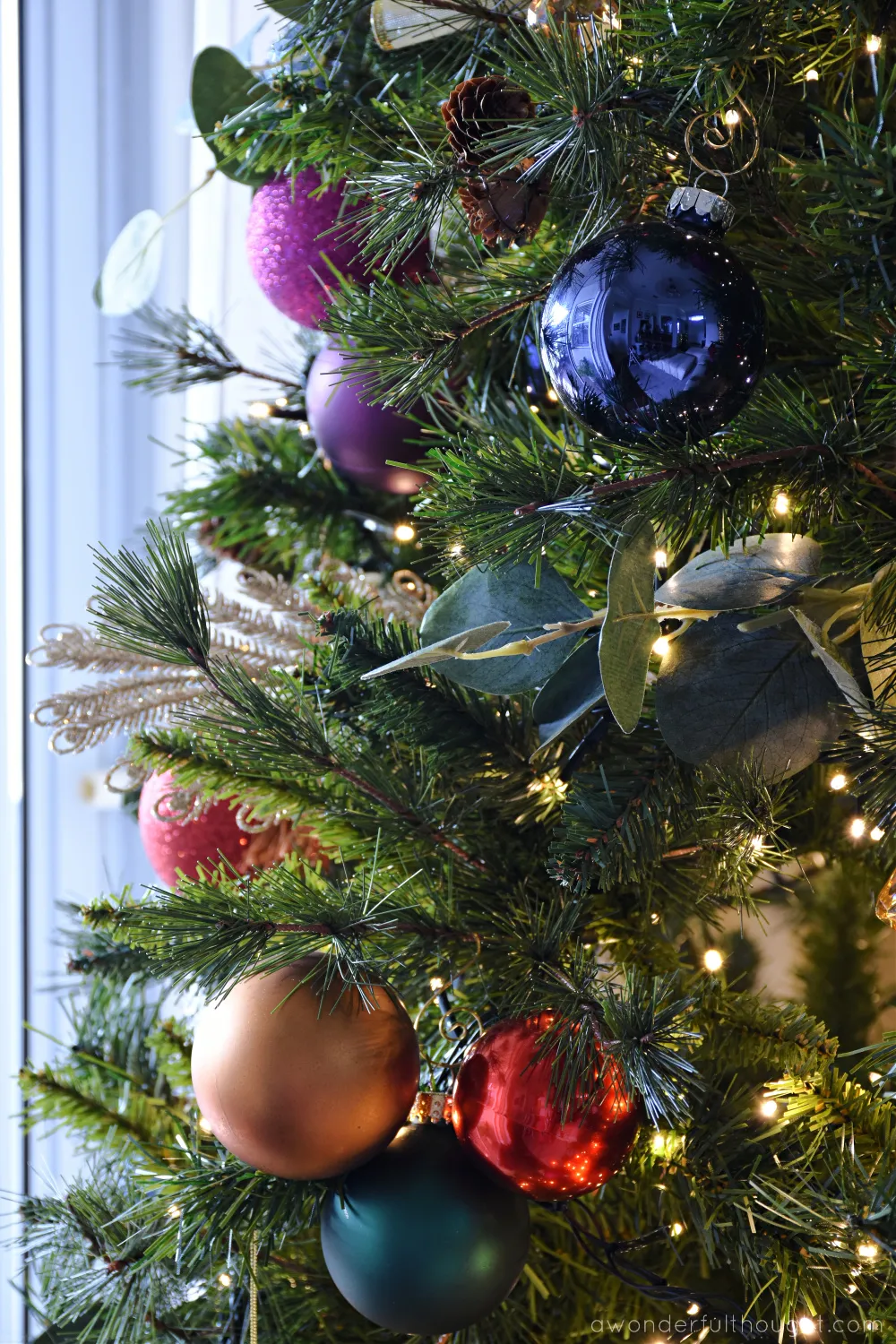
Add greenery picks before ornaments. It feels backwards, but it’s the difference between depth and clutter. Cut or buy eucalyptus sprigs at 6 to 8 inches, tuck them into the middle layer of branches pointing slightly outward, and use 10 to 15 stems on a 7-foot tree. Then hang ornaments so they nestle in front of the greenery rather than hiding it. Pinecones go deepest, near the trunk, where texture catches light between branches. If your tree is pre-lit, do this with the lights off so you can see where the glow lands.
25. Flocked Tree on a Round Rug Against a Deep Blue Wall
Taming a shedding flocked tree: Flocking sheds — there’s no way around it — but you can slow it down dramatically.
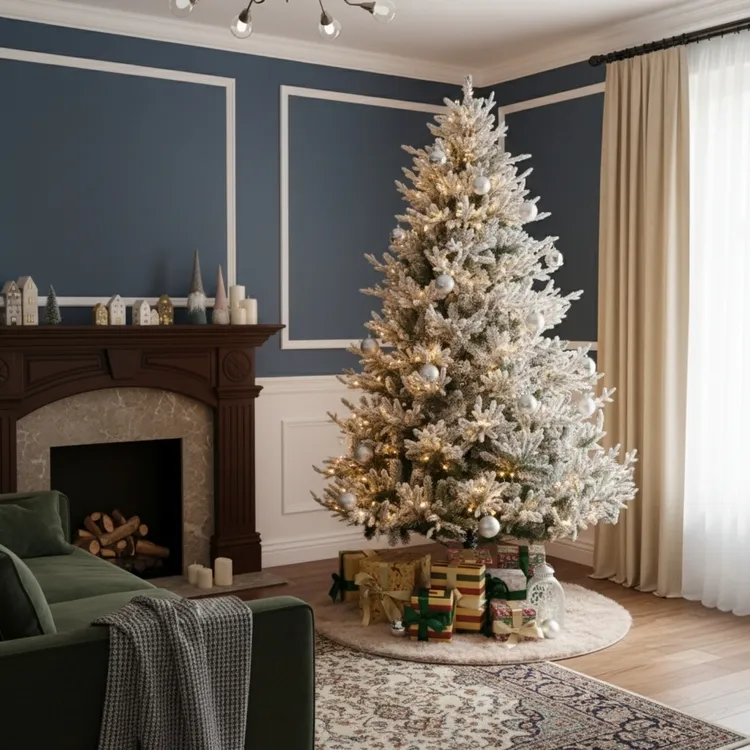
- Unbox it outside or over a sheet you can carry straight to the laundry.
- Mist the flocking very lightly with plain water and let it dry — this sets loose fibers.
- Finish with a light dusting of matte craft sealer from 12 inches away, in a ventilated room.
- Fluff branches gently from underneath, never downward.
- Place a smooth cotton sheet under the skirt area, not a shaggy rug.
Time: about 20 minutes. Cost: around $10.
The deep blue paneled wall is doing something clever. A white flocked tree on a white wall disappears; on blue, every branch silhouette reads. The green velvet sofa then acts as a warm mid-tone between the cool wall and the warm tree lights, which is why the room feels collected rather than color-blocked. The round light rug under the tree separates it from the dark wood floor, giving the tree its own footprint. Compare with Idea #9 — both formal, opposite temperatures.
26. Glowing Wooden Gift Boxes on a Burlap Tree Skirt
Light-up gift boxes are lovely and slightly annoying. With corded lights you’ll have a small tangle running across your tree skirt, and someone will unplug the wrong one. Battery LED puck lights or short fairy strands solve it — a 6-pack with a built-in 6-hour timer runs about $15 and lasts the season on one set of batteries. Keep the boxes at least 18 inches from any heat source, and never set them against a power strip hidden under the burlap.
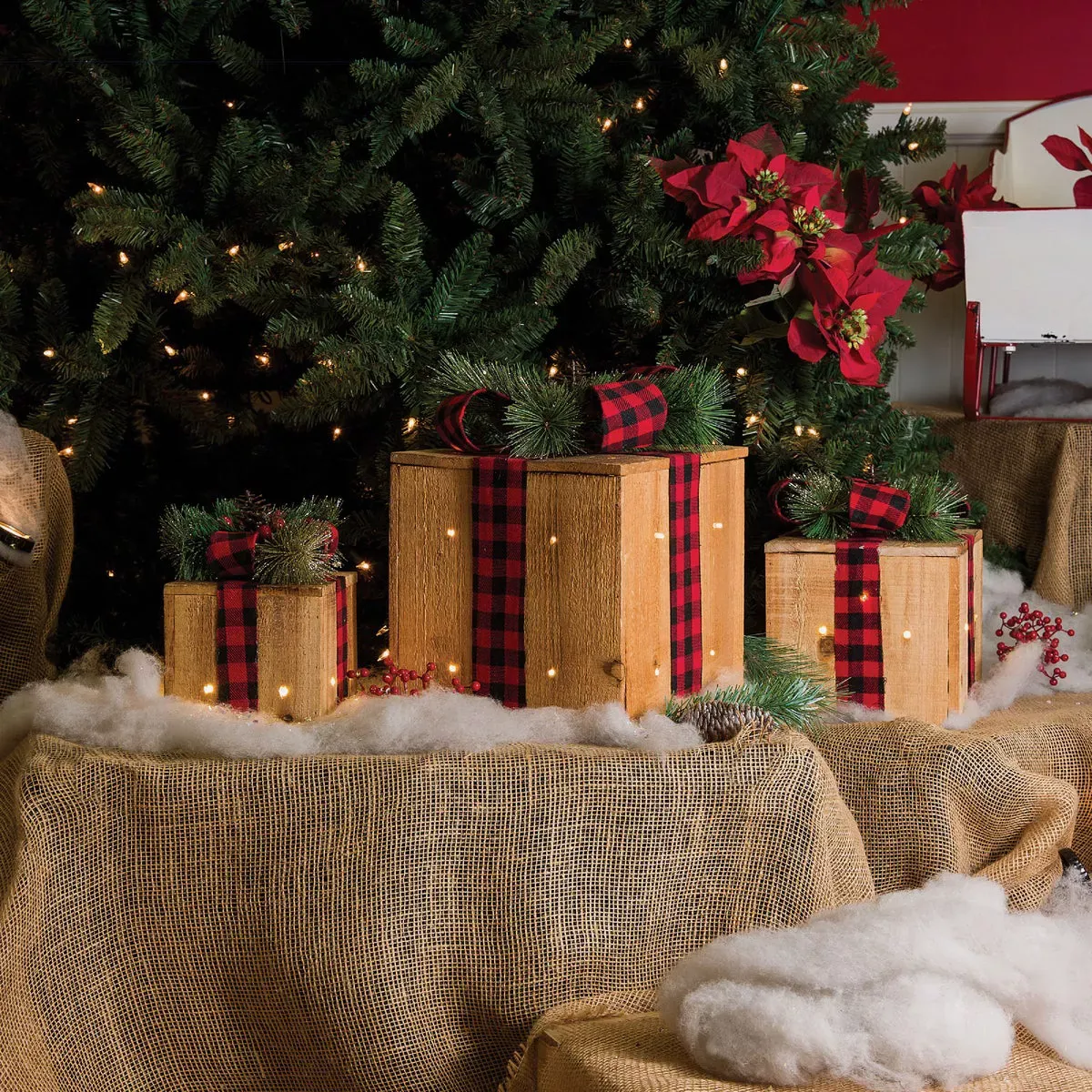
Unfinished wooden boxes in the 6- to 9-inch range run $5–$10 each at Michaels or Joann, and a can of light stain covers all three for $8. Drill a 1-inch hole in the back for the light strand, then line the inside with parchment paper to diffuse the glow. Buffalo plaid ribbon is $4 a roll at Walmart, dollar-store fairy lights are $1.25 each and work fine, and burlap by the yard is about $3. Total project: under $50 for the whole base vignette.
27. Berry Clusters, Green Velvet Bows, and a Gold Sequin Heart
Statement ornaments need negative space to work. A gold sequin heart this size only reads as a focal point if there’s nothing of comparable visual weight within about 18 inches of it. Same rule for the velvet bows — space the large pieces 15 to 18 inches apart on a 7-foot tree and let smaller berries and gold branches fill the gaps. The mistake almost everyone makes is clustering the best ornaments together, which turns three focal points into one crowded patch and leaves the rest of the tree looking thin.
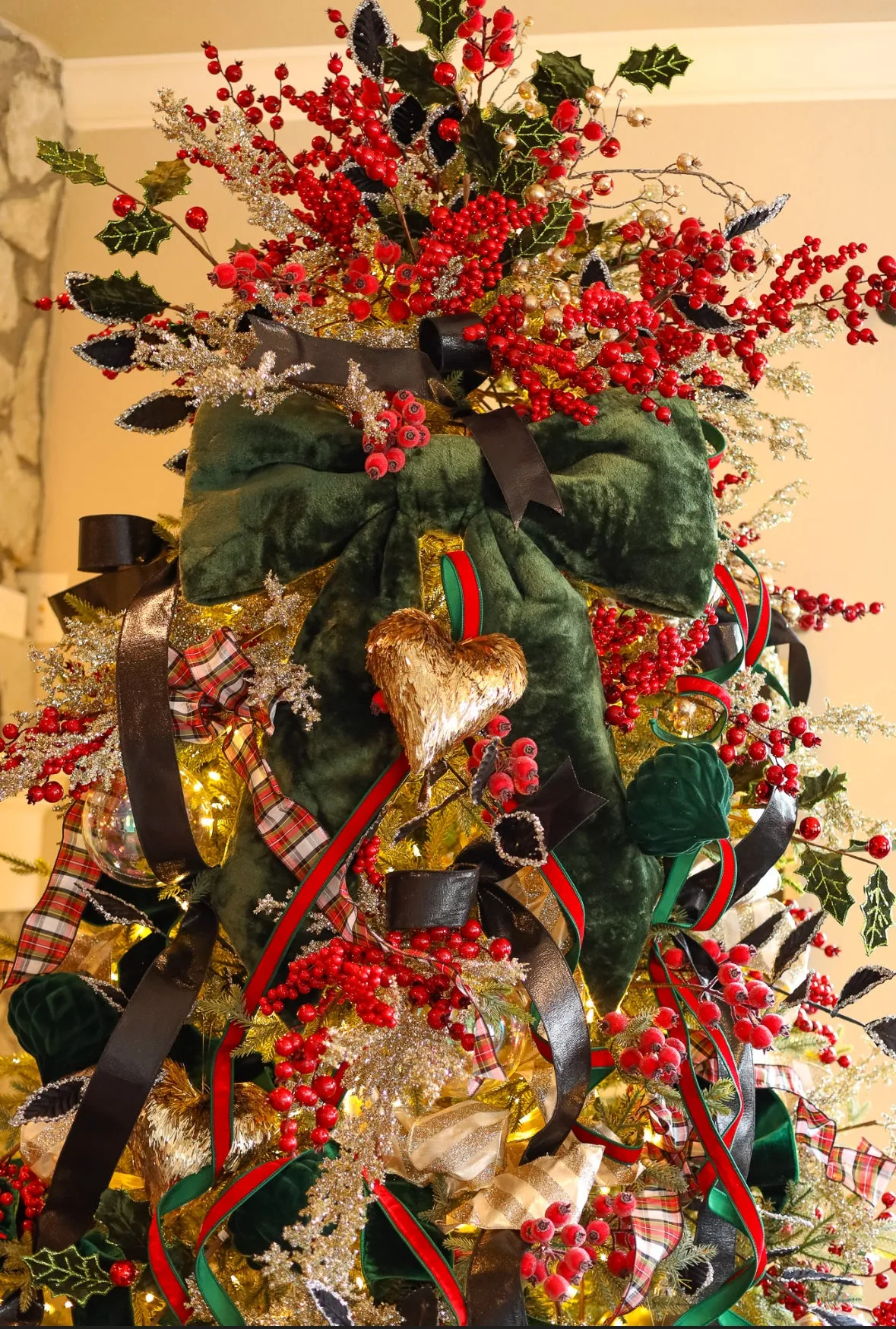
It’s the gold sequin heart, and it isn’t close. Everything else on this tree — berry clusters, velvet bows, plaid and striped ribbons — is texture. The heart is the only element with a defined shape, and that shape pulls focus from six feet away. Take it off and the tree reads as an opulent red-and-green mass with no place for your eye to land. If you’re building this look, buy the focal ornament first and design everything else around it.
28. Fox Hunt Tree with Riding Boots and a Brass Hunting Horn
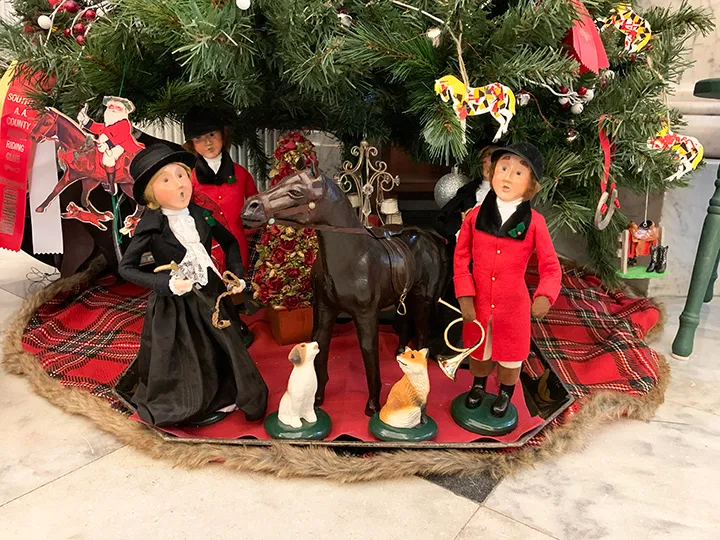
The base vignette is what turns a decorated tree into a scene. Boots, a brass hunting horn, figurines, a dog — placed together on a plaid skirt, they read as a moment rather than a display, and your eye completes the story on its own. It’s the same instinct behind Ralph Lauren’s whole approach: heritage objects arranged with confidence instead of decor bought to match. The practical version: pick a theme you actually have objects for — riding, sailing, camping, baking — and use four to six real pieces instead of twenty decorative ones.
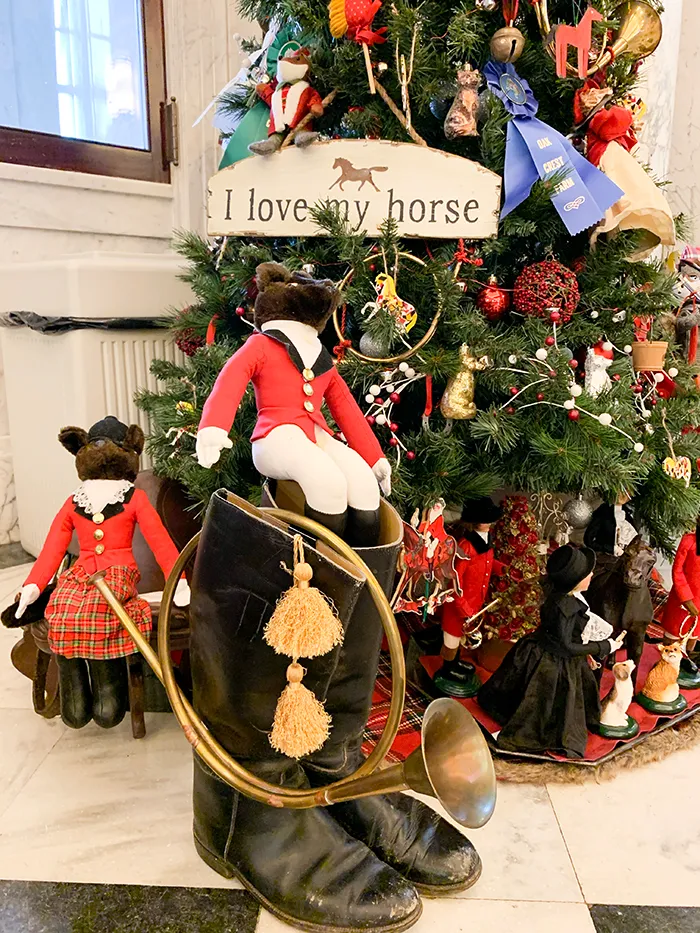
Building a tree-base vignette in about 20 minutes:
- Choose one hero object — here, the riding boots — and place it slightly off-center.
- Add a second object of contrasting height, like the hunting horn propped on a small stand.
- Fill the gap between them with three or four small figurines at different depths.
- Layer a textile underneath — plaid, burlap, or a folded wool throw — so nothing sits directly on the floor.
- Step back 10 feet and remove anything you can’t identify from there.
29. Award Ribbons and an Antique Clock on a Dark Wood Nightstand
The formula here is roughly 40% ribbon, 30% warm white light, 20% greenery, 10% antique accessory. The ribbons carry equal weight in blue, red, yellow, and cream — an even split, which is unusual but works because ribbons are low-contrast flat shapes and never fight each other the way ornaments do. Break the recipe by keeping the ribbons but cutting them to 25%, then adding navy and gold baubles to fill the space. Same nostalgic feeling, much less visual noise.
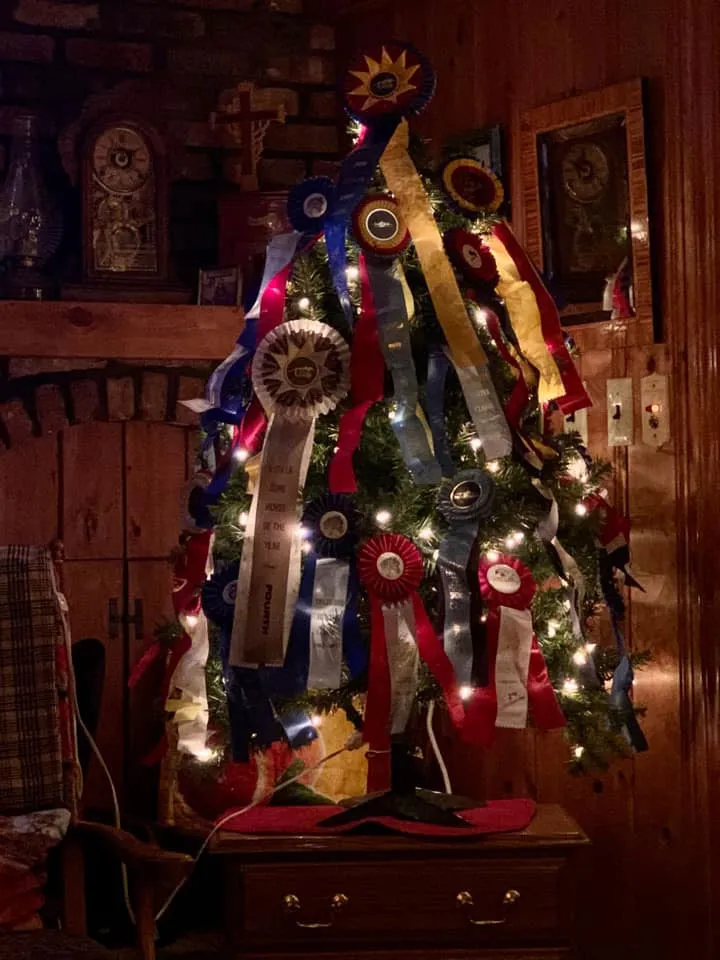
This is the smallest footprint in the article, and a good model for tight rooms. A 5- to 6-foot tree on a nightstand or low chest works in spaces of 100 square feet or more, as long as you keep a 30-inch clear radius around it. The nightstand base is genuinely clever: it lifts the tree above the sightline of furniture and gives ornaments a place to be seen. In a studio, a 4-foot tree on a 24-inch chest delivers the same effect. For larger rooms, see the ceiling-height requirements in Idea #20.
Start With the Ribbon, End With the Story
Every one of these trees comes down to the same three decisions: one dominant color, one texture repeated in two places, and one object that actually means something to your family. Get those right and the rest is just shopping. If you only try one thing this year, make it the plaid ribbon — it’s the cheapest way to change how an entire room feels. 📌 Pin your favorite idea so you can find it again when the boxes come out.