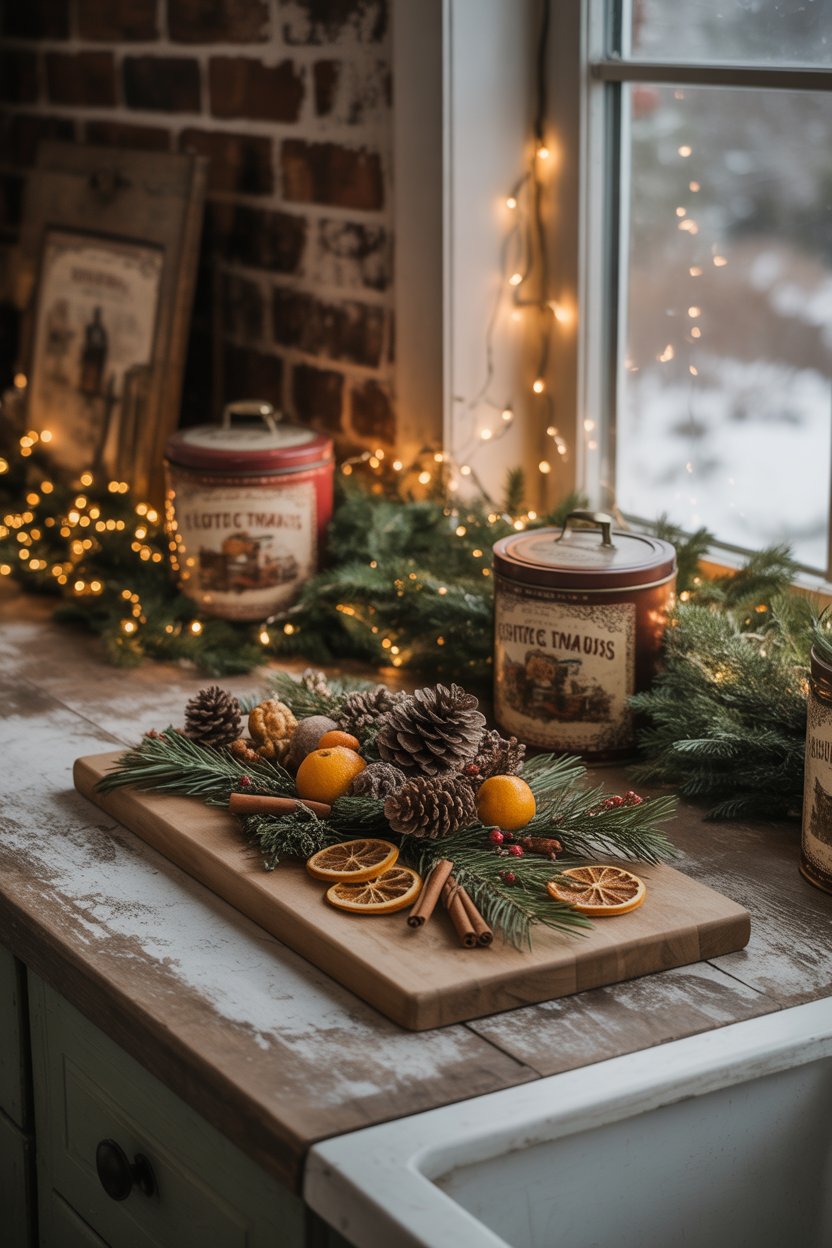
28 Jaw-Dropping Christmas Front Porch Ideas You Need to Try in 2026 to Elevate Your Holiday Decor

You know the feeling: it’s the second week of November, you’ve saved forty porch photos, and you still can’t decide whether you’re a red-bow traditionalist or a rustic cabin person. That’s not indecision — that’s a porch with range, and this guide is built for it.
We spent serious time digging through Home Depot, Target, Lowe’s, Amazon, and Facebook Marketplace to bring you only what’s worth your attention this year, from $18 wooden deer cutouts to $1,200 custom garland runs. Inside: 28 curated ideas spanning traditional white-clapboard, rustic farmhouse, cabin-lodge, and the soft pastel palette quietly taking over Pinterest — with budget and luxury versions compared side by side and every idea shoppable with direct product links.
The trend driving 2026 is layered naturalism: real branches, copper, birch logs, and dried florals instead of plastic shine. And stay until the end — we break down the most common mistakes that can ruin these looks.
📌 Save this to Pinterest for later — you’ll want to revisit these ideas.
1. White Clapboard Porch With White Poinsettias and Red Bows
Here’s the measurement that separates a decorated porch from a designed one: your urn diameter should land at roughly one-third of your door width. On a standard 36-inch door, that means a 12-inch urn — which sounds small until you see it in place. And if you’re set on white poinsettias, buy faux. Real ones sulk the moment the temperature drops below 50°F and turn an unflattering gray-beige overnight.
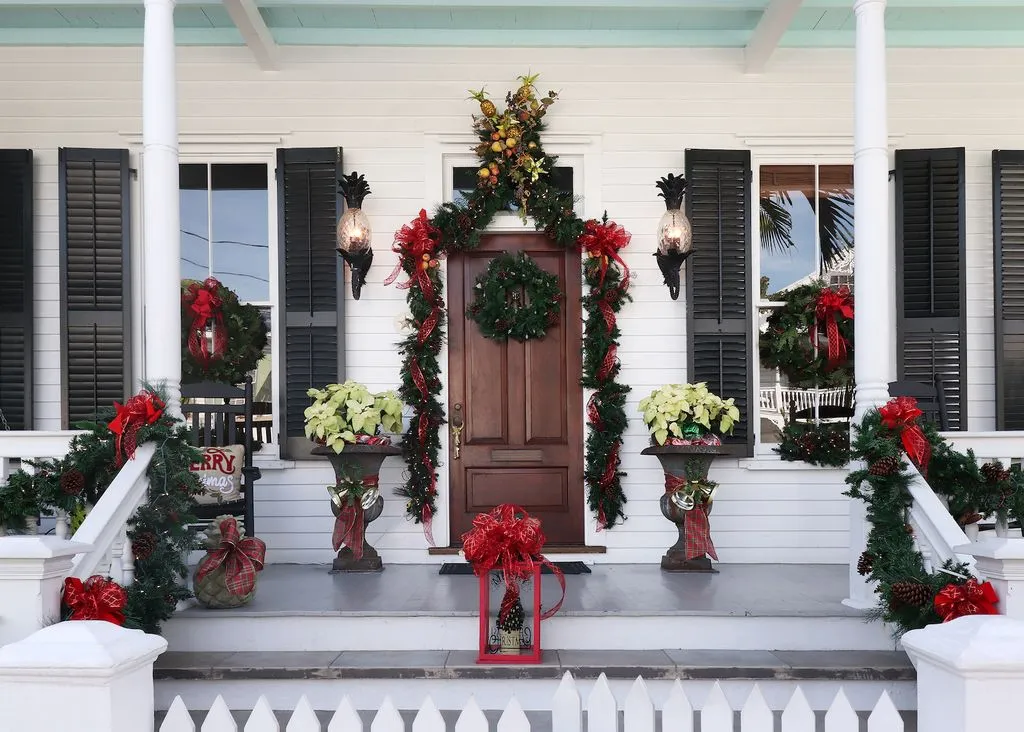
The single thing holding this porch together is white poinsettias instead of red. The palette is already loud — red ribbons, red bows, a red lantern on the steps — and red flowers in those urns would have flattened the whole scene into one red blur. White gives your eye a place to land and quietly pushes the deep green garland forward. Take the white away and this becomes a very nice, very forgettable porch.
2. A Grey Door Framed in Gold Bells and Dried Orange Slices
- Lush garland and matching wreath with gold bells and dried orange slices: $90–$320
- Two pre-lit mini trees in wicker baskets: $70–$220
- Glass lanterns with LED candles: $30–$90
- Black circular wall planters with pine branches: $40–$130
- Patterned coir doormat: $25–$60
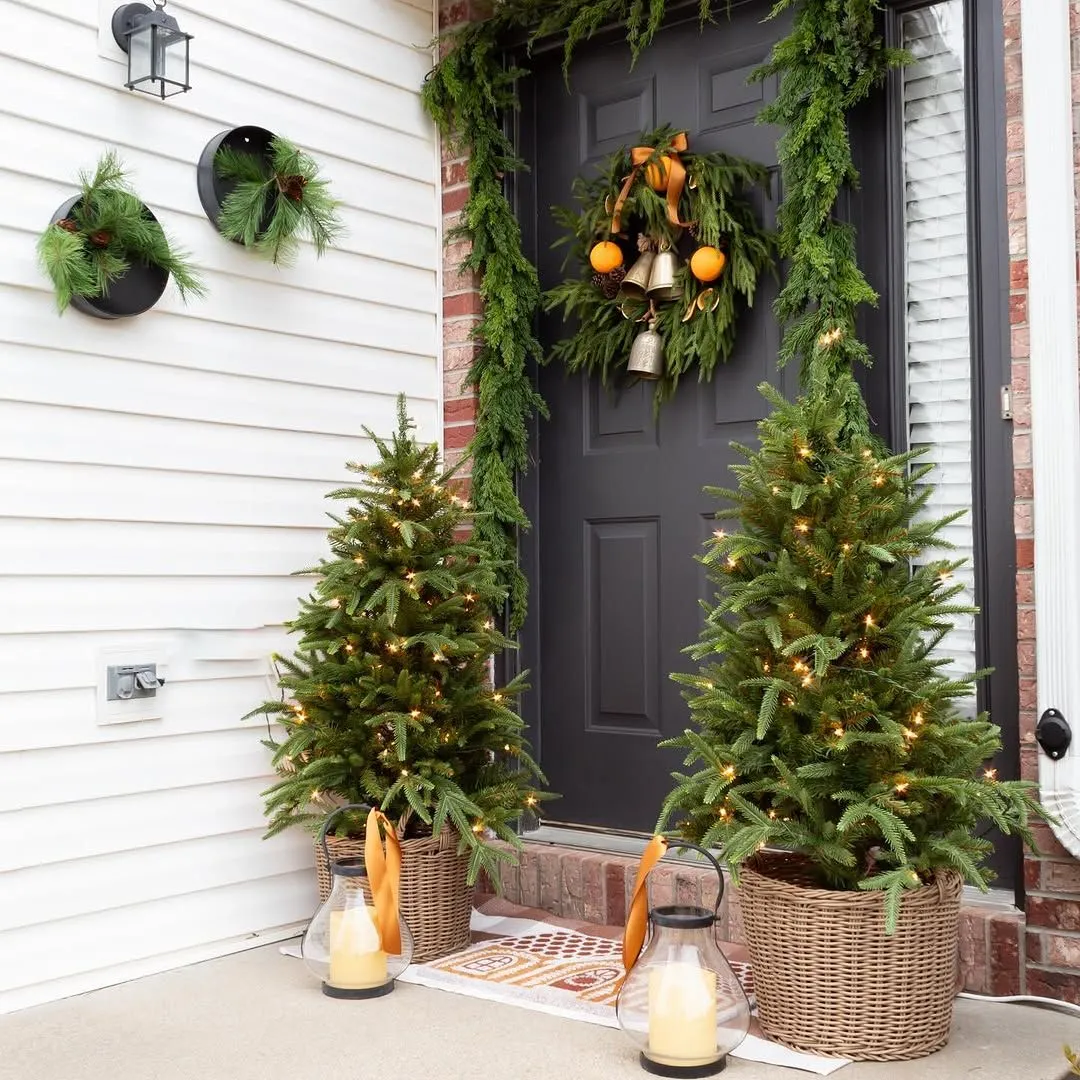
Total: $255–$820
Budget alternative: skip the wicker baskets entirely and grab two $12 galvanized buckets from a hardware store — the mini trees look just as good and you save $50–$150.
on dried orange slices: they look spectacular in photos and slightly exhausted by January 2. Citrus fades, gold bells dull, and ribbon fades fastest of all, so plan on refreshing the wreath accents every other season. One more thing — those black circular wall planters need real blocking behind vinyl or aluminum siding, because siding alone will not hold a loaded planter through a windy December.
3. A Hand-Bent Copper Pipe Garland on a Snowy Rail
What makes this work is temperature contrast, and I mean that literally. Warm copper against cold snow, glossy metal against matte evergreen, hand-bent irregularity against the straight lines of a dark-stained railing. The cream ceramic pot and the scattered pinecones keep it from reading as a craft project that got out of hand. It’s asymmetry done on purpose: one long horizontal gesture, then small quiet objects placed around it.
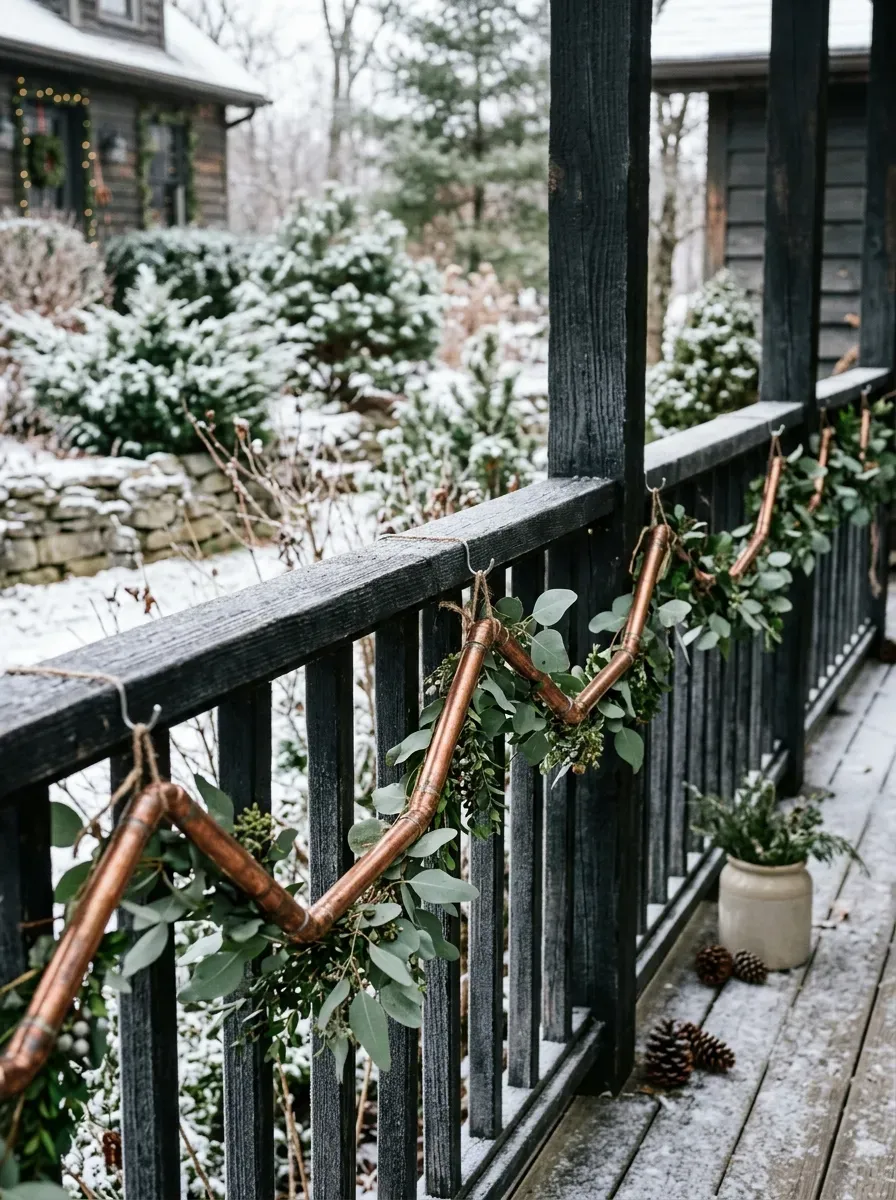
You can build this for under $40. A half-inch copper pipe, two elbows, and a length of twine from any hardware store gets you the whole shape, and the greenery is whatever your yard or a $15 grocery-store bundle offers. If you’d rather buy than bend, the dried-floral urns in Idea #9 deliver that same collected, un-mall feeling with zero time at a workbench. Facebook Marketplace is also full of cheap copper remnants every November.
4. Three Pinecone Trees and a Distressed White Rocker
The piece that makes this vignette is the trio of pinecone trees at three different heights. Remove the shortest one and the grouping instantly looks like leftover inventory from a store display. The staggered heights pull your eye up and across, and the red bead garland running between them ties three objects into one composition instead of three things sitting near each other.
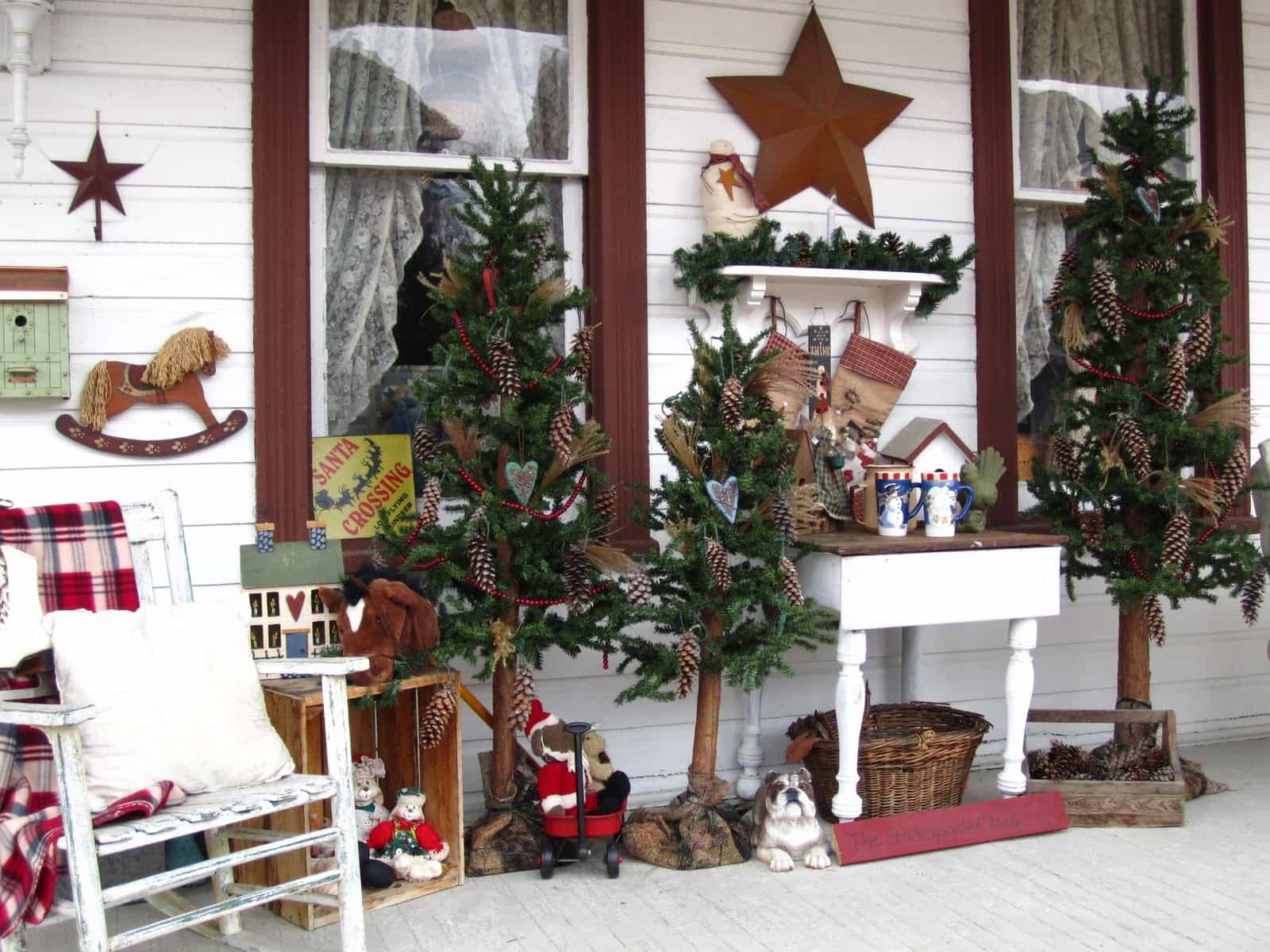
- Start with three artificial trees — 12, 18, and 24 inches — and rough them up by bending branches outward.
- Wrap each trunk in red bead garland, tucking the ends inside the branches.
- Hot-glue pinecones in clusters of three, never evenly spaced.
- Drape a plaid blanket over the rocker’s arm so it puddles instead of hangs.
- Step back ten feet and adjust anything that reads as perfectly symmetrical.
Time: about 45 minutes. Materials: $50–$90 if you already own the trees.
5. A Window Box of Boughs, Bells, and Dried Hydrangeas
Here’s the formula this window box is running: 70% evergreen volume, 20% red accents (berries, metal bells, deep red leaves), and 10% texture surprise — the dried hydrangeas and sedum that keep it from looking like every other box on the block. To swap the mood, keep the 70% greenery and change the 20%. Copper magnolia leaves and brass bells make it warmer; white birch and silver ribbon make it frostier.
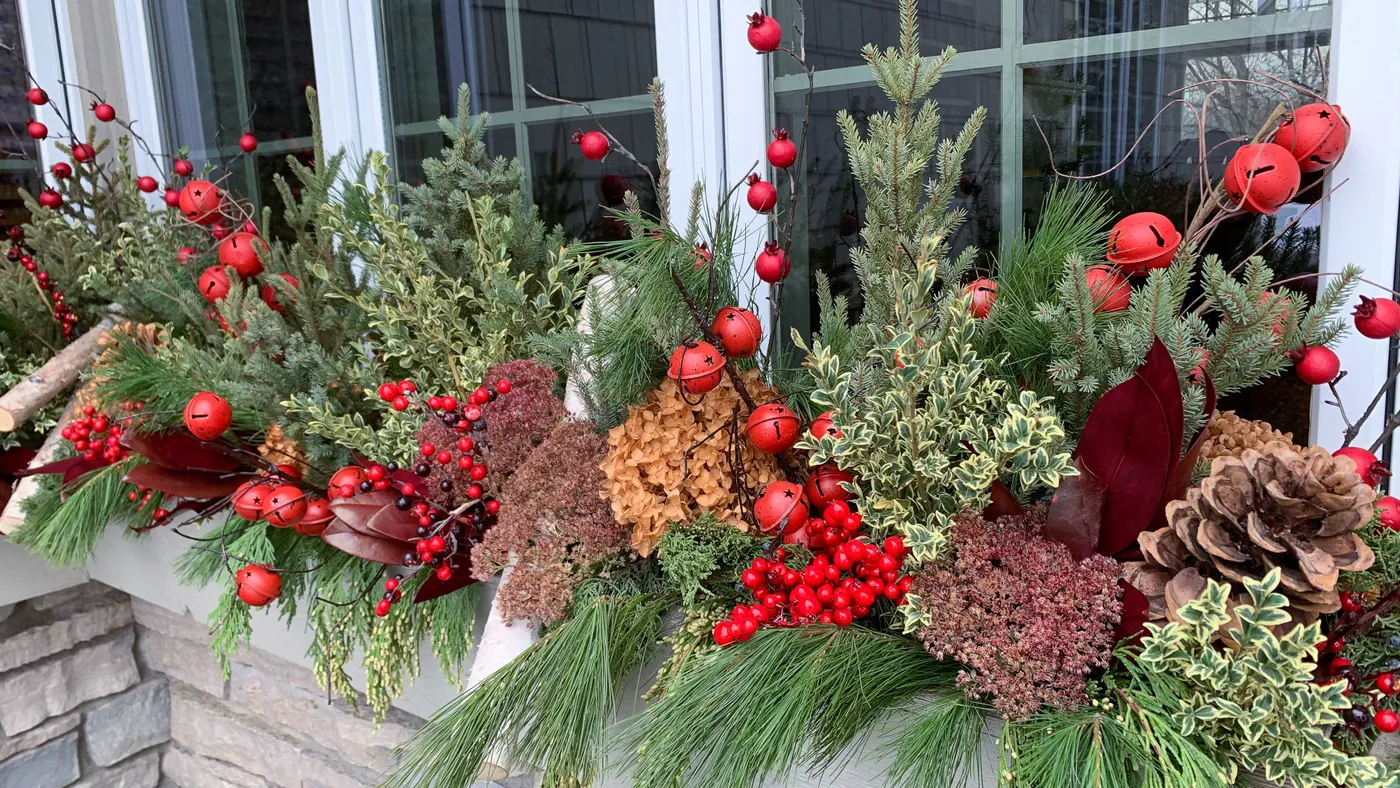
Window boxes fail for one boring reason: they block light. Keep the finished arrangement at least 8 inches below the window glass, and angle every branch outward and slightly down so snow slides off instead of pooling in the middle. If your box runs wider than 30 inches, add a vertical birch log near the middle as an anchor — it stops the whole thing from sagging forward by February.
6. Teal Door, Galvanized Tub, and a Red Truck Mat
Colored front doors are quietly doing the heavy lifting in 2026 — teal especially, which reads cheerful in daylight and nearly black at dusk. Add galvanized tubs and a red truck doormat and you’ve got the modern farmhouse formula that’s been building on Pinterest for three seasons straight. The good news: the door is architectural, so it works year-round. Only the basket, mat, and greenery are seasonal, which means next December costs you about $80 to refresh.
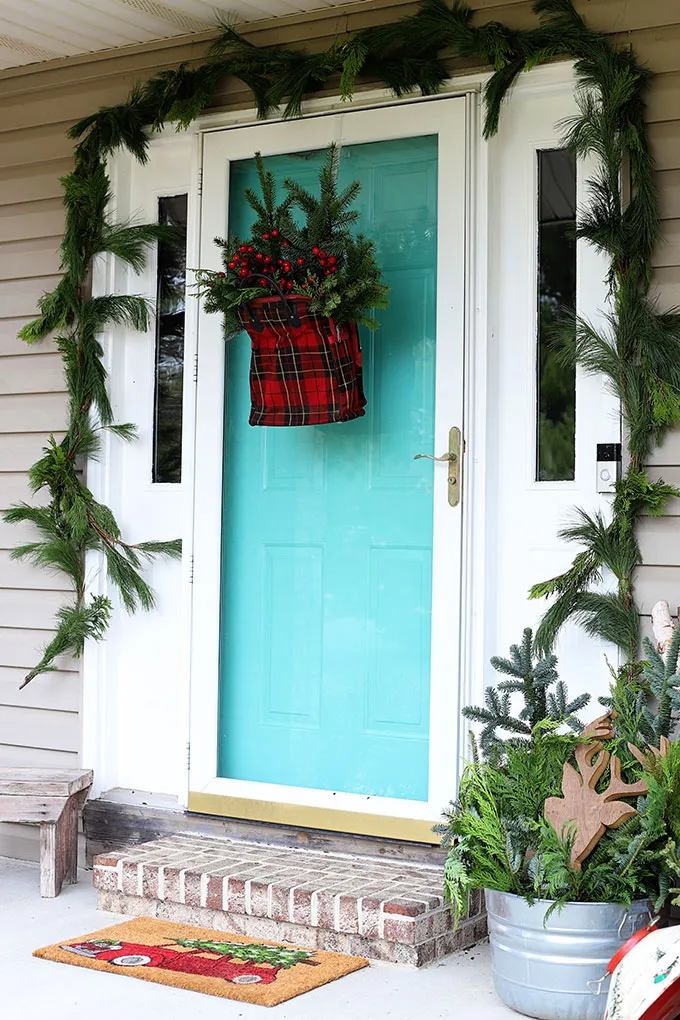
- Plaid hanging basket with evergreens and red berries: $35–$90
- Natural evergreen garland around the door: $40–$160
- Galvanized tub planter with mixed greens: $45–$110
- Wooden deer cutout: $18–$60
- Red truck welcome mat: $22–$45
Total: $160–$465
7. Evergreens, Hammered Gold Bells, and a Merry Christmas Sign
The black Merry Christmas sign is what turns a decorated door into a moment. It’s the only text on the porch, it’s personal, and it hangs low enough to sit inside the garland rather than float above it. Without the sign you’d have beautiful greenery and no point of view — the sign is the sentence the porch is speaking. Keep it at eye level or just below, and let the evergreen crowd it a little.
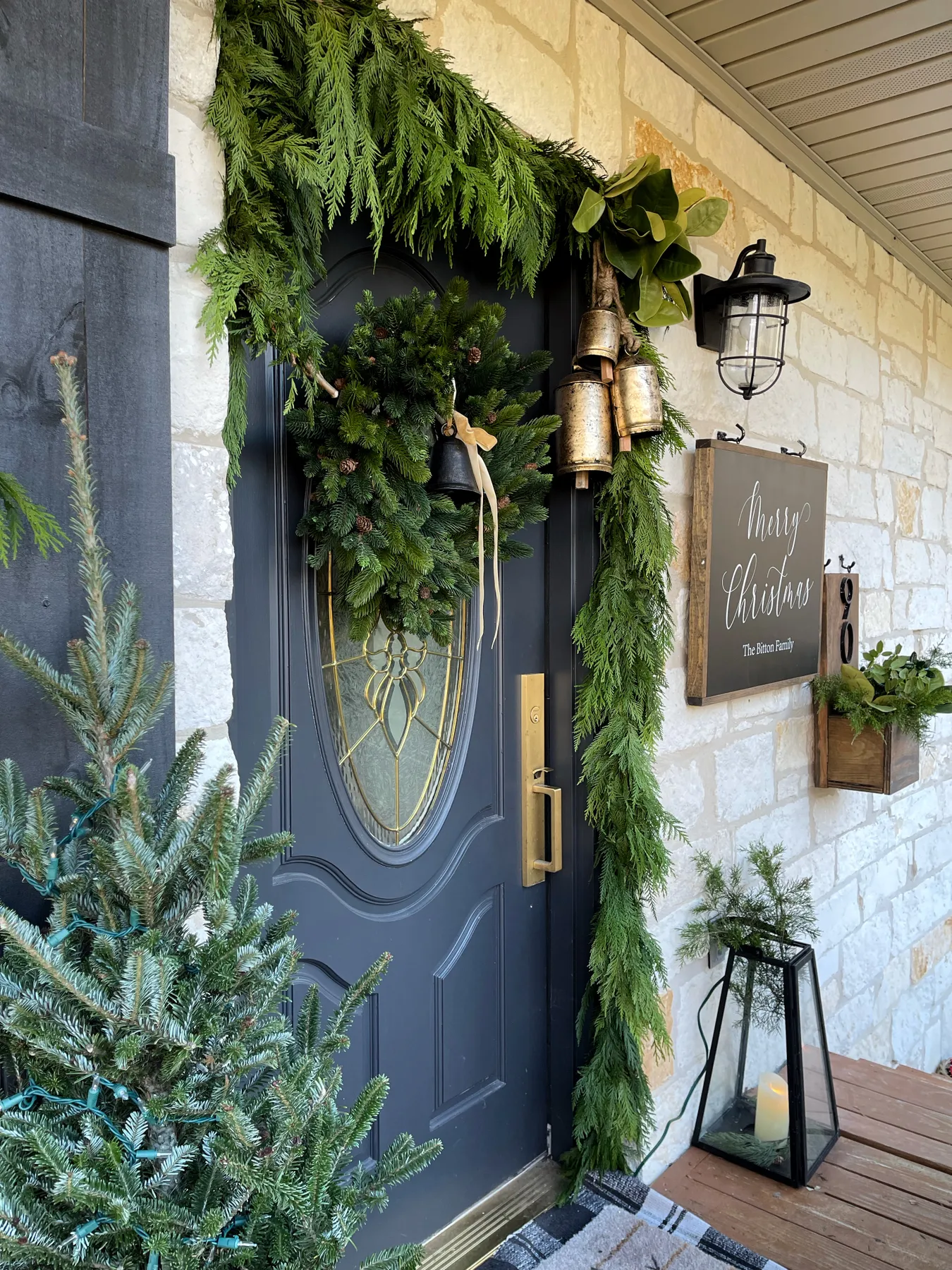
This layout wants an entry at least 6 feet wide and a facade in light stone, stucco, or pale siding — the charcoal door against cream stone is doing a lot of the work. On a narrow stoop under 5 feet, drop either the wreath or the potted tree; three focal points in a tight space read as clutter. For long railing runs, see Idea #20, which handles a 20-foot span properly.
8. A Faux Fireplace, a Flocked Tree, and a Zermatt Poster
Before you fall in love with the faux fireplace: it only works under a covered porch with a deep overhang. Stacked logs and a mantel sitting in direct rain go gray and soft within a season, and flocked trees shed white dust every time the wind picks up. If you’re in an HOA, check the rules on illuminated outdoor trees first — they’re a surprisingly common violation.
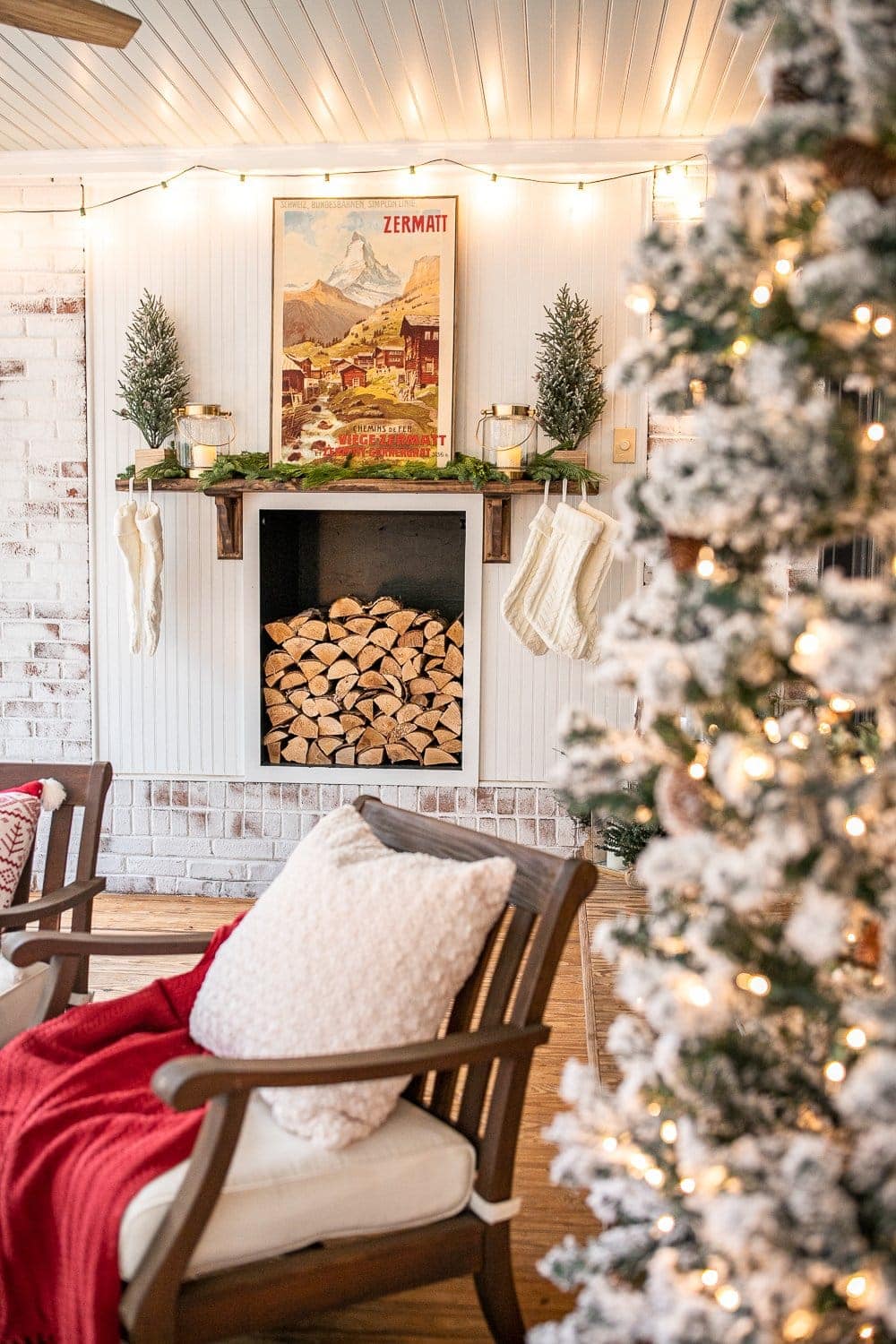
The mantel is the trick here, and it’s doing something clever: giving an outdoor wall a horizontal anchor so the tall flocked tree on the left doesn’t feel like it’s leaning into empty space. The vintage Zermatt poster adds a rectangle of color that’s neither red nor green, which is exactly what keeps the palette from going candy-cane. Real firewood, artificial greens, one piece of graphic art — that’s the whole recipe.
9. A Weathered Teal Urn Piled With Birch and Red Fans
A weathered teal planter like this one runs $150–$400 new. Paint a $25 plastic urn with two coats of chalk paint and a wax finish, and it will fool everyone from the sidewalk for three winters. Craft-store birch logs, a bunch of red palm fans from a florist supply shop, and a bag of faux berries put the whole arrangement under $90 — versus $300+ for the store-bought version.
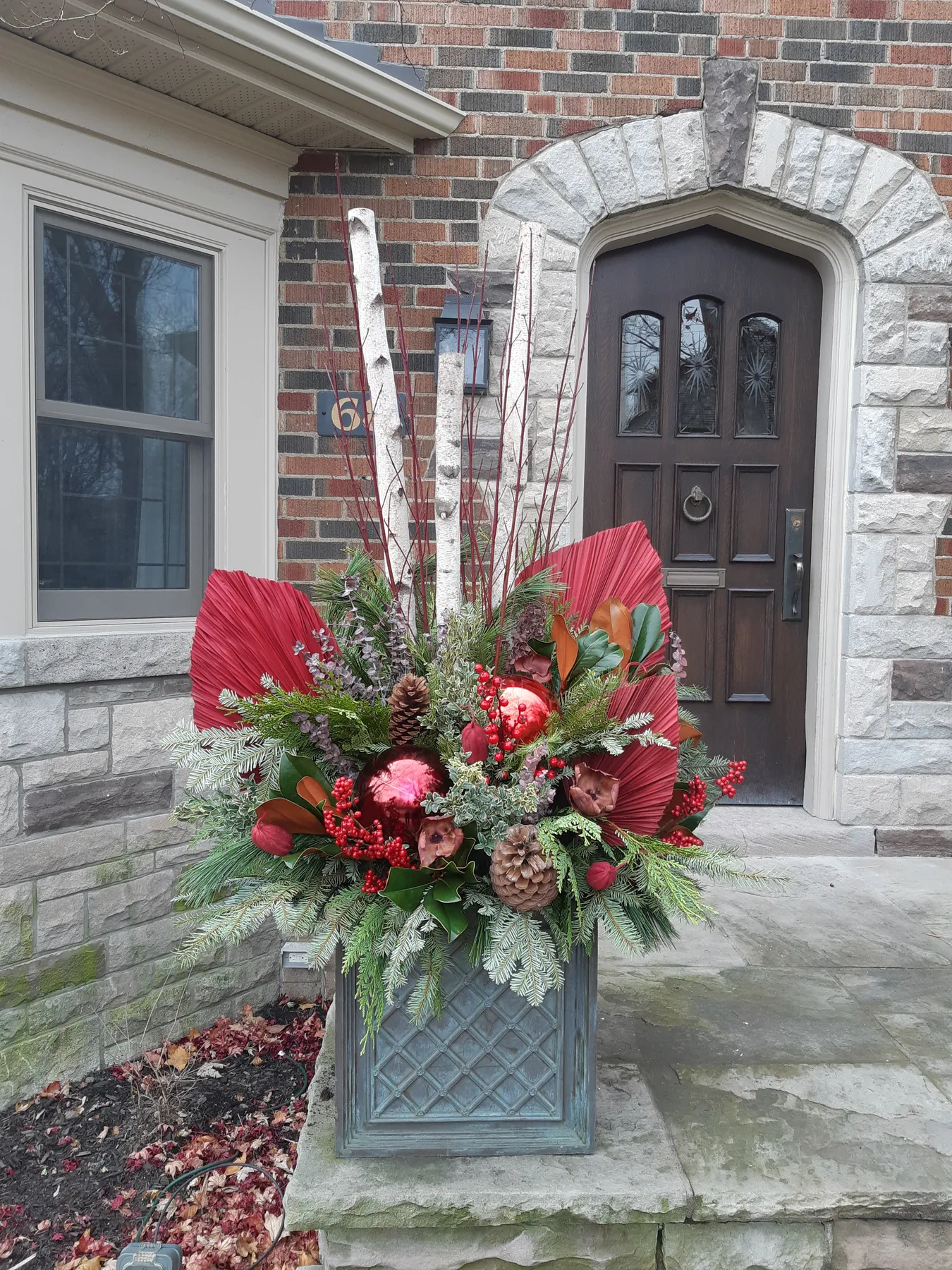
Winter urn tip that saves real money: skip potting soil. Fill the urn two-thirds with sand or pea gravel instead, then push your branches in deep. Soil heaves when it freezes and tips your birch logs sideways by January; sand doesn’t move. A 24-inch urn typically takes six to eight birch logs and about four bunches of greenery to look properly full.
This urn is roughly 24 to 28 inches tall and it’s built for a grand entry — two or more stone steps, a 36-inch arched door, enough width that it doesn’t crowd the walkway. Leave at least 30 inches of clear path beside it. On a single-step stoop, size down to a 20-inch terracotta urn.
10. An Obelisk Planter Wrapped in Lights and Burgundy Eucalyptus
The color math here is 50% green fir boughs, 25% bright red branches and berries, 15% that unexpected burgundy eucalyptus, and 10% black metal frame. The burgundy is the whole personality — it’s why this planter feels rich instead of standard. Trade it for dusty blue spruce and you get a cooler, more modern arrangement using the exact same proportions.
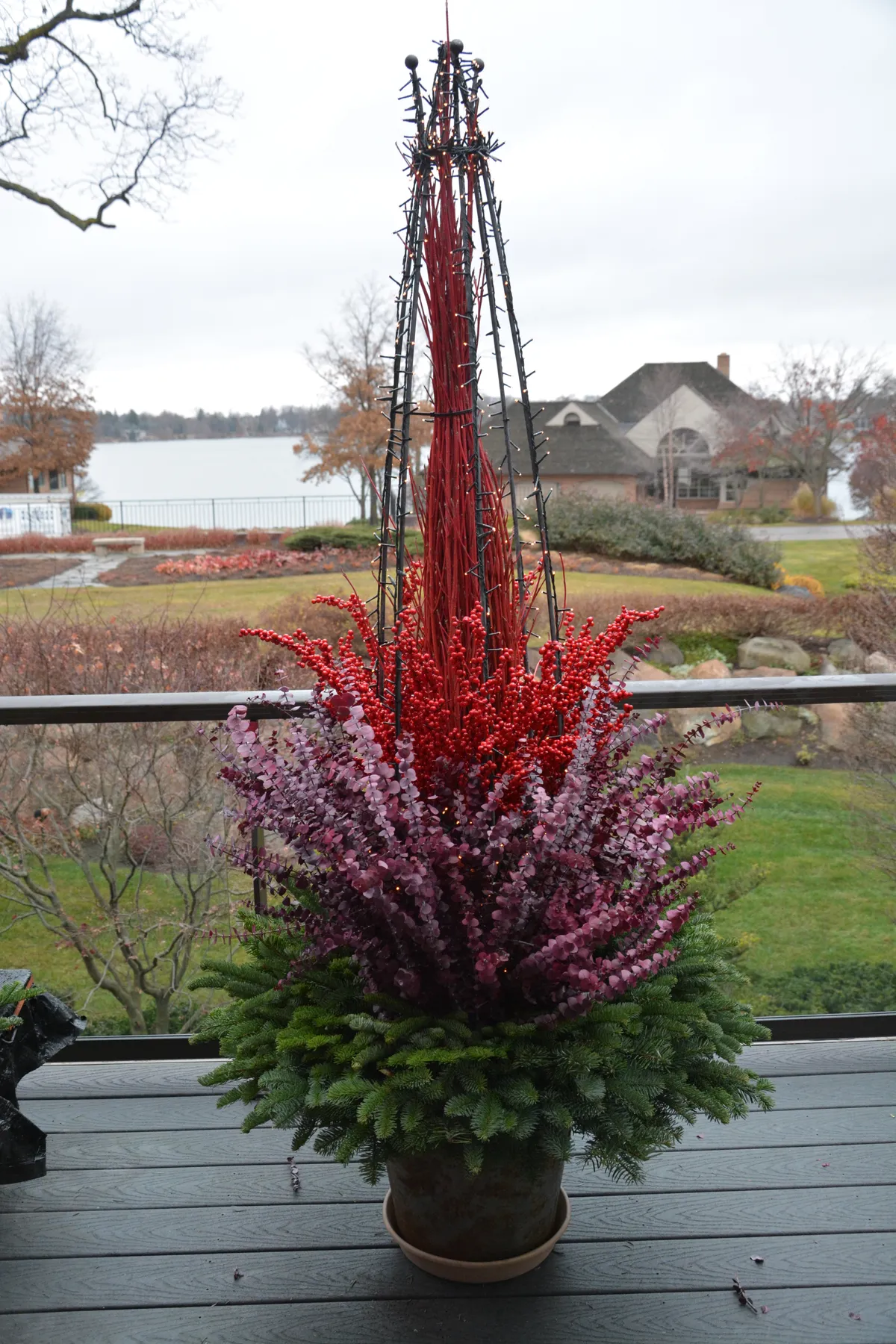
Two honest upkeep notes. Outdoor string lights, even the good ones, last about three to five seasons before sections start dying, so buy a spare strand now while it’s in stock. And terracotta cracks when water freezes inside it; set a resin or fiberglass liner inside the terracotta pot and the outer shell survives the winter untouched. Annual cost to maintain a planter like this: $25–$40.
11. Vintage Skis, a Wooden Bear, and Two Snow-Dusted Rockers
- Choose vintage wooden skis with intact bindings — thrift stores and Marketplace, $30–$80.
- Locate two studs in the siding; a pair of skis weighs 4–6 pounds.
- Drive exterior-grade screws with rubber washers so water can’t track in behind them.
- Lean the ski tips out about 8 degrees so snow slides off rather than stacking up.
- Tuck evergreen sprigs behind the bindings instead of hanging anything from them.
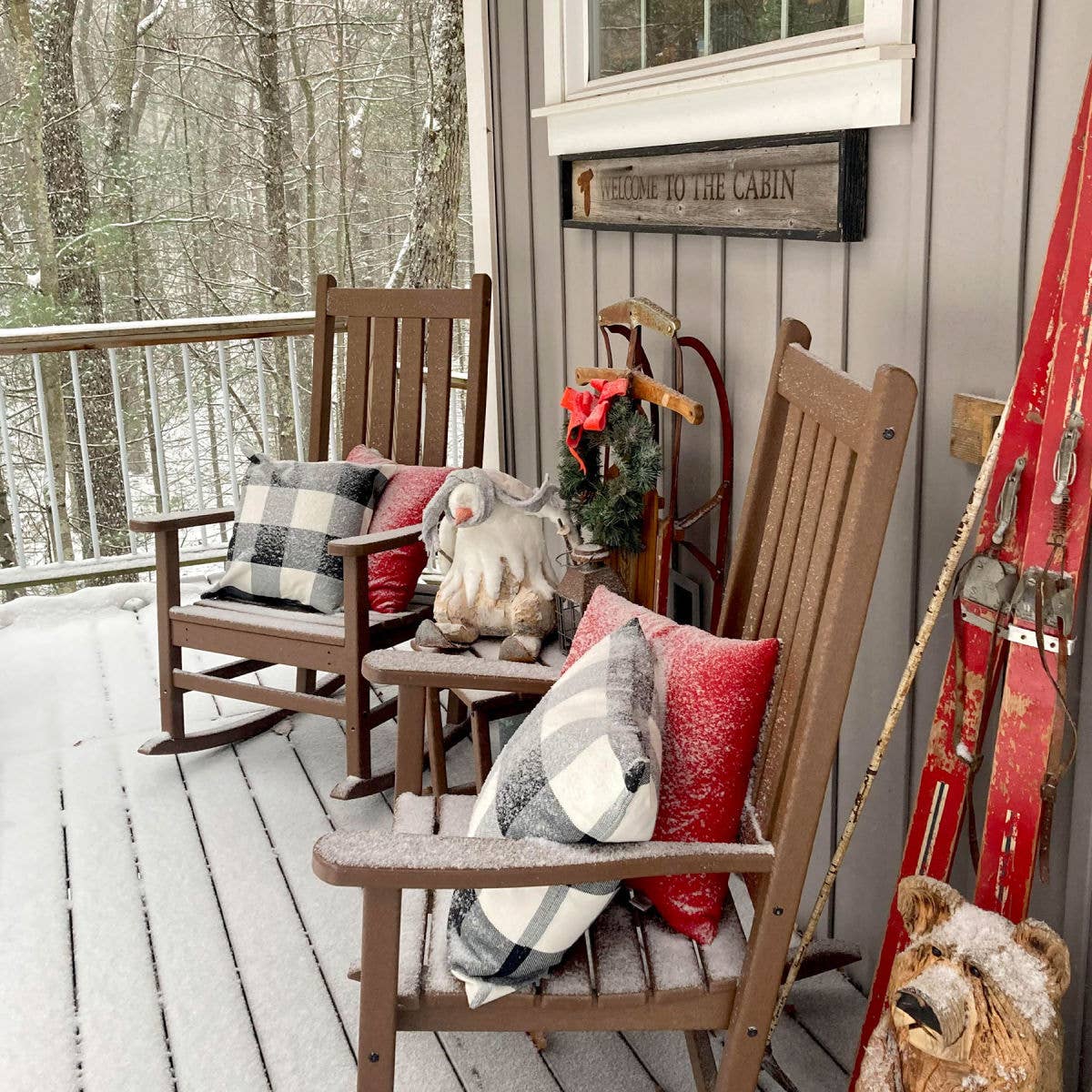
Time: 25 minutes. Hardware: under $12.
The one element that makes this porch feel like a place and not a display is the carved wooden bear. Everything else just says cabin — the rockers, the plaid, the vintage skis. The bear says yours. Find him at a craft fair or marketplace for $40–$120 and give him a spot where snow won’t pile on his head.
12. A Green Porch Swing, a Teal Door, and Plaid Snowshoes
- Pine garland around the teal door: $35–$140
- Two potted evergreens in galvanized planters: $60–$180
- Birch logs (3–4 pieces): $20–$50
- Vintage snowshoes with plaid bow: $30–$120
- Plaid pillows and accents: $15–$45
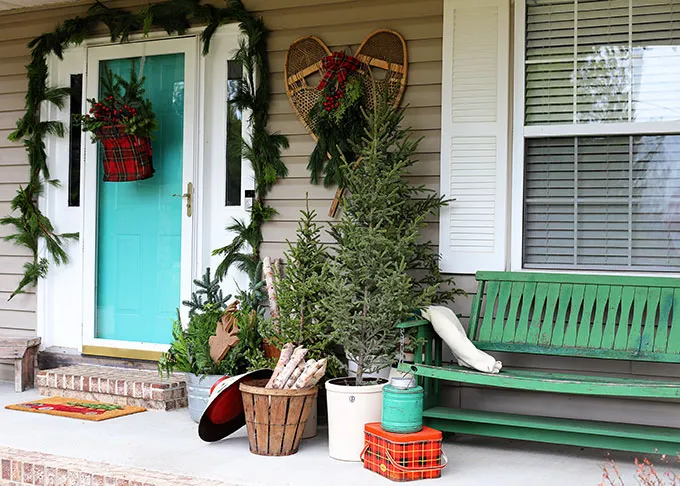
Total: $160–$535
The swing is the splurge — if you already have one, repaint it deep green and you’re most of the way there.
Same teal door as Idea #6, completely different supporting cast, and that’s the point. The risk with a bold door color is seasonal decor fighting the architecture, so keep red confined to small doses: a bow, a pillow, a plaid basket. Also, painted concrete gets genuinely slick when it ices. A $20 textured mat at the top and bottom of the stairs prevents the December slip you don’t want on video.
13. Heart-Shaped Snowshoes on a Light Grey Siding Wall
Two things are working at once here. First, symmetry — the heart-shaped snowshoes create a clean vertical accent that balances the horizontal lines of the siding. Second, negative space: the wall around them is left mostly empty, which is why your eye knows exactly where to go. Stack a wreath, a sign, and a garland on that same wall and the charm evaporates.
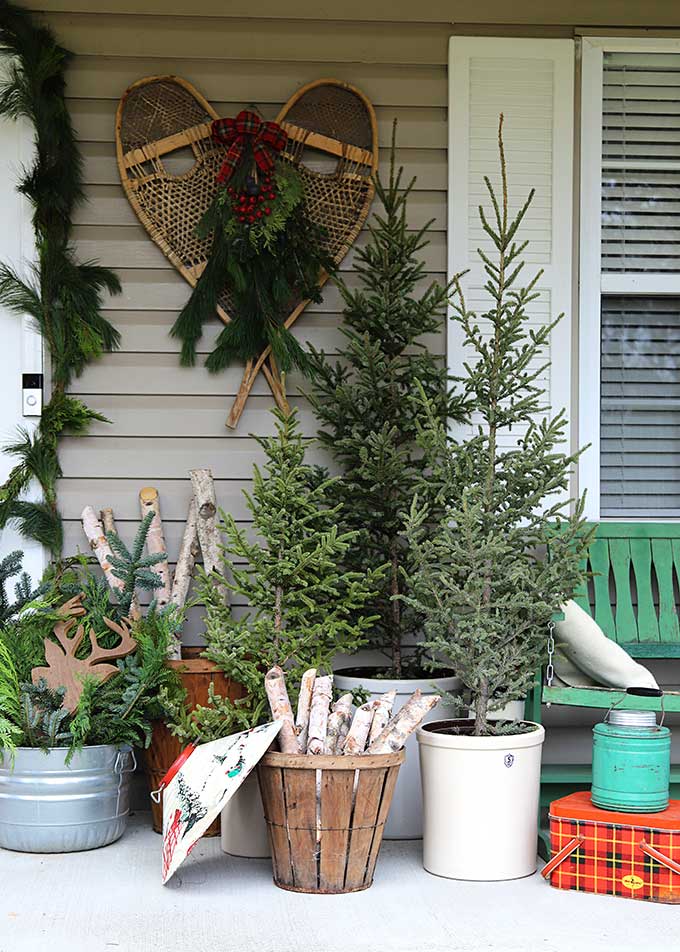
- Measure the wall between the door frame and the corner — you want at least 14 inches clear for snowshoes.
- Confirm what’s behind the siding; anything over 3 pounds needs a stud or solid sheathing.
- Check the overhang. Snowshoes under cover survive; exposed to rain and freeze-thaw, wood swells.
- Decide whether the red plaid bow stays through January — if not, pick a ribbon you can swap.
14. One Small Evergreen in a Dark Urn With a Plaid Bow
For a single-tree urn, run the 3x rule: the evergreen should be about three times the height of the container. A 14-inch urn wants a 42-inch tree. Then tie the plaid bow at the exact point where the tree meets the rim — not above it, not below. That one intersection is what makes the arrangement look finished rather than gathered. Use wired ribbon; unwired plaid collapses the second it gets damp.
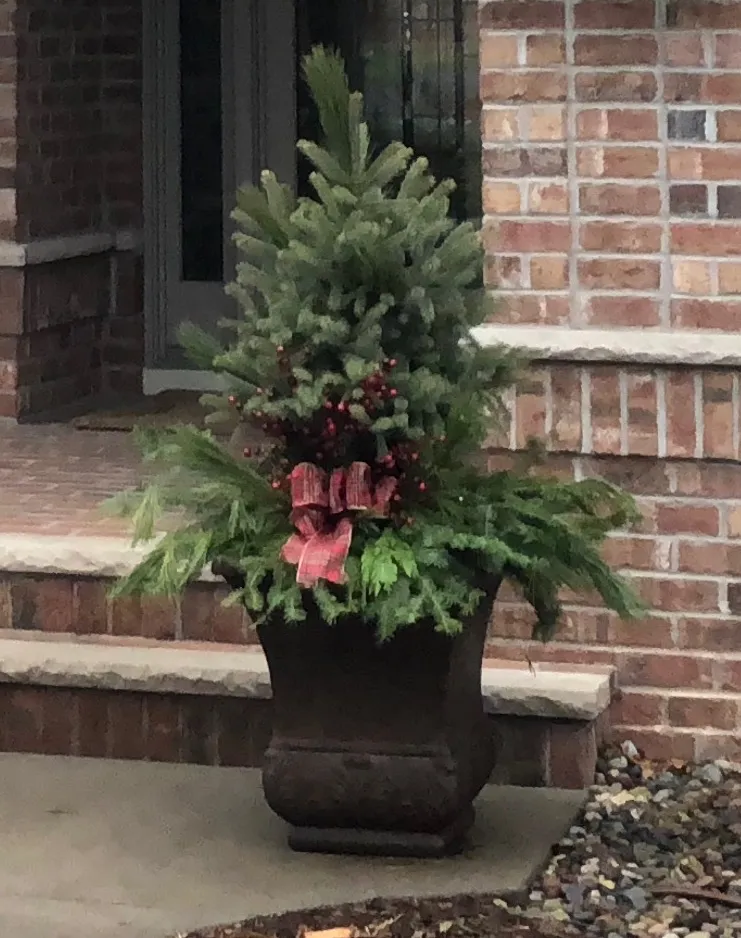
This is the simplest formula on the list: 60% dark neutral container, 30% green, 10% red-and-black plaid. The dark urn is doing more than you’d think — against a brick wall, a black or bronze planter creates a hard edge that makes the green pop. Swap the plaid for solid burgundy ribbon and the whole thing turns elegant; swap it for buffalo check and it goes full cabin.
15. Garland and Red Velvet Bows on a Dark Picket Fence
Velvet ribbon is beautiful for about six weeks outdoors, then it fades, droops, and prints a watermark on your fence. Nylon velvet or a matte satin holds its color two to three seasons longer. Plan on re-securing the garland after every heavy snow too — wet greenery roughly triples in weight, and the ties holding it to a picket fence are usually the first thing to give.
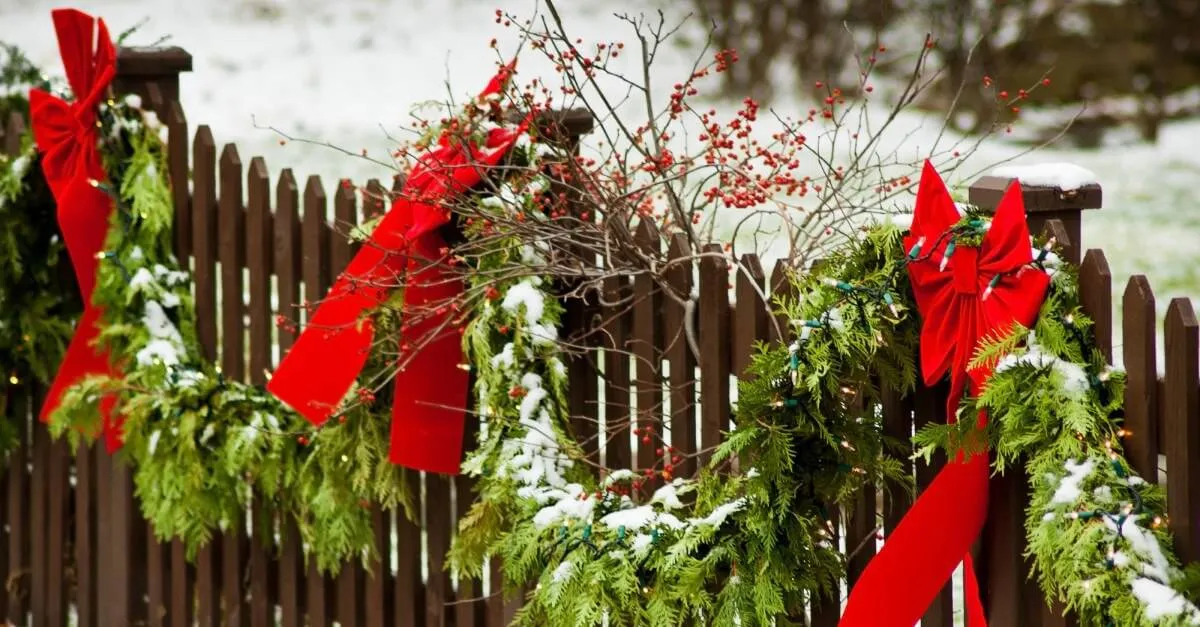
Fence garland is one of the cheapest big-impact moves available. Two 9-foot strands from a big-box store run $30–$60, red velvet ribbon is $8–$15 a roll at a craft store, and zip ties cost pennies. Under $100 for a fence run that looks like it cost three times that. Thrift stores in early January are also gold mines for next year’s ribbon.
16. A Weathered Terracotta Urn of Berries and Bare Twigs
This is a 20- to 24-inch fluted terracotta urn, the right size for a modest two-step entry beside a brick wall. Give it at least 18 inches of breathing room on the step. If your entry is grander — three steps, stone facade, wide landing — size up rather than adding more urns; one generous arrangement always beats two apologetic ones. Scale is what makes an entry look considered instead of assembled.
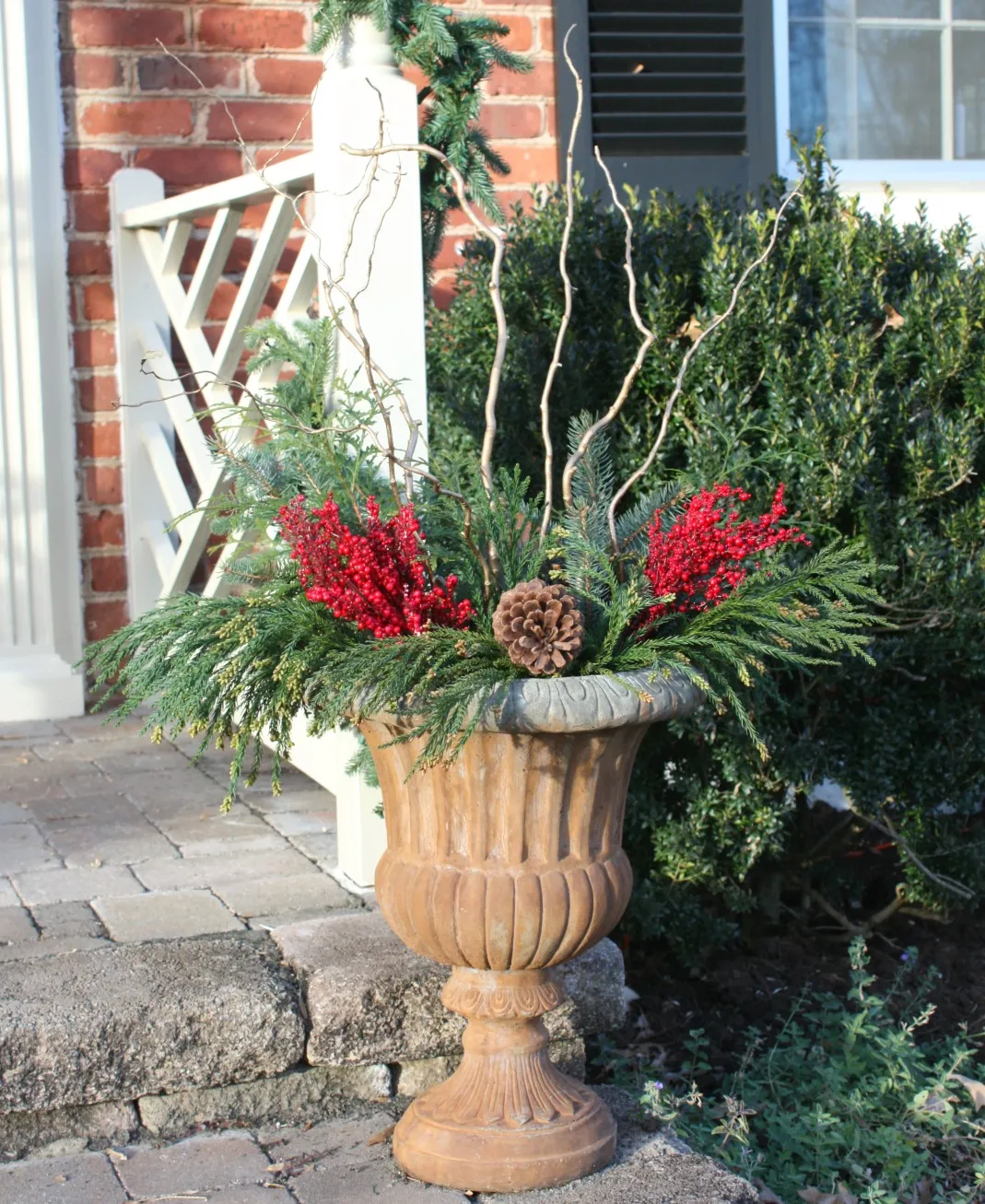
Restraint is the whole design. Three ingredients — evergreen, red berries, light brown twigs — plus one pinecone placed with intent. Nothing here is fighting for attention, and the weathered terracotta earns its keep by matching the brick instead of contrasting with it. This is what people mean when they say a porch feels collected rather than bought.
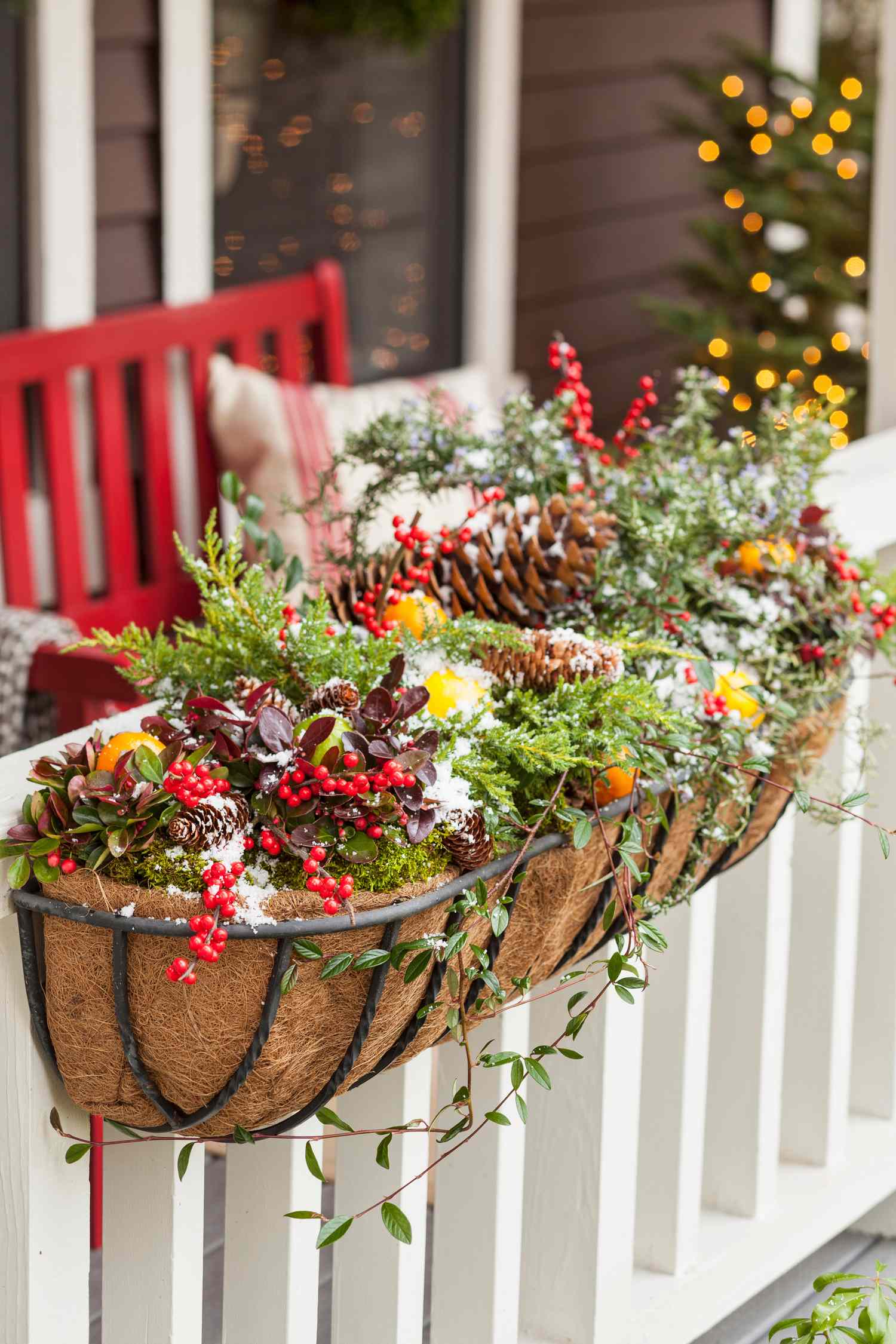
17. A Red Door Lit End to End in Warm White
The detail that sells this red door is continuity of light: the same warm white string lights run through the garland, up both potted trees, and into the wreath. Same color temperature, same spacing, one continuous glow. Mixed light temperatures are the most common reason a decorated porch looks off in photos and nobody can say why. Buy every strand in one trip, one brand, 2700K if you want that honeyed look.
- Count your power sources first — most porches have exactly one usable exterior outlet.
- Run a single 14-gauge outdoor extension cord behind the downspout or under the threshold trim.
- Connect strands with the plugs facing the door, not the street.
- Add a plug-in outdoor timer; $15 and you’ll never think about it again.
- Test everything for one full night before you finalize placement.
Time: about an hour. Cords and timer: $40–$70.
18. Woven Planters of Lavender and Hydrangea on Brick
Here’s a palette doing something unusual: 55% natural woven fiber, 30% soft green and lavender, 15% warm brick. No red, no gold — and it still reads as Christmas because the shapes and containers are holiday, only the color isn’t. Swap the lavender for white hellebore and the mood cools further; bring in dried orange slices and it warms right back up.
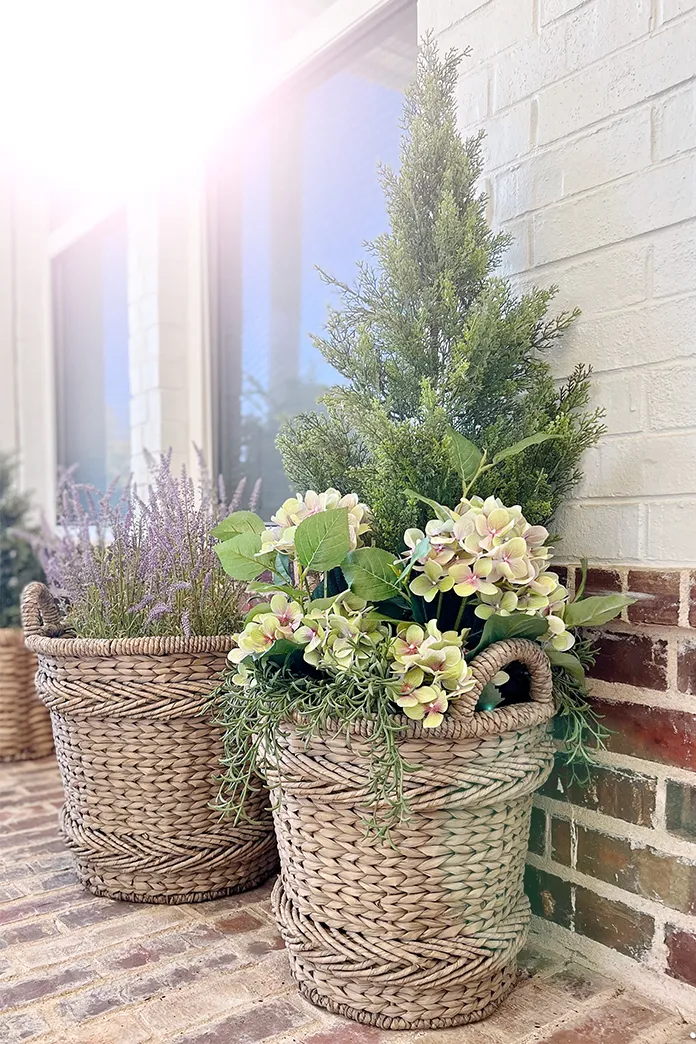
The quiet, non-red holiday palette has been climbing for a few seasons, and 2026 is the year it went mainstream. Blame the general appetite for understated design, or just blame how good soft green looks against brick — either way, searches for neutral Christmas decor keep climbing. It has staying power because it isn’t really a Christmas trend; it’s a color-preference trend borrowing Christmas shapes.
19. A Black Scrolled Planter With Gold Berries and Magnolia
Magnolia leaves are the most underrated element in winter containers. Tuck them in shingle-style — each leaf overlapping the next, glossy side facing out — starting at the rim and working inward. Twenty to twenty-five leaves will cover an urn this size. Then nest a small twig wreath flat on the soil line so it reads as a halo rather than a random circle that landed there.
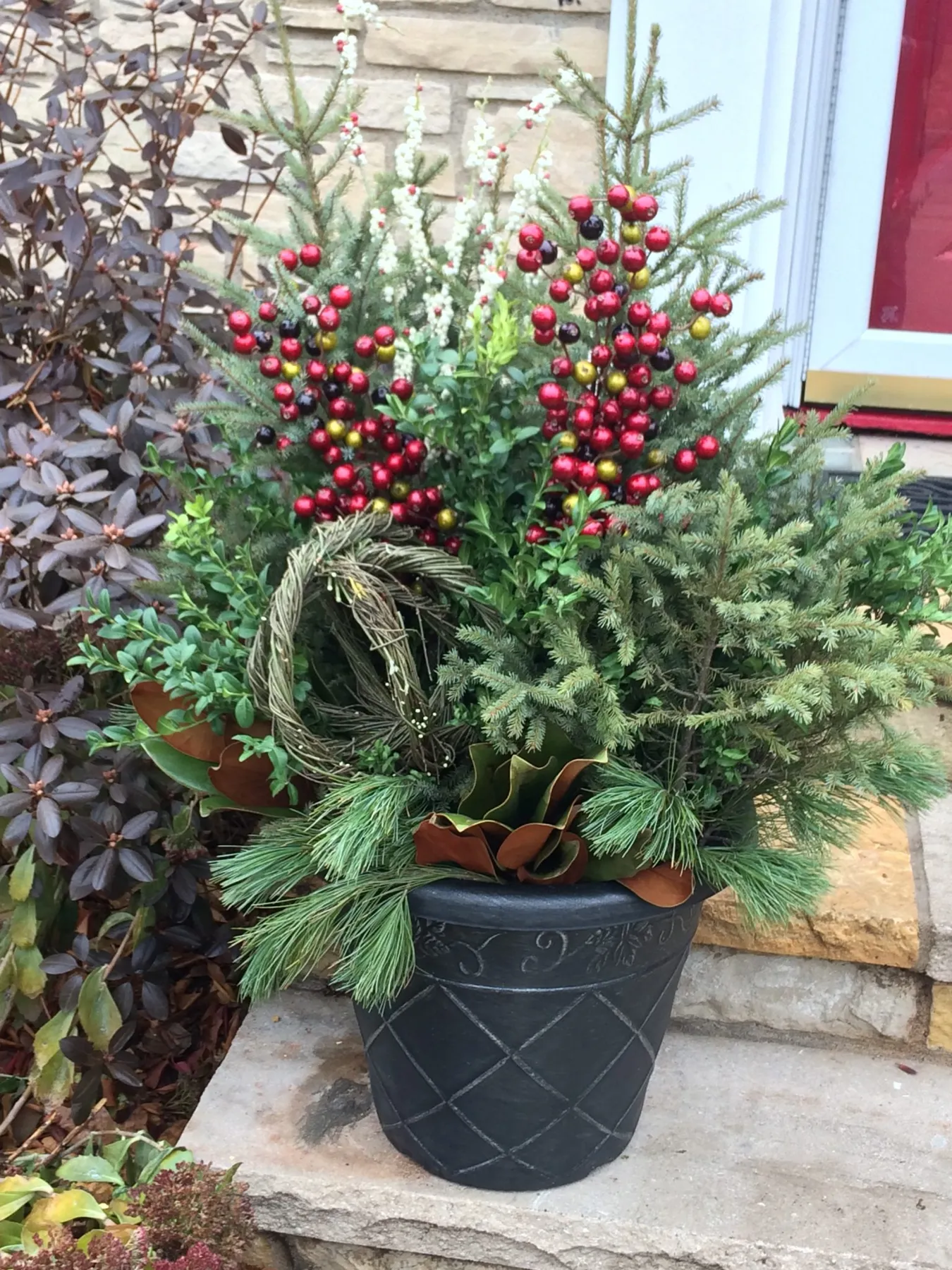
One honest caveat: magnolia goes brown and leathery in about three weeks, especially in wind. That’s fine if you like the aged look and terrible if you don’t. Gold berries also tarnish and shed glitter onto steps, which is a genuine slip hazard in wet weather. Both problems have a fix — use faux magnolia treated with leaf shine and swap glitter berries for matte gold.
20. White Columns, Icicle Lights, and Oversized Red Bows
- Garland for a 20-foot railing run: $60–$240
- Six large red bows: $24–$120
- Two sets of white icicle lights: $30–$90
- Zip ties, gutter clips, and hooks: $8–$20
- Outdoor extension cords and timer: $20–$50
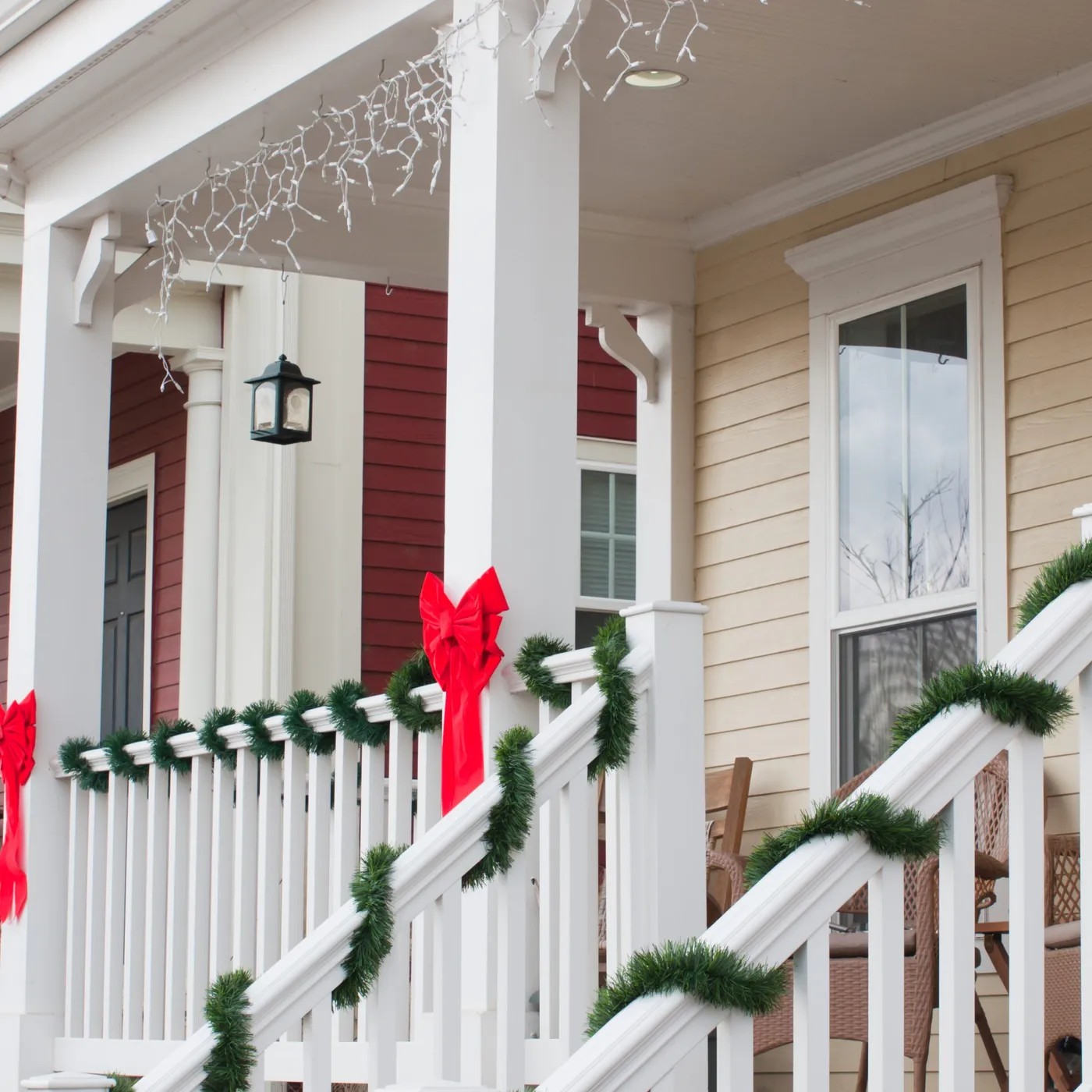
Total: $142–$520
Budget alternative: buy plain green garland and upgrade it yourself — a $10 roll of red velvet makes $60 garland look like $200 garland.
Icicle lights need ceiling height to work; figure 9 feet minimum or they hang into your guests’ faces. This railing treatment shines on runs of 20 feet or more, and it overwhelms a short 6-foot porch. For compact entries, go with the more restrained approach in Idea #7. If your balusters are widely spaced, add a second tie point mid-run so the garland doesn’t sag between them.
21. A Lit Teepee, a Bean Bag, and a Porch for the Kids
- Start with a 4- or 5-foot canvas teepee — small enough to fit a porch corner.
- Wrap one 25-foot strand of warm white lights loosely around the poles, spiraling upward.
- Run a second strand along the railing behind it so the glow has depth.
- Add an off-white bean bag and two or three plush toys.
- Hang a simple bunting banner above; skip garland here, the space needs to stay soft.
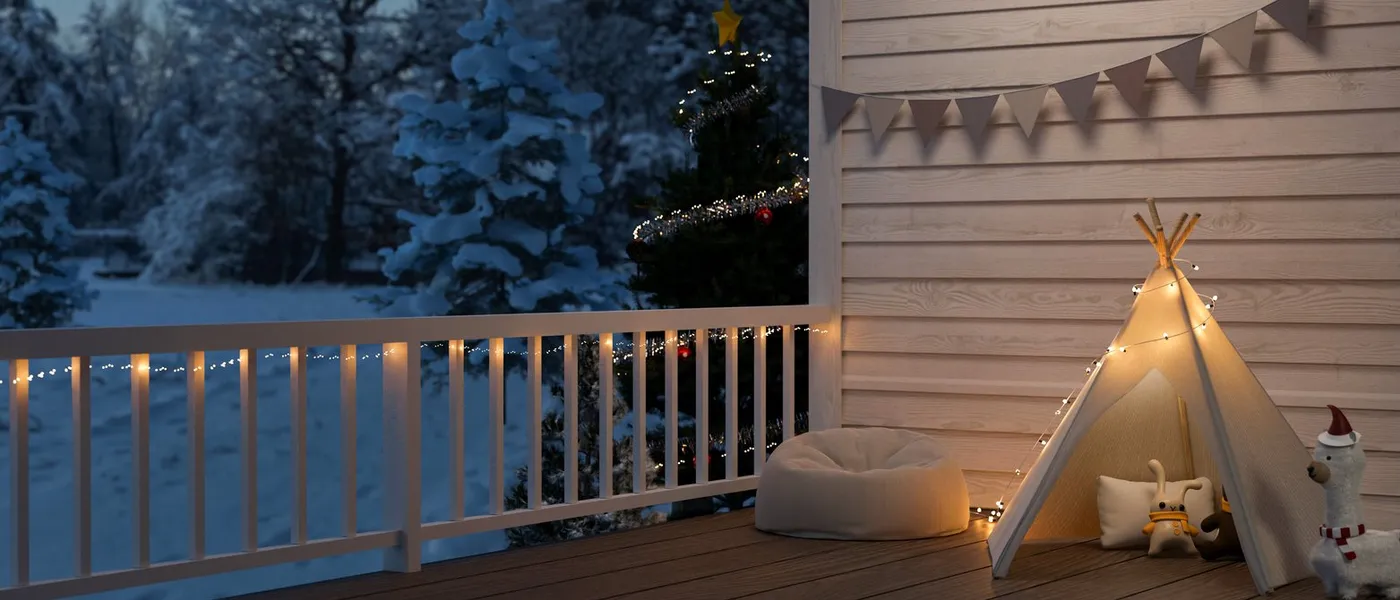
Time: about an hour. Cost: $80–$140 without the teepee.
The teepee is the entire idea, and it’s worth saying why: it turns a porch into a room that belongs to someone small. Remove it and you have a nice lit porch that no kid will ever ask to sit on. Keep it up through New Year’s — this is the rare holiday setup that gets more use in January than December.
22. Garland and Two Bows on a Black Iron Stair Rail
On a straight iron stair rail, don’t put bows at the ends — put them at the one-third and two-thirds points. Ends read as bookends; interior placement makes the garland feel continuous. Buy garland at 1.3 times the rail length so it can bunch slightly, and attach with plastic-coated zip ties facing inward so no wire scratches the black finish.
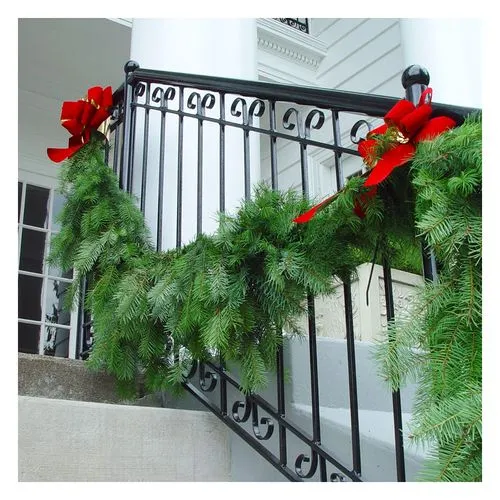
Wrought iron is a moisture magnet, and greenery holds water against it. Check the paint for chips before you decorate; a bare spot under wet garland will rust by spring. Real garland also drops needles onto concrete steps that get slick when wet, so sweep every few days. A UV-rated faux garland costs more up front but survives four or five seasons with a rinse and a re-fluff.
23. Silver Glitter Leaves Zip-Tied to a White Railing
A silver glitter garland like this is easy to fake. Buy a plain faux boxwood garland for $15–$25, then hot-glue craft-store silver glitter leaves on top, roughly 40 per strand. Total: under $35 for a look that runs $120 in stores. Attach it with white zip ties so they disappear against the railing — you can spot the difference between white and black ties in two seconds.
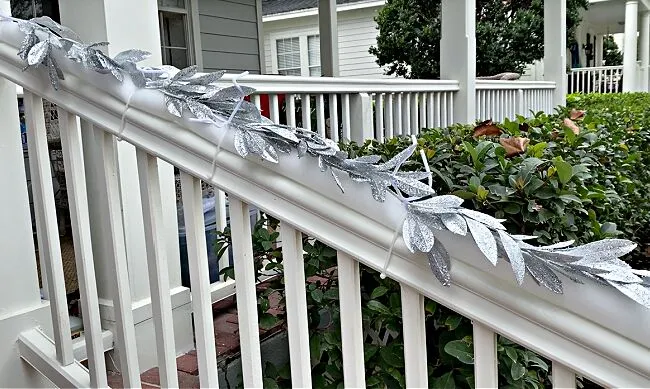
This is a two-color formula and it holds: 70% white, 30% silver. No green shows except the bushes behind it, which is exactly why it reads crisp instead of cluttered. To shift the mood, swap silver for champagne gold and keep the same 70/30 split. For a softer spin on the same monochrome idea, see Idea #27.
24. Warm Lights Under Snow Against a Log Cabin Wall
Warm string lights under snow are the oldest trick in the winter lighting book, and they still work because of color temperature. Yellow-tinged bulbs against blue-gray snow create natural contrast, and the snow bounces that warm glow back onto the dark wood wall. The wicker chair is the second half of the equation — it gives your eye a place to land so the lights read as atmosphere instead of decoration.
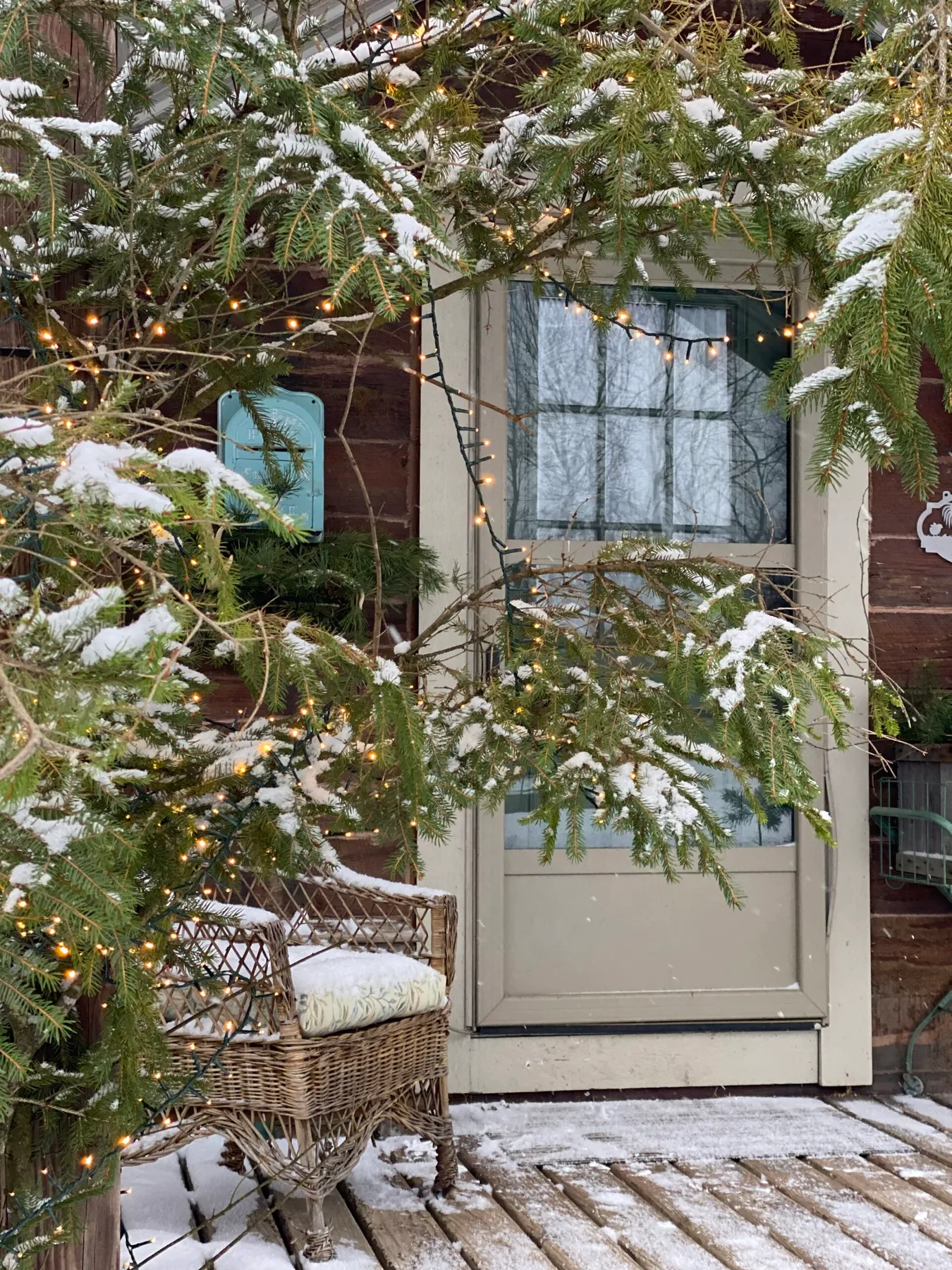
- Wicker or rattan outdoor chair: $120–$400
- Two hundred feet of warm string lights: $30–$70
- Snow-flocked evergreen garland: $40–$160
- Weatherproof seat cushion: $25–$60
- Simple door wreath: $30–$90
Total: $245–$780
25. Snow-Covered Garland and Red Satin on Wrought Iron
Two warnings for ornate wrought iron. First, red satin ribbon bleeds dye when it gets wet — it will stain light-colored steps, so use ribbon with a sealed edge. Second, decorative ironwork is weaker than it looks, and heavy snow-loaded garland can bend finials. If the forecast calls for a wet snowstorm, take the dressings down and put them back after. Ten minutes of work beats a bent rail you can’t unbend.
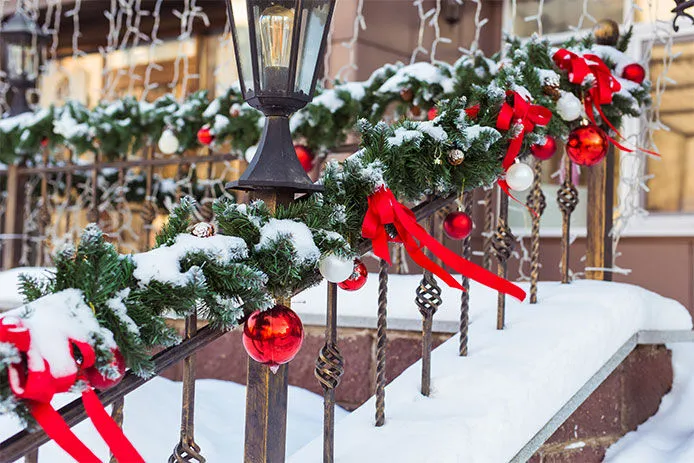
Attaching anything to ornamental iron is a scratch waiting to happen. Use foam-lined gutter clips and never bare wire ties, which leave marks you can’t buff out. Space ornaments roughly every 10 inches along the garland, and cluster them a little more densely near the newel post so the arrangement has a natural starting point instead of just ending.
26. Flocked Greenery, Cream Bows, and Silver Baubles
- Check your overhang — flocked garland loses its flocking fast in direct rain.
- Measure the railing run, then buy garland at 1.3x that length so it can bunch.
- Confirm you have a protected outdoor outlet; flocked decor plus cords is a lot of loose pieces.
- Test the flocking indoors over a sheet first to see how much it sheds.
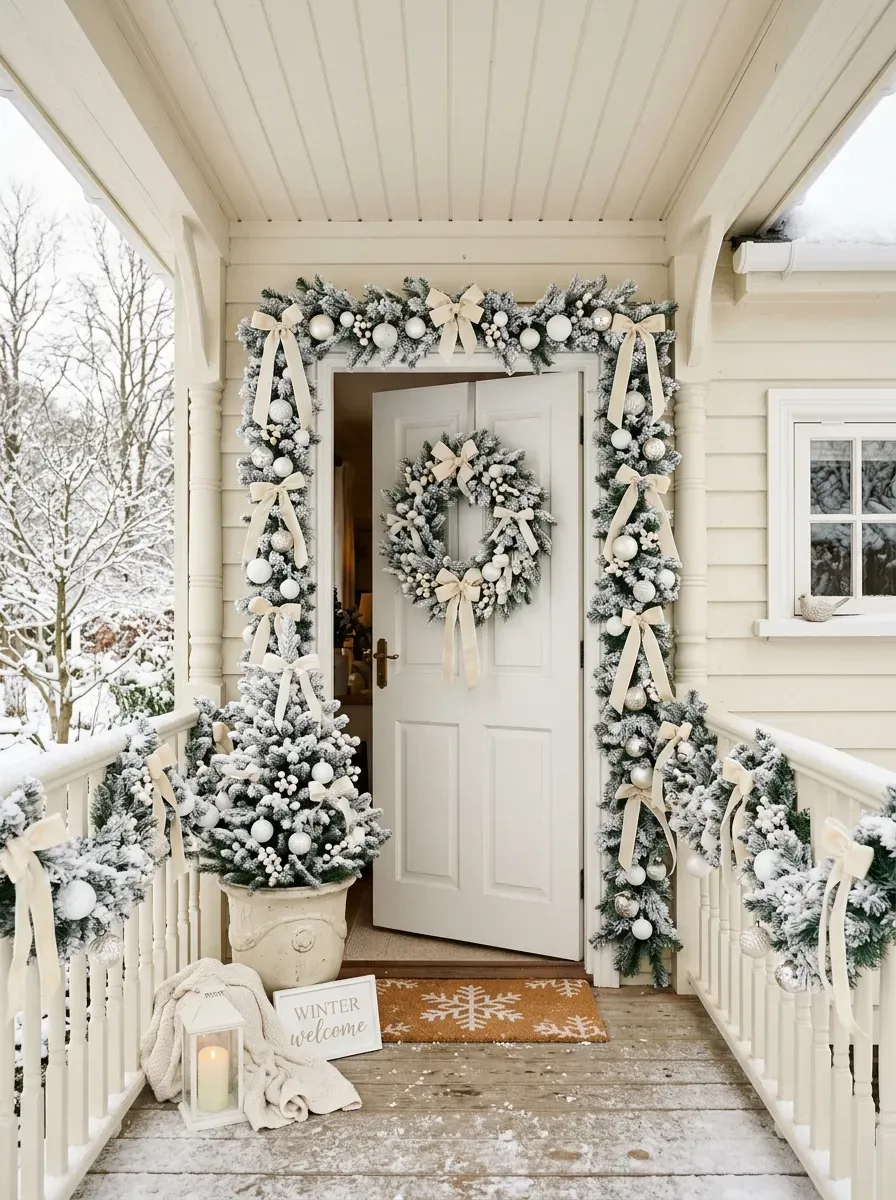
The cream fabric bows are what keep this porch from looking like every other flocked setup on the block. Red bows would have made it classic; cream bows make it calm. That single substitution changes the temperature of the whole scene, and it costs maybe $12 more in ribbon. If you’re on the fence, buy both, hang them, and let your neighbors’ reactions decide.
This look wants a white or cream porch with a covered overhang — call it 8 by 10 feet minimum. On a smaller stoop, drop the potted flocked tree and keep just the wreath and door garland; two flocked elements in a tight space go from elegant to dusty.
27. Pink Hydrangeas and Snowflakes on a White Railing
Non-traditional Christmas palettes are having their loudest year yet, and pink is leading the charge — partly a spillover from the broader pastel-everything mood, partly because people are simply tired of red. It photographs beautifully and it’s genuinely divisive, which is fine. The upside: pink holiday decor hits clearance earlier than anything else, so late November is your moment to stock up.
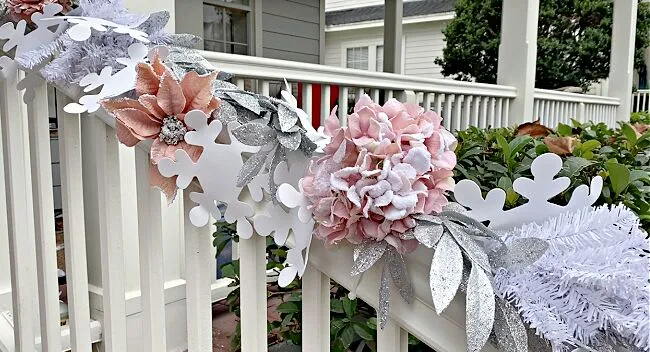
Faux pink blooms are cheap right now. A dollar-store snowflake garland plus two bunches of craft-store pink hydrangea will cost $25–$35, and a plain white tinsel garland as the base is $10–$18. Hot-glue the blooms in clusters of three, leaving the snowflakes visible. The look in Idea #23 is the cooler, silver cousin of this one — same technique, different palette.
28. A Bowl of Frosted Pinecones and Glossy Red Berries
- Bake foraged pinecones at 200°F for 30 minutes, then let them cool completely.
- Brush the tips with white craft paint, or dip in a 1:1 water-and-glue mix and roll in Epsom salt.
- Dry on wax paper for two hours — no shortcuts here.
- Layer the bowl: needles first, berries second, pinecones on top and slightly off-center.
- Set the bowl out of direct rain so the snow finish survives past New Year’s.
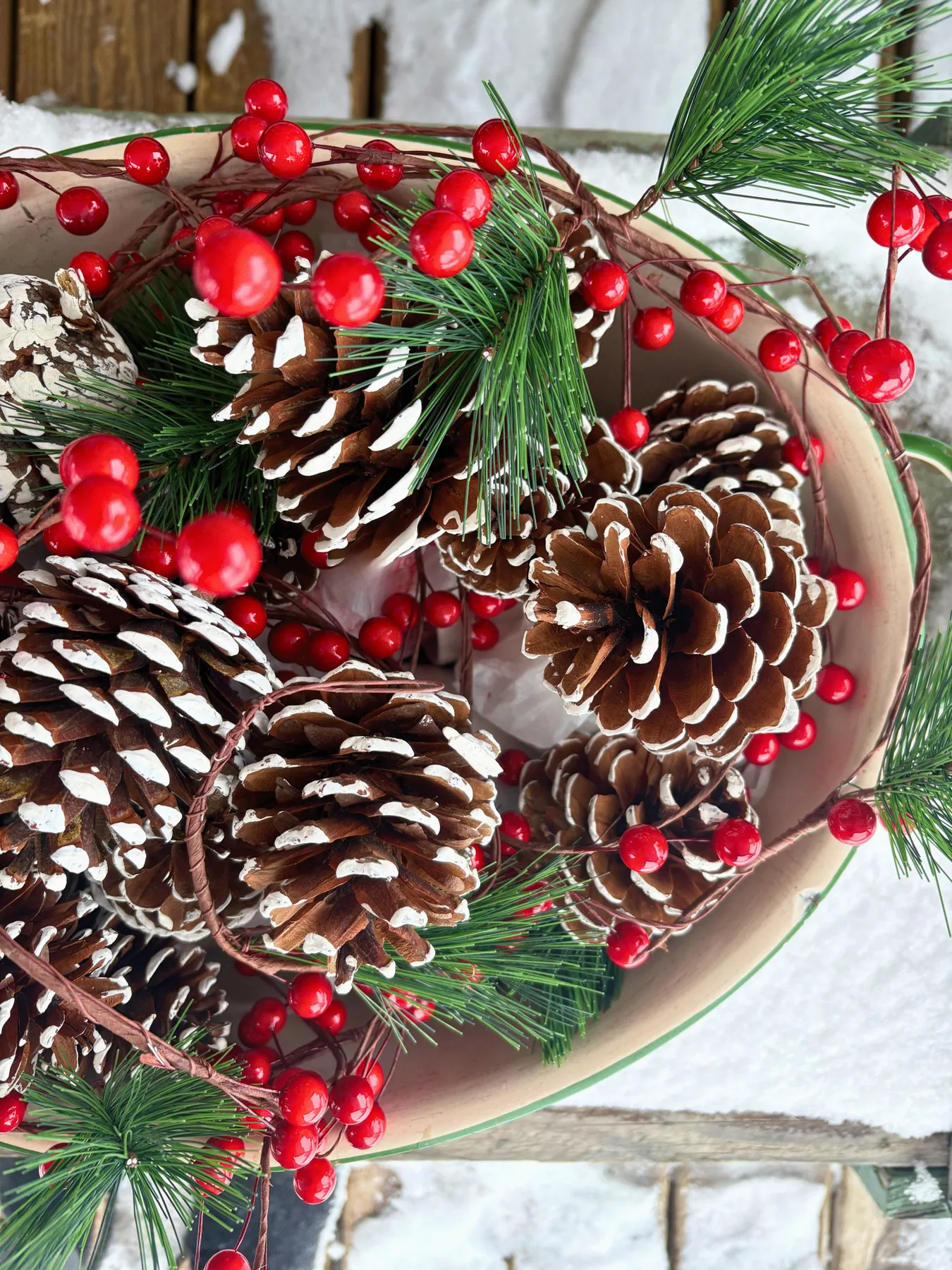
Time: about an hour. Cost: $8–$15.
Foraged pinecones bring company. Bake them, or you’ll end up with sap on your table and small insects waking up in a warm entryway. The snow finish also softens in fog and washes away in rain, and faux berries go from glossy to dull after one season outdoors.
- Check the bowl material — thin ceramic and terracotta crack in freeze-thaw cycles; resin or glazed stoneware won’t.
- Confirm the surface drains. A bowl holding water against wood leaves a ring you can’t sand out.
- Decide indoor or outdoor before you start gluing, since the finish differs.
Your Porch Is the First Gift They See
Start with one idea you actually love — not the one that’s trending hardest — and build outward from the front door. Two good urns and a garland that reaches the corner will always beat a porch decorated to the edges with no point of view. 📌 Save this to Pinterest before you start shopping; next November you’ll be very glad you did.