Loft beds have come a long way from the wobbly twin-over-full frames of childhood sleepovers. In 2026, they’re one of the most-searched bedroom solutions on Pinterest—and for good reason. Whether you’re working with a studio apartment in Chicago, a college dorm in Austin, or a teenager’s bedroom that needs to do triple duty, a loft bed can completely transform how a room functions and feels. This guide walks you through 22 fresh, real-world loft bed ideas that balance style, storage, and smart living for every kind of space and budget.
1. Minimalist Loft Bed for Small Rooms
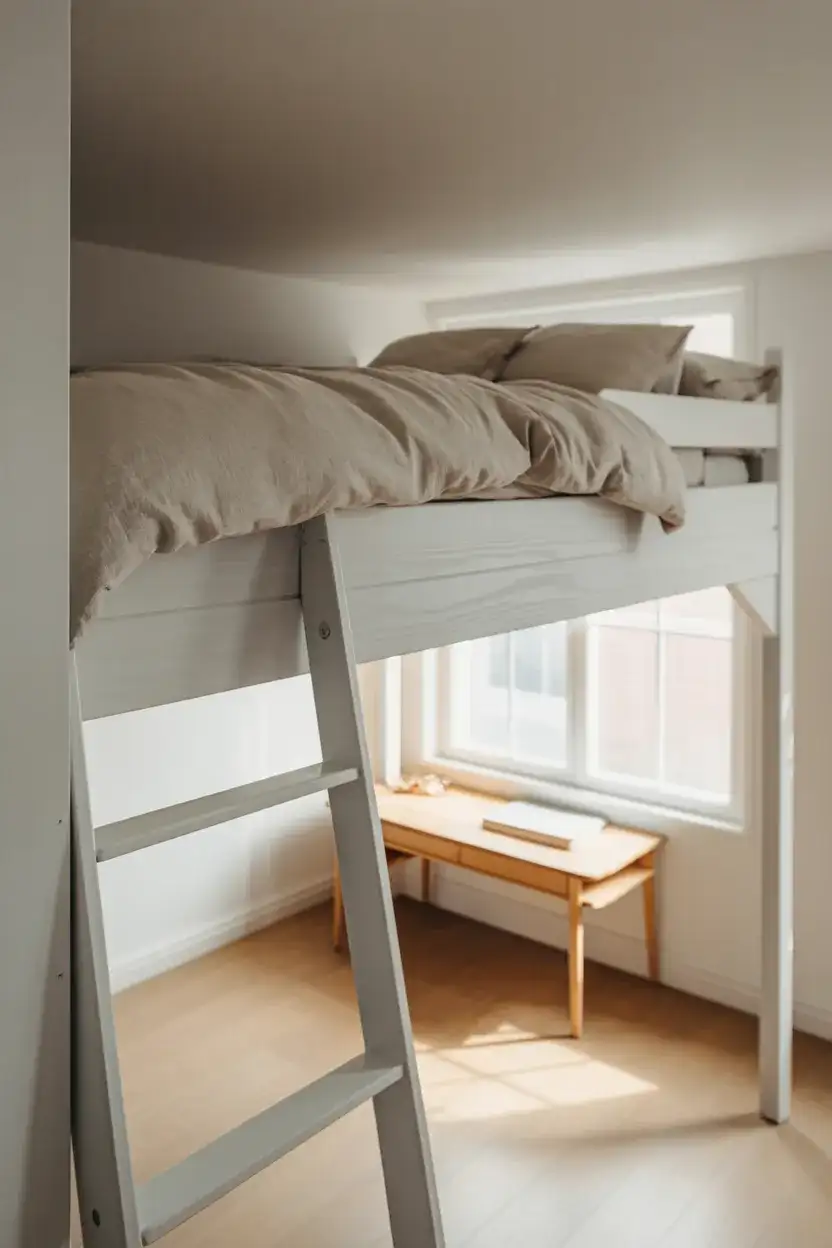
When square footage is tight, a loft bed for small rooms is one of the smartest moves you can make. By lifting the sleeping area off the floor, you instantly reclaim the space below—enough room for a full desk setup, a loveseat, or even a mini wardrobe. The minimalist approach keeps things clean: think white-lacquered wood frames, slim ladder rungs, and zero visual clutter. It’s a surprisingly elegant solution for small rooms that need to punch well above their weight.
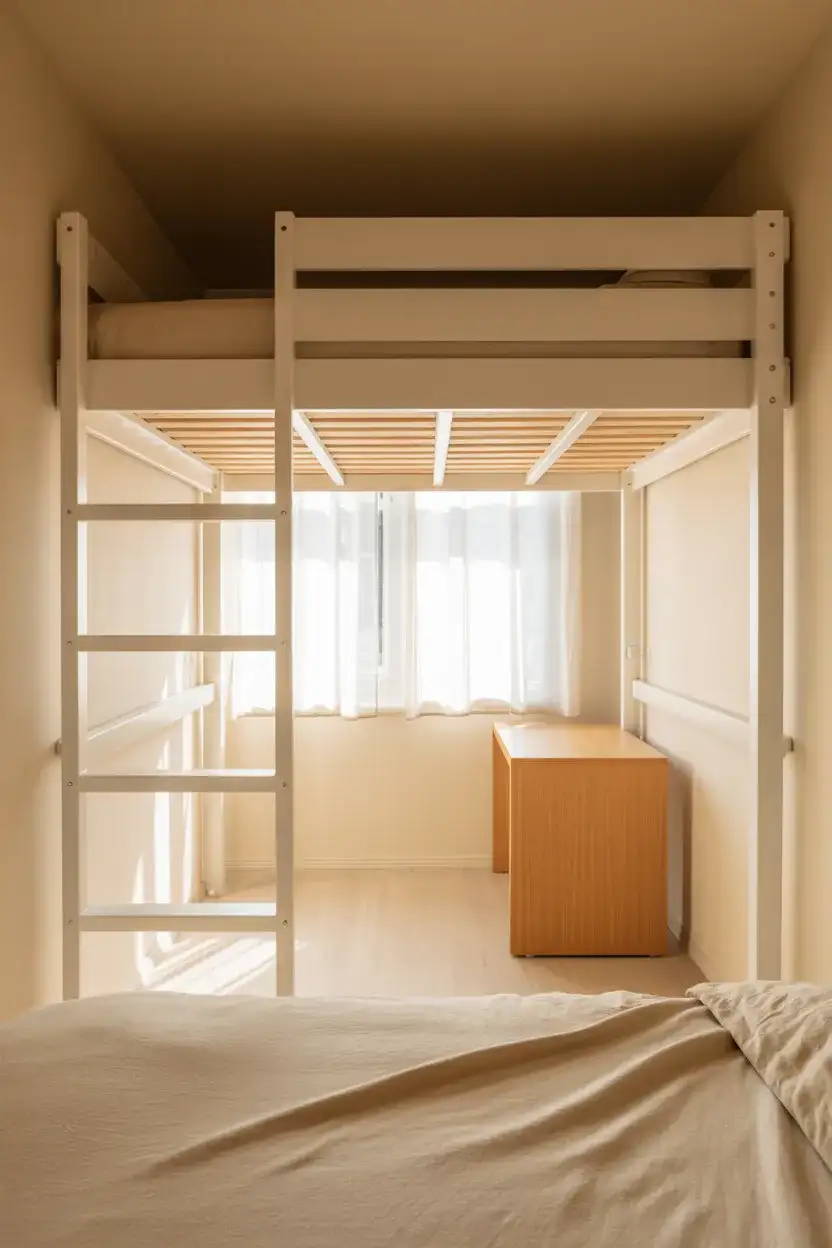
Where this works best: apartments under 400 square feet and city studios where every inch counts. The under-loft zone can flex depending on your lifestyle—swap a desk for a reading chair or compact dresser without changing the bed frame at all. Keeping the palette neutral (whites, oaks, soft grays) prevents the elevated structure from feeling heavy or cave-like, which is the most common trap people fall into with loft beds in tight quarters.
2. Loft Bed with Desk for a Home Office Setup
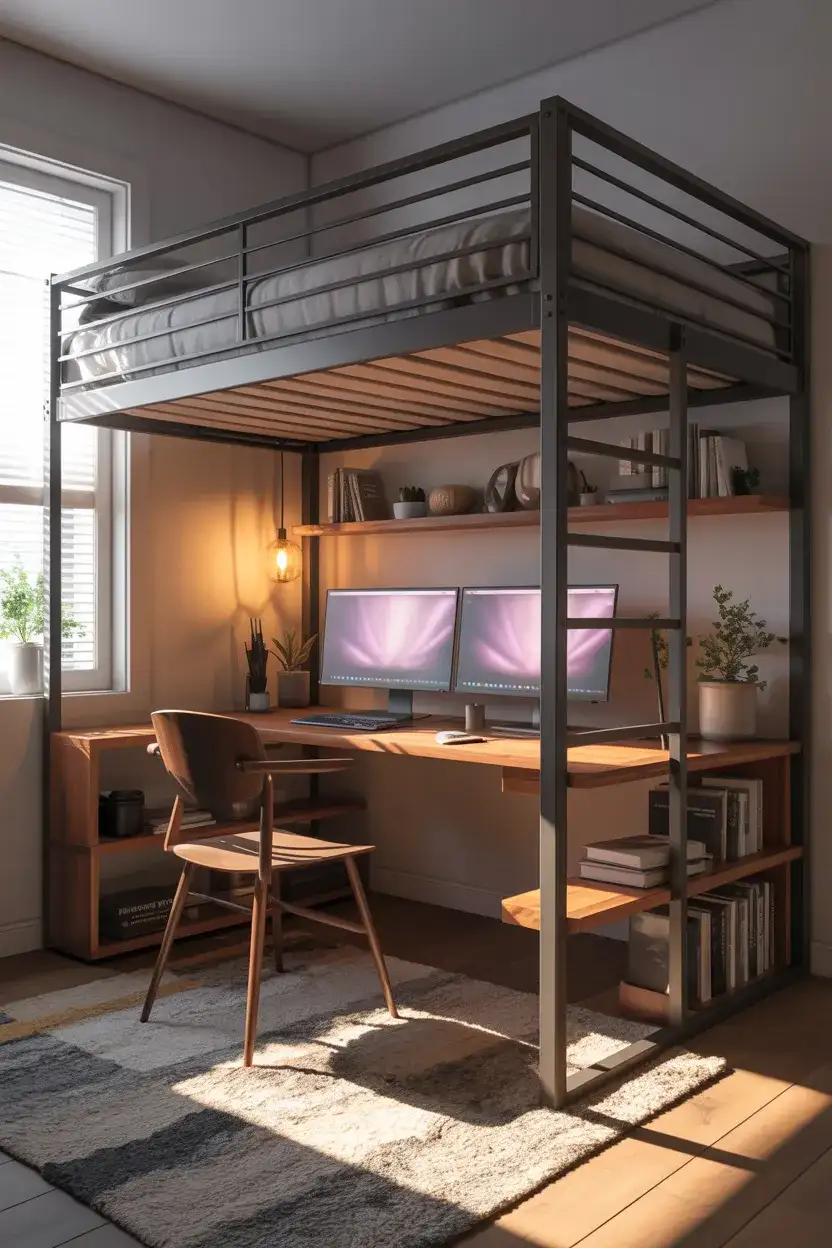
The work-from-home era didn’t just change how we work—it permanently changed how we design bedrooms. A loft bed with a desk underneath is the most efficient answer for anyone who needs a dedicated workspace but doesn’t have a spare room. You sleep above, you work below, and the two zones feel surprisingly separate. Pair a solid-surface desk with a monitor arm, cable management clips, and proper task lighting, and you’ve got a modern home office that a standalone apartment couldn’t offer at twice the cost.
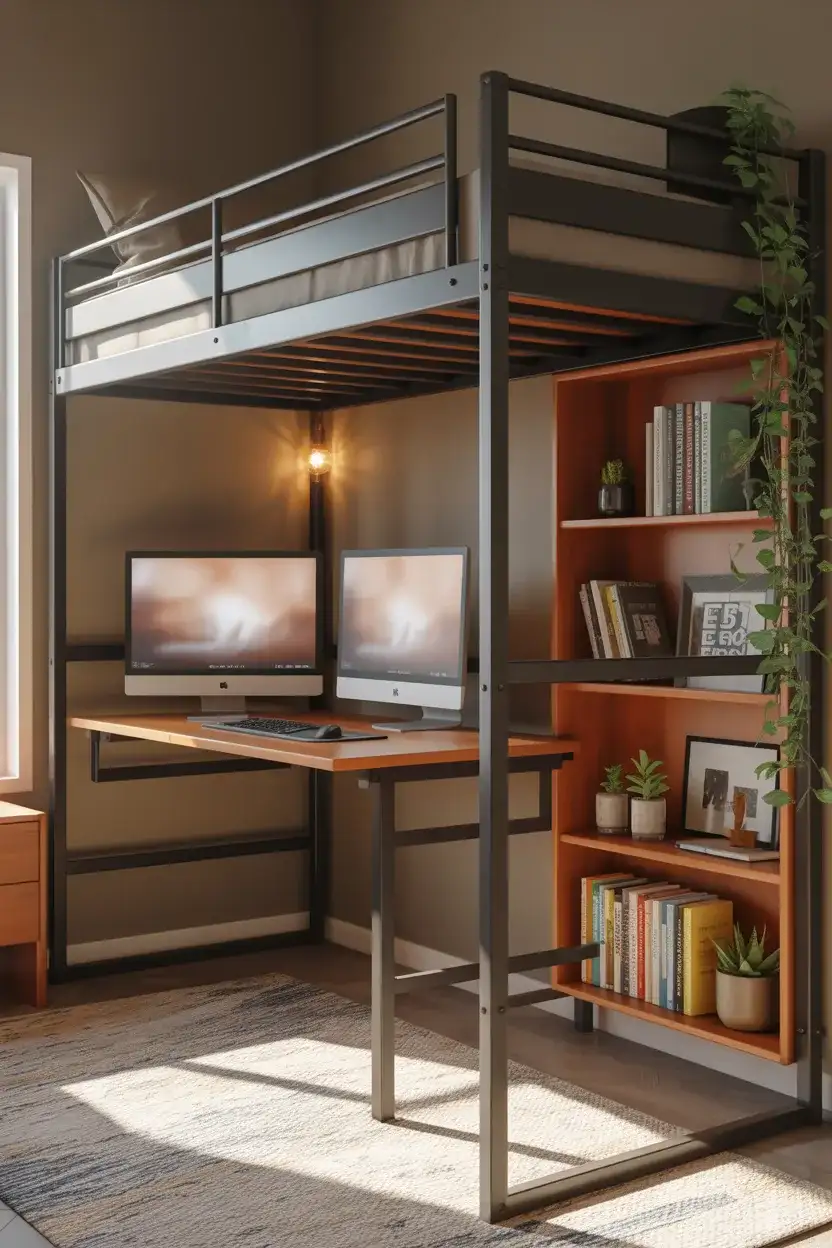
One practical insight worth knowing: the height of your loft matters more than you’d think for the desk zone. Aim for at least 48 inches of clearance below the frame so you can sit comfortably without the mattress platform looming over your monitor. If your ceiling is on the lower side, go for a lower-profile loft with a slightly smaller mattress—a twin XL often hits the sweet spot for adults who want maximum headroom downstairs.
3. DIY Loft Bed Built from Scratch
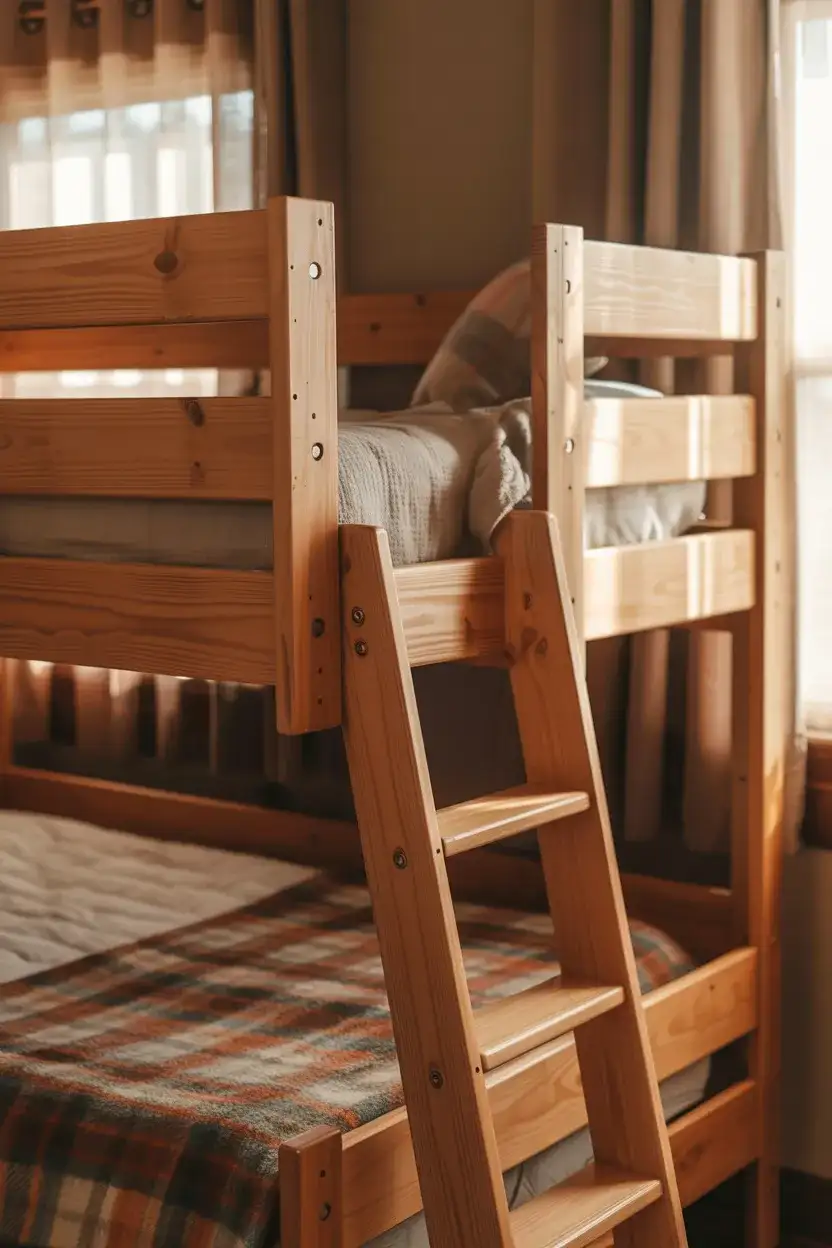
There’s a certain satisfaction in sleeping on something you built yourself—and a DIY loft bed is one of the most rewarding weekend projects you can tackle. With a solid set of plans, a few sheets of plywood, 4×4 posts, and basic hardware, most handy adults can build a custom loft bed for well under $300. The real advantage over store-bought? You control every dimension. Need an extra six inches of desk height? Done. Want angled supports instead of a ladder? You’ve got it.
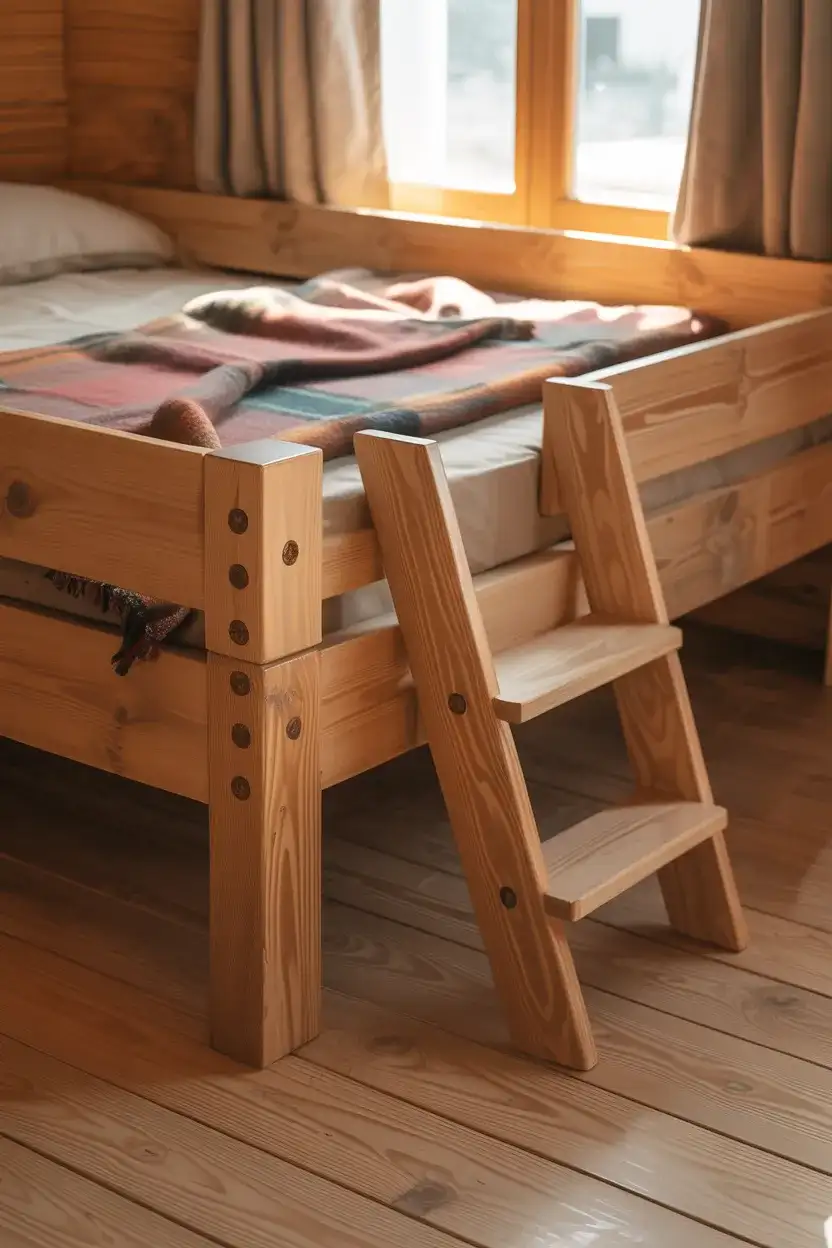
Budget breakdown to set realistic expectations: lumber typically runs $80–$150, hardware $30–$60, and paint or stain another $20–$40. That puts most DIY loft beds in the $150–$250 range—a fraction of what comparable store-bought frames cost. The most common mistake first-timers make is underestimating the importance of diagonal bracing. Without it, even a beautifully built frame will wobble. Cross-brace every corner, and your bed will feel as solid as furniture twice the price.
4. IKEA Loft Bed Hack for Adults
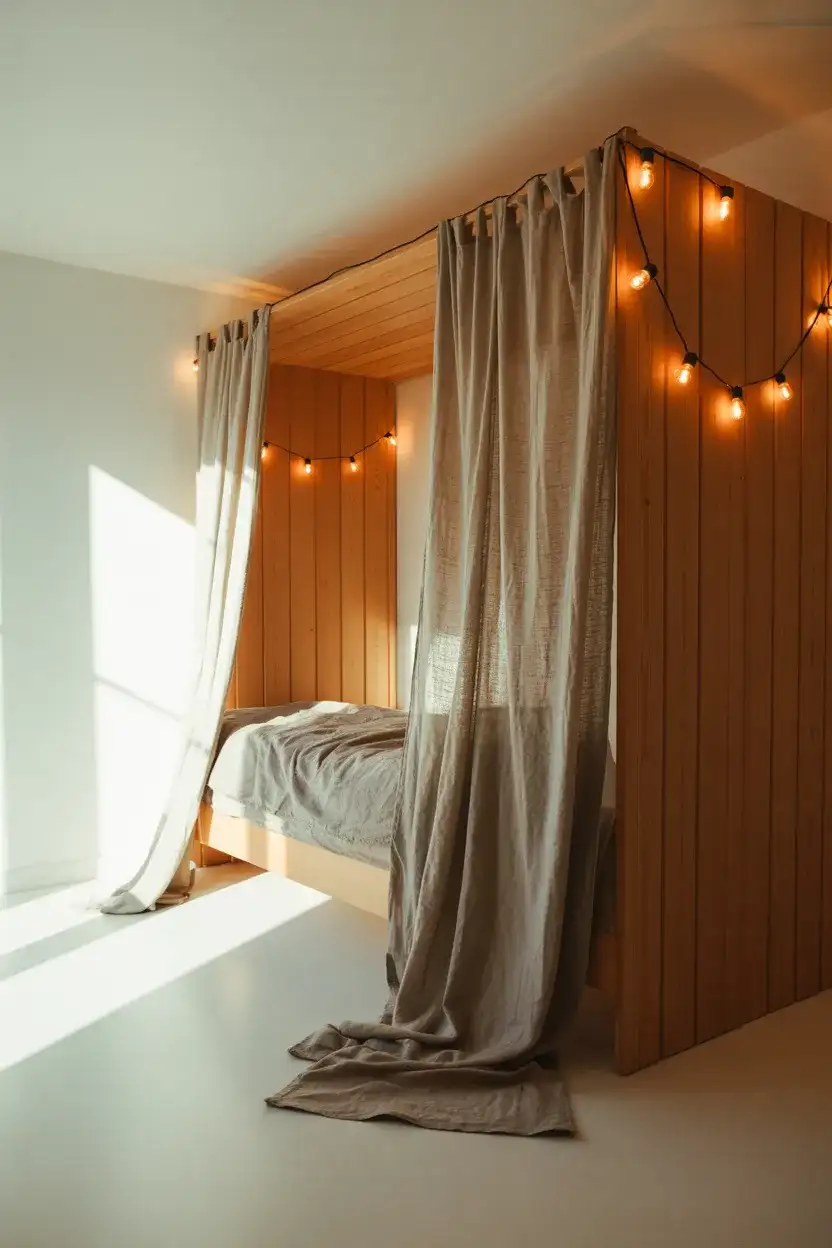
The IKEA STORÅ and KURA have earned cult status for good reason—they’re the most affordable loft bed starting points on the market, and with the right IKEA hacks, they clean up beautifully for adults who want something that doesn’t look like a children’s bedroom. The trick is in the upgrades: swap the standard ladder for a sleek floating-step design, add board-and-batten paneling to the sides, and finish with a linen canopy draped over the guardrail. Suddenly it’s Apartment Therapy material.
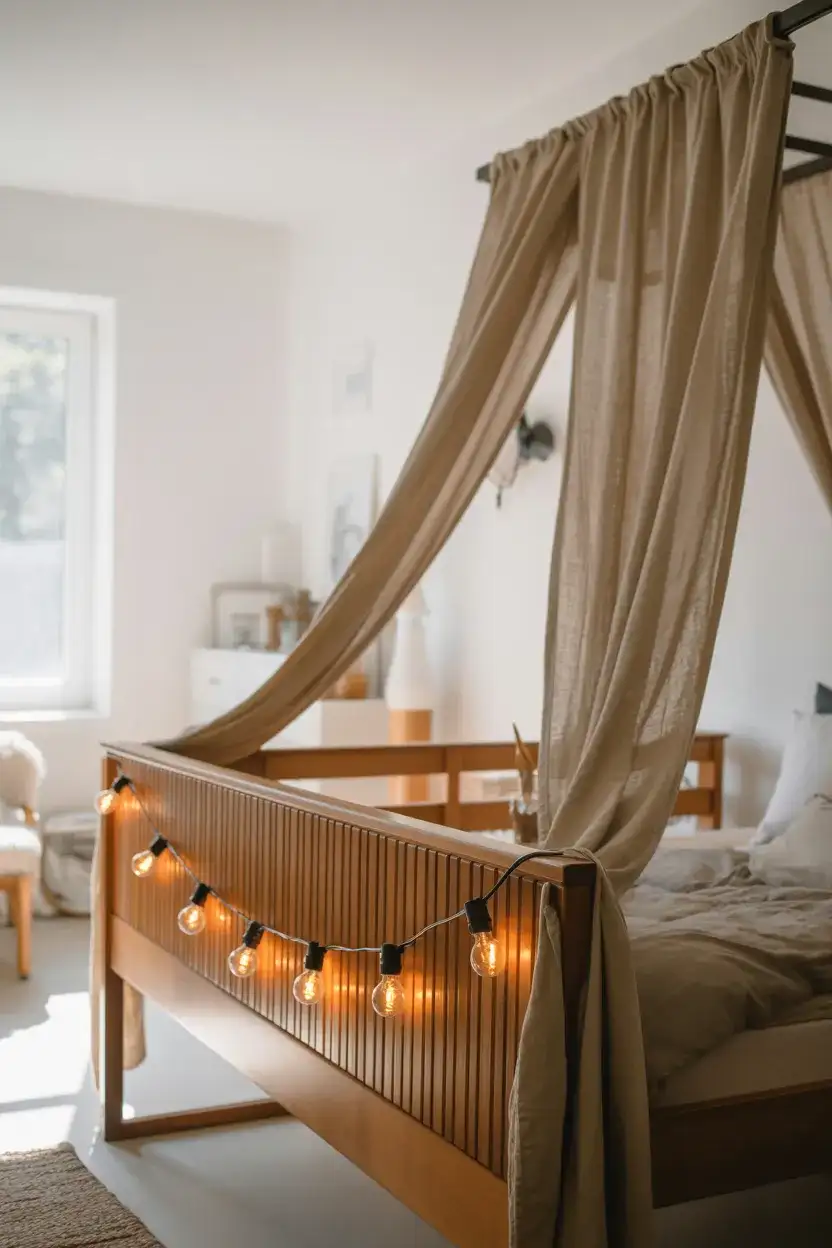
Real homeowner behavior worth noting: most people who go the IKEA route do at least one round of upgrades six to twelve months after purchase. The most popular add-ons are under-bed curtains for privacy, LED strip lighting along the guardrail, and a custom-cut mattress topper for extra comfort. The upside is you can start cheap and personalize over time without ever needing to replace the structural frame itself.
5. Loft Bed Ideas for Teens with a Gaming Setup
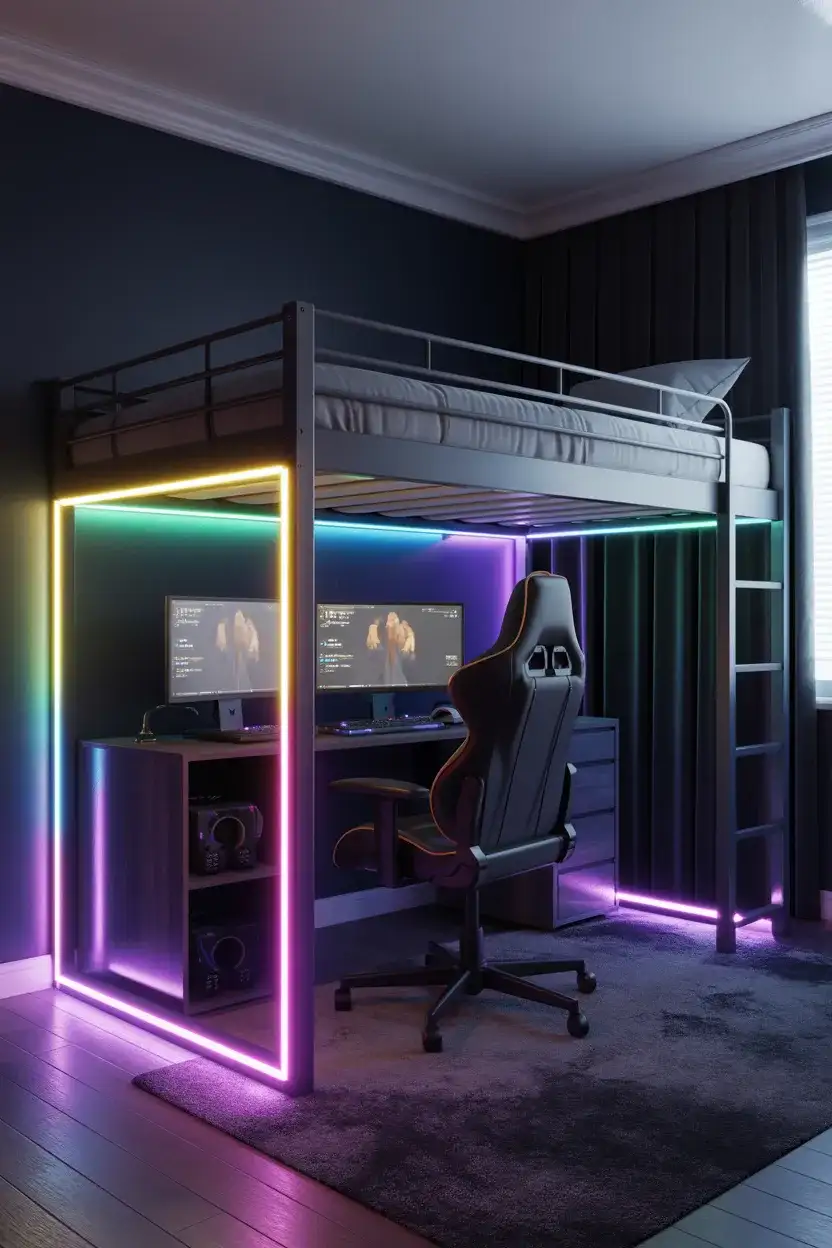
For teens who live and breathe gaming, a loft bed isn’t just furniture—it’s the foundation of their whole setup. Sleeping up top frees the entire lower level for a proper gaming setup: a wide desk, multiple monitors, a console tower, a headphone stand, and the all-important RGB lighting that wraps around the frame like a neon halo. Ideas for teens in this category tend to lean dark and dramatic—navy walls, blackout curtains, LED strips in purple or blue, and cable trays to keep the wiring invisible.
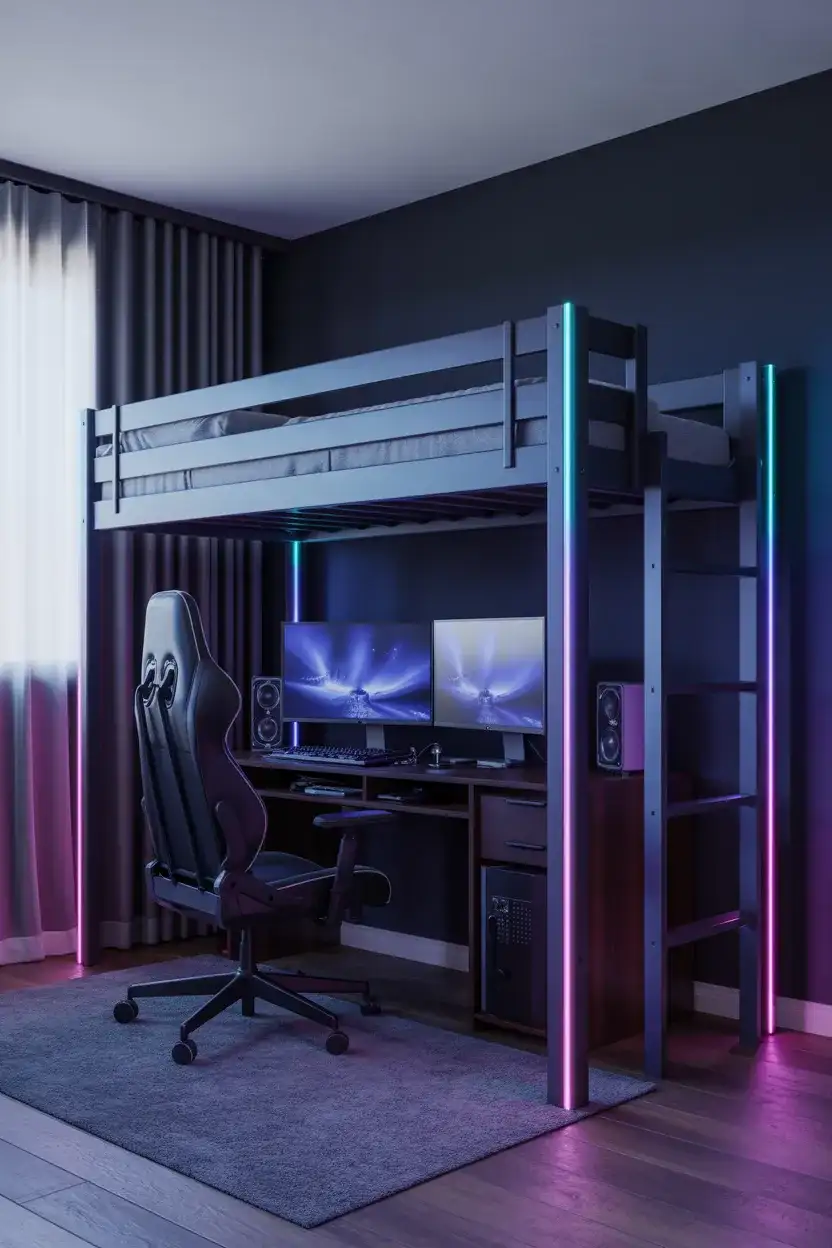
An American lifestyle note here: the average American teenager spends upward of three hours a day gaming, so building a room that genuinely supports that habit—with ergonomic seating, proper monitor height, and acoustic panels on the wall—isn’t indulgence; it’s sensible design. The loft format is particularly smart because it separates the stimulating gaming zone from the restful sleeping zone, which child sleep experts consistently say improves sleep quality for screen-heavy teenagers.
6. Cozy Loft Bed Nook with Curtains
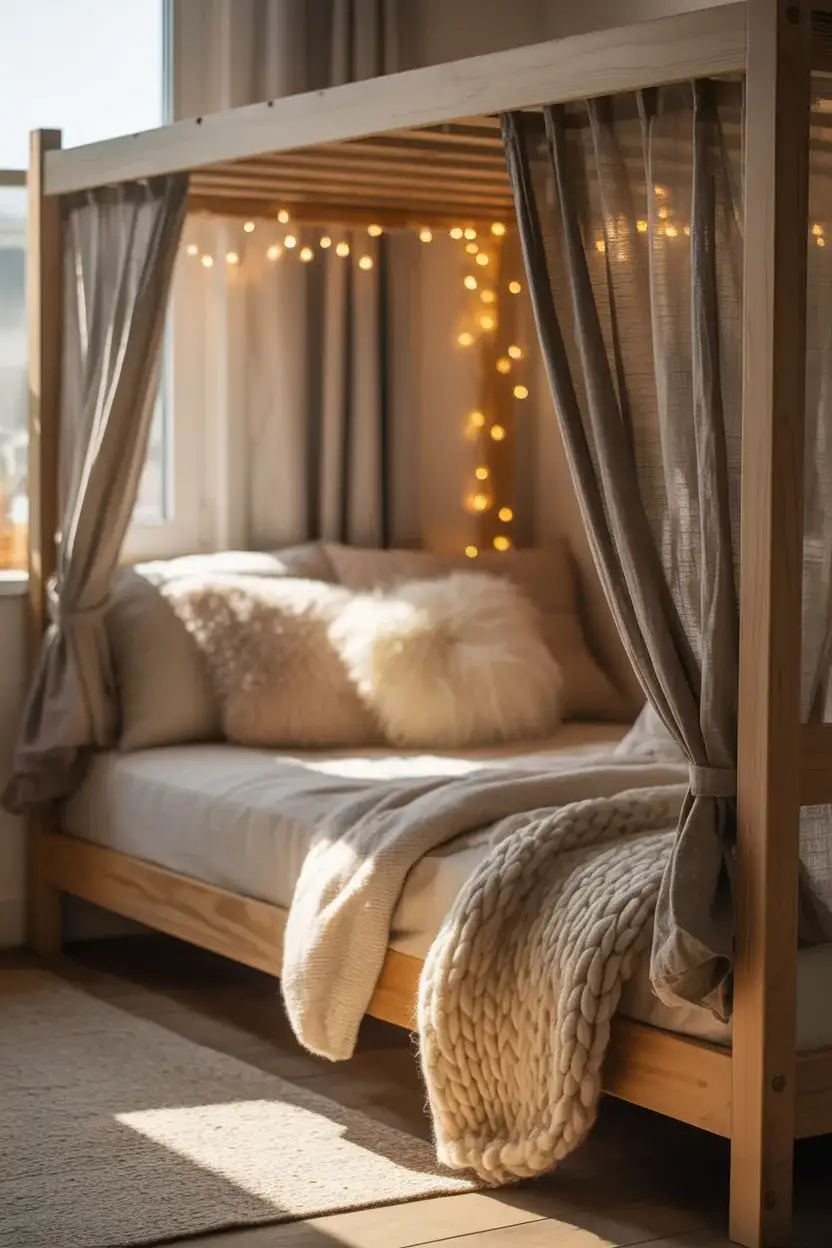
Some people don’t want their bed to feel exposed—they want it to feel like a den. A cozy loft bed with curtains accomplishes exactly that, wrapping the sleeping platform in a soft cocoon of linen, velvet, or cotton panels that you draw closed at night. This approach works brilliantly in shared spaces or studio apartments where the bedroom and living area are technically the same room. Add fairy lights inside the canopy and a small clip-on reading lamp, and the whole setup becomes irresistibly aesthetic.
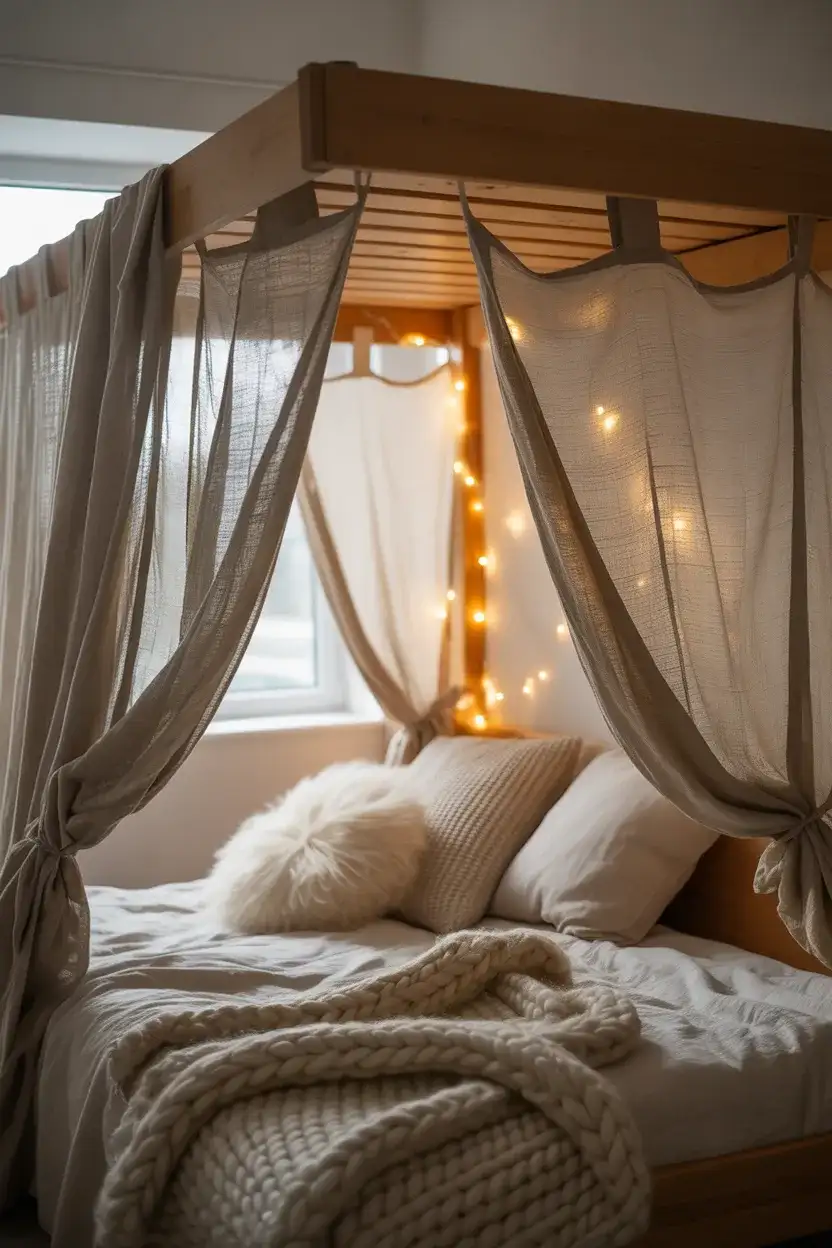
A micro-anecdote that captures this perfectly: a Brooklyn designer shared that after adding curtains to her loft bed, she started sleeping a full hour longer on weekends—the visual separation from her living space cued her brain that sleep was a distinct, protected activity. Whether or not you’re a sleep-science believer, there’s something genuinely soothing about disappearing behind a curtain at the end of the day.
7. Loft Bed with Stairs and Built-In Storage
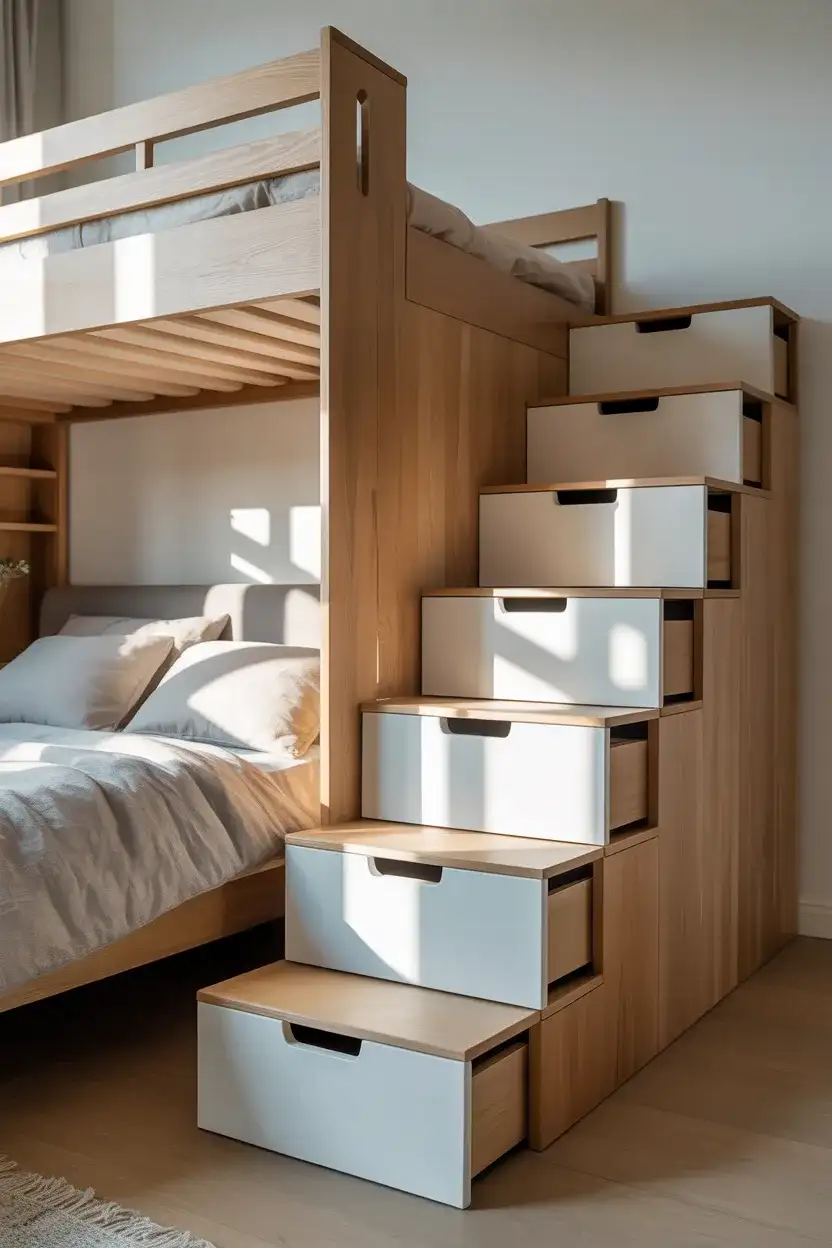
If you’ve ever climbed a loft bed ladder in the middle of the night half-asleep, you already understand why stairs are worth the extra cost and footprint. A loft bed with stair access—especially when those stairs are hollow drawers—doubles as the room’s primary dresser. Each step holds folded clothes, extra linens, or seasonal items. This is the ultimate expression of built-in design thinking: every structural element earns its space by doing at least two jobs simultaneously.
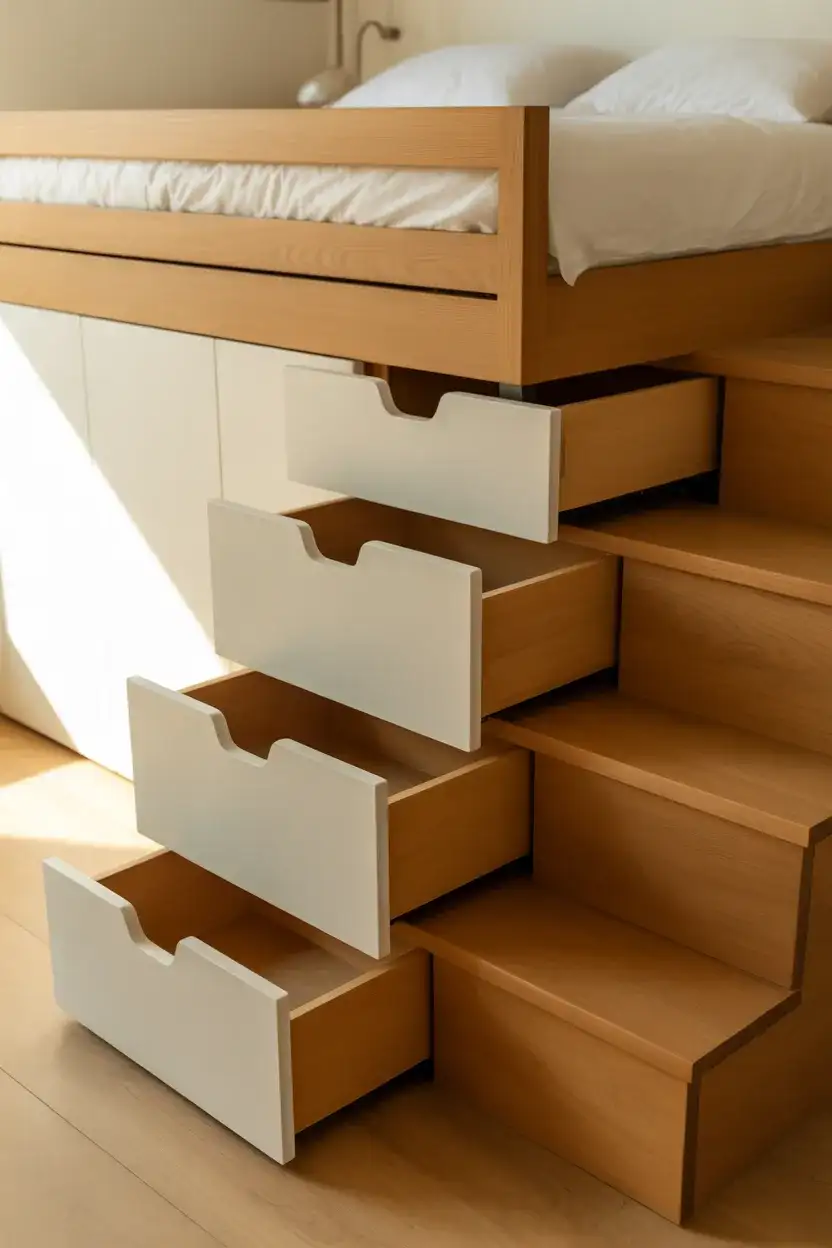
Expert-style insight: interior designers consistently recommend stair-access lofts over ladder versions for anyone over 40, for children under 8, and for anyone whose bedroom is the primary location of a mobility limitation. The stair format also tends to feel more architecturally permanent—less “assembled furniture,” more “custom carpentry”—which adds genuine perceived value if you’re renting out your space on platforms like Airbnb.
8. Modern Loft Bed in a Studio Apartment
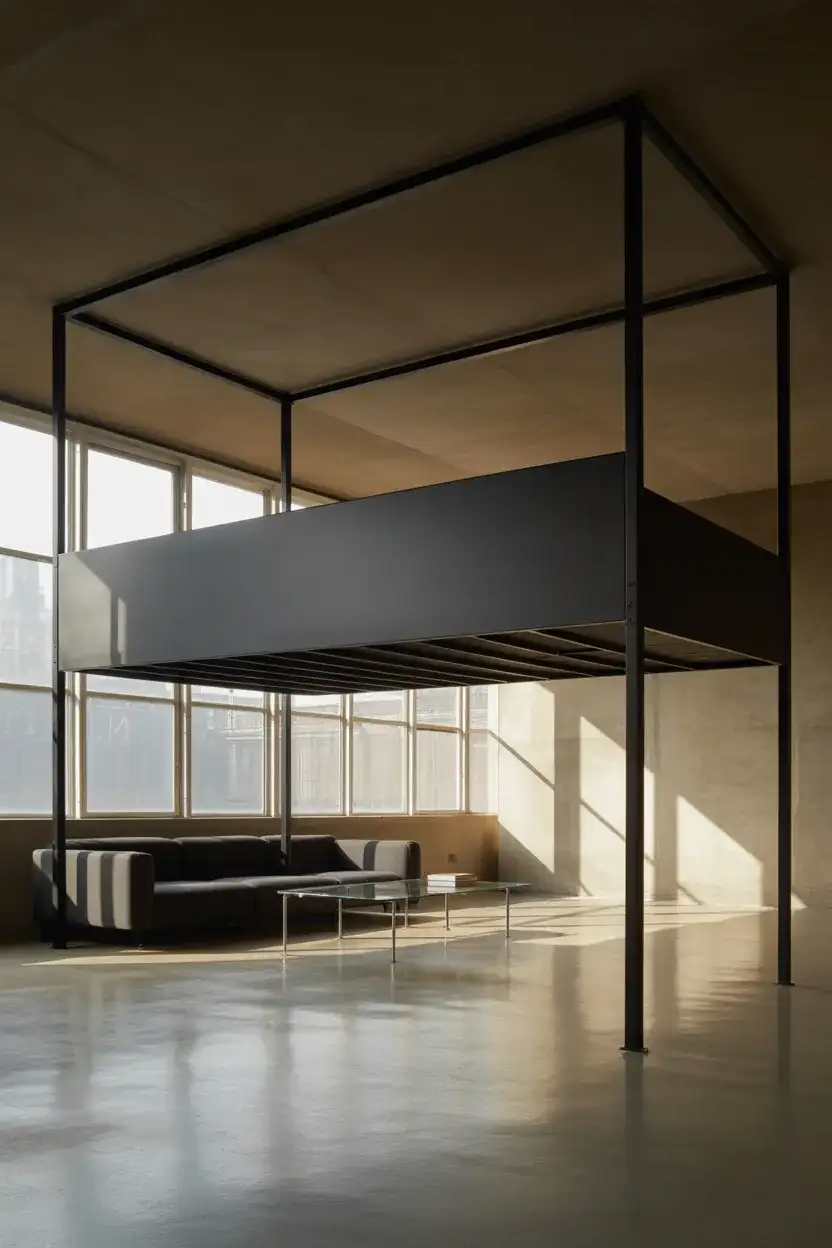
Studio living is one of the defining housing realities of American cities right now, and a modern loft bed is one of the most effective tools for making it work without sacrificing style. The key in a studio is to treat the loft bed as a design feature—not a compromise. Choose a matte black or brushed steel frame, add architectural lighting that washes the wall below, and let the elevated sleeping zone anchor the room the way a platform bed would anchor a full bedroom. Room ideas like this tend to photograph beautifully, which is why they dominate Pinterest boards.
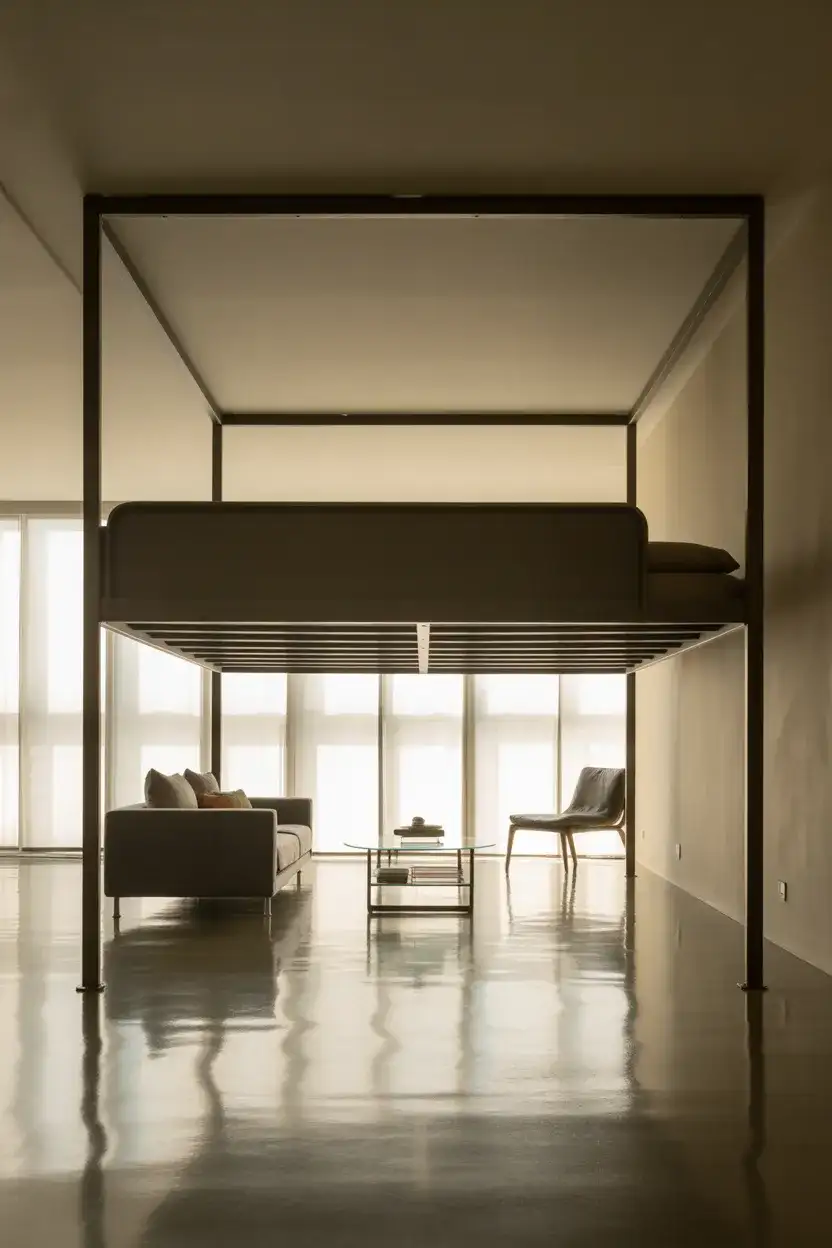
Where this works best: apartments with 9-foot or higher ceilings, which are more common in older urban buildings—prewar New York, Chicago greystones, and converted warehouse units in cities like Denver and Portland. Lower ceilings can still work, but you’ll want to cap the loft height so you’re not hunched while reading in bed. Shoot for 36–42 inches of clearance above the mattress surface as your minimum.
9. Dorm Room Loft Bed Transformation
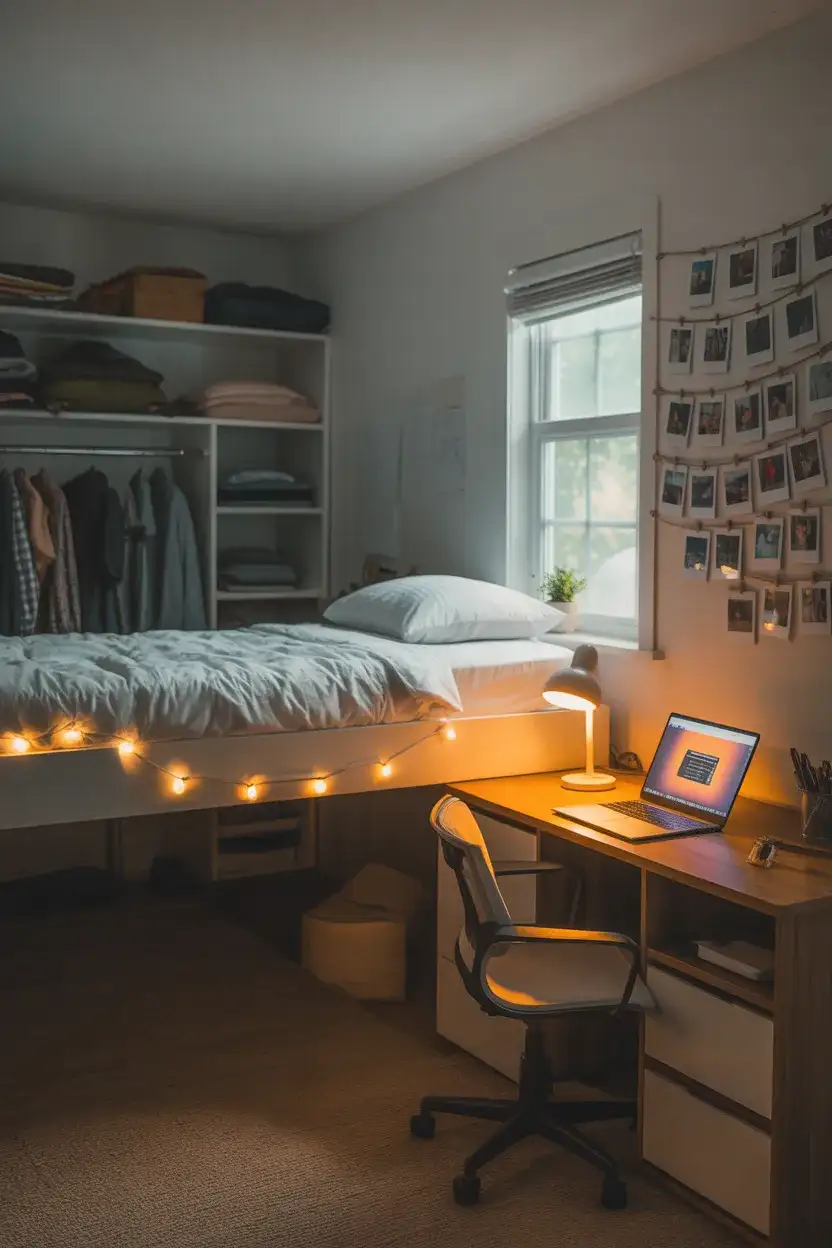
Most college dorms already come with beds that can be lofted—but the way most students set them up leaves enormous potential untapped. The best dorm room ideas treat the under-bed zone as a micro-apartment: a proper desk with a task lamp on one side, a mini-wardrobe or cube organizer on the other, and a small command strip gallery wall behind the desk to make it feel intentional. Even in the most standard-issue dorm room, this transformation takes about a weekend and costs under $200 including all accessories.
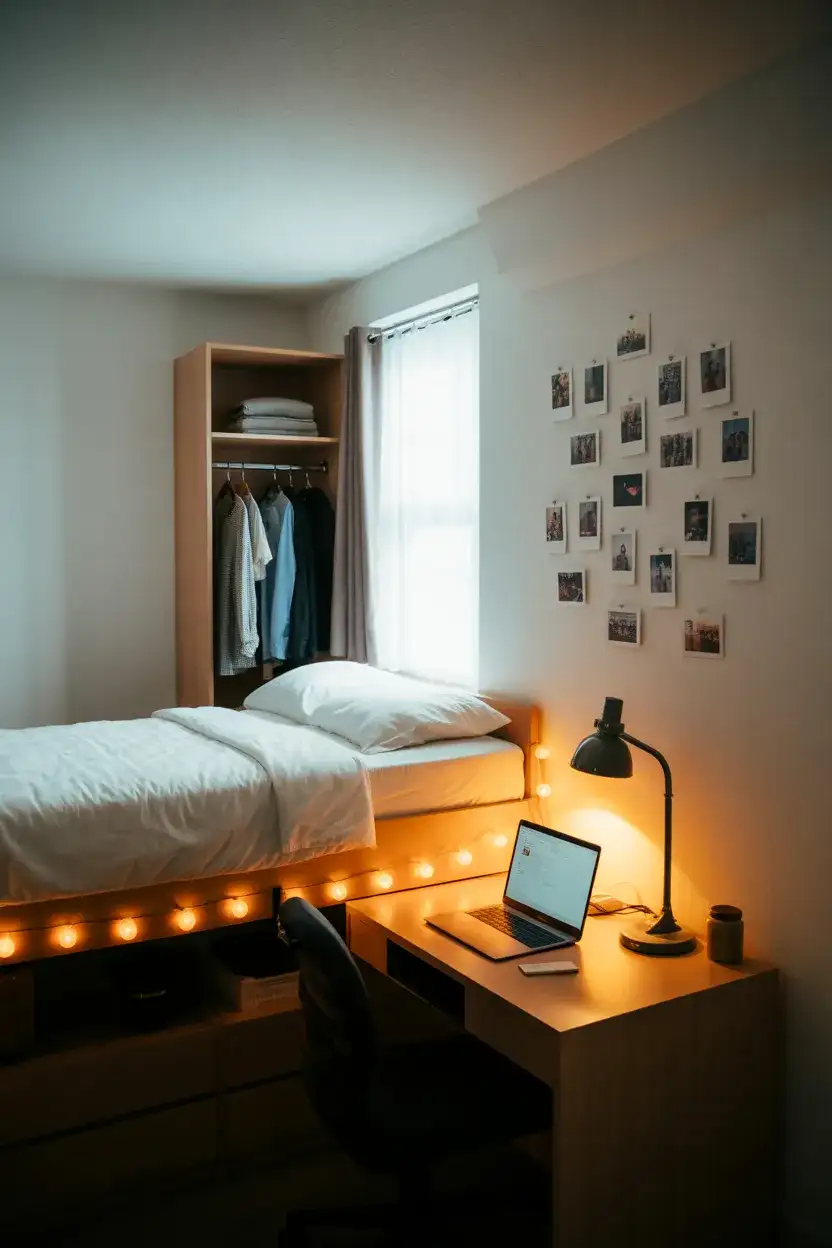
Common mistakes and how to avoid them: the biggest dorm loft error is going too tall too fast. Students who loft their beds to the maximum height often find they hate climbing up after late nights, forget things constantly, and feel isolated from their roommate. A mid-height loft—just enough to fit a desk comfortably below—typically offers 90% of the functional benefit with far less of the inconvenience. Start lower, and only go higher if you genuinely need the extra clearance.
10. Aesthetic Loft Bed for Teen Girls
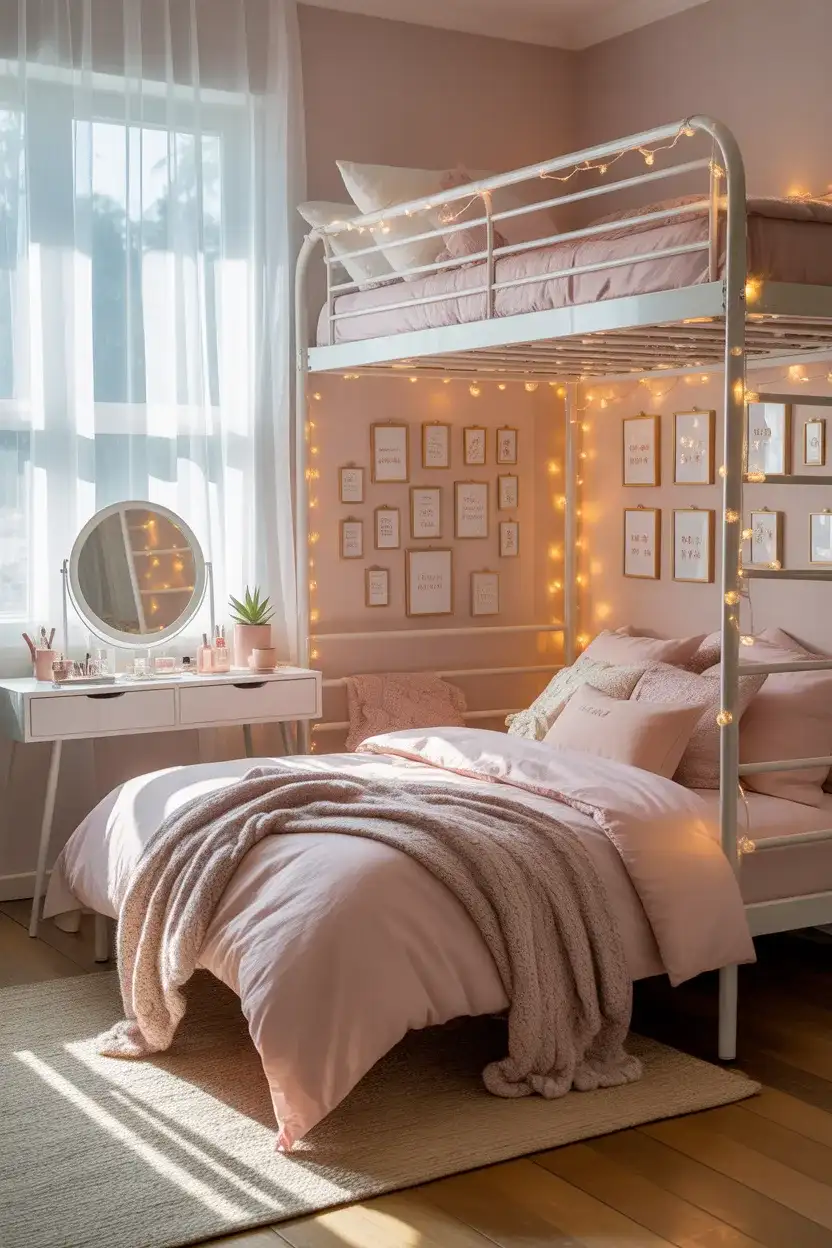
The Pinterest aesthetic bedroom trend isn’t slowing down—and for teenage girls, a loft bed is one of the best canvases for expressing a fully realized personal style. Whether the vibe is cottagecore, dark academia, or Y2K pastel revival, the loft format gives teens a vertical space to layer their personality: a gallery wall at eye level below, a canopy above, string lights threaded through the guardrail, and a vanity mirror tucked into the corner. Ideas aesthetic enough for TikTok and Pinterest require this kind of layered thinking.
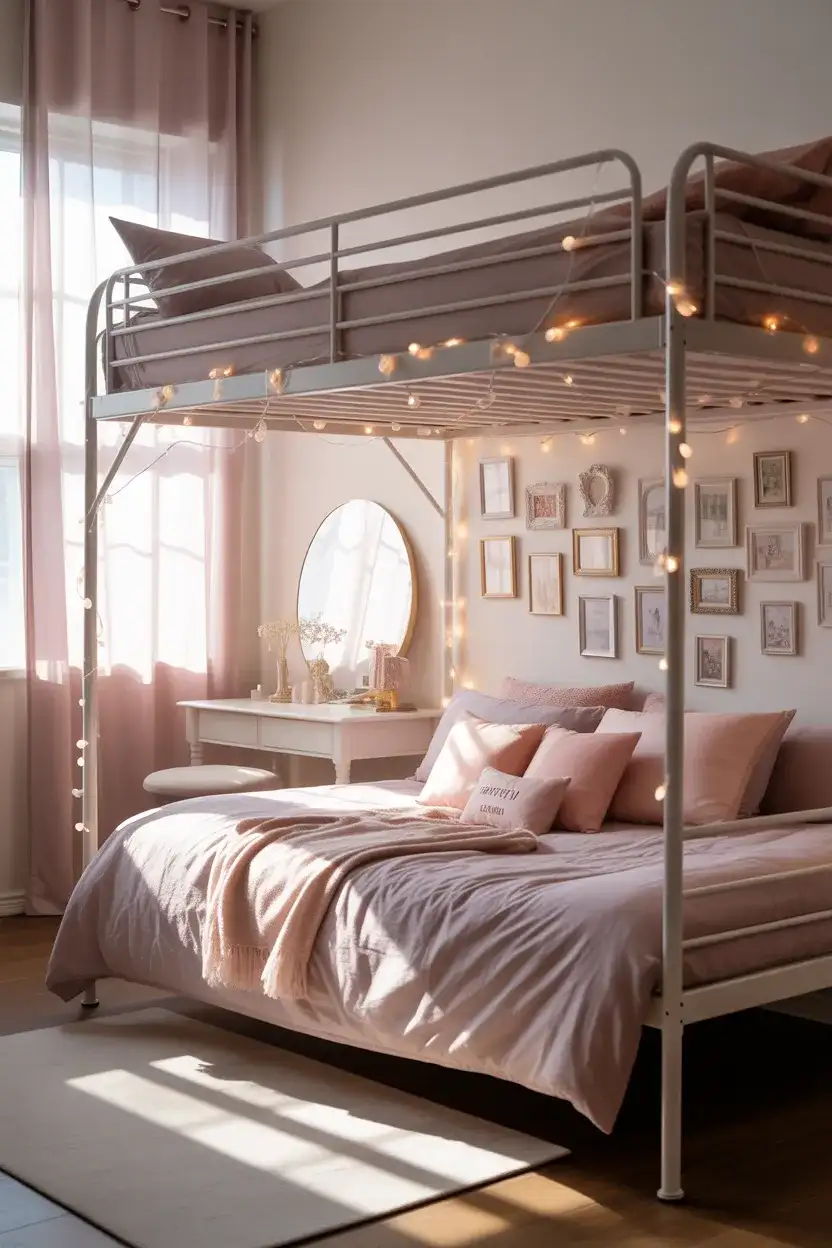
A practical note for parents: the investment in letting a teenager genuinely design their space pays dividends in ways that go beyond aesthetics. Studies in environmental psychology consistently show that teens who feel ownership over their personal space report higher self-esteem and spend more time doing homework at their desk. Giving them a $400 loft bed budget and real creative control often produces a room they’re genuinely proud of—and one that keeps them off the couch.
11. Small Room Loft Bed for Teenagers
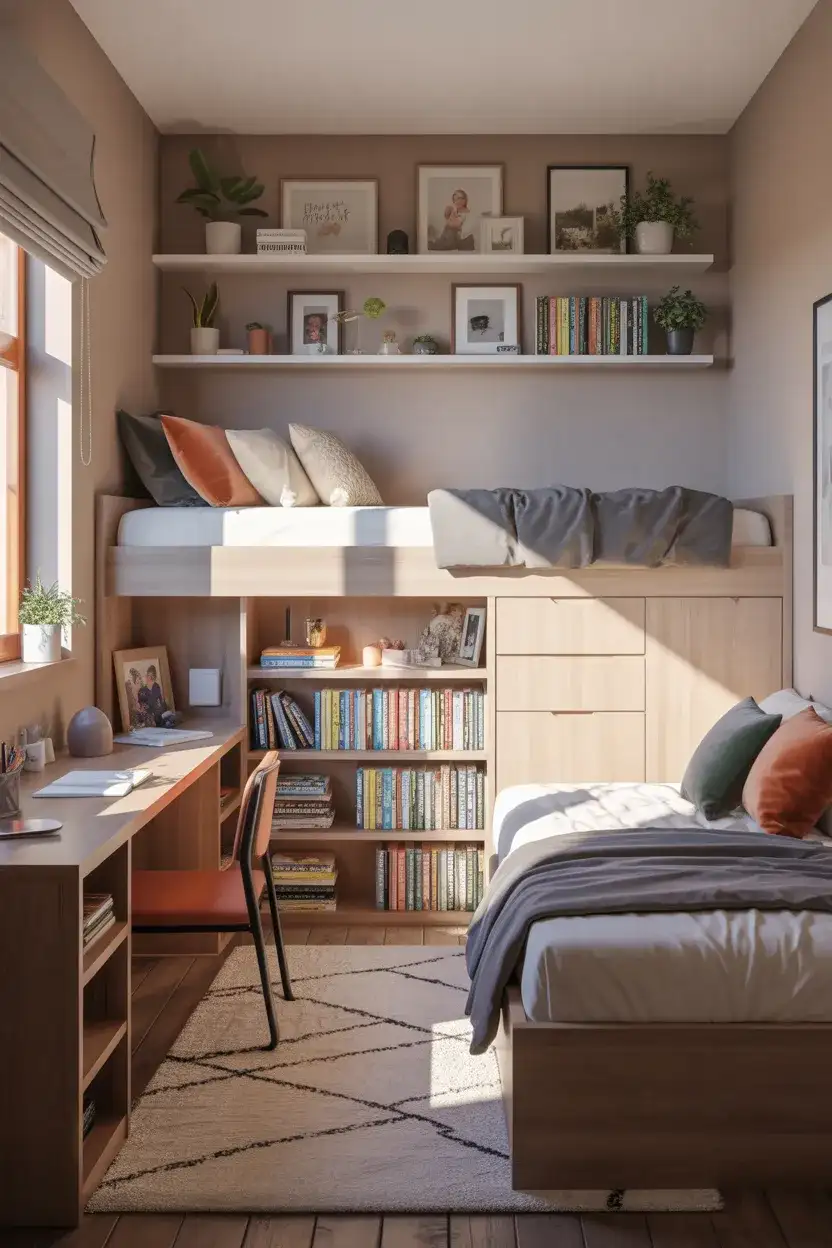
Navigating a small room’s teenage challenge requires more than just buying a smaller bed—it requires rethinking the room’s entire vertical architecture. A loft bed in a tight teen bedroom can free up enough floor space for a proper desk, a floor-length mirror, and even a small reading chair or beanbag. The secret is choosing a frame that matches the room’s wall height precisely and building outward from it: shelves on the adjacent wall at loft level and hooks for bags and headphones on the ladder’s side posts.
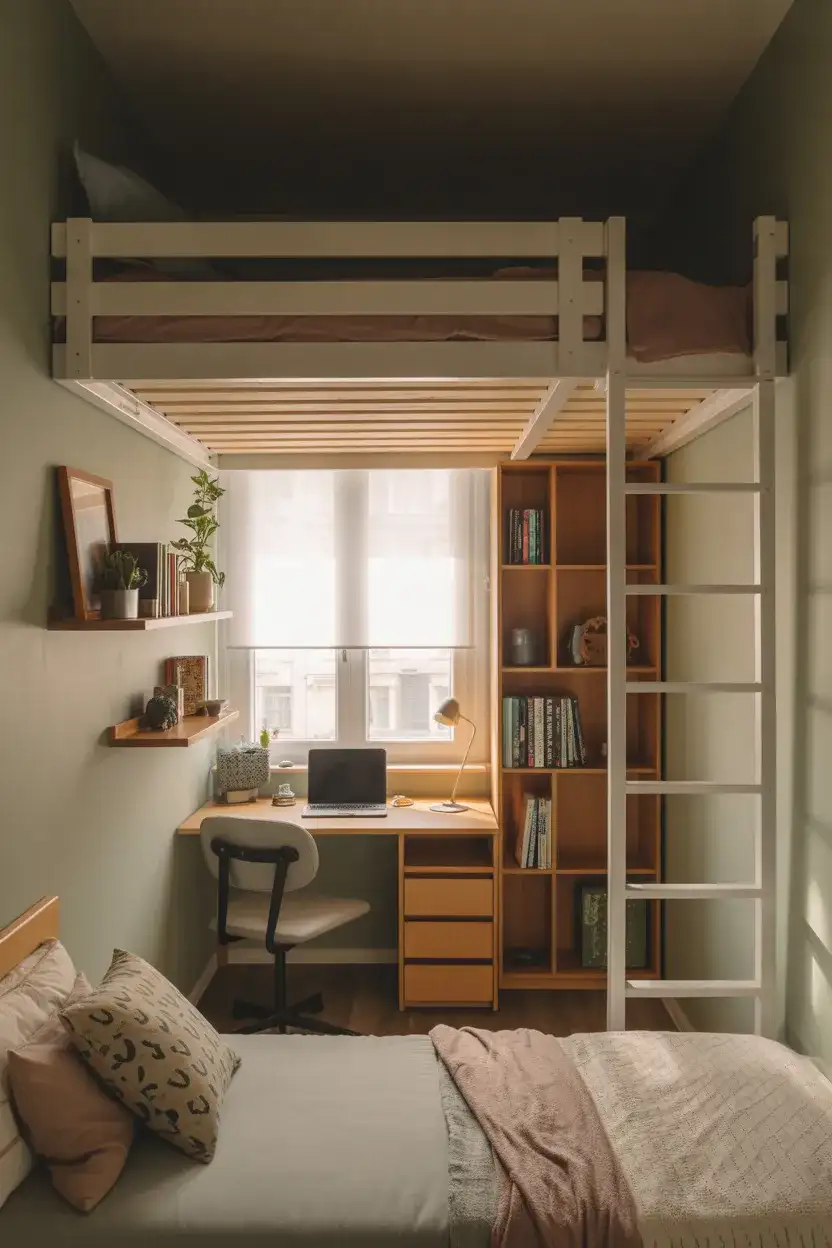
Budget and price angle: for smaller teen rooms, you rarely need to spend more than $500–$700 on a quality loft bed, especially if you pair a mid-tier frame from Wayfair or Pottery Barn Teen with DIY storage additions underneath. The bigger investment is usually in the accessories—lighting, organizers, and bedding—which collectively run $150–$300 but make the difference between a room that looks assembled and one that looks designed.
12. Reverse Loft Bed with Sofa Below
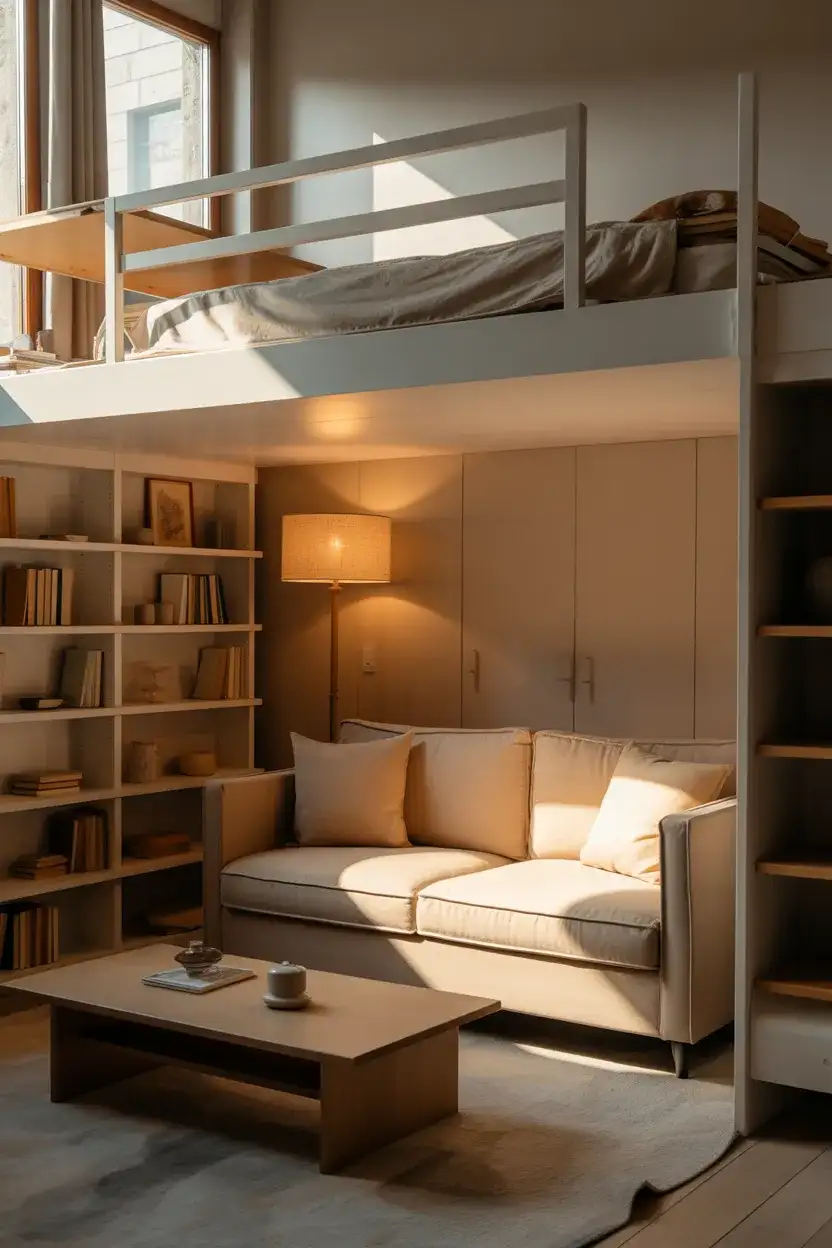
The reverse loft bed—also called a loft sofa bed—flips the traditional configuration: instead of a desk below, you place a full-size sofa or daybed, creating a private lounge zone beneath the sleeping platform. It’s the studio apartment’s answer to having a separate living room. This works especially well when paired with a low coffee table, a floor lamp, and a small bookshelf, turning the under-loft area into a genuinely inviting place to sit and decompress that feels distinct from both sleep and work.
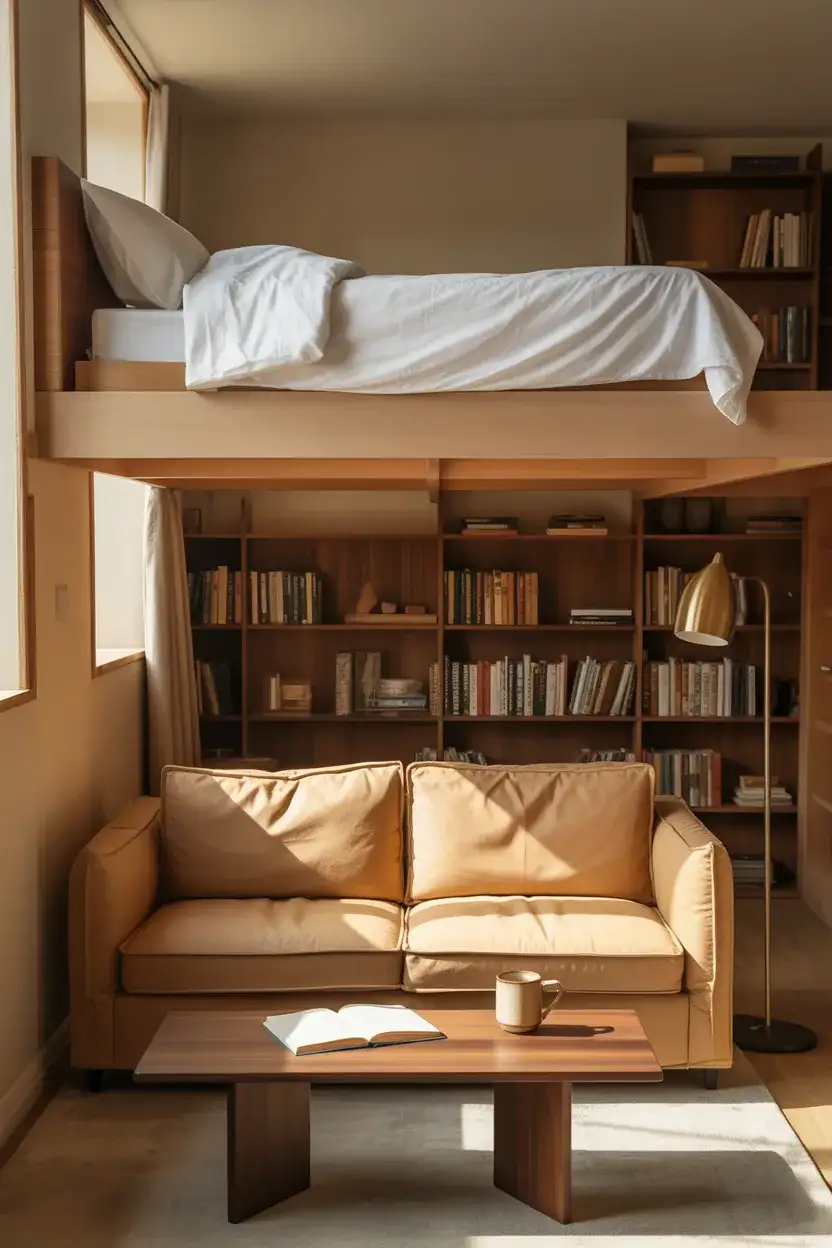
Real homeowner behavior: people who set up a reverse loft consistently report using their space very differently than those who put a desk below. Evening routines shift—instead of scrolling in bed, they move to the sofa below, which creates a genuine wind-down ritual separate from the sleep environment. It’s an accidental sleep hygiene upgrade that comes baked into the design, and one that therapists who specialize in insomnia frequently point to as genuinely beneficial.
13. Built-In Loft Bed with Custom Cabinetry
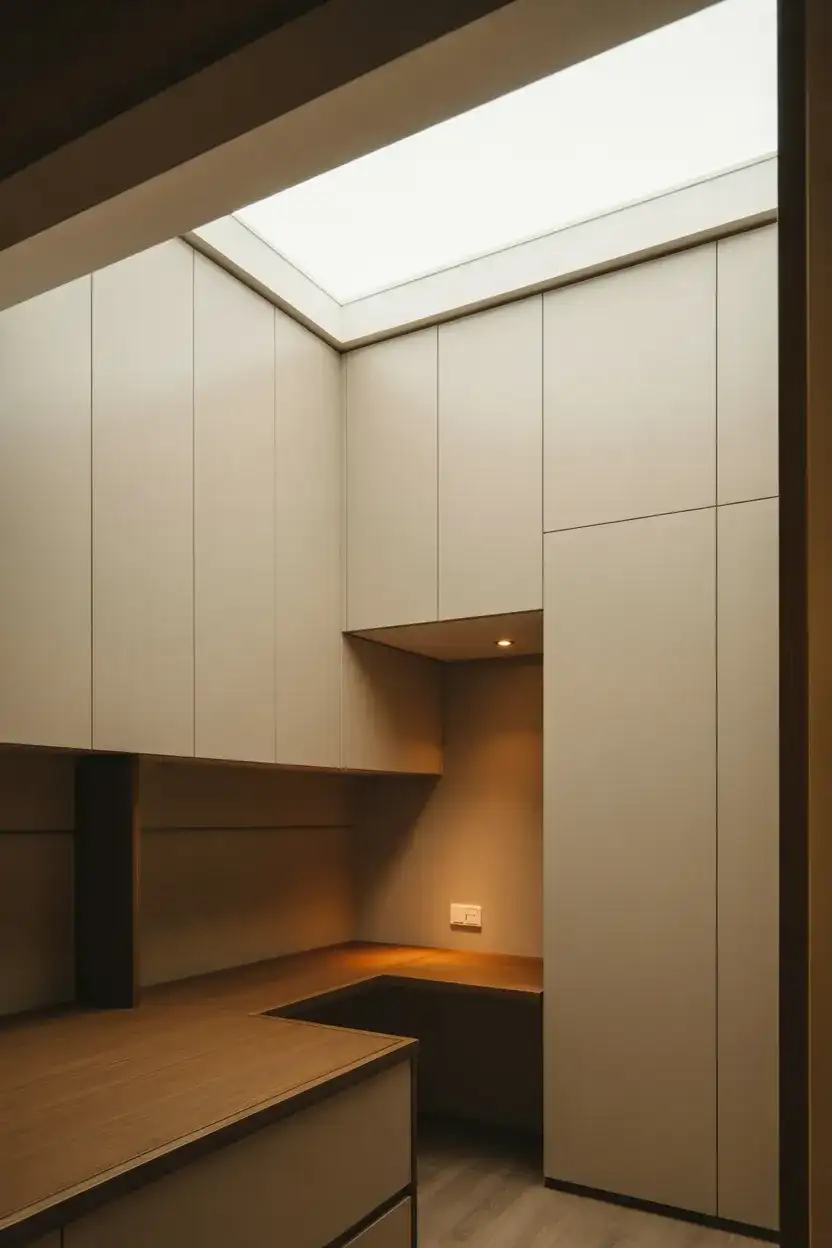
A built-in loft bed is in a completely different category from anything you’d order online. Designed and installed by a carpenter or a skilled DIYer, these structures integrate seamlessly with the room’s walls, often incorporating full floor-to-ceiling cabinetry, integrated lighting, and custom desk surfaces that look like they were always part of the architecture. The result is something that adds genuine resale value to a home and reads less as bedroom furniture and more as thoughtful interior design. This is the gold standard of loft bed thinking.
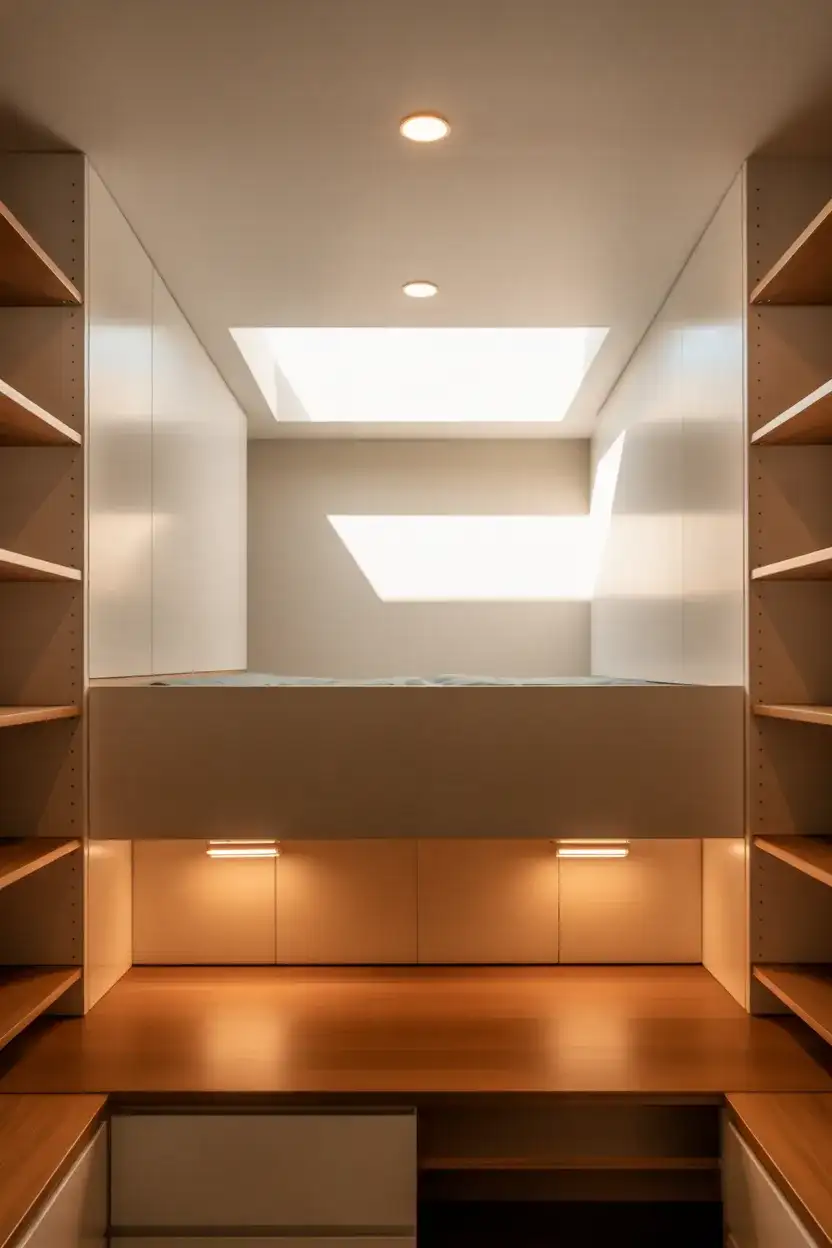
Expert-style commentary: architects and interior designers consistently treat built-in loft beds as the smartest investment in small bedroom design. Unlike freestanding furniture that you take with you when you move, built-ins are a permanent improvement that buyers and renters respond to immediately. In competitive rental markets like San Francisco, Seattle, and New York, a well-executed built-in loft bed with desk and storage has been documented to justify rent premiums of $100–$200 per month.
14. Loft Bed Decorating Ideas with Plants and Lighting
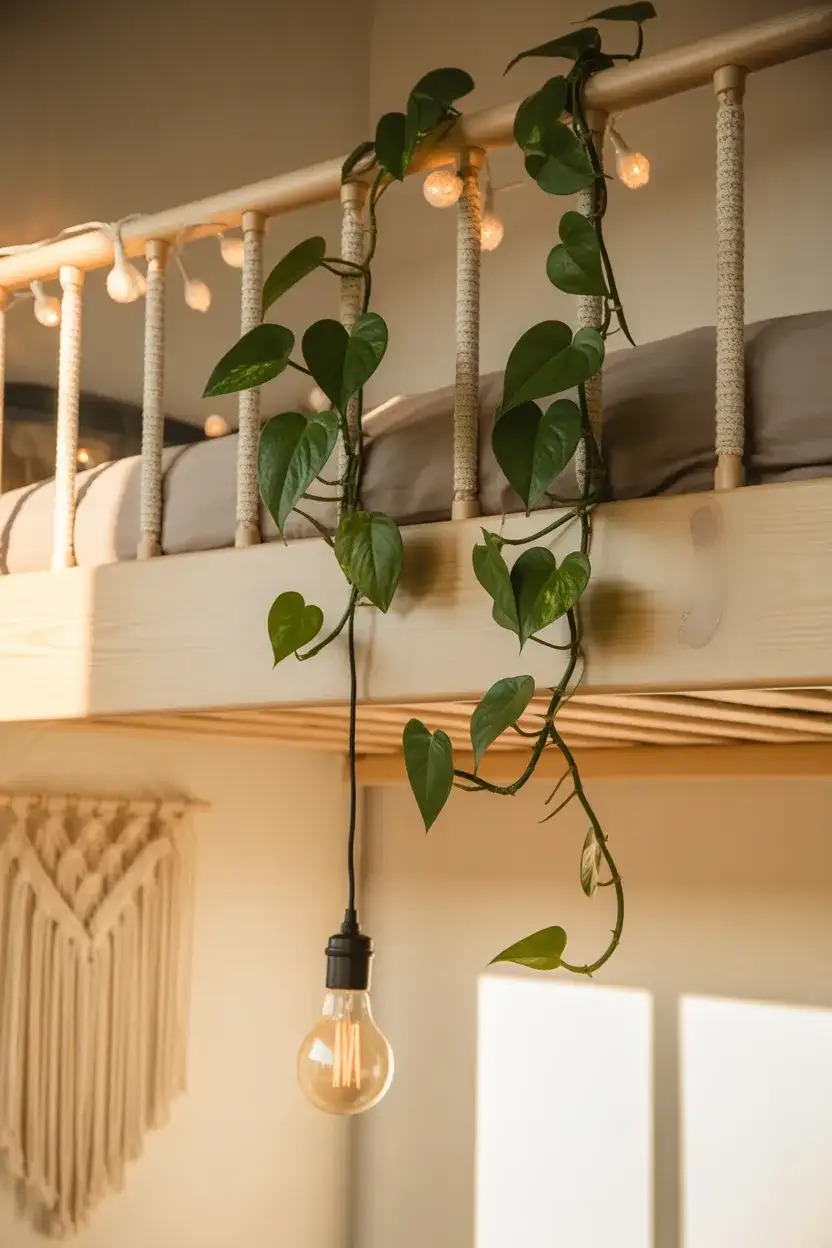
The frame is just the beginning—what separates a forgettable loft bed from a truly memorable bedroom is the layering of decorating ideas around it. Trailing plants like pothos or string-of-pearls draped over the guardrail add organic softness to what can otherwise be a rigid, structural-feeling piece. Warm-toned Edison bulbs on a dimmer switch below and fairy lights woven through the spindles above—these are the details that make a bedroom feel curated rather than merely furnished. Inspo like this is exactly what drives Pinterest’s most-saved bedroom pins.
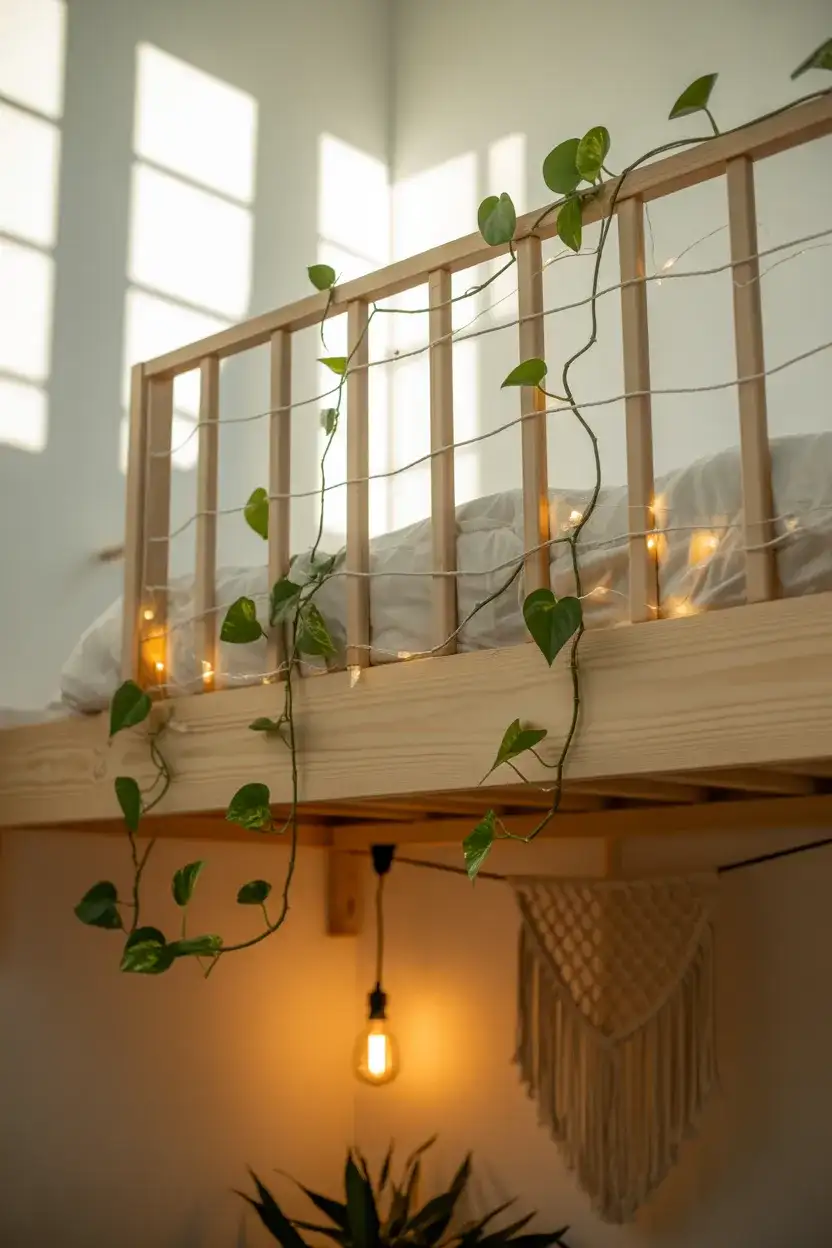
Where this decorating approach works best: bedrooms with natural light—east- or south-facing windows that give plants a fighting chance—and rooms where the palette is already warm and earthy. The key mistake to avoid is overdoing it: three trailing plants are lush; seven trailing plants become a jungle that feels chaotic. Choose two to three species with different textures, keep them in lightweight nursery pots inside decorative baskets, and make sure the guardrail is structurally sound enough to support the weight.
15. Loft Bed Ideas for Adults in a One-Bedroom Apartment
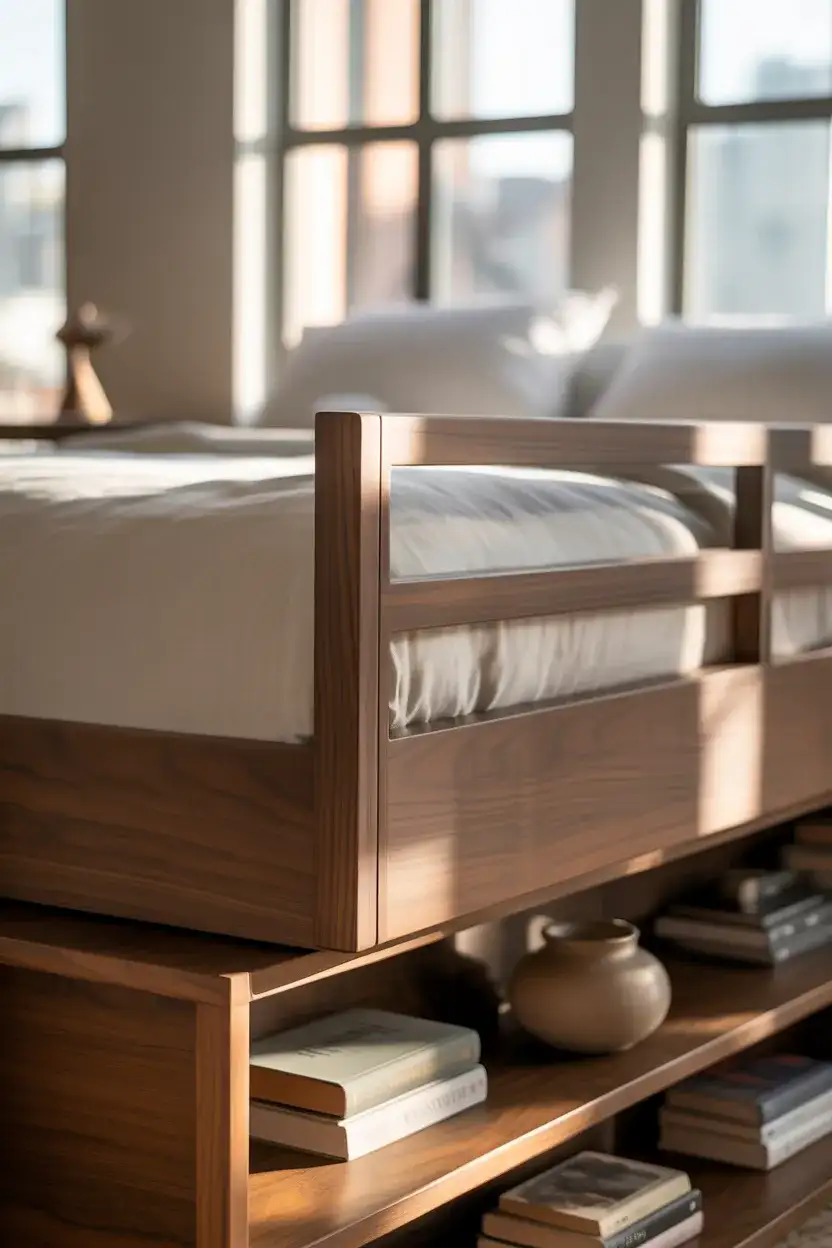
There’s a lingering misconception that loft beds are for kids—but the reality is that ideas for adults in this space have never been more sophisticated or more necessary. With American housing costs pushing one-bedroom apartments into financially difficult territory, many adults in their 30s and 40s are reconsidering studio living—and a well-designed adult loft bed makes that possible without feeling like a regression. The adult version emphasizes comfort: a quality mattress (queen-size low-profile if the clearance allows), premium bedding, and a guardrail that’s genuinely attractive rather than merely functional.
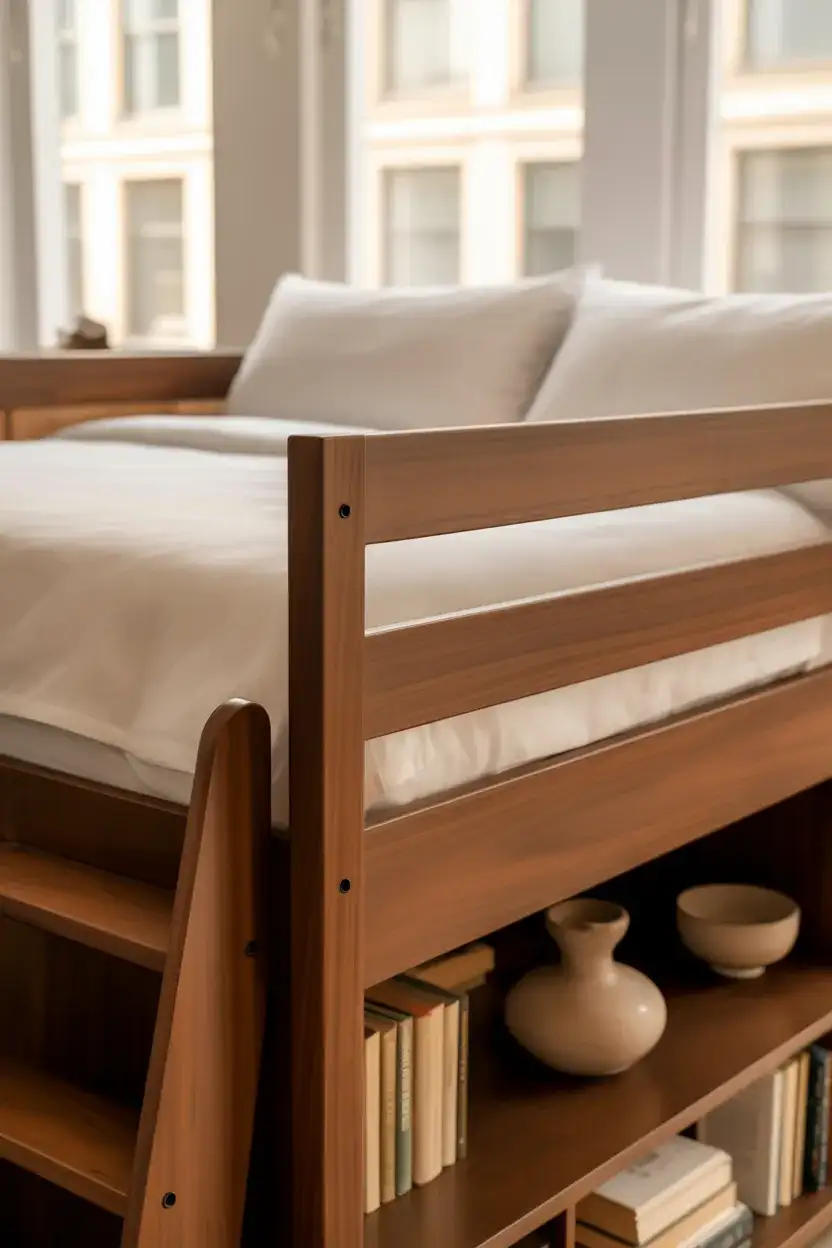
American lifestyle context: the shift toward loft beds for adults is most visible in coastal cities and in university towns, where housing costs have outpaced wage growth for the better part of a decade. Houzz and Apartment Therapy have both documented a measurable spike in adult loft bed content since 2023, driven primarily by 25–38 year olds in cities like Boston, Austin, and Seattle who want to live solo without spending 50% of their income on rent.
16. Loft Bed with Staircase Bookshelf
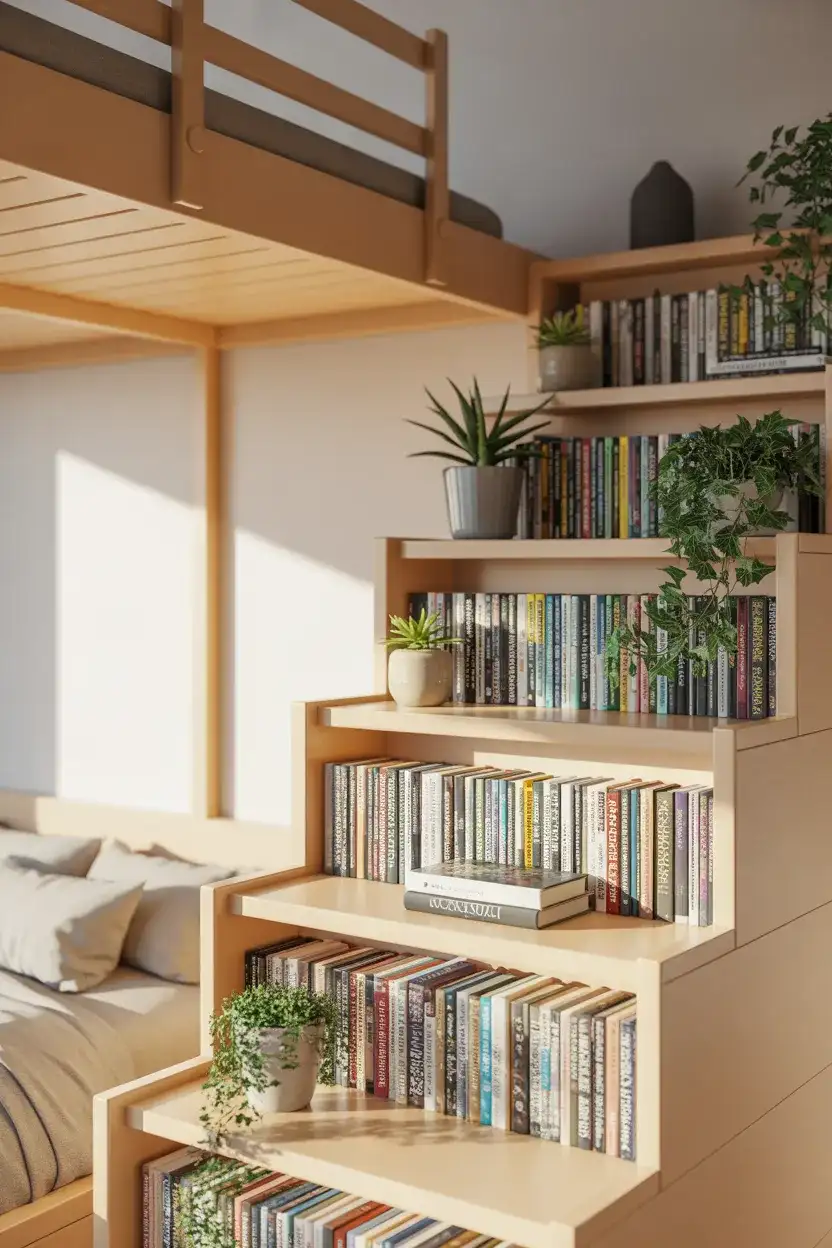
Combining stairs with an integrated bookshelf is one of those ideas that seems obvious the moment you see it—and yet most loft beds don’t offer it out of the box. Each step becomes a mini shelf: narrow enough for paperbacks but perfectly sized for plants, framed photos, candles, or a charging station. The structure effectively becomes the room’s primary bookcase, which in a small bedroom can eliminate the need for any freestanding shelving unit entirely. It’s the kind of solution that makes you wonder why all designs don’t think this way.
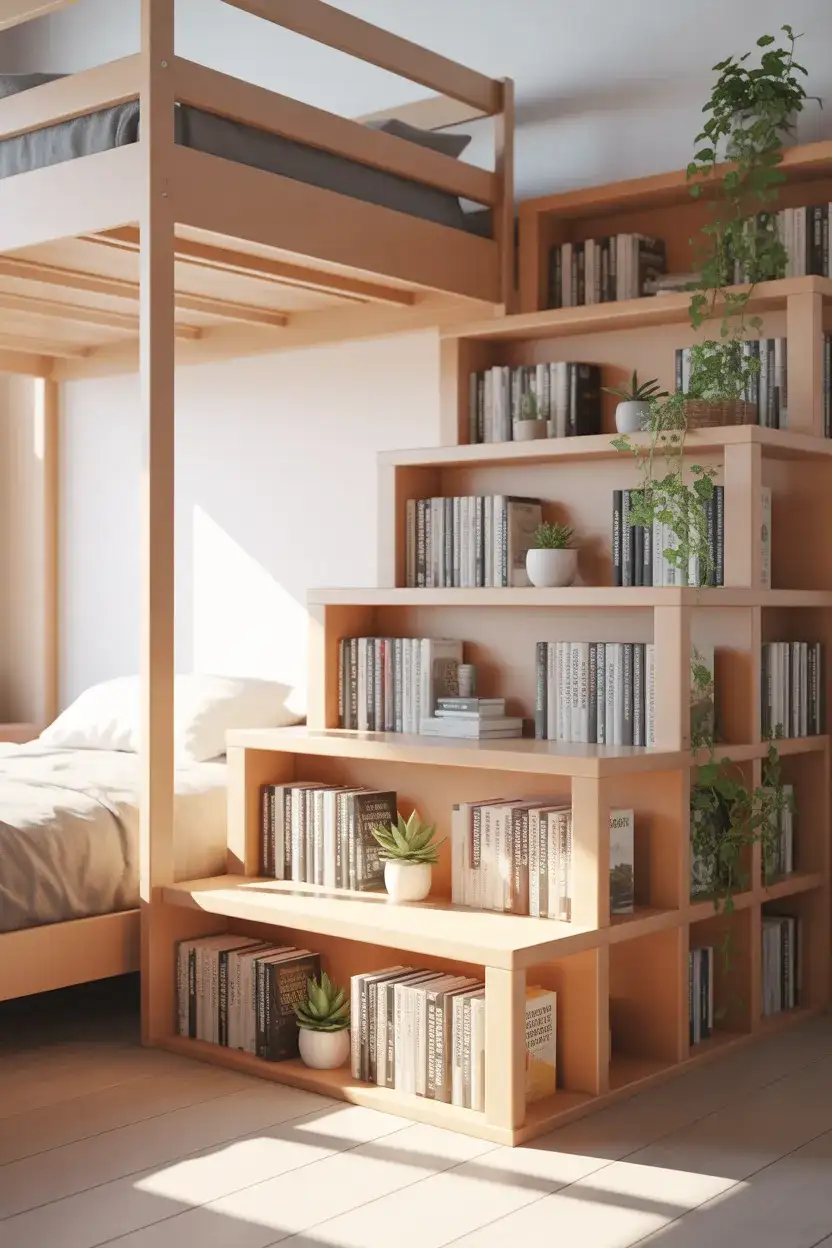
A micro-anecdote: a Seattle-based interior stylist who specializes in compact living told us she specifies the stair-bookshelf loft for nearly every client with under 500 square feet. “I had one client who got rid of her BILLY bookcase, her nightstand, and her bedroom dresser all in one swap,” she said. The frame she chose integrated all three functions—and the room immediately opened up by what felt like 30 percent.
17. Loft Bed Plans for Custom Builds
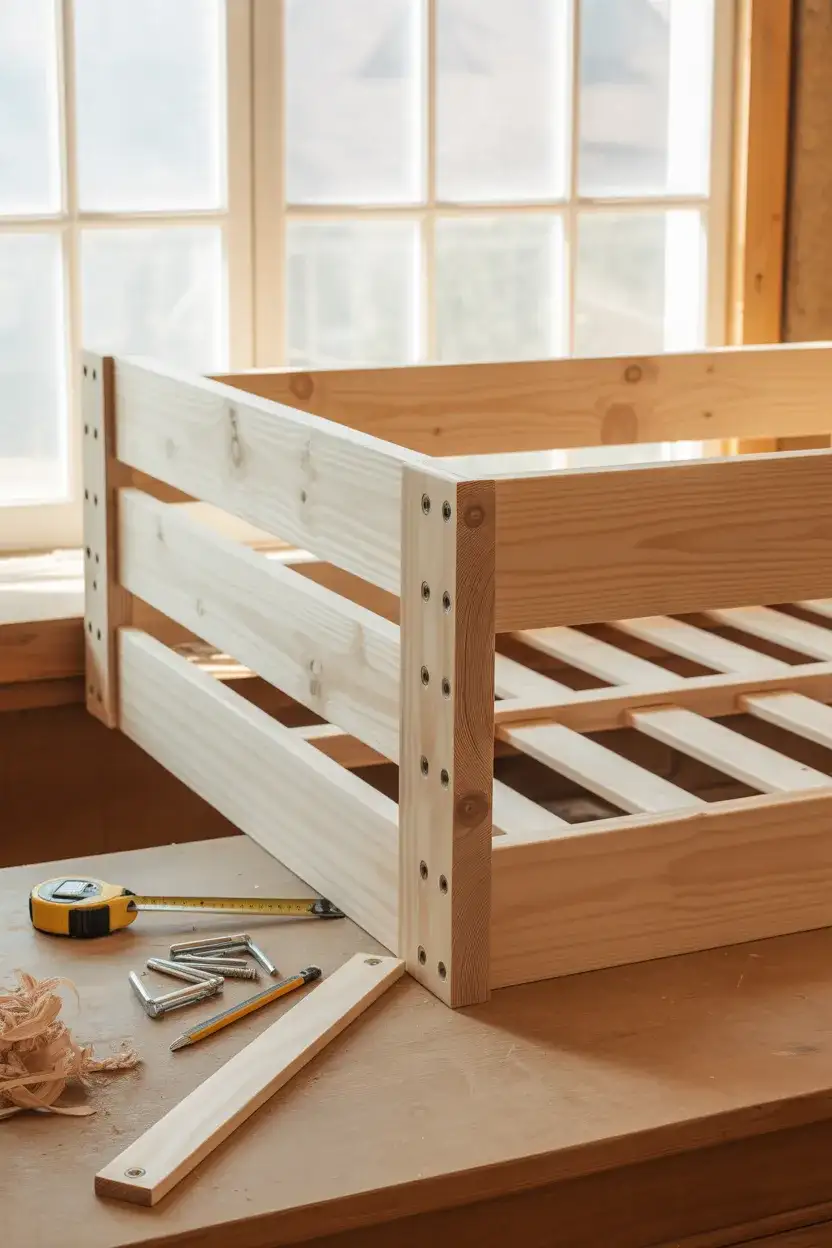
Good plans are the difference between a loft bed that stands for a decade and one that wobbles the first time someone sits on it too fast. Before cutting a single board, it’s worth investing in a professional blueprint—either from woodworking plan sites like Ana White or Rogue Engineer, or from a local carpenter who can customize dimensions to your exact ceiling height and room layout. A solid set of DIY plans specifies wood species, joint types, fastener sizes, and weight ratings—the kind of detail that separates a properly engineered structure from a furniture guess.
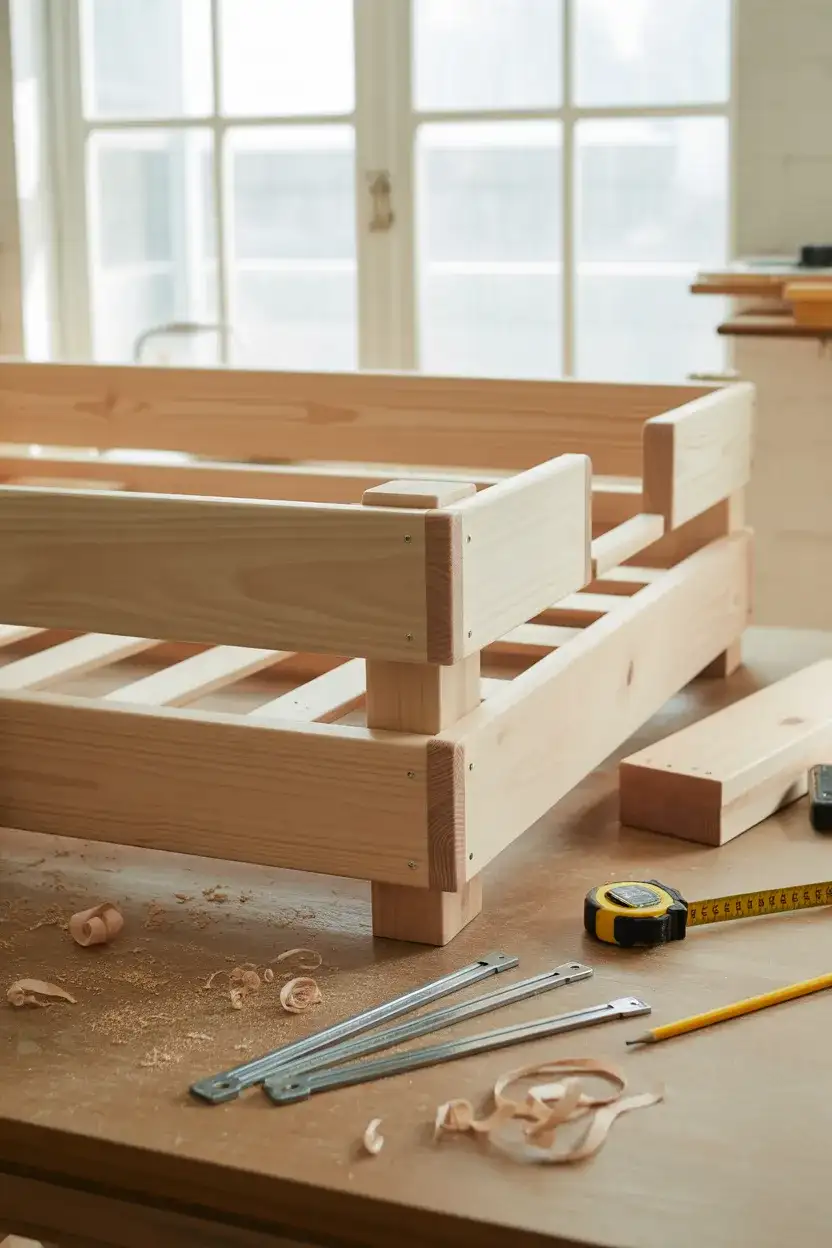
Common mistakes and how to avoid them: the most critical error in custom loft bed construction is underspecifying the posts. Many first-time builders use 2×4 posts instead of 4×4—it saves money but dramatically reduces the structure’s rigidity under dynamic load (which is what happens when a person climbs or rolls over in their sleep). Always use 4×4 posts for the uprights, and always add cross-bracing at 45-degree angles on both the head and foot ends. This alone accounts for 80% of a frame’s stability.
18. Loft Bedroom Ideas for Shared Kids’ Bedrooms
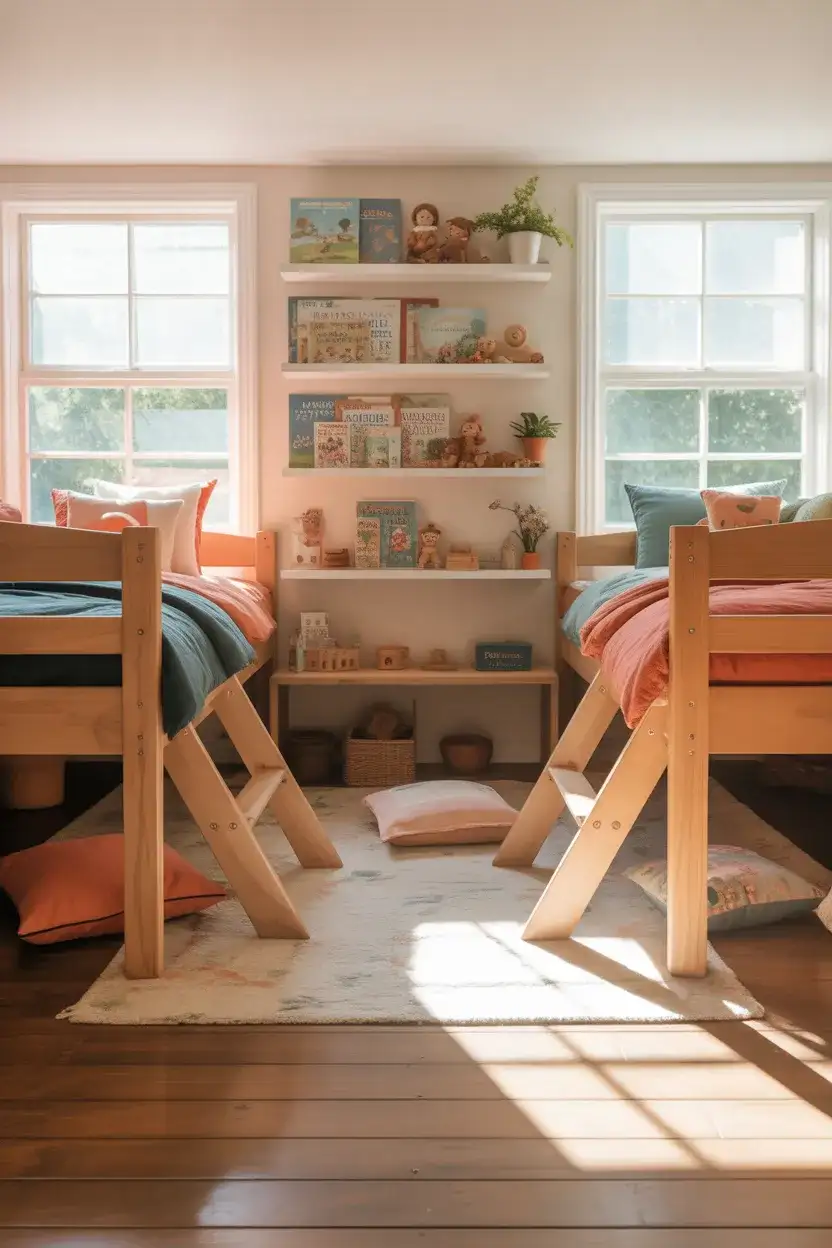
When two kids share one bedroom, a loft bed arrangement can give each child their own defined zone without adding square footage. The classic approach is a loft bed on one wall (sleeping above, desk or play space below) and a standard bed or trundle on the opposite wall—but more creative room ideas put both kids in a twin loft configuration with a shared middle zone for playing, building, or gaming. The key is making each child feel like their area is genuinely theirs: different bedding colors, personalized name signs on the ladder, and separate task lights.
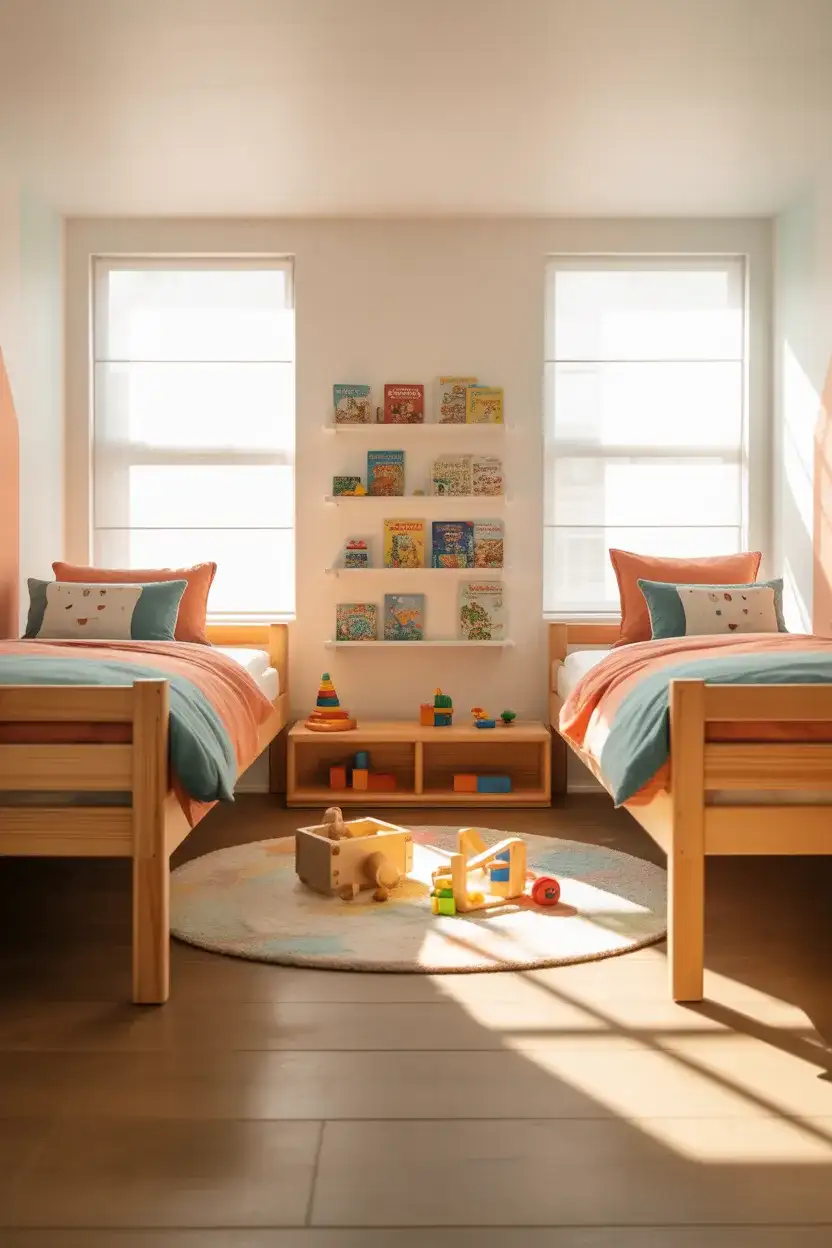
Where this works best: bedrooms between 120 and 180 square feet where two kids need to coexist without constant territorial conflict. The elevation itself is part of what makes loft beds work so well for siblings—being up on the loft is perceived as a “special” zone, and most kids quickly establish bedtime routines that respect each other’s sleeping territory in a way they wouldn’t if both were at floor level.
19. Loft Bed with Industrial Pipe Frame
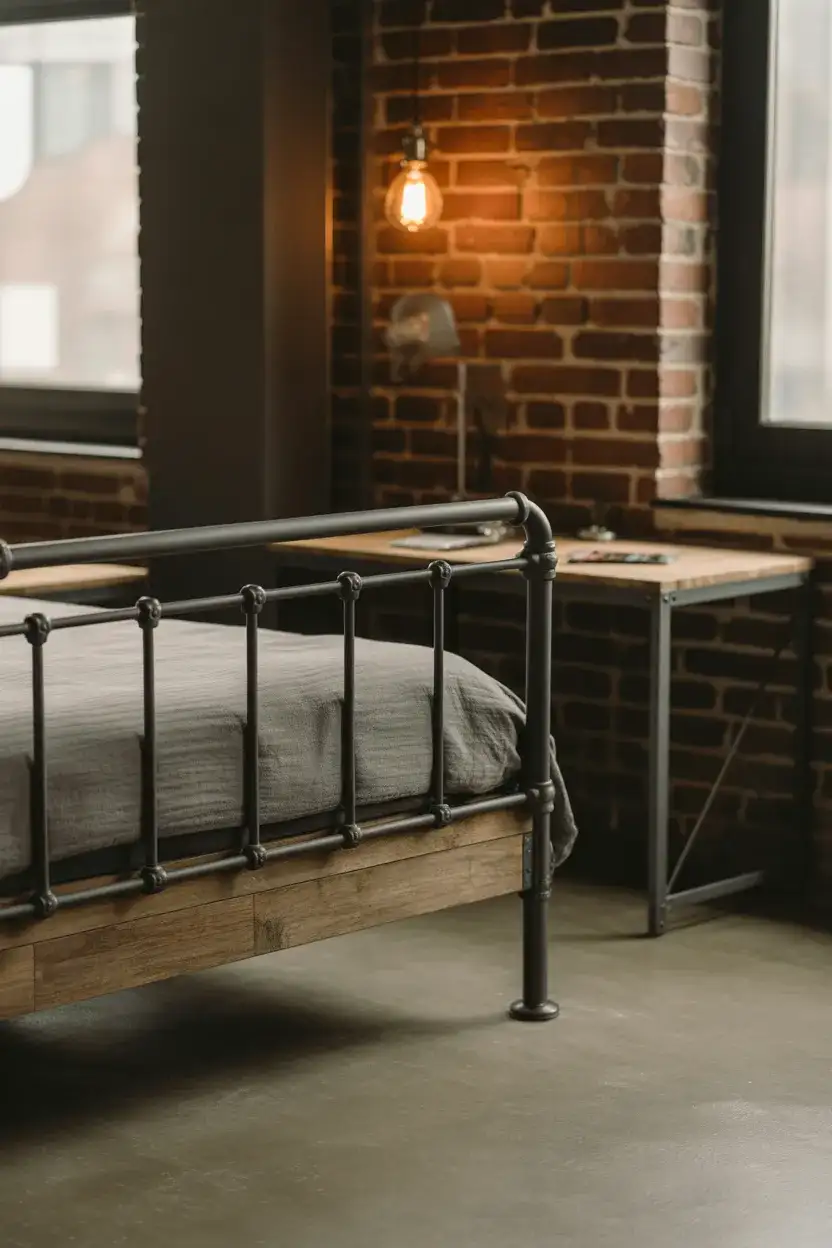
Black iron pipe frames are having a real moment in bedroom design—and a loft bed built from plumbing pipe and flanges is both genuinely beautiful and impressively strong. The industrial pipe aesthetic pairs naturally with exposed brick, concrete floors, and reclaimed wood shelving. This style skews modern in the urban-industrial direction rather than the Scandinavian-minimalist one, and it photographs particularly well against white or deep charcoal walls. It’s also a legitimate DIY option: pipe and fittings from any hardware store, assembled with basic hand tools.
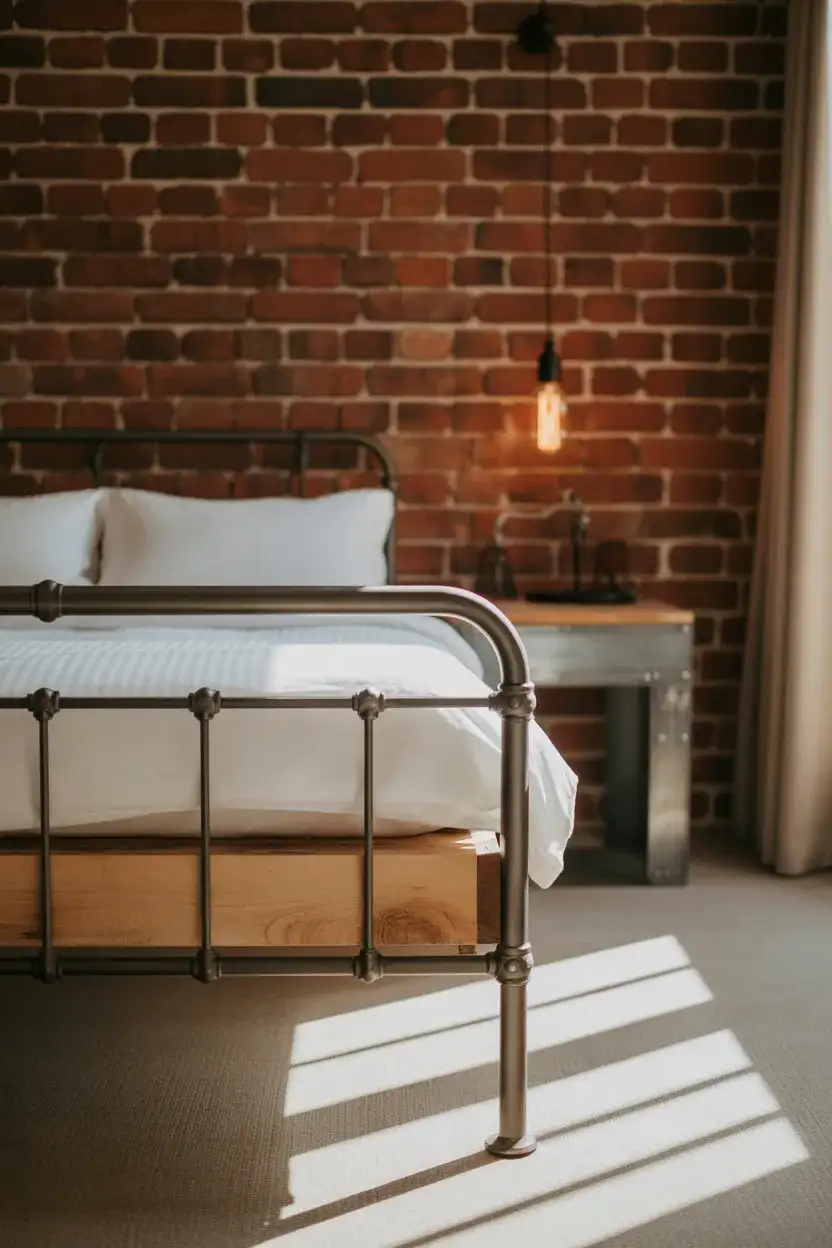
Budget and price angle: a full iron pipe loft bed typically costs $200–$400 in materials depending on bed size, which puts it between a budget flat-pack and a mid-tier retail frame in cost but significantly ahead of both in perceived quality and durability. Iron pipe doesn’t flex, warp, or strip screws the way MDF furniture does—meaning a well-assembled pipe loft bed can realistically last 15–20 years with zero structural degradation.
20. Loft Bed with Reading Nook Below
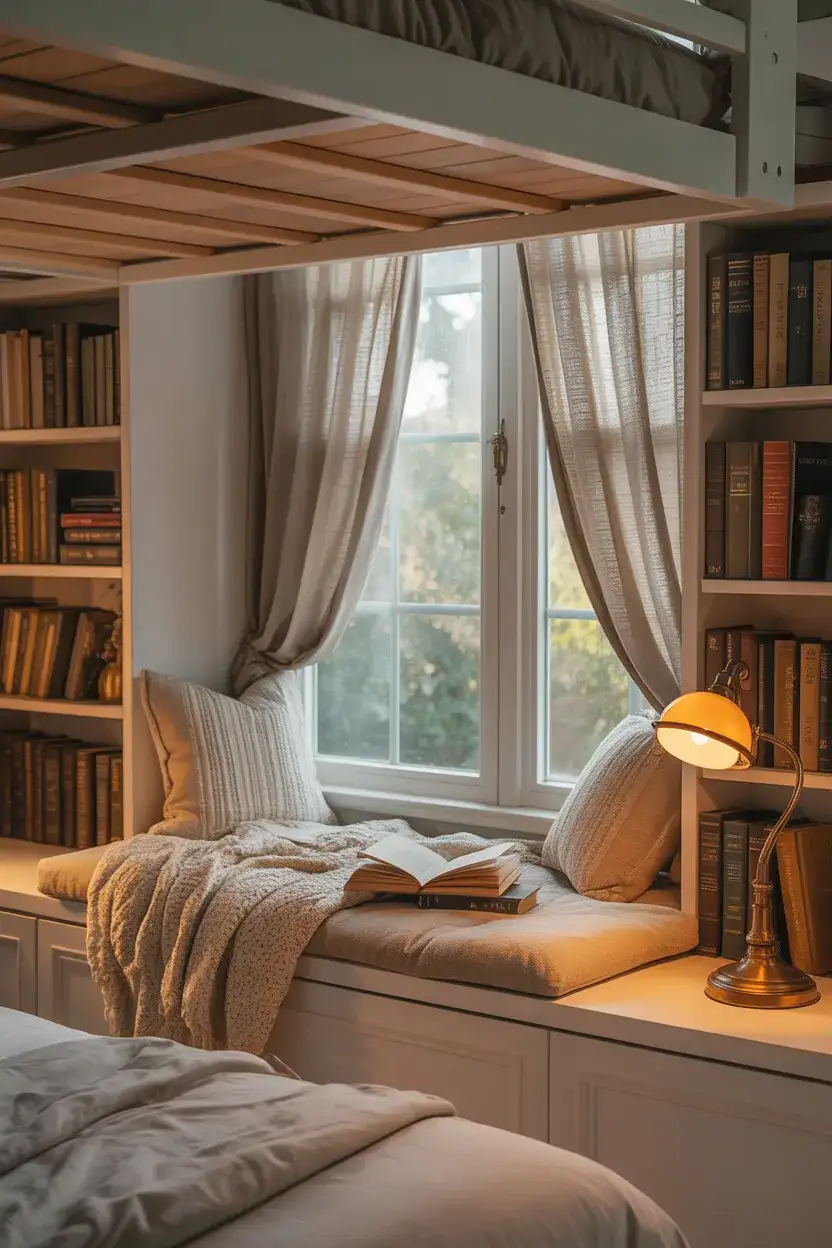
Not every under-loft zone needs to be a workspace. For book lovers, turning the space below into a dedicated reading nook—a cushioned bench or loveseat, a small side table, a well-directed reading lamp, and shelves lining the side walls—is a deeply satisfying design choice that prioritizes joy over productivity. This setup is particularly popular in children’s rooms, but it works beautifully for adults too, especially those who want their bedroom to feel like a retreat rather than a second office. The result is irresistibly cozy, the kind of space that makes staying home feel like a treat.
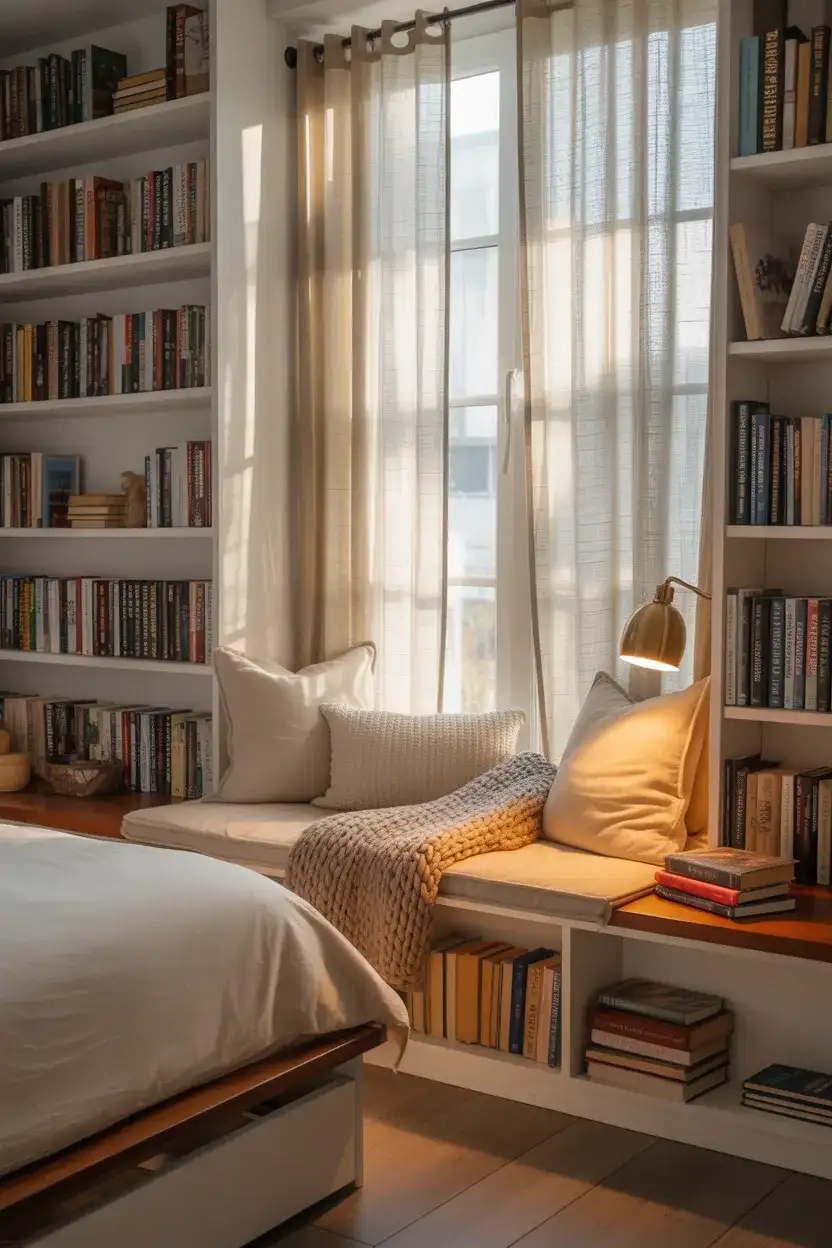
Real homeowner behavior: parents who build reading nooks below their kids’ loft beds consistently report a measurable change in reading habits. The enclosed, purposeful space—slightly protected by the platform overhead—creates a psychological permission slip to slow down and read. Several families in online home design communities have shared that their children went from reluctant readers to enthusiastic ones after a reading nook was installed. The physical environment genuinely shapes behavior.
21. Loft Bed with Murphy Desk for Flexible Small Rooms

The Murphy desk—a fold-down work surface that closes flush against the wall—is the ultimate companion for a loft bed in a small room’s context. When folded up, the space below the loft is completely open, functioning as a living area. Fold it down, and the workspace materializes in seconds. This combination is ideal for freelancers, students, and remote workers who don’t want their home to feel like an office 24 hours a day. It’s one of the smartest ideas for small rooms in modern residential design, and it’s finally available at accessible price points.
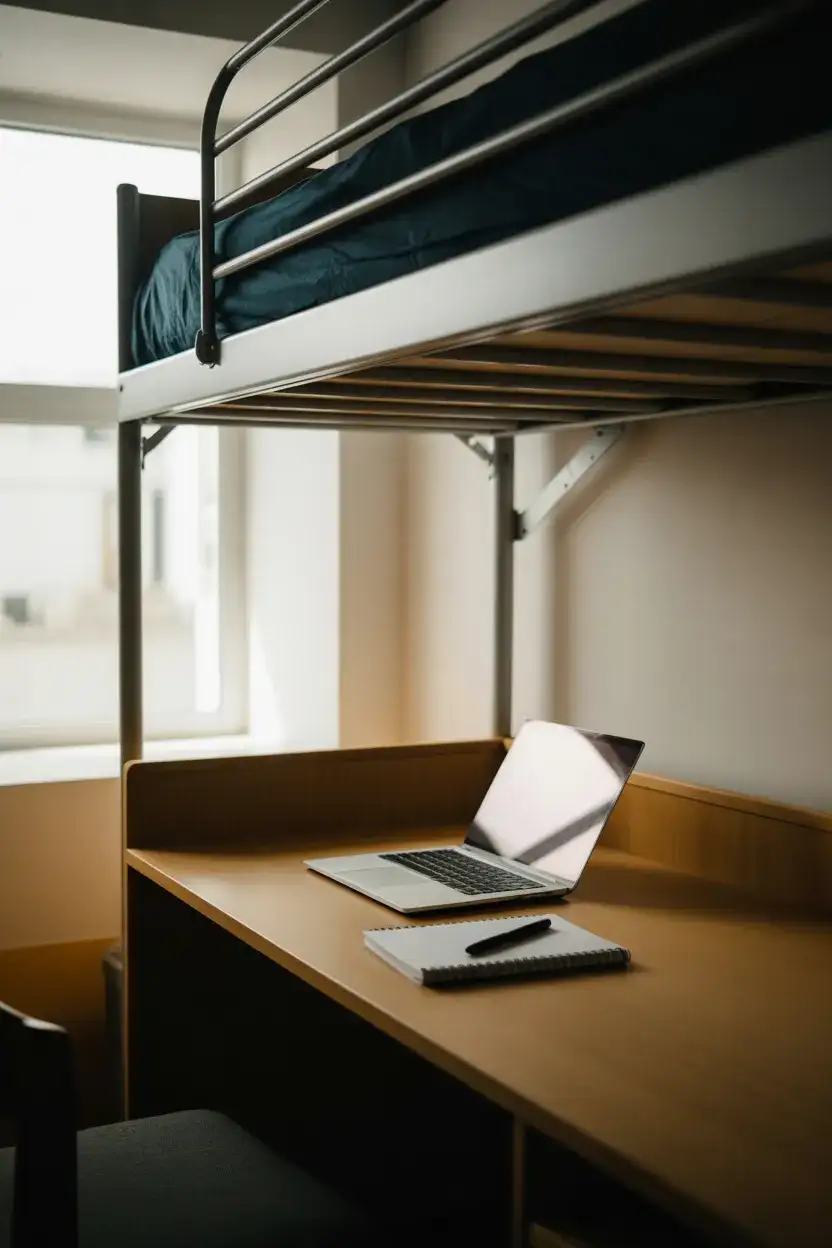
Expert-style commentary: flexibility is the defining value of 2020s residential design, and the loft-plus-Murphy combination embodies it completely. Space planners at leading interior design firms in New York and Los Angeles have pointed to this pairing as one of the best value-per-dollar investments in small apartment design, noting that it can functionally replicate a two-room apartment in 400 square feet when executed well. The key is choosing a Murphy desk rated for at least 50 lbs of working load—some budget models flex worryingly under a laptop and a monitor.
22. Full-Wall Loft Bed Built-In System
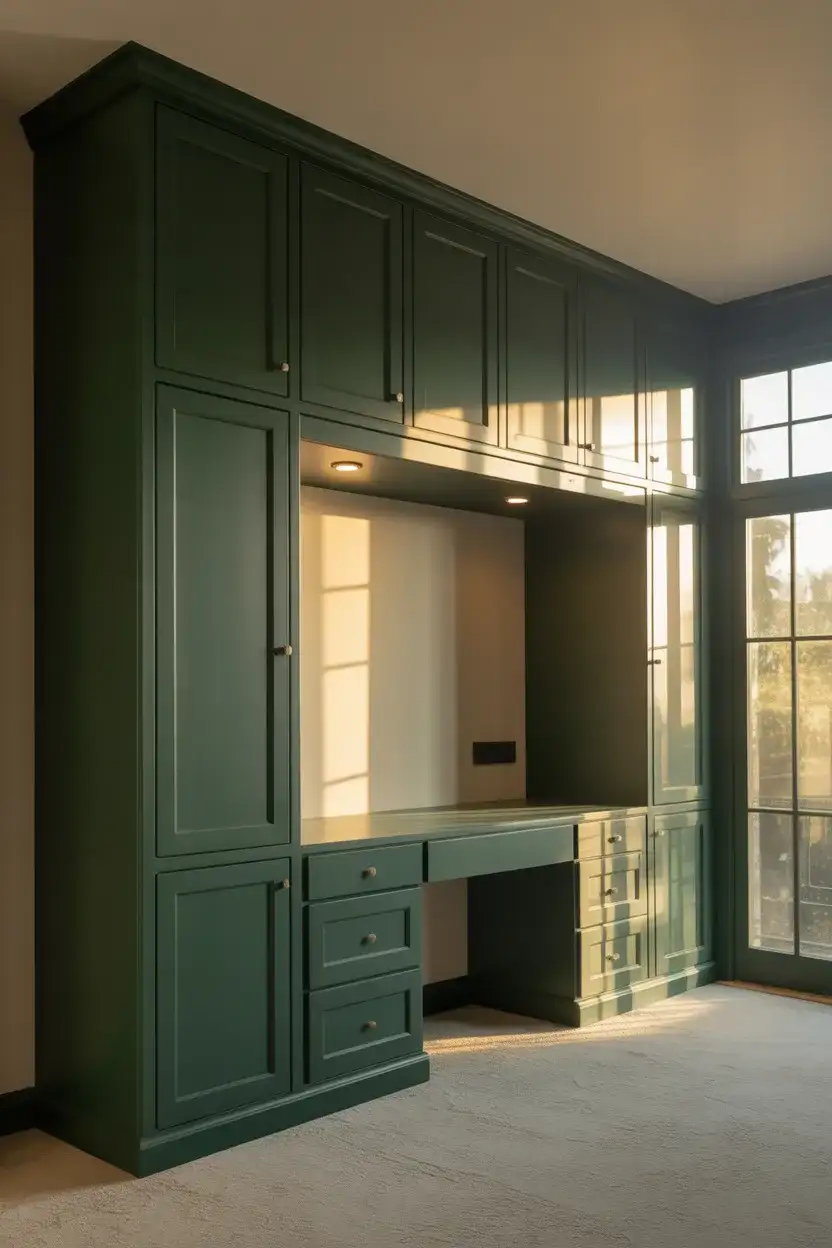
The most ambitious—and most rewarding—loft bed concept takes over an entire wall from floor to ceiling. A full-wall built-in system integrates the loft bed at the top, floor-to-ceiling cabinetry or open shelving on both flanking sides, and a custom desk or storage zone at the base. When painted the same color as the wall (usually a rich, deep tone like charcoal, forest green, or navy), the whole unit appears to emerge from the architecture itself. This is the modern bedroom’s answer to the Murphy bed—a system that actually looks better than the room it replaced.

This is where loft bed design and architectural interior design fully converge—and where the results justify the investment. Full-wall built-in systems typically run $3,000–$8,000 installed depending on materials and market, which puts them well above any freestanding option. But they’re also permanent, they photograph like editorial spreads, and they consistently generate the kind of “wow” response from guests—and buyers—that translates into real dollar value on a home’s market price.
Conclusion
Loft beds are one of those genuinely rare design solutions that get better the more thoughtfully you approach them—and whether you’re a renter working with $200 and an IKEA frame or a homeowner ready to commission a full built-in system, there’s a version of this idea that’s exactly right for your life. We’d love to hear what you’re working with: drop your room dimensions, your biggest challenge, or your favorite idea from this list in the comments below, and let’s figure it out together.