If you’ve spent any time scrolling Pinterest lately, you already know barn doors are having a major moment—and in 2026, they’re showing up in places you’d never expect. What started as a farmhouse-kitchen staple has quietly evolved into one of the most versatile design moves in American homes, showing up in primary bathrooms, studio apartments, and even sleek modern condos. This article rounds up 24 real ideas that prove barn doors aren’t just a trend—they’re a long-term design decision worth making. Whether you’re renovating a master bedroom, carving out storage, or giving a rental a personality transplant on a budget, something here will spark that “yes, that’s the one” feeling.
1. The Classic Sliding Barn Door for an Open-Plan Living Room
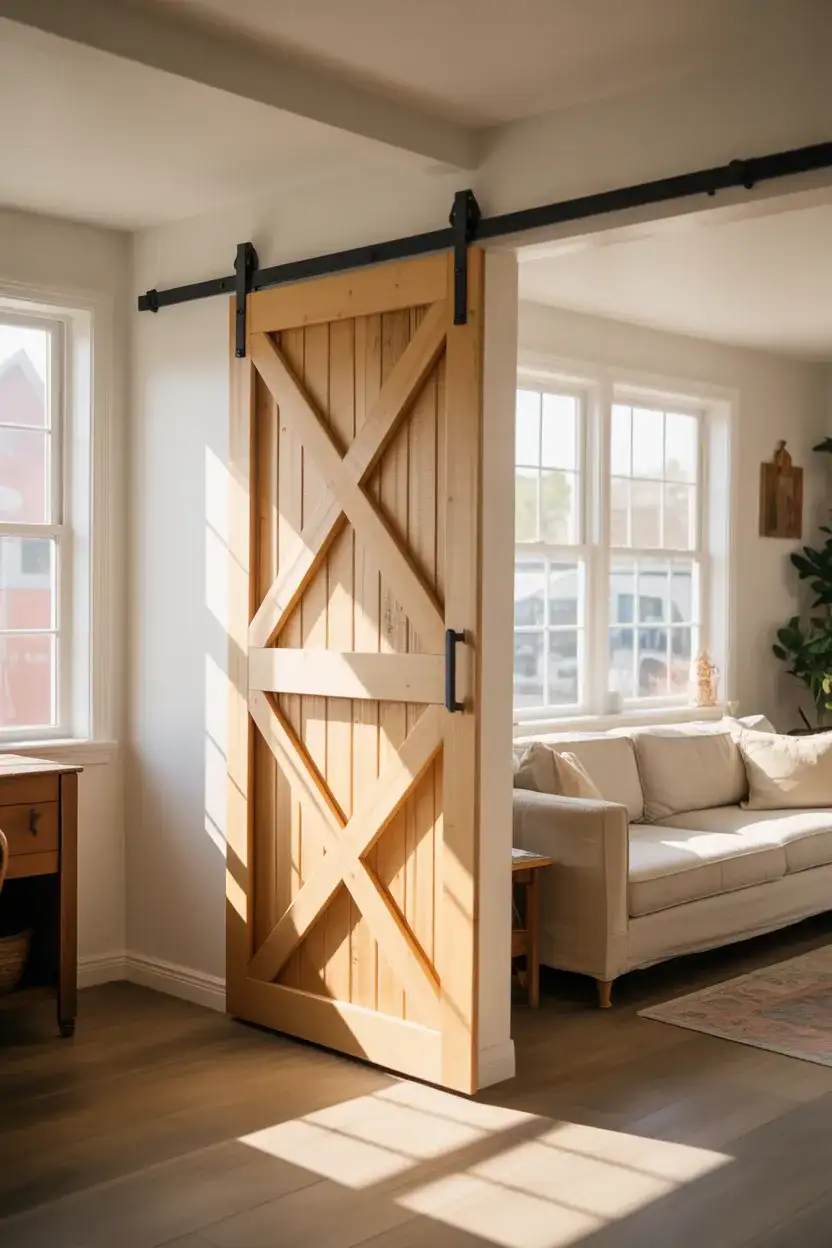
There’s a reason the sliding barn door became the face of an entire design era—it solves a very American problem: too many rooms, too little square footage. When you hang a classic wood barn door between your living room and a home office or dining space, you get visual separation without giving up precious floor area. The door glides along an exposed track mounted to the wall, which means no swing radius eating into your furniture arrangement. It works beautifully in open-plan homes built in the 1990s and early 2000s that feel perpetually unfinished—like they want a wall but can’t quite commit to one.
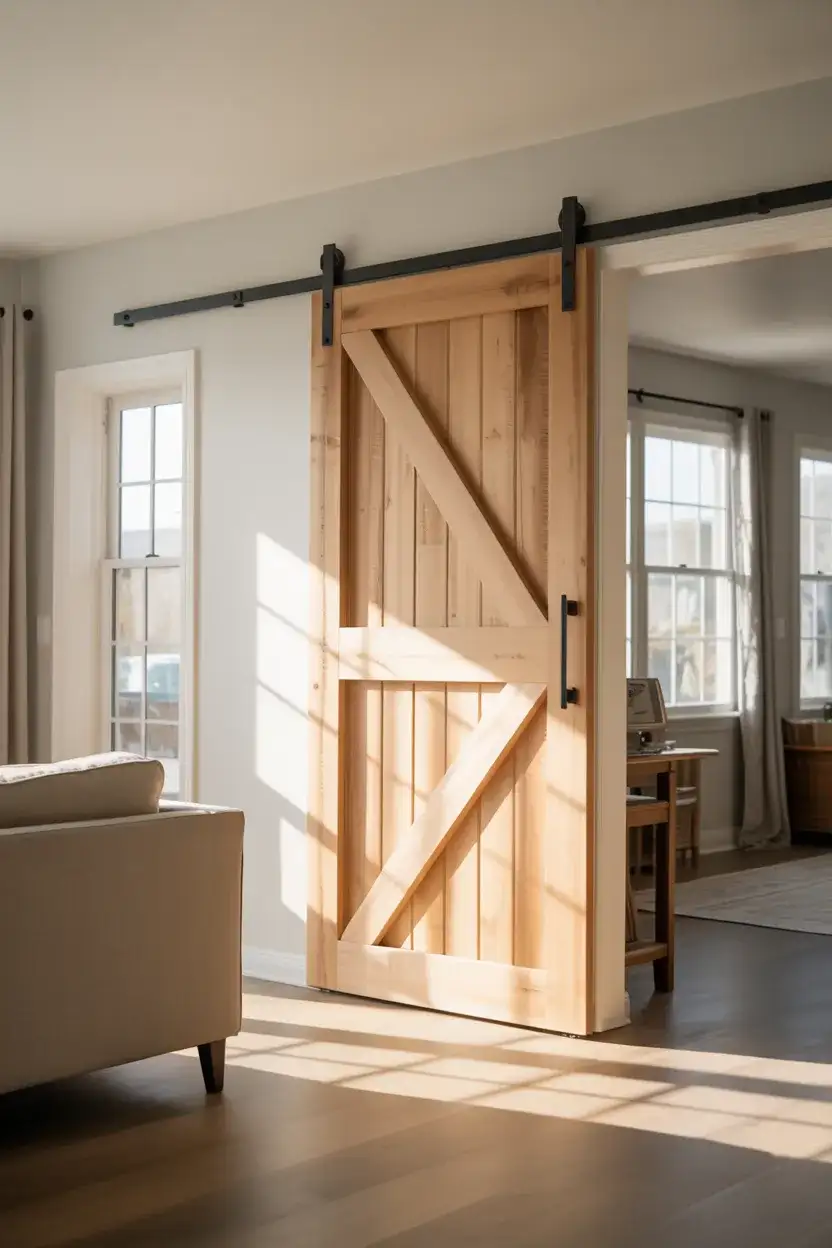
Here’s the practical insight that most design blogs skip: the track needs to extend past the door opening by at least the width of the door itself, so you always want to check your wall space before ordering. If you’ve got a light switch or a piece of art in the landing zone, the whole plan falls apart. Measure twice, and use painter’s tape to mock up the track length before you commit. That one extra step saves most homeowners from the most common installation mistake in the book.
2. Modern Barn Door with Black Metal Hardware
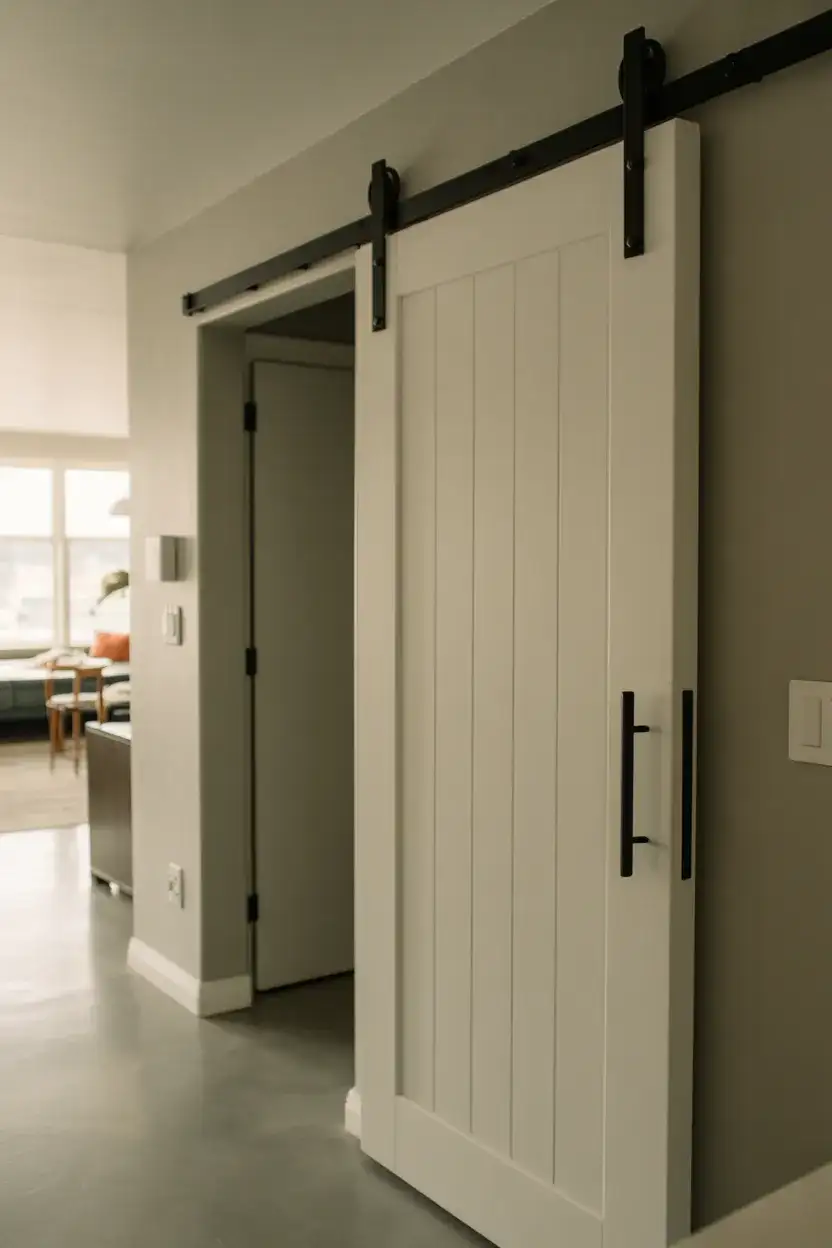
The modern barn door is proof that utility and sophistication aren’t opposites. When you pair a flat-panel door—think clean lines, no raised molding—with matte black hardware, the result skews more loft in Brooklyn than farmhouse in Kentucky. These doors often use MDF or smooth-grained wood with a painted finish, letting the metal track and handle do the design talking. They’ve become particularly popular in newer construction homes with high ceilings and minimal trim, where the hardware reads like intentional industrial jewelry rather than an afterthought.
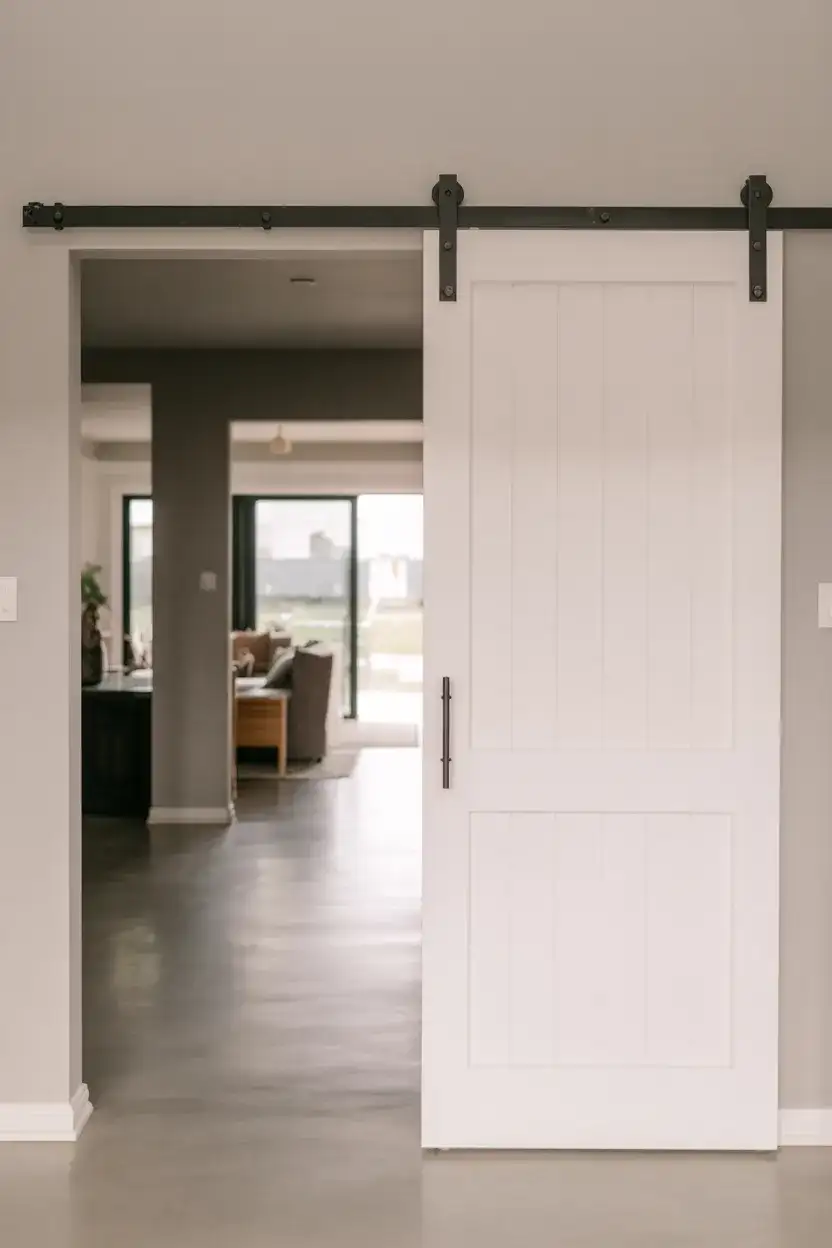
Interior designers who specialize in transitional style—that sweet spot between contemporary and traditional—often recommend this pairing as a gateway into bolder design. It works especially well in homes where the rest of the palette is fairly neutral, because the black hardware acts as a grounding element rather than a shocking one. If you’re the kind of homeowner who keeps second-guessing bold choices, starting with this combination gives you the visual impact without any design regret in the morning.
3. Rustic Barn Door for a Cozy Farmhouse Bedroom
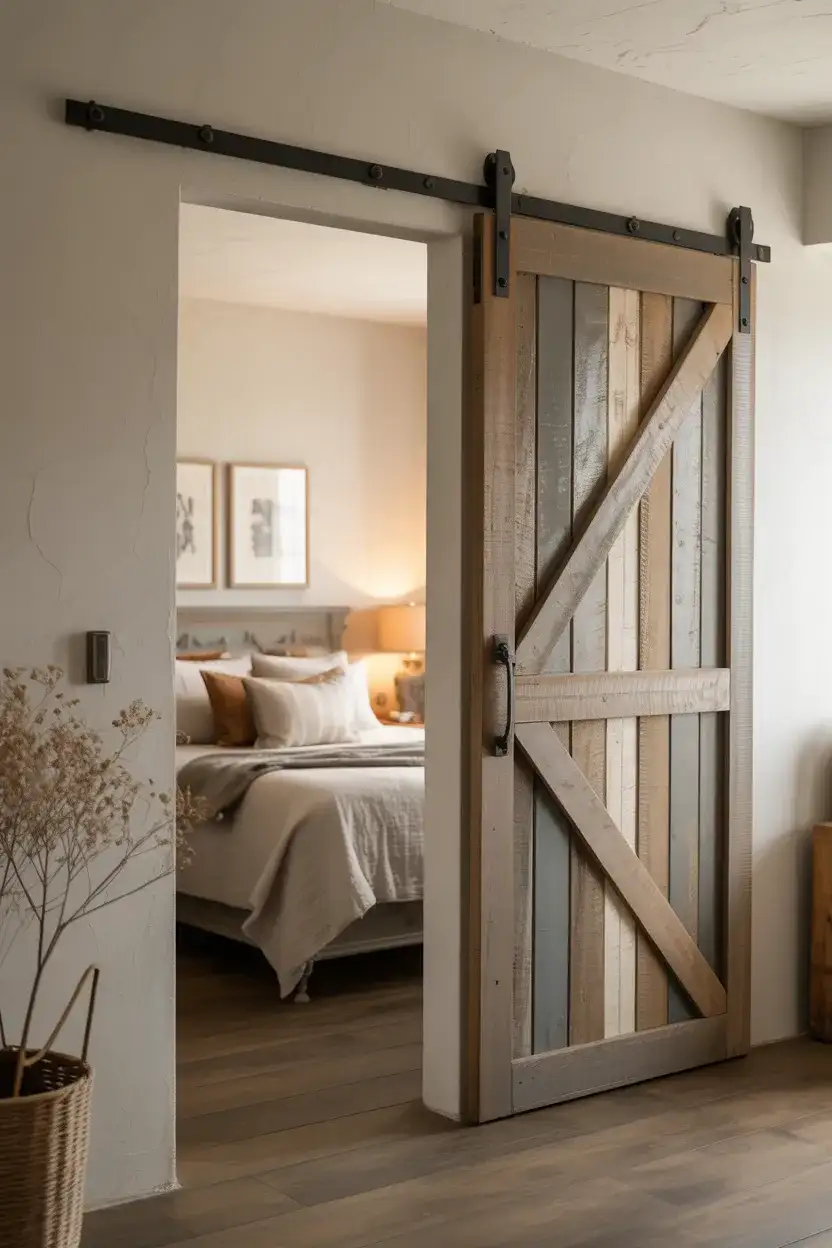
If you want to feel like you’re waking up somewhere special every single morning, a rustic barn door on your bedroom entrance is a surprisingly powerful move. These doors typically use reclaimed or hand-distressed wood—the kind with visible knots, saw marks, and color variation—mounted on a raw steel or oil-rubbed bronze track. The imperfection is the entire point. In a bedroom context, that worn, storied quality softens the space rather than roughening it, especially when it’s paired with linen bedding, a jute rug, or woven wall art.
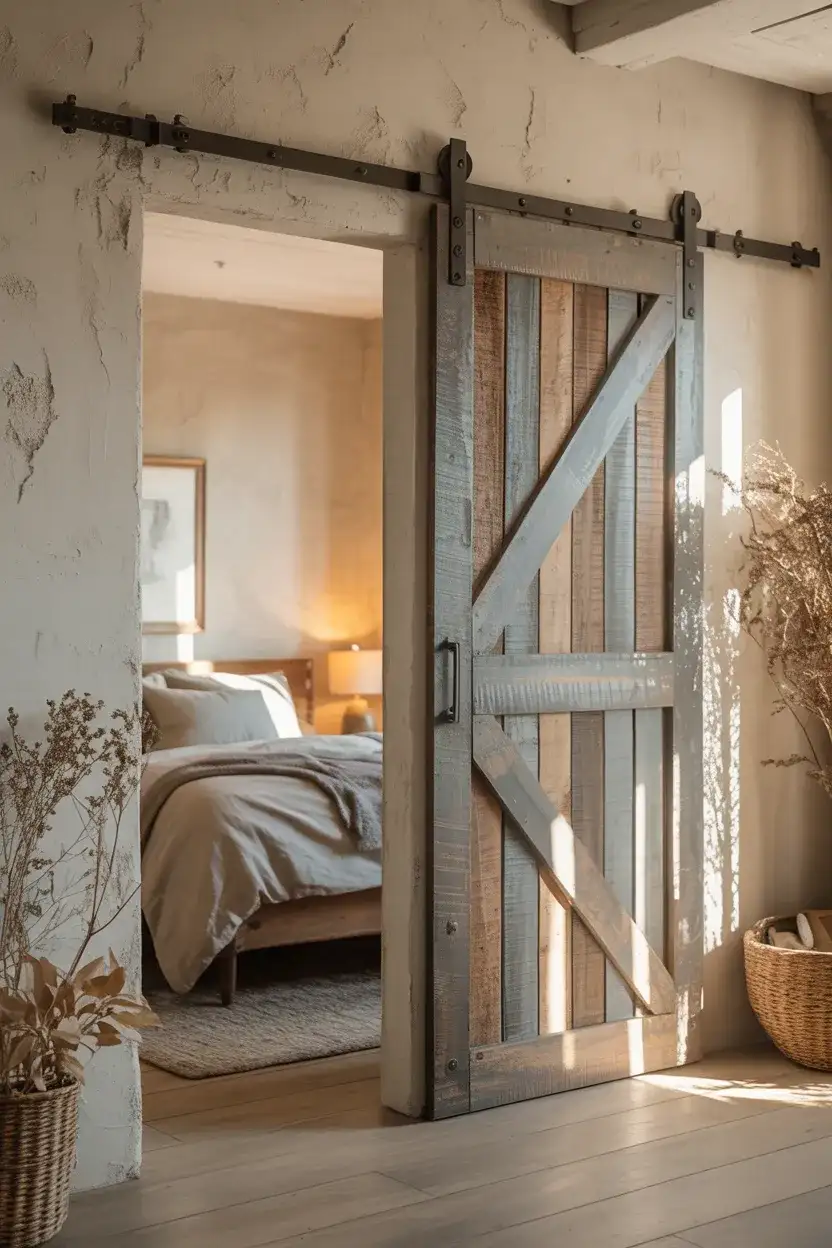
This look is especially at home in the American South and Mountain West, where farmhouse aesthetics aren’t just a Pinterest trend but an actual regional identity. A homeowner in Tennessee once described hanging a reclaimed barn door from her grandfather’s property as “the most meaningful design decision in the whole renovation.” You don’t need actual salvage materials to get that feeling, though—dozens of domestic manufacturers now produce beautifully distressed doors that look authentically aged right out of the box, typically ranging from $180 to $400 before hardware.
4. Double Barn Door for a Wide Hallway Entrance
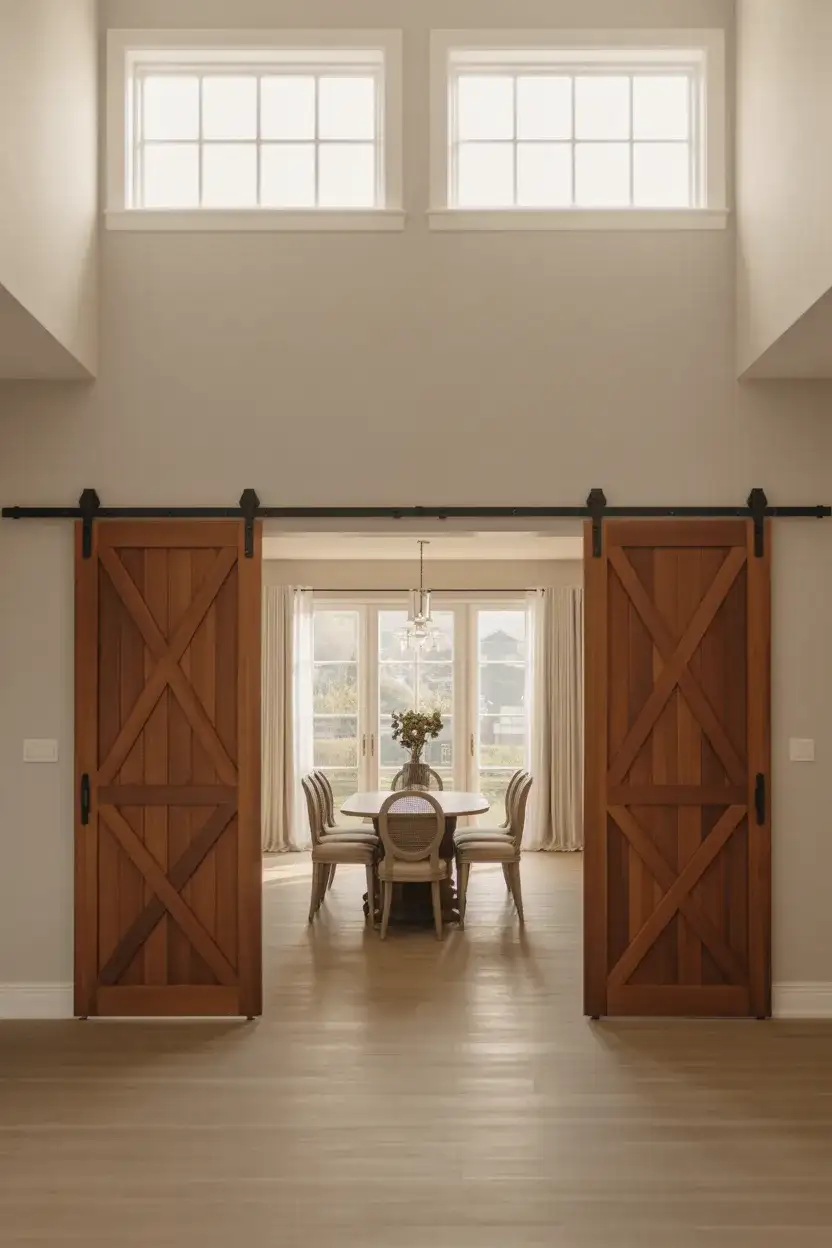
When you need to close off a large opening—think between a great room and a formal dining space, or across a wide pantry entrance—a single barn door simply won’t cut it. That’s where the double barn door configuration comes in. Two matching panels mount on the same track or parallel tracks, meeting in the center when closed and sliding apart in opposite directions when open. The effect is inherently dramatic, almost theatrical—like parting a curtain onto another room. It’s become one of the most-pinned configurations on design boards in 2026, and for good reason.
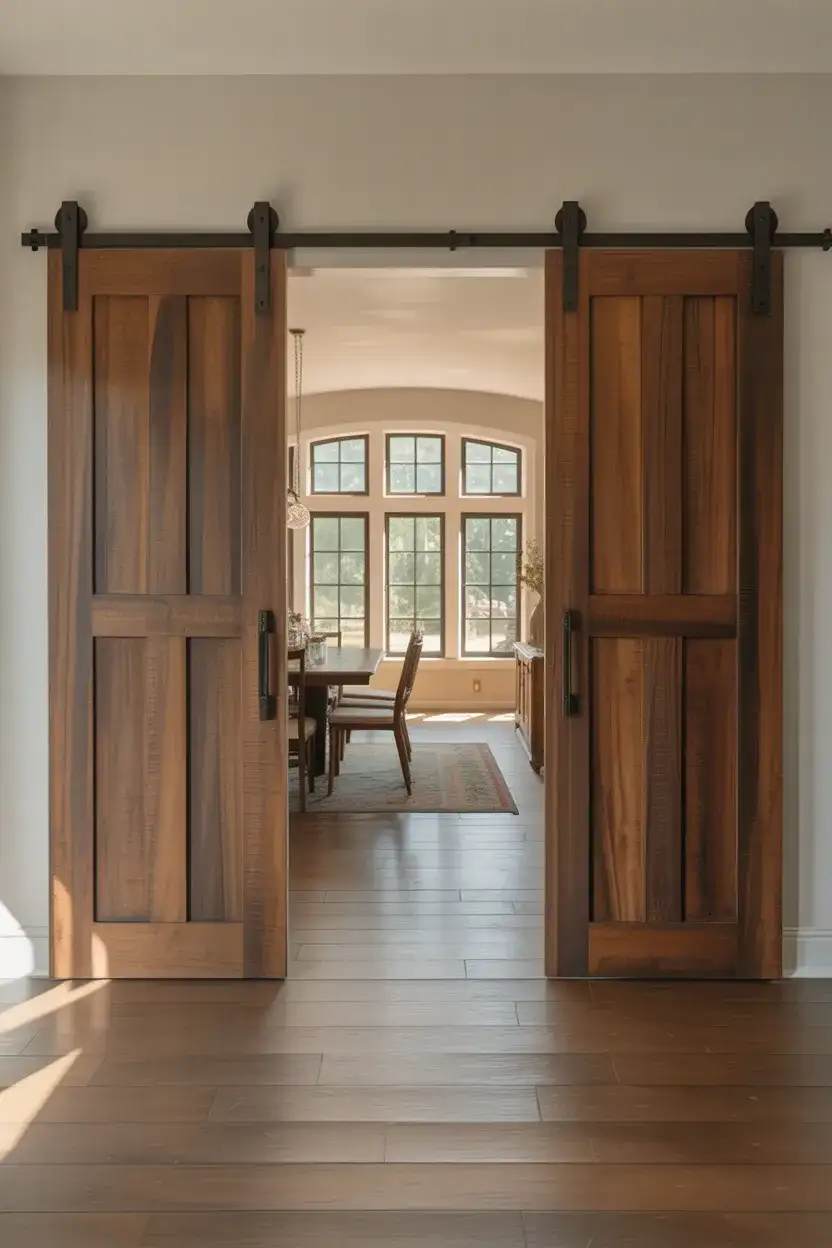
Where this works best is in homes where a wide opening was designed for a traditional set of French doors but the homeowner wants more of a statement—and a more budget-friendly installation. French door sets with proper framing can run $1,200 and up with installation, while a double barn door kit with hardware often lands between $400 and $700 total. The visual payoff is comparable. The caveat: you’ll want to confirm the wall flanking each side of the opening has enough clear space for each panel to fully retract without blocking a window or built-in.
5. Black Barn Door for a Bold Bathroom Statement
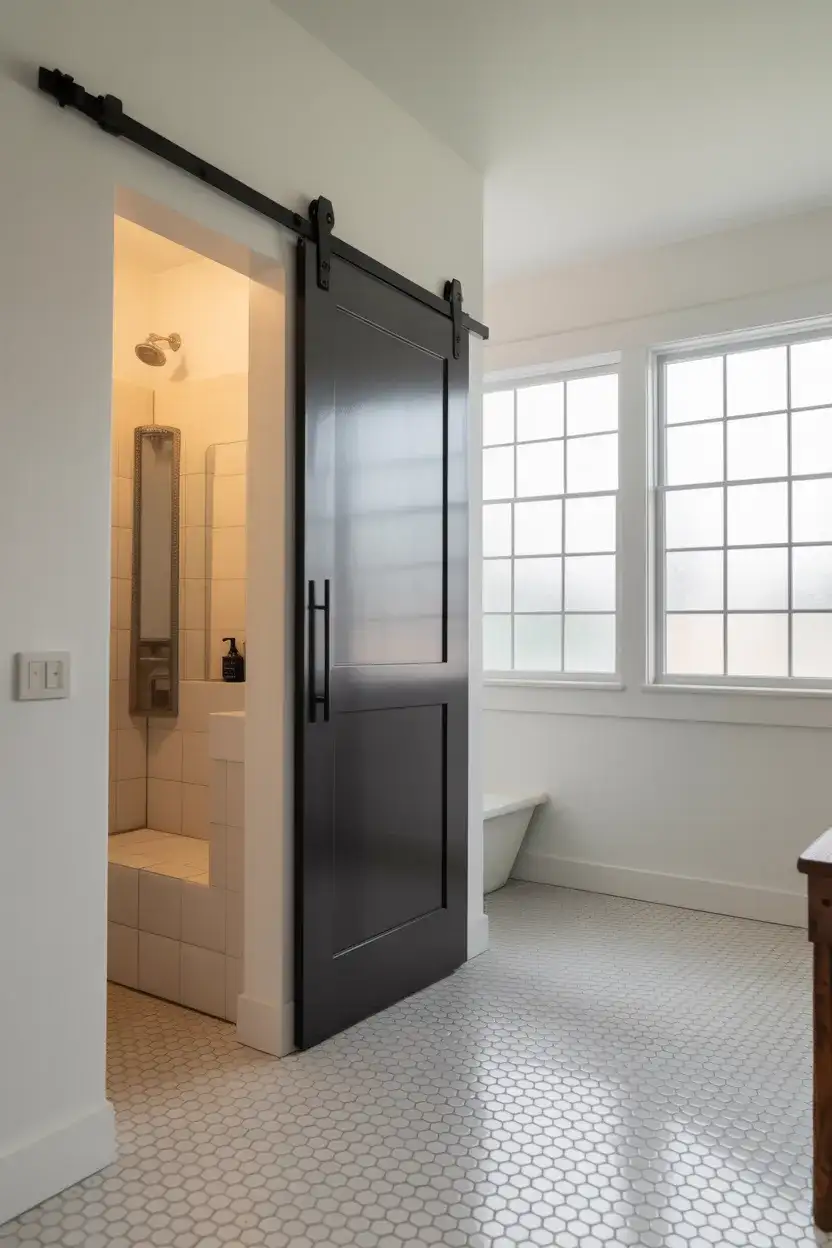
A black barn door on a bathroom entrance is the kind of design move that stops people mid-tour of your home. Against white subway tile, marble counters, or even just a bright white bathroom interior, a flat matte-black door creates contrast that reads as deeply intentional. It’s bold without being aggressive, especially when the rest of the space stays light and airy. In 2026, the trend toward moody, high-contrast bathrooms has pushed this look into mainstream popularity—it no longer signals “avant-garde” so much as “I know what I’m doing.”
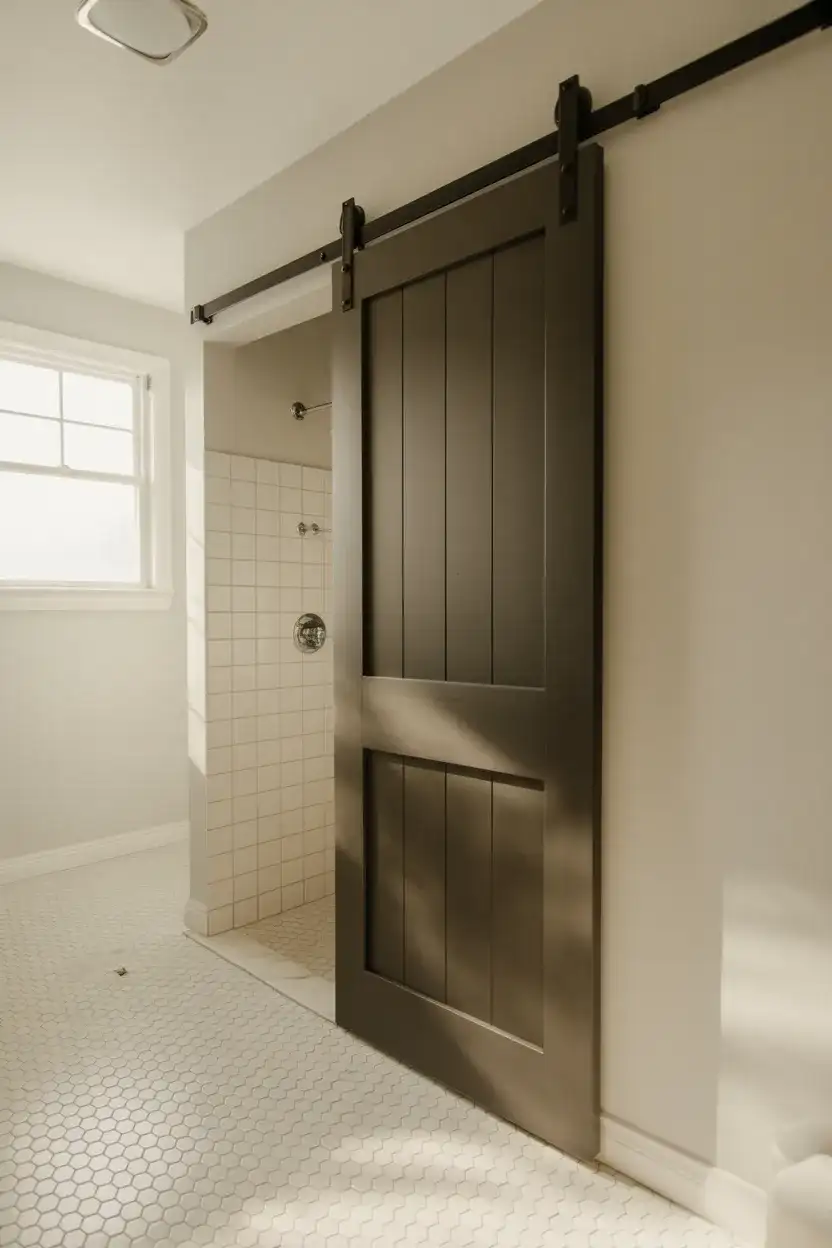
One thing experienced designers always flag with bathroom barn doors: privacy. Unlike a hinged door that creates a full seal at the frame, a barn door leaves a small gap along the edges. For a powder room or a half bath used by guests, this is rarely a problem. For a primary bathroom, though, you’ll want to look into a soft-close guide system and a door pull that positions the panel as close to the opening as possible. A small floor guide at the bottom keeps the door plumb and eliminates the wobble that telegraphs a budget installation.
6. White Painted Barn Door for a Bright, Airy Feel
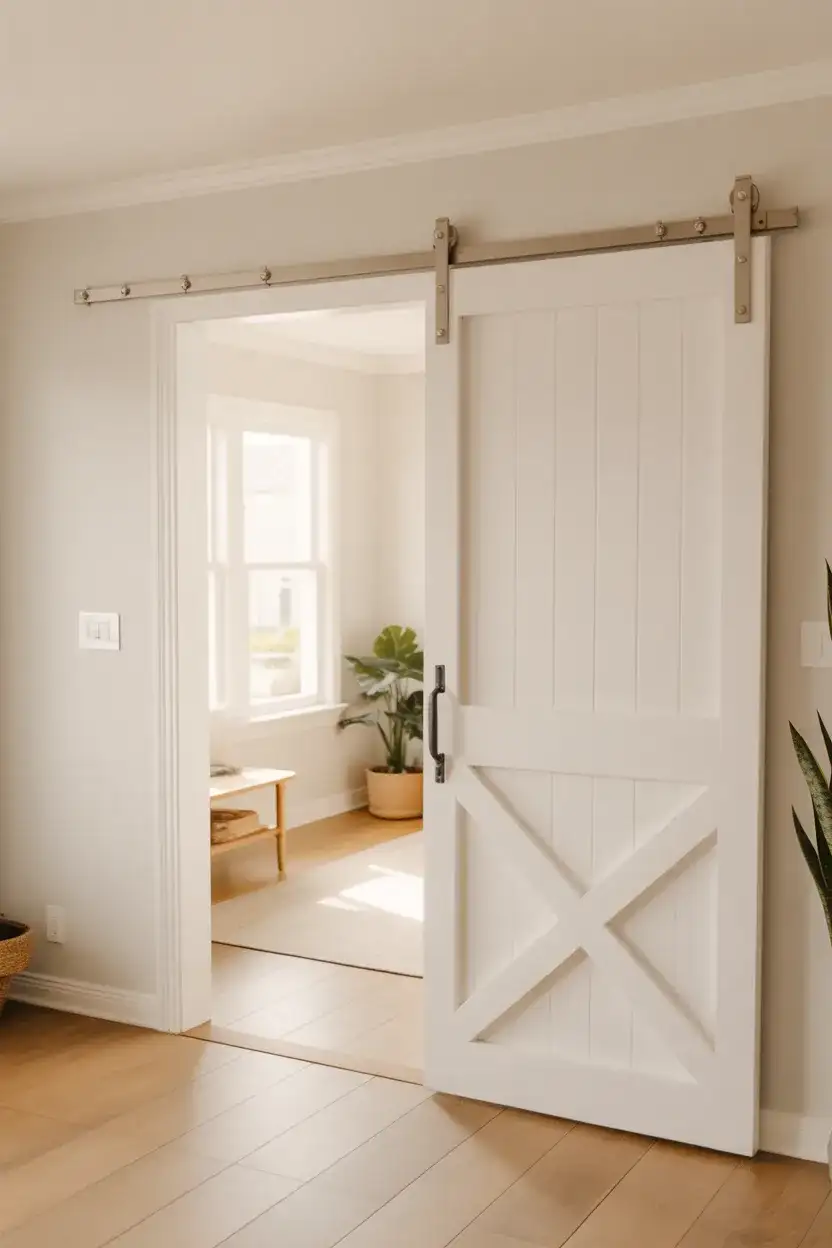
A white-painted barn door might sound like the cautious choice, but executed well, it’s one of the most enduringly beautiful options in the lineup. When the door color matches the trim and wall tone, the door itself seems to float—a textured panel that divides space without visually interrupting it. This works particularly well in smaller homes or apartments where you want the flexibility of a barn door but don’t want another dark, dominant element competing for attention in a compact room.
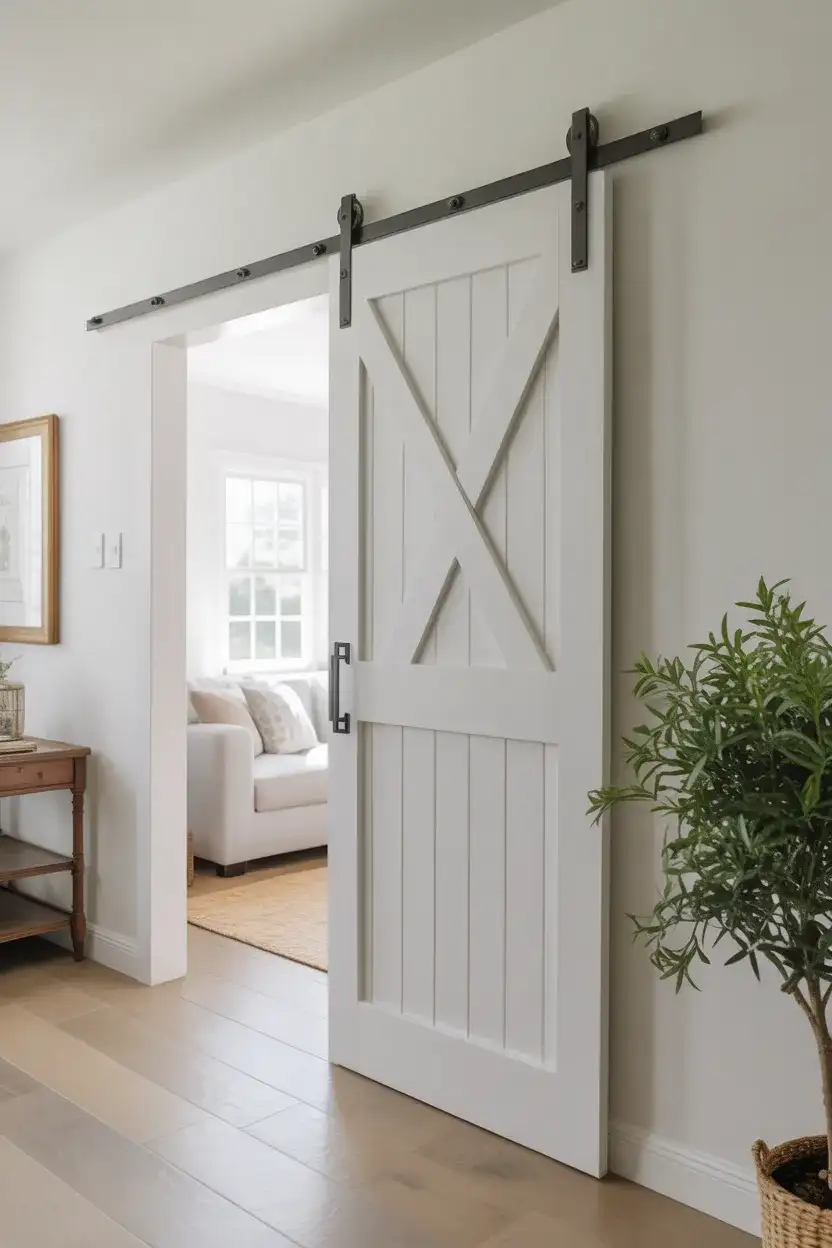
Real homeowners who go this route often report that the white barn door becomes one of those decisions they never think about again—in the best way. It disappears into the architecture when open, and when closed, it reads as a clean, finished wall. For anyone who gets design fatigue from trends, this is the version that will still look right in fifteen years. A semi-gloss or satin finish is your friend here; it holds up to handprints better than flat paint and wipes clean without marking.
7. Large Statement Barn Door for High-Ceiling Spaces
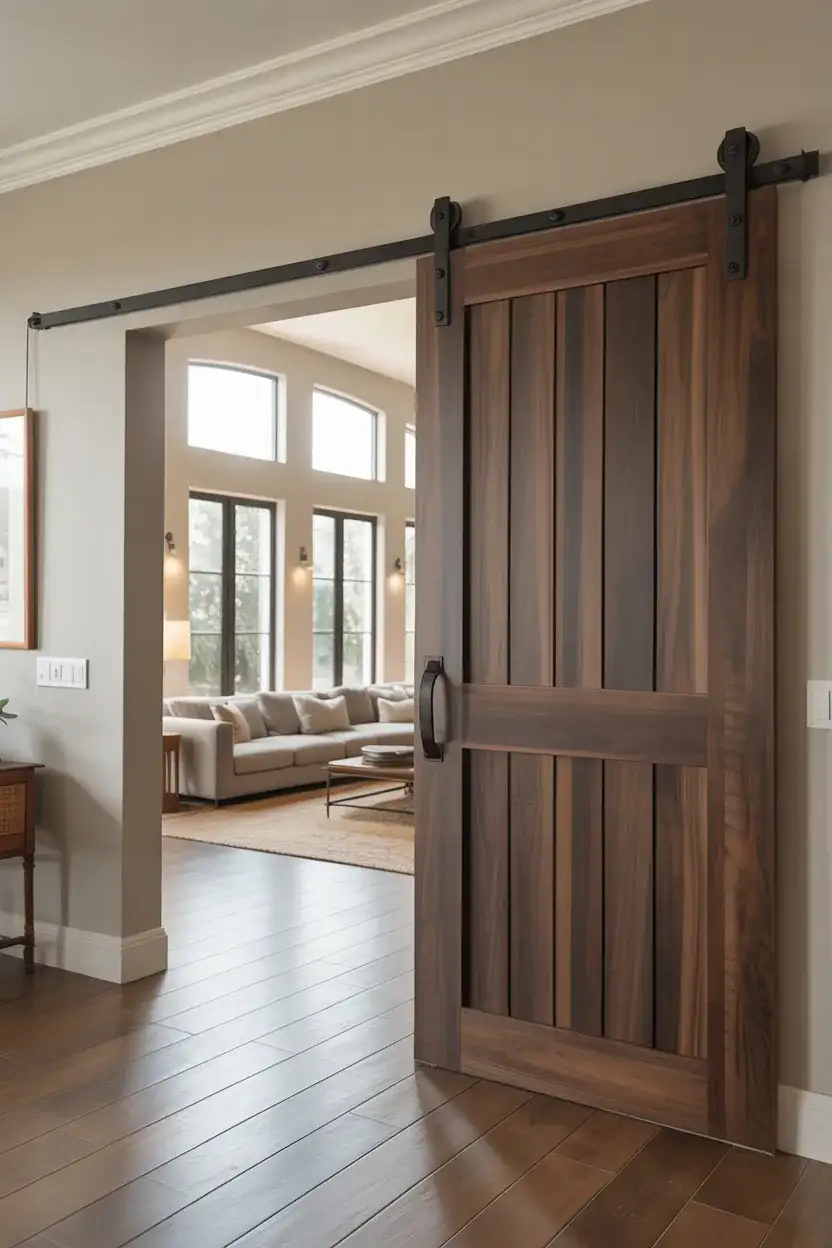
In homes with nine-, ten-, or twelve-foot ceilings, a standard-height barn door looks like a band-aid on a ballroom—undersized and oddly apologetic. A large door, scaled to the full height of the opening (or close to it), transforms the architectural proportions entirely. These oversized panels—sometimes eight feet tall or more—become sculptural elements in their own right. The door IS the décor. In a modern great room or an entry foyer with dramatic height, this move pays for itself in visual drama every single time someone walks through the front door.
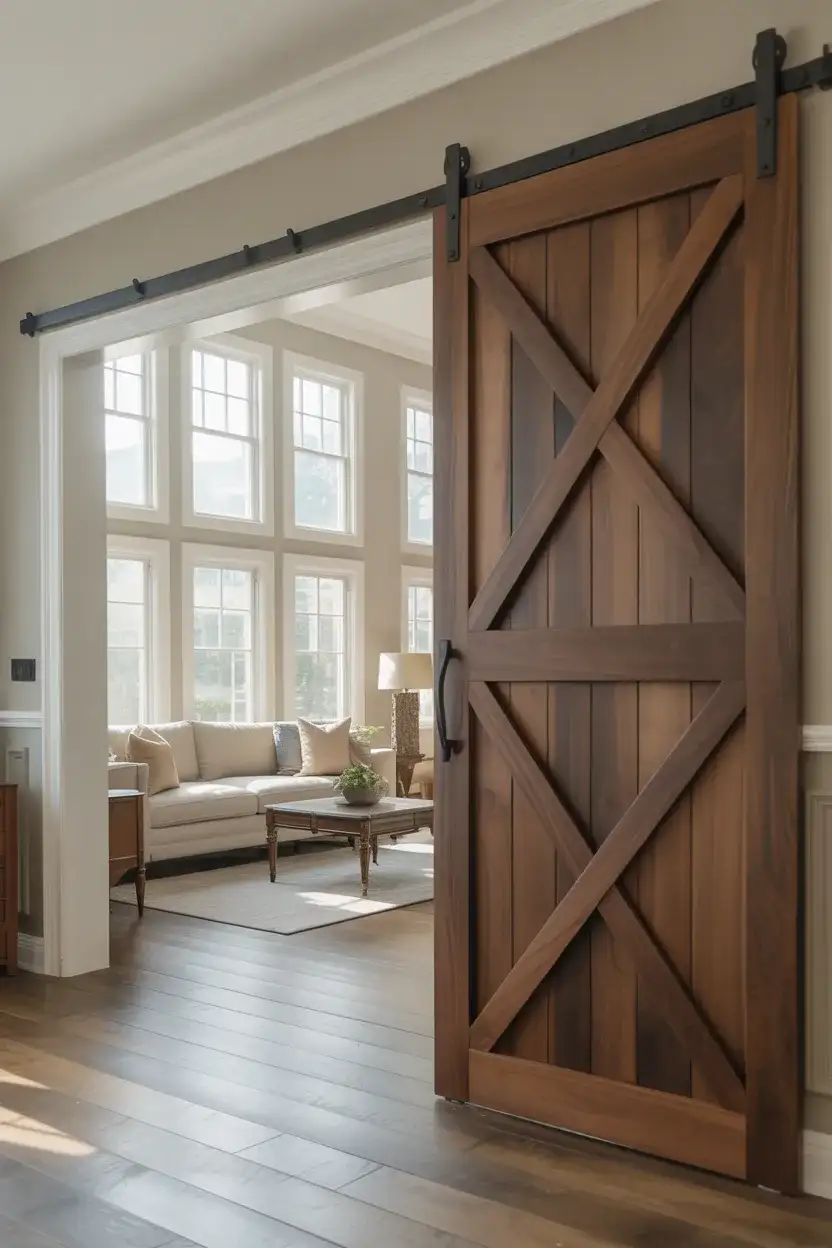
Where this works best: open-concept homes built or renovated after 2005, loft-style apartments in urban buildings, and craftsman-style homes that were given a kitchen or great room addition. Custom sizing is almost always necessary for true floor-to-ceiling panels, and that does add cost—expect to pay a premium of 30–60% over standard sizing from most manufacturers. But in spaces where the ceiling height is the dominant feature, the investment in properly scaled hardware turns a structural quirk into a selling point.
8. Antique Barn Door as a Decorative Room Divider
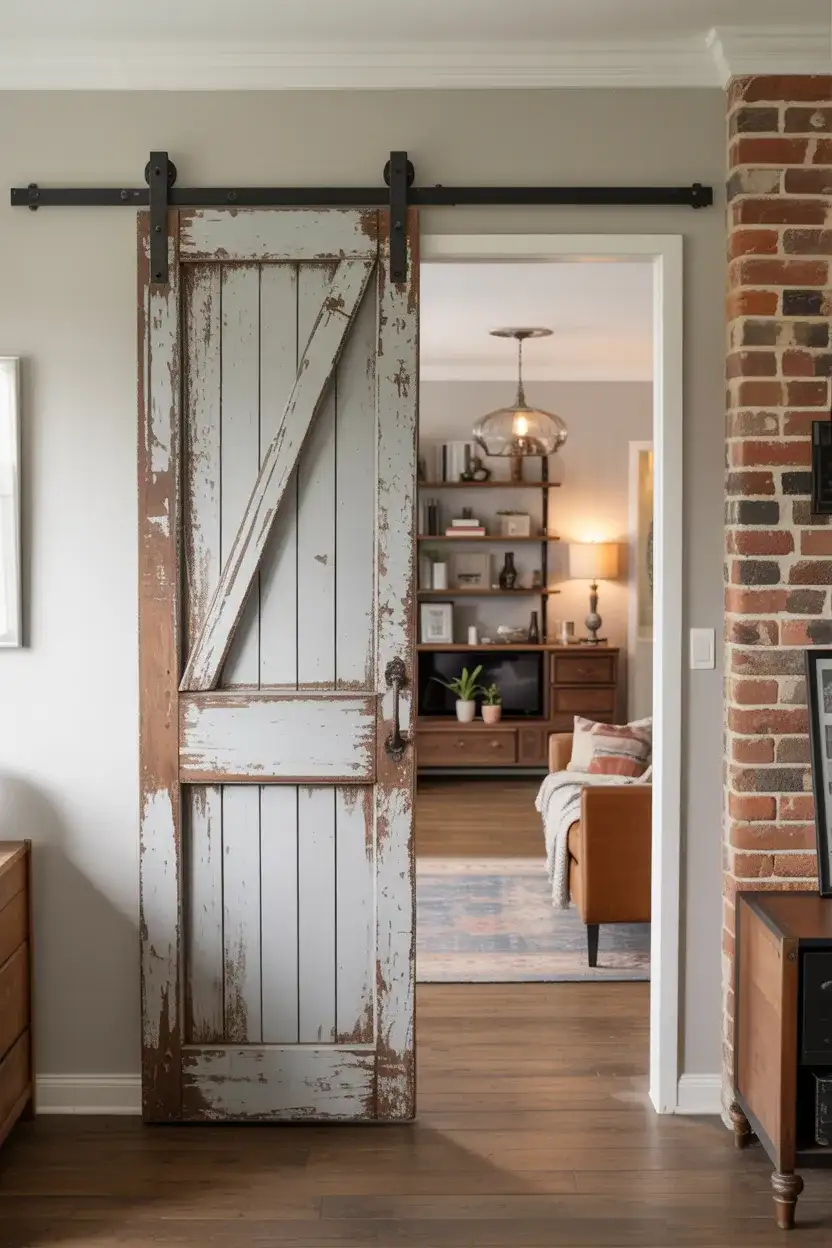
An antique barn door—pulled from a salvage yard, an estate sale, or an old New England barn—brings something no new door ever can: actual history. The peeling paint layers, the hand-forged hardware holes, the places where hay hooks once hung. When used as a room divider in a living or dining space, it functions less like a door and more like a large-scale art installation that just happens to slide. Paired with a simple flat-track system, even the most battered salvage door can be brought back to functional life with minimal restoration.
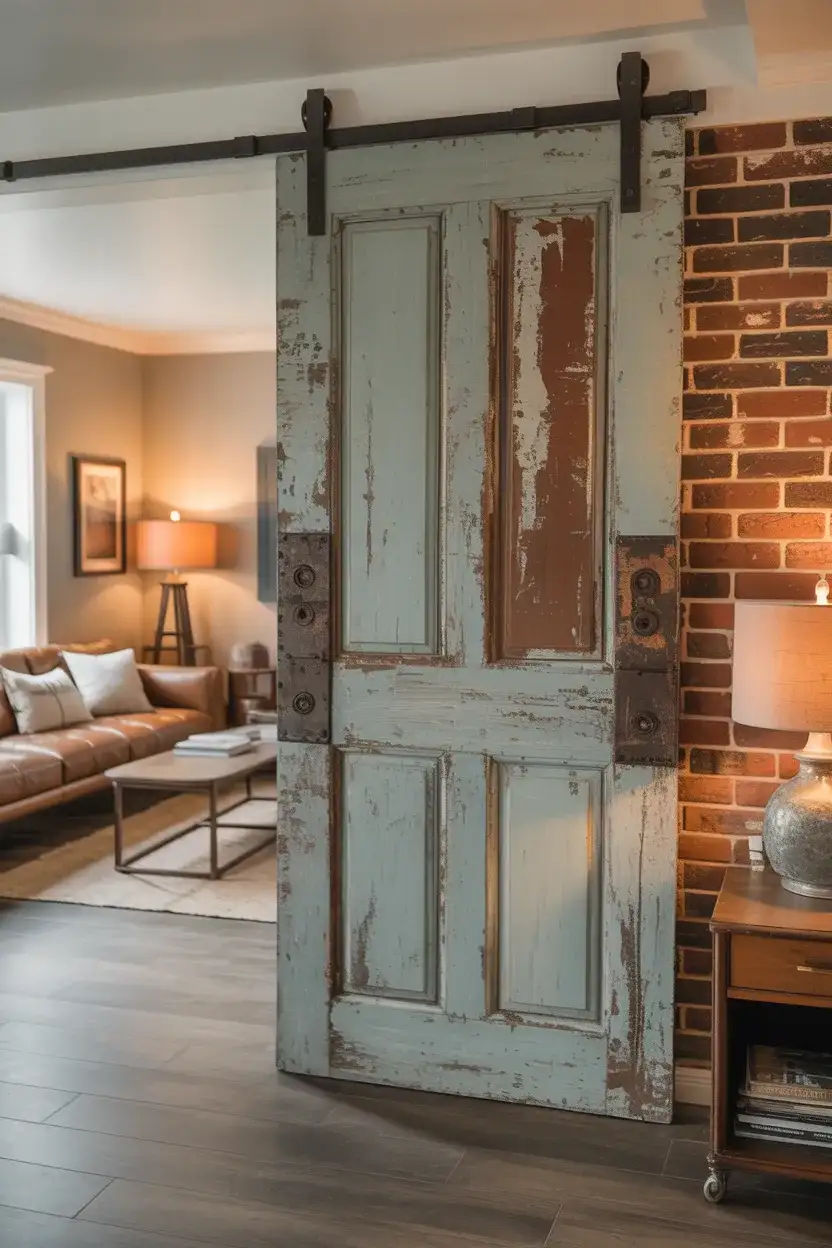
Sourcing is part of the adventure. Salvage yards like Architectural Antiques (Minneapolis), Olde Good Things (New York and LA), and Community Forklift (DC area) regularly stock authentic barn doors in various widths and conditions. Prices vary wildly—$75 for a rough working piece to $600+ for a beautifully patinated specimen. A common mistake is buying before measuring: antique doors come in non-standard sizes that may not fit your opening without significant modification. Always bring exact measurements and factor in some wiggle room for shimming.
9. Split Barn Door for a Pantry or Utility Closet
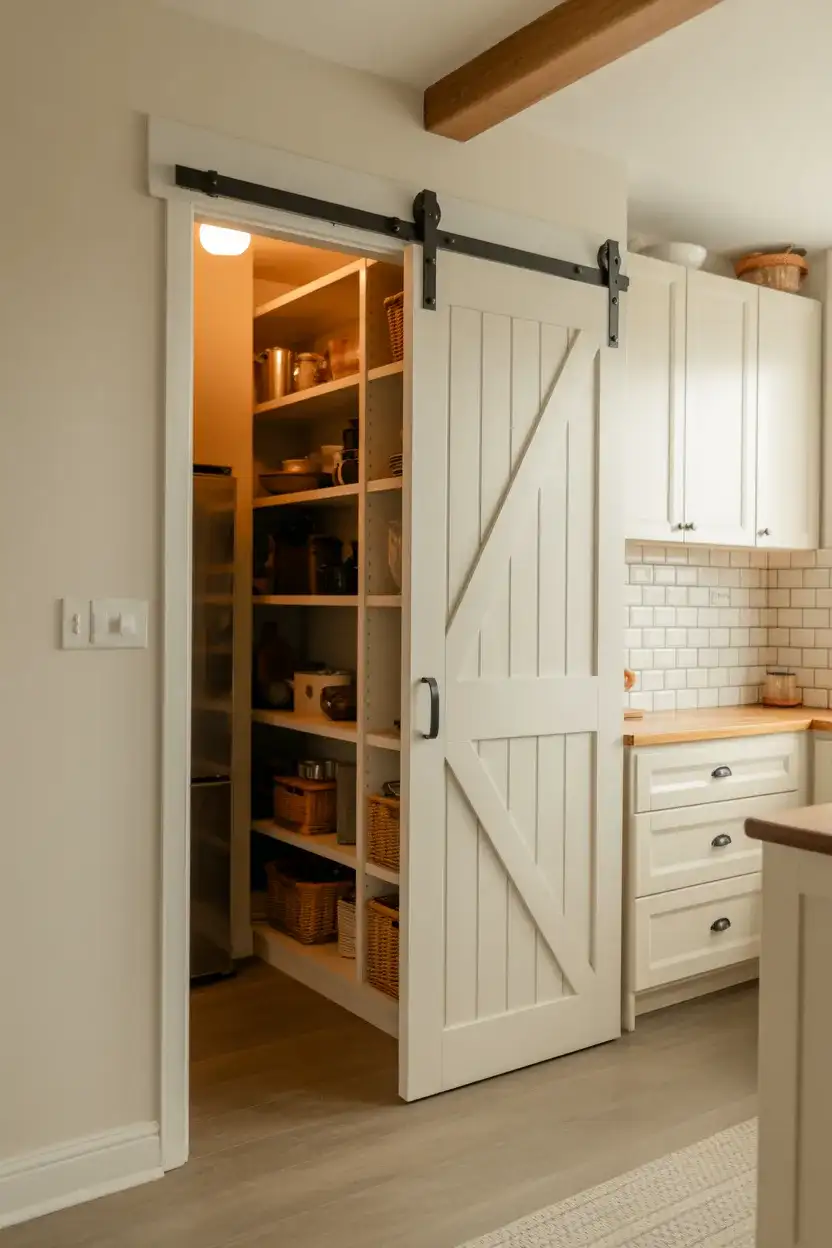
The split barn door—sometimes called a Dutch barn door—divides into a top and bottom half that can open independently. It’s a charming and genuinely functional configuration for pantries, laundry rooms, and utility closet spaces. You can keep the bottom half closed to contain pets or toddlers while leaving the top open for ventilation and easy access. In kitchens especially, this door style lends enormous personality to what would otherwise be a very forgettable utility door, turning a purely practical decision into a small design celebration.
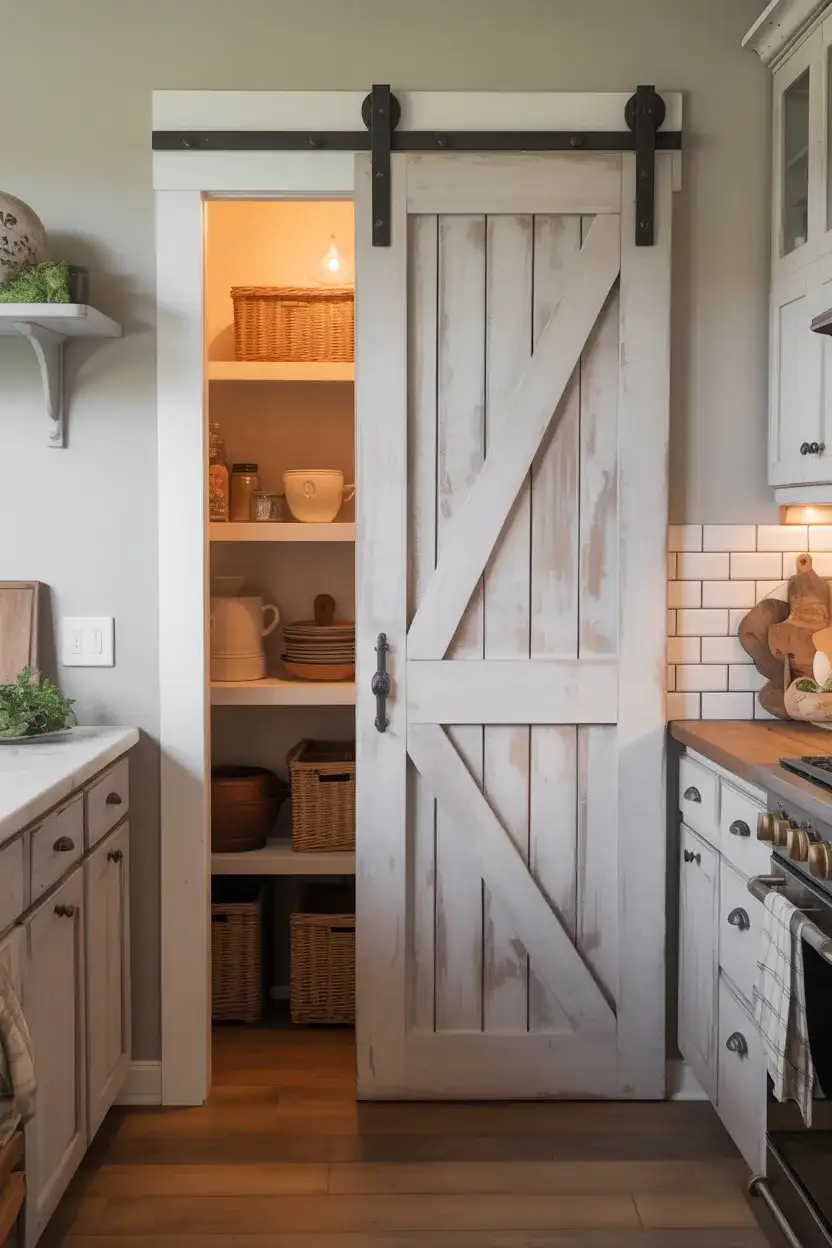 floors.
Expert cabinetmakers and kitchen designers often suggest the split door as an underutilized solution for homes with young children or cats that tend to wander into pantries and knock things over. It’s one of those ideas that sounds quirky until you actually live with it—and then you wonder why every pantry door isn’t built this way. Hardware kits for Dutch-style sliding doors are widely available online and at most major home improvement retailers, typically running $80 to $160 for the track and split-hinge system.
10. Foldable Barn Door for a Small Room or Nook
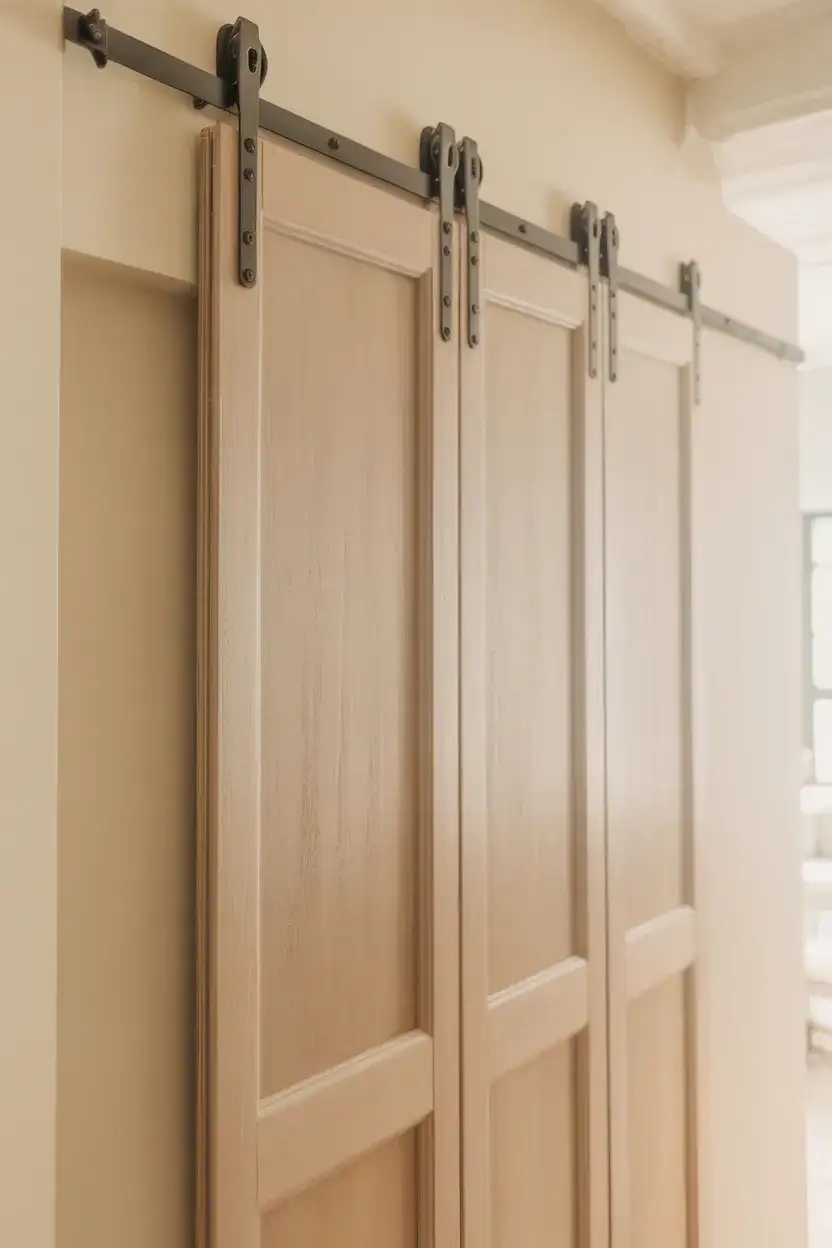
When wall space is genuinely tight—think a nook office, a converted closet workspace, or a small laundry alcove—a foldable barn door offers a clever middle path between a hinged door and a full slider. The panels fold accordion-style along a track, collapsing flat against the wall to one side when fully open. This means you need significantly less clearance than a traditional sliding door. The look is more architectural and geometric than a standard barn door, giving it an almost Scandinavian cabinet quality that works in both contemporary and transitional homes.
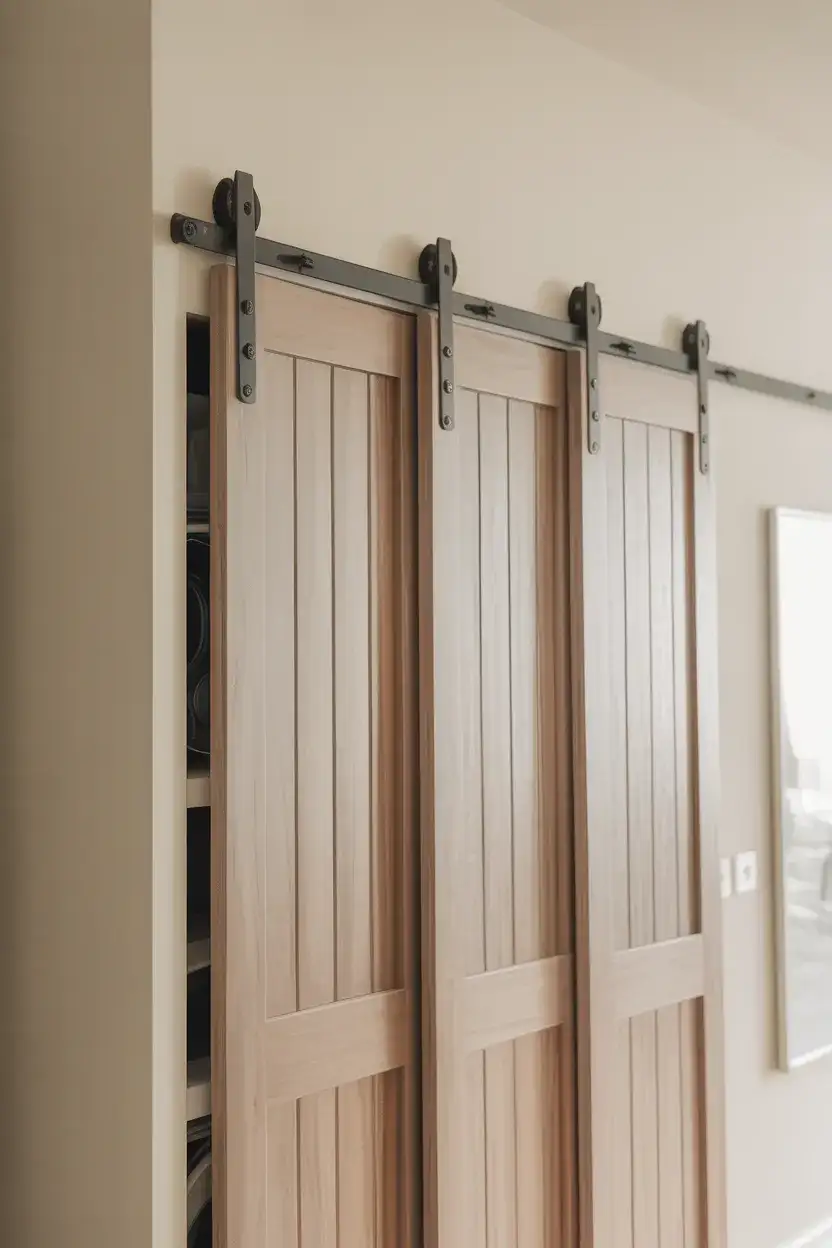
This is a great solution for renters and homeowners alike—foldable track systems mount with fewer anchor points than full sliding setups and can often be removed without major wall damage, making them a favorite in the growing market of design-forward temporary installations. If you’re outfitting a rental and want to add real design impact without surrendering your security deposit, a well-mounted foldable door is often the most rewarding investment you can make in a small space.
11. DIY Barn Door Weekend Project on a Budget
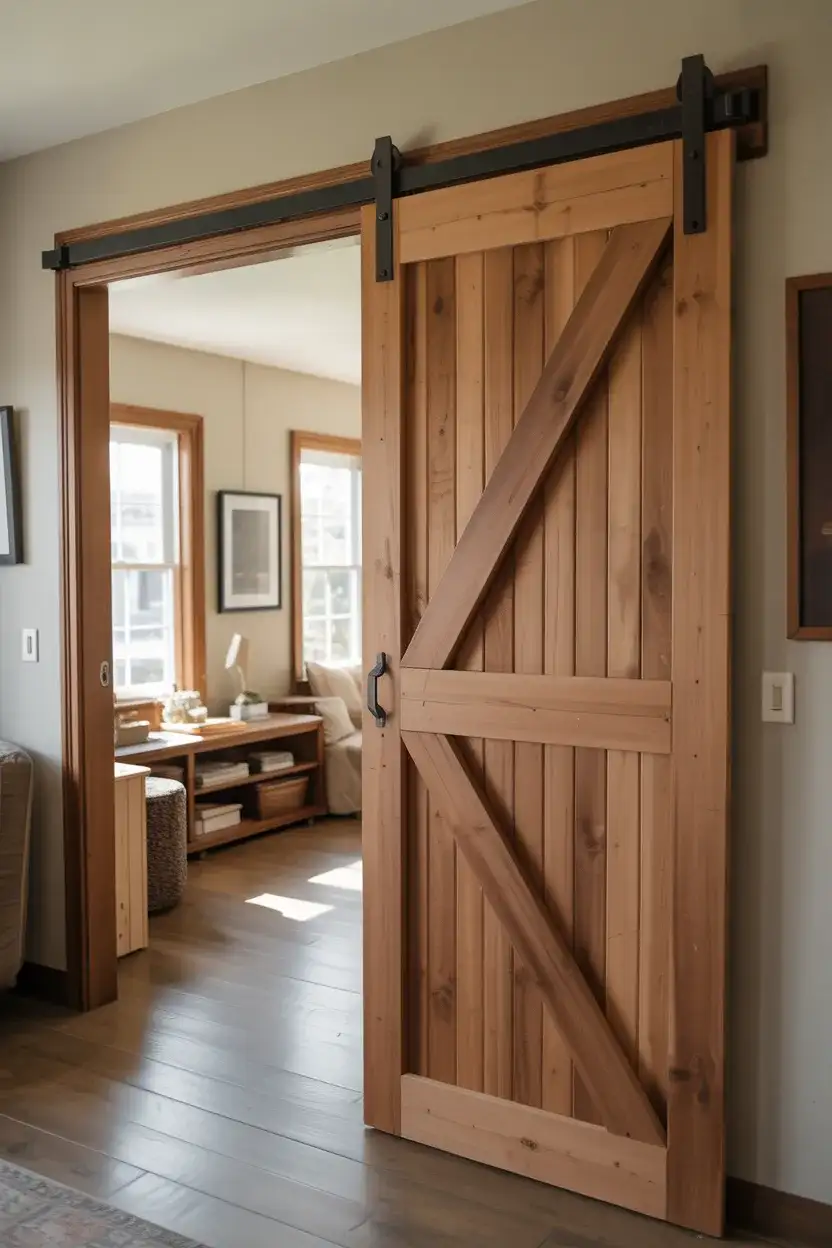
The DIY barn door is, without question, one of the most democratic design projects in the American home improvement ecosystem. With a weekend, a few sheets of lumber, some basic tools, and a $60–$100 hardware kit from Amazon or Home Depot, you can build a door that looks like it cost five times as much. Most popular DIY builds use standard 1×6 or 1×8 pine boards arranged in a Z-brace or X-brace pattern—the same configuration used on actual working barn doors for well over a century. It’s beautiful precisely because the design logic is so honest.
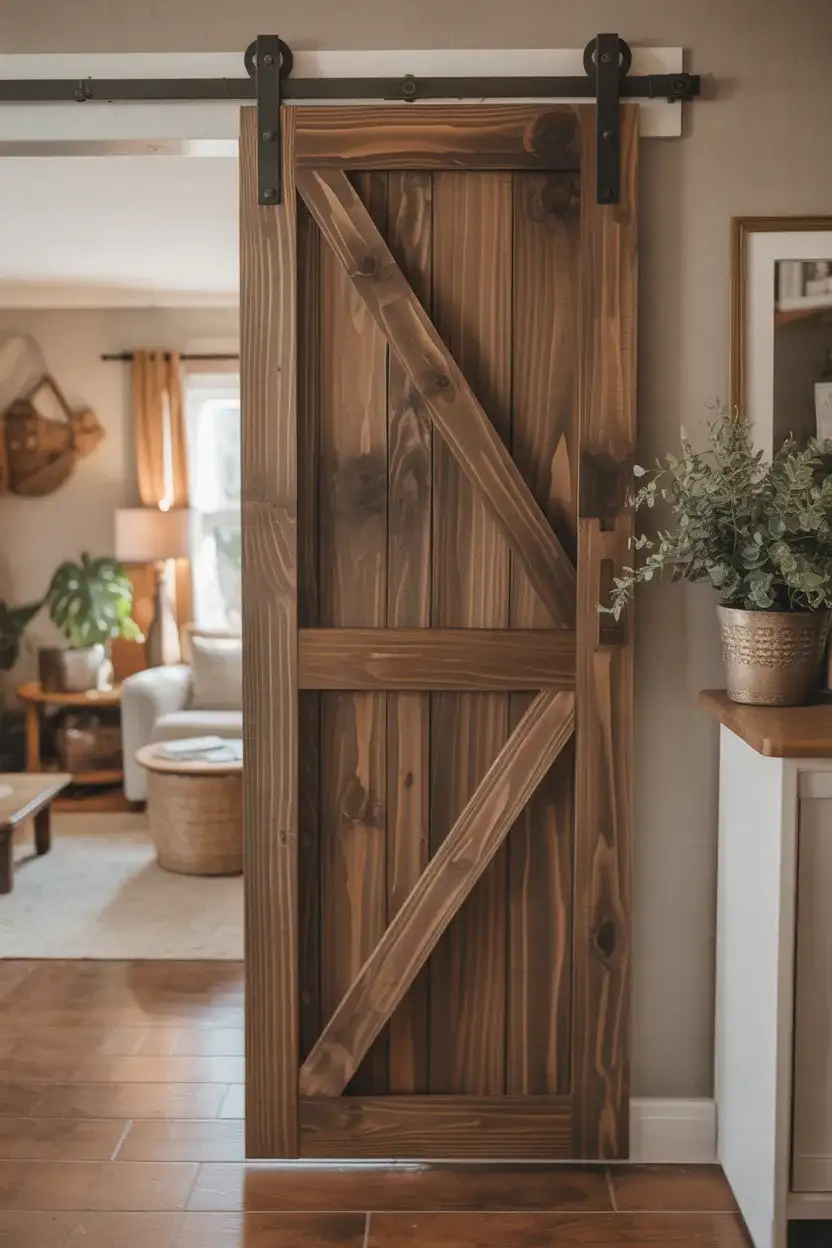
The budget angle here is real: a complete DIY barn door build, including lumber, hardware, and stain or paint, typically lands between $120 and $200 total—versus $350 to $700 for a comparable pre-made panel. The trade-off is four to six hours of build time and some intermediate woodworking comfort. YouTube tutorials from creators like Shanty 2 Chic and April Wilkerson have made this project accessible to first-timers, and the learning curve is genuinely gentle. It’s the rare DIY project where the beginner result still looks intentional and finished.
12. Folding Barn Door for a Living Room Media Wall
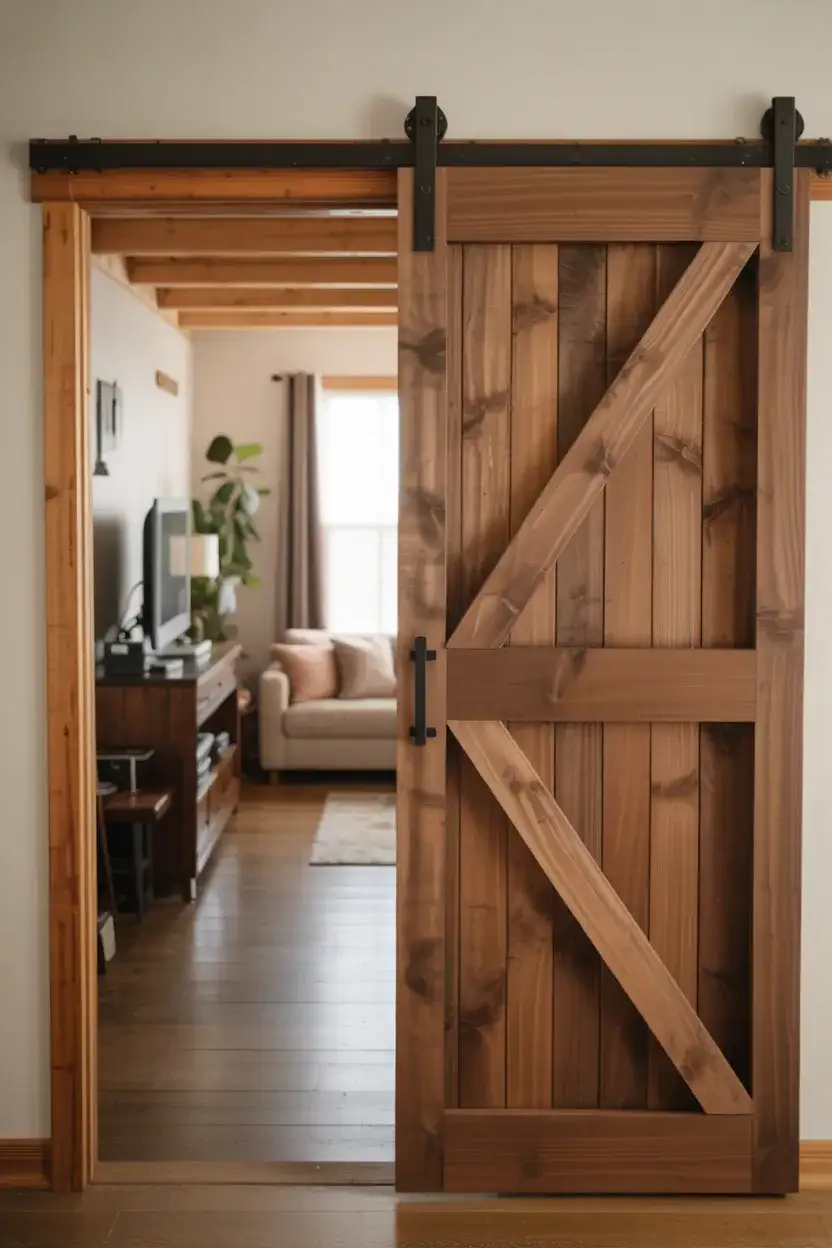
One of the most inventive uses of the folding barn door trend in 2026 is to hide a media wall or entertainment center behind beautiful wood panels. When the TV is off, you see a stunning wall of textured wood. When it’s showtime, the panels fold neatly to the sides, revealing your setup behind. This approach turns your living room into two versions of itself—one for lounging and watching, one for entertaining and conversation. For homeowners who love design but hate the way screens dominate a room, it’s something close to a revelation.
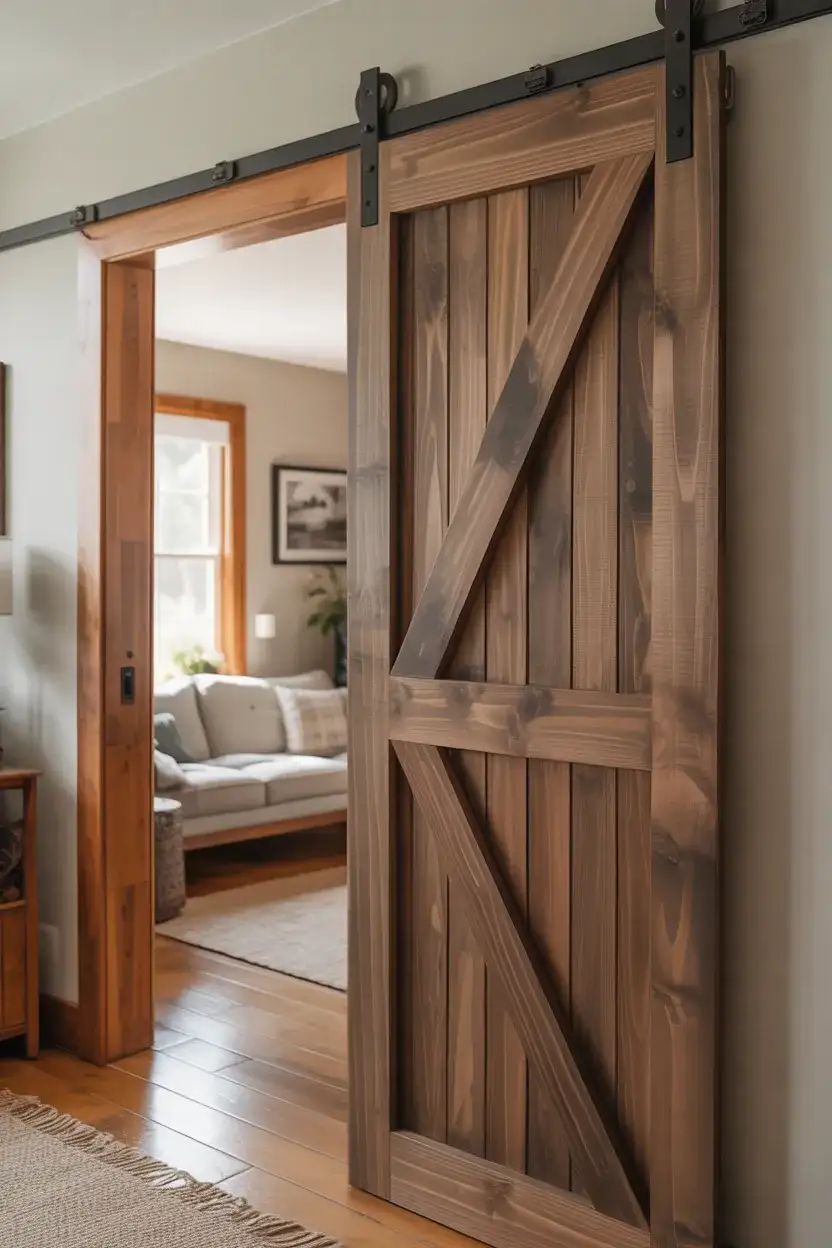
This approach is particularly popular in mid-century ranch homes being renovated for modern life—homes where the living room was designed around conversation and the TV was never part of the original plan. A local designer in Austin noted that clients who install concealed media walls report feeling less “screenified” in their own homes, spending more evenings with the doors closed and music on instead. It’s a small architectural decision with a surprisingly large impact on how a family actually uses their living room day to day.
13. Double Sliding Barn Door for an Open Master Suite
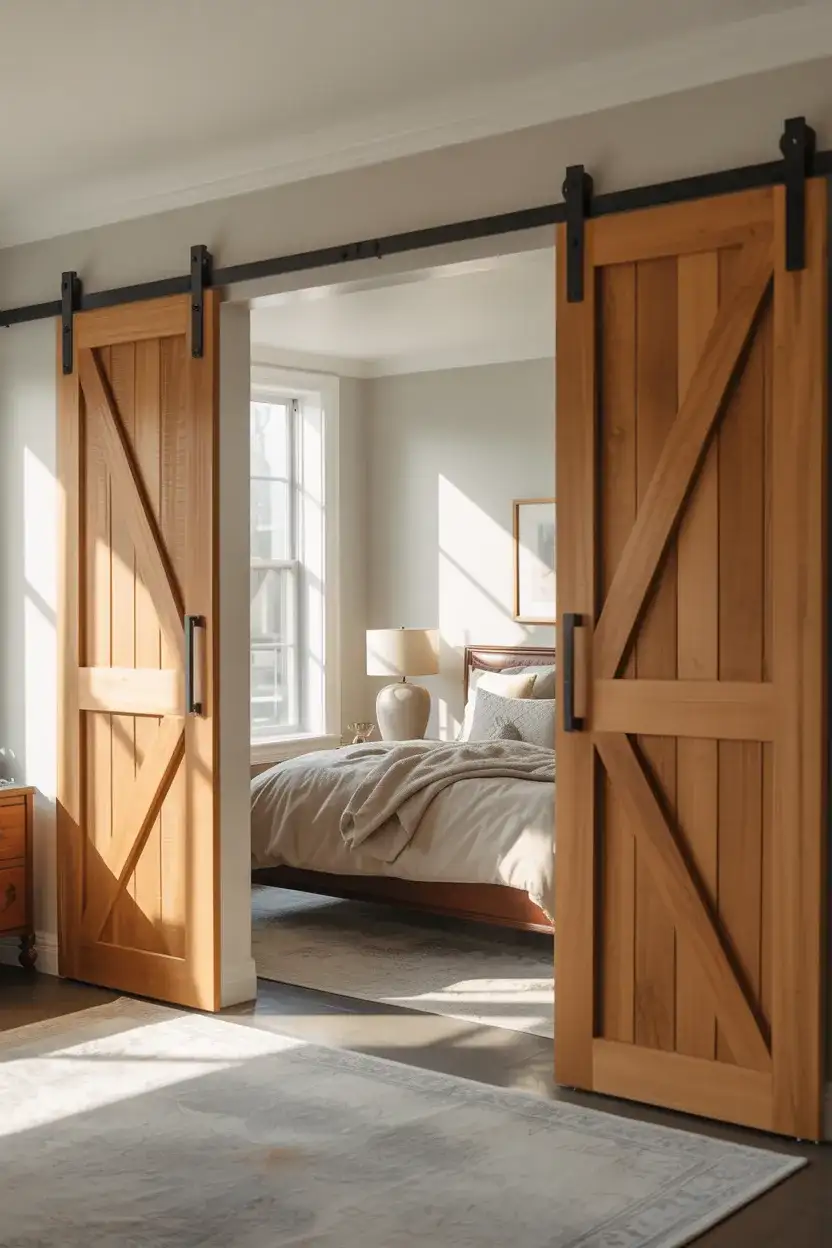
The double sliding barn door configuration—two panels that each slide to opposite sides—is the gold standard for wide bedroom openings, especially in master suites where the goal is equal parts drama and function. When both panels are pulled back, the entire width of the opening is unobstructed, creating that open-plan flow that makes a bedroom feel spacious and resort-like. When closed, the symmetrical pairing of two matching panels reads almost like a headboard for the room itself—a framing element that gives the bedroom wall intentional structure and presence.
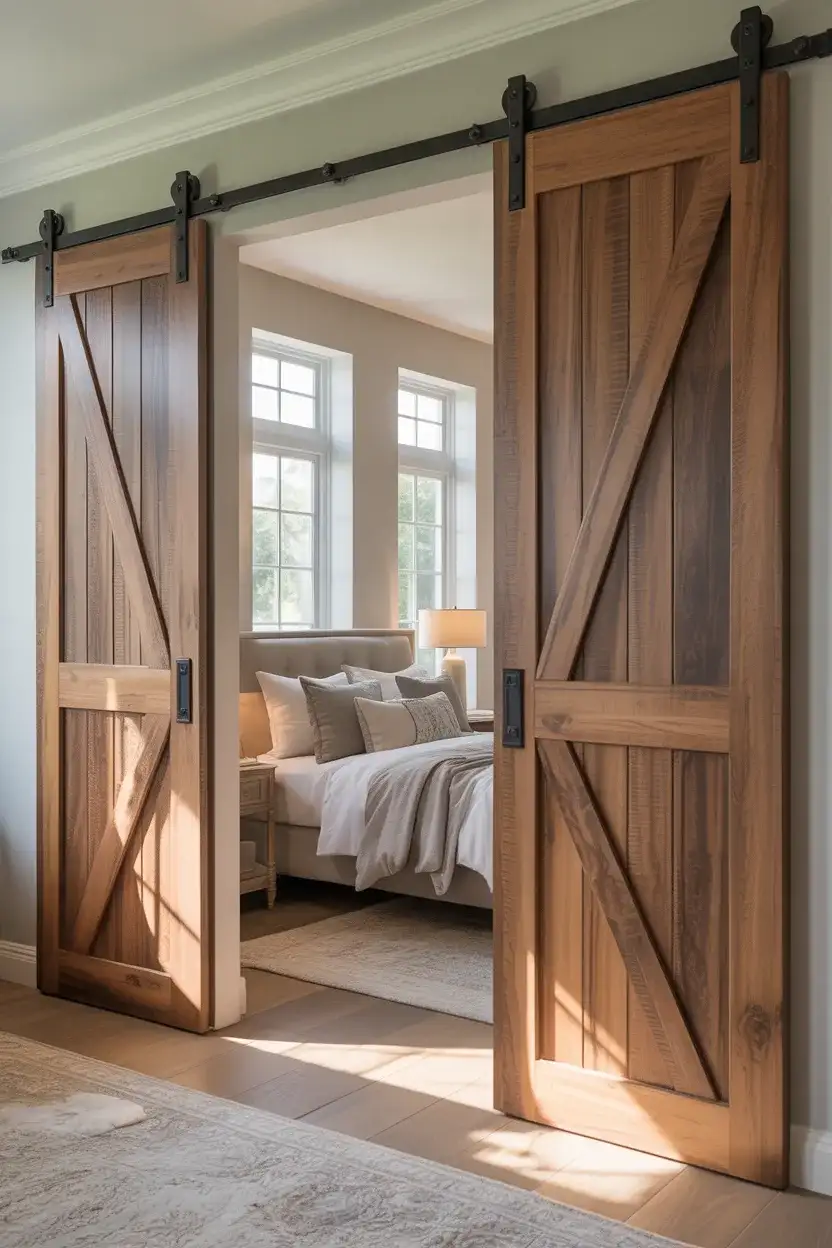
Where this configuration truly earns its keep is in homes where the primary bedroom connects to a sitting room, home office, or large walk-in closet via a wide passage. The typical hinged French door solution for this scenario requires serious floor clearance and can eat into furniture placement significantly. The double slider eliminates that entirely. Real homeowners report that once they experience walking into their bedroom past two barn doors, going back to a traditional door setup feels almost impossible to imagine.
14. Arched Barn Door for a Romantic, Old-World Touch
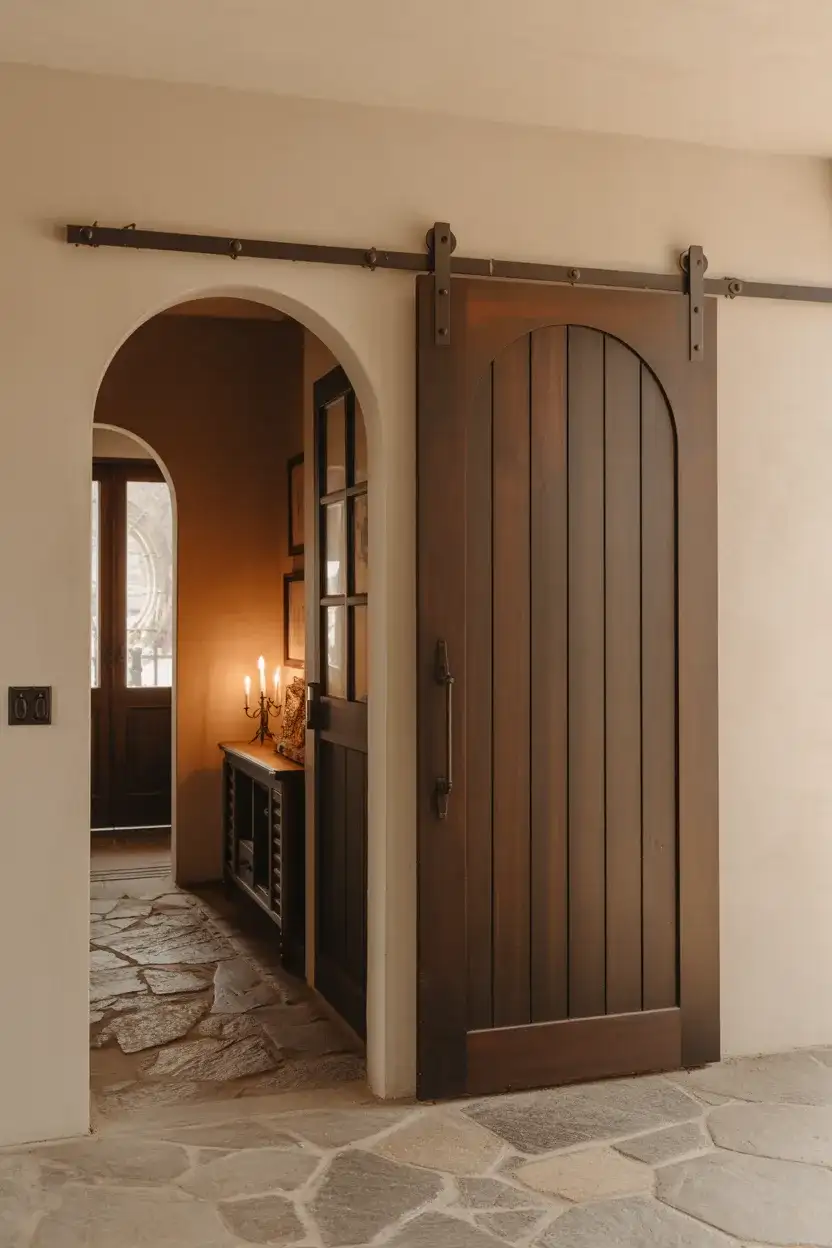
The arched barn door is the most architecturally ambitious version of the trend and also one of the most breathtaking when done right. Instead of a flat rectangular top, the door panel has a curved or pointed arch at the crown—echoing the ironwork of European castles, the doorways of old Tuscan villas, or the gothic arches of American craftsman architecture. These doors tend to be custom-built or sourced from specialty millwork shops, and the curved top requires a matching arched opening or a curved header trim to frame it properly. The result is unmistakably romantic.
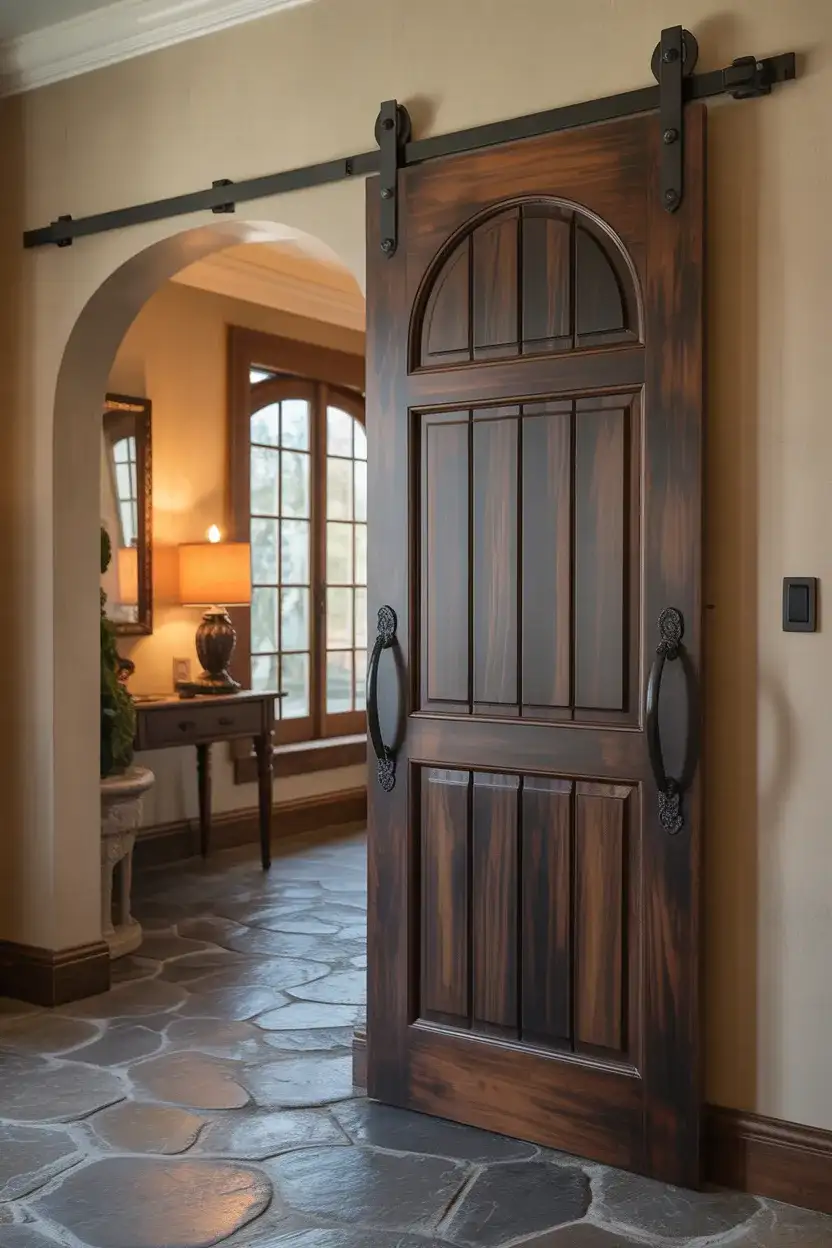
If you already have an arched doorway in an older home—common in American Foursquare, Spanish Revival, and Tudor-style houses—an arched barn door is a way to honor that architecture while modernizing the function. It signals design literacy, the sense that the homeowner understood what was already in the house and made decisions in conversation with it rather than in opposition to it. Custom arched sliding doors typically start at $600 and can reach well over $2,000 for hand-carved hardwood versions from boutique millwork studios.
15. Corner Barn Door for Tight Transitional Spaces
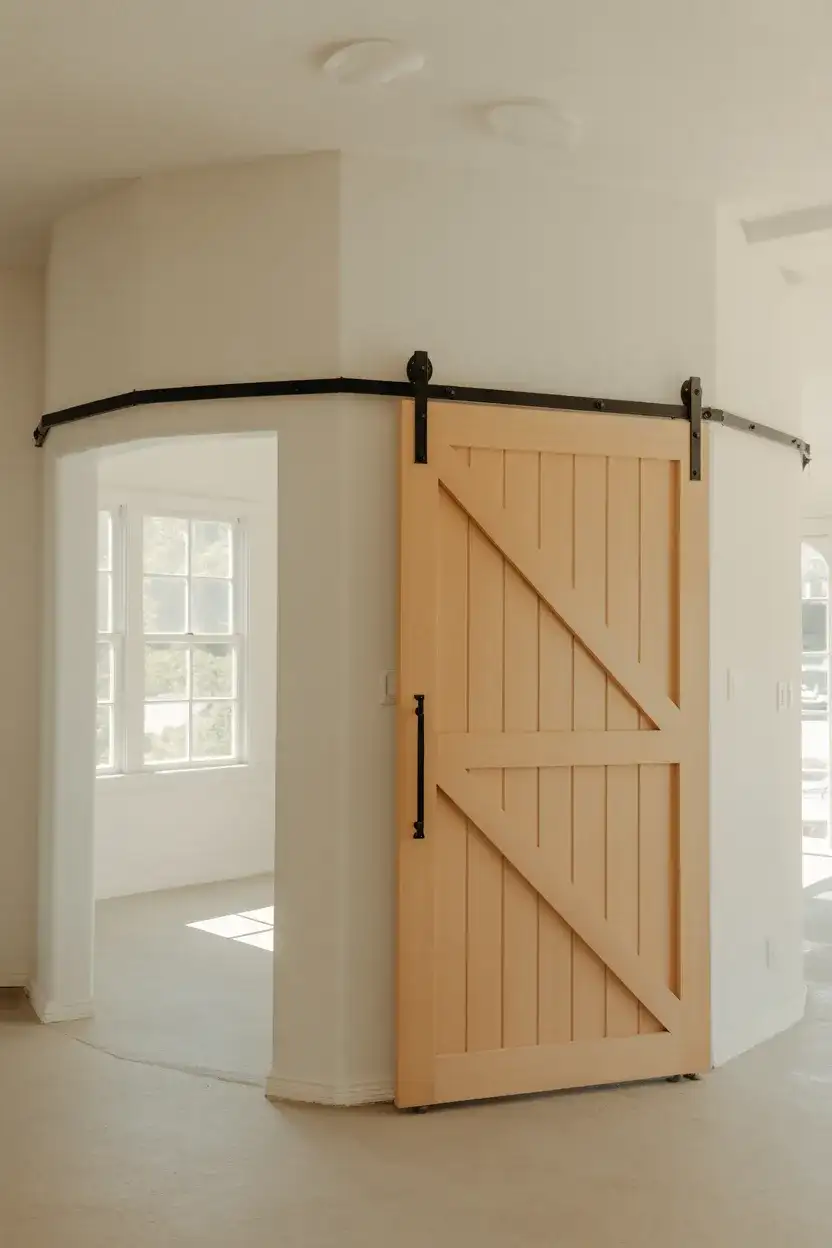
The corner barn door is one of the most underrated space solutions in residential design right now. Designed for openings that sit at the corner of two walls, it uses a specially engineered curved or angled track that allows the door to swing around the corner and park flat along the adjacent wall. This solves a genuine architectural puzzle—what do you do when the wall next to a doorway is too short for the door to slide along, but the adjacent wall has plenty of clearance? The corner track system handles what a traditional slider can’t.
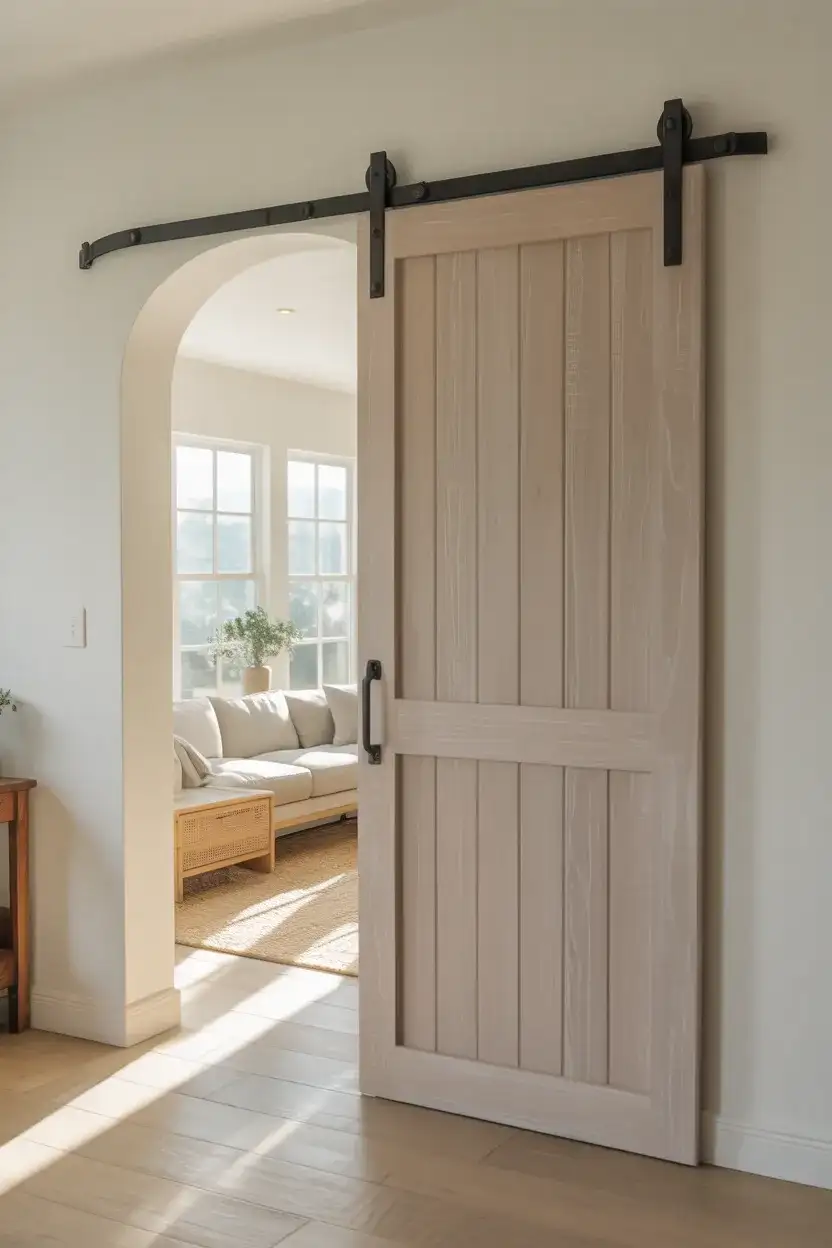
This is one of those practical solutions that most homeowners don’t know exists until a contractor or designer mentions it. The common mistake is assuming the only option for a tight-walled doorway is a hinged door or a pocket door—and pocket doors require opening up the wall, which can be cost-prohibitive and structurally complicated. The corner track system installs without touching the drywall and turns a problem space into a genuinely clever design moment. Hardware kits run $150 to $350 for most residential applications.
16. Closet Barn Door to Replace Awkward Bi-Fold Panels
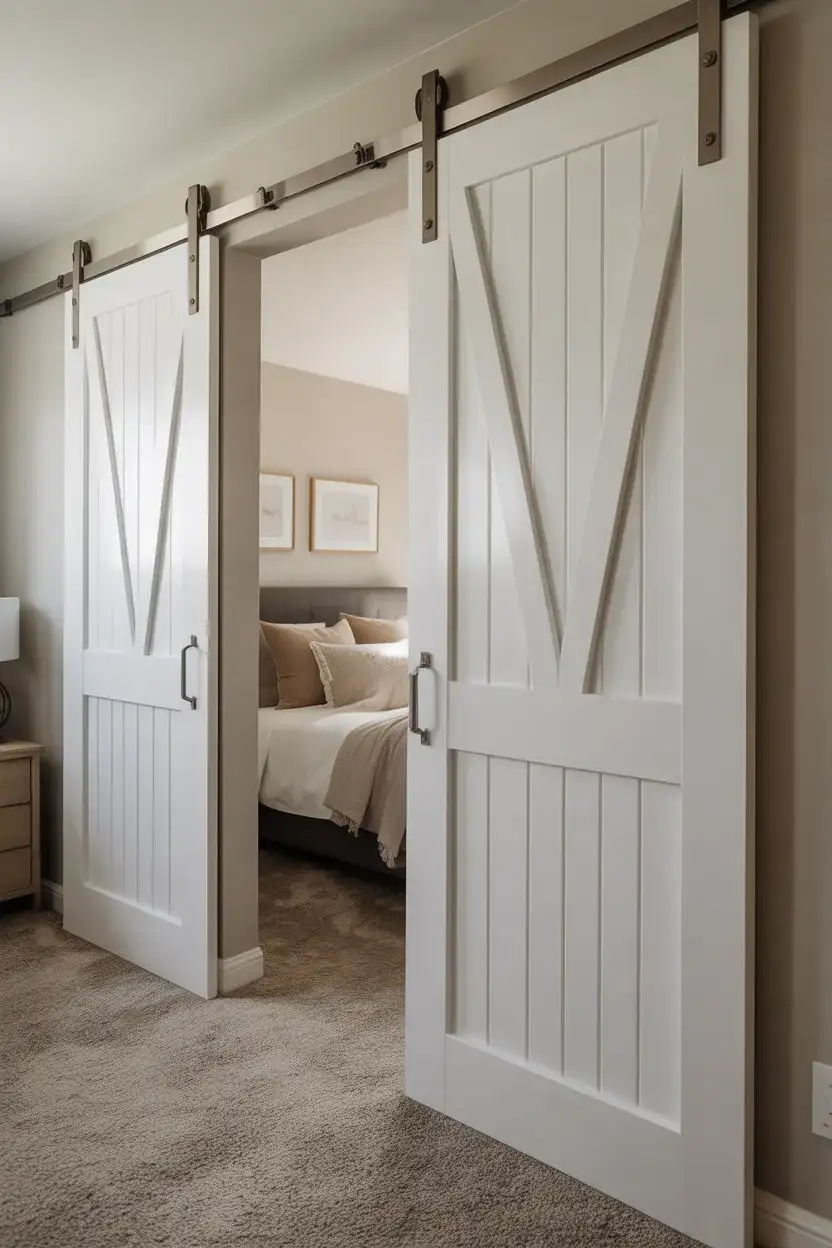
If there is one universally hated door style in American homes, it’s the hollow-core bifold panel that buckles, derails, and rattles its way through every closet in every subdivision built between 1980 and 2015. Replacing them with a closet barn door is one of the fastest, most satisfying design upgrades available to a homeowner—and in many cases it costs less than a proper bifold replacement would. A single sliding panel for a standard 60-inch closet opening can be installed in an afternoon and will make the entire bedroom feel like a different room.
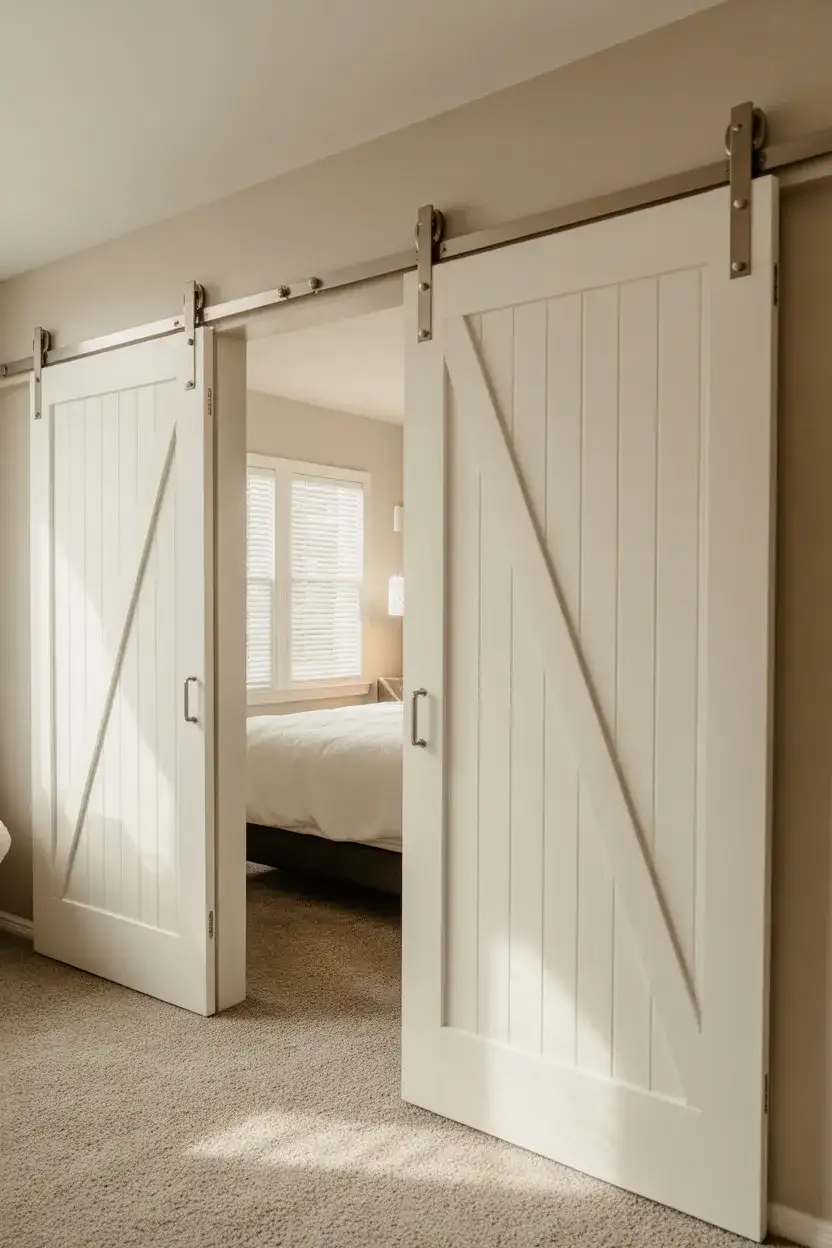
The caveat with this swap: a single sliding door covers only half the closet opening at any given moment. For walk-in closets or larger reach-in spaces, this usually isn’t a problem—you access what you need and slide. But for narrow closets where you want to see the full contents at once, consider a double-panel bypass system (two doors that slide past each other on parallel tracks), which maintains full access to the entire opening with a simple side-to-side motion.
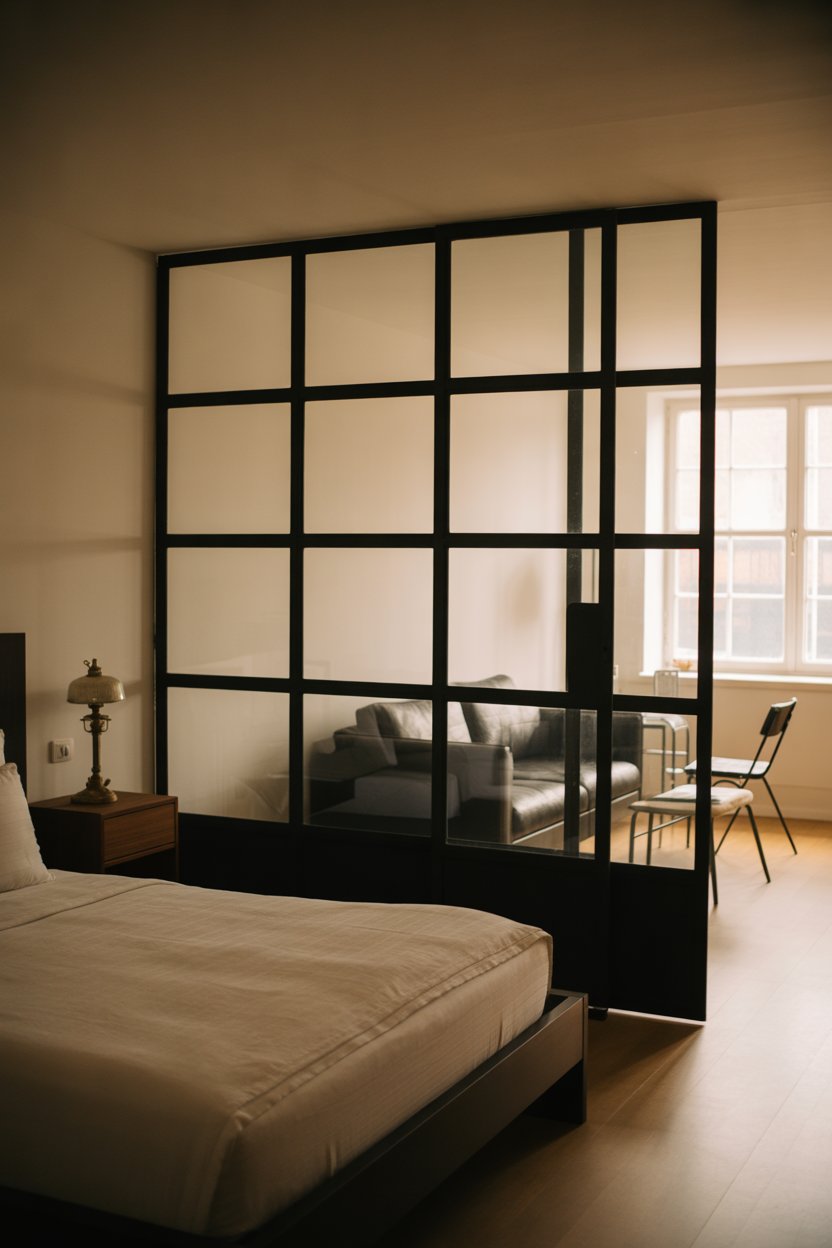
17. Glass Panel Barn Door for a Light-Filled Home Office
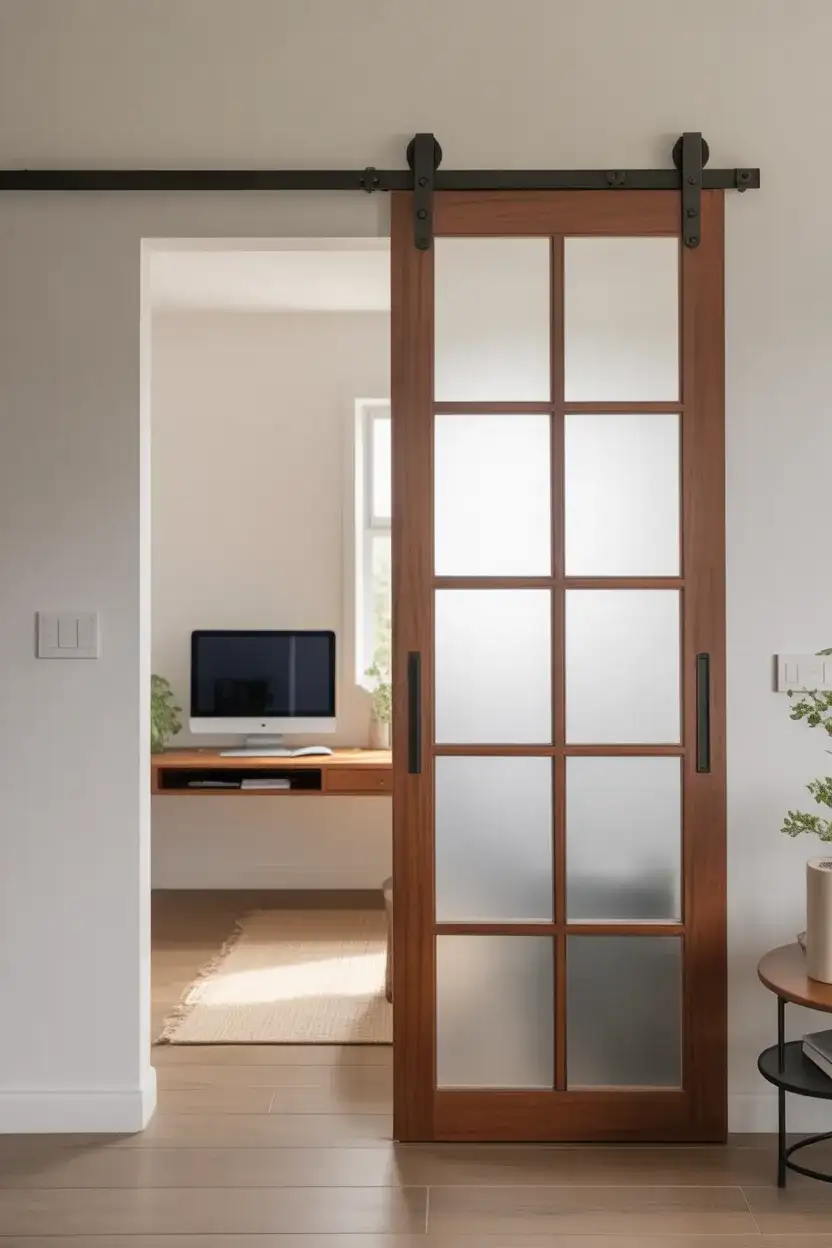
The glass barn door is the design world’s answer to a very modern problem: the need for acoustic separation in a home office without losing the visual openness that keeps small homes from feeling claustrophobic. A door with glass panels—frosted, ribbed, clear, or seeded—lets light pass freely between rooms while still muffling the sounds of video calls, keyboard typing, or the general hum of a workday. In the era of permanent hybrid work, this configuration has become one of the most-requested features in home renovation consultations across the country.
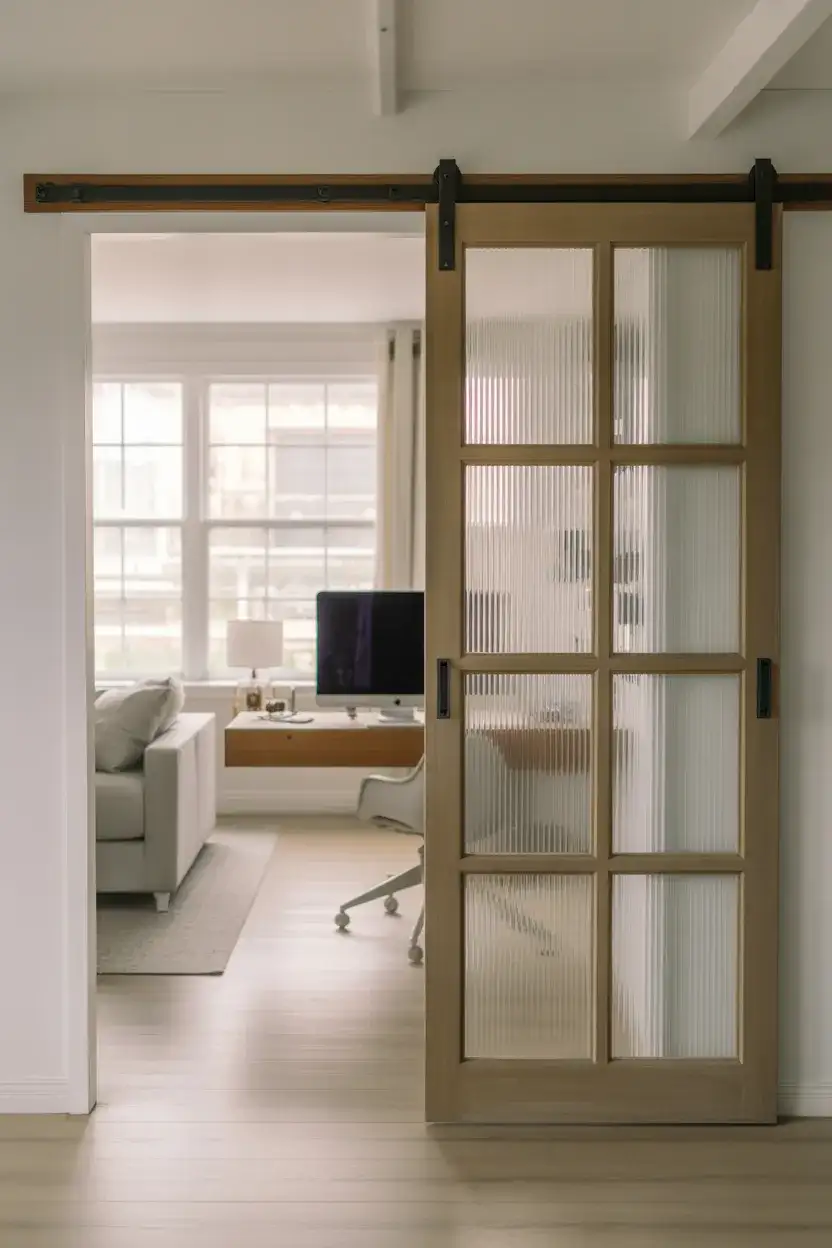
One expert tip worth knowing: ribbed or fluted glass offers more visual privacy than clear glass while maintaining light transmission almost as effectively. It distorts silhouettes enough to feel private during a call without making the space feel closed off during the rest of the day. Seeded glass—the kind with tiny trapped air bubbles—has a vintage quality that works beautifully in homes with some age to them. Reed glass, the narrowly channeled version, has become particularly sought-after for its connection to both Art Deco aesthetics and contemporary Scandinavian design.
18. Wood Barn Door with Walnut Finish for a Sophisticated Look
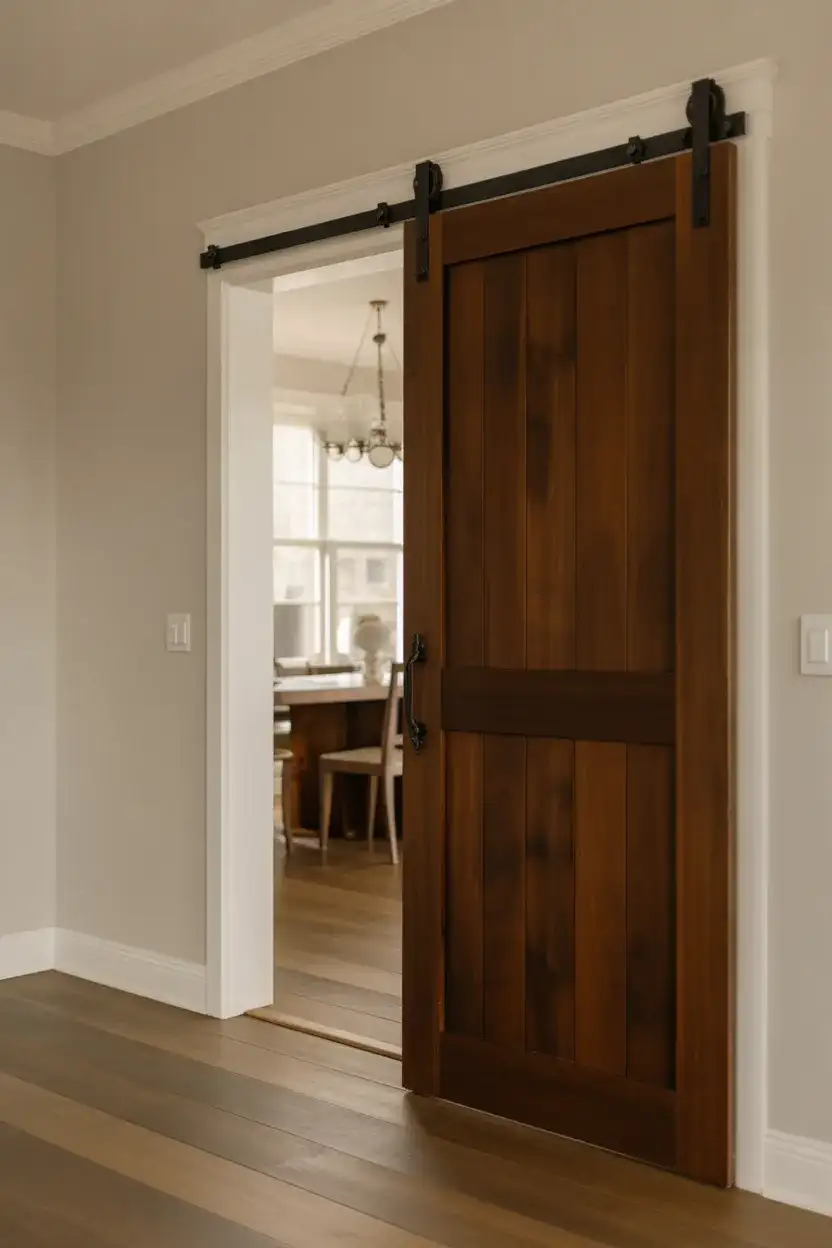
A wood barn door with a deep walnut stain occupies a very specific design register—somewhere between the rawness of a working farm and the polish of a boutique hotel. The darkness of walnut grounds a room in a way that lighter woods can’t, and against white walls or pale tile, it creates contrast that reads as curated rather than accidental. This is a door that communicates that its owner has thought carefully about materials, that wood matters to them, and that there is a standard of finish in this home. It’s the version you often see in designer-published homes and rarely regret choosing.
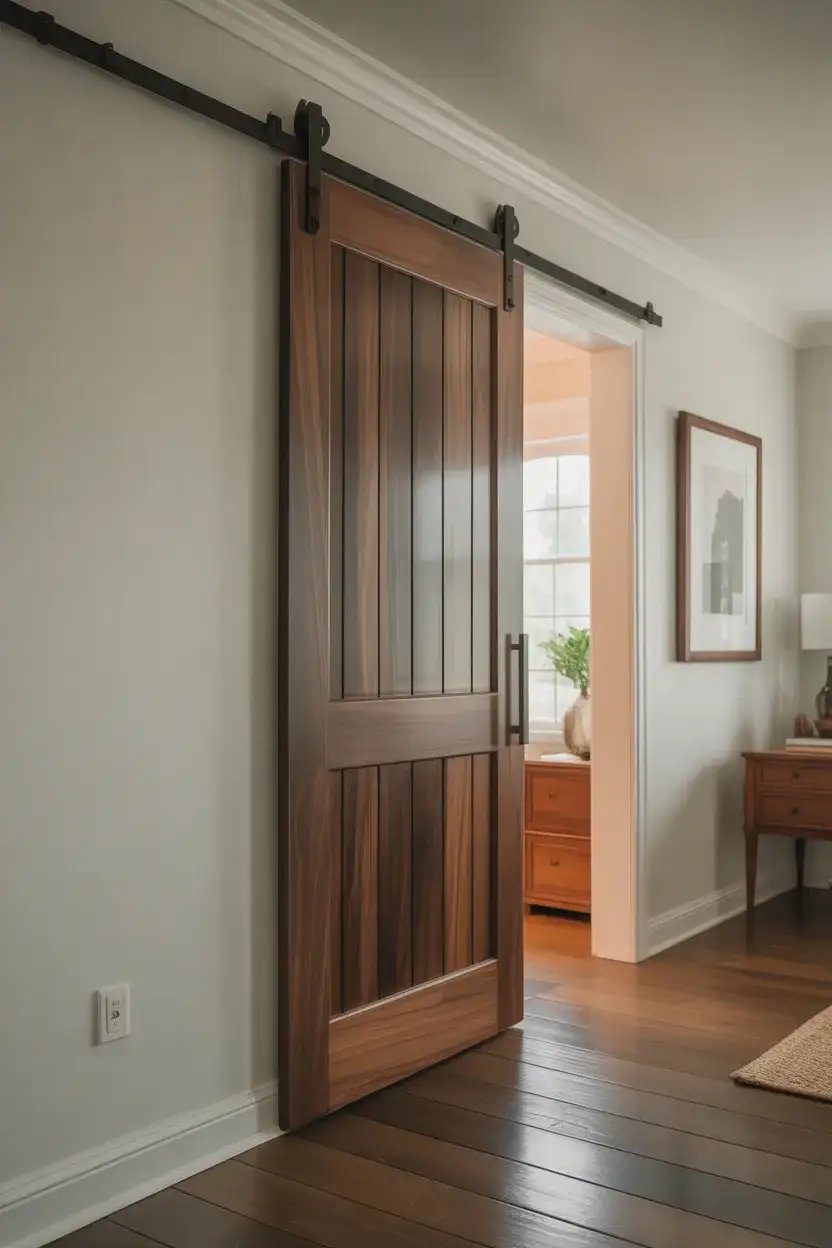
Walnut’s warmth makes it particularly effective in homes that have cool-toned elements—gray tile, white walls, concrete countertops—where it acts as a thermal counterbalance. It prevents the space from feeling sterile or clinical. For homeowners concerned about cost, walnut veneer over MDF core is a widely available option that delivers the look of solid walnut at roughly 40–50% of the price, with the added bonus of being more dimensionally stable over time—less prone to warping in high-humidity environments like hallways near bathrooms.
19. Half Barn Door for a Kitchen Pass-Through or Bar
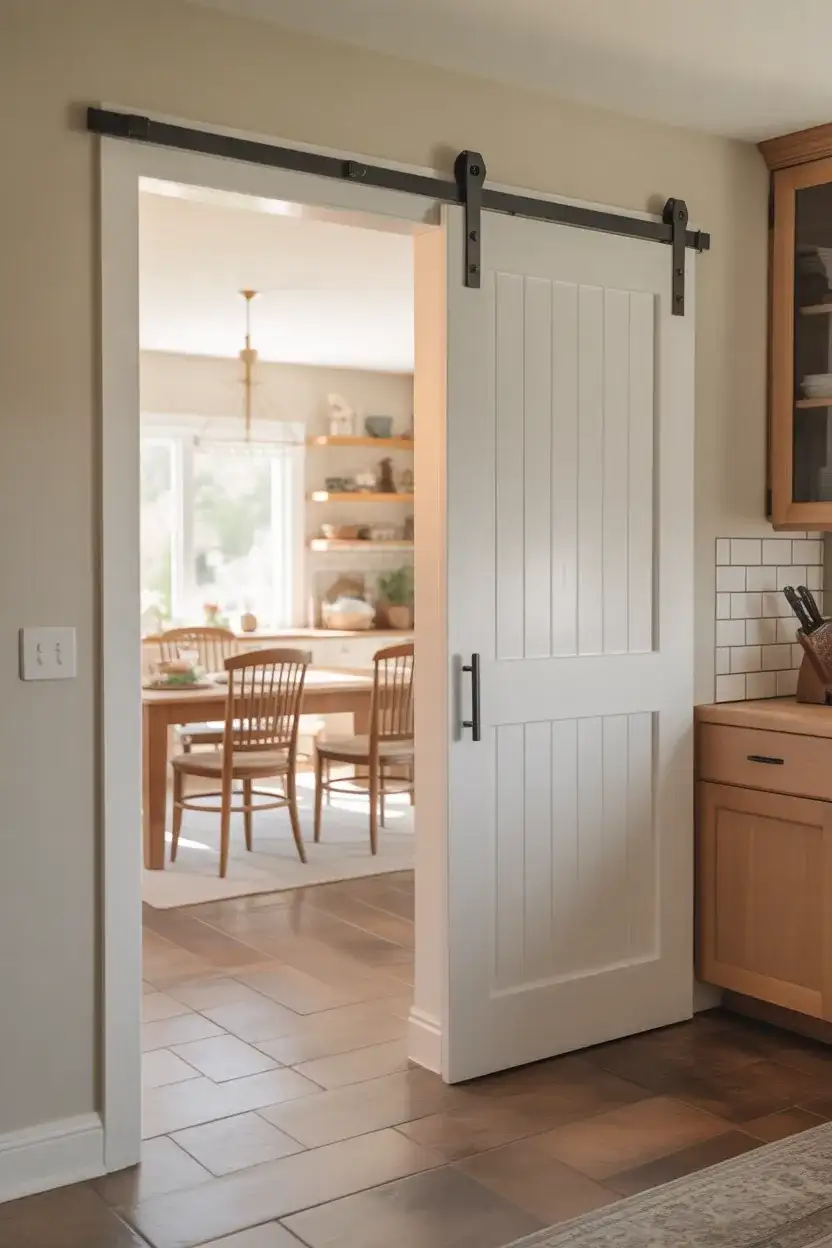
A half barn door—roughly hip to chest height—is a niche idea that solves specific problems with an enormous amount of charm. In homes with a kitchen pass-through or a casual bar setup, a half door keeps the cooking zone slightly separated from a living or dining area without creating a full visual wall. It signals “here is the kitchen” without building a barrier. It’s also practical for homes with dogs that are allowed in the living room but shouldn’t be in the kitchen during cooking—a solution that’s oddly elegant for what is, functionally, a pet gate.
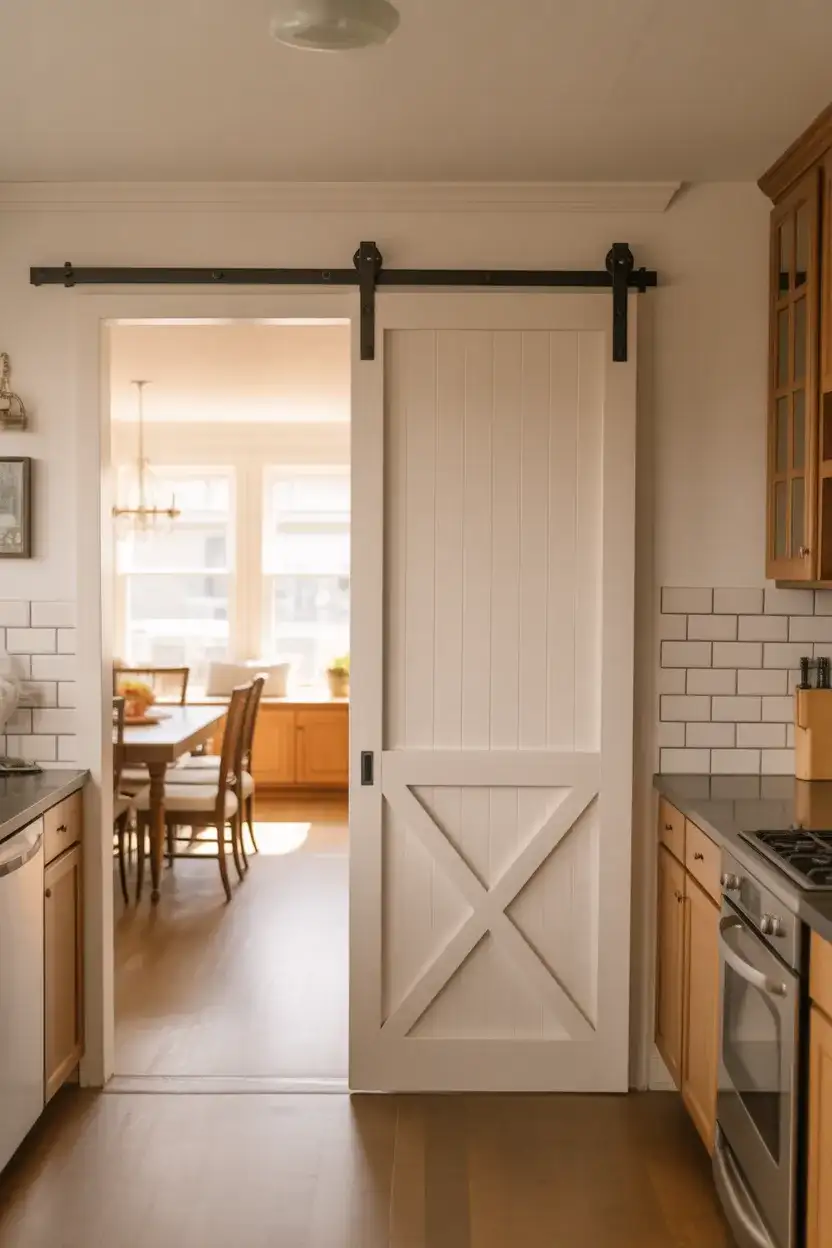
This configuration has a strong regional resonance in the American Southwest and coastal South, where informal indoor-outdoor living spaces blur the boundaries between kitchen, dining patio, and bar. A half door at a backyard-facing kitchen door, for example, lets the cook stay connected to guests on the patio while keeping insects and heat out during grilling season. It’s the kind of detail that makes a home feel like it was designed for the way its owners actually live—casual, social, and a little unconventional.
20. Stained Glass Accent Barn Door for an Artistic Hallway
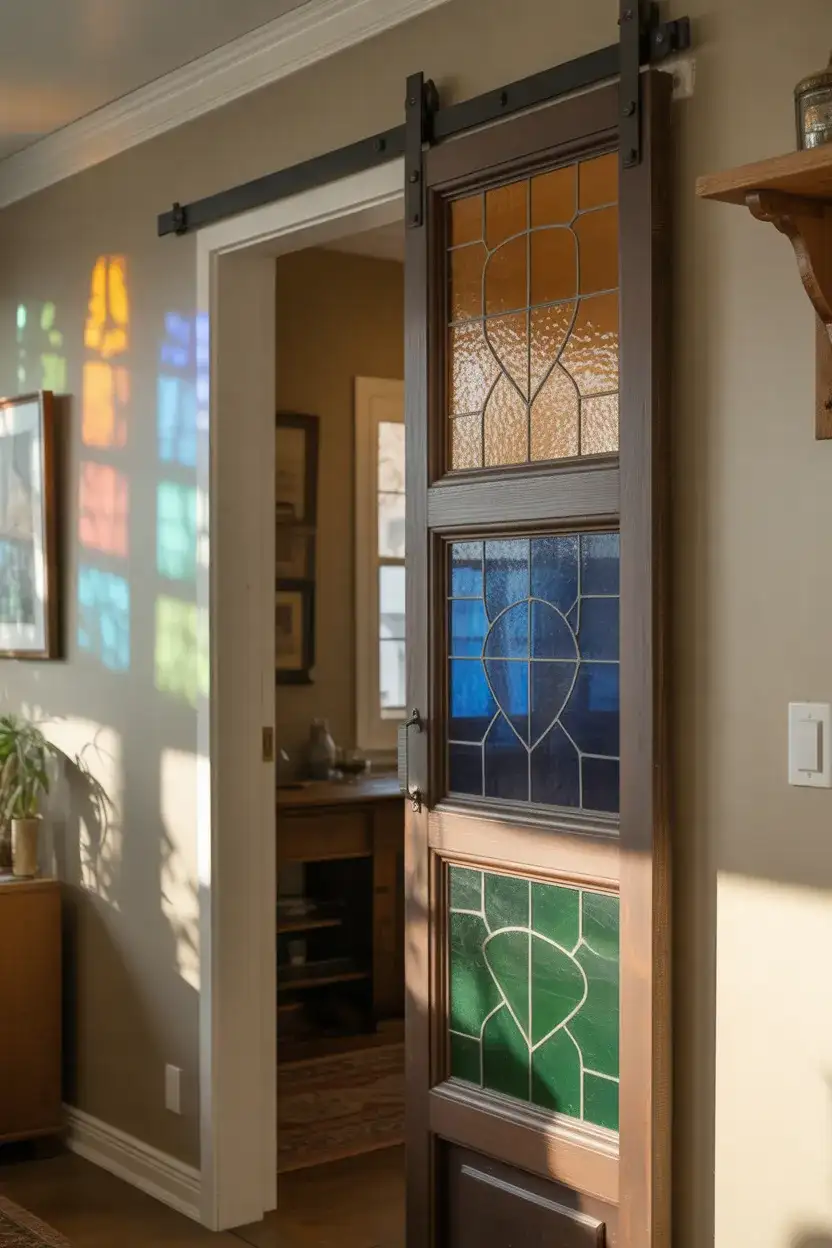
For homeowners whose interior sensibility runs toward the artistic and eclectic, a barn door with stained glass inserts is a design move that is equal parts bold and beautiful. Small panels of stained glass—whether antique salvage or new custom work—can be set into a wood-framed door in geometric, organic, or narrative patterns, casting colored light into a hallway throughout the day. The effect shifts with the sun, which means the door becomes a living element, different at 9am than at 4pm. It’s one of the few design decisions in a home that gets better the more time you spend with it.
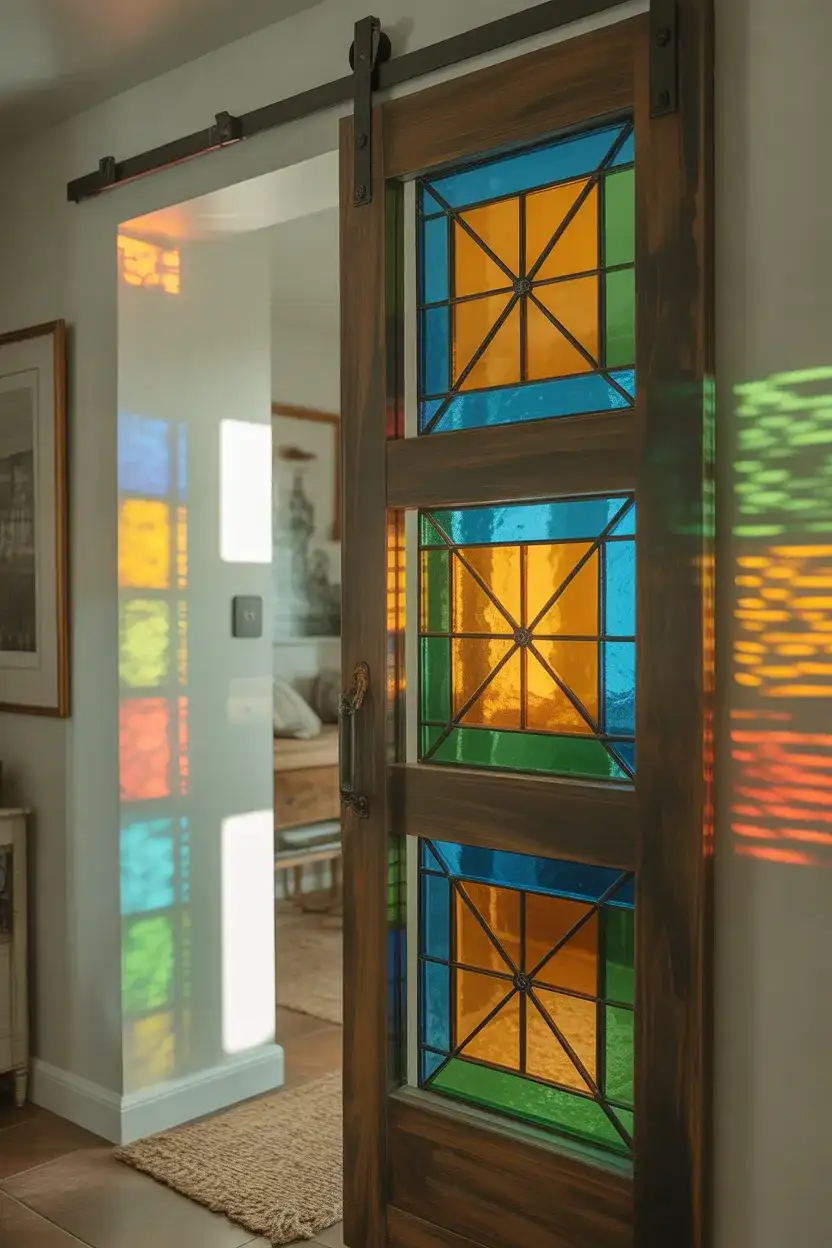
Stained glass artisans operate in nearly every mid-sized American city, and many take custom commissions for door inserts at accessible price points—particularly if you’re working with small, simple geometric patterns rather than large figurative compositions. A set of three 6×9 inch inserts might run $200 to $500 depending on complexity and your region. Another option: antique stained glass salvage from church restorations, which can be found through architectural salvage dealers and occasionally on eBay in exceptional pieces at surprisingly reasonable prices.
21. Farmhouse Barn Door with Shiplap Detail
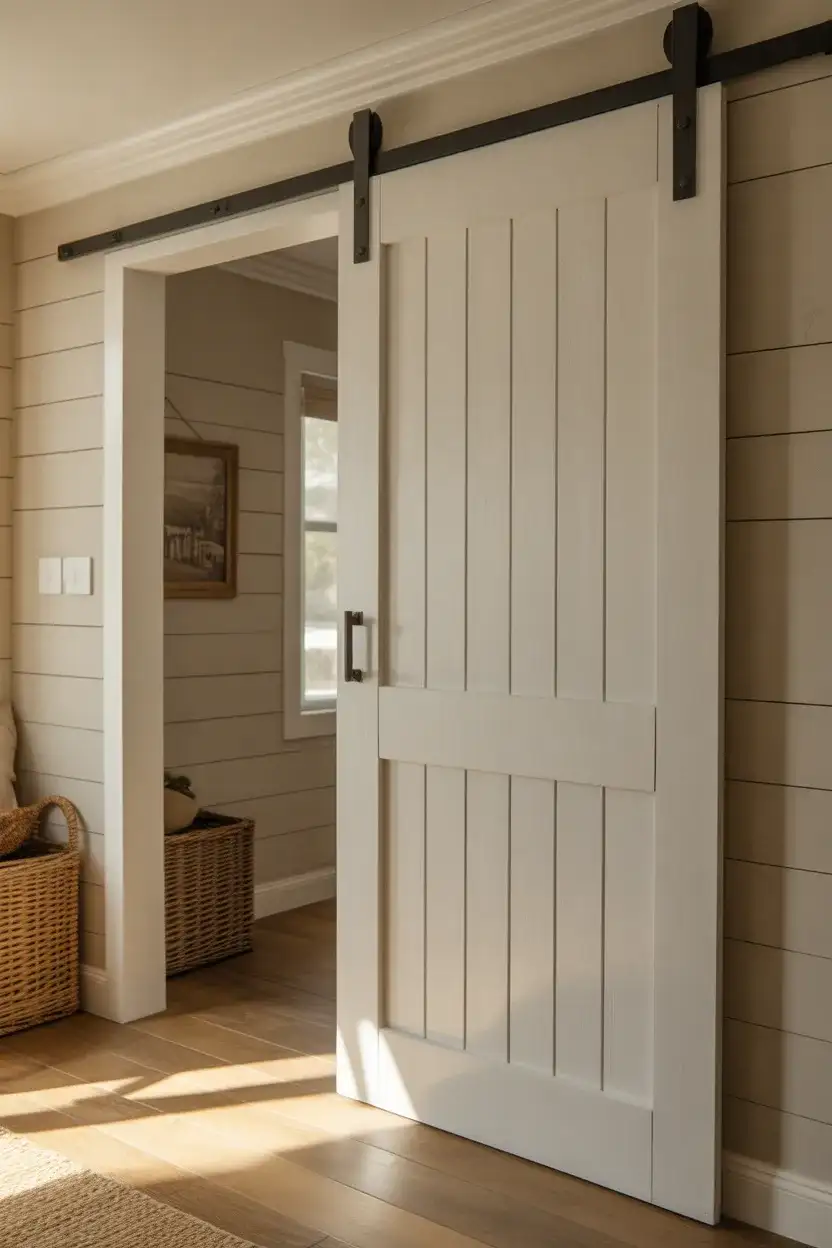
The farmhouse barn door with horizontal shiplap detailing is the quintessential American home design statement of the past decade—and in 2026, it’s evolved from trend to timeless. The overlapping horizontal boards create shadow lines across the door face that shift subtly throughout the day, giving the panel a depth that a flat surface never achieves. When the shiplap runs horizontally, the door reads as calm and grounded; when it runs vertically, it emphasizes height. Either way, the honest materiality of the detail—boards that look like they came from somewhere real—connects the home to a sense of place and craft.
The most common mistake with shiplap barn doors isn’t the door itself—it’s the surrounding wall treatment. If every surface in the room also has shiplap, the door disappears and loses its impact. Where this look absolutely sings is when the door is the only shiplap element in the space and the surrounding walls are smooth and simple. Let the door be the texture. Let everything else be the backdrop. That restraint is what separates a well-considered farmhouse interior from one that looks like a Fixer Upper episode went slightly overboard.
22. Modern Bifold Barn Door for a Laundry Room Makeover
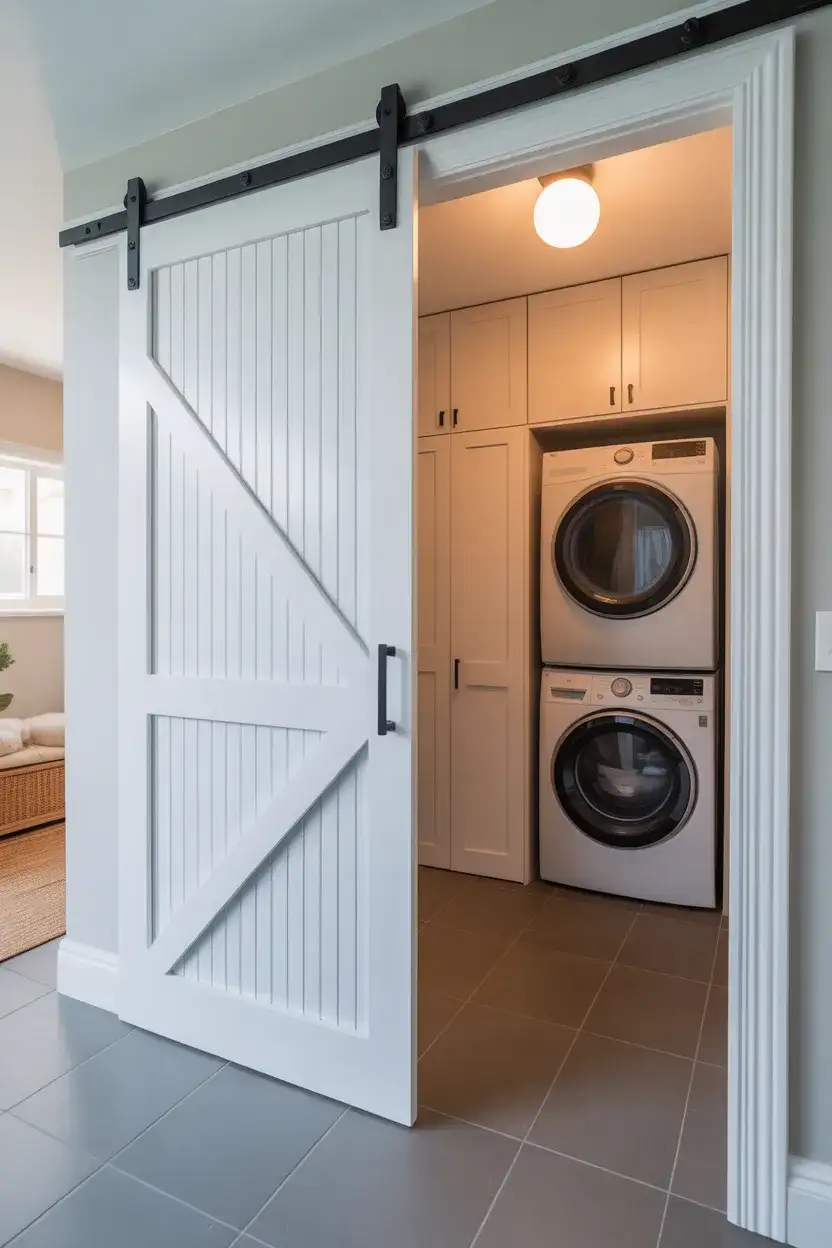
The laundry room is one of the least glamorous spaces in any home, and yet the door you put in front of it has an enormous bearing on how the surrounding hallway or mudroom feels. A modern bifold barn door—two panels hinged together and mounted on a track—gives you the fold-away convenience of a traditional bifold with the design integrity of a proper barn door. When closed, it looks architectural. When folded open, it stays compact against the wall and gives full access to the machine and shelving inside without dominating the passage.
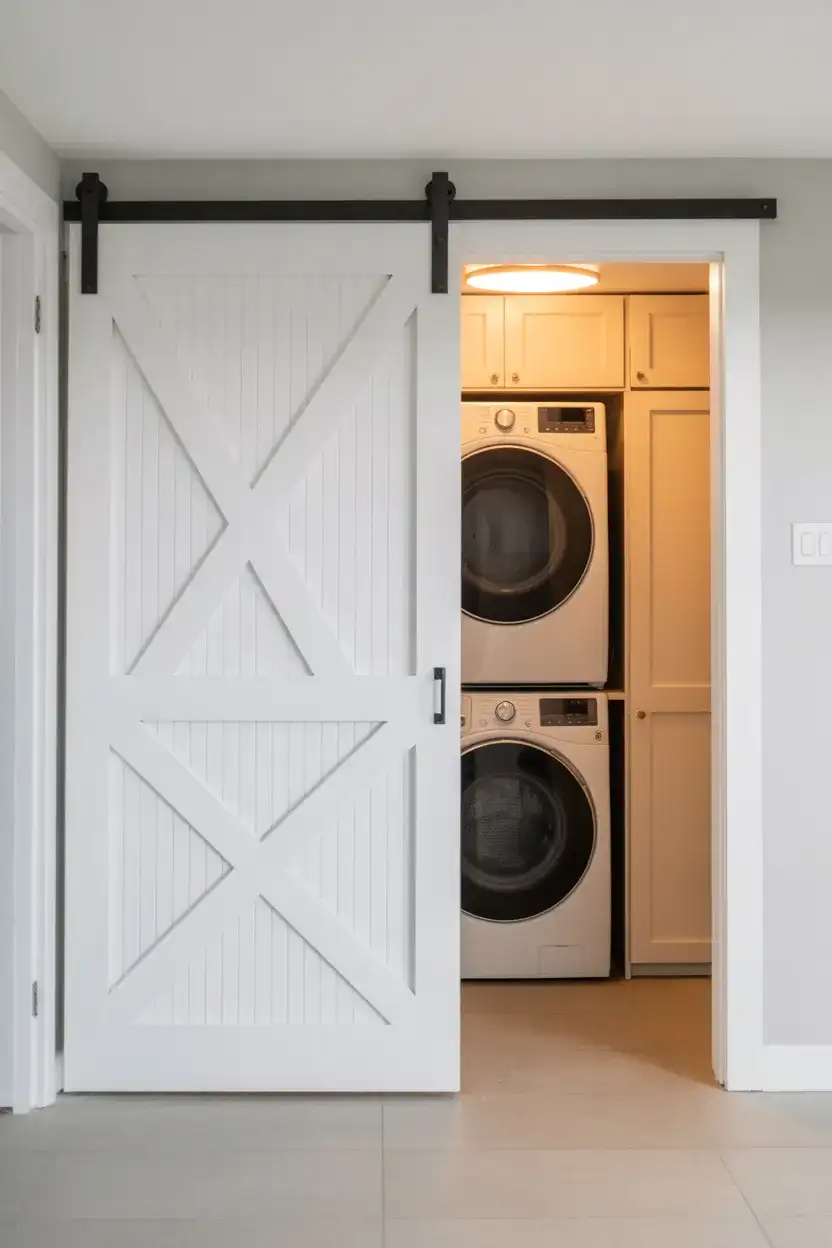
American homeowners who have undergone full home renovations frequently report that small upgrades to utilitarian doors deliver some of the most outsized satisfaction. The laundry room door is opened and closed multiple times a day—it’s arguably more frequently encountered than a bedroom door. Investing $200 to $400 in a proper bifold sliding system rather than replacing a broken bifold with an identical broken bifold is a decision that pays dividends in daily quality of life in ways that are hard to quantify but immediately felt.
23. Painted Barn Door as a Color-Pop Design Element
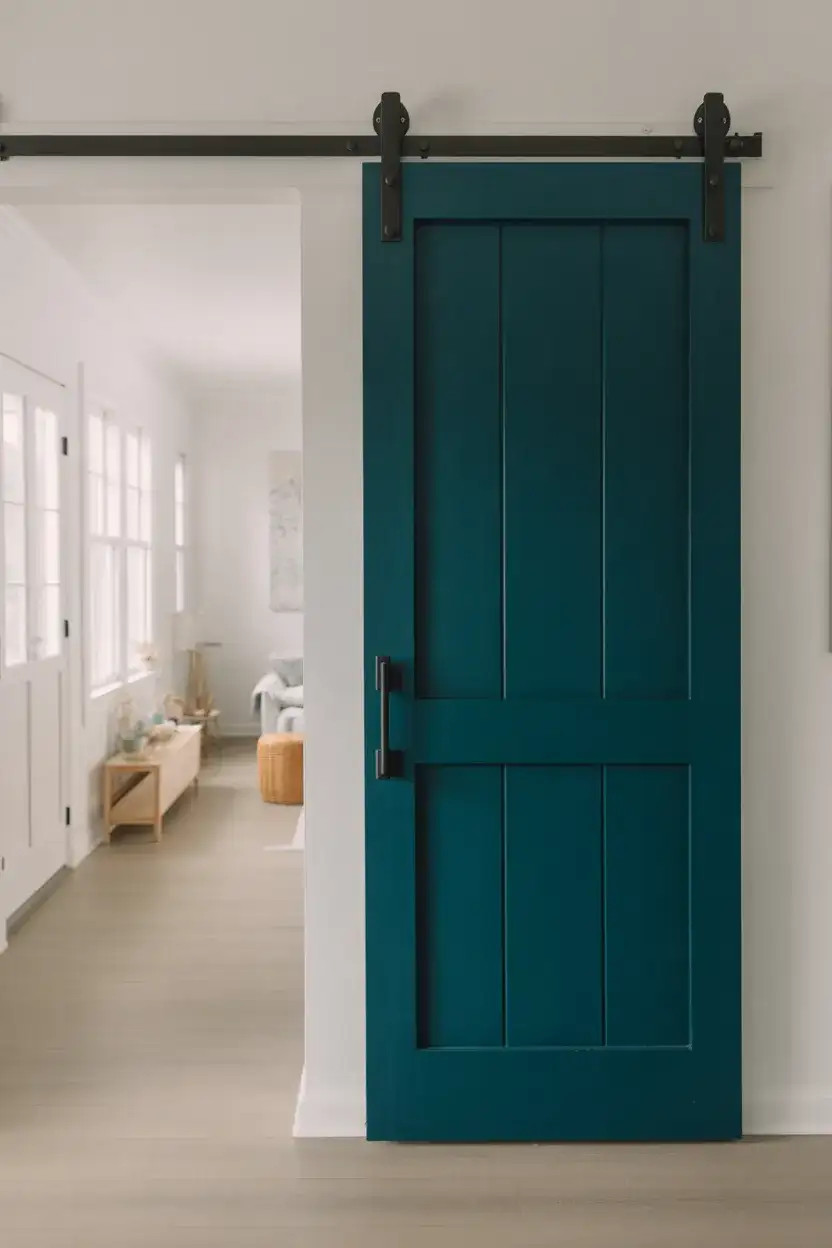
A boldly painted barn door—deep teal, dusty sage, terracotta, navy, or even a moody plum—is one of the fastest, lowest-commitment ways to introduce a color story into a neutral home. Because the door slides along the wall rather than swinging inward, it functions almost like a piece of moveable art. When closed, it’s a statement. When open, it becomes part of the wall composition. This approach is particularly popular among renters who can get landlord approval for painting a single door and then treat the whole project as temporary installation art rather than a permanent design decision.
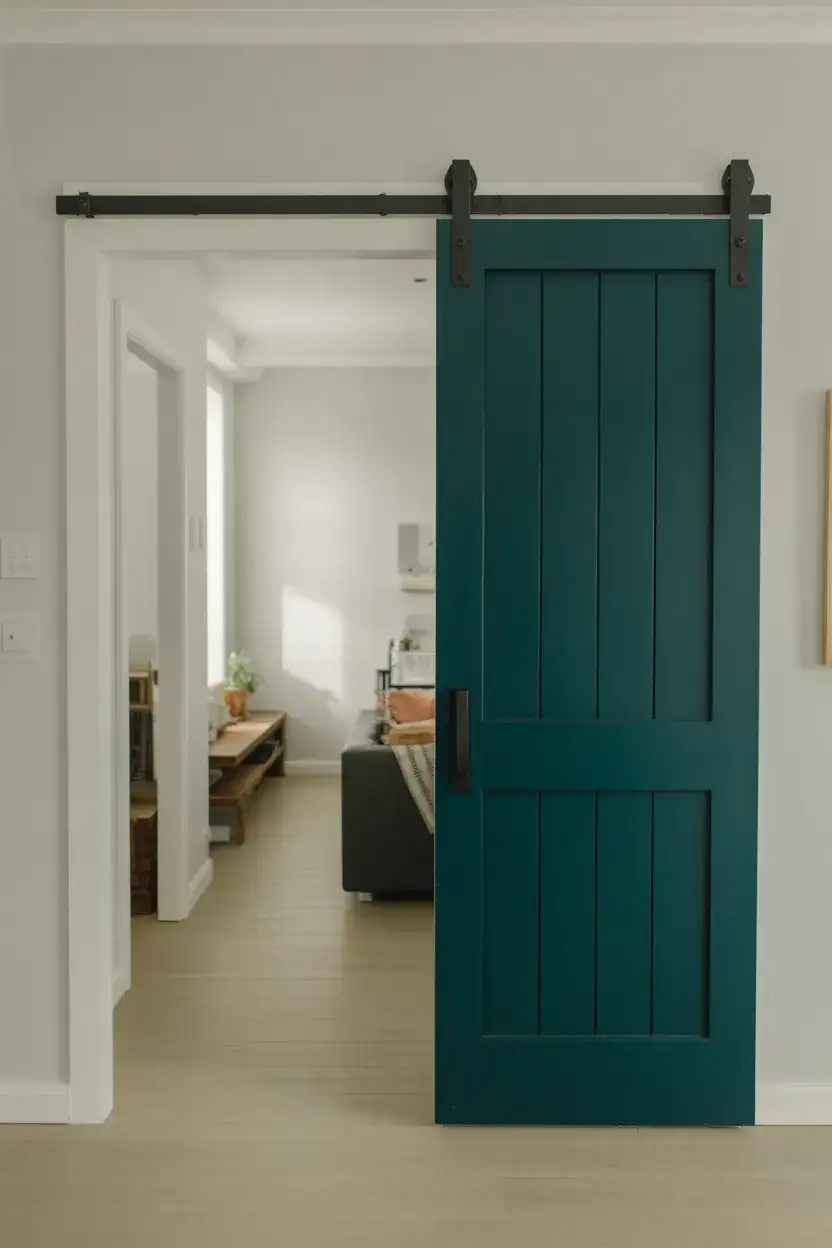
The color you choose matters more than the door style itself in this approach. Interior designers who work with color-forward palettes consistently recommend grounding the door color in something already present in the room—a throw pillow, a rug accent, or pottery on a shelf. When the door color has a conversation partner somewhere in the space, the whole room feels considered rather than impulsive. For anyone nervous about going bold: start with a deeply saturated version of a color you already love wearing. Your instincts about color are usually more right than you think.
24. Barn Door in the Bedroom as a Walk-In Closet Entrance
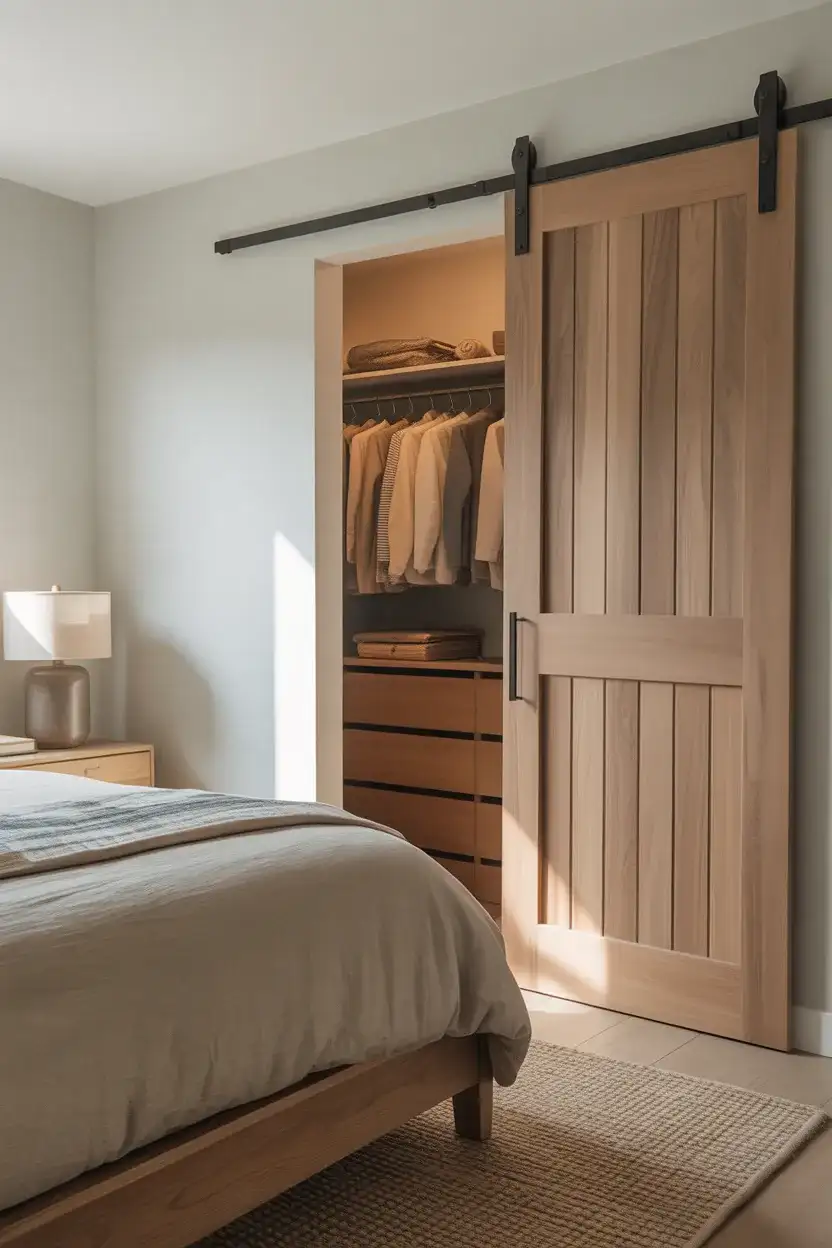
Using a barn door as the entrance to a walk-in closet from the bedroom is one of the most satisfying design decisions in a primary suite renovation—and in 2026, it’s become almost expected in boutique-hotel-inspired bedroom makeovers. The door eliminates the swing zone of a traditional hinged closet door, which in a tightly furnished bedroom can mean the difference between a dresser fitting on one wall or not. A well-chosen door—whether in a warm farmhouse wood finish or a sleek black lacquered panel—turns the closet entrance into a focal point that anchors the bedroom’s design rather than competing with it.
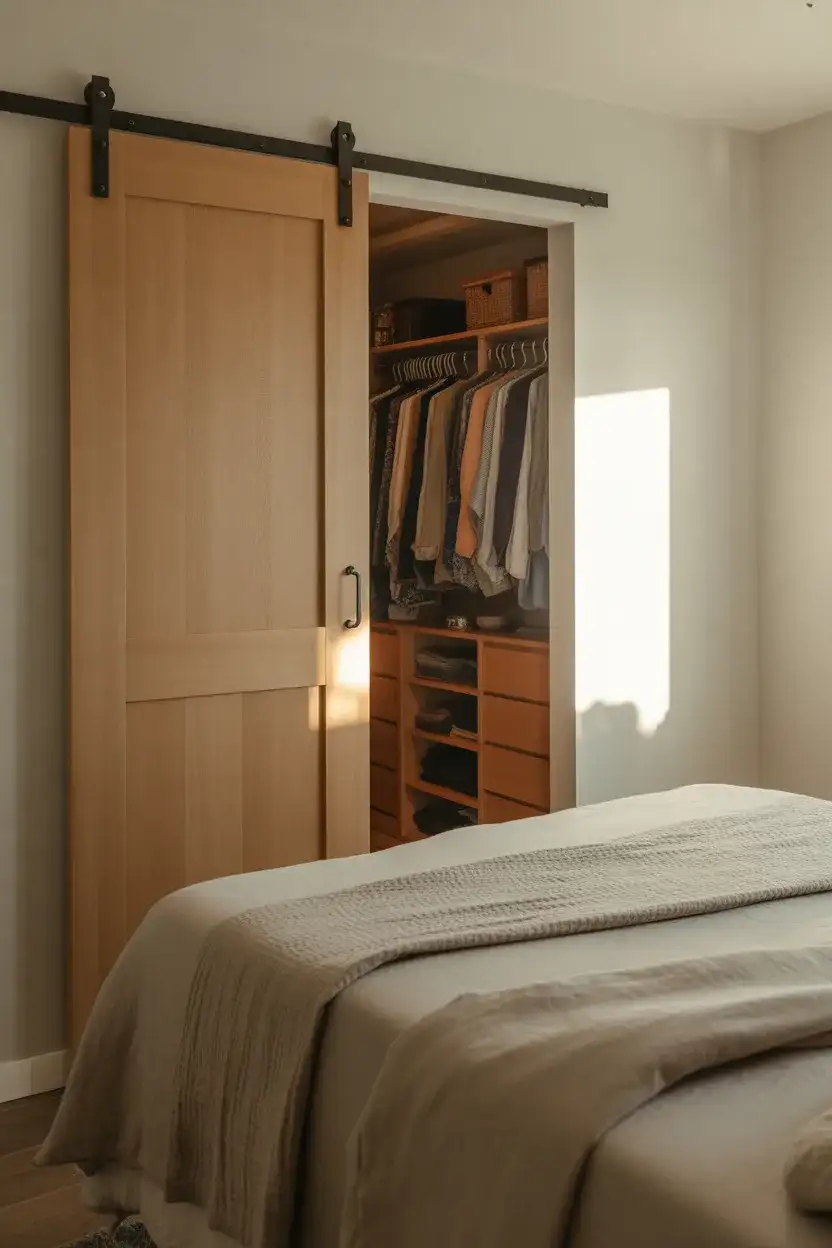
The micro-anecdote that stays with designers on this one: a homeowner in Portland, Oregon, described her bedroom before and after swapping out a traditional closet door as “the same room with and without a heartbeat.” The barn door was the last piece that made the space feel deliberate—all the furniture, the bedding, and the lighting had been right, but without the door anchoring that wall, something was always quietly wrong. Sometimes it really is just one element standing between a beautiful room and a finished one.
Conclusion
Barn doors are one of those rare design elements that reward creative thinking—the more unexpected the application, the more interesting the result. Whether you’re drawn to a classic rustic sliding panel or a custom arched double door in your master suite, there’s a version of this idea that works for your home, your budget, and your sense of style. We’d love to hear which of these 24 ideas sparked something for you—drop a comment below with your favorite, or tell us about a barn door installation you’ve done in your own home. The best design conversations usually start right there.